Operator
Thank you for standing by. Welcome to the New Tech 1 second quarter 2026 earnings conference call. At this time, all participants are in a listen-only mode. After the speaker's presentation, there will be a question and answer session. To ask a question during the session, you will need to press star 11 on your telephone. You'll then hear an automated message advising your hand is raised to withdraw your question please press star one one again please be advised that today's conference is being recorded i would now like to hand the conference over to your first speaker today barry sloan president and ceo of new tech one please go ahead thank you very much everyone and welcome to our second quarter 2026 financial results conference call we appreciate everybody attending, and thank you for tuning in today.
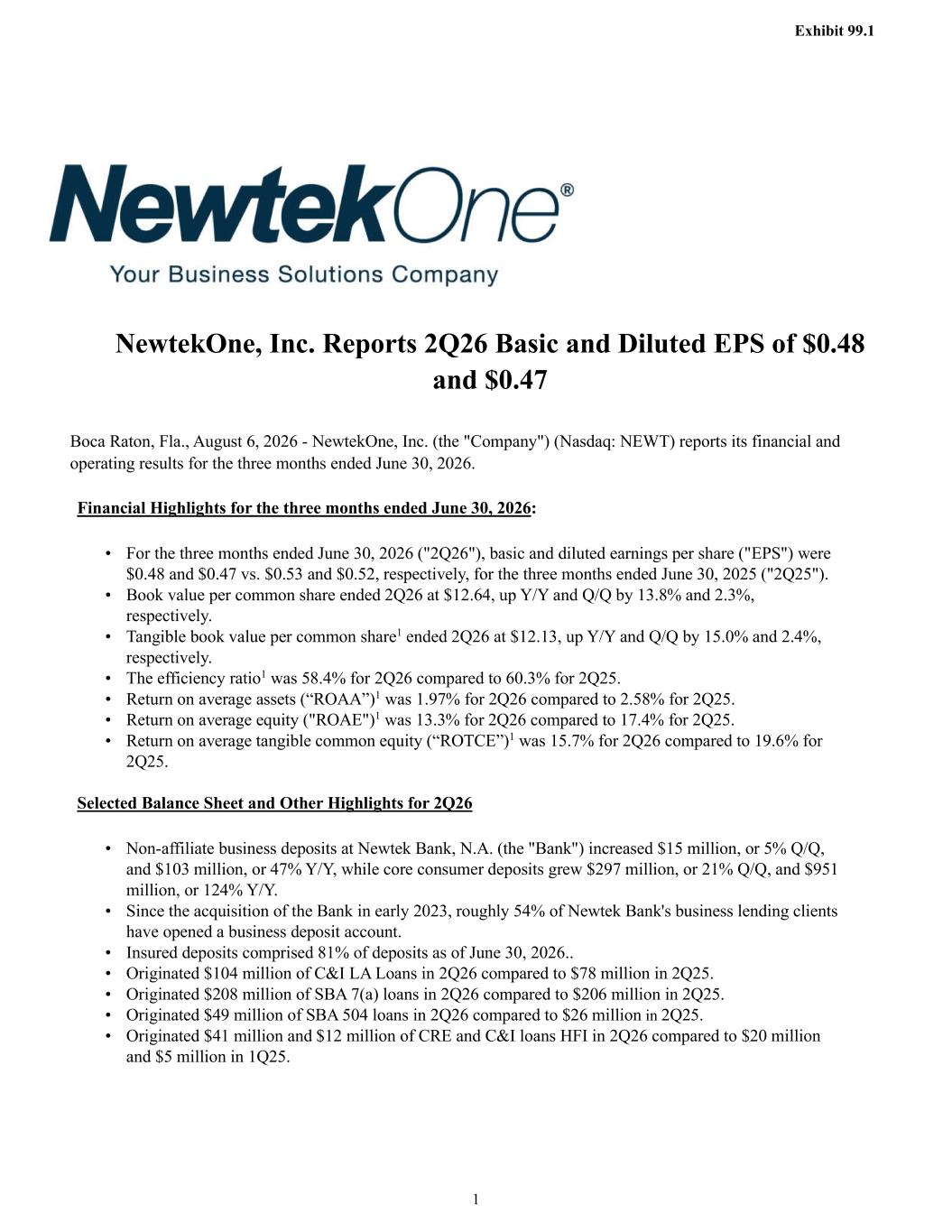
I wanted to also let everybody know that presenting, in addition to myself, will be Frank DiMaria, EVP, CFO of New Tech One, the publicly traded holding company, stock symbol AEWT, and New Tech Bank National Association. We appreciate everyone patching into our call, and we always sort of start off with, why should you care about new tech one company was established in 1998 i'm the original founder of the company established out of his spare bedroom in new york city apartment we take a look at the business model that we have today and look at metrics such as return on average assets return on tangible common equity the dividend yield uh the book value growth over time all things that we'll talk about extensively today it's a very interesting what i would call a value and a growth story However, three and a half years into our inception, we're still evolving, and we're appreciative of things that are changing in the marketplace today, and we're adopting to all different changing conditions. Obviously, if you take a look at our presentation today and recent presentations, more things are being done out of the bank than in the bank holding company. We recently acquired or merged the payroll solutions business into the bank. We're doing our commercial and industrial long AM loans out of the bank. And one thing that's important to notice, we'll see that our income, our net interest income at the bank is growing, particularly on comparisons. We'll talk about that in the call. So I think going forward, as we transform, you'll see a little bit less gain on sale, more debt interest income, more use of the balance sheet and the portfolio. I think as we've grown in this particular space, obviously, we traded at market multiples to earnings of five and a half times to six times where the banking industry is trading at nine or 11. So from our perspective, our goal is to do good credits, do what's best for shareholders, most importantly, really do a great job for our customers. And let's go to slide number three. New Tech's mission statement hasn't changed from 1998 to provide business and financial solutions to this sort of underserved demographic, independent business owners in the United States. Most importantly, we provide real good products and solutions for our customers for the purpose of making them more successful. Many times I am asked, Barry, is there a comp? Is there a company like yours? And I have to say, not really. Sometimes historically that works against you, but from our perspective, we believe we've got the right business model, the right way to handle our customers, work with all of our employees, associates in-house to provide the solution to the client, and really provide a valuable service to the independent business owner community, which on slide number four, you know, we can see that utilizing technology, which we've done over two decades, is extremely important. Instead of traditional bankers, branches. We use technology to exchange data, analyze the data, put the data in a better decision-making mode. We've recently started to use AI when we're analyzing data coming to us from the customer. It reduces friction, increases speed. All these things are extremely valuable. So we look at what we do, which is a technology-oriented company there to serve as the independent business community across the United States we believe we have taken on some of the tasks in a bank holding company owning a nationally chartered bank that we think most of the market in the industry is interested in adopting to in a very big way but it's slow to adopt number one the high cost infrastructure with branches and traditional bankers for those of you that haven't used our solutions, you get an executive on camera 24-7, and you also get great software to exchange data that has minimal amounts of friction and, important for us, accuracy. Two, and by the way, the existing bank model is extremely costly. We think going forward, the giants of the industry, the top four players, are pouring huge dollars into the space to do what we believe we have done within our confines already. Second, inefficient lending margins from loans that bear very little risk and, frankly, just really tight on the margins. Deposit products that we're able to offer our business clients with, historically, we're competing against zero interest paid, and excessive fees for the business client. I think it's important. Our goal is to manage risk, not avoid it, put a fair product and price onto our customers, beat the competition like Merchant Cash Advance or Daily Debit-type loans, and basically provide our banking solution in a safe and sound manner. Slide number five, these are things that you've heard previously. it pretty much labels all the things that we do. Slide number six, we talk about the importance of our target market, that SMB, SME, independent business owner. There's 36 million of them in the United States. According to the Chamber of Commerce, it's 43% of U.S. GDP. Importantly, over the last six and a half years, according to the SBA statistics, we have supported or created 280,000 jobs, the second highest amongst all SBA lenders in the 7A program. The independent business owner is a huge economic demographic and even the top four large institutions struggle with acquiring the client, solutioning the client, and therefore what we have built, our technology, our infrastructure, and we'll take you through some of those things today, we think is extremely valuable. We don't believe it's fully reflected in our current stock price, which is mostly driven by the typical analytics of taking the call report, pushing it through a model, and coming out with numbers. By the way, I will comment, you know, the concept of, you know, loan loss provisions and things of that nature. At the end of the day, it's a business expense. That's what it is. Now, you don't want it growing or going out of control. Mind you, it's an organization that's been in this space for over 23 years, lending to SMBs, 17 securitizations, never credit watched, never downgrade. So we're proud of what we've been able to accomplish. Slide number seven talks about the quarterly highlights. Obviously, we came in within the range between basic and diluted, 48 cents and 47 respectively. importantly book value we have a slide to address that continues to grow very nicely and that's really important that's value to our shareholders we continue to capture the operating leverage and growing a business with asset growth of 50% and expenses just up 3.6 at the holding company our ROA is 2% compared very favorably to the industry we recently switched to putting our C&I lending business down in the bank versus doing it up at the holding company. We believe this will pay great dividends going forward. We'll continue to securitize the C&I loans out of the bank. We've had tremendous success in our digital account opening with deposit gathering focusing on business and consumer type deposits. So in 14 quarters since our inception. We've grown from $142 million to $2.2 billion. Non-affiliate deposits increased in the quarter by $15 million. And obviously, the core consumer deposits, which are very sticky, not very transactional, with basically close to zero acquisition costs, climbed by $297 million in the quarter. And we're very proud of how we've been able to get deposits digitally. It's part of our technological advantage. Slide number eight, we focus on tangible value per share growth. You can see all the math, and you can see that when you add the dividends in, it's been a nice run since we've gotten into this financial holding company owning a nationally chartered bank structure. And you can see that the tangible book value has grown 75.3% in 12 quarters since converting to a technology enabled financial holding company extremely important we're very proud of growing tangible book obviously that's the value portion of it slide number nine shows the profitability of new tech one with all these different data points slide number ten really drills down on the deposit growth we talked about the non affiliate deposits we talked about the total deposit changes, deposit accounts, 1,471 accounts, quarter-over-quarter, core consumer, 2,600 accounts. I believe combined you're looking at about 40,000 depository accounts. Important to note, 81% of our depository accounts are insured under the 250,000 balance. Loan-to-deposit ratio about 90%. You know, when we think about deposits, we're extremely pleased with how we acquire them, extremely efficient, and we give a great value to consumers and businesses that do business with us. And that's very important for branding and brand loyalty. Slide number 11 talks about the three active C&I long amortization loan securitizations. There's a lot to talk about this. We spent a lot of time in prior calls, which are all archived on our website. I think the important aspect of the CNI LA securitization business is what we refer to as the initial over-collateralization. That's more loans versus the bonds. And we hyper-amortize the bonds and drive the cash flow to pay the bonds down. So the current over-collateralization, for example, on the 2026-1 deal, which is just done, started off at $47 million. It's grown by $11 million. 2025-1, a little bit more season started off at 31.6 million current oc is 45 million so you can see it's really nice growth there about 13 to 14 million the 2024 deal also 14 million dollar increase on the on the oc you can see that the notes have paid down across all three issues and obviously the collateral is paying down too at the same time let's go to slide number 12. this is new tech bank financial highlights you can see by putting more of our activity down in the bank we believe will provide much greater efficiencies much greater value when you think of things like payments or insurance those are both eligible we want to do this slowly we want to do methodically we want to do it correctly when you look at our ROI our OTCE these are numbers in the final column on slide number 12 that are just extremely attractive. I will point out the net interest income, Q2 2025, $16.2 million. Q2 2026, $25 million. That's the reoccurring income that most people that invest in institutions like ourselves really want to be very involved with. I would also like to point out the cost of deposits over this window has been pretty flattish, which we're appreciative about as you go from Q2 2025 to Q2 2026, actually declined from Q1 2026 to Q2 2026. Also, a very nice NIM. That NIM has helped by putting more SBA 7A loans on our books and holding them prior to a potential sale, but we're going to hold more of these on our books. And in addition to that, the CNILA business provides some nice NIM to the bank while we're accumulating for securitization.
When you take a look at our capital ratios, they're all in line with what we consider a more than adequately capitalized bank.
Obviously, we always focus on our cushion with respect to our ACL in particular, and we're pleased our ACL ratio to unguaranteed loans, 5.31%. When you exclude the government guarantees that are on our books that are in a non-accrual category. It's 4.14. So it's a ratio we keep close attention to to make sure that we've got the right amount of reserves because, as I said, we manage credit risk. We don't avoid it. These things are marked to market on a quarterly basis with our CECL calculation. So we're very pleased with how our performance has been over the course of three and a half years, many of you will see that we increased that revision on a quarterly basis and net charge-offs went down. So, once again, we are pleased with how we're handling and managing the risks. Slide number 13, a little repetitive here with some charts and graphs, particularly what I just discussed, the provision for credit losses versus net charge-offs at the bottom right category. I will point out that although you see 30 days past due increasing somewhat, we believe that this is a brand new bank with a brand new portfolio. So when you're starting from zero, it's almost impossible as you're climbing that default curve with most loans defaulting in the first 30 to 36 months. We've only been around for three and a half years, that is going to grow and it's going to begin to flatten. So, but once again, having the right reserves with the right underwriting and the right mix of assets is extremely important. Needless to say, most of that comes in from the SBA 7A business, but by adding the higher quality C&I LA, the CRE book, the C&I Short Am book to the portfolio. I believe that our uninsured 7A balances are about 42 percent, down from close to 50, and we want to continue to diversify our book of business. Slide number 14 gives a nice quarterly profitability snapshot at the bank. You can see these numbers that don't look, frankly, they're really high. I'm sorry to say. I know that sounds funny, but people look at it and go, how can you do that? Well, if you invest in assets that provide an attractive return, net of the anticipated and expected losses, and continue to manage that risk quarter to quarter, you'll do just fine. With that said, I would now like to pass the presentation off to Frank DiMaria, EVP and CFO of NewTekOne and NewTekBank NA.
Thanks, Barry. Barry has covered most of the highlights for the quarter, but I wanted to touch on a couple of noteworthy items that are outlined on the next couple of slides. The pre-provision net revenue continues to grow in absolute dollar terms with balance sheet growth. As a percentage of average assets, the PPNR was down year over year from 5.25% for the second quarter of 2025 to 4.22% for this quarter, but still remains well ahead of the industry average, which is below 2%. Moving to the next slide, we provide some details on the bank's loans held for investment at cost, which is the loan portfolio against where CISO is applied, consistent with past quarters. As Barry mentioned, the bulk of our CISO reserves are about 89% of our allowance for credit losses is directed at the unguaranteed SBA 7A loans. The ACL coverage ratio on that portfolio was about 8.56% of that portion of the loan portfolio, which is elevated to appropriately reflect the higher loss characteristics of those 7A loans. With that, I'll turn it back to Barry for some closing remarks before we take questions.
Thank you, Frank. Slide number 18, I think this is the important slide. It's the technology. When you look at how we do our business, how we acquire clients, 600, 800 unique business referrals a day, how we open up accounts for a digital account opening, how we process loans through our secure file vault in an automated and frictionless manner, how we have rolled out our real-time payments offering so businesses can move money quicker, faster, cheaper with real-time information through the NewTek Advantage in an automatic manner to do so. The NewTracker referral system, which is how we track referrals, manage the opportunity as it goes through, whether it's payroll, whether it's insurance, whether it's loans, whether it's deposits, everything is in NewTracker. At NewTek, if we say if it's not a NewTracker, it doesn't exist. And the very important NewTek Advantage, which is the business portal for the customer, that really helps the client with so many different things to be able to make payroll from their banking interface, to be able to look at their credit card batches, refunds, chargebacks from their banking interface, to be able to look at their line of credit, to be able to see that they're not being charged for an ACH or a wire. It really is a tool that gives the customer an advantage and helps them manage their business. What makes New Tech One unique and special is the fact that it has innovated and put technology in a banking environment for the benefit of this huge, tremendous demographic that we have almost an exclusive focus on, the SMB, the SME, in all 50 states, in the United States, and are able to do so in an efficient way where 98% of the banks, that's just a guess on my part, are still operating with branches, with traditional bankers, high cost manner, not paying businesses a fair rate for their deposits, charging them excessive amounts of fees for moving money, not allowing them to move it in a real time basis, not giving them the analytics and information and tools that can track their business, analyze their business. So, when it comes to our organization, and I will tell you, technologically, I'm getting a lot of organizations coming to me, looking at what we're doing that we believe isn't necessarily reflected in the markets, that are looking at what we do, how we do it, and seeing basically taking this and putting this involved in their infrastructure would be immeasurably valuable. we greatly appreciate the time you spend here today as you can see many of you have labored through much longer presentations there is a very exciting appendix that's hung on our website but has a lot more data on things that we've
Operator
covered many of you are familiar with that and obviously are you'll be following shortly with that operator we'd like to open it up for questions thank you at this time we will conduct the question and answer session as a reminder to ask a question you will need to have star one one on your telephone and then wait for your name to be announced to withdraw your question please press star one one again please stand by while we compile the q a roster our first question today is from tim switzer with kbw your line is open Hey, guys.
Thank you for taking my questions. Thank you, Tim. Hey, Tim. I was wondering if you could maybe provide a little bit more color on the strategy about holding more guaranteed portions of the SBA loans on your balance sheet than you have in the past. And it seems like this might have a near-term impact on guidance. I know previously you guys were guiding like 79, 89 cents for Q4. Could you maybe talk about the impact that will have near-term and then the longer-term impact of that?
Yeah, so I think that organizations that do not have our ROAA, ROTCE, and business model that is pretty, I won't say focused, but drives a lot of gain on sale income, but basically have net interest income and net margins that they view as more long-term and more stable has entered into our thinking that we're going to continue to do both we're going to continue to grow that net interest income line and yes I would say on a top-line category it probably will affect the next couple of quarters coming up however it could provide a more stable stream of income and we also hope to attain the PE valuations that other industry participants do that don't have our technology don't have our innovation and don't have the capability to service the customer I mean there's almost a five-point spread between where we are and others are that have that different type of income so we're gonna we're gonna put our toe in the water and start to drive toward that and yes it could potentially affect that top line headline EPS, which we're appreciative of and proud of. But frankly, it's left us with a low earnings multiple.
Okay. All right. So, right now, the near-term impact is the lower gain on sale revenue, not fully offset by interest income, but it will be in future quarters.
Well, you said fully offset. I got to be clear. I've got a lot of lawyers on my shoulder. So we haven't fully run these numbers through, but over the long term, adding more net interest income and giving up some of the gain on sale income is definitely something that is in the cards for us. So we are holding more gum and guarantees on our books. Some of them were setting them up and then selling them into the market. But with that said, I think you'll see a mix and a change going forward. Also, the CNILA business is on our books, so that's going to add to net interest income while it's in the incubation period as well. So yeah, there'll be a bit of a change. I think that people that invest in our organization should be investing, not quarter to quarter, but should be looking at the business model, looking at the technology, looking at what we do differently, and figuring how, in effect, these things that we have put into place and are working would be extremely attractive in a bigger customer base that we acquire organically, as well as possibly other things down the road.
Can you talk about, with the ALP loans, have there been any benefits now that you're originating them through the bank. And like, what are the challenges with that? Well, one of the challenges, Tim, I try to be as transparent as possible.
You know, with rates at these levels, it certainly makes it a little harder. I think businesses are a little bit more reluctant to take it. But the good news is these loans are, they're well underwritten. They have good debt service coverage, strong guarantors, and they actually fit well in the banking environment.
Okay. Are you planning to still do some more securitizations and any updates on size for Q4?
Yeah, we will do a securitization out of the bank. And I think that securitization size will be, I'm going to say, between $300 million to $400 million.
Speaker 5
Okay, that's helpful.
And then on credit, I'm looking at your call report, and it looks like really good improvement in the net charge-off rate, so that's good to see. But NPLs were up a little bit, and it seems like a lot of it was on the guaranteed loan balance for a lot of loans. Yes. can you provide some color on these guaranteed NPLs? Were these loans you repurchased after you previously originated, or were these loans that went NPL after issuance? Whatever color you can provide would be helpful.
Sure, and I appreciate the question, Tim. When you do a 7A loan and you sell it in the secondary market, which at points in time in our career and history, we've been, you know, as much as 95% of all of our loans got sold to the secondary market. And I believe as of today, we are the second largest lender by volume and the first by units. Okay. So when you put that into the market, you know, these are credits as defined by the SBA's SOP that are technically not bankable, meaning that without the guarantee and out the program, you wouldn't be able to make the loan. So the guarantee provides a significant amount of the credit support. However, when you have situations where those loans go bad and there's a lot of sensitivity in the market today, that has to get bought out. So either the government buys it out or we buy it out. And we have chosen to be more aggressive in those buyouts. That's helpful to our partnership with the SBA. And what we then wind up doing in many cases, and this gets really into the weeds of when a loan should be bought or not. You could have a situation where the loan might be in bankruptcy, but it's still in that bad category and they have to get worked out and there's partial payments or things of that nature. We've made decisions to increase that purchase rate which helps the partnership with the government agency okay interesting and is is the guarantee on that portion of the loan still still intact by the government if it goes bad or the some of these you might guarantee guaranteed participation certificate the government uh guarantee is still on it when we buy it back subject only to repair and denial which we have reserves on our on our books for okay all right understood thank you barry thank
Speaker 5
you jim thank you our next question is from joe yankanis from raymond james your line is open hey guys uh good afternoon thank you for taking my questions thank you joe i wanted to follow up on Tim's last line of questioning there, and I might have just missed this and could get it in the transfer, but can you go back through the rationale versus buying out the problem loan versus having the government buy it back? And I guess, have you ever had a government guarantee on your books that was removed?
Only in the case of what I would call a repair and denial, and that's been historic, and we have reserves for that based upon the history. But Joe, what you're asking is, and to be honest with you, it's a little incredible to me, and I'm not being a jerk on this, there's other top five lenders in the United States that have this. Just look at their call reports. So this is not new, and it's not something that hasn't been done probably for 25 years. It's just something that we've historically not done much of, but at this point in time, our view of this is we have a joint relationship with the SBA. We're putting this on our books. These are government-guaranteed obligations, and the guarantee is good.
Speaker 5
All right. Well, that horse has been beat.
Speaker 5
So you mentioned that what new tech has built from a technology standpoint could be valuable to other institutions if they were to put in their own infrastructure. But how realistic is it to outsource a white-labeled New Tracker, New Tech Advantage, other banks? And can you talk through some of that opportunity?
Yeah, we have opportunities in the pipeline now that we're working on with some material players. In addition, when you look at the business model, which is to utilize non-branches, non-brokers, no BDOs, no bankers, and to be able to outreach to an existing book of SMBs in a large bank's portfolio, much more cost-effective, on camera, with this technology to be able to effortlessly take a payroll app, take a merchant app, take a loan app, take a line of credit app. This is a big deal. And we don't believe we've been given, it's different. And once again, I don't believe there's anybody else doing what we're doing. So there's no, I get asked all the time, where's the comp? Well, there isn't any. Okay. Except that based upon the conversations I'm having, Everybody wants to go in this direction. Everybody wants to go in an automated manner. And we're using AI tools, particularly in gathering the data, putting the apps together. Human beings are still reviewing everything, but we're taking the mundane tasks out of it. So we think it's very realistic. However, as you can imagine, Joe, change occurs in this world at slow rates, particularly when you're dealing with other financial institutions. But we have been at this for a while. We're getting good traction. I will tell you our referral system, we get 600 to 800 referrals a day, is kind of predicated on these types of relationships. That's like putting your toe or your ankle in the water.
Speaker 5
Got it. I appreciate that. Certainly exciting. It won't be something to monitor from our perspective. So can you talk about what was in the other income bucket on the P&L? It looked to be abnormally large, and just curious what drove that increase and the sustainability kind of behind that line item.
All right. Now I pass the baton to Frank.
Thanks, Joe. So we did, with the securitization, we did see some increased payoffs and paydowns in the securitization, as you saw on that slide, with the loans kind of getting paid down. So that's what drove that little bit of an increase that you're seeing quarter of a quarter, and especially year over year in that line item. So it's mainly due to the loan pay downs on the securitizations.
Speaker 5
So should that normalize in future quarters back to a more historical norm?
Yeah, I would anticipate that to normalize. I don't anticipate to remain elevated. Got it. All right.
Speaker 5
Well, thanks, Cheryl, for taking my questions. Thank you, Jill.
Operator
Thank you. Our next question, pardon me, is from Crispin Love with Piper Sandler. Your line is open.
Hey, good afternoon. This is Ben Graham and for Crispin Love, thanks so much for taking my question. I'm just wondering if you could give some background on the $15 million dollar loan to some mad holdings the um the company that operates summer camps um in light of their june bankruptcy um seems like a big loan for new tech and i would just be interested to hear the background of the sourcing underwriting and then any recent updates on that loan and lastly where that loan was was marked at march 31 uh versus now if you if you could give color on that. Thank you.
Sure. That loan is in a securitization. I believe it's in one of our prior securitizations. So it is sitting in that. Now the loan has seven or eight camps collateralizing the loan. It has collateral that is outside of the camps in a lot of different categories. And I believe the fair value of the collateral, I believe it's somewhere, I don't want to guess, but it covers the loan amount. That loan is in bankruptcy, as you're aware, based upon public information. Those camps are being sold. Those camps are operating. Those camps are cash flowing, generally speaking. And I don't have the exact mark on that, but I would believe that we will have full recovery I am familiar with the loan I believe we'll have full recovery on the law awesome thanks so much for the color there that's all I had so I'll step back but thank you so much that's the key to having you know I can't tell you for sure because there's a bankruptcy going on here but it's important to have good cash flow on the businesses which are still operating and liens in this case there's liens that are outside of the camps. It's on other assets.
Speaker 5
Got it. Thank you so much.
Operator
Our next question is from Hale Goats with B. Riley Securities. Your line is open.
Speaker 5
Thank you, guys. Hey, Barry, just, you know, with maybe holding more loans in the books, is this putting more pressure on your deposit franchise and gathering deposits? Could you comment on that for a moment? Thanks. Yes.
Be glad to, Hal. So, Frank, I believe as of this date or recent days, our deposits are over $500 million?
Our cash that we're holding at the Federal Reserve.
Yep. That's correct. Yeah.
So, Hal, we're pretty liquid. It's indicative of, A, our view on where rates are, and B, I want to be a little careful here. We believe I'll have good use for the money. Well, why are we good at acquiring deposits? We're good at acquiring deposits. So if you go look at our Trustpilot scores in the bank and in the hold code, it's 4.6 to 4.9. Jen Merritt and her team, fabulous job. We have a gentleman, Rodney Becerra, reports to Andrew Kaplan, chief strategy officer client success and services we're talking to our customers and we answer their questions and we're available on demand so service is extremely important because we have a very low cost of acquisition we're able to pay the client a fair rate so we don't need branches i don't need bankers taking people out to the masters as you can see from our insured deposits which are north of 80 percent these are retail deposits um they don't move around that much particularly in a high yield savings account yes it might be a high rate but money sits there they're not moving it they're not calling up people they're not transacting so we we really like our strategy for a deposit acquisition matter of fact if the brethren in the industry would actually calculate the expense that they pay to go acquire the deposits and service the deposits, they would probably be very interested in our digital account opening and the way we wind up servicing our customers. That's a very good question. We have, knock wood, been very good in this particular area. Okay. And, you know, with the commentary and the press release on your guidance going forward being re-evaluated, you know, what kind of timeline do you get back to that guidance at some point, or can you give us kind of an event path to like more visibility on that? Yeah, I know I just gave all you guys heartburn. I'm sorry. I think we're going to be looking at, I'm going to say a 45-day window, give or take, maybe 60. we have to do a lot of calculation. We've shifted a lot of things around. I also want to point out that although we've historically not been an SBA express lender, I think we're going to go toward that model where you're able to get a much more generous rate, which makes it beneficial to hold on our balance sheet. I think it's for the really small loans, it goes up to prime plus six and a half and up to five hundred thousand I think it's prime plus four and a half so you still get obviously the government guarantee with it it's a smaller guarantee but at the end of the day you know we've got to do a lot of number crunching these are decisions we pretty much made more recently so we do need to crunch some numbers I realize we've given you some heartburn here but we're not really trading it crazy market multiples although some people might think they're crazy, but you can interpret that both ways. I don't want to get yelled at by my chief legal officer.
Operator
Thank you, Barry.
Operator
As a reminder, to ask a question, please press star one one on your telephone and wait for your name to be announced. One moment for our next question. And our next question is from Christopher Nolan from Leidenberg Salmon. Your line is open.
Hey, guys. Frank, why did the NIM contract so much in the quarter?
The NIM at the holding company? Well, we're moving most of the operations into the bank. So, you're seeing that expansion at the bank. So, you're having less income-generating operations up at the holding company while we still have some assets, as you know, left up there, as well as some of the debt that we are paying down, as you've seen, quarter to quarter, which is a little bit more expensive debt than you see typically on the deposits, hence the shift in the operations. So with everything moving into the bank, that's really driving the compression.
Yeah, and Frank and Chris, I've got to add one other thing to that. When you do securitizations at the holding company, which we've done historically, There's a lot of interest income that is now folded into the securitization, so it doesn't show up in the NIMP. So we have fewer and fewer loans with just interest coming in at the holdco. And a lot of that has been converted into a spread in the ownership certificates at the holding company. so is it fair to say in terms of part of the strategy to move more of the activity to the bank is to capture more what is gain income as net interest income which bank investors generally prefer and thus hopefully improve the stock trading multiple well i think and and you know i can't answer the last part of it chris but what i what i can tell you is that um we have a lot of staff down in the bank and by putting things like payroll in the bank and maybe other things in the future. We want to be methodical. We want to give our regulatory agencies that we have a good relationship with comfort that we could manage these things. So certainly by doing the lending out of the bank, it's tremendously advantageous, particularly based upon the cost of the deposits and things of that nature by putting payroll into the bank, which really is a core function for any business. It ties right into the operating, ties right into the loans, helps you control the situation. You can see, are they making payroll? Are they bouncing payroll? It's incredibly valuable. So having less activities at the holding company and more down in the bank is definitely of interest to us.
As a final question, Barry, on the move to the bank, does that give you any flexibility on capital ratios at all um i think i'd pass on that question but you can see what you see what the ratios are and um you know i would say they're competitive and a well capitalized market but no i i no i i think they've actually been um a good partner with us in terms of working with us, educating us, helping us really develop a bank that's safe and sound. So, no, we've been appreciative of that relationship.
Great. Thanks for taking my questions, and I appreciate the more expedited format of the call. Good job.
It took three and a half years, but eventually we listened, Chris.
You're getting there, Barry. Sounds good.
Operator
Thank you. I am showing no further questions at this time, so I'd like to turn it back to Barry Sloan for closing remarks.
We're extremely thankful for the thoughtful questions and the work the analysts put into our business and business model. We look forward to keeping our head down, plowing ahead, and really doing a great job for our clients, the small to medium-sized business customer in the United States that is a major driver of the U.S. economy, employment, and also helps our shareholders. Thank you very much.
Operator
Thank you for your participation in today's conference. This does conclude the program, so you may now disconnect.