Operator
Good morning, and welcome to One Oaks' fourth quarter 2025 earnings conference call. As a reminder, this call is being recorded. After the speaker's opening remarks, there will be a question and answer session. If you would like to ask a question during this time, simply press star, then the number one on your telephone keypad. If you would like to withdraw your question, please press star, then the number two on your telephone keypad. With that, it is my pleasure to turn the program over to Megan Patterson, Vice President, Investor You may now begin.
Thank you, Angela, and welcome to 1OAP's fourth quarter and year-end 2025 earnings We issued our earnings release and presentation after the markets closed yesterday, and those materials are available on our website. After our prepared remarks, management will be available to take your questions. Statements made during this call that might include 1OAP's expectations or predictions should be considered forward-looking statements and are covered by the Safe Harbor Provision of the Securities Acts of 1933 and 1934. Actual results could differ materially from those projected and forward-looking statements. For discussion of factors that could cause actual results to differ, please refer to our SEC filings. With that, I'll turn the call over to Pierce Norton, President and Chief Executive Officer. Thanks, Megan. Good morning, everyone,
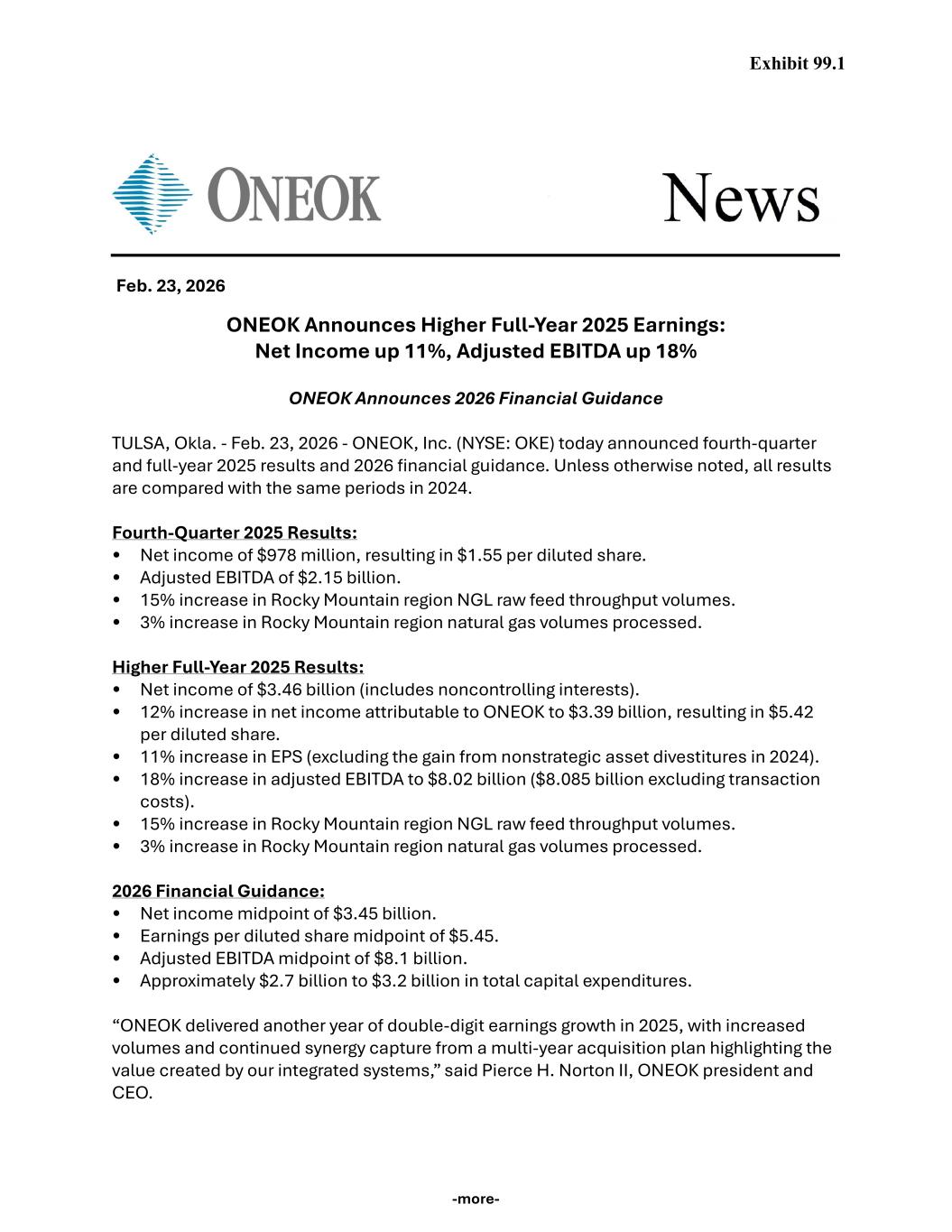
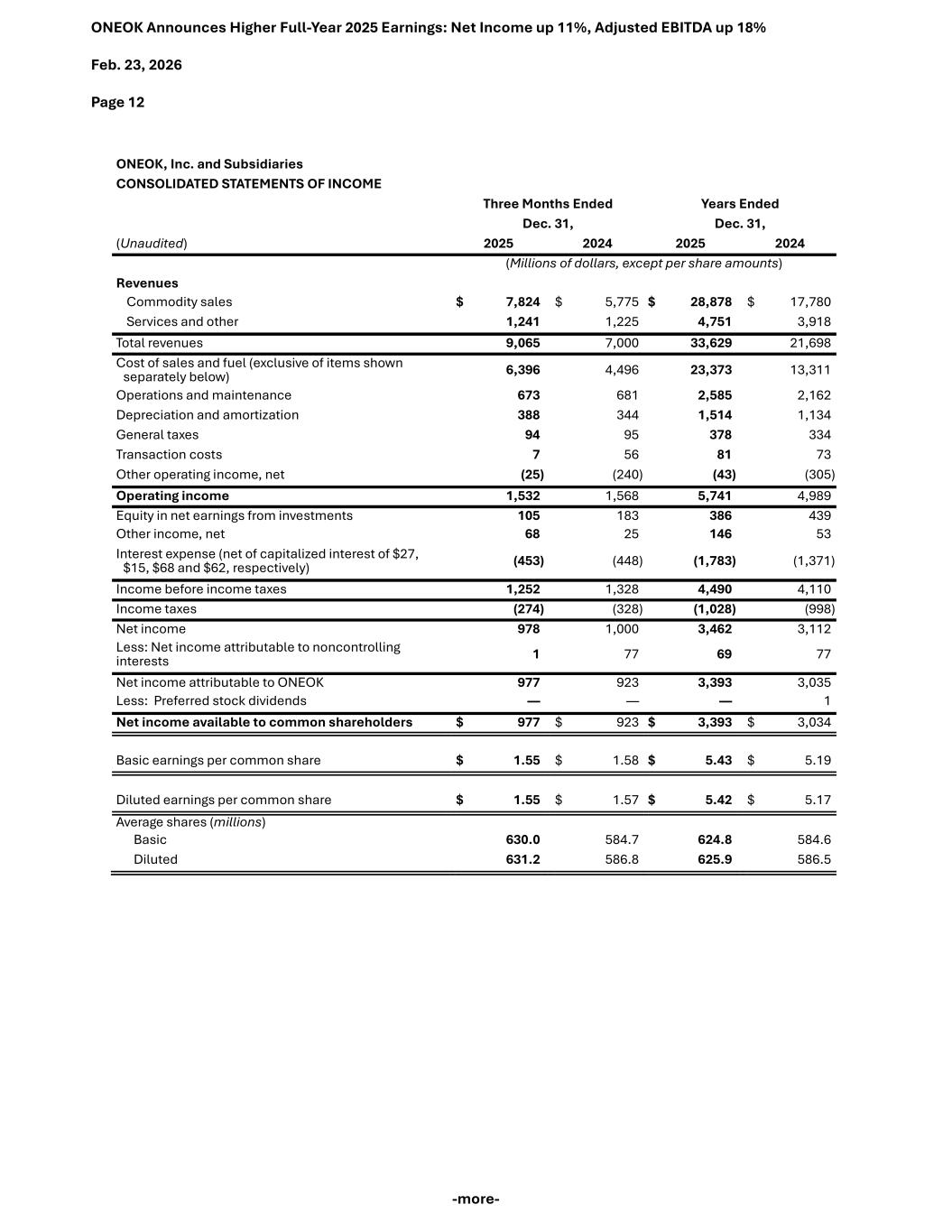
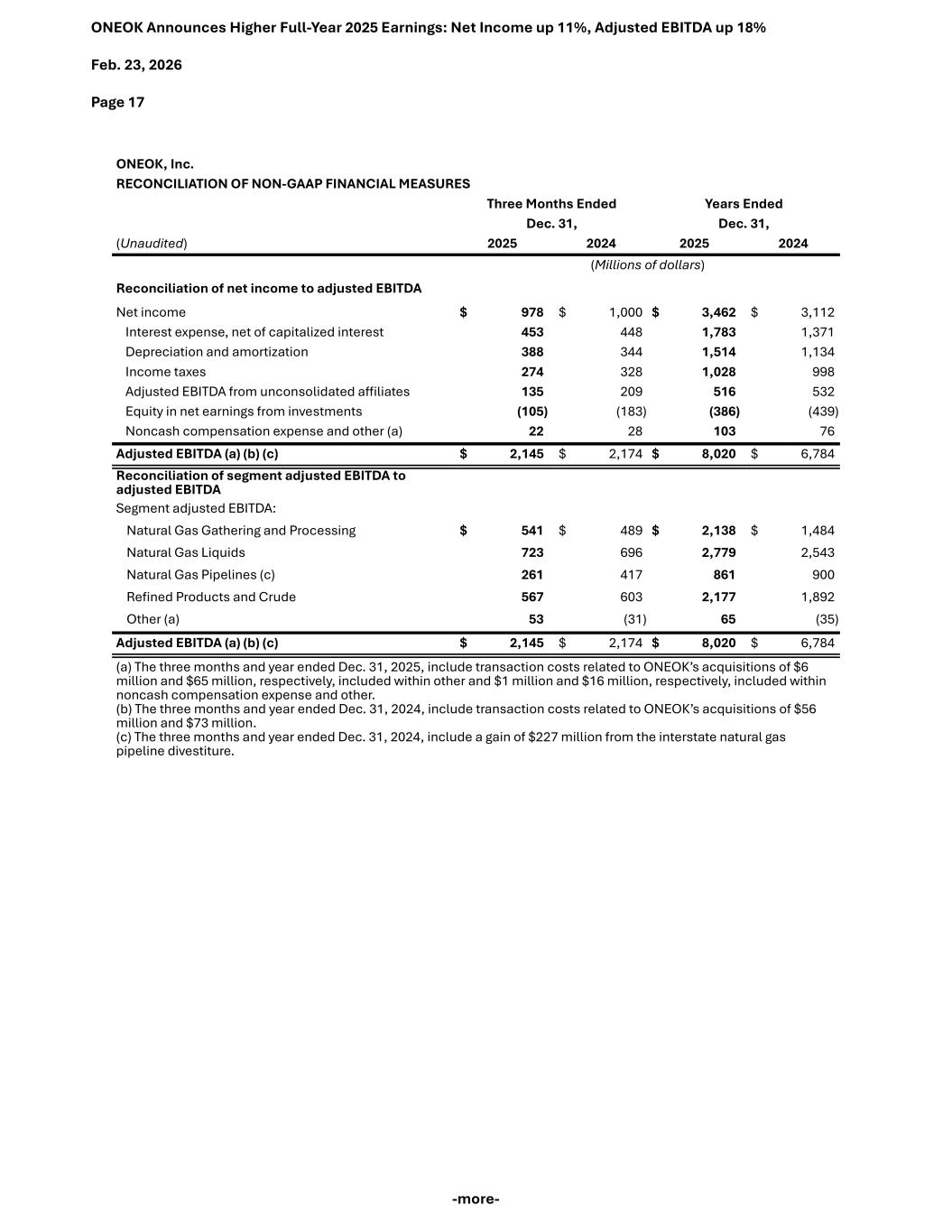
and thank you for joining us today. Joining me on the call are Walt Hulse, our Chief Financial Officer, Randy Lentz, our Chief Operating Officer, and Sheridan Swords, our Chief Commercial Officer. 1-0 has begun to become a diversified, scaled, integrated, and energy infrastructure company delivering durable growth with a disciplined capital allocation strategy. 2025 was a defining year for 1-0. We delivered double-digit earnings growth, expanded margins, and materially strengthened our balance sheet, all while integrating major acquisitions and advancing long-cycle growth projects. On today's call, there are several key takeaways that I'd like to highlight. First, over the past two and a half years, One Oak has experienced an earnings power step change. In 2025, our net income attributable to One Oak increased 12% to $3.39 billion. Our adjusted EBITDA is up 18% to $8.02 billion. 2025 marked 12 consecutive years of adjusted EBITDA growth, and we achieved a 17% average annual earnings growth rate over the same period. This significant earnings power has been sustained through various market conditions in commodity science. Second, we have created an integrated platform advantage. The Magellan, Easton, Kinley and Medallion acquisitions will be fully embedded in 2026 across our NGL, the five products, crude and natural gas systems, driving scale, connectivity and commercial optionality. We've realized nearly 500 million of total synergies since closing the Magellan acquisition in September of 2023, far exceeding our original expectations. We realized approximately 250 million of those synergies in 2025 alone. And through strategic organic expansions, we built in operating leverage for projects newly completed or nearing completion that will serve contracts in place and allow one of them to compete for volumes in the future. Third, our strategy has created a high-quality earnings mix with approximately 90% fee-based earnings, limiting commodity exposure and supporting valuation durability. And finally, although lower crude oil prices are expected to slow the pace of drilling, we still have visibility to the growth in 2026 and beyond. our 2026 adjusted EBITDA midpoint of 8.1 billion is supported by volume growth completed or near completed projects and 150 million of incremental acquisition synergies related to producer activity in the Bakken alone there is currently 5 000 identified wells yet to be drilled on dedicated acreage and at current rig rates that equates to approximately 15 plus years of inventory I want to combine scale, integration, and fee stability with long-life assets aligned to meet domestic and global energy demand, and management has proven they can integrate acquisitions and capture the expected synergies to generate additional cash flow. For 2026, we have good visibility into customer development plans across our operations, operations, with PESA growth being a key consideration for the year ahead. Our guidance reflects discipline, caution around commodity prices, but also continued confidence in our durability of our integrated asset base and the ingenuity of our employees. Through significant growth and change, our employees continue to drive our strategy forward, prioritizing safe and reliable operations and executing on opportunities that enhance long-term value. I'll now turn it over to Walt, Brandy, and Sheridan to provide their financial operations, capital projects, and commercial updates. Walt. Thank you, Pierce. I'll start
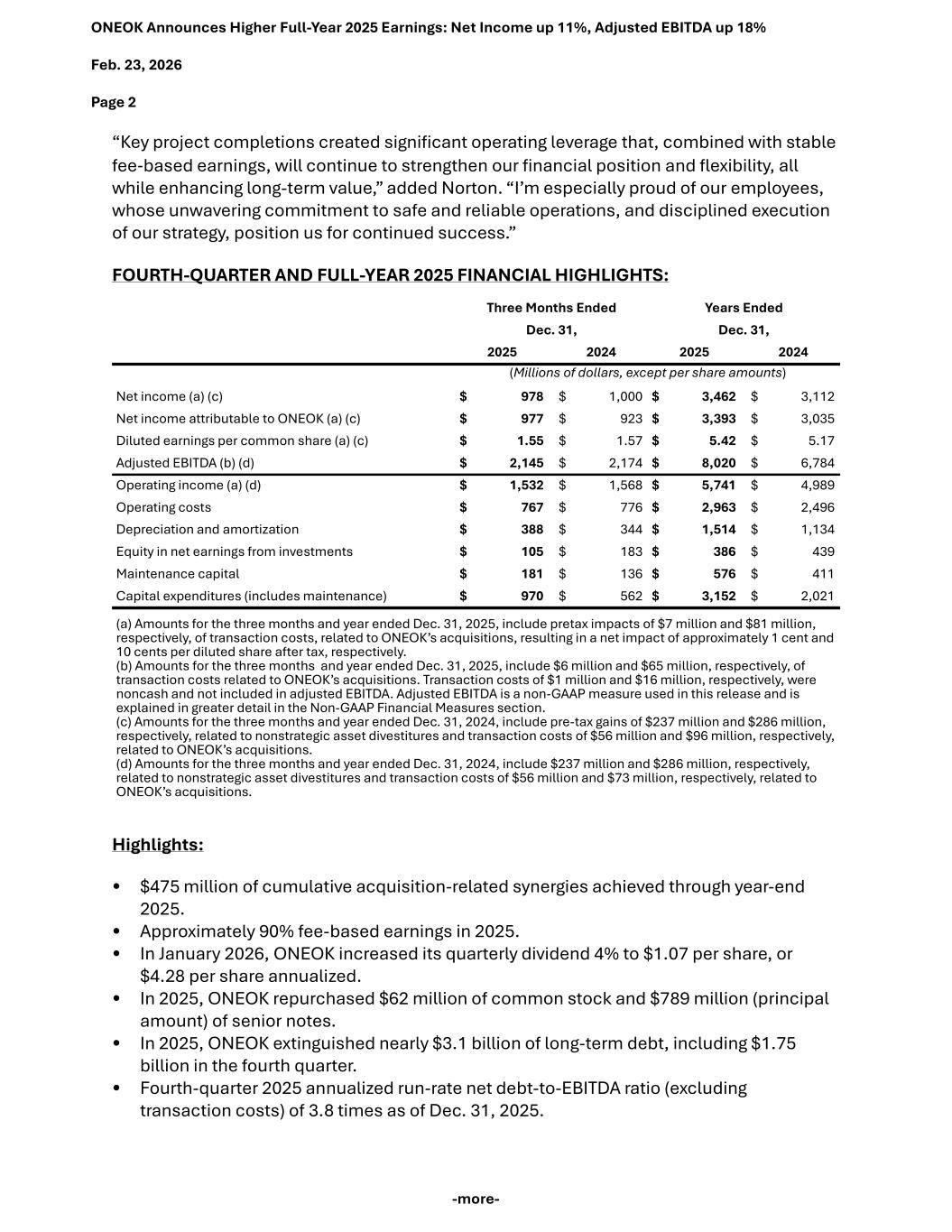
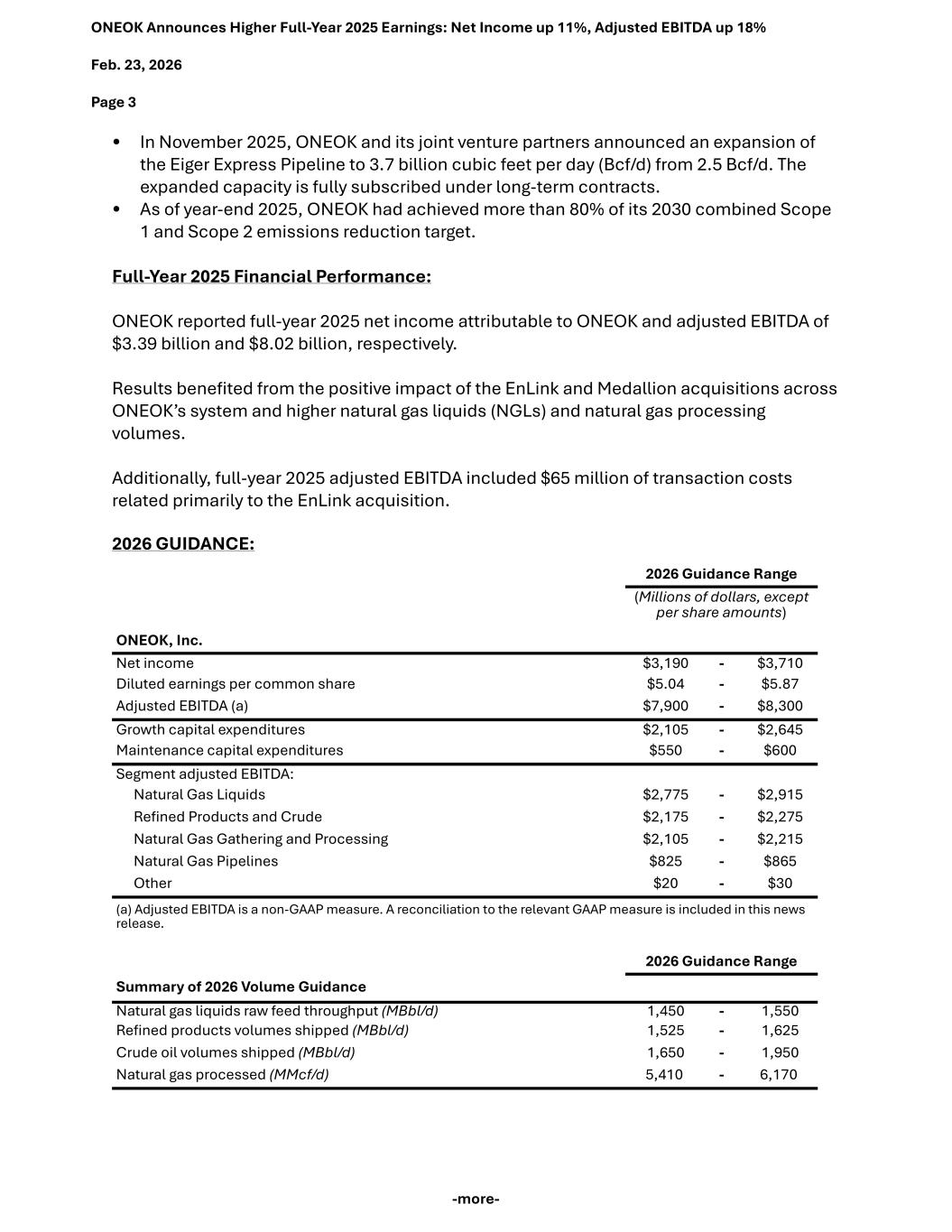
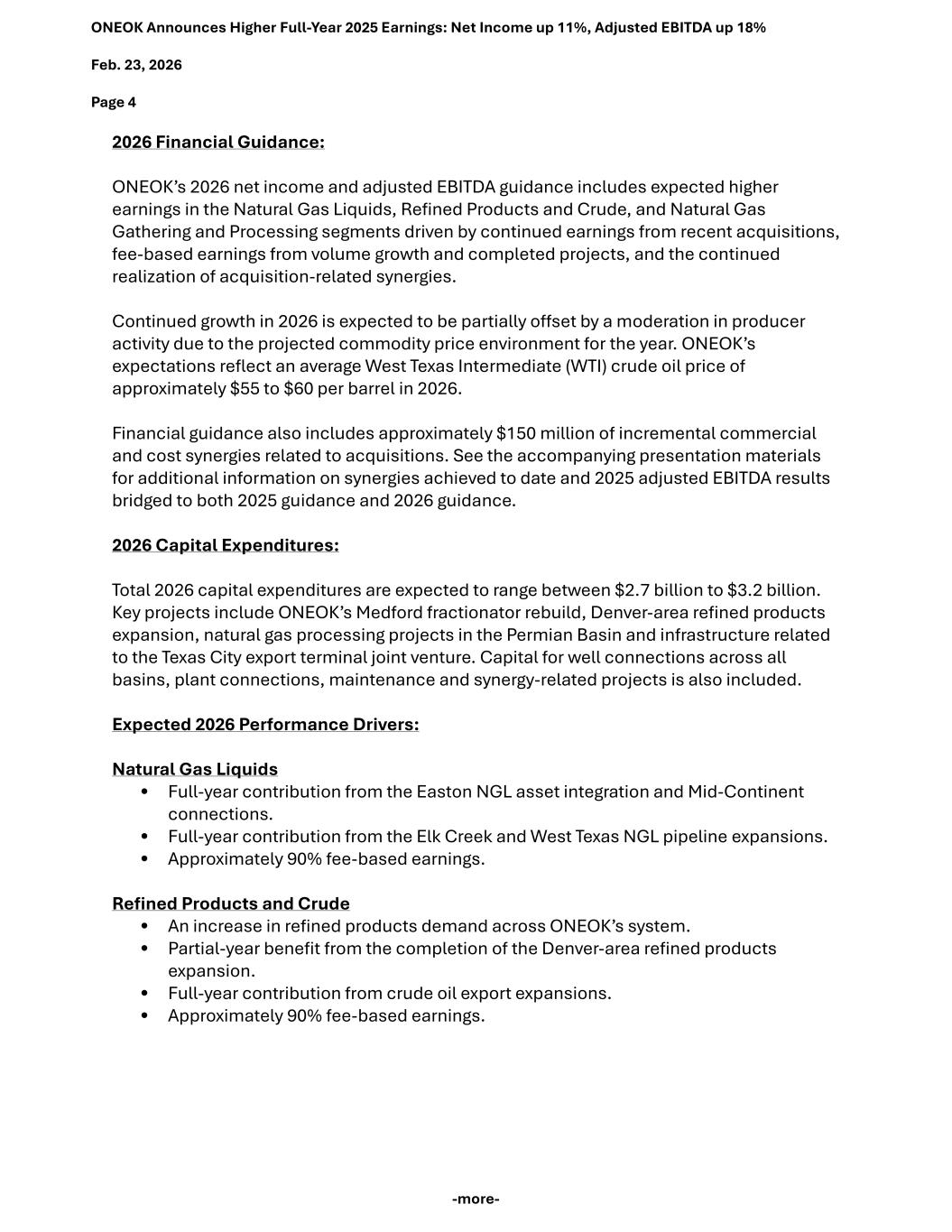
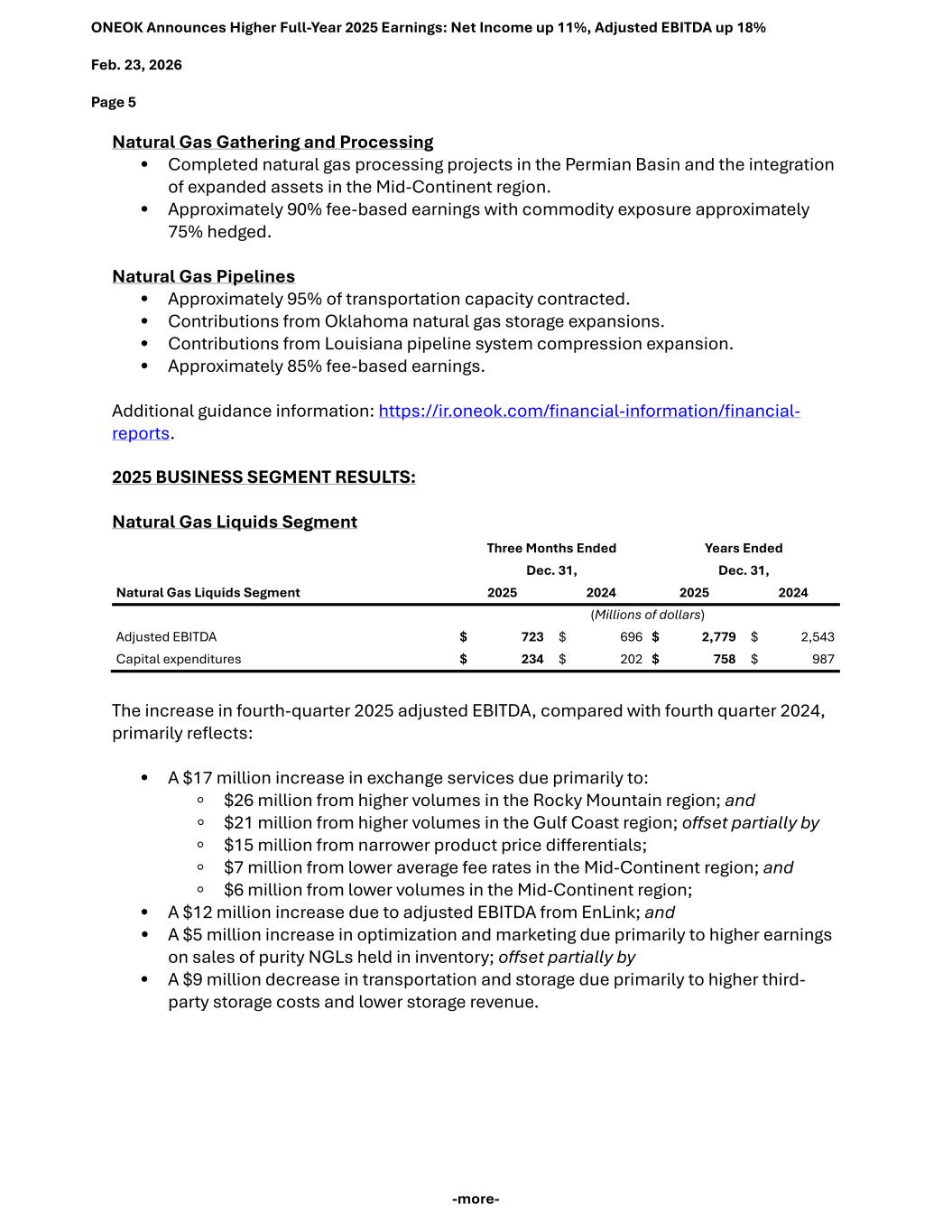
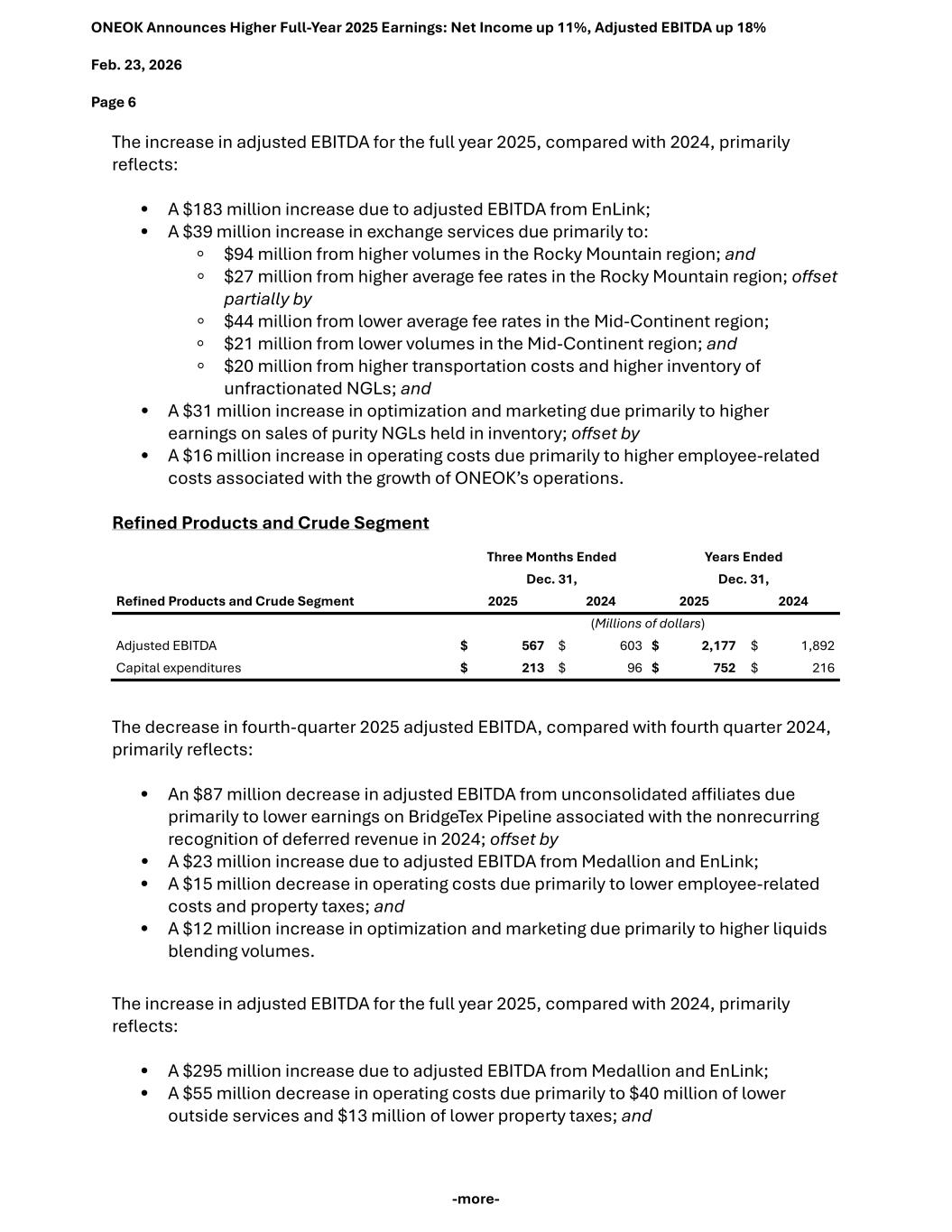
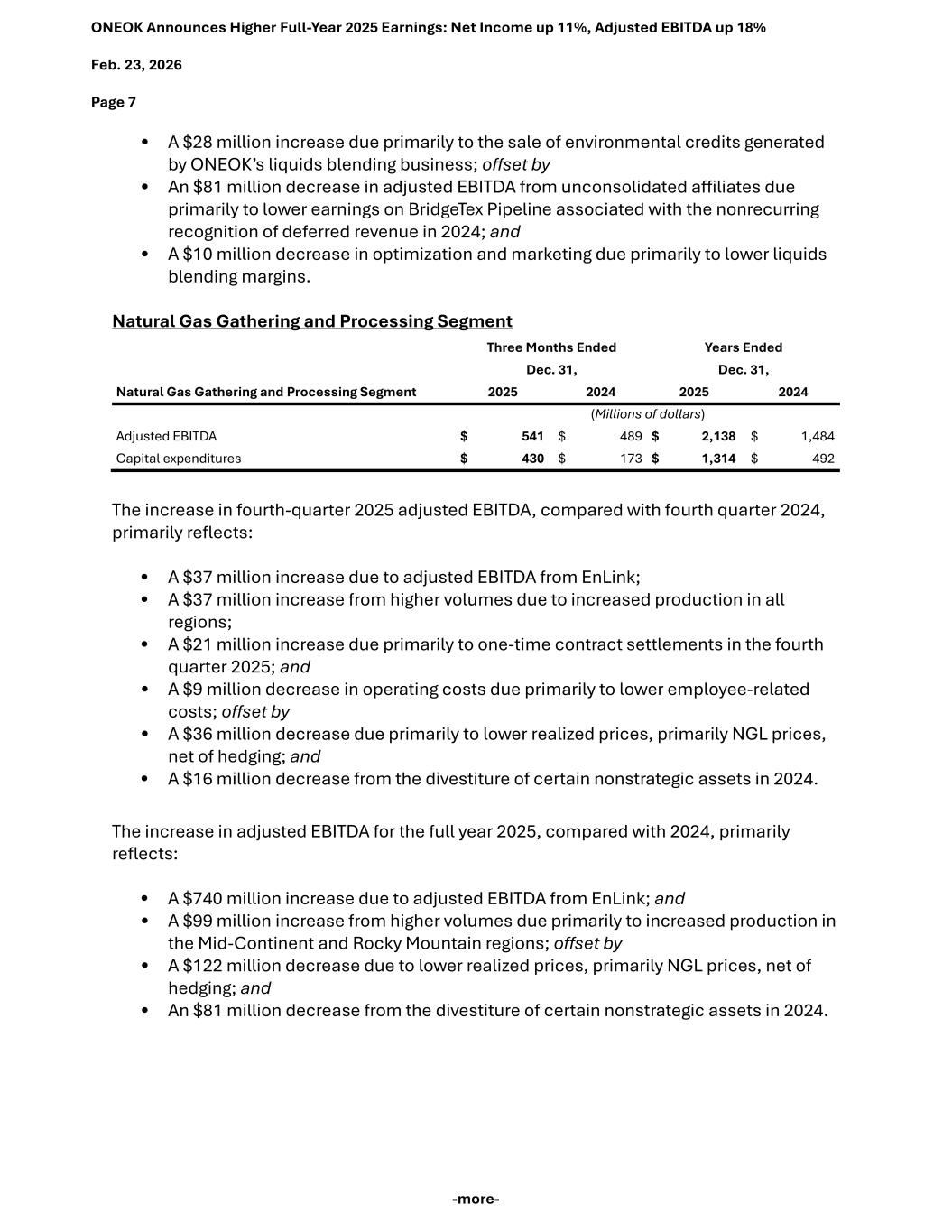
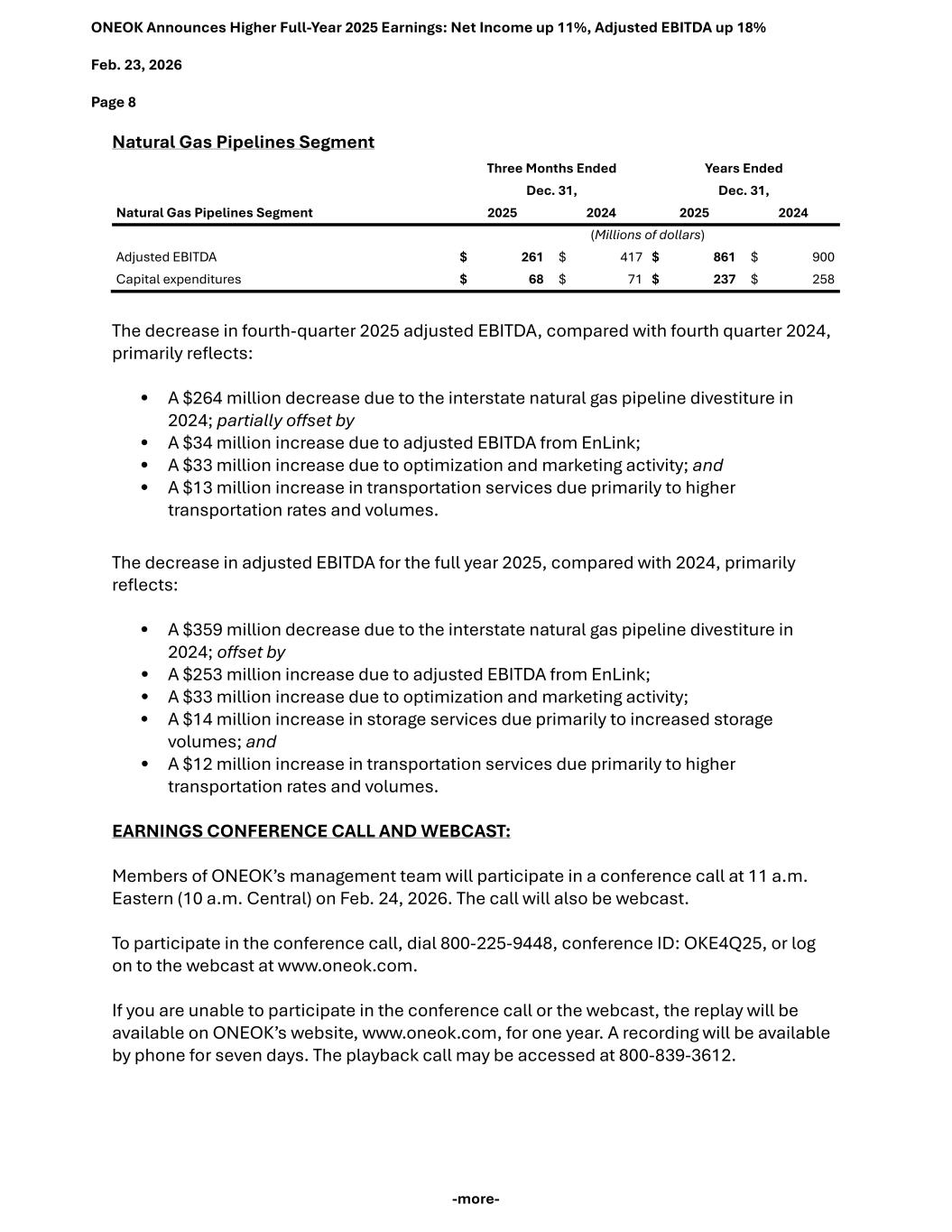
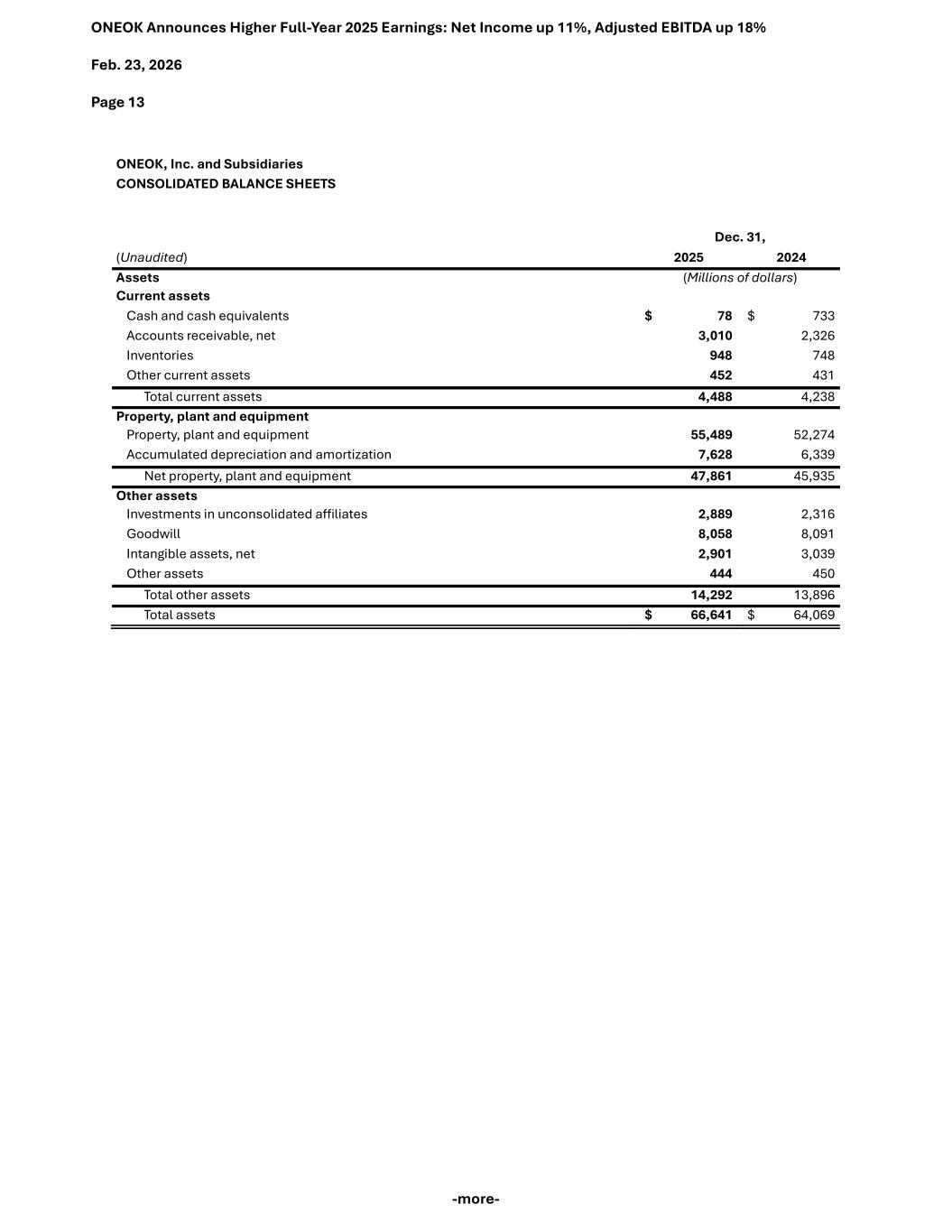
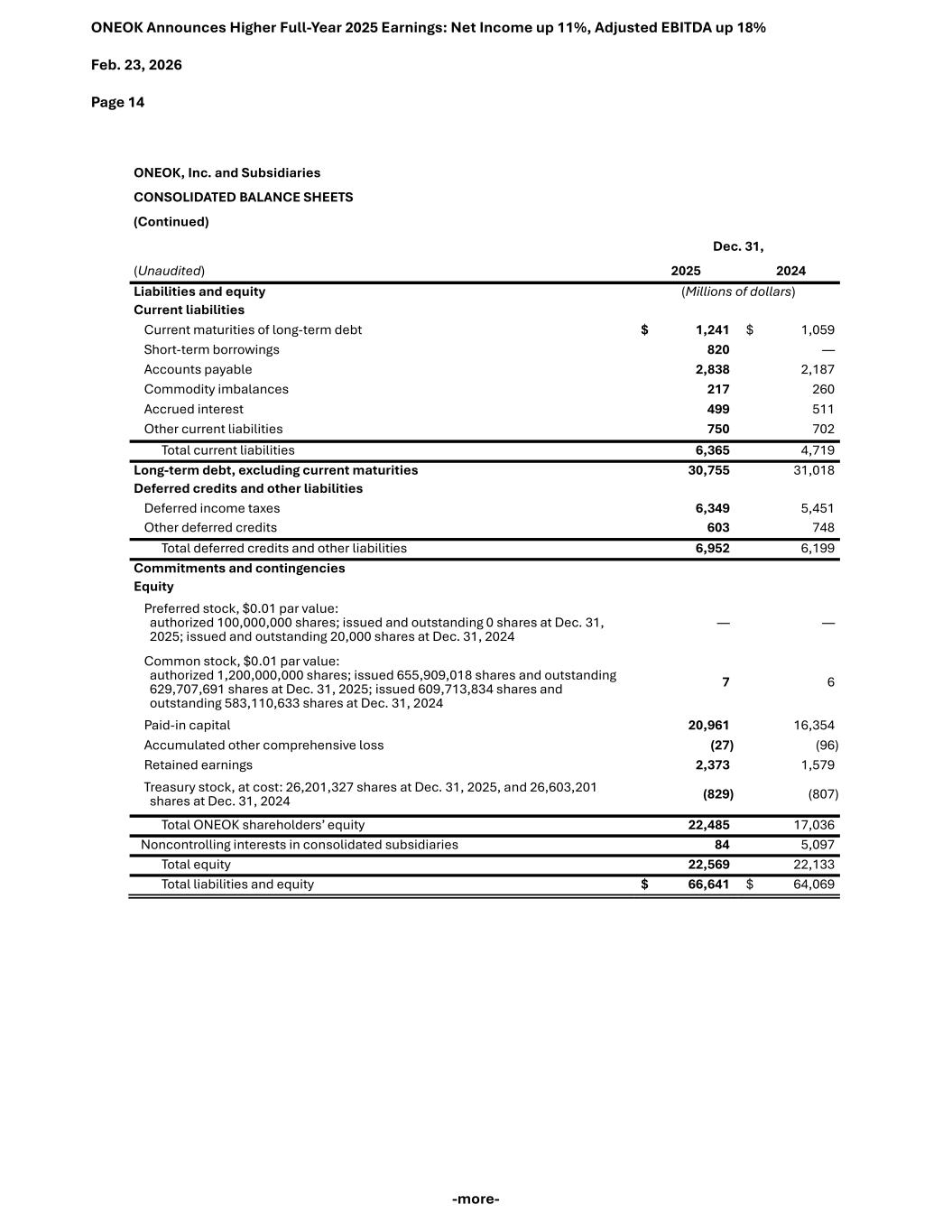
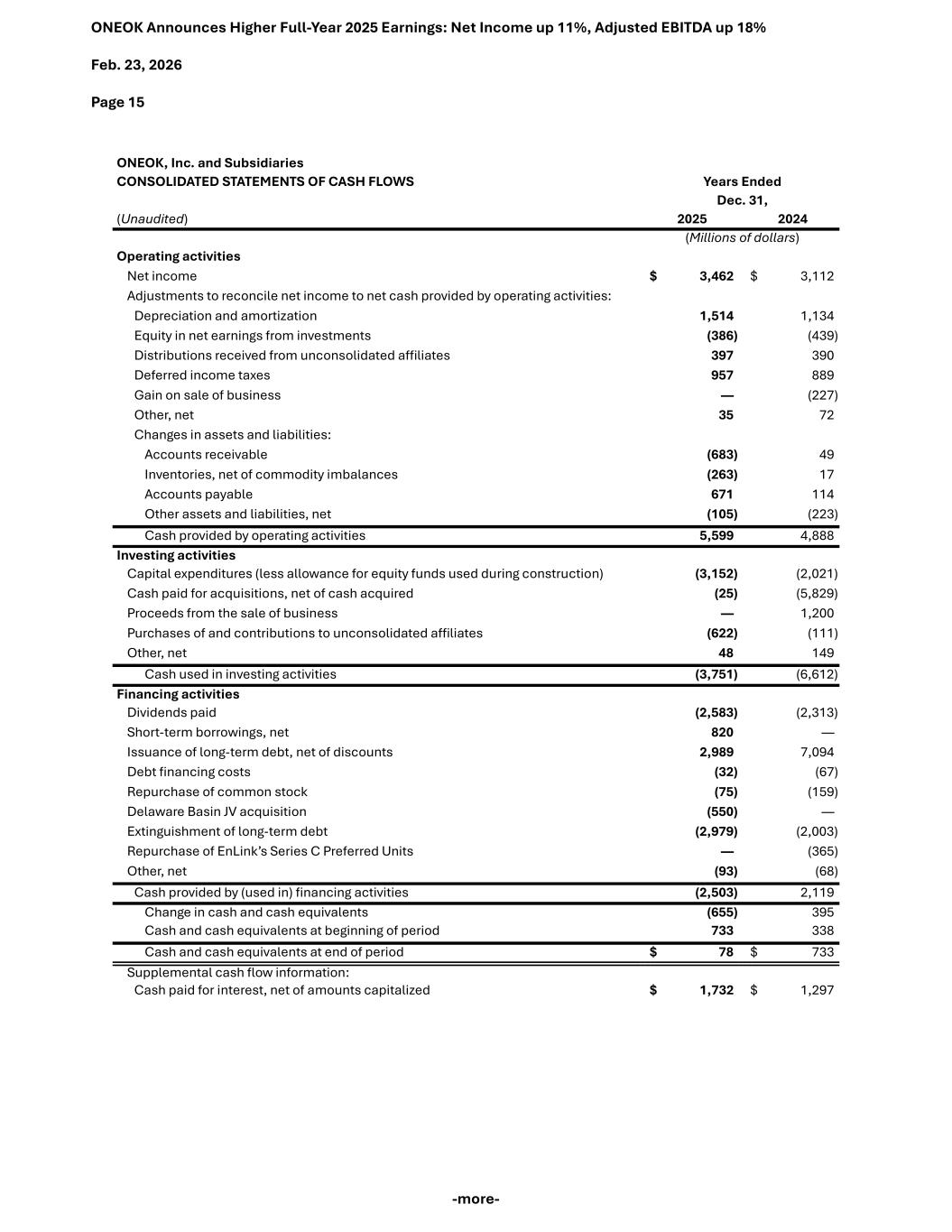
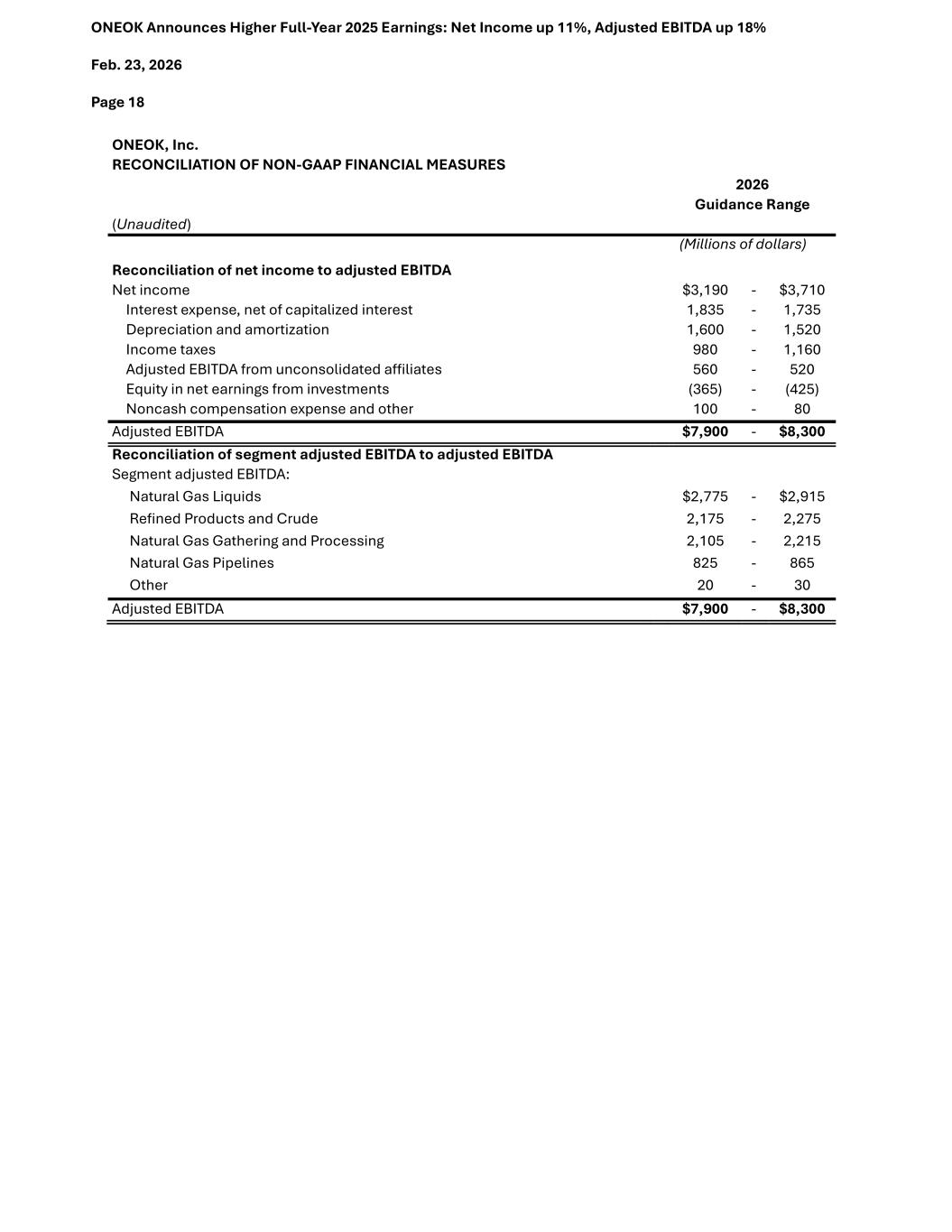
with a brief overview of our fourth quarter and full-year financial performance and then move on to our 2026 guidance. Fourth quarter net income attributable to one-oath total $977 million or $1.55 per share and totaled $3.39 billion for the full year, representing a 12% increase compared with 2024 and resulting in earnings of $5.42 per share. Adjusted EBITDA totaled $2.15 billion in the fourth quarter of 2025 and more than $8 billion for the full year. Full year results included 65 billion dollars of transaction costs. During the quarter, we retired more than 1.75 billion dollars in senior notes through a combination of redemptions and repurchases. Fourth quarter activity brought our full year total to nearly 3.1 billion dollars of long-term debt extinguished. In 2025, we returned nearly $2.7 billion to shareholders through a combination of dividends and share repurchases. We also recently increased our quarterly dividend by 4%, further reinforcing that commitment. As we progress towards our long-term leverage target of 3.5 times or lower, we continue to gain flexibility in how we deploy capital. Now, moving on to guidance. For 2026, we expect net income at a midpoint of approximately $3.45 billion, or $5.45 per diluted share, and an adjusted EBITDA midpoint of approximately $8.1 billion. On page seven of our investor deck, we have provided a bridge analysis from original 2025 guidance issued in February of 2025 to year-end 2025 and then a bridge to 2026 guidance. To preempt some of the questions we expect to get on this chart, I plan to walk through each column in the chart to give a brief explanation. The 2025 guidance was first impacted by lower Bakken volume growth that resulted in gathered volumes being 100 million cubic feet per day lower than originally anticipated this change in drilling base began in the spring of 2025 when crude oil prices dropped from the 70s to the lower 60 dollar range we also experienced a reduction in anticipated ngl volumes when two third-party Permian NGL customer plants were delayed for the majority of 2025. The second column in the chart reflects a $125 million reduction in lower upgrade margin in our NGL and refined products businesses. An example of this would be the narrowing of Arbob to butane spreads in our blending business. On the positive side, we enjoyed strong location differentials such as the Waha-Ducati spread in our natural gas pipeline segment. These differentials added approximately $150 million to EBITDA in 2025. The majority of the $85 million of other income reflected on the chart is the gain realized on debt repurchases made throughout the year. On a comparative basis, excluding transaction costs, we ended 2025 with EBITDA of $8.085 billion compared to our original 2025 guidance of $8.225 billion. Looking forward to 2026, we see $100 billion of EBITDA growth from increased volumes in the Permian and the full year of third-party Permian plant volumes that were delayed in 2025. This 100 million dollar increase is net of other impacts such as contract rollovers and the 18,000 barrels per day of continental NGLs rolling off our Rocky Mountain region volumes this year which we've previously discussed. We expect asset optimization to add 150 million dollars of EBITDA from batching and blending logistical benefits allowing us to efficiently move NGLs and refined products through the Easton acquisition connections between Mount Bellevue and East Houston and other synergy projects completed throughout the mid-continent NGL and refined products businesses. The 150 million dollars reduction in EBITDA shown on the chart stems from lower forecasted differentials from Waha to Katy and lower price realizations year over year in our GMD, NGL, and refined products businesses. We have also not forecasted any gains on debt repurchases of 26, representing the additional reduction of 85 billion dollars to get us to a forecasted 2026 EBITDA of 8.1 billion dollars for 2026. Our expectations reflect an average WTI crude oil price range of 55 to 60 dollars per barrel in 2026 and incorporate normal seasonal dynamics across the business which influence how earnings are distributed throughout the year. To help illustrate this, we've added another new slide to our earnings material on page eight. Yeah, that outlines the key factors driving results by quarter and directionally shows an earnings cadence that typically builds progressively over the course of the year. On average, we expect to make a little over 22 million dollars of EBITDA each day in 2026. With the first quarter only having 90 days compared with 92 days in the third and fourth quarter coupled with the impacts of weather, we expect the first quarter to be our lowest EBITDA quarter each year. Expect earnings growth across our natural gas liquids, refined products, and crude and natural gas gathering and processing segments supported supported by continued contribution from recent acquisitions, fee-based growth from volumes, and completed projects, and the continued realization of synergies. As Pierce mentioned, we expect approximately $150 million of incremental commercial and cost synergies this year, in addition to the nearly $500 million we've captured since the closing of Magellan transaction two and a half years ago. Our 2026 capital expenditure guidance assumes a range of $2.7 billion to $3.2 billion, which includes both growth and basis. This reflects a portfolio of high return projects to be completed in 2026 across our system, which Randy will review in a moment, as well as the Texas City Export Terminal and the Bighorn Processing Plan. Capital for synergy related projects, ongoing well connections, and maintenance are also included. As we've discussed previously, we expect capital expenditures to continue to step down in the coming years as we complete current projects. And we do not expect to pay meaningful cash taxes until 2029, both of which continue to support our free cash flow capital allocation flexibility going forward i'll turn it over to randy for an operational and large capital projects update thank you all
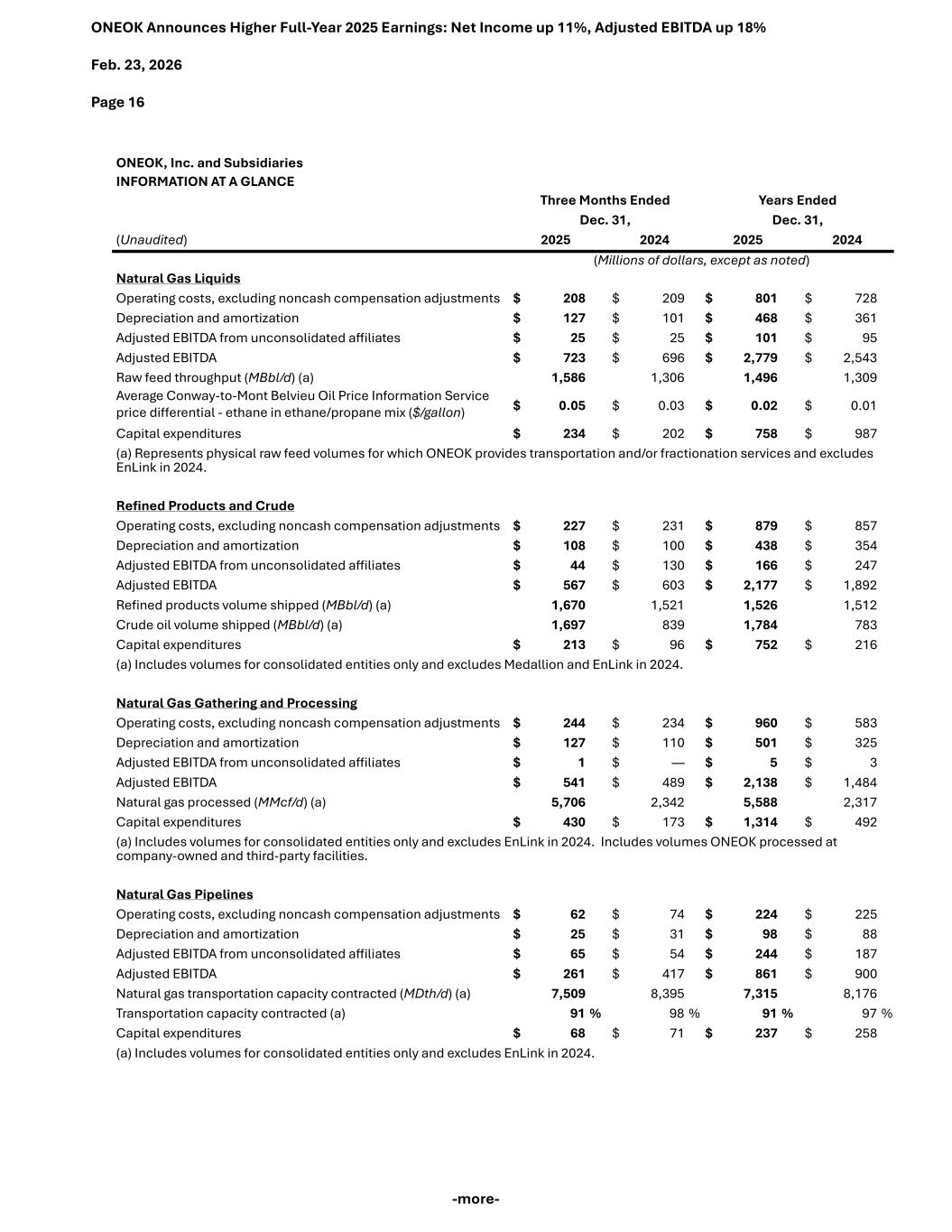
i'll begin with a comment about the impacts of weather in the fourth quarter of 2025 and the first quarter of 2026. winter weather across our system in the fourth quarter of 2025 tempered volumes in the natural gas gathering and processing, natural gas liquid segments, but this was largely within our expectations for normal seasonality. More recently, winter storm fern caused temporary wellhead freeze-offs and challenging operating conditions, briefly impacting throughput in the first quarter of 26. We estimate January gathering and processing and NGL volumes were approximately 10 percent below our original expectations due to weather. We experienced no material downtime in our own assets. We have already incorporated the storm's impacts into our 2026 guidance. Now turning to our capital update. Our large capital growth projects are progressing according to plan and are currently expected to enter service as anticipated. In the gathering and processing segment, our 150 million cubic feet per day Shadowfax plant, which is being relocated to the Midland Basin from North Texas, is expected to be in service by the end of the first quarter. We expect volumes to ramp up with activity over time, providing flexibility for our customers in the area. Additionally, the expansions of our Delaware natural gas processing assets, totaling 110 million cubic feet per day, are expected to be completed early in the third quarter. We expect volumes to ramp up quickly as these expansions are aligned with specific producer projects. These expansions help to fill the gap in capacity before our Bighorn plant comes online in mid-2027. In the refined product segment, the Denver area pipeline expansion remains on track for expected mid-third quarter 2026 startup. And lastly, phase one of our Medford NGL fractionated rebuild is on track for a fourth quarter 2026 completion. This will add an initial 100 000 barrels per day of fractionation capacity with phase two adding an additional 110 000 barrels per day of capacity in the first quarter of 2027. these projects extend and expand our existing system adding needed capacity to address future volumes i'll now turn it over to sheridan for a commercial update thank you randy as we said today
we continue to see opportunities for growth across our expansive portfolio. We expect our Rocky Mountain and Mid-Continent region, NGL and GNP volumes to grow at a steady low single-digit level. These assets continue to generate stable long-term cash flows that help fund higher return growth across. In the Permian Basin, we continue to expect higher pace of growth in the Permian platform that spans. We saw the benefit of our larger scale asset portfolio in 2025, achieving record NGL and GNP volumes in the Rocky Mountain region and record liquid splitting volumes in the refined product segment. Permian Basin processing and NGL volumes increased significantly over the course of 2025. As we continue to enhance our Permian system, the natural gas pipeline segment once again exceeded the high end of its guidance range in 2025 benefiting specifically in the Permian Basin and the segments of interconnectivity between these assets has level related underway to for you to drive this attractive opportunities in the basin beyond those we've already announced in the mid-continent we continue to expect currently operating across more than 1 million dedicated Rocky Mountain region there are currently 12 rigs on our dedicated acreage but producers heavily focused on ratios in the basins stable long-term outlet for natural gas are closed with our natural gas pipeline segment which we expect will have another strong year for former natural gas type of Permian it's along the Gulf Coast separately we will operate opportunities to optimize our system particularly in the permanent basin to capture natural gas private you Sheridan and work we've done to integrate assets build operating
leverage and further enhance our portfolio is translating into durable performance and resilient growth. Most importantly, this execution is driven by our employees. I want to thank our entire team for their continued focus on safety and operational excellence and collaboration. In 2026, 1OF will celebrate its 120th anniversary. I want to take a moment to recognize the contributions of those who came before us that allow us the opportunity to do what we do today. It is our responsibility to provide the next generation the same opportunity afforded to us. Thank you to our shareholders for your continued trust and support. With that operator, we're ready to take questions.
Operator
Thank you. If you'd like to ask a question, press star 1 on your keypad. To leave the queue at any time, press star 2. We also do ask that you please limit yourself to one question and one follow-up. And our first question today comes from Spiro Dunas with Citi. Your line is now open.
Thanks, operator. Morning, team. I wanted to start with a 26 outlook, two-part question here. Walt, I was curious if you could talk about maybe where you've built in some conservatism around the guide. I know commodity assumptions maybe looks like one area that screens conservative. And Sheridan, in any given year, you seem to find opportunities to optimize and find margin. I know a lot of times that's not baked into the guidance. I think rocky deathane recovery maybe is one example. Just curious if you could walk through some optimization opportunities you've been able to realize in the past that you think are upside to the guide.
Sure, Spiro. Well, I think that, you know, we think that there's a meaningful potential that we're going to see crude prices in that 55 to 60 range. It's got some geopolitical influence on it now that's popped it up a little bit above 60. But we want to plan for that lower level as we look forward. Clearly, if we get a little stronger pricing, that could help our spread differentials. that could also provide our producers with more cash flow to drill. So high prices always are a benefit. Higher prices are always a benefit to us. But we think we've been, you know, intentional and disciplined as we've put these projections together. And that $8.1 billion.
dollars this bureau when i think about on we have typically seen upside in the past and you mentioned one of them is the discretionary ethane out of out of the balkan where our marketing team has been done for a good job of being able to lock those in at different periods where they see spreads being wider not just the average what we see over a year they've been very successful in through that we've also had on the gnp side especially the permian we have a little bit of open capacity they've been able to to have some offloads some spot offloads that they get throughout the year as they continue to work with producers and leverage our our commercial customer relationships that have been developed overall our basins into that area and grow volume on a spot basis we've also seen that on the NGL as we look about you know between Conway and Bellevue that spread at different times they'll move and we're able to capture those or lock going forward are the same things that are our fine product with our normal butane too we look to lock them in when we see opportunities as we continue to go forward and then be able to sell those at different times of the year when the spreads are wider than we typically show in our
couple thank you guys uh second question maybe switching over to the power opportunity uh the slides pointed out a step up in the amount of customers you're engaging with and the potential gas opportunity for you curious when we can expect some of these deals to start to announce and what they look like i think you originally said that they were smaller kind of higher return projects so curious if these additional opportunities start to scale you up a little bit
yeah they are scaling up a little bit and we are in some advanced negotiations with with some hyperscalers out there that we feel really good about we're hoping that that we can announce something you know in the fairly near future but we still need to go through the process and get those to bed but it is looking very we probably have quite a few that we think are in that advanced stages thank you
Operator
our next question comes from Michael Blum with Wells Fargo thanks good morning
everyone. I wanted to ask a couple more questions on the guidance. First, can you remind us how much open capacity you have to capture Waha basis spreads and what Waha spread is assumed in the guidance? Are you basically assuming there's no spread in 26? This is Sheridan. I don't know if I
want to go out and tell you exactly what we have on open capacity, but we do have capacity that we we have contracted on the IGR pipeline system that is above what we need right now. We are seeing good spreads right now above what our forecast was. We think that will go through the third quarter before the next pipelines come online that will bring that spread back to target. Okay, got it.
Thanks for that. And then the Bakken, Rockies, and Mid-Continent processing volume guidance on slide 16, the The ranges are fairly wide, so I wonder if you could just speak to what you think will drive that towards the lower, higher end of those ranges and things.
When we think about ranges in there, we try to put it out there because we're dependent on a lot on as producers complete the wells and bring pads on at times, and sometimes they will delay those pads coming on at times, or they may speed them up at different times. So we try to give a range of where we think it's going to be, and that's what kind of And then, you know, if we see higher crew prices, you could see, you know, producers put another rig on or put more completion crews on, then you could see those grow to more of the higher side of those ranges and beyond. So we're trying to give a range of what we think is reasonable from our experience of operating these assets for many years of producer activity and how just a simple delay for a month or two can swing or improve it.
Operator
thank you and we'll move next to teresa chen with barclays your line is now open
good morning i appreciate the granularity in the ebdo bridge and the details related to the synergies um as we think about these building blocks for 2026 with respect to the 150 million dollars of incremental synergies underlying guidance can you help us risk weight that i know sheridan alluded to this in his prepared remarks but can you speak specifically on how much visibility you have in capturing these opportunities at this point?
Yeah, what I would tell you about that 150 million of synergies that was outlined by Walt is they are all identified and they are in the plan and they are underway. And as we continue to grow, so we have a very high confidence that we are going to be able to capture these synergies in 2027. They will come in the same kind of buckets that you see on page nine, where we've outlined the different areas where we have been able to capture synergies, and we will continue. That's where these are going to come from.
Thank you. And as you prepared to bring online the first phase of the Denver Refined Products Pipeline expansion um in mid-2026 um what is your outlook for the subsequent phases of this project and um have the expectations related to the denver refined product system changed at all and parlaying this to another component of your potential refined product uh pipeline portfolio can you provide some incremental color on the commercialization efforts related to sunbelt
the first thing on the denver expansion yeah it will come up as we said mid third quarter It's fully contracted with take or pay volume, so it will come up right away during that period of time. As you can imagine, our commercial team is out there working diligently right now to bring the Phase 2 online as we continue to go forward. We have some momentum in that area, and we're hoping that we can commercialize that sooner rather than later as we go forward. because obviously it's a very nice add-on project. We built operating leverage into that pipeline we've been out there. When we think about the Sunbelt Connector, I had said last time that we had an open season that had a lot of interest in it, but not enough to FID. And we still believe that the other project out there still does not have enough to FID as well. But we do think we bring in value to bringing volume into the Phoenix area by having access to the Gulf Coast and our connectivity that we have, extensive connectivity that we have through our system tied into all those refiners down there, that we believe that there is an opportunity to be able to work together to be able to bring this much-needed project to FID.
Operator
Thank you. And we'll take our next question from Jeremy Tonette with JPMorgan. Your line is now open.
Hi. Thank you for the helpful information with the bridge here. I was just wondering if we could bridge maybe just a little bit more. You know, if we take a look back, there's been a number of acquisitions in the past several years here, and just wondering if you could expand a bit more on which ones are hitting expectations, or really which ones might be coming in a little bit below, such as that link, just trying to square, you know, acquisition expectations versus
the outlook for 26 at this point? Well, Jeremy, clearly the Magellan, we've had the most time to, you know, play through the synergies there, spend a little capital where necessary to make the connections, to get the logistical benefits. So we definitely have the most progress on the Magellan transaction. And the synergies to date have been weighted in that direction. Remember, it's just now been a year since we brought in NLINK, and things are going according to plan. I think that they're at the pace. You know, at the time we announced that transaction, we said that there were some contractual arrangements at NLINK that were going to take a little bit of time to roll off, and those volumes would come over to our pipes. so you know we're still expecting that and medallion I think we've been able to jump into it pretty pretty quickly by being able to bring our balance sheet to the fold to bring volumes on to our long-haul crude pipes and really just to enhance the gathering system by providing the full integrated service so So I think they're all on pace with Magellan clearly leading the way just because we've been at it a little bit longer. And its opportunity set might be a little bit bigger given the overlap of our assets.
Got it. Understood. Maybe coming at a slightly different direction here, I think there was the expectation for the potential for EBITDA to approach $9 billion going into next year here. And just wondering, I guess, beyond lower commodity prices, are there any other kind of drivers to the delta with the current outlook?
No, I think that, you know, the difference in our outlook has been really more, you know, it's twofold. It's producer activity. You know, we clearly saw 100 million a day of lower volume than we had expected in 2025. So, you know, we haven't caught up on that yet. and then with the lower prices you do see a narrowing of spreads across the various various businesses so I think it's pretty much as simple as that volumetrically we our expectations are down a little bit we still see the building blocks that we have ready to come in here in 2026 that will drive us into 2027 like the Denver expansion that Sheridan was just talking about as well as Medford coming on and the Shadowfax plant. So we've got some some nice ads throughout 26 that will give us some strength as we roll into 2027 regardless of what the commodity environment is. Got it.
Operator
Understood. Thank you. Thank you. We'll move next to Gina Ann Salisbury with Bank of America. Your line is now open.
Hi, good morning. Can you talk through the drivers of your NGL throughput volumes on slide 14? Your 2026 guidance is forecast basically flat versus 2025. To your point, you know, given growing gas to oil ratio, we would expect, you know, growth in NGLs in all of your basins. So if you can kind of just walk through and talk about market share loss or ethane recovery changes, but why overall you kind of have that flat.
Yeah, I think when we think about on that, I'll just start with a walk-in and walk through you a little bit, and there's obviously in the walk-in, we've talked about it for a period of time. We have a contract coming off this year where we're going to lose about 18,000 barrels a day going over to the Kinder Morgan system. So we're still going to see growth in that, but that's going to temper that down a little bit. In the mid-continent, it is a ethane story, or C3 plus is growing in the mid-continent, but we are predicting a little bit more ethane rejection. in 2026 and we did in 2025. The mid-continent is also an area where we have been able to do some incentivized ethane or discretionary, bringing some discretionary ethane on in that portion, and that's not predicted in these, and these numbers continue to go forward. And then the Permian, we are expecting some nice growth uptick on that, and we do expect that to be in full ethane recovery. So it's kind of a little bit of, let's say in a nutshell, it's our ethane assumptions through our systems that we have in there and also the Bakken with that volume coming off. I would also say that we do not have, we had a very good year last year on discretionary ethane out of the Bakken and we have not predicted to be at that same level this year. Okay, that's
very clear. Thank you. And then I kind of just wanted to follow up on Michael's question. So, you know, the Waha-KD spread is still pretty wide for 2026, but it seems like maybe you didn't put all of that into the guidance, but I guess my question is just like in 27 when all those pipelines come on and that spread basically disappears, should we expect like basically a further material step down in that bucket in 27? Well, what I would say is we contracted for
that space on Iger and to be able to provide a service to our customers that we're bringing through our gas processing plants to give them an outlet for their gas to continue to go forward. it and what we market that gas for them make sure they have a good net back and that gives us advantages to attract more gas to our system but as we bring more volume on to our gas processing plants that volume is not all being used right now and the extra volume is what we are able to sell at the spread so we so as we get into 27 we are predicting that that volume will be used for our G&P business and the natural gas that's coming off our plants.
Operator
Thank you. And we'll move next to Julian Demoulin-Smith with Jefferies. Your line is now open.
Hi, this is Rob Mosca on for Julian. Good morning, everyone. So maybe related to that $55 to $60 per barrel assumption, do you think it'd be fair to assume on a go-forward basis that at that level you'd expect your Bakken G&P position to grow 1% And maybe if not, what other factors could alter that correlation?
Well, I think we've come out and said that it's 55 to 60 is what our prediction is going forward. And, yeah, at that, at this crude level, we are saying a low single bid to low single digit growth rate for the Bakken volume, both on the NGLs and on the GNP side of it. Obviously, in a higher crude environment, as producers have more cash flow, as they're operating within cash flow today, if they have more cash flow and they feel like they can deploy more rigs for that additional cash flow, we will see increased volumes coming out of the bucket and be able to continue to grow our own position. Obviously, we have a very, very large position in there right now, so it's really about growth across them. So we really see it as to get beyond that 1% is probably going to be driven by more commodity price increases. As we continue to look out forward though, we are seeing that producers are continuing to work on efficiencies around longer laterals and efficiencies on completion techniques, as well as starting to see them toy around with more refracking and reworking older wells that could bring more volume on as well. So we look into the future, we think there's some other factors that could tend to push the tier two and tier three acreage into more economical that could be drilled.
Got it. That's really helpful, Sheridan. And for my follow-up, you know, I'm wondering if you could provide an update on how you're angling to get more third-party volumes onto your Permian NGL system. And what are your plans if you need more capacity beyond nameplate, given that the 4Q number was strong, you're adding more plants, and you have a pretty modest-sized NGL package
rolling to you in 2027. I'll start with the capacity. We still have right now roughly around 300,000 barrels a day on our West Texas NGL pipeline. You remember as we continued to loop that system, we finally had to loop the whole thing, and now we're sitting at well over 740,000 barrels a day on the system. As we continue, and the question about being able to track third-party going to our system. There are still GNP operators out there that are not associated with an NGL pipeline that are looking to move on an NGL pipeline. There's RFPs out there today as well as there's a lot of producers out there that have taken kind rides at existing plants that we are able to contract for that we're already connected to or can be connected to. So even those those plants may be owned by somebody that is associated with the long-haul NGL pipeline. And we've been able to execute on both of those at the time, and we see opportunities going forward, not only in 26, 27, and beyond, that we will have those opportunities to be able to entice that volume to come here. And with this very advantaged capacity we have on our NGL pipeline and advantaged frack capacity we'll have at Medford, we think we've...
Understood. Thanks for the time, everyone.
Operator
Thank you. And we'll go next to Manav Gupta with UBS. Your line is now open.
Good morning. Your slide deck references natural gas storage opportunities. I was wondering if you could comment a little bit more about them, which are the areas geographically where you're seeing most of these opportunities? And also, are these opportunities tied to data centers or it's a combination of data centers and LNG export projects? If you could talk a little bit about natural gas storage opportunities.
Yeah, what I would say is I'll kind of break our natural gas storage opportunities into two areas one first area is Texas and Oklahoma more on the legacy one oak system and that has mainly been driven by utilities going in there we've expanded those a couple different times we see opportunities to be able to expand them more we continue to see if there's opportunities for us to expand right now those are fully contracted under long-term contracts when you get over to Louisiana we with the in-link acquisition we are completing out the GIST expansion that we will go from I think it's 2 BCF to about 10 BCF and as we go there that will come on in 2028 that is that has been contracted as well we do see some more opportunities out there to grow more storage there's another opportunity to grow the to expand the GIST storage some more and then there's the pulling in the storage over there we think that there's an opportunity grows well. We have teams, engineering teams and geology teams looking at that to see what we can do to go forward. Those are going to be more driven by industrial customers and LNG people that are going to want to need those systems aware which we've had a lot of inquiry into that. So we do see a lot of upside on the storage and natural gas beyond 2026 and beyond.
Thank you. My quick follow-up is what are you seeing in terms of refined product demand in your system we are off to a very surprising year where you know we have seen massive coal so probably higher on the diesel heating oil side but maybe a little more on the gasoline but in your system uh how are you seeing the refined product demand year to date if you
could talk a little bit about that what i would say is so far through the year i mean it can be you got to be careful it can be sick a little bit through the year but so far as we come off in the first quarter, we're seeing good demand, especially on our West Texas system out to El Paso, which is very, very encouraging. Now we've got to be careful a lot of times demand swings will change based on refinery turnarounds and what's going on in the system. But so far we've been very good. The central system through the mid-continent is performing at or above our expectations for the first quarter. So we are seeing some good demand pull across
Operator
our system thank you so much thank you our next question comes from John McKay
with Goldman Sachs please go ahead hey good morning thank you for the time I wanted to touch on the 26 capex guidance could you tell us a little bit more of a breakdown of where those dollars are going in terms of kind of the bigger projects coming on maybe over the next two years and then on a related note how you're thinking about kind of all-in return profiles for that capital wedge
thanks sure well the keys are the ones that Randy mentioned that would come here in 2026 the Denver pipeline expansion and the refined products the Shadowfax plan the first phase of Medford coming on those are all right on target and will be additive as they come on. Then we have a couple rolling over into the first six months or so of 27 and then our larger projects really have been completed and we'll be on to the more ordinary course, what we call routine growth, you know, expanding and extending our system. You know, we've been out there and said that we spend about $600 million, give or take, on maintenance, kind of about a billion dollars on routine growth every year, and then we managed to find you know four or five hundred million dollars of other larger capital projects that we you know our commercial team is always out looking for and that backlog is building so but we don't expect any we don't see any real large capital projects like a thousand thousand mile pipeline or something on the horizon at the moment. Clearly the one we haven't mentioned there is our joint venture on the Dock, which will wrap up as we go into 2028.
All right, I appreciate that. And then going back to, I think, maybe Rob's question, capturing more Permian GNP volumes, also earlier in the prepared remarks, you kind of pointed to potential inorganic opportunities in the Permian. Can you talk about that a little bit more for us and maybe potentially what your experience with Synergy Capture informs what you could be considering? Thanks.
Well, when we think about GMP growth in the Permian, you know, with the growth that we're seeing now in 2026 is from mid to high single digits, and that's based on contracts that we have today coming on forward. We're also seeing plenty of RFPs out there come forward that the volume either coming off contract or new volume being drilled, that we have a very good chance of being able to capture, especially when you think about a lot of these customers are in other basins So we feel very good about capturing more volume on the GMP side. The great customer feedback that we've had and what we've done so far, we have, as I told I told you last time, where the Shadowfax plant and the Boiwagoon in Delaware has given us a little bit of operating room to be able to grow with these producers, and that's what they really were missing when InLink was operating these assets. As we think about inorganic growth, I think in the comments we were talking about was more about we built a platform with the integrative growth that we've done so far. We're really concentrated at this time on the organic side of it and how do we connect it up to the wellhead or to the cdps that are out there and concentrating on these rfps that are in front of us that will continue to fuel understood thank you thank you and we'll now move to brandon
bingham with scotiabank your line is now open hi good morning thanks for taking the questions here just looking at the 150 million dollar headwind bar on realized pricing impacts for the guide I was just wondering what you guys are assuming price-wise within each of those buckets and how that might compare to current strip prices, and then what the potential uplift could be if you sort of mark to market those assumptions.
What I would tell you about is those – when we put that together, we were at a $55 to $60 – or we're going on based on a $55 to $60 price environment. but what we typically see is we think about those headwinds is that is on the spread business we as crude prices are higher we typically are at our wider on our commodity exposure that's mainly in the GNP business and we have a systematic program of hedging and we only we try to leave only about 25% open on our commodity exposures we continue to go forward so as we think about going forward that's more like in a we would see some improvement in crew prices from the 55 to 60 dollar range we'll see we'll see upside into our spread spread
part of the part of the business okay thanks and then maybe just one quick follow-up just haven't heard much on the Texas JV with NPLX just curious if you have anything to share what's kind of the latest and greatest there and I know you mentioned as part of the budget for this year but just kind of any updates
you can provide well I mean it gets progressing the build side of that is progressing it is progressing as planned very satisfied we're going on that on the commercial side is there we are continuing event advance the commercial commercialization of that doc we are we like where we are today the momentum is strong where we are today continue to have a lot of customer interaction with that a lot of interest moving forward with quite a few people on that and going forward so we like where we're at and excited about one
thing I'd add to that is that we have multiple touch points different levels of MPLX and here and I'm very very pleased with the communication that's going back and forth between the two companies. Excellent collaboration. Okay, great. Thank you.
Operator
Thank you. We'll now move on to Keith Stanley with Wolf Research. Your line is now open.
Hi, good morning. I wanted to ask on capital allocation. Would you expect excess free cash flow this year to go to debt repayment? Where do you see leverage ending the year, and when would you expect to get to that three and a half times target, roughly?
I think that it's important to recognize that our three and a half times target is a self-imposed target. The agencies for our current credit rating, you know, provide us a little bit more flexibility at a higher debt to EBITDA than that three and a half target. So we believe we have flexibility from a capital allocation standpoint as we look forward and have clear visibility down to the three and a half. So, you know, we may or may not be a little bit opportunistic if we see opportunities in the capital allocation side. But we're still on target clearly with EBITDA expectations lower than they were, you know, in 2025 guidance. our denominator has not been as strong as we thought it would, so it's going to take a little bit longer than we originally expected. But we're on track and you know we're aggressively reducing debt through 2025 and we still have a pretty strong CapEx project this year, backlog this year. So, you know, we won't be able to lean in too much into the debt reduction until we start to complete those in the second half of 27. You see that incremental pre-cashbound really kick off.
Thanks for that. Second one, on the bundled NGL rate in the Bakken, it slipped a little to 27 cents in Q4. uh was that increased ethane recovery and what would your expectation be for 2026 on your rate
there that's that's increased ethane recovery what you're saying is we we had a pretty good fourth quarter with that thing recovering in there you know we're still rough you know in that 30th range going over a lot of it's driven by how much i think we bring on uh what con what different contracts come on i'm going forward uh there is a little bit of difference between some of the contracts out there. But yeah, it's going to be in that 30-ish range. Thank you.
Operator
And we'll go next to Jason Gableman with Petey Cowan. Your line is now open.
Yeah. Hey, most of my questions have been answered, but maybe I'll just ask one more on the M&A front and more related to the RP&C segment, given the success in the Magellan business and kind of your unique footprint there. You've been growing in a segment that most peers have a small or nonexistent footprint. So, perhaps you're better positioned to consolidate that part of the value chain. Is there a desire to further grow the RP&C
business inorganically? So, Jason, this is Pierce. I was wondering when the M&A question would come up continues to be on executing for 2026 plan and beyond and we don't see any really glaring holes in our portfolio right now so we're really pleased with what we got we're going to continue to look at things that fit our strategic objectives and especially as you know our our criteria and the questions around that and we're going to continue to be intentional in this one and our approach to M&A. So if that's adding the RPC or adding different things, then we're going to look at those. But we're going to be really intentional about what we're doing.
Operator
Thank you. At this time, we've reached our allotted time for questions. I'll now turn the call back to Megan Patterson.
Thank you, Angela. Our quiet period for the first quarter starts when we close our books in early April and extends until we release earnings in late April. We'll provide details for that conference call at a later date. Our IR team will be available throughout the day for any follow-ups. Thank you for joining us today and have a great day. Thank you. This brings us to
Operator
the end of today's meeting. We appreciate your time and participation. You may now disconnect.