Public Service Enterprise Group Inc Q4 FY2024 Earnings Call

Public Service Enterprise Group Inc (PEG)

Earnings Call FY2024 Q4 Call date: 2025-02-25 Concluded

Call artefacts

Transcript

Speaker-labelled transcript of the call.

Read transcript
8-K earnings release

Item 2.02 release filed around the call (2025-02-25).

View 8-K filing
10-K filing

The annual report covering this quarter (filed 2025-02-25).

View 10-K filing
Audio

Call audio is not captured yet.

Slides

A slide deck is not captured yet.

Transcript

Auto-generated speakers
Operator

Ladies and gentlemen, thank you for standing by. My name is Rob, and I am your event operator today. I would like to welcome everyone to today's conference. Public Service Enterprise Group's Fourth Quarter and Full Year Results 2024 earnings conference call and webcast. At this time, all participants are in a listen-only mode. Later, we will conduct a question and answer session for members of the financial community. At that time, if you have a question, you will need to press the star and the number one on your telephone keypad. To withdraw your question, please press star and the number two. As a reminder, this conference is being recorded today, February 25, 2025, and will be available for replay as an audio webcast on PSEG's Investor Relations website at https://investor.pseg.com. I would now like to turn the conference over to Carlotta Chan. Please go ahead.

Carlotta Chan Head of Investor Relations

Good morning, and welcome to PSEG's fourth quarter and full year 2024 earnings presentation. On today's call are Ralph LaRosa, Chair, President and CEO, and Dan Cregg, Executive Vice President and CFO. The press release, attachments, and slides for today's discussion are posted on our IR website at investor.pseg.com, and our 10-Ks will be filed later today. PSEG's earnings release and other matters discussed during today's call contain forward-looking statements and estimates that are subject to various risks and uncertainties. We will also discuss non-GAAP operating earnings, which differ from net income as reported in accordance with Generally Accepted Accounting Principles or GAAP in the United States. We include reconciliations of our non-GAAP financial measures and a disclaimer regarding forward-looking statements on our IR website and in today's materials. Following our prepared remarks, we will conduct a 30-minute question and answer session. I will now turn the call over to Ralph LaRosa.

Speaker 2

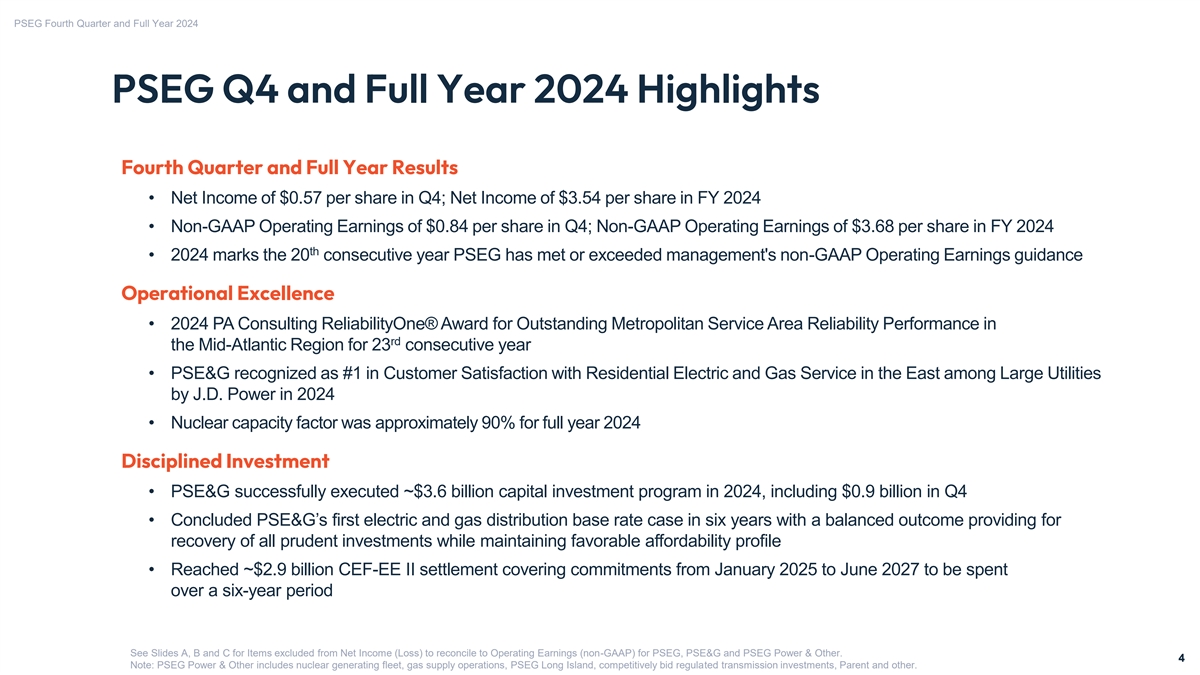
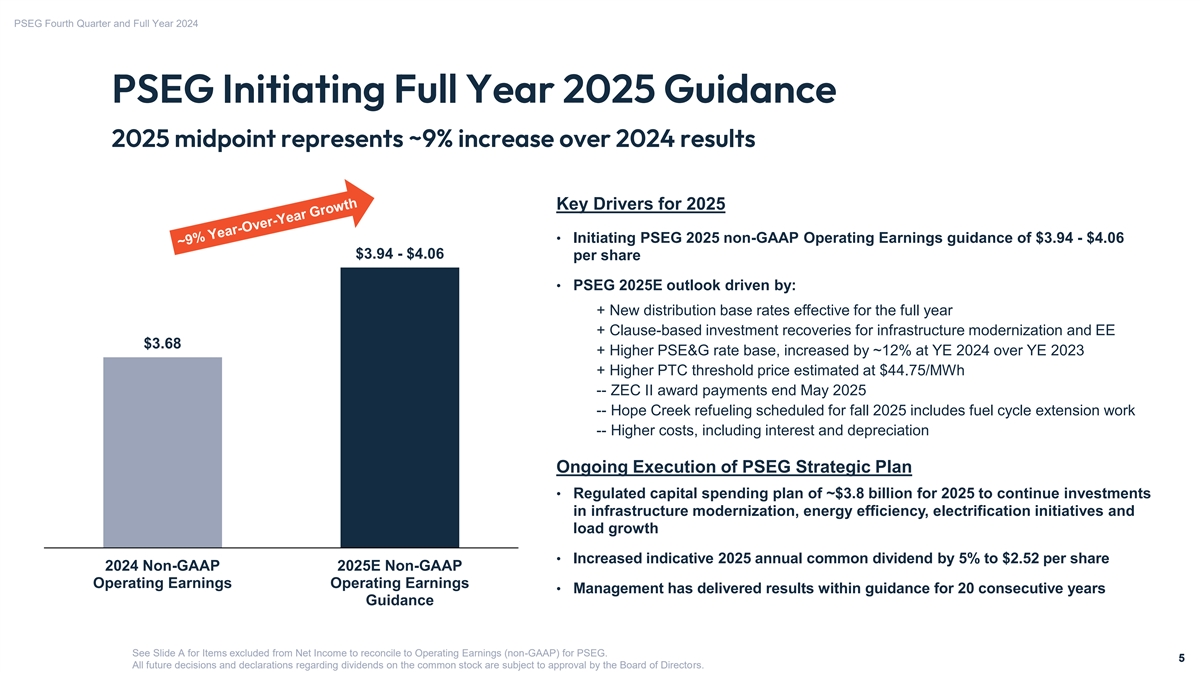
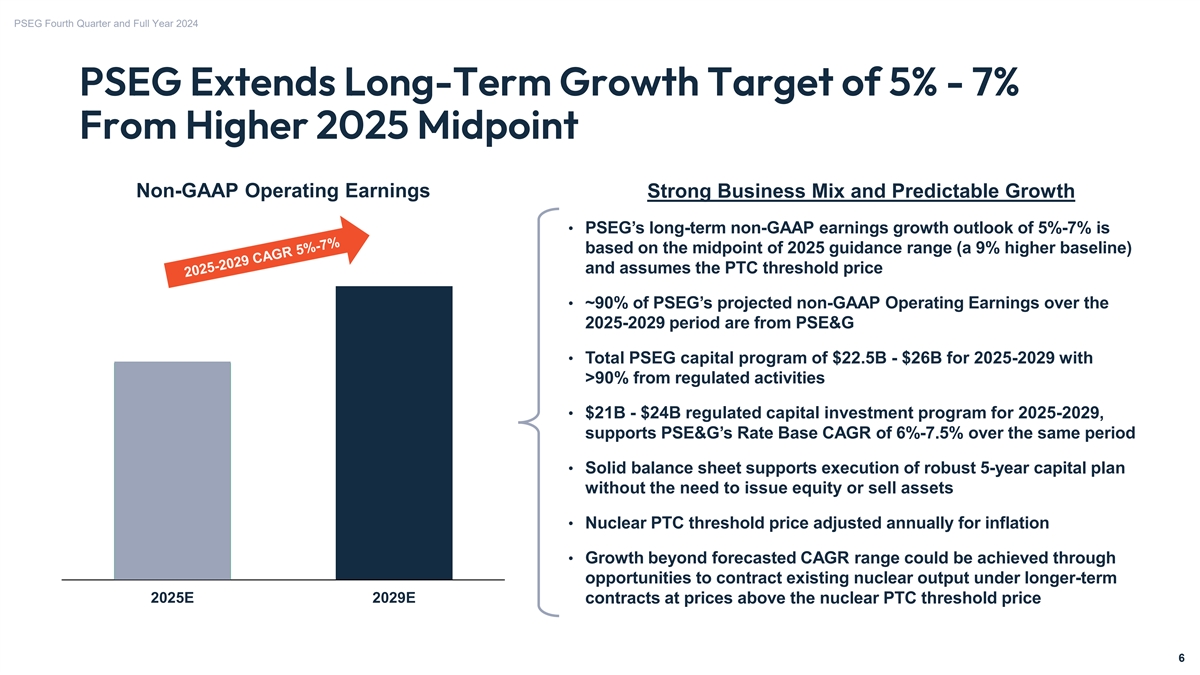
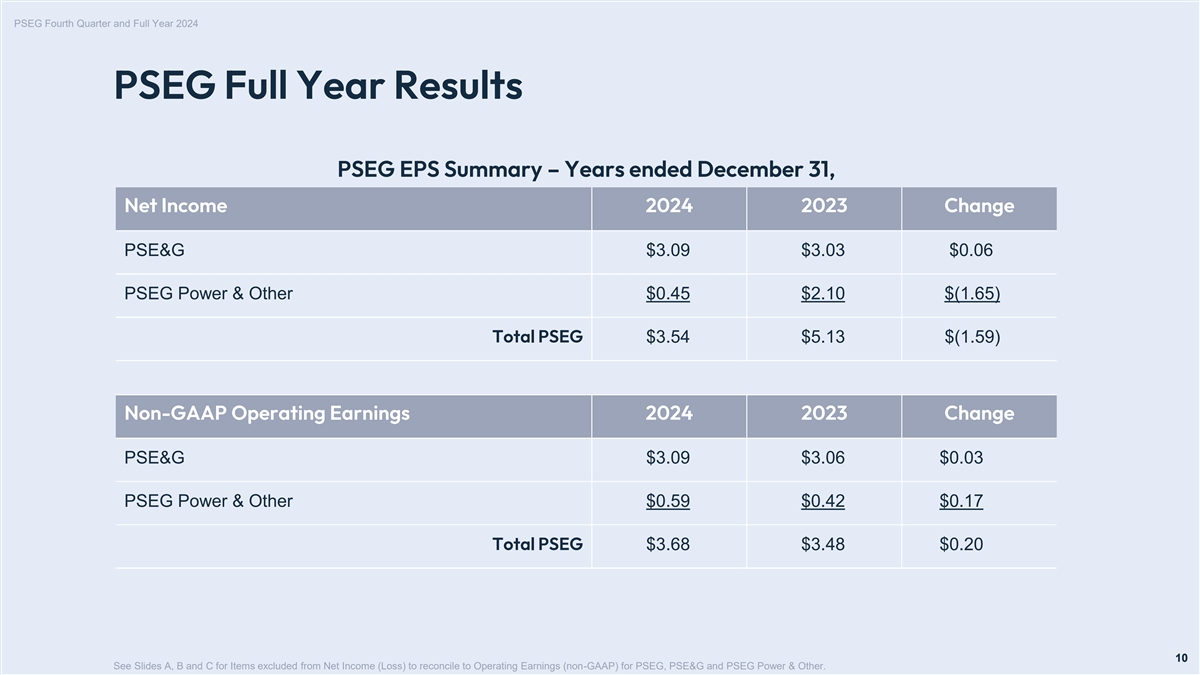
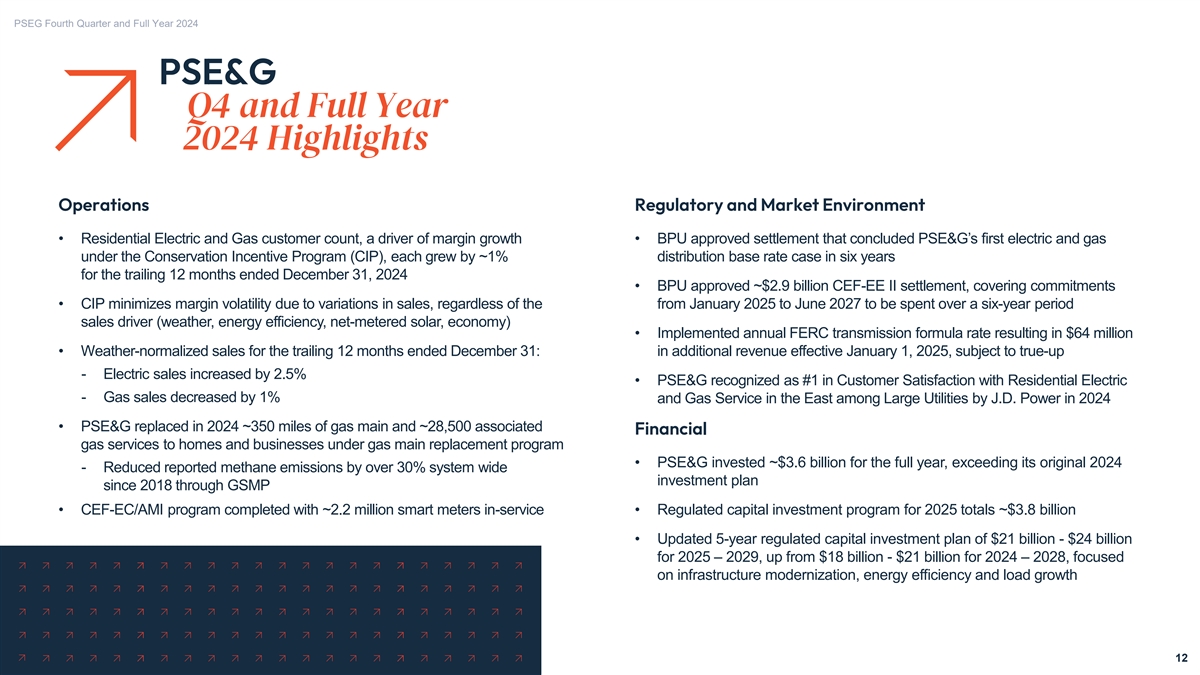
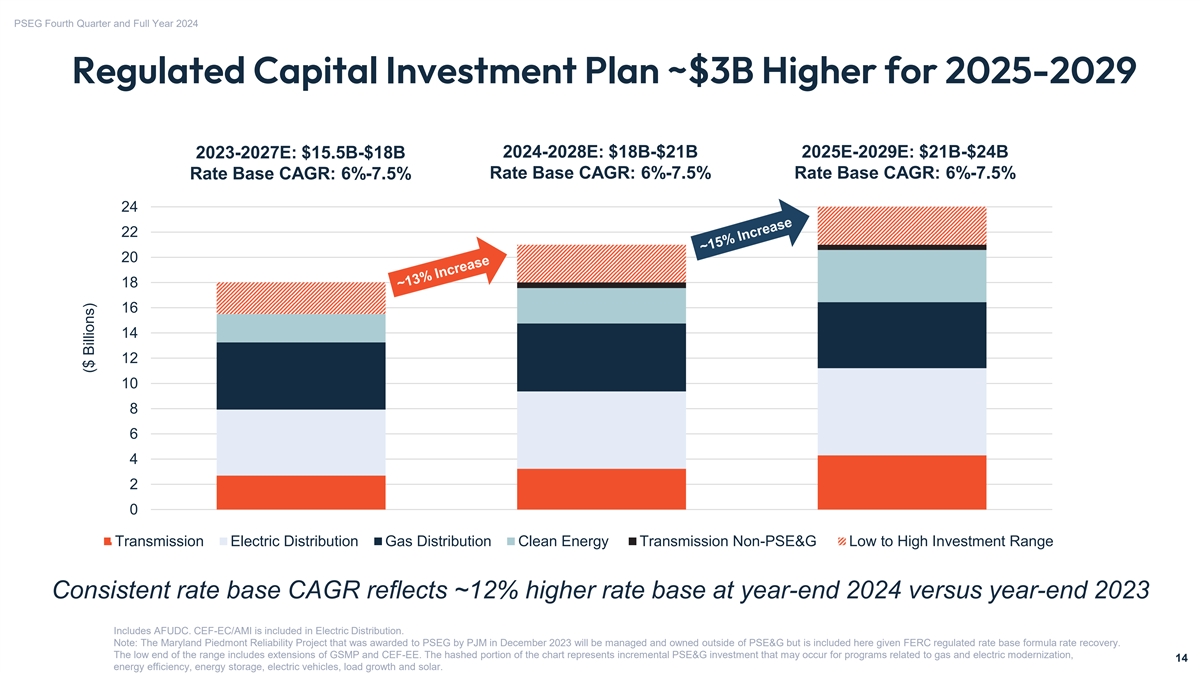
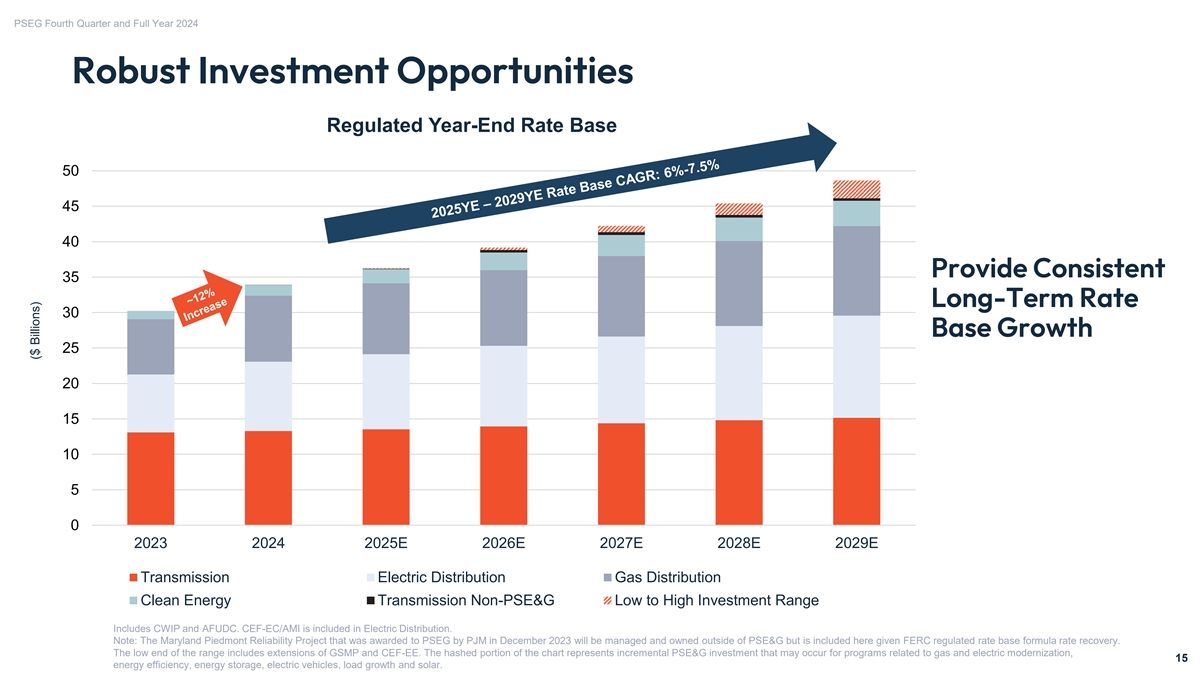
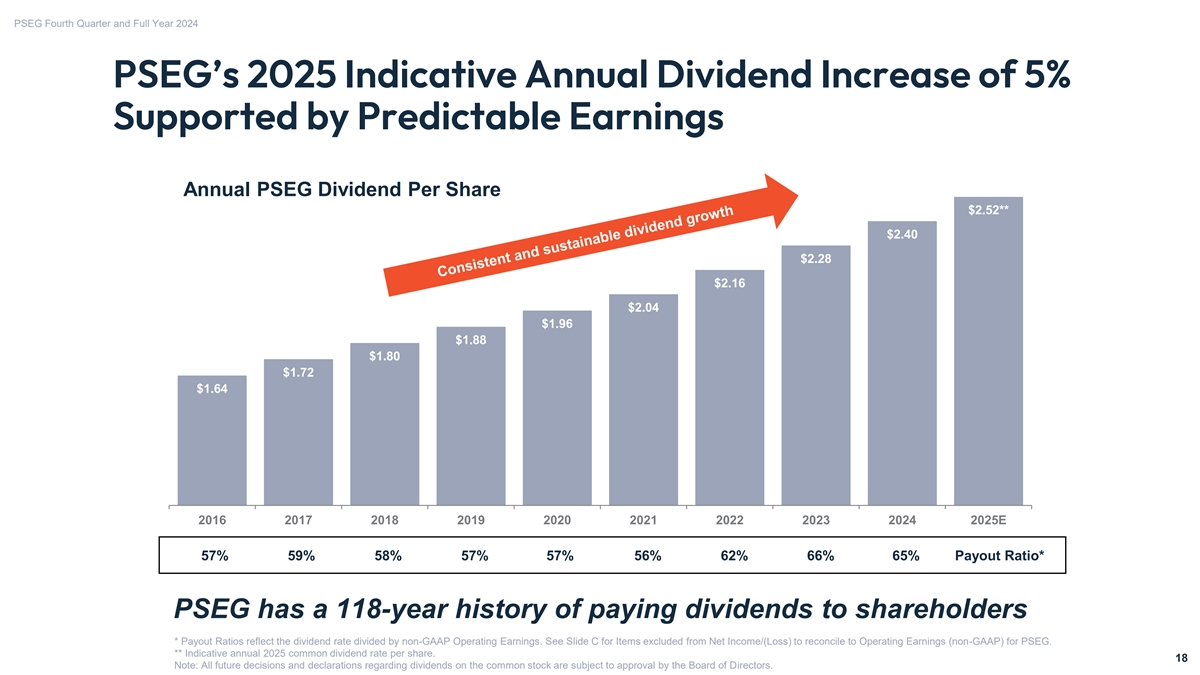
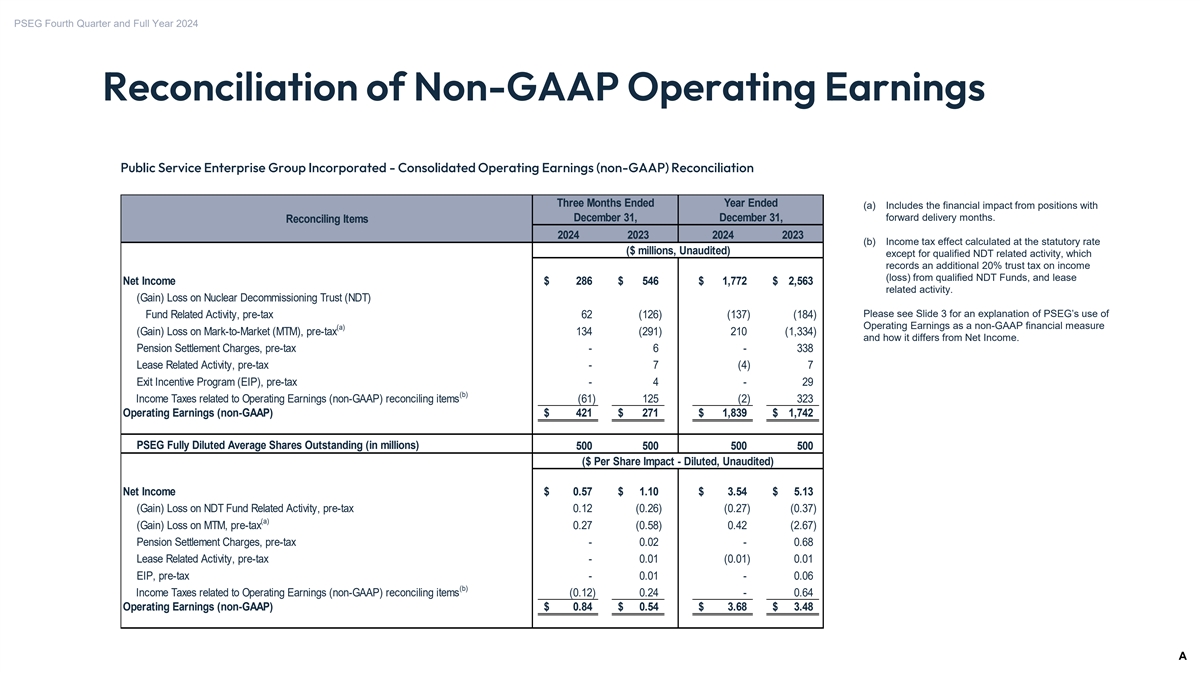
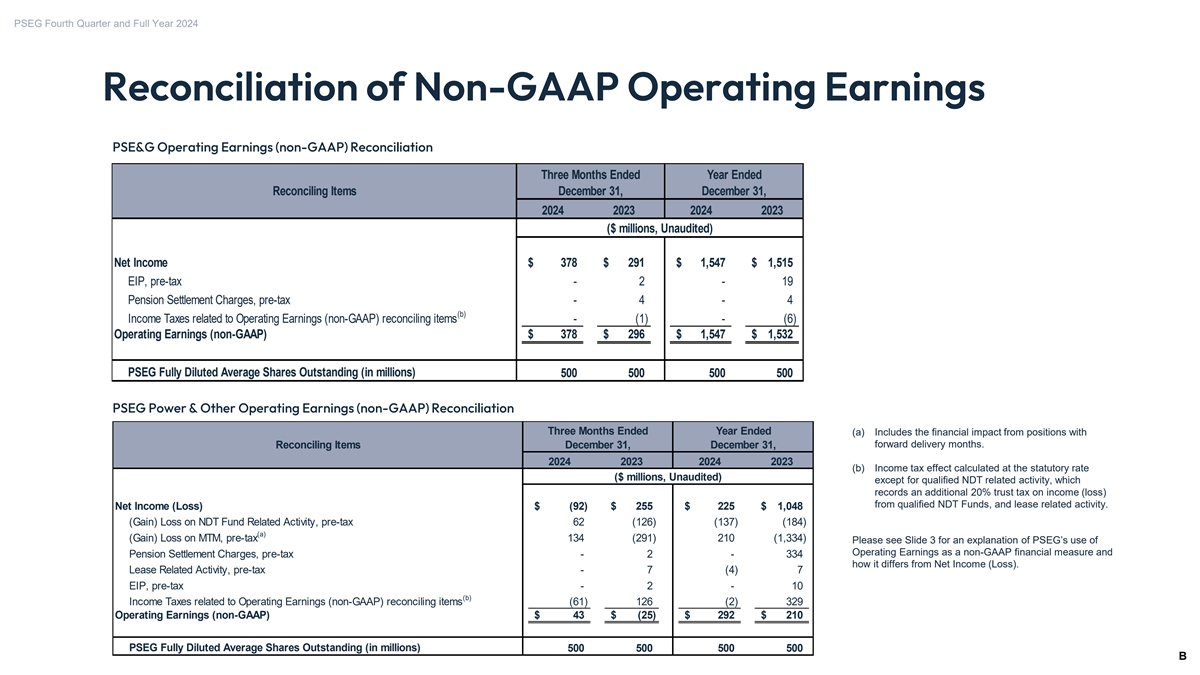
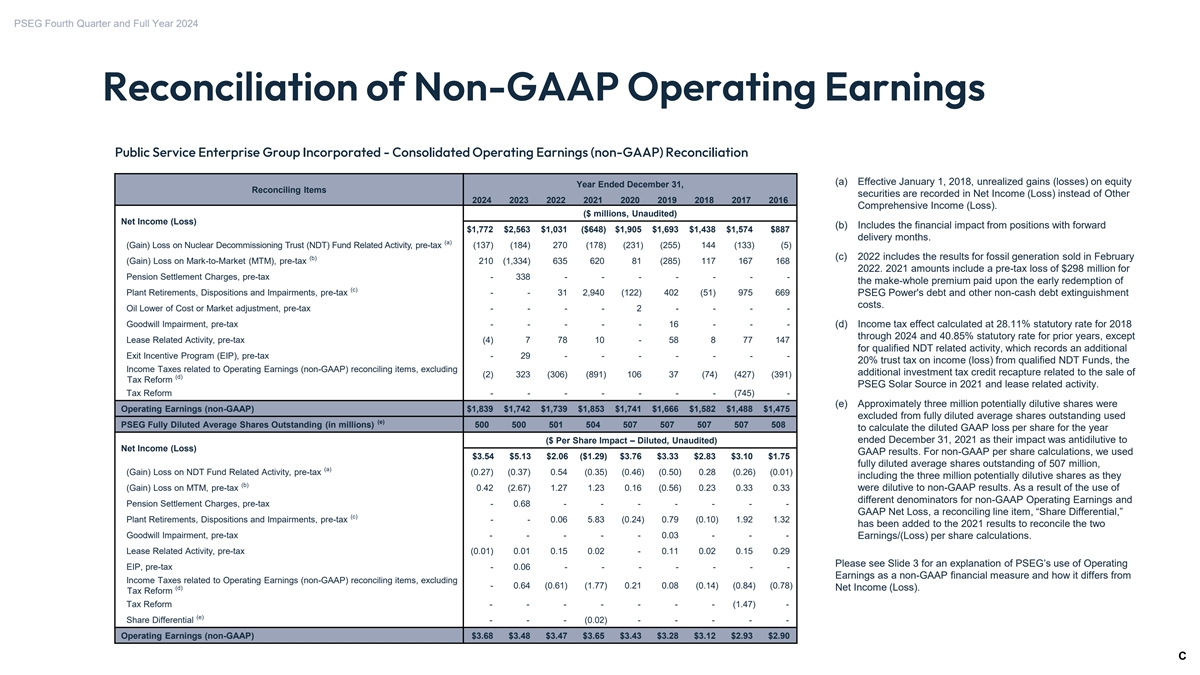
Thank you, Carlotta. Thank you, everyone, for joining us this morning to review PSEG's 2024 results and our outlook for the business going forward. Let's start with our strong results. PSEG reported net income of $0.57 per share for the fourth quarter of 2024 and $3.54 per share for the full year. For non-GAAP operating earnings, PSEG reported results of $0.84 per share for the fourth quarter and $3.68 per share for the full year, which was at the top of our 2024 guidance range. Our reported results for 2024 also marked the twentieth consecutive year that we have met or exceeded management's non-GAAP operating earnings guidance to investors. We are proud of this track record and confident that our team will continue to build on it. We were also successful in achieving our strategic and regulatory objectives for 2024. First, we settled PSE&G's first electric and gas rate case with a balanced outcome that recovers prudent investments, maintains our favorable affordability profile, and mitigates variability for our customers. Second, PSE&G received approval to invest $2.9 billion in its Clean Energy Future Energy Efficiency II program over the upcoming six-year period. This second phase of the Board of Public Utilities statewide energy efficiency framework has resulted in a meaningful increase to the program, which will enable us to make investments at more customer premises to reduce energy usage, improve affordability, and reduce carbon emissions. Third, we efficiently executed the utility's planned $3.6 billion capital spending program and notably completed the advanced metering infrastructure program on time and on budget, installing approximately 2.2 million smart meters in customers' homes and businesses. And fourth, I am very happy to say, we implemented new deferral mechanisms for pension and storm costs. This increases the predictability of PSE&G's future financial results and stabilizes rates for customers. Speaking of customer rates, the new base rates that were placed into effect last October represented an annual increase of about 1% per year since our last rate case in 2018. Also, last October, PSE&G lowered its gas commodity charge to $0.33 per therm for the winter of 2025, the third supply charge reduction since January of 2023. All of these steps will serve to moderate the outcome of the Basic Generation Service auction result, which will increase customer electric bills this June 1. PSE&G's record reliability, affordability, and customer satisfaction continue to be a valuable combination. We were recently named number one in customer satisfaction with residential electric and gas service in the East among large utilities by J.D. Power in 2024. The utility also received the PA Consulting 2024 ReliabilityOne Award for the Mid-Atlantic region for the twenty-third consecutive year. I want to take a moment to recognize and thank all of our over 13,000 employees for the incredible teamwork and individual efforts that delivered 2024 strategic objectives and financial results. So let's turn to our outlook for 2025, starting with slides five and six. For the current year, we have initiated PSEG's non-GAAP operating earnings guidance at $3.94 to $4.06 per share, which is up by 9% at the midpoint over our 2024 reported results. Our 2025 guidance midpoint is the new base year for PSEG's 5% to 7% non-GAAP operating earnings CAGR at the nuclear production tax credit threshold for the 2025 to 2029 period. I would also note this CAGR, while unchanged as we pursue incremental revenue opportunities at PSEG Nuclear, starts from a $4 midpoint of 2025 guidance that is 9% higher than our 2024 non-GAAP results. For 2025, we plan to invest $4 billion across the enterprise, driven by regulated investments. We also raised PSEG's 2025-2029 capital spending plan to $22.5 billion to $26 billion. This increase is largely comprised of incremental investments at PSE&G to meet growing customer demand, modernize infrastructure, and further execute on previously mentioned energy efficiency programs. Please see slides fourteen and fifteen for the updated regulated capital spending plan and rate-based projections for the 2025 to 2029 period. This updated five-year capital spending program is expected to support a PSE&G rate base compound annual growth rate that continues its 6% to 7.5% over the upcoming five-year period, which grows from a starting point of approximately $34 billion, which is notably 12% higher than the year-end 2023 balance. Something new for PSE&G this year has been a significant increase in inquiries from large load and data center customers. Last year at this time, these totaled under 400 megawatts. Today, the interest has grown to 4,700 megawatts, which includes both mature leads and initial inquiries. This pipeline represents an over twelve-fold increase over the last year. The average size of these project leads is in the 100-megawatt range, which can often fit within PSE&G's existing robust utility transmission infrastructure. We are responding to these inquiries in under four months on average. Approximately 25% of the 4,700 megawatts of new business leads have been incorporated into PJM's 2025 system peak load forecast. As I mentioned earlier, the Basic Generation Service auction results will raise the residential bill starting June 1. This increase is being driven by the significant rise in the capacity prices coming out of PJM's latest RPM auction conducted last July, which reflects growing energy demand combined with the need for new power generation. As a reminder, electric supply is a pass-through cost that PSE&G does not earn a profit on. Even with this upcoming BGS increase, our combined bill still compares favorably to all other utilities in New Jersey, and we remain a leader across the nation on our low share of wallet comparison. PSE&G's bill remains at about 3% of total income for medium-income customers and even lower, still approximately 2% for low to moderate-income customers that take advantage of payment assistance programs. Turning to PSEG Power and Other, while the production tax credit threshold provides sufficient support to meet PSEG's 5% to 7% long-term growth outlook, we continue to pursue nuclear revenue growth opportunities at PSEG Nuclear that would be incremental. These opportunities to contract portions of our nuclear output under long-term contracts can also benefit the economic development interests of the state in helping to attract AI hubs to New Jersey. We had an exceptional year in 2024, continuing to execute on our business plan and, in doing so, have made our businesses more predictable and our earnings growth more visible. These benefits will enhance our ability to drive our future performance that prioritizes maintaining our financial strength, making disciplined investments, and delivering operational excellence. Another PSEG distinction we are proud to extend is our ability to continue supporting another robust five-year capital program without the need to issue new equity or sell assets through 2029, even with the latest $3.5 billion increase over the prior plan. Before I conclude, I want to highlight that our Board of Directors recently announced a $0.12 per share increase in PSEG's annual common dividend to an indicative annual rate of $2.52 per share for 2025. This is PSEG's fourteenth consecutive annual increase, made possible by a long-standing commitment to financial discipline that has enabled us to pay a common dividend to our shareholders for 118 consecutive years. I'll now turn the call over to Dan to walk you through the results for the quarter and our outlook for the 2025 through 2029 period, and then rejoin the call for Q&A.

Dan Cregg CFO

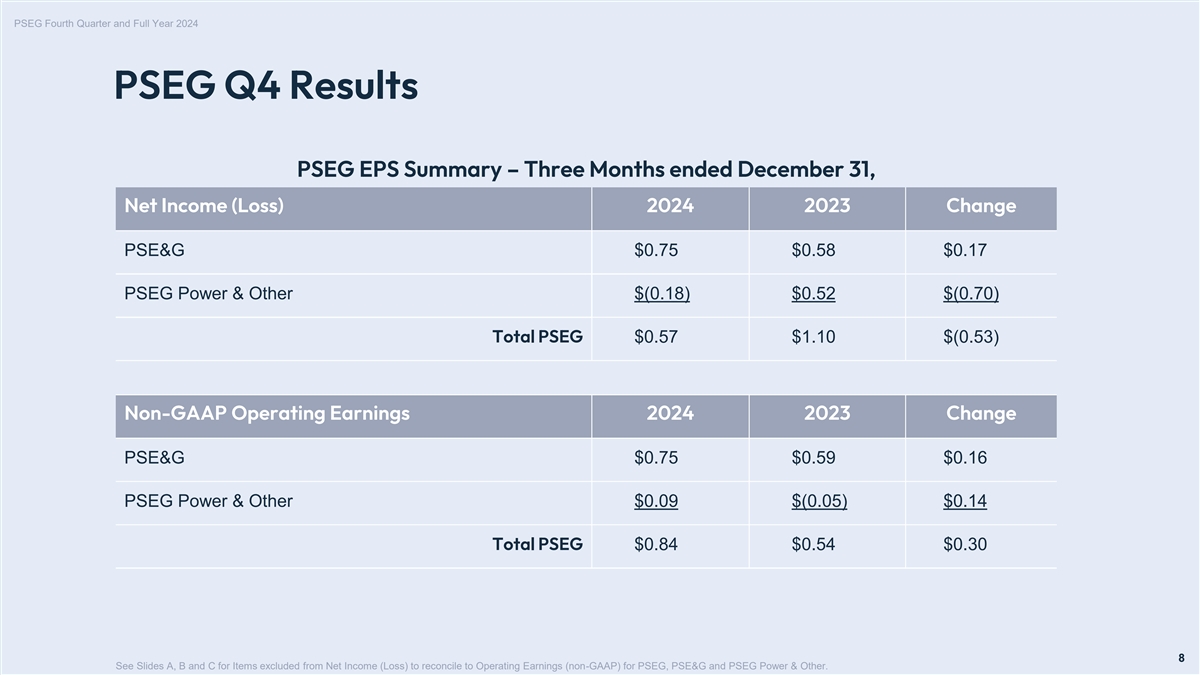
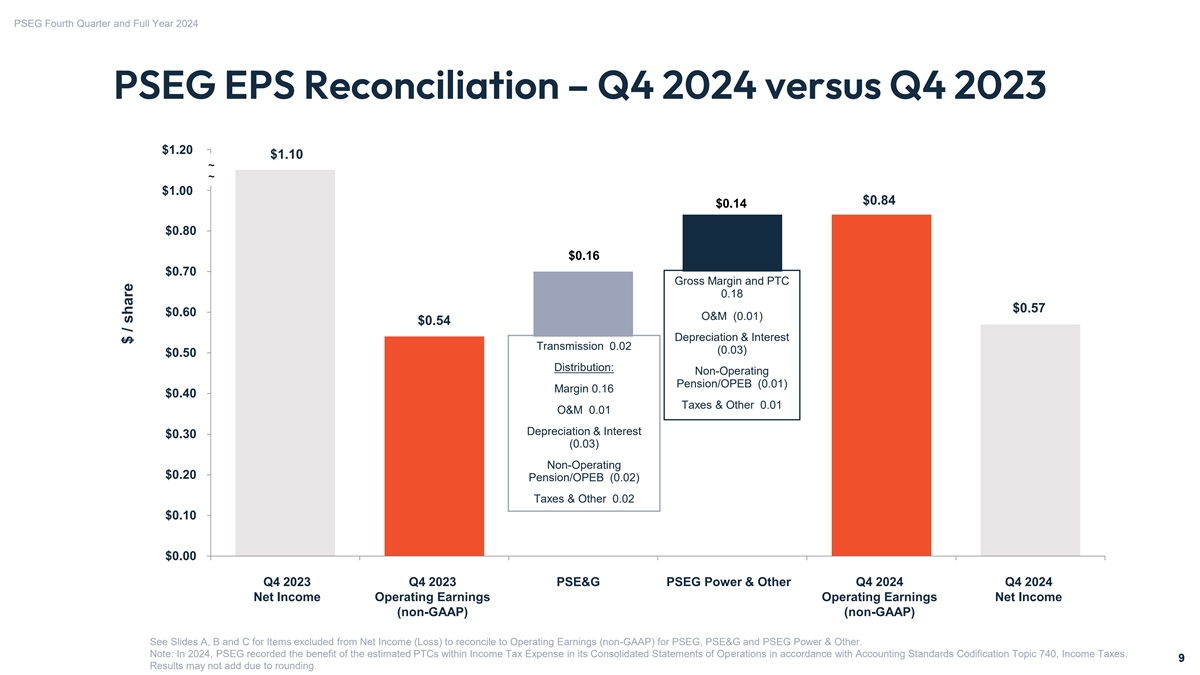
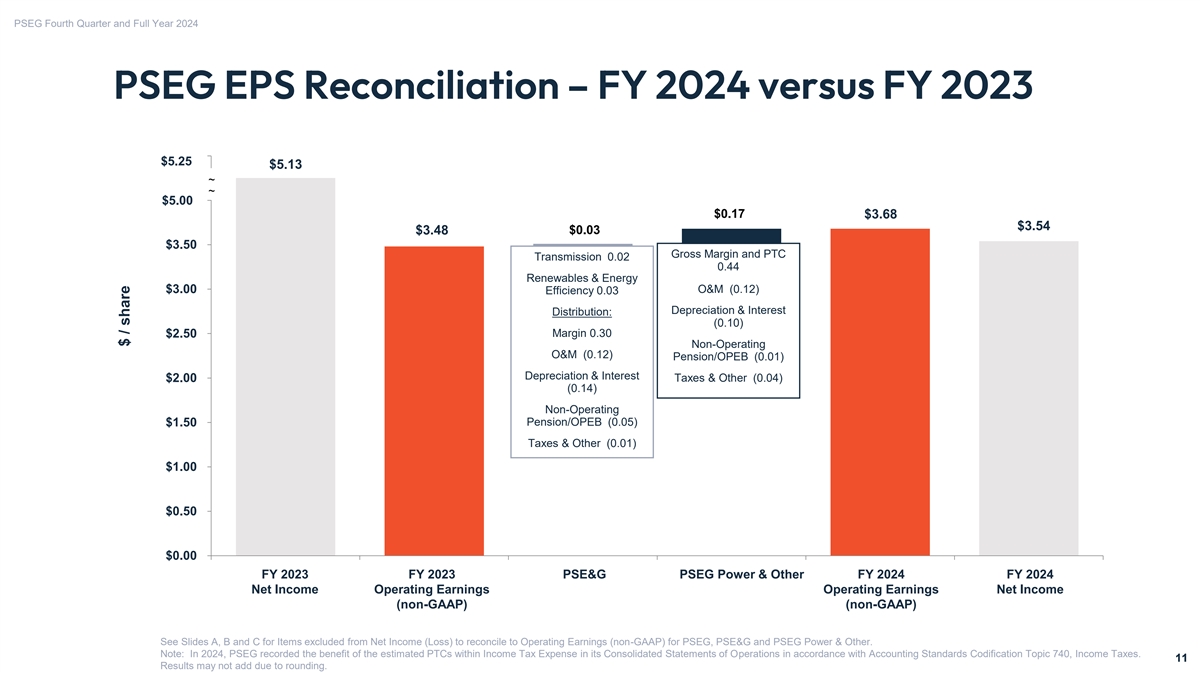
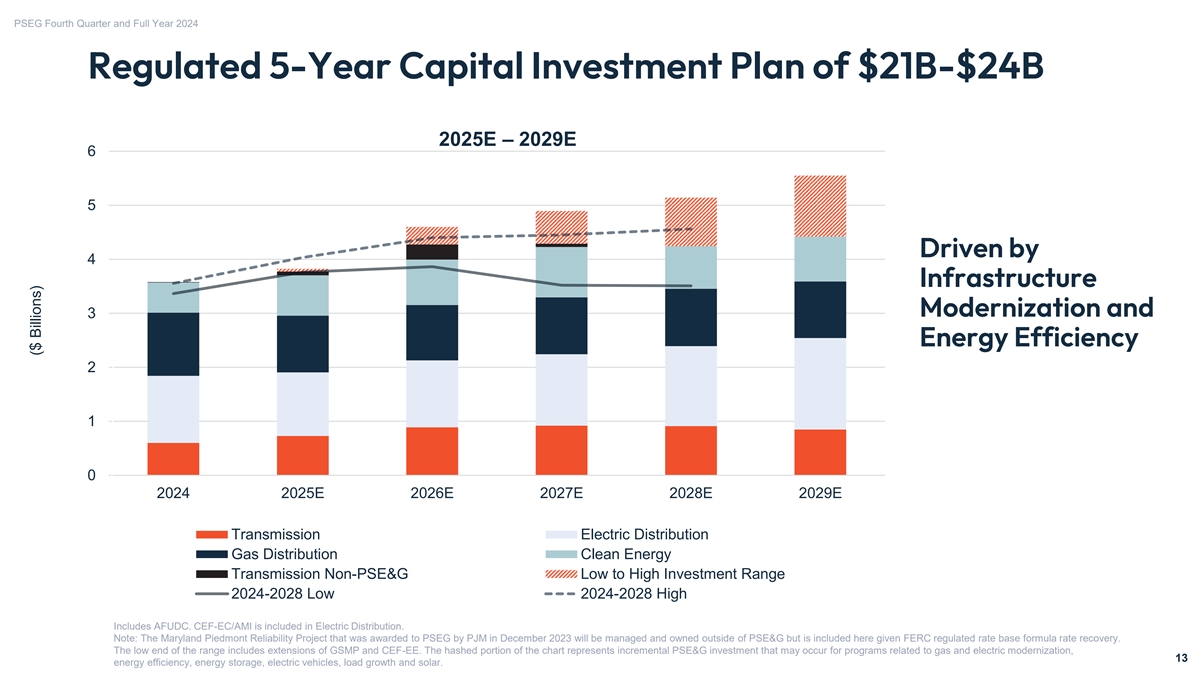
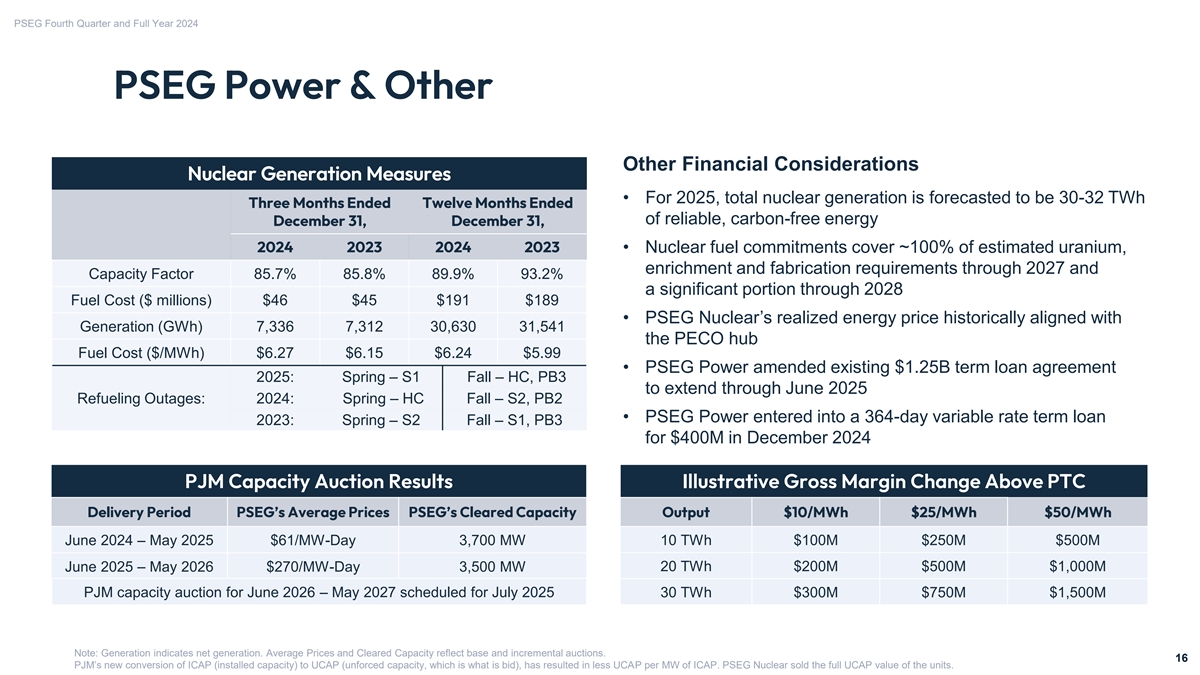
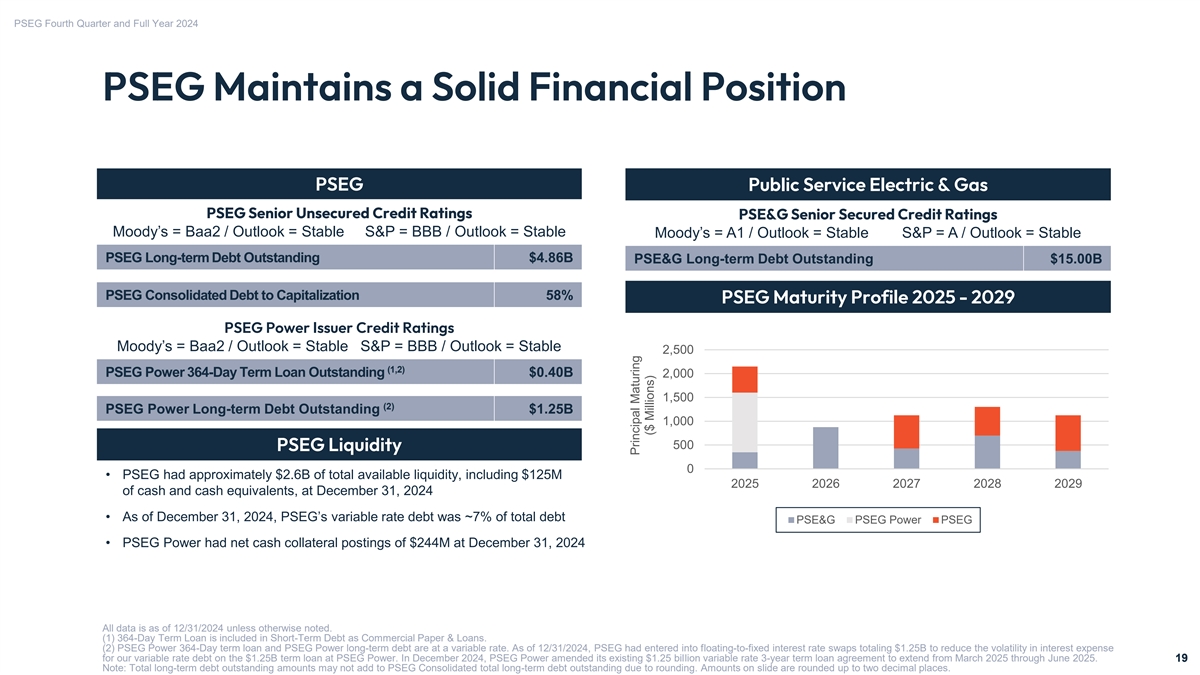
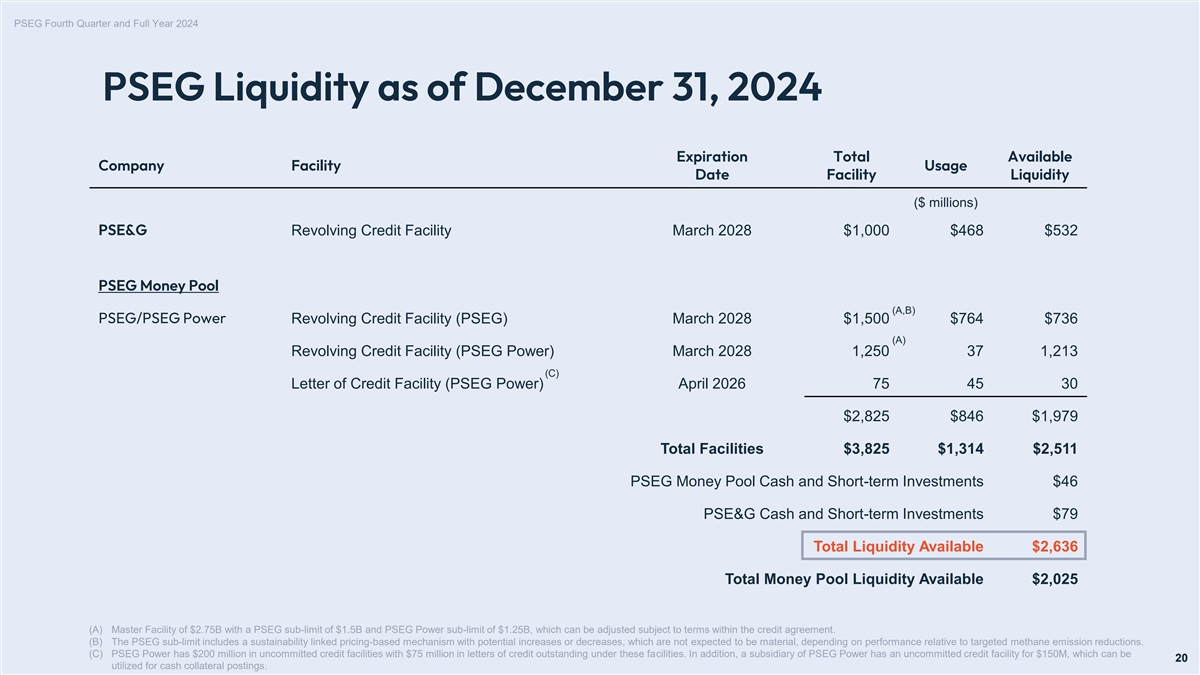
Thank you, Ralph, and good morning, everybody. As Ralph mentioned earlier, PSEG reported net income of $3.54 per share for the full year of 2024, compared with net income of $5.13 per share for 2023. And non-GAAP operating earnings for the full year of 2024 were $3.68 per share compared to $3.48 per share for 2023. For the fourth quarter of 2024, net income was $0.57 per share compared to $1.10 per share in 2023. And non-GAAP operating earnings were $0.84 per share in the fourth quarter of 2024 compared to $0.54 per share in 2023. Slides eight and ten detail the contribution to non-GAAP operating earnings per share by business segment for the fourth quarter and full year of 2024, and slides nine and eleven contain waterfall charts that take you through the changes for the quarter-over-quarter and full-year periods in non-GAAP operating earnings per share by major business. Starting with PSE&G, which reported fourth quarter 2024 net income of $0.75 per share compared to $0.58 per share in 2023. PSE&G had non-GAAP operating earnings of $0.75 per share for the fourth quarter of 2024 compared to $0.59 per share in 2023. Utility results were driven by the implementation of new electric and gas-based distribution rates. The new rates went into effect on October 15. And the fourth quarter results reflect the impact of seasonality of gas revenues during winter months. 2025 comparisons will benefit from a full year of new rates for both gas and electric revenues. Compared to the fourth quarter of 2023, transmission margin was a benefit of $0.02 per share due to higher recovery of investment. Distribution margin increased by $0.16 per share and reflects the impacts of the rate case on gas revenues in the fourth quarter. Distribution O&M expense was a penny per share favorable compared to the fourth quarter of 2023, primarily due to the timing of spending. Depreciation and interest expense rose by a penny per share and $0.02 per share, respectively, compared to the fourth quarter of 2023, reflecting continued growth in investment and higher interest expense. Lower pension and OPEB income resulting from the cessation of OPEB-related credits, which ended in 2023, resulted in a $0.02 per share unfavorable comparison to the year-earlier quarter. And lastly, the timing of taxes recorded through an annual effective tax rate, which nets to zero over the full year, and other taxes had a net favorable impact of $0.02 per share in the fourth quarter compared to 2023. And for the full year, PSE&G results reflect higher earnings from increased investment in infrastructure replacement and energy efficiency, as well as the rate case, partially offset by higher interest and depreciation expense from higher investment balances. Weather during the fourth quarter, as measured by heating degree days, was 12% warmer than normal but 3% cooler than the fourth quarter of 2023. As I'm sure you know, weather variations have a minimal impact on PSE&G's utility margin because of the conservation incentive program. This decoupling mechanism limits the impact of weather and other sales on electric and gas margins while helping PSE&G promote the widespread adoption of its energy efficiency program. Under the CIP, the number of electric and gas customers is what drives margin, and each segment grew by approximately 1% in 2024. Capital spending, as Ralph mentioned, PSE&G invested approximately $0.9 billion or $900 million during the fourth quarter, and for the full year 2024, our capital spending totaled $3.6 billion, slightly higher than our original plan of $3.4 billion based on the continued execution of our electric system reliability programs, including Energy Strong and last-mile spend in the IAP, our ongoing gas infrastructure replacement spending, as well as our energy efficiency program. For 2025, we plan to invest approximately $3.8 billion in regulated investments focused on infrastructure modernization, energy efficiency, and meeting growing demand and electrification initiatives. We've rolled forward our five-year regulated capital investment plan through 2029, amounting to $21 billion to $24 billion compared to our prior plan of $18 billion to $21 billion. The $3 billion increase in regulated under PSE&G's existing infrastructure programs and the CEF-EE II Program. Our 2025 to 2029 regulated capital investment plan is expected to produce compound annual growth in rate base of 6% to 7.5%, starting from a year-end 2024 rate base of approximately $34 billion, and as Ralph mentioned, an increase of approximately 12% over the same number for year-end 2023. Moving to PSEG Power and Other. For the fourth quarter of 2024, PSEG Power and Other reported a net loss of $0.18 per share compared to net income of $0.52 per share in the fourth quarter of 2023. Non-GAAP operating earnings were $0.09 per share for the fourth quarter compared to a non-GAAP operating earnings loss of $0.05 per share in the fourth quarter of 2023. For the fourth quarter of 2024, net energy margin rose by $0.18 per share driven by higher recontracting prices at nuclear, which includes the net impact of the nuclear production tax credit that took effect January 1, 2024. As anticipated, we realized a significant portion of the increase in the 2024 gross margin over 2023's gross margin during the second half of the year, based upon the shape of our underlying hedges. O&M was a penny per share unfavorable, interest expense was $0.02 per share higher, reflecting incremental debt at higher rates, and lower pension income and OPEB credits were $0.01 per share unfavorable versus the fourth quarter of 2023. Taxes and other were a penny per share favorable compared to the year-earlier quarter. On the operating side, the nuclear fleet produced approximately 7.3 terawatt-hours during the fourth quarter and approximately 31 terawatt-hours for the full year, running at a capacity factor of approximately 86% and 90% for the quarter and full year, respectively. Touching on some recent financing activity, as of the end of December, PSEG had total available liquidity of $2.6 billion, including approximately $100 million of cash on hand. Through December 2024, cash from operations was strong, though well below the 2023 level, which was substantially helped by the return of cash collateral. Our cash collateral balance was approximately $250 million as of December 31. We've supported our strong liquidity position. Last November, PSE&G repaid its $250 million 3.05% secured medium-term notes upon maturity. And in December of 2024, PSEG Power entered into a new 364-day variable rate term loan for $400 million, supported by the strength of its cash flow. And also in December, PSEG Power amended its existing $1.25 billion variable rate three-year term loan agreement to extend the maturity from March to June of 2025, which helps manage our cash position during the upcoming year. At the end of 2024, Power had $1.65 billion of debt outstanding, with $1.25 billion swapped to a fixed rate, mitigating fluctuations in interest rates through March of 2025. And given our swaps, we continue to have a low level of variable rate debt, approximately just 7% of total debt at year-end. Looking ahead, our solid balance sheet supports the execution of PSEG's five-year capital spending plan dominated by regulated CapEx without the need to sell new equity or assets and provides for the opportunity for consistent and sustainable dividends. Now before I conclude my remarks, let's review some earnings drivers for 2025, and those are outlined on Slide five. The most impactful driver will be the implementation of new distribution base rates in effect for the full year. Recall that the fourth quarter of 2024 is a seasonal peak for gas, which comes into play in a projection of the new base rates over a full year. Also note electric seasonality will produce a similar impact from the third quarter of the year. In addition, clause-based recoveries for investments in GSMP, the Infrastructure Enhancement Program or IAP, and the CEF-EE II program will also add to the 2025 utility margin. Partly offsetting these positives are higher O&M, interest, and depreciation expense, reflecting higher investment balances of PSE&G, as well as higher interest expense at PSEG Power and parent related to refinancing maturities at higher current interest costs. At PSEG Nuclear, our 100% owned Hope Creek nuclear unit has a scheduled refueling set for the fall of 2025 that will include the fuel cycle extension work to extend its next scheduled refueling in 24 months, for the fall of 2027. And as a reminder, the zero-emission certificate amounts earned by our New Jersey nuclear units will conclude in May of 2025. In closing, we delivered our twentieth year in a row of meeting or exceeding our guidance. And we carry that confidence forward to our full-year 2025 non-GAAP operating earnings guidance of $3.94 to $4.06 per share, approximately 9% higher at the midpoint over 2024 results. We also expanded our 5% to 7% non-GAAP operating earnings CAGR through 2029, starting with 2025 as the base year. As Ralph mentioned, we're continuing to pursue incremental revenue opportunities at PSEG Nuclear, which could enhance our long-term growth CAGR relative to the range that we provided based on the production tax credit. That concludes our formal remarks, and we are ready to begin the question and answer session.

Operator

Thank you. Ladies and gentlemen, we will now begin the question and answer session for members of the financial community. If you have a question, please press the star and the number one on your telephone keypad. If your question has been answered and you wish to withdraw your polling request, you may do so by pressing the star and the number two. If you are on a speakerphone, please pick up your handset before entering your request. One moment, please, for the first question. The first question comes from the line of Shar Pourreza with Guggenheim Partners. Please proceed with your questions.

Speaker 4

Hey, guys. Good morning. Ralph, starting off on the nuclear side with Artificial Island, do you see commercial discussions being delayed with the recent actions at FERC? Does the complexity of behind-the-meter deals change the deal structure to potential opportunities around the side of the meter? And any sense on timing, especially given the governor's ambitions? Thanks.

Speaker 2

Thanks, Shar. I'll let Dan give you some details on that. Since you mentioned the governor, I would note the New Jersey Economic Development Authority has made comments about their wind port and that they are looking at alternative uses for that wind port. The governor has also mentioned that they're looking at alternate uses for it. You can put those pieces together, and we know there is interest from the governor's standpoint and from New Jersey's standpoint to continue to pursue these opportunities. Regarding timing, Dan can address the commercial discussion specifics and the details related to FERC.

Dan Cregg CFO

Shar, our messaging remains consistent. We continue to see interest and are having discussions with multiple parties across the various elements we're talking about, and that interest remains strong. On FERC, while it would have been great to have complete answers, we did not necessarily expect that. Directionally, what they said was favorable for the flexibility to do what you want to do, though details are yet to come. We'll continue to see what happens, but our messaging about nuclear and the related opportunities remains consistent.

Speaker 2

To add, the timing of it is pretty aggressive, and it was a clear message from FERC on their need to get to a solution. We took that as a positive. We could have been in a different place, but the message reinforces the potential for solutions. There are still front-of-the-meter and other offload opportunities, and while the leading potential solution discussed was behind the meter, there are alternatives.

Speaker 4

That's a fair point. I appreciate that, Ralph. Just to be clear: does the PSE&G pipeline of opportunities and inquiries you highlighted, the over four gigawatts, negate any of the Artificial Island opportunities? In other words, is there any chance that a potential deal with Artificial Island shifts towards front of the meter with PSE&G, or are the Artificial Island counterparties completely separate from the PSE&G conversations you highlighted? Thanks.

Speaker 2

The 4,700 megawatts includes data centers and other large load requests, and we are still seeing some large electric vehicle interconnections. There are two takeaways. First, there is clear interest in data centers in New Jersey. Second, the state's marketing efforts are working. There are multiple initiatives taking hold—developments like the helix in New Brunswick and announcements from organizations moving into the area. We expect the momentum to continue.

Speaker 4

Fantastic. Thank you guys so much. Appreciate it and great execution.

Operator

The next question is from the line of David Arcaro with Morgan Stanley. Please proceed with your question.

David Arcaro Analyst — Morgan Stanley

Hey, thanks. Good morning. The PJM auction has been getting a lot of attention recently. FERC is going to be relooking at auction structures, and a number of changes are underway now. I was wondering if you could comment on how you're thinking about the outlook for the PJM market, what could change, and whether there are possibilities of structural changes. How do you navigate that, both from a customer impact perspective and for your nuclear fleet?

Speaker 2

We are setting our targets off the production tax credit floor. From a customer standpoint, we'll do everything we can to help keep customer costs down. We will continue to advocate on customers' behalf. I have concerns about reliability in the current construct—whether the region can attract generation in a timely way. Those questions focus on reliability and affordability, and we will keep advocating for customers on both fronts.

Dan Cregg CFO

David, there are longer-term elements that are important for resource adequacy, and it's vital to get that right. For the nearer term, if a collar in pricing is implemented for a couple of years, it could provide more stability. Financially, our guidance is positioned at the PTC floor. If markets move below that, the floor provides protection; if they move above, there could be upside. Job one is getting resource adequacy right.

David Arcaro Analyst — Morgan Stanley

I appreciate that color. Relatedly, is the uncertainty a deterrent broadly in the market? With changes being considered for the auction construct and resource adequacy challenges ahead, are you seeing lower interest levels from some customers? Any perspective would be helpful.

Speaker 2

I would point you back to the increase from around 400 megawatts to 4,700 megawatts of interest in large load in New Jersey. So at least in New Jersey, we are still seeing strong interest despite the uncertainty.

David Arcaro Analyst — Morgan Stanley

Got it. That's fair. Great. I'll leave it there. Thanks so much.

Operator

Our next question is from the line of Nicholas Campanella with Barclays. Please proceed with your questions.

Nicholas Campanella Analyst — Barclays

Hey, good morning, everyone. Thanks for taking the time. I want to follow up on Shar's question about bringing a commercial deal forward for the nuclear fleet. Are you still watching and waiting for the state at this point, or is it really waiting on FERC? And as we think about timeline, if a large load customer was able to connect to the facility, what's the timeline for ramp? Could that affect earnings in 2027, or is it more likely later in the decade?

Dan Cregg CFO

Nick, we're not waiting on the state, and we're not waiting on FERC to continue working. Some details about flexibility may come from FERC, but there is ability to continue work and we are continuing. They indicated urgency, and that will be helpful, but it is not stopping activity. As for timing, if there is a sale of what exists today, something could happen more quickly. If a customer needs a new data center built, that will take longer. The nature of the transaction will dictate when you might see an impact to the bottom line.

Nicholas Campanella Analyst — Barclays

Okay, I appreciate that. And the ramp for a customer—these data centers take time to ramp. Is this something that you think can impact the five-year plan, or is it more long-dated?

Dan Cregg CFO

Depending on whether there's an immediate sale of existing output or a need to build new infrastructure, timing will vary. That will determine the potential impact on our five-year outlook.

Nicholas Campanella Analyst — Barclays

I appreciate that. And following up on the capacity auction commentary, if we continue to clear near the $270 level, how does that impact your gross receipts calculation at the PTC threshold and where you are in the range?

Dan Cregg CFO

You need to look at what's in place from the standpoint of hedging and then layer capacity prices on top. The capacity auction is structured on a net cone, which is net of energy, so there's a relationship between energy and capacity prices. When capacity rises, energy can react lower, and vice versa. If energy increases and you clear higher, it could move us higher in the range or above the range, depending on the movement. Remember, the PTC floor provides comfort; upside exists if markets move higher.

Speaker 2

Also note there is an inflation adjustment to that floor, which will affect where those lines cross in out years.

Nicholas Campanella Analyst — Barclays

Absolutely. I appreciate the commentary. Thank you.

Operator

Our next question is from the line of Paul Fremont with Ladenburg Thalmann. Please proceed with your question.

Speaker 7

Great. First question: can you give any color on hedges that you have at PSEG Power? Normally you would be around 90% for this year. How should we think about past guidance versus where you are right now?

Dan Cregg CFO

Paul, we have tried to balance the existing uncertainty around the definition of gross receipts to minimize our risk, understanding we have a PTC floor. Directionally, that hasn't resulted in radical shifts from what hedging percentages would have been under a ratable approach. Think of it as somewhere in the nineties in 2025, maybe two-thirds in 2026, and a third in 2027—that's consistent with a ratable approach, and while we've made some movements, don't think of them as radically different.

Speaker 7

Great. Also, you used to provide a breakout of net income guidance between the utility and PSEG Power and Other. Is there a reason you haven't done that this year?

Speaker 2

We made that change a year or two back and are comfortable leaving guidance at the enterprise level. It's still roughly 90% utility, so we're comfortable discussing results at the enterprise level.

Speaker 7

And the gross margin sensitivity that you provide includes capacity prices to the extent auctions continue. In other words, does your dollar-per-megawatt-hour sensitivity include the capacity auction dollar-per-megawatt-day equivalent?

Dan Cregg CFO

Think about it as an all-in price per megawatt-hour. Yes, you would variableize the fixed charge, but the sensitivity is intended to reflect an all-in view, including the capacity component.

Speaker 7

Great. Thank you very much.

Operator

The next question is from the line of Paul Zimbardo with Jefferies. Please proceed with your question.

Speaker 2

We might have lost Paul. Might have lost him.

Operator

Our next question is from the line of Paul Patterson with Glenrock Associates. Please proceed.

Speaker 8

Hey. On the timing for the colocation guidance and the item you referenced, I noticed the language that the chair reiterated on Friday. What does that actually mean in terms of when you think an actual order or decision might come out?

Dan Cregg CFO

I have to take the statements at face value that they want to come out shortly thereafter. They used language suggesting a short timeframe. We've seen the team be consistent in delivering on statements in the past, so I wouldn't expect much beyond the sixty days if that path is taken.

Speaker 8

You also mentioned there might not be a PJM market anymore. Given the activity and apprehension around reliability and pricing, do you have thoughts on what a longer-term setup might be or how the market might evolve?

Speaker 2

It will depend on the state and economic policies. I can speak for New Jersey: we have the Basic Generation Service established in law since the early 2000s, and utilities are not involved in that process. New Jersey is at a crossroads and needs to figure the best path forward. I don't want to pre-empt policy decisions being made in the state, but this will remain a topic of discussion with affordability and reliability as key concerns.

Speaker 8

Any idea when we might see a proposal?

Speaker 2

There is some talk about it and a master plan coming out. To be honest, I think some decisions may bridge administrations in New Jersey. As a company, we're trying to educate stakeholders and help think through different opportunities the state could pursue.

Speaker 8

Okay. Great. I appreciate it. Thanks so much.

Operator

The next question is from the line of Carly Davenport with Goldman Sachs. Please proceed.

Speaker 9

Hello. Thanks for taking the question. On the GSMP III filing, do you still expect to revisit that this quarter? And would that be upside to the plan in 2025, or are there already assumptions baked in after the GSMP II extension runs its course?

Speaker 2

Yes, Carly. We are starting those conversations, and it is in the plan. That work is part of our core business activities and something we expect to continue.

Speaker 9

Great. Thank you for that. I'll leave it there.

Operator

The next question is from the line of Paul Zimbardo with Jefferies. Please proceed.

Speaker 10

Can you hear me? The neighborhood reception wasn't the best earlier. I wanted to follow up on the balance sheet side. I saw the no additional equity in the outlook even with the CapEx increase. Can you level set what 2024 FFO to debt was and where you envision credit metrics going throughout the plan?

Dan Cregg CFO

Paul, I don't have that at my fingertips, and you'll be able to pull that together when the 10-K comes out, so I won't jump that. But looking forward and putting forward the guidance for the next few years, we continue to be in the mid-teens range for FFO to debt and are in a pretty good place from that perspective. That is why we are comfortable stating there is no need for new equity in this plan.

Speaker 10

Okay. I'll follow up on that. I also wanted to ask about the BGS results for commercial and industrial in your zone—they were high on a dollar-per-megawatt-day basis. You did not purchase for that with your unregulated fleet. Any takeaways on what that indicates for New Jersey if there isn't robust supply response?

Speaker 2

In the numbers published by the state, our area was around $17 per megawatt day all-in, while some other areas were higher in the twenties. Those are Basic Generation Service provider-of-last-resort rates. Customers have the opportunity to shop, and we expect some of that to happen with third-party suppliers. For customers relying on BGS, we'll focus on payment assistance and energy efficiency programs to help affordability and access. We are higher but not as high as some other areas in the state.

Dan Cregg CFO

Just a reminder: BGS is a pass-through and not something we profit from. The biggest driver of the increase is the auctions at PJM. You'll likely see more interest in shopping, but providers will have to return to the same wholesale markets that had higher prices in the last auction.

Speaker 10

Okay. Thank you very much.

Operator

Our final question is from the line of Anthony Crowdell with Mizuho. Please proceed with your question.

Speaker 11

Hey. Good morning, Dan. Good morning, Ralph. Quick follow-up to Paul Patterson and your comment about the PJM market. Is the state of New Jersey in a net long position on generation? If so, what's the reserve margin there, or do you have one?

Speaker 2

New Jersey does not have an integrated resource plan, so there isn't a state reserve margin set that can be quoted. We are short—New Jersey is a net importer, especially on peak days. PJM's last numbers showed about a 2% margin above their target. As load comes in, the reserve margin will need to be reevaluated and is part of the resource adequacy discussion we keep having.

Speaker 11

Is an FRR-type option—where load and generation are pulled together—one of the options the state could consider, or should we think differently?

Speaker 2

Yes, the state could consider that and a range of other options. Remember, BGS is the existing legal framework in New Jersey, and PJM is the market we participate in. The balance between affordability, reliability, and a market structure is complex, and states will evaluate alternatives.

Speaker 11

Great. Thanks for taking my questions.

Operator

Thank you. I'd like to turn the floor back to Mr. LaRosa for closing comments.

Speaker 2

Well, thank you, Rob. We had a lot of conversation about where we expect to be on nuclear output and potential data centers, but I don't want to lose sight of all the good work completed in 2024. The team executed on everything in front of it last year, including the rate case, storm response, and cold weather events. I want to end with a thank you to the employees at PSEG. They do a fantastic job day in and day out, and that shows up in many areas. Thank you. We look forward to seeing you at one of the roadshows.

Operator

Ladies and gentlemen, this concludes today's teleconference. You may disconnect your lines at this time. Thank you for your participation.