Operator
Good morning, and welcome to the IAC Third Quarter 2025 Earnings Conference Call. Please note this event is being recorded. I would now like to turn the conference over to Mr. Christopher Halpin, COO and CFO. Please go ahead, sir.
Thank you. Good morning, everyone. Christopher Halpin here, and welcome to the IAC Third Quarter Earnings Call. Joining me today are Barry Diller, Chairman and Senior Executive of IAC; and Neil Vogel, CEO of People Inc. IAC has published a presentation on the Investor Relations section of our website today entitled Q3 Earnings Presentation. On this call, Barry, Neil, and I will provide some introductory remarks referencing that presentation and then open it up to Q&A. Before we get to that, I'd like to remind you that during this call, we may make certain statements that are considered forward-looking under the federal securities laws. These forward-looking statements may include statements related to our outlook, strategy, and future performance and are based on current expectations and on information currently available to us. Actual outcomes and results may differ materially from the future results expressed or implied in these statements due to a number of risks and uncertainties, including those contained in our most recent annual report on Form 10-K and in the subsequent reports we filed with the SEC. The information provided on this conference call and in the presentation should be considered in light of such risks. We'll also discuss certain non-GAAP measures, which, as a reminder, includes adjusted EBITDA, which we'll refer to today as EBITDA for simplicity during the call. I'll also refer you to our earnings release, investor presentations, our public filings with the SEC, and again, to the Investor Relations section of our website for all comparable GAAP measures and full reconciliations for all material non-GAAP measures. And now I will hand it over to Barry Diller.
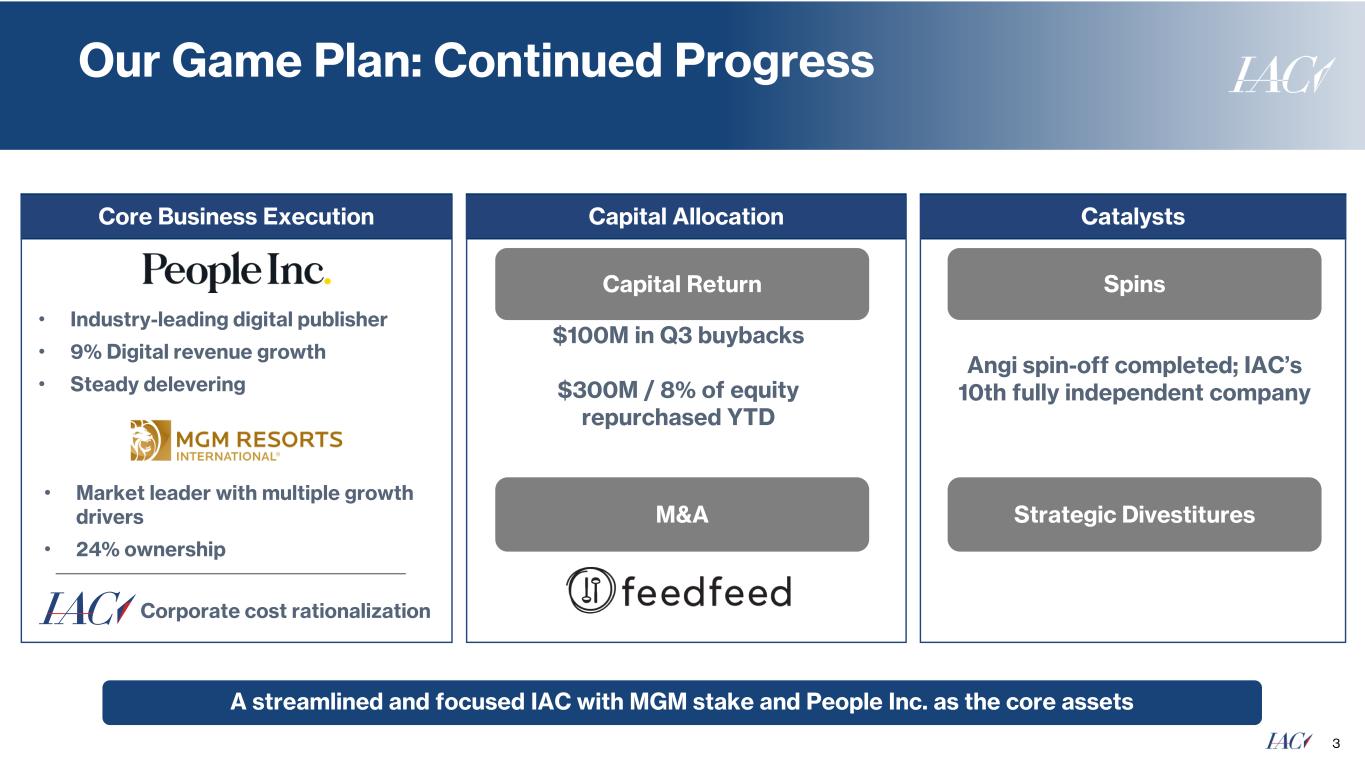
Thank you. I'm very glad to be with you all today. I've been talking to investors lately, and I certainly understand everyone's desire for more clarity about IAC's future. With the departure of our CEO and the spin-off of Angi, it's understandable that there are questions about our direction and our future. I am going to address those this morning, both in my remarks and in answering any of your questions. There are two core parts to IAC today. They are underpinned by a strong cash position and our balance sheet. They are People Inc. and our investment in MGM. Broadly, we have been, and we will continue to slim down IAC's assets and our overhead. We'll get lean and crystal clear that People and MGM are IAC until something else wildly compelling comes along. What we want to do is, first, reimagine People Inc. from defense to offense. Second, help MGM's excellent management teams simplify its business and change its dismal multiple. Next, we'll divest our non-core holdings and reduce our overhead, and finally, continue to be opportunistic on share repurchases. It seems to me that opportunistic is now, as is increasing our ownership of MGM. There's this huge discount in the value of our shares and an unbelievable discount in the value of MGM; I mean, it's selling at an emergency multiple. There's no chance that will continue indefinitely. Time will correct this, but we won't let time stand still. So let's start talking about People Inc. As for transparency, changing the name from the awkward DDM was a good first step. We are the largest digital and print publisher in America. We significantly outperform our peers with our brands, content, and technology. The market narrative says content is dead, given all the AI talk of disintermediation and Google's continuing drive to shrink the revenue it shares with publishers. It's all a giant overreaction, and it is not our reality. Yes, there's a transition in Search. Yes, we're getting declining traffic from Google. But for several years, we've known these disruptions were coming, and we've been preparing and mastering for this rocky environment. Our results speak to that as Neil Vogel and Chris Halpin will soon detail. If you just play the old game, like most publishers, you are indeed in trouble. We've been doing the opposite for several years now. We're transferring these great brands built over a century in the old media mold into digital powerhouses. We built out a massive modern content engine behind these brands that allows us to reach consumers wherever they are on our sites and apps, through social media, news platforms, via video, at events—actually everywhere. And for monetization, no one comes close to us. Beyond all that excellent execution from the great people at People, there is the evolution we're conducting beyond the traditional publishing industry. We're going to invert the base publishing model. I've used the following examples with my colleagues: what if five years ago at Travel + Leisure, which has always had these stunning pictures from vacation spots, they thought about producing something like 'White Lotus'? What if our Food & Wine magazine, knowing so much about food and wine, thought to invent something like 'Casamigos'? Why didn’t Investopedia, one of our sites, launch 'Shark Tank'? The idea generates from there is abundant in every property we've got and all these incredible opportunities to invert our content businesses into a wide range of new businesses. If we get that going, there's really no ceiling to what we can create, and it is to create and not be on the back foot like almost every other publisher seems to be these days. That's what we'll be doing while we continue to execute on the day-to-day operations of today's publishing business. Neil has got more to tell you. But for the first time, since we've acquired these assets, I am genuinely excited about their future. Frankly, if we spent all our time on this one asset of ours, we can create a giant octopus of owned and operated companies and businesses for the future. Alright. Now to MGM; here we're dealing with the opposite of the fear of disintermediation. MGM is a giant hedge against disintermediation. I use that term often because it truly encapsulates the genuine and proper concern regarding disruption from artificial intelligence. For sure, AI will affect everything except live entertainment and travel experiences, as there is no simulation that can replace MGM's connection with its worldwide customers. Please consider this, these assets can never be disintermediated. Las Vegas can never be disintermediated, and nowhere will anyone build the depth and scale of Las Vegas. It is now and will forever be the entertainment capital of the world. It has more infrastructure per square inch than anywhere else, with sports, gaming, performances from every major entertainer, and the best food, and so on. It may ebb and flow due to macroeconomic issues from time to time, but it has been a constant build over the last 30 years, especially since Steve Wynn kind of reinvented the city. Las Vegas is nearing 100 years old, and MGM's footprint in Las Vegas with nine resorts is unmatched. Back in 2020, at the height of COVID, we invested in MGM. We bought it right, understanding its extraordinary position in Las Vegas, excellently managed teams, exciting digital opportunities, and the prospect of building a truly extraordinary resort in Japan. Our expectations have been realized. Revenue rebounded from the lows of the pandemic. Digital operations scaled to profitability and have repurchased an astounding 45% of its shares. Shockingly, despite all this, MGM's share prices declined 29% since the beginning of 2022. As management stated on the last earnings call, if you back out the value of MGM's publicly traded holdings in MGM China and the value of its 50% stake in BetMGM, everything else in MGM is trading at less than three times EBITDA. It's extraordinary to say the least, and it will not continue. Think about what we have at MGM. Just think about it: nine casinos, 40,000 hotel rooms, scaled convention centers that no one else has anywhere, hundreds of restaurants, approximately 400 restaurants, 120 music halls and arenas, and so forth—upcoming F1 races and more sports teams coming along in the coming years. It cannot be duplicated anywhere. Our ownership in MGM is now at 24%, and I believe it will increase over time, both through our direct purchases and MGM stock purchases. I am continuously amazed that the stock market seems to ignore this, too focused as it always is on the short term. But bears point to the economic overhang of Las Vegas after this massive post-pandemic bounce, the 50-50 joint venture structure at MGM, BetMGM, and the fact that Japan will take some years before it goes online. When Japan does come online, it will be the only casino in the entire country of Japan. I mean, can you imagine? Well, all the critics of MGM are simply wrong, and time will surely tell. On IAC capital allocation, which I previously mentioned, we purchased an additional $100 million of shares since our earnings call in early August, which brings our total year-to-date purchases to $300 million, representing 7 million shares or about 8% of our shares outstanding. Our cash balances are over $1 billion and will be enhanced when we sell our non-core assets. I do not intend for our capital to sit idle, nor do I wish to spend it on acquisitions at high prices for speculatively questionable concepts. We've been inventing and building businesses at IAC for over 30 years. We had a greenfield for decades in Internet and e-commerce. That period has mostly ended, but it doesn't take a genius to be sure there will be opportunities in the future. I am patient—well, not really patient about almost anything—but I am cautious now regarding asset pricing, and I have no intention of splurging. If you need to hear it again, I'll say it again: People and MGM have enough opportunity to fully engage us. So now, Neil Vogel will give you more detail on People Inc.
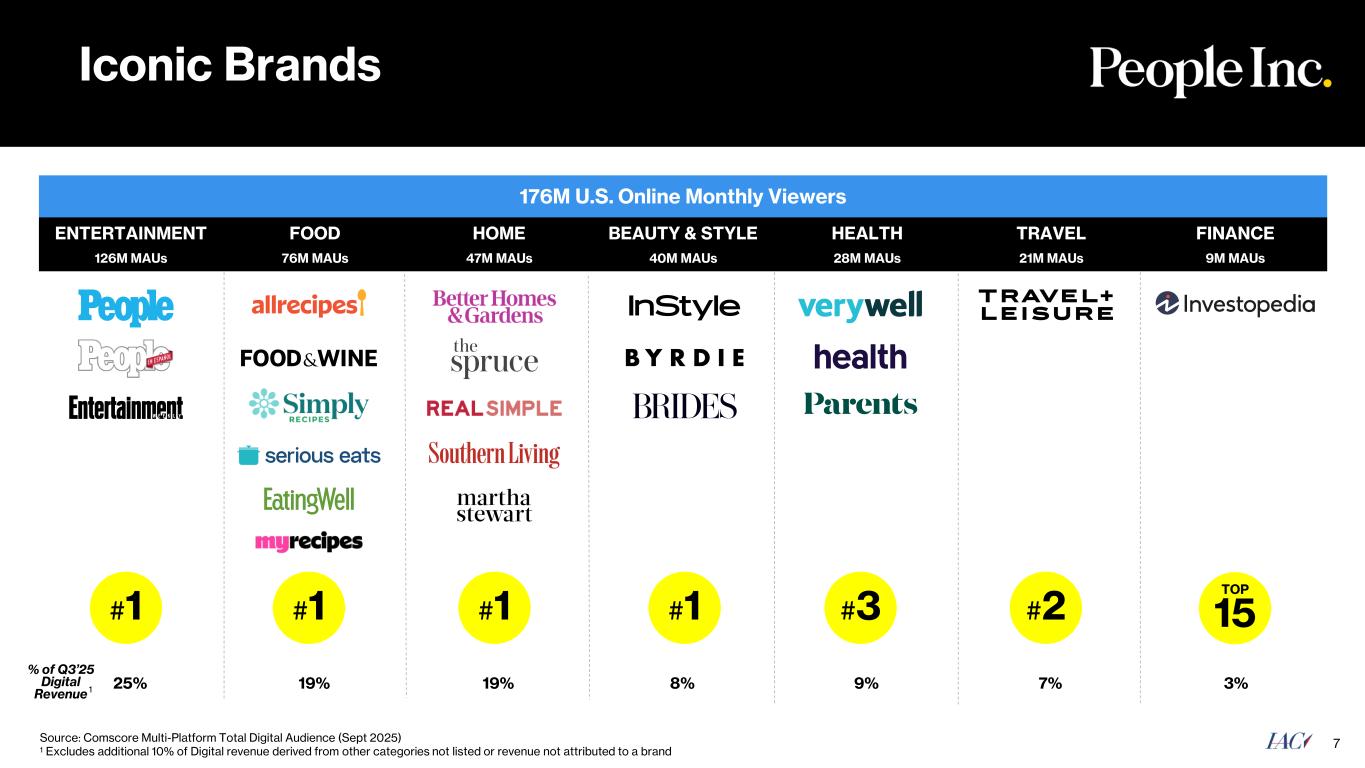
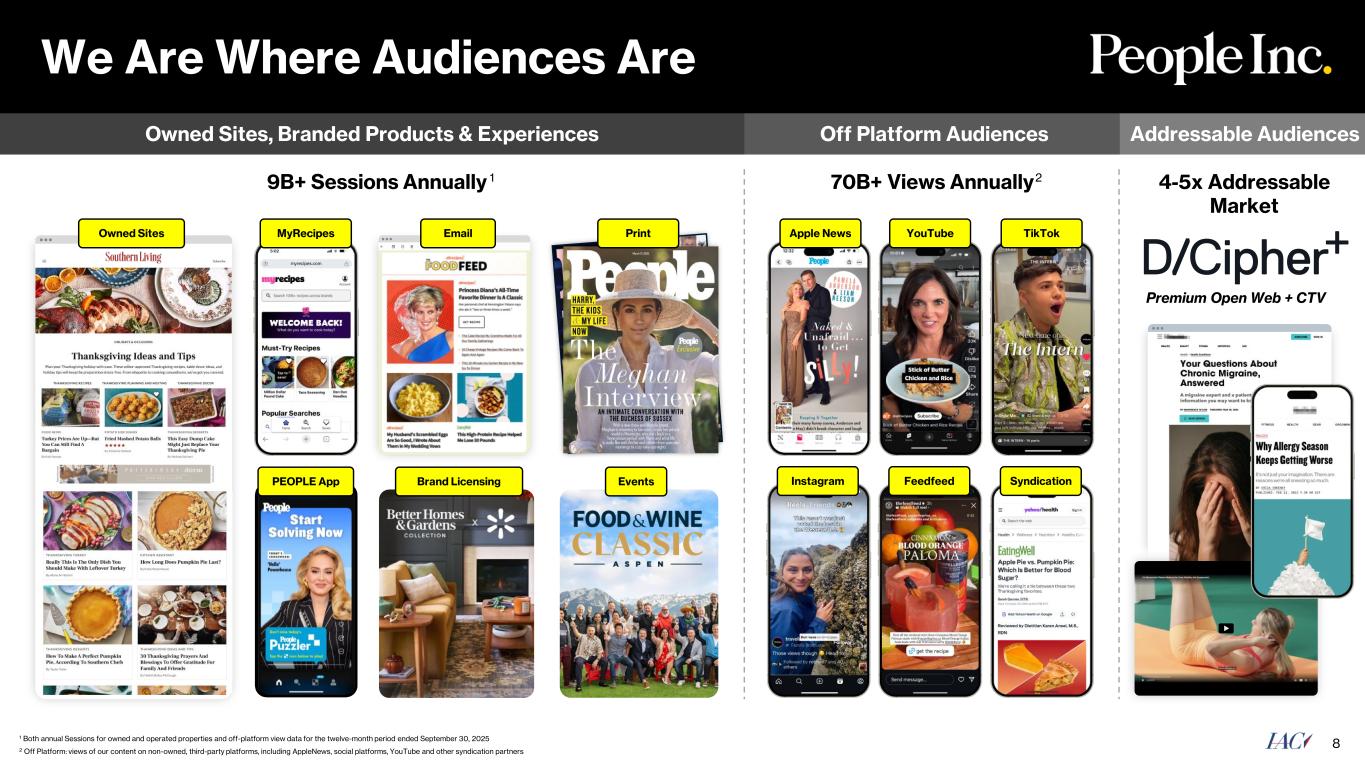
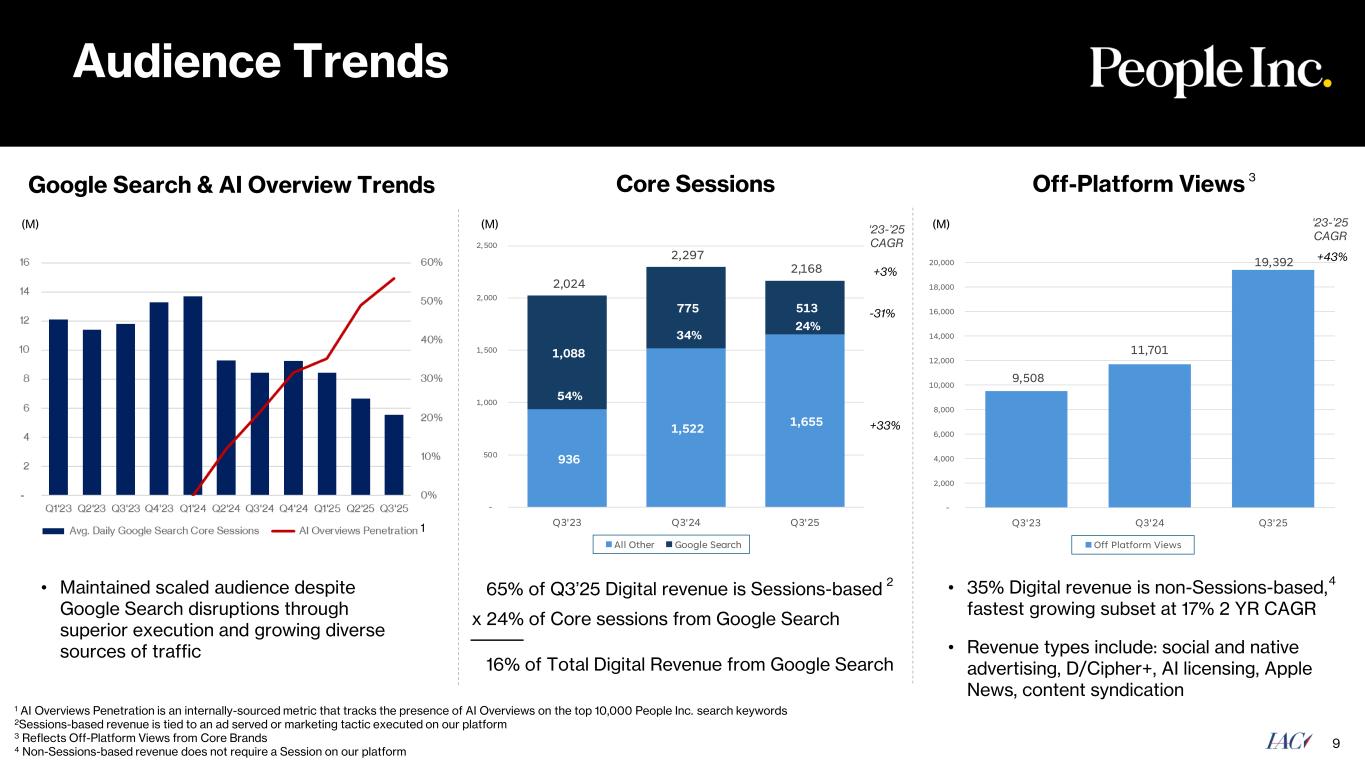
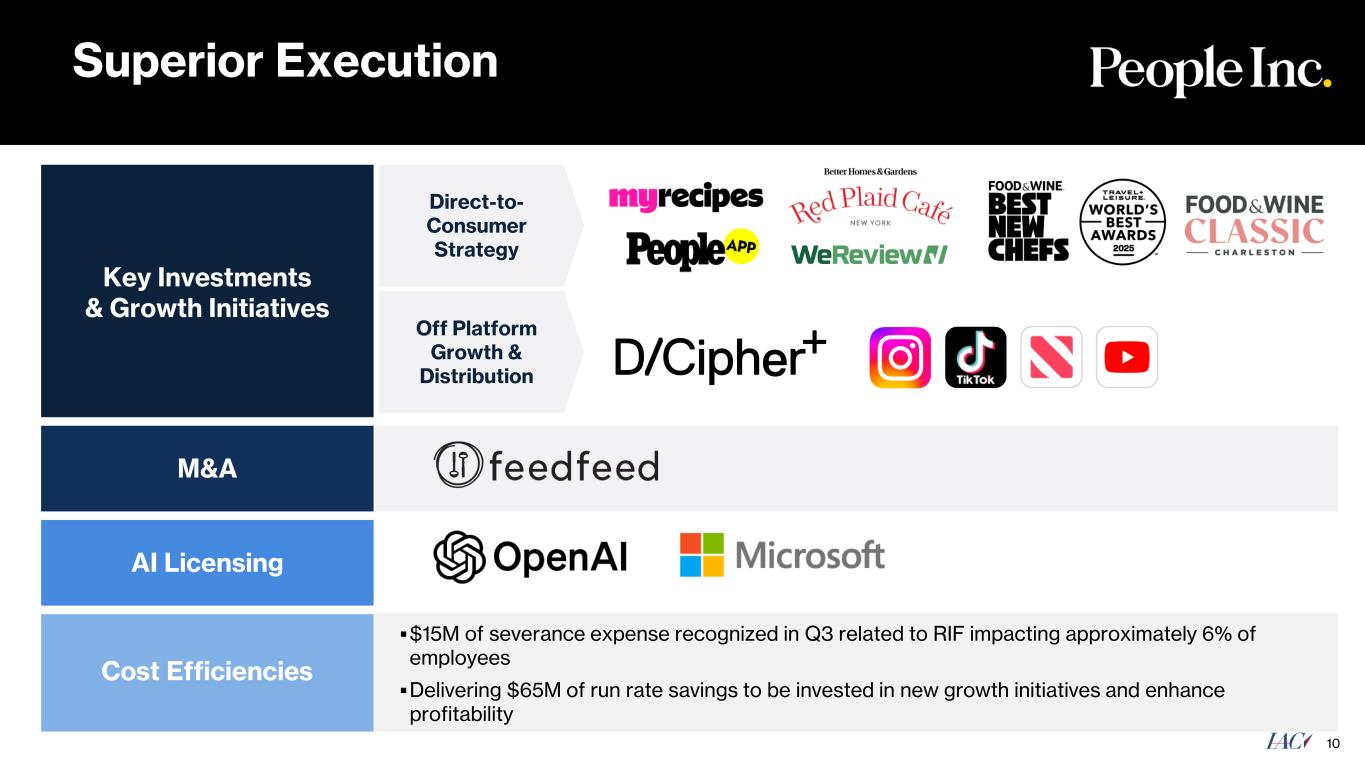
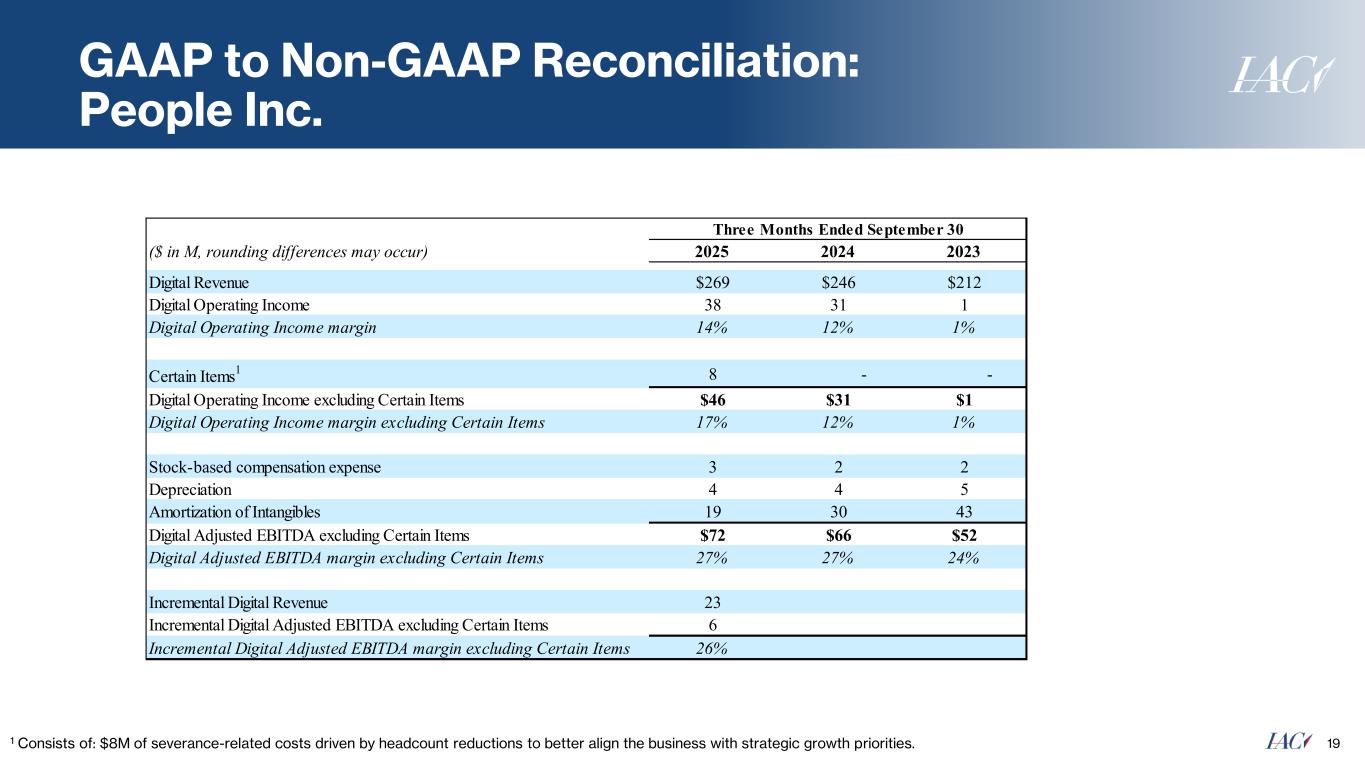
Thanks. Hello, everyone. I share Barry's confidence and optimism around our business. We had a strong quarter. It was our eighth consecutive quarter of digital revenue growth. The 9% digital revenue growth in Q3 was the second quarter in a row at 9% and at the high end of our guidance range. We've talked to you a lot about what drives our performance, and it remains consistent. Our performance resulted from three things: our iconic portfolio of brands, the scaled audiences we've built, and our superior execution around those two factors. We've continued to focus, as we said we would, on diversifying our sources of revenue and audience in the quarter. You can see evidence of that in the strong results in our licensing and performance marketing revenue streams, and our continued extremely strong off-platform audience growth. We've got real traction, and we're excited about it. Even with our investments in the quarter, we saw improved profitability: $72 million of digital EBITDA, 27% margins, and 26% incremental margins around that. We're positioned to grow as we evolve the business. As Barry said, we're doing this from our front foot, not our back foot, and we feel very good about that. So, going to the next slide. Our core asset and advantage is our iconic brands. These are incredible brands with real gravitas, real cultural resonance, and real history. People, Food & Wine, and Travel + Leisure are household names. Each has scale that puts us near the top in audience size for every category in which we participate. Fun fact: we reach over half the U.S. population each month with our assets. Importantly, for our brands and the type of content we create in an era where content feels increasingly artificial and manufactured, we are authentic. Our audiences want more of what is genuine. You see it in our growing audiences, and we see it in the responses to our offerings. We have a real relationship between our audiences and our brands built over decades. That is the core and the underpinning of the opportunity to grow the medium business and do much of what Barry discussed. If we go to the third slide of our presentation, an important concept is we are where audiences are and where audiences are going. Diverse sources of audience have become a significant strength of ours and have been a focus of ours longer than it's been trendy. What we've been doing across audience categories is exactly what has driven our growth over the last eight quarters. Let's talk about our different categories, just to clarify. The first is the left side of the slide, which covers owned and operated assets. These are assets we own, scaled with diverse ways to reach audiences, including everything from events to websites to emails to our direct-to-consumer properties. The second category is off-platform, where our content lives on other platforms and increases the value of those platforms. It is where audiences are increasingly online, and we are there with them: Apple News, YouTube, TikTok, our recent Feedfeed acquisition, etc. The third category is addressable audiences. An addressable audience for us means how we can take our assets and skills and extend them across the open web. We achieve this with something called D/Cipher, which we've spoken to you about extensively. We leverage our trove of proprietary first-party data around consumer intent to target ads not only on our sites but across the web. Our ads perform in a superior way to almost anything we can find online, and we can extend that across the Internet. This allows us to drastically increase the addressable market for our ad products and unlocks the ability for us to target connected TV as well, which we're very excited about. D/Cipher is our fastest-growing product by revenue, the fastest-growing by investment. Since its launch, it has grown every quarter sequentially, and we are excited it will be a meaningful contributor by 2026, significantly expanding what we can do with our audiences. Slide four outlines our audience trends. Let's specifically discuss changes in Google Search traffic and what that has meant to us. The rise of AI overviews on Google Search results pages for searches that we compete has been rapid and dramatic. Google Search as a traffic source for our core brands has gone from 54% of our traffic two years ago, even more than that when we merged Dotdash and Meredith, to 24% of our traffic this past quarter. The good news is that we've maintained our scaled audiences despite this decline because we were prepared for these disruptions. We recognized changes in Google early on and acknowledged the rise of AI, which is why every other meaningful source of traffic has increased for us over the past two years. We expect the Google Search challenges to continue, but we believe our strategy and investments will enable us to maintain our overall growth. If you look at core sessions, as we've mentioned at the Goldman conference, we cautiously expect it to be down this quarter in the range of 4% to 6%. We are currently down about 6%. That was due to some tough comparisons; we lapped the Olympics last year and the lead-up to the election, along with the ongoing challenges from Google. This is the primary reason our ad revenue declined 3% in the quarter, which was very much volume-related, not rate-related, but we expect to return to growth in Q4 despite continued pressure on Google sessions. Off-platform usage has been a bright spot. Again, it’s something we've focused on for a long time. I cannot emphasize enough: it is where consumers are, and it is where consumers are growing. Off-platform audiences accelerated 66% year-over-year; over one-third of this quarter's revenue is now not based on user sessions, and this has become our fastest-growing revenue stream at 16%, even faster than our sessions-based revenue. I want to touch on our Feedfeed acquisition: Feedfeed, as many of you may know, is a leading food influencer network. This is the first time we have purchased a capability—not just a media property—which illustrates our focus on monetizing audiences off-platform and engaging in the influencer marketplace, increasingly vital when selling to advertisers. Social advertising is the fastest-growing sector in digital, and this acquisition gives us a strong advantage in that area. Lastly, we can talk about our execution and future perspectives. The first update we should probably mention is in our release from last night: our AI conversations are heating up. As you saw in the release, we have an agreement with Microsoft to be a launch partner in their publisher content marketplace, essentially a pay-per-use market where AI players can directly compensate publishers for content usage a la carte. We intend to be an active participant as these content markets evolve, and we work directly with Microsoft. We have been physically present in their discussions to help conceptualize this marketplace. This is a very strong endorsement from Microsoft of both us being in the room and the overall publishing marketplace's value. Broadly speaking, there are two types of deals emerging: the sort we have with Microsoft, which is like a vibrant marketplace where content is available a la carte, or broader use deals like our agreement with OpenAI. We are satisfied with either model as long as our content receives the respect and monetary compensation it deserves. Now, to summarize our focus and priorities: we are striving to connect more directly with our consumers and with our advertisers and marketers. In our key investments and growth initiatives, we have a deep pipeline—again, as Barry hinted—comprising direct-to-consumer ideas that we are pursuing, and we are very excited. We call it inversion ideas around here, concepts harnessing the power of our brands. We've done some of this already, as discussed regarding MyRecipes and the People app. We have also recently launched something called WeReview, a new commerce offering based on our robust commerce relationships in product categories we previously did not cover. There's real momentum surrounding these direct-to-consumer properties. We are also very focused on editorial tentpoles that can drive multiple revenue streams, having just raised an initiative called Red Plaid Café at Better Homes & Gardens, along with notable concepts like Best New Chefs and Travel + Leisure World's Best and Food & Wine. In conclusion, we made some tough decisions this past quarter, which included laying off about 6% of our workforce. We did this primarily to free up capital for investment while keeping our profitability goals in mind. To wrap up, we had a strong quarter, our brands are great, our audience remains strong, our execution has been pretty solid, and we have all the ingredients necessary for a bright future. I'll now turn it over to Chris.
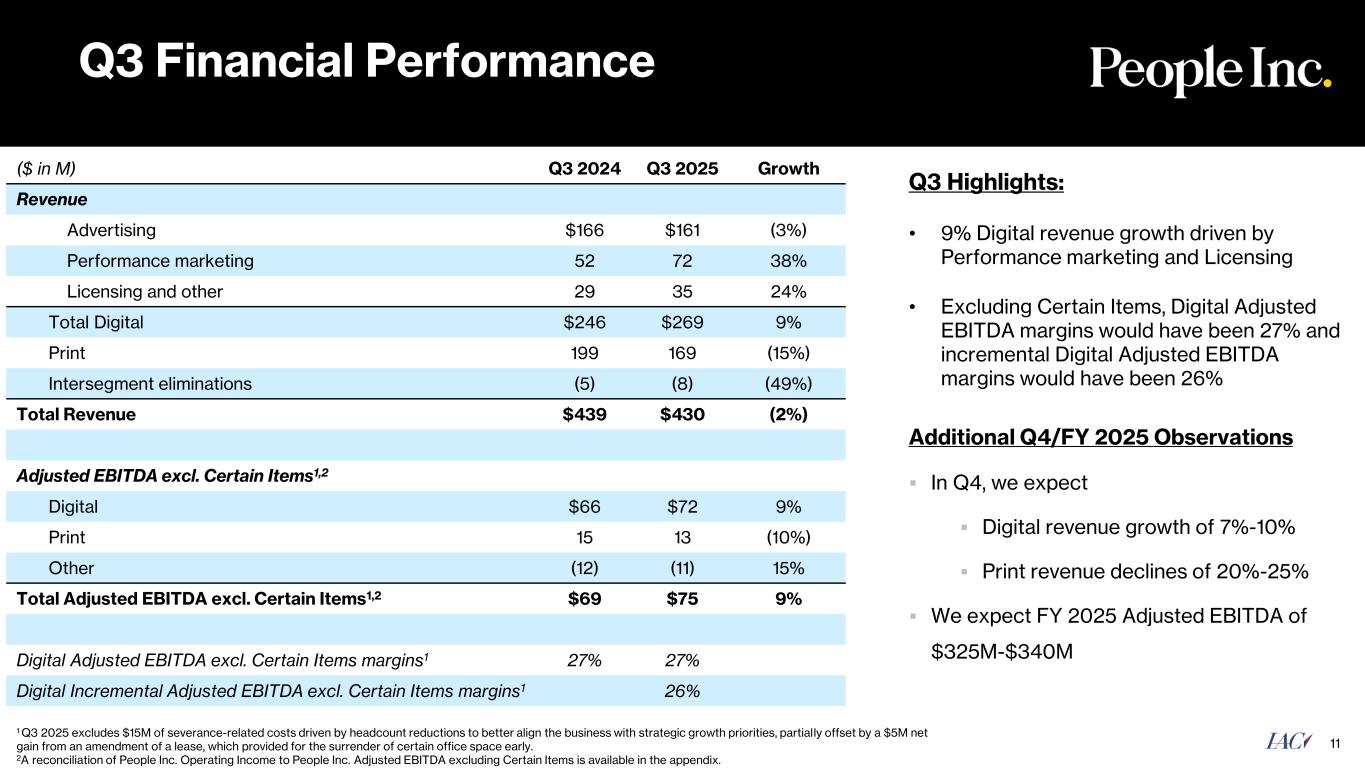
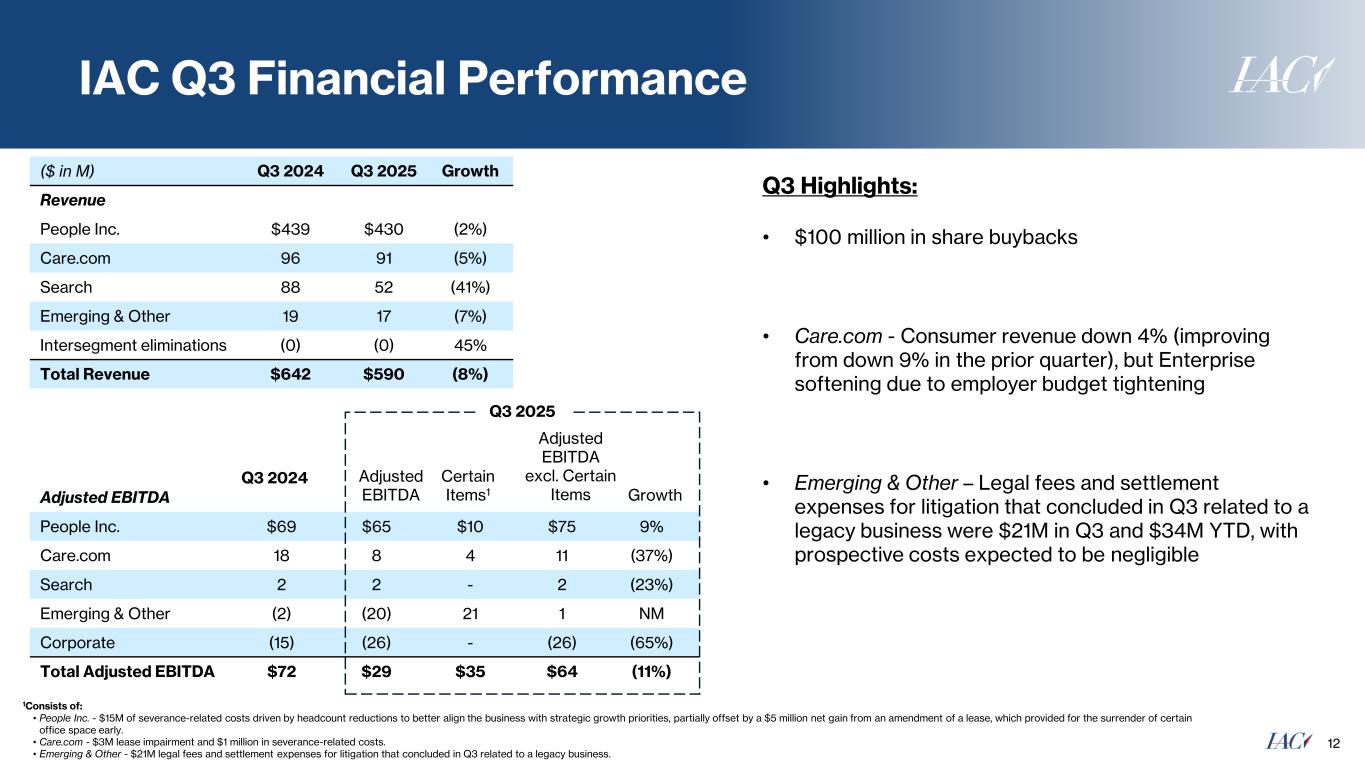
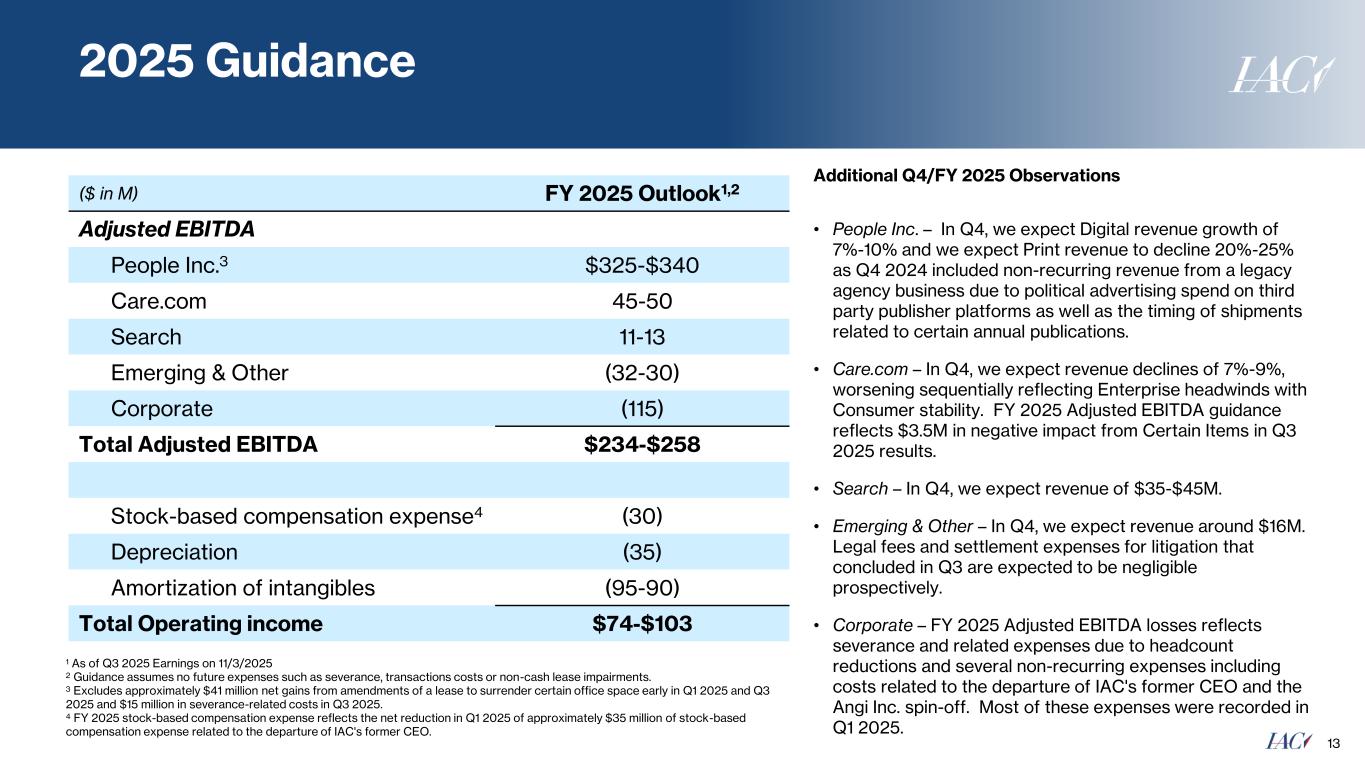
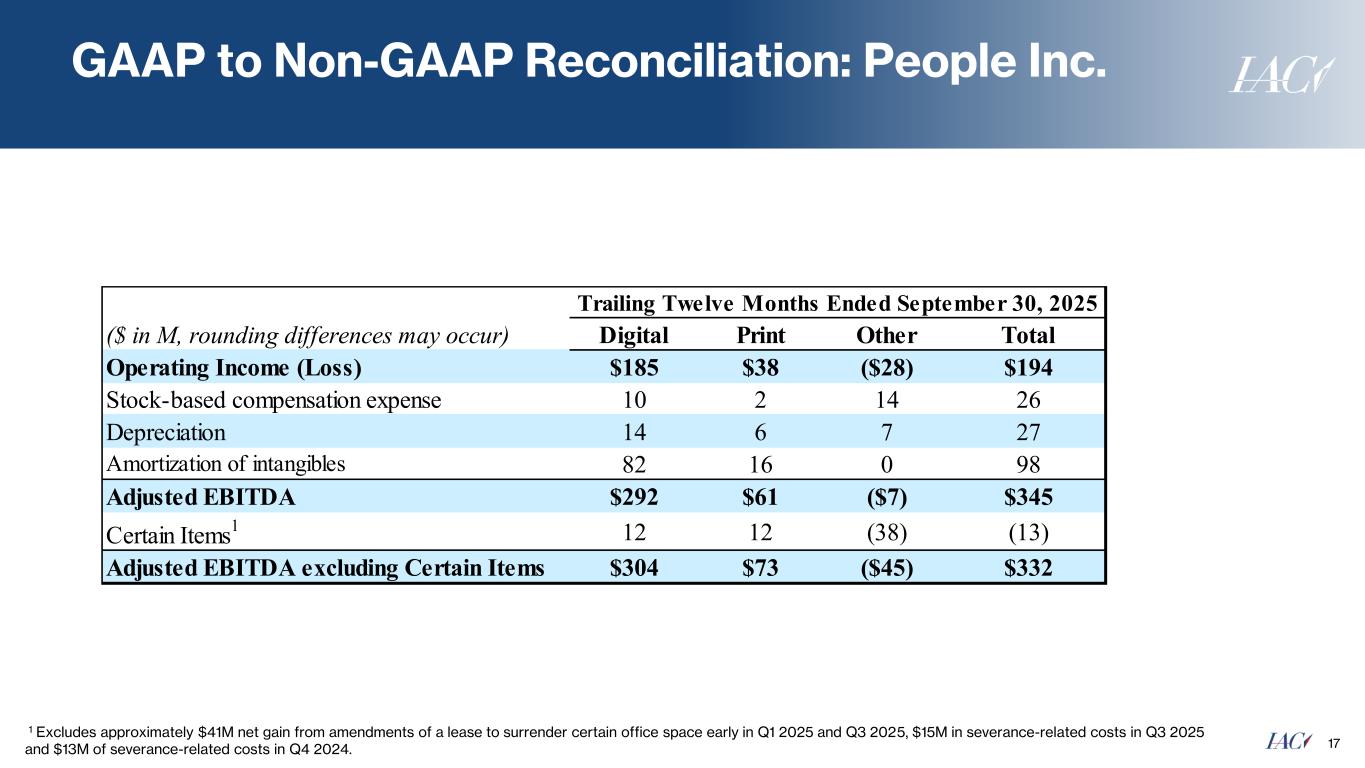
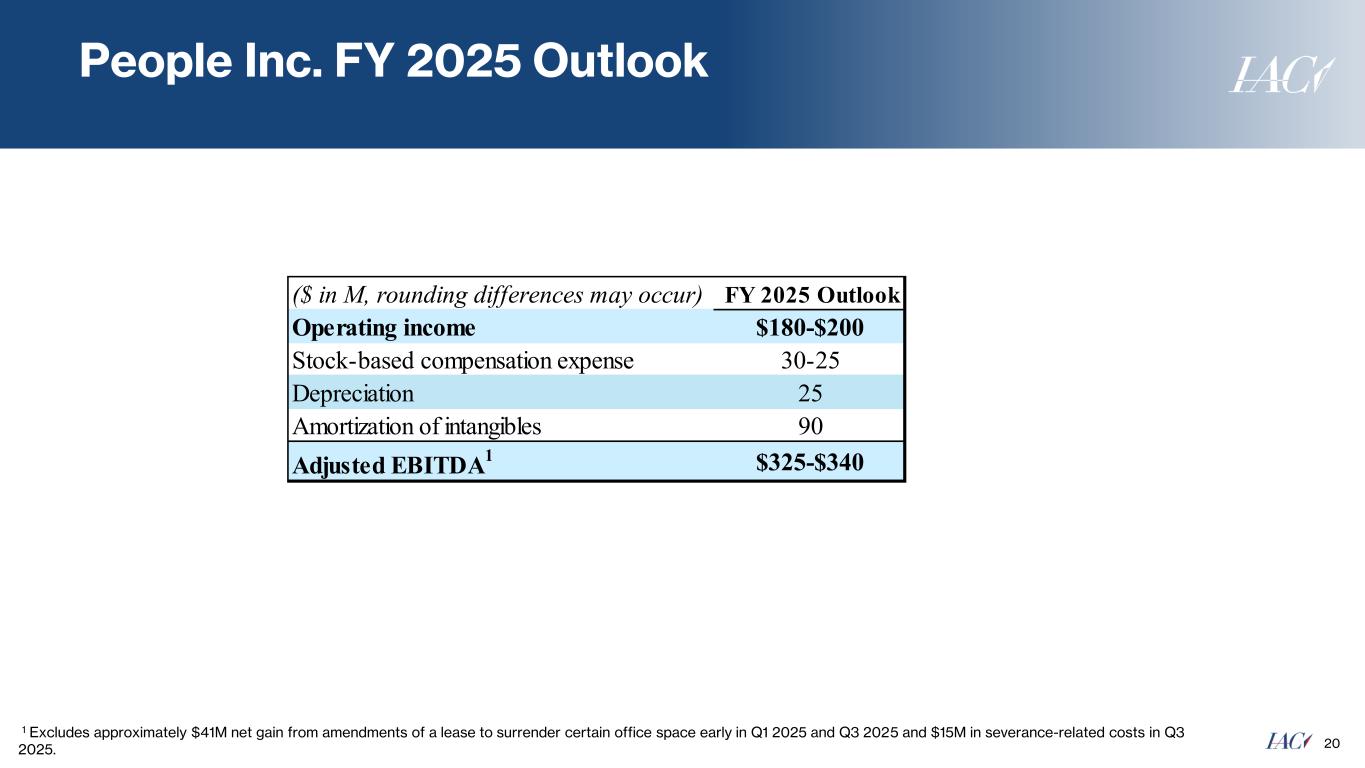
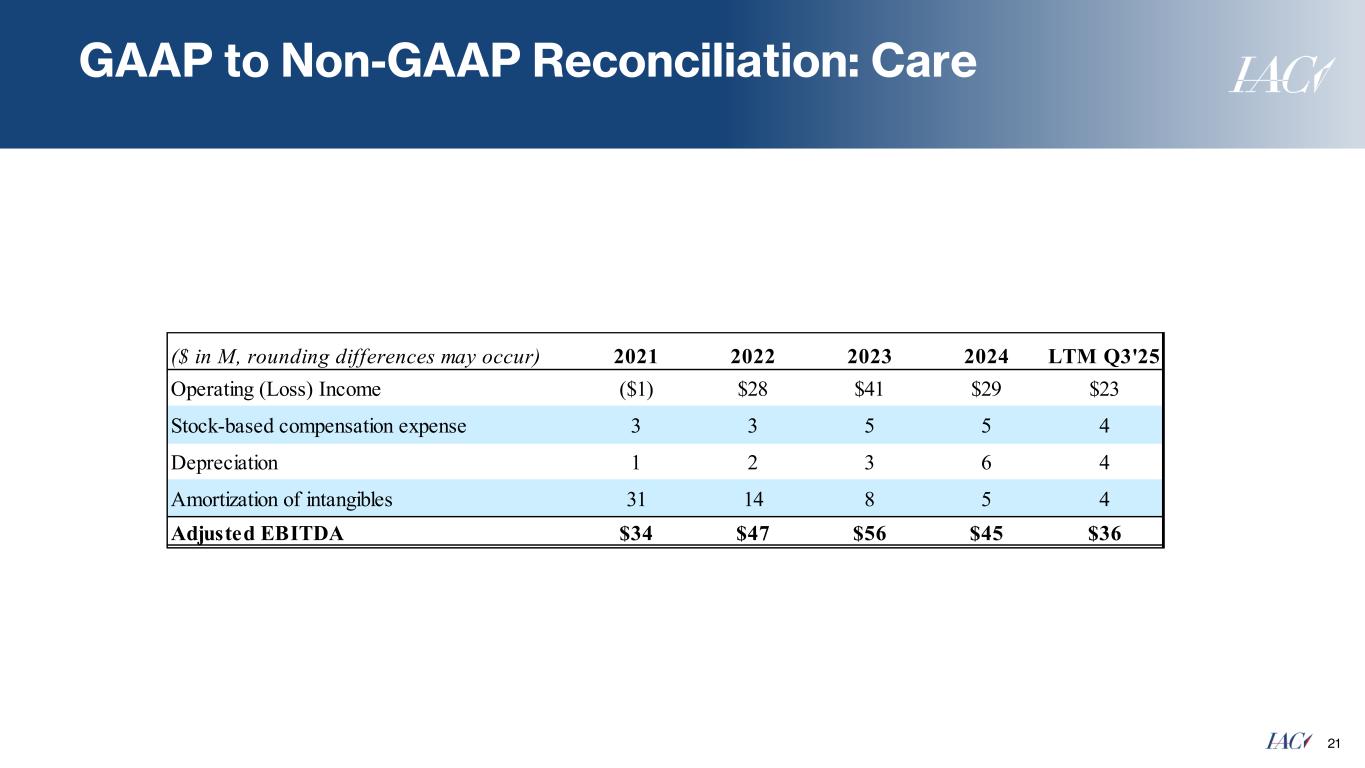
Thanks, Neil. I'll be efficient so we can get to Q&A, but there was some expense noise in the quarter that initially clouded results we were otherwise happy with. Turning to Slide 11, let's quickly walk through People Inc.'s third quarter financial performance. As Neil mentioned, we achieved a 9% digital revenue growth at the top end of our previous range. Strong growth in performance marketing and licensing offset declines in advertising revenue. I'm sure we'll discuss that more in Q&A. Focusing on profitability: these numbers are pro forma excluding the two major one-time impacts in the quarter. There was a $15 million severance expense resulting from People Inc.'s reduction in force and a $5 million favorable gain from the buyout of a lease on attractive terms as we rationalize our real estate footprint. Reconciliations for both these one-timers can be found in the appendix. Digital adjusted EBITDA grew 9% pro forma in the quarter to $72 million. Incremental margins were consistent with total margins. Continued cost management in the print division led to only a 10% decline in adjusted EBITDA and a 15% revenue decline, which we're satisfied with, while corporate costs declined 15% pro forma. So, in total, excluding the two one-time items mentioned, People Inc. produced $75 million in adjusted EBITDA for the quarter, surpassing the high end of our previous guidance range, which specifically excluded the severance impact. Looking ahead, we expect digital revenue growth in the 7% to 10% range and the usual strong adjusted EBITDA margins in the fourth quarter. For the year, we've slightly lowered the bottom end of our adjusted EBITDA guidance range to $325 million to $340 million. Note that this excludes both the $15 million in severance and $41 million of lease gains year-to-date. The wider range reflects some uncertainty regarding the continued disruptions in Google Search, as well as approximately $4 million of legal expenses for our ad tech litigation with Google. The timing of this litigation has accelerated due to favorable judge's decisions, and we view this expenditure as worthwhile given the magnitude of the damages we're seeking. However, it will negatively impact profitability in the fourth quarter this year and into next year. Turning to Page 12, we want to highlight some larger one-time items that impacted the quarter beyond those at People Inc. Care's profitability was affected by $3.5 million in nonrecurring charges related to a lease impairment and severance costs. Additionally, our Emerging & Other segments swung to a negative $20 million EBITDA this quarter driven entirely by $21 million in legal expenses for litigation that concluded in the quarter related to a legacy business. We estimated these legal costs in our guidance, but the final expenses were higher than our previous estimates. Importantly, we note that the total costs related to this legal matter for the year amount to $34 million, and we anticipate future expenses related to this matter will be negligible. The rest of emerging and other is profitable. Regarding our company's Care segment performance: consumer continues to demonstrate growth, thanks to great work by Brad Wilson and his team on product marketing, which results in improvement in sign-ups and retention. Unfortunately, the enterprise business has slowed significantly over the past few months due to employers tightening their spending with Care. For the fourth quarter, driven by those enterprise pressures, we expect 7% to 9% revenue declines in Care. We expect consumers to return to growth by the second quarter next year, with the whole business growing in the second half of the year. For the full year, we're adjusting our adjusted EBITDA range for Care to $45 million to $50 million, reflecting the aforementioned $3.5 million in one-time severance and lease impairment costs, along with some impact from enterprise revenue headwinds. Finally, turning to Page 14, as Barry mentioned, we repurchased $100 million in shares during the quarter. We've bought back a total of $300 million, roughly 8% of the company year-to-date. As Barry noted, buybacks remain a core part of our capital allocation strategy, and our shares currently appear even more attractively priced than they did earlier this year; there's a high threshold for M&A. With that, let's move to Q&A. Operator, first question, please.
Operator
The first question will come from Dayton Helfstein with Oppenheimer.
Speaker 4
Barry, nice to have you on the call. I was going to ask about your current thoughts on MGM's valuation and what the market is missing, but it seems you've covered that thoroughly. So I guess my next question is, why would an investor want to invest in MGM through you? Why wouldn’t they just buy it directly? Intellectually, wouldn’t it inherently trade at a discount under IAC? You could argue that you might get it cheaper through IAC, but over time, how do you close that discount? Plus, obviously, the Arab community is involved here, and they seem to find ways to make money. But it feels like fundamental investors are struggling with the IAC stock given how significant a piece MGM is of the value. You can observe that the stock literally mirrors the MGM stock price. That’s my first question. My second question, Chris, how should we think about the one-time expense cleanup in Q3? Is there more to come in the P&L? Or can we assume the numbers will be clean moving forward?
I don’t think the issue is separating MGM from IAC. As I mentioned before, IAC will now primarily consist of People Inc. and MGM. And I would say I believe this increasingly represents a publishing content strategy and businesses that stem from it. Any acquisitions we make, I wouldn't declare this for every acquisition, but certainly those in line with that strategy, we recently made a very small acquisition that I believe totaled around $10 million. Regarding acquisitions aligning with our publishing business, we’re going to create new opportunities from our content structure in the world of disintermediated media, and I think we’re managing that better than our competitors. We have this absolute non-disintermediated asset in MGM. While you can choose to buy MGM independently, with IAC you are getting our ambitions in publishing along with MGM. In a nutshell, you're getting both, which I believe presents excellent balance. I don't think this situation will persist indefinitely; new things will unfold with time. However, if you buy MGM on its own, purchasing through IAC offers a solid value proposition.
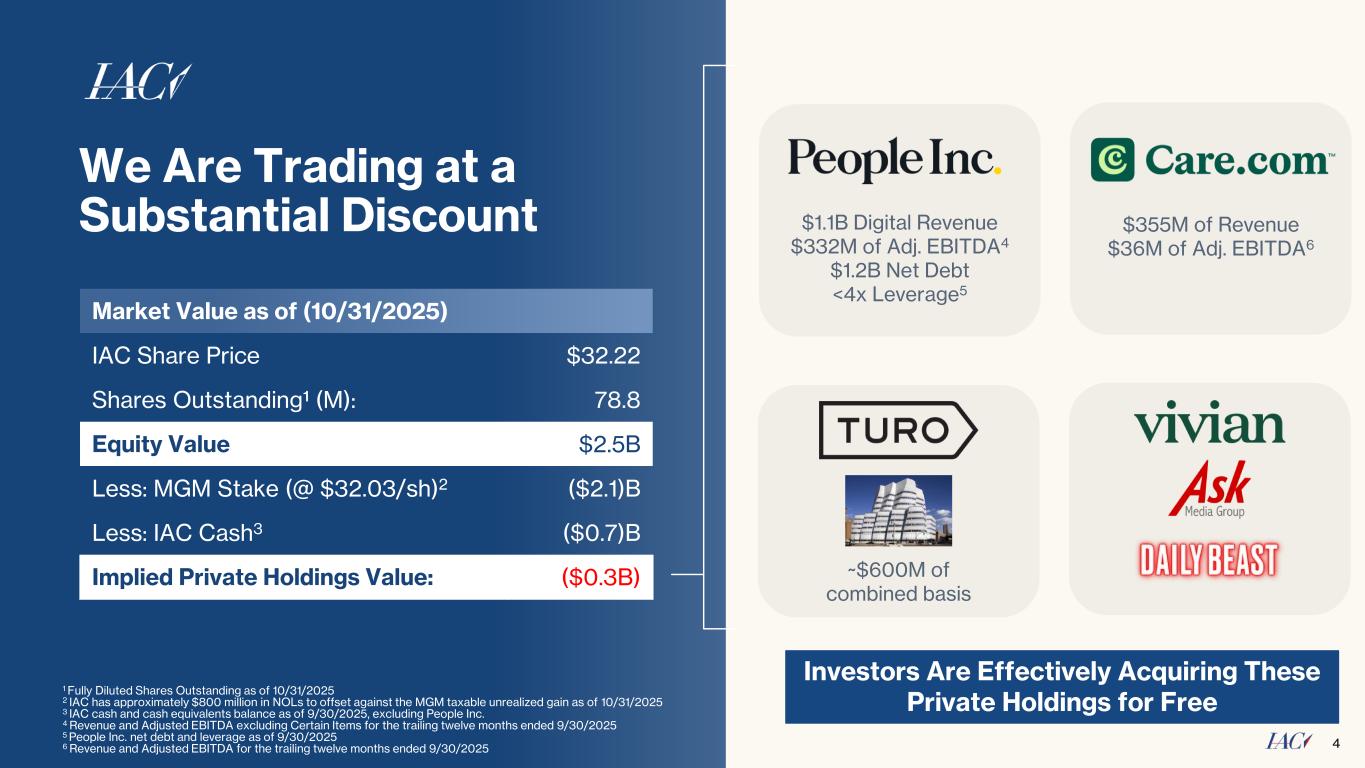
I'll quickly add that you are indeed acquiring MGM at a better price through IAC than purchasing it directly. I support your decision to buy MGM independently, and I believe both stocks, as Barry said, are outrageously undervalued. However, within IAC, you're also getting our private assets, such as People Inc., Care, Vivian, and our little search business that continues to thrive, along with Daily Beast and other holdings—at a discount and a negative value. This means there is even greater room for valuation growth in the IAC stock if you believe in MGM's prospects. Concerning the one-time expenses, we have indeed performed a great deal of cleanup this quarter. We don’t foresee any severance expenses, and we don’t anticipate lease gains continuing at People. We will continue to optimize our cost structures, but significant one-time charges at People are not expected going forward. In the Care segment, the lease impairments and severance we discussed were one-off incidents. Additionally, concerning emerging and other legal cases, those are behind us. Looking ahead, the only expense to highlight would be related to our Google litigation where we anticipate incurring around $4 million this quarter and expect additional spending in the following quarters. Nonetheless, we view this claim as an investment opportunity.
Operator
The next question will come from Cory Carpenter with JPMorgan.
Speaker 5
Maybe for you, Neil, just thanks for the background on People. You had a busy quarter with the Feedfeed acquisition and the Microsoft AI deal. Pulling everything together, could you provide your latest thoughts on the state of the business and what this indicates about your outlook for the future? And I want to follow up on the People litigation you just mentioned. Is there any update regarding that, Chris? I believe you mentioned there was a recent ruling that provided indications?
I will go first and then pass it to Chris. I think the cumulative things you mentioned are all reasons for confidence and optimism. The first is the Microsoft deal, which we discussed. However, I believe it demonstrates that such deals are now happening frequently. This summer, we began blocking AI crawlers, which was highly effective and prompted almost everyone to engage in dialogue with us. I expect, alongside the commentary of industry experts, there will be further deal developments in the upcoming months and quarters, covering both a la carte and all-you-can-eat structures. We feel highly positive about this turn of events. Recognizing the value of our content is very important as well. On another note, Feedfeed indicates how well we are performing off-platform and emphasizes its crucial role in our long-term growth trajectory. We will actively explore new avenues to monetize these growing audiences. I think it's worth noting, as Chris has pointed out before, our connections with platforms like Instagram, TikTok, and YouTube differ greatly from our relationship with Google. Google has historically taken our content and redirected traffic away from us. Thus, there exists an inherent conflict as they lose value when they send us traffic. Conversely, our relationships with the other platforms are synergistic; our content enhances their offerings. This is indeed a pivotal moment for us and our brands.
Additionally, on litigation, just to provide context: the lawsuit builds on the government's antitrust case against Google from an ad tech perspective, where Google allegedly monopolized the ad server and ad exchange markets to the detriment of online publishers. We, together with other significant publishers such as Dotdash and Meredith, have pooled efforts to hold Google accountable and seek compensation for the lost revenue stemming from its anti-competitive actions. While the damages will be established during litigation, we are pursuing hundreds of millions of dollars in damages. To address your question, Cory, you likely observed the recent rulings favoring Gannett and Daily Mail, where courts determined that publishers in those cases do not need to reprove what the government has already established regarding Google's anti-competitive behavior. Our specific claims and the corresponding damages still need to be resolved. Following our judge's recent acceleration of our case's timing, we plan to spend approximately $4 million this quarter, with decisions on the comprehensive magnitude of expenditures or pacing difficult to anticipate. We will keep you updated, but we believe our investment here is more than justified based on the significant damages we believe we're entitled to receive.
As discussed, this indeed involves damages that have already been identified through the earlier ruling, simplifying our process of tallying our claims. It's not just a matter of quantifying figures; there's substance behind our strategy. Let's continue.
Operator
The next question will come from James Heaney with Jefferies.
Speaker 6
Could you provide us with an update on the current macro environment as we approach Q4 across IAC's various businesses? I also have another question.
Regarding the macro environment, everything seems healthy at the middle to upper end, but not as robust at the lower end. You can forecast at will about what the future holds, but that's been the trend for a while now. Of course, absent any exogenous events, I expect this situation to persist for a while.
In reference to performance marketing: credit to Neil and his team for their strong growth; the U.S. consumer is holding steady and continuing to spend, albeit more focused on the higher-end market. On the Care side, we have noted a slowdown as corporations have tightened their spending due to employee reductions and pressures on healthcare costs. In the broader macroeconomic landscape, things seem fairly stable.
To amplify that point, the advertisement industry appears to be somewhat stable. On a scale of one to ten, if I were to rate it, I would place it at six; healthy and advancing, although there are certain challenging categories. Those problematic sectors align with what Barry mentioned, particularly in consumer packaged goods and food and beverage. On the other hand, we encounter real positive momentum in premium sectors like travel, technology, and others. Overall, the advertising market remains robust—though far from extraordinary, it's solid.
On the front of the travel market, as the Chair of Expedia, I can announce that we are pleasantly witnessing exceptional performance in travel. We have experienced double-digit growth at Expedia over twelve quarters, and this trend seems to be increasing.
Speaker 6
I have a second inquiry: can you provide insights into your capital allocation plans moving forward? We've noticed the $100 million buyback this quarter. How should we consider that as you contemplate potential M&A or other uses for cash?
I consider our capital allocation strategy to be an important signal; we are currently opportunistic, leveraging this moment to buy shares in IAC and MGM. Capital will be deployed for stock purchases rather than for acquisitions at inflated prices amid questionable economic contexts. As I mentioned previously, many opportunities seem overpriced right now, but we view ourselves as currently undervalued.
Operator
Your next question will come from Eric Sheridan with Goldman Sachs.
Speaker 7
I have a couple of inquiries regarding People Inc. Firstly, could you elaborate on the building blocks of growth regarding headwinds and tailwinds that impact digital revenue? How should we perceive this concerning your fourth-quarter outlook for 2026? Secondly, how do you envision the growth trajectory of off-platform traffic and revenue for People Inc., and what will be the impact of this on margin?
I’ll provide my insights on the upcoming quarter, and then I'll hand it off to Chris. Overall, I believe we are in a favorable position leading into Q4. I anticipate strong performance despite session challenges. These challenges are likely the primary headwind for our business. Advertising rates will improve due to our stellar sales team and satisfied clientele. Our off-platform efforts are set to enhance revenue through growing D/Cipher investments, while commerce remains robust despite the timing of some payments which may not deliver year-over-year strength this quarter. Our licensing business continues to do very well as we maintain resonating relationships between our audiences and brands built over decades. So, for Q4, I am confident that we can expect favorable results. I expect a steady growth formula will be carried forward into 2026.
Regarding margins, our off-platform traffic includes various components like Apple News+, social media traffic, D/Cipher, which each carry different margins. For simplicity—and as a conservative estimate—the incremental digital EBITDA margins on off-platform initiatives can be projected to be neutral to slightly accretive to our overall annual digital EBITDA margins of approximately 28-29%. Therefore, consider it around 30% or slightly more for incremental digital adjusted EBITDA margins on off-platform activity, while we have previously indicated higher margins on platform traffic.
Operator
The next question comes from Ross Sandler with Barclays.
Speaker 8
Continuing from our previous discussion, Neil, several outrageous projections have been presented. For example, Forrester recently claimed Open Web display ad revenues will decrease by 30% next year due to shifts towards generative AI. I’m doubtful of these predictions. However, what feedback are you receiving from agencies and brands regarding the future? How does this context shape People’s growth rate compared to the industry in 2026? If we exclude the impact from Google—which has decreased to mid-teen percentages in revenue—how would the rest of People be expected to grow, compared to the broader Open Web display industry?
We are not hearing predictions of a 30% decline. We are on the contrary hearing signals of enthusiasm—affirmative energy around our capabilities, especially given our status as the largest publisher in America. We possess scale, renowned brands, and a proven history of ad performance alongside established assets driving our growth. Moving ahead into the following year, I cannot speak for the broader Open Web display market, but we anticipate becoming share-takers in this industry based on the energy around our business models and trust in our brands.
We have consistently observed and will continue to observe growth through the combination of our efforts. The performance metrics from our People Inc. segment and the entire team Neil leads indicate robust execution amidst adversities, while also launching our new ventures. This presents an exciting outlook.
Moreover, we are immersed in developing communities as exemplified by the Feedfeed initiative. We continue to expand delivery across various channels. Our approach and execution have generated noticeable user engagement. Our goal is to further integrate our assets while maintaining authentic interactions to leverage audience connections.
Operator
The next question will come from John Blackledge with TD Cowen.
Speaker 9
Two questions. Firstly, regarding corporate costs, could you detail how we should anticipate that trajectory heading into the fourth quarter and into 2026? Secondly, what is your strategy concerning the divestiture of IAC's non-core assets? Should we regard everything outside of People and MGM as non-core?
I expect corporate costs to decrease.
At present, we maintain a quarterly corporate cost run rate of roughly $22 million to $23 million. While last quarter contained a slight amount of one-time noise that we’re working through, we expect it to trend into the mid-80s next year as we strive to rationalize our expenses.
No illogical decisions will be made on our end. We intend to secure good pricing for everything we hold. We are determined to divest any assets that fall outside of our primary focus on MGM and People. The rest is fair game.
We are aware of some of our strategic assets and receive a number of inquiries from time to time.
We won't speculate excessively, but we do anticipate continuing activity.
Operator
Your next question will come from Dan Kurnos with The Benchmark Company.
Speaker 10
Chris, could you elaborate on the anticipated run rate savings from the RIF? How much do you expect to reinvest, and how much will flow through to the bottom line? Neil, I have two questions for you. I'd like to ask about increasing the community dynamics of your properties. Clearly, Feedfeed appears to be a move in that direction. Still, I believe many people don't fully grasp the value of the off-platform interactivity you’re fostering. Is there a plan to amplify this initiative? Are there any new creative channels you’re exploring to increase distribution?
The identified savings will approximate $60 million in annual run rate savings, with around half expected to be realized in profitability, and the other half reinvested into high ROI digital activities. We've previously mentioned the drag on our incremental margins resulting from our investments in D/Cipher, MyRecipes, and the People app. Therefore, we’re conservatively stating we will reinvest about half of our savings while being mindful of market performance and growth to ensure our profitability and margins improve.
In response to your question about amplifying our off-platform presence, we are diligently working on this initiative. Our brands possess unique permission to thrive in these areas, and audience engagement is a considerable opportunity. For instance, we recently announced this year's Sexiest Man Alive on Jimmy Fallon. Expect to see significant social media activity around it, including behind-the-scenes content. A great case is 'The Intern,' our mock reality show launched in InStyle, which amassed millions of views per episode and grew a substantial following among Gen Z female audiences. We are passionately committed to maintaining high visibility across social platforms with engaging and relevant content, which we understand is increasingly crucial in capturing audiences.
I don’t foresee a quiet period in our plans; we are actively pursuing opportunities. While we're currently focused on fundamental advancements, we anticipate launching products and concepts that emerge from our established knowledge base. Our approach is systematic, diving deep into the existing materials to extract new business concepts that align with our established knowledge in the sector.
Indeed, we have a roster and pipeline of initiatives similar to the People app and MyRecipes that are on a more immediate path for execution. Additionally, our brand strength provides ample opportunity for exploration.
While we are actively working on our established fundamentals, the innovation and conceptual inversion process takes time to fully develop. I genuinely believe there is untapped potential available, with myriad opportunities extending indefinitely. We have initiated this exploration and will continue moving forward.
Given the strength of our established brands, I deeply believe that should propel us to expect outcomes significant.
In closing, I want to express gratitude to Neil and Chris for their active contributions today. I am eager to continue our engagement with you all and look forward to maintaining this dialogue moving forward. Thank you for your time.
Operator
The conference has now concluded. Thank you for attending today's presentation. You may now disconnect.