Operator
Good morning, and welcome to the Priority Technology Holdings Second Quarter 2025 Earnings Conference Call. All participants will be in listen-only mode. If you need assistance, please signal a conference specialist by pressing the star key followed by zero. After today's presentation, there will be an opportunity to ask questions. To ask a question, you may press star than 1 on your telephone keypad, and to withdraw your question, please press star than 2. Please note, today's event is being recorded. I would now like to turn the conference over to Meg Namara with Investor Relations. Please go ahead.
Good morning, and thank you for joining us. With me today are Tom Priory, Chairman and Chief Executive Officer of Priority Technology Holdings, and Tim O'Leary, Chief Financial Officer. Before giving our prepared remarks, I would like to remind all participants that our comments today will include forward-looking statements, which involves a number of risks and uncertainties that may cause actual results to differ materially from our forward-looking statements. The company undertakes no obligation to update or revise the forward-looking statements, whether as a result of new information, future events, or otherwise. We provide a detailed discussion of the various risk factors in our SEC filings, and we encourage you to review these filings. Additionally, we may refer to non-GAAP measures, including but not limited to EBITDA and adjusted EBITDA during the call. Reconciliations of our non-GAAP performance and liquidity measures to the appropriate GAAP measures can be found in our press release and SEC filings available in the Investors section of our website. With that, I would like to turn the call over to our Chairman and CEO, Tom Priory.
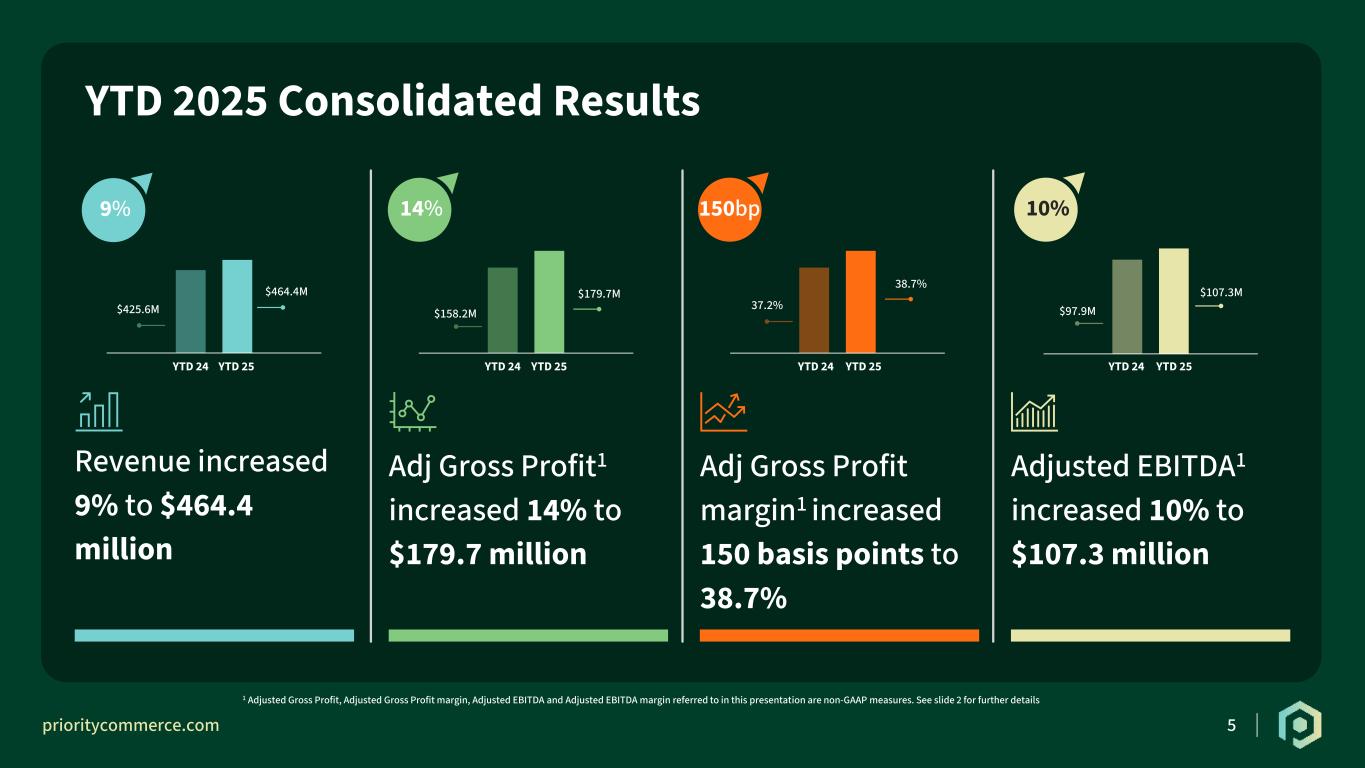
Thank you, Meghna, and thanks to everyone for joining us for our second quarter 2025 earnings call. Once again, I'll begin today's call by highlighting our aggregate performance that reinforces our strong revenue and adjusted EBITDA guidance for 2025 before handing it over to Tim who will provide segment-level performance, key trends and developments within each of the business segments, and priority overall. This morning, we reported continued solid growth in both revenue and profit despite lingering economic uncertainty over the impact of tariffs and government cuts that extended into the second quarter. Summarized on slide three, Priority had a strong Q2 by every key financial metric, growing net revenue by 9%, generating adjusted gross profit and adjusted EBITDA growth of 13 and 9% respectively, and increased adjusted EPS by $0.15 year-over-year to $0.26. We ended the second quarter with over 1.6 million total customer accounts operating on our commerce platform, up from $1.3 at the end of last quarter. Annual transaction volume in the LTM period increased by nearly $5 billion from Q1 to $140 billion. And average account balances under administration improved to $1.4 billion versus $1.3 billion in the first quarter of 2025. Tim will walk you through the full year 2025 guidance specifics and some of the more noteworthy trends we're seeing within SMB acquiring, B2B payables, and the enterprise payment segments later in the call. Based on strong growth trends and a continued favorable shift in our business mix, I'm confident that Priority can achieve 10% to 12.5% top-line revenue growth, which is why we're increasing the low end of our revenue expectations to $970 million and narrowing the overall range to $990 million at the high end, while refining adjusted EBITDA around the midpoint of our original full-year guidance, increasing the low end to $222.5 million and narrowing the overall range to $227.5 million at the high end. Our confidence comes from the adoption we continue to experience for our connected commerce platform, combining payments and banking capabilities to streamline, collecting, storing, lending, and sending money to create revenue and operational success for our customers. But turning our attention to our Q2 results noted on slide four, revenue of $239.8 million increased 9% from the prior year. This led to a 13% increase in adjusted gross profit in $92.4 million and a 9% improvement in adjusted EBITDA, $56 million. Adjusted gross profit margin of 38.5% increased 135 basis points from the prior year's second quarter. On slide five, our steady Q2 performance contributed the year-to-date revenue growth of 9% to $464.4 million, fueling a 14% increase in adjusted gross profit to $179.7 million, and a 10% improvement in adjusted EBITDA to $107.3 million, while expanding adjusted gross profit margin by 150 basis points to 38.7%.
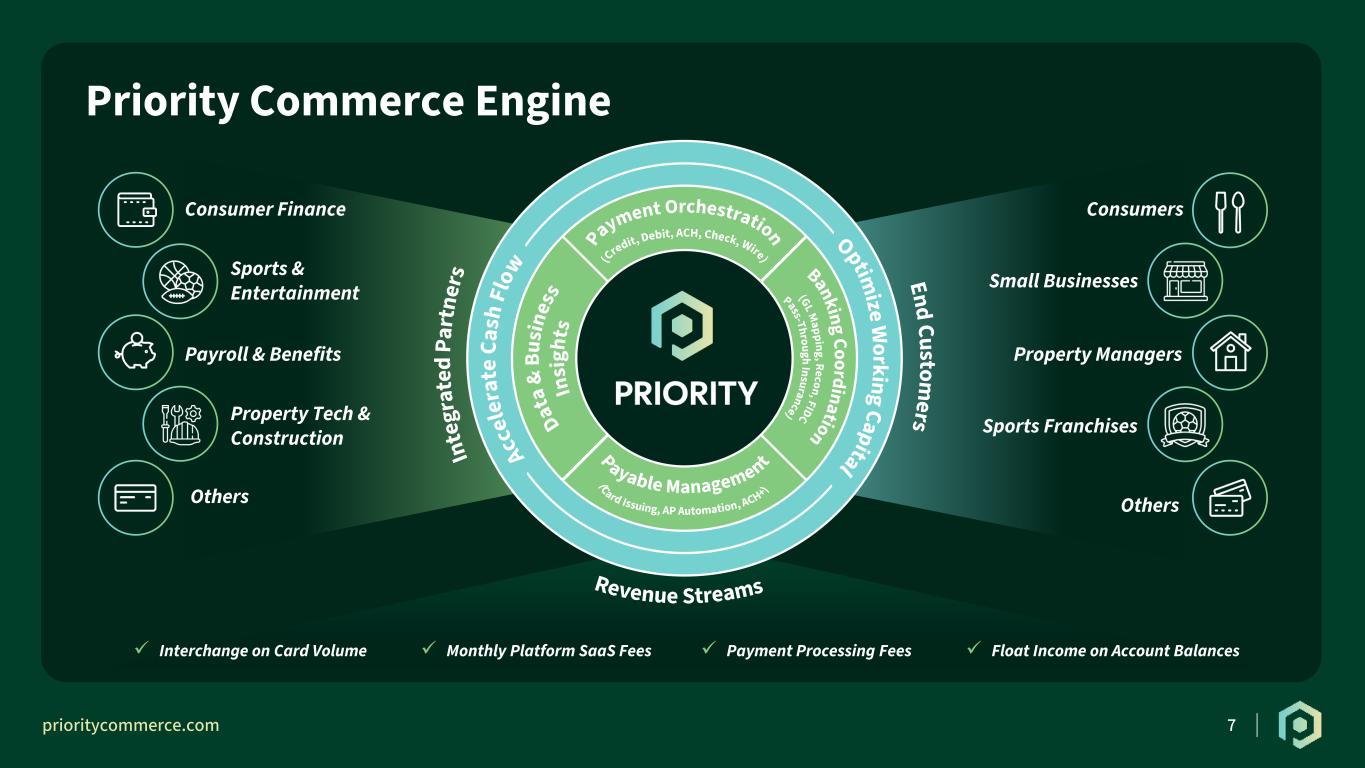
For those of you who are new to Priority, slides six and seven highlight our vision for connected commerce.
The Priority Commerce Engine is purpose-built to streamline collecting, storing, lending, and sending money, and delivers a flexible financial tool set for merchant services, payables, and banking and treasury solutions to accelerate cash flow and optimize working capital for businesses. I would encourage you to play the short one- to two-minute videos embedded in the product length on this slide. It will give you a more fulsome appreciation for their value and how they're being leveraged by our growing customer base. While our financial performance demonstrates that partners consistently choose priority to help power their businesses, I thought it would be useful for investors to gain a deeper appreciation of why we are emerging as a go-to solution provider for embedded finance solutions. Slide seven highlights a typical enterprise partner experience for our commerce API, offering payment orchestration, banking optimization, and payables management solutions within a single-point connection that allows our partners to choose their adventure and leverage our solutions in a way that best suits their objectives. Importantly, this framework is consistently applied, whether the partner is a sports management software company, a debt resolution provider leveraging CFTPay, a vertically focused software provider or property management technology company. Customers connect and can access all routes for digital payment acceptance, as well as lockbox for checks, create FDIC-eligible pass-through-insured full-feature virtual bank accounts with both virtual and physical card issuing, bill payment, and automated payables options at their own pace. Our tightly coupled platform creates two important benefits for Priority's long-term prospects. First, it allows our partners to evolve their offering, to respond to opportunities and emerging trends as we add features and new embedded solutions in collaboration with their goals. Both parties have a clear line of sight, quantify, and tap into revenue growth opportunities. And this creates loyalty and gives us the ability to grow with our partners' businesses. Second, by maintaining operational workflow consistency across implementations and diverse industry segments where collecting, storing, and sending money is an important part of the value chain, we can clearly identify and refine our operational metrics in key performance areas like compliance, payment operations, risk management, application support, and others to ensure that we scale cost efficiently. We're committed to meeting our customers where they are by curating the experience for our partners in order to make working with Priority seamless and easy. This vision explains why we've been continually able to transform Priority into a high-performing payments and banking financial technology company with consistently strong recurring revenue prospects. Our customers and current market conditions reinforce our belief that systems connecting payments and banking solutions to accept and distribute funds in multi-party environments will be critical as businesses put greater demands on software and payment solution providers to deliver a full suite of core business services in a single relationship. At the end of my comments, I'll speak to this accelerating trend toward bundled services in greater depth. But at this point, I'd like to hand it over to Tim, who'll provide further insight into the health of our business segments, along with current trends in each that factored into our second quarter results and our confidence for sustained and accelerated performance in the second half of 2025.
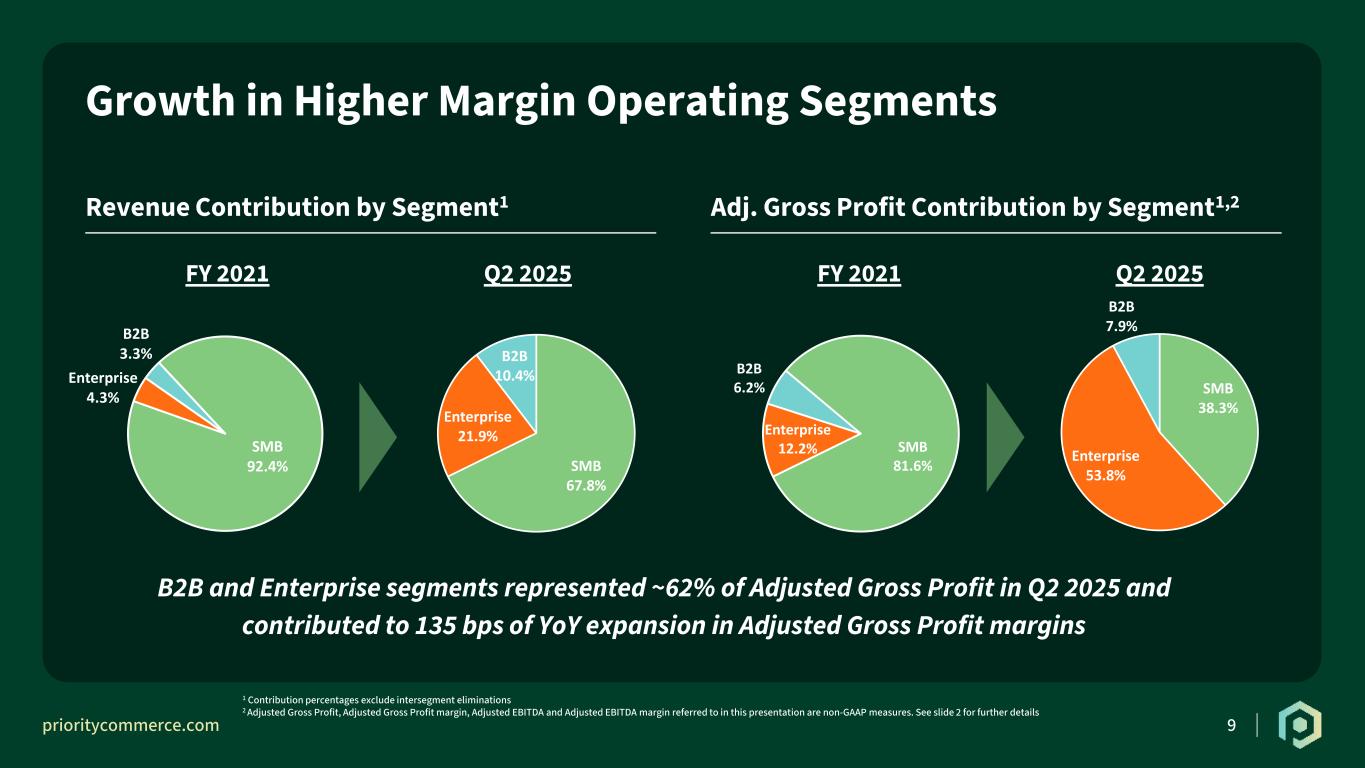
Thank you, Tom, and good morning, everyone. I'll start on slide nine. As Tom mentioned, we had strong financial performance across the business in the second quarter, and the priority commerce engine continues to generate high growth in our higher margin operating segments as B2B revenue grew over 14% and enterprise revenue grew over 20% on a year-over-year basis for the quarter. The strong growth in those segments also allowed for overall margin expansion as adjusted gross profit margins improved by 135 basis points from Q2 last year. Consistent with Q1 and as shown in the charts, the adjusted gross profit from our B2B and enterprise segments represented over 60% of the total for the quarter. The continued shift in our business mix also contributes to the highly visible and recurring nature of our business model as over 62% of adjusted gross profit in Q2 came from recurring revenues that are not dependent on transaction counts or card volumes. Moving now to the segment level results and starting with the SMB segment on slide 10, SMB generated Q2 revenue of $163.2 million, which is $8.1 million or 5.2% higher than last year's second quarter. SMB's revenue growth was a combination of strong 9.5% growth in the core portfolio, partially offset by the attrition of historical residual purchases, along with lower revenue and specialized acquiring. Those headwinds will continue in Q3 and Q4, but with a moderating impact compared to what we saw in Q1 and Q2, where it was a 4% to 5% drag on overall growth rates for SMB. Total card volume was $18.7 billion for the quarter, which is up 2.3% from the prior year and 5.6% from Q1. From a merchant standpoint, we averaged approximately 179,000 accounts during the quarter, which is consistent with last year and up from 178,000 in Q1. While new monthly boards averaged 4,000 during the quarter compared to 4,100 in Q2 of last year and Q1 of this year. adjusted gross profit in smb for the second quarter was 35.4 million which is consistent with gross profit in q2 of last year and sequentially is almost seven percent higher than the first quarter's gross profit gross margins of 21.7 percent are comparable to the 21.8 percent in the first quarter but down 130 basis points from last year on a year-over-year basis margins were impacted by lower specialized acquiring revenue and the attrition of historical or residual purchases. If you were to adjust for the impact of those two items, gross margins in the core portfolio increased by 125 basis points on a year-over-year basis. Lastly for SMB, adjusted EBDA was $27.7 million, which is down $850,000 from last year's second quarter, and up $2 million from Q1 of this year. Adjusted EBDA was slightly lower than the comparative of quarter last year as a result of increased salaries and benefits, along with higher SG&A resulting from increased headcount along with higher software expenses related to the previously discussed cloud migration. Moving to B2B, revenue of $25 million was 14.4% higher than Q2 of last year and sequentially increased from $23.9 million in Q1. Our buyer-funded revenues grew by 12.7%, while supplier-funded revenues grew by 21.7% on a year-over-year basis. I offered a more detailed explanation on our Q1 earnings call, but when we use the terms buyer-funded and supplier-funded, we are referring to which party in the payables transaction is paying the interchange or credit card-related fees for the payment. Consistent with Q1, the buyer-funded businesses increased focus on larger customers and bank referral partners continue to show success in the quarter as companies seek to optimize their working capital and streamline their payables operations. Adjusted gross profit was $7.3 million in the quarter, which is a 30.8% increase over the prior year. For the quarter, gross margins are 29.1% or 365 basis points higher compared to 25.4% in the second quarter of 2024. The B2B segment produced $3.8 million of adjusted EBTA during the quarter, which was a $2.2 million, or 146% increase, over the comparable period in 2024. The acceleration of adjusted EBITDA growth compared to adjusted gross profit was driven by strong operating leverage in the segment, including a 13% reduction in operating expenses, excluding DNA, on a year-over-year basis. Moving to the enterprise segment, due to revenue of $52.7 million was an increase of $9 million, or 20.6%, over the prior year. Revenue growth was driven by continued strong enrollment trends and an increase in the number of billed clients and CFT pay, combined with an increase in the number of integrated partners in organic same-store sales growth with existing Passport program managers. Higher account balances in both CFT pay and Passport were able to more than offset the impact of 100 basis points and lower interest rates in the quarter compared to Q2 of last year. As a result of those factors, adjusted gross profit for the enterprise segment also increased by 22.6% to $49.7 million, while adjusted gross profit margins were 94.4% in the quarter. Adjusted EBITDA for the quarter was $45.6 million, an increase of $8.3 million, or 22.3% from the prior year's first quarter. Overall profitability in enterprise was driven by continued strong performance in CFT pay, combined with an acceleration of revenue and profitability in Passport, which offset investments we continue to make in newer verticals within priority tech ventures that we believe will provide the next leg of the growth stool for the enterprise segment. Moving to consolidated operating expenses, salaries and benefits of $27.1 million increased by $4.9 million, or 22.3 percent, compared to Q2 of last year, and SG&A of $13.9 million increased by $2.7 million, or 24 percent, from Q2 of 2024. The increase in salaries and benefits was driven by higher stock compensation expense in the quarter, along with increased headcount from organic growth, along with acquisition-related activity in late Q4 of last year and early Q1 of this year. SG&A expenses were higher in the quarter as a result of increased accounting and stocks-related expenses, along with higher marketing and software expenses. Moving to the capital structure and liquidity overview, debt at the end of the quarter was $935.5 million, and we ended the quarter with $120.6 million of available liquidity, including all $70 million of borrowing capacity under our revolving credit facility and $50.6 million of unrestricted cash on the balance sheet. For the LTM period into June 30th, adjusted EBITDA of $213.7 million represents $4.5 million of sequential quarterly growth from $209.2 million at the end of Q1. This growth in adjusted EBITDA combined with our net debt of $884.9 million resulted in net leverage of $4.1 at quarter end, which is down from 4.2 times at the end of Q1. As highlighted in our press release on Monday, I'm pleased to reiterate that we closed on the issuance of new senior credit facilities to refinance our existing debt on favorable terms. The new senior credit facilities consist of an upsized $100 million five-year revolver and a new $1 billion seven-year term loan. In addition to extending maturities, we've successfully lowered the interest rate on the upsized term loan by 100 basis points, which will save priority and its shareholders nearly $7 million of interest expense on an annualized basis. Proceeds from the $1 billion term loan were used to refinance existing debt, pay-related transaction fees and expenses, accelerate payment of certain deferred considerations related to the Q3 2023 acquisition of plastic, and to put cash on the balance sheet that will be used for strategic growth initiatives, including a tuck-in acquisition that we anticipate closing within the next several weeks. Moving now to slide 15 in our revised financial guidance, we are narrowing our original full-year revenue guidance to a range of $970 to $990 million, which compares to the prior guidance of $965 million to $1 billion. As Tom noted earlier, we expect to see an acceleration of growth in the second half of the year. That acceleration is due to the timing of our sales pipeline, the impact of year-over-year comparatives, and moderating headwinds in specialized acquiring and the attrition from historical residual purchases, which were 4% to 5% drags against strong growth and core operating performance in SMB during the first half of the year. Consistent with the revised revenue guidance, we're also narrowing our adjusted gross profit and adjusted EBITDA guidance ranges to the middle of our prior guidance ranges. As noted on the slide, the updated ranges are $365 to $380 million and $222.5 to $227.5 million, respectively. Before I turn the call back over to Tom, I also wanted to provide an update on our progress and the remediation of the material weakness related to the design and operating deficiencies in certain automated controls around ingestion and validation of third-party processors' data. As noted in our 10K and comments on our last earnings call, The material weakness did not result in a restatement or any change to our consolidated financial results. And as of today, I'm pleased to say the team has substantially completed the work necessary to remediate the deficiency and is now testing those controls in a production environment. So while we're confident that the hard work on this project is behind us, the material weakness will remain until we complete our testing procedures and receive validation from our external auditor. With that, I'll now turn the call back over to Tom for his closing comments.
Thank you, Tim. Before concluding, I want to reflect on a handful of topics we've detailed in the past that are core to our differentiation and consistent performance through varying economic environments and an emerging trend that I believe will be an important catalyst for outsized growth and equity value creation at priority. Tim has already discussed the mix shift in our earnings quality over the past four-plus years, as adjusted gross profit from recurring revenue now represents 62% of total adjusted gross profit on the increased strength of 31% and 23% in this key metric for B2B and the enterprise segments, respectively. As with everything we do, we've built these business lines with intention over years of thoughtful planning and cost-efficient execution to be in position to capitalize on emerging trends early in their cycle to create asymmetric risk-reward profiles. Now, when including our results in the second quarter of 2025, that vision and execution delivered five-year compound annual adjusted EBITDA growth of nearly 20% through the end of June 2025. I offer this perspective because I believe some of the recently publicized transactions reflect an acceleration in the embedded finance value creation thesis and fintech consolidation, with a number of players seeking strategic assets, deepen their access to business distribution pools, particularly small and medium-sized businesses, and add products that you could characterize. as non-discretionary to be a single-source solution provider to improve their unit economics. Recent transactions like Xero's acquisition of Melio for $2 billion, Bain Capital Portfolio Company AccuSure's purchase of Heartland Payroll for $1.1 billion, or TPG's purchase of Avid Exchange, reinforce this emerging dynamic. We continue to curate and evolve Priority's flexible commerce engine, connecting payments and banking on a single platform to centralize all money movement at scale for our partners, and with our expanding menu of core business applications to go along with that capability. Through our Priority Tech Ventures activity, we're enabling solutions for payroll, benefits, and vertical markets with large profit pools, including construction and prop tech, among others, at attractive entry points, giving our strategies time to manifest profits and margin expansion, while the accelerating trend toward full-service platforms continues to emerge. As always, I first want to thank my colleagues at Priority who continue to work incredibly hard to deliver industry-leading results. Your commitment and dedication to improving everything we do is clear, providing our partners and customers with a constant reminder that they made the right choice to partner with Priority. Last, we continue to appreciate the ongoing support of our investors and analysts. And for those in attendance who are new to priority, we're taking the time to participate in today's call. Operator, we'd like to now open the call for questions.
Operator
Absolutely. If you'd like to ask a question, please press star than one on your telephone keypad. If your question has already been addressed and you'd like to remove yourself from queue, please press star than two. Our first question today comes from Brian Bergen with TD Colin. Please go ahead.
Hey, guys. Good morning. Thank you. I wanted to start on just core SMB growth. So just first, what was that core growth net of the vamp and the residual headwind versus the 1Q growth of about 10%? I may have missed it. Sorry, I did. And then can you dig into the drivers of the underlying strength of SMB here? Just any outperformance drivers that you want to detail?
No, happy to, Brian. So it was 9.5% for the quarter compared to the 10% number you reference for Q1. And, you know, as I think about the core, you know, what I define in that core is really just taking the SMB or the acquiring business and then backing out the impact of the residual purchases and then the specialized acquiring business and then getting down to that core. So, we're continuing to see very strong growth in, you know, our larger ISOs. They continue to perform very well. They're adding a lot of volume, right? The volume growth in that same core component was, you know, north of 10%, right? So, we do see some attrition at the lower ends of the portfolio. A lot of that is same-store sales, right? We're actually seeing the headwinds from same-store sales in the market now, where our controllable churn, as we think about the actual, you know, merchant base that remains on the platform, has remained very steady in kind of the high single digits area. You know, the same-store sales is a little bit of a headwind, but, you know, our larger ISOs continue to grow at a very healthy clip, and we continue to add anyway. So it was onto the platform as well. So those are really the main drivers of what we're seeing there with that strong core performance. Okay. Okay. Very good.
As we look at the revised 2025 revenue guide, can you talk about some of the underlying assumptions at the low end versus the high end? And it's just, we did kind of run the math on the second half implied growth. I think it's about 13 and a half of the midpoint versus nine year to date. Just help us with the the conviction you have on that acceleration.
Sure. Yeah, I think some of it is driven by SMB, right? We're going to have moderating headwinds in SMB from, you know, some of those two areas that I spoke about. Just looking at kind of year-over-year comparatives there, those will moderate a little bit in the second half of the year. We also have a number of, you know, large customer wins that, you know, we're rolling onto the platform. They haven't really shown up in the numbers just yet. And we've been, I'd say, probably conservative as you think about the timing of those and the impact they have and the balance of the year. So I think that could be some potential, you know, upside if those come on faster and ramp faster than what we've modeled at this stage. So as you think about kind of the low-end and high-end, those are two of the variables. Yeah, I think we also have modeled, you know, two rate cuts right now into the forecast. Obviously, those numbers are still moving around as you think about what could happen in the broader macroeconomy. I think most estimates right now would show, you know, two, maybe two and a half if you kind of look at the averages. So we've got that built into the forecast as well. And then deposit balances continue to grow, right? So if those accelerate even faster than what we've been seeing, that could be some further upside to the upper end of that range.
All right. Very good. Thank you. Thanks, Brian.
Operator
Thank you. And our next question today comes from Brian Klinglinger with Alliance Global Partners. Please go ahead.
Kevin
Analyst — Alliance Global Partners
Hi. Thanks for taking our questions. This is Kevin for Brian. So last quarter, you spoke about the resilience in the SMB segment. Have you seen any shift in the volume trends for some of those businesses, given the softening jobs and business sentiment, especially now that we're starting to see the new tariff policies in effect?
We really haven't. I think the portfolio has performed very well overall. And we talked to Q1 about some of the resilience within our portfolio and just the mix of end customers we serve. And even if you break that apart and say that we've got, call it roughly 30 percent in retail, you know, there's a lot of subcomponents within that that have resilience, right? Whether it's, you know, beer, wine, liquor stores, auto parts stores, gas stations, right? There's a lot of areas there that are somewhat more resilient to any kind of a recession or a downturn.
You know, same-store sales on a macro level is definitely a headwind, but that's been the case now for several quarters in a row. So I don't think that's a new phenomenon that we're seeing.
Kevin
Analyst — Alliance Global Partners
Okay, great. Thank you. And just another one. With the recent closing of the new credit facilities and stronger balance sheet, how have you been thinking about capital allocation in the near and longer term?
I don't think it's changed.
I think our allocation strategy is to continue to, you know, overall look to delever, but remain opportunistic on the acquisition front as we see opportunities in the marketplace with some dislocation out there and the ability to acquire attractive assets at what we think are very attractive valuation multiples. I think the real driver of this refinancing was to take advantage of a favorable market condition and our continued strong performance and lower the interest rate. So saving 100 basis points on the rates was really the main driver in that refinancing effort.
Operator
Great, thank you. Thank you. And our next question comes from Jacob Stefan with Lake Street Capital Markets. please go ahead.
Hey, morning, guys. Congrats on the nice quarter here. Maybe just kind of help us think through some of the average monthly enrollments, the CFT pay. It looks like they accelerated nicely. You've got almost a million clients there. But I mean, is this really a function of better cross-selling efforts? Is this a function of new client wins? What's the driving factor here.
The primary driver there has been investment from some of our partners. So there's been a favorable condition for some time in terms of the customer acquisition. I think we've spoken about it, just some of the changes in credit counseling and so forth. So So some of our partners have just amped up their efforts in sales and marketing, and we had the expectations that that would kick in in the latter part of the year, and you're seeing that acceleration. So we don't expect that to abate anytime soon.
And maybe just on the priority tech ventures investments you're making, you know, help us understand kind of how this pieces into the overall portfolio of these kind of companies, you know, you're taking early stage investments in and, you know, bringing them onto the tech stack as they kind of grow or how are you thinking about that?
Yeah, sure. I'll digress for a moment, but you'll probably recall from more than a year ago, we had noted that just the venture space generally was struggling for capital. And there were some just well-built technology platforms out there that collecting, storing, lending, sending money was a core part of the value chain. Payroll for one, property tech, and, you know, real estate property management benefits and other. And, you know, the platforms out there that we're competing with were somewhat legacy and, you know, not that they weren't at scale. There are a number of excellent competitors out there, but they were probably less capital efficient operating from an operating cost standpoint. So, you know, we were able to find platforms that, you know, at real attractive prices that fit well into our core customer base, like payroll, you know, buying Rolfi, like, you know, our Prisma product where, you know, we've, you know, we've been able to build out a presence in property management and treasury activity in that segment or, you know, the benefits space as well. So all these are, you know, especially payroll and benefits, They're non-discretionary. Every business needs them. We've got a few hundred thousand small businesses. It doesn't take a genius to figure out, well, you know, you buy it at the right price point. You get it into the sales funnel, and you incentivize, you know, really strong sales teams that, you know, I think, you know, we deliver. You can just see those results in small business growth. Then, you know, it's really making our partners' portfolios worth more at priority. That's a phenomenon you're seeing, you know, in the SMB space when you look at acquiring and, you know, why the volume is consistent and, you know, why we drive loyalty because, you know, we invest in their ability to make, you know, to make things happen and make money. So it's really bringing all that together. And that's what Tech Ventures is, you know, has been designed to do. And we're excited about the potential within that segment, particularly given, as I said, our price point of entry.
Got it. Very helpful. I appreciate all the color. Yeah, absolutely.
Operator
Our next question today comes from Tim Switzer at KBW. Please go ahead.
Hey, good morning. Thank you for answering my questions. I have a couple follow-ups on the capital stack with this tuck-in acquisition you guys are talking about. Is that anything where you might need to raise more debt for it or would there be debt coming along with it? And do you guys have any plans at all to utilize the share reprint stuff?
Now, the acquisition is largely pre-funded, right? So the billion dollars of debt was obviously an upsize from the existing debt level we had. And part of that increase in the proceeds went to prepaying the deferred consideration on plastic, the balance, if it went to the balance sheet in cash, and we'll be there for this tuck-in acquisition, assuming that one closes. If not, it'll remain there as we continue to look at opportunities, you know, in the broader marketplace. But we're excited about this opportunity that's in front of us. You know, it won't have a large impact on the balance of this year, but, you know, going into full year 26, you know, that'll have a nice uplift for us, you know, on the rest of the P&L.
Okay, great. Good color. And then can you also discuss – it sounds like you haven't seen any material impacts at all around, you know, tariffs and some of the macro uncertainty. But, you know, if things did sort of turn around and start and see a weaker labor market here, how would that impact, you know, the revenue outlook you have overall and, you know, particularly in S&B versus enterprise?
Yeah. In fact, let me let Tim speak to the SMB segment, and then I think as we've publicized very intentionally, we have built out counter-cyclical business lines that I'll just say do well in economically challenging environments. And then I'll sort of maybe reflect on that counter-cyclical component that, you know, that offsets any pressures that emerge in SMB, which, you know, I'll just say at this stage we're not seeing. But, Tim, go ahead.
And, Tim, I'd maybe offer a more nuanced response to kind of what you said about SMB and not seeing any impact on the tariffs because I think it's hard to delineate, you know, what's the impact on the tariff versus just broader economy. But, you know, we have been seeing some headwinds from same-store sales, and that's been continuing for, you know, several quarters now. So I think that could be part of the impact of the economy or tariffs. I don't want to say we're not seeing any impact in SMB because that probably lays into that. We're just – we're outrunning it, right? Our ISO base is growing. We're adding more ISOs onto the platform, and we continue to just really grow the core business at a faster pace. So we're outrunning, you know, some of those headwinds.
The other thing I'll just note, and this is what gives us the optimism for the remainder of the year, is, you know, our ISV partners have, you know, have continued to grow. We're still, you know, those you harvest over a longer period of time once they connect. So, you know, we have a number of those contracted that are just being harvested. So as that occurs, that gives us confidence in the acquiring segment's stability. Now, aside from that, and to your point on, let's say, a potential labor market impact or on tariffs, Those are environments where we generally see our B2B payable segment accelerate because working capital becomes a greater concern. Folks are looking for, you know, sources like, you know, like plastic and our payables suite to extend working capital. So that's been a benefit in previous economic cycles. So we would expect that to continue. And then, of course, you know, within the CFT pay segment, you know, again, that's just when consumers become a bit more stressed, you know, they're more likely to, you know, to look for assistance. And we're really well positioned to work with our partners in that segment to provide that assistance. And, you know, we see generally enrollments accelerate.
Thank you for all the color.
Operator
Thank you. And our next question comes from Hal Goetz with B. Riley. Please go ahead.
Hey, guys. Congratulations. You're really executing well. I just wanted to ask about, you know, some of the larger ISOs that you are having success with. Can you just kind of describe their go-to-market? Are they leading with a software-enabled solution or a point-of-sale system, either yours or reselling somebody else? Give us a colorful on what is working in SMB, because what is working seems to be, like, you know, growing nicely above what you would see from, you know, the card network. You know, they're only growing, you know, 6%, 7%, you know, so you clearly have some success there and want to know a little bit more about that.
Yeah, you know, it is, we lead with a technology suite, right? We like to say choose your adventure. So, you know, enabling a more agile approach to, I'll call it, like vertical solutions that our resellers focus on is, you know, has just been a benefit. So that is, you know, not just, it's certainly POS that, you know, to some extent, but the menu of options that are available to accelerate cash flow and optimize working capital, that's really our value proposition. and, you know, sort of build your a la carte menu the way your business operates, that's been the winning formula. And it's not a one-size-fits-all. I think that comes from the deep understanding of who our reselling partners are and, you know, and enabling that flexibility for them to play to their strengths.
I would just add on to that, Hal, that I think the other component, in addition to the technology Tom talked about is having high-quality customer service, right, and being available for those reselling partners to get problems solved as well as the merchants to solve their issues. So I think having that high level of customer service and actually having somebody pick up the phone and resolve that problem is also a key component for us.
Okay. Terrific. Thank you very much.
Operator
Thank you. And this concludes the question and answer session.
Operator
I'd like to turn the conference back over to the management team for any closing remarks.
Well, hey, we'd like to thank everybody for taking the time to express their continued interest and priority. I appreciate the final comment, Hal, on our execution, and rest assured, we'll be continued laser-focused on just that. So thanks, everyone, and we look forward to getting together next quarter to demonstrate our execution.
Operator
Thank you. This concludes today's conference call. We thank you all for attending today's presentation. You may now disconnect your lines and have a wonderful day.