Operator
Good day, and thank you for standing by. Welcome to Riot Platforms Third Quarter 2025 Earnings Conference Call. Please also be advised that today's call is being recorded. I would now like to hand the conference call over to Josh Kane, Vice President of Investor Relations at Riot Platforms. Please go ahead.
Speaker 1
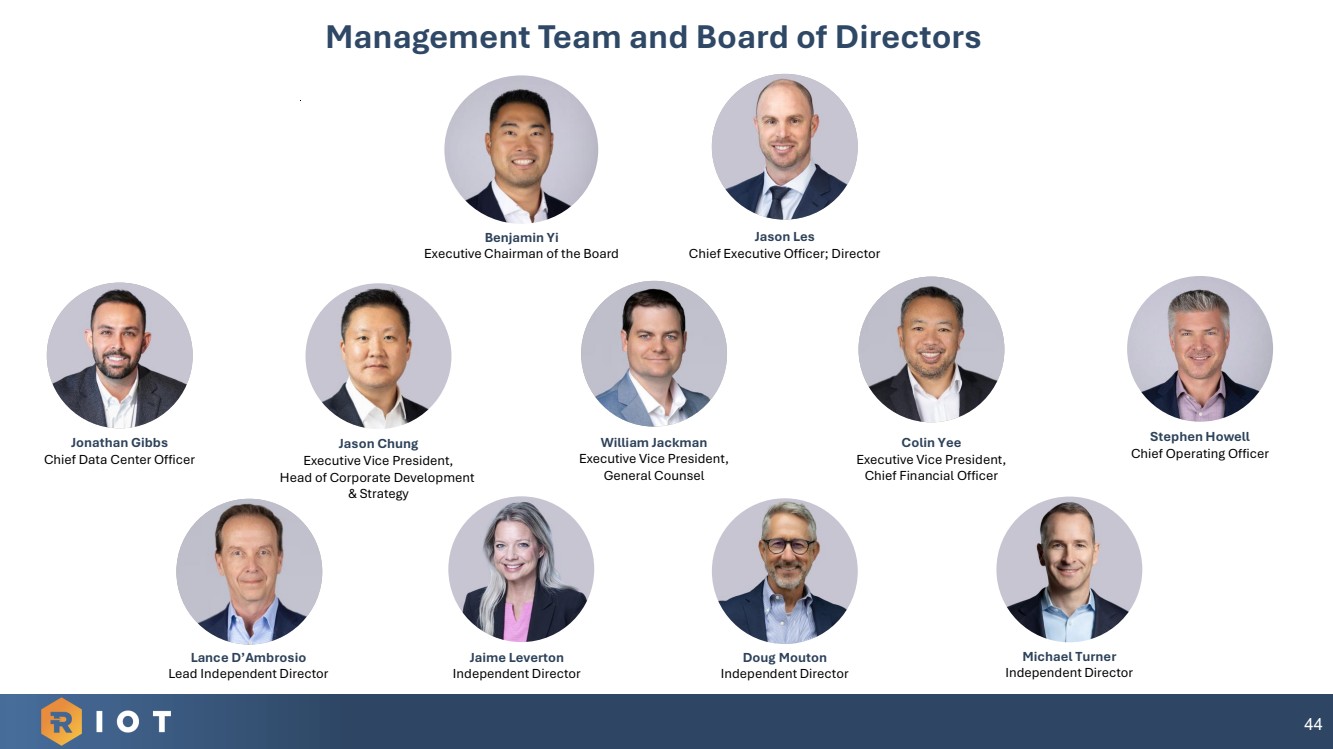
Thank you, operator. Good afternoon, and welcome to Riot Platforms Third Quarter Earnings Conference Call. My name is Josh Kane, Vice President of Investor Relations. And joining me on today's call from Riot are Jason Les, CEO; Benjamin Yee, Executive Chairman; Colin Yee, CFO; and Jason Chung, EVP and Head of Corporate Development and Strategy. On the Riot Investor Relations website, you can find our third quarter earnings press release and accompanying earnings presentation, which are intended to supplement today's prepared remarks and which include a discussion of certain non-GAAP items. Non-GAAP financial measures provided should not be considered as a substitute for or superior to the measures of financial performance prepared in accordance with GAAP and are included as additional clarifying items to aid investors in further understanding the company's third quarter performance. During today's call, we will be making forward-looking statements regarding potential future events. These statements are based on management's current expectations and assumptions and are subject to risks and uncertainties. Actual results could materially differ due to factors discussed in today's earnings press release, in comments and responses made during today's call and in the Risk Factors section of our Form 10-K and Forms 10-Q, including for the 3 months ended September 30, 2025, which will be filed later today as well as other filings with the Securities and Exchange Commission. With that, I will turn the call over to Jason Les, CEO of Riot Platforms.
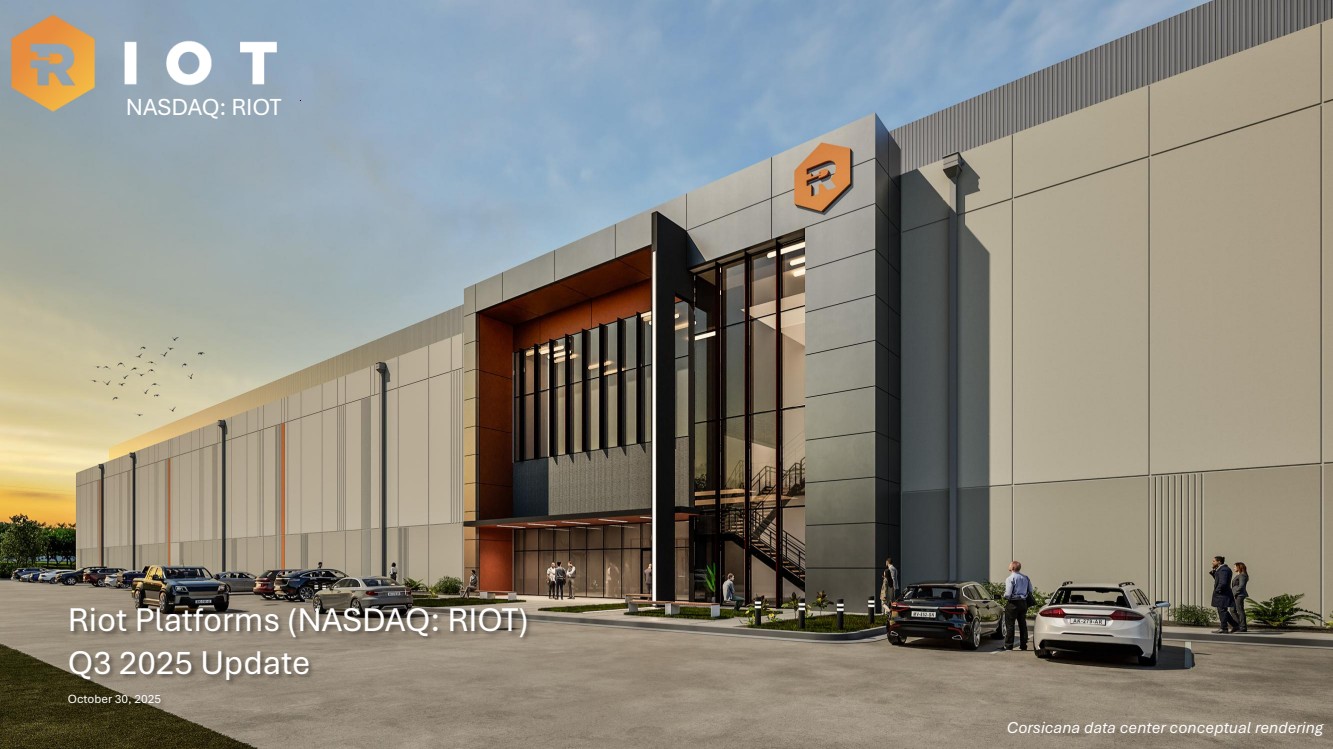
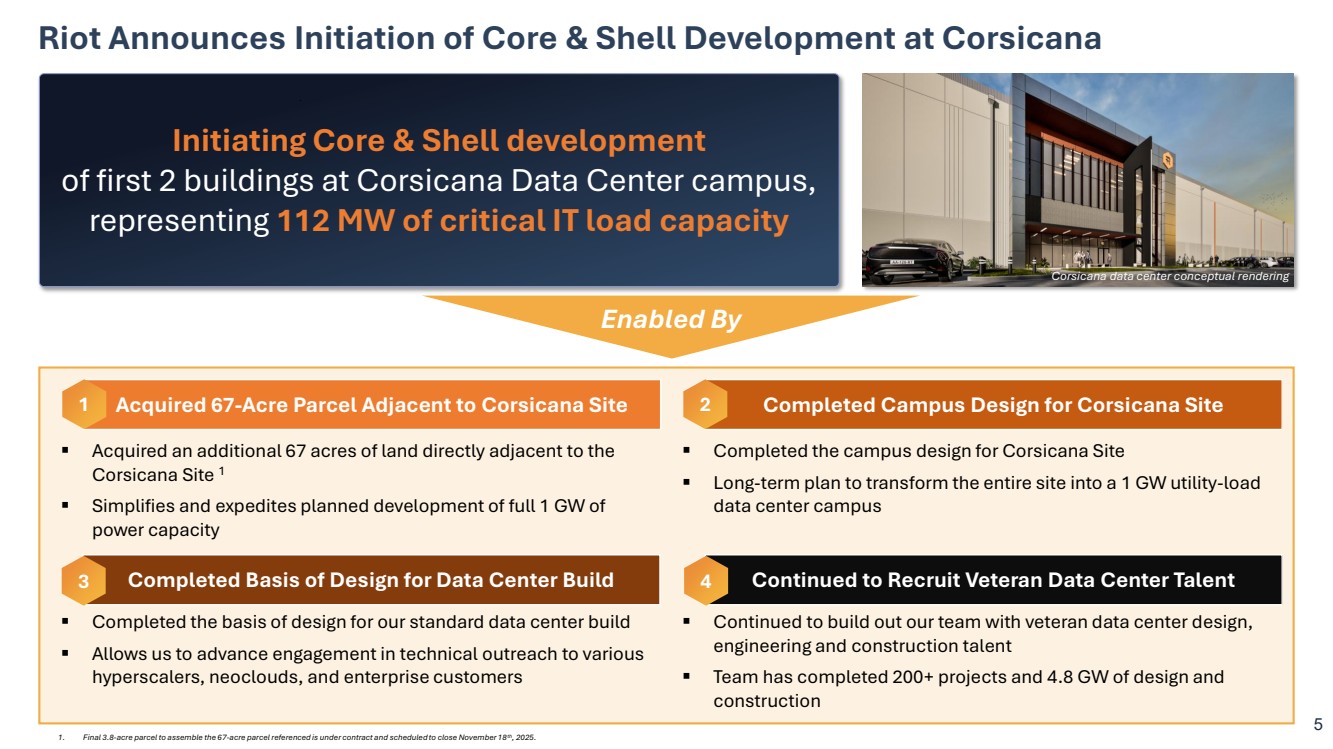
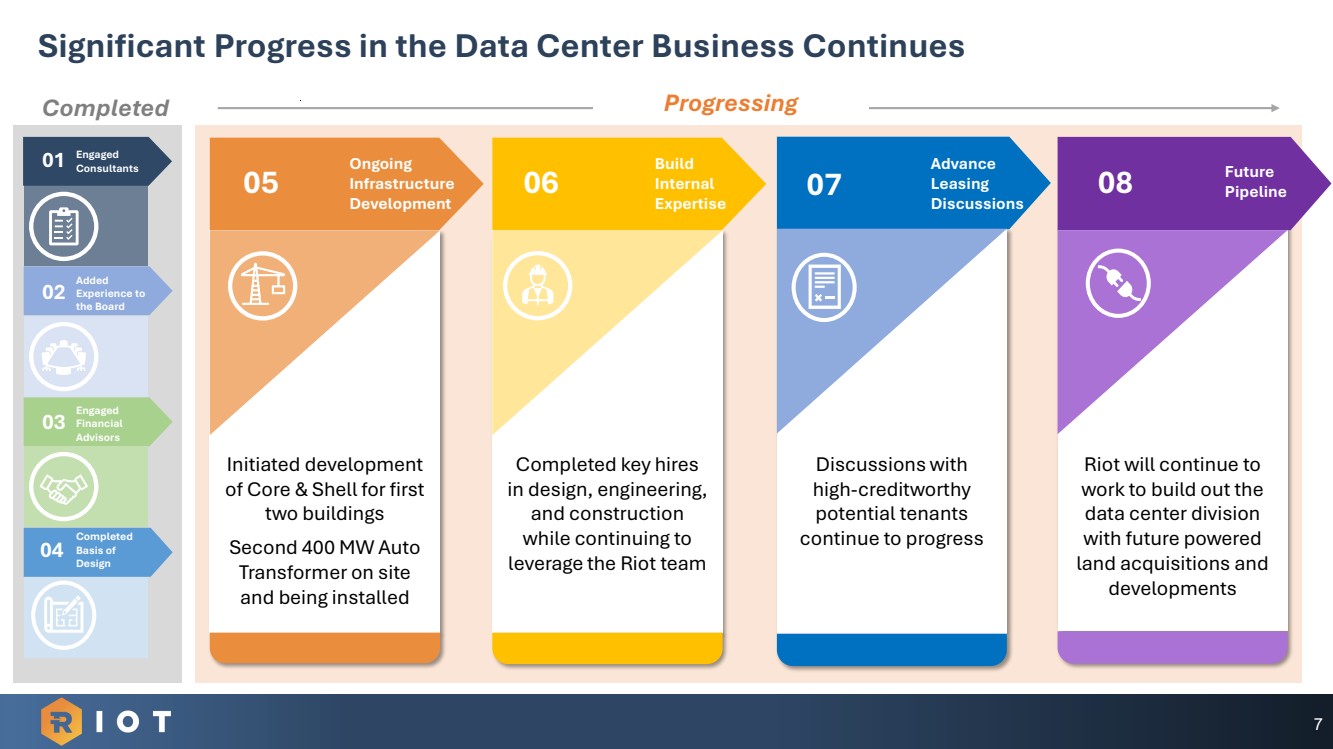
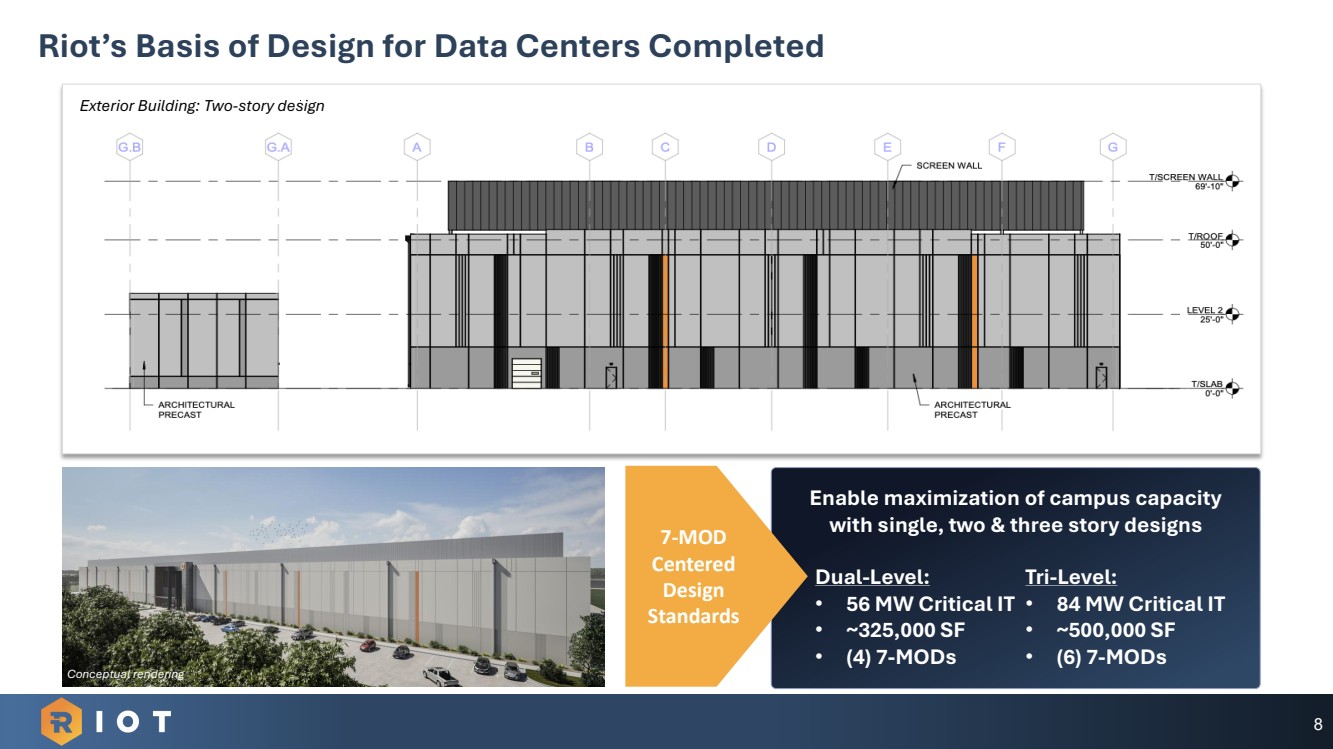
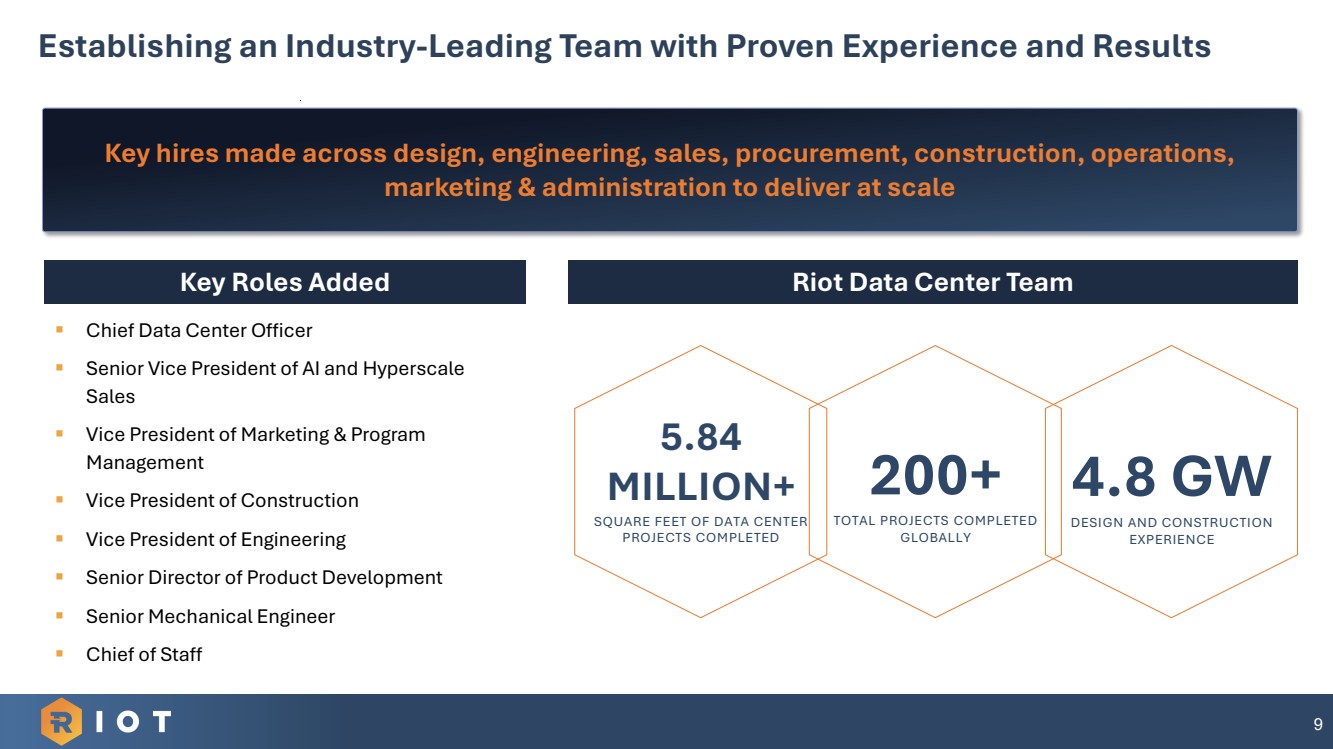
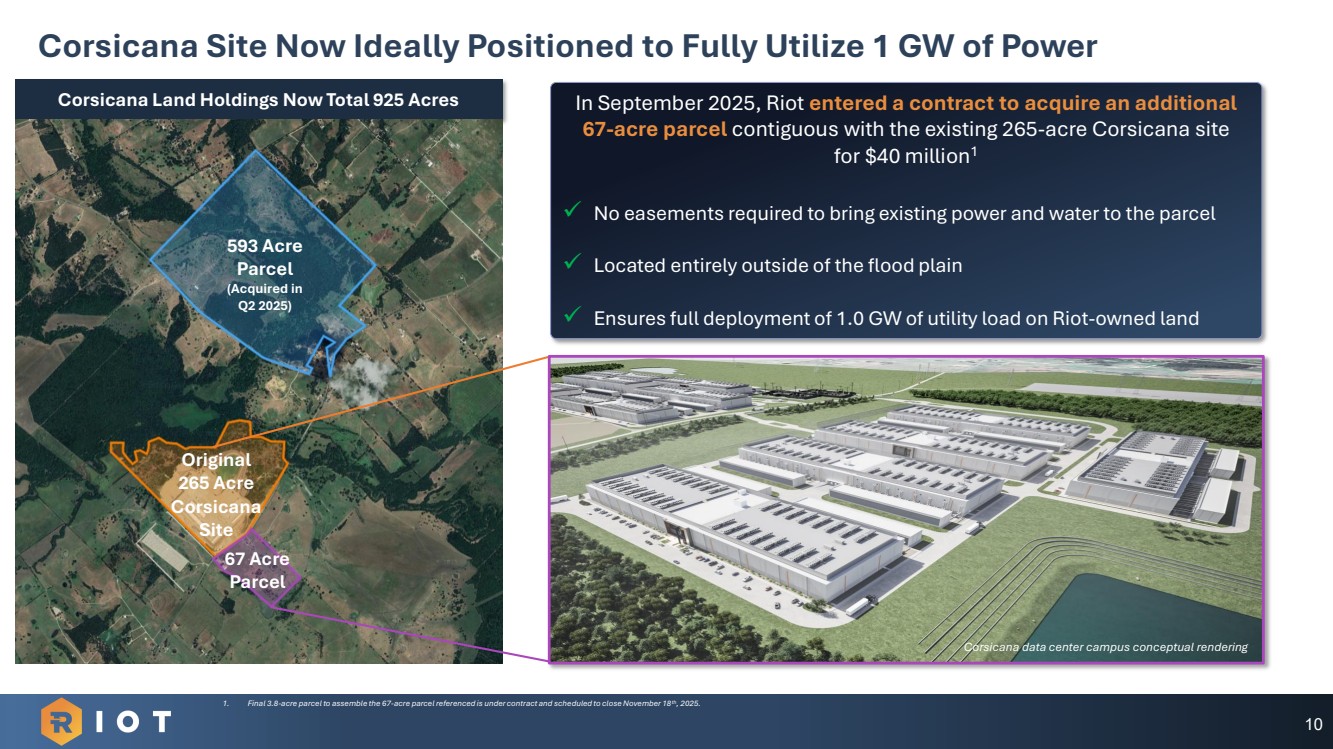
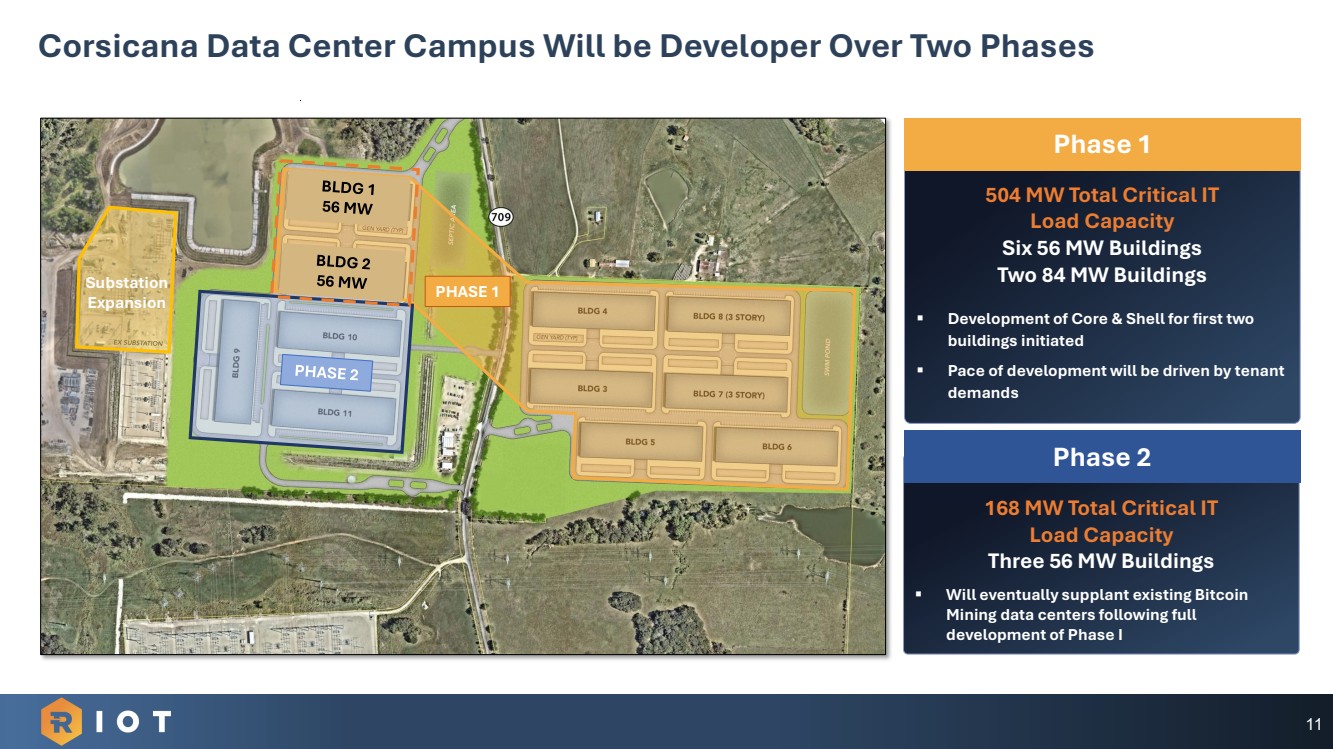
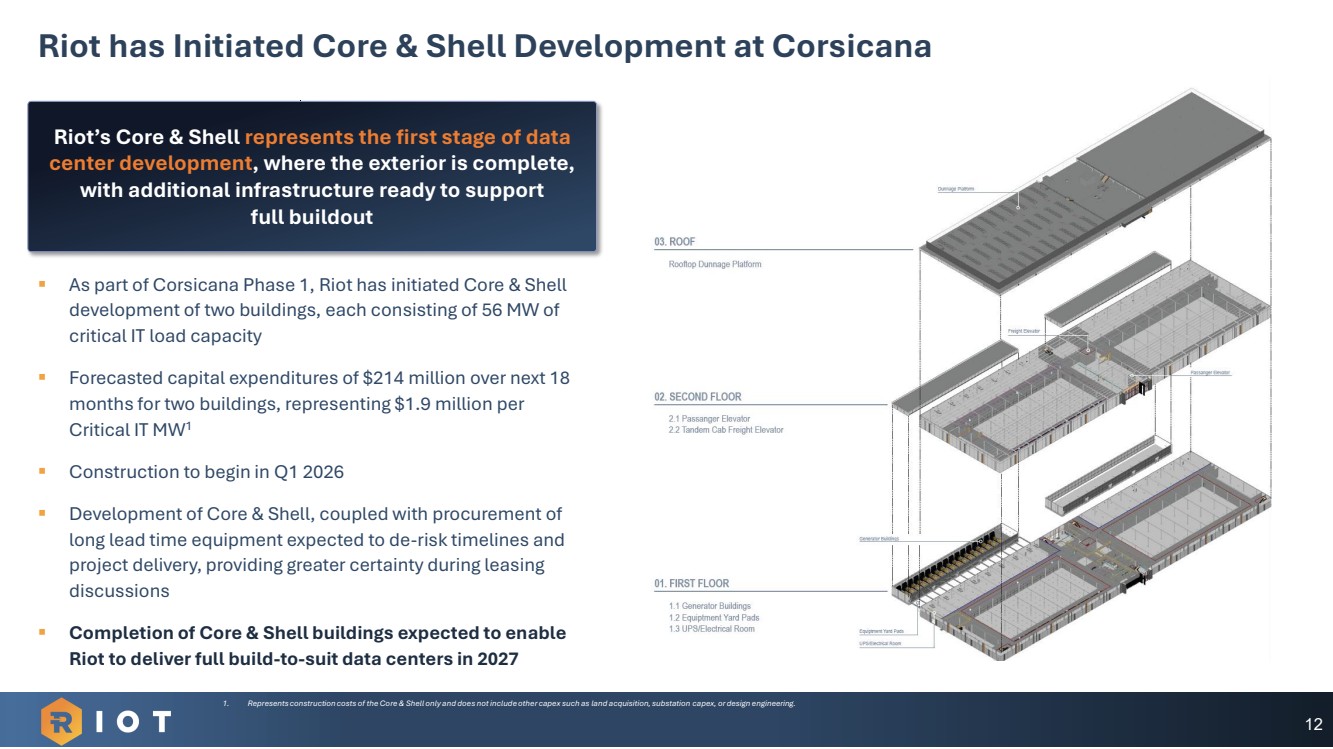
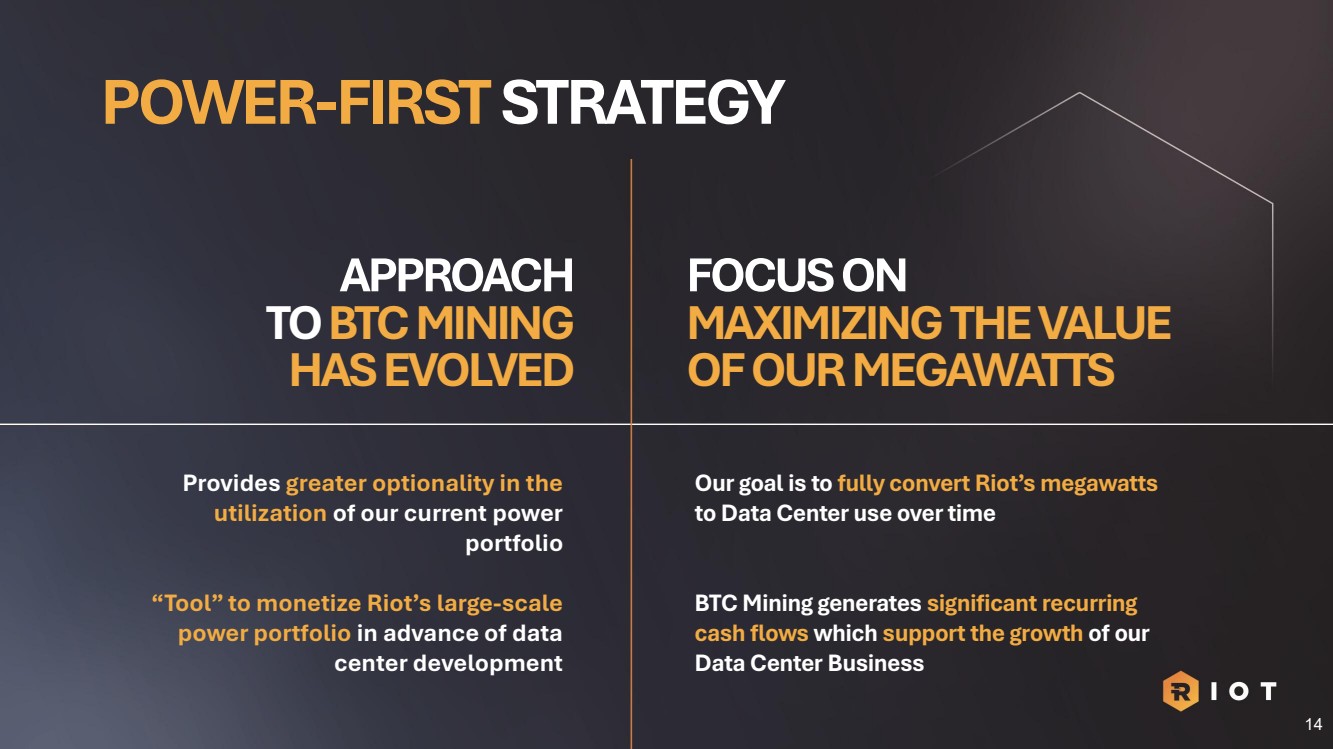
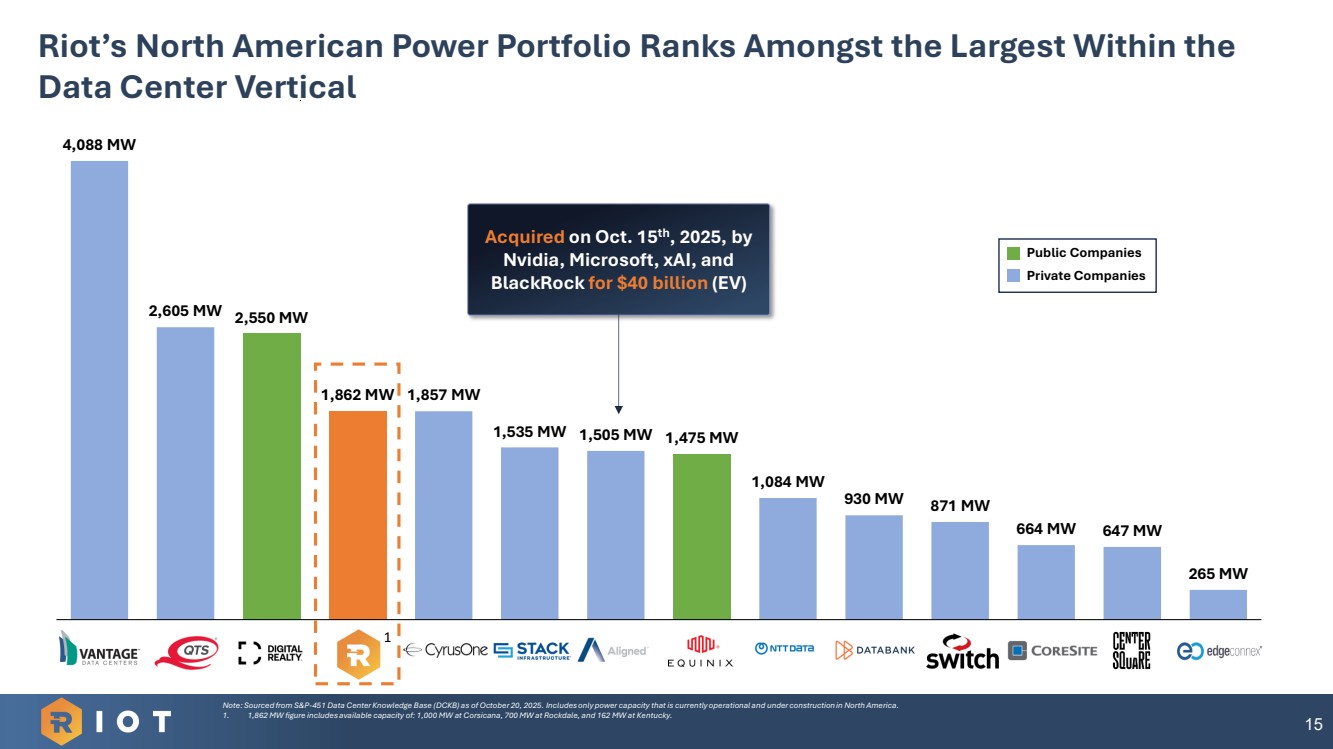
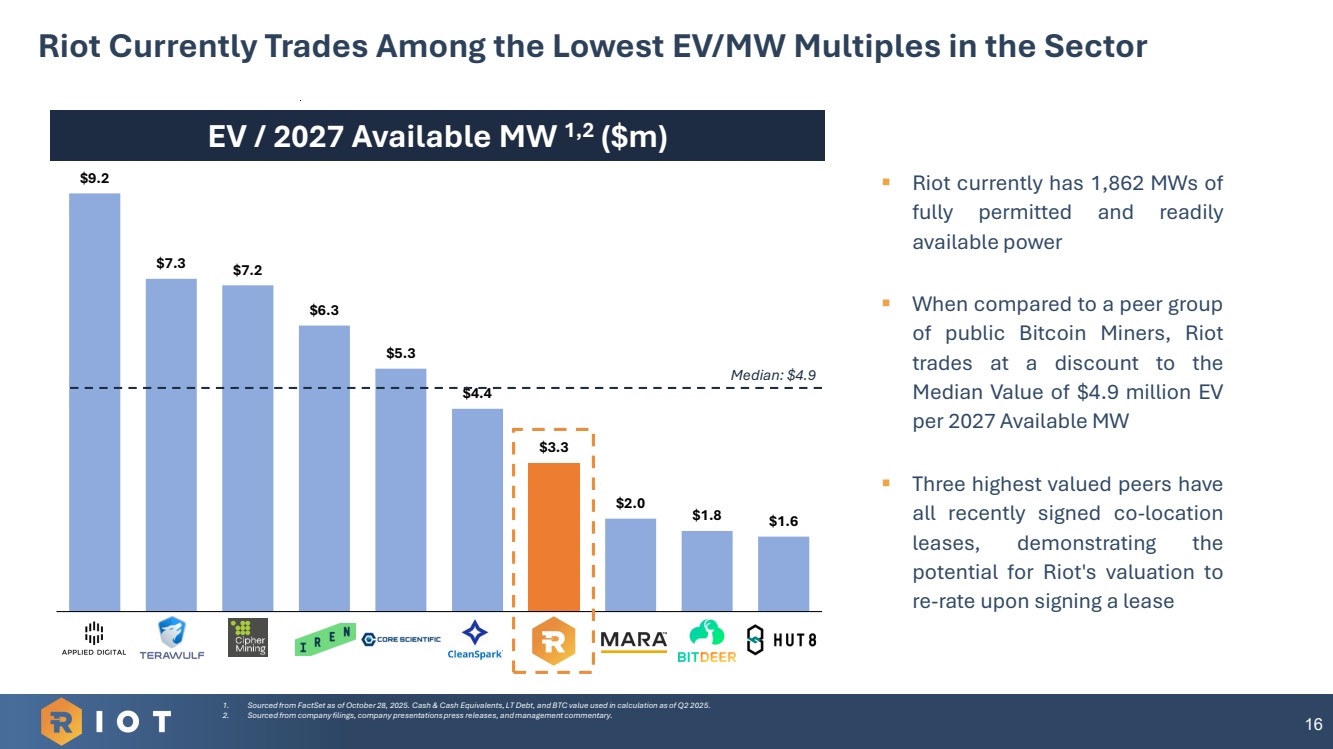
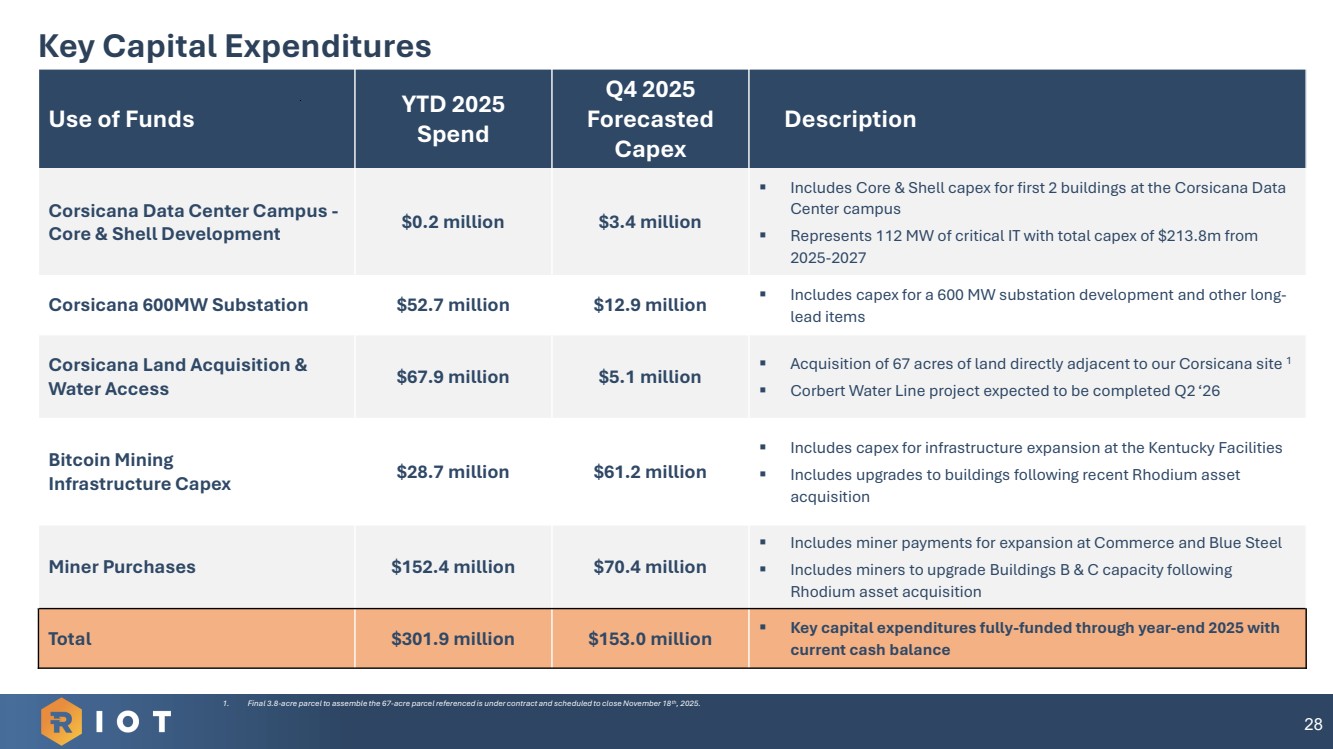
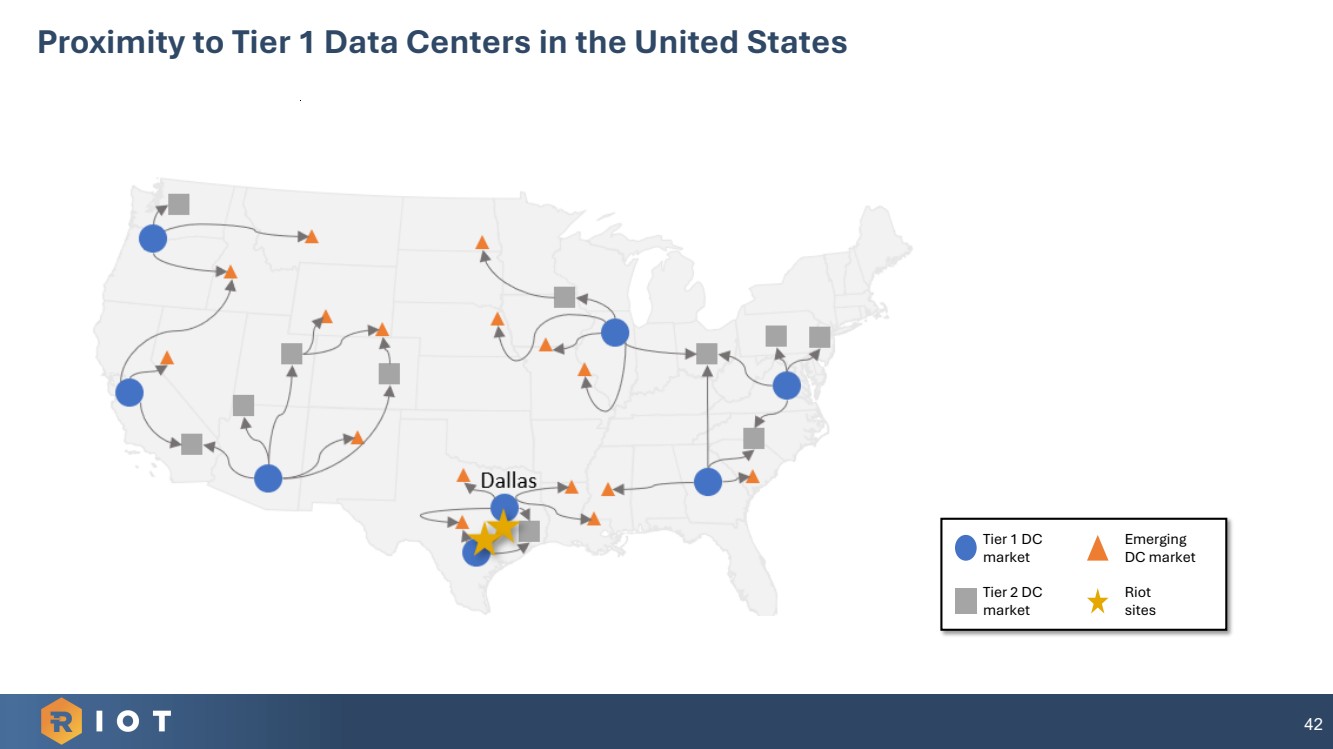
Thank you, Josh. Riot is in the process of transforming into one of the most meaningful data center developers and operators in the market today. The demand for data center capacity is insatiable and growing, and our unmatched portfolio of large-scale land and power assets positions us to significantly capitalize on this opportunity. I am incredibly excited to announce the completion of several key milestones and additional ongoing strategic initiatives, which we are currently undertaking as part of the development of our data center business and more broadly as part of the ongoing transformation of Riot. In particular, I am proud to announce today that we are initiating the Core & Shell development of the first 2 buildings at our Corsicana data center campus, representing a combined 112 megawatts of critical IT data center capacity. We have already been securing long lead equipment and plan to mobilize construction of these 2 buildings beginning in Q1 2026. This announcement has been enabled by 4 key achievements this quarter. During the quarter, Riot acquired an additional 67 acres of land directly adjacent to our original Corsicana site, greatly simplifying the development of our full 1 gigawatt of approved power capacity and enabling the completion of our campus design at Corsicana, completed the campus design for Corsicana with a plan to transform the entire site into a 1 gigawatt utility load data center campus, completed the basis of design for our standard data center build, which has deepened our technical engagement with hyperscaler, neocloud, and enterprise customers and continued to build out our in-house data center expertise with veteran data center sales, design, engineering, and construction talent. These achievements further advance the ongoing process of transforming Riot into a large-scale, multifaceted data center enterprise. We are investing in building out our data center business in order to enhance our conversations with prospective tenants and leverage competitive tension in our leasing process, all with a view towards maximizing the value generated from our portfolio of land and power assets. We are announcing this development of 112 megawatts of critical IT capacity as just an initial milestone in our development pipeline, which consists of nearly 2 gigawatts of secured utility load power, and we will continue to announce further development plans as we progress on our strategy and advance further on customer discussions. Riot is transforming into one of the most meaningful data center companies at the center of the Fourth Industrial Revolution. We have a significant portfolio of readily available power, an incredibly strong balance sheet, and the world-class talent necessary to deliver on our plans. The demand for data center capacity has never been more robust. And on behalf of all of our shareholders, we are incredibly excited to be executing on the enormous value creation opportunity in front of us. Riot has a tremendous advantage today in our unmatched portfolio of fully approved power and land located within highly desirable data center markets. We have made significant progress in establishing our data center business, which serves as the foundation not only for maximizing the value of our power portfolio today but from which we will also continue to scale and capitalize on new opportunities. Over the course of this year, we have completed third-party expert assessments of our 2 primary sites, Corsicana and Rockdale. Added data center and real estate development experience to our Board of Directors and engaged financial advisers to assist on discussions with strategic and financial partners and on the broader leasing negotiation process. Most recently, I am pleased to announce we have completed the basis of design for our data centers. Completion of this basis of design has enabled us to deepen our engagement in technical and engineering level outreach with potential tenants, begin procurement of necessary long lead time equipment, and begin construction on our first 2 buildings. We will provide additional information on our basis of design later on today's call. We have also further progressed on the ongoing infrastructure development at Corsicana, including the 600-megawatt substation expansion, where the first 400-megawatt auto transformer of this expansion development is now on site being installed and remains on track for energization in Q1 next year and the Core & Shell development of the first 2 buildings of our Phase 1 development plan, which will allow us to deliver full build-to-suit data centers in 2027. On the hiring front, the build-out of our data center team has continued at an aggressive pace. We have in place key leadership across product development, construction, engineering, sales, and marketing, which has allowed us to complete the basis of design and rapidly move towards initiating construction. We will continue to build on this momentum by adding additional positions that underpin our data center business and support future leasing, operational, and growth targets. We have made substantial progress on our design program, which will support Corsicana and other sites, and we have completed a standardized data center basis of design that meets Tier 3 resiliency and efficiency expectations for prospective tenants in the market. Advancing our basis of design is critical as we engage prospective tenants on specifications and customization. Our design philosophy emphasizes flexibility to address the needs of a range of potential customers and use cases. That flexibility includes multiple building formats, including single, 2-, and 3-story configurations in order to maximize campus capacity. In addition, our design is centered around a 7-module or 7-mod format. With this format, we are standardizing around a 7 plus 1 component design, 7 components plus 1 additional component of redundancy. Our basis of design can easily be adapted to the requirements of any tenant. Each 7-mod is a data hall representing 14 megawatts of critical IT load capacity, and there are two 7-mods per floor totaling 28 IT megawatts per floor. Therefore, a 2-story building will have four 7-mod data halls, 2 per floor, representing 56 IT megawatts, and a 3-story building will have six 7-mod data halls representing 84 IT megawatts. We are confident that this sits within the range of tenants' desired topography and allows us to easily adapt to each of the requirements. If a tenant wants more redundancy, we can easily build that in and vice versa. Riot's basis of design establishes the foundation for our data center development and has been designed in a manner that is intentionally replicable beyond Corsicana, enabling faster, more efficient equipment procurement and delivery on future development in order to quickly seize upon any market opportunities going forward. One of the most important differentiators we are developing at Riot is the assembly of an industry-leading in-house data center team with expertise across design, engineering, sales, procurement, construction, operations, marketing, and administration. As highlighted here, our growing team brings deep, directly relevant experience in building and delivering mission-critical data centers. We have in place the team to deliver on our first phase of construction and development with collective experience completing over 200 data center projects, totaling nearly 5 gigawatts of capacity. Data center development talent is in high demand, and we are incredibly proud of the depth of capabilities and experience that we have already been able to attract to Riot. The quality of the data center team we already have in place today is a critical advantage in ensuring that potential tenants and partners are confident in our ability to deliver at scale. These internal data center team capabilities are further reinforced by our engineering business, comprised of ESS Metron and E4A Solutions, which provides integrated manufacturing, commissioning, and maintenance expertise. These complementary units create meaningful synergies and strengthen our ability to rapidly execute on an expanding data center development program. In September, we successfully acquired a collection of parcels that total 67 acres contiguous with our original Corsicana site for total consideration of $40 million. Early on, Riot identified this plot of land as the most ideal site for immediate development of our data centers, and I am excited to share an update on what this acquisition has enabled for us. The new parcel's proximity to our Corsicana site enables rapid development as it is immediately adjacent to our existing site and therefore, will not require additional easements or transmission construction, which could potentially have extended delivery timelines. The ideal condition, gradient, and location of this new parcel will allow us to quickly begin development and strengthen confidence in our delivery timelines. Most importantly, the additional acreage we now own next to our existing Corsicana site ensures the ability to completely utilize our 1 gigawatt of fully approved power on Riot-owned land for data center use, all in a connected campus layout. Together with the previous land acquisitions announced last quarter, Riot now owns 925 acres surrounding the Corsicana area, securing long-term development flexibility and fully completes all necessary land acquisitions for potential build-outs. Our now expanded footprint at Corsicana has allowed us to complete our campus design for the entire site, which we envision taking place across 2 development phases. Development of Phase 1 will encompass 504 megawatts of critical IT load, consisting of six 56-megawatt buildings and two 84-megawatt buildings spread across both the excess developable acreage on our original Corsicana site as well as on our newly acquired immediately adjacent parcel. As previously announced, Core & Shell development on buildings 1 and 2 has already been initiated, and we anticipate the first building to be completed in Q1 2027. The overall pace of development in Phase 1 will be driven by tenant commitments and leasing progress, and we are sequencing capital expenditures to maximize power to value conversion. Phase 2 will be comprised of three 56-megawatt buildings, representing 168 megawatts of critical IT load and over time, will eventually supplant our existing Bitcoin mining data centers. The completion of our data center designs has enabled us to take the next steps on delivering full build-to-suit Tier 3 data centers. With our initiation of the development phase of our first two 56-megawatt buildings at our Corsicana site, we will begin construction in Q1 2026 on the Core & Shell of the first 2 buildings. The Core & Shell construction will consist of a build-out and enclosure of the main structure of the data center, generator buildings, and completed power yards, an open interior with operational elevators, docks, logistics areas, lighting, fire protection, and security. It will also include the first steps on electrical, plumbing, and HVAC infrastructure, which will support full data center build-out and tenant fit-out. Construction of Core & Shell buildings will be completed in phases with the first building expected to be completed in Q1 2027 and will be followed by full fit-out of the data hall with IT equipment, cooling, and power delivery systems. The first phase of construction of the Core & Shell is the most time-intensive but capital-light portion of the build-out with a total expected development cost of $214 million, representing approximately $1.9 million per IT megawatt for the first 2 buildings. Initiating construction on this timeline, coupled with procurement of long lead time equipment allows us to provide certainty during leasing discussions of our forecasted energization in 2027. As we progress further in leasing discussions, we will provide cost estimates and timelines on the build-out and delivery of the complete and full build-to-suit of the first two 56-megawatt data centers. Riot has long focused on maintaining 3 strategic pillars in relation to our Bitcoin mining business: significant scale of operations, being a low-cost producer, and maintaining a strong balance sheet. These strategic pillars formed the foundation of Riot's vertically integrated approach to Bitcoin mining and the development of a unique portfolio of large-scale powered sites supported with significant cash and Bitcoin on hand. As our strategy has evolved, so has our approach to our Bitcoin mining business. We no longer see Bitcoin mining operations as the end goal but instead as a means to an end, and that end is maximizing the value of our megawatts. Over time, this means transitioning the megawatts in our power portfolio for data center development. Ready-for-service power in the right locations is increasingly scarce and valuable, which in turn forms the basis for the enormous value creation opportunity ahead of us. Monetizing megawatts is how we translate that advantage directly into shareholder value. Bitcoin mining continues to be a very valuable tool to monetize Riot's large-scale portfolio of power, and our Bitcoin mining business continues to be highly profitable. We will continue to utilize the opportunity Bitcoin mining brings to secure power and drive strong cash flow that we will leverage to support the ongoing transformation of our overall business. We just discussed our Power First strategy, which underpins the evolution of our business. On Slide 15, we wanted to provide some context on the underlying significant size and scale of Riot's power portfolio. While many peers reference pipelines of prospective projects, Riot's portfolio totaling more than 1.8 gigawatts is fully approved and available today. This positions Riot as having one of the largest data center power portfolios in North America. It's also important to consider location. This slide presents total megawatts, but not all megawatts are the same. Approximately 1.7 gigawatts of our total capacity is located in the Dallas and Austin regions, two of the most attractive data center markets in the country, offering compelling proximity to existing hyperscaler and enterprise core architecture and tenant demand. On Slide 16, we show enterprise value per megawatt across selected peers in the Bitcoin mining space. We view this as a useful lens on how the market values power portfolios today. Some of the companies to the left of Riot have announced lease arrangements and have seen their valuation multiples rerate significantly. Riot currently trades at a meaningful discount to this peer set despite having one of the largest fully approved and readily available power portfolios in the industry. As we execute our data center strategy and convert megawatts into contracted data center leases, we anticipate the market will increasingly reevaluate the underlying value of our power portfolio from a data center lens, leading to a re-rating and multiple expansion on our valuation as well. More broadly, as the market matures, we expect investors will increasingly differentiate on the quality of power, meaning location, cost of power, schedule certainty, and interconnection, and on the credit quality and profitability of underlying projects and leases. Our plan is focused on delivering against these dimensions. I will now turn the call over to Colin Yee, CFO, to present our third quarter financial update.
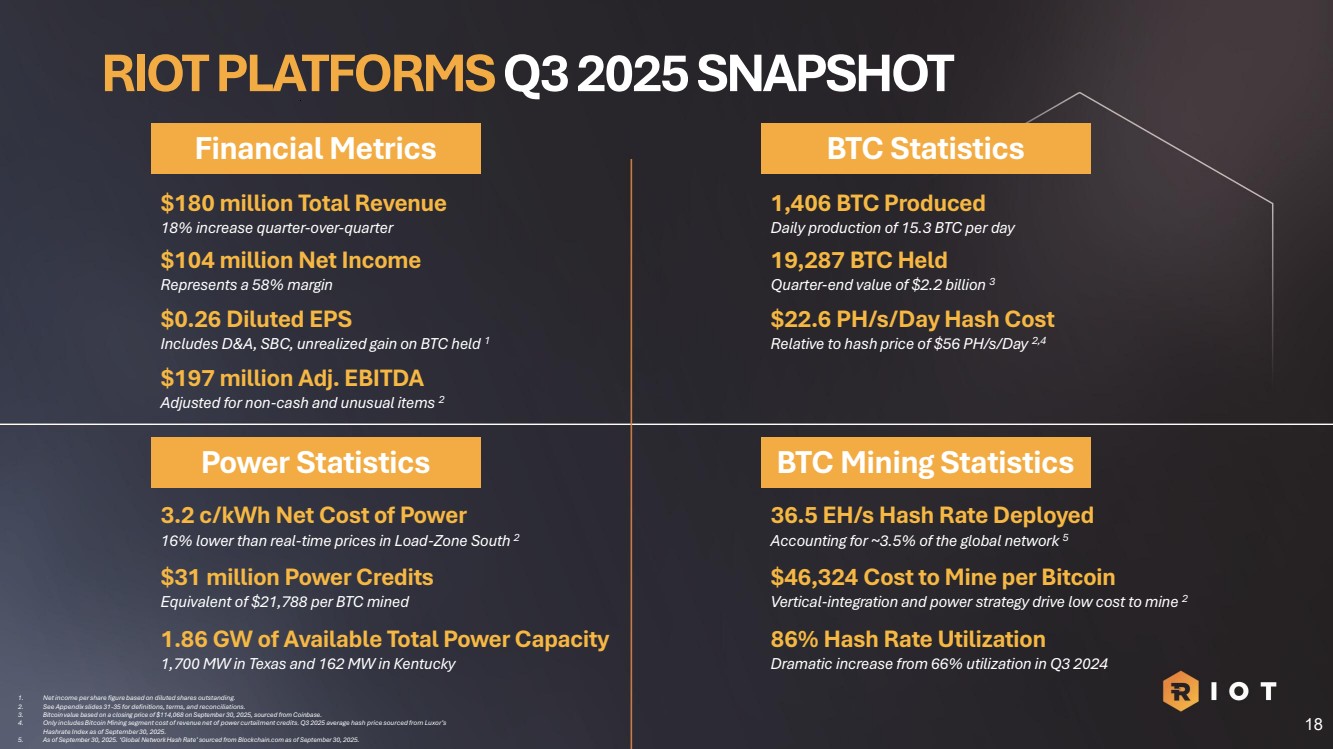
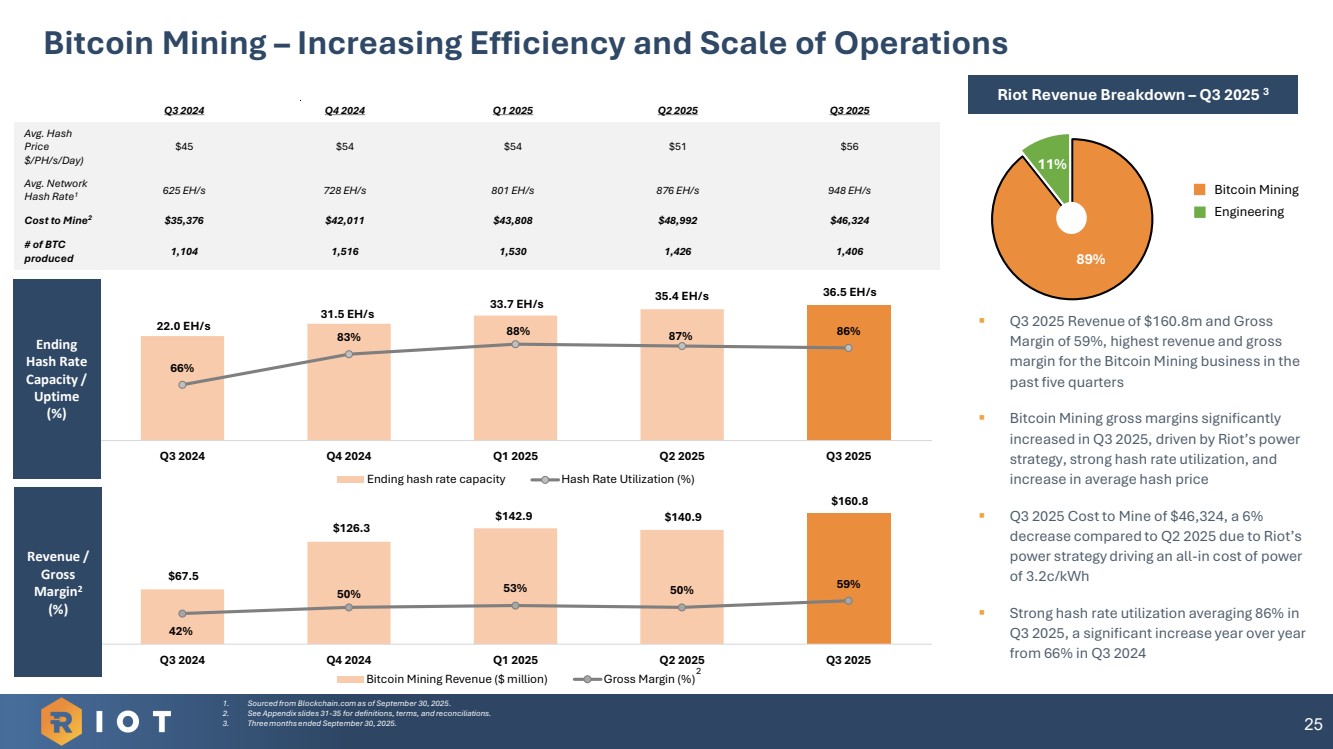
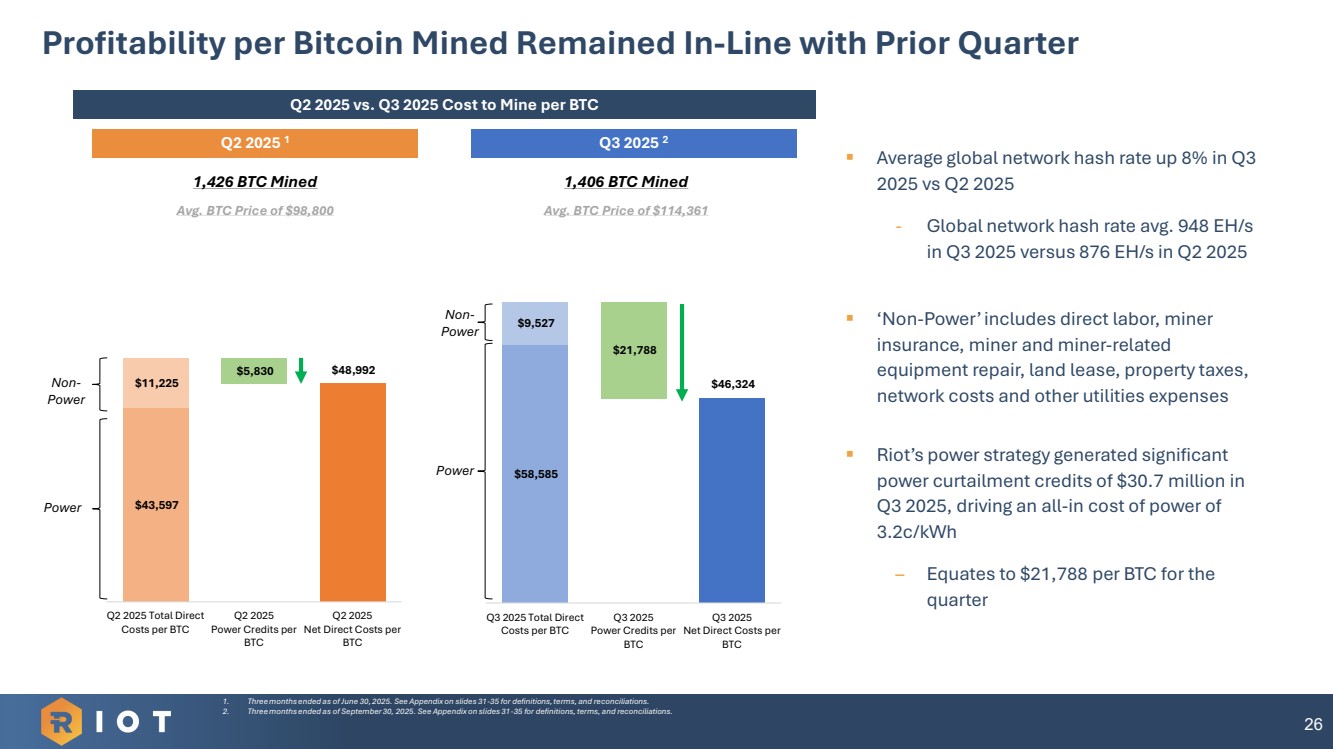
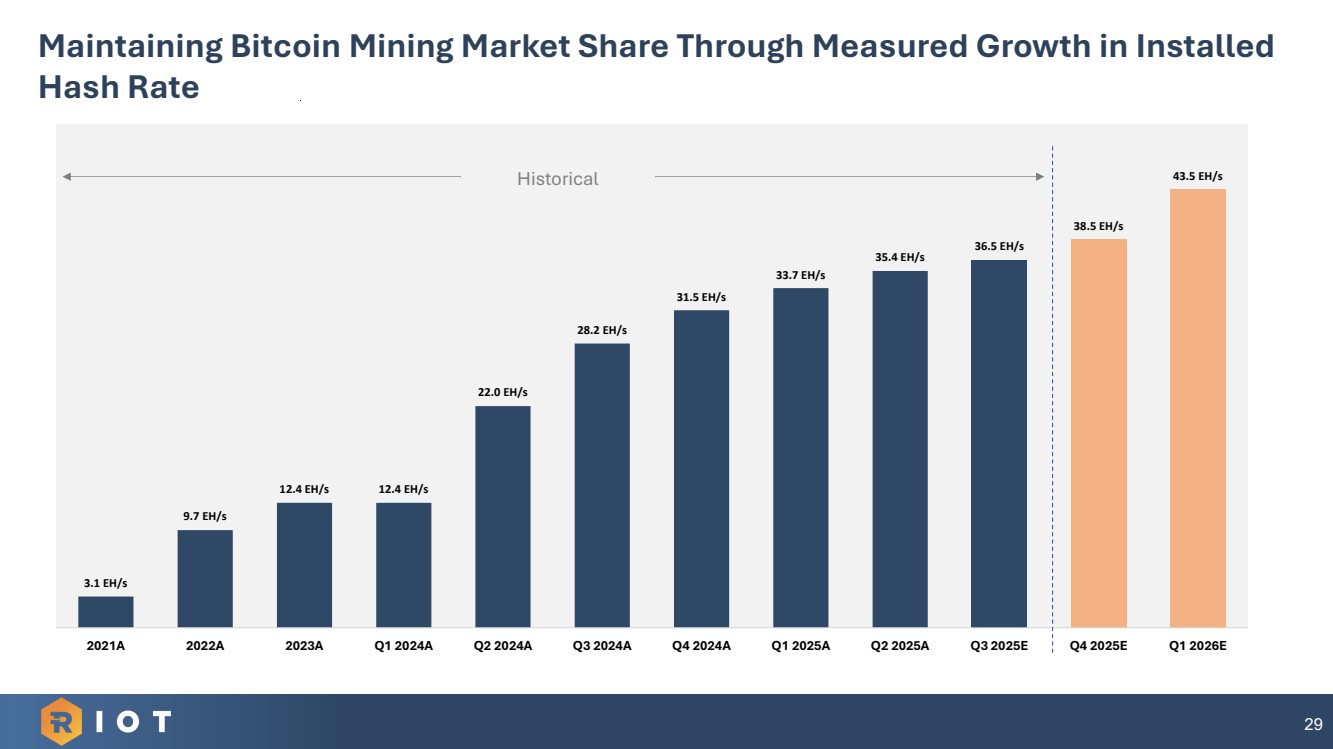
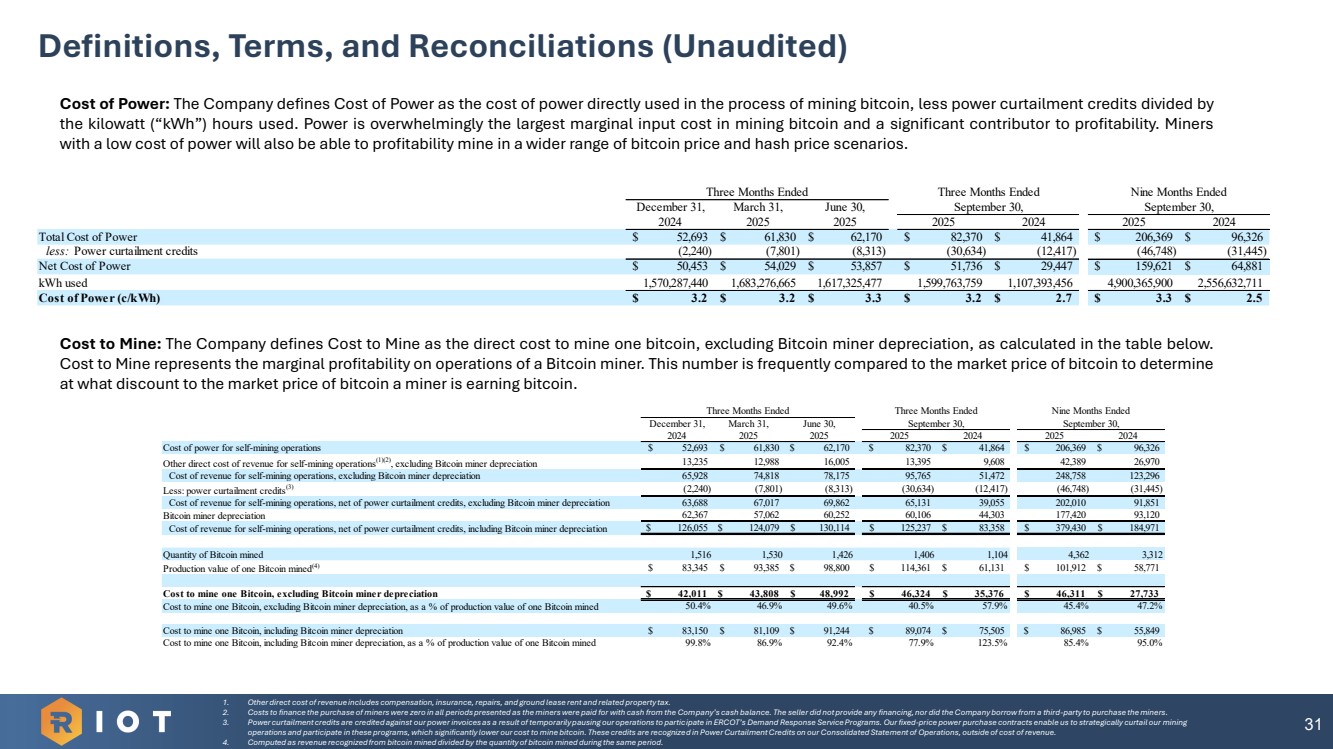
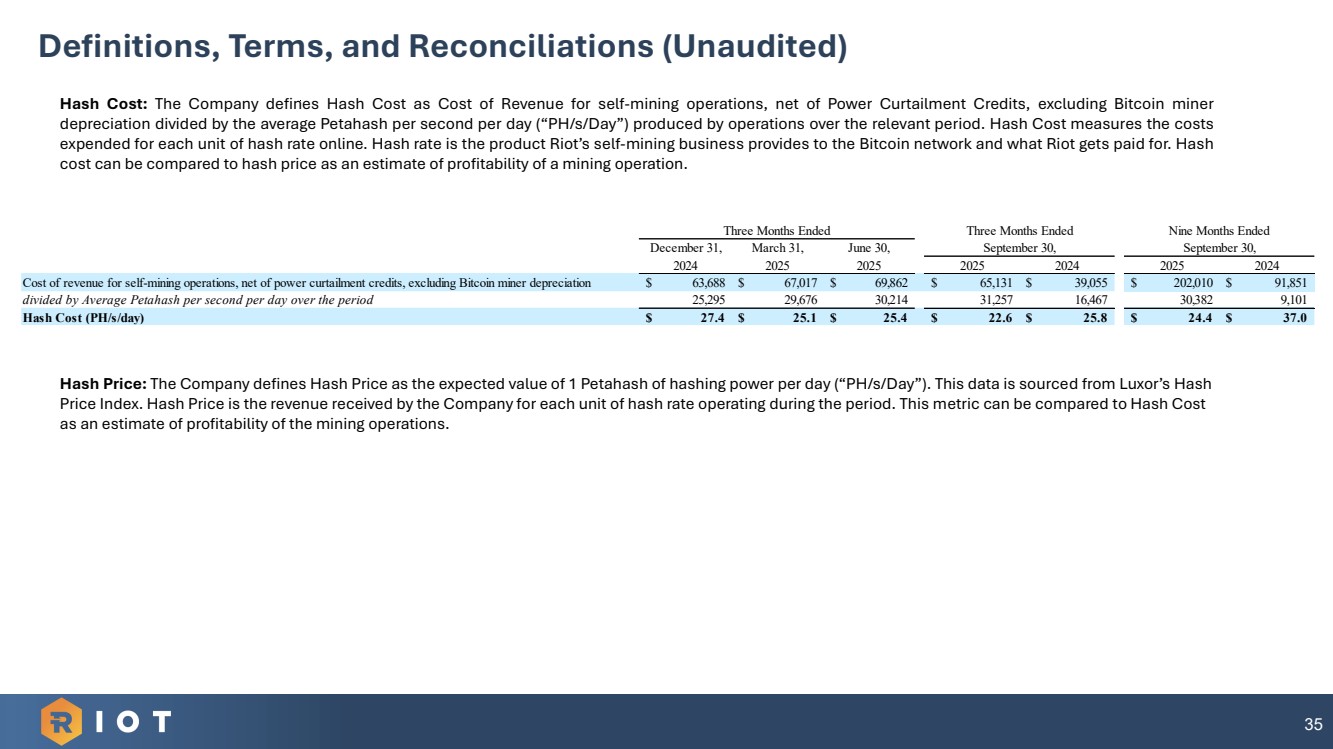
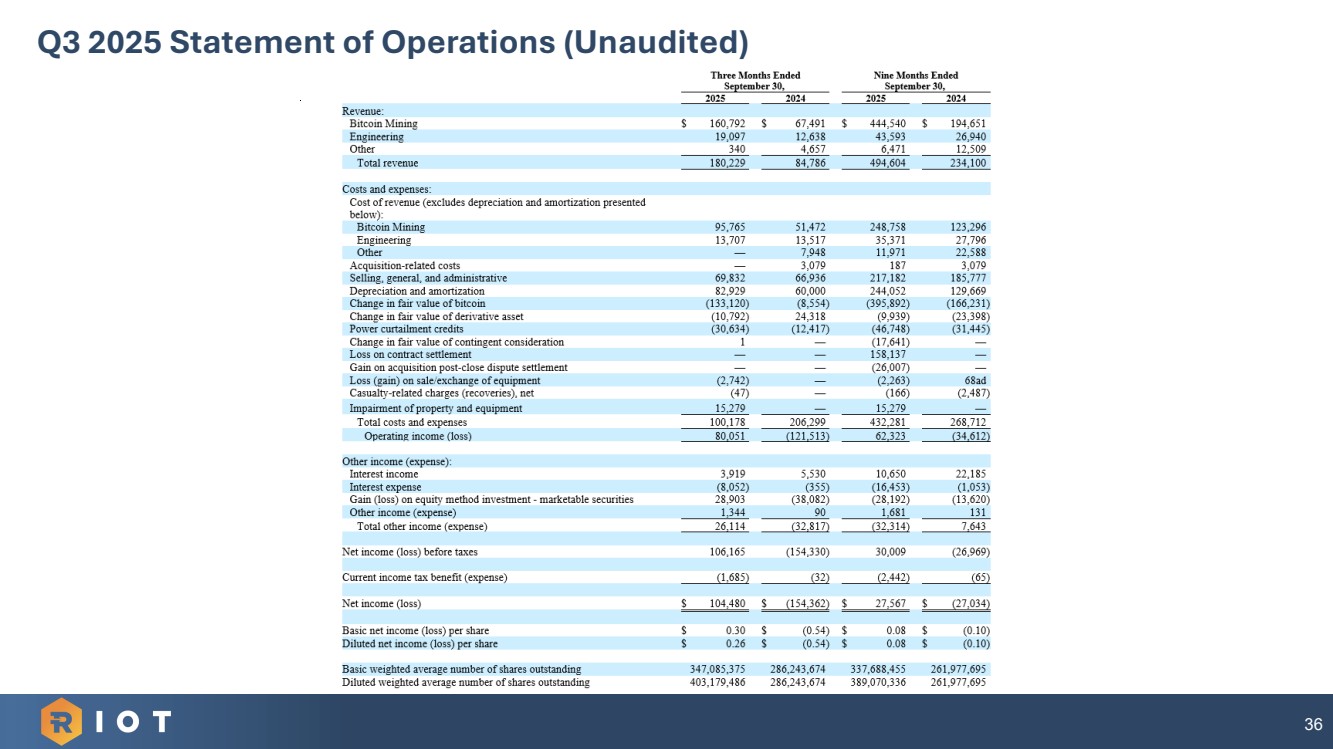
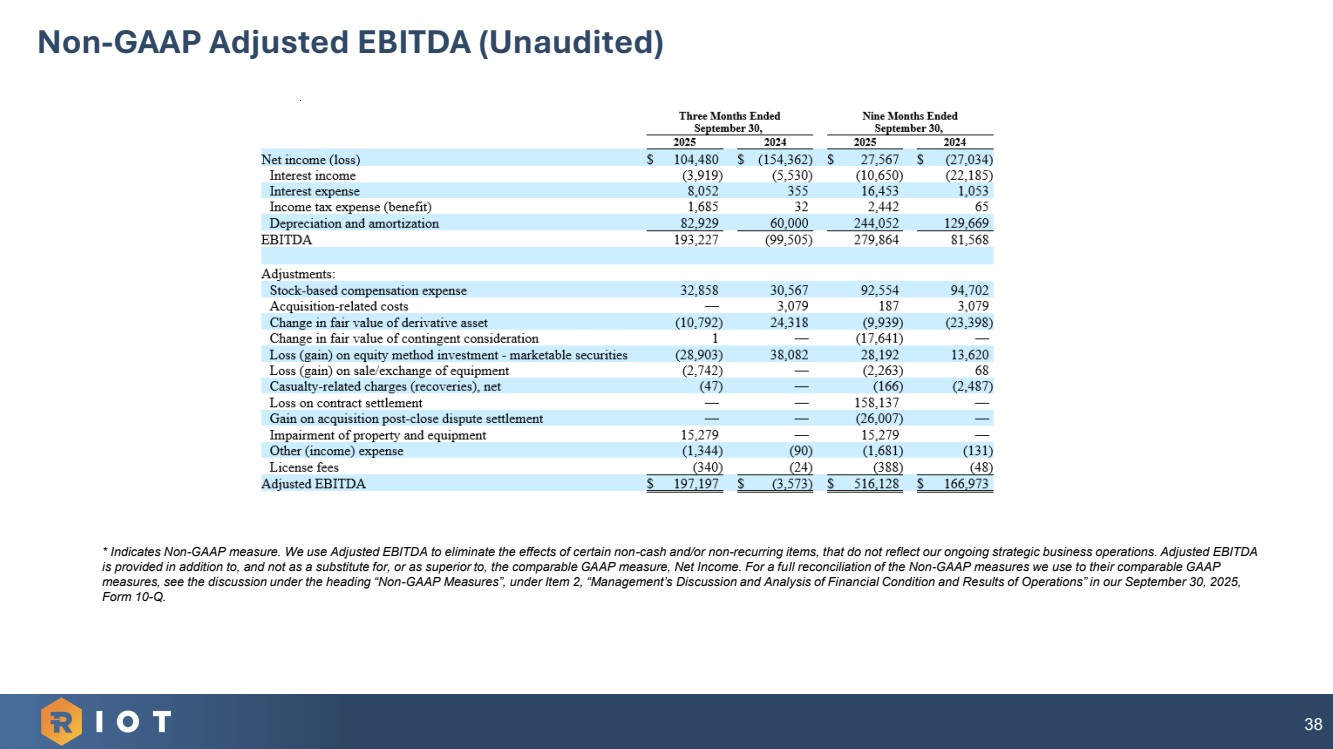
Thank you, Jason. For the third quarter of 2025, Riot reported total revenue, which consists of Bitcoin mining and engineering revenue of $180.2 million as compared to $153 million for the previous quarter, an 18% increase quarter-over-quarter. Net income for the third quarter equaled $104.5 million or $0.26 per fully diluted share compared to net income of $219.5 million or $0.58 per fully diluted share for the prior quarter. Non-GAAP adjusted EBITDA for the third quarter was $197.2 million as compared to non-GAAP adjusted EBITDA of $495.3 million for the prior quarter. During the third quarter, Riot produced 1,406 Bitcoin as compared to 1,426 Bitcoin in the prior quarter. The slight decline in Bitcoin production quarter-over-quarter was driven by growth in the global hash rate of approximately 8%, which exceeded Riot's growth in hash rate deployed of approximately 3%, though partially offset by continued improvements in our operating efficiency and utilization rate, which reached 86% this quarter. This improvement in our utilization rate in the third quarter was achieved despite more active employment of our power strategy in the third quarter, during which we successfully generated $31 million in power credits, lowering our net cost of power to $0.032 per kilowatt hour and further solidifying our position as a low-cost leader in the sector. Riot ended the third quarter holding 19,287 Bitcoin with a market value at the end of the quarter equal to $2.2 billion. I will now turn the call over to Jason Chung, Riot's EVP of Corporate Development and Strategy.
Speaker 4
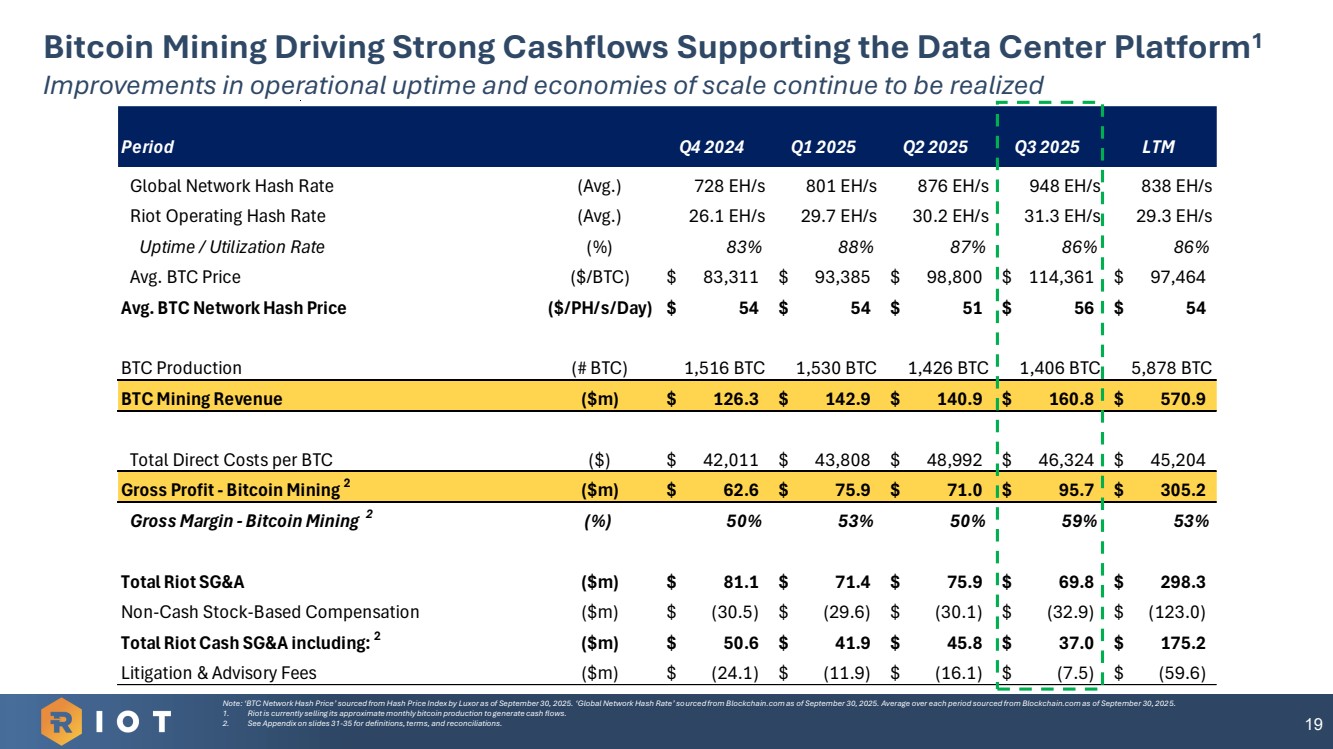
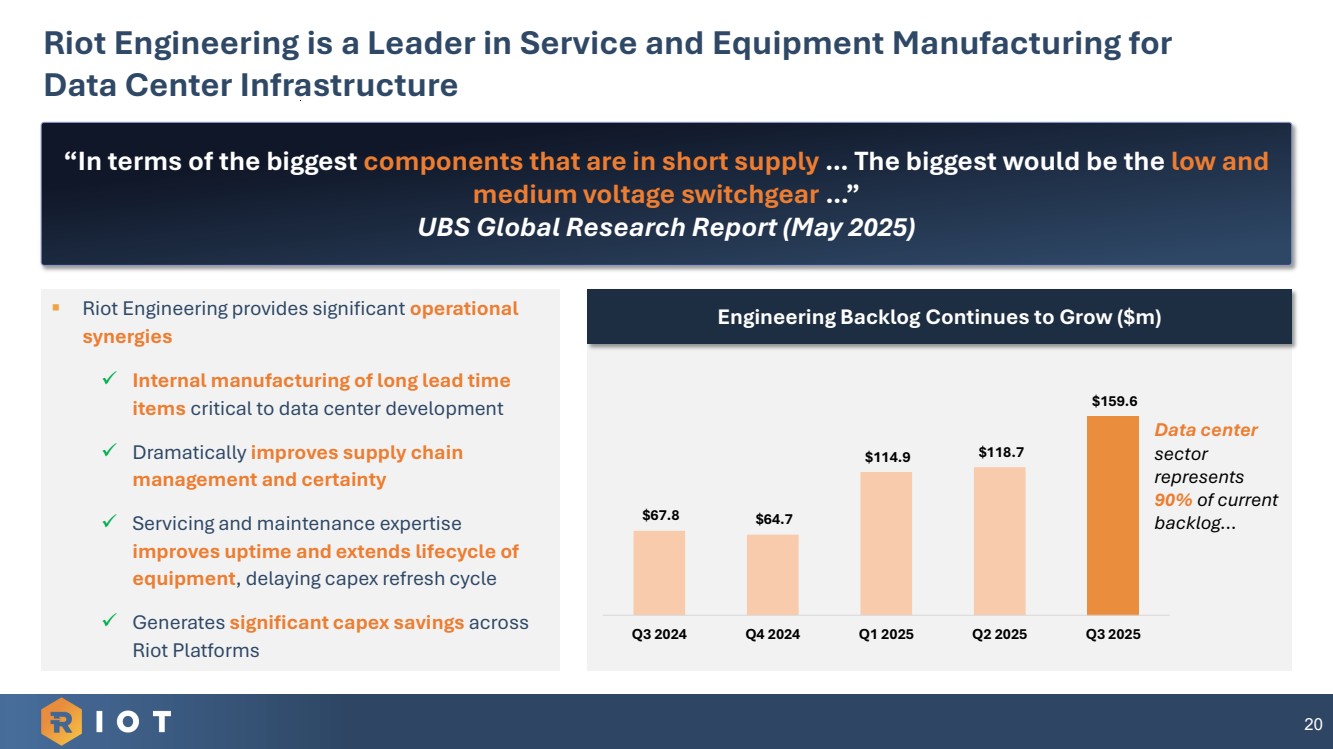
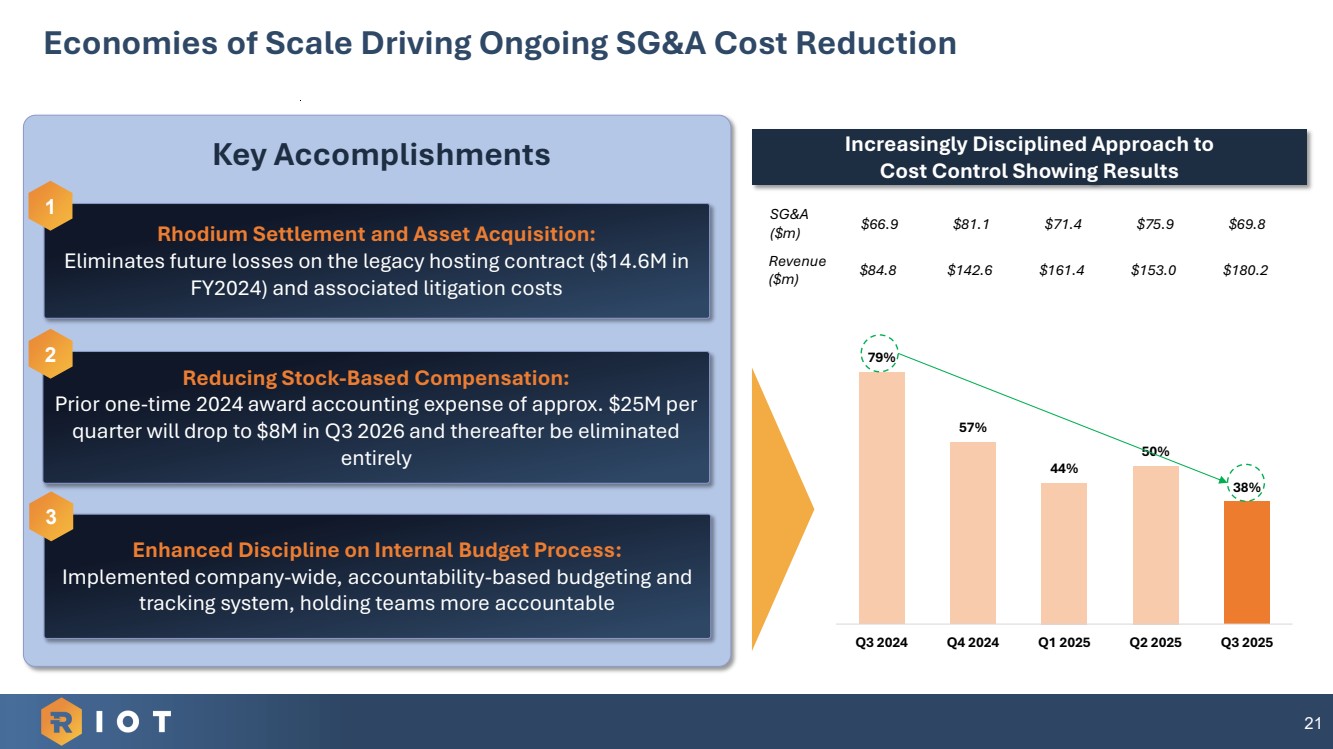
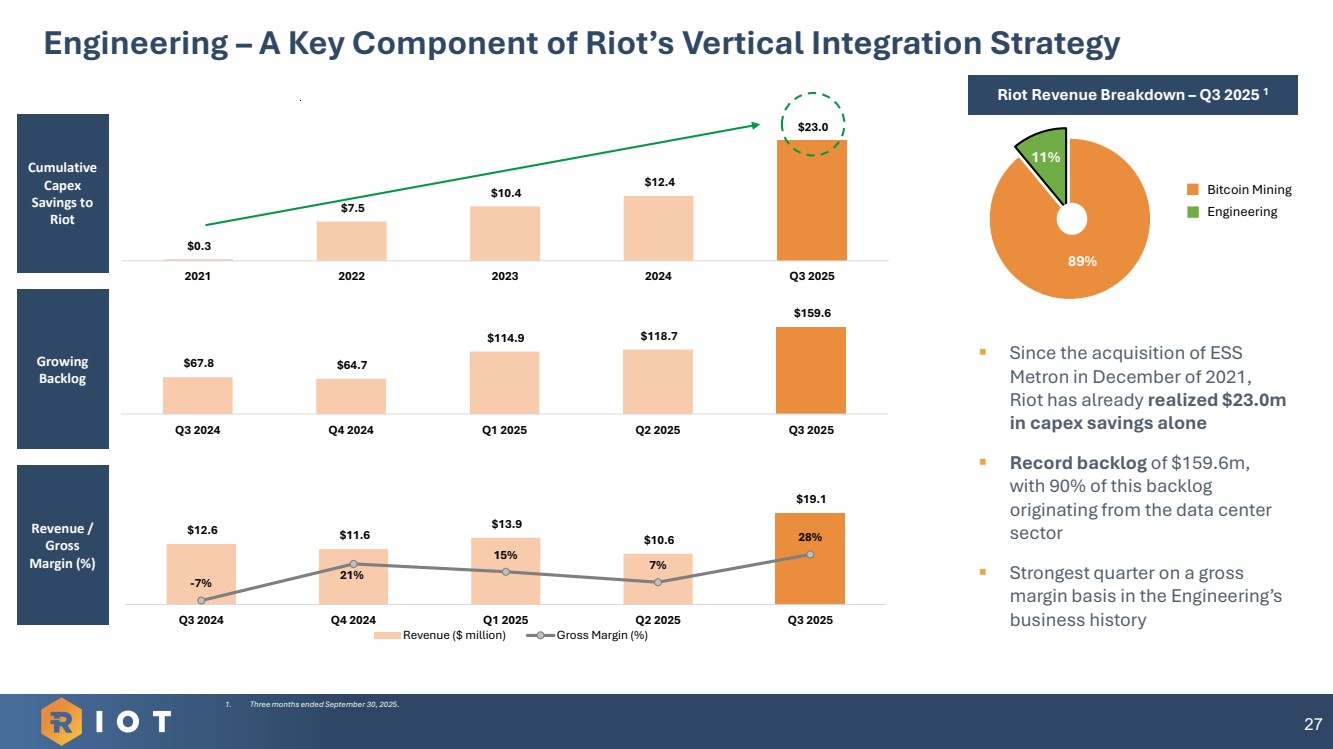
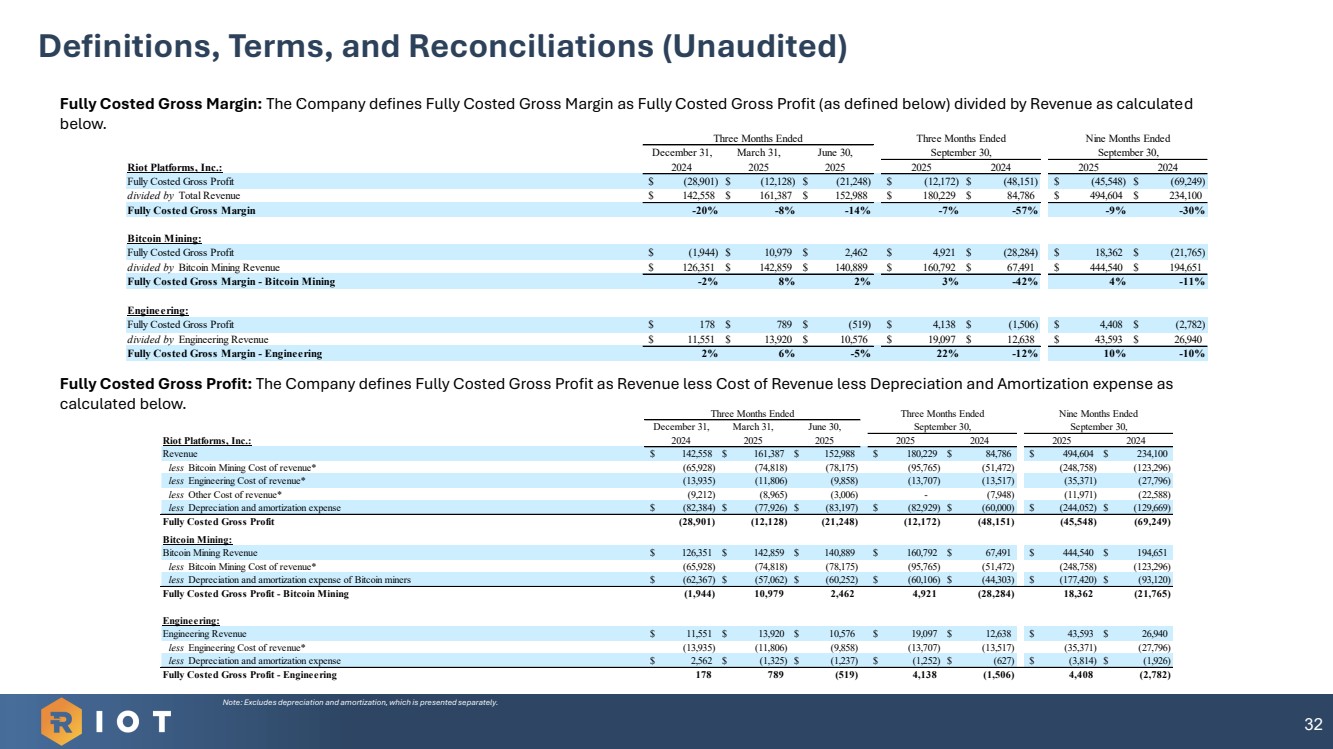
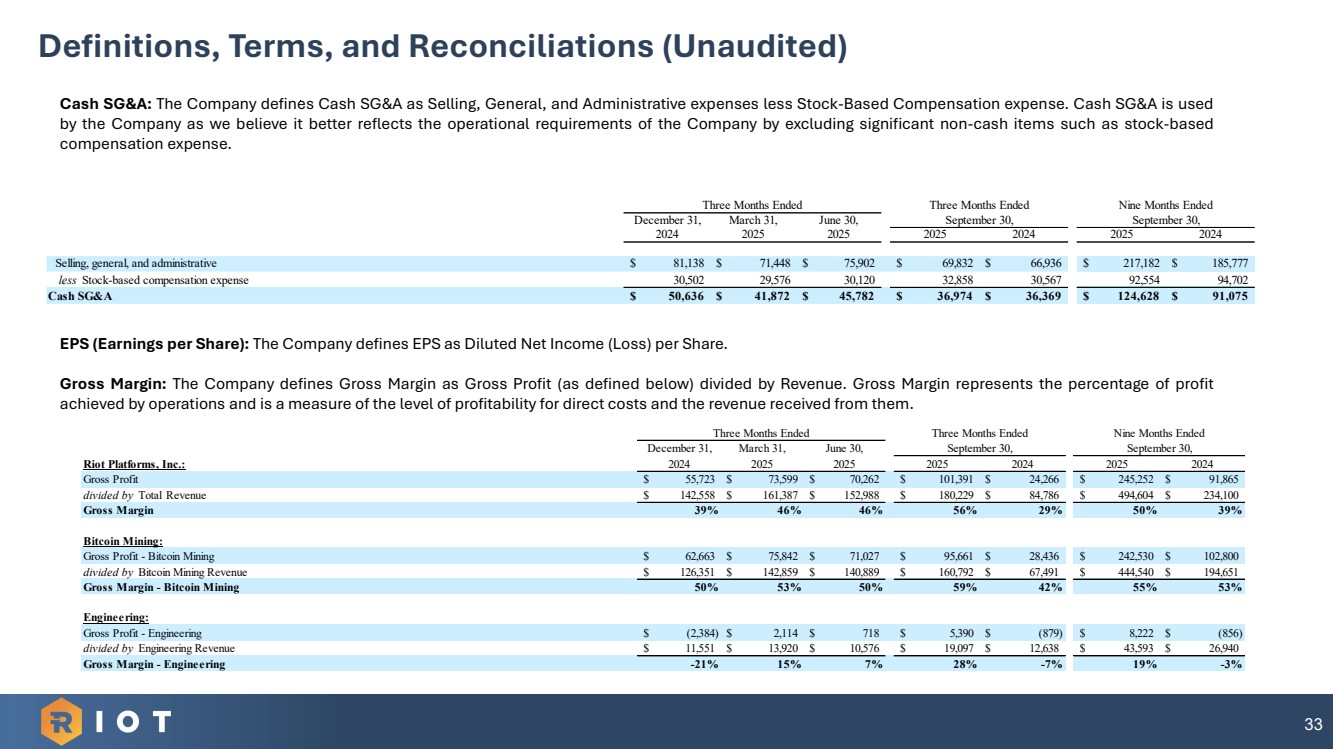
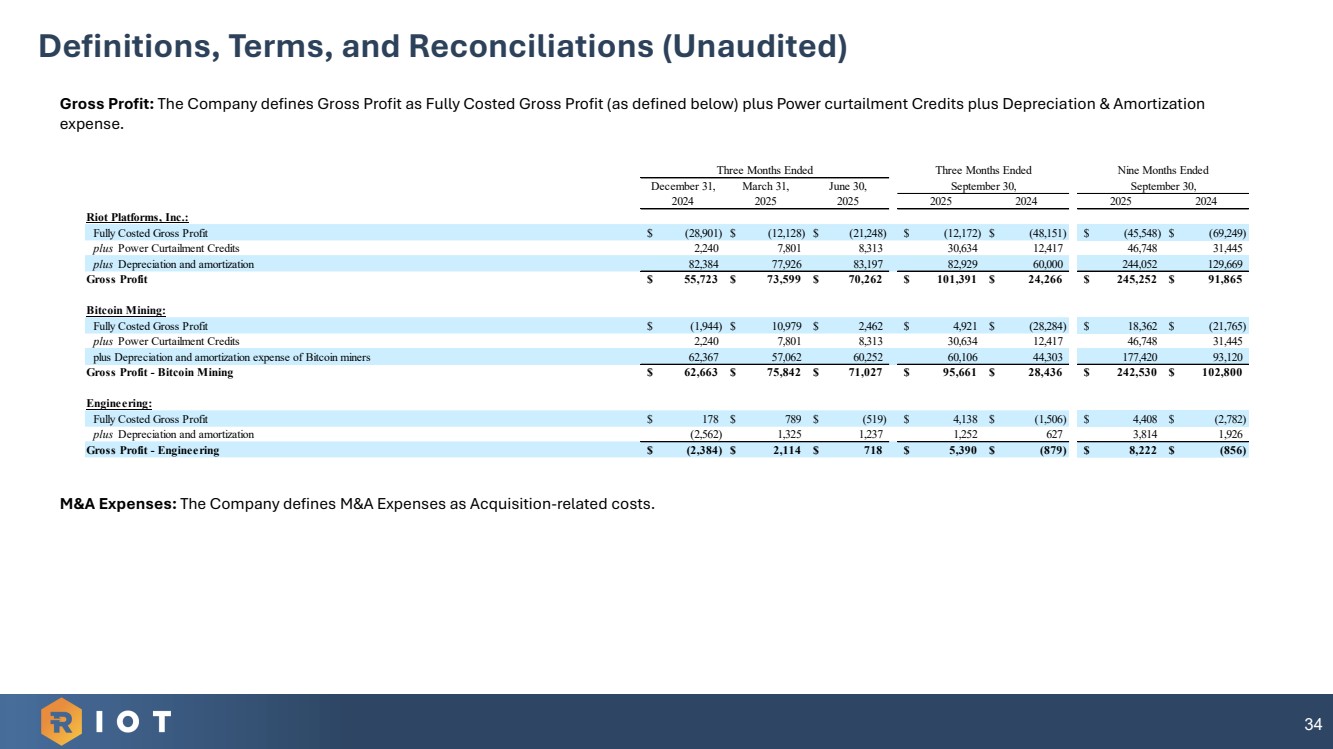
Thank you, Colin. During the third quarter, the benefits of Riot's large-scale, efficient Bitcoin mining operations and our unique power strategy were all clearly demonstrated in the overall profitability profile of our Bitcoin mining business. The highlighted column in green provides a step-by-step walkthrough of the key profitability drivers of our operations in the third quarter of 2025. Top line revenue drivers for our Bitcoin mining business include the average global network hash rate, Riot's average operating hash rate, average network hash price, and our total Bitcoin production for the quarter, which when taken together, resulted in a reported third quarter Bitcoin mining revenue of $160.8 million. Total direct cost per Bitcoin for the third quarter was $46,324, and when applied to the 1,406 Bitcoin we produced during the quarter, results in a reported Bitcoin mining gross profit of $95.7 million or 59% on a gross profit margin basis. Total Riot SG&A for the third quarter equaled $69.8 million, of which noncash stock-based compensation expense represented $32.9 million, resulting in total Riot cash SG&A of $37 million this quarter. Total Riot cash SG&A also included $7.5 million in temporary litigation-related costs and advisory fees as well as costs associated with our engineering business. By breaking out our total cash and noncash SG&A, our intention is to give investors as much insight as possible into the underlying value of our key operating segments. Our Bitcoin mining and engineering operations demonstrated incredibly strong profitability this quarter. And going forward, we will continue to leverage the significant cash flows being generated from our efficient scaled operations to support the ongoing rapid development of our data center platform. Our engineering business is a core asset that uniquely differentiates Riot as we scale into large-scale data center development. In an environment where long-lead electrical infrastructure represents a major constraint to development, owning the manufacturing set from end-to-end creates powerful strategic advantages for Riot. Built through the acquisitions of ESS Metron in December 2021 and E4A Solutions late last year, our engineering capabilities combine manufacturing, engineering design, and servicing into a vertically integrated platform predominantly focused on data center-grade power systems. Delivery times in the market for key components have extended, but by directly owning and coordinating these capabilities within Riot, we benefit from direct control over the development of long lead critical items, deep supply chain visibility, longer equipment life cycles, and resulting lower total cost of ownership and significant total CapEx savings for Riot. Wall Street analysts have cited low and medium voltage switchgear as among the most supply-constrained items for data center development, which our engineering business is a leading provider of. By internalizing these development capabilities, we are able to meaningfully derisk the most constrained elements of the development cycle. This not only lowers unit costs but also protects timelines, ensures design quality, and enables predictable on-time development. These synergies translate into directly measurable value and de-risk the transition of our megawatts into value-creating data center development. Since our acquisition of ESS Metron, Riot has realized approximately $23 million in cumulative CapEx savings on equipment purchases to date, and we anticipate ongoing savings and logistical benefits to scale alongside growth in our data center operations. Riot's operating model continues to scale efficiently. And as the scale of our operations has grown, we are seeing the results of the work we have been putting in to proportionately reduce SG&A and realize a more durable cost structure as we transition to developing data centers. SG&A has remained relatively flat over the past 4 quarters, while our revenues have grown by more than 110% year-over-year, demonstrating the significant economies of scale that Riot now enjoys. This reduction in proportionate SG&A has been built on 3 key pillars, each implemented over the last several quarters and which are becoming increasingly visible in our financial results. Number one, Rhodium settlement and asset acquisition. In the prior quarter, we successfully settled this legacy hosting contract, which previously led to ongoing losses and litigation costs. The settlement of litigation and asset acquisition reduced legal costs and eliminated future drag on earnings. Number two, reduction in stock-based compensation. We have previously highlighted the accounting impact of the onetime special awards granted in 2024. Noncash charges associated with this onetime grant of approximately $25 million per quarter will drop to approximately $8 million in Q3 2026 and thereafter roll off entirely, significantly reducing noncash stock-based compensation expense. Number three, increasingly disciplined internal budget process. We have enhanced our accountability-based budgeting and tracking system throughout Riot. Teams now operate against more clear targets with monthly variance reviews, driving greater predictability in run rate SG&A, inter-department coordination, and a continuous improvement cycle, which will be critical as we onboard new hires and systems in support of our data center business development. Together, the impact is visible in our Q3 results. Revenue increased to approximately $180 million, up 18% quarter-over-quarter, while total SG&A came down and also improved significantly on a proportionate basis. Importantly, we are pairing cost discipline with selective hiring in core areas where hiring is directly tied to expanding our data center development capabilities. We are simplifying our cost base, reducing nonrecurring drags on earnings, and have dramatically improved run rate visibility. The result is a structurally leaner organization that can scale data center development with greater operating leverage and stronger earnings quality over time. I'll now turn it back over to Jason Les for closing remarks.
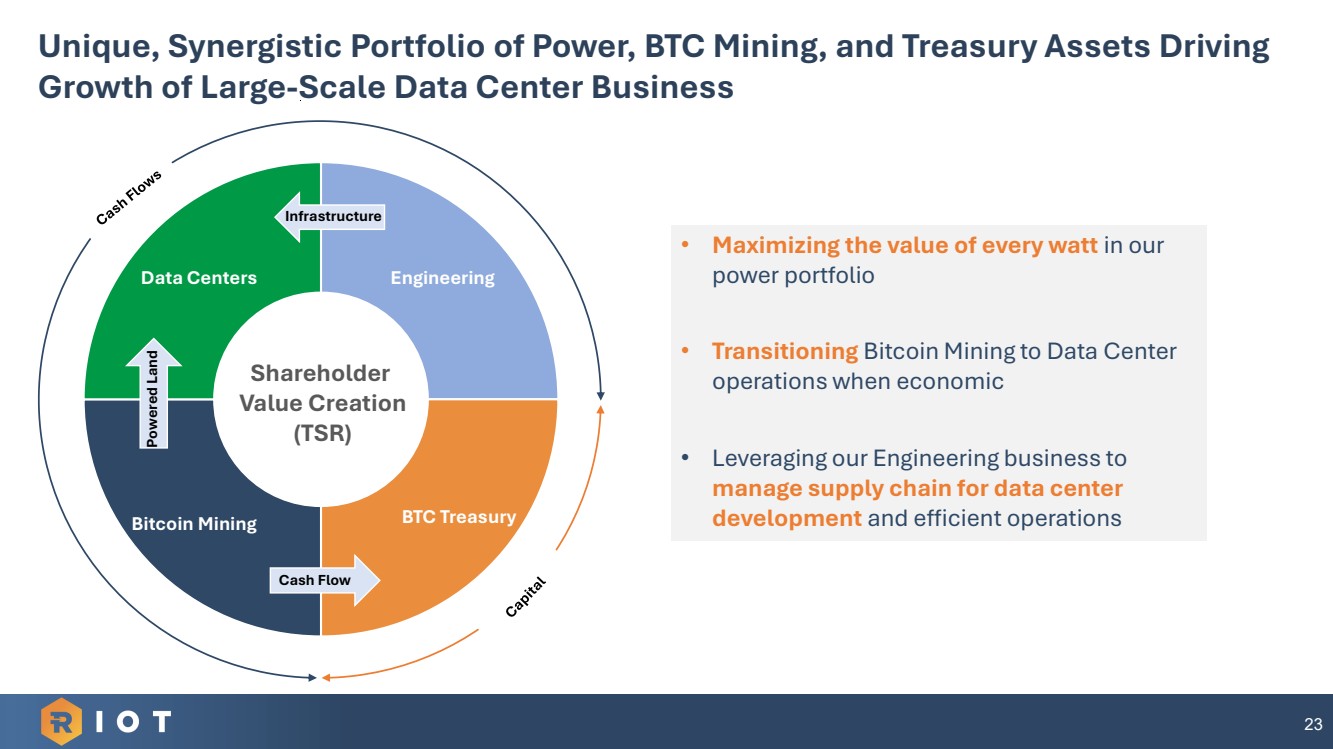
Thank you, Jason Chung. Riot is in an incredibly advantageous position today because of our industry-wide unique combination of significant scale of readily available power capacity in key high-demand jurisdictions, experienced credible data center leadership and development capability, strong balance sheet underpinned by more than 19,000 Bitcoin and $400 million in cash on hand and significant access to the capital markets, large-scale, efficient Bitcoin mining operations, generating hundreds of millions of dollars in revenues and cash flows, which will support the growth of our data center business, and battle-hardened and experienced management and operations teams. With this framework and these strengths in place, our mission is clear. Riot will maximize value across our entire power portfolio with a view to ensuring full utilization of our available power capacity and pipeline, leaving no stranded power capacity behind, progressively shift power capacity towards data centers, strategically expand our power assets utilizing Bitcoin mining where advantageous, and increase our shareholders' exposure to value-accreting assets. We are strategically positioned at the confluence of surging compute demand and constraints on availability of power, offering compelling potential for shareholder value creation. We will now open the call up for questions. Operator?
Operator
Our first question comes from John Todaro with Needham.
Speaker 5
Congrats on all the progress, guys, especially at Corsicana. Great to see. Obviously, there's been a number of leases now signed in the space. Can you just give us an update, in particular, on the discussions you're having with potential tenants for those first few builds and what you need to do from here to get a finalized lease? And then I have a follow-up question.
Sure. Thank you for that question. I can't comment specifically on any ongoing discussions. However, I want to express that we are highly encouraged by our current position in the market. As you know, there is a significant surge in AI, which is driving an insatiable demand for power that continues to grow across all market players: hyperscalers, enterprise customers, and new cloud providers, all of whom are facing considerable power constraints. Recently, during earnings calls with hyperscale companies, additional insights emerged indicating that the power bottleneck is intensifying. The data center infrastructure demand is expected to persist for years, and despite efforts to catch up, companies are still falling short. Historically, they tried to build independently but are now seeking third-party leases to meet their data center needs. For instance, Meta mentioned that despite their aggressive building strategies, they still find themselves short on capacity. This positive feedback reaffirms our strategy and the value of our assets. We are concentrating on high-quality potential tenants because we want to establish a strong foundation for our data center business at Riot. These tenants usually have substantial power requirements and CapEx budgets, but they also proceed cautiously. They need certainty regarding delivery timelines and power approvals, which is why we've focused on derisking our sites to ensure credibility in meeting their deadlines. Our team has been working diligently to complete our basis of design, engage in technical discussions, and now initiate the development of the Core & Shell buildings at Corsicana. All the steps we've taken aim to position Riot favorably with top-tier potential tenants and align our delivery capabilities with their timelines. It's important to note that the market is experiencing a notable shortage of power, which will continue for the next few years. The demand for reliable power sources during this period is very real, and we’ve consistently received validation from industry experts, partners, and potential tenants regarding power availability. Consequently, we have seen significant interest in our site. We believe we are well-prepared, having completed earlier outlined steps to make Corsicana an attractive development. We are in a prime position to move forward, which is a key factor driving today's announcement about commencing the Core & Shell builds at Corsicana.
Speaker 5
That's great. That's super helpful. And then just as a follow-up, because you did talk about the constrained power environment, which we're obviously seeing as well. But I guess within that, is there still some additional power out there that you guys could procure? Do you still feel comfortable? Is there additional capacity out there that maybe you could get to add to the pipeline? I don't know, call it, maybe power that's available before 2028. Just maybe frame up some of that too on the supply side and what maybe additional you could procure.
Yes. We are very active on working on building out our power pipeline beyond just the 1.7 gigawatts that we have at Corsicana and Rockdale. But let me turn that question over to Jason Chung for some more color.
Speaker 4
Thanks, Jason, and thanks, John, for the question. We remain very active in looking at opportunities to expand our power portfolio and a large number of opportunities that continue to come across our plate, and we do spend a lot of time as a team evaluating these opportunities. That being said, we've got a tremendous opportunity for value creation on our plate right now, and that's really the primary focus of the management team here. So we do look at opportunities, and we'll act when there's an opportunity that's compelling enough for us to do so, but with perhaps a bit of a higher threshold in terms of where we allocate our time and resources given what we have in terms of our power portfolio that needs to be developed today.
Operator
Our next question comes from Paul Golding with Macquarie.
Speaker 6
Congrats on all the progress with the site and the basis of design. I wanted to ask, so it sounds like the proactive construction or commencement of construction of this 112 megawatts of Core & Shell is not a change in approach given you're still looking at prospective hyperscale tenants. But I wanted to ask in terms of maybe, Jason Les, your comments around facilitating the most optimal negotiations and getting leverage in these negotiations. Could you give some color or unpack how having these shells being constructed earlier than signing that deal that may come in the future, how that is factoring into these discussions, where it's coming into play? Is it the lead time allows you to take more price? Is it maybe helping you attract higher investment-grade counterparties? And then a follow-up on the comments around ESS Metron and the Engineering segment. Just in seeing how much revenue has grown there and the backlog that's built up, how are you thinking about measuring out third-party engagements for that segment versus internal given the project you're undertaking at Corsicana?
Thanks, Paul. So let me answer your question. Well, the first part of your question in 2 parts. The first thing I want to stress is, just to be clear, what we're announcing today with the Core & Shell development is not a shift in our strategy. What I want the market to understand is this is an unveiling of our strategy and how we know that we can best serve the market here. Our focus is owning and operating build-to-suit data centers and the team that we have in place at Riot has the full ability to deliver on that. So what we bring to the market, which is so important to all types of customers, but particularly hyperscale customers is a derisked project. And I think that comes through our power approvals are in place. We have up to 1 gigawatt of utility power at Corsicana. That power is running today. We can demonstrate the validity of that power to customers. Two, we have a team in place that has deep experience building the type of data centers that we're talking about, build-to-suit Tier 3 data centers in the configurations that hyperscalers are looking for. We also have a balance sheet that's able to support the development of this project. And with the announcement today, we're showing that construction of the Core & Shell is already underway for the data center. So all of these elements allow us to communicate the level of certainty to power and ready for service to date that hyperscaler tenants require. The other thing I want to say is what we announced today in the development in the Core & Shell is the first step in the eventual build-out of a full Tier 3 data center. And what we're doing is building a powered shell; it's $214 million or $1.9 million per IT megawatt. It's actually a little bit more than just a powered shell. Beyond just the water type building, we are also completing generator buildings, fully operational elevators, fully finished admin areas, security, access control systems, and power distribution. So what we're actually building is in a way that we are providing the components that we know every hyperscaler will require, and we're positioning these buildings so they can very quickly become Tier 3 data centers when those tenant specifications are finalized. And I'll also comment that our teams have deep experience and knowledge in building these types of data centers and understand how to make them usable by any potential tenants while providing the flexibility for the tenant to meet their specific specifications. What we're also doing is procuring equipment and locking in our delivery timelines now so the finished data centers can be in line with the timing that hyperscale and enterprise customer buying habits. Now I know that was a lot, but let me just summarize by saying this. We are executing on a strategy to position us in front of the highest quality tenants and give us more certainty on how and when we will deliver on them and deliver on building build-to-suit data centers. This is all under the framework of maximizing the value of the assets that we have. And ultimately, I believe today's announcement is an indication of our confidence in our strategy and our team's ability to successfully develop the data center business along the timeline that we envision. And then your engineering question. ESS Metron, E4A solutions comprising Riot's engineering business has a lot of strategic benefits. The primary reason that we acquire these companies is for controlling our supply chain and derisking that. We've also, in our presentation, Jason Chung talked about the cost synergies that we're realizing there as well. Riot is actually a small portion of ESS Metron's overall business. 90% of ESS Metron's business are data center projects. In fact, some of the most significant data center projects in the country that I'm certain that you've heard of. So they have a growing business themselves, and they're able to balance the internal demand from Riot and the growing demand reflected in the growing backlog for all these data center projects all over the country.
Operator
Our next question comes from Gregory Lewis with BTIG.
Speaker 7
Jason, I was hoping you could talk a little bit more about Phase 1 in terms of how you're thinking about the sequencing, the decision to go with 2 buildings, not 1 or 3? And just how should we think about the timing of the shells being built? And then is this something where the next phase is really going to just be customer dependent, and we're kind of waiting on the customer to see how we think about advancing the shells.
Yes. Thanks for the question, Greg. So the Core & Shell construction we've already started. I want to highlight that we're talking about building at Corsicana, which is already an active site. A substation is already active on that site, of course. We already have the pad ready for these first 2 buildings. So this is a development that's far along, and it's just these buildings themselves that construction will begin on in the first quarter of 2026. And then we expect the first Core & Shell to be completed in the first quarter of 2027. And because we're building a little beyond the Core & Shell, what we actually call Core & Shell Plus, we are in a position from that point to very quickly get those into build-to-suit turnkey data centers. This is just the beginning of what our development plans will be. Obviously, we have a total IT load campus capacity at Corsicana of at least 672 megawatts, and we're announcing just 112 megawatts today. The pace of future announcements will be, I think, guided by industry demand and the pace of customer conversations. But we felt it was very important to start development right away based on the demand that we are seeing, based on the types of discussions that we are having. And I think you can expect future developments to be announced as we progress on our strategy and we progress on conversations with potential counterparties. It is relatively simple for us to continue to add on additional buildings. So we're talking about these first 2 buildings here. And if we have a conversation with a customer who is then demanding significantly more capacity than that, then we are positioned to rapidly spin up additional developments to support their needs. So we're in a great position to be flexible and be aggressive with meeting timelines.
Speaker 7
I understand there's a lot more to discuss about Corsicana, but I would like to hear some thoughts on Rockdale. As we consider this, Corsicana has been highlighted as one of the top data center sites in the U.S. due to its size, scope, and proximity to Dallas. Can you share your thoughts on Rockdale? Do we need to complete the development of Corsicana before we start exploring opportunities at Rockdale, or is it possible to pursue both simultaneously?
Yes. Thank you for asking about Rockdale, Greg. Rockdale shares many of the same characteristics that make Corsicana a highly attractive site for data center development. Just like Corsicana, Rockdale has large-scale secured power, active and operating today, 700 megawatts fully approved, electrical infrastructure already in place. Now keep in mind, we already operate one of the world's largest Bitcoin mining data center campuses on that site. So it is an active operating site. And it also has ample land, water, and fiber that can satisfy and is located in close proximity to Austin, which is a leading technology region. So collectively, we think this makes Rockdale a very attractive site. Most importantly, having that power approved and in use today significantly derisks the development execution from a potential tenant's perspective, and that gives them greater confidence in the opportunity. Today, we are working to enhance the attractiveness of Rockdale for high creditworthy prospective tenants. And while we do so, we continue to focus on Corsicana as our near-term development opportunity. So today, Rockdale provides Riot with additional optionality for future development of our data center business. But in the meantime, our mining business there continues to generate strong cash flow and helps finance our growing data center business. So Corsicana is a near-term focus for data centers, but Rockdale is the next logical step in the process. So I'm emphasizing not to discount Rockdale from our development pipeline as we continue to work to make the site tenant-ready in the meantime. And I feel confident about our ability to execute there.
Operator
Our next question comes from Reggie Smith with JPMorgan.
Speaker 8
Congrats on all the progress. Two quick questions for me. I love that you guys are thinking about maximizing the electrons at your 2 sites. I was curious like what's your thinking today on neocloud? Maybe talk us through the pros and cons of becoming neocloud like iron or someone else and how you're thinking about that? And then I have one follow-up.
Yes, thanks for the question, Reggie. We are always looking to maximize the value of our megawatts. We believe the best first step for Riot to achieve this is by focusing on a build-to-suit colocation model. Our sites are located in very desirable areas with attractive ready-for-service dates. We think the best way to unlock value right now is by building data centers and securing leases with high-quality tenants. Therefore, we are concentrating on developments aimed at a broad market. We are building data centers that cater to hyperscalers, all types of enterprise customers, and potentially neoclouds. This could also serve an internal neocloud business if we choose to pursue that direction. It's something we will consider and evaluate, but the build-to-suit model is our priority for today.
Speaker 8
Not closing the door on that, but right now, build-to-suit is where you're going. Perfect. And then I guess the second question, we've seen quite a few deals struck in the space the last couple of months. I don't think any of them are as ideally located as you guys are in terms of being close to a major city. Are you talking to clients more? Or do you think you're getting a higher mix of kind of inferences clients inquiries for your site? And should we expect better pricing when a deal is struck because of where you guys are located versus other sites? Or at least are you pushing for that? Like I would imagine that's a point of negotiation where you guys are thinking like, look, we've got great locations. And so what may have flown in a more remote location, we even expect more. Is that the right way to think about it?
Yes. I think the location of our sites, but also the timing of being ready for service is what positions us to get the best possible deal here. We believe with what we have that we can command very strong economics. And for us, it's twofold. It's both the types of deal economics that we think we can secure with the assets that we have, but it's also the types of tenants that we believe that we can secure with the assets that we have. I would say that I think we're very confident today based on the level of interest that we've received that we could easily enter into a contract with the neocloud. But what we are focused on is building a platform that will be able to service a range of potential tenants, hyperscalers, enterprises, and neoclouds. And so our priority is building our data center business on a strong foundation. And we think that means that with what we have, we can attract high-quality, which beyond just the name recognition and beyond just the economic terms we can get in the lease make benefits available to Riot in terms of value creation and access to attractive project financing terms. So it's twofold, Reggie. Our assets, we believe both can command strong economics, but can also command because of the properties can command very high-quality tenants.
Operator
Our next question comes from Brett Knoblauch with Cantor Fitzgerald.
Speaker 9
I think it was just as recently as June as you guys hired Jonathan to lead the data centers team. I'm curious where else on the maybe the hiring front, you guys have made hires and to what extent there's more hires that you need to go out and make? Or do you think that team is kind of fully in place at this point?
Yes. Thanks for the question. One of our ongoing priorities is building out our team. And what we're doing is building this team in sequence with the steps that we're at in building the business. So you can kind of think of it as like a pendulum where it starts with focus on engineering, and then as the development and engineering part advances, then it swings into the sales side and then eventually swings into the operations side. So we have made a number of key hires over the third quarter that position us to execute on the development side of the business. Of course, we're still adding talent there, but we have the talent that we need to proceed. And very recently, we have hired a sales position, our Senior Vice President of AI and Hyperscale Sales as now from the development side more into the sales side. So we have been, I'll say, very pleased with the level of talent that we have been able to attract to Riot. I think that's a testament to the quality of assets that we have, our power, our capital, and all the other capabilities that we have at Riot. It made Riot a very attractive place for veteran data center talent to build their careers and have the opportunity to be a part of building something very big from the ground up. So I've been very pleased with the rapid pace that we've been able to add some incredible talent to our bench. And as that pendulum swings, you'll continue to see us bring in more of that talent to meet the cycle of the business that we're in.
Speaker 9
Awesome. And then maybe just as a follow-up, and I don't know if you guys said this or I might have missed it, the, call it, 400 megawatts being used for Bitcoin mining at Corsicana, is that maybe like the last source of power that you would draw as you kind of build up more on the AI side, like you'll keep mining Bitcoin until you need that power, I guess, is the question.
On Slide 11 of our earnings presentation, we outline a campus layout divided into two phases. The first phase involves developing all the unused land we have at Corsicana, allowing us to maintain strong cash flow from one of the largest Bitcoin mining sites globally. This site remains productive and continues to generate significant cash flow while we construct additional buildings. Once we have utilized the available land, which involves building about 504 megawatts of essential IT load, our plan's second phase will focus on developing the area where the existing Bitcoin mining buildings are located, adding the final three 56-megawatt builds and ensuring all critical IT capacity is in place. Our plans are designed to eventually integrate this phase, and the timeline will be influenced by customer demand, market dynamics, and our leasing progress. We aim to maximize the value of our available megawatts, ensuring no power goes unused as we expand our data center business. Ultimately, we envision the whole site operating as a 1 gigawatt utility load data center campus.
Operator
Our next question comes from Mike Grondahl with Northland.
Speaker 10
Just following up on the discussion you had on expanding the pipeline. Do you have any internal goals for what you could expand that pipeline to by year-end 2026 or '27? And then secondly, just what are the key next steps you need to deliver in the next 90 to 120 days?
We don't have any goals that we would be publicly disclosing at this point. But I would say we recognize the value of power, and we also recognize our capabilities of securing power. Riot has a proven capability of securing power at scale, as demonstrated on one of the slides in our deck at a scale rivaling the biggest data center companies in the world. So when you have an advantage, you press it, and we are looking to press that advantage and utilize the tools at our disposal to add more power to our pipeline. So the story ultimately would not end at just Corsicana, Rockdale, but on additional sites that we bring into our pipeline. So not a specific I have for you outside of telling you that it is a strategic priority at Riot to build that pipeline. Key steps for the next 120 days, I think that will really center around the development progressing at the 2 Core & Shells that we're announcing today. We expect to break ground on construction in the first quarter of 2026 in order to meet the timelines that we've laid out here. I think internally that we will continue to be advancing on development and further detailed designs of our development. And what we will be doing internally is continuing the technical outreach that we've had, speaking with potential parties and potential tenants to ensure that we are progressing on a design that meets their specification. That isn't something externally looking in, you'd be able to see progress on. But internally, that is what we for the next 120 days.
Speaker 11
Congrats on the Corsicana progress. First, Jason, I know you mentioned that the design for Corsicana could be replicable beyond Corsicana. Does that mean you don't need a separate master site design for Rockdale? Or could you just sort of clarify what you mean by that?
Thank you for that question. Yes. So our basis of design is a design that will ultimately work wherever we have a site where we have power. So we have the basis of design now and then the process of putting that on a site is what we call localizing that standard design to the specific site in question. The land profile wherever the site would be, that determines what the specific layout would be, but it's the same type of building that's being made. So the fact that we have a standard design means that we're able to be a lot more efficient in procuring equipment and scheduling with contractors and those contracting partners, development partners, construction partners, knowing exactly what we're building. It's the same standard design that is tweaked at the endpoint for specific tenant specifications and then localized on whatever site that it's at. And then, like I said, the campus layout where the buildings are actually placed will depend on the land profile of the site. But this is why this basis of design was so important to us. It's really the foundation of our whole development program at Riot for data centers. We're not just making a data center for Corsicana. We are making a design we can continue to improve on and apply wherever we're able to get access to power.
Speaker 11
Great. And as a follow-up, like when the first 2 power shell plus are done sometime in Q1 '27, like is that the next step that potential tenants need to see your progress on to advance sort of discussions on a lease? Or are you sort of talking with them throughout the process?
We'd be talking with them throughout the process. I think that's the schedule. That's the timeline of when those Core & Shells will be completed. But one of the purposes of initiating this Core & Shell development is it enables a more productive discussion with potential tenants. So we would expect to be further along in our sales and leasing process before those Core & Shells are even completed.
Operator
And our final question comes from Nick Giles with B. Riley Securities.
Speaker 12
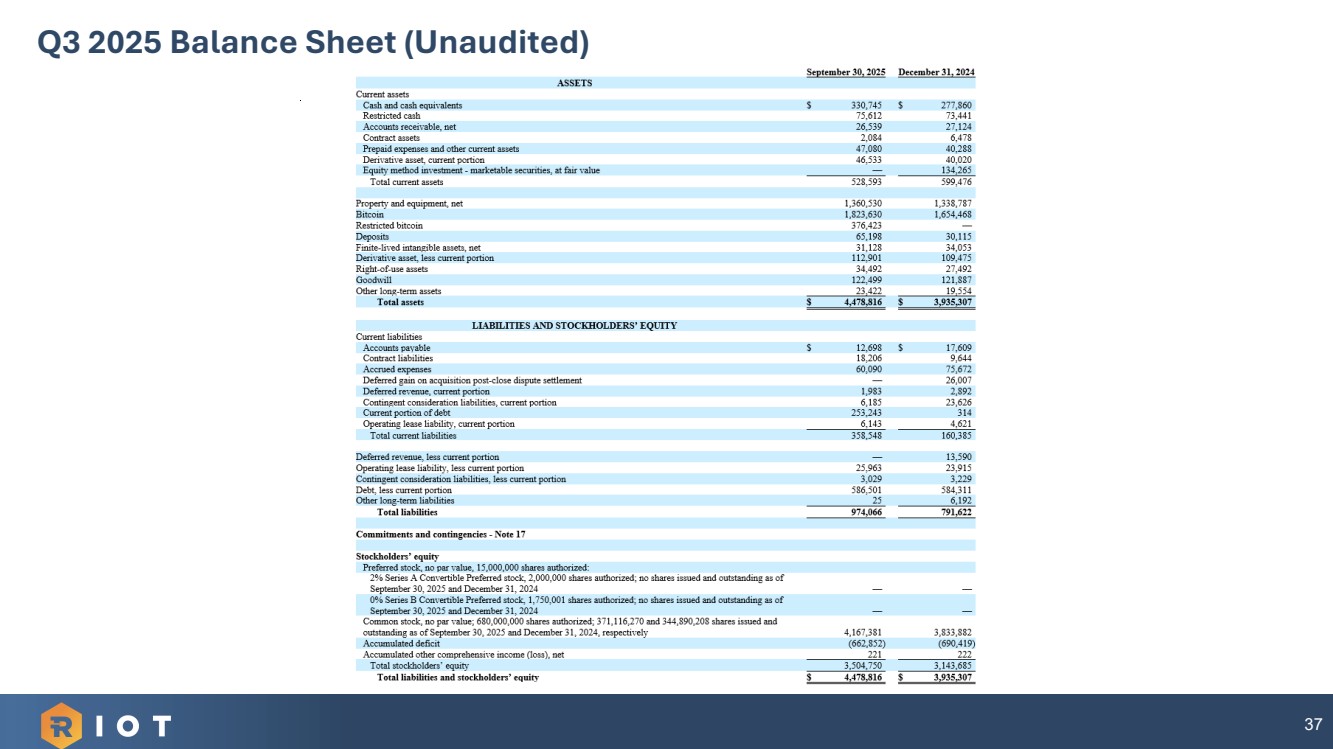
My first question was you have $330 million on the balance sheet today and obviously, a lot of Bitcoin as well. $214 million for the Core & Shell. But my question is, are there any other major capital outlays we should think about in 2026, whether it be deposits for long lead time items or just any other moving pieces to keep in mind? I think you've pretty much wrapped up the land acquisitions you set out to make, but I appreciate any color there.
We haven't released our full 2026 CapEx budget yet, but I think with the development plans that we announced today, the majority of it at this stage would be the $214 million for these first 2 Core & Shells. That doesn't mean, though, that we are not progressing all the long lead time equipment as well. Even without deposits, we have been able to secure most of that, that would be necessary for those first 2 buildings. And then, of course, we have our internal capabilities that we're using to secure the supply chain as well. So we are being very capital efficient with how we secure this long lead time equipment and all around the strategy of managing our capital deployment and making sure that those 2 items are synced up closely. And with our development strategy, we are always positioned to rapidly move to the next step, depending on what the tenant is looking for.
Speaker 12
I appreciate that, Jason. And one more, if I may. I think you mentioned that 672 megawatts of critical IT is kind of the minimum you could see at Corsicana. I think that implies a PUE just below 1.5. So my question is, is there any work ongoing today to improve that? Or what could be done to ultimately increase critical IT megawatts at Corsicana?
Before addressing your question, I want to add something regarding the earlier discussion. Alongside the cash on our balance sheet, which includes restricted cash, we currently hold about $400 million and a significant Bitcoin balance. Additionally, we operate a strong Bitcoin mining business that produces substantial cash flows, which is a vital asset for funding our ongoing developments. Regarding your recent question about PUE, what we have shared is our base case, which reflects our targeted PUE of approximately 1.49. Any improvement in PUE would enhance our economics, and we are actively working to achieve better results in this area. The higher the PUE we can attain, the better the overall economics from our projects will be.
Operator
Thank you. I would now like to turn the call back over to Jason Les for any closing remarks.
I want to thank everyone for listening in on our earnings call today. We are incredibly excited about the progress we've made and the strategic milestones that we're announcing today. Look forward to sharing more progress as we accomplish it and getting together again with you all on our next earnings call. Thank you.
Operator
Thank you. This concludes the conference. Thank you for your participation. You may now disconnect.