Operator
Welcome to the RxO Q3 2025 earnings conference call and webcast. My name is Michael, and I will be your operator for today's call. Please note that this conference is being recorded. During this call, the company will make certain forward-looking statements with the meaning of federal securities laws, which, by their nature, involve a number of risks, uncertainty, and other factors that could cause actual results to differ materially from those in the forward-looking statements. A discussion of factors that could cause actual results to differ materially is contained in the company's SEC filings as well as in its earnings release. You should refer to a copy of the company's earnings release in the Investors Relations section on the company's website for additional information regarding forward-looking statements and disclosures and reconciliations of non-GAAP financial measures the company uses when discussing its results. I will now turn the call over to Drew Wilkerson. Mr. Wilkerson, you may now begin.
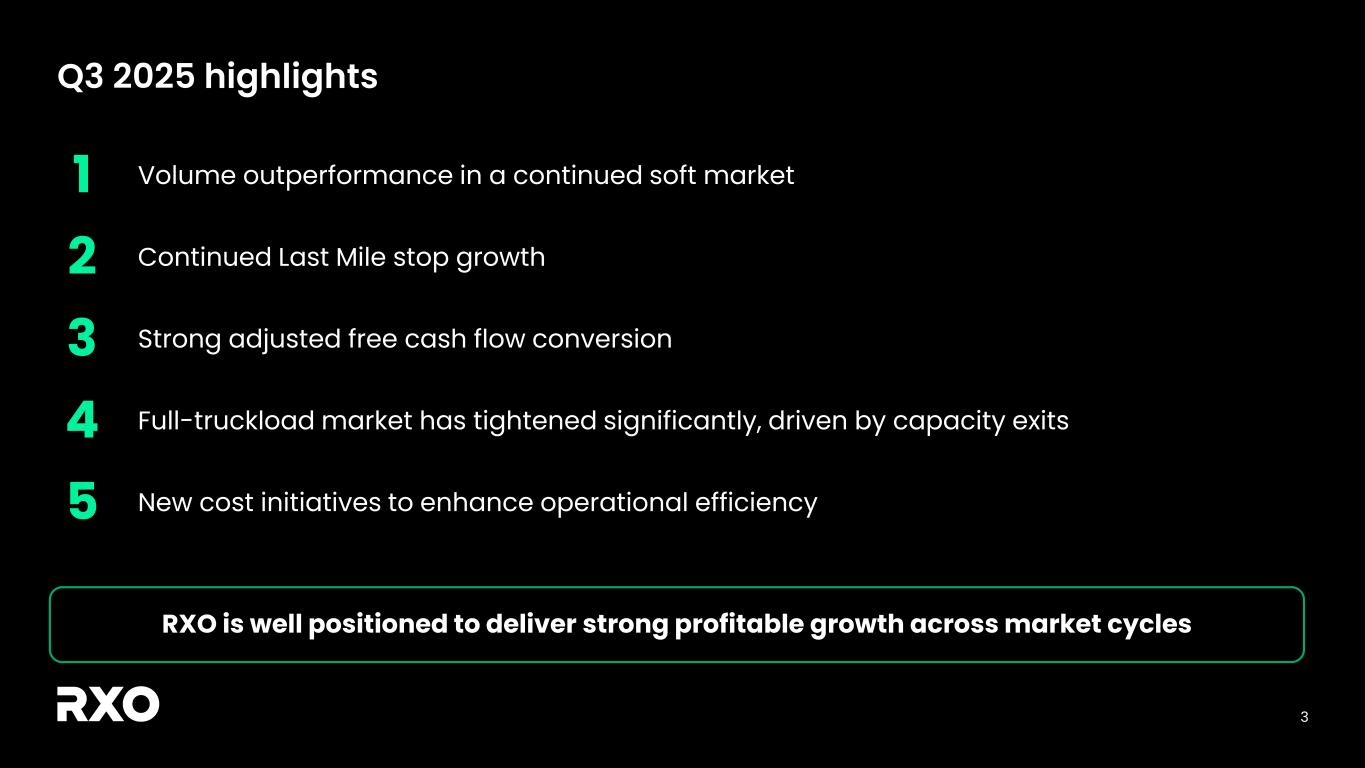
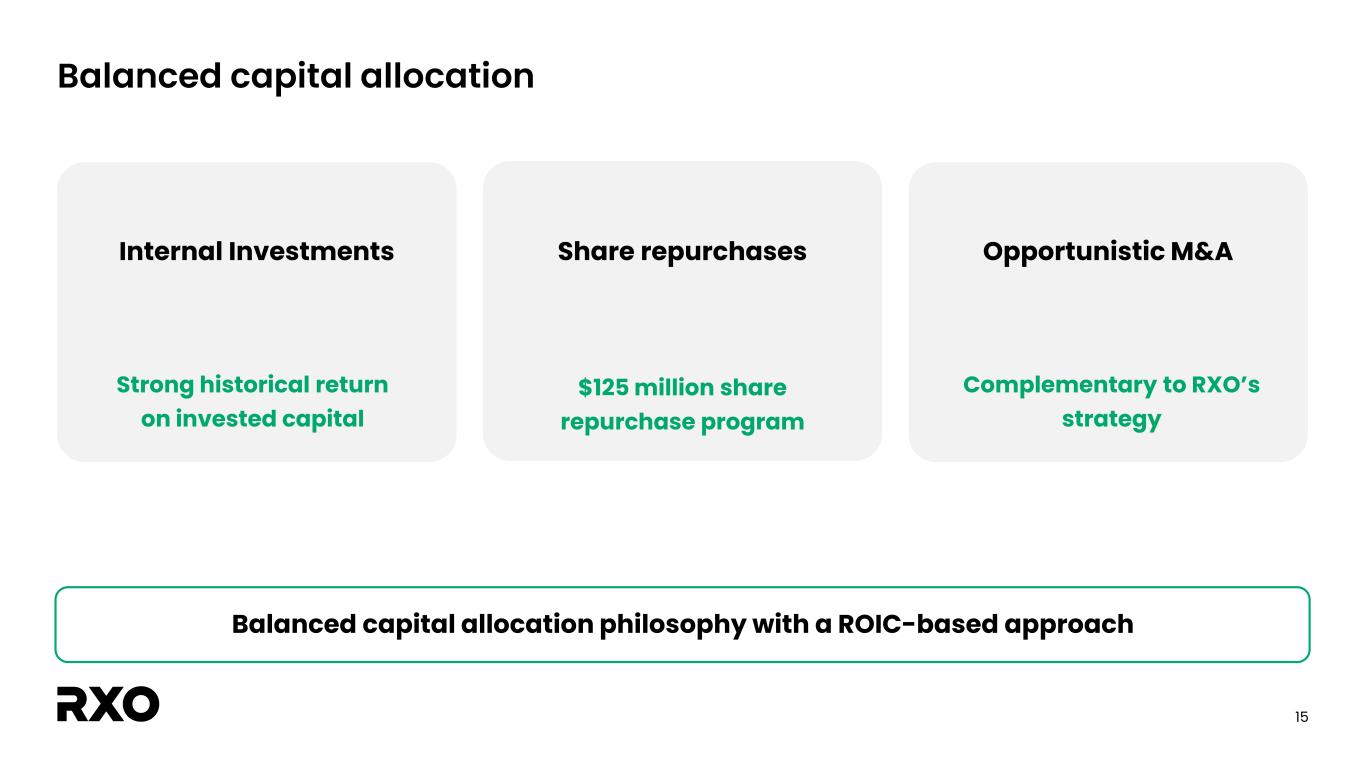
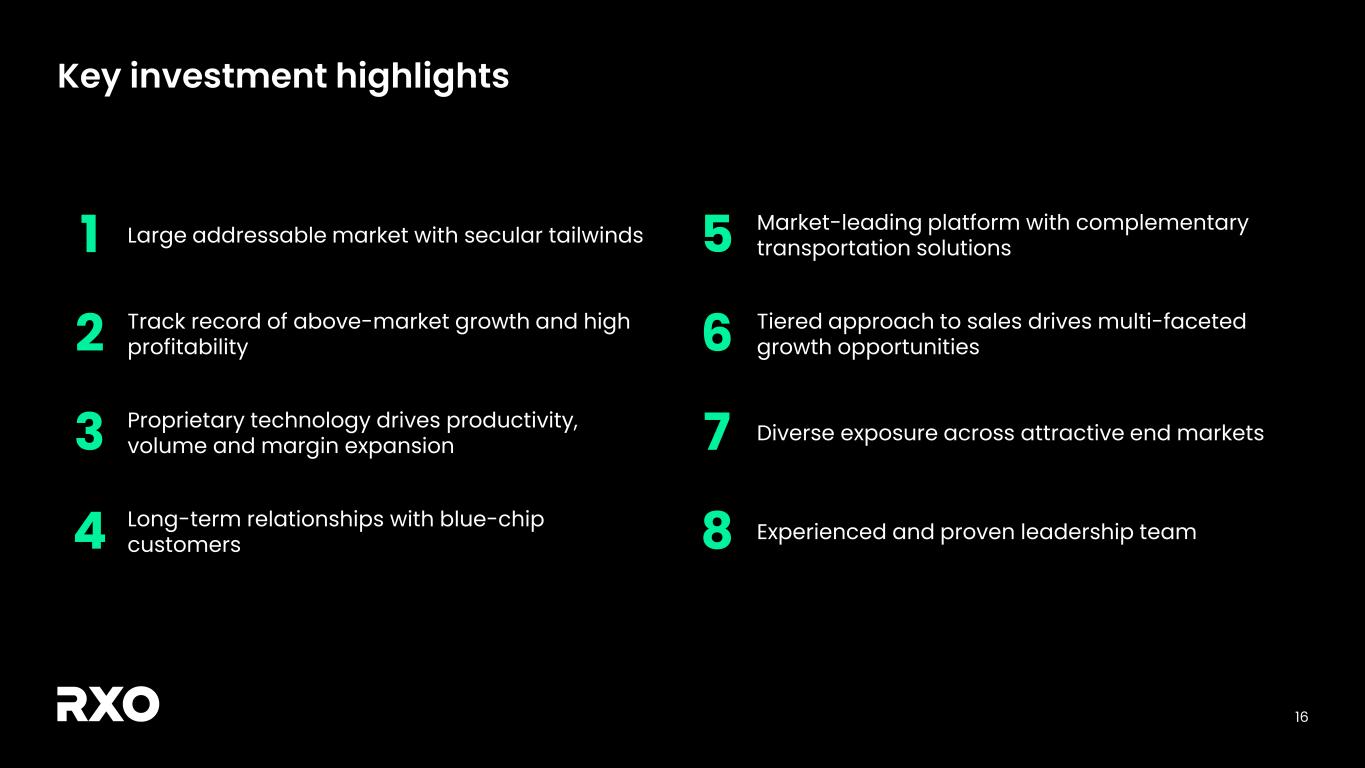
Good morning, everyone. Thank you for joining today. I'm here in Charlotte with RxO's Chief Financial Officer, Jamie Harris, and Chief Strategy Officer, Jared Weisfeld. This morning, we announced our third quarter results. Year-over-year, overall brokerage volume grew 1%, driven by less than truckload volume growth of 43%. Brokerage truckload volume declined by 11% year-over-year, but increased by 1% sequentially. Last mile stops grew by 12% year-over-year, the fifth consecutive quarter of double-digit growth. And we added cash to the balance sheet and had 56% adjusted free cash flow conversion. Brokerage gross margin was 13.5%, and RSO's EBITDA was $32 million in the quarter, below our expectations. Contrary to our assumptions on last quarter's call, the market tightened in September. Capacity began exiting in certain regions, driven primarily by regulatory changes and enforcement. About two-thirds of RxO's freight in the quarter came from regions where buy rates increased, and this impacted our results. Buy rates increased faster than our contractual sale rates, with no meaningful corresponding increase in accretive spot opportunities. We take our commitments to our customers very seriously and continue to honor the service commitments we made in the quarter. Industry tender rejections in the third quarter were 6%. RxOs were just 2%. This built trust and strengthened relationship with our customers, and you can see the impact of our efforts and recognition we recently received from blue-chip customers, including United States Cold Storage, Owens Corning, and Autonium. Reliably serving our customers' freight at this point in the market cycle, we'll position RxO to win more spot loads and mini-bids as the market recovers. Now I'd like to provide you with the details on our fourth quarter expectations, including EBITDA between $20 and $30 million. The biggest driver of the sequential decline is volume weakness within our last mile business, which is counter to typical seasonality. While we posted another quarter of impressive double-digit stock growth in the third quarter, since Labor Day, we've seen a weakening in demand for big and bulky goods. Jamie and Jared will discuss this in more detail later in the call. In brokerage, we expect the squeeze dynamic to intensify into the fourth quarter. At this point in the cycle, roughly 70% of our truckload brokerage businesses contract, primarily with enterprise customers. so the squeeze on our gross profit per load has been acute. In addition, we have not yet seen a meaningful increase in accretive spot opportunities. When demand ultimately recovers, spot loads will increase, which will be accretive to gross profit per load, helping to offset the higher cost of purchase transportation. The big question is whether these changes to the industry capacity are permanent. If the regulatory changes hold and enforcement continues, we believe a significant amount of truckload capacity will permanently exit the market. This will help improve the overall safety of the industry as well as help combat theft and fraud. This has the potential to be one of the largest structural changes to truckload supply since deregulation and could result in a higher for longer freight environment. RxO is well positioned to capitalize on that if it occurs because of our larger scale as the third largest provider of brokered transportation. However, for a sustained freight market recovery, we need increased demand for goods, and we aren't seeing that yet. Demand trends weakened throughout the third quarter and remain below typical seasonality. In fact, during the month of August, cash freight shipments reached their lowest level since 2020. We continue to take strategic actions to position RxO for both the short-term and the long-term. We've greatly improved RxO's cost structure throughout the downturn and took additional action in the third quarter. Since we've become a public standalone company, we've removed more than $125 million of cost. That is a significant improvement to our cost structure. Right now, the impact is being masked by the market-driven declines in gross profit per load. We're looking at our actions holistically. Some examples of our initiatives include investing in artificial intelligence that frees up time for our team to focus on our customers' most challenging problems, optimizing our real estate footprint, and right-sizing our teams to ensure the optimal balance between current demand and ensuring we're staffed for growth. Given the sustained soft-rate market conditions, we've been moving quickly to streamline our costs within our brokerage business. As an example, in the third quarter, brokerage headcount declined by approximately 15% year over year. Our actions to date, including our investments in technology, have already yielded substantial productivity gains in brokerage. Productivity increased by 19% over the last 12 months and by 38% over the last two years. These are sticky changes to our business that will yield benefits in the future. I remain extremely confident in RxO's ability to deliver outsized earnings growth over the long term because of five things. Our improved cost structure, larger scale, continued focus on profitable growth, best-in-class technology, and ability to generate cash. First, our much more efficient cost structure will provide us with significant operating leverage when the market improves. Second, we have a much larger scale. Scale is a differentiator in brokerage, and I'll highlight two examples. Scale enables us to purchase transportation more effectively. Our common technology platform is helping us capitalize on additional power lanes while providing the best truck for each load. During the third quarter, our incremental buy rate favorability was similar to last quarter and approximately 30 to 50 basis points better when compared to the period before the carrier migration. Those improvements were more than offset by the September market tightening I mentioned earlier. We expect our buy rate favorability to further improve as we increase productivity across the organization. We remain confident that over time, our favorability will increase to approximately 100 basis points. Another benefit of scale is a decreased cost per load. This was one of the guiding principles of the Coyote acquisition, and we achieved results in this area. Since our spend, our cost per load has decreased by more than 20%. We're effectively leveraging our increased scale and technology platform and will continue to bring down our cost to serve. The third driver of long-term value creation for RxO is profitable growth. This is part of our DNA, and we have continued opportunities to drive future growth. In addition to growing our core truckload business, we will also grow by offering valuable premium services that deepen relationships with customers. We're also in the early stages of growing more consistent sources of EBITDA, including managed transportation and LTL, because they reliably bring in strong and more consistent profits through market cycles. In the third quarter, we grew LTL volume by 43%. While LTL volume has grown significantly, it only represents about 10% of total brokerage gross profit dollars. We have a long runway in LTL. We have an exceptional track record when it comes to growth. Over the five years prior to the Coyote acquisition, RxO grew total volume by 72% organically and 11% CAGR. Fourth, our technology is the differentiator. Customers and carriers constantly tell us that our tech is the best and easiest to use in the industry. We invest heavily in this area, spending over $100 million every year. This technology, powered by AI and machine learning, helps our employees be more productive, freeing up their time to focus on our customers and carriers. It also enhances our customer experience and drives our pricing engines. And fifth, our asset-like business model enables us to produce strong cash flow. In the quarter, despite the soft market conditions, our adjusted free cash flow conversion was 56%. We remain confident in delivering 40% to 60% conversion across market cycles. In conclusion, although we're in a challenging market environment and we're not satisfied with our near-term performance, we've taken decisive strategic actions. We remain focused on what has made us so successful over the past decade plus. We provide exceptional service, a comprehensive set of solutions, cutting-edge technology, and deep customer relationships. All of this provides RxO with a unique algorithm for long-term growth. Now, Jamie will discuss our financial results in more detail.
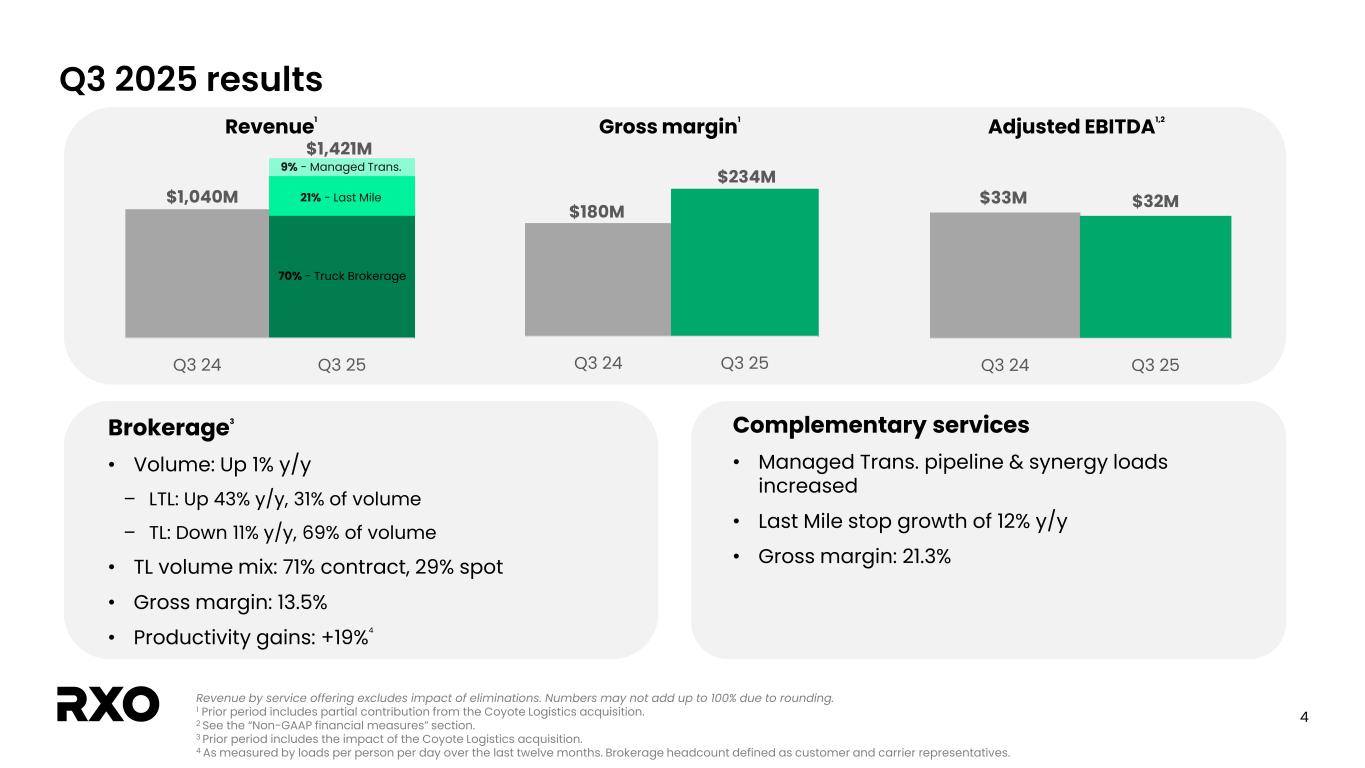
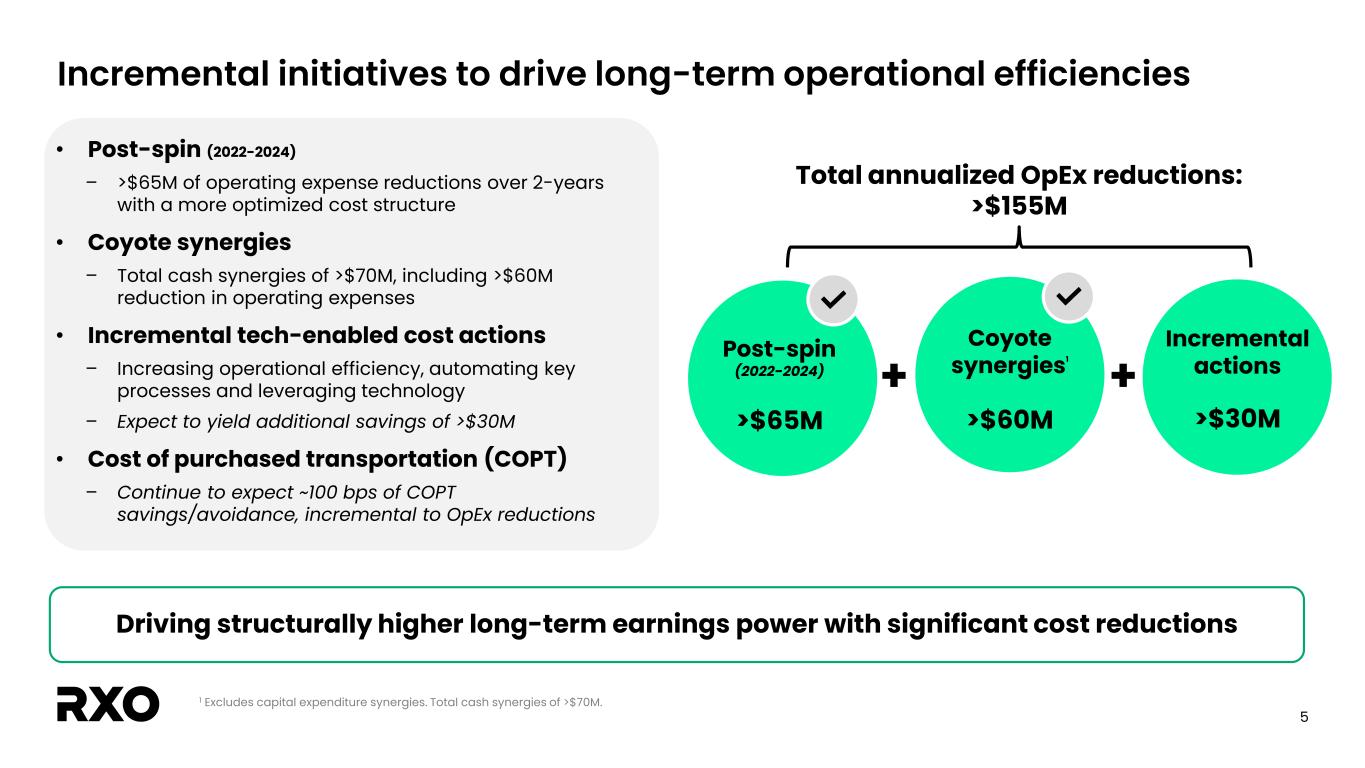
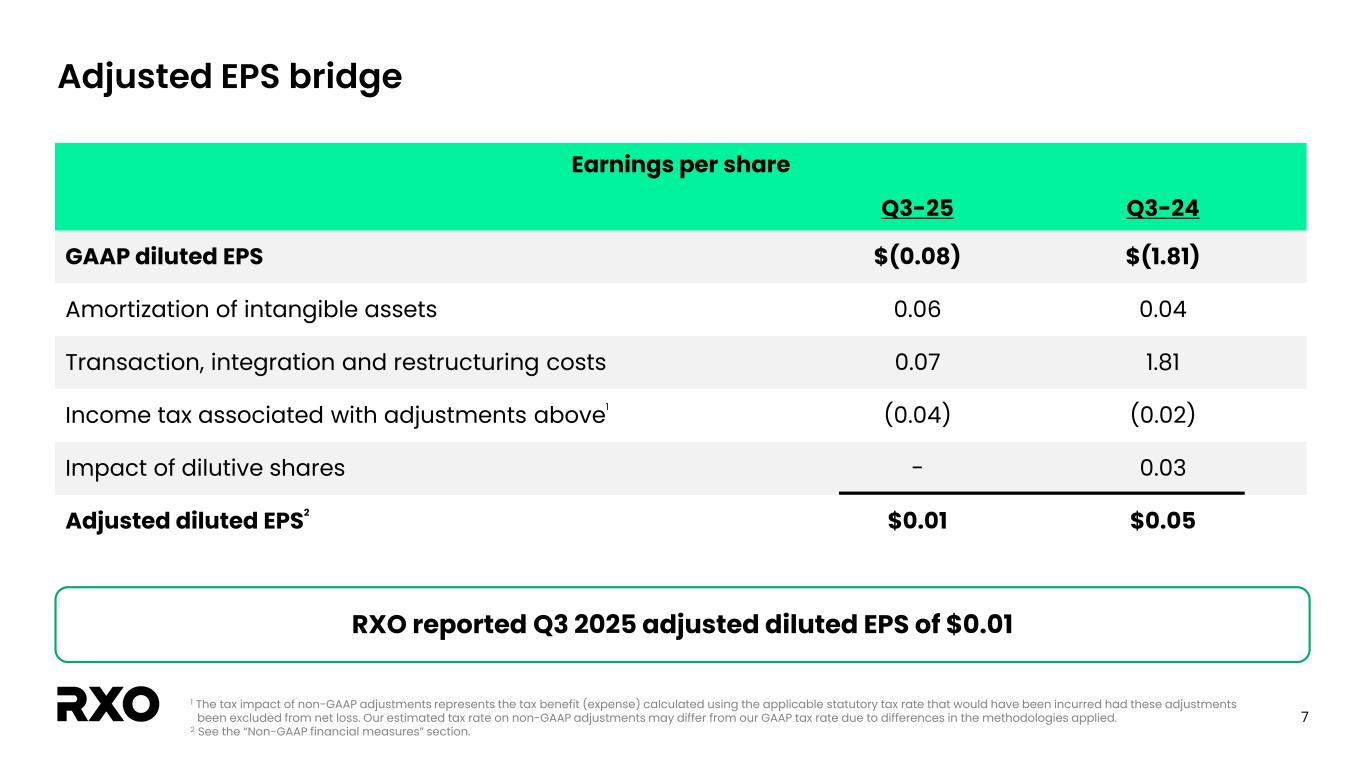
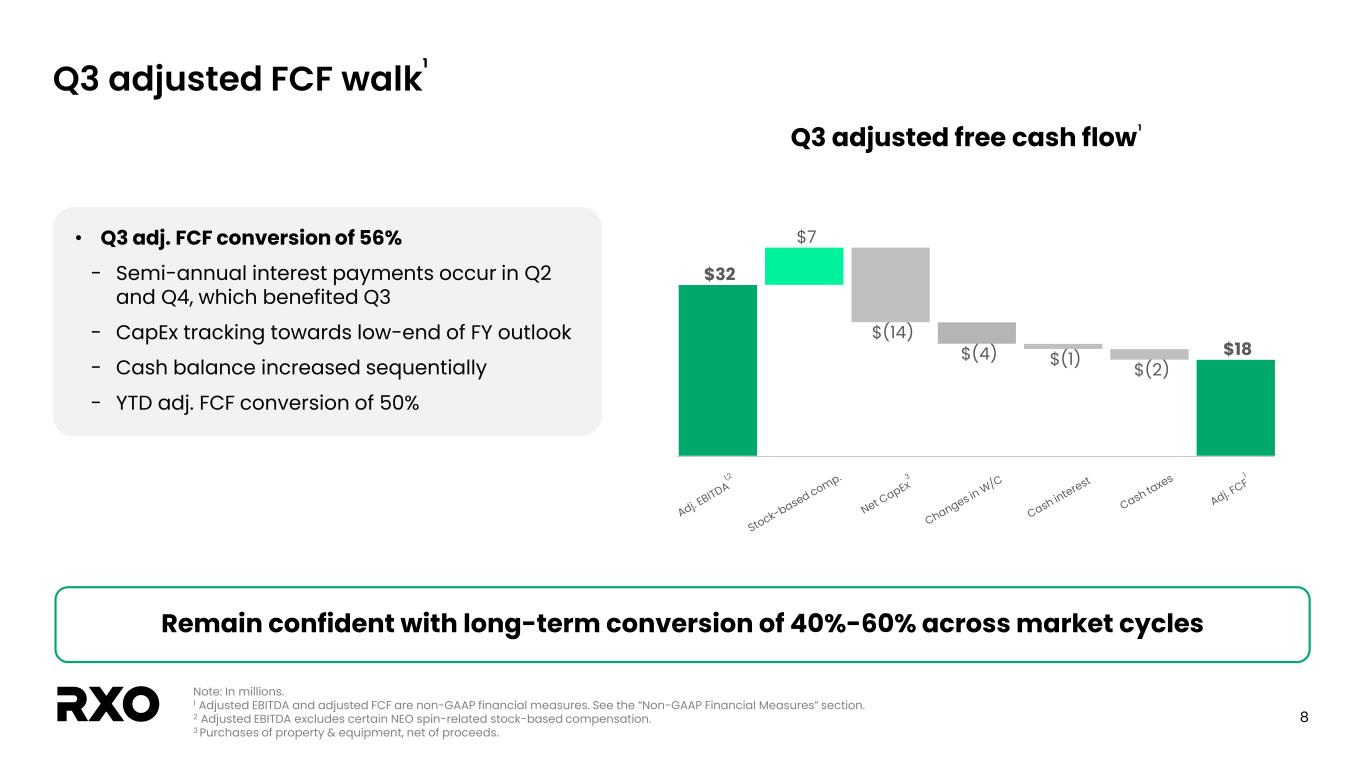
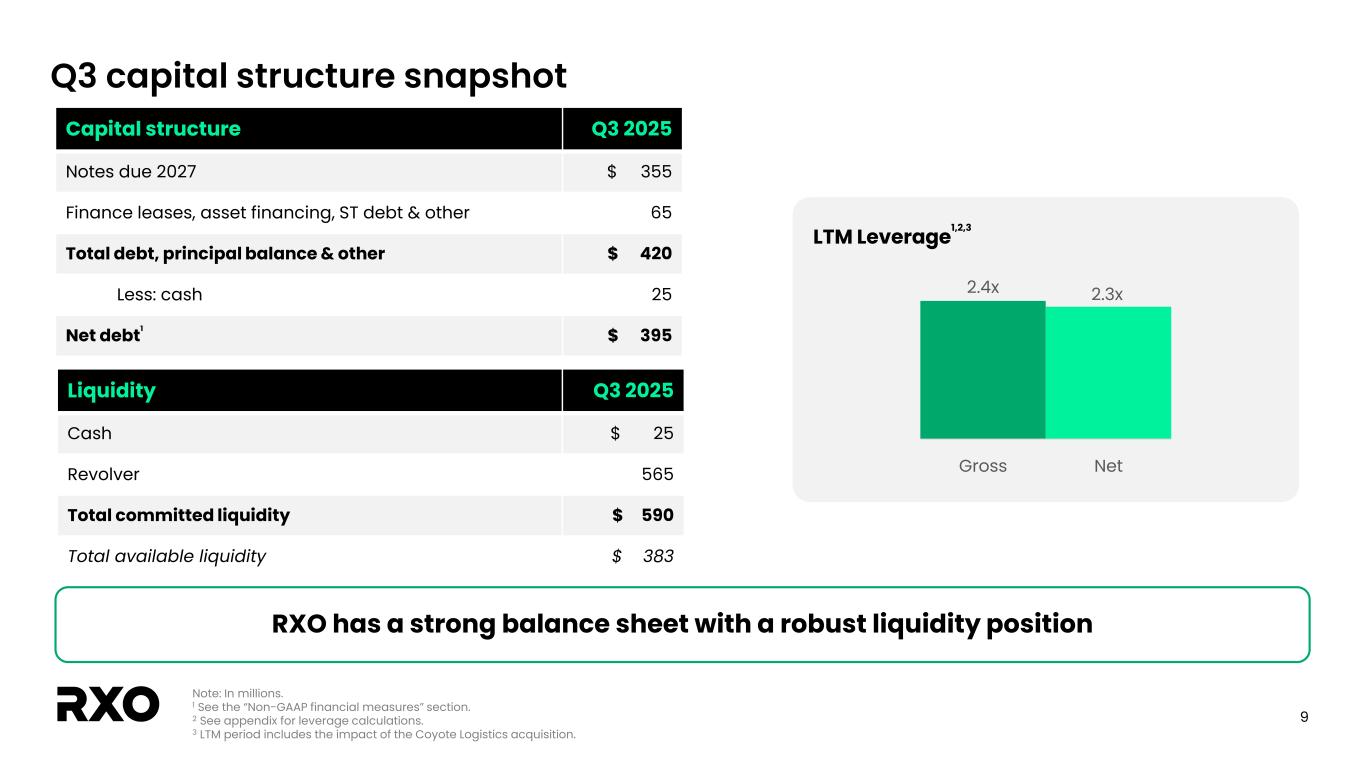
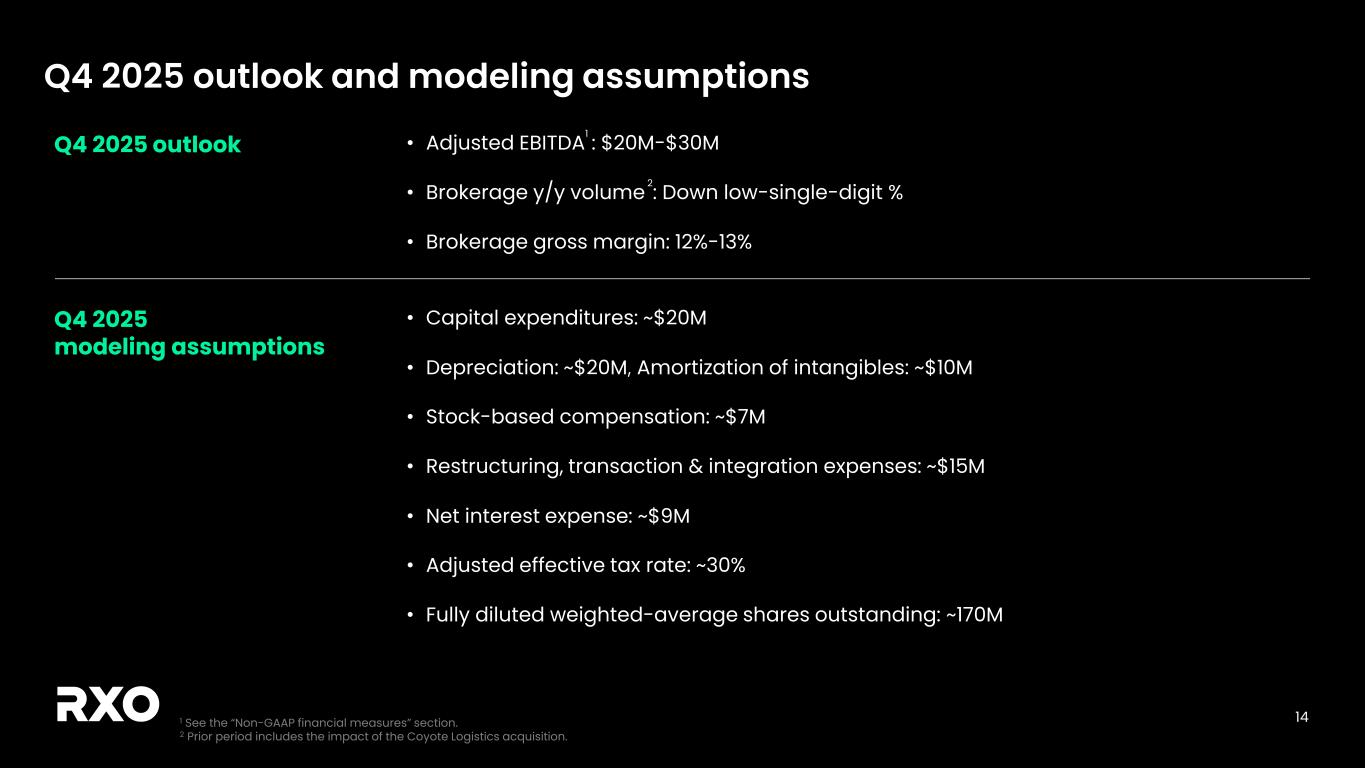
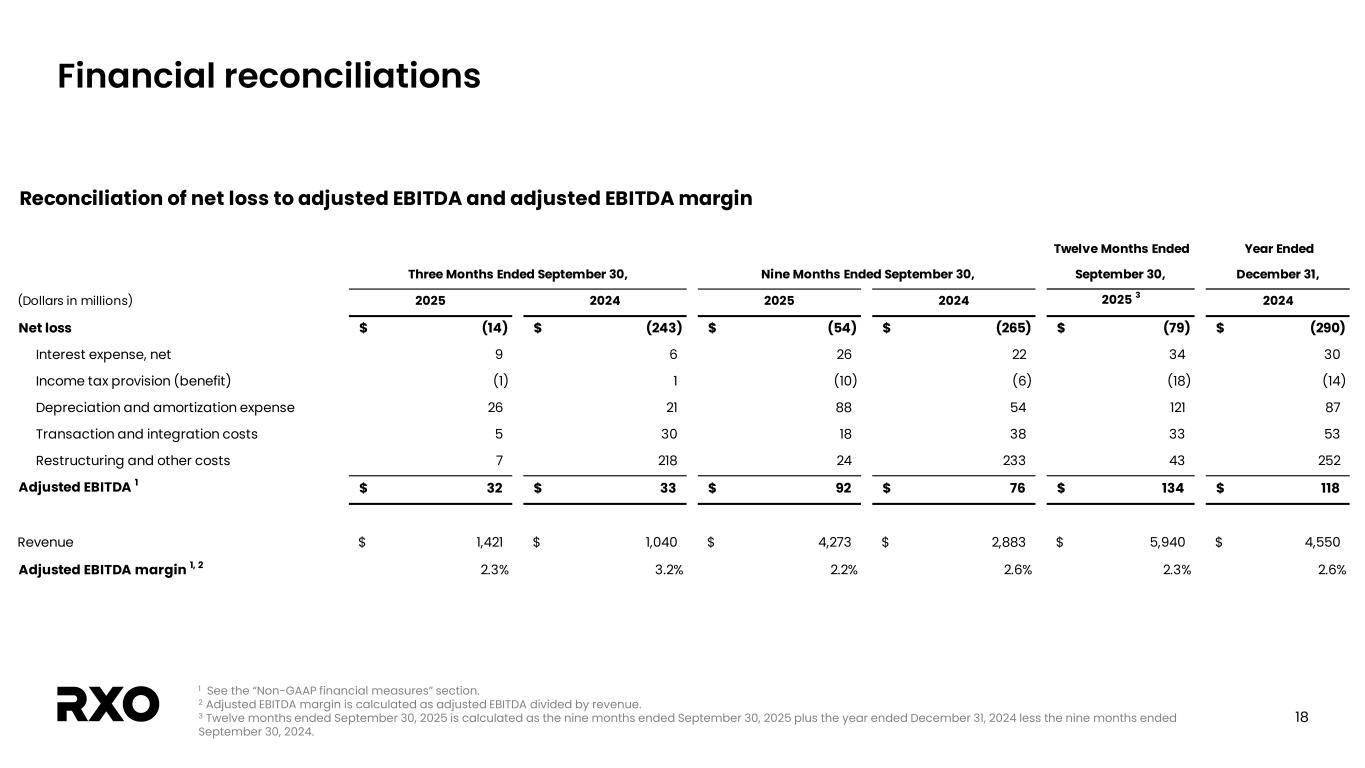
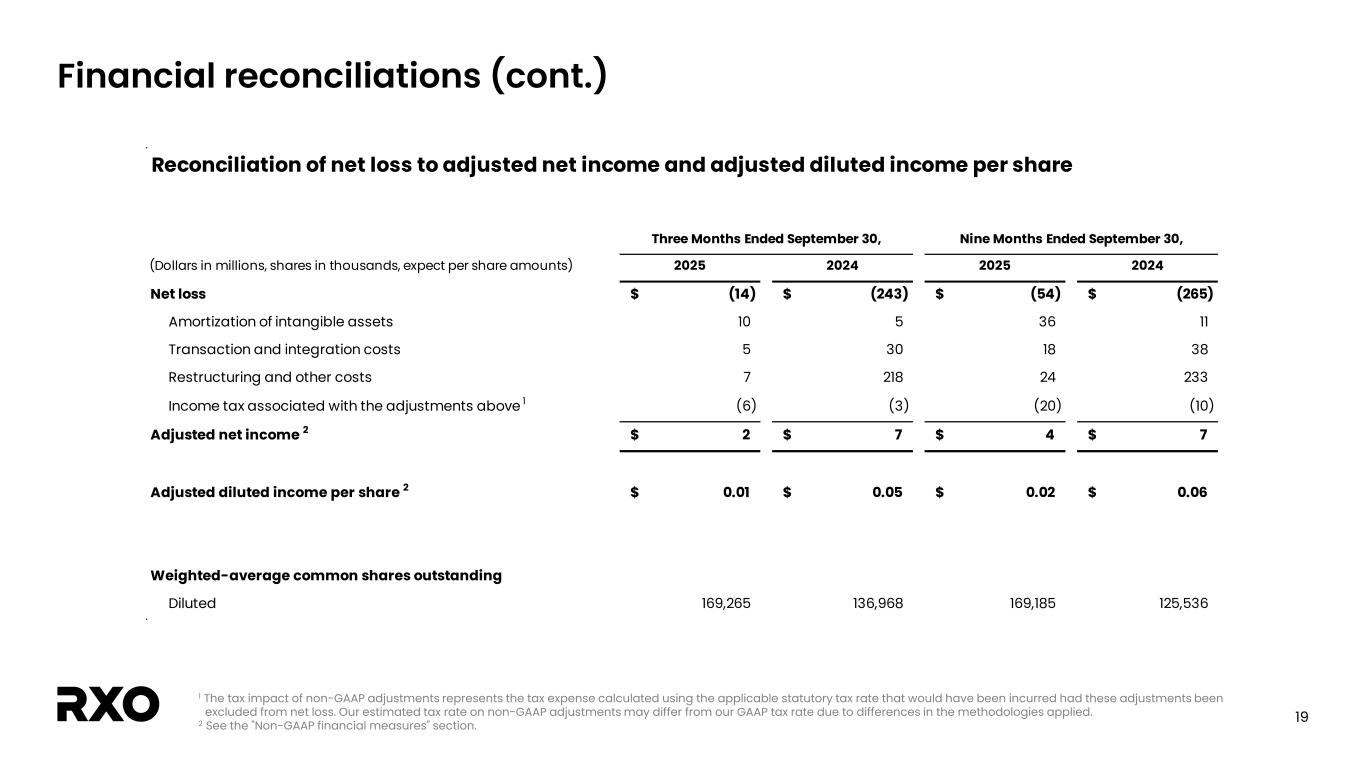
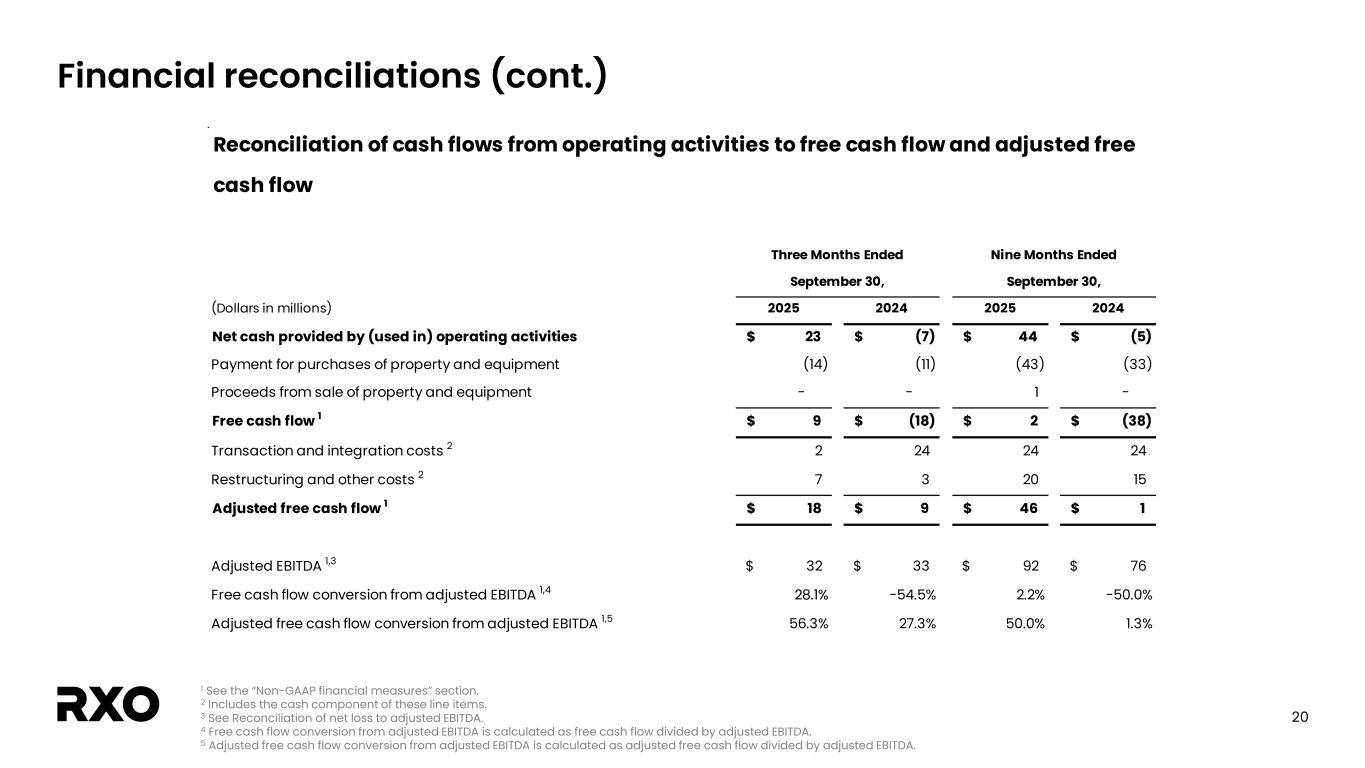
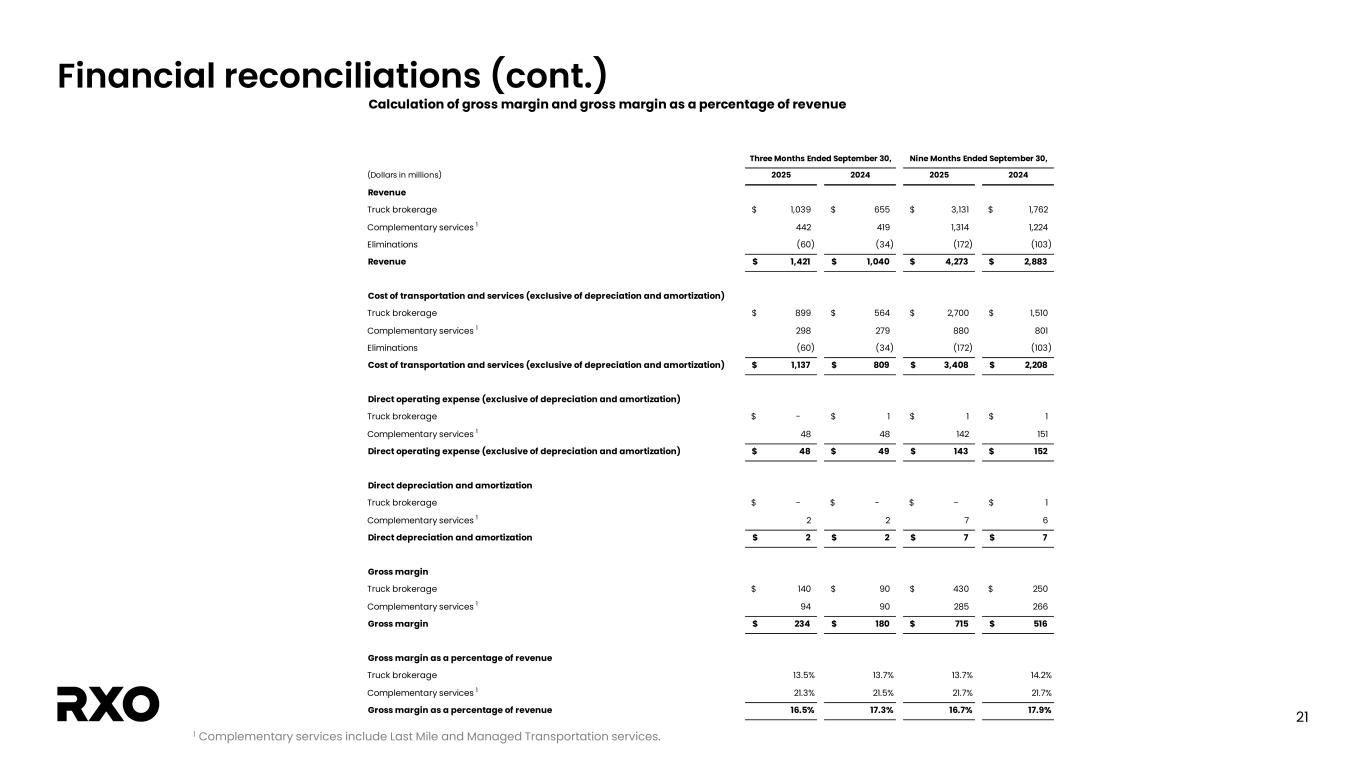
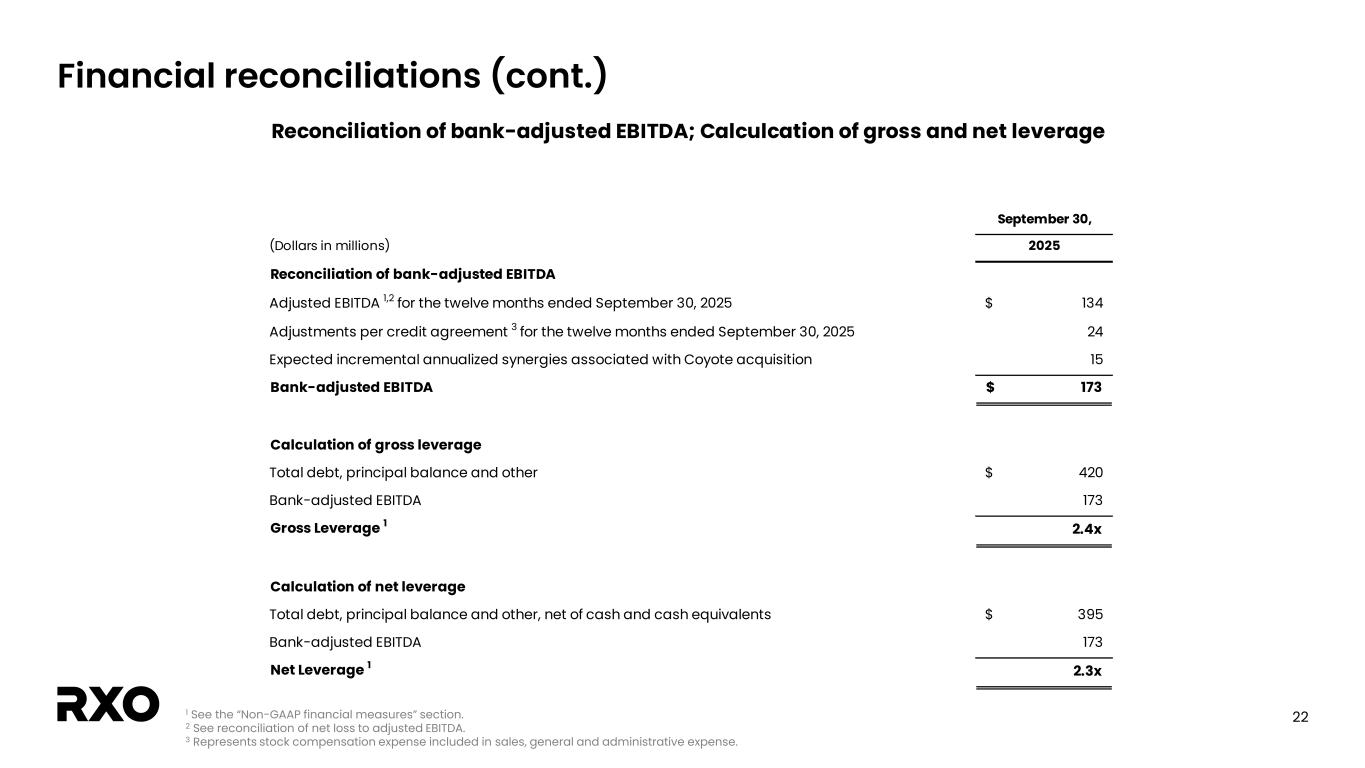
Thank you, Drew, and good morning. Let's review our third quarter performance in more detail. Our results were slightly below our outlook. For the quarter, we reported $1.4 billion in total revenue, gross margin of 16.5%, adjusted EBITDA of $32 million, and an adjusted EBITDA margin of 2.3%. Gross margin and adjusted EBITDA were primarily impacted by the increase in cost of transportation, further broad-based demand weakness, and continued headwinds in the automotive sector. As Drew mentioned, cost of transportation increased without a corresponding increase in sell rates or accretive spot opportunities. This caused a margin squeeze on our contractual brokerage volume during the month of September. Jared will provide more details later in the call. Automotive was a continued headwind and represented an approximately $5 million year-over-year margin impact in the quarter. As we discussed over the past two quarters, this freight is time-critical and with high service requirements and typically carries a higher-than-average gross margin with strong flow-through to EBITDA. Below the line, our interest expense was $9 million. For the quarter, our adjusted earnings per share was $0.01. You can find a bridge to adjusted EBITDA on slide 7 of the earnings presentation. Now I'd like to give an overview of our performance within our lines of business. Brokerage revenue was $1 billion and represented 70% of our total revenue. Overall, brokerage volume growth was 1% in the quarter. We had strong LTO growth of 43%, which was offset by 11% decline in full truckload volume. The year-over-year decline in truckload volume was impacted by overall demand weakness, softness in the automotive sector, and efforts we undertook with customers to optimize price, volume, and service. Given the market tightening in September, brokerage gross margin was down 90 basis points sequentially to 13.5% at the low end of our outlook. Complementary services revenue in a quarter of $442 million increased by 5% year-over-year and was 30% of our total revenue. Gross margin within complementary services was 21.3%. Now let's discuss each line of business within complementary services. Managed transportation generated $137 million of revenue in the quarter, down 9% year-over-year. Managed transportation continues to be impacted by lower automotive volume in our managed expedite business. Our last mile business generated $305 million in revenue in the quarter, up 14% year-over-year. Last mile stocks grew by 12%. However, over the past few months, we have seen a weakening in the big and bulky demand. This trend has worsened into the fourth quarter. Let's now discuss cash. Please refer to slide eight. Adjusted free cash flow in the third quarter was $18 million, yielding a strong 56% conversion from adjusted EBITDA. As a reminder, our semi-annual interest payment is not due until the fourth quarter, which benefited our third quarter conversion. Year to date, our conversion is 50%. We're very pleased with our conversion at this point in the freight cycle. Given our asset-like business model, we remain confident in a 40% to 60% conversion over the long term and across market cycles. We ended the quarter with $25 million of cash on the balance sheet, which increased by $7 million sequentially, with no change to the Revolver balance. We grew our cash balance despite $9 million of restructuring, transaction, and integration cash outflows. As you can see on slide 9, our liquidity position continues to be strong with $590 million of total committed liquidity, of which approximately $375 million is currently available. Quarter-end net leverage was 2.3 times LTM bank-adjusted EBITDA, up slightly when compared to the prior quarter. I'd now like to talk about the actions we've taken to optimize our cost structure. We've taken actions to achieve more than $125 million of annualized expense savings, including $65 million of post-spend costs and $60 million of cost synergies related to the Coyote acquisition. Today, we announced that we're taking additional actions that would yield more than $30 million of incremental annualized savings. Collectively, this means a total reduction in annualized expenses over the last three years of more than $155 million. We're optimizing our cost structure, operating more efficiently, and automating key processes. Now let's discuss our expectations for the fourth quarter. Our outlook reflects a fluid macroeconomic environment with weakening freight demand and a continued increase in the cost to purchase transportation. For the combined company in the fourth quarter, we expect to generate between 20 and 30 million dollars of adjusted EBITDA. While we would typically see a sequential increase in brokerage adjusted EBITDA in the fourth quarter, that is being more than offset by higher costs of purchase transportation. We're also expecting a decline in complementary services driven by slowing demand and last mile, which is counter to normal seasonality. Jared will provide more details on our outlook shortly. Slide 14 includes our fourth quarter modeling assumptions. There are a few things I want to highlight. We expect CapEx of approximately $20 million. We're tracking and towards the low end of our previously discussed $65 to $75 million outlook for the full year 2025. For 2026, we continue to expect CapEx to be between $45 and $55 million down materially year over year. As we discussed, we're taking additional cost actions that will result in more than $30 million of annualized expense savings. In conjunction with these actions, we expect fourth-quarter restructuring, transaction, and integration expenses to be approximately $15 million. Below the line, we expect net interest expense of approximately $9 million, an adjusted effective tax rate of approximately 30 percent, and fully diluted shares of $170 million. To summarize, recent accelerated capacity exits are putting upward pressure on our cost of purchase transportation and squeezing our contractual brokerage gross margin. This impacts near-term profitability, given our large footprint of contract business with Tier 1 shippers. We are reliably servicing our customers' freight and are well-positioned to win spot opportunities and special projects when demand recovers. Longer term, as we think about the broader macro economy, we do see positive developments such as lower interest rates, new tax legislation, domestic investment announcements, and improving clarity on trade. Lower interest rates specifically can spur freight activity in many rate-sensitive industries, such as the housing sector. As an example, according to the American Trucking Association, every new home built requires between 6 and 10 truckloads of goods to be shipped. Mortgage rates recently reached 12-month lows, and any recovery in the housing market would be positive for ground transportation and RxO. We are closely monitoring the macro environment and are positioned to benefit when demand strengthens. Now, I'd like to turn it over to Chief Strategy Officer, Jared Weisfeld, who will talk in more detail about our results and our outlook.
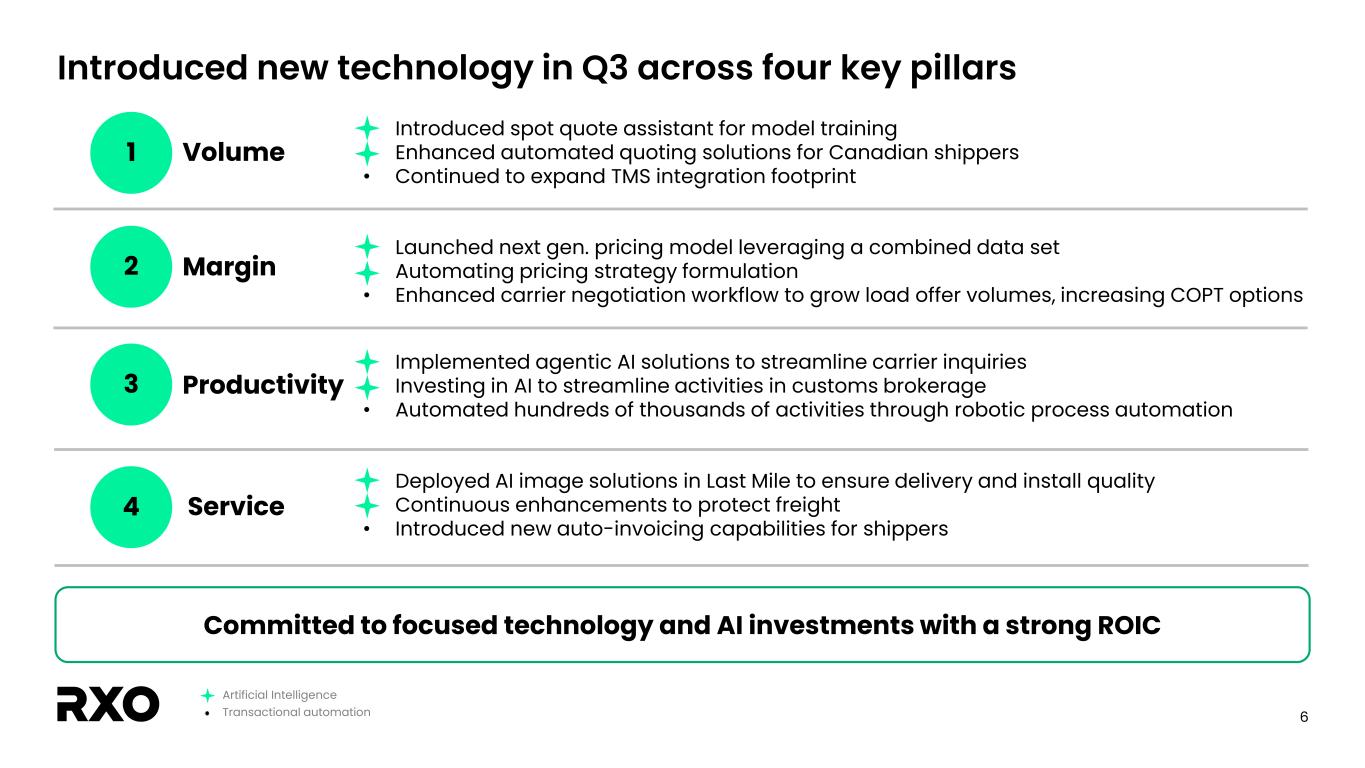
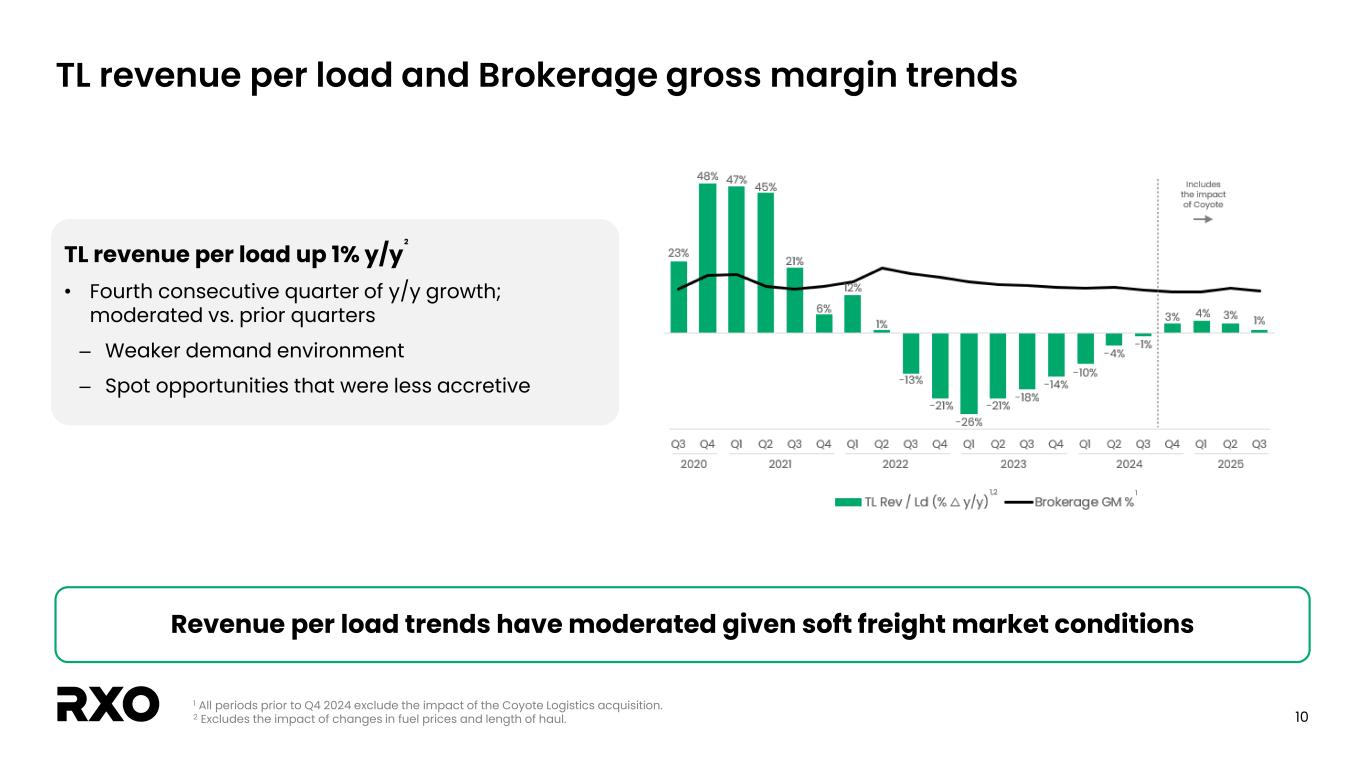
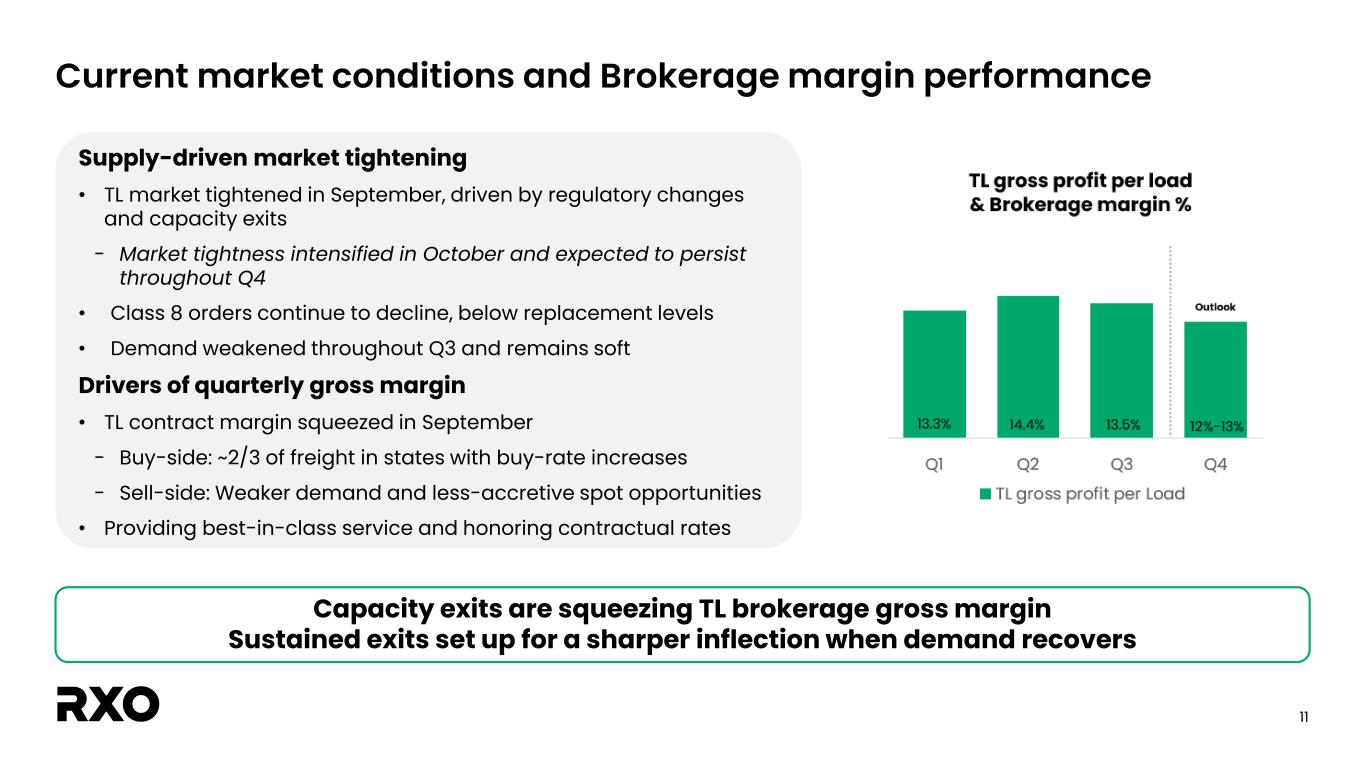
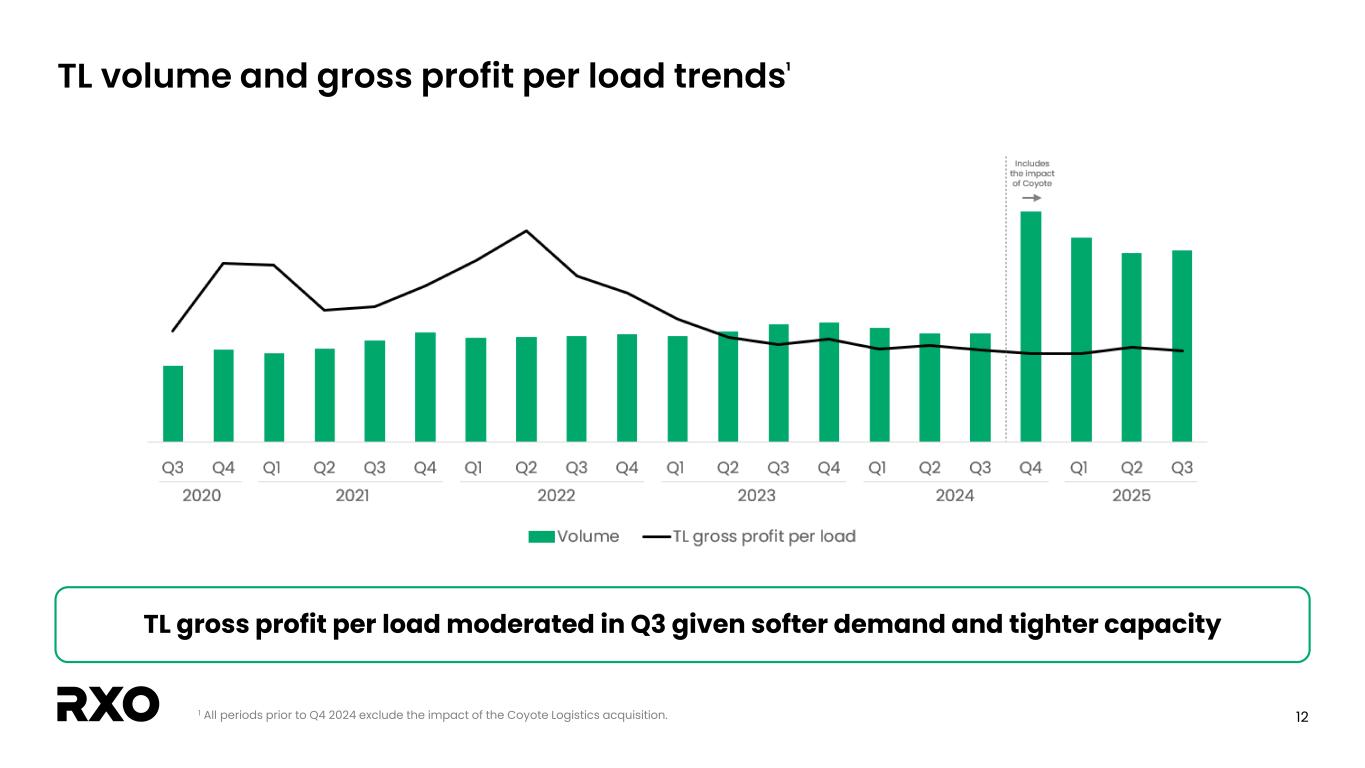
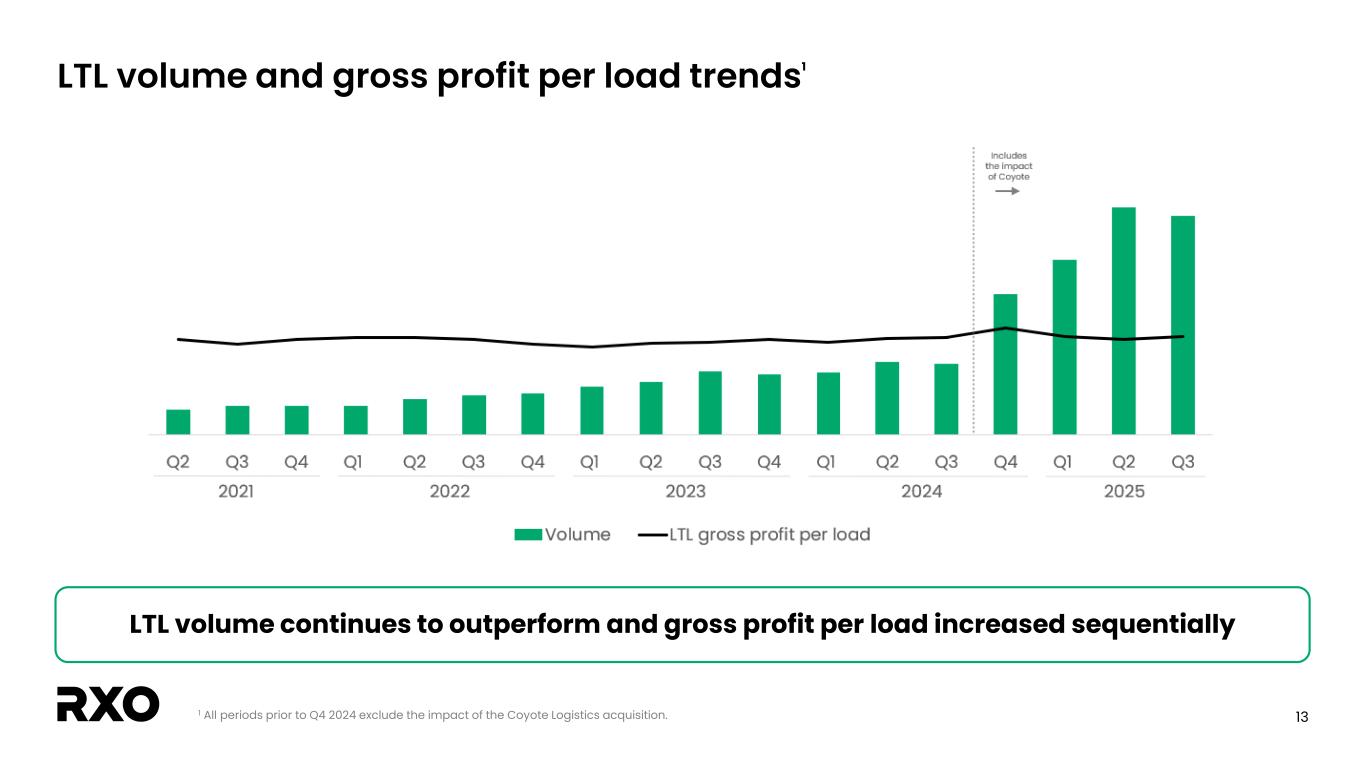
Thanks, Jamie, and good morning, everyone. As I typically do, I'll start with an overview of our brokerage performance in the quarter. To make the comparisons more useful for you, I'll give you combined numbers that include Coyote's results in the prior period. Brokerage volume in the quarter was up 1% year over year, outpacing the cash rate index. LTL volume increased by a strong 43% year-over-year. LTL represented 31% of brokerage volume in the quarter, up 900 basis points year-over-year, and down slightly from the second quarter. Truckload volume was down 11% year-over-year and represented 69% of brokerage volume, up 100 basis points sequentially. Similar to last quarter, truckload volume was impacted by a decline in automotive, efforts we undertook with customers to optimize price, volume, and service, and broader market weakness. From a vertical perspective, automotive volume was down 22% year over year. In the industrial and manufacturing vertical, encouragingly, we saw a slight pickup sequentially, which was largely driven by special projects. Industrial manufacturing volume declined by 3% year-over-year. Contract volume was 71% of our overall truckload volume in the quarter. Contract business declined by 200 basis points sequentially and 100 basis points year-over-year. SPOT represented 29% of our truckload volume in the quarter, up 200 basis points sequentially, and 100 basis points year-over-year. This was partly tied to the Coyote technology integration. As we migrated shippers to RxO Connect from Bazooka, we benefited from an increase in API connectivity. This enhanced connectivity will also benefit the combined organization when the freight market eventually recovers. However, given the weakening demand environment, the spot opportunities were less robust when compared to the second quarter and not enough to offset the squeeze on our contractual book of business. Before reviewing our financial performance and market conditions in more detail, I'd like to talk more about some of the technology offerings that we rolled out in the quarter. We deliver technology that drives improvements across four key pillars, volume, margin, productivity, and service. We've been developing and enhancing our artificial intelligence and machine learning capabilities for years, utilizing our proprietary data. During the quarter, we made progress further enhancing our AI capabilities across each pillar. We enhanced our proprietary and differentiated pricing model, which leverages the combined data of RxO and Coyote. We implemented agentic AI solutions to streamline carrier inquiries, reducing manual effort by tens of thousands of hours. We've deployed AI image solutions in Last Mile to ensure delivery and install quality, which has the opportunity to fully automate thousands of manual photo validations per day. And our engineering teams have been leveraging AI tools that have generated millions of lines of code. We're applying AI to structurally improve the long-term margin profile of the business. Let's now review our brokerage financial performance and market conditions in more detail. starting with revenue per load on slide 10. In the third quarter, truckload revenue per load moderated. Year-over-year revenue per load, excluding the impact of changes in fuel prices and length of haul, increased by 1%. The demand environment also weakened in the third quarter, negatively impacting revenue per load. Let's move to slide 11 and discuss brokerage margin performance and current market conditions. As Drew mentioned, the truckload market tightened during the month of September. This squeezed the margins in our contractual book of business, resulting in a moderation in gross profit per load and third quarter brokerage gross margin at the low end of our outlook. From a market standpoint, buy rates and industry KPIs moved higher in the quarter. Tighter market conditions have been entirely driven by supply-side dynamics as overall demand has weakened. This tightening in supply is largely due to enforcement actions related to non-domiciled CDLs and English language proficiency. From a seasonal standpoint, buy rates typically eased during September. This year, however, the market moved counter-seasonally and buy rates moved higher in September. This trend not only continued, but was even more pronounced in October, despite weaker demand. For the quarter, approximately two-thirds of our freight came from outbound states with buy rate increases. For example, we saw acute tightening in California and Texas. Over the last two months, industry-wide line haul spot rates have moved up by approximately six cents per mile, with no increase in sell rates or a corresponding increase in accretive spot opportunities. While RxO continued to procure transportation more favorably than the market, we are not immune to market squeezes given our large contractual book of business with Tier 1 enterprise shippers. As it relates to purchase transportation savings from the Coyote acquisition, our incremental buy rate favorability was similar to the prior quarter at approximately 30 to 50 basis points. Our customer and carrier representatives continue to increase their familiarity and productivity within RxO Connect. We remain confident in our ability to achieve 100 basis points of incremental favorability over the long term. As a reminder, in tightening market conditions, such as the current market, incremental favorability serves as cost avoidance. Turning to slide 12, as we just discussed, truckload gross profit per load moderated in the third quarter, given softer demand and tighter capacity. This market tightness intensified recently, and to put in perspective, our truckload gross profit per load in the month of October was approximately 25 percent behind our five-year average, excluding COVID highs. Incremental margins attributable to a gross profit per load increase are very strong, in excess of 80 percent. Moving to slide 13, RxO's LTL brokerage volume continues to outperform the broader LTL market. In the quarter, LTL gross profit per load also improved sequentially. We have many opportunities to continue to grow LTL volume with existing and new customers. I'd now like to look forward and give you some more details on our fourth quarter outlook. We're assuming a muted peak season and weak demand trends across all our lines of business. starting with brokerage. We expect overall volume to decline by a low single digit percent year over year with continued soft truckload volume trends partially offset by strong LTL growth. Market tightness intensified in the month of October and is expected to persist throughout Q4, pressuring brokerage gross margin and gross profit per load. We anticipate that brokerage gross margin will be between 12 and 13 percent. Let's now talk about complementary services. In managed transportation, while the business has strong sales momentum and an expanded pipeline, managed expedite automotive headwinds continue to impact us in the near term. In last mile, demand trends within big and bulky have weakened after Labor Day, and we're taking that into account in our outlook. Putting it all together, we expect RxO's fourth quarter adjusted EBITDA to be in the range of $20 to $30 million. While we would typically see a sequential increase in brokerage adjusted EBITDA in the fourth quarter, that is being more than offset by higher cost of purchase transportation. We are also expecting a decline in complementary services, driven by slowing demand in last mile, which is counter to normal seasonality. Taken together, the impact of these two items is approximately $15 million. dollars. Similar to previous quarters, we thought it would also be helpful to share some assumptions underlying our fourth quarter outlook. The low end of our adjusted EBITDA outlook assumes a further moderation of our truckload gross profit per load. This would include a continued increase in buy rates and no corresponding increase in accretive spot opportunities. The high end of our outlook assumes an increase in our gross profit per load and improvement in brokerage gross margin. This would include accretive spot opportunities to offset the squeeze. To close, we continue to operate in a soft demand environment. On the supply side, continued enforcement of non-domiciled CDL restrictions and English language proficiency would result in a major structural change to the industry. While our brokerage gross margin is impacted in the near term, assuming enforcement continues, this could result in a sharper inflection when demand eventually recovers. Longer term, this could be a very positive development for large-scale brokerages like RxO, and it would strengthen safety, reduce theft, and fraud. Our actions over the last several years have improved RxO's cost structure, which will lead to higher earnings across market cycles. We have taken actions to remove over $125 million of costs. We announced more than $30 million of new cost initiatives today to enhance operational efficiency. We've improved brokerage productivity by 38% over the last two years. Our brokerage cost per load has decreased by more than 20% since our spin, and we are committed to investing in technology, including AI, with a strong return on invested capital. More than ever, shippers want to do business with large-scale brokerages that have the resources, capital, and ability to invest throughout market cycles. With a continued focus on profitable growth, a more efficient call structure, larger scale, and a cutting-edge technology platform, we are well-positioned to drive significant long-term earnings and free cash flow growth. With that, I'll turn it over to the operator for Q&A.
Operator
Thank you very much. It is now time for our Q&A session. Our first question will come from Stephanie Moore with Jeffries. You may now begin.
Hi, team. Good morning. I wanted to get a sense, I guess, just on the underlying market dynamics and specifically the supply environment, which, you know, you've touched on here. But there's a lot of debate on whether these federal enforcement actions will be enough to shift the supply-demand balance. So the first question is, do you think the recent supply exits are sustainable and enough to structurally reduce market supply? And then second, if this is, in fact, the final squeeze that we would expect to see at the bottom of the cycle, if demand doesn't materialize near term, what actions can RxO take to manage gross profit per load to, say, the next couple quarters? Thanks.
Hey, Stephanie. Good morning. It's Drew. I'll take the first part on the reducing capacity, and Jared will take the second part of your question on the gross margin dollars and gross profit per load through a quarter. When you look at what's going on on the supply side, you know, as I said in my prepared commentary, I think this is the biggest structural change potentially in transportation. Compare it to something like ELDs. And when ELDs were enforced, drivers had a choice of whether or not they were going to invest into their equipment and continue to haul. At this point, they don't have a choice. They're being pulled off the road if they're non-domiciled drivers or if the English language proficiency doesn't meet the requirements. So I think it's a much bigger change than what anything that has happened in the industry in the past. And it is something that will take out capacity in a major way in large percentage points. The one thing that we still need is for demand to return overall. As demand returns, what that does is it creates a much sharper inflection as the market comes back.
And, Stephanie, on your second part of the question in terms of if this is the final squeeze but demand doesn't recover, you know, what actions can we do? I would point to the, you know, $30 million of new cost initiatives that we announced this morning, more than $30 million, where you will see a partial impact here in the fourth quarter. We continue to streamline the cost structure of the business, and we see significant opportunities as it relates to improving that cost structure longer term. As you think about additionally heading into next year, like Drew touched on this in the opening remarks, our cost of purchase transportation benefits as carrier reps continue to gain incremental efficiencies on RxO Connect and Freight Optimizer, the ability to go ahead and become more productive and benefit from a PT standpoint I think are very real. And then the last thing I close with is, you know, I think Jamie touched on this, you know, ultimately, you know, we are seeing, you know, lower interest rates and some benefits associated with you know the recent uh bills that were passed through congress as it relates to potential investments in the u.s as well so you know as you think about what this is setting up for when supply eventually um continues to normalize combined with a demand inflection you know it could be pretty strong on the other side but enforcement does need to sustain great thank you i'll pass it on thank you very much our next question comes from brandon oblensky with Barkley.
Operator
You may now begin.
Hey, good morning, everyone, and thanks for taking the question. Drew, this is going to come off a little critical, but I think it's probably for the betterment of everyone on the call. I mean, let's take it at face value. Your adjusted EBITDA guide here is down about 40% at the midpoint year-on-year, and that's a year into Coyote. We really thought Coyote was going to be transformative, you know, a pretty big acquisition for a company of your size. I guess looking back, you know, are there things that you maybe wouldn't have done And, I mean, maybe to exemplify it, I think the last couple years you guys have said, look, 1Q is usually a lot weaker than 4Q. Is that what we're to infer here? And if that's the case, I mean, I guess investors are probably going to look for more tangible actions here on earnings.
Yeah, Brandon, good morning. Thanks for the question. You know, if you look back at the Coyote acquisition, on people, customers, and technology, we have done extremely well. But the financial results are not where they need to be. And the biggest miss off of that was whenever you went into the 2025 market, we made a decision on pricing, and we took price up off of that. I made the wrong call on that one. And that is something that has impacted overall volumes. And if you go back and you look at our history, we've outgrown the market for several times. I look forward to us getting back to the days of where we are the market leader and we're the transportation leader from a growth standpoint of taking market share. Clearly, 2025 is not where we want it to be overall. As you go from 4Q to 1Q, first, I would say let's start with the third quarter. Typically, from the third quarter to the fourth quarter, you see brokerage and last mile go up from an EBITDA perspective. That is not what you're seeing this year. So the headwind going from 4Q to 1Q is not the same as what it typically would be. We also have the cost actions that we have taken that will be impacted from 4Q to 1Q. So I don't think it's an apples to apples. Demand is still an unknown as we go into Q1, and are we still getting squeezed as we go into Q1? That's unknown. But ultimately, what is happening in the business right now is setting up for a very, very good thing.
Well, I appreciate that, Drew. And, Jamie, can you talk to your adjusted leverage calc that I think speaks to some of your covenants? And is that going to be a challenge just given the earnings outlook here into the fourth quarter, especially as you move forward?
Yeah, thanks. Yeah, so we ended the quarter at leverage of a net 2.3. If you look forward to the midpoint of our range, at end of Q4, say 20 to 30 at 25, you'll be about 2.8. our covenant is 4.5 so we've got a lot of headroom we have a very strong balance sheet we've got access to several hundreds of millions of dollars of capital so we're not concerned about that you know one thing I would point out you know we had as Drew said we had a strong cash flow quarter 56% conversion added cash to the balance sheet you know as we look forward to the fourth quarter we will have the semi-annual bond payment which is not normally do in Q4 which we'll make that and so you know we'll use some cash in the fourth quarter but as you look at 25 holistically one thing really important to point out there's about 65 or 70 million dollars of cash outflows in 2025 that will not reoccur in 26. Three drivers number one in first quarter we had $25 million of cash usage to finish paying for transaction fees related to the Coyote acquisition that happened in 24 is purely timing secondly our total span on restructuring and integration will go down approximately $30 million year-over-year and then third our capex will go down 10 to 15 million dollars so if you think of dead all those together we've really got 65 or 70 million dollars of cash outflow in 2025 that will not reoccur. If you put that in context of the 25 you know midpoint of the range for the full year that means we would be producing 20 to 25 million dollars of free cash flow on in 25. So if you think about at the bottom of the cycle very strong it really sets up nicely as the cycle improves that number will go up and so all that taken together we know we have a very strong cash flow business we have a very strong balance sheet and you know we always watch the balance sheet closely but we're you know it's not not something that we're overly concerned about right now but we do pay close attention as you'd expect us to all right thank you jamie thanks true thank you very much our next question comes from rob shanker with morgan stanley you may now begin uh great thanks uh morning guys uh so um it's a bit
of an AI arms race out there in the brokerage space. It's all about how many agentic AI bots you have and how many press releases you put out. But you said that your customers are telling you that you have the best and easiest tech out there. Can you just unpack first the process of going out there and selling your tech platform to your customers? Like, what are they looking for? How do you drive conversion? And kind of how do you differentiate yourself with what else is out there from a tech world because sometimes it may be hard to see for us in our seat.
Yeah, Ravi, one, appreciate the question. The only thing I would level set on is it's not about press releases for us. It's about results for employees. It's about results for customers. It's about results for carriers. And we are hitting an inflection point with our AI investments that we have been making. Not only have we been running an integration, we have been investing in AI, and we've been investing in it heavily. When you look on the ability of what we're able to do on the pricing side, it is something, while we had a very strong pricing algorithm that's allowed us to outperform the market from a margin perspective for a decade plus, it is getting better. When you look at the way that we are communicating with carriers, it is changing, and it is allowing our reps to spend more time focusing on solutions. And then the last thing is, even if you look at our last mile business, we've done things like whenever you're doing an installation versus a person going in there and getting a photo and checking it, we've been able to actually do that with an AI bot that is checking everything from an installation standpoint, which is critical to our customers and consumers and how that process unfolds. So for us, you know, very excited about hitting an inflection point with AI and what it will actually mean from an operating margin perspective to the business. And look forward to hosting you next week and letting you actually see it on the floor of how it impacts carrier-ups' lives, how it impacts customers and how we're interacting with them so that you can see it live and in person.
Great. Looking forward to that as well. Maybe a super quick follow-up. Your 4Q guidance is predicated on the current demand supply equation holding, right? So if, for some reason, the supply side of the reinforcement drops off or the supply side gets looser, your 4Q gross margin will be better than guided.
Robin, as you think about the range that we provided for Q4, $20 to $30 million of adjusted EBITDA, the midpoint assumes that current market conditions in terms of the intensification that occurred in the month of October with respect to market tightness, given the supply dynamics that we talked about, that sustains throughout the rest of the quarter. the low end assumes that the market further tightens in terms of that squeeze impact without a corresponding increase in demand in spot opportunities. So that environment would result at the low end. And for the high end, to your point, as you think about either the market tightening to the point where it results in some pressure in waterfall routing guides and some spot opportunities and or if there is an easing in buy rates, that would allow gross profit per load to improve from current levels to get to the high end of our guide for Q4.
Operator
Great. Thanks, Eric. Thank you. Our next question comes from Chris Weatherby with Wells Fargo. You may now begin.
Hey, thanks. Good morning, guys. I guess I want to ask a question about operating expenses and your ability to maybe sort of rein those in a little bit as you go forward in this weaker market. Maybe you can talk a little bit about the potential opportunities you have. It looks like if I just sort of zone in on direct OPEX and labor expenses, those have been relatively flat in this market over the course of the last few quarters. Is there work that you can do there to try to adapt to what has been obviously a more challenging outlook?
Yeah, so this is Jamie. We've taken a lot of cost action since then, $155 million in total, including the synergies we've gotten from the acquisition we're constantly looking at our expenses you know if you look at our P&L a lot of the direct OpEx that you see in the P&L it relates to our last mile and our managed transportation business you know SGA that shows up in the P&L was across all the business lines you know there's still plenty of actions that we can take and we've talked about you know automation we've talked about process improvement one of the things that we're constantly working on drew mentioned in his remarks footprint how do we consolidate footprint so we can give the same level of high customer service in fewer square feet of space and fewer facilities um those are the type things we're constantly working on so you know answers yes there's is more that we can do um and we're working we're constantly working on those on those type activities and you can see it with the 30 million dollars that we announced today i mean that's a constant process that we're going through.
Okay, that's helpful. And then I guess, you know, maybe Drew, if we could sort of zoom out a little bit and try to get a sense of maybe how we come out of this dynamic that we're in right now. I don't think you typically see the cycles turn simply driven by the supply coming out. And it seems like that's happening without any demand, I guess, you know, maybe help us a little bit as you think about the next couple of quarters as you guys are planning for the sort of demand environment? What do you see out there? You obviously need demand. Where do you think it comes from?
Yeah, I think, you know, Chris, there's a lot of things that we're watching on the demand, as Jamie alluded to in his prepared comments. We're watching what happens on the interest rates. We're watching what is happening in the homes. We're paying very close attention on the automotive side. As you know, in automotive, you know, there is the managed expedite portion. And that's when everything breaks down and you have to get something to a plant to avoid shutdown. That's a big piece of our business. And when you look at what that piece of the business was during the peak, it was around 13% of our gross margin dollars in brokerage came from expedite loads. Right now we're sitting at around one or 2%. So to see where the business can go to getting back on track from that perspective. We've always had a big presence in retail and e-commerce, and we have a lot of great relationships there. From the Coyote acquisition, we gained a lot of exposure to food and beverage. And one of the things that we've been really focused on on the sales side is expanding in the technology vertical and expanding in the high cargo value goods area. And we have got a very good pipeline. We're seeing good wins in those areas and look forward to the results. The second part of your question, I think, was more on the market and what's going on And what I would say is this is not an episodic squeeze. This is not DOT checkpoint week. This is not produce season. This is not a weather impact. This is a structural change that is taking place in the industry if it persists. And so supply coming out is real. It's happening. And on the other side of that, with the demand, that sets up extremely well for large carriers, specifically brokers, who have good relationships with their customers, who provide good service, can provide a comprehensive set of solutions and have great technology we fit we check the box on every one of those so you know this is mechanical and part of what we go through at this point in the process but we know what's on the other side of it are you willing to sort of venture a guess on what the capacity rationalization might look like in terms of percent of the fleet chris we're watching a lot of the same things that you're watching and you know i mean if you take out the private fleets and the large cares, there's numbers out there that it could be 15 to 20 percent of capacity. And if that happens, you know, that is a big change within the industry and a lot of capacity that would be exiting. Thank you very much. Appreciate it.
Operator
Thank you. Our next question comes from Ken Hexter with Bank of America. You may now begin.
Hey, good morning. So, Drew or Jared, I just want to understand kind of the messaging here for the fourth quarter. Is this just the squeeze of the spot price that shifted quickly? Are you seeing an acceleration in the demand falling away? It seems like such a more significant change for a fourth quarter outlook than we've heard from other carriers that have also reported within the past week. I just want to understand what you're seeing. Maybe that's a little different. Is the cost exposure unique to RxO in terms of two-thirds of the cost came from regions where where the buy rates increased is that maybe something more particular to rxo than your peers or or is it the capacity tightening more in texas and california so any thoughts i know it's a long question but but any thoughts on that would be helpful thanks hey ken it's jared uh so when you think about the bridge from q3 to q4 you know typically both brokerage and last mile are up sequentially from third quarter to fourth quarter uh this this year we are assuming that they are both down sequentially.
And that's a function of both of what you cited in terms of lower demand and higher PT costs. So, on the demand side, we are seeing lower demand across the business. We saw that play out throughout Q3, and we are expecting the same in the fourth quarter. I'd say specific also to last mile, we did see a drop-off, call it after the Labor Day timeframe with respect to goods for big and bulky. So, last mile is seasonally up into the fourth quarter, and we are expecting that to decline sequentially, given that decline in big and bulky demand. With respect to the question as it relates to purchase transportation costs, right, so when you think about our business, to your point, you know, we did see about two-thirds of states where we were moving goods from an outbound standpoint, our PT costs going higher in the third quarter. So, I'd say it moved modestly higher in the month of September, But that acute tightening really did happen over the last four weeks after the emergency order on non-domiciled CDLs came into effect at the end of September. And we've seen that play out with gross profit per load and gross margin compression within the brokerage business in the month of October. And what makes this interesting and unique to Drew's point where this is very structural from our standpoint, because this is not an episodic squeeze like we've seen over the last three years where, you know, whether it's seasonality due to produce season or DOT checkpoint, this is a lot of capacity that is coming out of the market. And ultimately it's happening at a point where we are having weaker demand trends. So you don't have routing guide pressures to allow for accretive spot opportunities. So that's really what's playing out here, Ken.
So just to clarify that, Chad, because again, I'm just trying to compare it versus what we've heard from some peers, right? So the lack of spot opportunities, but are you seeing that poor demand fall faster? I'm just trying to differentiate kind of why we're seeing maybe some cost or some margin accretion at some relative peers versus the continued pressure. I get the cost side. I think you've made that quite clear in terms of the speed with which this is happening. So is anything also happening on the demand side?
So, yes, demand has weakened. I would also, you know, when you look at our mix, mix is very different across different businesses and different brokerages, right? So for RxO, our contractual book of business, which was, you know, just north of 70% of our volume in the third quarter from a brokerage standpoint, you know, really, you know, you think about largest shippers in North America, tier one enterprise class shippers, you know, not as much SMB, right? One of the benefits associated with the acquisitions of Coyote was we did get an SMB business, but ultimately, you know, that's probably around 10% of total volume. You know, the big bulk of our exposure really is, you know, large tier one enterprise class shippers. So I do think that mix is also important. Can I go back to the earlier question as it relates to automotive, which, you know, certainly has been a headwind for the business as well as an example throughout the year, I suppose, with the manage expedite type freight. So, you know, it would certainly highlight mix as a big difference.
Ken, I'll expand on it a little bit. I think there's a lot of public data out there that shows what's going on with demand. if you look at the cash freight index it shows that it is down seven percent if you want to dive specifically into truckload uh you know freight wave sonar's got a product out there that shows it is down sitting around 17 right now in the truckload so i think you know it's not necessarily taking our word for it it's looking at the public data out there available in the truckload market thank you our next question comes from scott group with wolf research you may now begin it.
Hey, thanks. Good morning. So again, just sort of like a big picture, we're talking about a tightening market. And at the same time, your truckload rev per load goes from up three to up one. Drew, you've been doing this a long time. Have you seen this before where the market tightens and your buy rates go up, but like industry spot rates or sell rates don't move? I don't know that I've seen this before. And then ultimately, I guess what I'm trying to understand is like, you know, if it's a typical squeeze for your business is, you know, a quarter or two, and then eventually you sort of like benefit from it. Like, do you think this is a, if it's supply driven, is it a longer squeeze this time? Or do you think, hey, this can't, this dynamic of buy rates up and sell rates not moving can't last. And at some point the sell rates are going to have to start moving pretty quickly.
Yeah, Scott, I think that everything that you just said points to it being a structural change that has happened in the industry because it is something that we all have not seen before in shaking out this way. As far as how long the squeeze is, yeah, I don't think it would be wise of me to venture a guess on how long the squeeze is because I don't think that anybody saw the upside and the downside of this cycle lasting five-plus years at this point. So, you know, I don't know how long the squeeze will be, but, yes, we are in the thick of it right now is something that impacts our margins. I'll tell you, if you go back and you look at the time of ELD, you actually saw our margins fall to 11.5% during that time. And, you know, within two quarters, you saw more than it make up for that on the recovery side. Now, there was demand there. So I think that demand is a key point. But I do not think that the capacity coming out in this situation is the same as ELD. I think it's in a much bigger way. Because at ELD, you had a choice of if you were going to spend the money and invest in your equipment to meet federal mandates. This time, you don't have a choice. You're just coming off of the road.
Oh, that makes sense. Can I just ask one quick flop? I think you mentioned that buy rates have gone up like six cents or something. Is there any sensitivity, like every penny or a buy rate equals how much of operating income or EBITDA? Any sort of sensitivity there?
Yeah, you know, I mean, for us, Scott, the industry went up six cents. We were much less than that. And I think that goes to the benefit of the Coyote acquisition of being able to buy better than market. So for us, you know, in a quarter, every penny that it goes up is two and a half million bucks of EBITDA.
Operator
All right. Thank you. Thank you. Our next question comes from Jordan Allager with Goldman Sachs. You may now begin.
Yeah, just maybe just to follow on on thinking about the purchase transport and the squeeze. Obviously, there's decent squeeze going on, PTs going up. I mean, doesn't that read that as we get into the contract season next cycle, which I presume starts in earnest, you know, in early next year or March or something, that we should see significant increase or at least an increase in contract rates and the squeeze should be going away?
Yeah. Good morning, Jordan. I think it'll still depend on what happens with overall demand. And bid season's underway right now. We're in the middle of some of our largest bids. Yesterday in Charlotte, we had seven of our largest customers, and we spent a lot of time talking about our pricing strategy with them, talking about how we could draw synergies between the customers that were in the room from a capacity standpoint, talking about what was going on with the federal mandates. So for us, we look at every customer as their own story as we go through bid cycles. So are there the opportunity for rates to go up? Absolutely. But I think some of it depends on what's going on in the market as that customer's bid is going on. So I'm not going to forecast on where rates are going to go for next year. But what I will say is as routing ads start to break down, that's where spot loads come in at. And those are at a much higher revenue per load well i guess just as a quick follow-up i mean i mean given what you're seeing in purchase transport i mean is the do you feel that the customers you're talking to are understanding that you're going to need to push rate up we're very we have very close relationships with all of our customers every one of them is their own story um and you know for us it's about providing a solution for them and for us that works for both the short and the long-term. So our customers are very well aware of what's going on in the market right now.
Operator
Thank you very much. Our next question comes from Tom Wavericks with UBS. You may now begin.
Yeah, good morning. So I wanted to swing back a little bit to just kind of how we should view the run rate in 4Q and what that implies for 26, or just broad brush how to think about 26. If you kind of take midpoint of your EBITDA guide for 4Q, add it up with the three you reported, you get $117 million for EBITDA base in 25. If you kind of put seasonality on the $25 million 4Q, it's probably well below $100 So I guess, I know you've got the $30 million of cost saves, you've got other initiatives, but I mean, do you think 26 EBITDA is more, you know, closer to $100 million or closer to 150 or just you know it seems like hard to know you know what's the right ballpark even to be in given given four keys so tough yeah hey this is jamie as you know we we do one quarter at a time as we think about 26 as you know there's a lot of unknowns heading into next year we got the volume demand where does it go we got the cost of purchase trans how long does the squeeze
endure how long you know how you know how does it get a little worse does it get better and when you mentioned this we do have a significant amount of cost that we've taken out of the business some piece of that run there's a run rate into 26 we've got the purchase transportation opportunities we talked about you know 30 to 50 basis points to date much of that is showing up in the P&L as cost avoidance that will translate we will get more of that we will get to that hundred basis points and so I don't think you can take you know kind of a Q4 project into a Q1 or Q2 because again Q4 is sub-seasonal we would expect both last mile and brokers to be up sequentially from Q3 to Q4 it's not it's actually down that being said you know what what that translates into to a Q1 is not going to be normal also as it relates to the rest of the year and is this demand is this market sets up as Drew's talked about on the capacity side when demand comes back and it will come back there are a lot of things going on out of the macro that demand will come back when you don't know for sure but when it does we're set up very well to be a beneficiary of that Tom I agree with everything that Jamie just said but one thing that I would add is if you look at what's happened in the industry over the last seven eight weeks um and the impact that that has had to financials it's running in the negative way
it works the exact opposite whenever the market starts to turn on the positive way and this is an industry that turns very very quickly and you've got the opportunity as the market recovers to expand margins in a big way yeah okay that it seems like you could have a setup for a big improvement in second half 26 right so that that's you know seems like a thing worth considering as well as the tough run rate coming in.
I wanted to ask for like a second question to follow up. How do you think about what's important on enforcement and supply side? I mean, I think, I wonder if there's some avoidance of enforcement areas where the capacity that's questionable in the market, you know, understands where the enforcement is taking place and then you avoid that. So part of the capacity doesn't leave the market, but kind of, you know, sits on the sidelines or maybe just avoids, or maybe, you know, given the way the interstates flow, they're across multiple states and you can't avoid enforcement. Just wanted to get your sense on that because it seems like such a big question and, you know, the potential impact is so large, but just kind of, you know, hard to know if it all comes out or not.
Yeah, I mean, Tom, we're watching it extremely closely and, you know, it's something that we support. When you look at what this does for the industry, it makes it a safer industry, it eliminates fraud, it reduces theft. So this is a positive thing for the industry. It also puts something front of mind for customers, and customers are going to look at who they're doing business with. They're going to look to do business with large, financially stable companies that have provided them with great service. They provide them with solutions.
They've got good technology that allows them to make better decisions as a customer and they're going to go back to the people who have delivered for them in the past and we think that we set up very very well on that market do you have any visibility on kind of avoidance or is that that hard to measure from the carriers yes this is Jamie I mean personally what I see going on with the enforcement and what I think what the industry sees going on right now is I don't think there's gonna be this is not state-by-state enforcement issue this is more of a federal enforcement issue and so regardless of where a carrier may be I think they're subject to being being taken off the road wherever and you know it will take some time but we are seeing it impacted the capacity and it impacted it very quickly and so I don't think we would say there's any one spot that folks can go run loads in that is not under risk of being caught and so i think it'll be a continued enforcement tom just remember you only have to drive a few hundred miles in any direction to be in another state line yeah right well that's where it seems like it's probably maybe tough to uh maybe some states are easier but hard to avoid you know states that are enforcing pretty significantly so okay
Operator
great thanks for the time thank you thank you our next question comes from jeff kaufman with vertical research partners. You may now begin.
Thank you very much. Good morning, everybody. Drew, a question. I know nobody can predict how long this squeeze is going to go on, but I guess kind of following Scott and Jordan's question a little bit, if things just stayed static where they are right now, where the market is, I know you talked about one to two quarters, two to three quarters. How long would it take you to price up to where this was not impacting the franchise anymore if it didn't get worse from where it was?
Yeah, I mean, the biggest thing that we're watching right there is what happens on tender rejections. And if you look, even though demand is down significantly, tender rejections have gone up to over 6%. So right now, you are starting to see capacity push it to where it goes. And it's not necessarily as much on the contract rates that you're watching right there. It's more what happens on the tender rejections whenever routing guides start to break and on the spot. So that's with demand extremely depressed, you're starting to see pressure on tender rejection. So that's mostly what I'm watching right now, Jeff.
And where do we need to see normally tenders to get to where you can push price? Does it need to be above eight? Does it need to be above 10? Where is that historic kind of breaking point?
Yeah, it needs to be at 10 or above. That's typically whenever you start to see tender rejections called spot loads. Whenever it gets into the mid-teens, that's excessive spot loads. And if you get back into a COVID-like environment, I think it was sitting in the high 20s, low 30s during that time frame.
But your point would be in the long run, this is a good thing. And when the market does stabilize, we're better off. would be the thing.
In the long run, this is not a good thing. This is a great thing. You're talking about the carriers that customers are doing business with, the people who have been there for them, that they know that have the right qualifications on who they're doing business with. That's what they're looking for. And for us, the quality of carriers that we work for, the bar is extremely high. This is not something that we just started doing because of the federal mandates. If you go on and you look at our website, you can't go on and start a trucking company and do business with today. A lot of the large brokerages, you can go on and start doing business with today. We want to be able to monitor your safe set score. We want to be able to see a history of what you've done. A lot of other brokers, you can go out there and you can do your first loads with them digitally. And while digital is an important aspect of being able to do freight, the first thing that we want to do is get to know the carriers that we're doing business with so we don't allow your first few loads to be booked digitally we want to know who we're doing business with as you come onto the platform we built the business off of high cargo value off of automotive so the vetting process for carriers for us has always been very strict and always been above federal guidelines and so you know we think we're in a very good position to win off of that okay thank you very much thank you that appears to be our last question i'll send the conference back to Drew Wilkerson for any additional remarks. Thank you, Michael. We're in a squeeze, but I remain extremely confident in RxO's ability to deliver outsized earnings growth over the long term. Our improved cost structure, larger scale, continued focus on profitable growth, best-in-class technology, and ability to generate cash are differentiators for RxO. We remain focused on what has made us so successful over the past decade plus we provide exceptional service a comprehensive set of solutions cutting-edge technology and deep customer relationships thank you all for your time today and look forward to seeing you soon ladies and gentlemen this concludes today's conference call thank you for your participation you may now just connect