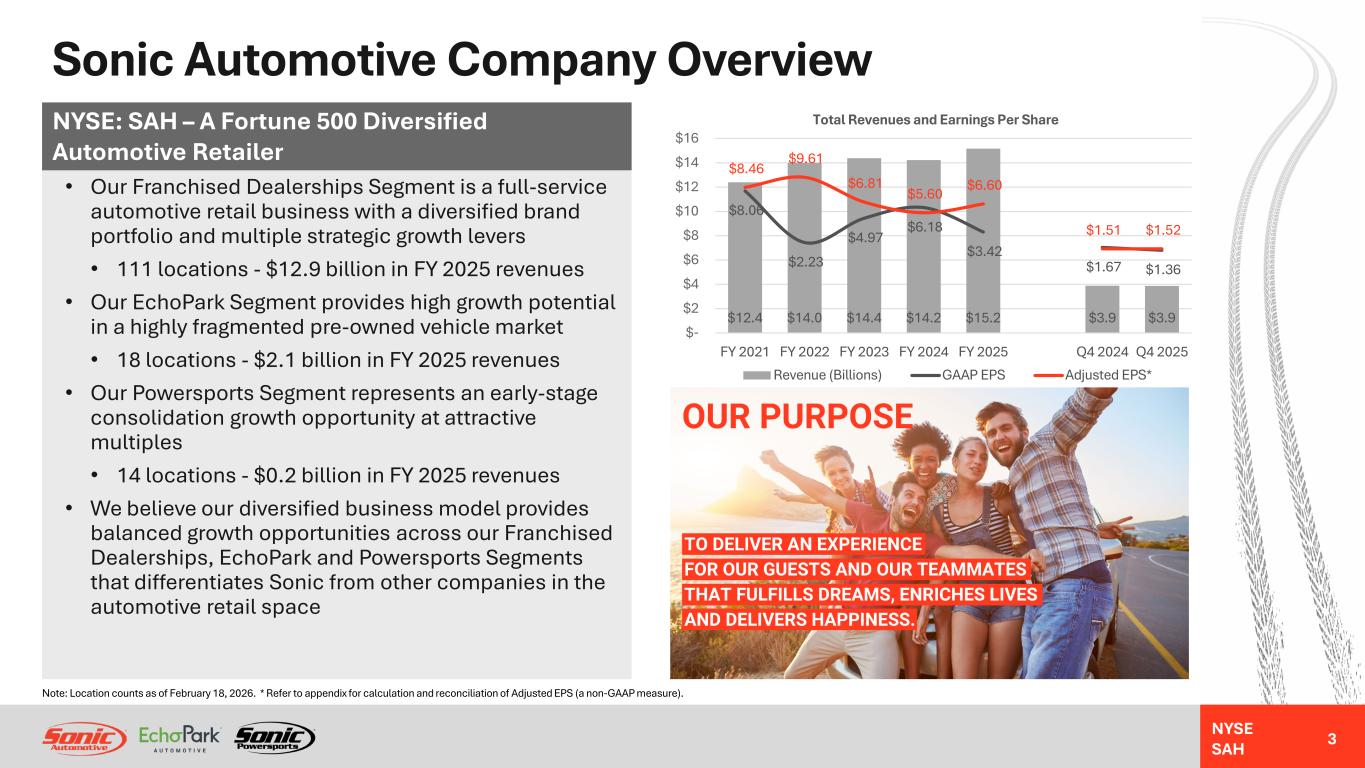
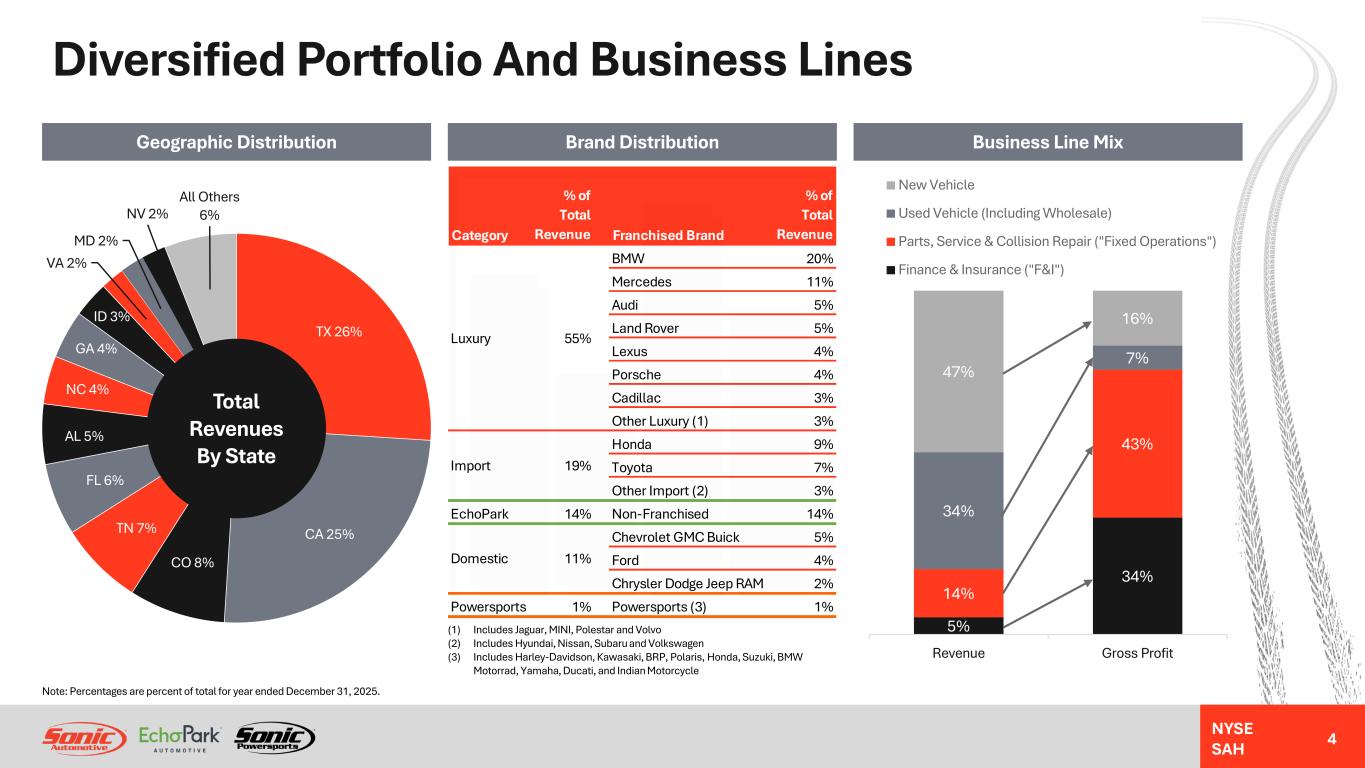
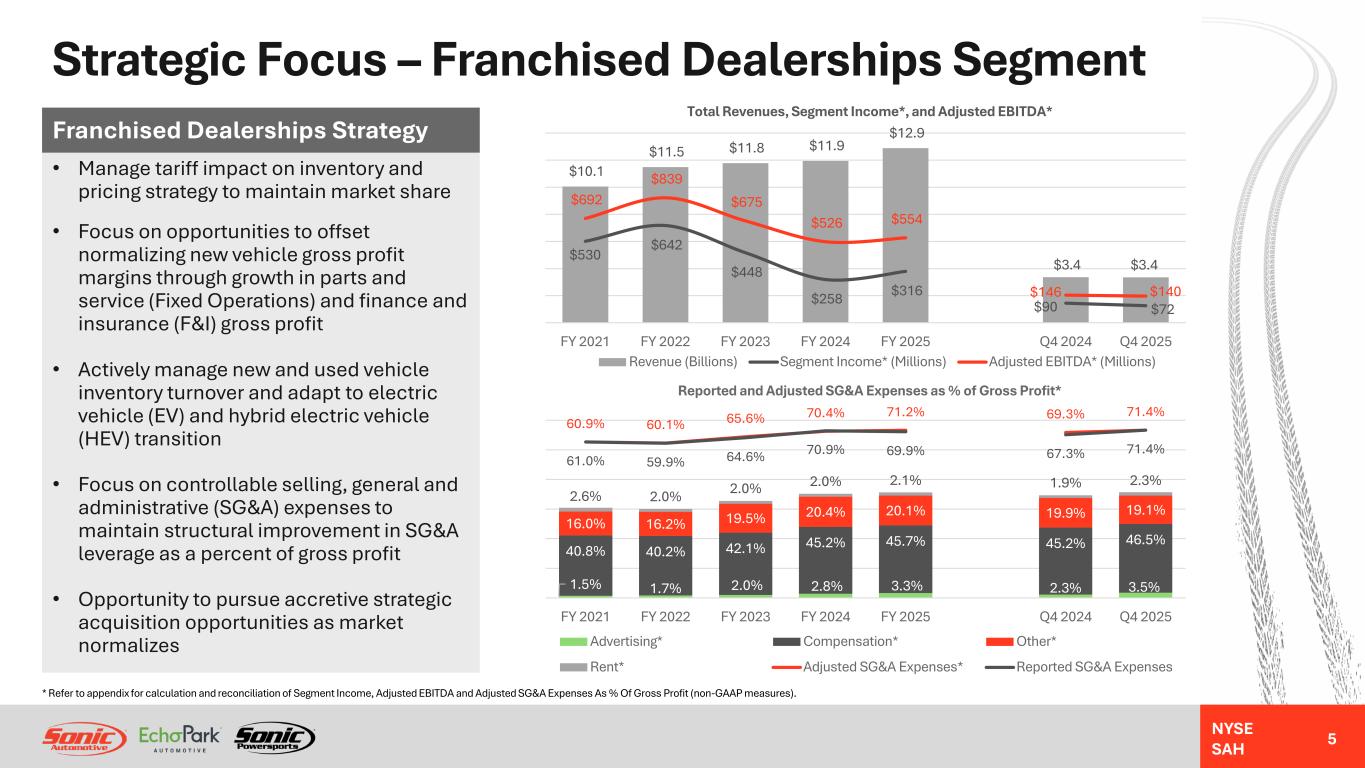
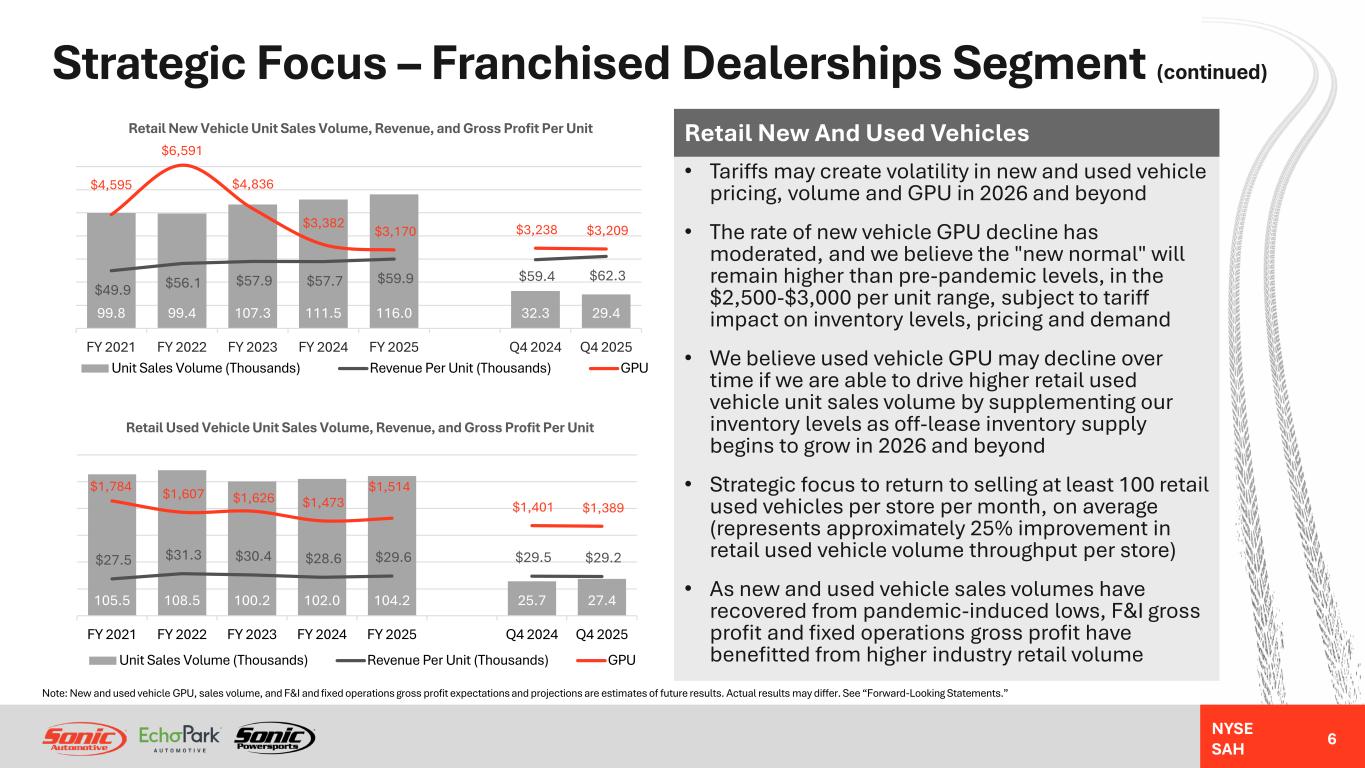
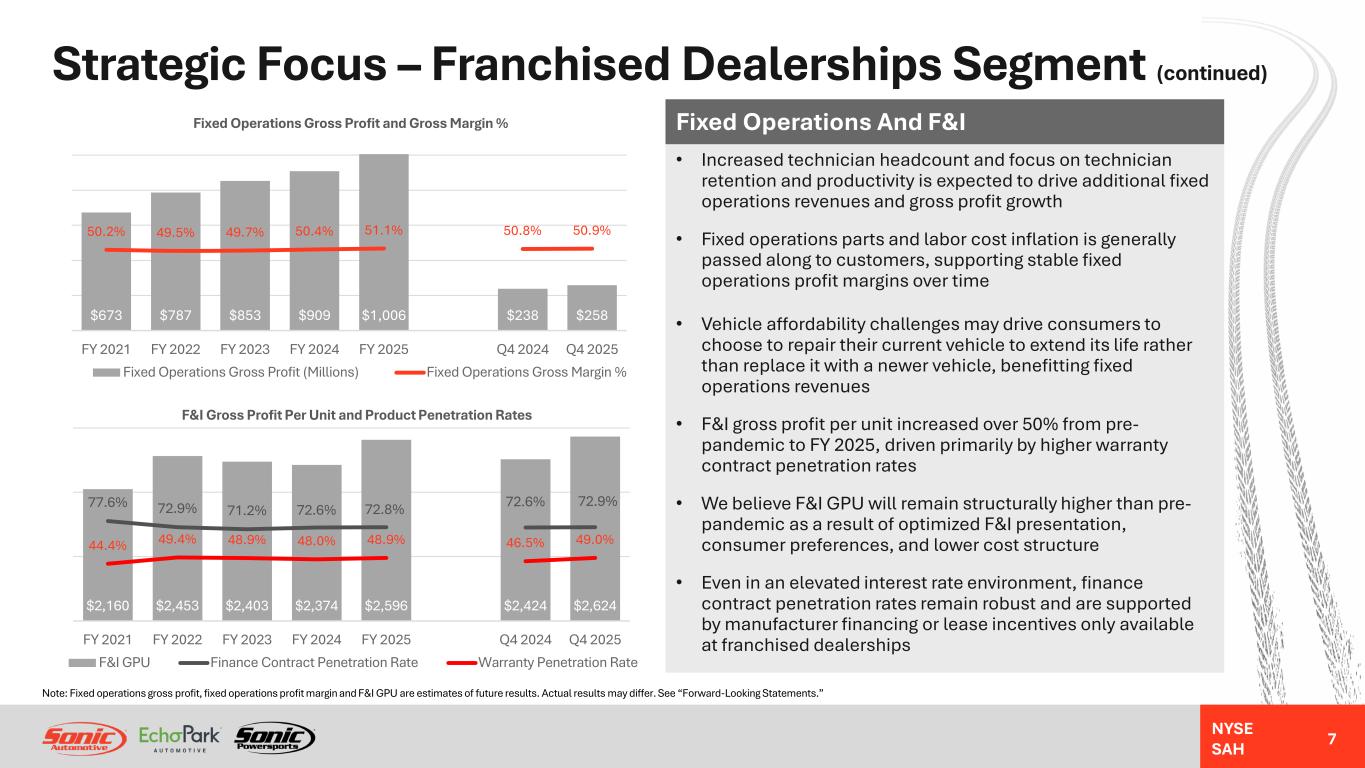
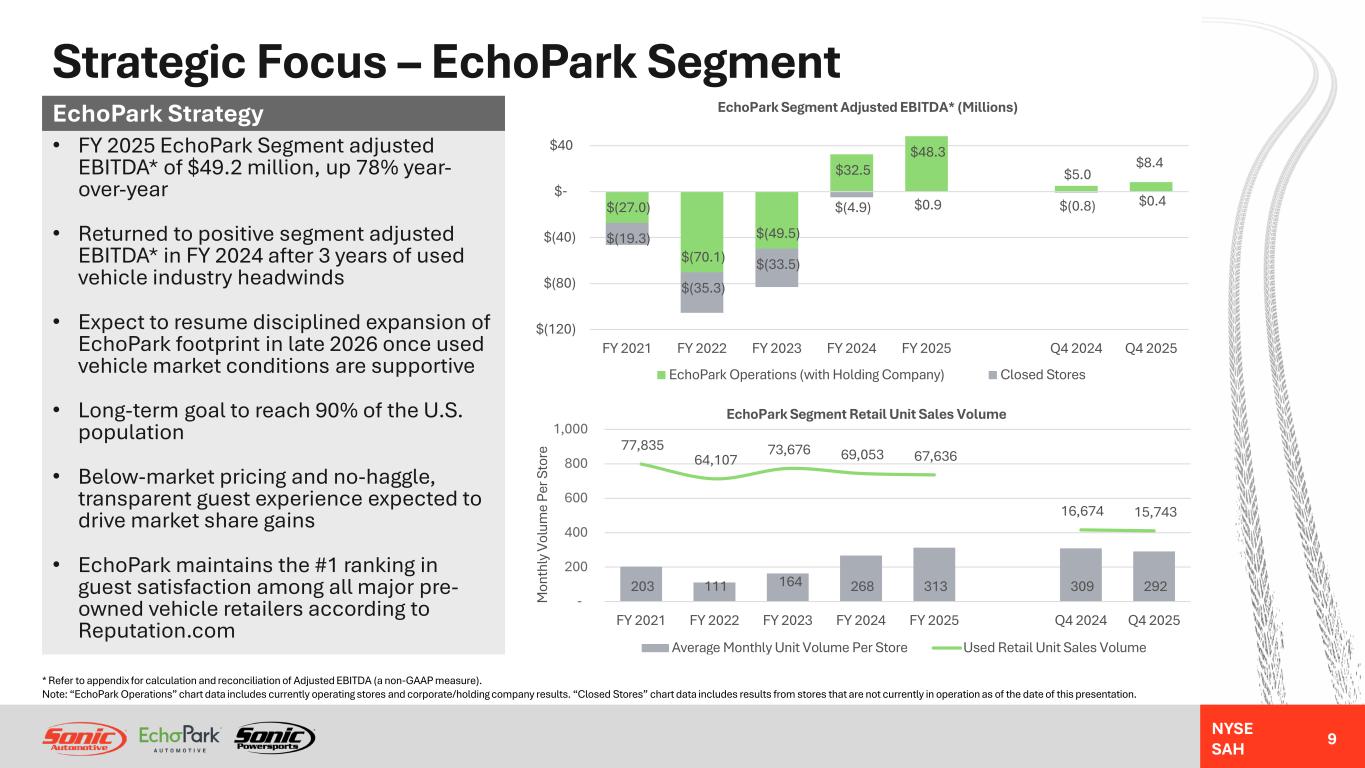
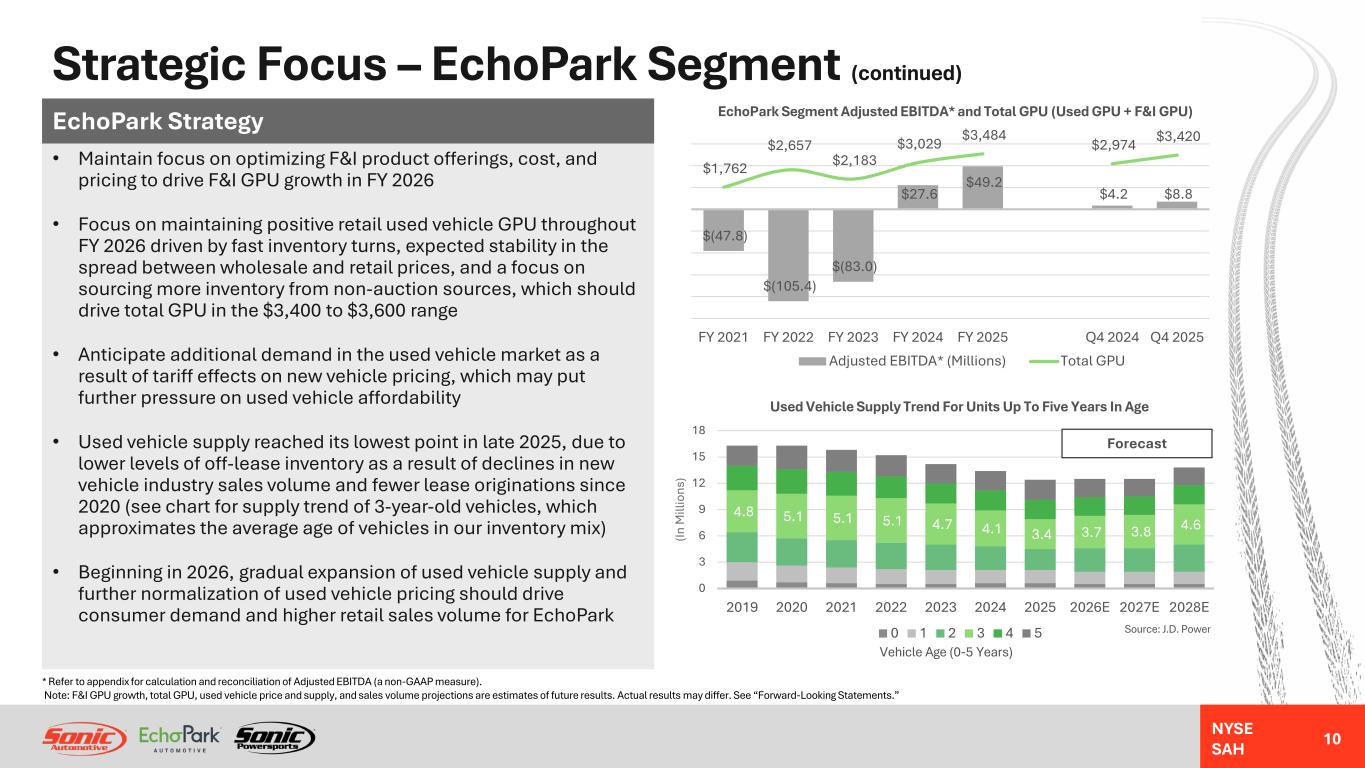
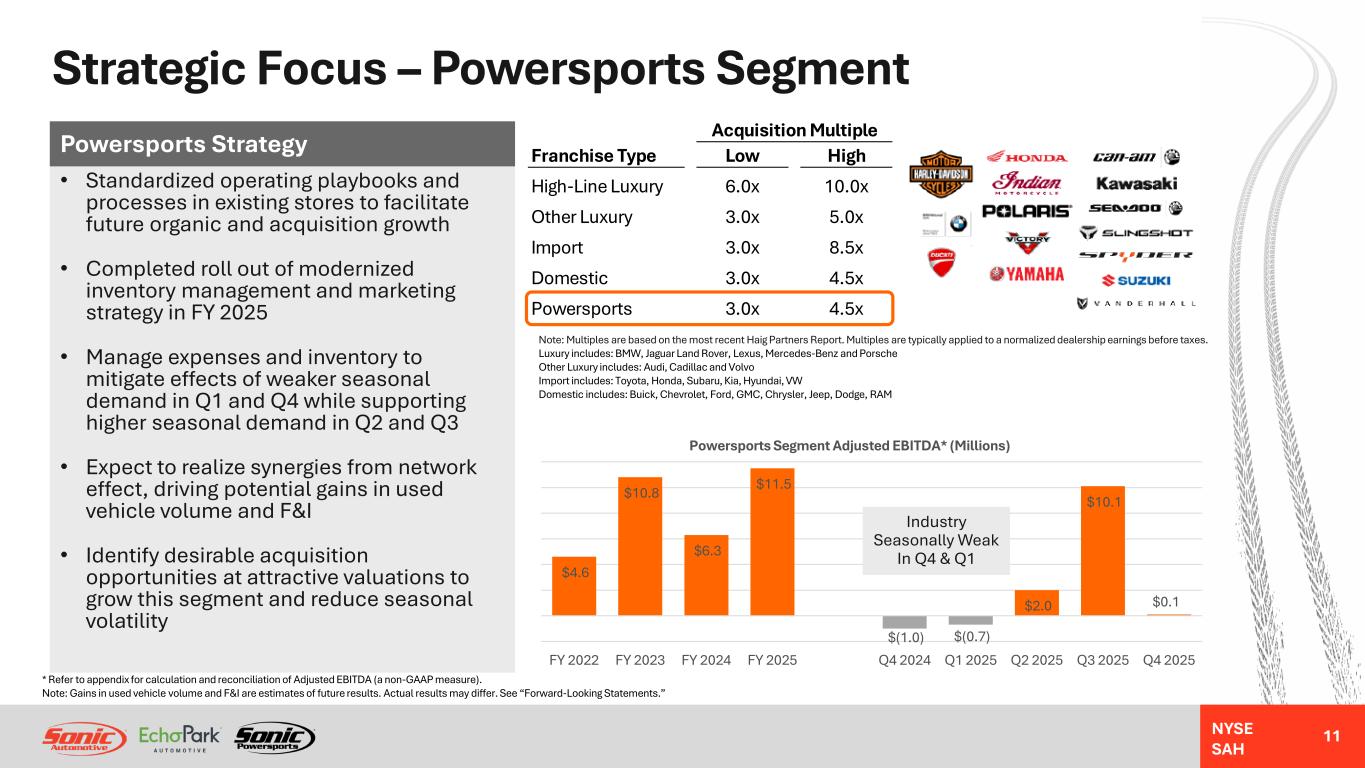
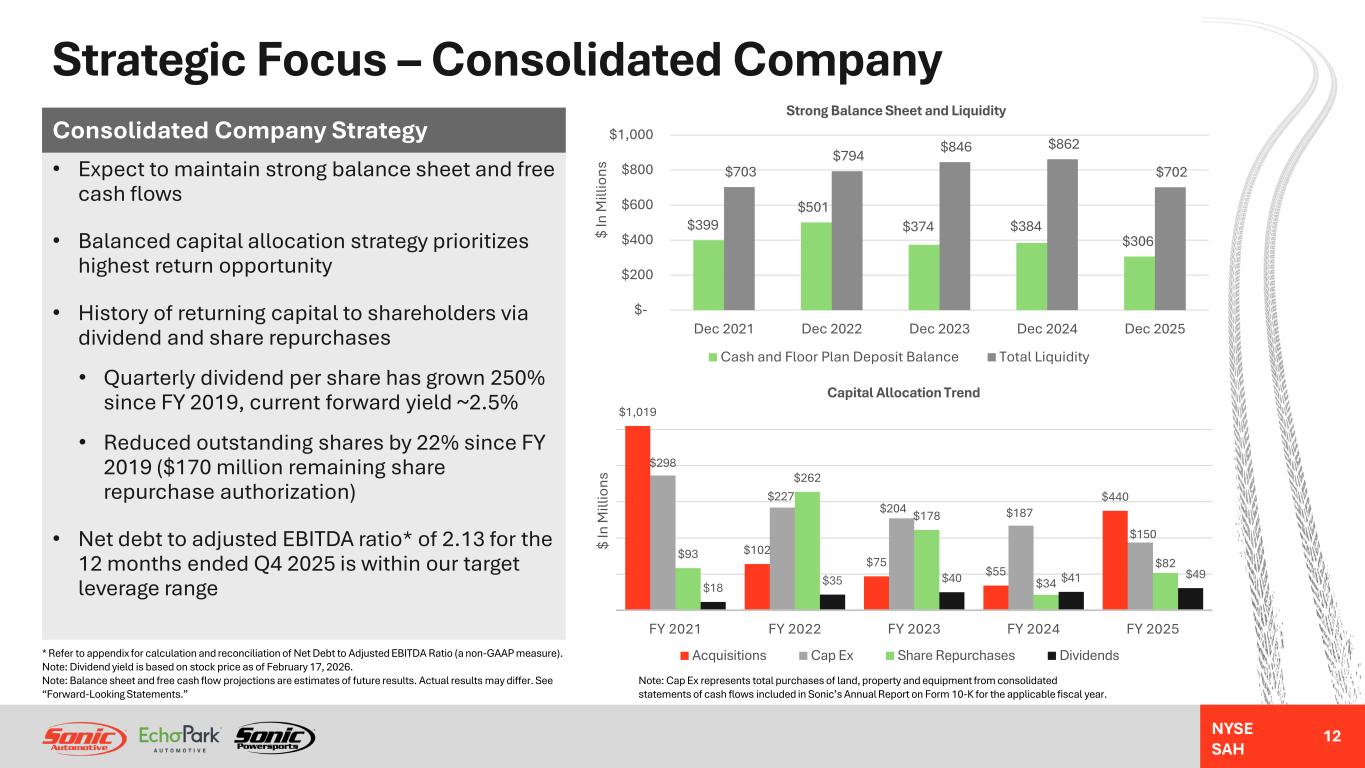
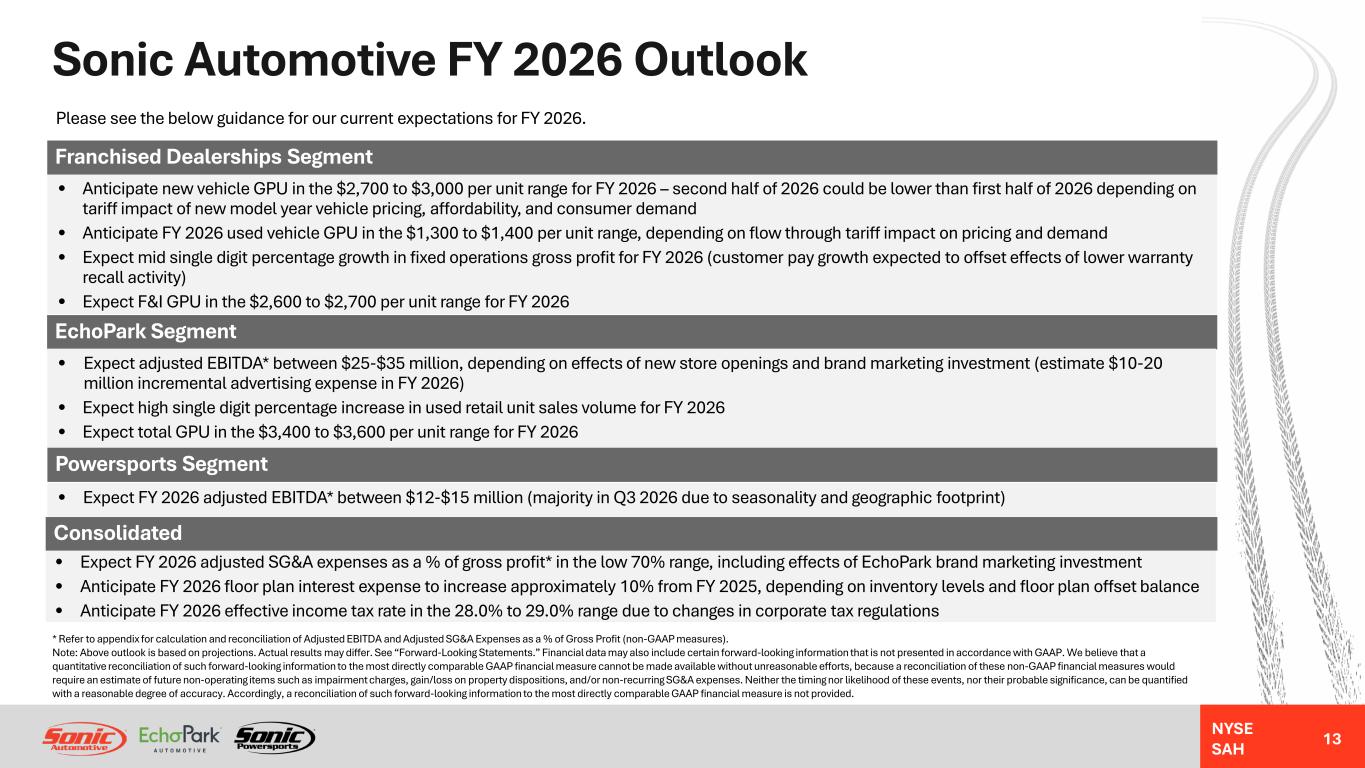
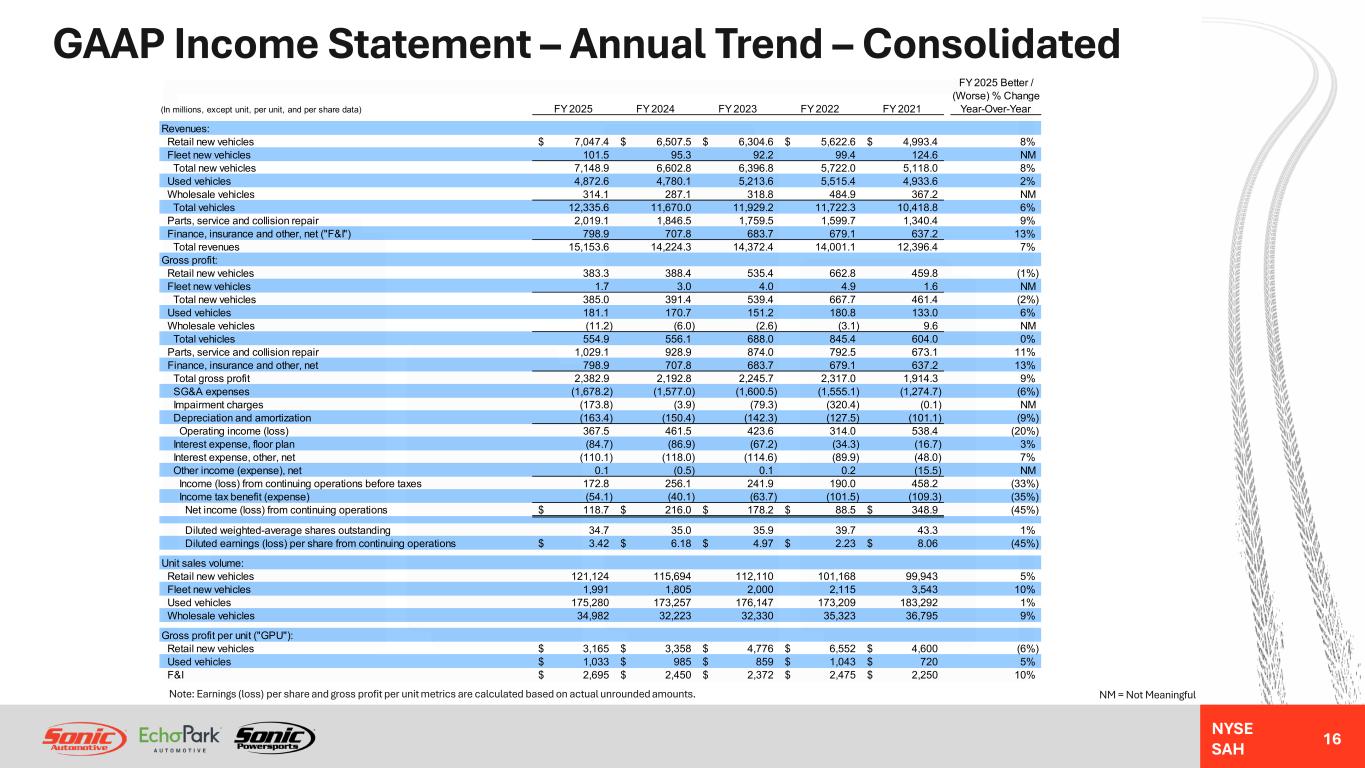
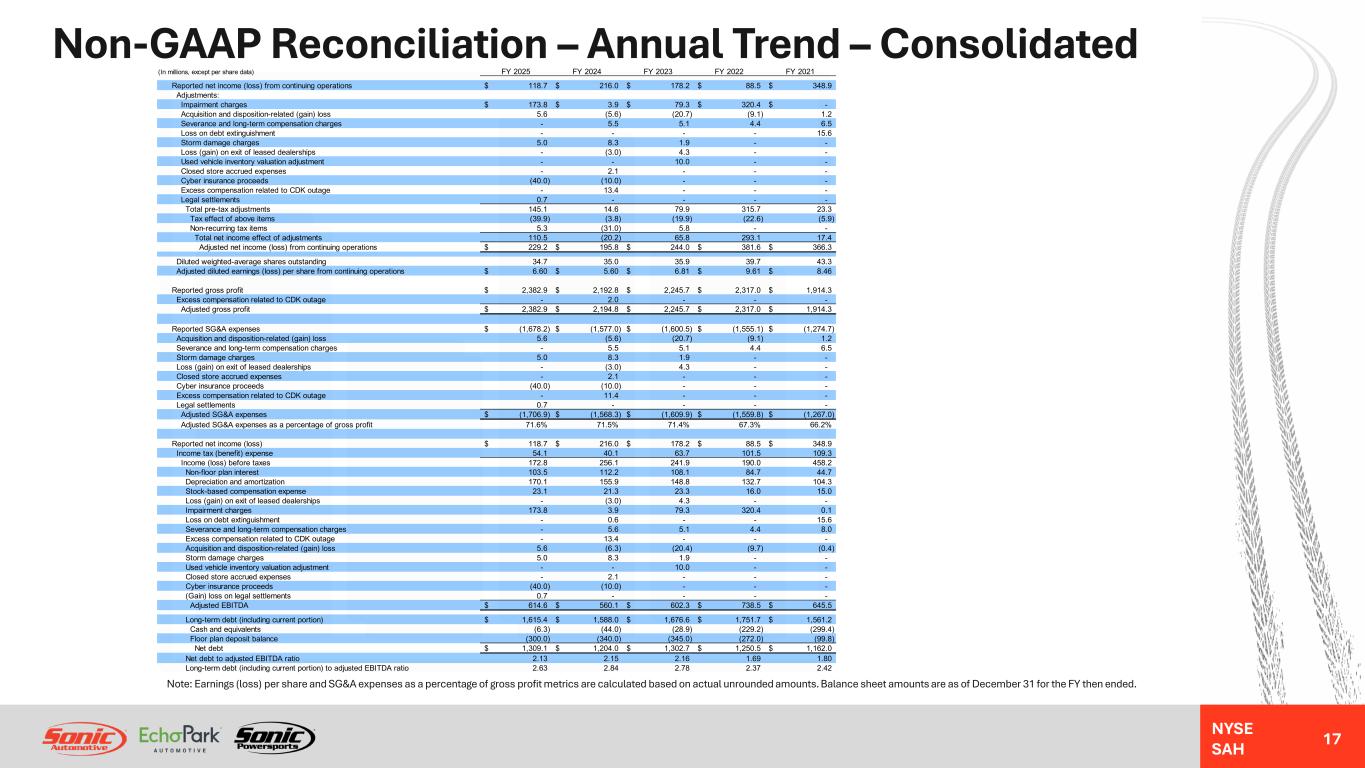
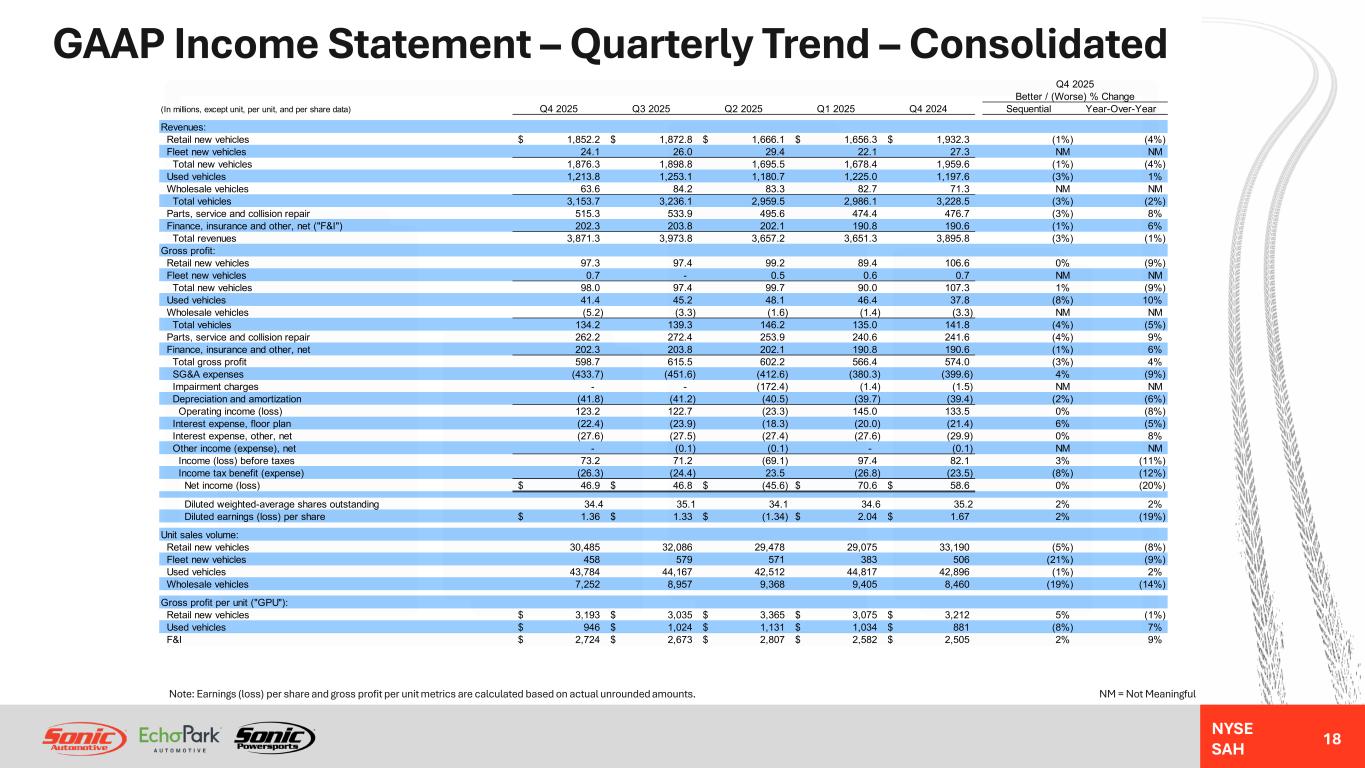
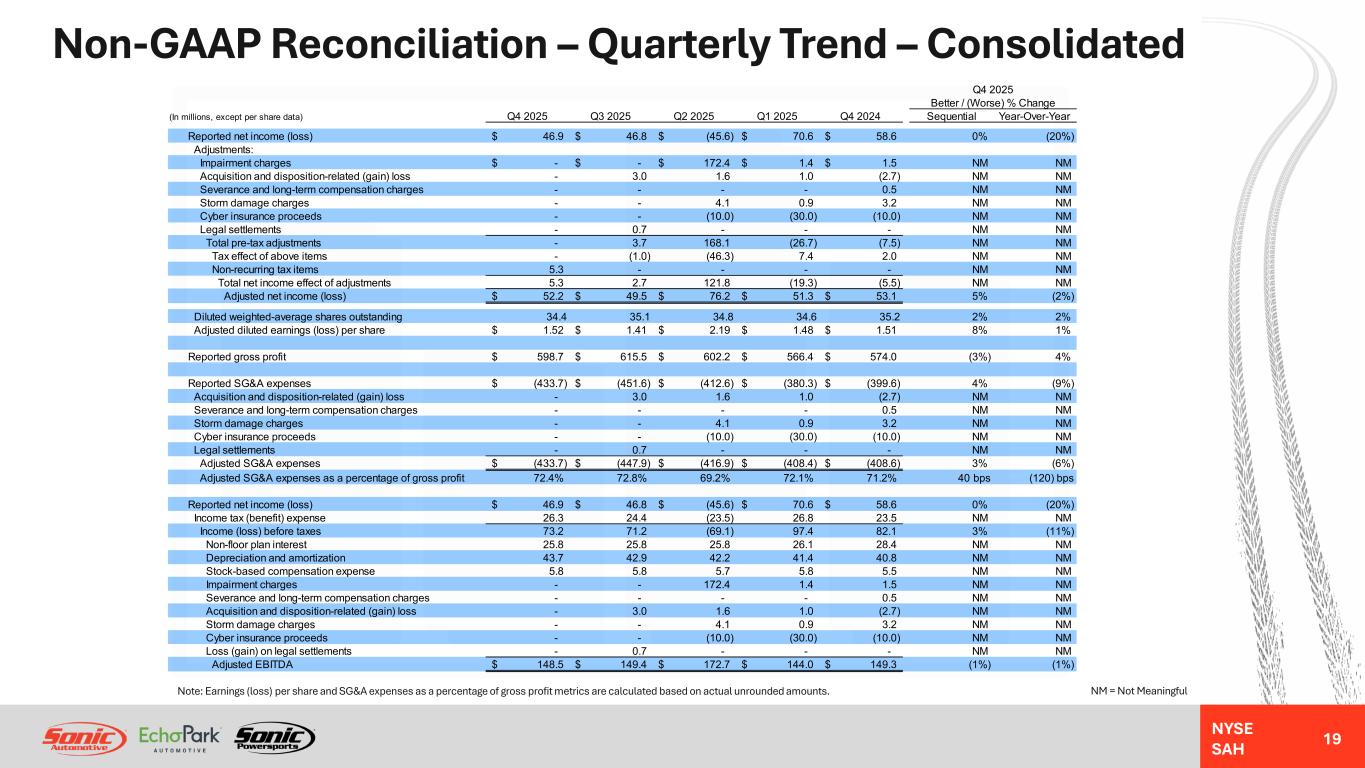
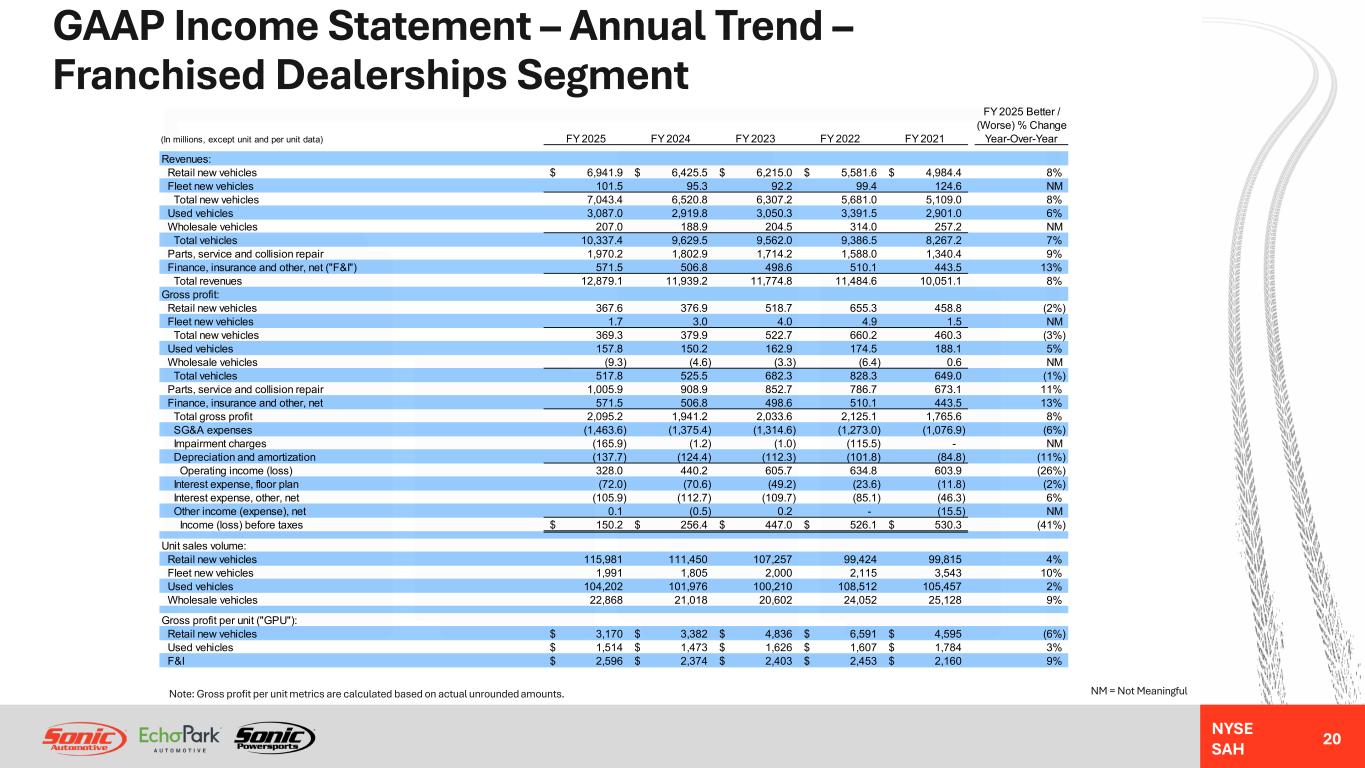
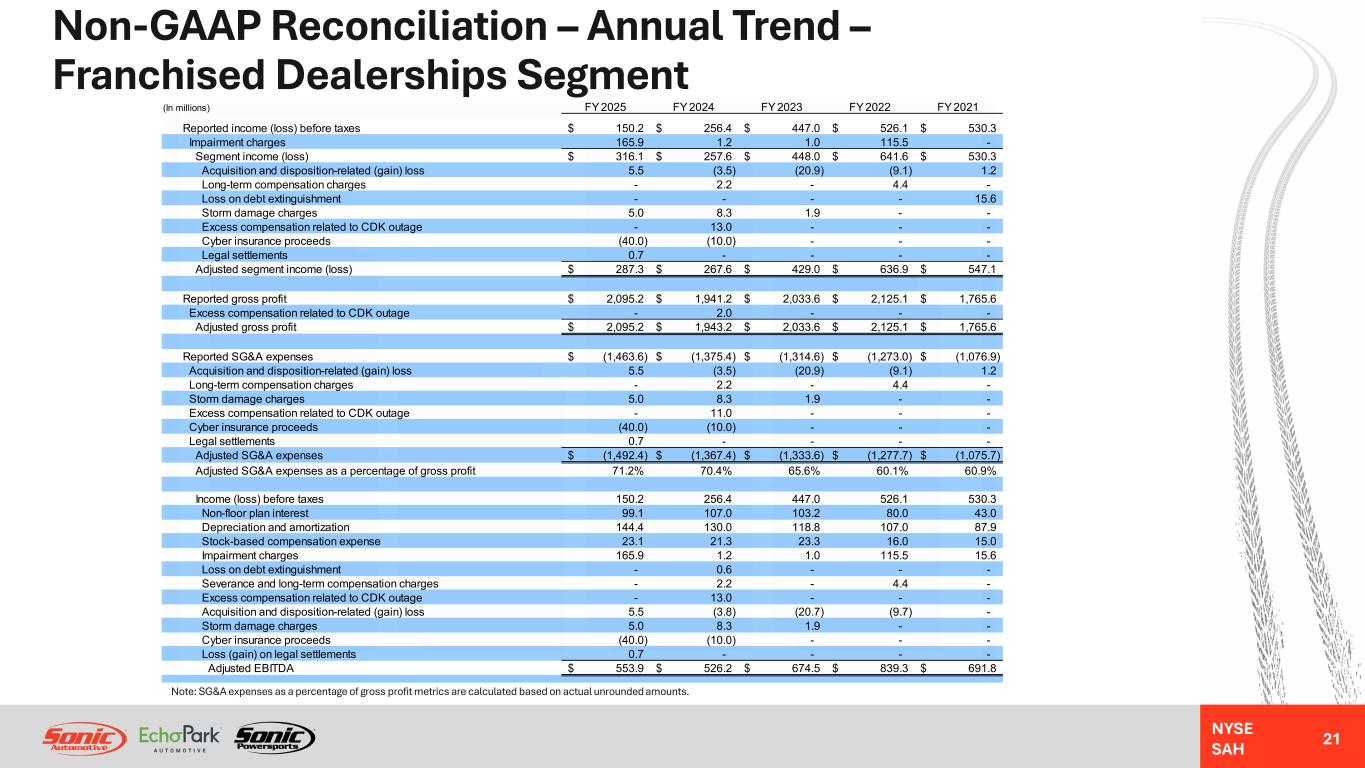
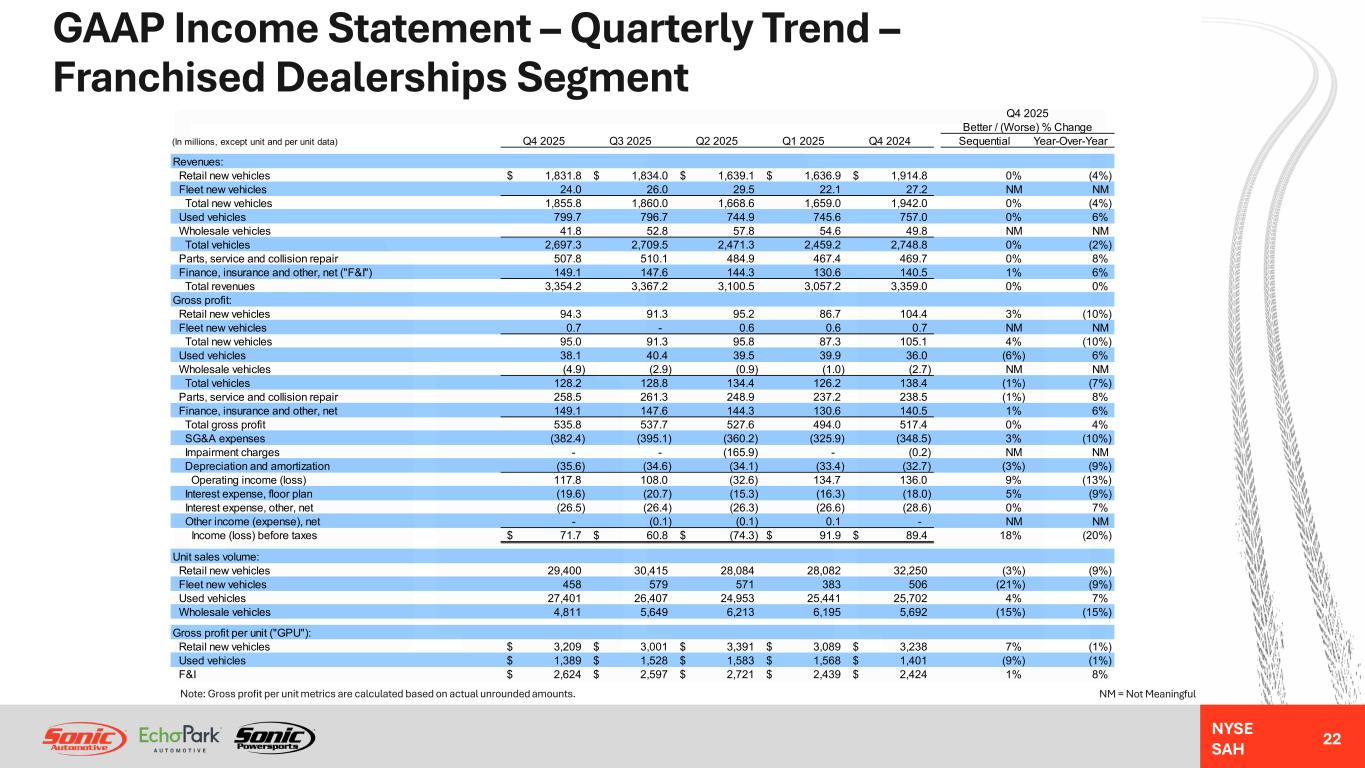
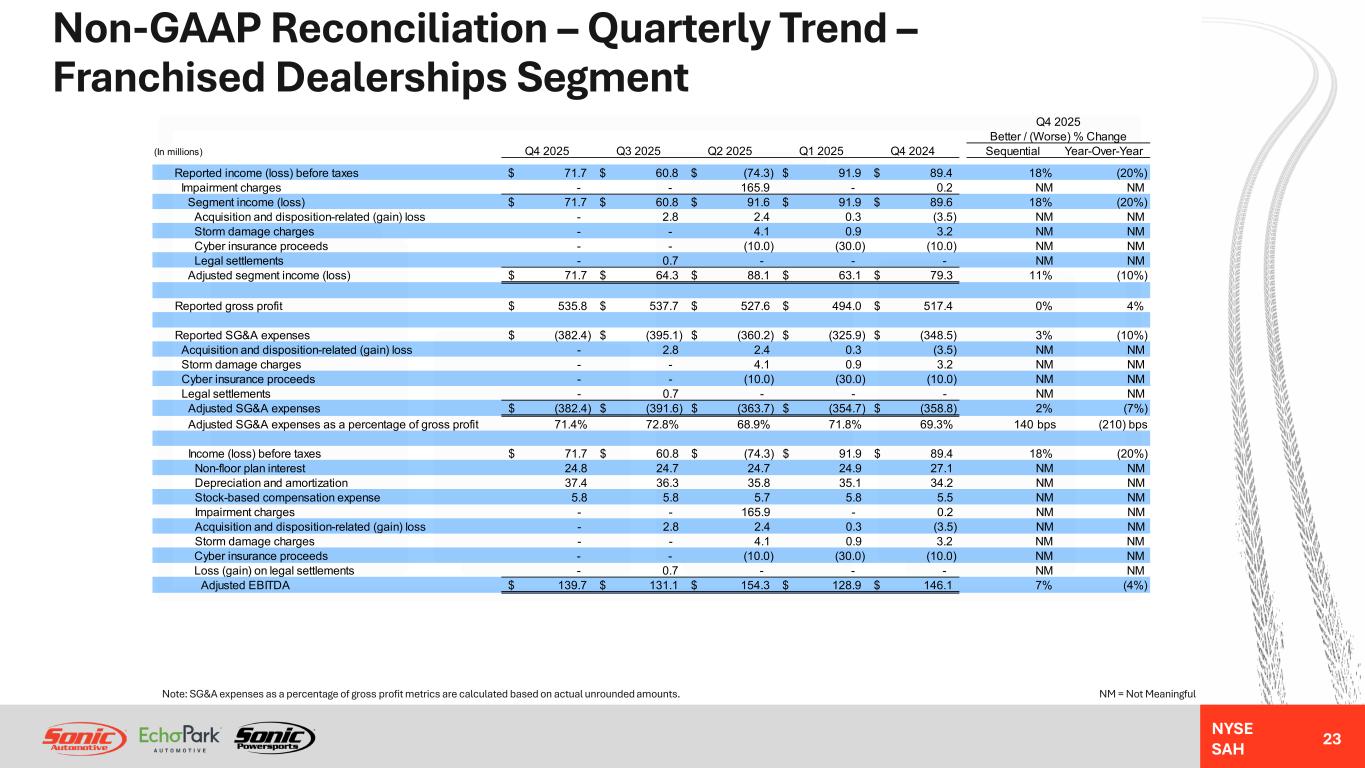
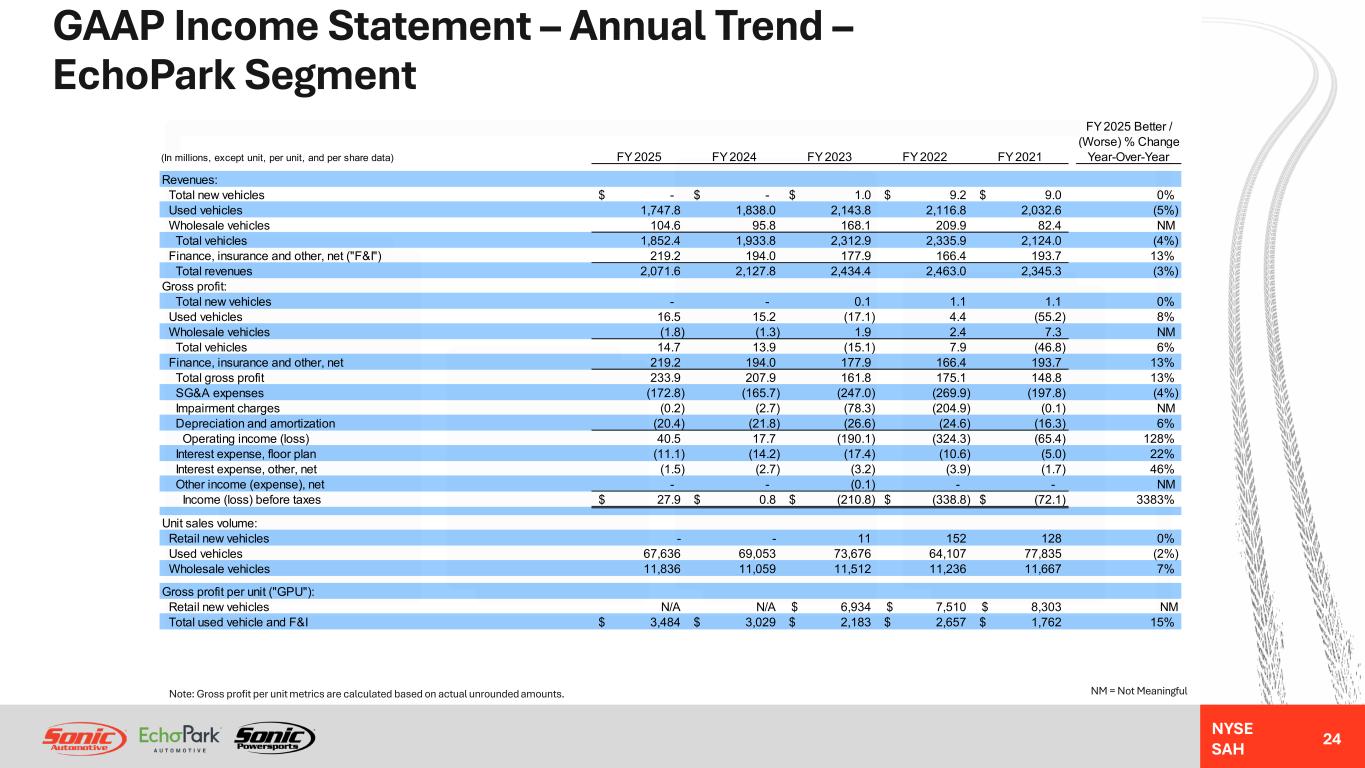
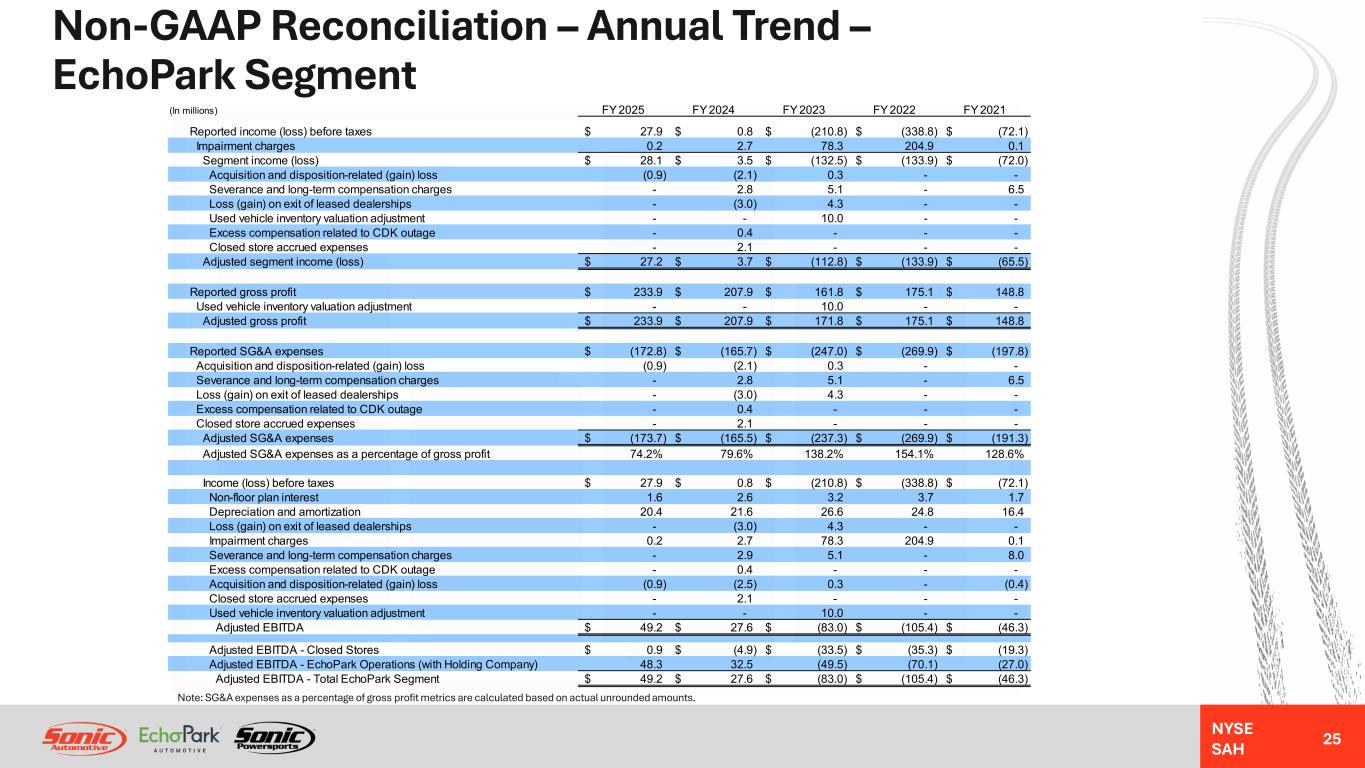
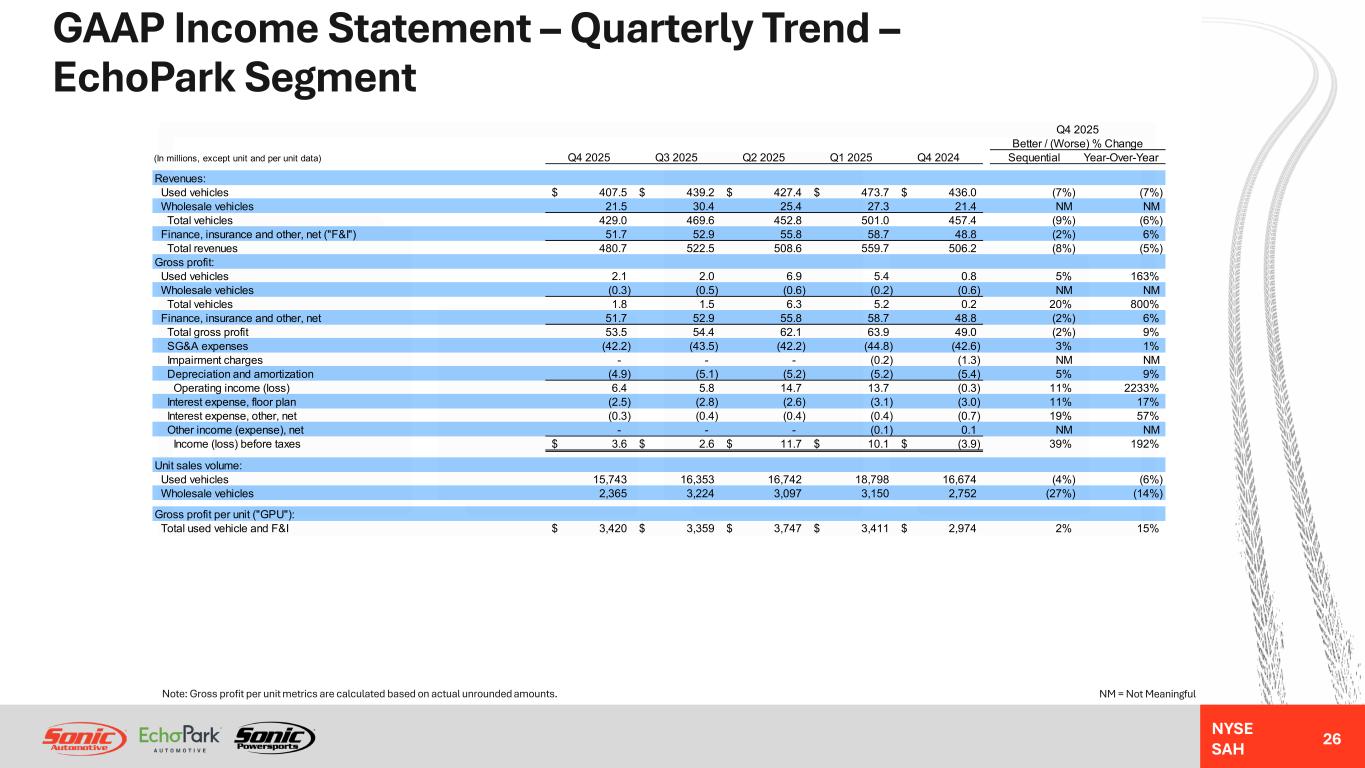
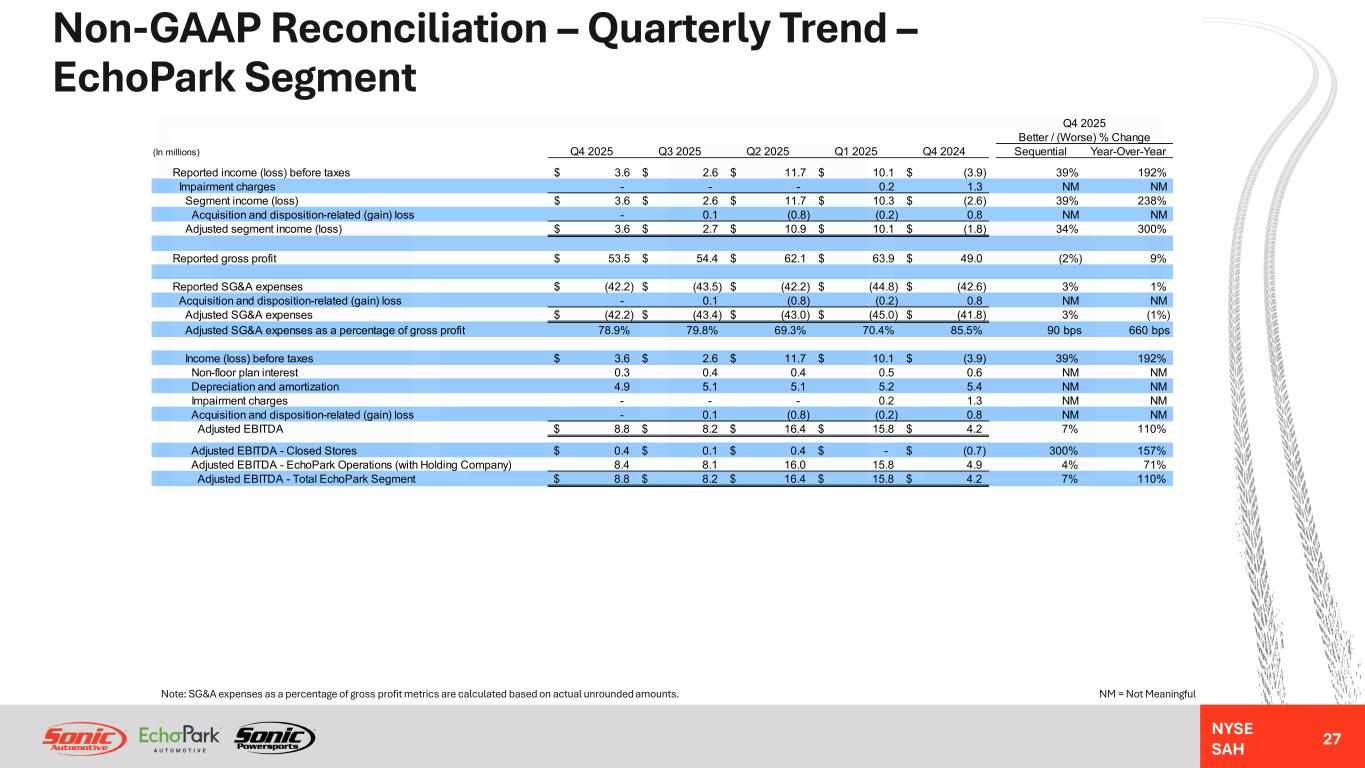
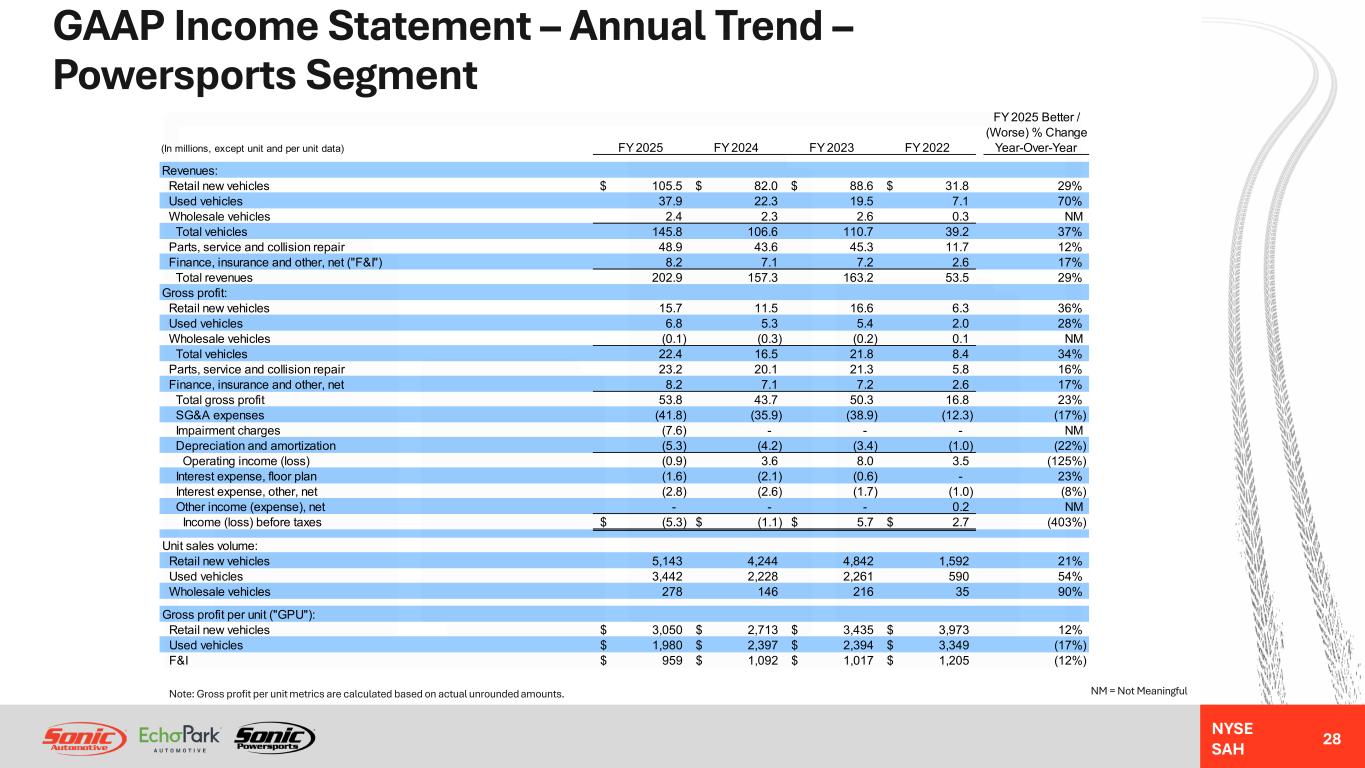
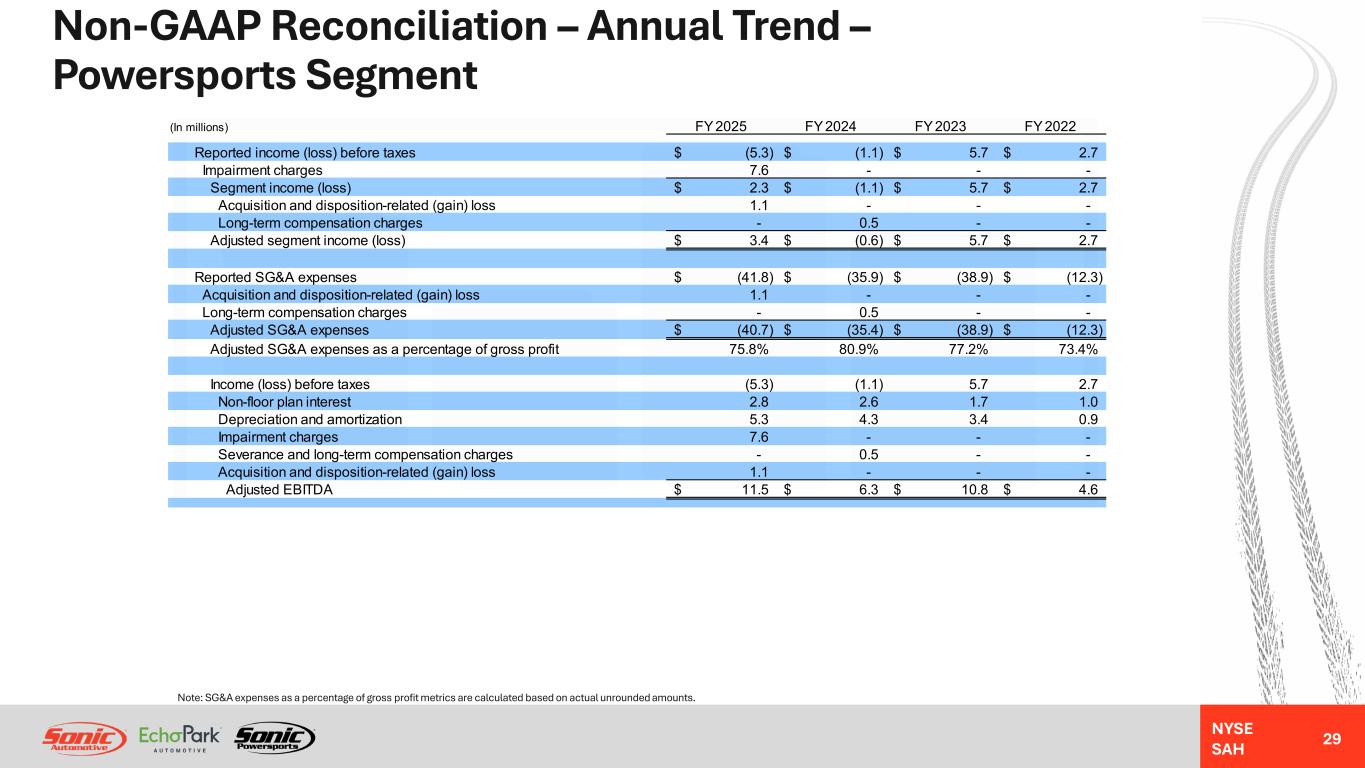
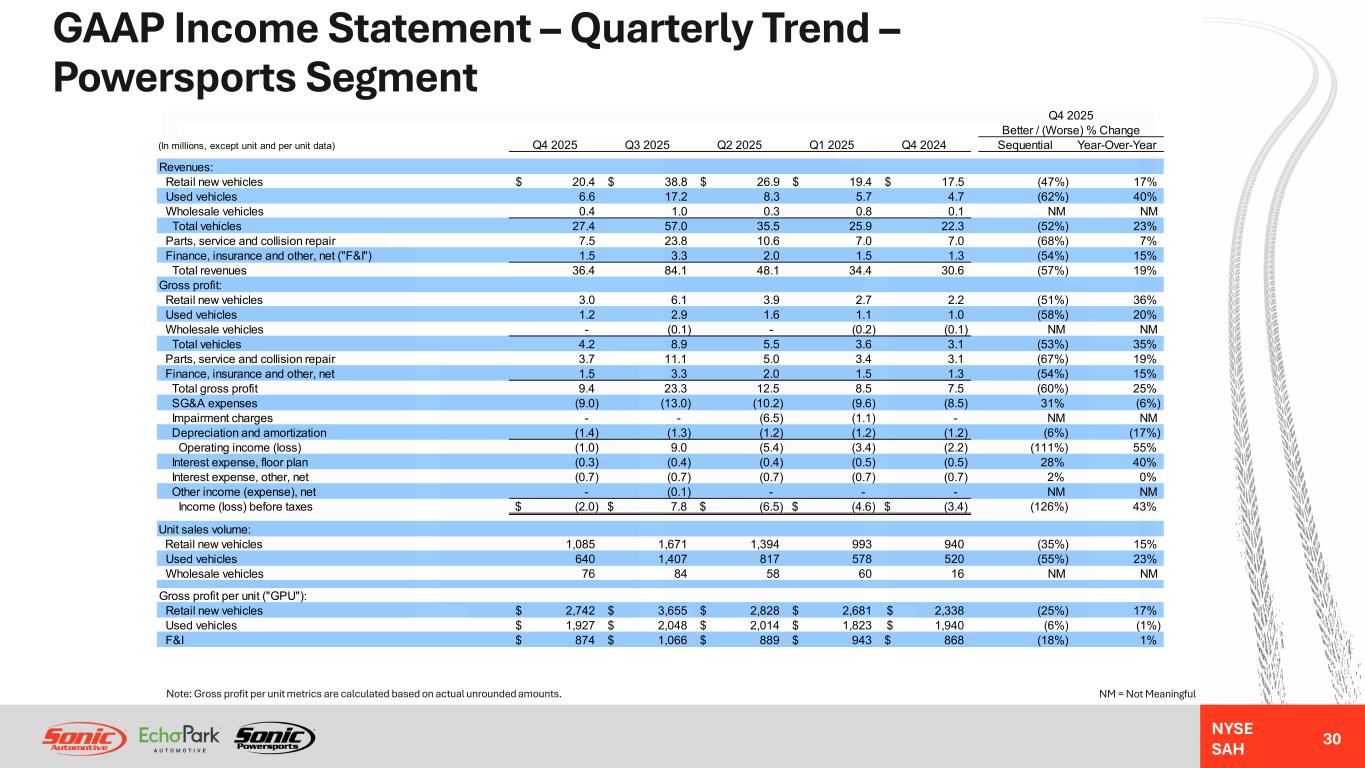
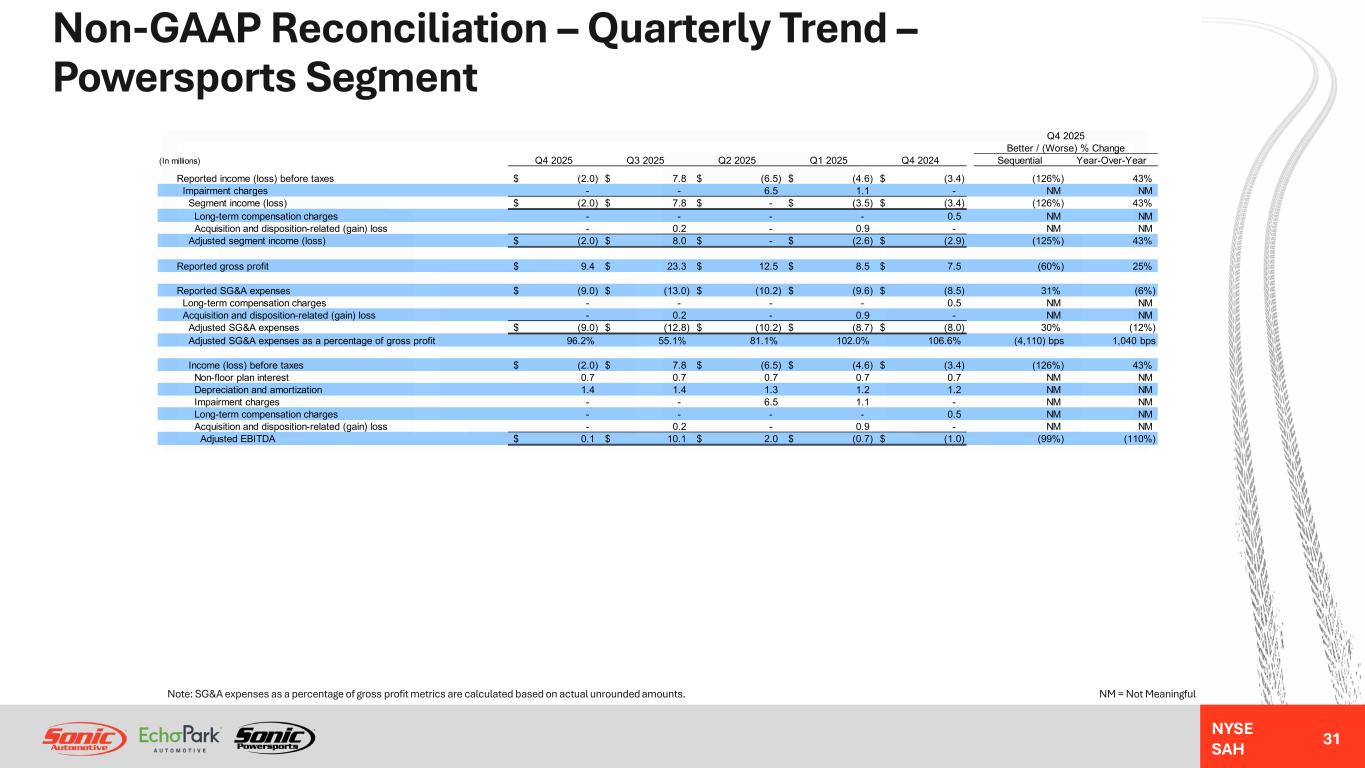
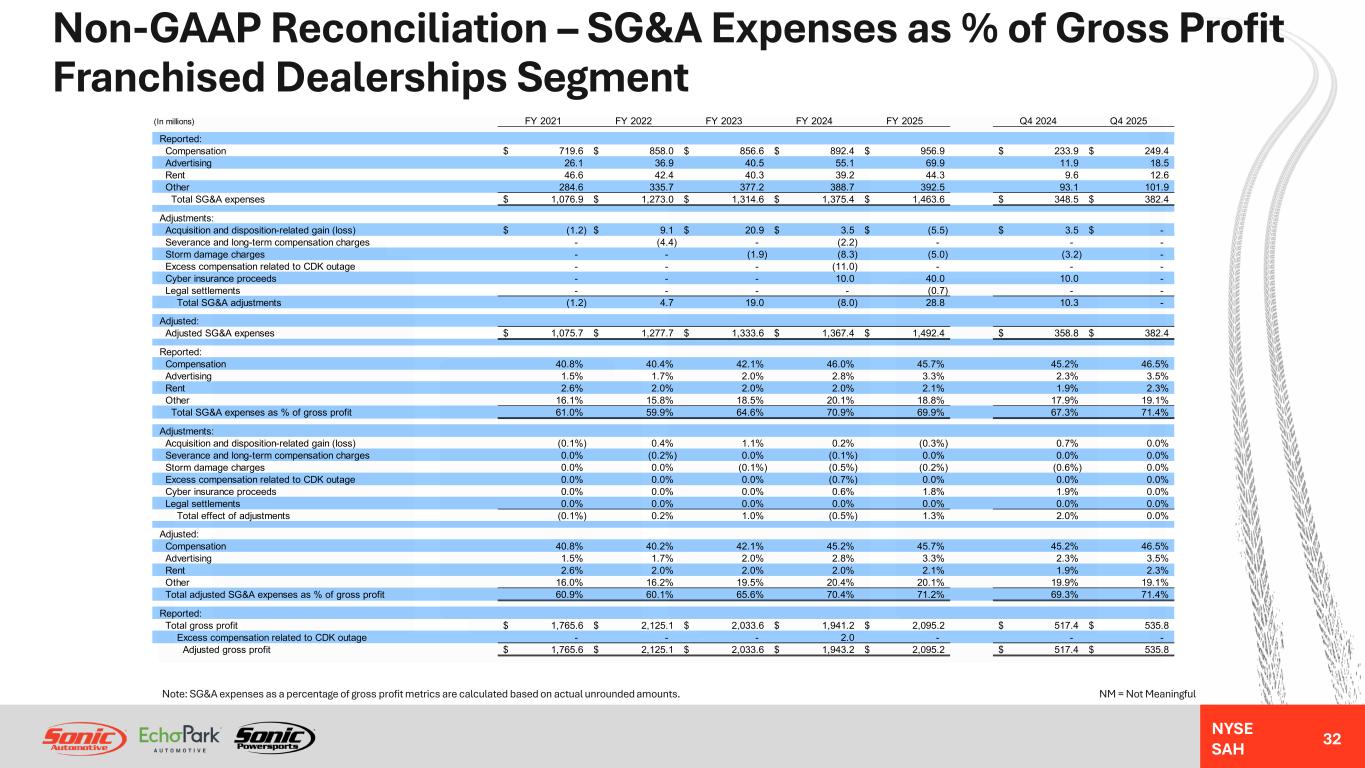
Thank you very much and good morning, everyone. Welcome to the Sonic Automotive Fourth Quarter 2025 Earnings Call. Again, I'm David Smith, the company's chairman and CEO. Joining me on today's call is our president, Jeff Dyke, our CFO, Heath Bird, our Echo Park Chief Operating Officer, Tim Keene, and our VP of Investor Relations, Danny Weiland. I'd like to open the call by thanking our amazing teammates for continuing to deliver a world-class guest experience for our customers 2025 marked the third consecutive year of delivering all-time record customer satisfaction scores for our friend truck franchise dealership guests and Echo Park once again retained the highest guest satisfaction rating among pre-owned vehicle retailers we believe our strong relationships with our teammates guests and manufacturer and lending partners are key to our future success, and as always, I would like to thank them all for their continued support and loyalty to the Sonic Automotive team. Turning now to our fourth quarter results, reported GAAP EPS was $1.36 per share. Excluding the effect of certain items as detailed in our press release this morning, adjusted EPS for the fourth quarter was $1.52 per share, a 1% increase year over year. Consolidated total revenues were $3.9 billion, down 1% year-over-year. Fourth quarter record consolidated gross profit grew 4%, and consolidated adjusted EBITDA was flat compared to the prior year, fourth quarter. For the full year, reported GAAP EPS was $3.42 per share, and adjusted EPS was $6.60 per share. year, an 18% increase from 2024. Consolidated total revenues were an all-time annual record of $15.2 billion, up 7% year over year, and consolidated total gross profits was an all-time annual record of $2.4 billion, up 9% year over year. For 2025, consolidated adjusted EBITDA grew 10% to $615 million. Moving now to our fourth quarter franchise dealership segment results, we generated reported revenues of $3.4 billion, flat year-over-year, and down 5% on a same-store basis, driven by an 11% decrease in same-store new vehicle retail volume, offset partially by a five percent increase in the same store used vehicle retail volume year over year fourth quarter new vehicle volume faced headwinds from pull forward consumer demand for electric vehicles ahead of the expiration of the federal tax credit in the third quarter combined with strong luxury demand in the prior year fourth quarter reported franchised total gross profit was a fourth quarter record of four percent and declined two percent on the same store basis our fixed operations gross profit was a fourth quarter record and f and i gross profit set an all-time quarterly record of eight percent and six percent year over year respectively on a reported basis these two high margin business lines continue to increase their share of our total gross gross profit pool, once again contributing over 75% of total gross profit for the fourth quarter, mitigating the tariff headwinds on new vehicle volume and margin to our overall profitability, while also leveraging our SG&A expenses more efficiently than incremental vehicle-related gross profit. Same-store new vehicle GPU was $3,033 per unit, down 7% year-over-year, but up 6% sequentially due to a higher luxury mix in the fourth quarter. On a reported basis, new vehicle GPU was $3,209 per unit, down 1% year-over-year, and up $208, or 7%, sequentially from the third quarter. On the used vehicle side of the franchise business, same-store used GPU decreased 2% year-over-year and decreased 10% sequentially from the third quarter to $1,379 per unit. Our F&I performance continues to be a strength with fourth quarter record franchised F&I GPU of $2,624 per unit, up 8% year-over-year and up 1% sequentially. Turning now to Echo Park, adjusted segment income was a fourth-quarter record $3.6 million, up 300% year-over-year, and adjusted EBITDA was a fourth-quarter record $8.8 million, up 110% year-over-year. For the fourth quarter, we reported Echo Park revenues of $481 million, down 5% year-over-year, and fourth-quarter record gross profit of $54 million, up 9% year over year. Echo Park segment retail unit sales volume for the quarter decreased 6% year over year. And Echo Park segment total GPU was a fourth quarter record $3,420 per unit, up 15% per unit year over year, and up 2% sequentially from the third quarter. For the full year, Echo Park segment adjusted EBITDA was an all-time record $49.2 million, up 78 percent year over year going forward we remain focused on increasing our mix of non-auction source inventory to benefit consumer affordability and retail sales volume and gpu when combined with the strategic adjustments we have made to our ecopark business model we believe we are well positioned to resume a disciplined store opening cadence for ecopark beginning in late 2026 assuming used vehicle market conditions continue to improve. In the long term, we intend to expand our Echo Park platform to reach 90% of U.S. car buyers, selling over a million vehicles annually, while continuing to provide a superior guest experience. We believe investment in brand marketing will be key to our long-term Echo Park growth plan, and we expect to begin to invest in this effort during 2026, potentially increasing advertising expense by 10 to 20 million dollars this year turning now to our power sports segment we generated fourth quarter record revenues of 36 million dollars of 19% year-over-year and fourth quarter record gross profit of 9 million dollars of 25% year-over-year fourth quarter combined new and used retail volume was up 18% year-over-year and we are beginning to see the benefits of our investment in modernizing the power sports business and the future growth opportunities it may provide finally turning to our balance sheet we ended the quarter with 702 million in available liquidity including 306 million in combined cash and floor plan deposits on hand our focus on maintaining a strong balance sheet in liquidity position allows us to strategically deploy capital in a variety of ways to deliver value to our shareholders. During the fourth quarter, we repurchased approximately 600,000 shares of our common stock for approximately $38 million, bringing the full year share repurchase to 1.3 million shares for approximately $82 million. In addition, I'm pleased to report today that our board of directors approved a quarterly cash dividend of $0.38 per share, payable on April 15, 2026, to all stockholders of record on March 13, 2026. We continue to work closely with our manufacturer partners to understand the potential impact of tariffs on vehicle production, pricing and volume forecasts, vehicle affordability and consumer demand going forward. The full year 2026 outlook and guidance on page 13 of our investor presentation considers these uncertainties and represents our current expectations for 2026 financial results. As always, our team remains focused on executing our strategy and adapting to ongoing changes in the automotive retail environment while making strategic decisions to maximize long-term returns. This concludes our opening remarks, and we look forward to answering any questions you may have. Thank you very much.
Operator
We'll now be conducting a question and answer session. If you would like to ask a question, please press star 1 on your telephone keypad. A confirmation tone will indicate your line is in the question queue. You may press star 2 if you'd like to remove your question from the queue. For participants using speaker equipment, it may be necessary to pick up your handset before pressing the star keys. One moment, please, while we poll for questions. Thank you. Our first question is from Jeff Lick with Stevens, Inc. Good morning.
Can you guys hear me? Yes, sir. Oh, great. Congrats on a standout quarter of the impressive results relative to the OSCQ4. I was wondering if we could talk a little bit about Ecclapark. I was just curious, if you think about, you know, the used car options that are out there right now, and there's obviously big players like Carbonic, CarMax, Drive Time. I'm just wondering, as you're starting to understand the Ecclapark business, you know, better, where do you guys see how you fit into the used car ecosystem in terms of when someone's looking to buy a new car, a used car, you know, where do you guys view as like where you really kind of over-index and, you know, solve a problem for a customer? Where do you fit in the used car ecosystem?
This is Jeff. We've always kind of looked at Echo Park as the Costco sort of of the pre-owned world. There are 35 to 40 million pre-owned cars sold every year in this country. And, you know, if you look at what Carvana is doing, $500,000, $600,000, you looked at CarMax and the $800,000, $900,000 range, there's a lot of room for us. And prior to COVID, we said we'd, you know, be at 90% coverage of the country and sell over a million vehicles. We feel very comfortable over the last three or four years. We've worked very hard on the model. We can slowly and accurately build stores. Like we said, we're going to open one or two in the fourth quarter of this year. We'll open more in 27, and we will methodically grow the Echo Park business. But we're the low-cost provider in this arena. And when you look at how we price our vehicles and you compare to those two competitors, we're anywhere from $3,000 to $6,000 cheaper than those guys. And it gives us the ability to sell, you know, a lot of vehicles on a per rooftop basis versus our competitive set. And we're seeing that. We see it in the 17 stores that we have open now. And we believe that being that low-cost provider and really taking care of our guests like we do with our great guest satisfaction scores, which are industry-leading, that combination is just going to be really hard to beat as we slowly begin to grow this brand.
And, Jeff, I'll add one point is exactly what Jeff was alluding to, is that objectively we are the lowest cost provider. You can look at the data and the facts are there. Objectively, we have the best customer experience. We've won for the last 16 quarters with Reputation.com, comparing to Carvana, CarMax, and others. And now that we are starting the expansion again in a disciplined way where we still have profitability going forward, You combine that with our brand initiative, which we mentioned earlier in the press release and in the statements, now people know. I mean, I think the biggest thing is that we get our name out there, and you've got the two main things that people are looking for, and that's just going to give additional tailwinds to Echo Park, especially as the inventory is returning. It's going to be a really nice situation for growth for Echo Park.
Just a quick follow-up. You talked about non-auction sourcing. I'm just curious. You had a little bit of a hiccup with the commercial rental car fleet returns and that coming up sourcing a little bit. Just any updates on where you're sourcing non-auction related and how you see the sourcing availability for your business model in 2026?
Yeah, you know, we are. We're incentivizing our team to buy vehicles all over the country. And we're finally beginning to leverage our new car franchise dealerships for inventory. We've always kind of kept that separate. And we have found a way, we believe, to leverage the heck out of that as lease returns begin to come back, as we can trade for more cars out of those 111 franchise stores. And we'll begin to see the beginnings of all this and the inventory sort of feeding into Echo Park will start in March and April timeframe of this year. And so we're very excited about that in reducing, you know, our dependence on the auction lanes. And that's happening, but it's methodically happening with a very strategic plan around that. and buying more cars off the street certainly is happening and engaging our experience guides in that kind of model is going to make a big difference for Echo Park as we go forward. It's a very important part of our growth plan.
Well, thanks for taking my questions and best of luck in 2026. Yes, sir. Thank you. Thank you.
Operator
Our next question is from John Babcock with Barclays.
Hey, good morning. I guess your first question while we're on Echo Park, When do you plan to do the advertising spend? And then also, is that going to be more focused on building the brand or driving trade-ins? How are you thinking about that? And then also, if you could just talk regionally about, you know, whether you're going to target certain regions or if this is going to be more of a broad-based, you know, nationwide type advertising.
Yeah, that $10 million to $20 million is brand-based and focused on that, strategically focused on that. We'll start spending that money, call it now, beginning of second quarter, somewhere in that time frame. And we've got to build, you know, commercials and do different things. We've got a lot of fun ideas that we'll present to the public. But I wouldn't expect any of that to be put into action for the public and you guys to see until the fourth quarter as we begin to launch stores again. So that will all kind of come together. Unfortunately, you've got to start spending some money now, so the return doesn't come until fourth quarter or 27. And then that will be, you know, focused on our markets. But then as we move into 27, we'll even start marketing our brand in markets we don't exist in. We've seen some of our competitors do that, and they've done a great job with that. So, you know, as Heath was saying earlier, we're going to bring the Echo Park brand to life, and we're going to start sharing with the world, you know, what our pricing model is and how great our guest experience is. And that's a one-two punch. It's going to be very difficult to deal with on top of an amazing selection of inventory. So put all that together, and we think we're sitting in the catbird seat. And, you know, we've got a lot of runway in front of us. And there's a lot of pre-owned cars being sold in this country, so we're very excited about it.
And this is David. And something to note is that, remember, the first Echo Park store opened in 2014. So this is something that factually we know that when people know us, like in markets like Denver, that we get a far higher market share to get more for our cars. They know about us. They refer their friends and family to us. We've got a lot of people who've bought from us over and over again. So it's not something that we're wondering, well, what if we advertise? Will it work? It absolutely works. They just need to know about us.
All right, that's very helpful. And then my last question, just on GPUs, fared pretty well in the fourth quarter. Just kind of curious how you're thinking about the cadence of that in 26.
Yeah, from a, Jeff, from a new car perspective, we put it out there in our franchise segment of $2,700 to $3,000 a copy. Probably could, yeah, be a little stronger than that in the first quarter of the year. Maybe April, tax return season, all the good things. We're going to see what happens with tariffs. I mean, thank God for our manufacturer partners last year in 2025. They made up – you saw their balance sheets and what they all lost and what they've done for our industry. They are going to pass those expenses on. Our average retail selling price just got to $60,000 in the third quarter, over $62,000 in the fourth quarter. These are all-time record high prices. So the affordability issue, while maybe not being felt in 25, we believe as you get into May, June, July, August, you're going to start feeling it as new car prices have nowhere to go but up. And that's a difficult situation. It's a great situation for us with Echo Park because it's going to put us in the catbird seat with affordability from an Echo Park perspective and our used car business on the franchise side. That's exciting for us. But I think that everybody needs to keep a real close eye out on the inflationary effects and what's going to happen with new car pricing as we move into the early parts of the summer, late spring here, and our manufacturer partners start moving that cost on to the consumer in a way that we did not see in 2025.
Actually, as a quick follow-on to that, are you starting to see indications that the OEMs are planning to push on more costs? I don't know if you have any additional commentary there.
Absolutely. They're lowering margin rebates that we get. Their prices are going up. There's no question that you're going to see that. They're not going to sit back and lose billions and billions of dollars. They can't. It's just not going to happen. And so it's going to be really interesting to see the elasticity in new car pricing as we move forward over the next six months. And, you know, look, January was a hell of a month. You know, without the snowstorms, it would have been a magnificent month. So we'll see. I don't know if it's the tax stuff that's helping that. But definitely prices are higher. And so maybe there's some great elasticity. but it does bring in the affordability discussion and it really rings the bell from a used car perspective. We're going to have that gap that we've been missing between new car and pre-owned cars again. And that's just going to be fantastic for the industry and really, really good for Echo Park. All right. Thanks for the detail.
Operator
Our next question is from Raja Gupta with JP Morgan.
Great. Thanks for taking the question. I just wanted to quickly follow up on, you know, the Echo Park commentary. You know, given, you know, the store openings later this year, you know, the increase in advertising, it looks like, you know, the year-over-year growth should accelerate in the back half. And are you setting up for 2027 to be an even stronger year from a growth rate perspective than the high single digits this year? Is that the right takeaway, you know, from these investments? 100%. Got it. That's helpful. And maybe I want to look at the two, like parts and services. You know, understandably, warranty comps were tough here in the fourth quarter. Could you give us an update on, you know, where you ended up with respect to, you know, seen store technician growth and any targets for 2026 that you're going after there. I would be curious.
I think since March of 24, where we started our technician focus, we're now plus 400 technicians from that original date that we started talking about this. And that's been a big part of our, you know, success since then from a fixed operations perspective. We're all in Houston right now at our annual meeting, and our whole annual meeting today is focused on fixed operations and our ability to grow this business significantly. We think we've got $100 million a month in fixed operations growth that we can do. That's $1.2 billion. We did a little over a billion in 2025. So we're really excited about the opportunity here. There's just too many customers that went in for the industry that don't come back to a new car store to have their vehicle serviced. And it's like 50-50. And we think we can attract a lot of customers. We've got the time to sell. We've got the bays. We've got the technicians. And we're going to take advantage of that as we move forward here over the next year or two.
Understood. And then just on your balance sheet levers, just, you know, question on capital allocation. Looks like, you know, the way you define it, you know, it's 2.1 in terms of net debt to EBITDA based on, you know, the addbacks are allowed from many agencies. I'm curious, you know, how much could you stretch? And would you plan to stretch that, you know, in 26 or in the medium term? to need a diploma capital into either more M&A or buybacks.
Thanks. Yeah, if you look at that rate, I think we are the first or number one or number two in leverage ratio, and we're comfortable with that. We want to have a very strong balance sheet. We would be comfortable going to a three and a half, but we can actually execute our plans for next year and still maintain that low leverage ratio. So if a nice acquisition shows up that requires some debt funding, then we could do that as well. We have plenty of room. But we've got enough dry powder to implement our plan for 26. You can see we had the big acquisition in 2025. That was a majority of our capital spend. You can see that from a returning capital to shareholders, dividend, you know, that's been increased by 200-plus over the last several years. And so that's always something we want to stay within 20% to 25% payout on the dividend. That's our target. And share repurchase, that's one of those things that when we see opportunity, you know, when we have a price that pencils out and it's the best return, we're going to continue that as well. And then the last piece is returning, you know, basically investing back in the business. And as we start growing Echo Park, you'll see that bucket fill up a little bit more as we build new Echo Park stores. So very comfortable with our balance sheet, all of our covenants, and got the dry powder we need to execute for 26 and forward into 27. And Rajeev, this is David.
I think just an M&A just to note that, you know, these opportunities in our industry, you know, come along and they can come along quickly. And just, you know, we're excited so far about our big acquisition of the JLR stores last year. It's been a great acquisition. And that one came along pretty darn quickly, and it was a great one. So hopefully we'll see some more like that and some great opportunities to grow the business and grow earnings.
Great. Thanks for all the color. Good luck. Thank you, sir.
Operator
Our next question is from Brett Jordan with Jeffries.
Hey, good morning, guys. Hey, slide 13, I guess down in 26 roughly by the amount of your marketing. advertising expense. Do you see that inflecting positively in 27, or is there sort of ongoing rollout expense as you start rebuilding the You broke up right there at the beginning.
Is that on Echo Park? Yes, right there.
Yeah. Yeah, I was wondering, do you see that in 27 accelerating as you're sort of passing this initial bargaining expense?
Yes, that's exactly how you should look at it. We're going to have some initial spend here while we get prepared for That's really not going to happen until the fourth quarter as we begin to open a few stores. And then we'll have a cadence of stores that we can open next year and a different level of spend that we'll talk about as we begin to grow the brand across the country and focus on thriving our million-plus sales and our 90% coverage. And as we go through the quarters, we'll continue to update you guys on where we are in the progress that we're making. You know, we gave you a $10 million to $20 million range. kind of we can narrow that gap a little bit as we get towards the fourth quarter for you, but that's exactly how you should look at it.
And just to add to that, Brett, this is Danny, you know, we guided the high single digit volume growth for Echo Park in 26, but as Jeff said earlier, that really doesn't reflect any benefits from this brand investment. So you can look at that as accelerating in 27 and beyond as we get the benefits of the brand investment and increase our store base. So that'll help drive both the volume-based growth that we're projecting as well as well as some EBITDA leverage in 27 and beyond.
Okay, great. And then a question on Q4. Some of your peers talked about luxury consumers acting a little softer than normal for that seasonal period, and you guys didn't mention that. Do you see any behavioral change, whether it's, you know, people pushing back on these high ASPs in luxury or in the parts and service, or is there any, you know, move to decline recommended services, anything at the consumer we should read through?
Yeah, you know, that's what I was saying earlier. I'm concerned about the tariffs and from a pricing perspective, what's going to happen as we get into the early summer. You know, if you'd have sat, been with us and you were looking at October and November and the cadence, you'd have gone, holy cow, you guys better have a big December. This is going to be a rough fourth quarter. And then December came along and it was just, it was one of those great sonic Decembers that we always count on. And it was just amazing. We sold a lot of everything, in particular in our luxury segment. And surprisingly, you know, $62,000 plus average selling price is that mixed change to luxury. And, you know, we were prepared. We've been doing this for so long together as a team. We had the right inventory mix. Our manufacturer partners stepped up. And so we had a great, you know, quarter. We think it was a great quarter and an amazing December. And then we came in and had a really good January, you know, when we report, we can talk about it on the first quarter, but the snowstorm slowed things down a little bit, but it was still a great January, even with the damn snowstorm. Had we not had that, right? No, had we not had that, you know, wow. Wow. And so we'll see. I am, you know, cautioning and concerned about what is going to happen. How far, how much elasticity can we deal with or can the consumer deal with from a new car perspective? And something's going to have to give here. The prices are getting or just getting too high. And now, it didn't show up in January, it's, you know, really not showing up in February. We'll see. I think a lot of people are counting on big tax returns. We'll learn a lot this summer. Great news is the service business is great and has lots of upside. The F&I business is great. And then the used car business should just be fantastic as that gap widens. You really want your average retail selling price of a used car to be one-half that new And we're beginning to see that gap come back. And, you know, during COVID, it got all the way to 80%, 90%, sometimes 100%, depending on the brand. So a lot of great opportunities when we move into the year, but a big caution on exactly what's going to happen from a pricing perspective on new.
Do you have visibility as to what the OEs are going to pass through in higher price, sort of on a same skew basis? You know, if a BMW X Series was 50, is it now 55 with the pass-through?
You – I don't – you know, I mean, I'm – from – based on what I've been seeing, we're seeing 3% to 5% increases, and that, you know, can be a 1% to 2% increase on a normalized basis, right? So, they're definitely passing on, but they're also doing a great job of cutting spending where they don't need to spend and cutting programs that, you know, were nice to have And so – and I've spent a lot of time on a bunch of different dealer boards, and that's a great topic of conversation with the manufacturer partners. So they are making some really good decisions on spend so that they don't have to impact pricing and they don't have to impact margin. But the tariffs are too high, you know, on some of these brands, and you're going to – they're going to pass pricing on. It's already happening. They're going to cut margin. It's already happening. And they paid for it all in 25. and that's a big point here. They really pay for it, and you can see it in their reported numbers and the amount of money that some of these manufacturers were losing in the billions of dollars. That's just not going to – that's unaffordable. That's not going to continue to happen, and something's going to change as we move into this year, and we'll see. We've got to really pay close attention. I was calling this out, if you all remember, in the third and fourth quarter. Watch these numbers. And I'm telling you, watch these numbers. Watch new car pricing as we move forward in particular on luxury. The luxury buyer will push back at some point. Great.
Operator
Thank you. Our next question is from Chris Pierce with Needham & Company.
Hey, good morning, everyone. Just kind of looking at fixed ops, I was just wondering if maybe you could speak to possibly like the subscription nature of this business or I mean I know I guess you're trying to bring people back into the funnel but when people buy cars I know there's a pre-buy option for three years of service that type of thing is that something you're seeing and that gives you confidence in growing this business or is that so small right now that it's not really a factor no I mean I think that you know we have an opportunity to sell more products like that for sure to bring the customer back but the industry as a whole is doing something wrong If, you know, 10 customers come in, buy cars, and five of them don't come back to a dealership to have their vehicle serviced.
And some manufacturers, high as 70%. This is something as an industry we must address. Why would you not come back to a dealership where you have ASE certified technicians, you've got the best equipment, the best parts, the best service you can get, and they're going to a mom-and-pop store, or half of them are going to a mom-and-pop store down the street? That would indicate that there's a pricing opportunity from my perspective. And there's an opportunity. We filled the bucket up with technicians and the amount of hours that are available. Now we need to put that to work for us. And that's where we are at this point in time of our journey is really sharpening our pencils, making sure that we've got the right pricing out there and that we're bringing customers and the marketing, and we're bringing customers into our service drives. There's more out there to get, a lot more out there to get, a lot of upside, And we're just scratching the surface from my perspective.
We've got to get the perception versus reality where the customer knows that our prices are actually competitive or better than the independent down the street.
Literally, the marketing is a new concept from the Sonic perspective. We have a focus to Salesforce. We have a focus campaign now, which we used to never have that on the service side. So that coupled with having products, warranty products, that drive the consumer back to the franchise dealer, those two things are going to help our market share.
And one other point there, you know, we guided the mid-single-digit percent growth in fixed-offs on the same-store basis. You know, fourth quarter, our warranty was only up 2% year-over-year. You know, that's been growing 20%, 30%, 40% year-over-year for the last several quarters. So we're finally seeing kind of a normalized level there. But we think that these opportunities on the customer pay side are what's going to drive sustained, you know, mid-single-digit growth above that long-term, you know, 2%, 3% average, but continued opportunity with the additional technicians, the marketing efforts, the efficiency of selling the hours and loading the bays, you know, there's some real upside there in that piece of the business. They've just crested a billion dollars in gross for the first time this year.
So, you know, the larger numbers with a mid-single-digit percentage is significant opportunity from a gross profit growth perspective. and on that is it something i know you guys have to take the ball and run with it but it's something the oems can help with as well i know the cars are getting smarter you don't just see a check engine light you can actually push a message what needs to have and maybe the price like do the oems help on this front as well with the cars getting smarter or is it 100 you guys have to kind of take this and execute here uh 100 well yeah 100 you sit down and talk with uh many of our oem partners They see the exact same issue, and it's at the top of discussion with all of them is how do we drive more customers that we're selling cars to now back into our service drive, and what products do we need to use in order to make that happen? I've had this exact conversation with the leadership of Toyota and Lexus not too long ago. It is a big, big focus point, and we need to drive more customers that we're selling cars to back into our service drive, and we can do it. The industry needs to do it, but we're certainly going to make that happen, you know, at Sonic Automotive. And it's awareness, as David was saying earlier, it's making sure that our door rates and our pricing are in the right areas in terms of being competitive with the mom and pops up and down the street. That data is readily available for us all now, and I think you'll see us make a big impact as we move forward.
And I think it sounds like you're also thinking of the technology side of it where the customers will have apps for their BMW and Mercedes, Porsche, et cetera, and the app will tell them, okay, come on in, and that's going to drive a lot of business for us.
So that's something that's not quite happening now, but it can get better. And then just one on Echo Park. You know, do you feel like you need, like, a buy button on Echo Park, given what digitally only, like, what Carbon is seeing as far as growth in units, or is it just about convey the value to customers, convey the price, and then, you know, versus peers, and from there that should get the customers in the store, and that has consistently got the customers in the store in your older locations?
Part of that $10 million to $20 million spend is you will see a launch of the Echo Park app, which we're incredibly excited about. And we're building and investing in a digital retail solution that we think will be industry-leading once complete. We've got a great team that's dedicated to that, and we're very, very excited about that exact opportunity for Echo Park. Yeah, we need it. We need in an omni-channel environment, whether the customer wants to come in and test drive the car or, you know, sit at home in their underwear and buy a car, We need to be in a position where we can, you know, take care of that guest all the way through that buying journey. And it's great because at Echo Park they can come, they can test drive a car, many of our competitors. You can't even test drive a car. You just got to buy it. And we want to, you know, put ourselves in a position where they can do all of that. And that is part of that spin. So great, great question. Much appreciated.
Our next question is from Michael Ward with Citi. thanks very much good morning everyone um what are you mentioned some variables that are giving you confidence i i don't know if they're internal or external to to step up the growth in an echo park can you talk about some of those yeah uh go ahead let's see you know one of them is obvious the external uh triggering is the inventory returning that's going to be a big part of it and we said that from the beginning that once that inventory starts returning and i think we all believe is going to take the 28 to 29 to get back to the 2019 number, but that's the external. And the other, the internal is the fact that we've seen we can actually make really good EBITDA even at these lower units that are being sold. And so a lot of the efficiencies that we have seen and done internally gives us confidence that now we can grow. And the branding that David was mentioning, at our older locations, we can command a higher price and get a higher GPU because it's been there long enough that the word-of-mouth branding is working. So that coupled with the inventory coming back, coupled with the things we've learned with this lower unit environment are the things that give us confidence that it's time to grow again.
We've said the last two years, as soon as inventory begins to return, you're going to see us methodically start and strategically growing. Inventory is returning, and we're going to start methodically and strategically growing.
And one of the things that's most impressive because of the environment we were in, we got a lot better of finding alternate sources to buy, better buying off the street. And so all of that's going to help us as we grow as well.
Also, this is David. David, also the economics of what a new Echo Park location and the money we're going to spend on those is going to be far less than some of the locations we've had, some of our current locations. So, you know, it's going to be a lot easier to sell fewer cars at those locations to actually break even. So you're going to see those locations are going to be highly profitable.
Did I hear the number right? Your goal is to get to a million units?
We actually said over a million.
Yeah, it's a million plus units. And so that's not a new number. If you go back and you look at our growth trajectory from 18, 19, before COVID hit, we were saying this exact same thing. We're on our way to making that happen. And we were well on our way, and the whole world changed. Now, methodically and strategically, we're on our way again. And we darn well believe that that is something that we can do. And we know we've got the pricing methodology, we've got the inventory management, and we've got the guest experience. We're adding technology, our branding. We've been doing this for a long time, and we're very excited about this day. It's a long time in coming.
Yeah, it's a big deal. So, second thing, two of the headwinds that kind of hit you and treat you were BEVs and JLR. You didn't mention you had a JLR acquisition. What's the inventory situation like with JLR, and how did the – what's the latest trend on the BEV side?
Yeah, so, you know, we saw a lot of BEVs because of the tax credit going away in the third quarter. That significantly dropped, and, you know, we'll see what happens. and, you know, this upcoming calendar year, but maybe settle in in the 5% to 7% range. Who knows? JLR's inventory was impacted by a multitude of things, but coming back now. And we're right on plan with our acquisition there, which is great. You know, we were real green with those guys, really understand that brand. And, you know, the acquisitions that we made in California, I mean, LR, Beverly Hills, it all goes together. That's a great – that's a great – Newport, that's a great fit for us. And so, yeah, we're very excited about that acquisition. Their inventory is returning. But they're another one that are going to be faced with a tariff issue, right? There's not a plant here, and they're faced with this, as is Porsche, as is Audi. These are all things that, you know, they're going to pass on expense to the consumer, but fantastic product, and, you know, our inventory is improving as every month goes on with them.
Yeah, and fortunately, you know, the JLR customers, you know, people love those cars. We've got, you know, multiple customers that have more than one in the garage, you know, so it's a great brand. We're excited about that acquisition.
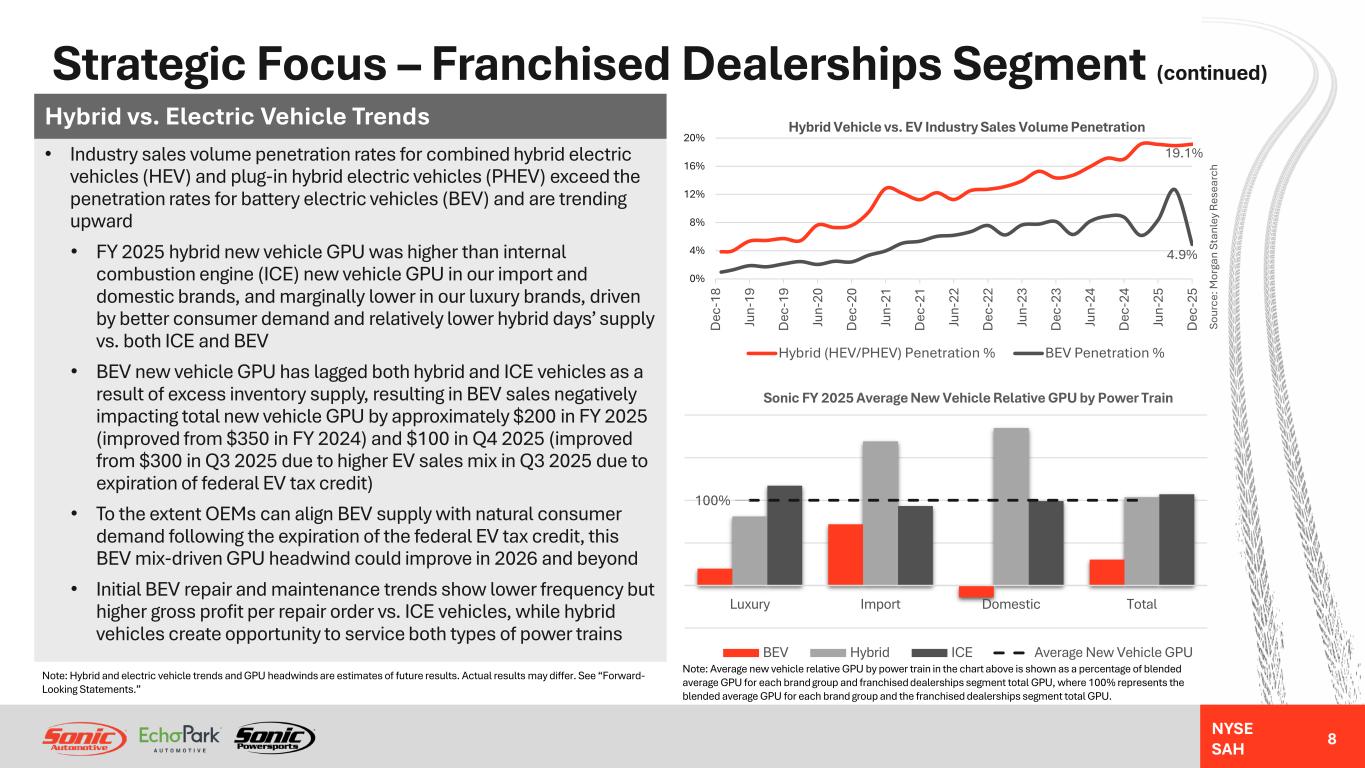
And, Mike, on the BEV mix, you know, we saw north of 12% of our sales mix in the third quarter was EV with the full forward demand from the federal tax credit expiration. But it was only about 4% of our mix in the fourth quarter. And you've seen our inventory mix of EV become more in line with that kind of 4% or 5%. So it's benefiting GPUs, relatively speaking. You know, BEVs are still a $100 headwind in the fourth quarter to blended GPU, but that was down from $300 in the third quarter. You know, and so as we go forward, if the OEMs can continue to produce the right BEVs for the right markets, as importantly, I think that becomes less of a headwind for us going forward.
Really appreciate the color. Thank you, everyone.
Operator
As a reminder, if you'd like to ask a question, please press star 1 on your telephone keypad. Our next question is from Glenn Chin with Seaport Research Partners.
Good morning. Wow, thanks for squeezing me in.
Just revisiting the pricing discussion, Jeff, you mentioned a few times OEMs cutting margins. Can you just clarify, is that a reference to dealer margin?
Both. I mean, you've got dealer margin in some manufacturers being cut. You've got price increases, you know, 1%, 2%, 3%. You've got all kinds of different things going. And then you've got manufacturer partners doing a great job, from my perspective on their part, cutting spend where, you know, the dealer and the manufacturer got together and said, we really didn't need this program. And so they're doing everything they can to fight this tariff battle. But, again, if you go back to 25 and you look at some of the losses that some of our manufacturers took, It's a lot, and they did an amazing job fighting this battle. They're not going to fight that battle by themselves forever. It's just not going to happen. They're going to have to pass on, and we'll see what happens from a pricing perspective, from a margin perspective. We're working incredibly close with all of them, and everybody's got the right mindset. that everybody wants to do the right thing, but there's only so much, you know, room before you have to start passing on, you know, price increases to the consumer.
Yeah, and on a related note, are you seeing any signs of them decontenting, taking out equipment?
Absolutely, everybody's looking at it as, what can we do to pare down the price of a vehicle, whether it's wheels, you name it. That's something that is a topic of conversation across the board.
Any items in particular, Jeff, that stand out to you?
No. I mean, I could probably go get you some detail, but not off the top of my head. I mean, wheels definitely are part of that. The infotainment systems are certainly changing. And really, we're heading in one direction when Bev, you know, first launched because of the amazing technology in those vehicles. I think that's being tightened up and more to come. We're really, you know, sort of, you know, at a crossroads, an inflection point. As manufacturers put their arms up and say enough is enough, dealers, you know, certainly can't absorb those kinds of hits. and pricing is going to have to change or something's going to have to change.
Interesting times. And then just a question on the outlook. You're expecting a 10% increase in floor plan interest expense. Is this a function of higher store count? I know you guys acquired those JLR stores last year. Or is that a function of you expecting to carry higher inventory levels or both?
It's really on store count and brand mix as well as the inflationary cost of vehicles. You know, our floor plan is based on the dollar value of the invoice cost. And if the OEMs are going to pass along with the model year 26 increases we've seen as well as what we expect in 27, and then compound that with, you know, we carried a higher floor plan offset balance for most of the last year, depending on what we do from a capital deployment perspective going forward. You could reduce the benefit that we see against floor plans somewhat. That's a combination of factors.
Okay. Yeah, that makes sense. But just to confirm, your floor plan rates are variable, no? So any reduction in the rate, the rate environment should be a favorable offset to that. Is that accounted for in your outlook?
Yes. And that's accurate.
Okay. Very good. That's it for me.
Operator
Thank you. There are no further questions at this time. I'd like to hand the floor back over to David Smith for any closing comments.
Thank you very much, everyone. We'll speak to you next quarter.
Operator
This concludes today's conference. You may disconnect your lines at this time. Thank you for your participation.