Operator
Hello and thank you for standing by. Welcome to SEI first quarter 2026 earnings conference call. At this time all participants are in a listen only mode. After the speaker's presentation there will be a question and answer session. To ask the question during the session you will need to press star 1-1 on your telephone. You will then hear an automated message advising your hand is raised. To withdraw your question please press star 1-1 again. I would now like to hand the conference over to Brad Burke. You may begin.
Thank you, and welcome, everyone, to SEI's first quarter 2026 earnings call. We appreciate you joining us today. On the call, we have Ryan Hickey, SEI's Chief Executive Officer, Sean Denham, our Chief Financial and Chief Operating Officer, and members of our Executive Management Team, including Michael Lane, Bill McCabe, Mike Peterson, Sneha Shaw, Amy Stowinski. Before we begin, I'd like to point out that our earnings press release and the presentation accompanying today's call can be found under the investor relations section of our website at seic.com. This call is being webcast live and a replay will be available on the events and webcast. With that, I'll now turn the call over to Ryan.
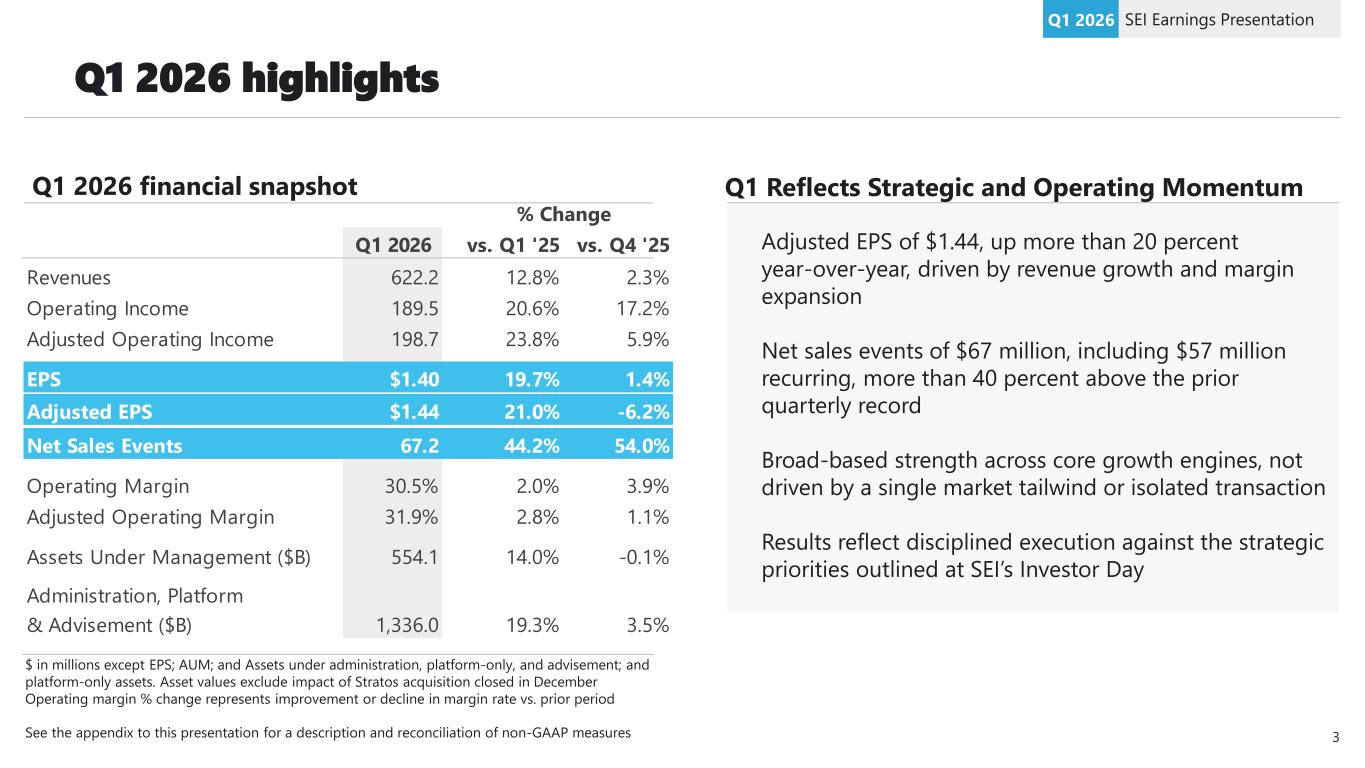
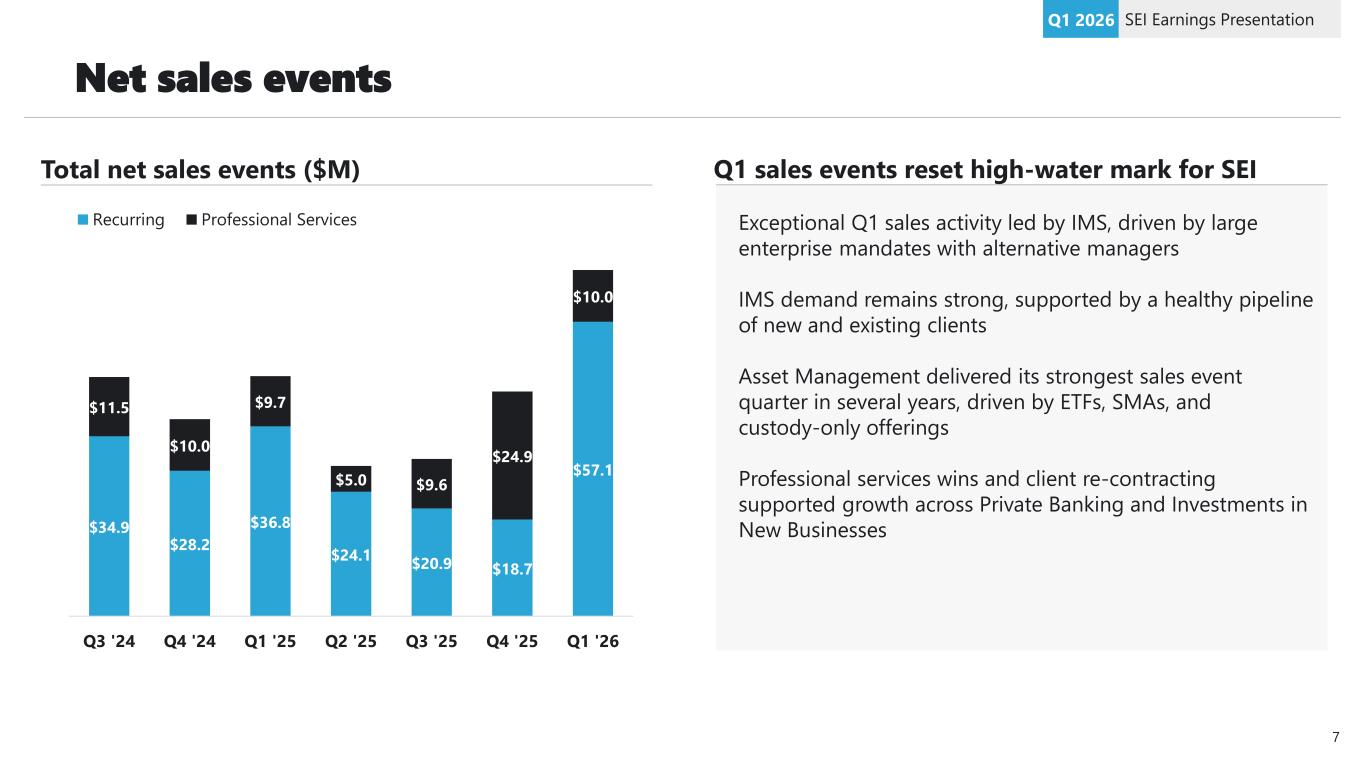
Thank you, Brad, and good afternoon, everyone. This was a defining quarter for SEI. Q1 was not simply a strong start to the year. We believe it is emphatic evidence that the strategic and operating changes we have made set a new standard for what SEI is capable of delivering on a sustained basis. Q1 adjusted EPS totaled $1.44. That's more than a 20% increase from last year, driven by both top-line growth and margin expansion. We also delivered 67 million dollars of net sales events in Q1, including $57 million of recurring revenue and $10 million of professional services. This is an outstanding outcome. It exceeds our prior quarterly record by more than 40%. The scale and quality of these sales events reflect demonstrable progress in our core growth engines, rather than a single market tailwind or discrete event. This distinction matters. It gives us confidence that what we delivered in Q1 is not an anomaly. During our investor day last fall, we outlined five strategic pillars that guide how we run the company, how we allocate capital, and how we show up for clients. Q1 was decisive validation of that strategy and our ability to consistently execute against Let me walk through those pillars, how they showed up in Q1, and why we feel good about the trajectory ahead. First, we invest in proven growth engines. Most notably, alternative investment managers and professional services. In IMS, demand for outsourcing remains strong, particularly among larger and more complex alternative managers. First quarter sales events reflect the initial phase of multiple enterprise-level mandates with first-time outsourcers, the quote-unquote big deals we've been talking about. These relationships are designed to expand over time as the clients deepen their partnership with SEI, and as their fundraising and new product launches progress. These relationships also have the potential to grow into some of SEI's largest overall clients. The momentum in this business is incredible, giving us confidence of what we saw in Q1 as a starting point, not an end point. Professional services also continues to support growth. Clients are engaging SEI earlier and more strategically across a broader set of needs. which is improving win rates and increasing durability of relationships, as evidenced by the previously announced Huntington Bank win. Second, reimagining asset management. I think we're actually now past the reimagining stage, and we are executing against our evolved strategy at pace. The strategy is showing meaningful results. Q1 represented our best quarter in several years, with the improvement in flows that built through 2025 continuing into 2026. We saw progress across both the RIA and IBD channels, where our strategy of delivering a broader SEI ecosystem to more scaled advisors is showing results. Engagement is improving every day, particularly with larger firms that value integrated solutions. Stratos integration is also well underway, with multiple work streams focused on scalable infrastructure and building a centralized investment hub. We are encouraged by strong inbound interest from advisors seeking a long-term capital partner like Stratos. And in our institutional business, we remain on track towards net positive flows later this year while maintaining discipline around client fit and flow quality. Third is enterprise excellence. The partnership we recently announced with IBM reinforces and accelerates the direction we are taking around infrastructure modernization, automation, and responsible AI deployment. As I have said in the past several earnings calls, we are applying AI and automation where it creates real impact, reduces friction, lowering unit costs, and expanding capabilities and services for clients and employees. These initiatives are translating into margin expansion with Q1 delivering higher margins at the consolidated level. Enterprise excellence is about running the company smarter, not just tighter, and with increased accountability. Our margin expansion reflects real progress against that priority. We view AI as a force multiplier of time, and our execution of these programs will create additional capacity and opportunity for our employee base. Fourth, we continue to focus on boosting international returns. We are taking a more disciplined approach to how we operate outside the U.S. with clear accountability for growth, margins, and capital deployment. In Q1, we began to see traction across both professional services and asset management, with more than one-third of professional services sales events generated internationally this quarter. We also continue to build out our Singapore presence as part of our global expansion priority. This remains an important opportunity as we apply a more integrated, enterprise-wide operating model across our international platform. Fifth is strategic capital allocation. In Q1, we repurchased over $200 million of SCI stock. Given the strength of our operating performance and long-term growth outlook, we believe our shares represent an attractive use of capital at current levels. Share repurchases will remain a meaningful lever within our capital allocation strategy, especially when market pricing does not, in our view, reflect the trajectory of our business. Beyond share repurchases, we also activated several investments targeted for later in the year, which are reflected in Q1 results. This was also our first full quarter with Stratos, which is deepening SEI's participation in the advice value chain and strengthening the overall reach and relevance of our platforms. We remain committed to disciplined capital deployment that balances reinvestment, M&A, and consistent returns of capital to shareholders. Before turning the call over to Sean, a brief word on AI. We believe AI strengthens our value proposition and supports continued margin expansion and growth. It is a clear positive and accelerant for SEI. Our combination of regulated infrastructure, proprietary data, mission-critical processes, and talent positions us well to apply AI in ways that can improve client outcomes and productivity. We have been proactive, investing over the past two years in AI-native capabilities, automation, and AI-naval expansions and extensions across our platforms. In parallel, we are selectively experimenting with more disruptive ideas that have the potentially to substantially expand our addressable markets that we can serve. Importantly, clients are increasingly turning to SEI as a partner to help them think through responsible, scalable AI adoption in complex regulated environments. Stepping back, we believe Q1 represents a statement quarter for SEI. The quarter reinforces our confidence in the scalability of our business and the demand for our capabilities. But finally, I want to thank SEI employees for an outstanding quarter. The results reflect their focus, execution, and daily and unwavering commitment to our clients. With that, I'll turn the call over to Sean.
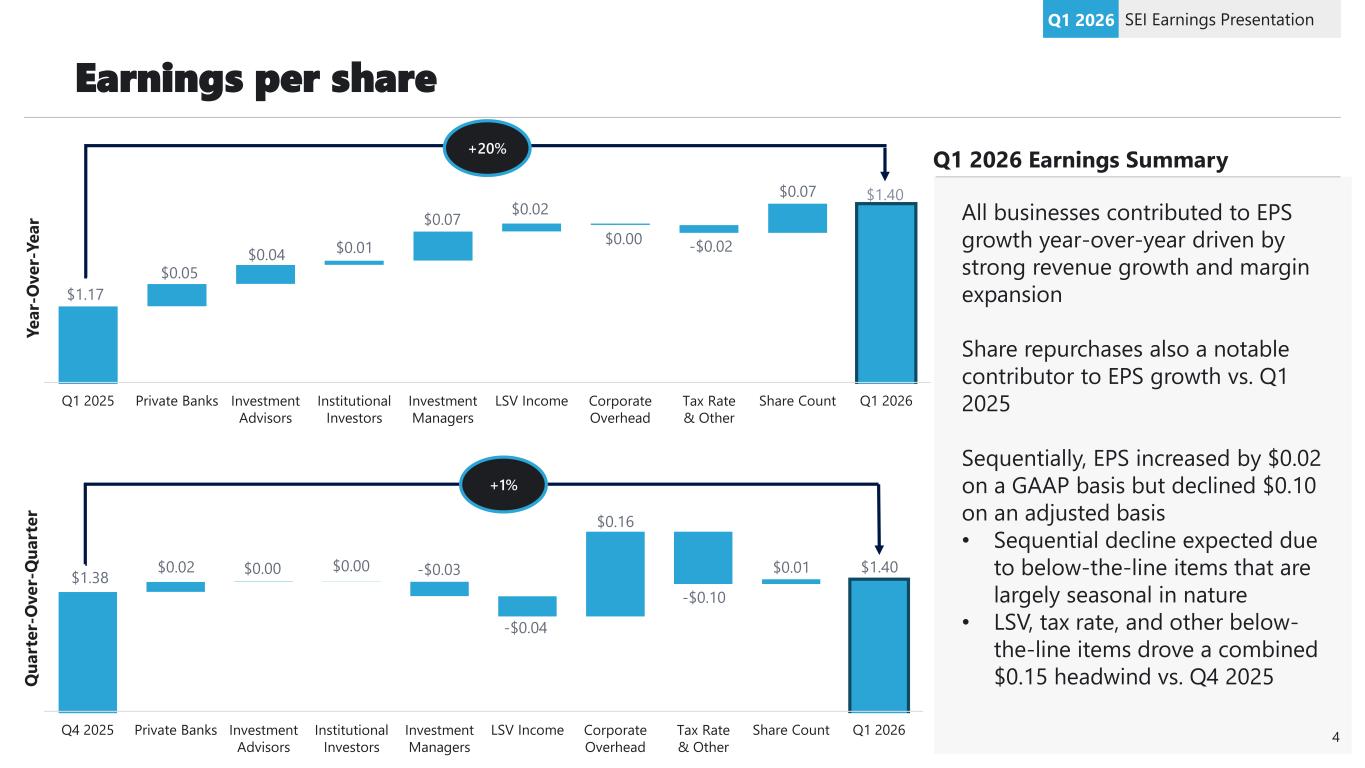
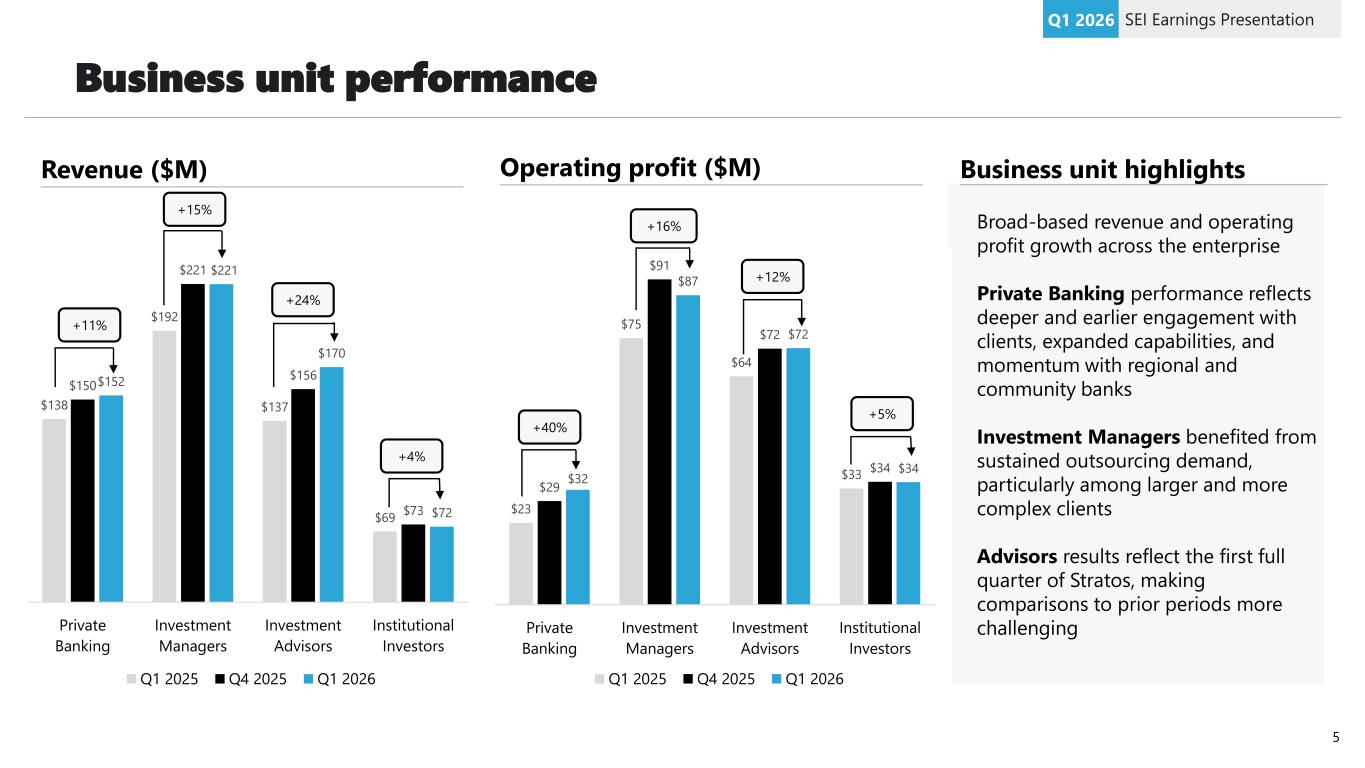
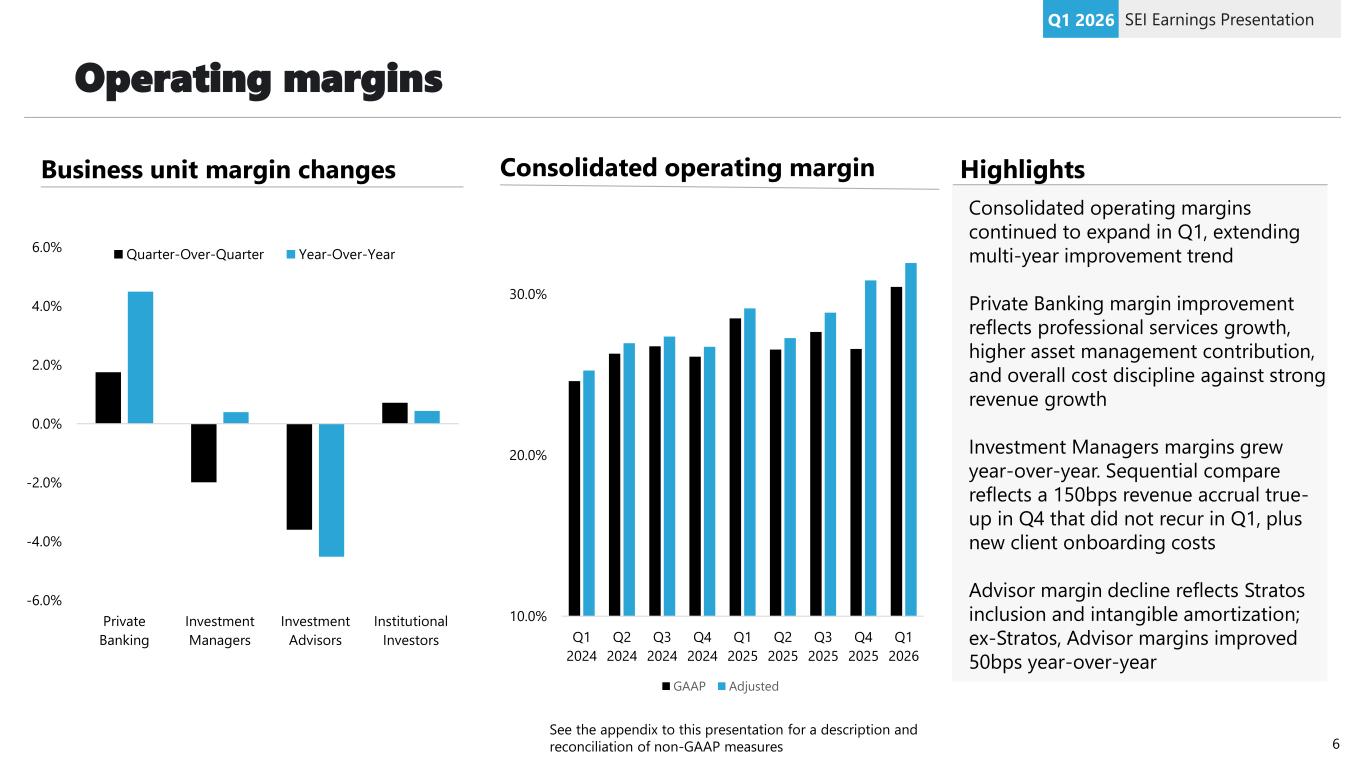
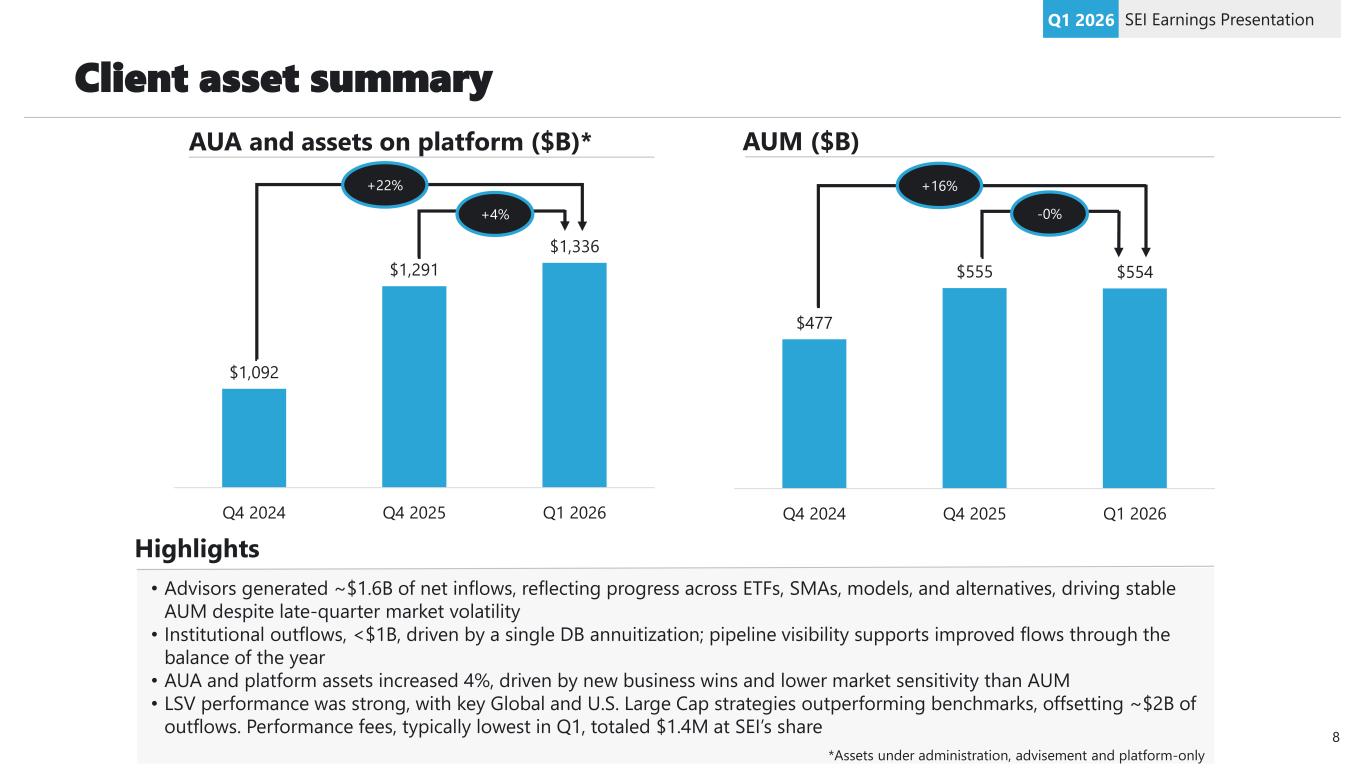
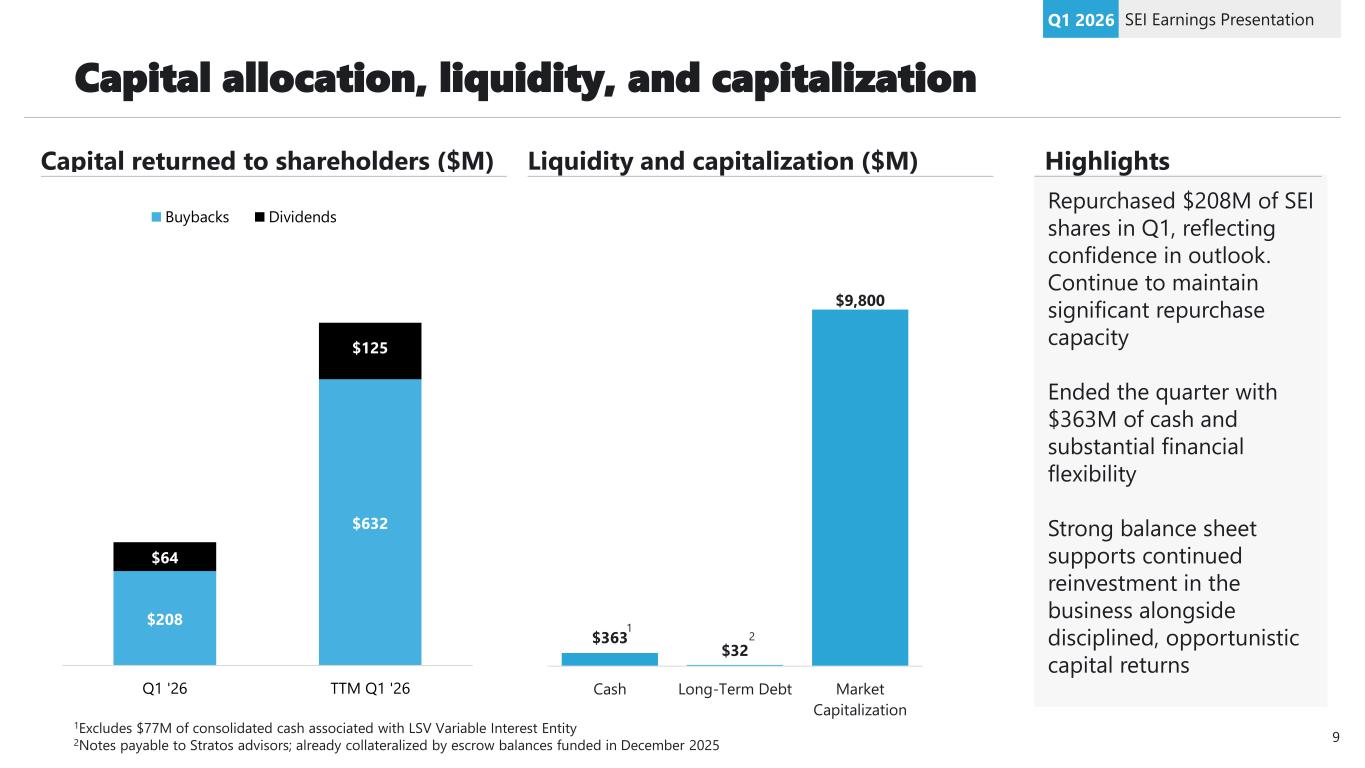
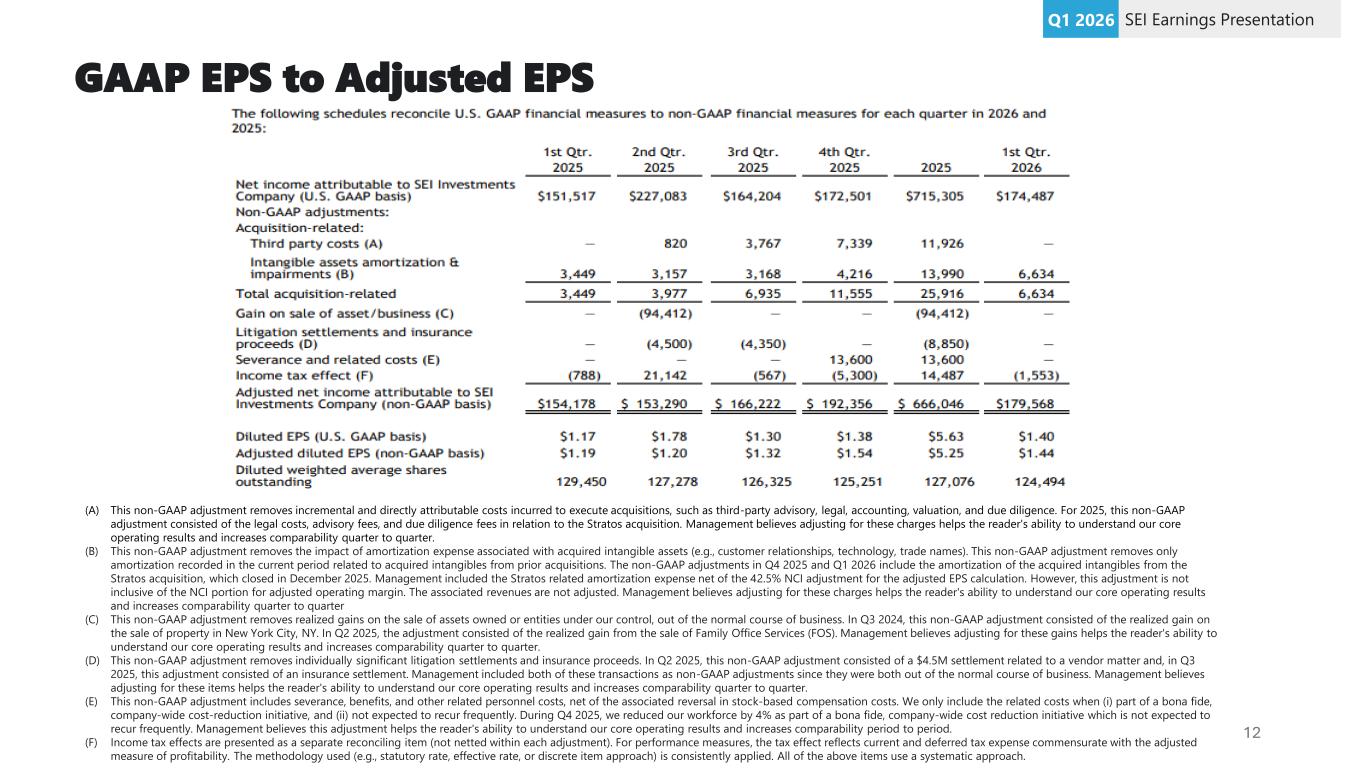
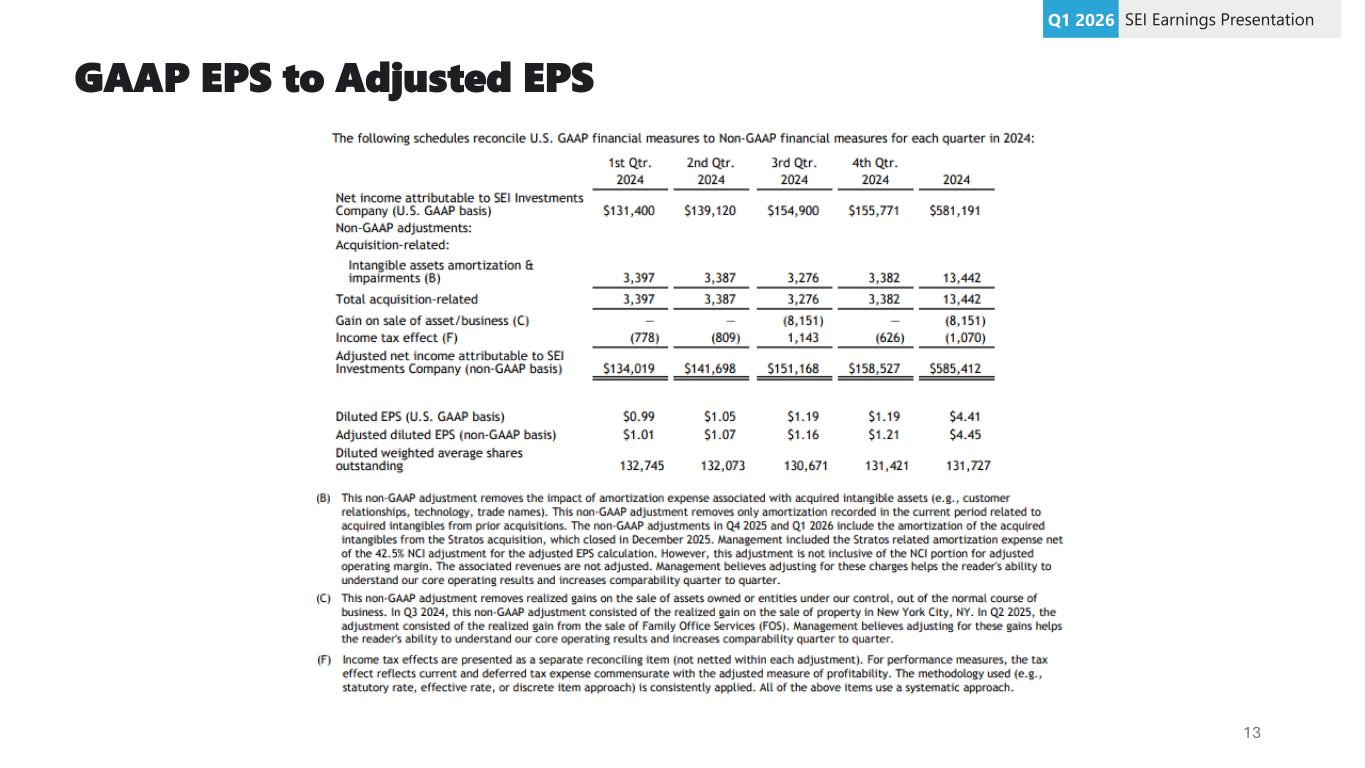
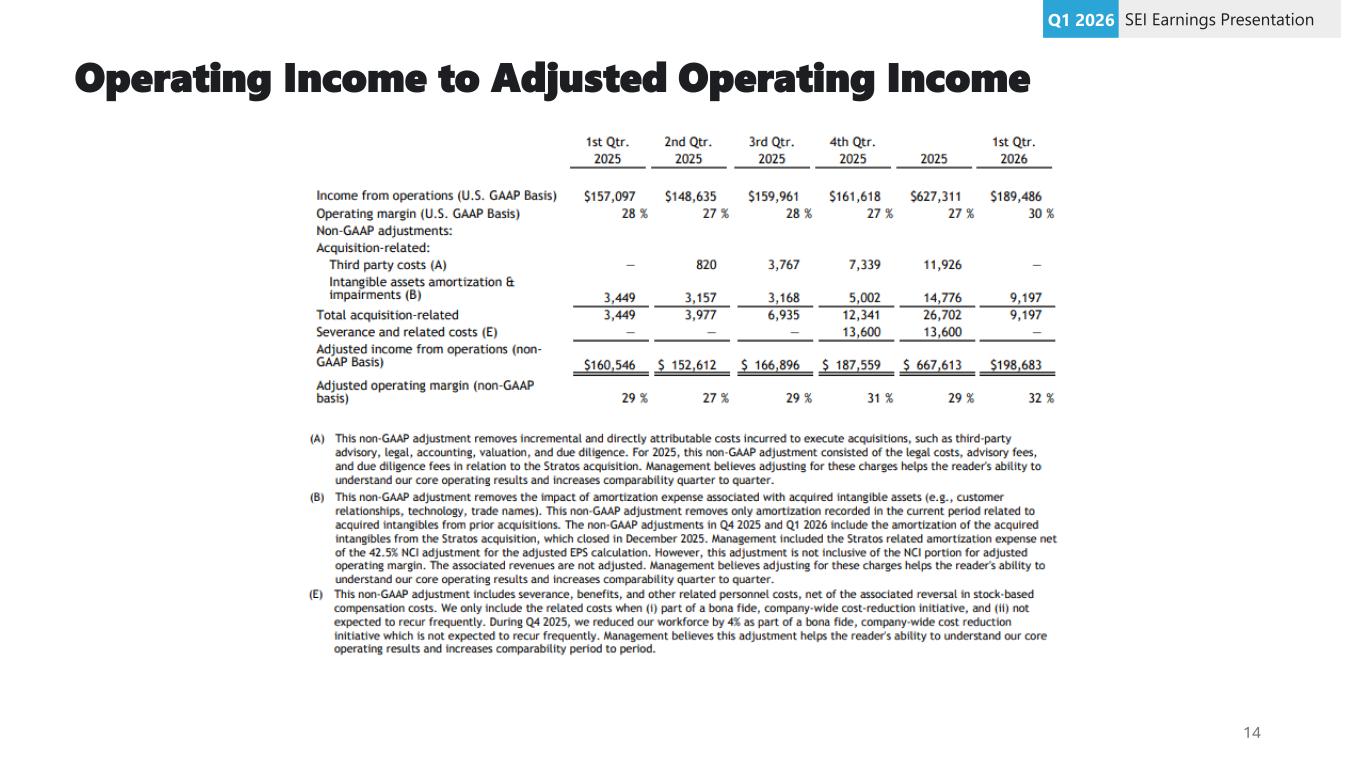
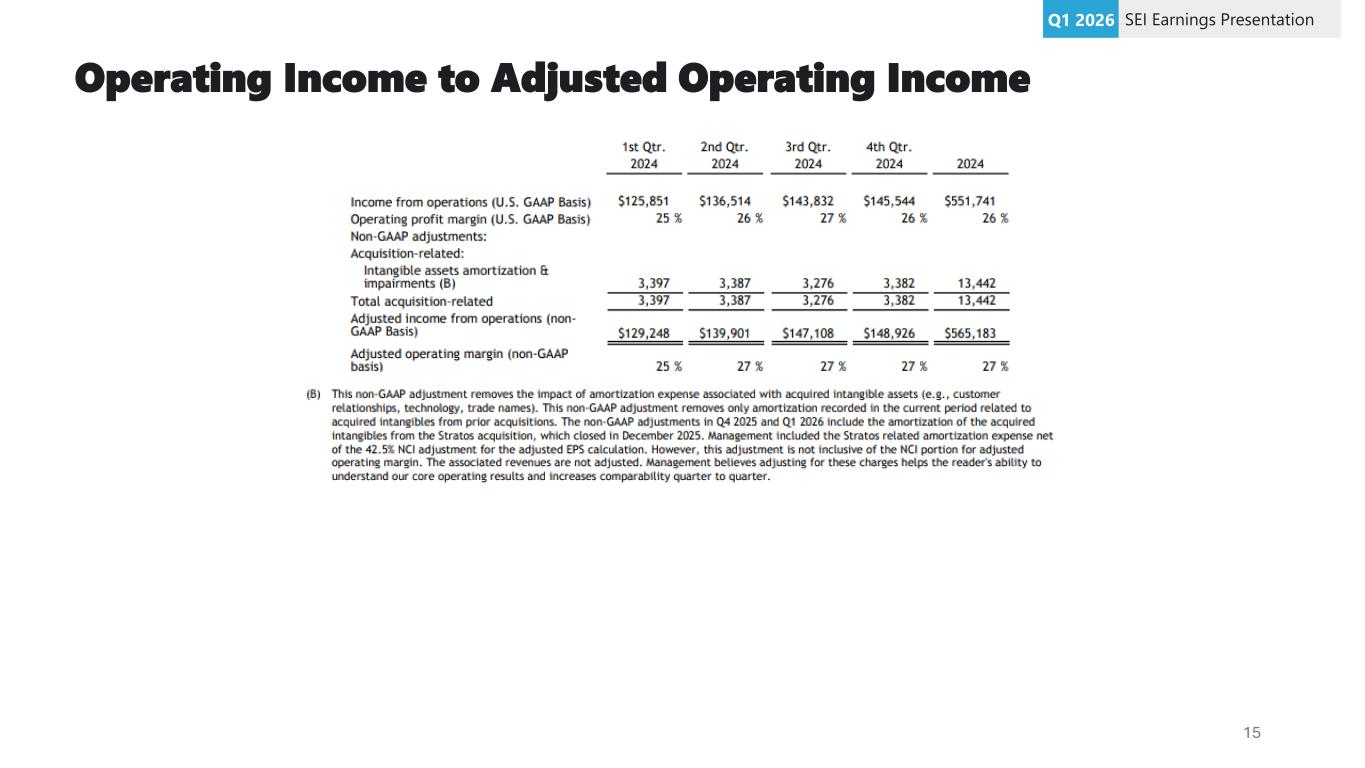
Thank you, Ryan. I'll begin on slide four and to reiterate Ryan's comments SCI delivered in an outstanding first quarter. On a GAAP basis, EPS increased by 20% and operating profit increased 21% versus Q1 of last year. On an adjusted basis, EPS increased 21% year-over-year. The sequential decline in adjusted EPS from Q4 was expected and reflects items we discussed last quarter. Most notably, a higher effective tax rate and lower investment income and performance fees from LSV, which tend to be seasonal in nature. In total, our tax rate, LSV, and other below-the-line items drove a combined $0.15 headwind to EPS relative to Q4 last year. Adjusted operating income, which excludes these items, increased by 6% from the fourth quarter. This quarter also marks our first period reporting adjusted financial metrics. We believe this enhanced disclosure aligns our reporting more closely with market practice and provides investors with a more effective basis for comparison. For additional context, we have also included historical quarterly disclosures on an adjusted basis at the end of our press release. Turning to slide five. SEI's adjusted operating profit increased 6% sequentially and by 24% year-over-year. Performance was strong across the enterprise. Private banking delivered a notable increase in revenue and more impactfully operating margins. This reflects continued execution and deeper client engagement, as banks increasingly partnered with SEI earlier and across a broader set of strategic and operational needs, not just investment processing. For example, we are now playing a more active role in client implementations, resulting in less lag time between contract wins and revenue recognition. In addition, we were pleased to announce the Huntington win during the quarter, which underscores our relevance and credibility in the regional community bank market, especially at the higher end of that segment. Our advisor segment had a healthy start to the year, but the first full quarter of our Stratos partnership, reflected in the advisor segment, makes comparison with prior periods challenging. Given our 57.5% ownership, Stratos is fully consolidated in our results. Stratos contributed nearly $20 million of revenue and $3 million of operating profit to advisors in Q1 before considering non-controlling interest. Excluding depreciation and amortization, primarily acquired and tangible amortization, Stratos generated $8 million of EBITDA at the consolidated level. Several planned transactions also closed during the quarter, so the underlying run rate contribution is modestly higher than reflected in Q1 results. Excluding the impact of Stratos, all of SEI's businesses delivered year-over-year revenue growth, operating profit growth, and margin expansion. This performance reflects execution against the strategic priorities Ryan outlined earlier, so I will not reiterate those themes here. Turning to slide six, consolidated operating margins were very strong, continuing the improvement trend we've seen over the past several years. At a segment level, the improvement in private banking margins, both year-over-year and sequentially reflects continued execution against the five-point plan Sanjay discussed during our investor day. Key contributors include professional services growth, increased adoption of our asset management offerings internationally, and operating leverage against deeper engagement with our clients. For our IMS business, the modest sequential decline in margins versus Q4 was expected and primarily driven by the absence of the revenue accrual true-up we referenced last quarter, which accounted for approximately 150 basis points of the decline. The balance reflects onboarding costs associated with the substantial sales events delivered in the quarter. Advisors' margins declined due to the inclusion of Stratos, which was weighed down by intangible amortization, as I just discussed. Absent the impact of Stratos, advisors' margins increased approximately 50 basis points relative to Q1 last year. At the consolidated level, adjusted operating profit margins improved versus both the prior quarter and the prior year on both a gap and adjusted basis. Slide seven summarizes our sales events for the quarter. We debated opening the presentation with this slide, but decided it was best to remain consistent. Sales activity in the quarter was exceptional. Investment manager services led the business with more than $50 million of net sales events, driven by the large enterprise mandates Ryan discussed earlier. Together, portions of these wins accounted for just over half of total IMS sales events. As Ryan noted, we expect these relationships to continue contributing to sales activity and IMS over the coming quarters and years. Before moving on from IMS, a brief comment on private credit and a broader market commentary. We are not seeing any slowdown in IMS demand. Our exposure to retail private credit, including public BDCs, currently remains limited, and the vast majority of our private credit exposure is institutional. We continue to see strong pipeline activity across existing and prospective clients, and with the launch of our registered transfer agency in Q3, we would expect our retail exposure to increase with evergreen fund launches. IMF led the quarter, but the strength of those results should not diminish the continued progress we have seen in both private banking and asset management. While the magnitudes differ, all three businesses are contributing positively to growth. Asset management delivered its strongest sales events quarter in several years, driven by growing demand for ETFs, SMAs, and our custody-only platform offerings. We are encouraged by the momentum in this business and expected continued progress as we expand our product lineup and distribution capabilities. Investments in new businesses generated approximately $4 million of net sales events, including engagements won in conjunction with private banking. This is another example of how our investment in professional services is supporting growth across the enterprise. Additionally, while not reflected in sales events, we successfully re-contracted eight private banking clients, renewing an average contract term of approximately four years and retaining $34 million of recurring revenue with no material impact to run rate profitability. Turning to slide eight, we saw continued asset momentum during the quarter. In asset management, growth was led by the advisor's business. Last quarter, Ryan mentioned that we're accelerating investment management product launches in ETS, SMAs, models, and alts. This quarter, we are seeing progress against those initiatives, driving approximately $1.5 billion of net inflows. Institutional investors experienced less than $1 billion of net outflows, almost entirely attributable to a large defined benefit client annuitization following the achievement of funding objectives. This outflow is a result of SEI advising a client to successfully meet their long-term investment objectives. Based on current pipeline visibility, we expect improved flow performance in this business over the balance of the year. Regarding market impact, SEI's portfolios remain highly diversified across equities, fixed income, alternatives, cash, and geographies, with a relatively higher weighting towards value, which mitigated market headwinds during March. And as you may have noticed, market performance in April has been pretty encouraging, to put it lightly. LSV had a strong start to the year, with key products in global and U.S. large-cap outperforming benchmarks by single-digit percentages in Q1, more than offsetting market weakness in March and approximately $2 billion of net outflows in the quarter. Assets under administration and on-platform increased 4%, driven by strong new business wins and lower mark-to-market sensitivity. Turning to slide 9 and building on Ryan's comments on capital allocation, in Q1, we repurchased $208 million of SEI shares. While repurchase activity was elevated during the quarter, we continue to maintain significant capacity and tend to remain active buyers. We ended the quarter with $363 million of cash on the balance sheet and substantial financial flexibility. This balance sheet strength provides ample capacity to continue investing in the business while maintaining a disciplined and opportunistic approach to capital returns. Stepping back, the first quarter represents an amazing start to the year for SEI. We delivered meaningful earnings growth, improved margins, and exceptional sales activity while continuing to invest to support the opportunities we are seeing across the business. The quality of our results reflect disciplined execution against the strategic priorities we outlined at Investor Day, and it reinforces our confidence on the path ahead. There are a lot of exciting things happening right now at SEI, and there's more to come. With that, operator, please open the line for questions.
Operator
Ladies and gentlemen, as a reminder to ask the question, please press star 1-1 on your telephone, then wait for your name to be announced. To withdraw your question, please press star 1-1 again. Please stand by while we compile the Q&A roster. Our first question comes from the line of Alex Cram with UBS. Your line is open.
Yes, hey. Good evening, everyone. Just maybe starting with a strong sales in IMS, was hoping you can give a little bit more color around, I think you said multiple first-time deals, So maybe a little bit more about how competitive these wins were. And then most importantly, you said the pipeline remains very strong. So is this a run rate that we should be expecting in terms of new sales, or is this going to be lumpy? Yeah, just a little bit more color on how this year could shape up here given the recent strength here.
Brian here. Thanks for the question. I think we'll turn that one to Phil, and then Phil, if you want to kind of unpack them a couple different ways and we can add on.
All right, that sounds great. Great. Thank you for the question. A couple of quick highlights. So, by every measure, we had a phenomenal quarter. We won two of the largest and most complex alternative managers in the entire industry. It was an extremely competitive bake-off that lasted over a period of a full year. Both of those managers were moving from insourcing to outsourcing. One of them is in the top five globally and the other is in the top 15 globally alternative managers so we believe there's meaningful room to land and expand like we always do over the course of the next several years both of these clients will be in our top five but these deals are in addition to what we would normally sell on a quarterly basis so from a pipeline perspective we're really strong we're supported by the enterprise mindset from Ryan and Michael and Sanjay. We're all out in the market selling together. And we're probably talking to 20 of the top 50 alternative managers right now. So we expect sales events to continue to trend up year over year. And one last fun fact, we're actually now we are the third largest fund administrator in North America. So we're moving up the league tables. Brian, anything to add? Anything I missed?
I think the appetite for outsourcing increases literally daily. And the more effective we have been at helping our firms deploy capital in different areas for their growth acceleration, it has just increased the partnership and deepened our relationship. So as you said, I think if you're looking, Alex, from kind of an average quarterly basis of sales, we would expect those numbers to continue to grow. Some footers will be a little bit lumpier than others based on size, deals, and timing, but the pipeline and the market and our positioning in this space is extremely strong.
And then maybe staying on the same topic, and you already addressed this somewhat proactively in terms of what's going on in private credit and private equity right now, but maybe we can go a little bit deeper there and not to lead the witness here too much, but, you know, we've seen in the past, for example, during the financial crisis on the hedge fund side in particular and Madoff, there was a lot of outsourcing demand that already all of a sudden came out of some of that stress and some scrutiny around that space. So again, not trying to paint too rosy of a picture here, but just curious how the discussions have changed given what's going on. Do you think this could actually be maybe an accelerant to saying, hey, we need to open the kimono a little bit and this will be maybe one of the ways to do it? So, yeah, just curious about what you're hearing live.
So just to answer that real quick, this is Phil. The three of our largest clients are looking at launching flagship products this year. So we're not seeing any slowdown in demand, especially on the institutional side. And I do think if the market was ever to get a little bit more interesting or challenged, we're playing in the very, very large end of the market. and these clients are really, really good at what they do. And I know in this script Sean said that we're a little lighter on the retail side of the market, but we expect that to pick up when we launch our registered transfer agency solution over the course of the next couple of months.
I think it's also really important to distinguish when we talk about this business, 70% of IMS is driven by exposure to alternatives, and 25% of that 70% is private. Thank you.
Operator
Ladies and gentlemen, please stand by. All right, we'll move on to the next person. Our next question comes from the line of Jeff Smith with Wim Blair. Your line is open.
So in private banks, I know the margin can jump around, but it was up to 21% in the quarter.
Professional services growth is obviously helping, but how much of that was driven by the reduction in the workforce, or were there any other one-time items that were in there?
So, Jeff, can you hear me?
Okay. So I'll open up to Sanjay. The reduction in workforce had little to no impact, really, specifically in banking. That was across the enterprise. That really was part of a Q4 initiative, as we talked about. I mean, Sanjay can talk about, I mean, the execution against the five specific things that he discussed in New York in September, and we've been talking about the last couple of years, he literally continues to execute against that quarter over quarter. But, Sanji, do you want to highlight some of the specific things that drove, you know, kind of the increased margin this quarter?
Yes, absolutely. That's a really good question. If you look at the five pillars strategy we talked about on September 18th, 2025, two of those core pillars were professional services was one of them, and then second was how we going to market with the new logos. Professional services events, we have significant events in third quarter and fourth quarter. And as you could see, our revenue realization is much faster for those kind of deals. And in Q1, that's a good reflection that, yes, we sold new professional services in third quarter, fourth quarter, and we realized that. And that is one dimension of it. Second is we are very judicious how we are going to market. And and the new contracts we are signing, they are coming with a higher margin. So it's a combination of those, thus of course our GCC initiative is playing a big role here. We are leveraging GCC. We talked about, we introduced this about our software as a service expenses.
So when you combine all those things together, you will see that, and you will see in the coming quarters as well, we are continuously making progress on all those five pillars. okay great and then it sounds like transaction multiples for rias have been on the rise is that the case are you seeing that in the market and do you think that would be uh do you see that as being a hindrance for your roll-up strategy for stratos or are there still you know good opportunities out there michael did you hear the question i didn't just said It seems like EBITDA multiples are rising for RIAs or IBD roll-ups. Do we think that's impairing our strategy with Stratos and their M&A strategy?
No, not at all. We do see that the multiples on the high end definitely have been increasing. And if you look at the scaled firms, there was a report recently that came out that the typical multiple would be between 22 and 24. And remember, we acquired Stratos at a much less multiple than that. And so you do see it at the very high end in the scaled players. But when you go into the marketplace where you're looking at the $100 million RAAs up to about a billion dollar RAAs, you still have a very reasonable multiple arbitrage opportunity between what you buy them at versus what they would then reprice at when they become part of a scaled player. So we're not seeing any slowdown at all right now.
Operator
Thank you. Our next question comes from the line of Crispin Love with Piper Sandler. Your line is open.
I appreciate taking the question. Sorry, I had some feedback issues earlier in the call. Just one follow-up on the IMS sales wins. You mentioned two of the largest and most complex alts being part of those wins.
Can you discuss any concentration on the wins in the quarter? I mean, how much of the $51 million came from those two, or just any other concentrations worth calling out from the sales?
I can take it. Yep. Those two deals were less than 50% of the concentration for the quarter, so not even, and we expect a lot more later.
Perfect. Thank you. And then just on margins, 32% core margins in the quarter, commentary seems to be very positive. Can you just discuss the outlook for margins? Are you still expecting high 20s range, or could there be a new run rate here, maybe high 20s to low 30s, and then just if there's anything one time that impacted the core margin in the first quarter, that's out of the ordinary.
Hey, Crispin, it's Sean. Thanks for the question. So, you know, the main driver for overall margin improvement really is just the fact that revenue growth is up 2%. We're doing a much better job of managing our expense. We had nice sequential improvements in PV and institutional, but primarily it was driven from revenue growth. And so, you know, as we have large improvement in revenue and sales and revenue growth, we expect margins to improve. So our fixed costs are pretty well fixed. There are some variable costs, but for the most part, you're seeing the appreciation of margin due to revenue. Thank you. Appreciate it. That's my question.
Operator
Thank you. Our next question comes from the line of Ryan Kinney with Morgan Stanley. Your line is open.
All right. Great. So on the AI theme, you touched on it in the opening remarks a little bit, but can you just dig in a little bit deeper? Because I think there is a perception in the market that some of the businesses that you operate in, like fund administration, maybe could be at risk of disruption or maybe could see fee rates come down over time if you're expected to pass on efficiencies that you gain. So could you just dive a little deeper on how you view yourself as more protected from AI intermediation?
Yeah, I mean, we'll answer that in a few ways. Ryan, I hope you're doing well. And then I think Snake is in the room if she wants to provide some color. I mean, the second half of your question, I think we really need to also continue to focus on continued productivity and efficiency through leveraging technology and process engineering has always been part of our strategy and has always been part of how we pass on and maintain margin expansion or pricing levels relative to the competitive market. So AI will definitely be a bit of an accelerant to that, but if you think about how we're looking at it right now, and I mentioned this a little bit earlier in the call, we really see this right now as a significant positive for SEI, and we're not naive. We know that there's disruptive possibilities out there, but when we look at our ability to provide a full suite of capabilities and platforms to our clients, our clients are looking to SEI to figure out how to harness these capabilities to expand our services, potentially drive more scale and productivity. So we definitely see it as a positive, and when you look at the suite of capabilities that we provide, certainly there will be organizations and firms that try to go displace that brick by brick, if you will, and it's our job to maintain that positioning for that whole wall of our services. But right now, and Sneha, you can weigh in, we're really excited about what we see, and we definitely are excited, Ryan, around the engagement we have with clients looking to SEI to partner with them around how to harness and drive more growth here.
Yeah, I'll just add, Ryan, thanks for that, but I think that there's two elements of this. So one is the ability for us to do more with, like, the amount of resources that we have, which we're actively driving. We've got AI-enabled employee base, and they're using it actively in their day-to-day jobs. We're also seeing the way to deliver growth more efficiently. So as Phil is winning, he's doing it without adding more costs, which I think is really helpful, which is why you're seeing a little bit of a margin expansion. And then we're seeing this adaptability of not just us but our client base. as they become more efficient and we become more efficient, discovering new areas of growth. And so we're seeing, for example, in the banking client base, a lot of interest in us helping them become more AI native. And so doing, you know, work with data cloud and professional services and helping secure their data through our security services. And on the IMS side, we're seeing a lot of interest to say, what additional services can we provide those same clients as they're growing that we wouldn't have done naturally because now AI is making that possible. So we see it really as a net driver of growth and both for our people and for our businesses and our clients.
And we get the question a lot on fee rate impact from AI, but as you mix shift into areas like alts, could your reported aggregate fee rate actually go up or stable? How should we think about fee rate in the various businesses?
Right now we've seen a tremendous amount of stability in our fee rates. been able to continue to win new business at premium prices and deliver a premium service. So I don't know if anybody else wants to add anything to that. We haven't seen it yet. Ryan, we're certainly aware there's a tremendous amount of change happening in the market. We actually are excited about that. I mean, if you think about our cultural posture and the position that we have around leaning more into accelerating good ideas for good outcomes, that's just the way we think right now. I'm full of quotes that Sean likes to listen to, but a ship is safe in the harbor. That's not what ships were built for. So we are being aggressive with experimentation. We're being aggressive with innovation, and that's just the kind of mindset we want to bring here. But right now, specific to your fee rate question, we're actually really excited about our current position, and we don't plan to kind of lessen our focus and let that position get diminished or deteriorated.
Phil, from an IMS perspective, we're not seeing a lot of key pressure at all. But what we do expect from AI is faster navs, higher quality, adjacent markets that we're getting into. So our clients are expecting that from us, and, again, we're in the higher end of the market, and they just want things better, faster, and perfect.
All right, great. Very clear. Thanks.
Operator
Our next question comes from Milana. Alex Bond with KVW. Your line is open.
Great. Thanks for taking the question and good afternoon, everyone. Another follow-up on the wins in the IMS segment this quarter and just the impact on the margin. In the past, you've spoken to the fact that due to the onboarding processes for large wins like this, the IMS margin may dip slightly before reaching the full run rate once the implementations are completed. Can you just help us size up the timing and magnitude of these processes or processes on the IMS margin over the next few quarters?
Sure, love to. We're going to convert these clients in a few different tranches over the next year or so. We expect the revenue is going to increase more and more quarter over quarter over the next 15 months. From an event perspective, we're going to continue to land and expand as we always do. This year, revenue and expense will be flattish for those two deals, but we're going to get back to normal margins for those two deals in mid-2027, and we're going to start to see pretty significant revenue in that timeframe as well. Got it. Great. That's very helpful.
And then maybe just moving to the professional services, I think you all have also made reference there previously to expanding that offering within other areas of the business, like IMS, and certainly appreciate the new breakout there this quarter. But can you maybe help us think about the opportunity set within IMS or other areas of the business for the professional services offering, maybe relative to within private banks where you've seen the majority of sales for professional services to date, and then also maybe just how sizable the international opportunities for professional services, given the strength that you all noted there this quarter as well. Thank you.
Yeah, you're welcome. That's a great question. So So I think if you think about kind of the breadth of the capabilities and professional services, some of the things that have the most momentum and demand right now across all the client bases, and some of this is early in some of the segments, but the AI-enabled data cloud platform is probably one of the most attractive capabilities we have where we help our clients really harmonize, ingest, and create business intelligence off of their data sets off of our data cloud platform. And Sanjay and the team really pioneered that really in the banking segment, but it absolutely has applicability in Phil's segment and as well as Michael Ames when you're looking at larger RIAs and also kind of the more enterprise-scaled organizations. I would say integration services continues to have significant demand. Sean called that out around kind of truncating, if you will, some of the lag time between signing and implementation because we're taking on more responsibility for other integration services and, you know, workflows, if you will, as part of the implementation. And I would say, you know, coming back to, you know, Alex, the question that Ryan had just asked a couple minutes ago, we're also starting to see demand for firms that want to think about how do they become more AI-enabled, how do they become an AI-native organization. So there are a variety of ways that we are able to add value from professional services, and we also had a tremendous quarter with our cybersecurity capabilities with SEI Sphere in there as well. So, I mean, that's just some color. I mean, Sanjay, you're a little bit closer to it, especially in the banking side, but also Alex that's what's around international.
So, first of all, great question. I really appreciate asking this question. On professional services side, Ryan and Sean, they also called out that we are engaging with our prospects very early now, and we are changing our playbook a bit. But rather than just leading with our platform change initiatives, now we are leading with enterprise capabilities, and that is creating a different growth opportunity for us. I would think about how many banks or institutions are looking for platform change every year. Not many, but almost every financial institution is looking for some professional services so that they can keep pace with the change. And that presents significant opportunity for SEI. And we are seeing that opportunity not just here in the U.S. market, but in the international market as well. That's where like a third of our professional services wins in the U.K. market for the last And we are seeing that momentum building up. And that's where I'm partnering with Michael Lane and Phil in terms of how we can continue to expand that at the enterprise level.
Great. I appreciate all the color there, and thank you for taking the questions.
Operator
Thank you. Please stand by for our next question. Our next question comes from the line of Patrick O'Shaughnessy with Raymond James. Your line is open.
Hey, good evening. Another AI question for you. How are you guys thinking about AI potentially disrupting the wealth management advice industry broadly, you know, in terms of disintermediating your clients, whether that's AI native software or something else?
Michael, you want to take that one?
Great to talk to you, Patrick. So that is interesting. This has been a topic of conversation that dates back 25 years from when the first robo-advisor came to play, where they thought that coming out with robotic advice to offer up advice for 25 basis points or, you know, something in that ballpark would disrupt the financial advisor business. And what they found over time was that the robo-advice marketplace didn't work. It wasn't a good B2C. It needed to actually be a B2B still or a B2C2B or whatever, but it didn't actually do what people expected it to do, which was to take over the financial advisor business. AI will supplement and make advisors more efficient. It'll enable advisors to have, I think, a greater ability to serve more clients in a more efficient way. And when you look at the statistics about what's happening in the wealth marketplace, where there's going to be a shortage of financial advisors, we're going to need AI in order to be more efficient in the wealth space to serve more people. The demand for advice is increasing. The number of advisors is decreasing. And so we have to actually use AI in the wealth marketplace to serve more. So I don't see it disintermediating. I've been involved in that question for a long, long time. I think that at the end of the day, when people start to achieve a reasonable amount of wealth, they want to talk to a human being. It'll supplement the advice that's given them.
All right. Very helpful. Thank Thank you. And then institutional investors, sounds like you guys are incrementally more optimistic there. Can you just give a little bit more color on kind of what sort of sales are in your pipeline there and also kind of how to think about the fee rate impact as you get those new on board?
Institutional investors, just your view on kind of the pipeline there, fee rates moving forward?
Yeah, the thing that I love about the institutional business that we saw is the first quarter, although you saw a negative revenue from the institutional business, it was driven by the fact that we helped, as Sean said, we helped a significant client achieve a funding status that enabled them to de-risk the portfolio and take it off of the books. I mean, that's what we do in the institutional business on the defined benefit place is if we're successful, we help firms actually achieve their goals so that they can de-risk. So largely the first quarter, the event was a result of a single plan, the de-risk. When you look forward, where we're spending a considerable amount of time and energy is continuing to deepen our penetration in areas where there are demographical shifts that will grow the area of OCIO, for instance, endowment and foundation. With a great wealth transfer, a portion of those assets that will transfer, now the estimates are over $100 trillion. When that $100 trillion continues to transition from generation to generation, a portion of that is going to go to not-for-profits. It's going to go to foundation. That's going to grow that part of the business. that's going to result in the need for more outsourcing of investment management. And so we are leaning more and more into that space. And so we feel strongly that over the next few quarters that the business, our institutional business, has growth opportunities. We will start to see a rising pipeline in areas like Endowment Foundation, healthcare, and where we have an occasional defined benefit that de-risks. We should be celebrating those wins as helping clients achieve their goals. They're going to happen once in a while in the DB space. But we feel good about where the market is going, the demographics are going, and where we're positioned as one of the largest OCIO providers.
Operator
Thank you. Our next question comes from Alex Cram. We have a follow-up question from him. He's with UBS. Your line is open.
Yes, hello again. Just a very quick follow-up. I don't think this has come up, but can you just give a quick view on your integrated cash programs? I mean, there's been a little bit more noise around brokers, investment managers, and some of their cash programs and new offerings. Some large banks have talked about this, like optimizing cash programs. So just wondering if you could outline, I know it's a relatively new program for you over the last few years, But how sticky you think there is and if there's any risk from, you know, those assets going out or that cash going out of the door at some point.
Absolutely. You know, we have been reading the same headlines that you have about a certain large bank who came out and talked about how they were going to be looking to optimize cash across different programs. And so we are very aware of the cash management programs and the pressures on cash management programs, both from what's happened over the last couple of years, you know, last year in the reduction of interest rates and the reduction of yields to the firms that have these cash management programs. As you said, ours is relatively young. It's only about two and a half years old. Ours was structured differently than many of the competitors that are being discussed in the media. Ours was structured as a 1% operational cash, which was meant to cover operational expenses. It wasn't a percentage of a portfolio. It wasn't a percentage of a model. It wasn't something that was more of a fiduciary percentage of somebody's portfolio. That's a huge differentiator. And from our perspective, what's very different as well is when you look at a lot of the different players in the custody business, their cash positions tend to be significantly higher, the average balance is being up to 4%. whereas if you look at our cash balances with the minimum of 1%, the aggregate in totality is still less than 2% that we tend to see across the entirety of our book. And when you also then look at, because of being an adversified business, the total cash revenue from our suite programs is 3% of the gross revenue of SEI. Even in the advisor business, it's still only 12% of the total revenues. And so from our perspective, yes, there's pressure that will come on those. It's not new. There are several companies out there that already have cash optimization programs where they will take anything above the minimum required to be held, and they'll sweep that into higher-yielding investments. So that's existed for years. I think we got a lot of news out of that because it was a large bank that came out and said they were going to use that, I think, because AI was put in front of it also signaled something. But at the end of the day, it's been algorithmic for quite a while, and we haven't seen any impact on that. Awesome. Thanks for the follow-up. You're welcome.
Operator
Thank you. Ladies and gentlemen, I'm showing no further questions in the queue. I would now like to turn the call back over to Ryan for closing remarks.
Thank you again for the discussion today. We appreciate it, and we are encouraged by the execution and progress we've seen early in the year. Have a great evening.
Operator
Ladies and gentlemen, that concludes today's conference call. Thank you for your participation. You may now disconnect.