Operator
Good day, and welcome to the Selective Insurance Group Second Quarter 2025 Earnings Conference Call. As a reminder, this call may be recorded. I would now like to turn the call over to Brad Wilson, Senior Vice President, Investor Relations and Treasurer. Please go ahead.
Good morning. Thank you for joining Selective's Second Quarter 2025 Earnings Conference Call. Yesterday, we posted our earnings press release, financial supplement, and investor presentation on selective.com's Investors section. A replay of the webcast will be available there shortly after this call. John Marchioni, our Chairman of the Board, President and Chief Executive Officer; and Patrick Brennan, Executive Vice President and Chief Financial Officer, will discuss second quarter results and take your questions. John and Patrick will reference non-GAAP measures that we and the investment community use to make it easier to evaluate our insurance business. These non-GAAP measures include operating income, operating return on common equity, and adjusted book value per common share. The financial supplements on our website include GAAP reconciliations to any referenced non-GAAP financial measures. We will also make statements and projections about our future performance. These are forward-looking statements under the Private Securities Litigation Reform Act of 1995, not guarantees of future performance. These statements are subject to risks and uncertainties that we disclose in our annual, quarterly, and current reports filed with the SEC. We undertake no obligation to update or revise any forward-looking statements. Now I'll turn the call over to John.
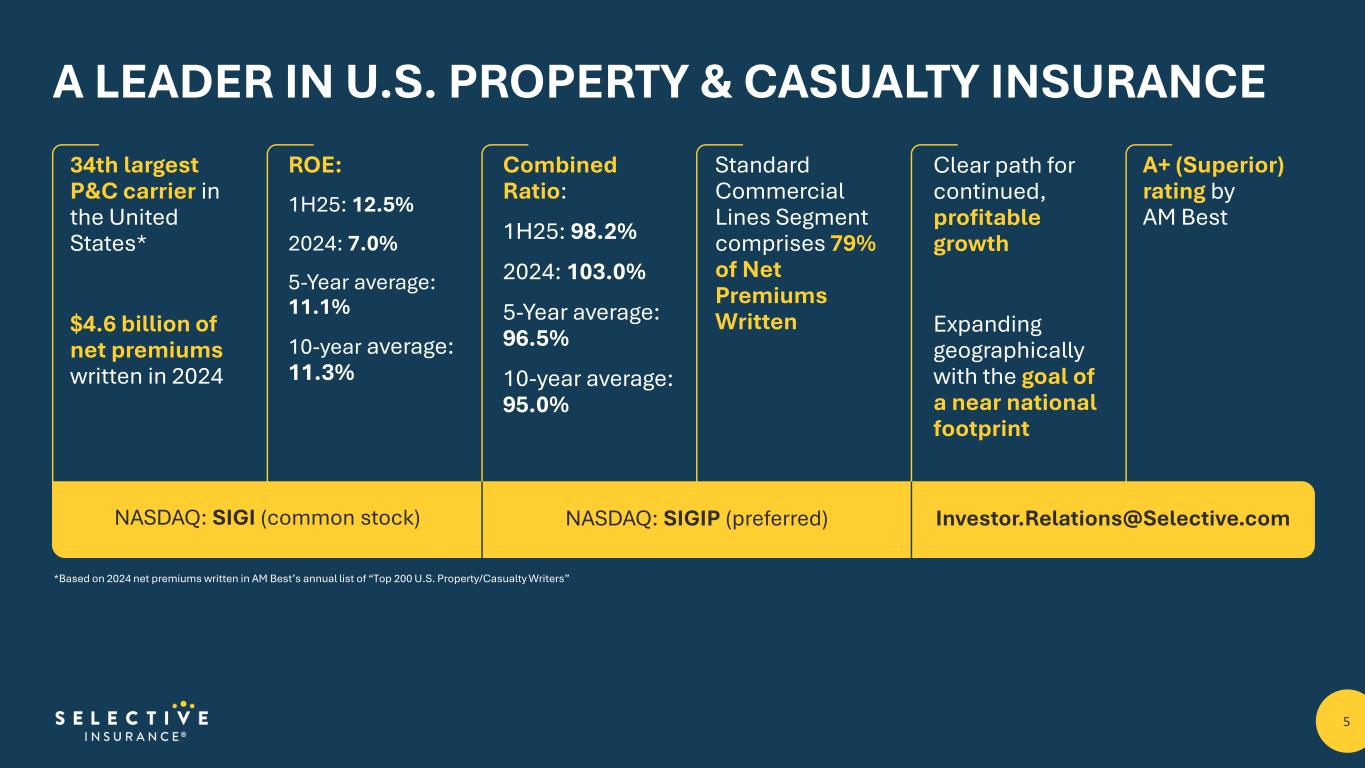
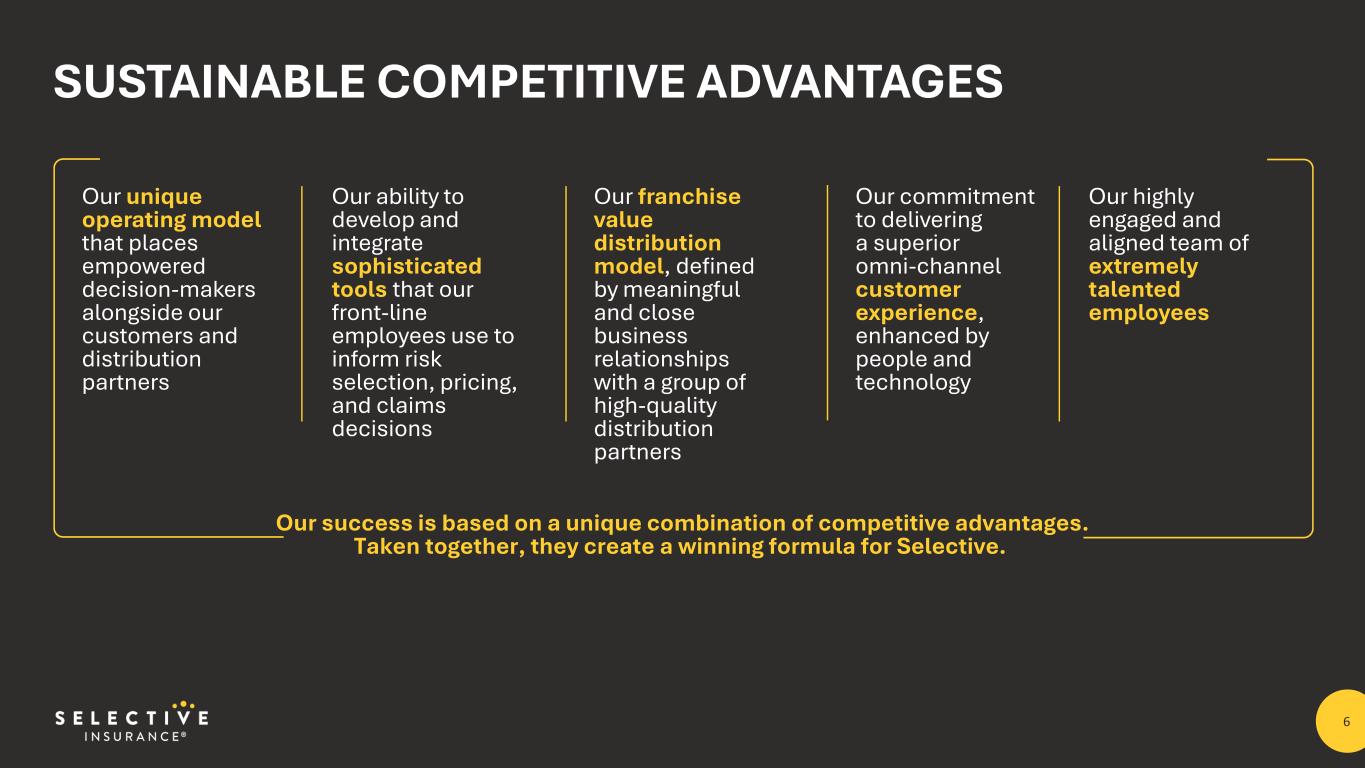
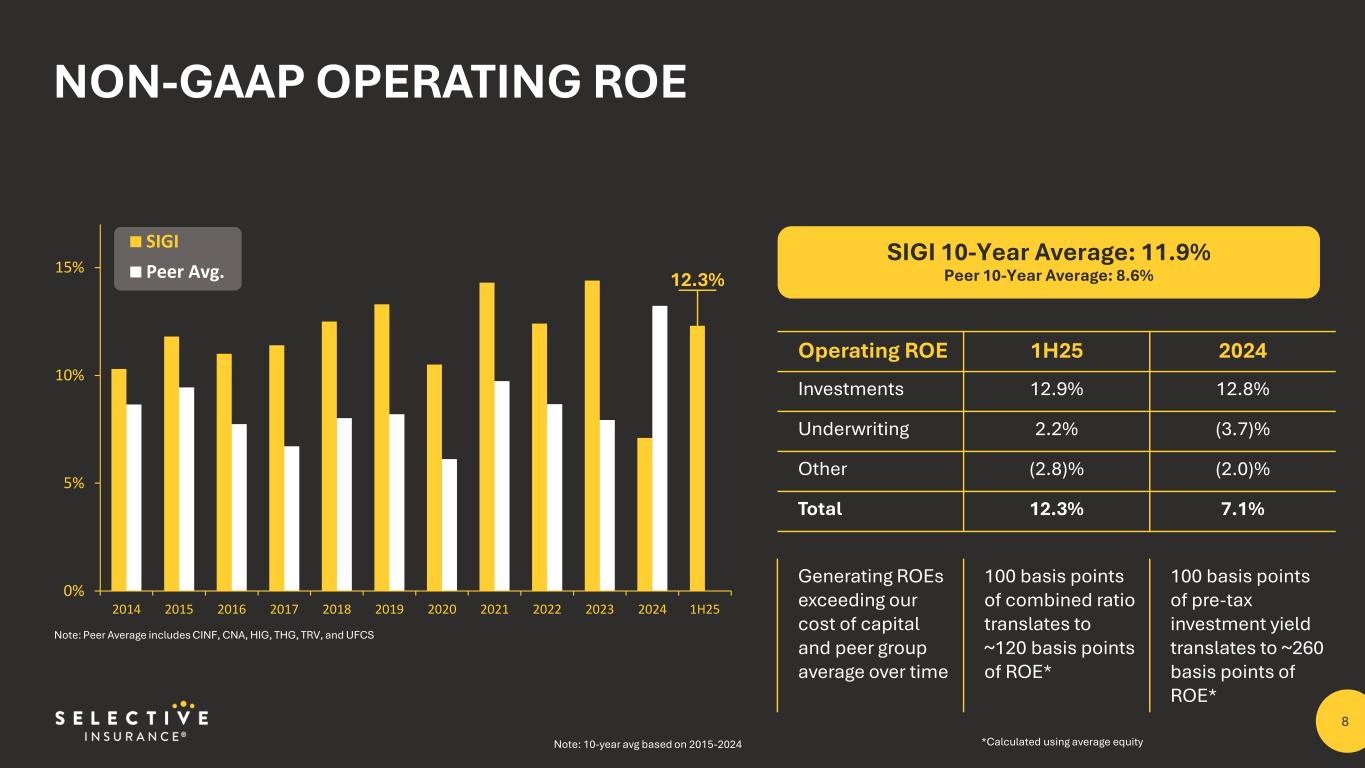
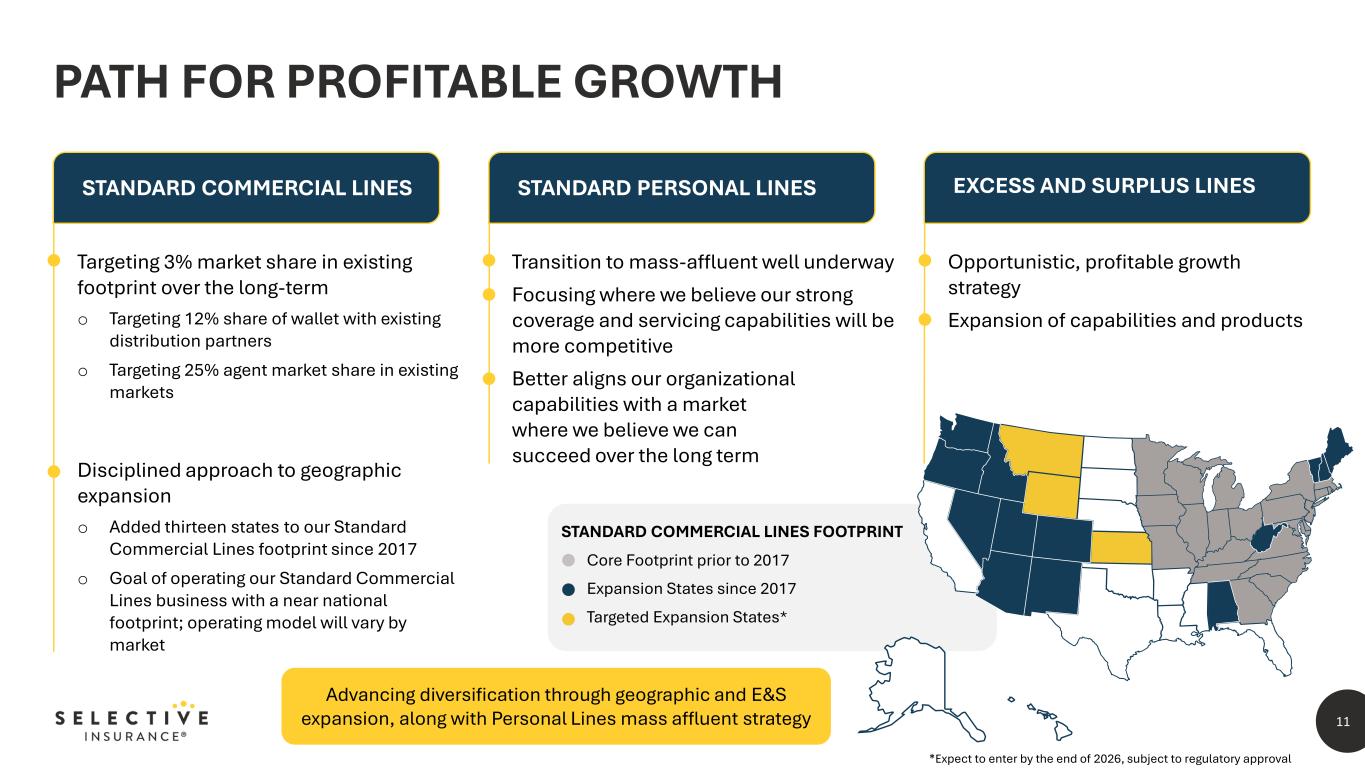
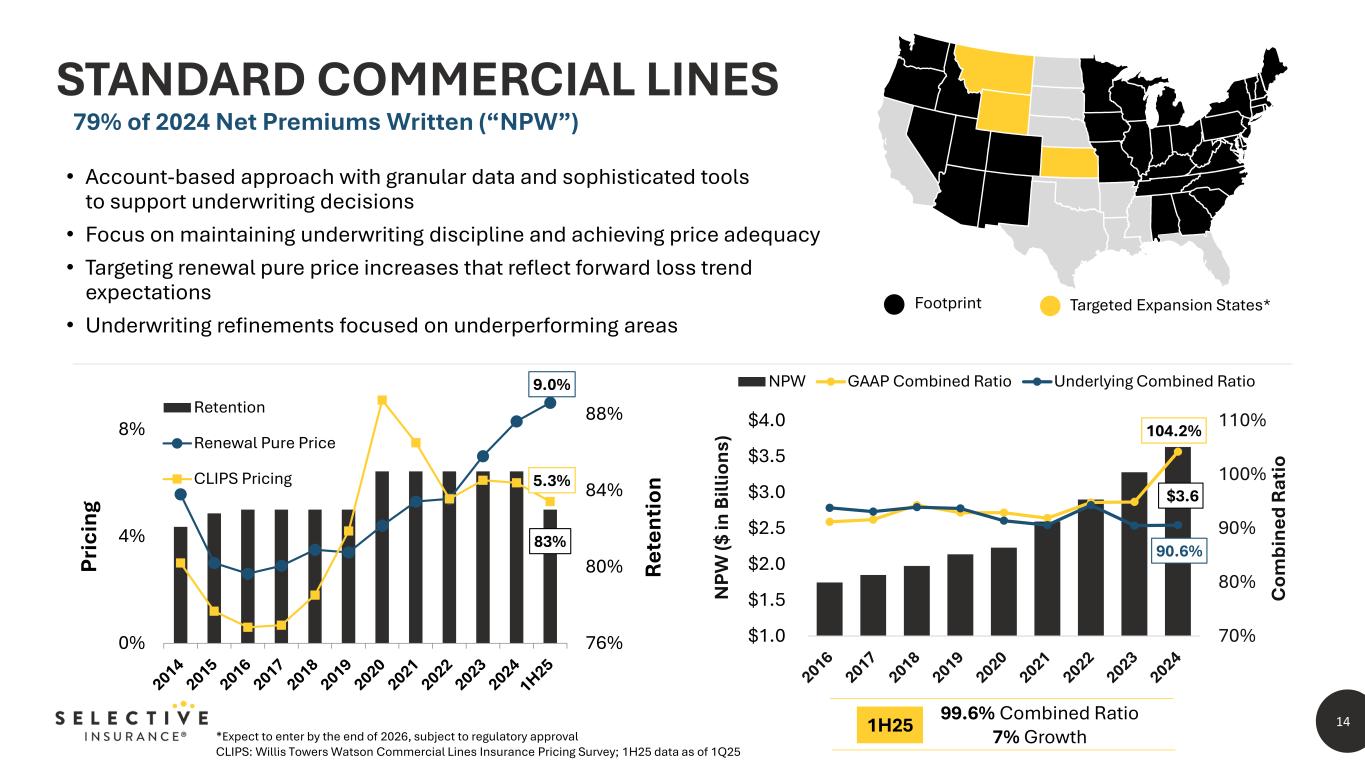
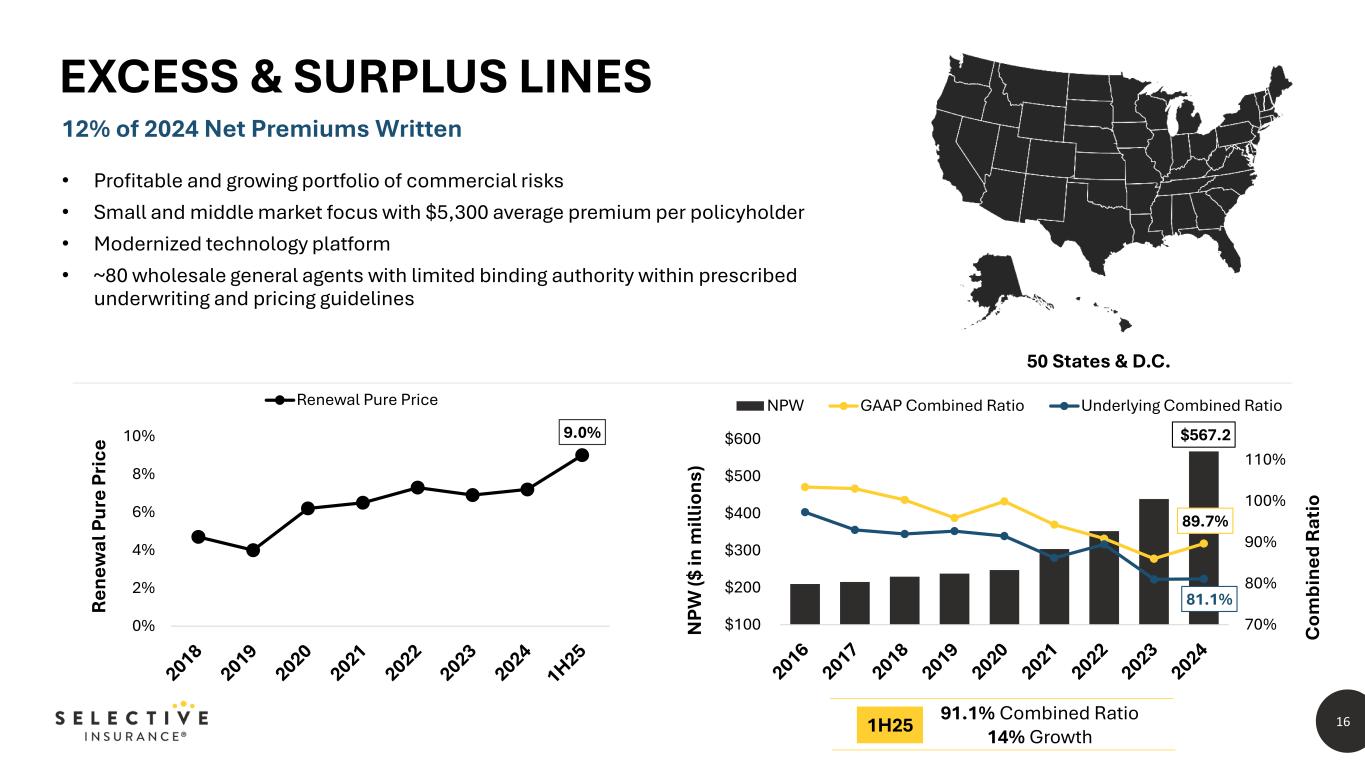
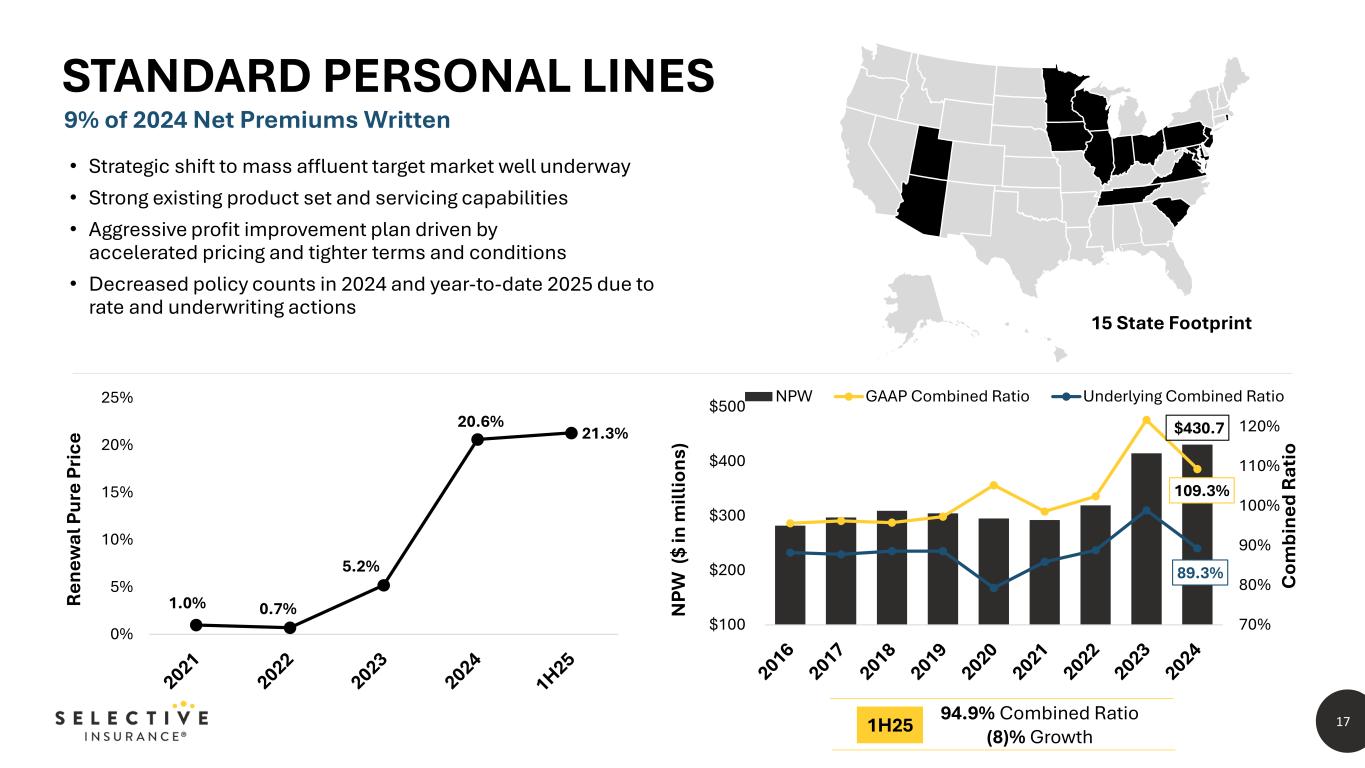
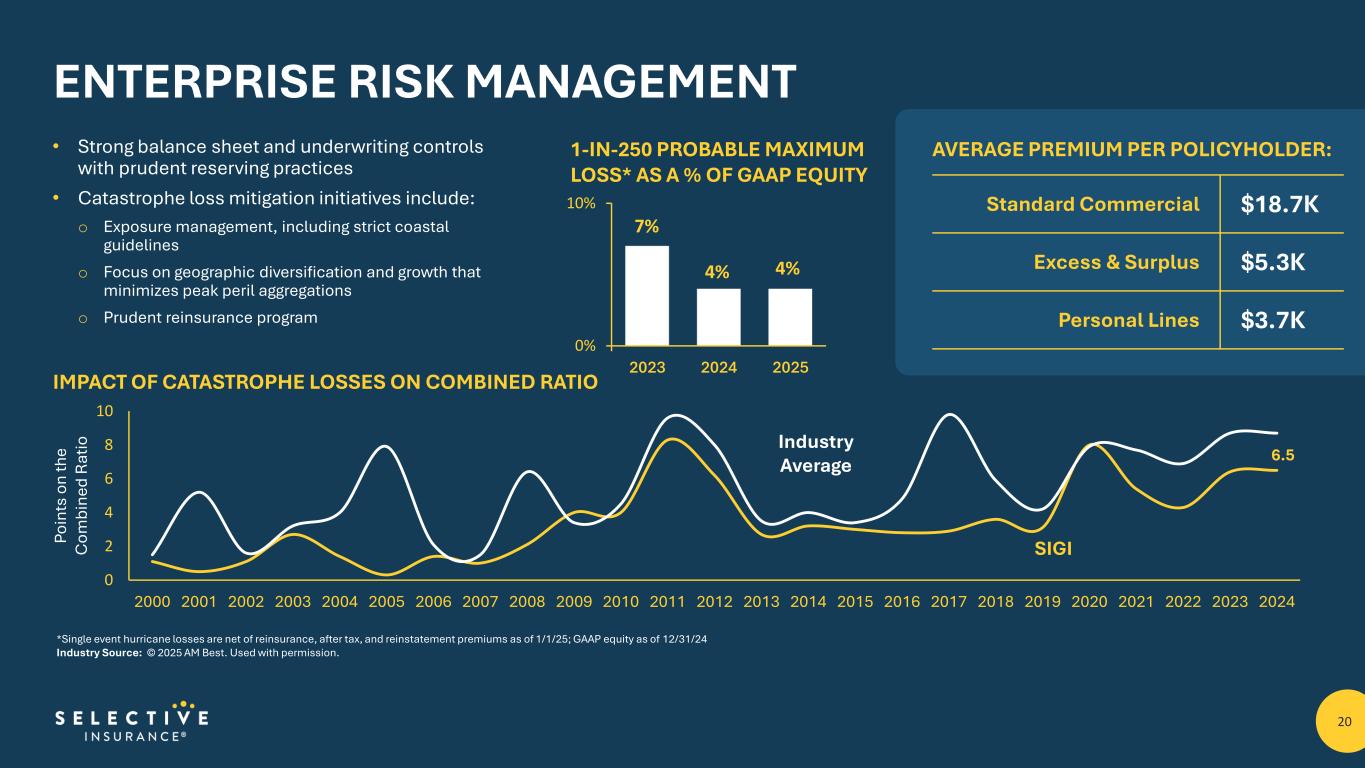
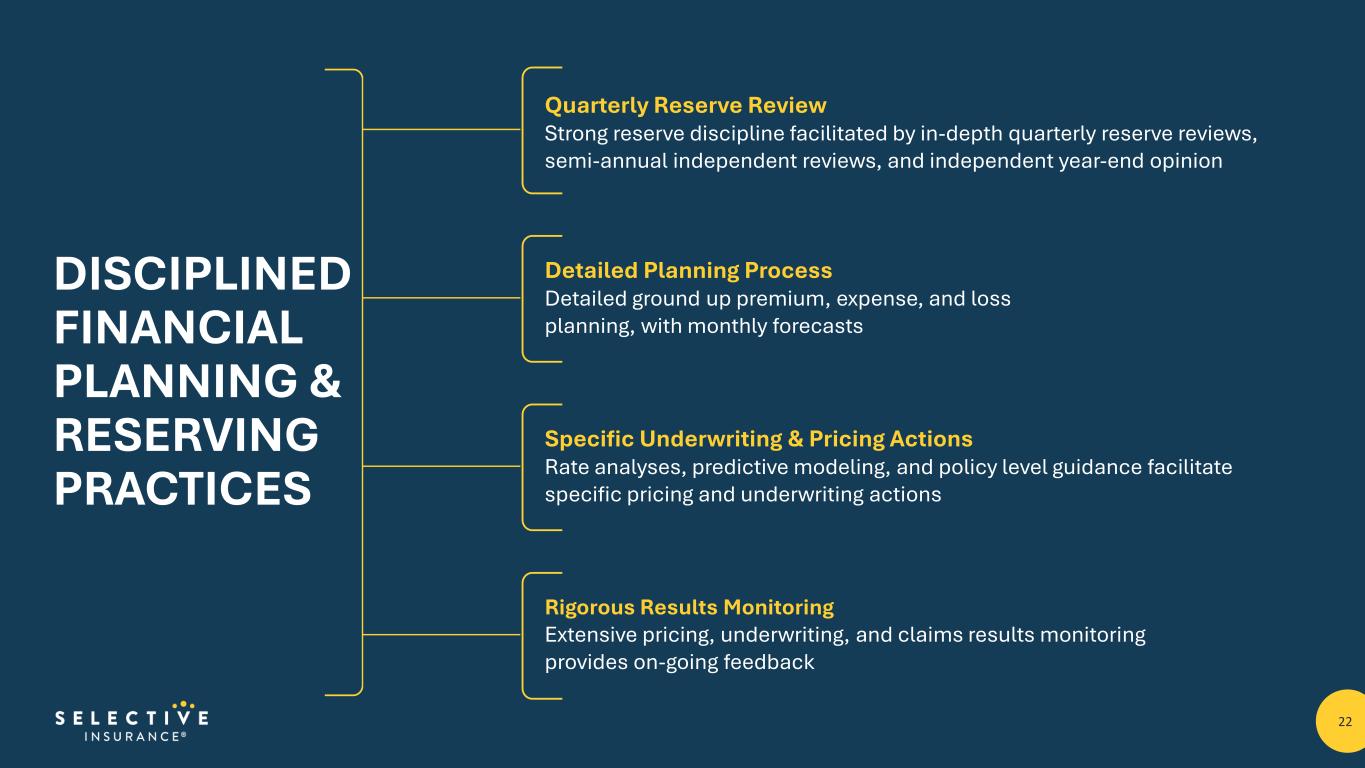
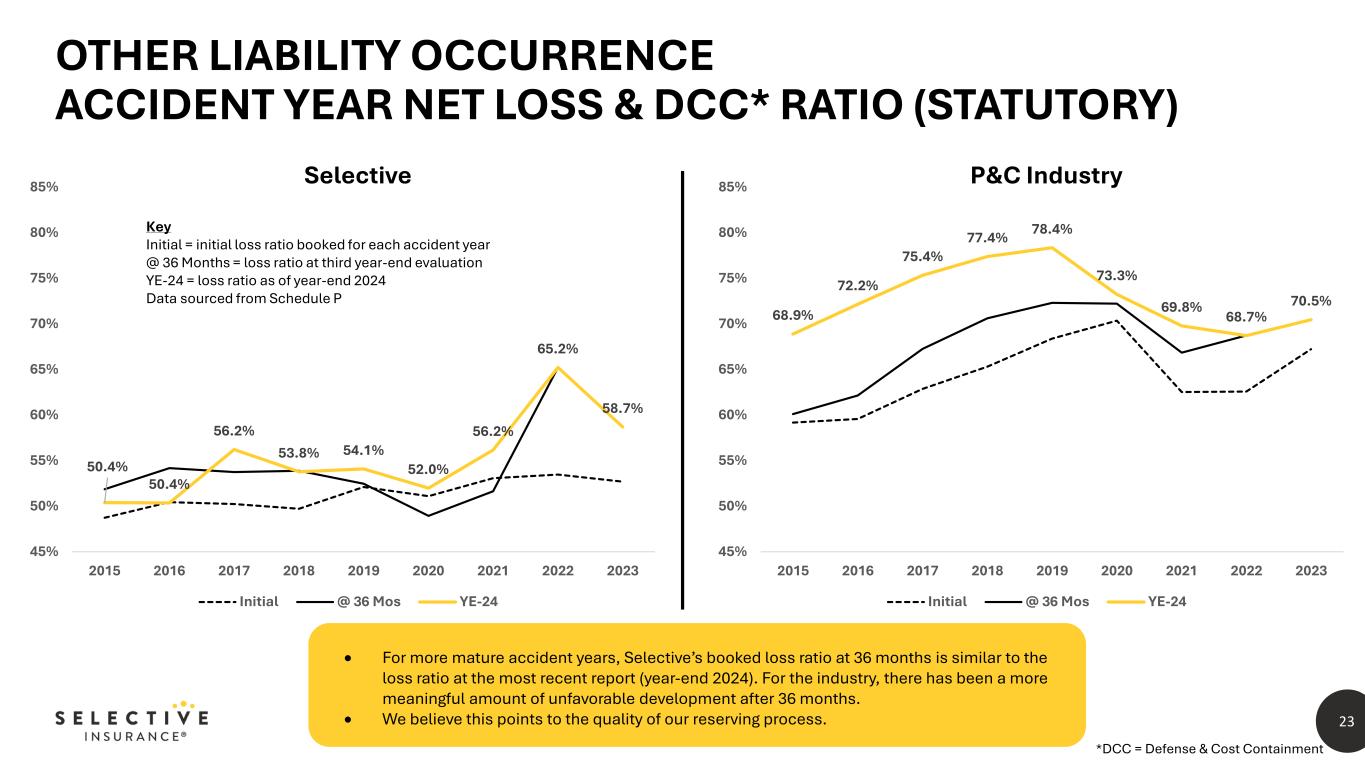
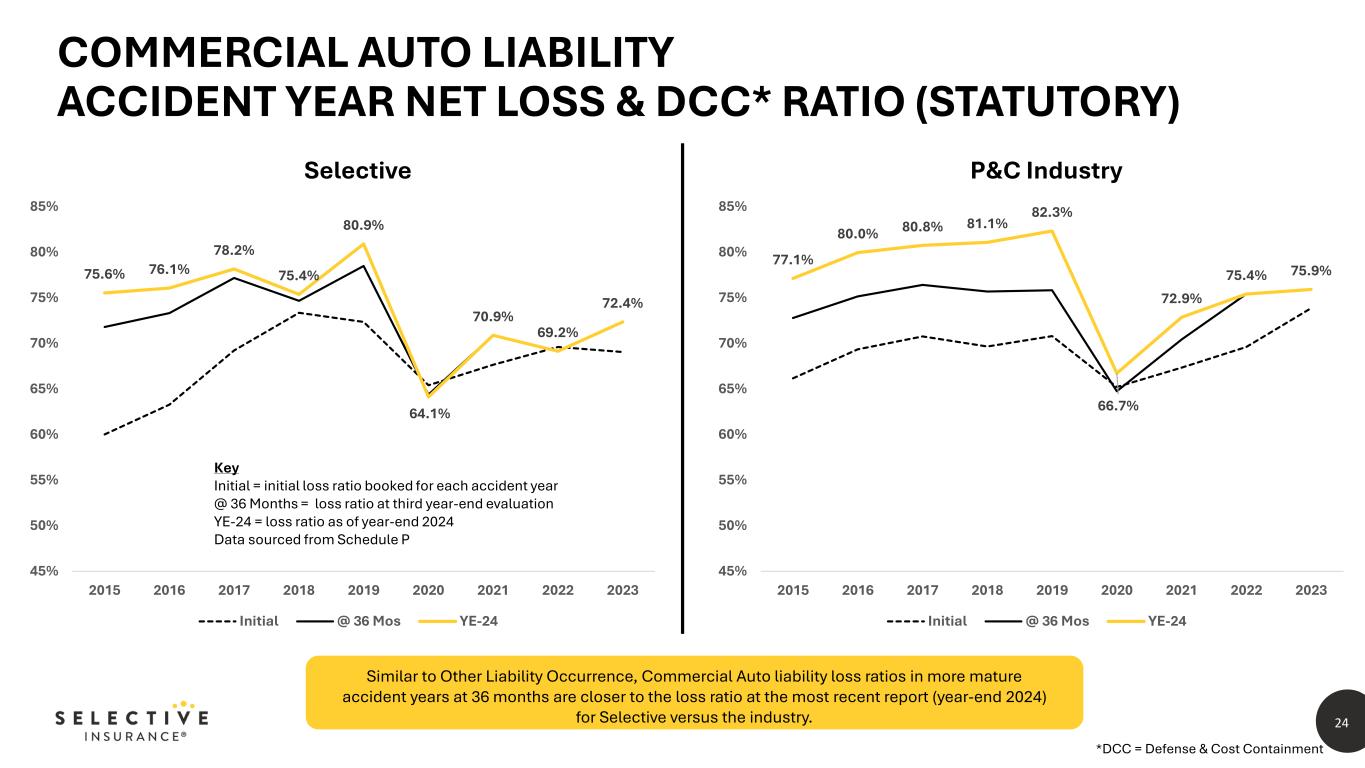
Thanks, Brad, and good morning. We delivered an operating return on equity of 10.3% this quarter with excellent investment income, which increased 18% from the prior year period. Excess and surplus and Personal lines produced strong results in the quarter, with both segments reporting quarterly and year-to-date combined ratios at or below our 95% long-term target. Overall, our insurance segments grew 5%, reflecting our disciplined underwriting and pricing strategy in an increasingly competitive market. In Standard Commercial Lines, renewal pure price increased 8.9%, and we continue to execute targeted underwriting and claims actions that I will describe later in more detail. We recorded $45 million or 3.8 points of unfavorable prior year casualty reserve development related to general liability and commercial auto. This pushed our overall combined ratio for the quarter to 100.2%, including an assumed 6 points of catastrophe losses. Given this reserving action and those in 2024, I want to provide context around our process, current risks, and how we respond when new loss data emerges. In addition to comprehensive quarterly reserve reviews, we conduct semiannual independent reserve assessments and periodically engage third parties for benchmarking and methodology reviews. Ultimately, reserve development reflects the quality of our initial loss picks. Historically, those have held up quite well. Focusing on the more mature 2015 to 2019 accident years through 2024, we increased our other liability occurrence ultimate losses by 5.5% from our initial picks compared to an average 14% increase for the industry. In the 2021 to 2023 accident years, we increased our ultimate losses by 13% compared to the industry's 5%. While industry trends in recent years have not matched pre-pandemic levels, there have been significant reserving actions, which we believe point to industry-wide pressure on this line of business. Schedule P data confirms that we tend to respond early to loss emergence, even for relatively immature accident years for longer tail lines. We added new slides in our investor presentation to highlight this point. For more mature accident years and other liability occurrence and commercial auto liability, our booked loss ratio at the third year-end evaluation for a given accident year is similar to the loss ratio at year-end 2024. For the industry, there has been a more meaningful amount of unfavorable development after the third year-end evaluation. This responsiveness informs our view when setting prospective loss trends and pricing strategy. Our casualty mix of business is higher than our peers. This has been a benefit when property lines have been challenged, and our historical catastrophe losses and volatility are lower than the industry average. However, the ongoing industry-wide social inflationary environment has an outsized impact on casualty lines, particularly on claims involving bodily injury. We have been steadily increasing our loss trend estimates for casualty lines in recent years, largely in anticipation of social inflationary impacts on claim severities. Those assumptions are embedded in the current accident year loss ratios we are reporting. In our quarterly reserve review, the frequency and severity estimates included in our ultimate loss selections are key metrics. Claim frequencies are our earliest profitability indicator, and we have a robust monitoring process that includes reviewing actual and expected claim counts. Through the first half of the year, overall accident year 2025 casualty claim frequencies are consistent with or in some cases, better than our initial expectations. Workers' compensation claim counts in particular have been notably lower than expected. However, we responded to elevated recent accident year paid emergence this quarter. In general liability, we recorded $20 million of unfavorable prior year development, primarily tied to the 2022 and 2023 accident years in the umbrella and product sublines. Higher auto liability severities have increased the frequency of claims piercing the umbrella layer. The product line has also experienced elevated litigation rates and paid severities in recent years, impacting both loss and allocated loss adjustment expenses. In commercial auto, we responded to elevated paid severity emergence in the quarter, strengthening reserves by $25 million, primarily related to the 2022 through 2024 accident years. The loss trends we are seeing are broad-based, impacting most geographies and major industry groups. Our 2025 loss ratio includes assumptions for escalating severity trends. Even with the reserve increases in commercial auto and general liability for prior accident years this quarter, we remain comfortable with the ultimate severity trend implied by our current year loss ratio selections. We have adopted several strategies in recent years to address social inflation challenges, which involve pricing, underwriting, and claims. Related to pricing, we continue to seek and achieve overall renewal pure price increases above expected loss trend. I'll discuss pricing in more detail in our segment results, and we're continuing to execute these increases in a granular fashion. Within underwriting, we continue to take actions to maximize our well-known strategic competitive advantages. Our strong distribution partner relationships, our unique field-based operating model, and our sophisticated tools contribute to this. These actions include tightening underwriting guidelines for select liability exposures, including certain contractors' coverage offerings, managing limits in challenging jurisdictions, reducing the number of new umbrella lines with a particular focus on reducing limits greater than $5 million, increasing minimum premiums in general liability and umbrella, trimming underperforming classes or risks with emerging exposures, and prioritizing new business in better-performing segments. Contractors are our largest industry segment and have a higher mix of general liability and commercial auto exposure. We have built strong expertise in this industry segment and remain comfortable in our ability to produce consistent growth and profitability. However, we continue to invest in diversifying our business mix and geographic footprint. In addition to diversification within Commercial Lines, our efforts to expand our E&S business and Personal Lines mass affluent strategy will contribute to a more balanced portfolio in the future. We remain focused on the fundamentals of claims. Our adjusters specialize by claim type, size, and jurisdiction. For example, we have a limited number of adjusters assigned to Georgia bodily injury or New York labor law cases, to drive greater insight into best practices in analyzing these higher-risk claims and defending related litigation. To address social inflation, we have increased the review of cases going to trial, boosting the use of second opinions, engaging jury consultants, conducting mock trials, and using roundtables to gain further insights about potential outcomes. We also have created an internal task force to evaluate our fraud beta review processes and gain insights about where to invest additional investigatory resources. We're currently in the process of developing attorney representation claims models to replace our existing claims litigation models to more quickly identify which claimants are likely to seek representation. Our pricing strategies and underwriting refinements contributed to slower premium growth in the quarter. Overall, renewal pure pricing across our three insurance segments was 9.9%, up 80 basis points from a year ago. We will continue to maintain a balanced approach and make investments to support future growth. However, we believe emphasizing improving underwriting margins and tempering the top line in the current environment is prudent. Turning to segment performance. Standard Commercial Lines reported a 102.8 combined ratio, including 4.8 points of unfavorable prior year casualty development. Renewal pure price increased from a year ago to 8.9%, led by general liability at 11.9%. Commercial auto renewal pure price was 10.4% and Property was 7.8%. Property renewal pure price increases slowed in the quarter compared to our recent run rate, reflecting broader market conditions and improved profitability. Renewal pure price excluding workers' compensation was 10.2%. Retention for the quarter fell 2 points to 83% due to our rate increases and underwriting actions, along with an increasingly competitive environment. Excess and surplus lines grew 9% this quarter, driven by an average renewal pure price increase of 9.3%. The segment's combined ratio was 89.8%, and we see continued growth opportunities for this segment. We have deployed deliberate E&S strategies and introduced new products over time, expanded our brokerage business, and invested in operational efficiency. We are now in the early stages of giving our retail agents access to our E&S offerings. We do not expect to realize immediate significant growth from this latest effort, but believe it will facilitate additional growth capacity over time. The Personal Lines combined ratio was 91.6%, 26.5 points better than a year ago. Our rating and non-rating actions to reposition this book are continuing to gain traction. We are emphasizing growth in states with adequate rate levels. And as a result, Personal Lines net premiums written declined 5%. However, target business grew 16% in the quarter, with nearly all new business being in our target mass affluent market. Renewal pure price for the quarter was 19%. We expect rate changes will remain above loss trends, but moderate in comparison to those achieved in 2024 as the portfolio moves closer to achieving long-term target profitability. In summary, we delivered a 12.3% operating ROE through the first half of the year and remain focused on executing our risk management strategies while driving long-term profitable growth. Loss trends remain elevated, but we are confident in our ability to quickly identify and address areas within our control and deliver consistent underwriting margins over the long term. Now I will turn the call over to Patrick, who will provide more details about our financial results.
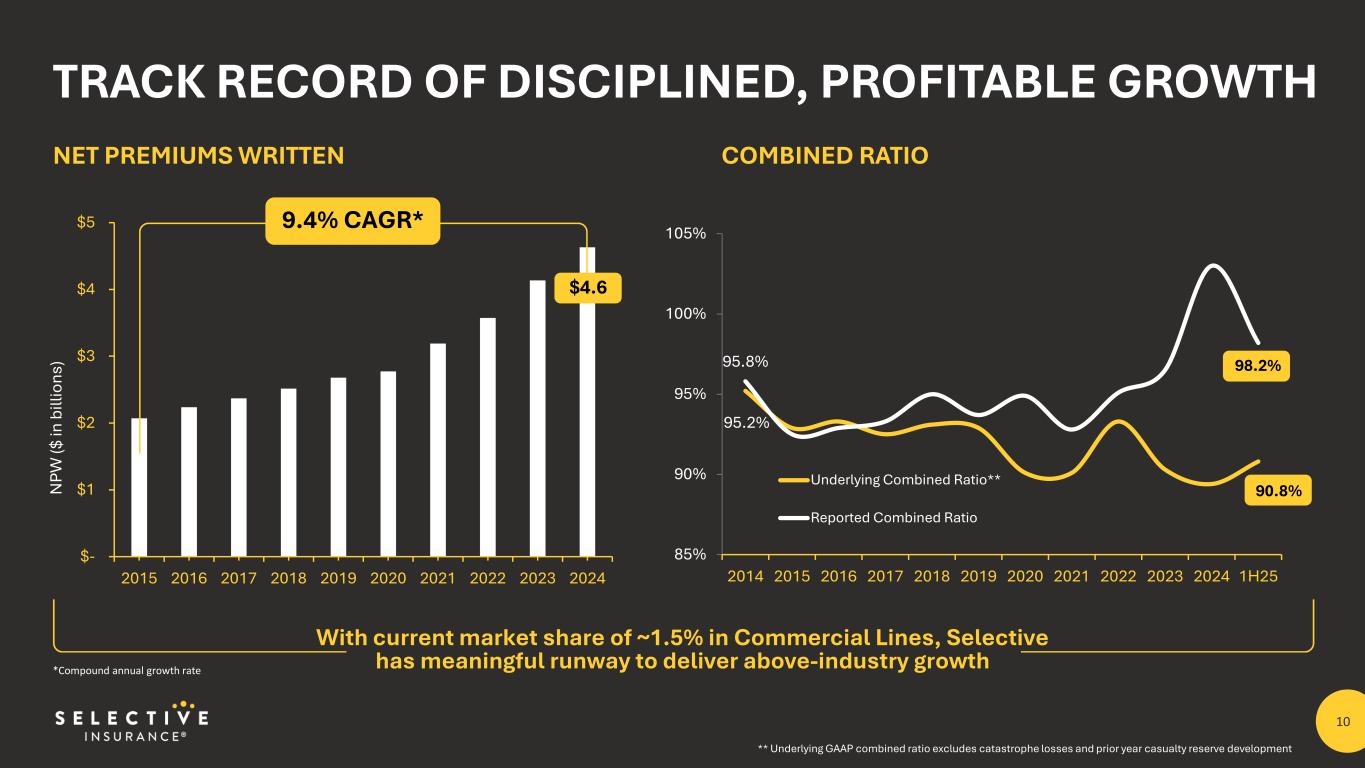
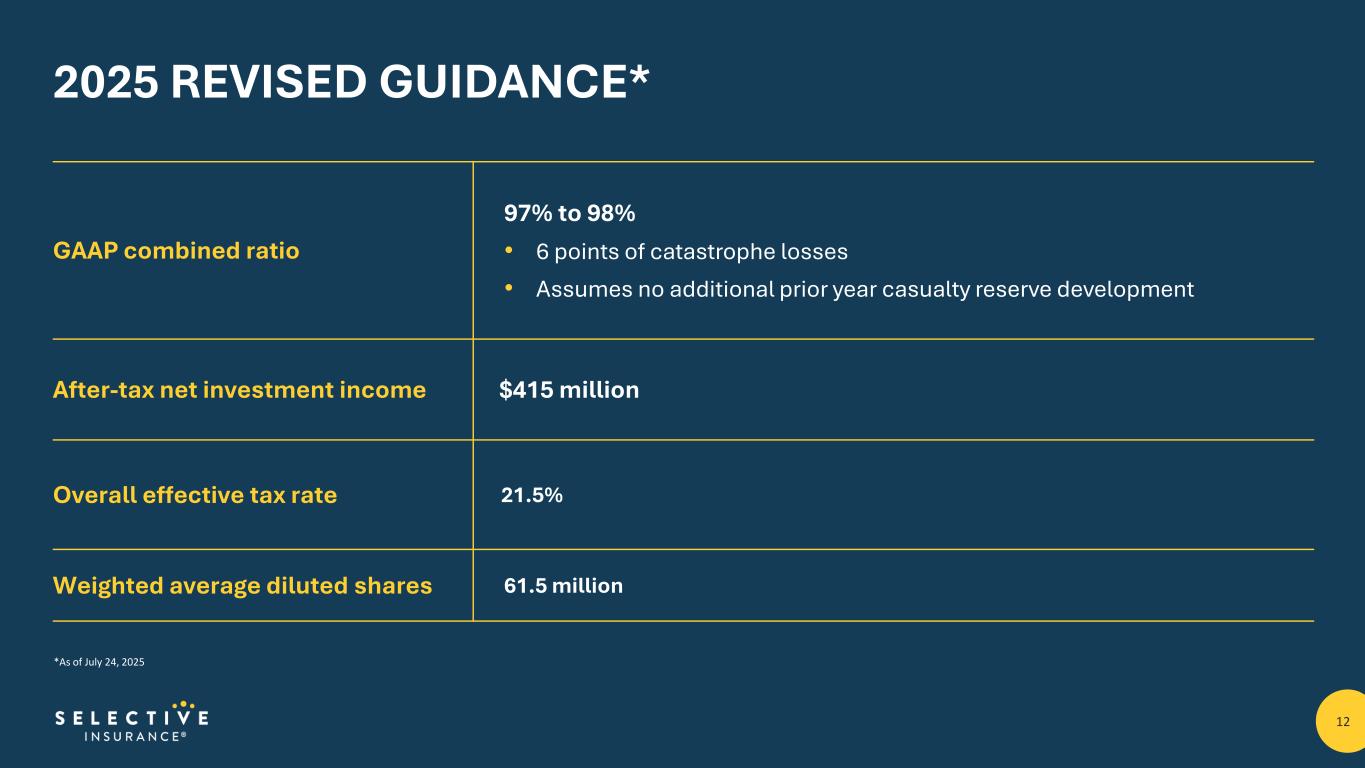
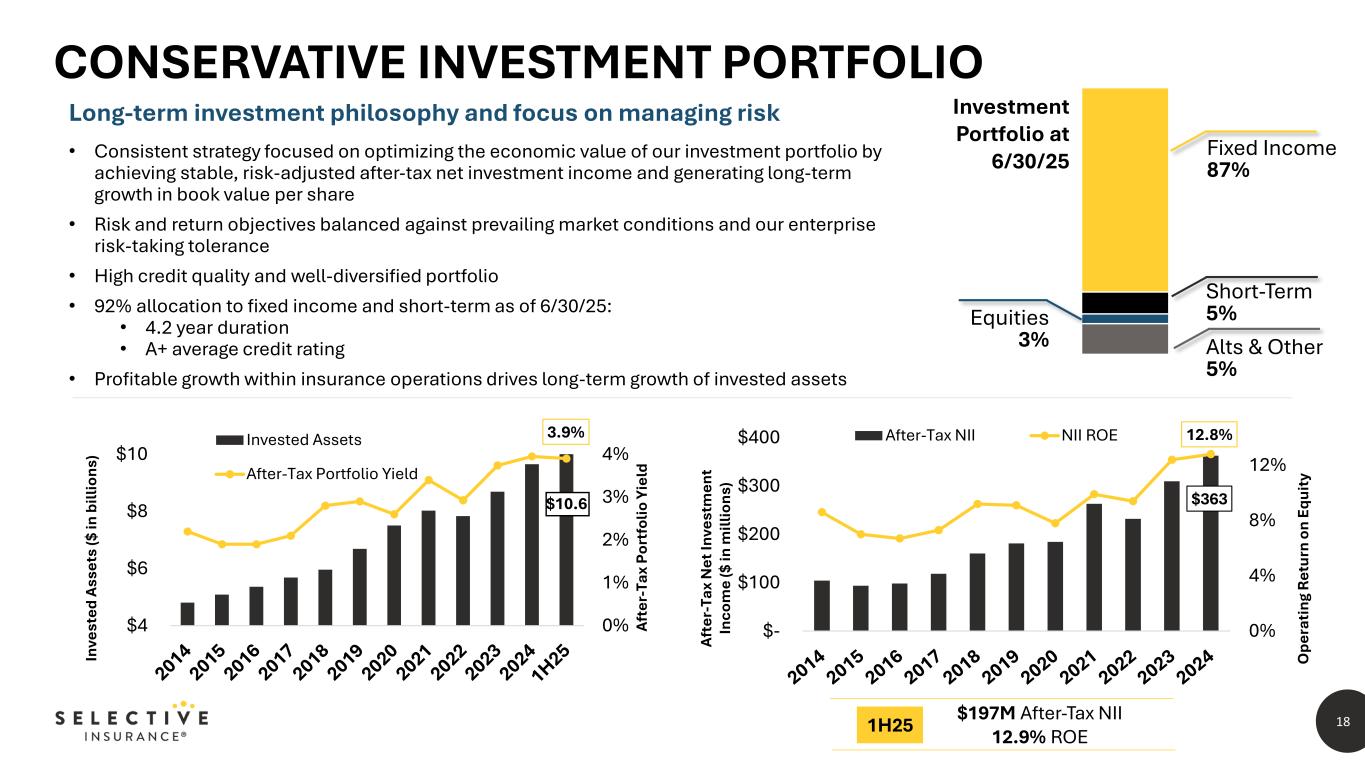
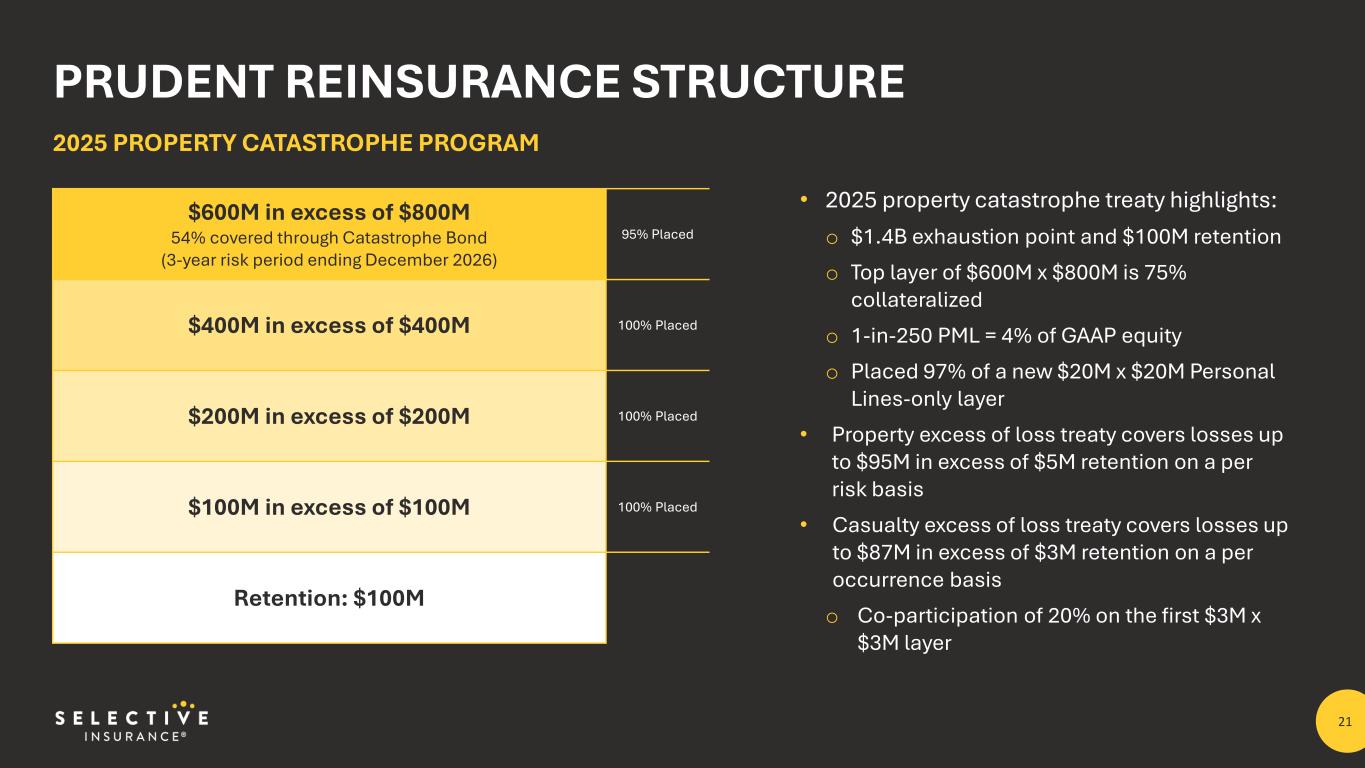
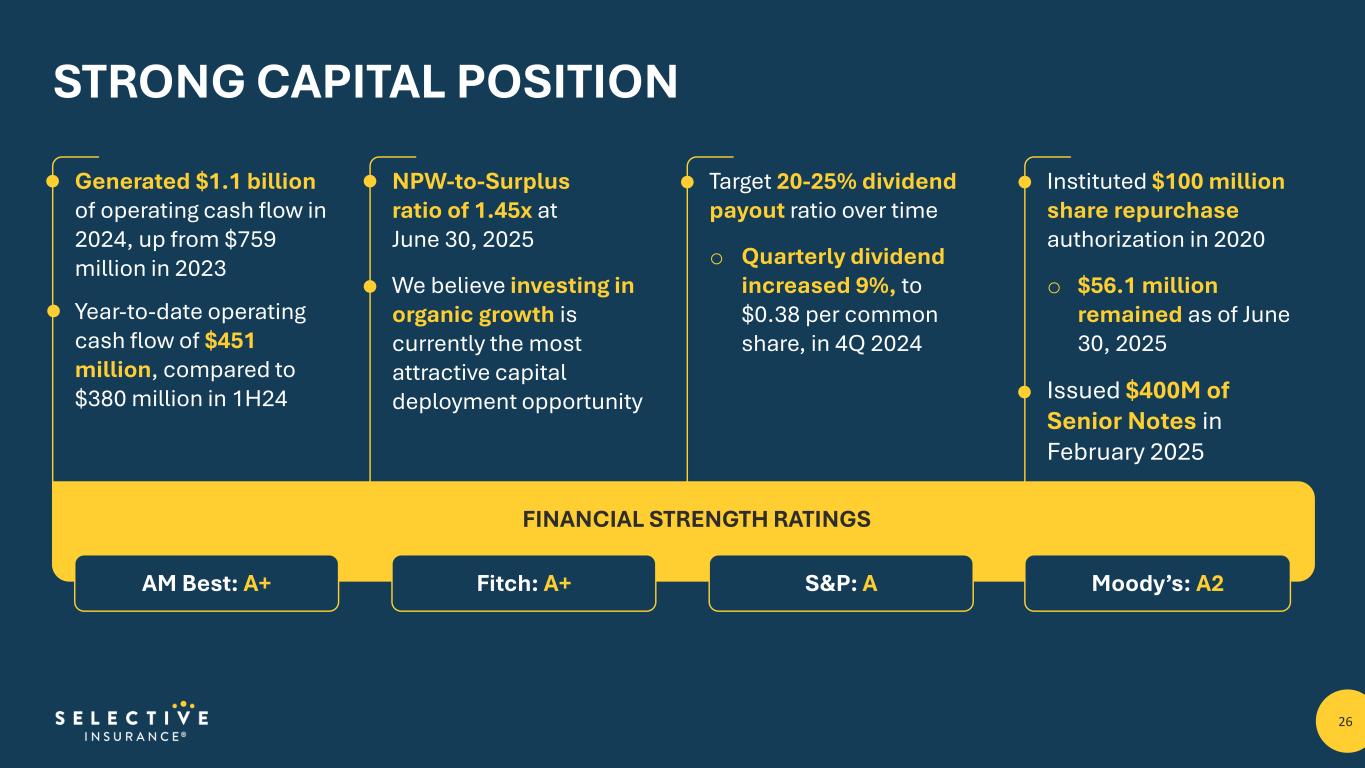
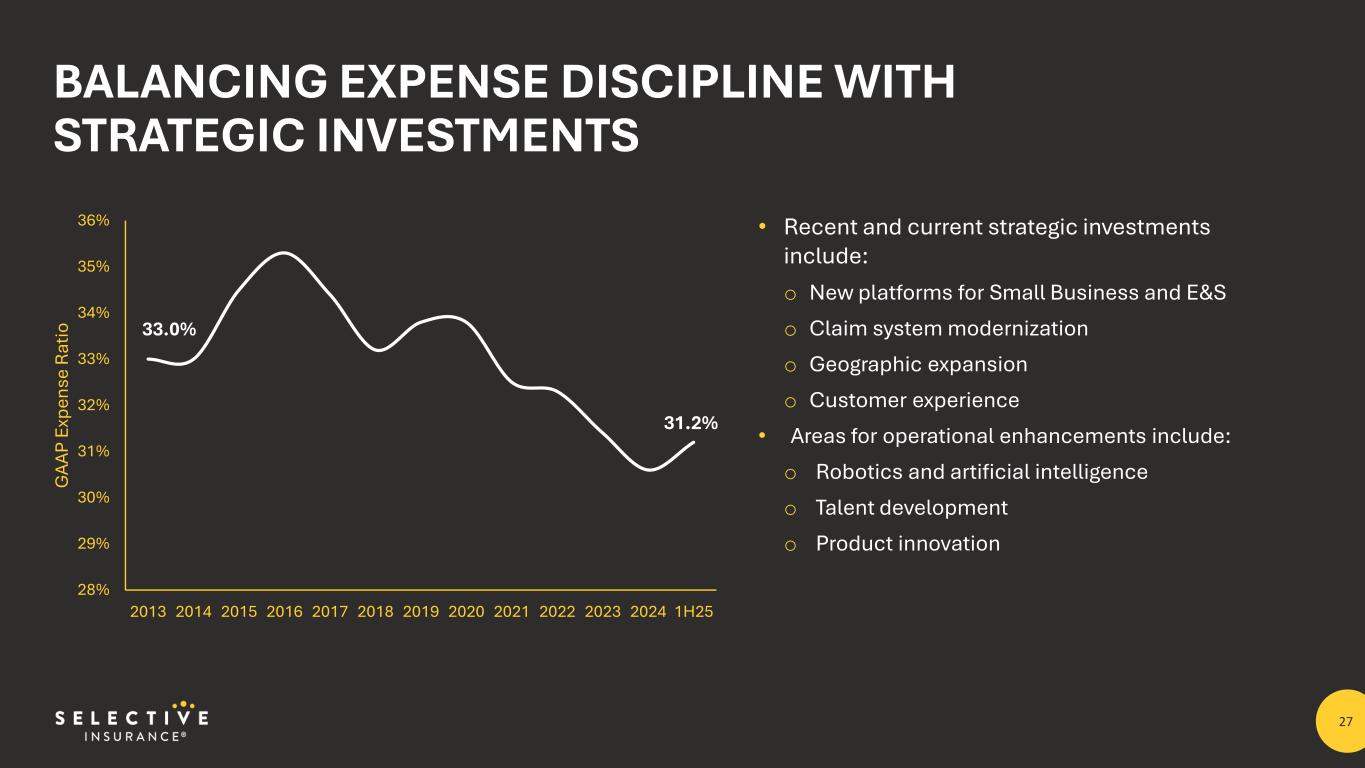
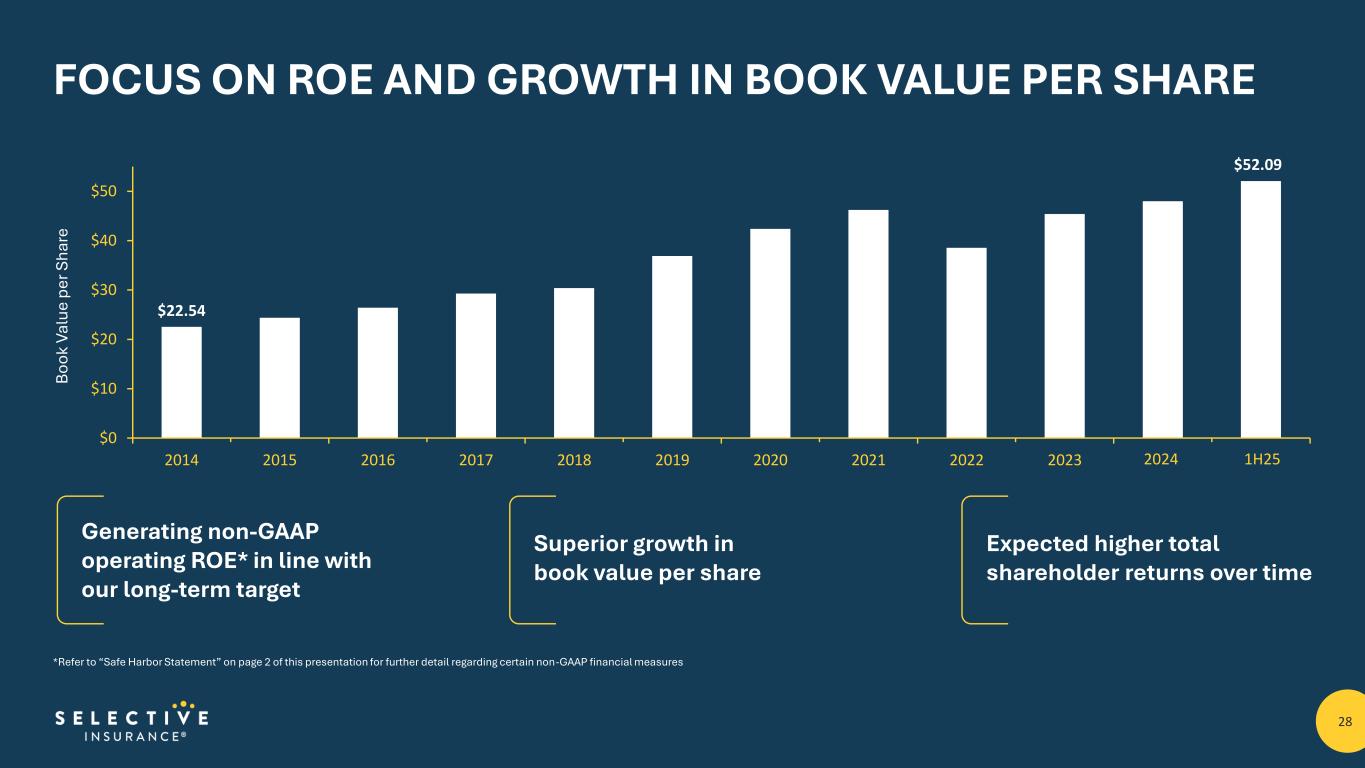
Thanks, John, and good morning, everyone. For the quarter, fully diluted EPS was $1.36 and non-GAAP operating EPS was $1.31. Our underwriting performance was breakeven, but our return on equity was 10.7%, and operating ROE was 10.3% due to the investment portfolio's continued strong performance. The GAAP combined ratio for the quarter was 100.2%, which was elevated primarily due to the 3.8 points of unfavorable prior year casualty reserve development that John discussed. Catastrophe losses were 6.7%, which was better than anticipated and 1.7 points better than the prior year period. We continue to see the benefits from profitability improvement actions in Personal Lines as we execute our mass affluent strategy. As expected, excess and surplus lines delivered another strong quarter. In Standard Commercial Lines, we're focused on executing appropriate underwriting actions and rate increases to address the current environment and position us to achieve target margins. Our overall underlying combined ratio for the quarter was 89.7%, an improvement of 170 basis points from the prior year period. Year-to-date, the underlying combined ratio was 90.8%, which is up 20 basis points from the first half of 2024. Non-catastrophe property losses were 15 points year-to-date, which is 170 basis points better than a year ago and reflects continued benefits from property lines earned rate and the tightening of terms and conditions over the last few years. Year-to-date, these benefits are more than offset by a 140 basis point increase in current year casualty loss costs. The expense ratio increased by 60 points, primarily driven by higher expected employee compensation after last year's lower profit-based payouts. We remain focused on expense discipline and deploying capital to support scale, enhance decision-making, and operational efficiency. Second quarter after-tax net investment income was $101 million, up 18% from a year ago. This income generated 13 points of return on equity, up 50 basis points from the second quarter of 2024. We continue to position our investment portfolio conservatively and have made no significant changes to our investment strategy. Total fixed-income and short-term investments at quarter end represented 92% of the portfolio and had an average credit quality of A+ and a duration of 4.2 years. We delivered strong operating cash flow in the quarter, allowing us to make over $750 million of new investments. The average new purchase yield was an attractive 5.7% pretax, and the quarter-end average pretax book yield was 5%. We expect this embedded book yield to provide a durable source of future investment income. Turning to capital, we ended the quarter with $3.4 billion of GAAP equity and $3.3 billion of statutory surplus. Book value per share increased 9% in the first half of the year, driven by our profitability and a $1.74 per share reduction in after-tax net unrealized fixed income security losses. Debt to capital was 21.1%, below our internal threshold of 25%. We continue to return capital to our shareholders by issuing quarterly dividends and opportunistic share repurchases. During the second quarter, we did not repurchase any shares of common stock, and $56 million remained available under our repurchase authorization as of June 30. Effective July 1, we successfully renewed the casualty excess of loss and property per risk treaties that cover Standard Commercial Lines, Standard Personal Lines, and E&S. The casualty excess of loss treaty covers all our casualty business and provides $87 million of protection above a $3 million retention. We increased the first layer to a $3 million retention, up from $2 million, and continue to retain a portion of the first layer through co-participation. The remaining treaty layers were fully placed without co-participation. We also renewed our property per risk treaty, now providing $95 million of coverage in excess of a $5 million retention for losses on a per risk basis. The $30 million limit increase from the expiring treaty reflects growth and higher insured values. Pricing in key terms and conditions were within our expectations heading into the renewal. In light of results through the first half of the year, our revised 2025 guidance is as follows: we expect our 2025 combined GAAP combined ratio to be between 97% and 98%, up 1 point from prior guidance. Our guidance includes 6 points of catastrophe losses and the impact of prior year casualty reserve development reported through the second quarter. It assumes no additional prior year casualty reserve development and no further change in loss cost estimates. We do not make assumptions about future reserve development as we book our best estimate each quarter. After-tax net investment income of $415 million, up from prior year guidance of $405 million. Our guidance includes an overall effective tax rate of approximately 21.5%. Our guidance assumes an estimated $61.5 million of fully diluted weighted average shares, including those repurchased in the first quarter, and assumes no additional repurchases under our existing share repurchase authorization. With that, I'll now turn it over to Q&A. Operator, please start our question-and-answer session.
Operator
Our first question comes from Michael Phillips with Oppenheimer.
Speaker 4
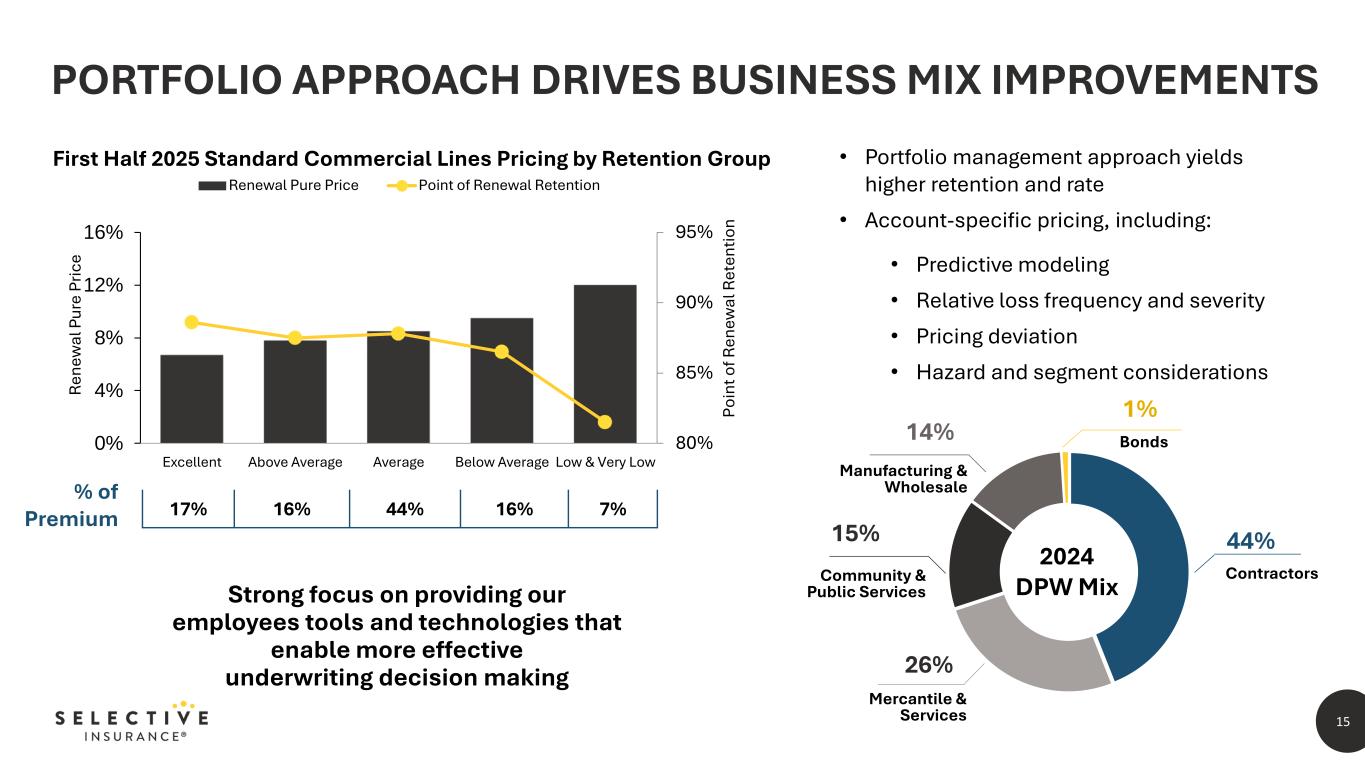
Appreciate the new slides, John. I guess, I want to ask a question on a slide that's been in your deck for a while, and that's where you show kind of the excellent above-average and below-average retention in pure price. That slide hasn't changed much over the past year. And I guess, I wonder if, if we look forward to maybe the next year, should it change specifically the below average, very low jack-up 20% rates and see retention fall to the floor. Why not see that? And I guess, maybe partly the answer could be your comments on broad-based. Is this social inflation issue? Is it across your entire book? Or is it more concentrated in kind of what you're labeling these below-average risks.
Thank you, Mike, for your question. We've been presenting that slide for quite some time. It illustrates ongoing business improvements, demonstrated by lower retention rates and a higher percentage of low and very low risk categories, alongside higher retention in the excellent and above-average groups. We continue to focus on this aspect. It's important to remember that unlike rate plans in Personal Lines or small commercial where individual accounts remain stable, we can push these rates more aggressively. However, we also face a subjective underwriting component that affects those categories. Overall, what we're observing aligns with our expectations, and we will keep adjusting our approach. Still, it's not as straightforward as it would be in a clear rate plan like those in small commercial or Personal Lines, which lack the discretionary pricing and underwriting influences on top of the model outputs.
Speaker 4
I mean, I guess, part of the question then would be, are the issues you're seeing, are they across your entire book? Or are they more concentrated in certain accounts that you kind of want to win yourself off of?
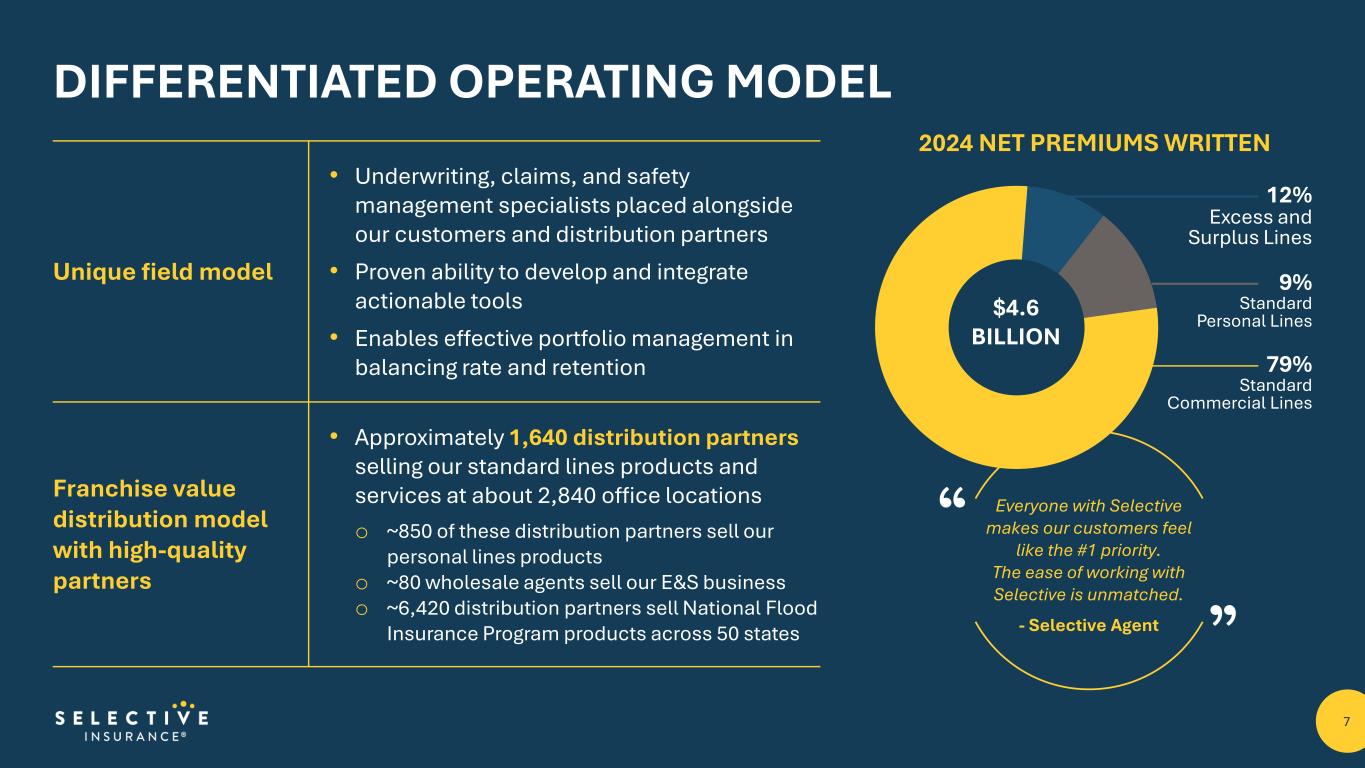
Yes. I appreciate your emphasis on this matter, and while we have discussed it previously, it remains something we are actively evaluating. We're observing and reacting to an increase in higher paid claims across various industry sectors and regions. This is a significant point that also relates to our comments about commercial auto and general liability. Our priority is to ensure we are responding appropriately to what seems to be a broader industry trend driving social inflation, while also acknowledging areas we can control. We need to maintain a continuous improvement mindset to ensure our individual risk selection and claims decisions yield the right outcomes regularly. We believe there will be ongoing refinement in that area, and it’s essential that we keep focusing on it. What we’re experiencing is indeed widespread. Based on feedback following our earnings release, I want to underscore this. We have a higher proportion of Commercial Auto and General Liability compared to some peers and the industry overall. These two lines, which are significantly affected by social inflation, account for about 64% of our Commercial Lines premium and just over 51% of our total premium. Our belief that the severity trends we’re noticing are driven by social inflation, rather than being unique to our portfolio, is something we stand by, but it's also something we continually assess critically. We do this by ensuring we maintain stability in our portfolio and pricing on a risk-by-risk basis, which remains the case. Furthermore, to validate our perspective, we conduct extensive industry analysis on frequency and severity trends, performing thorough analyses for our peer group and the whole industry to confirm that the trends we observe are consistent with broader industry patterns. We see this consistency, which we highlighted in our investor presentation to demonstrate historically that we tend to react more swiftly. You can observe this in past data for both general liability and commercial auto. While this past data is informative, we will eventually find out if those patterns hold true for recent accident years. However, I believe it's a crucial insight as we evaluate how well our estimates hold up and how quickly we adjust our current views of past accident years. It's vital that we dedicate sufficient time to this important subject, and I assure you we are continuously validating our belief that this issue is indeed widespread and industry-driven.
Speaker 4
Okay. That's perfect. I guess if I could, and I also appreciate that it's more than pricing, you talked about your underwriting actions and some claims things that you're doing. But should we be surprised at all, if I heard the numbers right, on the GL pricing was 11.9%. It's kind of in line with last quarter, did not see more pricing on the GL's piece.
Yes, that figure is a blended one. It encompasses the underlying general liability and the umbrella general liability, which is just under 11% on a year-to-date basis, while the umbrella sits closer to 14% year-to-date within that figure. This number has experienced significant movement sequentially. Furthermore, I want to emphasize that despite the frequent discussions in the industry about social inflation and increasing severity trends affecting casualty pricing, our pricing remains around 11% for general liability, which is adversely impacting our conversion rate for new business and applying some downward pressure on our retention. Our retention rate, although still strong, has decreased to 83% for Commercial Lines. This serves as a clear indicator of how our pricing compares to the market. If there isn't full acknowledgment of the increased severities from the more recent accident years, it may not be entirely apparent on an industry scale, which presents a competitive challenge for us. However, we've consistently expressed our strong confidence in our understanding of the recent accident years, which informs our firm stance on pricing. We are prepared to accept a bit more pressure on our top line to meet our profitability goals.
Operator
Our next question comes from Bob Jian Huang with Morgan Stanley.
Speaker 5
I'd like to discuss the Commercial Auto reserving in more detail. If we look back at the latest Schedule P, you reduced your initial estimates for the most recent accident year, which was attributed to pricing improvements. Given the reserve charges that have been recorded, can you provide insight into how we should approach the changes in assumptions moving forward? Specifically, how can we gain more confidence regarding the assumptions for Commercial Auto and how we might consider the losses and potential outcomes going forward?
Yes. I discussed this last quarter, and I'll highlight the key points again regarding Commercial Auto. Over the last four accident years, from 2021 to 2024, our expected loss ratios included an average assumed loss trend of about 8%, specifically for Commercial Auto Liability and bodily injury. During that same period, our average renewal pricing for Commercial Auto liability exceeded 10%. The improvement in our loss ratio, reported on an accident year basis, reflects the gap over time between the renewal pricing of just over 10% and the assumed loss trends around 8%. As we assess more recent years and their emergence, we maintain a consistent view on loss trends across our casualty portfolio, which have been generally rising. However, for Commercial Auto specifically, we have incorporated a higher loss trend. This is crucial for understanding our ongoing performance in Commercial Auto. We review our emergence quarterly, and if our outlook changes, we will adjust our pricing accordingly. Nevertheless, the current pricing in Commercial Auto appears sustainable, aligning with industry trends.
Speaker 5
Okay. So maybe just a follow-up on my point then. In this case, so is it fair to say that, despite the charges you took here, you still feel that 8% and the 10% are appropriate assumptions going forward? Or do you think that 8% might need to move up? Or have you moved up that 8%? I'm assuming no, but just kind of curious if that's the case.
We would say those are still reasonable assumptions, based on everything we continue to see.
Operator
Our next question comes from Paul Newsome with Piper Sandler.
Speaker 6
Good morning. I hope you're all doing well. Could you provide more detail about the excess you set for the quarter and this year so far? I'm curious if there's any discussion about increasing the accident year peg due to the uncertainty around social inflation. There’s clearly a mix to consider, but I’d appreciate your thoughts on why it might not rise as much or what you think about it.
Yes. No, thanks, Paul. I appreciate that. So when you look at where we are and the trend assumptions we made, and we give you the rolled-up number regarding casualty and casualty ex-comp, we then compare that to what are we observing in the more recent accident years in terms of severity trends, and that's sort of our test around whether or not we have a level of confidence in the current year assumptions that we need. And based on that, that's why we remain comfortable because the assumed severities that were incorporated into our expected loss ratios for GL and Commercial Auto and across our casualty portfolio in total in terms of expected loss ratios remain in line with what we're observing in the most recent accident years, which is the most elevated point of the diagonal. And I think that is where our confidence remains. Now the other point I think is important to make just to bring you back to last year, we also boosted and I'll focus on GL in particular, in '24 year when we took action on prior years, we boosted our GL expected loss ratio by a little over 7 points for the '24 accident year. That then got incorporated into our view of 2025. So that was an important step from our perspective and allowed us to put our best foot forward in terms of staying ahead of this higher severity mergers we were seeing. And I think that's another important consideration and why we remain comfortable with our book loss ratios for the current year.
Speaker 6
Yes, super helpful. I noticed the workers' comp combined ratio, maybe I misread this, I apologize for asking a stupid question, popped up for the quarter on the combined. Anything there? I would have thought that would be a little bit different from the kind of social inflation issues, which was much more consistent we've seen in the results in the quarter?
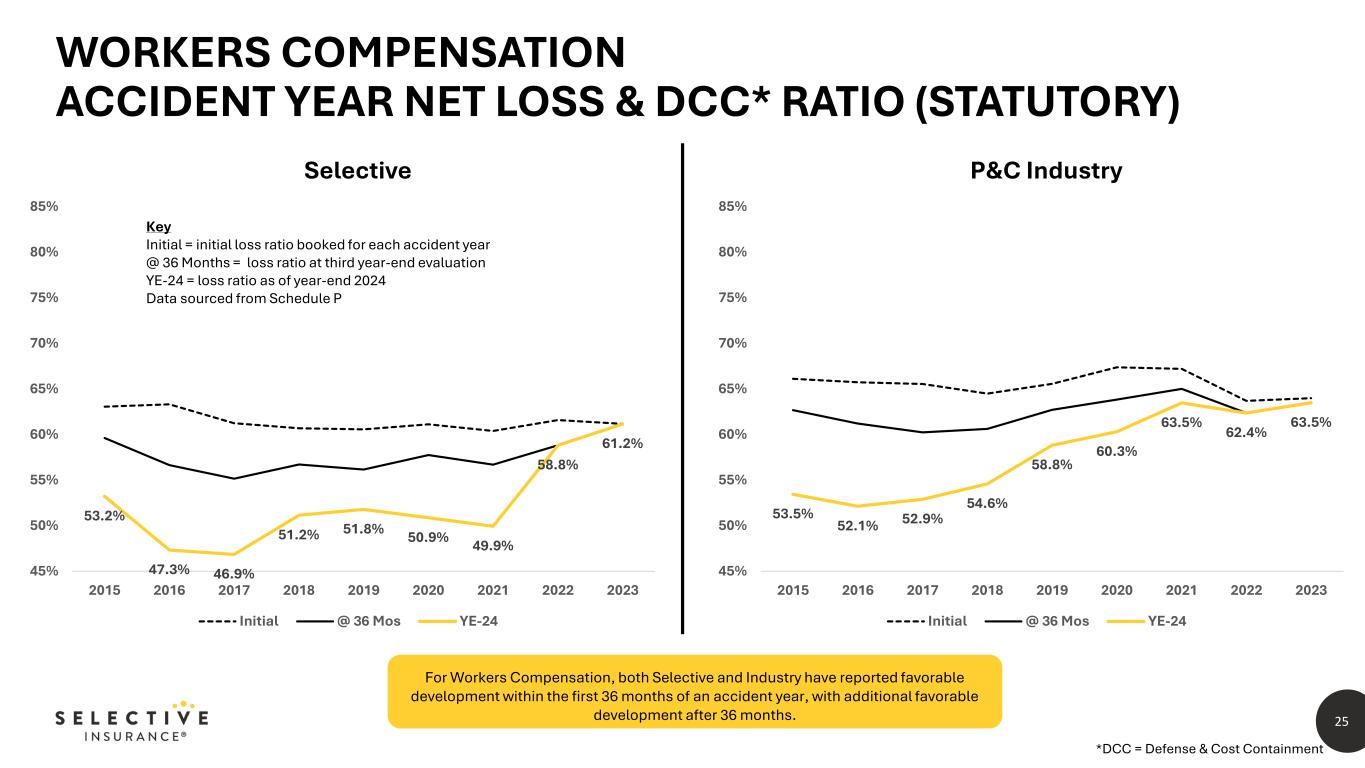
Yes, thanks, Paul. I mentioned this last quarter as well. If you review the 2024 year, what you noted in Q2 was also evident in Q1, and it's present on a year-to-date basis. For our 2024 accident year in workers' comp, we were around 97%. When you exclude the favorable development impact, it remains roughly 97%. Based on our ongoing observation of a flattening frequency trend in workers' comp, we're assuming no improvement in frequency from 2024 to 2025. Regarding average severities, we’re seeing a consistent trend across the industry, with medical severity increasing about 5% and earned rates showing a slight decrease, roughly in the 3% range. So with flat frequency, severities up around 5%, and rates down about 3%, you can take that 97% and project it forward, which gives you the combined or book loss ratio you're referencing. Additionally, in my prepared remarks, I pointed out that for the 2025 year, we noted that workers' comp had favorable frequency during the first 6 months. However, it's only 6 months of data, so we’re cautious about calling it a trend, but it could suggest that the flattening trend we had previously noticed isn’t continuing into 2025. I hope that addresses your question.
Speaker 6
No, it does. If I could sneak in one, just one more. Is there anything unusual about your excess casualty here on grower book from a limit or terms and conditions that would make it anything different than the rest of the industry? I suspect the answer is no, but I don't think I've ever asked the question.
I would say the answer is no. And in fact, if anything, the biggest difference might be on a peer-to-peer comparison basis is our umbrella is entirely supported. So we don't write any umbrella where we don't have the underlying Auto or GL or both. And I think that gives us better earlier insight into the frequency and potentially severity of our umbrella portfolio. The profile is a lower limits profile, so 95% of our umbrella and our grow is about roughly $400 million direct premium portfolio. The 95% of the policies have a limit of $5 million or less and about half of them have a limit of $1 million. So that's the overall profile of our umbrella portfolio.
Operator
Our next question comes from Mike Zaremski with BMO.
Speaker 7
Returning to the topic of reserve additions, I understand you mentioned that the industry may be lagging in this area, and most would likely agree with that observation. The industry has been increasing its reserves for social inflation over the years. However, looking more closely at Selective, you've indicated that you've noticed a flattening trend in frequency regarding workers' compensation. It seems that not many carriers have reported this trend, and frequency appears to be a more straightforward metric. Additionally, you've mentioned having increased exposure to social inflation, potentially linked to your contractors’ portfolio. I’m trying to understand if it’s fair to say that some of this situation is unique to Selective due to your specific business mix, especially since you appear to have a distinctive advantage with contractors.
Yes. I believe we have six months of data. It’s possible that the recent trend of flattening frequency is just a one-year occurrence. We need more time to determine if this trend is directionally correct. Before this period, we observed a steady decline in frequency, although it might have been slightly lower than the industry average. It’s important to acknowledge that. Our overall portfolio's heavier focus on construction also affects our workers' comp portfolio. There is no doubt that during and after the pandemic, the effects of remote or hybrid work on frequency and other workers' comp segments did not affect construction. This likely accounts for some of the differences in frequency changes in our portfolio. Additionally, I mentioned our workers' comp accident year combined ratio for 2024 is around 97%. While reported combined ratios often attract attention, industry data suggests that the accident year for the industry in 2024 is close to 100. The older accident years have continued to improve, benefiting the industry and us as well. If this trend continues, our current year assumptions may prove to be conservative, but that’s how we approach a line that has a tail like this.
Speaker 7
Thank you for the insights, John. Just to follow up, you’ve been in this field for many years, and we've observed charges in five out of the last seven quarters. It seems unusual in Selective's historical context. Is this typical for underwriters to take years to fully understand the loss trends? Should we be concerned that future developments may depend heavily on whether social inflation continues to rise? Are there any indicators we can look for that might assure us there won't be significant changes ahead?
I want to emphasize that our actions reflect our responsiveness to recent, relatively immature accident years. When we analyze the actual paid and case data from these years, we observe that it's still early in the process. We're focusing on recent paid emergence patterns and estimating a smaller number of paid claims that will ultimately be realized, particularly for these recent accident years. This approach is somewhat unusual for the industry, as it is guided by young accident years in longer-tailed lines. To provide some context, regarding the 2023 accident year, the expected ultimate claims show that only about 22% of expected dollars for general liability excluding products is paid so far, with around 17% for the products themselves and just over 30% for commercial auto. These figures indicate that we are dealing with immature years and that our actuarial methods, which are based on paid data, are highly sensitive to any changes. The emergence of severity, which we’ve observed across the industry, adds a layer of uncertainty and perhaps makes our situation more unprecedented. Additionally, while I can't comment on what others are doing, it's common for actuaries to lean more heavily on the most recent years—typically the last three—when assessing claims emergence trends, as opposed to spreading the focus across the past seven years as was done traditionally. This shift can have a significant impact given the limited amount of paid data available. Although I understand we’re delving deeply into the reserving process, it’s relevant to highlight that we are not working to adjust for older accident years. The industry as a whole, based on Dowling analysis, added $10.5 billion to other liability reserves in 2024, with nearly half of that amount, around $5 billion, allocated to pre-pandemic years. This indicates how various lines evolve over time. In contrast, we haven’t observed any further developments regarding the pre-pandemic years since we made our adjustments at the end of 2023 with a $55 million reserve adjustment. I can’t provide any guarantees for our case or the industry's situation, but I believe what sets us apart is our focus on very recent and relatively immature accident years related to longer-tailed lines, as everyone is trying to assess when severity trends may stabilize.
Speaker 7
Okay. I think that helps. So I'll have to follow up and use your insights and look at more data. But so you're saying you are seeing paid emergence increase a bit higher than expected in some of these lines. Is that correct in more recent accident years?
Yes. Yes. That's driving the entirety of our reserve adjustments over the last few quarters; it's paid emergence in the more recent accident years. This is not frequency-driven. This is not older accident years. It's paid emergence. And you're seeing it in cures as well in course including case reserves, but it's more pronounced in paid emergence.
Speaker 7
Okay, I understand. Lastly, you mentioned earlier that it's not surprising commercial property pricing is slowing down a bit, although the absolute levels remain quite healthy due to good profitability. Is this trend likely to continue, considering the industry seems to be generating solid profits in commercial property? Do you have any thoughts or insights on this?
Yes, I have observed some of the industry commentary and largely agree with it. At the higher end of the market, including layered and shared programs, we aren't really participating. There has likely been more contraction in pricing in our segment of the market. I believe this contraction will persist, though it will stay above where property loss trends are, which we noted at the beginning of the year as being around 3.5%. I still see potential for margin expansion. Additionally, there are concerns over potential tariff impacts that many are factoring into their future expectations of loss trend increases. We also face a level of catastrophe volatility across the industry, which I think will moderate the decline. I anticipate property pricing will continue to drift down slightly but will remain favorable compared to loss trends as casualty rates increase.
Operator
[Operator Instructions] Our next question comes from Meyer Shields with KBW.
Speaker 8
Great. I have two questions about the Commercial Lines. First, regarding Commercial Auto, we observed a similar improvement in the loss ratio year-over-year in the second quarter as we did in the first. However, if you increase the accident year '24 loss pick and presumably need some adjustments for the first quarter, shouldn’t that lead to an improvement that accelerates sequentially?
Yes. Now I think I remember the first point is the $25 million was spread across three accident years through '24. And also remember what I had mentioned earlier, which was what we had embedded into our '25 loss trend assumption across our casualty lines, I think that's the primary areas that I would focus you on. And remember, our practices, and we've done this before, we've done it with Commercial Auto over the course of the last 10 years, which has raised the current year loss ratio when we saw an amount of pressure that we thought was the right thing to do. We did it in General Liability last year. We've done it in Commercial Auto liability in the past. So we're certainly open to doing that, but we haven't seen evidence at this point with a '24-year to the level that leads us to think differently about where we're booking '25.
Speaker 8
Okay. That's fair. Second question, I guess, I'm looking at the BOP business, and it's good to see that there's been no adverse reserve development there. But I'm wondering why that casualty side hasn't faced the same sort of social inflation that we're seeing in General Liability.
Well, it's much more aligned for us that BOP liability is something that we evaluate every quarter on a line of business basis. But I do think your point raises another point relative to industry comparisons, which is we report all our General Liability in Schedule P as general liability. We don't include any of that in CMP; a number of our peers do incorporate their GL business that's written on a companion policy basis in CMP, which makes it hard to get a full picture of GL performance, because it's co-mingled with property performance, which has been improving. But BOP liability, it's a different mix of business for us. It's a smaller line of business, but it's one that we evaluate on a quarterly basis, the liability portion like we do other lines of business. It’s a different portfolio of business, and it’s a much more stable portfolio. Therefore, any movements that may occur, whether favorable or unfavorable, wouldn't really have a noticeable impact on an overall basis.
Operator
Thank you. I'm showing no further questions at this time. I'd like to turn the call back over to John for closing remarks.
Well, thank you all for joining us this morning. We always appreciate the engagement and the questions. And as always, please feel free to reach out to Brad if you have additional questions. Thank you all.
Operator
Thank you for your participation. This does conclude the program, and you may now disconnect. Everyone, have a great day.