Operator
Good day, and welcome to Selective Insurance Group 4th Quarter 2025 Earnings Call. At this time, all participants are in listen-only mode. After the speaker's presentation, there will be a question and answer session. Instructions will be given at that time. Please be advised that today's conference is being recorded. I would like to turn the conference over to Brad Wilson, Senior Vice President, Investor Relations and Treasurer. Please go ahead.
Thank you for joining Selective's 4th Quarter and Full Year 2025 Earnings Conference Call. Yesterday, we posted our earnings press release, financial supplement, and investor presentation on Selective.com's Investors section. A replay of the webcast will be available there shortly after this call. John Marcioni, our Chairman of the Board, President, and Chief Executive Officer, and Patrick Brennan, Executive Vice President and Chief Financial Officer, will discuss results and take your questions. We will reference non-GAAP measures that insurance and investment professionals use to evaluate operational and financial performance. These non-GAAP measures include operating income, operating return on common equity, and adjusted book value per common share. The financial supplements on our website include GAAP reconciliations to any referenced non-GAAP financial measures. We will also make statements and projections about our future performance. These are forward-looking statements under the Private Securities Litigation Reform Act of 1995, not guarantees of future performance. These statements are subject to risks and uncertainties that we disclose in our annual, quarterly, and current reports filed with the SEC. We undertake no obligation to update or revise any forward-looking statements. Now I'll turn the call over to John.
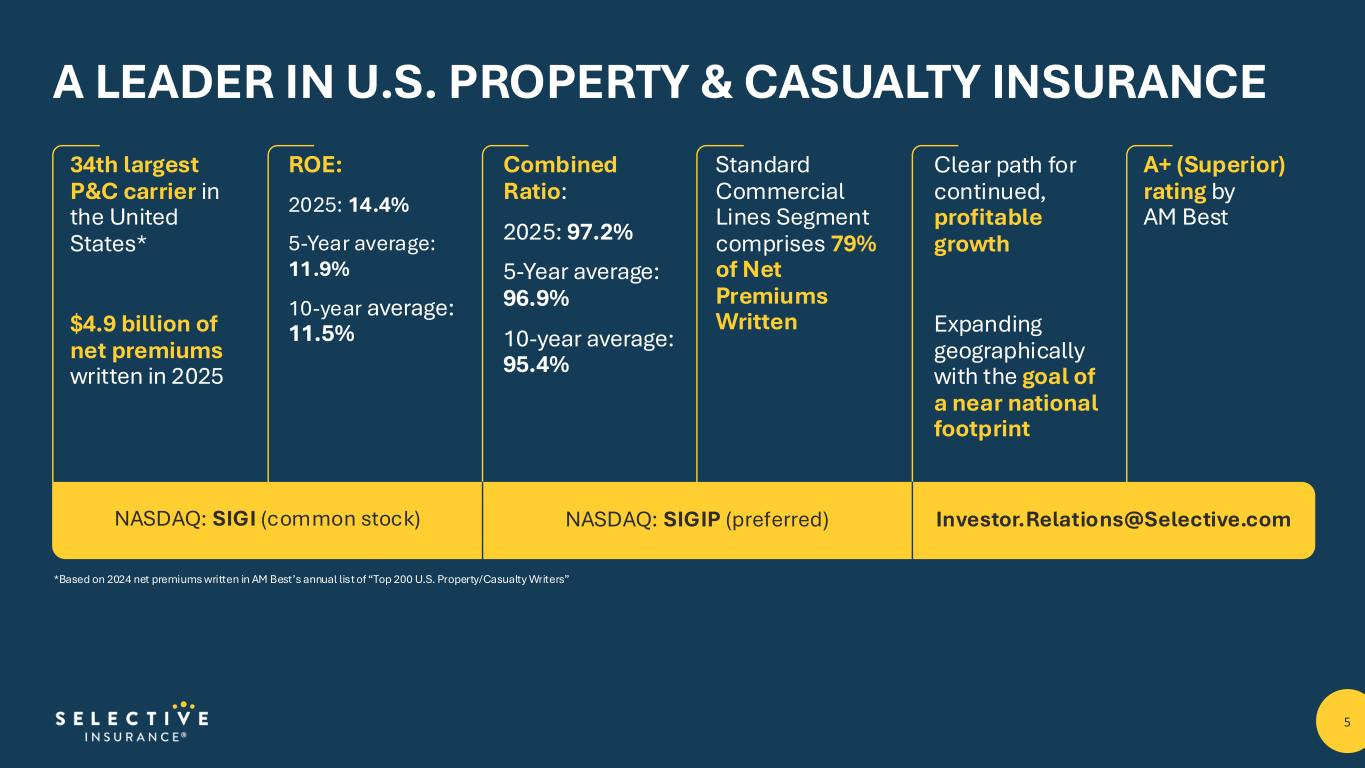
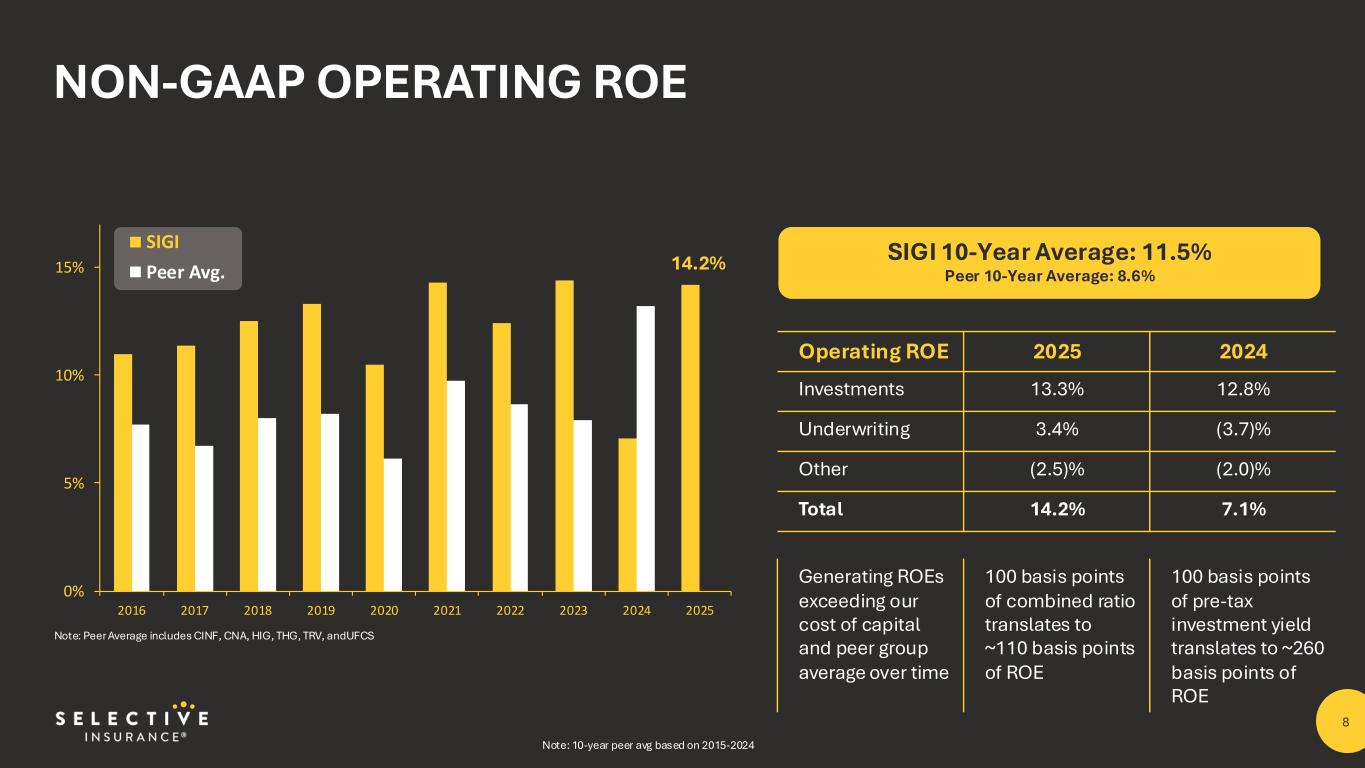
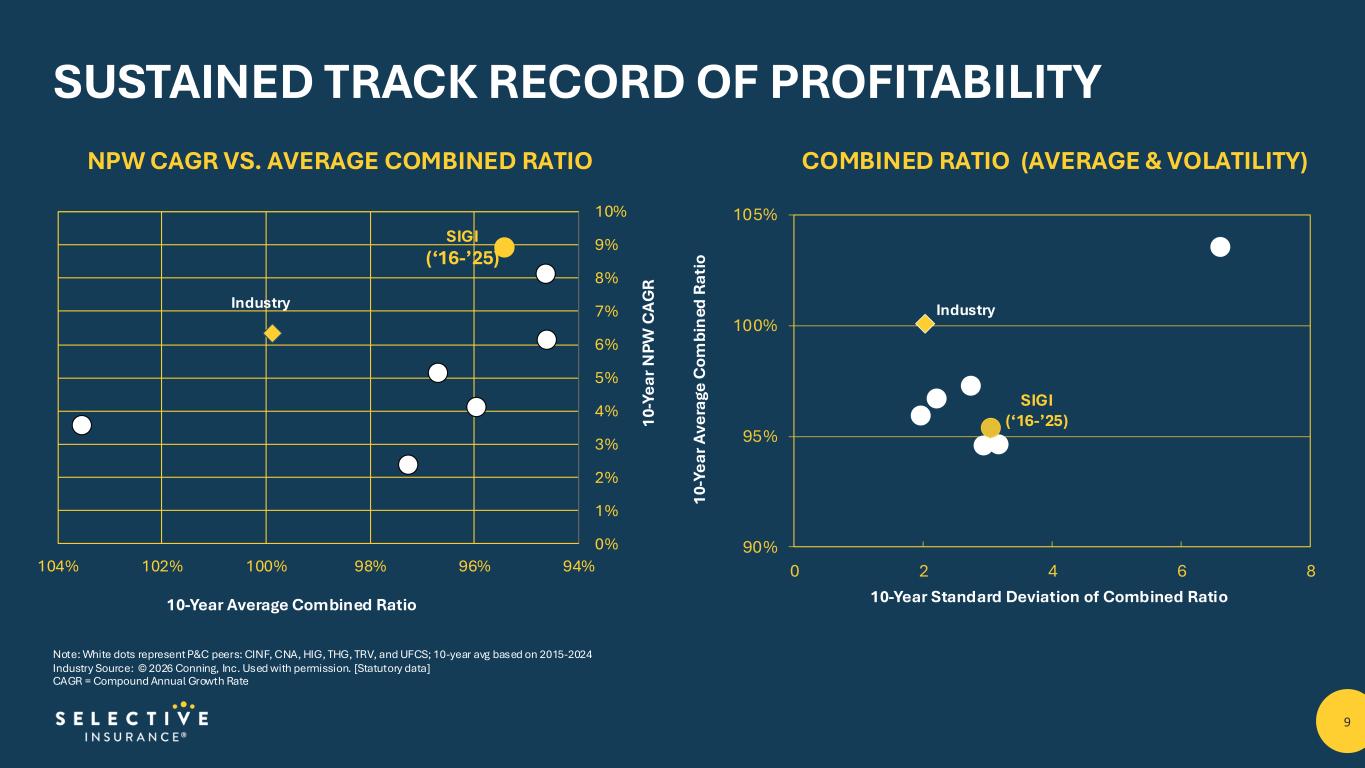
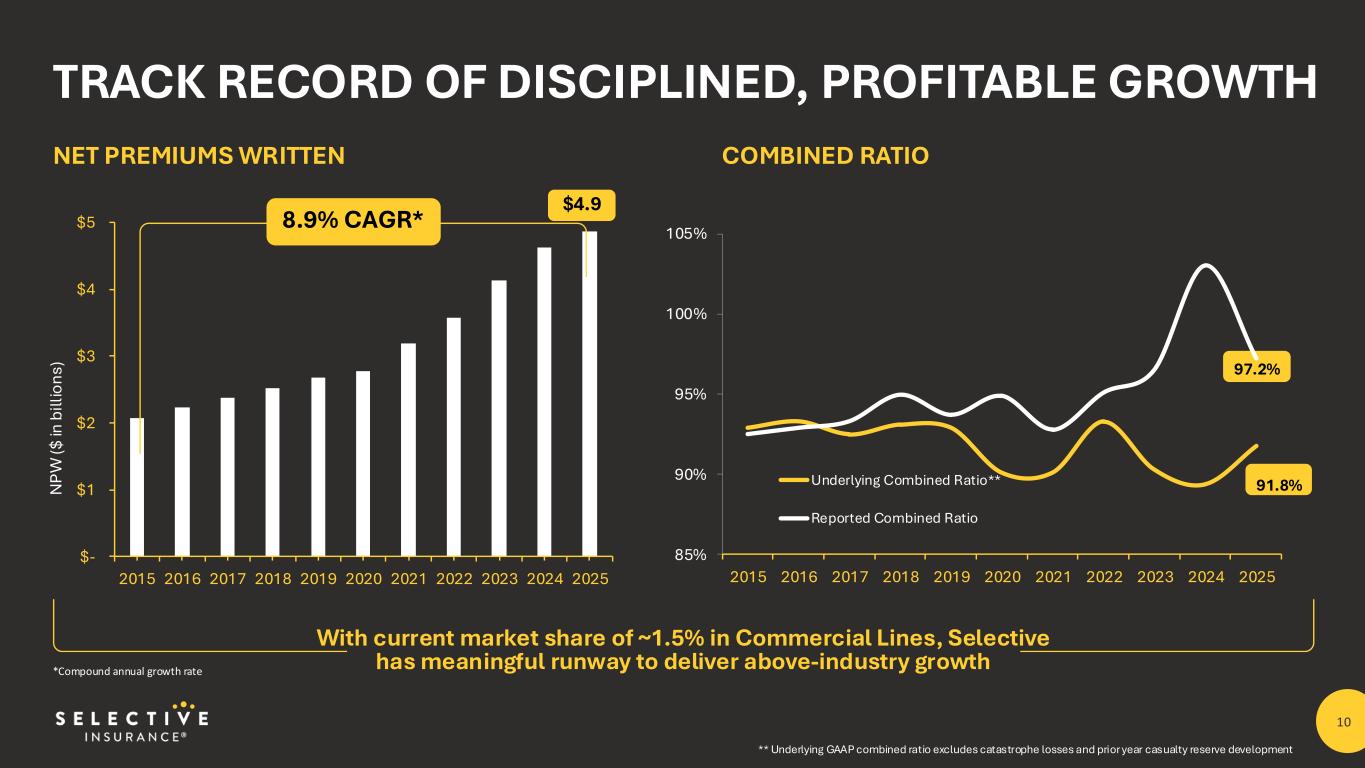
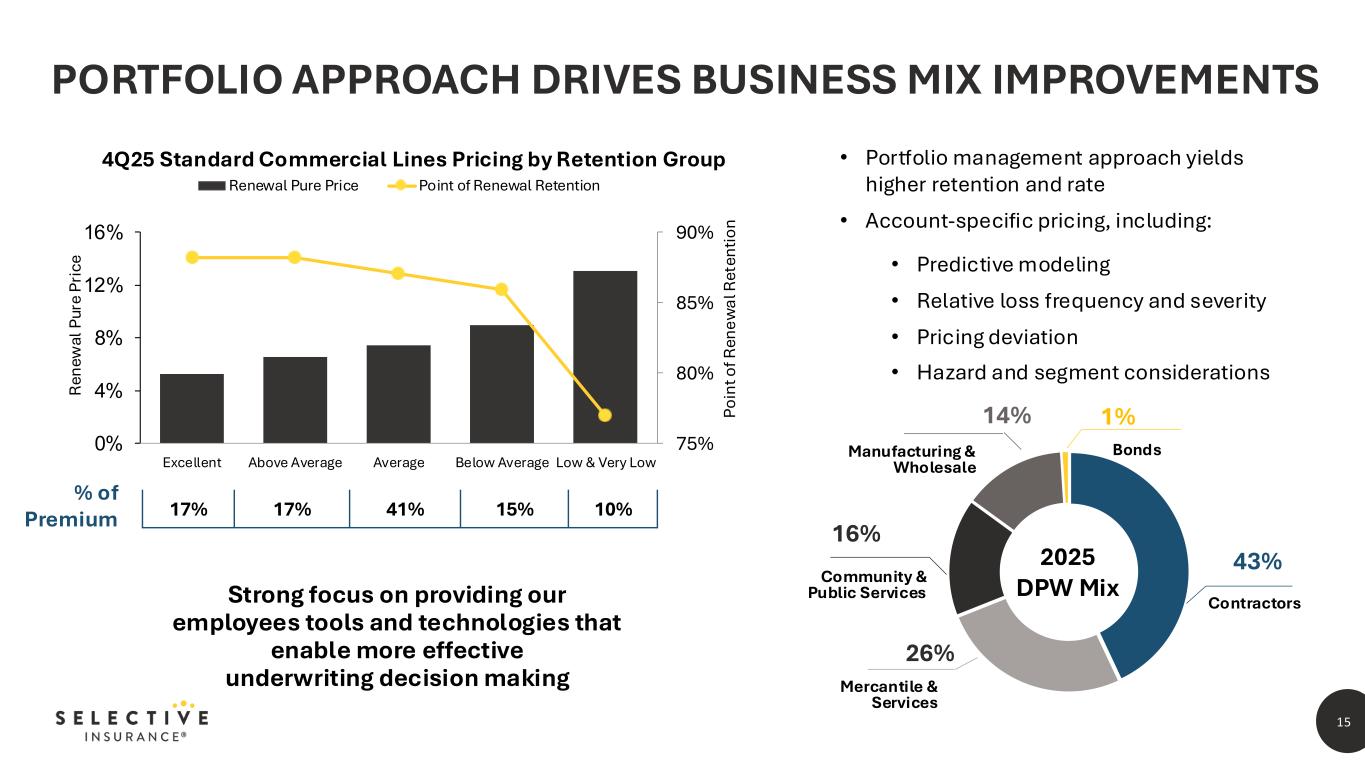
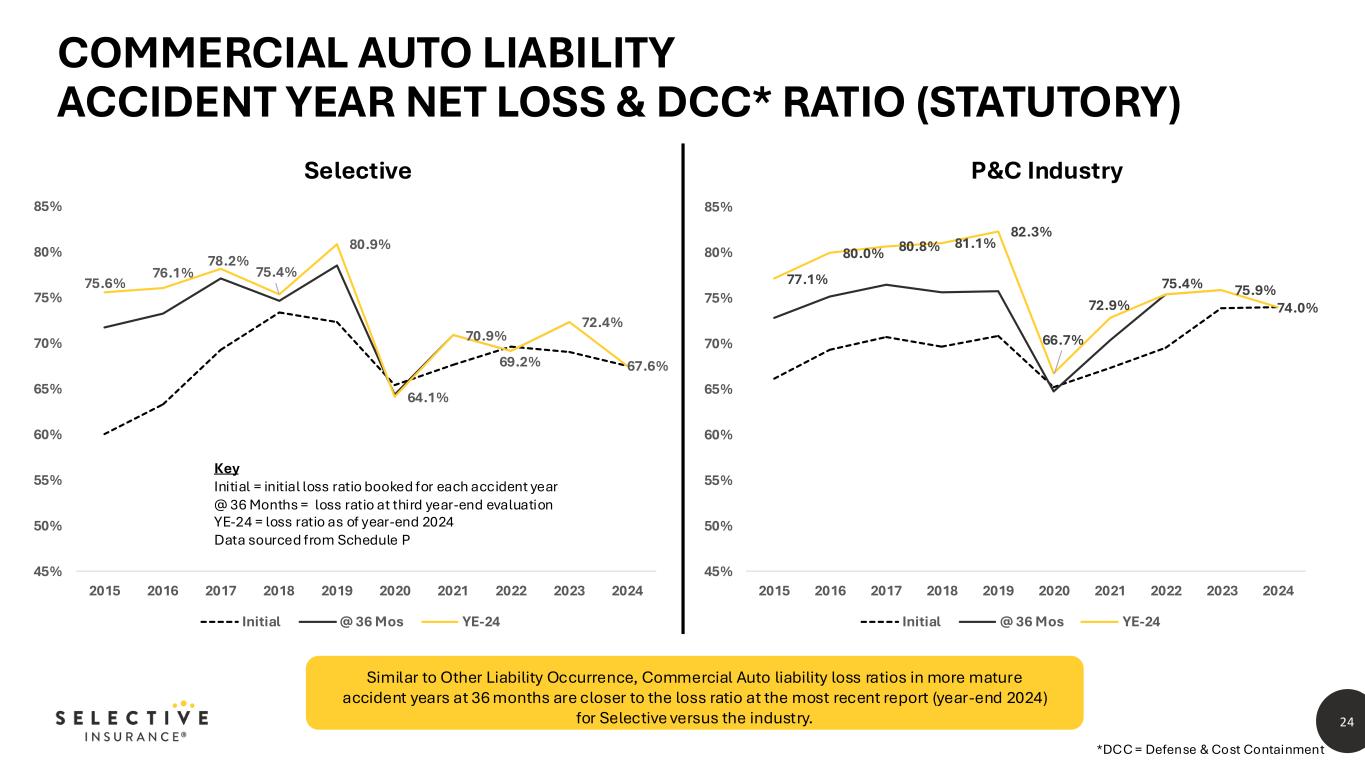
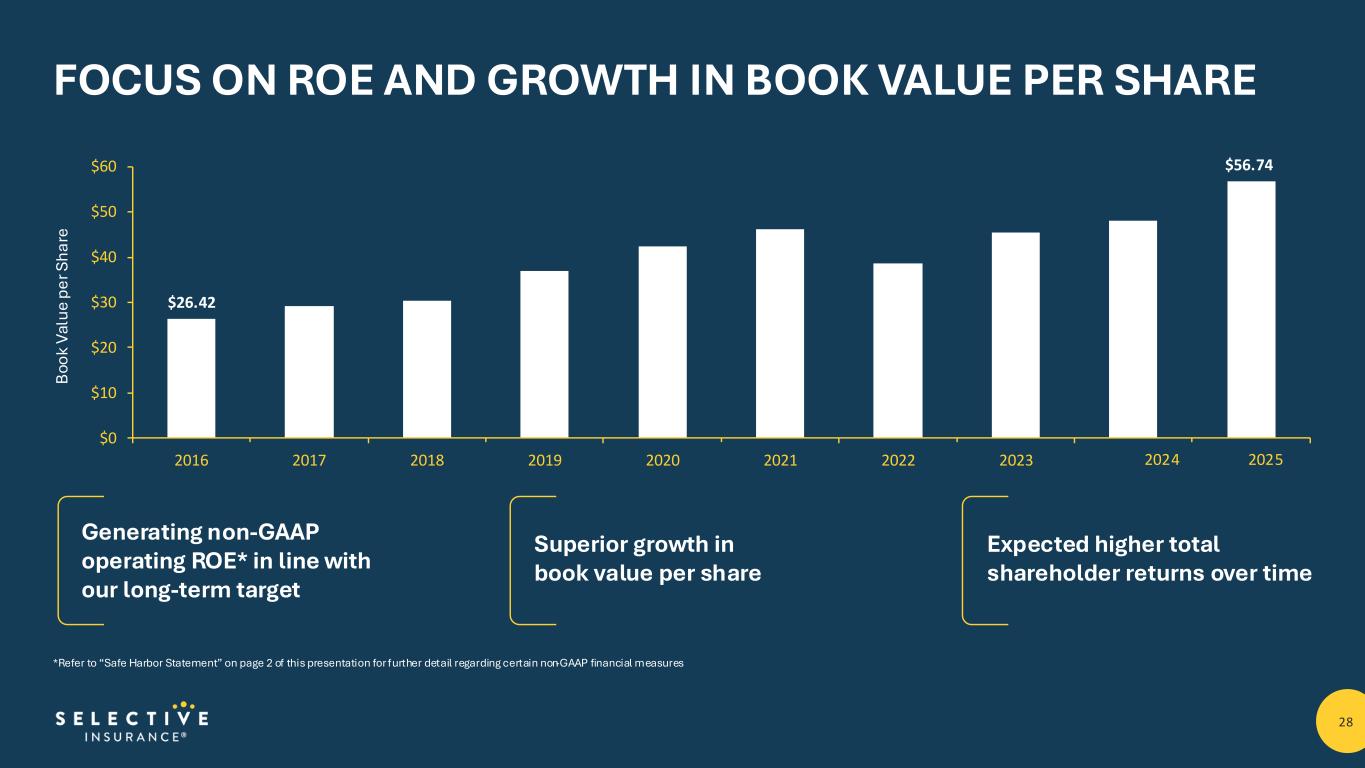
Thanks, Brad, and good morning. We are well positioned to build on recent momentum. in 2025 we delivered an roe of 14.4 percent and an operating roe of 14.2 percent this exceeds our 10-year average operating roe of 12.1 percent and our five-year average of 12.5 percent we are proud of our long-term track record and are taking clear steps to drive future margin improvement in 2025 we grew book value per share by 18 percent and returned 182 million dollars to shareholders through our common dividends and share repurchases at attractive valuation. With our strong capital position, we can deploy capital in several ways that are accretive to long-term value, including continued investments to grow and diversify our business, along with opportunistic share repurchases. We have a strong foundation with opportunities to drive improvement across our organization. We delivered a 93.8% combined ratio in the quarter, reducing our full year combined ratio to 97.2 just outside the 96 to 97 guidance we provided at the beginning of the year and at the low end of the 97 to 98 guidance provided last quarter net premium is written growth was 5% for the year as we executed deliberate actions to improve underwriting profitability this remains our primary focus however we are also executing strategies to support future growth opportunities, including expanding our geographic footprint and broadening ENS distribution capabilities with retail access. We believe we have the capabilities and strategy to further diversify our premium and outpace industry growth in coming years. In the fourth quarter, favorable workers' compensation development offset unfavorable prior year emergence in the commercial and personal auto lines and ens casualty there are also several smaller adjustments across multiple lines of business including umbrella which was driven by auto in 2024 and 2025 we took meaningful actions to strengthen reserves our picks for older accident years have held up well and our actions have been increasingly weighted to more recent accident years we are comfortable with our overall carried reserve position We firmly believe our disciplined approach responds promptly and appropriately to emerging trends and ensures pricing targets keep pace with an evolving external environment, even though it can create short-term volatility. We will stick to our process, continuing to assess emerging information, considering risk factors, and booking our best reserve estimates each quarter. we expected 2025 accident year margins to improve for commercial automobile as we have earned double digit rate increases over multiple years that exceeded our assumed loss trend of roughly eight percent as 2025 progressed we ultimately increased commercial auto casualty loss costs by nearly six points we also increased our expected severity trend for commercial auto liability to approximately 10 percent this assumption is reflected in our book results and incorporated into our 2026 guidance in total we strengthen commercial auto reserves by approximately 190 million dollars in 2025. the majority is attributable to the 2024 and 2025 accident years with 2025 representing the largest share we are addressing commercial auto with both underwriting and claims actions. For example, we've implemented tighter underwriting guidelines for fleet exposures supported by state-specific tactics and focused our commercial auto telematics rollout in specific segments and states. In general liability, we've discussed our actions to manage limits in challenging jurisdictions and trim underperforming classes. We are also prioritizing new business in better performing segments and have strengthened new business pricing standard commercial lines is our largest segment and our earnings engine we have the sophisticated pricing and risk selection tools in the hands of our talented underwriters that are necessary for taking granular action across the portfolio we are improving mix by achieving stronger rate and retention differentiation based on expected profitability while continuing to focus on overall rate adequacy this is not new but we expect the amount of differentiation to increase we are leveraging our tools granular insights and differentiated operating model to drive higher renewal retention on our best-performing business and meaningfully lower retention on our poor performing business through appropriate rating actions while overall rate increases could moderate in the short term we expect these mixed improvement actions will deliver improved profitability. Our guidance reflects the benefits we expect in 2026 from the various actions we have taken and our multi-year plan points to continued margin improvement at 2027. Now I'll turn the call over to Patrick. Thanks John and good morning everyone.
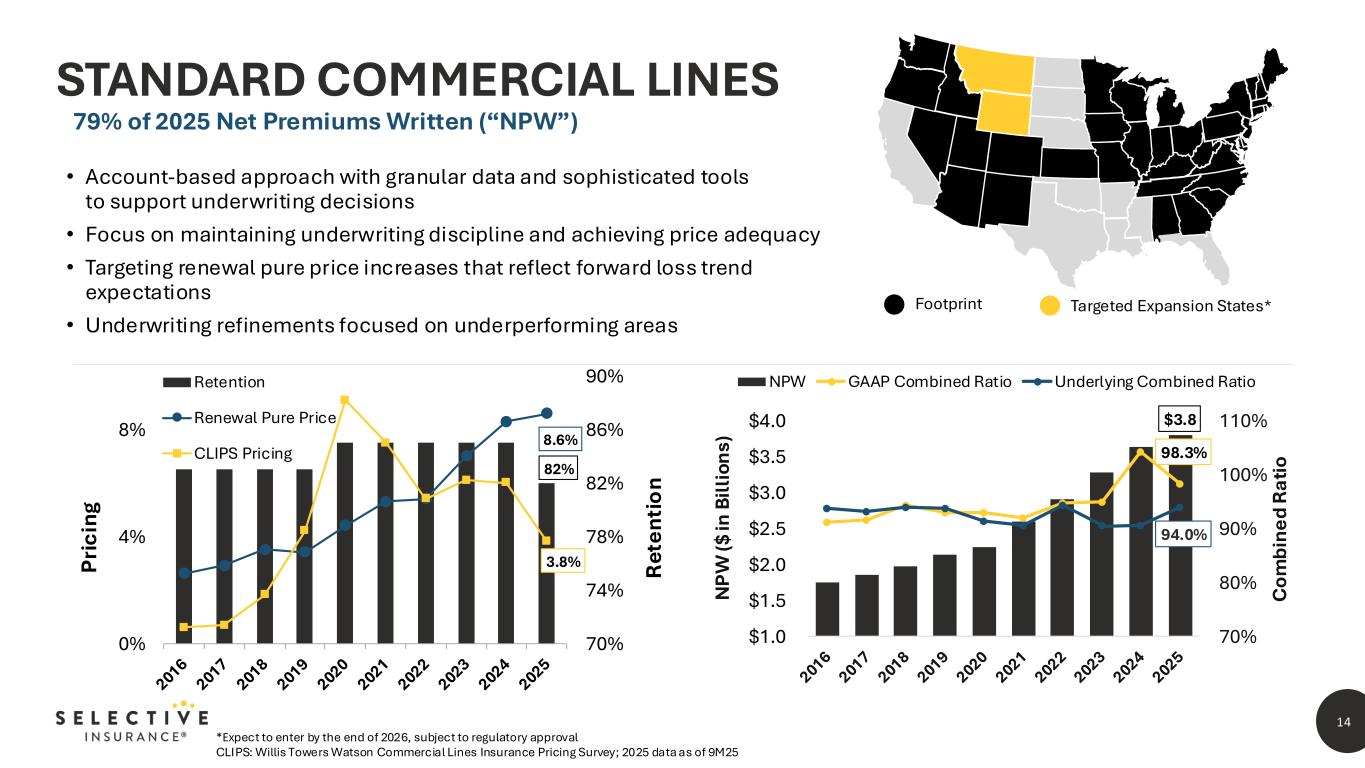
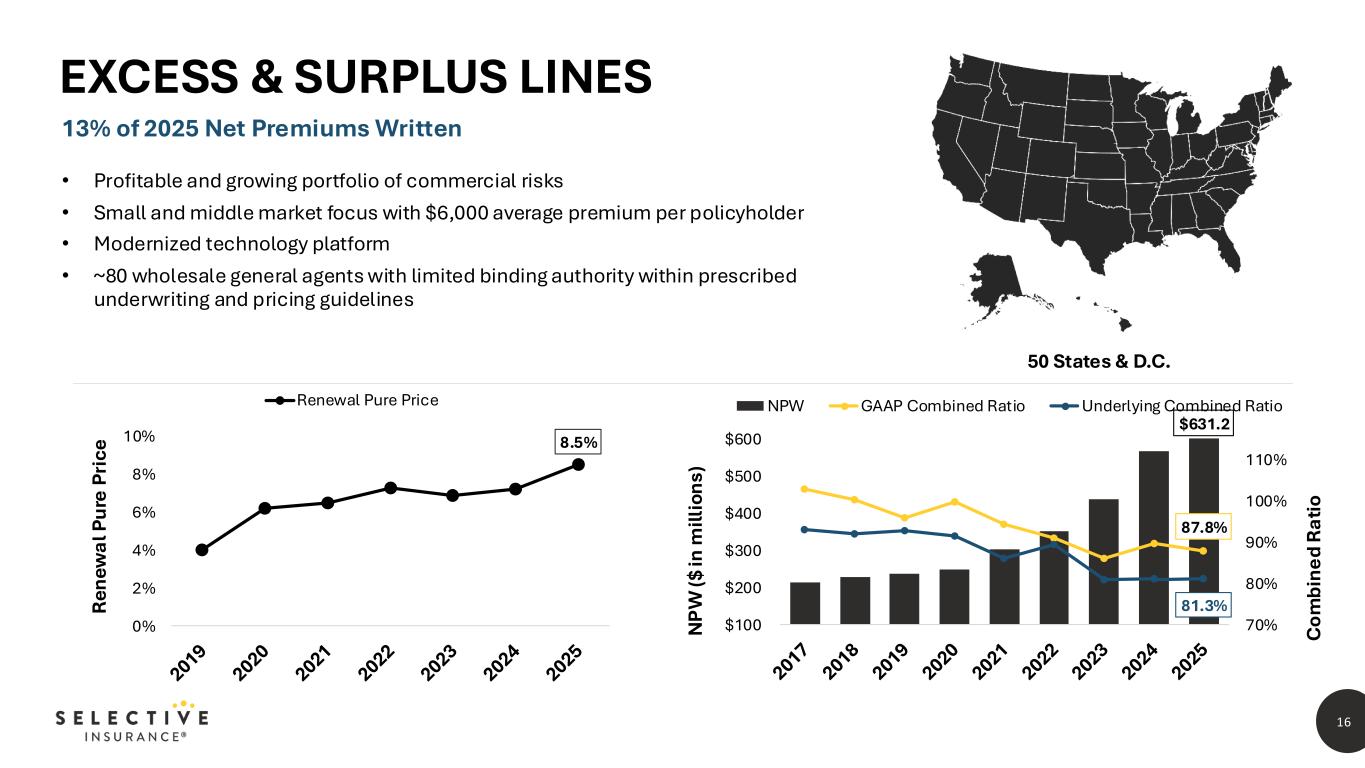
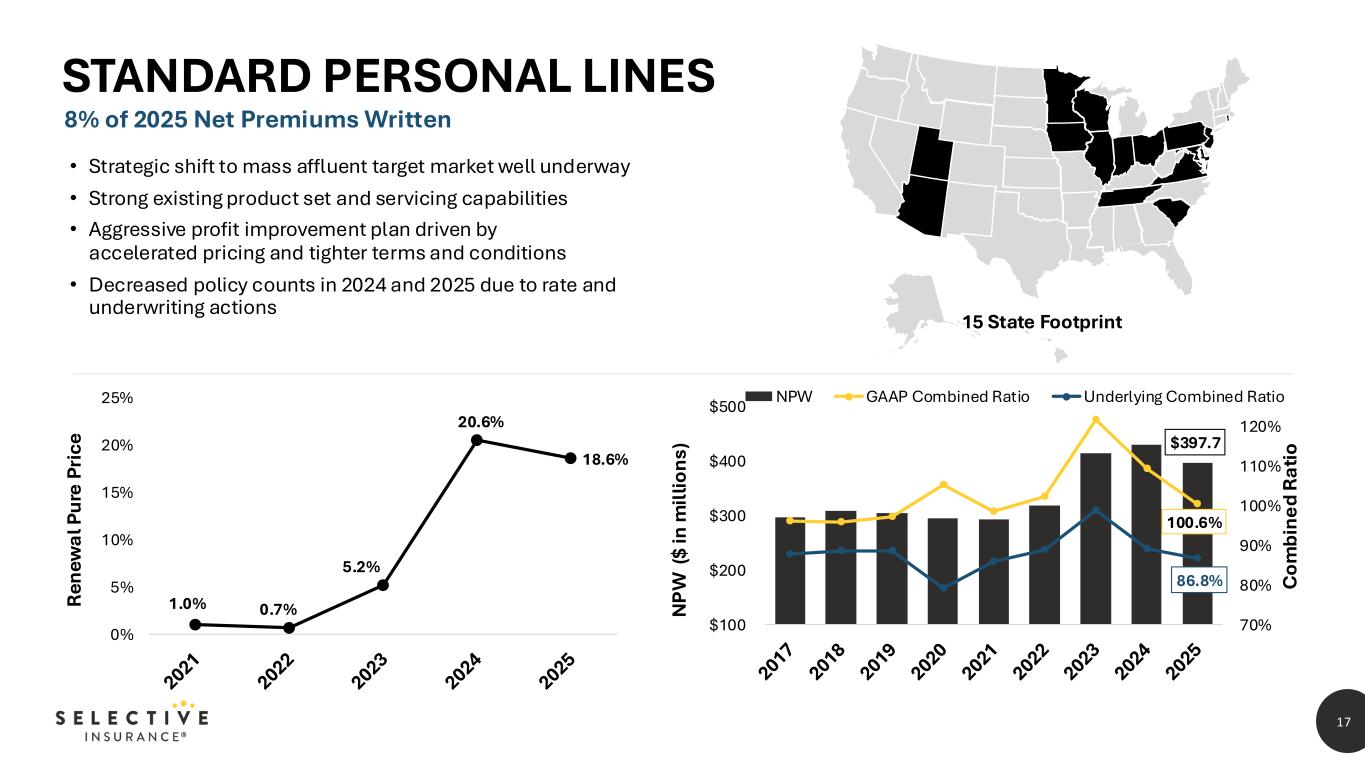
For the quarter, fully diluted EPS was $2.52, up 66 percent from a year ago. Non-GAAP operating EPS was $2.57, up 59%. Our return on equity was 18.3%, and our non-GAAP operating return on equity was 18.7%, reflecting continued strong investment performance. The GAAP combined ratio was 93.8, a 4.7 point improvement from fourth quarter 2024, mainly because this quarter had no net prior year reserve development for the quarter the overall underlying combined ratio was 92.1 a point and a half higher than the 90.6 a year ago the increase is attributable to the reserving actions we took to address the 2025 accident year primarily in commercial auto this quarter's standard commercial lines combined ratio was 92.9 percent which included 1.6 points of favorable prior year casualty development, and 3.2 points of higher current year casualty loss costs. As John noted, the current environment demands strong underwriting and pricing discipline. Standard commercial lines premium growth in the quarter was 5%, driven by renewal pure price increase of 7.5%, or 8.5%, excluding workers' compensation. General liability pricing increased by 9.8% and commercial auto pricing increased by 8.6. While there was some deceleration in commercial auto pricing for physical damage, liability price increases continue to exceed 10%. For property, renewal premium change was 12.2%, including four points of exposure growth. Retention for the quarter was 82%, stable with recent periods, but down three points from a year ago. Excess and surplus lines premium grew 4% this quarter with average renewal pure price increases of 7.8%. We continue to push higher rate levels in ENS casualty based on our view of general liability loss trends. The ENS combined ratio for the quarter was 93.1% and a very strong 87.8% for the year. Turning to personal lines, the combined ratio for the quarter was 103%, up 91.7% in the fourth quarter 2024. There were two reasons for the deterioration. Catastrophe losses, which were 6.2 points higher this quarter, and current year casualty loss costs, which increased by 8.1 points. Current year adjustments were driven by New Jersey Personal Auto. For the year, the personal lines combined ratio was 100.6%, improved from 109.3% in 2024. Results are even more favorable for the portfolio outside of New Jersey, and we are positioned for profitable growth in those states. For the quarter, personal lines net premiums written declined 8%, with target business up 5%. Nearly all our new business was in our target mass affluent market. Renewal pure price for the quarter was 15.1%. Across all our segments the combined ratio was 97.2 percent in 2025 a significant improvement from 2024's 103 primarily because of lower prior year casualty reserve development and catastrophe losses last quarter we discussed our third party claims review which was ongoing at that time the review
is now complete and the findings were consistent with what we had previously discussed turning to
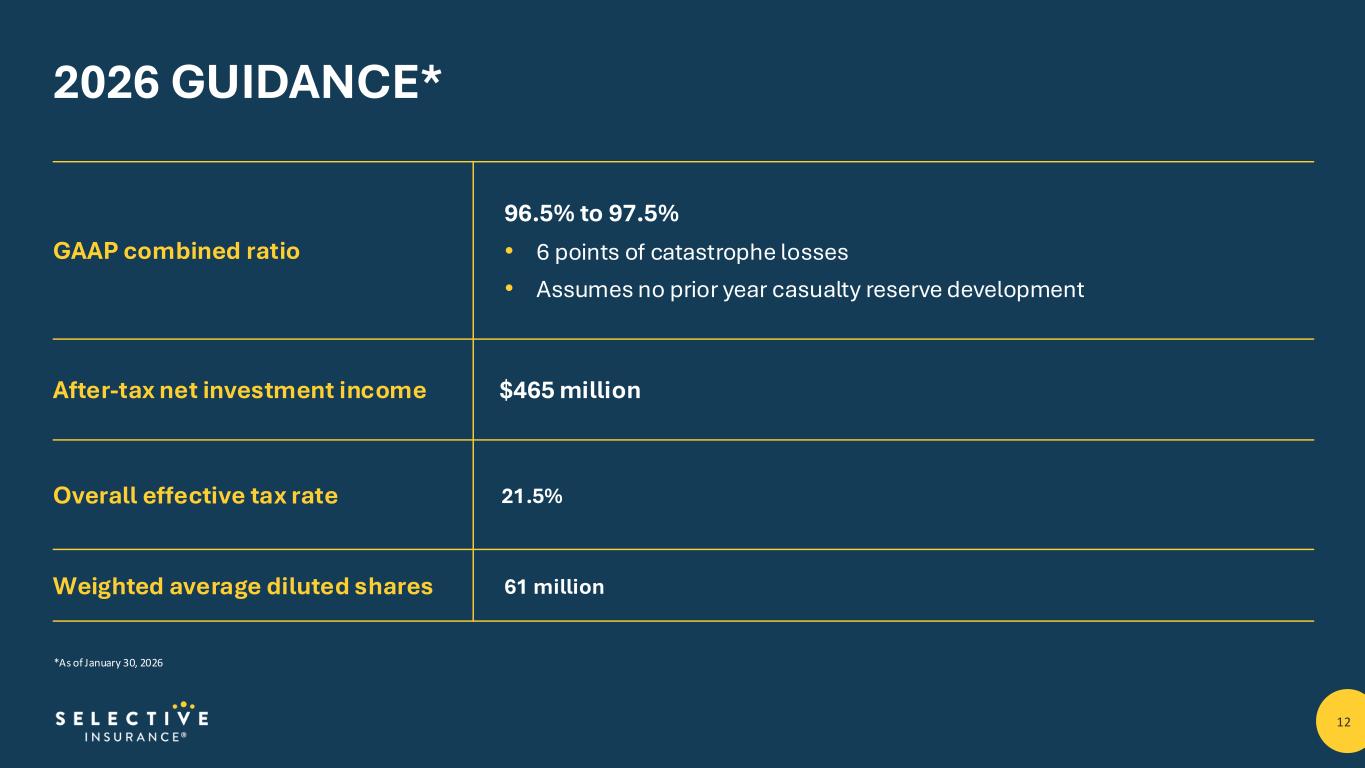
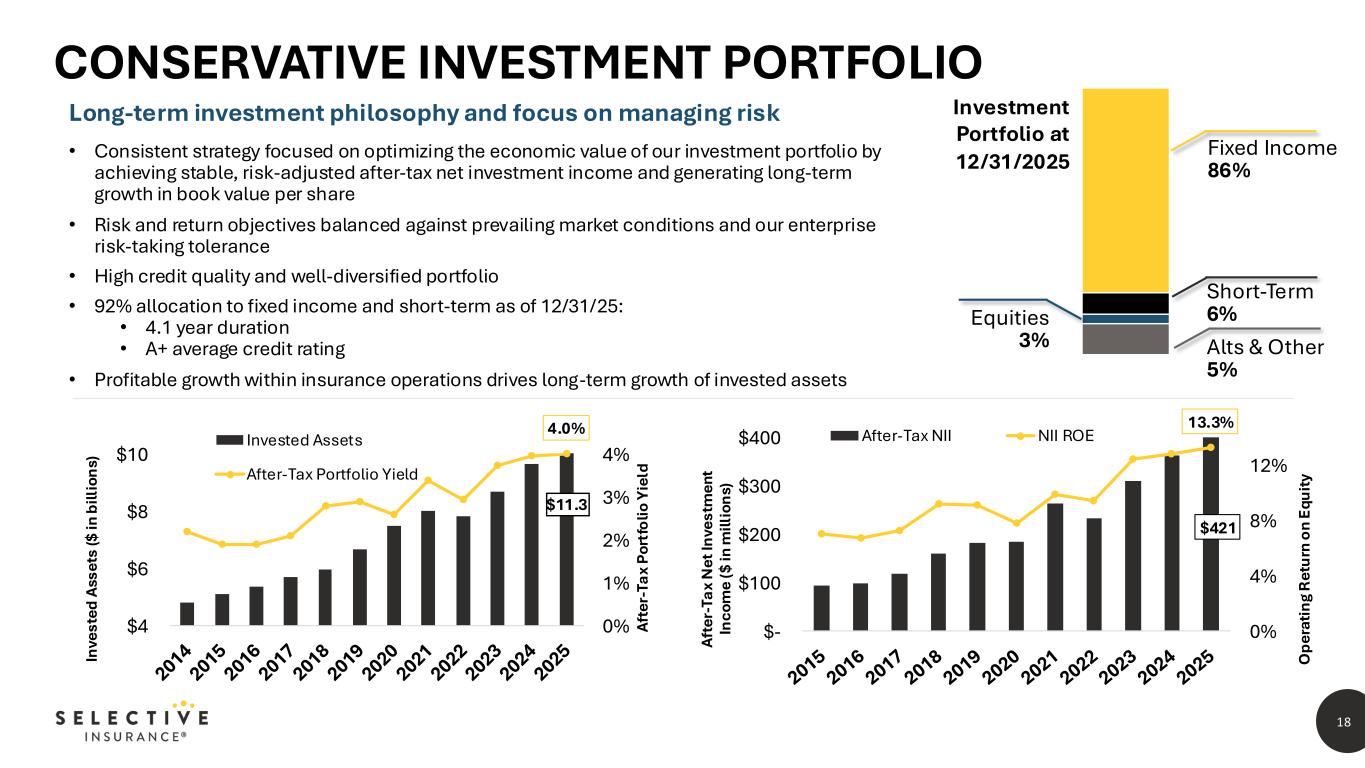
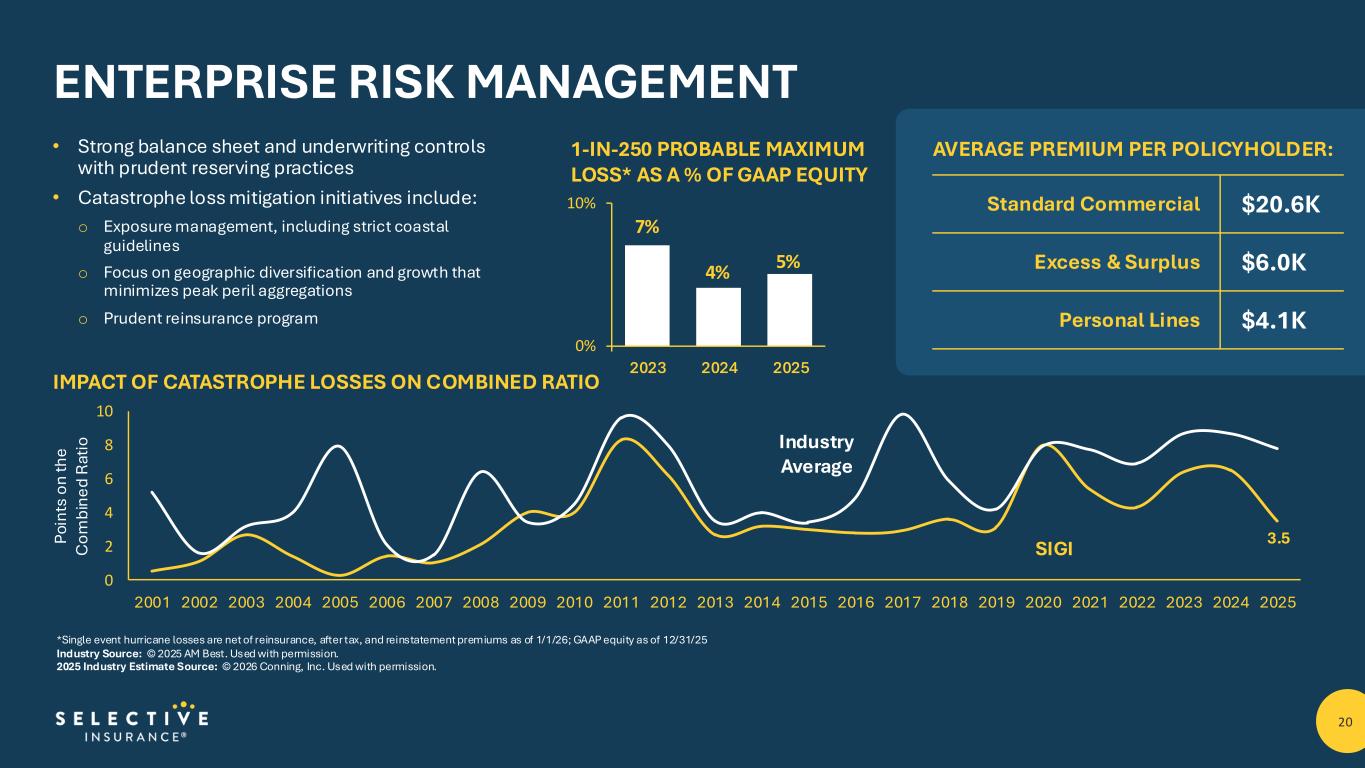
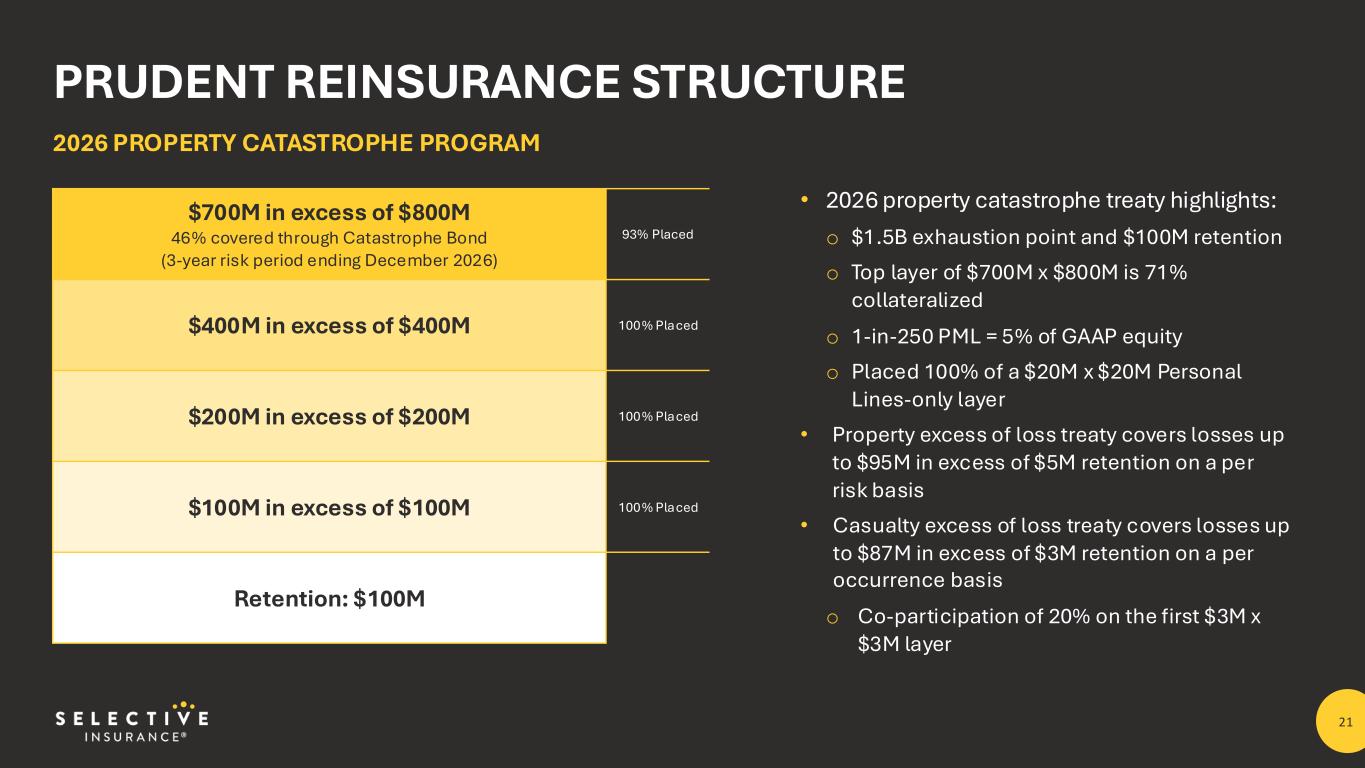
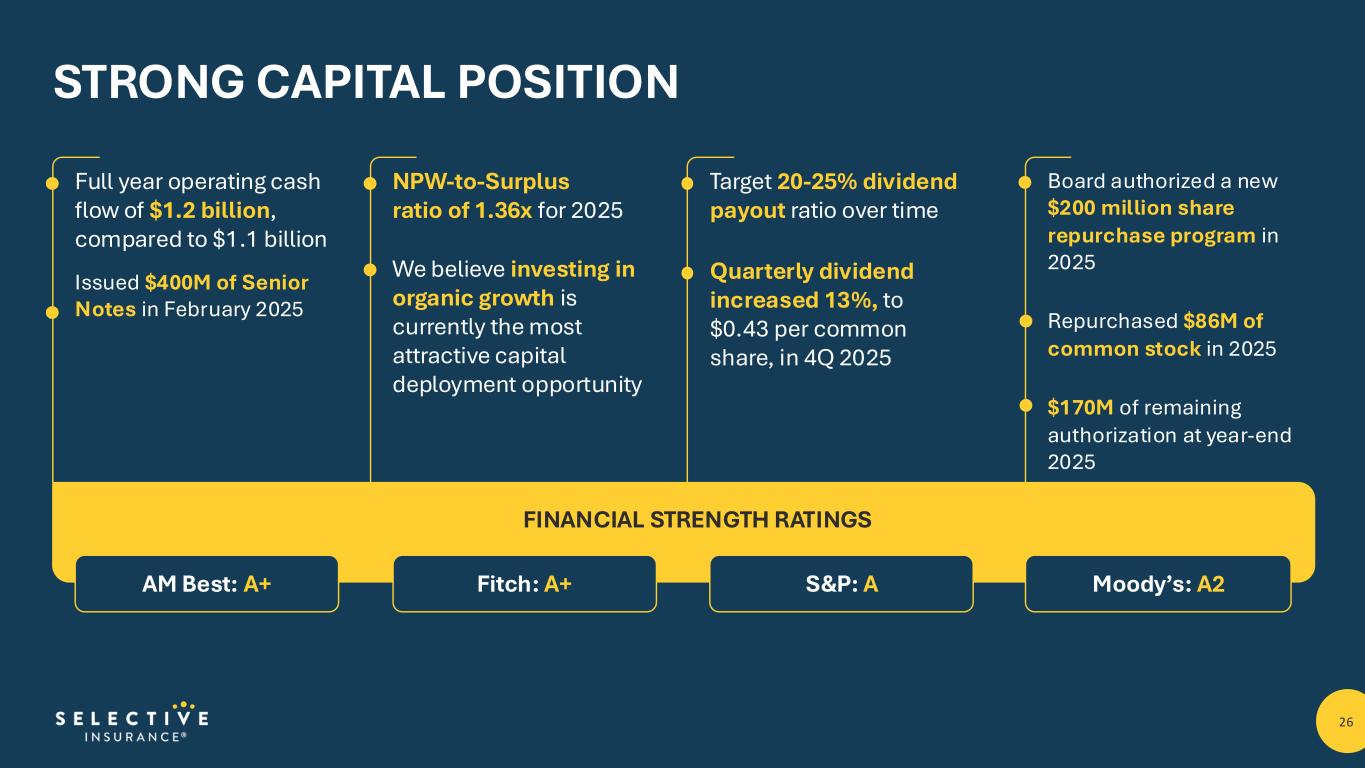
investments fourth quarter after tax net investment income was 114 million dollars up 17 percent from a year ago and generated 13.6 points of return on equity our investment portfolio remains conservatively positioned and our investment strategy is consistent with average credit quality of a plus and a duration of 4.1 years we expect the portfolio strong embedded book yield to continue to provide a durable source of future investment income even if interest rates decline We successfully renewed our property catastrophe reinsurance program effective January 1st. Our retention remains $100 million and we increased our coverage exhaustion point to 1.5 billion from 1.4 billion. Property market conditions are attractive and we completed the renewal with meaningful risk adjusted pricing decreases and improved terms and conditions. We continue to supplement our main tower with a personal lines only buy down layer. Our peak peril, U.S. Hurricane, is well within our risk tolerance at 5% of GAAP equity for a 1 in 250-year net probable maximum loss. Our capital management strategies continue to prioritize profitable growth within our insurance business and aim to return 20 to 25% of our earnings to shareholders through dividends. We also expect to opportunistically repurchase shares. These actions reflect our commitment to delivering long-term value to shareholders. During the quarter, we repurchased $30 million of common stock, bringing our total repurchases for the year to $86 million. We believe these repurchases are completed at attractive valuations. That year end, $170 million remained on our authorization. Book value per share increased 18% and we reported $3.6 billion of both GAAP equity and statutory surplus. We ended the year with a strong capital position, and we are proud that AMBEST recently affirmed our A-plus financial strength rating. For 2026, we expect a gap combined ratio between 96.5 and 97.5%. Our guidance assumes six points of catastrophe losses. We do not make assumptions about future reserve development, as we book our best estimate each quarter. We expect after-tax net investment income to be $465 million. This is up 10% from 2025, reflecting growth in our invested assets. Our guidance includes an overall effective tax rate of approximately 21.5%. Weighted average shares are estimated to be approximately $61 million on a fully diluted basis without assumptions about share repurchases under our existing authorization. As a reminder, our first quarter underlying combined ratios tend to be higher than the rest of the year due to normal seasonality. For financial modeling purposes, this has historically been most relevant to non-catastrophe property losses. Corporate expenses also tend to be higher in the first quarter due to holding company expenses related to stock compensation. Now I'll turn the call back to John.
Thanks Patrick. our 2026 guidance implies an underlying combined ratio in the 90.5 to 91.5 range compared to the 91.8 we reported in 2025. Our guidance does not provide segment level combined ratios. However, directionally, we expect underlying combined ratio improvement in personal lines and commercial lines and continuing strong performance in ENS. Our 2026 guidance considers reserve reactions for recent accident years and embeds an overall expected loss trend of approximately 7.5% up from the 7% we assumed a year ago. Our loss trend assumptions are 3.5% for property and 9% for casualty. The casualty trend would be closer to 10% excluding workers compensation. We expect our 2026 expense ratio to increase by about half a point as we make strategic technology investments to support scale, enhance decision-making, and improve operational efficiency. With expected strong investment income, our 2026 guidance implies an operating ROE in the 14% range. Before turning to your questions, I want to remind everyone that Selective is celebrating its 100th anniversary in 2026. We are proud of our history, the work of our employees, and the value we deliver to our policyholders, distribution partners, and shareholders. We are excited to build on our legacy of success. To drive this, we remain focused on a set of key priorities across the company, including relentlessly improving on the fundamentals across risk selection, individual policy pricing, and claim outcomes, diversifying revenue and income within and across our three insurance segments, and further leveraging our use of data, analytics, and technology, including artificial intelligence, to drive operational efficiency and improved underwriting and claim outcomes. I'll now ask the operator to begin our question and answer session.
Operator
Thank you. If you'd like to ask a question, please press star 11. If your question hasn't answered and you'd like to remove yourself from the queue, please press star 11 again. Our first question comes from Michael Phillips with Oppenheimer. Your line is open.
John, my first question is around your last comments on the guidance. As you said, the core underlying combined, it kind of implies a bit of improvement from last year, 2025, and you said you kind of expect commercial to improve, personal to improve, and some strong from E&S. I guess if we focus on commercial for a second, there you're seeing price deceleration. It seems like in line with peers, elevated casualty loss picks that kind of start to pick up in 3Q and 4Q, and then you've still got some noise on PYD and commercial auto and GL. I guess, given all that, can you just talk about the confidence you have in maintaining or maybe even improving the commercial line margins from here?
Yeah, thanks, Mike. And, again, as I mentioned, we provide very detailed guidance, but we stop short of providing individual combined ratio guidance by segment. but as you indicated, we did provide some directional guidance, and I think that's the focus of your question. I think without question, we have continued to take rate on the casualty lines of business, and where you've seen the most significant deceleration, albeit not as substantial as may be reported for larger accounts, is on the property side. So we expect to see continued strong pricing on the casualty side within auto, casualty, auto liability, commercial auto liability, and in general liability. The other thing I'll point to is, and this has been ongoing for the last couple of years, and this was referenced in my prepared comments, is we see meaningful opportunity by further leveraging the tools we have from a pricing and a risk selection perspective to drive meaningful mix of business improvement on both the renewal portfolio and the new business selection process. And that'll also result in some of the benefit we're talking about here. So with regard to your overall question around confidence, as we are, you know, based on the confidence in our process, we're confident in the guidance we're providing you. And to your point on an overall basis, that underlying combined ratio improvement of 80 basis points, if you just focus on the midpoint of our underlying combined ratio, we think is reasonable. And don't forget, there's about a 50 basis point increase in the expense ratio. So the underlying loss ratio improvement is a little bit more than that. Yep. Okay, good. Thank you, John. Appreciate
that. That's helpful. I guess second question, we've talked about this before briefly, but maybe just to refresh here, a lot of your comments on reserves have been from higher paid severities in the recent accident years for your casualty business. And I guess I wonder what that means for GL and commercial auto, specifically case reserves for those same recent action years. What I mean is I think some companies, there's a disconnect between paid activity and how they set the initial case reserves because a lot of that's done automatically, and there's often a big disconnect there when they see higher paves. I don't think that's the case for you, but I guess, what about yours? We're clearly going to be looking at that pretty detailed in your case reserves for those two lines in a couple months with that data. but can you talk about how any changes that might be taking place in your initial setting of case
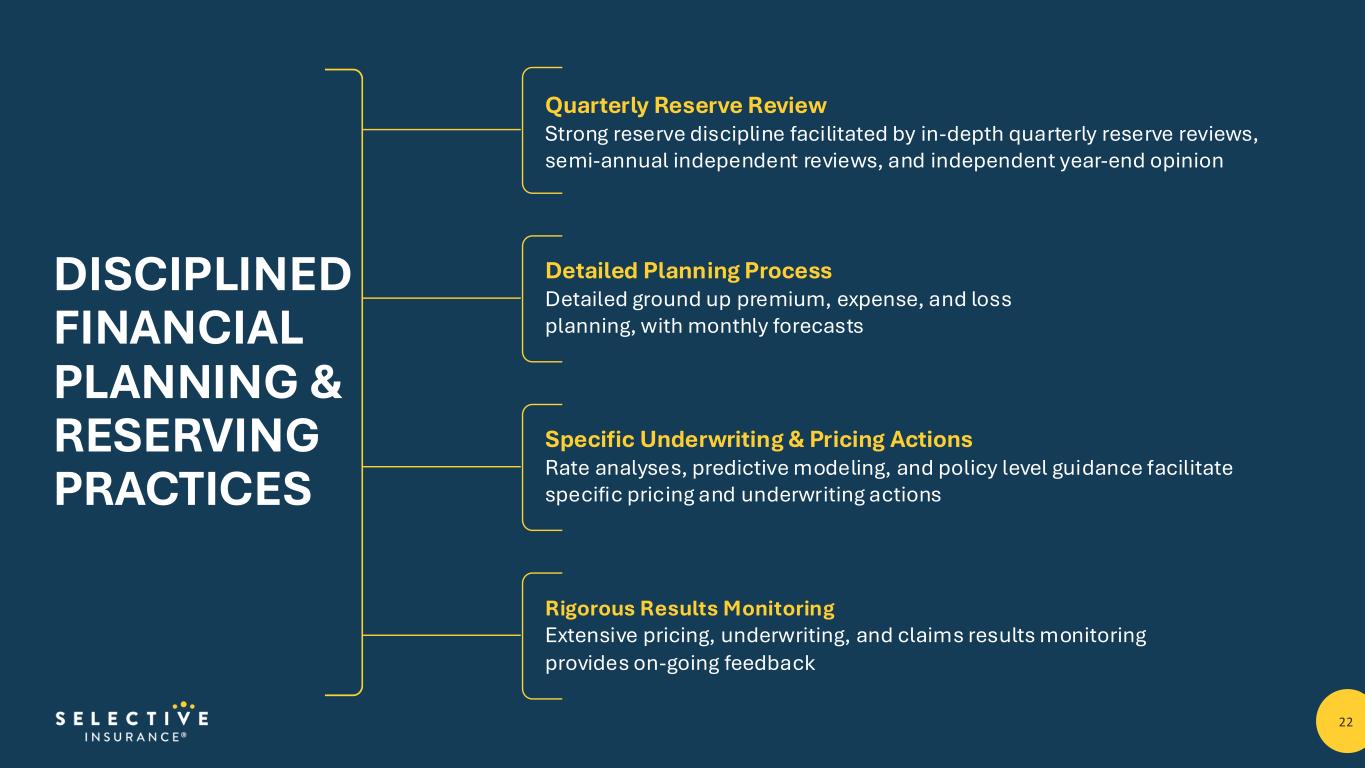
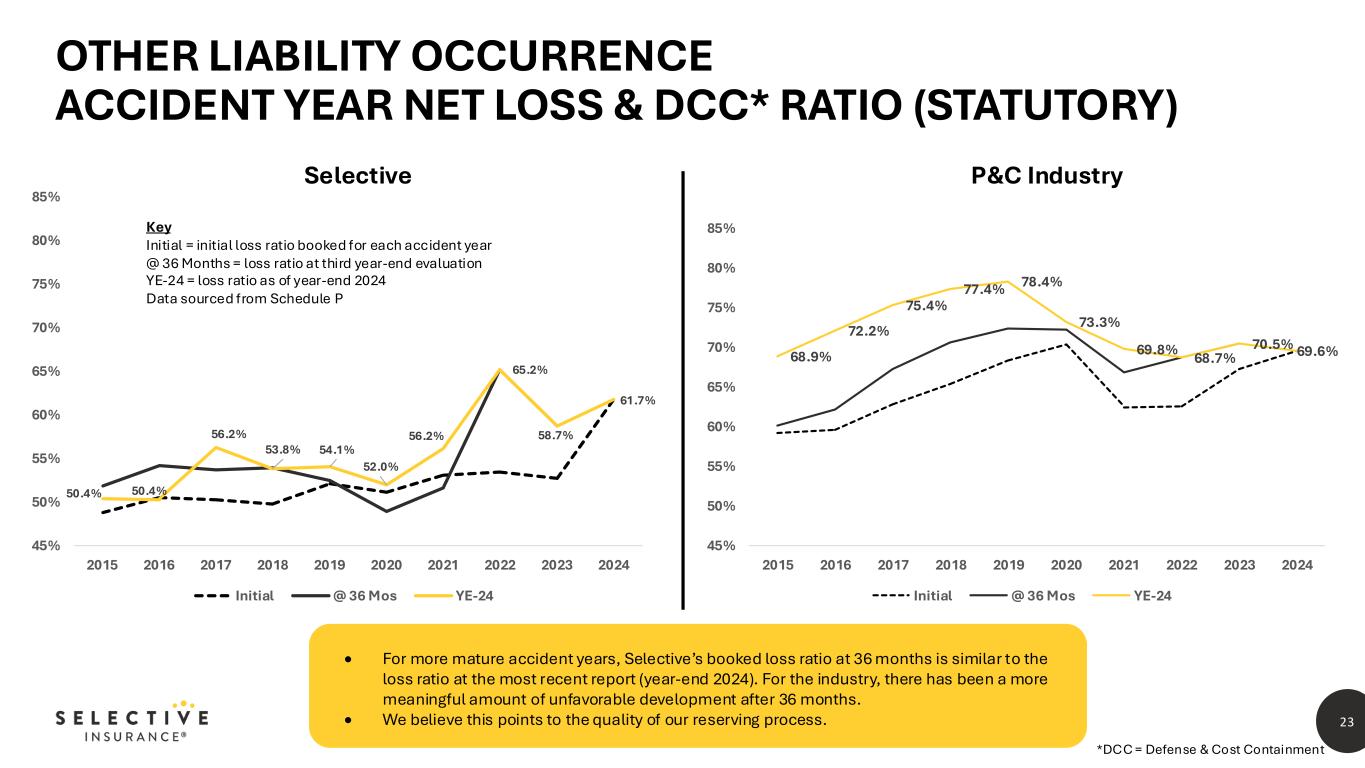
reserves given a higher paid activity? Yeah, I would say, you know, and I know we pointed to paid, I would say that we've seen movement from an incurred basis similar to what we've seen on the paid side, and I think that's reflective of your point relative to case reserves and movement and case reserves. I'll also go back to the point we made last quarter where we talked about the outside studies we had done on both the actuarial reserving and planning process as well as the claims process. And that was our way of doing an assessment with regard to any understanding any change in underlying case reserve adequacy, either favorable or unfavorable. And I think, as we mentioned, we're pleased with the results of those surveys on both sides. And I think indicated that while there's opportunities for us to continue to drive some improvements in our claims organization, you know, very strong performance there. So, but we look at both. We look at several methods. We're looking at paid and incurred methods. We're projecting them to ultimate. That continues to be our process. And we think it gives us the best insight into, you know, where most more recent prior accident years are. And more importantly where run rate profitability is okay wonderful john thank you for your help thank you
Operator
our next question comes from paul newsome with piper sandler your line is open paul if your
telephone is muted please unmute sorry about that good morning um thanks for the call um hopefully you can give us just a little bit more detail on the reserve development of the personalized business and how it might sort of fundamentally differ from what you, you know, had in the commercial lines business, size, geography, anything that you would suggest other than just sort of differences or similarity in or delay in the overall sort of liability claim
Yeah, I guess, Paul, thank you for the question. and we've mentioned this both in prior quarter and this quarter, in personal auto, the prior development is driven entirely by the state of New Jersey. And in personal auto, New Jersey represents about 30% of our portfolio. So all of that is New Jersey and all of it, pretty much all of it is the 2024 accident year. And that was the case in the Q4 and also the prior quarter. So for the full year number, when you look at that and the impact on personalized overall combined ratio, that prior development was about 3.7 points in total. All of that is New Jersey. And I think that's important. And I know Patrick referenced this in his prepared comments as well. I think when you look at the improvement that we see in personal lines and look at that 100.6 combined ratio, recognize that that almost four-point impact of PYD is entirely New Jersey, and it really masks the improvement we've seen and the strong run rate performance we're seeing in that personal lines book outside of New Jersey. And we're also taking pretty significant actions to continue to manage that New Jersey portfolio so it becomes less of an impact going forward.
So that's what I would point to. I think that's an important point to make. And it's a very different environment there.
Now, we have made comments in prior calls, and I'll kind of reinforce them here. Some of the New Jersey dynamics that we see in personal lines also apply to commercial lines. And New Jersey has always been a higher litigation rate state for both personal and commercial, and we've seen over the last few years through legislative change a number of what I'll call sort of pro-plaintiffs bar legislative enactments that I think have made it more fertile ground for litigation abuse and social inflation. So legal changes that require pre-suit disclosure of policy limits, increasing private passenger auto minimum limits, increasing mandatory commercial auto limits to a million point five for autos over 26,000 pounds, which is a small portion of our book. But I think it's one of those areas that attracts more attorney involvement. And then a couple of years ago, a lowering of the bad faith standard for uninsured motorists and underinsured motorist claims. I think all of those things have driven up the interest of the plaintiff's bar in that state and have driven up a more aggressive litigation environment. And I think lost trends have reflected that. And unfortunately, on the personal line side, the regulatory environment hasn't been as conducive to rate adjustments to make up for those costs. So that's an ongoing challenge. I think you see it in fast-track data on an industry basis for personal lines. And I think a lot of those same dynamics impact the commercial auto line for that state as
Yeah, sounds like all the lawyers are moving back to New Jersey from Florida. Yeah. My second question is, I want to ask about sort of operating leverage from a capital perspective. Historically, because of the firm's underwriting consistency, it has been able to run with a little bit higher premiums to surplus ratios than some of its peers. And I want to know if there's anything that we should think about in terms of that change, given, you know, capital buybacks and such today and where the stock is and things of that nature. But I think that was the question. But if you could talk to that, that would be interesting to me.
Yeah, sure. So there's no change in how we think about our target operating leverage. You know, You've heard us talk about operating in a range of 1.35 to 1.55 times, and over the last several years, we've been in that range where a couple years we were at the upper end of the range, a couple years at the bottom end of that range. If you look back historically, that operating leverage did tend to be a little bit higher than the peer group, but I would say if you look over the last decade or so, the peer group has generally moved a lot closer to where we operate from an operating leverage perspective. So it's not that much of a differentiating factor at this point. But in terms of how we think about target operating leverage, that range continues to serve us well.
Yeah, and I think I would just add that operating leverage is one of many capital metrics that we use to evaluate where we are relative to what we think we need to run the business. And we continue to, on a regular basis, look at our own internal models and calibrate those versus external models as well to ensure that we have sufficient capital to absorb any unforeseen consequences but still operate with an efficient balance sheet.
Great. Appreciate the help. Thank you, guys.
Operator
Thank you. Our next question comes from Jing Lee with KBW. Your line is open.
Good morning. Thank you for taking that question. I'll stay on reserves for a sec. Just curious about E&S Schedule Reserve, can you kind of unpack some drivers behind the reserve charge? Is it concentrated in specific excellent year geography coverage types that's similar to the commercial lines that's mostly from commercial auto, and how does this impact your appetite? for growing the ENS platform going forward?
Yeah, thank you for the question. Just let me make sure we're talking about this in the proper context, which is our full year ENS combined ratio was an 87.8, so strong profitability. The reserve action we took in ENS in the quarter, and we hadn't taken any on a year-to-date basis, was $10 million, so de minimis in total, but spread across the 2020 through 2023 accident years. So four accident years and $10 million are very de minimis movements on an annual basis for each of those accident years. So there's nothing noteworthy there. We disclose a great deal of detail with regards to reserve adjustments. We true up lines at the end of the year and there's nothing there that's noteworthy from an accident year or a geography or a segment perspective. And, again, this is all in the context of extremely strong operating margins in ENS over the last few years, and we expect that to continue going forward.
Got it. Thank you. That's very helpful. My second question is on your geographic expansion. You've been investing a lot on geographic expansion and new state throughout the several years. Are these newer territories, as they have been mature, what contribution are they making to the top-line growth versus the margin profile?
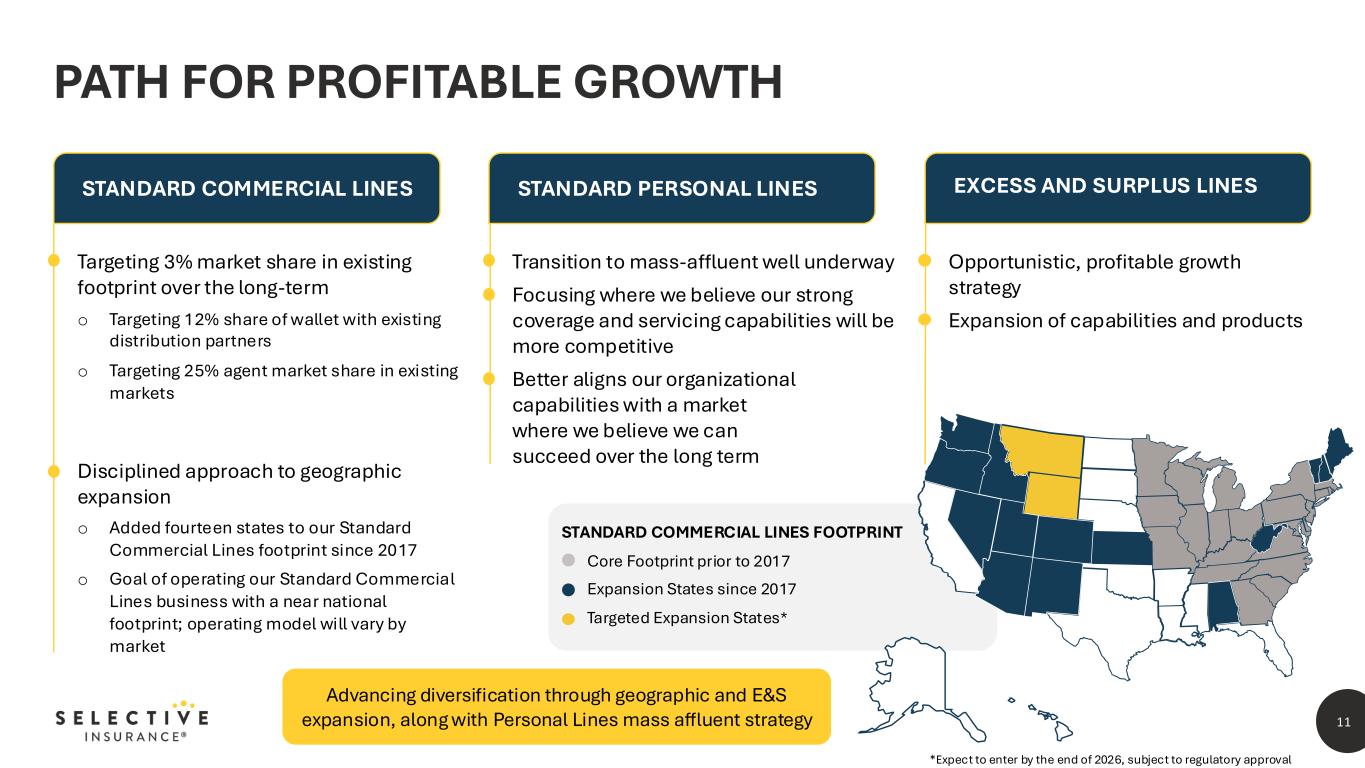
Yeah, the top-line growth, if you just look at it on average over the last several years, and remember, we started geo-expansion again in earnest in the 2017 to 2018 kind of timeframe. And I would say over that time as states have come on and some of those states have matured while new states are coming on, it's contributed between one and two points of growth overall on average over that time period. I would expect that to continue to temper going forward. But that's what the contribution has been to this point. With regard to profitability, as we've talked about in the past, for the first few years in a new state, we planned and incorporated into our planning guidance and expected loss ratios that newer states run at worse profitability than our legacy book runs. But I would say our experience over the last eight or so years has been that those states have consistently performed within our expectations and have improved as they've matured. So there's nothing we're seeing there that is a different profitability profile than what we talk about in terms of the overall portfolio we have.
Got it. Thank you. I appreciate the help. Thank you.
Operator
Thank you. And our next question comes from Roland Mayer with RBC Capital Markets. Your line is open.
Good morning, and I guess congrats on 100 years, even though I know you all weren't there the whole time. I wanted to ask just on the workers' comp releases and what accident years those pertain to.
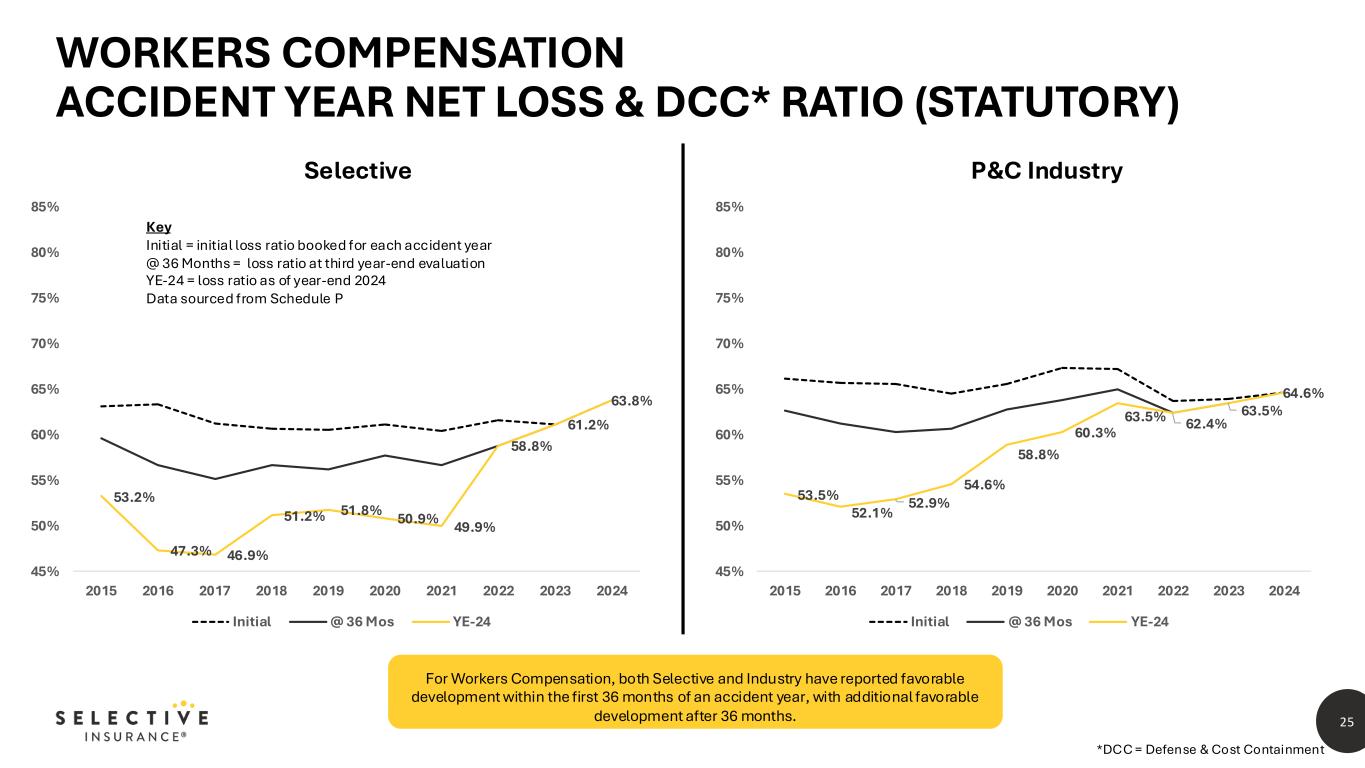
Yeah, sure. So there are two big drivers, and I want to hit them, and I think it's an important question. First thing is, as you know, we do our annual tail study in the fourth quarter every year for workers' comp, and just without getting too far into the tail study, that's effectively an evaluation of the development to ultimate for accident years and maturities that fall outside of your traditional reserving triangles, which cover 20 years. and you're really going through that analysis to get an accurate reserving picture for those long-term chronic and permanent injuries that may remain open for decades. And then you apply that development assumption to all accident years as your long-term view of medical inflation. That drove about half of the favorable emergence we recognize in the quarter. And I think you want to put that in context, which is because we're talking about decades of accident years, the individual impact by any given accident year for that is de minimis. It's in the, call it roughly half a point per year over that extended period of time. So that represented half of it. The balance of the favorable booking action in the quarter was from accident years 2022 and prior. So I think that's the other driver. So accident years 2022 and prior. As we talked about throughout the year, we continue to see better than expected frequency emergence in the workers' comp line. That held up through the full year. But as has been our practice, we won't react that quickly to a long-term line from a frequency perspective. So the actions were 22 and prior, and the workers'
comp tail study. That's helpful. And then I wanted to ask on the GL charge. I know this year, I think it's all been umbrella, but in 24, I think a lot of it was primary GL. Was there any movement on the 2024 charges this year?
On the 2024 charge? So just to reinforce, the point you started with, which is for the quarter and the full year, the GL adjustments we made and booked were predominantly umbrella, and that umbrella is predominantly driven by the auto lines of business. The core GL lines and our booked levels for the core GL lines in the priors have held up well throughout the year. That's great. And then I wanted to see if I could speak
one more in. You talked about the 14% ROE for next year in the guidance, and I think this year the NII was about 13%. Given all the movement, do you have an idea of what the long-term target should be at this interest rate level in your portfolio? With regard to investments in particular? No, just for the overall consolidated ROE. There's a lot of movement in the underwriting margins right now? And I just wondered, you know, in a few years from now, is there a goal you're
aiming for? Yeah. So I would say that we set our ROE target to be something that we expect to achieve on a consistent basis over time. And we set that target on the basis of what we believe to be sort of long-term rates of return on the investment portfolio. To your point, we're generally returning, think about a 4% after-tax book yield on the portfolio currently is kind of above where you'd expect it to be on a long-term basis. And if you look over time, I think something closer to 3% after-tax is a more reasonable long-term assumption. And with our invested asset leverage, it's just over three times, you know, think something in the neighborhood of a nine to nine and a half percent after tax or ROE impact for investments. And that's why we maintain our 95% combined ratio target because that over time will position us to meet or exceed that 12% ROE target. That's how we think about it. That's why we keep that target where it is because we recognize that these returns, while there is durability here, and I do want to stress that point, and you heard it in the guidance that Patrick outlined, There is durability in these book yields, if you look at our duration, and we feel good about that over the next few years. But we also know that over the long term, you can't expect that to be
the case. And I would say the 12% target is intended to provide a spread over what we estimate to be our cost of capital. We want to make sure that we're earning our economic freight, so that's how we ground ourselves in that bogey.
Operator
Thank you. Our next question comes from Michael Zerimski with BMO Capital Markets. Your line is open.
Hey, Greg, good morning. Thanks for the color on workers' comp. You know, clearly a great result this quarter, too. And then in the past, maybe it was a bit of a head fake, but there was some indication that loss trend might have been getting a bit worse. But just curious on the underlying loss ratio and comp. I think it still appears elevated. How are you, how does that line rolling up into the combined ratio guide for next year? That's my first question.
Yeah, I guess we don't provide individual line guidance. You know, you'll see our reported results and we give you a lot of detail on the reported results by line, so you'll see that in Q1. But as we talked about in prior years, generally speaking, we've maintained our severity assumptions, our medical severity assumptions, and I've seen a little bit of upward pressure that we've talked about with regard to utilization and maybe seeing your average medical severities come in a little bit higher than they had been running over the last few years. But we've also continued to see improving frequency trends, and that's held up through 2025. So you have to put those pieces together alongside of the rate level that continues to be slightly negative, and that'll all come through in how we set our plan loss ratios for that line of business. And I think you'll see something similar to what you saw in 2025.
Okay. That is helpful. My follow-up is back on the expense ratio commentary and initiatives there. It's been interesting, I guess, over the last couple of quarters, there's been a few companies that have come out with very large expense ratio improvement guides based on implementing technology and AI, et cetera. And then on the other hand, there's other companies in your camp that are kind of guiding to upwards expense ratio movement to make further investments. So I guess I'm just curious, would you say that this is like, is this kind of a one-time step up to kind of broaden selectors' capabilities having to do with newer technologies? Or is this more of kind of all the work you've been doing on improving the reserving and claims, you know, processes, et cetera?
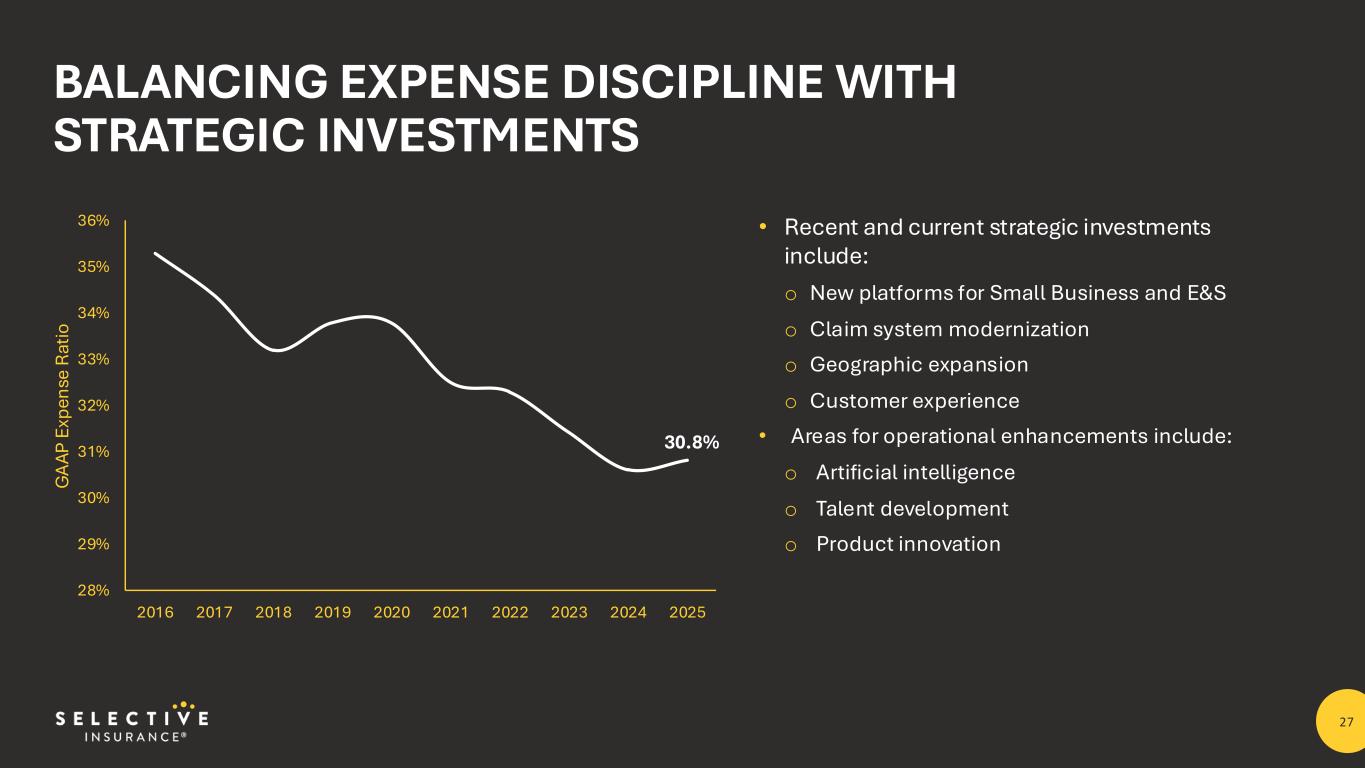
Yeah, no, it's a great question. And I think we've seen and heard a lot of the same commentary. And clearly, we're in the camp that the investment in technology and our investment in technology has continued to ramp up as a percentage of premium. over the last several years. And we expect that to continue. And I think when you look at it at the highest level, we expect the investment in technology to continue to rise as a percentage of premium and the cost of labor, the percentage of premium that goes to labor will be coming down over time as a result of gaining the benefit of these technology investments. We're not setting aggressive targets, but we think there are real opportunities here, not just to drive operational efficiency, but to improve decision-making and improve outcomes across underwriting, pricing, decision-making, and claims outcomes. And that's what we're pointing to in terms of the increase in our strategic investment dollars. So if you looked over the last three years, our split of strategic investment dollars in technology relative to running our technology infrastructure, you know, quote, unquote, keeping the lights on. It's about a 50-50 split, which is a pretty significant improvement. So there's more money going into the strategic investments. And we've already doubled that over the last three years and have been able to manage the overall impact on the combined ratio or the expense ratio. And that'll be our focus going forward. So it's not a step up per se, but I think we expect technology investment as a percentage of premiums and continue to go higher, and then there will be offsetting benefits in other cost aspects, and loss ratio benefit as well to be realized.
I understood that's helpful, and maybe sneak one last one in, and you might have touched on some of this in prepared remarks, but should we be thinking about the retention ratio as staying around current levels based on kind of the indications of kind of making sure to continue to turn out the less profitable business in a decelerating rate environment? Or is this, or anything that can tease out on the retention ratio is the help of things?
Yeah, sure. And again, that's not an area we guide to. We don't do growth or retention. But I think generally speaking, to your point, our focus is on the granularity of our execution of our pricing strategy. And we believe that by doing that, we should be able to deliver relatively stable retentions, but there's an assumption around market behavior that I think is a little bit tougher to forecast. And I think depending on market behavior with regard to pricing discipline in the casualty lines, that will ultimately influence where that retention settles. But our focus, to your point, is on that granularity of execution, which we think does allow us to maintain more stable retentions. Thank you.
Operator
thank you thank you our next question comes from daniel lee with morgan stanley your line is open
hi good morning uh thank you for taking my questions and squeezing me in um i kind of want to switch switch gears and kind of ask about my first question would be on the ens segment um i know your growth has been strong for ens in the past prior years but i'm starting it's kind E&S seems like it's slowing down. I kind of wanted to get your thoughts on what you're expecting for E&S overall and your growth aspirations for the E&S segment.
Sure. That's a business we really like. It's a business that we would expect to continue to become a bigger part of our overall premium in the coming years. But it's also a business where it's important that you maintain consistent discipline from a pricing and underwriting perspective over time. i think there's been a fair amount of industry commentary around some more aggressive pricing behavior not just on the property side but i think leading into the casualty side as well and and we're going to maintain our discipline there and and that might create some some downward pressure on growth in the near term but in the longer term i would put that segment in the category of business that we like and we expect to be able to continue to grow as a percentage of our overall premium. We've got meaningful potential to expand our capabilities there from a product and an underwriting perspective, but also having recently opened up a retail access channel for our strong retail partnerships on the standard line side, we think that's also
a real growth avenue for us in the coming years. Awesome. Thank you. Yeah. So my follow-up, I guess, I wanted to also ask about, so ENS casualty, just lost cost trends overall. I kind of wanted to maybe ask just the differences between commercial, just standard commercial lost cost trends versus ENS casualty, and what are some nuances there that we should be thinking about for ENS casualty in terms of lost cost trends?
Yeah, I would say probably the biggest difference is the E&S, and you see it in lower retention ratios, it does tend to be a more transient business, which allows you to turn over the portfolio more quickly and make more significant mix improvements. As we've pointed to over the last couple of years, as a result of those actions, we've seen a much more meaningful frequency decline in E&S than we have in standard GL. We've seen frequency benefits in our standard lines, but I think it's been a bigger frequency benefit that we've been able to realize in E&S. But with regard to severity trends and social inflation, I would say the general dynamics are consistent, and what we see them consistent across both admitted and non-admitted business, I would say the bigger difference that we've seen has been more so on the frequency side. And we had also been, and we pointed to this in prior comments, we had been embedding higher severity increase assumptions into our expected loss ratios, in part because of the more transient nature of E&S casualty portfolios.
Operator
Thank you. There are no further questions at this time. I'd like to turn the call back over to John for closing remarks.
Great. Well, thank you all for joining us. We always appreciate the engagement, and if you have any additional questions, please feel free to follow up with Brad.
Operator
Thank you for your participation. You may now disconnect. Everyone, have a great day.