Operator
ladies and gentlemen good afternoon my name is abby and i will be your conference operator today at this time i would like to welcome everyone to the sky harbor 2024 year-end earnings call and webinar all lines have been placed on mute to prevent any background noise after the speaker's remarks there will be a question and answer session if you would like to ask a question during that time simply submit a question online using the webcast url posted on our website Thank you. And I would now like to turn the call over to Mr. Francisco Gonzalez, Chief Financial Officer. Mr. Gonzalez, you may begin your conference.
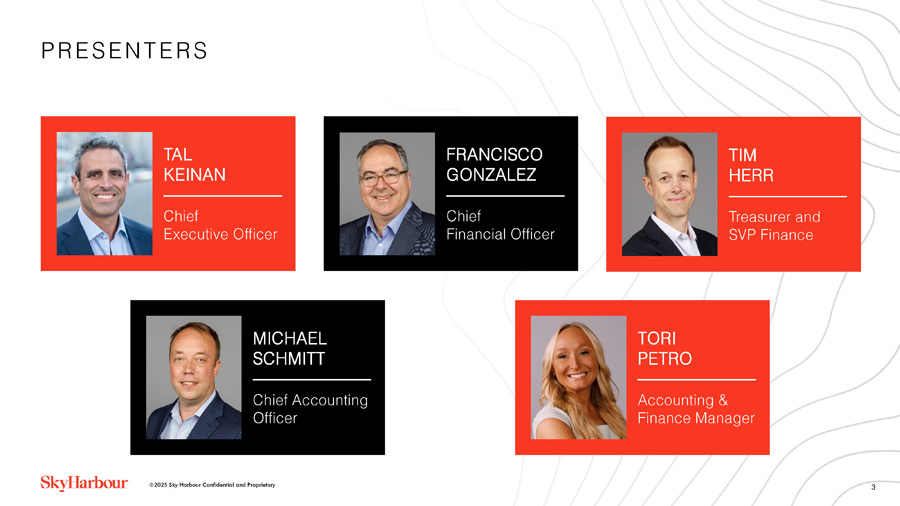
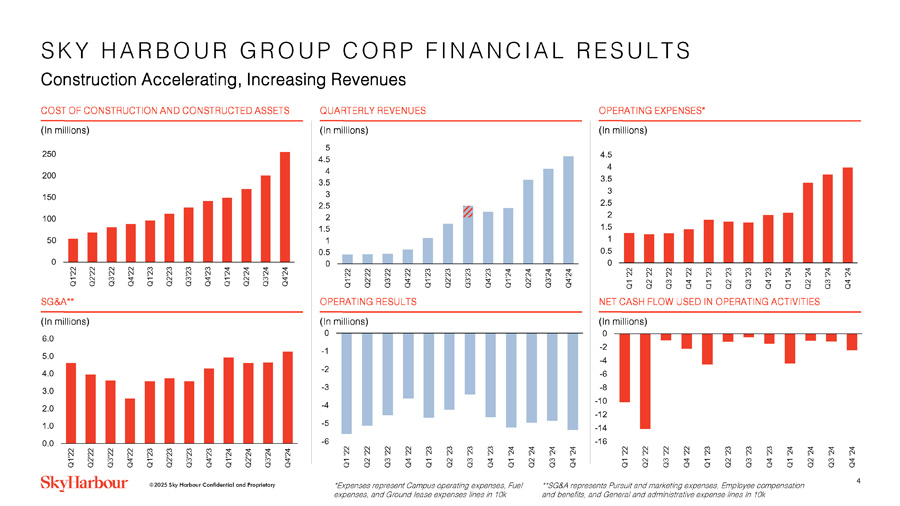
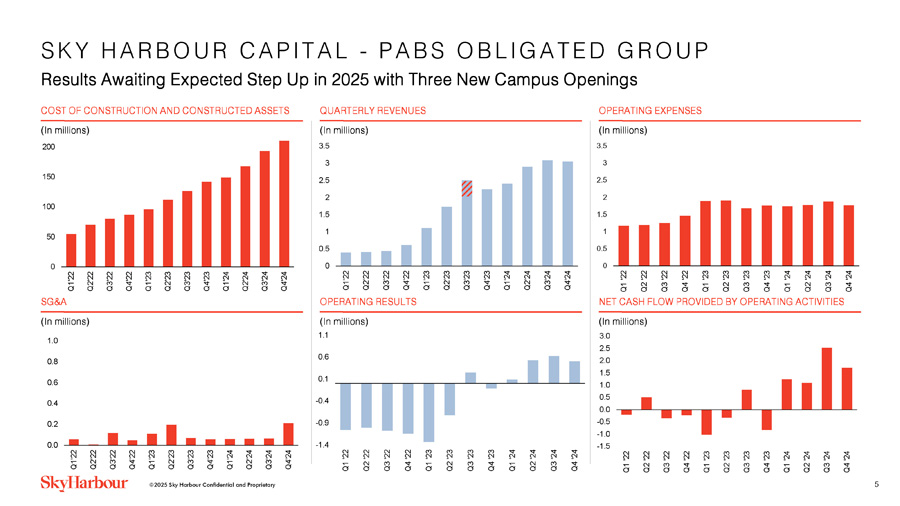
Thank you, Abby. And hello and welcome to the 2024 fourth quarter and full year results investor conference call and webcast for the Sky Harbor Group Corporation. We have also invited our bondholder investors in our borrowing subsidiary Sky Harbor Capital to join and participate on this call. Before we begin, I've been asked by counsel to note that on today's call, the company will address certain factors that may impact this and next year's earnings. Some of the information that will be discussed today contain forward-looking statements. These statements are based on management assumptions which may or may not come true, and you should refer to the language on slides one and two of this presentation, as well as our SEC filings for a description of the factors that may cause actual results to differ from our forward-looking statements. All forward-looking statements are made as of today and we assume no obligation to update any such statements. So now let's get started. The team with us this afternoon you know from our prior webcast our CEO and Chair of the Board Tal Kanan, our Treasurer Tim Herr, our Chief Accounting Officer Mike Smith, our Accounting Manager Tori Petro, we also have Andreas Frank, our recently promoted Assistant Treasurer. We have a few slides we'll want to review with you before we open it to questions. These were filed with the ACC about an hour ago in Form 8K along with our 10K and will also be available on our website later this evening. We also filed our fourth quarter Sky Harbor Capital Obligated Group on Alita Financials with MSRB EMMA a few days ago. As Avi mentioned, you may submit written questions during webcasts during the Q4 platform and we'll address them shortly after our prepared remarks. So let's get started. In the fourth quarter, on a consolidated basis assets under construction and completed construction continue to accelerate reaching over 250 million as of year end on the back of construction activity at phoenix dallas and denver revenues experienced an increase of 13 percent sequentially over q3 as we realized more leases in san jose optimized in the other three operating campuses and had three weeks of operations from the acquisition of the Camarillo California campus on December 6. For the full year, consolidated revenues doubled over those from 2023. Operating expenses in Q4 increased mainly from two factors. We began to hire general managers and staff for new campuses coming online this quarter and next in order to do the adequate onboarding and training at our existing campuses second factor as we have explained in the past we accrue for ground lease payments at 13 airport locations even if we're not actually making cash payments to the airport or municipal owner of our sites that non-cash accrual of ground lease expense amounted to over 1.4 million in q4 and is reflected within operating expenses also worth repeating that increase over the last three quarters in ground lease expense is due principally to the ground lease payments at San Jose which are significantly higher than our typical greenfield projects as ground lease payments incorporate the leasing of an existing large hangar apron and parking because of these existing buildings or facilities is basically amortized through ground lease payments as part of our operating expenses. On SG&A, we strive to keep it in check as we grow our business. And we also would like to reaffirm our prior guidance that we expect Sky Harbor to reach cash flow breakeven on a consolidated basis in Q4 of this year, as we reach sufficient scale with a new campus openings to cover our holding company expenses. One last thing to note, as you review the 10K just filed, is that for the first time we're reporting fuel revenues apart from rental revenues. Fuel revenues are mostly margin we get from providing the fuel delivery service, as we don't take ownership of fuel in most of our existing campuses. As this plan item grows in importance, we'll break down further to show how much of these fuel revenues correspond to minimum amount guarantees. We embed in most of our tenant leases, as those represent also contracted revenues, in a sense. Said simply, if a tenant does not fly or doesn't consume their minimum amount, guaranteed amount, it's like additional contracted rents that get added to their rental invoice. Next slide, please. This slide summarizes the financial results of our holding on Scarborough Capital Sub-Series that forms the of the United Group. This basically incorporates the results of our Houston, Miami, and Nashville campuses, along with the capex and operating costs of our three projects under construction in Denver, Phoenix, and Addison as of Q4. Two of those are now open. Revenues were basically flat from Q3 to Q4. We expect a step function increase in revenues in Q2, Q3, and Q4 of this year as these three campuses are list up and rent revenues and fuel revenues commence to flow. Operating expenses increased, but I should note, as we have discussed in the past, that these include ground lease payments or accruals as per year's gap in all six ground leases in the obligated group. In other words, we do not capitalize ground lease payments or accruals during construction. As may be seen in the bottom right-hand chart, we have firmly crossed into positive cash flow from operations at the project level. We expect this trend to continue and to accelerate, as I mentioned, in the second and third quarters of this year when Denver, Phoenix and Dallas campuses ramp up in these rental and field revenues. One last thing to note at the Sky Harbor Capital level is that at the end of 2024 we were required to begin the compliance testing as per our bond indenture and we were in compliance in terms of those ratios for the 2024 and forward looking for 2025. Next slide. Let us now turn to Mike Smith, our Chief Accounting officer for a review of the introduction of the presentation of adjusted EBITDA in our reporting. Mike. Thank you, Francisco.
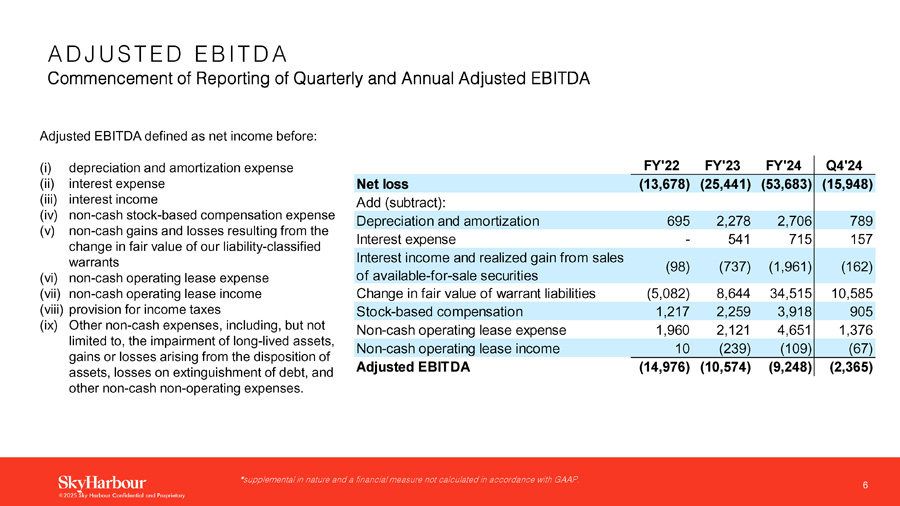
I would like to take this opportunity to provide and highlight a key business metric that we began presenting within the management discussion and analysis section of our annual report. Adjusted EBITDA is utilized by our management team to evaluate our operating and financial performance, which is supplemental in nature and a financial measure not calculated in accordance with U.S. GAAP. We've provided a reconciliation from our gap net loss in fiscal years 2022 through 2024 on the right-hand portion of this slide we define adjusted EBITDA as gap net income or loss before the addbacks and subtractions that are enumerated on the left portion of the slide which i encourage you to review amongst these items are a few significant non-cash items that we have discussed both in francisco's commentary as well as our previous call including the non-cash portion of our ground lease expense share-based compensation and the change in fair value associated with our liability classified warrants we began including adjusted even in our filings as we believe it is a potentially useful metric for investors analysts and other interested parties as it provides a view of our operating performance analyzes our ability to meet debt service obligations and facilitates company to company operating performance comparisons by excluding potential differences caused by various factors including items that are non-cash or volatile in nature lastly it's important that i know that our method of calculating adjusted eva though may differ than and therefore it's comparable um and with that thank you mike so we've been sharing this
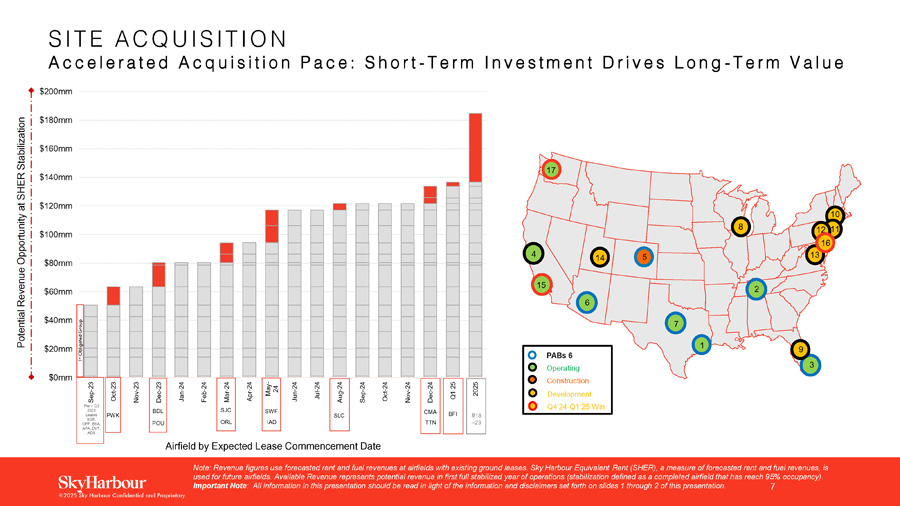
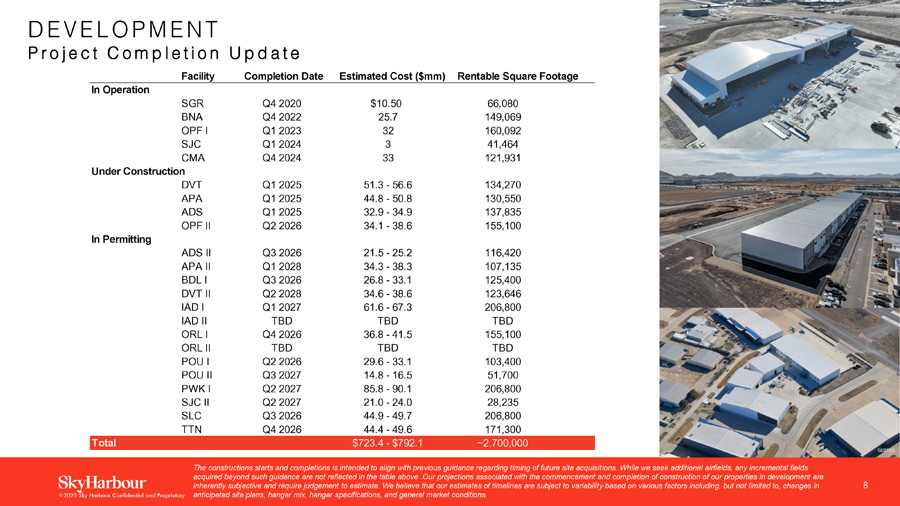
chart on all the last quarterly earnings calls i think this is fundamentally where value is driven at Sky Harbor. This is the realizable revenue from ground leases that have already been signed. We are currently at the second to last from the right chart. That's BFI. That's our Boeing field in Seattle, our most recent acquisition, which puts us at just under $140 million of realizable revenue. By the end of this year, if we meet our guidance, we will be coming in just shy of $190 million of realizable revenue. The, I think, important thing to look at on this chart is, you know, I would advise anyone looking at the company, let me remind people of the methodology here. This is the number of square footage, the amount of square footage of hangar capacity that is buildable on each site according to our site layouts times the Sky Harbor recruitment rent. or share, which is what aircraft are currently paying on those airports in rented fuel. We think that's a conservative estimate because on every airport, we are our actual revenues have significantly exceeded the shares. So that I think is a good starting point. Now then anyone who's analyzing us will want to discount for development risk, lease up risk, operating risk that goes with that. But that fundamentally is the foundation of value creation at Sky Harbor. on the right side you can see the current status of the various airfields that have been announced with that let's move to the next slide okay so i i won't dwell on this other than to highlight in the under construction section dvt is deer valley phoenix we actually have our first two certificates of occupancy at deer valley and we've begun flight operations at that airport we continue with construction with the rest of the campus and at ADS that's Addison Dallas we have our first certificate of occupancy and again
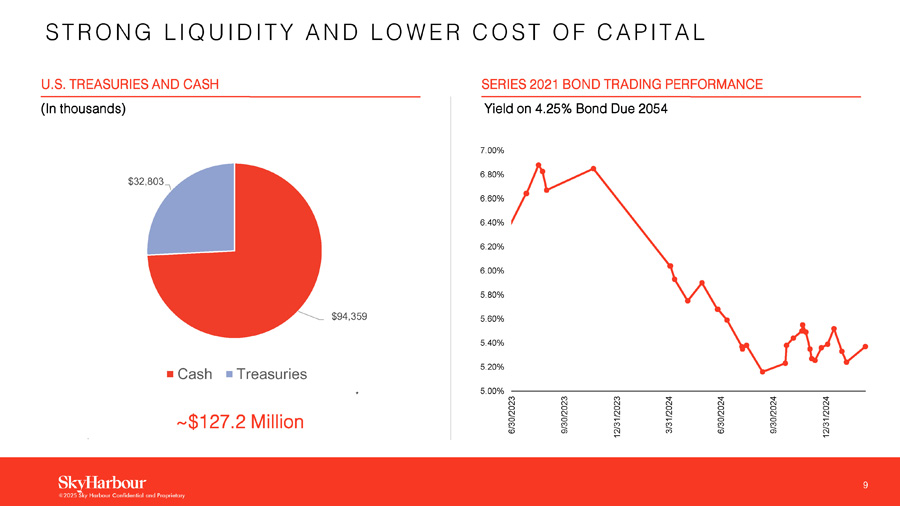
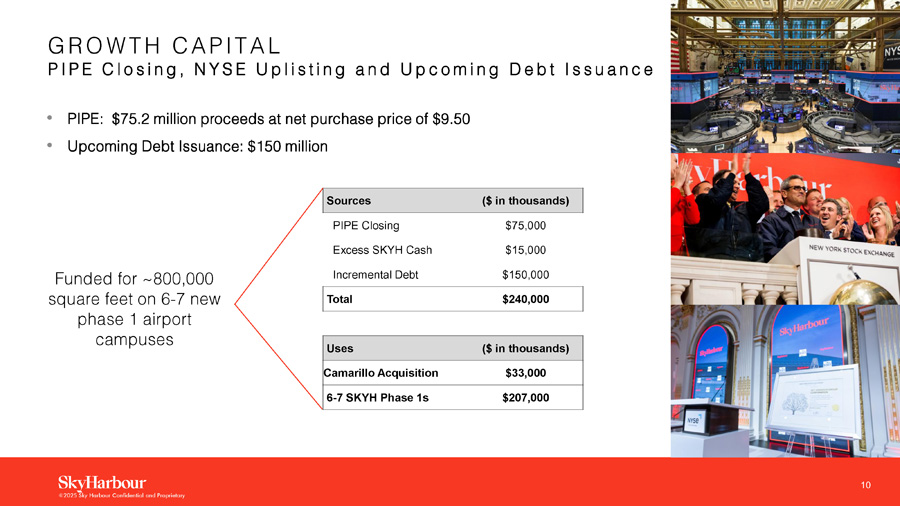
construction continues with the rest of the campus other than that I'm not going to go through the rest of the items on that chart and let me hand it back to Francisco thank you Tal on the left hand side we showed that we continue to enjoy strong liquidity with about 127 million dollars of cash and US Treasury bills we We continue our cash management strategy led by our treasurer Tim Herr, overruling our cash in short-term one- and three-month U.S. Treasury bills pending their use in construction. These cash balances exclude the approximately $32 million cash we used in December to acquire and pay certain liabilities of Cloud9 and Sky 05 at Camarillo Airport in Ventura County, On the right-hand side, I wanted to show the latest trading of our long bond, which continues to rally over the past year. We have been in constant touch with our bondholders who continue to exhibit interest in our bonds and look forward to our next offering. We have begun the process to approach zero agencies to aim to secure investment rate ratings for existing bonds, and we'll be reporting on that exercise by the summer ahead of our next debt financing. And we also want to take the opportunity to reiterate our expectation that the future debt service coverage ratios for these bonds will exceed those that forecasted, that we forecasted at the time of the bond insurance three years ago. And that, and supporting and protecting that coverage is a solemn commitment that we have as a firm. Next slide, please. As many of you know, we completed our second PIPE equity placement of common stock in the fourth quarter of last year, raising approximately $75 million from a group of existing and new qualified investors. Those proceeds, along with cash in hand, will support our next debt issuance in anticipation of the start of construction of phases one at various projects outside the existing obligated Let me turn it back to Tal, please, because some of those new campuses and ground visits that we have secured in the past quarter.
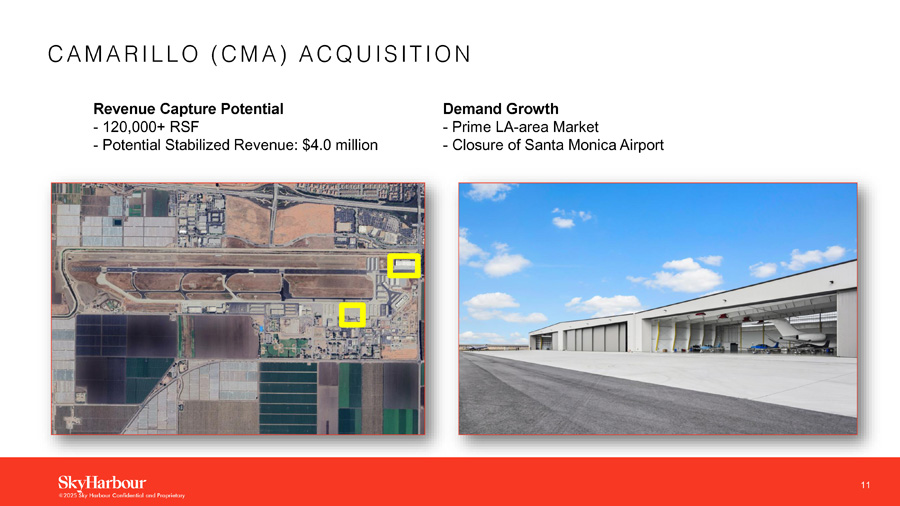
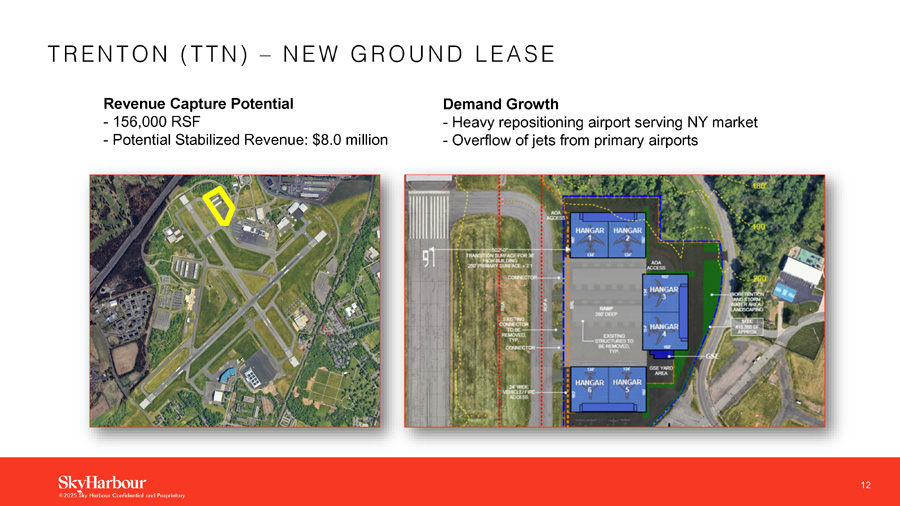
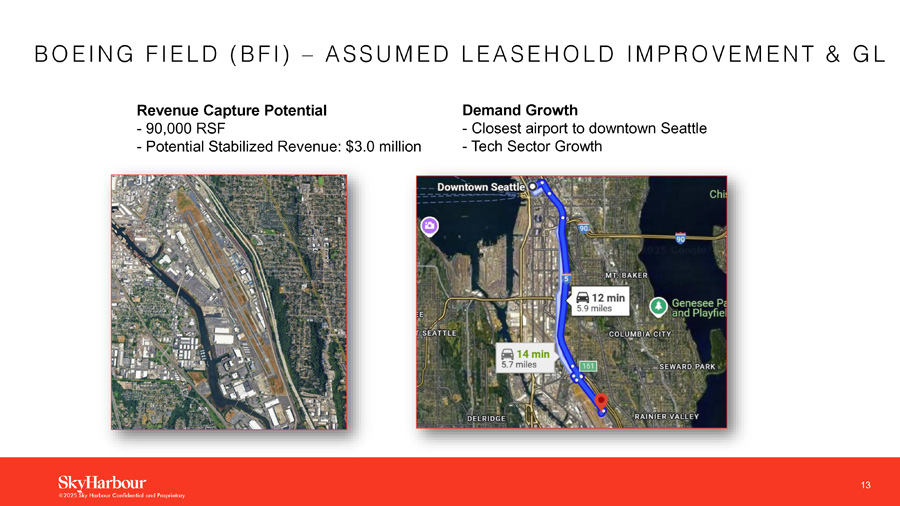
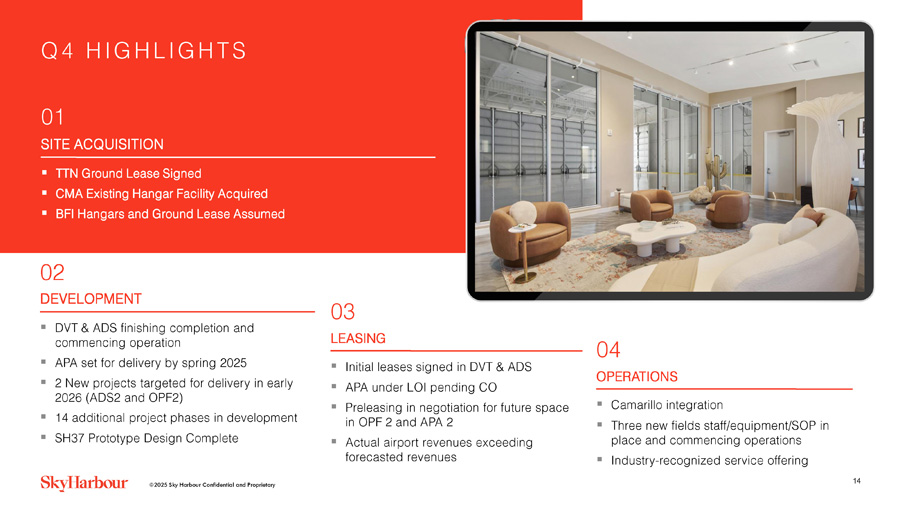
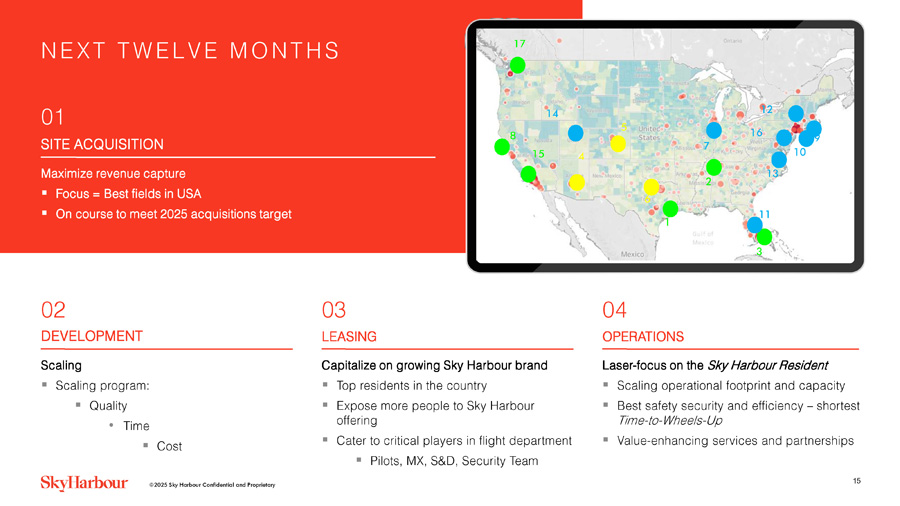
Thanks, Francisco. Okay, briefly on each campus, we're starting with Camarillo, California. This is our first brownfield acquisition at Sky Harbor. The reasoning behind it is pretty straightforward. As many of the people on the call know, we split our airport target list into what we call primary airports and secondary airports, or primary airports and repositioning airports. Primary airports are airports where the airplane lives at the same place that passengers board and deplane. Okay, so if you take an aircraft that's based at Teterboro, that is a primary airport. Repositioning airports are airports where the airplanes live, but the passengers do not always board and deplane. So if you take Bradley, Connecticut or Oxford, Connecticut, that's a place where a lot of aircraft live that reposition to, let's say, Teterboro or White Plains for passenger operations. So Camarillo is both of those, and there are a number of airports that serve both of those purposes. It's a primary airport for aircraft owners that live roughly in the corridor between Calabasas and Montecito, California. It's a secondary airport that serves Van Nuys, which is the top primary airport for the LA basin. What we foresee happening, this is a little bit future looking from our perspective, but really not that much, is that Santa Monica Airport is in the process of closing. It has been for a number of years now. It's already been cut in half in terms of runway length, forcing most of the large jets off of the airport. When it does finally close, a lot of the or all of the aircraft that are based there will be looking for new homes in California. There's going to be a crowding out phenomenon into a market where there is already zero capacity. Van Nuys is fully, fully booked with waiting lists across the entire airport. Similar situations exist in Burbank. So LA is definitely one of the top markets for us in the country. Capturing an existing facility that is already cash flowing, that is really on the migration path. It has to pass through Camarillo is an important move for us. I will say Francisco noted we closed that transaction in December, so you're not really going to see any of the cash flow from Camarillo in our Q4 earnings. You'll begin to see those captured starting in Q1 of this year. Next one is Trenton, New Jersey. Again, I've said it before on this call, Sky Harbor could be a New York-only company, and it'd be a pretty exciting company if we were only based in new york um almost any square foot of land that we can get in the new york area we want to get um and we would say i'd say in general the repositioning airports in the new york area feature higher rents than the primary airports in almost every other major metro center in the united states uh you say maybe a dozen um probably fewer than a dozen so we're very excited with Trenton, New Jersey. It is, again, I would say, first and foremost, a repo airport for Teterboro and White Plains, although there is a significant amount of activity from, call it the Philadelphia suburbs, all the way to Princeton, New Jersey, and a lot of the pharmaceutical industry that's based in that area, so exciting development for us and then lastly boeing field which we've been at for about five years now um and you know just a reminder to people our site acquisition features a much longer gestation period than we originally appreciated uh i think that was bad news for us for the first few years it's very good news for us today that i think people are seeing there's a bit of a hockey stick moment going on right now on the site acquisition side is that seeds that we planted five years ago are beginning to sprout uh today seattle is one of the best markets in the country it's one of those call it doesn't exceptions where you can exceed new york repositioning rents uh and boeing field is the reigning king of uh seattle no pun intended because it's king county uh this is our first foray into uh boeing field there are additional targets for us on that field and we hope this is the beginning of a very long and fruitful relationship with with King County a couple highlights from Q4 by the way I'll call out the photographs that is from somebody help me Phoenix that's our Phoenix one of our Phoenix hangers in the photograph I like to break things into site acquisition development leasing and operations increasingly people who study the company closely have seen that these four silos are increasingly integrated. It's really one fluid effort increasingly as we go. But in terms of framing and understanding the scope of our activity, it's still, I think, useful to break it into those four areas. So on the side acquisition side, we discussed the three airports that have come on board. On development, the biggest theme is our uh really foundational effort to turn this into a major construction company with the associated benefits of speed and cost control i'll talk about that a little bit in the next slide but more tactically uh dvt and ads that's that's phoenix and dallas have both commenced operation. We have leases in both campuses with flight operations having commenced. Something that people look at us a little bit closely understand, we do have a kind of an interesting period where flight operations have begun, but construction is still not finished on the rest of the campus. And it's a bit of a dance to make them coexist in a safe and efficient way. We're there right now, and I think the overlap is, you know, is several months. I don't think that's something that's going to go away. That's how we will operate probably forever, because we do think we have a good handle on how to conduct those parallel operations safely and efficiently. And there's no reason to forget the revenue in the meantime as you're waiting for Lisa. APA is Denver. That is set for delivery next month. We are under LOI for a good number of hangars in denver already um again we can't uh can't move people in until we have certificate of occupancy but but uh that is in the next uh month or so um two new projects uh slated for delivery end of this year beginning of next is miami phase two and dallas phase two and we have another 14 projects in various phases of uh of development uh not to jump ahead but the sky harbor 37 is the name of the what we hope at least for the next few years will be the final prototype in sky harbor a lot of our cost cutting and speed enhancing exercises have to do with the fact that it is the same hanger same prototype on every airport with minor adjustments right so we have a version that is compliant with wind load requirements in Florida, one that's compliant with snow load requirements in Connecticut, one that's compliant with seismic loads on the west coast, but those are minor adaptations in the prototype when you call it at 95 percent the same hangar in each of those locations. Possibly, I'll say possibly, it is the major effort right now at Sky Harbor is getting that program perfected and running. On the leasing side, I noted we've started leasing as soon as hangars are CO'd, they've been leased in Phoenix and Denver. We hope to continue that. We figured the next four to six months we should get close to full capacity on those campuses. Again, Denver under LOI pending certificate of occupancy in the coming months. We are – I think there's a line of questioning that we've we've gotten over the last year or two um both on these calls and and offline regarding pre-leasing and why doesn't sky harbor do any kind of pre-leasing and a lot of that comes from our bondholders which we understand uh and our answer has always been that our pricing leverage really peaks when we actually have a standing product that's move-in ready you know this industry is not really one that looks, you know, two, four years ahead. And, you know, as an industrial or office tenant, my aircraft owners tend to look for hangar capacity when they need hangar capacity. We're starting to see a few exceptions to that. And I think that has to do with the brand that, you know, we've been making a really conscious effort at building this brand yet but it is spreading and it's not a huge community the the business aviation community people who understand the unique value proposition that sky harbor brings they're often existing residents who are looking to expand and we are entertaining our first pre-leases specifically in miami and and uh denver we've begun to talk with people on other campuses that are not quite as far along in development Again, a very good anchor tenant who understands the value proposition and is comfortable with the rents that we're putting forward. I think that's something that we will increasingly experiment with. I don't see us ever trying to pre-lease an entire campus, but one or two hangers is probably not a bad thing to do. So we'll stay tuned for how that goes. And then finally, again, if you're following our results, you can see it. and I mentioned it earlier, the actual revenues continue to exceed actually by increasing margins our forecast revenues. That is particularly, again, if you're studying us closely, that's particularly the case on the second round of lease-ups, okay? The second round. The first time you lease up a campus, you've got your 150, 200,000 square feet of hangar, and it's 150, 200,000 square feet of vacancies um you're negotiating with very sophisticated uh prospective residents that are coming in so the leverage is such that you know and from our perspective let's get them leased up as quickly as possible but as you see the second turn of the lease is where we really start establishing what we think is the uh is the market rate um again something you can you can track if you're if you're studying as closely and then fourth operations uh increasingly important part we had a big thrust in the fourth quarter of last year including the onboarding of Marty Kretschmann our senior vice president of airports to really codify what seems to be the special sauce that's driving value for residents at sky harbor and it's really in the operations the real estate is a platform the real estate has to be put down in a very specific way in order to be able to serve that operational level uh that that we've been serving um but fundamentally you know staffing training and equipping these campuses in our in our specific way is a key to uh to the entire value proposition and increasingly we're we're seeing that recognizing the industry there are a number of flight departments uh that will do everything they can to be at sky harbor um and and that's we want to keep it that way and grow it and lastly uh a look ahead to the next 12 months again in these same four categories site acquisition and so again we we we have a lot of seeds sprouting as we go and you know i don't want to say that happens on autopilot um but it increasingly requires uh they call it a more routine effort uh so our kind of innovative aggressive efforts are increasingly focused on the best fields in the country and you know fundamentally we're still waiting for a competitor to come in and join us in this space but for the time being as we're alone here our focus is really capturing the best revenue producing fields in the country and the the growing side acquisition team is focused primarily on that that is that that is the ambition for 2025 is is the best airports in the country On the development side, right now it's all about that scaling program, and if there are questions on it, we're happy to get into some detail, but for now, I'll leave it at this. our number one ambition is quality we want the best hangar in business aviation full stop time we want to put these up quicker than anybody knows how to put them up a lot faster than we're doing it today and and we want to keep doing it at increasingly attractive cost to sky harbor on the leasing side there is a growing brand for sky harbor and that's something that we're looking to capitalize on we have opened a marketing department at sky harbor for the first time and we will be looking to articulate our message and our value to the market in a more deliberate way going forward and then lastly operations so the focus will remain on the sky harbor resident i know a lot of people have called in to ask about additional revenue producing services which are you know certainly in the works but we're introducing those things you know things like our you know our new security service um really is a value enhancing service at the beginning rather than a revenue producing service with the idea that you know again we we want to put as many and good good dots on the map as we can right now that is the the primary focus of the company is grow and grow in the right places um put out the best offering in aviation and then Then we'll have time later to circle back and see which revenue light items we can capture later in a way that enhances value for our residents. So we've spoken about additional revenue registering services in the past, and I want to reiterate that it's important, but it's certainly not the most urgent item right now.
Operator
It's not where we're allocating most of our resources. and with that uh wanna we have that oh yeah okay yeah with that why don't we open these questions yeah this concludes our prepared remarks we look now forward we look forward now to your questions operator please go ahead with the queue thank you and at this time i would like to remind everyone in order to ask a question please submit it online using the webcast url and your first question comes from Alex Bossert. In a recent podcast interview with Ben Clareman, Tao mentioned it's absolutely possible to have 50 campuses in three to five years. I'm not giving any spoilers, but I think it might be possible to exceed that as well.
Could you provide more color on this statement and expand on what is leading to the potential of a significant an acceleration in the pace of ground lease signings yeah thank you Alex look if if we just meet our guidance and don't exceed it then by the end of this year we're already halfway there and as as you you've probably noticed I know you're somebody who follows us quite closely uh the pace of site acquisition wins is is growing exponentially it's not linear and that has to do with what i mentioned earlier is that a lot of that is seeds that were planted years ago that have been cultivated over the last years and are now uh you know beginning to sprout so you know we we see a very strong case for accelerating and significantly beating our projections and we don't. We're not quite ready to make any plans for the end of this year yet, but certainly for the next three to five years. I think 50 may end up having looked conservative.
Operator
And your next question comes from Philip Ristow. Congrats on the new BFI lease. I'm assuming this is the second brownfield location. If so, what is the expectation on price per square foot of the six new locations for this calendar year, are any of those six also brownfield? Finally, what does the timeline look like for additional revenue streams to start to materialize? Thanks.
Okay, thanks, Philip. So, there are a couple questions in there, starting with the last. What I closed on at the end of my remarks is that those additional revenue streams, we're not in a rush to put them in place, right? so right now almost all of our revenues are from rent and fuel services that we have rolled out like the security service we're offering right now really as part of rent and again the idea is let's focus our efforts on claiming more marquee airport sites around the country and creating the best possible offering that we can for sky harbor residents and with the idea that we there'll be plenty of time to circle back and optimize the revenue streams and get into some of the other call it OpEx line items of an aircraft owner so important but less urgent than the others on the six locations that were set to announce for the coming year well all of them are greenfield that said the nature of the brownfield opportunities is such that they it's difficult to predict when they're going to materialize. Happily, Francisco and team have us in a place where from a liquidity perspective, we've been able to capitalize on those quickly. I think that's part of what allows us to win. So I don't know if any of those will materialize this year. I will say that the kind of informal pipeline of brownfield opportunities that are being shown to us seems to be getting more robust. So I wouldn't be surprised if there are some brownfield opportunities but my guess is they'll be on top of the greenfield opportunities not not instead of um anything else in there no i think i think that that answers it when i move to the next and your next question comes from randy binner um great quarter and thank you for taking the question it is positive to see the 23 campus guide confirmed can you give us a sense of how campus development will progress in 2026. okay thanks randy so Based on the first part of the question, I assume you mean by development site acquisition in 2026. So we're not providing guidance quite yet for 2026, but I would say, you know, we should continue at least a pace with 2025, you know, possibly significantly more than that. So if you want to put a range, I think the bottom of that range would be, call it six airports. Don't want to say what the top of the range would look like.
Operator
And your next question comes from Alex Bocert. You mentioned that the average step up in rents when you've had a vacancy has been 28%. Do you believe that your existing tenant leases are below market? And do you believe you can continue to achieve large step ups when you release space?
Good question. look i'd say this the i don't know that we've had a third lease on a hanger yet in the portfolio my guess is that the step up from the second lease to the third lease is not going to be quite as dramatic as a step up from the first to the second lease so um that that's that's more or less how how i see this going down is you you have a significant compromise let's call it on your first round of lease up in an airport, a significant step up to what I would consider market rates on the second round that you lease up. And then from the second round on, sorry, third roll on, I would say inflation should more or less be our guide. Again, this is barring establishing a more solid brand and better recognition in the industry that if you are a premier jet owner, you want to be at Sky Harbor. If we put that aside for now, I think inflation should be our guide. Now, to be clear, we think inflation at airports is going to outstrip CPI by a very, very significant margin. It's beachfront property. There are no new airports coming up. There's limited additional land at existing airports. So we think inflation is going to be a pretty major factor. But that's what I think. There's just one kind of hint to where that goes is that, you know, our multi-year leases feature annual escalators of CPI with a floor of 4%. And there's very little pushback in the industry. And again, we're dealing primarily with the most sophisticated flight departments in aviation. The fact that there's little pushback I think constitutes some recognition among those who are experienced in business aviation operations that significant airport inflation is inevitable.
Operator
And your next question comes from Tom York. slide 10 indicates you are funded for 800 000 square feet assuming you receive the full 150 million of pab funding your square foot in development outside of the obligated group is obviously more than double 800 000. how do you expect to bridge this gap funding wise Yes, Tom, it's Francisco again.
Thanks for the question. Indeed, you know, we are very deliberate of our capital raising plan, and one of our objectives is always to be at least 12 to 18 months in terms of having the capital versus the time that we need to deploy it, making sure that you know, we can then navigate any market environment and so on on a timely basis. So, you know, come 2026, we should be then, on a consolidated basis, a positive cash flow and company from the standpoint of the operations, which then leads to the question, do we, you know, redeploy that excess cash as the equity into new fields thereafter, or do we at some point later in 26 or 27 start thinking about the dividend policy, if any, for the company? There's been a lot of school of thought in our board, in our investor base, and that's a debate that we'll continue having internally over the course of the next 18 months. Do we dividend out most of our free cash flow, but then that will require us to raise a growth equity in the markets, or do we reinvest our cash? Now, given our accelerating level of ground leases, it's fair to say that those free cash flows over in 2026 and 2027 will not likely be sufficient to meet that time schedule. We have been approached in the past couple of years by between four to six real estate infrastructure funds who have been interested in potentially partnering with us in some type of sidecar vehicles to prosecute our business plan, where we will be needing to put just a small amount of equity and be able to extract a significant amount of the economics of our business model. So we also have been wrestling with those more asset-like business models as a way of thinking about the right deployment of our capital and versus the dilution to existing equity holders. So again, we're going to be deliberate about this going forward, and stay tuned for that. Thank you, Tom, for the question.
Operator
And your next question comes from Randy Binner. Can you please provide an update on the process for raising $150 million?
Oh, yes. Thank you, Randy, for your question. We just came earlier this week from a Muni bond conference in Midtown Manhattan, sponsored by a large investment bank. And we're pleasantly happy to see we had about 11 one-on-ones with institutional investors, some of them who have been with us since the original deal, PAPS deal, three years ago, and some new phases and so on. And it's clear that there's an interest in our bonds in terms of the existing bonds and the potential debt financing this summer. In terms of the process, we have commissioned the feasibility and marketing study with the third-party consultant. So that is underway and should be ready by May, late April, early May. We also are in the process of starting the rating agency process to seek investment grade with their existing bonds. And that's something that also, as I said in my remarks a few minutes ago, we look to also update everyone by the beginning of the summer. So we are obviously paying attention to market interest rates and credit spreads and all of that, and working with our various relationship bankers in terms of strategy. Simultaneously, we have received several proposals from some large commercial banks to basically provide five-year term financing in lieu of bonds, which is also an alternative that we have in place to the extent that we don't like the bond market at the time that we come to market this summer.
Operator
And your next question is from Alex Bossert. Does RapidBuilt have the opportunity to expand to clients outside of Sky Harbor? If so, how material could this be?
Yeah, thanks, Alex. So the answer is yes. It turns out that the Sky Harbor 37 prototype is actually a pretty good design, not just for Sky Harbor's uses. The way that's shaped, and I don't know if it's made its way to our website yet. If it hasn't, it will be soon. um you can actually come from comfortably fit about 70 000 feet of airplane into that 37 000 square feet of tanker uh right and you'll understand that sounds counterintuitive when we put up on the website you'll understand exactly how that works if you're a busy fbo you could probably get to a lot more than that so the answer is yes uh just want to remind people that the purpose of the rapid build acquisition was to increase the quality speed and and reduce the cost of sky harbor development that's really what that company's about uh we're not seeking to turn it into a profit center for sky harbor that said we're working one shift now at rapid built um we're soon going to go up to you know two shifts where we're not going to be filling our two shift capacity entirely and we can go to three shifts ultimately in that factory as well so there will come a point where we're very comfortable that we're supplying ourselves adequately and doing exactly what we need for Sky Harbor at Rapid Built and that might be a time it's a pressure question because we are actually getting quite a bit of interest from from third parties to manufacture metal buildings for them and people who understand the Sky Harbor 37 and are happy to take exactly that for their own uses. So I'd say probably not in the next couple quarters, but ultimately that is an opportunity.
Operator
And your next question is from Pat McCann. Can you give any expectations for the interest rate you might get with the upcoming private activity bond issuance?
Yes. Thank you, Pat, for the question. So are the secondary market a trading of our current bonds, and you can actually follow this by logging into the MSRB EMA website of the municipal industry. But in the last trade, our long bond was about 538 in yield, and our shortest bond, which is the 11-year, it traded at last at 4.65. So call it on average roughly around five, five and one-eighth in terms of secondary market level trading. A new issue sometimes likely comes at a discount to that, meaning a slightly higher yield. So in the current market, one could speculate a little bit that issuance like ours will come there in the low fives. Now, our plan, though, is first to seek investment-grade ratings for existing bonds, which should obviously impact those secondary market level of those bonds, and then that might have a halo effect on our new issuance. So stay tuned for that. And our goal, obviously, is to get the lowest cost and value out there in the marketplace for the next financing.
Operator
And your next question comes from Doug Johnston. Are you going to publish publicly the projected 2025 DS coverage for the PAB obligated group?
Yes, thanks for the question. We actually did. If you look at the quarterly financial on audited of the Sky Harbor Capital that was filed with MMSRB a few days ago, March 1st, and the audited financials will be coming up in the next few days. You will see in the last page the calculation for 2024 and the calculation for 2025. The other thing I will note in our website, we posted already, or we're about to post the presentation that we provided this week in the municipal bond conference, and we showed the projected level of debt service for the Sky Harbor Capital bonds and pro forma for, or updated, I will say better, for the rents that we have been receiving in the past three years and that we expect to receive in the phases that are still under construction or in development. And you can see our expectation of debt service coverage in the presentation. Thank you.
Operator
And your next question is from Tom York. In 2023, you projected debt service coverage of over three times in 2025, but have lowered this to 1.36 on EMA. What are the moving pieces here?
Yes, thank you, Tom, for the questions. Actually, like a follow-up to the prior question. Yes, the service coverage ratio calculated for less than 25 is 1.36, which is higher than the 1.25 maintenance requirement in the indenture. But we have to remember that we still are halfway or actually less than halfway of the revenue potential of the obligated group. So as we open Denver, Phoenix, and Dallas in the coming months, and then later on in in early 2026, Opadoca Phase II, and later then, Denver Phase II. All those things together will result, and our expectation is that the death service coverage, once all those things stabilize a couple of years from now, will be higher than the three times that we expected three years ago. So actually, again, referencing that illustration that we provided in that presentation filed with MSRB-EMA, actually that we're going to file later tonight or tomorrow, you will see that our expectation is that instead of three times as we projected three years ago at the time of the bond issue, we are looking to be at four to five times the service coverage of our debt service in the future years. So please look into that.
Operator
And your next question is from Payton Skill. Based on the 10K, estimated some airfield construction costs, RSF, have changed quarter over quarter in both directions. Can you provide some color on initiatives that have reduced costs, RSF, i.e. BDL, and challenges that have increased costs, RSF, i.e. PWK.
Yeah, thanks, Peyton. So let's start with all the macro factors are pushing costs up. And that's obviously not specific to Sky Harbor. That's across the board. the the efforts that we've been talking about for the last several quarters on the development side have started to bear fruit so i'll give you some examples just the manufacturing of pre-engineered metal buildings by ourselves is saving us today on most recent projects between 32 and 33 dollars a square foot uh right that's that's what we'd be paying in pre-engineered metal building margin to third-party suppliers if we had to purchase from from them we've taken a lot of the ability to control the feedback loop between manufacturing and construction and I'm talking about the extreme end of the construction envelope which is the subcontractors and and take for example trades like erection and create a strong feedback loop between our manufacturing and what is now becoming a small group of regional and national erector partners with Sky Harbor who are putting up our campuses. That feedback loop is we project, and we haven't seen this yet, but we're going to have to live up to this as we put these next projects into construction, is going to result in significant time savings in the field, right? These buildings are going to go a lot faster than the previous buildings went up, and that's time savings. On the other side of that, and we don't exactly put this into cost cutting, but if you figure that a fully leased campus generates, you know, call it half a million to $700,000 a month in net operating income, shaving a month or two off of a construction time frame is very significant in terms of when revenues get turned on again. Another example, and I won't provide too many of these, but another example is national procurement, right? So the way we've built all of the campuses to date has been, let's say you're looking at your lighting fixtures, of which there are thousands on a campus. We will purchase those on a per-campus, per-project basis, typically through our electrical subcontractor, who takes a margin on that as well. So that means building each campus as though it's the only campus that we're ever going to build. What we're doing is starting now on the campuses that are coming in is that we're pre-purchasing everything that we can for the next six, seven, eight campuses at once. and we're already realizing really significant cost savings by that procurement and yeah so there's all sorts of interesting kind of hedging and uh and procurement uh uh means that we can take that look some of them i think we could have done earlier uh we just didn't where we hadn't gotten around to it some of them are really a function of the scale that we're building it right now and that we're able to realize it so stay tuned for that if we if we do this right
Operator
you'll see our development costs continue to come down as we go forward and your next question is from dave storms uh one as you are procuring materials and labor for development are you seeing any impact from tariffs and two you mentioned site acquisition has benefited from seeds planted a while ago. Are you seeing or expecting to see any impact on the pace or availability of site acquisitions coming from some of the uncertainty in the public sector following the government layoffs at the federal level?
Yeah. All right. Thanks, Dave. I'll start with the second one. Short answer is no. First of all, our exposure to the federal regulation is relatively static, right? Compliance with FAA guidelines secondarily, TSA guidelines. Pretty much anything national is uniform. It can be complicated, but it's uniform and it's relatively unchanging. So we don't see any significant change. Most of the unique hurdles that we have to cross on every project are local, right uh local and state so um so the answer to that one is no on the first one uh look there have been two there have been two hikes in steel prices this month um so the short answer is yes we are seeing some uh uh you know materials and labor uh uh well materials changes i'm not talking about labor quite yet but uh so yes and those are directly results of tariffs luckily we were able to preempt that um you know just a bunch of caution put some pretty large pre-orders in place before those happens and we're able to capture some savings so we're feeling pretty lucky to have uh to have gotten that in place and then going forward you know, we don't want to speculate on macro developments. The night is young. We'll see how the whole tariff situation unfolds for us. But for the coming projects we're actually covered, we were – Sky Harbor itself was actually not impacted by those two increases in steel prices.
Operator
And as a reminder, if you'd like to ask a question, please submit it on the webcast. And your next question is from Jacob Robinson. Hi, Sky Harbor team.
A student from the university of michigan here was wondering if you had a solid outlook on the capex financing plan well into the next five years and how the terms of that lending might gradually turn in your favor and when you might choose to instead turn to equity issuance and further dilution thank you jacob uh for the question uh this reminds me that there are always uh college students looking to invest early in their careers also have to say go blue for those guys who follow Michigan listen the interesting thing about our model is that we have a very modular business plan in terms of young we the moment we secured those ground leases as Tal mentioned earlier a we then have a very deliberate plan in terms of getting the entitlements the permits, and so on, that could range between six or nine months, and then we have a 12-month construction period. So we then have basically a lot of visibility ahead in the finance area of looking out at those ground leases as they're coming together and those various construction plans and so on. So we basically have a good idea well in advance. I say actually, as I mentioned, like about a year or two years in advance of when we actually need funding, which is important because it allows us to plan, be opportunistic, and so on. And as I said earlier, our plan is always to be raising the funds 12 to 18 months minimum ahead of when we need the funds. So as you look out into the future, that translates into a capital plan and a financing plan that We obviously want to take situations that lend themselves in the marketplace, either in the debt side or in the equity side. I think one important thing is always to have a plan B or plan C and so on, just in case there's market turbulence, either in the equity markets or in the debt market. I think we have proven, you know, in terms of our pipe financings, that we have been able to take advantage of reverse inquiry interest into the company, as we have proven in a couple of financings in the past year and a half. We as I mentioned earlier, we're dual tracking, for a better word, between a bond deal and a bank financing for this upcoming bond deal or debt financing this summer. And also, as I said in another response to another question, we have also the opportunity to potentially co-invest with existing large real estate infrastructure funds in some projects, especially brownfield ones. So there's a lot of alternatives here that we see in front of us, and so we're going to be delivered as we go forward in our deployment, obviously being conscious of cost of capital and dilution to our equity. So thank you, Jacob, for the question.
And your next question is from Brad Thomas. curious as to sky harbors customer sentiment as it relates to reshoring announcements and trump tax cuts thank you uh brad so uh i think by customers you mean our our residents um it's a good question i'm trying to think where where we might have gotten a uh a peek into that you know i i will say in general we're we're feeling you know significant optimism from our residents. If you measure that in terms of the level of improvements, post-delivery improvements that tenants put into their hangars, and in some cases, you know, we're talking about like literally a million dollars on leased space, right? It's often not necessarily a very long-term lease. There actually is quite a bit of optimism in that group, whether that has to do with reshoring or or tax cuts, I don't know. I'll ask if anyone around the table, Francisco, maybe you know about bonus depreciation. Yes, I was going to add that.
First of all, thank you, Brad, for the question. And it's great to see the king of reeds following our stock. Thank you, Brad. Yeah, I was going to mention that it has been rumored that as the tax plan is coming together in Washington, that they may bring back what they had in the 2017, tax reform of the center depreciation for new machinery equipment and that will include also a business aviation aircraft. So if that were to happen, you know, where you basically depreciate the entire purchase of your of a plane within a year, that's to accelerate the people purchasing planes or upgrading their planes to bigger planes. And remember, in our business model, it's not just the amount of business aviation, it's that the amount of business aviation of larger planes cannot be serviced by the existing legacy hanger, a real estate out there. So thank you, Brad, for the question.
Operator
And your final question is from Alex Bossert. In a recent podcast interview with Ben Claremont, Tal mentioned that recent M&A transactions of hanger space by peers in the industry imply a value for Sky Harbor a lot higher than the current share price.
Could you mention what those comps are and their valuation thank you alex for for the question you know we we avoid having discussions of our view of our value you know we let that to the pundits and our research analyst like cover us and so on one thing we will note is that you know we have observed a you know as in the m&a market for FBOs, although again, different model, but those continue being bought and sold at very hefty multiples. And I think more comparable than an FBO, because you're aware of infrastructure real estate business model, is marinas. Marinas, especially in the U.S., have a lot of similarities to us in the sense that they're fish-front properties, literally fish-front properties. And they sell fuel and you cannot really replicate or there's no more. Marina has been dredging environmental issues, making very, very scarce real estate. And obviously they serve a very diverse clientele of high net worth individuals. So a lot of similarities. And we saw a recent MA transaction when Blackstone, I think, acquired a safe harbor marinas from a breed out there called Sun Communities. And that was at a hefty multiple, I think it was 21 times every doubt or something like that. Anyway, so we keep track of the M&A activity out there, but truthfully, we're very focused on our business, our execution, our plan, and so on, and our funding needs, and so on, and let valuation be something that gets determined over time by the marketplace.
Operator
And with no further questions at this time, I would like to turn the call back to Mr. Francisco Gonzalez for closing remarks.
Thank you, Avi. this um thank you everybody for joining us this afternoon and for your interest uh in sky harbor we have uh as i mentioned earlier additional information at our website that we keep updating uh and that's at www.skyharbor.group and you can always reach us directly with any additional questions through the email investors at skyharbor.group so thank you again for your participation and with this we have concluded our webcast operator thank you thank you and ladies and gentlemen this concludes today's call and we thank you for your participation you may now disconnect