Operator
Good afternoon and welcome to NewScale's fourth quarter and full year 2025 earnings results conference call. Today's call is being recorded. A replay of today's conference call will be available and accessible on NewScale's investor relations website. The web replay will be available for 30 days following the earnings call. At this time, for opening remarks, I would like to turn the call over to Rodney McMahan, Senior Director of Investor Relations. Please go ahead.
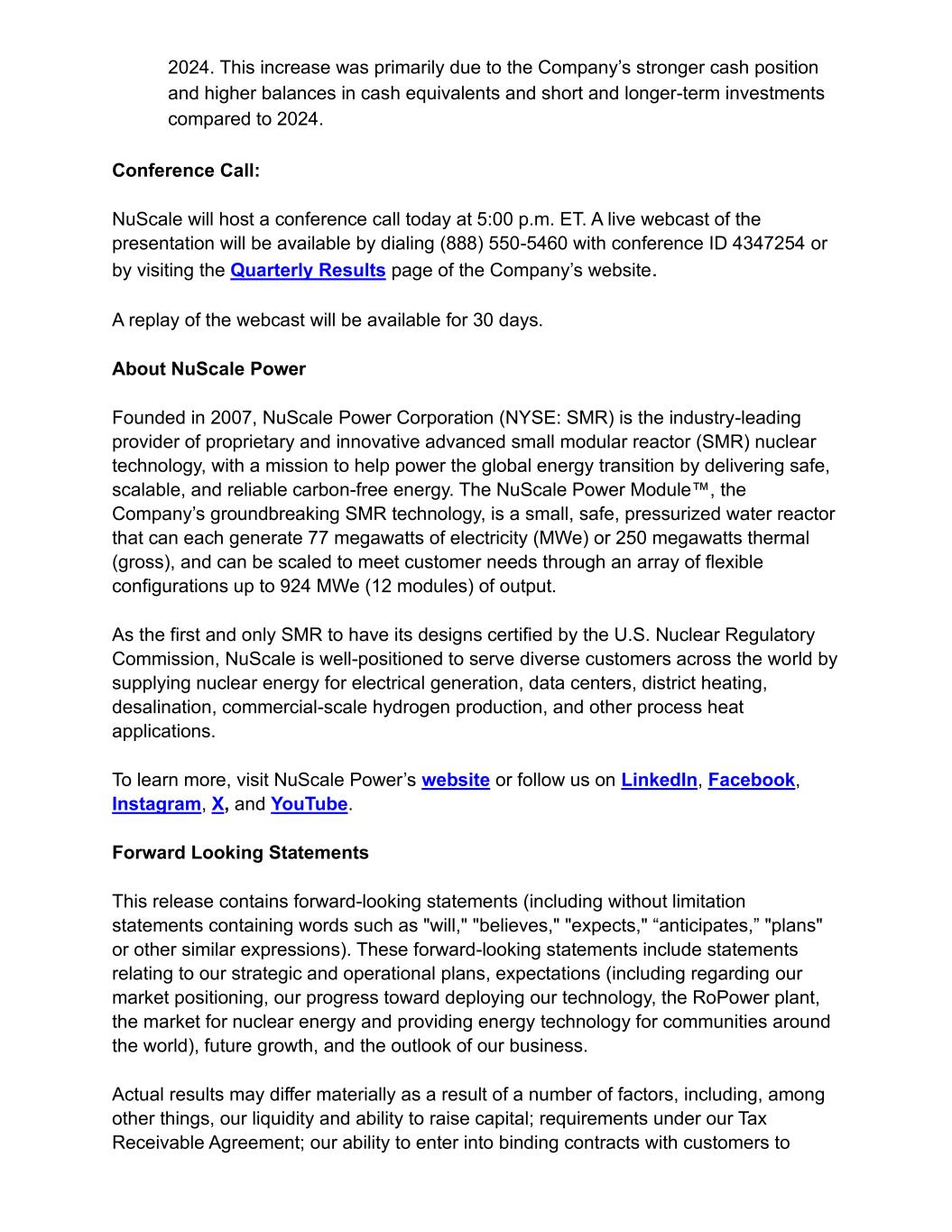
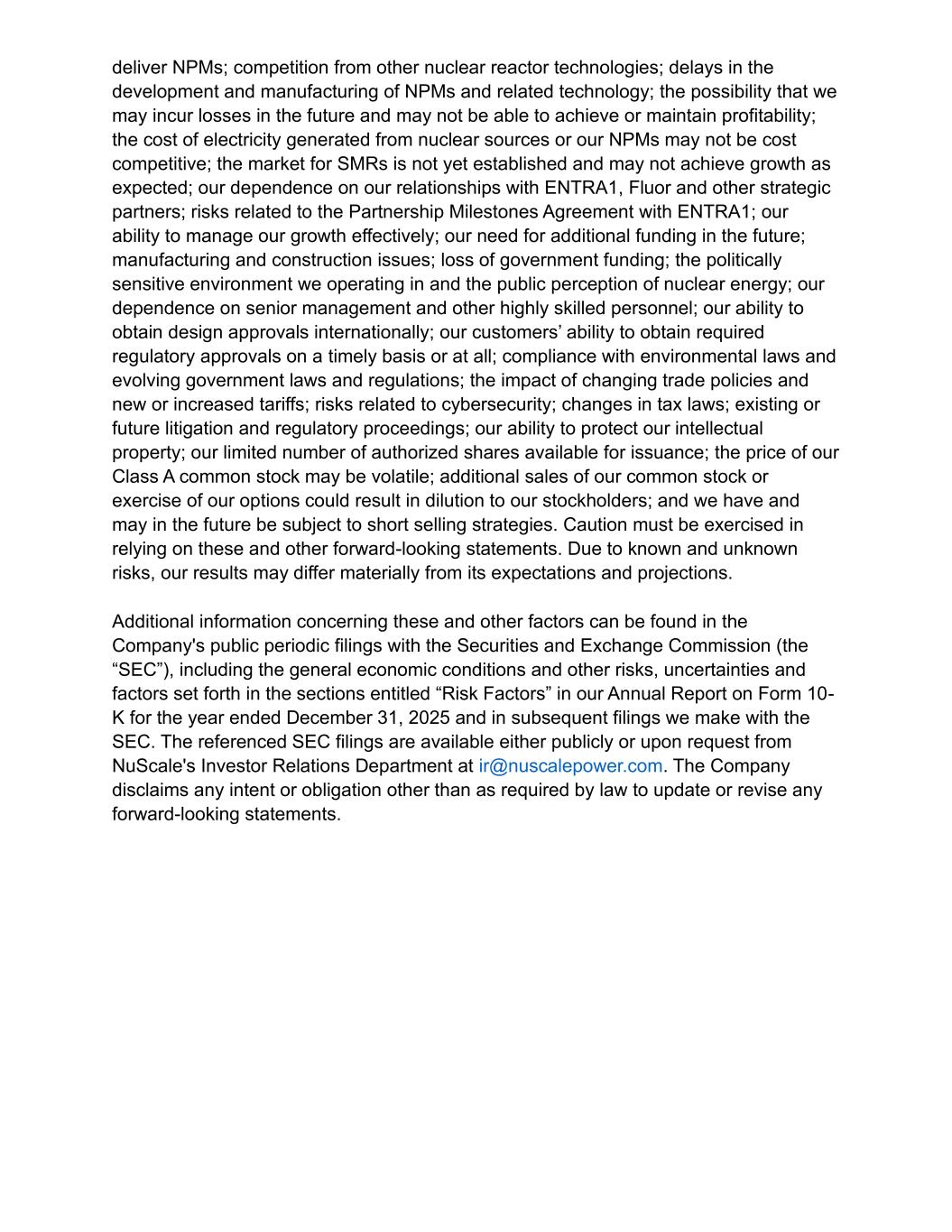
Thank you, Operator. With us today are John Hopkins, Newskill President and Chief Executive Officer, Ramsey Hamedy, Chief Financial Officer, and Clayton Scott, Chief Commercial Officer. We will begin by providing an update on our business, followed by a discussion of our financial results. We will then open the phone lines for questions. This afternoon, we posted supplemental slides on our Investor Relations website. As reflected in the Safe Harbor Statements on Slide 2, the information set forth in the presentation and discussed during the course of our remarks and the subsequent Q&A session includes forward-looking statements which reflect our current views of existing trends and are subject to a variety of risks and uncertainties. For a detailed discussion of our risk factors that could contribute to differences in our expectations, please refer to our Form 10-K for the year ended December 31st, 2025, and our subsequent SEC filings. I'll now turn the call over to John Hopkins.
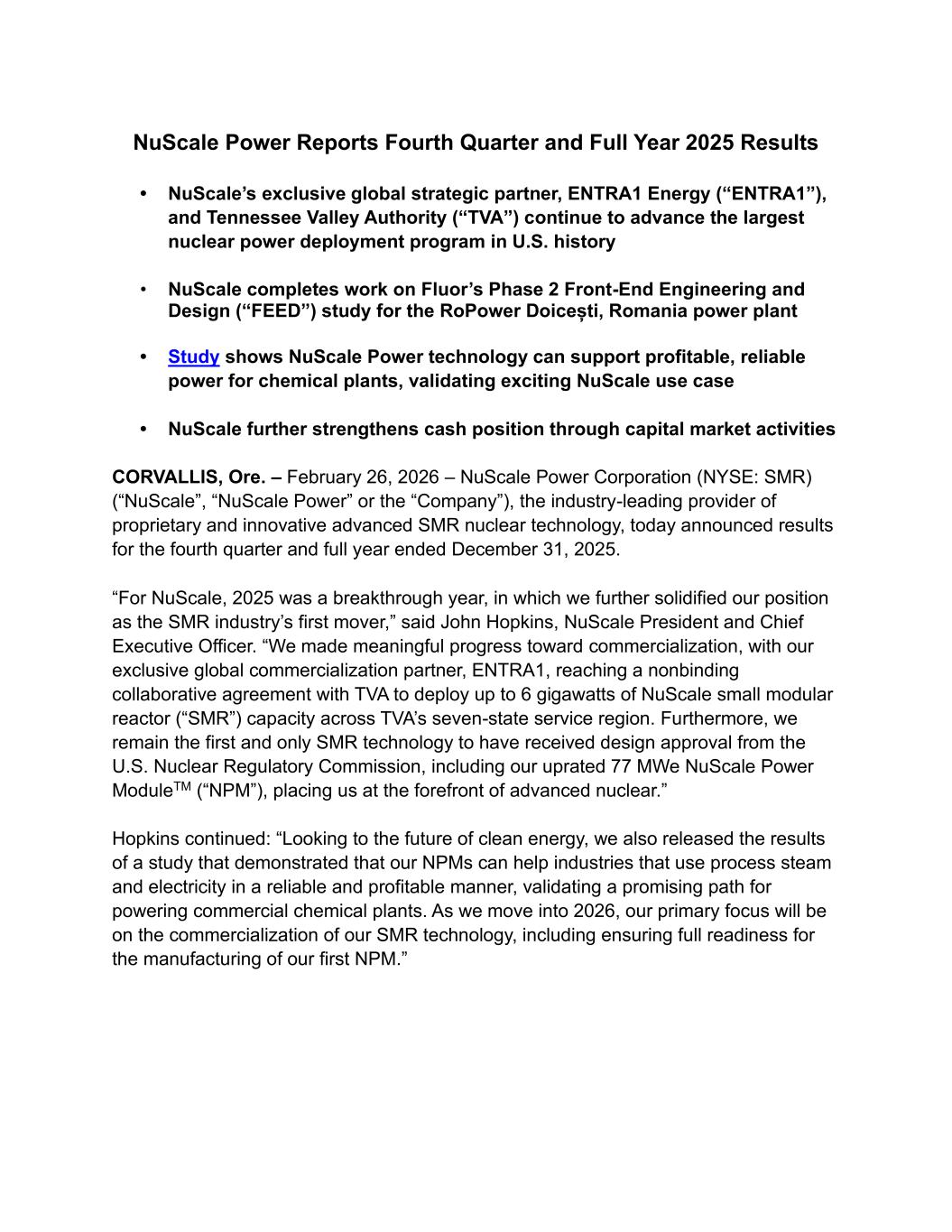
Thank you, Rodney, and good afternoon, everyone. I'll start with some key highlights from 2025, a year marked by significant progress for NuScale. The U.S. Nuclear Regulatory Commission, or NRC, approved our 77-megawatt electric standard design ahead of schedule, allowing us to support a wider range of off-takers and consumers seeking clean baseload energy. NuScale remains the only SMR technology to achieve NRC design certification. And with 12 modules in production, we retain our position as the industry's first mover. Furthermore, our exclusive global commercialization partner, Inter1 Energy, reached an agreement with the Tennessee Valley Authority, or TVA, to supply six gigawatts of power by deploying the largest nuclear power program in U.S. history. And in for one, we use new scale SMR technology and Citus power plants. Both are incredibly important milestones in our commercialization journey and gives us strong momentum going into 2026 to pioneer the SMR space as the only NRC certified SMR under 10 CFR Part 52 versus other technologies pursuing 10 CFR Part 50. We believe this approach provides new scale SMR power plants with a much different risk profile. Now, turning to slide three, we list new skills, fourth quarter, and recent highlights, which we will discuss in more detail in a moment. They include significant progress made by Inter1 and TBA on a power purchase agreement, or PPA, as well as the completion of our work on floors phase two, front-end engineering and design, or fee two study. for the proposed willpower door chest power plant in Romania in the continuing strengthening of our cast position to ensure new scale is well funded pursue its activities turning to slide 4 in September of last year TVA announced an agreement in connection with the purchase of power from inter one for six gigawatts which would represent a total deployment of 72 new scale power modules or NPMs and six enter one energy plants providing power to support TVA seventh-state service region in the five to six months since the program was announced we understand that into one and TVA have advanced discussions maintaining strong momentum in collaboration in their efforts our understanding is that the following recent steps have been taken to move the program forward enter one is assembling an infrastructure experience team that includes design engineers a construction contractor owners engineers investors and legal advisors second our project financing several major financial institutions are working with inter one in discussions are underway in one major institution has already signed a multi-billion dollar term sheet with intro one third on the project execution side site visits have been conducted and site evaluations are underway by teams of qualified, professional engineers and heavy infrastructure experienced individuals. Four sites identified that could each support Intra1 plants powered by new scale SMR technology with respect to the six gigawatt program. The prospective site for the first plant deployed has been identified. Drafting of a definitive PPA is underway, with robust engagement from legal teams and progress is being made on transaction documentation in structure. Please note that TVA announced the deal last September, and the new TVA board was confirmed just this January. Considering all of this, we believe that significant progress has been made relative to time. Separately, we'd like to touch on the U.S.-Japan Investment Initiative, which was discussed in our last earnings call. As noted in recent government announcements, under the U.S.-Japan Framework Agreement, Several American and Japanese companies were named as potential recipients of financing for Japan's groundbreaking commitment of $550 billion towards investments in the United States. two points here first we understand it is publicly known Interwind Energy was one of the several companies named on the fact sheet chosen by the Japanese government it is the only American SMR power plant developer on the list others included engineering construction firms oem companies investment holding groups and industrial players second japan has been new scale's second largest investor since 2022 and their selection of interwine would validate their continued interests to support NuScale in our SMR deployment via IntraOne energy power plants. While we are still on the subject of IntraOne energy, and in the spirit of being helpful to our listeners, I want to reiterate a few key points with respect to our IntraOne partnership. One, IntraOne is an American-owned, in-control development and investment platform that is focused on supporting the commercialization of next-generation baseload energy technologies, which includes the new scale SMR technology. Two, their mission is to support American and global energy security and economic growth by deploying baseload power infrastructure to generate power three the company is led by an american energy and technology investor and brings together experienced professionals with backgrounds in energy in infrastructure project management finance development and asset management or in our partnership intra1 as the project developer is responsible for financing project development and deal execution management to build the infrastructure intra1 works with seasoned engineering and construction firms inter1 was established to address a need for a strategic developer and investor in a first-of-a-kind industry to be the first mover to bridge the gap between financing and execution of such first-of-a-kind technologies six over the course of several years into one conducted due diligence and analysis on the various newer technologies that have been under research and development and we believe they recognize the value creation opportunity that they could capture around the need of a strategic partner and investor to support nuclear SMR commercialization. Seven, NuScale was selected among several of the reactor technologies analyzed by Inter1 along with their financial institutional partners. Inter1 has professionals with backgrounds in project finance investment management engineering construction management legal and infrastructure development and they work with specialized technical partners contractors engineering firms financial institutions and legal advisors for each project phase it is important to note that tba and new scale have had a relationship for almost a decade in japan has been an investor in new scale since 2022 we view these as long-standing follow-up relationships now supporting our commercialization along with our strategic partner intra1 new scale has chosen to be a technology provider with our nrc approved small-module reactors. We chose to pursue an asset-light business model, relying on outsourcing responsibilities outside our scope to reliable third parties. Currently, Doosan Intervility is our primary manufacturing arm. We chose not to be a manufacturer of the reactors, is, nor are we the developer that houses the reactor equipment. EnterOne is the development arm that helps NUSCIO commercialize its reactor technology by installing our SMR technology and equipment into their new power plant infrastructure assets. I'd like to remind everyone that the SMR space is a first-of-a-kind within the U.S. nuclear of industry, and there are no commercially operating SMR powered plants in the United States. All stakeholders and participants in the SMR space are pursuing a first-of-a-kind activity. Inter1 and NuScale work closely together to advance the deployment of the NuScale SMRs in the United States and in global markets. Both teams work in an integrated fashion and in close collaboration while maintaining a common professional work environment. In summary, we are very excited about the TVA Inter1 opportunity, which we hope will empower the local economy across TVA's 7th state region, support the fast-growing energy demand for ai data centers advanced manufacturing and national defense while creating thousands of high quality american jobs reinforcing america's energy independence and strengthening our country's energy security moving to slide five regarding romania by the end of 2025 NewScale completed his FED2 work for Fluor Corporation to further Roe Power's goal of developing and deploying their six-module SMR power plant in Romania. In total, NewScale recognized $63.1 million in revenue from licensing fees and engineering and work from the feed to study over an 18-month period ending in december 2025. earlier this month shareholders of romania's sndico electrica overwhelmingly voted in favor of progressing we understand that this vote allows to seek secure financing to further feasibility studies and site-specific design work and to advance the licensing and geotechnical work finalize a free engineering procurement and construction or EPC contract and begin negotiating contracts for long lead items therefore we anticipate that they will have pre EPC activities begin in the second quarter of this year and have an estimated duration of up to 15 months and will include among other things the development of a class 2 cost estimate we look forward to continuing supporting floor on their door chest project turning to slide 6 you'll find a list of our plant services broken out by pre and post commercial operations date while the sale of npm to enter one will make up the largest percentage of new skills future revenues those revenues will be complemented by the many different plant services we offer these plant related services cover licensing installation commissioning in post cod services we have already seen services generate revenue for new skill from the row power project and we expect that once the ppa between Inter1 and TVA is executed, we will begin generating service revenues related to those projects as well. Specifically from the Combined Operating License Application or COLA process, plus services related to feed work for Inter1 power plants. On slide 7, we would like to provide an update with respect to an exciting use case for NuScale's SMR technology producing processed steam and electricity for chemical plants. Just last month, in collaboration with Oak Ridge National Laboratory in Tennessee, NuScale released the results of a techno-economic assessment, examining the performance and profitability of coupling NuScale power modules with a U.S. chemical facility to provide nuclear-generated steam and electric power. The findings showcase that nuclear power, specifically nuclear power generated by NuScale's SMR technology, can help industries that use processed steam and electricity in a reliable and profitable manner a recent second study conducted by Idaho National Labs demonstrated that new skills high-temperature process theme is on par with high temperature gas reactors to further validate this use case new scale and the bar Elliot energy a major Japanese industrial player established a collaborative program to fabricate and field test a high temperature steam compression system at their plant in Pennsylvania. It is further intended that the compressor will be later deployed at a domestic industrial petrochemical site. New Scale and Ibarra Elliott are actively in discussions seeking a petrochemical industrial player for this effort the results of the Oak Ridge lab study in plants for high temperature steam compression demonstrator will be presented to the World Petrochemical Conference next month in Houston in other news new scale has also launched a project at the Oak Ridge National Laboratory in Tennessee to use AI to enhance fuel efficiencies for multi and modular nuclear plants beyond what is achievable in nuclear plants with a single reactor be a small or large next month new scale will be speaking at the National Academy of Engineering sponsored conference on closing strategy gaps for the future of AI hosted by the University of Maryland in College Park NuScale SMRs are the only nuclear technology, large or small, that has been certified by the NRC for off-grid, behind-the-meter application. At that event in Maryland, NuScale will be discussing the advantages of off-grid, behind-the-meter, small-mog reactors to power data centers. Now over to Ramsey for the financial update.
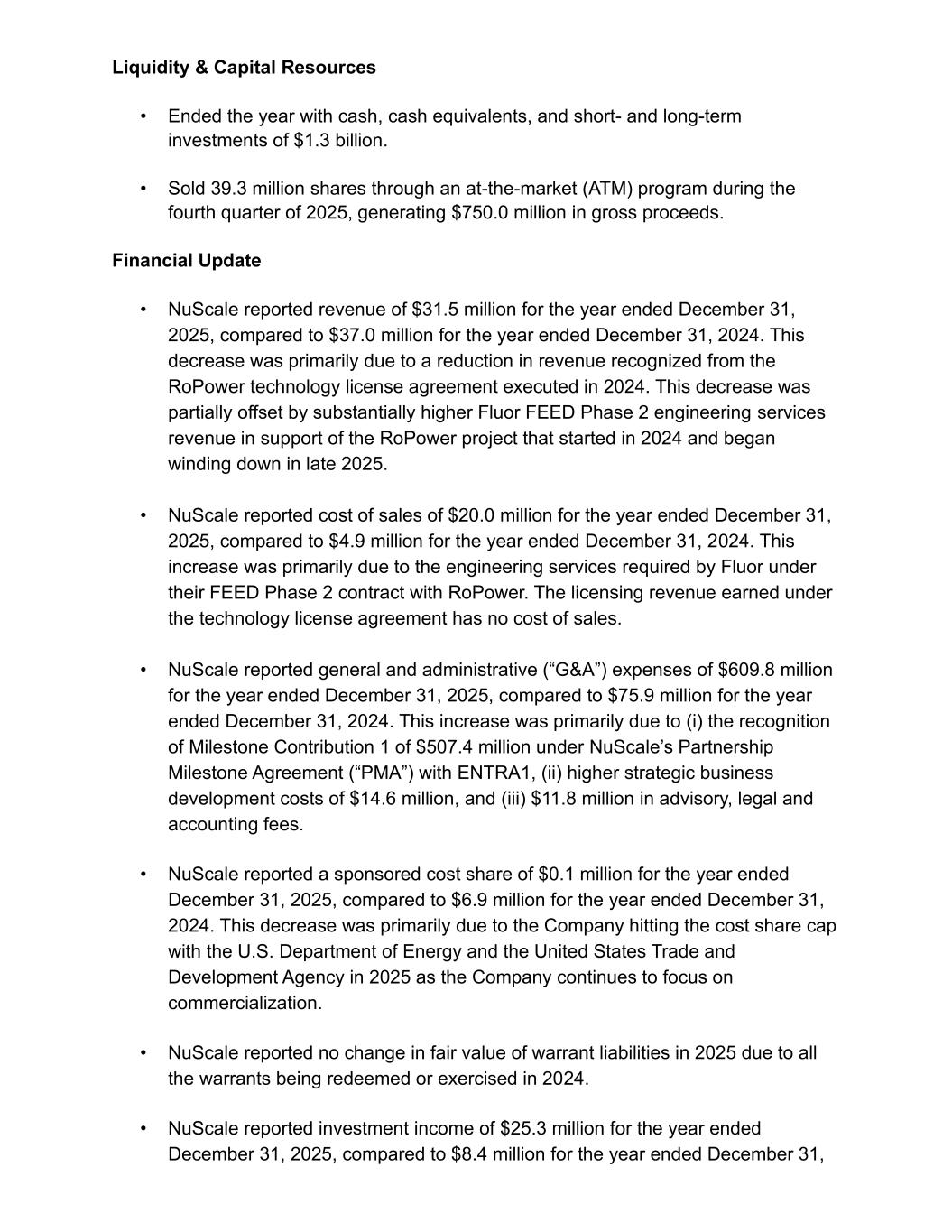
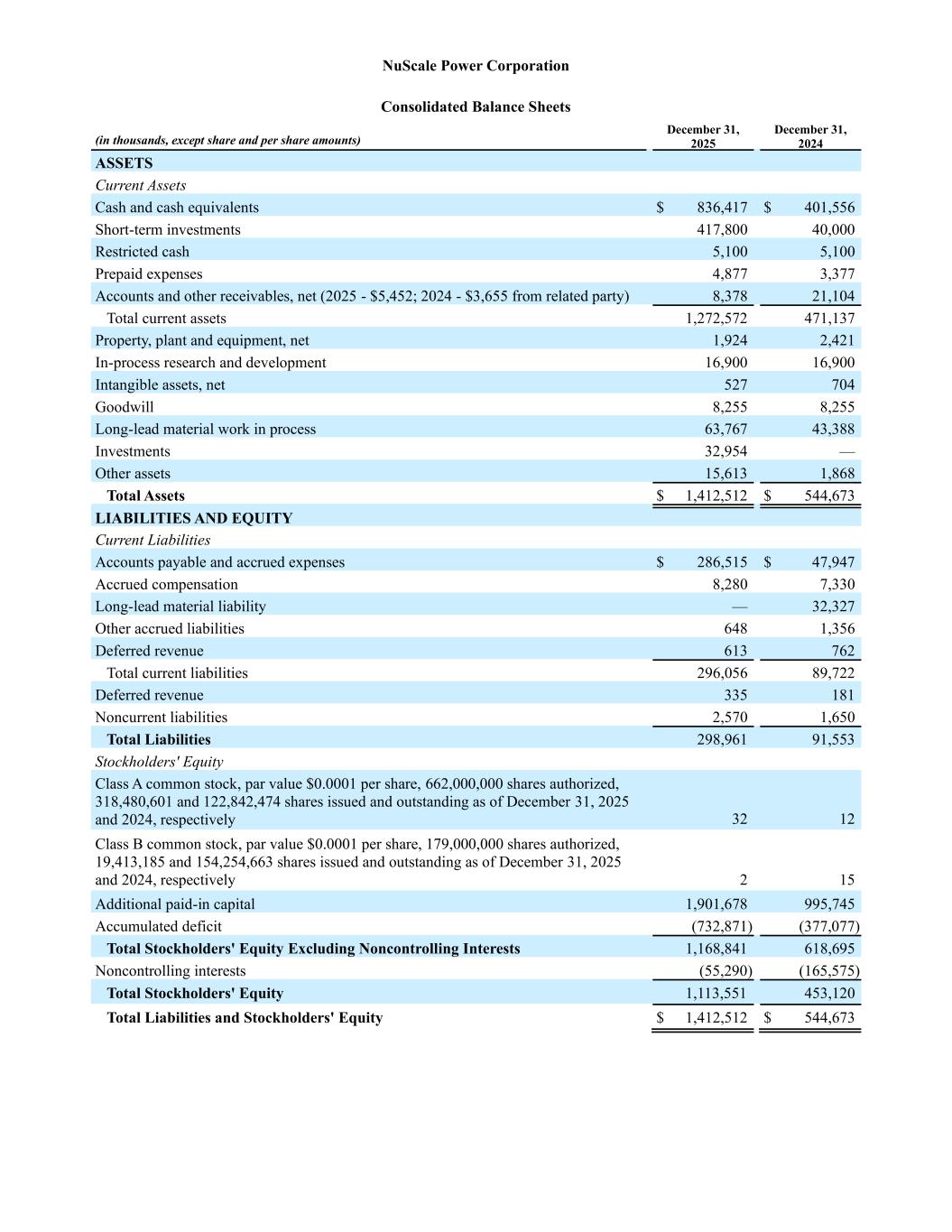
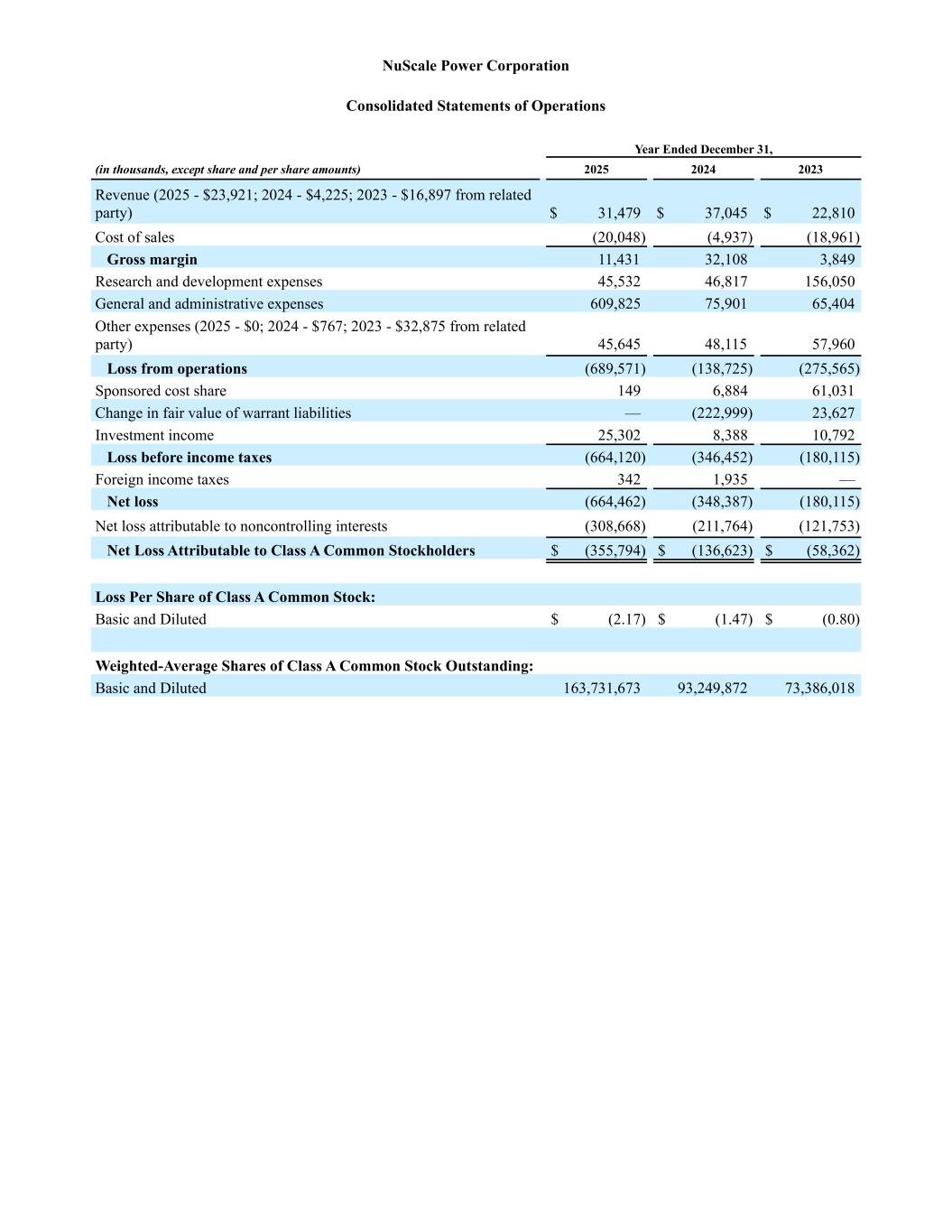
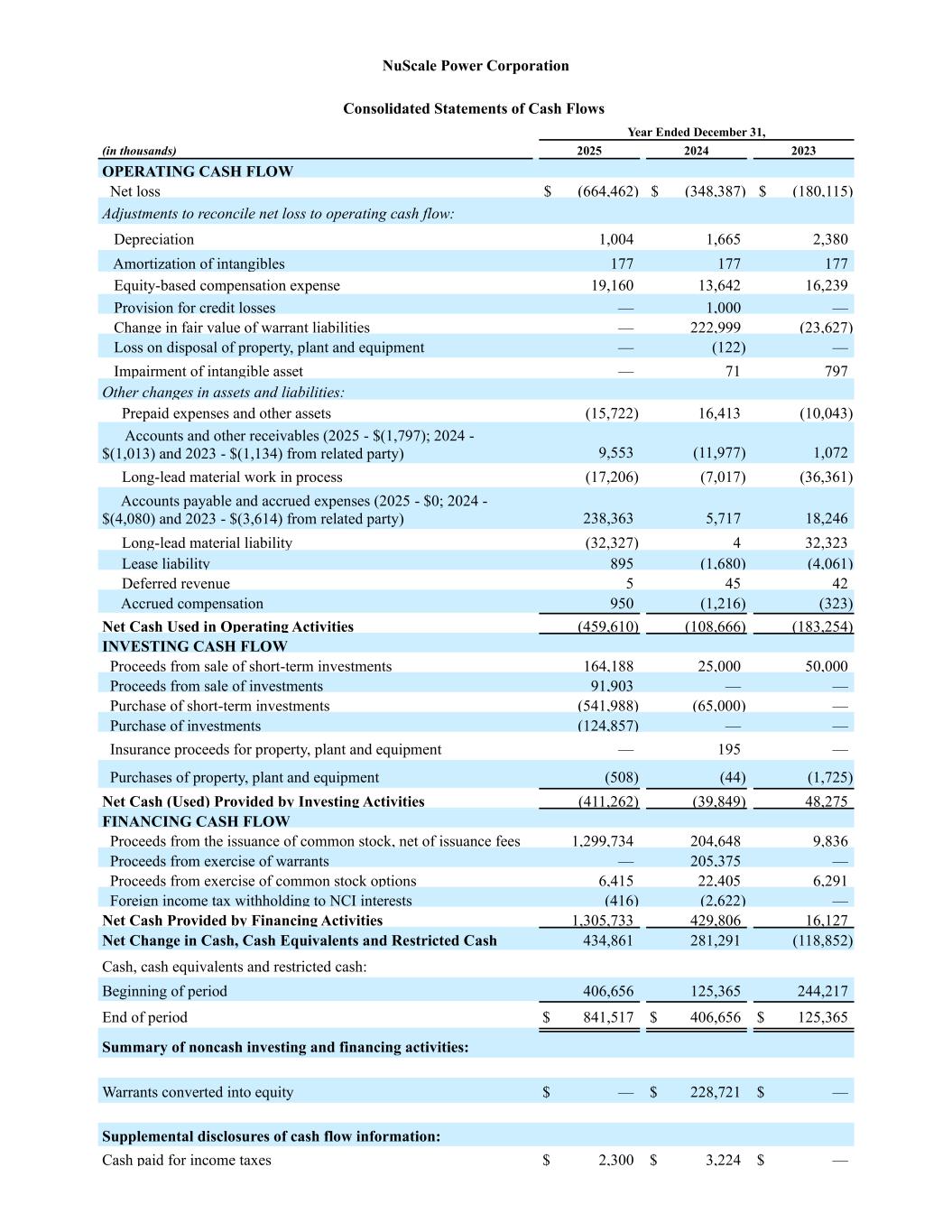
Thank you, John, and hello everyone. Our financial results are available in our filings. So, my focus will be on explaining major line items which can be found on slide eight. New Scale's overall liquidity increased to 1.3 billion at December 31st, 2025, versus $754 million at September 30th, 2025, and $442 million at the end of 2024. This liquidity allows NewScale to further enhance supply chain and manufacturing readiness, fund obligations in connection with the advancement of commercialization, and further strengthen our balance sheet. As projects progress forward, U-Scale expects revenues from products and services to support positive cash flow from operations. Moving on to revenue, U-Skill reported revenue of $31.5 million for the year ending December 31st, 2025, compared to $37 million during the same period in the prior year. This decrease was due to reduction in revenue recognized from the Rowe Power Technology licensing agreement, which was partially offset by higher FLIR phase two engineering and services revenue. I will conclude my remarks with a brief overview of our capitalization summary as shown on slide nine. As you can see on this slide, the number of class B shares was greatly reduced in the fourth quarter due to FLIR's conversion of their New Scale B shares into Class A common stock. We understand that FLIR continues to monetize their investment in New Scale via open market transactions, subject to certain agreed upon restrictions.
Operator
With that, I'd like to thank you again for joining today and for your continued support of new scale we'll now take questions operator thank you we will now begin the question and answer session if you have dialed in and would like to ask a question please press star 1 on your telephone keypad to raise your hand and join the queue if you would like to withdraw your question simply press star 1 again if you are called upon to ask your question and are listening via speakerphone or device please pick up your handset to ensure that your phone is not on mute been asking your question. Again press star one to join the queue. Our first question comes from the line of Eric Stein with Craig Halum. Your line is open.
Hi everyone thanks for taking the questions.
Good. Oh that's okay. So maybe if we could just start on the supply chain and specifically Doosan you did talk about that a little bit but I know that it's committed to 20 modules a year committed to being able to take that higher so just maybe some commentary on confidence in that but also curious you know it's a pretty differentiated position to to actually you know those are actually being built and so curious you know how is that playing into the process with enter one and TVA and also you know just some of the other opportunities as they progress in your pipeline yeah this is a Carl Fisher
chief operating officer as you know we've progressed significantly well with Doosan we have 12 modules under production right now so with whether no matter what the project is it gives us a significant timing advantage because we have ordered the long lead materials and the modules are under production okay Gotcha.
In terms of just feeling confident in, you know, that Doosan is, you know, committed and able, I know that they've got a big facility and they're, you know, they're committed to this space, but that they are, in fact, you know, in a position that should TVA, you know, should that move forward that they could, you know, I know it's a ways out, but that they could execute on that and help you get to, you know, potentially some big numbers.
Yeah, we have extreme confidence with Doosan. The other thing that you should know is that they're increasing their capacity so they can move up to 20 modules per year and then eventually doubling that capacity. I just recently was at Doosan and seen the works that are being done. These 12 modules will set the stage for the next set of 12 modules that could be used with the Inter1 projects, and having these already in production, it really gives us a significant timing advantage because we do have the small-lead materials already ordered and the modules ready to be fabricated.
Got it. And maybe just turn into the up-rate approval. I know that six-plus months ago I asked this on the call. were there customers that were waiting for that upgrade from 50 megawatts to 77 you know what that potentially kind of set in motion so I guess you know now that it's six plus months later you know looking back what what has that impact been on your pipeline whether it's overall growth of the pipeline or movement within that pipeline yeah I think first of all the you know the upgrade that approved last year was approved ahead of schedule and and we've got there's a lot
of confidence we have with the fact that we have that approval because a lot of questions and and and any concerns that may have had by the regular regulator were put were approved and put to put aside in that case after that and having that SDA approval, our customers, the ones that we've been speaking with, and also basically just the general industry puts a lot of confidence in the fact that the NRC has made that approval.
I'll let Clayton Scott discuss the pipeline aspect of it, but I will say even for our international projects, having that NRC approval is significant because of the respect that the international community and the international nuclear regulators have for the NRC yeah this is John we we do regular quarterly generally drop-ins with the commissioners of the NRC we're just there two weeks and you know it was pleasant surprise to speak with commissioners in relation to expediting processes and etc but they ask a lot of questions because as you know we are the only one has ever submitted a design certification application from the SMR space and have been approved so we've been through the rigor and so we're we've been ready to go and we're just sitting here you know as a company wanting to get these things and the bottom line still is I keep saying this We are the only game in town that has an NRC certified not only to construct, but also to operate.
But I think in addition to the 77 megawatt approval, it's really given Entra1 the opportunity to really push their pipeline. And it's given confidence from the industry to understand that that regulatory hurdle has been completed. and now that, you know, we can reach capacity levels that I think are a little bit more satisfactory when ENTER-1 looks at their overall facilities.
Got it. Helpful. Last one for me, just you mentioned it in your commentary here, but the term sheet with ENTER-1, you mentioned the one financial institution who has entered that. Can you just unpack that a little bit? is that is that something that's firm that gets triggered on the signing of a PPA or is that something where there would be some additional steps upon that signing to lock that in thanks for the question it's bill Cooper general counsel at new scale and we're under NDA with intro on so we can't say any more about that okay worth a try thank you our next question comes from the line of brian thanks would be riley your line is open hey guys thanks for taking my questions um maybe just to follow up on that last one um to the extent that that you can say john
you mentioned that the major institution that signed a multi-billion dollar term sheet um with enter one is there is there anything you can share there around who the players might be uh what exactly was signed for um yeah and anything there i think would be super helpful nothing we can share i'm sorry yep i will share got it i i'll turn to romania then um could you talk about the next phase of the row power project what will entail for new scale in terms of services rendered or maybe you know the potential revenue new opportunity there.
Yeah, this is John. You know, we met with the Romanian government last night, actually, so it's a timely question. We, as we stated, the feed phase two hasn't been completed as of the last quarter. February, they did have a shareholders meeting that they voted in favor of moving the project forward. Rope Power is now authorized to advance the licensing and geotechnical moving towards a pre-EPC and we anticipate NewScale to be generating revenues as soon as, now understand, we are a subcontractor to Flora Corporation and Flora is in negotiations right now with the Roe Power government. Our contract is with Flora, it's not with the Romanian government and we explained this last night to the Romanian government and they understood. it we view this as a very important project that you know right now we're waiting for the next steps via floor and row power to do their deal and then we move on but it was a good it was an interesting conversation last night we they appreciated it appreciate that and then just one more um could you give an update on the status of the material weakness in your financial reporting that you identified last year and where that stands today this is
Ramsey Hamity in our 2024 annual report we disclose the material weakness on internal controls over financial reporting ICFR so what we term it and specifically we focus on something called ITGC which is information technology general controls we state a plan to remediate it we work very hard i would give credit to david tunnel our chief accounting officer and his team and we've come through with a clean bill of health from ey i think it's a remarkable feat and um so we we no longer have that we addressed it as we said we would thanks for everything i'll turn it back
next question comes from the line of sheriff l mcgrabby with btig your line is open hi thanks saying my questions um first on on floor once they monetize their remaining stake um will they still have right of first refusal as your epc provider for future projects hi can you hear me uh please hold for a second hi this is bill cooper again general counsel i'm not familiar with any right of first refusal but the agreement is otherwise confidential okay uh got it and then um the the The study you completed with the Oak Ridge National Lab, that study gives us a sense of power module pricing that is significantly lower than large-scale nuclear. Of course, that's part of the value proposition of SMRs, but is that sort of the pricing you're aiming for in Romania and with the TVA, or is it kind of for later-stage projects?
Yeah, I'm sorry. Could you repeat the question?
The study that you guys did with the Oak Ridge National Lab, it talks about roughly, I think, about $5,500 per kilowatt pricing for your modules. And I'm wondering if that's the sort of pricing that applies for Romania and the TVA.
Yeah, I'll have to look into that. I apologize. I'm not familiar with that number. You know, I think what's important here, if you remember over the years, we've seen three significant markets. One was coal plant refurbishment. One was working with process companies for need of process heat. It could be for electricity. And the other one, obviously, the elephant in the room is hyperscalers. And these studies, the prevailing notion was that high-temperature gas could only produce the steam requirements needed for high-pressure steam. We went into an analysis that Oak Ridge or actually INL did for us to show that Nuskio's light water reactor could provide the economics and efficiencies necessary to provide the steam requirements for these plants. And why this is getting specific interest, remember, our emergency planning zone is that site boundary. So when I look at process plants in an area like Baytown, Texas, we have multiple companies that share a fence line. Interwine could build that plant outside that fence line, close to the end user, and provide if it's process heat, if it's electricity, if they want to do hydrogen production, and it's not inside the evacuation zone typical of a large-scale nuclear reactor.
The other thing is, too, John, and I think it's really important, is we're also the only nuclear technology company, period, that is certified by the NRC for behind-the-meter, off-the-grid applications, and that's a significant benefit.
Okay, thank you very much for taking my questions.
Operator
Next question comes from the line of Derek Soderbergh with Candler Fitzgerald. Your line is open.
Yeah, hey, guys, thanks for taking the questions. Just on cash, $1.3 billion, what's sort of the expected cash burn range for 26? And then can you talk about any sort of swing factors potentially in that as well?
This is Ramsey Hammity, Chief Financial Officer. As you pointed out, we ended 2025 with approximately $1.3 billion in cash. That's a tremendous achievement. It shows a very defensive position in terms of our liquidity. Post-closed disclosure, I believe, note nine in financial statements, we note a payment of about $250 million out. Arithmetically, we can assume about a billion of cash on balance sheet today. If I look at my OPEX, apart from what I would call one-time type items, my OPEX stays fairly consistent between $172, call it $200 million, closer to $193, actually, in 2024 on an adjusted basis. The billion dollars in cash, I think our investors can rest assured that we have taken a very conservative, very strong equity position, and burn rate or runway is not a problematic item for us. Uscale has the legs to run this race.
Got it. That's helpful. And then, Ramsey, you mentioned just the one-time payment. I'm wondering if you can talk about how many more of these sort of one-time payments or milestone payments you guys expect to make associated with the project, and will those payments sort of be a similar magnitude, or can you help us maybe quantify the potential there. Thanks.
I think on this one, we have been very transparent in our disclosures and our filings. There is a partnership model center agreement filing, which describes all the payments in great detail. This is more of a developer-led model, which I would refer you to.
Operator
Next question comes from the line of Nate Pendleton with Texas Capital those securities. Your line is open.
Good afternoon. So after Intra 1 signs a binding PPA with TVA, can you talk about what that means from a near-term revenue perspective? And would that revenue be comparable to what we've seen at Real Power thus far?
That's good. Hi, this is Clayton Scott, Chief Commercial Officer. So what we expect after the PPA is signed is that we would enter into COLA and feed activities to generate revenue, which will allow us to move forward. But, you know, this is something that I would expect to be more than what we see in rural power just because the size of the plants are much larger, and we anticipate a little bit more revenue stream in that respect.
Got it. And as my follow-up, perhaps staying with you, Clayton, referencing slide seven in the chemical plant study has that study opened any new doors for the commercial team with that extra layer of validation there and are there any other applications that you feel are underappreciated as well there's other discussions that are happening and and we're in concert with enter one to have those but uh at this point in time we're under nda and we can't really disclose anything understood thanks for taking my questions next question comes from the line of lean lean
Operator
Anne Hayden with Canaccord Genuity. Your line is open.
Evening, everyone. Thanks so much for taking my questions. Just wanted to start by digging into progress with ENTRA-1 and TVA. Can you please help us try to understand any sort of gating factors to securing a binding PPA? Understand that there's been some pretty strong progress since January and that you're in the process of drafting a PPA. I do believe you previously guided for binding PPA execution by the end of 2025 so any color around what may have caused that delay would be much appreciated thank you we've said all that we can say this bill cooper again general counsel we've said all that we can say about the ppa in the prepared remarks we can't see anything to the extent that you're able to comment when can we expect any sort of site permitting or early site submissions associated with the four identified sites can you hear me uh i'm sorry
Go ahead. This is Rodney. No, we went through that in the script. They can lay that out with the four sites. So I would just reference that, or if not, we can circle up after the call.
Operator
And our last question comes from the line of Dimple Gozai with Bank of America. Your line is open.
Good evening, gents. Thank you for taking my question. I understand that you don't give guidance, but there's just many different pieces here with the Feed 2 coming to an end and Roe Power advancement now, while you're also kind of pre-funding Intra 1 and or Romania. Can you help us or give us a sense of how to think of, you know, the revenue and liquidity outlook or quality profile over the next 12 to 24 months, please?
This is Ramsey Hammady. Thank you for your question. As we stated earlier and as you pointed out in your question we do not give guidance at this point however I think looking at our balance sheet we look at our liquidity position the company is conservatively positioned and prudently raised capital towards the end of last year or to give us a balance sheet that has lasting power and as I said run rate and that party runway is not an issue for us and we have another
Operator
question comes from the line of Brian Lee with Goldman Sachs. Your line is open.
At the tone, please record your message. When you have finished recording, you may hang up or press one for more options. Because of a bad connection, to disconnect.
Operator
That concludes the question-and-answer session. I would like to turn the call back over to John Hopkins for closing remarks.
Thank you, operator. Thank you, operator. And thank you to everyone for joining us today. As we close this period for NewScale, we are excited about the path ahead in 2026. We look forward to continuing to take meaningful strides toward deployment of the ONI NRC-certified SMR technology to support American and global energy security. Thank you very much.
Operator
Ladies and gentlemen, that concludes today's call. Thank you all for joining in. You may now...