Operator
Good afternoon, and welcome to NewScale's first quarter 2026 Earnings Results Conference Call. Today's call is being recorded. A replay of today's conference call will be available and accessible on NewScale's Investor Relations website. The web replay will be available for 30 days following the earnings call. At this time for opening remarks, I would like to turn the call over to Rodney McMahon, Senior Director of Investor Relations. Please go ahead.
Thank you, Operator. With us today are John Hopkins, New Scale President and Chief Executive Officer, and Ramsey Hamedy, Chief Financial Officer. We will begin by providing an update on our business, followed by a discussion of our financial results. We will then open the phone lines for questions. This afternoon, we posted supplemental slides on our Investor Relations website. As reflected in the Safe Harbor Statements on Slide 2, the information set forth in the presentation and discussed during the course of our remarks in the subsequent Q&A session includes forward-looking statements, which reflect our current views of existing trends and are subject to a variety of risks and uncertainties. For a detailed discussion of our risk factors that could contribute to differences in our expectations, please refer to our Form 10-K for the year ended December 31, 2025, and our subsequent SEC filings. I'll now turn the call over to John Hopkins.
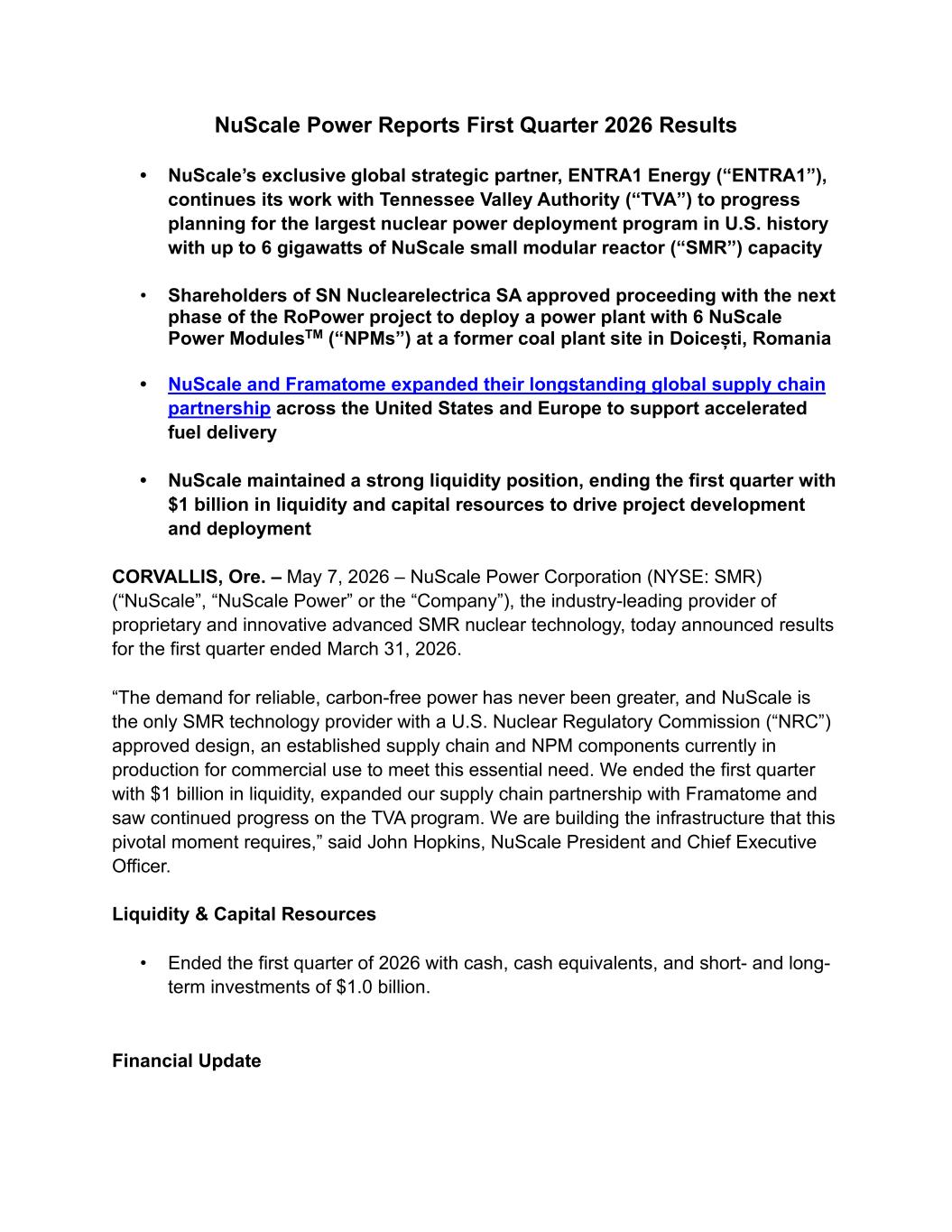
Thank you, Rodney, and good afternoon, everyone. We are at a true watershed moment for the nuclear industry. Global demand for reliable 24-7 baseload power is surging, and the appetite for proven advanced nuclear solutions has never been stronger. In this environment, NewScale stands apart, not as a promising newcomer, but is the clear global leader ready to deliver today. Let me remind you why NewSkill is uniquely positioned to capture this historic opportunity. As you can see in slide three, we are differentiated on the dimensions that matter. Regulatory leadership, fuel supply availability, true modular factory fabrication, deployment readiness, and safety. In addition, NuScale has a balance sheet to deliver to the commercial market. First, unmatched regulatory leadership. NuScale stands alone as the only SMR company in the world to have earned U.S. Nuclear Regulatory Commission standard design approval. And we've done it for two separate designs, our 50 megawatt and our 77 megawatt modules. This isn't just a regulatory milestone, it is a critical gateway to commercial operations. Without NRC design approval, no SMR can deliver power to the grid. NewScale has already cleared the highest regulatory bar in the industry, giving us a significant competitive advantage in de-risking the path to deployment for customers and investors. Additionally, what makes this regulatory milestone even more powerful is that NuScale achieved it under 10 CFR Part 52, the modern one-step licensing framework specifically designed for more efficient nuclear deployment. Why does this matter? Under the traditional Part 50 licensing process, investors and utilities face a higher degree of risk. They need to secure a construction permit based on a preliminary safety analysis report or concrete and potentially spend billions, then hope to pass a second full safety review later to receive an operating license. History shows how problematic this path can be, a problem that could persist today. Recently, the Advisory Committee on Reactor Safeguards, or ACRS, has highlighted deficiencies of new reactor submittals and warned of delays ahead for Part 50 applicants. Most Generation 4 designs rely on new fuels, coolants, and safety concepts never before licensed in the United States. This explains why the Department of Energy still classifies them as demonstration projects. Part 52 changes the game. It provides a single, combined license that addresses major safety, design, and operational issues before the first dollar is spent on construction. Even better, NuScale is the only SMR company to earn full NRC standard design approval under Part 52. Our core technology is approved and proven. Every future project can simply reference our approved designs rather than reinventing the wheel. First, NuScale delivers the clearest, low-risk, NRC-approved pathway to commercial operation, a solution that is ready for deployment now. NuScale offers certainty you can take to the bank. Second, fuel that is available today. NuScale power modules run on proven, widely available commercial, low-enriched uranium or LEU. Fuel that has reliably powered upwards of 400 commercial reactors around the world for decades. In contrast, other advanced designs depend on high-assay, low-enriched uranium or HALU. A fuel that is not currently available at commercial scale within North America. When your project timelines matter, NuScale removes a critical supply chain risk that others are still hoping to resolve. Third, NuScale modular factory fabrication is uniquely comprehensive. Each NuScale power module is fully integrated, self-contained unit that includes the reactor vessel steam generators pressurizer and the high pressure steel containment vessel all of it is built in a factory and shipped to the site with virtually no nuclear grade field construction needed this goes far beyond what most other smr vendors mean when they say modular well competitors emphasize modular construction techniques such as prefabricated large components skids or structures assembled on site new scale delivers complete transportable reactor modules including the primary containment bury itself this modularity allows new scale power modules to be added incrementally as load grows with the first units generating revenue in power while others are being deployed this plug-and-play scalability with built-in redundancy is regulator validated and unmatched by any other SMR technology today fourth water smart nuclear power dry cooling gives new scale SMRs a major sighting and environmental advantage in arid regions but water is scarce, expensive, or subject to competing demands from agriculture, municipal use, or ecosystems. It allows deployment in places where traditional wet-cooled nuclear or other thermal plants would face severe restrictions or high costs. Dry air-cooled condensers cut water consumption by more than 90% compared to wet cooling towers. Many SMR vendors market dry cooling options to highlight water independence. NewScale remains one of the most advanced and demonstrated integrations for light water reactor technology. The choice really depends on site climate, economics, and whether the project prioritizes maximum power output or minimum water use, making dry cooling a viable option where water is expensive or restricted and finally a decisive new skill advantage that truly sets us apart superior regulator approved safety as further described on slide four we are the only nuclear technology approved by the u.s nuclear regulatory commission for behind the meter operations paired with a groundbreaking emergency planning zone or epz a methodology that limits the epc to the plant's own site boundary. This is game changing. It eliminates the need for any AC or DC interconnections to the bulk electric grid and allows new scale powered plants to be sited directly adjacent to where the energy is needed most. Right beside hyperscaler data centers, industrial facilities, population centers and retired coal plant sites. The result, unmatched siting flexibility, dramatically reduced transmission costs, faster deployment timelines, and the ability to deliver clean, reliable, resilient power exactly where the demand is needed most. NewScale dramatically reduces emerging planning costs and flashes siting timelines, transforming where it's been a major regulatory hurdle into a powerful economic and strategic advantage all while delivering a critical boost to our nation's energy security and national security by reducing reliance on foreign energy and vulnerable transmission infrastructure by combining unmatched regulatory approval a compact emergency planning zone and behind the meter capability NewScale doesn't just participate in Ameris Clean Energy Transition, it is uniquely positioned to lead it. While it was acquired a quarter from an announcement perspective, we have been active. To that end, on Slide 5, let's review several key highlights from the first quarter. These include continued advancement on the Inter1 and TVA Power Purchase Agreement discussions. for what would be the largest nuclear deployment program in U.S. history. We also saw progress on the Rural Power Project in Dorchester, Romania, where nuclear electrical shareholders voted to advance the project. We continue to strengthen our critical supply chain partnerships, particularly our fuel supplier, Framitone, and manufacturing partner, Doosan Inernobility. And separately, we closed the quarter with a strong liquidity position, approximately $1 billion in cash and other capital resources. This balance sheet strength gives us the flexibility to execute across a wide range of commercialization scenarios as we move towards large-scale deployment. Turning to slide six, in September of last year, TVA announced a major agreement with InterOne for up to six gigawatts of safe, reliable, 24-7 baseload energy to help powering growing demand in its seven-state service territory, utilizing new-scale SMR technology. ENTER-ONE has updated us that discussions with TVA are advancing well toward a definitive PPA. We remain highly encouraged by the progress and the strategic alignment between ENTER-ONE, TVA, and NUSCALE as we work to deliver this game-changing clean energy solution. Separately, two recent key international announcements indicate a strong desire to facilitate foreign investment in u.s strategic interests such as the tva project the first is a 550 billion u.s japan framework agreement announced last year in which enter one was the only developer named and a second and more recent announcement by south korea's national assembly to facilitate 350 $250 billion in Korean investments into U.S. strategic industries, with $200 billion for sectors like nuclear power, AI, and semiconductors aimed at securing economic ties between the two countries in reducing tariffs. NewScale remains bullish about the TVA Inter1 opportunity. We believe it will be the catalyst for the commercialization of our SMR technology in the United States and around the world while supporting fast-growing energy demand creating thousands of high-quality jobs and strengthening our nation's national security interests moving to slide 7 in February of this year the Romanian government approved the investment decision for the door chest SMR plant project this was a step in the right direction as a project can now seek financing to conduct further feasibility studies in site-specific design work prior to construction moving forward. As a reminder, Floor Corporation serves as the primary contractor leading overall engineer and procurement construction delivery with RoePower, the project owner, and Floor's client. NewScale, in turn, serves a subcontractor to Floor providing SMR technology, design support, and licensing expertise to the project should free EPC financing be secured the next phase of the project is expected to last approximately 15 months project stakeholders role power floor new scale and both the US and Romanian governments remain engaged the role power project in Romania is currently the most advanced SMR effort in Europe. Moving to slide eight. New scale is well positioned to meet its near-term deployment objectives, driven by continued enhancement and supply chain readiness. We have established a robust foundation to contractually secure supplier partnerships, strategic long-lead material positioning, and align manufacturing capacity across our critical components our approach is anchored in a structured readiness framework with reoccurring cross-functional supplier reviews to actively manage risk validate mitigation actions and ensure alignment with project execution requirements new scale is not building a conventional product or supply chain we are building a transformative deployment model for nuclear technology under intense scrutiny with high expectations and on timelines that matter. Our success will require more than capability. It will require alignment, transparency, and trust across our entire supply chain. Last month, we convened for our annual New Scale Supplier Working Group, bringing together 37 key supplier partners to align on 2026 demand signals and near-term deployment milestones. This engagement strengthens forward visibility into production readiness and reinforces both contractual and operational alignment across our supply base. NewScale is advancing a deliberate multi-sourcing strategy for critical components reducing single source dependencies and enhancing supply continuity in a constrained global market in parallel key new scale power module components remain an active production at doosan earnability marking continued progression from design into manufacturing execution collectively these actions materially de-risk the supply chain increase schedule confidence and position new scale to support near-term deployments with a high degree of execution certainty let's turn to slide nine you'll find a detailed summary of the extensive industry engagement by our office of technology team we continue to lead the conversation and drive innovation at the intersection of nuclear energy in hard-to-abate industrial sectors. During the first quarter, our team actively participated in five major industrial international conferences, engaging directly with the leaders from oil and gas, petrochemical, commodity chemicals, energy, and hyperscaler communities. A standout moment came at the World Petrochemical Conference where our co-founder and Chief Technology Officer Dr. Jose Reyes delivered a compelling presentation on how new scale generated high temperature steam is rapidly moving from concept to commercial reality. This is strategically important. Industrial process heat is a true national security imperative as it powers critical supply change strengthens economic resilience supports defense manufacturing and advances energy independence new scale power modules are positioned to deliver commercial scale high temperature thermal energy for direct industrial use applications include chemical production petroleum refining cement manufacturing fertilizer production and desalinization just to name a few sectors that together represent hundreds of billions in economic activity before turning the call over to Ramsey Hamity our chief financial officer I want to talk about the opening of a new scale operation center in Houston on April 29th we proudly opened our new new scale operations center in Houston's prestigious energy corridor at City Center a strategic milestone that positions us right in the heart of America's energy capital in short we're not just building reactors we are embedding ourselves where the biggest energy decisions are being made this move shortens decision cycles deepens customer relationships and reinforces NuScale's leadership. We're excited about the momentum this new hub is already generating. Now over to Ramsey for the financial update.
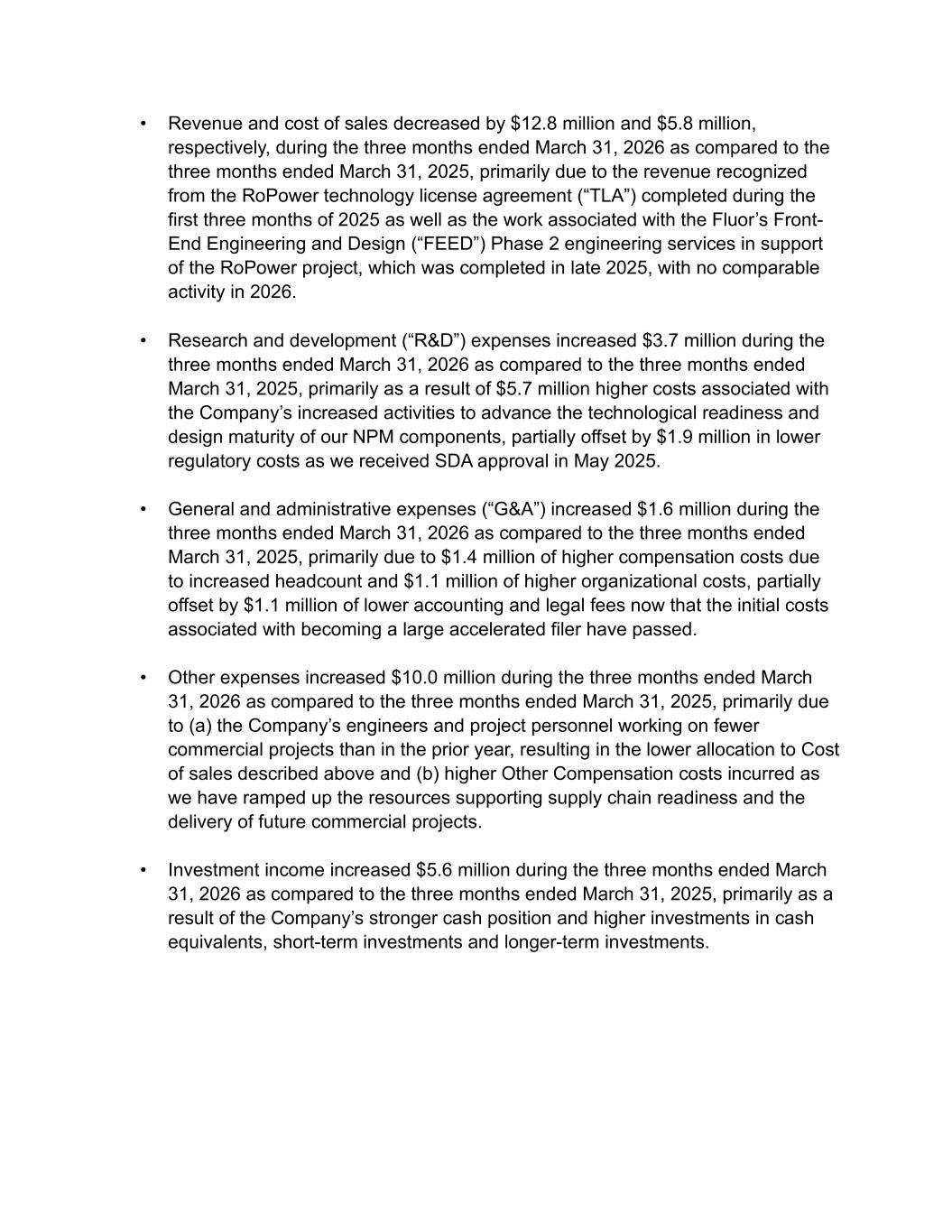
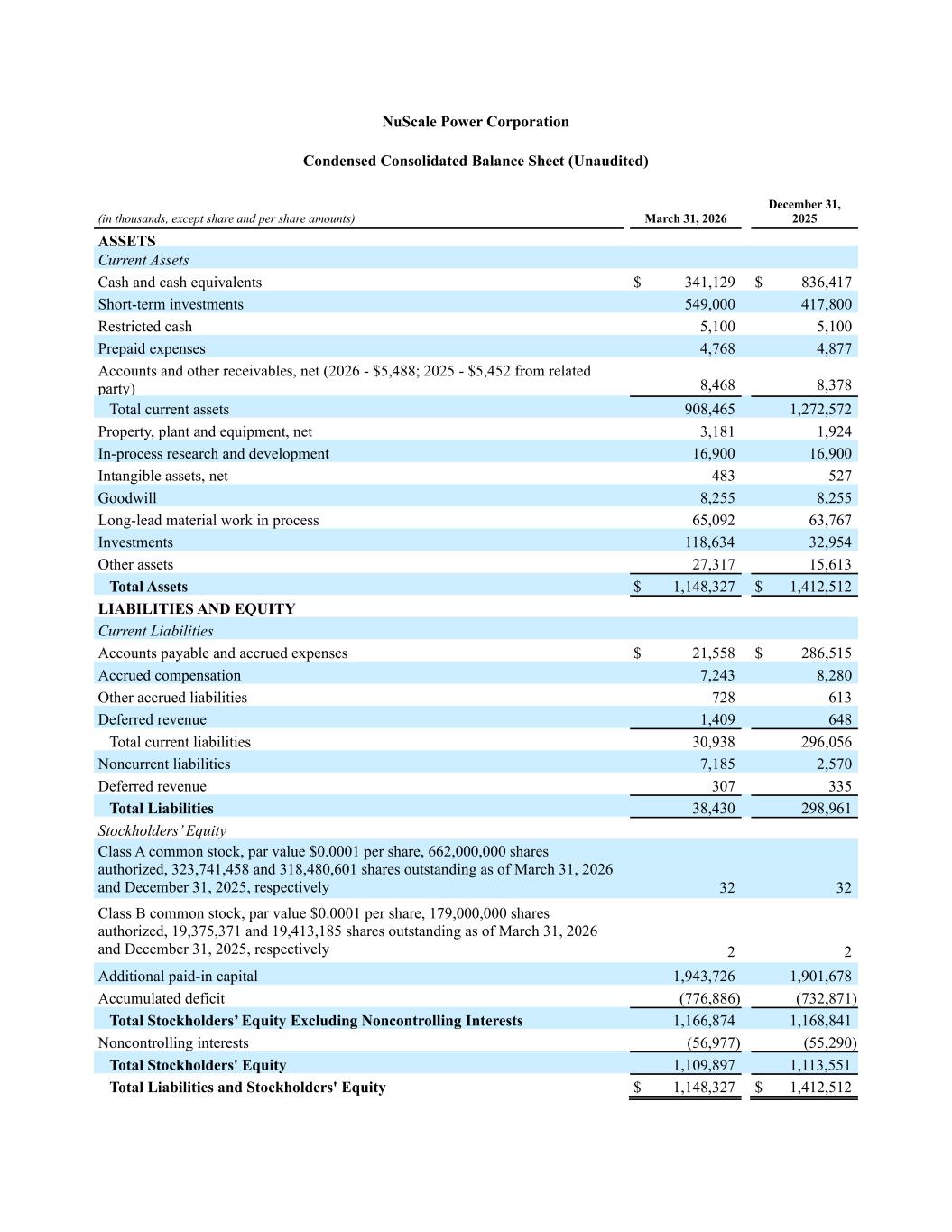
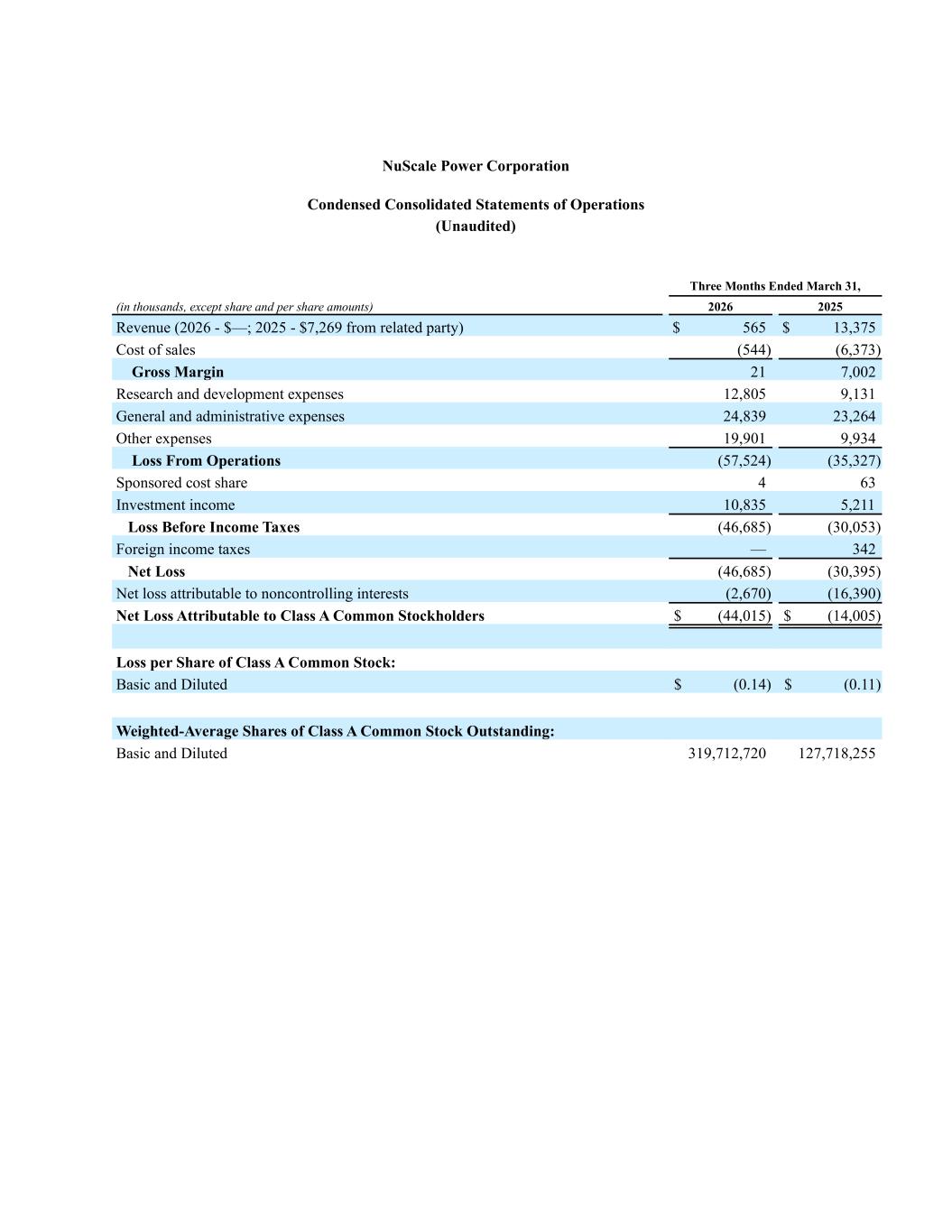
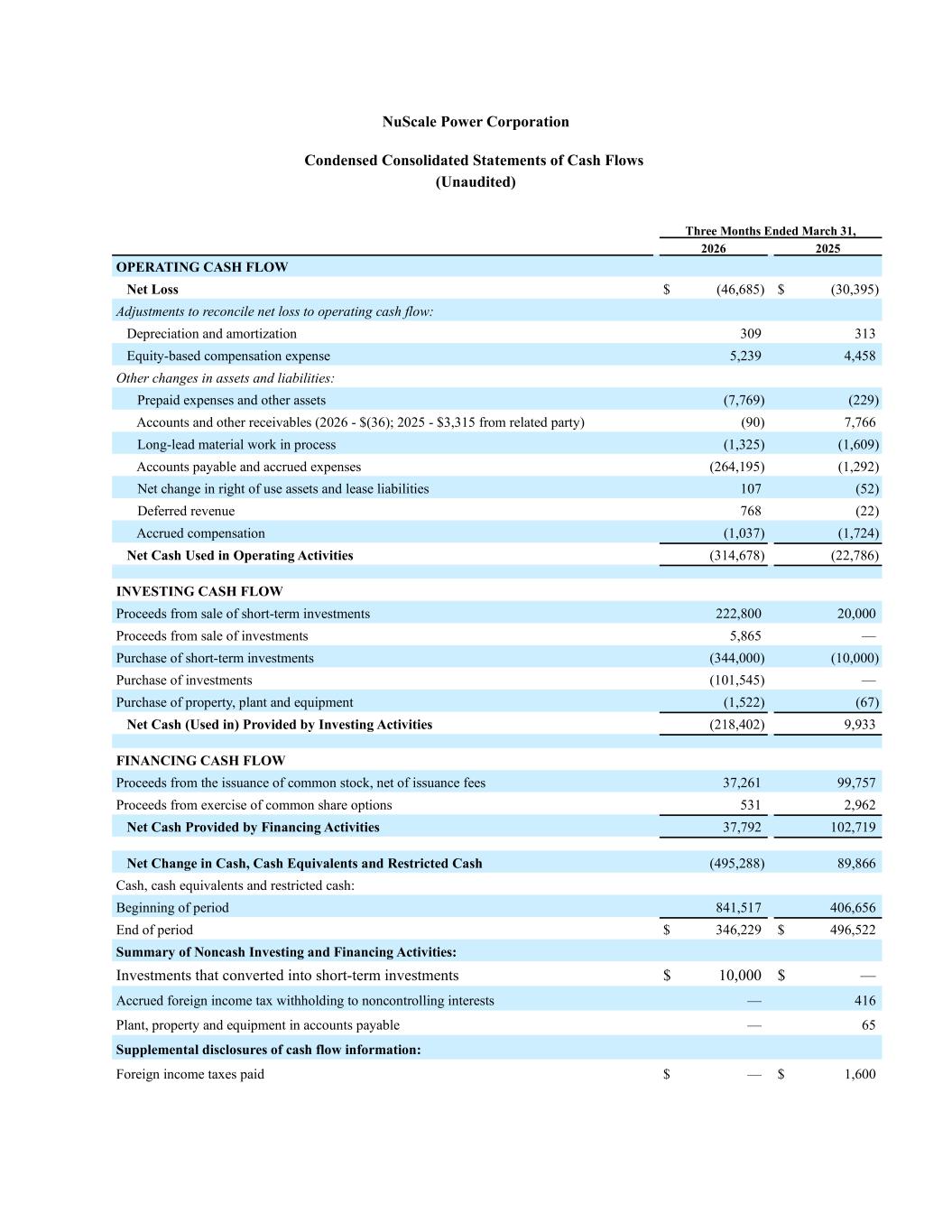
Thank you, John, and hello everyone. Our financial results are available in our filings, so my focus will be on explaining major line items, which can be found on slide 10. NuScale's overall liquidity stood at $1 billion at March 31, 2026, and increased to over $1.2 billion by early May of 2026. Our strong liquidity enables New Scale to further enhance supply chain and manufacturing readiness and fund obligations associated with advancing commercialization, all while maintaining a sturdy balance sheet. Moving on to revenue. New Scale reported revenue of $0.6 million for the three-month period ending March 31st, 2026, compared to $13.4 million during the same period in the prior year. This decrease was primarily due to the revenue recognized from the Roe Power Technology Licensing Agreement completed during the first three months of 2025, as well as the work associated with FLIR Feed Phase II Engineering Services, also in support of the RoePower project, which was completed in late 2025. As projects progress forward, we expect to realize revenues and offering cash flow from the sale of products and services. I will conclude my remarks with a brief overview of our capitalization summary, as shown on slide 11. Our total share count increased primarily due to the sale of 3.2 million U-Scale Class A shares through our at-the-market program, during the first quarter of this year, generating $37.9 million in gross proceeds. Additionally, we note that just a few weeks ago, Blur announced that they had completed the sale of their remaining NuScale shares, removing a significant overhang on our equity. Blur did well on their investment in NuScale, generating a 4.3x return on an initial investment of $570 million. With that, I'd like to thank you again for joining today and for your continued support of NewScale. We'll now take questions. Operator?
Operator
At this time, if you would like to ask a question, press star, then the number one on your telephone keypad. To withdraw your question, simply press star one again. We kindly ask that you limit your questions to one and one follow-up for today's call. We will pause for just a moment to compile the Q&A roster. Your first question comes from the line of Nate Pendleton with Texas Capital. Please go ahead.
Good afternoon. John, you make a compelling pitch. Thank you. You make a compelling pitch on the readiness and advantages of your solution. Can you talk about what's holding back more near-term adoption, additional contracts? Is it just the time it takes to get customers comfortable with those solutions?
Yeah, Nate, thank you. We're, you know, kind of like Pavlov's dogs here, waiting for the bell to ring. We're ready to go. We've been continually working on our supply chain and, in fact, we've had ongoing discussions. We're excited about, you know, last week I was in D.C. We met with the Korean government on the discussions of their potential for $350 billion of which, you know, $200 billion of that could be slated for AI data centers and new nuclear. We're also, you know, we're highly encouraged by TVA's strong pro-nuclear stance yesterday from Mike Skaggs, the interim CEO. He, again, affirmed TVA as a very pro-nuclear organization and highlighted interest in new nuclear technologies. And, you know, as it relates to TVA, we've got very much a primary focus on that company. That's not to say, however, that we're not talking to others as well. As a good example, my general counsel and I last night had a very good discussion with a potential company that's looking at megagigawatts here in the United States. We had dinner, and it's a follow-up conversation with them. It's just, you know, it's just a complicated, slow process. And so we're bullish that this thing is going to take off here and, you know, with the U.S. government support that we're seeing and all the activity that's going on right now, it's just we think we're hopeful that we're close to closure.
That's awesome. I appreciate that color there. And then I wanted to go back actually to the agreement with Framatome. You just mentioned the supply chain. And you guys have the advantage of years to build out these relationships. But broadly speaking with the nuclear industry and all that excitement, can you talk for a moment about the state of the nuclear fuel supply chain in the U.S. and where you see potential bottlenecks developing?
Yeah, this is Carl Fisher, Chief Operating Officer. I'm happy to answer that question. As you know, NewScale employs light water reactor technology using readily available low-enriched uranium. As far as the low-enriched uranium forecast for the long term, it looks very, very good. Unlike the uncertainty with high-assay low-enriched uranium, which you're hearing a lot of noise about and a lot of discussion due to the fact that the only long-term availability, at least at this point in time, is not through the United States, it's through Russia. So, with that said, what we see on the long-term forecast for low-enriched uranium is not a risky area. It's not a bottleneck, unlike the high-assay, low-enriched uranium.
You know, Nate, this is John. i remember many years ago i guess 12 years ago now because i've been with the company i had asked our as part of the due diligence process i had asked dr jose reyes why did you stay with light water why not thorium or why not and he looked at me and he said john all the regulators in the world know light water he said i've worked with the nrc the nrc regulators no light water. And when we entered into agreements, as Carl stated, you know, the fuel supply from Framitone, when I talked to him about being readily available, it's readily available. And so we're not, again, encumbered with some of the issues that others are facing currently. So that's not an issue for us currently. Yeah.
One last thing also with Framitone is that they have multiple sites for supplying the fuel, both in Europe and also in the United States. So that's... So in Washington. Yeah, Richmond, Washington for the U.S. and Lingen in Germany. And also they have a facility in France.
That's great. I really appreciate all the detail and thanks for taking my questions. Thank you, Nate.
Operator
Your next question comes from the line of Sharif El-McRobbie with BTIG. Please go ahead.
Hi, thanks for taking my questions. You know, something a little different just to start. Is there a need for the SMR space to maintain a certain level of domestic content for tax credit eligibility? It's something we're seeing elsewhere, and I wonder if, you know, the supply chain for NuScale and nuclear as a whole is concentrated in Korea and Europe, so I'm wondering if that's something we have to think about.
Yeah, this is Clayton Scott, Chief Commercial Officer. So there are requirements that, you know, to try and maintain as much U.S. content as possible. However, you know, there are certain aspects that the industry has fell short on over the years, and large-scale forgings, for example, is one of those cases. So in that particular instance, you know, you're allowed to position the supply inadequacy and where that's compensated from externally. So in those particular cases, you know, there's alternatives and ways to get past that. But, yes, in general, in order to meet the credits, there is certainly an interest to try and find the supply chain as much as possible in the United States. but there are options to move from there if it's not available or not capable to do within the country.
That's helpful. Shifting to regulatory, you guys talked about how important Part 52 is. I believe that since you guys last reported, the NRC came out with a framework for a new Part 53, and I'm curious if new licensing pathways could accelerate the regulatory process for TVA, anything coming in the future in the U.S.
Yes, a really good question. This is Carl Fisher again. The Part 53, what I would say, pathway was not available when we first pursued our licensing strategy. So Part 53 is relatively new. In fact, a lot of the industry is still trying to get their head around what does this actually mean. Primarily, it relies on a probabilistic analysis to go forward. So we've spoken to the NRC about this is where can we take credit off Part 53 and apply it to where we are already way down the road with Part 52. So, we are looking at, obviously, as John mentioned earlier, a Part 52 pathway with enhancements, which has been recently deployed with Part 53 opportunities. And we will continue to have that dialogue with the NRC because we're looking for continuous improvement, even as advanced as we are in Part 52 licensing space.
Yeah, I think it's important. We were just with the NRC, Carl and I, here recently, and, you know, they made it very clear that this enhanced NRC process is going to benefit everybody in terms of streamlining a lot of the requirements, but the rigor of safety and health is not going to go away. Everybody's going to have to go through that same process. So where we see benefit, you know, in our COLAs and elsewhere, that streamlining, instead have taken 18 to two years to get it hopefully it could be much shorter yeah it's good to know you guys have options available thanks for taking my questions thank you your next question comes from the line of Eric Stein with Craig Hallam please go ahead everyone good afternoon all right doing well thanks so I know a lot of this call spent highlighting kind of your differentiation.
But, I mean, there's also been a lot of activity on the advanced reactor side. And I'm just curious, you know, when you talk to customers, I mean, and I know you're part of it and it's more intro one, but just curious how do customers view it? I mean, did they appreciate the fact that it's light water technology, that you're using a readily available fuel, that this is a technology that's been around, you know, since the inception of the industry. You know, what are your thoughts around that? Because obviously, ultimately, that's the most important metric.
The customers we're talking to, I don't care if the process or generally utilities, the feedback we normally get is that process companies, whomever they are, they generally don't want to own a nuclear asset. what they want is reliable resilient clean power and they want it now and so we're in discussions with these companies and we still believe you know we're significant years ahead of others and we you know i want everybody to be successful i'd like to see this u.s vendors out there competing against state-owned enterprises but bottom line is we want to be a first mover i think i think the customers who are serious and truly understand the differentiation of part 52 and part 50 risk
um they they they fully get it and those are the ones that i think collectively with enter one are we're having the most uh concrete and serious conversations with so you know i i you see a lot of stuff out there a lot of noise but you know a lot of it is around a part 50 movement which i I think, you know, has a large element of risk, which was mentioned earlier. But I do believe that the customers that were, I'd say, on a very serious level in engagement, they truly appreciate and recognize where we are.
And then just sticking with that as my follow-up, I mean, I would assume that just the fact all of the things that have been done in the supply chain, that that's certainly a needle mover as well. Well, I guess it's not a question, more an observation, but I guess I'll turn it over.
No, you asked a great question on supply chain because many of our suppliers are not only strategic partners, but also investors. But as I often said, we've been in the process of ordering long lead items for years now. And it takes years for these forageants to get developed. And if you haven't ordered long lead items, you're that much further behind the curve. and what thing Carl and his team does, you may want to talk about the supplier system we just had.
Yeah, just to build on that one question, though, a lot of our suppliers are very nuclear savvy as well, and they are aware of the deployment opportunities with low-enriched uranium, per se, and light water reactor technology. That's not to say that they don't believe in the other technologies around advanced reactors, but they do spend a lot of their time with what they see as near-term deployable. And so these suppliers are very smart in that way, And they put a lot of priority on the current SMR supplier fleet or suppliers. The other thing just recently we had, just kind of to demonstrate that, is we had our New Scale Supplier Working Group meeting summit in Houston just a few weeks ago. So in there, we had over 120, 130 people at this summit, a lot of excitement around that representing well over half of our supplier base. Once again, these are suppliers who are very nuclear savvy. They've been around the block, and it really was demonstrated, what I would say, their interest and enthusiasm due to the fact that all the activity that's going on with ourselves and our business development partner enter one.
Operator
Your next question comes from the line of Derek Soderbergh with Cantor Fitzgerald. Please go ahead.
Yeah, thanks for taking my questions, guys.
So, in the presentation regarding role power, it says, should pre-EPC financing be secured i'm curious is the participation uh in the next phase contractually committed or is it more contingent on real power closing that third party financing good question we have in fact we had one today ongoing meetings every week with the department of energy real power nuclear electrica floor and and others discussing the status of the project and we continue to as we said build out our supply chain we are as i stated before a subcontracted floor corporation
floor is still in negotiations what i call what they call pre-epc so as as we are aware today those are those discussions are still ongoing got it got it um and as my follow-up uh so intro one is positioned uh to receive investment capital what size of commitment would largely de-risk the first phase of that project? And, you know, depending on the funding amount, would that reduce your need to provide milestone payments or broadly your funding obligations at all? Thanks.
I'm not sure I fully understand the question. You're asking about our funding obligations in relation to row power or in relation to projects in general or TVA?
So, TVA. So, if ENTRA sounds like they're in the market to raise capital, should they do that? Depending on the size, does that at all reduce, you know, in what way does it de-risk the project on your end? And then, depending on the funding amount, would that reduce your funding obligations at all? Thanks.
Sure. Thanks for the question.
Does it de-risk the project? Absolutely.
You know, funding is a massive component of pulling these projects together. It's very complex. And for ENTER-1 to be, for example, you know, named in the U.S.-Japan Framework Trade Agreement with, I think, the $35 billion earmarked, $25 billion, pardon me, earmarked, you know, that sort of funding can really move the needle for project, and subsequently, you know, really moved the needle for NewScale. Funding at the project level, though, is completely separate from any of the PMA payments. PMA payments are partnership milestone agreement payments, and those come with, for example, the term sheet, which we already did, and the PPA, which we anticipate doing in respect of TVA at some point soon. So those are separate ideas, but you bring up a good point. Project financing definitely de-risks our pathway forward because it de-risks the entire project. And these are new scale powered power plants.
Got it. Really appreciate it, guys.
Operator
Your next question comes from the line of Moses Sutton with B&P. Pariba, please go ahead.
Thanks for taking my questions. Any update on the Japanese financing framework, like, that you can provide more detail on? Is this sort of going to be the gateway to FIDs on TVA projects? How do we think about that?
Hi, Moses. How are you doing? This is Ramsey Hammity. So, it could be. I mean, you know, TVA requires financing. I know that ENTER-1 is an active dialogue with both sovereign-based or quasi-sovereign-based financial institutions as well as private financial institutions. So I wouldn't say exclusively, you know, we require money under the U.S.-Japan Framework Trade Agreement, but I think it's a strong possibility. But rest assured, ENTER-1 is working on all available sources of financing to get this across the line.
Well, this is John. And I think it was public domain information that, you know, a pretty large component of that $550 billion through the American-Japan framework was plated for energy, including SMRs. And then most recently, last week, we met with the Korean government on this potential of $350, as I stated before. You know, a significant piece of that, again, is towards investment in energy projects, including SMRs, into the United States. So we've been in discussions with both. We met with Korea last week, and we're pretty excited about it. Again, it's part of this whole ground soil we're seeing around the nuclear energy in this country. It's pretty phenomenal right now. You know, we're at a tipping point, I think, as a country and in an industry to something's going to break soon.
I think it's also important to acknowledge within the construct of either Korea or Japan as examples that NewScale historically has had very strong relationships with both the Koreans and Japanese as equity investors, as supply chain partners, both through IHI and through Doosan. The relationships there are longstanding. They're deep. They're well-established. And while they're not the only source of financing, I think they are, you know, a strong potential source of financing for projects.
Got it. And can you provide more detail on the fuel fabrication strategy with Framatone? Because to our understanding, there are 444 assemblies unnoticed with Framatone. Is that sufficient for about 12 module deployments? Is there an annualized run rate or capacity you can provide there, or is it more flexible from Framatone in terms of, you know, based on demand? How do we think about that?
Right now we're in the preliminary design with Framatone. It fuels a very long-term proposition, you know, in the sense of, you know, having the fuel ready in several years. So we've got ahead of it. You probably saw the announcement. That was so that we will be ready to support the market's needs. As far as capacity, as I mentioned earlier, Framitone has multiple facilities globally. So part of that announcement was to inform that we have that ability to go global and not just rely on American capacity. As far as the pipeline, in our discussions with our pipeline and discussions with our business development partner, intra-1, and based on what Framitone's capabilities are, we don't see any bottlenecks or any kind of shortcomings there because we got ahead of it early. In speaking with Framitone, the one thing they ask us to ensure is to keep them informed on what's going on with the market and with our customer base, which we do, so that they can plan ahead. is if they have time to plan ahead, then they can meet the demand that we require.
Operator
Your next question comes from the line of Craig Shear with Tui Brothers. Please go ahead.
Good afternoon. So it sounds like a Roe Power FID could take at least into 2027. If ENTRA-1 has successful funding, could there be a TBA opportunity finalized this year? And to the degree either of these projects make notable pre-FID advancement, could that at least drive some notable new scale revenue in the coming quarters?
RAMSEY HAMMEDY, CFO. Well, we're hopeful that TVA can come across the line at some point later this year. We believe that's a strong possibility. Our revenue stream, our cash flow this year, should TVA come across the line with, for example, PPA, we anticipate that we would have site-specific services, so pre-OEM services, If we look at Rowe Power as an example, we had technology licensing, we had pre-feed, we had feed phase two. All in with Rowe Power, we realized about $8 million worth of revenue, and that's pre an OEM contract. And that's over, I think, 2024 and 2025. That's pre an OEM contract, and that's pre true FID on behalf of Rowe Power. I know they had an announcement, and it kind of sounded like an FID, and we went out to the market and explained it was subject to financing. So we would anticipate something potentially in that scale once we get to a PPA with – or what Central One gets a PPA with TVA.
Great. And I wanted to kind of think through the potential, you know, reduction in the cash burn. I noticed the payables are down significantly. I think that's for some of the long lead time equipment you had to pay for. Given that and given, I think, the OCF drag before working capital changes was, you know, attractively down versus the second half last year, going forward before any major, you know, project news, is it fair to say that the cash burn should be, you know, improving?
Interesting. Interesting. So, again, this is Ramsey Hamley. So, our AP was down. That's correct. But it was principally because we recognized the payable under the PMA agreement. At the time, the PMA agreement was signed because we acknowledged the term sheet, the stage one payable. So payables did go down. You saw that reflected in our cash flow statement. But without getting into the real technicals of our financial statements, I think what's important is that we have positioned our balance sheet in a highly conservative fashion. We, along with everyone else in this industry, we are pre-revenue companies focused on a technology, which to this point has not yet been deployed, and which we strongly believe in, but which hasn't been deployed. And we're dealing in tricky markets as well. So I say this as a point of pride. You know, now three years as CFO here, we've really positioned ourselves with this fortress balance sheet because we don't know what's around the corner. We anticipate, we expect, we believe we won't be talking in terms of burn rate by the end of this year. I hope to be operationally cash flow positive by the end of this year. But I positioned myself conservatively for, you know, for my company and for my investors. So what's our burn rate? I think OPEX, you know, this year was a very, or this quarter was a low revenue quarter compared to last quarter, our Q1 2025. I think we went into that in the script. In Q1, we had revenues associated with Rowe Power. This quarter, we did not have revenues associated with projects. So the OpEx was about, I think, $55 million this quarter, but we anticipate, actually, it will go up as we near commercialization, because we're focused on supply chain readiness. We're focused on design finalization. You know, we're focused on getting ready to actually deliver this product, and as we focus on that, we're starting to spend a little bit more. But rest assured to our investors, we plan for this. Our balance sheet can withstand that additional spend.
Operator
Your next question comes from the line of LeAnn Hayden with Canaccord Genuity. Please go ahead.
Hi, everyone. Thanks so much for taking my question. To start, I was just hoping you could help us. Hi there. I was just hoping you could help out what that looks like per NPM. And I expect this to change from first of a kind to end of a kind, especially now that you've started more procurement efforts.
I'm sorry. You're breaking up pretty bad. You don't mind repeating yourself.
Sorry about that. Can you guys hear me now? Okay. I was just hoping you could help us think about what CAPEX should look like per NPM and how we can expect that to change from first of a kind to end of a kind and maybe any sort of early indications on dollars per kilowatt hour as well would be great.
No, yeah, I don't think we can provide guidance. I think on CapEx per NPM, I think you're referring to COGS versus CapEx, and we're not providing guidance on the cost of, you know, the cost of building NPM, and we're not providing guidance on the maturation of those costs through, from first of content of a kind. So our apologies to that. I think it's a little bit early for us to provide that sort of guidance. And your second question, you're talking about dollar per kilowatt hour. We've really gone away from this sort of metric. So we don't provide this, we don't provide guidance on that. It's too fuzzy, really, to provide guidance of dollar per kilowatt hour. And plus we don't we don't produce we don't produce the electrons we sell NPMs okay yep that's fair enough got it I thank you and then just curious like after enter one signs the binding PPA with TVA can you just talk about a little bit what that is for from a near-term revenue perspective if possible yeah surely and I I think what I went to is I can't remember it was Moses or who I was speaking with, but, you know, I look to some of the, you know, the early services that we would provide, site-specific services. I refer to our work with Roe Power over 2024 and 2025. We had some technology licensing revenues along with pre-feed and feed phase two. I said in the context of Roe Power, what we saw was about $80 million worth of revenue, just on kind of like, you know, these pre-sort of services, and I think that we can anticipate something similar in relation to, in relation to ENTRA-1 post-signing of a PPA with, post their signing of a PPA with TVA. And there could be, there's licensing work as well, there's COLA work, but I stick to the road power examples, a good idea of what we may anticipate.
Got it. Thank you, Ramsey. That's helpful.
Operator
Your next question comes from the line of John Windham with UBS. Please go ahead.
Hey, perfect. Thanks for taking all the questions and being patient with us. Appreciate the sort of regulatory review. You know, it's been, I think, three and a half years of covering you guys. It's good to, you know, refresh on that. There's been a lot of talk about a PPA with TBA. I just want to understand how we should think about the next 12 months and what does progress I mean, just looking at some of the things TVA has done with, like, GE Hitachi and some of the other nuclear development programs, they don't seem to start with a fixed-price PPA and then now let's move forward. You know, it's, like, more incremental of a site construction permit, PPA is still sort of up in the air, everyone's sort of moving one step at a time. If you could just help me, I'll be more articulate, just in the next 12 months, sort of timelines, key mileposts on advancing the TVA project.
Yeah, I think it's a little bit different scenario, I think. I mean, you know, PPAs are somewhat new to the nuclear industry and, you know, the process on how things move forward in a project perspective. So, as we see it, and for one, you know, in those finalizations of that deal. And, you know, once that's performed, you know, the sites have been, you know, we've already kind of worked with the collective to identify the sites that will be worked And most of those sites have some level of preparation that have been progressed. So we would see us going into COLA activities and to pre-feed activities and supporting the supply chain for intra-1. So it's kind of different than what you've seen in some other sites that may not be as mature or in a PPA situation that's not necessarily secured or even working with reactor suppliers that are not as advanced. So I think we're kind of in a different position. We're ready to go, ready to deploy. So I think once their deals have been secured, then we can start real activity that are COLA-driven, not what you see today in the other end.
And we're also all driven to, once these PPAs are defanticized and put in place, hopefully near-term here, we also have been working diligently on our OEM contract. so it's in everybody's that's your interest as soon as these ppas are defined we quickly move into our oem contract you know we'll do the caller as clay mentioned but getting that contract signed is is it everybody's benefit to get that done quickly yeah great appreciate the color thanks so much thank you thanks john your next question comes from the line of bikram
I was wondering if we can talk about other customers, customers other than TVA or Role Power that you or anyone may be talking about, or is it fair to assume the focus is squarely on these two potential opportunities? And when you talk to TVA and Role Power, TVA particularly, and other customers, do tariffs and logistics cost and, you know, higher commodity prices, they come up a lot, you know, changing economics of building a reactor because of these things. And I asked this question while I saw a flash that the new 10% tariffs were deemed unlawful by the trade code just now. But are tariffs and, you know, the logistics cost changing the economics, is that somewhat of a hold up? Are you talking to the customers of the TVA and RoPOWER?
I'll answer the first part of the question. TVA is an important opportunity, and it's currently our primary focus. However, it's not the only one, as there are other engagements. These are ongoing with other potential optakers and customers across different regions and segments. So, we're working with Entrawana on a pipeline that includes other projects. They're also being contemplated on their business models other than a PPA structure, such as a development structure. I think we've said in the past, Central One has a pretty deep pipeline of projects, and we're not tied to one. I'd like to highlight the importance of the safety and growth drivers that make secure baseload nuclear power the only solution for both the U.S. and the global energy sector. It means there are a lot of people, a lot of customers, looking for solutions like the power that we provide. But certainly, TVA is important and is our core focus today.
The second part of your question, if you don't mind repeating, that might be helpful for I was asking if the changing economics of building a reactor is also somewhat delaying the discussions with TVA and other customers in the U.S. given the commodity prices are rapidly changing, the tariffs have moved around a lot. Is that somewhat of a hold-up delaying the process?
I don't know if that's purely an SMR-related idea. I mean, tariffs and commodity prices affect everyone. So, yeah, like these are the, you know, the provision of nuclear and the deployment of nuclear is a very long-term type of idea. It does, yeah, it has less to do with kind of like, you know, short-term swings and more to do with long-term needs, especially when those short-term swings are really macro and aren't just kind of, you know, they're not just focused on the nuclear industry or SMRs. That's, you know, that's kind of like U.S. wide, you know, technology-wide.
And this relates to the mantle. A couple weeks ago, we attended, there's an annual energy conference every year called CIRA Week. It brings together energy, senior executives, government officials, NGOs from all over the world. And of the probably 15 years I've been attending that event, I've never seen so much focus as we did in this event on nuclear across the board, international, global, U.S. domestic. You know, if you look at the markets that we've talked about over the years, they haven't gone away. We're going to see potentially a significant decline at the end of this decade. coal-fired plants. We're going to see the need for, as I said, the elephant in the room is still the hyperscalers who demand energy. They want behind the meter. And recently, as the president announced, they're going to have to figure out how to incur those costs. So the demand pull right now, as we're seeing, is unlike anything I've ever seen. It's just, you know, it's been a long cycle, but I believe we're finally starting to see the latest in the tunnel here. All these technologies are going to benefit from, you know, the increase of our current government pushing this, needing energy security and national security and energy supply. So we're bullish on the market, and we think the opportunity is near term.
Got it. That's all right.
Operator
Your next question comes from the line of Brian Lee with Goldman Sachs. Please go ahead.
Good afternoon. Thanks for squeezing me in. I missed a little bit of the earlier part of the call, so I apologize if some of this is redundant. And you did cover a lot with respect to TVA and related topics. But I wanted to ask specifically, given some of your comments, Ramsey. So I think a lot of focus on the PPA with TVA, and you kind of alluded to the fact that maybe it could happen later this year. So let's presume it does. Can you kind of walk us through what happens next, right? When does an equipment OEM offtake get finalized? Is that in conjunction with the PPA or is that a few quarters later? And so you're talking about 2027. And then you also mentioned pre-feed revenue. There was no mention about deposits. I think you've talked about deposits in the past, but is that something that's still on the table? Because it does seem like you would need that to be cash flow, you know, neutral deposit, as you mentioned. It's sort of your ambition maybe later this year. But just trying to understand the sequencing here around some of those elements.
Yeah, let me start with the OEM. I mentioned earlier we've been working diligently on the structure of the OEM. Now, we have to wait for the definitization of the PPA. However, it's in everybody's interest as soon as these PPAs are put in place that we quickly negotiate and finalize our OEM. So, we're hoping, you know, near term that once that's done, that's the first thing we've got to get done.
The other part of the question? So, I think it was sequencing. So, you know, once we have the PPA, what can we expect? But, Brian, we talked about, and I don't know if you heard this part or not, but I referenced Roe Power. So, hey, you know, within the context of Roe Power, as an example, we did, you know, pre-feed, feed phase two, and technology licensing, that was about $80 million in revenues. I think on top of that, you could add COLA work, so that's site-specific licensing work, which we can anticipate to see post-PPA and not necessarily tied to having an OEM because that's work the comp just needs to push forward. On deposits, I may be getting a little bit tripped up on the nomenclature of how we describe it. Within an OEM contract, we would expect payments, and those payments would be staged over time. You know, we're actively working to structure an OEM agreement now, but it's not deposits per se. It's, you know, it's us producing NPMs under an OEM agreement and acting as essentially a pass-through as funds go from Entra1, the buyer of the NPMs, to our supply chain, Doosan and others, to pay for the production of the NPMs. And I think the last point, I'm not sure if you asked this, or I'm just kind of interpreting this through the dialogue, but we anticipate the OEM then to be like a, you know, OEM is a cash-positive event for a new scale. I know there are some payments to go out under a PMA, but ultimately we anticipate payments coming in more than offset that, and then we have a runway, TBD, and this is all to be negotiated in the OEM agreement, But then we have a runway of payments coming in to ultimately pay for, you know, pay for the modules. Did I answer that correctly, Brian?
I don't know if I was clear there. I understand it. Yeah, I understand the scope of work and, you know, getting paid on delivery of, you know, components. I suppose it's maybe, as you said, grand denomenclature. But my understanding was that there was going to be some structuring of a upfront deposit that would be quite significant once you had the OEM agreement in place. But maybe that's.
Yeah, no, that's right, Brian. That's right. No, it's not just payment upon. It's not like we, you know, we produce and we hand over an NPM and then we get paid for an NPM. And I think what you may be speaking to is, like, ideas of working capital, I think, you know, cash and working capital as we go to produce NPMs. We would anticipate that we have staged payments over time, starting at the signing of the OEM agreement, and then pushing into the future as we progress manufacturing of the NPM, and then terminating in the delivery of the NPM.
Last one for me, and I'll take it offline. When you said upon signing the equipment OEM, you expect to be cash flow positive, Are you talking about recouping, in addition to the PMA that's made upon signing the PPA, also the initial milestone payment of, I guess, the $500 million that's already been paid? Like, what's the scale of what you're referencing in terms of being cash flow positive once you hit the equipment OEM agreement?
Yeah, I was really referencing, in that particular statement, I was referencing milestone three under the PMA. of what, you know, what we expect to pay out under Milestone 3 and what we expect to take in is that we'll be cash flow positive on that. The, you know, the total Milestone payments overall, I think those are recoverable or we can recoup those over the course of, you know, over the course of delivering the NPM and the payments that come in. But I was solely referring to that moment in time, Brian. an OEM is signed, amounts are due under a PMA, amounts come in as, you know, first payment under an OEM, and the net of those we anticipate being cash flow positive. Okay. I appreciate the clarification. Sure.
Operator
Your final question for today comes from the line of Brian Finkst with B-Riley Securities. Please go ahead.
Okay. Hey, Ramsey, how are you? Thanks for taking the question. Maybe just a follow-up on RoePower. Ramsey, you just mentioned the revenue earned there over the last couple of years, but could you share what the revenue opportunity might look like if RoePower continues to advance, or maybe what types of services you'd be providing in the next stage of that project?
This is Carl Fisher. The next phases of the project, just to back up a bit, we finished the feed just in November. Once again, we are a sub to Flora Corporation, and Flora Corporation is now pulling together the next phases, which is what they call a pre-EPC approach. So the lion's share of that will go to most likely the floor, and we'll have a subcomponent. And they're still working through what that scope actually is. So until they get that finalized, we're not going to know exactly what kind of revenue streams we're going to be pulling in for this, what we call a pre-understood.
Operator
That concludes our question-and-answer session. I will now turn the call back over to John Hopkins for closing remarks.
Thank you very much, Operator. You know, our objective today, folks, is try to level set as much as we could. There's a lot of chatter in the market right now, but NewScale didn't just happen. We've been, and the team, have been hard at work for nearly two decades with one clear mission, help power the global energy transition by delivering safe, scalable, and reliable energy. and with that I'll sign off and we thank you until next time ladies and gentlemen this concludes today's call thank you all for joining