Operator
Good afternoon, everyone, and welcome to SNAP Inc's first quarter 2026 earnings conference call. At this time, participants are in listen-only mode. I would now like to turn the call over to David Ommeter, Head of Investor Relations.
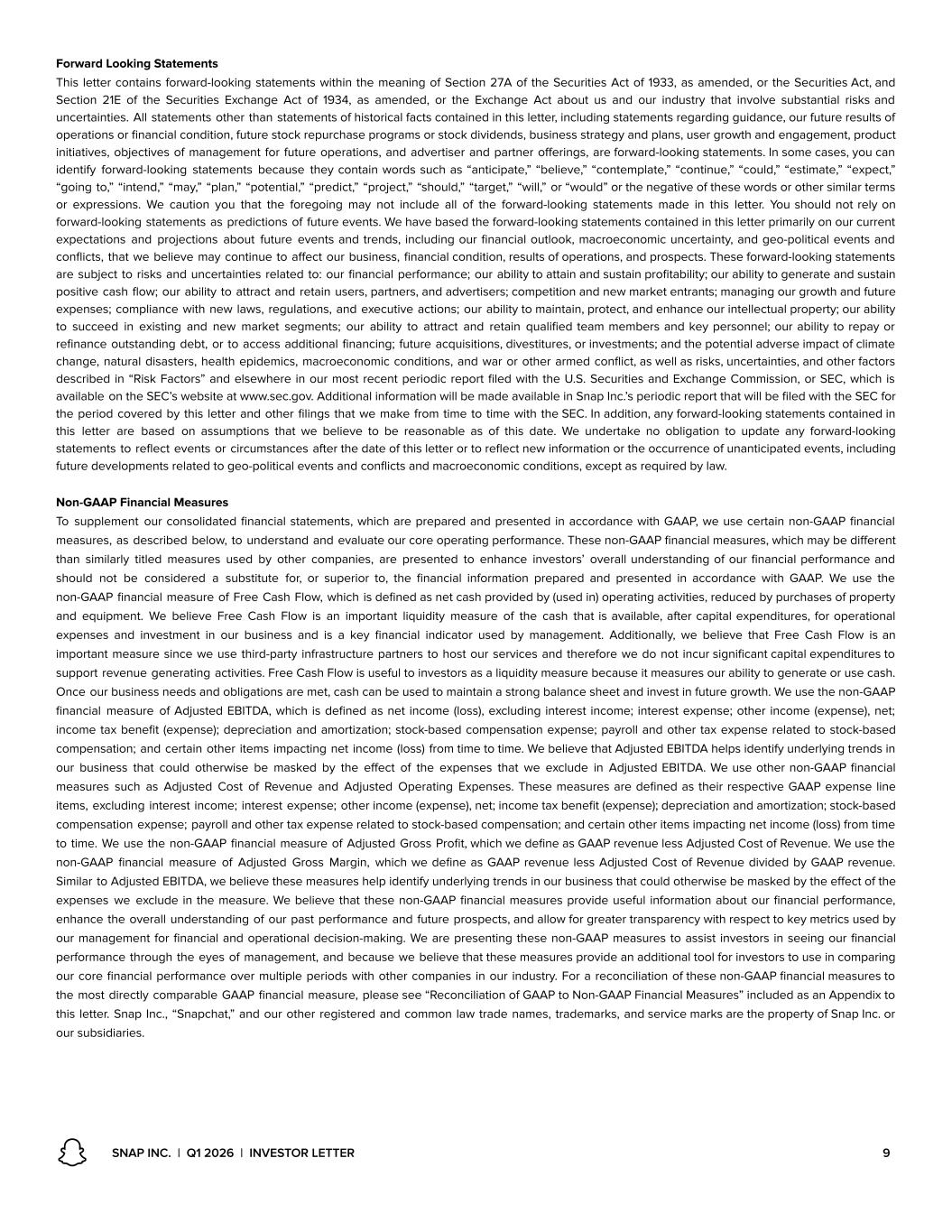
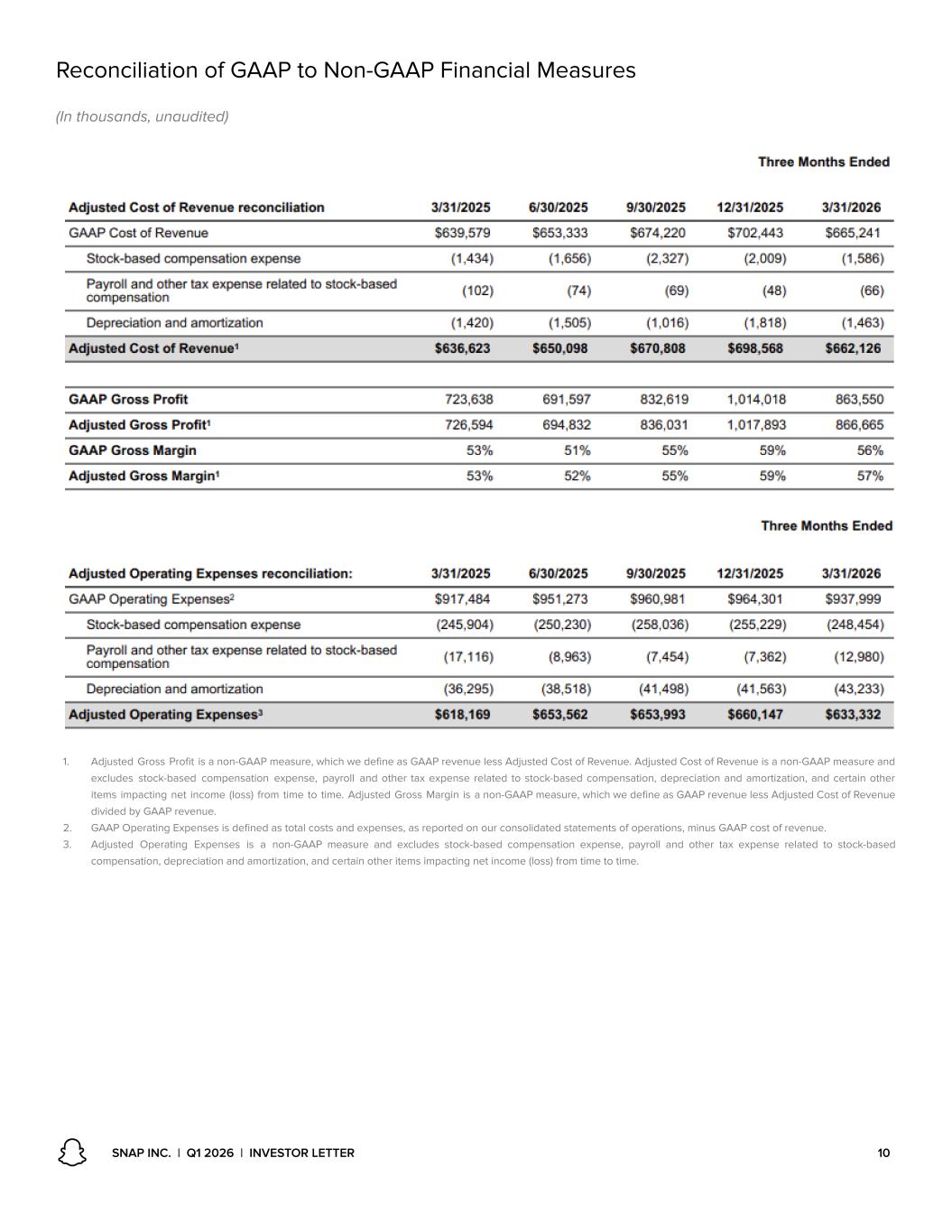
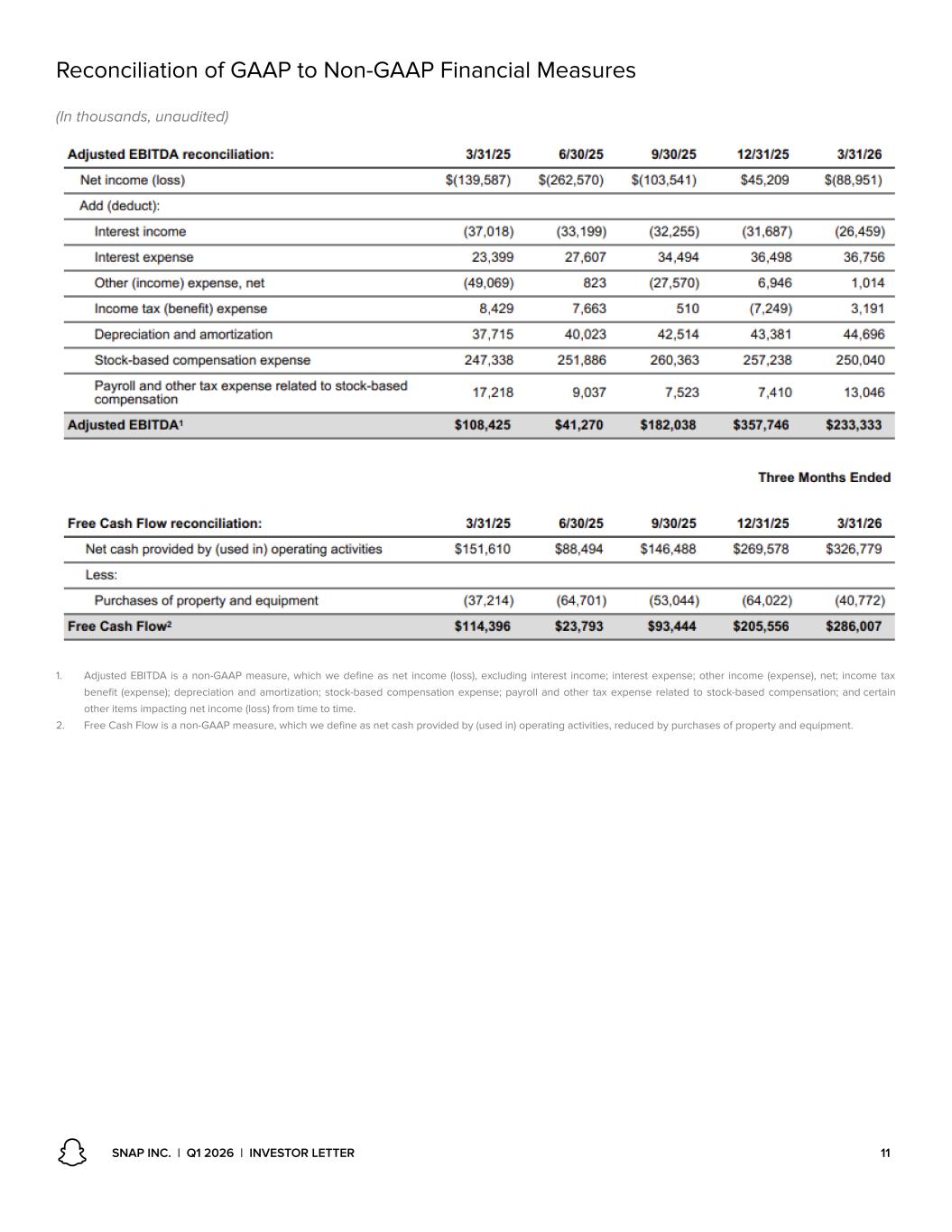
Thank you, and good afternoon, everyone. Welcome to SNAP's first quarter 2026 earnings conference call. With us today are Evan Spiegel, Chief Executive Officer and Co-Founder, and Derek Anderson, Chief Financial Officer. Please refer to our investor relations website at investor.snap.com to find today's press release, earnings slides, and investor letter. This conference call includes forward-looking statements which are based on our assumptions as of today. Actual results may differ materially from those expressed in these forward-looking statements, and we make no obligation to update our disclosures. For more information about factors that may cause actual results to differ materially from these forward-looking statements please refer to the press release we issued today as well as risks described in our most recent form 10k or form 10q particularly in the section titled risk factors today's call will include both gap and non-gap measures reconciliations between the two can be found in today's press release please note that when we discuss all of our expense figures they will exclude stock-based compensation and related payroll taxes as well as depreciation and amortization and certain other items please refer to our filings with the sec to understand how we calculate any of the metrics
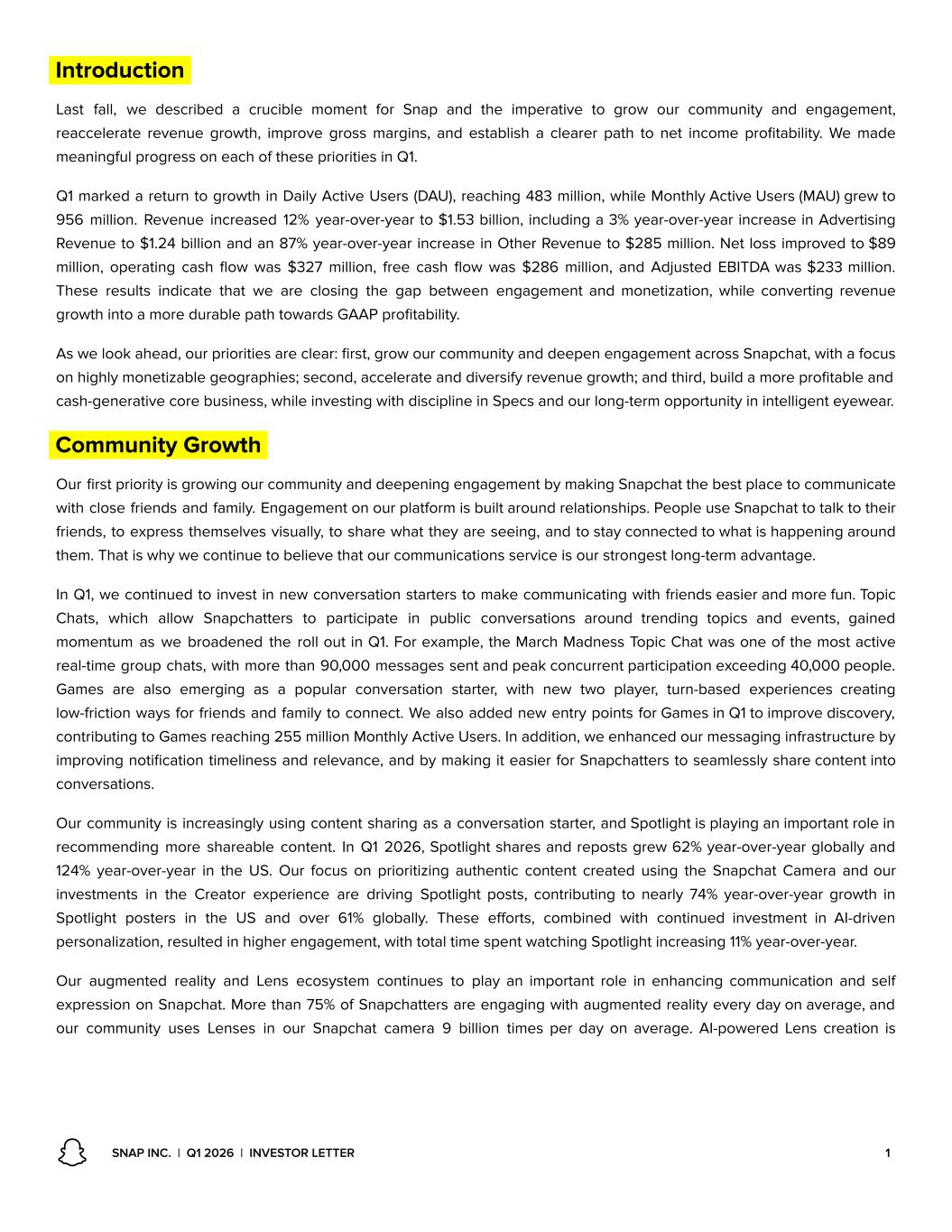
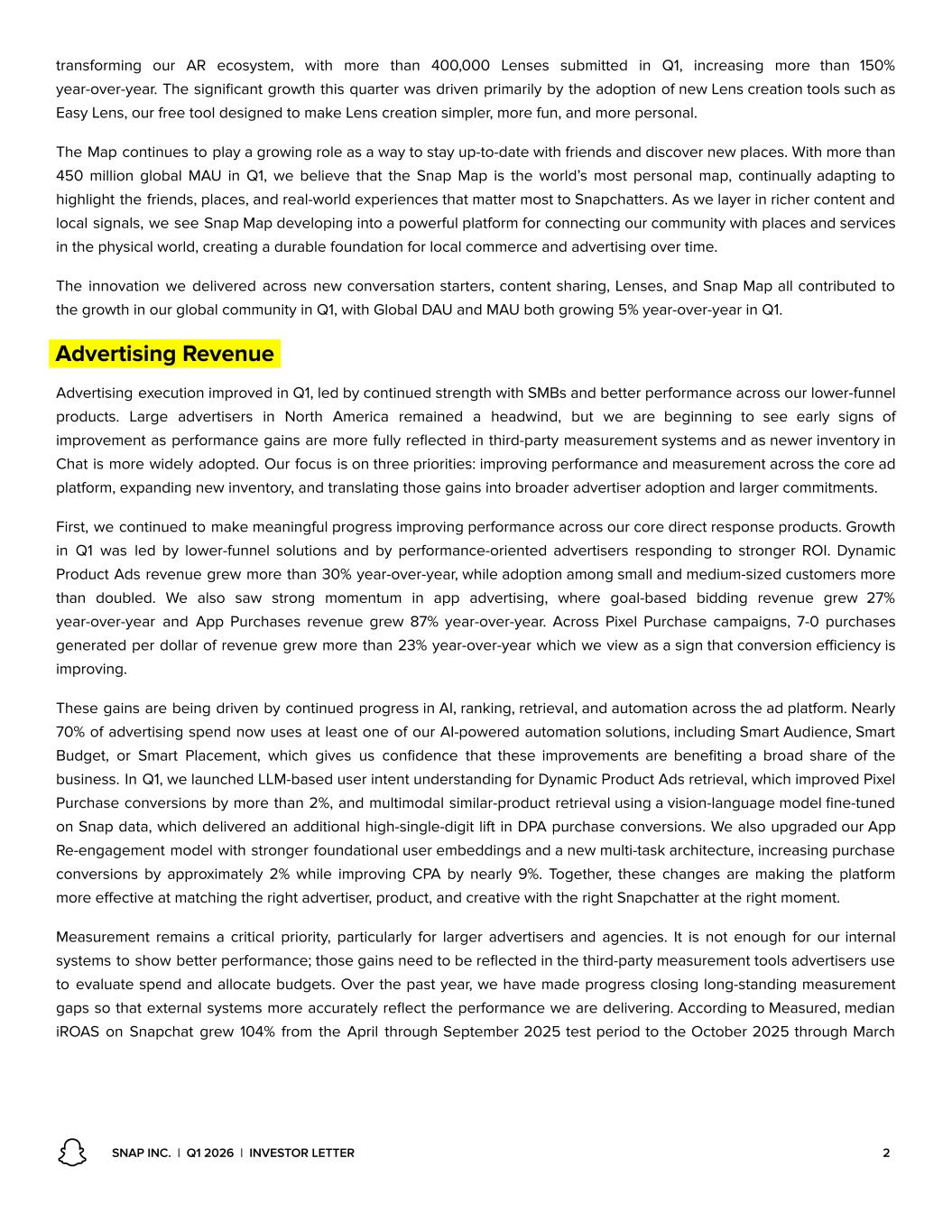
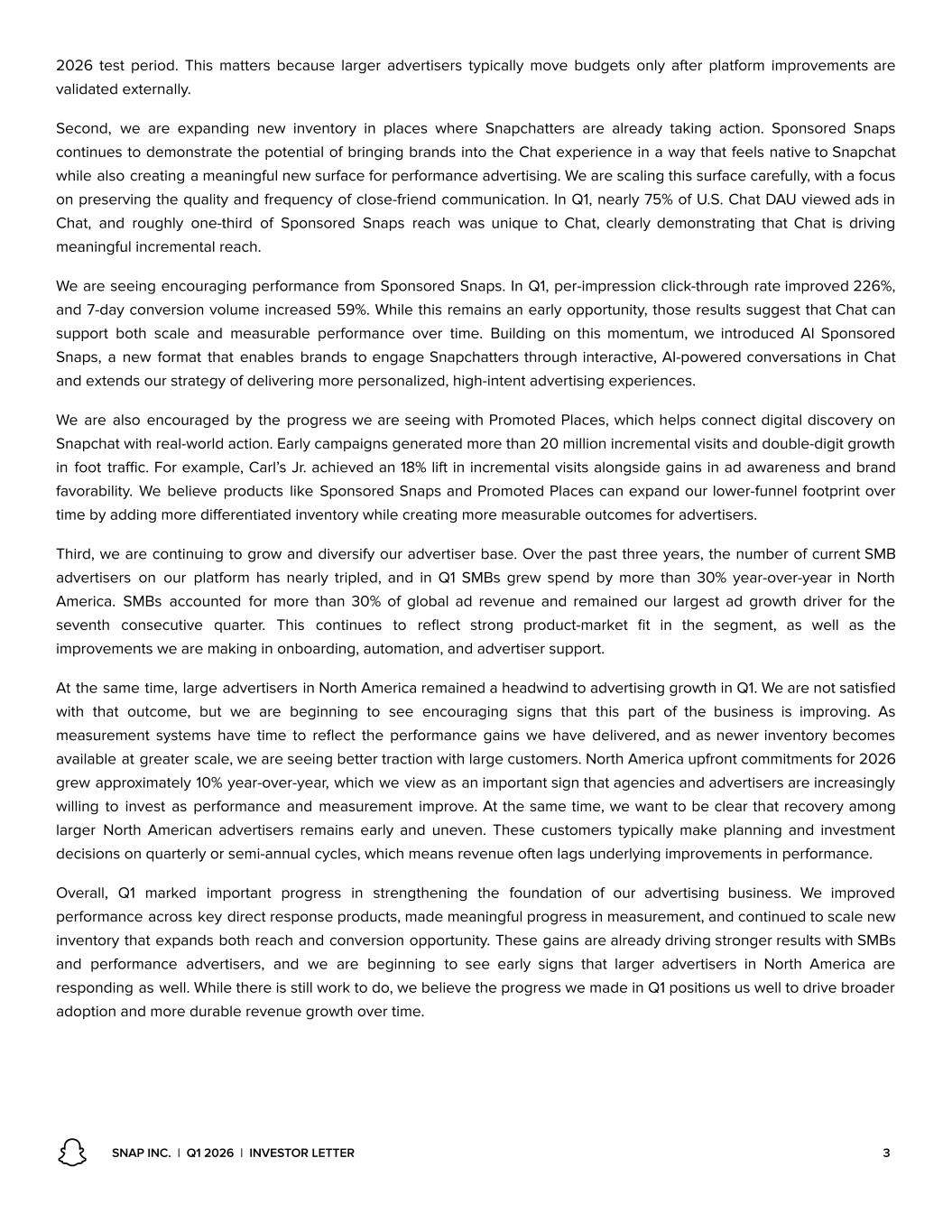
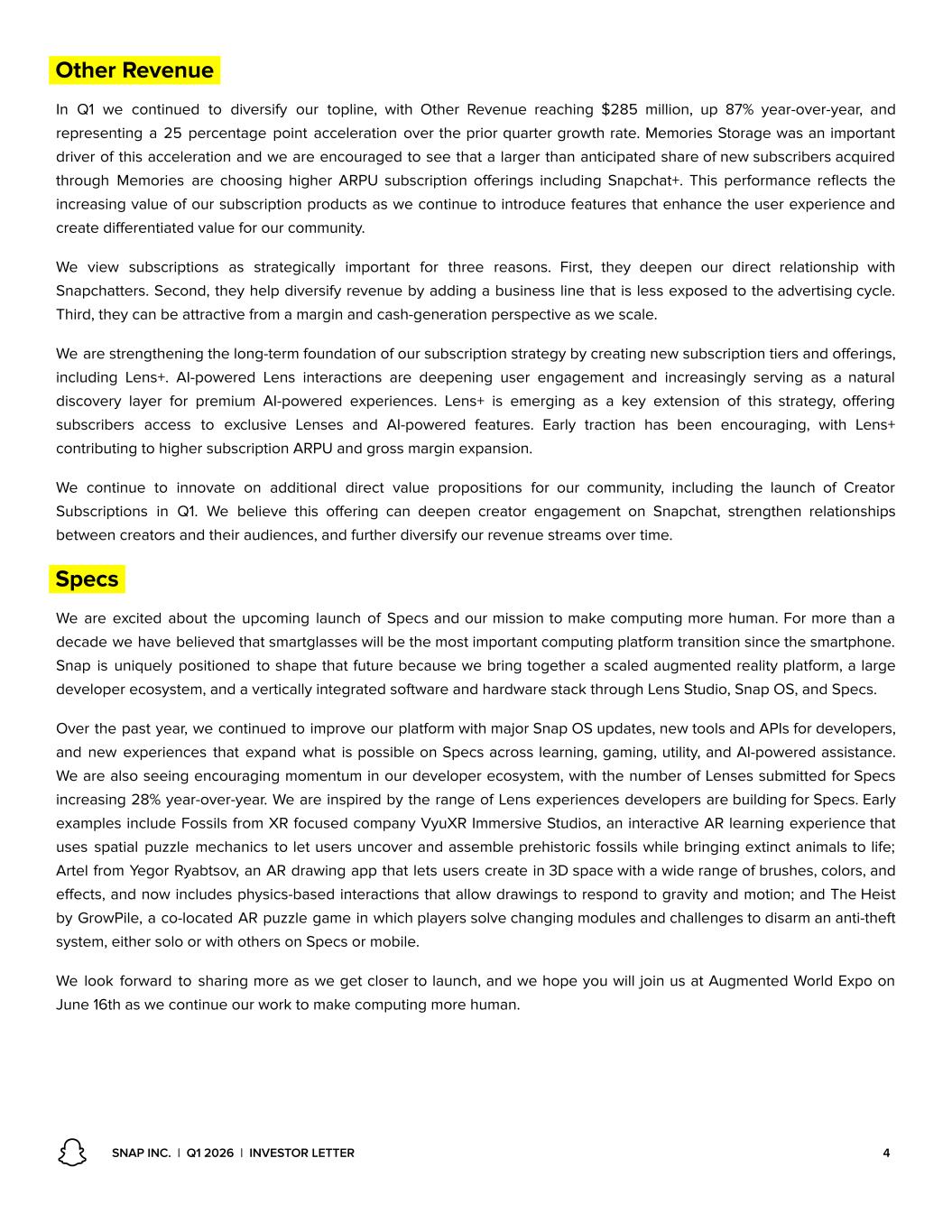
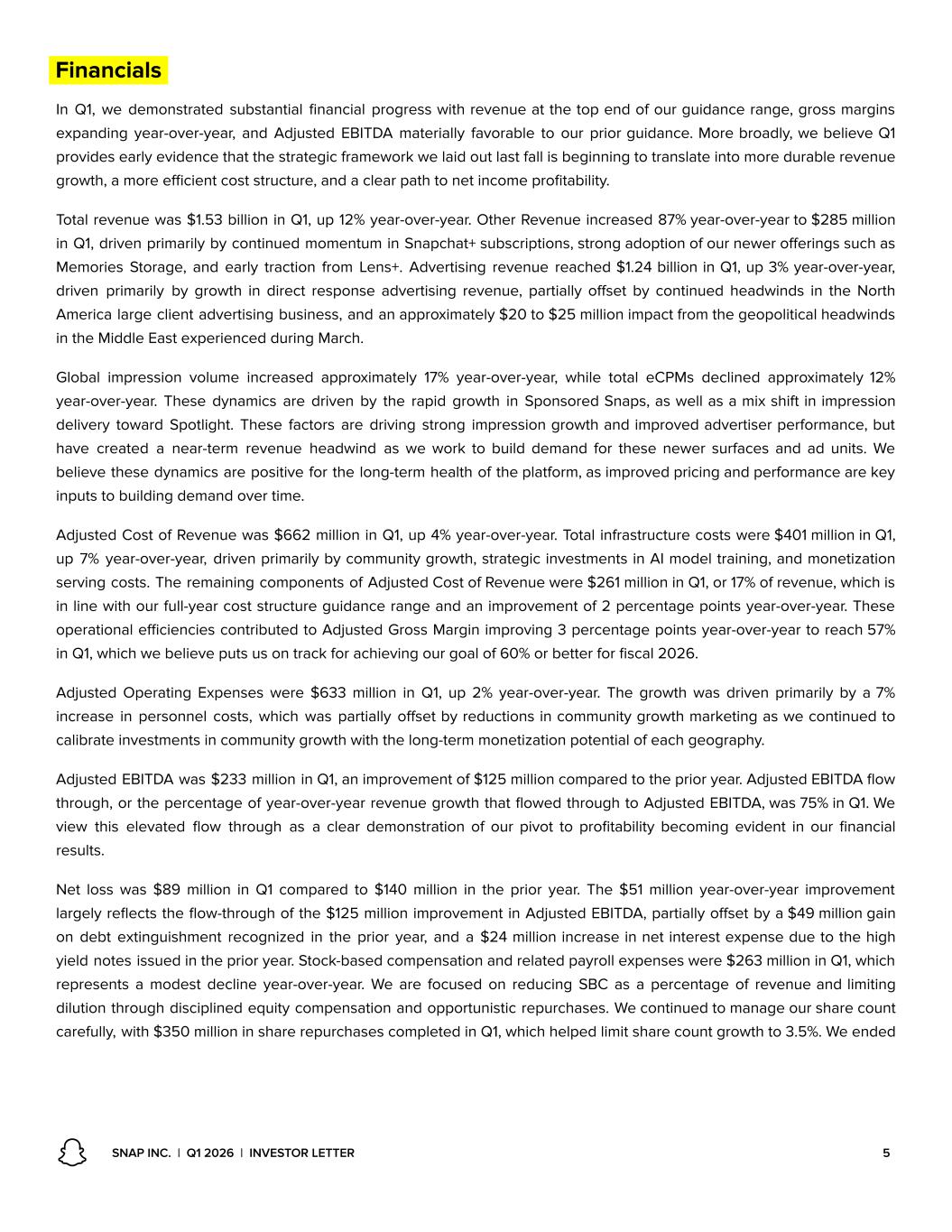
discussed on today's call with that i'd like to turn the call over to evan hi everyone and welcome to our call last fall we described a crucible moment for snap and the imperative to grow our community and engagement re-accelerate revenue growth improve gross margins and establish a clearer path to net income profitability. We made meaningful progress on each of these priorities in Q1. Q1 marked a return to growth in daily active users, reaching 483 million, while monthly active users grew to 956 million. Revenue increased 12 percent year-over-year to 1.53 billion, including a 3 percent year-over-year increase in advertising revenue to 1.24 billion, and an 87% year-over-year increase in other revenue to $285 million. Net loss improved to $89 million, operating cash flow was $327 million, free cash flow was $286 million, and adjusted EBITDA was $233 million. These results indicate that we are closing the gap between engagement and monetization while converting revenue growth into a more durable path towards gap profitability. As we look ahead, our priorities are clear. First, grow our community and deepen engagement across Snapchat with a focus on highly monetizable geographies. Second, accelerate and diversify revenue growth. And third, build a more profitable and cash-generative core business while investing with discipline and specs and our long-term opportunity in intelligent eyewear. Our first priority is growing our community and deepening engagement by making Snapchat the best place to communicate with close friends and family. Engagement on our platform is built around relationships. People use Snapchat to talk to their friends, to express themselves visually, to share what they're seeing, and to stay connected to what is happening around them. That is why we continue to believe that our communication service is our strongest long-term advantage. In Q1, we continue to invest in new conversation starters to make communicating with friends easier and more fun topic chats which allow snapchatters to participate in public conversations around trending topics and events gain momentum as we broaden the rollout in q1 for example the march madness topic chat was one of the most active real-time group chats with more than 90 000 messages sent and peak concurrent participation exceeding 40 000 people games are also emerging as a popular conversation starter with new two-player turn-based experiences creating low friction ways for friends and family to connect we also added new entry points for games in q1 to improve discovery contributing to games reaching 255 million monthly active users in addition we enhanced our messaging infrastructure by improving notification timeliness and relevance and by making it easier for snapchatters to seamlessly share content into conversations our community is increasingly using content sharing as a conversation starter and and Spotlight is playing an important role in recommending more shareable content. In Q1, 2026, Spotlight shares and reposts grew 62% year-over-year globally and 124% year-over-year in the US. Our focus on prioritizing authentic content created using the Snapchat camera and our investments in the creator experience are driving Spotlight posts, contributing to nearly 74% year-over-year growth in Spotlight posters in the US and over 61% globally. These efforts combined with continued investment resulted in higher engagement, with total time spent watching Spotlight increasing 11% year-over-year. Our augmented reality and lens ecosystem continues to play an important role in enhancing communication and self-expression on Snapchat. More than 75% of Snapchatters are engaging with augmented reality every day on average, and our community uses lenses and our Snapchat camera 9 billion times per day on average. ai-powered lens creation is transforming our ar ecosystem with more than 400 000 lenses submitted in q1 increasing more than 150 percent year over year the significant growth this quarter was driven primarily by the adoption of new lens creation tools such as easy lens our free tool designed to make lens creation simpler more fun and more personal the math continues to play a growing role as a way to stay up to date with friends and discover new places with more than 450 million global monthly active users in q1 we believe that the snap map is the world's most personal map continually adapting to highlight the friends places and real world experiences that matter most to snapchatters as we layer in richer content and local signals we see snap map developing into a powerful platform for connecting our community with places and services in the fiscal world creating a durable foundation for local commerce and advertising over time the innovation we delivered across new conversation starters content sharing lenses and snap map all contributed to the growth in our global community in q1 with global daily active users and monthly active users both growing five percent year over year in q1 advertising execution improved in q1 led by continued strength with smbs and better performance across our lower funnel products large advertisers in north america remained a headwind, but we are beginning to see early signs of improvement as performance gains are more fully reflected in third-party measurement systems and as newer inventory in chat is more widely adopted. Our focus is on three priorities, improving performance and measurement across the core ad platform, expanding new inventory, and translating those gains into broader advertiser adoption and larger commitments. First, we continue to make meaningful progress improving performance across our core direct response products growth in q1 was led by lower funnel solutions and by performance-oriented advertisers responding to stronger roi dynamic product ads revenue grew more than 30 percent year-over-year while adoption among small and medium-sized customers more than doubled we also saw strong momentum in app advertising where goal-based bidding revenue grew 27 percent year-over-year and app purchases revenue grew 87% year-over-year. Across pixel purchase campaigns, 7-0 purchases generated per dollar of revenue grew more than 23% year-over-year, which we view as a sign that conversion efficiency is improving. These gains are being driven by continued progress in AI, ranking, retrieval, and automation across the ad platform. Nearly 70% of advertising spend now use at least one of our AI-powered automation solutions, including smart audience, smart budget, or smart placement, which gives us confidence that these improvements are benefiting a broad share of the business. In Q1, we launched LLM-based user intent understanding for dynamic product ads retrieval, which improved pixel purchase conversions by more than 2%, and multimodal similar product retrieval using a vision language model fine-tuned on SNAP data, which delivered an additional high single-digit lift in DPA purchase conversions. We also upgraded our app re-engagement model with stronger foundational user embeddings and a new multitask architecture increasing purchase conversions by approximately two percent while improving cpa by nearly nine percent together these changes are making the platform more effective at matching the right advertiser product and creative with the right snapchatter at the right moment measurement remains a critical priority particularly for large advertisers and agencies it is not enough for our internal systems to show better performance those games need to be reflected in the third-party measurement tools advertisers use to evaluate spend and allocate budgets over the past year we have made progress closing long-standing measurement gaps so that external systems more accurately reflect the performance we are delivering according to measured median iro as on snapchat grew 104 from the april through september 2025 test period to the october 2025 through march 2026 test period this matters because larger advertisers typically move budgets only after platform improvements are validated externally second we are expanding new inventory in places where snapchatters are already taking action sponsored snaps continues to demonstrate the potential of bringing brands into the chat experience in a way that feels native to snapchat while also creating a meaningful new surface for performance advertising we are scaling the surface carefully with a focus on preserving the quality and frequency of close friend communication in q1 nearly 75 of us chat daily active users viewed ads in chat and roughly one-third of sponsored snaps reach was unique to chat clearly demonstrating that chat is driving meaningful incremental reach we are seeing encouraging performance from sponsored snaps in q1 per impression click-through rate improved 226 and seven day conversion volume increased 59 while this remains an early opportunity those results suggest the chat can support both scale and measurable performance over time building on this momentum, we introduced AI-sponsored Snaps, a new format that enables brands to engage Snapchatters through interactive, AI-powered conversations and chat, and extends our strategy of delivering more personalized, high-intent advertising experiences. We were also encouraged by the progress we were seeing with Promoted Places, which helps connect digital discovery on Snapchat with real-world action. Early campaigns generated more than 20 million incremental visits and double-digit growth in foot traffic. For example, Carl's Jr. achieved an 18-year percent lift in incremental visits alongside gains in ad awareness and brand favorability we believe products like sponsored snaps and promoted places can expand our lower funnel footprint over time by adding more differentiated inventory while creating more measurable outcomes for advertisers third we are continuing to grow and diversify our advertiser base over the past three years the number of current smb advertisers on our platform has nearly tripled And in Q1, SMBs grew spend by more than 30% year-over-year in North America. SMBs accounted for more than 30% of global ad revenue and remained our largest ad growth driver for the seventh consecutive quarter. This continues to reflect strong product market fit in the segment, as well as the improvements we are making in onboarding, automation, and advertiser support. At the same time, large advertisers in North America remained a headwind to advertising growth in Q1. we are not satisfied with that outcome but we are beginning to see encouraging signs that this part of the business is improving as measurement systems have time to reflect the performance gains we have delivered and as newer inventory becomes available at greater scale we are seeing better traction with large customers north america upfront commitments for 2026 grew approximately 10 year-over-year which we view is an important sign that agencies and advertisers are increasingly willing to invest as performance and measurement improve at the same time we want to be clear that recovery among larger north american advertisers remains early and uneven these customers typically make planning and investment decisions on quarterly or semi-annual cycles which means revenue often lags underlying improvements in performance overall q1 marked important progress in strengthening the foundation of our advertising business we improved performance across key direct response products made meaningful progress in measurement, and continue to scale new inventory that expands both reach and conversion opportunity. These gains are already driving stronger results with SMBs and performance advertisers, and we are beginning to see early signs that larger advertisers in North America are responding as well. While there is still work to do, we believe the progress we made in Q1 positions us well to drive broader adoption and more durable revenue growth over time in q1 we continue to diversify our top line with other revenue reaching 285 million up 87 percent year over year and representing a 25 percentage point acceleration over the prior quarter growth rate memory storage was an important driver of this acceleration and we are encouraged to see that a larger than anticipated share of new subscribers acquired through memories are choosing higher arpu subscription offerings including snapchat plus this performance reflects the increasing value of our subscription products as we continue to introduce features that enhance the user experience and create differentiated value for our community. We view subscriptions as strategically important for three reasons. First, they deepen our direct relationship with Snapchatters. Second, they help diversify revenue by adding a business line that is less exposed to the advertising cycle. Third, they can be attracted from a margin and cash generation perspective as we scale. We are strengthening the long-term foundation of our subscription strategy by creating new subscription tiers and offerings including lens plus ai-powered lens interactions are deepening user engagement and increasingly serving as a natural discovery layer for premium ai-powered experiences lens plus is emerging as a key extension of this strategy offering subscribers access to exclusive lenses and ai-powered features early traction has been encouraging with lens plus contributing to higher subscription arpu and gross margin expansion we continue to innovate on additional direct value propositions for our community including the launch of creator subscriptions in Q1. We believe this offering can deepen creator engagement on Snapchat, strengthen relationships between creators and their audiences, and further diversify our revenue streams over time. We are excited about the upcoming launch of Specs and our mission to make computing more human. For more than a decade, we have believed that smart glasses will be the most important computing platform transition since the smartphone. Snap is uniquely positioned to shape that future because we bring together a scaled augmented reality platform a large developer ecosystem, and a vertically integrated software and hardware stack through Lens Studio, SnapOS, and Specs. Over the past year, we continue to improve our platform with major SnapOS updates, new tools and APIs for developers, and new experiences that expand what is possible on Specs across learning, gaming, utility, and AI-powered assistants. We are also seeing encouraging momentum in our developer ecosystem, with the number of lenses submitted for Specs increasing 28% year-over-year. We are inspired by the range of lens experiences developers are building for specs. Early examples include fossils from XR company VueXR Immersive Studios, an interactive AR learning experience that uses spatial puzzle mechanics to let users uncover and assemble prehistoric fossils while bringing extinct animals to life, Artel from Yegor Ryabsov, an AR drawing app that lets users create in 3D space with a wide range of brushes, colors, and effects, and now includes physics-based interactions that allow drawings to respond to gravity and motion, and The Heist by GrowPile, a co-located AR puzzle game in which players solve changing modules and challenges to disarm an anti-theft system, either solo or with others on specs or mobile. We look forward to sharing more as we get closer to launch, and we hope you'll join us at Augmented World Expo on June 16th as we continue our work to make computing more I'd now like to turn over the call to Derek to discuss our financial results. This will be Derek's last earnings call at SNAP and I want to thank him for his leadership and contributions to our team over the past eight years.
Thank you, Evan. I really appreciate the kind words and thank you everybody for joining our call today.
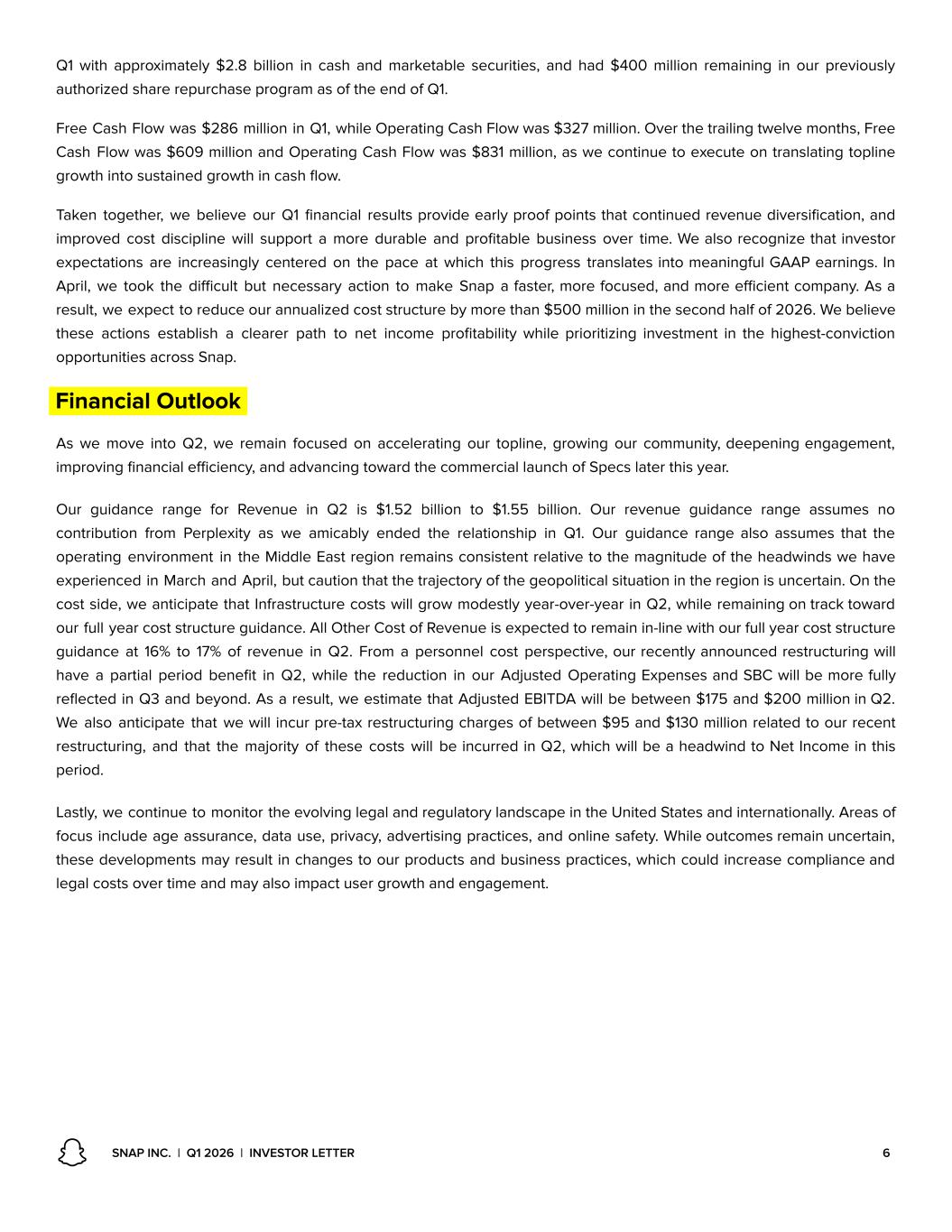
In Q1, we demonstrated substantial financial progress with revenue at the top end of our guidance range, gross margins expanding year-over-year and adjusted EBITDA materially favorable to our prior guidance more broadly we believe q1 provides early evidence that the strategic framework we laid out last fall is beginning to translate into more durable revenue growth a more efficient cost structure and a clear path to net income profitability total revenue was 1.53 billion in q1 up 12 percent year-over-year. Other revenue increased 87 percent year-over-year to 285 million in Q1, driven primarily by continued momentum and Snapchat Plus subscriptions, strong adoption of our newer offerings such as memory storage, and early traction from LensPlus. Advertising revenue reached 1.24 billion in Q1, up 3 percent year-over-year, driven primarily by growth and direct response advertising revenue, partially offset by continued headwinds in the North America large client advertising business and an approximately 20 to 25 million dollar impact from the geopolitical headwinds in the Middle East experienced during March. Global impression volume increased approximately 17 percent year-over-year, while total eCPMs declined approximately 12 percent year over year these dynamics are driven by the rapid growth and sponsored snaps as well as a mixed shift in impression delivery towards spotlight these factors are driving strong impression growth and improved advertiser performance but have created a near-term revenue headwind as we work to build demand for these newer services and ad units we believe these dynamics are positive for the long-term health of the platform as improved pricing and performance are key inputs to building demand over time. Adjusted cost of revenue was $662 million in Q1, up 4% year-over-year. Total infrastructure costs were $401 million in Q1, up 7% year-over-year, driven primarily by community growth, strategic investments in AI model training, and monetization serving costs. The remaining components of adjusted cost of revenue were $261 million in Q1, or 17% of revenue which is in line with our full year cost structure guidance range and improvement of two percentage points year over year these operational efficiencies contributed to adjusted gross margin improving three percentage points year over year to reach 57 percent in q1 which we believe puts us on track for achieving our goal of 60 or better for fiscal 2026. projects. Adjusted operating expenses were $633 million in Q1, up 2% year-over-year. The growth was driven primarily by a 7% increase in personnel costs, which was partially offset by reductions in community growth marketing as we continued to calibrate investments in community growth with the long-term monetization potential of each geography. Adjusted EBITDA was 233 million in Q1, an improvement of 125 million compared to the prior year. Adjusted EBITDA flow-through, or the percentage of year-over-year revenue growth that flowed through to adjusted EBITDA, was 75% in Q1. We view this elevated flow-through as a clear demonstration of our pivot to profitability becoming evident in our financial results. Net loss was 89 million in Q1 compared 140 million in the prior year the 51 million year-over-year improvement largely reflects the flow through of the 125 million improvement in adjusted EBITDA partially offset by a 49 million dollar gain on debt extinguishment recognized in the prior year and a 24 million increase in net interest expense due to the high yield notes issued in the prior year stock Stock-based compensation and related payroll expenses were $263 million in Q1, which represents a modest decline year-over-year. We are focused on reducing SBC as a percentage of revenue and limiting dilution through disciplined equity compensation and opportunistic repurchases. We continue to manage our share count carefully, with $350 million in share repurchases completed in q1 which helped limit share count growth to 3.5 percent we ended q1 with approximately 2.8 billion in cash and marketable securities and had 400 million dollars remaining in our previously authorized share repurchase program as of the end of q1 free cash flow was 286 million in q1 while operating cash flow was 327 million over the trailing 12 months free cash flow was 609 million and operating cash flow was 831 million as we continue to execute on translating top line growth into sustained growth in cash flow taken together we believe our q1 financial results provide early proof points that continued revenue diversification and improved cost discipline will support a more durable and profitable business over time we also recognize that investor Our expectations are increasingly centered on the pace at which this progress translates into meaningful gap earnings. In April, we took the difficult but necessary action to make SNAP a faster, more focused, and more efficient company. As a result, we expect to reduce our annualized cost structure by more than $500 million in the second half of 2026. We believe these actions establish a clearer path to net income profitability while prioritizing investment in the highest conviction opportunities across snap as we move into q2 we remain focused on accelerating our top line growing our community deepening engagement improving financial efficiency and advancing toward the commercial launch of specs later this year our guidance range for revenue in q2 is 1.52 billion to 1.55 billion our revenue guidance range assumes no contribution from perplexity as we amicably ended the relationship in Q1. Our guidance range also assumes that the operating environment in the Middle East region remains consistent relative to the magnitude of the headwinds we have experienced in March and April, but caution that the trajectory of the geopolitical situation in the region is uncertain. On the cost side, we anticipate that infrastructure costs will grow modestly year-over-year in Q2, while remaining on track toward our full-year cost structure guidance. All other cost of revenue is expected to remain in line with our full-year cost structure guidance at 16% to 17% of revenue in Q2. From a personnel cost perspective, our recently announced restructuring will have a partial period benefit in Q2, while the reduction in our adjusted operating expenses and SBC will be more fully reflected in Q3 and beyond. As a result, we estimate that adjusted EBITDA will be between $175 and $200 million in Q2. We also anticipate that we will incur pre-taxed restructuring charges of between $95 and $130 million related to our recent restructuring, and that the majority of these costs will be incurred in Q2, which will be a headwind to net income in this period. Lastly, we continue to monitor the evolving legal and regulatory landscape in the United States and internationally. Areas of focus include age assurance, data use, privacy, advertising practices, and online safety. While outcomes remain uncertain, these developments may result in changes to our products and business practices, which could increase compliance and legal costs over time and may also impact user growth and engagement. Thank you, and we will now take your questions.
Operator
Thank you. We will now begin the question and answer session. To ask a question, you may press star then one on your touchtone phone. If you are using a speakerphone, please pick up your handset before pressing the keys. To withdraw your question, please press star then two. In the interest of time, we ask that you please limit yourself to one question. After your initial question is asked, your line will be muted. At this time, we'll pause momentarily to assemble our roster. The first question comes from Ross Sandler with Barclays. You may proceed.
Hey, guys. The 2Q Revenue Guidance has a couple-point acceleration baked in at the high end. I'm just curious, like, given what you said about the Middle East, what's driving that potential improving growth rate? Is it the ad business? Is it Snap Plus and any additional color there? And then, Evan, so I'm sure you guys saw the 70-page activist deck that was released. I'm just curious to get your take on some of the suggestions that were in that around cost improvement, monetization, and governance. Just curious your take on that. Thanks a lot.
It's Derek speaking. I'll take the first one there on the guide. Probably worthwhile just to take a minute to contextualize the growth rates in Q1 and then what we're expecting in Q2. So in Q1, a couple of different factors there on the growth rate. One is we had about a two-point FX tailwind, but we also had the impact of the conflict in the Middle East that really impacted the business in March. And those two essentially largely washed with the headwind on the Middle East side being similar. So that left us with a 12 percent growth rate, which was a two percentage point acceleration over Q4. And at the very high end of our guidance range with the strength there driven largely by the subscription business and the momentum we saw there in Q1. As we move into Q2, there are again a few different factors there. One, the comps on the growth rate in the prior year are a tailwind into Q2 of approximately five points from the prior year. But that's essentially fully offset by one, what we expect will be a diminished going from about two to about one points approximately. And then also we expect that the headwinds that we're seeing from the conflict in the Middle East will be a full quarter impact in Q2 relative to a single month impact in Q1. And so those two factors combined offset the comps. So with those factors set aside, you're really left with a two-point acceleration at the midpoint of the guide relative to Q1. And that I would attribute to the strength that we are seeing in the North America ads business. So we've been talking for some time about the improvements in pricing and yields that advertisers are enjoying there and the progress we've made with the ad platform and improving ROAS that folks are seeing there. And we saw that translate into really improved upfront commitments in Q1. And we talked about that in the letter being about 10% year over year, which is encouraging. And that's starting to show up in the top line. And that gave us the confidence to put that into the guide for Q2 with an acceleration there driven largely by the North America ads business and the guidance there. So hopefully that gives you good context on what we're seeing there from quarter to quarter and what's driving the acceleration.
Hey Ross, it's Evan. Thanks so much for the question. You know, we're really grateful, obviously, from input from our shareholders. And I think we've taken some strong actions already, you know, to operate with better discipline, to improve profitability and sharpen capital allocation. But fundamentally, we think our job is to operate the business in the long-term interests of our shareholders, and we're going to continue to invest against our core long-term opportunity.
Operator
Thank you. The next question comes from Michael Nathanson with Moffitt Nathanson. You may proceed.
Thanks. I have two for either of you guys. One is, you know, we cover Roku and CTV, and what we've seen happen is as Roku has added third-party DSPs, is you'll be able to really accelerate agro's because reward gardens are hard to compete against. And I wondered, have you thought about it, contemplated the idea of perhaps opening your inventory up to more sellers on the DSP side to encourage more density in the auctions? Why, why not? And then on Snapchat+, it's impressive what you guys are doing. Is there any color you could give us on who these users are, where they're coming from, and kind of just the pricing dynamics that you've seen in terms of ability to, where you think your ability is to raise price here. So anything you'd give us in color on the sustainability of Snapshot Plus would be great.
Yeah, thanks so much for the question. You know, I think on the DSP side, we just always believe that the advertiser relationship is very important strategically, especially as we've diversified with small and medium customers and focused more on lower funnel objectives. I do think, to your point, there may be some opportunity around upper funnel video demand that we've been considering, but we'd have to really carefully think through the channel conflict and how to grow that demand while continuing to build strong, direct advertiser relationships. So I do think scaling through partners is important. And as Derek mentioned, we do see some opportunity with agencies and by working more closely with them. And so we are pleased to see the growth in those upfront commitments. On Snapchat Plus, you know, obviously the growth is really exciting. I think there are a couple of different ways to look about, you know, look at the long-term opportunity. One is, you know, increased tiers of Snapchat Plus. So we've seen some strong momentum with Lens Plus, which is really anchored around our AI creative and editing tools in the camera. And that I think could be a big, you know, opportunity for us long-term, it's obviously a higher price offering. And I think there's some real customer value there, obviously with our strength in the camera and in our lens ecosystem so uh tiering i think is certainly one one approach and then you know we just continue to see uh growth as we roll out new features we've got a community that really loves our product that's constantly asking for new and differentiated ways to use snapchat and so as we respond uh to those requests and continue to build out uh new new features you know that that tends to drive a subscriber growth um and then you know with with the introduction of memories we have seen overall retention for snapchat plus improve as well and so that uh you know is helping as we look at just the long-term growth and durability of the subscription product thank you the next question comes from doug and move with
Operator
jp morgan you may proceed hi this is maggie on for doug thanks for taking the question um i was wondering if you can just talk a bit more about the broader opportunity you see with ai-sponsored snaps um and sort of what you're hearing from advertisers in terms of overall interest in something like this. Thank you.
Hey, thanks, Maggie. You know, advertiser feedback has been really positive. I think mostly because sponsor snaps are showing that chat can be monetized in a way that's really native to Snapchat. And brands are loving this combination of very high reach and high attention, especially because chat is such a high frequency behavior on Snapchat throughout the day. So I think what's important for us strategically is that chat's not just another inventory pool. It really gives us a differentiated environment where brands can engage users and, you know, more direct and more personal way. And AI sponsored snaps are really an extension of that because they can make those interactions and those conversations more useful and more relevant over time. So I think just, you know, looking forward, the roadmap is really about just careful, you know, expansion of capability, improving demand and yield, obviously, of sponsored snaps, adding more direct response features, and then, you know, continuing to work with new partners like Experian to evolve the AI sponsored snap product.
Operator
Thank you. The next question comes from Rich Greenfield with Lineshed Partners. You may proceed.
Thanks for taking the question. You know, Evan, it looks like your North American ad business was down, you know, call it about 7% with the overall growth driven by subscription. I'm wondering how much of that downdraft in ad revenue is being caused by the drop in North American DAUs versus the transition that you and Derek talked about towards performance advertising. And fundamentally, can you grow North American ad revenue without reversing the trend in users? And I guess related to that, just given the growth that everyone is excited about on the subscription side of the business, how are you balancing your own time and focus on the subscription business versus the ad business overall?
Yeah, hey, thanks, Rich. So I think, you know, at a high level, just looking at the North American DAU trend, it has been improving over the past two quarters after we pulled back on broad-based user acquisition. spend. And, you know, I think we currently forecast something like a decline of 1 million daily active users in North America in Q2, but we also see a path to flat quarter over quarter if we can continue to land product improvement. So I think, you know, more interestingly, though, under the hood, monetizable daily active users, meaning users who, you know, see an ad or make an in-app purchase or have a subscription, they've actually grown in North America and the U.S. over the past two years with a meaningful increase, obviously, with the launch of sponsored snaps, which really extended ad reach into the messaging surface. So overall, the monetizable user trends have been improving while the North America large customer business has struggled and put some downward pressure on the overall ad business. So what has been encouraging to see is that the North America SMB business grew approximately 30% year over year in Q1. So there's some nice momentum in the North America SMC business. And we have seen some modest improvement, as Derek said, in the large customer segment. So we're very focused on that large customer segment, especially around upper funnel brand advertising and, you know, with new leaders in place, with the team working more effectively together, you know, we'd really like to see some more progress there as we work through the year. And then, you know, the direct revenue opportunity is a very large opportunity for us, you know, just given the frequency of use and the passion, you know, that our community, you know, really has for Snapchat. So, you know, we're continuing to develop the product offering. It's something we love to do. And, you know, as I mentioned creating new tiers as well which you know we think can contribute to increasing overall subscription ARPU.
Operator
Thank you. The following comes from Nitin Bansal with Bank of America. You may proceed.
Thank you for taking my question. So Snapchat plus subscriber growth and revenue growth has remained quite strong. You mentioned memory and lens as like the key drivers behind the recent strength. Can you talk about like how sustainable you believe the current growth trajectory is over the medium term, and whether you see any additional opportunities to deepen monetization and retention as the feature set continues to expand. Thank you.
Yeah, we're really excited about the growth in direct revenue, and we do think that subscription business and internet purchases as well can continue to contribute to our overall revenue growth. I think, you know, the importance for us is really just focusing on the user experience, making sure we're really delivering things that folks view as valuable to their overall product experience. I think Recent additions like creator subscriptions, for example, both strengthen the content ecosystem by building deeper relationships between users and creators, creating new ways for creators to monetize and obviously contributing to the overall direct revenue business. LensPlus, I already mentioned, but I think is a really meaningful opportunity just given the excitement and momentum we see around AI creative tools and AI editing for images and videos. So we certainly think that that could help drive ARPU higher over time. And then, you know, the core Snapchat Plus offering is really important to us, and I think we've been excited to see that folks who have entered through that memory storage entry point, you know, selecting into Snapchat Plus to get those additional features, and that's also been a tailwind as well.
Operator
Thank you. The next question comes from Mark Schmollick with Bernstein. You may proceed.
Yes, thanks for taking the question. Evan, sorry, just another one on direct revenue. But, you know, I kind of always come back to that kind of quote, you know, it may not be the business you set out to kind of go after, but it might be the one you're best to deliver. You know, when you look at kind of the torque and acceleration in that and the imminent kind of launch of specs, is there a different way to think about what Snapchat looks like 12, 24 months from now that, you know, may be quite different than what you were thinking of 6, 12 months ago?
Hey, Mark. Yeah, I think that's a really inspiring question, something we we thought a lot about obviously we worked on specs for i think something like 12 years now so we really have believed that we can innovate and build awesome products for our community that they want to buy and i think seeing that reflected in the direct revenue business and in snapchat plus has really built a lot more confidence uh you know in the team because we love to innovate for our community and and i think you know being able to demonstrate that our community is willing to pay for that innovation i think really bodes well for the future of the platform and the future of specs. So certainly a lot of opportunity there. We're really excited to have more diversified revenue. Obviously the growth has been fantastic and it should just help us create a much more resilient business over time.
Operator
Thank you. The next question comes from Eric Sheridan with Goldman Sachs. You may proceed.
Thanks so much for taking the question. Maybe building on that answer, Evan, can you talk a little bit about some of the execution pieces that still have to be put in place as you look towards the remainder of this year with respect to the specs rollout? Can you also talk to the Qualcomm collaboration and have a think about what that means for where you want to go as a platform and an ecosystem going forward? And then lastly, just how should we be thinking about agentic AI as sort of an interface for specs over the medium to long term as well? Thanks so much.
A lot of great questions in there and probably could talk for hours about that. I think, you know, just looking ahead to the launch of specs later this year, it's just all hands on deck to execute, deliver an amazing product experience we hope folks will join us at awe on june 16th we'll have more to share uh you know on our progress on on specs uh certainly we are spending a lot of time on the long-term roadmap there as well and as you mentioned uh you know the way that people are using their computers is changing really dramatically and i think that that's going to be evident you know in the adoption of wearables and the adoption of specs uh over time because people are going to spend less time hunched over their computers or their phones typing away on keyboards and spend more time supervising agents who are doing that work on their behalf. So we actually had a team member who, with AI, built out a pretty cool lens called Agent Center, where you can oversee and manage your agents through specs, you know, with the current developer version of the glasses, which is a pretty cool way, you know, to stay on top of what your agents are getting done for you without carrying your laptop around. So certainly, I think a lot of opportunity there and the way that people are using computing is changing so fundamentally in so many ways at this moment, and we're just so excited to get this product out into the world soon.
Operator
Thank you. Our last question comes from Dan Salmon with New Street Research. You may proceed.
Great. Good afternoon, everyone. Evan, can we hear maybe a little update on how you and the company are addressing various pieces of legislation and litigation around the world regarding potential restrictions on teen social media and oftentimes mobile phone use as well just love to hear a little bit more about age verification work uh including with the app stores how your legal and policy teams are approaching the issue as it evolves in different jurisdictions and and how you and the team are planning for different ranges of potential outcomes thanks thanks so much for the question it's certainly something we care a lot about and And we invest deeply, you know, in keeping people safe on Snapchat.
And, you know, we're thinking a lot about how we continue to evolve the platform. I think one of the biggest challenges we face is that we often get lumped in with social media, even though Snapchat's really different. It's focused on communication, especially between friends and family. And we see that validated in third-party research that continues to show that Snapchat can have a positive impact on well-being and on relationships. And so we really are, you know, proud of the positive impact that we can play in people's lives. and we have to do a lot of work to continue differentiating ourselves from more traditional social media platforms. I think age assurance is certainly an important issue for us. It's something that we're continuing to improve on the platform. We did integrate with Apple's new offering. Unfortunately, that offering requires users to essentially agree to share their age with Snapchat rather than being something that's on by default. And so that does in some ways limit its usefulness so we are exploring other uh you know additional age assurance practices uh you know we've implemented things like facial scanning or id verification in australia and that's something we may roll out more broadly you know as things progress through the year this concludes our question and answer session as well as snap inc's first quarter 2026 earnings conference call Thank you for attending today's session, you may now disconnect.