Operator
Good morning and welcome to State Street Corporation's second quarter 2026 Earnings Conference call and webcast. Today's call will be hosted by Elizabeth Lynn, Head of Investor Relations at State Street. We ask that you please hold all questions until the completion of the formal remarks, at which time you will be given instructions for the question and answer session. Today's discussion is being broadcast live on State Street's website at investors.statestreet.com. This conference call is also being recorded for replay. state street conference call is copyrighted and all rights are reserved this call may not be recorded for rebroadcast or distribution in part or in whole without the express written authorization from state street corporation the only authorized broadcast of this call will be on the state street website now i would like to hand the call over to elizabeth lynn good morning and thank you all for joining us on today's call our ceo ron ohanily and our cfo john woods will review our second quarter 2026 results and provide an update on our medium-term financial outlook.
Both are included in our earnings presentation, which is available in the investor relations section of our website at investors.statestreet.com. Following prepared remarks, we will be happy to take your questions. Before we get started, I'd like to remind you that today's presentation will include results presented on a basis that excludes or adjusts one or more items from GAAP. Reconciliations of these non-GAAP measures to the most directly comparable GAAP or regulatory measure are available in the Earnings Release Addendum. In addition, today's call will contain forward-looking statements. Actual results may differ materially from those statements due to a variety of important factors, such as those referenced in our discussion today and in our SEC filings, including the Risk Factor section in our Form 10 . Our forward-looking statements speak only as of today, and we disclaim any obligation to update them, even if our views should change. With that, let me turn it over to Ron.
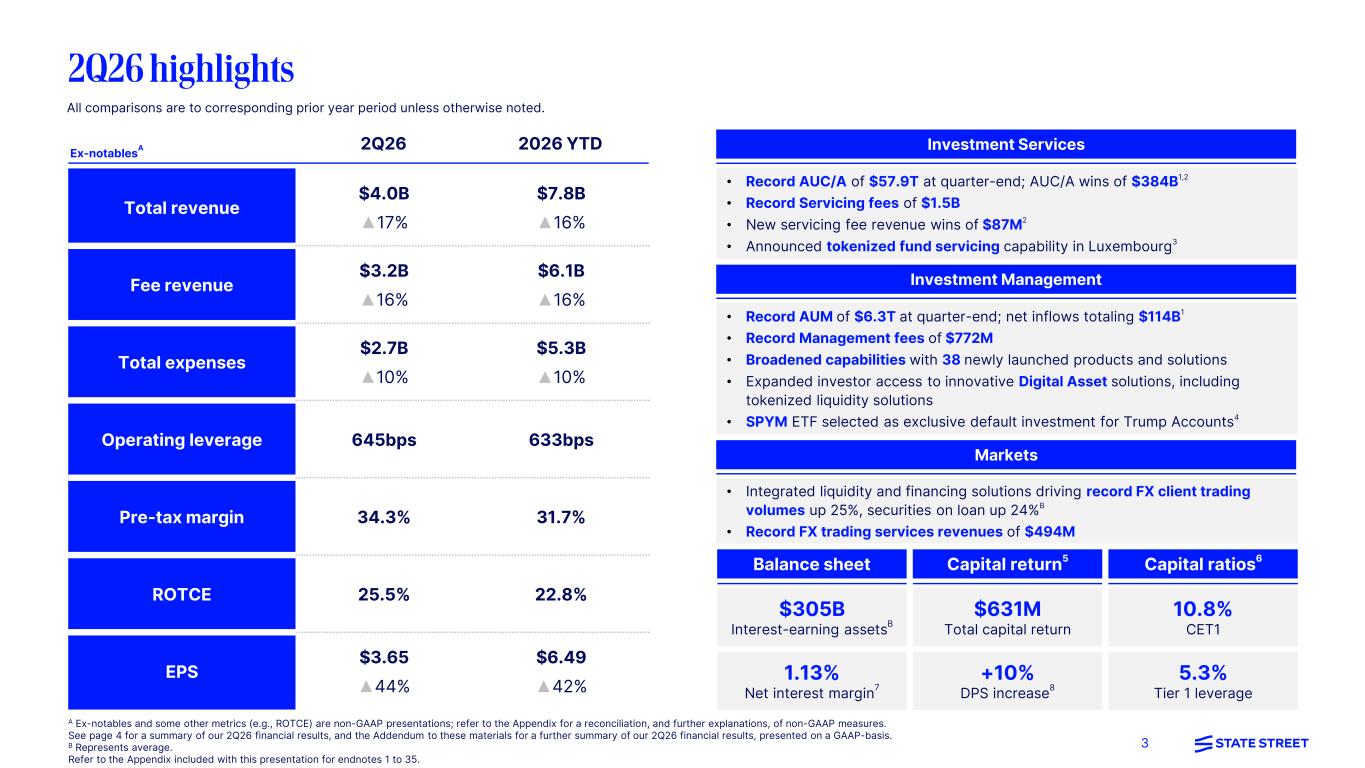
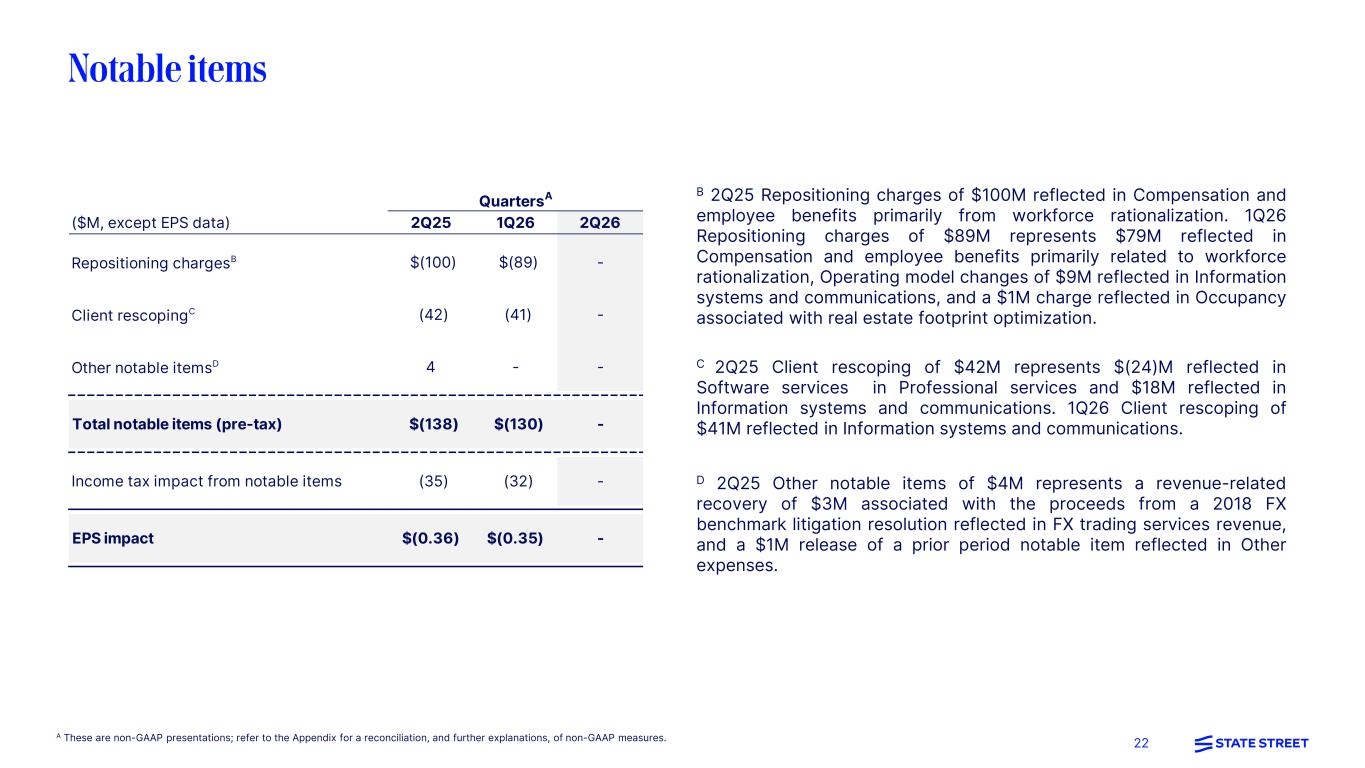
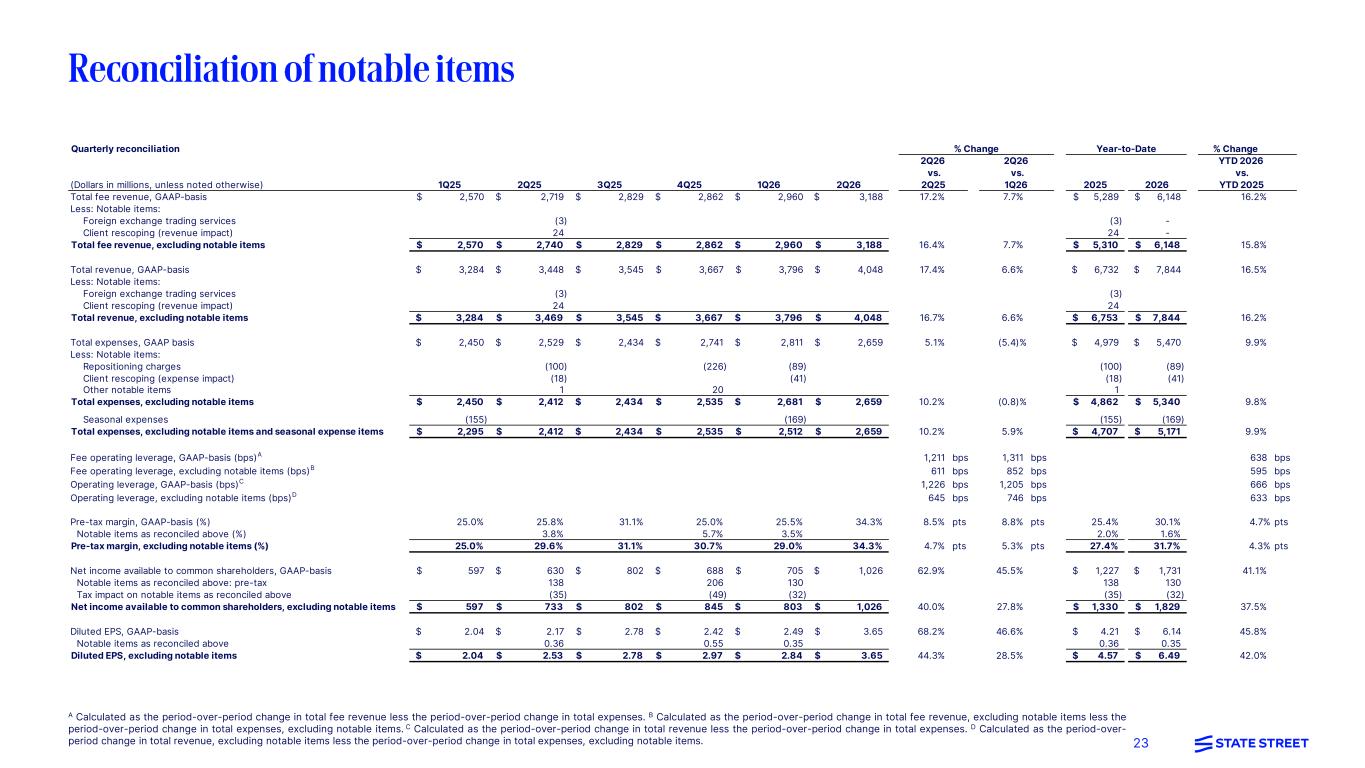
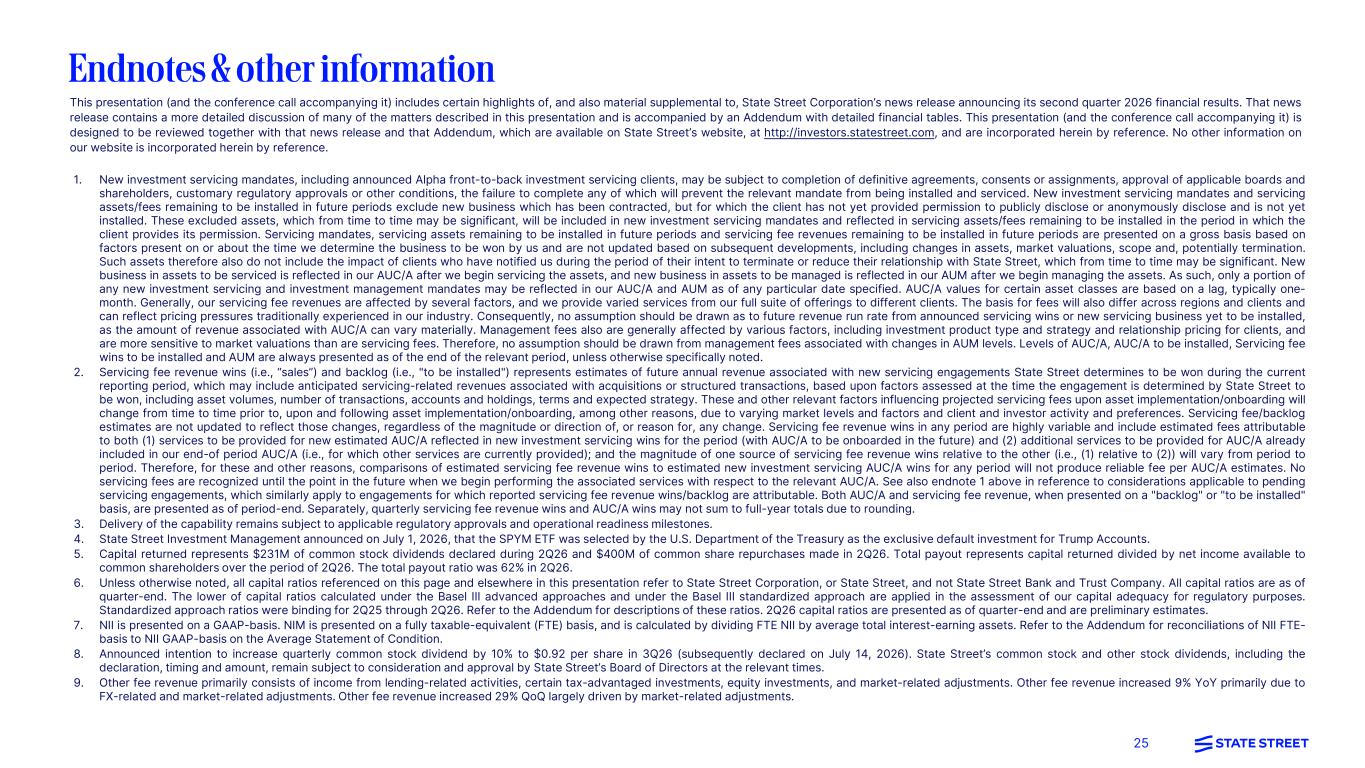
Thank you, Liz. Good morning, everyone, and thank you for joining us. Today, we'll focus on two key topics. First, we'll review our strong second quarter performance, the momentum we continue to build across the franchise, and our improving outlook for 2026. We'll then discuss our new medium-term financial targets, which we released this morning. We are excited to outline the strategic pillars that will drive this next phase of State Street's growth, the significant opportunities we see to further strengthen our compelling value proposition and competitive position, and the actions we are taking to further transform our operating model. Together, these initiatives reinforce our confidence in our ability to deliver sustained growth, expand margins and returns, and create long-term value for our clients and shareholders. But first, let me begin with our second quarter highlights on slide three. We delivered a strong set of financial results in the second quarter, driven by disciplined execution, deep client engagement, and continued momentum across our businesses. These results reflect the strength of our platform and position us well for continued progress as we look ahead. Second quarter EPS was 365, up from 217 in 2Q25. Excluding prior year notable items, we delivered significant earnings growth of 44% year-over-year, driven by record quarterly fee revenue, including record servicing, management, and FX trading revenues, together with record NII, driving total quarterly revenue up 17% year-over-year to an all-time high. This performance drove continued margin expansion and stronger returns. Taking a step back, this quarter's results reinforced the durability of our franchise and the sustained progress in our financial performance. 2Q marks our 10th consecutive quarter of positive operating leverage, excluding notable items, reflecting disciplined execution and the momentum we're building across the business. In addition to our strong 2Q financial results, we also meaningfully advance our strategic agenda in the second quarter, further strengthening our franchises and positioning us for continued growth. Within investment services, innovation continues to be a key driver of future growth. For example, our digital asset platform is always on financial infrastructure that will enable clients to rapidly bridge from traditional to digital finance, and we continue to make strong progress in advancing this strategy. In 2Q, we announced our intention to deliver a tokenized fund servicing capability by year-end, subject to regulatory approval. Following a competitive process, a leading European asset manager selected State Street to serve as tokenized money market funds expected to launch later this year. Importantly, State Street Investment Management is also expected to be an early adopter of this offering, underscoring the strength of our One State Street approach. Our investment management business continued its focus on innovation and product capability to position the franchise for sustained growth and it demonstrated further evidence of the power of our franchises working together as an integrated One State Street. In 2Q, 91, a State Street Alpha client, entered into a strategic partnership with State Street Investment Management, paving the way for a suite of active co-branded ETFs. This is a clear example of how we bring the value of our combined firm to clients for a one-state street approach, as well as how we drive innovation within the industry, deploying our extensive expertise and capabilities to identify and create solutions for the world's investors. We also recently announced that SPYM, our low-cost S&P 500 ETF, has been selected by the U.S. Department of the Treasury as the exclusive default ETF for Trump accounts. These accounts are designed to make investing simple and accessible, giving children a straightforward opportunity to begin early in life as asset owners, benefit from the power of compounding, and stay invested over time to build wealth. We're proud to help Americans through that journey with SPY-M. Turning to State Street Markets, we continue to demonstrate the strength of our integrated liquidity and financing capabilities, driving strong client activity. We experience record FX trading volumes and revenues in the second quarter, with securities lending also up significantly year over year. Our markets franchise provides industry-leading capabilities to our investment services clients, deepening client relationships while driving revenue diversification and earnings growth. Before I turn the call over to John, let me briefly touch on the strength of our capital position, which was reflected in the Federal Reserve's recent stress tests. Following the release of those results, we announced an increase to our quarterly common stock dividend of 10% to $0.92 per share beginning in the third quarter. Dividend growth remains an important component of our capital return, as demonstrated by the double-digit average dividend per share growth we've delivered over the last four years in closing we delivered a strong second quarter driven by disciplined execution deep client engagement and broad-based momentum across the franchise our results highlight the strength of our businesses both individually and as one state street and the role innovation plays in driving performance today and growth ahead we are encouraged by our progress and confident in our ability to continue delivering improved performance through the balance of the year and over the medium term, supported by solid financial and strategic momentum. With that, I'll turn it over to John to walk through the quarter in more detail.
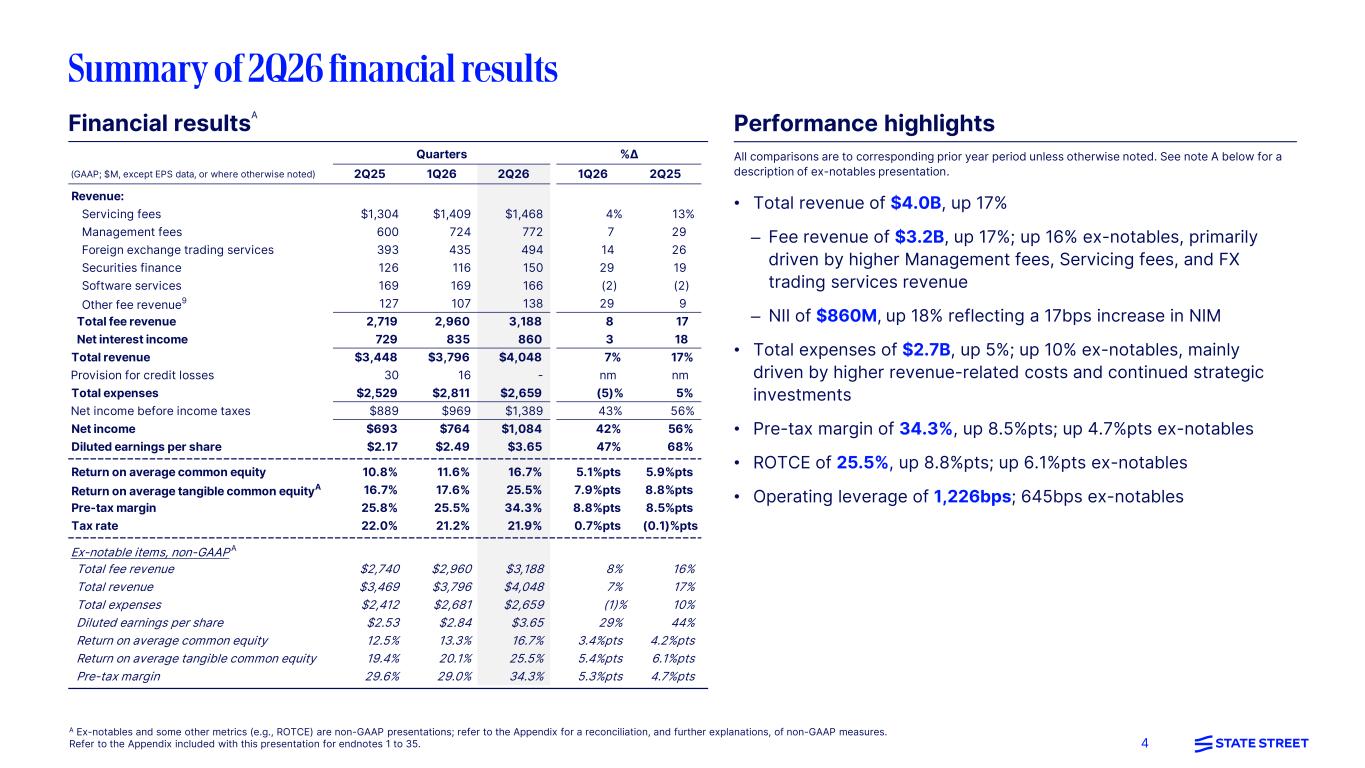
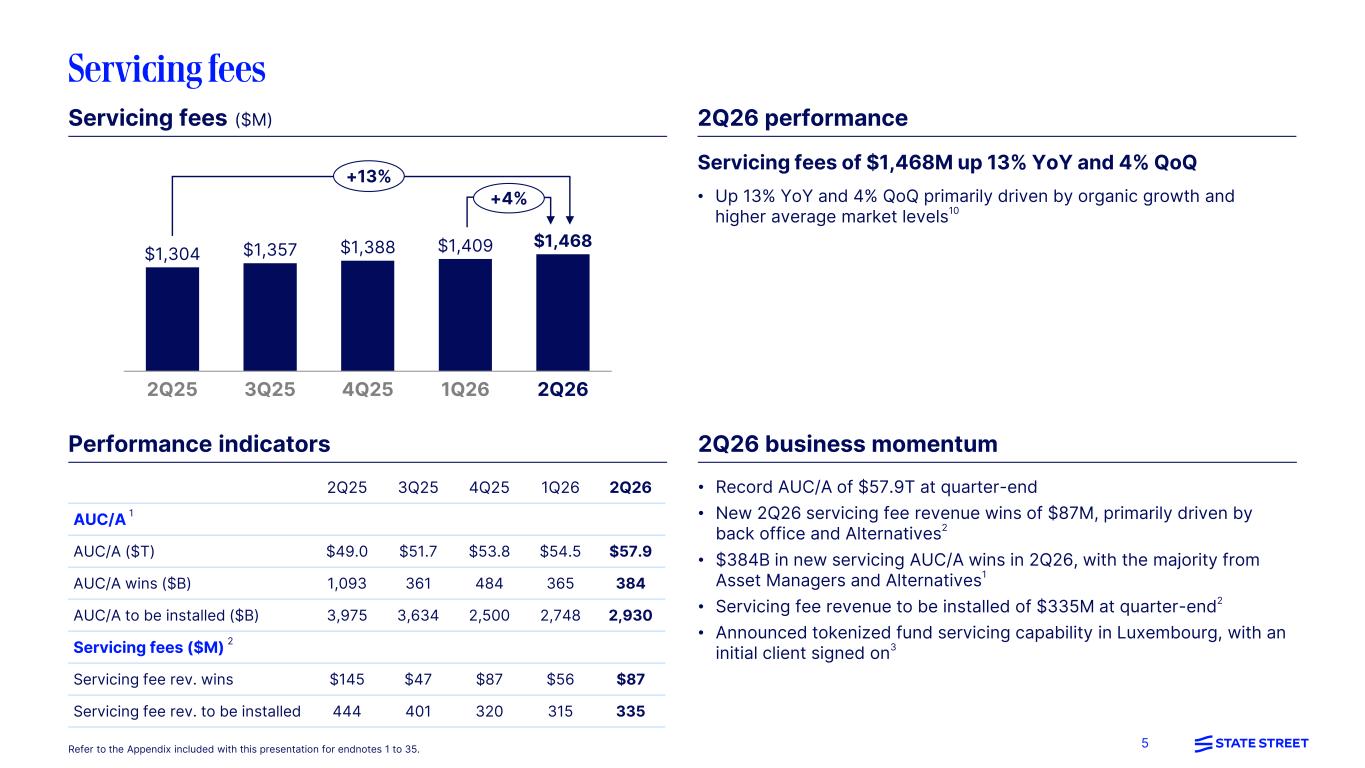
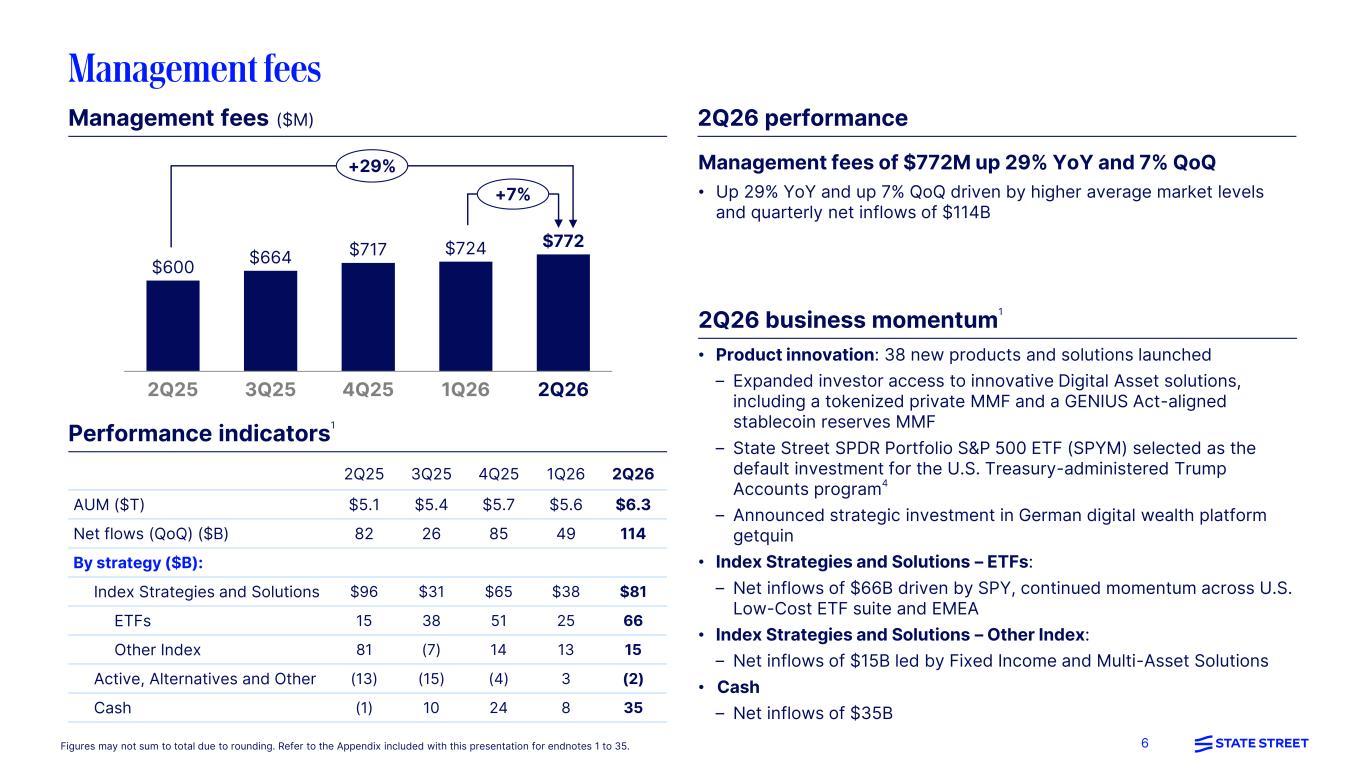
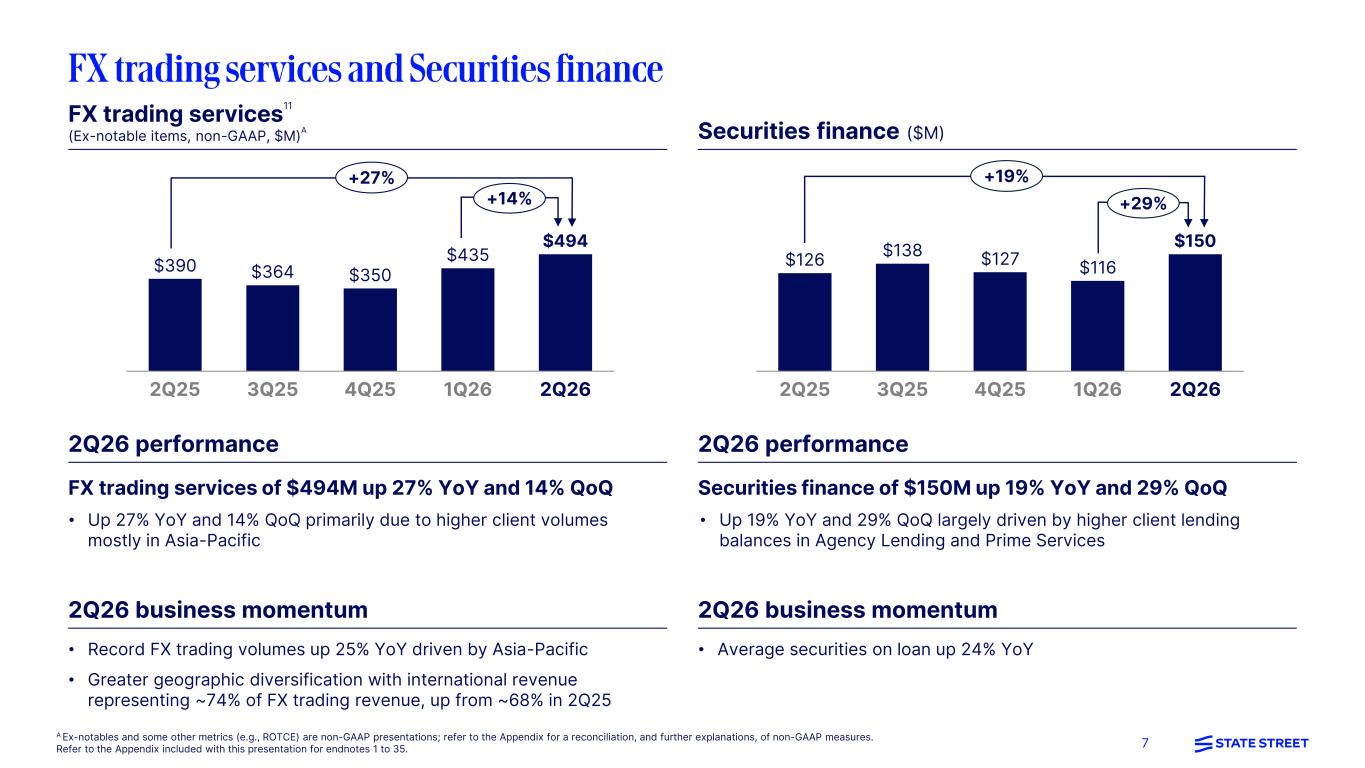
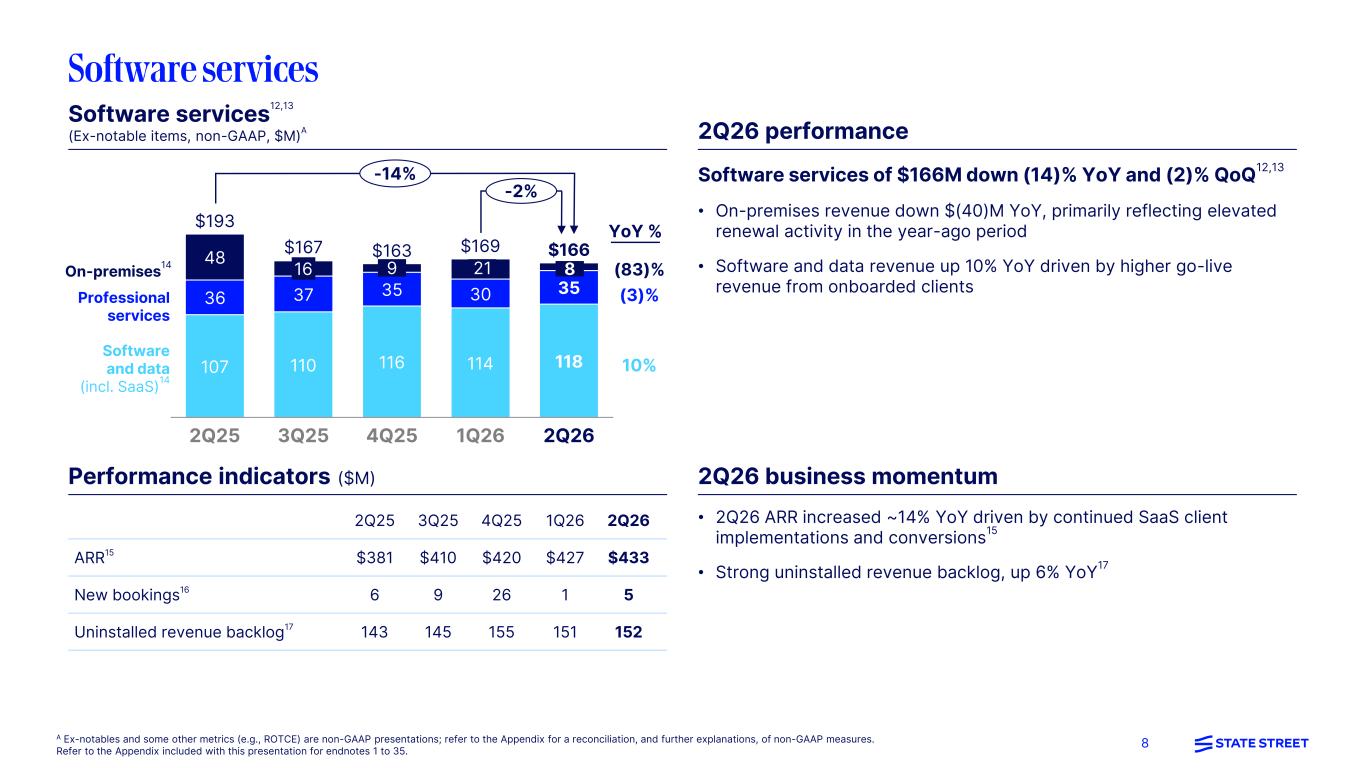
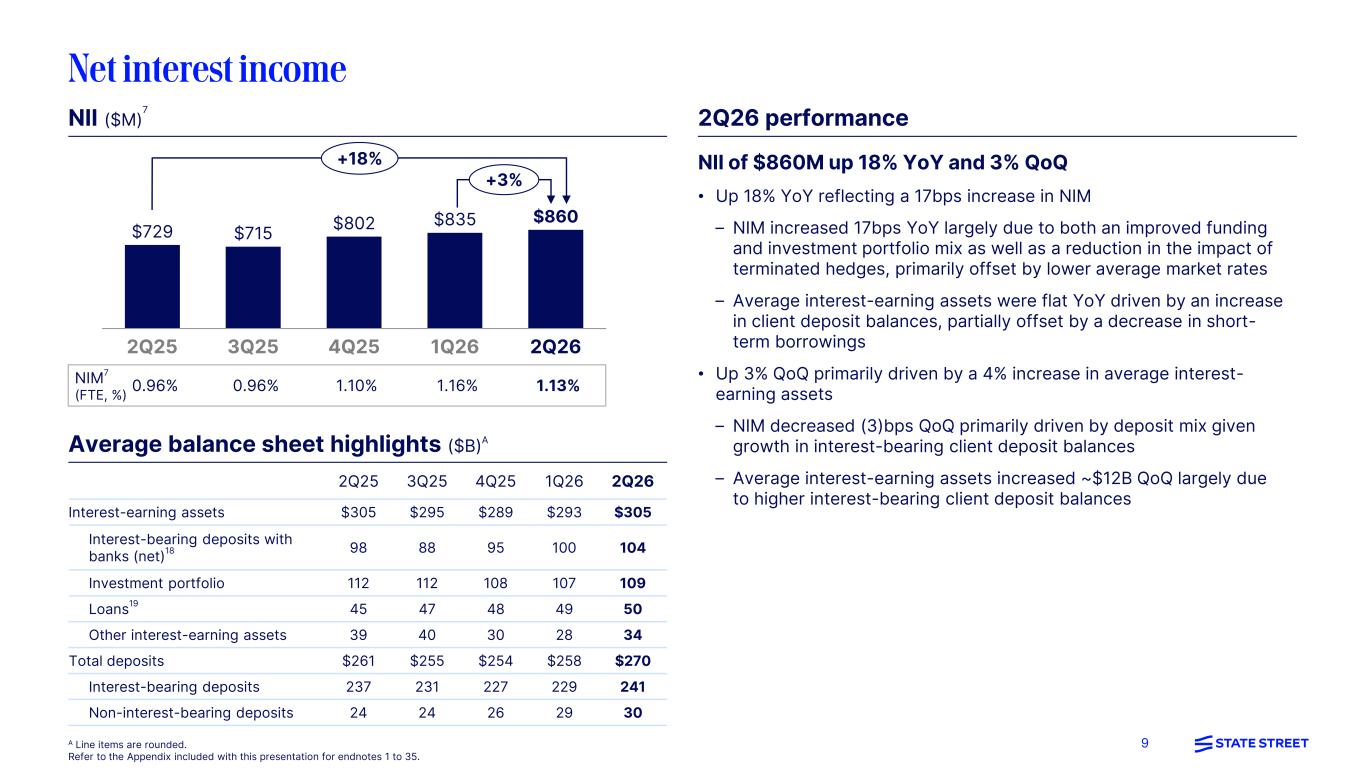
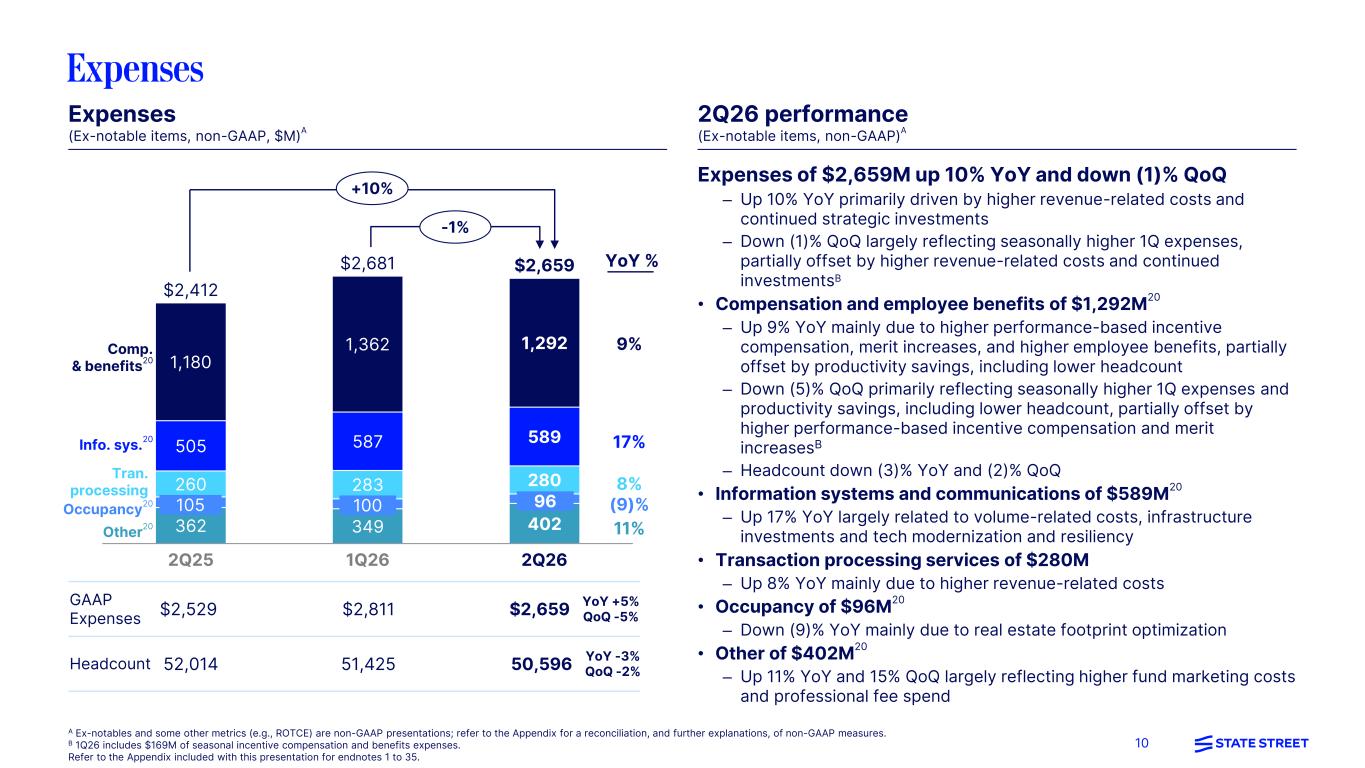
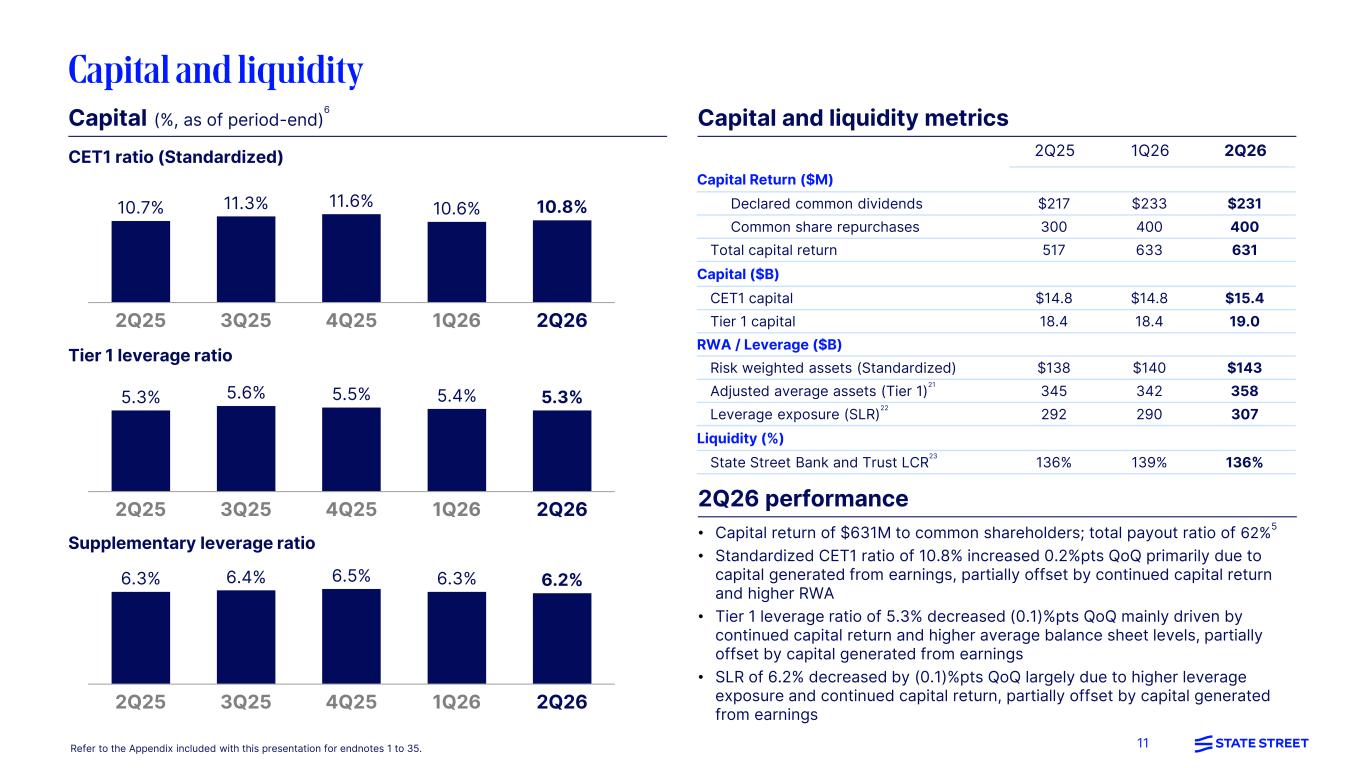
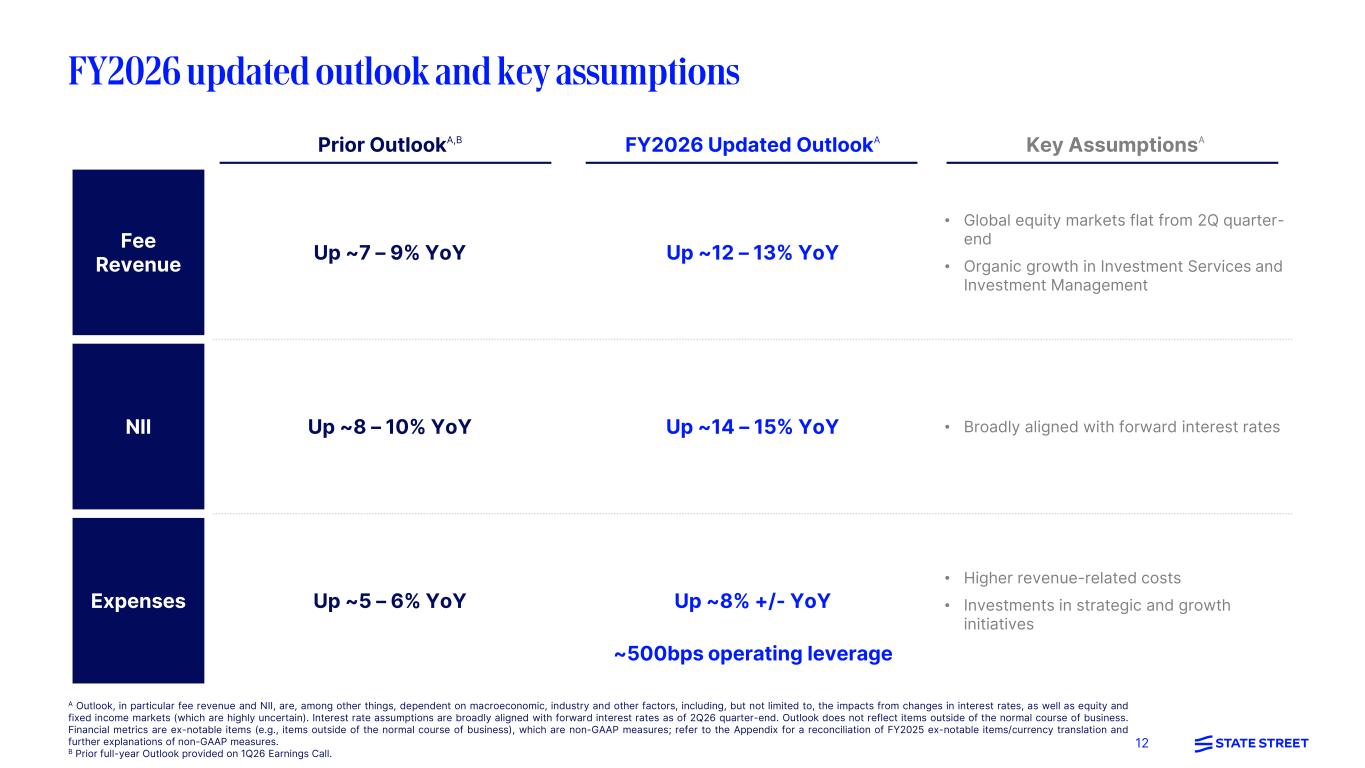
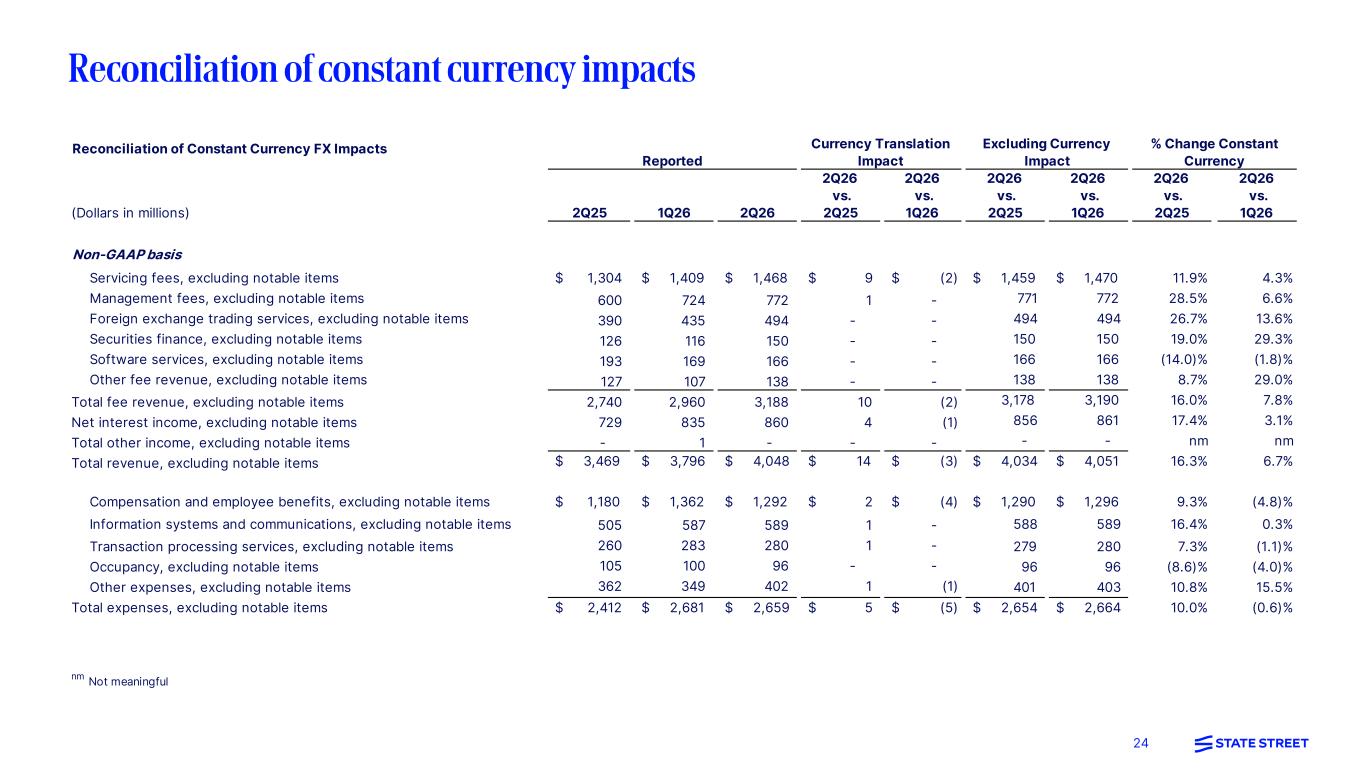
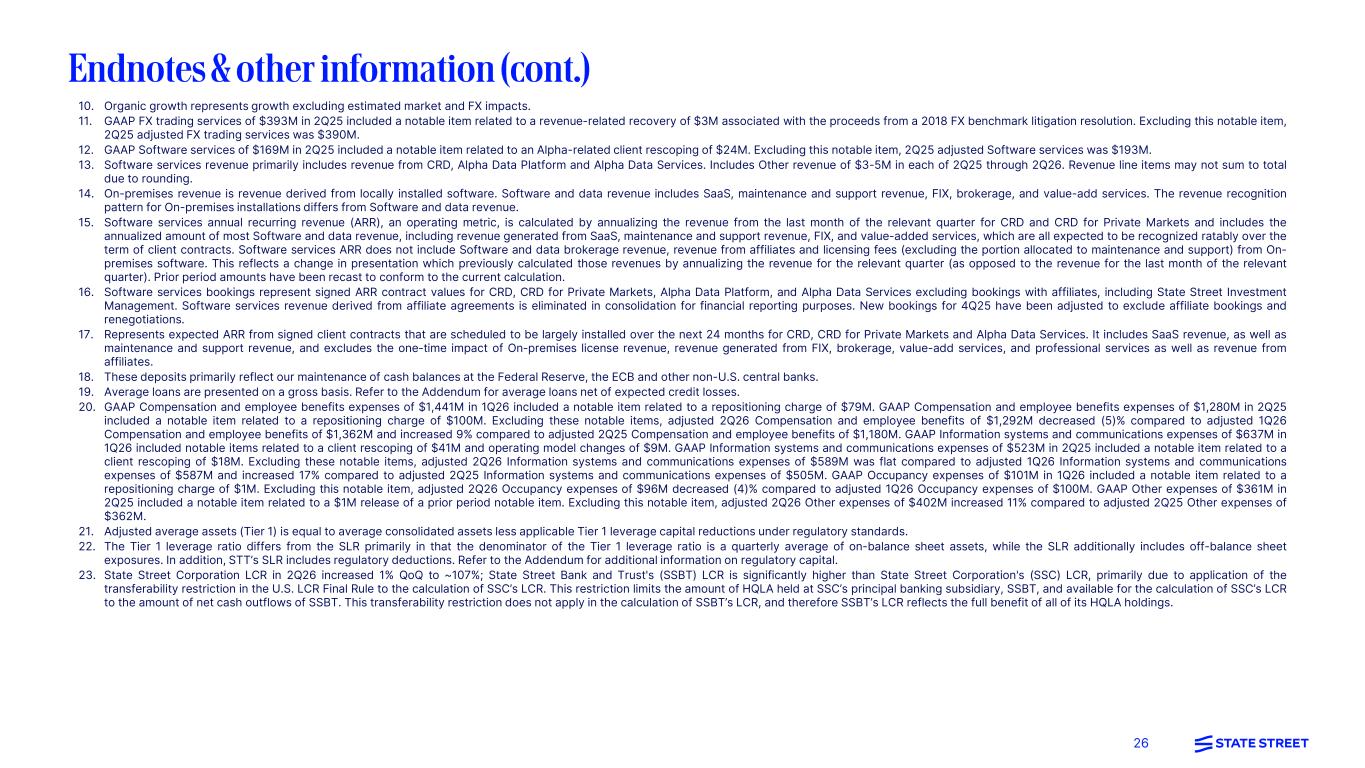
Thank you, Ron, and good morning, everyone. Starting on slide four, our second quarter results, excluding the impact of notable items in the prior year period, reflect continued momentum across the franchise, with broad-based revenue growth driving 645 basis points of positive operating leverage. Total revenue increased 17% year-over-year to a record $4 billion. The revenue of $3.2 billion increased 16% year-over-year, reflecting strong performance across investment services, investment management, and markets, while net interest income of $860 million increased 18%, driven by a 17 basis point increase in net interest margin to 113 basis points. Against the backdrop of strong revenue performance, expenses of $2.7 billion increased 10% year-over-year, primarily reflecting higher revenue-related costs, as well as continued strategic investment in the franchise. These results drove another quarter of improved profitability, with pre-tax margin expanding 470 basis points year-over-year to 34%, and ROTC increasing over 6 percentage points to approximately 26%. Turning to slide 5, servicing fees were $1.5 billion in the second quarter, up 13% year-over-year, primarily reflecting organic growth of approximately 7%, driven by client activity, flows, and net new business, with the remainder from higher average market levels and currency translation. AUCA ended the quarter at a record $57.9 trillion, up 18% year-over-year, reflecting higher period and market levels, client flows, and net new business. Servicing fee sales totaled $87 million in the second quarter, reflecting continued client demand across regions and strength in strategic growth areas, including alternatives. Turning to slide 6, management fees were $772 million in the second quarter, up 29% year over year, reflecting approximately 9% organic growth and strong support from higher average market levels. Assets under management ended the quarter at a record $6.3 trillion, up 23% year over year, supported by higher period end market levels and positive net flows. Net inflows totaled $114 billion in the quarter, marking our fifth consecutive quarter of positive organic growth. This performance was primarily driven by strong index ETF and cash net inflows of $66 billion and $35 billion, respectively. Net inflows were broad-based across geographies, led by the Americas and complemented by solid contributions from Asia Pacific and EMEA. We launched 38 new products and solutions during the quarter, including a tokenized money market solution and a stable coin reserves fund, further advancing our digital assets strategy. As Ron mentioned, SPY-M was selected as the exclusive default ETF for Trump accounts, expanding access to investing for U.S. children. Beyond the near-term asset-gathering opportunity, the program introduces a new generation of investors to State Street Investment Management and reinforces our position in the growing U.S. wealth market. Turning to slide seven, our global client franchise continued to support healthy activity across our markets business in the second quarter. FX Trading Services revenue increased 27% year-over-year, excluding a notable item in the prior year period, to $494 million, driven by record-high client volumes. These volumes reflect both our distinctive capabilities and the continued deepening of relationships with clients. Asia-Pacific was a particular area of strength, with robust equity market activity and a number of markets across the region supporting client volumes. Securities finance revenue increased 19% year-over-year, reflecting higher client lending balances. Turning to slide eight, software services revenue declined 14% year-over-year in the second quarter, excluding a notable item in the prior year period, reflecting elevated on-premises renewal activity last year. That said, underlying trends were strong, with software and data revenue up 10% year-over-year, driven by client onboarding and conversions. In addition, annual recurring revenue increased approximately 14% and revenue backlog grew 6% year-over-year, reflecting continued SaaS implementations and conversions, as well as ongoing sales momentum across the software platform. Turning out to slide 9, net interest income of $860 million increased 18% year-over-year, year driven by a 17 basis point expansion in net interest margin to 113 basis points. The improvement in NIM reflected a more favorable funding mix, continued benefits from investment portfolio repricing, and the runoff of terminated hedges, partially offset by lower average market rates. Average interest-earning assets of $305 billion were largely stable from the prior year quarter as growth in deposit balances was partially offset by lower short-term borrowings. Moving to expenses on slide 10, expenses increased 10% year-over-year in the second quarter, excluding notable items, primarily reflecting strong revenue performance. The majority of expense growth in the quarter was tied to higher business activity, with revenue-related costs contributing approximately six percentage points. Additionally, we continue to invest in our business, including capabilities, products, AI, and technology. These strategic investments contributed an additional 2.5 percentage points, while underlying run-the-bank costs, net of productivity savings accounted for the remaining 1.5 percentage points. Headcount was down approximately 3% from a year ago, consistent with our focus on productivity and disciplined resource allocation across the enterprise. Turning to slide 11, our capital position remained robust at quarter end, providing flexibility to support client activity, invest in the business, and return capital to shareholders. Our standardized set one and tier one leverage ratios were 10.8 percent and 5.3 percent respectively, broadly stable relative to the first quarter. We returned $631 million to shareholders during the quarter, consisting of $400 million of common share repurchases and $231 million in declared common stock dividends for a total payout ratio of 62%, bringing our year-to-date payout ratio to approximately 73%. As Ron noted, we announced a 10% increase in our quarterly common dividend per share beginning in the third quarter, reflecting the strength and resiliency of our business. Let's turn to our full-year outlook on slide 12, which, as a reminder, excludes notable items. Our outlook assumes global equity markets remain flat on a point-to-point basis from the end of 2Q through year end. Our rate outlook is broadly aligned with forward curves and assumes the Fed and BOE remain on hold while the ECB delivers one additional rate hike this year. We now expect fee revenue growth of 12 to 13 percent, up from our prior outlook of 7 to 9 percent, reflecting continued organic growth across servicing and management fees, as well as healthy client activity in markets. We expect NII growth of 14 to 15 percent, up from our prior outlook of 8 to 10 percent, primarily reflecting stronger average deposit balances. Consistent with our stronger revenue outlook, expenses are expected to increase by roughly 8 percent, up from our prior outlook of 5 to 6 percent, reflecting higher revenue-related costs and continued investment. Based on our current outlook, we expect to deliver roughly 500 basis points of positive operating leverage in 2026, implying a pre-tax margin of approximately 32 percent. Finally, we continue to expect an effective tax rate of approximately 22% for the full year and a total payout ratio of roughly 80%, subject to board approval and other factors. Our strong first-half results and improved outlook for 2026 reflect the strength of our franchise and continued execution against our strategic priorities. With that, I'll turn it back over to Ron to discuss our medium-term financial targets.
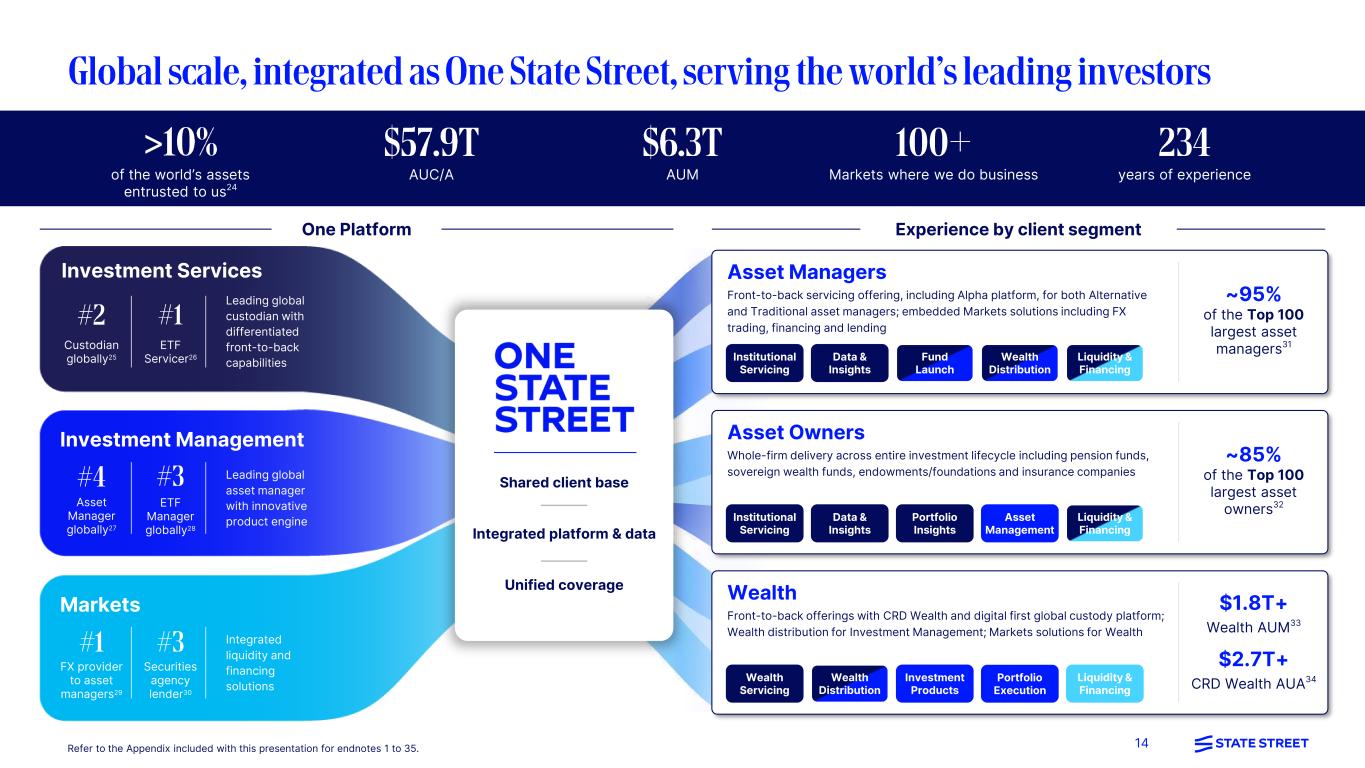
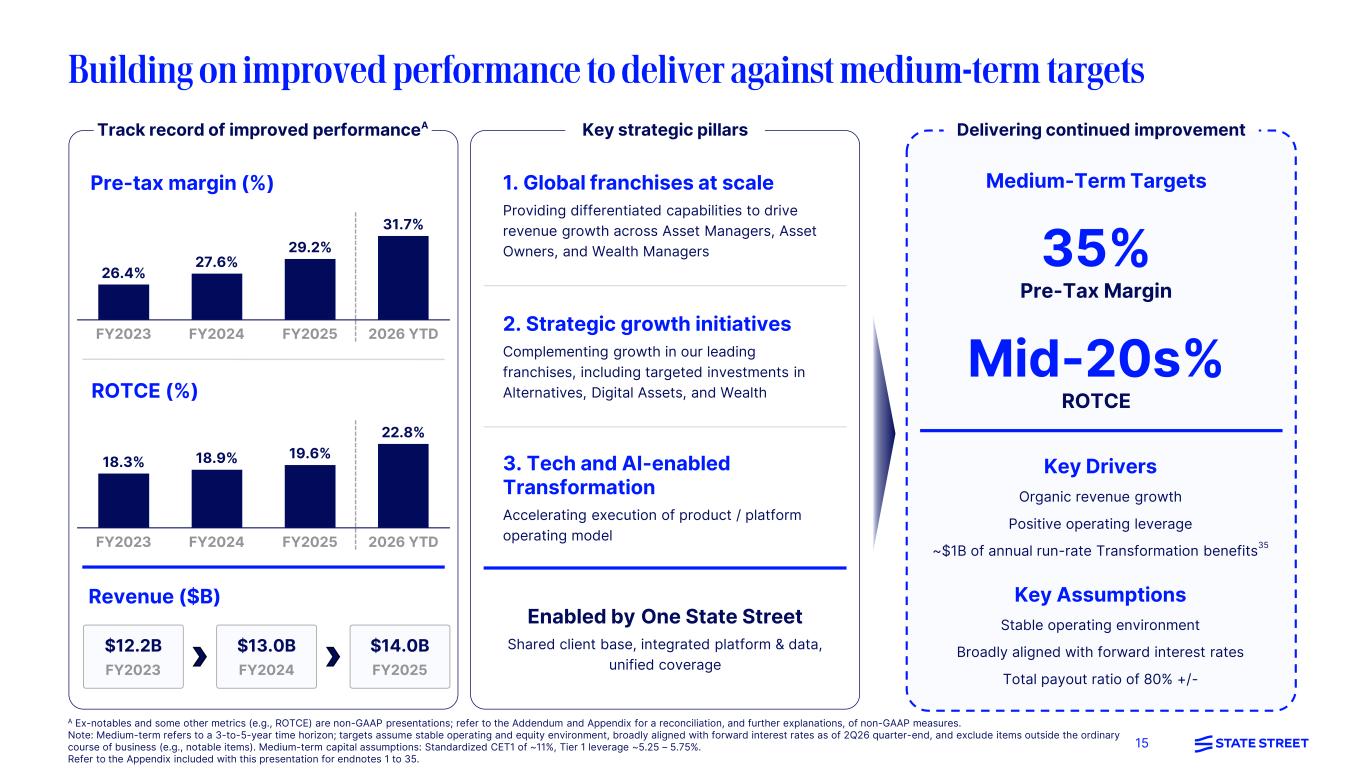
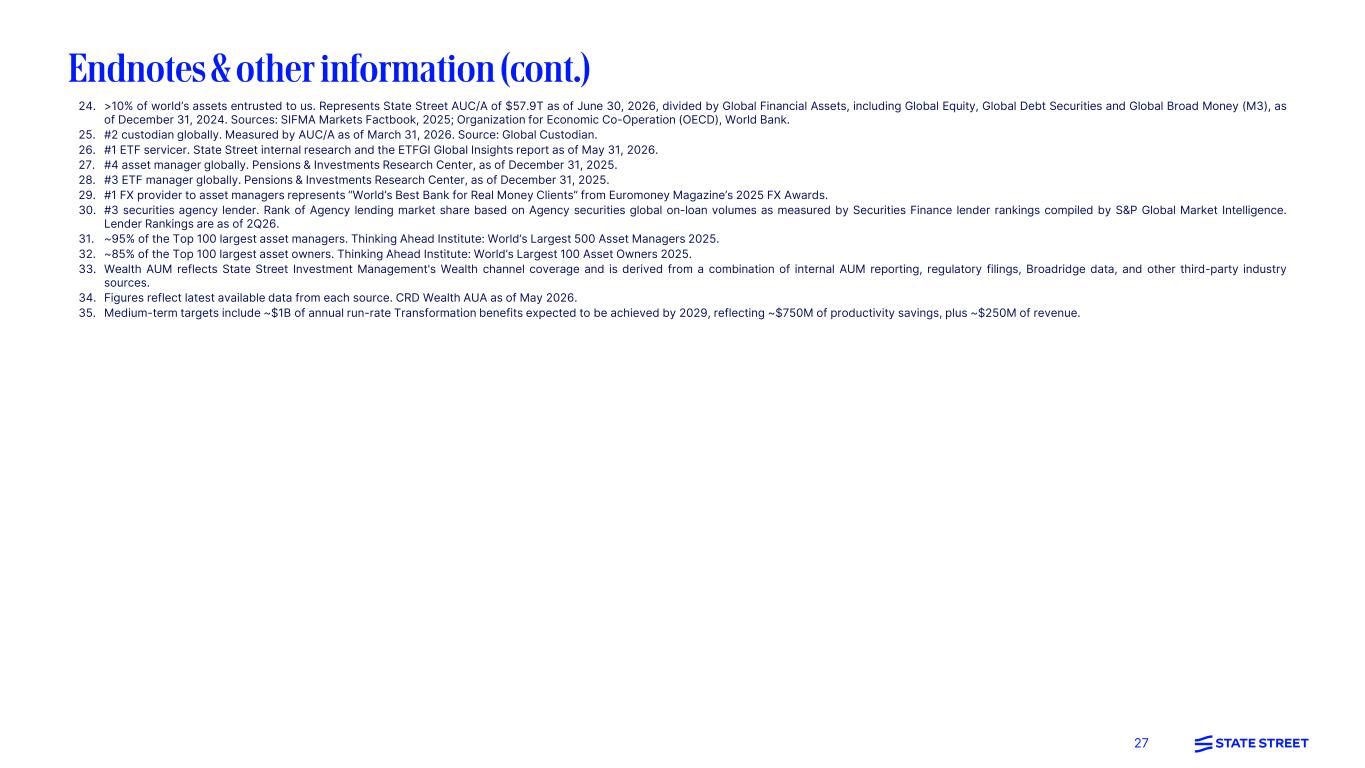
Thank you, John. Let me turn to the second part of our discussion on slide 14. Our strong execution in the second quarter, combined with our improved outlook for 2026, provides meaningful momentum as we begin the next phase of our journey towards achieving new medium-term targets. Faith Street is well positioned for its next phase of growth and value creation. That begins with the scale and strength of our franchises. The breadth of our platform is substantial, enabling us to compete and serve clients from a position of strength. Globally, we are the second largest custodian, largest ETF servicer, and a partner to the world's largest asset managers and asset owners, entrusted with more than 10% of the world's financial assets. And we operate in more than 100 markets worldwide. We are the fourth largest asset manager and the third largest ETF manager globally and in our markets franchise we are the number one provider of asset FX to asset managers as well as a top three securities lender with capabilities that are deeply integrated with our investment services business and client relationships not only do these businesses hold leading market positions they come together as a powerful one state street an integrated firm creating meaningful synergies and delivering greater value for both our clients and our shareholders. Importantly, our businesses are integrated not just in how they go to market, but also in how they serve a shared client base across asset managers, asset owners, and wealth managers. As illustrated on the right side of the page, we serve as an essential and trusted services and investment partner to the world's leading investors. As a result, we are strategically aligned with firms positioned to grow, enabling us to drive further value as we broaden and deepen our relationships and participate in their growth in the years This one state street is the foundation for everything you will hear from us today, and it is the platform from which we will deliver the medium-term financial targets. With that understanding of who we are and how we go to market as one state street, let Let me turn to what all of this translates into strategically and financially, starting with our track record and where we're committing to take the franchise from here. Turning to slide 15, in recent years, State Street has delivered structural improvement across the metrics that matter most. Excluding notable items, and over the past two years through the end of 2025, free tax margin expanded by approximately 300 basis points, and return on tangible common equity increased to approximately 20%, supported by revenue growth of more than 14%. That strong performance continued into the first half of this year. As you can see on the left of the slide, year-to-date pre-tax margin improved to approximately 32%, and ROTC increased to roughly 23%, excluding notable items. This reflects the deliberate choices we have made in recent years to strengthen the franchise, improve operating efficiency, and invest in areas that positioned us for durable growth. As we look ahead, our continued momentum and next phase of growth will be driven by three key strategic pillars, which are outlined on the center of the slide. First, our core businesses. Many of our most compelling growth opportunities lie within the franchises we already lead. These are businesses where we have built deep capabilities, operate at scale, and enjoy strong competitive positions. We remain focused on strategically investing to accelerate these opportunities and executing with discipline to deepen client engagement and deliver durable growth over the medium term. Second, to complement the growth of our core franchises, we are prioritizing three strategic growth initiatives. alternatives, digital assets, and wealth services that span and connect our investment services, investment management, and markets franchises, creating opportunities across the breadth of the firm. These three initiatives are adjacencies that align us with evolving client demand and some of the fastest growing and most attractive revenue pools, while also deepening our essential role to our clients as the industry evolves. Importantly, these initiatives are diversified across the maturity curve, driving growth from our already strong position today in alternatives, positioning us for the next phase of market structure and digital assets, and enabling access to the largest and fastest growing pools of client demand through wealth services and investment solutions. And third, our next phase of technology and AI-enabled transformation will be a critical enabler, simplifying how we operate, accelerating time to market, and fundamentally improving productivity through a more integrated product platform model, which John will speak to shortly. Finally, as we execute against these three strategic pillars, we believe the firm is advantaged by the interconnected capabilities across investment services, investment management, and markets, enabling us to deliver through a one-state street model that provides whole portfolio solutions at scale rather than just standalone products. Taken together, our consistent track record of stronger financial performance positions us well for the next phase of growth. We enter that phase with positive momentum, supported by the continued strength of our global franchises, a differentiated portfolio of strategic investments spanning multiple stages of maturity, and the evolution of our operating model through technology and AI-driven transformation. These efforts underpin the new medium-term targets we are announcing today, which include the milestones of expanding our pre-tax margin to 35% and increasing return on tangible common equity to the mid-20s over the cycle. We are confident in our ability to achieve these ambitious targets as we build on our strong momentum and continued improvement in financial performance. With a clear path to sustained organic revenue growth and positive operating leverage, we believe we are well positioned to unlock long-term value for our shareholders. With With that, let me turn it over to John, who will walk through our path to achieving these objectives in greater detail.
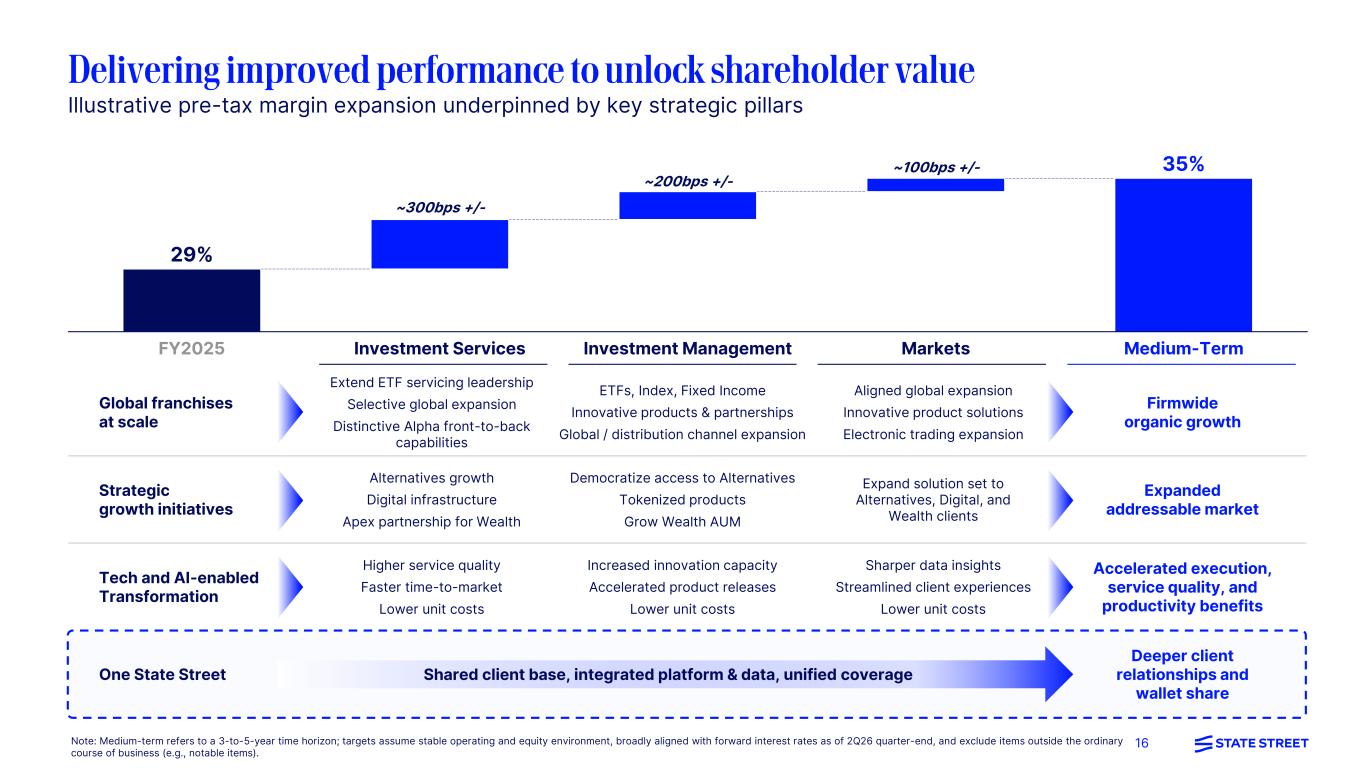
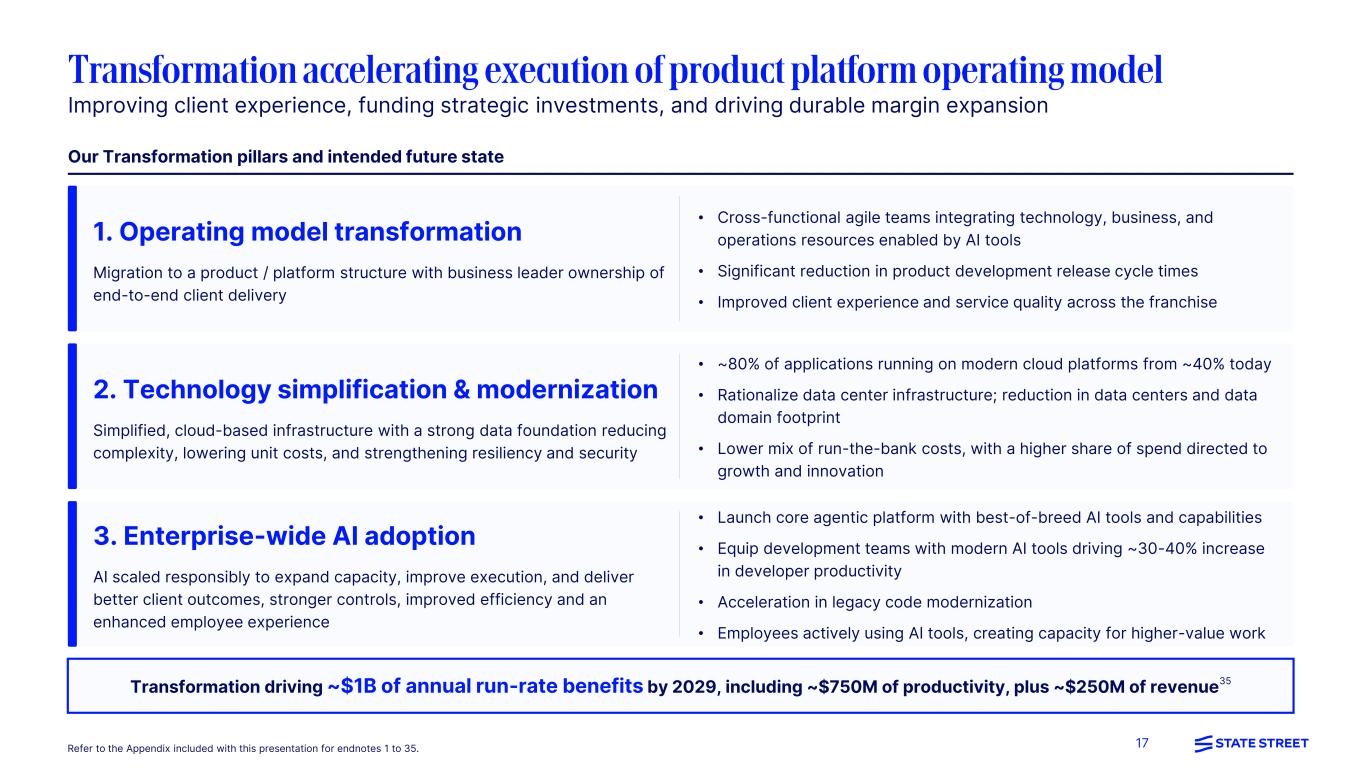
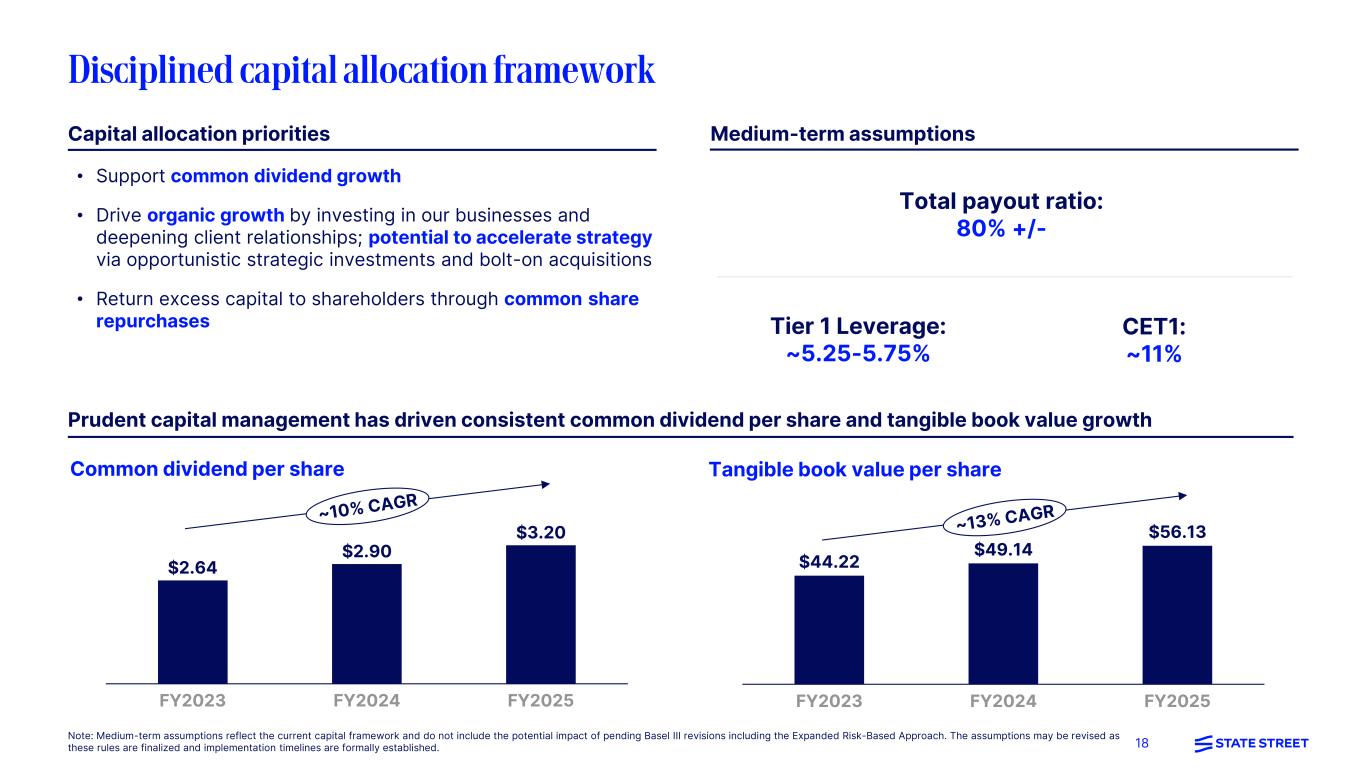
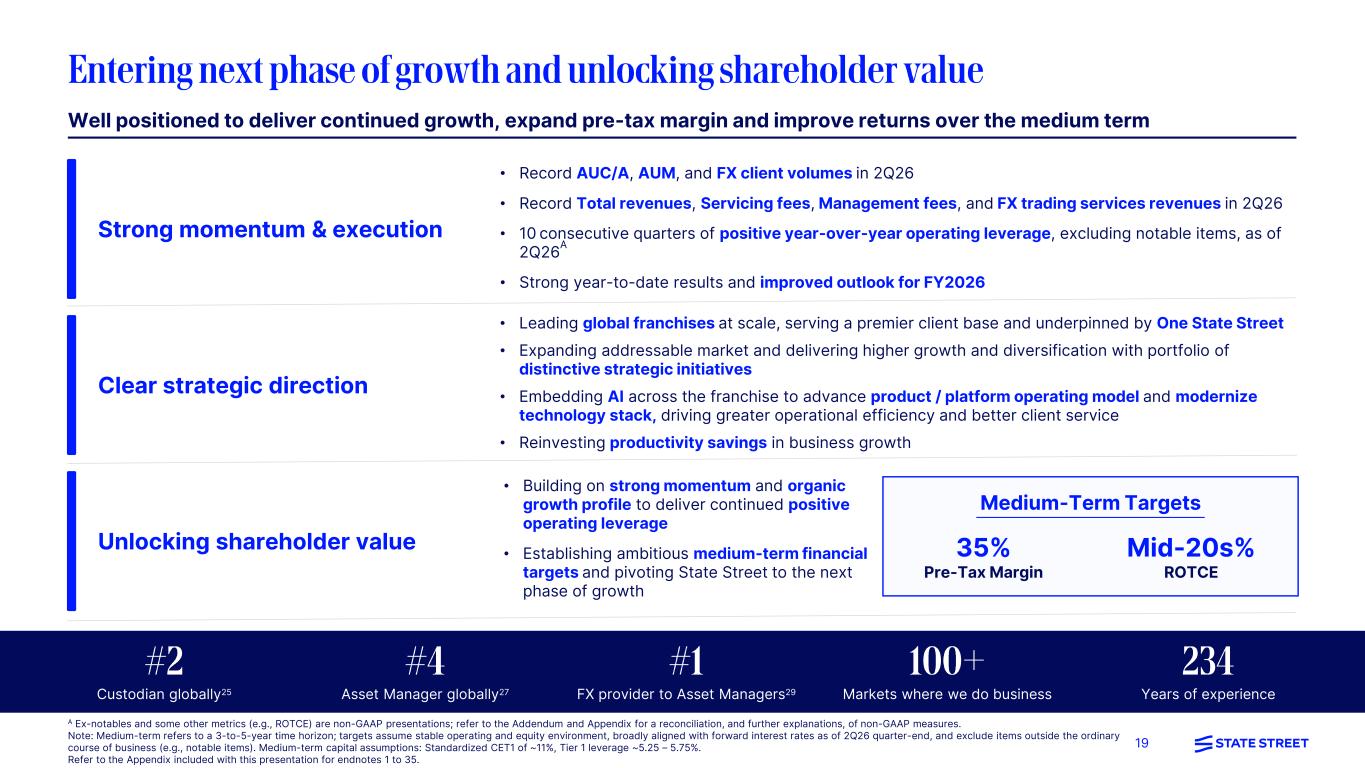
John L. Thanks, Ron. Turning to slide 16, the pre-tax margin expansion we expect to achieve over the medium term is broad-based with contributions across investment services, investment management, and markets. In investment services, the approximately 300 basis point contribution to enterprise margin expansion is expected to be driven by a combination of organic revenue growth and productivity initiatives. On the revenue side, we see opportunities to deepen our existing client partnerships. Our key growth priorities include extending our ETF servicing leadership, broadening our reach across key international markets, expanding adoption of our differentiated alpha front-to-back capabilities, and capturing growth across alternatives, digital assets, and wealth servicing. We also expect continued support from net interest income, which remains closely tied to the client deposit growth and underlying strength of our servicing business. On the productivity side, given the scale of our global operations, investment services is expected to be the largest contributor to the expense phase in our technology and AI transformation program. By simplifying our operating model, scaling common platforms, modernizing our technology stack, and increasingly leveraging data and AI capabilities, we expect to deliver an upgraded client experience and improve service quality while lowering unit costs over time. In investment management, we see significant opportunities to drive growth through scale and expanded client access. ETFs, index investing, fixed income, and other solutions remain core growth engines for the business. In addition, wealth is a key strategic focus as we expand our presence across advisory, intermediary, and retirement channels, while partnerships with next-generation wealth platforms extend our distribution to new investors and bring differentiated investment solutions to market. We also see substantial opportunities in alternatives and tokenization, where we are broadening access and developing new ways for clients to incorporate private market and digital asset exposure into their portfolios. Taken together, these opportunities support our confidence in delivering sustained organic growth, operating leverage, and approximately 200 basis points of enterprise margin expansion from investment management over the medium term. In markets, we see continued opportunities from both geographic expansion and product innovation. This includes scaling our financing, trading, and execution capabilities in our faster-growing international markets, expanding our product offerings, and deepening engagement with our core investment services clients. Beyond this, growing demand across alternatives, digital assets, and wealth is creating new opportunities to expand our solution set. Supporting these growth drivers, enhanced data capabilities, automation, and operating efficiency initiatives are expected to enhance execution and help to deliver approximately 100 basis points of enterprise margin expansion over the medium term underlying all of these opportunities is our one state street approach which enables us to connect capabilities across investment services investment management and markets to deliver more integrated solutions deepen client relationships and increase wallet share turning out to slide 17 let me expand on the transformation initiatives that will accelerate execution enhance service quality and create capacity for future growth first is the migration of our operating model to a technology and ai enabled product platform structure rather than just re-engineering legacy processes we are taking an end-to-end view of the enterprise and are planning to rewire how we operate embedding ai and modern technology into our core business processes. Under this model, business, operations, and technology resources are reorganized into integrated agile delivery teams with business leaders holding end-to-end ownership of the client delivery process and experience. The result is meaningful efficiency gains from simplification, automation, and AI enablement. Beyond these efficiency benefits, faster time to market for new products, enhanced service quality, and improved client experience are expected to drive incremental revenue opportunities across the franchise. Supporting this operating model is our technology simplification and modernization agenda. By reducing legacy applications, expanding the use of modern cloud platforms, and further strengthening our enterprise data foundation, we are lowering unit costs, improving resiliency, and reducing operational risk. At the same time, a modernized data foundation unlocks new revenue potential by creating capacity for investment in growth and innovation. Finally, we're scaling AI adoption across the enterprise to improve execution, enhance productivity, and accelerate software development. AI will drive meaningful gains in developer efficiency and code modernization, freeing up capacity for higher value work. Beyond these productivity benefits, AI is enabling new client-facing capabilities and better data insights that will increase the earnings power of our franchises over time. Together, these efforts are expected to deliver approximately $1 billion of run rate transformation benefits by 2029, with approximately 75% of this driven by expense productivity and 25% from revenue. Turning to slide 18, we outline our capital allocation framework and how we intend to deploy capital over the medium term to support our strategic objectives, generate attractive returns for shareholders, and maintain the resilient balance sheet our clients expect. Our capital priorities remain unchanged, supporting a strong and growing common dividend, investing in the franchise to drive organic growth, and returning excess capital to shareholders through share repurchases. Consistent with these priorities, we continue to target a total payout ratio of approximately 80%. To support these objectives, our current medium-term outlook includes a set one ratio of approximately 11% and a tier one leverage ratio of approximately 5.25 to 5.75%. Turning to our final slide, State Street is entering its next phase of growth from a position of strength. The momentum we have built in recent years has fundamentally repositioned stage streets to deliver sustained growth, continued margin expansion, and stronger returns over the medium term. The scale and strength of our franchises, our distinctive portfolio of strategic growth initiatives, and the accelerating impact of our transformation agenda give us real conviction in the path ahead and in our ability to execute against it. Collectively, these drivers support our new medium-term targets of 35% pre-tax margin and a return on tangible common equity in the mid-20s. With that, operator, please open the line for questions.
Operator
At this time, we will open the floor for questions. If you would like to ask a question, please press star 5 on your telephone keypad. You may remove yourself at any time by pressing star 5 again. Please note, it will be allowed one question and one related follow-up question. Again, that is star five to ask a question. And we'll pause just a moment for the queue to form. Our first question will come from Alex Flostein with Goldman Sachs. Your line is open. Please go ahead.
Hi, good morning. Thank you for taking the question. So I was hoping to start with the medium-term targets, maybe starting with the revenue question first. So helpful in the way you framed it in terms of sort of qualitatively where you're looking to lean into, but I was hoping you can give perhaps just a little more granularity on the $250 million and kind of which businesses that's likely to come from. And I guess more importantly, you know, you guys have been improving organic growth to begin with over the last couple of years. So as you think about the firm-wide organic fee growth today, where does that stand? And I guess when you layer in these incremental efficiencies or incremental initiatives, where do you see organic growth firm-wide going on the fee side?
Yeah, I mean, Bill, thanks for the question, Alex. is, John. I'll go ahead and give you some context with respect to overall how we're thinking about it. Over the medium term, the way I would think through it would be positive operating leverage is the main sort of North Star that we're committing to. So what we're saying here is, and as I mentioned in my remarks, look at the baseline from which we're launching this in 2026, whether it's 1H or even our outlook for 2026 overall, we're around 32%. That's growing over the medium term to that 35%. And I'd say that that would be consistent with positive operating leverage of 100 to 150 basis points, which is driven by organic growth across all three of those businesses that we're talking about. I would pair that with some commentary with respect to NII over the medium term. So we do see net interest income rising in that low to mid single digits area driven by balance sheet growth in the low single digit range and our net interest margin getting to the upper end of our 110 to 115 range as you get out over the medium term. And so those are the underlying engine that drives this progression. And then when you flip over to the transformation program and that 75-25 split, that billion dollars that we expect to deliver by 2029, as you asked, 25% of that is decked against revenue opportunities. And I think that's a starting point given what we're trying to accomplish here is so broad-based and has huge impacts on client experience and time to market and cycle times. But the $250 million that we have in there is primarily related to the targeted strategic initiatives that you'll see that we're mentioning here that are one-state street driven. That would be in the alternative space and in digital and in wealth and among those three probably alternatives is the biggest contributor where just given its maturity profile, we've gotten, you know, that initiative has been ongoing for a number of years and we're accelerating into it. So that's how I would think about overall the context for the medium-term outlook and putting revenue into the mix there.
Got it. That's helpful. And just for a follow-up, maybe double-clicking on the 750 of, I guess, cost savings you expect to see here. again it feels like there's you know inherent operating leverage in the business regular way as you described it initially and then this sort of comes on top if you run that through obviously that leaves you with much higher pretext margin than the 35% so if I think about the 750 being a gross number maybe help us frame how much of that will ultimately get reinvested back in the business to think about what the net kind of efficiency on the net cost savings could be on the back of the program?
Yeah, I mean, it's fungible, right? But I would say that the transformation program has two overall objectives that, you know, maybe more than two, but two overall financial objectives. It has the broader objective in the revenue space, which we've already covered. But when it comes to just the 750, it's doing double duty. First, it's allowing us to grow our strategic investment capacity over this medium term in order to drive the outcomes that we're talking about with respect to these one-stage street initiatives, as well as the broader powering our leading franchises. So that's the first part of it. And then the second part of it is helping us stay on track for the margin expansion. So I think without giving you a specific percentage. I think it's relatively equal parts allocated to reinvestment and margin expansion is, I think, the best way to think about it. And we also mentioned that when you look at our businesses, just given the footprint of our investment services business, that's the majority of the productivity saves get generated by where all that headcount is over in the servicing side of the business so that's a way to think about it across the businesses as well yep i understood thanks very much your next question will come from glenn shore with evercore isi your line is open please go ahead hi thanks very much so i definitely want to ask a question on on all things digital assets stablecoin and tokenized deposits but the lead-in to that i just want
to make sure i get the right perspective and i think this for you guys and for the industry is the initiatives and you have many in that space are included in that incremental 250 million and it's not even the biggest piece so the message i'm hearing is for you guys in the industry is we're investing a lot in the future infrastructure of the financial markets but it's a long-term commitment because even if all 250 was from digital assets that would be less than two percent of state's revenue so focus on the big picture first and and and either way my next question is you know I noticed there was a two announcements during the quarter one on the Visa MasterCard stable coin network with over a hundred businesses and you weren't one of them and also tokenized deposit network with a bunch of banks and that's more of a bank thing so my question is What is taking place in terms of as we're modernizing all the payments and clearing and settlement systems, and are we paying too much attention because right now it's not adding up to much money? So I apologize.
I smooshed those two together, but I want to get the right perspective on all things Maybe I'll start, and John will pick up on the specifics as it relates to the numbers. Yes, and as you think about the 750 and the 250, again, that was in the context of the go-forward next phase of transformation that we just described. We've got initiatives underway, and if you think about just on the cost side, if you think about the margin expansion that we've enjoyed over the past several years, I mean, that's been the result of our ongoing transformation program. What we're talking about here in the 750 and the 250 is the next phase, which is incremental. But we've got existing initiatives that also will be contributing. So I just want to make sure that people understand the mathematics here, number one. Number two, in terms of your specific question on digital, the way we think about this is we're primarily an infrastructure provider to our clients enabling them to do to execute their digital strategies so who are our clients our clients are our global investors right so that's why we're focusing on the you know if you think about it the traditional the digital back to traditional kind of rails because it'll be a long time before the whole infrastructure stack is digital and then secondly we're focused on things that relate to those investors asset managers or asset owners hence for example of the focus on the focus on tokenized money market funds who are our client place. Well, a large segment of them are large asset managers. So we're picking our spots and going to where we know our clients want to go is the way to think about it.
John? Yeah, just a few comments to add to that. I mean, I'd say that, as you know, we launched our digital asset platform recently. It's a secure, scalable platform. I think we're trying to create the capabilities to manage wallets and really manage the on-ramp and off-ramp between traditional finance and into the digital on-chain world. A few comments about some things that we've also been able to do is, you know, in the investment services side of the business, we're focused on enabling client launches of tokenized money markets. And so that's early in the roadmap, and we're excited about that. And, you know, and I think on the other side of the house with respect to investment management, we also announced a couple of digital asset ecosystem product launches as well. So you think about this across the one state street lens, we, you know, state street investment management did launch a tokenized money market fund on chain, basically cash equivalent for the digital ecosystem, creating new distribution, et cetera. And broadly, asset managers love this with respect to the distribution aspects as well as collateral mobility. And investment management also launched a stablecoin reserves money market fund as well, targeted to stablecoin issuers. I think it's going to be table stakes for us in the space that we're in to have these capabilities as we mentioned you know alternatives is probably the most mature of the three that we're spotlighting here today digital is gaining momentum but lots of activity as I articulated here in the here and now as well that we're that we're making progress on I appreciate that I mean it sounds like you make a lot of progress it doesn't add up to huge numbers right now but that actually I take as a good thing because it means the other 15, 16 billion of your revenues is that much safer from the digital invasion.
But if you agree with that, I'm good and done. Thanks. Thank you.
Operator
Your next question will come from Mike Mayo with Wells Fargo. Your line is open. Please go ahead.
Hi. Could you guys give us more confidence on or why you're confident that this new phase at state three over the next three to five years is going to succeed I guess I have in my plus column I recognize that you have ten quarters in a row positive option leverage better returns better pre-tax margin and the organic growth seems to pick up I'd love it if you could verify that looks like the servicing fees have picked up organic two percent last year to five percent this year asset management six percent to double digits this year so maybe the plus column. But I'd say the negative column is, I've heard this before at phase three for the last 15 years, and this certainly predates you, John, and it predates you, Ron. But the whole cloud, the tech, the rewiring, as you said, John, was the story last decade, and it failed to produce the results that were desired. So really, why is this time different?
Why should investors think that this major kind of demarcation new phase of State Street should succeed thank you Mike it's Ron I'll start with that we begin with a very strong foundation if you look at our track record of execution we've got you point out the ten quarters of positive operating leverage I mean that didn't come out of nowhere that came out of investment in the platform but also investment in the in products and the revenue growth capabilities that we've now demonstrated over those ten quarters so what you're seeing in this foundation is consistent organic revenue growth and a very productivity focused culture right John noted in the results that yes our expenses have gone up revenue related and reflecting the revenue related cost plus investments in these capabilities but our headcount's actually gone down we didn't have that kind of foundation in the history that you're referring to secondly i put a lot of we put a lot of credence in this team the current management team is a strong one over 50 of that team is either new or new to its role in the last three years They work very well together, and you're seeing it in terms of this strengthening each of the franchises, but also the real results coming out of the integrated one State Street approach. You're seeing out of this team improved operating efficiency literally across the board, quarter after quarter, year after year. And our first half of 2026 results kind of reinforced this trajectory, right? we had the prior three years that we pointed to and you're seeing that now play out again in the first half here so taking it all together we look at these targets and these are targets over a cycle I mean we're in a very constructive environment now we're not assuming that that's going to last forever but when we look over the cycle these are the targets that we're aiming for they're ambitious uh but we're going to hit them uh we've selected margin and rotzi um because they're uh they're within our control and they're things that are important to you as investors so we bring it all together uh we've got a lot of conviction we've got a lot of confidence um and we intend to execute what we laid out there i guess um in terms of the rewiring part and i mean it all sounds good on paper and it may or may not play out the way you expect it.
Is there any metric that you or we on the outside can monitor to see that success, like revenues per employee or I got a number of employees? You know, just the idea of going to a more agile infrastructure, kind of what that means in financial terms.
Yeah, Mike, it's John. I guess a couple things. One is the starting with the overall number of the 750, it is disproportionately being driven by this operating model transformation, which is pretty tangible. I mean, what we're talking about is basically migrating to a product platform approach where our business technology and ops teams are reorganized into cross-functional integrated teams that deliver specific business outcomes for clients. That's a physical organizational migration that's very tangible to see. And what we're going to be doing is taking out the unneeded interfaces that currently exist that slow down and create some inefficiencies between those groups today. That's pretty tangible, and that'll flow through to headcount. I think what you saw over the last couple of years is that our headcount is down. The gross headcount is down by more than what the net is, and the reason for that is that we've been investing in driving strategic initiatives along the way, and that theme will continue. So I think you should keep an eye on headcount and watch that area. We'll also, over time, you know, look for a short list of metrics that will help support what we're talking about here in terms of product development, life release cycle times, you know, and client experience and service quality metrics, etc., which we expect to improve. And in the platform space, you know, having migrating to, you know, more applications in the cloud and reducing the footprint of our data centers are also lend themselves to metrics that I think we can share. And also, you know, migrating our overall investment spend because of the efficiency that we should get in software development life cycle and in the product life cycle overall, you should see the percentage of our grow percent, you know, of our investment spend rise over time as well so i think there's a a handful of metrics that we can share in combination with the fact that we are actually going to reorganize the company along these lines and that's that'll be that'll be very tangible it won't be uh yeah and that'll that'll that'll be something that we can demonstrate uh over this medium term all right thank you your next question will come from ken houston with autonomous research your line is open please go
Thanks. Actually, if you don't mind to focus on the current outlook, John, just maybe give a little color just looking at kind of what you're expecting for the full year now. I guess it would assume that NII kind of flattens out from here and fees probably revert a little bit. Given how strong FX was in the second quarter, I can imagine some of that would be there, but can you kind of just distill how you expect some of those to progress from here and anything we should just be thinking about with regards to either seasonality or things that revert from the recent results? Thanks.
Yeah, sure. I mean, I think maybe starting with the revenue, I mean, I think we can we expect continued organic growth in the servicing fee and management fee space. And I think that's an important anchor point of continuing the momentum that you're seeing in the first half. That continues into the second half. We're not assuming, however, as much of a tailwind from market levels. I mean, as well as markets. I'll get back to markets in a second. But market levels, we're keeping it flat to the end of the second quarter. And so we'll see how that plays out. But most importantly, organic growth continues into 2H. But to your point we're setting records in fx trading services here uh quarter after quarter it seems and uh we do have built in some moderation uh into the second half and well you know that you can be of two minds there i mean i i think we've we've been uh we've seen client volumes be extremely resilient we've seen opportunities internationally where uh where spreads are wider uh and and growth is a little stronger, but continue to support our markets business. And so we're excited about that, but we're not counting on that in continuing in this outlook for the revenue side of things in the markets business. I think it's going to be a strong second half for markets, but moderating a bit from the record in 2Q is what we're assuming in this outlook. When it comes to NII, that's about right. I mean, I think you're seeing some flattening out there. I mean, I'd say earlier we had a sense that deposits would be in the $250 to $260 billion range. We came in above that in the second quarter. Average was around $270. And I think we're going to assume that that is going to be the outlook for the whole year. So we're raising that in terms of balance sheet contribution coming from NII, and that's underpinning this increase in the outlook from 8% to 10% to up 14% to 15% year over year, and with a net interest margin kind of staying in that range of 110% to 115% that we mentioned last quarter. So those are the thoughts from my standpoint on the revenue side. And on expenses, I think the point there is that, you know, we're going to see some moderation in the growth in part due to some lower costs on the third-party spend side in the numerator. And then, you know, there's also a year-over-year denominator impact from 2H25 that that takes our expenses up to 8% from the prior five, six, including revenue related. So just a few comments across each one of those line items.
Okay, thanks, John. And just one clarification, apologize if I missed it in the deck somewhere, but can you just make sure we understand the three to five years, just what years we're talking about there? And some questions people were just asking about, like, you know, possibility of achieving it inside, you know, when you can get to these targets inside that range, thanks.
Yeah, sure. Two points there. One is, on the billion-dollar transformation program, that is explicitly tied to achieving that by 2029. So that's sort of earlier than the three to five, I would say. So that's by 2029. So that's more in the three-year range, early end of it. But with respect to the targets overall, so I think we like to talk about the medium term meeting three to five. But that 100 to 150 basis point, you know, positive operating leverage expectation would imply that we would get there in the early end of that medium term time frame.
Operator
Your next question will come from David Smith with Truist.
Operator
Your line is open. Please go ahead.
Speaker 11
Hi. Good morning.
Speaker 5
The billion dollars of transformation is a nice goal. Are you anticipating any major upfront spend required to get there by the 2029 target, or is it just embedded between your normal investment spend each year net of efficiencies?
Yeah, I think on the recurring side of things, that's all embedded in the numbers that you I think there will be some one-time costs that are predominantly severance-related with respect to the headcount implications. And so, you know, I'd probably frame that, you know, in the neighborhood of around $500 million or so would give you a sense for how that would equate to headcount reductions growth. and then on a net basis, maybe similar to what you saw over the recent past, we would expect headcount to be down in the low single digits range on a net basis after reinvestment of that capacity into strategic initiatives and growing our franchises. So that's the way to think about it. And we think that's a highly attractive ROI on that severance cost. There's there's a little contract termination there too but but but almost the substantial majority of that 500 i would say is sevens related which typically ends up with very solid rois and and solid earn backs as well okay and then in terms of the lines of business uh targets just focusing on investment management you know you're saying you're going to get about 200 basis points of enterprise-wide margin expansion from there, but it was less than 20 percent of revenues last year.
Speaker 5
So just thinking about the weighted contribution, it would take a pretty big improvement in margins, specifically investment management, to get 200 for the overall company. Can you just talk a little bit more about the key drivers there and your confidence in achieving them?
Yeah, and I'd say, I think the answer is, I think that's right. I mean, the math there is that if you go back to 2029, investment management was around 33% margin. You know, in second quarter, investment management has already improved that to 38. So, and I think that's probably about halfway home from a mathematical standpoint in order to deliver that 200 basis points top of the house. So it seems large from 25, but about 50% of that's already delivered here in the second quarter. Now, you know, nothing's linear and, you know, like the market levels can have an impact on that over time, but we're just seeing incredible momentum in the investment management space and just flexing the scale advantage that they have and the innovation in terms of the products that's being delivered. We've got a lot of confidence in this 200 basis point top of house contribution coming from investment management. And I think the specific areas that we're talking about is continuing to drive our leading franchise as it stands with ETFs, index and fixed income, and just our global distribution expanding. That's a big driver. And then their own transformation delivery as part the overall transformation program is also a large contributor where cycle times and product release you know cycle times all shorten and there's revenue off left that's embedded in that 200 as well so those are some of the ways i think about the credibility of that 200. all right thank you your next question will come from jim mitchell with seaport global security your line is open please go ahead hey good morning um just maybe you know on the margins and expenses again i guess um
if we think about the tech and ops transformation do you expect any drag i guess in the very short term on pre-tax margins as you invest or is a lot of that stepped up investment spending kind of in the run rate just trying to think through you know 100 150 basis points of pre-tax margin improvement per year would you view that as somewhat linear or back-ended?
Yeah, it's not back-ended. I would say that the base case is that we would expect to generate positive operating leverage in each year of the medium-term outlook. That's our goal, and that's what we're trying to accomplish to make progress along the way. So it's not back-end loaded, but what I'm giving you is an average, and there will be some variation in that inevitably based on both the pace of internal activity and execution as well as external macro factors. But I think 100 to 150 is a good planning range that takes it to the earlier end of that three to five year outlook. And there's not a early years large investment cycle that is then back-end unveiled over the medium term. The tech investments are planned and consistent with the billion-dollar program along the way across the medium term without it being back-end loaded.
Right. Okay. That's helpful. And then on the numerator side, obviously this year has been a great year and you've gotten 500 basis points of operating leverage. But you talked about expectations for the rest of the year from assumptions. But how are you thinking about the assumptions over the medium term for the revenue backdrop? And if we have more years like this, can you get there even quicker? Does that flow to the bottom line, the upside?
Yeah. I mean, I think, as I mentioned, the 100 to 150 basis points assumes, systems, and we expect to deliver organic fee growth over this time frame. I also mentioned that NII would come in low to mid-single digits when we think about how that will contribute over the time frame. And so to the extent that positive operating leverage exceeds the 100 to 150, we would we would achieve the 35% earlier. That's for sure. I would hasten to add that we are going to be looking for a sustainable level at the 35 and at these targets where we're delivering it not only in real time for a sufficiently long multiple quarter period, but also have an expectation that it will continue to stabilize and grow from there. And then that's the timing for when we would, you know, we would, you know, reassess whether those targets have been achieved and then consider whether they should be adjusted higher.
Speaker 11
Okay. No, that's helpful. Appreciate it.
Operator
Your next question will come from Abraham Poonawalla with Bank America Securities, Merrill Lynch. Your line is open.
Please go ahead. Thank you. First of all, John, thanks for all the detail in the slide deck on the target. Nicely laid out. I had a question. I think it's an interesting point in time where you're going through when you talked about rewiring the business and kind of when we think about AI adoption within financial services, just talk to us as you've approached the targets, as you're thinking about adopting AI, how difficult is it to sort of implement that through workflows and rewire that? Is it, like, do you think over the next 12 to 24 months, you'd have a franchise or an enterprise that's fully, I guess, I don't know, AI native or, yeah, if you don't mind talking through that. And I guess tied to that, how much of AI-driven gains are in these targets as opposed to you could be an even more profitable bank if kind of AI delivers to its promise on productivity?
Yeah, sure. I mean, I'll make a few comments about this. I'd say I'd put the AI, you know, you know, benefits and maybe three three categories. The the first one would be within our operating model, which is the lion's share of what we're what we're really delivering here in terms of the 750, you know, and which depends upon the tech, you know, simplification and an AI adoption. We are going to be embedding agenda capabilities within our operating model redesign. So we are migrating to agile ways of working and within any given cross-functional team. If we would have done this, call it five years ago, that would have been composed of all humans, of course. Now it's going to be a hybrid of human agentic team that actually staffs these integrated teams. So I would describe the savings that will be coming from the operating model transformation as embedded with agentic capabilities. And I'm not sure you can fully unpack how much is separately driven by the agentic aspects versus there are a lot of other things going on where we're re-engineering, taking out interfaces from business processes at the same time, the rewiring is basically creating these human agentic hybrid teams. And so it'll all happen together. And I'd put that one category, which is agentic is helping to power the operating model efficiencies that we're talking about. So I'd say that's the first one. The second one is within the technology organization itself, where it's much more able to to be ring-fenced, if you will, when we look at software developer productivity. And it's very explicit, and we're indicating that it's our expectation that you'll see equipping software developers with these tools that we would expect to see a 30 to 40% increase in productivity. And that likely gets deployed in faster cycle times and more product launch and higher innovation, which drives revenue. So we're excited about that. And that's the second overall category. I think the third one is really a kind of a rising tide lifts all boats story where we're going to be and have, you know, delivered Agenta capabilities from a standardized standpoint on a co-pilot platform to all eligible employees. And it's basically allowing them to actively use these AI tools and create higher value work. So knowledge retrieval, data document extraction, content creation, all of those things, and analytics and decision support, all of that is improving the productivity of our colleagues across the platform. And those are the three ways that I think about it, and you're going to see the savings expressed and embedded in that $750,000 with respect to expense saves, definitely. But you'll also see it driving the expectation of the $250,000 on revenue and beyond over time.
Got it. Thanks for walking through. That was helpful. And just a separate question, following up on Glenn's on digital assets. I mean there seems to be a lot of hype around that not that the technology is not real but just talk to us when you think about the blockchain and digital assets kind of playing a physical role in the plumbing of the markets they do think of that as a five to ten year build-out or do you think over the next year or two this is gonna have meaningful impact on how you think about revenue growth and including disruption risks to certain line items just yeah your thought process around that thank you Abraham it's Ron it's a it's a really good question and I think what's playing out is like a lot of technologies
there's an awful lot of promise and the early delivery I think underwhelms and is disappointing and then the later delivery actually is greater than what everybody anticipated and I suspect that's how this will play out I mean if you think about some of this blockchain technology it's it's not new at all I mean it's been around for a while part of it is you're you're taking new technology and putting it into an ecosystem and I'm not talking about just State Street ecosystem you're talking about a financial ecosystem but the there's a lot of enablement that's occurred over the past couple years and things like the genius and whatever is going to come out of the Clarity Act there's a regulatory movement that's starting to align around this again given some of these things the regulatory movement has to align across borders but if you think about what it enables you know just think about collateral alone and the ability to uh create a uh to transform money market funds into collateral eligible there'll be so much pressure to do that if you think about um in real assets the growth in real assets and the ability to use blockchain uh to actually tokenize some of these things enable it to be broken up and put into smaller portfolios, wealth and retail portfolios. I think market pressures will accelerate this. So I believe that it's not surprisingly slower than what the hype might have suggested. But if you look at what's going on under the covers, there's real adoption going on. There's real stuff being built out. And I think you will see this promise over the medium to long term.
Operator
Thank you. Your next question will come from with Morgan Stanley.
Operator
Your line is open. Please go ahead.
Speaker 8
Good afternoon. John, you've spoken about the balance sheet optimization and the NII durability as being central pillars of the medium-term outlook. Can you just remind us on what the near-term and medium-term impacts of the balance sheet optimization efforts are and what the impact is to NII?
Yeah, I mean, I would say it's all embedded in that outlook with respect to, you know, I think in mid-2025, our net interest margin was around 96 basis points, I think. And we've been able to raise that predominantly through optimization activities, not exclusively, but a big part of it was optimization activities to remix the funding side of our balance sheet into higher deposits as a percentage of overall funding and lower short-term wholesale funding. And so that net interest margin has risen from around that 96 level to 110 to 115 range that we're talking about today. So, you know, you do the map on that. That's around 15 to 20 basis points overall of net interest margin lift. I think there's some environmental factors and business execution that has been driving that, which is great. And then there's a reasonably large piece of that was restructuring the balance sheet over the last several quarters to stabilize it at this 110 to 115 level. And then, as I mentioned earlier, we're expecting to try to see continued tailwinds there on net interest margin. And so I would, you know, what's assumed in the medium-term outlook is that we'll migrate to the high end of that 110 to 115 and be around the 115 range as the medium-term plays out.
Speaker 8
Got it. And then maybe on the capital side, it feels like you raised the CET1 target a bit from 10 to 11 percent to 11 percent. Can you speak towards driving that? Is it just conservation or is it a desire to keep some sort of capital buffer right now while the environment is good? And is there any upside to that 80 percent payout ratio?
Yeah, I mean, I think 80 percent is a good planning level. That's what we've got included and assumed in our medium-term outlook. And I'll start with that and come back to the ratio itself. You know, we do have very attractive opportunities to put capital to work in support of our strategic clients, whether it's in our global credit finance business supporting our investment services clients or in the markets business who are supporting investment services clients as well as asset owners and increasingly thinking about wealth managers over time. So there's RWA there that we think about aligning with our strategic goals over the medium term and also being attractive marginal deployment, just a growth mindset there. So I think it balances reasonably well our opportunities in terms of putting balance sheet to work with our desire to continue to have an attractive return of capital for shareholders. So that's what's going on there. I mean, I think what you're seeing with respect to the set one ratio is a couple things. One is, you know, we're leverage constrained. You know, if we're increasingly able to continue to grow deposits, which is our expectation, you know, not only here in 20 – we demonstrated that in the first half, we're committing to that, maintaining those levels, and, you know, on an average basis in 2026, that creates more of a leverage constraint. And so, you know, we'll have to be managing the interplay between leverage capital and set one. And so that's probably the thing to think about when you see that 11%.
Speaker 11
Got it. Thank you.
Operator
Your next question will come from Brennan Hawken with BMO Capital Markets.
Operator
Your line is open. Please go ahead.
Speaker 16
Hi, Ron. Hi, John. Thanks for taking my questions. I had a couple on the ETF business. So recently you launched a new product, QNDX, which is a rather interesting market, had been dominated by the Qs and recently opened up for new competition. But what was particularly interesting to me was the pricing of the product. You priced it at 10 basis points, which was a pretty narrow spread above NASDAQ's 8 basis point licensing charge, and suggested to me that maybe this might be a new pricing strategy for spiders, given your inherent advantage of having your own servicer and effectively being able to price more attractively than a lot of your competition. Is this what we're starting to see here, and does it lead to any concerns around potential pricing pressure on ETF servicing?
Yeah, Brennan, I mean, unlike if you think about the history of us in ETFs, if you think about SPY and the SPYDR franchise, which started out as an institutional franchise, and later on we thought about, okay, what are we going to do for the wealth and the asset holder world, if you will. That's what led to the launch of SPYM to sit alongside SPY. We didn't have that equivalent institutional product. So our view was, when we went into this, that we needed to round out our product line. We just didn't have it. It's a good strategy for the wealth and buy and hold investors. So we thought about it, positioning that way is really how we thought about it and really nothing more than that. Obviously, because we are the leading ETF servicer, when we're both the servicer and the sponsor, we're in effect deriving revenues from two different places. So sure, that's a factor, But in terms of how we position the product, it really has to do with our starting point, which was not being in that market at all. And when NASDAQ, in effect, opened it up to others, that's how we thought about the positioning.
Speaker 16
Got it. That makes sense. Thanks, Ron. And also, we've heard a noise from both management firms talking about rolling out revenue share programs for ETFs. do you have any sense for that potential impact and you've been in dialogue with any of those wealth management firms and what would you expect on that front going forward I know I know the ETF business is a little more institutional oriented but you know the wealth side is still relevant yeah so I mean we're it is I think you know the our ETF franchise is growing and the fastest growing part of that is the wealth side of it so and we clearly are in dialogue with all these distributors we work with all of them there's long
term partnerships here with them in many cases not only are they our distributor but we serve them in other ways and they serve us in other ways so these are virtually all these distributors are also important partners so you know we we talk to them we'll do things that make sense and we won't do things that won't make sense keep it clear thanks your next question will come from steven chewback with wolf research your line is open please go ahead good afternoon ron and john and thanks for taking my questions so wanted to ask on the pricing outlook you know pricing pressures have been less acute in recent
years at the same time there are more investors that are questioning pricing resiliency going forward just given the significant windfall you and your peers are expecting to realize from ai deployment and just a structurally lower cost to serve was hoping you could speak to what you're hearing from customers as you engage in more recent discussions on pricing and what are some of the assumptions on pricing that are underpinning the 35 medium-term target how much of that benefit do you expect will be shared with customers over time yeah I'll start on that I mean I'm just reflecting on your question and I mean I've spent a lot of time with clients and I can't think of one we always talk about AI and I can't
think of one that's talked about and we're really looking forward to you lowering prices right they think of it more and that the discussions are more around you know first state street how is it going to help you serve us and we talked there about speed so it's kind of cycle times and and those kinds of things we then talk about how we can actually think about AI across our firms particularly in those cases where we're not just the back office but we're providing middle office services. So most of the dialogue is around what does this enable us to do in terms of either getting things faster to them or how we might work more intensively and in an automated way together.
I might just add on to that. I mean, I think what we've got planned over the medium term is organic growth in the servicing business. And within that, there are multiple drivers. And that incorporates conversations with clients with respect to pricing and all of that. And they all end up being positive. I mean, we are going to lower cost to serve over the medium term. There is net new business. There is client activity and turnover that we really benefit from. And I think all of that would be included in and inclusive of our organic growth on the top line and then when you look at the contribution we expect from the servicing business of 300 basis points to the overall enterprise you know that that drops to the bottom line as well from a pre-tax margin standpoint that's great color and for my my follow-up i wanted to ask on the medium-term target but maybe looking at it from some of the parts lens if you will You noted the 35% margin target is ambitious.
If I look across each of the core segments, best-in-class peers are running with standalone margins somewhere around 40% plus. And just wanted to better understand how you and the board settled on 35% just given some of the higher margin upside that might be implied when benchmarking to best-in-class peers. And is there anything structural that's precluding you from getting somewhere closer to high 30% to maybe 40% type margin over time, even beyond the medium term?
Yeah. Firstly, I think it's important to put these targets into context. They're a, it's not a destination, it's a milestone, right? And if you think about the progress that we've made to date and the fact that we've, we're talking about what we're going to do through a cycle, We feel like over the timeframe that we've talked about, three to four to five years, that this is a reasonable number and we'll reset them again. So number one, number two, that margin is composed, I'm not sure the number you're citing kind of which segment that you're alluding to there, but if you think about obviously embedded in this are the three businesses you've got a services kind of service intensive business like the investment service services which will have a lower margin but a higher opportunity for improvement just given the this next generation of of transformation that we're putting in you've then got the investment management in the markets business, which starts with high margins and will continue to improve. So there's a portfolio of businesses here.
Yeah, I think I would just add on to that, just that we've, we're looking at in 2029, we were at 29% pre-tax margin. And, you know, we are delivering 32% in the first half of 2026, that's 300 basis points. And what you're seeing here today, given the outlook for 32 percent, also implied by 2026, another 300 basis points of sustainable pre-tax margin, you know, where we want to have ambitious and achievable targets. And that's some of the thinking that went into this, and you heard from Ron, that all of these are milestones. And when and if we've been able to demonstrate sustainability, not only from a demonstrated delivery of that level, but an expectation that would continue and rise over time, we would reconsider them. And I think that's a pretty natural cadence that you would expect from us as we're delivering these targets.
Speaker 11
That's great, Pallor. I really appreciate all the detail in the remarks as well as your slides.
Operator
Your next question will come from Vivek Janeja with J.P.
Operator
Morgan. your line is open. Please go ahead.
Thanks. John, I wanted to clarify a couple of things. One from your last answer, you said pricing discussions have been positive. Does that mean you're actually having discussions for being able to raise pricing or what does that positive mean?
Yeah, I'm not sure we said that. We'll have to go and reflect on that one. of that. But what I said was that we have an expectation of organic revenue growth in the servicing business over the medium term that incorporates all impacts with respect to client activity, net new business, and all pricing expectations are all built into that. And that incorporates organic growth. And that drops to the bottom line because servicing contributes 300 basis points over the medium term. So I think that's what you should take away from that.
So what do you mean by pricing expectation? Are you expecting pricing to go up, stay static? And given that you've never had this kind of operating margin of this anywhere, this level of return on tangible common equity, isn't it, I understand that AI is in the early stages. People are trying to figure out how to use it. But once it gets set in and the returns are much higher, wouldn't your clients come back to you? And this is something that you all have talked about over the years when the ROE came down, that you went back to clients saying you weren't earning an adequate return, wouldn't the flip side happen when the return goes up a lot and your clients look at you and say, hey, where are you sharing that with us?
Vivek, I just think we're in a very different environment than we saw. If you go back five plus years ago where there was a lot more price compression in the market, think about the environment we were in it was largely a mutual fund driven environment that was at some level particularly in the retail space it was it was a time when mutual funds were being rapidly consolidated platforms were basically kicking mutual funds off the platform trying to get down from you know the old supermarkets to a curated selection that's not what we're in now right you've got this rapid adoption and proliferation of ETFs and applications in areas that nobody would have even contemplated five years ago number one number two if you think about the firms themselves particularly are the segment that we operate in which tends to be the larger multi-discipline kind of asset managers and the most sophisticated asset owners right the they've the kinds of asset classes that they're competing in the needs that they have that are driving a couple things one more traditional servicing but now it's alternatives and things like that but two it's working with them on their own on their own operations and how do we deliver technology and services them so they can actually adapt to not only these multiple kinds of assets but the movement from institutional to to wealth so obviously these clients are sophisticated and they want to get value for what they're spending but it's just a very different environment than the one you're referencing your next question will come from jaron cassidy with rbc your line is open please go ahead everyone hi john throughout your conversation on the call today you keep on referring to through the cycle you know these milestones that you're
planning and reaching i'm assuming that's an economic market cycle and if it is is this an average that you think you can get to during through the cycle or can you frame out you know the highs and lows at all yeah i mean i think um maybe a couple of thoughts there uh gerard i mean i'd say that just going back to the 100 to 150 basis points of positive operating leverage average is an average over the medium term. It does imply the earlier end of the medium term. But we're just saying that often these things don't happen on a linear straight line. And so they're just based on what may occur in terms of business opportunities as well as the macro environment could have an impact on exactly how this gets achieved over the medium term. But the average we're talking about is that 100 to 150 basis points. I think one of the larger contributors, not just with respect to the business delivery from an organic growth standpoint, one of the, maybe the way to frame it could be in the NII space, where that's a reasonably important contributor to this over time. And, you know, you could think about the rate environment having an impact on net interest margin. And so framing that for you may be helpful and responsive to your inquiry. If we think about rates, you know, we've got the base case here with respect to forward rates. If we end up, we do a little better if rates are higher. And so, and given that we're asset sensitive and maybe a little lower, before management optimization or actions, you know, on a static basis, a plus or minus 50 basis points on rates would have along the lines of a three to five basis point impact up or down with respect to the net interest margin, and that can give you a sense for some of the variability from one factor, which is where rates would play out, but other factors, as I already mentioned, in terms of the operating environment, et cetera, you know, would also play into that in terms of the impact on fee revenues, but nevertheless, we're feeling very good about the organic growth profile over the medium term.
Operator
This concludes our Q&A session. I will now turn the call back over to Elizabeth Lynn for closing remarks.
Thank you all for joining us today. Please feel free to reach out to Investor Relations with any follow-up questions. Thank you again and have a nice day.