Operator
Hello everyone and welcome to the Texas Capital Bank Shares Inc. Q1 2025 Earnings School. My name is Ezra and I will be your coordinator today. If you would like to ask a question, please press star followed by one on your telephone keypad. If you change your mind, please press star followed by two. I will now hand over to Jeffalyn Kakulka, Head of Investor Relations, to begin. Please go ahead.
Good morning, and thank you for joining us for TCBI's first quarter 2025 earnings conference call. I'm Jocelyn Koukoulka, head of Investor Relations. Before we begin, please be aware this call will include forward-looking statements that are based on our current expectation of future results or events. Forward-looking statements are subject to both known and unknown risks and uncertainties that could cause actual results to differ materially from these statements. Our forward-looking statements are as of the date of this call, and we do not assume any obligation to update or revise them. Statements made on this call should be considered together with the cautionary statements and other information contained in today's earnings release, our most recent annual report on Form 10-K, and subsequent filings with the SEC. We will refer to slides during today's presentation, which can be found along with the press release in the Investor Relations section of our website at texascapital.com. Our speakers for the call today are Rob Holmes, Chairman, President, and CEO, and Matt Scurlock, CFO. At the conclusion of our prepared remarks, our operator will open the call for Q&A. Now I'll turn the call over to Rob for opening remarks.
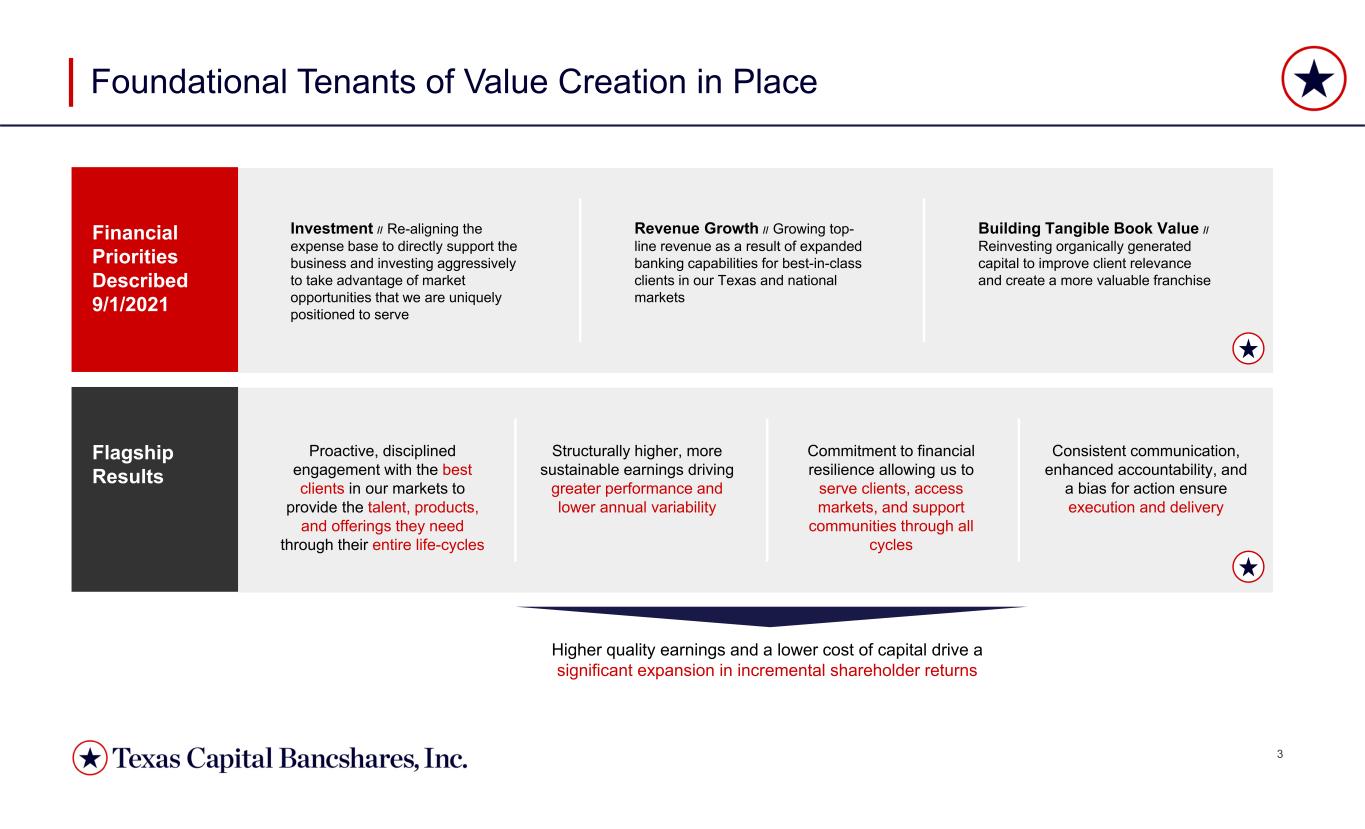
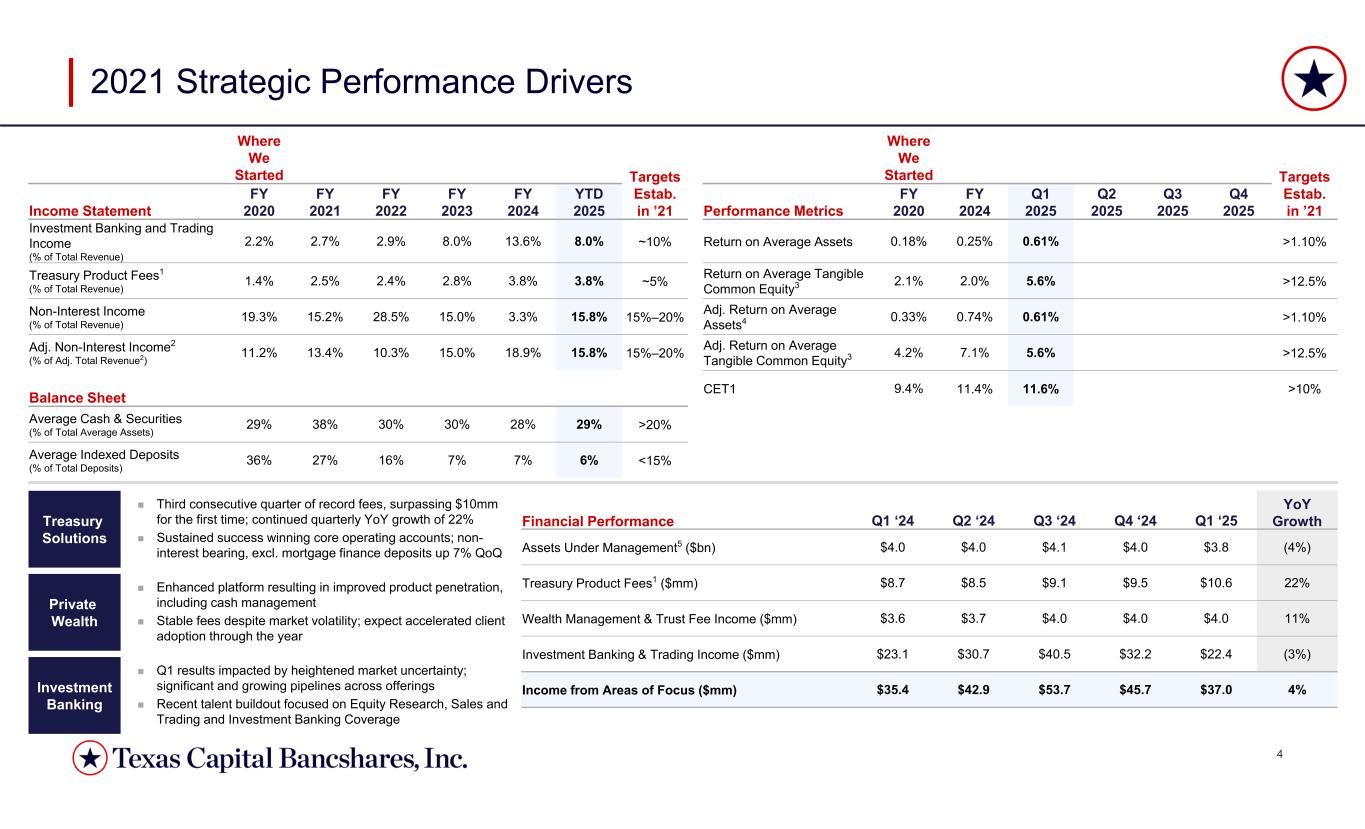
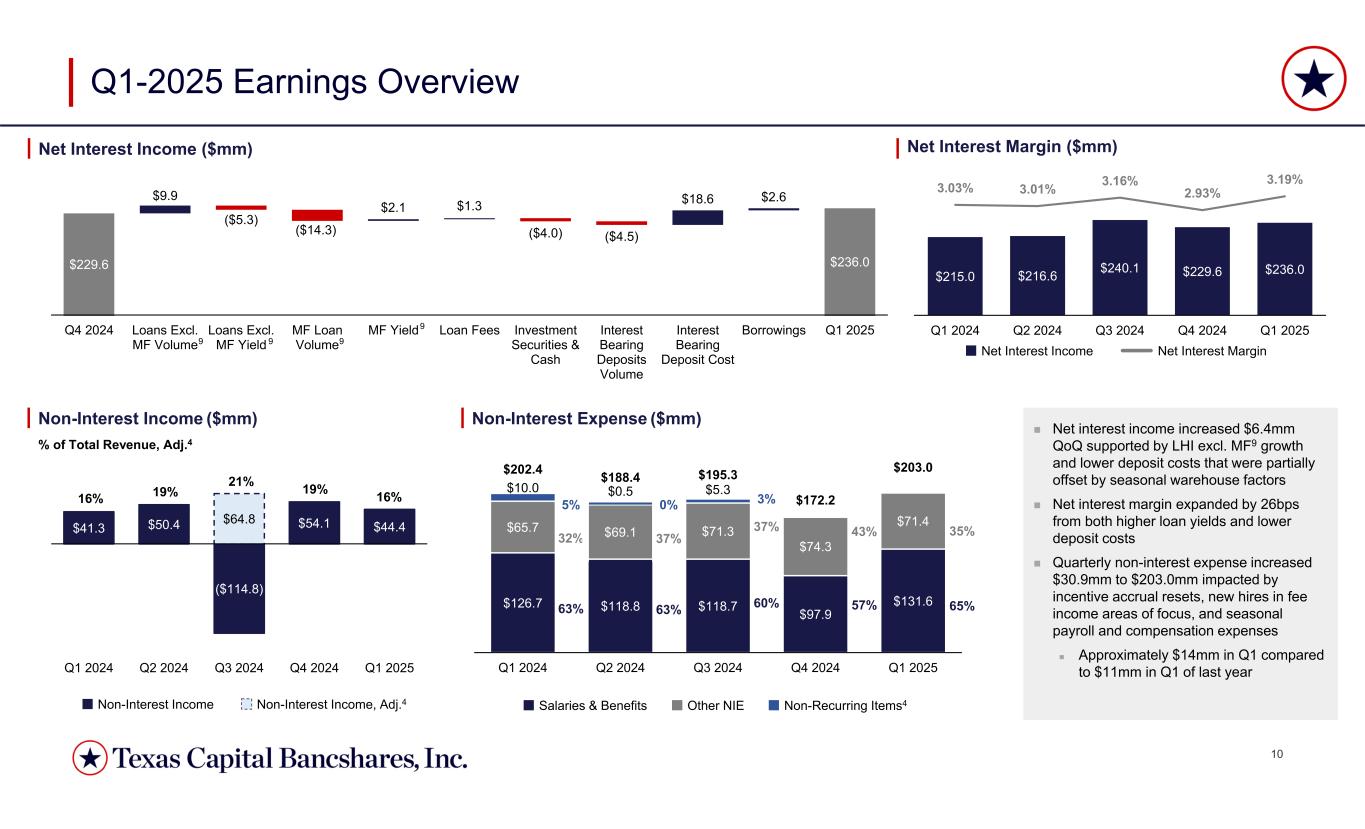
Thank you for joining us today. This quarter's results continue to evidence our clearly differentiated strategy and operating model. Contributions from across the firm enabled another quarter of strong financial progress, with year-over-year revenue growth of 9 percent, adjusted pre-provision net revenue growth of 21 percent, and tangible book value per share growth of 11 percent, which ended the quarter at a record high for the firm. The company also maintained its peer-leading capital levels with tangible common equity to tangible assets of 10%, while continuing to effectively support clients' growth objectives during the first quarter of the year. Earning the right to be our client's primary operating bank remains the foundation of our transformation, with sustained success again displayed by another quarter of peer-leading growth in Treasury product fees, which increased 22% year-over-year to a record high for the firm. non-interest bearing deposits excluding mortgage finance grew seven percent marking the firm's largest quarterly increase since 2021 and are up 11 since the first quarter of last year consistently increasing client relevance through both breadth of services and quality of advice continues to deliver a longer duration less rate sensitive deposit base further evidence this quarter by our ability to effectively reprice down our liabilities, supporting a 26 basis point increase in late quarter net interest margin and 10% increase in year-over-year quarterly net interest income. Looking ahead, we remain confident in our ability to deliver risk-adjusted returns consistent with our published targets. Deliberate actions over the last four years, purposefully positioned our firm to operate through any market or rate cycle with our financially resilient balance sheet, tailored coverage model, and breadth of products and services, enabling us to uniquely serve clients as they navigate this period of elevated macroeconomic uncertainty. Recent tariff actions and resulting volatility in the financial markets could manifest in changes to client confidence affecting hiring, capital investment, and M&A. To date, institutional debt markets are still functioning, albeit at higher costs. Banks are still aggressively competing for high-quality credits, and flows in our institutional sales and trading desks continue to grow in a consistent manner. Our perspectives are influenced by unique positioning as the only full-service firm headquartered in Texas with significant connectivity to small businesses through our top five SBA 7A lending program, our loan syndications team, which has reached as high as the number eight leader ranger in league tables for middle market loan transactions in the country, our extensive reach into institutional credit markets through more than $25 billion of leveraged finance transactions we facilitated last year, and our institutional sales and trading business, which now transacts with over 1,000 active accounts. You have often heard me say that we regularly prepare for a range of economic or geopolitical outcomes beyond the base case or consensus view. Strategically, that means operating without balance sheet concentrations, deploying products and services that allow us to comprehensively serve clients, and carrying liquidity, capital, and reserve levels that enable confidence and flexibility across a range of economic scenarios. We often refer to that as operating with a balance sheet and business model that is resilient to market and rate cycles. It is because of our deliberate preparation that we are confident about the future and expect to continue to onboard and serve the best clients in our markets. Thank you for your continued interest in and support of our firm. I'll turn it over to Matt to discuss the financial results.
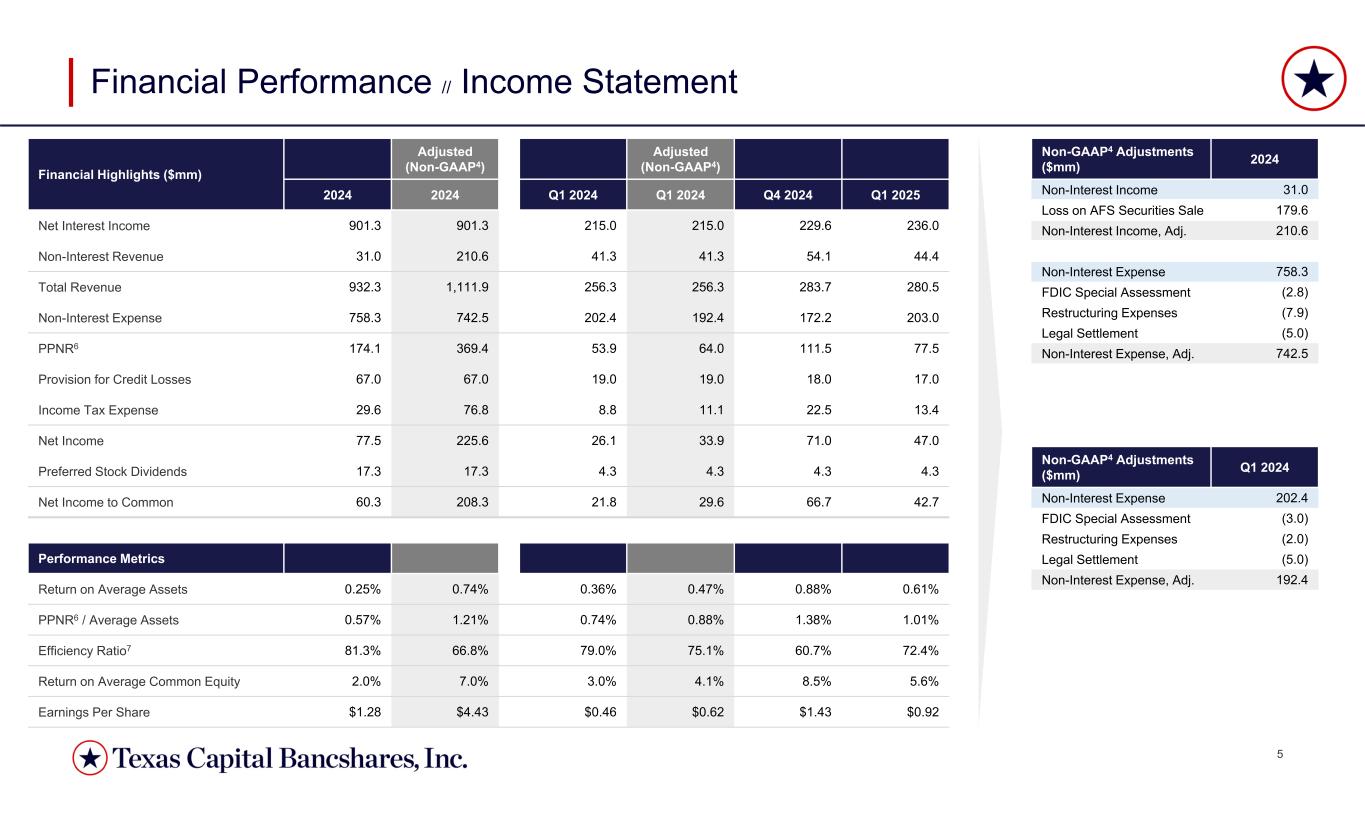
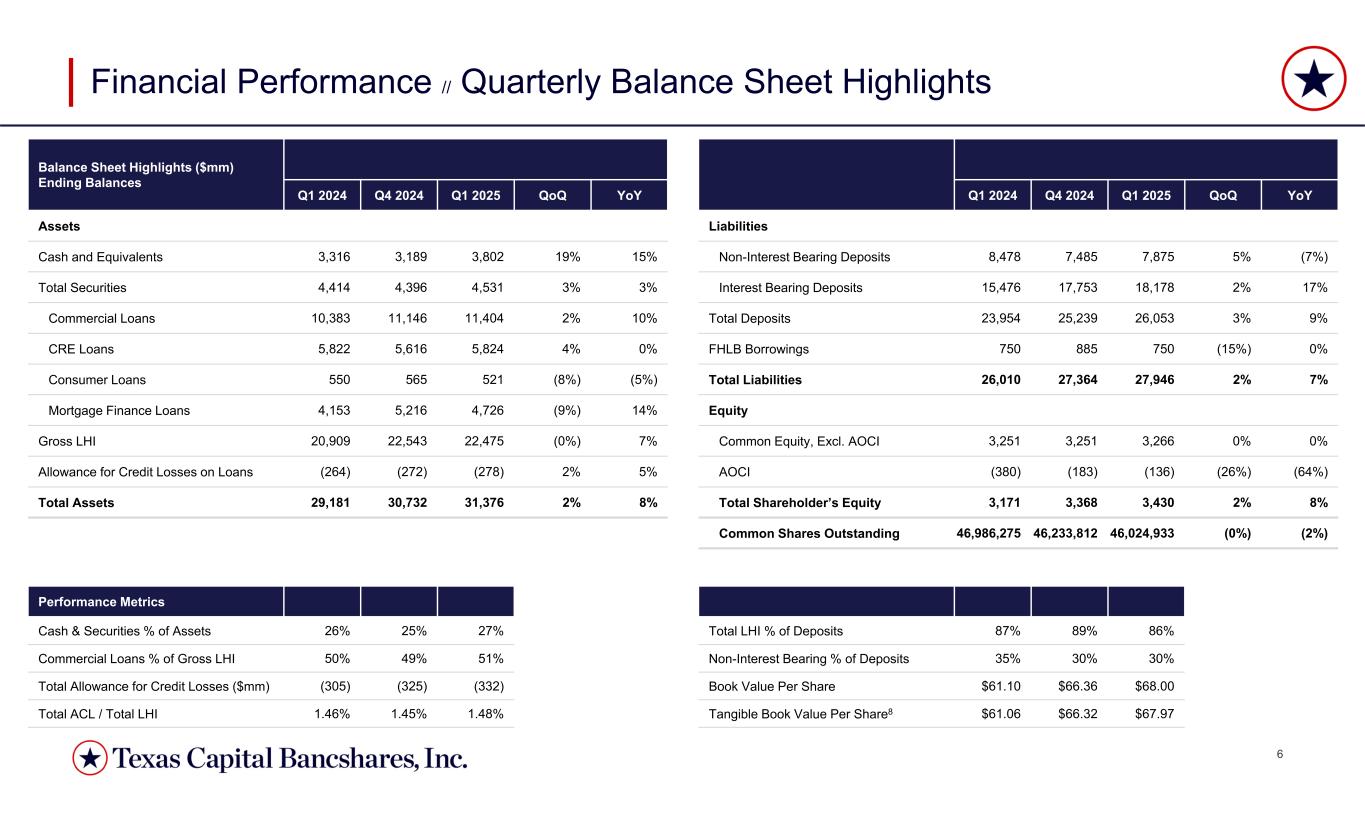
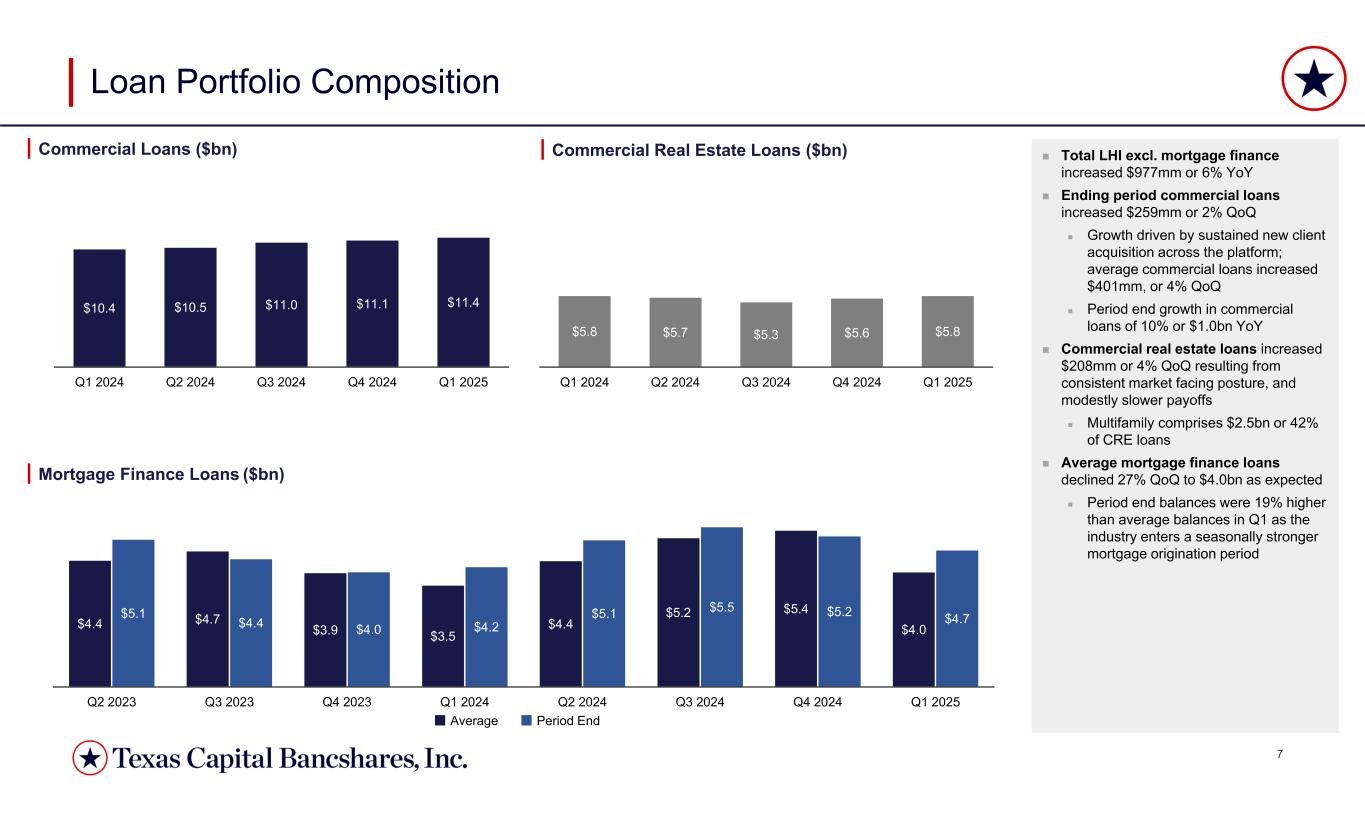
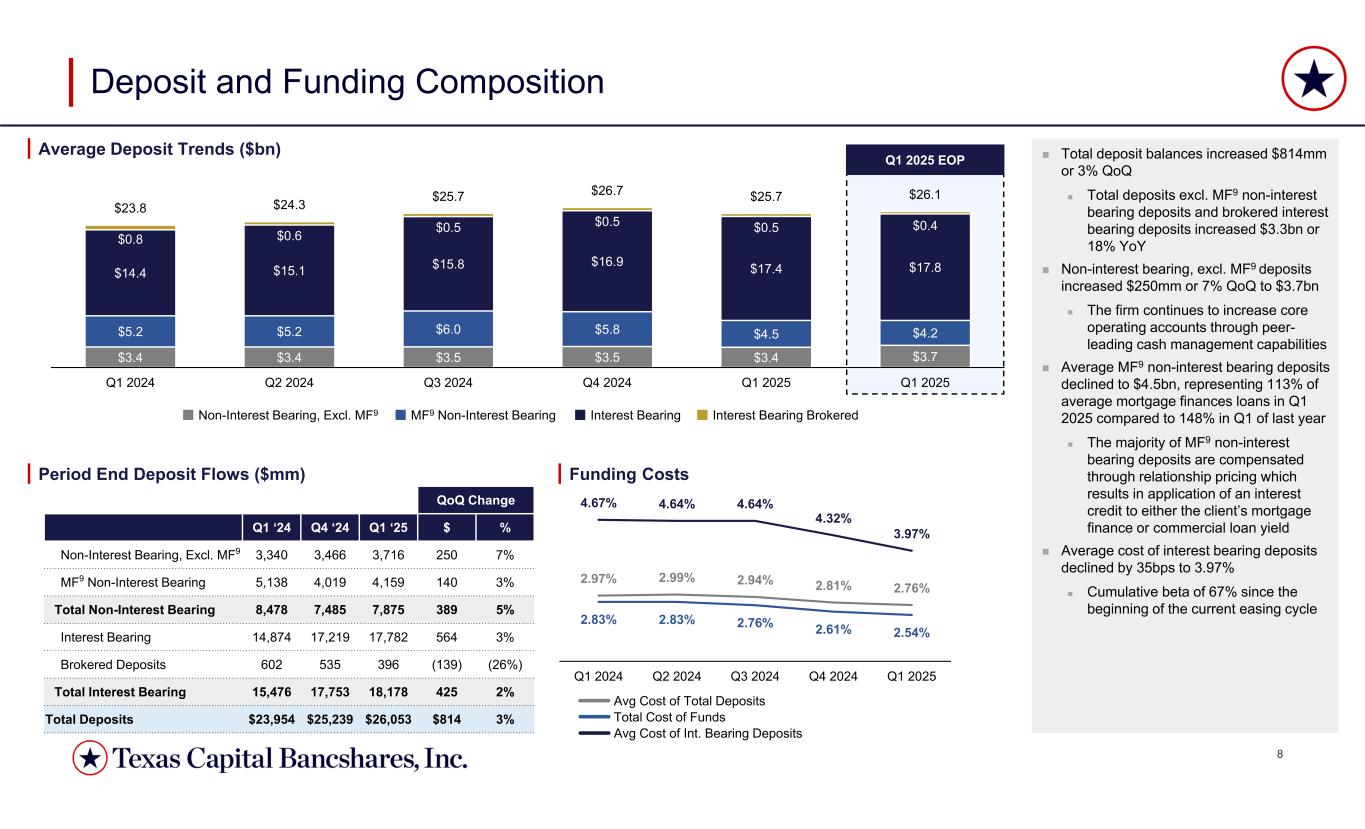
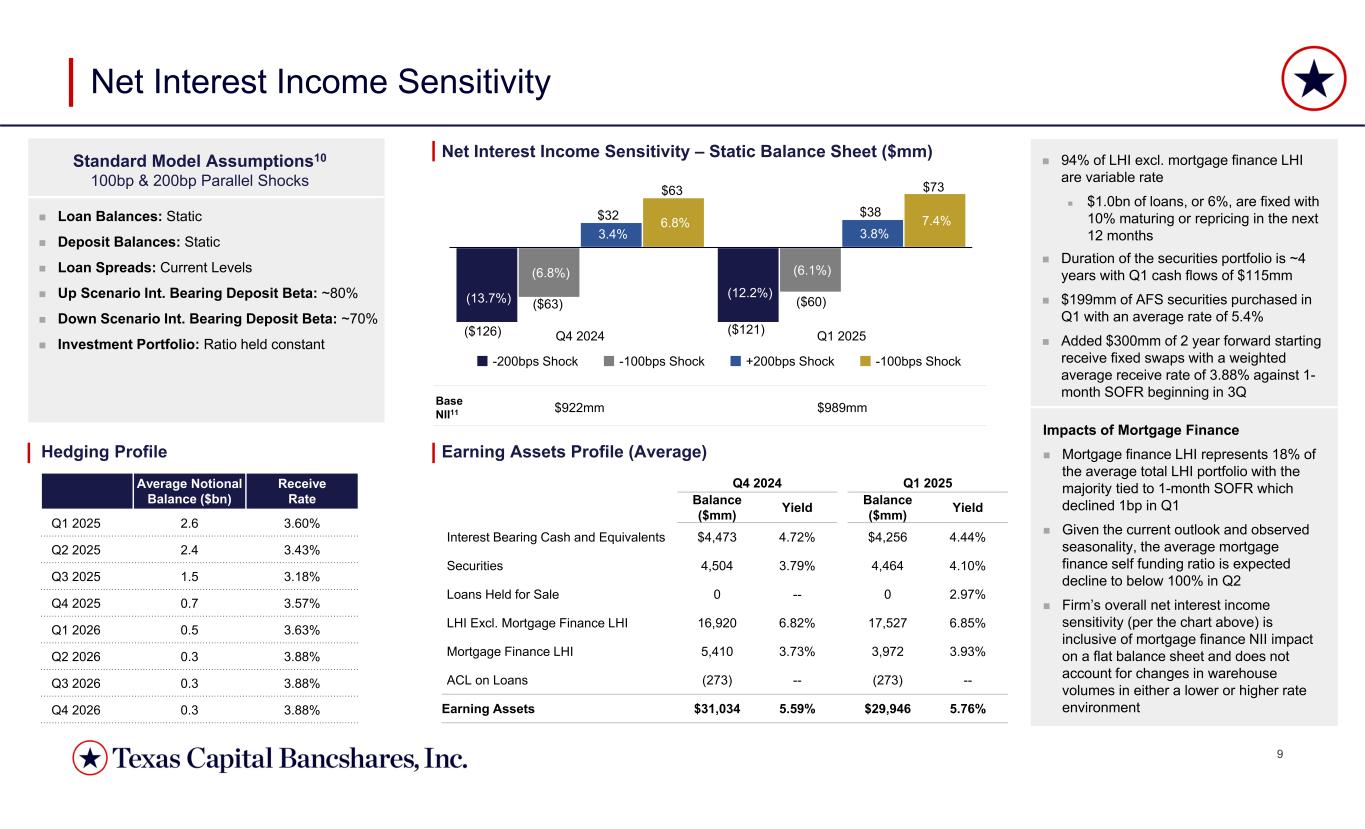
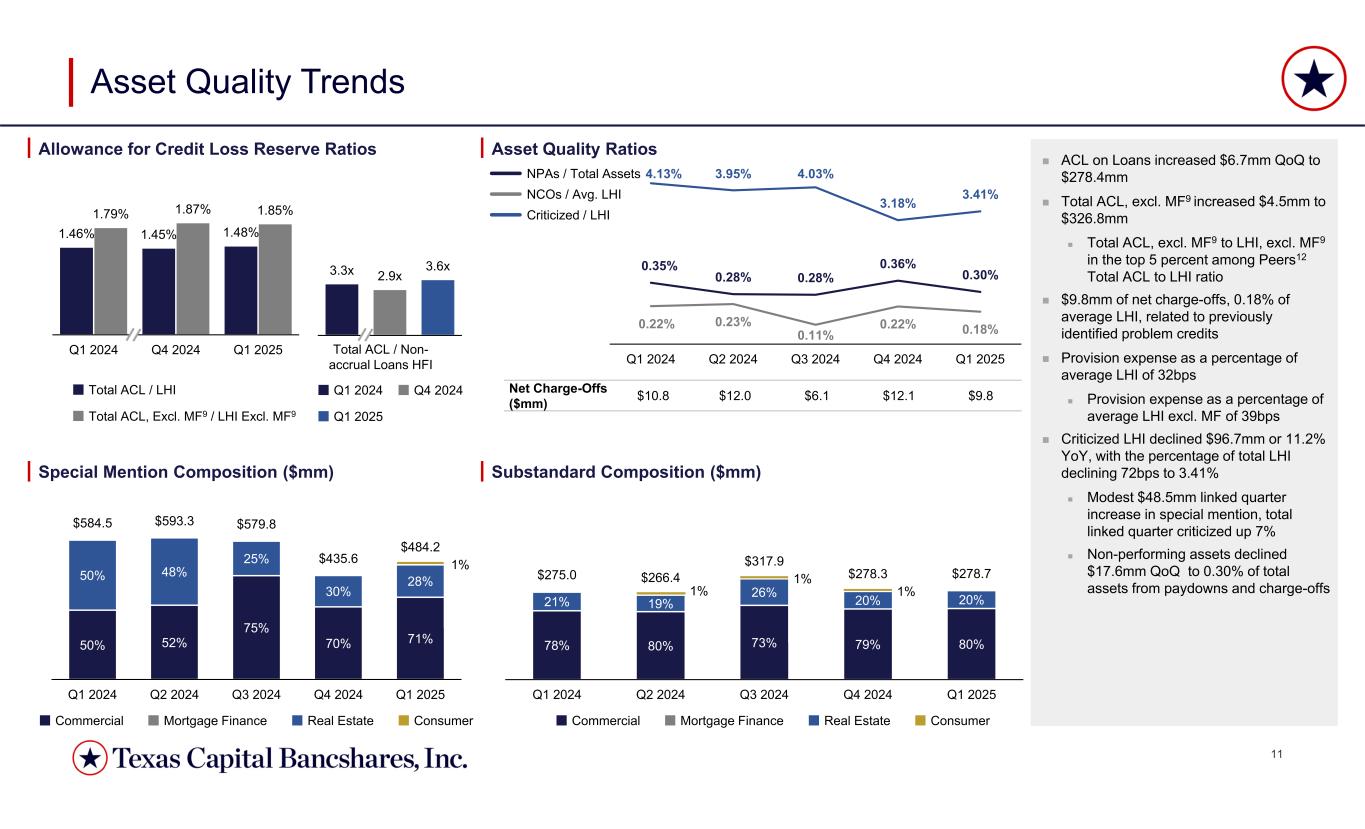
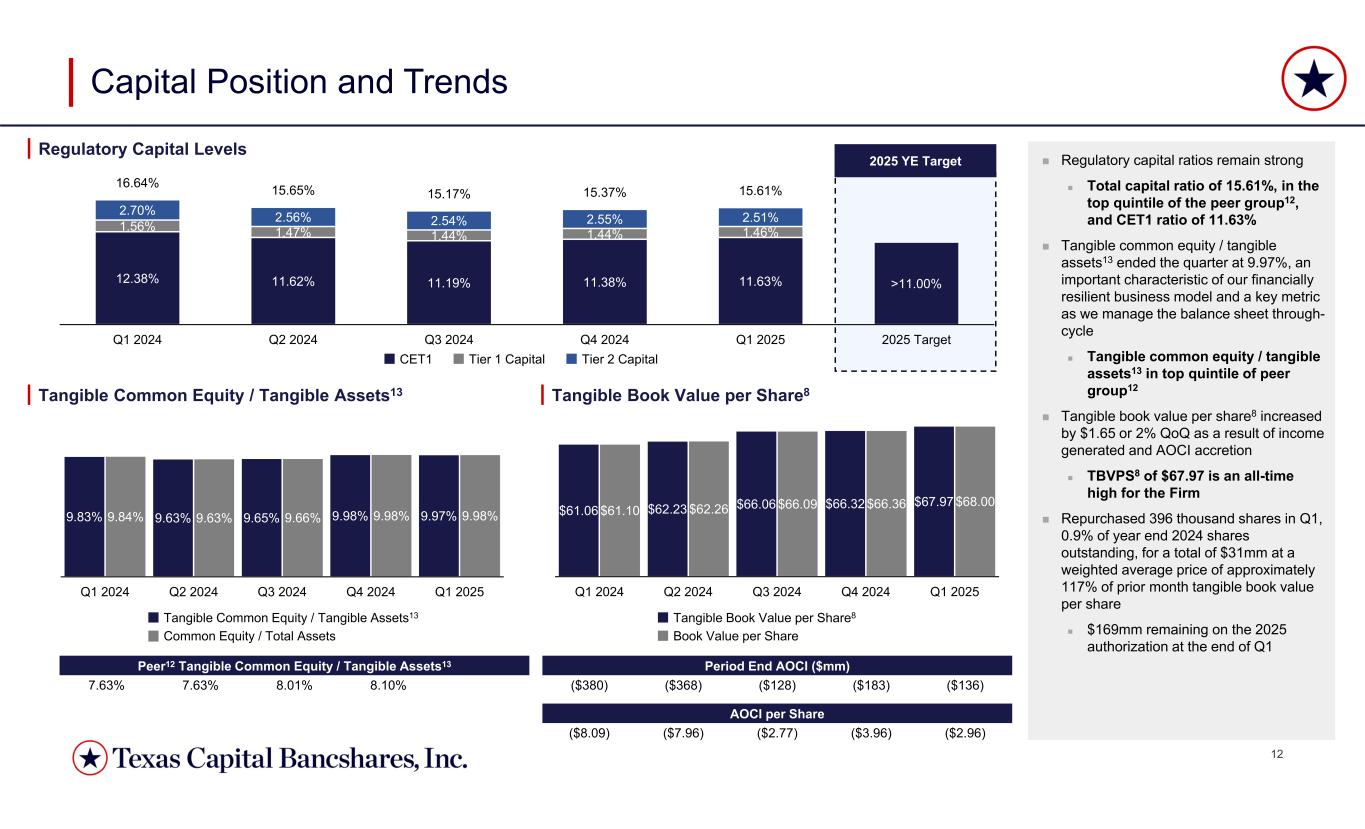
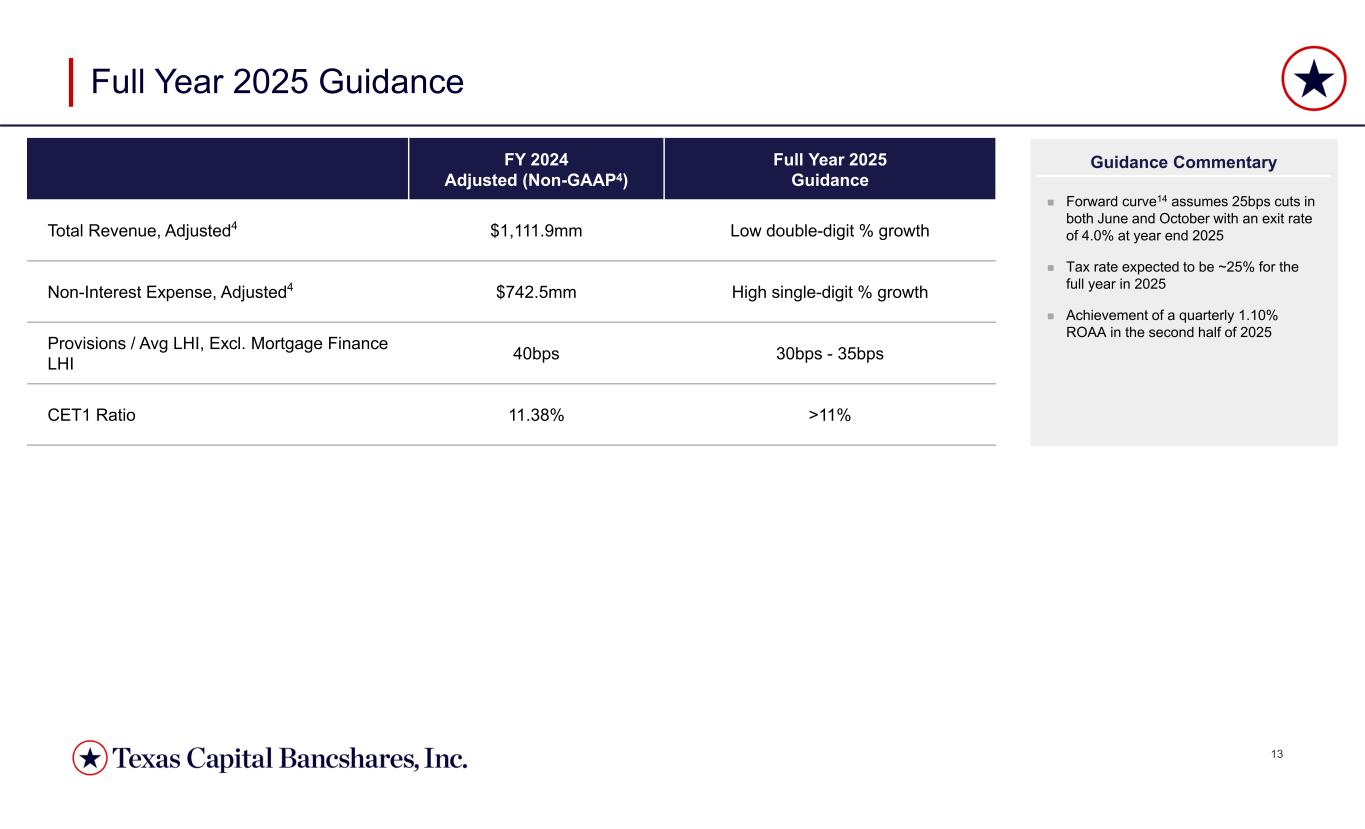
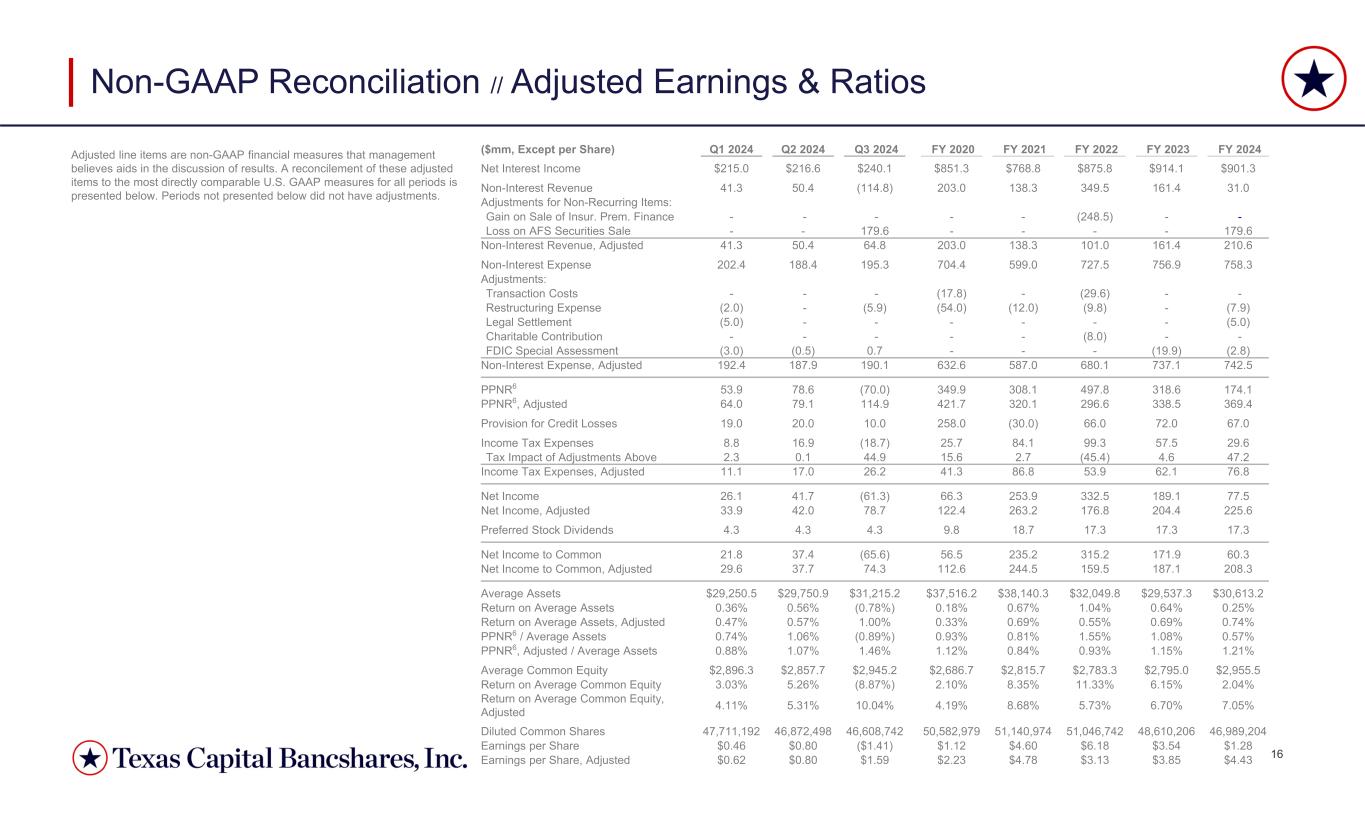
Thanks, Rob. Good morning. Starting on slide five, first quarter total revenue increased $24.1 million, or 9%, relative to Q1 of last year, supported by 10% growth in net interest income and 8% growth in fee-based Link quarter total revenue declined by $3.2 million, or 1% for the quarter, as a $6.4 million increase in net interest income was offset by a decline in fee revenue as mid to late-quarter capital markets uncertainty, limited pull-through of a strong and building investment banking pipeline. Total non-interest expense increased $30.9 million quarter-over-quarter due to $14 million of expected seasonal payroll and compensation expenses, resetting annual variable compensation accruals, and onboarding of previously discussed talent and fee-income areas of focus, particularly investment banking. Taken together, year-over-year pre-provision net revenue increased 21%, or $13.5 million on an adjusted basis, to $77.5 million, which should, as expected, represent the low point for the year. This quarter's provision expense of $17 million resulted from $422 million of growth in gross LHI excluding mortgage finance, $10 million of net charge-offs against previously identified problem credits, and our continued view of the uncertain macroeconomic environment, which remains decidedly more conservative than consensus expectations. The firm's allowance for credit loss increased $7.2 million to $332 million, finishing the quarter at 1.85% of LHI when excluding the impact of mortgage finance allowance and loan balances. Net income to common was $42.7 million, an increase of 44% compared to adjusted net income to common in Q1 of last year. This continued financial progress coupled with a consistent multi-year buyback approach contributed to a 48% increase in quarterly earnings per share compared to adjusted earnings per share from a year ago. The firm continues to operate from position of financial strength, with balance sheet metrics remaining exceptionally strong. Ending period cash and securities comprise 27% of total assets, as the firm continues to onboard and expand client deposit relationships while supporting their broad needs, including access to credit. These consistent client acquisition trends are increasingly resulting in risk-appropriate portfolio expansion, with ending period gross LHI balances excluding mortgage finance growing $422 million, or 2%, link quarter. Average commercial loan balances increased 4%, or $401 million during the quarter, with broad contributions across areas of industry and geographic coverage. And ending period balances now up approximately $1 billion, or 10%, year-over-year. Real estate loans also increased during the quarter of $208 million, and were flat to first-quarter 2024 levels, as new volume resulting from our consistent market-facing posture outpaced potential payoffs that could result should rates move lower. As anticipated, average mortgage finance loans decreased 27% link quarter to $4 billion, as quarterly seasonal home buying activity hit its annual low in Q1. Given ongoing rate volatility, we remain cautious on our mortgage outlook for the remainder of 2025, with full-year expectations for a 10% increase in average balances predicated on a $1.9 trillion origination market. Link quarter deposit growth of $814 million, or 3%, was driven predominantly by our continued ability to onboard and expand core operating relationships while serving the entirety of our clients' cash management needs. This was the third consecutive quarter of growth in non-interest-bearing deposits excluding mortgage finance, which increased $250 million, or 7% link quarter, to finish at their highest level since Q2 of 2023. Clients' interest-bearing deposit balances also continued to expand and are now up approximately $2.9 billion, or 19%, year-over-year. year. Our sustained success winning high-quality deposit relationships continues to enable maintenance of decade-low levels of broker deposits, and a slight reduction of higher cost deposits, we are unable to earn an adequate return on the aggregate relationship. This is in part observed in the ratio of average mortgage finance deposits to average mortgage finance loans, which improved to 113% this quarter, down significantly from 148% in Q1 of last year. We would expect this ratio to trend below 100% as loan volumes grow in the seasonally stronger second and third quarter. Our modeled earnings at risk were relatively flat quarter over quarter, with current and prospective balance sheet positioning continuing to reflect a business model that is intentionally more resilient to changes in interest rates. Improvements in rates fall earnings sensitivities were driven by adjustments and down rate deposit datas to better align with recent experience, and the addition of $300 million in forward starting receive fixed swaps that will become active in Q3. Given the volume of maturing swaps, we do anticipate future interest rate derivative or securities actions over the course of 2025, augmenting potential rates fall earnings generation at materially better terms than available during our deliberate pause through the mid part of last year. The total allowance for credit loss, including off-balance sheet reserves, increased $7 million on a link quarter basis to $332 million of $28 million year-over-year, which, when excluding the impact of mortgage finance allowance and loan balances is 1.85% of total LHI, two basis points below our high since adopting CECL in 2020. Despite a modest increase in late quarter special mention loans, criticized loans decreased 96 million or 11% year-over-year, supported by stable substandard loan balances and 8.5 million or 8% decline in year-over-year non-performing assets. We remain highly focused on proactively managing credit risk across a range of both macroeconomic and portfolio-specific scenarios, including those associated with a recent trade policy-induced market volatility, with our frequently discussed through-cycle approach centered on quality client selection, excess capital and liquidity, and consistently applied reserving methodology. Specifically, the firm has been focused on the effects of possible tariffs since late summer 2024, as the presidential campaigns were moving towards the November election, with initial emphasis on Canada, Mexico, and China. While too early to know the precise impacts of the April 2nd trade announcements, we remain confident in our routines to monitor and manage the portfolio while effectively supporting clients as they look to navigate considerable economic uncertainty. Consistent with prior quarters, capital levels remain at or near the top of the industry. Total regulatory capital remains exceptionally strong relative to both peer group and our internally assessed risk profile. CET1 finished the quarter 11.63%, a 25 basis point increase from prior quarter. Supported by continued strong capital generation coupled with effective implementation of the enhanced credit structures discussed last quarter for 15% of our mortgage finance loan portfolio. Our continued client dialogue suggests at least 30% of Q2 ending mortgage finance balances will qualify for the improved structure and associated reduction in risk-weighted assets. We continue to deploy the capital base in a disciplined and analytically rigorous manner focused on driving long-term shareholder value. During the first quarter, we purchased approximately 396,000 shares, or 0.86% of prior quarter's shared outstanding, for a total of $31 million at a weighted average price of $78.25 per share, or 117% of prior month's tangible book value per share. Turning to our full-year outlook, despite observed macroeconomic uncertainty, we are raising our revenue guidance to low double-digit percent growth. The higher end of our previously disclosed range is our ability to effectively serve clients across an increasingly broad platform should continue to differentiate in the market while providing revenue resilience across a wide range of potential scenarios. We're maintaining our non-interest expense guidance of high single-digit percent growth, which includes resumed progress associated with fee-based initiatives in the second half of the year. The full-year provision expense outlook remains 30 to 35 basis points of loans held for investment, excluding mortgage finance, which should enable the preservation of industry-leading coverage levels while effectively supporting our clients' growth needs. Taken together, this outlook suggests continued earnings momentum and achievement of quarterly 1-1 ROAA in the second half of the year. Operator, we'd now like to open up the call for questions.
Operator
Thank you very much. If you would like to ask a question, please press star followed by one on your telephone keypad now. Please ensure your device is unmuted locally. And if you change your mind or your question has already been answered, please press star followed by two. Our first question comes from Woody Lay with KBW. Woody, your line is now open. Please go ahead.
Hey, good morning, guys. Good morning. I wanted to start on the revenue guide and just wanted to better understand the motivation to now targeting the higher end of the range. Is that really being driven by NII? I mean, it was a nice NIM increase in the quarter, solid growth. Is that what is driving the higher revenue guide?
Yeah, you got it, Woody. So we noted on the first quarter call that we could move to the higher end of the revenue guide if we saw interest range 60 prior to the mid part of the year, ultimately go higher than 60 for comparable loan growth to last year. and if we suspected that average mortgage finance volumes could be up 10% for the full year. So those are the general components that we outlined that would move us to the higher end. Those are obviously all things that have either already just will. There is no question that that net interest income improvement that you cited could potentially be partially offset by decreases in fees, but as noted in both my comments as well as Rob's, the majority of the transactions in our investment-making pipeline haven't been canceled. they've just been delayed. So if we get to the second half of the year and those transactions do start to fall away or push into 2025, you'll see a start to adjust down the expense outlook to reflect lower fee-based incentives. But at this point, feel pretty confident in the ability to deliver double-digit growth and revenue across a pretty wide range of economics.
Got it. Yeah, that's great to hear. Maybe shifting over to loan growth in the pipeline, You know, it was a really strong growth quarter in the first quarter. How's the pipeline shaping up into the second quarter? And are you seeing the macro uncertainty, you know, impact clients' demand for loans at this point?
Yeah, I note that along with the consistently growing and improving deposit franchise, we do continue to fill clients' capital needs through a variety of channels, which includes access, sustained client acquisition trends, coupled with multiple quarters of slowing capital recycling. That's what supported the $422 million or 10% annualized increase in LHI this quarter. Pays continuing, notably potential CRE for onboarding new C&I relationships at this point.
Got it. And then last for me, I wanted to touch on the buyback.
It was great to see you all active again in the first quarter. you know obviously with the market pullback that stops this stock is a little bit cheaper today so how are you thinking about forward buybacks from here yeah say that we're pretty boring on this topic there's no change in capital priorities we rely on the exact same highly disciplined approach to allocation that you've seen us employ since times like this precisely why we choose to carry to your point the stock's clearly trading below levels where we've previously we've been comfortable buying back shares and alongside opportunities for new client acquisition, it's like we've got multiple compelling options for near-term capital deployment. I call out that further supporting the optionality is a success that we've had implementing the enhanced credit. So we noted in the prepared remarks that as of 331, we had 715 million or 15% of clients that have moved into that structure, which reduced their risk weighting from 100% to 26%, resulting in a 21 basis point increase in regulatory capital. I suspect we can get that number to 30% of ending period Q2 warehouse balances, near 10% tangible common equity, a lot of new client acquisition, and building regulatory capital.
Yep. Thanks for taking my questions.
Operator
Thank you. Our next question comes from Ben Gerlinger with Citi. Ben, your line is now open.
Please go ahead. good morning uh when you guys i think you said the commentary for clients especially the investment banking isn't that things are canceled that they've been pushed is there something that they're looking for either economically or political clarity that they're citing most i'm just trying to think like the rate of change it seems like every bank has said client activity slowed a little bit since liberation day but all is equal You're still thinking it's a healthy economy. I'm just kind of curious, is there any sticking points specifically because you do because it's kind of new or budding investment banks that are seeing success? I'm just kind of trying to look, what are they looking for?
They're just looking for certainty. It's very, very hard to project financial forecasts in a world of as great uncertainty as we have today. Uncertainty is the great killer of all deals. You have, like we said, the debt markets are functioning, but if you don't have to go in periods such as this, then you don't go. The only people going are people that have to, and they'll do it at wider spreads than maybe necessary or previously they could have achieved before what you call Liberation Day. So I think the uncertainty index that people keep referring to is very, very real. We had low single-digit millions of investment banking fees fall away that won't come back. But the rest of the pipeline, like Matt suggested, was pushed out. It's really hard for a CEO or a board to do something strategic in an environment such as this. It's also not a great time to refinance or plan capital investment or build your inventories until you know what the economic environment is going to be going forward.
That's helpful. And then- Yeah, a long way of saying it's a lot of factors. You're right. No, no, no. I'm just more of something- you answered it well, Rob. I appreciate that. I'm just more of something just kind of anything specific. But it's a tough environment for certain, too. So not lost on me. So when you look at loan yields and securities yields, they're up linked quarter. I mean, is this trend continue? I just wanted to double-check on everything that you guys have done. Is there anything idiosyncratic that within those this quarter would have inflated it more than normal?
You had the full-quarter impact, Ben, of the mortgage finance deposit repricing back end of last year. So there's a couple of months delay before that ultimately shows up in loan yields attributed to the mortgage warehouse and about 42 commercial loans to mortgage companies. but aggregate yields as well as spread on the securities portfolio. We've got around $120 million a quarter of cash flows, 0.3%. That obviously changes every single day. You can expect to see us continue to do that.
Maybe the one other thing I would say, the compilation included two dissipated NII.
Operator
Our next question comes from Brett Rupperton with Hovda Group. Brett, your line is now open. Please go ahead.
Hey, good morning. Wanted to ask about mortgage finance. And, you know, the mortgage finance business is obviously competitive, but, you know, it seems like you guys might have taken some share this quarter. Any thoughts on market share gains this quarter and just what you're trying to get with that business relative to maybe the top five in the space.
Thanks, Brett. We landed full year on ending period balances, which was the impact of rates moving down and call it mid-February. There's a 40-day or so last ultimately show up as warehouse balances. We still sit around 5% total market share, which is where the guide suggests the $1.9 trillion origination market, market, which is predicated on 30-year fixed-rate mortgages between 6-8. If we see that, then we expect some full-year average balances. Thinking about Q2, around $5.2 billion of average balances, and then we noted in the commentary continued reductions, which is quite a self-funding ratio move from 113% to somewhere closer to 95%. And the last comment I'd make on that is, although it's steady market share, we continue to do more with Our ability to effectively help them hedge their portfolios, help them through portions of their wallet are things we've worked quite hard on over the last few years. The holistic offering to mortgage finance clients that generates much higher return on equity than we've had historically.
I would just emphasize the last part of Matt's comments. We are not focused at all on market share in mortgage warehouse. The mortgage warehouse balance is a result of our clients' needs that we are focused on in that space. and so we're focused on the very best clients in the mortgage origination space and if that's their need that's the result in the warehouse and i think you could further probably project that or assume that there'll be a time that if you don't convert to the sbe structure in the warehouse that you may not be a client of the firm because that's where we're going because of the better capital treatment uh and all the different things that we do with those clients it's more of a vertical than a warehouse okay that's great color on that um you know and then you obviously changed
the the revenue guidance to be more optimistic on nii and you took away the the fee income guidance of 270 million for the year you know if if you were to think about the pipeline for um investment banking from here, is it changed relative to previously, or is it just the uncertainty that's kind of driving the near-term quarter lower?
I would just say it's growing, it's granular, it's been pushed back. So it's changing in a constructive way, not a different way. But to the question earlier, just the uncertainty, it's really, really hard to transact a this moment.
The only thing I'd add, I'm much more heavily weighted now to the banking fees. So the number of transactions and the pipeline drop point continues to increase. The awarded mandates and M&A folks have just put on a year, but it isn't.
Which is no different than the other banks reporting so far.
Okay, great. Appreciate the call, guys.
Operator
Our next question comes from Michael Rose with Raymond James. Michael, your line is now open. Please go ahead.
Hey, good morning, guys. Thanks for taking my questions. Just wanted to see if I could get a little color on the increase in special mention loans this quarter. And then to the extent that you can, what are some of the industry sectors that you'd be more worried about in your markets as it relates to tariffs. Thanks.
Happy to address that, Michael. So Rob re-emphasized in his opening remarkums that are considerably more stressful than a consensus view. And as you know, those scenarios are directly connected to current and prospective balance sheet positioning. We also noted that we entered the period, in our view, well-equipped to arrange a potential economic outcomes, and that we began specific preparations for changes in global trade policy late in the summer with a particular focus on implications for changes in policy with Mexico. The current assessment indicates areas worthy of heightened monitoring are infrastructure and logistics, as well as just general manufacturing within CNI. We also remain focused on commercial clients that serve the low end of the consumer markets, where you could see increases in prices put additional stress on those consumers. I'd say importantly, none of those segments on their own comprise more than 1% to 2% of the overall loan portfolio. And then the last point I'd make on credit is that our multi-year reserve bill that has relied on a set of economic assumptions materially more conservative than a consensus, which, alongside our observed performance in the portfolio, suggests the full-year outlook stills 30 to 35 basis points of provision relative to LHI, excluding mortgage finance.
Very helpful. I appreciate the color. Just switching gears to fees, just on the Treasury solutions, you noted that kind of a record quarter for the third quarter in a row.
Can you just give some color on the outlook there and why the growth has been so strong? and then just separately on private wealth it does say in the slide deck that you kind of anticipate improved kind of penetration as the year goes on so just some color in those two areas would be helpful thanks yeah michael what i what i would say about treasury and if this is redundant apologize so it's 20 up 22 percent year over year that's all products and services cash pay cash payments is up 11 so that doesn't include fx or merchant or corporate card It's just the payments and receivables of our clients, if you will. That is really, really strong. That business grows GDP or less for most banks, and this is eight straight quarters of three times market rate of growth. So there is congedient momentum, and it's very simple. It's in our DNA now. Our bankers don't talk about deposits. They don't go talk to their clients about, can we make you a loan or can you give us a deposit? We go talk to our clients about solutions. And it could come in any form of debt, private credit, bank debt, institutional debt, what have you, equity or the like, converts, et cetera. So when you go talk to your clients about solutions, you add more value. You're more likely to become their primary bank. That comes with operating accounts, and so you see the cash fees go up like they did. I would venture to say that we have the only institutional sales and trading floor in America that sells treasury services. We all know that's the health of the bank. We are astute on the products and services in that space. We add value to our clients, reducing working capital and improving their operations and also making it safer and de-risking. And it's easier. We developed through our own technology platform an onboarding platform called Initio that we talked about in the past. It was easier to onboard operating accounts here when clients onboard an incremental account. They choose us other than a secondary or third bank because it's more simple. And then if you go talk to our clients, they feel very safe and sound with our capital and our equity to give us all their primary operating business. So I would say it's because it's in our DNA. I hope I explained that correctly. On the Treasury side and on the wealth side, we're behind in wealth. It was hard for us to go all in on wealth. We got a lot better. We have really good people. We have really good investors. We have a great go-to-market strategy. We have great clients, but they were burdened with a lesser platform. That platform was put in place fourth quarter of last year for new clients, kind of the first quarter of this year for current clients. that migration will go through the back half of this year, migrating our legacy clients onto the new platform. And what I mean by that is it's the digital journey of our wealth clients. So now they have a digital journey of their everyday operating accounts, if you will, with their investments and with their money transfer, et cetera, that you'll see at a money center bank. It's not an inferior client journey anymore. So now that we have an on-par, better client journey than most banks with really good investors and really good performance and talented advisors, we expect to make real progress in the wealth business moving forward, and we can get totally behind it.
Thanks, guys. I appreciate the color and candor. I'll step back. Thanks, Michael.
Operator
Our next question comes from Anthony Elian with J.P. Morgan. Anthony, your line is now open.
Hi, everyone. Matt, you mentioned the prepared remarks, the anticipated future rate derivative or securities actions you plan to make sometime this year to potentially offset falling rates. Can you just provide a bit more color on on this and the timing of it, and if it's included in your revenue outlook as well?
It is included in the revenue outlook, Tony. We added $300 million of two-year forage starting receipt fixed swaps this quarter. That obviously impacts the 12-month IR sensitivities, but what also impacts is that sensitivity is being more effective in repricing down our liabilities. So, the sensitivities were previously modeled at a 60% interest rate deposit data, we move that up to 70%, which we expect of the year. We've got about 500 million of prime swaps that mature in Q2, and then a billion and a half of SOFR swaps that mature in the third quarter. So we do, in the outlook, expect to try to manage our balance sheet duration to a similar position to where we are today. You also see a selectivity, as I mentioned earlier, add to the securities portfolio. So we push to buy four. We expect to continue to manage that portfolio.
Thank you. And then on the enhanced credit structures you first outlined last quarter and the benefits to RWA. So you've implemented, I think you said, 15% on the mortgage finance loan portfolio, and then that could be at least 30%. Is the timing of that in the second quarter, or is that more of a second half of your event when you'd expect to be implemented on the 30%?
Yeah, we would expect that 30% of ending period balances in the Q2 are in the structure. And just to risk waiting for those clients to move from 100% to 26%. So the 15% RDN has created 21 basis points of regulatory capital. Great.
Operator
Our next question comes from John Arpstorm with RBC. John, your line is now open. Please go ahead.
Thank you. A couple questions for you. Just on uncapped markets, is there a way to size the pipeline relative to where it's been historically?
We entered the year with 2x the M&A pipe that we had entering the previous year. That's up 50%. The capped markets pipe is larger at this point in 2025 than it was at this point in 2024. We've onboarded a large quantity of new investment banking talent, starting in the back end of Q4 through Q1. We talked about that a lot on the last call, that our increase in full-year non-interest expense guide was primarily related to adding new talent and fee-income areas of focus, which includes Treasury, but it's heavily weighted toward investment banking. So, John, I think all those factors suggest a really healthy business, And although the timing is somewhat difficult to predict, a lot of momentum as you move into the second half of the year.
This is an annoying question for you guys, I know, but just the 1-1 ROA level, I'm not too hung up over it. I think it's time rather than timing, but what's different in the P&L later in the year to get there? Is it just your last answer? Is it the banking and treasury fees and maybe a little better non-interest bearing? Is that it or is there something else we're missing?
We think there's a lot of balance sheet momentum as well, John. And we've said for a long time that we're generally product agnostic. We want to show up and serve clients in a way that best fills their needs, not ours. P&L geography was not our primary concern. It was more onboarding the right relationships and serving them for the entire of their life cycle. The current outlook suggests a lot of momentum in balance sheet and a lot of associated momentum in NII. So, PPNR this quarter is obviously going to be distorted by day count, so that's roughly $5 million of pre-tax income, as well as the seasonal comp and benefits expense, which this quarter was $14 million. So, that's another $20 million of PPNR in a seasonally slower quarter for us. and that you should think about as you look toward the back half of the year and achievement of the 1-1.
Rob, I want to say... Yeah, go ahead.
No, I was just going to add. Look, I think it's... Matt said it well for modeling purposes, but what I would just say is it's the improvement of the entirety of the balance sheet and income statement. We are now viewed very differently in the marketplace as a firm than we were before. three years ago, four years ago, and certainly before I got here, we did not have the right client selection. Those clients banked with us because of rate, not because of value that we brought to them. That is no longer the case. We can't compete on them now. We expect to compete on them now, and our best clients appreciate. We may show up with an investment banker on a deal that the deal was pushed because of the uncertainty we talked about, but because you bring that advice and you're there frequently and you're highly valued, they don't care about rate nearly as much. And so I don't see any stop to that improvement over time. And then you have fee growth on the other parts of the firm, and you have credit that looks really, really good. You know, we've got peer leading and industry leading provisions from since I got here and criticized loans are down 11% year over year and we feel really, really good. And that's primarily driven by client selection. So I think it's a combination of the entirety of balance sheet income statement, client selection, and improvement of our ability to operate and gain efficiencies.
Got it. And then I wanted to say this last quarter, but I want to congratulate you on the chairman title. And just curious if anything changes from your point of view with you adding that incremental responsibility.
Thank you, John. I think a lot changes. It comes with a lot of responsibility. But it also, nothing changes. So Bob Stallings went from chairman to lead director. The lead director is very important here, like any public company, and so it's kind of a title, but it's not. What it'll do is, look, I've got to shape the board. I've got to lead the board. I'll have much more of a say in who's on the board, what the board focuses on, et cetera, but I'm really excited about Stallings staying as a lead director, and I have an immense amount of respect and appreciation for him doing so.
Thank you, guys. Thank you very much. Thank you.
Operator
Our next question comes from Matt Olney with Stevens. Matt, your line is now open. Please go ahead.
Thanks, Guy. Just want to follow up on the mortgage finance self-funding ratio. I think Matt said 95% in the second quarter. Just remind us of the driver of that, and could we see further improvements throughout the year, or did you just make some adjustments in the first quarter? we'll see the full impact in 2Q.
Yeah, we think $5.2 billion of average warehouse loan balances, $4.9 billion of average mortgage finance deposits. So, Matt, we talked a bit earlier about services that we can offer those clients, as well as the pretty significant growth side of that area. So, we've talked, I think Rob articulated the growth in commercial non-interest bearing up 7% in late quarter, 11% year over year. But we also have material growth in interest-sparing deposits with our core commercial clients. And we're up 3.4 billion or 26% year-over-year in interest-sparing deposits, excluding brokered and excluding institutional index. That's while pushing the interest-sparing deposit beta is up to 67%. So we look across the franchise at relationships where we're unable to earn an acceptable return on the aggregate relationship. there's an ample of those that resided in the mortgage finance business where we were paying outsized rate for deposits. And over the last year or so, we've been selectively reducing those where we couldn't earn the right to do more business with those clients. So you should see us move below the 100% self-funding ratio in the second and third quarter as warehouse balances move higher and then likely stay a hair below that even in the fourth quarter.
So it's just reflects it's just a reflection of growth elsewhere on okay thanks for that Matt and then um one more question the the hedge impact in the quarter we just saw in one queue didn't see news closure didn't know if you saw what the hedge impact was to the NII in the first quarter it's coming down materially Matt I mean you're going to see the remainder of the hedges generally roll off by the end of the year with the big slug like I said yeah okay thank you You bet.
Operator
Our next question comes from Jared Troll from Barclays. Jared, your line is now open. Please go ahead.
How should we think about sort of the pace of timing of getting to the 11% CET1? Is that just sort of consistently through the year, or do you feel that there's an opportunity to maybe accelerate that earlier? earlier.
Jared, the 11 percent isn't meant to suggest that we would push it all the way down to 11 percent. You should more think about that as a floor. So, we've talked, I think, quite frequently about what we believe is a real competitive advantage of operating with the most capital, in particular the most TCE. So, I don't know that I would look for us to push it all the way down to 11. That just more indicates the amount of flexibility that we have near term. If you look at all the metrics that we put out on September 1st, 2021, the only metric that we backed away from is the C2-1 guide. So we originally had that going down to 9% prudent to now operate with materially higher levels of regulatory capital and, again, focus on real losses over in capital and TCE.
Okay. All right. Got that. Thanks. And then just a little bit of follow-up on Matt's question from before. I guess the hedge costs are $12.5 million in fourth quarter. Do you have the actual number for first quarter?
It should be around $8 million.
All right, thanks. And then just finally, when we look at the 1-1 ROA target or goal, is that before or after preferred dividends?
That's all in 1-1 ROA as reported. There's no gimmicks associated with it. Okay, all right.
So that's after paying the preferred dividends.
Before paying the preferred.
Operator
Thank you very much. We currently have no further questions, so I will hand back to Rob Holmes for any closing remarks.
Just grateful for everybody's interest in the firm and look forward to the next couple of quarters. Thank you.
Operator
Thank you very much, everyone, for joining. That concludes today's conference call. You may now disconnect your lines.