Operator
Thank you for joining us for the V2X Fourth Quarter and Full Year 2025 Earnings Conference Call and Webcast. Today's call is being recorded. My name is Gary, and I'll be the operator for today's call. At this time, all participants have been placed in a listen-only mode. Following management's presentation, I will open up the call for a Q&A session. To ask a question, you may press star, then 1 on your telephone keypad. If you withdraw your question, please press star then 2. And now I'll pass the call over to your host, Mike Smith, Vice President of Treasury, Investor Relations and Corporate Development at V2X. Please go ahead.
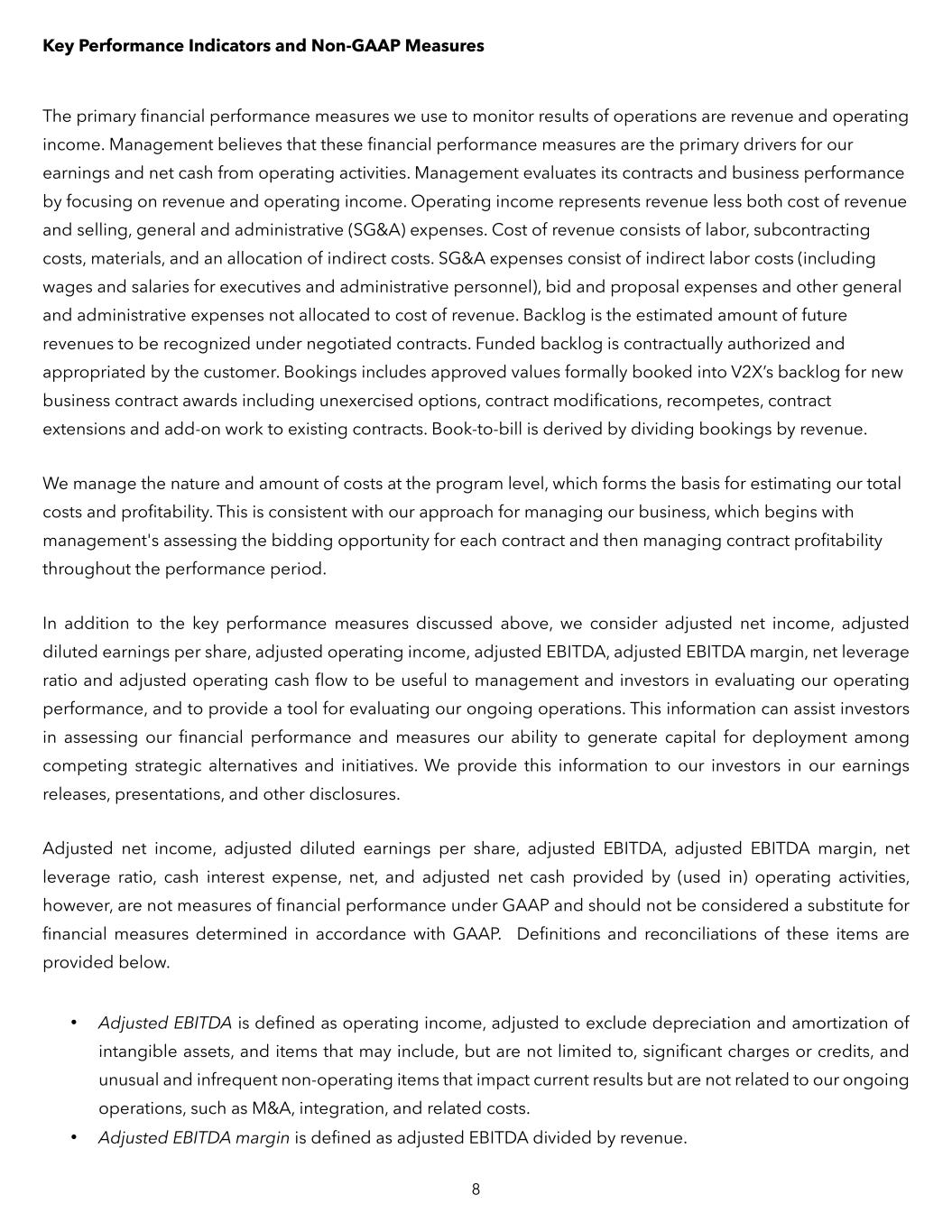
Good afternoon, everyone. Welcome to the V2X fourth quarter and full year 2025 earnings conference call. Joining us today are Jeremy Wenziger, President and Chief Executive Officer, and Sean Morrell, Senior Vice President and Chief Financial Officer. Slides for today's presentation are available on the Investor Relations section of our website, gov2x.com. Please turn to slide two. During today's presentation, management will be making forward-looking statements pursuant to the safe harbor provisions of the federal securities laws. Please review our safe harbor statements in our press release and presentation materials for a description of some of the factors that may cause actual results to differ materially from the results contemplated by these forward-looking statements. The company assumes no obligation to update its forward-looking statements. In addition, in today's remarks, we will refer to certain non-GAAP financial measures because management believes such measures are useful to investors. You can find a reconciliation of these measures to the most comparable measure calculated and present it in accordance with GAAP on our slide presentation and in our earnings release filed with the FCC, both of which are available on the investor relations section of our website. At this time, I'd like to turn the call over to Jeremy.
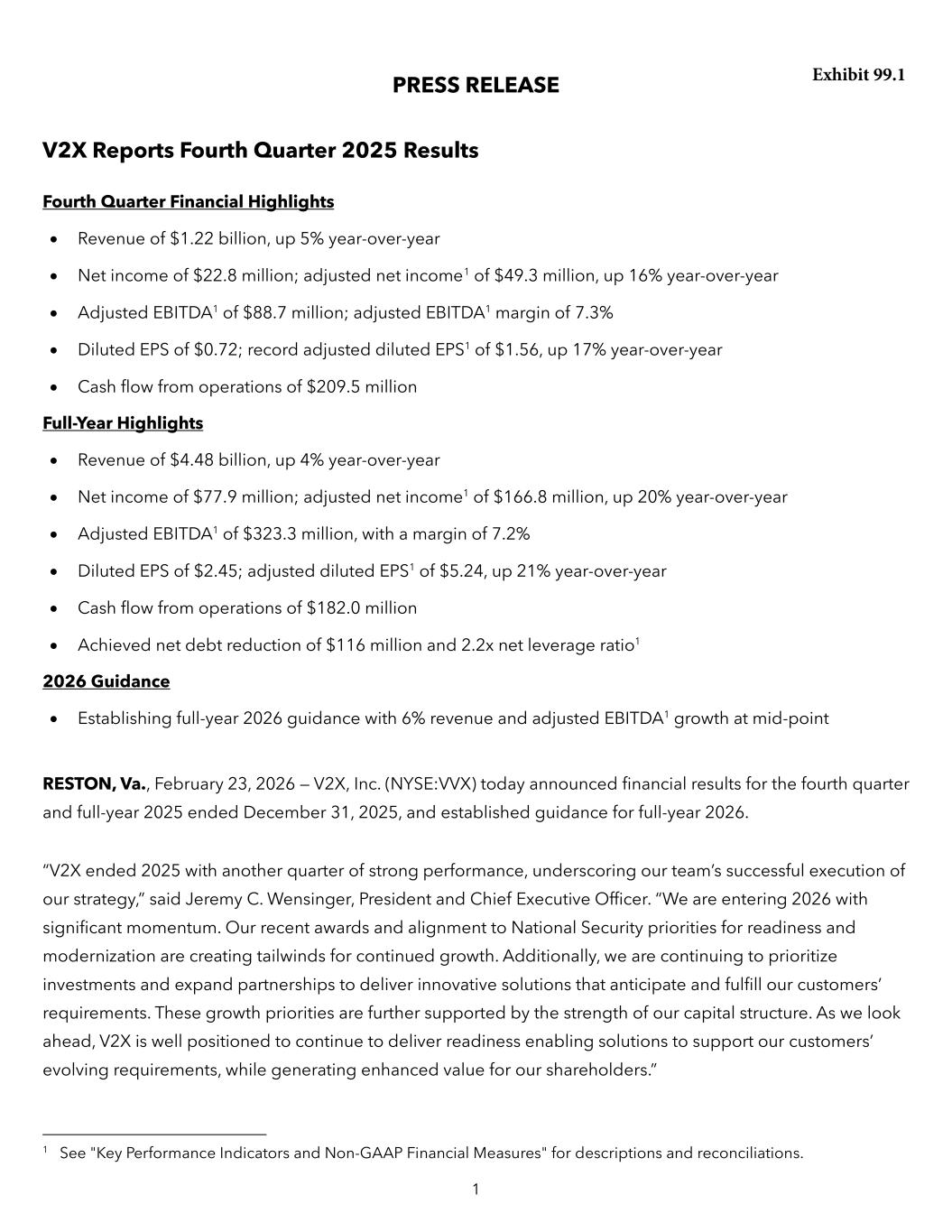
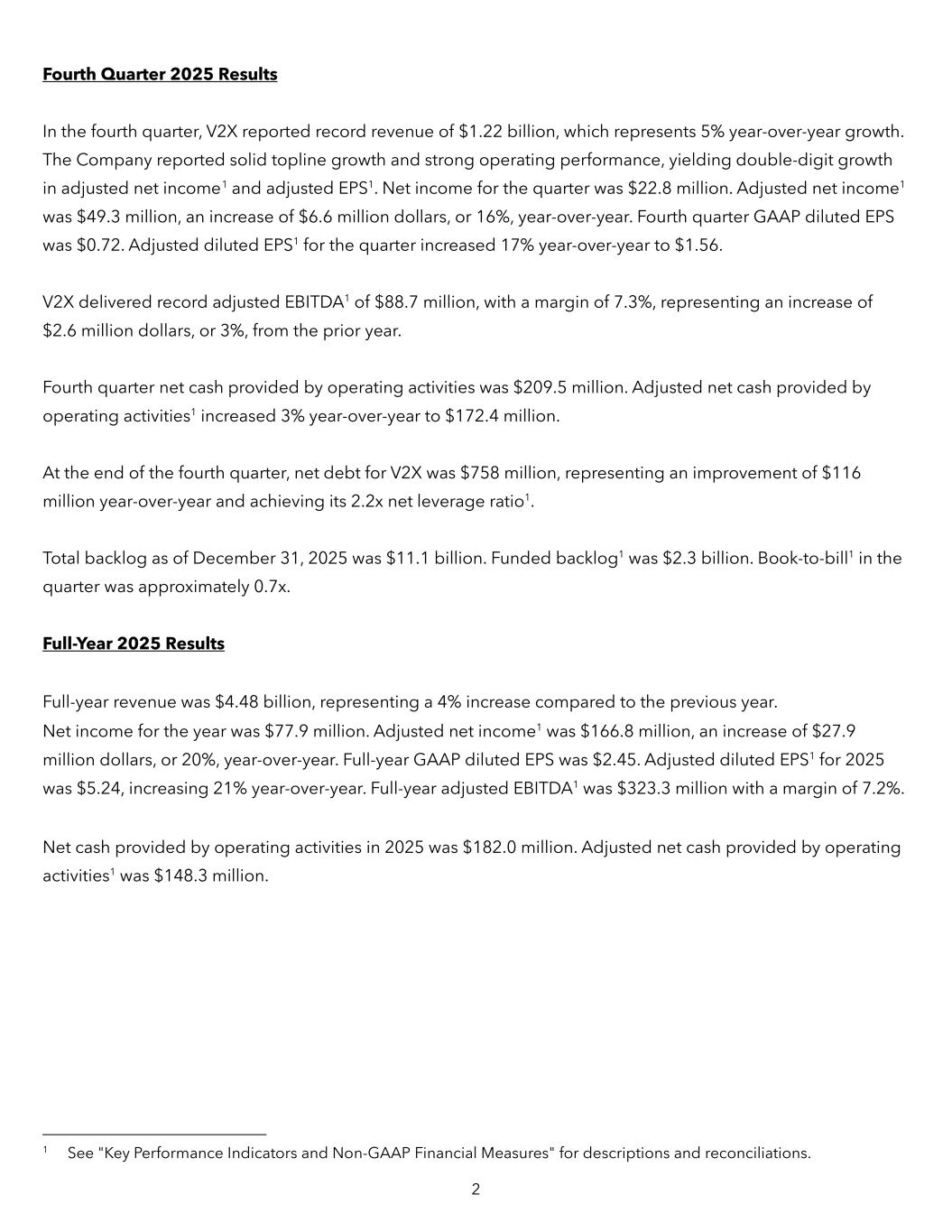
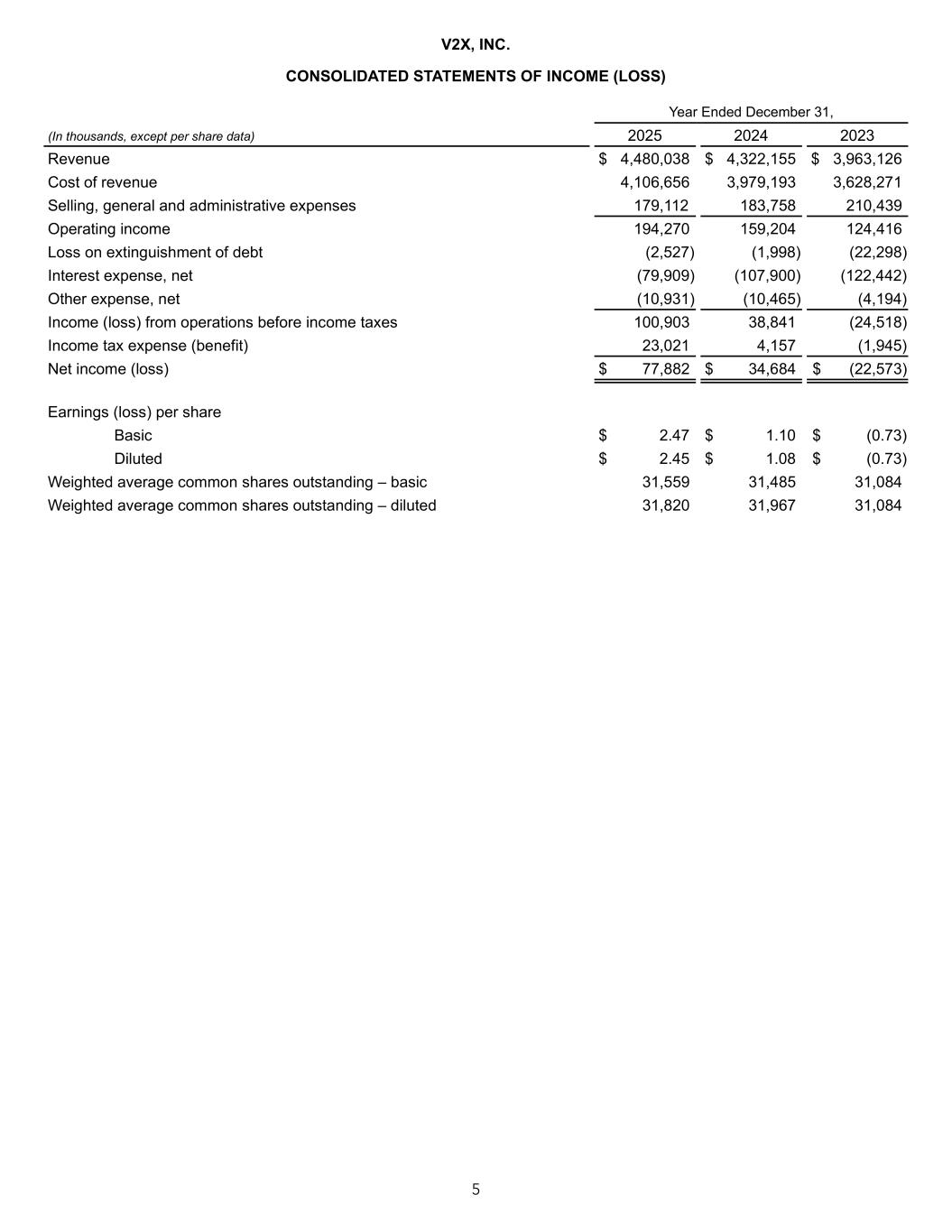
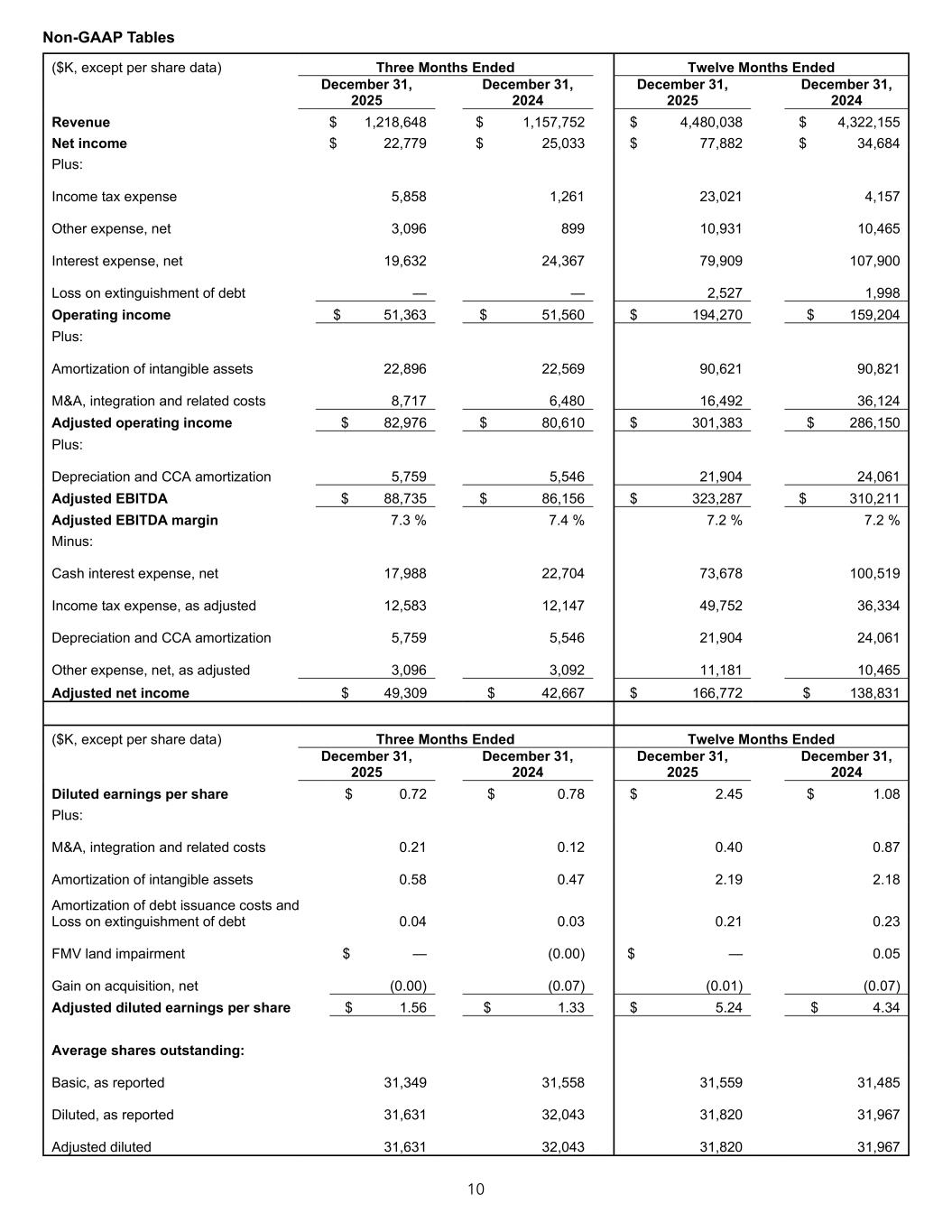
Thank you, Mike, and good afternoon, everyone. Thank you for joining us today. Please turn to slide three. Today, we'll be providing a recap of our fourth quarter and full year financials for 2025. We will also share more on our positioning and expectations for 2026. I'm pleased with the team's execution and our financial performance, which underscores the strength of our strategy and alignment with national security priorities for readiness and modernization. Looking to the future, we are focused on leading with innovation. We are continuing to prioritize investments and expanded partnerships to deliver innovative solutions that anticipate and fulfill our customer requirements. These growth priorities are further supported by the strength of our capital structure. We continue to see momentum across the business coming through contract wins in our key growth areas, and we are encouraged by the ongoing demand for our mission solutions. As we continue to execute our strategy and innovate the base, we are doing so from a strong position. Our focus on cash generation has yielded positive results. We have a strong capital structure and the flexibility to strategically deploy capital. We believe V2X is well positioned to continue delivering enhanced value for both customers and shareholders in 2026, as supported by the financial outlook we provided today. With that, let's turn to slide four. With more detail around the fourth quarter and full year 2025 results and the progress we've made. We reported solid top-line growth and strong operating performance. In the fourth quarter, we drove record quarterly revenue, adjusted EBITDA, and adjusted cash flow. This is a testament to our commitment to generate value. Revenue increased 5% year-over-year to a record $1.22 billion. dollars for the full year revenue grew four percent to four point four eight billion dollars hitting the upper end of our 2025 guidance range adjusted ebitda was 88.7 million for the quarter a record for the company in exceeding our expectations we delivered a full year adjusted EBITDA of $323.3 million with a margin of 7.2%. Adjusted net income was $49.3 million and adjusted EPS was $1.56, both representing double-digit year-over-year growth. Adjusted net income was $166.8 million for the full year representing a 20% increase year-over-year. Adjusted diluted EPS US was $5.24 for 2025, increasing 21% year over year. Our ongoing emphasis on reducing debt and generating cash allowed us to improve our net debt by $116 million compared to last year. As a result, our net leverage ratio now stands at 2.2 times. Sean will share more of our financials and our outlook later in the presentation. Turning to slide five. The progress we have made this year exemplifies how our readiness-enabled solutions continue to support our customers' evolving requirements and create tailwinds for continued growth. We have won a number of recent contracts across key growth areas, reflecting both the depth of our customer relationships and our ability to deliver at-scale complex, high-consequence missions. In 2025, we delivered two contract wins valued at more than $1 billion each and 10 awards each exceeding 100 million dollars in supporting mission readiness the successful t6 aircraft award represents approximately 4.3 billion dollars and underscores customer confidence in our execution and industry-leading readiness rates similarly the f-16 modernization and services award reflects our ability to support fleet readiness through modernization sustainment integrated support, and capabilities that remain essential to our customers' mission priorities. We are also seeing continued traction in training and services. The more than $100 million General Motors Training Award demonstrates how our core competency translates effectively across both defense and commercial environments. In advanced capabilities, the MDA SHIELD IDIQ Award positions us to extend our space domain awareness and emerging missile defense priorities. The Advanced Technology Support Program, IDAQ, reflects our growing role in rapid development and fielding of emerging technologies, an area where speed, integration, and trust batter deeply. For national security programs, our classified awards across cyber operations and systems reinforce the relevance of our capabilities in highly sensitive, mission-critical environments. Looking ahead, our qualified pipeline stands at more than $60 billion, reflecting both scale of opportunities and demand for our offerings. We talked through 2025 about an increase of 50% in bid velocity, and that's exactly what Our continued investment in people, process, and technology have allowed us to pursue expanded opportunities. In 2026, we are targeting an additional 30% increase as we further leverage investments to capture larger and more complex programs. We are confident in our momentum exiting 2025 and our ability to carry it forward. We are aligned with well-funded priorities, have secured long-duration programs, and are positioned with customers who value proven execution. Before we move on, I want to note that this slide really represents a company that's winning. V2X excels in mission-critical work with long-term customers in areas aligned with national security priorities. As we look ahead, we believe this foundation positions V2X well for continued growth. Turning to slide six, I'd like to discuss something that we are very excited about and the transformation it represents. We are continuing to build our technology-first foundation, including targeted investment and best-in-class partnerships. These efforts are driving innovation across our base and improving outcomes for our customers. Let me walk through how we think about this. Our investments are focused on high-growth opportunities where technology can accelerate modernization and strengthen our technical depth for customers. These investments are designed to use data to move us faster from concept to deployment while remaining tightly aligned with mission needs. Second, we are partnering with the best. We recognize that innovation at scale requires access to world-class platforms and capabilities. That's why we've established partnerships with leading technology companies that bring AI, data automation, and advanced robotic capabilities to deliver mission outcomes. Recently, we announced a partnership with Amazon Web Services to advance smart warehousing and global logistics automation. This partnership helps modernize supply chains, improve visibility, and enhance resilience across distributed operations. We also recently partnered with Google Public Sector to deploy secure, responsible AI solutions in a way that meets the stringent security and compliance requirements of our customers. These partnerships allow our customers to benefit from proven, scalable platforms. And V2X provides the mission context, integration experience, and operational know-how needed to deploy them effectively at speed. These initiatives allow us to apply top-tier innovation across our base. We will be able to innovate program execution through predictive, data-enabled solutions to improve decision-making, increase speed, and drive more consistent outcomes. Simply put, we are deepening our bias for innovation. We are transforming our global presence into a true global persistence through speed and execution. With operations expanding some of the most complex environments in the world, speed matters. By connecting data, systems, and teams across geographies, we will be able to execute faster, respond quicker, and deliver consistent performance at scale. We are turning our footprint into a strategic advantage. When we put it all together, you can see how our capabilities come to life. This is what we mean by technology-first solutions, mission-tested engineering, and global persistent operations working together. No one is better positioned than v2x to meet the mission needs of our customers today and tomorrow our recent progress reflects our strategy and as we continue to invest partner and innovate with discipline we believe v2x is uniquely positioned to extend that momentum delivering greater value for our customers and creating sustainable long-term value for our shareholders with that I'll turn the call over to Sean for a review of her financials Thank you, Jeremy.
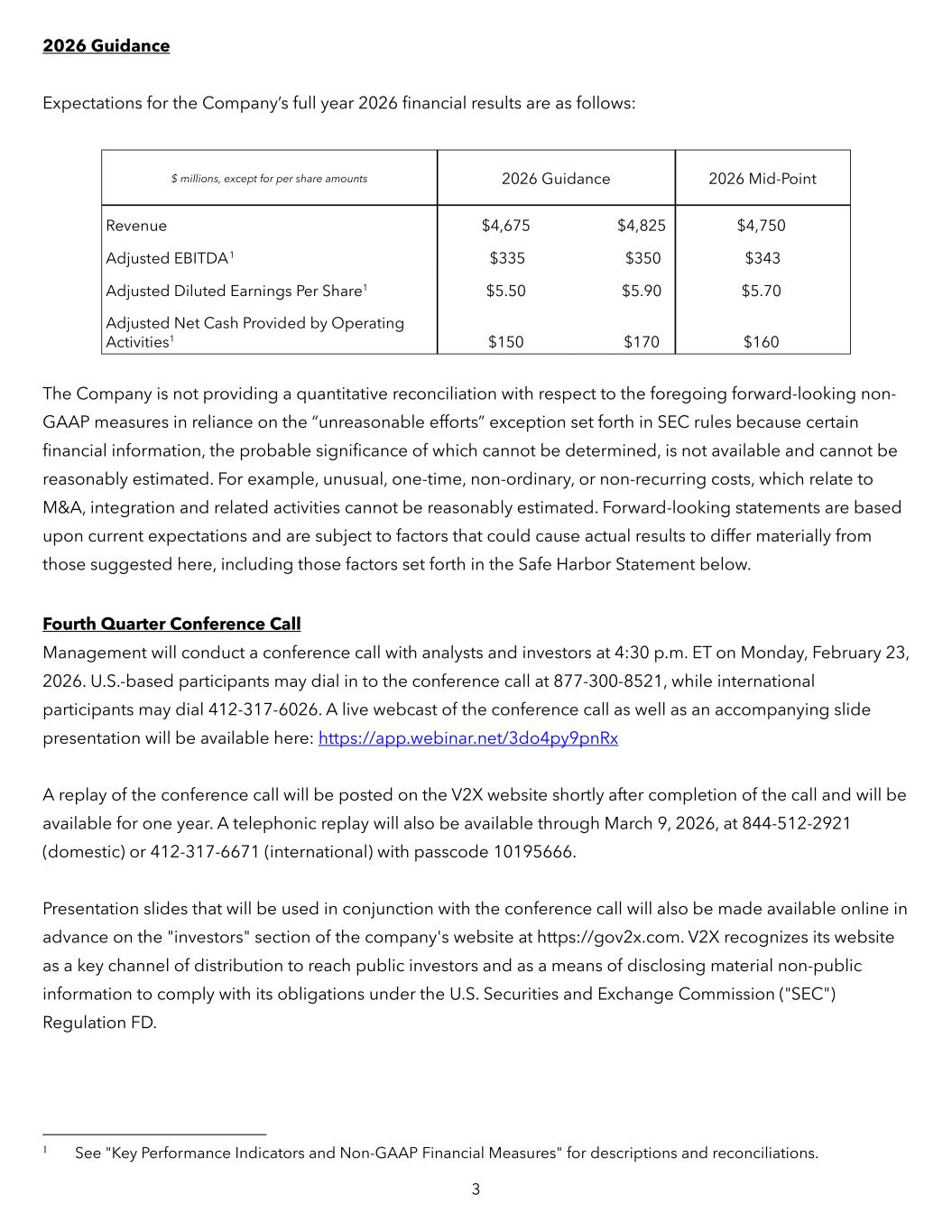
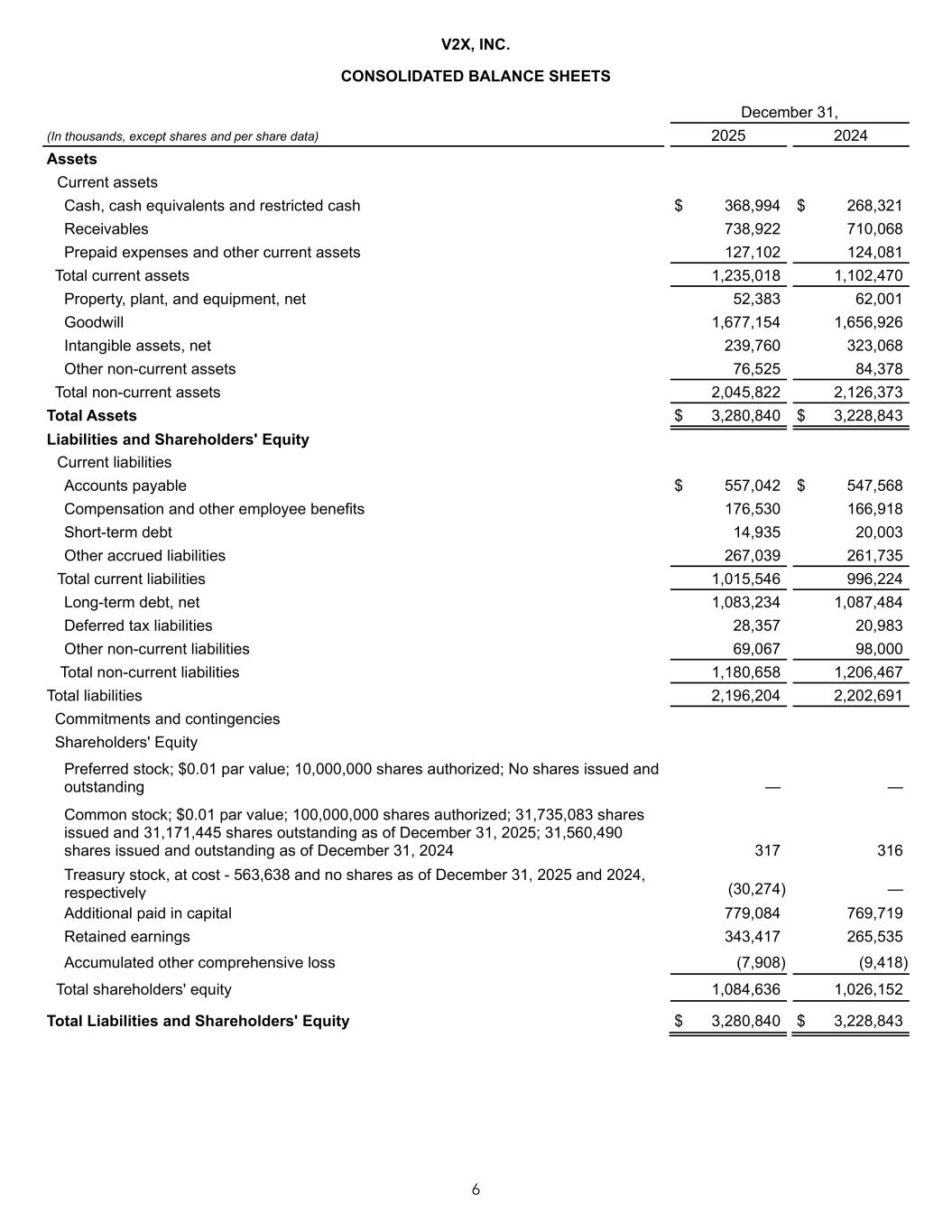
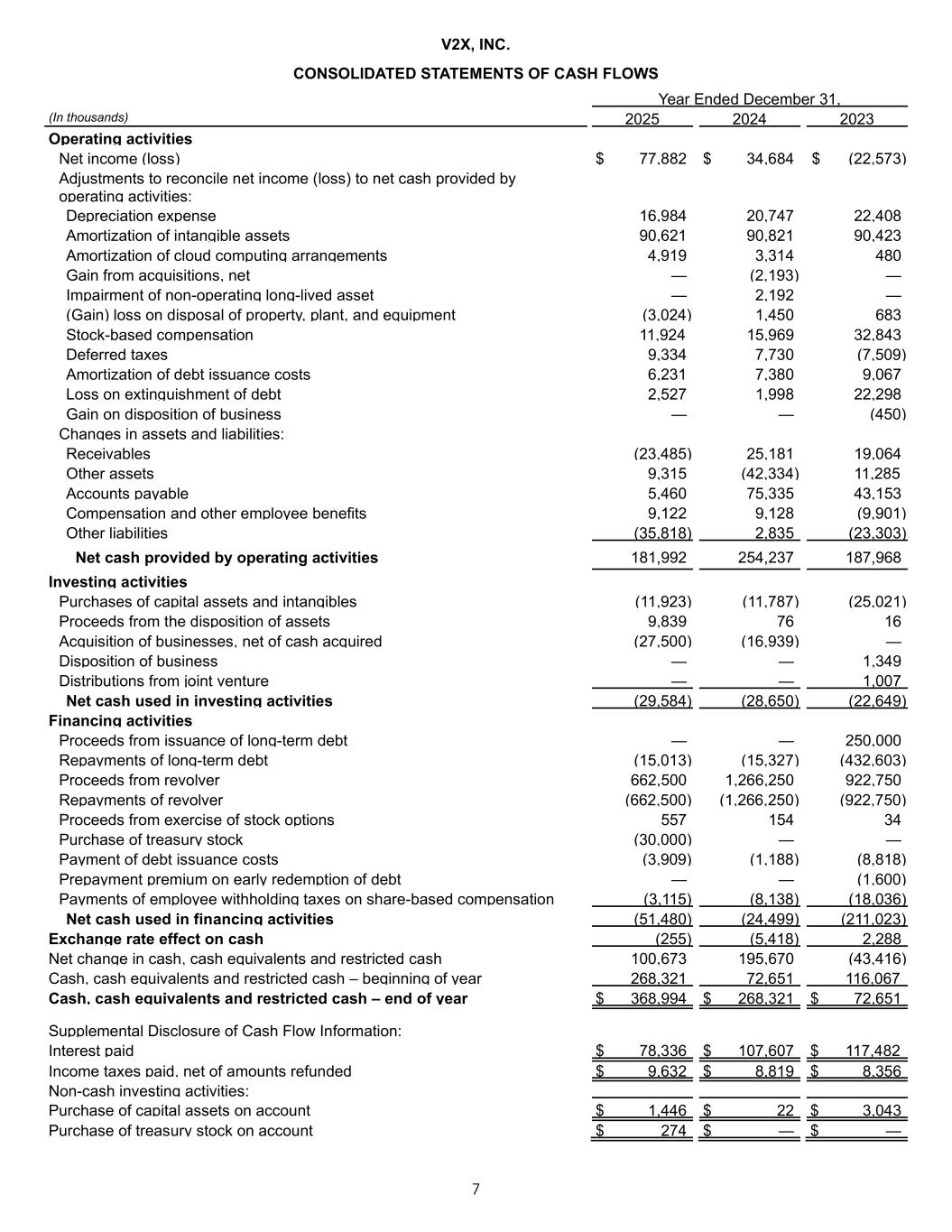
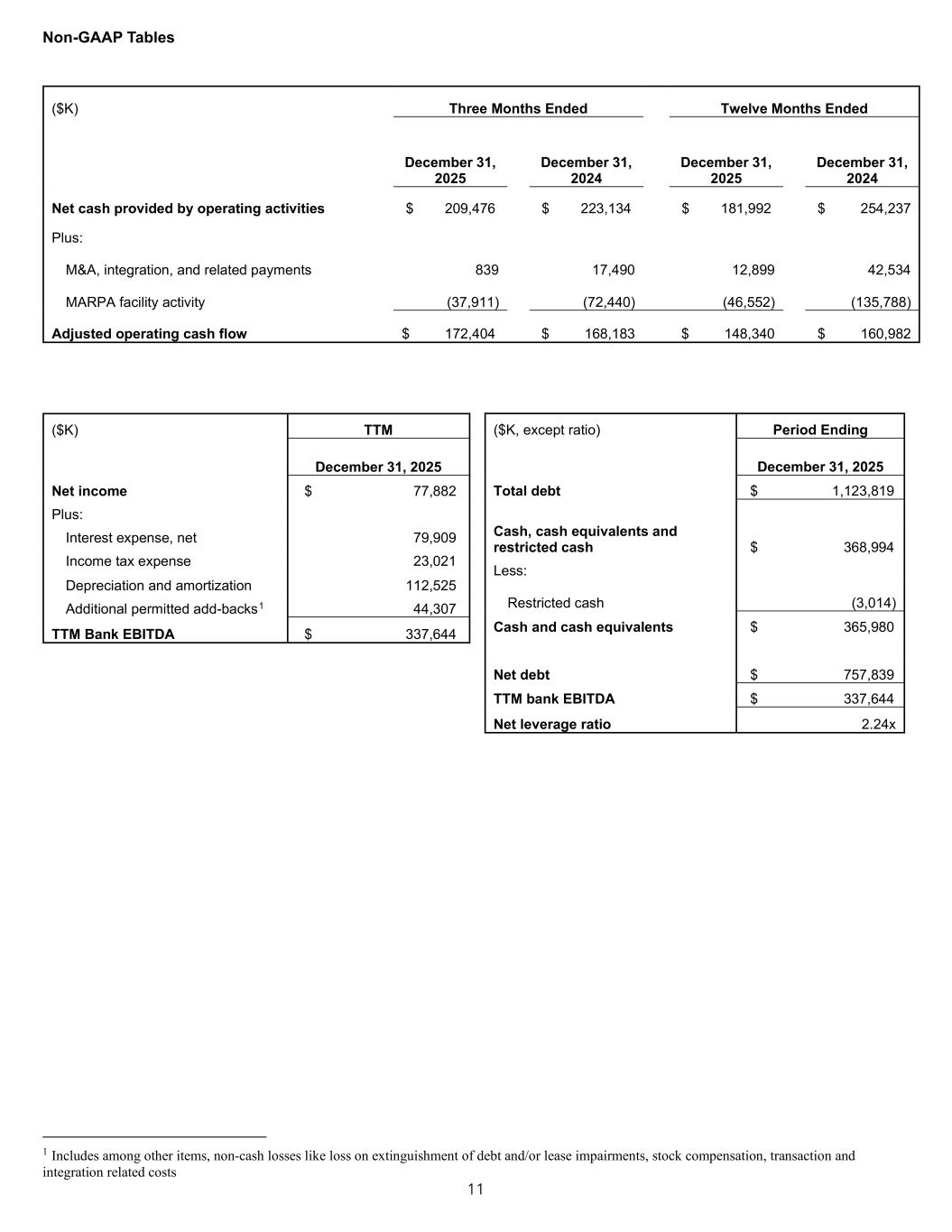
Good afternoon, everyone. Please turn to slide seven. The value V2X delivers for its customers was clearly demonstrated in the fourth quarter, with notable top-line growth and strong operating performance. Revenue in the fourth quarter increased 5% to $1,219,000,000. Growth was primarily fueled by our training, foreign military sales, and rapid prototyping programs. Adjusted EBITDA in the quarter was $88.7 million, a record for the company. Adjusted EBITDA margin was 7.3%. Interest expense in the fourth quarter was $19.6 million. Cash interest expense was $18 million, dollars, improving 4.7 million dollars year-over-year. Net income for the quarter was 22.8 million dollars. Adjusted net income was 49.3 million dollars, up 16 percent year-over-year. Fourth quarter diluted EPS was 72 cents, based on 31.6 million weighted average shares. Adjusted diluted EPS in the quarter increased approximately 17 percent year-over-year to a record $1.56. Adjusted operating cash flow in the fourth quarter was $172.4 million. I feel it's important to highlight that the extended government shutdown did not have a material effect on our financial results in the fourth quarter, further demonstrating the enduring and mission-aligned nature of our business. Let's turn to slide eight, where I'll discuss our full-year results. Revenue in 2025 increased 4% on a year-over-year basis to $4,480,000,000. Adjusted EBITDA for the year was $323.3 million, exceeding the high end of our guidance range. Interest expense for the year was $79.9 million. Cash interest expense was $73.7 million, improving approximately $27 million compared to the prior year period, demonstrating our proactive repricing activities, debt pay down, and cash flow generation. Net income for the year was $77.9 million. Adjusted net income was $166.8 million, increasing 20% year-over-year. Diluted EPS for the year was $2.45. Adjusted diluted EPS increased 21% year-over-year to $5.24, exceeding the high end of our range. Year-to-date net cash provided by operating activities was $182 million. Adjusted net cash provided by operating activities was $148.3 million. The ability to generate strong cash is an important characteristic of our business and is further highlighted on slide nine. In 2025, our solid cash flow generation drove a $116 million year-over-year improvement in net debt to $758 million. This positive performance yielded in that leverage ratio of 2.2 times, representing over one full turn of improvement in just 24 months. We thought it important to highlight that we achieved this success while executing our capital allocation strategy, which included deploying over $50 million in the second half of the year to accelerate value creation. The strength of our balance sheet and cash flow provides substantial flexibility and optionality to deploy capital, including internal investments, and to strategically acquire complementary capabilities, access to new channels, and solutions that accelerate our growth strategy. In summary, we are executing on the capital allocation strategy we outlined in the second quarter and see further opportunities in 2026 and beyond. Please turn to slide 10. Our backlog and recent wins provide a clear path to revenue growth as we look into 2026. Our backlog at the end of the year was $11.1 billion. Funded backlog improved slightly from the last quarter to $2.3 billion. Important to note that our backlog at the end of the year does not include the approximate $4 billion T6 award. Subsequent to the fourth quarter, the award decision to V2X was upheld, and we expect to book this award to backlog in the first quarter. This is a great outcome for V2X, representing a milestone program that we expect to add positively to our backlog and revenue visibility. We look forward to delivering our industry-leading mission readiness rates for this important training platform. The book-to-bill ratio for the trailing 12 months was 0.9, in line with our expectations and consistent with our commentary last quarter. Also, as previously mentioned, we expect book-to-bill will be above one in 2026. Please turn to slide 11. We made exceptional progress executing our strategy in 2025. Looking ahead, we believe our recent wins, backlog, limited recompets, and solutions that are transforming the speed with which our customers can achieve mission readiness positions us to continue this momentum. For 2026, revenue is expected to be 4.675 to 4.825 billion dollars. We expect revenue growth to accelerate to 6 percent or 4.75 billion dollars at the midpoint, which compares favorably when taking into account 2025 revenue was at the upper end of our guidance range. Revenue in 2026 incorporates the incremental contribution from our training, foreign military sales, and rapid prototyping programs, as well as the initial ramp on T6 and completion of previously referenced certain mission support activities in the Middle East. Additionally, a percent of revenue expected to come from Recompetes has improved going into 2026 6 and now represents approximately 3% of revenue at the midpoint of the guide. Adjusted EBITDA is estimated at $335 to $350 million. Adjusted EBITDA contemplates the above mentioned items as well as some internal investments. Adjusted diluted earnings per share guidance is $5.50 to $5.90, representing 9% growth at the midpoint. We expect adjusted net cash provided by operating activities to be $150 to $170 million. Cash flow in 2026 assumes one additional payroll than 2025, which is estimated at approximately $50 million. We believe cash flow should be in line with our normal seasonal pattern and cash generation occurring in the second half of the year. Cash interest expense is expected to be approximately $69 million, with other expenses of $15 million. Capital expenditures for the year are estimated at approximately $25 million. In summary, 2025 was a successful year on many fronts, in both supporting our customers' missions and achieving our commitments to our shareholders and employees. We are well-positioned going into 2026 and look forward to discussing our progress with you throughout the year. Jeremy, back over to you.
Thanks, Sean. 2025 was a great year for V2X. We are accelerating our position as a leading provider of mission capabilities. Before I turn it over to Q&A, I'd like to take a moment of appreciation for over 16,000 employees across the globe. Their execution and commitment to our customer's mission propels B2X forward and prepares us today to take on the missions of tomorrow. With that, I'd like to open it up for questions.
Operator
We will now begin the question and answer session. To ask a question, you may press star, then 1 on your telephone keypad. If you are using a speakerphone, please pick up your handset before pressing the keys. To withdraw your question, please press star, then two. Our first question today is from Toby Sommer with Truist. Please go ahead.
I was wondering if you could comment on what has been the trajectory of the company's revenue and activity in the Middle East region with the shifting of resources that direction towards Iran.
Yeah. Good to hear from you, Toby. Thanks. Yeah. So, you know, at this time, obviously, you know, the situation is, I'll say, fluid. You know, our priority right now is make sure everyone's safe. You know, I'd like to think that, you know, we'll participate in whatever the outcome looks like eventually. But today, it's like I said, fairly fluid with ensuring the safety of all of our employees in the region that we have throughout that area. So we'll certainly see how things evolve as time progresses, but that's kind of where we are today. I think the one thing I'd add to that is Sean's right.
We were highly concerned for our employees and we have actually an activity every day that allows us to understand where everybody is, but I do think presence matters. And we talk about that all the time. I think being in the region, allowing and supporting our customer in terms of what they're going to do in the region is something that's very important. Whatever happens there, I think presence matters. But the single most important thing we're doing right now, and I think everybody needs to keep this in mind, is that our employee safety and our concern for them is number one.
And how much contribution do you expect from the T6 contract and is that, do you think that there will be additional legal hurdles to that transition?
And I can't speculate on legal hurdles, Toby, I'll tell you the assumptions that we've made. So, you know, you heard what we said in the prepared remarks, we will effectively start that program on March 1st, where transition will be complete. You may recall, we began executing that in the mid third quarter through the fourth quarter. We were paused for a brief period after the first of the year. And so now we'll pick it up in, you know, in March. From a planning standpoint, here's a little bit about the assumption that we've made on There's an inherent lag. This is a largely material receipts job for us, at least at first. And there's a 90- to 120-day type of lag. So, in the guide that we gave at the midpoint, you should think it's somewhere around $140 to $160 million of revenue for us this year.
I appreciate that. And what are you seeing in your Intel business, which kind of the exposures are relatively new to you, but you had some classified work announced not too long ago. What's the trajectory of that in your guide? Is that area sort of a source of creative growth there?
Yeah, I think what we did with the kinetic acquisition was positioning us well to augment what we do today. We're excited about what that business brings to us. I'm excited about the fact that it builds on a pipeline that is going to only grow. So I think that is a business that we're very excited about.
Operator
Next question is from Andre Madrid with PTIG. Please go ahead.
Good afternoon, everyone. Thanks for taking my question. Sure. So I know last year you guys had called out five one-plus bill opportunities that you were targeting. And slide five, I know you called out $2 billion of them being awarded. Is there a status update that you can give on the remaining opportunities? Are those still stuff that you're actively bidding on where, you know, any color there?
Yeah, the two that we retired, obviously we're thrilled about. We obviously have, you know, that plus, we've added to that portfolio this year in terms of where we're bidding when they talk about 30% increase in overall bid velocity. But, yeah, we're waiting on adjudication on the remaining three that we feel very good But, again, we've got to wait for adjudication. But, again, the fact that we were able to retire two of them in the fiscal year plus, you know, the 10 plus $100 million one, I think bodes well for the business in terms of not only bid velocity but also our ability to win. So I think those bodes well for the company.
Okay, Andre, to put a fine point on it, so one of those was bid in the fall. One of the three was bid in the fall. Two were captured as exactly as Jeremy said. And then there's one to be bid this year and one to be bid in 27. And there's about a year lag between the time the bid goes in and any award assumption that we would have on those things, not counting any protest periods or anything like that. So, very modest to any impact in 26 as a result of any of those captures. We'll be talking about those for some time to come, I suspect. But remain very happy with where we're positioned on those. Teams worked extremely hard to put together, you know, wonderful offerings and teammates.
That's very helpful. And then, I mean, pivoting, it seems like everybody wants to, you know, talk about the Middle East, but I know you guys called out the Indo-Pacific as a growth area for you throughout much of 2025. Any updates that you could provide there as to how that market's materializing?
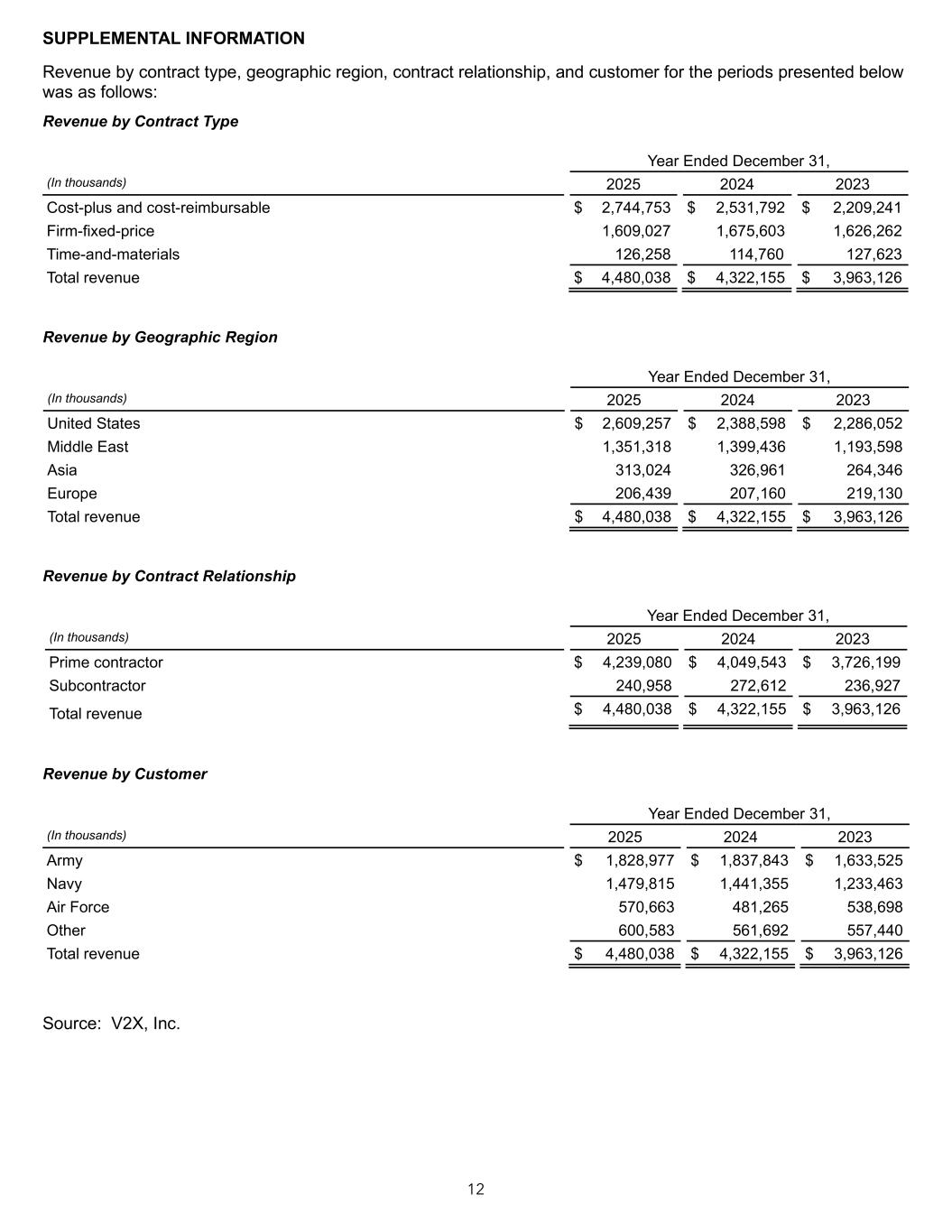
Yeah, you know, when you look at the breakdown and the details that we provided, you know, it was flat to slightly down, and we're seeing that, I'll say, continue into 26. So, you know, Folks may recall, 20 odd number of years tends to be training years in the region. We didn't necessarily see that materialize to the volume that we had historically seen. Now we saw an increase in, I'll say, requests to put things in front of customers. They didn't necessarily materialize. So we'll see how things play out in 26, but as I sit here today thinking about where the The growth will come from our position. There's very good ops tempo. We're really happy with the positioning. Jeremy consistently talks about presence and there's not a month that goes by that we don't talk about opportunity sets in the region. I don't know that there's anything imminent. As I sit here today, Andrea, and we think about kind of early 2026, but we'll see. We're just starting with the early innings.
I'll leave it there. Thank you, gentlemen. Thank you.
Operator
The next question is from Peter Arment with Baird. Please go ahead.
Good afternoon, Jeremy, Shawn, Mike. Nice results. Hey, Jeremy, on the – you had a really strong year in kind of ramping up the bid velocity and you talk about a big pipeline. How should we think about – are there more, like, opportunities the size of, you know, the T6s of the world, or is this going to be more kind of the ones you mentioned where you had, you know, 10, 100-plus million-dollar awards, you know, how should we think about just the pipeline of what you're bidding on?
No, it's a really good question, Peter, because I think we're trying to balance it. We're trying to balance what I call, you know, big game hunting with, you know, singles and And I think both of them fit in the portfolio very well. But, you know, clearly the administration and, you know, prior administrations have kind to consolidate some of these buys into bigger buys, which at our scale allows us to compete. But again, I think the singles and doubles are just as important, and I think they add to the overall value of the company. And so when I look at it, I look at bid velocity as the metric. As long as I'm getting the bid volume out the door, it could be big ones, it could be small ones, it could be intermediate ones. And I think that's important as a company because I think that's what feeds the system.
Got it. That's helpful. And then just also there were some pursuits around, you know, that you guys have had a lot of opportunities to think about, you know, contracts maybe moving to fixed price or things of that nature. Has there been any kind of further advancing of that with the administration now kind of, you know, more, I guess, up and running with the Department of War? Are there opportunities you think you're pursuing on a fixed price basis?
Yeah. I think we're seeing more fixed price opportunities than we have in the past. I don't know, Sean, if you want to add to that, but I think it's clearly an avenue for us, which we're really good at.
Customers that have historically been cost-type have approached us. It hasn't translated into an award yet as fixed price feeder, but between, I'll call it, you know, late, mid to late fourth quarter, and as we sit here today, we've seen a higher ops tempo with customers asking and soliciting those type of offerings from us. So, you know, we'll see how that plays out, but encouraging to see, I'll say, some more traction around getting, you know, contracts and the appropriate parties that would make that happen engaged. So, it's gone from more than just talk to words on paper.
Got it. And just lastly, Sean, on the net leverage, you guys have done an incredible job, obviously, setting yourselves up. How are we thinking about kind of the go forward? Is it further, you know, a reduction or are you looking at other pursuits on an M&A perspective?
Yeah, you know, listen, I think we've said we'll look at all options for value creation for the shareholders. And that remains the case, Peter, right? We're extremely happy with the leverage that the company's got. And, you know, Jeremy said consistently that opens up optionality. You know, I think I highlighted it in the remarks. really happy to deliver 2.2 while deploying, you know, $40, $50 million of capital last year to further enhance shareholder value. So, you know, we'll see how 26 plays out, but, you know, it's a good spot for us to be in to have those options in front of us.
100%. Appreciate all the color. I'll jump back in the queue.
Thanks, Peter. Thanks, Peter.
Operator
The next question is from Trevor Walsh with Citizens JMP. Please go ahead.
Great. Thanks for taking the questions. I wanted to start with the AI partnerships with Google and AWS. Can you maybe just click in one level deeper around what those opportunities look like kind of broadly as you look at them going forward? Are they more technology-centric type of implementations with the smart warehousing, or is it more just traditional IT system integrator type work, just want to try to get a sense of what that could look like and then kind of relatedly, how does it maybe shift by opportunity around like what the margin contract kind of profile might be of those opportunities?
No, it's a really good question and I appreciate you asking it. I think AWS was an opportunity for us to look at somebody who does some of the best smart warehousing around the globe and use them on things that we do every day. I mean, if you think about everywhere we are around the globe, there's a warehouse. And I think AWS is, you know, one of the best in the world at the ability to manage a warehouse and put their smart warehousing capability in play. We own all the data and what they own is the process. And so, I think the combination between us and AWS and us and Google, who is clearly invested in AI, is taking our data and using our data in a way that's going to enable my customer to have better outcomes, faster outcomes, better outcomes, and more efficient outcomes. So I wanted to put myself in the position where I was partnered with the best in the industry to deliver these capabilities because all the data I have and so they're going to use my data to deliver better outcomes for my customer using their technology and I think at the end it ends up being a perfect partnership partnership between them you know if you think about AWS Google and IBM it was a perfect partnership for us to go with there's a speed to market aspect here too right in terms of how quickly we can deploy things you've heard us talk about the global footprint right so don't think about don't think about it
only from a pursuit standpoint but capability that we have that we can deploy in a broad scale today and we'll see you know we'll see how things evolve but but exactly as Jeremy said a wonderful partnership to go forward and deliver we think enhanced capability to our customers at speed and a scale they were already doing on the WTRS program we're giving them capability that they they never had before, and I'm looking forward to sending that to other customers.
That's fantastic. Thanks, Bulls. Sean, maybe just a quick follow-up then for you. On the T6 contract, appreciate that color that you gave around the revenue. Can you maybe provide a little bit of color as well on how that's going to affect backlog? I realize that the whole amount will go into backlog in Q1, as you mentioned, but could you maybe give us a sense of what would be funded or unfunded if you have like a high high-level pay just as we think about that?
I don't have the funding and unfunded portion yet. We're working through that with the customer. But if it's like other programs we have, it wouldn't shock me if it was funded annually or slightly less in terms of what we would get incrementally. That's not at all unusual in these type of programs. I do think the booking that we will take in Q4 will not be the entire value that we were There's options in there that cannot all be exercised, and I say that, it's kind of one or the other from an optionality standpoint, Trevor, right? So the team's going through that right now from a bookings and backlog practice. You should all think of this as being tying our booking to what our performance obligations on the contract to include the options will be. And that's what will end up in our backlog here at the end of the quarter.
Got it. Super helpful. I'll leave it there. Jeff.
Operator
Thanks, Trevor. The next question is from Jonathan Siegman with Stiefel. Please go ahead.
Hey, good afternoon. Jeremy, Shawn, and Michael. This is actually Sebastian Rivera on the line for John Seaton, and congrats on the strong print here. I guess I just wanted to start with a broader question. There's kind of been some AI existential threat jitters recently, the service names, and kind of wanted to just get your glass half full view, if you will, on how AI will be a lever for the company over the short to medium term and kind of perhaps in the context of some of your recent wins and partnership announcements.
Yeah, I think, Sebastian, that's why we lean forward with the partnerships that we have. We decided that we wanted to be on with partners whose critical path was the future of AI. And I think Google is that. And I think Google also recognized that we have the information that makes AI operate. And so, when I look at the transformational aspects of AI in our business, I wanted to partner with somebody who brought a tool and I brought the data and I brought some vision capabilities and I want them in the context and the contract that enabled that AI to work. So, it was a natural partnership that occurred and I'm thrilled to have them part of the I'm thrilled to have Amazon part of the team. I'm thrilled to have IBM part of the team because I think our business is going to be enabled by this transformational technology because we have all the, you know, we have all the mission know-how. I mean, I'm the guy on the ground. I'm the guy doing all the work and they're going to enable me to do that work much better, much faster, and much more efficient and deliver my customer a much better outcome, so we're excited about that.
And, Sebastian, I'll say that, you know, think of this in increments, right? Like there's not a big bang here. There's incremental filtering, sorting, sourcing, those types of things that can be done to demonstrate speed and agility to our customers by using capabilities that already exist. And exactly as Jeremy, again, has said before, we have data, we have presence. So let's leverage those things and make incremental progress on this, the adoption of these tools and capabilities as we go forward.
Got it. Yeah, that's super helpful. And then on the back of the recent S.H.I.E.L.D. IDIQ, can you maybe provide some more high-level color on kind of where you see the company kind of positioning with regard to Golden Dome requirements over time, I guess kind of beyond the Cobra Dane, Cobra King, if you have that visibility today? I'll jump back in the queue.
I think that's going to be a long-term play. Again, I would call presence and also contract vehicles is the key to participating. Obviously, getting on the contract, having the presence on the ground, having the presence at the local facilities is everything.
So as this thing evolves, our goal was to get into the mix that allowed us to be a participant to enable the government to deliver Golden Dome, and we think we're well positioned to do that question is from john godin with city please go ahead hey guys thank you for taking my question um i i wanted to follow up on the commentary about um book to bill and just make sure i understand that the t6 award is hitting in the in the first quarter is that correct yep we will look at the protest was resolved here in in the first quarter and so we will we will
we'll reflect it in our backlog at the end of Q1.
Okay. And the pipeline, you know, some of the commentary around that, you know, it seems very positive and optimistic. I was curious that the guidance of being above a 1X book-to-bill for the full year, is that, would that still be the case if we excluded the T-6 award?
Or is the T-6 award kind of critical in hitting the greater than 1x book to bill for the full Yeah, I'd say, you know, the T-6 award, you know, we should certainly be above one with the T-6. Like I said earlier, it's early innings in the year. You know, we will see how some things play out, but we're confident that we'll be at There's opportunity to be, you know, well above 1.4, 1.5 or more, depending on how some other things play out. But we'll see the timing of certain awards, you know, as they play out in the year. We can never predict those things perfectly and protest factors and such.
But again, feel very, very comfortable where we sit today with the guide that we've put I think, John, that's the place I would probably burn your calories on is, you know, we bid 50% more last year than we did the year before. We're projected to bid 30% more this year than we did last year. Our win rates are, you know, I'll stand them up against anybody in the industry. That's an easy way for you to think about it.
Okay. But it sounds like we need that T6 award in the number to be above and exposed to bill. Is that, am I hearing that right?
Yeah, that's a fair interpretation.
Okay. And then if we just look at the full year guidance, just a simple question about kind of the sensitivity or the range around kind of low end versus high end, maybe you guys can talk a little bit about on the revenue and the margin side, what drives the sort of midpoint versus the high end of the guide?
Yeah, mostly timing of things, right? So, I think we put out there, we're down to about 3% of the revenue at the midpoint is up for recompete. And so, timing of other new business activities or on-contract growth, things of that could sway it relative to that ops tempo and when we might see some things materialize. We're feeling very good as we sit here today for, you know, the line of sight we have to the total year, but specifically the first half, and we'll see the timing of awards. But it's nothing more than that, really.
Okay, great. Thanks, guys.
Operator
Thank you. The next question is from Ken Herbert with RBC. Please go ahead.
Good afternoon, Jeremy and Sean and Mike. Hey, just wanted to follow up. Maybe, just wanted to follow up on the margin discussion. How do we think about with the T6 and incremental bookings you're seeing this year, what's the potential to see better than sort of the flattish margins in 26, or what are maybe the key puts and takes as we think about potential margin upside?
Yeah. So, I'll go to the, you know, many of our programs that start out, you know, early, We've got several this year that are contributing to growth. They start out at margins that are, you know, somewhat dilutive to the company composite and then they grow. And so, T6 in the early phases, you know, we'll see. We're going to do the EAC here in Q1 and we'll see, but it wouldn't shock me if it follows the profile for most of our programs that are like that, that we tend to grow into the margins. It takes a little bit of time because what you do is you re-engineer the process around delivering those industry-leading readiness rates that we have across the majority of the platforms that we have. And so, you've kind of got to tear things down and then build them back up. You've got the supply base, all of those things that go into it, but we're really happy with the performance that we ultimately get.
So, I don't know that I look at that as being a real, you know, margin enhancement activity been here in 2026 but I think we have full confidence that the team will deliver to the commitments hundred percent look I I think John's right I think every program kind of goes through its lifecycle but once my team gets in and they're able to get a hold of the supply chain and they're able to get a hold of you know the employment base and they're able to understand what's the best-in-class way to do things to deliver the readiness rates that we deliver I have all confidence in that team's ability to do this does it take us a little bit time to do it yes because you're taking over someone else's you know pre-existing program but it takes us a moment to just conform it to
the way we do business and once we do we do exceptionally well yeah that's great if I could Jeremy maybe just obviously the the scale of what you're bidding is is up significantly, and I can appreciate then the tailwinds on the top line. Is it fair to say that the stuff you're bidding today, to the extent to which you're successful on it, would support sort of a structural step up in margins over time, obviously, as the new work ramps?
I would say we're bidding work that's accretive to the overall business as a norm to our posture going forward. That is our posture. Now, to Sean's point, will we have programs that start out because of the where, you know, we inherit something that is not a creative day one, but it grows into itself? Absolutely. But as a corporate policy and process, we have a strong conviction around growing margins.
Operator
Thanks, guys. Nice results. The next question is from Noah Pokanak with Goldman Sachs. Please go ahead.
Hey, good evening, guys. Last year and the year prior, the top line growth was in the first half. I'm just curious if that holds this year or if with the much easier compares in the first half and then the tougher compares in the back half, if the shape of this year is different?
Yeah, it is a little bit different. This year I think it's more balanced. No, I think it's more 50-50, you know, in terms of what that profile looks like on the revenue side.
And pieces on cash flow, as you wrapped up 25, you had the, you know, you sort of flagged the possibility of collections related to government shutdown. You ended up coming in fairly close to the low end of the, sort of thought 26 would have have maybe grown from the 25 original range and then also had that working count. Can you maybe just bridge us through that or just sort of, where should we think of, how should we think of converting EBITDA to the free cash flow going forward?
Yeah. Yeah. So, I think, yeah, you're right. 25 did come in a little bit, certainly higher than the midpoint of the guide that we gave, You know, at the 148, you know, having a couple extra days, we saw significant receipts, I'll say, right at the end. And candidly, that's why we adjusted, because there was timing that was, I'll call it somewhat unpredictable. In terms of 2026, you know, I think when we look at, we have an extra pay period in 2026. That is worth about $50 million. And I think when we think about net income conversion, at the midpoint of the guide we put out, we're about 115% net income conversion. So I think we're pretty good this year. We will be cash negative in the first half of the year. As always, the profile will look, you know, probably very similar to what played out in 2025.
And then just maybe zooming out and thinking about long-term growth, you know, you have some new programs ramping this year that drives a pretty good-looking growth rate relative to the industry, you know, that has to keep growing, and then you've discussed a pretty healthy bid pipeline, can you grow what you're forecasting this year for multiple years or do you start to hit just a higher base and tougher compares that drives it to decelerate No, I think we're sitting on a target-rich environment.
When I look at the pipeline, we are very, very selective about what ends up in the pipeline. And it is all around our ability to capture and win and not burn unnecessary resources on something that's a flyer. And so, when I look at that, you know, that pipeline that Rogers put together and I look at the win rates that are reflective of that, I feel very good about the fact that we can continue to grow. We are, we have, you know, we're not touching nothing but an opportunity in front of us. We continue to build out Rogers' organization in terms of growth. We are competing to hire new people all the time. That is the least of my concerns about having something to grow on, you know, is trying to make sure that we're prepared for that growth. That's where my…
Operator
The next question is from Mariana Petters-Moro with Bank of America. Please go ahead.
Good morning, everyone. Good morning, no, good afternoon, see, long day. you guys laugh um so first one on 26 guidance could you mind discussing for the midpoint what kind of recompete risk you are thinking about and then like what are the major programs like that are driving this growth like this WTRS ramping that much or even within like You mentioned FMS and internationally, CMERS, IDIQ also expanding, like, what are the main drivers for that midpoint?
Yeah, sure. So, I'll give you a color around what I said in the prepared remarks. So, from an FMS standpoint, you know, we're growing from a range standpoint. Think of $150 to $170 million in that area. From a training standpoint, year-over-year, we're about $130 million to $150 million. I mentioned the T6. We do have, and I previously mentioned, some Middle East mission support activities that are concluding and kind of ramping down. And so when you net all those things together, you get the midpoint year-over-year growth of about 6%. time. You hit on re-competes. Re-competes are about 3% today of the projected revenue growth at the midpoint.
Thank you. And then how should we think about like at the midpoint, how much is already covered by the funded backlog and how much you guys have to still go and like get? And then as a link to that, the context or the framework for this question is, Because we have seen a shutdown, we're getting into a year where we'll see midterm elections later in the year. Like, how is the award environment and how that could affect this, like, range for 26?
Sure. So, I'll answer your question on the backlog, the revenue and backlog, although I would distinguish its total. It's not necessarily funded at this time because funded has seasonality to it when, you know, period of performances, you know, flip in the middle of the year and that sort of stuff. But approximately 85% of the total year's revenue is in backlog today. That of course excludes T6 that I mentioned earlier because we will book that in Q1. From an award-taking standpoint, you know, I think the fourth quarter played out almost exactly as we thought, you know, in terms of where we ended up. The first quarter is playing out, you know, kind of very, very similar. We'll see how the stuff progresses throughout the year. But I'll go back even a year ago. You know, when we played, when 2025 played out, the booking cadence was by and large on plan in terms of what we saw. Will that persist? And for all the reasons that you just mentioned, Mariana, I don't know. But in terms of a cadence, in terms of an expectation, and aligned with what our internal plans have been, you know, I think it's been pretty consistent.
Yeah, I think, Marianne, the way you need to think about us is persistence at the mission level requires somebody to be there. And almost entirely of what we bid is keeping aircraft in the air, keeping a base running, you know, delivering technology and capability. those things and yes they could be influenced by an election it could be influenced by budgets whatever you want to do but you know candidly we saw very little implications associated with government shutdown associated with the fact that you know every you know people want to keep aircraft in the air people want to keep bases running people want to have technology delivered you know we we saw very few implications with that and so do I do I think we could be impacted by you know Politics? Absolutely. Did we see it to Sean's point? No. Everything pretty much stayed on schedule, which we were pleasantly surprised by.
Great. Thank you. And last one from me. You mentioned throughout the call how you want to use capital deployment and partnerships to be prepared to get to, I don't know, support is like more complex and larger programs, and particularly around rapid development and fielding of these new technologies. Would you mind discussing, number one, if you already – how strong is the M&A pipeline? And number two, any particular efforts that you can highlight that you are doing internally to be able to support these things and to have the best technologies?
Yeah, I think, you know, one of the things that we're really happy about from an investment standpoint and the way things have played out for us has been, you know, some of our rapid prototyping activities, right? We talked about that last year. You know, the team's ability to field assets, go from a paper design to a fielded asset in a very short period of time is just been remarkable. We measure that in months or weeks in some cases, right? So that speaks to some of the investments that we've made, you know, internally as well as, you know, and people might not think of it this much, but, you know, we get co-investment from our customers or CRAD dollars to help support those rapid prototyping, that development work, certainly low risk to us, but speaks to our ability to get things fielded in a very timely manner that we think distinguishes us in the marketplace.
I would agree with that. But I would also time around, we decided in August of 24 to make a fundamental shift in how we think about the next three to five years in the business. And I think when you saw the announcement that we put out, it was because we made those investments. We made those investments in the future of the company. And those investments are going to pay dividends because we believe that our ability to be effective for our customer means that we are going to deliver technology into our mission. Only way in which our customer is going to benefit long term is taking advantage of what is commercially available to everybody else and we're leveraging it into what we do today.
Right. Thank you so much. Thank you.
Operator
The next question is from Joe Gomez with Noble Capital. Please go ahead.
Good evening. Thanks for taking my questions, most of which have already been asked, but I'll throw this one out there. So a lot of positives, but as you look at 26, what do you see as kind of the biggest risks for the company to achieving the 26 guidance?
John, that's a great question because I think it always comes down to, we are a very responsive company and if the customer tells us to move left, we move left. If they tell us to move right, we move right. We don't always get to see, like in the Middle East, what may or may not happen, so that is not always a benefit in terms of foresight for us, but I do think that it creates opportunity force and has for a long time because we're so responsive I don't view it as risks as much as it is being prepared you know to making sure our recruiting team is prepared making sure that our team is prepared on the ground making sure we're able to move when the customer needs us to move building whatever they need is to build making sure the aircraft is in the air you know those are things that we are very good at I don't see you the risk in 26 as much as I you know what keeps me up at night is making sure we're prepared for that customer when they move at that moment's notice on those mission requirements, that we're there to support them at the time and speed at which they need us to be. That's what keeps me up at night.
Thanks for that. I appreciate the insight.
Operator
Thanks, Jeff. The next question is from Christine Lewag with Morgan Stanley. Please go ahead.
Hey. Good afternoon, everyone. Just following up on Noah's question earlier on cash flow, when we look at adjusting to operating cash divided by adjusted EBITDA, it looks like, you know, 2024 was a higher water market, 52% of that conversion versus 46% last year. And the midpoint of your guide for this year implies 47%. I guess I would have thought that this would have been trending higher, especially as the leverage comes down and you get some tailing from interest expense. So how should we think about these metrics? Is this the right way to think about the cash generation of the business, is there anything that's changing in the cash cycle or cash milestones that we should think about?
No, it's really just the additional payroll that we have this year, which is worth about $50 million. So if you adjusted for that on the midpoint of the guide, the conversion would be about 115% against net income. And so it's really nothing more than that.
Gotcha. And then does that mean for 2027 with, you know, with the extra payroll for 26, you should see a higher number for that conversion for that following year? Would that be fair?
All else being equal, yes.
Great. And following up on what you said on the Middle East, you've got some contracts there on setting this back into your guidance. Depending on how we see Iran play out this year, is there potentially more upside to that opportunity set in the region? And how do you think about potential timing or magnitude if anything does materialize?
No, no, no. It's very early. So, you know, our guide doesn't contemplate anything today because we don't have any requirements to react to, right? As we said, you know, earlier in the call, we're ensuring the safety of all of our employees and, you know, in the region. Could things develop? They have in the past. And, you know, those things, it would purely be speculative at this point, Christine, to think about what that could turn into or, you know, where it might be. We know that there's a very large mobilization effort going on in the region. I think they said the highest amount since 2003 in terms of assets in the region. So, you know, could there be some space for us? Yes. We have not contemplated any of that, so that, no. Great.
Operator
Thank you. This concludes our question and answer session. I would like to turn the conference back over to Jeremy Wentzinger for any closing remarks.
Thank you for joining us today. I really appreciate you taking the time to, you know, share with us what we did in 2025. I'm so proud of the team. I'm proud of the, you know, the 16,000-plus employees and what they do for us every day. And I appreciate your interest in V2X, and I hope that we were fulsome and clear on our remarks. So thank you so much. Take care.
Operator
Conference is now concluded. Thank you for attending today's presentation. You may now disconnect.