Operator
Good day, everyone. Welcome to Western Alliance Bank Corporation's first quarter 2025 earnings call. You may also view the presentation today via webcast through the company's website at westernalliancebankcorporation.com. I would now like to turn the call over to Miles Pondelik, Director of Investor Relations and Corporate Development. Please go ahead.
Thank you. Welcome to Western Alliance Bank's first quarter 2025 conference call. Our speakers today are Ken Vecchione, President and Chief Executive Officer, and Dale Gibbons, Chief financial officer. Before I hand the call over to Ken, please note that today's presentation contains forward-looking statements which are subject to risks, uncertainties, and assumptions, except those required by law. Companies not undertake any obligation to update any forward-looking statements. For a more complete discussion of the risks and uncertainties that could cause their actual results to differ materially from any forward-looking statements, please refer to the company's SEC filings, including the form aka filed yesterday, which are available on the company's website. Now for opening remarks, I'd like to turn the call over to Ken Vecchione.
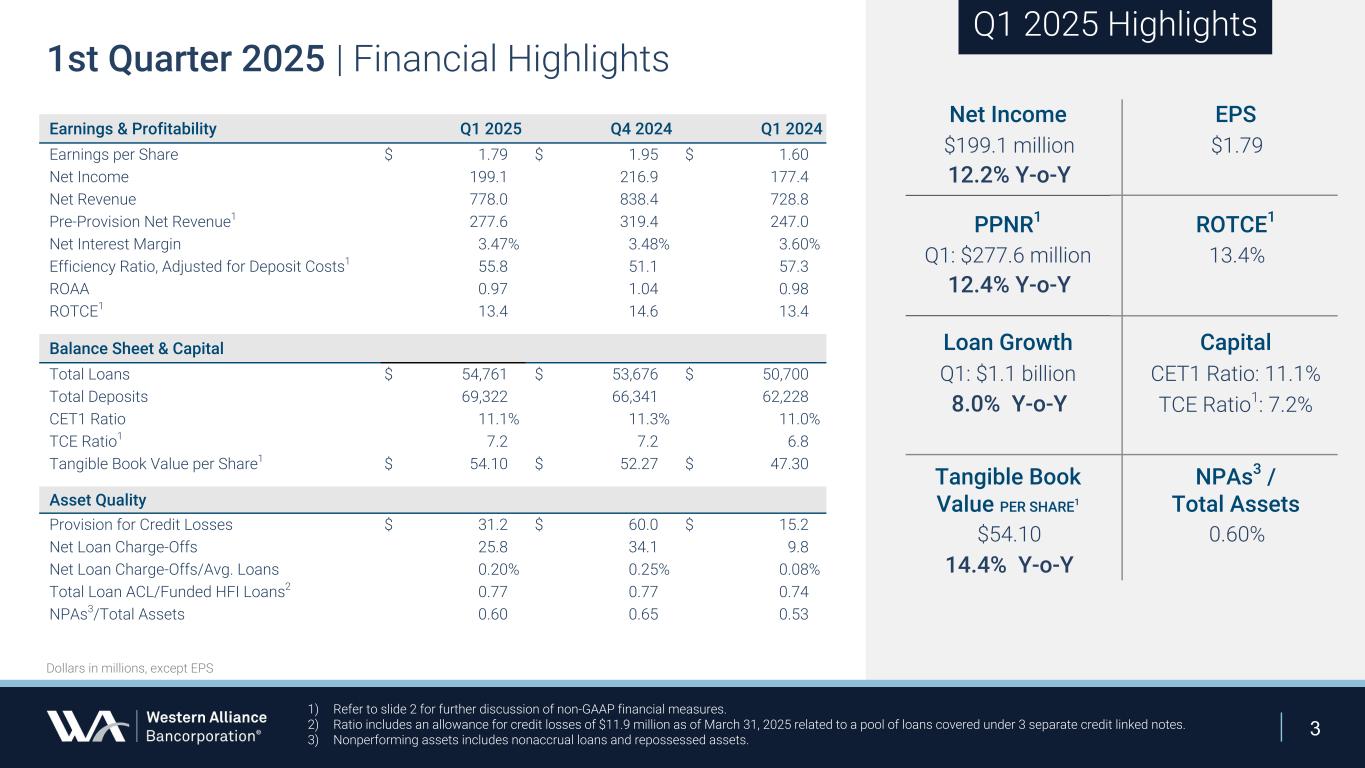
Thanks, Miles, and good afternoon, everyone. I'll make some brief comments about our first quarter earnings before handing the call over to Dale to review our financial performance and drivers in more detail. And then I'll close with some prepared remarks regarding our 2025 outlook, and our Chief Banking Officer for Regional Banking, Tim Partner, will then join us for Q&A. Before turning to our financial results, I want to thank the people of Western Alliance, as well as our customers and investors, for the many kind notes and well wishes received during my leave of absence. I also want to express my appreciation to the other members of the executive leadership team for managing the company during my absence. I'm feeling great and excited to be back at work. We often refer to Western Alliance as a bank for all seasons that is always ready to serve our commercial clients' needs, irrespective of the macro environment. This is because our extensive sector expertise enables us to evaluate and structure business around perceived risks. The significant diversification of our business lines means we are able to consistently support profitability and risk-adjusted earnings while compounding tangible book value. In other words, we produce growth through all seasons. Different pistons in our growth engine fire at different times during the economic cycle, but the net result is consistent, safe, and sound loan and deposit growth, even during times of uncertainty like the present. Over the past two years, Western Alliance has significantly increased its capital and liquidity to fortify our balance sheet against potential market fluctuations, ensuring we are all well prepared for any changes in the U.S. economy, including from tariffs. We have preliminarily evaluated our borrowers and do not see a meaningful number of them with significant transaction volume with China, Canada, and Mexico, since Western Alliance serves U.S. companies dependent on largely domestic supply chains with limited international exposure. Looking back on the first quarter, we are pleased with our execution that delivered financial results in line with expectations as we continue to prudently grow the balance sheet and maintain asset quality. Western Alliance's balance sheet growth supported solid pre-provision net revenue of $278 million, which equates to a $31 million or 12% year-over-year increase. Driving this increase was net interest income, which grew $52 million year-over-year, or 9%. Net interest income, inclusive of deposit costs, also grew $52 million year-over-year, as ECR costs reverted to the prior year's first quarter level. Net interest margin held steady at 3.47%, declining only one basis point from the prior quarter while adjusted NIM, inclusive of deposit costs, expanded 17 basis points to 2.75% as a result of our accelerated ECR cost reduction efforts. Asset quality was stable, net charge offs declined five basis points in the quarter to 20 basis points, which aligns with our full year view. Provisioning for the quarter was $31 million, which was significantly below to four levels of $60 million. While classified assets rose $186 million, non-accual loans declined by $25 million quarter to $451 million and moved seven basis points lower as a percentage of funded HFI loans to 82 basis points. I know collateral values are affirmed by recent appraisals above loan values. Dan will now take you through the rest of the results in more detail.
Thank you again. Looking closer at the income statement, net interest income grew 9% year over year to $651 million and declined $16 million quarter over quarter almost entirely from two fewer days in Q1. Our backloaded loan growth places us in good position to drive continued net interest income growth with ending health for investment balances 1.1 billion higher quarter over quarter versus a quarterly average increase of only 57 million. This loan growth is indicative of the improving profitability of our balance sheet and points to expanded NII going forward. As Ken mentioned, net interest income inclusive deposit costs increased 52 million from the prior year and 22 million quarter over quarter. Non-interest income was relatively stable year over year at 127 million. Mortgage loan production volume increased 25% annually and the gain on sale margin was 19 basis points. This quarterly decline in mortgage banking revenue was primarily related to lower gain on sale due to a decline in secondary trading gains. The smaller quarterly decline in net servicing revenues stemmed from a lower MSR fair value change net of hedging. The results, the reduction in income from equity investments was driven by an approximately eight million dollar charge on investment due to change in timing of income recognition, which we expect to fully recover over time. Non-interest expense was reduced $19 million to $500 million from the prior quarter as the positive cost declined $38 million to $137 million. Provision expense of $31 million replenished $26 million up net charge-offs, as well as provided incremental benefit to the Reserve for Commercial Real Estate, which we see as prudent given the current macro volatility. As a reminder, we focus on mitigating future losses by requiring low advance rates at the time of underwriting. This standard is validated by recent appraisals that show collateral values exceed low values. Turning to our net interest drivers, continued improvement in interest-bearing deposit costs and overall liability funding updates slower loan and securities yields. In Q1, the yield on total securities compressed four basis points to 463. Held for investment, loan yields decreased 14 basis points to 620, which reflected a full quarter's impact of rate cuts made during Q4 on our variable rate loan book. The cost of interest bearing deposits declined 23 basis points as a function of our active management of deposit rates, even without additional FOMC rate cuts since Q4. We continue to sustain momentum in lowering the banks cost of funding is demonstrated by the interest bearing deposit cost spot rate landing 29 basis points below the average rate for the quarter as discussed earlier net interest income declined 16 million from q4 to approximately 651 million almost entirely due to the smaller day count net interest margin remained relatively stable from q4 347. the impact of reduced hfi loan was mostly mitigated by a comparable decrease in interest cost of funding, average earning assets. Non-interest expenses declined 19 million court per quarter as deposit cost fell 38 from both lower rates and smaller average balances. This decline offset normal seasonal increases in compensation and other expenses. Salaries and benefit expenses were higher from an annual incentive compensation plan bonuses earned from the achievement of various performance goals, as well as higher payroll taxes. Our adjusted efficiency ratio of 56 percent compares favorably to the 57 percent ratio reported the first quarter of 2024. While we remain asset sensitive on a net interest income basis, we are essentially interest rate neutral on an earnings at risk basis in a ramp scenario. This offset is supported by a material projected ECR related deposit cost decline this year and an increase in mortgage banking revenue. Our updated rate forecast calls for two 25 basis point rate cuts before the end of 2025. The balance sheet expanded 2.1 billion from year end to 83 billion in total assets which reflected HFI loan and deposit growth of 1.1 billion and 3 billion respectively. The seasonal rebound of mortgage warehouse deposits also allowed us to reduce borrowings by 1.4 billion total equity increased 508 million inclusive of 293 million dollars in proceeds from the issuance of reet preferred equity finally tangible book value per share climbed 14 year over year aided by sustained organic profitability and some rate driven relief for a negative aoci position hfi loan growth of 1.1 billion demonstrated gathering momentum toward the end of the quarter cni drove most of the growth supported by smaller contributions from commercial real estate and construction residential loans decreased 63 million cni loans now account for 44 of the hfi loan portfolio compared to 39 a year ago while residential loans are now 26 of the portfolio compared to 29 these results exemplify the deep sector expertise and strong client relationships the company has fostered. I'd also like to add this expertise is concentrated in areas with inherently low embedded risk of loss, which we view as increasingly valuable amidst a changing macro backdrop. Regional banking produced over $900 million of loan growth led by contributions from home builder finance and in-market relationship banking. National business lines provided the remainder with lender finance the main driver of its growth with but with smaller diversified increases from other areas our growth in lender finance has continued to gain traction from our relationships with private credit clients deposits grew 3 billion in q1 mostly a non-interest bearing and were complemented by growth and savings and money market balances seasonal strength and mortgage warehouse was augmented by a solid results in hoa and our specialty escrow services hoa solidified its market-leading position by posting a $900 million increase in quarterly growth during a seasonally strong quarter and surpassed $10 billion in deposits for the first time. Among specialty escrow services, corporate trust was a standout with nearly $300 million of growth and business escrow services generating approximately $100 million. Corporate trust momentum could continue to benefit from the positive rating actions Western Alliance received in February. According to asset quality, criticized assets rose $254 million from increases of $68 million in special mention loans and $186 million in classified assets. These loans have been reserved or charged down to current as-is market values and are revalued on an ongoing basis. Non-performing assets as a percentage of total assets eased five basis points from year end to 0.6%. on. Quarterly net charge-offs were 26 million or 20 basis points of average loans. Provision expense of 31 million added reserves to cover charge-offs that augmented our CRE reserve. Our ACL for funded loans increased 15 million from the prior quarter to trading 89 million. The total loan ACL to funded loans was unchanged from the prior quarter at 77 basis points. Our ACL ratio is conservatively weighted to economic scenarios more pessimistic than economists are forecasting, which include a weighted peak unemployment rate above 6%, continued reductions in CRE valuations with greater than 50% peak to trough contraction in office values, and several quarters of negative GDP growth. The ACL walk we regularly provide to add more context behind our allowance methodology moves our ACL from 77 basis points to 1.35%. This incorporates the effect of credit link notes, as well as low to no loss loan categories like equity fund resources, our low LTV and high FICO residential portfolio, and mortgage Additionally, we applied another method to compare our loan portfolio to peers since loan mix matters when establishing loss reserves from differences in embedded loss content across various portfolios. Relatives to peers, Western Alliance's loan portfolio is much more weighted to categories with very limited risk of loss. We have over $8 billion of mortgage warehouse loans, which are advances on mortgage properties while being escrowed for the GSEs with an average duration of about two weeks. We know of no bank that has incurred loan losses in this category. Our $8 billion total compares to the peer median of just $69 million, with several having no exposure at all, which suppresses our relative reserve level. Our $14 billion in residential portfolio is larger than the peer median of $9.4 billion, and also carries a high proportion of loans and high FICO, low LTV residential mortgages that we believe is not the case for the typical appear credit link notes ensure 8.5 billion dollars of this portfolio will already have the funds to cover any losses that might emerge conversely western alliance has de minimis consumer loans compared to a pure median of 3 billion these loans require substantially higher reserve levels as they are generally supported by a single source of repayment and more easily disrupted by adverse life events if you apply the peer median loan mix to our portfolio the comparable allowance would be over one percent turning to another look at capital levels we believe reserves should be considered in the context of adjusted capital our ct1 capital ranks around the median of the peers however if you add to that our lower adverse aoci mark and the ACL to address that some peers may have capital trapped in their reserve. You can see our adjusted capital is 11%, which is flat since year-end and ranks above the peer median for our asset cohort. This supports our confidence that our capacity to absorb any losses in concert with steady loan growth remains strong. Our CET rate one ratio decreased approximately 13 basis points to 11.1 during the quarter as a result of strong loan growth. Our tangible common equity to total assets ratio remained 7.2 percent. In late March, we received proceeds of 2 to 93 million from the sale of preferred equity at our REIT subsidiary. We issued out of the REIT in order to generate ongoing material after-tax dividend cost savings instead of issuing at the holding company. This issuance lifts our tier one leverage ratio from 8.1 percent at year end to 8.6%. Emblematic of a balance sheet with a lower risk profile, our risk-weighted assets to tangible assets ratio is among the lowest of peers at 70%. Tangible book value per share increased $1.83 from year-end to $54.10 as a function of organic earnings combined with $56 million reduction and negative AOCI position from a lower rate environment. Consistent upward growth in tangible book value per share remains the hallmark of Western Alliance as an exceeded peers by six times over the past decade. And I'll turn the card back again. Okay, thanks, Dale.
Our updated 2025 guidance is as follows. While we remain attentive to economic and macro developments, our balance sheet guidance remains unchanged at $5 billion of loan growth and $8 billion of deposit growth for the full year as pipelines remain healthy with strong client engagement. Turning to capital, our CET1 ratio should remain above 11%, a level we have been above for a year as we produce solid, risk-weighted loan growth. Net interest income should ascend sequentially throughout the year and is still expected to increase 6% to 8% for 2025, largely as a result of sustained loan growth and expanding net interest margin that approximates 2024's level on a full-year basis. Non-interest income will follow net interest income's trajectory of 6% to 8% growth due to the ongoing traction in cultivating deeper client relationships with commercial banking fee opportunities. Non-interest expense, assisted by declining ECR costs from two rate cuts expected before December, should land between 0% growth and a 5% decline. We expect ECR costs in Q2 of $140 to $150 million. Our revised full-year ECR cost outlook of $485 to $535 million incorporates our current rate assumptions and typical seasonal outflows of mortgage warehouse deposits in Q4. Asset quality should remain stable with full-year net charge-offs hovering around 20 basis points. And lastly, we now expect the effective tax rate for 2025 to be approximately 20%. At this time, Dale, Tim, and I will make your questions.
Operator
Great. If you'd like to queue for a question, you can do so by pressing star 1 on your telephone keypad. If you'd like to remove your question, it's star 2. But again, to join the question queue, please press star 1.
In the interest of time, it has been asked that you hold yourself to one question with a follow-up question our first question is from casey hair with autonomous your line is now open thanks good morning guys uh dale uh i appreciate all the color you gave morning guys uh yeah i appreciate all the call you gave on on the acl and certainly does seem like it's predicated on some very conservative macro assumptions but uh it's just obviously it's a major overhang on the stock for investors to see the ACL that low. I'm just wondering, is there any thought to use some qualitative reserves to just get that into a more palatable level for the market?
Well, I mean, I think we've shown that our reserve is adequate both in composition and when you add it with some capital. What I don't want to have happen is I don't want people to think oh my gosh you know they have a reserve level that's lower than somebody else is there you know after i've become an owner of western alliance is there a charge coming that's going to take the reserve to a higher level we do not see that we continue to you know have a very rigorous methodology for determining our allowance and uh and supporting that by what's taking place we actually had a scenario this last quarter where we would have had a release of reserves in the CRE, but we instead put that into additional overlay on CRE and again gets us to the higher levels we have now with a more conservative view using the S-4 scenario from Moody's to be able to put on our commercial real estate office.
Fair enough. And then just switching to the guide for $25,000. Everything seems to be tracking pretty well with the exception of fees.
It sounds like that's coming from just more traction with your commercial clients.
Just wondering, if it's down year over year and you've got a healthy high signal budget expectation, is there any help coming from mortgage or just the cadence of what looks to be a pretty steep the fee map and the remaining quarters here? Yeah, we see fee income rising in the second half of the year, buttressed from the seasonal increase in mortgage income. We expect mortgage income to remain flat year over year to prior year, although I will say we are mindful that the recent rate volatility could impact consumer behavior. But all in, we expect non-interest at this point to follow the net interest income trajectory.
Operator
Our next question is from Jared Shaw with Barclays Capital. Your line is now open.
Hey, good morning, everybody. Ken, it's great to have you back on the call. Looking forward to hearing more as we go through the summer. Maybe just the first, can you give a little color on some of the C&I growth dynamics where you were seeing strength and what was driving that disorder?
Yeah, so let me just talk about the balance sheet, I think, in its entirety to begin. But there's strong momentum on both sides of the balance sheet. For loans, the client pipelines are active and full. And at this point, we expect Q2 loan growth to actually top Q1. Our National Home Builder Group, Warehouse Lending Group, Note Finance, Lender Finance will all fuel the growth for the following quarters. All right. And then with that, we see our deposits also tracking to our full year guide to support the loan growth that we're bringing in.
Thanks for that color. And then I guess, you know, looking at the capital raise, that was an interesting structure. Was the primary goal for that to raise tier one leverage? And are you happy with where that is now? Or could we expect to see, you know, some other maybe unique capital moves going forward?
Yeah, it was to raise the Tier 1 leverage ratio, and we are happy with our level in kind of the mid-8 range. You know, again, if you juxtapose our Tier 1 leverage ratio compared to peers, which maybe is a little below the median, but a much higher than median level of risk-weighted assets to total assets, we think that gives you good balance. It also shows you, really confirmed by where we stand on a CET1 ratio of north of 11 percent. I might also note that we have a subordinated debt transaction that becomes callable this quarter, and we expect to call at least part of that in the near term, which will mitigate to some degree the cost of the preferred. So we did a preferred deal of the REIT. A lot of banks don't have this option because they don't have a REIT to be able to do that. The rate on that preferred less that those two dividends are tax deductible. If we pay dividends out of the holding company, they're not tax deductible. They're just like common share dividends. But out of the REIT, they are tax deductible. And so the net to us is a lower cost after taxes than what it would have been if we had issued out of the parent. Great.
Thanks for that detail. Appreciate it.
Operator
Our next question is from Bernard von Gusecki with Deutsche Bank. Your line is now open.
Hey, guys. Just on insurance costs and deposit service charges, so I know you've engaged your larger depositors about passing over the deposit insurance costs over to them if they want to maintain the level of insurance. I know it just was over about $1 million for the quarter, but service charges increased over $5 million. So I'm just wondering, is this mostly due to the larger depositors maintaining their insurance accounts and you benefiting from higher service charges? Or was that the increase due to the change in pricing that you previously noted from Gen 1?
This is Ken. I also think that the answer here is that we've put a full court press on improving our treasury management services and outreach to our clients. And I think what you're seeing is that increase is showing up in the service charges for this quarter. And if you really look at it year over year, it's really up significantly for us. And so, you know, Tim Bruckner, who's sitting to my right, he's kind of led that charge to bring in more fee income. and we've been focusing on that for the last 18 months to two years, rolling out products, improving our products and service capabilities and delivery, and we're pleased to see that type of improvement.
Okay, and my follow-up, just on the expenses for ECR-related deposit costs, I know the 2Q, 140 to 150 million is a small uptick versus 1Q, and I think you just raised the guide on that uh for full year could you just break down like is that higher expected ecr related deposits higher rate uh what's driving that change it's really a higher average balance um you know so q4 was uh you know it came down um it built back up in the first quarter so as it go from you know q1 to q2 we expect a higher average balance in ecr related deposits and that's what's kicking that up we don't we do not see you know spreads on ecrs climbing from here okay great Thanks for taking my questions.
Operator
Our next question is from Ibrahim Kunawala with Bank of America. Your line is now open.
Good morning. I guess maybe, Dale, just following up on the NII and the margin trajectory, one, remind us whether rate cuts, including of ECR costs, are helpful or neutral to the NII outlook. And when we think about the sequential improvement, is this more back-half rated? Is it a big step up in the fourth quarter when you think about just how NII and the margin trajectory are going to play out for the remaining three quarters?
Yeah, this is Ken. So on net interest income, we kind of see the net interest income sequentially growing quarter to quarter, certainly for Q2 and Q3. We do have two rate cuts in there, one in June and I think the other in September is our forecast. And so what you'll see from us is net interest margin increasing gradually through the year, but I think you'll see more of an increase in the adjusted net interest margin as ECR costs kind of rise a little bit in Q2 and then flatten to decline in Q3 and really in Q4 as volume also leaves us, right, for the warehouse seasonal mortgage exit. So you'll see the adjusted net interest margin grow, and that's going to bring the net interest income to that sequential pattern of growth. Plus, you know, the loan growth itself is going to help us. And so to the extent that we could accelerate our loan growth and increase it at a faster pace, that will give an increase to our average earning assets, which will give more support to the net interest income. And that's how we get to our full year guide.
Got it. And Ken, welcome back. I guess another question And back to, I mean, I heard Dale's response on the reserves, but I think when you think about, and I know you spend a lot of time, when you think about the stock performance, it's trading at seven times earnings. Like, what do you think you can do to improve shareholder returns? I'm not sure if I heard any sort of discussion around buybacks, but how do you get the stock to re-rate?
How do you improve shareholder returns? like what do you think needs to happen for uh the stock to really react differently as we move forward i think i think we need to do a better job you know kind of really promoting what we're doing and the strength of our diversified business model we talked about that a little bit about being able to pivot from one you know sector or one business to another depending on what's in favor what might be at risk kind of going forward and we were talking about this earlier we've seen how you know some companies have brought up the southeast you know when what they're doing there well we have 14 billion dollars in loans and 14 billion dollars in deposits in the southeast and i don't know that that gets enough attention um you know we have offices there we've got people there we've got people in some 40 states uh but but we haven't uh you know we haven't put a flag you know in some of those so they don't so it doesn't show up necessarily on an fdic stand but uh but we're there we're active and uh and we're successful and would you consider some sort of an like we've talked about bank m a and maybe the regulatory environment improving like would some sort of a strategic partnership that better sort of extracts franchise value is that something that you would consider like how would you think about that no i don't think so i mean look uh it's hard to find another bank in our peer group
that can grow the way we can grow on the balance sheet side and improve earnings the way we generally have improved earnings and improved really tangible book value over the last, you know, 10 years. So I don't think we're going to consider anything along those lines.
Thank you. our next question is from gary tenner with da davidson your line is now open uh thanks good morning and ken welcome back uh a bit of a follow-up to that last question just in terms of you know if if uh m a is not on the docket uh you know the stock's trading a 120 of tangible book and below you're out tangible book uh you know and you don't have a big dividend payout uh ratio so any more openness to using some capital for buyback at this level?
So, you know, right now, in times of uncertainty, you want to have excess capital and liquidity to either defend the bank against market or economic disruptions, or be well positioned to take advantage of these disruptions. We've said since 2023 that we want to have a 11% CET1 floor. We are there. We think that positions the bank best in terms of taking advantage of growth. Go back to my opening statements, we're a bank that tends to grow through all different types of economic cycles. I understand that many of our peers are buying back their stock, but that is more of a temporarily improving EPS through those stock repurchase programs. You know, for us, we look to have that capital. We can deploy that capital into sound, safe and thoughtful loan growth. We believe we can deliver a return on average tangible common equity in Q1 was 13 percent, but we see that rising as we go forward into the mid-teens percentage. and we think over time that is the best use of our capital. Additionally, we compete very strongly against the top 10 banks in the country with our national business lines. And when we go in to talk to clients, we need to kind of look like they do in terms of their CET1 ratios and liquidity profile. And having a larger CET1 or higher CET1 ratio is very helpful in us being awarded business. So we do use it as a competitive strength in terms of growing the balance sheet. At this point, we're still not inclined to use it to buy back stock. We think the best longer-term value is doing what we're doing, and it's growing the company.
Fair enough. Appreciate the thoughts there. And then as it relates to the positive second quarter long growth commentary, I know it's still a little bit early in the quarter, but any visibility as to kind of how that may layer in over the course of the quarter, given the commentary about the first quarter long growth being pretty late quarter?
Yeah, I mean, to be honest, that's the hardest thing for us to forecast. My viewpoint is it always should come in early and it always should come in on the first day of the quarter. It just never works out that way, unfortunately. uh you've always got deals to be done and completed by our clients you've got lawyers in the way and it's always a little later than we think we're confident about our loan growth for the second quarter my guess it comes more towards the middle of the second quarter to the back half of the of the second quarter but we make a very concerted effort here to push it up as quickly as we can into a quarter, but that is a hard task for us to accomplish every quarter.
Operator
Our next question is from Ben Gerlinger with Citi. Your line is now open.
Good morning. Welcome back, Ken. Just a quick question. I know it follows up a little bit on the past couple. I hate to beat a dead horse here, but if you look at, like you said, interest-bearing deposit costs, spot rates down 29 pips. so I get to below 3 to start April. Why is the margin only going up gradually considering loan growth is pretty healthy in the month of March? I'm thinking it's a little bit more than gradual when you look at just the pace of which NII should increase. Am I missing something here?
I do think that we're going to be more a little more stable on non-interest bearing from here. I mean, you know, that has a strong recovery with primarily ECR-related deposits, you know, going into the second quarter. I would say as well that there is a little bit of issue with pricing pressure. So, you know, we are seeing our loan growth, which we're confident about achieving, it is going to have a lower average spread relative to kind of the, you know, the current what's currently on the balance sheet. And so that's going to be modestly dilutive to the margin over time. Again, we're really focused on PPNR and what we can do to drive that more than we are about managing the margin per se. And so PPNR obviously also includes the ECR costs that are in a non-interest expense.
Right. No, that makes sense. It seems like PPNR is going to go higher seemingly every quarter for the next year or two years. But obviously, rate dependence is hard to see six or seven quarters out. But when you think about just the investment spend associated with that PPNR, i.e. non-ECR-related deposits, is there anything incremental to a non-run rate perspective on investment, i.e. to get over the $100 billion that you still need to do? Or if the rules were changed and $100 billion was more like $50 or something like that, would you be ready today?
So, embedded in our forecast and certainly in our PP&R guide is the fact that we continue to build out our LFI readiness. And, you know, we assume on a natural growth curve that somewhere at the end of 26, early 27, we'll be over $100 billion, and we are preparing to do that. And embedded in our expense base is about $30 million to do that. Okay? Now, if your question is if new rules or regulations come out and kind of push that out a little bit and we don't have to be ready to cross over $100 billion, then, yeah, there would be some expense savings as we would push out the development for that. But I'll tell you, you know, just as much as this is a heavy lift for us inside of the company, and I don't think it really gets appreciated that or what type of heavy lift we're doing inside the company and simultaneously being able to grow the company the way we're growing it, the preparation for the LFI or Category 4 levels actually helps us make better decisions. It provides a better discourse around the table with better data. And so we are seeing some benefits from it immediately as we prepare to cross over that level in the future.
Operator
Our next question is from Timur Brasili with Wells Fargo. Your line is now open.
Hi, good morning. Going back to the loan yield conversation, just the C&I loans that were put on back end of the quarter, I'm just wondering, you know, given rate activity, can we actually see those loan yields increase in 2Q or just some of the pricing pressures that you're talking through, the loan production was below the kind of average balance for the first quarter?
Yeah, I would not say that you're going to see those loan yields increase over in Q2. Again, we have a rate decrease occurring in the second quarter, so that will put some pressure on the loan yields. Dale mentioned this in his comments that we are seeing some pricing pressure in the market, so we're still winning deals, but there are a number of banks that are out there really searching and groping for loan growth. And sometimes they come in with pricing that for us doesn't make any sense, and we'll walk away from those deals. But there is some gradual downward pressure on loan yields.
As Ken mentioned, we have two rate cuts expected. The first of those is at the June FOMC meeting, which is in the middle of the month.
And so, assuming that's a 25 basis point that that will move you know the preponderance of our loan book lower by 25 bps as well again it's only for one sixth of the quarter but you're going to get a haircut of a few basic points from that too okay great and then my follow-up just on credit um maybe can you talk through the increase in cni classifies this quarter and then as you look at the office portfolio just the the reappraisal rates um and i'm looking at page 22 of the deck Just over the last couple of quarters, that's grown from 7% over 80% LTV and 3Q. That's over 25% of the portfolio today. Granted, much of that did occur last quarter. I'm just wondering, you know, how granular was some of those reappraisals that are now over 80% and just with 40% of the office book maturing in 25, 75% maturing through 26? Does the current uncertainty in the macro change the way you potentially think about the risk profile of these upcoming maturities? Sure.
Yeah, I'll take that. So, first with the substandard, in our methodology and our risk grading, we are quick to move into substandard. We use special mention very sparingly. And we do that because we have built our culture around elevation and then timely resolution. So, that moves those loans into a very direct remediation strategy. So the movements and substandard are all fully secured, fully appraised, and real estate backed, unlike the discussion we've had on past calls. So when we look at the appraisal rates, everything that we underrate, and let's talk about office everything that we underwrite in office we go in at uh 55 or below on on the appraised uh on the appraised value and then we uh have any additional fundings that would move on from there as we call it good news money uh with signed leases and co-support from the the sponsorship So through this cycle, we've been rigorous to make sure that we have that support dynamic and that if we don't have that dynamic, we take very timely moves to assert control over the assets. So as you see those move up, you also see the basis of appraisal move from a fair market value to a very conservative as-is value, giving effect to current market conditions. So, when you see those appraisal movements, the numbers, a small part of the story, the bigger part is the basis of the appraisal.
Operator
Great. Thank you. Our next question is from Chris McGrady with KBW. Your line is now open. Oh, great.
Operator
Welcome back, Ken.
I'm looking at slide 18 to guide. Is there any reason why you would steer us away from the midpoints across PPNR? Are you leaning either in any direction for any of the NII fees or expenses?
I'm sorry, is your- Chris, your question again is- is what?
I think- Oh, sure. If I'm looking at your guidance, is there any reason for us to not assume the midpoint of the various ranges, or are you leaning to the high or low end in any one of the three components of pre-provision earnings?
I think the midpoint is appropriate. You know, if I had my druthers in terms of what would happen by the end of 2025, we would have pushed a little harder on deposit growth and a little harder on loan growth based upon, you know, from the guidance we have here. And that would be kind of the primary driver of improved performance. But again, we, you know, want to be very attentive to changes in, you know, in economic conditions that folks have been, you know, rather frequently. Okay.
And in that point, Dale, if the revenue, either mortgage or the growth doesn't come through, but can you speak to the degree to flex the expenses a little harder?
I think if there's any flex that's really going to drive PPNR upward will be higher loan growth and higher average earning assets that would drive the PPNR off higher. I think the flex on the expenses is pretty much what we've guided to at this point, and I would not change that guide or change that in your model.
Operator
We have a question from John Arfstrom with RBC. Your line is now open.
Hey, thanks. Hello, everyone. Hey, John. Question for you guys on the mortgage banking outlook. I think, Ken, you mentioned earlier flat mortgage revenues year over year. Can you talk a little bit about your rate assumptions around those expectations? And is there a 10-year level where the volumes start to increase and maybe there's upside to that outlook?
Yeah, I mean, in terms of mortgage rates and what we saw last year, you know, the pickup in volume begins somewhere when the mortgage yield for the 30-year is 625 or lower. That's when we started to really see a pickup in volume. If you talk to the mortgage folks at AmeriHome, they'll tell you anything that cracks 6% would really be a race for the roses in terms of a much, much higher volume. So we're assuming that rates kind of stay where they are to getting a little bit better throughout the year, and that's sort of what gives us this projection to keep mortgage income flat year over year. I will tell you that, you know, we are watching consumer behavior, and we're mindful that the recent rate in market volatility could impact future consumer behavior. and we'll wait to see how that unfolds. But right now, we're sticking with the full year guide. It may come a little bit later in second quarter and then into the third quarter. I think April was a little choppy for consumers for the obvious reasons.
We've heard this persistent cry, refis are coming, refis are coming, and yet they seem to be going to perpetually put off. And there's two pieces, as Ken was mentioning, there's two pieces to that rate spread issue that we have one of them is overall rates higher and then the other is the volatility in the premium price above like say the 10-year treasury for the mortgage prop you know for mortgage refinance and that's because in part they some are concerned buyers are concerned well if i buy this mortgage now but yet we see the volatility crush or we see rates decline for whatever reason that could happen maybe a pullback you know in terms of tariff action, maybe action from the FOMC, we can see both of those collapse. And so, if you're going to be buying, you know, financing mortgages, you're going to be in a refi business kind of out of the gate. And so, I think just more stability might mute the ball and the rates for, you know, for what we have in 30-year mortgage property relative to, you know, relative to market, independent market rates anyway.
Any thoughts the gain on sale outlook would you do you think 19 basis points is unusually low or or any thoughts on that outlook yeah i don't yeah i can't say whether it's going to expand i would say that 19 basis points is is unusually low thanks guys thanks john we have a question from andrew tarrell with stevens your line is now open hey good morning and again welcome back um if i could ask on just Dale, you mentioned in the prepared remarks the Moody's rating change back in February. I was hoping you could maybe just discuss a bit more any incremental traction you're gaining in the corporate trust business following that news. I know it's been a point you guys have talked about for a couple of years now.
Well, I think primarily what it does is it, again, reinforces confidence in terms of the strength and stability of the company. It was also upgraded by Fitch at that same timeline, and so a lot of those are based upon kind of deposit ratings as opposed to debt ratings, which already were an A-rated situation, so we think that that's helpful, but again, kind of gets back in terms of kind of closer to where we've been historically, and we think overall it just promotes confidence, it's not just in corporate trust, but with our business escrow services, with our digital account products as well.
I'll just add to that, you know, very proud of the corporate trust folks this quarter. They approved deposits $270 million. Our corporate trust business is, you know, now over 800 million in deposits. Our business escrow services is just about touching a billion dollars. And so we've got six different digital or six different deposit platforms that are going gangbusters led by, of course, HOA, which we now think we are the market share leader. And as Dale mentioned earlier, $900 million. So, yeah, I think the upgrade in investment grade rating is going to help. I just think these deals take time. We've got to be awarded deals, and then they've got to fund the deals, and then we get those deposits. But we're encouraged by what's happening in all of our deposit channels, and I think it's supported by that upgrade by Moody's and by Fitch.
Great. I appreciate the color. If I can go back to just some of the commentary on loan yields, I don't know if you guys have it, but could you share the weighted average yield on the new production for the first quarter? I'm just trying to get a sense of, you know, I hear you on the competitive front, you know, just trying to get a sense for how different, you know, new loans being put on are from the 620 or so book yield today. Thanks.
Well, right now it's coming in at three basis points lower, but our deposit costs are coming in 29 basis points lower. So we're seeing a slight decline in yield, loan yields, but we're picking it back up in deposits.
Okay. Thanks for taking the questions.
Operator
Our next question is from Matthew Clark with Piper Sandler. Your line is now open.
Hey, thanks. Good morning and welcome back, Ken. Just on the kind of round out the discussion on margin and NII, it looks like you've got some pretty good visibility going to 2Q with the end of period loan growth called 617 and the drop in the spot rate. You would argue for a margin over 360 on a reported basis, but any sense for kind of where that margin ended at the end of the quarter, you know, if you normalize it for any unusual fees?
Well, we don't track, though, what the margin is. Oh, sorry, at the end of the month or?
Yeah, end of the month. End of the month, yep. Yeah, so, end of the month, right.
You know, I'll just say, let me try to kind of give you this, guys. I think when you think about the net interest margin, we kind of see it staying rather, kind of moving slightly upwards in Q2, a little bit more in Q3, and then plateauing Q4 to Q3. That's the net interest margin. The adjusted net interest margin, inclusive of VCR costs, you know, we kind of see second quarter and first quarter kind of being about the same, and then we kind of see it growing, the net interest margin improving, adjusted net interest margin improving stronger in Q3 and then again in Q4.
That's probably the best guidance I can give you on that. Yeah, you're definitely going to see more leverage over the adjusted margin than just the reported margin. That's really, that's closer to what we're focused on. It's more direct relationship to PPNR. What we don't want to do is we don't want to not underwrite, we have liquidity, a reasonable credit opportunity that has strong credit metrics, just because it might be decremental to the loan yields under the margin.
And then just on the criticized increase this quarter, any thoughts on the outlook and migration in general, whether or not we might see some improvement, or is this kind of environment making it a little more? um skeptical uh our our migration as i as i mentioned is is really focused on um real estate uh related particularly office uh secured loans so when we look at those those have been in view now for a couple of years and we've been you know working our strategies on that so when we look forward, we see the path to resolution as well as the necessary steps. And we know the assets by name. Again, this is a floating rate portfolio. We're not waiting for balloons or maturities here. So we've dealt with these assets early. So where I see it is flat in the coming quarter. We see it begin to move downward in the later part of the year.
Operator
We have a question from Anthony Ellion with JP Morgan. Your line is now open.
Ken, good to hear you're feeling much better and welcome back. I want to start on loan growth. I know you mentioned that second quarter should top. I know you mentioned that second quarter loan growth should top first quarter growth, but can you just share with us anecdotally anything you've heard since Liberation Day on what you've heard from your customers in terms of business investment, CAPEX they may be thinking about, but that's on pause now, and if they're making any adjustments now given the elevated uncertainty from tariffs?
Yeah, so our clients are certainly mindful and cautious of what's going on. I would say the longer the tariff discussion stays in limbo, the more uncertainty and angst will be added to their outlook. But, you know, we're seeing a lot of our growth in Q2 come from longer-dated capital expenditure programs, i.e. national home builder finance, which we do lot financing, and then we do the vertical construction on that. Those folks make longer-term investment decisions, and we're funding them as such. And so those folks are, you know, of course, mindful, but not immediately impacting their business, mostly because there's still somewhat of a housing shortage in the U.S. On the CNI side, you know, lender finance seems to continue to push forward. We're actually seeing some improvements in tech and innovation, although overall that sector has slowed a little bit, certainly in deposit generation and liquidity events. But we seem to be winning more than our fair share of market deals that are out there or taking market share. And so that's giving us some confidence as well.
Thank you. And then my follow up on credit, I think back to the early days of COVID. You guys were early in terms of proactiveness, diving deeper into potential problem portfolios. Ken, it sounds like you did that again based on your prepared remarks and you don't see a significant number of borrowers or meaningful exposures to China or Canada. But are there any segments now within national business lines that you're just paying a little bit more attention to, given the outsized uncertainty? Thank you.
Hi. You know, we really look at our, as Ken introed with, our diversified business model as a strategy for any type of economy, and it plays out in this type economy. So we're constantly at the table, dialing some of our businesses up a little bit, and we're seeing great results, and we're dialing other businesses down. So, you know, we're a bank going into this period with virtually no retail or energy exposure, no consumer exposure outside of our mortgage business, and all of our borrowers, for the most part, are domestic companies doing business in the U.S.
That doesn't take the risk away, but it gives us a very manageable model with our diversified strategy where we can where we can we think manage through this better than most thank you there are no further questions at this time so i'll pass it back to ken vecchione for any closing remarks uh yeah thank you all for joining us and thank you for again for all your uh well wishes and uh look forward to seeing you on the road at conferences and then uh picking up again with you on our next earnings fall thanks again that concludes today's call thank you all for
Operator
For your participation, you may now disconnect your line.