Operator
Good morning, ladies and gentlemen. Thank you for standing by. Welcome to the Westlake Corporation fourth quarter and full year 2025 earnings conference call. During the presentation, all participants will be in a listen-only mode. After the speaker's remarks, you will be invited to participate in a question and answer session. As a reminder, ladies and gentlemen, this conference is being recorded today, February 24, 2026. I would now like to turn the call over to today's host, Jeff Halley, Westlake's Vice President and Chief Accounting Officer. Sir, you may begin.
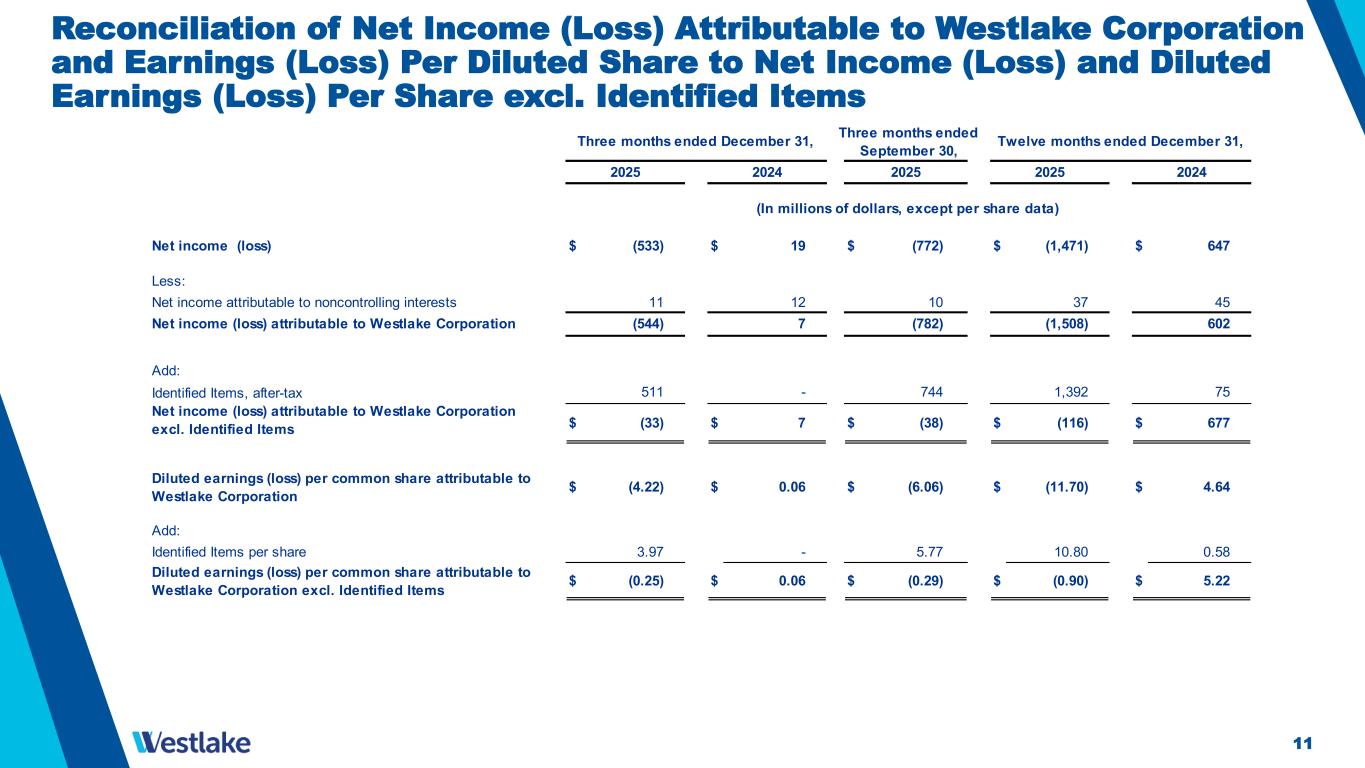
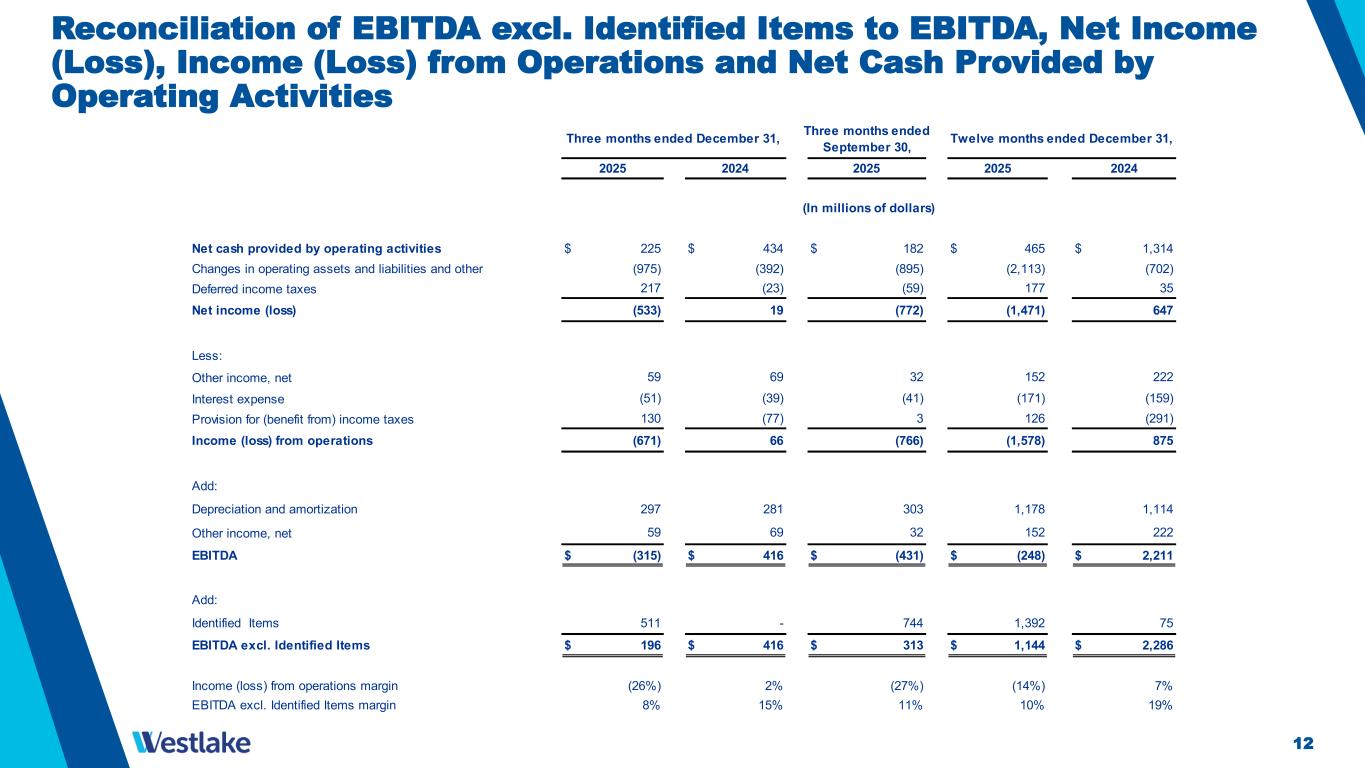
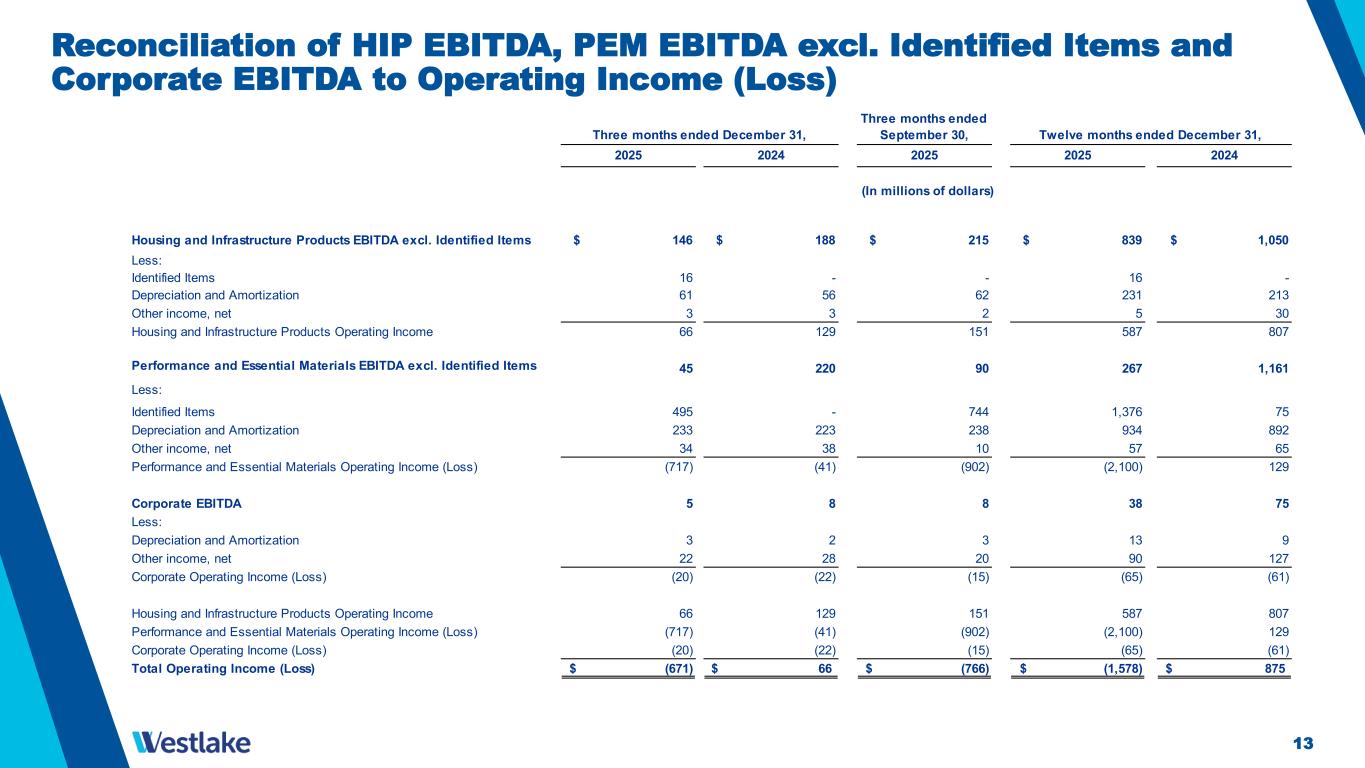
Thank you, Amber. Good morning, everyone, and welcome to the Westlake Corporation Conference Call to discuss our fourth quarter and full year results for 2025. I'm joined today by Albert Chow, our Executive Chairman, Jean-Marc Gilson, our President and CEO, Steve Bender, our Executive Vice President and Chief Financial Officer, and other members of our management team. During the call, we will refer to our two reporting segments, Housing and Infrastructure Products, which we refer to as HIP or Products, and Performance and Essential Materials, which we refer to as PEM or Materials. Today's conference call will begin with John Mark, who will open with a few comments regarding Westlake's performance. steve will then discuss our financial and operating results after which john mark will add a few concluding comments and we'll open the call up to questions during the fourth quarter of 2025 we wrote off inventory and accrued expenses totaling 495 million related to the decision to shut one styrene and three chlorvinyl facilities in north america and our epoxy facility in Pernice, Netherlands, in PEM. We also recognized $16 million of accrued expenses within our HIP footprint optimization actions and the sale of a compounding business. We refer to these expense items, which in aggregate were $511 million, as the identified items in our earnings release and on this conference call. References to income from operations, EBITDA, net income, and earnings per share on this call exclude the financial impact of the identified items. As such, comments made on this call will be in regard to our underlying business results using non-GAAP financial measures. A reconciliation of these non-GAAP financial measures to GAAP financial measures is provided in our earnings release, which is available in the Investor Relations section of our website. Today, management is going to discuss certain topics that will contain forward-looking information that is based on management's beliefs as well as assumptions made by and information currently available to management. These forward-looking statements suggest predictions or expectations and thus are subject to risks or uncertainties. These risks and uncertainties are discussed in Westlake's SEC filings. We encourage you to learn more about these factors by reviewing these SEC filings, which are also available on our investor relations website. This morning, Westlake issued a press release with details of our fourth quarter and full year results. This document is available in the press release section of our website at westlake.com. We have also included an earnings presentation, which can be found in the investor relations section on our website a replay of today's call will be available beginning today two hours following the conclusion of this call this replay may be accessed via westlake's website please note that information reported on this call speaks only as of today february 24th 2026 and therefore you're advised that time sensitive information may look no longer be accurate as of the time of any replay finally I would advise you that this conference call is being broadcast live through an internet webcast system that can be accessed on
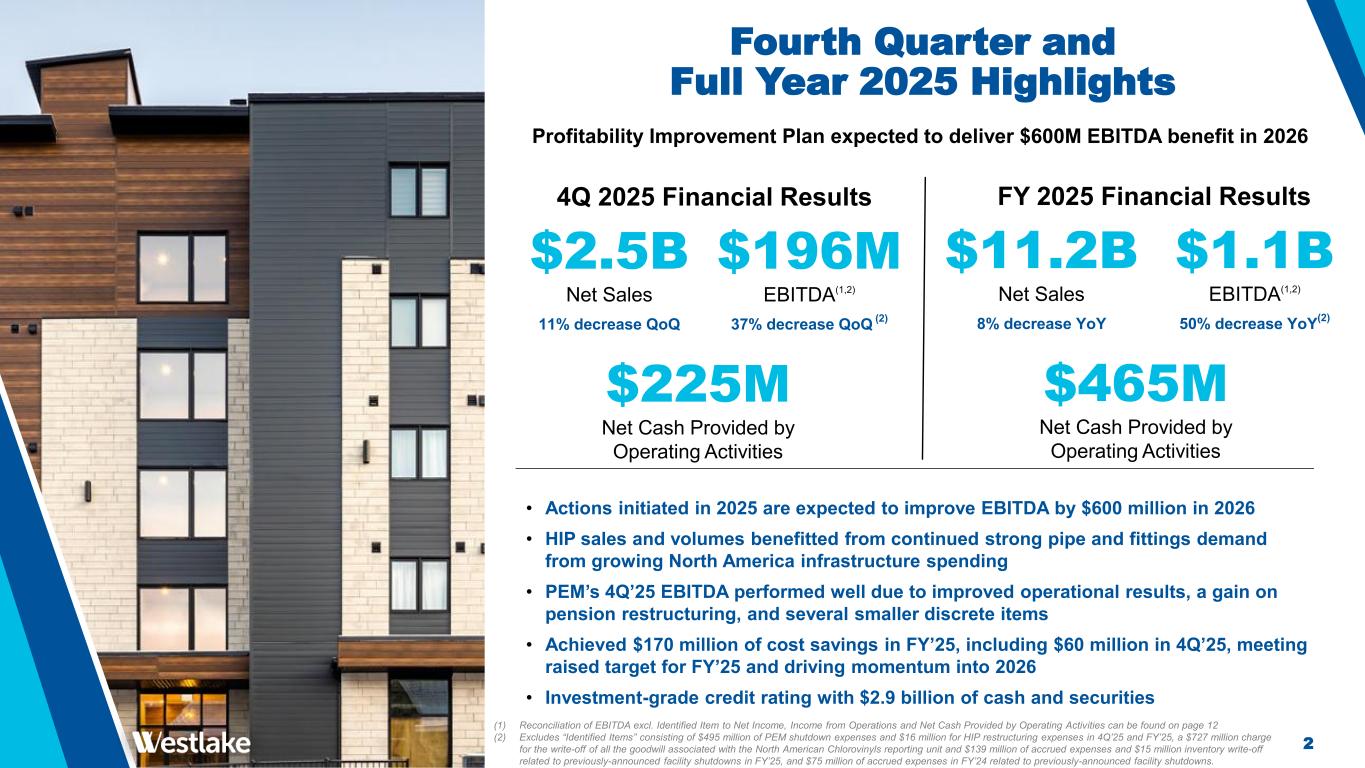
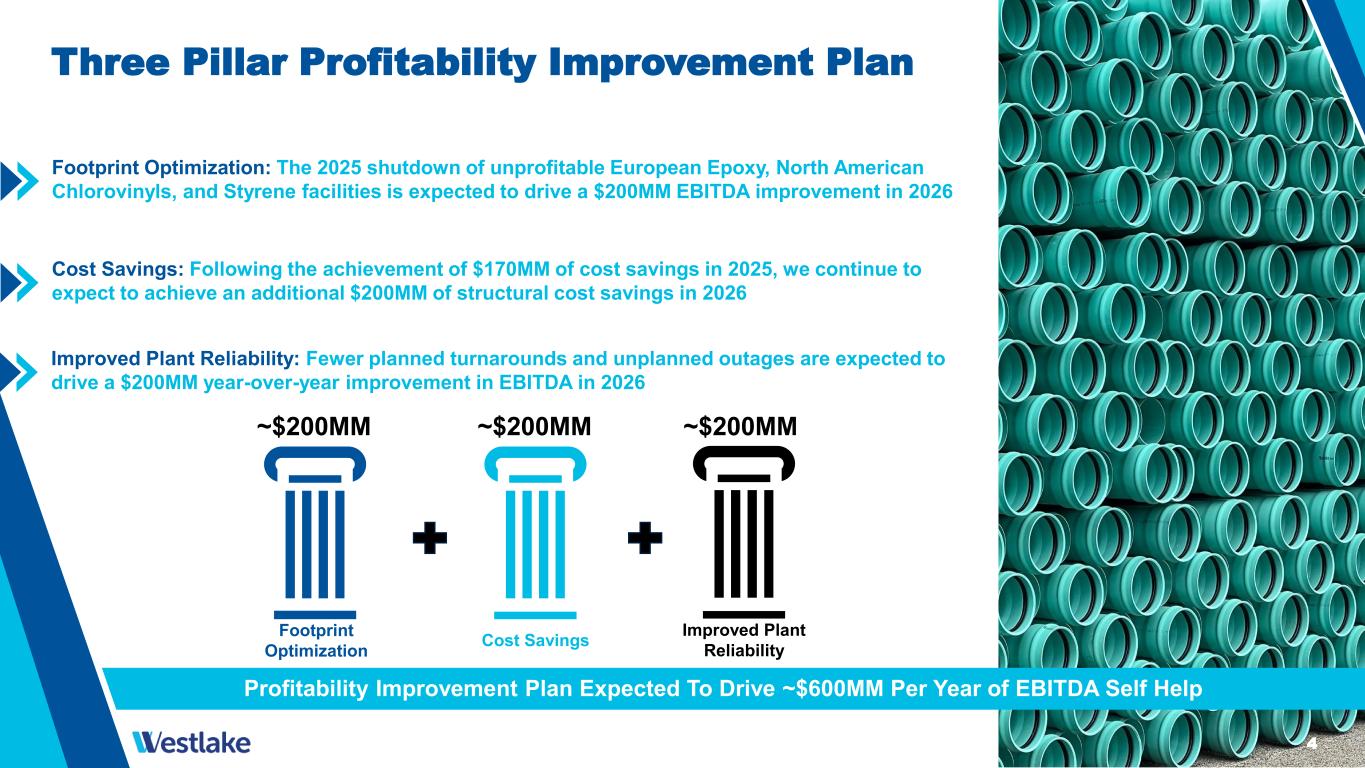
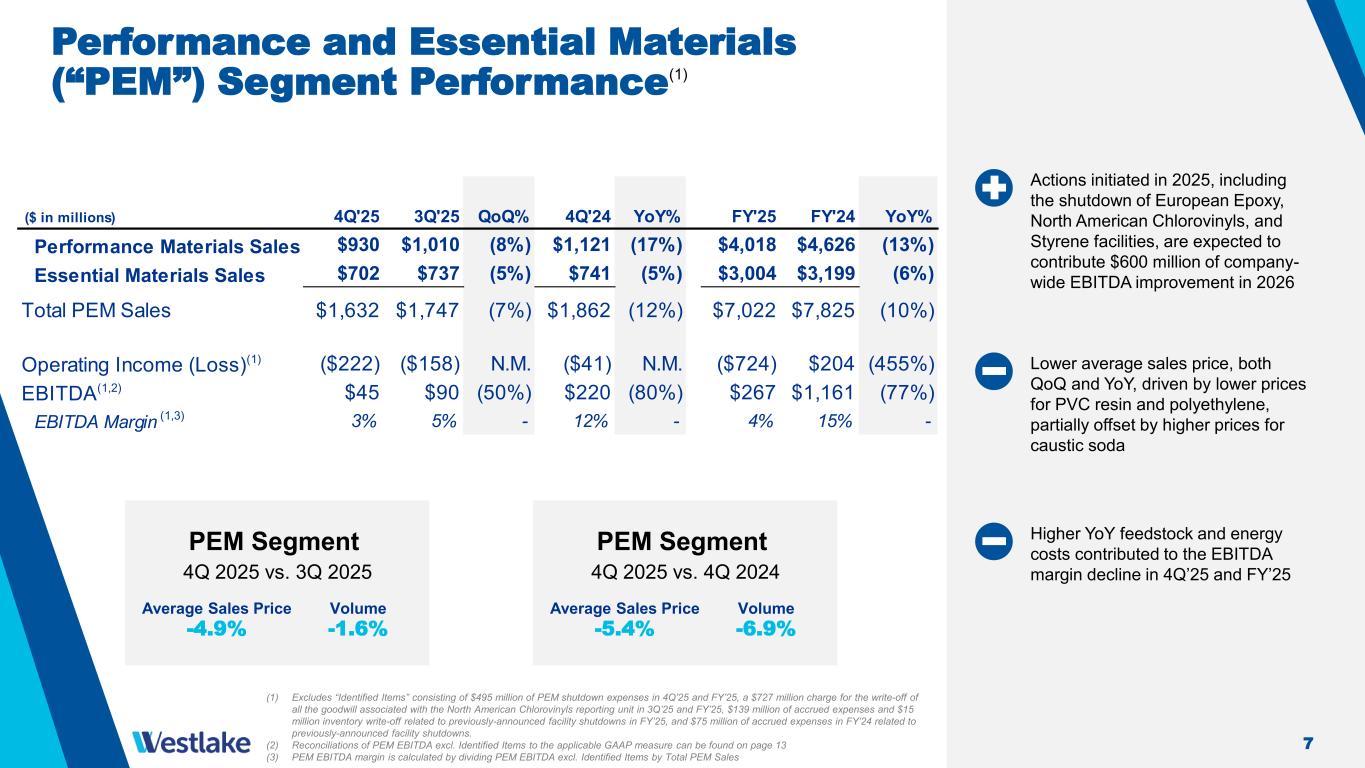
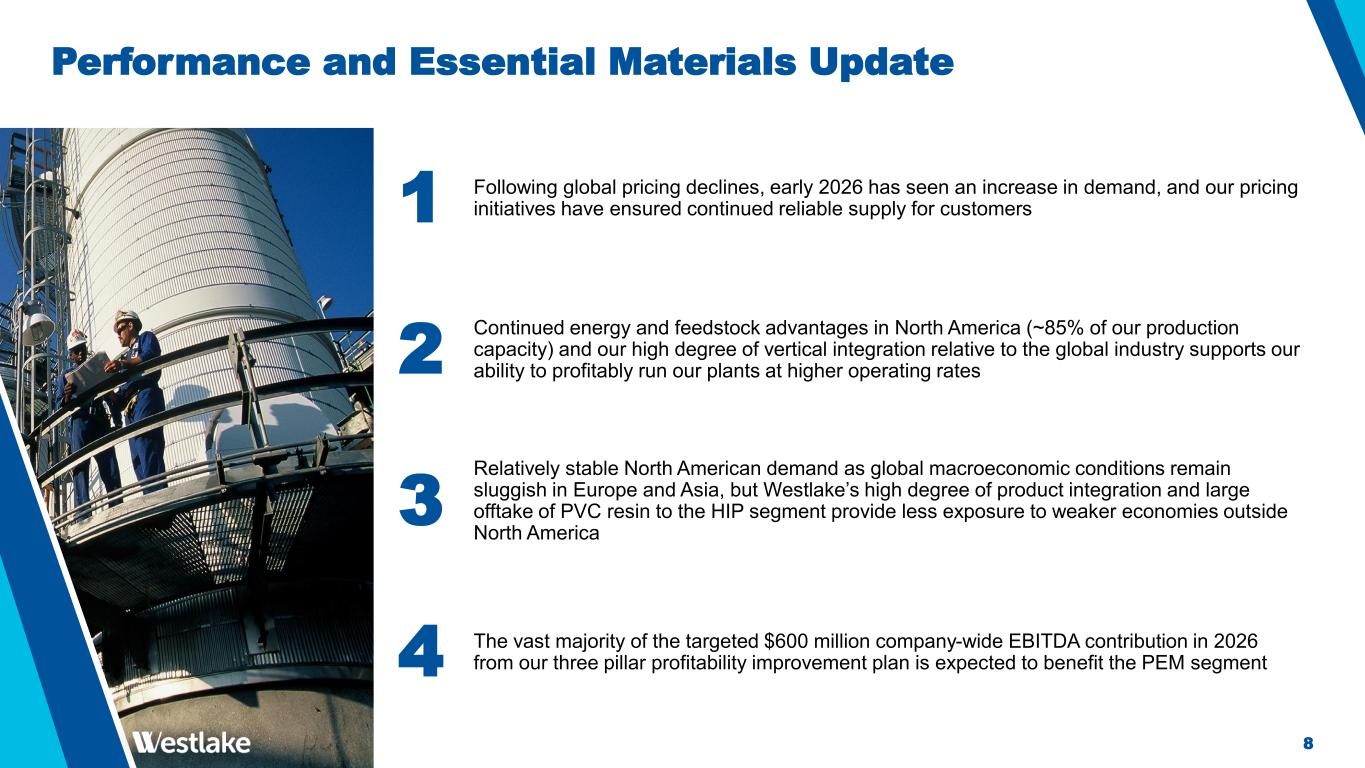
our web page at westlake.com now I would like to turn the call over to John Mark Gilson John Mark thank you Jeff and good morning everyone we appreciate you joining us to discuss our fourth quarter and full year 2025 results a fourth quarter EBITDA of 196 million dollars is net of 511 million dollars of identified items that reflect our announced plan to restructure the businesses and reset our cost position to address the persistent macroeconomic challenges and volatility in trade policies we are experiencing Despite continued industry pressures, we have taken decisive action to strengthen a global manufacturing footprint, and we continue to deliver on our commercial commitments while executing our three-pillar strategy, which we expect to contribute $600 million of growth earnings improvement in 2026, while maintaining a focus on our long-term strategy of value creation. Westlake's cost-saving measures gained significant traction across every business in 2025, and we delivered over $170 million of structural cost reductions. Looking at our fourth quarter results, HIP performed well while experiencing the typical seasonal decline in sales volume and earnings and the added impact of lower construction activity in the fourth quarter. The year-over-year decline in sales reflected lower new housing construction activity in North America, but that decline was partially offset by solid municipal pipe sales volumes as we benefited from the growth in infrastructure spending in cities across North America. Turning to PEM, the fourth quarter was a continuation of the trends that we witnessed throughout 2025 with results reflecting a decline in volume and price with margin compressions across our product portfolio as we serve the stable global industrial and manufacturing base as we discussed in december global overcapacity in certain products created downward pressure on the sales price for many of pams products leading to a sharp decline in pams profitability compared to historical levels. These pricing pressures continued in the fourth quarter with a further 5% decline in PEM's average sales prices compared to the third quarter of 2025. A three-pillar strategy, which I outlined in December, is expected to contribute a $600 million improvement in earnings in 2026. Let me summarize each of these pillars as significant steps have already been taken to drive this earnings performance strategy forward. First, we have taken decisive actions to close higher-cost PEM assets that largely sold products into low-priced export markets. We closed an epoxy manufacturing site in Pernice, the Netherlands, a non-integrated PVC plant in China, three North American chlorovinyl assets, a styrene asset, and three HIP fabrication sites. These actions contributed to a 6% reduction in our headcount and an even more significant reduction in our contractor workforce in 2025. Having now shuttered all of these assets, we expect to see an improvement in earnings of $200 million in 2026 from footprint optimization. Second, we have redoubled our efforts to address reliability in plant operation. Thus, we expect to deliver a $200 million year-over-year EBITDA improvement from better plant reliability in 2026. Third, building on the successful structural cost reduction efforts achieved in 2025, we have implemented an additional structural company-wide cost reduction program that we expect will deliver $200 million in 2026. These decisive steps and the commitment to deliver improved financial performance through these self-help actions will deliver better utilized assets and an improved cost structure to compete in a global marketplace i would like now to turn our call over to steve to provide more detail on our financial results for the fourth quarter and full year of 2020-25 but before i do that i would like to make an additional comment As you may have seen in the 8K we issued yesterday, our colleague and long-serving Chief Financial Officer, Steve Bender, has informed us that he plans to retire later this year, once his replacement has been appointed and an appropriate transition has occurred. We are tremendously grateful for the countless contributions that Steve has made to the company over the years. He joined Westlake in 2005, not long after the company's 2004 initial public offering. And he has been instrumental to the significant growth in the company that the company enjoyed since then. Steve will be with me on several more earnings calls in 2026, so this is not yet a goodbye. Nonetheless, we wanted to take this moment to express our gratitude to Steve. Now, let's turn to the fourth quarter and full year 2025 financial results.
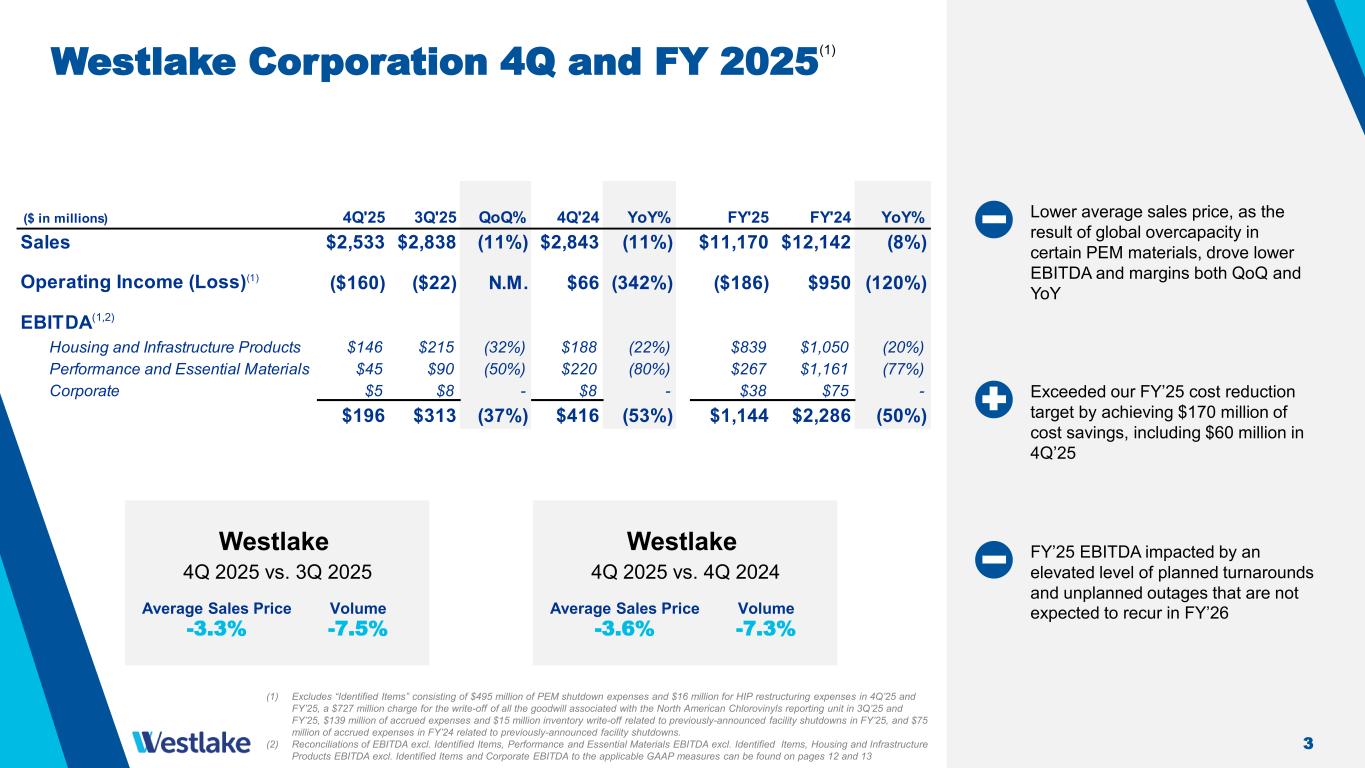
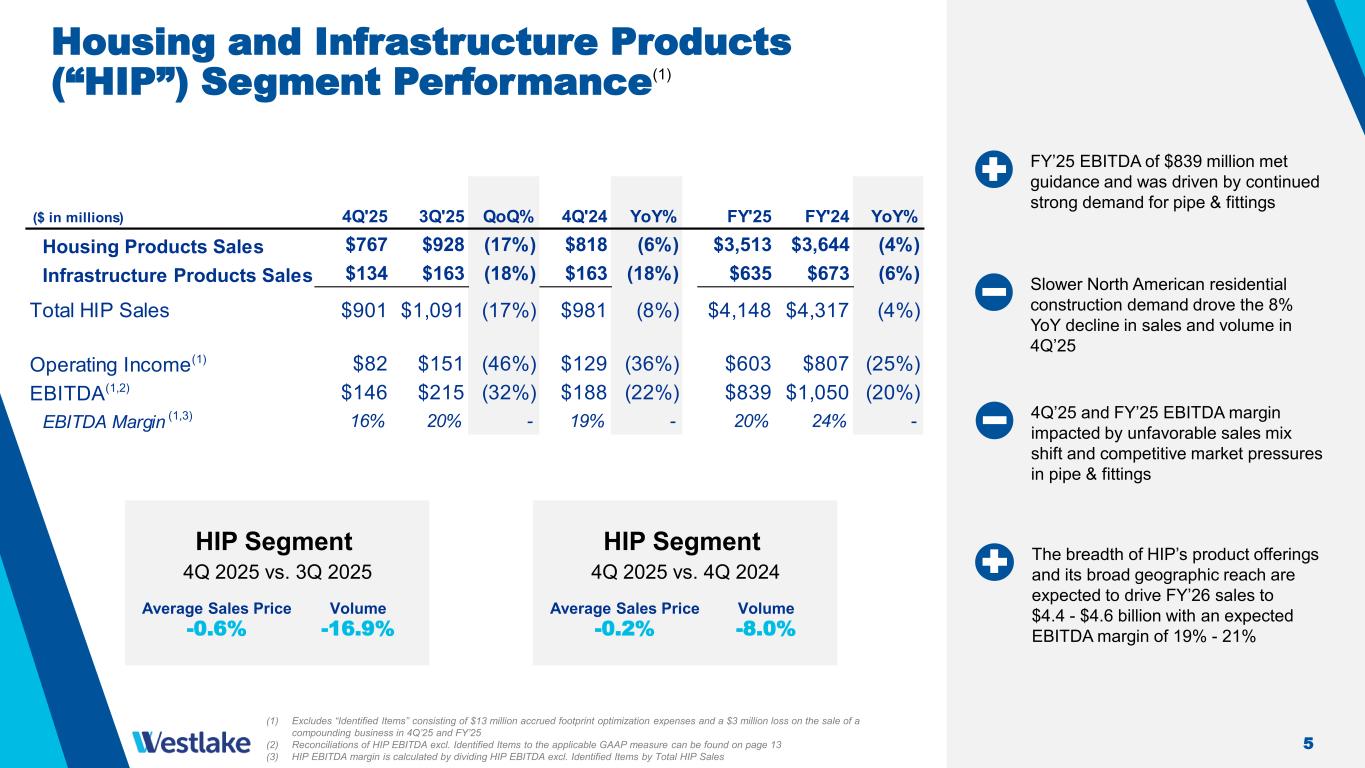
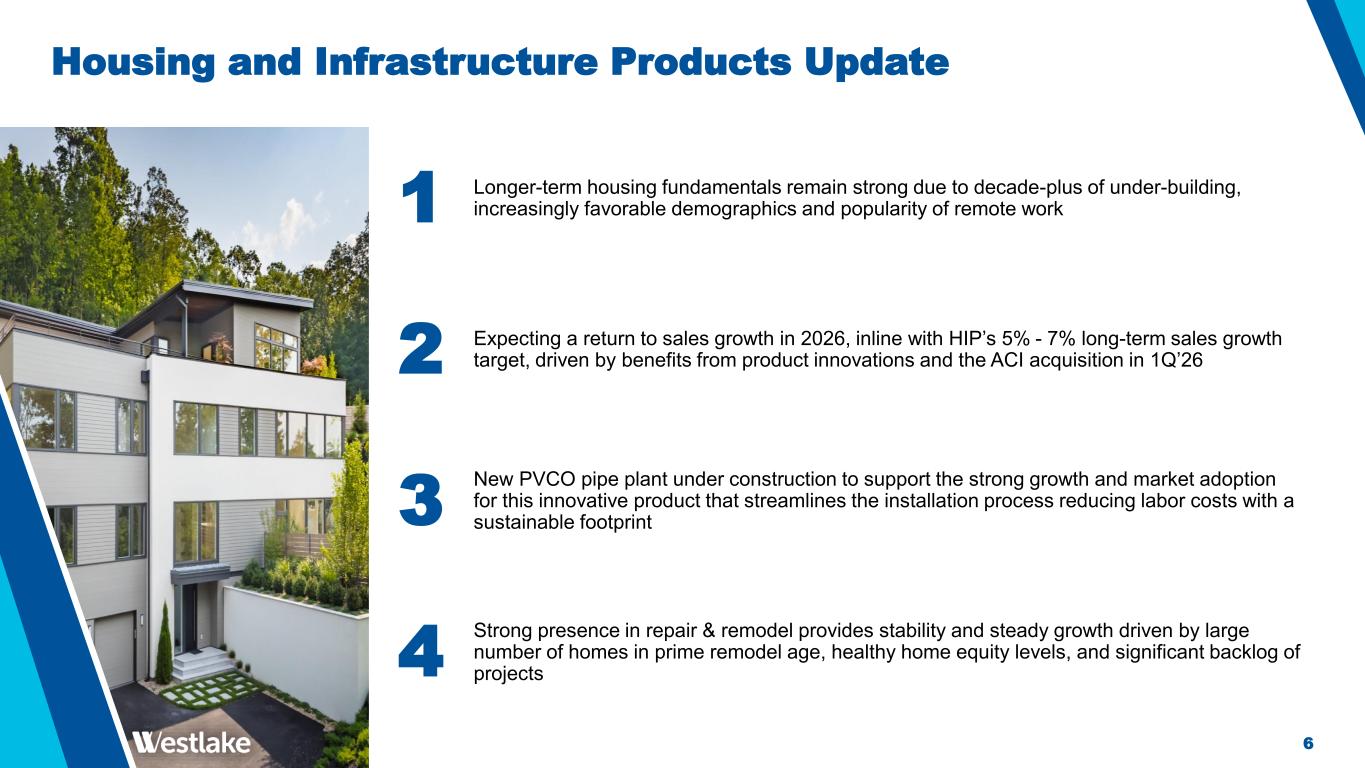
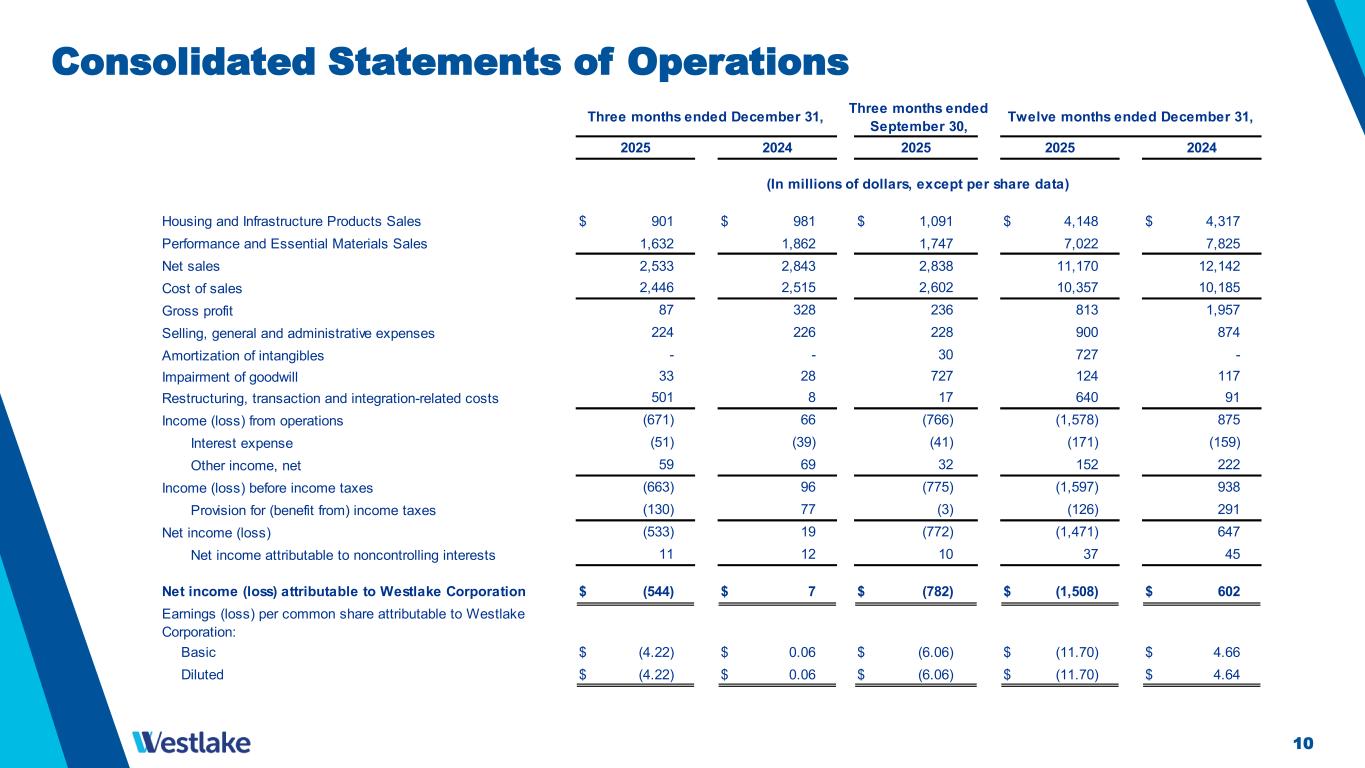
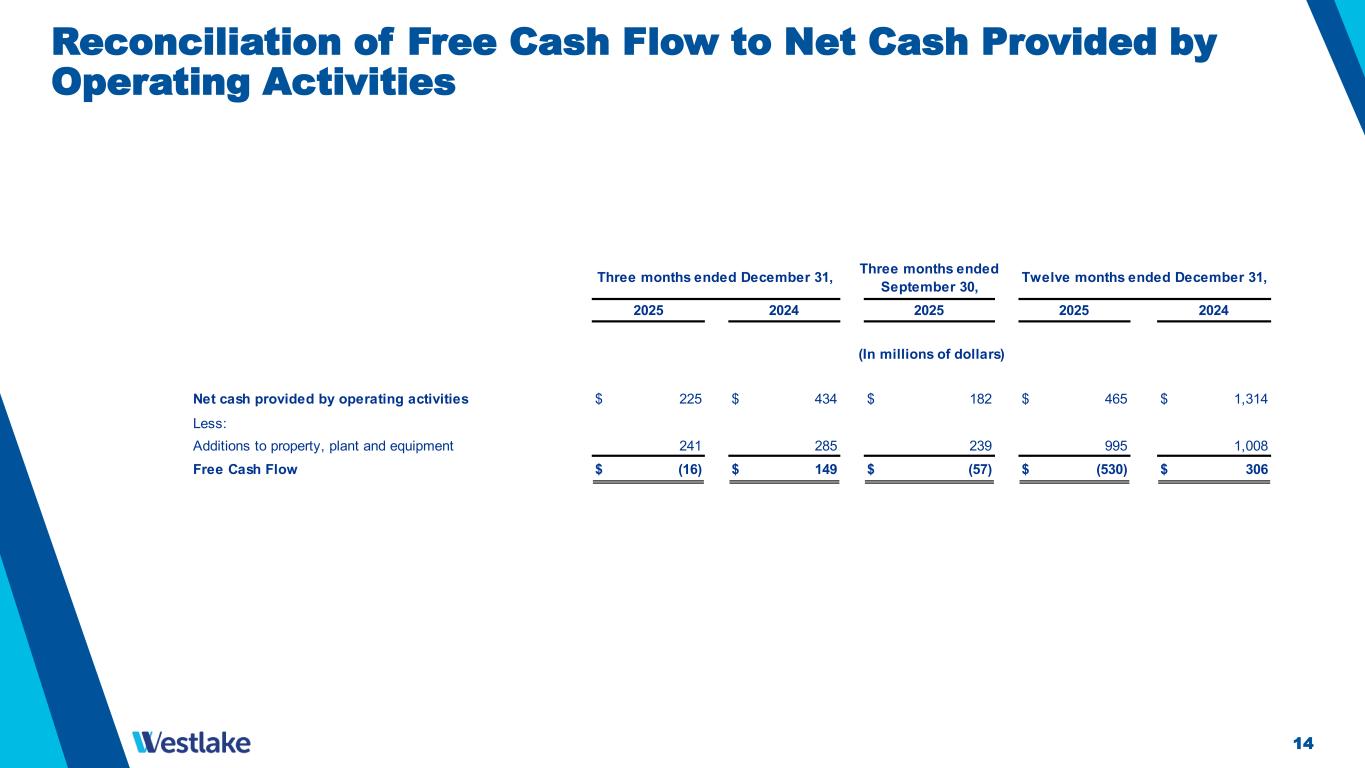
Thank you, John Mark, for those comments. Thank you very much, and good morning, everyone. As a reminder, my comments regarding income from operations, EBITDA, net income, and earnings per share all exclude the financial impact of the identified items. Leslie reported a net loss of $33 million or a loss of 25 cents per share in the fourth quarter on sales of 2.5 billion dollars the net loss in the fourth quarter of 2025 was 5 million dollars lower than the third quarter of 2025 primarily due to lower average sales prices and lower sales volumes for the fourth quarter of 2025 our utilization of the FIFO method of accounting resulted in an unfavorable pre-tax impact of 2 million dollars compared to what earnings would have been if we reported on the lifo method this is only an estimate and has not been audited we delivered an additional 60 million dollars of cost reductions in the fourth quarter thereby achieving the 170 million dollars of total cost reductions in 2025 and accomplishing our 2025 target of structural cost reductions so the full year of 2020 2025 we reported a net loss of 116 million dollars and evita of 1.1 billion dollars compared to our 2024 results 2025 sales of 11.2 billion dollars declined eight percent the lower full year of 2025 sales were the result of a five percent decline in sales volume driven primarily by pvc resin and epoxy resin and a three percent decline in average sales price driven primarily by piping fittings and PVC resin before I discuss the details of our segment results I want to provide some high-level thoughts on the quarter and the year as a whole our head segment performed very well and we were very pleased with the stability and really resiliency of the portfolio businesses that we've assembled at the same time as we discussed in December our pin segment was impacted by global over capacity particularly in polyethylene and the core vinyls chain that drove lower average sales prices and margins as john mark discussed throughout 2025 we took the necessary actions to adjust to the changing global balance of supply and demand and to position our pims segment for improved profitability in 2026 and beyond moving to the specifics of our segment performance hip sales in the fourth quarter declined eight percent year-over-year driven by a decrease in sales volumes the sales volume decline was mostly driven by pvc compounds and exterior building products which were most exposed to lower residential construction activity and was only partially offset by the continued solid sales volume and pipe and fittings hips even on margin of 16 percent in the fourth quarter of 2025 was below the prior year period due to unfavorable changes in sales mix and some higher cost shifting focus to pims excuse me to hips full year 2025 results evita of 839 million and even a margin of 20 percent were in line with our guidance and expectations while hips 2025 sales and evita were below the prior year we're pleased with its ability to manage the slower new residential construction environment better than the overall industry due to its broad geographical footprint and deep product offering that make it a supplier of choice for many large national home builders. HIP's resilient sales and EBITDA in 2025 also supported by strong customer adoption of our innovative PVCO pipe as well as continued solid demand growth for municipal pipe in general moving to PIM segment fourth quarter EBITDA of 45 million dollars decreased by 45 million dollars from the third quarter of 2025. the sequential decrease in EBITDA was the result of five percent lower average sales price driven primarily by polyethylene and pvc resin and a two percent lower sales volume due to seasonal customer inventory destocking which was partially offset by a $27 million benefit from annuitizing certain pension obligations, among other small one-time items. PIM's fourth quarter EBITDA margin of 3% declined from 5% in the third quarter of 2025, driven by lower average sales price, which was partially offset by a $26 million benefit from sequential lower planned turnarounds and unplanned outages. Shifting focus to PIM's full year 2025 results, EBITDA of $267 million was lower than 2024 due to higher feedstock and energy cost, an elevated level of planned and unplanned outages, and lower global sales price. Weak global industrial and manufacturing activity combined with overseas capacity additions created global overcapacity in certain materials in 2025. This global overcapacity drove lower average sales prices and margins in PEM, particularly for polyethylene and for aquiline and for vinyls. In response, we made the necessary decision in December to close three of our non-integrated and higher cost North American core vinyl assets that sold into low priced export markets. As we discussed in December, we expect these actions to provide an annual EBITDA benefit for PEM of approximately 100 million dollars starting in 2026 by reducing our exposure to the low-priced export market turning to the balance sheet and cash flows as of December 31st 2025 cash and securities were 2.9 billion dollars and total debt was 5.6 billion our balance sheet continues to be well positioned for the 16-year average debt maturity life for the fourth quarter of 2025 net cash provided by operating activities was 225 million while capital expenditures were 241 million for the full year of 2025 we returned 335 million dollars to shareholders in the form of dividends and share repurchases we continue to look for opportunity opportunities to strategically deploy our balance sheet in order to continue to create long-term value for our shareholders turning our attention to 2026 let me address some of your modeling questions and provide some guidance for the year ahead our three-powered strategy which was outlined in december is expected to contribute 600 million dollars of improvement and earnings in 2026 through these self-help structural actions we are better positioned to serve our value customers and navigate the current macro environment we have revamped our operating model and now have better utilized assets and a lower cost structure to compete in the global marketplace with improved financial performance now turning to our guidance for hip housing and industry consultants and a consensus of economists forecast that housing starts to range between $1.3 and $1.4 million in 2026 and for home affordability, based on lower interest rates, to improve. Furthermore, we expect HIP to benefit in 2026 from the recent acquisition of ACI with a now-expanded compound product offering and strong customer relationships. The strong 2026 structural savings that we've initiated and the benefits from plan optimization actions taken in 2025. Thus, based on our current view of demand and prices, we expect 2026 revenue in our HIP segment to be between $4.4 and $4.6 billion, with an EBITDA margin of 19% to 21%. For 2026, we expect a $100 million year-over-year reduction in our cap expenditures to approximately $900 million. dollars, similar to our depreciation run rate. For the full year of 2026, we expect our effective tax rate to be approximately 17 percent. We also expect cash interest expense to be approximately $215 million. Now I'd like to turn the call over to Jean-Marc to provide the current outlook of our business. Jean-Marc.
Thank you, Steve. 2026 represents an inflection point. Following the actions we have taken to optimize our manufacturing footprint streamline our cost position and operate our assets to serve our customers we have positioned westlake for a stronger more resilient and profitable future as we navigate the challenging micro environment with our three pillar action plan together with our long-term strategy and our investment discipline Turning to our outlook for demand, we expect a rebound from the seasonal lows of the fourth quarter. We are also seeing signs of improvement in global industrial and manufacturing activity to start the year. The January US ISM reading of 53 was the first month in expansionary territory in a year, And the average 30-year mortgage rate sits at 6.2% today, down from 7% a year ago, which improves the affordability of new houses. So overall, some signs of improvement in the market, which has us cautiously optimistic that we will see sales volume growth in each of our segments in 2026. sustainability and environmental stewardship remain critical to our mission at west lake having established a target to reduce our carbon emissions intensity by 20 percent by the year 2030 i'm happy to report that in november we released our 2024 sustainability report which showed that we achieved our mission our emissions reduction goal six years early Before I open the call to your questions, I want to close by highlighting Westlake's foundational strengths, which continue to serve us well. These strengths include a diversified and complementary portfolio of businesses, a vertically integrated business model, a globally advantaged feedstock and energy position in the U.S., and our investment-grade rated balance sheet with $2.9 billion of cash and securities. We have streamlined our operating model and have reset our cost structure. As we navigate the cycle in PEM, we have a more competitive business that is positioned to grow more efficiently with our customers. The expected steady improvement in housing construction will provide HIP the ability to continue to capitalize on its very broad and deep product offering to grow our business and to create value for our shareholders. We remain focused on execution, cost discipline, and value-driven growth. Thank you very much for listening to our earnings call. I will now turn the call over to Jeff.
Thank you, John Mark. Before we begin taking questions, I'd like to remind listeners that our earnings presentation, which provides additional clarity into our results, is available on our website, and a replay of this teleconference will be available two hours after the call has ended. We will provide that information again at the end of the call. Amber, we will now take questions.
Operator
Thank you. At this time, we will conduct the question and answer session. As a reminder, to ask a question, you will need to press star 11 on your telephone and wait for your name to be announced. To withdraw your question, please press star 11 again. Please stand by while we compile the Q&A roster. Our first question comes from David Bigleiter of Deutsche Bank. Your line is open.
Thank you. Good morning. John Mark and Steve, if you go back to the PEM business in Q4 and break down the beat versus what you announced back in mid-December of roughly $90 million, thank you.
Yeah, so, David, thank you very much for the question. And as you can see, when we compare the results in PEM quarter over quarter, we did identify specifically some annuitization of some pension benefits. You can see that we also shuttered some of these assets in the fourth quarter. And so the three core vinyl plants had actually been down during the entire fourth quarter. So the losses that we saw accruing during that period no longer were accruing. So when I think about this, we had a volume reduction of only about 2% and a price reduction really in PVC and polyethylene. So the BEAT was really attributable to beginning to take the proactive steps in our three-pillar initiative by removing the losses that we saw accruing from those sales in that low-priced market and begin to take some of those cost-reduction initiatives at the tail end of 2025.
Very clear. And just on polyethylene in February, what are your expectations around your announced price increases and potential realization?
Thank you. well as we think about 2026 you know we have seen some improvement in demand and some improvement in price action but remember we also had some adjustments at the end of the year of 2025 and so the the announced increase in polyethylene price that we saw in January of about five cents really begins to offset some of the the non-market adjustment which is a market adjustment at the end of last year, and we've made further announcements in price actions for February. We'll see how February plays through, but we have another price announcement also on the table for February.
Operator
You're welcome. Thank you. Our next question comes from Patrick Cunningham of Citi. Your line is open.
Hi. Good morning. I'm curious on your outlook for chloroviny and PVC chain in 2026. It seems, you know, maybe cautiously optimistic, you know, with some demand pull through into the hit business, but, you know, still dealing with some structural supply issues. So how would you frame the supply and demand outlook and sort of direction for price and margin in 2026?
Well, I think, Patrick, as you look at the price action that we've seen so far is indicative of some restocking that's going on. I would say that we remain cautiously optimistic. mystic we've seen some as I mentioned some price action you know in PVC resin we've seen some improvement in price but we're still not fully recovered from the end of the year price adjustments that we saw in PVC so we've seen announcement also in February and we've also noticed that inventory is as I say a restocking by some of our some of our customers but I'd say we're still very cautious in terms of how we look out through the year because i don't have that longer term long-term availability of visibility i can only see out several months but i think the uh early signs that we see in pricing initiatives in pvc and in caustic signal that we see some improvement in restocking but it's hard to know whether this will play through the entire quarter and for that matter the entire year. You know, we've also seen movement. I'd also note that with the actions that we've seen in terms of a export market, export market prices have started to trend higher and I think attributable to some of the reduction of duty drawback that certain markets like China are providing. It's going to affect in April, but the actions taken already suggest that prices have moved up in export market pricing.
Understood. Very helpful. And then maybe just some clarification on the HIP guidance. I'm assuming that includes three-quarters of ACI. We have a slightly lower margin guide. Is the bulk of that coming from the dilutive margin impact there, or are there any other mixed impacts we should be monitoring?
No, it's really not an impact of ACI, and we closed that in January. And so I do expect that it'll be a contributor all year long. But I would say, Patrick, it's really looking at the numbers that we've guided to 1.3 to 1.4 million starts in 26, somewhere to 25, and just recognizing that as we work through the starts numbers this year, that product mix can have an impact in the overall margin that we see in the HIP business. But we still remain, to say, cautiously optimistic about the contributions that HIP will make this year in 26.
Operator
Thank you. One moment for our next question. Our next question comes from Duffy Fisher of Goldman Sachs. Your line is open.
Good morning, guys. First question, just on the $600 million of cost help this year, how does that play through the year? If you could kind of walk quarter by quarter, how do we add up to that $600 million for the year?
Yeah, good question, Duffy. And I would say that as we've taken the actions in 2025, some of the savings that we achieved in 25 are attributable to the actions that we took in 25 and those will continue to play through for the year through 2026 and so those actions that that that we've taken cover things such as logistics procurement a variety of other initiatives to really drive reductions in cost which we think will be structural in nature so we think that as we think about the the rateable benefit that we expect to see we do expect to see that rate of benefit of cost reductions to play through the year of course we've shuttered those assets at the end of the year for that second pillar and so certainly those uh those operations are down no longer exposed as heavily we were to that low priced export market so i do expect those also to be coming through the course of 2026. the third pillar is reliability and of course we have to earn that each and every day But we're very confident we've made significant investments in our plants, significant in training of our people. 24 and 25 were years of very elevated levels of planned turnarounds, and therefore associated with some of those planned turnarounds were the unplanned outages as we brought those plants up or attempted to. 2026 will be a year with far fewer planned turnarounds. So we do have a high expectation that we'll be able to deliver on that third pillar of reliability. Fair enough.
And then at the midpoint of your HIP guidance, you're basically 60 million better on EBITDA than you were last year. Again, how does that portend for kind of each quarter? Are there still some quarters where you may be down year over year, even if you hit the midpoint, or maybe first half, second half, just to kind of help us get the shape for the HIP earnings this year?
Yeah, and Duffy, good question. And the fourth quarter and the first quarter of each year tend to be weaker quarters just seasonally. I mean, those who are in the Midwest or Northeast have seen the heavy snowfall in the winter season play through. And so as we think about it, it slows down demand and the construction activities. So the fourth quarter and the first quarter of each year tend to be a slower period of activity. But nevertheless, quarter two and quarter three tend to be much stronger. So that same cycle that we see played through in 2025 should be similar in terms of the shape of the curve, if you think about it, in 2026. So we do expect, you know, again, a cautiously optimistic outlook for HIPP, and the guidance we have for starts is similar to those in 2025.
Terrific. Thank you, guys.
Operator
Our next question comes from Josh Spector of UBS. Your line is open.
Yeah, good morning. I wanted to just ask on HIPP where you guys continue to talk about, I think, relatively strong growth in the infrastructure segment around pipe and fittings, but the infrastructure subsegment sales are actually down more than the housing product segment, both year on year and sequentially.
So does that mean that the composites business is down much more, or what am I missing between that more positive commentary and the segment results? yeah a good question and the answer is that a lot of that municipal pipe actually goes into neighborhoods and subdivisions which actually are not in that sub segment and so there are sales not only to cities and counties and states but also into major developers who may be developing those neighborhoods and those subdivisions with infrastructure uh pipe and fittings and so it's really a mix between those two sub segments within the hip segment we are seeing really continued strong growth in the volume in that side of the business and so when I
think of and speak to municipal pipe it isn't always necessarily in the infrastructure sub-segment because some of that is in the housing sub-segment related to nationwide builders who are building out infrastructure in their neighborhoods and subdivisions okay thanks so that's helpful and maybe actually a similar point to what Duffy was asking if I look at the cost savings is any of that being attributed to hip so if eba does up 60 million at the end point you're doing an acquisition is the organic up as their cost savings is there something else we're missing in the moving parts there yeah you know as we think about the pillar that we talked about a cost
reduction yes the hip side of business does have a meaningful contribution in that cost savings initiative and so as we look forward they and all the other functions are also contributing so there is a meaningful contribution in that pillar that HIPAA is making so I do expect them to continue to make those contributions in 26 okay thank you thank you our next question comes from Frank Mitch from the research LLC your line is open thank you and let me echo John Mark's appreciation for your job Steve it's been a pleasure working with you of
Of course, we'll work with you, I guess, on another one or two calls. Steve, in 2025, Westlake registered negative free cash flow. I was wondering what your expectations are in terms of free cash flow for 2026.
Good question, Frank. And our objective really is to generate, you know, strong results to drive strong cash flows. You know, but as you can see, a lot of the self-help that we have with these three pillars is really focused, And the predominance really is on the PIM side of the business. And you can see that our capital expenditure plan for 2026 is also $100 million lower than we had in 2025. So our real focus is really to drive free cash flow for the entire business as we go forward. And so while we have no real visibility beyond the next several months from our order book, I would say our real objective really is to drive real cost savings, improvement and reliability, and really make this business really a cash flow positive generating business. But, as you know, we don't give necessarily direct guidance on a lot of those metrics. But that is clearly our objective.
Okay, terrific. And I was wondering if you guys could opine on the news the other day, you know, following the Supreme Court decision on tariffs. The administration came out and said it was looking at putting emergency tariffs on several items, including plastic pipes. So, I'm curious if you could offer some comments there as to the necessity there and what expectations you might have in terms of tariff benefits, et cetera.
Yeah, Frank, good question again. And I would say that our materials are all subject to the USMCA rules guidelines, and so therefore the impact tariffs has really been de minimis, really immaterial. Okay, great.
But the fact that they called out plastic pipes, you know, among, I think, six or seven items, is there something going on there where the domestic plastic pipe industry needs tower protection?
Frank, I would say that what we've seen is all throughout the course of 2025 and, frankly, in the previous administration that the current administration has really used the USMCA treaty as a way to make sure that those items that were embodied in that treaty are not hit with additional tariffs. So that is our expectation. Okay. All right. Thank you so much.
Operator
Thank you. Our next question is from John Roberts of Mizzou. Your line is open.
And thanks as well, Steve, and also welcome Bob Patel to the board. OxyChem is a large competitor. Do you see any changes in how they compete after the change in ownership a couple months ago?
We have not at this stage.
Okay. And then your competitor cited weakness in domestic merchant chlorine. Did you see that weakness as well? And what's the near-term outlook for domestic merchant chlorine?
Yeah, as you know, we're a much smaller producer of domestic chlorine now with some of the actions that we've taken. in December. But as we think about it, you know, our view is that the weakness in chlorine is driven, excuse me, the weakness in chlorine we've seen is really attributable to some of the weakness that we've seen really in some of the vinyl side of the business. And of course, in the first quarter and the fourth quarter of the year, we also have a reduction in demand for water treatment and some of the precursors going into refrigerants. And so all of those speak to kind of the lesser pull on chlorine, whether it is construction materials, water treatment, or precursors to refrigerants. And so it doesn't surprise that there is a slowdown in demand in fourth quarter and first quarter for those kind of materials.
Operator
Thank you. Our next question comes from Jeff Zakaskis of JPMorgan. Your line is now open.
Thanks very much. You talked about $600 million in benefits from plant reliability, cost reduction, footprint changes. But I was wondering, what's the EBITDA base that these benefits should come from? So, last year, your EBITDA was $11.40. You know, should a rational agent add $600 million to the $11.40 and get, I don't know, $17.40? Or because business deteriorated through the course of 2025, the EBITDA base is lower that the $600 million in cost should be added to? Could you give us an idea of how to put the two numbers together?
Yeah, and so, Jeff, as you think about it, the actions that we've taken in December impacted four of the North American plants. And, frankly, the full shuttering of the Pernice facility wasn't completed until really very tail end of 2025. And so when you think about the contributions of that first pillar of site optimization, we really get that full benefit starting in 2026. In terms of the cost initiatives, yes, we achieved $170 million of cost reductions that were structural in nature, but the guidance we've continued to provide for 2026 is an additional $200 million on top of those achieved in 2025. And, of course, the reliability issues, as I mentioned earlier, again, 25 was an incredibly busy year of planned outages and a number of unplanned outages around those outages as well. And given that our plan for 2026 is far fewer planned turnaround activity or maintenance activities, I do expect that we'll see those benefits accrue in this year as well. So back to your question, I think that you could think of a starting point when we took those actions at the plants as a way to build that map.
And when you think about your opportunities in PVC volume in 2026, do you think you'll grow more in the export market or more in the domestic market? Do you think the growth rates will be comparable? example, how do you assess the volume opportunities in PVC for 2026?
And so, Jeff, when you think about the vinyl demand that we see, it's really going into largely building products of one sort or the other, whether it is in pipe fitting, siding trim, and other applications. That's more than 50, closer to 65% of the overall vinyl resin demand. And so, as you can see, our outlook for HIPP is reflective, really, of a year of construction activities similar to 2025 we've seen a really thin level of inventories being carried by our customers all throughout 25 because prices continue to trend lower and the restocking that we've seen in the first part of this year is reflective of some of the demand pull that we've seen in a rebuilding of those inventories we've been able to nominate prices in vinyl so as we look forward we We are, again, cautiously optimistic as we see the demand pull on PVC resin going in the construction materials and some of the other compounded materials that we sell through our compounds businesses.
Can you comment on the opportunities in PEM in PVC?
Yeah, in PEM, again, you know, we're selling a significant portion of our resin into our own HIP segment. And certainly, I think given our lower cost structure that we've achieved through these rationalization actions that we've taken in the plants through our cost reductions, we think we have a much better cost structure. And certainly, we're looking to initiate sales initiatives with many of those customers going forward domestically. Given the fact that we've pulled back from the exports through those actions that we took in December, I do expect our exposure to export volumes will be greatly diminished.
Great. Thank you very much.
Operator
Thank you. Our next question comes from Hassan Ahmed of Alembic Global Advisors. Your line is open.
Good morning, Steve and Jamak. Steve, you know, I know a bit premature, but great working with you over the years and wishing you all the best for your retirement. Thank you very much. Now, a quick question around, I know a lot was discussed around HIP segments, EBITDA guidance, but just wanted to switch over to the sales guidance. I know you guys, you know, are talking about a return to sort of more normalized longer term sort of sales growth in 26, so five to seven percent. Even though, you know, if I heard you correctly, you're assuming similar housing starts in 26 to 25. But, you know, sort of flipping through the presentation, it seems a chunk of that growth you're expecting coming from the ACI acquisition as well as product innovations. So I'm just trying to understand the significance of, you know, both those innovations as well as the ACI contribution to that growth.
Yeah, I do expect that ACI will be a very nice contributor. It brings a broader portfolio offering rather than just adding to our existing PVC portfolio that we had. It brings an expanded portfolio in silicon and cross-linked polyethylene. It will be a nice contributor. But I would also say the innovations that we've seen in products such as our PVCO plant, which we'll be starting up at the end of this year, such as other product innovations in our West Wake Royal exterior businesses, we think will continue to be a nice driver in not only the revenue growth, but also margin growth. So this product innovation is certainly a huge element within the hip side of the business, and it continues to have us be selected as supplier of choice by many of the nationwide builders. so that innovation remains very much key and central to the growth as we see in HIPP. So that the long-term guidance that you highlighted is very much as we see it still on track.
Understood. Very helpful. And as a follow-up, I know you guys have been busy sort of optimizing the footprint and the like and obviously 200 million of incremental EBITDA coming from that. But if we step back a second and, you know, you guys take a look at the broader portfolio, I mean, obviously, you know, you're getting deeper and deeper into building products. And, you know, as you take a look at the ethylene, polyethylene side, you know, it seems, you know, fairly oversupplied. You know, if rationalization doesn't happen, it'll remain that way for a while. So I'm just trying to understand, you know, from a portfolio perspective, do you guys still see, you know, part of the portfolio, or would you potentially consider divesting that at some stage?
Well, again, our focus, as you know, as well, is to really be focused on value creation. And so, as I think about opportunity sets in both the PIM side and the HIP side, the answer is where we see really the strength really continuing to play through and the fact that we continue to underbilled in north america we think that the opportunities to deploy capital on the hip side of the business probably have the nearest term return potential but that does not mean that we would not invest in a valued opportunity on the pym side of the business it really is just where is the best investment opportunity for that dollar be it in hip or in pym so our focus remains very much value oriented and driving really long-term value creation and if that takes us into pym or into HIPP, and we see that opportunity, that's where the funds will be deployed. But given where we are in the various business cycles, I would say the predominance of the opportunities near term would probably be in HIPP, but that doesn't mean there couldn't be some opportunities on the PIM side. In other words, we continue to watch both.
Very helpful. Thank you so much.
Operator
Our next question comes from Alexi Jeferman of KeyBank Capital Markets.
Ryan
Analyst — KeyBanc Capital Markets
Your line is now open. thanks good morning guys this is ryan on for alexi i just wanted to ask the first question in the deck you mentioned competitive market pressures and pipe and fittings so i was just curious if maybe you could provide some maybe some more color there and you know how much was pricing down for pipe and fittings versus the broader hip segment with flat pricing year-on-year yeah and so as we think about you know the the pipes and fittings business it remains a a really a very good business but certainly with some of the slowdown in construction activity we continue to make inroads from a volume perspective but naturally with some of the
pressures on affordability and some of the slowdown in construction activity there is going to have to be some pressure on pricing but we do believe that we're at a point where we are our product innovation and i've mentioned pvco earlier our product innovation we think allows us to really continue to penetrate that market with innovative products, which bring really solid margins to the business. And so while there's always the ebb and flow in each region across the country in terms of volume and pricing, so it's hard to give you a direct pricing number because it varies by region across the country, I would say that the innovative products that we're bringing forth specifically in our pipes and fittings business continue to drive really long-term good value there and i just want to remind you that we're really the only player in the u.s markets that provides both the integrated solution of fittings and pipe and i would add engineering so we're able to sit down with a customer and say we can engineer the project for you we can deliver the pipe and deliver the fitting so there is an integrated value of providing the service as well as the products to provide an integrated solution to a to a customer and i would say that we continue to see real good innovation in that business, and I expect to see future PBCO plans continue to be built and grow that market space.
Ryan
Analyst — KeyBanc Capital Markets
I appreciate the comprehensive answer there, Steve. And just the last one from me, maybe can you just give us, you know, your thoughts on caustic soda? How do you kind of feel about market balance and pricing over the next couple months? Thanks.
You know, caustic is a market that we've seen begin to see some price traction. We've announced pricing initiatives of $75 a ton back in December and have had a second price announcement of $65 a ton that was announced just last month. And so we are seeing some ability to get traction on those price announcements. And so when you think of our two announcements that total $140 a ton, we do expect that we'll achieve some of that.
And that is really coming from some of the industrial and manufacturing demand that we see the very tail end of the year and early this year so far thank you our next question comes from Matthew Deo of Bank of America your line is now open thanks Steve I guess just to follow up on that and you mentioned earlier you were seeing some signs of an industrial recovery like is Westlake seeing something specifically in its order books or is this kind of just like the read on PMIs?
Well, it's both. When you think about the PMI, it certainly is a positive signal. We'd like to see more of those positive signals play through, but I would also say that the volumes that we're seeing in some of the infrastructure business that we mentioned earlier continue to be constructive as we go forward. It's still early in the first quarter. As I mentioned, the first quarter is typically a slower demand period, so we're wanting to take a look and see how does the rest of the year play through. So it's, as I say, we're cautiously optimistic, but there is a constructive view here as we look forward into 2026. Okay.
And just to kind of follow up on Dave's question a bit, and I don't know, maybe it's blunt, but, you know, we will walk down or the street was walked down into 4Q on account of the unabsorbed FIC costs from the assets that were eventually closed. Clearly, we saw a lot of those charges hit gap income. So is the outperformance on an adjusted basis just, like, saving money faster once, you know, the assets were closed, or is it just some creative adjusting on the unabsorbed fixed costs?
No, it actually – you're being – sorry. I was just going to answer the first part of your question, and I would say what you're really seeing is the impact of being able to be really taking the actions that we announced in December and really taking the steps to really reduce our cost and shutter assets that we're not creating real value. So that's really what you begin to see play through in fourth quarter. And as we think about our three-powered strategy, this is why we have the confidence that we can deliver on that three-powered strategy. Sorry, did you have a restful question?
Yeah, I was just going to say, is it fair to say now that if you're seeing this faster in 4Q and we have a big, you know, beat here, Does that mean, like, the tailwind for 2026 is less than $600 million, all else equal, because now you're going to be copying some good savings in 4Q?
Well, no, I think the guidance that we provided was to achieve that 600 in those three pillars throughout 2026. And so, as you see, that we took actions in 25 related to cost, related to optimizing our footprint. Right. And I think we're still very comfortable that that 600 is going to get fully contributed over the course of the year. Okay. Thank you.
Operator
Thank you. Our next question comes from Arun Viswathin of RBC Capital Markets. Your line is now open.
Great. Thanks for taking my question, and I'll echo all the other comments. Steve, great working with you over the last several years. Thank you. Good luck in your retirement, and we'll be speaking again soon, obviously. But just wanted to follow up on that same line of questioning here. So if we take your TIP guidance, you know, that implies around $900 million of EBITDA at the midpoint, if you say, you know, 20% margins on $4.5 billion of sales. And then your TEM guidance can be interpreted to be, you know, So the 267 that you did in 25 plus maybe 600 million of increase. So that would be 1.75 maybe at the midpoint. What would you call out as decrements to that or maybe other positive drivers? Are we missing anything else or are those the most important components?
As Jean-Marc noted, you know, the $600 million is a gross number. So there will be some cost to achieve some of those initiatives that we've outlined here. But as we think, you know, and again, setting the market conditions aside, because none of this is factoring in the market conditions. So all of this is just really focused on the self-help initiatives of these three pillars. And so as we look forward into 2026, you know, certainly we'll take the market conditions as they come, but certainly we'll be very focused on delivering these actions that we've outlined here on this three-pillared strategy. There will be some cost to achieve that $600 million savings initiatives in each one of those three pillars. but we think that we've got you know a good a good effort underway in those three pillars we recognize for reliability we have to earn that each and every day for the actions to rationalize the footprints that we've already taken and initiatives to negotiate produced costs and we focused on that all throughout the rest of the year as you would imagine we're not just going to rest on those actions that we've taken in 2025 we'll continue to look for other opportunities to reduce our costs throughout the rest of this year above and beyond those that we've outlined already okay thanks and
understanding you just completed an acquisition here what else needs to be done I guess you know from your portfolio standpoint would you be looking to integrate further downstream in building products continue to grow out that business or do you feel like their position now is is quite set what What else are you guys kind of looking at from an M&A standpoint?
Well, and thank you for the question. I would say that starting with the HIP side of the business, certainly improving the portfolio depth and breadth is certainly a focus that we always have. ACI is a good example of adding both a geographical position as well as product breadth. As we think about the other components of our HIP business to add further depth and breadth is certainly something that we've talked about. and I mentioned innovation is a huge piece of our focus. That can come from both organic or inorganic growth opportunities. On the PIM side, you know, we certainly continue to look for ways where we can improve our positioning. So as we think about on the PIM side, there's still opportunities to further integrate the business and improve the logistics related to those businesses that improve the overall profitability by cost reductions. So there are all kinds of efforts, both on the HIP side as well as on the PIM side, to improve the integrated model that we have, integrated not only from a product set, but also from a managing cost set perspective. So it's really focused on both sides of the business to be able to integrate and run the business smoothly and effectively and cost-effectively.
Okay. Great. Thanks a lot.
Operator
Thank you. Our next question comes from Peter Osterlin of Truist Securities. Your line is open.
Hey, good morning. Thanks for taking the questions. I just wanted to start by following up on the profitability improvement plan. Just from the actions you've already announced and that are embedded in that $600 million of improvement this year, is there some amount that you would expect to be realized on a year-over-year basis in 27, and could you size that?
Yeah, and so as you think about the initiatives that we've taken in 25, $170 million, those were structural in nature, those in 2026 of an additional $200 million. So, we do expect, since these are structural benefits, to continue to have that carry through into 27. As I mentioned earlier in my comments, we're continuing to look for areas where we can continue to find ways to reduce our cost. These can be in the manufacturing area, support area, logistics, and procurement. So, as we think about those, we'll continue to then enunciate those as we go forward over the course of 2026, but those changes that we've already announced, 25 and 26, are structural in nature, and I expect them to carry forward into future years.
Okay, great. And then just on cash flow, do you expect free cash flow to be positive in 2026? And I guess what are some of the major drivers aside from earnings growth to be aware of? Because you highlight your working capital expectations or any non-recurring cash costs associated with asset closures this year?
Yeah, and so as we think about 2026, working capital is always an issue that we need to kind of keep our eye on. As we think about, you know, some of the price initiatives, they can certainly have an impact on working capital. So as we think about the overall cash generation of the business, as I say, as we think about that, looking at our CapEx program, our guidance for 2026 is $900 million. dollars and so as we think about working capital and capex we'll want to keep those a close eye on because as i mentioned to one of the other callers earlier we will we clearly recognize that generating free cash flow is critically important to to our stakeholders and that is always a strong objective as we go through any year including this year that'll be our objective that'll be our big Thank you.
Operator
Our next question comes from Matthew Blair of TPH. Your line is now open.
Hey, Steve, congrats on your retirement. It's been great working with you over the years here. I want to circle back to your comments on the removal of the VAT rebate in China, which I think is scheduled for April 1st. I think China's PVC exports are nearly 10% of the global PVC market. And, you know, if you think that PVC is roughly break-even in China, the rebate is 13%. It seems like this could be a pretty meaningful impact on the market, you know, meaningfully reduced volumes, export volumes coming out of China. Does that all make sense to you? Do you agree with that? And is there anything else that you would add there?
Yeah, it's a good question. and I was just looking at some statistics this morning, China represents about 15 or so percent of global PBC capacity and some are in caustic capacity, but they're not exporting that much, not the 15 percent that I just mentioned. They're exporting much less than that as a percentage of their total domestic production. But the focus that they've initiated on removing effective of April 1st, that VAT drawback or that duty drawback is about a 13% impact in overall pricing. We've actually seen the benefits of that announcement play through in export pricing already. It's targeted in PBC. And so we've already seen export prices in PBC begin to rise because of the expectation that that duty drawback will not be available to them going forward. And so I think it's an indication by the authorities there in China that they really need to find actions to rationalize some of those exports that are being disruptive to the market, both internationally, but also domestically.
Great. Thank you. And then the incremental $200 million of cost reductions in 2026, I just want to clarify here, does that all stem from the asset closures that you already did in the fourth quarter of 2025, or will there be incremental cost reduction efforts as you progress through 2026?
Yeah, these are incremental above and beyond the actions taken in December or earlier in the year in 2025. So as I think about these, these include initiatives in the manufacturing arena, initiatives in logistics, procurement domestically as well as internationally, that add up to well over 50% of the $200 million that we've talked about in cost reduction initiatives. So these are not solely only tied to those initiatives and footprint optimization.
Great. Thanks for your comments.
Operator
Our next question comes from Vincent Andrews of Morgan Stanley. Your line is now open.
Hi. Congrats, Steve. This is Turner on for Vincent. So, since last year, consultants have been calling for pretty significant chlorine price declines this year, which I understand is driven largely by vinyls weakness. Has the situation evolved this year, perhaps due to, I don't know, the VAT export rebate elimination or perhaps something else on demand or orders?
And could you provide color on how you see chloroalkali and vinyls earnings trending this year? yeah it's a good question and i would say that as i mentioned earlier uh given the demand pull that we're seeing in pvc going into construction activity we see a similar year uh in 26 to 2025. so the construction activity we see um as being similar so the demand pull i think there i would say though that given the indications we've seen in industrial and manufacturing demand for caustic We've actually seen those numbers tick up, and that tick up in demand has driven them to re-inventory, and that re-inventory position has caused us to recognize that pricing has just gotten too low in caustic soda. So as you could see, and I mentioned earlier, we've initiated two price initiatives, a $75 a ton that we initiated in late December, and then another in January of $65 a ton, So a total of $140 a ton. And so while I can see the consultants are speaking to caustic price increases, we do think we'll get some traction on that. On the chlorine front, I would say that, again, we'll have to see how the year plays through from a vinyl demand. As we sit through fourth quarter and first quarter, as I mentioned earlier in my commentary, that fourth quarter and first quarter tend to be weaker demand periods for chlorine, simply because of the slower construction season, pulling less on chlorine, lesser demand in the precursors for refrigerants, and, frankly, lesser water treatment demand. So no surprise that we'd see some slowdown in pricing, slowdown in demand in chlorine. But a lot is uncertain as we look forward into the year. I just don't have the visibility I wish I had for the mid-year or the tail end of 2026. our visibility really is more limited than that. So I would say that as we look forward, we actually are fairly, you know, we see, again, some bright spots in pricing in caustic, bright spots in pricing in PVC, but I don't want to then extrapolate that until we see more of how 2026 will play through.
Thank you. That makes a lot of sense. So skipping over to the HIP segment, Can you talk about some of the swing factors that could take us to the low end versus the high end of the 19% to 21% EBITDA margin guide and any color on related drivers such as price, mix, or synergies?
Yeah, I'd say it's really going to be a function primarily in mix. You know, we certainly have seen a lot of discussion on affordability over the course of the last several years. And so to address affordability and be the producer of choice by many of the nationwide home builders, we have a good, better, best range of products, and each one of those range of products have a different margin associated with them. But it's important that, nevertheless, we're picked because of the quality and the ability to deliver those products, and we have that range of products. And so being able to have that volume is very important. But a big swing could be simply product mix over the course of the year.
Operator
Our next question comes from Abigail Eberts of Wells Fargo. Your line is now open.
Hi there. Thanks for taking my question. So looking at PEM, I'm curious about your expectations for the cost side. If you look at what the consultants have, obviously polyethylene pricing is looking to be higher on a more or less apples-to-apples basis in 2026. But on the flip side, integrated margins are looking like they might be down up to double digits. Is that around in line what you're looking for? And also for your February price increase, are you around $0.05 in line with your peers?
So, you know, certainly as you know well, we're also a buyer of ethylene, and that ethylene goes into our production of PVC. And so we have seen elevated pricing in ethylene. Ethane has been pretty volatile over the last several months, run up in natural gas, and ethane has followed the run up and also some pullback in pricing, but ethylene has remained pretty elevated. From a pricing perspective in polyethylene, we did see a recognition of five cents in January, but remember in December, we also saw some price adjustments to in the non-price are in the adjustment December's reset thank you we do have an announced increase in February of five cents we'll see how the marketplace through over the course of February and into March but we have announced a an additional increase in February got it thank you welcome our The last question comes from Kevin McCarthy of Vertical Research Partners.
Operator
Your line is now open.
Yes, thank you and good morning. Steve, it's been a real pleasure over the last 21 years. Wish you all the best. Most of my questions have been asked and answered, but maybe a couple to probe here. First I wanted to ask you about asset utilization. If I look at slide four, your $200 million of savings from footprint optimization I think was crafted before we saw the PMI and the incremental goodness in your order book. So I guess my question would be if I look at it on an apples-to-apples basis, do you think what you're seeing now would support a contention that you would see an uplift in utilization let's say in chlorovinyls and polyolefins you know irrespective of your rationalizations that could help earnings more than the 200 million would suggest yeah yeah I would take the you know the asset utilization has been a little bit uneven across the business last year and after the big turnaround in in ethylene polyethylene chain we saw really good performance in the
second half of the year so and with no turnaround in 2026 and maybe one in 2027 for lcc we are expecting that our olefin business will continue to run at very high utilization rate last year most of the issue were on the chlorovinyl side now the combination of better operating performance and the shutdown our assets shutdown of assets i think will lead to a significant improvement into operating rates and operating rates where that we think will will will be conducive together with all the cost savings to much better results in 2026 okay thank you sean mark and then uh
steve maybe a small question for you on the tax line i think you guided to a 17 rate for 2026 which was a little bit lower than we might have guessed has your tax rate come down on a on a structural basis and if so what is driving that yeah Kevin question good question and the answer is because of our operating performance in 2025 I have some net operating losses that I'm able to utilize in 2026 so what you see in my effective tax rate of 17% is really overseas taxes overseas international tax rates and I'm actually trying to utilize those in a wells generated in
Operator
25 and 26 I see okay thank you so much thank you at this time the Q&A session has ended I'd like to turn it over to Jeff Holly for closing remarks thank you thanks everyone for participating in today's call we hope you'll join us again for our next conference call to discuss our first quarter 2026 results thank you for your participation in today's Westlake Corporation fourth quarter and full year earnings conference call as a reminder this call will be available for replay beginning two hours after the call has ended the replay can be accessed via Westlake's website goodbye