Operator
Good morning, and welcome to ACI Worldwide, Inc. Reports Financial results for the quarter ended June 30, 2025. As a reminder, this conference call is being recorded. I would now like to turn the call over to John Kraft. Thank you. Please go ahead.
Thank you, and good morning, everyone. On today's call, we will discuss the company's second quarter 2025 results as well as our financial outlook for the rest of the year. We will take your questions at the end. The slides accompanying this call and webcast can be found at aciworldwide.com under the Investor Relations tab and will remain available after the call. Today's call is subject to safe harbor and forward-looking statements like all of our events. You can find the full text of both statements in our presentation deck and earnings release, both of which are available on our website and with the SEC. On this morning's call is Tom Warsop, our President and CEO; and Robert Leibrock, our new CFO. With that, I'll turn the call over to Tom. Tom?
Speaker 2
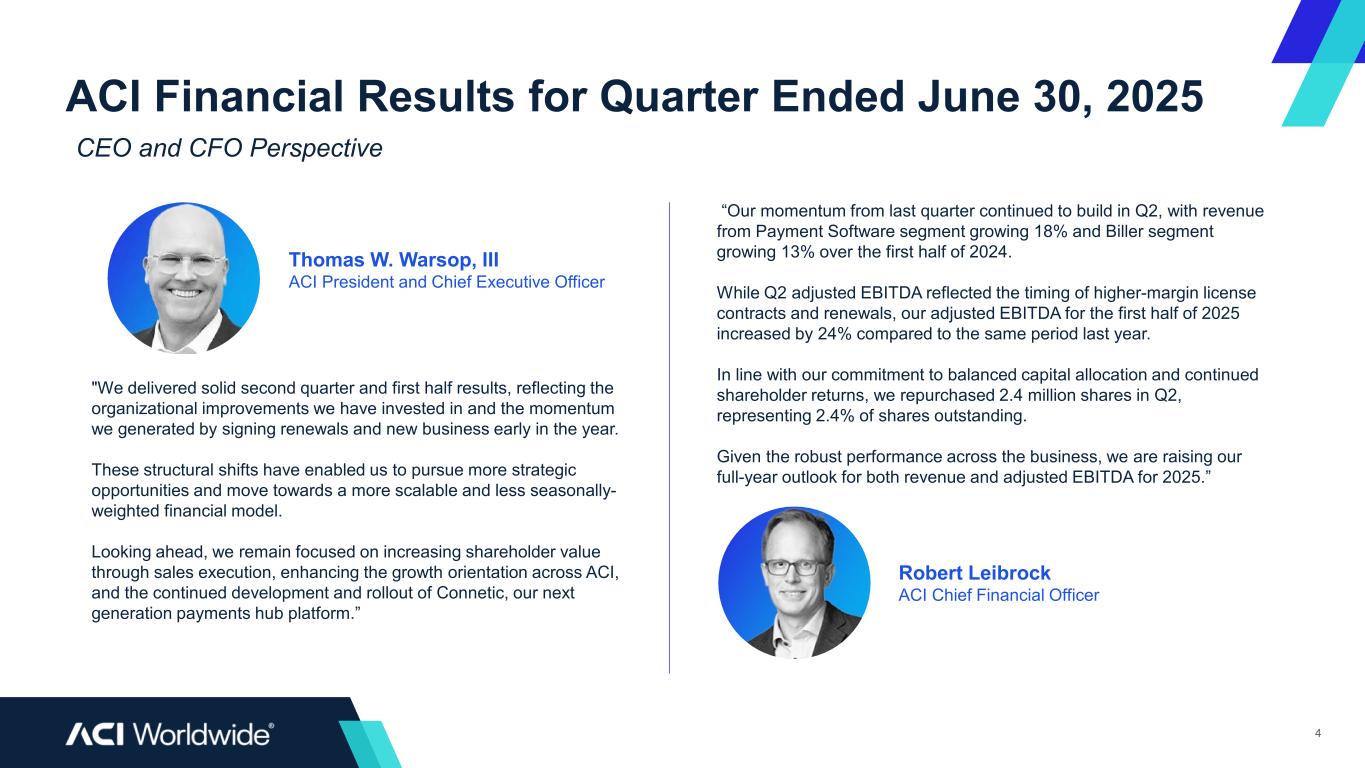
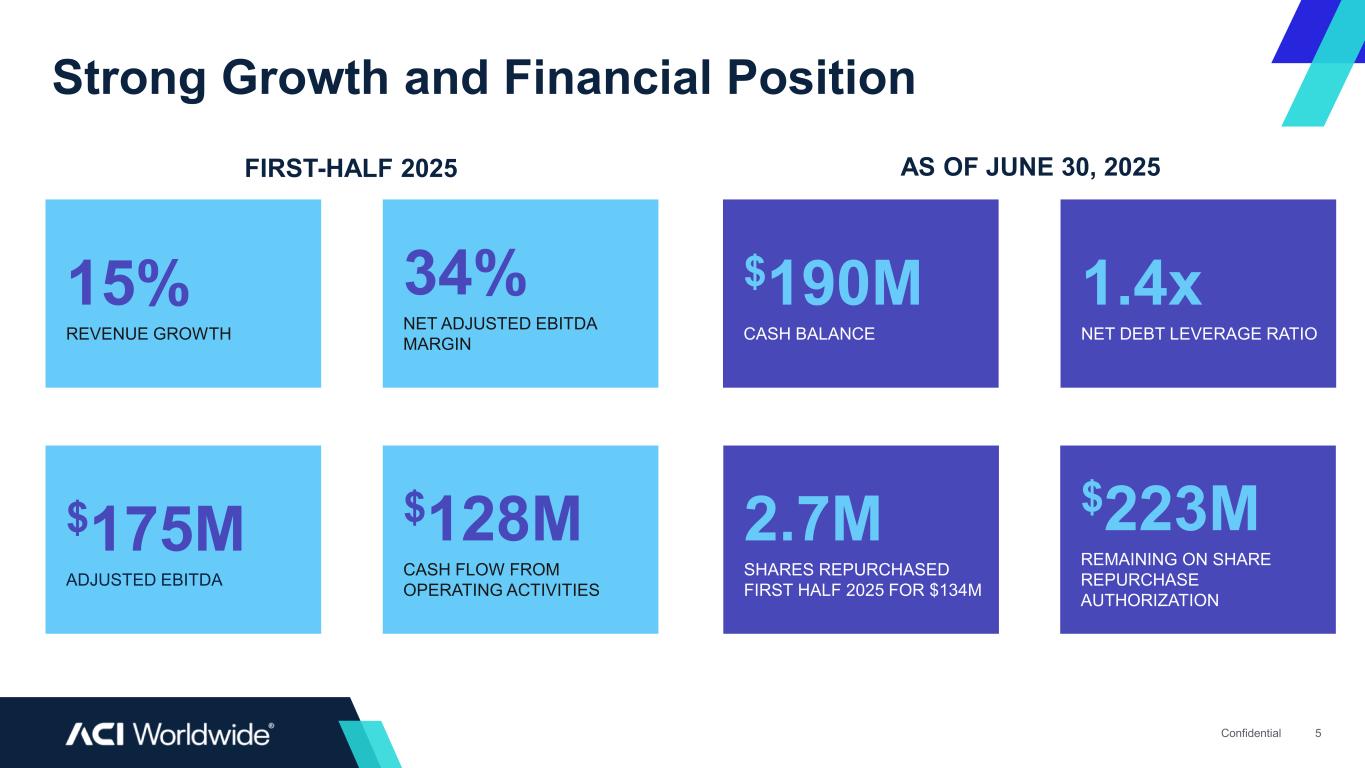
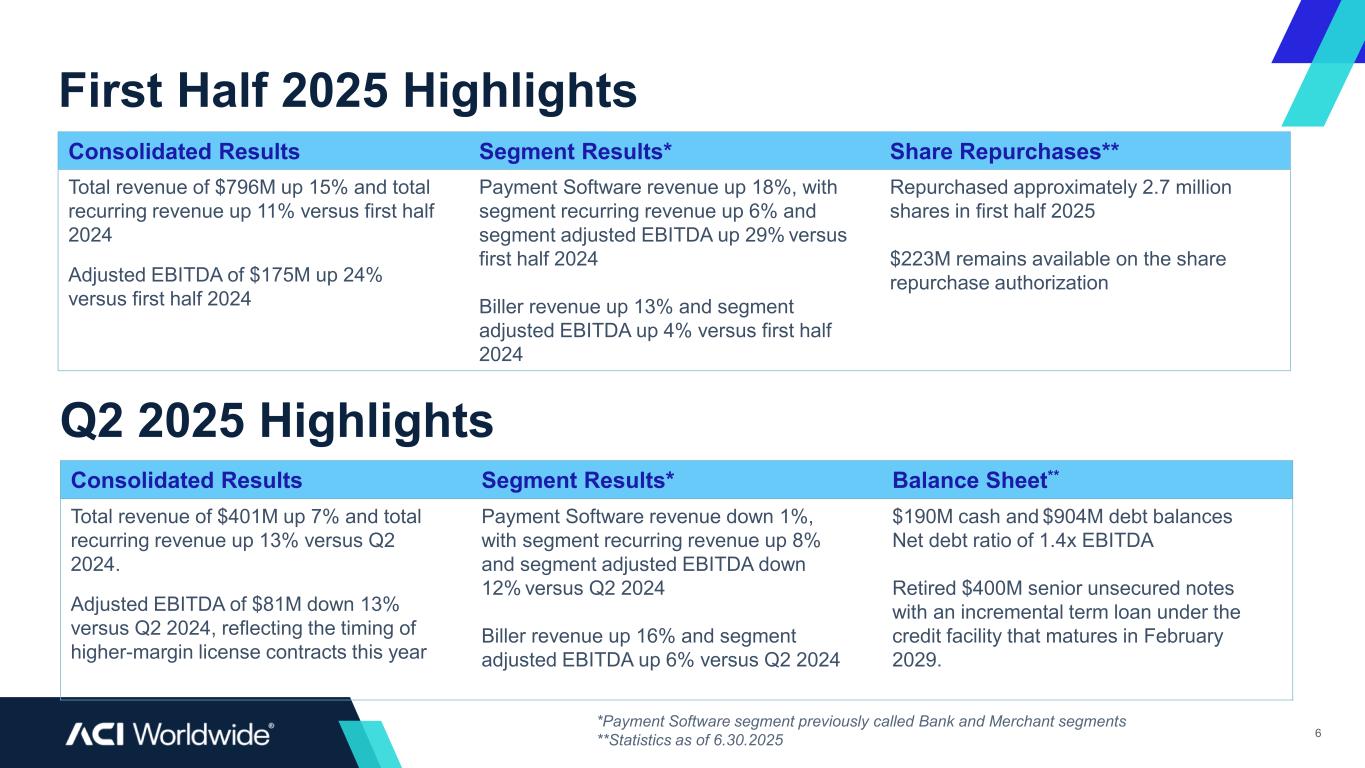
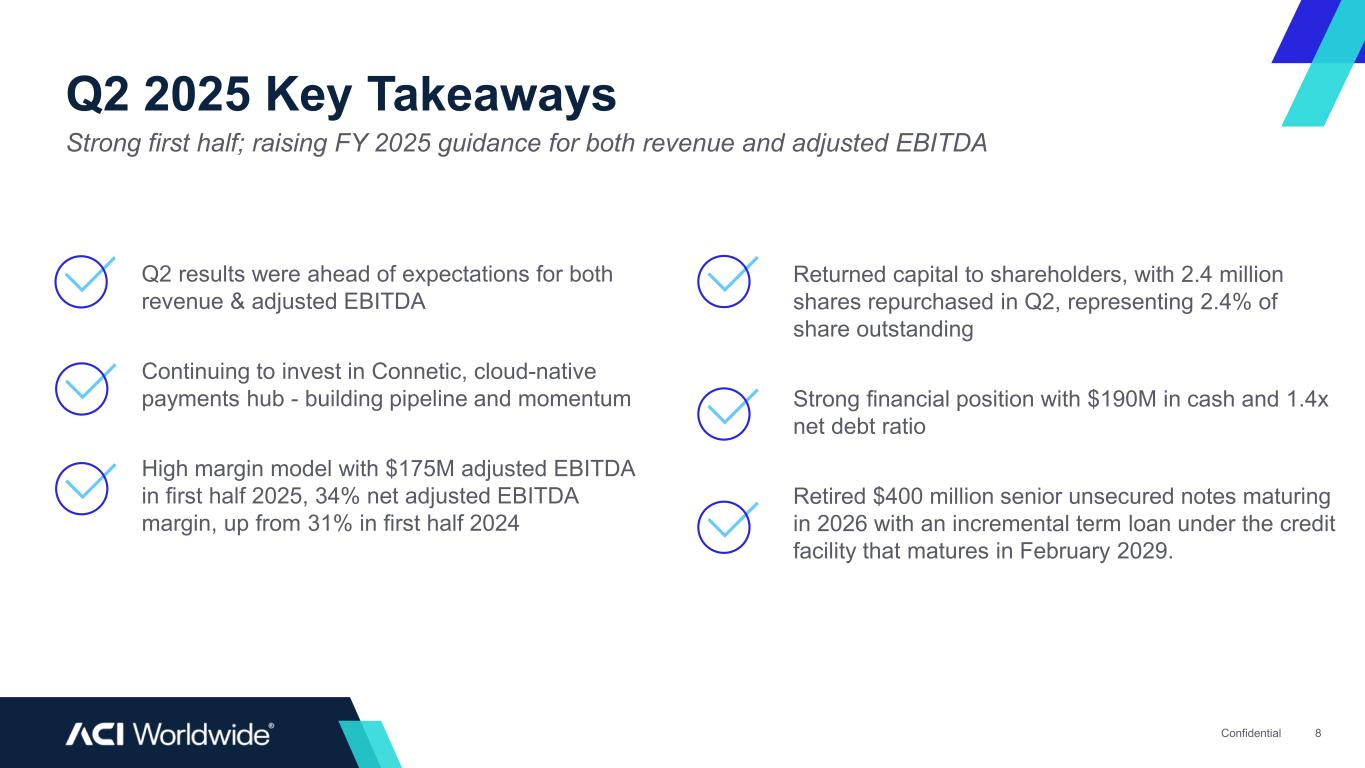
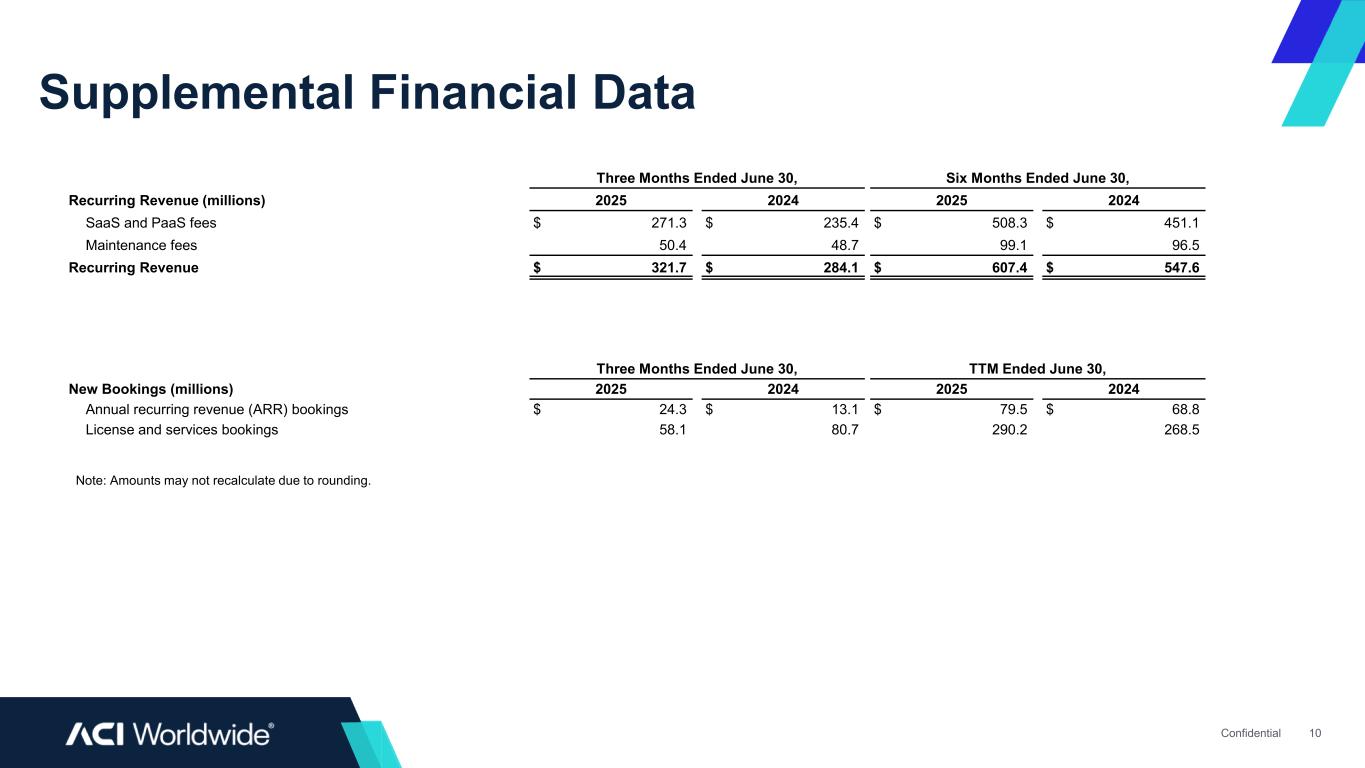
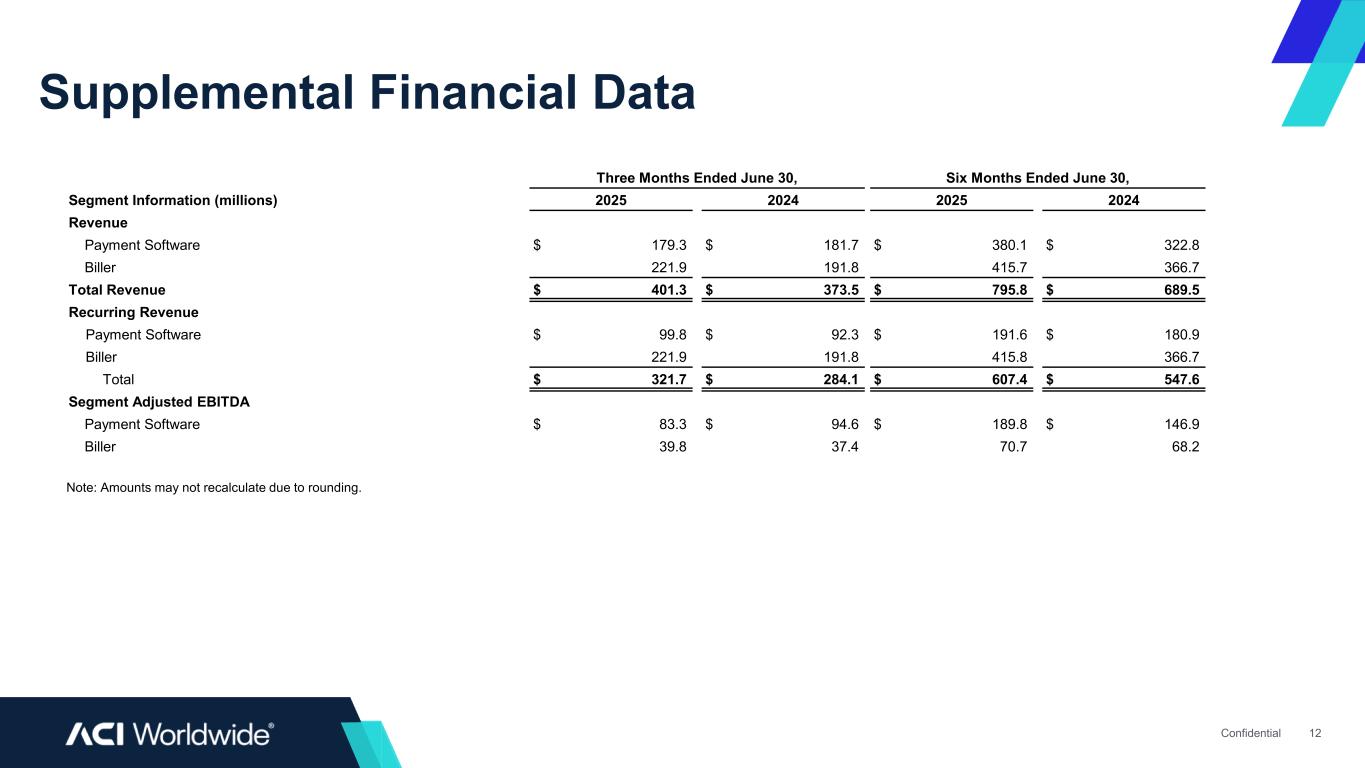
Thanks, John. Good morning, everyone. We appreciate you joining our Q2 2025 earnings conference call. I'm going to start by highlighting some key takeaways of our second quarter results, and then Bobby, in his first earnings call as our CFO, will provide a financial and segment-level review. They'll conclude with our updated 2025 guidance. We'll then open the call for questions. Q2 was another solid quarter for ACI. Revenue was up 7% year-over-year versus Q2 2024, and it was up 15% versus the first half of 2024. The momentum we're achieving gives us the confidence to raise our full year guidance for revenue and adjusted EBITDA for fiscal 2025, and Bobby will discuss that in more detail shortly. Our strong business momentum is reflected in strength across both our segments. And turning to the segments. The Biller segment was up 16% in Q2 and up 13% for the first half of 2025. Our Payment Software segment was roughly flat in Q2, and that was driven by the timing of our renewal and new business signings between Q1 and Q2, but it's up 18% in the first half of 2025. As a company, we signed notable new contracts and our ARR bookings in the quarter were up 86%. That brings our first half 2025 new ARR bookings growth to 71%. In May, we officially launched Connetic, our next-generation payments hub platform. As a reminder, Connetic is cloud native, and it provides enhanced capabilities such as automated decisioning, straight-through processing, decline transaction reduction and AI-powered insights that support fast decisions and superior value for our customers' customers. We have several live opportunities right now with particular interest related to real-time payments and wire transfers and the feedback about Connetic from potential customers continues to be overwhelmingly positive. Our pipeline is strong, and I'll keep you updated on our progress. In addition to our continued investment in technology leadership and innovation, we remain committed to returning capital to shareholders. In the second quarter of 2025, we repurchased 2.4 million shares, representing approximately 2.4% of ACI's common shares outstanding at the beginning of the quarter. Our ability to take these important steps to enhance shareholder returns is built on the foundation of work we've done over the last few years to strengthen our company's balance sheet. We finished the quarter with a strong cash balance of $190 million and a net leverage ratio of 1.4x adjusted EBITDA, which is significantly below the recently lowered target of 2x that we have previously discussed. I'd now like to revisit the revenue growth I just mentioned. As you know, our quarterly growth rates can fluctuate due to the timing of our term license-based business with both new contracts and renewals having significant revenue recognition upfront. Because of this, it's important to analyze longer-term trends to get an accurate sense of the trajectory of the business. And those trends are improving. While Q2 revenue was up 7% for the first half of 2025, revenue grew 15%, and that's on top of the 10% revenue growth we achieved for the full year 2024. These first half results position us well for achieving our upper single-digit revenue growth target in 2025, and they let our team focus on new business, closing opportunities more quickly and expanding our pipeline. And that supports meeting or exceeding our long-term growth target of sustainable high single-digit revenue growth. I want to highlight the changes we've made to improve our growth performance. This hasn't been an accident or a fluke. There are several factors that contribute to the growth acceleration we've seen over the last few years, and just a few of those include improving solution mix, active portfolio management, including a strategic divestiture and more aggressive pricing. But one that really stands out to me is our conscious effort to complete the signing of new contracts and renewals earlier in the year. While the revenue from a renewal contract cannot be recognized earlier than the renewal date, that's just how the accounting rules work. Getting these time-consuming renewals out of the way continues to allow us to focus on new customer wins, which can often be recognized at the time of signing. That allows our sales team to be far more efficient, and it's shown a direct impact on our results. In fact, this quarter marks the first time our estimated 60-month backlog has exceeded $7 billion. Before I turn the call over to Bobby, I thought I'd take a moment to address stablecoin, which has increasingly entered the discussions I've had over the last few weeks, particularly after the Circle IPO. You may have heard me say before that real-time payments use cases get more interesting as cross-border payments are allowed. Stablecoin is a potential driver of more adoption of cross-border real-time payments, and our solutions can already support those payments. If I broaden the lens beyond cross-border, from my perspective, the most important news to share with you today about stablecoin is that ACI is well positioned to benefit from stablecoin adoption in general. Our solutions have long accommodated many different digital currencies. One of ACI's sales differentiators is that our software handles more alternative payment networks and methods than any other competitor. Quite simply, increasing payment complexity drives customers to our solutions. It's part of our core competencies. We're actively working with players in the stablecoin space as partners enabling additional payment types for our solutions and even as customers. Our software is a great way to process stablecoin transactions, for example. With increasing regulatory clarity such as the signing into law of the GENIUS Act in the U.S. recently, we see new use cases, and we're excited about the opportunities this trend represents for us. To sum up, we see potential here with stablecoin, and we feel very well positioned to take advantage of the opportunities it presents and it will present in the future. I'd also like to point you to the newsroom page on our website where we published some articles about stablecoin and how it may impact the global payments ecosystem over time. Have a look for some interesting information. Lastly, I'm proud to say that our leadership in the Payment Software industry and our ability to stay on top of emerging trends around the world has helped ACI to earn recognition as one of CNBC's world's top fintech companies for 2025 and one of Time's America's best midsized companies in 2025. These two honors are a recognition of our continued efforts to power the global payments ecosystem with people and technology that push the envelope, that move our industry forward and that solve money movement needs for banks, merchants and billers alike. ACI Worldwide is continually committed to excellence. I want to provide a huge thank you to the entire ACI Worldwide team for helping the company earn both awards. I'm going to turn it over to Bobby to discuss our financials and our guidance. Bobby?
Speaker 3
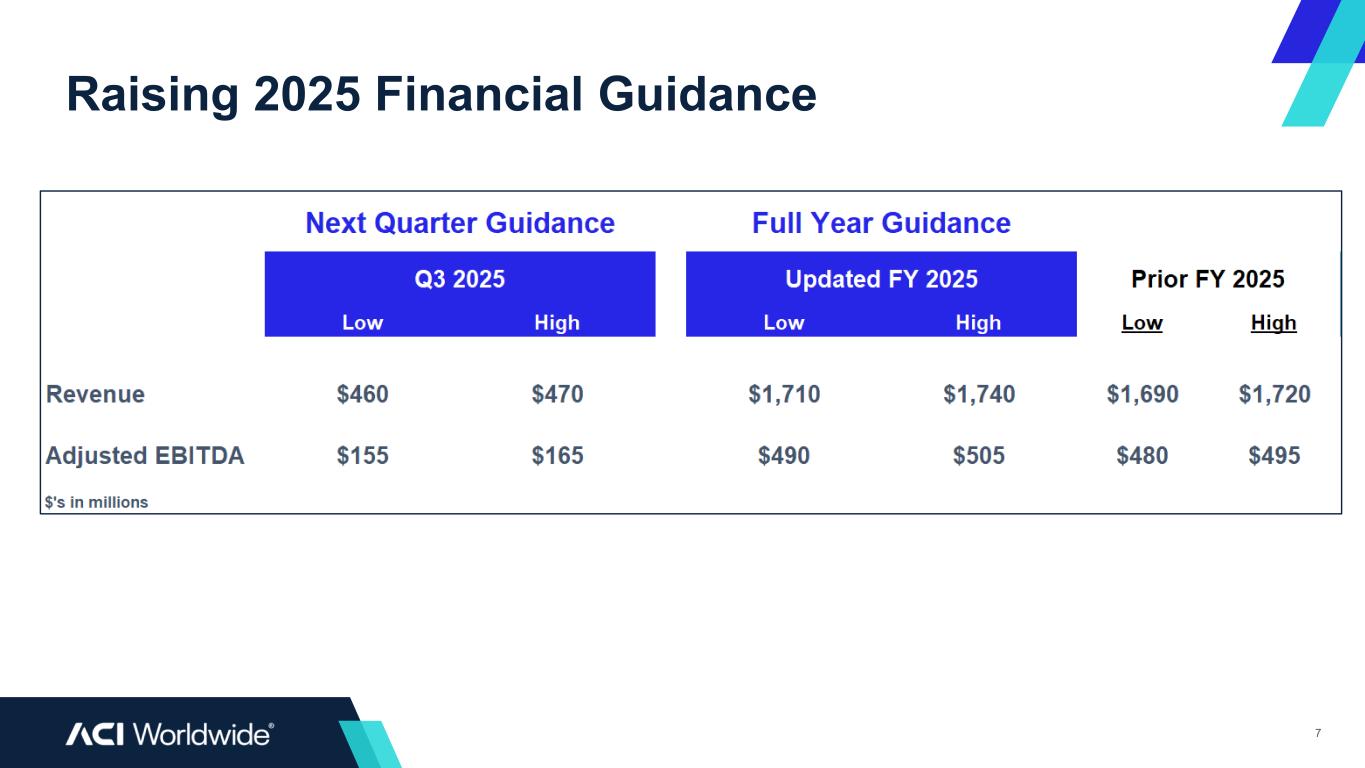
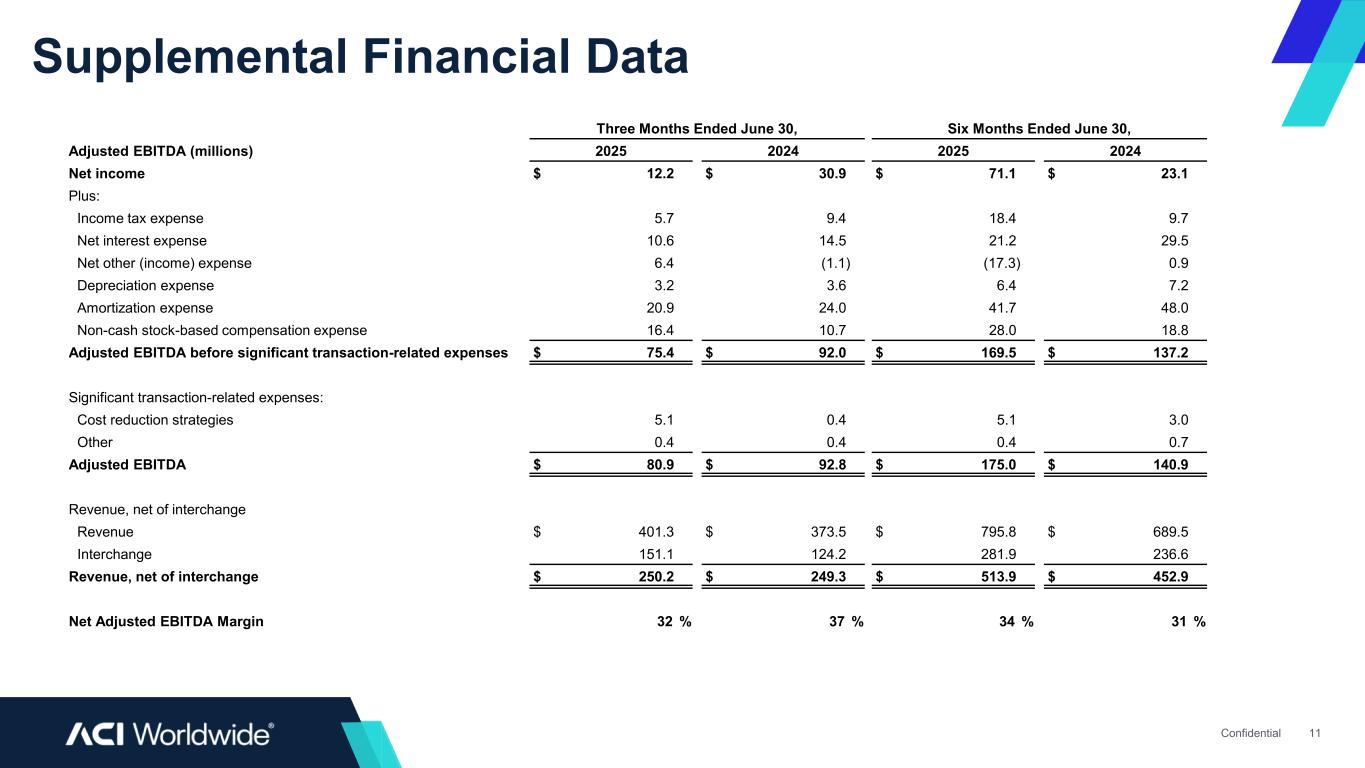
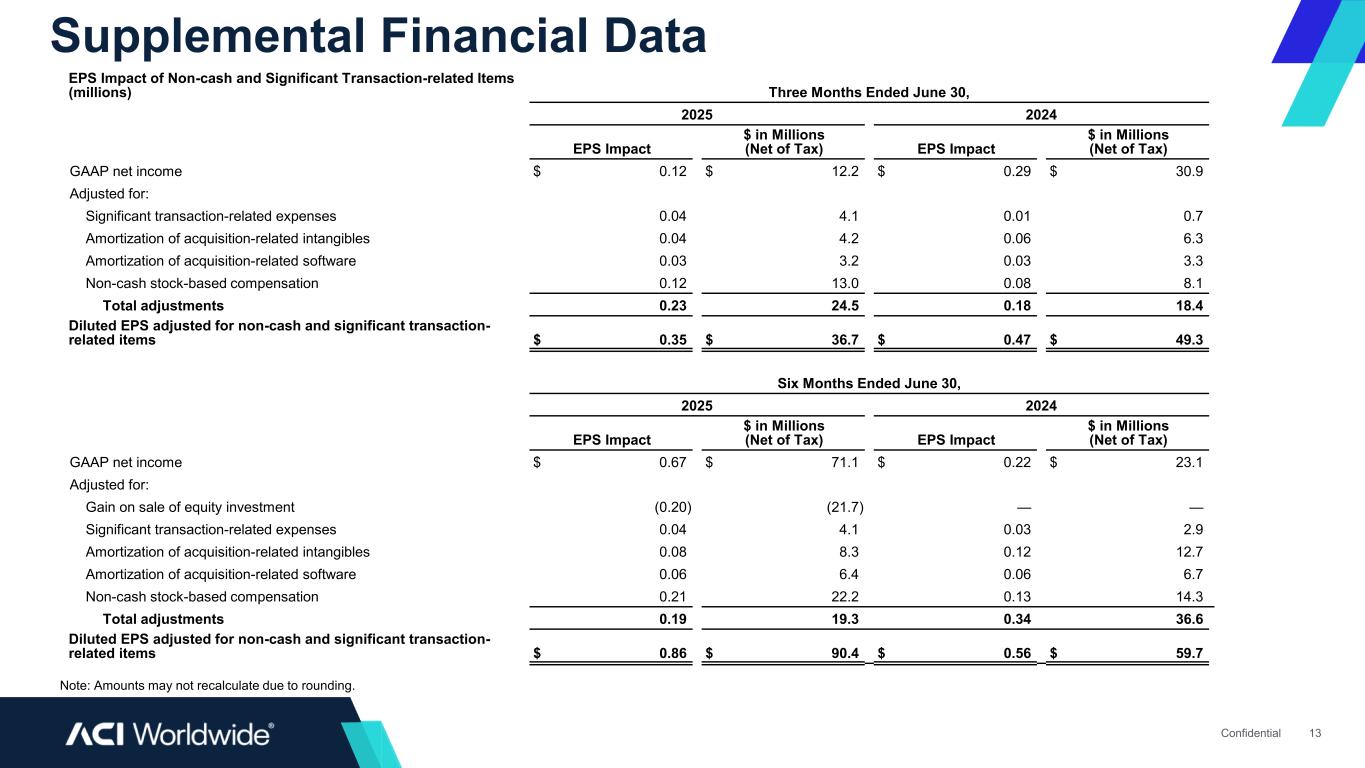
Thank you, and good morning, everyone. Before I dive into our financial results and guidance, as Tom mentioned, I want to express how energized and honored I am to be part of ACI as Chief Financial Officer and to be speaking with you on my first earnings call since assuming the role on July 1. Let me start by sharing why I joined ACI. The decision was driven by the clear potential to create meaningful long-term value for customers, employees, and importantly, shareholders. That alignment is fundamental to how I lead as CFO. I was also drawn to how well positioned ACI is in a fast-moving payments industry with rising demand for secure, intelligent real-time solutions. ACI has a durable competitive advantage and is a trusted leader powering the world's payments ecosystem. Over the past month, I've been diving into the business and engaging deeply with Tom, the ACI leadership team and the financial leadership team as well as the Board. I've come away confident in the company's direction and motivated by the path ahead. I've also spent a lot of time with Scott Barron, my predecessor, and I want to extend my appreciation for his nearly two decades of dedicated leadership. His commitment to financial discipline and operational rigor has helped position ACI for continued success, and I'm grateful for his support during the transition. Looking ahead as CFO, I am committed to financial transparency, operational discipline, and a proactive dialogue with the investment community. In the coming quarters, I'll be evaluating ways to enhance how we provide you even greater clarity into our progress. I believe the best outcomes originate from open data-driven discussions, and I look forward to having conversations with many of you in the months to come. Now let's get into the financial results. I'll cover Q2 and then provide first half progress. Revenue was $401 million in Q2, growing 7% compared to last year, and recurring revenue of $322 million accelerated to 13% growth compared to last year. Total adjusted EBITDA in Q2 was $181 million, down 13% compared to last year, driven primarily by the quarterly timing of license-based contracts and Payment Software. Turning to the segments for Q2. Growth was led by the Biller segment, where revenue grew 16% and segment adjusted EBITDA increased 6% compared to last year. We saw particularly strong growth driven by our solutions in the government, consumer finance, and utility markets. Payment Software segment revenue in Q2 declined 1% and segment adjusted EBITDA decreased 12% compared to last year. This decline year-over-year was expected and incorporated into the prior guidance given our renewal calendar and the strong new business signings we had in Q1 this year. We continue to manage the business towards our full year growth objectives and reduce the historically heavy Q4 seasonality while focusing on building sustainable revenue growth. This is shown in Payment Software's recurring revenue that accelerated to 8% growth in Q2. Looking now at the first half of the year, revenue grew 15%, recurring revenue grew 11%, and adjusted EBITDA grew 24% compared to the first six months of last year. Both segments contributed to growth in the first half. Payment Software segment revenue grew 18% and adjusted EBITDA grew 29% compared to the first half last year. Banking solutions saw strength across all three main product sets with issuing and acquiring, fraud management, and real-time payments all growing 20% or more for the first half of the year. Biller segment revenue in the first half grew 13% and adjusted EBITDA grew 4% compared to last year. Cash flow from operating activities in the first six months of this year was $128 million compared to $178 million last year, lower largely due to the timing of receivables. We ended Q2 with strong liquidity, including $190 million in cash on hand and approximately $904 million of total debt outstanding, representing a net debt leverage ratio of 1.4x. During the quarter, we also retired our $400 million senior unsecured notes maturing in August 2026 with an updated and expanded credit facility that matures in February 2029. Tom mentioned our $119 million Q2 share repurchase. And for the first half, this brings our total share repurchases to approximately 2.7 million shares for $134 million. Exiting June this year, we have approximately $223 million remaining on our share repurchase authorization. Based on the momentum exiting the first half, we are raising our guidance for 2025. We now expect total revenue for the full year to be in the range of $1.71 billion to $1.74 billion, higher than the previously issued guidance of $1.69 billion to $1.72 billion. We expect adjusted EBITDA for the full year to be in the range of $490 million to $505 million, higher than the previously issued guidance of $480 million to $495 million. For next quarter, Q3, we're providing guidance for total revenue to be in the range of $460 million to $470 million and adjusted EBITDA to be in the range of $155 million to $165 million. To recap, the first two quarters of 2025 are tracking ahead of our original expectations, and we're well positioned as we enter the second half of the year. As I hope you can tell, I'm excited to be part of the ACI team at such a pivotal time, and I look forward to helping deliver on our mission and our commitments to shareholders. With that, I'll pass it back to Tom for some closing remarks.
Speaker 2
Thanks, Bobby. We're pleased with our progress in 2025. We remain focused on our broader strategy on sales execution, on the development of our next-generation Connetic platform. The first half of 2025 was strong, and we're increasingly optimistic about the rest of the year as well. With our healthy pipeline and strong full-year financial forecast, we're confident in our ability to continue delivering significant shareholder value. Finally, I want to mention an upcoming event we're planning for October 21 to the 23 in New York City. We've named it Payments Unleashed, and it will be partly a celebration of 50 years of ACI payments innovation. This is our 50th year as a company. And partly, it's a thought leadership event for the payments industry, gathering some of the brightest minds in payments for two days of speakers, panels and topical sessions. While this is not a financial or investor-focused event per se, I think many of you will appreciate learning more about AI, stablecoin, ACI Connetic and many other hot topics in payments. If you're interested in attending, please reach out directly to John Kraft, and we'll do our best to make that happen. Thank you for joining our call. Thank you for your interest in ACI, and thank you for your ongoing support. We really appreciate it. Operator, we can now take questions.
Operator
Our first question today will come from Trevor Williams from Jefferies.
Speaker 4
I wanted to go back to stablecoins, Tom. I think maybe you could just frame for us what the latest has been in the conversations that you've been having with the bank's customers. And then as a second part to that, we've seen the core processors introduce some of their own solutions to help facilitate stablecoin payments for banks. If you could remind us within the stack for a bank, just where ACI sits relative to the core and what the interplay would be if there are more interbank payments made using stablecoins.
Speaker 2
Sure, thank you, Trevor. Stablecoins have been receiving considerable attention and discussion, which I find fascinating. From my viewpoint, the key points are that we have been prepared for digital currencies for quite some time. Stablecoins are indeed a form of digital currency, differing slightly in their backing, but we are ready for how they are processed. In terms of our position, we are situated right in the center of the payments infrastructure for banks. You mentioned banks, but it's also a matter for merchants, and we occupy a central role there as well. We are prepared to facilitate stablecoin payments as soon as there is notable demand. I specifically referred to real-time payments because we have discussed this topic extensively in recent years. I hope I've been consistent in expressing my enthusiasm for real-time payments, especially in relation to cross-border transactions. I've consistently noted that the hurdle is not the technology— we're fully equipped for that— but rather the regulatory landscape. One promising aspect of stablecoins is their potential to simplify cross-border real-time payments and expedite support. This seems to be proving accurate. Additionally, they largely eliminate the foreign exchange aspect of the transactions. We are eager about stablecoins and are largely prepared for such transactions. As I mentioned, we are collaborating with several other entities that are either facilitating or aiming to facilitate stablecoin transactions to streamline the process. This aligns well with our long-term strategy, especially concerning real-time payments.
Speaker 4
Okay. I appreciate all that. And then on Biller, if you guys could just help unpack the acceleration this quarter. And I think coming into the year, the expectation had been for Biller to grow within that high single-digit range. For the first half, you're running quite a bit above that. So if anything has changed on the full year expectation? And just any help on how we should think about Biller in the back half would be great.
Speaker 3
Trevor, this is Bobby. Appreciate the question. Yes, we're very pleased with how the Biller teams come out of the year in Q2 with acceleration. Some of that you probably guess what we talked about. We saw the government area really come through with the IRS putting us in a more advantageous position there. We have seen other new logos kick in as well. For the rest of the year, we continue to see progress in there. It probably won't be at the Q2 levels, but it's still going to be strong performance that we're seeing out of that segment the rest of the year. And you'll see some of that reflected in the guidance increase for the year of $20 million that we took that up. That's in Biller, but as well as the strength in the pipeline we see in Payment Software as well.
Operator
Our next question comes from Peter Heckmann from D.A. Davidson.
Speaker 5
Very nice bookings on the ARR side. Good to see. Can you talk about some of the areas of strength you had there and whether that was dominated by, let's say, one large deal or several large deals? Or was it pretty diversified in a number of smaller deals?
Speaker 2
Yes, Pete, thanks for joining us. We're really pleased with the sales momentum we're experiencing across the board, which isn't dominated by a single deal. We had a few sizable deals, but there were also several smaller deals, creating a nice mix. Nothing overshadowed the overall performance. As you can see, we're up over 70% year-over-year, and this will translate into benefits later this year and into next year. It's always encouraging to see the sales momentum, especially concerning recurring revenue and ARR.
Speaker 3
The only thing I'd add, Tom, I mean, the diversity that you mentioned, I'm staring at the top 15 of those that we did. They span all geos, merchants, banks, and billers. So I was pleased with how pervasive the traction we're seeing there is.
Speaker 5
That's great. That's great. And then can you maybe give us an update on the project within merchant to kind of further develop the software to better serve the U.S. market, if I'm correct in that assumption, can you give us an update on that?
Speaker 2
Certainly, Pete. We have several initiatives in place, and part of our sales momentum is originating from our merchant business. The progress we’re making with merchants is going well, especially with larger projects where we adapt as necessary, allowing us to compete effectively. I briefly mentioned stablecoin earlier. While it wasn’t your direct question, it's a fascinating aspect of our work. Real-time payments are part of this, but it's also crucial for merchants. The good news is that our merchant solutions adeptly accommodate digital payments and various other payment methods. As merchants look to accept a broader range of payment options, particularly digital currencies and stablecoin, we are fully prepared to assist them. This is an exciting time for us. Although what you're asking isn't directly linked to digital currency, I want to emphasize that we are well equipped to support customers globally, which is vital as these payment types grow in significance within the global payments ecosystem. In short, the project is progressing very well, and we are gaining solid traction with both U.S. merchants and those worldwide.
Operator
Our next question comes from George Sutton from Craig-Hallum.
Speaker 6
Welcome to Bobby. Bobby, I wondered if you could just take us real quickly through what you see here relative to what you saw at Red Hat, where you saw them go from a similar high single-digit stance for growth into the teens. Do you see the same kind of dynamics here?
Speaker 3
Yes, I appreciate the welcome. I've been really excited about what I've experienced in my first month. To start, I'd like to mention some qualitative similarities, followed by the quantitative aspects of your question. I'm truly impressed by the passion, expertise, and 50 years of history we have, which reflects the reasons our customers choose us. This is strikingly similar to what I observed at Red Hat in terms of dedication and purpose in the payment industry. Another similarity is the trust our customers place in us. Like in my previous roles, we are managing mission-critical systems for banks worldwide. What gets me excited about ACI are the operational and execution opportunities ahead. Tom has been focused on this since arriving, emphasizing the importance of spreading our sales efforts throughout the year to secure deals earlier. This approach has resulted in the net new ARR we're seeing. We're working hard to generate demand for our market-leading portfolio, much like we did at Red Hat. Additionally, I spent significant time at Red Hat ensuring that our investors understood our progress. I see opportunities on the operational side, as well as in being transparent about our advancements for you as we continue on this journey. I'm excited about the potential for acceleration that lies ahead.
Speaker 6
Awesome. And then, Tom, we had to go into this quarter watching FIS and Fiserv put up pretty lousy outlooks, and yours is quite separated from that. I wondered if you can give us a bigger picture kind of how you feel strategically positioned up against some of the other large payment players.
Speaker 2
Yes, thanks, George. It's important to note that our comparison with those companies isn't perfect, and we recognize the differences in our businesses. We keep a close eye on them, and they are significant customers for us. However, the factors driving our business are quite distinct, and we aren't experiencing the same challenges they have. For instance, Fiserv has seen some slowdown in growth related to Clover, which is a different business altogether. We're not facing that issue, though their growth rate has been less than they initially anticipated. We feel very positive about our business. Our relationships with customers are strengthening, our sales efforts are improving each quarter, and we're generating strong cash flows and margins. We’re confident in our business model, which is different from theirs, and it’s performing well. That's all I can share.
Operator
Our next question comes from Charles Nabhan from Stephens.
Speaker 7
I wanted to ask about some of the trends driving the strength in the backlog. Specifically, are you noticing any increase in government investment or anything related to investment trends and competitive factors, such as banks investing in payment technology compared to previous years? I'm trying to understand what is contributing to the strength in the backlog this quarter.
Speaker 2
Yes. I don't think there has been a fundamental change in the way our customers approach investments. This is a crucial area for all our customers, including merchants, billers, banks, and intermediaries like processors. That hasn’t changed. There isn’t anything specific to highlight. We're receiving significant attention, not just as ACI but for payments in general, which is positive. Since I became CEO, I’ve discussed our ongoing conversations with customers about modernization and the importance of launching new products quickly to meet their needs. We can clearly show that we are equipped to support them in this endeavor. I believe we’re improving our execution, especially on the sales and consultative account management fronts. These are the key factors. I don’t see a fundamental shift in investment willingness; that has been consistent. We are just getting better at capitalizing on it. Our position in powering the world's payments ecosystem consistently gives us an opportunity when organizations seek to make a change.
Speaker 3
Yes, I'd like to add a comment on the backlog, and I'm pleased you mentioned it. Tom noted this is the first time we shared a backlog starting with a $7 billion figure, which I'm excited about. Looking ahead, you'll see balanced strength across both Payment Software and Biller. Tom addressed the relationship between banks and possibly governments, but the main focus is on acquiring new clients and, in many cases, expanding our offerings and applications for our existing customers as they grow their trust in us. We're very optimistic about the health of the backlog, and it reinforces our confidence in the revenue growth we discussed.
Speaker 7
Yes, I understand. As a follow-up, I think capital flexibility is an important aspect of the story that often gets overlooked, but you've been quite active with buybacks in the first half of the year. I wanted to hear more about your approach to capital allocation as we move into the second half of the year, particularly whether the stock's performance has influenced your views on buybacks and how you foresee M&A playing a larger role in your considerations moving forward.
Speaker 2
Yes, Chuck, flexibility is crucial in this situation. I believe we have positioned ourselves very well and have significant flexibility to act in the best interest of the company and our shareholders. We were notably more aggressive with buybacks in the second quarter due to favorable stock pricing, and we took full advantage of that. Our capital allocation strategy remains unchanged; we aim to invest where we can drive profitable growth for the company, and we will continue to pursue that. We have ample capacity to do so. Additionally, when we identify appealing merger and acquisition opportunities, we will be ready to act. I've mentioned previously that we primarily make acquisitions for two reasons: to accelerate our progress with Connetic by finding suitable cloud-native, multi-tenant software companies, and for geographic expansion in areas where we currently have a limited presence. We actively search for these opportunities, but if we don't find the right candidates, we will focus on returning capital to shareholders, primarily through share buybacks as we have historically. We have plenty of capacity to pursue all these avenues and are continually seeking the best ways to utilize the capital we generate.
Operator
Our next question comes from Jeff Cantwell from Seaport Research.
Speaker 8
Tom, interesting comments on stablecoins, particularly where you see the potential adoption in certain areas like cross-border. The question I want to ask is, can you talk at all about how the unit economics stack up for you when it's a stablecoin transaction versus maybe some of the other form factors of payments you were to switch for? Are they better or are they the same on average? It seems to me like maybe there's potentially some difference on a per transaction basis if you're involved with the stablecoin transaction versus maybe something like debit. So I wanted to ask, can you maybe talk through how you see that?
Speaker 2
Sure. Thanks, Jeff. I’ll explain how it works today and why it may change in the future. Consider the cross-border real-time payment I mentioned; it’s an interesting application for stablecoin, and the same could apply to Bitcoin or any currency really. If I examine the unit economics for ACI, a real-time payment generates significantly more revenue compared to a debit transaction. The reason for this is that we price our transactions based on volume; customers purchase transactions in bulk. When you buy more transactions, the price per transaction decreases compared to buying fewer. Therefore, it relies on the expected volumes. Today, if I look at a cross-border stablecoin transaction on a real-time platform, it would generate much more revenue than a debit transaction. As adoption increases, pricing will go up accordingly. If the volumes were equal for debit and a real-time cross-border transaction, the prices would converge. However, as volumes ramp up, the economics will be more favorable for us.
Speaker 8
Interesting. Okay. Great. And Bobby, welcome. I wanted to ask you one on your Q3 EBITDA guidance. Can you just walk us through the puts and takes that you see there? I wanted to better understand, you had some strong results in Q2 here. So clearly, there's some flow-through, some good momentum. But we also understand there's a lot of moving parts to this business. So curious if you can tell us more about what the major call-outs are for Q3 EBITDA and how you arrived at the guide of $155 million to $165 million. And what in your own mind puts you at the high end of that range? And what would be the main factors that will put you at the lower end of the range?
Speaker 3
Yes, I appreciate it, Jeff. So we are confident in our strong guidance for Q2 and Q3 based on current insights. I want to emphasize some dynamics that differ from typical seasonality. We're anticipating an increase of nearly $70 million in our EBITDA on a quarter-to-quarter basis. A significant portion of this is expected from the higher Payment Software revenue stream in the third quarter, which tends to grow each year as we experience better seasonality with some of our deals. This will contribute positively to the EBITDA mix from that segment of our business. Additionally, we are continuing to invest in our new platforms like Connetic to enhance our sales capacity. Regarding the differences in the $10 million range, the uncertainty arises from the timing of customers signing high-margin license deals. Our pipeline is robust, and we are actively working with the team on this. I feel confident in our current guidance, and achieving the higher end of the range will depend on having a favorable mix of deals affecting our bottom line. This is the basis for my confidence.
Speaker 2
Yes. Jeff, the increase that Bobby mentioned would depend on new deals or additional cross-sell opportunities, since renewals are accounted for when they occur. This is something new. There's always some uncertainty in predicting how much of that new business pipeline we expect to close in Q3 versus Q4 or the first quarter of next year. That uncertainty is what could shift us within that range.
Operator
We have no further questions. I would like to turn the call back over to the company for any closing remarks.
Speaker 2
All right. Well, thank you. Thanks all for joining us, of course, and for the insightful questions, and I always enjoy the engagement. We're really pleased with the results we delivered in the quarter, in the first half, and we're certainly energized about the momentum that we see for the second half of 2025. I want to just reiterate something we actually just talked about, our strategy to drive earlier contract signings is working. And when I combine that with the strong pipeline, the growing pipeline that we have, the customer demand for our Connetic platform, that reinforces the confidence we have in our path ahead, and it makes us really excited about what's coming. We appreciate your continued support. We'll obviously keep you updated on our progress, and we appreciate you and what you do to help us. So thank you very much.
Jefferies Conference in New York City. Tom, Bobby and I will be there on September 4. Thanks, everyone.
Operator
This concludes today's conference call. Thank you for your participation. You may now disconnect.