Operator
Hello, everyone. Thank you for joining us and welcome to ACI Worldwide Inc. Report's final results call. After today's prepared remarks, we will host a question and answer session. If you would like to ask a question, please press star 1 to raise your hand. To withdraw your question, press star 1 again. I will now hand the conference over to John Craft. You may begin.
Thank you and good morning, everyone.
On today's call, we will discuss ACI Worldwide's first quarter 2026 results, as well as our updated financial outlook for the remainder of the year. The slides accompanying this webcast can be found at ACIWorldwide.com under the Investor Relations tab and will remain available after the call. We will then open the line for your questions. As always, today's call includes forward-looking statements and is subject to the safe harbor provisions. You can find the full text of these statements in our earnings press release and in our filings with the SEC. These documents describe important risk factors that could cause actual results to differ materially from those indicated in any forward-looking statements. Joining me today are Tom Warsop, our President and CEO, and Bobby LeBrock, our Chief Financial Officer. Tom will begin with an overview of our Q1 performance, strategic highlights, and the progress we're making against our long-term plan, and Bobby will then review our financial results in more detail, including segment performance, cash flow, and updated outlook for 2026. We'll then open the line for questions. Before we begin, I'd like to let everybody know that we will be attending several upcoming investor conferences, including J.P. Morgan's 2026 Global Technology, Media, and Communications Conference on May 18 in Boston, Baird's 2026 Global Consumer Technology and Services Conference on June 4 in New York City, and D.A. Davidson's 2026 Technology Conference in Nashville on June 11. With that, I'll turn the call over to Tom.
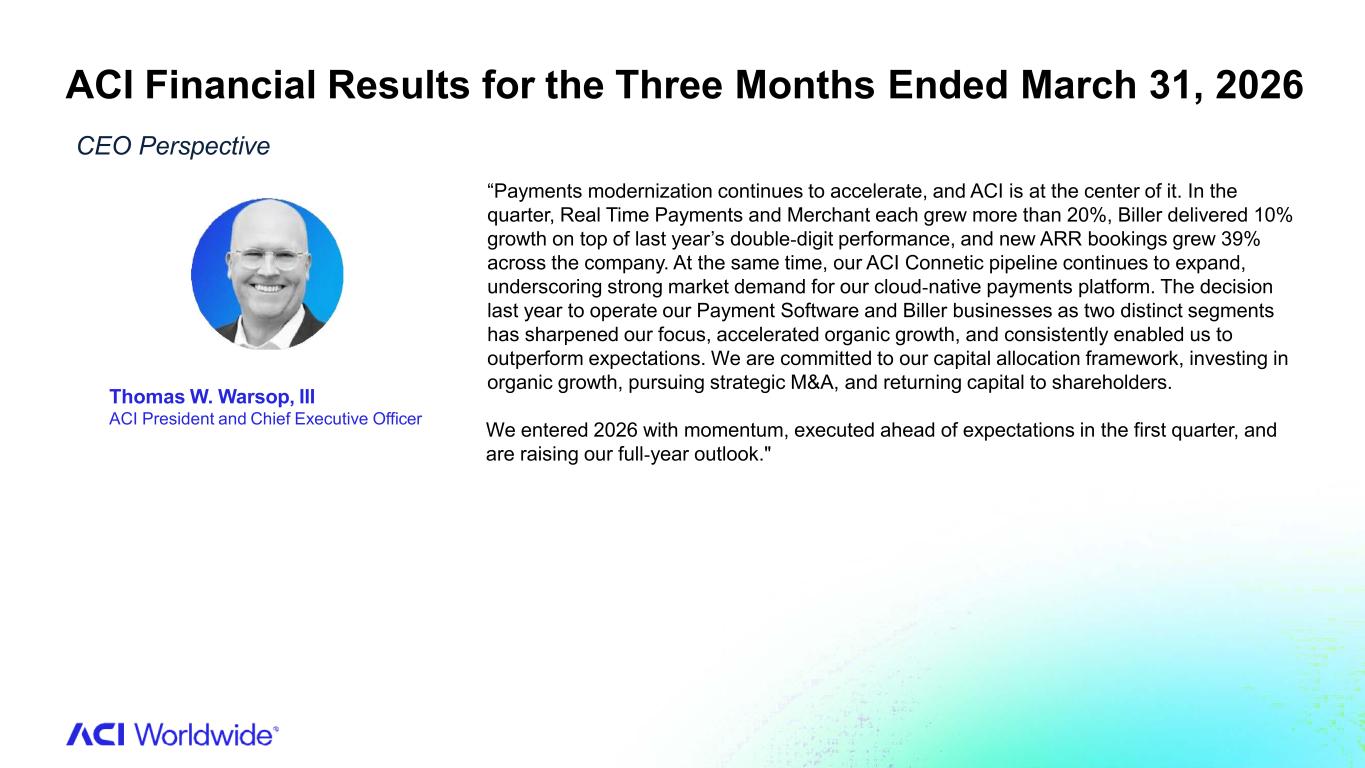
Thanks, John, and good morning, everyone. As always, I appreciate you joining us for our first quarter 2026 earnings call. We're pleased with the start to 2026, and that's building on the strong performance we delivered throughout 2025. We're executing well, we're delivering on our promises, and we're staying focused on our strategic priorities. We're in a strong competitive position, and we're increasingly optimistic about the outlook for our business. If I look at the first quarter, we delivered 6% organic revenue growth in constant currency, and that growth compares against the strongest first quarter in the company's history last year. That is, the strongest quarter until this quarter, since we grew on top of that. So I'm particularly happy with this performance. Our focus on operational efficiency, combined with the operating leverage in our model, drove over 160 basis points of FX-adjusted, net-adjusted EBITDA margin expansion, and 8% adjusted EBITDA growth. The combination of this overall strong operating performance and our continued share repurchases, I'll detail that a little bit later, translated to double-digit growth in adjusted EPS. Bobby's going to cover the quarter in more detail in a few moments, but for my part, I'd like to step back and provide an update on our strategic initiatives and what we're seeing in our markets. Our business momentum stems from continuing sustained focus on our multi-year value creation strategy. As we regularly discuss, our strategy emphasizes growth within our core vertical markets, disciplined operational execution, and a return-driven approach to capital allocation. We expect our strategy to enable us to deliver at least high single-digit organic revenue growth, strong cash flow conversion, and the allocation of capital to drive incremental value, all with a focus on maximizing shareholder returns. Our growth strategy is built on expanding within our existing customer base, in addition to winning new logos, and of course, accelerating innovation all along the way. Within our payment software segment, we took a major step forward in 2025 when we unified our bank and merchant businesses into what we now call payment software. The goal was to increase efficiency, to accelerate innovation, and to simplify our operating structure. We're seeing the benefits of this strategy, and the payment software business had a very solid first quarter, growing 6%, 2% on a constant currency basis. Now, again, as you recall, Q1 last year was particularly strong in this area, driven by our largest competitive issuing and acquiring takeaway ever in the Asia-Pacific region. Our issuing and acquiring solutions remain leading edge and strongly in demand. We've been at it for 50 years, and our latest versions of these proven tools utilize leading technology as we continue to innovate and deliver market-leading customer value. And these solutions are, to put it very simply, mission critical. They're so critical, in fact, that we actually have one Middle East customer push itself to not let an upgrade go live date slip, even with the Iran conflict raging all around them. Together, we successfully delivered on time. And that's just another reminder of the resilience of our customers, the dedication of our employees, and the mission-critical nature of the solutions we provide. They just wouldn't let it slip. We also saw strength in real-time payments. That part of the business grew revenue by over 20% as increasing real-time payment volumes drive larger total contract values at renewal. Transaction volumes, as most of you know, are one of the key levers we use at ACI to expand our relationships with existing customers. I'd like to share a specific example from Q1 of how this sometimes works as it relates to real-time account-to-account solutions. We had a renewal of a Base24 customer in the first quarter, it was happened to be in Asia, and this is a customer that's seeing very significant growth in real-time payment transaction volumes. We were able to construct a deal which drove mid-single-digit growth in the pricing for their renewing portion of their transactions and 25% plus growth in pricing related to the net new real-time transactions. And those transactions are generating new business, incremental business for the customer. Overall, when you put all that together, this led to a healthy overall increase in total contract value from this customer. And as RTP volumes continue to grow, we expect similar opportunities across our portfolio. This is a demonstration of the power of having many different payment solutions our customers can use as the market evolves. They see ACI as a partner across payments, not just in a particular payment area. Now, I gave you an example of RTP and its impact in Asia. Much of our business and the growth we're seeing right now is international, but the U.S. adoption of real-time payments is also starting to pick up. FedNow and RTP adoption is increasing. This is obviously a huge opportunity for us, and we remain optimistic about future volume growth here domestically. So the volumes are still small in the U.S., but we're definitely seeing them start to expand. We also continue to make progress advancing ACI Kinetic, and that, of course, is critical to our long-term platform and modernization strategy. In the quarter, we expanded Kinetic's scope and momentum. We extended the platform to modernize card payments, to unify multi-rail U.S. clearing connectivity, and to embed advanced fraud and verification capabilities directly into the payment flow. These advancements reinforce Kinetic's role as a single cloud-native foundation that helps customers reduce complexity, manage risk, and modernize across payment types at their own pace. Kinetic's capabilities, combined with ACI's proven reliability and future-ready roadmap, remain and are in fact growing as meaningful differentiators between us and our competitors. And I want to share something about the broader Kinetic strategy that may not be quite as clear to some people and may require a little more explanation. So let me try to put it this way. Simply investing in Kinetic, and of course, that's the name of our next generation payment technology, just investing in that is providing confidence in our customer base that our longer term technology roadmap is aligned with where most people in the industry want to go. I want to use a sports analogy here. We're skating to where the puck will be, not where it is today. As we compete for work under RFPs and during renewals, we're consistently asked about our multi-year roadmap and how we're going to help customers modernize without introducing undue risk. And Kinetic is that roadmap. It's resonating. Even when a customer isn't ready to migrate immediately, they're not ready internally. Aligning our strategy with theirs builds confidence and supports expansions and longer duration commitments. We've had several customers sign significant contracts with us for our core solutions because of Kinect, even when they're not quite ready to go all the way down the Kinect path. So to illustrate this dynamic, I want to use another specific example from the first quarter. we had a renewal with a major North American bank, and I personally engaged to finalize the renewal terms. And the entire conversation was not about the renewal itself, the products they use today. It was about Kinetic. And even though the bank is not ready to embark on the modernization journey Kinetic enables, they know they need it in the future. The bank CTO told me he wants connect. He wants to begin the preparation for it during the next few years, and that's during the renewal period, this renewal period, and that he wants us to be ready to hit the ground running at the time of the next renewal. And when I say us, I mean the bank and ACI. In the meantime, they've asked for our help to get the bank to a place where they can make the progress they need internally from a business process, a personnel perspective, and a technology perspective. They want our help, and of course, we're thrilled to support them. This is an example of kinetic supporting expansion of a renewal deal and positioning us as the long-term partner for our customers. Now I want to turn to Biller, where we continue to see strong results, and that's building on the momentum we saw in 2025. A key area of focus is advancing our market-leading SpeedPay One platform, and that's driving core electronic bill payment transaction growth and new customer relationships. We signed significant new contracts in the quarter, and our total new ARR bookings grew 39% for the company, a majority of which was attributable to Biller. We signed several new logos and we saw some nice expansionary upsells with existing customers in our utility and insurance verticals in particular. One renewal that I'd like to highlight provided us an opportunity to improve pricing substantially while offsetting interchange increases. And that shows the strength of the relationship and leadership position we hold in the utility sector. Another large client was able to work with us to significantly improve its customer experience while also dramatically lowering operating costs by shifting transaction volume from calls to self-service. And when they do that, that reduces the operating costs from about $20 per inbound call to about a dollar for a self-service interaction. That client was also able to consolidate four platforms into one while significantly improving the overall experience and adding new payment options at the same time. Another deal in the quarter involved an existing customer in the insurance industry, and that also happens to be my personal insurer. In the first quarter, this customer nearly doubled their relationship with us, and I can personally attest that the experience is straightforward, quick, and convenient. These are the types of significant outcomes we're able to achieve within our biller business that benefit both ACI and our customers and their customers. ACI is gaining share in the biller market as more billers are consolidating onto modern outsourced digital bill payment platforms, ACI SpeedPay one. They're meeting customers where they are with mobile-first digital payment experiences that enable them to tailor payments to their preferences. This is a highly fragmented market, and the immediate opportunity is converting the significant portion of the market that is using legacy or outdated platforms to ACI. Increasingly, we are the partner of choice and we're excited by the opportunities for our builder business through modern, scalable, resilient platform Speedpay One. So I want to talk a little bit about operational execution across ACI. Our model remains highly scalable. As we grow, we have a clear opportunity to continue expanding margins through operational discipline and continued productivity improvements while we still continue to invest in the initiatives that support our long-term roadmap. We saw that in the first quarter with about 200 basis points, nearly 200 basis points of margin expansion. And while near-term investments have a little bit of ebb and flow and they can modestly dampen operating leverage in any given quarter, we expect the underlying scalability of our business to become increasingly evident over time. We're also very focused on our disciplined approach to capital allocation. We benefit from a strong business that has limited capital requirements and generates strong cash flow, and that gives us the flexibility to execute on our strategy. Our capital allocation strategy prioritizes investments in organic growth, strategic M&A, capital return, and maintaining financial strength, of course. As we've discussed, a key area of recent focus has been returning capital through our share repurchase program. Last quarter, we committed to allocating at least 50 to 60 percent of our cash from operations to share repurchases in 2026, and that reflects our strong financial position, our confidence in the long-term outlook, and our belief that current valuations are particularly attractive. During the first quarter of 2026, we repurchased 1.5 million shares, and that brings the total repurchase since the start of 2025 to over 5% of the shares that were outstanding at the beginning of last year. We remain in a very strong financial position with leverage well below our targeted range of two times EBITDA, and we remain committed to our capital allocation framework. To sum all that up, I'm excited about our recent financial performance and I'm very encouraged by our path ahead. I'm proud of what we've accomplished and we have a lot of work ahead and I mean that in a really good way. We'll continue to invest in our key growth initiatives and that includes our cloud native kinetic platform and SpeedPay One. In addition, as I discussed last quarter, we're investing in our AI first roadmap. We view generative AI as a significant opportunity, not a threat. We're already deploying many tools across the enterprise, and this is accelerating our process. ASCI is able to combine the power of these tools with our 50-plus years of engineering and architecture expertise and substantial volumes of proprietary data. When we put all that together, we can provide enormous customer value. Further, we provide certifications with hundreds of networks and payment schemes around the globe and all of those regularly require updates we are really good at that ai simply cannot deliver these aspects of what we do as i emphasized on our last earnings call we see generative ai as a big opportunity and we're well down the path to taking advantage of it before i close i want to briefly address the macro environment the conflict in the middle east and resulting energy shock have introduced real uncertainty into the broader economic outlook. And of course, no organization is entirely insulated from macroeconomic pressures, but our business at ACI is purpose-built for moments like this. Payments infrastructure doesn't take a pause during geopolitical disruption. If anything, the resilience of our customers and the criticality of what we provide becomes even more apparent. The example I shared earlier from the Middle East is not an exception. It's indicative of who our customers are, the role they play in the world's economy, and what our solutions mean to them. I want to thank all of our employees across the organization for their hard work and dedication. We're excited about the opportunities ahead as we continue our shareholder value creation journey. I'll hand over to Bobby to talk more about our financial results and our updated outlook for 2026. Bobby?
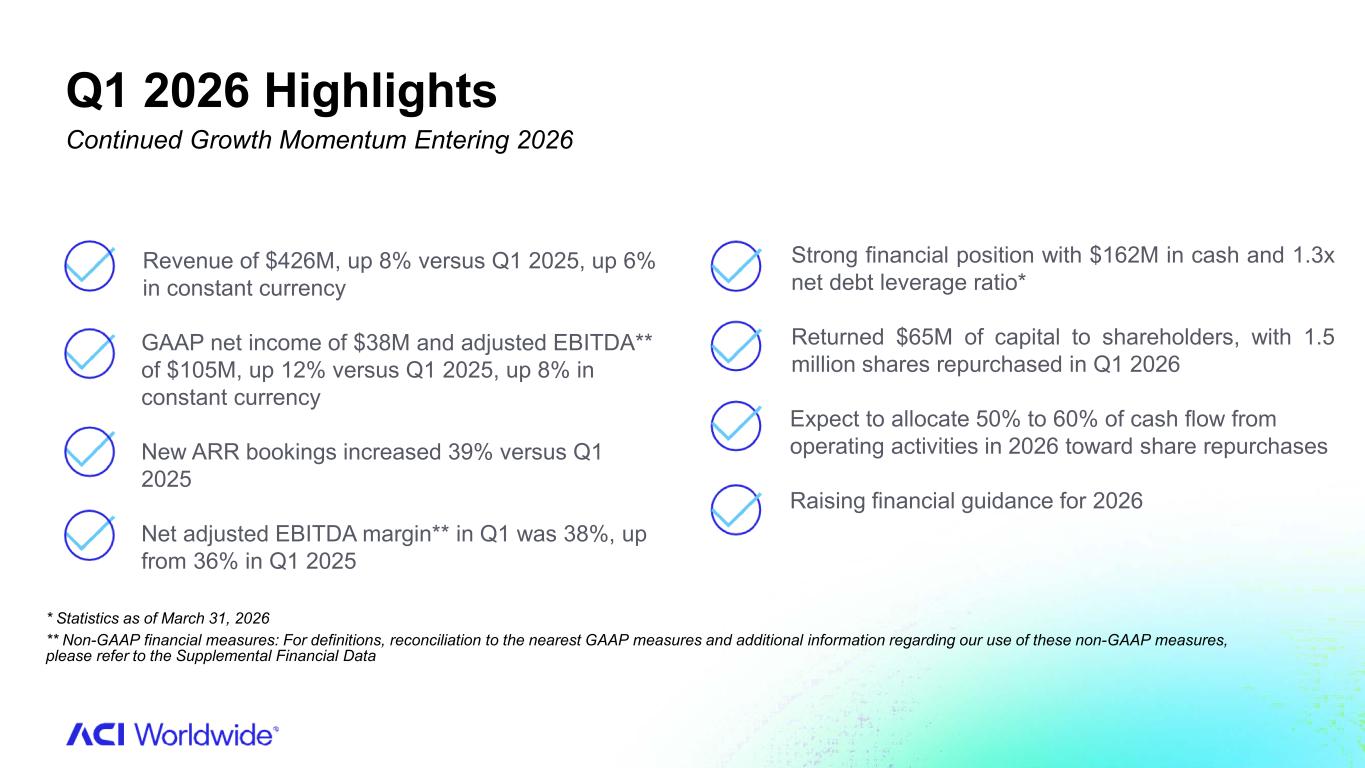
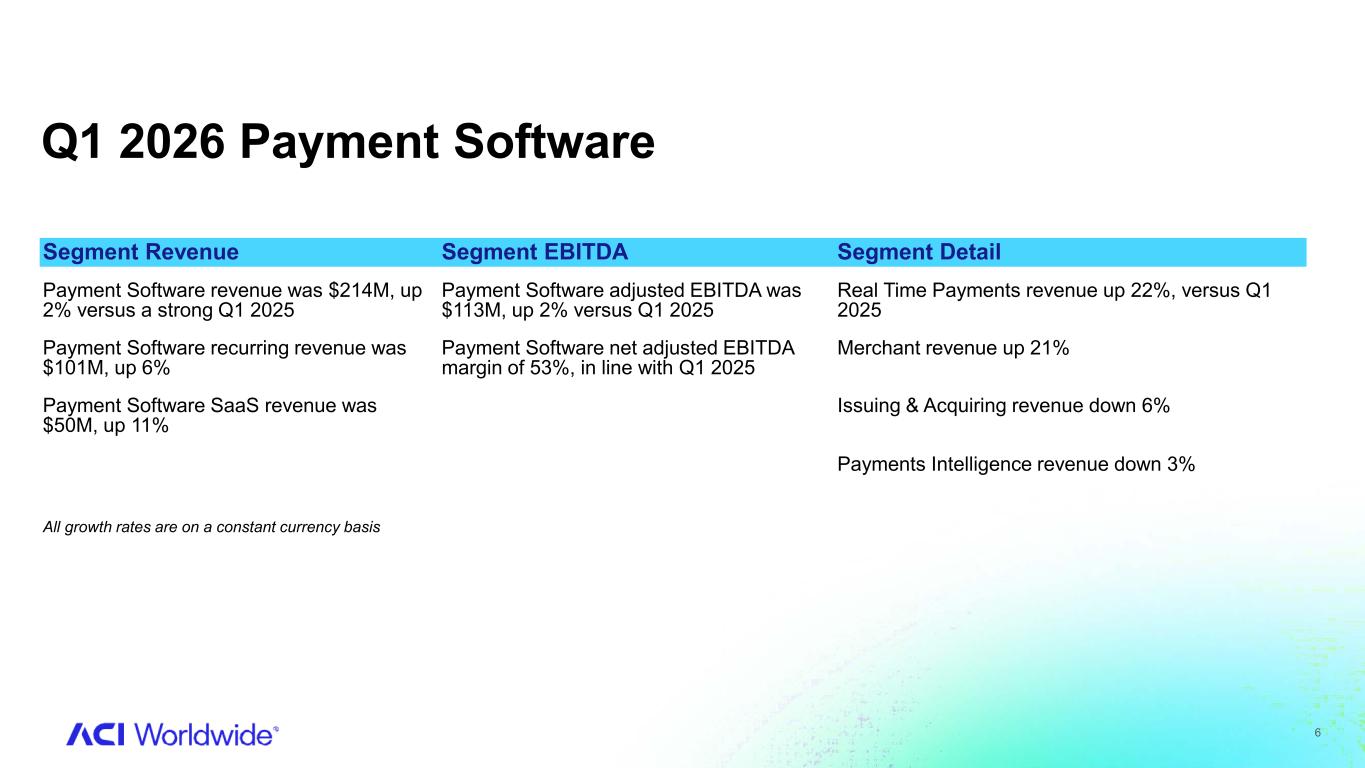
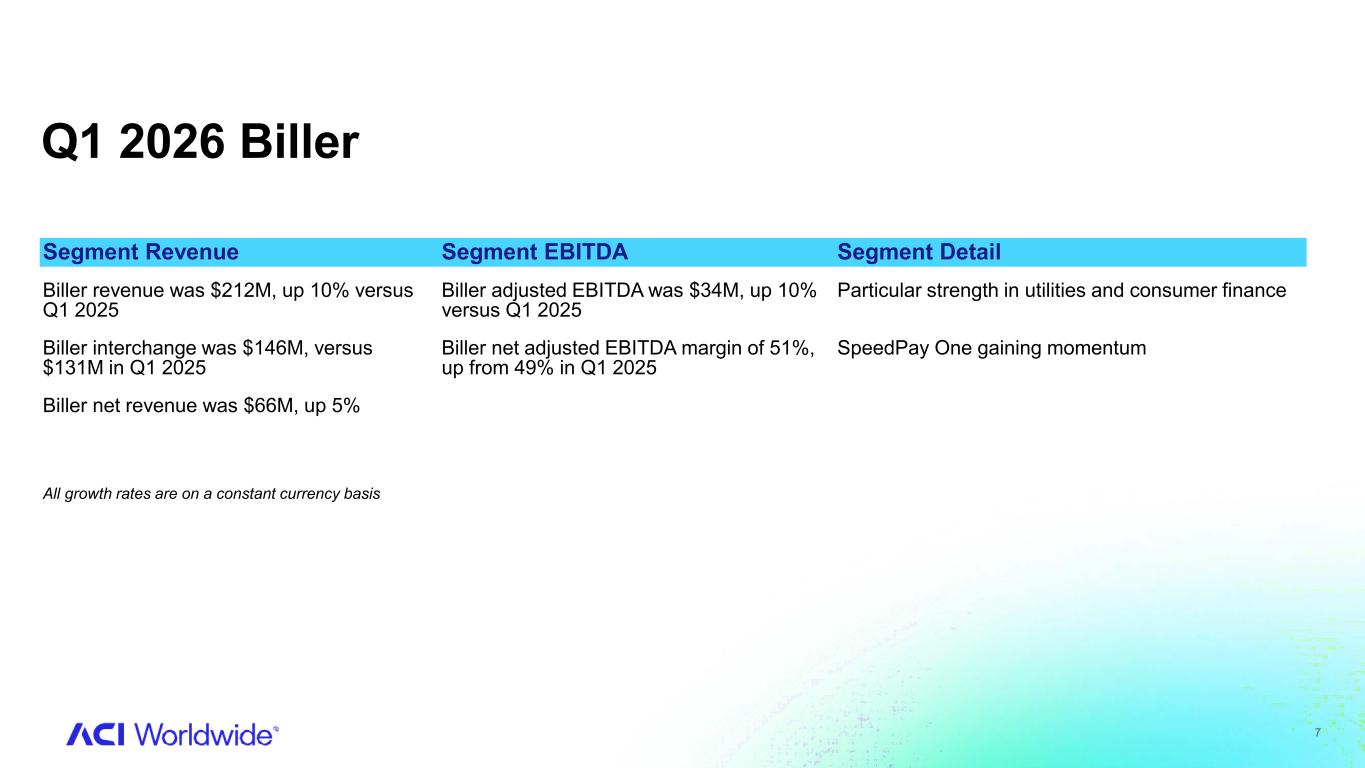
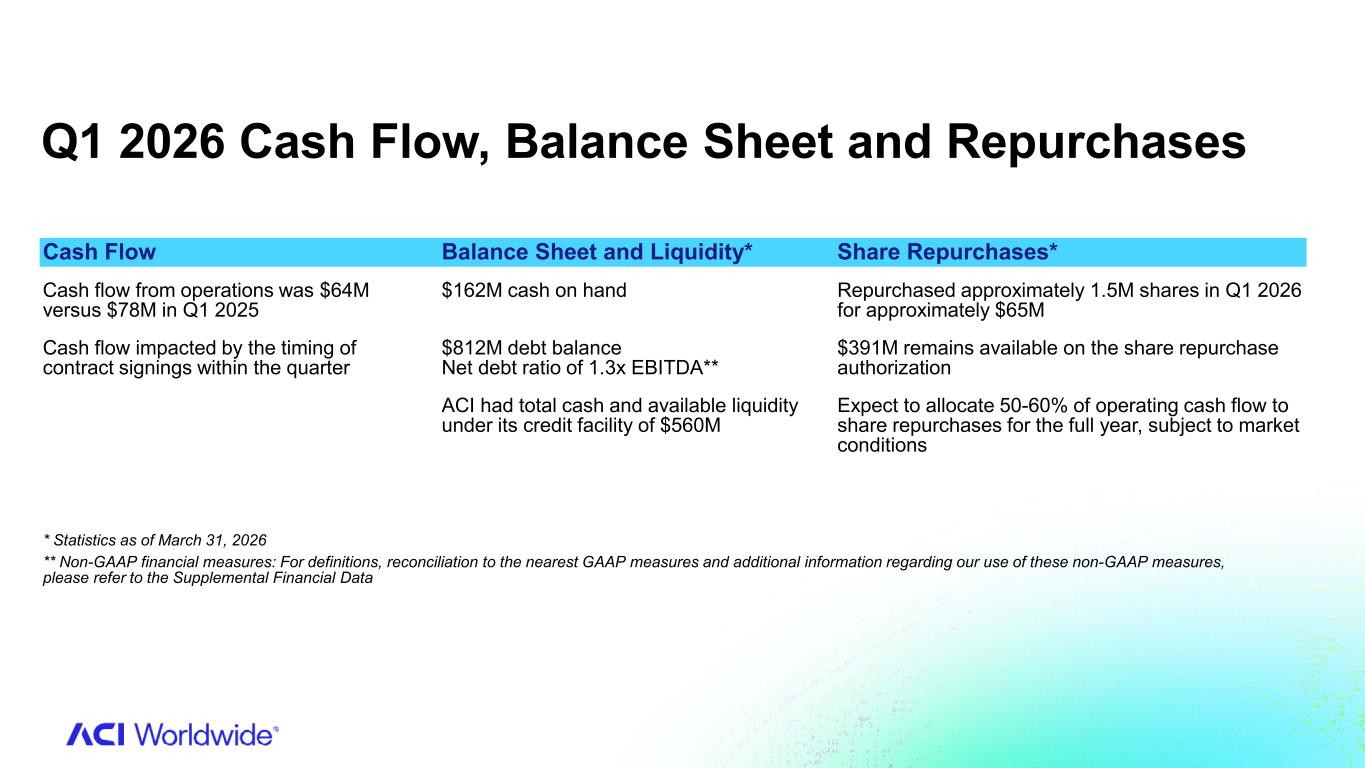
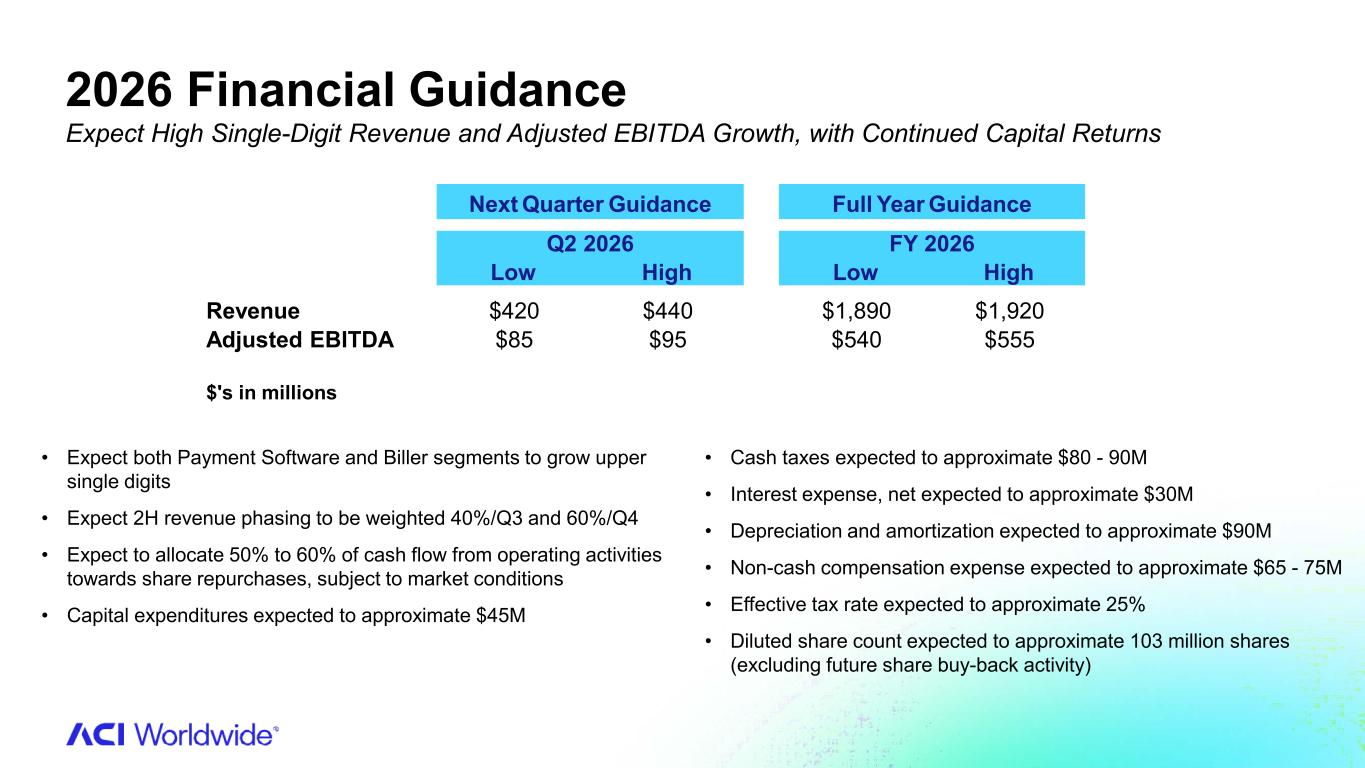
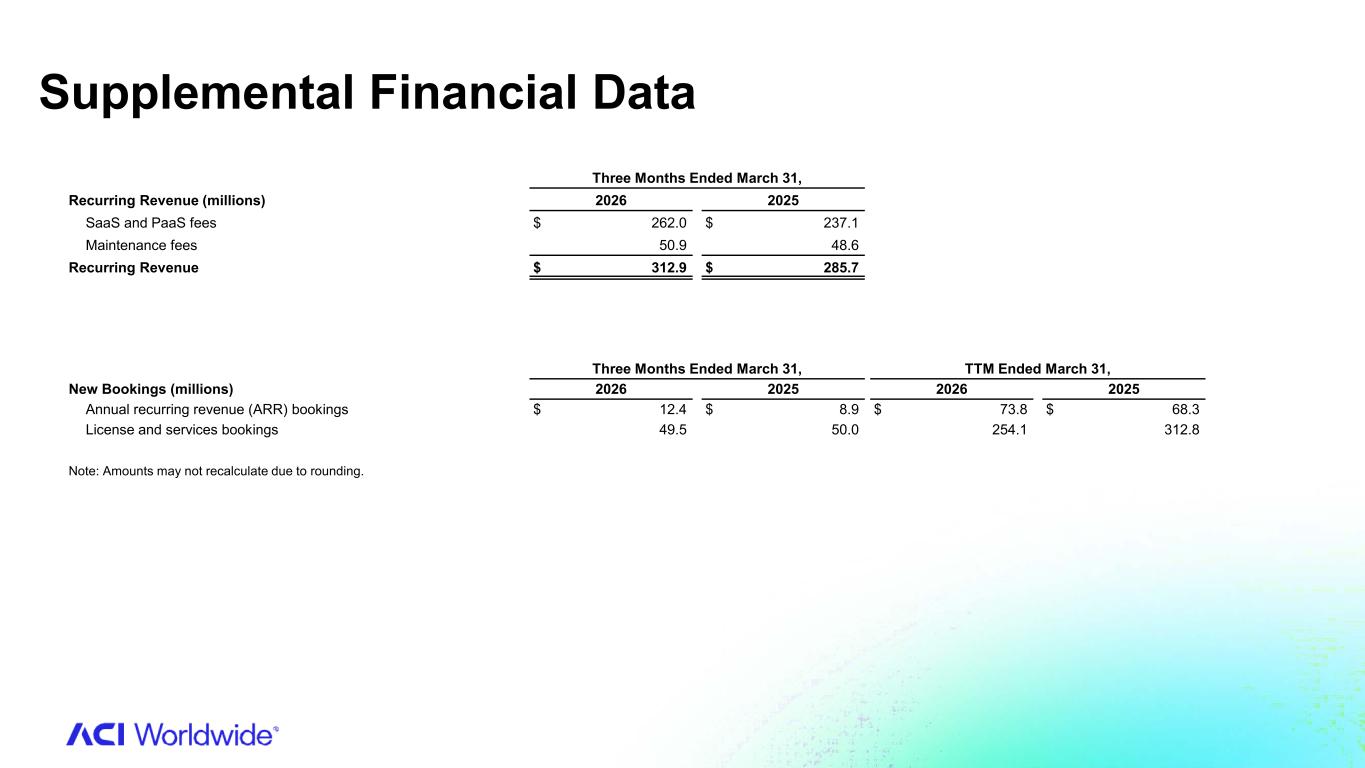
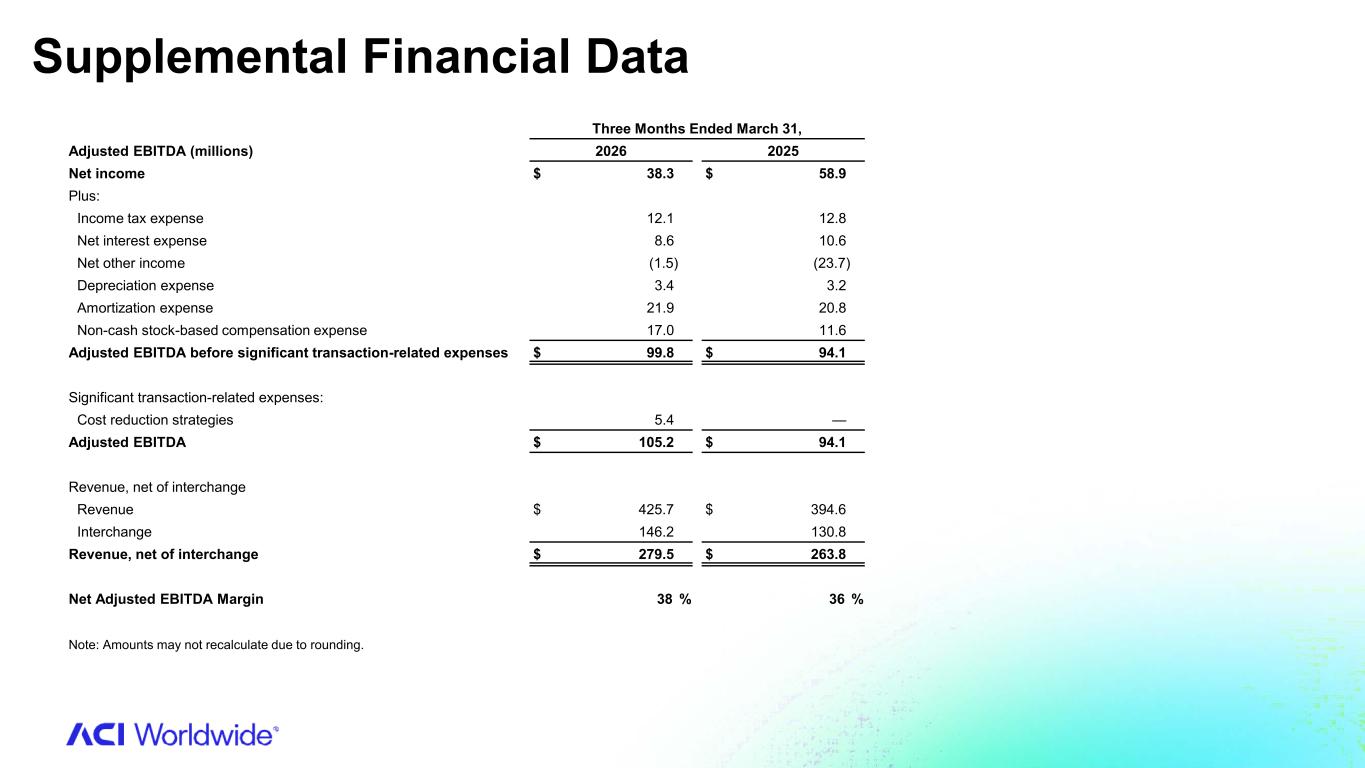
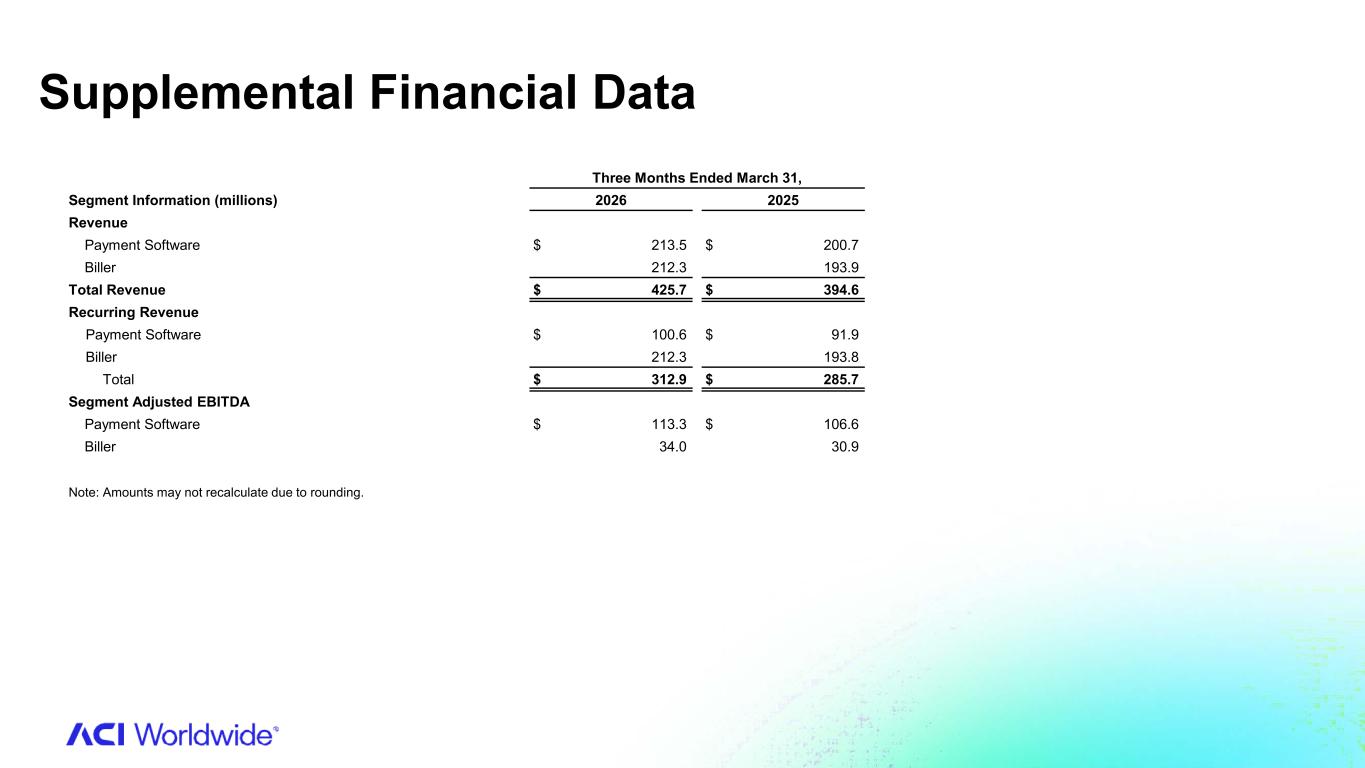
Thank you, Tom, and thank you all for joining us today. I'll begin with a brief review of our first quarter financial performance, followed by an update on our balance sheet, liquidity, and cash flows. I'll close with an update on our guidance and capital allocation priorities for 2026. As Tom said, we had a solid start to the year, driven by our progress on our growth initiatives, strong operating discipline, and focused execution following the move to a two-segment operating model last year. That translated into margin improvement and continued progress against our capital allocation priorities. Total revenue in the quarter was $426 million, up 8% year-over-year on a reported basis, and up 6% in constant currency. Recurring revenue was $313 million, up 10% as reported, and up 8% in constant currency. The continued growth in recurring revenue reflects strong momentum and increasing demand from our software-led offerings across both payment software and Biller. We delivered first quarter adjusted EBITDA of $105 million, an increase of 12% year-over-year, or 8% in constant currency, driven by solid organic growth and improved operating performance. As a result, adjusted EBITDA margin was 38%, up from 36% last year, reflecting continued disciplined execution and the operating leverage inherent in our software model. We also took certain one-time cost reduction actions in G&A during the quarter, which are excluded from our adjusted EBITDA. Net new ARR bookings increased 39% to $12 million, while new license and services bookings were $50 million, flat against a notably strong prior year comparison. Turning to our segment results, in payment software, revenue increased 2% in constant currency to $214 million. We continue to see increasing demand for cloud-based offerings, with SaaS revenue growing 11% in Q1, excluding FX. Segment recurring revenue, representing SaaS and maintenance, grew 9% year-over-year, as reported, or 6% in constant currency. From a product perspective, we saw particular strength in real-time payments and merchant, which grew 22% and 21% in constant currency, respectively, driven by transaction-based volume growth within our customer base. Fraud management was essentially flat as we're issuing and acquiring, which maintained the strong revenue levels achieved in the first quarter last year. Payment software EBITDA was $113 million in the first quarter, up 2% year-over-year in constant currency. EBITDA margin was 53%, flat versus last year, as operating leverage was offset by continued investment in growth initiatives, including ACI Kinetic. Turning to Biller, revenue increased 10% to $212 million, driven by higher transaction volumes and new customer wins revenue net of interchange increased five percent year over year we continue to see strong new business momentum across utilities government and consumer finance as billers increasingly consolidate onto modern digital platforms we also continue to advance speed pay one our next generation biller platform supporting the long-term modernization of the segment building on Tom's comments, I want to highlight the diversity of our top 10 ARR contributions this quarter. Three were consumer finance, three were utilities, two in insurance, and two in government and higher ed. That breadth across verticals is exactly what we want to see. Equally important is the balance between new and expansion. Three of the 10 were new logos, and seven were existing customers expanding the relationship with us. That mix is a healthy indicator of the durability of our growth. Biller adjusted EBITDA grew 10% to $34 million. EBITDA margin net of interchange was 51%, up more than 200 basis points from last year, reflecting operating leverage from new implementations and incremental volume from existing customers. Turning to cash flow in balance sheet cash flow from operating activities was 64 million in the first quarter compared to 78 million last year strong underlying performance continued to translate into solid cash generation with the year-over-year change driven by timing in working capital including a higher concentration of billings late in march we are not seeing changes in billing discipline or collection patterns, and we expect this timing to normalize in the second quarter. We ended the quarter with $162 million of cash on hand and total debt of $812 million, resulting in net leverage of 1.3 times adjusted EBITDA, below our targeted leverage range of two times. With total liquidity of $560 million, including revolver availability, our balance sheet remains a strategic asset and provides flexibility to invest in growth while returning capital to shareholders. Capital allocation remains a core component of our value creation framework. As Tom discussed, during the first quarter, we repurchased 1.5 million shares for approximately 65 million. Since the start of 2025, we've repurchased roughly 5.7 million shares, representing more than 5% of shares outstanding. We remain well on track to allocate 50 to 60 percent of operating cash flow to share repurchases in 2026, and we ended the quarter with $391 million remaining under our current authorization. Turning to our outlook for 2026, based on the strong start to the year, we are raising our financial guidance. This increase is driven by operational performance, with minimal impact from currency movements relative to our February guidance. For the full year, we now expect revenue growth of seven to nine percent, or $1.89 billion to $1.92 billion, up from our prior forecast. Both payment software and Biller are expected to deliver upper single-digit growth. For the second quarter, we expect revenue of $420 to $440 million, representing approximately seven percent growth at the midpoint. Payment software is expected to deliver double-digit growth, while Biller is expected to grow at mid-single digits against a strong prior-year comparison. Looking to the second half, we see a strong pipeline of implementations and renewals, with a heavier contribution weighted towards the fourth quarter. We expect an approximate 40-60 revenue split between Q3 and Q4, consistent with historical patterns. Payment software licenses are the primary driver of the SKU, with Biller expected to accelerate in the second half. For the full year, we are raising adjusted EBITDA guidance to a range of $540 to $555 million, up from $530 to $550 million, representing growth of 7% to 10%. This outlook reflects continued cost discipline while reinvesting in high return initiatives and maintaining flexibility to support our long-term roadmap. For the second quarter, we expect adjusted EBITDA in the range of $85 to $95 million. Looking ahead to the remainder of 2026 and beyond, we remain confident in our strategy and execution. A strong balance sheet and a highly cash-generative business give us the flexibility to return capital to shareholders while continuing to invest in innovation and long-term growth. With that, Tom and I would be happy to take your questions.
Operator
We will now begin the question and answer session. Please limit yourself to one question and one follow-up. If you would like to ask a question, please press star 1 to raise your hand. To withdraw your question, press star 1 again. We ask that you pick up your handset when asking a question to allow for optimum sound quality. If you are muted locally, please remember to unmute your device. Please stand by while we compile the Q&A roster. Your first question comes from the line of George Sutton. Your line is now open.
Thank you. Great job, guys. So I think you buried the lead a little bit with the 39% bookings growth. I just wondered if we could kind of talk about that in the context of the full year. What kind of growth does your pipeline support? Was there anything super unusual in that first quarter bookings?
Hey, George. This is Bobby. Thanks for the question. And I agree that that was one of the most encouraging pieces underneath our ARR recurring businesses there. And to provide some context, we delivered 12 million, 39% growth in our new ARR bookings that straddle both segments. You know, Tom talked about the great performance we saw in there for our biller business, our SpeedPay platform, as well as the SaaS offerings across payment software that span both our banking as well as our emerging customers. Very encouraged across it. I think as you think about the pipeline for the year at Strong, the team got off to a great focused execution. and then that that means two things one healthy demand in the market for our products and platforms and two we're off to the races to go implement these SAS space offerings to go you know be able to get those live for our customers yeah I did try to expand George when I was talking a bit about the profile of those underneath the biller business and in my earlier comments when I looked across the top ten that of those in our biller business I was really talking about you know new logos within there and equally encouraging the amount of new customers that are doubling up on the revenue that they see and the commitment they're making to platforms like SpeedPay you know Tom talked about a big insurance business that was you know one of our top three wins there the team's been maniacally focused on reliability new innovation and we're seeing a lot of the man there from that piece. And it reflects when you look at our guidance for the year that we've taken that up.
Yeah, I think, George, just to add, I'm going to reiterate the point Bobby's making about the spread of wins. And we saw it specifically in Biller, we saw it across all the verticals. And that is precisely, as he said, what we want to see.
And we are seeing that the team they got off to an amazing start and you know we we're we just uh we're pushing pushing them to continue to deliver uh at a very high level um i wondered if we could just talk about kinetic in the target market um it's originally when you're building kinetic it was really driven towards more of a mid-size uh institution and sounds like it's creating confidence across even in your larger markets in terms of sizes of customers. Are you kind of redesigning the target market or rethinking the target market for Kinetic as you build this out?
No, we're not, I wouldn't say it that way, but I'll give you the kind of two most encouraging things from my perspective around Kinetic. One, the new customers, net new customers that are interested in Kinetic, they are, for the most part, that mid-tier that you were just talking about, that we talked about at the Investor Day, whatever, two years ago, I guess it was. So that hasn't changed. The net new ones, that is absolutely the target. What's happening, which is super encouraging, is that the larger customers, they're not ready, as I was highlighting in my prepared remarks, they're not ready. And they're not ready because it's kind of an inertia thing. They've made huge investments in what they have. It's hard to turn a battleship, as they say. So they're not quite ready, but Connecticut's had a very clear impact on our ability to to cross sell and expand with those big customers so we always expected them to to want kinetic always expected that we knew it would take longer for them to really take advantage and to be prepared for the the transformation at the institution that will be both facilitated by and required to take advantage of Kinetic. So the great news is this is a massive selling point for us. And, you know, Bobby highlighted that we have increased our investment in Kinetic, and that's absolutely true. And one of the things that, you know, I want to tie that point together with my point that larger customers, current customers, and even new customers are excited about Kinetic, and it's a big selling point. It's one of the reasons that they're buying or expanding. And we talked about that big Asia-Pacific brand new takeaway from last year. That deal would not have happened without Kinetic and our ability to explain the roadmap, show them where we're going. They were so excited about the future of Kinetic that they said I got to have that, I'm not ready, can you can you put in current software right now and then and then phase us in over the next few years. Of course we said yes and that deal alone funded would you know if we looked at it this way would fund the entire budget for our Kinetic development. So that's the power of Kinetic with big customers. And then we've got these net new ones coming. Pipeline continues to grow. So really excited about it. But these are, you know, just as a reminder, these are very complex transactions. These are big changes for financial institutions, whether they're midsize or extremely large. These are big deals and uh and complicated and so it does take time but i i i couldn't really be happier with the way that our investment in kinetic is driving our our pipeline and our expansion of existing customers your next question comes from the line of jeff cantwell with seaport your line is now open hey thanks can you elaborate a little more on kinetic in terms of how sales are going right now i'm curious if maybe you could talk a little about the announcement you had with the
eight major u.s payment networks and give us some details on why that's important and then more broadly how is everything tracking with kinetic versus your expectations at the beginning of the year and when should we expect to see these announcements impact the pnl over time yeah i'll jump in first jeff i appreciate the the focus there um and i was going to bring up actually that, you know, expansion we saw, because what we were just talking about was one dimension of, you know, how Kinetic expands the addressable market from the top tier banks into a longer tail within the mid-tier, as Tom described. There's two other dimensions, I think, and you touched on one of them that I think are really important in Kinetic. One, it touches the payment software portfolio very holistically. It touches both the issuing and acquiring business, the card side of that you saw those types of announcements and the account to account the real-time payment side we put out an announcement two weeks ago really showing the breadth of that across eight different payment types and when you think about the core value prop of kinetic intelligent payment orchestration orchestration is key with the amount of payment types that customers are challenged to deal with right now the intelligent side you know Tom's had some great examples on this and our customers are really seeing the excitement and the value around this, the intelligence side is around the AI capabilities we're infusing in Kinetic across those payment types. So a couple of points, you know, the second dimension after the addressable market is really it covers our portfolio, it embeds AI across that, as well as the orchestration touches everything from our account to account capabilities to the issue and acquiring in the card side. The third dimension that's important is the geographic one. You know, one of the, you know, the impressive stats, you know, that I've highlighted over my last year here is how internationally diverse are payment software businesses. It's 75% of payment software business for ACI comes outside of the domestic market here in the U.S. And with that, you've got customers that rely on us across Europe to operate within, you know, many different economies there, straddle, you know, the U.K. economy, the Euro economy. When you get into that, we've invested early on and you can see, you know, the public wins that we've announced in Europe. This year is a big year for the U.S., and our pipeline starts to show that because you saw that announcement. We'll have kind of a rolling thunder of capabilities that customers are excited for here on the roadmap in the U.S. And then your last point there is, you know, where's the money? You know, when is that going to – how does the pipeline look and how does that contribute to the year? Pipeline is healthy, you know, across the two markets we have availability in. It's, you know, I'd call it, you know, a little bit more than half in Europe and then the other part made up here in the U.S. Like Tom said, that does not preclude probably every one of our renewals we do in APAC or LATAM and asking about it. You know, a lot of the face-to-face meetings I've had with customers across Latin America, we still spend half the time on the kinetic roadmap and they're eager to get that localized for their market. You put it in context for this year, we don't have a dependency on kinetic revenue this year and I'll tell you why. It's not related to the confidence that we're seeing from customers or the confidence in the pipeline, it's because of the availability that we're providing in a hybrid fashion for customers to consume Kinetic as a service or if they want to manage it themselves. It's a fully cloud-native offering, runs on Kubernetes, but if you're running it yourself, that's a different licensing revenue model or if it's as a service. So if you look at the pipeline, it's split across those and that's going to you know, either have a routable, you know, revenue model or it's going to have more of our traditional upfront. But we're encouraged by it. You know, this year we'll continue to provide the visibility and the transparency that we've done against that.
And the early, just to add a couple things, the early wins have been primarily, I think, actually exclusively SaaS. And so those, the REVREC, as Bobby was just saying, that happens as transactions flow and the first go live is coming up here in the next few months. And so we will start to see revenue come in this year, but we're not dependent on it. It's not a huge amount this year and it's not factored really into our guidance at all. So it's great pipeline growth and we're seeing real excitement about the platform. It is driving, as I was just saying a moment ago, it is driving expansion with existing customers as well as new customers. So, it's been a fantastic journey so far. And we're keeping the pedal to the metal, Jeff.
Okay, great. Appreciate all the color on that. And then my other one was, could you maybe just clarify for Q1, was there any pull forward of revenue from Q2. I seem to remember that happened last year, and I'm curious if there's anything to be aware of on that front. And then, when we think about Q2, what are the biggest drivers for payment software delivering double-digit growth? Can you maybe unpack that for us in terms of what's driving the step up in growth there? Thanks.
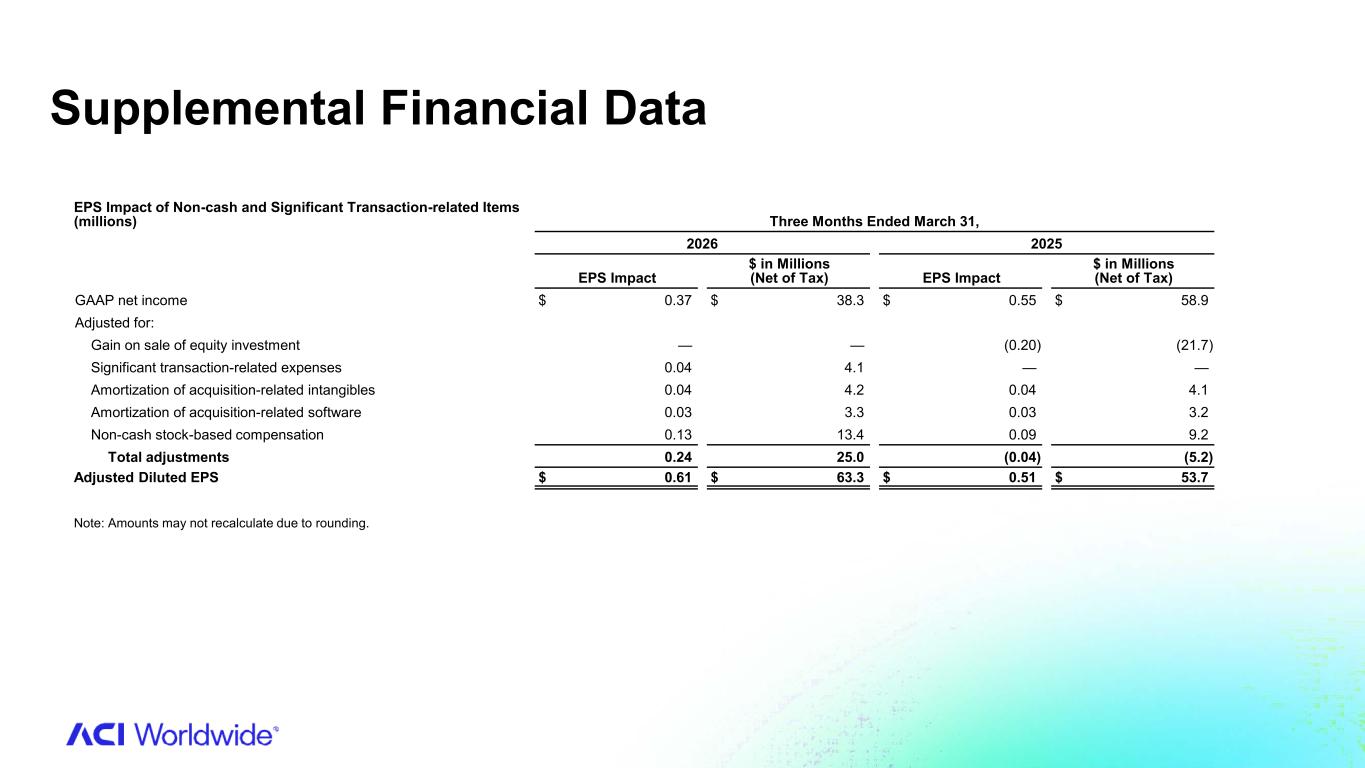
I'll jump in. So, one, I viewed it. We provided visibility on the first half's skew and reaffirmed that here with our 2Q guide. You know, the beginning part of your question, you asked about the quality of the, you know, the roughly 15, $16 million beat on revenue in Q1, which was a great way to start the year on top of the, you know, roughly 25% growth we saw last year in Q1, you posted the 6% constant currency this year. So underneath of that, you know, really, Jeff, it was minimal, you know, pull forwards, and that's why we're able to reaffirm the 2Q guidance. you know really what we saw is on the deals that we had forecasted both renewals and some of the new local opportunities it was exceeding the expectations we have on upselling and cross selling into those accounts we came in at the high end of those ranges which is really encouraging you know when you think about the retention rates you're getting on renewals and the adoption you're getting and the commitment you're getting on the new logo side of it as you put that in context and roll that forward through the year. We rolled the bulk of that beat right through to the full year for us. We've maintained a disciplined approach to the way we're guiding. We want to provide you numbers you have high confidence in getting to. You look at Q2, which asked about, you know, pleased with the profile, it's giving you the range that the midpoint revenue is growing 7% and strong operating leverage when you see the EBITDA that's growing 11%. And I think, you know, you're asking about some of the the durability underneath of that I think hopefully you see this year a transparent approach and more visibility that we're trying to give you into the quarterly dynamics I talked about second half as well and really providing not just through adjusted EBITDA I've given you all the componentry to think about the earnings power we have in the business you know for the full year we've guided a EBITDA range you know that's growing seven to 10%. When you see what that translates to on an adjusted earnings per share basis, you can see we almost double that growth range at the midpoint of what we're telling you there. So we're excited about the year, the position of strength, and the team's very focused.
Operator
Your next question comes from the line of Alex Newman with Stephens. Your line is now open.
Thanks for taking the question um i just wanted to ask are you facing any headwind from uh lower tax payments from the irs this year from higher refunds and then if you could quantify that impact if so and then just secondly uh assumptions for fx benefiting uh the 26 guide yeah i'll jump in on them on the irs side um i mean you're you're right to point out we do have some seasonal benefits that started last year as we saw the ramping of this business the the IRS and our federal business maintains strong volumes good resiliency there and and there is some spreading of that throughout the year as tax payments are made multiple times throughout the year we don't we see we see growth continuing in that segment so no no declines forecasted there I did try to provide transparent commentary Alex within Q2 as we laugh on some of that growth, you know, the 10% we had of biller growth in Q1, you know, that's going to be more like mid-single-digit growth, and then we see that re-accelerating in the second half, you know, based on the compare we saw in Q2, and as you heard, you know, I did try to provide segment-level commentary on the full year in line with our model that we see both segments growing high single digits there.
Yeah, and Alex, we don't see a meaningful impact from what, specifically what you were talking about more more refunds uh you know leading to potentially fewer tax payments we're not really seeing that so um you know i i read the same thing more people are getting a refund but uh we're not seeing material impacts i think what bobby was highlighting was there there'll be a it's it's a it's a tougher compare because we had a very strong uh year last year and that IRS business in particular grew a lot over the previous year, but we don't see any material there.
And the second part of your question, Alex, was around currency impacts. I made the comment earlier that, you know, the first 90 days ago, 60 days ago, roughly when we guided in February, we didn't see a change really in the U.S. dollar strength or weakening against that guidance level. But we did see two points of tailwind with a weaker U.S. dollar versus last year in Q1. On the full year basis, the rest of the quarters are more neutral and nominal when you look at the, you know, our reported, you know, deltas. I'm not forecasting where the U.S. dollar goes versus current positioning. You know, we don't see that two point really carrying forward in the remaining quarters. And that's how it plays out in terms of the modeling on the top line there. Great. Thank you. Thanks.
Operator
We have reached the end of the Q&A session. I will now turn the call back over to the company management for closing remarks.
Well, thank you very much for the questions and, of course, for the support that you give us all the time. We really appreciate it. I want to just summarize. We're pleased with the start to 2026. We're pleased with the momentum we're seeing in our business. Of course, there's a lot of noise in the industry. There's a lot of geopolitical unrest, all kinds of things happening in the world, but we remain absolutely focused on continuing to execute on our strategy, and we're very confident that we remain well-positioned to continue winning. The platforms we're operating are mission-critical, highly reliable, and deeply embedded in our customers critical workflows and we sit at the center of payment flows that are global highly regulated and increasingly complex we have a clear strategy a resilient portfolio we're seeing accelerating growth we have significant financial flexibility and we're very well positioned to continue delivering our long-term value for shareholders so we feel great about where we are, great start, and we're going to keep doing our best to deliver very high quality results and shareholder value. Thank you very much.
Operator
This concludes today's call. Thank you for attending. You may now disconnect.