Operator
Good day and welcome to the AFLAC incorporated first quarter 2026 earnings call. All participants will be in listen only mode. Did you need assistance? Please signal a conference specialist by pressing the star key followed by zero. After today's presentation, there will be an opportunity to ask questions. To ask a question, you may press star then one on your telephone keypad. To withdraw your question, please press star then 2. Please note this event is being recorded. I would now like to hand the call over to David Young, Senior Vice President of Capital Markets. Please go ahead.
Good morning and welcome. Thank you for joining us for Aflac Incorporated's first quarter 2026 earnings call. This morning, Dan Amos, Chairman and CEO of Aflac Incorporated, will provide an overview of our results and operations in Japan and the United States. Then, Max Brodin, Senior Executive Vice President and CFO of Aflac Incorporated, will provide more detail on this quarter's financial results, including our capital and liquidity. These topics are also addressed in the materials we posted with our earnings release, financial supplement, and quarterly CFO video update on investors.aflac.com. For Q&A today, we are also joined by Virgil Miller, President of AFLAC Incorporated and AFLAC U.S., Charles Lake, Chairman and Representative Director, President of AFLAC International, Masatoshi Kuide, President and Representative Director, AFLAC Life Insurance Japan, and Brad Dislin, Global Chief Investment Officer, President of AFLAC Global Investments. Before we begin, some statements in this teleconference are forward-looking within the meaning of federal securities laws. Although we believe these statements are reasonable, we give no assurance that they will prove to be accurate because they are prospective in nature. Actual results could differ materially from those we discussed today. We encourage you to look at our annual report on Form 10-K for some of the various risk factors that could materially impact our results. As I mentioned earlier, the earnings released with reconciliations of certain non-U.S. gap measures and related earnings materials are available on investors.aflac.com. I'll now hand the call over to Dan. Dan?
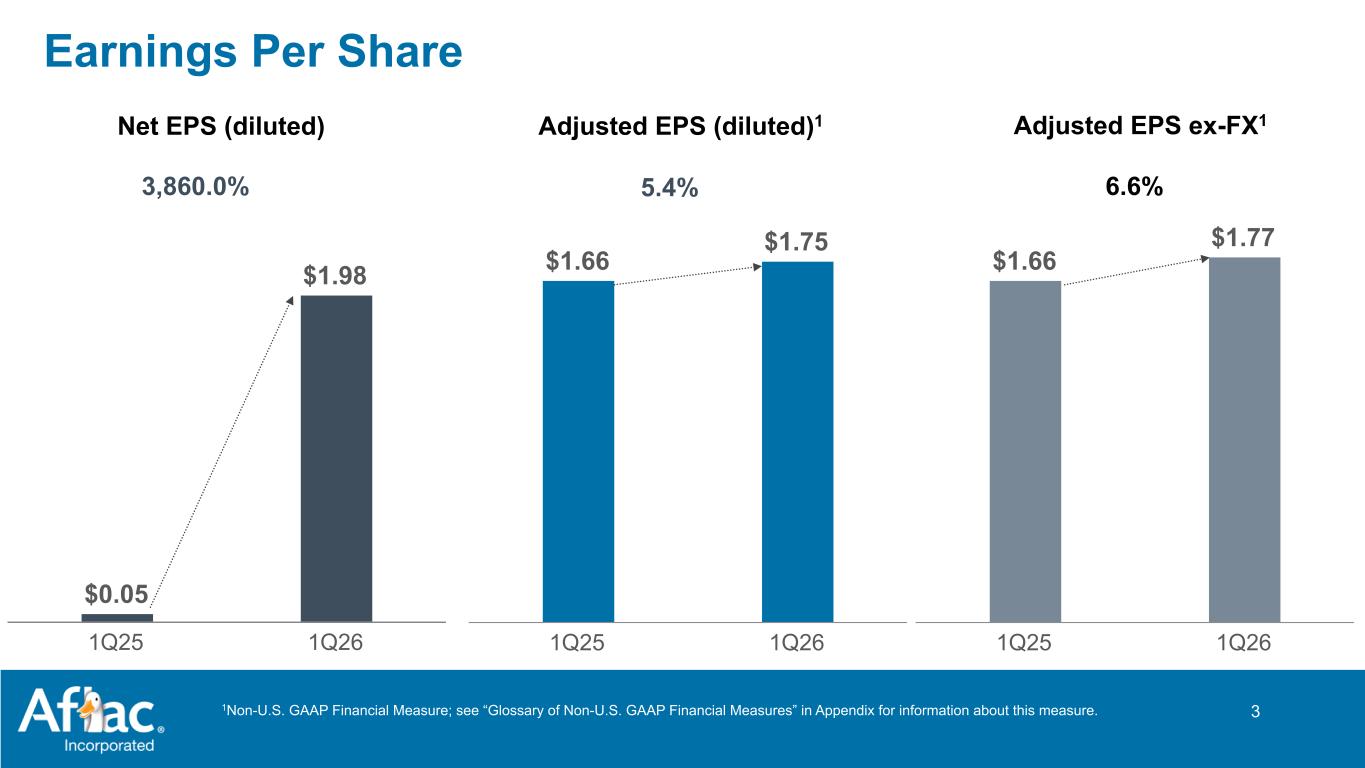
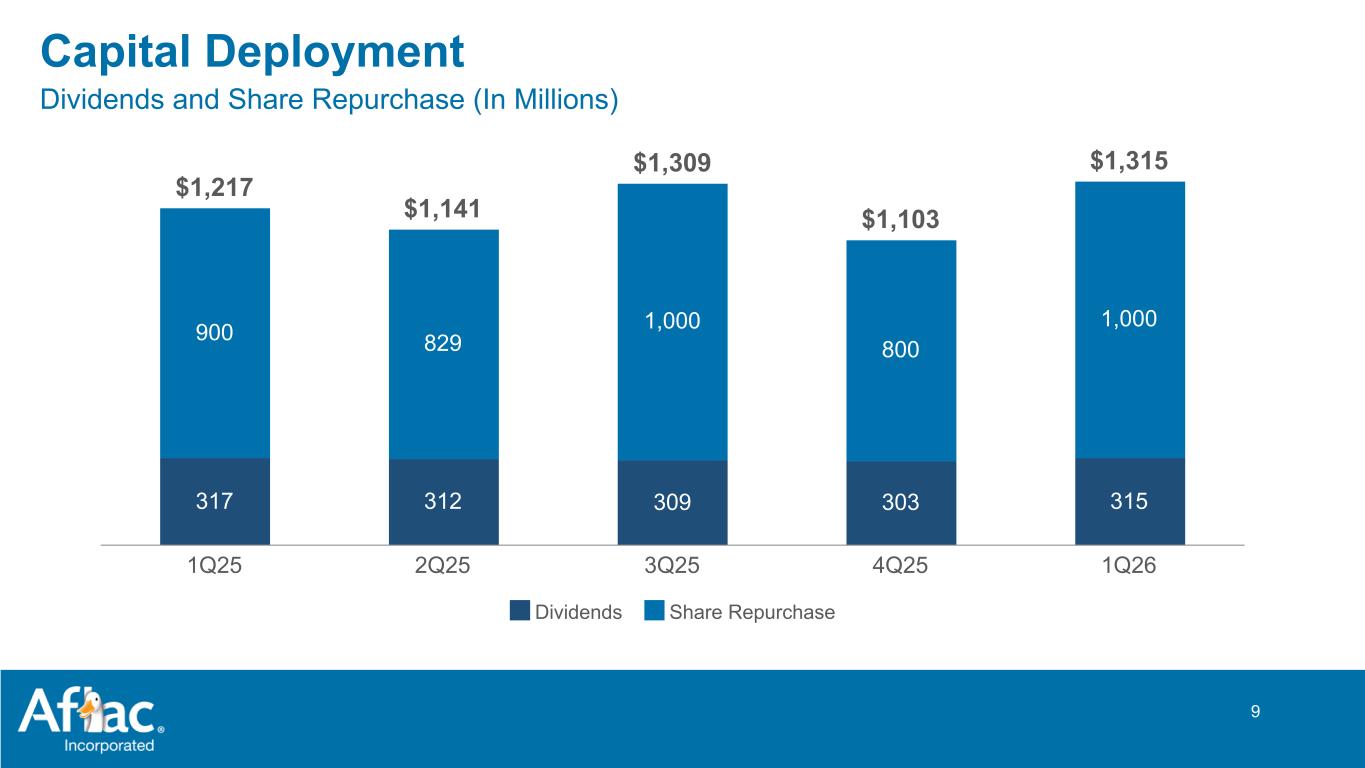
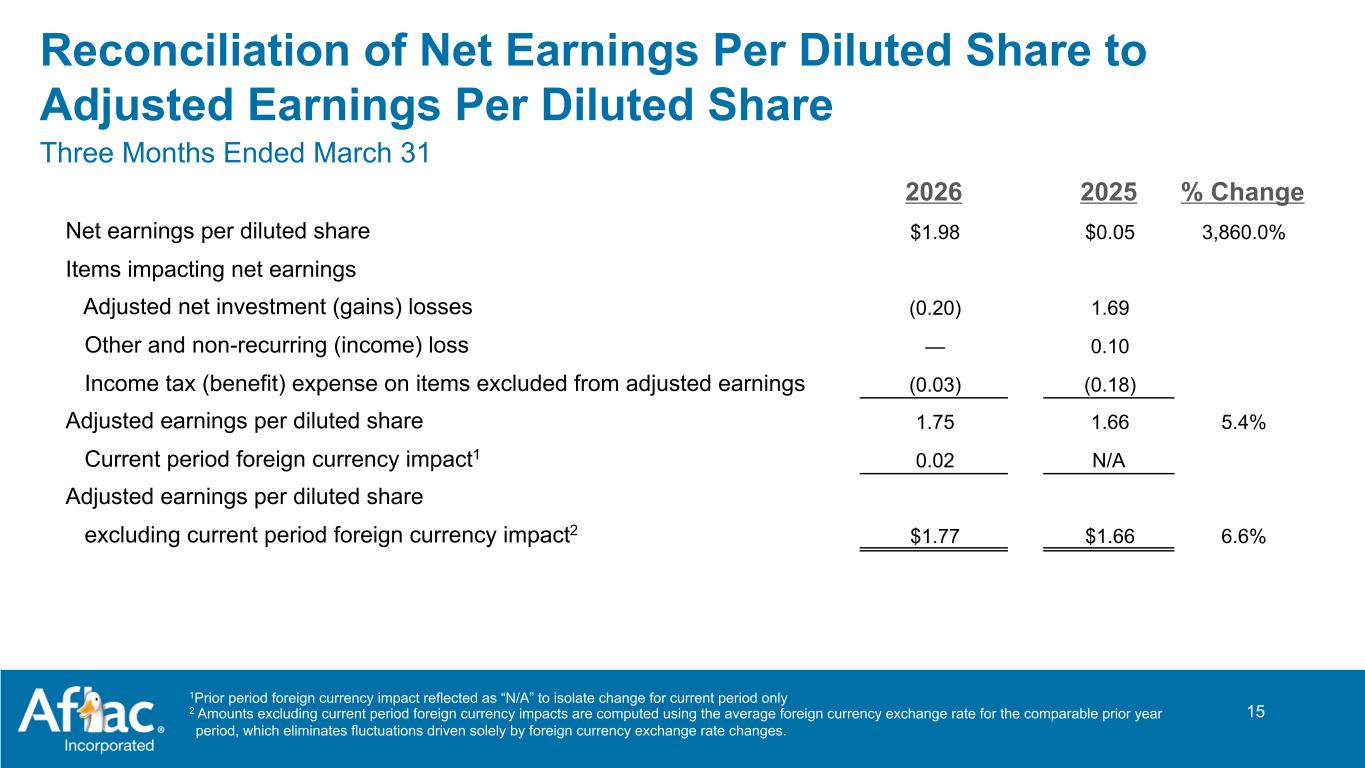
Thank you, David, and good morning, everyone. We're glad you've joined us. Although we have just one quarter under our belt, the first quarter marked a good start to the year. Half-Lack Incorporated reported net earnings per diluted share of $1.98 and adjusted earnings per diluted share of $1.75. These results reflect our focused execution of our strategy, thus creating long-term value for our shareholders. Starting with Japan, as you will recall last year, Affleck Japan implemented a marketing and sales transformation which helped deliver the strong results and sales momentum we saw in 2025 and again in this quarter. This transformation was a major strategic initiative driven by Affleck Japan's corporate strategy and marketing and sales team. I would highlight the leadership of Deputy President Shinsuke Morimoto, First Senior Vice President Michihiro Ito, and Chief Marketing Officer Yumi Saito, working together with Executive Vice President Yoshizumi to make it happen. As a cohesive management team, they delivered strong results. I'm excited about the new and innovation that they have produced and will continue to bring to the organization moving forward. With this in mind, I'm pleased with Athlete Japan's sales increase of a 25.5% increase for the first quarter. These strong sales results were driven largely by our newest medical product, Anshin Talit, and Moraito, our latest cancer insurance product. As part of our ongoing strategy, we continue to emphasize and promote the importance of third-sector protection to new and younger customers with our innovative first-sector product, Sumitatsu. The value of our policies resonates with millions of policyholders, and this reinforces how AFLAC's overall strategy is effective and reputation is important. By maintaining strong persistency while adding new premium through sales, we seek to offset the impact of lapses and reissue, as well as policies reaching paid-up status in the future. Maintaining strong persistency continues to be important to the future of AFLAC Japan. Our broad network of distribution channels, including agencies, alliance partners, and banks, continually leverage opportunities to help provide financial protection to Japanese consumers. For the quarter, all of our distribution channels generated increases in sales, which is significant considering that we prioritize being where the customer wants to buy insurance. We will continue to evaluate the needs of each channel and support those needs as we work together to provide Japanese citizens with financial protection. Turning to AFLAC US, I am encouraged by the 2.9% year-over-year increase in sales and the momentum we are seeing within all areas of our group business, especially our group voluntary products. More importantly, we maintain strong premium persistency of 79.3% and increase net earned premium of 3.5% for the quarter. We continue to focus on driving our profitable growth with strong underwriting discipline and maintaining strong premium and persistency. We believe this will continue to drive net earned premium growth. At the same time, AFLAC-US has continued its prudent approach to expense management and maintaining a strong pre-tax margin, as MACS will expand upon shortly. Across Japan and the United States, consumers are feeling the increasing burden of out-of-pocket medical expenses. That's where we step in. Our management teams, employees, and sales distribution partners are united to be there for the policyholders when they need us most. As the pioneer in cancer insurance and a leader in the industry, our team and sales partners show up every day to help ease the burden, providing financial protection with genuine compassion and care. As an insurance company, our primary responsibility is to fulfill the promises we make to the policyholders while being responsive to the needs of shareholders. We generated strong capital and cash flows on an ongoing basis while maintaining our commitment to prudent liquidity and capital management. We continue to be pleased with our investments, producing solid investment income. Our financial strength is the foundation that backs up our promise to our policyholders, balanced with the financial flexibility and tactical capital deployment. I am very pleased with the company's financial strength, which supports our capital deployment. We treasure our 43 consecutive years of dividend increases and remain committed to extending this record. Combining share repurchase and dividends, we delivered $1.3 billion back to the shareholders in the first quarter. In doing so, we have maintained our position among companies with the highest return on capital and the lowest cost of capital in the industry. In today's complex healthcare environment, Aflac stands out as a trusted partner, combining relevant products, financial strength, a powerful brand, and broad distribution to help consumers manage the financial strain of out-of-pocket medical expenses. The ongoing foundational strengths of our business and our capacity for continued growth in Japan and the United States, two of the largest life insurance markets in the world, support our leading position, and build on our momentum. I will now turn the program over to Max to cover more details of the financial results.
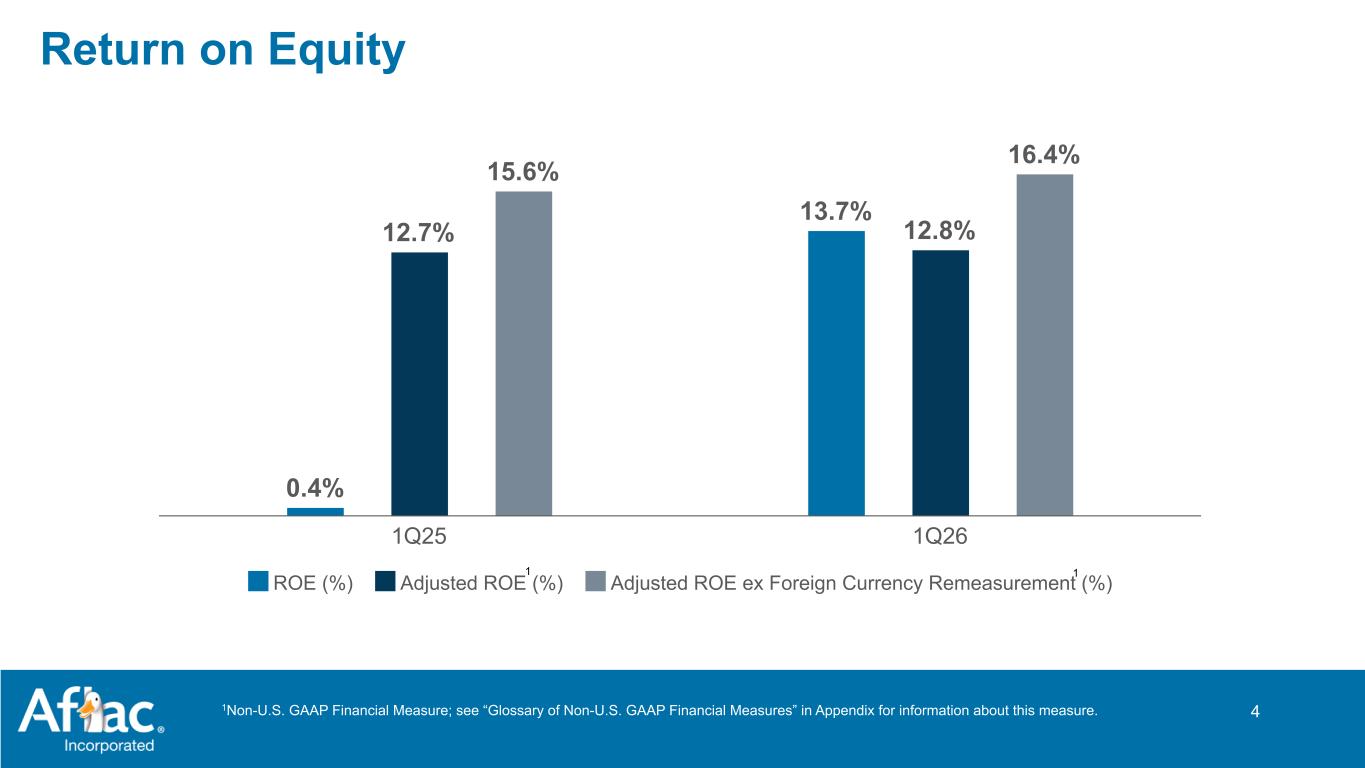
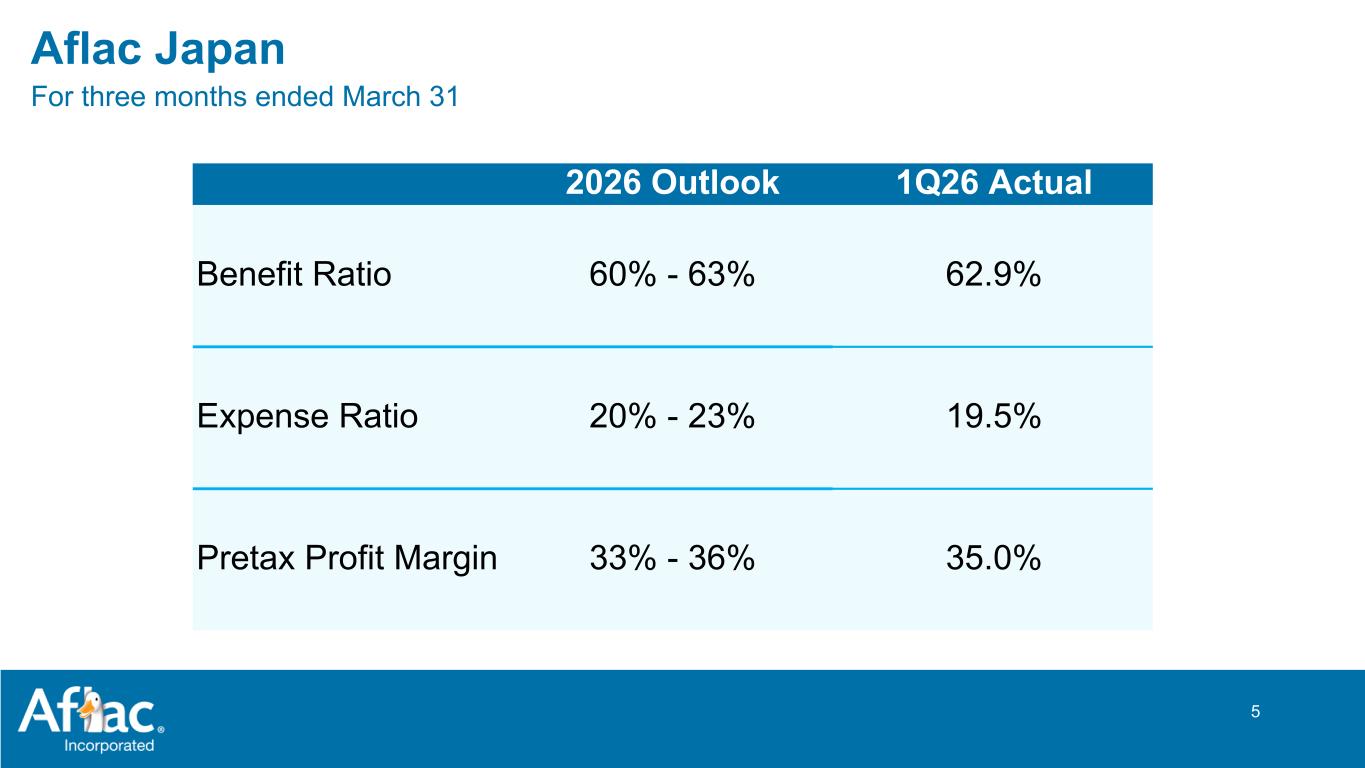
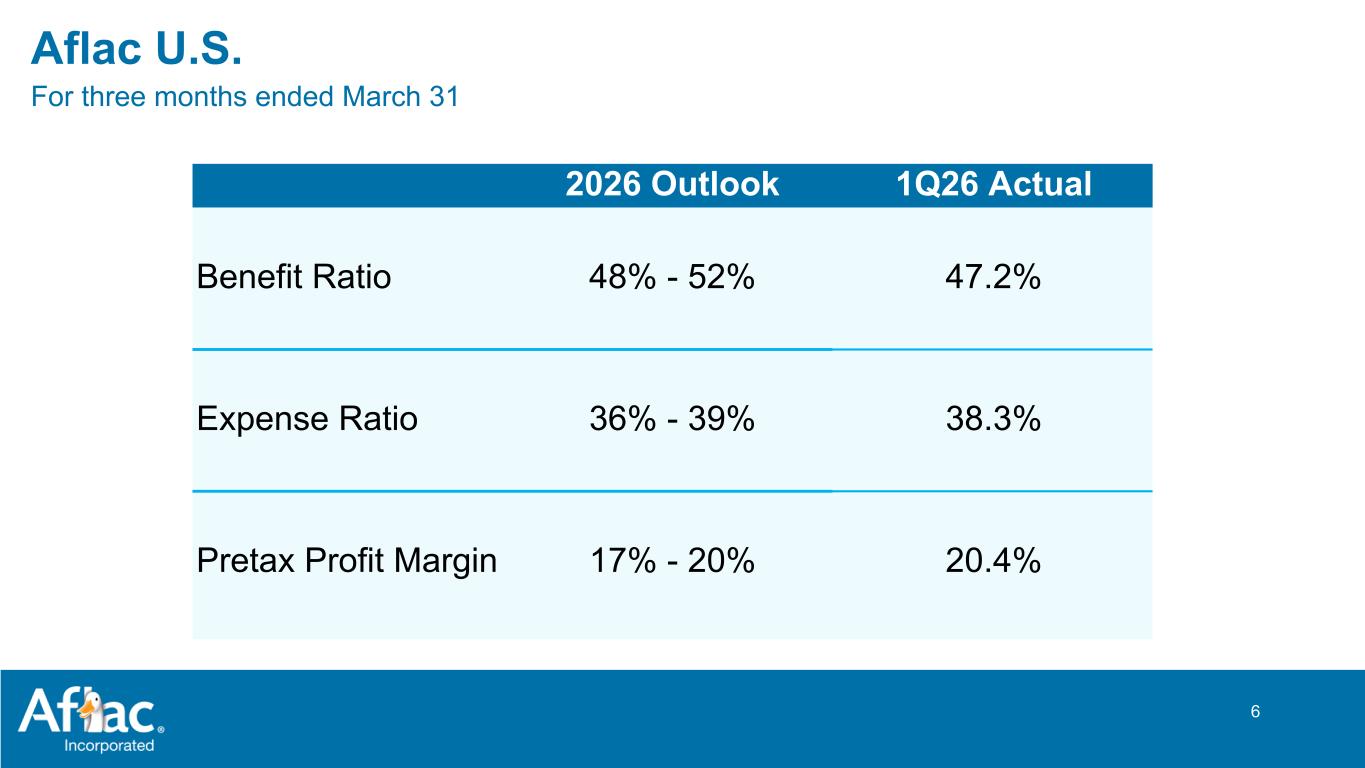
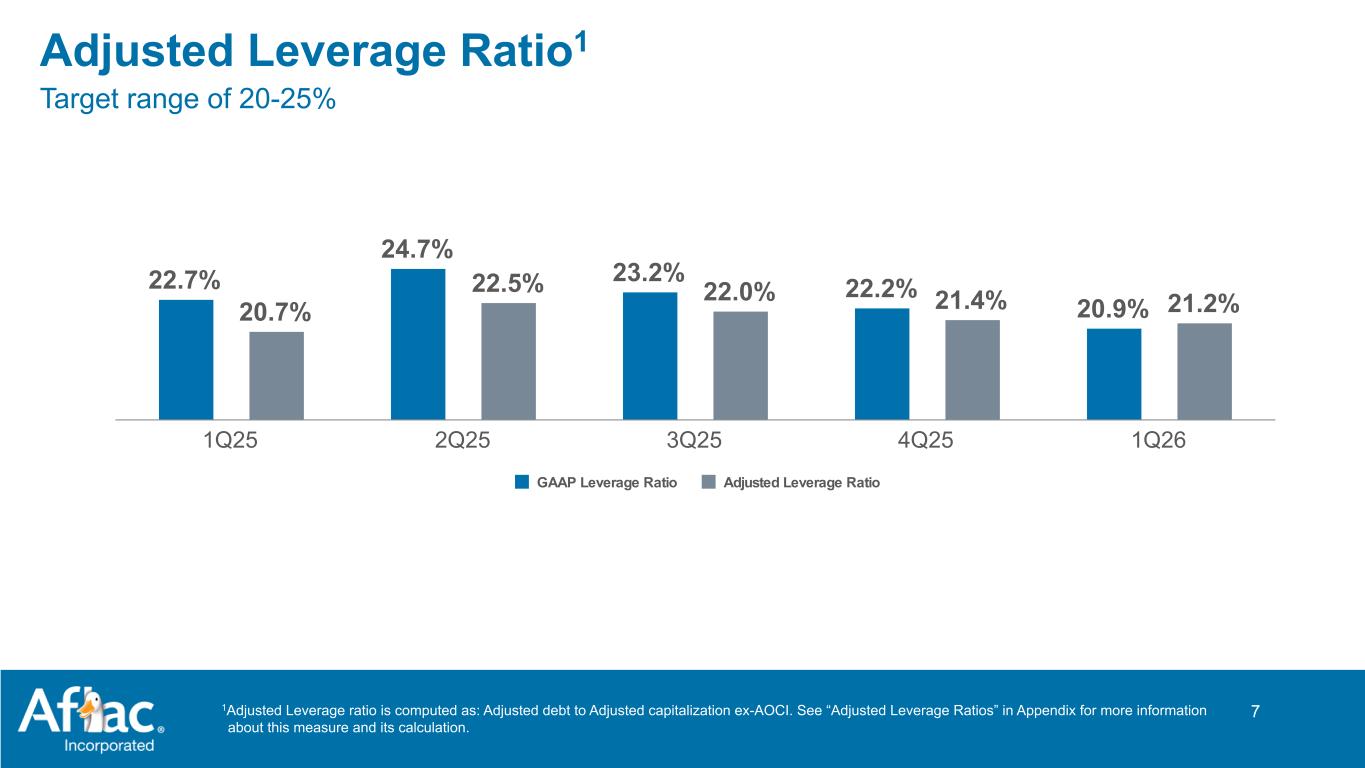
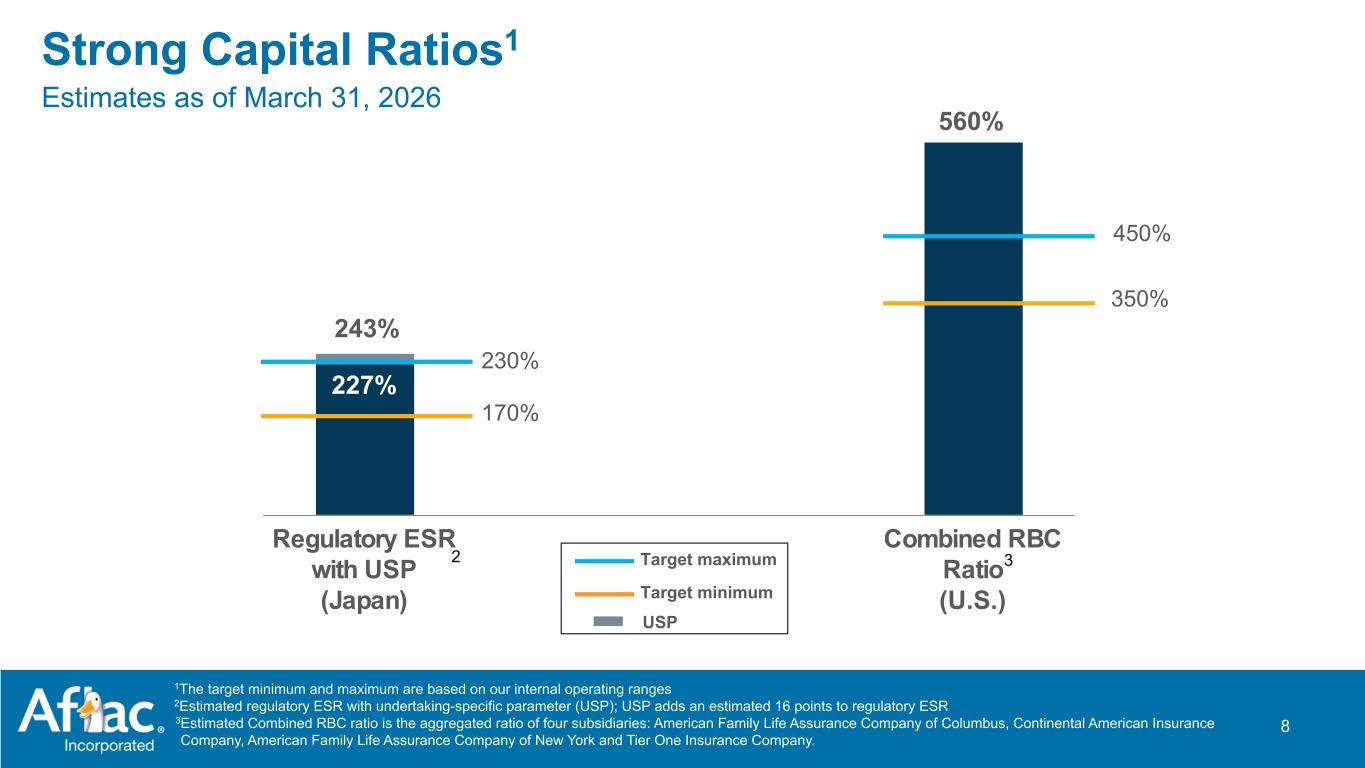
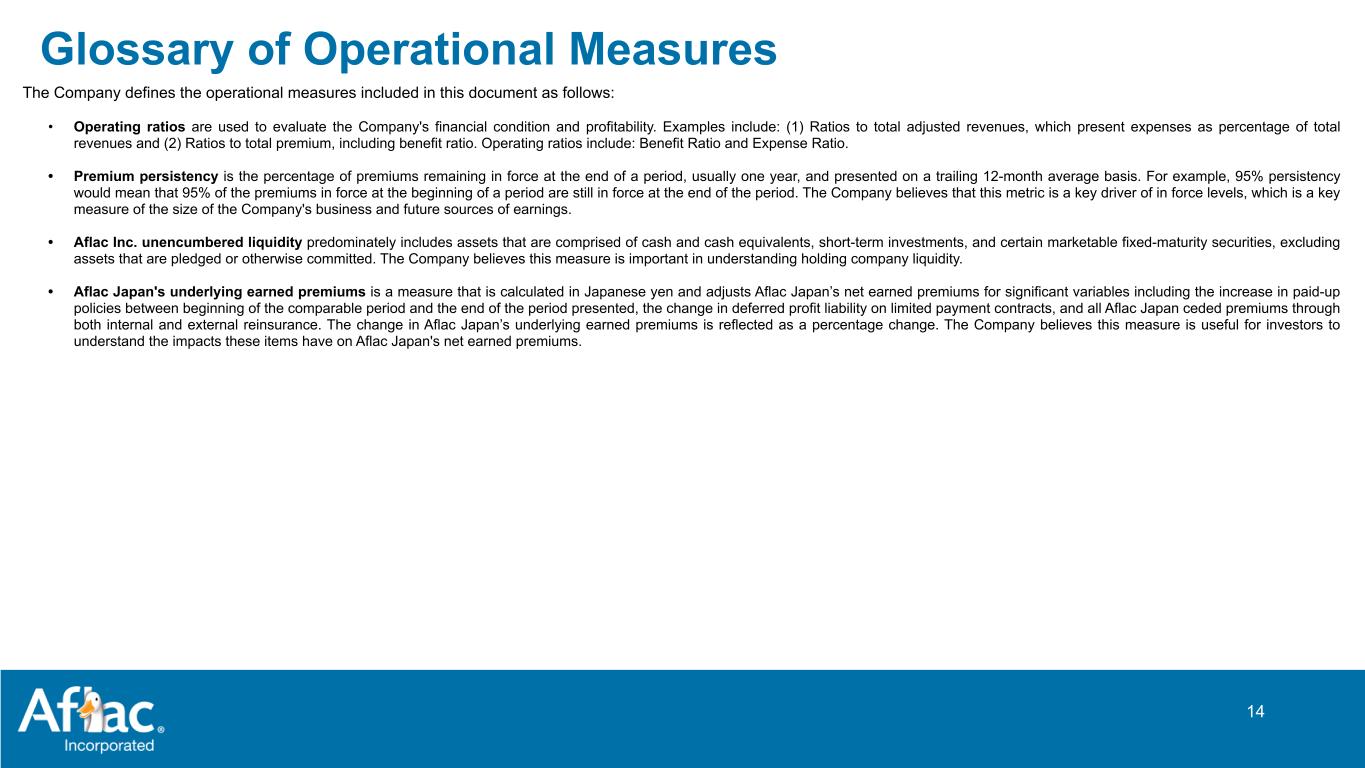
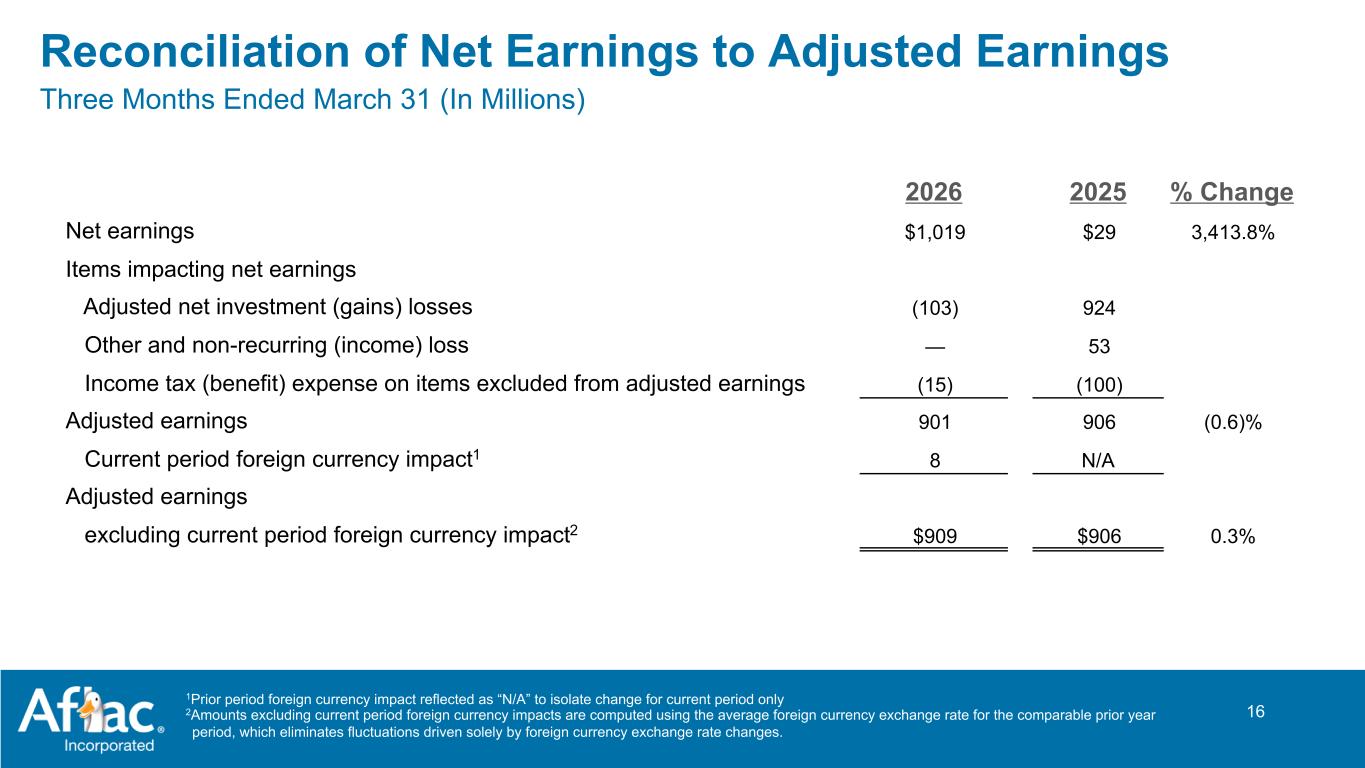
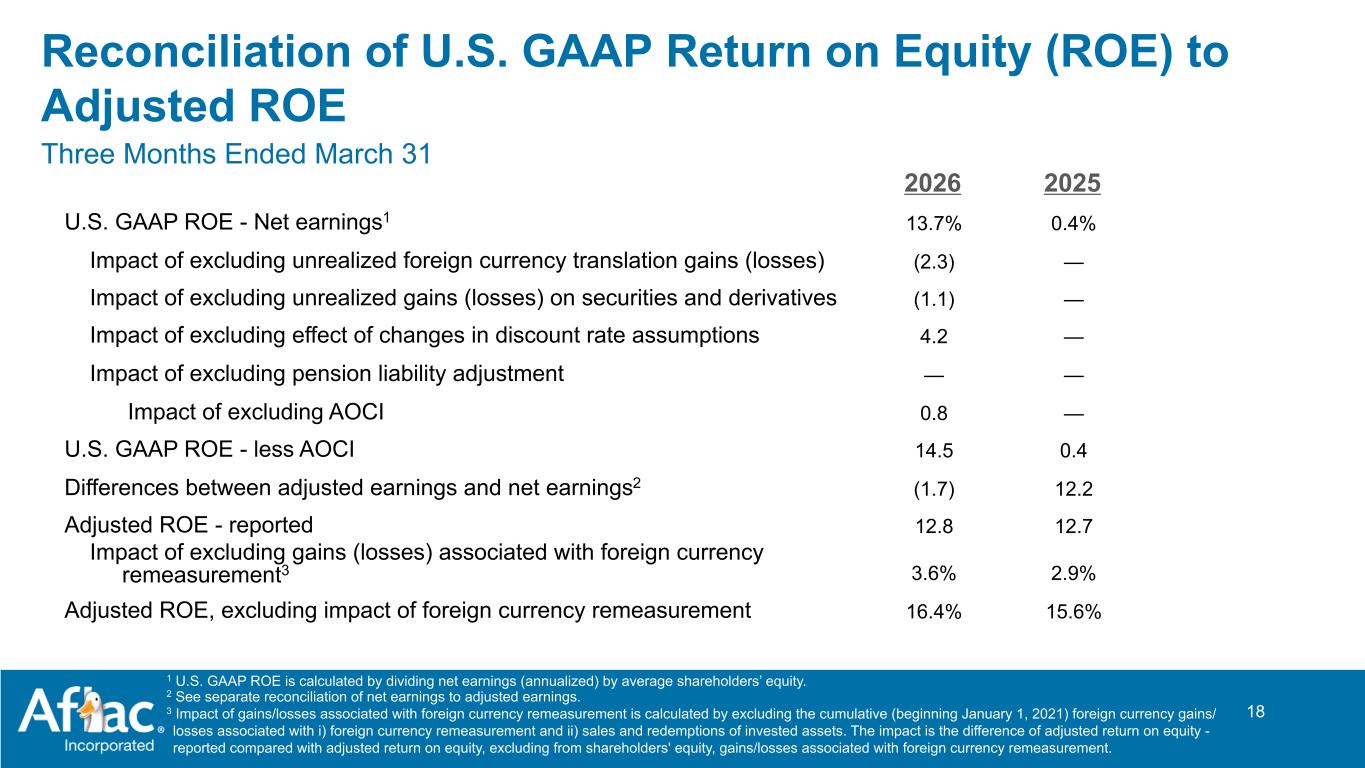
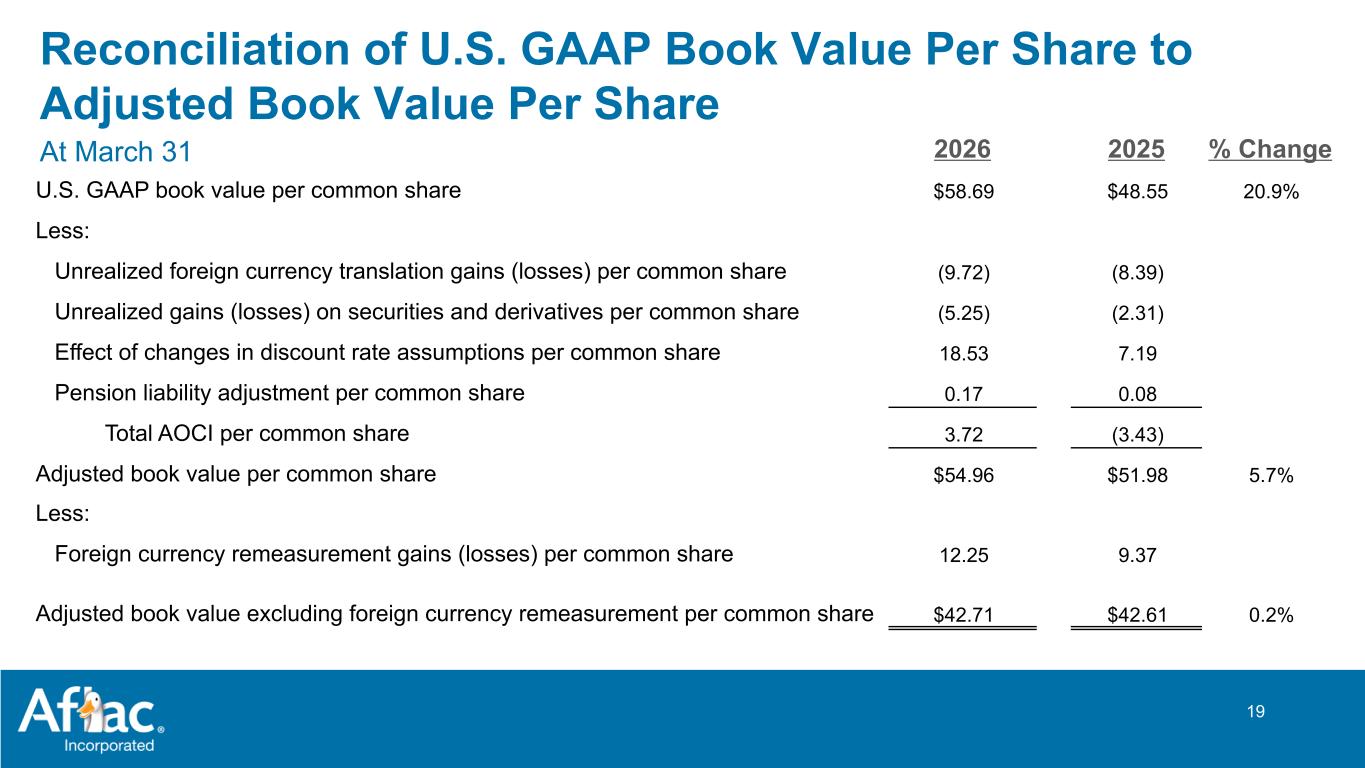
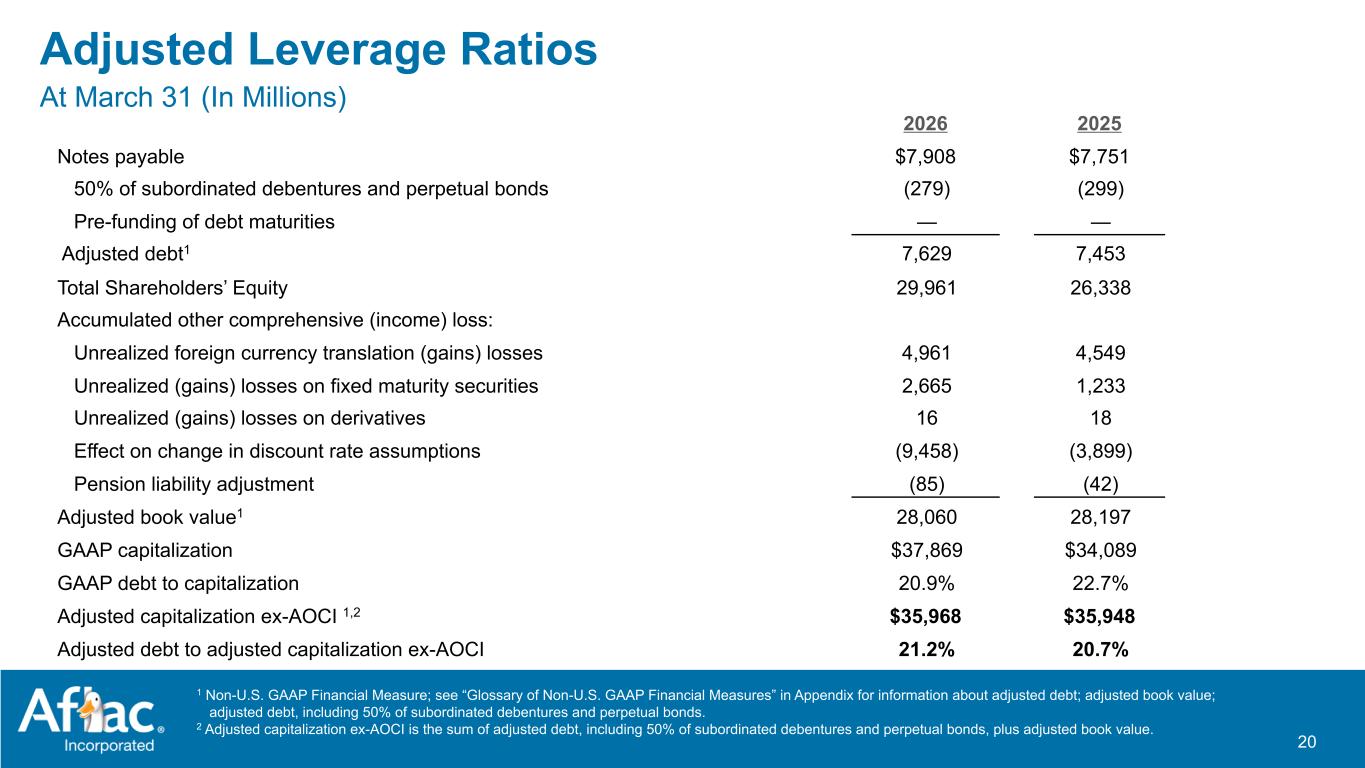
Max. Thank you, Dan. For the first quarter of 2026, adjusted earnings per diluted share increased 6.6% year-over-year to $1.77, excluding effect of foreign currency in the quarter. In this quarter, re-measurement gains on reserves totaled $82 million, reducing benefits, with $23 million, or $0.04 per diluted share, above plan. Variable investment income ran $14 million, or $0.02 per diluted share, below our long-term return expectations. Adjusted book value per share excluding foreign currency re-measurement increased 0.2%. The adjusted ROE was 12.8% and 16.4% excluding foreign currency re-measurement, a solid spread to our cost of capital. Overall, we view these results in the quarter as solid. Starting with our Japan segment, net term premiums in yen terms for the quarter declined 3.8 percent. AFLAC Japan's underlying earned premiums, which excludes the impact of reinsurance, paid-up policies, and deferred profit liability, declined 1.3 percent. We believe this metric provides a clearer insight into long-term premium trends. Japan's total benefit ratio came in at 62.9% for the quarter, down 290 basis points year over year. We as met the impact from reserve remeasurement gains exceeding plan to be approximately 70 basis points. We continue to have favorable trends in cancer and hospitalization. While persistency was down, it remained strong and in line with our expectations at 92.8%. We continue to see an uptick in lapse and reissue on our cancer insurance product. Lapses on our first sector savings block remain low and in line with previous periods, despite the increase in yen interest rates. Our expense ratio in Japan was 19.5% for the quarter, down 10 basis points year over year. For the quarter, adjusted net investment income in yen terms was up 4%, primarily driven by higher U.S. dollar fixed-rate income on higher volume and higher variable net investment income compared to last year, partially offset by lower dollar-denominated floating-rate income due to lower volume and rates, as well as reduced call income. The pre-tax margin for Japan in the quarter was 35%, up 320 basis points year-over-year, a very good result. Turning to U.S. results, net-term premiums were up 3.5 percent. Premium persistency remained solid at 79.3 percent. Our total benefit ratio came in at 47.2 percent, 50 basis points lower than Q1 2025, driven by favorable incurred claims for individual voluntary benefits products and group disability. We estimate that reserve remeasurement gains impacted the benefit ratio by approximately 230 basis points in the quarter, which is about 80 basis points above plan. Our expense ratio in the U.S. was 38.3%, up 70 basis points year-over-year, primarily driven by higher DAC amortization and commissions, along with timing of advertising and investment spend. Adjusted net investment income in the U.S. was down 0.5% for the quarter, primarily driven by lower short-term rates, offset by higher variable net investment income. Profitability in the U.S. segment was solid, with a pre-tax margin of 20.4%, a 40 basis points decrease compared with a strong quarter a year ago. Corporate and other reported break-even pre-tax adjusted earnings, down from a $43 million gain last year, driven by lower adjusted net investment income, high interest expense, and operating costs, and runoff impacts from close blocks of business. Adjusted net investment income was $17 million lower than last year due to a combination of lower hedge benefits, partially offset by lower volume of tax credit investments. Our tax credit investments impacted a net investment income line for U.S. GAAP purposes negatively by $5 million in the quarter, with an associated credit to the tax line. There were no benefit in first quarter earnings from tax credit investments. We're pleased with the overall performance of our investment portfolio. During the quarter, we recorded $19 million of charge-offs on our loan portfolio. Additionally, we did not foreclose on any properties in the period. We recorded $24 million of impairments on our real estate-owned portfolio to reflect the continued depressed valuations in the commercial real estate markets. However, we continue to believe that the currently stressed market does not reflect the true intrinsic value of our portfolio, which is why we continue to manage them through this cycle and maximize our recoveries. For U.S. statutory, we recorded $12 million of impairments on invested assets and a $1 million valuation allowance on mortgage loans as an unrealized loss during the quarter. On a Japan FSA basis, securities impairments reversals led to a net realized gain of 66 million yen in Q1, and we booked a valuation allowance of 201 million yen related to transitional real estate loans. This is well within our expectations and has a limited impact on regulatory earnings and capital. Effective March 31st, Aflac Re Bermuda entered into a transaction in which it assumed a block of whole-life annuities from Japan Post Insurance. This transaction itself is is immaterial to Aflac Inc's financials, but it marks a strategic milestone as we expand our reinsurance franchise targeting the Japan market. Aflac Inc unencumbered liquidity stood at $3.4 billion, which was $2.4 billion above our minimum balance of $1 billion at the end of the quarter. Our adjusted leverage was 21.2% for the quarter, which is within our target range of 20 to 25 percent as we hold approximately 65 percent of our debt in yen this leverage ratio is impacted by moves in the yen dollar exchange rate this is intentional and part of our enterprise hedging program protecting the economic value of aflac japan in u.s dollar terms our capital position remains strong we ended the quarter with an estimated regulatory ESR of 227 percent. If including the undertaking specific parameter or USP, this would add 16 points to the regulatory ratio and results in an ESR with USP of 243 percent. We estimate our combined RBC to be approximately 560 percent. These are strong capital ratios which we actively monitor, stress, and manage to withstand market volatility and credit cycles as well as external shocks. Given the strength of our capital and liquidity, we repurchased $1 billion of our own stock and paid dividends of $315 million in Q1, offering good relative IRR on these capital deployments. We will continue to be flexible and tactical in the way we manage the balance sheet and deploy capital in order to drive strong risk-adjusted ROE with a meaningful spread to our cost of capital.
I will now turn the call back over to David. Thank you, Max. Before we begin our Q&A, we ask that you please limit yourself to one initial question and a related follow-up. You may then rejoin the queue to ask additional questions. Our operator for today's call will now give you instructions on how to rejoin the queue and then announce our first question.
Operator
We will now begin the question and answer session. To ask a question, you may press star, then 1 on your telephone keypad. If you are using a speakerphone, you will need to pick up the handset before pressing the keys. To withdraw your question, please press star, then 2. At this time, we will pause momentarily to assemble the roster. And our first question comes from Tom Gallagher of Evercore ISI. Please go ahead.
Good morning. First question is just on capital generation. Max, can you help quantify how much benefit you got from that external reinsurance deal? And were there any ESR headwinds that emerged in Japan that might have impacted things?
so the the reinsurance transaction we executed in the first quarter with an external party the impacts to a capital this was a relatively small block in the scheme of it so it wasn't really meaningful to either the the esr or fsa earnings in the quarter and in terms of the the movements in the ESR, as you recall, we're down a little bit compared to the full year. The main driver of that is subsidiary dividends being moved up from Athlete Japan to the holding company in the quarter. Other than that, you have our sensitivities, and they work pretty well in terms of estimating the other impacts. Obviously, higher yen rates has a slightly negative impact to the ESR because of the increased capital charge associated with mass lapse risk. At the same time, you also saw a little bit of a yen weakening that is benefiting the ESR. So, relatively small impact from capital markets inputs to the ESR.
Okay, thanks for that. And then my follow-up is just, I think there was a change in the lapse and reissue activity during the quarter. normally it's much older policies and it was less so this quarter can you talk about what does that mean for from an IRR perspective for Aflac when there's somewhat younger customers that are doing laps and reissue are those still positive IRRs when you think about you know your economics thanks thank you Tom, so when you have a policy that is a little bit shorter in its duration because that policy is now lapsing and now moving into a new policy, what tends to happen in that scenario is obviously the policyholder is doing this in order to get a better coverage.
And once you have gotten that better coverage, you're probably more likely to improve the persistency post the lapse and reissue activity. So when you think overall, we think when we analyze this through the totality of the overall block, relatively minor impacts on the IRRs, there will be, if you take a snapshot of one specific policy that just lapsed, obviously that IRR is a little bit lower than originally assumed but we now think about that new policy it is moving into the duration of that policy is likely to be longer and that might actually improve the IRR of that new policy that is being written so that is sort of working a little bit like as a balancing impact so the overall impact to IRRs across the whole enforce is expected to be quite minor okay thanks the
Operator
Our next question comes from Ryan Krueger of KVW. Please go ahead.
Hey, thanks. I had a question on the Japan benefit ratio, you know, it's towards the high and a little bit above, I guess, excluding favorable experience. Can you talk about the key drivers of expected improvement that goes on towards the 60 to 63% outlook?
Thank you, Ryan. So when we think about the different drivers being underlying experience, that being the lower net premium ratio as last year, and then also different types of lapsed activity, we would expect going forward the favorable experience that we did have in this quarter and we've had for a long time. We think that we will continue to generally have those trends in place. When we think about the net premium ratio, that has been set more or less, and that's more driven by mix of business as it relates to the current year benefit ratio. And obviously, we will update our net premium ratio with our long-term assumption unlock in the third quarter of this year. And then the last piece being the mix of lapsation. We did have a mix in this quarter with a little bit less of old age cancer and a little bit higher lapsation of more recently issued policies. And when that happens, you naturally have less of an impact on the reported gap benefit ratio because the younger policies have less of a reserve being built up relative to old policies, especially old policies with a CSV could have quite an impact on the reported benefit ratio given the release of those reserves so as we don't think about these impacts and trends running through our results for the full year we still feel very feel very confident with the outlook range that we gave it a 63% for a Japan benefit ratio.
Great. Thanks. And then you did, I know, as third-party Japan, could you talk a little bit about how big of an opportunity you think that is for AFLAC, I guess, over time? And, you know, could that move the needle some on your growth in Japan?
Well, these transactions, well, this one was a relatively small transaction, could be material to us over time. And these can be pretty sizable blocks when executed, and they will then be immediately accretive to our earnings profile. So Japan, obviously, is a very sizable market. I don't think that we will target the whole market. We will be selective in the way we approach it, both in terms of the target niches and also the type of products and risks that we go after. But it's obvious to us that we think that we have a balance sheet that is quite attractive for counterparties to transact with with a AA rating. We think that we have a certain expertise in how to navigate and transact in the Japanese market. And we now built a platform that is ready to do so. So we do think that adding also some risks, i.e. that being mortality, longevity risk, and spread risk to our balance sheet can be quite attractive to us from a risk management standpoint as well. So there are many factors at play that makes this quite attractive from a financial standpoint for us. So, I think this will be, it will take time for this to build up, but over time, we certainly expect that this will be material to the company. Thank you.
Operator
The next question comes from Wes Carmichael of Wells Fargo. Please go ahead.
Hey, thank you. First question on Japan cancer sales, Moraito. So do you expect sales to sequentially improve in the next quarter relative to the first I know it's competing a bit now with the new medical product.
This is Yoshizumi from APAC Japan. AFRAC JAPAN We have created a system whereby the entire three products, starting with the cancer insurance Miraito, Medical Insurance, Anshin Palette, and Sumitas to be sold concurrently.
Thank you. Appreciate that. And then second question just was on the corporate segment. I know there's breakeven in the quarter, maybe a little bit of impact from tax credits, but you know, it's bounced around a little bit. I was wondering, Max, is there any help you can give us with an expected run rate of earnings power there? And I realize there's a few moving pieces.
Yeah, so you tell me where short-term rates are going to go, and I give you the answer. is a little bit of how this works. The main driver that is swinging our corporate and outer segment around is the net investment income that we generate on our cash and liquid assets. So obviously, depending on how much capital we hold at the hold code times, the short-term rates to some extent drives that. The other component to it is this is where we hold all our reinsurance treaties. And because these are runoff blocks, there's a natural decay roughly about 8% per year. So that also drives down the earnings contribution year over year, unless we add and do more either internal or external transactions adding to the earnings of that segment. So as we go into Q2 right now, I would say that I would expect this segment to be slightly negative in terms of pre-tax earnings given current volumes and rates and what we see from our reinsurance blocks. Thank you.
Operator
Next question comes from Joel Hurwitz of Dowling and Partners. Please go ahead.
Hey, good morning. Matt, Max, I wanted to go back to the external reinsurance transaction that you did with some of your first sector business in Japan. If I look at the seeded premiums and the tick up quarter over quarter, it looked like it had like a one and a half point impact to net earned premiums. Should we think that the earnings impact is similar to that premium impact over time, or is there another way we should? Are you thinking about earnings impact from that deal?
So on that transaction, it negatively impacted our Athlete Japan earnings in the first quarter by mid-single-digit U.S. dollars in millions. That transaction or that block of business will initially have a negative impact along those lines for the next couple of quarters. But then over time, it will go towards more of a zero impact. So in the near term, we expect a negative earnings impact from that seeded business and that it will go closer to zero over time as those policies reach paid up status.
Got it. That's helpful. And then switching to the U.S., there were some headlines in the past month that a state regulator was forcing rate cuts on some of your products. Are you seeing pressure from other states, and just how should we think about a potential impact of top-line earnings in the U.S.?
Hey, good morning, Joel. This is Virgil. No, we're not seeing any additional pressure like that, as a matter of fact, in the U.S. I'm pleased with how we are looking going forward with the year. We're still being consistent, but we're really seeing no material impacts at all.
Operator
The next question comes from Sunit Kamant of Jefferies. Please go ahead.
Great, thank you. Good morning. Just wanted to start on strategy maybe with Dan. So this reinsurance opportunity in Japan sounds interesting, but I guess another read could be sort of it's an indication that maybe the core business over there has less growth than maybe it previously did, and you're looking for other opportunities to sort of stimulate growth.
So just curious is that not the right read of this no what I would say is is that we're always looking for opportunities we you know our our position on reinsurance was is we've taken a slow methodical approach by starting by doing a reinsurance with another company then we ended up taking it internally and And what we've seen is success in the reinsurance business for us, and now the next thing is to do a deal with our biggest and closest partner, Japan Post, and then from there we'll see where it goes. we still believe there's a lot of opportunity to grow our business in Japan. And so this is a natural fit for us that we'll continue to watch. But what I like is evolution, not revolution. And so we continue to methodically take this on and continue to grow the business.
Got it. Okay. And then I guess for Virgil, last quarter you gave us some good color in terms of the mix of sales, sort of the group business versus kind of the core agent business. Just wondering if you could give us an update on what happened here in the first quarter and how you think things will trend for the balance of the year.
Thanks. uh yes thank you uh so i was mentioning just then i'm overall i'm pleased with the quarter uh it's consistent it's balanced uh the color i gave on the group business i'll give you some more insight very similar so in the quarter if you look at what we file as group products that would include our going vision line our our core vb and then you look at what we've been doing now with our group life and absence disability if you add those three categories up we're up about 12.4 percent for the quarter what we've been calling by the bills this is the investment we made with a dental and vision property what we made we were calling it class let's just call it group life absence and disability and then with our direct consumer platform that we refer to as consumer markets when you add the thrill those two those three entities up. By the bills, we were up 25% for the quarter. So strong performance. Very, very pleased with those. If you look at the Dillon Vision property, I fell on the sword maybe a couple over a year ago and told you that we were going to invest in improving that business and getting it back going. So we were up 52% for the quarter. Strong performance. I believe that the you'll continue to see solid performance in those categories and again I am pleased with how we're trending and overall you add in the point the fact that we still have consistent strong persistency 79.3 percent and that is how you're seeing though the overall increase in our premium income at 3.5 if you look at the premium income since the pandemic we've seen steady increase And now I'm pleased with where we're sitting with that metric.
But is the core business, like the agent business, shrinking still? Or what's going on with that piece?
Yeah, that's why you don't see the overall tremendous growth that you've seen in just the group space. That particular business, we've got some investments we're doing right now to try to get growth out of that business. But what you're seeing right now is slightly down to flat. But what's going to improve that is our continued focus on recruiting agents and then making sure that we convert those agents. So in the first quarter, we had a 16% conversion rate of new agents. That's where I continue to focus, and we continue to have strong productivity. The productivity with our agent group was about 8%. So that's our continued focus, but you're right. We're not seeing growth out of our core traditional business. We've also invested in improving and enhancing our enrollment process. What that really means is we've made it easier for new agents to be onboarded and have given them tools where they can go out and sell quickly and get going. We all know that when you're in a market where you're having people come on that are getting paid commission, the best thing to do is get money in their hands as quickly as possible and get some accounts in the book uh there's a metric that i monitor behind the scenes called new agent success and what that really measures is can we get an agent to produce about 25 000 in the first three months and add three new accounts and that metric is up uh also eight percent so i think we're headed in the right direction uh but with the market going toward group product and then group product continuing to go toward the smaller employee groups down now to 100 and some below 100 lives. We just have to continue to make sure that we are putting innovative product and technology, and that's what we're investing in.
Operator
Next question comes from Jack Matten of BMO Capital Markets. Please go ahead.
Hey, good morning. Just a follow-up on the U.S. business. I guess just Just given there's been some kind of incremental impacts on inflation and higher gas prices in recent months, is Affleck seeing anything changing around consumer behavior for voluntary products or regarding agent recruiting? I mean, it sounds like you just think your persistency has been stable so far, but just wondering if there's any other perspective you'd offer, because I think one of your peers caught up somewhat lower VB persistency.
Well, thank you for the question. Now, you can see our persistency has maintained consistent, and actually we had been showing steady increase. So that 79.3 is strong. So we haven't seen an impact of that. Recruiting is tough in the market. It's not easy. But however, I can tell you that we're going to be on track to recruit about consistent what we've been for the last two or three years. We've been in that 10,000 to 11,000 range now. That's what I expect to see again this year. But again, the focus would be on taking those and making sure we convert and making sure we maintain those going forward. But But we're not seeing any material impact that's worthy of calling out.
Got it. That's helpful. And then maybe just to follow up on the Japan business growth outlook, I mean, Affleck's been seeing very strong sales growth following the marketing transformation you all did and the new product introductions over the past year. But the underlying earned premium growth rate still hasn't gone to tick higher. So just wondering what, if anything, you think would need to change for that inflection to occur?
Well, I'll take it, I guess. Go ahead.
Excuse me. Could you say that question once again, please?
Yes. I mean, just in light of the strong sales growth that Affleck's had over the past year or so, it's been impressive, but the underlying kind of earned premium growth rate still hasn't picked higher. So just wondering what we need to change for that inflection to occur.
Maybe Affleck Japan can. If you look at the profile of earned premium, we are currently sort of running relatively predictable lapsation in about roughly 90 billion yen right now. And that means that in order to get back to earned premium growth, that's the kind of sales level that you basically need to get to in order to achieve zero or flat in force period over period on an annual basis. So that's what we need to get to Obviously, AFLAC Japan has a strategy that they're executing on And in that, we have a line of sight of getting to that level So over time, we do expect to get to both flat and into the earned premium as well But for the time being, we have been sort of hoovering in this range of negative 1 to 2% On the underlying earned premium And that's what we expect for the full year This is Koide speaking from Aflac Japan.
And by doing so, we aim to stop at the stagnation of the earned premium.
Operator
The next question comes from Wilma Birdis of Raymond James. Please go ahead.
Good morning. Leverage has been declining again. Does AFLAC have plans to raise any debt? And if so, could you talk a little bit about uses of capital? I think in addition to that, you have quite a bit of excess capital. So maybe just talk a little bit about that.
Thank you, Wilma. So leverage down to 21.2%. That is partially a function of the yen-dollar exchange rate. As you may recall, we hold about two-thirds of our debt denominated in yen and one-third in U.S. dollars. And this is a part of our enterprise FX hedging program that we run in order to neutralize the impact from the yen-dollar exchange rate to the overall enterprise. What that means is that as we operate within the leverage corridor of 20% to 25%, we have significant benefits from borrowing in yen, that being from a lowering risk standpoint as it relates to FX to enterprise, also accessing a broader investor base and also accessing lower interest rates, all of those very beneficial to us. But what it also means is that it does expose our leverage ratio to volatility in the yen-dollar exchange rate. So we need to stress test that and make sure that we don't necessarily breach the leverage corridor even in a significant yen-strengthening scenario. So that's why we always sort of stress test that under different scenarios, especially when we are looking to add new debt to our capital structure. At this point in time, we don't have any real plans to increase our leverage per se. We have significant capital and liquidity at the holding company in order to deploy that into our operations and also back to shareholders. And we have significant flexibility across the company as it relates to the capital that we hold inside of the regulated entities. entities. And later on top of that, the ability to then also utilize reinsurance to both create in the near term more capital and eventually further liquidity available to the holding company puts us in a very strong position to execute whatever plans we want to execute on.
Thank you, Max. Affleck has so much access capital. That's really the number one question I get. What can you do with that? Is pursuing these external reinsurance deals something that you think you could deploy more sizable amounts of capital? And if so, what would you look for in a larger deal? Thanks.
So as it relates to our external reinsurance strategy, that is something that will consume capital. That being said, I don't expect it to be consuming that much capital that we would alter our capital deployment back to shareholders as we have pursued over the last couple of years. This is more as an add-on strategy. And if we can do that at good IRRs and grow our overall business and earnings power, we think that that can be quite beneficial overall to the company. And certainly also it would diversify our earnings stream a little bit and also diversify the risk profile of the company, all of those being ultimately positive.
Operator
The next question comes from Pablo Singelon of JPMorgan. Please go ahead.
Hi, thank you. So first on the U.S. benefits ratio, sort of the reverse of Ryan's question. So 1Q was much better than your outlook. Is there any reason why the benefits ratio should increase from here? Basically, is your view that claims are just too good in 1Q?
Thank you, Pablo. So the benefit ratio guidance for the full year remains 48 to 52 percent. In the first quarter, we did benefit from remeasurement gains that was over and above our 80 basis points. So on an underlying basis, if I add back those 80 basis points, puts our first quarter underlying benefit ratio spot on 48%, i.e. at the very low end of the full year range. In this quarter, we did benefit both from favorable experience on cancer, but we also benefited from a low benefit ratio on our group disability block as well. This is something that can be quite volatile from quarter to quarter, so I would keep that in mind. So while we're very encouraged by the start of the year, we still think that 48% to 52% is a good range for the full year for our US benefit ratio.
Thanks, Max. And then my second question. Other group insurance companies have started talking more about paid family leave. Can you talk about your current involvement in the product today? I think you're mostly admin services and, you know, if there are goals or intentions to eventually start fully ensuring risk at some point in the future.
Hey, good morning. It's Virgil again. So, yeah, let me just give you a little bit more color on our overall block and what we do. Of course, our focus is on the administrative service portion. We provide services for more than about 3 million constituents out there. You know, the main thing we talk about is the services we provide for the state of Connecticut. We want and add it now to the state of Maine. We offer other entities, other business entities. Inside those business entities, though, we do provide insurance coverage also. So we get approximately about $40 million in premium on that side of business. It's not material to our overall U.S. block. but from administrative services fee we get probably about 90 million from that side so it kind of gives you a little bit more color into the size and again is providing services but more than 3 million constituents overall overall this has been very good for our overall book of business we've been able to demonstrate that we are certainly serious and a player in this space we We provide high-touch, very high-achieve and get good feedback from what we're providing those administrative services, and we look cautiously to expand where necessary out in the market.
Operator
The next question is a follow-up from Tom Gallagher of Evercore ISI. Please go ahead.
Thanks. Just wanted to try and tie a few things together from different responses I heard. to make sure I am understanding this correctly, Max D, the number to get to flat premium growth in Japan, you said would require around 90 billion of yen sales for the year. Did I understand that part correctly?
Okay. And then I think the earlier response on the expectation for Japan sales for 26 was the same level as 25, which was 74 billion yen. So that would leave you about 15, 16 billion short. Is that the right math to think about here?
Well, let me just say this to Dan. I think the number will be higher than last year's number.
So, Dan, you expect, and if you wouldn't mind opining a little bit further on that, Dan, what are you thinking overall relative to, you know, $74 billion was the baseline for 25? What's your best guess for how that emerges in 26?
Well, I would say closer to 80. That's what I'd like. Now, I'm not going to say that the company won't be satisfied with a little less, but I'd like 80.
And you want to talk a little bit about the product then? Yeah, go ahead. Yeah, just to say, you know, you can see just looking at consistency now with the growth we're seeing in the new cancer product. You can also see, though, that Unch and Pallet, the medical product we introduced to the market, has come out strongly in Q1. So we are very encouraged by the new sales of those two products. And then we continue to be focused on Sumitase. Sumitase, you know, came out very strong for us, but we're still adjusting our rates when necessary, and we're still being a major player in there. So when you combine those three things, I think that's what has us all encouraged about what we're seeing with Athlete Japan.
Operator
This concludes our question and answer session. I would like to turn the conference back over to David Young for any closing remarks.
Thank you, Andrea, and thank you all for joining us this morning for our call. If you have any additional questions, please reach out to the investor and rating agency relations team. We'll be happy to follow up, and we look forward to talking to you soon. Have a great day.
Operator
The conference is now concluded. Thank you for attending today's presentation, and you may now