Operator
Good afternoon. Welcome to the Affirm Holdings, Inc. third quarter fiscal 2026 earnings call. Following the speaker's remarks, we will open the lines for your questions. As a reminder, this conference call is being recorded and a replay of the call will be available on our Investor Relations website for a reasonable period of time after the call. I'd now like to turn the call over to Zane Keller, Head of Investor Relations. Thank you. You may begin.
Thank you, Operator. Before we begin, I would like to remind everyone listening that today's call may contain forward-looking statements. These forward-looking statements are subject to numerous risks and uncertainties, including those set forth in our filings with the SEC, which are available on our Investor Relations website. The actual results may differ materially from any forward-looking statements that we make today. These forward-looking statements speak only as of today, and the company does not assume any obligation or intent to update them, except as required by law. In addition, today's call may include non-GAAP financial measures. These measures should be considered as a supplement to, and not a substitute for, GAAP financial measures. For historical non-GAAP financial measures, reconciliations to the most directly comparable GAAP measures can be found in our earnings supplement slide deck, which is available on our Investor Relations website. Posting today's call with me are Max Levchin, a firm's founder and chief executive officer, Michael Linford, a firm's chief operating officer, and Rob O'Hare, a firm's chief financial officer. In line with our practice and prior quarters, we will begin with brief opening remarks from Max before proceeding immediately into questions and answers. Before we begin the call, as a reminder, we will be hosting our 2026 Affirm Investor Forum next week on Tuesday, May 12th, from 2 until approximately 5 p.m. Eastern Time. The event will be available to the public via livecast on our Investor Relations website. We will also publish a replay on our website after the event ends. With that, I'll turn the call over to Max to begin.
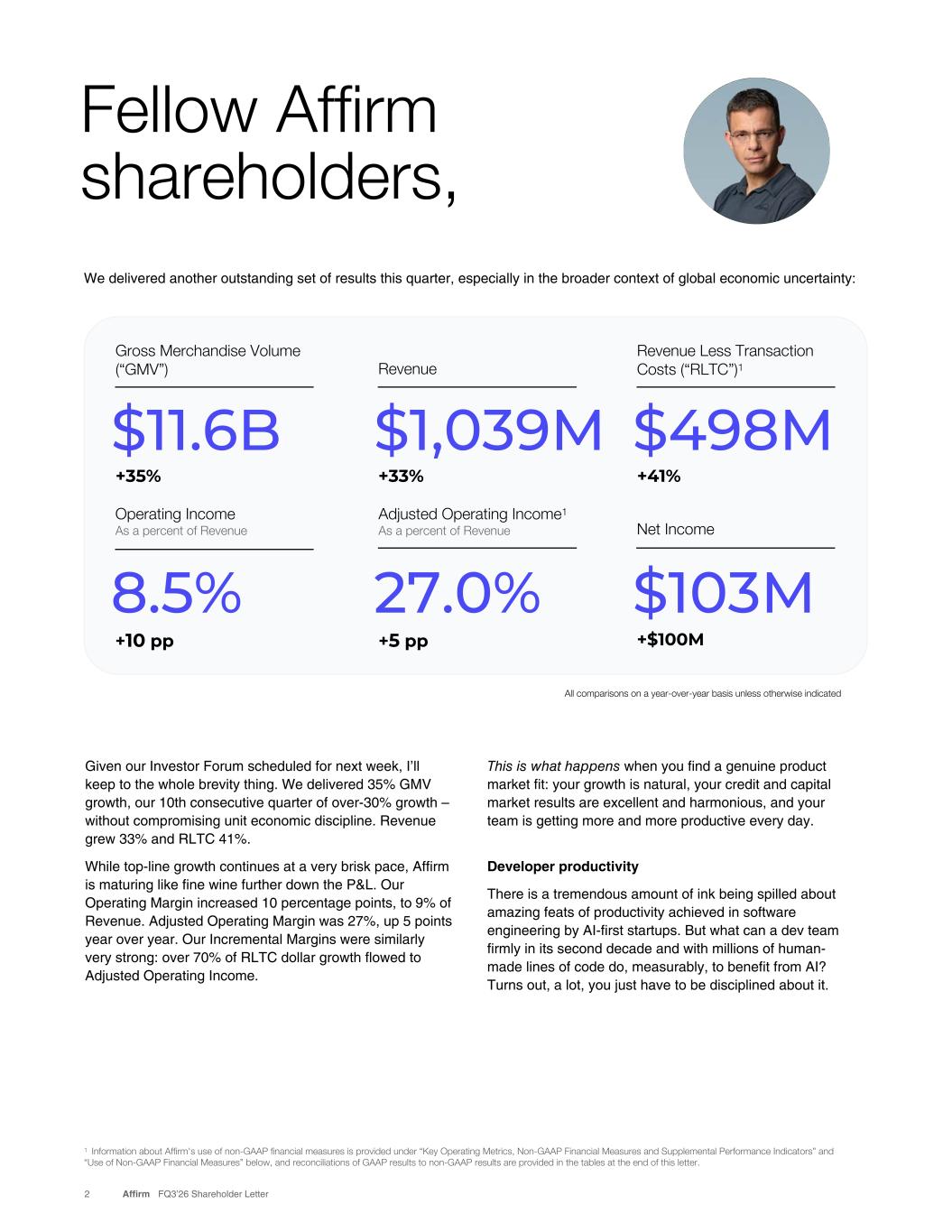
Thank you, Zane. Fiscal Q3 was another one for the record books. Given this streak, one could be forgiven if one thought this was actually pretty easy. That's all because the fantastic Affirm team is starting to make it look that way. It is not, in fact, easy, and we're very proud of this particular quarter. Zane said, I look forward to seeing many of you in person at the Investor Forum next week. On that note, back to you, Zane.
Thanks, Max. Okay, let's get to your questions. Operator, please begin the Q&A session.
Operator
Thank you. We will now be conducting a question and answer session. If you'd like to ask a question, please press star 1 on your telephone keypad. The confirmation tone will indicate your line is in the question queue. You may press star 2 if you would like to remove your question from the queue. For participants using speaker equipment, it may be necessary to pick up your handset before pressing the star keys. One moment, please, while we poll for questions. Our first question comes from Jason Kupferberg with Bank of America. Please proceed with your question.
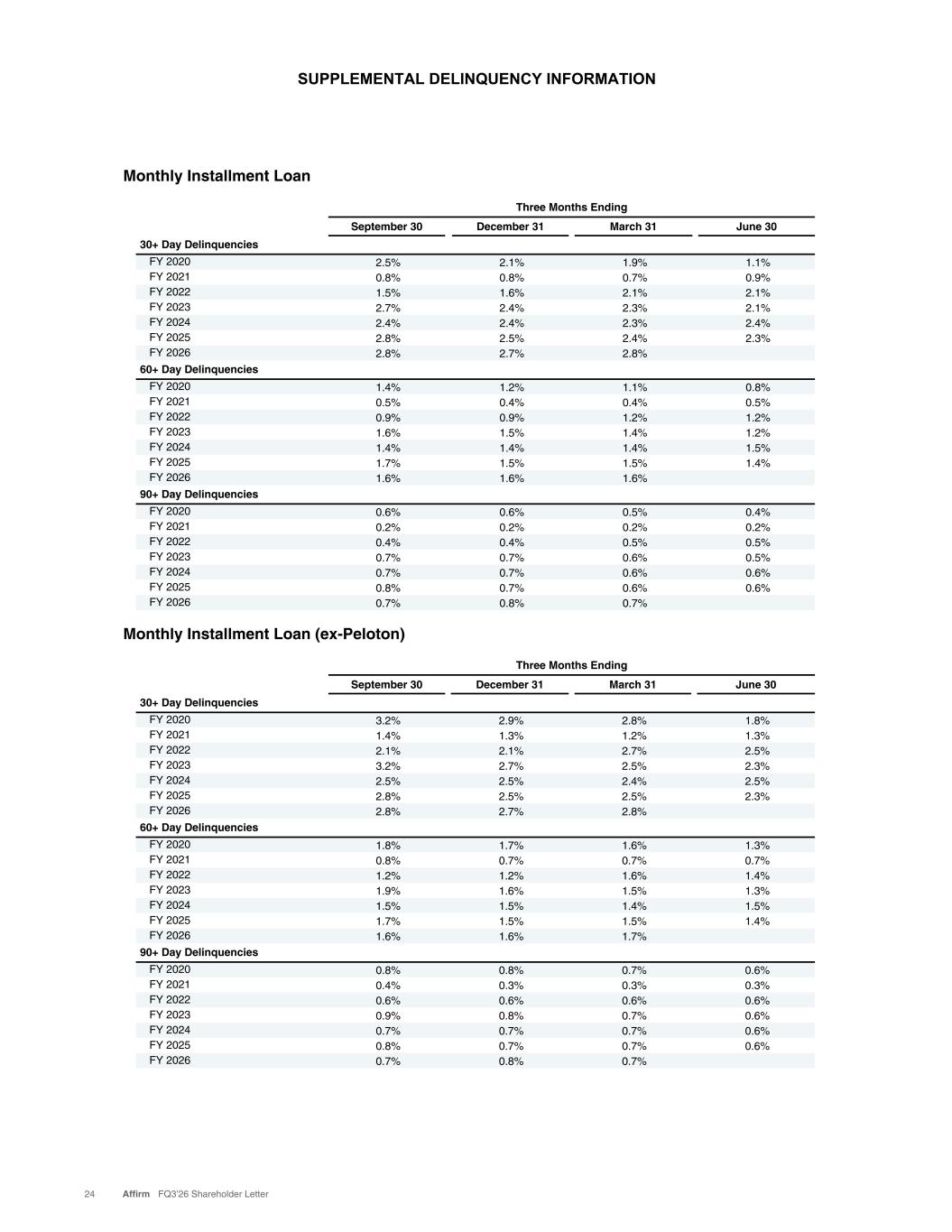
Hey guys, this is Cassie Chan on for Jason. Great quarter. I just wanted to ask first on the private credit side and in general on credit. It seems like the delinquencies were pretty stable this quarter. Is there anything that you are seeing in terms of changes or slowdowns in credit? and obviously unease in private credit seems to be a theme, but are you guys seeing any issues or changes on the funding side of the business?
I'll start with the credit side. Michael will pick up the funding side. No, we are not. At this point, I think we've earned the right to say the affirmed consumer, and so these are not comments on the universe or even North America or United States consumer, but people that we choose to underwrite and lend to, we are not seeing deterioration, we're not seeing any disturbances in the force, which naturally translated to a very stable and pleasant funding environment for us. Michael, can you tell me more?
Yeah, the funding market broadly remains exceptionally constructive for us. We're kind of out of adjectives to describe just how great the execution has been. I know a lot of ink is being spilled elsewhere about what's going on, in the capital markets, but from our perspective, we see a market that's very deep. We see sustained and reducing spreads, and we see deals with significant oversubscription along with foreflow partners who are, if anything, still clamoring for a bigger allocation of our portfolio. So we see the market as being very constructive to us and a key part of the reason why we feel there's so much tailwind in the business.
Operator
Our next question comes from Nate Svensson with Deutsche Bank. Please proceed with your question.
Hey, guys. Thanks for the question, and congrats on the record number of Lebowski references in the letter. I did want to ask about the upcoming big nothing. Anyway, sorry. I wanted to ask on the upcoming big nothing. Was going through the transcript last quarter, Max, you were obviously pretty effusive about all the first order and derivative benefits from that event, things like cardholder sign-ups. I assume directionally you're expecting a lot of the same things, but on the call last quarter you also talked about getting better and smarter as you do more of these. So I guess the question is around what ways you think you got better and smarter and maybe what are some of the incremental changes or initiatives we should be on the lookout for for the event next week.
I don't really want to reveal all the surprises to be completely honest, but I appreciate the kind words and we did get smarter. I think probably if you want to sort of look for breadcrumbs we got smarter about targeting that that's certainly and it's less about sort of sitting down in a lab somewhere and trying to come up with ideas much more about looking at the data we gathered and the last big nothing and just using all the same ML AI techniques we have here to ask the question what's the least costly highest probability of conversion for any one SKU, any one consumer, any one merchant, et cetera. So it'll get more efficient. That's certainly the case. We got smarter kind of qualitatively. I think we really underplayed the event itself in the early hours and kind of had to play a little bit of a catch-up on the marketing side of things. And this won't happen this time. So we will hit the ground running with just promoting it correctly to all the right people, again, maximizing the effective per-dollar yield for our merchant partners. So we expect to be even more satisfying to those who are paying for these deals.
Thanks. Excited to look out for it.
Operator
Our next question comes from Brian Keene with Citi.
Operator
Please proceed with your question.
Yeah, guys, can you give us some insights on the ABS market, the deal in March, and then the recent deal, what's going on with spreads and demand for you guys?
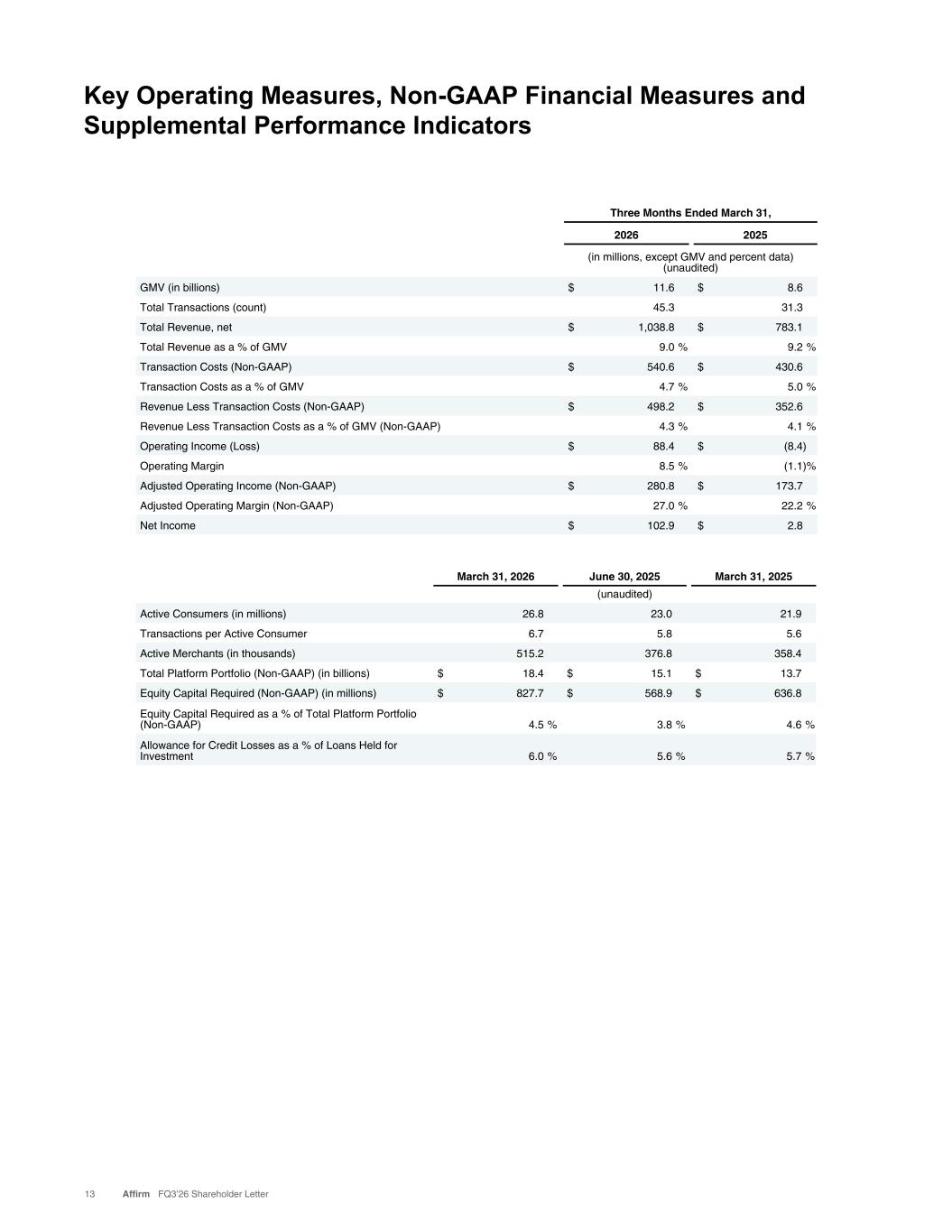
Yeah, thanks for the question. You know, I think we've executed three deals so far this year, two revolving deals in the quarter, and then we just priced a static deal. We haven't yet closed on, and the trend really across all three is incredible depth, you know, lots of oversubscription in these deals and continue in sustaining tightening of spreads. And it's a key part of the reason why you see funding costs down on the order of 125 basis points year on year. Obviously, benchmark rates are down as part of that, but you're also seeing spreads coming in at the same time. It's just really a reflection of the capital market's demand for our asset and our team's ability to execute. Despite quite a bit of economic volatility and headlines out there, We feel like the market is just extremely constructive earning.
Yeah, and it just feels like they're starting to recognize maybe the differences between what you guys, your credit versus others and the short duration and obviously the quick turn. But it looks like the market's starting to recognize that, so it's good to see.
Yeah, the short duration of our asset is a huge advantage, and it's taken us a long time to earn that. We've also done a really good job, I think, in engaging the investor base and bringing on board over the years a wider set of investors. That's really important for the depth of the market that we play in. It's a key channel for our long-term growth. But also, the more broad of the investor base you bring on, the better you can get on pricing.
Yeah. Okay, great. Congrats on the results.
Operator
Our next question comes from Rob Wildhack with Autonomous Research. Please proceed with your question. looks like we don't have him. Let's go to the next question. Our next question comes from Moishe Orenbach with TD Cohen. Please proceed with your question.
Great, thanks. I noticed that growth in the Pay and X has, you know, is your fastest growing segment now.
Is there, are there different either programs or, you know, kind of merchant partnerships or anything that, you know is kind of driving that and you know do we think that's going to continue into you know fiscal q4 yep hi moja this is rob we do expect that trend to continue into fiscal q4 um and i think the answer was largely in your question we did have one large one very large program moved to having an evergreen uh zero percent and be a pay and for offer so that that definitely drove a bit of the uptick, and then we also continue to see most of our pay-in-for, pay-in-x volume coming from the Shopify program, which continues to grow nicely. So a bit of sort of business as usual there, and then we did have one large program make a change to their financing program, which we think is a real positive.
Operator
And our next question comes from Ramsey Elisal with Cantor Fitzgerald. Please proceed with your question.
Hi, this is Ryan on for Ramsey. Thanks for taking our question today. I wanted to ask about the active merchant count, which went up by 44%, accelerating beyond a strong Q2. Where or what is the largest opportunity to add more merchants, and how penetrated is the market, not in terms of consumer usage, but in terms of merchant presentment for BNPL? Thank you.
I mean, I think in terms of merchant count, we're still looking at some of our largest platform partners as the biggest accelerant to growing our current merchant base. So some of the big PSPs where we have relationships as well as large merchant platforms like Shopify, those have been really additive to our merchant base overall. I think in terms of presentment, we still feel like it's really, really early innings in terms of presentment. Obviously, we have a brand new program with Intuit and there's lots of optimizations to do within that merchant base. That's an enormous universe of merchants that we're just scratching the surface on and it's very early days in that program. So there's countless other examples across our portfolio, but I think in terms of the partnerships that drive some of these big merchant counts, I think we still have plenty of room to optimize how we show up on the end merchant site.
Thank you. Looking forward to hearing more at the investor forum.
Operator
Our next question comes from Harry Bartlett with Rothschild and Co. Redburn. Please proceed with your question.
Hey, guys. Thanks for the question. I just wanted to touch on the kind of agentic code development point in the shareholder letter. You know, you cited the kind of noticeable ramp in agentically written code, and it looks like you're kind of doing double the amount of requests that you were doing previously. So I guess could you talk about this broadly in terms of, you know, how you're thinking maybe costs will develop versus how they developed historically or whether you kind of see this more as a vehicle for more rapid product development, I guess. Thank you.
So this is very tempting to turn us into a 15-minute answer in the finer points of software development, which I am personally invested and involved in. So the shorthand, first of all, and I will rely on Robin a second to maybe try to even quantify it, but it's unequivocally accretive to the bottom line to use AI the way we are. And so this is a net strongly positive, the fact that we are increasing our development velocity is just incredibly strong for our bottom line, and then some. The actual mechanics of development using agentic dev processes and et cetera we're pretty unique and we feel pretty great about where we are and where we're headed if you ever read the fine print of the likes of Chagipito Gemini there's a little thing on the bottom that says AI makes mistakes basically you're on your own we don't really have the luxury of putting that in our code if we make an underwriting mistake if our engine somehow treats some consumer unfairly or if we're off by a penny here and there like none of that is okay. And so as much as we can and do use these tools, there are still many unique to affirm checks and balances and processes that ensure that what we ship is of the same or higher quality than what we did before these tools came around. And we spent quite a lot of time getting there, gaining the confidence, testing it. And so the reason we had this sort of a uncork it moment early in the years because we felt that we were ready to mass deployed internally and have so far been very pleased with what's transpired. And we'll definitely do more. I think, I'm sure our engineering leadership is listening slash reading these letters, and I don't think anybody is begrudging me the right to say we think we can 10x this productivity further. So it's very early days. We're very excited about it. We have no shortage of things we want to build, and therefore humans that are both the creators of ideas, the arbiters of good taste, and the ultimate responsibility carriers for this no errors, no fine print, no bugs are still very necessary. So we don't anticipate any sort of a decimation of the engineering team, but we are certainly very excited to give each one of our engineers basically superpowers. And Rob has any additional cost points to make?
In terms of the cost, I mean, they did obviously show up in the P&L this quarter. They'll continue into Q4 as well. I wouldn't say it's a material impact to the P&L overall. It's sort of very low single-digit millions per quarter in terms of spend. So to Max's point, I mean, we're seeing a lot of efficiency. Spending money on developer tools is something we've always done. So we're just thinking about ways to make sure that on a holistic basis that all-in budget makes sense for us and that we're seeing efficiency and lift from the entire portfolio of tools that we're employing.
Super helpful. Thank you.
Operator
Our next question comes from Rob Wildtack with Autonomous Research. Please proceed with your question.
Hey, can you guys hear me this time? Yeah. I wanted to ask about the different Affirm surfaces, namely the app. You know, you've highlighted in the past the GMV lift there. That's intuitive. I'm curious, though, where consumer awareness is on that. Like, are consumers still opening up their format to make a payment than going, oh, lucky me, here's this great offer? Or have they become more attuned to the fact that this is a place where they can start looking for products and shopping via the app first?
All right, you're front-running, like, half of my speech next week. So I'm not going to gratify this one. No, I'm kidding. The short answer is it is trending in the very direction you described. So a firm app was deliberately designed to make sure that there is more value to be had there than just sort of an in passing setting up or checking up on your auto pay. So all the different components in the first three and the fifth tabs of the app are all designed to create engagement, to expose consumers to various merchant promotions. It is not an accident that the Big Nothing days are basically organized around the app. We're trying to teach consumers that this is where you go. There's always 0% offers in the app. The B&D is just a nexus of many of them concurrently, but at any given time there's a lot to begin with. We have a really nice number, I won't spoil the eventual report on that one, number of searches that consumers run in our app. We're watching that grow, and it's all in a service of teaching consumers that the best experience of a firm is the app plus the card. So I'm deliberately obscuring some of the maybe more interesting portions, but you'll have to wait six more days before we start really doing some fun reveals. But directionally, you're exactly right. We are motivated to make the app experience excellent both as a product and as a financial service to our consumers. And there's a bunch of things to show and many more that we're probably not going to show up necessarily next week. But it shapes the roadmap for years in our minds.
Got it. And then a quick one for Rob, if I may. was up quarter over quarter. Could you just call out the drivers there?
I'm sorry. Could you repeat the question?
The allowance was up quarter over quarter, just wondering the drivers there.
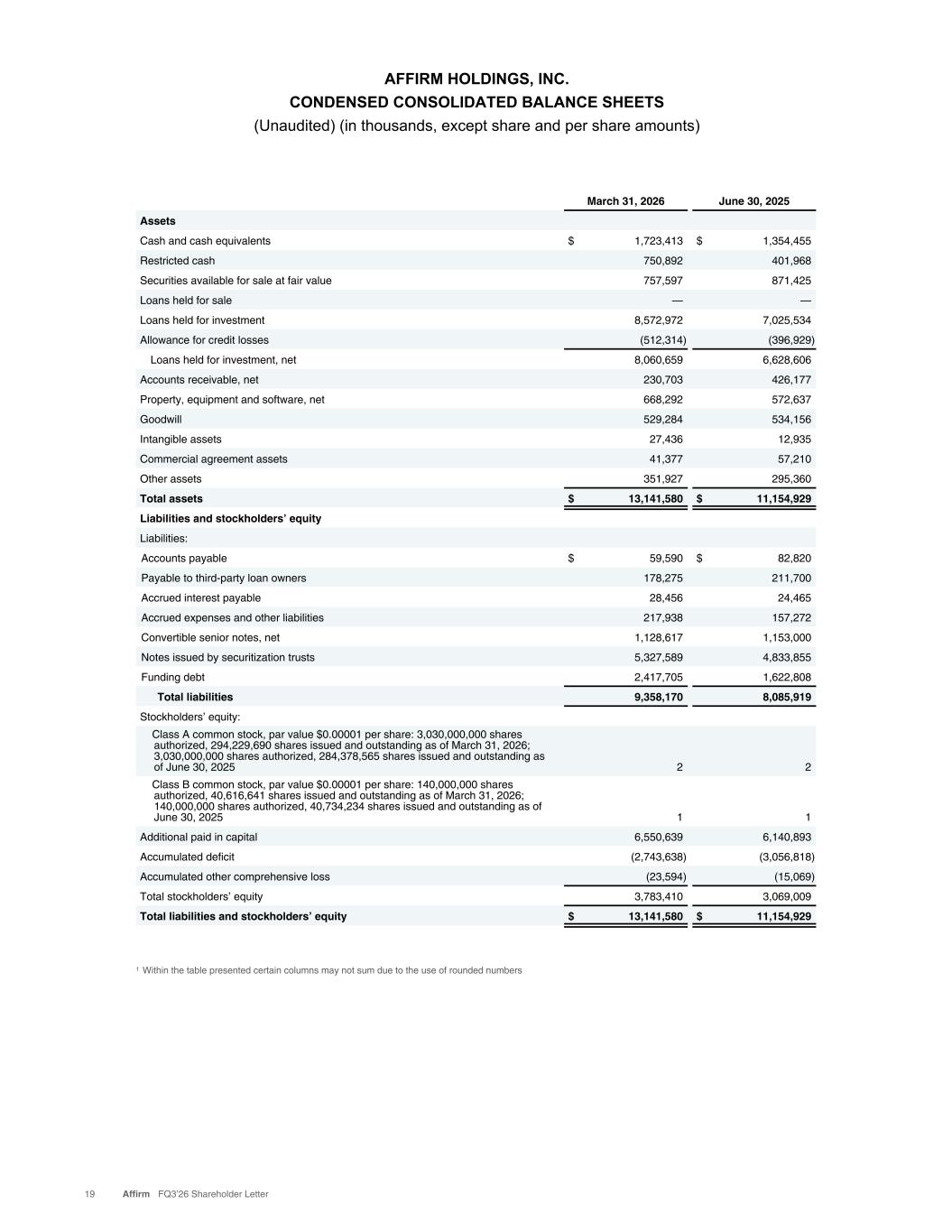
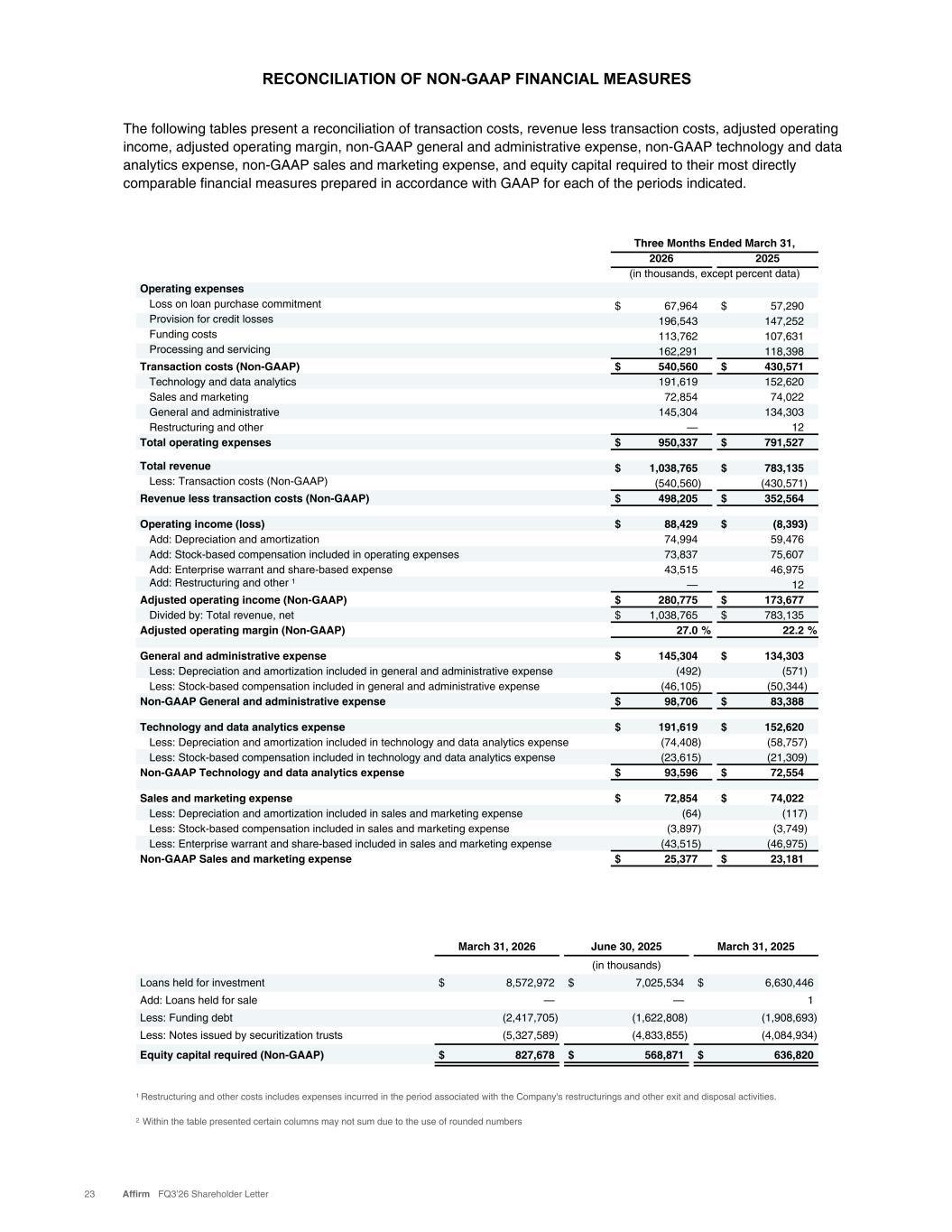
Yeah, I mean, it's, of course, partly a function of just seasonality. The allowance rate typically is elevated in Q3, just given we have the sequential downtick from holiday volumes in Q2 down to a lower base in fiscal Q3. That's part of it. Another driver, which I think Max called out in his portion of the letter, was just that we did see elevated prepayments on the platform. It's a little bit of a counterintuitive point, but that's a really positive credit signal, and it has the effect of reducing the overall loan balance, which obviously the good loans are being paid off early, and so you're left with more delinquencies off of a lower base. So that contributed to a higher allowance rate all in, but we think it's a really positive credit signal across our users at large. So those were sort of the two biggest drivers, seasonality and then a bit of favorable prepayments from tax season.
This particular tax season was understandably refund maxed.
Operator
Is that what the kids say?
Operator
And our next question comes from Dan Domez with Mizihu. Please proceed with your question.
Our next question comes from the line of Tim Chiodo.
Hey, guys. There's always very impressive results. I just wanted to ask you, Max, can you hear me well?
Yeah, yeah, yeah. Sorry, we're just, we're silent waiting.
I just wanted to ask really quickly, some of your competitors have done some significant layoffs because of AI. I just wanted to know what the official firm stance is on this topic.
We are not planning AI-related layoffs full stop. I don't mean to belittle anyone out there making the right or what they believe to be the right decisions for their company. So strictly a firm-centric view of the world from us. If you look at our revenue per employee, it is already hanging out in like NVIDIA territory. I don't remember the last time I looked at it, but it's a very high number of dollars per employee. So we today operate as a very lean machine. If you look at our overall headcount, it hasn't grown very much. If you look at the revenue per employee, you'll see that we're just highly efficient. If you look at overall operating leverage, it's done really well. So long before AI tools came along, we had tooled ourselves up to be very efficient. These tools are giving us rocket boosters, wings, whatever metaphor you want. And we're very happy for it. But at least for now, and as far as the eye can see, as far as I can see anyway, it is just a thing we're going to keep using to ship more. The list of things we want to ship is very long. And until very recently, a lot of our conversations were, well, we don't know when we're going to prioritize this thing that you want, Max, because we have so much more to build. And blissfully, these conversations are now like, well, we can just have a hackathon, and 48 hours later, we'll have a working prototype. We just wrapped up one here where our product team literally delivered dozens of shippable features, which is just impossible to imagine 12 months ago. So we need all the people we got. But we think we have fantastic people, and we like them all.
Operator
Our next question comes from Dan Perlin with RBC Capital Markets. Please proceed with your question.
I'm wondering, can you just speak, I think, maybe holistically to your expansion plans outside of North America? I know you talked about it a little bit embedded in the guidance here for the product and go-to-market initiatives and not being material on 26. but I'm just trying to think, contemplating in terms of investments as we start to think about next year.
And also, I guess in the context, although it's a little bit of a different driver, but the RLTC margins continue to run above long-term targets. I'm just wondering as you go into the international markets how that might impact it. Thank you.
Sure. I'll take them in order. I think we're going to spend a bit of time talking about our expansion plans with a bit more specificity in terms of markets. So I'll leave the deep dive on the international markets for next week's investor forum, if that's okay. You know, in terms of the investment portfolio for those launches, some of that work is already underway today. So it's definitely been an area that we've been investing in ahead of those markets coming live. And as you've seen from the results, we've been able to drive really nice operating leverage despite that investment. So So I think we would expect to do more of the same in fiscal 27, but I'll stop short of giving any sort of outlook or guidance for 27 today. In terms of unit-level economics, I mean, I think as we ramp in new countries, we would expect potentially that there is a bit of an investment period where we're meeting new consumers and coming down the curve in terms of underwriting prowess. So there could be a small drag on revenue-less transaction costs as we enter these new markets. But given the size of the U.S. and Canadian businesses today, we think any headwinds there would be pretty minimal.
That's great. Thank you so much.
Operator
Our next question comes from Andrew Bosch with BMO Capital Markets. Please proceed with your question.
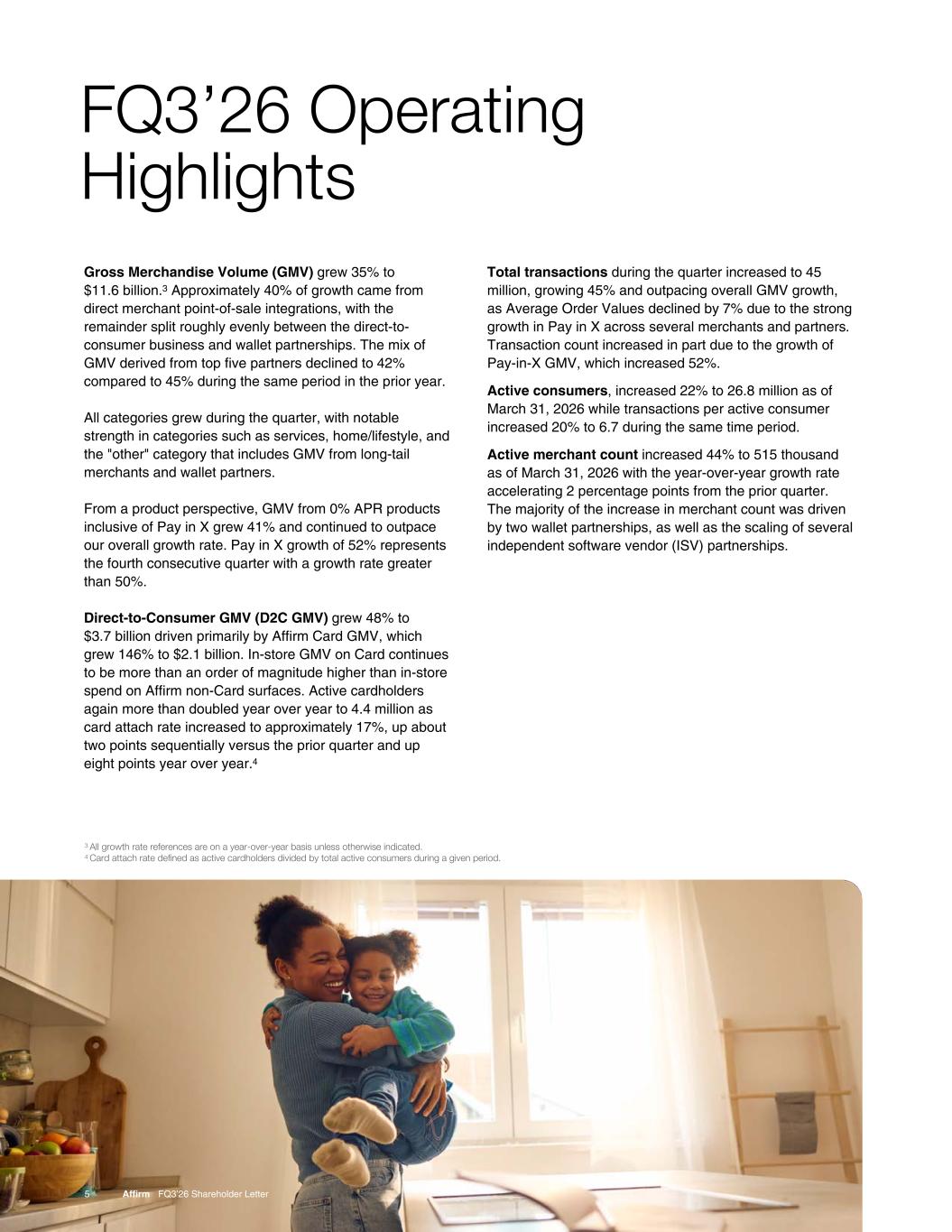
Hey, thanks for taking the question. I wanted to talk about Affirm card and the level of ads. you can continue to stack up here. You know, the 700,000 users is pretty impressive, especially coming off of the 900,000 last quarter. So is there anything that's working differently or stronger than it has been in the past as far as card customer acquisition goes? And then my follow-up would be, you know, now that we're doubled the base at 4.4, you know, are you starting to see more and more benefits of scale coming through the pike?
I think the first part, there's a long list of things we have done and continue to do to just increase adoption. We've said it before and it remains true that CARD are by far fastest growing and also our most profitable product, so there's absolutely no reason not to try to grow it. That said, we have not been in any way, if you will, juicing the growth. It's natural. There's not a secret game somewhere being played or anything like that. So it's growing about as fast as we can make it grow without tilting anything in a weird direction. It still primarily remains a repeat product. We've never tried to advertise it or promote it outside of existing Affirm user base. It's still roughly in the 20% of the actives, plus or minus. So we have a lot of road to cover before we start asking where can we get more cardholders. They are our favorite users in a sense that they transact most frequently. They tend to be least lossy just because we get to know them a lot quicker, a lot more frequently, and so on. So it's all goodness, nothing sort of, nothing hidden or regrettable there. And the economy to scale, you know, I think, to be completely honest, I haven't thought it through very carefully if we're finding benefits of scale that are sort of truly unique. The one thing that is true in a software development context, which is a little, maybe a glimpse into the resource allocation, your fastest growing product is typically your smallest product. And so no matter how much you love your youngest child, you can't really allocate the greatest number of resources towards it because it's just too small. The cart is now in the billions of dollars of volume. It is no longer a small product, which means that it deserves and gets the software engineering attention and the risk attention and all the various pieces that we would perhaps wonder if they're worth allocating from other parts. And so you can expect it to get more features sooner, maybe even more growth sooner, although that is not a forecast or a forward-looking statement. It's just sort of hitting its stride in every dimension, including internal resource allocation.
Operator
Our next question comes from Matt O'Neill with Bank of America. Please proceed with your question.
Yeah, hi. Thanks for the question. Being cognizant of the upcoming forum, I'll try not to get too long-term focused, but maybe we can talk a little bit about the card and what that sort of portends to the longer-term banking idea. Obviously, there's an application put in this past quarter. respecting that I expect a lot more of this next week.
Are there any sort of points you can kind of hint at as far as the focus around things like, you know, sort of pay now, you know, direct deposit, the dynamics to contemplate as you guys proceed down that path?
It's definitely worth separating the bank application and the product roadmap. They move on completely different time horizons. We are excited to continue the conversation with our regulatory friends, and it may take a little time, it may take a long time. We don't know, and that's part of the process. And certainly I have nothing to share on that front at the moment. On the feature set of where the product roadmap is headed, we'll cover some of that next week, so I definitely don't want to take Vishal's talking points away from him. But we definitely have aspirations in a variety of consumer financial services. For the longest time, we see ourselves – our mission states it pretty clearly we're trying to build honest financial products to improve lives. We're not trying to build short-term loans at the point of sale to improve lives. And so there's plenty of opportunity, we think, to right the wrongs of some of the poorly made products in this industry and also just invent our own and do interesting things there. So I'm giving you a little bit of a word salad here, but we have aspirations in just about everything that you can possibly imagine in consumer financial services. More to come, I'm also cognizant that sometimes we announce things and take three years to get them to the point where they're good enough to launch, and so I'm extra cautious not to say, oh, yeah, here's something we're going to do, and we'll definitely do it, but it may take us a year or two.
Thanks. I appreciate that and the delineation between the regulatory process and the business build-out.
Operator
Our next question comes from Darren Peller with Wolf Research. Please proceed with your question.
Hey, guys, thanks. Can we just touch base again on the strength of the GMB side for a moment and the sustainability? Number one is just making sure there was nothing unusual or unsustainable about the quarter, which I'm sure you'll say probably not. I guess I'm trying to figure out what's to stop this type of growth rate from being sustainable from your perspective. And then more importantly, I mean, and on that note, we've heard a lot from competitors about trying to do more in this space, but it seems to have very little impact on your growth potential. So, I mean, anything you're seeing from a competitive landscape that's changed worth sharing over the past, you know, quarter or two would be great. Thanks, guys. Nice job.
Thank you. I'll start, I suspect, Michael, who is doing a small victory dance right next to me. I will have something to add. But you're totally right. We don't see a reason. And again, I don't want to front run our promises and storytelling next week. But no, there's nothing unnatural about this one. We move up and down with the economy. But we are, you know, we've hit a product market fit quite some time ago. But we're still tiny relative to the massive payment volume in the US alone and e-commerce alone. We're really, really small. So taking share, it's not that hard yet. In terms of competitive, and I really will let my colleagues speak, it's hard to tell. One of our long-tenured executives here has this line, they're never retreating, they're just reloading. So it's a fantastic space. The NPL overall is just a very compelling product. We don't have a monopoly in the idea, and so it's always going to be a competitive space. There are really no monopolies and payments to begin with, so it's just not a thing we can expect to eventually own entirely to ourselves. We do, in my, anyway, very biased view of the world, are the best at it. We do have some really great economies of scale. Capital markets are now very familiar with our product. They understand exactly what we manufacture. They understand that we are entirely non-compromising in our view of what is and isn't fit to sell into forward flow or securitizations. And so we have a lot of trust with our counterparties, and we tend to take that very seriously. On a consumer side, we're not really heavy advertisers, certainly not heavy brand advertisers, and yet we do have a brand. We just ran a bunch of studies that show that we're really well recognized. People trust us. They understand after 15 years that when we say no late fees, we meet it, never charge a penny, don't have a plan to ever charge a penny of late fees. So that's been slowly but surely building up in our favor. And then just in a pure sort of competitive front, I think, speaking of maybe the most important and least understood advantage that we have, we have been at it for a very long time. We have built some very, very sophisticated underwriting capabilities. We'll definitely talk a lot about that next week, so I'm going to bite my tongue right there. But we have some very, very cool stuff that we've done. not just recently, but over the years in underwriting. And a great percentage, maybe the totality of our competitors that have raised their hand and said, sure, underwriting is not that hard, we can do it, one by one found out that it is. It is actually very, very difficult. And by showing a result, we may have fooled the world by just to print a good result quarter after quarter after quarter, and we get yelled at, gosh, why don't you guys already admit that it's always going to be over 4%. And it is a difficult balance to strike to print these unit economics day in and day out. And all of that or a lot of that comes from our AI team and the research that they do. And it's hard work. So I think we make it very easy to believe that just isn't that hard. And it really is. And the longer the show goes, the more it becomes obvious that we are pretty good at math and are very serious about it. And the rest of the competitors are not.
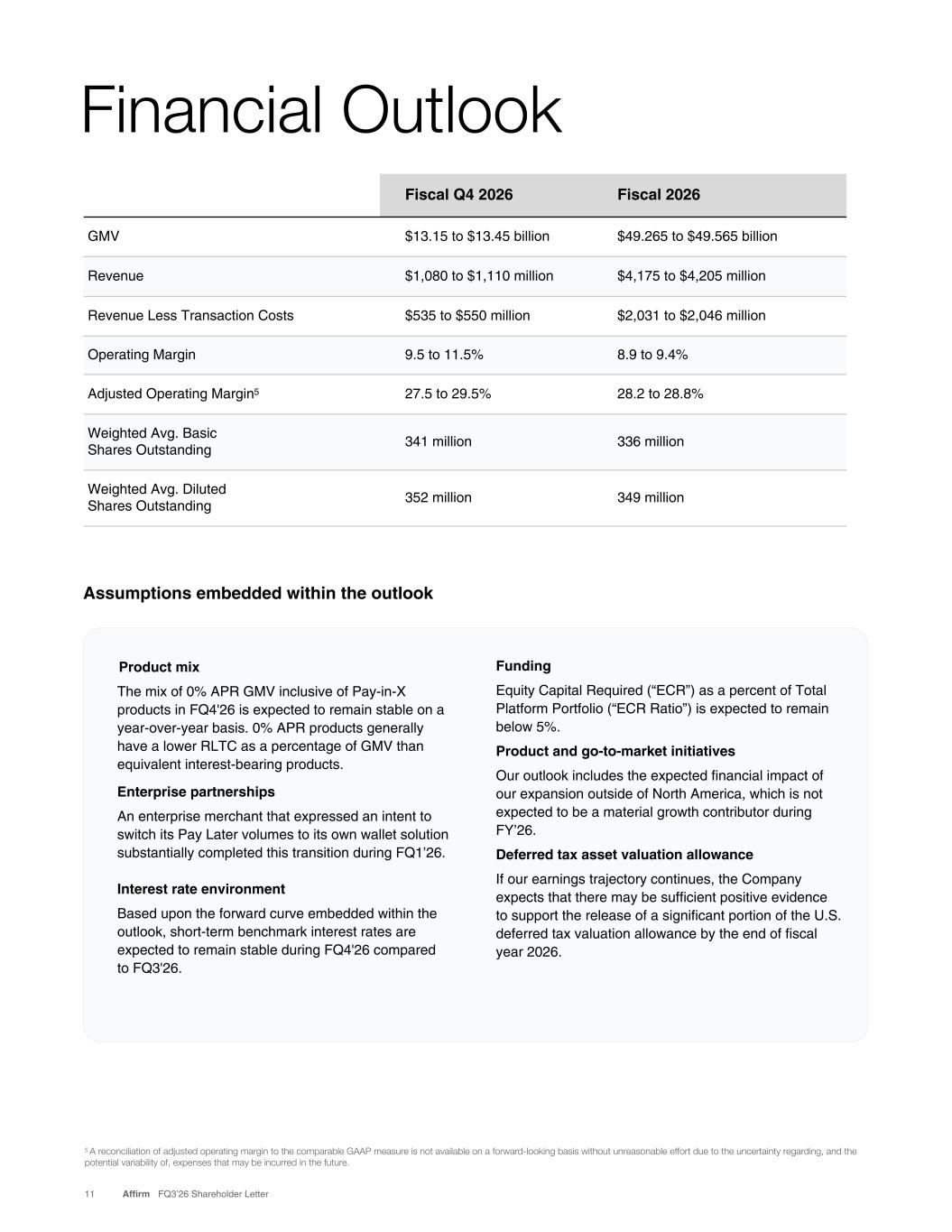
And then, Darren, just to your question on the growth rate, obviously we're really happy with the growth rate that we posted in Q3, and we're incrementally more positive on the Q4 growth rate in the updated guide. I will just remind everyone that we did sunset a top three merchant in Q1 of this year, so we are comping against, you know, there is a difficult comp in the prior year period, and that comp did step up a little bit from Q3 to Q4. So it's a little bit more of a headwind to growth. We're talking sort of a few points of growth in terms of headwind. And as we get into fiscal 27, you know, the comps get a lot easier for us. It's more of a same-store comp for us. So we don't think that the Q4 growth rate will necessarily be a ceiling as we look ahead into fiscal 27.
Very helpful, guys. Thank you.
Operator
Our next question comes from Connor Allen with JPMorgan. Please proceed with your question.
Hi, thanks for taking my question. I wanted to ask about transactions per active. It's been growing above 20% for quite a while. And I was curious, maybe this quarter or somewhat recently, you could just kind of decompose that a little bit for us. And maybe it's a bit duplicative of some of your other comments about just broader engagement. But I don't know, anything you could share around cohorts and their behaviors around this engagement or how broad versus targeted the improving engagement is. Maybe just a double clip, keep or dive on the engagement side.
All of the above. It's really good. There's definitely a few good lines on that one next week, so I won't steal that thunderer. But this is actually a really, really good example of network effect. So I'll give you a super brief preview. So even if we did absolutely nothing to improve product usability and just converted more and more consumers to cardholders, you would see increase of transactions per user with absolutely no effort on our part beyond that. But we don't just do that. We also sign new merchants, which means that we are visible with our logo at the very least at checkout, but also in other forms of merchant communications, including but not limited to their own advertising. So that creates another push towards the flywheel where more consumers are aware of us, more consumers know that we are in fact real, that our promises of no late fees, et cetera, are shown up in more and more places. That pushes consumer flywheel along, more consumers sign up, more consumer trust is available. Consumers get to their second or third loan quicker just because of more checkout counters available, which makes them eligible for the card, which we, of course, let them know as soon as they qualify, which drives the flywheel of cards. And so the acceleration across the usage, aka transactions per user in the business, is a function of both the merchant side of the network increasing through sales and the consumer side of the network increasing through signups because of the increased merchant reach, but also sign-ups from the occasional use to the card, which is much more frequent use. So those are just the two vectors. And Investor Forum will really break it down into all the various drivers.
Operator
Our next question comes from James Bostet with Morgan Stanley. Please proceed with your question.
Operator
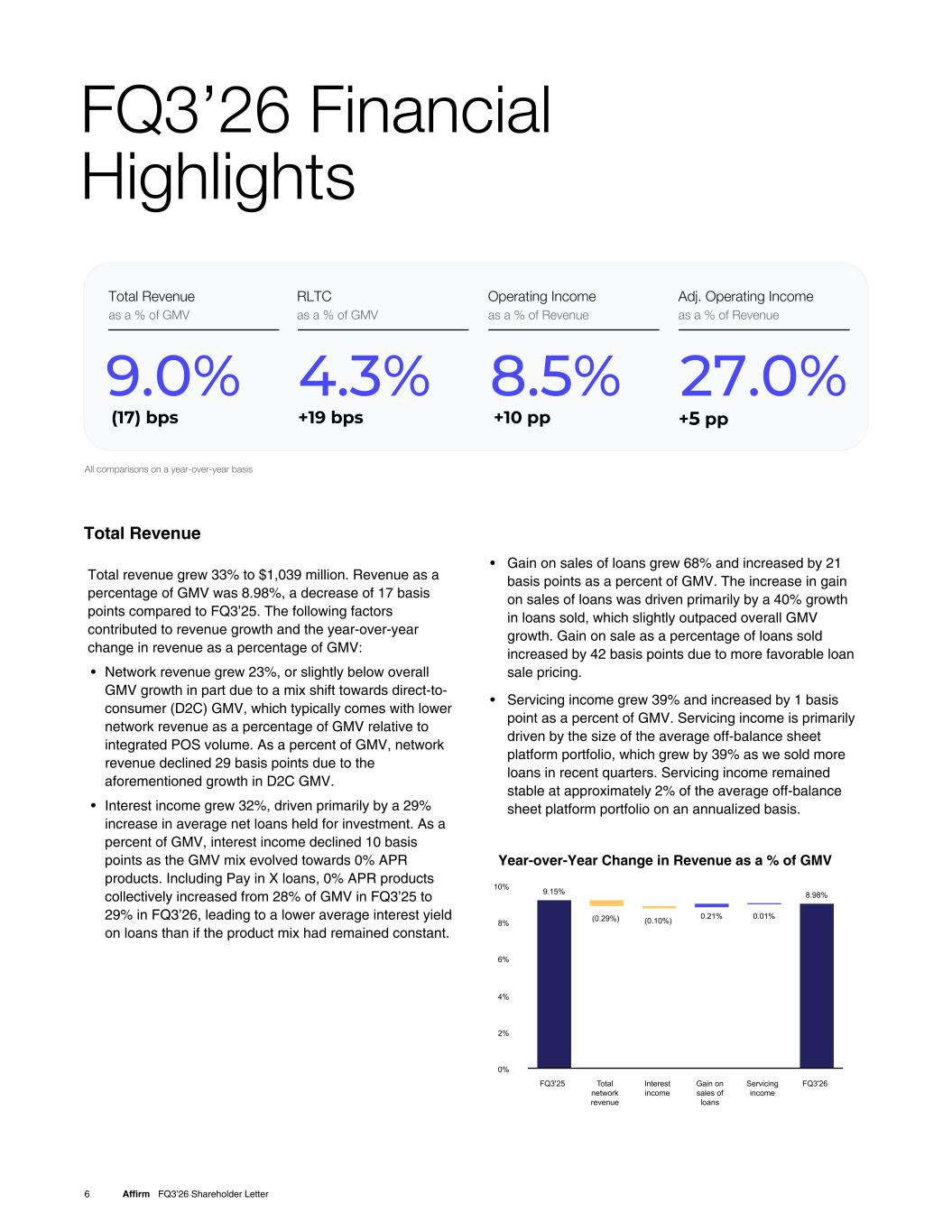
Hey, good afternoon, everybody. Just wanted to ask on, this goes back a little bit to RLTC, and Max, I appreciate it. It's hard to, it may seem easy to stay above where your targets are, but it's really hard. But along those lines, just trying to think about how the 0% APR mix ceiling can affect that and just how you're thinking about how high that can go. You call out that that typically has lower RLTC margin. And along those lines, I guess I wonder if as merchants become more informed and see the benefits of working with the firm for 0%, if you can actually close that 0% RLTC margin gap with the rest of the business. Thanks.
That's a great question, actually. In reverse order, I think it's another example of the network effects playing out. So to answer directly, I think yes. I think over time, more merchants, and part of why we stage these big nothing events and we'll do more, is because they act as teaching aids, if you will, sort of the white papers write themselves. if you fund these 0% deals, you will sell more and you'll sell more predictably and there will not be a pull forward. These are actual sales events that work. And so all of that adds up to a product that we think is increasing in value in part because the size of our consumer audience is increasing as well and we're able to sort of shine a concentrated spotlight onto a merchant that wants to fund these deals, etc. And we have a lot of really interesting stuff in works. for that. I've been monopolizing the airwaves, so I'll let Rob or Michael answer the economic breakdown. But it does remain true that 0% are slightly lighter on the RLDC basis. We are not fussed by that.
Yeah, no, I mean, I think we love all our loan products equally. There's a lot to like about our interest-bearing loans. But to your point, James, I mean, there is slightly less revenue content today. And I think as we look ahead as well within the 0% program, but the good news is there's less in terms of credit costs typically as well. So we really like that trade and we think it's a really good complement to the strong and profitable and high growth interest bearing book that we have as well. And so, yeah, I mean, again, we're really here to drive conversion for merchants and we think 0% should be an ingredient in every merchant's financing program. And as we look at the portfolio today, our largest programs are all utilizing 0%, which we think is a really good sign. We're definitely leaning into it within the Affirm card as well on our own surfaces. So we're doing everything we can to get as much out there and to continue to push that product.
Operator
Our next question comes from David Sharp with Citizens Capital Market. Please proceed with your question.
Hey, good afternoon. This is Zach. I'm for David. Congratulations on another great quarter. I wanted to dig in a little bit on the card side of stuff. Sorry, I don't know if you guys can hear me. There's a little bit of an echo. But, yeah, I wanted to kind of see what the profile of the average card user is. Obviously, you know, I think there was a kind of a medium-term target of $10 billion of GMT and about 7.5 million active card users. And, you know, we're kind of approaching that level at about 60% of the card user level. So yeah, kind of wondering if we can get an update on kind of what the profile is and kind of what the use cases are for those card customers.
Super general terms. It skews a little bit higher credit quality than the average Affirm consumer for no other reason than we make it that way. We're still at the limit slightly more conservative as to who gets the card offers and approvals. It's really converging towards this is just the average Affirm consumer, but right now I think the credit quality is slightly better on the card or somewhat better on the card. The usage patterns are broader, more frequent, obviously, than sort of the more casual Affirm consumer that uses us four or five times a year, six times a year now. Card customers start out, I think it's like a 40% higher and goes up from there. The maybe most useful thing is the category usage is more even. Typically, it takes a little while for an affirmed consumer to realize that if they found us or got exposed to us in category X, it takes them some number of months to rediscover us again at another retailer and say, oh, wait a second, it also works for fashion, not just travel. When you get the card, you have a muscle memory for it. This is a general purpose tool. It works everywhere. And so the category dispersion begins a little bit sooner and just stays fairly wide. It still skews more considered purchases than kind of your typical low AOV spend, which is fine with us. that is a much easier value point to drive to merchants. They understand that they wouldn't have sold a $700 thing or a $500 thing unless a firm was involved for this particular consumer given their preferences and the card highlights that that much better. Sort of a quick sketch I think at the investor forum we'll say a lot about the card as well. We have some nice little surprises there.
Operator
Thank you very much.
Operator
Our next question comes from Jacob Haggerty with Baird. Please proceed with your question.
Hey, guys. Thanks. So I was just looking at the loan loss on purchase commitment, and it looks like that came down as a percentage of, like lower than it's been in the last few quarters. Is there anything to that while you're getting maybe better economics from your purchasing partners or something along those lines?
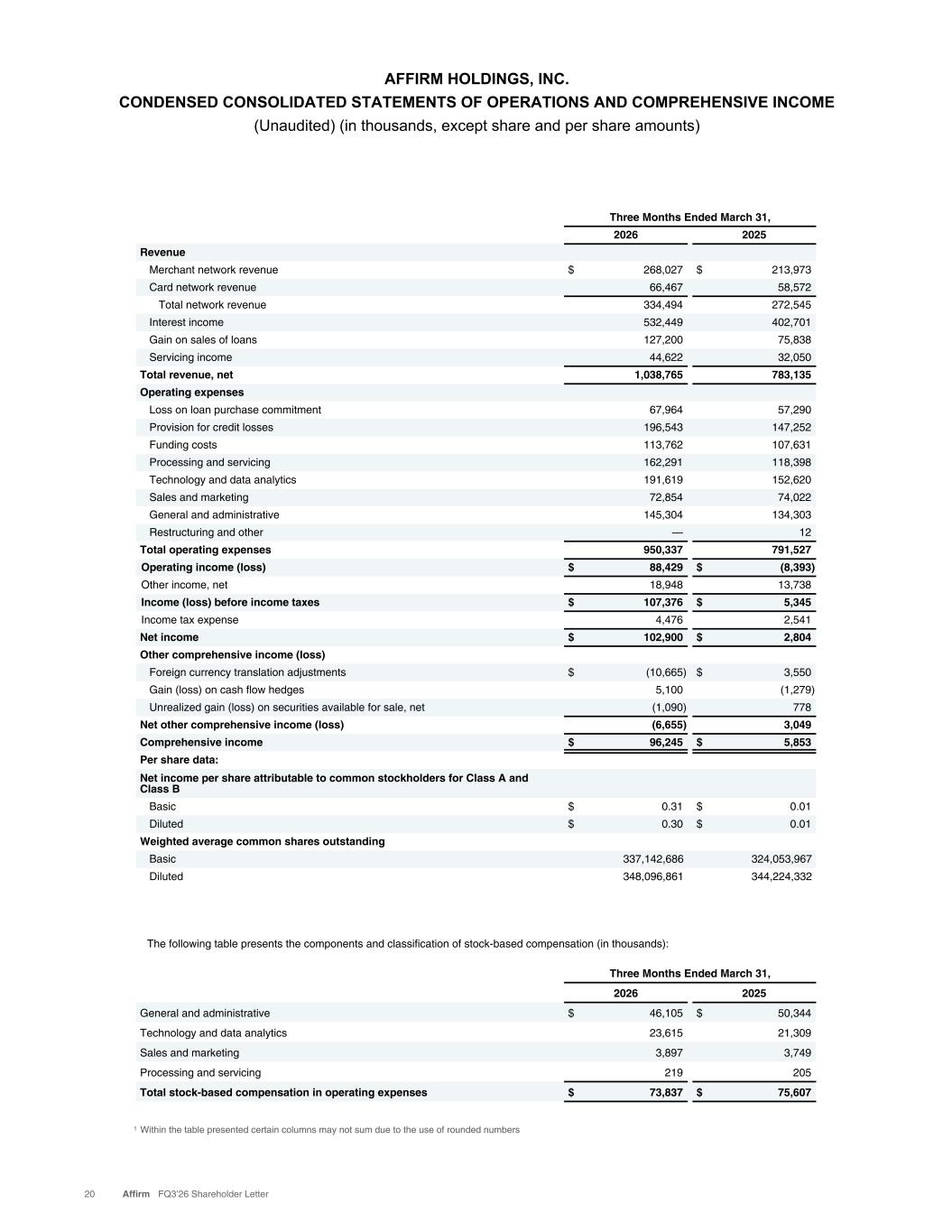
Yeah, that's really driven by the 0% volume in the business. It's not necessarily due to the economics with a single vendor or originating bank or anything in that ecosystem. It's just a function of the sort of discount rate that we apply to 0% loans. So yeah, no economic changes there. It's really a function of mix and term length.
Operator
Our next question comes from Kyle Peterson with Needham & Company. Please proceed with your question.
Great. Good afternoon, and thank you for taking my question. I want to go back on funding, specifically on the forward flow side, and see if you guys could give us whether it's a rank order, kind of relative sizing of some of these forward flow buyers as to what they look like under the hood. I understand everyone can be a lot different here, but I think some of the stress seems to be worse than some of these semi-liquid retail vehicles versus larger, more permanent forms of capital. So I guess if you could just give us any relative sizing or color on what the forward flow channel looks like, that would be extremely helpful.
Without getting too specific, We're heavily, heavily, heavily weighted away from things that are very liquid and subject to those kind of volatility that you're referring to. You know, our largest forward flow counterparty is our joint venture with Sixth Street. We have large pension funds and large insurance complexes, which obviously don't fit that description. And even among the funds who do participate in our program, they tend to be, again, overwhelmingly not of the kind we're talking about. And that's why we see such a strong renewal and repeat rate, while demand continues to be very high for the asset amongst whole loan buyers. They really do like the ability for a firm to generate consistent credit outcomes that they can underwrite to and generate returns for their funds. And we like the capital efficiency of those partnerships. And so we grow together and have done a really good job of that over the past three years.
Great. Thank you very much.
Operator
Our next question comes from Jamie Friedman with Susquehanna. Please proceed with your question.
Hi. Thanks for taking my question. I wanted to ask about adaptive checkout. I don't mean to front run the conversation next week, but if you might have any perspective on how that's evolving, it seems like a real opportunity to serve merchants and consumers alike. So any perspective on adaptive checkout would be helpful.
I'm doing really well. Definitely don't mistake my lack of name-checking it in this particular letter for... any sort of backing away from the strategy, quite the opposite. At this point, we're basically selling Adapt and Boost together as a single thing. We have a tendency to be overly literal in our description of our products, and so we're trying to learn how to package and market better. and so very soon you'll just hear strictly about Affirm Checkout, something like that. But it's doing really well. It's becoming more and more understood by our merchant base, and that is what you want. I think hopefully very soon it will just be the thing you turn on and you don't try to play with the knobs yourself. Our AI will find the optimal setting in real time for every new incremental consumer. So seeing well, I think we do have a bunch of content on it at the Investor Forum, so I'd rather not drop any stats on that here.
Operator
Our next question comes from John Hutch with Jeffries. Please proceed with your question.
Afternoon, and thanks for taking the question. A lot of questions have been asked and answered, but I'm wondering, Max, This is obviously a competitive industry, not only with other buy-now-pay-later companies, but the general consumer credit spectrum. And clearly, you guys are taking share in a competitive, maybe even increasingly competitive industry. And I'm wondering, obviously, size, scale, brand, all that stuff matters, that stuff that's been around for a while for you guys. is what do you think is – is there anything new, or what do you think is changing in terms of competitive positioning as the industry, even though it's not mature, but as it generally matures?
I will invite Michael and Rob to comment in a second because I'm going to scrape the bottom of my brain for something incrementally new. But we're very focused internally, I guess. The reason I'm struggling to come up with something particularly clever is I can tell you a lot about what's changing here. It's really hard to see what the outside world is doing when you're that focused on internal effort. It's a little bit easier to do what we do to be completely transparent. The consumer knows who we are. The one thing that is true, and we can see this when we do just consumer surveys as well as sort of more mechanical understanding of consumer preferences, there are people that have decided a firm is their jam, and that's what they're going to use. and it's really compelling. We can tell consumers, hey, you should go and get yourself an Affirm card because brand X is not yet integrated with Affirm directly, but it's okay. It's accessible. And at some point in the past that felt like maybe they will, maybe they won't, we now have data that shows that they will. Consumers believe, some percentage of our consumers believes that Affirm is a general purpose tool. It works anywhere. You just have to have the Affirm card or the Affirm virtual card on your app screen. And more and more of them understand how it's done, so long as we treat them right and we handle our post-transactional relationship as well as we do in the transaction, they come back. And that just makes repeats a little bit easier. We continue to maintain 90 plus percent of our transactions come from returning users to a firm, which is great. It's a lot easier to get the second and third transaction than the first. So all of that, it's a little bit easier to grow today than it was six months ago and 12 months ago. And every passing quarter or year makes our growth actually feel a little bit easier. There's a great cycling expression. It doesn't get any easier. You just go faster. And we still work just as hard as we've ever done. but the results are escalating, if you will.
This is Michael. I think for complicated business with a lot of moving parts, I think about our position in the market a little, it's actually quite simple. This is what you get when you compound results like this over the course of many years without tidbits, without changing your identity into who you are. We show up to the capital market the same way we did when we first shut up to merchants the same way, offering to drive better conversion, better outcomes, the promises we make to consumers we've kept over the years. And when you compound all that and stay really focused on doing the thing that matters, you end up building a pretty big lead. I think some of the other players in the space have changed who they are, want to try to enter new spaces and become something that they're not. And it shows with their footballs and doubling on results. and ours is just the benefit of compounding the same awesome thing over and over and over again.
That is very well said. All right, guys, thank you for the perspective. Thank you.
Operator
Our next question comes from Jeff Cantwell with Seaport Research. Please proceed with your question.
Okay, thanks, guys. I wanted just to follow up on that earlier question on the Affirm card. You said there's a long list of things you've done and continue to do to increase adoption, I was just hoping to better understand what exactly is on that list of things you're doing. Striving on an increase in cardholders to 4.4 million can maybe help us understand the work you're putting in to increase the number of cards in your customers' hands. And then as you look ahead, what are going to be some of the biggest drivers to increase that number by even more? I'd imagine you would expect to see that 17% of cash rate increase further over time, but what would you say are going to be the biggest drivers to increase the number of affirmed cardholders? Is it marketing of the product or opening new geographies or other new TAM opportunities? Just curious if you could help us understand the outlook for the Affirm card better.
You know, we don't do performance marketing at a firm. We don't have a business model to pay to acquire users. I think maybe that's a bit of a misconception that some people who are less excited about the card than we are have about it. We're not out buying ads. We're not mailing cards to mailing advertisements to people in the mail. that's not how the business works. The reason why the card is such a compelling business for us is it's the best way to re-engage consumers who we already know and have had successful transactions with. And that's really the strategy. The strategy is to continue to scale the network and ensure that the consumers who know what's not with that get access to the card and that we build a card that they can understand and they can use in as many transactions as possible to continue to take a big share of their spend from other payment devices. And that's the focus, and it's really that simple.
Yeah, and just to give you some flavor of the things we do internally, some of these will sound very unglamorous, but given our scale and our attention to numerical detail, I assure you these are very meaningful. So every pixel in the app is at any given time being A-B tested, by which I mean A-B, C-D, E-F, like multi-legged, extremely high-density multivariate testing. and the outcome of that is we just shave down the friction. So if you – it's not super easy to replicate because we're fairly good at keeping our cohort separate, but if you got enough people together and they opened their app and none of them had the card, they would see a slightly different experience in very subtle ways and in some number of weeks or days, we will know which one of them is most compelling when someone signs up for the card, but not just signs up for the card, but actually uses the card and sticks to it and becomes a no more compelling or no less compelling credit risk. And so there's a lot of downstream effects of any form of internal product change that we have to contend with. Like we can't just say, oh, go do this. It's not like you get a loan, everybody gets a loan. Like you get a loan and then we have to make sure that the loan you got actually got paid off and it was a good idea to give you the card based on whatever you in this thought experiment is. And so there's an incredible number of just optimization that happens on our own surfaces and every time we think we've hit plateau, we find that there's another single or double-digit percentage gain to be had and we're very far from running out of ideas. To give you a totally different flavor of what we might do at some point, there's painful little going on in store for any of the BNPL players. And we think we're the best. We think we're the farthest ahead in terms of how to use our product inside of a physical retail. But boy, we have some really interesting ideas and we're getting on it as quickly as we can. And so that's another reason to use our card. As much as we love our online e-commerce domination, we definitely want the remaining 80% of commerce or 75% of commerce, whatever it is. And so there's just a lot to do with the product. I'll end where Michael started. It is not a matter of external marketing. It's a matter of just making sure the product is as accessible, as easy to understand. We have a running tally of every possible declination when the card does not approve a transaction. And every day, someone's job is to ask the question, was this decline intelligent, as in this was a bad credit decision, the consumer should not have been approved? Or is it a mistake of the user, a mistake of a firm, mistake of our underwriting engine, etc., etc.? And so all of that is an enormous volume of work. It can move as quickly as my agents can code it, but it still has to be tested in the real world and validated and made statistically significant. And there is very little doubt in my mind that we will not run out of things to do there for years.
Thanks very much. there are no further questions at this time so I'd like to turn the call back over to Zane Keller for closing comments okay thank you for joining the call this afternoon we appreciate your time we look forward to seeing many of you at the investor forum next week see you there