Operator
Thank you for standing by. My name is Rebecca, and I will be your conference operator today. At this time, I would like to welcome everyone to the Allegiant Travel Company fourth quarter and full year 2024 earnings call. All lines have been placed on mute to prevent any background noise. After the speaker's remarks, there will be a question and answer session. If you would like to ask a question during this time, simply press star followed by the number one on your telephone keypad. If you would like to withdraw your question, press star one again. Thank you. I will now turn the call over to Sherry Wilson, Managing Director of Investor Relations. Please go ahead.
Thank you, Rebecca. Welcome to the Allegiant Travel Company's fourth quarter and full year 2024 earnings call. We will begin today's call with Greg Anderson, President and CEO, providing an update on our business and high-level overview of our results. Drew Wells, Chief Commercial Officer, will walk through our revenue performance and outlook. And finally, Robert Neal, Chief Financial Officer, will speak to our financial performance. Following commentary, we will open it up to questions. We ask that you please limit yourself to one question and one follow-up. The company's comments today will contain forward-looking statements concerning our future performance and strategic plan. Various risk factors could cause the underlying assumptions of these statements and our actual results to differ materially from those expressed or implied by our forward-looking statements. These risk factors and others are more fully disclosed in our filings with the SEC. Any forward-looking statements are based on information available to us today we undertake no obligation to update publicly any forward looking statements whether as a result of future events new information or otherwise the company cautions investors not to place undue reliance on forward-looking statements which may be based on assumptions and events that do not materialize to view this earnings release as well as the rebroadcast of the call feel free to visit the company's investor relations site at ir.allegionair.com and with that I'll turn it to Greg.
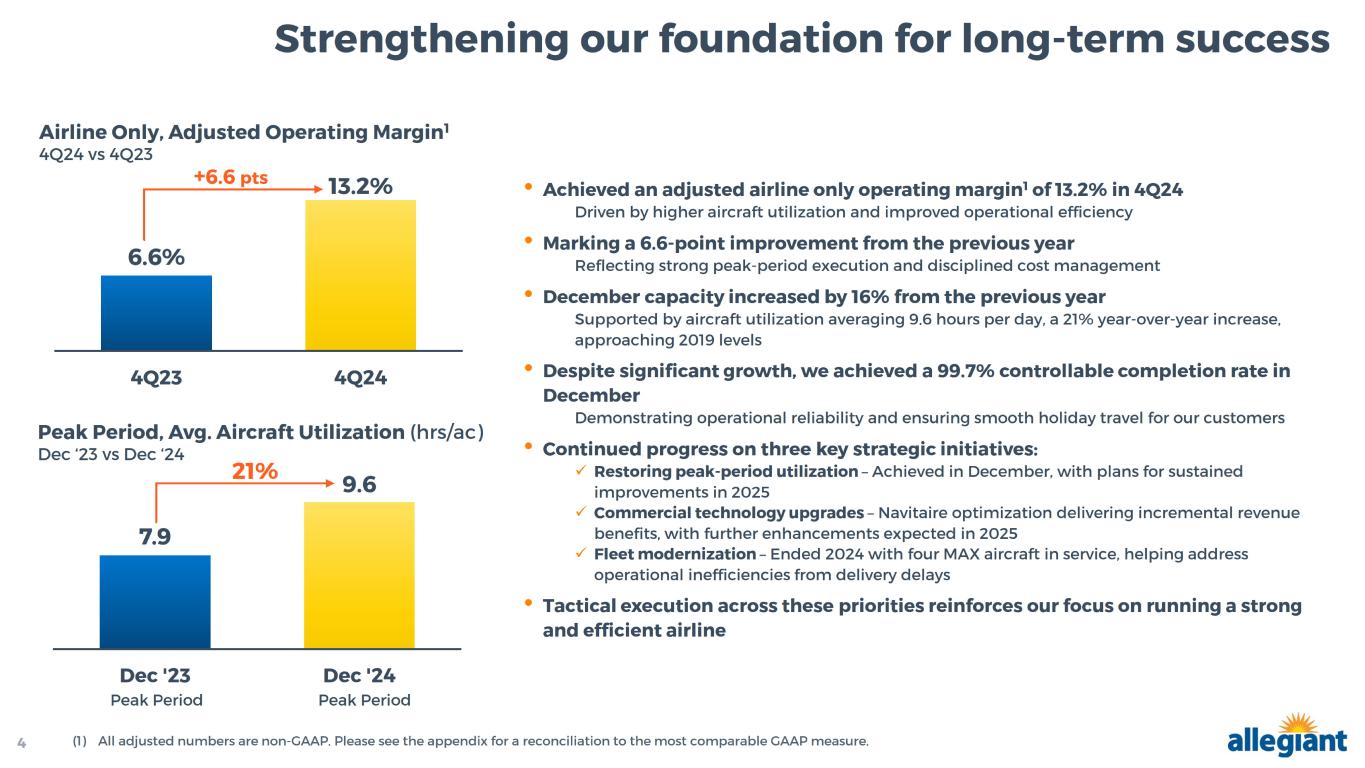
Sherry thank you and good afternoon everyone. We appreciate you joining us today. Before we get into it I wanted to take a moment to extend our heartfelt condolences to the loved ones of the passengers and crew who were involved in the tragic accident near DCA Reagan Airport last week. Our thoughts are with the individuals, their families, and all those impacted during this difficult time. Now to our earnings report. We concluded 2024 with a commendable performance, achieving an adjusted airline-only operating margin of over 13% for the December quarter, marking a six-and-a-half point increase from the previous year. This was driven by a 16% increase in December capacity, primarily due to aircraft utilization averaging 9.6 hours per day during the peak holiday period, reflecting a 21% year-over-year increase. Despite significant growth during the peak period, our team attained a controllable completion rate of 99.7%, and I want to thank them for ensuring smooth operations during one of the busiest times of the year. Last year, we introduced three primary initiatives, one of which focused on restoring utilization during peak leisure demand periods, a goal we successfully achieved in December and expect to maintain this momentum throughout 2025, particularly during spring and summer peak periods. Additionally, we prioritize upgrading our commercial technology and introducing new MAX aircraft, and we have made substantial progress in both of these areas. The ongoing optimization of our Navitaire system has already led to incremental improvements and is expected to continue enhancing revenue throughout 2025. Furthermore, we ended the year with four max aircraft in service, beginning to address operational inefficiencies caused by previous aircraft delivery delays. The tactical excellence demonstrated by Team Allegiant around these three key priorities significantly strengthens our foundation for improved performance. Underlying our execution is the deliberate efforts of being laser-focused on our core strength, the airline. Consequently, a significant step in this strategy is the goal of transitioning Sunseeker off Allegiance balance sheet. Over recent months, we have made significant progress in our strategic review of Sunseeker. This unique resort, located in a popular state, offers excellent amenities and is managed by a highly skilled team. We have great confidence in Sunseeker's future success and have observed material improvements in its financial performance. Nonetheless, we need to acknowledge that a new capital partner will be important for Sunseeker to achieve its full potential. As such, we have launched a competitive process with our team of experienced advisors for a potential sale or stake sale and have received promising indications of interest from several high-quality name investors. Our goal is to conclude this process by summer. We will update when appropriate and BJ will touch on the impairment announced last week and how we are guiding for the resort. Further strengthening our balance sheet remains crucial. Although leverage is improving, there's still work to be done and it continues to be a key focus for this management team. Fortunately, we own the vast majority of our aircraft, which has allowed the fleet team to strategically sell older underutilized A320 assets in a favorable market, resulting in substantial cash proceeds supporting our deleveraging efforts. The sell of these assets is aligned with our growing confidence in the delivery schedule from Boeing. Given the firmness of the aircraft market and the timing of our order, each MAX delivered and purchased represents significant value. In addition to the day one equity value, the operating economics of our MAX aircraft exceed the fleet average by as much as 30%. To add to that, every new aircraft delivered to us is configured with our impactful premium seeding product, Allegiant Extra. Currently, 46% of our fleet is equipped with our Allegiant Extra product, and we plan to end the year at 70%. This compares favorably with prior year's average of 23%. We continue to see strong demand from our customers for this premium seeding as we expand the product more broadly across the network. Similarly, the Allegiant Always Credit Card continues to perform as we expect to receive more than $140 million in total remuneration during 2025. As we advance our commercial technology structure, we are enthusiastic about the future products we will introduce to our customers, aiming to drive more to the top line and improve upon our industry-leading ancillary revenue. Starting out 2025, we have a clear path ahead to deliver on. The industry capacity backdrop is one of the most constructive we have seen for some time. The health of the consumer is strong, and we are well-positioned to capitalize on this trend with expected capacity growth of over 15% throughout the year. This growth will further enhance our operational efficiency by utilizing our existing infrastructure and expanding productively. The midpoint of our airline full-year EPS guidance of $9 suggests an improvement in earnings of over 50% compared to 2024. This is an exciting new chapter for Allegiant, which would not be possible without the ongoing excellence demonstrated by Team Allegiant and their persistent dedication and hard work. Additionally, I am encouraged by recent progress in contract negotiation with our pilots union. It is a privilege to work alongside the most talented team in the industry as we strengthen our position as a leading airline in the communities we serve, delivering reliable, nonstop travel at unbeatable value. With that, I'll turn it over to Drew.
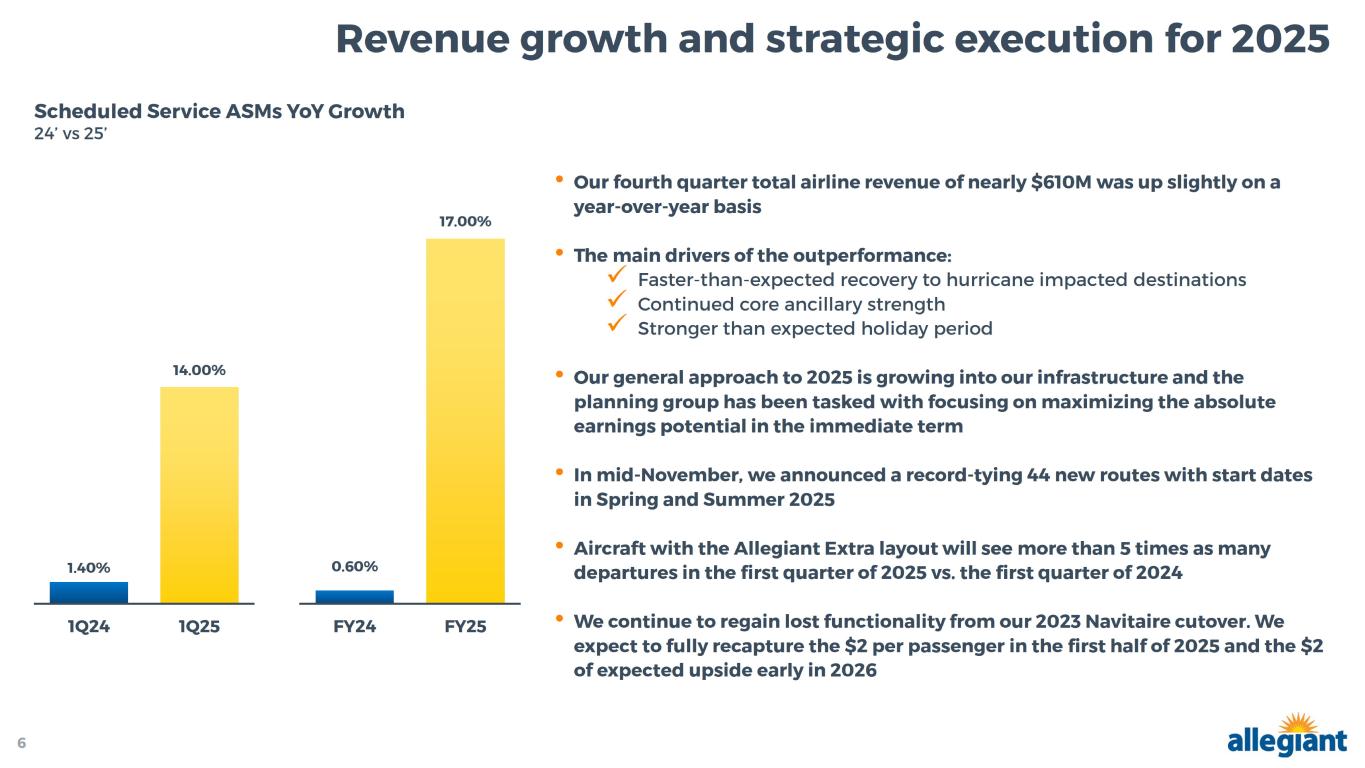
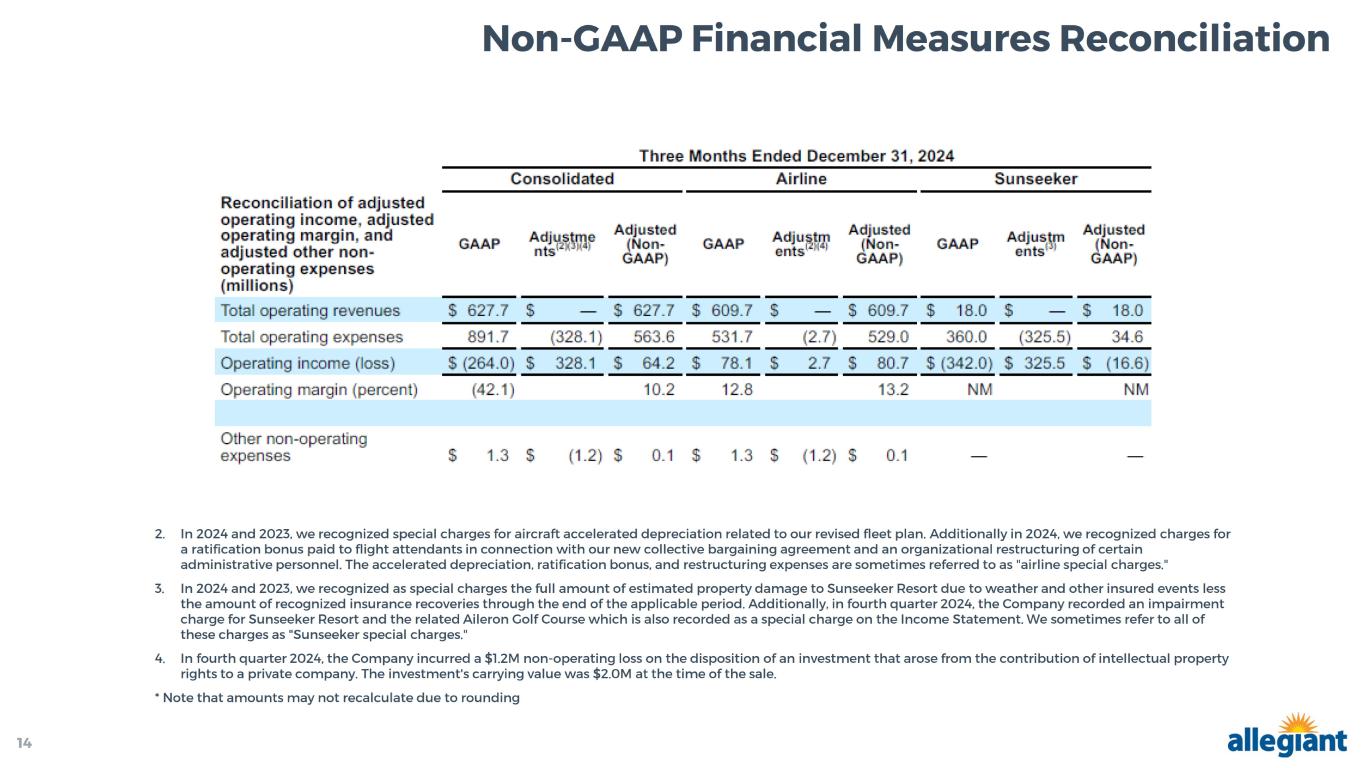
Thank you, Greg, and thanks to everyone for joining us this afternoon. We finished 2024 with $2.44 billion of airline revenue, approximately 2.6% below the prior year, on total ASMs, 1.1% higher. Our fixed fee and operations teams did an incredible job leveraging the available aircraft space all year to an Allegiant record $81 million of fixed fee revenue. Further, our total ancillary per passenger of nearly $76 improved almost $3 versus 2023. Our fourth quarter, total airline revenue of nearly $610 million was up slightly on a year-over-year basis. This result significantly outperformed our expectations during our last call and outpaced our revised expectations in early December. The main drivers of the outperformance were faster-than-expected recovery to hurricane-impacted destinations, continued core ancillary strength, as well as a stronger-than-expected holiday period. Over the Christmas week, we operated our aircraft roughly 9.6 hours per aircraft per day, in line to slightly above our 2019 levels. I could not be more proud of the operation and all of our team members that successfully navigated the push. In total, the three-week holiday period consisting of the last two weeks of December and first week of January grew more than 14% year-over-year while ending just better than negative 1% unit The increased utilization over the holidays, along with post-Thanksgiving travel falling into December, drove December ASMs 16.4% higher year-over-year in a theme that will continue into 2025. The first quarter capacity is expected to grow 14% versus 1Q 2024, while the year as a whole is expected to be up 17% versus 2024. The first quarter will mark the first time in three years with quarterly growth over 10%. In fact, only two of the last 10 quarters exceeded 1.5%. Pre-pandemic, you'd have to go back to 2011 to find the last year without a single quarter over 10% ASM growth. The planning team is ecstatic to have some flexibility and freedom in deploying capacity once more. This means growing in high-demand months, announcing new routes, and testing the limits of route-level capacity. It allows the team to focus on driving dollars to the bottom line rather than trying to fit 12 pounds of good flying into a 10 pound bag diving into that growth a little bit while we have focused heavily on flying in peak months just about a third of net growth will take place in march june and july and roughly a third of that will take place on peak leisure days in those peak leisure months over half of all growth will come in shoulder months like february april and august April being a large beneficiary due to Easter shifting later. The dynamics of that flying are different than a typical year. On average, a third of seats in any given week during the first half of the year will be in existing markets flying more than any prior year. This produces 300% more seats operating in excess of prior years versus the first half in 2024. Also, between 4% and 5% of seats will be on new routes. In mid-November, we announced a record-tying 44 new routes with start dates in Spring and Summer 2025. The long lead time means it's still early to judge many of the routes, though we're particularly excited about new service to our three new cities, Colorado Springs, Colorado, Columbia, South Carolina, and Gulf Shores, Alabama. Let me touch on Gulf Shores a little more. We've heard from our customers that they travel to the Alabama coast for an annual vacation but currently drive as much as 15 hours each way this looks a lot like prior allegiance success stories like punta gorda or dustin florida where we've been able to spur additional trips each year owing to our unique and affordable non-stop network whether through new routes or increased frequency our general approach to 2025 is growing into our infrastructure and while the growth profile i just outlined will have unit revenue impacts in the near term we strongly believe the benefits of the flying will still outweigh the marginal cost of that increased flying. The added elevated flying will either work and continue to mature into future seasons or be trimmed back if it doesn't produce. In addition to the growth-driven unit revenue impacts, Easter timing will play a role in shaping the final result for leisure-oriented carriers like us in both the first and second quarters. When combining the headwind of Easter timing and the tailwind of New Year's travel, we expect a one to one and a half point headwind to TRASM in the first quarter. Additionally, a mild stage increase through the first half of the year will carry an additional one point headwind. Lastly, while our network has diversified away from near border exposure in the last 10 to 15 years, the strengthening U.S. dollar to 20-ish year highs against the Canadian dollar has applied some pressure on those Origination City. Many of the same initiatives that supported ancillary growth in 2024 will continue to produce benefit into 2025 to help mitigate the impacts of growth. Aircraft with the Allegiant Extra layout will see more than five times as many departures in the first quarter of 2025 versus the first quarter of 2024. For the full year, more than two-thirds of departures should have an Allegiant Extra aircraft. We continue to regain lost functionality from our 2023 Navitaire cutover. We expect to fully recapture the lost $2 per passenger in the first half of 2025, and the $2 I've expected upside early in 2026. Finally, the contribution from Allianz Travel Insurance has roughly doubled on a per-passenger basis since its launch in February. All things considered, we expect 1Q TRASM down slightly more than negative 6%, implying airline rev excluding fixed fee up about 7%. We ended the year with another phenomenal performance from our co-branded Visa Allegiant Always program. We continue to add new cardholders at a great clip ending 2024 with over 540,000 accounts. This kind of scale gives us confidence that the program offering has matured nicely and we are excited to collaborate further with our bank partners to better both engage our existing cardholders and ensure we're providing the best offering for existing and future cardholders alike.
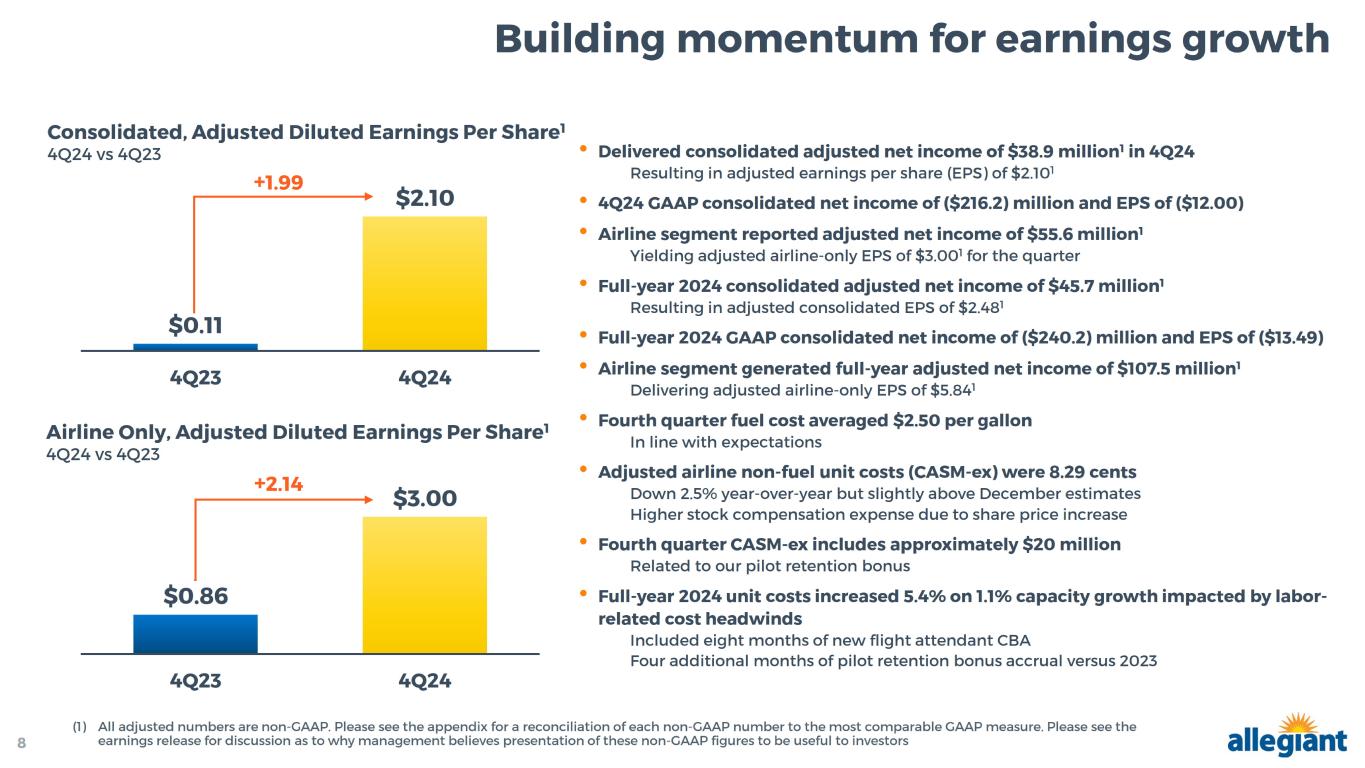
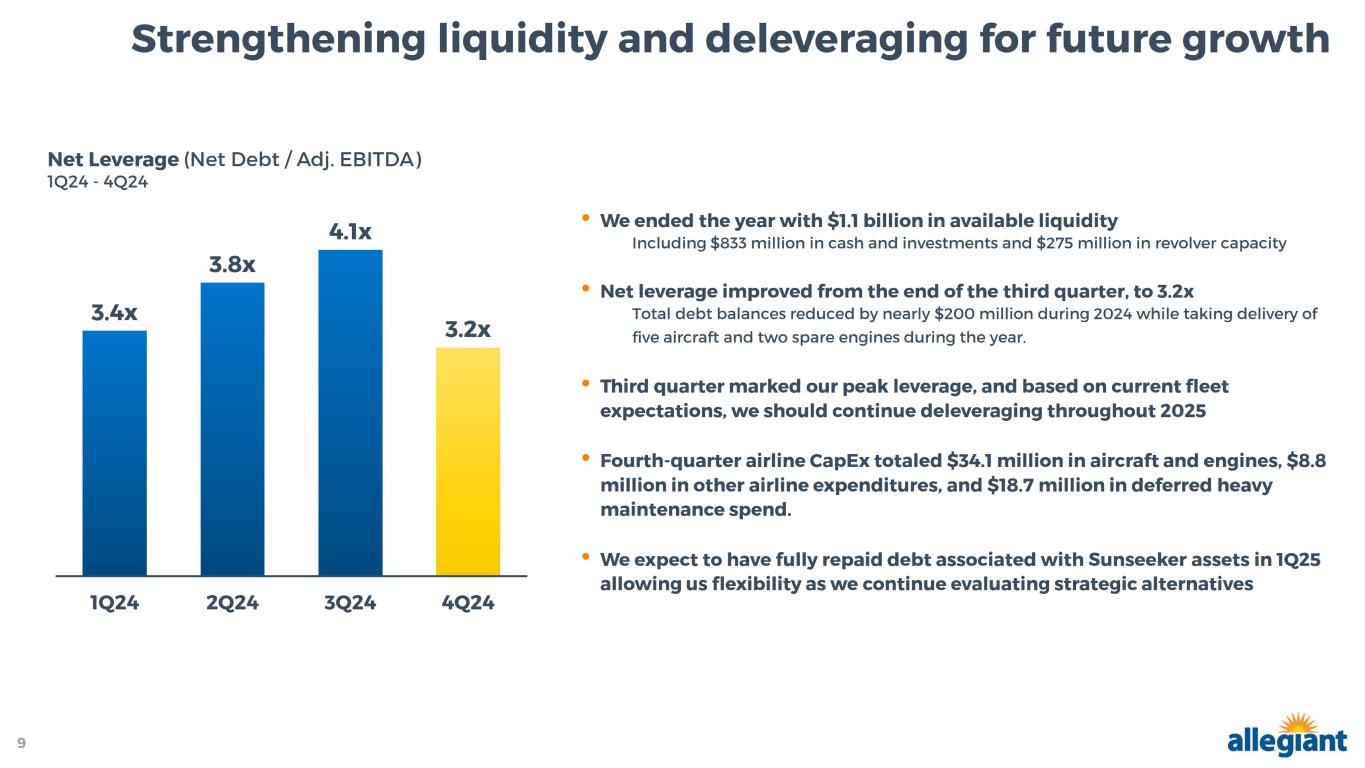
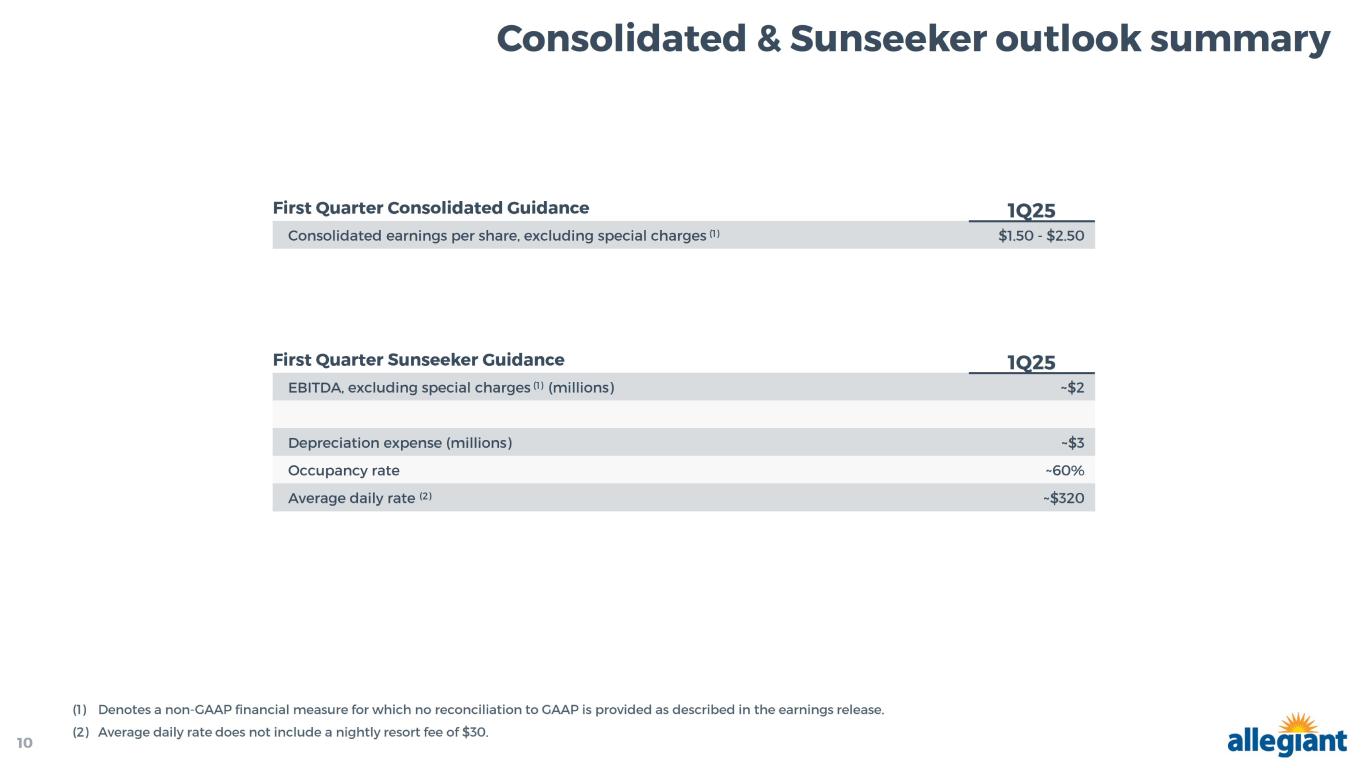
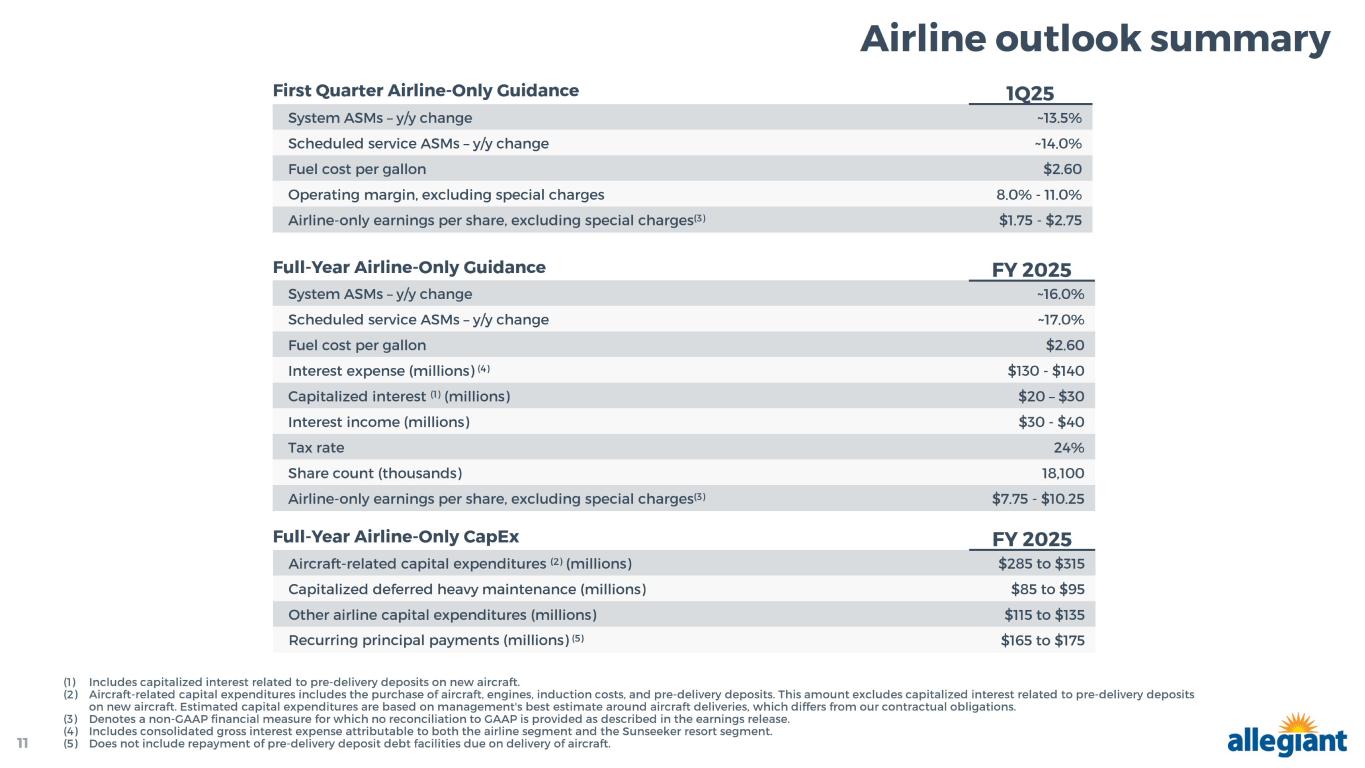
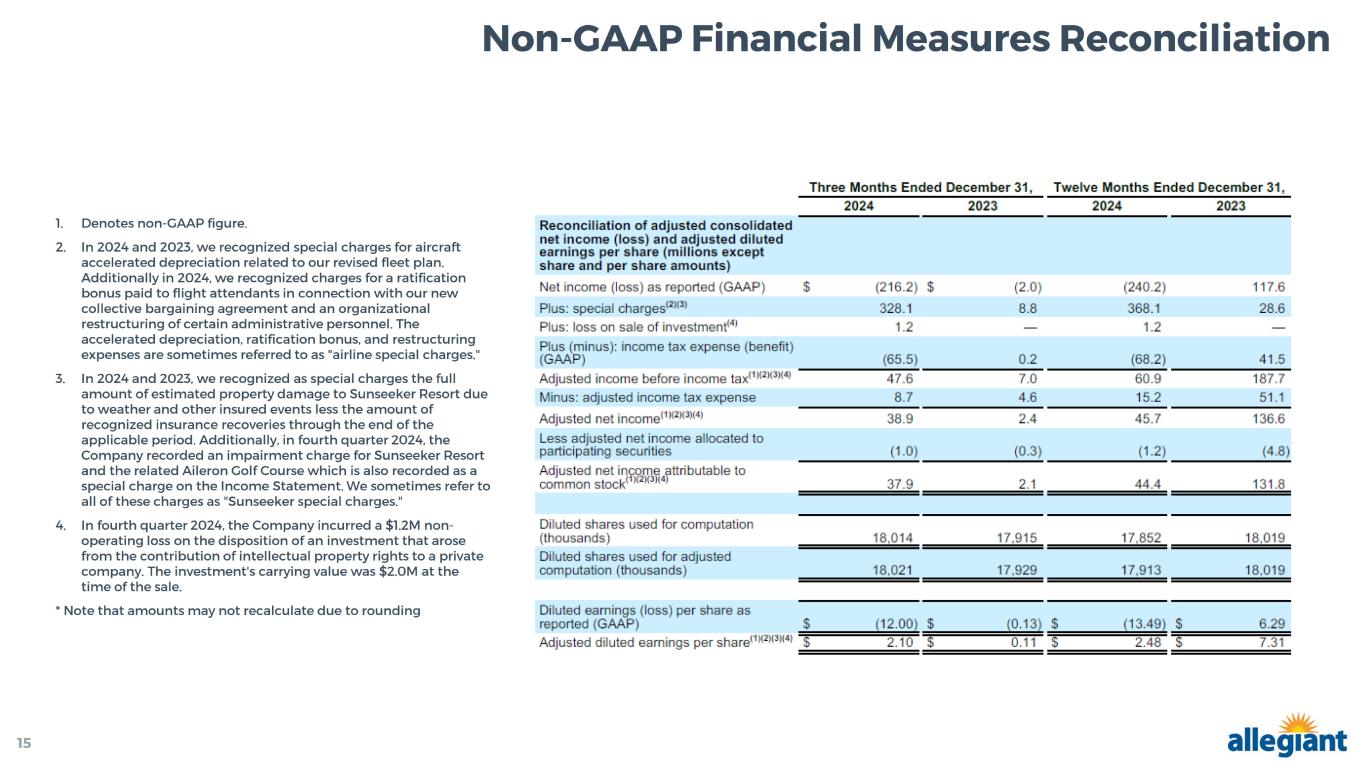
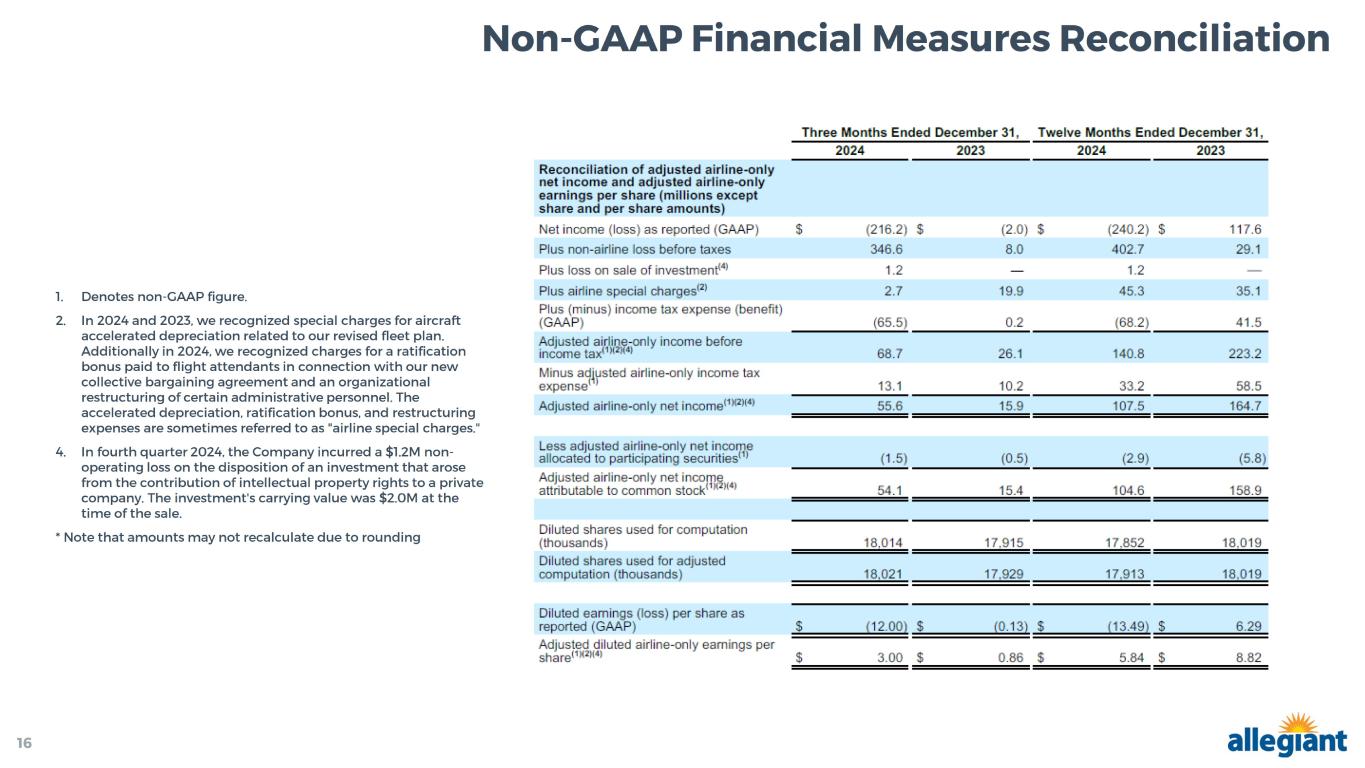
The power of loyalty revenue is evident across the industry and we believe our program is still in the early days of its full potential and now I'd like to hand it over to Robert Neal thank you Drew good afternoon everyone and thanks for joining us today as I speak to our results and guidance this afternoon please note that all of these are on an adjusted basis and we'll exclude any special items in the fourth quarter we delivered net income of 38.9 million dollars on a consolidated basis yielding earnings per share of $2.10. The airline segment reported an adjusted net income of $55.6 million, or earnings of $3 per share. For the full year, we posted a consolidated net income of $45.7 million, resulting in a consolidated EPS of $2.48. Our airline segment generated full year 2024 net income of 107.5 million dollars or five dollars and 84 cents of airline only earnings per share as greg and drew have highlighted we began seeing notable financial strength in the quarter driven by improved peak utilization implementation of revenue initiatives and delivery of 737 max aircraft ahead of our estimate the airline earned 139.2 million in ebitda during the quarter resulting in an EBITDA margin of 22.8 percent which is nearly seven points higher than the fourth quarter of 2023 on the cost side fuel averaged two dollars and fifty cents for the quarter in line with our expectations adjusted non-fuel unit costs were 8.29 cents an improvement of two and a half percent year over year slightly underperforming the estimate we provided in december this miss was driven by increased stock compensation related to the share price increase throughout the quarter a maintenance expense true up and timing related impacts from a new maintenance and material system which went live in the third quarter as a reminder fourth quarter chasm x does include roughly 20 million dollars related to our pilot retention bonus for the full year 2024 we had unit costs of 5.4 percent on capacity of 1.1 while we had a tailwind from serviceable engine sales mentioned in our december traffic release we saw cost headwinds from eight months of our new flight attendant cba and four additional months of our pilot retention bonus accrual as compared to 2023 turning to the balance sheet we ended the year with 1.1 billion in available liquidity including 833 million in cash and investments and 275 million in revolver capacity net leverage improved almost a full term from the end of the third quarter down to 3.2 times this result was achieved by improved fourth quarter earnings proceeds from equipment sales early debt repayments during the quarter, and benefits from our amended agreement with Boeing as disclosed in November. Total debt balances were down nearly $200 million during 2024. As mentioned on our October call, we expect that the third quarter marked our peak leverage, and based on current fleet expectations, we should continue deleveraging throughout 2025. While we'll continue to invest in the business, the balance sheet remains a top priority for this team. Fourth quarter airline capital expenditures included $34.1 million in aircraft and engine related spend, other airline CapEx of $8.8 million, and $18.7 million in deferred heavy maintenance costs. For the full year, total airline capital expenditures were $326 million, $16 million higher than our forecast, with three more aircraft in service than contemplated at the third quarter earnings call. Following downward revision to earnings estimates for our Sunseeker entity throughout 2024, the assets were tested for recoverability and we recorded a total non-cash impairment of $322 million in the fourth quarter. As of today's call, we've fully repaid the debt associated with Sunseeker assets, allowing us to increase flexibility as we continue evaluating strategic alternatives for the resort. Moving over to fleet, during the quarter we retired one A320 CO and placed into service three seven three seven max aircraft ending the year with 125 airplanes in our operating fleet looking ahead to 2025 we're anticipating delivery of nine seven three seven max aircraft during the year while boeing's recent estimates have 12 aircraft delivering to us during 2025 we're planning conservatively to keep a better balance of tie bridge flight crews with aircraft available to operate particularly through our summer peak we plan to retire 12 aircraft during this year so we should close 2025 with a total of 122 aircraft in service with some slight upside to that number as i've mentioned on prior calls estimates today differ from contractual commitments should aircraft deliveries exceed our expectations this year we are prepared to accelerate exit of a320 family aircraft once we have more visibility into 2026. based on these estimates we're projecting all in capital expenditures for 2025 to be approximately 515 million dollars at the midpoint of our guidance, including approximately $300 million in aircraft and engine-related CapEx, $125 million in airline other capital expenditures, and $90 million in deferred heavy maintenance. This guidance, of course, is subject to change depending on the timing of aircraft deliveries. Turning to our 2025 outlook, we're providing full-year expectations for the airline segment, and based on uncertainty around timing and potential outcomes for Sun seeker will continue to guide that segment on a quarterly basis that said we expect to deliver full year 2025 airline earnings per share of nine dollars a significant improvement over 2024 in the first quarter the airline is expected to produce an airline only operating margin of around nine and a half percent more than three points higher than the prior year this result implies a non-fuel unit cost reduction of around seven percent year over year on capacity growth of 13.5 percent as we're better able to leverage our existing infrastructure assets and staffing we're growing into our headcount as well as our fleet and we expect to deliver airline only earnings per share of two dollars and 25 cents in the quarter we're expecting sun seeker to produce two million dollars in eva dot during the first quarter due to the recent impairment charge depreciation expense is now expected at three million dollars per quarter these results combined with the airline should produce a first quarter consolidated earnings per share of two dollars as we move through the year we remain focused on cost discipline improving efficiency through increased utilization operational excellence and continued balance sheet improvement the momentum we've built exiting 2024 puts us in a strong position for 2025 and beyond in closing i'd like to express my gratitude to the entire allegiance team their dedication and hard work continue to drive our performance and I'm extremely proud of what we've accomplished in the fourth quarter. The increase in December capacity was completed with two fewer aircraft and a 9% reduction in overhead headcount over the holiday peak and the team still delivered strong operational performance. This ability to increase peak utilization is core to our margin restoration efforts. Thank you all for your time today and with that Rebecca we can now go to analyst questions.
Operator
At this time, I would like to remind everyone, in order to ask a question, press star, then the number one on your telephone keypad. We'll pause for a moment to compile the Q&A roster. Your first question comes from the line of Savvy Sath with Raymond James.
Hey, good afternoon, everyone. Drew, if I might, you gave some really interesting, helpful information on the capacity growth, but it was a lot to digest and just wondering if you could maybe take a step back and help us think of it just maybe across the quarters, you know, how you're thinking about kind of that, the progression of the capacity growth for the four quarters and, and which quarters might have more kind of capacity growth in peak versus off peak period.
Sure. Let me, let me take a quick stab at that. So, yeah, we guided out the first quarter approximately 14 percent um for that the second and third quarter is likely about the same coming in at the low 20s um and then we'll certainly see the lowest year over year growth in the fourth quarter in large part because of everything we talked about here uh in december of 24 uh not getting the lap uh they're not getting the same same utilization comp there um in terms of the overall growth profile, I talked about the peak months, March, June, and July will be about a third of the overall growth, but the bigger focus on the net ASM increase will be the shoulder months, February, April, May, August, October, getting more of the overall lift in, but the balance will take place in January and September.
So I don't know if I went too high level for you there or where you'd like me to uh dive in and savvy real quick this is greg uh just wanted to add maybe another perspective to 25 and the way we've been talking about it here internally and a lot of ways it's like a one-time catch-up year kind of a level setting and that's due to some of the prior year delivery delays or other constraints that we've seen and so what we're really trying to do in 25 is optimize you know that existing infrastructure that's in place grow with roughly the same FTE count, maybe slightly up, roughly a flat aircraft count, and then drive absolute higher earnings or drive higher absolute earnings, excuse me. But I would think of 25 more as an anomaly when it comes to growth. As we think about 26 and beyond, we'd get back to a different formula than 25 and really earning that right to grow.
That's a helpful perspective. I appreciate And maybe just on the follow-up, on the unit cost, just curious how we should think about it, because given your guide and unit revenue, I mean, it looks like there's a lot of kind of unit cost improvement here. Is that also kind of fair to assume, like, more first-half weighted and kind of moderates as you go to the back half, and generally how we should think about that?
Yeah, I think that's right. Hey, Sabi, it's BJ. I think that's right. You know, 1Q will probably be down the most on a year-over-year basis. 2Q, 3Q, still be down. Really nice cost improvement middle of the year, but you do have some of the Boeing aircraft entering the fleet in the middle of the year. You have the increased utilization means that we're also utilizing the A319s a little bit more, so you don't see quite the same year-over-year unit cost improvement in 2Q and 3Q. And then 4Q, similar to Drew's answer, just we had a good amount of growth in 4Q of 24. And then we also had that gain on engine sales in the fourth quarter. Helpful.
Operator
Your next question comes from the line of Duane Fissingworth with Evercore ISI.
Hey, thanks. Just on the debt that you're paying down related to SunSeeker, can you talk a little bit about how you're accomplishing that? you know, what financing you're using to kind of take down that debt, and how to think about the rate on what you're taking on versus the, you know, the debt that you're taking out. And I guess just like why you thought this was important to do now. Thank you.
Sure. Yeah. Hey, Dwayne, it's PJ. A couple of things there. I mean, one, the debt on Sunseeker was beginning to amortize just after the end of the quarter, I think beginning in April, and given the cash flow production of that asset, it was something that we wanted to get ahead of. In addition, we've been very focused on balance sheet improvement, really beginning in the back half of 2024 when we started to realize sort of what our level of operations was going to be on the airline side in the back half of 24 and through 25. And so one of the first places to go when we're trying to get leverage in the right place was paying off debt that was maturing earliest. And then we've also had this strategic review going on, and we've been learning a lot along the way, and we thought it would be best to have, you know, maximum kind of flexibility there. So that's really the reason. And then how we did that, you know, I mentioned we had proceeds from sale of fleet equipment during the fourth quarter, improved earnings.
We had a loan out to another entity that was repaid to us and so just overall the balance sheet improvement um didn't come from you know net net refi of that debt okay and then i guess um hard to comment while this is going on but i guess if everything went right when would you you know think you'd be able to kind of separate yourself um from this asset and any and again i guess any um color from the quote-unquote interested parties do you do you think we'll need to see you know quarters or or years for this to kind of spool up um before there's separation thanks for taking the questions
yeah of course duane thanks for the question um maybe let me hit on it a little bit uh more and that's that you know what we've talked about in the past that we're focused on the parallel paths and those paths are we need to approve the existing resort um and the team has done that. You see the EBITDA positive in the first quarter, the driving group business and doing a lot of things to improve the financial performance. And then the second two items that we've been looking at is the distribution partner or soft brand and then a capital partner. And I mention that because as we've gone through the process with our experienced advisors, what we're learning is that or what we've learned that investors want a seat at the table to determine who that distribution partner is or that flag, the Marriott, the Hildons and the likes. And so all of those potential flags or distribution partners have toured the property. They're very positive on it. And then in terms of the next steps, we're in a competitive process. I appreciate you respecting that on the call and your comments. It's kind of hard to talk about, but I'll try and give you a little bit as high a level as I think we can hit. And that's that there's a high single-digit number of investors. These are well-known, high-quality investors. the indications of interest that they've provided they're promising we're advancing the process there's no two structures that are like exactly alike but what we what we're pushing what we're working towards is you know at least we sell at the minimum we sell a majority ownership and our advisors who we're working with it's our our goal is to drive you know as much value to our shareholders as we possibly can more to come but as I mentioned in the early or my opening remarks that we would expect the transaction buttoned up by this summer. And if all went well, it could be early summer, but we're just really working through the process and trying to get to the right deal.
Oh, that's great, Greg. Thanks for the info.
Operator
Your next question, comes from the line of Tom Fitzgerald with TD Cohen.
Hi, everyone. Thanks so much for the time. Just curious how Spring Break's booking up across all your products, as well as Allegiant Extra.
Sure. Yeah, I mean, I have um you know legion extra detail top of my head uh in in advance but you know very generally um there's kind of a couple different pieces of march specific to the spring break so easter shifting out we'll put a pretty big headwind on the final week um remember well over a third even as much as 40 percent of our spring breaks um had coalesced around that week last year um and you know being a bit compressed on capacity we certainly couldn't take full advantage of that So that week will look relatively poor on a year-over-year basis. Additionally, the first week of March tends to get a little softer with Easter pushing back as well. The middle, too, that are more apples to apples look great. I think we have some solid flat capacity market strength there. And then we'll see how all the growth markets handle it.
But so far, pleased with how the middle of March is looking. um a bit early to talk to april but obviously with easter moving out there that's going to look really good on any year over your basis so um you know feel good about about the peak period okay that's that's really helpful and then just as a follow-up i think on the last call duane had asked about how you're merchandising a legion extra um and you talked about it as a as an ancillary versus it's distinct fare product and one of your competitors recently moved to um start retailing their extra legroom seat as its own distinct fare class i'm just kind of curious how you view the pros and cons of those two strategies and if you'd ever consider um changing how you retail it thanks again for the time yeah i mean it's almost like you're in some
of our our revenue strategy meetings where we've discussed this for the the better part of a couple quarters now um you know there's you know there's some tax implications depending on how you want to position it um as i understand anything that that moves into the same click as the fair so Everything is subject to the 7.5% excise tax by keeping them separated. The premium seat would still keep that 7.5%, but other pieces of the product or that bundle would not. We do like having a little bit more flexibility in how we can approach the product mix in a distinct offering versus from the fair class. is that there's a few other kind of back-end complications that are more Allegiant-centric than anything that would make bundling it together up front a little bit more challenging. So I don't have necessarily a very clear answer for which is going to be better. We will continue to debate this for a while, but for the foreseeable future, we like where we're at. We like having it separated. I feel like it's the best overall thing for the consumer experience, but to be determined.
Operator
Your next question comes from the line of Mike Linenberg with Deutsche Bank.
Oh yeah, hey, good afternoon. Just back on Sunseeker, seeing it turn to EBITDA positive, can you just remind us of the seasonality of the resort? What is typically the strongest quarters for Sunseeker?
Hey Mike, it's Greg. Let me hit it at a high level.
Mike is on if if uh i misspeak or if there's any detail he wants to add but you're typically the first quarter is the the strongest quarter uh the fourth quarter being probably the second strongest and then the summer would be the softest period okay is that right michael absolutely great thanks and then just um vj i heard you mention you talked about i think it was 20 million dollars in in pilot bonus accrual can you where are we now like how much have you accrued um because i i know it's been going on for some time and as we move into 2025 um how does that change i'm just you know as you
add more airplanes and grow your pilot ranks what what should we what number should we think per quarter sure mike yeah thanks for the question um we were just under 140 million dollars i believe at the end of 2024, and it's building, it was building right around 20 million, 20 million a quarter. For 2025, I have it coming up by about 22 and a half million a quarter.
Perfect. Thanks for taking my questions. Thanks, Mike. Thanks, Mike.
Operator
Your next question comes from the line of Dan McKenzie with Seaport Global.
Oh, hi, guys. Thanks for the time here.
It looks like the sale of Sunseeker will swing cash nicely positive this year and you know I know you can't talk a whole lot about it so I'm not sure it's how it would be recorded exactly but could you speak to the potential use of cash and the implications for year-end debt and leverage metrics hey Dan thanks for the question I'm glad you asked that I should mention that my prepared comments around deleveraging throughout the year did not include any assumptions on cash proceeds from a sun seeker transaction uh that was just based on on airline earnings uh so we haven't you know look i mean we're still exploring and it could be there could be many different ways that a transaction would be structured so i'm i'm hesitant to run away with anything but i would tell you you know our primary focus is just on continued improvement of our balance sheet so maybe we'll pay cash for the airplanes maybe we'll pay down some debt uh you know i know what you're probably looking for I don't think we'd be committing to any kind of shareholder returns with those proceeds but we can have that discussion when we get there you know opportunistically I think we do have 70 plus million in authority on on share repurchases if we wanted to look at that yeah okay and then with respect to Allegiant strategic focus here you know Frontier of course has expressed
interest in Spirit and I'm wondering you to speak to the overlap that you would have with Spirit and I'm you know just wondering you know is M&A you know something that's even on the you know on the radar for you or strategically you know does some kind of you know with some kind of acquisition or you know bolt-on acquisition at some point appeal to you guys yeah I'll kick it off with the overlap it's it's relatively thin I want to say approximately four percent uh give or take I haven't rerun it since the schedule was extended recently but I can't imagine we've
deviated far from that hey Dan I'll add on the the consolidation question and you know I think just under performance if that continues for like other carriers maybe that could result and we'll see they'll do what is best for them, but specifically to Allegiant around consolidation. And our view is that consolidation really, it isn't necessary for us. We have great assets. We have the right network. We have room for organic growth through this team. They talk about the 1400 incremental routes. Now, as I mentioned earlier, we need to earn that right to grow. But our focus is really on driving shareholder value. And that's what we've really worked towards 24, 25 and continue on in future years. So that's where our focus is at right now. Yeah, of course.
And I squeeze one last one in here. You know, for investors that are taking a two to three year horizon, you know, how can, just given the sharp expansion in margins in 25, how should, you know, longer term investors think about normalized margins for Allegiant at this point?
How about I'll kick it off and feel free Drew or BJ to jump in but you know as I think about as I mentioned earlier 25 and that's kind of a one-time catch-up year with 26 being a different kind of growth formula you know all else equal if the environment were equal I would expect 26 margins to be higher than 25 and you know as we think about how we look beyond that as well our Our focus is getting back to historical margins with what we've seen. We have a plan to do that, but we need to continue to execute. Some examples that, you know, may be worth highlighting why we have conviction that, again, all else being equal, 26 margins stronger than 25 is, you know, we still think there's upside with productivity internally here. How do we keep becoming more productive, growing productively from the commercial standpoint? You know, we talked about some of the enhancements that we've been working through. in terms of, like, Legion Extra or Navitare, you know, by the end of this year coming into 26, those will largely be in full swing. Drew and his team have a number of other commercial initiatives, you know, that we think could be beneficial. The network maturation, you know, that too should help drive less growth next year, which we expect would help drive margins. So, all in all, I just, our goal is to get back to historic margins, and we're, I think we're heading in the right direction. And so, hopefully, stay tuned, and we'll continue to execute on our plan.
Operator
Your next question comes from the line of Scott Group with Wolf Research.
Hey, thanks. Afternoon, guys. So the guidance is airline RASM down more than 6% in the first quarter. And I get that there's timing issues in Easter and all that, but that's a pretty big step down from the down 1% in Q4. So I guess any color there. And then what's assumed in the guidance the rest of the year. So it's like capacity goes from 14% to 20% in Q2, Q3. Does RASM get better than the down six or does it get worse? I'm not really sure what's in the guide.
Sure. And maybe, well, first talking four Qs to one Q, the Easter is a pretty big headwind on that front. But additionally, if you look at the growth a little bit, there was very little growth in little to no growth really in October, November, and the vast majority of the December growth came from, you know, the back end of Thanksgiving falling into early December as well as concentrated around the holiday itself. So it's really, really productive growth there that won't quite realize the same way in January, February, and even early March in particular. So the way in which the growth is manifesting and how we see that, I guess, play out in revenue will look probably meaningfully different than how it did in December. Looking, I guess, broader through the year, I do expect that because of Easter falling into the second quarter, because of some of the backdrop changes in the summer that affected the entire industry last year and at least, you know, today look to be more constructive in 25, you know, I think they should look a little bit better, probably similar to one another, but a little bit better than the first quarter. And then with growth kind of tapering off in the fourth quarter, I would expect probably the best performance on a year-over-year basis in the fourth.
So I guess when you add it all up, right, does RASM down more than CASM this year, or is CASM down more than RASM this year?
CASM is down more than RASM. Does that make sense? I I mean, what I'm saying is it's a creative, that the costs will come down more than the revenue side of the house. Is that what you're getting at, Scott?
Yeah, I mean, ultimately, I guess you're saying Q1, chasm's down seven, rasm's down six. You're saying chasm's going to be down less than seven the rest of the year, right? So I guess you need rasm's got to be better than down six the rest of the year for that to be true. But that's sort of what's in the – I just want to understand what's in the guide.
Yeah. And Scott, I think, you know, it's just important the nuance there. You know, you're asking about chasm. So both chasm X and chasm should be down. And just keep in mind the benefit as we get, you know, more and more of these max airplanes into the fleet on total chasm in the back half of the year.
Okay. And then just last thing really quick, the engine gain in Q4, do we assume any additional engine gains as some of the new planes come in? Are there any other there are engine gains assumed in the guide?
There are some in the guide for 2025 minor, nothing as meaningful as what we had in 4Q. That's why we called it out. Just to remind you that we've kind of always had disposition of scrap assets run through our other expense lines. Sometimes it's a gain, sometimes it's a loss. In 2024, it was lumpy, actually. We had a couple quarters with with gains on it could be parts landing years on serviceable engines things like that so i am assuming a little bit of that in in 2024 um but you know it'll be lumpy quarter to quarter i don't know that we'll um give a lot of clarity on it scott maybe just at a high level it's worth adding you know that there's there's value in the order we with boeing for our new max We have a value in our existing fleet assets, which we own.
As we look out in BJ and his team and how productive we are with those assets, how do we optimize that value? And we're well positioned and experienced not only as a commercial airline, but also in monetizing aircraft assets over the value of their life cycle. And so that's just what the team's doing. They're finding less productive assets and monetizing it in this unique market.
Thanks, Greg. And Scott, maybe just one more thing I should add in. And, you know, I mentioned in my script that, you know, there is potential for Boeing to deliver more aircraft than we have in the plan. If that happens and it happens early enough and we feel like that delivery schedule is reliable, then, you know, maybe we've changed our position on that, like, in the fourth quarter or something. We've disposed of airbus assets more quickly.
Operator
Your next question comes from the line of Ravi Schnackner with Morgan Stanley.
Great, thanks. Good evening, guys. So maybe as a follow-up to some of the questions here, great to see the traction with Allegiant Extra and getting to 70% of the planes at the end of the year, but can I just help unpack how you guys kind of just ideated between the strategies of growing to higher margins through higher, through more capacity versus trying to push to higher margins through less capacity and more price? Because it feels like the industry is going one way and you guys may be going a different way. Now, I'm not saying that's the wrong thing to do because you guys are your own, have your own strategy, but just how would you come to that conclusion?
I think we're guilty of that since probably the start of 2020. It feels like we've grown when no one else is and we've gotten the unit revenue when everyone else is growing and it's hard to, It's been hard to tell that story for the last five years, so why would we stop now? The core of this to me, and then maybe I'll hand it off, is really about growing into the infrastructure we have. The marginal cost that we add into the business through this flying is relatively low relative to what we believe we can achieve on the revenue side. So, you know, to me, this has really been about driving earnings and then harvesting the margin in the coming years, as Greg mentioned a little bit ago, as we get back to earning that right to grow. But by and large, we have the pieces in place to achieve this growth without having to add much on the foundational front.
That's really helpful. And maybe as a follow-up, just for the SunSeeker timing, you said, I think, late summer. How firm is that deadline? And what are maybe some of the moving pieces in terms of the process that will enable you to either hit or maybe even advance that deadline?
Yeah, we just put it by summer. So it's kind of a little wider range. If we were to, everything were to go as planned, it could be on, you know, the early part of the summer, Ravi, but we're just trying to give some buffer there and really take the right time that is needed to get to the right deal and structure. And so we're just, we're working through that. We're, you know, there's steps along the way, the process. And so we're in a more advanced step now than we were, you know, a month ago, meaning we've kind of narrowed it down and really focusing on advanced due diligence and discussions with software and things like that. So we're working through it as expeditiously as we can. But so we're putting that out there. The best information we have today is when we think we'll conclude this transaction.
Operator
Your next question comes to the line of Connor Cunningham with Mellis Research.
Hi, everyone. Just going back to the cost outlook here, it's a little confusing. So, in the past, I think you've talked about having the infrastructure in place to grow 15%. And then you've also said that if you grow five, your Chasamex is basically going to be flat. So, I'm just trying to understand in the context of 17% growth, why the best quarter on chasm x is going to be one q uh when you're going to have 20 growth like is there anything that we're missing from uh i don't know if there's like labor assumption anything just within it that we need to know about on the cost side uh that may be thrown off that that a little bit thank you thanks connor um yeah let me let me try that so um first quarter um let's see First quarter, remember, you have, or sorry, I should get to second quarter.
I mentioned, I think, in response to another question on the call, there was some lumpiness in the other line. Some of that was related to asset and part sales from parting out A320 family equipment. So that has some impact. And then you have more utilization on smaller aircraft and seats coming off of A320s for Legion Extra in 2Q and 3Q. Let's see what I'm missing here. Then you start to add some depreciation expense back into the business in the third quarter. What am I missing, guys?
You have the engine sale that we probably didn't have in that.
Yeah, and then, of course, the engine sale in the fourth quarter. So you don't really get much of a year-over-year benefit in the fourth quarter.
Okay. Maybe I can ask it a little bit different. Drew, just like, again, we're pushing capacity again. I know that you guys have been very clear about that. But just as you build a schedule in the current environment, you know, obviously there's been a big debate around, you know, ultra-low-cost carriers and the model and all that stuff.
But just have you changed your approach at all to building a schedule when you think about pushing growth now in the context of what you're seeing out there? thank you no i mean by and large it's the same approach right through the the peak periods you're trying to schedule up to whatever um your first operational constraint is um historically in the summer that's been our pilot head count um today i think we're a little a little more balanced on on that front and filling up our peak days until the aircraft space runs out um but you know one of the innovative things that we continue to bring to the industry is our ability to to schedule it two and three times a week. And as constraints allow, we push a number of those markets up to three and four to see where they can go. Outside of the peaks, we're still using a demand and fuel bake-off to ensure we're doing the right level of flying. And we probably changed our margin threshold targets a little bit in terms of what we're willing to deploy as we're focus more on the dollars than the margin in 25. But I think, you know, by and large, it's the same general process, but with just some minor tweaks.
Hey, Connor, if I can just come back in on the cost question now that I had a little bit of help from the team here, just a couple things maybe to add in. When you think about 1Q24, we had a bit of elevated cost related, crew related cost. This is crew related travel and and and cruise offline for training for the the Boeing aircraft and that relieves a little bit in the first quarter of 25 and so you don't see as much pressure there and then just remember we didn't have um the flight attendant deal in first quarter of 24. right okay appreciate thank you again if you would like to ask a question press star one on your telephone keypad.
Operator
And your next question comes from the line of Catherine O'Brien with Goldman Sachs.
Hey, this is Jack Ewell on for Katie. Thanks for taking our questions. Just to dig in a little more on the 1Q margin expansion, you got RASM down 6%, CASM down 7%. Is this more about increasing efficiency to drive better margin, or would you also call it the revenue backdrop as a driver?
All else equal, would you expect RASM to be worse at that level of growth and easter shift maybe you could speak to same sort of sales thank you yeah uh thanks jack i think you know the the piece um and all that that's also helpful right fuel is down a modest amount on a year over year which will will help but also is a headwind towards revenue production um at the same time um so you know i i talked a little bit about flat capacity um or same sort of performance over the spring break, I might, you know, stop short of doing that at any greater detail. Yeah, I think the, maybe just through the quarter, getting the New Year's travel benefit into January will serve as a positive. You know, similar to some commentary we heard this morning, I think February will be a little bit softer than we otherwise would have anticipated with the growth. but I think the spring break period looks pretty good when considering the Easter shift impact that's expected. I don't know if I ran around your question too much there, but I think not entirely out of line in total with maybe a little bit of extra softness in February than I would have anticipated.
That makes a lot of sense and super helpful. And just as a quick follow-up, On Sunseeker, this year the business drove – well, 2024, the business drove a $3 EPS degradation, understood you're in discussions to sell at least a majority stake now and therefore not given a full-year guide. But given the EBITDA improvement you're speaking to in 1Q, would you expect the drag to earnings from Sunseeker to be smaller year over the year in 2025 in addition to the expected improvement on an airline-only basis? And if Sunseeker is still a wholly owned property for 2Q, understand it's a tougher seasonal quarter. Are there other factors that could draw some EBITDA momentum despite that seasonality?
Hey, Jack, it's BJ. I'll start. I would say, so on a four-year basis, no, we wouldn't expect Sunseeker to be as much of an EPS drag as it was in 2024. I will tell you, we're still working through interest expense allocation to that segment. The actual loan on the property is paid off, but we may need to allocate some of the travel company to consolidated interest expense to that segment, so still need to look at that. And then the EBITDA improvement is really nice to see in the first quarter. We see that really throughout the year, but not as pronounced in TQ and 3Q.
Operator
Your final question comes from the line of Tom Wadewitz.
This is Akul Maeswarian from Tom Waterbridge. Thanks a lot for taking your question. Granted, it's a fluid situation, but if fuel prices were to move materially higher from here, either due to tariffs or otherwise, that begins to put pressure on your capacity lands or aircraft utilization.
And what levers do you have that you can pull to some material about it um sure just to make sure i understood the question if fuel were to spike meaningfully how that impacts capacity and what levers do we have to pull to combat it exactly that's the question yeah um yeah so i think depending on on the i guess how rapid the rise looks uh we'd be pulling capacity out of our shoulder uh in off-peak periods relatively quickly um Depending on, I guess, the level of booking there, we tend to be about three months out to action that. We're going to put customers first if our flights are meaningfully sold, even if it would put us in a disadvantageous position. And just natural economics should take place after that. As you restrict supply, the fare should rise a little bit to help offset the cost of the fuel there. We would have to take a deeper look at some of the peak periods. Historically, demand has been sufficient to offset largely any fuel price in the peakest of periods. So that would purely depend on the magnitude of that rise, as well as the, I guess, economic response to it from a demand perspective. And maybe just not that it's directly related to this, but with more Boeing coming online, too, that does make us more resilient to whatever spikes in fuel may occur. Just provides a slightly easier hurdle rate on that front.
Yeah, it's a little bit hard for me to hear your question, but just to add to Drew's last comment there, you know, I think we would look at Drew and the commercial team trying to see as much flying as possible on the fuel-efficient MAX aircraft, and then, you know, perhaps that even opens up opportunity for some early exits on the A320 fleet, too.
And maybe the final piece here, because utilization is rising, it will put pressure on our fixed fee team to be able to deliver at the same levels in 25 they did in 24, your scenario would play really well to be able to get into the fixed fee space more earnestly and try to backfill some of the lost scheduled service capacity where people will be a pass-through.
Okay. Great. That was very helpful. And then just quickly on the unit cost versus unit revenue dynamic.
So chasm down more than rasm, is that going to be the case in each quarter of the year or uh is there certain quarters where uh that spread is going to be a lot higher than others um yeah that might be a bit far in the weeds for before we're going to go here i think we've we've given some pretty good direction on that for the year as a whole as well as you know directionality for each of the two items um you know we feel really good about our position uh we have leverage to pull if things don't manifest as we see it today but um yeah maybe maybe we won't go to quite that far.
Operator
I will now turn the call back over to Sherri Wilson for closing remarks.
Thank you everyone for joining today's call. Please feel free to reach out with any questions, otherwise we will next quarter.
Operator
Ladies and gentlemen, that concludes today's call. Thank you all for joining. You may now disconnect.