Operator
Thank you for standing by. My name is Kayla and I will be your conference operator today. At this time, I would like to welcome everyone to the Allegiant Travel Company first quarter 2025 earnings call. All lines been placed on mute to prevent any background noise. After the speaker's remarks, there will be a question and answer session. If you'd like to ask a question during this time, simply press star followed by the number one on your telephone keypad if you'd like to withdraw your question again press the star and one i would now like to turn the call over to sherry wilson managing director of investor relations you may begin thank you kayla welcome to the allegiant travel company's first quarter 2025 earnings call we will begin today's call with greg anderson president and ceo providing a high-level overview of our results along with an update on our business.
Drew Wells, Chief Commercial Officer, will walk through our capacity plans and revenue performance. And finally, Robert Neal, Chief Financial Officer, will speak through our financial results and outlook. Following commentary, we will open it up to questions. We ask that you please limit yourself to one question and one follow-up. The company's comments today will contain forward-looking statements concerning our future performance and strategic plan. Various risk factors could cause the underlying assumptions of these statements and our actual results to differ materially from those expressed or implied by our forward-looking statements. These risk factors and others are more fully disclosed in our filings with the SEC. Any forward-looking statements are based on information available to us today. We undertake no obligation to update publicly any forward-looking statements, whether as a result of future events, new information or otherwise. The company cautions investors not to place undue reliance on forward-looking statements, which may be based on assumptions and events that do not materialize. To view this earnings release, as well as the rebroadcast of the call, feel free to visit the company's investor relations site at ir.allegiantair.com. And with that, I'll turn it over to Greg.
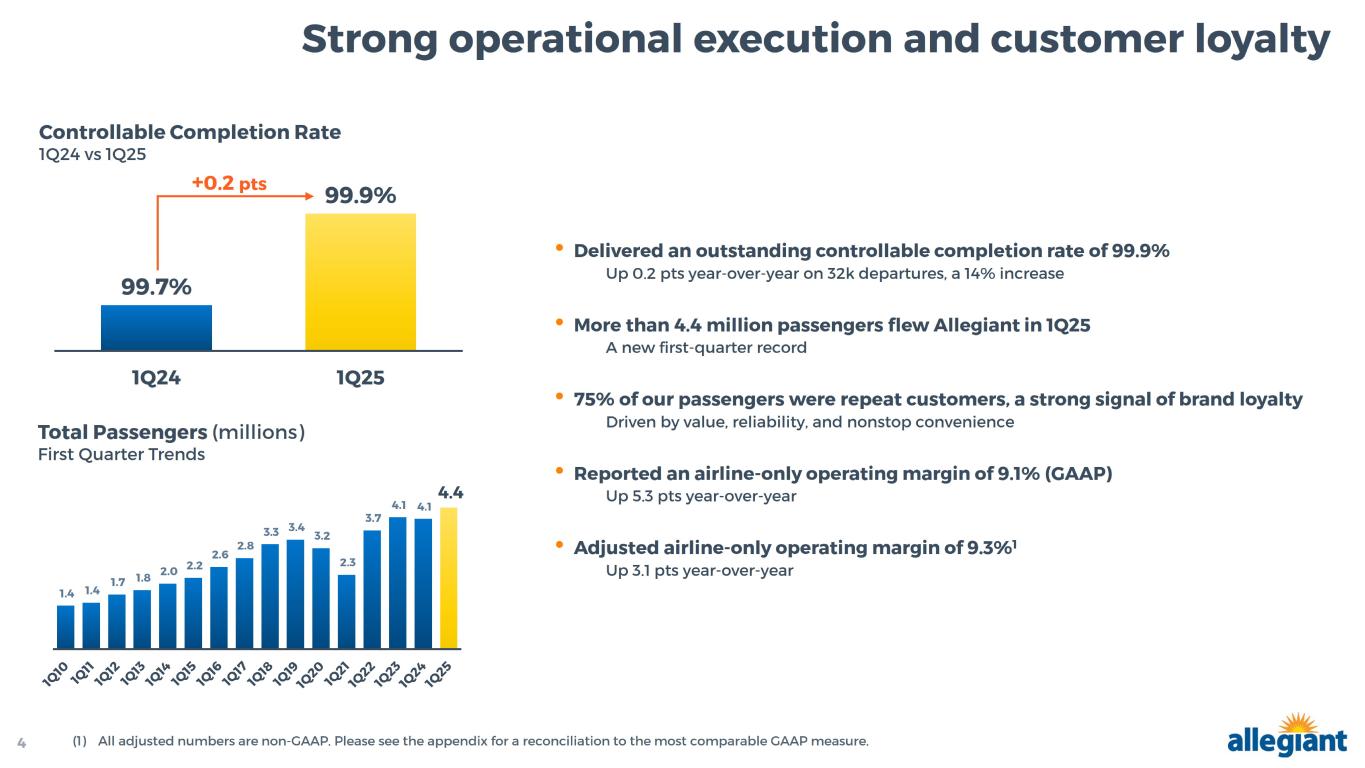
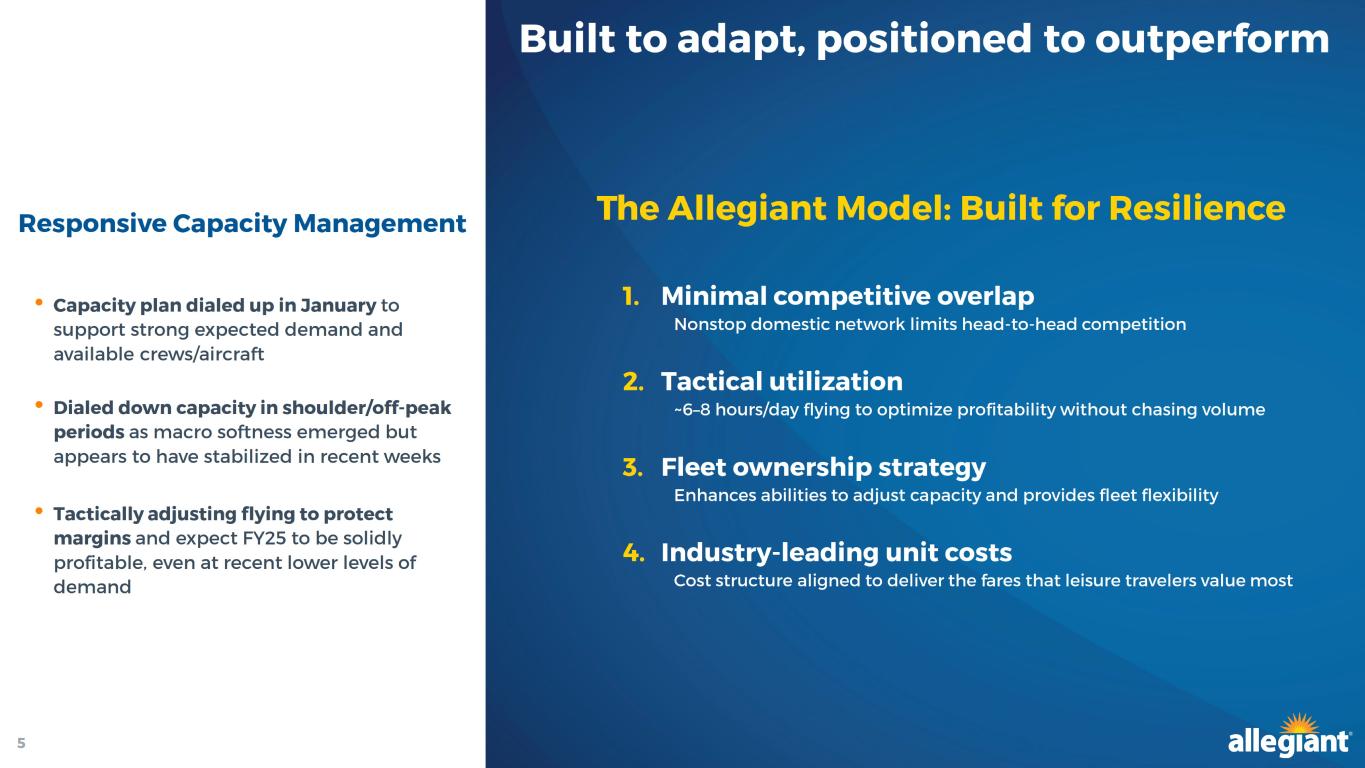
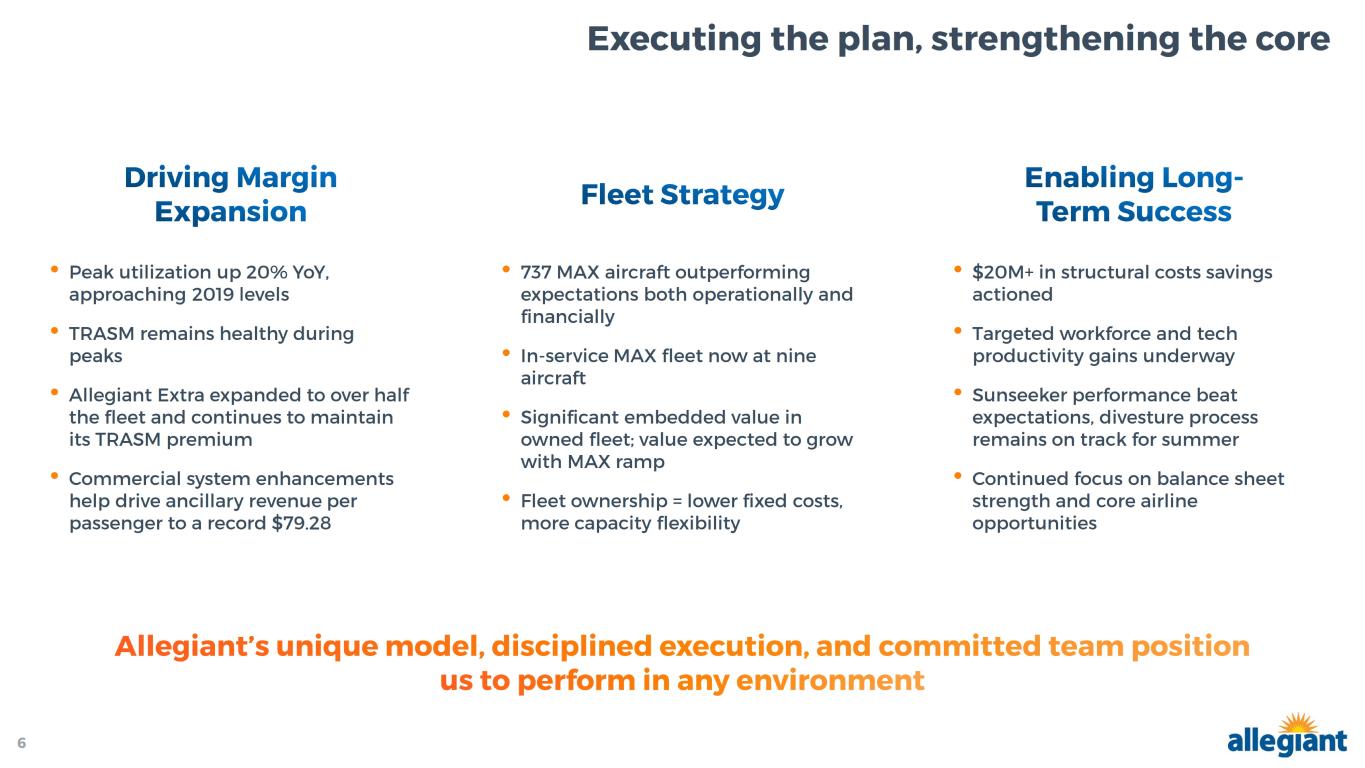
Sherry, thank you. Before I dive in, I am pleased to announce Tyler Hollingsworth has been officially named as our Chief Operating Officer. Over his 15 years at Allegiant, Tyler has held key roles across operations, most recently serving as interim COO, and has been instrumental in delivering the strong performance we continue to see today. That makes Tyler an excellent fit. Congratulations, Tyler. Turning to the quarter, the team delivered an outstanding controllable completion rate of 99.9% on 32,000 departures. Of 14% compared to the same period last year, more than 4.4 million passengers flew our airline in the quarter, the first quarter record, with 75% being repeat customers. Our customers recognize Allegiant's role in leisure-focused travel and consistently choose us for the distinctive value and experience we provide. This ongoing preference is evident in the strong engagement in our award-winning loyalty program, with the number of active cardholders increasing by nearly 7% year-over-year. The solid execution of our key initiatives discussed in prior quarters helped boost financial performance improvement. We reported an airline operating margin of 9.3% during the first quarter, up three percentage points versus last year. These results fell comfortably within the range of our initial guide provided in January, making us one of the few airlines to meet their initial targets. This excellent performance demonstrates the great work done by Team Allegiant despite a challenging start to the year. I want to extend my sincere appreciation for them. Thank you. In January of 2025, we turned the capacity knob up to plan for a year of strong growth. The demand backdrop was robust, and our favorable availability of crew and aircraft set us up nicely to drive meaningful margin expansion throughout the year. However, as economic uncertainty weighed on consumer confidence and discretionary spending, we acted quickly to adapt. Fortunately, Allegiant was built and designed with flexibility in mind. While peak leisure demand remains healthy, we responded promptly by turning the capacity knob down, primarily in the shoulder and off-peak, given the demand softness that showed up during these periods. Cost discipline is essential for us to protect margins. Aggressively managing capacity combined with additional structural cost reductions action during the quarter are expected to keep the airline solidly profitable in 2025, even in a stabilized lower demand environment. That said, we are currently seeing some improvements in our bookings. Allegiant pioneered the successful low fare model targeting leisure travelers. Our differentiated approach allows us to not only perform better than most during downturns, but hold strong our niche in the industry. Our airline has structural advantages, with the foundation built on the following cornerstones. First, minimizing competitive overlap with other domestic carriers and offering a network that ensures convenient nonstop travel from the core leisure airports we serve. Second, a strategic design focused on tactical utilization, optimizing profitability by operating aircraft for only six to eight hours per day on average. Third, a long-term fleet strategy centered on opportunistically acquiring and owning aircraft to support low fixed costs while building a high degree of fleet flexibility. Lastly, maintaining an industry-leading cost structure, as most leisure travelers are highly influenced by lower fares. For these reasons, Allegiant has been and will continue to be positioned uniquely. Furthermore, the execution of our key initiatives are going well, and with these initiatives are expected to further strengthen our foundation and drive margin improvement. Let me provide you with a brief update on our progress. First, restoring peak utilization. In the first quarter, peak utilization increased by 20 percent compared to the previous year and just slightly below 2019 levels. Peak leisure demand remains healthy with same-store trasm during these periods holding up well despite meaningful growth. Second, fleet flexibility. We are proactively managing our aircraft to the market conditions and our strategic needs. Moreover, our fleet holds significant equity value, a value we expect to meaningfully increase as we expand our in-service MAX fleet. During the first quarter, our growing cadre of MAX aircraft lose 6% of our ASMs and continues to outperform expectations operationally and financially. By year end, we anticipate 16% of ASMs to be flown by the MAX fleet and will continue to support strengthening our differentiated model. Third, product enhancements. The Legion Extra is now on more than half of our fleet, a five-fold increase when compared to the first quarter of 2024, and importantly, maintaining a strong revenue premium over our standard product. Additionally, we continue to enhance our bookings and reservation system, Naviter. These improvements have strengthened our operations and enabled us to reintroduce lost functionality and new features that are resulting in higher revenue. And fourth, cost discipline. Managing costs relentlessly is an everyday commitment to improve productivity, streamlined decision-making and challenged the status quo. Due to the recent economic downturn, material structural cost savings have already been proactively actioned with more initiatives under review. These changes support sustainable margin growth including adjustments in workforce alignment and enhancement through technology enabled productivity. And finally Sunseeker. We are confident that our new Sunseeker resort will do well over the long term. Sunseeker's financial performance exceeded expectations during the first quarter with EBITDA reaching $4.8 million compared to an EBITDA loss of negative $4.6 million in the first quarter of 2024. To that end, we recognize our core competencies lie within the airline business where we see abundant opportunity and long-term success. Maintaining a strong industry-leading balance sheet is also a top priority of ours. Pursuing a transaction related to the sale of the resort is an important step towards our objectives for the airline. And so So we're pleased to report this process remains on track for completion this summer, and we look forward to share further details when appropriate. And I'll close where I started. In a volatile environment, consistent execution and adaptability are essential, and that's where Legion excels. Our ability to deliver strong results while maintaining operational flexibility sets us The foundation of our model enables us to perform, adapt, and repeat. As we look ahead, our true north will remain centered around expanding margins and positioning Allegiant for long-term success. We will continue to manage capacity and cost aggressively as we closely monitor the demand environment and our greatest driver to success is Team Allegiant. Their dedication continues to set us apart and it is an honor to work with such a talented and inspiring team. With that I'll turn it over to Drew.
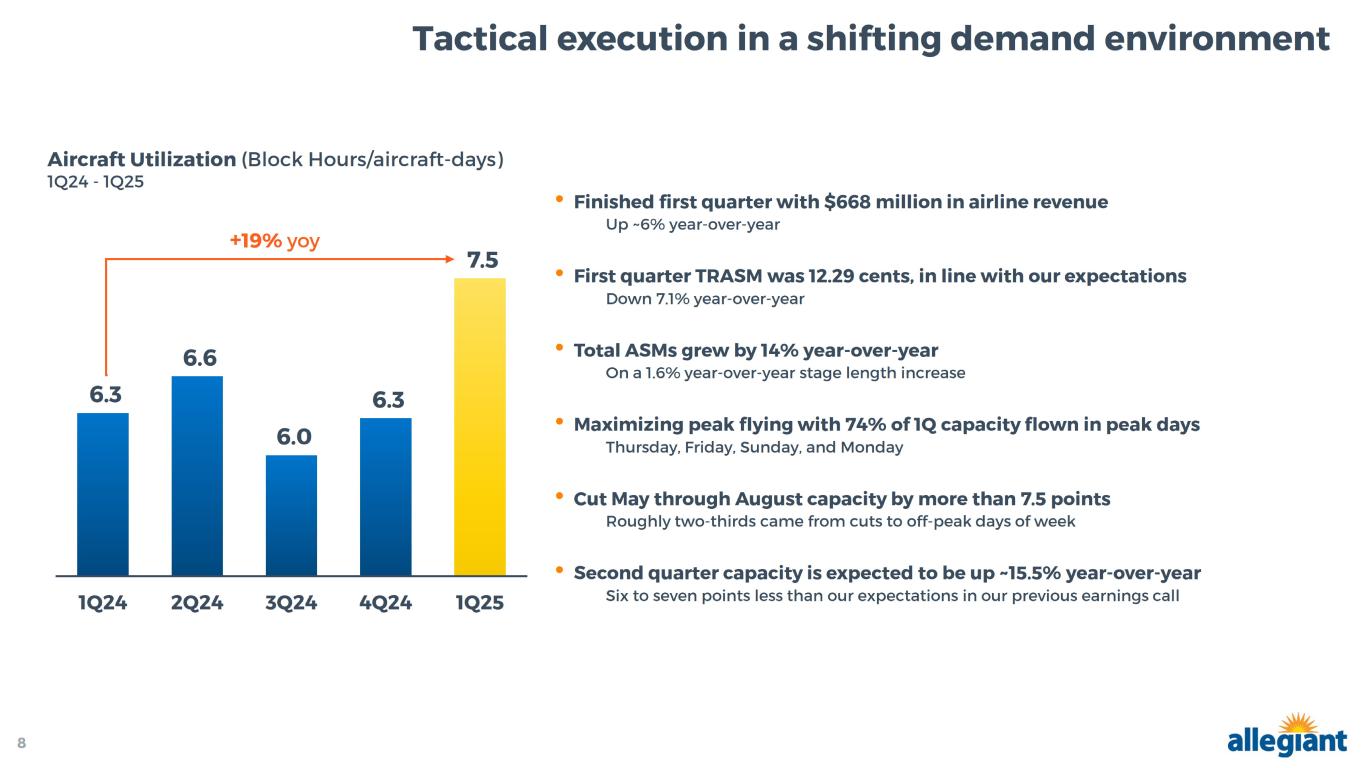
Thank you Greg and thanks everyone for joining us this afternoon. We finished the first quarter with 668 million dollars in airline revenue, approximately 6% above the prior year, producing a 1Q TRASM of $12.29, which was down 7.1% year-over-year, in line with our early March re-guide, and off just about a point from the initial guided figure of down just more than 6%. Allegiant grew total ASMs by 14.2%, with stage length increasing by about 1.6%. The first quarter capacity continues to build upon the unique attributes of our business model while supporting growth without adding aircraft and personnel. We were able to increase aircraft utilization by approximately 19 percent to 7.5 hours per aircraft per day in the first quarter. Despite the growth in the quarter, utilization still remains more than 10 percent lower than any other reporting carrier. To expand on this a bit more, given the demand environment that existed throughout the initial capacity planning process, we grew off-peak day-of-week ASMs approximately 34% in the first quarter. Even with this growth, we still flew 73% of ASMs on the peak leisure days of Thursday, Friday, Sunday, and Monday, the highest of reporting carriers in the first quarter. Due to the rapidly changing demand dynamics in the first quarter, this became increasingly important as the spread from peak day to off-peak day unit revenue performance returned to pre-pandemic variants as we previously communicated 2025 growth supported growing into our infrastructure the schedule was designed to fully leverage the existing infrastructure and in turn expand the margin profile the abrupt change in demand forces to course correct and better align our capacity with the current demand environment that current demand environment continues to present challenges across the industry we've diligently worked to find both the right price point that continues to stimulate customer demand and the right capacity to balance the overall revenue and cost outlook through all economic environments leisure customers have shown the intent to continue to travel but typically need a lower price point to fulfill that intent to support bookings we've seen pressure on yields but ancillary revenue has remained resilient in the first quarter our ancillary revenue per passenger of 79.28 was a record and up nearly 5% year-over-year, primarily driven by Allegiant Extra expansion and fully regained functionality from our Navitaire cutover in Fall 2023. Given the off-peak weakness experienced in the quarter, we focused our capacity review on shoulder season flying in May and August, and in particular, off-peak day flying in those months. More than 7.5 points of May through August capacity was removed, and roughly two-thirds of that capacity came from cuts to Tuesday, Wednesday, and Saturday flying. The adjustments to peak day flying were largely driven by closure of our LAX base, a strategic decision in response to rising airport costs, along with targeted route suspensions aimed at optimizing network efficiency. Following the capacity adjustments, we anticipate two QASMs to be of approximately 15.5% year-over-year, showcasing our continued ability to adapt and optimize in response to changing demand. In comparison to other airlines, we removed a larger percentage of capacity than any other carrier relative to published schedules at the start of the year. The quarter's ASM jump is predominantly driven by April's roughly 20% capacity increase, based on the late Easter shift, and a comp of down double digits in April 2024. Due to the timing of shifting demand trends, we had limited flexibility to adjust our April schedule. Looking ahead, while we anticipate second quarter TRASM to face greater year-over-year pressure than in the first quarter, periods like Easter and peak June are expected to deliver solid performance. We will remain vigilant and flexible with capacity moving forward to remain best positioned. Recent booking trends are promising and we are optimistic about the continued recovery and growth in demand. As we move forward, we expect to see continued strength and growth in our strategic initiatives. Nearly 65% of 2Q departures are planned to be on Allegiant extra-equipped aircraft. Despite the growth in departures and route serves, we continue to see a benefit of nearly $500 per departure on flights with a seat layout. 10% of 2Q departures are expected to take place on a new Boeing MAX. To date, our capacity deployment has been done to maximize throughput of crew members completing their operating experience. However, later this year, we expect to shift scheduled capacity toward a more commercial driven solution. We have lapped the first year of our Allianz travel insurance product and have seen the absolute contribution grow nearly 60% in April 2025 versus April 2024. And finally, at the end of the first quarter, our co-branded Allegiant Always Visa credit card grew cardholders approximately 11% over the last year, despite trailing 12-month ASM growth of less than 4% versus the previous 12 months.
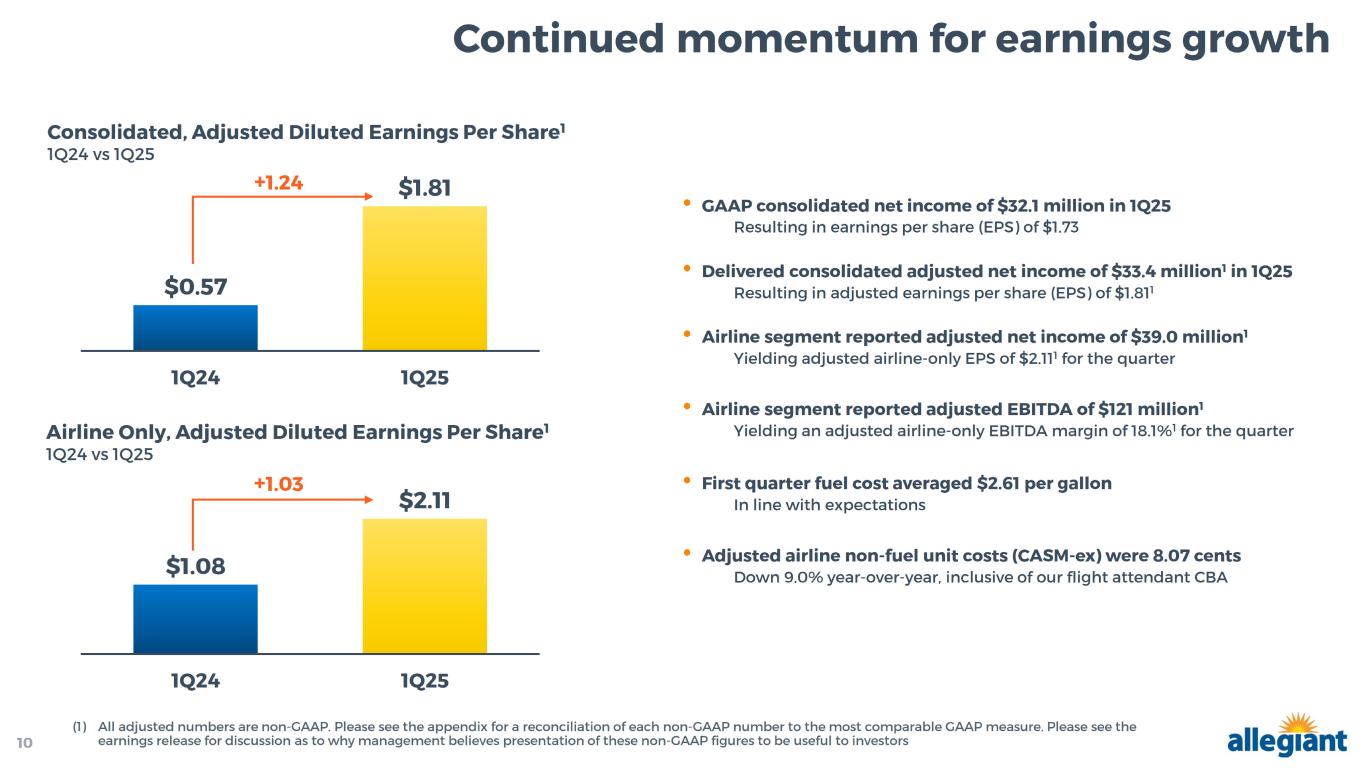
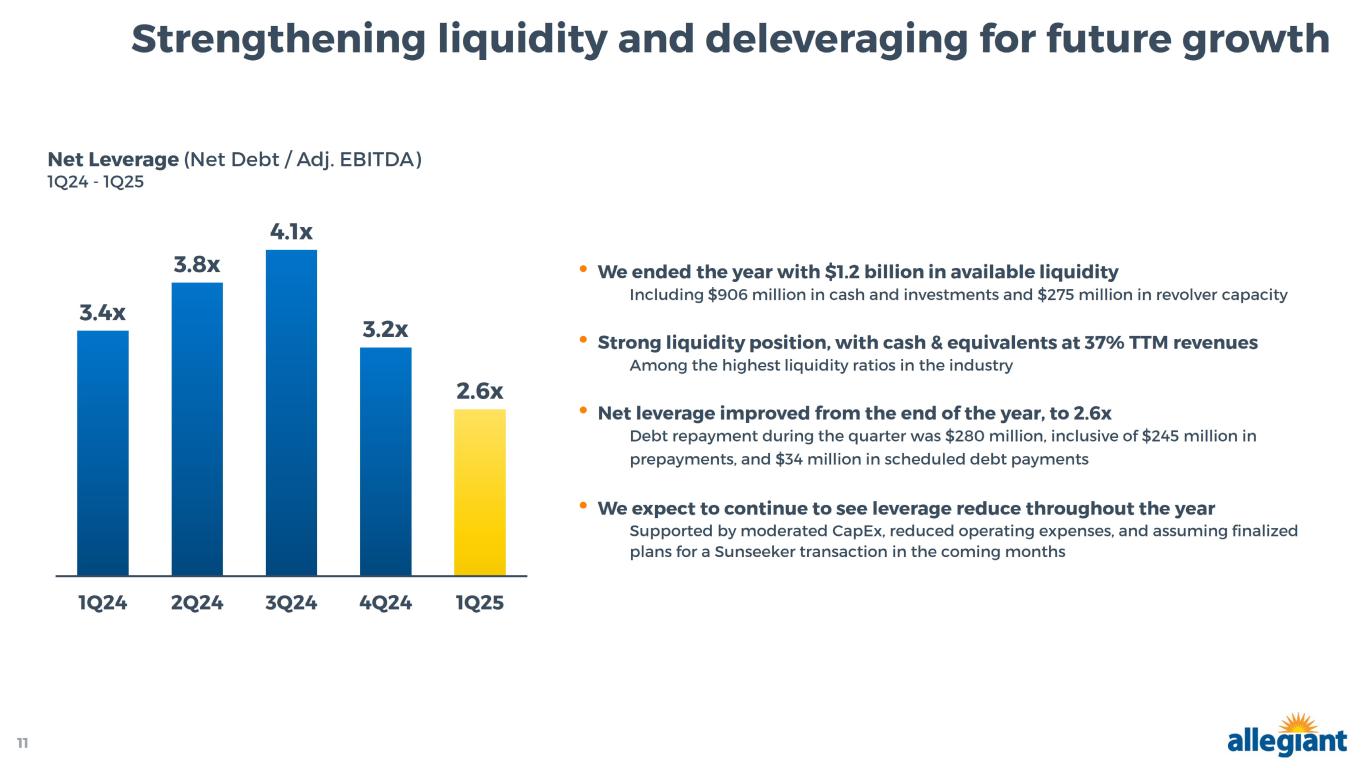
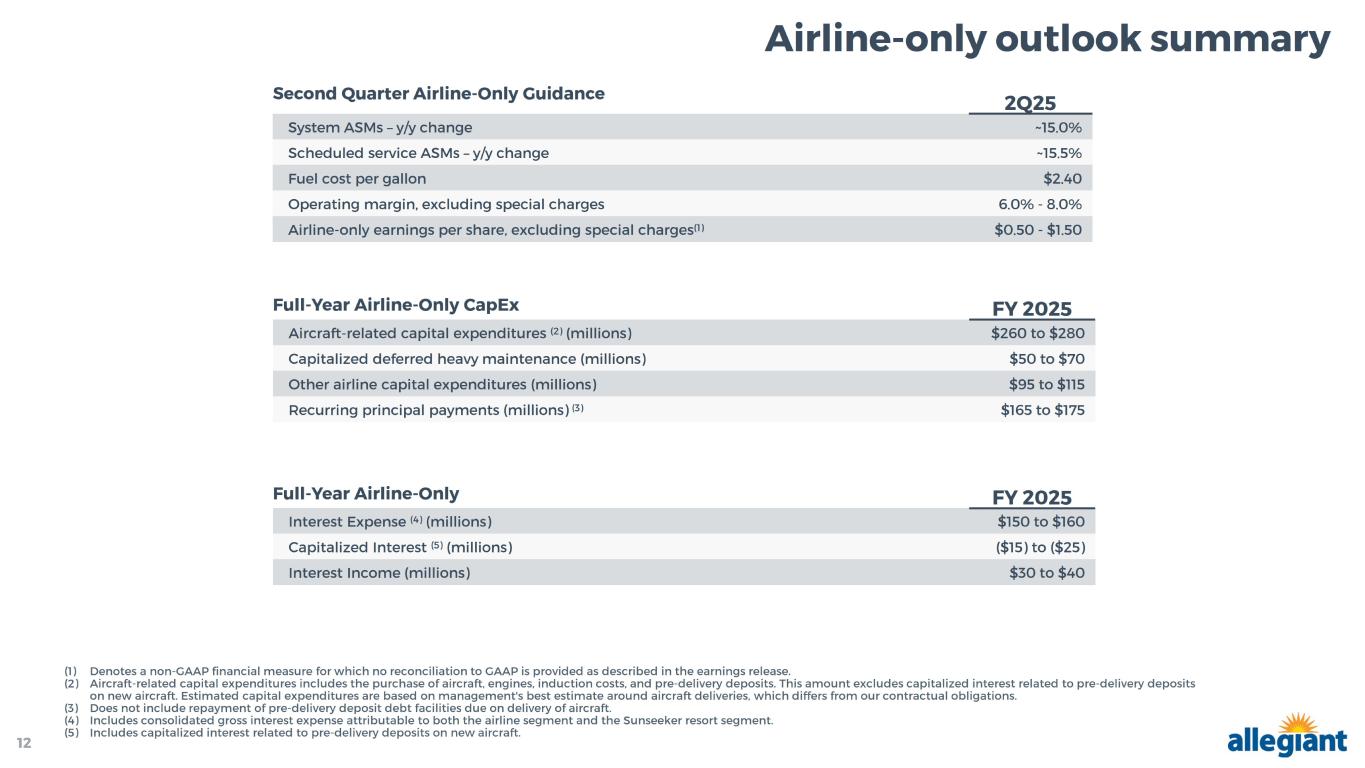
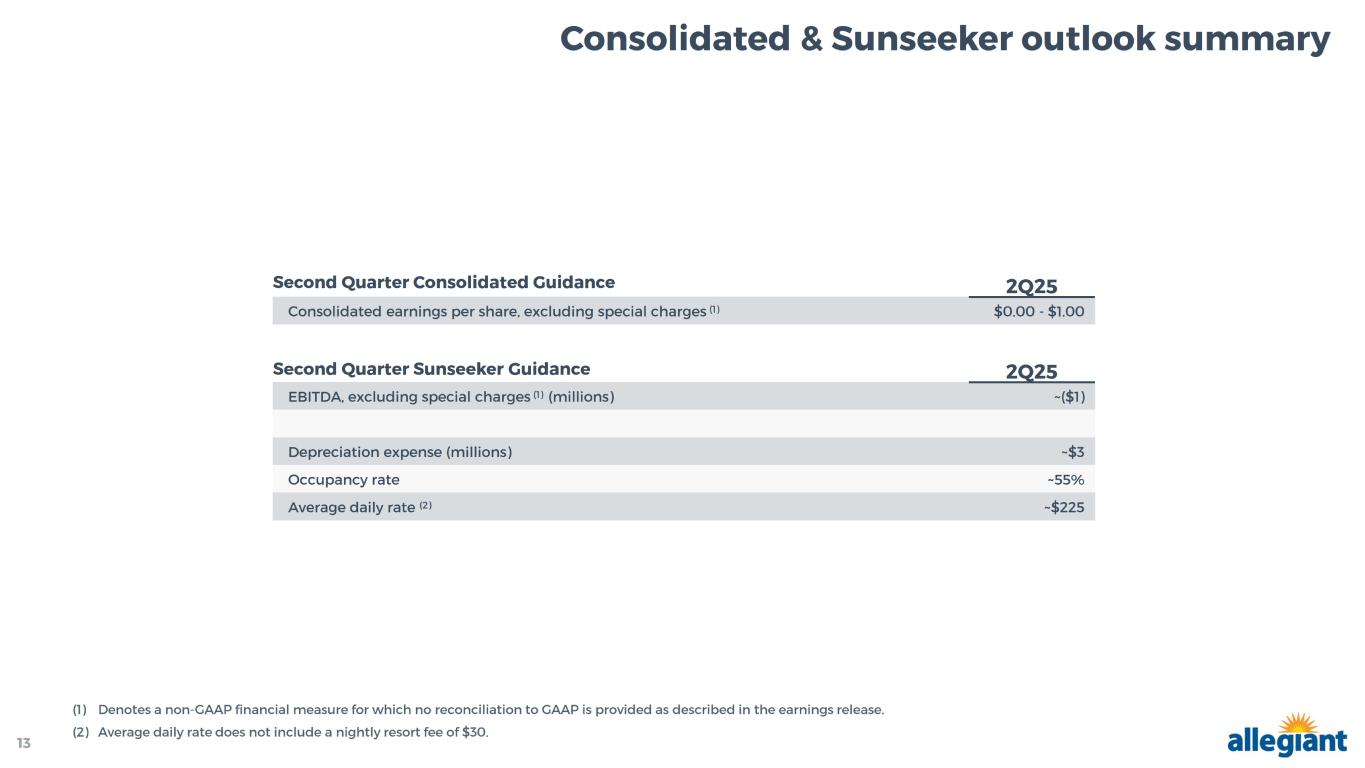
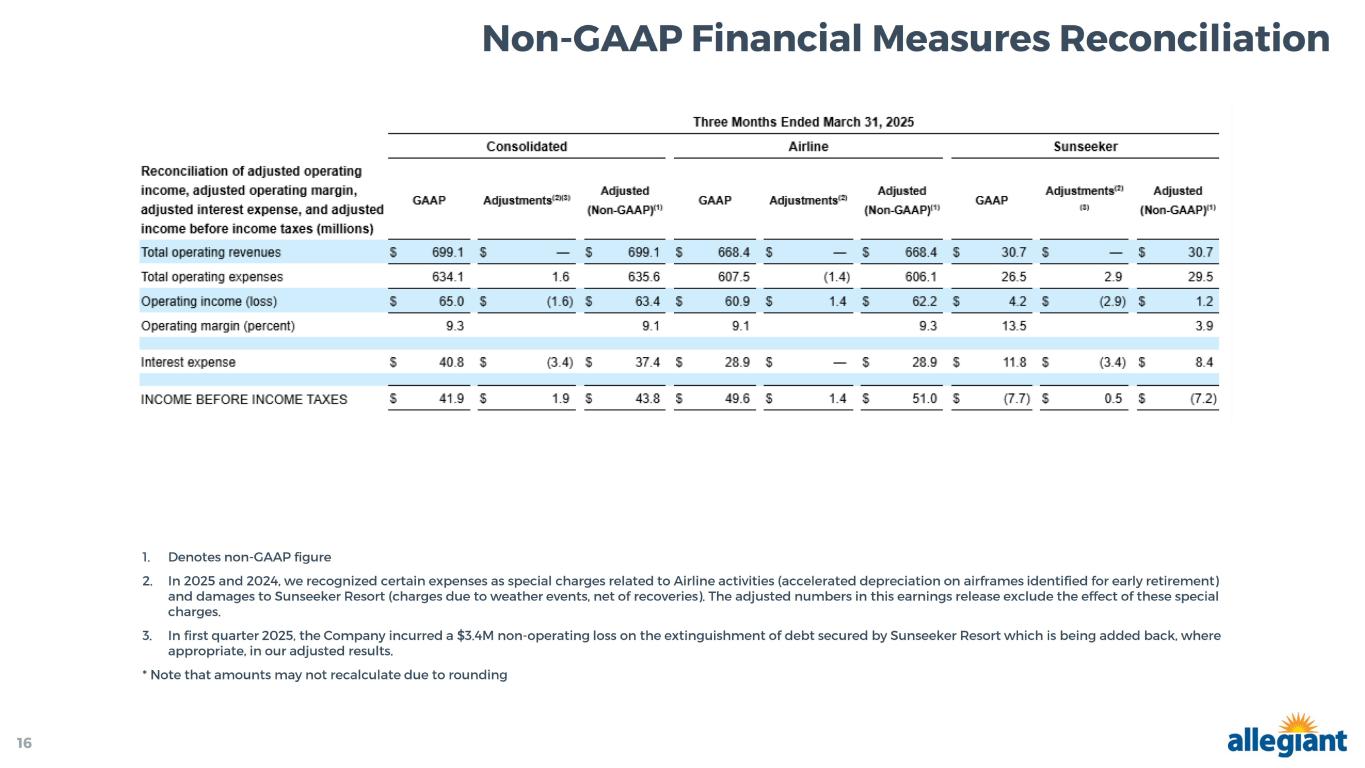
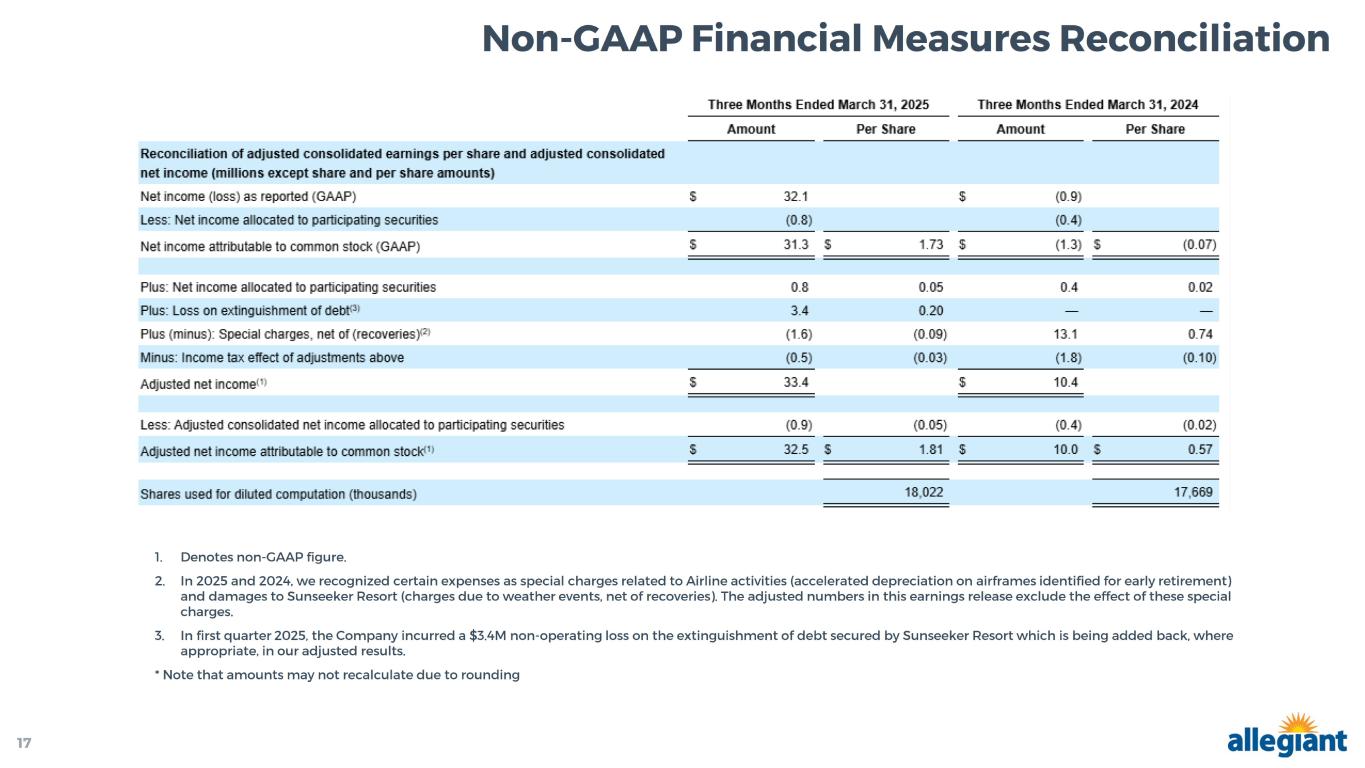
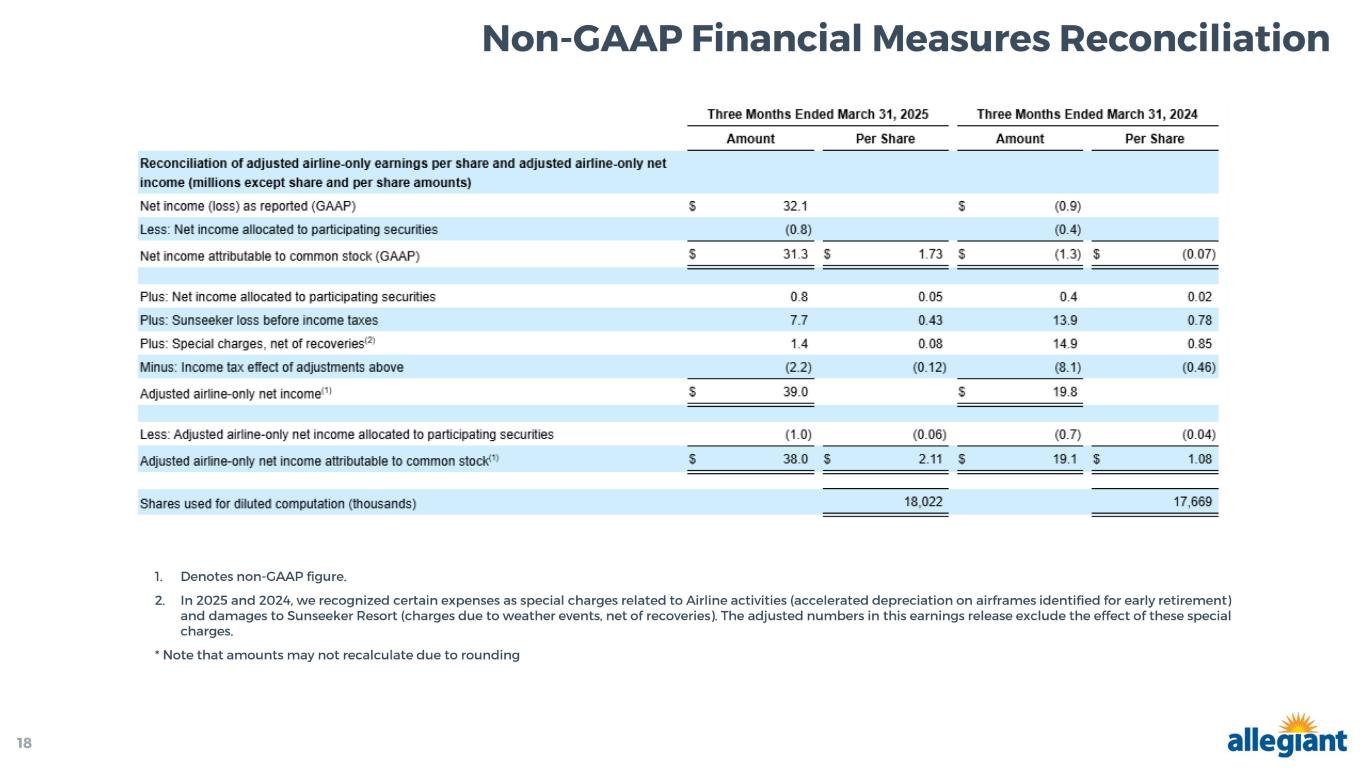
Additionally, consumer spend on the card was robust and outpaced 1q year-over-year passenger growth with early indications that April remains strong as well we look forward to continuing to grow the program alongside our partners and now I'd like to hand it over to Robert Neal all right thank you Drew good afternoon everyone and thank you for joining us today I'll walk through our results in our outlook this afternoon providing commentary on an adjusted basis excluding any special items unless otherwise noted for the first quarter 2025, Allegiant Travel Company consolidated net income with $33.4 million, resulting in consolidated earnings per share of $1.81. Our airline segment reported net income of $39 million, yielding airline-only earnings per share of $2.11, placing both consolidated and airline-only EPS within our original guidance. The airline generated $121 million in EBITDA during the quarter, 25 percent higher than the first quarter of 2024, resulting in an EBITDA margin of 18.1 percent. Fuel came in at $2.61 per gallon in line with our initial expectations. Total airline operating expenses were $606 million, approximately 2 percent above the first quarter of 2024 on 14 percent higher capacity. Excluding fuel, airline operating costs were $440 million, dollars, bringing non-fuel airline unit costs to 8.07 cents, down 9% year-over-year, outperforming our expectations. As a reminder, Casamex fuel for the quarter included wage increases for our flight attendants from the April 2024 CBA, as well as approximately $20 million in costs related to our pilot retention bonus. The better-than-expected cost performance was attributable to various items throughout each of our cost lines, some of which are timing-related and will shift into later quarters but i will note better than expected benefits from non-salary flight crew expenses and higher than expected gains on asset sales both of which are reflected in the other expenses line i'm pleased to see the cost performance coming in on plan as we benefit from better leveraging our existing infrastructure and growing into our workforce and i'm optimistic about our cost structure looking through the rest of the year turning to the balance sheet We ended the quarter with $1.2 billion in available liquidity, comprised of $906 million in cash and investments, and $275 million in undrawn revolvers. Debt repayment during the quarter was $281 million, inclusive of $246 million in prepayments, and $35 million in scheduled debt repayments. Net leverage improved to 2.6 turns, down from 3.2 turns at the end of 2024, driven by $191 million in cash from operations. Total debt ended at $2 billion, down 10% versus the first quarter of 2024, reflecting the final prepayment of the Sunseeker construction loan and repayment of $96 million in an unsecured bridge facility, offset by financing for four max aircraft deliveries. While we remain committed to investments in the business, specifically our ongoing fleet renewal, we expect to see leverage reductions in the balance of the year, with support for moderated CapEx, reduced operating expenses, and assuming we finalize a plan for Sunseeker in the coming months. As we've shared before, earning the right to grow is underpinned by balance sheet strength, which remains a top priority for our management team. Liquidity metrics remain strong with cash at 37% of trailing 12-month revenues, exclusive of $275 million in undrawn revolver capacity. Additionally, our unencumbered fleet assets carry a current market value of approximately $600 million. dollars capital expenditures during the quarter were 83 million dollars which included approximately 65 million for aircraft engines pdps and inductions and 18 million in other airline capex deferred heavy maintenance spend was approximately 14 million dollars on the fleet side we retired two a320 series aircraft during the quarter and placed four 737 max aircraft into service two more than previously anticipated and we ended the quarter with 127 aircraft in the operating fleet we're becoming increasingly confident in boeing's ability to look to deliver and we now expect 12 max deliveries during 2025 three more than our previous estimate as discussed on our february call we plan to offset these incremental aircraft by removing three more a320 series aircraft from service this year in addition to the 12 aircraft we had previously planned to exit and still anticipate ending the year with 122 aircraft and service. We've secured financing for all of our aircraft deliveries this year, with the first nine having either closed already or under definitive documentation, and the remaining three under LOI. In addition, during the second quarter, we extended $100 million of our revolving credit capacity with Credit Agricole, providing liquidity support through 2028. Notwithstanding the improved delivery performance at Boeing, we are reducing our full-year capital expenditure forecast by 80 million dollars to 435 million at the midpoint of today's guidance we expect aircraft related capex to come down by about 30 million from the midpoint of prior guide to approximately 270 million dollars as incremental aircraft delivery capex is more than offset by reduction in pdp requirements from a slower delivery schedule in 2026. we're forecasting deferred heavy maintenance capex of approximately 60 million dollars and other airline capex of approximately 105 million dollars moving to our second quarter outlook while we remain confident in the structural advantages of our model including cost flexibility and a highly adaptable fleet we think it's prudent to hold off on providing full year projections so for the second quarter we expect airline only operating margin of approximately seven percent at the midpoint and consolidated earnings per share of 50 cents with the airline contributing roughly one dollar Our guidance today assumes a second quarter fuel cost of $2.40 per gallon. In light of the fluid environment, we're not explicitly providing detailed unit cost guidance in our comments today. That said, we do expect to perform in line with messaging provided on our February call where we expect to see unit cost reductions throughout the year, even considering capacity reductions action to date with the first quarter delivering the strongest year-over-year performance. As Greg said, Allegiant's tactical utilization model, focused exclusively on the leisure traveler, has historically positioned us well during times of economic uncertainty. We expect no different this time, with continued flexibility in our own fleet, as well as great opportunity in our order book. In response to economic headlines and the challenging environment, leaders from across the business have come together to implement numerous cost initiatives, including early out options for certain employee groups closure of our crew and aircraft base in los angeles adjustments to overhead infrastructure and reduction of department budgets across the board in total we reduced our operating budget by more than 15 million in fixed costs in the balance of the year with the expectation to capture more than 20 million annually together with reduced or deferred capex we have removed over 90 million in spend from our 2025 plan excluding variable cost reductions from lower capacity demonstrating the agility and responsiveness of our team in closing i want to thank all of our team members for their hard work and dedication not only for strong performance during the first quarter but for coming together and making the right decisions to position allegiance to outperform over the long term despite near-term headwinds the strength of our model rooted in flexibility low fixed costs and bias for action provide the solid foundation to weather the current environment and capitalize on future opportunities. Thank you all for your time today. And with that, Kayla, we can now begin analyst questions.
Operator
At this time, I'd like to remind everyone in order to ask a question, press star, then the number one on your telephone keypad. Please limit to one question and one follow-up question. Our first question comes from the line of Dwayne Puffingworth with Evercore ISI. Your line is open.
Hey, nice to speak with you. Could you speak, too? I know you're not giving full-year guidance here, but just the shape of margins last year in the back half was pretty variable, so maybe you could just speak in broad strokes, at least on an airline-only basis, how you're thinking about that margin trajectory, and specifically you know the third quarter of last year where you had a a pretty decent size loss um you know how you're thinking about again the trajectory of margins um relative to the 2q guide that you're given here hey duane nice to speak with you as well this is greg why don't i kick it off and the team can add uh you know if there's anything that i may miss but you hit on it you know our
True North is going to be to drive an optimized margin. And so I think in the second half of the year, while we're not going to give a guide, we'll continue to, you know, aggressively manage capacity and costs to optimize margin. We'll have more time to adjust to the environment for Drew and his team to try and optimize the capacity and also optimize the network. We'll continue to assess the structural costs, you know, and if there's opportunity to pull more structural costs out of the business we're going to continue to look at that um but to your point on the third quarter that's generally for us and seasonally this has been the way uh in the history of our our model is the softest quarter of the year you know fourth quarter we would see you know stronger earnings uh than in the third quarter uh but we're focused on optimizing any way we can in this environment and uh we're going to make the necessary decisions to do so So I'm going to pause there to just see if Drew or BJ have any other commentary on the second half of the year.
I may just add then, Dwayne, that we, you know, in the fourth quarter last year, we did produce, I want to say it was like a 13% margin for the airline, you know, and our goal is to continue to, again, optimize margins, and then we'll see how we can improve the third quarter, which is our quarter with the most off-peak demand environment as we focus on the leisure customer. got it and then maybe just on uh sun seeker um can you give us an update on the on the process and and maybe timing um and then with respect to the f&b or or out of room spend you know how much of that is actually generated by customers that are staying in the resort um versus you know
locals and if we just think about the mix between a room revenue and and out of room revenue um are these trends kind of um you know are these trends consistent are these trends repeatable or is there something about the first quarter that makes it a one-off well why don't i start on the on your first question there duane about the process and then mike is on the call i think you can add some commentary on our second part of the question around uh the profile of f and b versus who's staying there but in terms of the process you know as you know and uh we've been running a competitive process uh for several months now we continue to down select along the way with the best suited counterparties um and this includes counterparties that are well capitalized with dry powder meaning that uh you know we're focused on execution in this environment um but the process does remain on track uh to have a transaction closed by this summer like just given kind of the nature of the discussions we're in i should probably just leave it at that but um but the positive is we do remain on track and then micah do you want to add uh to duane's question Yeah, absolutely, Duane.
The food and beverage revenues are probably 70-30 split, 70% coming from inside the hotels and 30% the work that we do to attract locals to the property. In terms of sustainability, the key in driving the earnings in Q1 and Q2 and beyond has been, as we've talked before, is really, really tightly related to how well we do with group business and putting that group business on the books in advance. In Q1, we had just about double versus what we had in prior year, and that shows up really well in occupancy, in ADR, as well as in catering, which is a high-margin business for us. So it's absolutely sustainable on a go-forward basis. You can always consider Q1 to be the strongest of the quarters in the year for sure, but that is the model going forward.
Operator
And your next question comes from the line of Mike Linenberg with Deutsche Bank. Your line is open.
Oh, yeah. Hey, everyone. Just some modeling, some boring modeling questions here. What is the underlying fuel that you're using, and maybe what are you paying for jet fuel now, just because it has come down so much through earnings season? And the capacity, I know we started the year at 17%, and then it was 13%. Where are we, like, what's a good, you know, number for where we think your capacity is on an annual basis?
Hey, Mike. It's me here. On fuel, we're using $2.40 for our assumptions for the rest of the year at this point. We usually just pay to sort of what we're paying immediately before the call, and it's pretty close to that today.
And then on the capacity front, Drew here, you know, based on what's published today, what we anticipate uh what i think goes on sale today or tomorrow for the last six weeks of the year um with a little bit of completion adjustment 13 is the right number um but we'll say we'll stay on top of that um as we see how things progress here in the coming months and mike it's craig i just to drew's point on on that you know we'll um we're remaining very flexible but should the demand environment not improve, you know, our bias would be to cut more capacity in the back half of the year.
Okay, great. And then just as a quick follow-up, your other operating expenses were down pretty meaningfully. I know, BJ, you mentioned, you know, you ended up taking a gain. What was the, I mean, I didn't see it in the release, and maybe you said it, and I apologize. What is the amount on that gain? And then is that, as we look forward for modeling, is that something we're going to continue to see in subsequent quarters. Thanks. Thanks for taking my questions.
Thanks, Mike. Yeah, on the gain, I don't want to give the number exactly. These are from asset sales that are still happening kind of on a continued basis. The fleet team is liquidating some of the assets that we have begun to retire as these max airplanes have come into service, and so they're still sort of negotiating with counterparties and whatnot. We didn't disclose the gain this time like we did in the fourth quarter so that should tell you it's not as large as it was in the fourth quarter and then there's another meaningful good guy in the other expenses line this year which is a reduction in non-salary flight crew expenses so these are costs related to like crew travel and training events things like that which was significantly lower this year and actually were elevated through all of last year. Maybe lastly, on the gains from sale, we don't have anything planned currently for the second quarter. Not to say something couldn't get done, but we don't have anything planned currently, and there were some gains last year, so I would expect to see a little bit of pressure there in 2Q, but the program will continue in the back half of the year as...
Operator
And your next question comes from the line of Catherine O'Brien with Goldman Sacks, your line is open.
Hey, good afternoon everyone. Thanks for the time. So you called out over the last few weeks you've seen demand stabilize and there's been some improvement over the last several days. Can you just give us a bit more color on that? Like over what period are you seeing the improvement? Maybe help us think about the magnitude of the step down starting in Feb to stabilization and then how much things have improved off that bottom, realizing it's a recent trend. And I know you noted, you know, to expect a steeper rise of decline in 2Q, just trying to get a sense of how big of a step down, kind of putting all that mosaic together on trends. Thanks so much.
Yeah, Drew here, and I'll invariably disappoint you by not giving you all the details you're looking for. But I mean, if you just think about, you know, maybe size of the change in RASM, right, in the last call we said we'd be down just more than six, ended at 7.1, said we'll be down more despite taking about five points out of the 2Q schedule. So, you know, there's probably a mid—accounting for all that, there's probably a mid-single digit kind of variance in what we thought the revenue production would be. So, maybe read between the lines in terms of what that meant for change in demand, and And then, really, it's been about the last week that we've seen kind of an uptick. Back half of last week through today, it's probably a little bit better. I'll probably stop short of magnitude of downswing or upswing there, but it's kind of long and short of it.
I guess maybe just a quick follow-up. Anything notable on where you've seen that improvement? Is it something regional? Is it close-in bookings? Is it something beyond 30 days? Like, any noticeable trends, or is it pretty broad-based?
Pretty broad-based. You know, in the first quarter, we, we, or our last call, we talked about, you know, Canadian border cities in particular. That's, that's stabilized. I wouldn't say it's, it's meaningfully on the upswing, but, but that's at least stabilized. of seeing a little bit more come into summer, a little bit less than we'd like maybe into May. But, you know, I think that builds well into, you know, some of the comments today around the peak. And, you know, Memorial Day through June is where we would hope to see that lift. And we're definitively still in a shoulder period here until we get to Memorial Day.
Operator
And your next question comes from the line of Scott Group with Wolf Research. Your line is open.
Hey, thanks, afternoon. Just wanted to follow up there. So any just, maybe I missed it in that last answer, but any directional color you can give on sort of the RASM expectation for Q2, either sequentially year over year or however you want to think about it?
I'd probably leave it where I had it in my remarks, and we'll be down, we'll be pressured more than we were in the first quarter on a year-over-year, but I think that's about the extent of what we're sharing today.
Yeah, and what you just said, right, your mid-single-digit settle, a headwind of 5-6%, I think, Scott, in the second quarter is what we're seeing, or estimating, excuse me.
So I just wondered, you're saying that Q2 is five or six points worse than Q1? no just just yeah taking relative to what we would have expected at the first quarter call that that we said would be better um than where the first quarter ended up if your second quarter would be better than first and now we're on the other side of that so just trying to size the amount of the swing which is i get it unknown to unknown but um yeah i think that's kind of what we're given right okay so me so so we're all on this here you thought second previously thought second quarter would be less negative than first quarter.
Now it's going to be more negative than first quarter. And the delta between the two is about a five or six point swing. But again, we don't know how much less negative you originally thought Q2 was going to be.
That's right. You rolled up the mystery very well there.
And then maybe just similar question around, I just want to understand what your sort of messaging is on chasm um is it down sort of each quarter year over year of the rest of the year and any more i don't know any more color you want to you can share on chasm sure scott yeah i just wanted to reiterate i think there was a question on the february call about sort of the cadence of chasm x through the year um i think we'll maintain that although maybe not to you know completely the same degree with some of the capacity pulls that have taken place so we said 1q would be the low point um in year over year cost performance but unit cost performance will be strong um throughout the year uh and expecting uh expecting unit cost to be down in the second quarter and the third quarter fourth quarter is a little bit more challenging remember we had a 15 million dollar gain on sale in the fourth quarter of 24 and we had utilization coming back up in the last few weeks of the year, but feeling really good about unit cost performance if you can get the lead there.
Operator
And your next question comes from the line of Connor Cunningham with Milius Research. Your line is open.
Hi, everyone. Thank you. So when I think about you guys, I don't necessarily view you as someone who cares about market share as much as some of the other carriers that have talked about this earnings cycle. So just trying to understand how you got to the seven and a half points of capacity that you pulled out of the market. Maybe like to all the questions that have kind of been asked already, it just, it seems like, you know, your unit revenue is deteriorating a little bit faster than you anticipate, which is understandable. But why are we not pulling down more? And I'm not quite, it's not quite clear to me that we're fixing the second half issues without pulling down incrementally more from here. So just any thoughts around how you got to the 7.5 number in general?
Yeah, not a problem, Connor. So, you know, as we think about the short-term kind of right capacity load, we're still looking to maximize the margin profile, understanding that we don't have maybe quite as many levers to pull broadly from the fixed expense perspective. So if we take a look at February, about 97% of our markets cover their variable expenses. We think May is going to look somewhat similar to that, maybe slightly more depressed. And so that's kind of what we're targeting again, right? We're targeting ensuring that the capacity that's out there is covering the variable that will push earnings and, you know, by way, margin as well as high as we can. You know, I'm sure we'll get some of those calls wrong, but that's kind of where we left out to taking a look at where the bookings were, where we felt we were in a good place from that gross contribution, and then, of course, everything that spilled out from the LAX-based closure and, in fact, there primarily through the summer. But that was the approach.
Okay. And then in the second half, we just, Drew, in the second half, just to hit on your point there, Connor, around capacity, I mean, we're monitoring the environment and we will, but we're going to aggressively managed capacity in the second half. I don't want to put words in Drew's mouth, but we just don't have to make those decisions today on the second half, but in the coming weeks and months, we will be. Is that fair, Drew? Yeah, that's fair, right?
Okay, and then maybe bigger picture, you mentioned in the deck, you know, past performance, and I think that, you know, we all know your competitive advantages relative to some of these other peers out there. So, when you look at a potential downturn, I mean, I know that you're not seeing that quite yet, but a further one from here, you know, this cycle is a lot different than prior cycles. You have other leisure, you know, focused airlines that are really struggling out there and there's relative strength at the larger, the larger airline. So I'm just trying to understand on how you may approach this downturn a little bit different. Like is M&A something that you guys would look at?
Just like what are the thought process around, around a further pullback, knowing that you'll be at a relative advantage to a lot of other airlines out there thank you I appreciate that Connor why don't I kick it off it's an important question and I do though think that relative to let's say prior downturns that the kind of foundation of a legion is still intact meaning I'm talking about the four cornerstones that I mentioned in my script are really the network the tactical utilization and flexibility within our fleet so that gives us a lot more optionality i think to adjust to the environment um in our infrastructure it is i think you and others are aware you know we've been waiting for some time on the delays with the max aircraft so we've been carrying an infrastructure that was larger than what we had thinking we've had the opportunity to grow in that this year um but with the demand environment dropping now we've already actioned on the infrastructure we will continue to do so. But to your point on that or your question on the industry, you know, I think consolidation or M&A, I think we're all aligned that, you know, the industry needs less supply, particularly in the low fare space. Leisure fares have not kept up, obviously, with the rising cost environment. And clearly, there's some low cost carriers that their models are struggling. I think we continue to be, in my opinion, in a category of our own. While I'll say consolidation isn't necessarily a requirement for Allegiant, I think we still have a great model with great assets, a network, the product set, the flexibility, and all that to continue to outperform in a downturn and emerge in a relative stronger position.
That said, our focus is and always will be to drive shareholder value and should we should always be open to any opportunities that are in support of that hey conrad it's bj i'll just add in uh you know back to your your first question to tie to that that last one i mean that's one of the reasons that that you haven't seen further cuts from us um the the cuts that we've done to date we believe are um margin optimizing and uh doing much more than that would make us cut into our infrastructure uh to to a place that might not put us in such an advantageous position on the other side of all this so we just want to be um thinking about what we're doing today with the future in mind and your next
question comes from the line of andrew dadora with bank of america your line is open hey good good afternoon everyone um first question might be a little bit of a stretch but just in terms of sun seeker um is there anything that you're seeing in your booking curve there you know maybe in the longer dated group bookings that can give you like a bit of a read in terms of how you think airline demand could trend over the the rest of 2025.
I might be on the I don't know that we have a good answer for you on that candidly Andrew uh what I would say though in Sunseeker it's tough because it's more nascent right we just opened it last year but uh year over year you know we've seen lot of strength that's that's on the sun seeker side um that's you know group business has been a big catalyst of that um and on the second quarter i think we put out uh our guide was down roughly a million i think in eva that's a significant improvement year over year so i think it's just a little bit difficult for us to kind of weave through just given the you know the relatively new nature of the of the resort um but let us follow up and see if there's something we can clean from that and come back to you on.
Maybe the only other thing I'd mention, with that area, Tanagorda, we're kind of exiting the peak season going into the off-peak now. It's going to be tough to get a little bit of a read-through from the airline side until we get that full winter schedule extended, and then you'll get a bit more of a read-through to the actual core peak demand for that area. So, yeah, to Greg's point, we might need a little time to get back on that.
No, I understood. I knew it was a little bit of a stretch question. Again, just kind of as a follow-up here just with regards to the capacity changes you've discussed on the call um you know i assume these are the lowest margin flying that you have some other airlines have spoken to the kind of the rasm differential of peak versus off-peak any way you could help quantify that rasm differential for for the routes you you've cut versus the rest of your system um i don't have that off the top of my head for it for that um that split you know when we look at just overall um through through the peak march period and like i put in my remarks it looks very much like um like pre-pandemic uh peak day it's off peak day um you know so as you as you peel
that back into what we cut back it would be um things we anticipate maybe a little bit weaker as you can imagine, or places where we could easily absorb, you know, we do, believe it or not, have a few of these in our system, a double data that we could absorb onto a single with relatively little loss of revenue there. So, maybe that helps a little bit, but I know I'm not getting all the way there for you.
Operator
Thanks, Andrew. Next question comes from Tom Fitzgerald with TD Cohen. Your line is open.
Hi, everyone. Thanks so much for the time. In the slides, you talked about how the MAX is outperforming your expectations operationally and financially. I wonder if you could give any numbers on that. I remember when the order was first placed, you talked about looking at it on EBITDA or aircraft metrics.
So, I don't know if it's outperforming on your margin expectations versus the rest of the aircraft in your fleet, but any color there would be helpful. yeah tom thanks it's great why don't i take it and bj may add some color if you'd like on the on the operational front i mean dispatch reliability is above advertised from boeing before we place the order and it's almost it's a full point maybe a little bit more than that above our system average so really pleased with the operational performance on the financial performance and i you know i think you were alluding to this but we we placed our order you know at a time when no one else was buying airplanes so it just it was timed well we believe uh but in the first quarter keep in mind it's still early but the first quarter uh we had about i want to say a 35 percent evita advantage per aircraft on the on the max fleet as compared to the A320 180-seat Allegiant Extra product configuration. So we're seeing it perform nicely. It's still early. Drew mentioned this, I think, in his opening comments as well. We haven't built the plan around the max yet to commercialize. We've been really working the pilots and getting them type rated and trained. last year I think we had roughly 100 pilots or a little bit more offline waiting to be type rated on the max aircraft and today Tyler I think all or nearly all are now through and are flying for the most part is that fair yeah that's fair so in the fall then we'll begin to better commercialize the max where we think there could even be more opportunity but I caveat all that with it's still early and this is the first quarter.
Hey, Tom, I just add that, you know, in addition to the EBITDA performance that Greg mentioned, you know, we've talked about depreciation expense being similar to those A320s that we were adding, you know, kind of, I'll call it 2018-19 timeframe. So you're seeing similar depreciation, but you're also seeing a benefit from the maintenance honeymoon. We haven't been adding new airplanes in a long time, and so there's a meaningful benefit in the maintenance honeymoon.
Okay, thanks. That's really helpful, caller. Appreciate that. Just as a quick follow-up on the modeling side, and apologies if you mentioned this and you're prepared, but on the sales and distribution line item in OPEX, that was down, I want to say like 17%. Was that just improvements on Navatar? Is that a higher mix of direct bookings? Appreciate any caller you could provide there. Thanks again for the time, everyone.
Sure, Tom. Yeah, it was a handful of things. There is some reduced spending in certain types of advertising like sponsorships. There's some improvement in credit card fees, but the meaningful driver there is a settlement with one of the card processors related to processing fees going back a number of years.
Operator
And your next question comes from the line of Christopher Stathupoulos with Susquehanna International Group. Your line is open.
Good afternoon. I want to circle back to the comments, I think it was from Scott, on RASM. So, in the prepared remarks, I heard same-store RASM, I think, performing well or up, and 2Q qualitatively more negative than 1Q. So, as we think about your route structure here, you screen lower with respect to relative route overlap. So if you could, perhaps if we could rank order your routes here, you know, what is the delta between the top quartile and bottom quartile routes?
If you want to show it on a stage length adjusted basis, just want to better understand here, given your network structure and fewer overlaps, how the better to kind of, how that quartile, I guess, or rank order, however you want to describe it is performing on a relative basis thank you yeah so if i remember right from greg's remarks he was talking to kind of the peak march and peak periods in particular holding up quite well um which is true you know we're not going to sit here and say that the off peaks and shoulders are holding up well that's why i've seen capacity come out in the way you have and will continue to be reviewed i'm not particularly interested in going through quartile results um here on the call um so you know okay um and so as a follow-up on the sound the shape of second half capacity any color you can provide with respect to markets new routes suspensions frequency and of course uh the the new aircraft configuration um that you cited um earlier thank you um so for the second half of the year you know we remain um somewhat elevated low double digits for for july um and into august mind you august has come down approximately 15 points give or take um from what we'd originally planned um september i believe is in the the mid to high singles um october looks quite high but remember we have a hurricane comp there that cut out a meaningful amount of capacity um and then you're kind of getting into you know by the time you get to the holidays you know that's the capacity that's going to go on sale here this week so we've had a lot more time to digest what the the uh demand environment looks like and respond accordingly and remember we had boosted december 2024 utilization that's kind of our first peak period so i wouldn't expect meaningful growth there so that's kind of where we stand today for for published or soon to be published schedules but as greg mentioned that that's all very much um still under review um as we think about um kind of new route profile you We'll stay probably mid single digits, I think maybe 5% of routes that'll be in a period of maturing still the first 12 months. The rest should be in the same store capacity. I think we're down for this year, I think we've announced mid-20s number of routes that have gone canceled or suspended, and obviously doors still open for more of those such that the environment calls for it.
And then on aircraft configuration, I'm sorry, Drew, feel free to add in if you know by flight. So on configuration, we ended 24 with 52 of our A320s in the Allegiant Extra configuration and four of our maxes. Currently at 60 A320s and nine maxes in the fleet. And then by the year, end of the year, I'm showing 75 A320s in the Allegiant Extra configuration and then all 16 maxes.
Yeah, a little bit less than half of what's left to retrofit on the A320s will happen and here in the next couple of weeks with the balance happening in September to round that out.
Yeah, and actually maybe just to share, if you look at the fleet plan and the earnings release for this year, we started breaking out 180 versus 186 seat to 320, the 180 seat is the Allegiant extra configuration. So we gave a guide by quarter.
Operator
And your next question comes from the line of Dan McKenzie with Seaport Global. Your line is open.
Oh, hey, thanks. Good afternoon, guys. Drew, apologies for kicking a dead horse here on the recent uptick, but does the guide in bed that pick up as continuing into the month of June? And I guess I'm just trying to get some sense of the sustainability of the current trends. Is that uptick just as simple as lower pricing, stimulating demand further out, or are you seeing it tied more to reduce, say, macro headline risk?
Yeah, good question. So, you know, fares yields have been depressed for a few months as we work to simulate customer You know, that's been successful. April sale looked really good, candidly, a few weeks back. So that's had definitely an influence. I think this goes just a level deeper in terms of search traffic and overall visitation being a little bit healthier. That helps drive more bookings while fares remain lower as well. So a little bit of both, with more recently probably being more than just fairs on their own.
And our Q guide does not take into it. We're not assuming any uptick in rabbit hole.
No, I'm not assuming that this is, yeah, continuing in a meaningfully positive fashion or something like that. So it's more of a status quo kind of approach.
Understood. And then, I guess, Drew, Allegiant Extra is on, I guess, over 50% of the fleet today. So I guess the question is, what does that look like at the end of the second quarter and for the full year? And can you share what percent of the revenue picture it is and what rate it's growing at?
I can try on that. So we mentioned that 65% of the second quarter departures will have Allegiant Extra on board. That will tick up just a little bit, I believe, in the third quarter and maybe just a little bit more in the fourth. but without a huge number of maxes coming to the back half of the year it's going to be the retrofit of which there's only 15 I believe remaining in the year so it'll take up a little bit but I wouldn't run away with it it's definitely out punching its weight so remember Legion extra rolls through as an ancillary item as seat revenue and not something in the fair line so while we don't go to that level of detail you know you're going to out punch 62% of of departures in terms of the contribution of CREVs, if that makes sense.
Operator
And I would now like to turn the call back over to Sherry Wilson.
Thank you everyone for joining the call today. Please feel free to reach out with questions. Otherwise, we'll talk to you next quarter.
Operator
This concludes today's conference call. You may now disconnect.