Operator
Thank you for standing by. At this time, I would like to welcome everyone to today's Allegiant Travel Company second quarter 2025 earnings call. All lines have been placed on mute to prevent any background noise. After the speaker's remarks, there will be a question and answer session. If you'd like to ask a question during that time, simply press star followed by the number one on your telephone keypad. Once again, star one. And if you'd like to withdraw your question, simply press star one again. Thank you. I would now like to turn the call over to Sherry Wilson, Managing Director of Investor Relations.
Sherry. Thank you, Greg. Welcome to the Allegiant Travel Company's second quarter 2025 earnings call. We will begin today's call with Greg Anderson, President and CEO, providing a high-level overview of our results along with an update on our business. Drew Wells, Chief Commercial Officer, will walk through our capacity plans and revenue performance. And finally, Robert Neal, Chief financial officer will speak to our financial results and outlook following commentary we will open it up to questions we ask that you please limit yourself to one question and one follow-up the company's comments today will contain forward-looking statements concerning our future performance and strategic plan various risk factors could cause the underlying assumptions of these statements and our actual results to differ materially from those expressed or implied by our forward-looking statements. These risk factors and others are more fully disclosed in our filings with the SEC. Any forward-looking statements are based on information available to us today. We undertake no obligation to update publicly any forward-looking statements, whether as a result of future events, new information, or otherwise. The company cautions investors not to place undue reliance on forward-looking statements, which may be based on assumptions and events that do not materialize. To view this earnings release, as well as the rebroadcast of the call, feel free to visit the company's investor relations site at ir.legionaire.com. And with that, I'll turn it over to Greg.
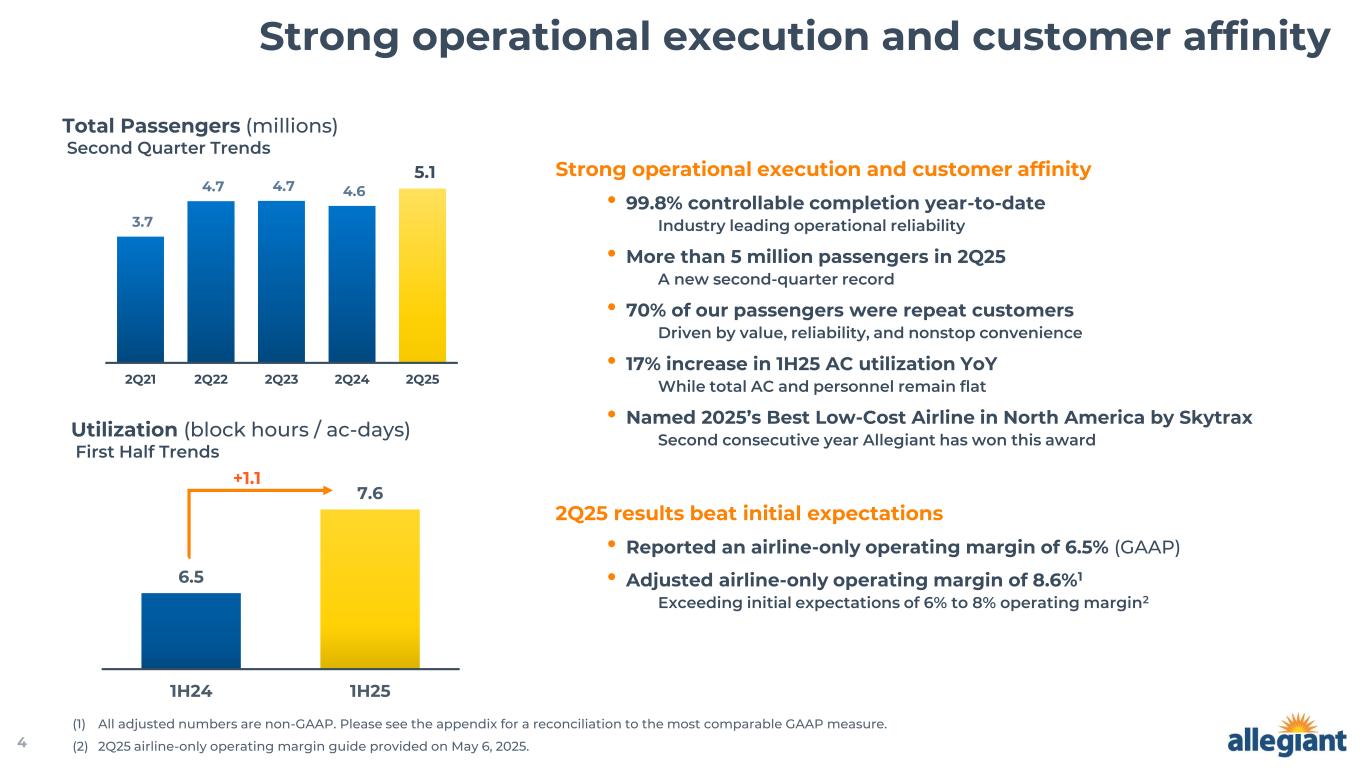
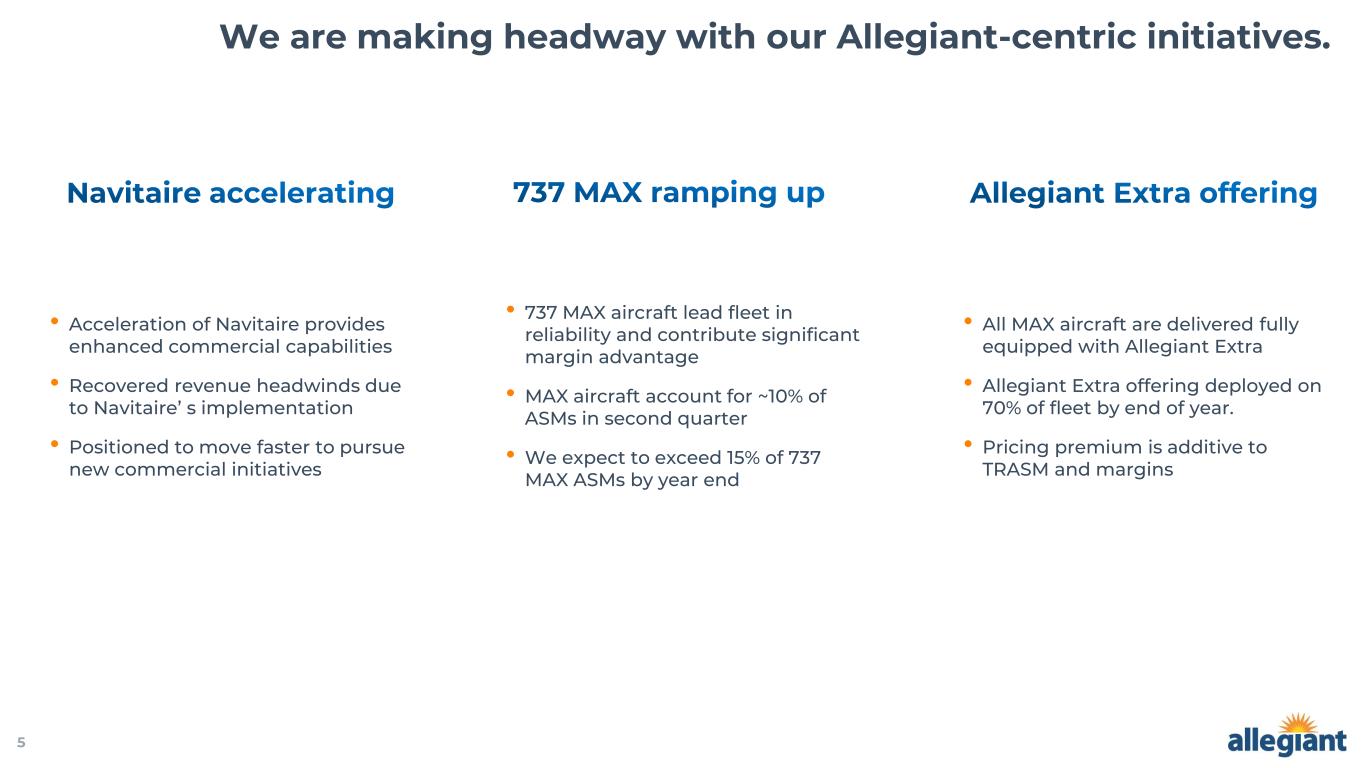
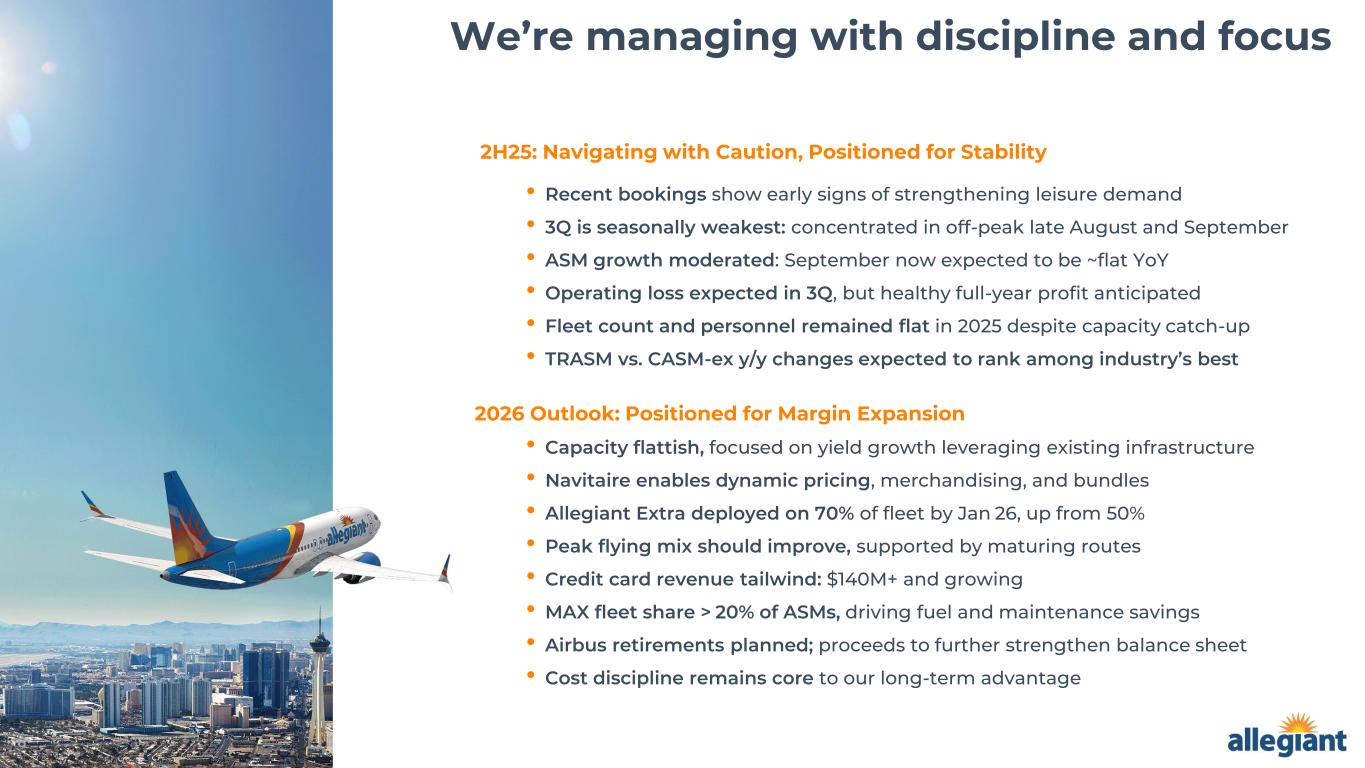
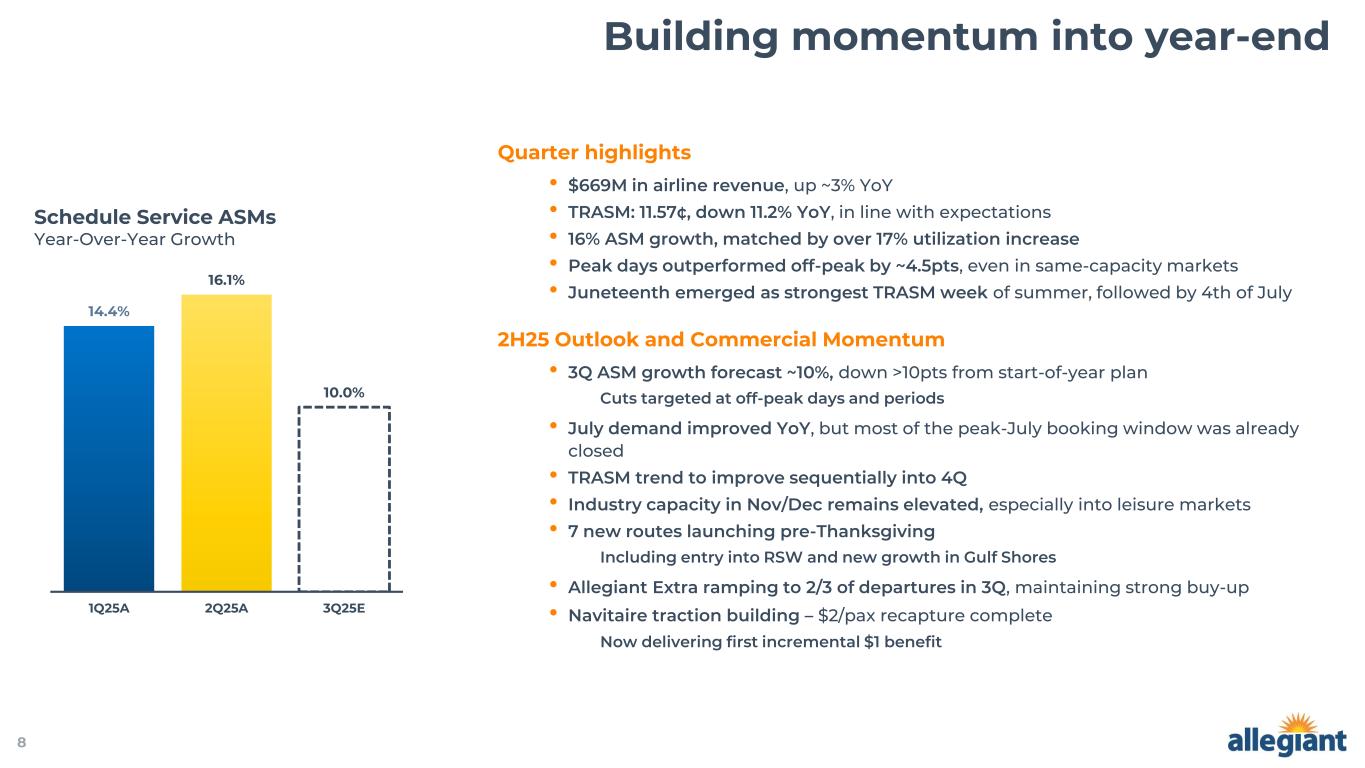
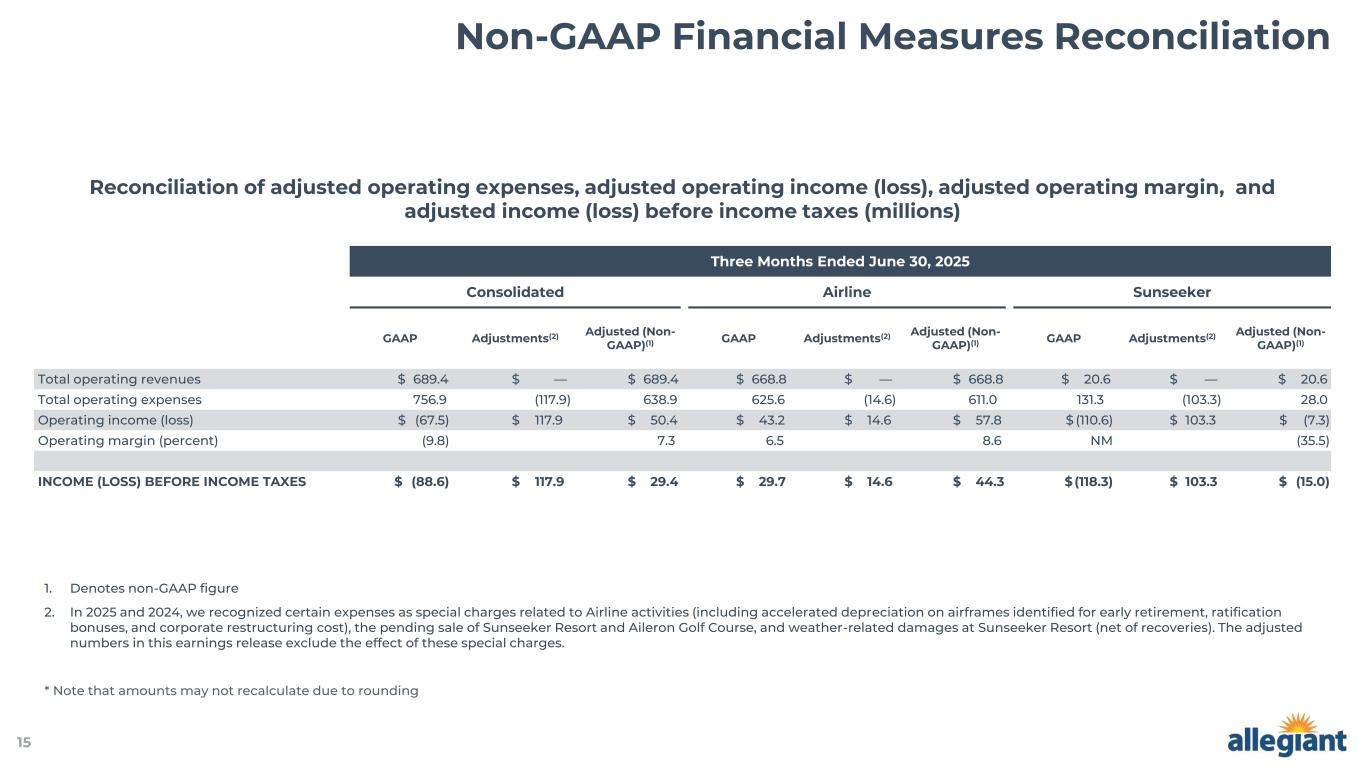
Thanks, Sherry, and thank you all for joining us today. I'm proud of our second quarter results where, once again, we delivered an excellent operating performance with a 99.9% controllable completion. We flew more than 5 million passengers, the record for the second quarter and approximately 70 of those are repeat customers a sign of our strong net promoter scores and reflects our position as the leading airline in most of the communities we serve offering reliable non-stop travel at unbeatable value i'm also happy to report that we achieved an airline operating margin of 8.6 exceeding our initial guidance combined with our first quarter performance our first half operating margin was close to nine percent an improvement compared to the first half of 2024. Pima Legion has done a good job at controlling what we can control. Aircraft utilization is back to our historic productivity levels, increasing by 17% in the first half versus a year ago, while total aircraft and personnel have remained flat. Furthermore, we are continually enhancing our commercial offerings and we are keeping a tight lid on costs. What we can't control is the demand environment. As many airlines have already commented, domestic leisure demand was noticeably softer during the first half of this year than initially anticipated. Despite this weaker domestic demand backdrop, we achieved solid profitability because we are one of the lowest cost providers in the industry and have a relentless focus on offering our customers attractive prices and a safe, reliable on-time product. We are making headway with our Legion-centric initiatives. With Navitaire's initial revenue headwinds behind us, we are better positioned to accelerate our progress as we further enhance its capabilities along with pursuing additional commercial initiatives our new max aircraft are boosting our performance as expected leading our fleet and reliability in contributing a significant margin advantage when compared to our older a320 aircraft the max fleet accounted for roughly 10 of our asms in the second quarter and we expect that amount to exceed 15 by year end our premium Allegiant Extra offering is in high demand by our customers. We are benefiting from a significant price bump for this product, which is both additive to margin and TRASM. Drew will speak in more detail, but I wanted to provide some insight to our overall TRASM trends. There are several factors that impact TRASM, including the mix of peak versus off-peak flying, existing markets versus new markets, and of course, capacity growth. When you look deeper into the numbers, peak TRASM is performing relatively well, reflecting strong customer demand during high travel periods. It is the shoulder and off-peak periods where demand softness, coupled with the capacity growth, has driven outside headwinds to reported TRASM. There are two things that are important here. The first is that we continue to manage our network to maximize profitability, and the shoulder and off-peak flying we added this year have been margin accretive. Second, adjusting for the mix of flying, we believe our TRASM decline compared favorably to domestic leisure trends of our peers, highlighting our strong competitive offering and positioning with our customers. As we announced last month, we are exiting Sunseeker, allowing us to further simplify the business and solely focus on our core airline. With that, let me shift to our initial views for the second half of the year. Although signs from the performance of the U.S. economy appear to be mixed, we are cautiously optimistic in our recent bookings that suggest a modest strengthening of leisure demand keep in mind that our third quarter is typically our seasonally weakest period for leisure demand due to the higher proportion of shoulder and off-peak compared to other quarters with the second half of august and most of september representing the lowest period for leisure travel during the year a key attribute of allegiance is our flexible scheduling as we look to peak to peaks and fly off peak when it makes sense economically appropriately we pull back on our capacity growth expectations for the full year due to increased macro and geopolitical uncertainty we have made further adjustments with september asms now expected to be roughly flat year over year vj will provide more details shortly but we expect to incur an operating loss in the third quarter importantly we continue to expect to report a healthy operating profit for the full year with our fourth quarter historically more in line with the first first two quarters and a much stronger quarter than the third, as leisure travel typically picks up seasonally. I also want to reiterate that we remain steadfast on our core principle that we need to earn the right to grow. While 2025 has been a year with meaningful growth, and as mentioned, that growth was accomplished without adding to our fleet count or to our personnel. It represents a one-time catch-up year after max delivery delays that sharply curtailed our capacity growth in previous year's encouragingly when we compare our first half 25 year-over-year changes between trasm and chasm x we believe it to be among the industry's best as we look to 2026 we currently expect capacity to be relatively flat as we further further harvest our current infrastructure those plans should help us improve our yields for several reasons first we expect to drive incremental revenue through enhanced navitaire capabilities and new commercial initiatives Second, we should benefit from routes maturing and with peak flying representing a greater proportion of ASMs in 26 than 2025. Also, we expect a tailwind from a more fully ramped Allegiant Extra, which will start the year being deployed on 70% of our fleet, up from 50% at the beginning of 2025. Third, we anticipate our Allegiant credit card remuneration will continue to grow from the $140 million expected this year. It is a great source of steady incremental cash flows. drew will provide more details but suffice it to say those offerings as well as other revenue generating initiatives give us confidence today that the unit revenues should improve in 2026 all else being equal in the demand backdrop on the cost side we are continuing to increase the usage of the max aircraft which are expected to be more than 20 of our asm for 2026 up sharply from 25. we are planning to divest some of the airbus fleet over the course of the coming year with any proceeds used to further strengthen our balance sheet. We are keeping a tight control over costs. Our cost structure is a key competitive advantage. So when you put it all together, we are taking important steps to simplify our business and further strengthening our core airline competencies. The airline is operating extremely well, and we continue to position ourselves to deliver strong incremental margins. I am excited about what was in store for us over the coming year and beyond. And let me close by highlighting how proud I am that our team's performance resulted in allegiant being named sky track best low-cost carrier in north america for the second year in a row our greatest driver of success is team allegiant our dedicated team members who deliver a great service for our customers every day of the year their dedication sets us apart and i'm honored to work with such a talented team with that i'll turn it over drew thank you greg and thanks everyone for joining us this afternoon we finished the second quarter with 669 million in airline revenue, approximately 3% above the prior year, producing a 2Q TRASM of $0.11.57, which was down 11.2% year-over-year, in line with our internal expectation from the prior call.
Allegiant grew total ASM 16%, with overall utilization up 17%. Despite the increase in utilization reducing available plane space for our fixed-fee flying, our fixed-fee revenue was down just 4% on a year-over-year basis and ahead of our internal estimates for the quarter. While BJ will hit on the unit cost benefits of our growth profile, they expectedly have an impact on our unit reps. Focusing a bit on the core of Allegiant's strengths in deploying predominantly peak day capacity, unit revenues in our markets operate in the same capacity in both the current year and prior year, mainly comprised of markets buying two to three times per week, will offer roughly 6% year-over-year, seemingly in line with commentary from others throughout the While perhaps oversimplified slightly, the growth profile contributed roughly five incremental points of headwind and fell generally in line with our typical expectations of the relationship between growth and year revenue change. We certainly saw more resilience on peak days where, even in the aforementioned same capacity scenario, peak days held up about four and a half points better year over year than on peak days. New peak weekends even came to light. The emergence of Juneteenth as a strong traveling holiday was a welcome addition and was, in fact, the strongest traveling week of the summer, while a traditional peak week around the 4th of July was top in total risk. Our approach to capacity in the second half of the year aims to align capacity with demand in our typical fashion. Our 3Q growth rate is down more than 10 points from our estimates at the start of the year. As mentioned on the last call, those cuts are heavily focused on the off-peaks, both day of week and season. august for example saw an 18 point change in expected capacity in september will only be approximately 48 percent of july flying after the cuts we still expect third quarter scheduled service asms to grow approximately 10 percent with the fourth quarter slightly higher than that given 2024 hurricane-related cancers in comparison we've certainly seen demand pick up in july earlier than last year and while those same capacity markets did improve slightly in july relative to june the uptick missed a good portion of the July booking window. Additionally, due to the overweight portion of 3Q ASMs falling in July, the third quarter will see a lower overall benefit than other carriers most likely. Broadly, we do believe the back half of the year is setting up better than most of the last six months. Consumer confidence ticked higher in July, and the industry setup is improving through the post-summer trough. That said, the November-December industry growth profile remains elevated, and in particular, capacity into leader-oriented destinations has an even larger spread versus last year. Our revenue forecast for the back half of the year contemplates this year's various factors largely washing out and producing a generally similar trajectory relative to 2024, sufficient to forecast sequentially improving year-over-year traveling trends in each of the third and fourth quarters. Significant tailwinds beyond that would represent upside, more likely in the fourth quarter than the third, simply given the amount of time left to book. We feel bullish enough about forward demand to introduce a small handful of new markets into the network. These include service to a new airport in our network, Southwest Florida International, RSW, and Fort Myers, Florida, which we believe is complementary to our incredible service in Punta Gorda about 40 minutes away, as well as a ninth route into Gulf Shores, Alabama, an airport we began serving in only May of this year. All seven of our new routes launched just before Thanksgiving, focusing on peak demand times over the holidays and into next year's spring break period. A part of the improving trends is due to the continued traction of our initiatives. Allegiant Extra will grow to two-thirds of departures in the third quarter, while showing extreme resilience with the increased profile. And, as indicated on the last call, we recaptured $2 per passenger of lost revenue from the initial NavTec implementation, and now believe we've gained the first incremental dollar of benefit from the system. Some of the early wins we're discovering aren't necessarily solely ancillary revenue per passenger lift, but rather conversion, and in turn load factor, benefits that we expect to see manifest more fully in the coming months in fact july load factor should be the best month year to date both in terms of the actual metric and year-over-year performance finally while we're thrilled with the trajectory and results of our award-winning allegion always co-branded credit card and loyalty programs to date we have kicked off an in-depth review of the programs to ensure we are continuing to offer a value proposition that resonates with our customers after nine years and much industry change as we dig in on the evolution of these programs to best support our customers needs we'll come back with more details in the coming quarters
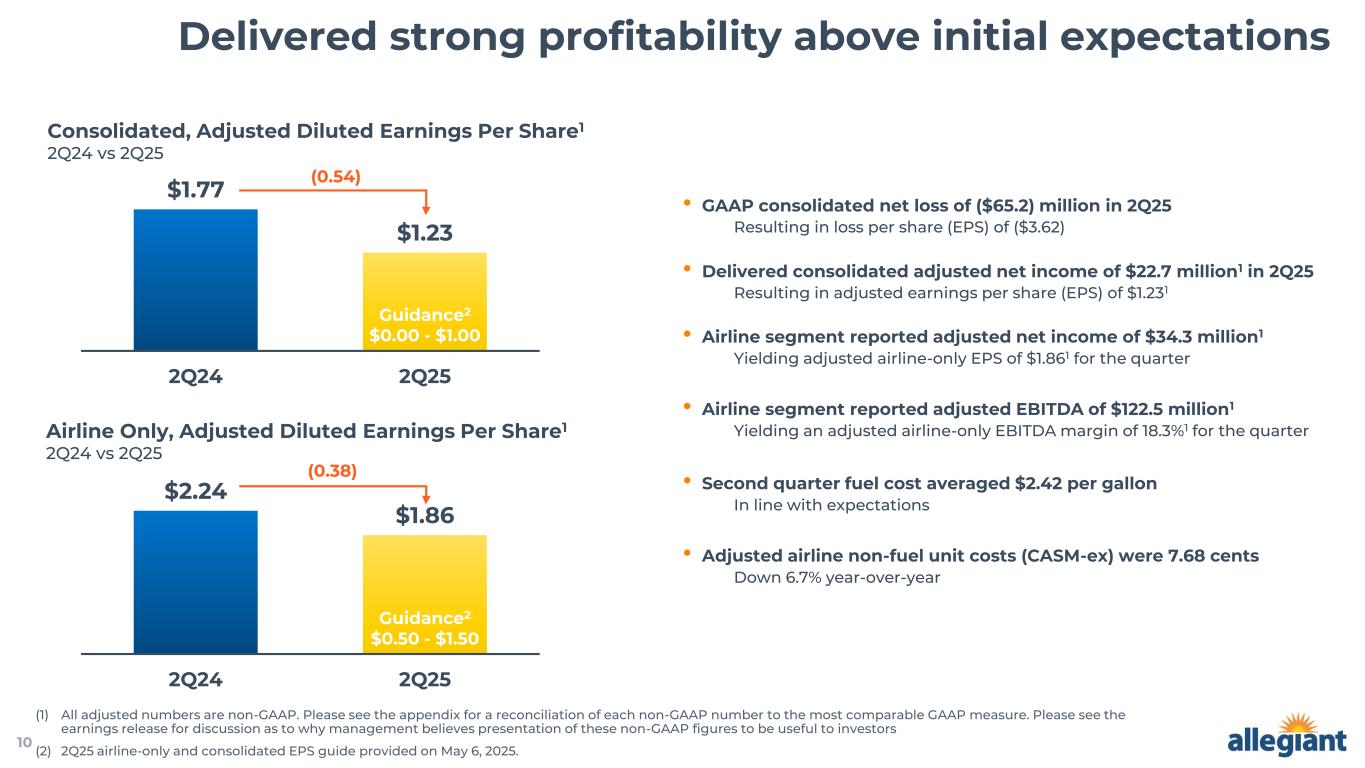
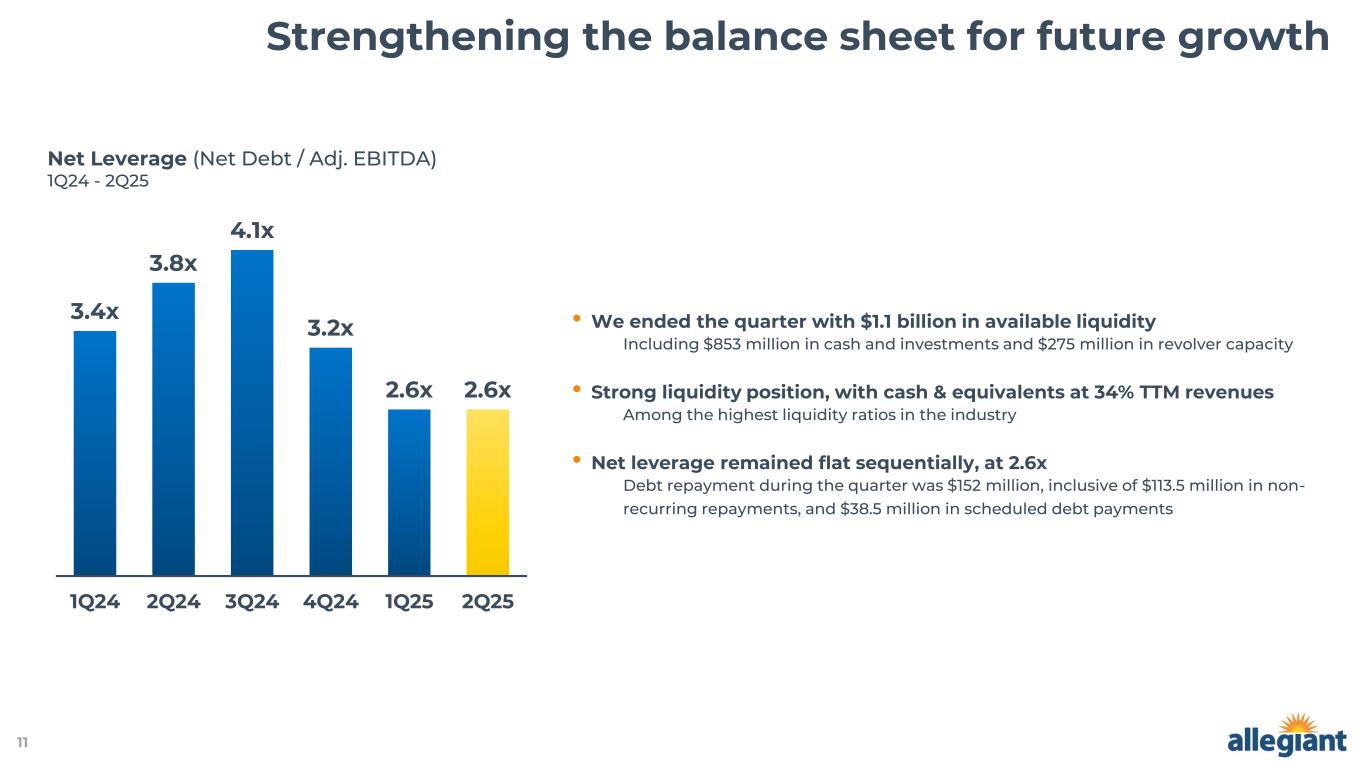
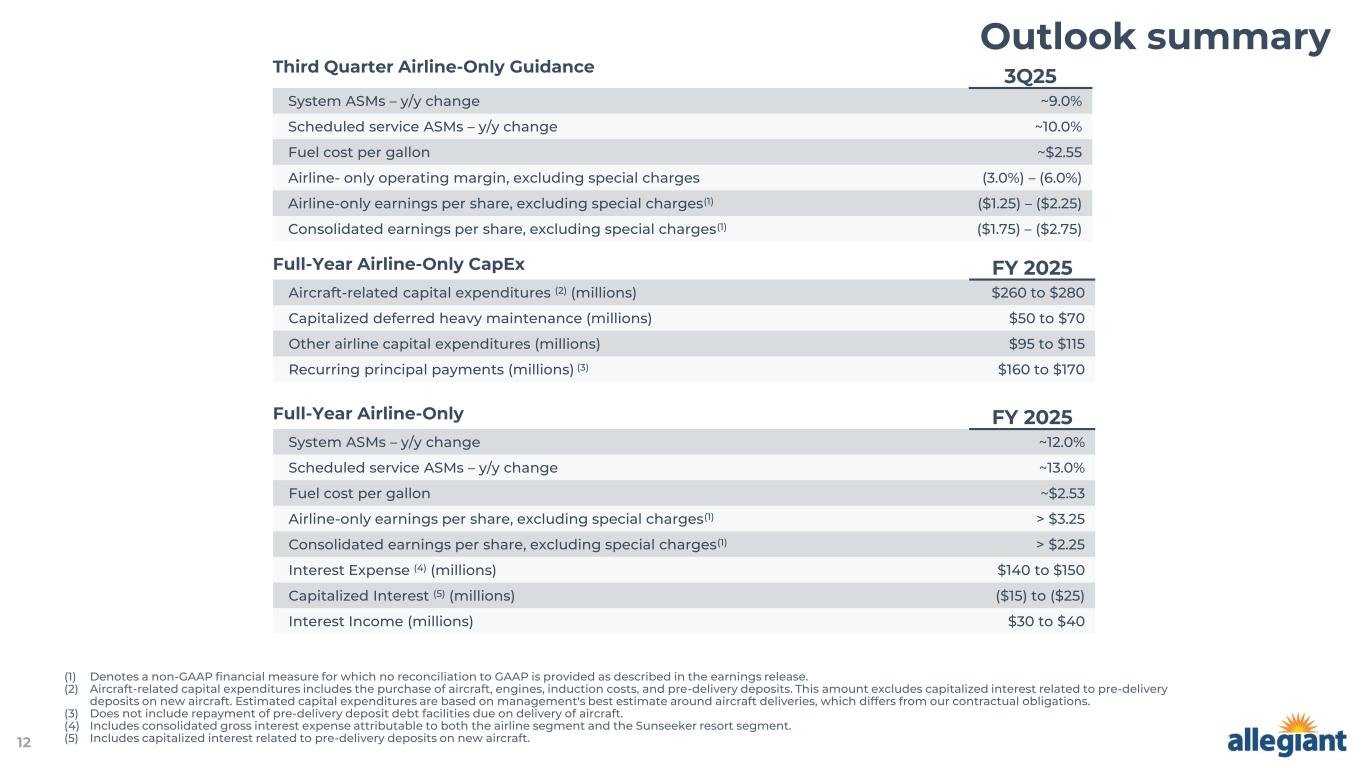
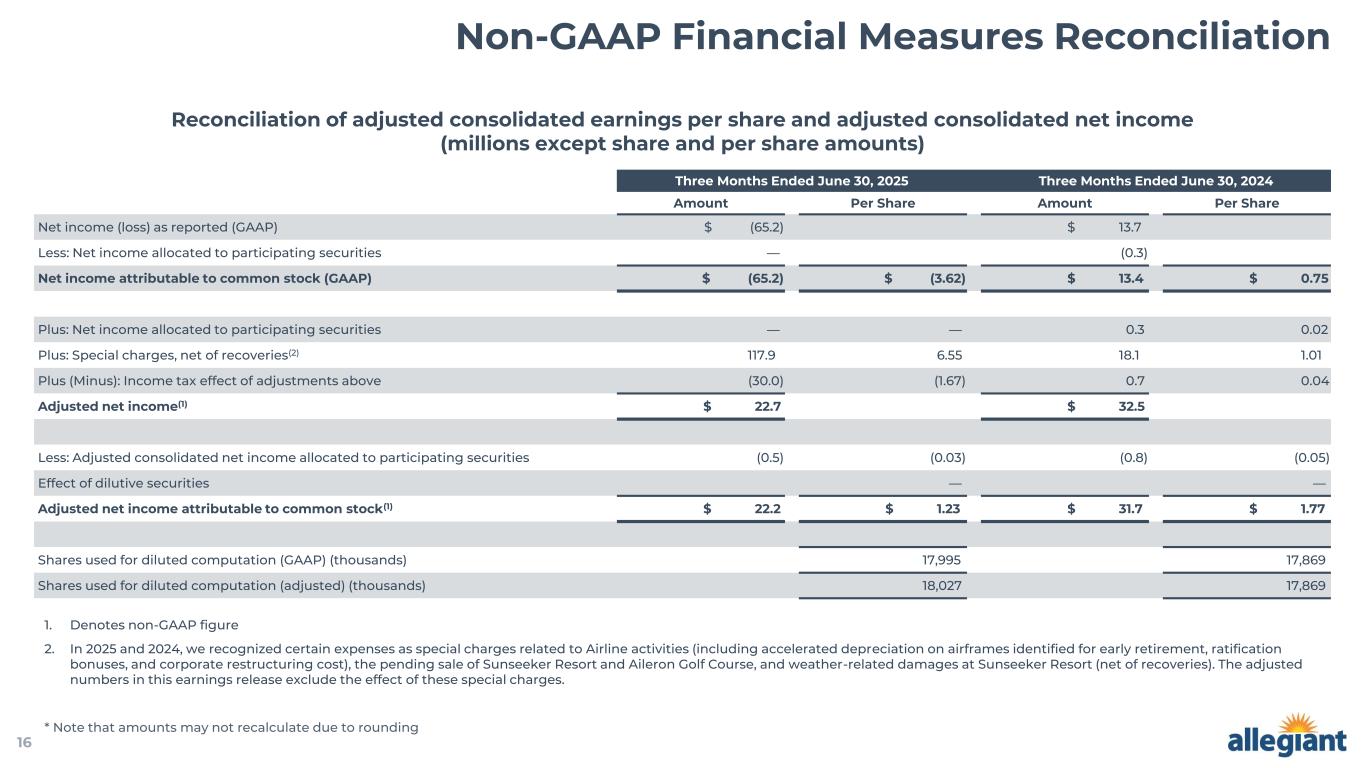
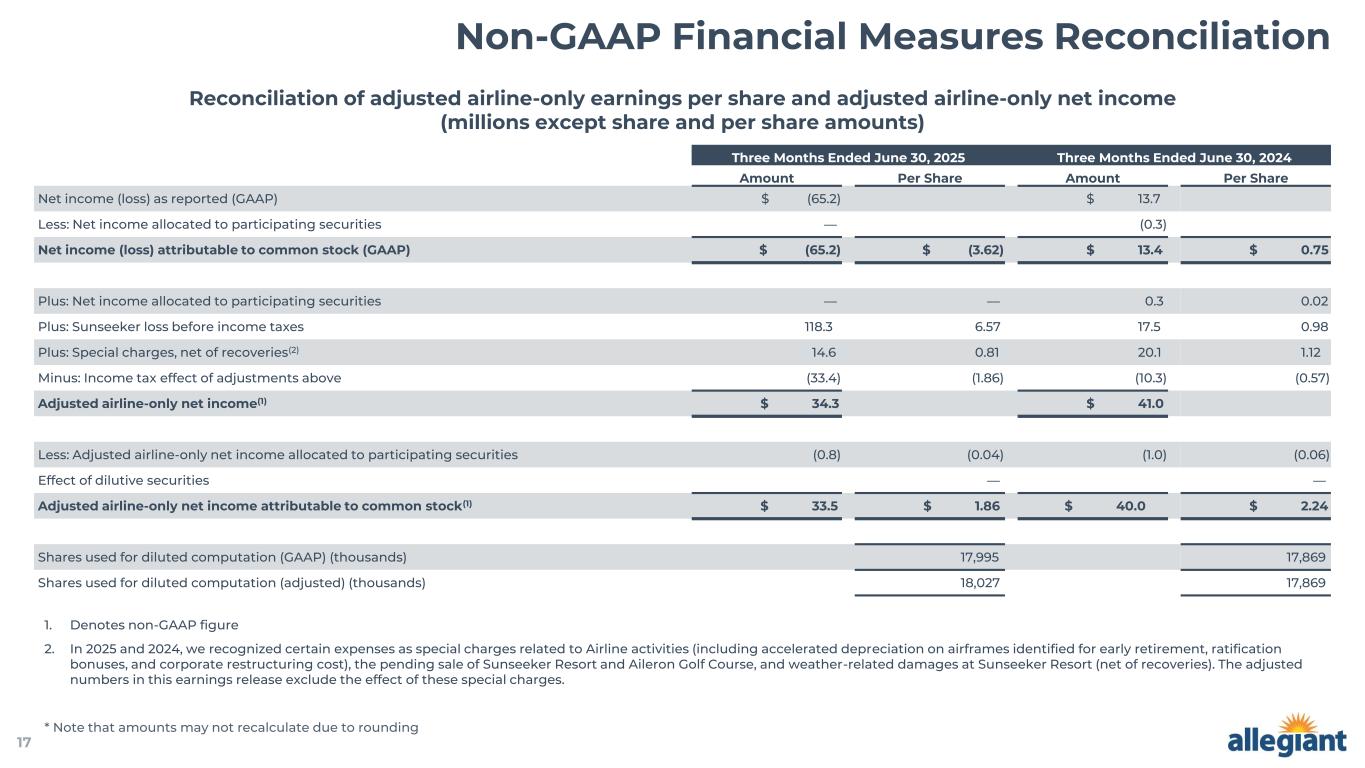
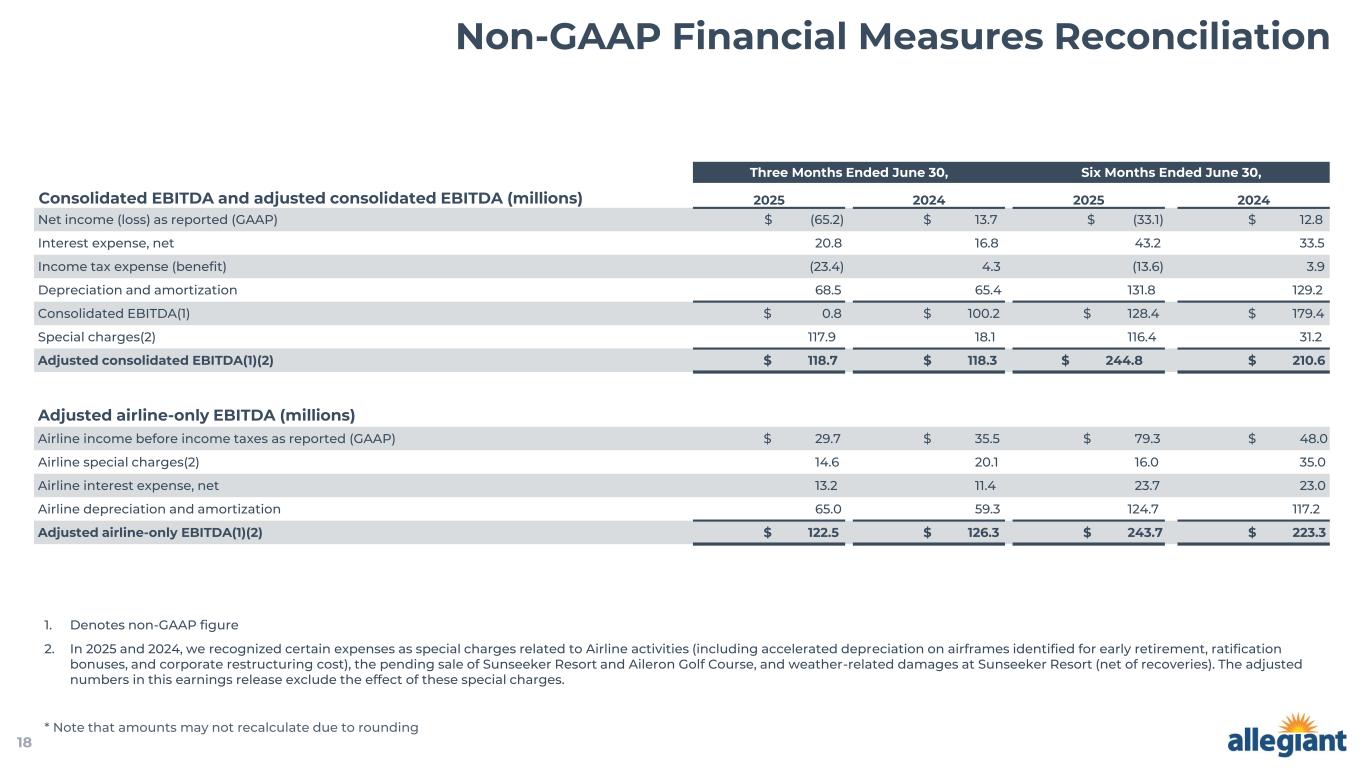
and now i'd like to hand it over to all the man all right thank you drew uh good afternoon everyone i'll walk through our results and share our outlook today all on an adjusted basis unless otherwise noted this afternoon we reported second quarter consolidated that income of 22.7 million dollars and consolidated earnings per share of one dollar and 23 cents the airline segment produced net income of $34.3 million and airline-only earnings of $1.86 per share, exceeding our initial expectations of approximately $1. This outperformance was attributable to solid cost execution throughout the quarter on a share count of just under $18 million and drove operating margins at 8.6% ahead of our guided range. Our second quarter consolidated results do include special charges of $103 million related to the pending sale of Sunseeker Resort announced in early July. We remain on track to close on the sale in early September. Airline EBITDA was $122.5 million, yielding an EBITDA margin of 18.3%. Fuel averaged $2.42 per gallon during the quarter, in line with our initial forecast. Our focus on growing into our labor force and leveraging existing infrastructure kept momentum during the second quarter. Total airline operating expenses of $611 million, up just 4.9% year-over-year on capacity growth of 15.7%. I'm very pleased with the team's cost execution. Excluding fuel, unit costs were down 6.7%, despite removal of nearly seven points of planned capacity growth in the quarter. Our calendar next result included a one-point headwind for an expected transitory cost in the aircraft rent line, as we prepare to return 11 aircraft off operating leases, which originated during the pandemic. Department leaders across the organization have been focused on cost performance, especially in light of capacity reductions and the softer demand environment experienced during the first half. We will continue to set capacity for optimized margins, and we are not solely focused on unit cost results. With that said, we've pulled four and a half points of capacity growth from our 2025 plan and still expect full-year non-fueled unit costs to be down mid-single digits, thanks to numerous budget initiatives across the organization. Turning to the balance sheet, we ended the period with robust total liquidity of $1.1 billion, which includes $853 million in cash and investments and $275 million in undrawn revolving credit facilities. In addition, we had $335 million in available undrawn loan commitments at the end of the quarter. Cash and investments were approximately 34% of trailing 12-month revenue at quarter end. We made continued progress on debt reduction, repaying $152 million, including $113.5 million in non-recurring repayments, and $38.5 million in scheduled principal payments, ending the quarter just below $2 billion in total debt. Net leverage remained flat sequentially at 2.6 times, down from 3.8 times at the end of the second quarter last year capital expenditures for the quarter totaled 137.7 million dollars comprised of 108.3 million in aircraft related spend and 29.4 million in other airline capex deferred heavy maintenance accounted for an additional 10 million during the period now moving to fleet we retired two a320 series aircraft and took delivery of five new 737 max aircraft of which one was placed into service at quarter end we are pleased to say that boeing has exceeded our expectations on aircraft deliveries throughout this year and we expect our remaining three aircraft for 2025 to be delivered in the third quarter as we ramp up operation of our max fleet in the fourth quarter predictable and reliable performance from boeing provides us with tremendous fleet flexibility we're leaving our full-year capex forecast unchanged at this time at $435 million. In light of staffing costs incurred in 2024, we made the conscious decision at the start of the year not to hire additional flight crews for these aircraft and plan for pilot transition after our summer peak schedule. And thus, we expect to place the remainder of these aircraft into service alongside available type-rated flight crews beginning in October when we transition our Fort Lauderdale base to an all-737 MAX operation. Looking ahead to the third quarter, as previously announced, we've entered into a definitive agreement to sell Sunseeker Resort for $200 million, with closing plans for early September and expectation for sales proceeds to be used for debt repayment. We will report consolidated and airline-only results for the third quarter, which we expect will include approximately two months of operating losses at Sunseeker during its off-peak season. As most of you know, the third quarter is seasonally our office while we've recently seen some strength in bookings much of july our peak month would have been booked before a notable increase in demand was observed as such the benefit to the third quarter is somewhat muted so we expect to capture some upside in our full year guidance which i'll discuss in a moment for the third quarter we expect a consolidated loss per share of two dollars and 25 cents including a loss of approximately 50 cents from sun seeker For the full year, 2025, we are expecting airline-only earnings of greater than $3.25 per share. Factoring in eight months of operations at Sunseeker, we expect consolidated full-year earnings per share above $2.25. Our outlook today contemplates some of the demand improvement observed in July. However, we believe there's still room for upside, particularly during the fourth quarter if macroeconomic conditions continue to improve. Although it's still too early for us to guide 2026, we will share that we expect to retire eight A320 family aircraft and plan to induct nine incremental max aircraft into the operating fleet next year, weighted to the back half. As a result, we do not expect fleet count to drive capacity growth next year. With continued progress on revenue initiatives, the earnings drag from Sunseeker removed, and an improving macroeconomic backdrop, we believe we're well-positioned to deliver materially higher earnings in 2026. In closing, I want to thank the entire Allegiant team for their efforts during our peak summer travel season. We operated a record number of flights this summer, and the operational performance exceeded expectations. Despite a nearly 17% increase in fleet utilization and flat employee headcount, We operated nearly 16% more flights compared to 2024 and did so with significantly fewer operational disruptions. From cost discipline to operational execution, we're proving our ability to adapt, execute, and position a legion for long-term outperformance. And with that, Greg, this concludes management's prepared remarks. We can now go to analyst questions.
Operator
Thanks, Robert. And at this time, I would like to remind everyone, in order to ask a question, press star, then the number one on your telephone keypad. Once again, star one. In the interest of time, we ask that you please limit your questions to one primary and one follow-up question. Thanks in advance, excuse me. And we will pause just a moment to compile the Q&A roster. Okay, looks like our first question comes from the line of Mike Lindenberg with Deutsche Bank. Mike, please go ahead.
Yeah, hey, good afternoon, everyone. Hey, I just, on the numbers for the full year, you have the consolidated at greater than $2.25 and the airline greater than $3.25. I guess Sunseeker has already lost over a dollar per share for the first half of the year. There's another 50 cents in the third quarter for the last two months, I guess. What's, I see the dollar difference, but I guess, you know, you sort of left the gap at that point, but maybe that was by design.
Hey, Mike, it's Greg. let me kick it off and bj or the team could jump in the you know what we're expecting for our guide is that um at the end of september by september that sun seeker uh is you know no longer a part of a legion and excluded obviously moving forward in earnings and so um i think that's the way it was built and if we need to go kind of more in the detail we could do that certainly offline But what the guide suggests, you have our third quarter number, but I believe on the EPS, what it would suggest that is about a buck and a quarter in airline-only EPS.
Okay. Okay. Thanks, Ben. Then just my second question on SunSeeker itself. I mean, the 8K that came out talked about, you know, I guess cash proceeds of $200 million. I mean, I'm not sure if there was anything else tied to that, if there's a residual stake. I mean, is it clean, $200 million coming in? Are there some other impacts there? How should we think about it? Just because the original 8K was fairly terse in providing details around that transaction. Thanks for taking my question. Yeah, of course, Mike.
It's all 100% sold to Blackstone. That's the sale agreement. and then the $200 proceeds to Allegiant upon close of the deal.
Operator
All right. Thanks, Mike. Our next question comes from the line of Savi Scythe with Raymond James. Savi, please go ahead.
Thank you, and good afternoon, everyone. Maybe I can kind of talk a little bit about the 2026 kind of way you're thinking about it. I appreciate that color this early on. I'm just curious, your cost execution this year has been remarkable, and given the kind of the flat outlook, how should we think about non-fuel costs next year, given that you still don't know what the pilot deal might look like? And just how should we think about puts and takes into 2026?
Sure. Thanks, Sabi. Yeah, one of the reasons, you know, we're not prepared to guide 2026, of course, we're still just actually kicking off our budget initiatives now. but also just fully understanding what capacity is going to look like next year. Remember, we had a good bit of off-peak capacity during certain periods in 2025 and based on the current environment, and we wouldn't expect to see that next year. So, just trying to get a handle around aircraft and team member utilization. So, I keep those in mind, and then timing of a pilot deal, as you mentioned in the question.
Anything else then, Vijay, as we think about, like, some of the cost savings that you have this year, do any of those get reversed next year? Or is there kind of a rule of thumb if you didn't have any of those kind of moving parts, just how much, you know, unit cost pressure you see?
I mean, we expect the-where you're seeing the most benefit on a unit cost basis this year is in the salaries and wages line. I would expect that the total cost for that line-I don't want to commit to it being flat, but I don't expect it to be up materially. And on lower utilization, if we had lower utilization or lower ASMs, you would see some pressure there. But again, this just depends on what kind of capacity we put out there.
Usabi. Hey, it's Greg. I might just add just a more high-level comment. And the team's probably heard me say this too many times, but everything at an airline begins and ends by running a great operation and i think from a cost perspective it can get pretty expensive quickly uh when we don't run a good option so just really proud you're hearing some of the operational performance uh that's we're seeing and the improvements we've seen over the past couple years it's helped drive a lot of our costs out of the business so that that's step one next year and giving us even some more confidence to fly a little bit more in those peak periods uh given that the ops performance but one of the things that you know i think i want to say as well is just the organization has been incredibly focused on just driving unnecessary costs out of the business. BJ and his team, it's a team of cost hawks, and we've seen, you know, closed a couple of high-cost bases like LAX and Austin. We've reduced corporate personnel over the past year by 10 percent. We've reduced fixed marketing expenses, and we've reduced IT spend. I mean, there's areas in the business that structurally we've gone through, and they've done a really nice job. And what I am, I guess, very encouraged by is the culture where everyone's looking to, you know, really be prudent on the cost front.
Maybe one more quick addition to the answer there, Savi, and this one I can give you to help with modeling. I mentioned in the prepared remarks an increase in the aircraft rent line.
I would expect that to persist through the back half of year maybe a little bit of relief in the fourth quarter but in 2026 we should see that return to the same run rate that we had in 24. very helpful thank you all right thanks Javi and our next question comes from the line of Dwayne Finningworth with Evercore Dwayne please go ahead hey thank you um on the growth headwind uh to RASM of five points I assume that's a that's a 2Q comment, and this might be impossible, but how would you frame that maybe earlier in the year and even into third quarter here? Is it fair to say that the year-to-date impact is probably in a similar range to that five points?
Yeah, Drew, I think that's probably fair year-to-date. Just looking at the severe off-peaks like September, we didn't have that same comp in January as as we were still kind of thriving from a booking perspective. So we're kind of forecasting that we see it similar but slightly improving through the quarter to a point that's maybe a little bit better than that 6% that we put up in the second quarter.
Got it. And then just on some of the cost leverage, because I thought the driver of the growth this year was really about legging into the investments that you already made in support of this transition for the max. And so would you say there's still cost leverage to achieve based on investments you've already made? I mean, you are effectively growing the max sub fleet in 26, shrinking on the Airbus side. So it doesn't feel like your average flat capacity year, maybe from a from a chasm perspective. So maybe just talk about what inning we're in, in sort of, you know, getting cost leverage on the max investments you've already made. Thanks for taking the questions.
Thanks, Wayne. Yeah, I'm happy to start, Greg, if you want to add in. Yeah, early innings for sure. I think Greg gave the percentage of ASMs that were operated by the MAX, but certainly expect that to be up, you know, in the 20% range next year. So there's definitely room to grow. We're also not able to schedule the MAX aircraft on the most optimal lines of flying yet because we're still training crew members. And so the airplanes are operating shorter stage lengths, which is not optimal for the fuel burn performance of that airplane. So I think there's definitely room to go. And then I would just say on the DNA side, you've got to remember there's also a little bit of overlap. In the second quarter of this year, we had a one-time true-up on some unrelated assets. So there's a little bit of a bump in the second quarter. I would expect to see some relief there in the third quarter. And then as we move into next year, you see some of the Airbus assets start to fall off from the DNA line.
And Duane, I'd just add maybe a little more specific on the cost improvements. To BJ's point, we have, you know, we're up to next year about 20 percent of our ASMs flown by the more cost-efficient max fleet. You know, we'd expect ASMs per gallon next year to improve by, call it, two to four points.
I think in 27, you would expect that to step up even further i think our just our kind of tentative plan has us you know between seven to nine points or seven to ten points in asm per gallon improvement thank you thanks dwayne all right thank you dwayne and our next question comes from the line of robbie chenker with margaret stanley robbie please go ahead good afternoon everyone uh not asking you to guide for 26 but do you have a sense of what your normalized eps might look like one of your peers quantified it on their call for 2027 uh and also uh what might that be dependent on in terms of
moving parts hey ravi why don't i kick it off but yeah we're not we're we're not going to give a guide right here and i'll just i mentioned a lot of the initiatives as we think about 26 or perhaps items to keep an eye on and uh we mentioned you know we believe there's a clear path to improving unit revenue, and we're going to keep a tight lid on costs. You've seen the team in the performance this year, and so we want to continue to really run a great operation. The flattish capacity is not going to put any pressure, we don't think, on the operations. We can fly a little bit more in the peak period, we think, given what we're seeing on the operational front, and Drew and his team other states starting to think about and plan towards 2026. Right now, you know, if the demand backdrop improves, particularly leisure, you'd still have some flexibility to push the utilization in the shoulder and off-peak. We're not planning on that today, but what I'd say is just you kind of put it all together, Ravi, and I know this isn't giving you a specific answer, but we think there's an opportunity to, you know, materially improve our earnings. EPS for us, we have 18 million shares. So you can kind of back into, you know, here and there, each one of these levers is worth X points and EPS, just all else being equal.
I understand that's helpful. And maybe as a follow-up slash clarification, just on 3Q on the demand environment, are you saying that the 3Q you've guided to is essentially what a normal 3Q, like non-peak environment looks like, or do you think we're still seeing drags from what happened the first half? It's not give a sense of what that sequential step through 2Q, 3Q, 4Q looks like relative to what do you think normal would be?
Yeah, I'd probably caution normal for sure. What we're thinking about for the third quarter is a ramp in demand similar to what we experienced last year. So 2024 was not particularly normal as we talked about a year ago. We're starting from a little bit of a lower point, right? so getting a slightly stronger ramp I think will get you to the sequential TRASM your benefit that we talked about so I don't think we're quite normal yet very little post pandemic feels normal at all but but look more than 2024 is kind of the guiding principle there more than anything very good thank you thank you Robbie and our next question comes from the line of scott group with wolf research scott please go ahead hey thanks afternoon um i'm i apologize i missed this but maybe can you just repeat sort of how you're thinking about rasm and and chasm in q3 and i think you had a point that things are getting better but maybe you're not going to see the same benefit of things getting better maybe as much as others i just didn't follow that point if you can just go through that again yeah i'll start on drew i'll start on the random side and really got what that comes back to is um how we deploy our capacity right 42 of our asms for the quarter will come in july um leaving only 58 for the rest of it so as demand ticks up we don't have the same flat kind of schedule that many other carriers do uh that would enable them to better um feel a third quarter impact from that that uptick uh that was really the the extent of that commentary. But more generally, maybe, I think in the remarks that I mentioned, you would expect sequential wins on year-over-year as we get into the third quarter and then the fourth quarter getting just a little bit better in each of those.
Yeah. Hey, Scott, it's BJ. And then on the cost side, we did not guide unit metrics for the quarter, but I will tell you that I gave a bit of a cadence of unit costs at the first call this year, the 14-24 earnings call. So I'll just kind of repeat that so it's out there. We expected at the time first quarter to be down the most, second quarter to be down not quite as much. And then we had talked about the fourth quarter coming in maybe flat, and that did assume a little bit higher capacity, so we've pulled some capacity out since then. But I think those comments will largely hold. And then I said in my prepared remarks that we would expect the full year to end down mid-single digits.
Okay, that's helpful. And then just secondly, I think you had a comment about fourth quarter capacity in leisure markets looking higher. Maybe just any more color there. I just want to sort of like, if I look at the Q4 guide of a dollar plus of airline earnings, obviously a big improvement from Q3, but still a big decline from fourth quarter last year. And that just feels a little different than what some of the other airlines have guided to.
So just any thoughts or colors? yeah i mean some of that's just going to come down to you know a belief in what the full ramp is going to look like i think we maybe have a slightly more conservative view on where the fourth quarter can end up um but you know just looking at leisure oriented markets uh there's a pretty big change you know for example um the orlando area that was down 10 fourth quarter last year is now you know showing up seven seven and a half percent at an industry level. So it's a little bit of a different dynamic, I think, in the geography of where fees are still in the market. Now that's all subject to change. That just kind of lives in the back of my mind as something that maybe it's reason for us to be a little more cautious as we go into November, December, than maybe how other airlines have described it.
Great. And then I apologize if I can just sneak one lesson.
Just going back to my first question, like relative to the RASM down 11% or whatever in Q2, like how much sequential improvement are we talking about? is it five points is that a good ballpark is it more or less any just any thoughts just to give us a little bit of help yeah probably won't go into you know trying to guide an actual number here though i appreciate the question um you know do you think it will be better um you know a lot of this will come down to your view on how good you think september can be um in a typically leisure uh week period um like that we're planning on something you know roughly similar uh to what we on 2024 um as a kind of ramp from this point forward in terms of demand that might be as far
Operator
as i take it okay great well thank you scott and our next question comes from the line of andrew didora with bank of america andrew please go ahead hey good afternoon everyone uh thanks for the questions here his first question for for drew um when you when you look at you know all the commercial initiatives you outlined in your prepared remarks whether it's a legion extra more peak flying. Now you have Navitaire operating as you initially thought. How should we think about whether it's RASM or maybe it's ancillary per passenger? How do you think about the uplift from all of these initiatives in kind of a status quo demand environment as we head into 2026? How should we think about that?
Sure. So on the Navitaire front, we had always talked about that being lift and the ancillary per passenger line. um i think what we've seen is actually a little bit more coming in in low factor and conversion which may actually put a little pressure on um air per passenger or ancillary per passenger but it's good for the overall as we can drive incremental bookings um so that's a little bit candidly of a change we had called that out as you know the two dollars uh to get back to level and an incremental two dollars per passenger um but we might have to might start to shape that definitely given given we're seeing it come through to load instead uh on the allegian extra that's that's purely uh purely an ancillary revenue per passenger metric we're still holding pretty strong at that roughly three dollars per passenger on uh flights with uh the allegian extra layout uh coming out to you know five hundred dollars per per departure that that number is I'm still attacked on that front, so I'm just going to go on this one here.
Operator
Got it. And then a question for BJ. Thanks for the color on the higher lease costs in the quarter. I was going to ask you about that.
But it got me thinking, like, when you think about, you know, you have the maxes coming in, you know, would you ever consider, you know, leases or sell leasebacks as a way to finance future deliveries or are you still 100 committed to the full-on ownership thanks yeah thanks thanks andrew uh the answer is yes we will always uh consider it we revisit it two to three times a year uh at this point uh it's it's our view that over the long term over the long the full useful life of the aircraft it's two times as expensive to lease airplanes as it is to own them. And so, so long as the balance sheet allows us to own aircraft, I think you'll continue to see that from us. Doesn't mean that we won't diversify our funding sources or, you know, be opportunistic here or there. You know, we have an order for 50 firm aircraft. I can envision a few of those being operating leases by the time we take the last one. But at the moment, we don't have any plans to use daily specs.
And Andrew, it's Greg. I might just add a quick comment an eye level on that as well. And that's, you know, our strategy is not only to be really good at operating aircraft, but very opportunistic in trading assets in aircraft. And, you know, we like to own that provides us flexibility, that there's a lot of embedded value in our fleet. And one of the things that I've been, EJ and team, as we talk about capital allocation, I think they've been doing a really nice job, is selling some of our underutilized assets in a very, you know, high market or hot market uh to help us buy aircraft we ordered you know at the bottom of the market and so that that's been helpful as well but the the thing that's most impressive is they're looking at every which way um to be opportunistic and they're they're on their game all right thanks andrew and our next question comes from the line of connor cunningham with melius research connor please go ahead hi everyone thank you i was hoping to ask about the booking
curve and maybe tie it into a couple other questions that you had. So I'm just trying to understand, is the booking curve normal at this point? And I guess the question that I think a lot of us are trying to figure out is just how much do you have left to book in 3Q? I realize that July is obviously your most important month. But then if you could just talk about where you are at 4Q and is that comping up on what you currently have? I'm just trying to understand what's out there right now.
Again, you've kind of struck a more cautious tone, which is fine, but i'm just trying to benchmark like where we're at thank you yeah july the one i'm most confident um when responding with zero percent left to book um for the rest of the quarter uh you know august and september we probably have um something in the 40 maybe 35 to 40 percent left to book there um so so certainly still some some room um but you know it's it's starting to get dark on that booking window uh fourth quarter still still allowed to go we're 85 percent left um at that point uh so there's still a lot to learn um like i kind of uh said in the previous uh response you know a lot of fourth quarter right now is just about trying to forecast you know how a lot of things are going to unfold um just because the industry setup it looks a little bit different for such a leisure oriented carrier than maybe one that that has a business outlook or is more hub bit uh oriented uh where you've seen see kind of come down this year relative to others uh it's just enough for the the back of my mind to say hey maybe that looks just a little different as we get to the end of the year and connor i would just add a brief comment to that as well that if you take the suggested eps guide for the fourth quarter it's below both the first quarter second quarter of this year scott mentioned you know he called out rightfully so well below fourth quarter of last year and just back to drew's point there's still a lot left to book and we just our guide suggests a modest improvement in leisure demand and you know we're keeping a close eye on it and we're going to do everything we can to to maximize the fourth quarter earnings and you know and maybe just to get back to your booking curve question so we saw a lot of compression last year um yeah where we were down probably you know medium looking down seven percent percent something like that we've held relatively flat with with that um you know kind of close in proportion uh so you know we haven't seen quite the same surge that you've seen from others but it's normalized with what we saw last year which was a surge uh that that maybe uh i don't know
if others saw or not it wasn't quite as popular as a question as soon okay appreciate it then maybe on the comment uh that you uh need to earn the right to grow i was just hoping that you could potentially benchmark what that means to you is there a margin target a return on invested capital target that you're looking that would give you the green light to grow again i'm just trying to understand what maybe long term you know when does allegiance start to go back at this you know 10 percentage number that you've historically been at for some time thank you yeah thanks for the question connor i don't think we're ready like publicly to go out there with the benchmark i would tell you is how we're looking at it internally it's kind of a couple factor fold
one is margin you know how do we get back to restoring our historic margin performance others balance sheet you know we want to continue to strengthen and improve our balance sheet obviously improving margin helps in that regard and then the others are cost of capital and what that looks like uh so you kind of put all that together and you balance the environment and some of the items that we mentioned uh before just being disciplined i don't think allegiance dependent on high growth i think we're able to produce you know solid margins and with with growth or without um and but with that said we want to maintain flexibility and uh and as the demand environment fluctuates we want to be able to adjust accordingly and continue to focus on initiatives that'll help us drive uh more margin and i think uh just you know our our the mode around our airline that we've talked about for many years as our model and our team members and last quarter we talked about like the four cornerstones that kind of fortify that moat and what is that in the network tactical utilization fleet flexibility and having you know a little cost structure and connor that's what we're incredibly focused on simplifying the business continue to strengthen those four cornerstones we've talked about how we're doing that today with more you know obviously initiatives down the road as well and we think you put all that together that'll continue to help us improve and drive more earnings and earn that right to
as you said appreciate it oh greg thank you uh thanks connor all right thank you connor and our next question comes from the line of tom fitzgerald with pd callen tom please go ahead hey thanks so much for the time um so just kind of picking up with that last uh response to connor's question should we be expecting an investor day in the next like 12 18 months um and just you know just you are at an interesting point in the road and um would you look to just focus on these like kind of asset light opportunities and like a low growth organic story or would you be open to any any any M&A at all thanks again for the time hey Tom thanks for
the question we're you can't obviously see us but there's a couple smiles across the table because well we've been talking about that for some time and in fact you know Drew and BJ and I we want to get something scheduled in the not too distant future because we think that'll be incredibly helpful to walk through obviously we're viewing the business uh in long term as well and the initiatives that we think could help be a little more creative uh we've held off on that but just given some of the um i guess idiosyncratic issues that we've been facing or constraints we've been facing we're now working through those and it's the stories kind of clearing up a little bit more so i i think my point of going into uh into that detail is yes that that's the plan we don't have anything set. I wouldn't expect it in the coming months, but I would expect in the next year to 18 months or so, maybe probably within the next year, we would have, we'd get someone scheduled for an investor day. And then I think on your M&A question, I thought I heard a M&A question in there. We get asked quite a bit about that. I would say I think there's a degree of consolidation that could be positive for the industry. I think right now, less supply would be better, particularly in the domestic leisure space. I think for Allegiant, we continue to be profitable. Not all airlines right now are durable. I think we're a very durable model and airline, and we're producing healthy earnings. I mean, candidly, my focus, this team's focus is more about improving our margins, getting third quarter back to profitability. If you recall, pre-pandemic, We had, what, 68, 69 consecutive quarters of profitability. We need to get third quarter back, you know, where it needs to be. We're taking measures to do that. I don't think consolidation is required for us to get back to those historical margin levels. With that said, as we always do, we look to expand and drive more shareholder value. And whatever that looks like, we keep a close eye on all the time.
Thank you so much. Those are both of mine.
Operator
All right. Thank you, Tom. And it looks like our final question today comes from the line of Chris Stathalopoulos with Susquehanna. Chris, I hope I got your name right. Please go ahead.
That's right. Thanks. Thanks, everyone. So on the next year's outlook, flat capacity, and apologies if you went over this, but if you could help parse that out. So I guess the usual input stage gauge departures, and then if you could peak versus off peak and new versus existing markets. Thank you.
I don't know if I'm going to have all that in front of me to share with you right now. On the new versus existing, right now we're running about 5.5% of our ASMs being in new markets. Obviously some of that will start to come off, but something mid-singles is probably fine for an overall outlook on that front. And, you know, stage, off the top of my head, I don't think we'll see stage change much. We'll see a slight increase in gauge as we move into the maxes at 190 seats and retires from the 177-seat aircraft. But I don't know if there's a lot of moving parts in there.
The only other thing I might add, Drew, is that we would expect, how you're planning right now a higher mix of peak flying first off peak flying proportionally year over year and what gives us at least for me a lot more confidence in that is just back to how the operations have performed this year in those peak periods now we pushed it significantly and we wanted to make sure we could achieve that and the team that the the front line and the operational teams have done just a fantastic job uh with the same overall infrastructure and they continue to improve processes systems and continue to strengthen that foundation and so part of the how drew a team are planning is there's an ability even on that same uh infrastructure that we could push a little bit more in those peak periods and i think they're planning as such and then back to just an earlier comment this is based on you know if the demand and backdrop improves um there's still opportunity to push utilization in the shoulder and off-peak periods. But again, we're planning to drive most of the – as much in the peaks as we can next year.
So, but – and I think I heard you say on the max piece, the percentage of your total fleet or capacity, was that – was that 20% for next year?
I didn't mention that. I don't know if anybody else had a unit or not for next year. Do you have that number?
Oh, on the max fleet. thought you said peak flight yeah yeah max fleet we expect i'm sorry uh chris yeah the max fleet we expect 20 of our asms to be produced with the max aircraft okay but but overall at the system level flattish on gauge at this point no i think we'll see gage come up just a little bit because we're retiring aircraft with 177 seats and adding airplanes with 190. it's my second question so the The materially higher, excuse me, earnings for next year, I realize you don't want to, you know, you're still early stages here. What I heard was, so qualitative, flat capacity, we have loyalty benefit at this point, assuming steady state economy, leisure, let's say sideways to light seasonal outperformance, Navistar. So maybe on the utilization piece, any color you can give on how you're thinking about utilization or perhaps on load factors? Are we at a point where there's a, I guess, sustained and permanent return to kind of that low 80s system load factor?
Or any color really on how you're thinking about utilization at this point here, in addition to what you've said about Navistar loyalty and everything else? yeah utilization will effectively ebb and flow with the off-peak percentage of flying right that's that's the easiest um flying that to plug into the schedule i will be able to do a little bit more on our peak days like like greg mentioned but i would expect utilization maybe slightly lower given the lower um uh portion of off-peak day flying in the schedule um so with that yes But there should be, along with, you know, the, you know, there should be some low-factor benefits. We talked a little bit in my remarks about, you know, July seeing that improvement and the Navitair helping to drive conversion, which is turning into low-factor as well. So I do think there's a line of sight to that. It may take, you know, a few months to get back to the levels we really want to be at. But, yeah, there's a line of sight.
And at this point, just you said earlier, I think fourth quarter is 85 percent left. It sounds like 15 or so percent is on the books.
Yeah, that's good for a semi-round number.
Operator
And we did have one additional caller jump into the queue. Atul Mahaswari with UBS has a question. And, Atul, please go ahead.
Oh, thanks for squeezing me in. Good afternoon, everybody. So, two quick ones, really. So first, you're expecting a similar level of RASM acceleration in the fourth quarter like you saw last year. So the question is, how much confidence do you have that this acceleration will come through? Last year you had about, if I'm looking at the model correctly, 300 to 400 basis point improvement, like sequentially from 4Q to 3Q. so like are you already seeing yield improvement in recent bookings that's commensurate with this level of acceleration or any other color that you can provide that helps us get get more confidence about the implied fourth quarter ramp yeah i mean we've certainly seen the the uptick in demand happen you know across the you know the selling schedule uh just just bear in mind i mean it's 15 percent uh for the entirety of the fourth quarter right so you're looking at more than 90 percent left to go for december um so it's i'm trying not to run away with small sample size theater um but hey it looks it looks fine in the small sample we do have okay uh and then uh as a follow up uh in 2023 uh you earned well north of seven dollars in eps so do you think you were over earning then or is that level of eps something that you expect to achieve in the next couple of years and somewhat related to this so what elements of the business that drove that seven dollar plus in eps a few years back that is maybe not going to repeat going forward and what are some of the things that were missing then that you expect to drive earnings in the future hey joel it's great i i could kick it off at a high level i think 23 at a better you know looking
at drew at a very strong demand backdrop um also 23 is when we began nearly mid-year i want to say in may um so it wasn't a full year we started accruing a 35 increase for our pilots in terms of pay uh that'll you know as we're in by other negotiations um but kind of just putting it all back together what we talked about in the focus and the areas whether that be you know flying more in the peak periods the operational performance all the commercial initiatives the cost discipline, bringing on more FMAX aircraft, growing the loyalty program, technology advancements, all of that, better productivity. We see a path where we sit today to continue to grow and expand our earnings. And we see that we expect to be able to get back to where we were in historical performance. I don't want to come out and give a guide and say, we're going to recapture 23 EBS by this year or that year, but we expect to get back to where we were and that's what we're working towards.
Great. Thanks for that and good luck with the rest of the year.
Operator
Thanks, Fatul. Thank you. And that does conclude our Q&A session for today, so I will now turn the call back over to Sherry Wilson for closing remarks. Sherry?
Thank you all for joining the call. We'll speak again next quarter.
Operator
Thanks, Sherry. And again, ladies and gentlemen, that concludes today's call. Thank you all for joining and you may now disconnect.