Operator
Hello and welcome to the Allegiant Travel Company fourth quarter and full year 2025 earnings call. All lines have been placed on mute to prevent any background noise. After the speaker's remarks, there will be a question and answer session. If you would like to ask a question during this time, please press star 1 on your telephone keypad. I would now like to turn the conference over to Sherry Wilson, Managing Director of Investor You may begin.
Thank you, and welcome to Allegiant Travel Company's fourth quarter and full year 2025 earnings call. We will begin today's call with Greg Anderson, CEO, providing a high-level overview of the quarter, along with an update on our business. Drew Wells, Chief Commercial Officer, will walk through demand commentary and revenue performance. And finally, Robert Neal, President and Chief Financial Officer, will speak to our financial results and outlook. following commentary we will open it up to questions we ask that you please limit yourself to one question and one follow-up if needed the company's comments today will contain forward-looking statements concerning our future performance and strategic plan various risk factors could cause the underlying assumptions of these statements and our actual results to differ materially from those expressed or implied by our forward-looking statements these risk factors and others are more fully disclosed in our filings with the SEC. Any forward-looking statements are based on information available to us today. We undertake no obligation to update publicly any forward-looking statements, whether as a result of future events, new information, or otherwise. The company cautions investors not to place undue reliance on forward-looking statements, which may be based on assumptions and events that do not materialize. To view this earnings release, as well as the rebroadcast of the call, feel free to visit the company's investor relations site at ir.elegionair.com. And with that, I'll turn it to Grace.
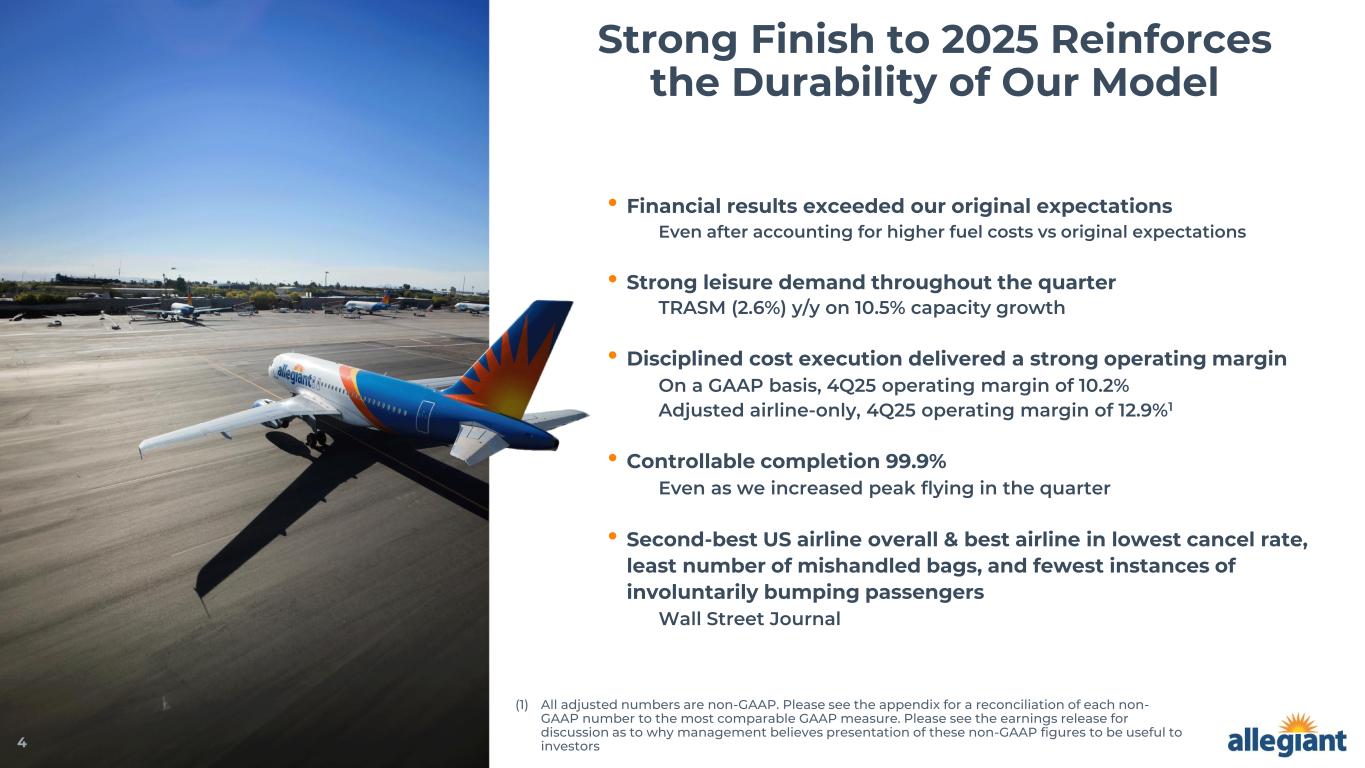
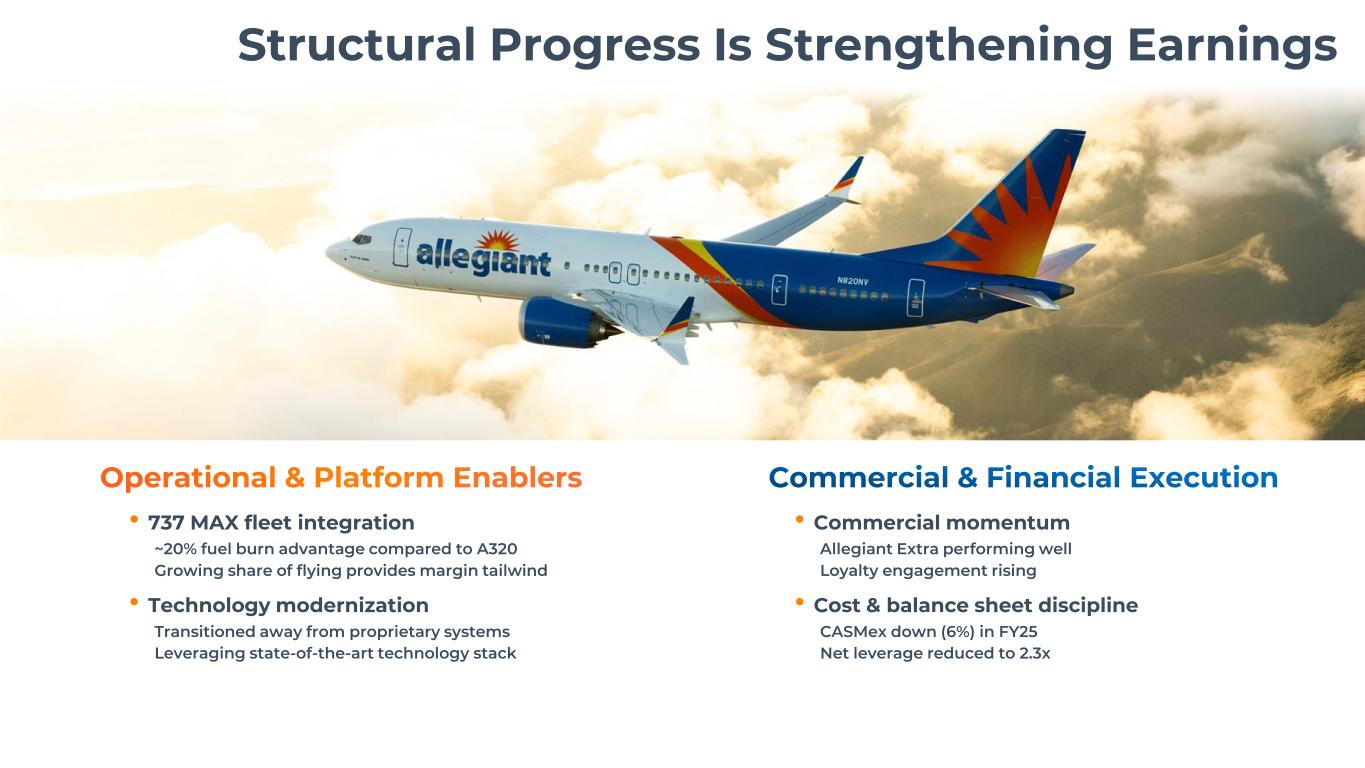
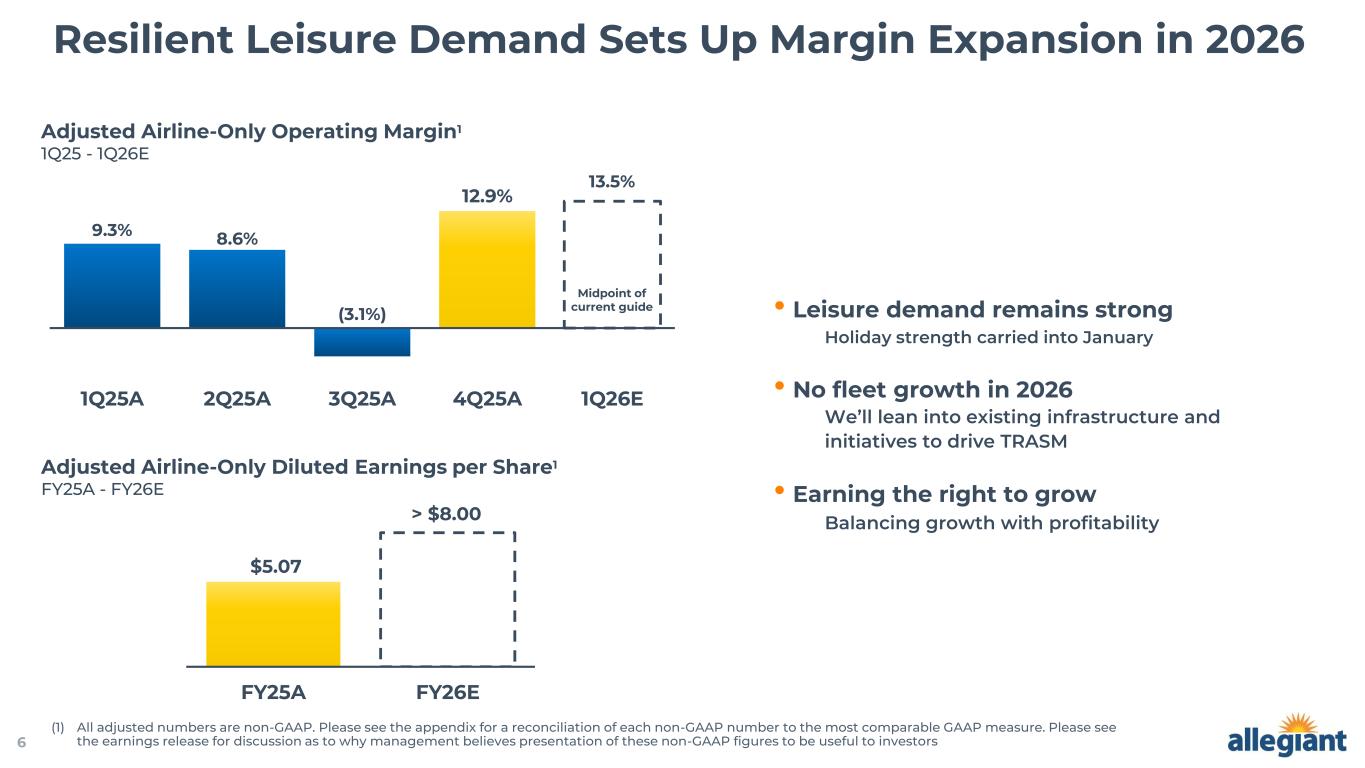
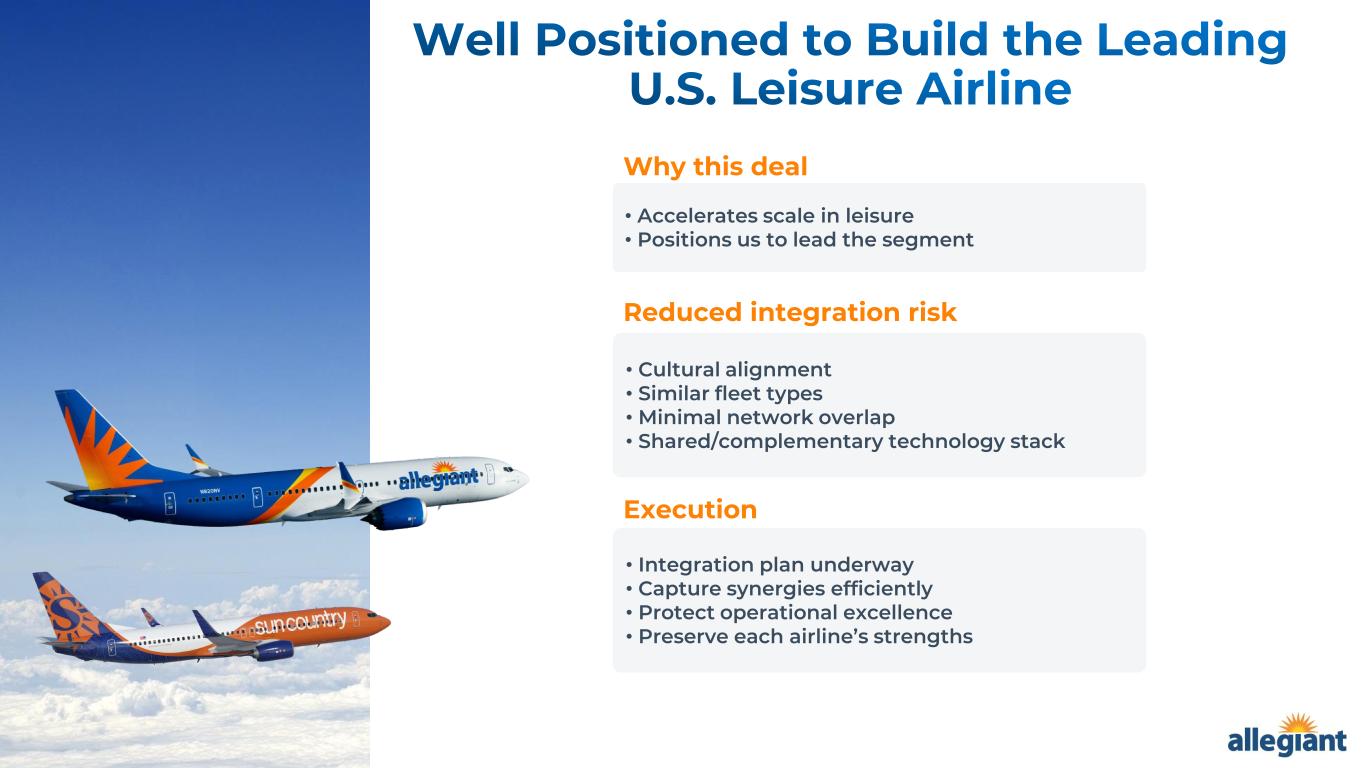
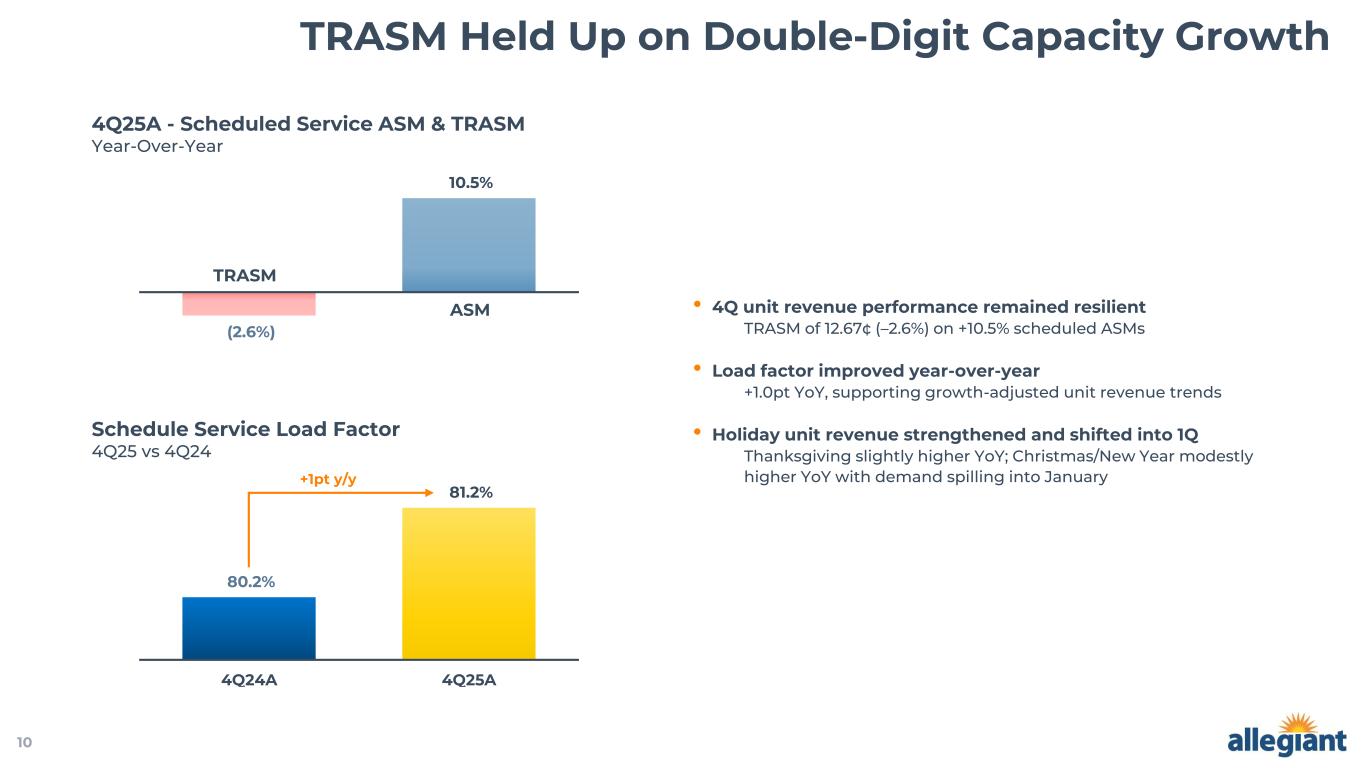
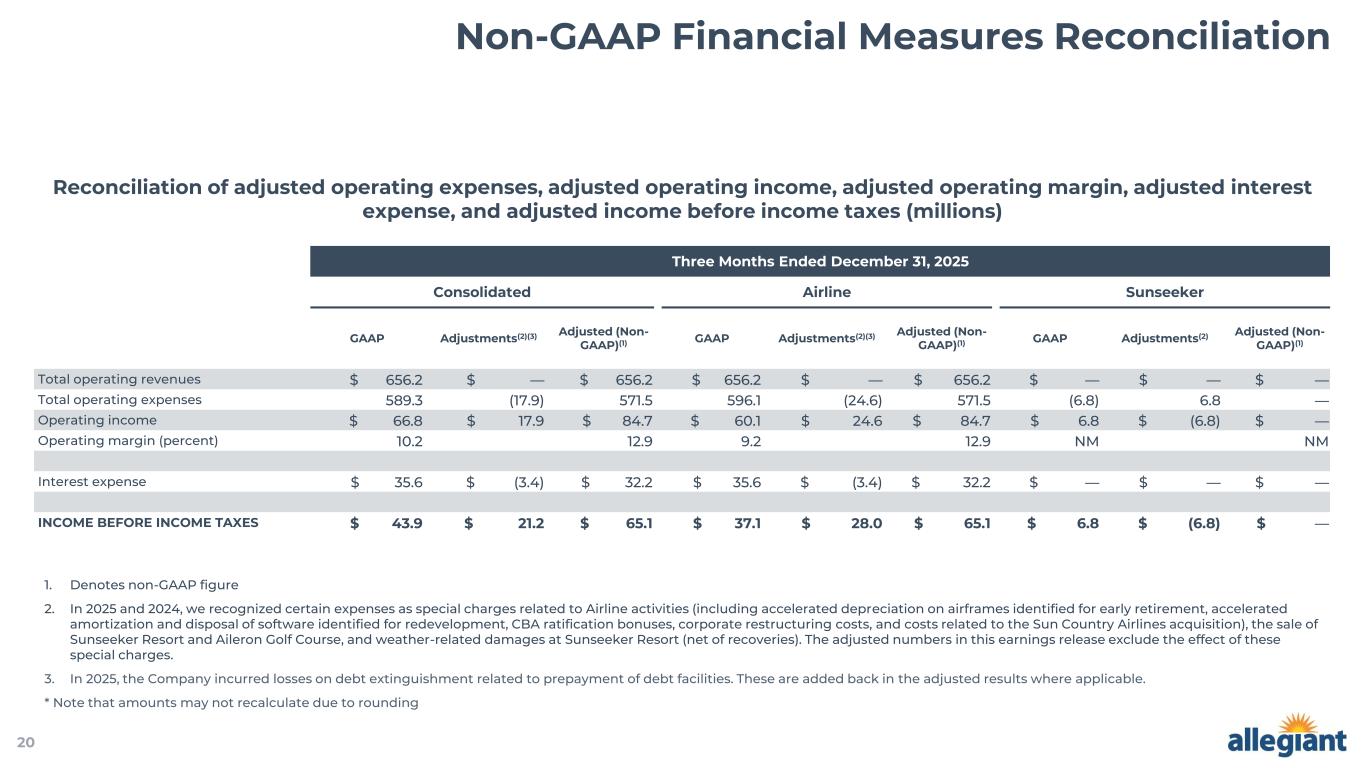
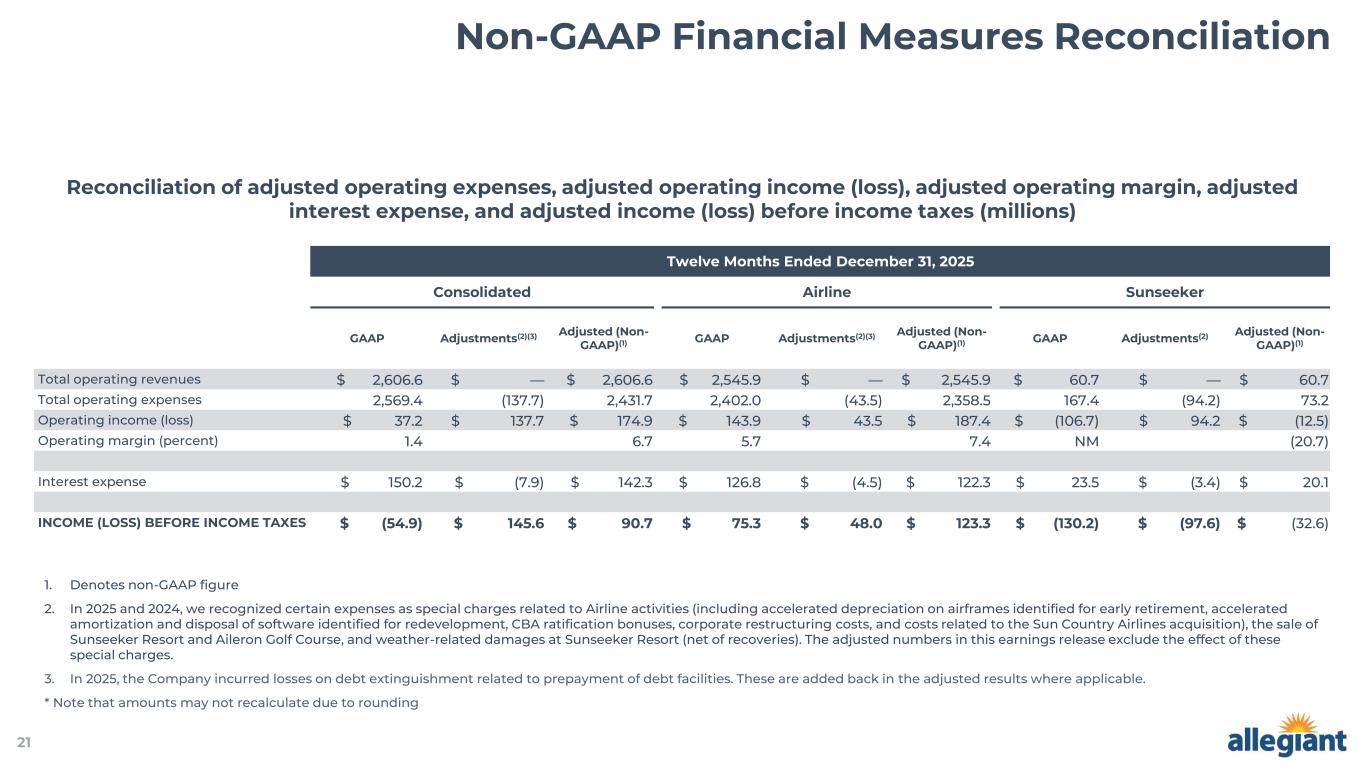
Sarah, thank you, and thanks to everyone for joining us today. We close 2025 with strong momentum, capping a year of meaningful progress that strengthened our foundation and showcased the durability of our model. Let me briefly review our performance in the fourth quarter, reflect on key achievements from last year, and then frame our strategic focus for 2026. Our financial results for the fourth quarter exceeded our original expectations. We saw strong leisure demand throughout the quarter as TRASM declined just 2.6% on 10.5% capacity growth. Fuel ran slightly higher than expected, but disciplined cost execution helped us deliver a 12.9% adjusted operating margin among the best in the industry. These results demonstrate the effectiveness of our low-utilization, flexible capacity model. operationally 2025 was an outstanding year controllable completion was an impressive 99.9% even as we increased peak flying that consistency was recognized externally as well the Wall Street Journal ranked Allegiant the second best U.S. airline overall and number one in lowest cancellation rate the least number of mishandled bags and the fewest instances of involuntarily bumping passengers. This reflects the daily professionalism and execution of Team Allegiant. We also successfully integrated the max aircraft into our fleet. After receiving our first max in late 2024, we prioritized investing in pilot training and revamping our maintenance operations. This was to ensure a seamless transition. And these aircraft are performing very well, delivering roughly a 20% fuel burn advantage compared to the A320. And now, we are continuing to optimize schedules to allow us to realize the efficiency and reliability benefits from our max fleet. As they continue to increase their share of flying for us, they should become a meaningful tailwind for margins. Technology modernization was another important milestone. Transitioning away from our proprietary systems in favor of modern, flexible platforms was a major undertaking, but it was essential for achieving our future goals. We are now turning our focus to leveraging the state-of-the-art technology stack that allows us to introduce new tools and capabilities across the business. And our commercial initiatives are also gaining traction. Allegiant Extra continues to perform well, loyalty engagement is rising, and our improving Building digital capabilities are helping to make travel easier and even more enjoyable. With flash capacity growth in 2026, these commercial levers should boost earnings as their early results remain encouraging. Importantly, we've strengthened our financial position while advancing all these initiatives. Unit costs fell more than 6% for the year, an industry-leading performance. And with the sale of SunSeeker, debt repayments, and improved EBITDA, net leverage was reduced to 2.3 terms, nearing our lowest level since pre-COVID. Turning briefly to demand, we saw meaningful improvement over the holiday period, and that momentum continued into January. Currently, your demand is strong, and our customers continue to value convenience and affordability, areas where Allegiant is uniquely positioned. Looking ahead to 2026, we do not plan to grow the fleet this year as a standalone, and we We expect to lean into our existing infrastructure and commercial initiatives to drive travel improvement and margin expansion. Importantly, we remain committed to balancing growth with profitability, which we refer to as earning the right to growth. We expect a 13.5% adjusted operating margin in the first quarter, which should be our second straight quarter at or near the industry lead and setting the stage for a strong 2026. And for the full year, we're guiding to adjusted EPS of more than $8 per share, an increase of approximately 60% year-over-year, reflecting the structural improvements we've made across the business. Strategically, our agreement to acquire Sun Country is an important step forward as the combination is expected to accelerate our ability to build the leading leisure airline in the U.S. Given the execution over the past year and the strengthening of our foundation, the organization is well-positioned to take on this significant undertaking. The two airlines share strong cultural alignment, similar fleet types, minimal network overlap, and complementary technology platforms, including Avater, all of which help reduce integration risk. A thoughtful integration plan is underway, focusing on capturing synergies efficiently while protecting operational excellence and the respective strengths of both airlines. When you step back and look at the broader landscape, it's clear that Allegiant continues to separate itself within our segment of the industry. Our low-utilization, flexible capacity model has worked for more than 20 years because it is purpose-built for leisure planning. We take great pride in being the leisure carrier of choice in nearly all of the 126 communities we serve, delivering convenience and reliability that travelers can count on. And none of this is possible without the consistency and dedication of Team Allegiant. Their passion shows up every single day, and I'm honored to work alongside them. And with that, let me turn it over to Drew to walk through our commercial performance.
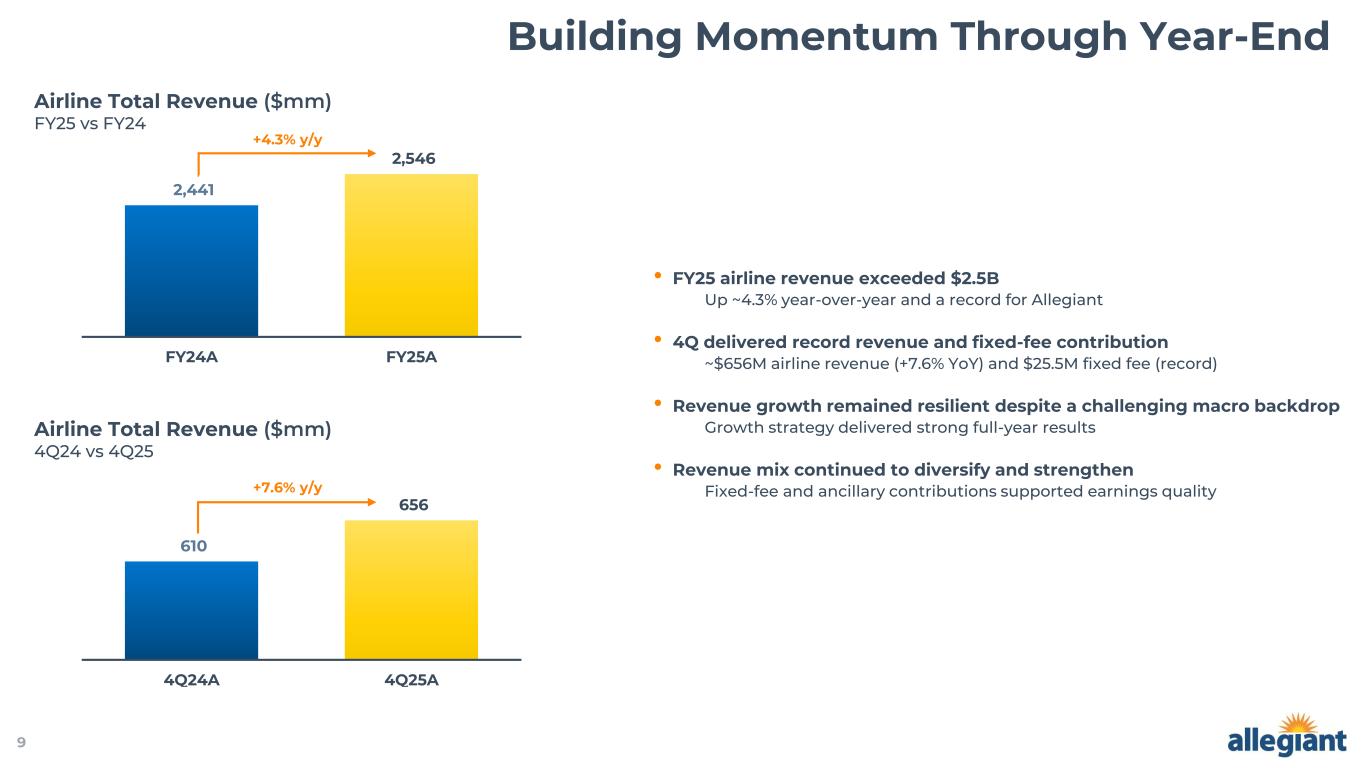
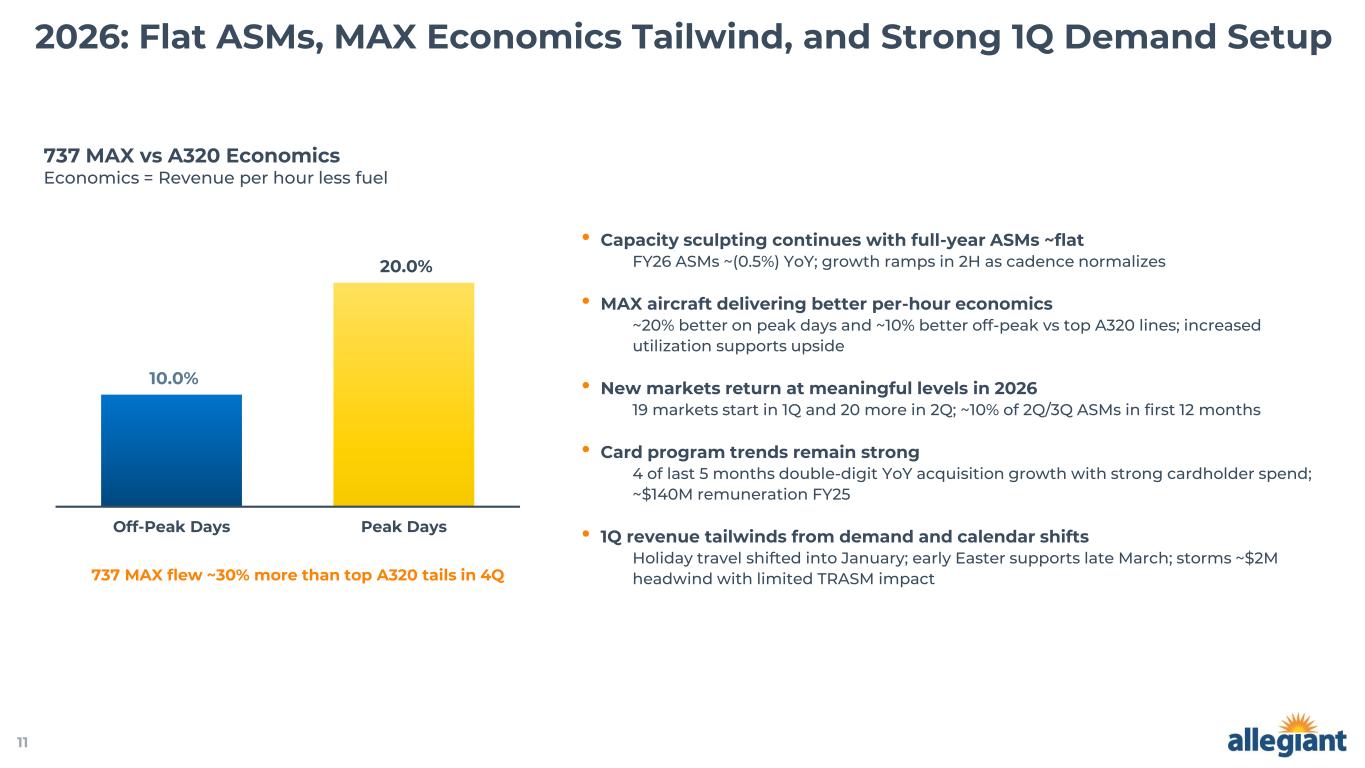
Thank you, Greg, and thanks, everyone, for joining us this afternoon. We finished 2025 with more than $2.5 billion in total airline revenue, up approximately 4.3% for its full year of 2024, and a record high for Allegiant. I'd be remiss not to celebrate the success of the growth strategy, even in the face of macroeconomic pressures through the year. On the back of that growth, we believe our year-over-year travel change relative to our CASMX performance will be the best in the industry for the full year. The fourth quarter ended with approximately $656 million in total airline revenue, up approximately 7.6% versus 4Q24, and the fixed fee revenue contribution of $25.5 million in the fourth quarter despite the increase of scheduled service utilization was another quarterly record. Our unit revenue metrics performed quite well in the fourth quarter when considering the growth profile. Our scheduled service ASMs grew 10.5% year-over-year in the fourth quarter, while TRASM decreased 2.6% to $0.12.67. As we've discussed over the last couple of quarters, the change in load factor trajectory is helping support the improvement of the growth-adjusted trends in unit revenue metrics as we gained a full point of load factor in 4Q25 compared to the prior year. The winter holiday performance was certainly the most striking. Unit revenues over the Thanksgiving travel window were slightly higher on a year-over-year basis, and unit revenues across the Christmas and New Year's travel period were modestly higher on a year-over-year basis, but also notably shifted into January, providing some tailwind into the first year. Remember, utilization normalizations and continues into the next year to represent additional sculpting of the significant utilization lift for many markets that represents capacity somewhere between 2024 and 2025 levels. This utilization just will maintain some slack in the approach, but, as usual, we'll feature more ability to add off-peak day capacity as the environment dictates. Additionally, as Greg alluded to, is the proliferation of max flying in our network. We're thrilled with the performance of the new aircraft in our system thus far. In fact, when cherry-picking the top A320 lines throughout the entire system against all max flyers, we are producing approximately 20% better economics, simply measured as revenue per hour less fuel expense per hour on peak days with similar utilization further through the same comparison on off-peak days we produce nearly 10 percent better per hour economics while also flying the max aircraft 30 percent more than the same top airbus tails we continue to be incredibly excited for the increased potential that lies ahead of this aircraft through 2026 of course correlates neatly with our own and the second quarter slightly more due both to the sleep schedule and the Easter holiday polling is expected to ramp up in the third and then further in the fourth quarter to achieve a full-year expectation of down half of one percent. 2021-26 will also mark a return of robust levels of new market ASMs, while 1Q remains in the mid-single percent of ASMs flown. Approximately 10% of both the second and third quarters will be in their first 12 months of operation. 19 markets begin service in the first quarter, 17 of those this month, and 20 more in the second quarter. New markets lend themselves to strong lift in new card acquisition trends. Four of the last five months have been double digit percent higher on a year-over-year basis and spend remained strong on the card. We received approximately $140 million in remuneration, which represented a modest year-over-year increase. As we continue to build on this momentum, we are committed to working closely with Bank of America on the evolution of the co-brand, and we are engaged in constructive discussions to ensure long-term alignment and a continued strong partnership that supports the next phase of our CARD program. The modest decline in ASM, holiday shifts pulling noticeable traffic into the quarter, and most importantly, the exceptional demand throughout the month of January sets us up for an incredible 1Q revenue performance. I noted the New Year's shift of travel into 1Q, but the early Easter will have some positive impact to the end of March as well. Even while winter storm impacts were worth approximately $2 million in absolute revenue headwinds, the TRASMA effect is a slight positive due to the timing within the corridor. We were much better positioned within our Navitare ecosystem to provide options and re-accommodate our passengers. And most of all, a huge thank you to all of our team members that showed up in adverse conditions and safely made a huge difference in the lives of our travelers. With that, I'd like to hand it over to Robert.
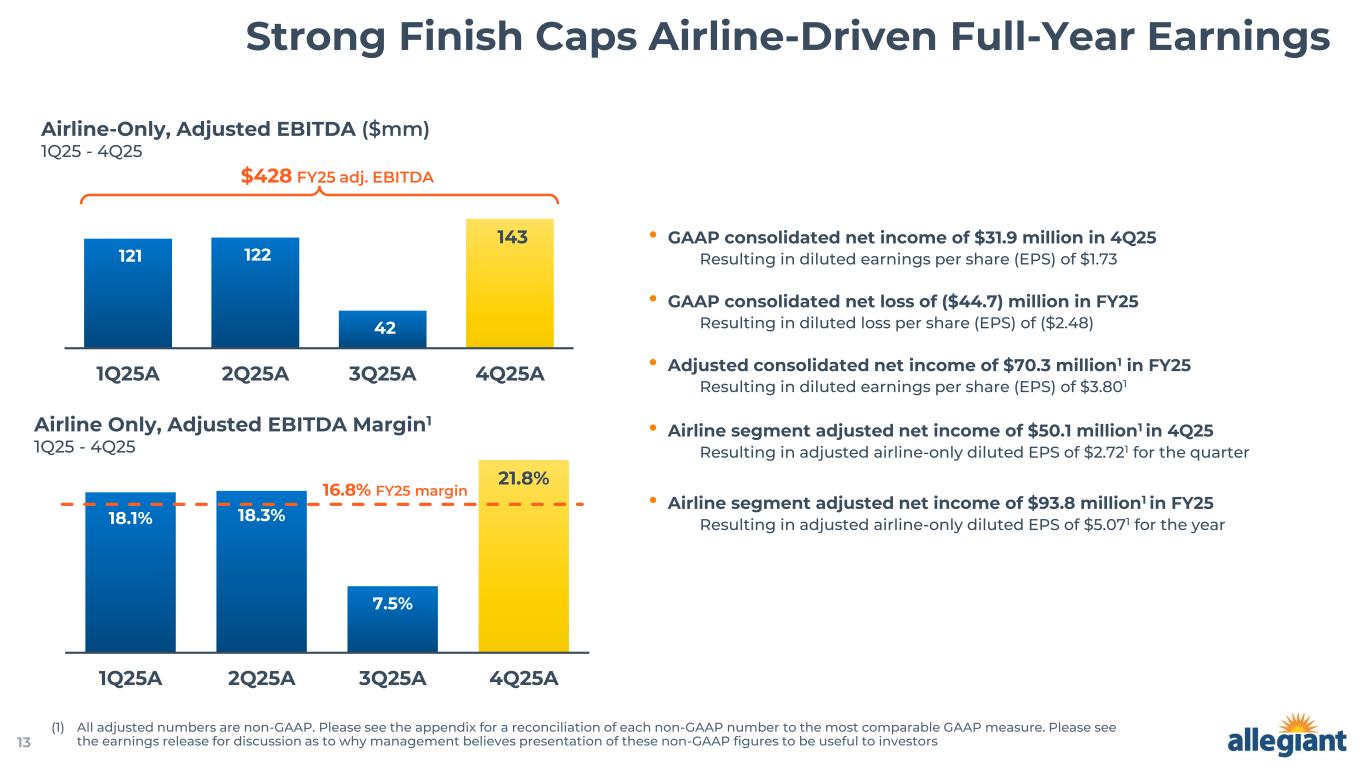
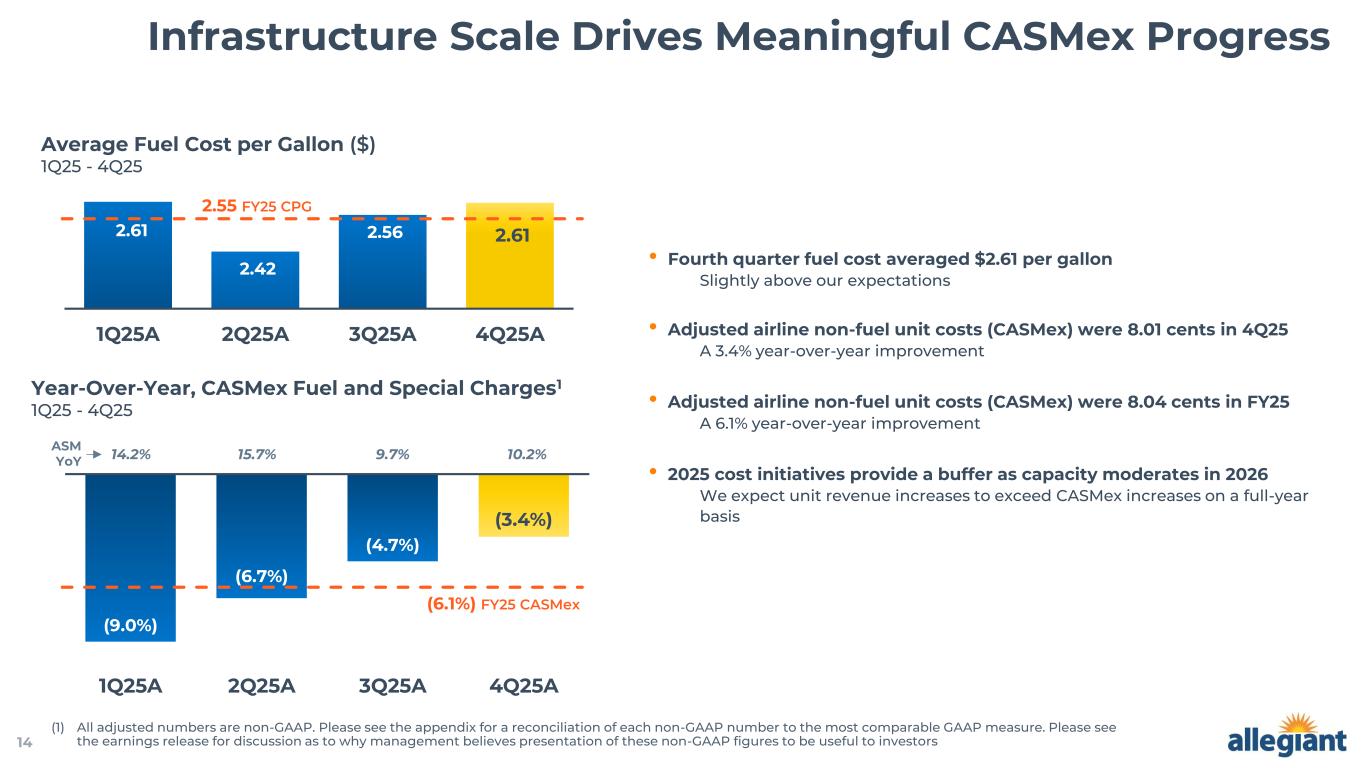
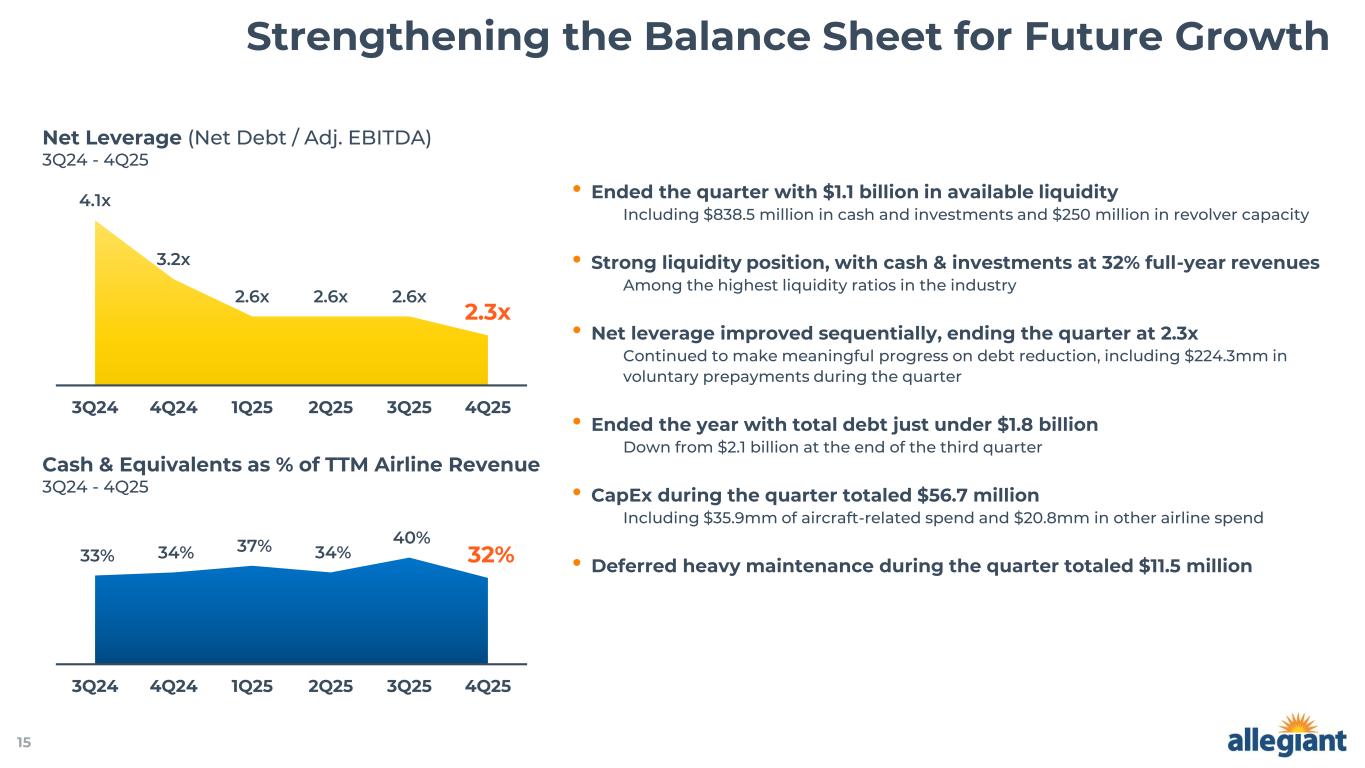
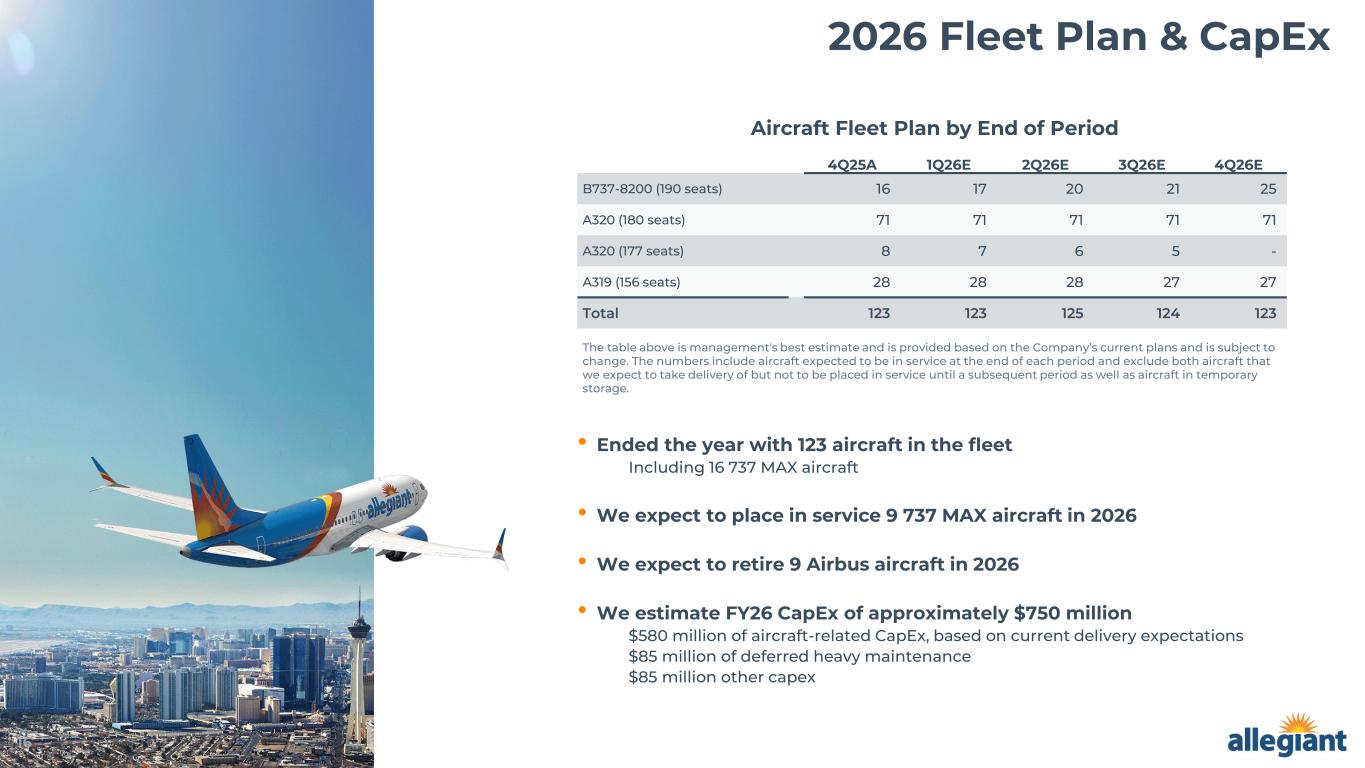
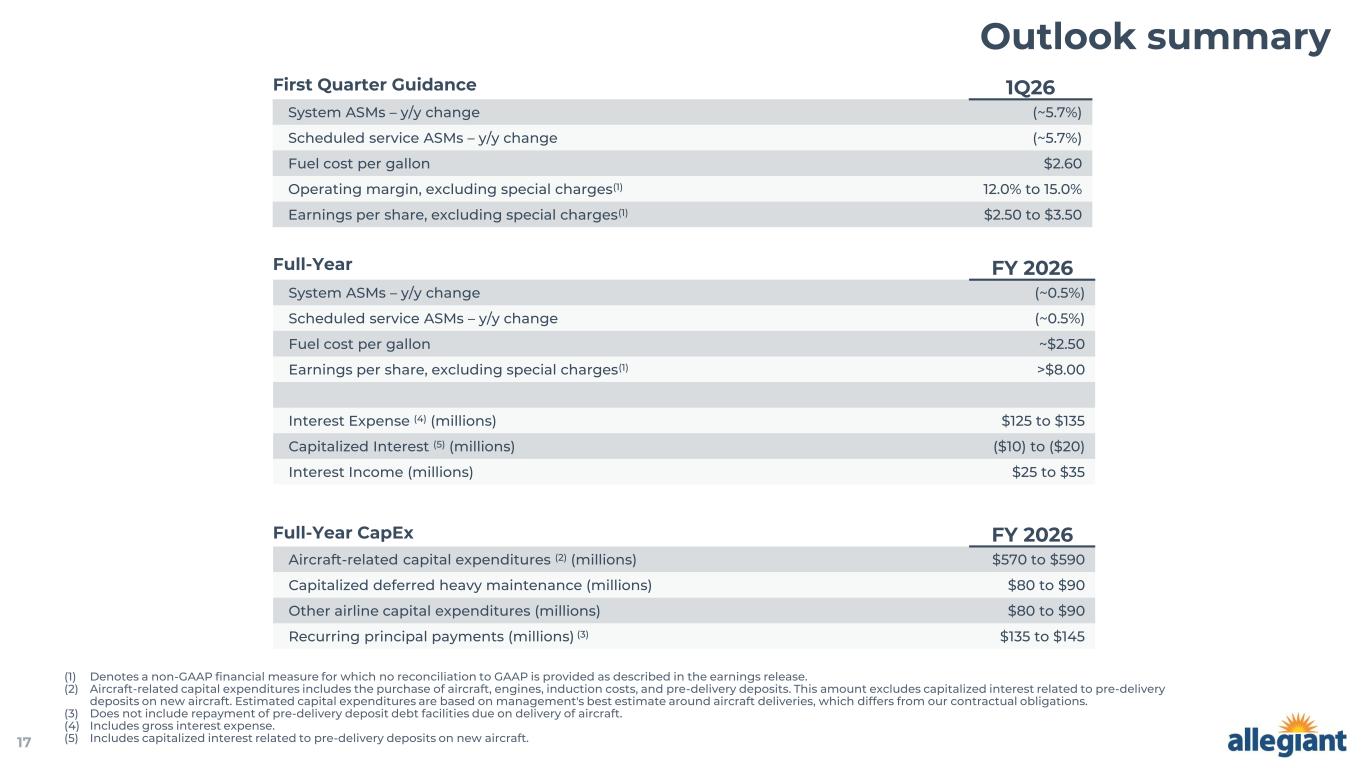
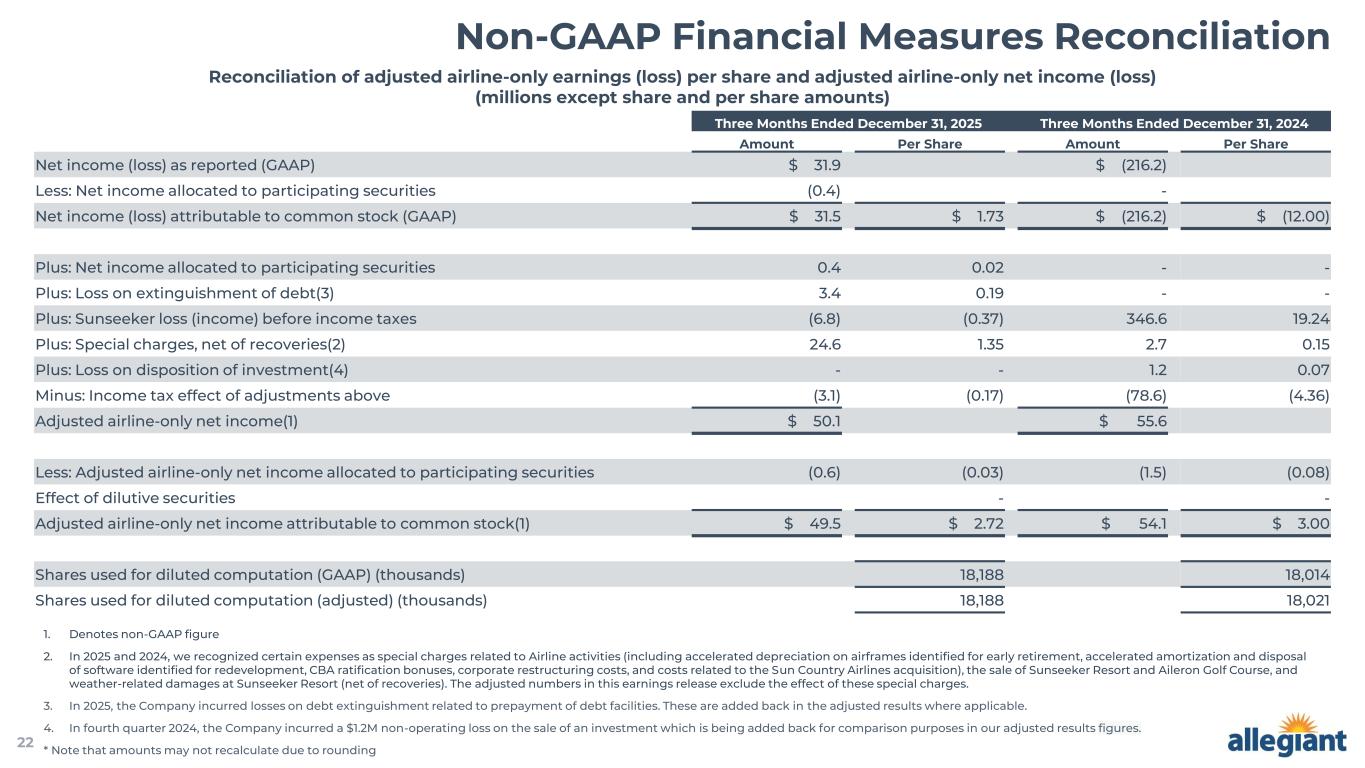
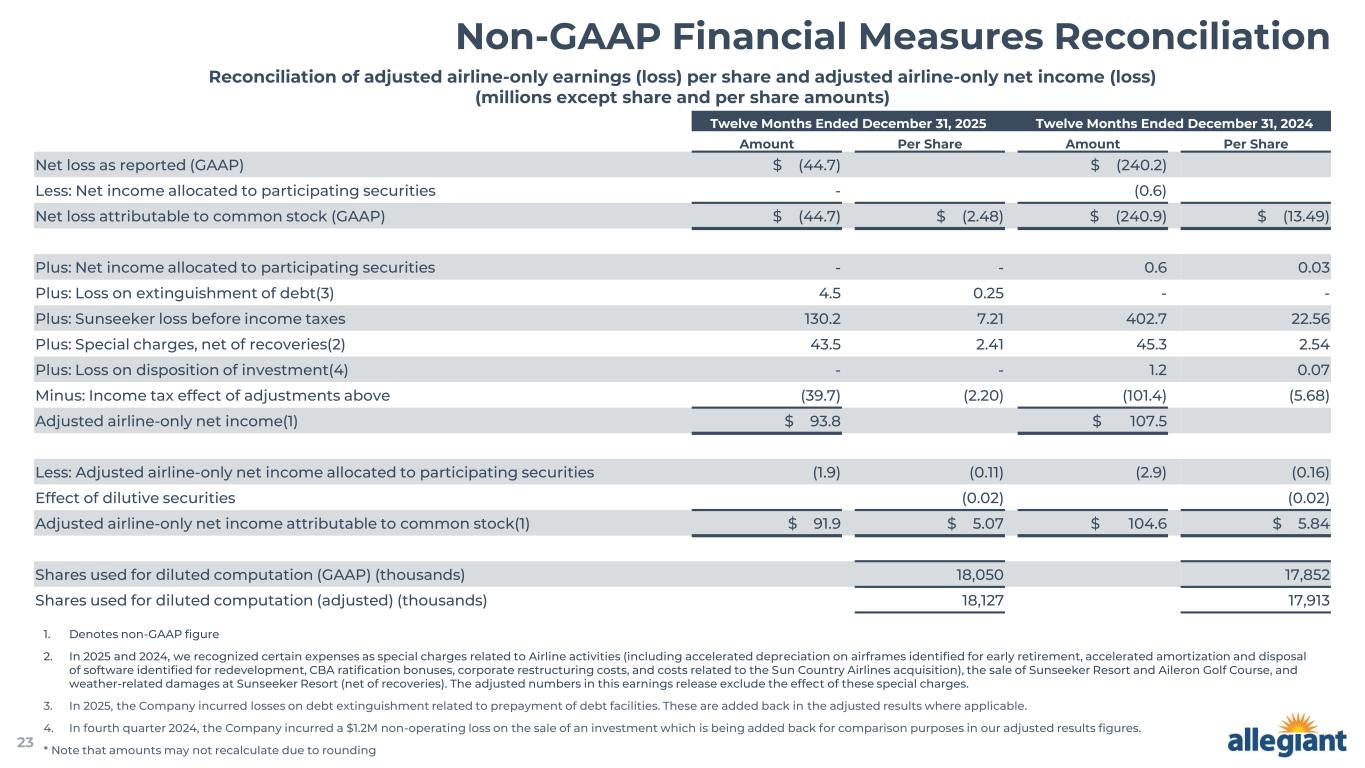
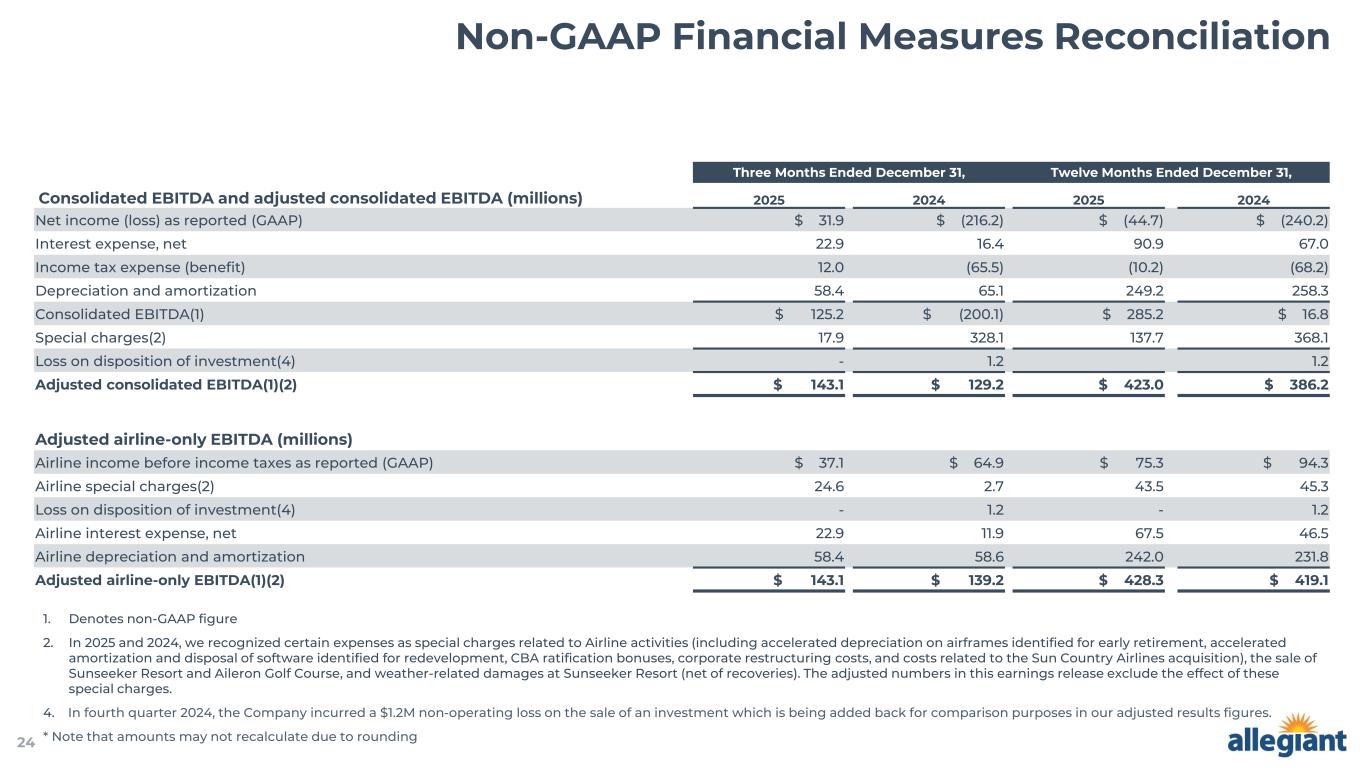
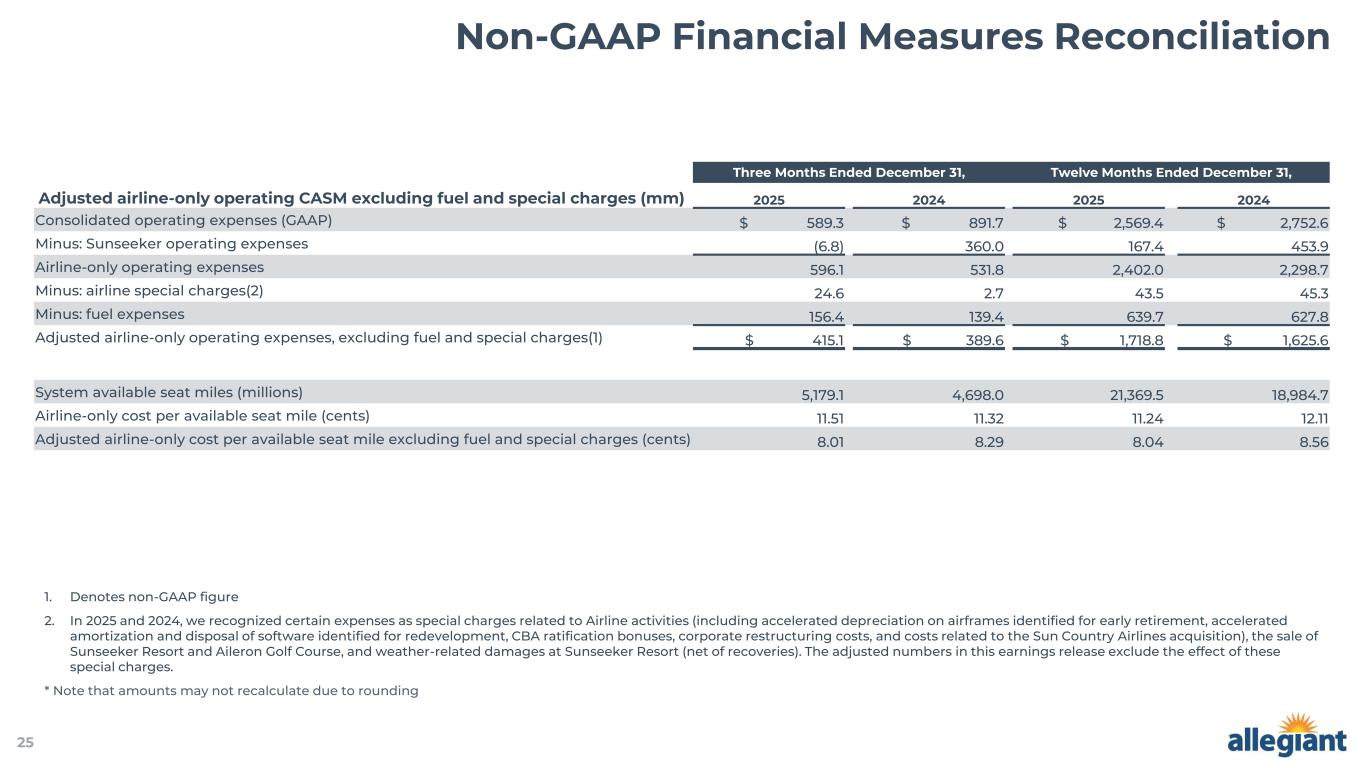
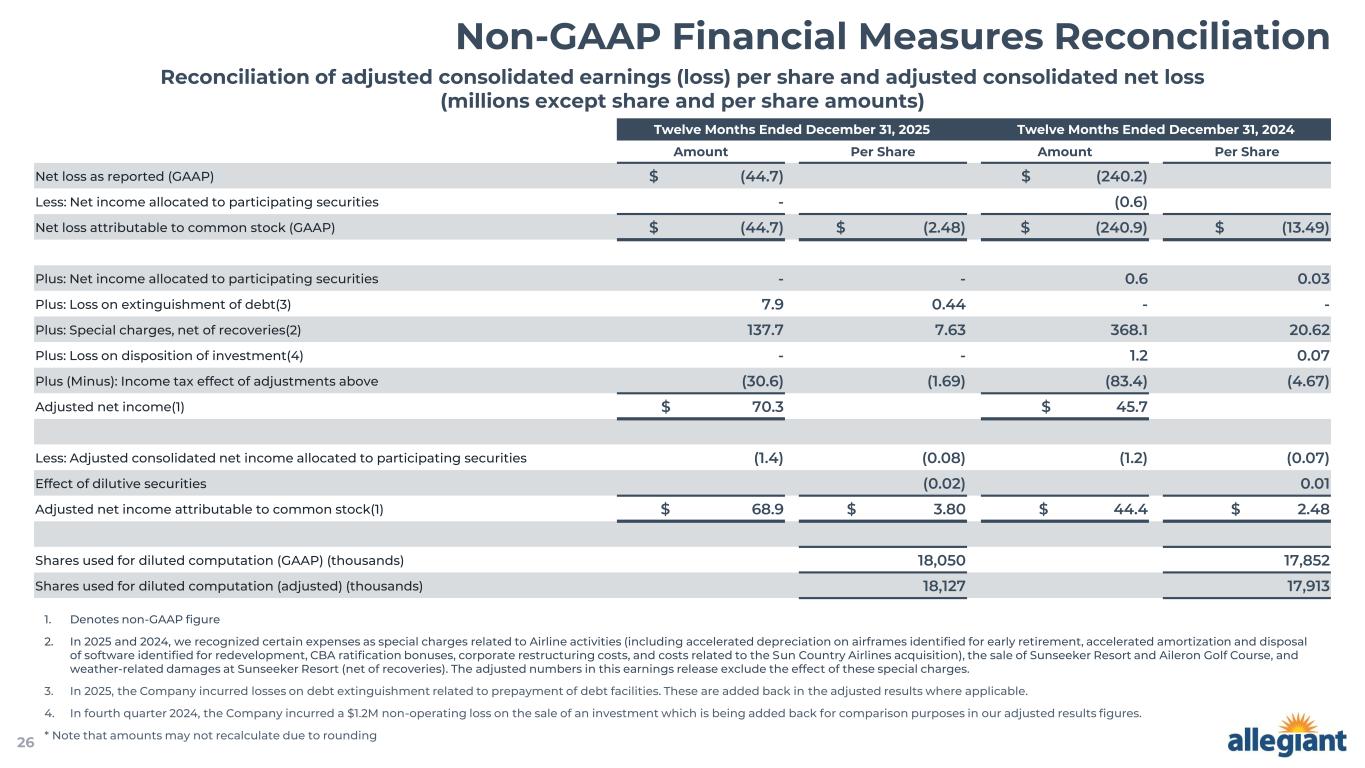
Thank you, Guru, and good afternoon, everyone. I'd like to start by just recognizing the team for their incredible work throughout 2025. We grew capacity by 12.6% in the year on flat fleet count and flat staffing levels. Despite a 14% increase in fleet utilization and nearly 17% reduction in employees for departure, our team members delivered an industry-leading controllable completion of 99.9% and then provide an update on our outlook and financial position. As with prior calls, my comments today will reference results on an adjusted basis, excluding special items unless otherwise noted. Our outlook today will exclude any impact from our proposed acquisition of Sun Country Airlines, which we expect to close in the back half of 2020. The airline segment produced net income of $50.1 million, resulting in airline-only earnings of $2.72 per share, coming in ahead of our guided range, which was $2 per share at the Our performance was driven by lower-than-expected salaries and benefits, timing of certain maintenance expenses, and a stronger-than-expected revenue environment following the government shutdown. Full-year 2025 consolidated net income was set for $3.80 per share. The airline earned $93.8 million, yielding a full-year airline-only earnings of $5.07 per share. The airline generated just over $143 million of EBITDA during the fourth quarter, producing an EBITDA margin of nearly 22%, underscoring the earnings power of the model in a favorable leisure demand environment. Turning to cost, we will average $2.61 per gallon during the fourth quarter, slightly above our expectations. Notably, ASMs per gallon were up 2.6% over the prior year quarter, highlighting initial efficiencies from investments in the maxed aircraft and LEAP engines. As the MAAC aircraft comprises a larger percentage of the fleet, we expect to see continued improvement here, yielding significant savings in annual fuel consumption. Adjusted non-fuel unit costs were $8.01, representing a 3.4% year-over-year improvement on 10.2% higher capacity. For the full year, cost performance came in consistent with our down mid-single-digit expectation with non-deal unit cost down 6.1% despite removal of four and a half points of plant capacity growth, demonstrating the strength and agility of our flexible utilization model and the cost discipline of our team. And I'm really pleased with how the team has delivered on the cost front. As we look ahead to 2026, while we expect capacity to be down slightly year over year, which will place modest pressure on CASM-X, I remain confident that the cost initiative implemented in 2025 will help mitigate these pressures. Importantly, we can see TASMX fuel increases as evidence by moving to the balance sheet of undrawn revolving credit facilities. Cash and investments declined by approximately $150 million from the end of the prior quarter, reflecting proactive debt repayments following the sale of Sunseeker, which had closed late in the third quarter. During the quarter, we have repaid $259 million of debt, including $224 million in voluntary prepayments. At year-end, cash and investments sat at approximately 32% of full-year revenues. We also increased our revolver capacity to $250 million, up from $175 million, providing efficient available liquidity while allowing for reduction in debt balances. Notably, we continue to maintain an unencumbered pool of aircraft and engines valued at well over $1 billion, providing substantial financial flexibility. Total debt at year-end was just under $1.8 billion, down from $2.1 billion at the end of the third quarter, and net leverage improved to 2.3 times, down nearly a full turn from the fourth quarter of 2024. Capital expenditures during the fourth quarter were $56.7 million, including $35.9 million of aircraft-related spend and $20.8 million in other expenditures, while deferred heavy maintenance spend during the quarter was $11.5 million. For the full year, we invested $453 million into the airline, inclusive of heavy maintenance expenditures and within our previously guided range. We are with 123 aircraft in the fleet, including 16 737 MAX and 107 A320 family aircraft. Looking ahead to 2026, we expect to take deliveries of 11 737 MAX aircraft with nine placed into service by year end, while retiring nine A320 family aircraft throughout the year, resulting in a flat year-over-year fleet count. Based on these delivery expectations, we estimate full-year 2026 capital expenditures of approximately $750 million, including $85 million in deferred heavy maintenance and $580 million of aircraft-related CAPEX. Turning to our outlook, as Drew noted, we now expect full-year capacity to be down slightly year-over-year, largely due to timing of aircraft deliveries, which are back half-weighted. This includes a modest delay of three aircrafts pushing their entry into service just after the start of our summer peak. The healthy demand environment we observed during the fourth quarter extended into early January. While winter storms, Fern and Gianna did impact bookings, we are beginning to see a recovery and today's guidance reflects the impact from the storms. As a reminder, our outlook is based on Allegiant's standalone forecast. For the first quarter, we expect earnings per share of approximately $3 at the midpoint of our guided range, implying an operating margin of 13.5% based on an assumed fuel cost of $2.50 per gallon. For the full year, given continued macro uncertainty across the industry, we believe it is appropriate to guide more conservatively. At this point, we expect to deliver earnings per share of at least $8 with the potential for upsides as demand trends cost initiatives and operating performance 2025 was a foundational year for allegiance we brought level of operations back in line with our fleet infrastructure providing operating cost economics constructed to our leisure focused flexible capacity model we largely restored peak day aircraft utilization making more of our products available on the days our customers want to travel we aligned management headcount to level of operations and introduced performance-based pay programs for leaders across the business we integrated one-third of our firm order book from boeing improving team member productivity and delivering initial fuel efficiency targets we divested of the sun seeker business and refocused management efforts on the airline we paid down debt and positioned our balance sheet for healthy investment in our future with more than 100 new technology aircraft available in our order book a healthy financial position to access the used aircraft market opportunistically and a technology suite suitable for serving a larger customer base, I remain highly confident in the foundation we have here, whether that be for navigating through various demand environments, expanding our leisure offerings to more communities, or enhancing our customer and team member experience. And with that, operator, this concludes our prepared remarks. We can now move to analyst questions.
Operator
Thank you. If you would like to ask a question, please press star one on your telephone keypad. If you would like to withdraw your question, simply press star 1 again. We ask that you please limit yourself to one question and one follow-up if needed. Your first question comes from Scott Group with Wolf Research. Your line is open.
Hey, thanks. Afternoon. So, I think the term you used was January was exceptional from a demand standpoint. Maybe just like some color on what you think is driving that. And I know it's early, but when you look at the – how does, you know, the rest of the quarter looking, you know, are you seeing that same trend continue? Any degree of moderation? Any thoughts there?
Yeah. Thanks, Scott. You know, this – it helps that we have seats pulling back a little bit when it comes to demand, but I don't think what we're talking about is much different than what we've heard from a number of carriers through this cycle, the user, the visitation coming through the front door is better than we've seen in several of the prior years, able to manifest both in terms of bookings and through some pricing capabilities and yield, which is a nice change of pace for us over the last couple of years. I think that's going to be really pronounced going through the spring break and Easter period. And then we'll kind of see what happens as bookings and demand starts to turn a corner or toward post-eastern into the summertime frame, which still a bit too far out for the current booking curve. So I think we're hopeful as we get into the second and third quarters that there remains upside similar to what we've seen in January, but not something that I'm willing to bank on quite yet. Air bars on what we've seen for summer period over the last several years are just so much wider that it's hard to have a great deal of conviction that this will definitively continue through that time frame.
And then, if I heard correctly, I think you have a view that you're going to have, you guys are going to have the best RASM-CHASM spread in the industry this year. Maybe just some, a little bit more color on how you are thinking about both RASM and CHASM this year would be helpful.
Okay, Scott, I think in Drew's comments, he was referring to in 2025 the best spread between TRASM and CASM-X, but I will say as we look to 2026, we expect TRASM to improve more than CASM-X this year as well, which reinforces the margin expansion that we're looking at.
That was backward looking. But how are we thinking about in a flattish capacity environment, how are you thinking about CASM this year?
Sure, Scott. Hey, it's BJ. On a full year basis, as you would expect, we would expect CASM to be up for the most part across all lines in the P&L except maybe aircraft rent, which we talked about the last couple of calls. And then if you just think about the shape of capacity, you would expect CASM X to be up more in the first half of the year than it would be in the back half of the year. And I would just share, I would expect the second quarter to be the high point on a year over year cost basis. And then maybe just worth noting, we do expect CASM-X on a full year basis to be down versus 2024.
That's helpful. Thank you, guys.
Operator
The next question comes from Atul Mahaswari with UBS. Your line is open.
Good evening. Thanks a lot for taking my question. Vijay, you mentioned in your prepared remarks that you were being conservative with the full-year guidance given, you know, how some of the macro issues hit the legion in the industry last year. So, just to be clear on what's assumed for the full-year guidance, you're not really assuming the current from January trends to continue, and is that the right way to think about you know what gets you to the $8 versus like a January trends were to continue to get a number higher than that is is that the right way to think about it yeah cool I think that's right you can just kind of think about Drew's answer there to Scott's question that would line up okay thank you and then on the first quarter I want to better understand what's assumed
at the low end and at the high end so if you know current booking trends were to continue does that take you to the midpoint of the first quarter range or which is the three dollars or does that take you to the high end of the range and then what's assumed at the low end a lot there you know like what we're putting out for for the midpoint is kind of where where we see demand we know it will taper a little bit through the quarter for in-quarter bookings that's You know, just the nature of things, the peak is certainly the weeks immediately after the So we won't persist at exactly the same level, but we wouldn't expect that either. And then, you know, variants from that on the rep side will take us one way or the other.
Operator
The next question comes from Mike Leinenberg with Deutsche Bank. Your line is open.
Hey, good afternoon. Two questions here. When you talk about demand and the strength that you're seeing, how much of that is just a function of the fact that you're coming into the year with a very favorable supply backdrop? I mean, you indicated, Drew, that you're going to be down March and June and then picks up and, you know, maybe more specifically, you know, where is the demand across the network?
You know, is it stronger in some regions versus others? like we know that Vegas has been struggling but we've also seen a lot of capacity come out of Vegas so I you know I realized the headline number may be somewhat deceiving and so I'm just curious if you could drill down and give us a little more color you know perhaps a little more color but you know I'll probably stop short of great detail you know geographically it all it all looks pretty strong I mean to your point it's not a new story that the Vegas has I think LBCBA's numbers had it down about seven and a half percent or so in visitation year over year, but convention attendees were flat, right? It's becoming a very event-driven and holiday-driven destination, which is very similar to the rest of our network, but a bit unfortunate to lose kind of that year-round rock star reliable that it once was. So, yeah, certainly having seats down helps, but I alluded to the visitation to the website. I mean, what's coming through the front door, you know, we would have loved to have in 25, too, when we were talking about how strong it was to start the year, and we're beating So, I feel really good about where we sit. I feel good about it in elevated capacity. I feel really good about it with seats coming down a little bit.
Okay, great. In my case, Greg, what Drew and team did in the plan this year as well is they concentrated more flying in the peaks and removed some in the off-peak as well. So I know Drew mentioned that in his opening remarks, but that too, you know, that's a helpful backdrop for the strength we're seeing in demand.
Great. And then just my question really turning to the merger and maybe just some of the mechanics. Not that you put out a filing, but just curious at what day or what time from you did actually file Hart Scott Rodino. I know it's a 30-day waiting period. The deal was announced early January, so if it was right around that time, we'd be coming up to at least the first 30-day period. And sort of tied to the merger, as we think about the cash component the four dollars plus per per Sun Country share I think that's about 200 million dollars is that is the plan to finance that out of cash or you know would you would you finance that you know is it out of cash or would you actually finance it thanks for taking my questions on that no thanks for the question Mike I'll kick it off BJ will follow up on that second part around cash.
As we put out, we expect the merger to close in the second half of 26. And to your point, there's conditions necessary to achieve that, shareholder vote, regulatory approval, and then some other customary closing conditions. For the shareholder vote and the regulatory approval or the HSR filing, we expect, Mike, to file both of those within the coming weeks and then post those filings and review that'll trigger the timeline as well. And then, oh, yeah, and then BJ, do you want to jump in on the question? Sure.
Hey, Mike. On the cash consideration for the merger closing, you know, it's certainly going to depend on when in the year the closing would take place. I would just note, we have a bond out there that matures in the third quarter of 2027, and so we've had an eye on the market to refinance that at some point. And so ideally, we would refinance that and take a little bit more out and have some extra cash to pay the cash consideration of the merger closing. But if the timing doesn't work out, there's more than a billion in unencumbered aircraft and engines. Yeah.
Speaker 1
Handedly, cash balances for the first quarter are ahead of schedule, we could start by just using cash balances we need to great great thanks everyone thanks Mike the next question comes from Dwayne Fenningworth with Evercore ISI your line is open hey thank you I just wondered if you could speak to how you were deploying the max aircraft any any more flexibility that you have currently versus maybe how you were using them with just a few on the property? And as you begin to consider the combination with some country's fleet and your own fleet, where do you see the biggest opportunities?
Yeah, so I think we talked about this in previous quarters. Starting around mid-November, we pivoted a little bit on MAX from flying, you know, a lot of cycles and getting up and down for pilot transition training into something that supported a bit of longer-haul flying, something that's a bit more commercially So, yeah, that started, what, two and a half months ago or so, and, you know, it's contributing to the numbers I quoted in the remarks, feeling great about that. You know, we'll get into additional basing on that in the back half this year as deliveries I've got a second.
Yeah, and then just on the, you know, the potential transaction, Duane, with fleet and how we would be flexible in that regard, I think we're really excited as we think some upside in the deal to ensure that we can have the right aircraft at the right gauge in the right markets. Both Sun Country and Allegiant, we own our aircraft. We have a great deal of flexibility there. It'd be too early to say what we're planning at this point, but we do think that provides some potential additional upside as part of the transaction as well.
Speaker 1
Thanks for that. And then maybe just from an earnings power, earnings seasonality perspective, as you think about the quarterly baseline, maybe for 2025, which quarter do you think has the most upside from your perspective? you know, and that's not necessarily a 2026 comment, but just to get to like that normalized earnings power on an Allegiant standalone basis, as you look back on the four quarters of 25, which quarter do you think has the most upside?
Dwayne, let me kick it off and I don't want to say that the third quarter I believe has the most upside, but what we're focused on is, as you recall in 2025, we had a negative margin in the third quarter, and we're focused on turning that to a positive margin as well. But in terms of the most upside, Drew, I mean, do you think it's kind of bookended on the first and the fourth quarter right now?
Yeah, they've remained incredibly resilient first and fourth quarter. You know, just, you know, thinking about the same store flat capacity backdrop, we were down about 6% in the second quarter and 5% in the third. You know, I don't know, I'm not willing to guide for you today what recovers from that, but those certainly took the largest kind of core demand impact through 25 and from that perspective would pose the biggest upside capability this year.
Speaker 1
Okay, very helpful. Thank you.
Operator
The next question comes from Andrew DeDora with Bank of America. Your line is open.
Hi, good afternoon, everyone. I guess first Next question for Greg, now that you're kind of back on track with your MAX order book here, that you used to generate roughly $6 million in EBITDA per aircraft back in 2019. With this new fleet, any chance you could maybe give us an update on where you think that can go in today's environment with the new MAX fleet that you're going to have?
Yeah, on the MAX aircraft, Andrew, they're definitely the larger share of ASMs that they're producing in the company. You know, we think that becomes a meaningful structural tailwind. We overall, though, and I appreciate the comment about the improvements you've seen, we've really been focused on these initiatives that we've talked about to strengthen our business, kind of get back to what the Allegiant of old. And, you know, for many years we have led the industry and we're pleased with the progress we're making. Our first step is getting back to double-digit margins. And I think this year you're seeing in our guide that we're taking, you know, a meaningful move in that direction. We expect still later this year, we talked about it on a previous earnings call, to have an investor day. I think the transaction announcement may push that back a little bit later than what we initially anticipated. But that would be, you know, I think a helpful setting for us to talk about the long-term earnings potential. And we could, you know, drive it in margins or in terms of EBITDA per aircraft as well.
Got it. Fair enough. And just my second question, you know, I know there's obviously a lot of utilization to flex capacity over the year. I guess, you know, if you see demand get materially better, do you have much capacity that you could potentially flex and add in given your flat fleet growth?
Yeah. I've mentioned a little bit in the remarks that we have some slack on peak days, you kind of have to go through the summer, but certainly, you know, off-peak has a ton of runway if the demand and fuel environments dictate that we add that in there. You know, I think we'd be making those calls, you know, Easter-ish timeframe, more or less, but certainly some slack that still exists there.
Operator
The next question comes from John Godin with Citigroup. Your line is open.
Hey, guys. Thanks for taking my question. Obviously, great quarter, great guidance. I wanted to just think about 1Q guidance for the full year in a little bit more detail. Last year, if we think about the seasonality of margins, we saw 2Q margins just a little bit lower than 1Q margins. Obviously, 3Q is very different, and then 4Q margins above significantly the 1Q level. Is that the right general seasonality that we should be thinking for 2026 off of this 13.5% margin at the midpoint? It seems like the full year guidance, at least at the $8 level, really doesn't contemplate that kind of seasonality, but maybe I'm wrong. Maybe you could just kind of offer some thoughts there.
Sure. I mean, maybe just, you know, thinking of of the ref side in particular and going back to some of the early comments. A lot of this will depend on your view on what happens with core demand as we go through the summer. I think the industry as a whole and we're no different taking a slightly more conservative view on how that will roll out. Again, we've just seen so much variability in those actual results as we go back through the last several years. So, depending on your level of volition on summer demand will probably dictate how you I think that margin cadence looks through through 26.
Hey, John, it's me, Jay. The only thing I'd add to that is just keep in mind, Drew hinted at the top of the call that he's constrained on fleet heading into the summer. We had some very modest delays on some max deliveries that are impacting the early part of summer capacity, and so that'll put a limit on what we can do in 2Q.
Okay. I guess what I was getting at is, you know, some of this is in your control with the maxes kind of rolling on throughout the year. It does seem very reasonable, even in a wide range of demand scenarios, that 4Q26 margins are going to be considerably higher than your 1Q range. I mean, unless something really changed in the demand environment, is that logic wrong?
Hey, John, it's Greg. I could step in maybe. For the first quarter, I think we have about 28% remaining to book, and we're still early in the full year, and so we put a guide out there for the full year that we're confident that we can deliver on. Currently demand is strong, and the economy, the backdrop, it seems good. But to Drew's point, we just don't want to get ahead of ourselves, and so we want to to take a more measured approach and then update throughout the year each quarter.
Okay. Okay. Fair enough. I mean, I think we can tell what you're getting at. Can we just ask a completely different question? There's a view out there that there could be a carrier liquidating relatively soon. I'm not sure if that's true or not. I'm just curious if you guys have a playbook for an event like that. Does that influence anything that you would do? Is there kind of a second step to that if we see an event like that occur in the industry?
I'll start, and Drew may want to add, but, you know, we don't view our success here at Allegiant as being kind of dependent on what other carriers in our sector may or may not do. We believe we're just uniquely positioned here at Allegiant just because our differentiated model, And candidly, we have limited overlap, but what Drew and his team always do is they keep a close eye on capacity, industry capacity, and they'll continue to evaluate that as they would normally, right?
Yes, that's right. And, you know, we recently secured a little bit more space in Fort Lauderdale as it is. You know, I've been looking to grow in there for a while. And, you know, it's a bit of an owner at the airport to be able to grow into, and we've been great partners with them. and they've been great partners to us, helping to work to secure that. And we're going to keep trying to grow where we see demand and success. And, you know, that's one of the places where we've been successful in doing so.
And if that happened in the near term, would you have the ability to lean into that, to flex capacity into that? It sounds like there are some aircraft constraints as well. Or do you think you'd just be a beneficiary more on the yield side or something like that?
I mean, to be determined, I mean, it's a lot of speculation in there. Like we mentioned earlier, we do have some slack left in our schedule that will deploy as we see fit, kind of as we see what shakes out. So whether that comes through capacity, whether that comes through, you know, just a few left seats in the market benefiting pricing for the short term, I guess we'll see. It's hard to speculate at this point, I think.
All right, fair enough. Thank you for all the answers.
Operator
The next question comes from Savi Saith with Raymond James. Your line is open. Hey, good afternoon. Just maybe a little – expanding a little bit on Mike's earlier question, I'm kind of curious how you're thinking about balance sheets this year and targets. You know, you do have a big CapEx plan this year and this merger. So I'm curious how you're kind of thinking about where you'd like to kind of keep the balance sheet.
Sure. Thanks, Avi. I've spoken on these calls for a while about trying to keep net leverage in the two to two and a half terms. We don't have a specific mandate from Greg or our board on that, but we update on it every quarter, and I think that's a healthy place to be. I'd like to see that number closer to two versus two and a half. But as we kind of alluded to on the call, there's a lot of opportunity out in the industry and there are certain times where we should move within that range. As I think about 2026, the things that we need to consider are refinancing our bonds. So that's maturing in 2027. We don't need to do that in 2026, but the markets are quite constructive at the moment. it could be a good opportunity to build up some cash balances at attractive economics. And then there's the consideration, the cash consideration due to Sun Country in the back of the year. And then we've been trying to keep cash balances elevated a little bit toward the higher end of our targets. And that's because we'd like to envision a world where we're paying out our pilot retention bonus at some point soon as well.
And so we want to be ready to do that when we have an opportunity so those are the big things and then we have a big capex here as you mentioned um now most of most of the all of that could be financed at delivery we'll probably pay cash for airplanes in the first half of the year and then think about aircraft financing in the back half of the year savvy it's greg i just wanted to add a couple comments on on bj's points there and maybe a little bit more high level and that's that owning our fleet and opportunistically buying aircraft is a differentiator for us at Allegiant and we think it sets us apart, particularly in our segment of the industry. And it's a major driver behind our durability, our low ownership costs and our flexibility in that regard. And with the Sun Country acquisition, just the work that BGA and the team have done to strengthen the balance sheet over the years and the way we structured the deal, the acquisition isn't going to stretch us by any means. In fact, post-close and integration, it's going to strengthen the balance sheet. We have a favorable, well-timed max order, and you combine that with the free cash flow that Sun Country is currently producing, And that's going to help us not only maintain low leverage, but continue to de-leverer post-combination.
That's well said, Greg. Thank you for adding that. And I think, you know, inside of Greg's comments there, Savi, the question is, if we wanted to raise the financing, do we do it ahead of having clarity on all the approval dates and the close date, knowing the close date definitively? Because we may raise a little bit of additional capital today to be ready to close. but immediately on closing will benefit, like Greg mentioned, from the cash flow that that business produces.
Operator
Great. Good point. And this is our answer. I'll leave it at that. Thank you.
Operator
The next question comes from Connor Cunningham with Milius Research. Your line is open.
Everyone, thank you. Maybe we could just start on the new market development. It's been a bit since we've started to add back new cities and whatnot. You highlighted the 10% of your capacity in 2Q and 3Q. Just curious if you could provide some, maybe some historical context to what a unit revenue drag would normally be on new markets, just as we start to think about past 1Q in general. Thank you.
Yeah, I think in the past, what we've talked about is something in the 10 to 15% range relative to the rest of the system, and no reason to expect it to be different through the cycle.
And then just in terms of – so, yeah, your well-timed max order, you've sounded very, very bullish on the maxes in general. I believe you have 80 on options that are still waiting to be converted or potentially converted. Like, do you need to wait – are you – can you just talk about how you would approach the options side of the business or the options for the maxes in general? Are you going to wait for Sun Country to close? Like, is there – just trying to understand the dynamic of where we could be in a couple of years from now in terms of just the overall – maybe a decade from now, where we could be in terms of just max contribution in general for the company.
Connor, yeah, thanks for the question. As you can tell, we're really excited about the opportunity and excited about what we're seeing in the firm portion of the max order, and there are 80 options. I think we would need to start talking about exercising those options if that's the decision in the back half of this year and that would be for deliveries beginning in 2028 and and i don't think that we have to wait for a sun country close to make that decision because we know or i'll say i believe that exercising some of those options at least is uh accreted to our standalone business but i i think it becomes much much more powerful when you think about the combined fleet you know when we had the call on the merger we talked a lot about synergies but it was really difficult to quantify fleet synergies, in particular around the P&L, because there's just a lot of trading opportunity between the two airlines that own their entire fleet. And we just have such a better opportunity to take advantage of the option order book.
And I just asked one more on top of that, like, if the A3, like, do you envision the A320 to be part of the fleet, like, you know, further down the line? It just seems like the MAX has done wonders for your business in general. And, you know, obviously, some countries are 737 operators. Just, like, any thoughts on single fleet in general?
Sure, Connor. I think I got a little bit of your question and probably forgot to maybe give you a responsible CFO comment and say the number one thing to guide that decision is probably the shape of our balance sheet. And so, the 320 has been a fantastic machine, a fantastic producer for the Allegiant business for a long time. When we announced the max order, I think we talked about the combined fleet being about 50% Airbus, 50% Boeing at the end of the order. Candidly, we haven't sat around internally and discussed that changing significantly. Like I said, there's probably a little bit more opportunity on the max side now that we – on the assumption that we would close the sub-country transaction. But I think owning aircraft is more important than which of the two aircraft right now. And in order to own the aircraft, we need to maintain a healthy balance sheet.
Operator
The next question comes from the line of Ravi Shanker with Morgan Stanley. Your line is open.
Great. I think on the top of the call you mentioned a tech stack opportunity and kind of how you're excited about what's coming. Can you just elaborate on that a little bit and kind of is that something that you are putting in place now or do you think that needs to be in a little after the merger?
Well, thanks, Robby, for the question. It's a really important one and we've been, you know, through a technology transformation here for a number of years And I'd like to think where we're at today is that our technology investments are much more focused and they're very practical. And as we've modernized our IT stack, it's unlocking a lot of value for us. And so these platforms, particularly on the commercial side, they're allowing us to move much more quickly. What we also were able to accomplish as part of this is bringing our data together and having better data and the ability to use that data to make better decisions. But we're going to continue to be more nimble, continue in terms of technology, continue to find ways to improve, particularly on the commercial side, but throughout the business. For example, we were seeing just for the winter storms that we just recently had, the new technology stack allowed us to communicate better with our customers. And that's what we're ultimately trying to drive. And it's still early, but we're pretty encouraged by what we're seeing and the changes we've made in this area of the business.
Maybe as a follow-up, you mentioned the investor that you mentioned earlier for this year. Do you think that's still a 2026 event, or do you think it gets pushed out?
I think it will pace with the close of the transaction that we're talking about, but we would expect if it closed during the timeline of which we put out there the second half of this year, we still think there's going to be room to have an investor day this year in 2026.
Yeah, I think that's going to be a pretty important catalyst for the stock and figuring out normal IDPS, so I would strongly encourage that.
Operator
The next question comes from Dan McKenzie with Seaport Global. Your line is open.
Thanks for the time, you guys. A couple questions here, and, you know, I guess just, you know, I hope you don't cringe too much at this question. You know, leave it to me to kick a dead horse here. But going back to the guide, does the, you know, does the $8 embed a full or partial recovery of the five percentage points of RASM that was lost in 2025 and I guess you know just beyond 2026 more broadly you know just given the k-shaped economic recovery that we've experienced our drew are some of the lowest leisure demand buckets still missing here as you kind of give us this revenue outlook and you know I guess related to that if that demand segment doesn't come back you can you still manage the airline to mid-teens operating margin throughout the cycle?
Thanks, Dan. I'll try to unpack some of this here. Yeah, I'd be remiss not to give another shout out for our customer mix. It does tend to be on the top part of that K-shape, right? We're median income over 100K, generally originating from lower cost of living, DMAs, we do have a really healthy customer that flies on us. So I don't think that the K-shaped economy by any means is any more headwind or worrisome for me, I guess, as we look forward. What we provide is truly valuable in the communities we serve, and we can still stimulate with We can still play with our schedule in a way that's going to produce the right outcome for what we're looking for. So, that is not something that I will lose sleep over at this point, starting with this.
Yeah. And I would just add to that, Dan, I mean, just to echo what Drew said, that our business and model is designed to protect margins, the flexibility that we've built into it. And what we've talked a lot to the street about over the past year or so, the initiatives and the execution of the team to really re-strengthen that foundation. And so, just a true point, we feel really good where we're at and the flexibility we have and our ability just to serve the leisure customer.
And maybe, sorry, I remember the first part of the question, as we think about the middle part of the year and recovering that kind of that same store deficiency we saw last year you know we're not plugging a full recovery into that numbers of it I mean that's that's kind of you know where you would see a clear upside story if the economy does let's get there we're above zero on it but not all the way back very helpful and then you know second question here going back to the script and the reference to the next phase of the credit card program I'm just reading what are the benchmarks that you'd like that credit card program to hit I guess first and then second of all you know are there steps you can take to get your credit card holders to spend more or do you just think as you think about that next phase and where the revenue upside is you know what are the areas of focus that you know that really makes sense yeah I mean there's definitively steps that we can take and we know that because we've seen it in action you know over the last five months yeah I mentioned at the top you have for the last five months being up double-digit percentage of new card acquisition, spend continues look really strong. I think we just surpassed 600,000 cardholders. It's a really great story as you applied some new tactics and new thoughts even within the existing program. And as you refresh it and bring it to something a little bit more modern, I think there's a meaningful amount of runway that exists there. So as we think about how it's been communicated elsewhere, you see 10% or more remuneration of the percent of revenue. I don't know that we get all the way to 10, but I think we get above the 5% or so that we did in 2025. So as you think about another two or three points on that, it's a pretty compelling case right there.
Yeah, absolutely. Thanks for the time, you guys.
Operator
The next question comes from Christopher Stassilopoulos with SIG. Your line is open.
Speaker 15
Good afternoon. I want to dig into the capacity outlook for 26. So the 10 to 15 percent, the new routes consistent with your historical profile. If you could speak to the composition, so departure, stage, engage, and then on immunization, hours per day, year-on-year, and then the mixed peak versus off-peak, year-on-year. And then also on the allocations, if you look at first Q, 1Q, excuse me, you know, inventory is down solidly across most of your key markets, obviously, with the exception of FLL, and how you're thinking about inventory, I guess, distribution against that full-year guide. Thanks. Hi, Mark. Yeah, you got it.
How about day two? We'll just go through all of it. I'll do my best to unpack everything we talked through here. Stage and engage are a little bit offsetting through the year, so those are somewhat of a neutral for us. We talked about Lauderdale and some of the other growth spots that kind of come from the new market announcements. since we filled out S&A a little bit, filled out a little more in both shores. Lauderdale we talked about. In the spring, it's come a little bit at the expense of Provo capacity. It's gone elsewhere, but by and large, we'll be back by summer. So some of it has really just been kind of a seasonal kind of sculpting, having to make some tough choices through the spring. But really, a lot of that capacity that is coming out is off peak day. We're able to hold our peak days pretty close to flat in terms of actual flying, which to Greg's earlier point will be a bit of a tailwind to our unit revenue outlook and better overall patterns for customers on that perspective. So I can promise you I didn't hit all of your topics there. Is there anything else you wanted me to dive there?
Aircraft utilization where we stepped it up meaningfully 25 versus 24. I want to say it was low sixes. Hours per aircraft per day, 24, up to 7, over 7, and 25. I think it's flat, maybe slightly up a little bit, and 26 for overall aircraft utilization.
Speaker 15
Great. I'll keep it to that.
Operator
The next question comes from Catherine O'Brien with Goldman Sachs. Your line is open. Hey, good afternoon, everyone.
Thanks for the time. So I just wanted to bring it back to the fourth quarter beat for a minute. You know, you came in ahead despite the government shutdown. We don't know what your RASM or CASM expectations were going into the quarter. Can you just walk us through what went better and maybe just put some numbers around maybe how much better, roughly, if not exactly? I'm really just trying to get a sense of, you know, where there might be continued momentum into the first quarter.
Yeah, I'm happy to start. I mean, the REV Outlook, you know, outperformed a little bit, and in particular, you know, We certainly, I think we communicated that we did see a bit of a slowdown during government shutdown as flights were being pulled back, but that recovered so well in the weeks following. And I talked a little bit about the holiday period, but that three-week stretch with some of which does spill into January being a positive on a year-over-year was certainly a bigger catalyst than I had anticipated at the beginning of the quarter. So, kind of that late demand spike was a good guy.
Sure, Katie, I'll just add in, yeah, we did have a handful of beats on the cost side as There were a few areas, salaries and wages came in a little bit lower than we had expected. And then I think the point of your question, there are a few items, maybe one that I'll call out, which is in the maintenance line. We had a meaningful beat there, which I would expect to be a bit of a shift into the first quarter of 26.
Okay, great. And then maybe, BJ, just sticking with you, on the potential for refinancing and perhaps looking to raise debt against your unencumbered assets, you mentioned that the markets look constructive right now. Is there any structure or market that looks particularly attractive? You know, capital markets, bank debt, finance, leave, Joko, whatever it may be.
We like all of those products. I think for me, and certainly others can weigh in here, for me, I just think it's important that we have a piece of the capital stack on the debt side that is not aircraft funded, because the aircraft have proven to be resilient throughout cycles, including through a pandemic. And I just really like the ability to tap into aircraft to raise capital, whether that's that's opportunistically for a large acquisition or whether that's out of defense because we see fluctuation in the demand environment. And so I just liked the idea of keeping something of similar size to our existing bond at the time of its original issuance, which was around $500 million. I like keeping something like that out there, which is secured by corporate collateral or the loyalty program.
Okay, great, thanks for the caller.
Operator
This concludes the question and answer session. I'll turn the call to Sherri Wilson for closing remarks. Thank you all for joining us today. We'll see you next quarter. This concludes today's conference call. Thank you for joining. You may now disconnect.