Operator
and welcome to the AMD second quarter 2026 conference call at this time all participants are in a listen-only mode a question and answer session will follow the formal presentation if anyone should require operator assistance during the conference please press star zero on your telephone keypad and please note that this conference is being recorded I will now turn the conference over to Matt Ramsey, VP, Financial Strategy and IR. Thank you, Matt. You may begin.
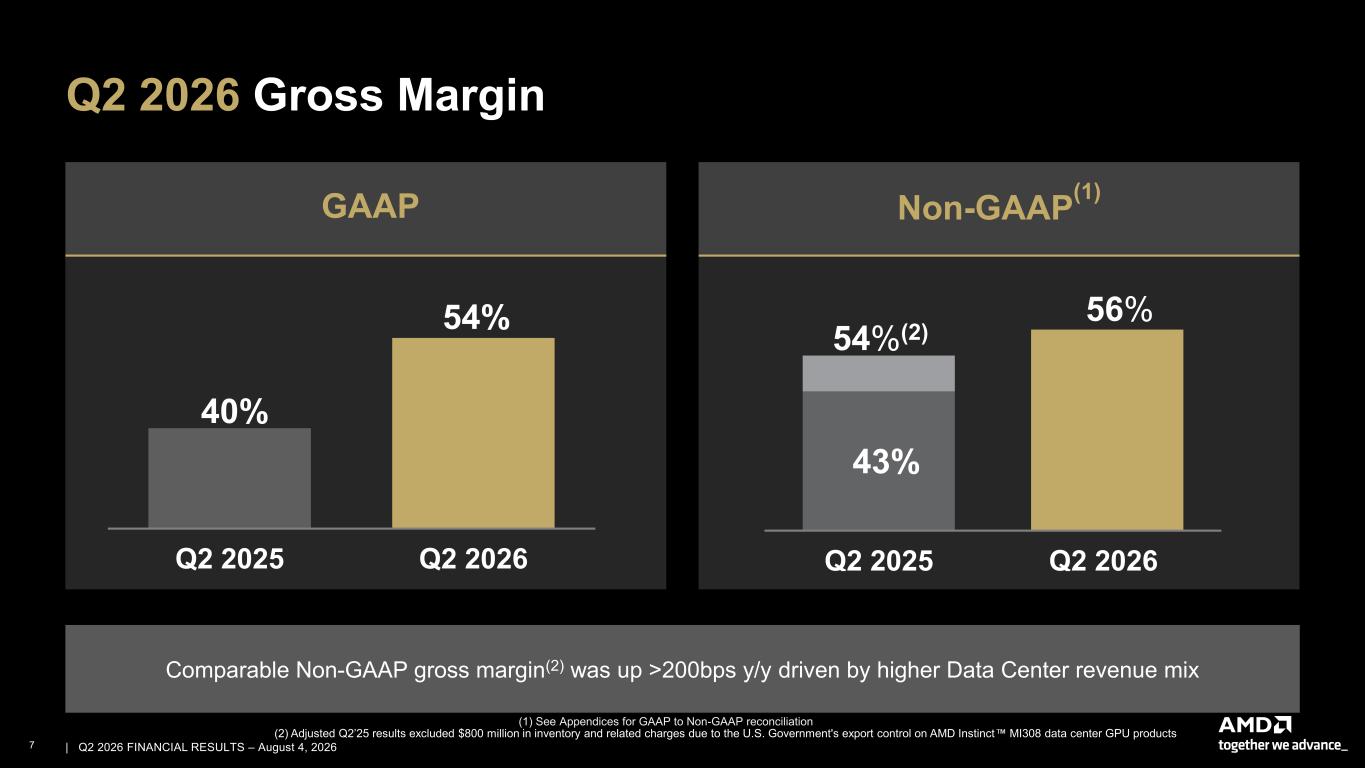
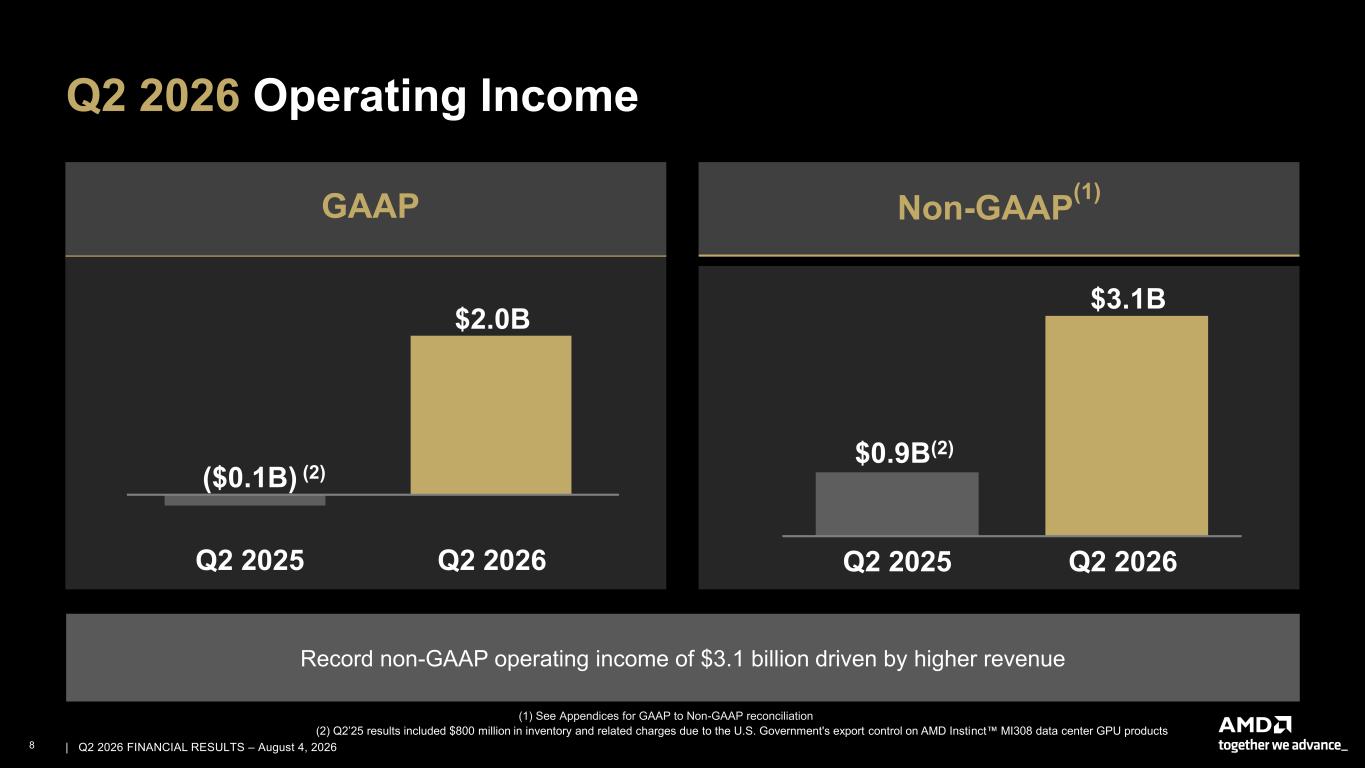
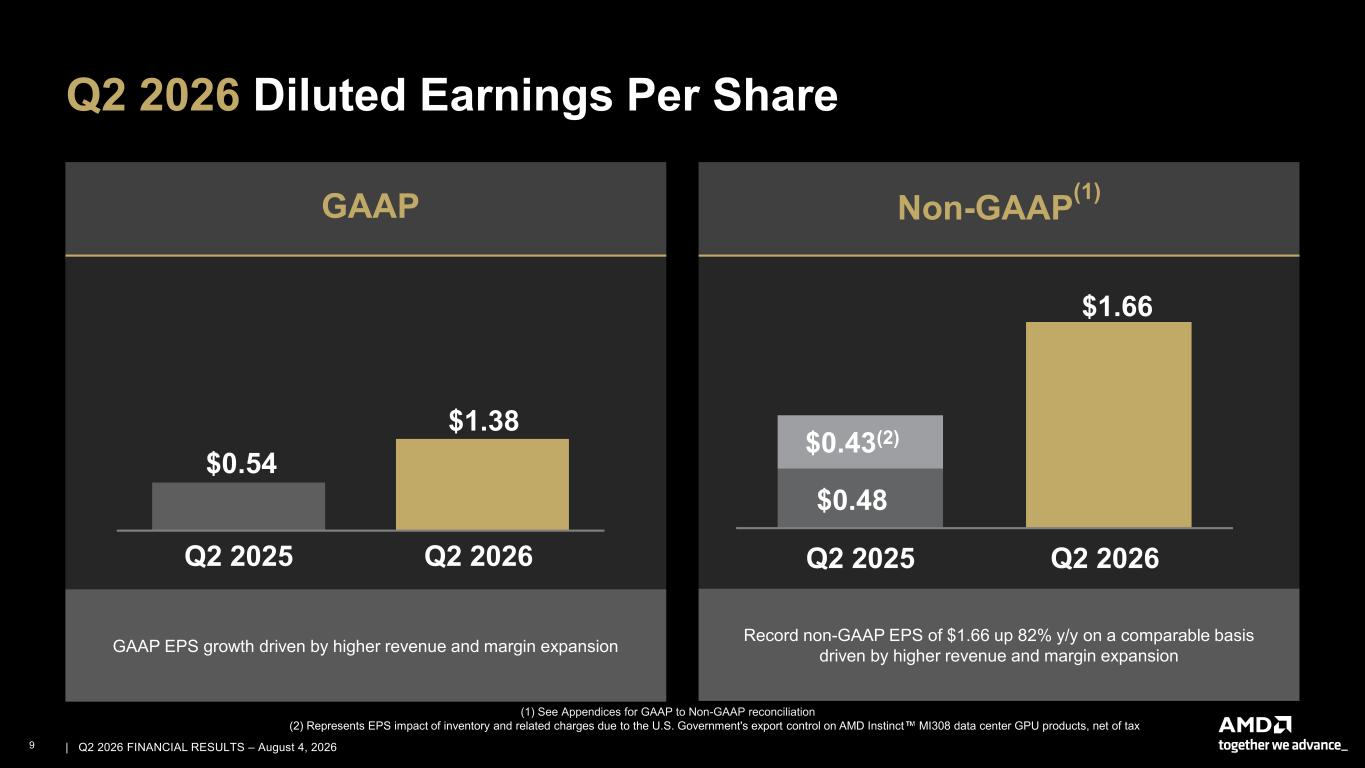
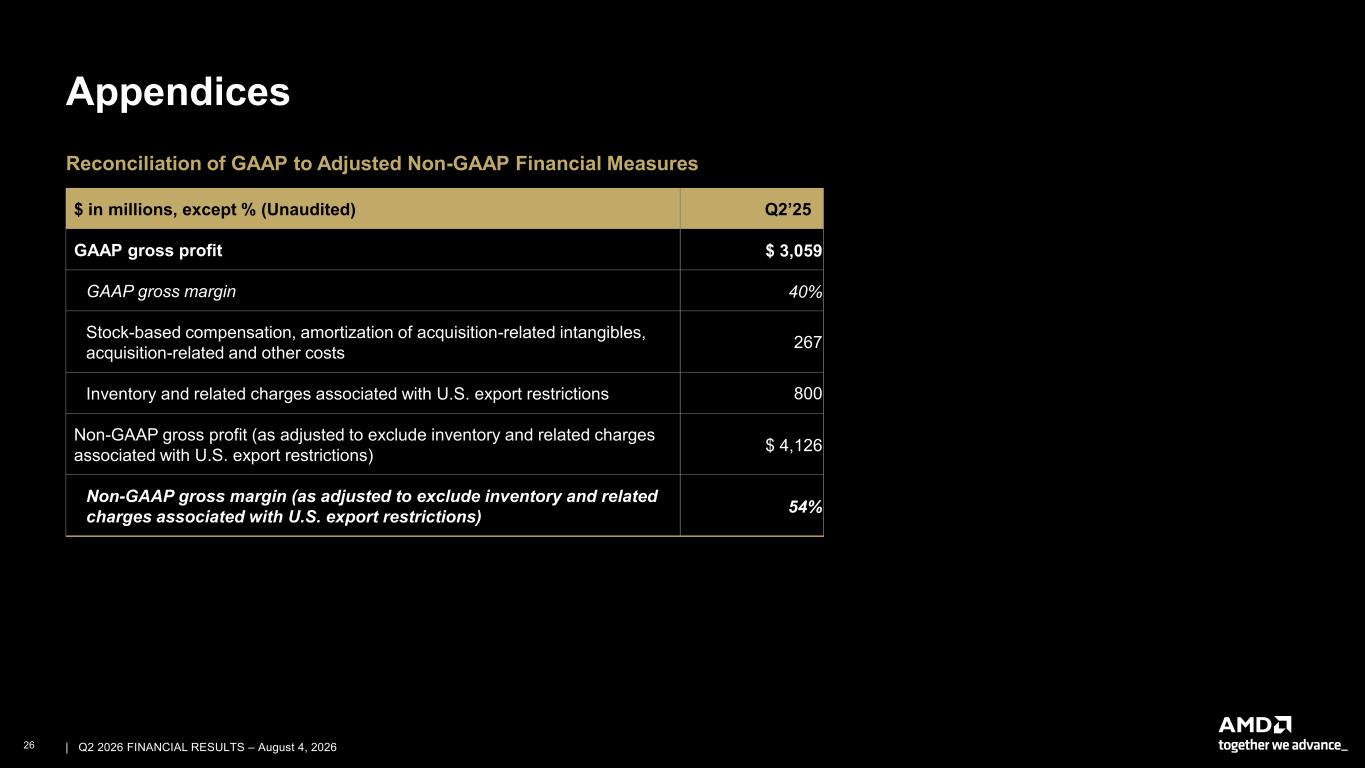
Thank you and welcome to AMD's second quarter 2026 Financial Results Conference Call. By now, you should have had the opportunity to review a copy of our earnings press release and the accompanying slides. If you have not had the chance to review these materials, they can be found on the Investor Relations page of AMD.com. Today, we will refer primarily to non-GAAP financial measures during the call. The full non-GAAP to GAAP reconciliations are available in today's press release and slides posted on our website. As a reminder, our second quarter 2025 results included approximately $800 million of inventory and related charges associated with U.S. export control restrictions on MI308 shipments to China. Unless otherwise noted, comments making year-over-year comparisons exclude the impact of those charges to provide a more comparable and meaningful view of our underlying business performance. Participants on today's conference call are Dr. Lisa Su, our Chair and CEO, and Jean Hu, our Executive Vice President, CFO, and Treasurer. This is a live call, and we will be replayed via webcast on our website. Before we begin, I would like to note that AMD will participate in the following events for the financial community key banks technology leadership forum on tuesday august 11th city's 2026 global tmt conference on tuesday september 8th and the goldman sachs communicopia and technology conference on friday september 11th today's discussion discussions contain forward-looking statements based on the current beliefs assumptions expectations including forward-looking statements regarding financial projections, business and industry trends that speak only as of today and as such involve risks and uncertainties that could cause actual results to differ materially from our current expectations. Please refer to the cautionary statement in our press release for more information on these factors that could cause actual results to differ materially. With that, I will hand the call over to Lisa.
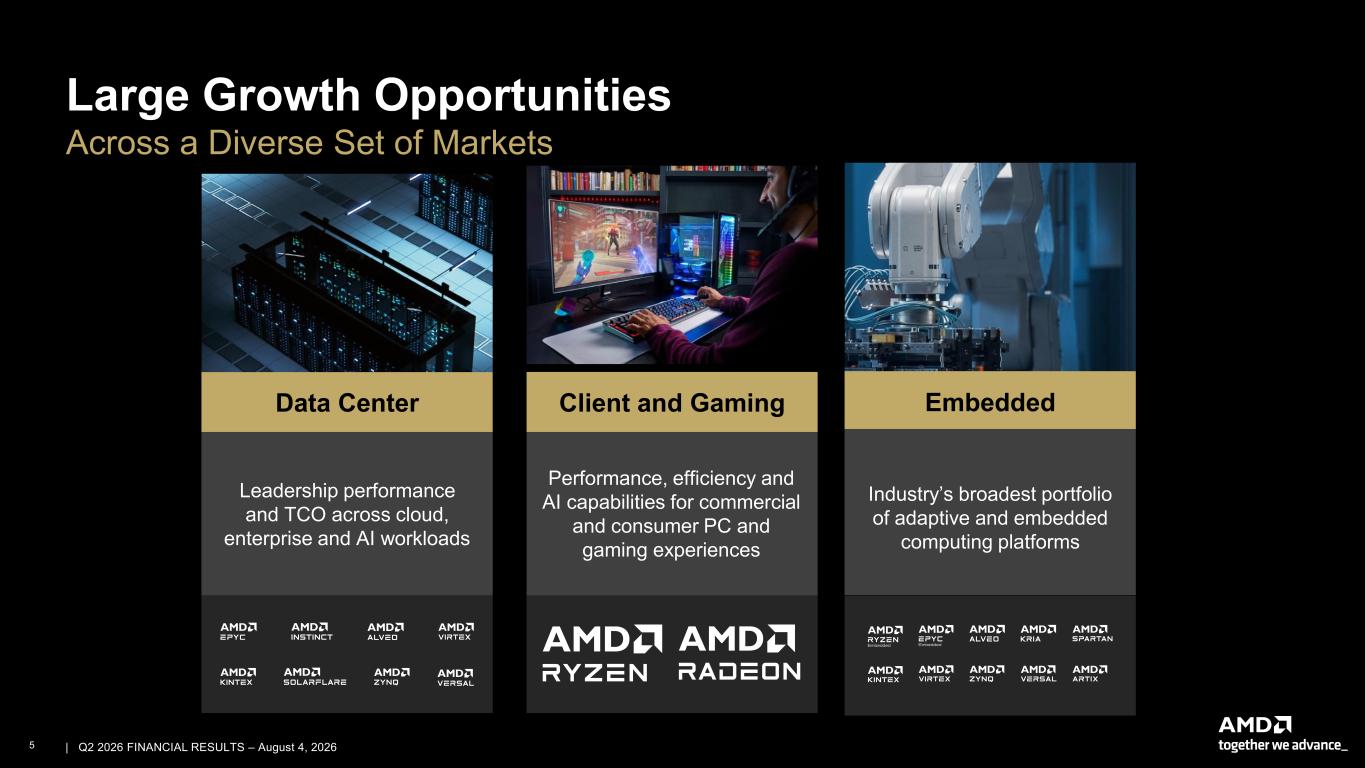
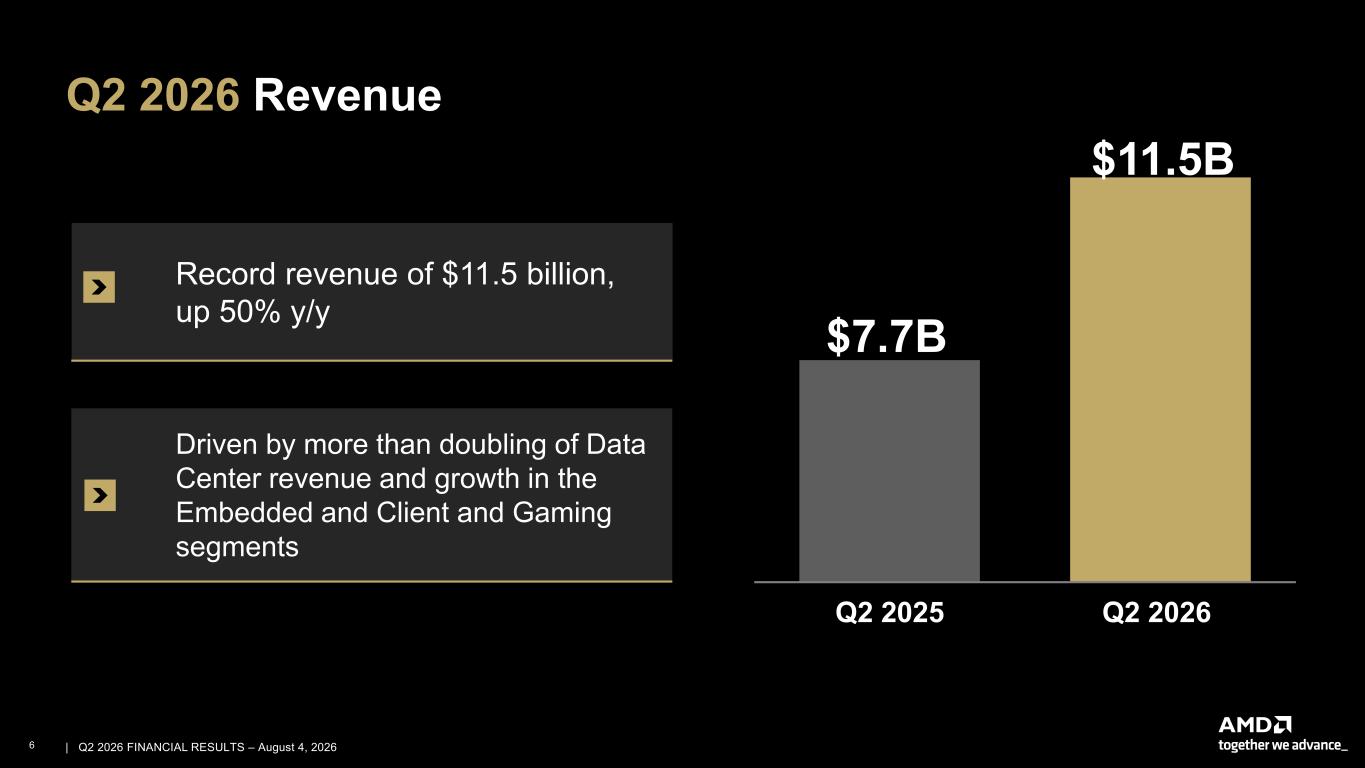
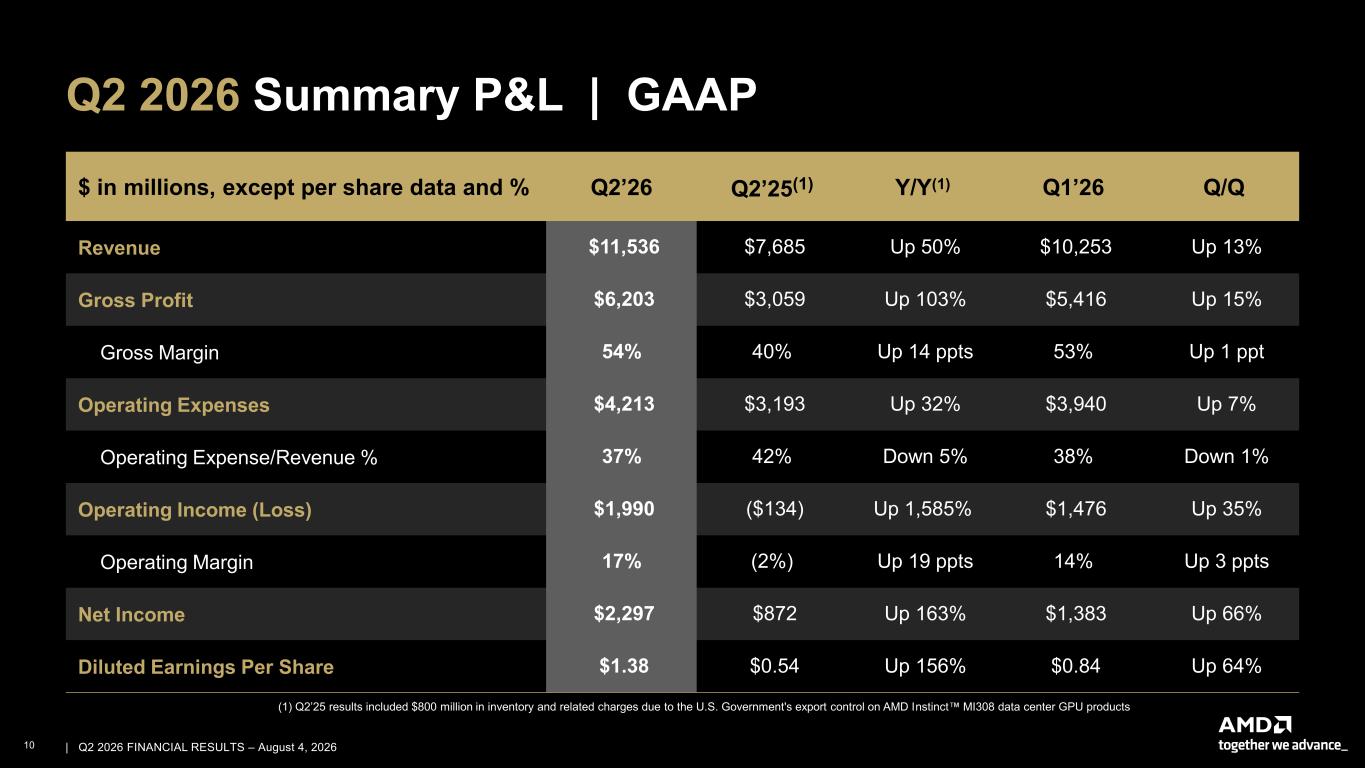
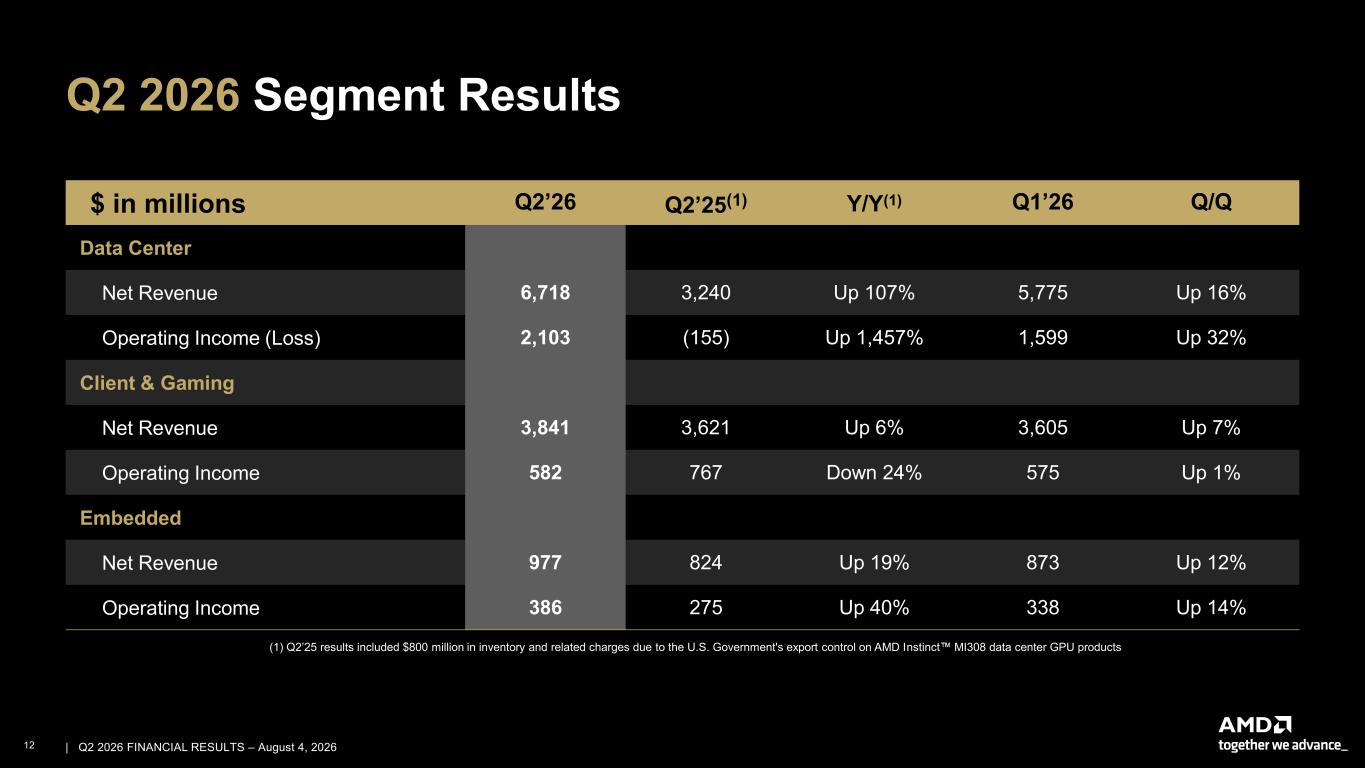
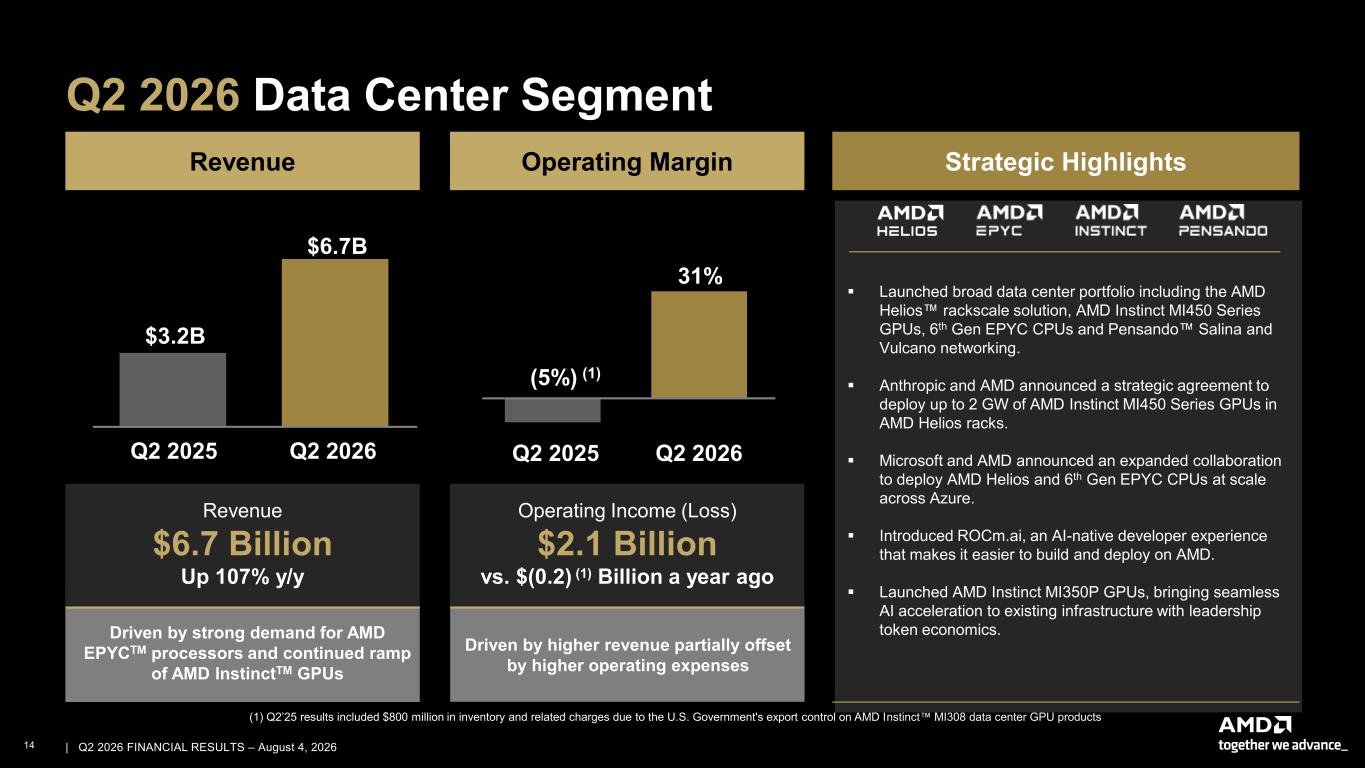
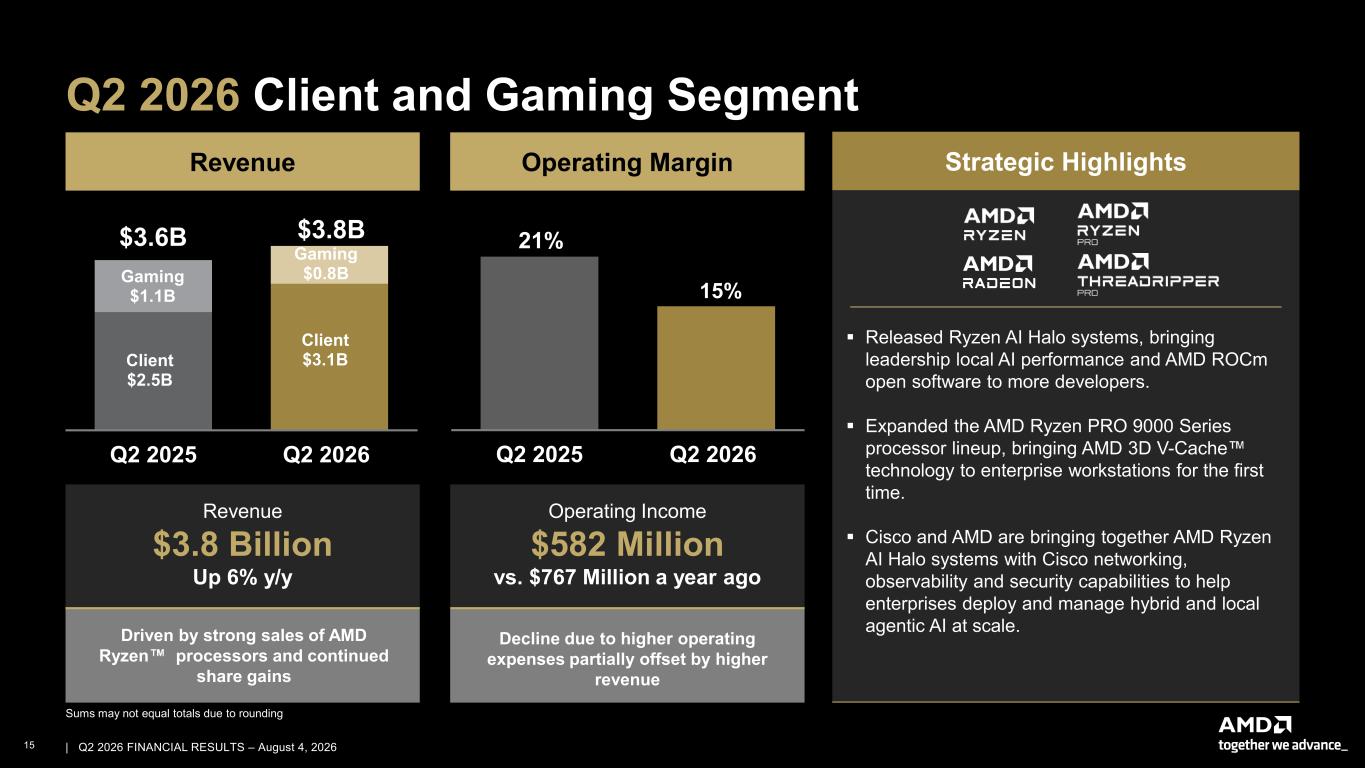
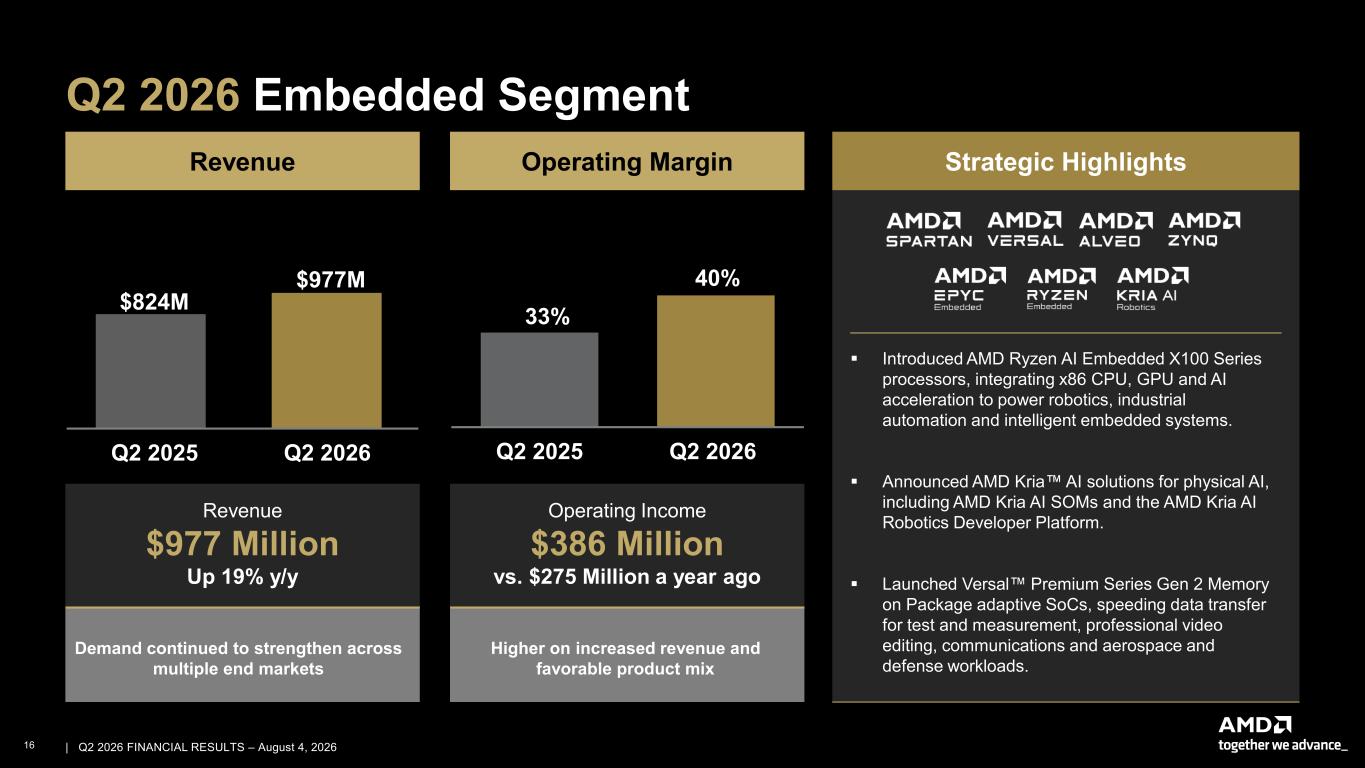
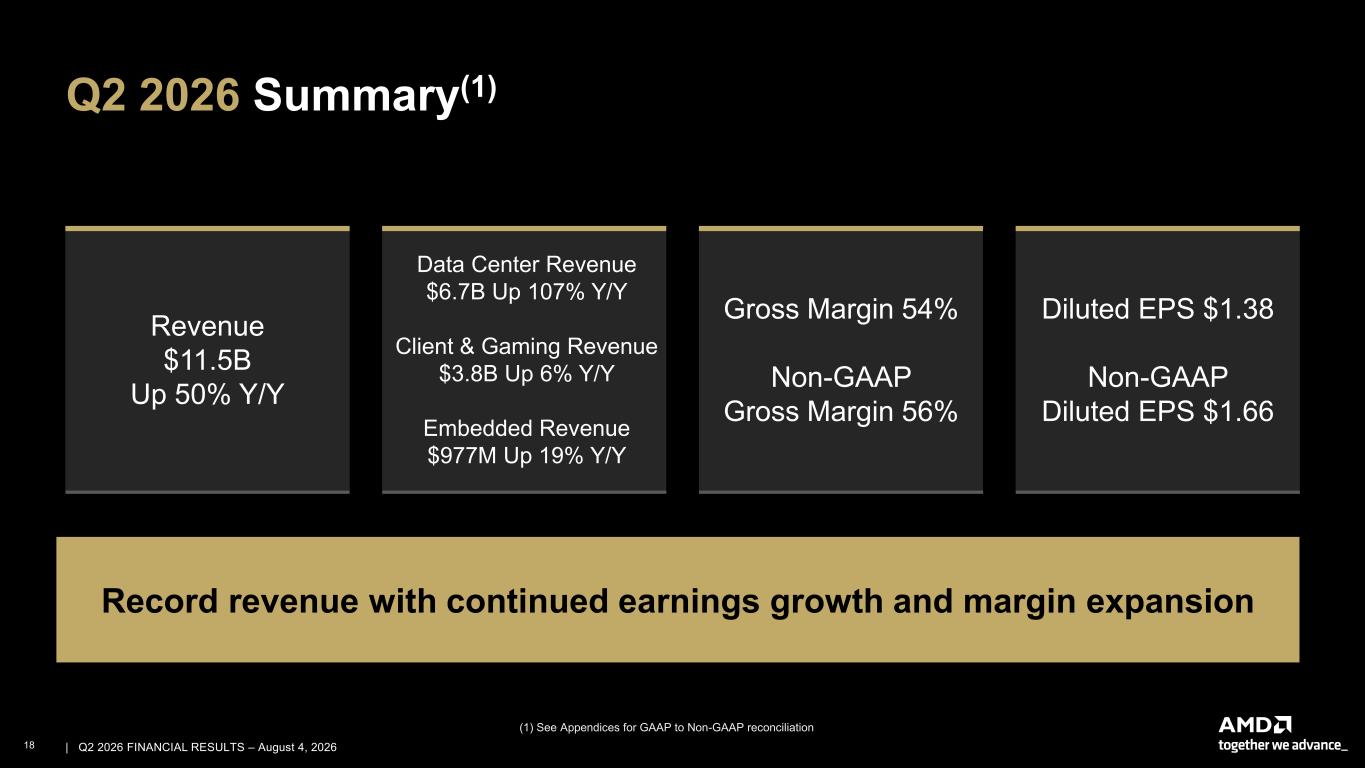
Thank you, Matt, and good afternoon to all those listening today. We delivered another outstanding quarter with record revenue and profitability as adoption of our leadership products continued to expand. Revenue increased 50% year-over-year to $11.5 billion, driven by significantly higher sales of Epic, Instinct, Ryzen, and embedded processors. Data center revenue more than doubled year over year and now represents 58% of total revenue, up from 42% a year ago, reflecting the rapidly expanding scale of our server and data center AI businesses. Our record results mark another clear step up in AMD's financial performance and demonstrate the strength of our product portfolio and execution. We are still in the early stages of a multi-year AI adoption cycle as deployments grow across a broad set of markets and workloads, driving demand for more compute and creating a clear path to significant revenue growth and earnings power in the years ahead. Turning to our segments, data center revenue grew 107% year-over-year to a record $6.7 billion, driven by strong demand for EPIC processors and instinct accelerators. In server, we delivered our fifth consecutive quarter of record server CPU revenue with cloud and enterprise sales each growing more than 70% year-over-year, exceeding the outlook we provided last quarter. We gained x86 server revenue share year-over-year as customers expanded deployments of both 5th Gen Epic Turin and 4th Gen Epic Genoa families. In cloud, hyperscalers continued expanding Epic across their internal infrastructure and public cloud offerings, including AWS, Microsoft, Google, Oracle, and others. Fifth-gen Epic Turin now powers nearly one-third of the more than 1,600 Epic public cloud instance types available globally, as providers broaden their offerings with new database storage and AI workloads. That expanding footprint is translating into growing adoption of Epic in the cloud, with healthcare, financial services, media, and technology companies adding tens of millions of instances in the last quarter. In enterprise, we delivered record sales in our fourth consecutive quarter of record sell-through as on-prem adoption accelerated, driven by the leadership performance and TCO advantages of our Epic portfolio. Growth was broad-based as we won large deployments with leading financial services, manufacturing, telecom, retail, and technology companies. More than 230 fifth-gen Epic platforms are now in market from HPE, Dell, Lenovo, Supermicro, and others, our broadest enterprise portfolio to date. Looking ahead, Agentec AI is creating a new growth vector for server CPUs, spanning high-frequency AI host nodes, high-density Agentec servers, and general-purpose cloud and enterprise workloads. Our 6th Gen EPYC VENIS family is purpose-built for this expanding range of workloads and delivers one of the largest generational performance gains in EPYC history. built on our all-new Zen 6 core and 2 nanometer technology Venice extends epic leadership in performance and efficiency delivering more than twice performance per watt of leading x86 CPUs and up to 3.3 times the performance per watt of leading arm-based CPUs the Venice family includes more than 30 processors that combine leadership per core and per socket performance with a broad range of memory and IO configurations giving customers greater flexibility to optimize performance efficiency and TCO across the most widely used cloud enterprise and HPC workloads Venice is in production now with every major OEM on track to launch platforms and the leading cloud providers planning deployments beginning later this year customer demand for Venice is stronger than for any prior epoch generation and we expect to continue growing market share across cloud and enterprise in the coming quarters turning toward data center ai business revenue more than doubled year over year driven by strong demand for instinct accelerators mi355x adoption continued to broaden as leading ai companies scaled deployments across a growing range of inferencing and training workloads and cloud providers expanded mi350 series availability at our advancing ai event we launched helios our rack scale ai platform combining epic venice cpus mi450 series gpus pensando networking and rockam software across a broad range of inferencing workloads helios delivers up to 15 percent more throughput at the same rack power and up to 30 percent more tokens per dollar than the competition. Customer pull for Helios is very strong and tracking ahead of our initial forecasts. In addition to our multi-generation gigawatt scale deployments with OpenAI and Meta, we announced a new strategic partnership with Anthropic. Anthropic will deploy up to two gigawatts of MI450 series GPUs in Helios with deployment of the first gigawatt beginning in the first half of 2027. The partnership includes a multi-year joint engineering collaboration using Claude to optimize workloads for Instinct CPUs and accelerate Rockham software development. We also expanded our long-standing partnership with Microsoft. Microsoft will deploy Helios at scale on Azure for frontier model inferencing across Microsoft, its AI customers, and Azure AI services. Together, these commitments broaden the group of leading AI companies and cloud providers, building their next-generation infrastructure on AMD. Helios is now in production, with initial shipments on track to begin later this quarter and ramp through the fourth quarter and into 2027 to meet very strong customer demand. looking beyond Helios we plan to launch a new rack scale AI platform every year with each generation delivering significant performance efficiency and TCO games in 2027 our next generation platform combines mi500 series GPUs Verano CPUs and Pensando networking with expanded scale-up domains, and both copper and optical-based interconnects. Customer engagement on MI500 is very strong, with multiple customers working closely with us as they plan their next-generation AI infrastructure. We expect MI500 to deliver the largest generational leap in Instinct history, putting us on track to increase inferencing performance more than 2,000 times in just four years. Turning to our AI software stack, Rockham has reached an important inflection point with the performance, capabilities, and developer experience customers need to deploy AI in production at scale. The breadth of the ecosystem also continues to expand. More than 3 million models now run out of the box on AMD. The leading open models launch with day zero support for Instinct, and open-source contributions to Rockham have increased more than tenfold over the past year. We introduced Rockham.ai, our new AI-assisted development platform for AMD GPUs, last month. Rockham.ai lets developers use today's leading coding agents, including Claude, Codex, and Cursor, to create, port, and optimize code for Instinct, making it significantly faster and and easier to bring new models and workloads to AMD. Rackham.ai delivers more than twice the training performance and more than three times the inferencing performance of Rackham 7 across a broad range of models. We are also working closely with the leading AI labs, including OpenAI, Anthropic, Meta, and others to co-optimize Rackham for their models with the improvements benefiting the entire AMD ecosystem. Taking a step back, the overall data center market opportunity is expanding far more rapidly than we projected just six months ago as ai moves into production across a broader range of applications and workloads demand for both accelerators and cpus is growing well above our prior expectations we now expect the data center ai accelerator market to grow more than 45 annually to approximately 1.4 trillion by 2030 and we expect the server CPU market to grow more than 50 percent annually to approximately 220 billion by 2030 for AMD this larger opportunity combined with the strength of our portfolio and growing customer visibility is creating a steeper growth trajectory for our data center business in data center AI the growing number and scale of Helios and mi 450 series instinct deployments position the business for significant growth in the second half of the year with growth accelerating in 2027. In server CPUs with very strong customer demand and improved supply, we now expect server revenue to grow more than 80% year-over-year in the second half of 2026 and more than 70% for the full year 2027 off a much higher base. Taken together, we now expect data center segment revenue to more than double year-over-year in 2027. Turning to client and gaming, segment revenue grew 6% year-over-year to $3.8 billion. In client, revenue increased 23% year-over-year to $3.1 billion, driven by record mobile processor revenue and continued sharegames. Commercial adoption continued to expand in the quarter, with Ryzen Pro sales growing more than 50% year-over-year as we closed new wins with large healthcare, technology, automotive, and financial services companies. To build on this momentum, Dell, HP, Lenovo, Asus, and others launched a broad portfolio of new commercial PCs powered by our latest generation Ryzen AI Pro 400 series processors. Demand was also strong for our Ryzen AI Halo developer systems, which went on sale in the quarter. In July, we introduced our next-generation Ryzen AI Halo platform, powered by our new Gorgon Halo processor, featuring an industry-leading 192 gigabytes of unified memory and can run models with up to 300 billion parameters. And to make it even easier for developers to build and test large AI models locally, we are partnering with Hugging Face to include one year of Hugging Face Pro with every Ryzen AI Halo system beginning later this year. Looking to the second half of the year, we're planning for a softer PC market as higher memory and component costs weigh on demand. Against this backdrop, we expect our client business to perform better than the market, driven by the strength of our Ryzen portfolio and growing commercial adoption. In gaming, revenue declined 31% year over year to $779 million, primarily due to lower semi-custom sales at this stage of the console cycle. Gaming graphics revenue also declined year over year, as higher industry-wide component costs contributed to higher graphics card prices and weighed on overall demand. Turning to our embedded segment, revenue increased 19% year over year to $977 million, our strongest growth in more than three years. Demand was broad-based, with strength across networking, aerospace and defense, test measurement and emulation, and communications customers. Our embedded x86 business grew significantly in the quarter as hyperscalers and networking customers increasingly adopted our CPUs to power critical networking and control plane functions in the data center. We also continued to expand our portfolio, introducing Ryzen AI embedded x100 processors for demanding real-time edge AI workloads, and the CREA AI robotics platform for physical AI. Looking more broadly, the strategy we have been executing over the last few years is now delivering strong results. Embedded x86 is becoming a significant growth driver for the segment. Our overall embedded portfolio is outgrowing the market and gaining share, and our embedded semi-custom engagements are expanding. design with momentum also remains very strong we are tracking towards another record year with more than 18 billion of new design wins led by major wins with networking data center communications tests and aerospace and defense customers in summary we delivered record revenue and profitability in the second quarter reflecting our strong execution and the growing adoption of our leadership products we enter the second half with strong momentum across our businesses with venison mi455x now in production initial helio shipments set to begin this quarter rising pro CPUs driving continued commercial share gains and our embedded segment returning to strong year-over-year growth more than a decade of focused investment has given us the strongest and broadest product portfolio in the industry, deep strategic relationships with the companies driving the future of computing, and a proven ability to deliver multi-generation roadmaps and ramp complex products at scale. At the same time, AI is driving demand for dramatically more compute across all of our markets. We now see the overall market for high performance in AI computing growing approximately 40% annually over the next several years, approaching $2 trillion by 2030. and we expect to grow well above the market. As a result, we are tracking materially ahead of the long-term financial model we shared at our Financial Analyst Day last November. We now expect revenue to grow substantially above our prior target of greater than 35%, and we expect to significantly exceed our $20 annual EPS target within our strategic timeframe. We are still in early innings of a multi-year AI adoption cycle and the opportunity ahead is enormous. We are exceptionally well positioned to capitalize on this opportunity and deliver significant growth in the coming years. Now I will turn the call over to Jean to provide additional color on our second quarter results. Jean?
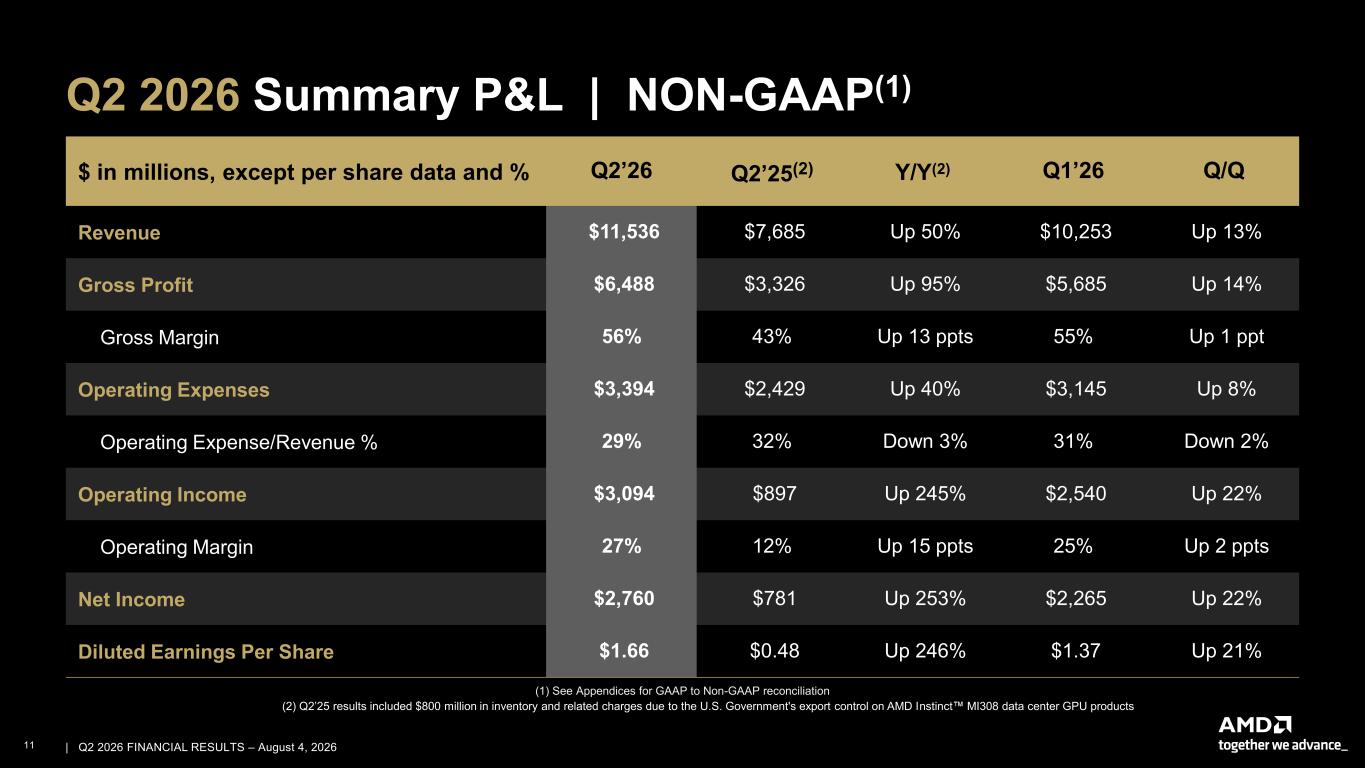
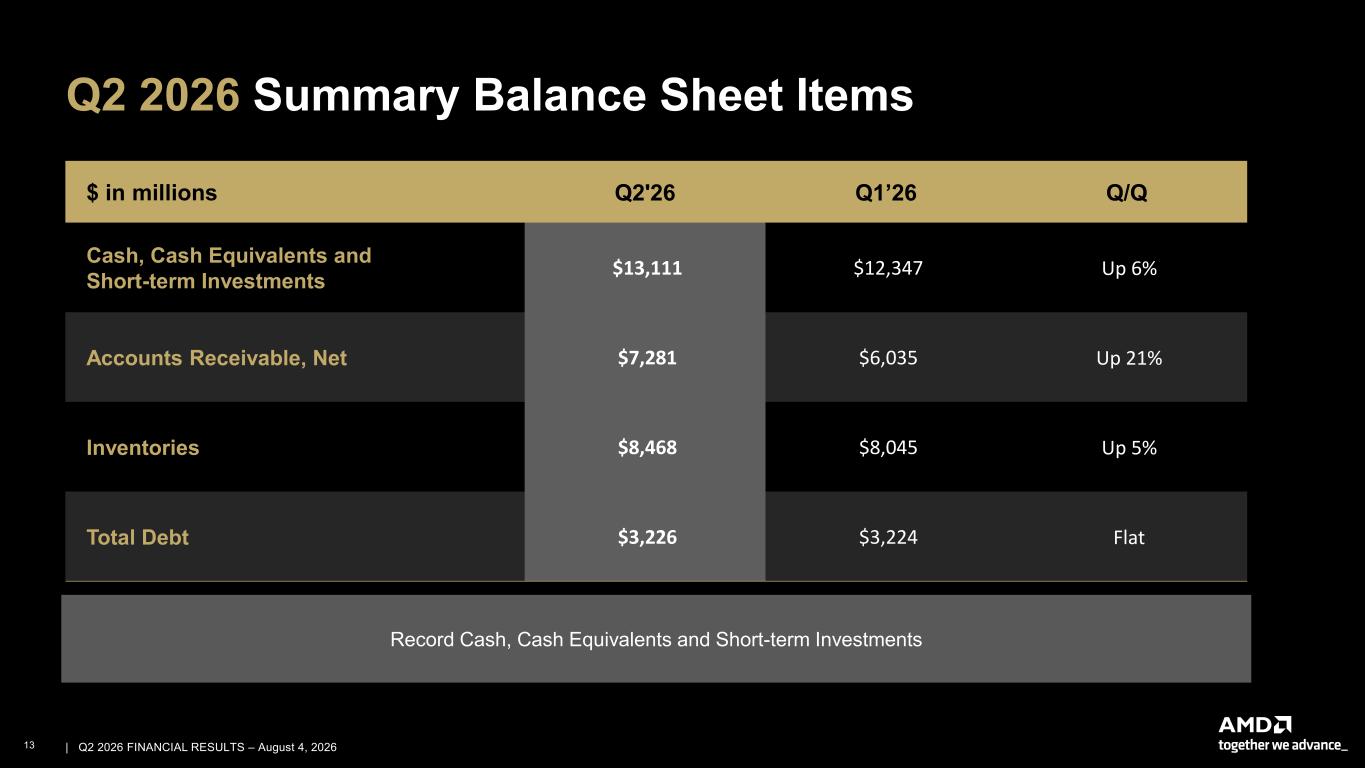
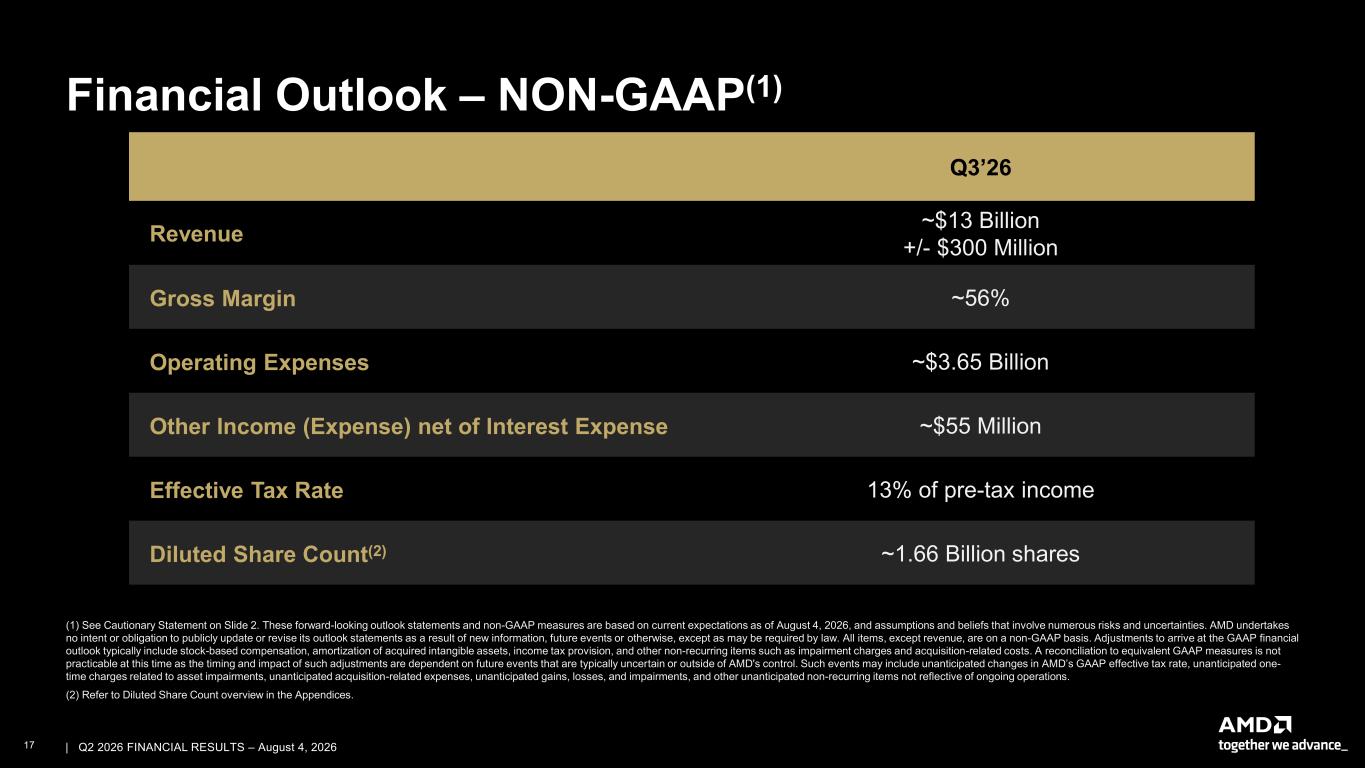
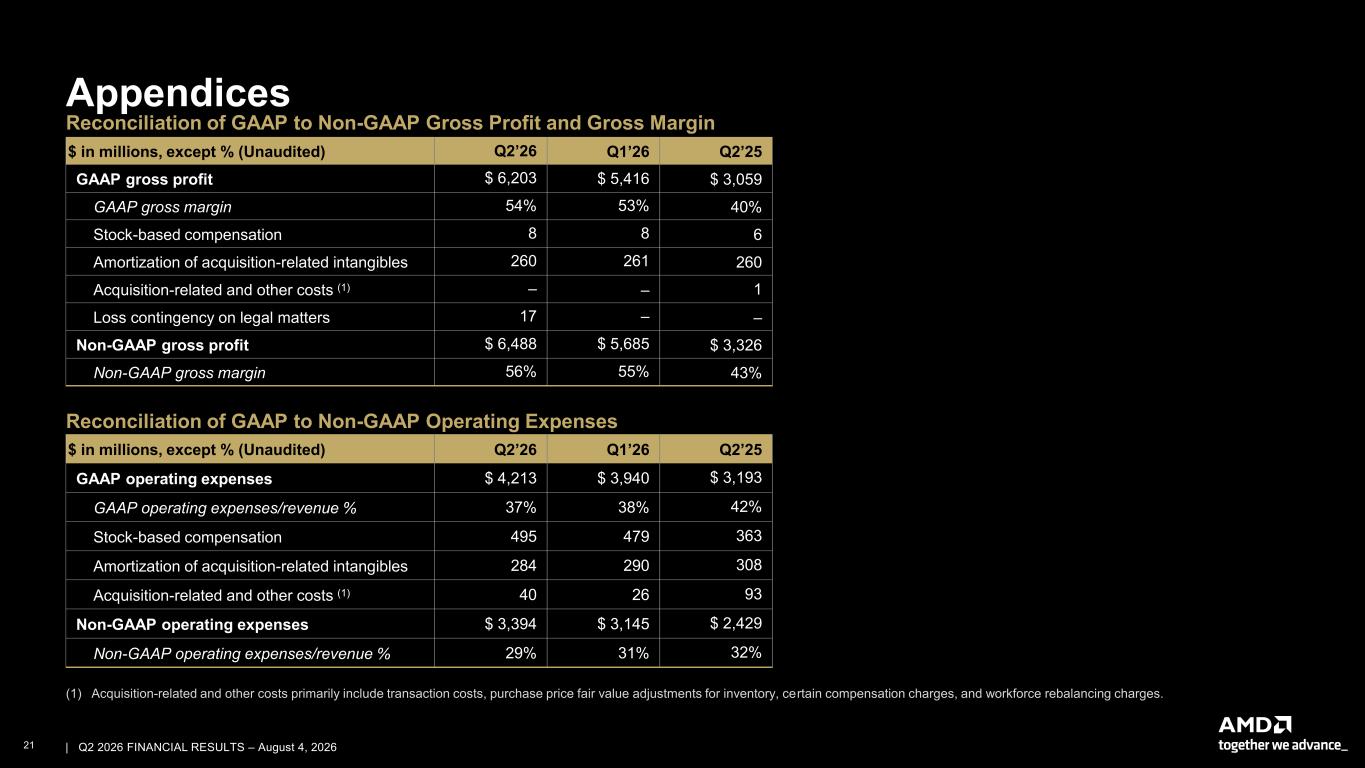
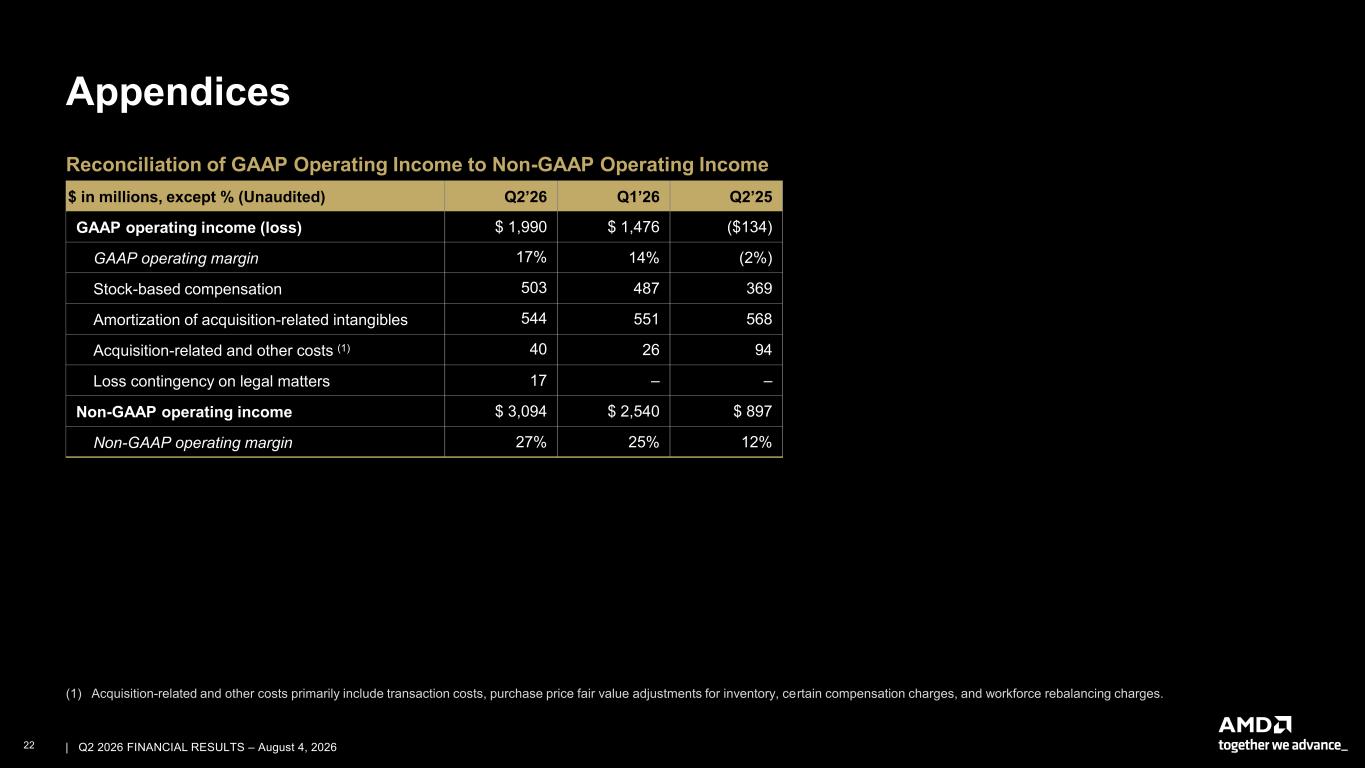
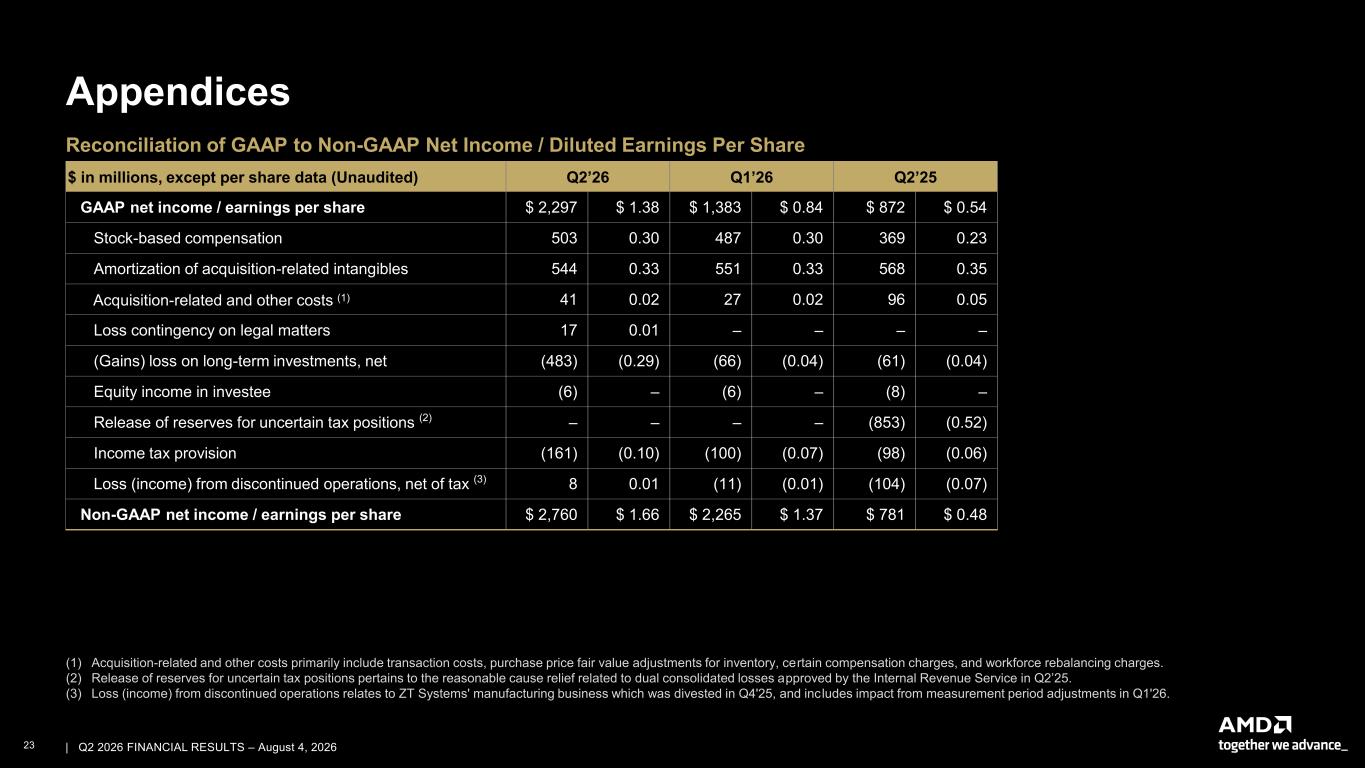
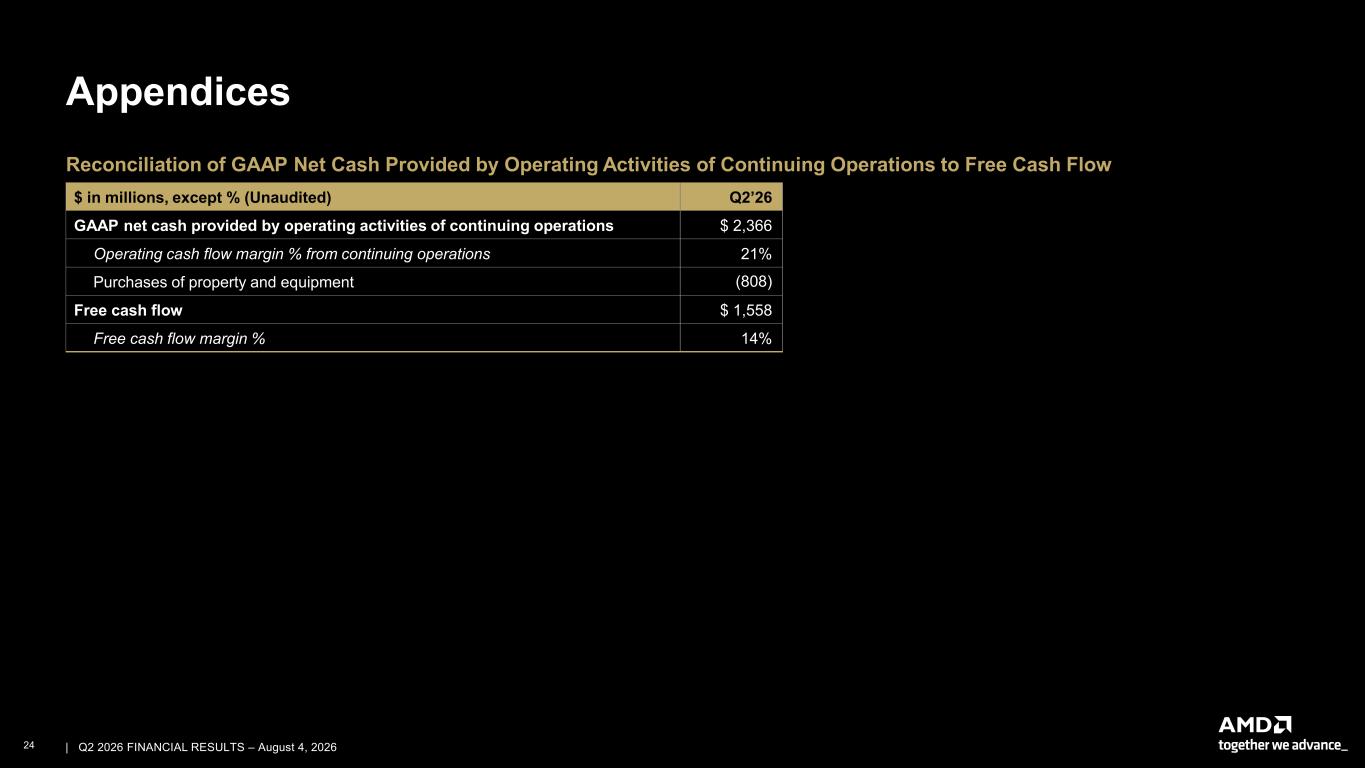
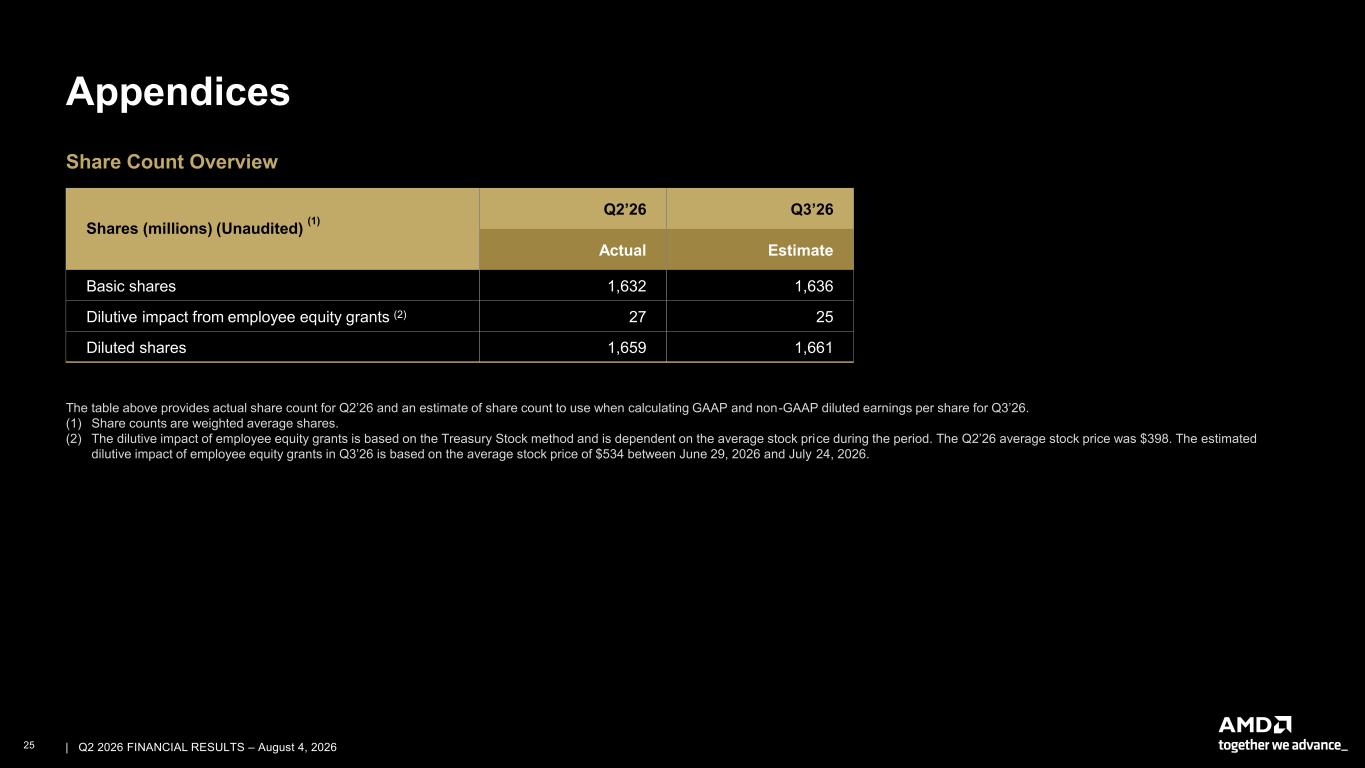
Thank you Lisa and good afternoon everyone. I'll start with the review of our second quarter financial results and then provide our current outlook for the third quarter of fiscal 2026. We had an outstanding second quarter, marking our sixth consecutive quarter of greater than 30% year-over-year revenue growth. Revenue increased 50% year-over-year and 13% sequentially to a record $11.5 billion, given by continued momentum across our businesses. Importantly, data center accounted for approximately 58% of total revenue, underscoring the continued shift in our business mix and its increasing contribution to AMD's growth. Our comparable basis diluted earnings per share increased approximately 82% year-over-year, significantly outpacing our revenue growth and demonstrating our earnings power as we scale our business. Growth margin for the quarter expanded to 56 percent, up over 200 basis points year-over-year and 80 basis points sequentially, reflecting a favorable product mix and a growing contribution from our data center business. Operating expenses were $3.4 billion, an increase of 40 percent year-over-year as we continue to invest in R&D to expand our AI silicon systems and the software capabilities to support our long-term growth opportunities. Operating income was $3.1 billion, representing a 27% operating margin. Now turning to our reportable segment, starting with the data center segment. Revenue was a record $6.7 billion, more than doubling year-over-year and up 16% sequentially. Growth was driven by greater than 70% year-of-year increase in epic sales, with record enterprise sell-through and robust demand across our cloud customer base. Both unit shipments and ASP increased significantly year-of-year, reflecting the continued mix shift forward to our latest SM5 generation processors. Instinct sales more than doubled year-of-year with the continued ramp of our MI350 series product, as adoption broadened across the largest AI labs, cloud providers, leading AI startups, national labs, and solvent AI deployment. Data center segment operating income was $2.1 billion, or 31% of revenue. Client gaming segment revenue was $3.8 billion, up 6% year-for-year, and 7% sequentially. The client business revenue was $3.1 billion, up 23% year-of-year and 6% sequentially, led by record mobile revenue. The gaming business revenue was $779 million, down 31% year-of-year, primarily due to lower semi-customer revenue. Sequentially, gaming revenue increased to 8%, driven by higher semi-customer sales, partially offset by lower radium shipments. Client gaming segment operating income was $582 million, or 15% of revenue, compared to $767 million, or 21% a year ago, reflecting continued investment in go-to-market activities and expanding product roadmap. Embedded segment revenue was $977 million, up 19% year-over-year and 12% sequentially as demand continued to improve across the end market and the new design wins began ramping. Embedded segment operating income was $386 million, or 40% of revenue, compared to $275 million, or 33% a year ago, driven by higher revenue and favorable product mix. Turning to the balance sheet and cash flow, during the quarter, we generated $2.4 billion in cash from continuing operations and $1.6 billion in free cash flow. Inventory increases sequentially to approximately $8.5 billion to support strong data center At the end of the quarter, cash, cash equivalents, and short-term investment were $13.1 billion. Now turning to our third quarter, 2026 outlook. We expect revenue to be approximately $13 billion plus or minus $300 million. At the middle point of our guidance, revenue is expected to be up 41% year-over-year, driven by very strong double-digit growth in our data center segment, strong double-digit growth in our embedded segment, and the decline in the client gaming segment, with growth in our client business more than offset by a significant double-digit decline in gaming. Sequentially, we expect revenue to be up approximately 13%, driven by strong double-digit growth in both our data center and the embedded segment, and the modest decline in our client gaming segment with a slight growth in client offset by a strong double-digit decline in gaming. In addition, we expect the third quarter non-GAAP gross margin to be approximately 56%. Non-GAAP operating expenses to be approximately $3.65 billion. non-GAAP other income and expense to be a gain of approximately 55 million non-GAAP effective tax rate to be 13 percent and the diluted share count is expected to be approximately 1.66 billion shares in closing we delivered another outstanding quarter of revenue growth and a significant earnings expansion reflecting the strength of our execution and the strong momentum across the business. As data center growth continues to accelerate, we enter the second half of the year, very well positioned to deliver continued profitable growth. With that, I'll turn it back to Matt for the Q&A session.
Thank you very much, Gene. John, we'd like to go ahead and start the Q&A session now. Please do poll the audience for questions. We ask that each caller ask one question with one brief follow-up.
Operator
Thank you, Matt. we will now be conducting a question and answer session. We ask that you please limit yourself to one question and one follow-up. If you would like to ask a question, please press star one on your telephone keypad. A confirmation tone will indicate that your line is in the question queue. You may press star two if you'd like to remove a question from the queue. For participants using speaker equipment, it may be necessary to pick up your handset before pressing the star keys. One moment while we poll for questions.
And the first question comes from the line of Tom O'Malley with barclays please proceed with your question thanks for taking my question uh lisa you uh you laid out the analyst day uh 1.4 trillion dollar team on the accelerator side uh you laid out the 220 billion on the cpu side uh but the share dynamics within those are are very different um so i think the the genesis of the question here is is when do you see that crossover point happening in the data center gpu business and the cpu business is that something that comes this calendar year? And when you look at the relative contributions between those two buckets into calendar year 27, from a dollar's perspective, where are you seeing the most strength?
Yeah, Tom, thanks for the question. So, look, we are certainly seeing a very, very strong compute market demand over both the data center accelerator as well as the server CPU. I think the server CPU is a little bit newer, and so we've been giving updates on that. As we go forward, certainly looking at our Q3 guide and our Q4 guide, we see very strong growth across both server and data center AI. So we're seeing server grow over 80% in the second half of the year, year over year. We're seeing very strong data center AI growth. And that reflects into our 2027. The way to think about it is both businesses are going to grow a lot. The data center AI TAM is certainly larger. And as a result, as we ramp the large strategic customers that we have on Helios in 2027, you would expect substantial growth in that business in 2027. But both businesses are very significant drivers of our 2027 growth and beyond.
And then maybe under that framework with both growing very strongly into next year, maybe this one's for Eugene, you obviously have some headwinds on the GPU side as you're ramping Helios, but also on the server processor side, you would imagine that you're getting above corporate gross margins there. Maybe as you look at the trade-offs to gross margins into next year, is one kind of offsetting the other? Or could you maybe think that directionally, just given some of the tailwinds you're seeing with pricing, directionally with the mix shift to more CPUs, could you see a tailwind more so than a headwind into calendar year 27? Thank you very much, guys.
Tom, that's a great question. Thank you for that. I think as we talked before, our growth margin is primarily driven by the business mix. We're actually very pleased with our growth margin progress in the first half of 2026 and our guidance for Q3 2026. I think the way to think about 2027 is there are a few puts and takes. The first thing is, right, And as Lisa just mentioned, our server business is expanding very significantly with the increased time and the pace of our business continues to grow, which from a gross margin perspective is accretive to our overall gross margin. On the other side, you're right, the pace of data center AI ramp is also very important And because from a revenue opportunity perspective, we see large incremental revenue opportunity from data center AI. Once it ramps, not only it adds tremendous revenue for the company, but also gross profit, even though the gross margin is slightly below corporate average. I think that makes the world determine how we go through 2027. But overall, we actually feel good about how we can really navigate through the transition of the business and continue to improve the gross margin to manage the balance of the gross margin. Plus, you know, our embedded business is recovering significantly. We actually think embedded business will give us an additional tailwind on the gross margin side in 2027. So I feel really good about that.
Operator
Thank you. And the next question comes from the line of Timothy or Corey with UBS. Please proceed with your question.
Thanks a lot. Lisa, I wanted to see if you could give us any color, just what's embedded in the guidance in terms of data center. So the question really is like of the growth between Q2 and Q3, which will grow more on a dollar basis, CPU or GPU? And I ask because if I take your up 80% half on half number, It sort of implies that the server, you know, CPU might not grow that much in Q4. So I'm not sure if I'm doing that wrong. Can you just give us some color there?
I'm just looking at that, Tim. Look, I think we believe that the server CPU is going to grow substantially in Q3 and in Q4. The way I would describe it in terms of dynamics is, you know, we have very strong demand across all of our customers in Hyperscale and Enterprise. And we have been adding additional supply as we've increased supply throughout the year. So we're guiding the Q3 segment to grow sequentially double digits. Both server and the data center AI will grow nicely within that. And then we should expect more growth for each of those businesses in Q4 with more supply coming on for server, as well as for data center AI, the Helios ramp is just starting at the end of Q3 and it'll be much more substantial in Q4. So that should sort of give you the picture of, you know, we think Q3 is a, you know, certainly a strong quarter as we look at the strong, very strong double digit growth going into in data center segment and in Q4, it will be higher than that.
Okay, thanks. And then And just as a follow-up, so relative to the TAM that you laid out at the analyst day, I think it's a 40% CAGR out through 2030. So do you think you can outgrow that CAGR out through 2030? So is your plan to grow your revenue more than 40% during that period?
Yes. So as we look at the overall TAM, first of all, it's a very exciting time in the compute market, when you look at every part of our business, whether it's server, CPU, data center, AI, or our embedded business and our PC business, we see them all benefiting from the AI tailwinds. And beneath that, I think in each one of the segments, we see an opportunity to grow above the market. So from that standpoint, with our view of the TAM being greater than 40%, And, you know, we are also saying that we will grow, you know, greater than that from an overall revenue standpoint for the company.
Operator
Thank you. And the next question comes from the line of Vivek Aria with Bank of America Securities. Please proceed with your question.
Thanks for taking my questions. Lisa, I'm curious, with all the announcements that you have made, how many gigawatt of compute does AMD have line of sight into for 2027? And what is AMD's monetization per gigawatt? I think the current assumption from everything you've announced is, you know, about 3 gigawatts. And I think from some of the warrant numbers that you had mentioned before, right, it seems to be at least $15 billion per gigawatt. But so I'm just curious if you agree with those views and then what is the upside or downside to either the gigawatt or the content assumption?
Yeah. So Vivek, there are lots of pieces to that question. so maybe let me take them one at a time. From an overall data center standpoint, I think we have given a little bit of color on 2027. We believe that the server CPU portion of our data center business will grow by over 70% year over year off of a higher base, and we believe the overall segment will grow by over 100%, so we'll more than double due to the data center AI ramping. So we do see a very significant ramp into 2027. We are very happy with our strategic anchor customers in OpenAI, Meta, and Anthropic. They are all in the process of ramping. The demand is high, and this is very much aligning their data center buildouts and their work with their cloud service providers together with our ramp. The way I would describe it is we have supply to, you know, more than meet the guidance that we've talked about and the upside potential is there. The key thing is to work very closely with our customers as they're planning their buildouts overall. So I think from a Helios ramp standpoint, we're expecting a very significant ramp over the next couple of quarters. We've said Q3 is the very beginning of the ramp, Q4 is a step up, and then Q1 will be a further step up and we'll ramp as we go through 2027. So hopefully that gives you a little bit of color on how that data center AI will play out. And in terms of the revenue per gigawatt, I think we've said double-digit billions. We're still in that range. I think there's you know that that looks like that's pretty you know pretty much where it will be and the key here will be you know continuing to work with our partners as they ramp because there's a demand for a lot more compute and we would like to satisfy that demand thank you Lisa and for my follow-up a little of a technical question when we look at the specs of Helios it has, I think, almost 50% more HPM than the competition.
And I think you have always had more HPM in your product. So how much of the benefit is because of having 50% more HPM? And then doesn't that expose AMD more to memory cost inflation? So I'm just curious, how are you ensuring that you're able to maintain margin, right, and get this memory allocation? And I I think Gene already suggested you are comfortable with the gross margin range, but I'm curious how much of the benefit is just because of the use of more HPM and, you know, does that still enable you to meet your profitability targets and allocation requirements over time?
So, look, Vivek, we're working very, very closely with our memory partners across the board on both our, you know, GPU, HPM memory, as well as just the general memory for the systems across our data center business and what I would say is you know we've worked with our memory partners for you know multiple years to ensure that we have a strong ramp in our business there is very good visibility into HBM allocation for what we expect to deliver in 2027 and the other piece of it is in terms of the memory bandwidth and the memory capacity it is one of the advantages of the AMD solutions. When you think about the larger model sizes, they really benefit from the larger memory footprint, and that goes into the total cost of ownership. We do recognize in this memory environment, though, every customer is looking at how to optimize their memory footprint, and we have the opportunity, if desired, to also modify that memory footprint if the total cost of ownership is not as significant in certain workloads. So think about it as the benefit of the memory is workload dependent. And we know a bunch of our customers are very, very happy with what that returns in terms of performance. But there are some workloads that call it medium-sized models that may not get as much of a benefit. And in that case, we would address the memory footprint as you might expect.
Operator
Thank you. The next question comes from the line of Joshua Buckalter with T.D. Cowan. Please proceed with your question.
Hey guys, thank you for taking my question and congrats on the very strong results. I wanted to also follow up on the server CPU assumptions for 2027. So it sounds like the supply for that is locked up and you have, you know, ability to service higher demand if it continues to track that way. But I guess any help you can give us on sort of the unit and ASP assumptions that are baked in there? Like I think investors are struggling to model the CPU market overall. So like, how should we think about, I guess, core count growth or whatever is the right proxy as we think about modeling this business? Thank you.
Yeah, sure, Josh. So let me maybe start with a little bit of grounding on the growth that we have seen so far. There is certainly both unit and ASP growth. So if you just look at our Q2 performance, when we said we grew over 70% in both cloud and enterprise, we actually had double digit growth in both units and ASPs, but it was actually more unit. The unit growth was higher. That is very much the nature of our business. I mean, we're seeing just very strong demand from an overall market standpoint. On the ASP growth, we have ASP growth as we go to higher core counts, certainly. But as we go forward, you should expect both unit and ASP growth. And what we have been working on very diligently over the past couple of quarters is, You know, as soon as we saw the significant inflection points in server demand, we've been working across our supply chain. That's wafers, that's back-end capacity, that's substrates, that's all of the components to raise the overall capacity for servers. And we're seeing that play out through this year. That's one of the reasons we can raise the second-half guidance. And we're seeing much more capacity coming to mind in 2027 that supports the growth that we've been talking about. So you should think about both units and ASP in this, in this framework.
Thank you for all the color there, and then Lisa, in your prepared remarks, you mentioned that Helios was ahead of your original forecast. Can we unpack that comment a little bit? Was that a comment on volumes? Was it yields? And if it yields, how should we think about sort of the first quarter or two of Helios gross margins compared to, you know, as it gets later into its ramp? Should we expect gross margins to improve as it ramps? Thank you.
Yes. So, Josh, when I was talking about Helios was ahead of our initial forecast, it was as it relates to the overall volumes. So let's call it the amount of demand there is for Helios in 2027. It's like an outstanding product. So what we're seeing from every one of our customers who's had a chance to not only spend time with Helios, but also spend time in our overall ecosystem, You know, there's a high confidence that, you know, Helios will be a great addition to the AI portfolio, particularly around inference. And that was my comment about, you know, higher than our initial expectations. As it relates to your comments about yields and performance and what do we expect as we go through the ramp, one would expect that the overall yields will improve as we go through the next few quarters. You know, the starting quarter is this quarter here in Q3, and we will be ramping over the next couple of quarters. And we always would expect that the yields will, you know, continue to improve as we go through the first few quarters, especially on a product like this, which is, you know, highly complex.
Operator
Thank you. And the next question comes from the line of Aaron Rakers with Wells Fargo. Please proceed with your question.
Yeah, thanks for taking the question. As you can imagine, I'll stick with the server piece of the business as well. You know, at your recent event, you highlighted the server market, the new $220 billion TAM that you're throwing out there as kind of in three buckets, right? General purpose, I think you called it or defined it as sandbox servers and then kind of the AI front end node. So as we think about the growth that you're talking about, I'm wondering if you could help us conceptualize the sizing of those buckets at all. And how big is that kind of middle category, that sandbox AI market, as we think about growing 80% plus this back half of the year and 70% plus? How big of that opportunity do you see that becoming?
Yeah, so, Aaron, what I would say is maybe let me start from the end point. So when you think about the $220 billion TAM in 2030, we actually see this agentic AI or these agentic sandboxes being the largest piece of the TAM. It's the fastest growing piece. It's also the smallest piece today. So in the near term, I would say that there is certainly growth in that area. But as we go out over the next three, four, five years, we think that's the largest growth in the server market. And I think the thing that is very strong about our portfolios, we believe we can grow in every one of those segments. So when you think about the types of CPUs you need for each of these workloads, you need sort of different optimization points. That's one of the things that we've really tried to point out. It's not just one CPU. It's actually a real family of CPUs that you need. From our standpoint, Venice is absolutely leadership in all of the categories. So whether you're talking about per core performance or you're talking about overall socket performance and that gives us a very strong position across general purpose agentic ai and also the head nodes for the ai accelerator business so from our standpoint when we look at our customer traction and our customer momentum going from turn into venice turn was already extremely, you know, widely used, especially amongst the hyperscalers. What we're seeing is when we go into Venice, the workloads actually expand. So there are more workloads that are going to be run on the next generation of Epic than are run on the previous generation. And that's what gives us the confidence to say that, you know, we can grow substantially ahead of the market given the product positioning.
Thank you. That's very helpful. And as a quick follow-up, I know it's probably lower on the radar for a lot of people, but I think in the past you've talked about the client business, even with some pressures in the PC market growing this year for you guys on a year-over-year basis. Do you still see that? And are you willing to give any thoughts on what you might think of 2027 on the client CPU side?
Yeah. Well, let me say, Aaron, first of all, Well, the client CPU business, you know, we have continued to think it's a very important I particularly think that local AI will continue to become a larger, larger piece of how people experience AI. So I think AI PCs will become more important. As it relates to our client business in 2026, I think our first half performance has been very strong. And although we are expecting that the market will decline in the second half, the markets actually held up better than most people would have thought. You know, our view is we will, you know, we see the growth in 2026 on a year over year basis, certainly there. And as we go into 2027, I think we have a strong product portfolio that is coming on board to address not just the traditional notebook and desktop markets, but also as you think about a more AI centric PC experience like what we have been talking about with the rise in AI halos. So I remain optimistic about the PC market as an important way for us to reach a broader set of users and our ability to grow ahead of the market. The market itself will depend a bit on some of the components. We're all watching the component costs and how that will play out over the next couple of quarters. But I think our portfolio and our rising content and enterprise are very positive for our client And the next question comes from the line of Stacy Rasgen with Bernstein Research.
Operator
Please proceed with your question.
Thanks for taking my question. First thing, I wanted to pick on something in the press release. It says that the data center accelerates in the second half. So it grew 107% year over year in Q2. You're guiding it up like in the 80s, though, like in Q3. So how do I interpret, which is not an acceleration, so how do I interpret that statement? I mean, is like the second half collectively higher than the 107% that you see in Q2, or were you just sort of, you know, like, how should I be interpreting what you guys wrote in the press release around data center accelerating in the second half?
Hi, Stacey. Good question. I think when we talk about acceleration, we're talking about the second half versus the first If you look at the first half of our data center business, you know, year-for-year growth versus the second half, we do think that there's an acceleration. That's the reflection there.
Thank you for that. And then I think for my follow-up, I want to dig in a little more into the data center targets for next year. So you said like more, I think server is more than 70 percent, the total more than doubling. I guess what I'm asking is how much work is the more in that statement doing? Like, you seem to be on a trajectory that would take you, like, well above those numbers. I guess just how should I be interpreting the more in the statement? Understanding that we're only in August of 26, I get it.
What's this on your mind there? Stacey, you bring a smile to my face. So I would say we're trying to give you a way to think about 2027. And yes, the server CPU we're saying is more than 70%, which we think at this point is a very strong statement, just given where the business is. And we do expect the overall data center business to be well over 100%. And the well over 100% comes because the data center AI business is going to be well over 100%, just given the strength of our strategic customers, the ramp of Helios, and all of the things that we've talked about. So hopefully that answers your more question.
Operator
Thank you. And the next question comes from the line of Jim Schneider with Goldman Sachs. Please proceed with your question.
Good afternoon. Thanks for taking my question. As you think about the early days of your MI400 series ramp over the next few quarters, can you maybe talk about the customer diversity you expect in the early stages, I think you've noted four or five large customers that you've announced publicly. Can you maybe talk about how many of those customers will be contributing, let's say, in Q4 and how many in the first half of 27?
Let's see. So, Jim, I guess the way to say it is, you know, we've talked about sort of the large frontier model companies, OpenAI, Anthropic, Meta, they will be consuming through a number of CSPs, both hyperscalers and others. So the diversity of the business, and there are additional customers, there are lots of customers who are interested in Helios at, let's call it a more regular scale than gigawatt scale. So I think we'll have a good diversity of customers as we go through the next couple of quarters. And what we're really doing is matching to when, you know, the larger data center buildouts are ready. And so we are working with each of our customers on their data center plans and ensuring that, you know, we are meeting their data center plans. But yeah, I think there's a good diversity, especially as we get into the Q4, Q1 timeframe.
Thanks. And maybe as a follow-up, you mentioned data center readiness. And so I wanted to sort of test, you know, how you're seeing your various customers and their ability to accept your products into their data centers, whether that's land, power, shell, or anything else. Any constraints that you see heading into the first half of 27 or even the back half of 27 that would give you pause about hitting your targets? Thank you.
Well, Jim, I don't think we see anything that would give us pause about hitting the targets. I mean, we feel very good about the targets. Now, when you ask me what the range could be, there is a range. And the range will depend on the ability to bring on more capacity in a timely fashion. So the way I view it is we're building sort of the entire supply chain. So ensuring that we have the entire, you know, our silicon CPU, GPU networking components that go into it, all of the Helios components. I think we feel very, very good about that part of the supply chain. And we are working very closely on the data center operators and ensuring that we have good visibility into what's going on there. And that gives us, let's call it, strong confidence in what we've guided for the data center AI business so far. And we're going to be continuing to look at how to accelerate some of those builds. And I think there's a clear desire on the part of everyone in the ecosystem to bring on more AI compute faster. We are seeing every day, you know, more opportunities with, you know, operators to accelerate some of that capacity, and that's much of the work that we're doing, you know, together with our customers and partners.
Operator
Thank you. And the next question comes from the line of CJ Muse with Cantor. Please proceed with your question.
Yeah, good afternoon. Thank you for taking the question. If I take your data center guide, Lisa, it sort of implies instinct revenues of $30 billion, give or take. And so curious two parts on this. how do you see kind of the revenue cadence first half second half uh and then if we isolate the instinct only and start thinking about 455x and helios how should we think about the underlying gross margins for that business you know starting in q1 and then exiting in q4 i think cj you're saying 30 billion are you talking about the server are you talking about which one are you talking you're talking about 20 27 right 20 27 instinct yeah yeah 2027 but maybe let me let me help CJ I think what what you're hearing from
us is that your data center AI number is probably too low and maybe back to Stacy's question without you know going into exact numbers I think this notion of you know over a hundred percent should consider the well over a hundred percent and look as we look at this it's a progression over the next couple of quarters, and as we go through the next couple of quarters, you know, we expect to continue growing, you know, Helios quarter by quarter. But yes, that's the best way of thinking about it. And I'm sure, you know, Gene can work on if you have further questions on that. But Gene, does that…
And on the gross margin side, if we isolate to instinct, how should we think about beginning to 2027 and then exiting?
Yeah. I think overall, when we think about the gross margin for 2027, as I said earlier, it's really determined by both the pace of server CPU business ramp and the data center AI ramp. So I actually think, you know, overall, quarter over quarter, it could be, you know, different in the mix could change differently. But overall, when we think about these, we are actually very optimistic about how we manage the ramp of the MI450. At the same time, the server business continue to improve and grow significantly in 2027. Overall, I think that they have a good offset in general, overall. But I do think, you know, it's important to remember we have multiple other levers from the company perspective, not only embedded business, but also client business will continue to improve gross margin. And operation team continue to do a great job. So we'll give you a mark of color when we get there to guide the 2027.
Operator
Thank you. And the next question comes from the line of Joe Moore with Morgan Stanley. Please proceed with your question.
Great. Thank you. In the server CPU business, are you supply constrained now? It seems like the market's very tight. And do you anticipate that tightness persisting? And when you sort of think about next year, just the general ability of the supply chain to support the level of growth that you're talking about specifically in CPU?
Sure, Joe. I would say the server CPU supply chain is tight right now. And it has been tight for the first half of the year because much of this demand was unforecasted. As we get into 2027, the demand is better forecasted. And so we would expect that the 2027 server supply situation should be better than 26. We feel very good about being able to satisfy, you know, what we just talked about, which was, you know, over 70% year over year growth. And, you know, I believe, you know, depending on how things play out, there may be opportunities for that growth to go higher, you know, as we, you know, get through the next few quarters okay thank you for that and and is it you guys are ramping a lot on two nanometer and there's been a lot of focus on three nanometer being in short supply is that helping or is it still you know challenging to bring up new capacity on the new node that way yeah i think joe it's always challenging to bring up new capacity on new node i think what makes our approach a little bit special and different is that because we're using the chiplet technology we actually ramp in fewer wafers in the new node and so that gives us the opportunity to again we're working very hard on ensuring that we get the supply necessary to you know meet the very strong customer demand so from my perspective i think all of that is work that's being done we're certainly looking at the overall supply chain not just wafers so that includes you know back-end capacity packaging capacity substrates all of those things but we feel good about where we are to satisfy both the the strong ramp in servers, as well as the strong ramp in the data center AI business.
Hey, John, I think we have time for one more caller before we close out the call, please.
Operator
Thank you. Our final question comes from the line of Atif Malik with Citi. Please proceed with your question.
Hi, thank you for taking my questions. Lisa, you guys announced a partnership with Cerebris at your advanced AI day on desegregate compute. Can you talk about just qualitatively, how do you expect the sales to grow in the fast inference market this year into next year?
Yeah, absolutely. So I think the inference market overall is growing very substantially over this year into next year. The fast inference in particular is an area which is, let's call it, starting to become more and more relevant. And so with our partnership with Cerebrus, I think they have great technology together with Helios plus their wafer scale engine, we get a very good solution for customers. And we would expect that solution to start becoming available in Q4 in the Cerebrus cloud and extend into 2027. But from our view, you know, this is an important part of the market, and we continue to look at, you know, ways to, I would say, you know, customize and optimize our technologies for the various workloads out there. So, you know, we view this as, you know, just more of what we do in an open ecosystem.
Great. And one for Gene. How should you think about OPEX growth relative to that overall 40% market growth that you talked about in the next few years?
Yeah, I think Lisa talked about the TEM growth at 40% and will be growing faster than TEM. From OPEX perspective, we'll continue to invest given the large opportunities we have ahead of us. But you should expect us to manage OPEX increase less than the top-line revenue growth. That's what our business model is designed for, so we can drive in more operating leverage. to deliver earnings per share. That is also consistent with Lisa said. Our EPS will be significantly higher than $20. We outlined at our financial analyst day.
Thank you very much for all the analysts and investors that joined our call today. John, you can go ahead and wrap up the call.
Operator
Thank you, ladies and gentlemen. That does conclude the question and answer session, and that also concludes today's teleconference. We thank you for your participation. You may disconnect your lines at this time.