Operator
And welcome to today's Annie Pharmaceuticals Inc. Second Quarter 2026 Earnings Results Call. Please note this call is being recorded. After the speaker's prepared remarks, there will be a question and answer session. If you would like to ask a question during this time, simply press star, then 11 on your telephone keypad. If you would like to withdraw your question, please press the star key, then 11 again on your telephone keypad. It is now my pleasure to turn the conference over to Irina Koffler. Please go ahead.
Thank you, Daniel. Welcome to A&I Pharmaceuticals Second Quarter 2026 Earnings Results Call. This is Irina Koffler, Investor Relations for A&I. With me on today's call are Nikhil Alwani, President and Chief Executive Officer, Stephen Carey, Senior Vice President and Chief Financial Officer, and Chris Mutz, Senior Vice President and Head of A&I's Rare Disease Business. Earlier this morning on August 7, 2026, we released our results for the second quarter 2026 via a press release that is available on our website. This call is also available via webcast and is accompanied by a slide deck that can be accessed by going to the events section of the Investors page of our website. Before we begin, I would like to remind you that we will be making forward-looking statements and discussing certain non-GAAP measures. Forward-looking statements are subject to substantial risks and uncertainties, speak only to the call's original date, and we take no obligation to update or revise any of the statements. During this call, we will also refer to certain non-GAAP financial measures to describe our performance and have provided a reconciliation to the most directly comparable GAAP financial measures within the materials that accompany this call. The archived webcast will be available for 30 days on our website, ANIPharmaceuticals.com. And with that, I'll turn the call over to Nikhil Alwani.
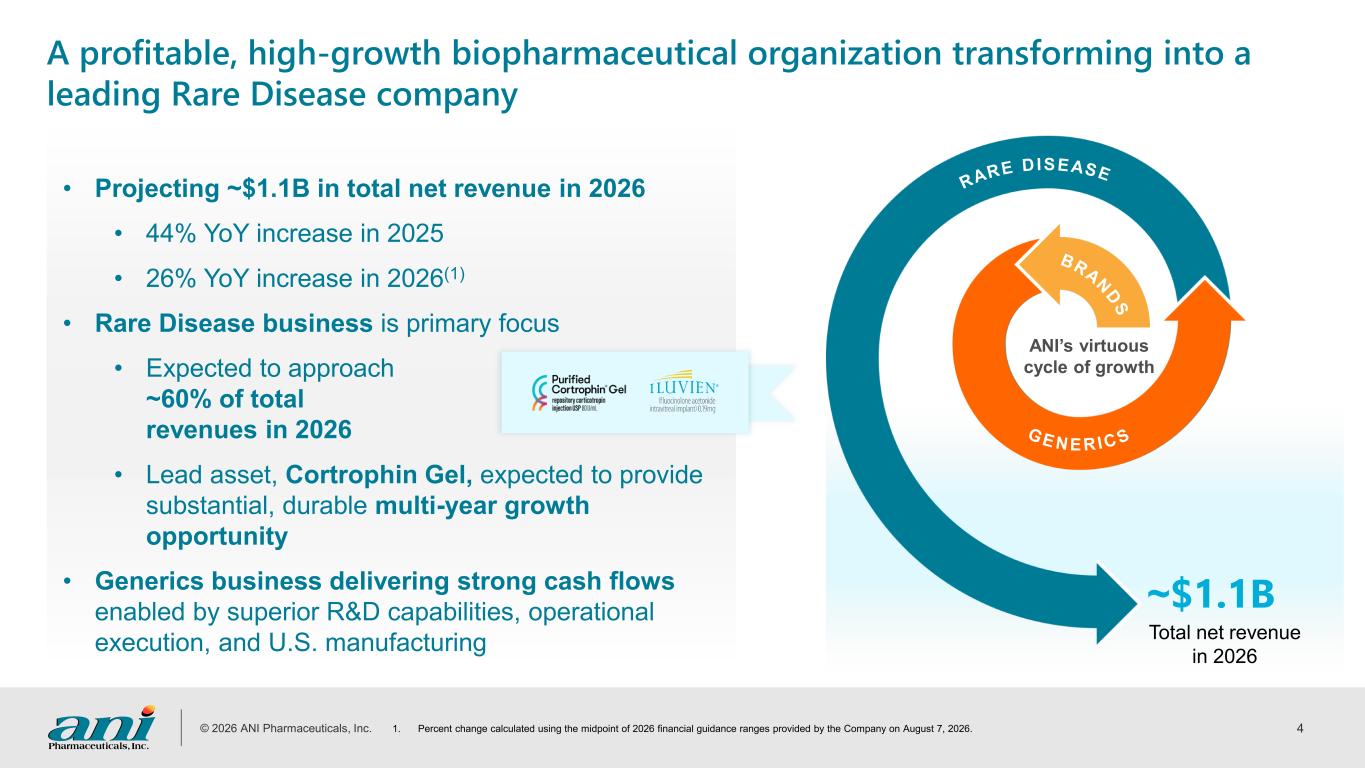
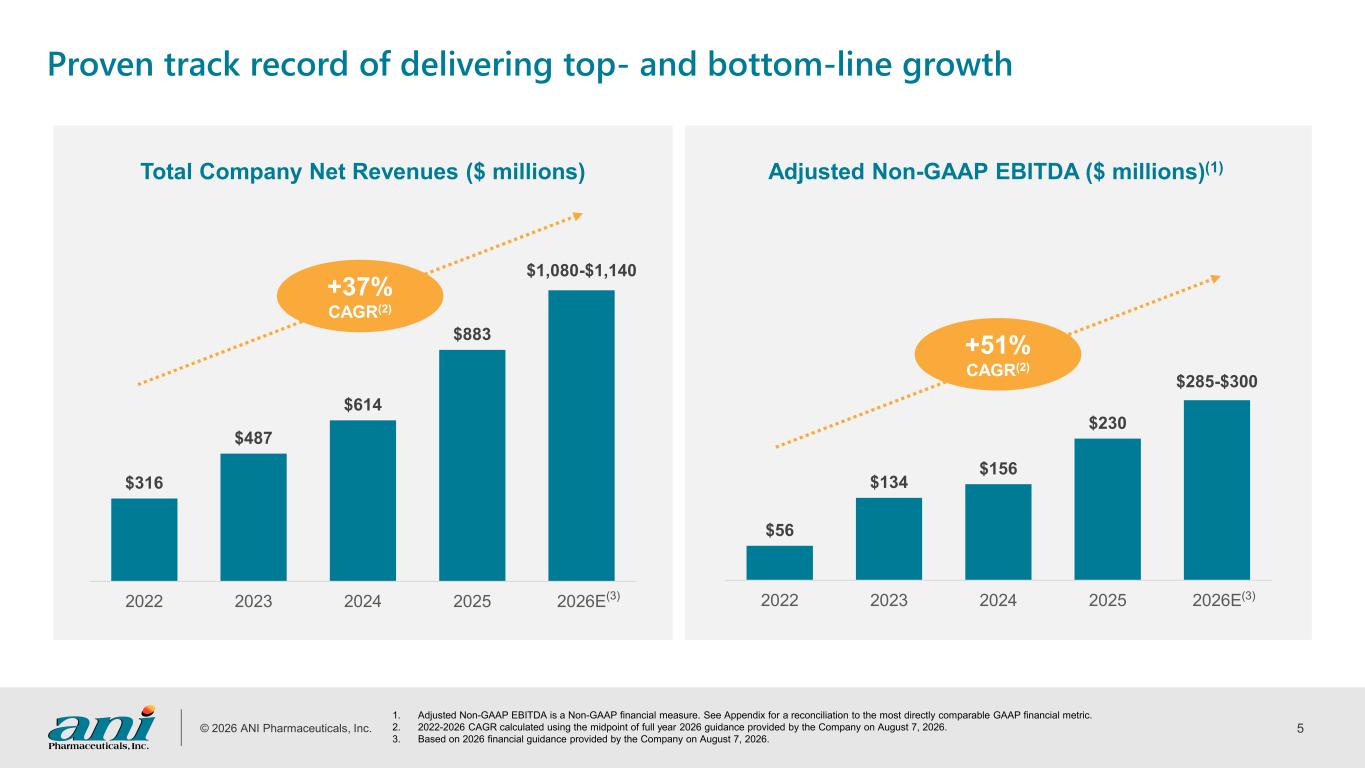
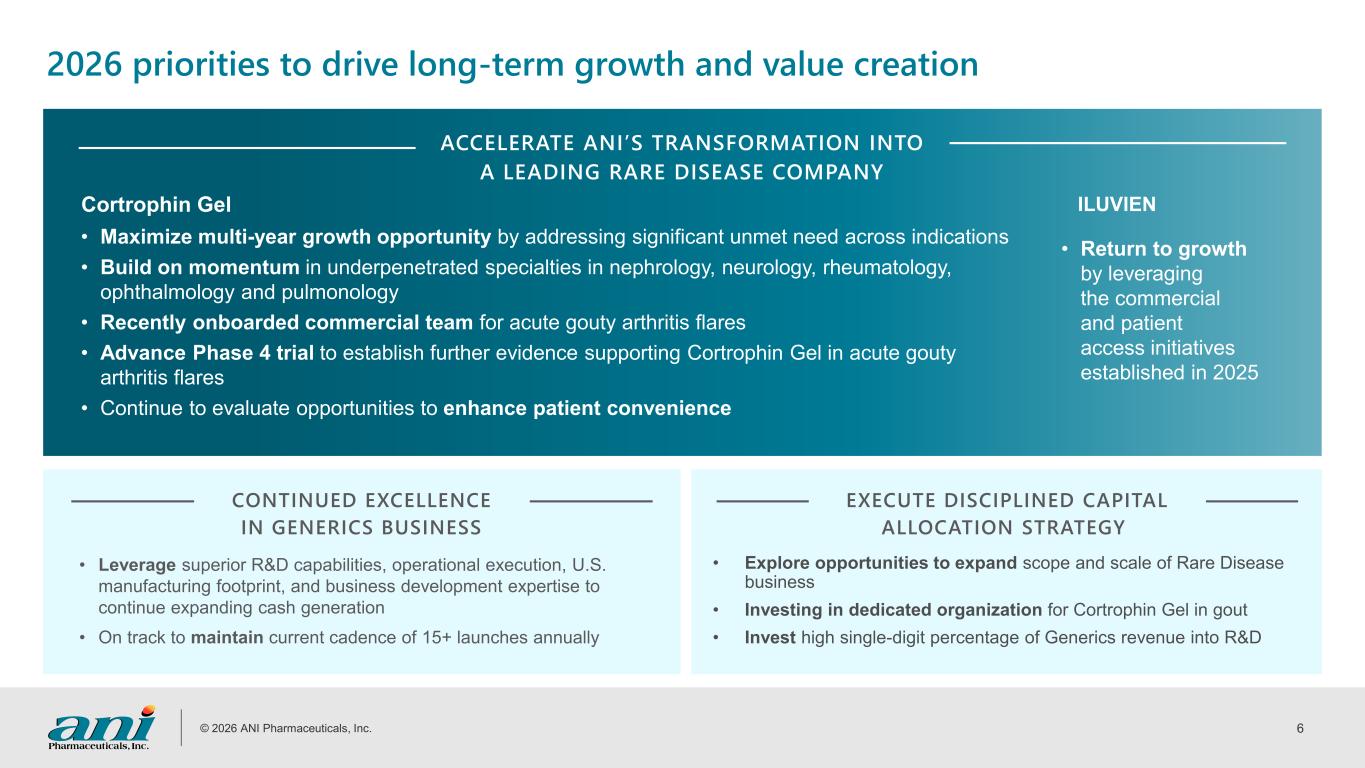
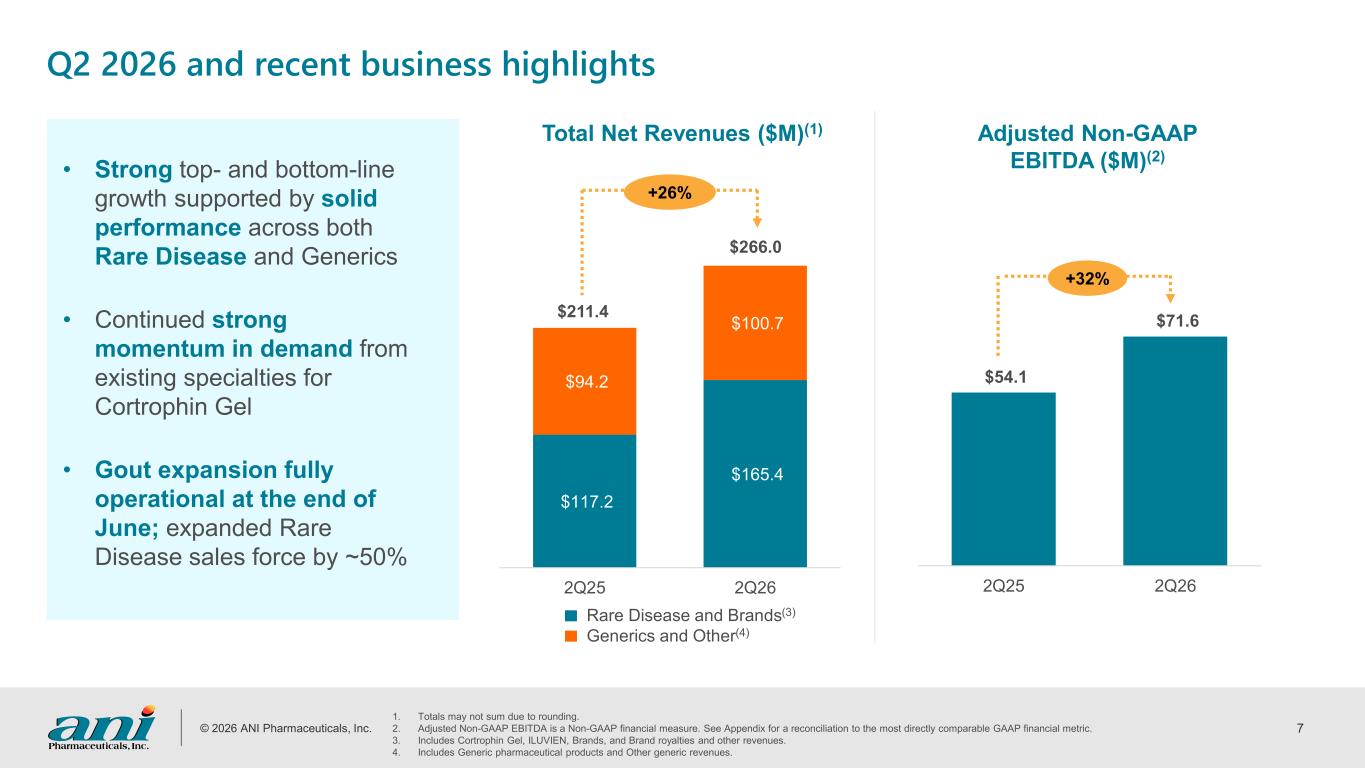
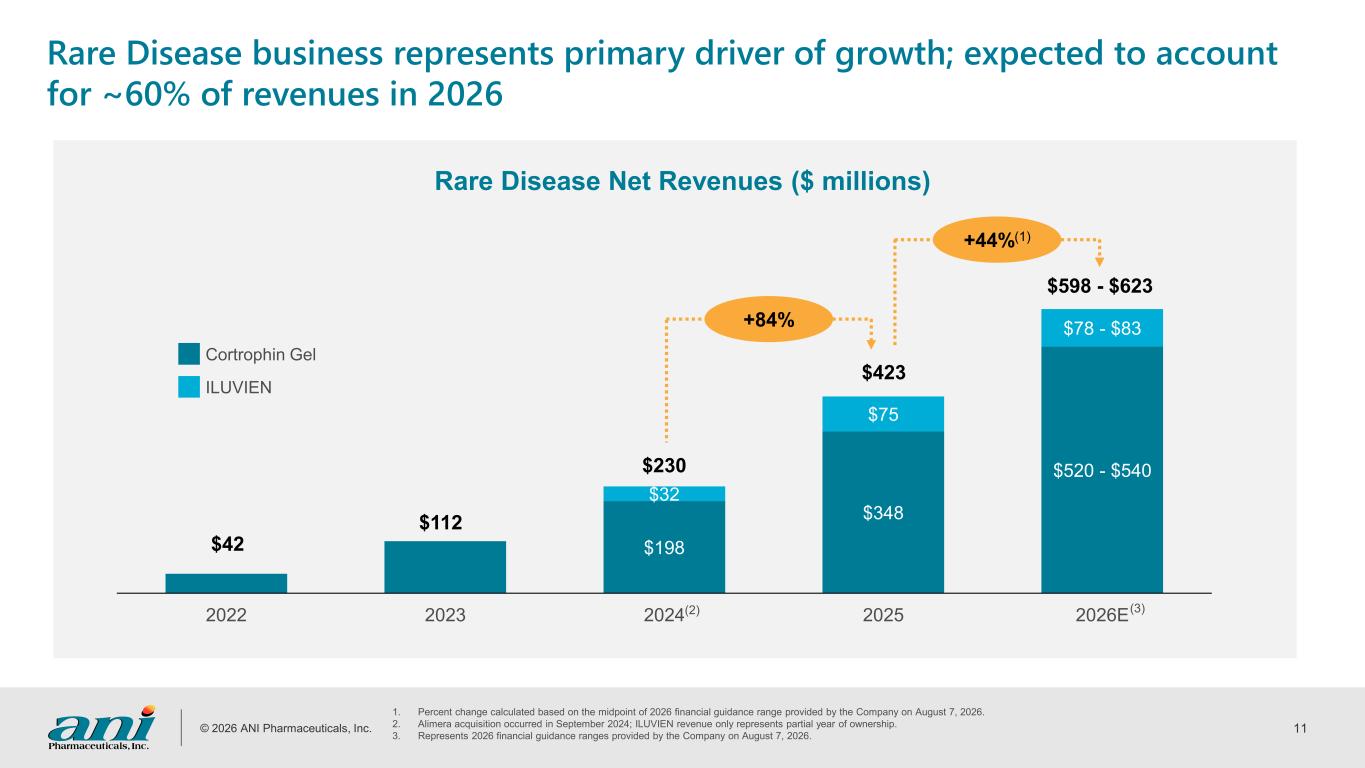
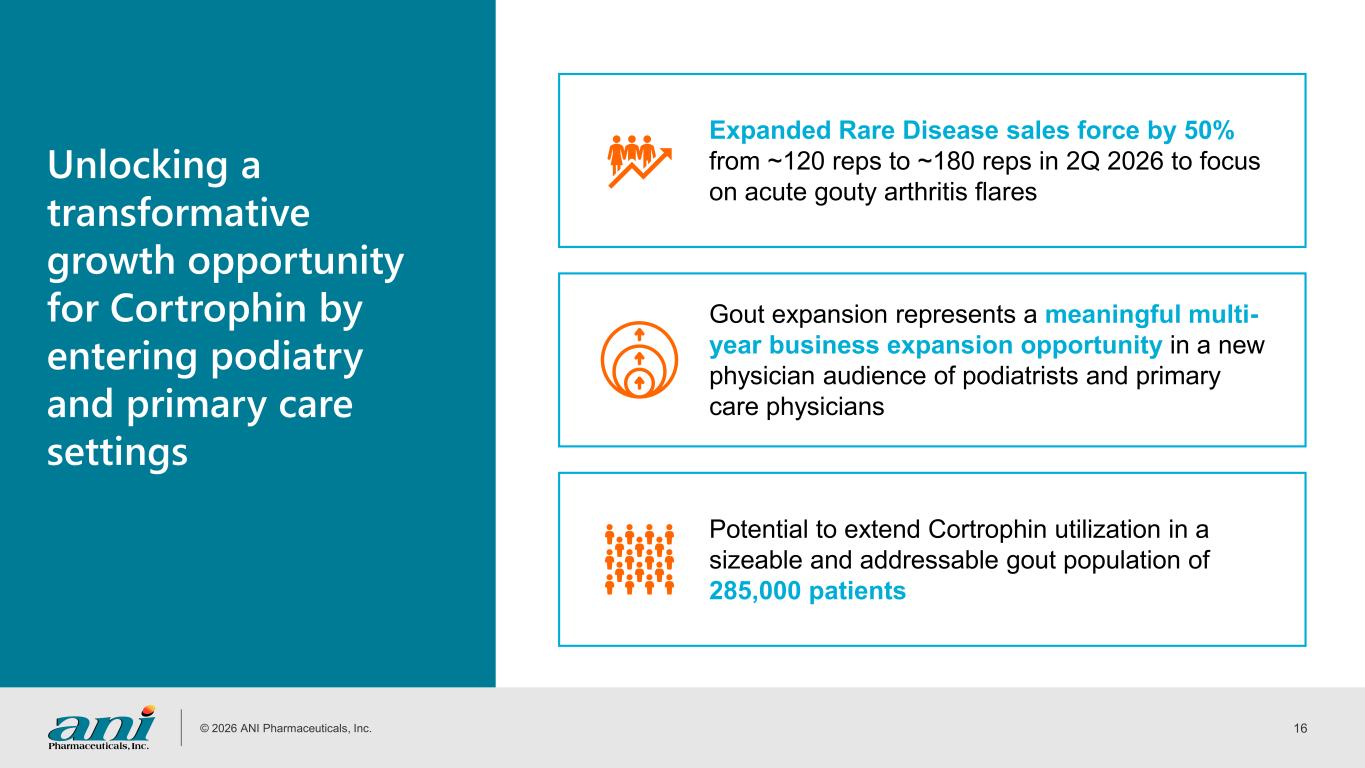
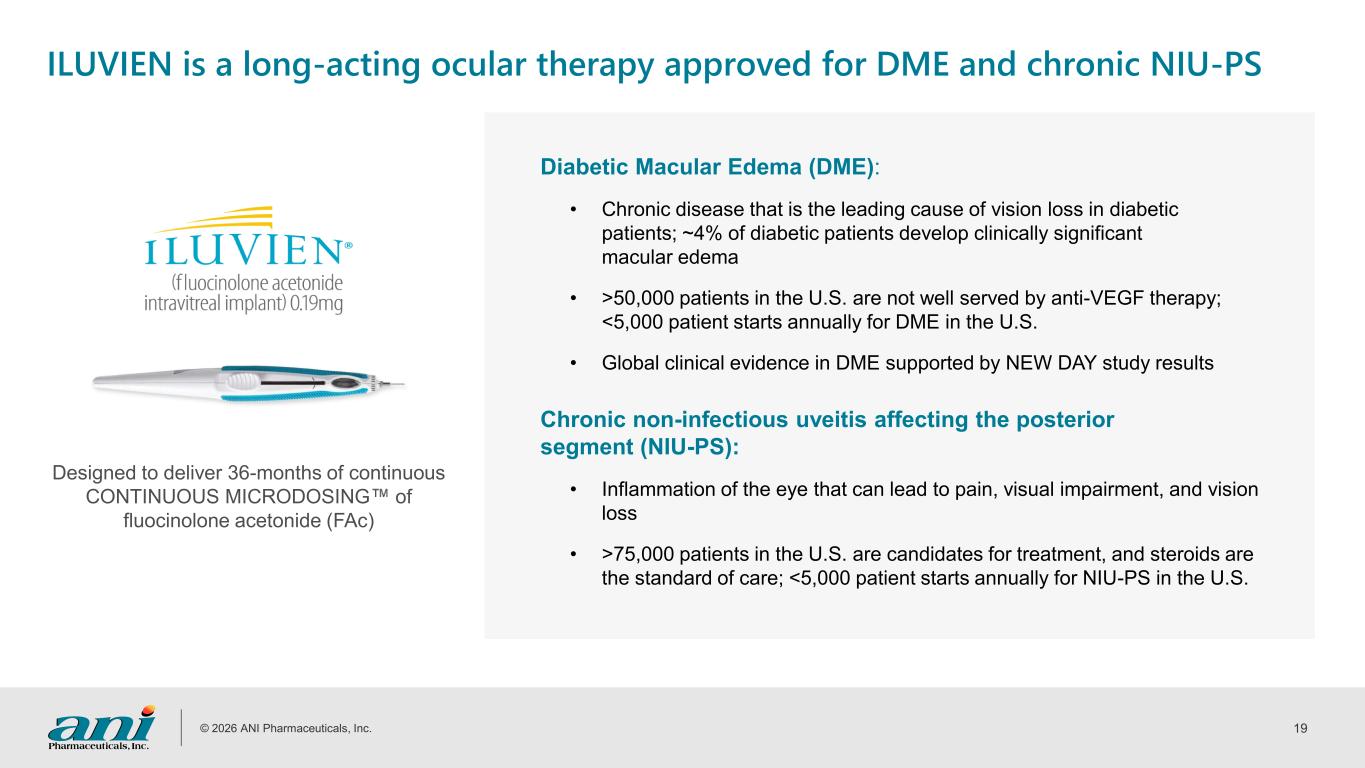
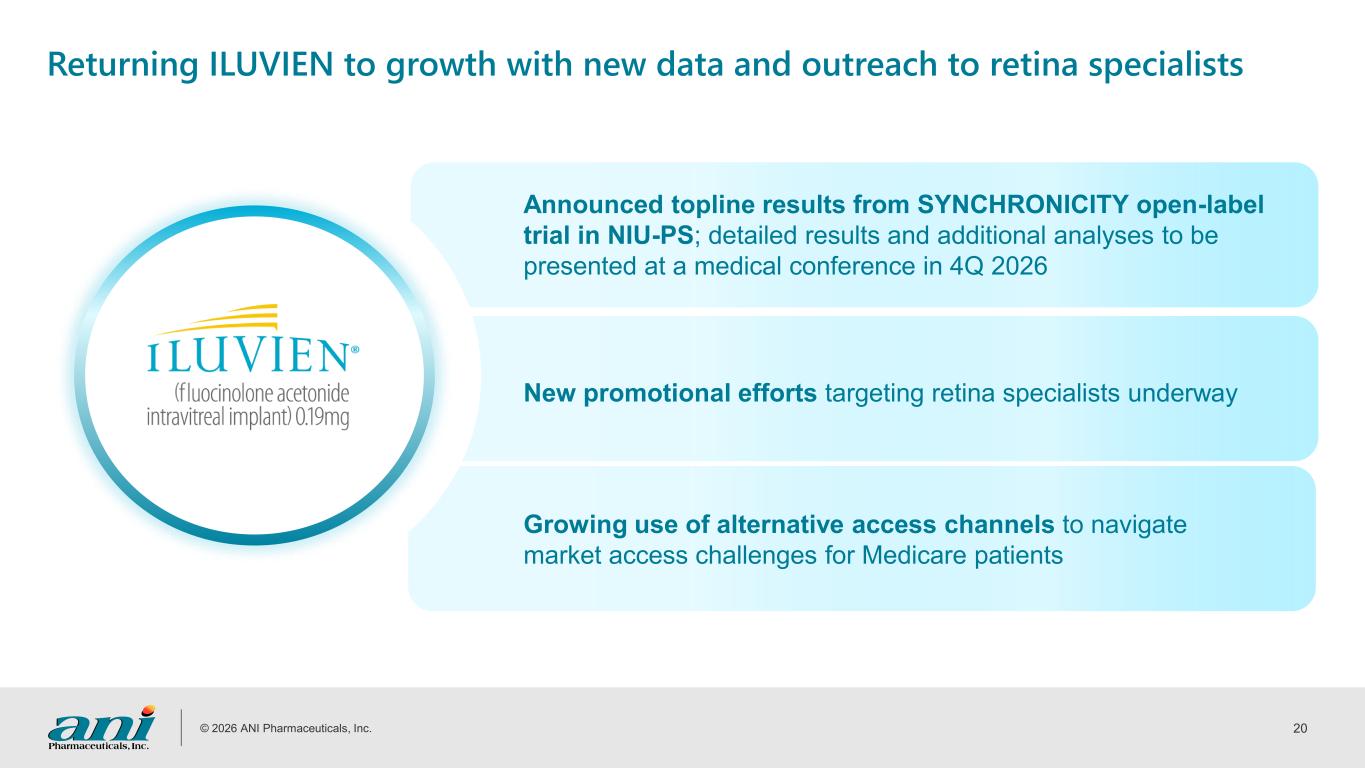
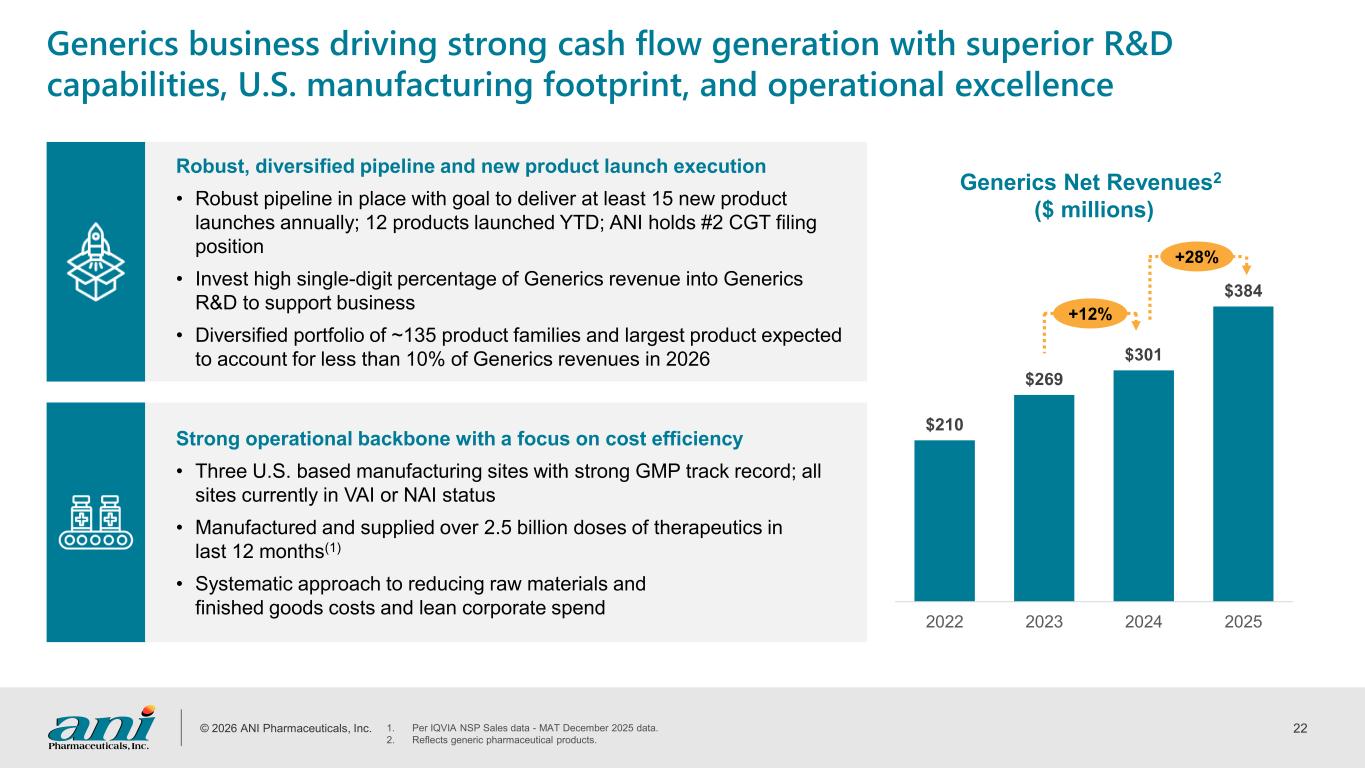
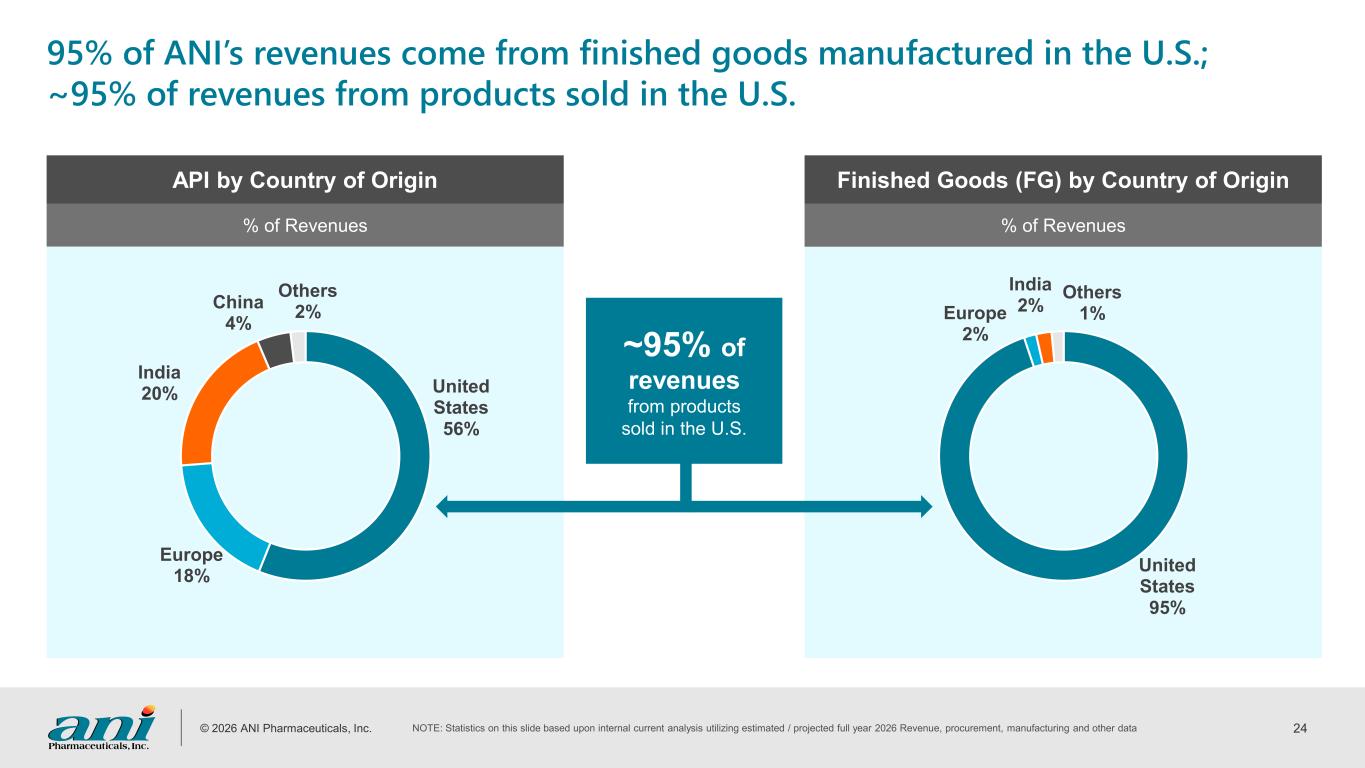
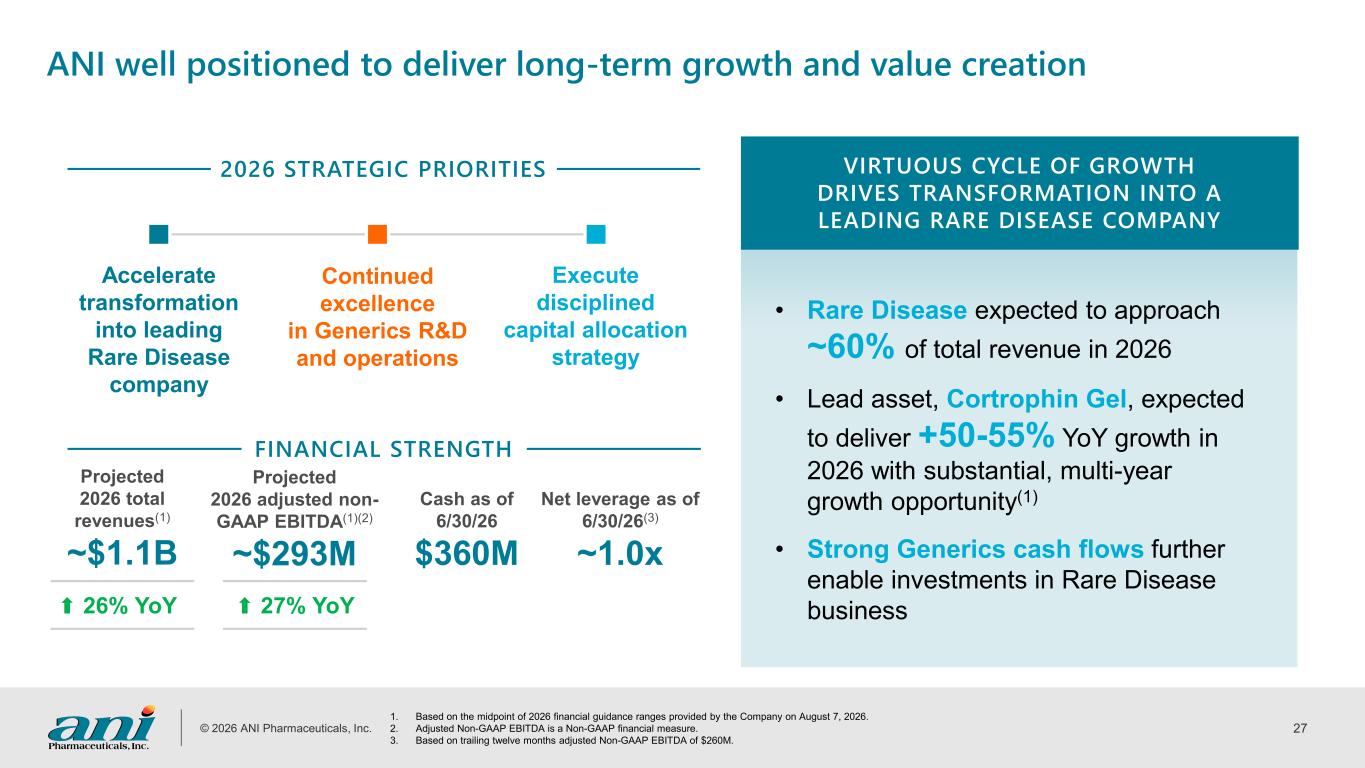
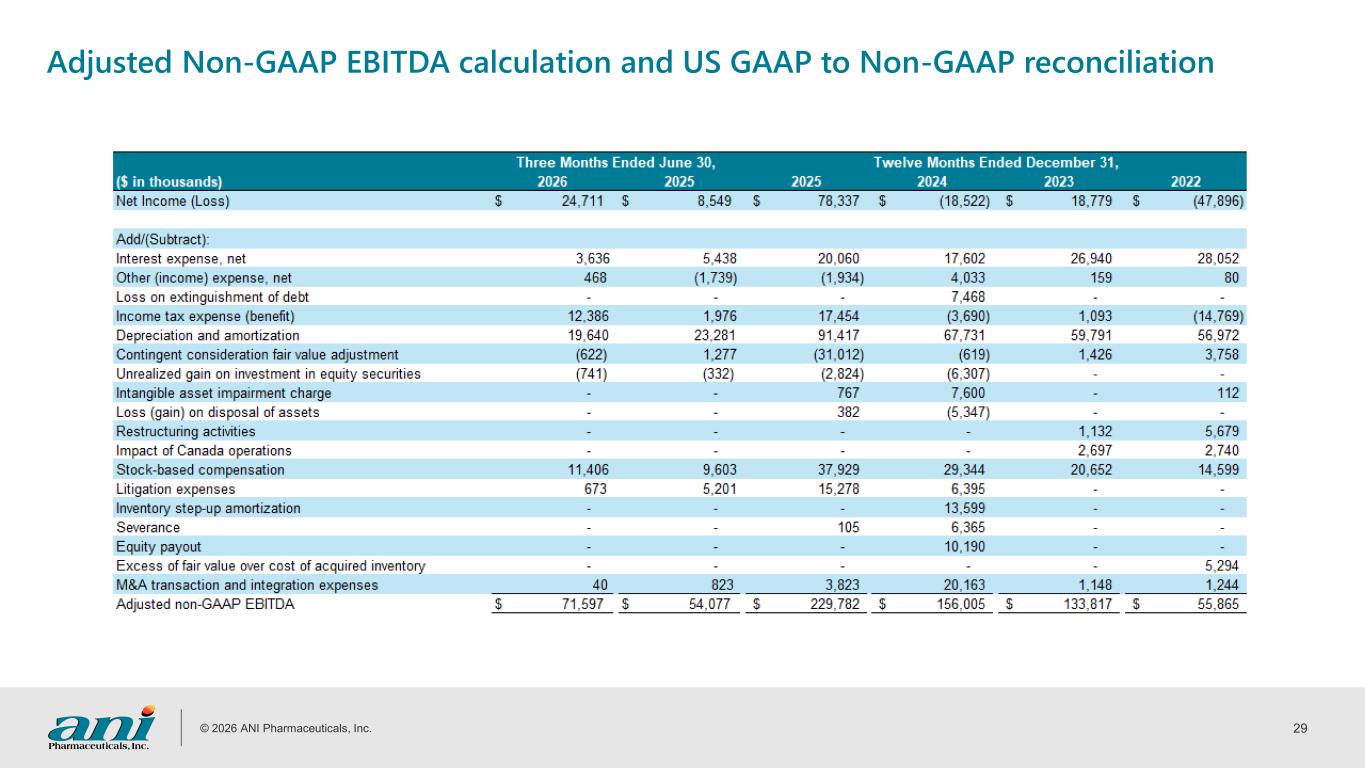
Nikhil Alwani Thank you, Irina. Good morning, everyone, and thank you for joining us for ANI's second quarter 2026 earnings call. Starting on slide 5, our entire organization demonstrated outstanding focus during the second quarter as we continued to transform E&I into a leading rare disease company. We reported record second quarter 2026 revenues of $266 million for the overall business, record Cotrofen revenues of $117.1 million, and record adjusted EBITDA of $71.6 million. In the second quarter, we grew total net revenues 26% year-over-year, driven by persistent execution across our rare disease and generics businesses with incremental contribution from the Harmony Intellectual Property outlicensing deal we announced last quarter. We also grew adjusted EBITDA 32% year-over-year to an all-time high and above our prior expectations. Furthermore, we achieved all of this while executing the single largest rare disease sales force expansion in our history, where we increased our sales force by 50% to approximately 180 reps. Our strategic plan is on track, and we are well positioned to drive meaningful growth in 2026 and beyond. Turning to slide six, our first area of focus in our transformation into a rare disease company is delivering organic growth for our two durable branded rare disease medicines, Cotrophin Gel and Illuvian. We delivered 117.1 million in Cotrophin Gel net revenues for the second quarter up 43% year over year and 56% over quarter one, 2026, consistent with the expectations we outlined during our last quarterly call. Second quarter revenues from our existing specialties of rheumatology, nephrology, neurology, ophthalmology, and pulmonology was healthy, and we are seeing significant momentum in demand in the third quarter, with July representing the highest month for new cases initiated. We expect our existing specialty sales force to continue its strong trajectory in the second half of 2026. We completed our gout-focused organization expansion, and the team was fully operational at the end of June, as expected. We are pleased that we have seen strong demand driven by the high unmet need for patients who are most severely impacted by acute gaudi arthritis flares and who need an additional treatment option. Our leading indicators are very positive, such as total new cases initiated, cases initiated per sales rep, and a number of prescribers with multiple new cases. We believe we are at the start of a sizable inflection for this business and look forward to updating you on our progress. Taking a step back, our conviction in the growth and durability of Cotrophin Gel have only increased over time since our 2022 launch. Cotrophin has grown at a compound annual growth rate of 103% to $348 million in sales in 2025, and we're just getting started. We believe Cotrophin will serve as the key building block catalyzing our transformation into a rare disease company. Now that we are midway through the year, we are modestly revising our Cotrophin Gel revenue guidance to $520 million to $540 million, primarily to account for results in the first half of 2026. Our expectations for the back half remain largely intact with what we had expected at the start of the year. Importantly, this still represents 50% to 55% growth for Cotrophin compared to 2025 and addition of the gout expansion creates a strong new growth trajectory for Quartrofit. We believe we are well positioned to achieve our revised 2026 guidance based on the continued momentum in existing specialties as evidenced by the highest new cases in July and the strong demand generation from the gout expansion. For Alluvian, we delivered $18.7 million of revenue in the second quarter. We announced the top-line results from the Phase IV open-label synchronicity trial in NIUPS and plan to unveil detailed results and additional analysis at a medical conference in the fourth quarter of 2026. These results are particularly relevant for retina specialists who see a large population of uveitis patients. Uveitis remains a category in which steroids are the standard of care and where we see an opportunity to build an increasing share of voice over time. Over the long term, we continue to believe the addressable patient populations in DME and NIUPS represent at least 10x the number of patients treated with Illuvian today, a significant and durable opportunity for value creation. Turning to slide 7, our strategic priority, our second strategic priority is continued execution in generics. To date, we have launched 12 generics in 2026 and are on track to launch at least 15 in the full year. We also continue to hold our position as the number two player in overall CGT filings. Driven by our superior R&D capabilities and operational execution, we delivered another strong quarter with generic revenue of $99.1 million, up 10% year-over-year. As a reminder, ANI is uniquely positioned to capitalize on opportunities in the evolving tariff landscape that may arise, with approximately 95% of our revenues coming from finished goods manufactured in the U.S. Bringing high-quality generics and rare disease products made in the U.S. to our patients plays an important role in our success. Third, we remain focused on executing a disciplined capital allocation strategy. We are investing in organic growth that have expanded our cotrophin commercial footprint in acute cardiothoritis flares. We continue to deploy a high single digit percentage of generics revenue into generics R&D programs. We are also evaluating attractive inorganic growth opportunities to expand the scope and scale of our rare disease business. Turning to slide eight, our strong second quarter performance demonstrates the steadfast execution of our strategic priorities as we deploy the cash created by generics and brands in our virtuous cycle towards our transformation to becoming a leading rare disease company. We are confident in delivering 50% to 55% Quartrofen revenue growth in 2026 and are pleased that our gout expansion is off to a strong start. Taken together, these initiatives are expected to create operational leverage in 2027 and beyond as we maximize the Quartrofen growth opportunity. In 2026, we expect to deliver $1.1 billion in revenue representing 26% growth over 2025 at the midpoint of our guidance range with rare disease as the primary driver of that growth. We also expect to expand the bottom line with adjusted EBITDA forecasted to grow 27% year over year to 285 million to 300 billion. Our balance sheet is healthy with the capacity to support future potential business development opportunities to expand the scope and scale of our rare disease business. I'll now turn the call to Chris to discuss our rare disease business and provide color from the ongoing launch in acute cardiothoritis flares.
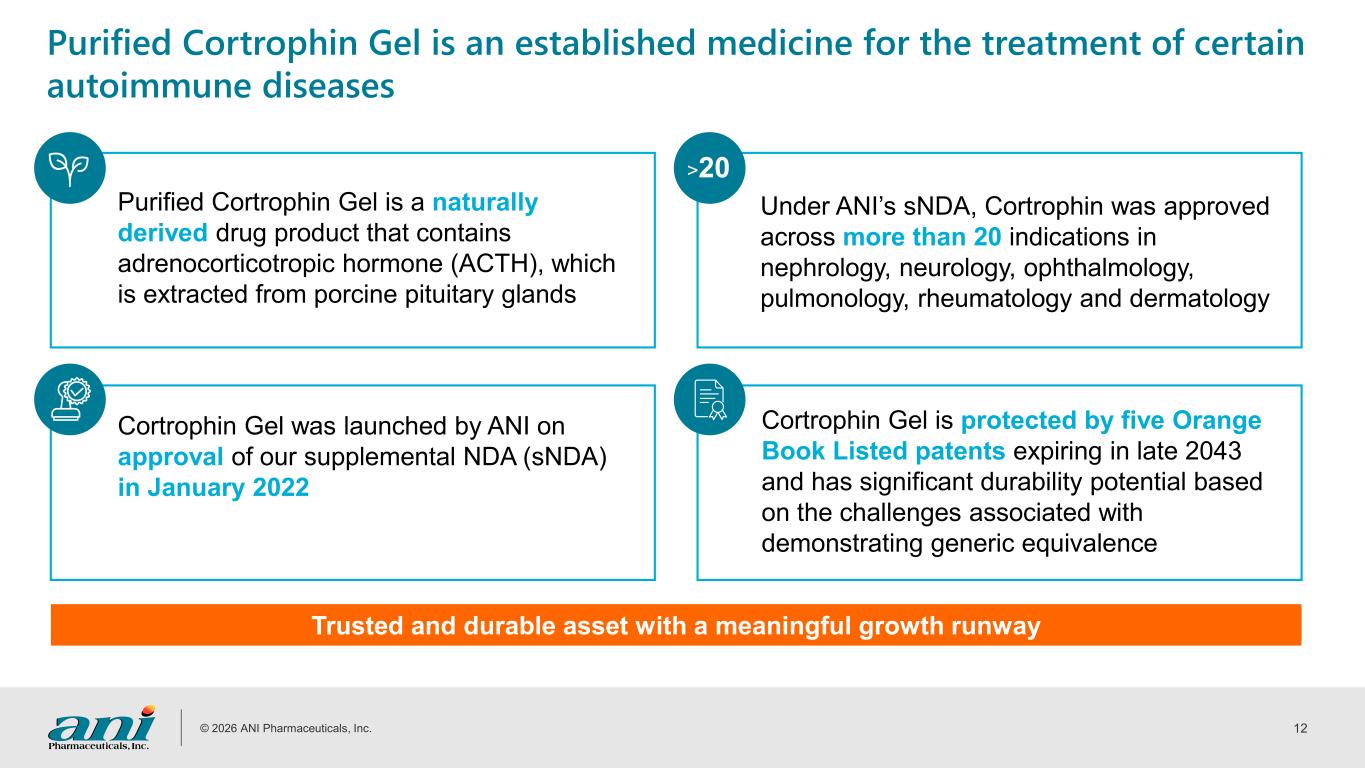
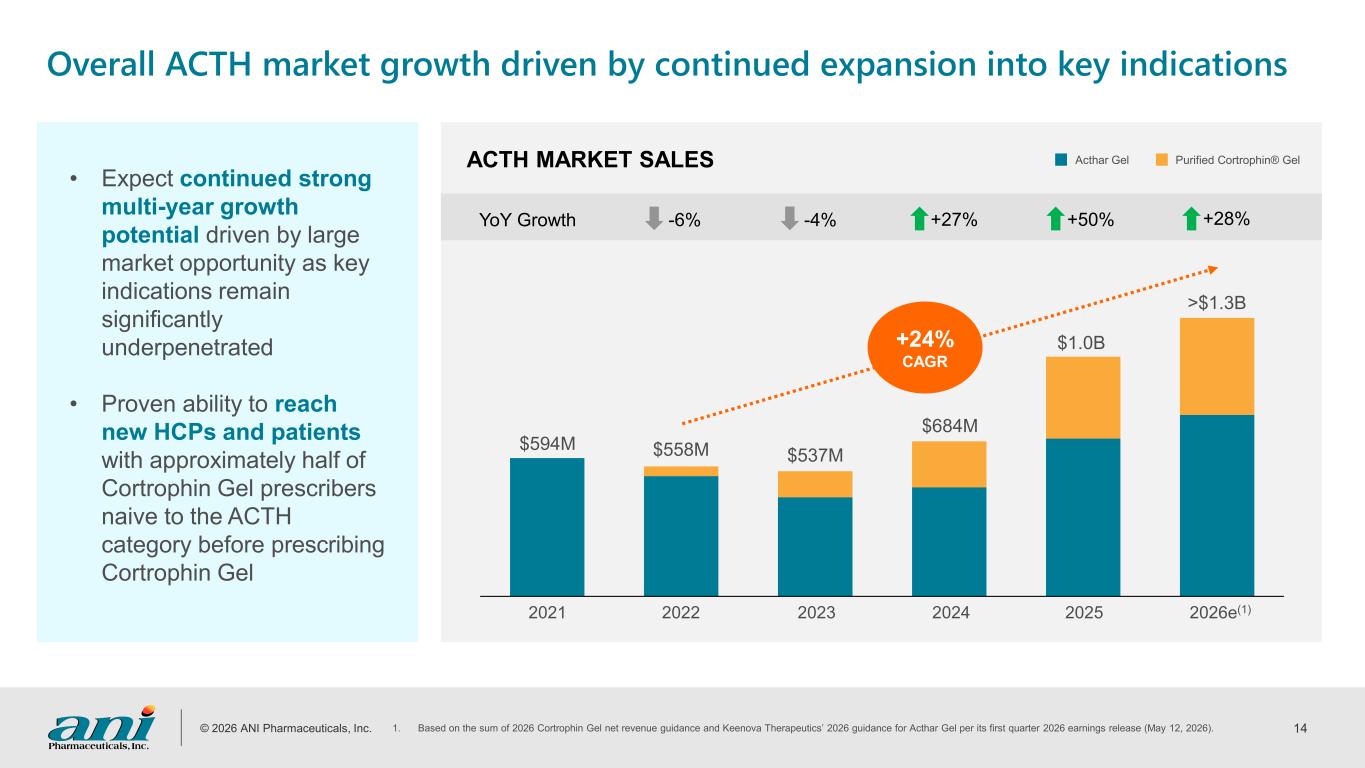
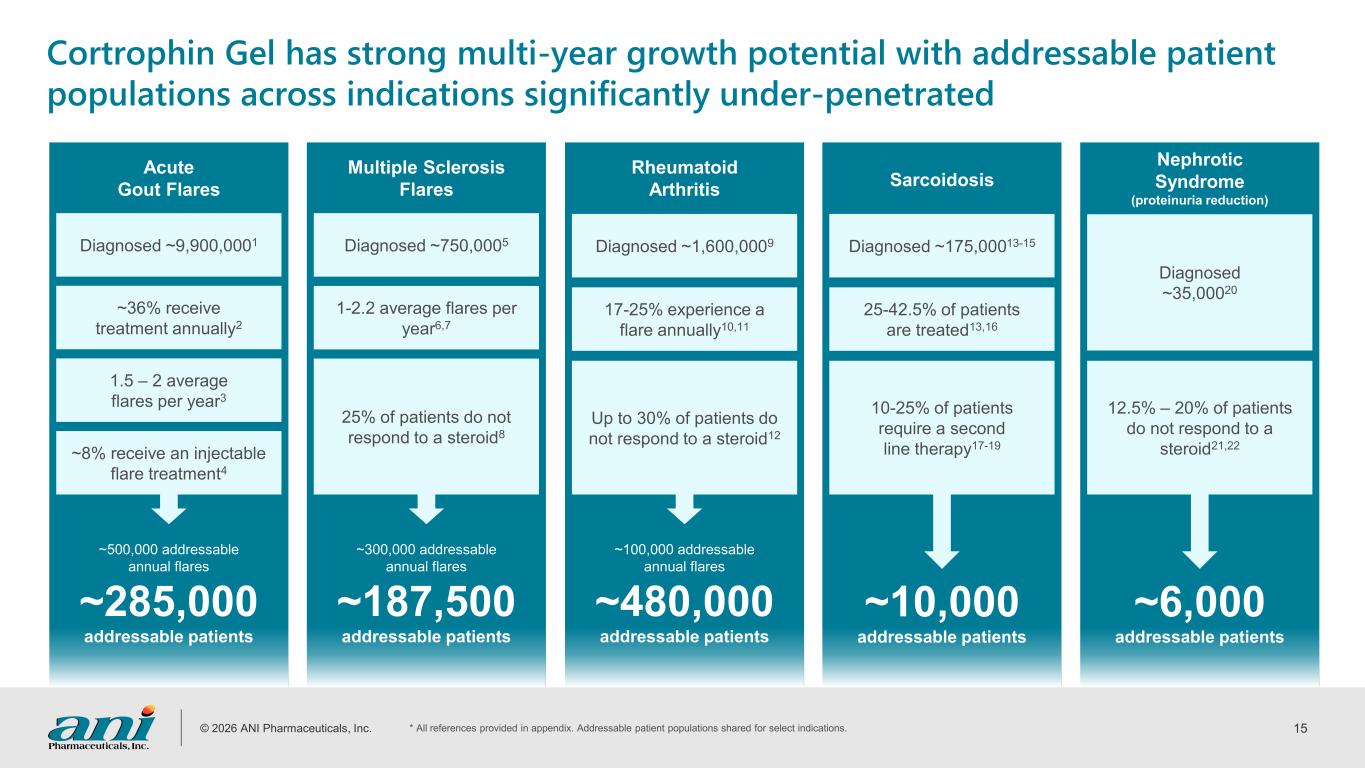
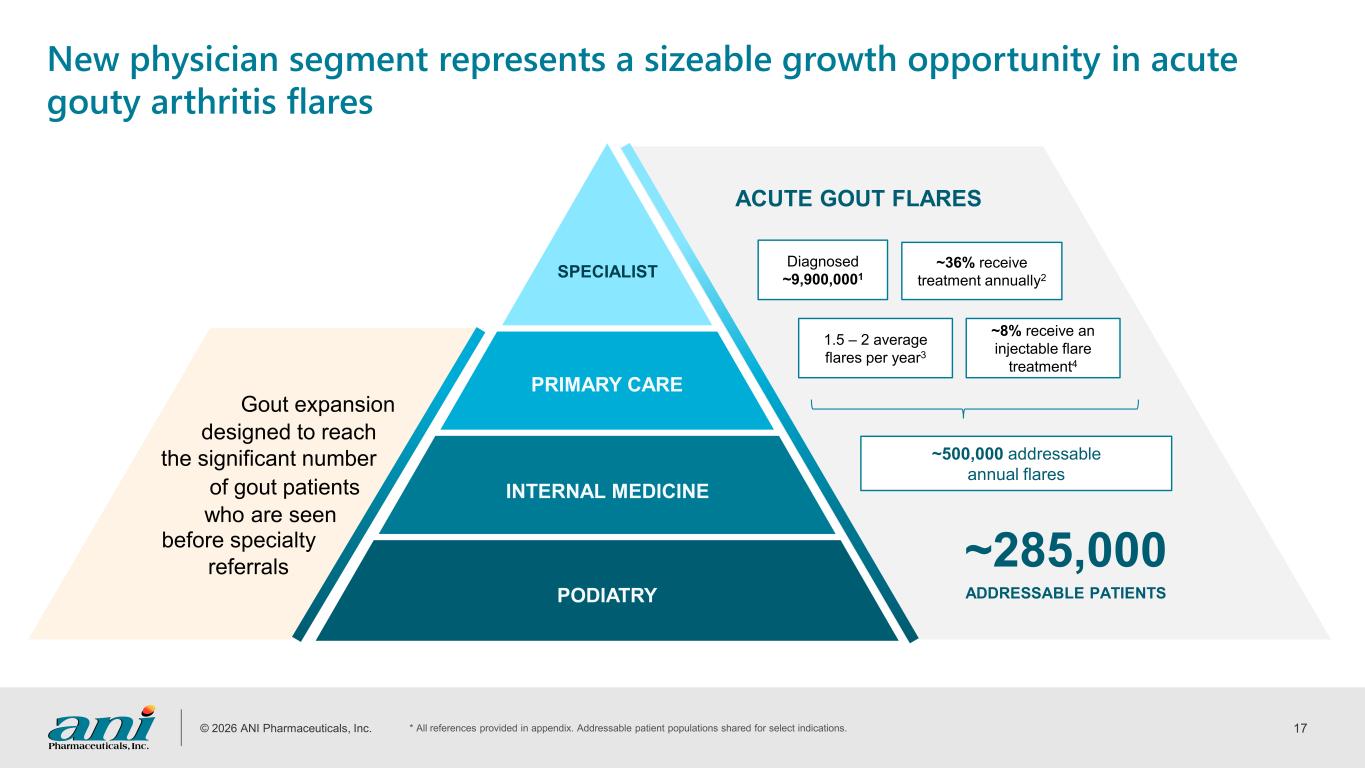
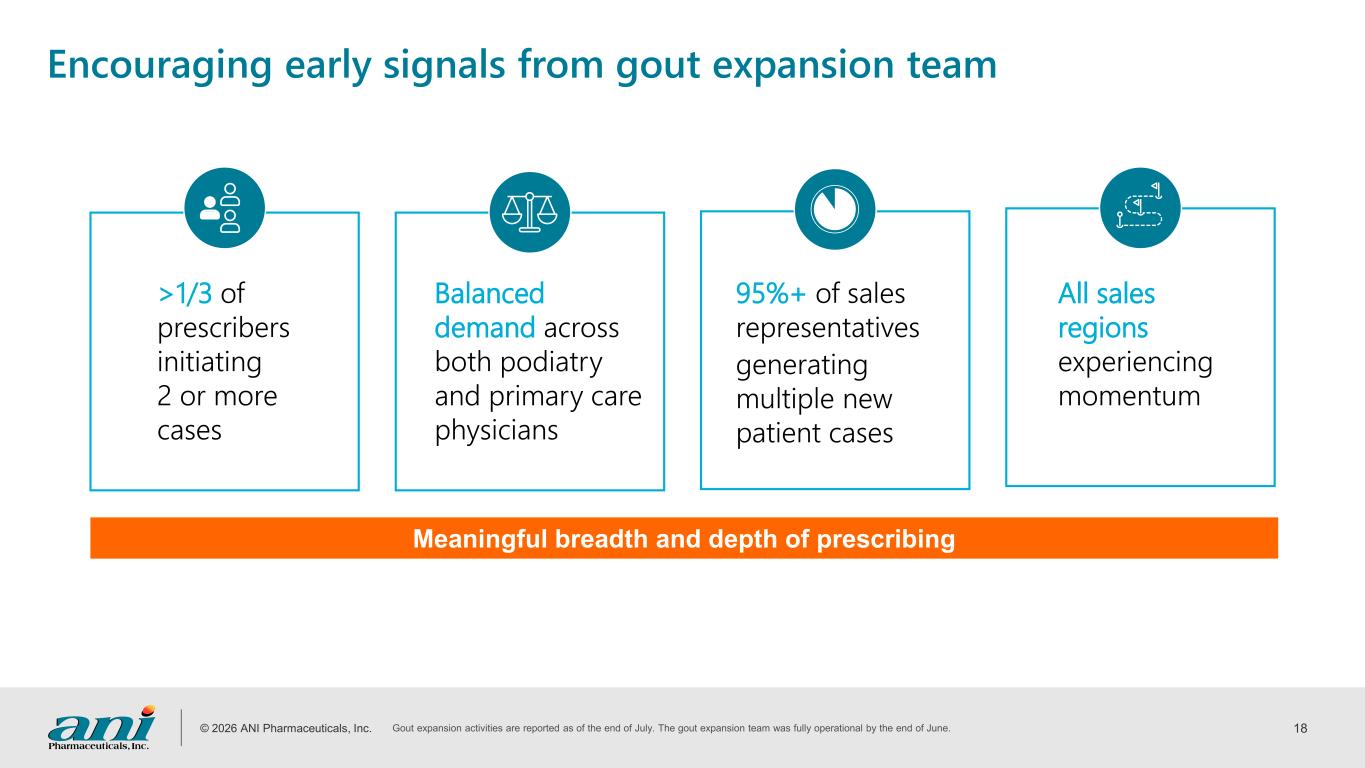
Thank you, Nikhil, and good morning, everyone. In the second quarter, cortrophin grew 43% year-over-year to $117.1 million, in line with our expectations. This growth originated primarily from our existing specialties, such as nephrology, neurology, ophthalmology, pulmonology, and rheumatology, which represent the base cortrophin business before the recent gout expansion. Momentum in our existing specialties has continued into the third quarter with a record number of new cases initiated in July. We also continue to realize meaningful revenue synergies in ophthalmology with second quarter cortrophin volumes in ophthalmology, again, doubling over the same period a year ago. Moving now to slide 11. The overall ACTH market is quite healthy and expected to grow nearly 30% in 2026 to reach over $1.3 billion in sales, with cortrophin expected to grow 50% to 55% year-over-year in 2026. This market expansion is driven by growth in key underpenetrated specialties that have significant upside potential. There are a large number of prescribers and patients who are naive to the ACTH category across all therapeutic areas, and I steadily reaching this segment, including as part of our gout expansion now reaching podiatrists and primary care physicians. Approximately half of cortrophin gel prescribers in our core specialties are naive to ACTH. Here on slide 12, we return to the size of the overall opportunity for cortrophin gel. Across indications, we estimate there are almost a million addressable patients, and And yet, to date, ACTH therapies are vastly underpenetrated. With A&I's demonstrated ability to educate healthcare providers to help identify new patients who are appropriate candidates for cortrophin treatment, we have confidence that there is significant runway for continued, strong, multiyear cortrophin growth and market expansion. Turning to slide 13, we have made our largest commercial expansion in the first half of 2026, increasing our sales headcount by 50% to approximately 180 sales representatives. based on what we view as a transformational multi-year growth opportunity for our business in the podiatry and primary care settings. Our team was fully onboarded and trained by the end of June and have been out in the field engaging with their new prescribers. Goud is a condition with significant patient burden, and our market research, as well as our early experience, shows us that people view their disease as disruptive, anxiety-provoking, and frustrating. Paying from acute gaudy arthritis flares has been described by some as unbearable and can come on quickly and unexpectedly, especially in the middle of the night or the early morning. We believe podiatrists and primary care physicians are actively managing a much larger volume of acute gaudy arthritis flares than specialists, and most often earlier in the patient journey, either due to referral gaps or access limitations. Our sales representatives are educating podiatrists and primary care providers about cortrophin gel and the identification of appropriate patients. We're focused on the most severe patients who experience multiple flares a year who have previously been treated with injectable medicines like steroids or pain-relieving medications. These patients may benefit from an additional treatment option. Our patient support team is helping patients request and access cortrophin gel to treat the current flare and to have drug readily available for when the next flare hits. Turning to slide 14, we feel confident about the opportunity in the podiatry and primary care settings because of the insights and results generated by both the pilots conducted in 10 territories, as well as the strong momentum we are seeing today from the GAUD expansion. While it is early days, we are pleased to see encouraging trends in our leading indicators. To date, we have been generating very strong demand with meaningful breadth and depth of prescribing. Over 95% of our new sales representatives have generated multiple new cases, and momentum and demand persist with record new cases achieved by the team week over week. We've seen traction with both primary care and podiatry offices with initial and repeat prescribing. Over a third of our prescribers have initiated two or more patient cases. Our patient support team has been successful in helping these patients get access to therapy. ANI's entire organization is dedicated to making this new commercial expansion successful. We're excited that this weekend our marketing, medical, and sales teams will be engaging with customers at the American Pediatric Medical Association Scientific Meeting, or APMA, being held in Nashville, and we intend to be increasingly visible to this key prescriber audience going forward. I wanted to thank the entire Core Trofrin team for their superior focus and execution. Our new guide expansion is off to a very encouraging start, and we look forward to their contribution in the second half of 2026 and beyond. On slide 15, turning to our retina franchise, we continue to make progress to support a return to growth for Alluvian. We recently reported top-line results from the Synchronicity Phase 4 Open Label Trial in noninfectious uveitis of the posterior segment and plan to present the detailed results and additional analyses at a medical meeting in fourth quarter 2026. These data will support increased engagement with retina specialists who treat NIUPS as we continue sharing insights and new findings from the Synchronicity study. The second quarter reflects strong execution across our team as we continue to accelerate into a leading rare disease company. With that, I will now turn the call over to Steve to detail our financials.
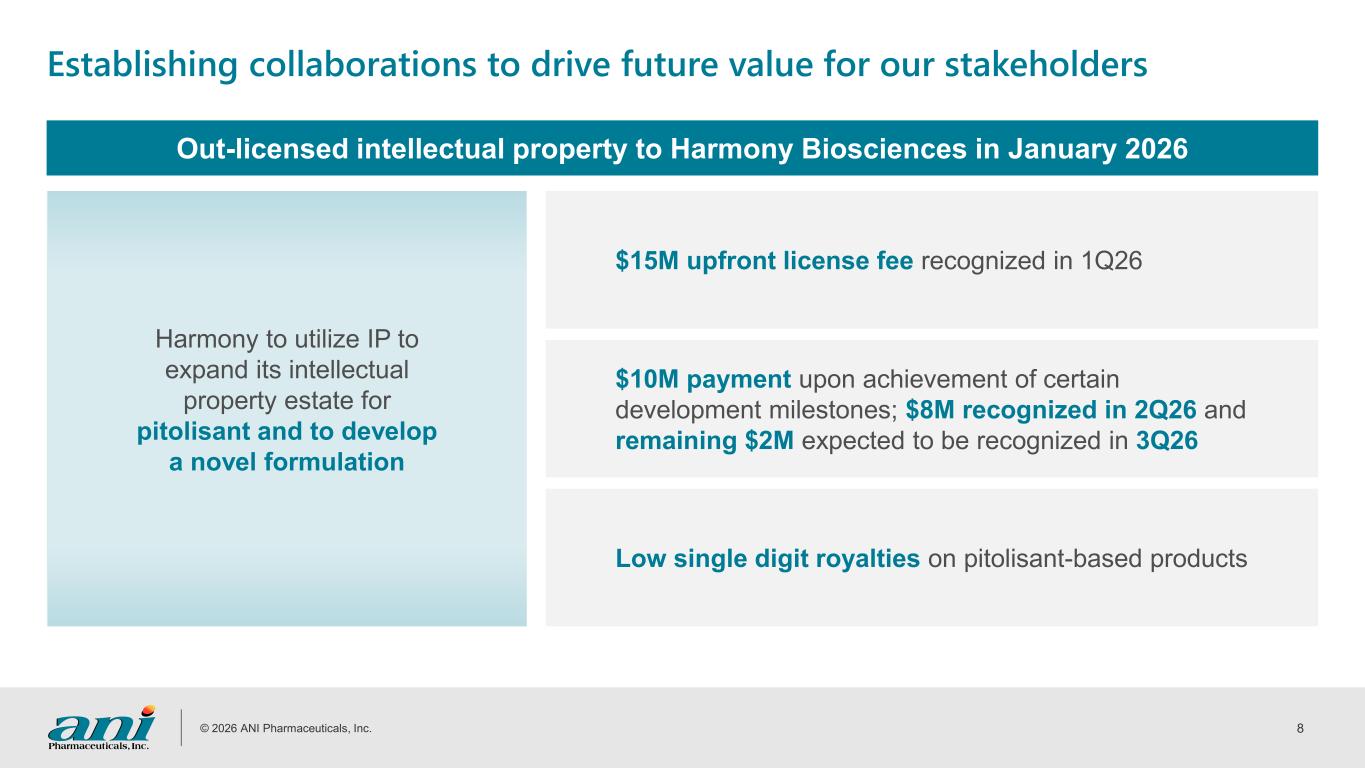
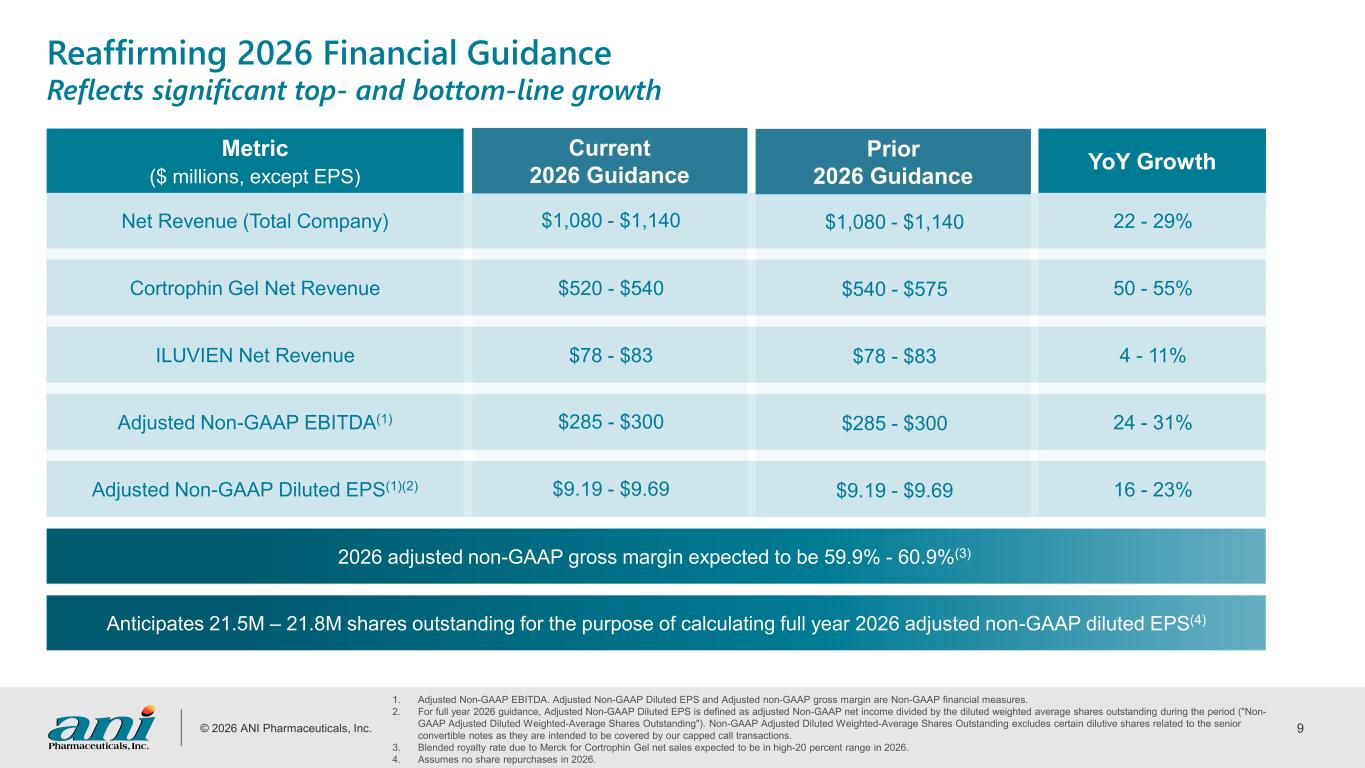
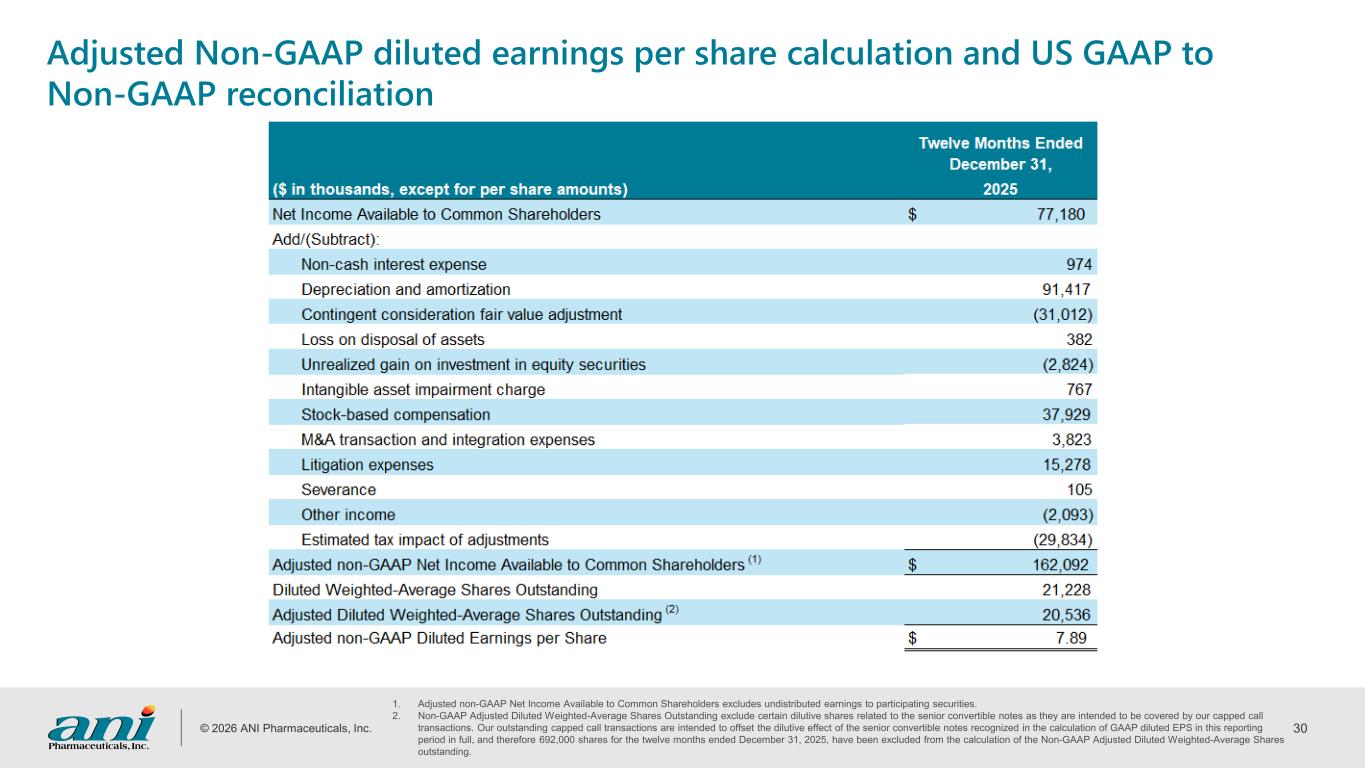
Thanks, Chris, and good morning to everyone on the call. Now I'll review our second quarter results in 2026 guidance in more detail. Starting with slide 17, A&I total net revenues were $266 million in the second quarter, up 26% over the prior year period. Revenues from Cotrofen Gel in the second quarter were $117.1 million, up 43% from the prior year period, driven by increased volume and performing in line with our expectations. Alluvian net revenues were $18.7 million in the second quarter, down 16% from the prior year, primarily based on timing of international shipments. We remain on track to meet our full year guidance for this product. In January, we entered into a licensing transaction with Harmony Biosciences. We recognized $17.7 million of associated revenues in the second quarter, consisting of $9.7 million of royalty income on sales of WACIX and $8 million of revenue based upon work completed in the quarter toward the achievement of certain development milestones. We expect to recognize the remaining $2 million from the development milestone in the third quarter of 2026. Revenues for generics in the second quarter were $99.1 million, an increase of 10% over the prior year, driven by continued strength in the partner generic launch that commenced in the third quarter of 2025, contribution from new product launches, and commercial and operational outperformance. Turning to slide 18, non-GAAP cost of sales increased 34 percent to $99.6 million in the second quarter of 2026 compared to the prior year period. Non-GAAP gross margin in the second quarter was 62.6 percent, a decrease of approximately 230 basis points from the prior year driven by product mix. Non-GAAP research and development expenses decreased 11% to $14.1 million in the second quarter, primarily due to phasing of generic R&D spend. Non-GAAP selling general and administrative expenses increased 20% to $80.7 million in the second quarter, driven by our gout expansion for cortrophin, as well as an overall increase in activities to support the ongoing growth of our business. Adjusted non-GAAP diluted earnings per share was $2.21 for the second quarter compared to $1.80 per share in the prior year period. Adjusted non-GAAP EBITDA for the second quarter was $71.6 million, up 32% compared to the prior year period. We ended the second quarter with $360.2 million in unrestricted cash, up $74.6 million as compared to the December 31st, 2025 balance sheet. Cash flow from operations was $56.7 million in the second quarter and $115 million on a year-to-date basis. As of June 30, 2026, we had $620.9 million in principal value of outstanding debt, inclusive of our senior convertible notes and term loan. At the end of the second quarter, our gross leverage was 2.4 times, and our net leverage was one time our trailing 12-month adjusted non-GAAP EBITDA of $259.6 million. Turning to slide 19, we are reaffirming our 2026 financial guidance for total net revenue, adjusted non-GAAP EBITDA, and adjusted non-GAAP EPS, which reflects significant top and bottom line growth, and modestly revising our guidance for cortrophin gel. Our guidance outlined on slide 19 is as follows. We expect 2026 total company net revenue of $1.08 billion to $1.14 billion, representing 26% year-over-year growth. From a quarterly cadence perspective, we expect the third quarter total company revenues to be modestly higher as compared to second quarter and accelerating sequential growth in the fourth quarter. We are revising our guidance for KortrofenGel net revenue to $520 million to $540 million, primarily to account for results in the first half of the year. Our expectations for the back half of the year remain largely intact. From a quarterly cadence perspective, we expect third-quarter Cotrofin revenues to be in the range of $143 million to $153 million, with further sequential gains in the fourth quarter, driven by continued performance of our existing specialties team, in addition to the full deployment of our GOUT expansion sales force. We are reaffirming our Illuvian net revenue guidance of $78 million to $83 million, which reflects stronger Illuvian revenue in the back half of the year compared to the first half. This guidance assumes no meaningful contribution from third-party patient assistance foundations in line with our prior expectations. We expect adjusted non-GAAP EBITDA of $285 million to $300 million. From a quarterly cadence perspective, we expect third quarter non-GAAP EBITDA to be down sequentially, however, higher than the first quarter of 2026 non-GAAP EBITDA. This will be driven by two factors. First, we expect to recognize the final $2 million Harmony development milestone loan in the third quarter as compared to the $8 million recognized in the second quarter. And secondly, the third quarter will be the first fully loaded quarter of the gout expansion and associated operating expense. We continue to expect fourth quarter EBITDA to be the highest of the year as we begin to achieve leverage on the gout expansion with increasing cortrophin gel revenues. We continue to expect adjusted non-GAAP earnings per share between $9.19 and $9.69. We continue to expect adjusted gross margin to be between 59.9% and 60.9% in 2026. We continue to anticipate 21.5 million and between 21.5 million and 21.8 million shares outstanding for the purpose of calculating full-year non-GAAP diluted EPS and a full-year U.S. GAAP effective tax rate of approximately 26% to 28%. With that, I'll turn the call back to Nikhil.
Thank you, Steve. Turning to slide 21, in closing, we are making meaningful progress against our strategic priorities to accelerate our transformation into a leading rare disease company, to continue executing in generics, and to deploy capital in a disciplined manner. We are very encouraged by the initial demand that our Cotrophin sales force expansion in grout is driving, and the momentum of our existing specialties. Overall, we expect to deliver over $1 billion in revenue in 2026, with rare disease approaching 60% of total revenues. We are confident in achieving our 2026 financial guidance, which reflects significant top and bottom line growth. Operator, please open the line for questions.
Operator
As a reminder, to ask a question, please press star 11 on your telephone and wait for your name to be announced. To withdraw your question, please press star 1-1 again. Please stand by while we compile the Q&A roster. Our first question comes from Vamal Devon with Guggenheim Partners. Your line is open.
Great. Thanks for taking my questions. Just focusing on court troping here, can you give a little bit more detail in terms of what you've been seeing so far in terms of the gout uptake? I appreciate the comments you made. I'm just sort of thinking about the way you've structured the guidance here you're going to get about 143, 153 in the third quarter, it's a pretty meaningful step up from there into the fourth quarter. So just try to see what you've seen so far in gout and kind of the confidence it gives you to see the further uptake through the course of the year. And then sort of tied to that also, obviously a lot of potential patients that are going to hit across the current indications as you showed on the one slide here. Can you maybe just give us a sense of how penetrated you think some of these current indications are? Again, just trying to get a sense in terms of, obviously there's a big runway ahead of you, but trying to get a sense of how far you've penetrated them to get a sense of what maybe is left to penetrate them. Thank you.
Yeah. Good morning, Vano, and thank you for your questions. I think your first question is on the uh gout expansion so as we said the leading indicators uh from the gout expansion are very positive right uh overseeing is the you know so first of all you know our gout focus organization expansion was fully operational by the end of june as expected and then the leading indicators of demand that we've pointed out ours which we're pleased with is the breadth and the depth of the prescribing right so over 95 percent of the reps generated multiple new patient cases over a third of the prescribers are initiated have initiated two or more cases and we also saw balanced demand between primary care and podiatrists we also see continued uh success and growth in the territories that were the 10 pilot territories that we had which based on whose success we actually you know thought about the gout expansion, right? So, I think all of those, you know, very pleased with the progress and the leading indicators of demand that we've pointed out for the gout expansion. Now, when it comes to guidance, you know, Steve pointed out that our Q3 guidance for Quotrofen is 143 to 153. And then, you know, your question was around the step up from there. So, when you think about the gout expansion, right, we've executed our largest rare disease Salesforce expansion and we've increased our reps by 50%. This expansion from 120 to 180 reps, right? So that's a meaningful expansion. That expansion was operational by the end of June. I already spoke about the leading indicators of demand. So we expect Q3 to keep building on this momentum and therefore Q4 will have significantly higher impact from the GAUD expansion. In parallel, our existing specialties, which were the primary drivers of growth, for the 56% quarter-on-quarter growth in 2Q, and have continued the momentum in 3Q with the highest number of new cases initiated in July, but that also has continued momentum. And then, you know, lastly, you know that Q4 also benefits from the typical channel and insurance dynamics acting as tailwinds. So finally, as a reference point, in 2025 too, where we did a Salesforce force expansion, revenue contribution from H2 was 61% of the total. And then, you know, just again as the reference point, the expansion in 2026 is 3x the expansion in 2025 in terms of number of reps and was completed in the second quarter versus the first quarter in 2025. And then lastly, your question was on penetration across the addressable market. It's very low, very, very low. And so there is a huge opportunity, and we continue to believe in the strong multi-year growth opportunity for cotrophin and are investing in multiple ways to capture that opportunity and to, most importantly, you know, be true to our purpose of serving patients, improving lives. Thank you, Vano.
Operator
Thank you. Our next question comes from Glenn Santangelo with Barclays. Your line is open.
Oh, yeah, thanks for taking my question. Hey, Nikhil, at the beginning of the year, you called out all these prior authorization and re-verification issues that would impact 1Q. But then on May 8th, when you reported 1Q, you said that this was kind of behind the company. You know, this quarter, you're talking about the early progress of your Salesforce expansion and the early success in gout, but yet you come in light and you're sort of trimming the guide for the year. And so I just want to try to get your sense for how the months have progressed and how, you know, the insurance reverification issues have progressed and is that playing a role here in the second quarter because, you know, what we find a little perplexing is the disconnect between the IQVIA data and what you're reporting and so I'm kind of curious if we have a situation where scripts are getting written but not approved. Any sort of details around sort of how the first half played out from 1Q to 2Q would be helpful. Thanks.
Yeah. Good morning, Glenn, and thank you for your question. So first is on the insurance re-verification, which impacted the performance in the first quarter. That issue is behind us, and there is no impact from insurance re-verifications in the Q2 number. And then to level set here, we did make our guidance range for the quarter, achieving the 56% and 43% year-over-year growth in Q2 and are proud of the progress we made. And there are a diverse range of inputs that drives our guidance, right, such as number of cases initiated, the indication mix, patient pull-through, payer type, and other such factors. And then, you know, in terms of momentum, right, going into Q2 and, you know, obviously, where we're sharing Q3 data too, the growth came in Q2, came primarily from existing specialties, and the momentum has continued into the third quarter with from existing specialties itself. We have the highest number of months of new patient cases initiated in July. As expected and as previously discussed, given the timing of operationalizing our gout expansion, it did not have a meaningful impact on Q2 reported revenues, but we continue MEASURABLE REVENUES IN THE THIRD QUARTER AND ROBUST GROWTH IN THE FOURTH QUARTER, AND WE'RE GIVING, YOU KNOW, METRICS ON THE INDICATORS OF DEMAND, RIGHT, THAT I ALREADY LAID OUT. AND SO OUR EXPECTATION FOR Q3 AND Q4 IS, IS, HINGES ON BOTH THE, THE CONTINUED MOMENTUM IN THE EXISTING WE TALKED ABOUT, AS WELL AS THE VERY POSITIVE EARLY FEEDBACK FROM THE GROUT LAUNCH WHERE WE HAVE OVER Over 95% of our team has generated multiple new cases, and over a third of our prescribers have initiated two or more cases. And we continue to have success going to prescribers who are naive to ACTH, right? We have, over the history of us commercializing Cotrofen, over half of our prescribers are, you know, were naive to ACTH and began using ACTH to serve patients. With the linkage to IQVIA and the question around that, while the IQVIA data has historically provided directional insights on revenues, we also know that there is a lot of volatility in the data, and it has over or understated quarterly revenues in the past. That's really all we have to say about the IQVIA data, but we understand that and to be helpful to investors, we have been providing to investors many of our key internal metrics, such as, you know, next quarter's revenue guidance or various demand metrics from July in the first month of the current quarter. Thank you, Glenn. Thank you.
Operator
Thank you. Our next question comes from Dennis Ding with Jefferies. Your line is open.
Hey, good morning. Thanks for taking our questions. We had two on the court's open guidance. So, number one, you know, what factors didn't play out to your expectations that has driven the guidance revision, because you guys landed, you know, within your Q1 and Q2 soft guidance, but then lower 2026 by about 30 million. So, I'm just curious, did early Q3 demand perhaps not meet your expectations, or maybe you're seeing incremental headwinds on access, as, you know, we've seen a couple of other spec-farm companies flag, you know, additional step edits and things, even though they're in other therapeutic areas. So, that's question number one um and then question number two is that you know your guidance also assumes a pretty big step up in q4 but if i look at last year that that was actually the slowest uh sequential step up um that core trofen had so i'm just wondering you know what gives you the confidence that q4 would play out as expected appreciating that the gout expansion is happening and is accelerating Thanks. Yeah.
Good morning, and thank you for your questions, Dennis. So our revised guidance principally accounts for the actual performance in the first half and largely maintains our expectations for both the existing specialties and the gout expansion in the back half. We expect to deliver 50% to 55% year-over-year growth, right, for cortrophin to $520 million into $540 million in Cotrofen revenue for the full year. And importantly, Cotrofen has a strong multi-year growth opportunity driven by the large, significantly underpenetrated, almost 1 million patients that we estimate as our addressable market. And we continue to see momentum across both our existing specialties and from the gout expansion. You asked about Q3 metrics, right? In existing specialties, highest number of new cases initiated in July. In the gout expansion, 95% of the reps, right, an expansion that was operational at the end of June, 95% of reps fully operational at the end of June, 95% of reps have initiated two or more cases. A third of our prescribers have written two or more cases. So we are seeing very strong demand generation and very positive demand generation, which is on track or ahead on metrics that we have. Week on week, we're continuing to see that momentum. We do not see any additional headwinds in the back half of the year. And very importantly, our expectations for the back half of the year are largely intact with what we had originally anticipated at the start of the year. So the revised guidance is simply taking into account the actual results from the first half. And then you asked about the question on the step up in Q4. I think the big difference with last year is we have an expansion that's 3x the previous year's expansion that's fully operational at the end of June. So these reps will have been out three months in Q3, but then you'll have a full quarter and you know most reps will be out between three to five months when you get to the fourth quarter so you'll see a much bigger impact from in from the gout expansion in the fourth quarter thank you dennis okay got it and and if i can have a quick follow-up so on the dedicated gout expansion can you comment on how many flares have been treated so far because based on your you know some of your comments i mean you guys had 65 dedicated scout reps you said 95 of them multiple new cases.
So, if you have conservatively assume two cases each, maybe that's 125 patients or flares from the end of June to the end of July. So, that's about a month and that's going to ramp up through the year. Do you think those are fair assumptions? Thanks.
Yeah. Thank you, Dennis, for your question. Look, we're trying to give as many internal metrics to be helpful to investors, but we're not at this point sharing flares per rep or number of cases per rep, because as I said, there are many factors that drive our guidance, and so I'll keep it at that. Thank you, Dennis.
Operator
Thank you. Our next question comes from David Amselm with Piper Sandler. Your line is open.
Thanks. So just a couple for me. First, just wanted to clarify, side, Nikhil. Are cases the same as prescriptions written? And if they're not, can you talk about how many of those cases that you referred to, a percentage of those cases are actually becoming active prescriptions? That's number one. Number two, as you think about the ramp in the back half of the year, how long does it take on average to get a script filled from when it was written? Are you seeing any significant lags there that could be or have been problematic just beyond the authorization issues that you cited earlier this year? And then lastly, operating leverage. with the expansion in place, how are you thinking about operating leverage beyond this year? Do you think you're going to need further Salesforce expansion to support the gout indication or other indications? Just generally speaking, if you can talk about that as well, that would be helpful. Thank you.
Good morning and thank you, David. So when we say new cases initiated uh we mean prescriptions we mean the same thing as enrollments enrollment forms so when we say you know number highest number of new cases initiated for existing specialties in um in the month of july then that means the highest number of enrollment forms or prescriptions that were written in july and the same thing when we talked about you know from the gout expansion the leading indicators of demand, there are a third of our prescribers have written more than two prescriptions, meaning intent to treat more than two enrollment forms and initiated new cases initiated. So new cases initiated is the terminology we use. So that's one. The second on time to, you know, from the time of the enrollment or the new case initiation to fulfillment, that time varies. It varies on a number of different factors. It can be in a matter of a couple of days to, you know, into weeks. And it depends on the payer type, the patient, the physician's office. I think it's a number of different factors that drives it. I think importantly, you know, we're in year five of our launch, right? And we have consistently across the five years kept improving this process to support prescribers and prescriber offices and patients who are appropriate for ACTH and cortropin therapy to get the medication that they need in time. So there is no lag or any new headwind that we're facing on that front. We continue to work with the prescriber's office in the appropriate fashion to ensure that these enrollments end up with patients on therapy. And then the last question was on, third question was on operating leverage. Absolutely, David. The investment that we've made in this year by expanding our rare disease sales force by about 50% from 120 reps to 180 reps, we'll see impact in the back half, but we'll see the full year impact on operating leverage in 2027. And so you can expect higher sales in 2027 and operating leverage from the investment made this year. Thank you, David.
Operator
Thank you. Our next question comes from Ekaterina Neskova with J.P. Morgan. Your line is open.
Thanks so much. So first, I just want to go back to the patient reverification issue. What percent of the volumes that you lost in q1 were you eventually able to recover in q2? versus how much of those that volume was permanently lost in Similar kind of line of questioning, but should we expect a similar issue as we kind of think about 27? um, and then the next topic I wanted to talk about is just also cut off in gel Trends that you're seeing in terms of well per patient just any big shifts in terms of you know the number of vials you're kind of seeing each patient use.
Got it. Good morning, and thank you, Katrina, for your questions. First question is on... I'll take a second question first, which is on the vials or the usage per patient. The usage per patient varies across indications and prescribers. So, you know, we are not seeing any significant shift. The mix of indications, right, we have is there are some indications for which there's a higher usage per patient and there are some indications where there's a lower number of lower usage per patient whatever the prescriber feels is appropriate for for the patient so we're not seeing you know any specific change in by any indication right of of the usage per per patient and then going back to your reverification question And then, look, we worked through the re-verification issues, and again, just to remind investors, there was a large bolus of patients that needed to be re-verified, that patients who were on therapy on December 31, 2025, and needed to be re-verified in 2026 early as part of their insurance process. And because of the large bolus as well as weather-related issues, it took a bit more time. Now, we were able to convert many or most of those patients through the re-verification process, right? And there was some shifting of that in the timing of that that had happened. Did we lose some patients? Yes. But that's also, you know, patient pull-through. This is also consistent with what has happened in the previous year. So, there's not, you know, an additional impact that we're seeing from that. Yeah. So, thank you, Katrina. Thanks.
Operator
Thank you. Our next question comes from Gary Nachman with Canic Origenuity. Your line is open.
Thanks, and good morning. A few more on cortropin for me. So, what portion of cortropin volume was from gouty arthritis flares in 2Q versus 1Q? If you could quantify that, it would be helpful. And maybe where do you see that going by the end of the year? And then just following up on the last usage question, within Gaudi Flares, is the revenue per patient a bit lower? So assuming you need a lot more of those patients on a relative basis, you know, I'm curious if that's a dynamic to consider with the revenue as the mix is going to shift going forward. And then, you know, any anticipated pressure in gross to nets at all that might be impacting the revenue based on the dynamics that you're seeing in the space, including with your competitor? And then I have one follow-up.
So, thank you for your – good morning and thank you for your questions, Gary. I think your first question on what was the contribution of gout. So, you know, I'll speak to existing specialties where you remember that even we have spoken about gout being about 18% of our sales as we were reporting in the past, right? So that's what that gout was giving from existing specialty, rheumatology, nephrology, you know, and from the pilot territories. That's the last sort of number that we've shared. You know, in Q2 from the gout expansion where we've, you know, had this expanded sales force that goes into primary care and podiatry, we had limited impact in the second quarter in revenues, right? And this was as expected. We obviously will expect, you know, to see a ramp in Q3 and then a much bigger ramp in Q4 on sales from that. So gout as a percentage of sales across existing specialty and from the gout expansion will increase from that 18%. But as I've said, there's 750,000 patients in the other specialties, right, which we believe is the underpenetrated and that are significantly underpenetrated, right? So this is ex-gout. So a million patients including gout, but 750,000 patients ex-gout, and there is a significant growth opportunity there. So that will keep growing and will keep investing to capture that growth in the non-gout areas too. So at this point, we're not projecting what's the gout mix of the business going to be going forward. Your second question was on the gout number of vials per patient. Yes, the gout number of vials per patient is lower or number of PFS per patient or MLs per patient is lower. but then there's a lot more gout patients. And even when you think of the prescribers that we go to, the number of patients that each prescriber are seeing, our experience has been through the 10 territories where we did the pilots as well as in the expansion that we've in the first few weeks of the expansion, that the number of patients that are suffering from acute gouty arthritis flares and who the prescribers believe are appropriate to consider for a new treatment option such as cortrofen is a larger number, right, just on a per-office basis. So we'll see more patients, and there'll be less usage per patient. So we think of it that way. And then the third question on the gross to net, there is nothing to highlight here. We obviously try to strike a balance with, as you referred to, our competitor between sharing information that is competitively sensitive with information that is helpful to investors. So, you know, nothing new to share at this time.
Okay, great. Just a follow-up. Yeah, just a follow-up on David's operating leverage question. So, just how aggressive are you at this point, you know, looking to expand the rare disease business through M&A, and what kind of assets are you looking for so i guess how important is it to further leverage the increased sales force um i guess particularly in podiatry and primary care is that going to be a focus or do you not want to mess with that because you need to focus on the core trofen growth so just you know your latest thoughts on the importance of m a at this point in rare disease thanks yeah so discipline capital allocation is a critical path of our success story and plans going forward.
And executing M&A to expand the scope and scale of our rare disease business is a top priority from a capital allocation perspective. And where do we plan to invest or where we've been evaluating opportunities, very much, you know, two sets of opportunities. So, commercial or near commercial assets that are, you know, synergistic either with our call points, right? So, and we have the benefit with Cucrofen having multiple call points. So, synergistic with the call points or from a Salesforce perspective or leveraging the rest of our infrastructure, right? Which is the market access, medical affairs, patient support, you know, a lot of the, which is also a critical part in the rare disease space, you know, so those are the two sets of sort of core capabilities that we want to, you know, add assets that are synergistic with that. Thank you, Gary.
Operator
Thank you. Our next question comes from Thomas Smith with Leering Partners. Your line is open.
Thanks for the updates and for taking our questions. Also, too, on the Quartropin Cal launch, if I may, are there any differences you're seeing in payer mix between these podiatrists and primary care settings versus the base business specialties? And can you just elaborate a little bit on how you're engaging with these new specialties to help them navigate the reimbursement process? And then separately, you also, you called out success and growth coming from these 10 initial pilot categories, excuse me, territories. Just wondering if you could elaborate and maybe quantify how much of the demand in the quarter came from those territories, and how broadly do you expect the experience within those pilot centers to play out now that you have the Salesforce expansion fully in place? Thanks so much.
Yeah, great. Thank you for your question. So I think that, you know, to your question on supporting the podiatrists or engaging with the podiatrists in PCP offices, we've taken, you know, we're in year five of Cortrofen, and we've engaged with new prescribers along the way, right? Over half of our prescribers are new, and we're naive to ACTH. And then we obviously have the learnings from the pilots that we did in the middle of last year for podiatry and PCP. So we've taken all those learnings as we have engaged with the podiatrists and PCP offices and we have found that on both fronts, both in terms of the engagement and the discussions with the podiatrists and PCPs as well as in the support that's needed for them, our experiences in the gout expansion to date has been pretty consistent. And then to your – and so we're continuing to build on that, right? So very positive and very consistent. I think the second question on contribution from the pilot territories, I mean, remember, there were 10 territories, roughly. And then as we've gone into the expansion, you know, we've had about 64 reps, right? And 95% of them are seeing – have initiated two or more cases. So the impact is beyond the demand generation, is beyond the 10 pilot territories, the momentum is across the entire team. So thank you for your questions, Tom.
Operator
Thank you. Our next question comes from Brennan Folks with H.C. Wainwright. Your line is open.
Hi, thanks for taking my questions. Staying on the cortropin guidance, can you just elaborate on the growth of cortropin outside of gout, especially those specialties which use a higher number of vials for a script? Is cortropin use declining in any of those specialties? Secondly, you reiterated cortropin guidance in May, what a flag in the first half of the year as the driver of the changing guidance. So can you just elaborate if those drivers of the guidance change arose in May and June of this year? And if so, are they resolved? If it is just timing on the Salesforce expansion, why don't we see that bump into EQ? And then just lastly, outside of the GAUS Salesforce expansion, what are the other drivers of the 4Qs, Quartrope, and Revenue Infection? Thank you.
Good morning, Brandon, and thank you for your questions. So the first question is on the existing specialties. look, we see strong multi-year growth potential across the existing specialties. And as I mentioned, there's 750,000 addressable patient population outside of the gout specialty, So across the key existing specialties, there are 750,000 patients and we're just, you know, they are significantly under-penetrated and there continues to be robust momentum across these existing specialties. The Q2 to Q1 growth of 56% quarter-on-quarter and the 43% year-over-year growth was, you know, essentially achieved by the existing specialties. And then the, you know, are you seeing, you asked, you know, is there a slowdown? We are not seeing a slowdown across specialties. In fact, I think one of the things we highlighted is there's a doubling of the ophthalmology volumes year over year, you know, to give you an example, obviously, we're trying to find a balance between sharing information that is helpful with information that is, you know, competitively sensitive. So, you know, we give that as an example. And as far as 3Q goes, you know, the momentum is strong, right? We gave multiple metrics for July, and especially for existing specialties, we said that there's the highest number of new patient cases initiated in July, right? And obviously, new patient cases initiated translates to new patient starts, translates to volumes dispensed. Yeah. So, thank you. Thank you for your questions, Brandon.
Operator
Thank you. I'm showing no further questions at this time. This concludes today's conference call. Thank you for participating. You may now disconnect.