Operator
Good morning and welcome to the Academy Sports and Outdoors First Quarter 2026 Earnings Conference Call. This call is being recorded and all participants are on a listen-only mode. Following the prepared remarks, there will be a brief question and answer session. Questions will be limited to analysts and investors. Please limit yourself to one question and one follow-up. To ask your question during the call, please press star 1 from your telephone keypad. If you require operator assistance during the call, please press star zero. I will now turn the call over to your host, Dan Aldridge, Vice President of Investor Relations for Academy Sports and Outdoors.
Good morning, everyone, and thank you for joining the Academy Sports and Outdoors first quarter fiscal 2026 financial results call. Participating on today's call are Steve Lawrence, Chief Executive Officer, and Carl Ford, Chief Financial Officer. As a reminder, today's earnings release and the comments made by management during this call include forward-looking statements. These statements are subject to risks and uncertainties that could cause our actual results to differ materially from our expectations and projections. These risks and uncertainties include, but are not limited to, the factors identified in today's earnings release and in our most recent Form 10-K and Form 10-Q filings. The company undertakes no obligation to revise any forward-looking statements. Today's remarks also refer to certain non-GAAP financial measures, Reconciliations to the most comparable gap measures are included in today's earnings release, which is available on our website at investors.academy.com. This morning, we will review our financial results for the first quarter of fiscal 2026, provide an update on our strategic initiatives, and discuss our outlook for the year. After we conclude prepared remarks, there will be time for questions. With that, I'll turn the call over to Steve.
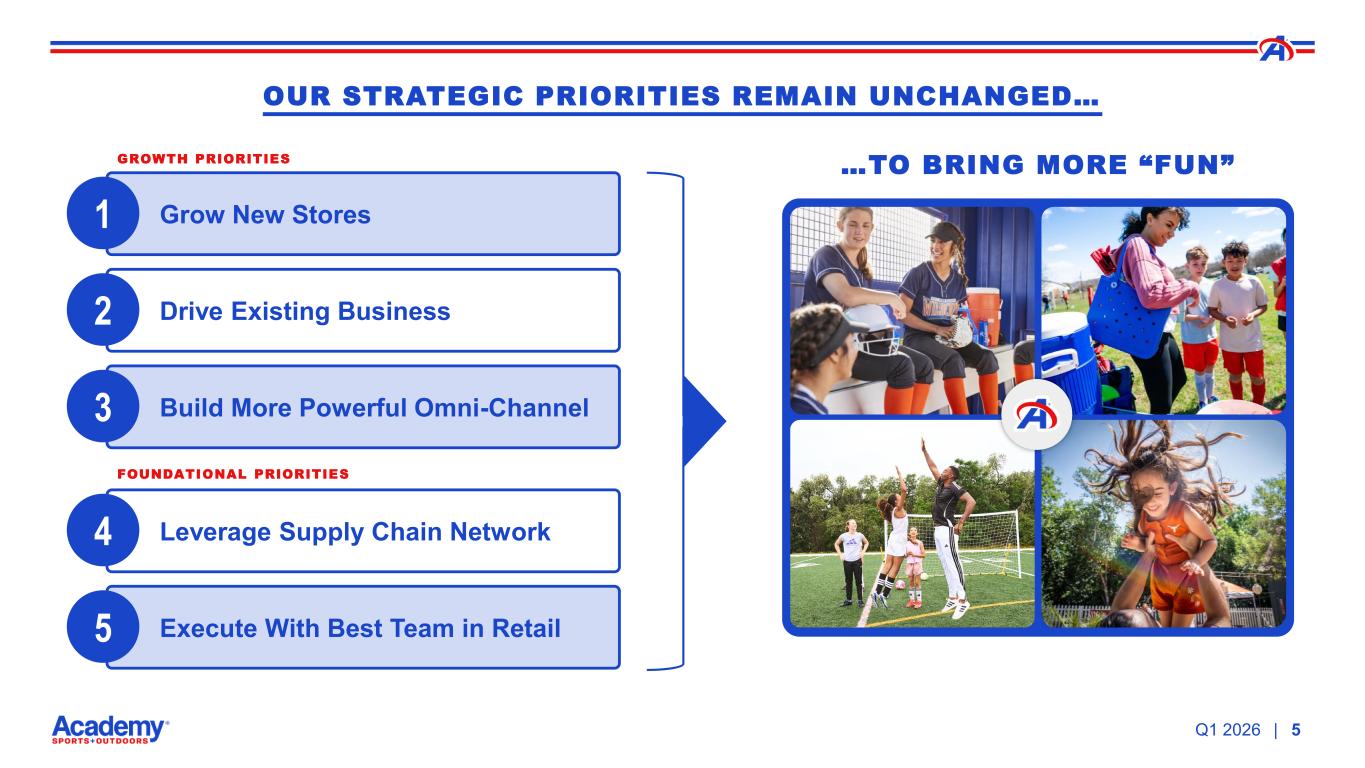
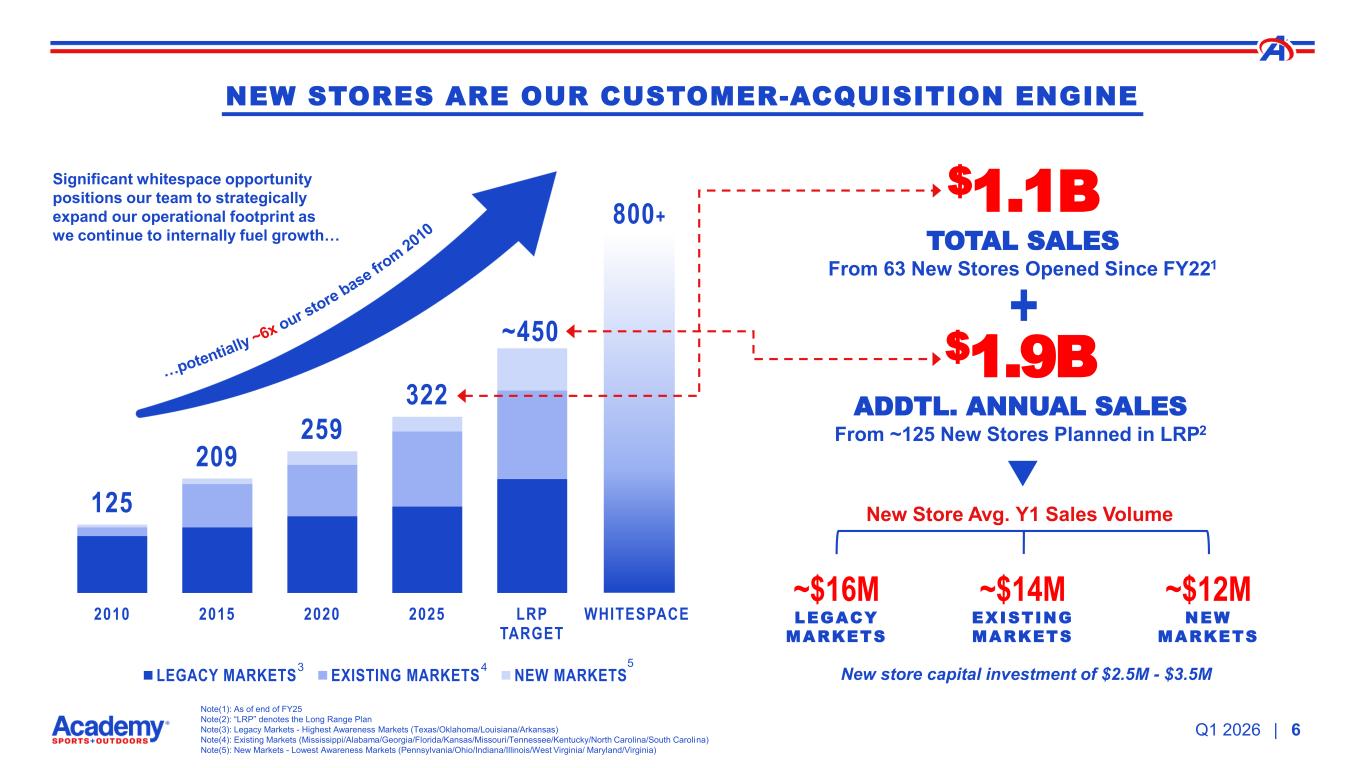
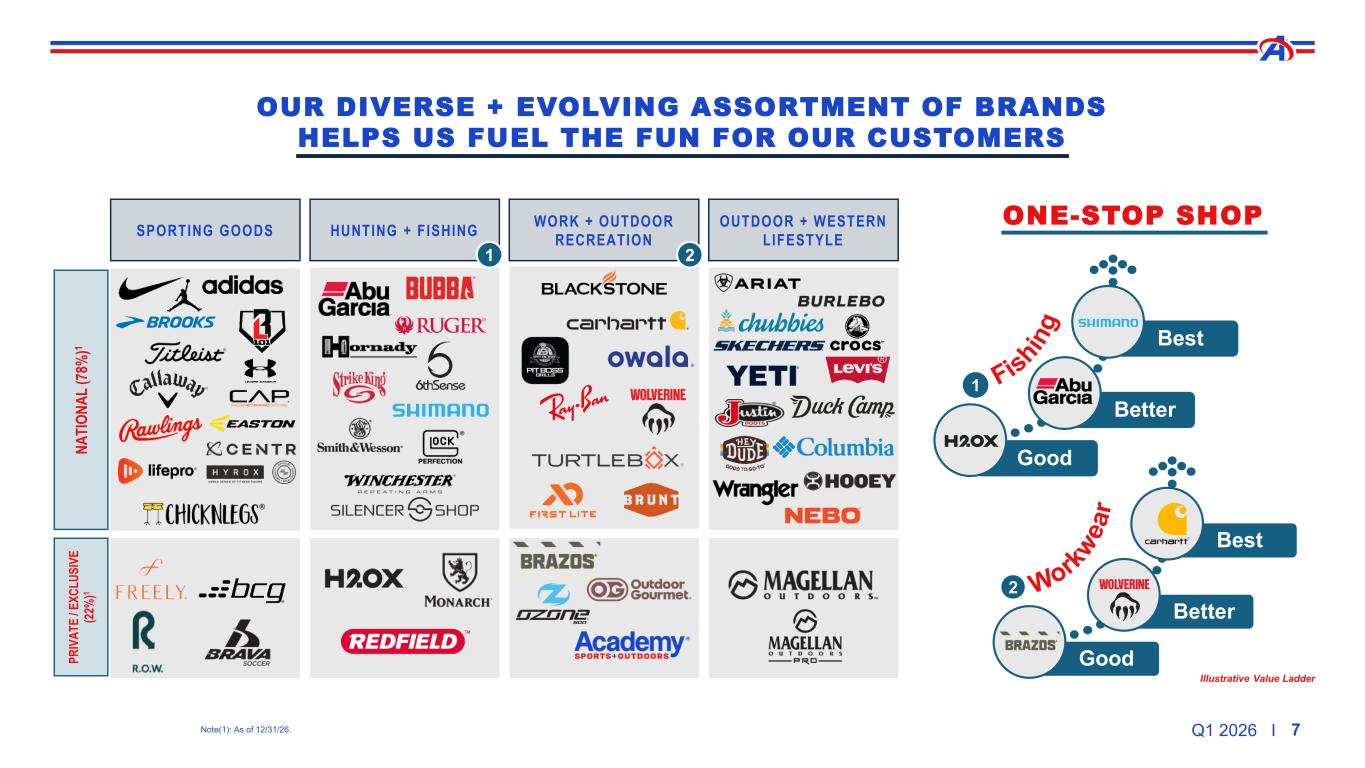
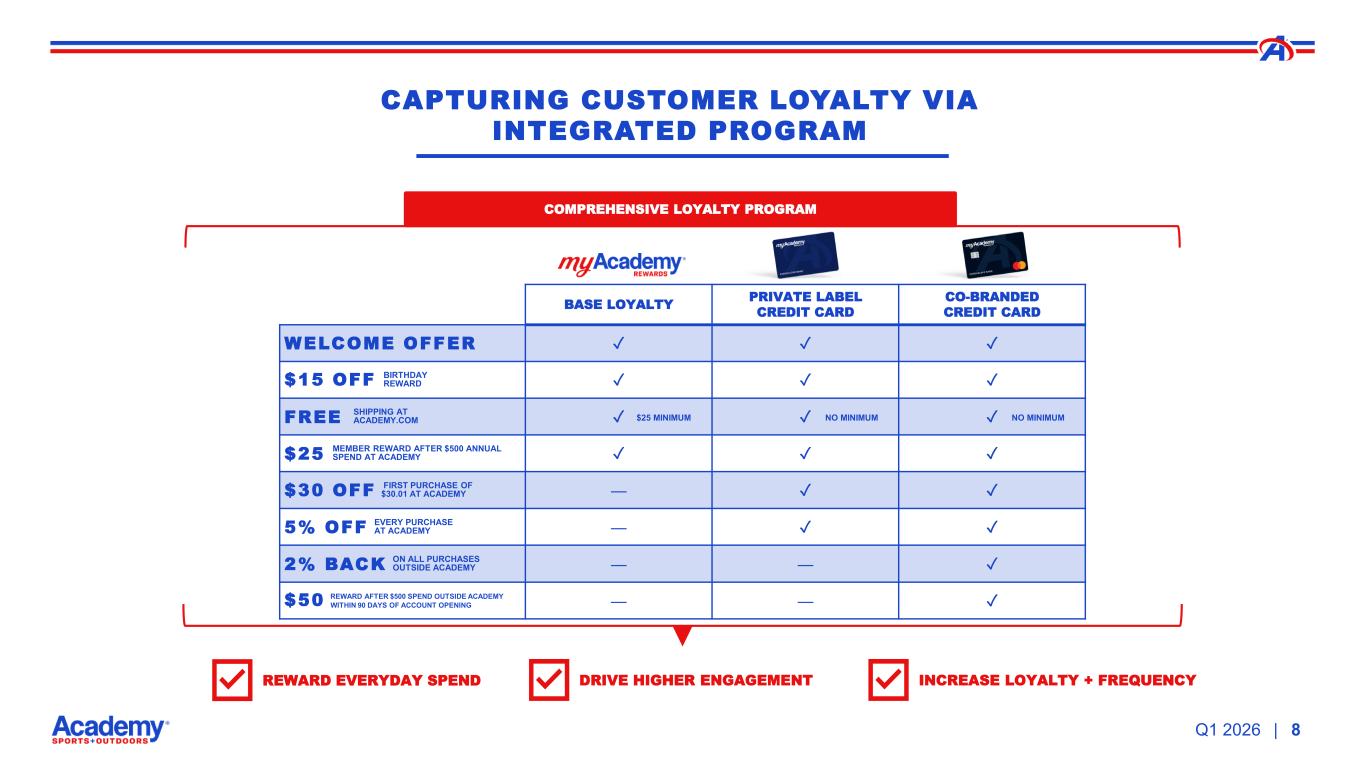
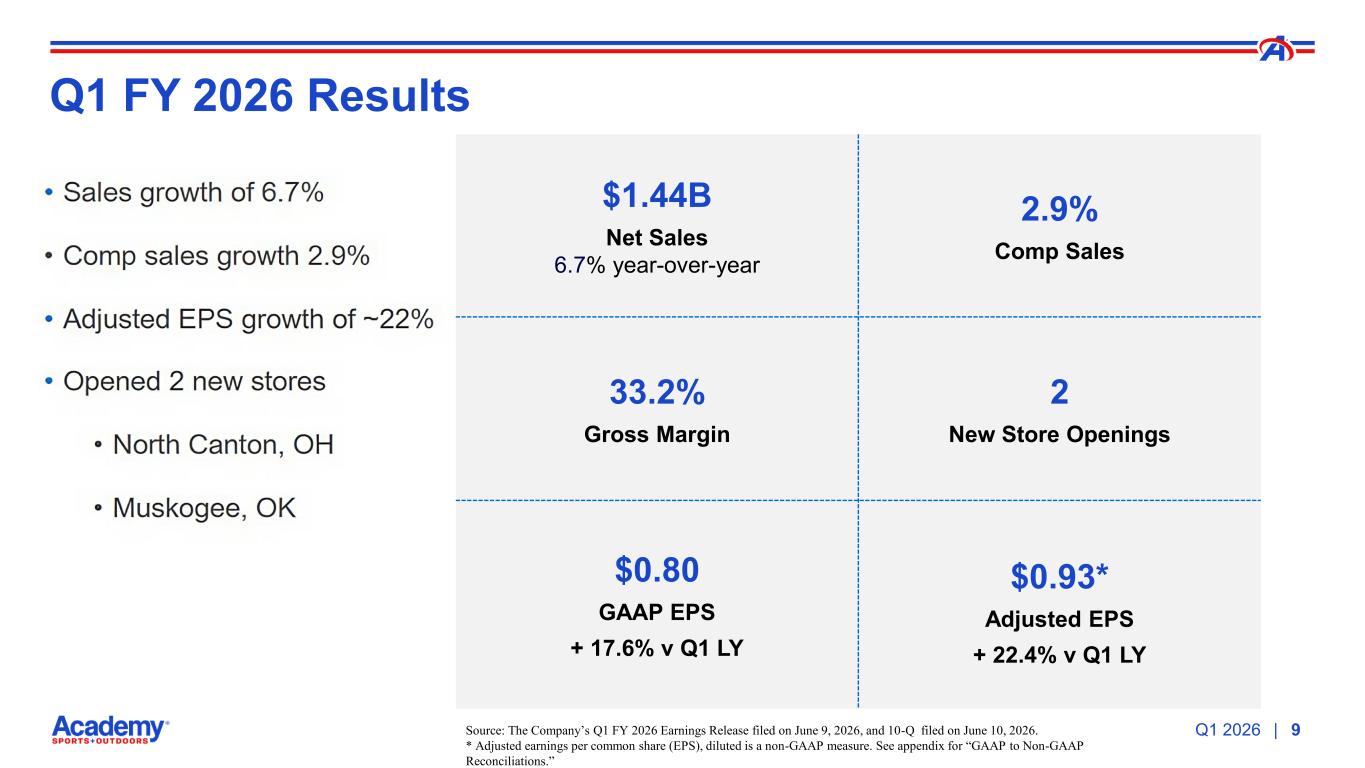
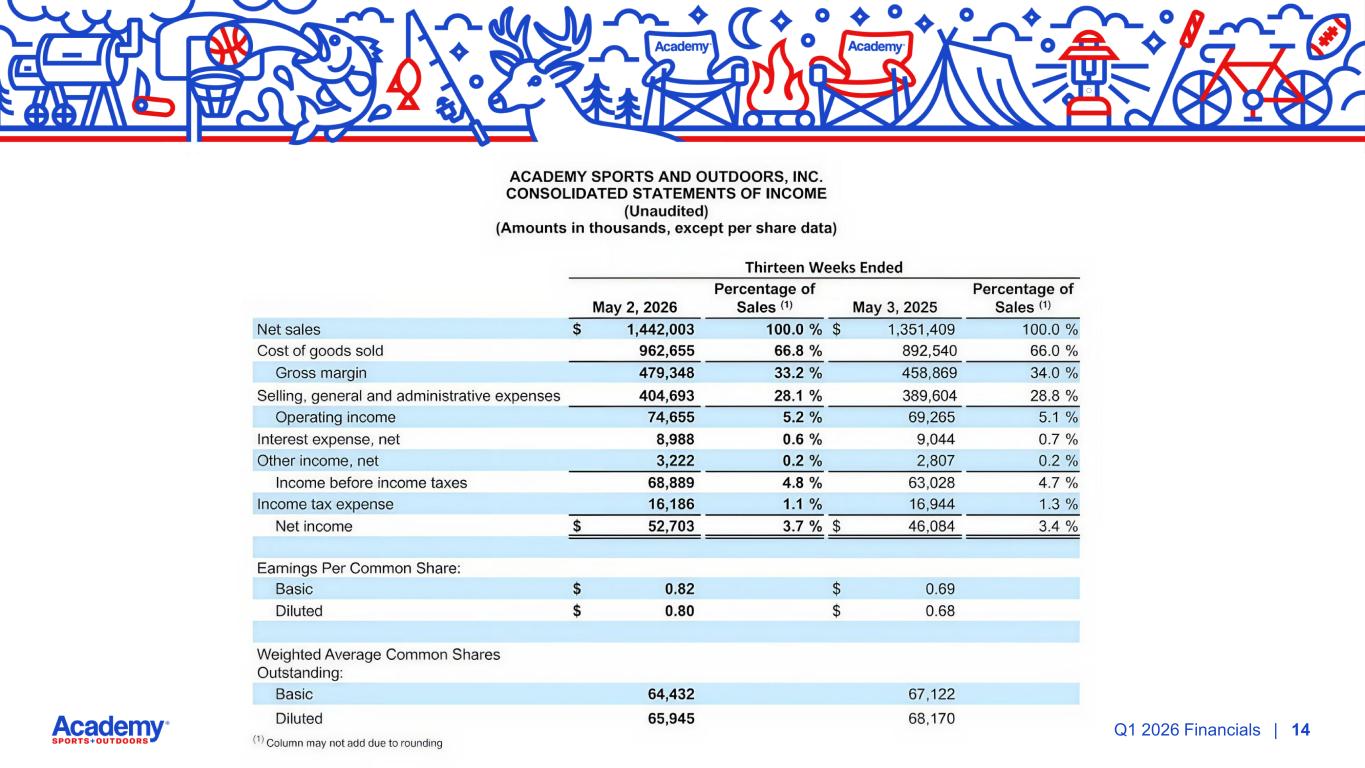
Good morning, everyone, and welcome to our first quarter 2026 earnings call. Our plan this morning is to discuss our Q1 results while also updating you on the progress we're making against our long-term growth initiatives. Turning to our first quarter results, we were pleased to move back to comp store growth in Q1, with sales coming in at $1.44 billion, which was up 6.7% in total sales and translated into a 2.9% comp increase. were on the high side of the range we communicated in our press release issued on April 7, 2026, in advance of our analyst day, where we gave an update to our long-range plan and goals. These results were driven by a combination of a low single-digit positive traffic coupled with a high single-digit AUR increase. Units per transaction were down slightly, which we would attribute to the increased AUR. Positive results were broad-based, with our dot-com business comping up 17% in all four of our divisions running increases. Outdoor was our best-performing category at up 12%, driven by strength in fishing and shooting sports categories. Beneath the surface, our ammo business, which was a headwind for us most of last year, turned positive in February and accelerated after the conflict in the Middle East began. firearms business also continues to be a bright spot and utilizing mixed checks data as a proxy we have grown market share in this category for eight consecutive quarters to help build on the momentum in the shooting sports business we launched the suppressors category into a limited door count during the first quarter with a goal to roll them out to over 100 stores by the end of the year this is a rapidly growing category in the industry with a strong attachment rate to firearms, and high AURs. Professors are totally new to our assortment. This business should be 100% accretive and provide an additional tailwind for the shooting sports category throughout the remainder of this year and next. Recreation was our second best business at plus 6%, with the increase driven by solid gains in baseball, which fueled our team sports business during the first quarter. We also saw a double-digit growth in our front-end business. Normally, we don't call out front-end, but we're seeing rapid growth in this area driven by the collectible trading card business, which has benefited from our increased investment in this category. In addition, we continue to see solid improvements in our outdoor speakers business driven by the leadership position we've taken in TurboBox. We're also positive at plus 5% with particular strength in our outdoor and work businesses, supported by expanded assortments from Carhartt, Burleybo, Levi's, and our own Magellan Outdoors brand. We will continue to lean into the work Western lifestyle trend with the addition of roughly 100 area shops in the back half of the year. On the athletic side of the business, gains were driven by continued momentum in the Nike and Jordan brand coupled with double-digit increases in our better private brands of Freely and Roe. In the second quarter, we plan to add 55 Jordan brand shops on our apparel pads, which will take our Jordan brand shop count to 200 stores and continue to fuel the growth in this business. Key drivers of growth in Q1 were our cleated business driven by baseball along with our summer seasonal businesses driven by Crocs and Birkenstock. We also remain encouraged by the momentum we're seeing in the performance running category fueled by key platforms such as the Nike Vomero, the Adidas Evo SL, the New Balance Ellipse, and the Brooks Glycerin. Our plan is to continue to build out our assortment in space devoted to this category as we progress throughout the remainder of the year. Based on the solid start to the year, we saw growth in market share across all of our businesses, both for the quarter and on a rolling 12-month basis. We've also driven a positive comp over that same 12-month period. To contribute the momentum we're building in the business and the market share gains to the continued progress we're making against our three core growth strategies, which I'll now give you a brief update on. Our expansion remains our number one growth lever, and we're starting to build critical mass behind this strategy. We began the year with 39 stores from our 2022 through 2024 vintages in our comp base. It continues to perform well with sales copying in the high single digits. The 24 stores from our 2025 vintages start to flow into the comp base as we've crossed through the year. During the first quarter, we opened up two new stores in Canton, Ohio, and Muscogee, Oklahoma, both of which support our strategy growing midsize markets. These are underserved communities and tend to over-index with our core customer, the always-gain family. During second quarter, we will open up three more stores with locations in Altoona, Pennsylvania, North Knoxville, Tennessee, and Morristown, Tennessee. The remaining 15 to 20 stores are expected to open in the back half of the year with a heavy focus in legacy and existing markets. As we head into 2027 and beyond, we'd expect to have a more balanced mix of openings between the first half, and the strategy is to improve the productivity of our existing businesses. There are multiple initiatives focused on driving comps in our legacy stores and improving the core business during the second quarter. Initiatives that will have the biggest impact on our comp sales through the remainder of the year will be the relaunch of our My Academy Rewards program, which is being integrated into our loyalty ecosystem. The newly integrated program features a three-tiered structure. The base tier is My Academy Rewards and does not require a credit card to access savings. The key element of the value proposition at this level include both a $15 off welcome offer and birthday reward, a $25 off reward and a $500 spend threshold, and free shipping on all .com orders over $25. The middle tier of MyAcademy rewards requires an Academy private label credit card, which gives you access to 5% off your purchases at Academy. It's important to note that the customer gets these savings instantaneously at point of sale versus having to wait for a reward certificate that they can redeem against future purchases, which is the case with most of the competitive officers in the marketplace. This tier also qualifies for free shipping on all .com purchases with no minimum purchase requirement. Top tier is unlocked by our new co-branded MyAcademy Rewards MasterCard, which we call the official card of fun. Customers in this tier get all the benefits from the other tiers while also getting a higher credit limit, coupled with a best-in-market 2% back on all spend outside of academy in the form of rewards that can only be redeemed at academy we're in the process of reaching new cards to all of our current card holders and plan to be complete by the end of june we're already seeing an uplift in sales from this initiative driven by increased enrollment and card utilization customers are leveraging our best in market value proposition as a way to offset the rising costs they're dealing with in their everyday lives enrollment in my academy rewards is up double digits year over year with our goal being to add an additional 2 million new members this year, which will grow our total loyalty program to over 15 million members. As we've shared before, summer is one of our prime selling seasons, and we're well positioned this year to help fuel the fun for our customers. Stocks continue to run up over 200 basis points versus last year, driven by our standard utilization of RFID. In addition, we have several non-comptail wins this year, including the World Cup being played in venues across our footprint, coupled with America's 250th birthday. We are well-stocked in World Cup gear, summer essentials, and all things red, white, and blue, so we can maximize the opportunities ahead of us in the second quarter. Shifting gears to our omni-channel business, we continue to make solid progress, which is evidenced by the 17% growth in sales and the 100 basis point expansion and penetration we experience in Q1. We have two key focuses during second quarter. First, we're Expanding our same-day delivery platforms to include Uber Eats and Instacart is a complement to our existing partnership with DoorDash. Our research shows there is minimal overlap between the customer bases for each of these services, so expanding our online presence to include these additional same-day delivery platforms should be mostly accretive and expose our brand and product categories to a broader audience. In addition, we plan to migrate the search platform from our site to be powered by Google's AI Commerce Search and Gemini Enterprise customer experience as we turn the corner into back-to-school. We believe customers are increasingly utilizing AI agents to aid them as they shop online, so moving our search to be powered by AI is a natural evolution and will be intuitive for them. As we continuously evolve our online capabilities, we expect the sales momentum we've built over the past year in this business will continue to provide a strong comp tailwind to our overall sales. Our belief is high gas prices and other inflationary pressures will persist and continue to negatively impact discretionary spending for the American consumer throughout the remainder of the year. In the face of this pressure, we are committed to remaining a steward of value for our customers while we methodically execute against our long-range plans and objectives. As our strategies mature and we build critical mass across each of them, we believe this will provide a strong tailwind which will allow us to sustain the positive momentum we built in the first quarter. Based on the solid start to the year, we're raising our annual sales guidance to be plus 3% to plus 5%, which would translate into a flat fiscal 2026. Now I'll turn it over to Carl, who will give you a deeper dive into the Q1 financial results, along with the additional information on our updated 2026 guidance. Carl?
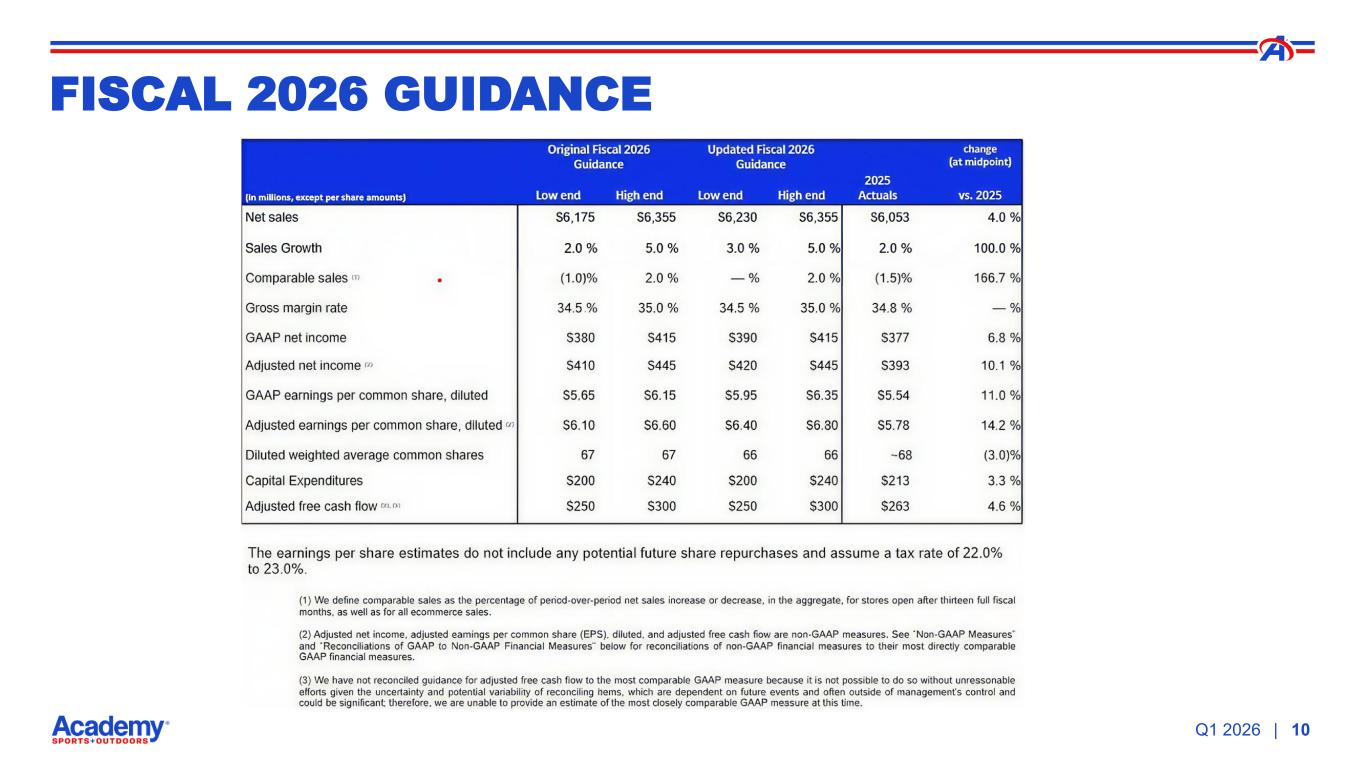
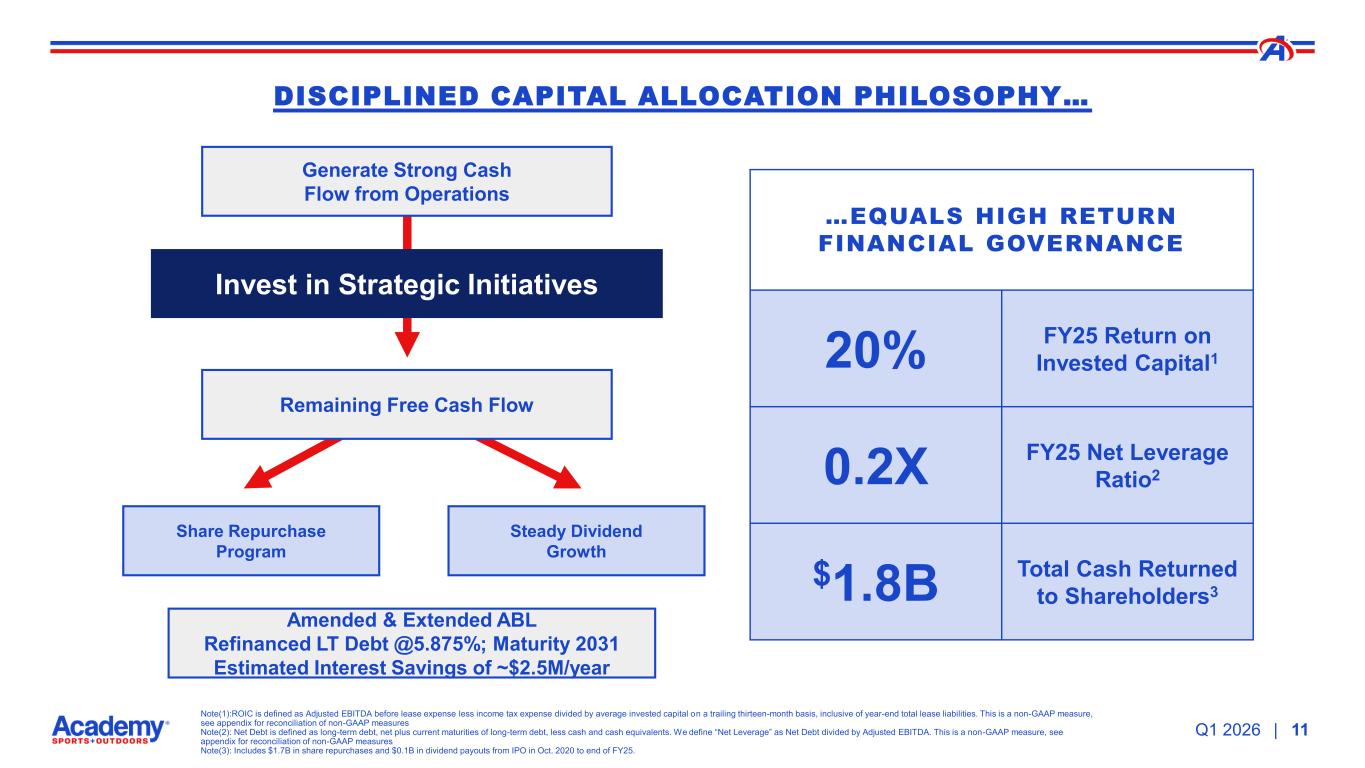
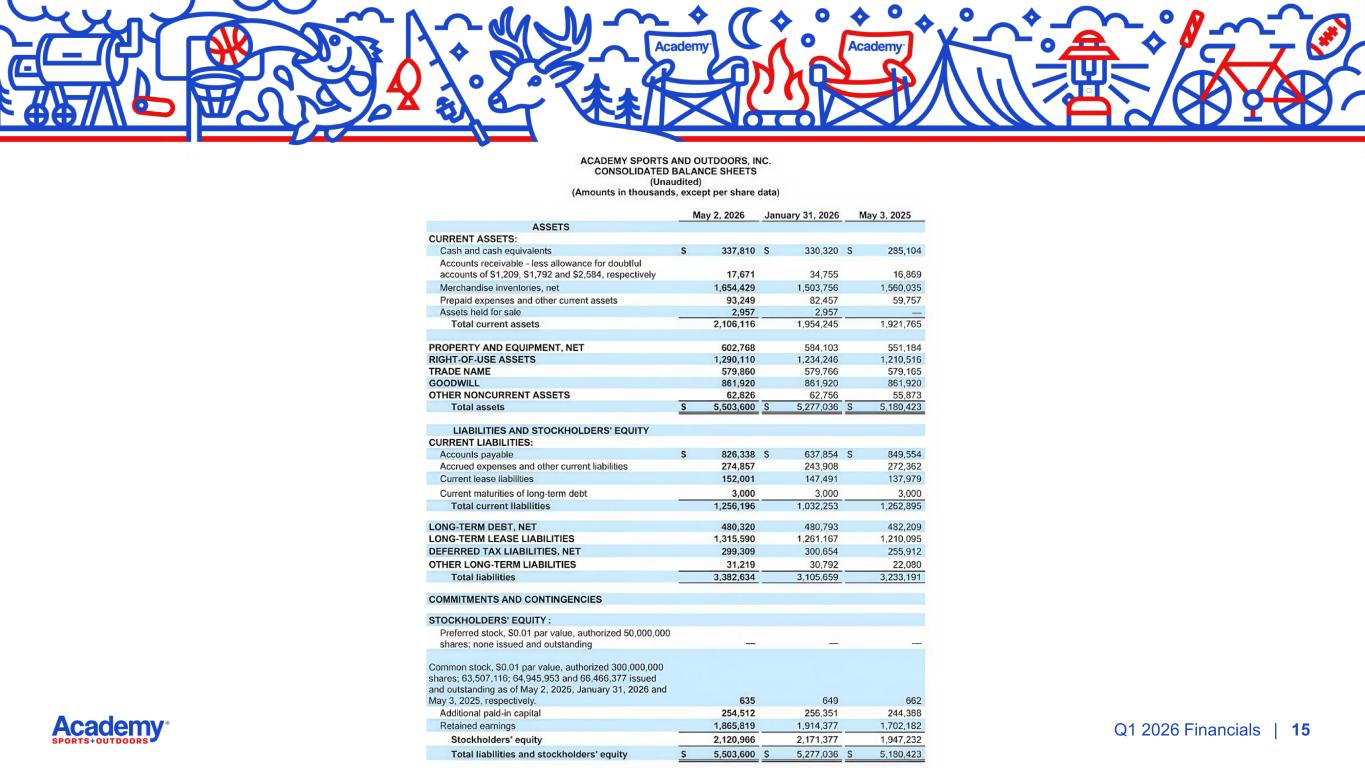
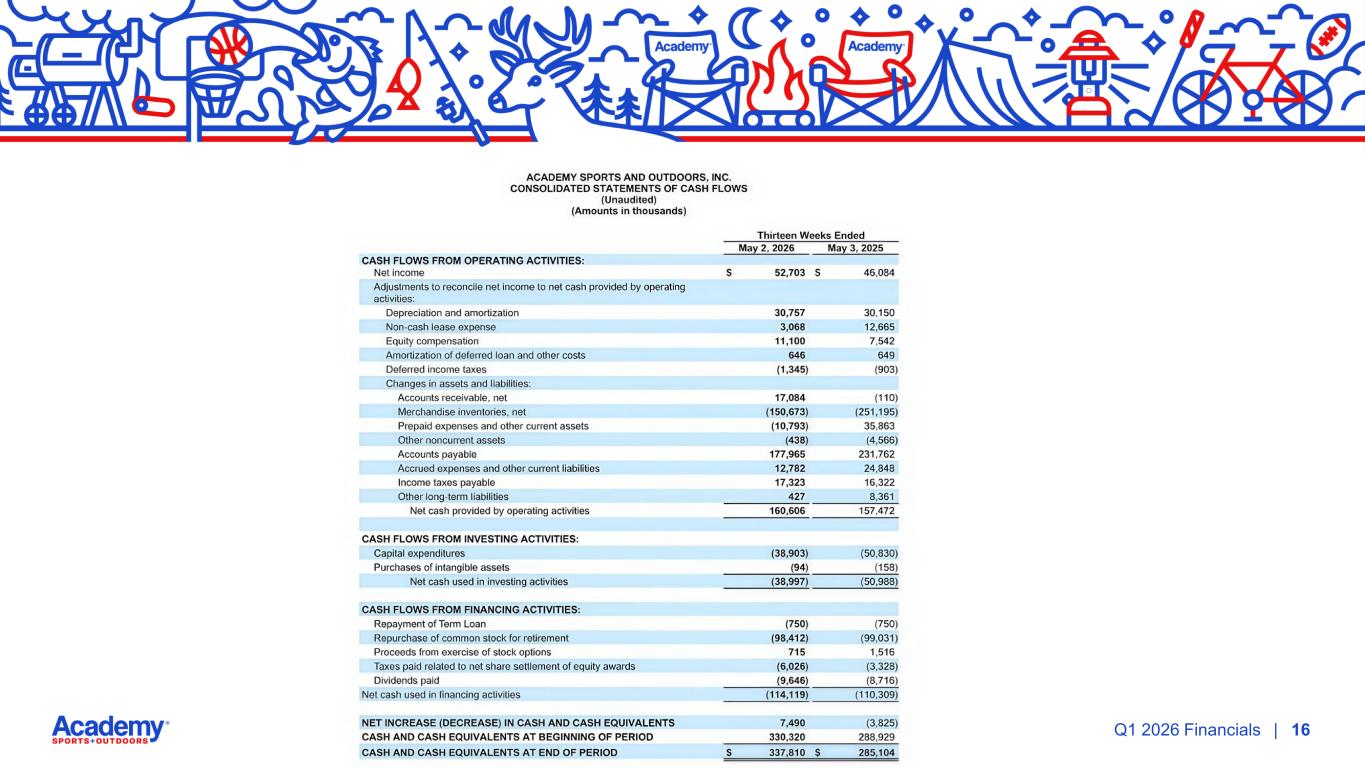
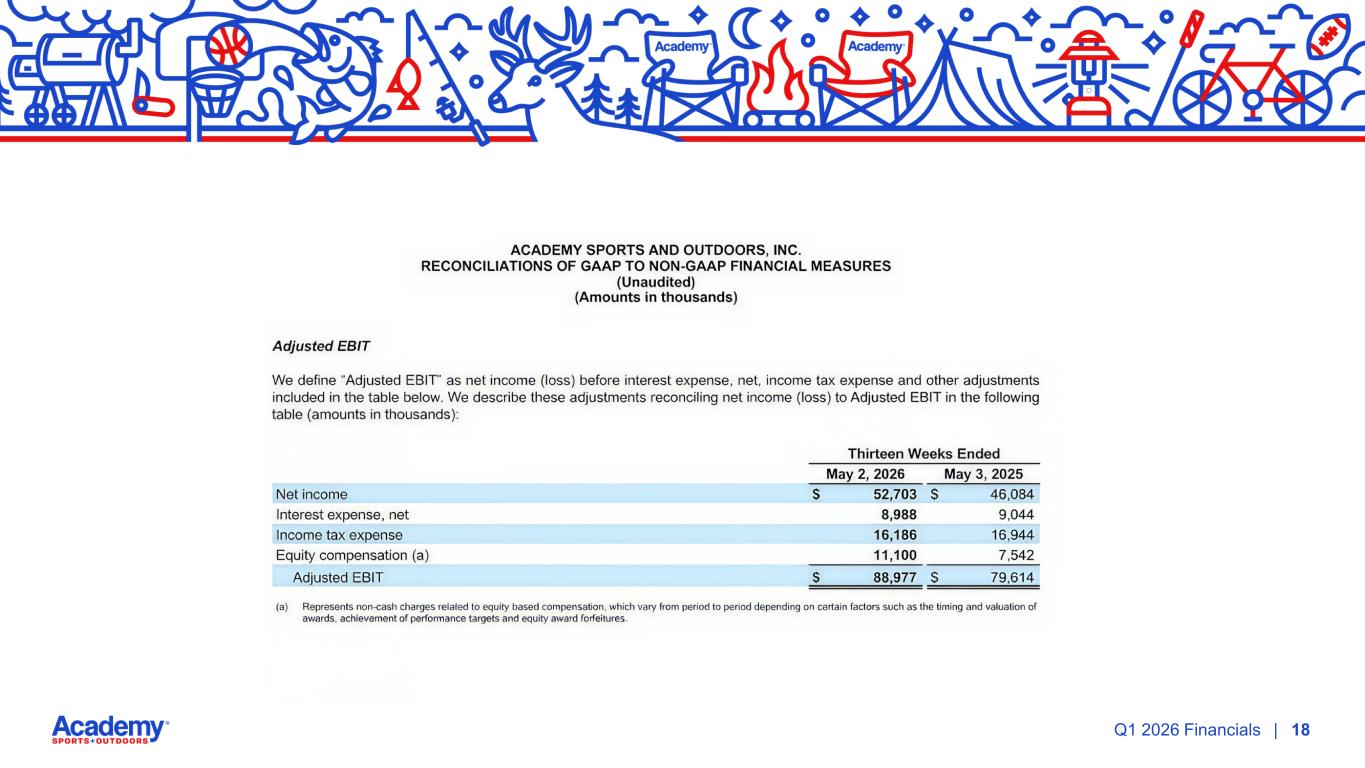
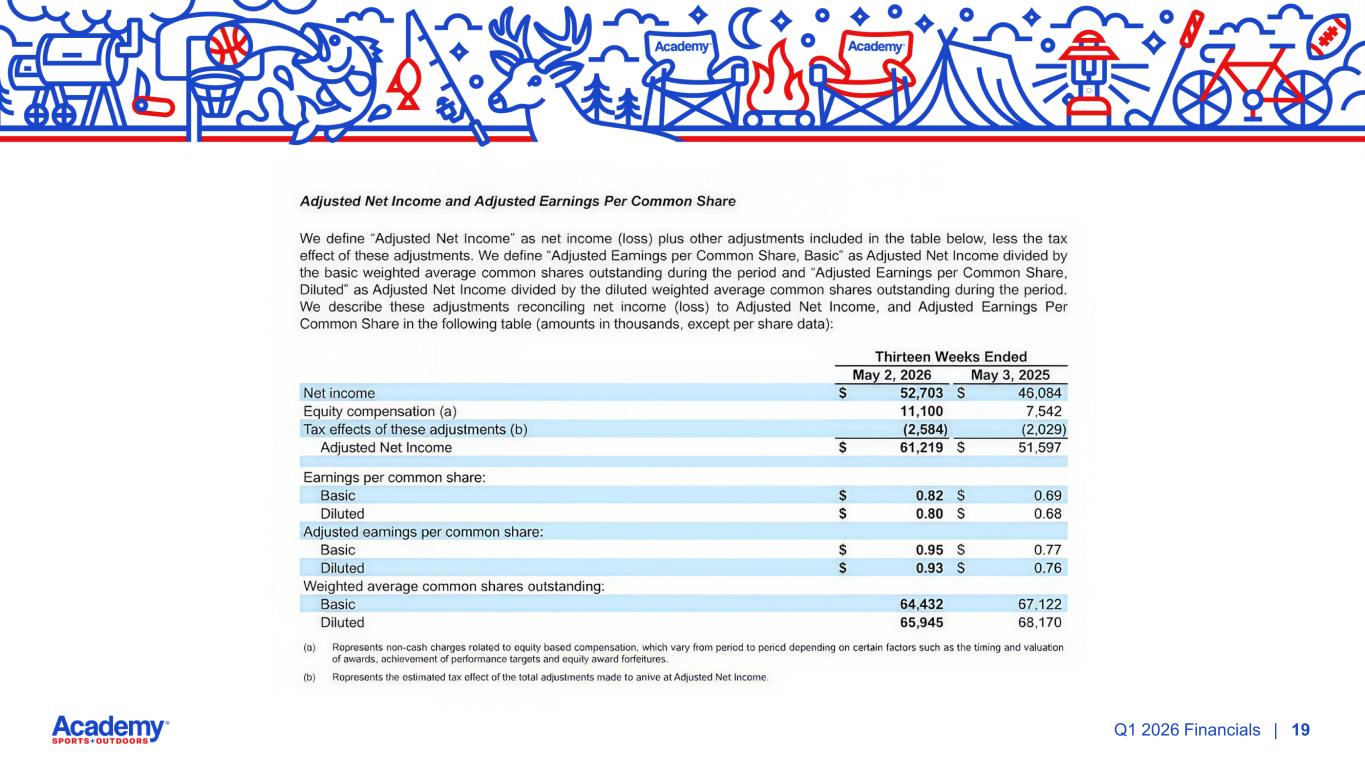
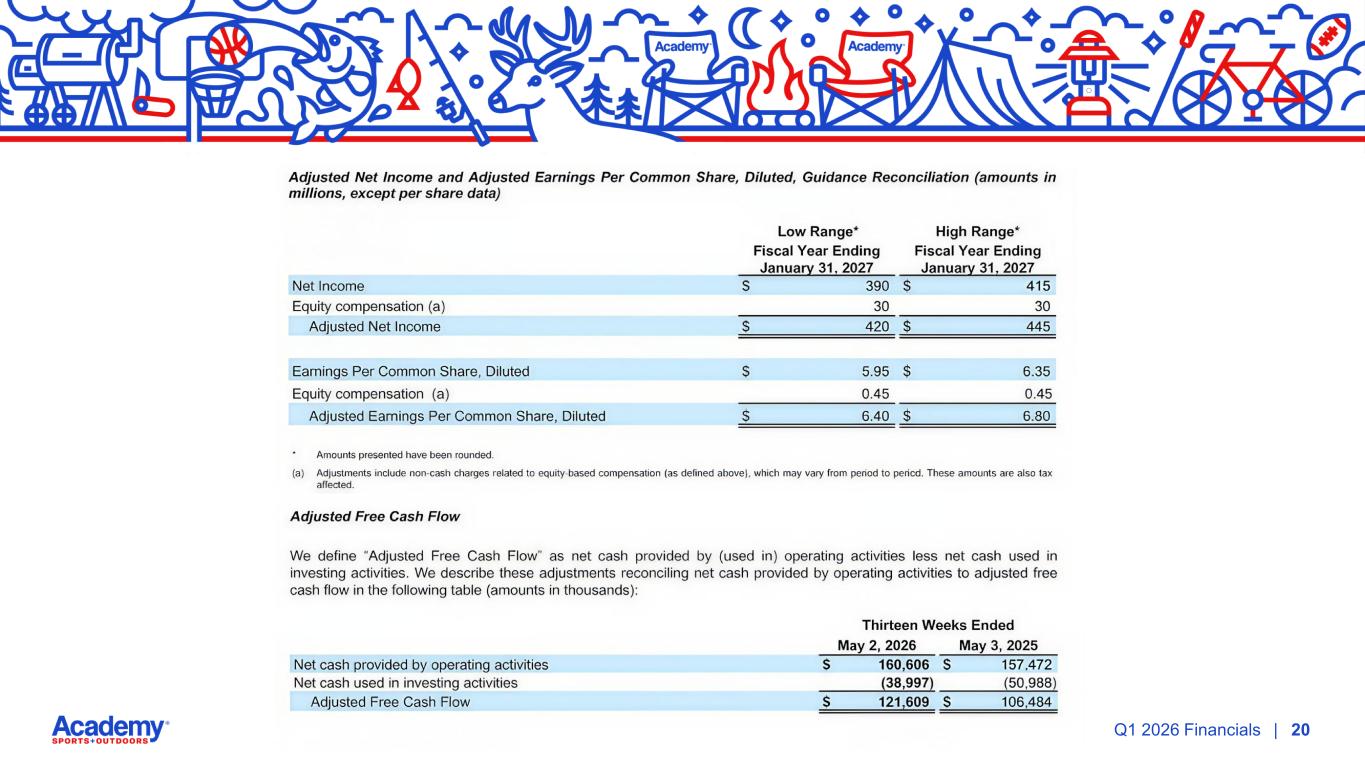
Thanks, Steve. Net sales for the first quarter were $1.44 billion, an increase of 6.7% with comparable sales up 2.9%. E-commerce remained a strength in the quarter with over 17% growth, which accelerated versus fiscal 2025 levels. Expect e-commerce to remain a tailwind throughout the year as we continue to expand our endless aisle, enhance search functionality, and expand same-day delivery. Order was 33.2%, down 71 basis points year over year. The decline was driven by tariffs, favorability in freight, and shrink. Order to be the largest tariff impact for the year and for the pressure to subside as we move through 2026. SG&A was 28.1% of sales, an improvement of 77 basis points, primarily driven by the 2.9% comp. Additionally, we are lapping $7.5 million related to the Nike expansion and Jordan brand rollout from the prior year. The improvement was partially offset by a $3.6 million increase in stock compensation expense year-over-year. Operating income for the quarter was $74.7 million. dollars. Diluted earnings per share was 80 cents, an increase of 17.6 percent, and adjusted earnings per share, which excludes stock compensation, was 93 cents, an increase of 22.4 percent. From balance sheet and cash flow standpoint, we remain in a position of strength. Inventory has continued to improve versus last year. Total inventory dollars per store down 0.8% and units per store down 6.8%. We ended the quarter with strong liquidity and generated healthy free cash flow of $121.6 million, representing a 14.2% increase year over year. This allows us to continue investing in the business while returning capital to shareholders. $338 million at the end of the first quarter, and we have an untapped $1 billion revolver. Allocation philosophy has not changed. Approximately 50% of cash flow from operations is reinvested back into the business, and we expect to return the remainder to shareholders through dividends and share repurchases. We repurchased approximately 1.7 million of our shares, representing about 2.5 percent of our shares outstanding. We paid $9.6 million in dividends and continued to fund strategic investments, including new stores, omni-channel capabilities, and technology initiatives. At the end of the first quarter, we had $338 million remaining on our share repurchase authorization. We refinanced our outstanding long-term debt at a 5.875% rate and amended and extended our ABL, which will generate approximately $2.5 million in annual interest savings for the next five years. The maturity date on each is 2031, and additional details were provided in our May 14th press release, which can be found on our investor relations site. Before getting into guidance, I wanted to share a few thoughts on the consumer and how ongoing trends played into how we think about the shape of the year. The consumer environment remains precious. Prices largely offset the benefit of tax refunds in the first quarter, particularly for lower income households, which continues to weigh on discretionary spending. We continue to see higher income consumers, which are our largest, and trade into academy in search of value. Employers who make over $100,000 grew by mid-single digits. This remains bifurcated with materially higher confidence levels among upper income households versus lower-income cohorts. Less optimism about their future financial prospects. This dynamic continues the de-risking of our consumer base that began at the end of 2024 and reinforces confidence in Academy's value-driven positioning. We are updating select elements of our full-year outlook to reflect the first-quarter sales performance while also planning for higher gas and freight prices, tariff dynamics, and the timing of new store yields to be in the range of $6.23 billion to $6.35 billion, or growth of 3% to 5%, and comp sales of flat to up 2%. We are maintaining our gross margin rate guidance of 34.5% to 35.0% for the year. We are raising the midpoint of our net income guidance, a range of $390 to $415 million. Expect earnings per share of $5.95 to $6.35 and adjusted earnings per share to be in the range of $6.40 to $6.80. To the point, we expect comp sales to be approximately 1%, gross margin to be roughly flat, and modest SG&A leverage for the full year, resulting in EPS growth of over 10% when compared to fiscal year 2025. This EPS guidance does not include any impact from future share repurchases. We expect our strategic initiatives to drive pie. As a reminder, we use margin in the first attributable to tariffs increase throughout the year as we use the weighted average method of inventory accounting with their full impact hitting average unit cost in the fourth quarter of 2025. We continue to expect modest gross margin pressure in the first half of 2026, followed by modest expansion in the back half, resulting in approximately flat gross margin at the midpoint of our full year guidance. On SG&A, we continue to expect leverage in the first half, with potential deleverage in the back half as new store openings arriving at modest leverage for the full year at the midpoint of our outlook. We continue to operate in a bifurcated consumer environment, recently trading into academy in search of value, while lower income consumers remain under pressure. Against this backdrop, we are executing a rock solid plan with clear supported by our strong balance sheet, disciplined expense management, and relentless focus on value. These position us well to navigate the current environment and drive long-term value for our shareholders. We're ready for Q&A.
Operator
Thank you. At this time, we'll be conducting a question and answer session. If you'd like to ask a question, please press star 1 on your telephone keypad. A confirmation tone will indicate your line is in the question queue. You may press star 2 if you'd like to remove your question from the queue. As a reminder, we ask that you please limit to one question and one follow-up. One moment, please, while we poll for questions. Our first question comes from Jeff Lick with Stevens. Your line is now live.
Good morning. Thanks for taking my question. Congrats on a nice quarter. I guess I'd throw this out to anyone. But I'm just curious, since the analyst day, maybe you could just comment on what has surprised you in either direction, what's been incremental, and how are you seeing the gas prices manifest itself in consumption patterns? I guess my follow-up would be, given the World Cup and America 250 is in 2Q, I think you've mentioned previously you were expecting 2Q to be the weakest quarter in terms of comp. Is that still going to be the case?
Yeah, I'll start. Thanks for the question. So, yeah, gas prices definitely are a headwind for the American consumer. I saw an article, I think, a week or so ago that said on a monthly basis, it's pulling out about 17 and a half billion dollars of consumer discretionary spending each month. So that definitely is impacting the consumer. I'd say as we've gotten into Q2, we've seen a little bit of a slowdown from the consumer, which we would attribute to gas prices. You know, that being said, we kind of look at the quarter as, you know, three legs of a race. The first leg is getting through Memorial Day, which is our first big event. Total sales through Memorial Day are tracking up low single digits, roughly flat comp. And, you know, while we'd like to be playing with the lead, What we're excited about is we still have a lot of the initiatives that we're counting on to drive business ahead of us. We've got the World Cup, as you just said, kicks off on Thursday. We've got our credit card relaunch, which is taking place right now. And we're issuing new plastic to consumers, and that should be in people's hands. And that has a reactivation reward associated with it. So we think that'll help drive business for the next leg of the race with Father's Day. And then, of course, we've got America's 250 ahead of us. So definitely seeing an impact, a little bit of a slowdown from what we saw in Q1 with the consumer tracking flat through Memorial Day, but optimistic about the opportunity still ahead of us with a lot of initiatives still to play out. You asked about what surprised us from our April 7th Analyst Day.
I would say this quarter generally came in as expected. We were at the high side of the guidance that we gave from a top-line perspective. We had indicated that we knew that there would be gross margin pressure associated with anniversaring last year's Q1 that didn't have that IEPA tariff burden in it. And from an expense management standpoint, you know, we knew that we weren't re-anniversaring the Jordan launch costs and the Nike expansion costs. That was seven and a half million dollars. So I would generally say that the quarter played out like we thought that it would, but it was towards the high side of the guidance that we put.
Awesome. Thanks very much. and I'll let others jump in. Thanks, Jeff.
Operator
Our next question comes from Kate McShane with Goldman Sachs. Your line is now live.
Hi, good morning. Thanks for taking our question. We wanted to focus on gross margins. With the strength in ammo just being a lower margin category, did that contribute at all to some of the pressure or the GPM shortfall that we saw in the quarter? And just how should we think about the cadence of some of the tariff pressures that we have saw in the first quarter for the rest of the year?
Yeah, I'm going to answer this very directly. So if you look at the 71 basis points of gross margin degradation to Q1 of last year, 110 basis points was driven by tariffs, essentially having the full burden of that IEPA impact in Q1 of this year versus really nothing last year. And that 110 basis points of tariff headwind was offset by 20 basis points of good news in shrink and 10 basis points as it relates to shipping. So think of transportation, e-com, shipping, things of that nature. That's how you kind of arrive at the big components of it. From an ammo perspective, you know, total field was all outdoor category. And so it was a headwind as it related to, but I would say it was offset by other puts and takes in the mix.
Operator
Our next question comes from Chris Horvors with J.P. Morgan. Your line is now live.
Thanks. Good morning, guys. So, my first question is on Decker's latest earnings call that they talked about, you know, planning to continue to selectively ban wholesale distribution with a few thoughtfully chosen tests with new partners this fall. Just curious if you can comment if you're a part of that planned test.
Yeah, I'll give you the same answer I give every time I get asked this question. If and when we're ready to announce something, you guys aren't going to have to ask us. We'll tell you nothing new to announce at this moment in time.
And then I guess just stepping back as you think about how you think about the balance of the year, I guess what's changed versus, you know, what you initially thought. Is ammo expected to be a continued tailwind for the balance of the year more than you originally thought? you know what's your read on Memorial Day weekend and what that says about you know Father's Day and July 4th and the 250th anniversary as well as as well as World Cup so can you maybe take us through the like the puts and takes of maybe you know how you're more optimistic versus something that's more balanced because you you know you basically kept the balance of the year on the comp side thank you yeah I would say what we saw happen as we progressed through the quarters I I think, you know, it's pretty widely documented that increased tax returns were out there feeling consumer spending.
And I think that helped kind of mute the impact of gas prices as we got through Q1. I think we're kind of past that now. And as we've seen kind of the exit rate coming out of the quarter move from, you know, up three-ish comp to more of a flat. I think that's kind of what we've seen happen with the health of the consumer. What gives us confidence about the remainder of the year is a lot of the initiatives that we have, right? We've talked about our credit card relaunch and kind of integrating that with our loyalty program. We think that's a big deal for us, probably going to have the most impact on our business moving forward. We think it's well-timed, particularly in an environment where consumers are looking for value. You know, the fact that we're going to get 5% off every day with the Academy credit card, which we've had before, but now 2% back on upside spend, I think is a big deal. I think we've got other things that we've created, self-created kind of tailwinds like leaning into that work Western wear category, rolling out area at shops, leaning into newness with brands like High Rocks and Brunt coming into the assortment, the dot-com growth we're I think all those things kind of provide a little bit of a tailwind for us that helps us overcome some of the headwinds. But I think it's going to be, you know, it's going to be a cautious consumer out there. They're clearly being very cautious about when they shop and choiceful about, you know, buying more on promotion or in clearance, and so that's something we're going to have to think about. Ammo specifically, I think, was a tailwind for us before the conflict with Iran happened. It accelerated a little bit in Q2. That sort of died, or Q1, I'm sorry, that sort of died off as we've gotten deeper into the conflict. I think it'll move from, you know, being a pretty good tailwind to still being a tailwind throughout the remainder of the year. We're lapping pretty tough ammo business. What we believe in is that the initiatives we put in place, the self-help initiatives, are going to be the things that are going to help us continue to drive the business throughout the remainder of the year.
Thanks, and best of luck with peak season.
Operator
Thanks. Appreciate it. Our next question comes from Jonathan Matuszewski with Jeffries. Your line is now live.
Great. Good morning. Thanks for the time. My first question was on Nike and Jordan. I think last year there were a couple of quarters where kind of that combined business was growing. somewhere between high single and maybe low double digits. I think we're at maybe a point where we've maybe lapped the initial kind of rollouts of Converse and Jordan. So maybe just an update on how the trends you're seeing in that combined business and what type of growth is embedded for the remainder of the year in the updated guide. Thank you.
Yeah, so we're still in a place. We launched Jordan, if you remember, last year in April. That being said, we did have product on the floor in March. So if you look at the combined Nike-Jordan business for us, that was up mid-single digits. We lapped the launch and ran an increase that week, which we're excited about. So it's still healthy for us, and we consider or expect the trend that we're seeing through first quarter to continue throughout the remainder of the year. We think Nike's a growth engine for us. We're really excited about some of the expansion we're going to have in some of the performance-running categories, like Vamero, we're going to have that, and roughly 150 doors going into back-to-school, which is about double the door count we had last year, and it feels like they're just starting to get their innovation pipeline really moving.
Great, that's helpful. And then just to follow up, I guess just regional trends, NBA championships, Spurs, you know, maybe if you could give some commentary on kind of related fanware implications for demand and maybe kind of dispersion you're seeing in Texas versus other markets would be great. Thank you.
Yeah, I would say the licensed team business for us has been a tailwind for us and will probably be a tailwind throughout the summer. That's where a lot of the World Cup product lives and we expect that obviously to continue into July as the World Cup plays out. The Spurs, you know, is certainly a little bit of a tailwind for us. You got to Remember, though, we're also up against last year the Thunder winning the championship, and so that's in our geography. And while we have fewer stores in Oklahoma City, kind of the whole state activates when they won, so it's pretty similar to what we're seeing with the Spurs. Certainly we hope that the Spurs win. We don't have any stores in the New York area, so the Knicks winning wouldn't be a good thing for us, but we're pretty happy so far with the license business and expect it to be a tailwind, primarily driven by the World Cup throughout the remainder of the quarter.
Thanks, and best of luck.
Operator
Our next question comes from Joseph Cizello with Truist Securities. Your line is now live.
Thanks so much for taking my question. I just wanted to see if you could provide any color on early June, post-Memorial Day, and if anything in recent trends, like you mentioned with the gas prices, has impacted your view on what the World Cup might deliver.
Yeah, so the World Cup is still early. We just set that at the front of our stores in the markets where the World Cup matches are being played. It's saying it's roughly 40 doors. um and we've seen an acceleration in that product once we set it we set it right after memorial day weekend um so i think it's still early but initial signs are pretty good in terms of trends i'll stick with what i told you you know we kind of are looking at uh q2 is kind of a three-legged race right first leg is memorial day uh we came out of that running flat comps up little single digits the next one's father's day father stays a week later on the calendar so we're still kind of in the middle of that and then from there we move into fourth of july with kind of back to school at the tail end of the quarter. So, so far, so good. Lots still ahead of us.
Yeah, from a fuel-specific standpoint, we think that fuel prices at an elevated level are going to be persistent throughout the majority of this year. We talked a little bit about the sensitization that we did at that on our last call, so I would now say that we've encapsulated that within our gross margin guidance. And as it relates to it weighing on the consumer, you know, $4 plus gas, look, we think being a steward of value is times like these, and we continue to see customers, you know, those upper income levels, quintiles four and five, transacting more with us year over year. Got it. Thanks so much. And then just to follow up on the tariff assumptions that are in for the guidance, how should we think about rates and refunds and stuff like that through the rest of the year?
Yeah, from a tariff perspective, we have disclosed to you guys that we sold our right to a refund for a portion of the IEPA tariffs from last year. We disclosed it in the 10K last year as well as in the third quarter. And so that we monetized about $10.5 million. Included in our guidance for this year is recognition of that $10.5 million portion that… so the the portion that you didn't sell is also embedded got it okay thank you yeah i guess for clarity there we did not receive any tariff refunds in the first quarter there's nothing associated with refunds in the first quarter to see those flow in the second quarter and so what's embedded in our guidance got it thanks so much our next question comes from paul away with city
your line is now live hey thanks just to just to clarify on that last powerpoint did you guys record a receivable that that is flowing through the P&L and I guess is this represent a change versus what you had baked into guidance as of last quarter?
No in order to book a receivable from an accounting standpoint we would have had to recognize that last year we did not we we put it on our balance sheet essentially as a contingent liability pending clarification from the administration associated with how refunds would play out. I think we're seeing some clarity in that. So the $10.5 million that was in our cash flow and our balance sheet and spoken to at year end within our 10K, we are anticipating that being recognized this year versus recognizing it last year with a receivable if that makes sense which quarters are benefiting from that ten and a half running through the P&L we don't give quarterly guidance I will tell you that there was no recognition in the first quarter but it is in our annual guidance that ten and a half million dollars got it and then just relative to the updated comp guidance range that you gave today can you just
talk about where you expect each quarter to fall relative to that range, specifically interested in how you're thinking about 2Q, but would love to hear your thoughts on each quarter relative to the full year range.
Yeah, we don't, obviously, as Carl just said, we don't give quarterly guidance. As was noted earlier, I think by somebody, Q2 is our best quarter last year. We're up against that modest comp gain. I think it was up 0.2 last year. As we mentioned earlier we're tracking flat through memorial day we still got a lot ahead of us we're optimistic that the remainder of the year we're going to be somewhere between that flat up to comp and that would be inclusive of what we think is going to happen in Q2 and then just last one on World Cup related product do you view those sales as incremental or do you feel that that's a substitute for something else in the store I think it's mainly incremental You know, obviously having the world's largest soccer tournament, you know, in the U.S. soil and having people cheer for their team that they do once every four years, come in and, you know, celebrate that. I think that's mostly incremental. I don't see that as a tradeoff from, you know, a college or a pro football fan. I think it's incremental.
Operator
Our next question comes from Ike Boruchow with Wells Fargo. Your line is now live.
Hey, morning, guys. Two from us. The gross margins inflecting in the back half, can you just comment on the drivers there? Is that just effectively the tariff headwinds kind of rolling off or getting less bad, or is there something else within the model that's kind of shifting as you kind of move through the year?
That is absolutely the main thing that you should be thinking about. We bore the full burden of that weighted average cost impact of the IEFA tariffs. towards the back part of last year, Q1, you're up against something where there was none of that. You'll see that tariff burden moderate throughout the year. And so I think my hope is that the shrink improvement we saw in the first quarter will continue. I think fuel will be a headwind for the year is what it's looking like. But I think the main driver of that inflection will be the diminishment of the Q1 tariff headwind that we experienced in Q1 of 26.
Got it. Um, on the store, uh, just two more, uh, the store count, um, the ramp through the year, I think it's three in the second quarter. Can you just give us three Q versus four Q the, the plan for the 15 to 20?
Uh, we haven't broken that down. We're a little more back-weighted this year than we wanted to be. Um, if you remember, uh, when we were kind of looking at the, the class of 20, 26 stores, uh, it is right when the whole, uh, tariff situation kind of changed and we weren't sure what the impact was going to be in terms of steel construction costs etc so we're more back half weighted our goal is obviously to get all the new stores opened up prior to thanksgiving but it'll be fairly balanced across both quarters more back half weighted than we initially would like next year expect to be more balanced got it thank you and the last one from us just uh the the commentary on the flat comp to memorial day i understand that Yeah, but can you just comment the last two weeks?
I assume they've slowed a little more considering your comment on the consumer, but can you just give us either the last two weeks or the quarter to date in totality? I'm sorry to harp on it, but I feel like it's relevant.
Well, we're in a period right now where Father's Day is a week later, so it's a little murky, but we're happy with the trends we're seeing, and we're still optimistic about being somewhere between that plat to up two for the year.
Operator
Our next question comes from Simeon Gutman with Morgan Stanley. Your line is now live.
Good morning. This is Pedro Gale on for Simeon. Thank you for taking our question. Nice quarter. I wanted to ask you about the comp guidance for the rest of the year and the shape of the quarters. Should we expect the second quarter to be sort of the strongest quarter in the year as you have World Cup and the 250th anniversary and the rollout of the loyalty program, or is it more of an even cadence for the remaining three quarters of the year?
Pedro, sitting where I'm at today, I think the 2.9% comp that we experienced in the first quarter, it's obviously outside the range of the zero to two. I think it's going to be the strongest quarter. I think we've got a difference in the year-over-year base related to Q1 versus Q2 of last year. We're excited about the credit card relaunch. We're excited about the World Cup and the 250th and some of the new brand launches that we have. But I think the rest of the quarters will be within those navigational beacons.
Okay, that's helpful. As a follow-up, I wanted to ask you about the work you're doing in supply chain. Can you give us an update on the efficiencies you're driving and how should we think about transportation costs for the rest of the year?
Yeah, so we brought in a new chief supply chain officer, Rob Howell, who had a background with Cisco Foods. How long ago was that now? About two years ago. I think he's doing yeoman's work. I think he's balancing, you know, capacity. If you look at our store count growing by 8% last year, it'll probably be in that 7% this year. He's got to make a lot of room in the distribution center, and he's got to factor in the type of units that we're flowing. We're continuing to see unit per hour productivity and cost per unit productivity as it relates to distribution center operations. I don't expect that to change. I think as it relates to transportation, net transportation was a 10 basis point tailwind. Improvement year over year from Q1 of this year versus Q1 of last year, you know, that reflects freight and sort of inbound supply chain, if you will, as well as e-commerce shipping. And so I think that fuel will be a bigger headwind as it relates to Q2 and perhaps Q3 and beyond. but I think the team's doing great work and they're increasing their productivity year over year. And that's what we expect. And that's what we're receiving.
Okay. That's helpful. Thank you. Good luck.
Operator
Our next question comes from John Heinbuckle with Guggenheim partners. Your line is now live.
Hey Steve, I wanted to start with, given what's going on with gas prices and just macro in general, do you think that amplifies the peaks and valleys around holidays and, you know, maybe deeper valleys. And is that, if you think that's true, is that sort of, have you made tactical adjustments when you think about, you know, how you want to spend promotional dollars and communicate with the customer the rest of the year?
Yeah, I think your instincts are spot on. I mean, we definitely have seen that play out a little bit as we progress through Q2. And I expect that's going to happen. And, you know, customers are looking for value, right? And I think they're looking for waste offset, higher gas prices, And I think we've seen them, and this happened a little bit in Q1, and we've seen it continue in the Q2 where they're amplifying purchases during the promotional windows that we have on the calendar. They're pulling back a little bit in the lulls, and we have definitely adjusted our forecasts and our plans moving forward to account for that.
And secondly, I think you want to add, when you look at the membership, and I think you said you want to add 2 million members and I think you get to 15 by year end. And when we think about how that breaks down between rewards members, proprietary credit card, MasterCard, relative sizes of that, and do you think will most of the growth come from the new MasterCard offering?
Yeah, we haven't broken it down, you know, between credit, loyalty, et cetera, like that. What I will tell you is that we're seeing a meaningful acceleration and take rate on the new credit card. We rolled that out in advance of issuing new plastic. So new customers apply for the credit card pretty much since the middle of March, I would say, have been eligible for either the private-level credit card or the co-branded MasterCard. We've seen applications up double digits pretty much since we've done that. We expect that to continue, and we think it's a great value proposition, and it's a great way for customers to stress their spending power. And so I think the $15 million we set as a goal by the end of the year, I'm fairly confident we're going to beat that number this year.
Operator
Our next question comes from Anna Glaston with B. Riley Securities. Your line is now live.
Hi, good morning. Thanks for taking my questions. I'd like to follow up on the Jordan-Mike performance. Nice to see that you're expanding into more stores. I guess could you comment on if there's any structural reason that it wouldn't be able to be expanded through the whole fleet And then a follow-up on, I think you said you expected mid-single-digit growth through the year following the 1Q performance. Was that on a comp store sales basis? Because given the expansion, I just want to understand better the terms assumed.
So I'll start with, we do have elements of Jordan in all stores right now. We've expanded out things like slides and backpacks and sports equipment out to all stores. The shop concept is going out to an additional 55 stores, taking us to 200, which is about two-thirds of the store base, which is obviously a meaningful chunk of our volume. I think you'll see us continue to expand that methodically over time. And I don't see any reason why ultimately we won't have all elements of Jordan in all stores at some point, but it's just more of a methodical rollout. So the growth we're seeing in terms of mid-single-digit comp with Jordan and Nike combined, we do expect that to continue forward. I believe that's a comp number that I'm citing, so I don't see any reason why we're going to see that slow in the back half, if that's the trend we saw in the first half of the year based on how we plan the business.
And I do want to take the opportunity to, you'll recall in Q1 of last year, we expanded uh nike and then roll that shop contest out to 135 doors in q1 of last year it's 55 doors but the timing obviously is not q1 it's q2 um so there's some costs associated with that but we saw enough um benefit uh in the shop concept versus just having the jordan elements uh in you dispersed amongst the store that we wanted to roll out those additional $55 this year.
There's some cloth that will hit in Q2.
Great. Thanks. That's super helpful. And then wanted to follow up on the introduction of suppressors. I guess, why historically have you not had the category and what signals were you seeing that gave the confidence to expand as, you know, a lot of competitors are exiting or diminishing the category? Thanks.
So I would say that suppressors has been a change in law, and it's a little easier to procure than it used to be. It's still a pretty arduous process, but the industry has seen an expansion in suppressors since the laws have changed really at the start of the new year. We've got it in roughly, I think, 30, 35 stores right now. We're going to roll it out to over 100 stores throughout the remainder of this year. It's, as we said on the call, it's, you know, it's really for hearing protection for the the person who enjoys shooting sports you know going to the range etc it's a little quieter and a little safer for them to use we see a high attachment rate it's not just the suppressor it's all the cleaning equipment and other things that you need to purchase when you buy suppressor it also has tailwinds into ammo because it requires a different type of ammo that you shoot so we think that this is a good non-comp thing for us that we're going to see expansion and fueling the shooting sports category for us throughout the remainder of this year and the next as we expand it into DOORS. And we're excited about it. I think it's a growing part of the shooting sports category and we're participating in it.
Operator
Our next question comes from Brian Nagel with Oppenheimer. Your line is now live.
All right. This is Andrew Chastanoff. On to Brian Nagel. Thanks for taking our questions. Just the first one, you know, Q1 comp was driven by both ticket and traffic, which is a sharp reversal from the Q4 transaction decline. And so just given your commentary about the 50K and under cohort remaining under pressure, I just want to understand how dependent full year comp guidance is on the lower income cohort improving versus just continued outperformance by the higher income cohorts.
Yeah. So going back to Q3 of 2024, we saw quintiles four and five, so households above 100,000 inflect. But it was being offset by less transactions by 50,000 and below. Um, that trend continued in 2025, but what we saw in Q1 of 2026 is those above 100,000 customers up mid-single digits, but the below 50,000 were only down low single digits. So I'll say it was less bad. Some of that may have been, uh, you know, um, rebates on taxes, tax refunds, excuse me. but we do see that those were offset by higher fuel. What I'm interested to look at is how does that lower income cohort, does it stay at low single digits? Does it go to zero? Does it go back to being a more meaningful pulldown? Our highest and fastest growing customer cohort is at above 100,000. I think that is going to continue, and that is what is embedded within the go-forward guidance, I think some of the differentiation between the low and the high end of our guidance range is how that lower income cohort. We saw something less bad in Q1 of 2026, TBD on whether that continues into Q2 and beyond.
That's really helpful. I appreciate that. If I could just get a follow-up, just how you're thinking about some of the halo effects around World Cup. I know you've talked a lot about stores where the games are going to be in market, but I just wanted to get your thinking on potential traffic uplifts for stores that are in, you know, markets where games are not necessarily being played.
Yeah, so we have World Cup product in all stores, right? We've moved it to the front of our stores at the entrance in the markets where the games are being played. But if you go into any of our stores or outside those markets, you'll see a meaningful presentation of World Cup jerseys, USA, Mexico, a couple other teams, depending upon, you know, which region those teams are playing in on the licensed team pad. So we expect to see growth not just in those stores but probably across the chain. I think we'd see that persist through the summer months. I also think there's probably a generic red, white, and blue opportunity out there as people cheer for Team USA that maybe is a little less, you know, license-driven. And then longer term, what we've seen in the past is kind of a halo effect of this in terms of driving youth participation in youth soccer well past the event itself. So we're expecting and believe we'll see, you know, more youth soccer participation in the back half of this year and into the spring of 2027.
That's really helpful. Best of luck. Thanks. thank you.
Operator
Our next question comes from Michael Lasser with UBS. Your line is now live.
Good morning. Thank you so much for taking my question. I'm curious what you think happened in the first quarter that may not necessarily repeat over the course of the year. So if we take your 2.9% same-store sales increase in 1Q, and if we want to get to the midpoint of the guide, it would imply somewhere in the neighborhood of a 50 to 100 basis point comp for 2Q, 3Q, and 4Q, understanding that the comparison is a little tougher in 2Q, but you will have the benefit of the World Cuff during this time. So should we assume that the difference between a nearly three comp in one queue and uh call it a 50 to 100 basis point comp for the rest of the year would simply be a function of a the tax refunds and b the macro getting a little bit more difficult such that if it doesn't get more difficult you could do better than what's embedded in your guidance thank you i think there's there's a lot wrapped up in that question And simplistically, you know, what we saw happen in the first quarter was increased tax returns, blunting the impact of, you know, much higher gas prices.
I think as we've gotten further away from that, we've seen the business, you know, move to more of a flattish comp, up low single digits in total. So that's where we kind of feel the natural run rate of the business is sitting today. What gets us from that plattish to that up one or up two implied in our guidance remainder of the year are the impact of the initiatives and how well they're received and how well they impact the consumer. So that's really what we're seeing in the business, Michael. We've got a lot of initiatives that we think will play out.
A lot of them are targeted at activating consumers who are under pressure with, you know, the new credit card rollout and the value delivery that we're giving um that's that's the thing that's going to take us somewhere between the flat top too yeah and and you spoke to it michael but i do i do want to be specific uh last year's q1 comp of negative 3.7 was the easiest compare q2 of last year was up 0.2 q3 was down 0.9 q4 was down 1.6 so i would encourage you to look at um you know two-year stacks as you think through the modeling aspect of it agree with everything that Steve said but the prior
year compares to do do do weigh in on how we guide for the current year those points are all very helpful so it sounds like you know in addition to the two year sacks you are expecting about 200 basis points of same store sales contribution from your initiatives and to the extent that you would come below that over the next few quarters, that would simply be a function of either the compare or the macro getting a little tougher. So A, is that fair? And just to clarify on your full year guidance, you took up the low end of the profit outlook, the profit dollar outlook by about $5 million. What drove that change? was it simply incorporating the updated expectation around tax tariff rebate into your guidance or was there some is there something else that you're seeing that drove that change thank you so much yeah so as I would speak to initiatives they get us to the midpoint of the comp guidance so a plus one percent comp, halfway between zero and two for the full year, is all initiatives.
We think EECOM is going to be a tailwind. I am very pleasantly pleased associated with the new stores when they get in the comp base. I'm liking that high single-digit comp. That is above how we modeled them when we did their pro forma. I think the credit card relaunch, we baked in, you know, growth associated with that. So our initiatives alone get us to the midpoint. I think the delineation between what drags us down to the low of a flat comp or the high of a 2%, I think some of that relates to the magnitude of these external events, World Cup, 250th, things of that nature, and the health of the overall consumer. Do we see that low? And I'm really focused primarily on that below 50,000 customer. Are we at an inflection point there? Is it moderating? Are we at a trough? I think those are the delineations between the high and the low point of the guidance. But I do want you to come away thinking that our initiatives alone get us to the midpoint. As it relates to the low end, I think the easiest way to think about why did we take the low end of the annual guidance up and why is the low end of the profit up it's because q1 came in towards that we're taking that q1 low side off the table and keeping huge play to do when we thank you so much you good luck thank you we've reached the end of the question and answer session i'd now like to turn the call back over to steve lawrence for closing comments
thanks we started to see momentum shift in the business last year which continued to build into the first quarter and resulted in a positive comp while inflationary pressures persist we're confident in our ability to execute through a range of environments we have a thoughtful straightforward strategy our goal is to continue to build momentum in the business by methodically executing against this strategy while also providing our customers with compelling assortments at a strong value. We know that if we do this, our key stakeholders will be pleased with the results. I'd like to close with a heartfelt thanks to our 22,000-plus Academy team members who delivered a solid start to the year. I'm confident our team will keep the momentum rolling as we head into the remainder of 2026. Thanks for joining our call today, and have a good rest of your day.
Operator
This concludes today's conference. You may disconnect your lines at this time, and we thank you for your participation.