Operator
Ladies and gentlemen, welcome to Avery Dennison's Earnings Conference Call for the second quarter ended on June 30th, 2026. During the presentation, all participants will be in a listen-only mode. Afterward, we will conduct a Q&A session. At that time, if you would like to ask a question, please press star 1 on your telephone keypad to raise your hand and enter the queue. As a reminder, this webcast is being recorded and will be available for replay on the Avery Denison Investor Relations website. I would now like to turn the call over to William Gilchrist, Avery Denison's Vice President of Investor Relations. Please go ahead, sir.
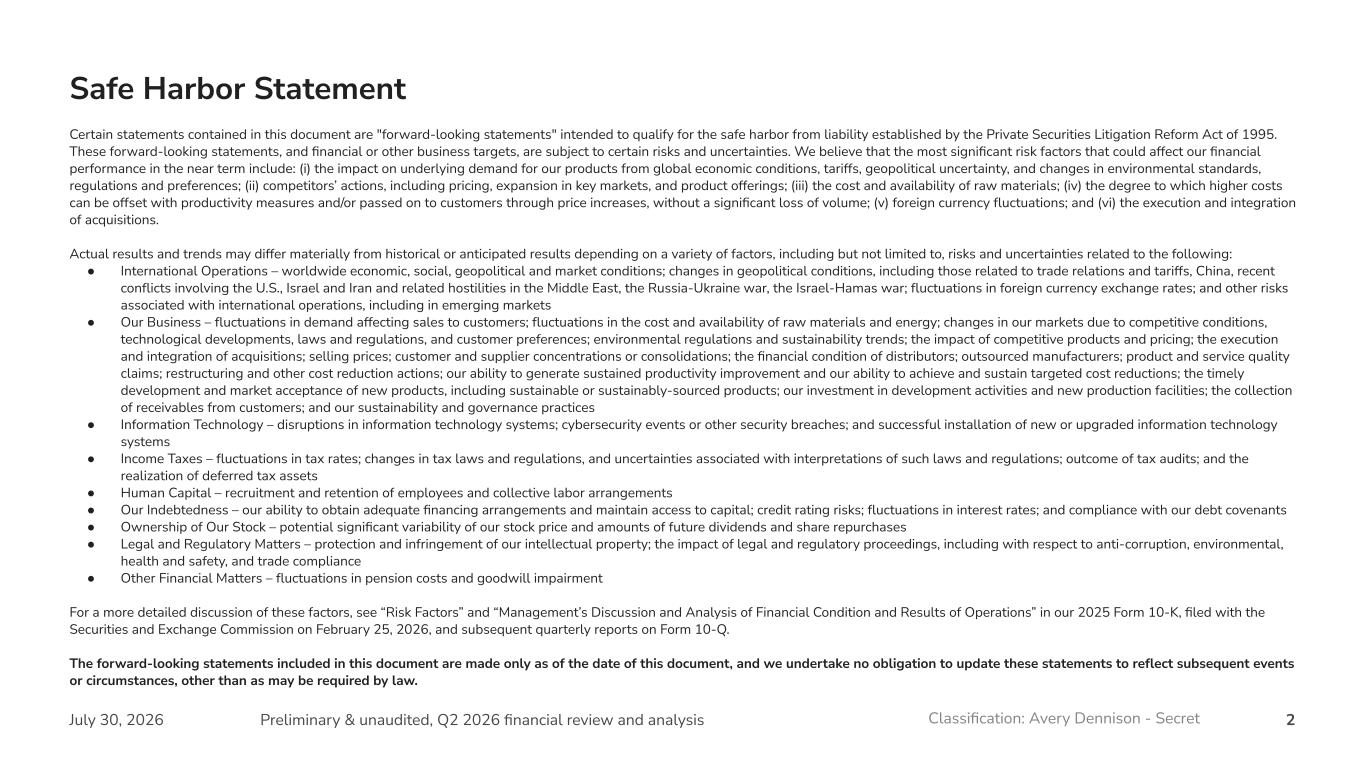
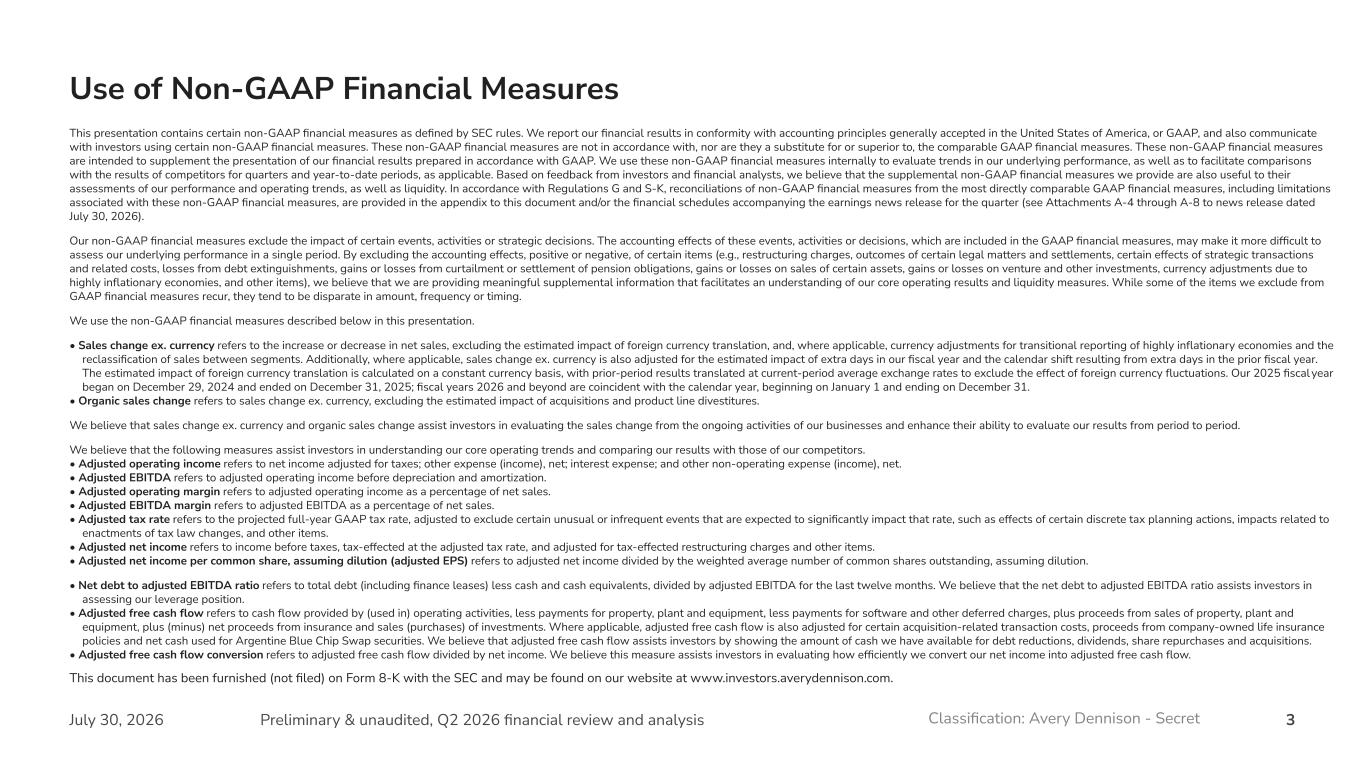
Thank you, Ellen, and welcome to Avery Denison's second quarter 2026 earnings conference call. Please note that throughout today's discussion, we'll be making references to non-GAAP financial measures. The non-GAAP measures that we use are defined, qualified, and reconciled from GAAP on Schedules A4 to A8 of the financial statements accompanying today's earnings release. Remind you that we'll make certain predictive statements that reflect our current views and estimates about our future performance and financial results. These forward-looking statements are made subject to the safe harbor statement included in today's earnings release. On the call today are Dion Stander, President and Chief Executive Officer, and Greg Lovins, Senior Vice President and Chief Financial Officer. I'll now turn the call over to Dion.
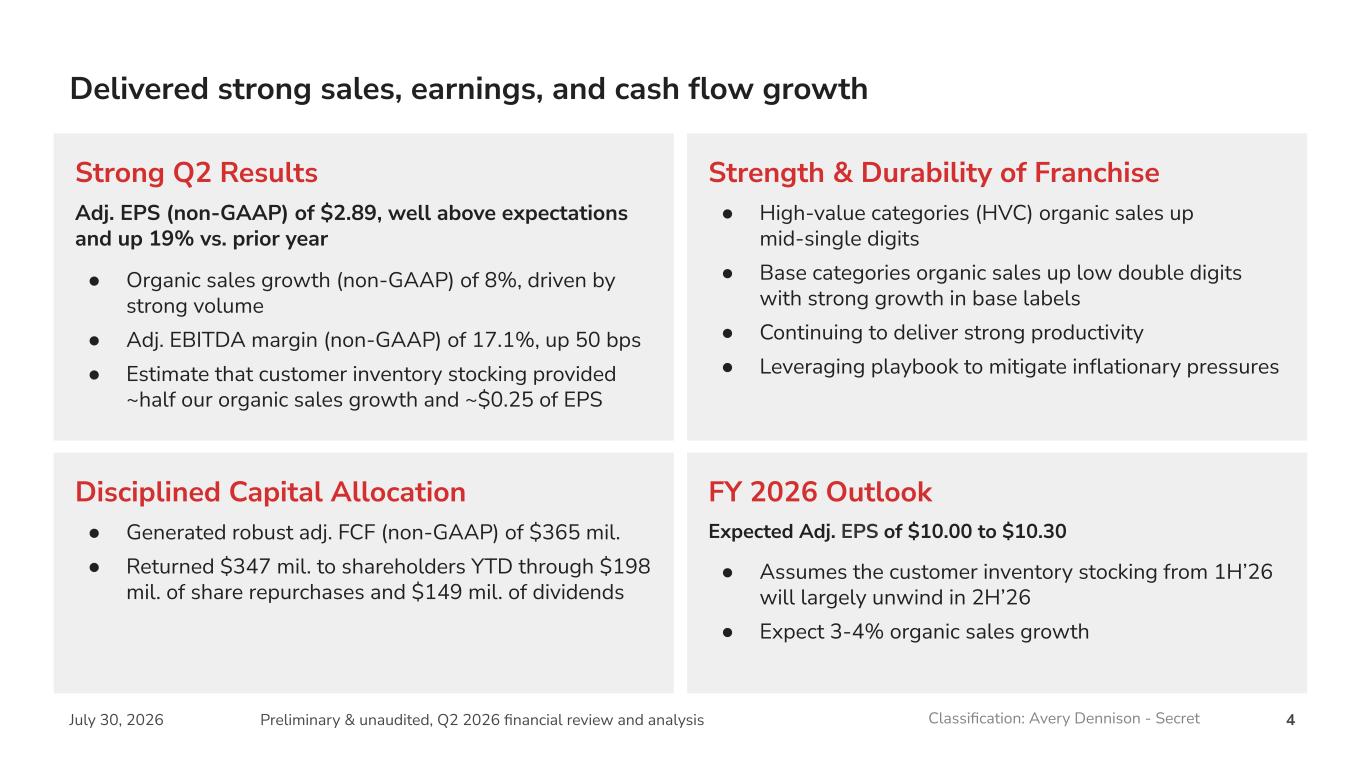
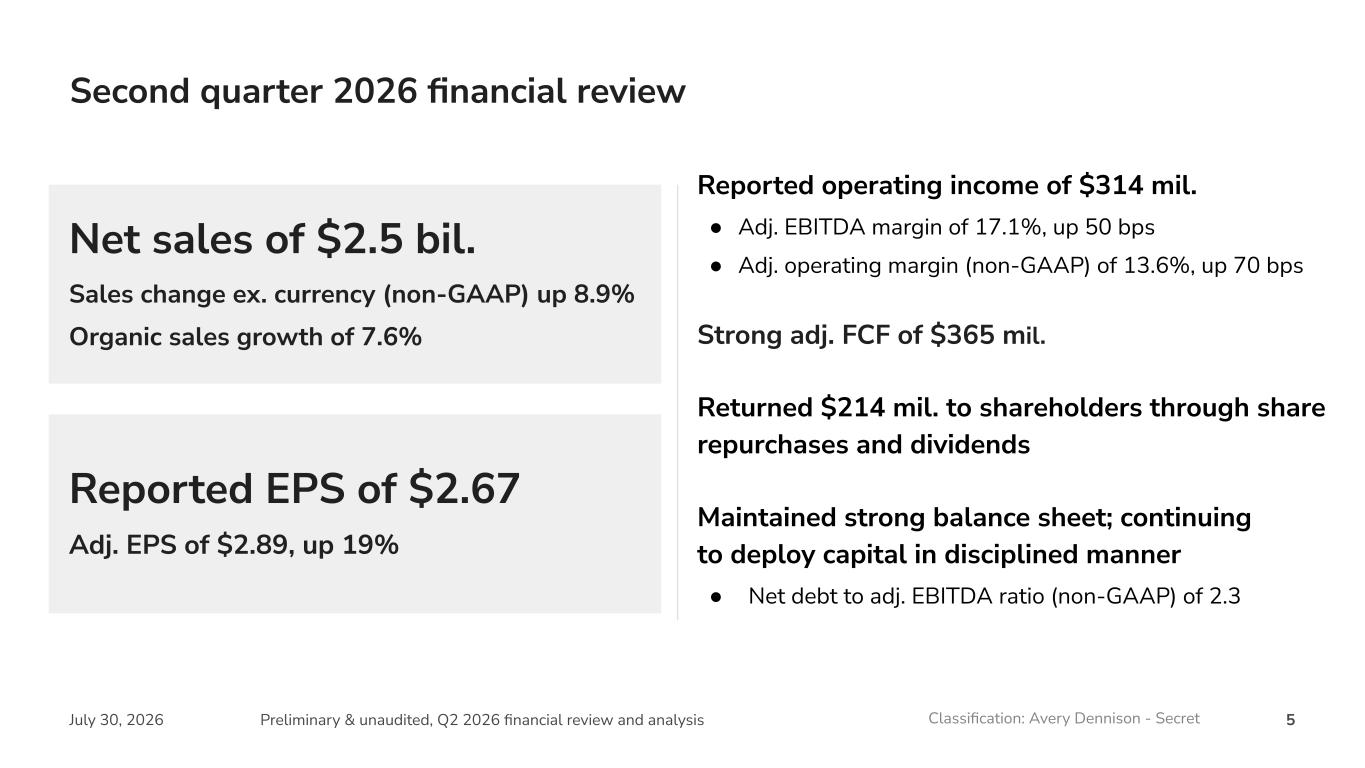
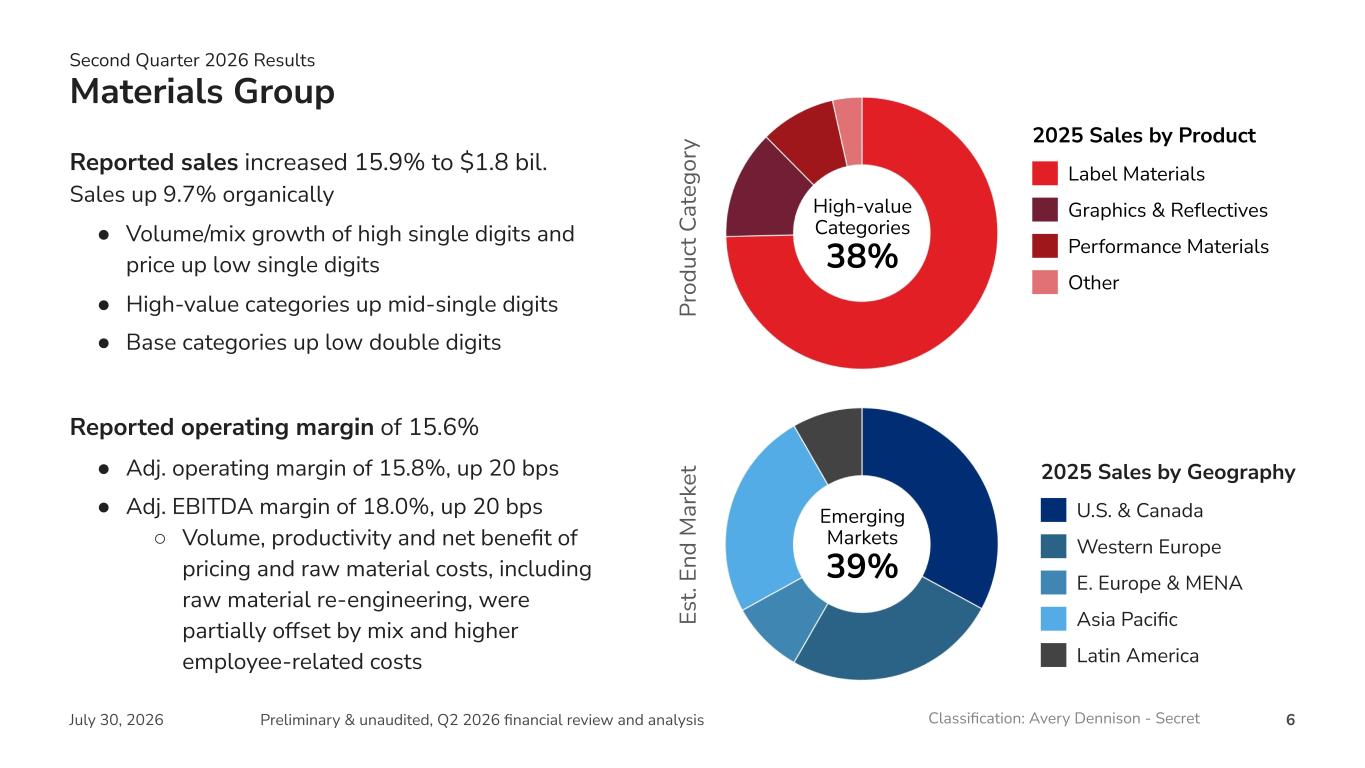
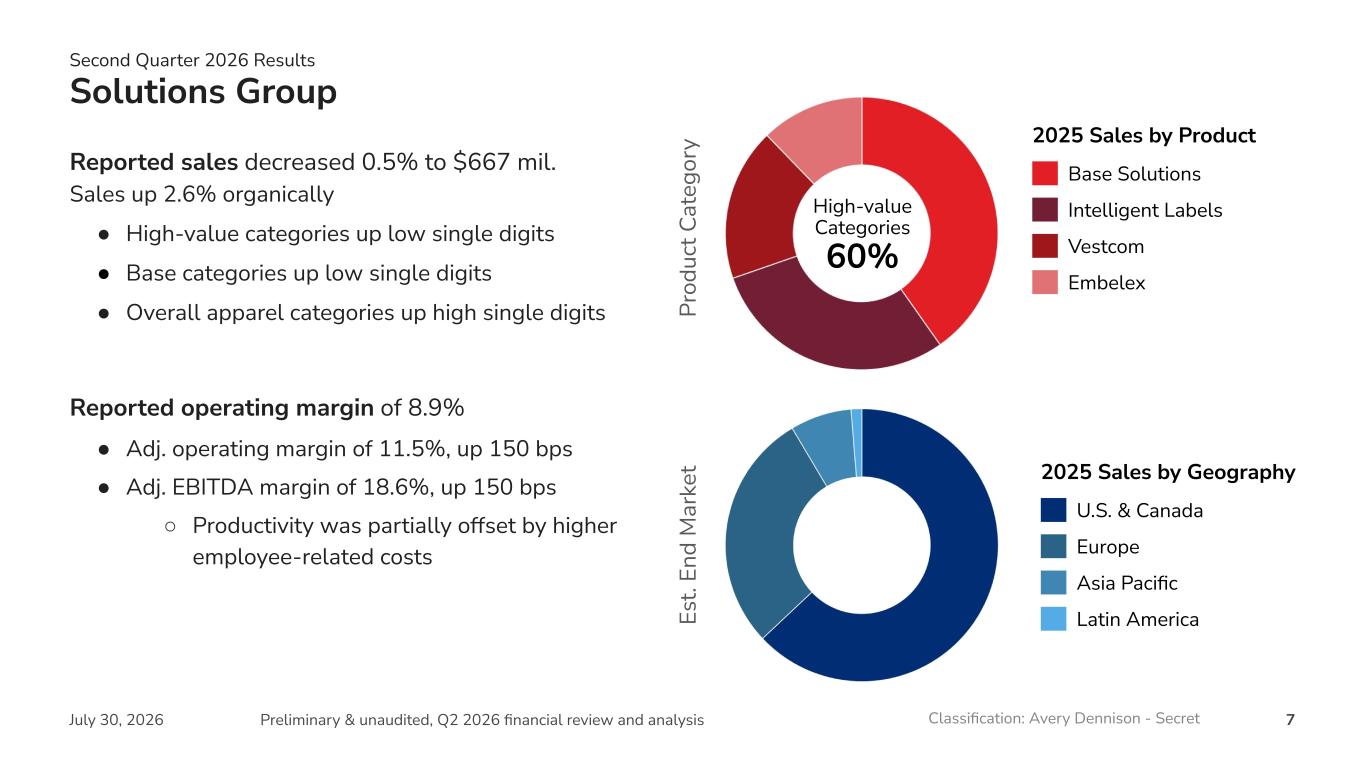
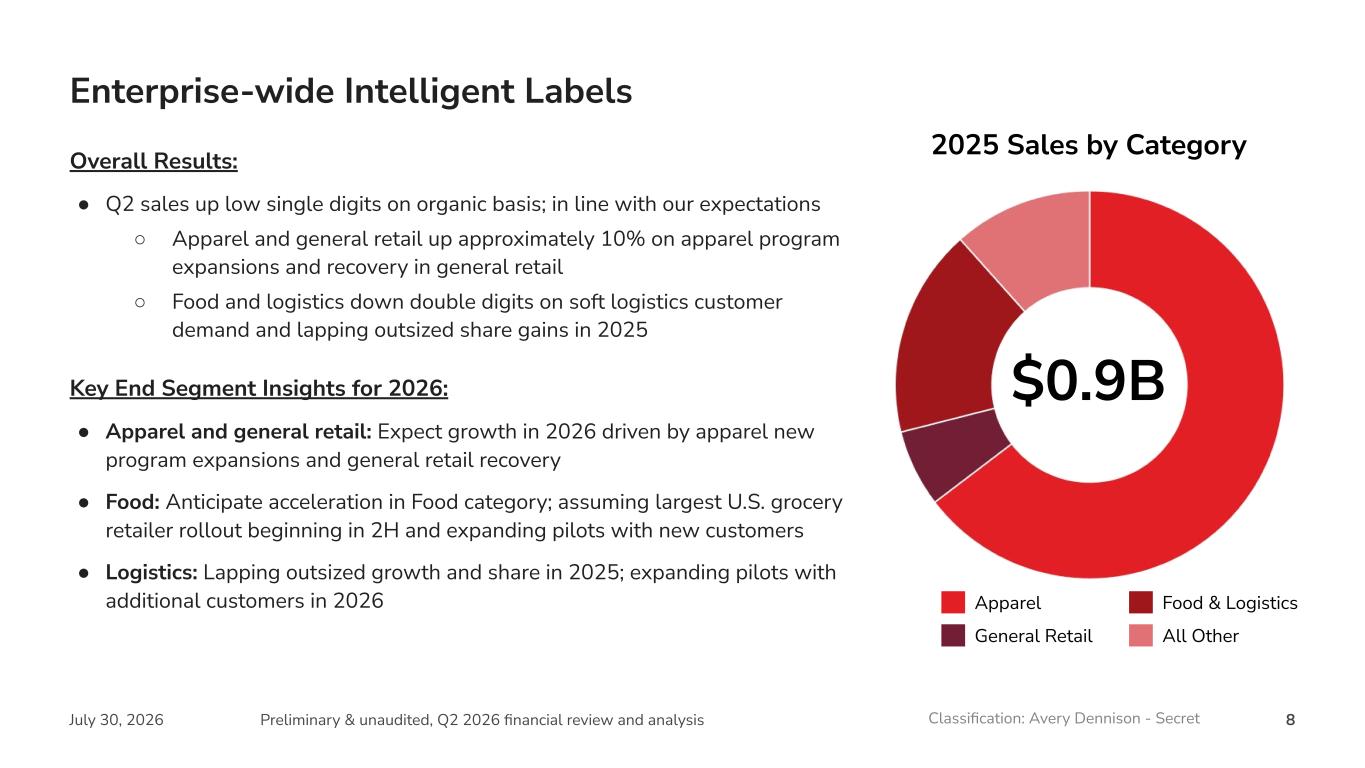
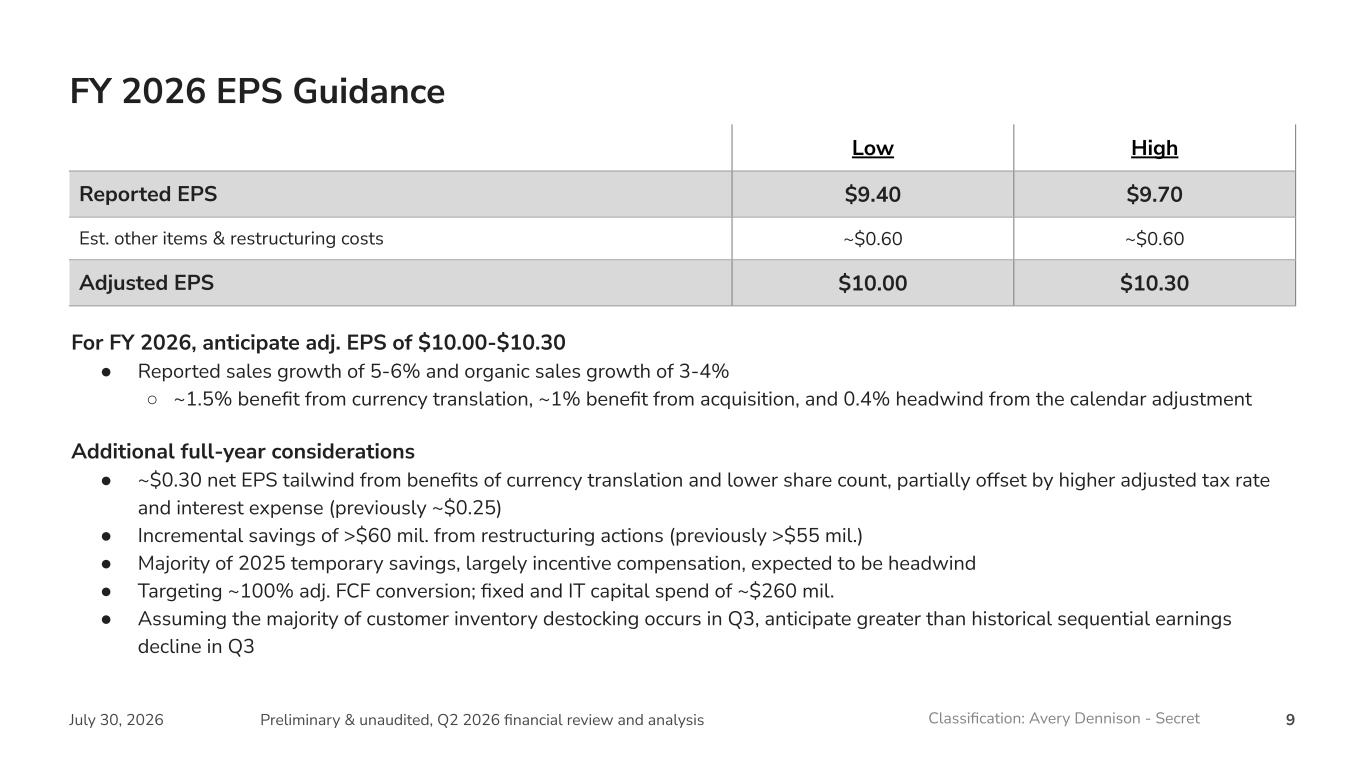
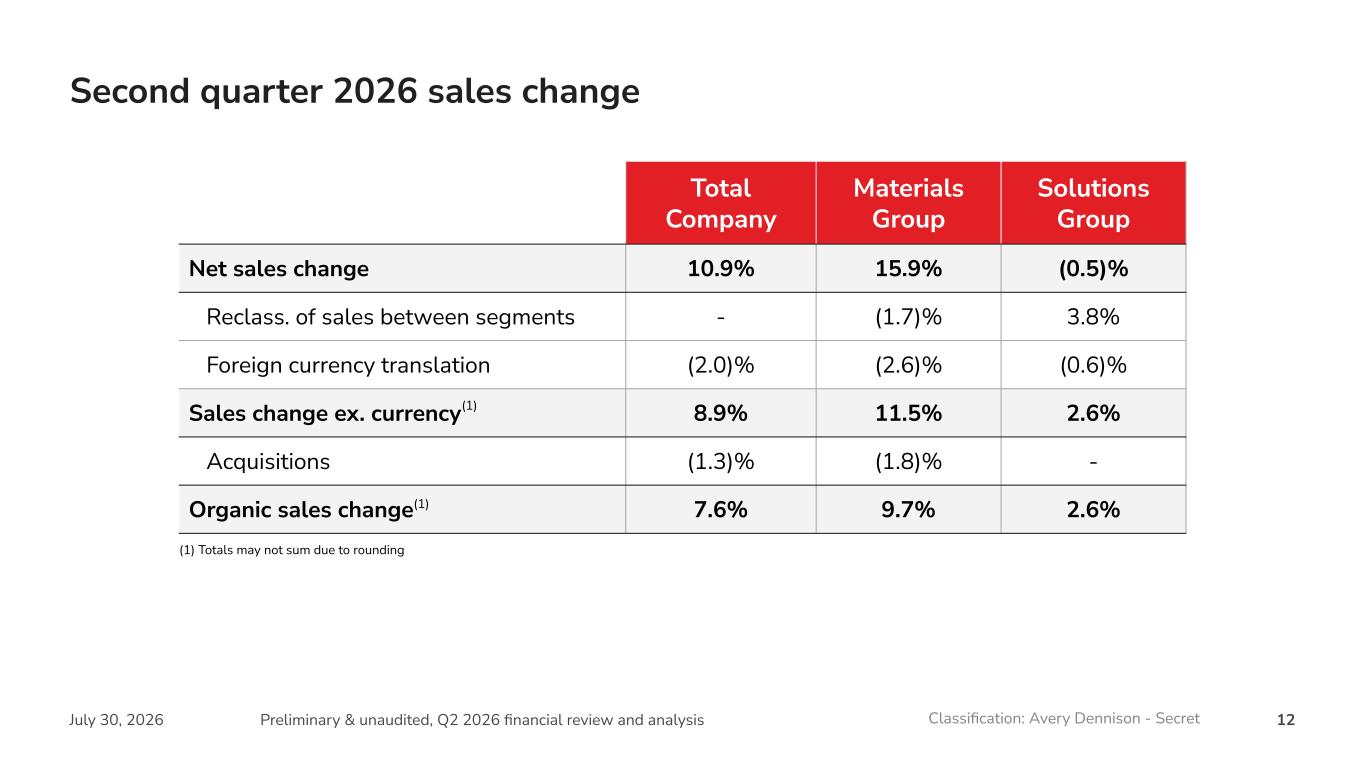
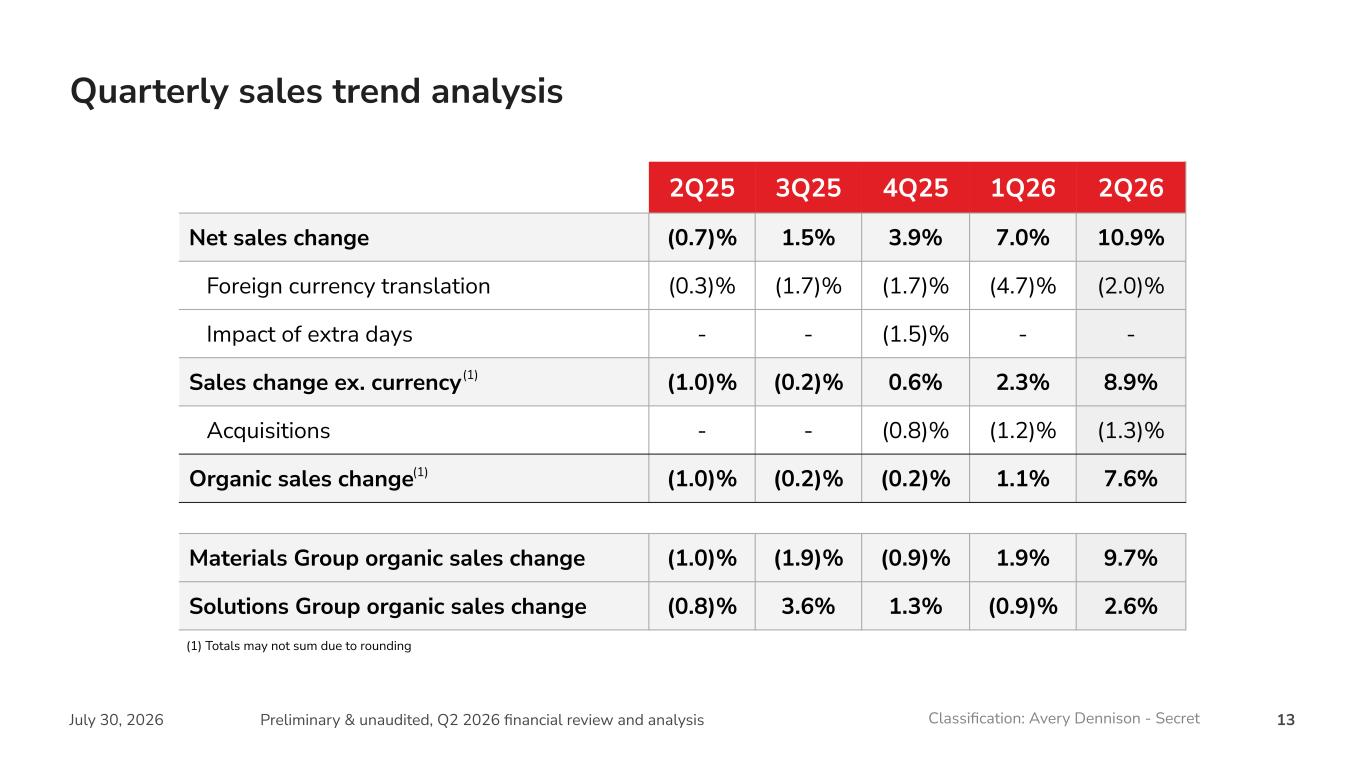
Thanks, Gillian. Good morning, everyone. We delivered strong second quarter results across the board. On a year-over-year basis, organic sales growth accelerated to 8%, adjusted EBITDA margins expanded, adjusted EPS grew by 19%, and adjusted free cash flow generation was strong at more than $360 million. While these results benefited from continued customer inventory stocking materials group, excluding this tailwind, we continue to drive a step change in the pace of our sales and earnings growth. Our performance this quarter once again demonstrated the strength and the resilience of our portfolio. Sales growth was balanced across both base and high-value categories, with high-value categories returning to mid-single-digit growth as we expected. Combining this improved organic growth with our commercial and operational excellence allowed us to expand adjusted EBITDA margins across both segments, even against a volatile and inflationary cost backdrop. Our priorities are clear. We are continuing to drive both earnings growth and business resiliency by leaning into our proven playbook first we're investing in innovation service-led differentiation to drive share gains and expand new business opportunities the strength of this focus was evident in our second quarter performance where organic sales growth accelerated second executing commercial and operational agility including productivity and pricing actions to mitigate inflationary pressures. And third, generating strong free cash flow and maintaining a healthy balance sheet. Our balance sheet strength and robust cash generation supported the increased pace of our share repurchases during the quarter and another increase in our dividend while continuing to invest in our long-term growth priorities. Turning to our segment results. Materials Group delivered organic sales growth of approximately 10%, driven by high single-digit volume mixed growth, as well as low single-digit pricing realization as we began to pass on cost inflation. During the quarter, the business delivered solid performance across both base and high-value categories. Encouragingly, high-value categories grew mid-single digits year-over-year, led by specialty and durable labels, as well as intelligent labels. Base categories grew low double digits, driven by underlying market growth, continued share gains, and the benefit of customer pre-buys. In label materials, customer pre-buying persisted longer into the quarter than we initially anticipated, driven by accelerating raw material inflation as well as customer concerns regarding surety of supply, particularly in Europe and parts of Asia. Looking forward, while it is difficult to predict the timing of when the unwind will happen due to continued geopolitical uncertainty, we anticipate the majority of the unwind in the third quarter with a smaller carryover into Q4. From a profitability perspective, materials group adjusted EBITDA was strong, growing high teams of margins expanding compared to prior year. In the solutions group, organic sales grew 3%. The quarter was characterized by solid low single-digit growth across both our high-value categories and base solutions. Within our high-value platforms, Embellix delivered robust low double-digit growth, driven by core market expansion and strong World Cup demand. Intelligent labels grew low single digits, while Vescom was down slightly as we lapped a major customer rollout from 2025. In our base solutions, we were pleased to see sales return to low single-digit growth. From a profitability perspective, execution in our productivity playbook more than offset higher employee-related costs. This allowed us to deliver strong EBITDA margin expansion. Fivoting to our enterprise-wide intelligent labels platform, sales were up low single digits compared to prior year, in line with our growth expectations for the quarter. As anticipated, this headline number reflects varying dynamics across our major end markets. In our largest category, apparel and general retail, we delivered another quarter strong performance with sales up approximately 10%. This growth was driven by continued program expansions in apparel, alongside a solid recovery in general retail. Conversely, we experienced a headwind in logistics where sales were down double digits. This was driven by the difficult comparison of lapping outside share gains from 2025 and softer overall customer demand in the segment. Looking ahead, we continue to expect 2026 growth for our enterprise intelligent labels platform to outpace 2025. In apparel and general retail, we expect to deliver strong full-year growth as adoption continues to deepen. In food, we are positioning the platform for an acceleration in the back half of the year, driven by the beginning of the rollout with the largest U.S. grocer retailer and expanding activity across other customers. Finally, logistics, we are managing through the normalization of outsized volume share gains from 2025 with our largest partner, while continuing to expand pilots with new logistics customers. As to our outlook, we are returning to providing full-year guidance, reflecting our team's strong execution through a dynamic environment and the challenges of precisely timing the second half customer inventory de-stocking and materials group. For the full year of 2026, we anticipate $10 to $10.30 in adjusted earnings per share on organic sales growth of 3% to 4%. In summary, our strong second quarter performance, delivering another quarter of accelerating sales and earnings growth highlights the differentiation and underlying strength of our enterprise. We remain focused on the key secular tailwind shaping our long-term strategy while continuing to execute the operational actions required to navigate cyclical dynamics and inflationary shifts with agility. The proactive steps we are taking to accelerate innovation-led differentiation, serve our customers, and ensure supply chain resilience further strengthens our competitive moat. Our proven strategies, market-leading, resilient businesses, agile teams, and disciplined capital allocation approach give us confidence in our ability to deliver sustainable growth in 2026 and beyond. I am proud of the global Avery Dennison team.
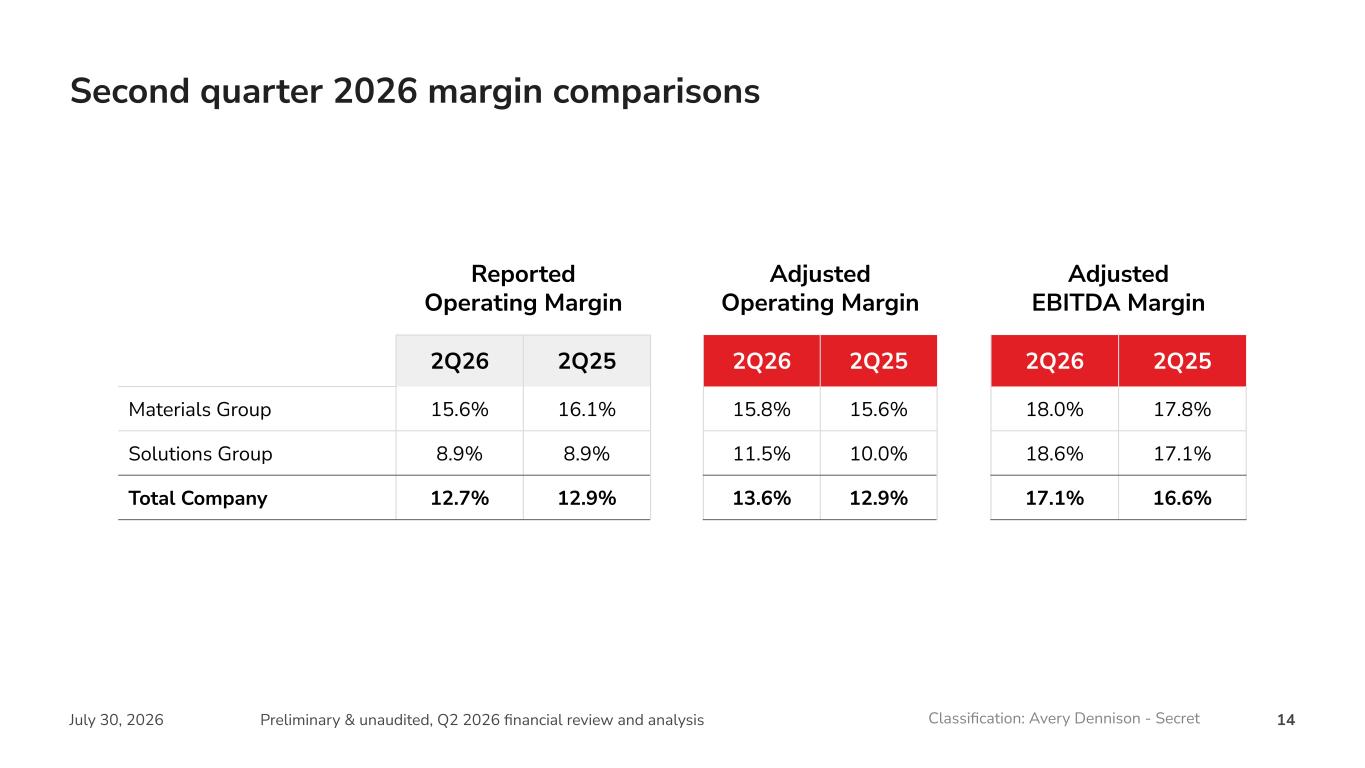
Their agility and operational execution continue to drive strong results, giving us momentum as we execute across the balance of 2026 and beyond now over to you greg thanks dion and hello everybody in the second quarter we delivered strong adjusted earnings per share of two dollars and 89 cents up at 19 compared to prior year earnings growth was driven by higher volume and productivity partially offset by higher employee related costs and targeted growth investments. As Dion mentioned, customer inventory pre-buys were a contributing factor during the quarter, adding an estimated $0.25 to earnings. Second quarter reported sales were up 11% year-over-year, with organic sales growth of 8%, driven by strong volume mix and slightly favorable pricing. We estimate that roughly half of the organic growth was from customer pre-buy activity. Reported sales also benefited from approximately two points of growth from foreign currency translation and a point of growth from the tailored adhesives acquisition. Adjusted EBITDA margin was 17.1% in the quarter, up 50 basis points compared to prior year. And we generated strong adjusted free cash flow of $365 million in the quarter, are merely driven by earnings growth and working capital improvements. Our balance sheet remains strong with a quarter-end net debt to adjusted EBITDA ratio of 2.3 times. Capital allocation during the second quarter remained consistent with our established framework. We returned over $210 million to shareholders through a balanced combination of $76 million in dividends and $138 million in share repurchases. an accelerated pace relative to the first quarter. This brings our year-to-date capital return to shareholders to roughly $350 million. These actions underscore our ongoing commitment to disciplined capital deployment while preserving our financial flexibility. Turning to segment results for the quarter, Materials Group organic sales were very strong, coming in 10% higher than prior year. driven by high single-digit volume mixed growth excluding our estimate of the year-over-year benefit from customer pre-buys underlying organic sales growth remains strong at mid-single digits turning to label materials similar to the first quarter we believe we successfully gained share and realized favorable year-over-year pricing as we acted to mitigate the impact of rising raw material costs from a regional perspective compared to prior year volume mix in north america was up mid single digits europe delivered strong mid-teens growth in emerging markets both asia and latin america grew high single digits organic growth across our materials group high value categories grew mid single digits led by low double digit growth in specialty and durable labels in high single digit growth in intelligent labels. Industrial tapes grew low single digits and graphics and reflective sales were comparable to prior year. Materials group adjusted EBITDA was up 17% compared to prior year with margins up 20 basis points. This margin expansion reflects strong volume, ongoing productivity actions, and the net benefits from pricing and raw material costs cost, inclusive of cost-out re-engineering. These factors more than offset an unfavorable product mix and higher employee-related costs. Regarding raw material costs, we experienced mid-single-digit, year-over-year raw material inflation in the second quarter, representing high single-digit sequential inflation, slightly above our expectations. Our teams continue to execute our proven playbook to navigate the current inflation environment through strategic sourcing actions, reengineering, and the timely implementation of pricing actions. Looking ahead for the remainder of the year, while the situation remains uncertain, we're currently anticipating high single-digit year-over-year inflation in the second half. Shifting to Solutions Group, organic sales were up 3%, with both high-value and base categories delivering low single-digit growth. Within high-value categories, Embelex delivered strong, low double-digit growth. Intelligent labels grew low single digits, with particular strength in apparel and general retail categories, while Vescom was down low single digits as we lapped new program rollouts from the prior year. Solutions Group Adjusted EVA DAW margin was 18.6%, expanding 150 basis points year over year and 220 basis points sequentially. This margin expansion was driven by continued execution of our productivity initiatives, the reversal of prior year tariff-related network inefficiencies, and a positive net price-cost impact, inclusive of tariff-related costs. Together, these benefits more than offset higher employee-related costs in our targeted investments in growth. Turning now to our full-year 2026 outlook, we anticipate reported sales growth of 5% to 6%. This includes organic growth of 3% to 4%, with approximately 1.5% from currency translation, 1% from the tailored adhesives acquisition, and a nearly half-point headwind from the fiscal calendar change. We expect full-year adjusted earnings per share in the range of $10 to $10.30, representing 7% growth year-over-year at the midpoint. This full-year earnings growth is driven by benefits of organic growth, which is primarily volume mix driven, a largely neutral impact from customer inventory management for the full year, productivity actions, including restructuring benefits of more than $60 million, offsetting headwinds from wage inflation and the normalization of 2025 temporary savings, which are largely incentive compensation related, and a net benefit of approximately $0.30 from combined currency, share count, interest, and tax. Additionally, we remain committed to strong free cash flow, targeting roughly 100% conversion for the year, with fixed and IT capital spending of approximately $260 million. From a quarterly earnings cadence perspective, we're assuming the third quarter will see a larger than normal sequential earnings decline driven by our customer destocking timing assumption, which will represent an approximate $0.50 sequential headwind versus the benefit we saw in the second quarter. While we expect a sequential headwind in the second half as these customer pre-buys unwind, underlying earnings momentum remains strong across the balance of the year. In summary, we delivered a strong second quarter, achieving 8% organic sales growth and 19% adjusted earnings growth. We generated very strong free cash flow, increased our dividend, and accelerated share repurchases while maintaining a strong balance sheet with leverage coming down to 2.3 times. Our updated 2026 outlook anticipates 3% to 4% organic sales growth and roughly 7% EPS growth, demonstrating positive momentum toward our long-term targets. Overall, our resilient portfolio, agile execution, and disciplined capital allocation give us high confidence in our ability to deliver strong, long-term value to all stakeholders. With that, we'll now open up the call for your questions.
Operator
Ladies and gentlemen, we will now begin the question and answer session. If you would like to ask a question, please raise your hand now using star 1 on your telephone keypad. If your question has been answered and you would like to withdraw your registration, please press star 1 again. to accommodate all participants we ask that you please limit yourself to one question and then return to the queue if you have additional questions please stand by as we compile the q a roster your first question comes from the line of gansham pajambi with baird your line is open please proceed with your question thank you operator good morning everybody um can you just Can you just give us a bit more granularity as it relates to the growth outlook for intelligent labels for 2026 relative to the low single digits you generated in 2Q?
Speaker 2
In particular, how's your view on the major end market verticals such as apparel, general retail, food and logistics change, if at all, relative to the last time you reported three months ago?
Thanks, Ganshan. Our anticipation has always been that we would continue to see our growth ramp in the second half of the year. And when I look at the individual segments in apparel and general retail, we'll continue to expect solid growth as we go through the second half of the year, largely on the new program rollouts we're doing, as well as the continued strengthening and some of the general retail execution as well. In logistics, specifically, you know, we're expecting a continued share and volume challenge relative to 2025 when we grew outside share and volume in that period, and we expect that to persist for the remainder of the year while we continue to also expand pilots with our existing customers that we have and some new customers in the logistics pipeline. And in food, we're expecting a much more meaningful contribution from the food programs as we go through the second half of the year, largely on the significant retailer rollout that we've talked about for a while, as well as a lot more activity in new customer programs overall that we're seeing in the food sector, Gunsham.
Operator
Your next question comes from the line of George Staffos with Bank of America. Please proceed with your question.
Hi, thanks, everyone. Thanks for taking my question, and congratulations on the progress. I want to dig into the pre-buy effect in materials, and there are a couple components to it. I think you said that the effective pre-buy was more or less five points, mid-single digits, in the second quarter, and I recall the figure being one point in the first quarter, and I think it was one and a half points at the materials level. Did I relate those correctly, and does that mean, in essence, there's six or six and a half percent that ultimately has to be de-stocked over the rest of the year? How should we interpret that? And why is there so much going on, especially, it sounded like, in Europe? Thank you, guys.
Yeah, thanks, George. So in one Q, we talked about relatively around a point of growth from customer inventory building. I think I mentioned earlier about half of our organic growth in Q2, we would estimate is related to inventory build. So in total, closer to five points of growth in the first half, or at a net first half, about 2.5% growth for the whole half of the year. And we would expect to see that come out in the second half, as we said. So I think you would see that change from first half to second half. At the same time, from an organic growth perspective, that will largely be offset in the second half by the fact that we'll have more pricing action versus prior year, where we still had deflation in the first quarter carryover from last year. We'll have more pricing impact year over year in the second half. I think, to your point, we're seeing that more in Europe and Asia, and that's where we're seeing more of the inflationary pressures as well, as well as just more customer concern, I think, about surety of supply. And as we move through the second quarter, we continue to see that inflation increase in the middle part of the quarter, and obviously it's been quite up and down since then. So customers are still seeing a pretty uncertain environment, And I think that's what led to a lot of the stock build that continued throughout the second quarter.
Operator
Your next question comes from the line of John McNulty with BMO Capital Markets. Please proceed with your question.
Yeah, good morning. Thanks for taking my question. So I guess maybe a couple of related points on the margin side. I guess, can you help us to think about price cost in the second half and if you'll catch up with pricing just given your expectations for cost to be kind of up in the high single digits? And then, I guess, somewhat related on the margin front in solutions, you're kind of hitting a high watermark. Anything special about that in terms of why you're kind of at these levels? Or is this kind of the new baseline now that you're starting to see volumes stabilize and IL starting to grow again?
Yeah, thanks, John, for the question. so when we look at the second quarter from a price cost perspective and i'll talk sequentially we saw high single digit inflation inflation from q1 to q2 and we had mid single digit price increase from q1 to q2 to help mitigate that in addition to obviously material engineering and our procurement teams continuing to work to mitigate that as well so i think we largely mitigated the majority of that in in the second quarter from a sequential perspective when we look Q2 to Q3, we would expect low single-digit sequential inflation, largely carryover from what we saw as we move through the second quarter. But I will say it continues to be a pretty uncertain environment there. So we've seen oil, like I said a minute ago, move up and down quite a bit over the last few weeks. But right now, our expectation is low single-digit sequential inflation and low single-digit sequential price as well, Q2 to Q3. if i shift to your second question on solutions margins i think overall there's a couple drivers there that team has continued to drive pretty significant productivity year over year certainly that's having a benefit on our margins there at the same time as a nice volume rebound our apparel business was growing mid to high single digits in the quarter as we lapped some of the tariff implications from q2 last year with some strong growth in our embellished platform our high value category there that we talked about earlier as well. So overall, it's both strong volume growth in apparel, as well as productivity across the business. And we did have a couple of small one-time type benefits in the quarter, but still strong underlying results. You may see a little bit of moderation in that margin in Q3, but we still expect the second half to be above prior year.
Operator
Your next question comes from the line of Jeff Sikowskis with JP Morgan. Please proceed with your question.
Thanks very much. A two-part question. It sounds like you're gaining more traction with your customers and intelligent labels in the general food category. Is it baked goods or frozen foods, or are there themes that are allowing you to expand your reach? Great. And for Greg, you know, you've talked about inflation and employee costs. Is this one time or what's the rate or how large are your employee costs as a percentage of your cost base? Can you help frame the employee cost issue?
Thanks, Jeff. Let me deal with the first and Greg can take the second. Thank you. You know, we continue to have very strong, We continue to have very strong conviction in the growth and the food segment as we move forward over the years to come. Because we see the return on investment at the retail level to be so strong in all the pilots that we've done and some of the rollout that have been underway for a while. I think the way I characterize it, Jeff, is the initial focus has been really around bakery. It's the more simple one to implement. But we are, as you know, working through protein now, which has been more technically difficult to do, but that's where we've brought our innovation to bear, where I think we continue to sustain advantage. And then beyond protein within, you know, the next category is really at the periphery of the store will be in perishable items, the further perishable items. And I think those will follow in suit. I certainly think that two things are also playing in thematically. So one is I think retail at an aggregate level is recognizing that the greater and the urgency with which they digitize their stores overall to drive more of a digital platform for their stores, the more they're likely to succeed in driving the efficiencies and consumer connections they really desire. And clearly, you know, technologies like IL play a very significant role in enabling that driving return on investment, both from a labor productivity, a gross margin expansion and sales uplift. we've seen that consistently, particularly in perishable foods. And so I think the only other thing I'd say from our perspective is, you know, it's an area where we're going to continue to invest. The scale of our customers that are now in pilot has continued to expand. Our pipeline has expanded in that regard, includes a number of other US retailers and European retailers, and also some areas very specifically where, for example, DSD deliveries are taking place in certain categories as well. So we have high conviction in it, and I see it as a longer-term growth opportunity within our broader high-value category portfolio overall.
Yeah, and Jeff, on your second question, I think there's two areas of employee costs where we're seeing a headwind year-over-year. One is the normal year-over-year wage inflation that we see across the business, and that's more normal levels of what we've seen in the recent past. I think the other one is the larger one really this year from a year-over-year perspective is incentive compensation. So last year, clearly, we delivered below our targets. Incentive comp payouts were well below target levels last year. And this year, we're on track at or above, depending on the business, to deliver on our targets. So there's a relatively sizable incentive compensation headwind. When I look at the overall earnings growth formula kind of year-over-year, from an order of magnitude perspective, our productivity is basically largely offsetting our wage inflation and our incentive compensation. So that's roughly the size of those headwinds versus our productivity.
Operator
Your next question comes from the line of Josh Spector with UBS. Please proceed with your question.
Yeah, hi. I wanted to just dig into the organic growth guidance. So the 3% to 4% range, if we try to unpack that a bit, I mean, my calculations here would say pricing in the second half is up, call it 3%, maybe to 4%, and you have that, call it 3-ish percent headwind in the second half. So, therefore, volumes then at the base level, excluding the kind of destocking dynamics, are maybe flattish. Is that how you would frame it? Because you sound more positive on some of the, you know, higher growth areas within materials, RFID improving. I don't know if there's an offset that we're missing. Thanks.
Yeah. So, I think, Josh, when you look first half to second half, first half organic growth is around four and a half percent on on the full first half basis with a couple points of that we would estimate from stocking as we've talked about here and we had as I said earlier a little bit of price down particularly in the first quarter is we start to lap some of that deflation from prior year so volume growth volume mix growth in the first half of the year in that low to mid single-digit range I think second half is somewhat similar from a volume mix perspective, but we have the de-stocking impact coming in, a headwind in the second half, largely offset by the fact that price now, we're no longer lapping the deflation from prior year. So the price actions that we're taking are a positive year over year in the second half.
So I think underlying volume mix trends, relatively similar, low to mid single digits in the first and second half, with a little bit of price differential between the halves as well that's impacting that in addition to the stocking impact your next question comes from the line of matt roberts with raymond james please proceed with your question um dan i appreciate all the comments you've given thus far on food but i think that's a little bit deeper on the contribution second half very specifically on just how far has that rollout progressed is there still incremental run Walmart. I know that's beginning here in the second half, but what percent of that initial rollout should we be thinking about in the 20s?
Speaker 6
Hey, Matt, you're breaking up on us. Matt, you're breaking up on us. Can you start again from the top? We missed the question. Yeah, is that better now?
Yes, try that. Okay. Basically, I'm looking to get a little bit more granular on the food contribution. Specifically, Kroger, how far along that rollout has progressed? Is there anything incremental in second half from that? Walmart, I know that begins to ramp in second half, but any percentage terms you could frame around that rollout in 26, in 27, and into 28? And I believe a third grocer here has announced a pilot, and you referenced some pilots in grocery. So how material are those new programs in second half, or how long would you expect them to be in pilot phase before any expansion, given it seems like food is certainly newer, but perhaps broadening faster than other categories? Thanks for taking the question.
Yeah, let me end where you end part of your question, Matt, and I'll address the rest. Yes, I think there is certainly much more accelerated interest from customers. They can clearly see the benefit, the returns as they get, as I said, on labor productivity, gross margin expansion, and sales uplift as well. Specifically on Kroger, the rollout continues to go as they planned, and the second half of the year, the only thing that is different that we said we'd be working on with, and which we are, which is really the protein piloting, and as that goes successfully in the second half of the year, we'd be looking to roll that out as we go into the start of next year. On Walmart, you know, I think my observation on that customer that continues to be that they are really committed to the technology. You can see it roll out across all of their stores in terms of both general merchandise and apparel and increasingly now in the food area as well. And they continue to see their return on investment of the technology as well, both in those areas as well as in food. Typically with kind of large-scale deployments, timelines can vary slightly, but our current assumption is the commercial rollout in this custom to begin in the second half of 26, and we're working very closely with them now on key deployment milestones to ensure a successful implementation. As it relates to the other customers, yes, the pilots are accelerating. I won't go into detail, but which specific customers they are, and we anticipate that largely those will manifest in 27 and beyond, and that's when you see the benefit of those positive pilots turning into broader implementation and roll-ups.
Operator
Your next question comes from the line of John Dunnigan with Jeffries. Please proceed with your question.
Hey, Dion, Greg. Really appreciate all the details and congrats on a good quarter. I want to go back to the customer inventory build. It sounded like there was some carryover from the inventory build in 1Q, but did you see the stocking through the quarter and has it progressed into 3Q or are you already seeing some of that de-stocking? And related, was there any portion of the 10% apparel and general retail RFID growth that was tied to the customer inventory build? Didn't sound like it from your comments, but just wanted to confirm. And then one last point of clarification, Greg, I just want to make sure I heard you correctly. On the 3Q EPS, you said it was 50 cents lower quarter over quarter. Did I get that right?
Yeah, thanks for the question, John. So on stocking, as we said in the first quarter, we had about a nickel earnings and earnings per share impact. We estimated from stocking that started really kind of early to mid-March in the first quarter. We saw that continue as we talked about last quarter through April. At the time, we thought it would reverse later in the quarter, but we continued to see more uncertainty as we moved through the quarter and inflation continuing to increase in the middle part of the quarter. So we saw that stocking really continue not only through April, but also through May. And it's a little bit different by region, but Europe and Asia, where we've seen most of that stocking impact, we saw some of it continue in June, early June, but largely June started to more normalize from a volume impact. And then we're expecting that, or a large portion of that, to come out in the third quarter. And we've started to see signs of that here the first few weeks of July as well. So I think our expectation is that it will continue as we move through the rest of this quarter. None of that is in solutions. We're really a materials group phenomenon that we're seeing here. We really haven't seen that stocking impact on the solutions or intelligent label side of the business. From the sequential headwind, basically the roughly 25-cent benefit we got from our customers' increase in their inventory in Q2, Q2, our outlook would be that assumes that roughly 25 cent headwind then in the third quarter. So that's the 50 cents Q2 to Q3 sequential headwind that we'll have from an earnings perspective. And again, that's an estimate based on what we're seeing right now, as I said, with that de-stocking starting. And we'll obviously see how the situation in the Middle East evolves as we go through the quarter. But right now, that's our estimate of what the Q3 impact would be.
And John, let me just reiterate, particularly in apparel general retail, there was no impact of inventory stocking or building that Greg spoke about. Most of that growth was really driven by new program rollouts that we've had, that we talked about in the past, and some of them are delivering as we go through the second quarter into the third and fourth quarter as well.
Operator
Your next question comes from the line of Mike Roxland with Truist Securities.
Please proceed with your question. yeah thank you dianne greg gillie for taking my question um a really high level question here i'm just i want to get a sense uh diana from you of how you think about volume growth in your base label business um your number of leading cpgs recently said they're done lowering prices uh they're going to focus on on raising prices at the expense of volumes so and then really it's all being driven by the fact that they've seen margins compressed over the last several quarters as a result of lowering prices so you know how should we think about this renewed focus on price affect volumes and how does that affect the materials business uh is it you know could you see buying you know the materials business shift from a gdp plus business to a
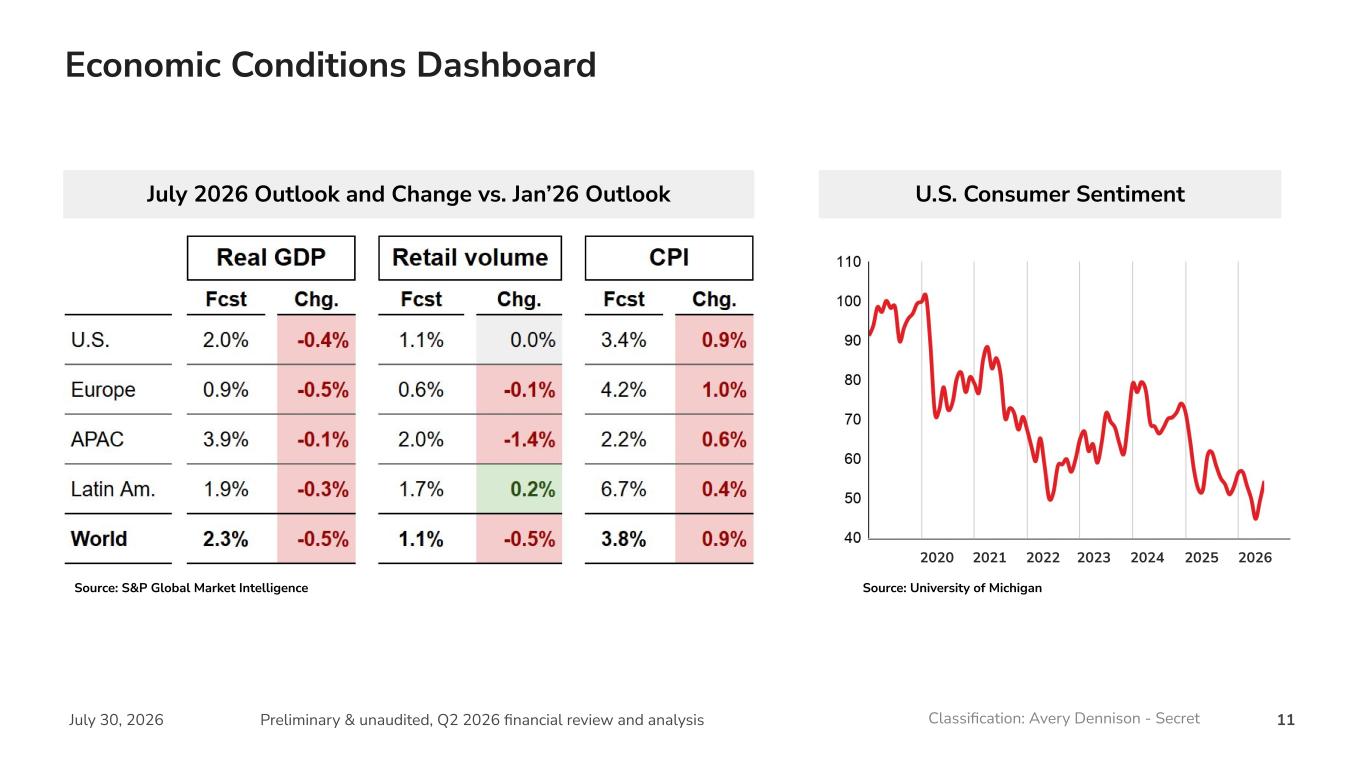
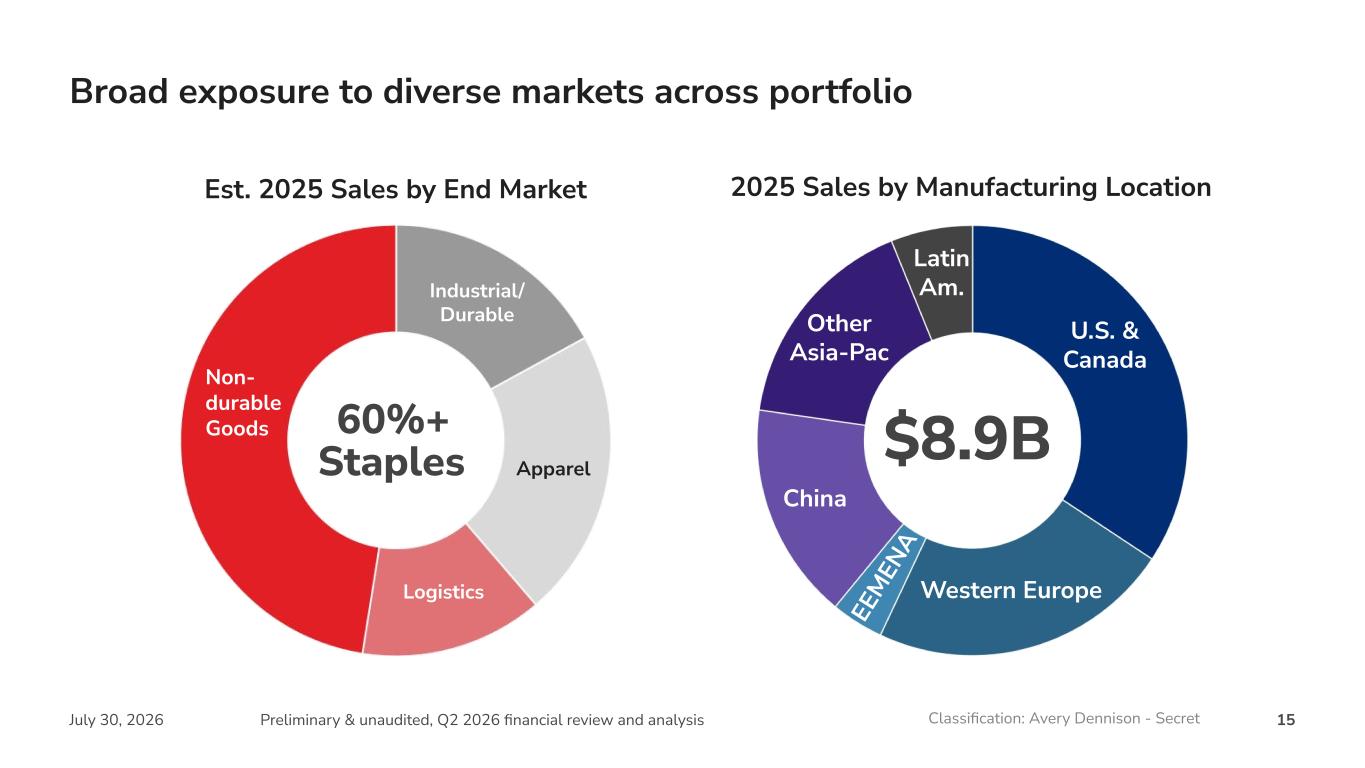
gdp or gdp minus particularly if you see cpgs more aggressively going after price any color you can provide would be helpful thank you yeah thanks mike i mean we've seen we've seen the cycle go through this when it comes to cpg volumes you're right you know cpg volumes i think largely over the last couple of years have been relatively flat if not slightly down i did see we did see some encouraging signs in the first quarter around certain segments of cpg volume home and personal care certainly grew a little bit but i think partly you know the continued weighing in of inflationary impact has no doubt has the cpgs weighing up how they balance or promotional activity for volume relative to pricing and the consumer impact thereof and we don't necessarily see a fundamentally changing forward as we move as we move through the rest this year given the uncertain environment we see i will say you know our best measure that we look at is we typically look at both gdp and then we also look at retail sales absolute retail sales and i think we provided some in detail in the materials you know gdp is i think moves slightly lower globally varies by region retail sales on the aggregate are around one percent growth at the moment overall. And think about our business being largely consumer staple-led in our base label business with some elements of logistics going into that as well. So we don't see fundamentally a big shift in our volumes, the base label volumes. Greg talked about kind of low single digit volume growth as we move through SVO. We don't anticipate it to be very different from that. The only other thing I'd say in there is we continue to take share in this business, in our base label business overall. And we've made a significant effort to make sure that as we think about how we service our customers, really anchoring around what it takes for service excellence and differentiation is starting to yield some benefit. We've also lent a lot more, and you've heard me talk about this, into our innovation to make sure we continue to secure differentiation and move forward. So as an example, a lot of the work that we've seen around where the growth in the base label business come from, which is largely filmic products, we tend to have a leadership advantage in filmic products. There's also a lot of impact that we're seeing from sustainability, recyclability. And there, some of our innovation, like our AD clean glass, our AD clean fiber, are really starting to resonate with customers. And so a combination of those helps us drive more share gain, which I think is very durable. And then there's a secondary element, which is typically during more uncertain times, Mike.
You tend to see customers when there are uncertain times in those areas, particularly in Europe and Asia, where the flights to the market leaders for surety really so we certainly do benefit a little bit from that that impact as well your next question comes from the line of anthony pedinari with city please proceed with your question uh good morning um a lot of my questions have been asked but i'm just wondering with the reinstatement of the full year guide is it fair to think of that as just kind of a one-time action to kind of help us understand the impact of the pre-buy and the reversal over the full year or you know would you anticipate going back to a full year behind or just kind of how do you
think about that yeah thanks anthony so i i think there's obviously a lot of drivers when it comes into thinking about our guidance i i think the first one for us is you know our business has been operating very well our teams have been doing a really nice job managing through what's been a pretty uncertain environment and delivering solid top line growth delivering strong productivity and generally just increasing the pace their underlying pace of our earnings growth so we feel confidence and good about what our teams are doing to perform there. And secondly, I think, as Dion mentioned earlier, we've got a little bit more uncertainty, as we've talked about here, with timing of destocking, given continued uncertainty in the Middle East and how that'll play out in the quarter. And, you know, will we see more destocking or less destocking between Q3 and Q4? So we think it's a little bit better for us to get full year at this stage. Our intention is not to go back and forth between different guidance time horizons in the future, though. So, you know, we're obviously not talking about 2027 guidance here, but our intention would be to stay with one approach as we go forward.
Operator
Our final question comes from the line of George Staffos with Bank of America. Please proceed with your question.
A point of clarification and then a question on intelligent label. So, Greg, you know, and I think John asked the question. So if we're assuming the 50 cent headwind because the up 25 becomes a down 25 and recognizing there's not scalpel-like precision with this, it isn't intended that way on your side. Since we had a nickel in the first quarter that was going to reverse, should we worry instead that it's 30 cents that has to come out and therefore it's more of like a 60 cent sequential downtick in 3Q. And then, Dion, the question on IL. I know you've been asked this in the past, likely. Do you see AI as an enabler and an accelerator for intelligent label? Or might it be, in some ways, a competing technology or an enabler of competing technologies? And so there's less of a pie to shoot after, recognizing the pie is big for intelligent label. Thank you, and good luck in the quarter.
Thanks, George. Thanks, George. As you said, we had about 30-cent impact in the first half is what we estimate the impact of the stocking was at our customers. And we're doing our best to try to triangulate around how we think that will come out between Q3 and Q4. Our view right now is a quarter or so of that comes out in the third quarter, and we've got a little bit of hangover of the rest of that in the fourth quarter. Again, it's a little tough to call, especially given how much of that stocking happened in Europe where we've seen the bulk of the inflation and the impacts there, especially with the holiday period that starts in August. So we'll see how that settles out. But that's our best guess right now on what we're seeing so far in July and how we think that plays out and what we're hearing from our customers through the rest of the quarter.
Yeah, and George, on your question, is AI an accelerator for IL? Yes, I believe it is, absolutely. And maybe I'll just give you a slight context that I still think the biggest secular trend we're going to see over the next five or so years of the continued digitization of industries and of items. And if you think about it from an IL perspective, every time an item is tagged at source and has data available about how it was made, where it was made, it's life through the supply chain into retail, how it gets used in retail, and ultimately to the end in terms of consumer use and disposal, you're generating significantly more data at the item level than ever historically. Now, AI, I think, is going to be an enabler to pass out and make a lot more sense and inference from that data. That's the real benefit it brings. And so in some ways, if you think about it, if AI helps you make more sense of data at, for example, a retail level, you now have much more ability to make more surgical decisions about what you want to do with items, which allows you to expand your ROI based on the work that you've done using IL, which in itself then creates a flywheel for more AI adoption. That's the hypothesis that I have, and I think we're starting to see that play out. I'd say stepping back at a more broader level for AI, at least for Avery Dennison, I think I've spoken in the past, George, around we're seeing that both as a driver for efficiency internally and productivity, a driver to help us accelerate innovation outcomes quicker, and then also to help us solve customer problems to accelerate our growth algorithm. We've invested, we're investing it, we have a chief digital officer we brought on board, and we've actually dedicated teams just to make sure that the big bets that we're taking will ultimately manifest in driving our growth algorithm or improving our profitability.
Operator
Mr. Gilchrist, there are no further questions at this time. I will now turn the call back to you for any closing remarks.
Thank you, Ellen. On behalf of everyone at Avery Dennison, I want to thank you all for joining today's call and for your continued interest in our company. As always, we're happy to address any follow-up questions you may have. Thank you again, and this concludes today's conference call.
Operator
Ladies and gentlemen, That does conclude the conference call for today. We thank you for your participation and ask that you please disconnect your line.