Operator
Good morning, and welcome to Bread Financial's Third Quarter 2025 Earnings Conference Call. My name is Kevin, and I'll be coordinating your call today. It is now my pleasure to introduce Mr. Brian Vereb, Head of Investor Relations for Bread Financial. The floor is yours.
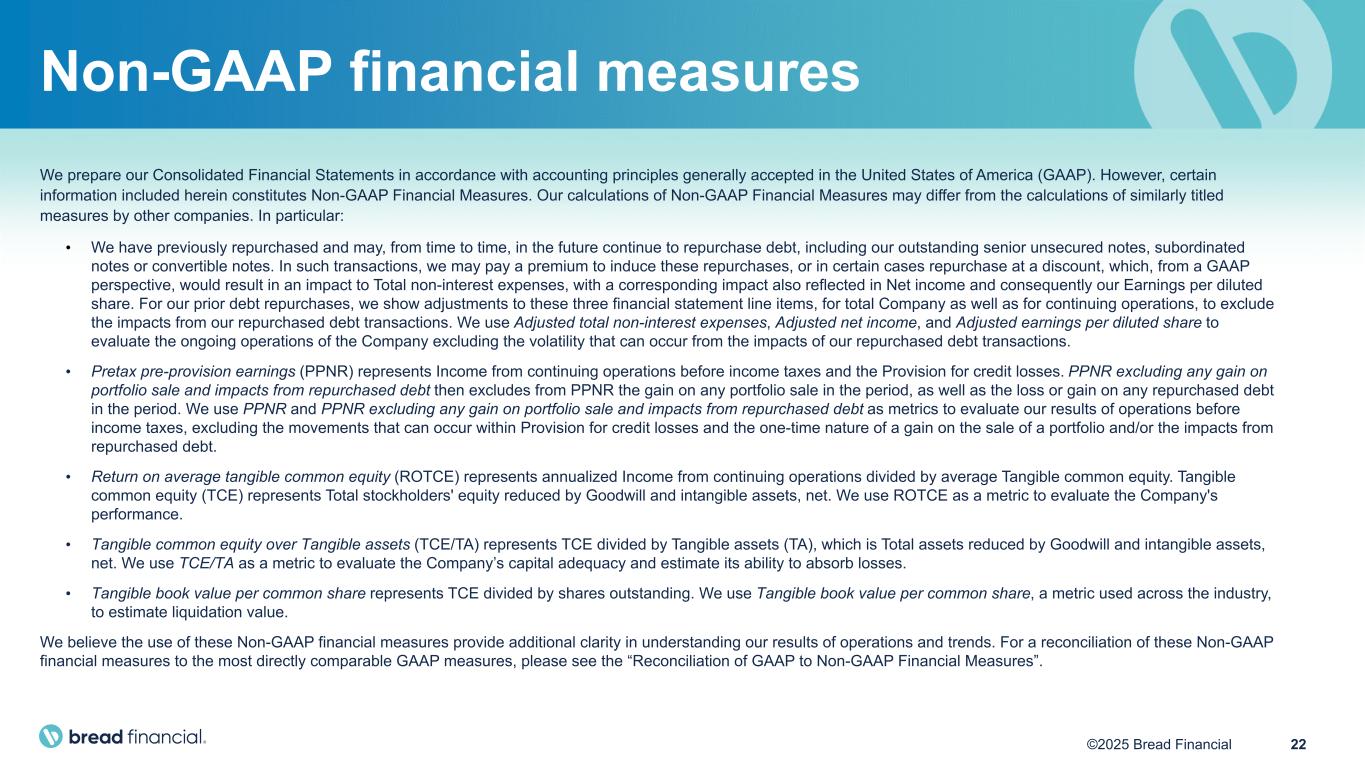
Thank you. Copies of the slides we will be reviewing and the earnings release can be found on the Investor Relations section of our website at breadfinancial.com. On the call today, we have Ralph Andretta, President and Chief Executive Officer; and Perry Beberman, Executive Vice President and Chief Financial Officer. Before we begin, I would like to remind you that some of the comments made on today's call and some of the responses to your questions may contain forward-looking statements. These statements are based on management's current expectations and assumptions and are subject to the risks and uncertainties described in the company's earnings release and other filings with the SEC. Also on today's call, our speakers will reference certain non-GAAP financial measures which we believe will provide useful information for investors. Reconciliation of those measures to GAAP are included in our quarterly earnings materials posted on our Investor Relations website. With that, I would like to turn the call over to Ralph Andretta.
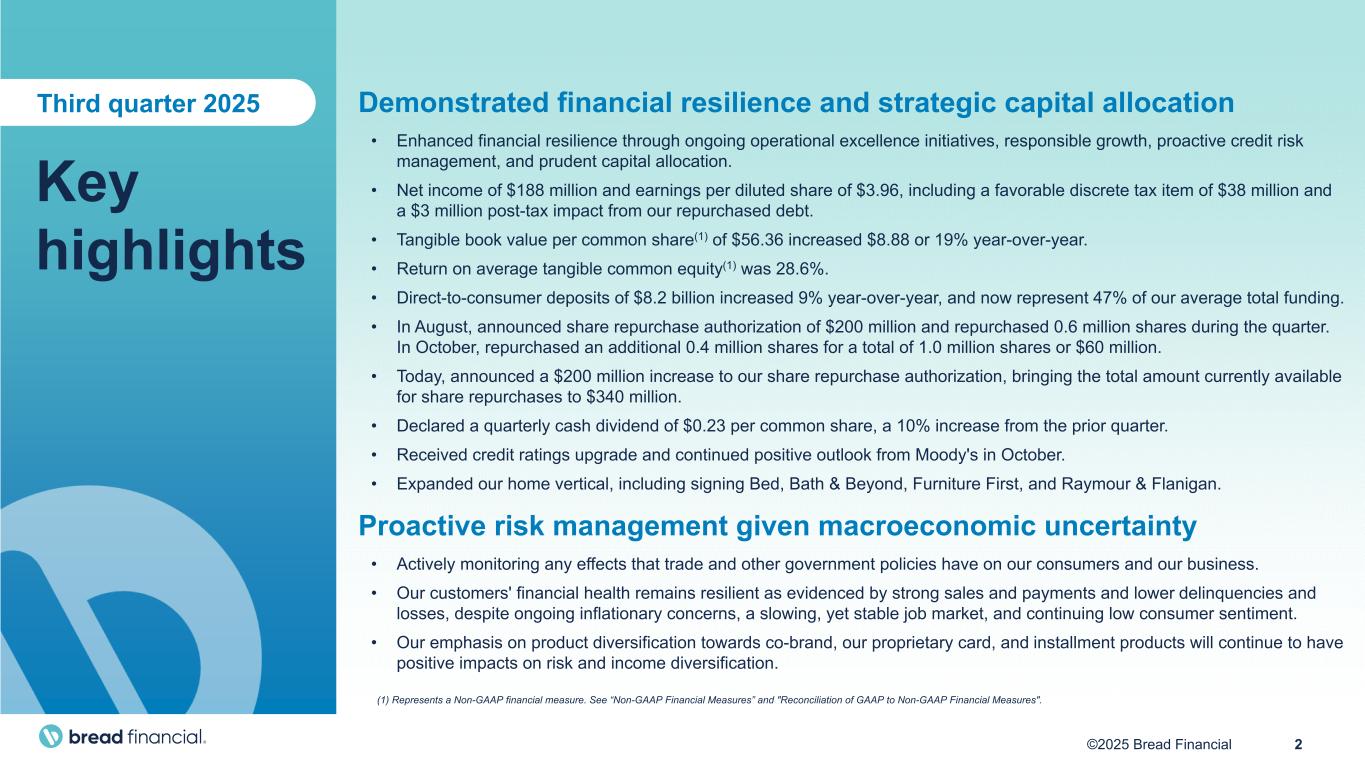
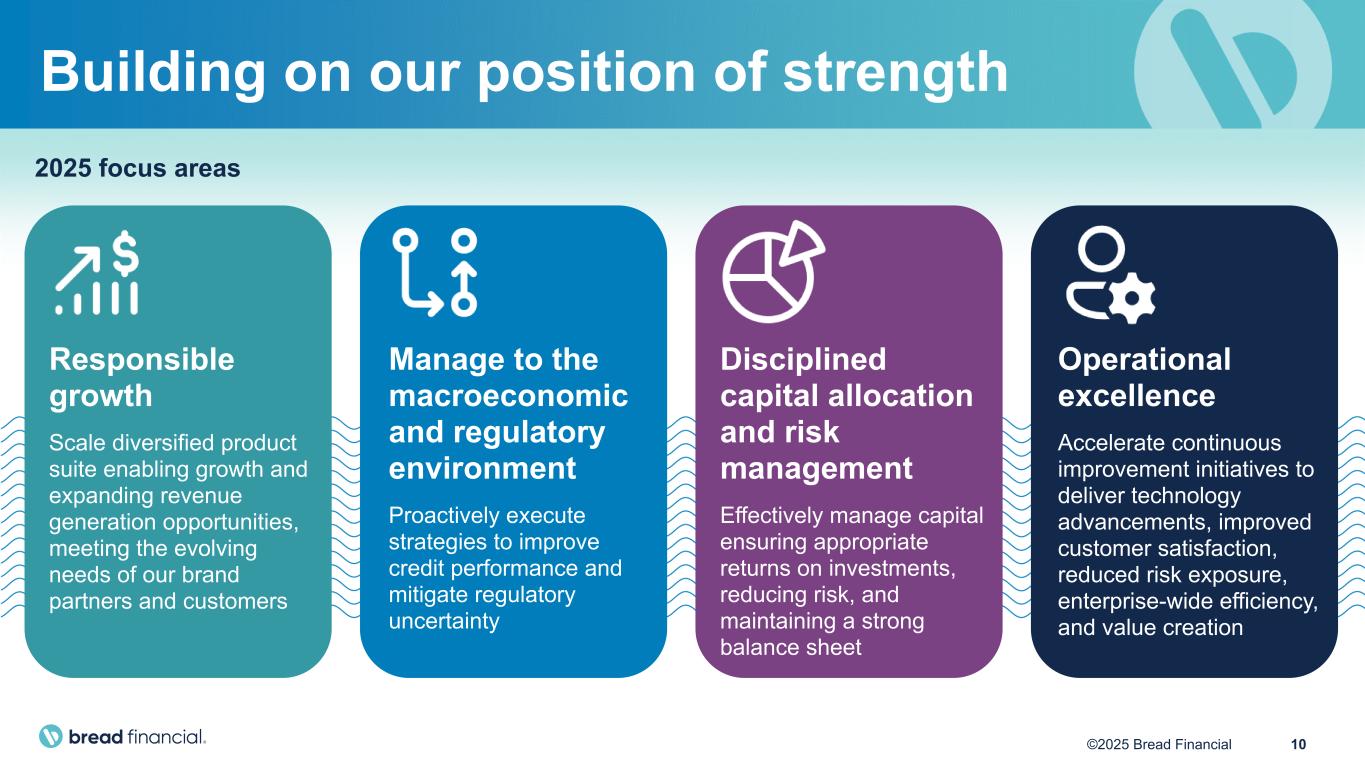
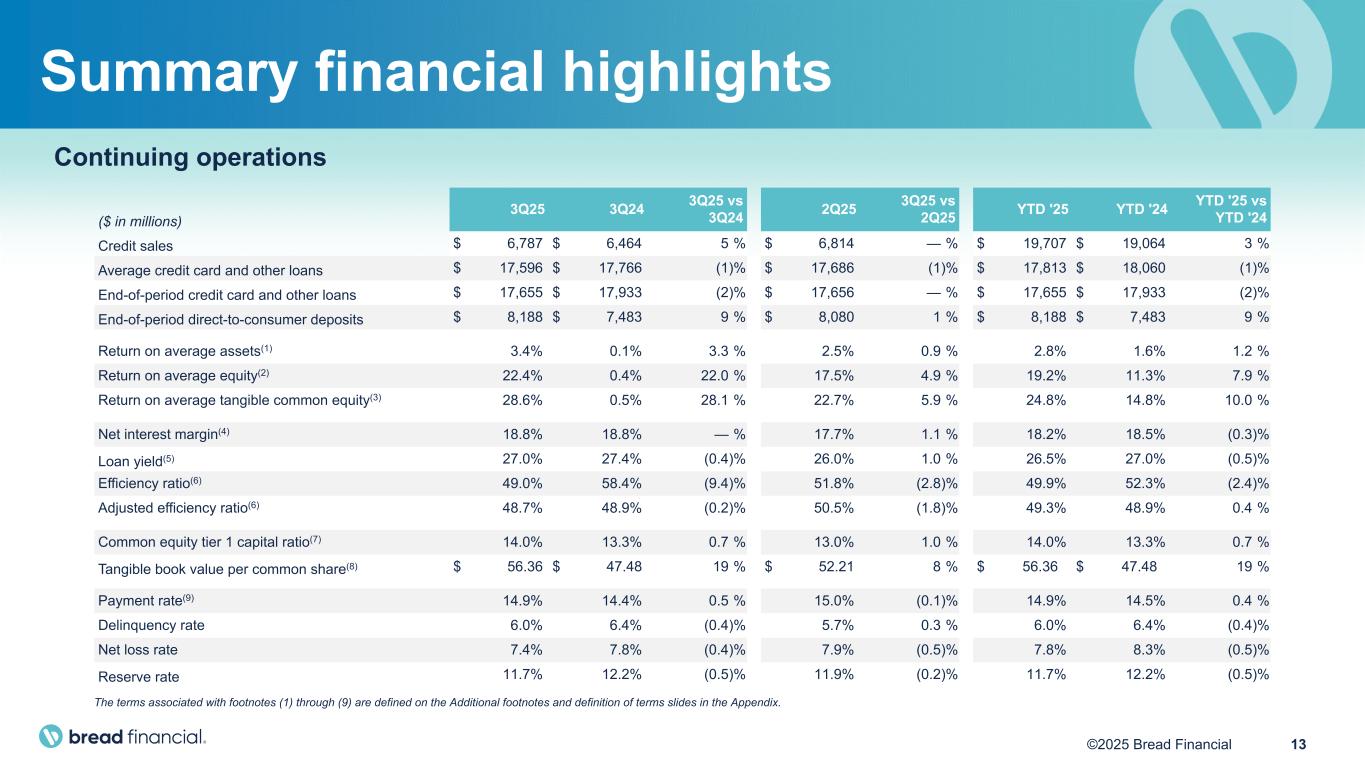
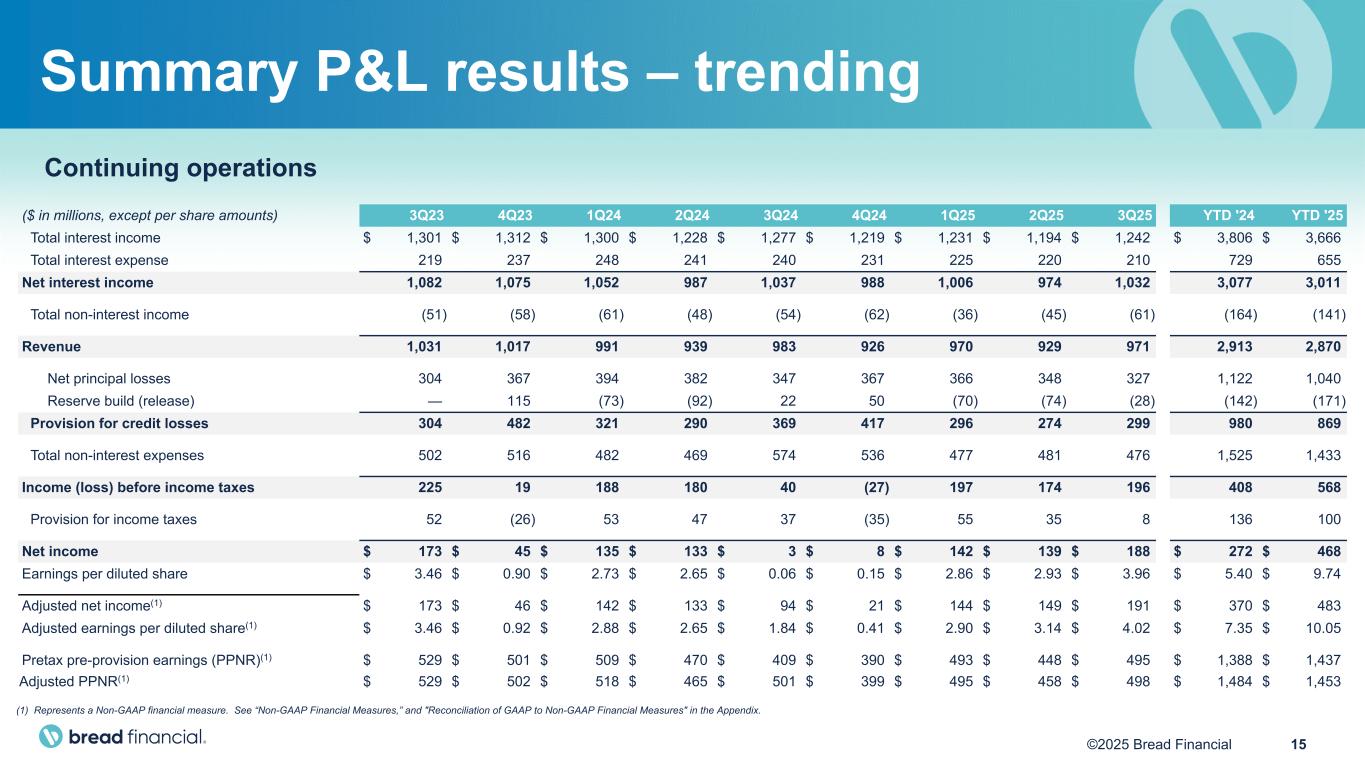
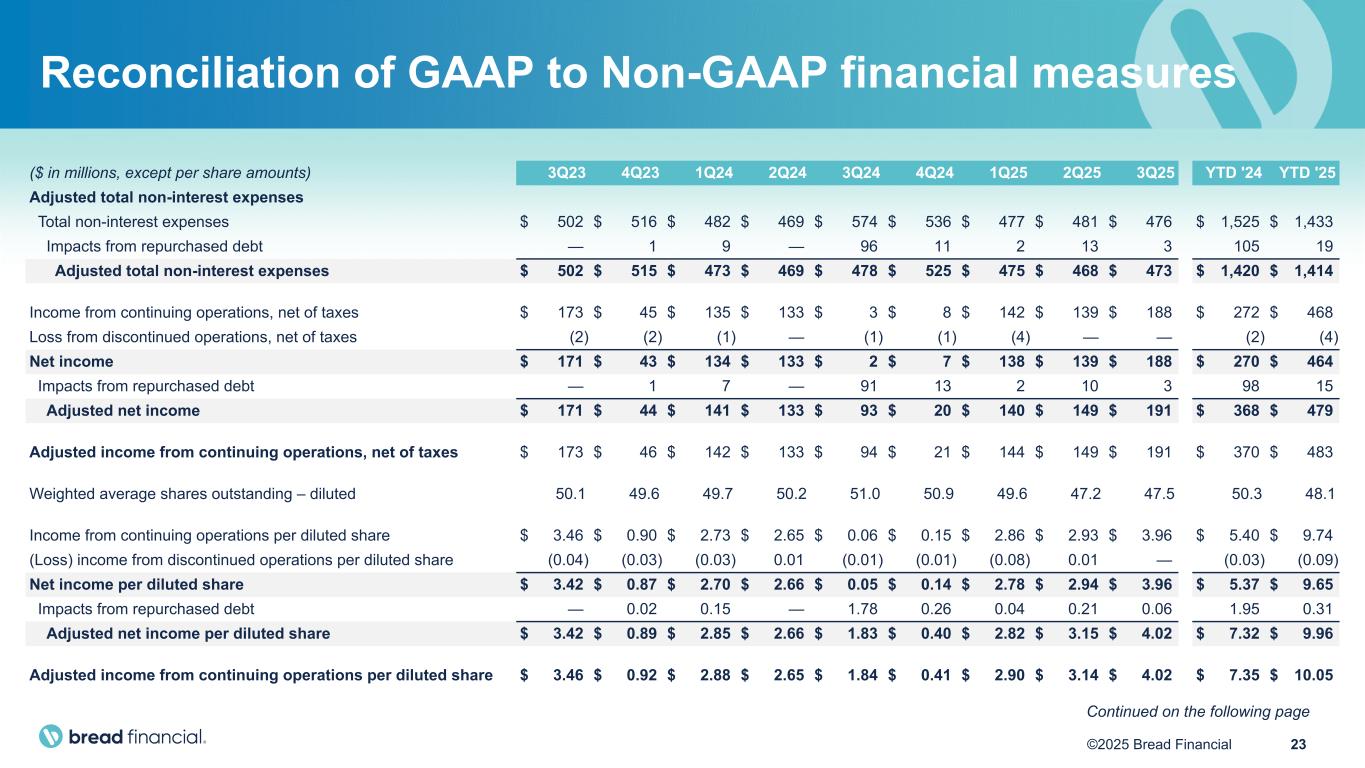
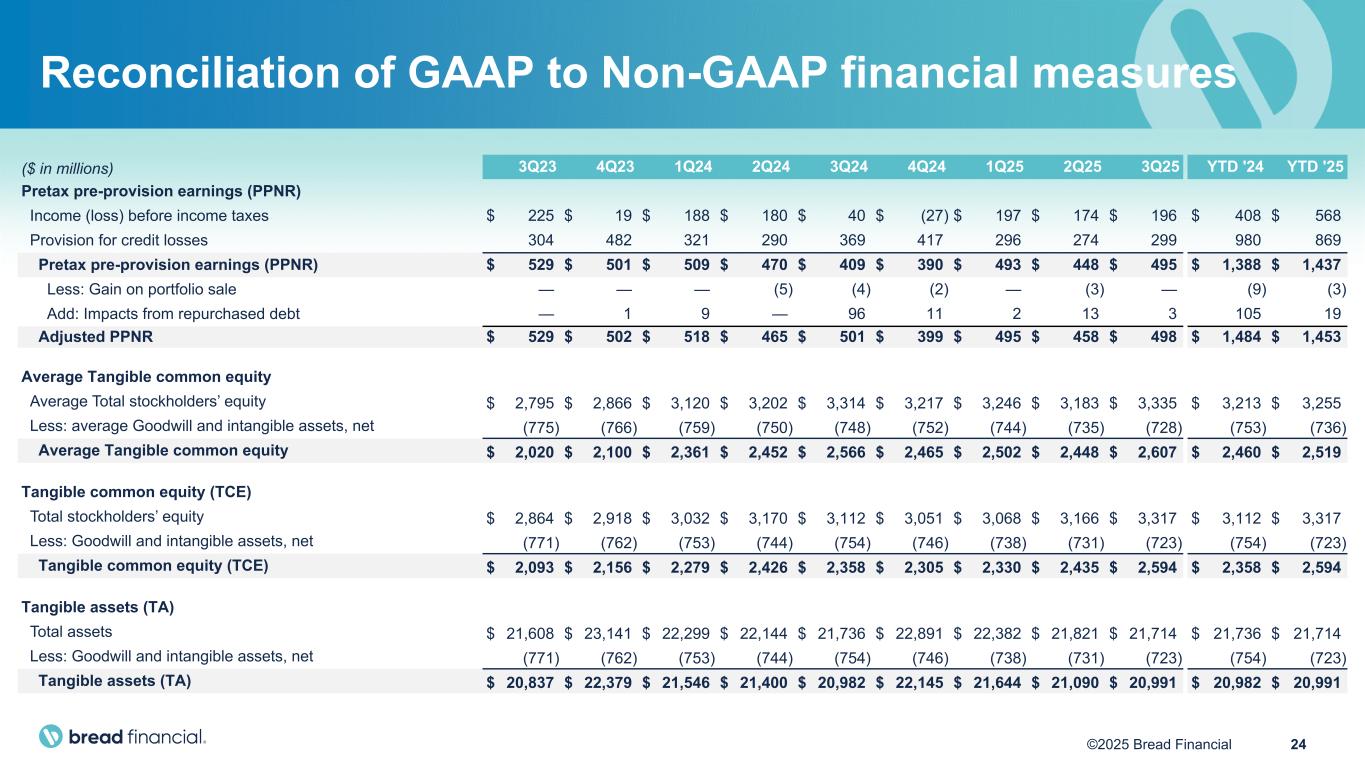
Thank you, Brian, and good morning to everyone joining the call. Today, Bread Financial reported strong third quarter 2025 results. We delivered net income of $188 million, adjusted net income and earnings per diluted share of $191 million and $4.02, excluding the $3 million post-tax impact from expenses related to repurchase debt in the quarter. Our tangible book value per common share grew by 19% year-over-year to $56.36. Our return on average tangible common equity was 28.6% for the quarter. Consumer financial health remained resilient in the third quarter as evidenced by strong credit sales, a higher payment rate as well as lower delinquencies and losses. Credit sales increased 5% year-over-year in the face of ongoing inflationary concerns, a slowing yet stable job market, and continuing weak consumer sentiment. The improvement was driven by strong back-to-school shopping early in the quarter with notable improvement in apparel and beauty. Additionally, purchase frequency increased and spending trends improved across all consumer segments. Amidst these favorable results, we continue to monitor changes in monetary and fiscal policies, including tariff and trade policies and their potential impacts on consumer spending and employment. Overall, a positive year-over-year credit sales trend and gradual improvement in our credit metrics give us confidence in our outlook as we enter the final quarter of the year. Given current credit trends and slightly better-than-expected performance of our net loss rate year-to-date, we expect that we will be at the low end of our full-year outlook range of 7.8% to 7.9%. While the net loss rate remains elevated compared to historic levels, the improving loss rate and delinquency rate trends are encouraging. As I mentioned earlier, we will continue to closely monitor consumer health, purchasing and payment patterns, and adjust our credit strategies accordingly to achieve industry-leading risk-adjusted returns. More broadly, we have remained consistent in our full-year financial outlook as we continue to navigate market volatility. Our expectations around the health of the consumer have not materially changed. We have maintained our long-term focus on responsible growth and executing our business strategy. Given the actions we have taken over the past 5-plus years, we are well positioned to achieve our long-term financial targets and anticipate increasing shareholder value over time. Our focus on expense discipline and operational excellence continues to produce desired results as adjusted total noninterest expense was down 1% year-over-year despite continued technology-related investments, inflation, and wage pressures. We will continue to invest in technology modernization, digital advancement, artificial intelligence solutions, and product innovation that will drive future growth and efficiencies. Considering the progress we have made, we are confident in our ability to achieve full-year positive operating leverage, excluding the impacts of repurchase debt and any portfolio sale gains. With our CET1 ratio at the top of our targeted range of 13% to 14%, we initiated the $200 million share repurchase program that the board approved in August, repurchasing $60 million during September and into October. This morning, we announced a board-approved $200 million increase to our share repurchase authorization. We also announced a 10% increase to our quarterly cash dividend, which is now $0.23 per common share with the goal of increasing our dividend annually as we see growth in our book value. These actions, along with our proven strong capital and cash flow generation, underscore our ability to execute all of our capital and growth priorities concurrently, providing a solid runway to deliver additional value to our shareholders. Moving to our new business activity, during the quarter, we expanded our home vertical foothold by signing new brand partners, including Bed Bath & Beyond, an e-commerce retailer with ownership interest in various retail brands; Furniture First, a national cooperative buying group that serves hundreds of independent home furnishings and bed retailers across the U.S.; and Raymour & Flanigan, the largest furniture and mattress retailer in the Northeast and the seventh largest nationwide. These new signings provide expanded opportunity for profitable growth going forward. We will continue to leverage our full product suite and omnichannel customer experience to extend category leadership in existing industry verticals while expanding into new verticals. Strategically, our vertical and product expansion efforts continue to have a positive impact on both risk management and income diversification across our portfolio. Finally, as released last week, we are pleased to have earned a credit ratings upgrade and positive outlook from Moody's, recognizing the progress we have made in strengthening our financial resilience and enterprise risk management framework. In summary, we are pleased with our third quarter results. Our financial performance reflects steady progress in executing our strategic priorities and our ongoing commitment to return value to shareholders, including in the form of increased dividends and share repurchases. Now I will pass it over to Perry to review the financials in more detail.
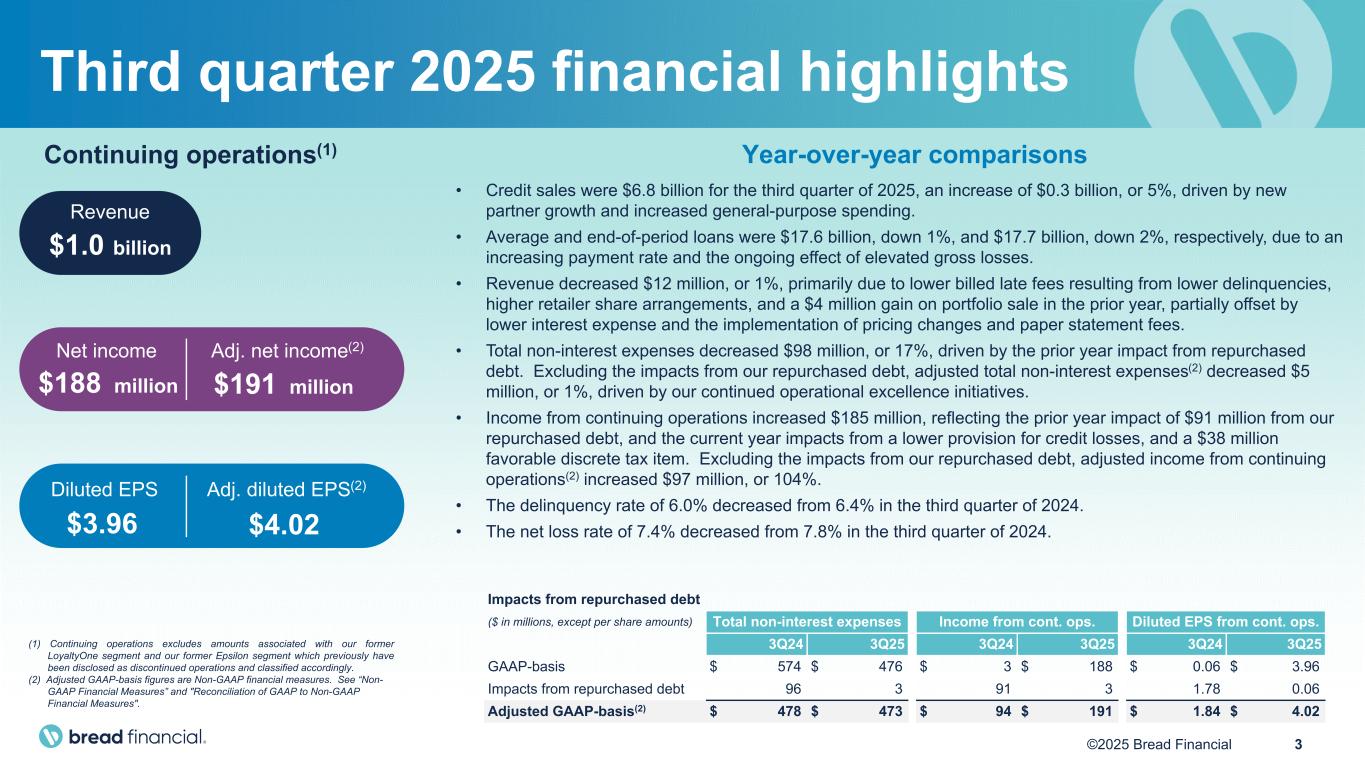
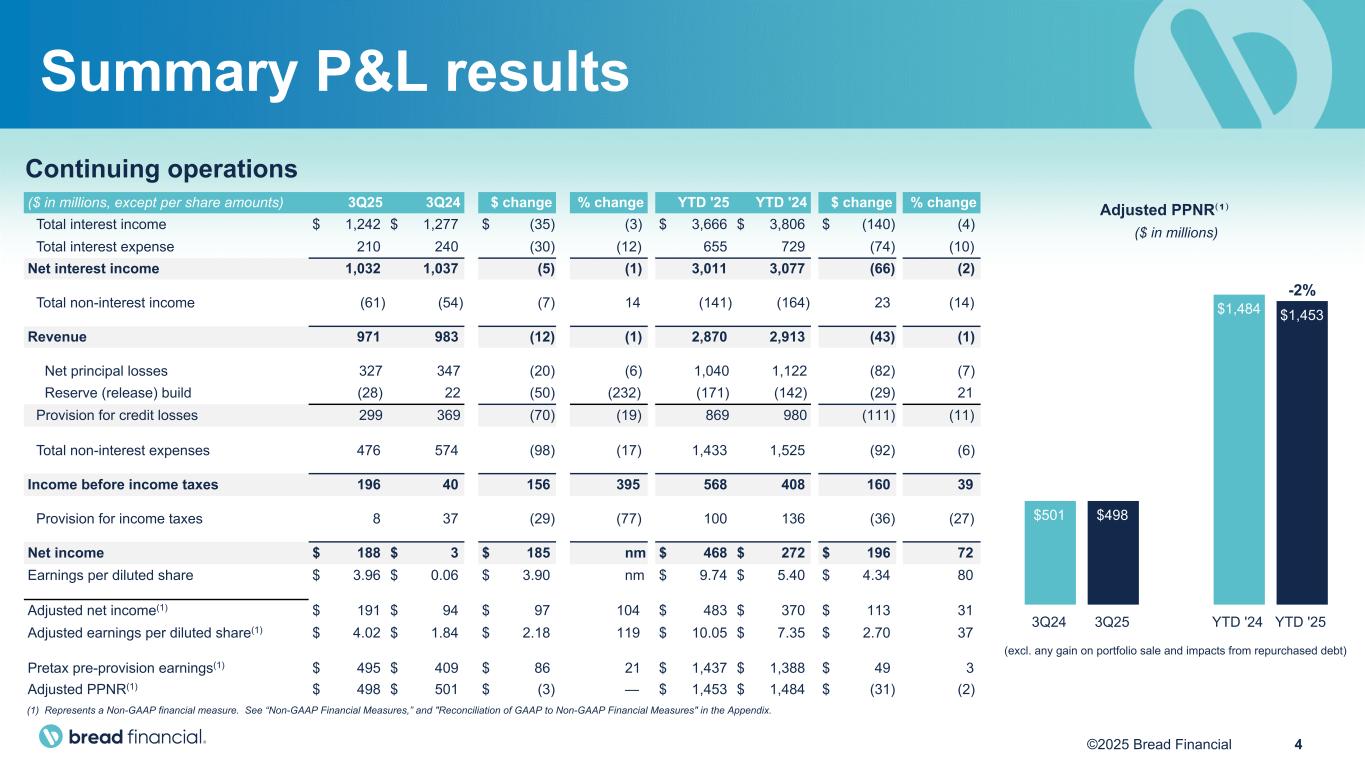
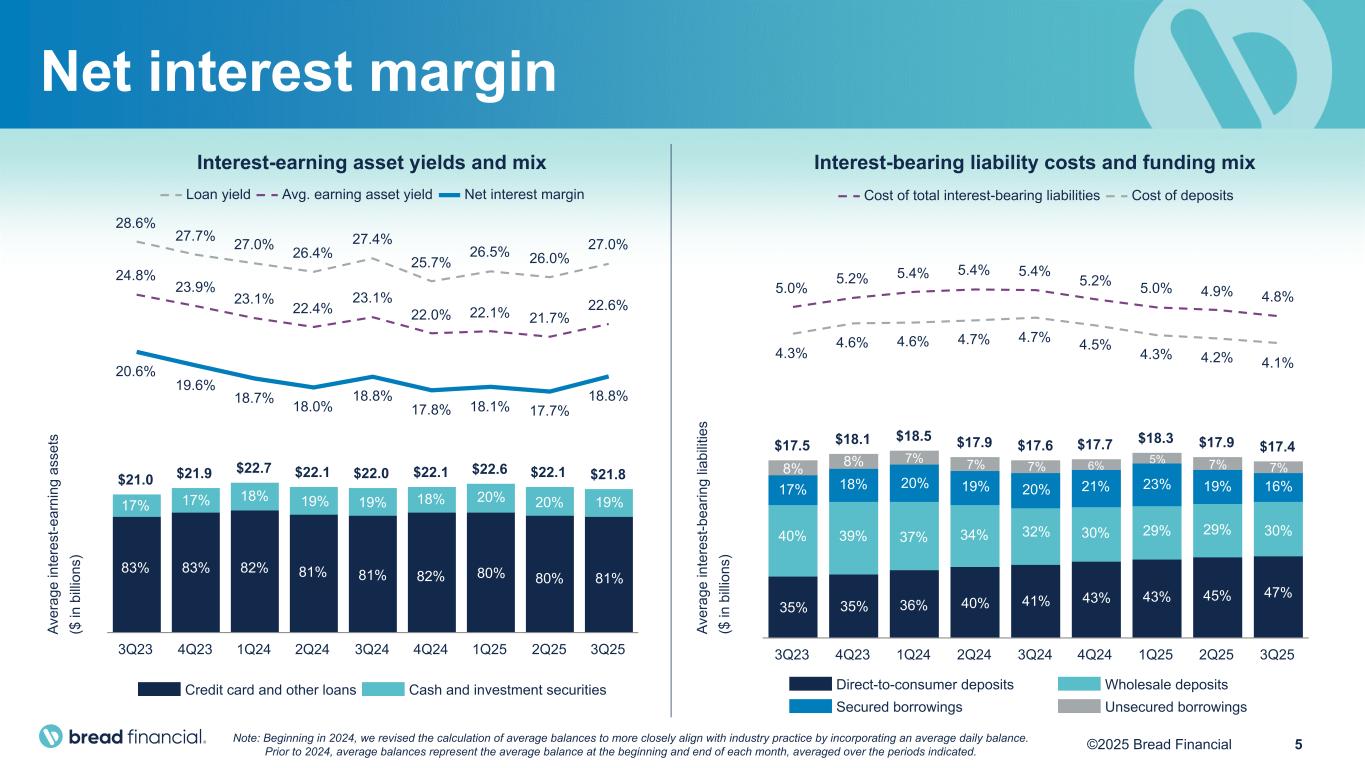
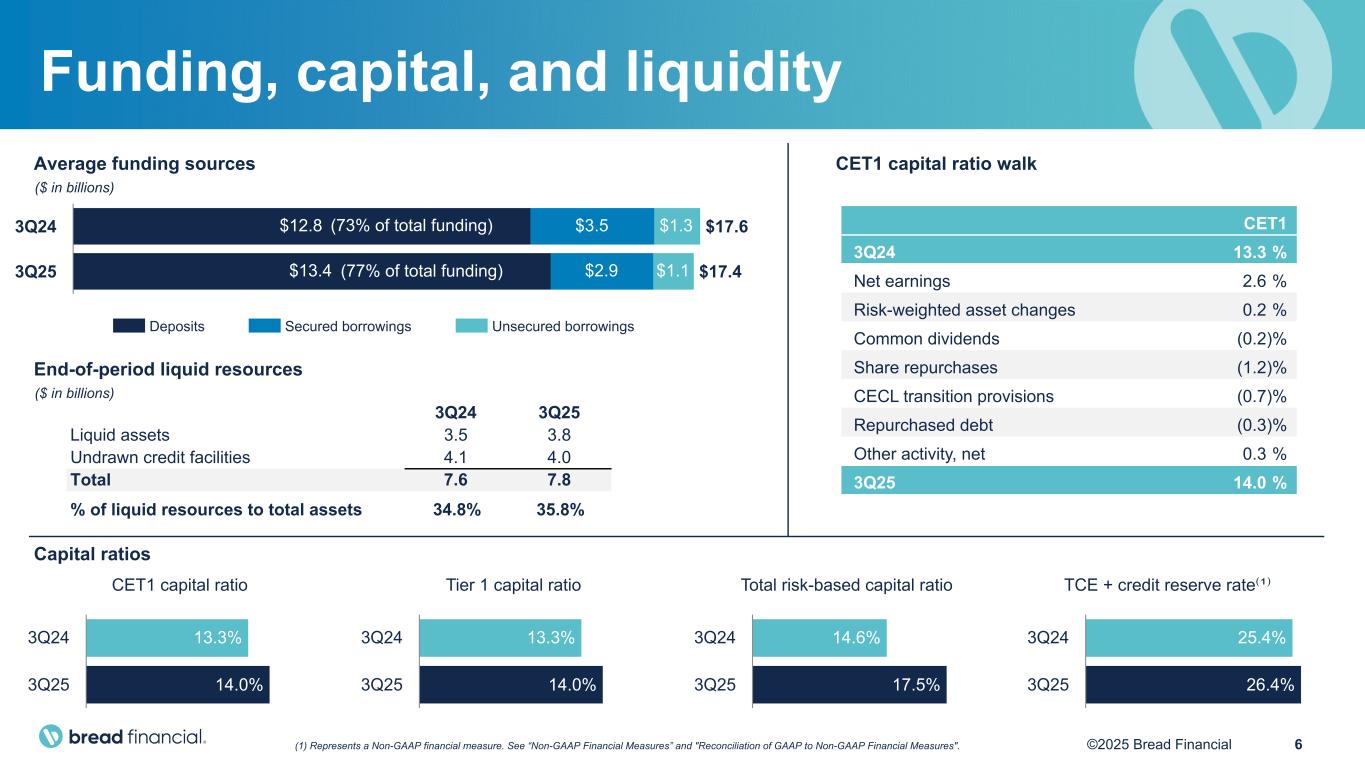
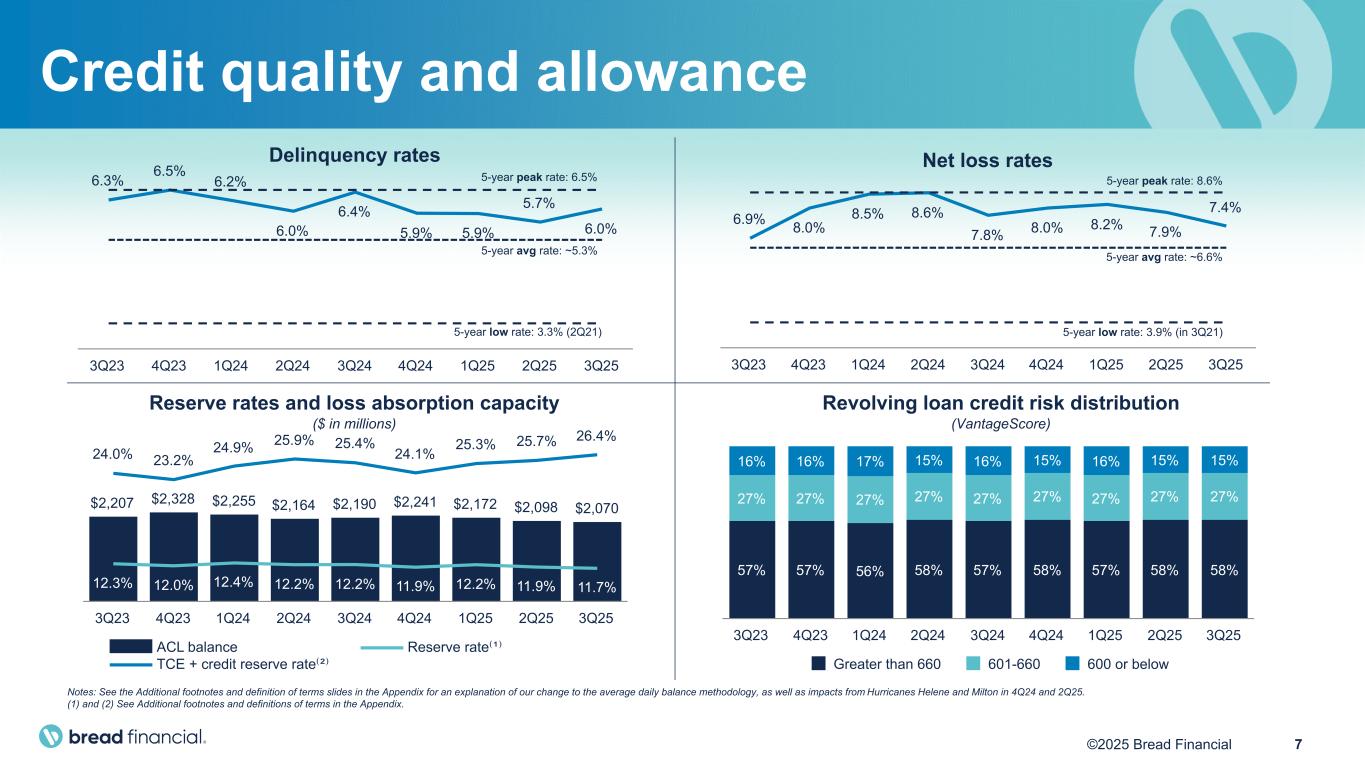
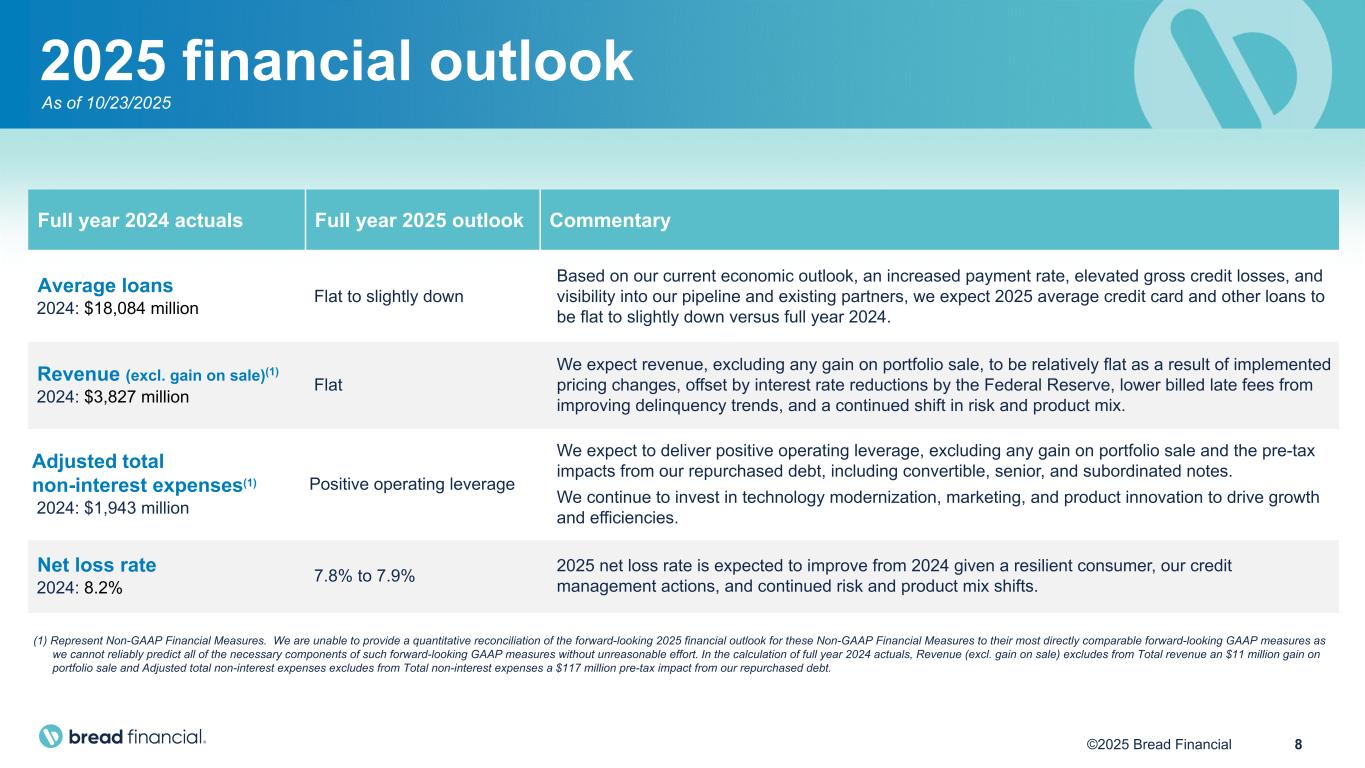
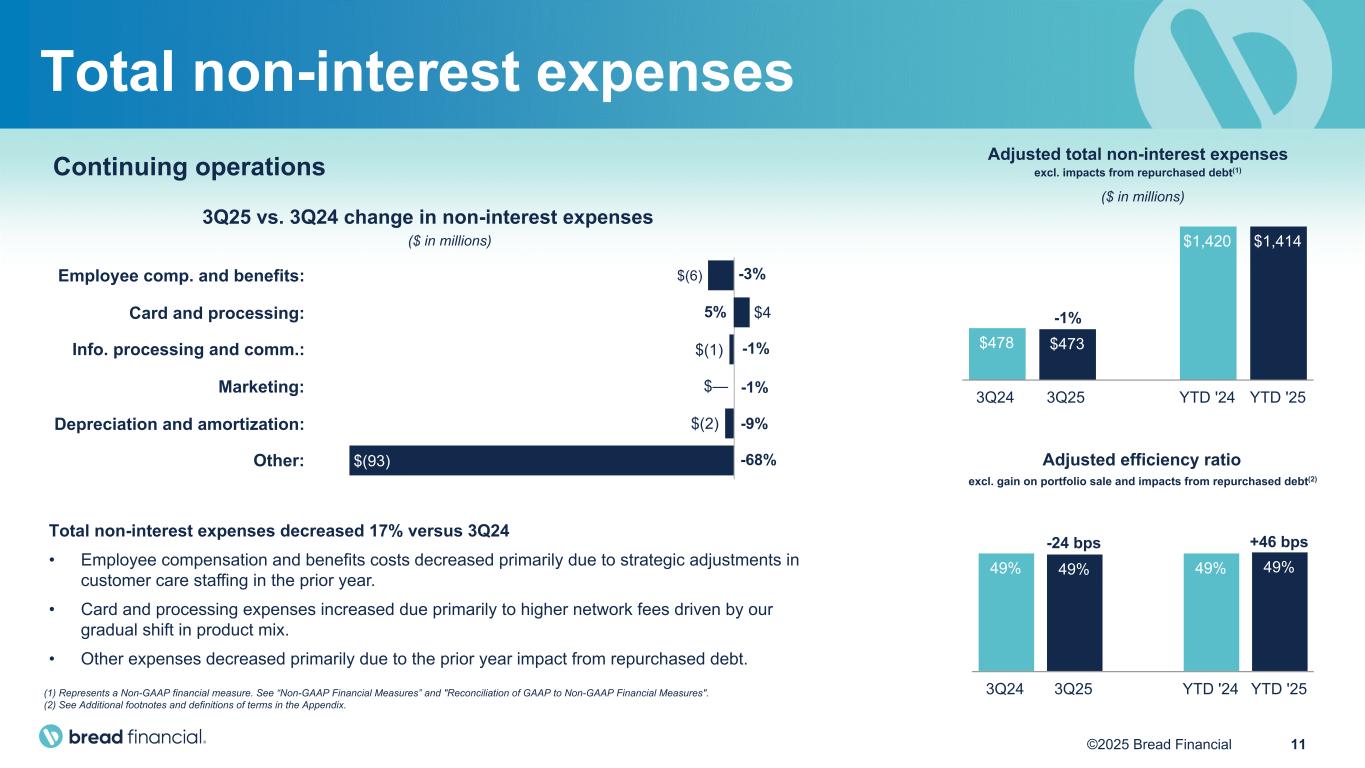
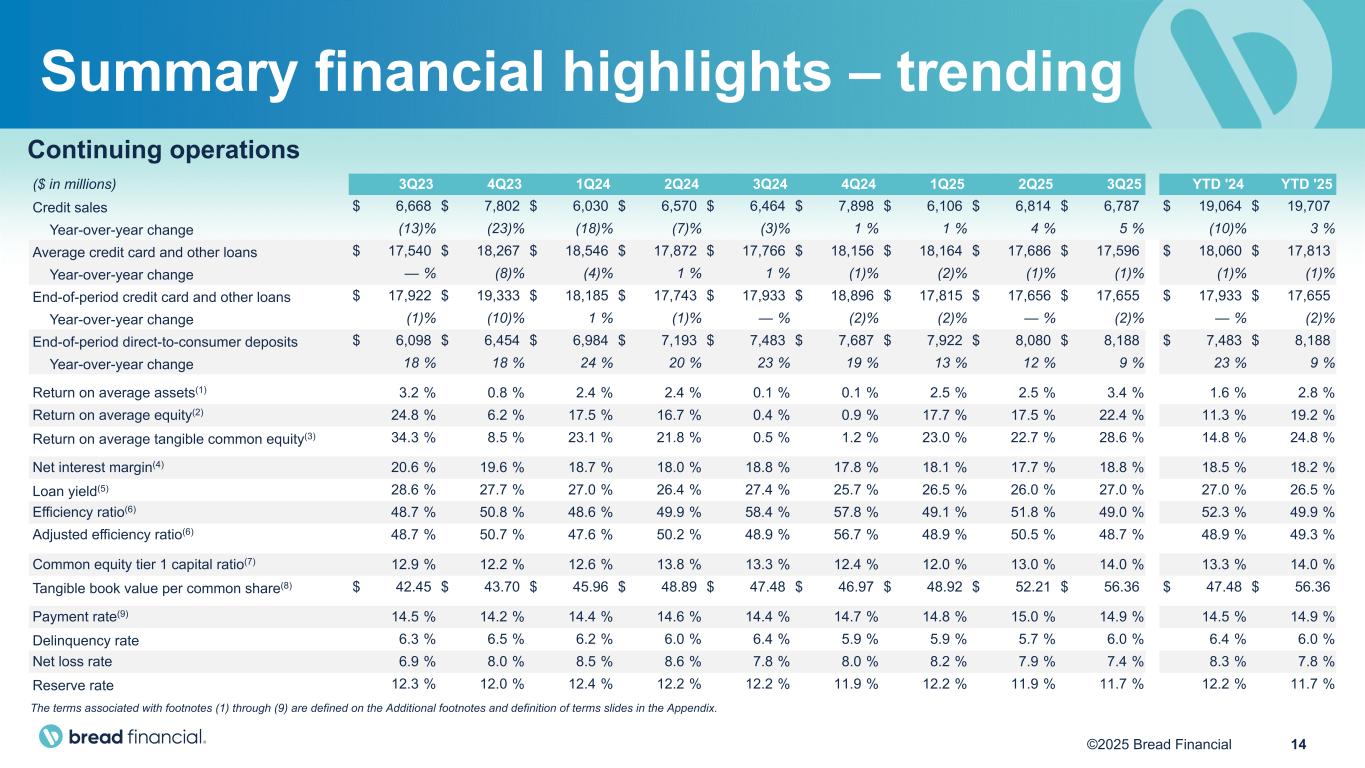
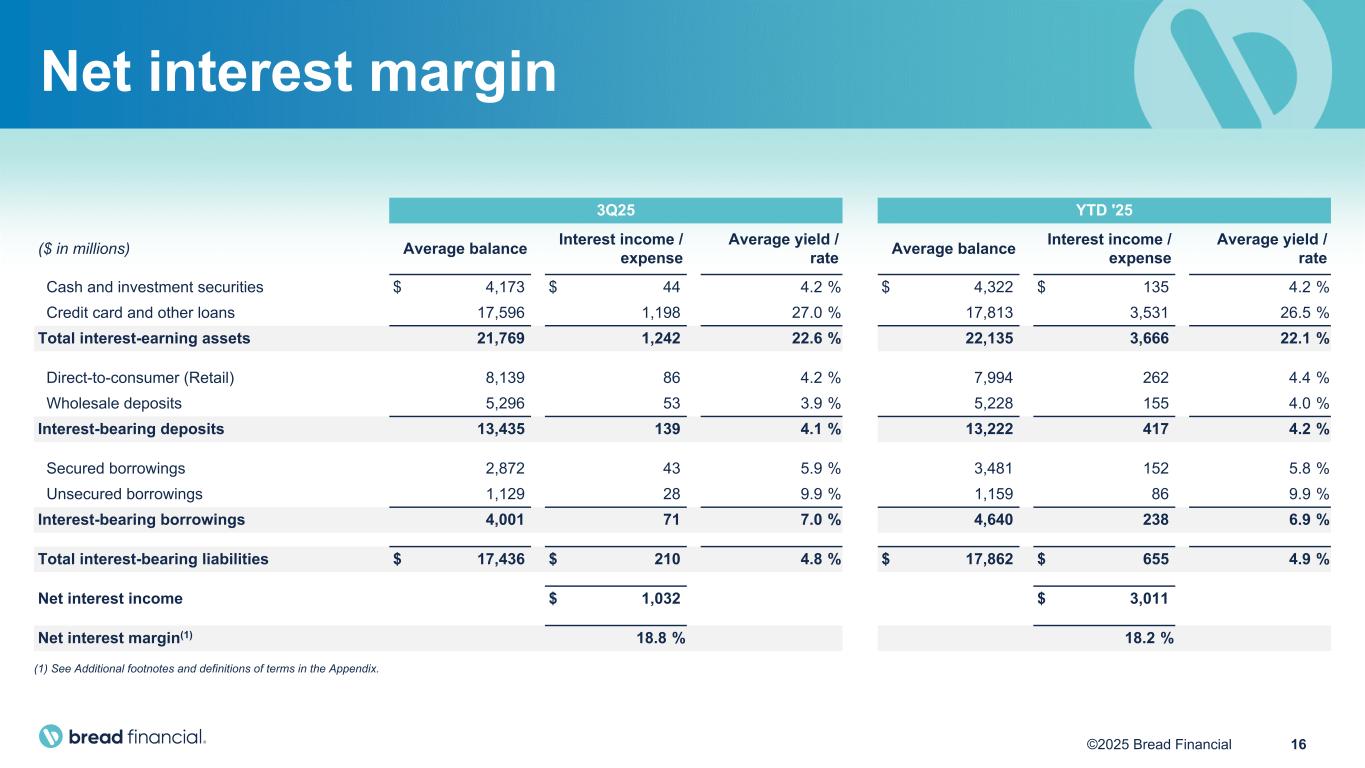
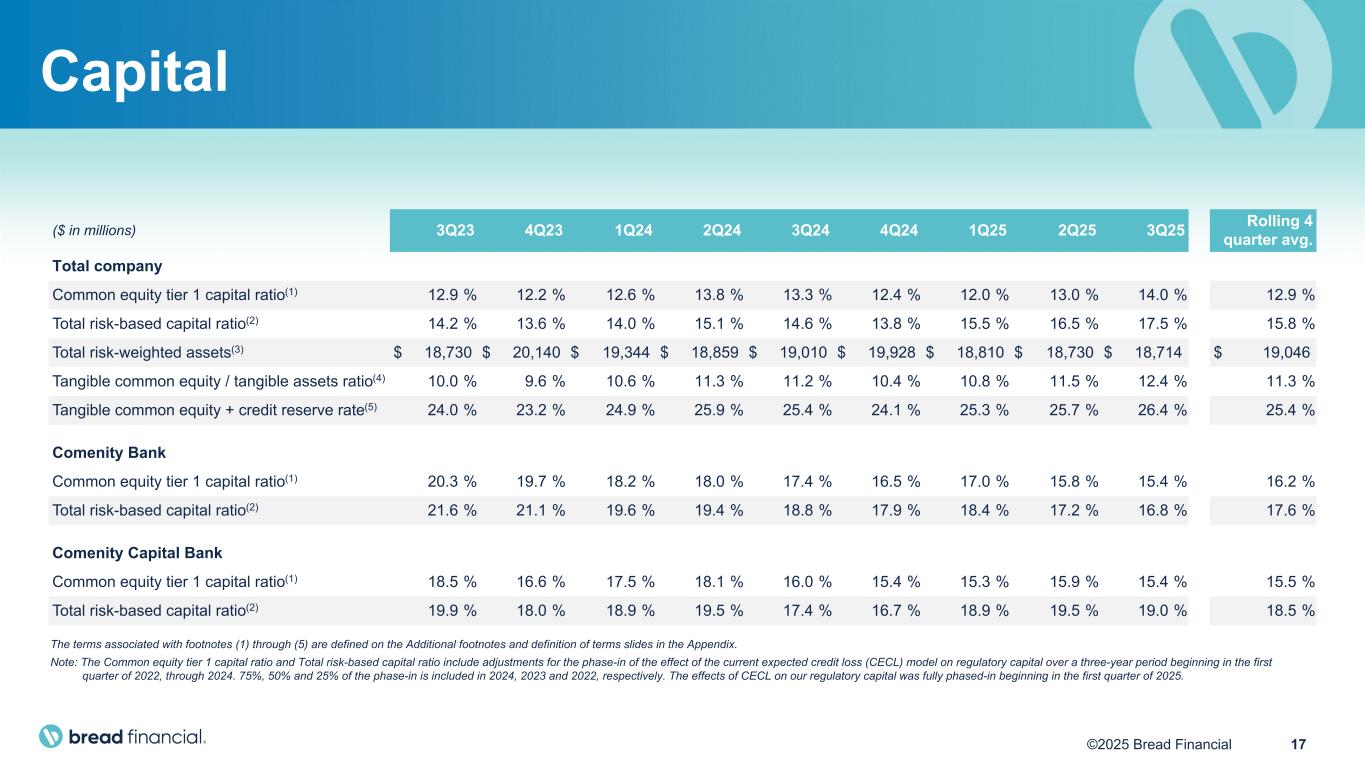
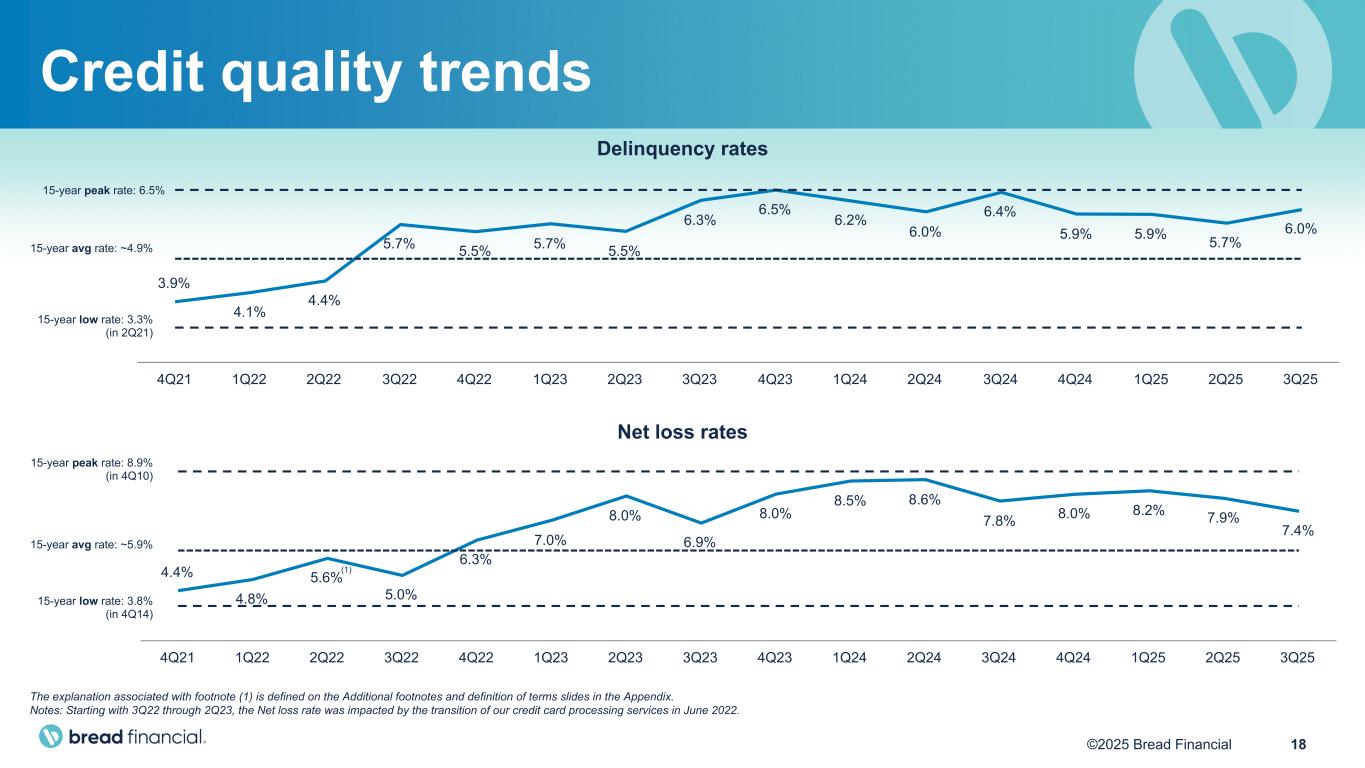
Thanks, Ralph. Slide 3 highlights our third quarter performance. During the quarter, credit sales of $6.8 billion increased 5% year-over-year even with the anniversary of the Saks portfolio addition in late August 2024. The increase was driven by new partner growth and higher general-purpose spending. As Ralph mentioned, we saw strong back-to-school shopping in the early part of the quarter, with sales growth moderating in the latter part of the quarter. Average loans of $17.6 billion decreased 1% year-over-year. Higher payment rates, coupled with the ongoing effect of elevated gross credit losses, pressured loan growth. In line with lower average loans, revenue was down 1% year-over-year to $971 million. Our revenue growth was also impacted by lower billed late fees resulting from lower delinquencies, higher retailer share arrangements, RSA with partial offsets, including lower interest expense and our ongoing implementation of pricing changes and paper statement fees. Total noninterest expenses decreased by $98 million attributed to the prior year impact from repurchase debt. Excluding the impacts from our repurchase debt, adjusted total noninterest expenses decreased $5 million or 1% driven by our continued operational excellence efforts. Income from continuing operations increased by $185 million, reflecting the prior year post-tax impact from repurchase debt of $91 million and the current year impact from a lower provision for credit losses, and a $38 million favorable discrete tax item. Excluding the impacts from our repurchase debt, adjusted income from continuing operations increased $97 million or 104%. Looking at the financials in more detail on Slide 4, total net interest income for the quarter decreased 1% year-over-year, resulting from a combination of a decrease in billed late fees due to lower delinquencies as well as a gradual shift in risk and product mix leading to a declining proportion of private label accounts, which generally have higher interest rates and more frequent fee assessments. These headwinds were partially offset by lower interest expense, the gradual build of pricing changes, and an improvement in the reversal of interest and fees related to improving gross credit losses. Noninterest income was $7 million lower year-over-year, driven by higher retailer share arrangements, partially offset by paper statement fees. Looking at the total noninterest expense variances, which can be seen on Slide 11 in the appendix, employee compensation and benefits costs decreased $6 million as a result of our continued focus on operational excellence. Card and processing expenses increased $4 million, primarily due to higher network fees driven by our gradual shift in product mix. Other expenses decreased $93 million, primarily due to the prior year impact of repurchase debt. Looking ahead, we anticipate a typical seasonal increase in fourth quarter expenses sequentially from the adjusted third quarter expenses due to increased holiday-driven transaction volume, higher planned marketing expenses, and higher expected employee compensation and benefits costs. Adjusted pretax preprovision earnings or adjusted PPNR, which excludes gains on portfolio sales and impacts from repurchase debt, were nearly flat year-over-year. Turning to Slide 5, both loan yield of 27.0% and net interest margin of 18.8% were higher sequentially following seasonal trends. Net interest margin was flat year-over-year. A number of variables continue to impact our NIM, including the drivers I noted on the prior slide, as well as an elevated cash position and changes in Fed rates. Given continued improvement in payment rate and delinquency rate trends, we anticipate lower billed late fees for the remainder of the year to pressure NIM, while the gradual benefit from pricing changes will continue to be realized over time. On the funding side, we are seeing costs decrease as savings accounts and new term CD rates decline. During the quarter, we completed a $31 million tender offer for our senior and subordinated notes using excess cash on hand to reduce higher-cost debt, which also improved our cost of funds. Direct-to-consumer deposit growth remained steady year-over-year, ending the quarter with $8.2 billion in direct-to-consumer deposits, further improving our funding mix. Direct-to-consumer deposits accounted for 47% of our average funding, up from 41% a year ago. Moving to Slide 6, optimizing our funding, capital, and liquidity levels continues to be a key strategic initiative. As history shows, we will be opportunistic in evaluating and executing plans to continue to enhance our structure. Along those lines, as Ralph mentioned, we are proud to have earned a credit ratings upgrade from Moody's to Ba2 while maintaining a positive outlook. This was a result of the actions we have taken to improve our capital and funding profiles along with our improved enterprise risk management framework and strong financial performance. Our liquidity position remains strong. Total liquid assets and undrawn credit facilities were $7.8 billion at the end of the quarter, representing 36% of total assets. At quarter end, deposits comprise 77% of our total funding, with the majority being direct-to-consumer deposits. Shifting to capital, we ended the quarter with a CET1 ratio of 14.0%, up 100 basis points sequentially and up 70 basis points compared to last year. Our CET1 ratio has benefited by 260 basis points from core earnings. Common dividends and the repurchase of $234 million in common shares over the past year impacted our capital ratios by 146 basis points. Additionally, the last CECL phase-in adjustment occurred in the first quarter of 2025 and resulted in a 73 basis point reduction to our ratios, and the impact from repurchase debt accounted for approximately 30 basis points of adjustment to CET1 since the third quarter of 2024. Finally, our total loss absorption capacity comprising total company tangible common equity plus credit reserves ended the quarter at 26.4% of total loans, a 70 basis point increase compared to last quarter, demonstrating a strong margin of safety should more adverse economic conditions arise. We have a proven track record of accumulating capital and generating strong cash flow through challenging economic environments. We have demonstrated our commitment to optimizing our capital structure through the issuance of subordinated debt and the return of capital to shareholders. We will continue to opportunistically optimize our capital structure, which includes potentially issuing preferred shares in the future. Our commitment to prudently returning capital to shareholders is evidenced by today's board-authorized announcements of both a 10% increase in our common share dividend and an additional $200 million share repurchase authorization. This $200 million increase to our existing repurchase authorization in combination with unused capacity under the previous authorization means we have approximately $340 million available for share repurchases at this time. We are well positioned from a capital, liquidity, and reserve perspective, providing stability and flexibility to successfully navigate an ever-changing economic environment while delivering value to our shareholders. Moving to credit on Slide 7, our delinquency rate for the third quarter was 6.0%, down 40 basis points from last year and 20 basis points sequentially, which was slightly better than normal seasonal trends. Our net loss rate was 7.4%, down 40 basis points from last year and down 50 basis points sequentially. Credit metrics continue to benefit from our multiyear credit tightening actions, ongoing product mix shift, and general stability in the macroeconomic environment. We anticipate the October and fourth-quarter net loss rates will increase sequentially following typical seasonal trends. The third quarter reserve rate of 11.7% at quarter end showed a 50 basis point improvement year-over-year and 20 basis points sequentially as a result of our improving credit metrics and higher quality, new vintages. We continue to maintain prudent weightings on the economic scenarios in our credit reserve model, and given the wide range of potential economic outcomes, we expect the reserve rate to decline at year-end before increasing again in the first quarter of 2026 following normal seasonality. As mentioned, our disciplined credit risk management and ongoing product diversification has continued to benefit our credit metrics. Our percentage of cardholders with a 660-plus prime score increased 100 basis points year-over-year to 58%, in line with our expectations. However, macroeconomic uncertainty persists with inflation above the Fed's target rate, evolving trade and government policy impacts to both inflation and labor, and continued low consumer sentiment. As a result, we continue to actively monitor these trends while remaining vigilant with our credit strategies. But at this point, we do anticipate a continued gradual improvement in the macroeconomic environment. Turning to Slide 8 and our full-year 2025 financial outlook, overall, our results have trended in line with our expectations, and our outlook remains unchanged from the previous quarter. We continue to expect average loans to be flat to slightly down. Our outlook for total revenue, excluding gains on portfolio sales, is anticipated to be roughly flat versus 2024. We continue to expect to generate full-year positive operating leverage in 2025, excluding portfolio sale gains and the pretax impact from our repurchase debt. Our results underscore our ability to deliver operational excellence and maintain expense discipline while investing in the business. Given the continued gradual improvement in our credit metrics, we are confident that we can deliver a full-year net loss rate in our guided range of 7.8% to 7.9%. As Ralph mentioned, based on current trends, we expect to come in towards the lower end of that range. Finally, with the $38 million favorable discrete tax item in the quarter, we have adjusted our full-year effective tax rate guidance to 19% to 20%. While there is variability, we would anticipate future years to align more closely with our historical target effective tax rate range of 25% to 26%. Overall, our third quarter results underscore the financial resilience and strong return profile of our business model. We remain confident in our ability to achieve our 2025 financial targets and to deliver strong long-term returns. Operator, we are now ready to open up the lines for questions.
Operator
Our first question comes from Sanjay Sakhrani with KBW.
Speaker 4
It sounds like you're seeing constructive trends across the portfolio. And I'm sure you've heard of some of the concerns on some cracks we've seen in consumer credit across some lenders and subprime. I'm just curious, as you've looked across your portfolio, have you seen any signs of weakness? Obviously, it seems like things are trending in the right direction. And then maybe, Perry, just related to that, maybe just the progression of the reserve rate and the loss rate as we go forward if things are stable?
Yes, Sanjay, thank you for your question. It’s important to start with a quick overview of the macro environment, which, at least through Q3, has shown surprising resilience in consumer and macro metrics. Unemployment and inflation have only changed slightly from the previous quarter, indicating a stable macro environment. However, there are concerns as consumers seem anxious about the future, which is reflected in significantly lower consumer confidence and sentiment compared to last year. Moving forward, the situation largely depends on Federal Reserve policy and its impact on inflation, especially as tariffs and labor conditions evolve. Within our own portfolio, we are observing steady gradual improvement across all segments. We primarily cater to prime customers, with some near-prime, and we’re experiencing good stability overall. Currently, we are not noticing any major weaknesses, which is reassuring. The entry rates for delinquency are better than they were before the pandemic, and we've started to see improvements in later stage roll rates. While macro factors will play a crucial role, our credit strategies and the shifts in risk mix are beginning to show positive results. Regarding the reserve rate and loss rate, I’ll follow up on that.
Speaker 4
Please, I'd love to advance for that.
Yes. So as it relates to the reserve rate, the only thing that drove the change this quarter was credit quality improving. So as the credit quality improves, that's the core input into it. So the loans we have on the books, similar to last quarter, that's all it was. The macro inputs quarter-to-quarter, very similar. That didn't really drive any change in the reserve rate. And we kept our credit risk mix and overlays exactly as it was last quarter. So that, as you look forward, as we have more confidence in how the current policies the government are going to play forward, I think you'll start to see us be able to shift back off of those adverse and severely adverse scenarios to get into more of a balanced weighting, and that will be a tailwind to the reserve rate coupled with continued improvement that we expect to see in our overall credit metrics as it pushes through into next year.
Speaker 4
Okay. That's great. That's encouraging. And I guess, like as a follow-up to that, I know there's this push and pull between loan growth and credit quality. But I'm just curious, as we think ahead, knowing what we know right now, do you envision loan growth picking up as we move into next year? And maybe you could just talk about the portfolio acquisition opportunities to the extent there are any?
I'll ask Ralph to take that one.
It's great to hear from you, Sanjay. Looking at the bigger picture, we have observed credit sales increase by 5% for the quarter, indicating positive movement in credit. While there's still work to be done, we are actively signing new partners. Today, we announced three new partnerships, and our pipeline remains strong alongside a resilient consumer base. Payment rates are up, and fees have decreased. I prefer a healthy consumer when it comes to payment and credit matters. Given our growth and the stability in the macroeconomic environment, along with the addition of new partners, I believe we will see some loan growth moving forward. Thank you.
Operator
Our next question comes from Moshe Orenbuch with TD Cowen.
Speaker 5
Great. Maybe to just follow up on that and Perry a little bit. In terms of clearly, there's things going on in terms of kind of still temporary moves in payment rate. But if you think about the new mix of your card base, is there like a way to think about the ranges of if you had 5% growth in spend volume, what that would mean in loan growth once that phenomenon is kind of fully played out or what those normal gaps would be given we've got now a different kind of base, more of it being co-brand spending and the like?
Yes. I think you're asking a question that's really relevant. It depends on the mix of the business that comes on. I mean, you heard Ralph mention the new brand partners coming on in the home space. Those would typically be larger ticket probably a little bit lower payment rate, so that would have a mix effect. But then if you have more of a top-of-wallet co-brand card, that has a higher payment rate. So it's really going to be mix dependent on what we have on. So I don't think it's very easy to say that if you had 5% sales growth all through next year, that 80% of that translates into loan growth. But certainly, there's a factor on that, but it is going to be dependent on mix, and some of that is yet to be seen what that will look like as we get into next year.
Speaker 5
Okay. And maybe in terms of some of the commentary on the margin and the impacts of the pricing changes versus kind of lower billed late fees. Just given the way you think about the kind of the credit improvement, I guess, is there a way to kind of dimensionalize how long it's going to take for until you no longer have that or that build length fee kind of bottoms out? And so that the pricing changes actually will start to increase faster and outweigh that? Kind of any way to kind of dimensionalize that thing.
Yes, that's a great question. To consider the situation, the build late fees will clearly align with delinquency trends. We are all interested in how quickly delinquency stabilizes, leading us to the long-term average. That will be a leading indicator, and then within about six months, we can expect an improvement in the build, along with a reversal of build interest and fees. These factors may create some challenges due to lower build late fees tied to delinquency, but there is also a benefit from the improvements in gross loss. These elements interact with each other. Additionally, there is a shift in risk mix and product mix within the business, as adding more high-quality co-brand products often comes with slightly lower APRs and yields compared to private label. This is taken into account, along with ongoing pricing adjustments. There are many factors at play, along with recent reductions in the prime rate, since we are somewhat sensitive to asset changes. I wish I could pinpoint the ideal inflection point, but with all these dynamics, we will provide more guidance as we approach January, allowing us to have a clearer understanding of our perspective on the mix and how it relates to macroeconomic improvements as well as credit enhancements in the portfolio.
Operator
Our next question comes from Mihir Bhatia with Bank of America.
Speaker 6
I wanted to continue the discussion about credit sales and loan growth. How are you approaching credit sales in the fourth quarter and into 2026? You mentioned there was some moderation as the quarter progressed after a strong back-to-school season. Are we currently experiencing a slowdown before the holiday shopping season? What insights do you have regarding holiday shopping based on feedback from your retail partners?
Yes. We are currently seeing good growth in credit sales. The beginning of the quarter was strong due to back-to-school shopping, although September saw a slight moderation, which is still positive. October is showing a similar year-over-year increase. Different reports suggest that retailers will be quite aggressive in trying to attract customers, possibly starting early. Consumers are looking for discounts and promotions, and reward programs will be crucial in this effort. We've been impressed with how responsibly consumers are managing their budgets. During this time, they will seek deals to stretch their spending further. If retailers offer good deals early in the holiday season, I believe consumers will be inclined to spend. However, it may resemble past years when people would wait until the last minute to shop for great deals due to budget constraints. Ultimately, the outcome will depend on the inventory situation and how motivated retailers are to manage their stock.
Speaker 6
That's helpful. When I consider the interchange revenues, there has been a significant increase in that line item this quarter. Even when looking at it as a percentage of credit sales, could you discuss how you expect that line to trend? What do you anticipate will happen? I assume it relates to the RSAs and some high-ticket items. How should we think about that line item moving forward? What are your expectations?
Yes, forecasting net interest margin is quite challenging. Revenue share agreements are also difficult to predict due to the netting involved. As sales increase, the revenue share agreements will feel pressure due to partner compensation and loyalty funding. Additionally, when revenue shares decline, they can lead to a higher profit share with partners. This means there are sales-based rebates and various types of profit sharing to consider. Furthermore, reduced big-ticket purchases have impacted marketing development funds. If big-ticket sales recover in certain sectors, that could provide a positive influence. However, as spending rises, it also increases partner share and revenue share, leading to a lot of moving parts in this area.
Operator
Our next question comes from Jeff Adelson with Morgan Stanley.
Speaker 7
Just wanted to focus a little bit more on the pipeline and the signings you announced this quarter. It seems like the home vertical was more of a focus for you this quarter. Is that something you're looking to focus on here, maybe creating a little bit more of a network effect around the home area and launching a joint card like one of your competitors has? And then are there any other verticals you'd call out as areas of focus for you going forward? I mean you mentioned the healthy or the robust pipeline. So maybe just sort of focus on what's in the pipeline.
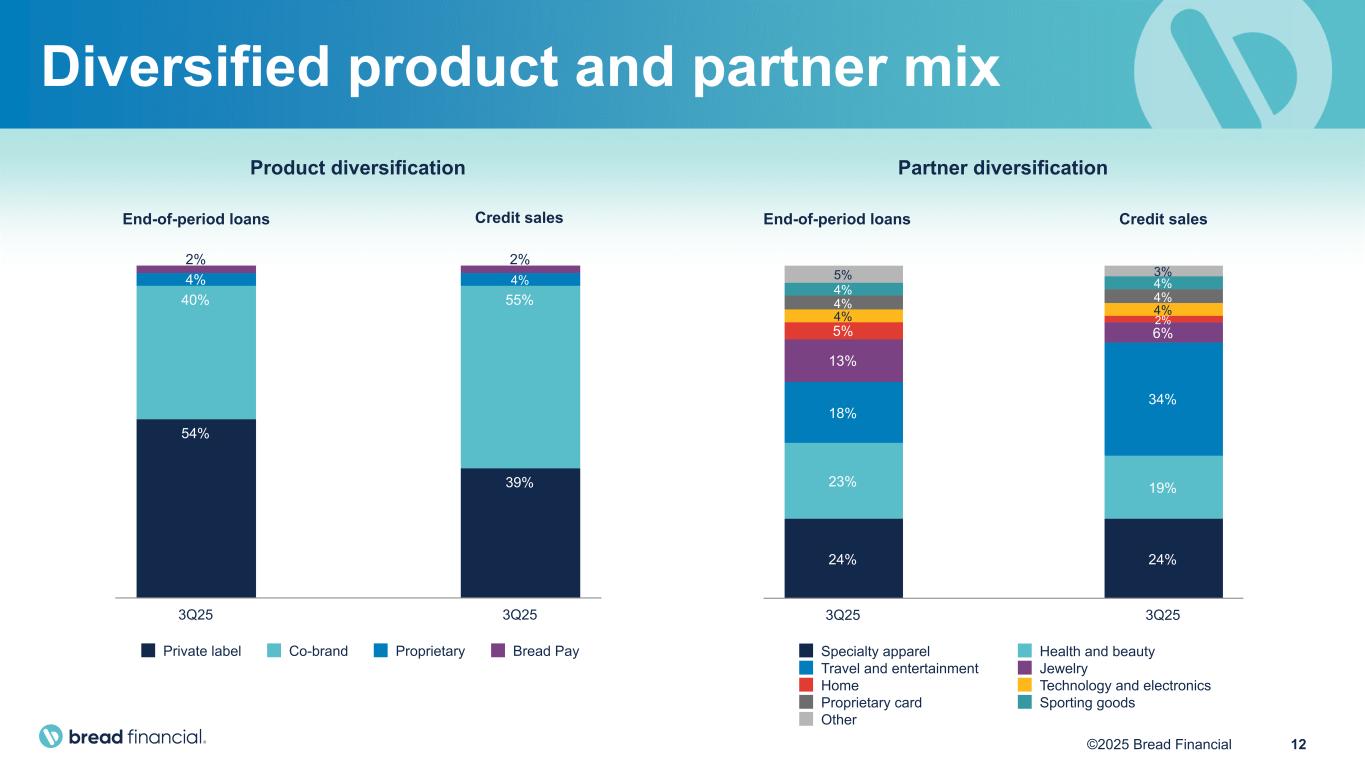
Thank you for the question. The home vertical is significant for us because it includes both essential and discretionary spending, such as home repairs and furniture. We see this vertical as very active and strong, and we plan to expand our efforts in this area moving forward, which is encouraging for us. We aim to be a leading player in this vertical, similar to our position in beauty and a few others. Overall, our portfolio is diversified, and we have reduced risks related to both products and industries. We are optimistic about the robust pipeline in these verticals and look forward to bringing in new partners within the home segment. Our travel vertical is performing well, and beauty remains a strong area for us. With our focus on home improvement and furnishings, we believe this vertical will also progress effectively. We are working to ensure that we are not overly reliant on any single vertical that may face challenges. In the past, downturns in areas like retail and apparel could impact us, but now we have insulated ourselves from such risks.
Speaker 7
Okay. Great. And maybe just a follow-up on capital return. You've been on a little bit of a roll here with the buyback authorizations. I guess just maybe any sort of way to think about like what needs to happen for you to move past this medium-term 13% to 14%? Is it just settling the preferred, maybe getting your credit rating up to investment grade? I think you're now a couple of notches away. And have you thought about maybe establishing a larger repurchase authorization? Or do you prefer to be a little bit more on the quarterly cadence or half-year cadence here?
Yes, that's a great question. As we consider our capital strategy, I want to emphasize that our capital priorities remain unchanged. We have consistently stated our commitment to funding responsible, profitable growth. Future capital authorizations or share repurchase decisions will be guided by the growth opportunities we see ahead. We will continue to invest in technology and enhance our capabilities to support our brand partners and customers, while ensuring we maintain robust capital ratios and return capital when appropriate. Currently, our binding constraint is CET1 in the range of 13% to 14%, which is our medium-term target. We reached the upper limit of this range this quarter, and we are optimistic about what lies ahead. It is crucial for us to have sufficient authorization in place to allow for capital flexibility, should we decide to optimize our capital structure. Regarding your question about reducing our binding constraint to the 12% to 13% range mentioned during our Investor Day as our long-term target, achieving this would likely involve introducing Tier 1 capital through preferred shares over time. However, a credit rating upgrade is not directly related to this; instead, it pertains more to what happens with senior debt and future financing linked to those ratings. We do not need to achieve an investment-grade rating to take capital actions.
Operator
Our next question comes from Reggie Smith with JPMorgan.
Speaker 8
I was looking through your slide deck, and my rough math has your BNPL sales volume up maybe 100%. That's probably a dirty calculation. But I guess there's a lot of investor interest in the BNPL space, certainly over the last couple of months. I was just curious, do you guys offer or have like a dual BNPL proprietary card today? And is there an opportunity there to kind of do more on that kind of blended dual-purpose cards? And I have one follow-up.
Yes, you need to consider our complete product lineup. We have co-brand cards, which currently represent a significant portion of our spending, including both discretionary and non-discretionary private label credit cards. We continue to see usage on those cards. Additionally, we offer Buy Now, Pay Later, which functions as an installment loan, with two types available in the market. Lastly, we have our prop card, which, although small, is a growing segment. This creates a diverse basket of products, allowing us to offer tailored options to consumers at different stages of their credit journey, either through partnerships or directly. We are confident about our varied product portfolio and our presence across different industry sectors.
Speaker 8
I understand. What I'm getting at is that companies like Quanta and Affirm are effectively utilizing the point of sale to attract customers to their ecosystem. I'm curious about your perspective, considering that Brett has historically operated as a white label solution for retailers. Do you see an opportunity to take a more proactive approach to bring additional customers onto the platform?
Yes. Unlike the two you mentioned, we are focused on partnerships. That's where we're focused. We're focused on not just bringing people into our ecosystem. We're making sure people are in our partner ecosystem. We can provide the credit products for them for our partners. So that's what's important to us. We have some direct-to-consumer. As you know, we have direct-to-consumer in terms of our credit card. We have direct-to-consumer. Even on breadth on certain sites where you'll see our button. But our main focus is ensuring that we provide our partners with the right products for their customers to drive loyalty no matter where they are in their credit journey, and we have that basket of products to do it.
Speaker 8
That actually makes sense. Okay. Real quick for me, last one. Thinking about AI and automation and the potential there, like I've seen some reports that like AI and automation could have a multi triple-digit kind of basis point impact on efficiency ratios in the credit card, the banking space, like how are you guys thinking about that longer term? I guess I would imagine there's like an opportunity there, but just maybe can you frame that out longer time for us?
Thank you, Reggie. We see significant opportunities with AI and have been engaged with it for some time. We view AI as a means to enhance our operational excellence goals, focusing on simplifying, streamlining, and automating our business processes to boost efficiency. This facilitates the introduction of new capabilities that mitigate risks and enhance controls, improving experiences for both customers and employees. Additionally, it allows us to expedite innovation and accelerate progress through the tech pipeline, ultimately driving growth. Our strategy with AI is to be a fast follower, learning from early adopters and investing in what works best. We are selectively targeting use cases that deliver immediate business value, while ensuring long-term scalability and regulatory compliance. Over time, these efforts should contribute positively to our operating leverage. We are agile in deploying solutions across the company, and AI is not new to us; we have over 200 machine learning models across multiple functions like credit, collections, marketing, and fraud. We have already enhanced over 100 processes using robotic process automation. There are many opportunities ahead, such as generative and agentic AI, and we are prepared to take advantage of these developments. Overall, we believe these initiatives will continue to foster growth, improve operating leverage, and enhance efficiency ratios in the long run.
Yes. I think our approach is very prudent. As Perry said, we're a fast follower. But listen, at the end of the day, we're a regulated industry. So we're going to protect our customers' data. We're going to act on all our information. We're going to make sure nothing enters our environment that is harmful in this world of ever-changing technology. But our focus on AI is to enhance the customer experience, make sure our employees have the tools in their hands and better serve our customers and partners, and make sure that we gain efficiencies across the patch, and that we're using it for better decision-making and better revenue generation.
Operator
Our next question comes from Dominick Gabriele with Compass Point.
Speaker 9
I don't know what to say. Congratulations on the buyback and the execution here. It has taken many years to achieve. At some point, when do you think the industry will stop using the term resilient consumer? Because ultimately, we noted that all vintage scores across the credit spectrum are improving. You mentioned that it seems like there is an acceleration in the improvement of your delinquencies at the end of the quarter. When do we reach the point where we can simply say that the consumer is solid across the spectrum, credit looks pretty good, and is trending back down? What are you observing regarding this? I have a follow-up after that.
Yes, I would like to state that I believe the consumer is stable and credit is improving. However, we are still experiencing high delinquencies and losses, so we are not yet where we want to be. The caution you are hearing from many comes from the resilience of consumers in handling this prolonged period of inflation, which has been compounded. They are getting a grip on it. But as I mentioned earlier, there is a sense of caution due to low sentiment; everyone is anxious about the existing uncertainty and what lies ahead. Once we gain clarity on tariff implications and other policies affecting labor, businesses can confidently invest in jobs, and I expect that the overall outlook will change. Right now, the uncertainty is the main issue, which is why you are hearing some caution.
Speaker 9
Yes, yes. And there's always cracks, right? There's always something that in credit land where there's some sort of issue, but it feels like generally the consumer, I mean, is improving. And I guess when you, Mastercard came out actually with their holiday spend and it looks like they expect some deceleration and year-over-year versus our last estimate, about a 1% deceleration. And so if you think about what you guys are seeing at the end of the quarter, you mentioned that spending has actually decelerated a little bit. That's pretty much in line with what we're seeing on an inter-quarter basis. So do you think that retailers seeing that potential forecast within their own models would trigger more discounts? And how do those discounts kind of affect Bread in a period where maybe versus a period where less discounts were given? Thanks so much guys and great results.
Yes. I think retailers are likely to advance discounts and reward opportunities during the buying cycle for the Christmas holiday. Consumers are savvy and will search for those discounts. They will also look for ways to maximize and utilize their reward programs. I believe this trend hasn't changed over the years. You’ve seen it in the past, and it will continue in the future. You might notice it happening a bit earlier and potentially more aggressively among certain groups, but you will definitely observe this shift.
Operator
Our next question comes from Vincent Caintic with BTIG.
Speaker 10
And actually, so two of them, and they're kind of follow-ups to some earlier questions. So kind of to the point about your good credit trends and where you're underwriting. I mean, you're talking about a positive consumer; late fees are coming down, but that's an output of the better credit that you're experiencing. And then you're expecting a gradual improvement in the macroeconomic environment. So I'm wondering if you still consider your underwriting to still be tight? And if so, at what point do you lean into growth?
Yes, thank you for the question. We've always focused on long-term business strategies, making targeted adjustments to our underwriting segments based on risk and reward, ensuring we are compensated for the risks we undertake. This approach adapts as we observe improvements in customer behavior and general economic conditions. We have been carefully unwinding past adjustments made due to macroeconomic tightening, gradually shifting towards a more Prime Plus account mix. While this isn't a sweeping change, we do notice tightening in other areas leading to some weaknesses in specific cohorts. Our underwriting philosophy remains centered on profitability, targeting industry-leading returns and aiming to reduce our losses to 6%. However, we anticipate that achieving this loss rate improvement will be a gradual process. We prioritize actions that do not adversely affect our brand partners, seeking to align the performance of each vintage with our expectations. While we could have taken a more aggressive approach to quickly lower our vintage losses, that would not be beneficial for our partners. Since we're not just a branded business, we must be cautious. We are optimistic about the new accounts we're seeing, with average Vantage scores around 720 and over 72% classified as prime. We carefully manage line assignments, particularly for near-prime customers. All these elements contribute to our low and grow credit strategy. Our experienced credit team has approached this thoughtfully. As we improve credit and reduce losses, we believe this will lead to significant growth as we move into next year.
Yes, I believe our philosophy revolves around prudent underwriting with an emphasis on profitability. That reflects how we approach credit.
Speaker 10
Okay. Great. And then, Perry, just kind of a follow-up, and it's great to see the additional share repurchases and your execution of that. You mentioned that it would take issuing preferreds to get down to the 12% to 13% CET1. And I'm just wondering what you need to see to feel comfortable kind of executing on maybe issuing those preferreds?
Yes, it's consistent with what we've communicated since the last Investor Day. We're being opportunistic and ensuring that it's the right moment and our company is positioned to proceed. It's dependent on the market.
Operator
And I'm not showing any further questions at this time. I'll now pass it back to Ralph Andretta for closing remarks.
Well, thank you all for joining the call today and for your continued interest in Bread Financial. We look forward to speaking to you next quarter. And everyone, have a terrific day. Thank you.
Operator
Ladies and gentlemen, this does conclude today's presentation. You may now disconnect, and have a wonderful day. Thank you.