Operator
Greetings and welcome to BOK Financial Corporation's fourth quarter and full year 2024 earnings conference call. All eyes have been placed on mute to prevent any background noise. After the speaker remarks, there will be a question and answer session. If you would like to ask a question during this time, simply press star followed by the number one on your telephone keypad. If you would like to withdraw your question, press star one again. Thank you. As a reminder, this conference is being recorded. I would now like to turn the presentation over to Heather King, Director of Investor Relations for BOK Financial Corporation. Please proceed.
Good afternoon, and thank you for joining our discussion of BOK Financial's fourth quarter and full year 2024 financial results. Our CEO, Stacey Kimes, will provide opening comments. Mark Maughan, Executive Vice President of Regional Banking, will cover our loan portfolio and related credit metrics. and Scott Brower, Executive Vice President of Wealth Management, will cover our fee-based results. Our CFO, Marty Grunst, will then discuss financial performance for the quarter and our forward guidance. The slide presentation and press release are available on our website at bokf.com. We refer you to the disclaimers on slide two regarding any forward-looking statements made during this call. I will now turn the call over to Stacey Kimes, who will begin on slide four.
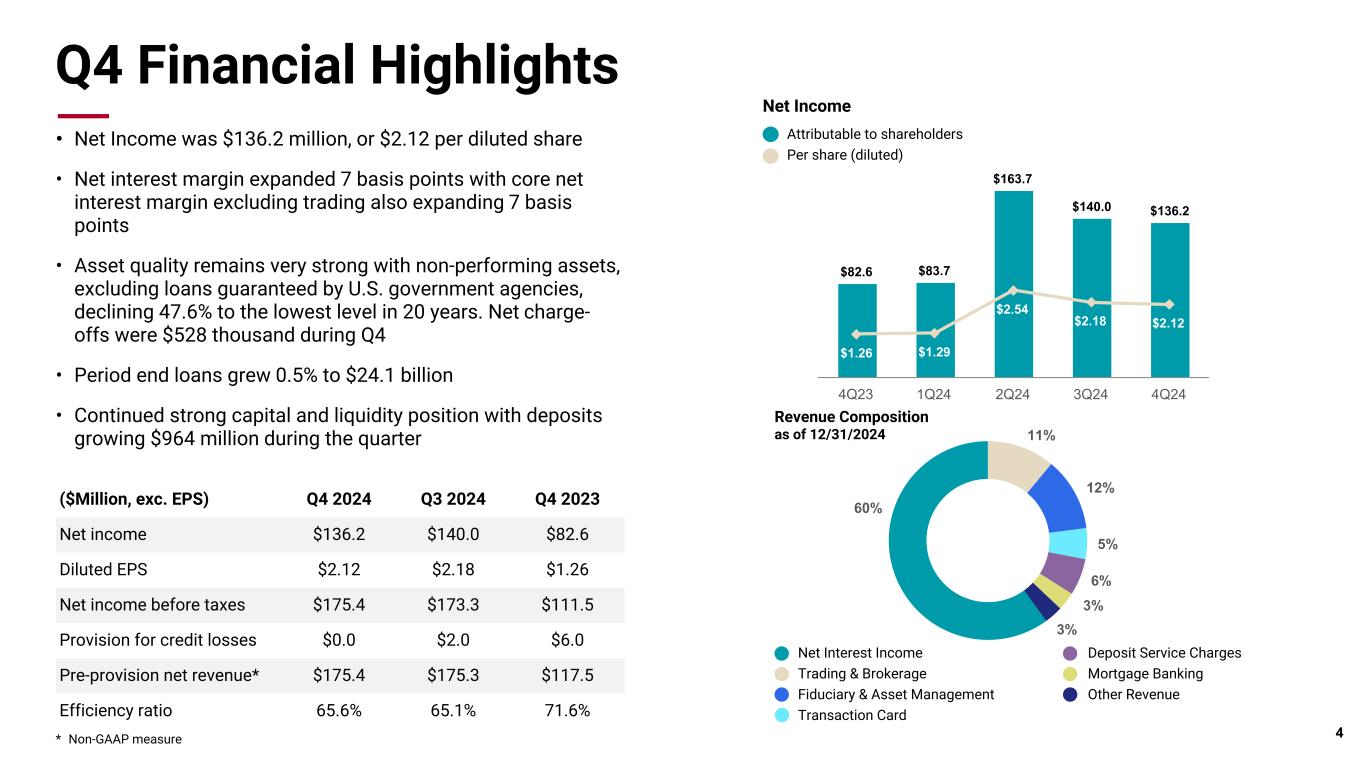
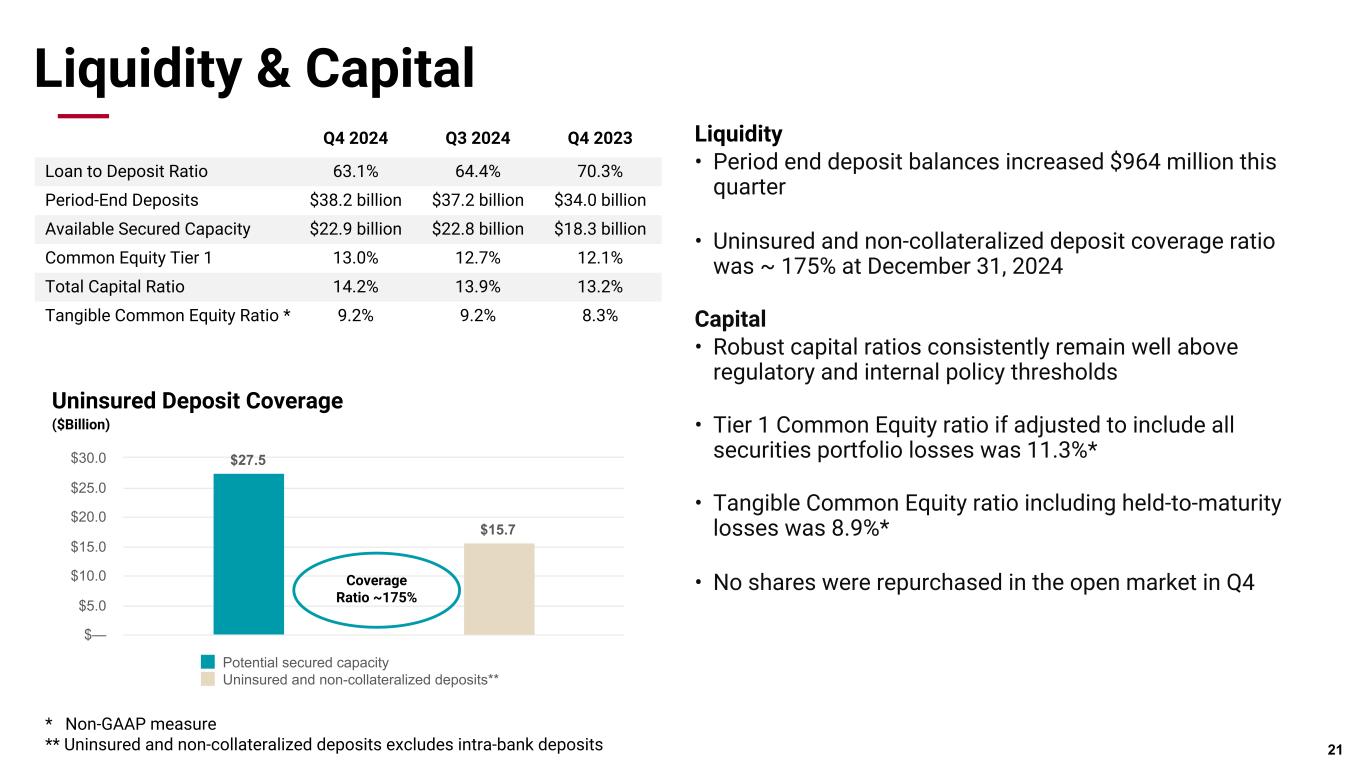
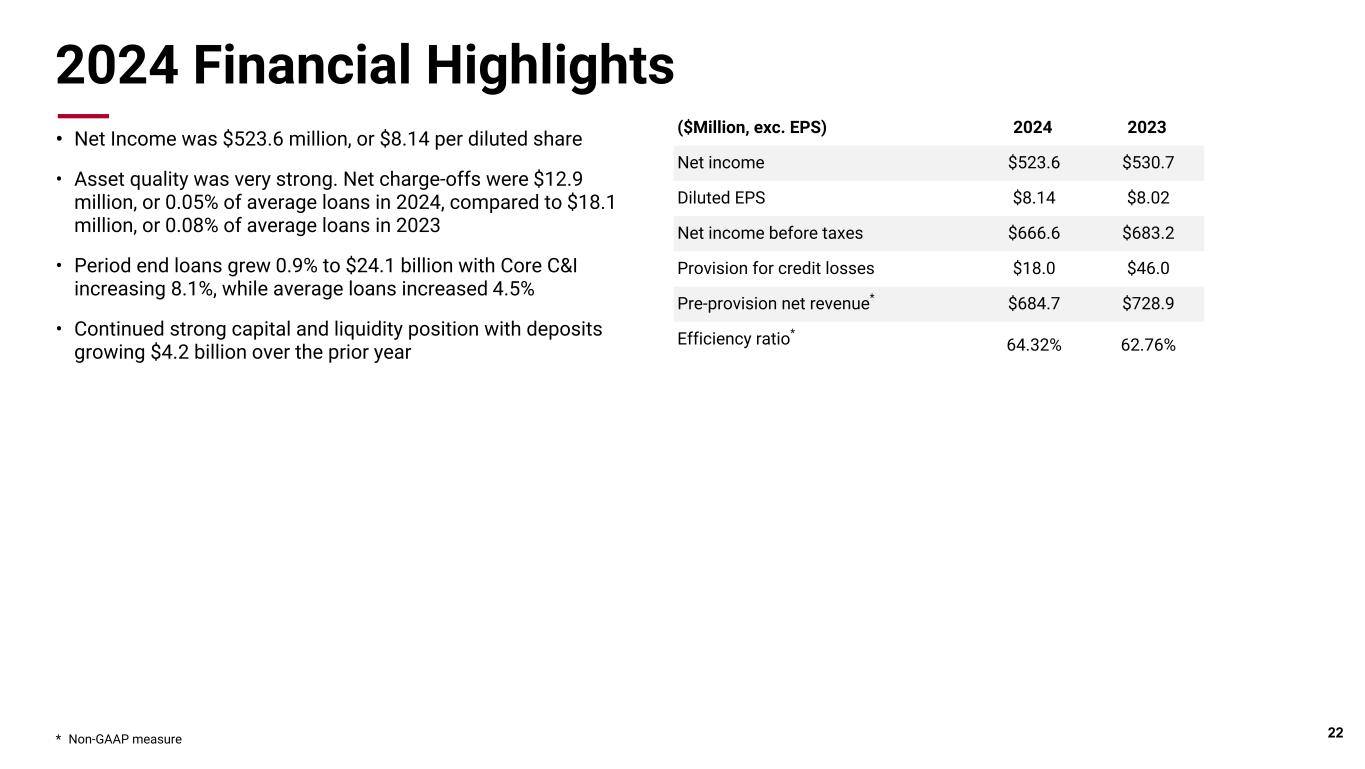
Thank you, Heather. We are pleased to report earnings of $136.2 million, or EPS, of $2.12 per diluted share for the fourth quarter. This results in earnings of $523.6 million, or EPS, of $8.14 for the full year, the second highest full-year EPS in our history. As I reflect on the year, it's impossible to do that without mentioning the outstanding team we have at the bank. We have a unique and entrepreneurial culture that is focused on driving long-term success. Our results this year are representative of hard work by an exceptional team with the underpinning of a strong fundamental base and robust risk management practices. I would like to take a moment to share with you the highlights from the year just ended. During the year, net interest income was solid and we delivered on our prior expectations of high deposit betas into the Federal Reserve's most recent cutting cycle. During the fourth quarter, deposit pricing leverage was also evidenced, giving us continued confidence in being able to capture the downrate deposit betas we've signaled and the strong outlook for margin. The credit performance of our loan portfolio remains exceptional. Criticized classified levels remain below normalized pre-pandemic levels, and we've maintained a combined allowance of 1.38 percent of outstanding loans. During the year we had an annualized net charge-up rate of just five basis points. The most recent peer data is as of the end of the third quarter, but these results would have placed us near the 90th percentile of KRX regional banks. It takes determination and persistence to generate CNI loan growth. This has been a long term focus for us and in 2024 our core CNI portfolio, which is reflective of services and general business, increased at an 8.1% year-over-year growth rate. We've also focused on growth in the Texas market broadly and expanded specifically into San Antonio. These efforts are bearing fruit, with C&I loan growth in Texas reaching 9.8% year-over-year. While we experienced payoff activity in the second half of the year related to our specialized lines of business and CRE, we are confident in our ability to grow those balances back over time. We've also invested in future growth by welcoming new, revenue-generating teammates during the year, which will bolster our loan growth prospects going forward. Our fee income segments have again delivered a 40% contribution to revenue. This ranks at the top of regional banks. Scott will highlight details of this performance in his commentary. Taken together, these results have contributed to a total shareholder return in our stock of 27%, which far outpaced the KRX index return of 13%. Our results were achieved while preserving strong levels of liquidity, regulatory and tangible capital levels. Despite rates moving higher, which would typically result in many banks' TCE ratios declining, our TCE ratio at quarter end was 9.2% flat versus last quarter. This placed us in the top third of the KRX index as of the end of the third quarter. Once fourth quarter results are released, it's not hard to imagine that our relative position could improve. I'm proud of the results for this quarter and for the full year 2024 and have high expectations about the trajectory of our organization. Our business has strong fundamentals. The economic backdrop is robust, the yield curve is beginning to take a more historically normal shape, and the markets we operate in remain strong and growing. And with that, I'll turn the call over to Mark.
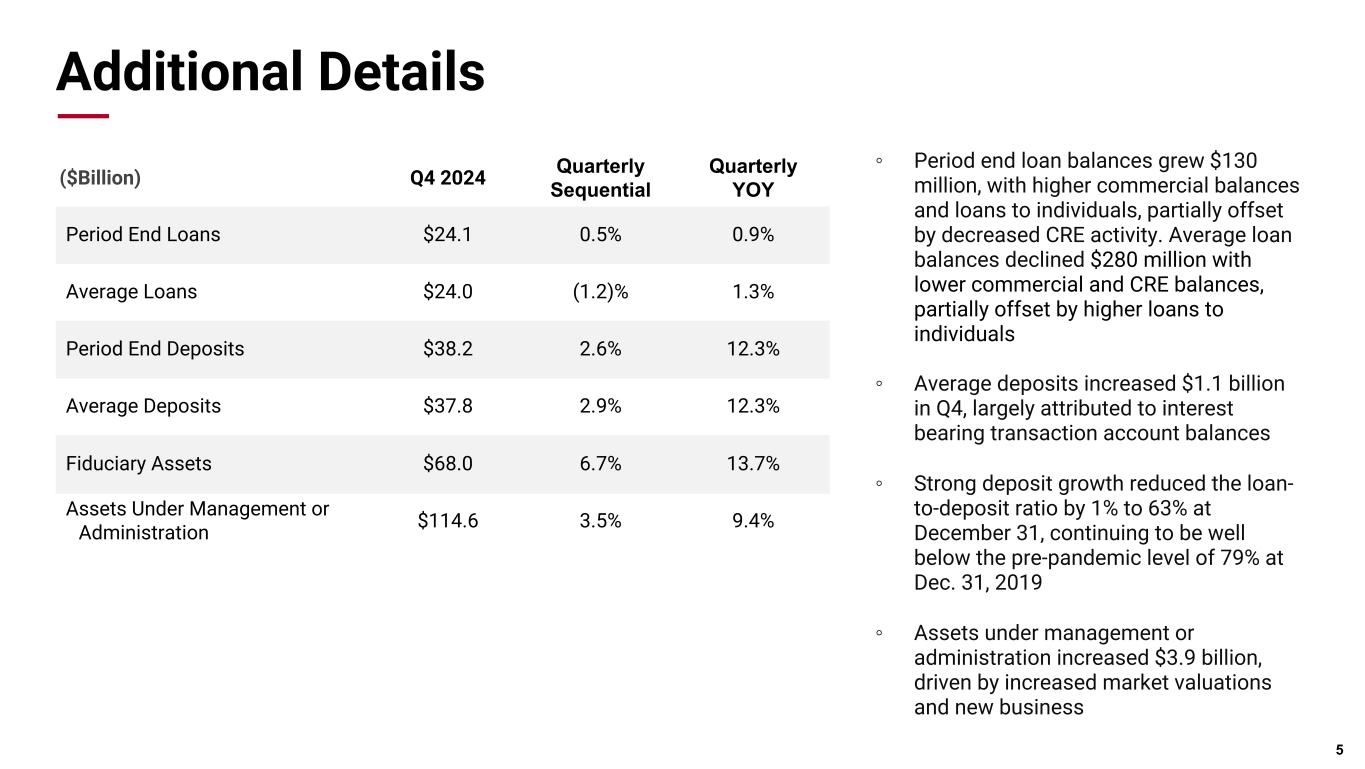
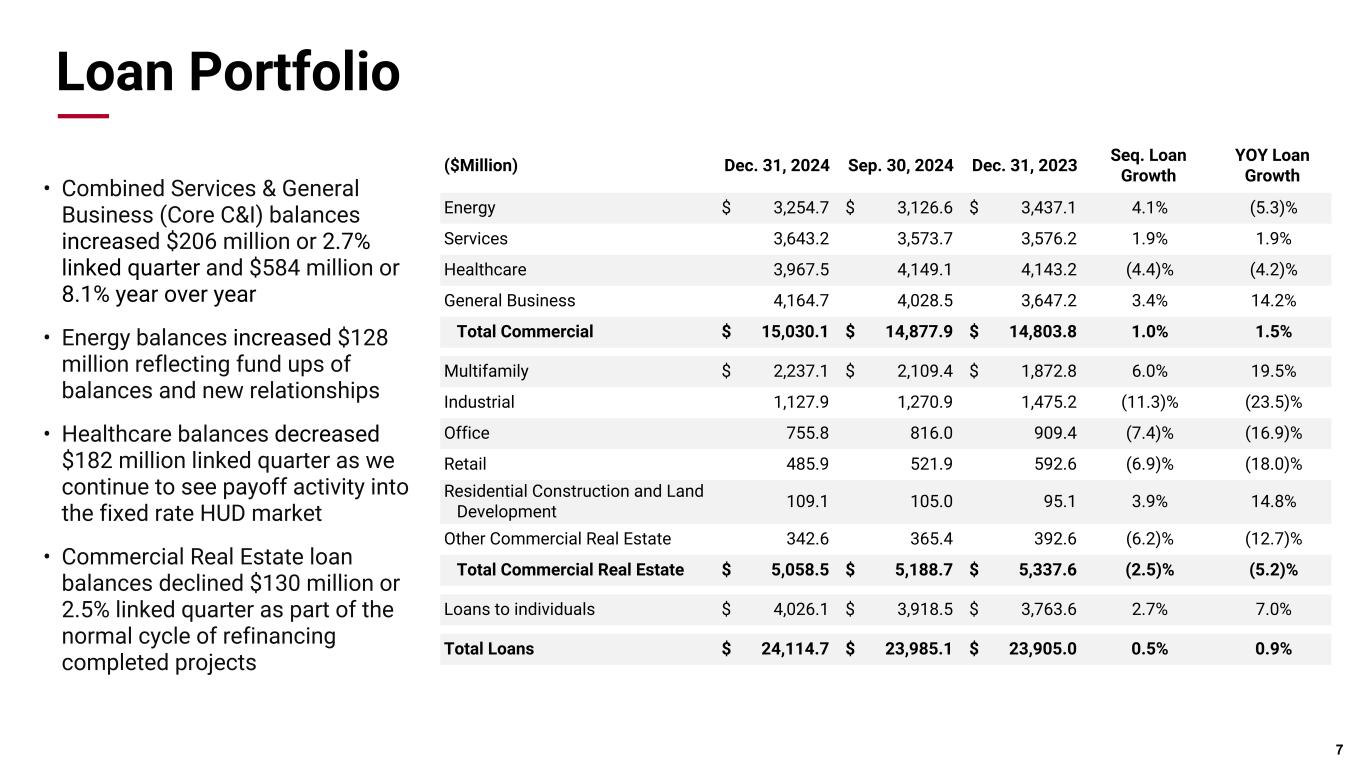
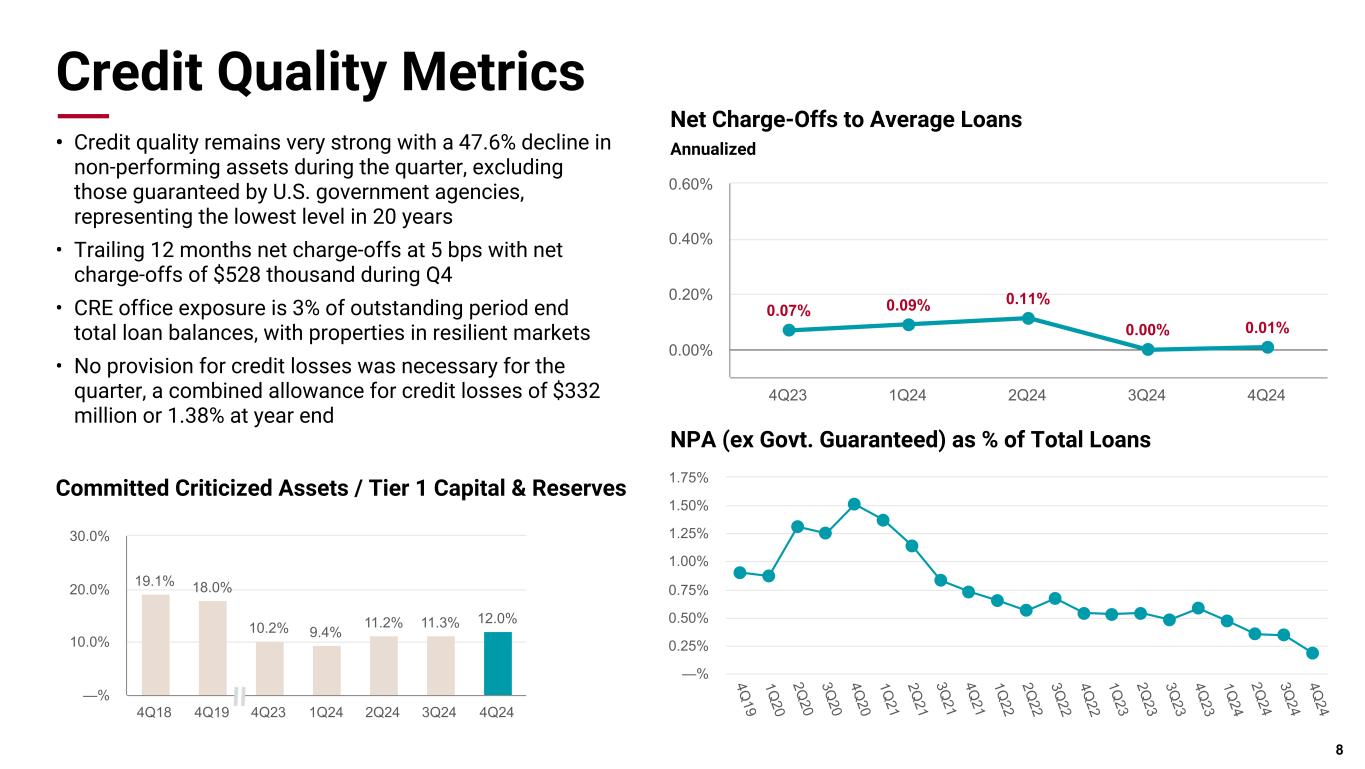
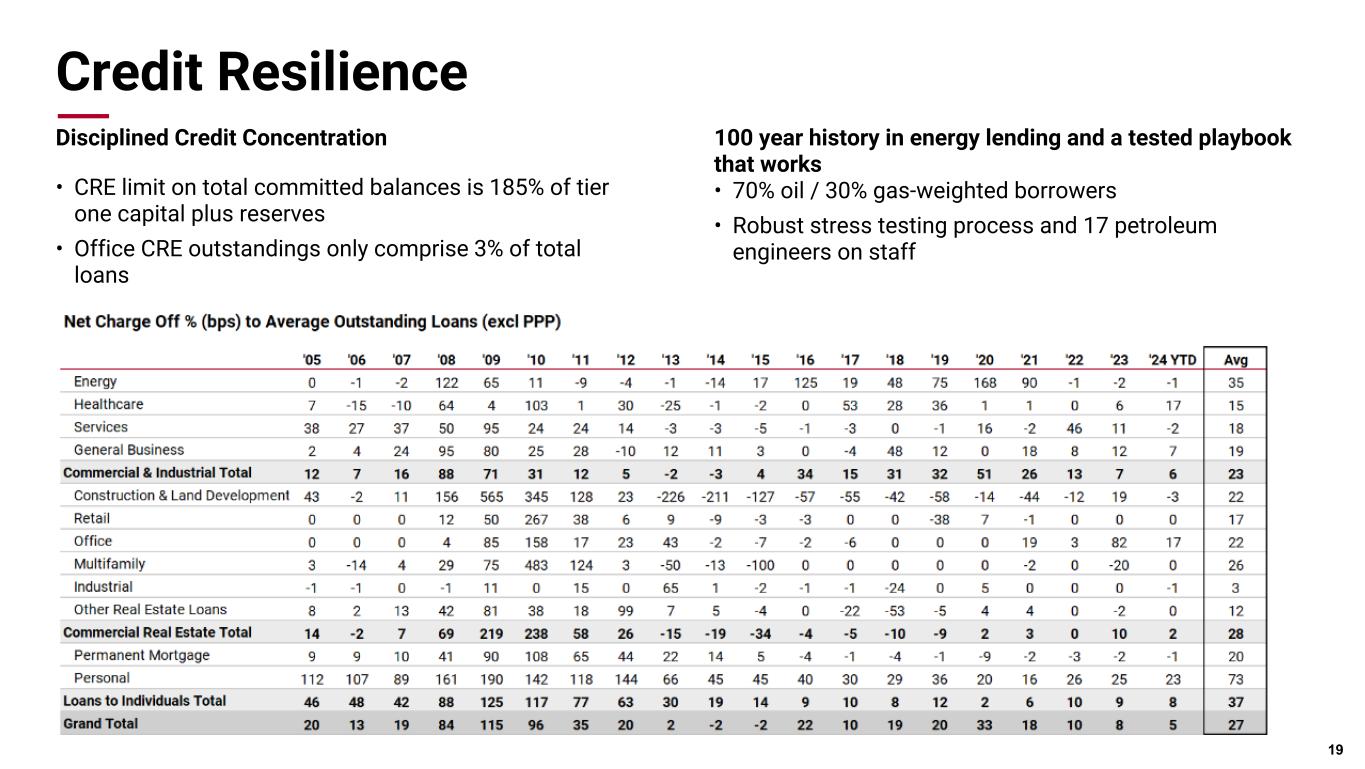
Thanks, Stacey. Turning to slide 7, period end loan balances increased 0.5% in the quarter. Commercial loan balances grew 1%, and loan state individuals were up 2.7%, while commercial real estate balances fell 2.5%. We continue to grow new commitments and relationships, and believe that economic conditions in our markets are supportive of continued growth. With our balance sheet, capital, and credit quality metrics, we are well positioned to take advantage of these conditions and are actively pursuing new loan opportunities. Portfolio yields decreased 46 basis points during the quarter as our predominantly floating rate loan portfolio repriced lower following the recent federal funds rate cuts. Loan balances in the energy business increased 4.1 percent linked quarter reflecting fund ups of existing lines and an increase in new relationships. Our core C&I loans grew 2.7 percent linked quarter, primarily in Texas, resulting from our increased investment in this market. These segments continue to produce strong growth, being up 8.1% on a year-over-year basis, with loan pipelines remaining stable. I know Stacey referenced this in his opening remarks, but this story is exciting enough that it bears repeating. Our healthcare business loans decreased 4.4% linked quarter. While new loan production and pipelines remain robust, we have continued to see payoff activity into the fixed rate hud market our cre business decreased two and a half percent quarter over quarter cre loans were down in q4 as part of the normal cycle of refinancing completed projects on a long-term basis we continue to add new loans in the early construction phase and will be funding up over time creating new loan growth loans to individuals increased 2.7 percent reflecting growth in both personal loans and residential mortgage loans transitioning to slide 8 credit quality remains exceptional across the loan portfolio extending our trend of out performance versus peers in this area NPA is not guaranteed by the US government fell again this quarter decreasing 38 million to 42 million dollars the lowest levels we've seen in the last 20 years the resulting non-performing assets to period end loans and repossessed assets decreased 16 basis points to 18 basis points committed criticized assets remain very low relative to historical standards in addition we had minimal net charge offs of 528 000 during the quarter and net charge offs have averaged five basis points over the last 12 months we expect net charge offs to remain below historical norms going forward we are well reserves with combined allowance for credit losses of $332 million, or 1.38% of outstanding loans. And now, I'll turn the call over to Scott.
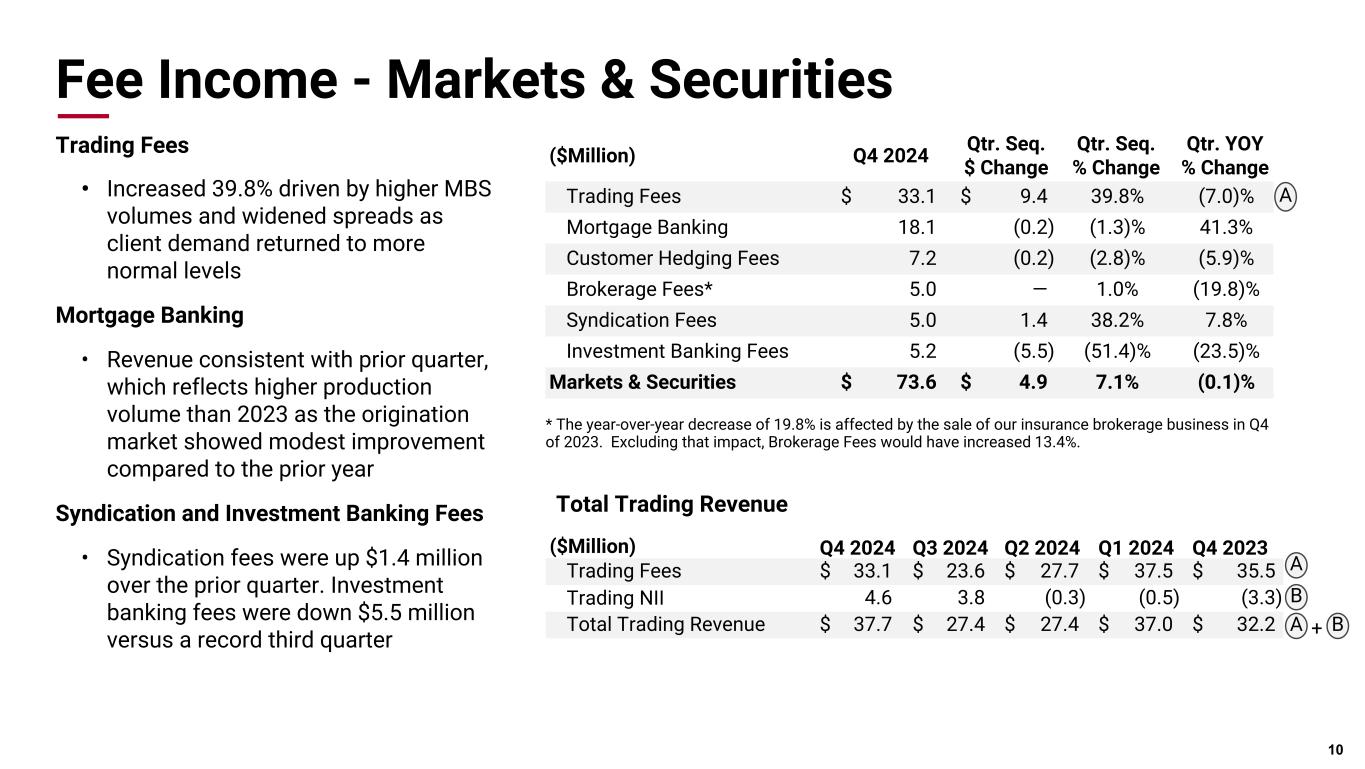
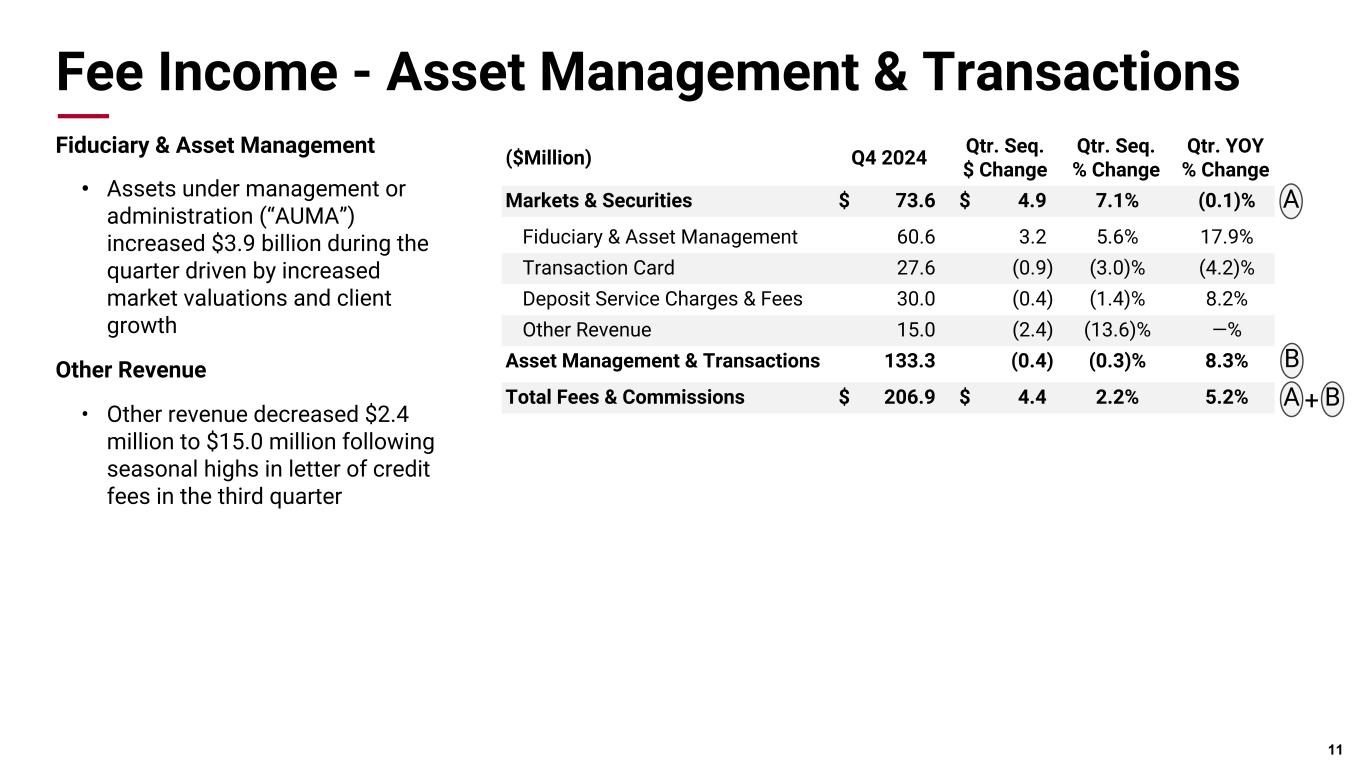
Thank you, Mark. Turning to our operating results for the quarter, on a linked quarter basis, total fee income grew $4.4 million, contributing $206.9 million to revenue and accounting for 40% of total This isn't a short-term trend. Our free income has averaged 39% of total revenue over the past five years, a key differentiator for us from our peers, and has been a hallmark to our success in varying economic conditions. I'd like to begin by covering our markets and securities businesses on slide 10. Our trading fees rebounded nicely, increasing 39.8% to $33.1 million during the quarter, driven by higher MBS volumes and widened spreads as client demand following anticipated rate cuts returned to more normal levels than we saw in the prior quarter. Due to the steepening yield curve environment, I'd like to note that total trading revenue includes two distinct pieces, trading fees and trading-related net interest income. This quarter, trading fees were $33.1 million while trading related net interest income was 4.6 million if the yield curve steepens further and trading portfolio yields move further above their funding cost we will see additional revenue mix shift with more of our total trading revenue coming from that interest income as opposed to fee income as we've seen in recent quarters we've provided a table on this slide to allow you to see this dynamic historically mortgage banking revenue has remained relatively steady for the past four quarters, coming in at $18.1 million for the fourth quarter. Our other markets and securities businesses continue to produce solid results with syndication fees up $1.4 million over the prior quarter. Investment banking fees were down $5.5 million. However, this is coming off a record quarter and the business is still performing exceptionally well. Turning to slide 11, asset management revenue grew 3.2 million or 5.6 percent linked quarter reflecting growth in our trustee income. AUMA grew 3.9 billion quarter over quarter, eclipsing 114 billion with increased market valuations and continued growth in client relationships. I know my commentary on this slide is less than usual, but the consistent results these businesses have exhibited over time speak for themselves. And now, I'll hand the call over to Marty to cover the financials. Thank you, Scott.
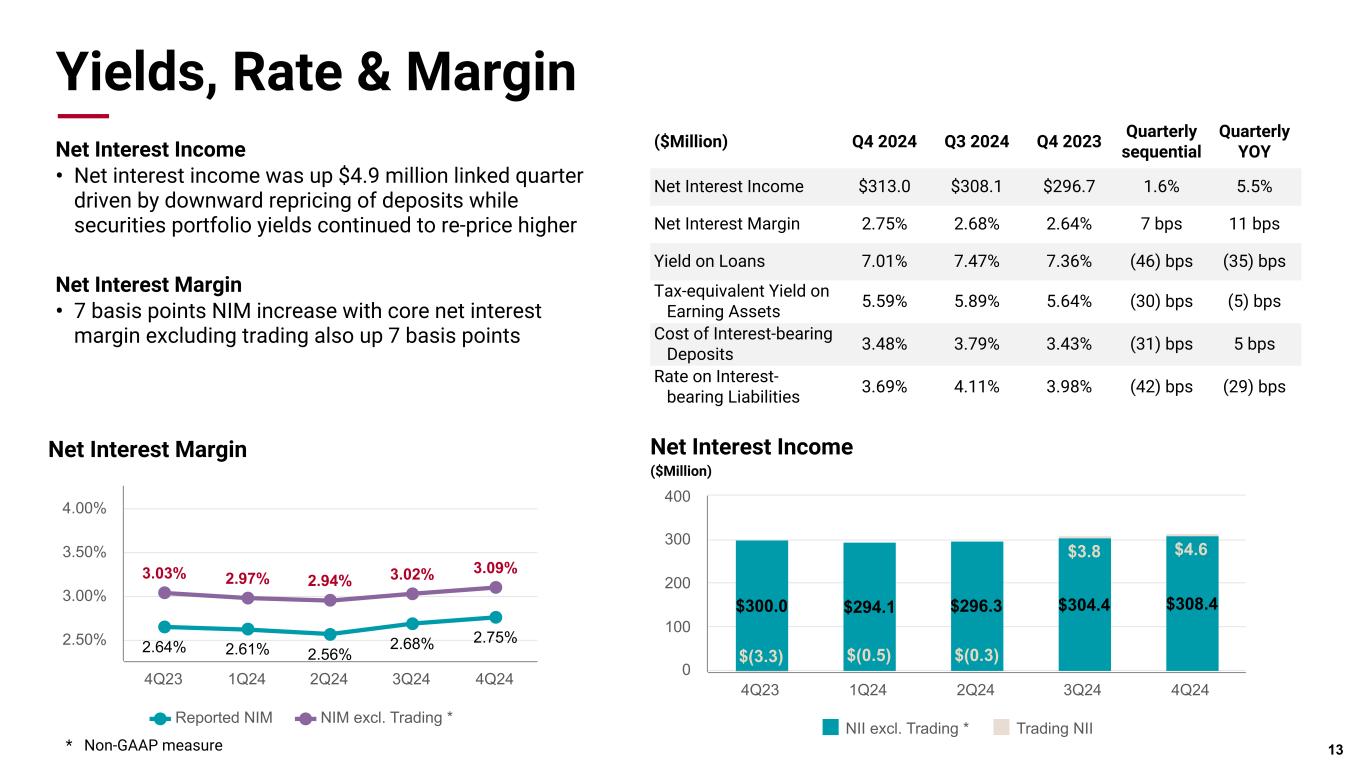
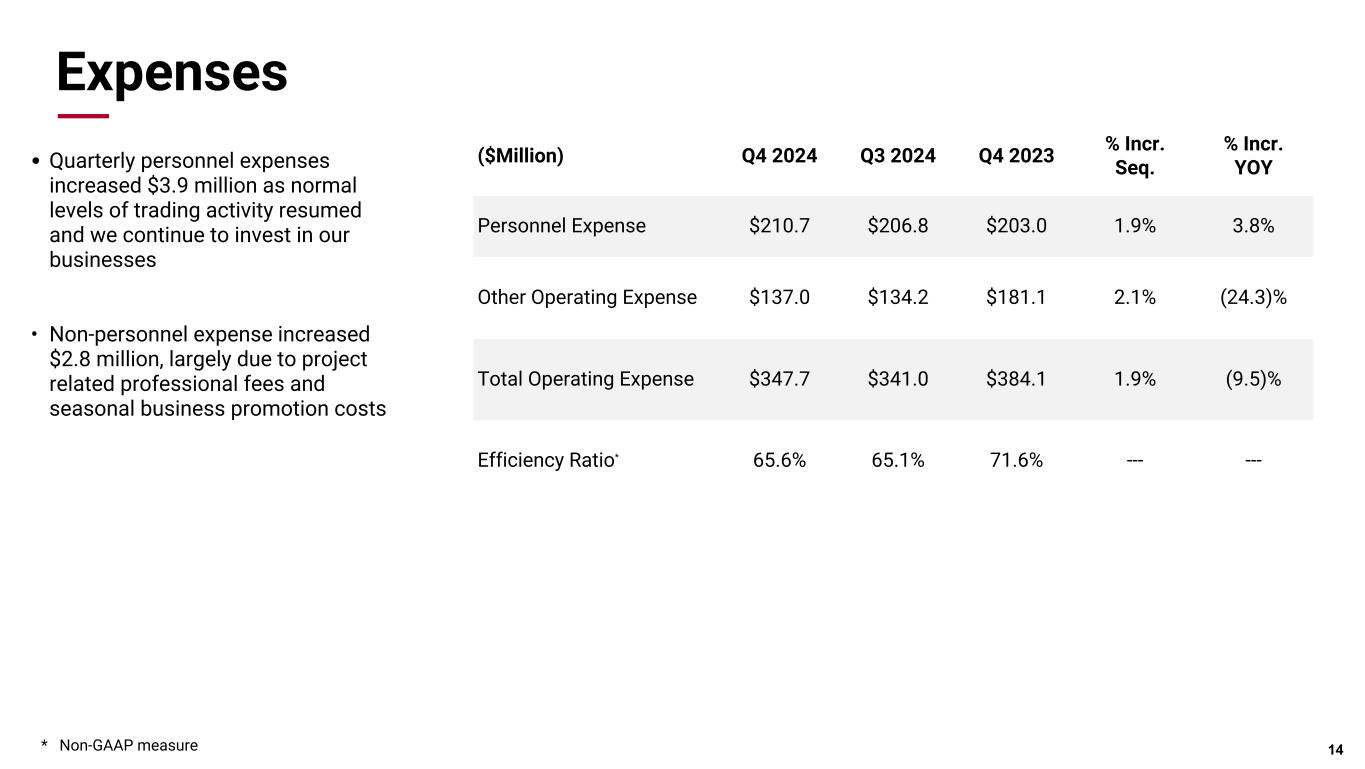
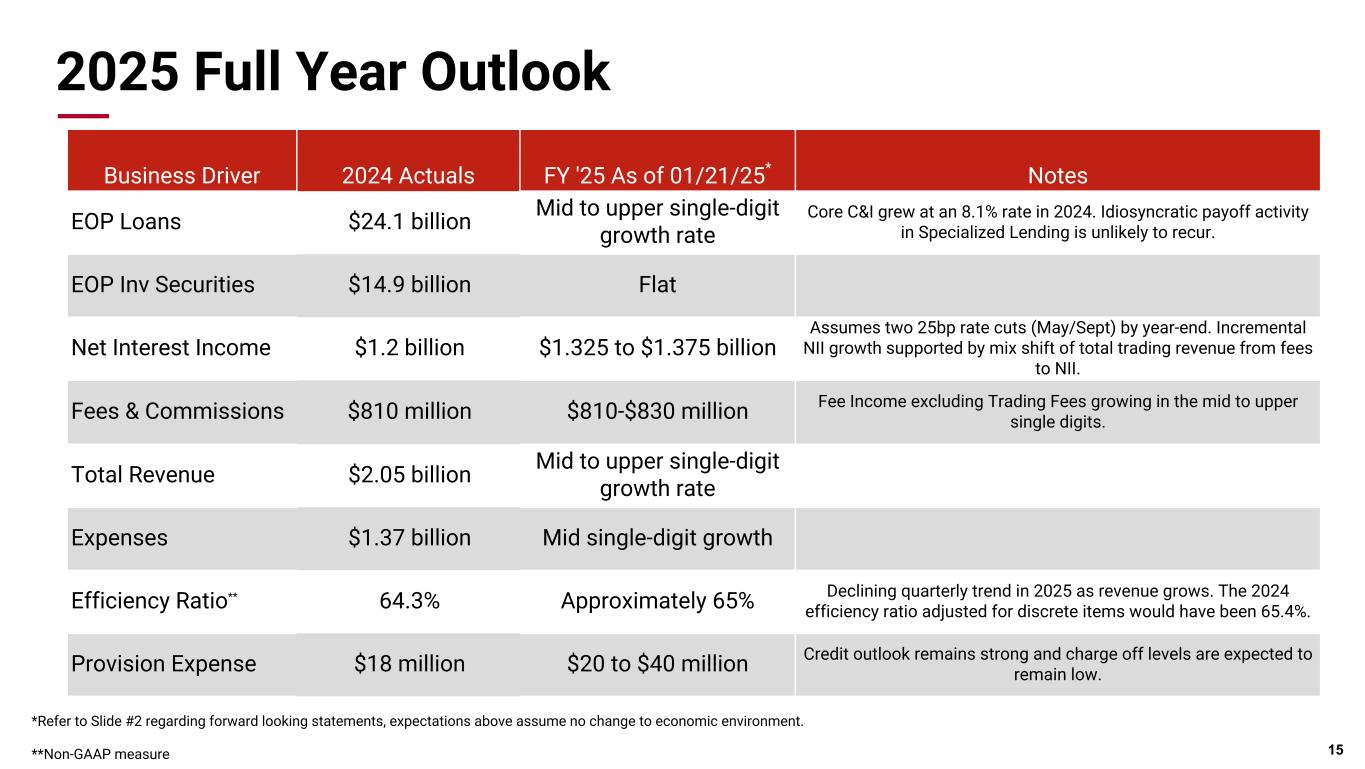
On slide 13, net interest income was up $4.9 million, supported by growth in both the trading and non-trading components. Headline net interest margin expanded seven basis points, with core net interest margin excluding trading also up seven basis points. That seven basis point increase in core margin was driven by several factors. The securities portfolio continued to reinvest cash flows at higher current market yields. The fixed rate portion of the loan portfolio also continued to reprice cash flows at higher current market fixed rates. Non-interest-bearing DDA grew in Q4, driven by normal seasonal balance increases. We saw strong interest-bearing deposit growth, and liabilities repriced more quickly than assets in response to rate cuts by the Federal Reserve. Both the magnitude and the pace of this quarter's deposit repricing activity aligns with our expectations and gives us great confidence in our ability to realize our previously communicated deposit beta expectations should short-term market rates continue to decline. Last quarter, we noted that if deposit balances increase significantly, it could mute the deposit beta somewhat, but would result in a better liability beta and be accretive to margin and NII. This played out in the fourth quarter as we grew average interest-bearing deposit balances by approximately $1 billion, offsetting a portion of our wholesale funding at below wholesale cost. Turning to slide 14, length quarter total expenses increased 6.6 million or 1.9 percent. Personnel expenses grew 3.9 million as normal levels of trading activity resumed and we continue to invest in our businesses. Non-personnel expense grew 2.8 million largely due to project-related professional fees and seasonal business promotion costs. Slide 15 provides our view on full year 2025 and I will note a couple of items. Loan balance projections reflect our strong track record of growing C&I as well as our specialty lending businesses. We have ample headroom versus our concentration limits due to high levels of pay downs in 2024, which we do not expect to recur this year. For total revenue, we expect growth in the mid to upper single-digit range. That growth rate would be unaffected by the mixed shift between trading NII and trading fees that Scott noted earlier. Within total revenue, based on our assumptions for rates, we expect growth in net interest income to be above single digit. However, that growth rate is driven incrementally higher by the mixed shift from trading fees to trading NII. We expect growth in core NII X trading to be mid to upper single digit. Fees and commissions growth is expected to be lower single digit. However, that growth rate is affected the opposite way by the trading revenue mix shift. Excluding trading, fees and commissions would also be in the mid to upper single digit range. Lastly, I will note that the remarkably low level of non-performing assets we see today supports our view that CHARGES will remain well-controlled for the foreseeable future. With that, I would like to hand the call back to the operator for Q&A, which will be followed by closing remarks from Stacey.
Operator
Thank you. We will now begin our question and answer session. If you have dialed in and would like to ask a question, please press star followed by the number one on your telephone keypad. If you would like to withdraw your question, please press star one again. We kindly ask everyone to limit themselves to one question and one follow-up only to accommodate all questions. Thank you.
Your first question comes from the line of John Arbstrom with RBC Capital Market. please go ahead hey thanks good afternoon hey john hey um can you talk a little bit more about the payoff activity and some of the expected changes you've you're you're thinking about in 25 you use the phrase over time and i'm just kind of curious when the pay downs could change or is that already starting to happen you're talking about with respect to loan growth and our kind of outlook yeah exactly yeah I think you look you know we we've spent so much time and energy investing in the core C&I areas because that's the longest sales cycle that's the hardest business to move
and we really saw that play out in our favor in 2024 with core C&I growing you know eight percent which which I think is is very very good the unexpected headwind really was the core specialty businesses, healthcare, commercial real estate, and energy were a headwind to loan growth. And really because of some idiosyncratic things related to the timing of the capital markets, whether it's respect to energy or whether it's the shape of the yield curve, it created some permanent financing opportunities outside the core portfolio for real estate and for healthcare. And so if you think those return back to kind of more normal growth patterns, and we do, We have plenty of concentration cap room in all of those areas, and you think you can sustain the C&I growth, which we think we can. I think the guidance that we have around loan growth for next year is very achievable.
Yeah, John, the one thing I would add on the energy side of this is that in the fourth quarter, we did generate a lot of new relationships at a much faster pace than we did the previous three quarters, which will which created a lot of loan growth we experienced in energy in the fourth quarter and we expect that we'll see the continue to see some of the benefits from that um so that that seems to have turned around and is in a growth pattern right now but i did want to ask about that as well just deeper on energy what do you think about um in terms of the energy lending outlook with the new administration and feels like maybe prices come down i don't know but
But, you know, how do you think about risks to that as well? Just curious on, you know, the administration, your thoughts there.
Yeah, I think, you know, it's too soon to know exactly. I think that certainly we expect that the incoming administration will open up more federal lands for drilling. I think the permitting process will be better. I think that they're going to commit to filling the Strategic Petroleum Reserve, which I think is a positive. But I think you cannot ignore borrower behavior. And those guys are going to do what's in their best interest, and that's being disciplined about how they spend their capital investment and getting a return on that capital investment. And so those energy companies will make discrete decisions at the point in time based on what they can hedge out on the curve and what kind of return they can get for drilling activity. And so I think it's too soon to know how it may spur or not spur actual drilling activity. But I think, you know, we have a lot of confidence in our borrowers that they're going to make the best economic decision at the point in time for them that makes sense for them. All right. Thank you.
Operator
Your next question comes from the line of Matt Olney with Stevens, Inc. Please go ahead.
Hey, thanks. Good afternoon. I want to ask more about the guidance for net interest income in 2025. I think that guidance you guys provided us assumes a low double-digit growth number in 25 versus 24, and I'm just struggling to get there. Can you give us any kind of launch point or guidance for the first quarter that can help us appreciate what you guys see on your side with respect to net interest income?
Yeah, Matt, I think it's useful to think about our guidance in two pieces, sort of the the core margin X trading and then the trading piece. And as you think through, you know, just the core margin X trading, you're going to see kind of the same factors that you've seen the last couple of quarters just play out, you know, in first quarter and throughout the year where you've got security, you know, all the fixed rate asset repricing, that's going to continue to reprice up. That's going to be supportive. You know, both loan growth and deposit growth are going to be supportive of margin. And, you know, know, it's nice to see the DDA trends be supportive of margin recently. But then when you look at the second half of that, the, you know, the trading component, you know, here's the way to think about that. So in Q4, just the trading portfolio, so that's 5.6 billion, that had a yield of 4.9%, which you can see, and a spread of 36 basis points over its funding costs, which you can see on page 17. And so that's $4.6 million of net interest income provided in Q4. As you play that over into 2025, you know, the volume of trading is probably still going to be in that $5.5 to $6 billion territory. But yields on the trading account should come up. 30-year mortgage yields are, you know, mortgage-backed security yields around $5.85. And you've seen short-term rates come down in the fourth quarter so you'll see a full quarter effect of that in Q1 and then later in the year we're assuming two more cuts and so over the course of 2025 that funding cost comes down and that spread that was 36 basis points in Q4 now that could be easily 100 basis points or a little bit more for 2025 overall. So you can see that that's a pretty big pickup up year over year in that trading related margin. And that will grow quarter by quarter as you get that widening playing out by the change more in the short term funding costs. Now importantly, that growth gets offset in trading fees with the hedge costs. But I think most importantly to think about our trading, our total revenue, we've given a guide of mid to upper single digits for total revenue, That's very attainable for us. And when you look at the three pieces within that, NIIX trading, fees X trading, and then trading in total, both the NIIX trading and the fees X trading are also mid to upper single digits, very attainable for us.
And then the last piece, trading in total, regardless of how much of that is fees versus margin, we feel very good about how that trading revenue is going to go over the course of 2025 versus 2024. and it's gotten I want to add a little bit to that sure hey Matt so I think that you know as Marty indicated those component pieces kind of get to the forecast going forward but are you know what we've seen really in the last six weeks or so of 2024 and is carrying on into the beginning of this year are our clients on the institutional side, a fair amount of which are financial institutions, prefer clarity that has emerged. So when you think about the election in the rearview mirror and a little bit better clarity, not certainty, but clarity around potential Fed moves, we're seeing quite a bit of increased appetite and willingness to invest out the curve which bodes well for demand for our business so as marty said we're we're optimistic and feel confident about our ability to continue to to move forward on the the rate that we've established here in the fourth quarter okay well i appreciate the commentary on that and just to follow up on maybe a point that
Marty made. I see in the deck the guidance assumes two Fed cuts throughout the year. I think you guys give us the time frame of those cuts. What does that guidance assume or imply with respect to the shape of the yield curve?
Yeah, so we're assuming that long-term rates are really about where they are today, give or take, throughout the year.
So we're not putting any particular changes in steepness into that curve you know other than what's driven by the short term does that make sense yeah okay so your curve would i guess would improve a little bit but the long-term rates stay flat short-term rates come in with those assumptions exactly yes oh got it okay thank you guys your next question comes from the line of Peter Winter with DA Davidson please go ahead.
Thanks. I was wondering if I could just dig into Matt's question a little bit more. Just the net interest income outlook, it's a pretty wide range for you guys. Just can you, Marty, maybe talk about some of the drivers to the upper end of the range versus the lower end of the range?
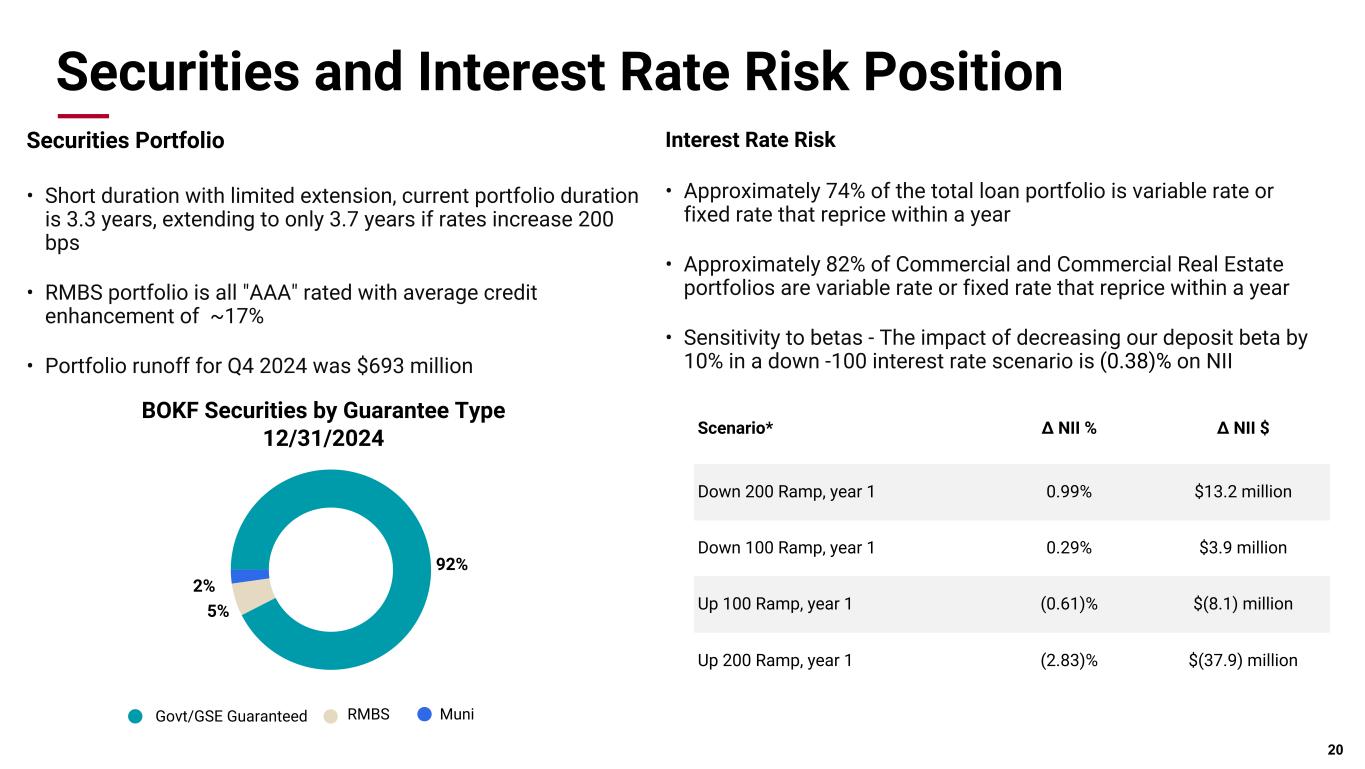
Yeah, I think, you know, one of the, we feel very good about all the things that I laid out. We've got that securities repricing, fixed rate repricing. That's very visible and durable throughout the year. The one thing that's interesting that I'll point out, Peter, is our loan to deposit ratio is very low. And that gives us an awful lot of flexibility when you think about how we manage deposit pricing. And that gives us room to be a little bit more aggressive on the yield side if we want to. That's not how we built our plan, but to the extent that we want to push on that, rate cuts certainly make that easier, but are not necessary to be able to take some incremental pricing action if we want to on the deposit side.
Okay. And I hear you. I see the guidance on end-of-period loans, but I'm just wondering what average loans would do what you're expecting for that range.
Peter, this is Stacy. I think you should assume that growth is relatively rideable over the period. So we're not assuming any kind of elevated growth in that particular period. But we try to grow it kind of typically a similar amount in every quarter. We understand the actual results will differ from that. But as we plan for 2025, we kind of look at it over the period.
Okay. Then, Stacey, if I could just ask, you know, you talked about it in the opening remarks, but you've had nice success with the team lift outs, and it's been additive to growth. Do you have a pipeline, you know, of additional team lift outs and looking to continue to do that? Because M&A, you know, my sense is still kind of a low priority.
Yeah, you know, I think from our perspective, there's not a team lift out pipeline per se, but we are constantly pipelining for new talent. So every single market we're in, we have targets for revenue producers that we're trying to add to our company. And it's been a really important strategy for us in 2023 and 2024. We saw the dividends for that, particularly the latter half of 2024, and we'll continue to do that. We think that's very positive, very accretive to our earnings, very accretive to our franchise value to do that. And so we continue to be very aggressive in all of our markets in adding talent. And this year will be no different in that regard.
Operator
Your next question comes from the line of Brett Rabitin with Havdi Group. Please go ahead.
Hey, guys. Good afternoon. I wanted to beat the long growth horse one more time. So if I understand, it looks to me like the payoffs and reductions in energy have swung the other way with some renewed momentum and energy. I didn't get a clear understanding of if you think the healthcare portfolio was getting to its bottom. And then also, just within the commercial real estate bucket, you've obviously had growth in multifamily offsetting other declines. So I just wanted to get a sense of what you think happens with the non-core C&I book. And then also, it seems like Oklahoma has been driving the strength, you know, in the loan portfolio. And wanted us to hear if that's a function maybe of Texas being more competitive lending-wise with rates or any other color around geography.
Well, okay, there's several questions in there. So let me start with health care. And, you know, basically the interest rate environment generated opportunities for a number of our customers to refinance on a long-term basis into the HUD market. And we see that a lot of that activity has taken place, and it's going to start to taper off, and we will see more opportunities for us to begin our growth on the health care side. So similarly, the interest rate environment has had an impact on our CRE portfolio because, again, they're taking advantage of the opportunity to do some normal course of business, move things off their short-term maturity to a longer-term maturity with a fixed interest rate. And again, those interest rates aren't moving like they were, so we do expect those opportunities to occur, and we're adding new construction opportunities that are going to give us the fund-up opportunity, which is a cycle we have historically gone through in our company. And we have a capacity in CRE relative to our concentration limits that's given us a lot of opportunity to grow that particular portfolio. And we are going to consistently look for the best deals. We do have different concentration limits for different types of real estate, but we're always looking for deals and have capacity for the various types of opportunities that exist. And we will look for the best deals that we can there. And we feel like we can generate additional growth in the CRE. On the CNI side, it's more of just a consistent approach that we've taken. The Oklahoma market may have driven a little more. We've been here longer, and we have a lot more relationships, and some of those are renewing. But we saw a substantial amount of growth in Texas in the C&I in the fourth quarter, which is starting to show that the investment we've made in Texas is starting to pay dividends. It takes time to generate C&I loan growth. And so as we've made those investments, we're not going to get the transactions that we might get in the specialty industries, but we're generating a lot of business now that we've spent and committed to time and investment on the C&I side in Texas. And we're starting to see that all the other markets generally grew at a double-digit rate on the C&I side as well. So I feel really good about the fact that it's been a consistent performance for the last couple of years. And barring any change in economic factors, we would expect that to continue. And so the combination is why we come up with the kind of guidance we're providing.
Okay. That's helpful. And then just back on the trading business again, you know, is there, you know, and I know it's probably tough to come up with an exact number in terms of what you're giving guidance to, but is there a way to extrapolate or can you give an idea of how much dollar change you expect in the trading to move from fee income to NII?
Yeah, so Brett, we're probably not going to give guidance on trading per se. That'd be a tough one to wrap your head around, but certainly there's a shift that's going to go on between that growth based on our economic assumptions in NII down to fees. But the point is trading in total, total trading revenue, that's going to grow nicely year over year. And I think that's really the important point.
Brett, I think if you look at slide 10 in the slide deck that we provided to accompany the call, you can see how we've broken out the impact of trading fees and trading NII over time. And I think Marty's given you all the component pieces that you need to kind of fill in the blanks from there. And we've provided the total revenue line item so that you can kind of see at the end of the day, does it make sense or not? And so, you know, we're not going to break it down by quarter or discrete line item, but I think the pieces are there for you to put it together.
Okay. Great. Fair enough. Appreciate all the color, guys.
Operator
Your next question comes from the line of Woodley with KBW. Please go ahead.
Hey, good afternoon. And I wanted to start on deposits. I mean, the fourth quarter was a really successful quarter, and really that success has been consistent throughout the year. Any color on what drove the deposit growth in the fourth quarter, and does the success impact your deposit strategy throughout 2025?
Yeah, I'd say that the growth was across all three lines of business. We were happy to see that a little bit more in commercial, as you might expect for us, but it was all three lines of business contributing, and it did not change our strategy. I mean, we were very happy with the growth that we've got, you know, the track record we have, and, you know, we expect to continue to grow deposits next year. It may not be at the very high rate that we were able to achieve this year, but we're very happy with the traction that we've got going on in that business and the level of price competitiveness has, you know, settled down from what it was a year ago, and that's been a great factor as well.
And then maybe shifting over to capital, I was just curious, does a more favorable regulatory backdrop sort of impact the way you view your excess capital position and how you might deploy that capital? yeah i'd say regulatory backdrop you know that's certainly helpful but it doesn't really fundamentally change how we think about capital we know we've got a strong capital position we've got a level of excess capital and that just represents earnings in reserve and we're going to be very patient and thoughtful about how we deliver that how we deploy that into whatever avenue is best for a long-term shareholder return.
But Woody, given kind of how we risk manage the bank and our outstanding CRA rating and those types of things, the regulatory overlay doesn't really impact how we can do that in any particular environment. We've kind of done things the right way, and so that gives us the latitude, depending regardless of who's in charge, to be able to do the right things for shareholders here.
All right, thanks for taking my questions. your next question comes from the line of tim mitchell with raymond james please go ahead hey good afternoon everyone uh tim on from michael um just want to start out on expenses i'm currently a single digit growth range uh obviously probably tied to the fee businesses and upper versus lower end now they perform but just want to appreciate you know are there any underlying investments and potential team without that we might we should kind of contemplate as we think about that range for the year?
Yeah, there's nothing that would qualify as team lift out, but like Stacey said earlier, we are constantly looking to grow talent, and that's a driver for, you know, year-over-year growth, both improvements in talent-based growth in the talent base and, you know, continued IT investments. All those things are propelling long-term growth. And that's really the core drivers there. And as you know, Q1, you'll see payroll taxes, that hits in Q1 like it does every year. But pretty standard revenue growth is going to drive a component of the expense growth as well.
We're constantly looking to see where can we make an investment today to add value tomorrow. And one of the things that we've spent a lot of time on recently is how we think about holistically our mortgage businesses. And so you'll see us in the latter half, really, probably the fourth quarter, late third quarter, fourth quarter, really begin to be fully engaged in the mortgage warehouse lending space. In order to do that, we've had to hire talent. Some of that was onboarded in the fourth quarter, and some of that will be onboarded in future periods. But it's things like that where the, you know, call it, the San Antonio team broadly or things like Mortgage Warehouse or individual contributors or individual revenue producers in each of these markets, we are constantly looking for opportunities where we can spend a dollar today to create a better opportunity for us to grow top-line revenue in the future. And so I think being able to maintain that efficiency ratio while we're making these types of investments is really positive for our franchise, and we're excited about these investments that we're making.
Awesome. Appreciate the color. and I appreciate the color on mortgage and what you said about trading so far. You just talked about investment banking and brokerage and some of the other kind of fee businesses and what the trends are there. It seems like the outlook for investment banking and whatnot is kind of improving post-election. Just curious what you're seeing on that front.
Yeah, so this is Scott. So as you noticed in the slides, if you take the impact on the results, If you take the impact from our sale of the insurance unit out, our retail brokerage business is growing at, you know, 13%. So we're confident in the trends there, and we continue to gain momentum with that piece of our business. Our investment banking activity has been exceptionally strong. We saw a decline in the fourth quarter, but that is really more seasonal as the majority of our investment banking activity centers around municipal finance. And in particular, we have a high concentration of that activity in Texas. And so when the elections and predominantly the independent school district debt cycles gear back up here, Well, you know, we feel very good about our positioning there and the demand for that activity because we don't, you know, we don't participate in the equity investment banking activity.
Well, thanks for taking my questions.
Operator
Your next question comes from the line of Timur Brazler with Wolf Fargo. Please go ahead.
Hi, good afternoon. My first question is on the deposit side. It was a pretty impressive result, especially considering that CD rates really didn't move in the quarter. Just wondering if you can remind us what the maturation schedule looks like there, and it looks like balance has even declined a little bit in the quarter. Just how much of a head start, maybe from a margin standpoint, you're getting from time deposits in the first half of 25?
Yeah, so time deposits, you know, our mix there isn't terribly huge. We actually let a couple of brokered CDs roll off that we put on a little over a year ago. And so that's part of the drop there. You know, the core portfolio is pretty short. And by the way, our brokered CDs are less than 1% today. So it's not meaningful, but that drove a drop. Our CD portfolio tends to be fairly short. It's a lot of that original four month maturity or eight to 10 month maturity. So, you know, it's only a couple months of maturity, and so you'll see some of that repriced nicely in the first quarter as we see rates being a little bit lower than when those were put on.
Okay, and then just looking at the trading securities, did I hear correct it's 5.8 is the current kind of ongoing rate versus the 4.90 rate for 4Q?
Well, so keep in mind, 490 is the weighted average portfolio for the whole trading book. Today's new current coupon MBS is, you know, 580 or so, but that portfolio will always have some blend of recently produced mortgages as well as some kind of secondary trading and older vintages. So, but just know that it won't be precisely moving towards exactly the current production level.
And then just lastly for me, just the commercial real estate payoff activity, you had made a comment that that was some normal course of business just going into year end. I'm just wondering with rates backing up, if that drove any of that activity or just kind of the timing there. And I guess as you look at stuff that could still be refied away, what component of that has and now largely found a new home.
Hey, Timur, I would just point you to the fact that look at what happened at 10 year rates kind of in September, you had those rates drop a lot. And so that customer base that did payoffs right at the end of Q3 and a bunch of Q4, those guys were taking down takeouts at that low point in rates. And so as rates came back up, that's what's gonna slow it going forward.
Got it, great, thank you.
Operator
Yep. Your next question comes from the line of Ben Gerlinger with CD. Please go ahead. Hey, good afternoon.
Just kind of looking at the expense, guys, it says mid-single digits. I'm assuming that's, let's call it four to six. And now the pivot from this fee to NII on trading really doesn't drive any expenses. So it's kind of 10,000-foot view. What gets us to the high end of the range?
What because it's so low end and would you kind of manage it towards total revenue if possible or is it more overall investment it doesn't matter as much well there's a portion of that that's just the investments we're making in the business a lot of the stuff that Stacy talked about those are long-term decisions and we're making those decisions based on their long-term effect to drive shareholder value there is a piece within the expenses that is really tied to the trading businesses and mortgage production you know all with the transactional businesses, even loan production to some extent. And so that component will behave as variable. And so as revenue comes up, you'll see that would be something that would move us to the higher end of the range, for example.
And I know over the past couple of years at a minimum, you've been a bit of a C&I hiring sales cycle, whatever you want to call it, but hiring individual banks across its footprint. I was really funded up and was supportive of this above-peer growth. I know you're not stopping, but if rates stay elevated, does that change your idea of what kind of C&I or potentially what other lending styles might be more attractive in this higher-for-longer environment?
Interest rates really have not had an impact on who we're focused on. We are very much focused on the types of industries that we feel can provide the credit metrics and the credit structure that we are comfortable in lending into. And we've focused more on having the ability to have a secondary source for repayment, strong guarantors, ways that we can generate business but prevent us from creating future credit problems, and management teams that can manage through cycles, not startup businesses, ones that fit the ability to manage long-term. We don't focus on interest rates as driving anything associated with our C&I calling efforts.
And being this is Stacey, I think if you look at interest rates on any kind of historical spectrum, rates aren't high. I think that, you know, we all get, you know, blended into the last 10 years and rates were zero and that created its own set of behaviors. But I think if you think about where rates are on a historical basis, rates are kind of in the middle of the fairway. And, you know, I think that this is much more likely to be the business environment than having really low rates. I think that was an unusual period of time coming out of the great financial crisis and then the pandemic and those types of things where you had really low rates for an extended period of time. I just don't think that's normal nor sustainable. And I think borrower behavior will adapt to this more normal. And frankly, we see it as a positive just from the shape of the yield curve. I mean we're awfully excited to have a yield curve that slopes as opposed to essentially a flat and inverted curve over the last decade. So we see net net overall that as a positive for financials overall.
Operator
As there are no further questions at this time, that concludes the Q&A session. I would now like to turn the call over to Stacey Kimes, President and CEO for closing remarks.
Thank you everyone for joining us for our discussion today. I'm very pleased with strong results we've reported this quarter and for the full year. Credit quality is exceptional, core loans are growing, and the right business activity is happening to continue this trend into the future. Margins robust and expanding, and our strong fee-income businesses continue to post solid results. We spent a long time constructing this foundation, and we're proud of the earnings engine we built. I do want to take a moment to recognize Mark Mohn. Mark has been an integral part of building this business over the last 40 years. We, as an organization, and I personally am thankful for Mark, his determination, grit, and decisive leadership during his career at BOKF. This will be Mark's last conference call with us, and on behalf of the organization, I'd like to say thank you. We appreciate your interest in BOK Financial and your willingness to spend time with us this afternoon. Please reach out to Heather Keene if you have questions at h.keene at bokf.com.
Operator
That concludes today's meeting. Thank you for your participation. You may now disconnect.