Operator
Greetings and welcome to Broadwind's second quarter 2026 results conference call. At this time, all participants are in a listen-only mode. A question-and-answer session will follow the formal presentation. If anyone should require operator assistance during the conference, please press star zero on your telephone keypad. As a reminder, this conference is being recorded. I would now like to turn the conference over to your host, Mr. Tom Ciccone. Thank you. You may begin.
Good morning, and welcome to the Broadwind Second Quarter 2026 Results Conference Call. Leading the call today is our CEO, Eric Blasherd, and I'm Tom Ciccone, the company's Vice President and Chief Financial Officer. We issued a press release before the market opened today, detailing our second quarter results. I would like to remind you that management's commentary and responses to questions on today's conference call may include forward-looking statements, which, by their nature, are uncertain and outside of the company's control. Although these forward-looking statements are based on management's current expectations and beliefs, actual results may differ materially. For discussion of some of the factors that could cause actual results to differ, please refer to the risk factors section of our latest annual and quarterly filings with the SEC. Additionally, please note that you can find reconciliations of historical non-GAAP financial measures discussed during our call in the press release issue today. As noted in the press release issue this morning, in conjunction with the April sale of our Abilene facility, the results of the heavy fabrication segment, excluding pressure-reducing systems, have been reflected as discontinued operation. Unless otherwise noted, the discussions today will relate to our continuing operation. At the conclusion of our prepared remarks, we'll open the line for questions. With that, I'll turn the call over to Eric.
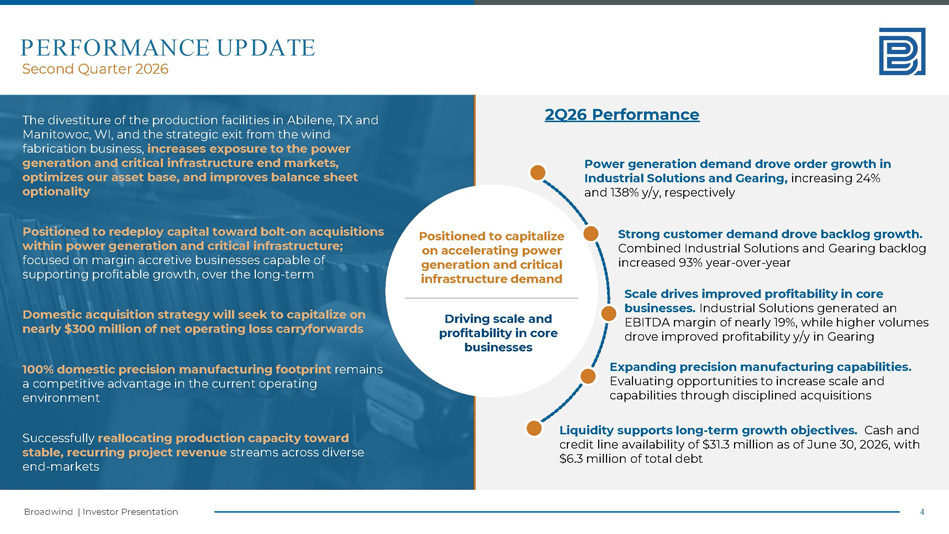
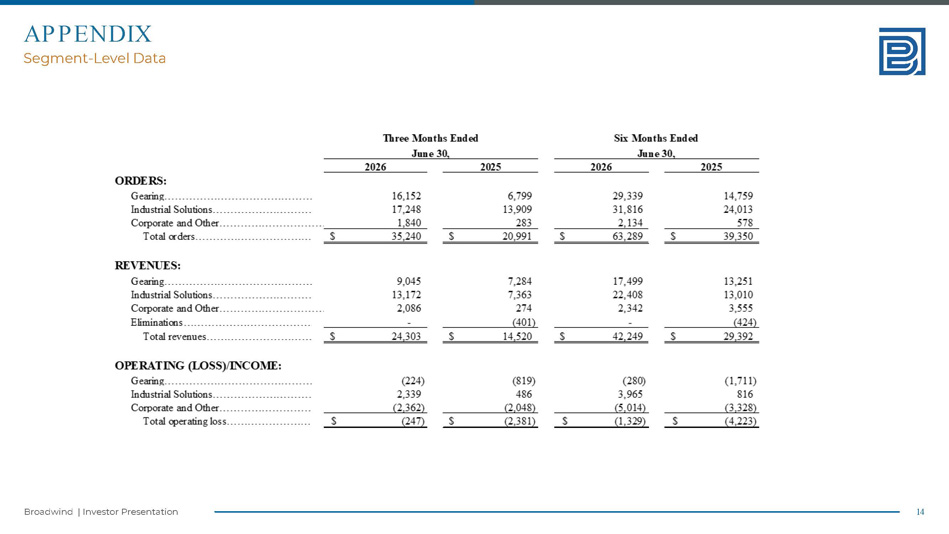
Thanks, Tom. And welcome, everyone, to our call today. During the second quarter, we continued a successful strategic pivot toward becoming a pure-play precision manufacturing business focused on the domestic power generation and critical infrastructure markets. Customer demand was robust during the second quarter as momentum accelerated across our key verticals. Following our strategic exit from wind tower manufacturing over the last year, Broadwind is operating from a position of increased financial flexibility and strategic focus. Given the strong foundation of our core gearing and industrial solution segments, We are building a precision manufacturing platform positioned to benefit from what we expect will become a sustained multi-year investment cycle in electricity generation, transmission, and distribution driven by accelerating load growth from AI data centers, a domestic manufacturing renaissance, a shift toward electrification, alongside the need to replace and modernize an aging grid. We believe our gearing and industrial solutions businesses position us for stronger, more stable growth trajectory than at any point in our history, characterized by attractive margin profiles, greater revenue visibility, and a potential for meaningfully improved earnings quality. Further, we believe our 100% domestic manufacturing footprint, technical expertise, and longstanding customer relationships position us well to capitalize on sustained momentum across our key vertical markets, providing customers with an integrated, onshore solution for the most complex, large-scale manufacturing challenges. At a segment level, industrial solutions generated EBITDA margin of nearly 19% during the quarter, reflecting strong execution and a higher value sales mix. Within gearing, profitability also improved due to increased sales volume, reflective of our recent elevated order levels. As customer demand has strengthened, we further optimize our asset base and human capital. a dynamic that's translated to improved operating leverage and visibility as we look forward to the second half of 2026. On a comparable basis, total backlog for our industrial solutions and gearing segments increased a combined to 93% as of June 30th when compared to the prior year period. We ended the second quarter with a book-to-bill of 1.5 times. Our capital allocation priorities remain centered on creating long-term shareholder value through a combination of sustained organic growth, together with opportunistic investments in complementary products and solutions within our targeted markets. With a strengthened balance sheet and a streamlined operating structure, we are actively evaluating opportunities that seek to scale our precision manufacturing expertise through bolt-on acquisitions that meet our strict investment criteria. We remain constructive on the opportunities we're seeing in the market and will continue to remain patient yet opportunistic acquirers of complementary position manufacturing assets that meet our parameters around sector focus, profitability, model durability, and valuation. Within the gearing segment, Q2 orders increased by 138% to $16 million. increasing the backlog to nearly $38 million. Demand growth within the Gehring segment has been supported by strong customer activity and power generation, including demand associated with data center-related powering requirements, as well as improving activity within upstream oil and gas. Quoting activity remains robust in this segment. Our industrial solutions segment had yet another strong quarter, as orders increased 24% year-over-year to a record $17.2 million, driving backlog to a new record of $47.4 million. Natural gas turbine demand remains strong, supported in part by data center-related power demand and broader global electrification trends. We believe these represent important growth drivers for this segment. We are positioning the business to serve that demand. operationally we continue to optimize our processes to increase throughput velocity and capacity in our gearing division we are executing a floor space optimization initiative aimed at improving material flow and enhancing operational efficiency as part of this effort key machining centers are being reconfigured into cellular manufacturing layouts to streamline production processes. These improvements are expected to reduce wasted motion, increase productivity, and increase throughput in support of the continued strong demand in power generation and critical infrastructure markets. In the industrial solution segment, we are already seeing the benefits of expanding our North Carolina facility footprint in Q2. The expansion of the warehouse by 30 percent has enabled us to handle the higher sales volume in a more efficient manner due to its improved layout. This has also opened much-needed processing and packaging space to accommodate the continued growth we expect. Gearing revenue increased 24% year-over-year to $9 million, driven by continued growth and power generation demand. Industrial solutions revenue rose 79% to $13.2 million, primarily reflecting higher shipments of natural gas-driven components for both new-build and aftermarket applications. In summary, the business continues to perform well as we sharpen our focus within adjacent, higher-margin precision manufacturing markets. Our strategic pivot away from the wind tower business and toward markets offering more attractive growth, margin, and demand characteristics has repositioned Broadwind to pursue more consistent profitable growth, and higher quality earnings. With that, I'll turn the call over to Tom for a discussion of our second quarter financial performance.
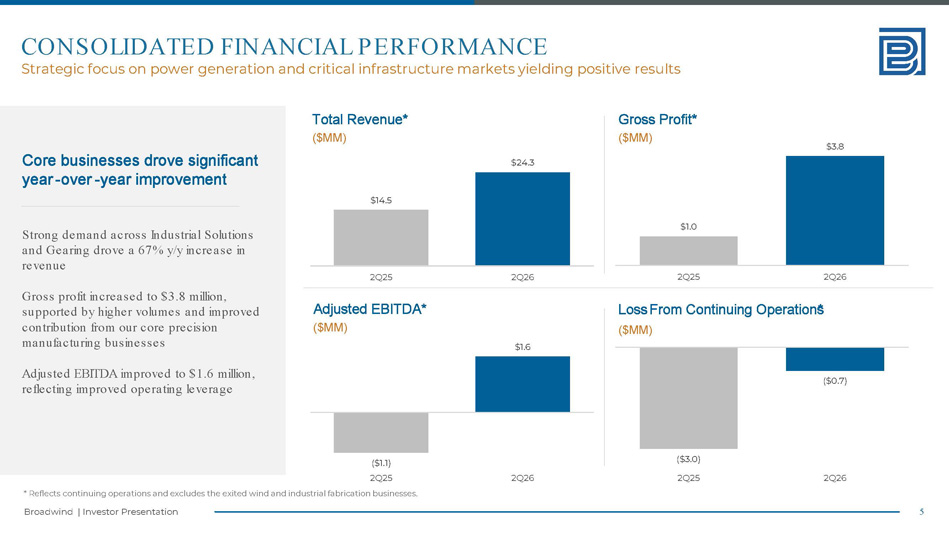
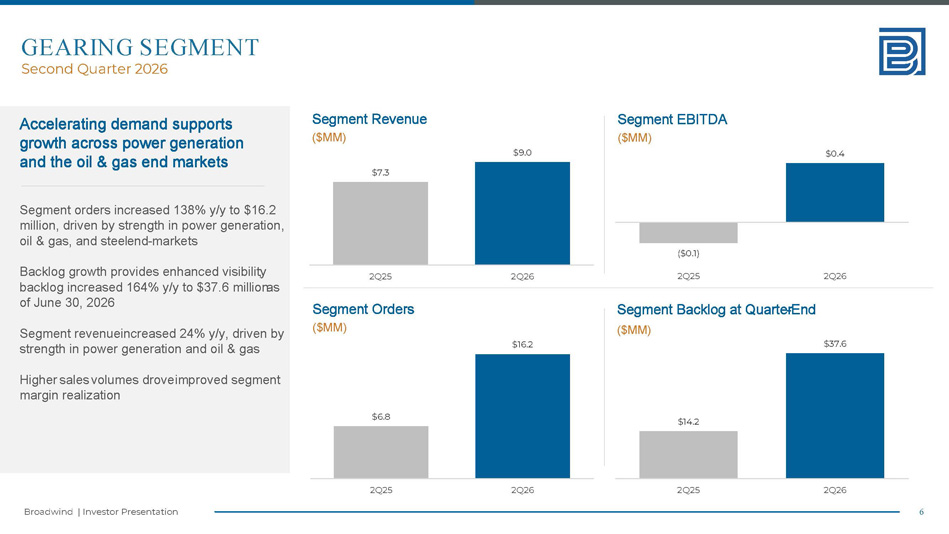
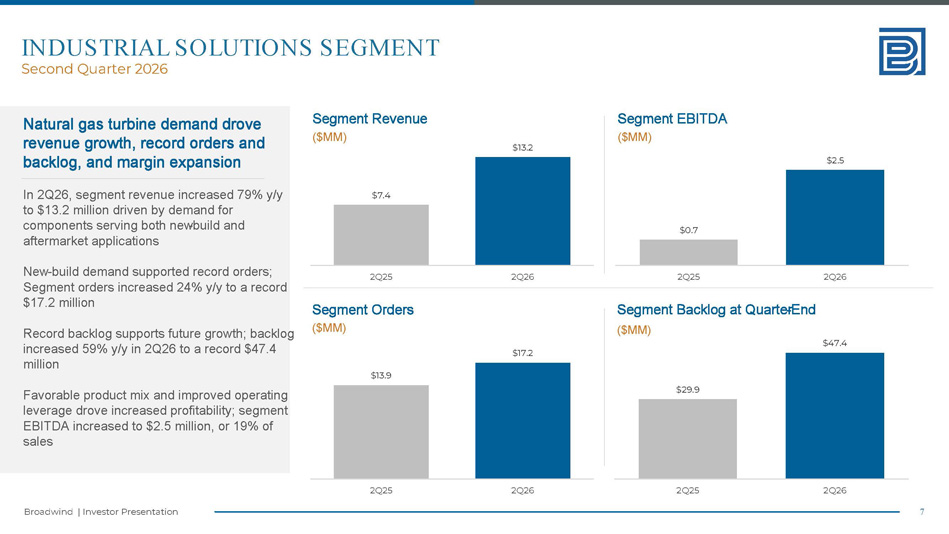
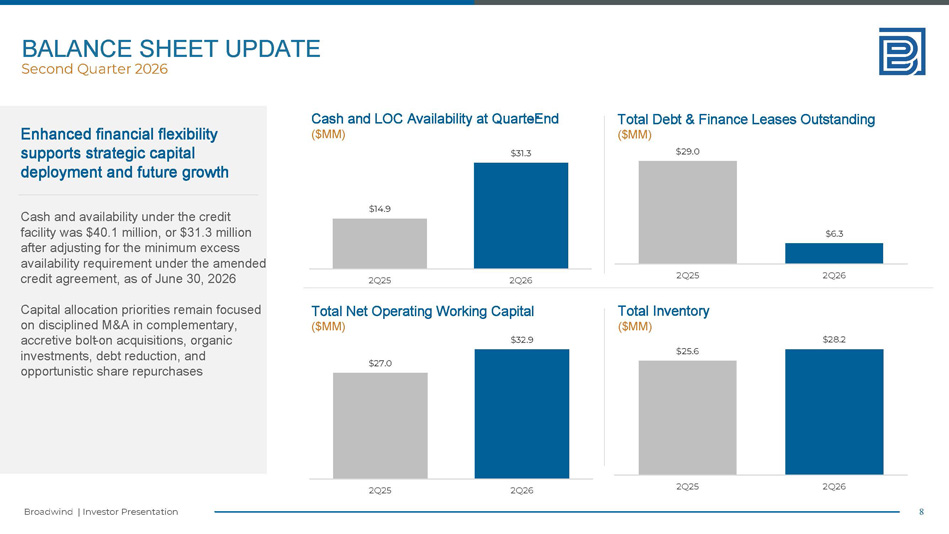
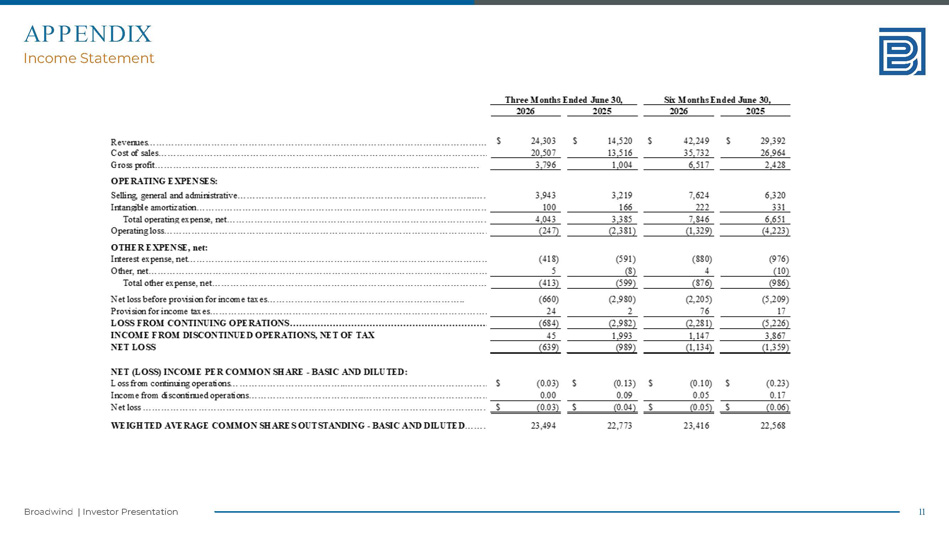
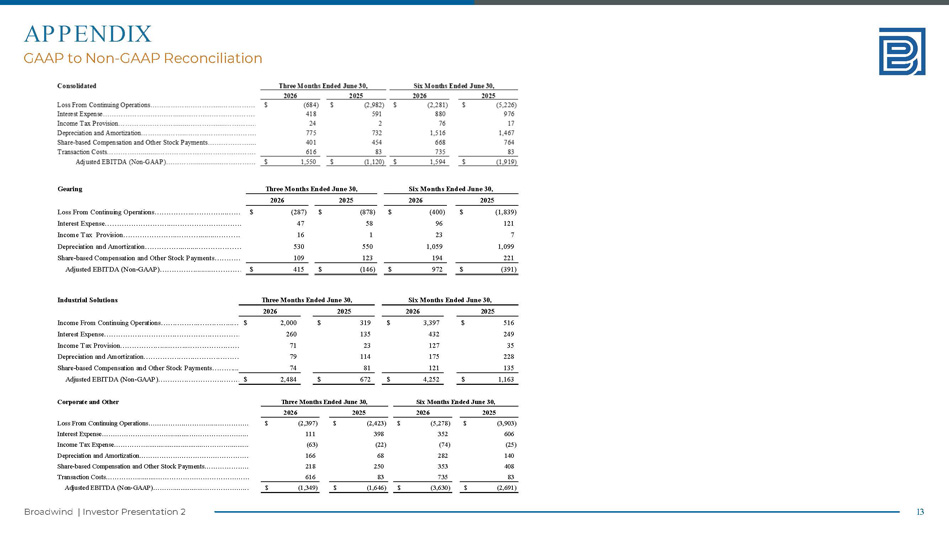
Thank you, Eric. Turning to slide five for an overview of our second quarter performance. We delivered another strong quarter marked by significant revenue growth, improved profitability, and continued order momentum across both operating segments. Second quarter consolidated revenues were $24.3 million, representing a 67% increase versus the prior year period. This increase is reflective of the strong order activity levels we've been recognizing in both the gearing and industrial solution segments. As noted last quarter, we expected Q1 to be the low-water mark in terms of 2026 revenue within our businesses, and we saw sequential increases within both segments. Adjusted EBITDA improved from an EBITDA loss of $1.1 million in the prior year second quarter to a positive $1.6 million in the current year. Second quarter orders exceeded $35 million, increasing more than $14 million in the prior year period, driven primarily by strength in gearing and higher PRS activity. As a reminder, PRS activity was previously reported within the heavy fabrication segment. Going forward, the PRS activity will be included in the consolidated financial performance, but individually does not meet the reportable segment criteria. Turning to slide six for a discussion of our gearing segment. Q2 gearing orders remain strong at $16.2 million, an increase of 138% versus the prior year and 22% sequentially, reflecting broad-based demand across major end markets. We ended Q2 with $37.6 million in backlogs, representing a fourth consecutive quarter with an increased level of backlog. Our Q2 orders and backlog totals are approaching the strongest levels in the segment's recent history, reflecting strength within our end markets, most notably within power generation and oil and gas. Segment revenue was $9 million, an increase both sequentially and versus the prior year, reflective of strong power generation deliveries. We recognize adjusted EBITDA of $0.4 million compared to an adjusted EBITDA loss of $0.1 million in the prior year period. As we noted previously, as volumes continue to recover in this segment, we anticipate improved operating leverage and higher margin. Turning to slide 7, Industrial Solutions booked over $17 million in new orders during the second quarter, an increase of 24% over the prior year and 18% sequentially. Industrial Solutions continued its exceptional momentum, achieving new records in both orders and backlog, while extending its backlog growth streak to eight consecutive quarters. In addition, orders of $17.2 million exceeded the prior record by more than $2.5 million. Q2 segment revenue was $13.2 million, up almost 80% versus the prior year period, reflective of our elevated order levels and strong backlogs. The $13 million of revenue recognized in Q2 also represents a quarterly record for the Second quarter adjusted EBITDA was $2.5 million versus $0.7 million recorded in the prior year period. This improvement reflects higher capacity utilization, a favorable product mix, and cost efficiencies realized during the quarter. While we expect EBITDA margin to adjust down to more typical levels moving forward, we currently expect revenue to remain above recent historical levels, subject to customer schedules, product mix, and prevailing market conditions. This expectation also reflects the recent expansion of our Sanford, North Carolina facility, where we increased our manufacturing footprint by approximately 30% at the end of Q2. Turning to slide 8, we ended the second quarter with total cash and availability on our credit facility of more than $40 million, or $31.3 million after adjusting for the minimum excess availability requirement in place effective Q1. This strong liquidity position, together with our significantly reduced debt levels, gives us substantial financial flexibility as we enter the second half of 2026. In terms of working capital, we've seen a modest increase in working capital within our continuing operations in Q2 as those businesses continue to ramp up. However, that increase is more than offset by a reduction in inventory associated with the Abilene Tower operations, which declined by more than $6 million during the quarter. That concludes my remarks. I'll turn the call back over to Eric to continue our discussion. Thanks, Tom.
Now, allow me to provide some thoughts as we move into Q3 and beyond. We continue to make a decisive shift toward power generation in critical infrastructure markets that we believe offer attractive long-term growth characteristics. The strategic moves we've made to divest of our two tower manufacturing facilities position us to focus on higher growth and higher margin opportunities to leverage our precision manufacturing expertise, supported by a strengthened balance sheet. Once we complete our remaining wind tower orders in Q3, satisfying our contractual obligations, Broadroom will have completed our strategic pivot away from wind, positioning us to fully advance our power gen and critical manufacturing vertical market strategy. Our remaining facilities in Chicago, Pittsburgh, and Sanford, North Carolina, near Raleigh, have more than 450,000 square feet of manufacturing space available to serve our customers. Quarter upon quarter of strong water growth within the gearing and industrial solution segments from power generation, specifically with distributed power, as well as growing opportunities in both small frame and utility scale natural gas turbines, support our strategy to expand in this market. Quote activity continues to increase in both gearing and industrial solutions, generated by our ability to solve the complex precision manufacturing and sourcing challenges faced by customers in this growing market. To that end, we have added engineering and manufacturing resources to meet this demand in both divisions. In our gearing segment, we continue to execute our strategy to move beyond traditional gearing to renew opportunities in other precision machine products for power generation, aerospace, and defense. We believe that the continuing strength and incoming orders from power generation sector may reflect the early stages of a sustained multi-year investment cycle. We are positioning the business to participate in that opportunity. Lastly, we also see improving order activity in traditional gearing markets supporting upstream oil and gas, specifically within the fracking aftermarket as certain customers evaluate or begin returning older rigs to service in response to strengthening commodity price environment. Industrial solutions. Our commercial performance continues to set records in both orders and backlog. The robust demand that began in early 2025 has continued for six quarters so far and continues to show strength. As the global demand for natural gas power generation equipment remains robust and our customers bring additional production capacity online, we believe this is an extended period of growth. In summary, I am pleased with the order growth and the strategic actions we've taken over the last year, and I'm excited to execute our plan. Within our core divisions, we have created a firm foundation for growth. This, combined with our strength and balance sheet, positioned us to execute our strategy, both organically and through acquisitions. We have been working with several advisors to secure a pipeline of opportunities to consider and are being very selective and disciplined in our search and evaluation. Our divisions are well-positioned to support the nation's growing need for power generation and infrastructure improvement, which we see as long-term opportunities for us. Our commitment to quality, technical expertise, and the ability to solve complex manufacturing challenges for our customers continue to help us win new opportunities. We have strategically pivoted our business, are investing wisely, and are taking decisive actions toward higher value and growing end markets. We're pleased that our order intake continues to expand, positioning us for improved utilization of our reduced manufacturing footprint in 2026, as we strengthen our foundation for steady profitable growth, serving the power generation, critical infrastructure, and other key markets with high-quality precision components and proprietary products to capitalize on the improved demand in years ahead. With that, I'll turn the call over to the moderator for the Q&A session.
Operator
Thank you. At this time, we'll be conducting a question and answer session. If you'd like to ask a question, please press star 1 on your telephone keypad. A confirmation tone will indicate your line is in the question queue. You may press star 2 if you'd like to remove your question from the queue. For participants using speaker equipment, it may be necessary to pick up your handset when pressing the star keys. One moment, please, while we poll for questions.
Operator
Our first question comes from Stephan Thomason with Ross.
Operator
Your line is now live.
Hi, this is Stephan Thomason on for Justin Clare. You had another quarter of strong orders and started to improve visibility in the balance of 26, but did not reinstate guidance. What else to have from here to give you guys enough confidence to re-guide? Thank you.
Yeah, I'll take that. You know, just at this time, given the ongoing wind down of our operations in Abilene, we just didn't think it was prudent for that to happen. So, we definitely want that wind down of the operations to be complete, which is happening here in Q3 as scheduled. So, that would be the first kind of domino to fall before we would be putting back, you know, guidance out there.
Okay, good to know. And then my next question would be on gearing. So what drove the strong gearing orders? Was there any outsized notable orders? Is this a good indication of future demand?
Yeah, I would say this is a good indication of future demand. And, guys, sorry, we've got a thunderstorm warning behind us. I hear the siren. That's what it is, but we're fine. So, yeah, the demand was across all of our normal verticals. oil and gas. I mentioned in my prepared remarks, rig counts are starting to go up a bit. They're up about 9%. But we think that's primarily due to customers putting older rigs that have been sidelined back in action. So we're seeing some aftermarket demand from that. But I think in general, Stephan, it would be indicative of future demand.
Operator
I'll hop back in the queue. thank you thanks our next question comes from eric stein with craig hallam your line is now live good morning um so i mean you're almost done uh with the remnants of wind um i know it's a another quarter so just curious i mean it sounds like you're certainly being thoughtful in terms of potential additions to the platform, but any thoughts you can share on areas, capabilities that you might be looking at, any details would be very helpful.
Yeah, we're willing. Thanks, Eric. This is Eric. We're focused on opportunities that expand our precision manufacturing capabilities. We're looking at the power gen, critical infrastructure, infrastructure, grid hardening, maybe even defense and aerospace. But, you know, attractive targets would be complementary in terms of customers, capabilities, or capacity. We're not going to recreate the wheel. We see our gearing business and our industrial solutions business as core. And so we want to add to those businesses and serve those customers. That's where we're hunting now, Eric. Okay, not too far afield from what you've got in place now, it sounds like. Yeah, we see PowerGen and critical infrastructure and grid as really long-term plays. I mean, it's a 10- or 15-year demand cycle here, so I think investing in those markets would prove well from an acquisition standpoint for us.
Operator
Got it. Okay. Thank you. And then maybe just turning to industrial solutions. Good that you've completed the 30% expansion. But I mean, if you could talk about your potential to do that longer term, and I guess the reason for that question is, correct me if I'm wrong, but I think you lag your largest customer by five to six quarters. and that customer in the last quarter or two has seen a massive upstuff in orders and their national guests turned on backwards. So just thoughts about your potential to expand more beyond the 30%.
Yeah, that customer, again, that's GE Vernova. It's common knowledge that they are a primary customer in that segment. They're expecting growth of 18% to 20%. given their guidance. And we think we can keep up with that. As I mentioned before, when we move into this new part of our facility, it opens up for packaging, picking a packaging space there. But what it also does is allows us to expand our manufacturing footprint in the original space. As we look to M&A, especially if we can find it more local, we will look to add manufacturing footprint there. So we can continue to grow local to the Sanford, Raleigh area. So our manufacturing can be local and then we can use that 130,000 square foot facility, which is now both manufacturing and picking and packing and shipping to be final picking and packing and shipping. So I think we can grow substantially in that facility. I've mentioned before to a $75-ish million rate. But beyond that, this M&A we're looking at in that specific part of our business could add manufacturing space, allowing further growth.
Operator
Okay. And maybe just sneak one last one in. I mean, talk about the growth opportunity, as you said. I mean, it's well known. It's very much tied to GE for Nova, which is a good thing. But, you know, maybe any limiting factors or the potential to add additional OEMs to that list?
Yeah, we are. We're actually we're working with all five of the top five players in natural gas turbines, both in the in the large scale. Sorry, guys, that's another warning here. We've got thunderstorms in the background here. But we are looking at other customers in that same segment, both in gearing and industrial solutions. They have somewhat different supply chain solutions required, so it's not exactly a match to what we primarily do for GE Renova. But we are looking at other customers in both gearing and industrial solutions in that space, in the power generation space, to grow. So we're not so concentrated within that one customer.
Operator
Okay, thank you. Thanks, Eric.
Operator
Our next question comes from Samir Joshi with HC Wainwright. Your line is now live.
Hey, good morning, Tom, Eric. Thanks for taking my questions. So, A, in your backlog that you already have in the bag, is there any component of revenues that are expected from the data center market? And a corollary to that is, in your pipeline, are you seeing any slowdown because of the various states and regional bans on data centers coming up?
Well, we service both oil and gas and PowerGen in both divisions. It's hard to divide PowerGen into what is just general demand growth and what is specific from AI. But I do know that both of our primary customers in that space tout AI as a primary demand driver, especially in the U.S. So while we think about 30% to 40% of our revenue in gearing is in PowerGen and a higher percentage of industrial solutions in PowerGen, I don't have a specific breakdown as the drivers of that demand coming from AI.
But I know it's significant, if that helps you. yeah yeah just wanted to see uh that uh and then will you remind us uh in both uh gearing as well as industrial solutions uh what is sort of the conversion cycle from backlog uh adding to backlog to actually realizing those revenues uh in terms of months a period is there any average for those two well yeah i'll take that typically we've we've said publicly that the um the conversion rate for a typical gearing order is about six months.
Now, given the demand that we have, again, in power generation, some of those customers have asked us to plan production beyond 2026. So, it's beyond that six-month normal cycle. But say you're an oil and gas customer, you're a mining customer, or you're a material handling customer, six months is normally a good benchmark for conversion of backlog into orders. With industrial solutions, That typically, again, it's depending on the need. If it's a new install, it can be up to 18 months or even further out. If it's aftermarket, we can turn orders, we can turn backlog well under three months if we need to. But if you're looking for a conversion rate, six months to a year is a good benchmark.
Yeah, I'd also say that, you know, with the improved visibility that some of our customers have, we're seeing backlog well into the out years. we're seeing significant backlog in in 2028 already so i think i think that really helps kind of um level set that in terms of when we're going to convert that backlog into revenue yeah no it's good to see that uh i mean the six month conversion cycle for gearing uh is sort of typical but then you already have advanced orders and visibility into as you said 27 28 so that's always good to say.
Just switching quickly to cost side, I think in prepared remarks you mentioned you're expecting to increase engineering and manufacturing resources. So how should we think of costs, operating costs going up and maybe how does it impact gross margins in the near term?
I would say that that would be, that would be ratable going forward. I wouldn't expect affect any degradation in gross margins due to those increases. Think in terms of quality engineers, general engineers, and production people, just to keep the volume moving in the direction we're going. It's not going to be a lag on gross profit percentage.
Yeah, I would say that particular example won't be a drag on margin. You may see some degradation due to mixed change, especially within – sorry, guys, again, we might have to take shelter here, but you may see some margin degradation due to mix, especially within our business unit, but any other cost increases would be in response to higher volume.
Yeah, and I guess it also speaks to leverage that you may have as you add these resources and revenues grow. So that's good to know. Thanks for taking our questions and stay safe. Thank you.
Yeah, we're in Chicago here. If any of our investors in Chicago, you might need to take shelter as well. Next question, please, if we have one.
Operator
We have reached the end of the question and answer session. I'd now like to turn the call back over to Eric Blashford for closing comments.
Well, yes, thanks for listening in, everyone. We're excited about our opportunities. We're excited about the strategic pivot and look forward to coming to you after Q3 to tell you about our results then. Thank you very much, everyone.
Operator
This concludes today's conference. You may disconnect your lines at this time, and we thank you for your participation.