Operator
Good afternoon, ladies and gentlemen, and welcome to Cathay General Bancorp's First Quarter 2026 Earnings Conference Call. My name is Ashia, and I'll be your coordinator for today. Operator provided instructions. Today's call is being recorded and will be available for replay at www.cathaygeneralbancorp.com. Now I would like to turn the call over to Georgia Lo, Investor Relations of Cathay General Bancorp. Please go ahead.
Thank you, Ashia and good afternoon. Here to discuss the financial results today are Mr. Chang Liu, our President and Chief Executive Officer; and Mr. Al Wang, our Executive Vice President and Chief Financial Officer. Before we begin, we wish to remind you that the speakers on this call may make forward-looking statements within the meaning of the applicable provisions of the Private Securities Litigation Reform Act of 1995 concerning future results and events and that these statements are subject to certain risks and uncertainties that could cause actual results to differ materially. These risks and uncertainties are further described in the company's annual report on Form 10-K for the year ended December 31, 2025, at Item 1A in particular, and in other reports and filings with the Securities and Exchange Commission from time to time. As such, we caution you not to place undue reliance on such forward-looking statements. Any forward-looking statement speaks only as of the date on which it is made and except as required by law, we undertake no obligation to update or revise any forward-looking statements to reflect future circumstances, developments or events or the occurrence of unanticipated events. This afternoon, Cathay General Bancorp issued an earnings release outlining its first quarter 2026 results. To obtain a copy of our earnings release as well as our earnings presentation, please visit our website at cathaygeneralbancorp.com. After management comments today, we will open up this call for questions. I will now turn the call over to our President and Chief Executive Officer, Mr. Chang Liu.
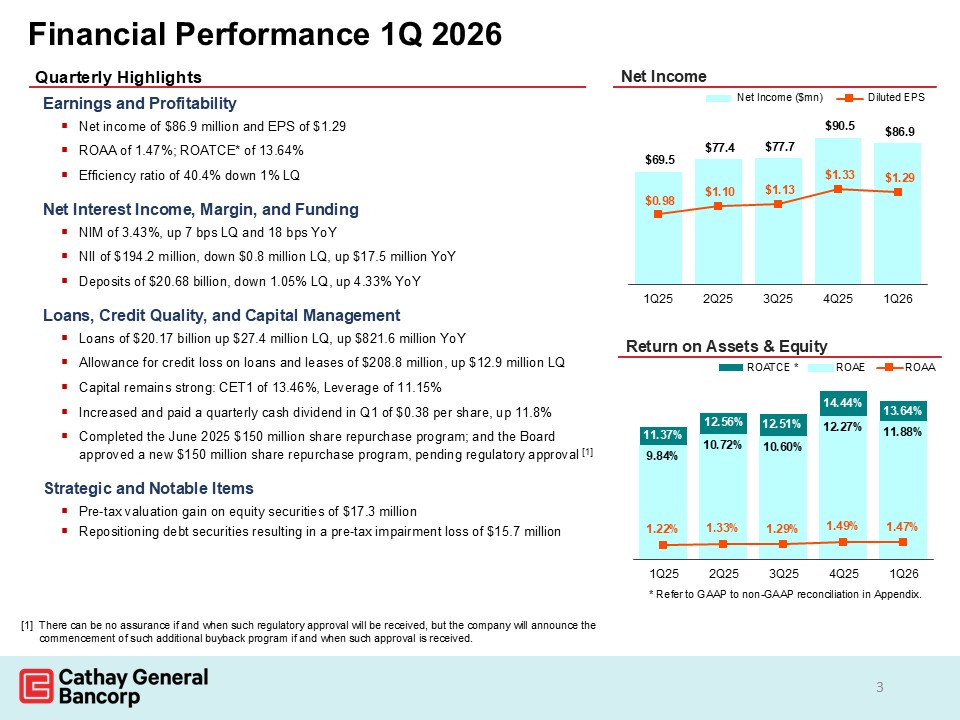
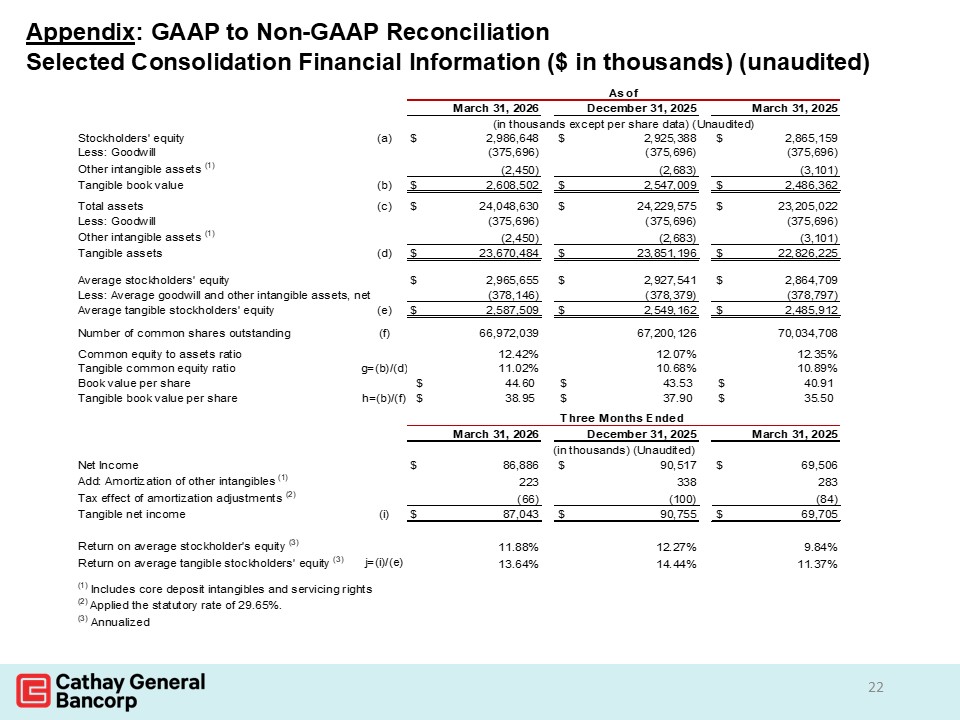
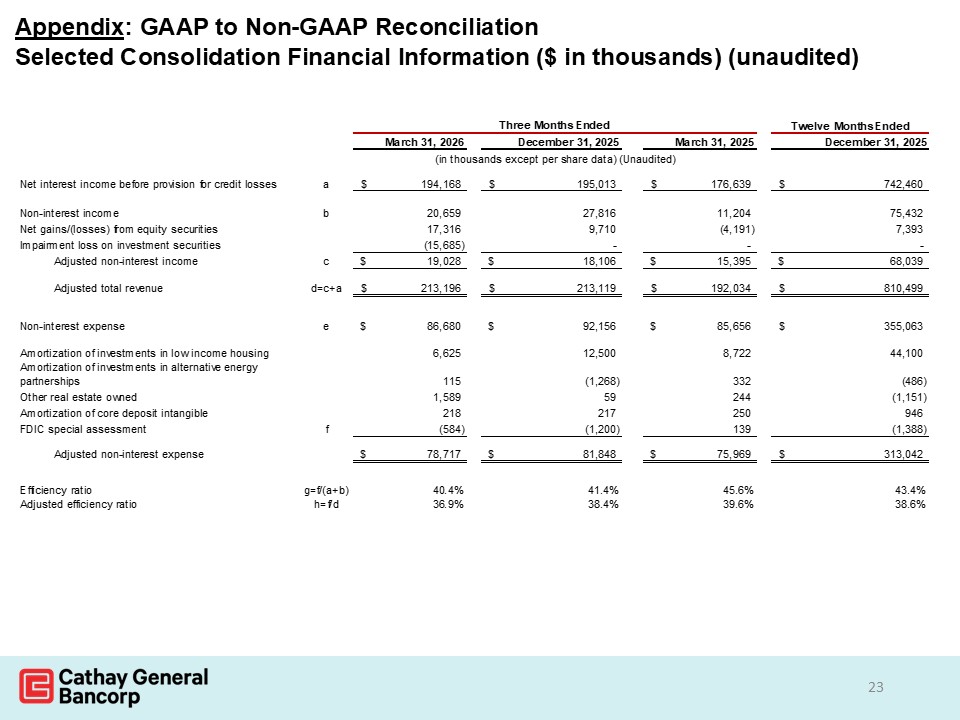
Thank you, Georgia. Good afternoon, and thank you for joining us today. I will begin on Slide 3. We delivered solid financial performance in the first quarter, reporting net income of $86.9 million and diluted earnings per share of $1.29. We also delivered another quarter of net interest margin expansion, driven by disciplined deposit cost management in a competitive environment. Our results reflect two noteworthy items that largely offset each other. The first was a $17.3 million valuation gain on equity securities and the other was a $15.7 million impairment on available-for-sale debt securities from balance sheet repositioning. We sold lower-yielding securities and reinvested at current market rates, a move that supports margin expansion and accelerates tangible book value recovery. Excluding these items, diluted EPS would have been $0.02 lower. Credit quality was stable overall this quarter. We saw improvement in nonperforming loans and net charge-offs, while criticized and classified levels remain steady, reflecting continued credit discipline across the portfolio. We remain focused on maintaining a prudent risk profile given the broader economic and geopolitical backdrop. We continue to generate positive operating leverage. Our efficiency ratio improved to 40.4%, down 100 basis points from the prior quarter, supported by ongoing expense management and steady core performance. On an adjusted basis, our efficiency ratio decreased by 1.5% to 36.9% from last quarter. Capital management remains a priority. During the quarter, we increased our quarterly cash dividend to $0.38 per share, reflecting an 11.8% increase. We also completed the $150 million share repurchase program announced in June 2025 by repurchasing 244,000 shares at an average cost of $51.31. In addition, our Board approved a new $150 million share repurchase program, subject to regulatory approval, underscoring our commitment to returning capital to shareholders in a balanced and controlled way. Loan growth was softer than we anticipated, but this reflects our disciplined underwriting approach. Our focus remains on supporting our loyal customers and deepening long-standing relationships rather than pursuing volume that will require taking on additional credit risk in this unpredictable economic environment. This relationship-driven strategy has served us well through many cycles and positions us well going forward. I will now turn the call over to Mr. Al Wang to walk through our first quarter results in more detail. I'll provide some closing comments before we open the call up to Q&A.
Speaker 3
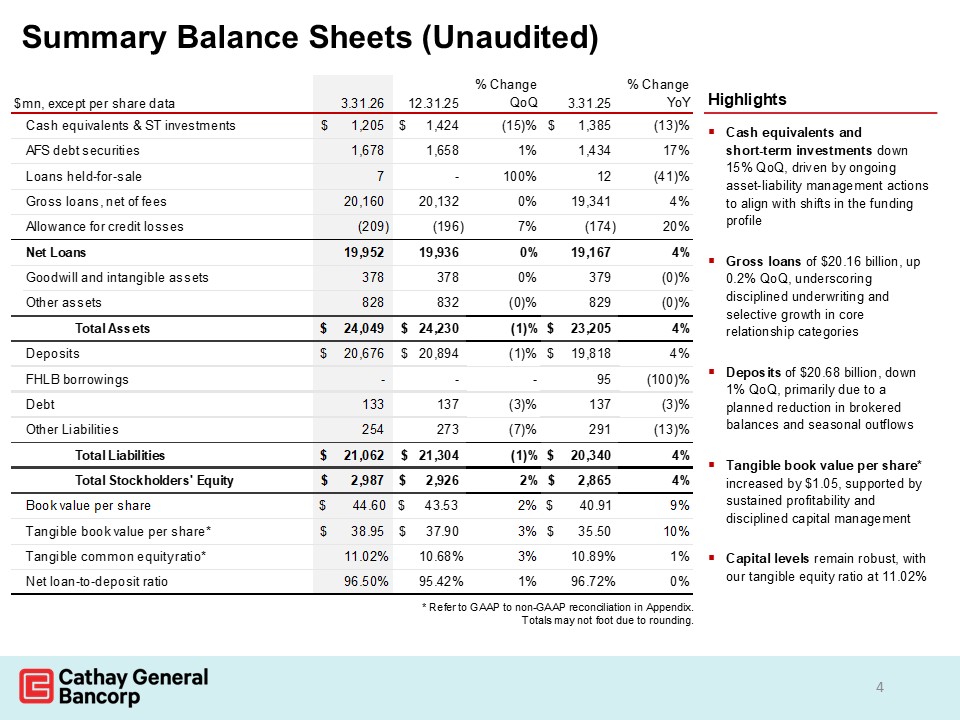
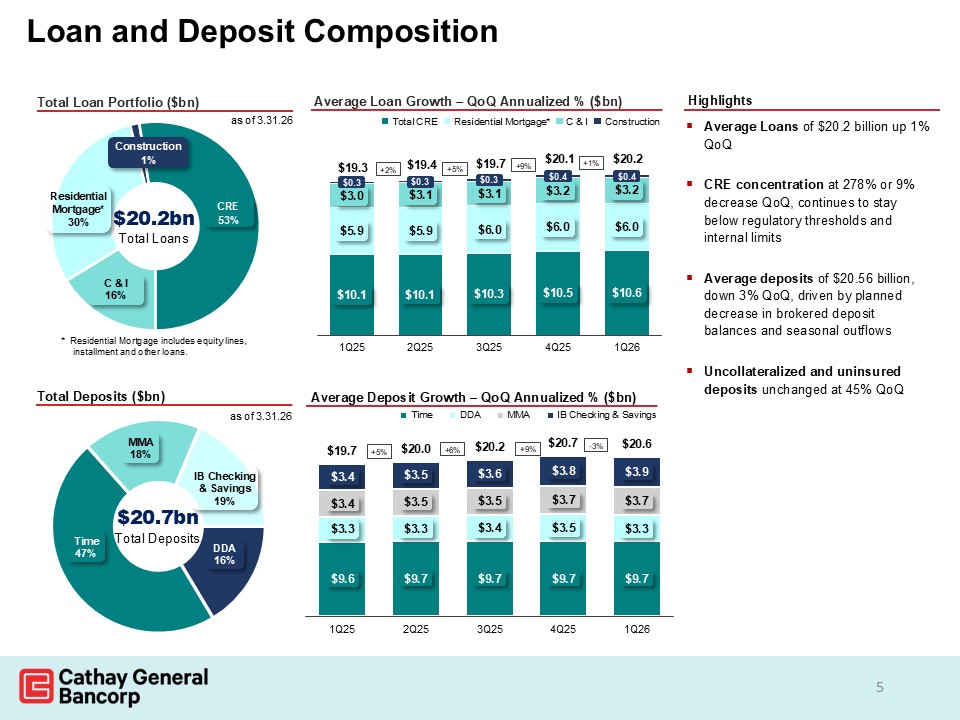
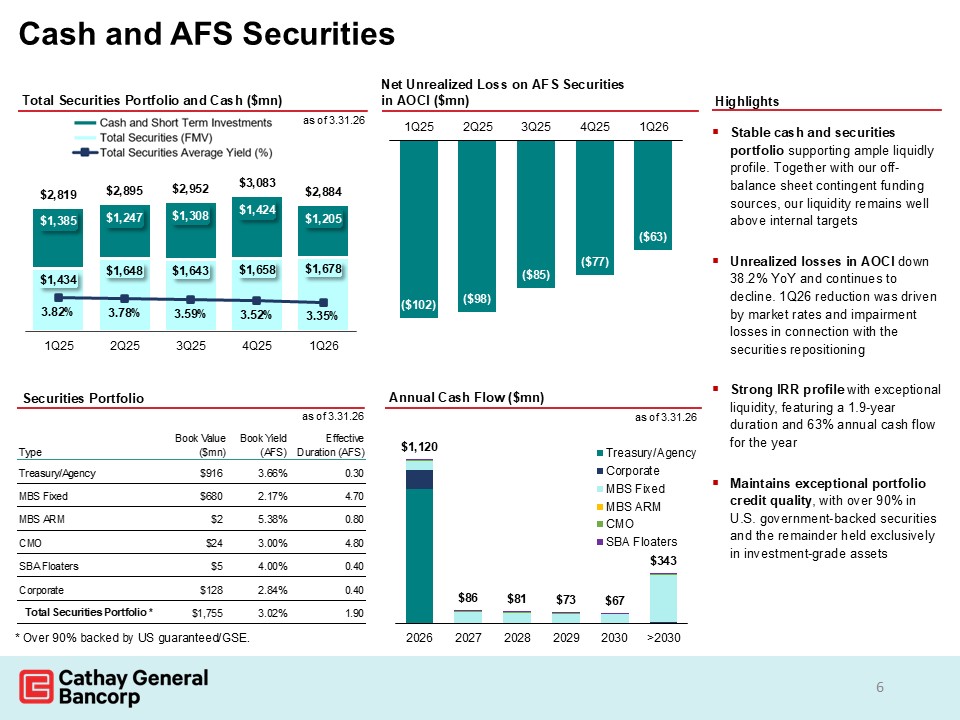
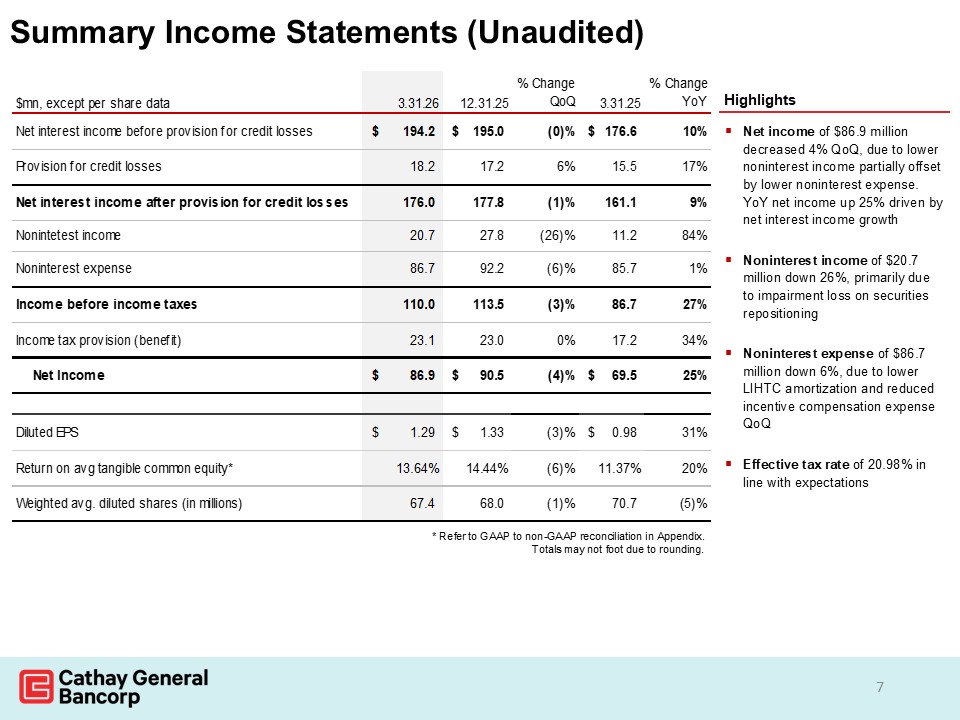
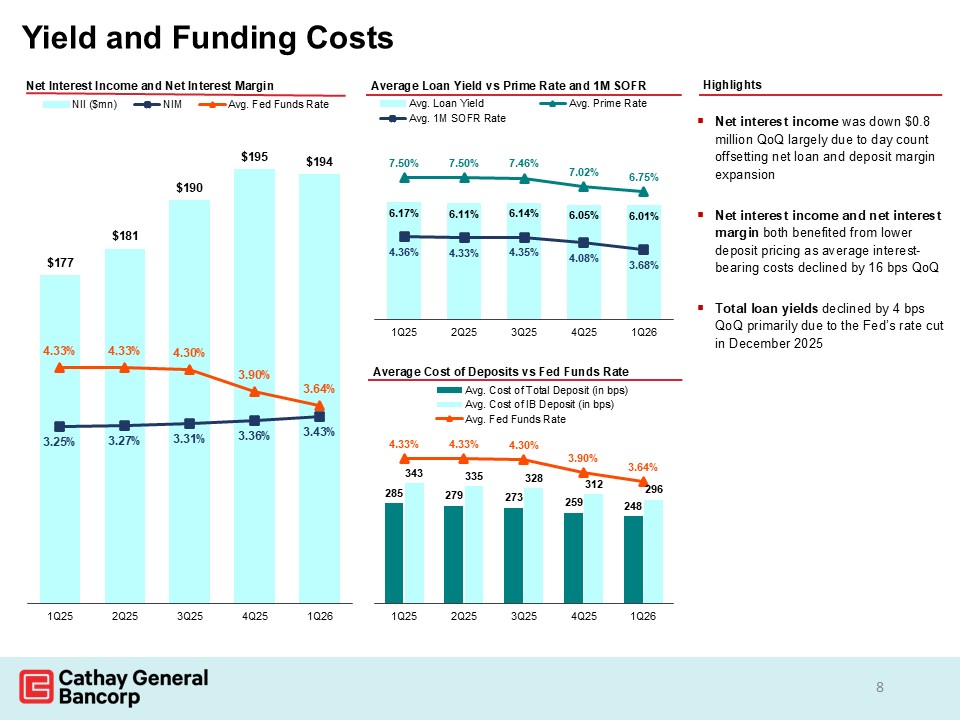
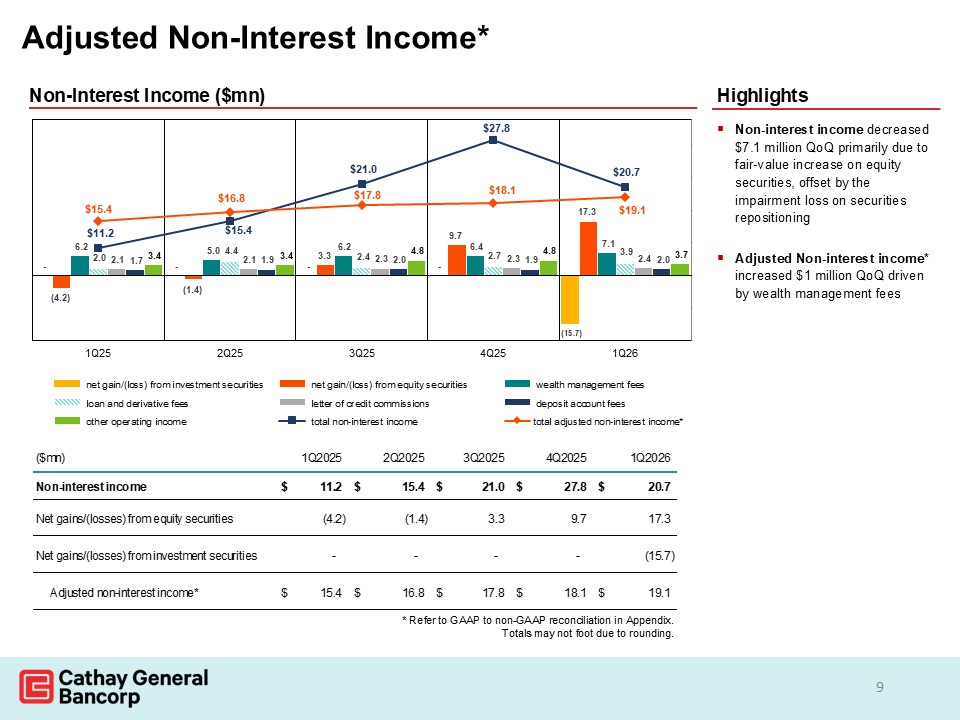
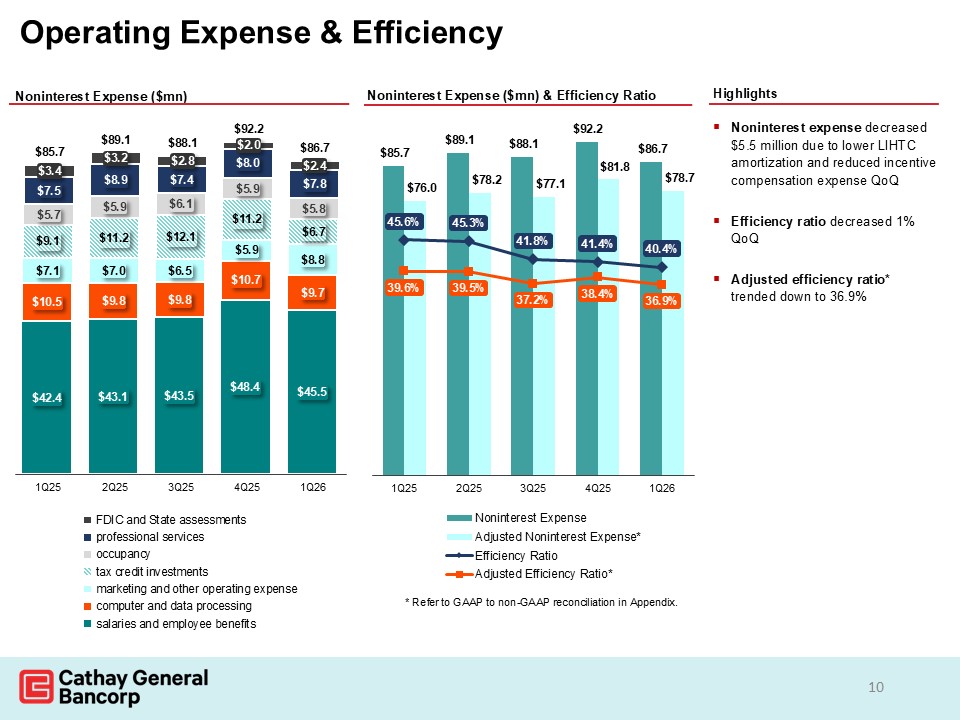
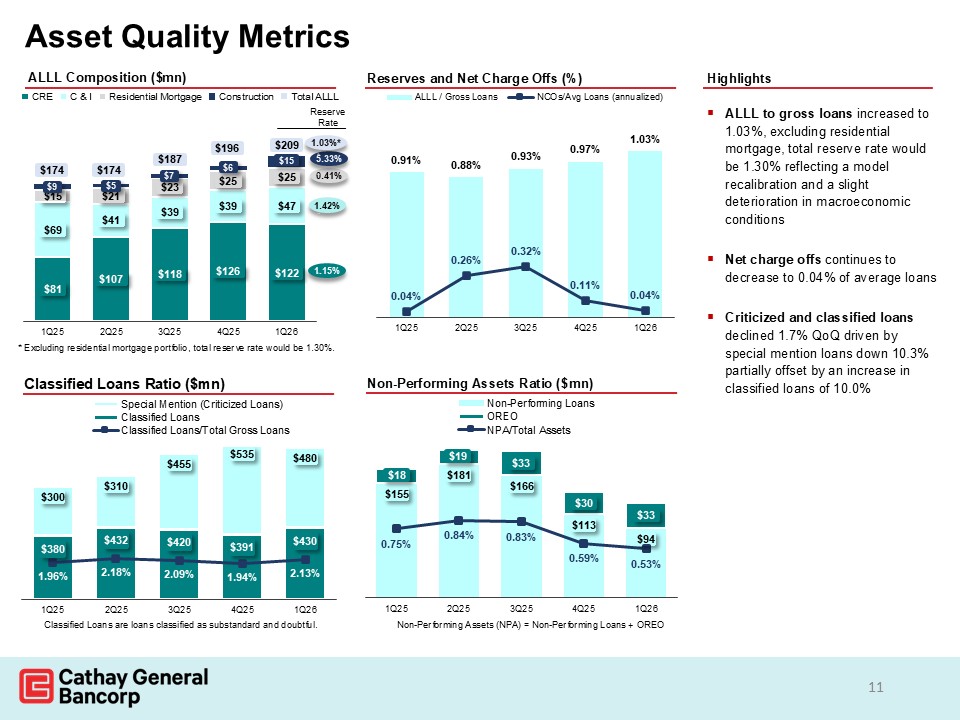
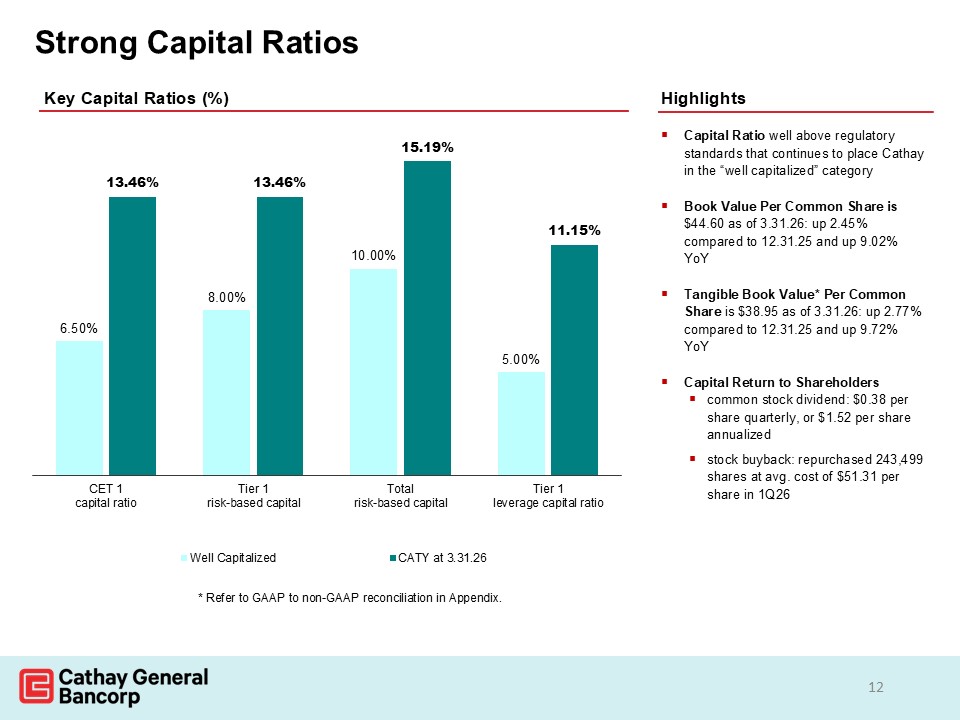
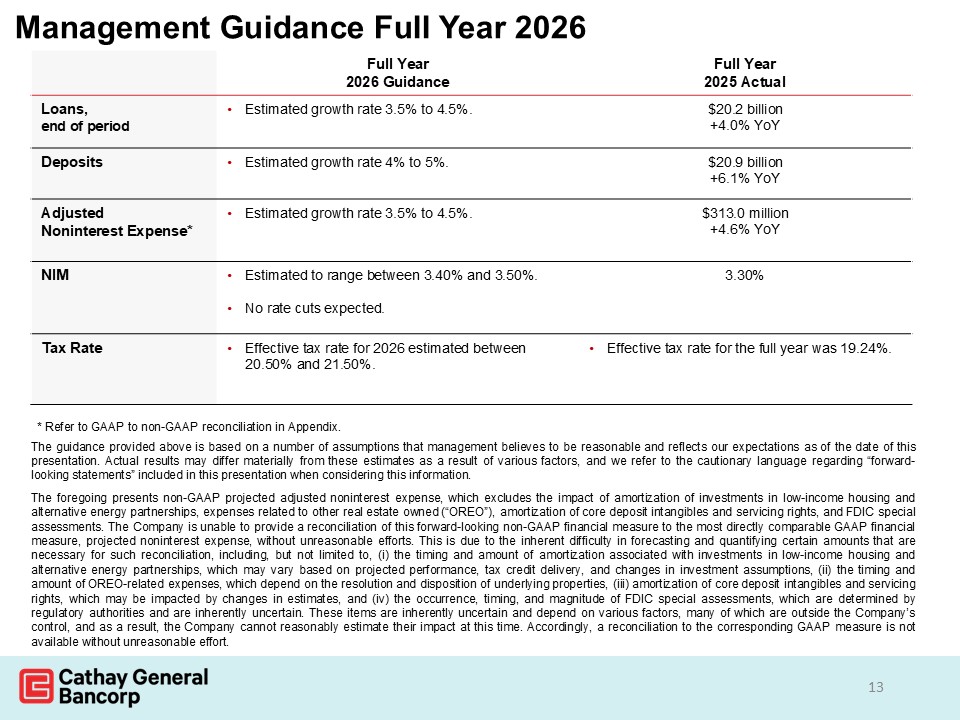
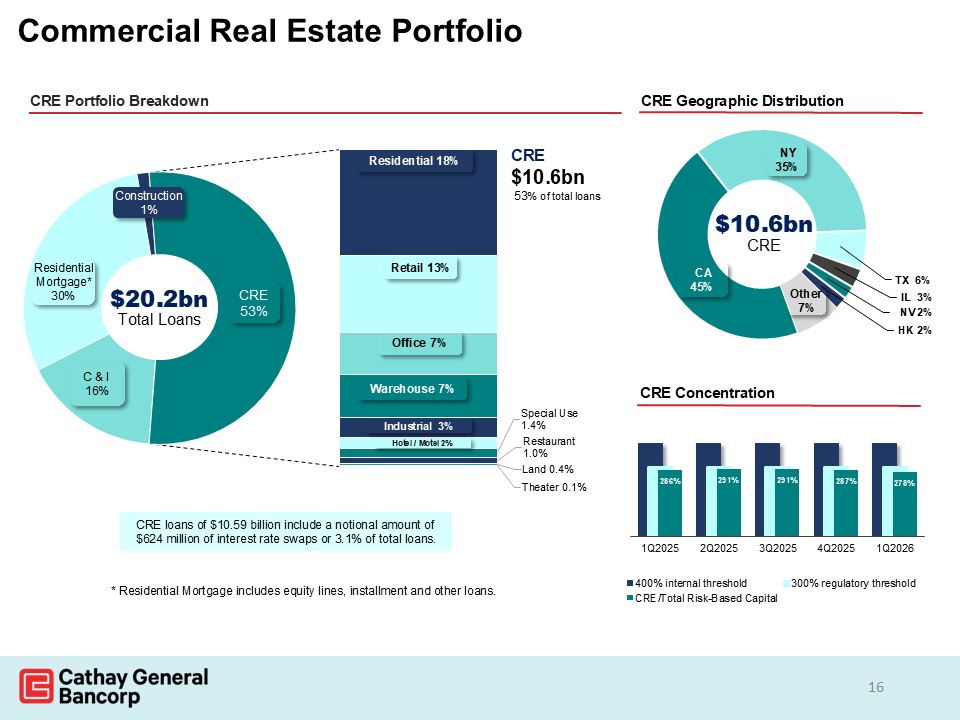
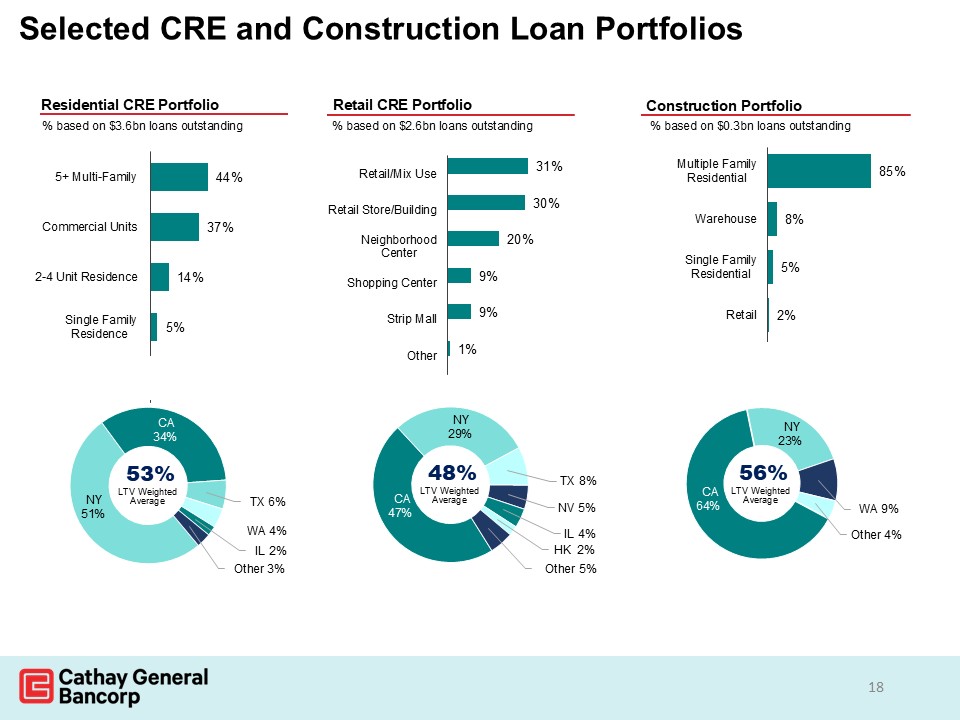
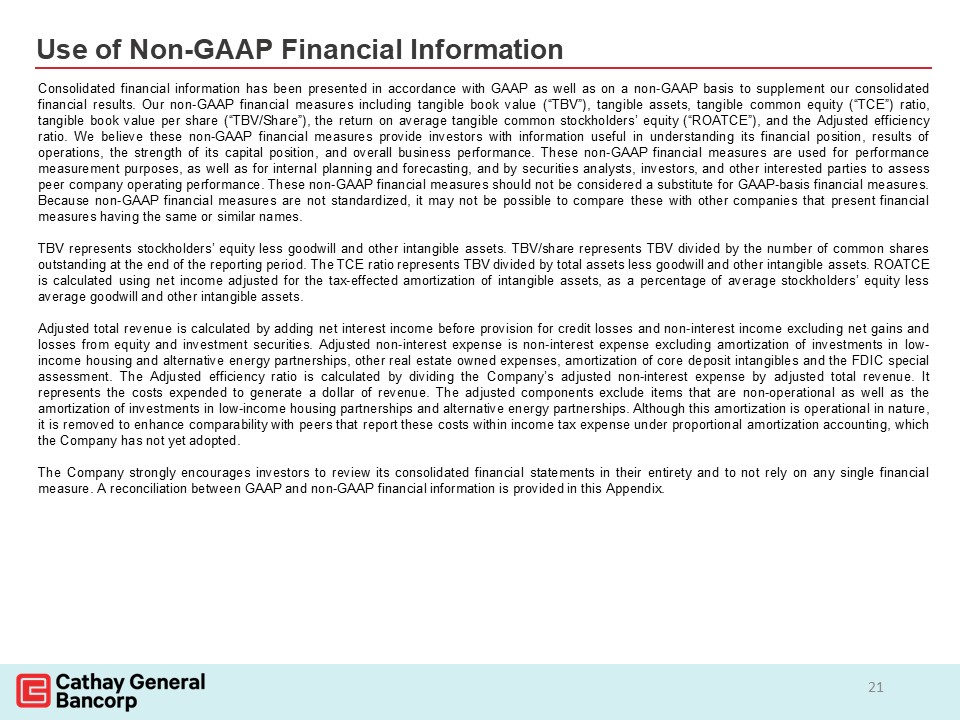
Thank you, Chang. I'll start with our balance sheet on Slide 4. We decreased our on-balance-sheet cash and short-term investments by $219 million to stay aligned with shifts in our funding profile. Period-end loans of $20.2 billion grew 0.2% linked quarter, reflecting our focus on relationship lending. Period-end deposits of $20.7 billion declined by 1% linked quarter, led by $71 million in broker deposits. Capital levels remained in excess of regulatory well-capitalized thresholds and our internal limits. And we continue to grow book value per share by 2% linked quarter and 9% year-over-year. Slide 5 breaks down our loan and deposit mix. Average loan balances increased 1% on an annualized basis linked quarter while the composition remains stable and well diversified. Commercial real estate concentration of 278% declined by 9 points and continues to stay below regulatory guidelines. In addition, our exposure to private credit is minimal with non-depository financial institution loans making up less than 2% of total loans. Average deposits decreased 3% linked quarter on an annualized basis, driven by the decline in brokered deposits. Core deposit outflows were largely seasonal and reflected normal cash management activity by our commercial customers. Our uninsured deposit ratio stayed consistent at 45%. Slide 6 is a new slide to illustrate the strong liquidity, credit and interest rate risk profile of our available-for-sale investment portfolio. In Q1, we recognized a $15.7 million impairment loss on our AFS securities portfolio as part of a securities repositioning initiative. During the first week of April, we sold $210 million of lower-yielding mortgage-backed securities and reinvested $197 million into similar-duration securities at significantly higher yields. This trade carried an earn-back under three years while keeping our overall duration and credit profile essentially unchanged. We keep the overall portfolio short and high quality. Duration is just under two years, and nearly two-thirds of the cash flows will come back this year. Unrealized losses have been improving as rates move and over 90% of the portfolio is U.S. government-backed with the rest in investment-grade securities. Slide 7 highlights our income statement. Net income of $86.9 million decreased 4% linked quarter due to lower noninterest income, offset by lower noninterest expense, which I will discuss in more detail on the following slides. Slide 8 summarizes our yield and funding costs. Net interest income of $194 million declined $0.8 million compared to last quarter due to day count, offset by margin expansion. Net interest margin of 3.43% grew 7 basis points compared to last quarter as deposit costs decreased, offset by a decline in loan yields driven by the Federal Reserve's latest interest rate cuts in the fourth quarter. Slide 9 highlights noninterest income. Noninterest income decreased $7.1 million linked quarter, driven by the notable items Chang mentioned previously. Specifically, we recognized $17.3 million in valuation gains in our equity securities portfolio, offset by the $15.7 million AFS securities impairment repositioning loss. Adjusting for these items, including the gain on equity securities in both periods, noninterest income would have been $19.1 million compared to $18.1 million in the prior quarter, reflecting an increase of 5.52%. Moving to Slide 10. Noninterest expense decreased from $92.2 million to $86.7 million this quarter; this decline was driven by $4.5 million of lower amortization expense on our low-income housing and alternative energy partnerships, along with lower compensation and benefit costs. It's worth noting that most peer banks record the amortization of tax credit investments and income tax expense under the proportional amortization method rather than in noninterest expense as we do. When adjusting for this difference and other noncore items, adjusted noninterest expense would have been $78.7 million, which is $3 million lower than last quarter. On the same basis, our adjusted efficiency ratio improved to 36.9% compared to 38.4% in the prior quarter. On Slide 11, you'll see that our asset quality stayed solid. We increased our allowance by $13 million to $209 million, which puts coverage at 1.03% or 1.30% excluding residential mortgages. That increase was driven by model updates, including a slight softening in the macroeconomic outlook. Net charge-offs improved, dropping from $5.4 million last quarter to $2.1 million this quarter. Classified loans were up $39 million, while special mentioned loans came down $55 million. Importantly, our nonperforming asset ratio continued to trend in the right direction, improving from 59 to 51 basis points. Turning to Slide 12. Capital levels remain strong and well above well-capitalized regulatory thresholds with a modest increase from last quarter. I'll wrap up on Slide 13 with our outlook. We continue to expect full-year loan growth in the 3.5% to 4.5% range and deposit growth of 4% to 5%. Adjusted noninterest expense is still expected to increase between 3.5% to 4.5% for the year. Our NIM and NII outlook no longer assumes any rate cuts in 2026. But even with that change, we remain confident in achieving our NIM target of 3.40% to 3.50%. We expect an effective tax rate of roughly 21%. And with that, I'll turn the call back over to Chang.
Thank you, Al. Overall, we feel very good about how we started the year, notwithstanding geopolitical tensions and uncertainty in the macro environment. We delivered solid financial performance by growing tangible book value per share to $30.95, expanding NIM by 7 basis points and continuing to manage capital prudently to expand the buyback capacity and dividend increases. Looking ahead, we are entering the second quarter with good momentum. Similar to last year, we saw a slower start to the first quarter, but activity strengthened meaningfully as the quarter progressed, and we expect a similar pattern as we move through 2026. Finally, I want to thank our team members for everything they do for our company, our communities and our clients. With that, we can now open it up for questions.
Operator
Operator provided instructions. Your first question comes from David Chiaverini with Jefferies.
Speaker 4
I wanted to start on the net interest margin. It was very strong in the quarter. Can you talk about—and you reiterated the guide—so I'm curious about the outlook kind of sequentially from here? And then to your point about rate cuts being eliminated from your assumptions, whether that would take us either to the high end or the low end or if you're still kind of thinking the midpoint of that range. Can you talk about that?
Speaker 3
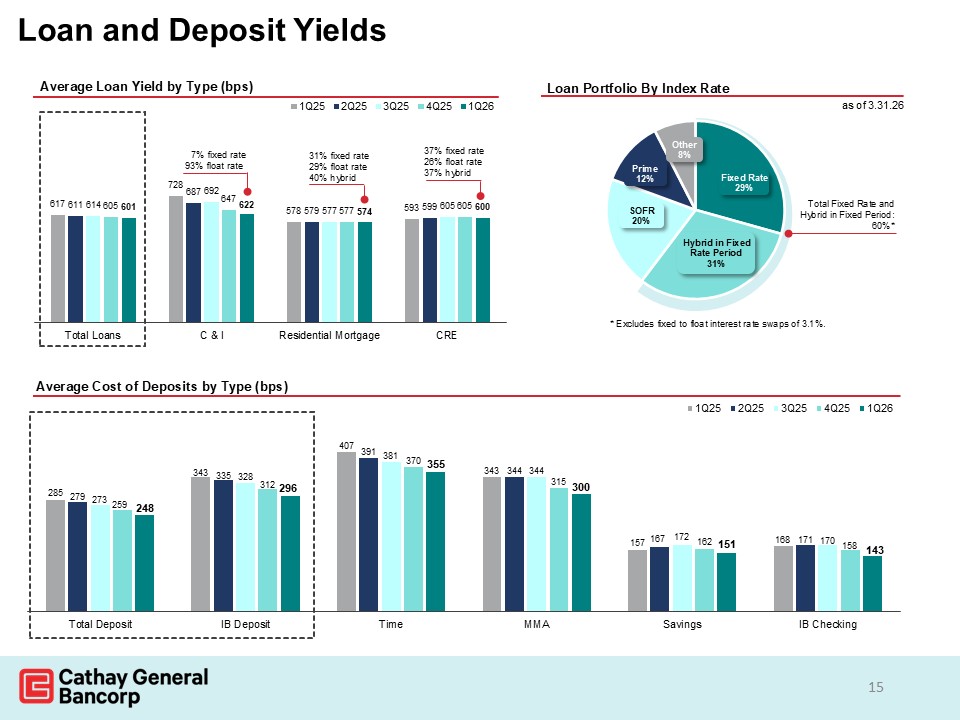
Yes. Obviously, without any cuts forecasted, that's going to put pressure and point us down slightly. But remember, we did the securities reposition, so that should help by a few basis points for the year. When I look at our loan portfolio, our yield was 6.01% for the quarter. But when I take a look at the origination rates for the commercial real estate book in the first quarter and the origination rates in mortgage, those came in at about 6.15% and 6.12%, respectively—higher than the overall loan yield. So I think, obviously, there is more pressure on C&I. But with mortgage and CRE repricing and what we're repricing on, I think that will support margin. We don't expect loan yield to drop off very much, if at all, so that should help support NIM. On the deposit side, we still have room to run also. We had a 2.96% cost for interest-bearing deposits this past quarter. A lot of the expansion we saw was driven by CDs that rolled off; last quarter we had almost $4 billion of CDs rolling off at a 3.80% weighted average rate, and those came on favorably this quarter. If I look at next quarter, for example, we've got close to $3 billion with a roughly 3.62% weighted average rate rolling off, so we think there's still some room to manage those costs down slightly. Between the two, we still feel comfortable with the overall guide for the year. We do acknowledge that brokered rates have moved up—at the beginning of the year large CD rates were in the 3.60% to 3.70% range; today they're around 4.00% to 4.05%—so there's more pressure and competition for deposits. But right now, looking at our profile, we think there's a little bit of room for expansion through this year. If there are cuts later in the year, that would be beneficial, but for now we think we're in a good position to achieve our guidance.
Speaker 4
Very helpful color on that. On the securities repositioning, held in isolation, can you estimate how much that should contribute to NIM? You gave the sizing of it. Maybe you can help us with how much yield was sold and what the yield was that came on?
Speaker 3
Yes. It was about $245 million of securities that we sold, and those were mostly long-dated mortgage-backed securities with coupons around 5.5%. The effective yield on what we sold was roughly 5.33% or so. That trade should be a little over $5.5 million annually in incremental interest income. Since the trade happened early in the quarter, we'll capture about three quarters of that amount in 2026, so probably about 2 to 2.5 basis points to NIM for the year and maybe about $4 million of additional boost to NII.
Operator
Next question comes from Matthew Clark with Piper Sandler.
Just want to get the amount of prepay and any interest recoveries in net interest income—I think it was around $3 million last quarter.
Yes. So it was about $3.5 million this quarter, which was about 6 basis points. For the quarter, our reported net interest income was $343 million. It would have been $337 million excluding those items. We also had a small FHLB special dividend included in that number.
Within that $3.5 million?
Okay. And then the low-income housing tax credit amortization came down more so relative to your guide coming into the year. Just want to get your updated thoughts on that run rate for the balance of the year.
Speaker 3
Yes. It's a fluid number; it depends on the timing of tax credits and the performance of the projects in the portfolio. We think it's probably going to be in the $7 million to $8 million range for the next few quarters throughout the year.
Okay. Good. And then just on the loan growth commentary in your prepared remarks and the release that has been a little more cautious, but you're sticking to the guide for the year. Is that because you're seeing the pipeline building? Or are you a little more open or not as cautious as maybe you were during the first quarter? Just wanted to get some thoughts there.
Yes. On the loan growth side, we saw some increased paydowns in our construction loan portfolio. Some customers took advantage of refinancing opportunities with life companies and Fannie Mae and Freddie Mac that offered better longer-term rates than we had. Our originations were healthy, but not enough to offset the timing of the paydowns. Today, our pipelines are still healthy and strong and customer engagement has improved. We expect growth to be more weighted toward the middle and back end of the year.
Operator
The next question comes from Gary Tenner with D.A. Davidson.
I wanted to follow up a little bit on the funding side. I appreciate the color on the second quarter CD maturities. Can you give us an idea of where the first quarter ones that rolled off at 3.80% were renewed?
Speaker 3
Yes. We had a new year promotion at about 3.65% for six months and 3.50% for 12 months. We extended that program by a couple of weeks. Since February we've seen more upward pressure on rates, so we think the renewals in the first quarter came in around the mid-3.50% range for what we put on.
Okay. That would suggest that the roughly $360 million rolling off in the second quarter, even without the specials, probably won't be too much of a benefit. Is that fair?
Speaker 3
Yes. We think there will be a marginal benefit from that. It's probably around $350 million at the rate we put on last quarter.
Appreciate that. So, in summary, with no cuts, pretty flat to slightly down in bias ex the securities repositioning? Is that kind of the nutshell?
Speaker 3
Yes. Again, the lending side shouldn't see much degradation in yields. We also have mortgages that were originated five-plus years ago at lower rates; when those reprice it'll help support NIM.
Okay. Great. One more on asset quality. Metrics overall were good and you increased the allowance by 6 basis points, commenting on model recalibration and macro conditions. Can you change weightings in your model in terms of building the allowance? Or give us a sense of how you were thinking about that?
Speaker 3
Yes. The biggest move was a recalibration of one of the inputs in the model. For the overall book we kept the weightings the same, but we did change the weightings for certain portfolios within the book, which pushed reserves up for those particular portfolios and resulted in an overall increase.
Can you comment which portfolios you increased the weightings on?
Speaker 3
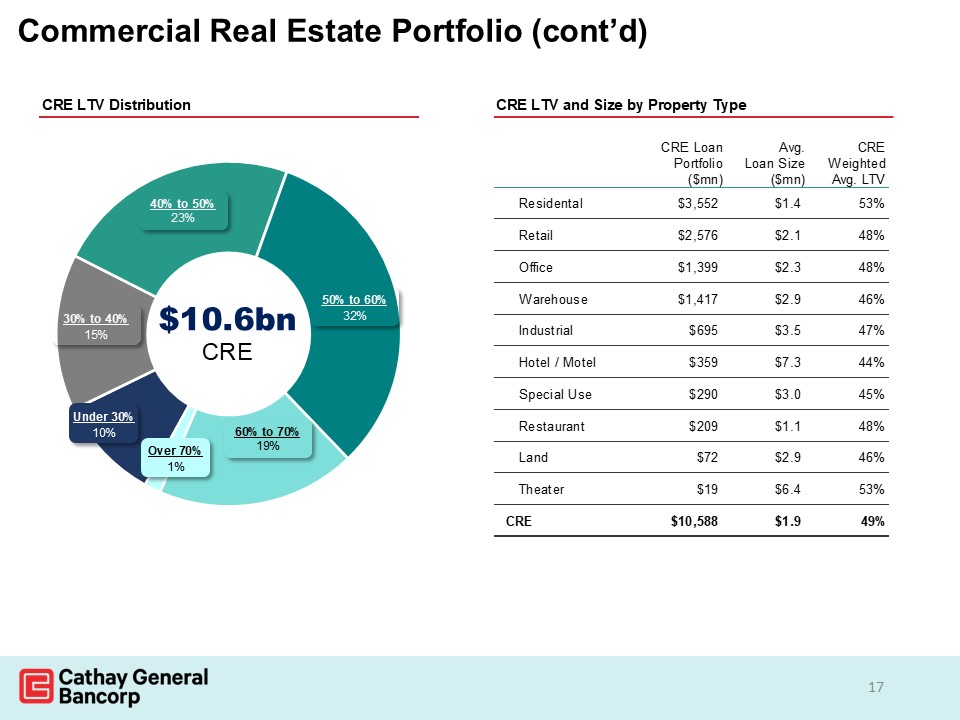
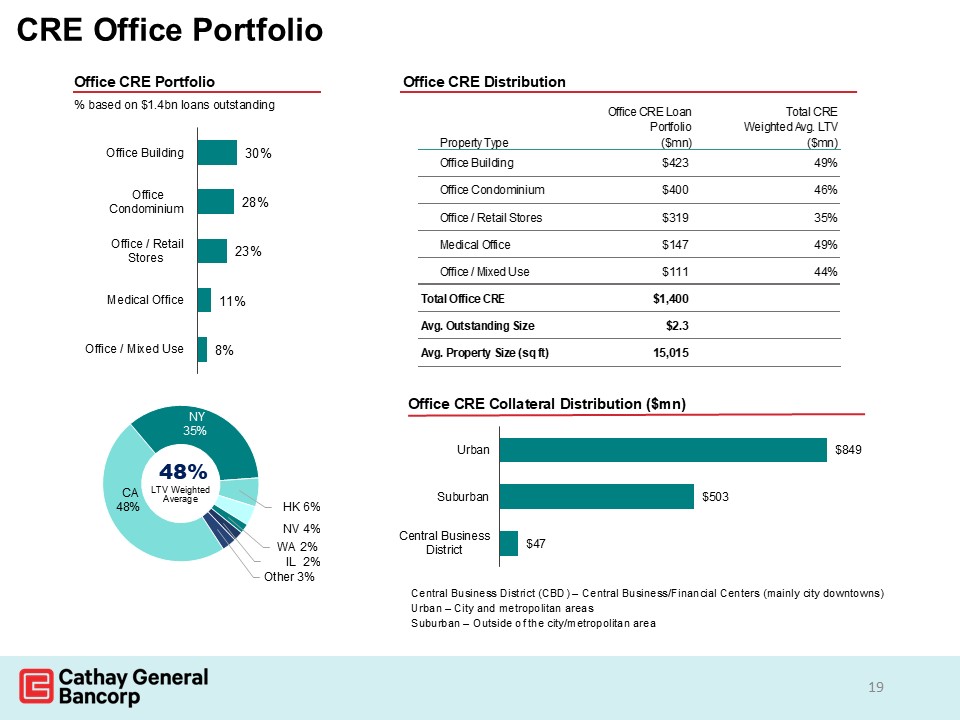
Yes. In our models we use national economic forecasts, but because we're concentrated on coastal markets like California and New York, we looked specifically at the office portfolio and determined the national forecast might not fully reflect the condition of those coastal office portfolios. So we stressed those portfolios a bit more.
Operator
Next question comes from Andrew Terrell with Stephens.
I wanted to start on operating expenses. Holding amortization relatively flat quarter-on-quarter, annualizing the first quarter kind of tracks to the low end of your adjusted expense growth guide for '26. Any seasonality impacts in the first quarter? Do you grow off this operating expense base throughout the year? Any expectation around expense run rate would be helpful.
Speaker 3
The first quarter was slightly lower on compensation and benefits, especially compared to year-end when we had incentive compensation accruals. That's what's driving the lower expense versus the fourth quarter. The current run rate is pretty good. We do have open positions and planned hires, so we expect some growth, but our current projection aligns with the guidance we provided.
Got it. Any thoughts on the Fed's proposed capital rules—any benefit that could provide to you in terms of CET1 or risk-weighted asset release?
Speaker 3
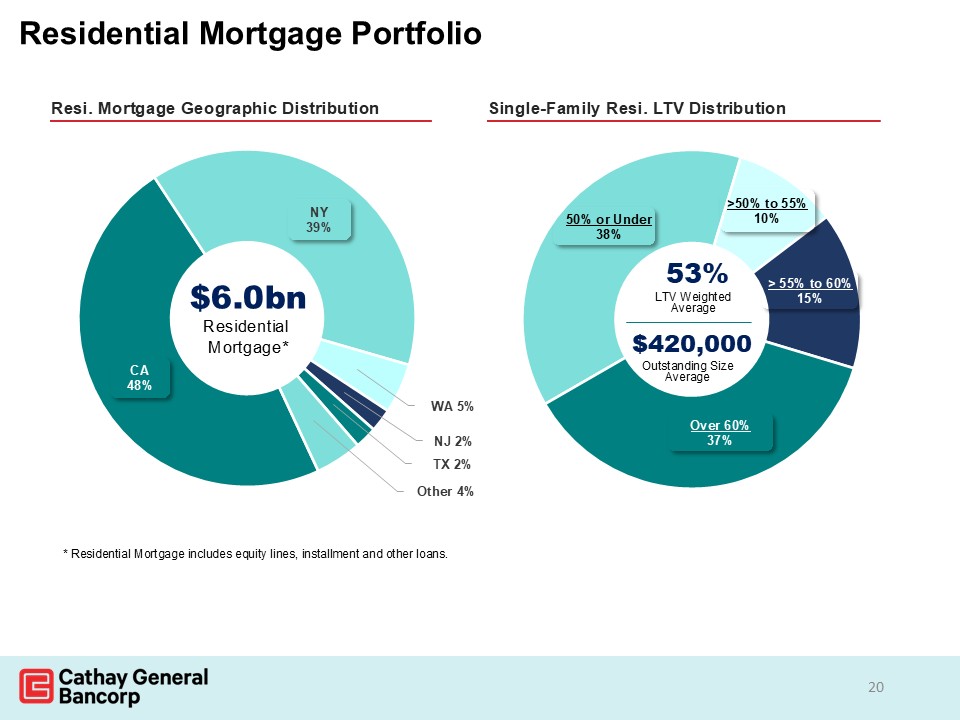
We think it would be a meaningful benefit. We have a decently sized mortgage portfolio with very low LTVs, so we'd get an upsized benefit. It could be a low double-digit reduction in risk-weighted assets for us, potentially boosting capital ratios by roughly $150 million to $175 million depending on the final rules and ratios.
Great. One last question—one of your competitors commented on M&A recently. Any thoughts on the M&A landscape today and how it fits into the puzzle for Cathay?
For us, we think opportunistically. We'll consider transactions that make strategic sense, but organic growth and executing our business plan remain the priority. If there's a candidate that fits and strengthens our franchise and meets our financial criteria, we'll consider it. But M&A is not the top priority right now.
Operator
Next question comes from Kelly Motta with KBW.
Thanks. Turning to fees, excluding the noise of the securities repositioning and other gains, core fee income still came in pretty strong. In your prepared remarks you mentioned that in part it is attributable to wealth management. Can you talk a bit about that business and what you're seeing more broadly on the fee income side? Is this $19 million core operating run rate a line that could hold, or are there puts and takes?
Kelly, our core strength in fee income is the wealth business, which drives a significant portion of that income. We're also finding other ancillary fee sources such as foreign exchange, international fees, swap fees, and treasury management services, but those can be more sporadic depending on the rate environment. The bulk of the consistency comes from wealth management.
Is the $19 million a step up versus the back half of last year—an approximate $1 million increase. Is that a good level to hold or was Q1 particularly strong?
Speaker 3
We think so. We have new leadership in Wilton and have seen a decent amount of referrals. We're optimistic that wealth will hold at the Q1 level.
Most of my questions have been answered. Thanks for the time.
Operator
Thank you for your participation. I will now turn the call back over to Cathay Bancorp's management for closing remarks.
I want to thank everyone for joining us and for your interest in Cathay. We look forward to speaking with you on our next quarterly earnings release call.
Operator
Ladies and gentlemen, thank you for your participation in today's conference. This concludes the presentation. You may now disconnect.