Operator
Good day, and welcome to the CF Industries 4th Quarter 2025 Earnings Conference Call. All participants will be in listen-only mode. Should you need assistance, please signal a conference specialist by pressing the star key followed by zero. After today's presentation, there will be an opportunity to ask questions. To ask a question, you may press star, then 1 on your touchtone phone. To withdraw your question, please press star, then 2. Please note this event is being recorded. I would now like to turn the conference over to Martin Jurassic. Please go ahead.
Good morning, and thanks for joining the CF Industries Earnings Conference Call. With me today are Chris Bone, President and CEO, who reported its results for the full year and fourth quarter of 2025 yesterday afternoon. On this call, we'll host a question and answer session. Statements made on this call and in the presentation on our website that are not historical facts are not guaranteed that future results may differ. differ materially from what is GAP and non-GAP measures in the full year 2025, in which we
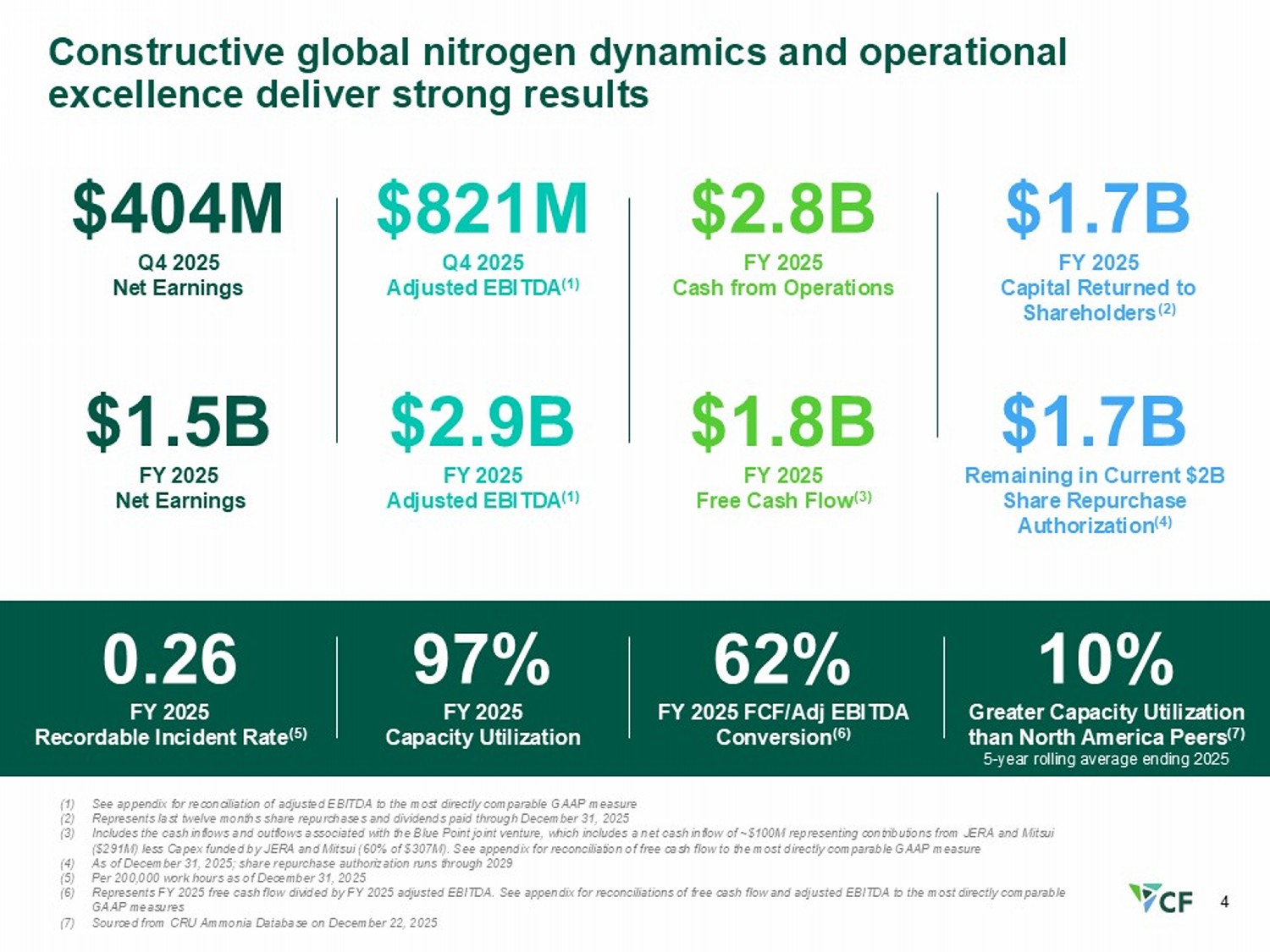
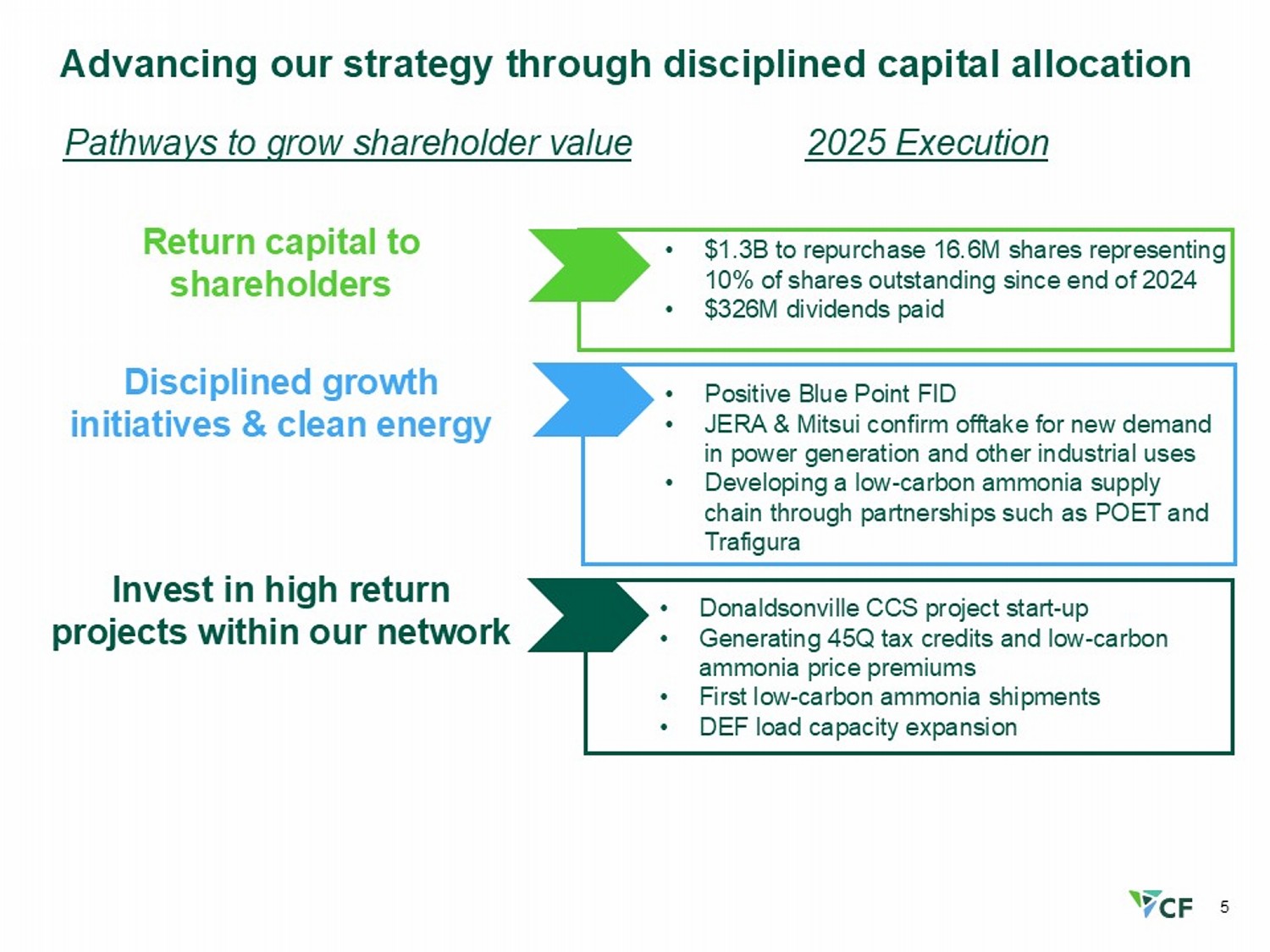
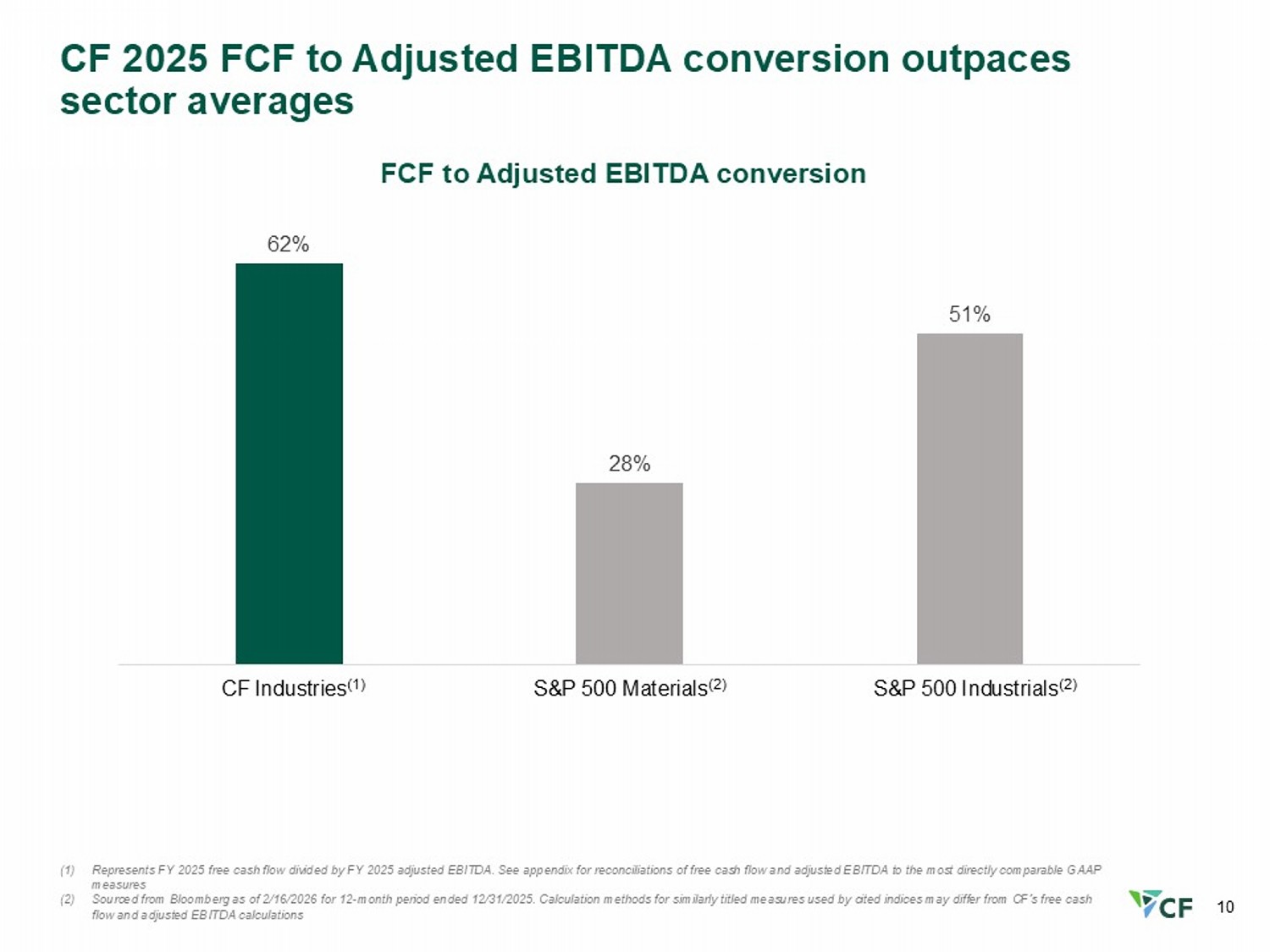
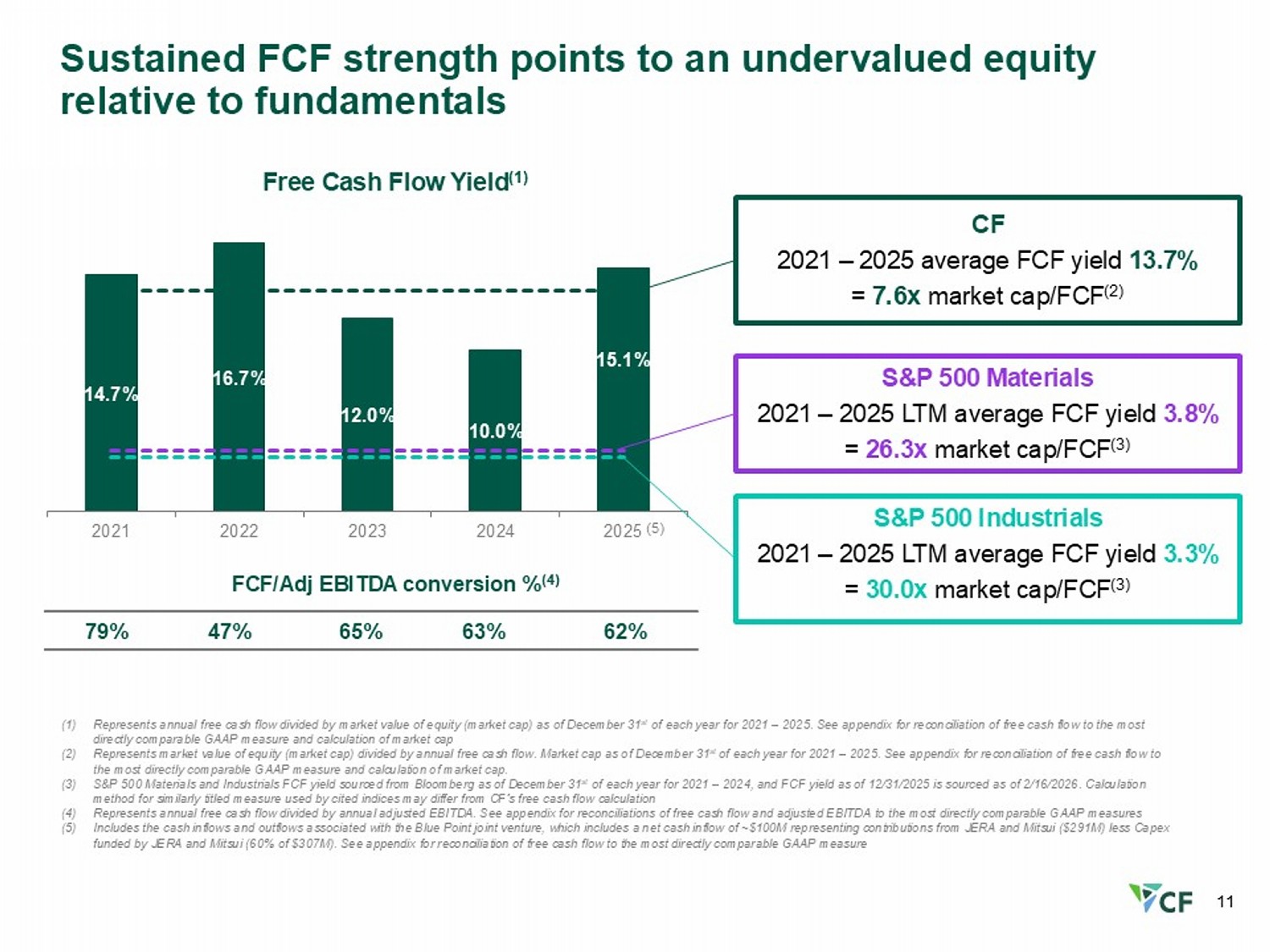
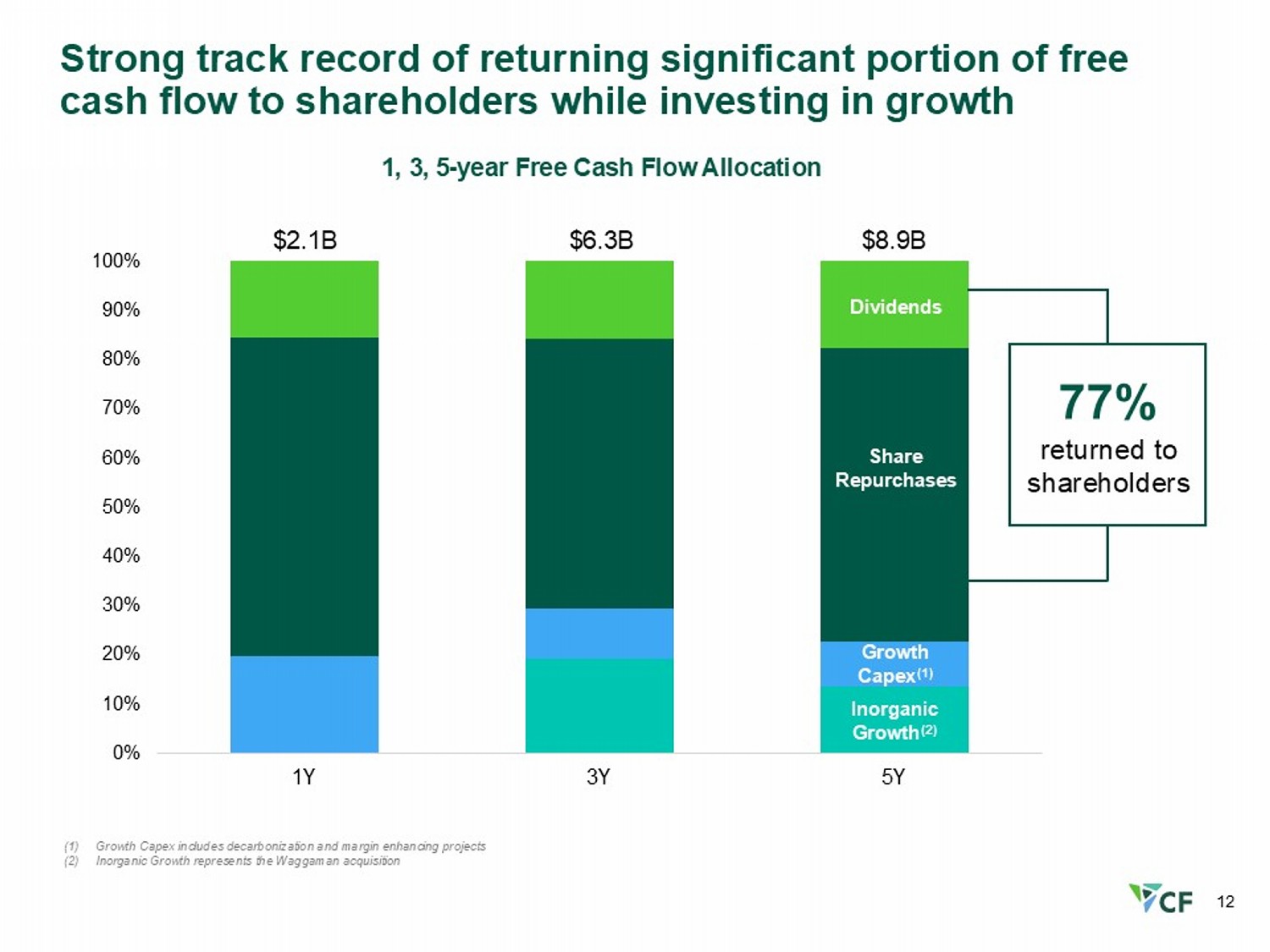
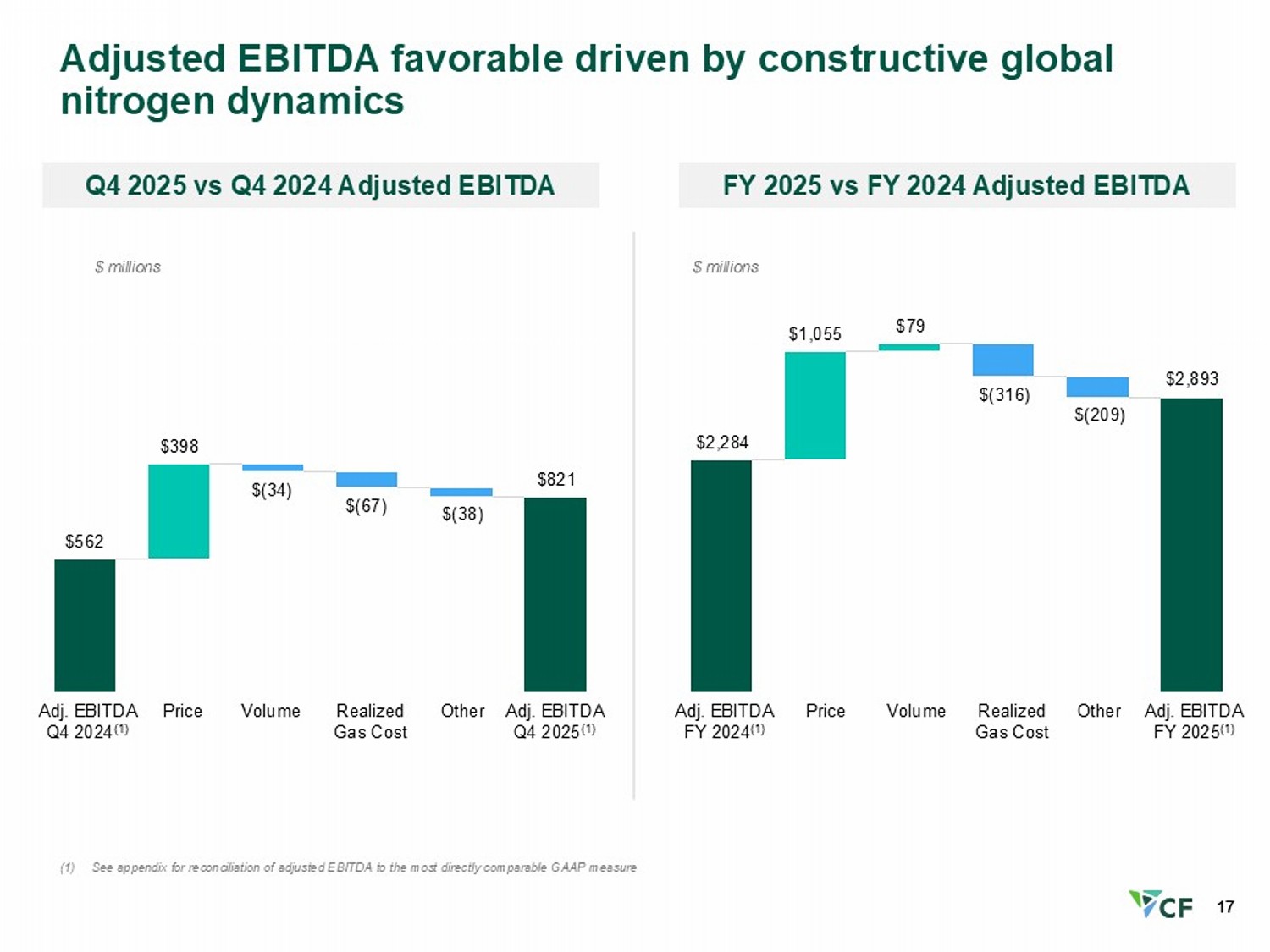
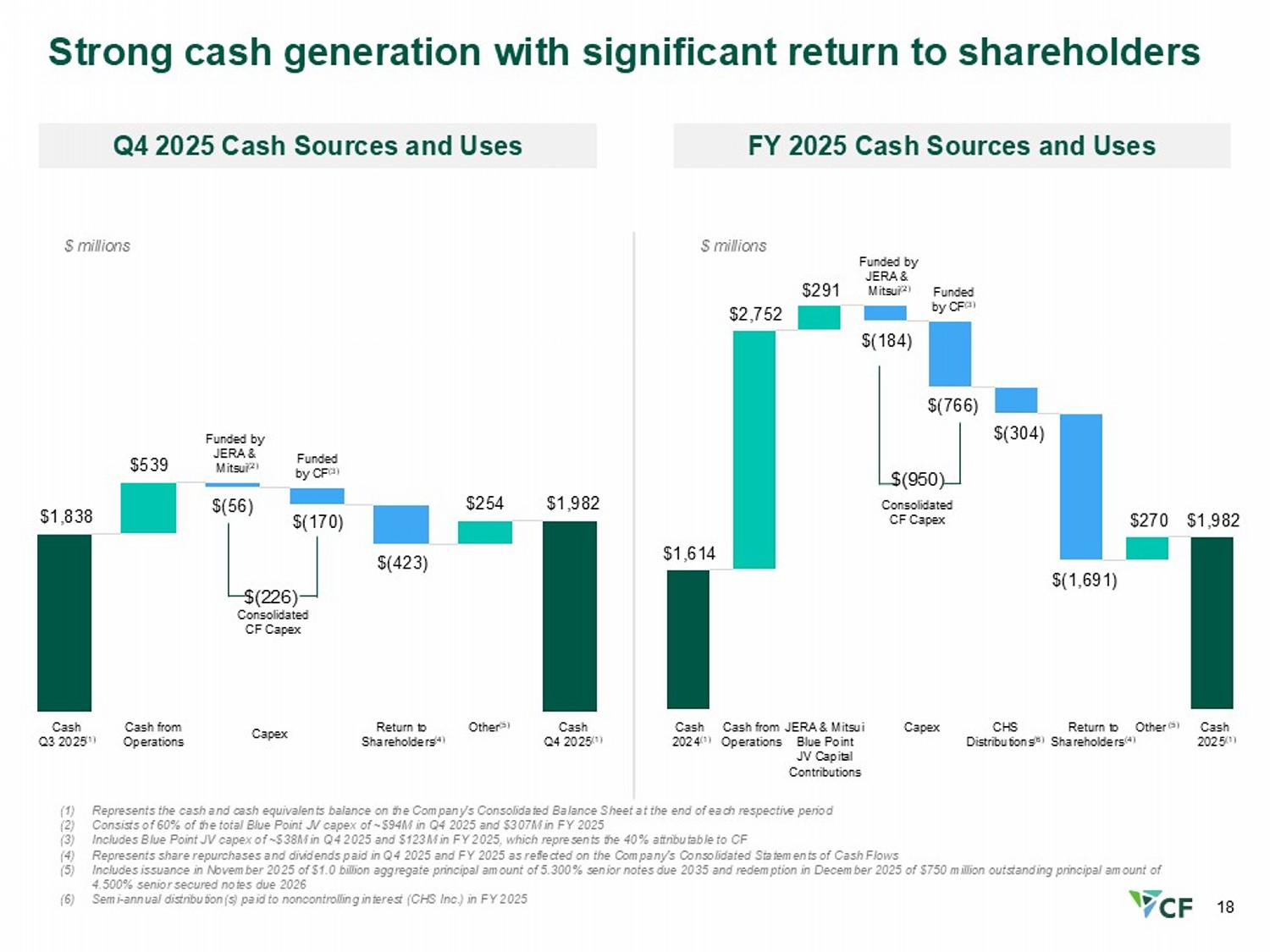
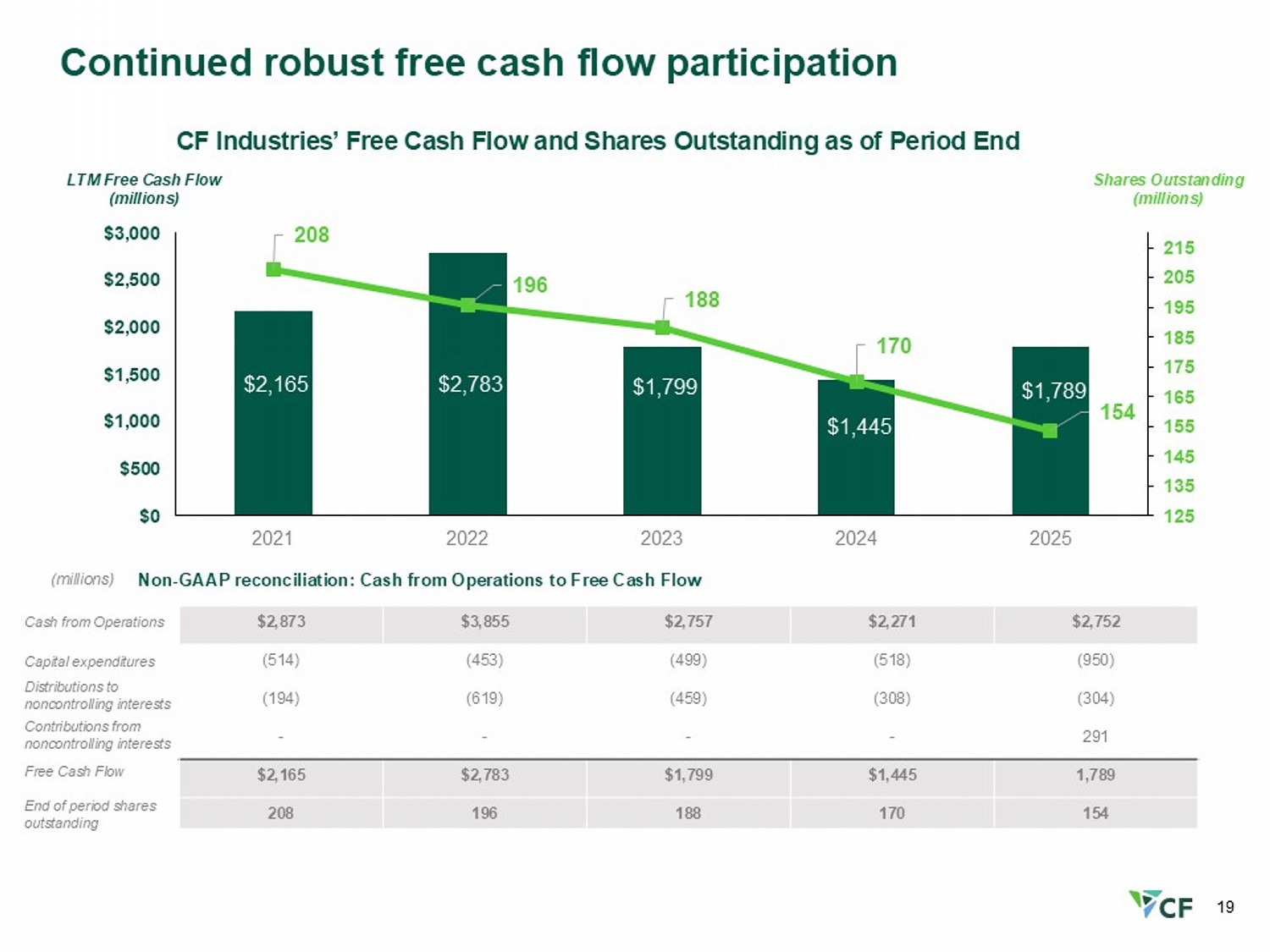
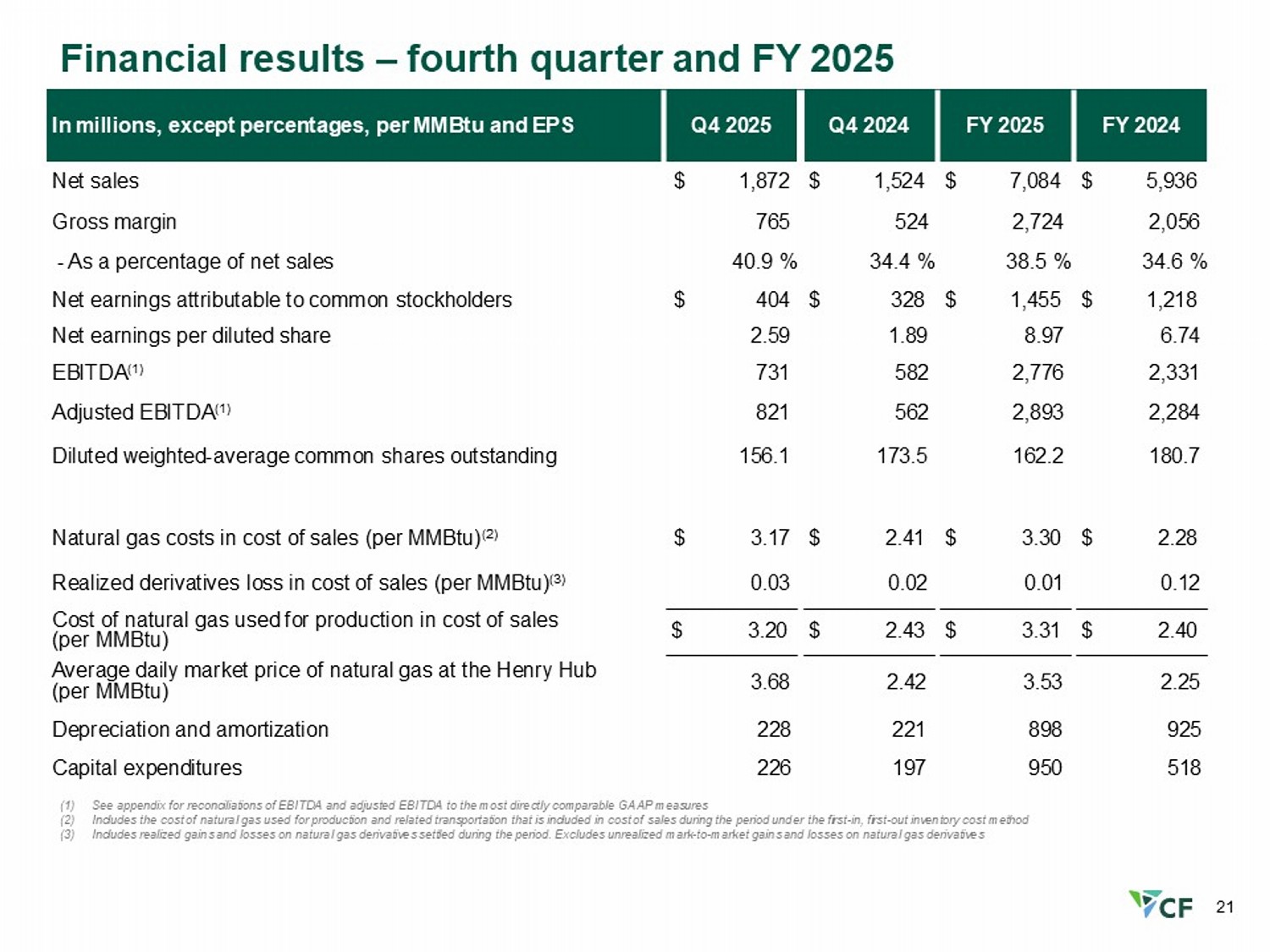
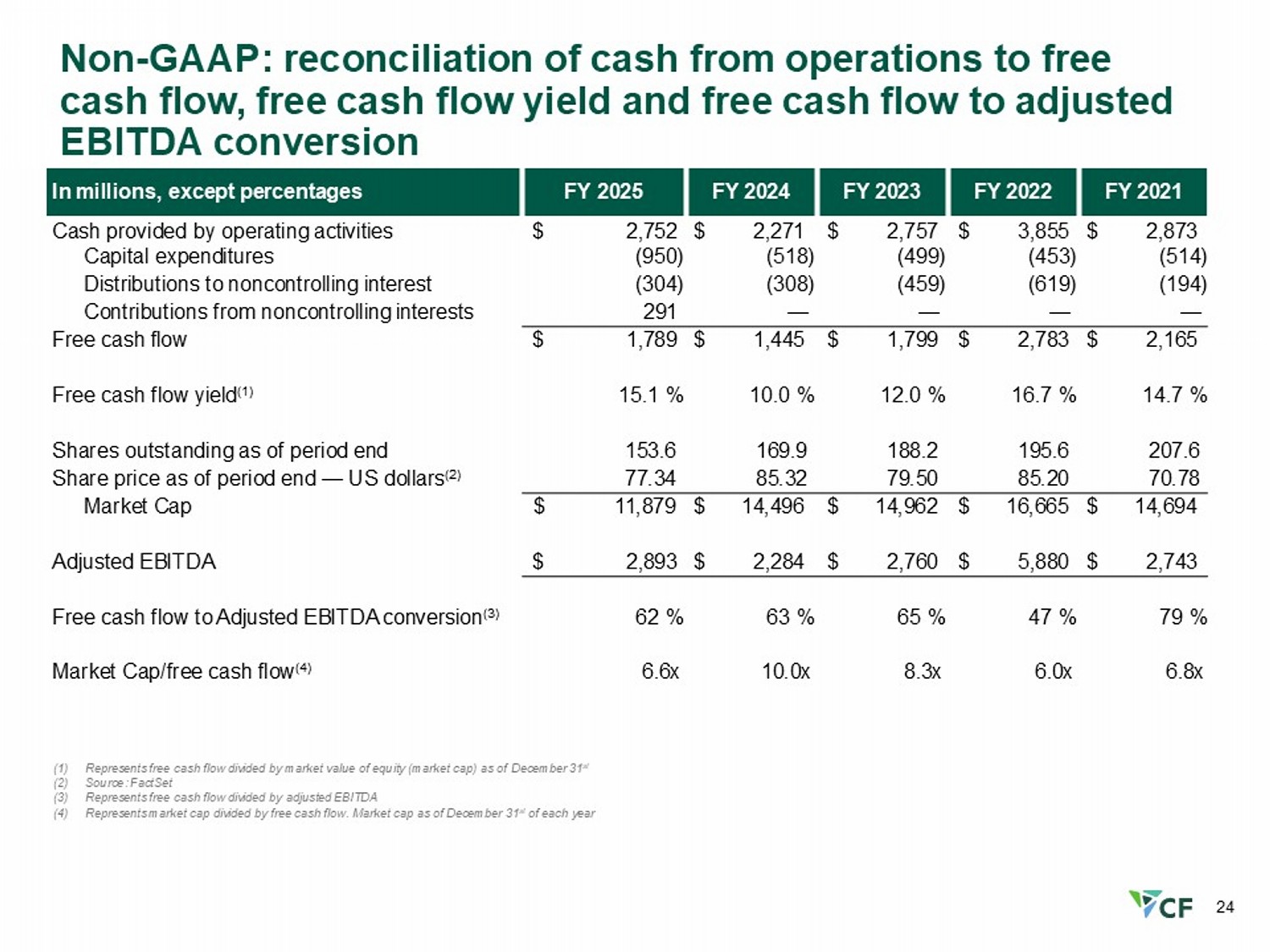
generated adjusted EBITDA of approximately $2.9 billion. These strong results reflect performance by the advantages of our manufacturing and distribution network and constructive global nitrogen industry dynamics that have persisted into 2026. One million tons of gross ammonia in 2025, which represents a 97% of the incident our Yazoo City comes in November. While there are no significant injuries, this event is a reminder of why we have safety every day across our entire network. We're at 2026 at the earliest, given the long lead times required to fabric ammonia in 2020 from the Japanese government. We continue to efficiently convert adjusted EVTA to free cash from operations in 2020 only $1.8 billion in 2025. This included deploying over $1.3 billion to repurchase 16.6 million shares, 10% of the outstanding shares at the beginning of the year. Strategic initiatives and what we believe are constructive global nitrogen industry dynamics ahead, we expect to continue to generate substantial free cash to remain firmly across the global nitrogen market environment.
18 months, with significant production has not maintained historical levels, and demand continues to grow. Indicative for economics in Europe, and the end of seasonal Chinese urea economy, geopolitical can't see many catalysts suggesting demand continues to meaningfully outstrip lower-than-expected nitrogen unit from ammonia. With continued strong genetics will be another year of high-planted corn acres domestically until the end of the northern ammonia capacity. Carbon ammonia, given the benefits for their sustain Africa, additional costs from EU regulations we're making domestically as we work with domestic retail.
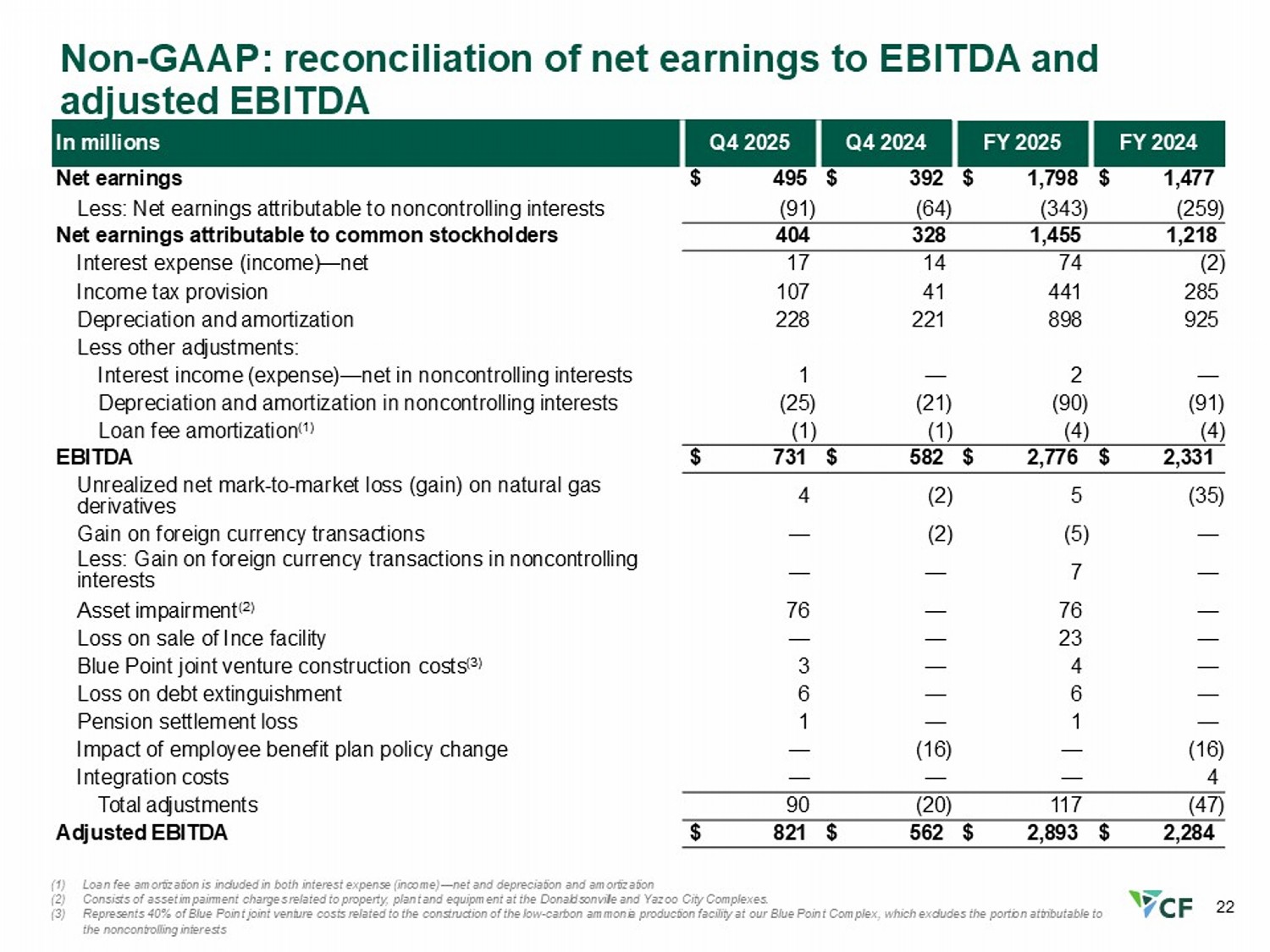
The company reported net earnings attributable to common stockholders of approximately $1.5 billion, or $8.97 per diluted share. EBITDA was approximately $2.8 billion. In 2025, we reported net earnings attributable to common stockholders of $404 million, or $2.59 per diluted share. EBITDA for the quarter was $731 million, and adjusted EBITDA was $821 million. For the fourth quarter, we recorded two impairment charges, $6 million, of which $51 million was related to the electrolyzer pilot in the Donaldsonville Complex in Louisiana. We made the decision not to continue to invest in this. We also recorded a $25 million impairment charge related to the incident at Yazoo City. We satisfied the business interruption insurance deductible based on lost profit. We also completed a $1 billion senior notes offering. We did this both to refinance $750 million in debt that was coming due in December 2026 and to further looking ahead $1 billion on $50 million. $150 million for $1.7 billion remains on the 2025 program.
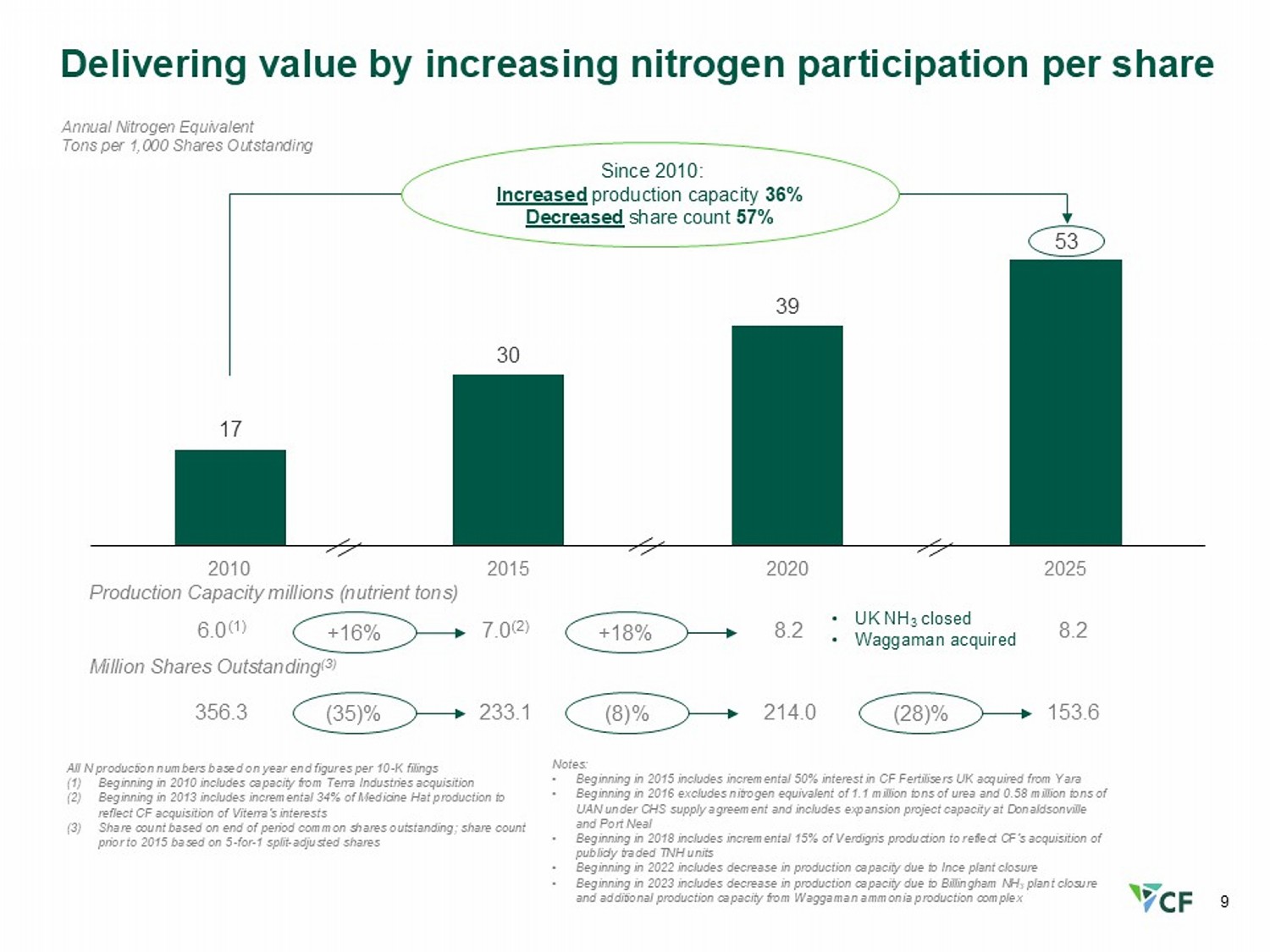
I want to thank CF Industries employees for their they delivered fantastic results. in the midst of a tumultuous global nitrogen market, operational excellence, and positive FID for Bluepoint, to completing two major decarbonization projects and securing our first low-carbon ammonia sales for a premium. Execution is not a one-year story. Delivered over time. ...advantages where we operate, increases long-term shareholder participation in our underlying assets. As you can see on slide nine, we have increased nitrogen purchasing global nitrogen market we believe we are well positioned to build and continue to create substantial value for launch we'll now open the call thank you we will now begin the question
Operator
and answer session to ask a question you may press star then one on your touchtone phone if you are using a speakerphone please pick up your handset before pressing the keys if at any time your question has been addressed and you would like to withdraw your question please press star then two at this time we will pause momentarily to assemble our roster our first question comes from andrew wong of rbc capital markets please go ahead
hey good morning thanks for taking my questions um i just wanted to ask about the pace of spending at the blue point project um it looked like some of the project might have
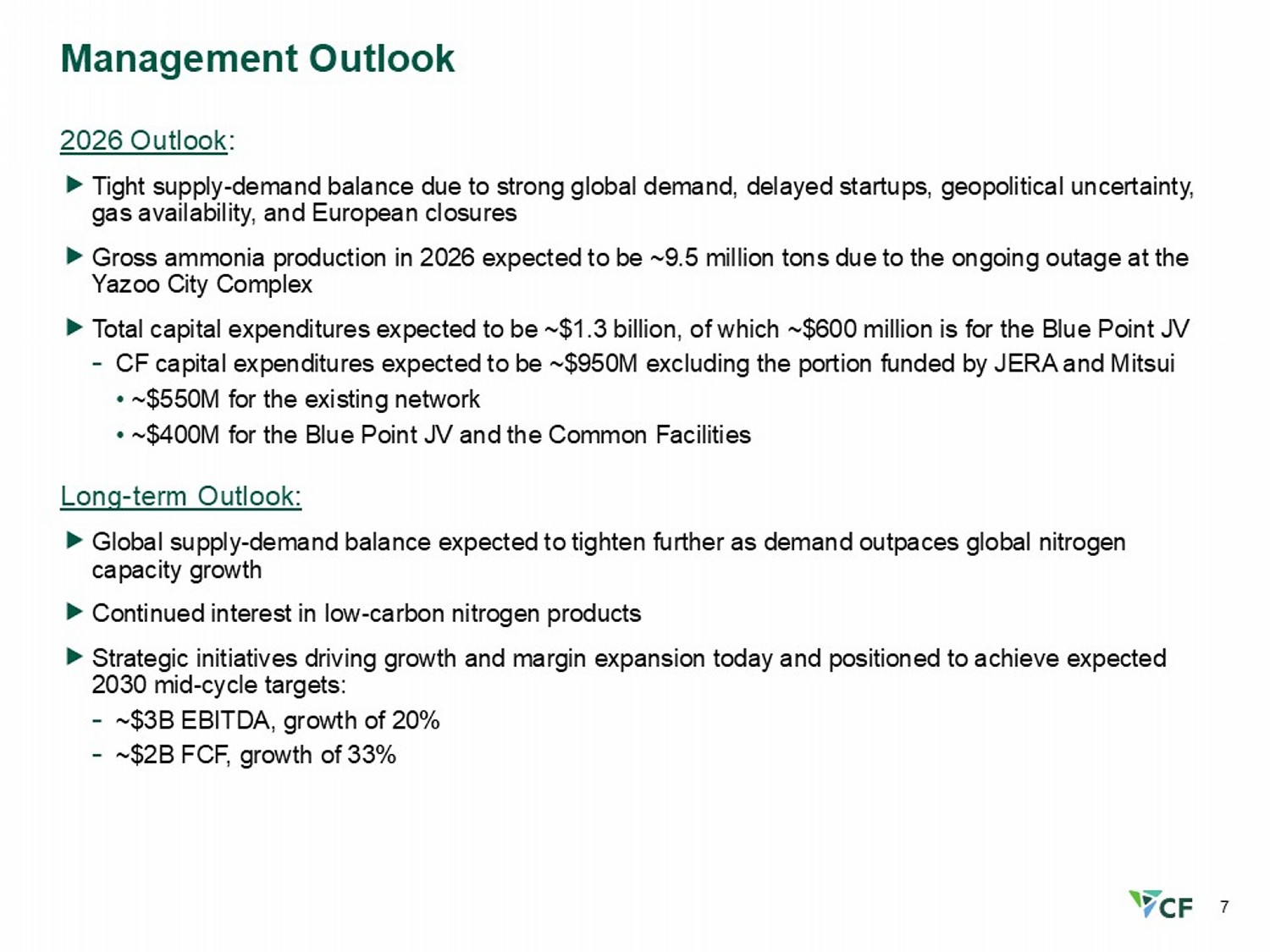
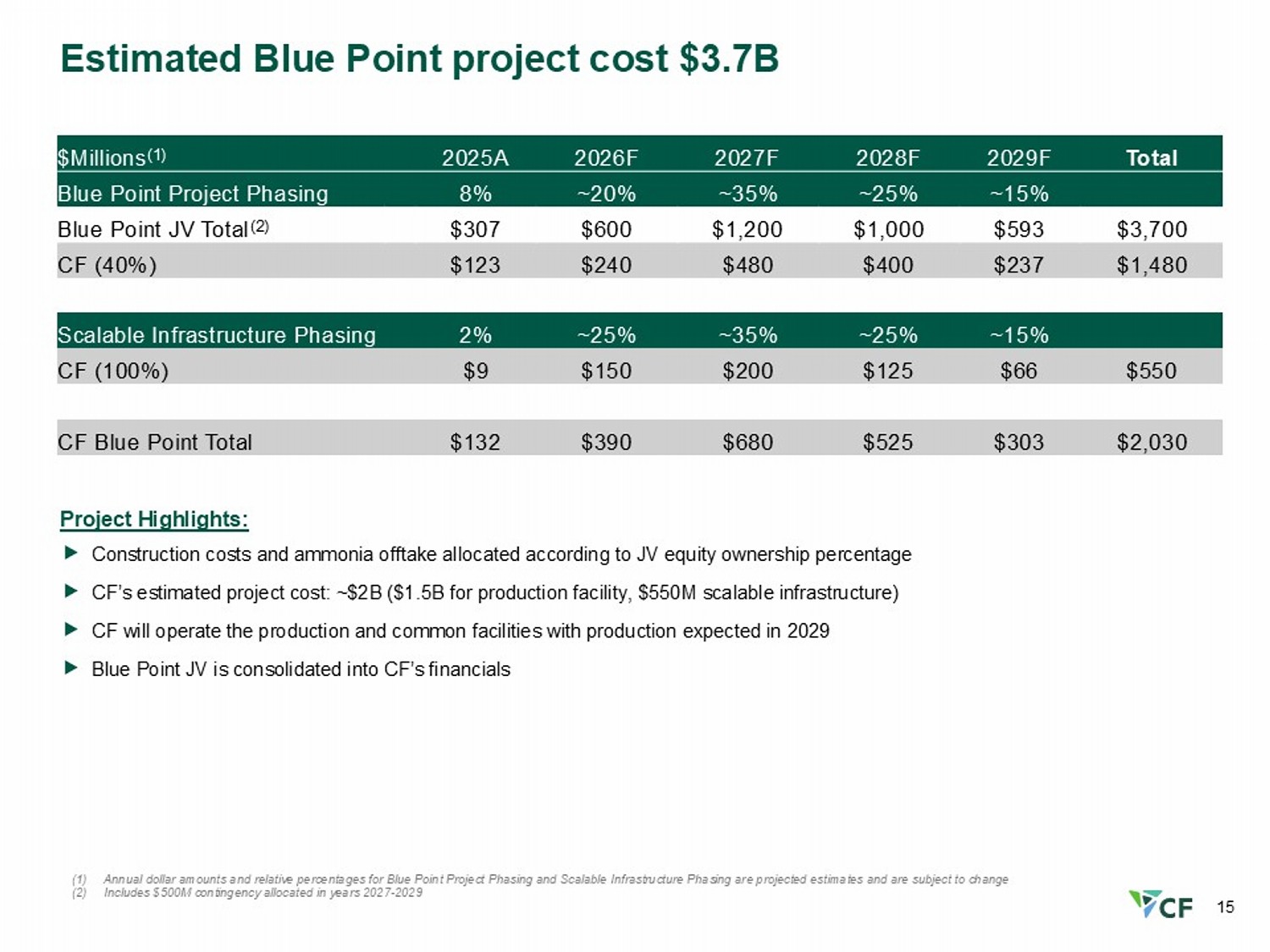
to be pushed out about that slide we had in the deck on slide 12 just the excuse me slide 15 the capital costs related to the blue point so the overall expenditure for blue point hasn't changed our it's still forecasted at 3.7 billion but with any project this size as you get closer and get into it, like we've done in engaging the modular contractors, you get a better idea of not only what the costs are, which haven't changed here, but also the timing of when that cost is going to occur. It would be worthwhile, just given that we've moved into that stage, what the cash will look like over the next five years. You know, slide 15 shows what's our annual cash. And given, you know, our strength of it at $1.8 billion the year before, you can see the level of each of those years is not something that we're concerned about affecting decisions which we're making. And that's really one of the reasons why with this growth platform that we structured the deal the way we did, taking a 40% interest in it so that we'd be able to manage and continue to be strategic in how we do other growth projects. Okay, great. Thanks. Thanks for that.
And then maybe just a little bit more on Bluepoint here. I recall there being quite a lot of room for expansion nearby on that site. CF is obviously building themselves some of the logistics and infrastructure there potentially to handle more volumes in the future. And so I know it's so early days here, but if we're thinking longer term, like five, ten years from now, does it make sense that we'll see a larger complex there? And is there a timing where it's more efficient too, like so that you have workers that are already working on blue plant to move to the second site? Like how should
we think about that? Yeah. So initially here, I would say, you know, our focus is on the first site, but you're right. The common infrastructure we're building, there'll be synergies where if we were to build a second plant, we wouldn't have near the level of expense. And the site itself could hold up to five ammonia plants on 1.5. An organic growth platform that we're looking at here, what the timing is where we had moved into a second, that we know that just yet there's some questions that we want to answer as we get into these module yards. You know, dynamics of the nitrogen market, there's just not enough new supply coming on to meet demand. So as we see that going forward, We do think there will be a tightening in the S&D that will provide other organic opportunities for us, but nothing to mention right now.
Operator
Our next question comes from Joel Jackson of BMO Capital Markets. Please go ahead.
Good morning. I want to talk to you about CDAM, obviously a lot in the news on CDAM. So what I want to ask you about is two different scenarios. You know, if CBAM for fertilizers goes as is, if there's some suspension on fertilizer, if you get some offsets and other cost subsidies that sort of offset it, you know, what does that mean for, A, your business, just your business this year? And then what does it mean for returns on Bluepoint as you have modeled it in these different CBAM scenarios?
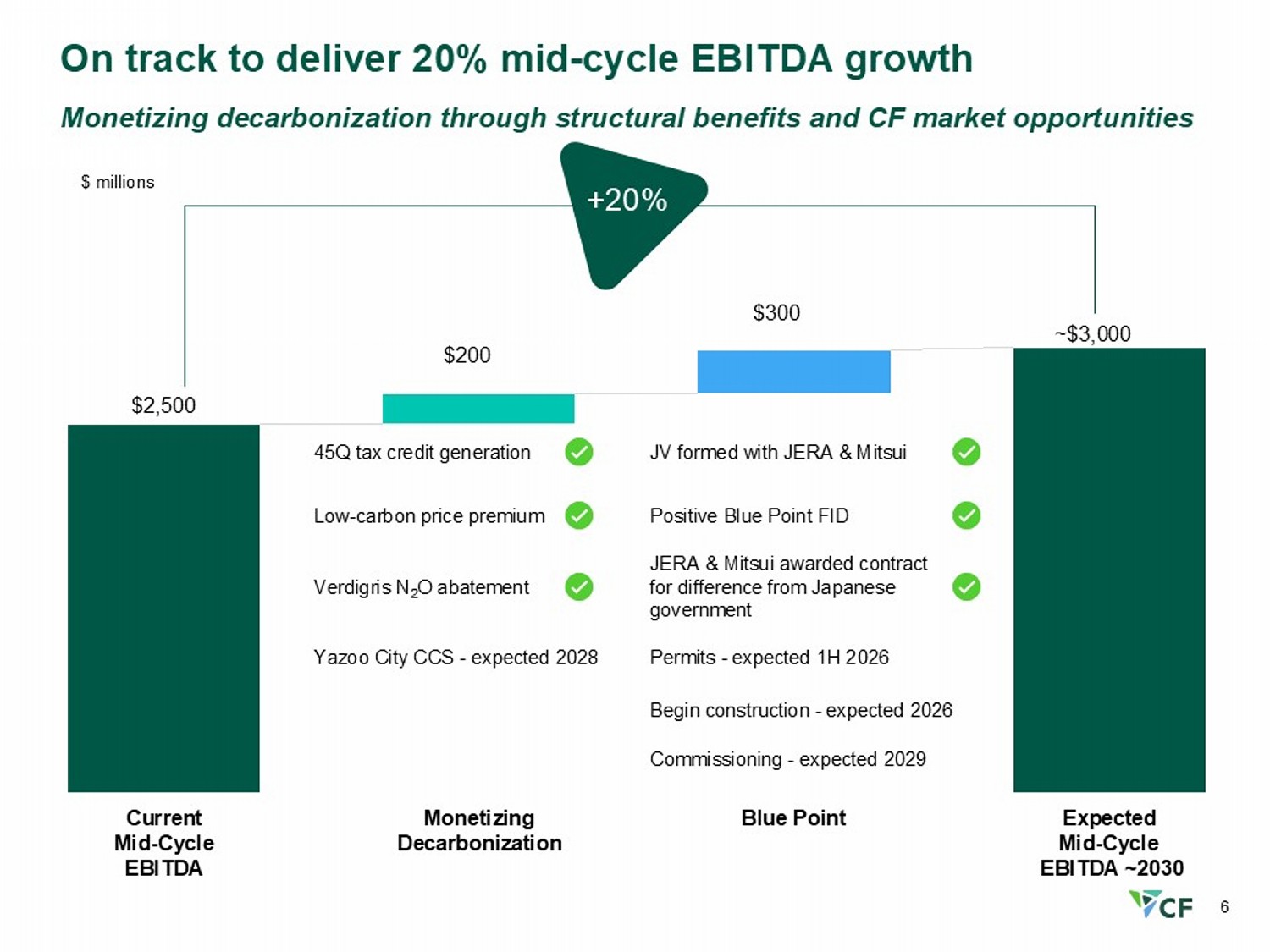
Yeah, so maybe I'll start with CBAM, then I'll get to the implications on the business in Bluepoint. So CBAM today, while there's a lot of uncertainty around it, it's in place. And so it's happening. We are continuing to see our European customers show interest in low-carbon product and willingness to pay a premium for it. So I think that speaks to their thoughts that it's going to maintain. I think that whether CBAM stays or goes is probably more of an issue for European producers than it is for our production base. You know, we view CBAM as one of several opportunities. Bert and his team and the clean energy team have been working on many different sales that go outside of Europe that we're receiving premiums on, you know, some here building in the U.S., others in Asia and Africa, that we don't necessarily have everything from a CBAM standpoint. Now, what I'll say is if CBAM is altered, there's going to be some type, and us having, you know, these benefits. Regarding how we did not model in any type of premium from Bluepoint or even in our Donaldsonville to low-carbon returns on that. So when you think about the CCS project we started online last year at Donaldsonville, we weren't looking at anything besides the 45Q benefit that we would get from that. Now we're realizing that we're able to start looking at any type of benefit.
Okay, and then second question. And on Yazoo City, you know, when the plant restarts, hopefully, end of the year, will it look the same as it did before? Will the mix be the same? And maybe you can just elaborate a little bit more on is there a specific piece of equipment that you really need to get in, that that's the manufacturing schedule that you have to hit to get, you know, in Q4?
Yeah, just to remind everybody on the Yazoo plant, so where the incident occurred was in the ammonium nitrate site itself and nitric acid plants. All that has been not logistically equipped to move that much net ammonia. If the upgrades are not operating, that's why the entire plant is down right now. So the only plant that we're looking to rebuild here is the ammonia nitrate plant. And I would say it's too early to judge on a lot of different aspects of that, but our intent is to get the plant up as soon as possible. The time frame that we've given with late queues as we've gone out to get switch gear and some of the electrical stuff, which is longer lead time items, we've been given those dates as delivery. If it comes in sooner, that would be excellent basing it on that. Point with Yazoo City, I'll have Rich talk through some of the economics for 2026. In terms of the economics,
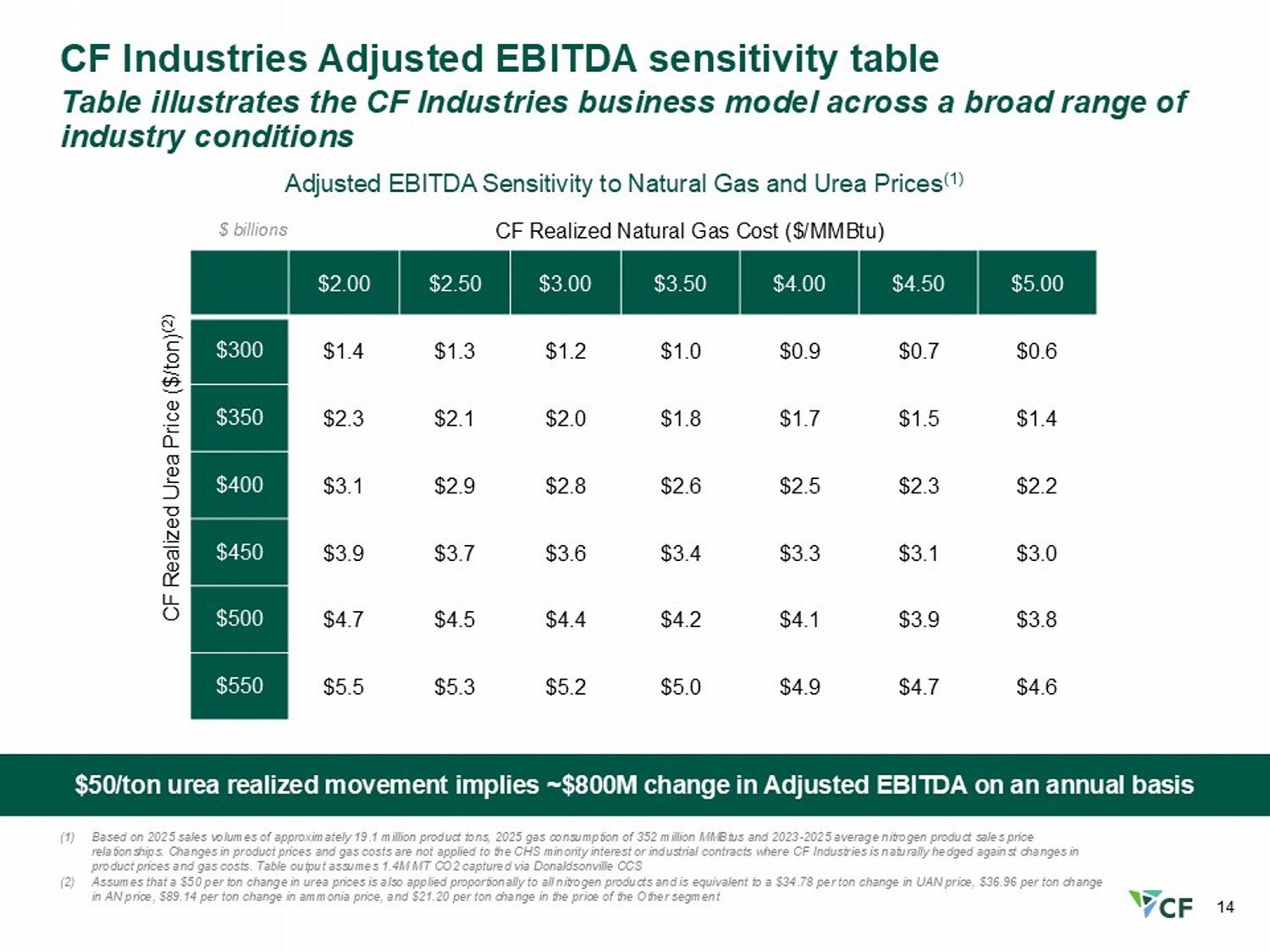
the full year EBITDA impact of not running the Yazoo City complex, is it going to be in the $200 million range. And again, that's an EBITDA number. But I also want to highlight, you know, we mentioned in our prepared remarks that we have business interruption insurance for this site. And so we are working with our insurance carriers. We're pulling together all those claims. And we would expect to be receiving those business interruption proceeds during 2026. You know, our goal is to see if we can offset most or all of that, you know, kind of loss. I'll also mention that the timing of those insurance proceeds are going to be a little bumpy because we will record
Operator
those as they come in. That's the impact. Our next question comes from Ben Scherer of Barclays.
Please go ahead. Yeah, good morning, and thanks for taking my question. Just wanted to kind of like get a little more commentary around the current tightness in the market, and you've laid this out as 25 was expected to be not as tight, and then it was actually tight until it's end of it and we saw this was you guys doing almost three billion in EBITDA versus the two and a half that you've talked about like kind of like current mid-cycle. So as we look into 2026 and some of the drivers that you think can take you towards the mid-cycle three billion, some of them might come already in 2026. So how should you think about A, the market and B, some of these drivers, toll works, more EBITDA generation, the tax credits, et cetera, as we move through 2026, considering the $200 million myths on jobs related to future suspensions.
Good morning, Ben. This is Bert. In 2025, planting 98 million acres of corn, incremental tons were needed to be industry would say it's South America as well. So being today in NOLA, urea pricing is $450 a shorter than it was in dynamics.
And I think you framed it nicely when you talked about 2025 that we thought would be balanced. Some people thought a little bit longer. You just mentioned, you know, 2025 came out with $2.9 billion in EBTA and the market. And that's why in our commentary we said we see the near, medium, and long-term nitrogen dynamics very strong because we thought we would be balanced. Due to the full year of the unit, last year we did about seven, it'll be just under 1.5 million tons that will sequester. And that number is really based on just the amount of processed CO2 we have remaining after we do upgrades and with the plant turnaround schedules with ammonia plants being down. So we're going to max out the most we can sequester during that particular time frame. And right now, we're thinking that's around a million and a half. Perfect. Thank you very much. I'll pass it on.
Operator
Our next question comes from Mike Sisson of Wells Fargo. Please go ahead.
Hey, good morning. Yeah, I just had a quick question on CBAM again. So if it goes away, does that make it difficult or maybe impossible to get a premium price for Bluepoint? And if it stays, then there's a good chance to get a premium for Bluepoint. And then just curious what y'all hearing in terms of timing when we'll find out on a decision for that by the
EU yeah so with CBAM I mean I think it's more complicated than just whether CBAM stays or not because you have the whole ETS scheme over there that are beginning to stop does that continue where they don't basically push European producer costs even higher without CBAM premium side I'll let Bert comment on this a little bit more, but I think it goes beyond what we're hearing from European low-carbon
product when it comes to this. Got it. And then just one quick follow-up, you know, given the
dynamics you shared for nitrogen this year, is your bias that pricing kind of stays at this level and maybe the bias is maybe potentially to go up from here? Or, you know, how do you sort of see
the kind of the scenarios for potential pricing there yeah i'm never biased the back half and you're like there always is as we move thank you our next question comes from christian owen of
oppenheimer please go ahead carbon opportunities and maybe double click on the agreement with poet for the low carbon fertilizers you know just given some of the proposed changes in the 45z guidelines, practice changes, I'm wondering how you're thinking about low CI fertilizer demand opportunity domestically, and if those 45Z tax credits maybe help improve the unit economics or pricing premium that you're seeing here in the U.S. Thank you.
Yeah, so we missed a little bit of the first part of your question, but it's about the assumption of that problem. Related to the 45Z is just going to be an upside to us. As Bert mentioned,
and he's hearing enough activity even though at this particular point low-carbon fertilizer is not recognized in the 45Z. Now, that is up for comment right now as the USDA is defining what are those qualifying activities, and you would think to be an attractive path mentioned, he's already included in the 45Z.
Super interesting. Thanks for the color there. My follow-up question is a little more boring and on the modeling. So can you just remind us your operating costs in 2026? You threw out the $200 million EBITDA headwind from Yazoo City. I imagine there are some stranded costs or overhead costs that won't be recoverable through the BI insurance. Just some thoughts around operating costs and any sort of turnaround that we should be thinking about in 2026.
Yeah, in terms of the BI, our hope is that virtually all of those costs are going to be recovered through BI. but we're not expecting anything major outside of that. And as we go through the rest of the year, our turnaround schedule I think is projected to be pretty normal in terms of what we would normally expect. So I don't really have anything I want to highlight.
Operator
Our next question comes from Christopher Parkinson of Wolf Research.
Operator
Please go ahead.
Great, thank you. Just a short-term question and a long-term question for me. The short-term, just Bert, circling back to some of the things you were discussing before, How are you thinking about order book flexibility into this year? I mean, you know, farmers are just now getting some, you know, deferred direct payments. You're waiting in news, RBO, you know, E15, and then you mentioned India, Iran, you know, Trinidad out, Texas capacity in. It seems like they're more moving parts now than in previous years, at least going back to 22, let's say. How are you thinking about that with your team? Are you leaving some flexibility as you enter spring, or are you happy with prices where they are now?
In the upper Midwest, there's been a number of plants in Canada and then communicating about those.
Perhaps a slightly longer-term question. There have obviously been a few, you know, questions here already on CBAM. But switching over to the other side of, you know, the blue ammonia equation and, you know, heading to the east, you know, Japan has actually been moving, as far as I can tell, further forward. You've seen, as of December, many certifications further go forward on a $20 billion hydrogen hub. A lot of those consumers and impotential, you know, have lost supply agreements with others based on three project cancellations, one long-term referral, and one final blue, you know, blue ammonia facility that's currently in flux for the next six months. You know, as much as everybody's focusing on Europe, do you think the buy side in the street is missing something more pronounced in Japan that's still ongoing?
Yeah, I think it's an excellent point, Chris, going to be this big white coming online. As you mentioned, a lot of those projects have fallen off. Now, what we're continuing to see a lot of interest in, and it goes beyond Japan in Asia, but is in low carbon. And I think, you know, the Jera and the Mitsuis and others over there, I think more importantly, it's not only the low carbon aspect of it, it's for a new demand source. You know, when you look at the MEDI agreement and what they were able to do with the contract for different percent of this new plant is going to a new demand source that didn't exist a year ago. And so we're optimistic that we continue to build up, continuing to see additional demand growth in the legacy agricultural business of sort of that 1% to 2% a year. And all those factors are why we are suggesting that longer term, not enough supply coming on, new demand centers coming on, and then just the regular legacy point does come up.
Operator
Our next question comes from Lucas Beaumont of UBS. Please go ahead.
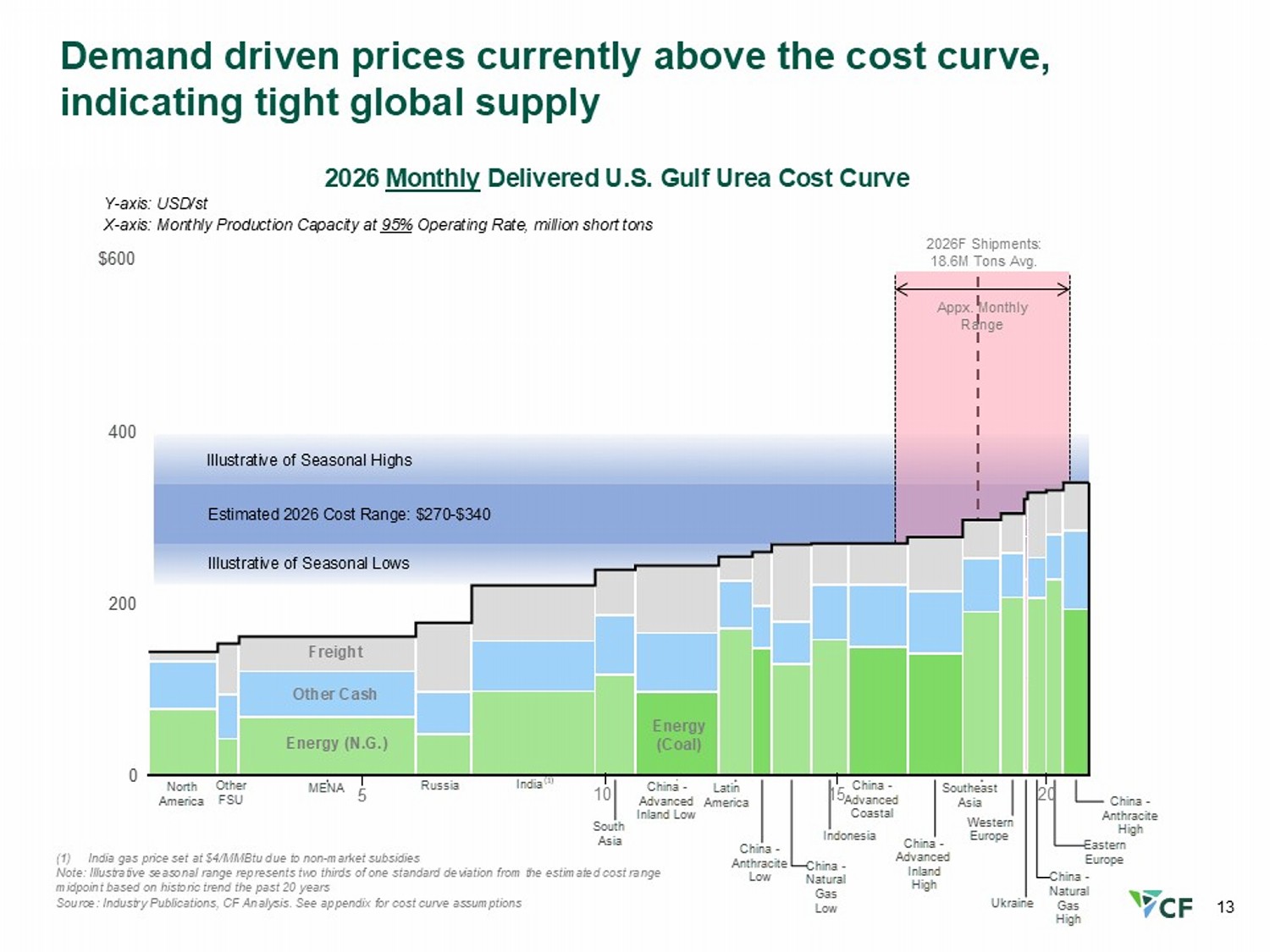
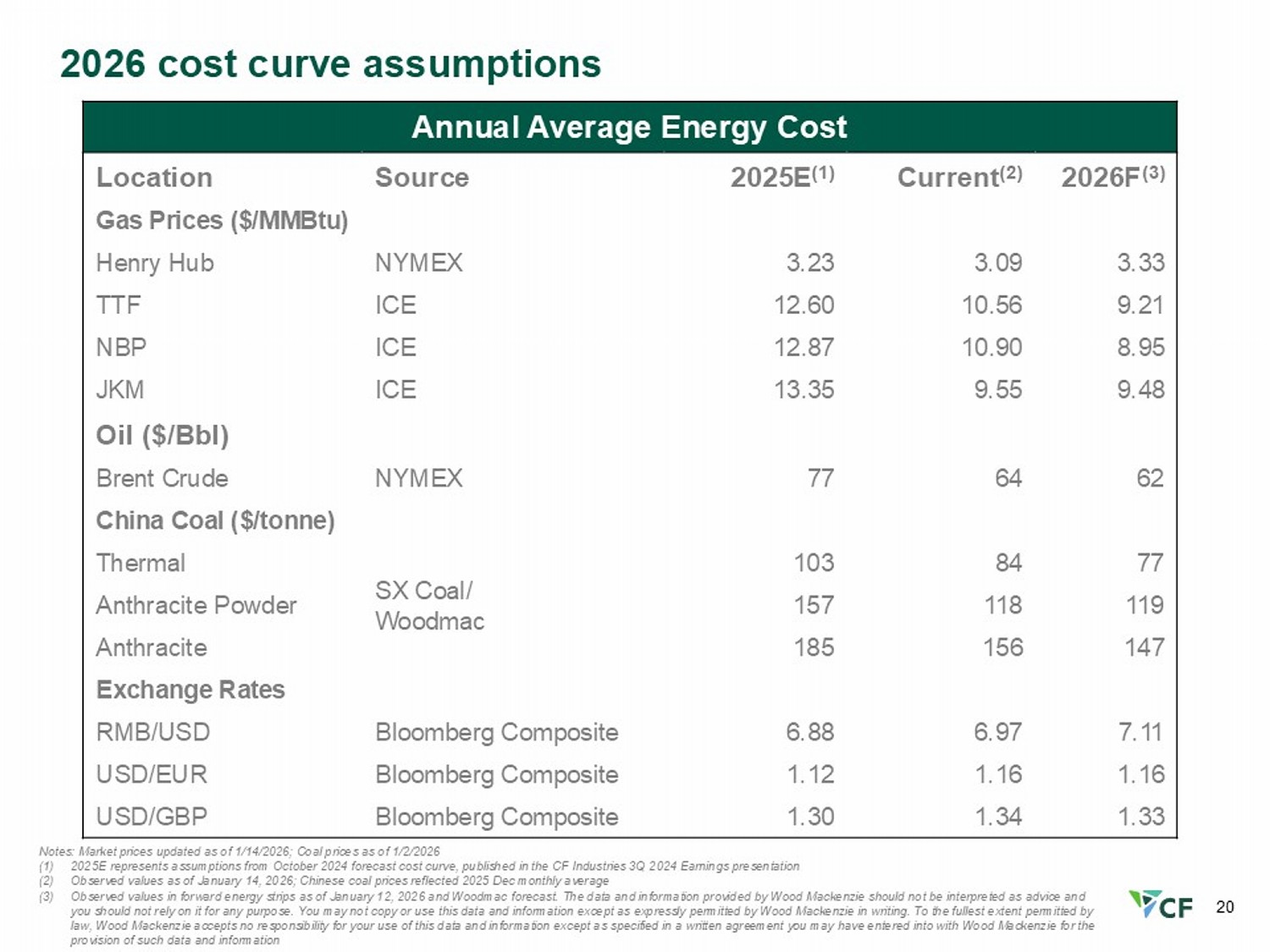
Thanks. Yeah, I just wanted to go back to the sort of difference between the pricing outlook and the cost curve. So, I mean, we've had, like, strong pricing to start the year. Cost curve has moved up a bit, but not as much. And, I mean, the sort of premium there has kind of widened. And as we look further out, you know, the energy futures curve continues to shift lower, kind of now into, like, the $7.850 range kind of later in the decade. So I just wanted to sort of get your view on how does that sort of resolve with your view of sustained market shortages on the supply side? Does this kind of need to correct in some way, or do you expect it to persist, I guess, through this year and then into the medium term?
Yeah, maybe I'll start. So on that, from a longer-term stamp, the gas differential that you're talking about, and today that sits at, you know, around $7 to $8 per MMBTU delta. We do expect that that will converge a little bit with Henry Hub. By no means do we think that goes away or flattens to a level that doesn't keep talking about on many of these questions through here, which is the S&D side, the COG side of what it would cost. But you have to bring on new capital in order to meet that demand growth, you know, without even clean energy growth coming into this, having to pull in or require new plants to be built. And like I said, our plant alone at $3.7 billion, capital costs are only going up. And we expect the natural gas differential to continue, the demand move to be supported by new plants that are going to be needed and required, or high-cost production to remain in.
And that also doesn't consider...
All right, thanks. And then I guess just maybe a bit of a short-term question on the Middle East tensions with Iran. So, I mean, they're about 10% of the global urea export markets. I guess, how would you see the market dealing with any disruption to production there and the impact on pricing? And I guess how would that sort of need to flow through from a timing perspective in terms of, I guess, disrupt to the shipments before it's really starting to have an impact and how long it
would be down. Thanks. Yeah, if you look at the Middle East and the...
Operator
All right, thank you. Our next question comes from Vincent Andrews of Morgan Stanley. Please go ahead.
Morning, this is Justin Pellegrino on for Vincent. Thank you for all the commentary on, you know, where prices and market commentary are headed over the last few weeks. But I kind of wanted to step back and go back to blue point for a second. You mentioned earlier in the call that as you've kind of started going through the process, permitting or whatever, that the timeline may have shifted around a little bit. And I was just curious, where have the pressure points been as you started to go through the process, whether that be terrorist labor, whatever it may be? And then can you kind of just flag anything that we should be watching as that project starts to progress through the stages and anything else that's worth talking about there? Thank you for
help. Yeah, thanks, Justin. The timing really has expectation is still in 2029, the plant will come on. By timing, I meant timing of payments, in which case, as you get closer into these larger projects in your, whether it be the module yards, the civil contractors, you've engaged different things like that, you have a better idea of when those payments would be going out. So nothing's changed from our timeline on the particular dimension. We've pretty much achieved the milestones that we have in place would be the air permit and army corps permit as we look to build a heavy haul bridge that will bring the modules over additionally as as we start expectation is here in the next isn't much of these milestone expectation is here in the next couple mention is built in as contingency so not knowing really court and also that lead time stuff doesn't come for three years, but we do have a sizable contingency built in.
Operator
Great. Thank you for the help.
Operator
Our next question comes from Adlai Rodriguez of Mizi. Please go ahead.
Good morning. Thanks, everyone. Chris and Burgess, one quick one for me. We've had some affordability issues with phosphate. Of course, you don't produce that, but you know what's going on there. And with urea prices moving higher, Like, any concerns about affordability in nitrogen? Like, is it better to be as affordable as possible just to prevent, you know, a bunch of issues? Or the market will just determine where nitrogen lands on the affordability spectrum, and we just have to deal with it?
Operator
Our next question comes from Matthew Dale of Bank of America. Please go ahead.
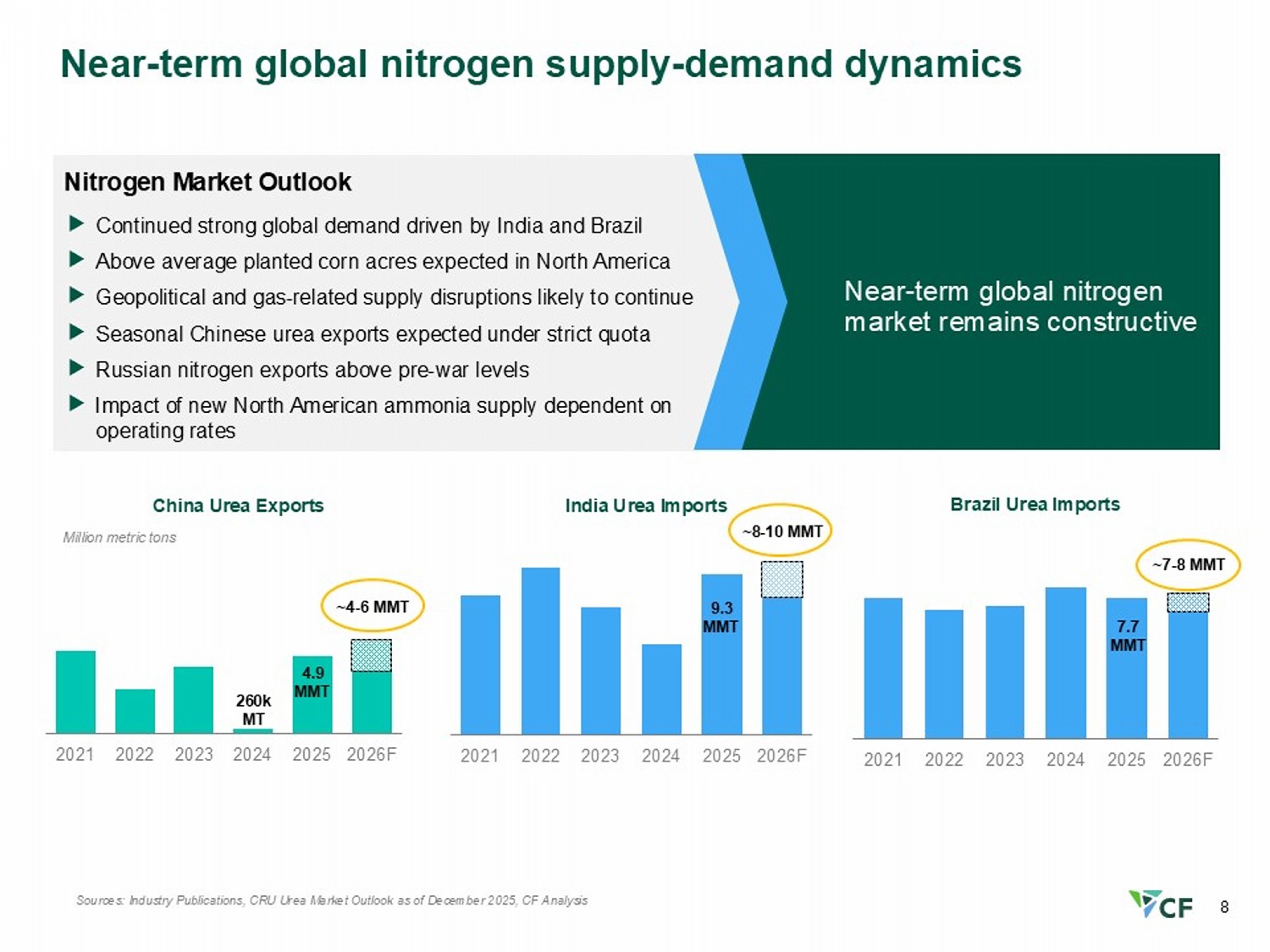
um you'd mentioned brazil and so i wanted to tap in a little bit on that and and the plants that you know were being restarted i know it's not your plants and so companies don't often like to highlight or talk about that a little bit but um you know at least from a headline basis there's like a million tons of urea in that in that production and effectively it was supposed to be started up or starting to start up by the back half of last year. Seems like you're calling for Brazilian urea to be flat on an import basis year over year. Is there some expectation that growth is in there or are you treating those plants as a zero or is it they'll take too long to ramp and demand will offset? I'm just kind of wondering your thoughts on that. And in general, I guess, like recommissioning and the commissioning cycle in plants and how that's creating or can create gaps in supply.
Yeah, Brazil has been an amazing story over the last nitrogen product coming into Brazil. And so initiating construction, the plan to monitor. Now there's on this just from my time in manufacturing and what the cost has taken down
just because of the number of years they've been down. I think the capital, the upfront capital costs, see what happens.
Yeah, thanks. Not alone on that part, I just wanted to know what your input, so thank you.
Operator
Our next question comes from David Simmons of BNT. Please go ahead.
Yeah, thanks very much. I just wanted to ask on your assumption of a 4 to 6 million ton export quota from China in 2026. That's pretty much flat year on year versus what they did in 2025. and my understanding is they've got 4 million tons of additional capacity coming online at some point through the year, and I think inventories are still quite high. So I've been penciling in a little bit more than 6, like 6, 7 million tons. I was just curious to hear your thoughts on that. Thanks.
This concludes our question and answer session.
Operator
I would like to turn the conference back over to Martin Jurassic for the closing remarks.
Thanks, everyone, for joining us today, and we look forward to seeing you at upcoming conferences.
Operator
This concludes today's conference call. You may disconnect your lines. Thank you for participating and have a pleasant day.