Operator
good day ladies and gentlemen and welcome to cf industries first half and second quarter of 2026. all participants will be in listen only mode should you need assistance please signal a conference specialist by pressing the star key followed by zero we will facilitate a question and answer session toward the end of the presentation To pose a question at any time, please press star, then 1 on your touchtone phone. I would now like to turn the presentation over to the host for today, Mr. Martin Jarosik with CF Investor Relations. Sir, please proceed.
Good morning, and thanks for joining the CF Industries Earnings Conference Call. With me today are Chris Bone, President and CEO, Burt Frost, Executive Vice President and Chief Commercial Officer, and Andrew Scribner, Executive Vice President and Chief Financial Officer. CF Industries reported its results for the first half and second quarter of 2026 yesterday afternoon. On this call, we'll review the results on our website that are not historical facts, are forward-looking statements. These statements are not guarantees of future performance and involve risks, uncertainties, and assumptions that are difficult to predict. Therefore, actual outcomes and results may differ materially from what is expressed or implied in any statements. More detailed information about factors that may affect your performance may be found in our filings with the SEC, which are available on our website. Also, you'll find reconciliations between GAAP and non-GAAP measures in the press release and presentation posted on our website. Now let me introduce Chris Bone.
Speaker 14
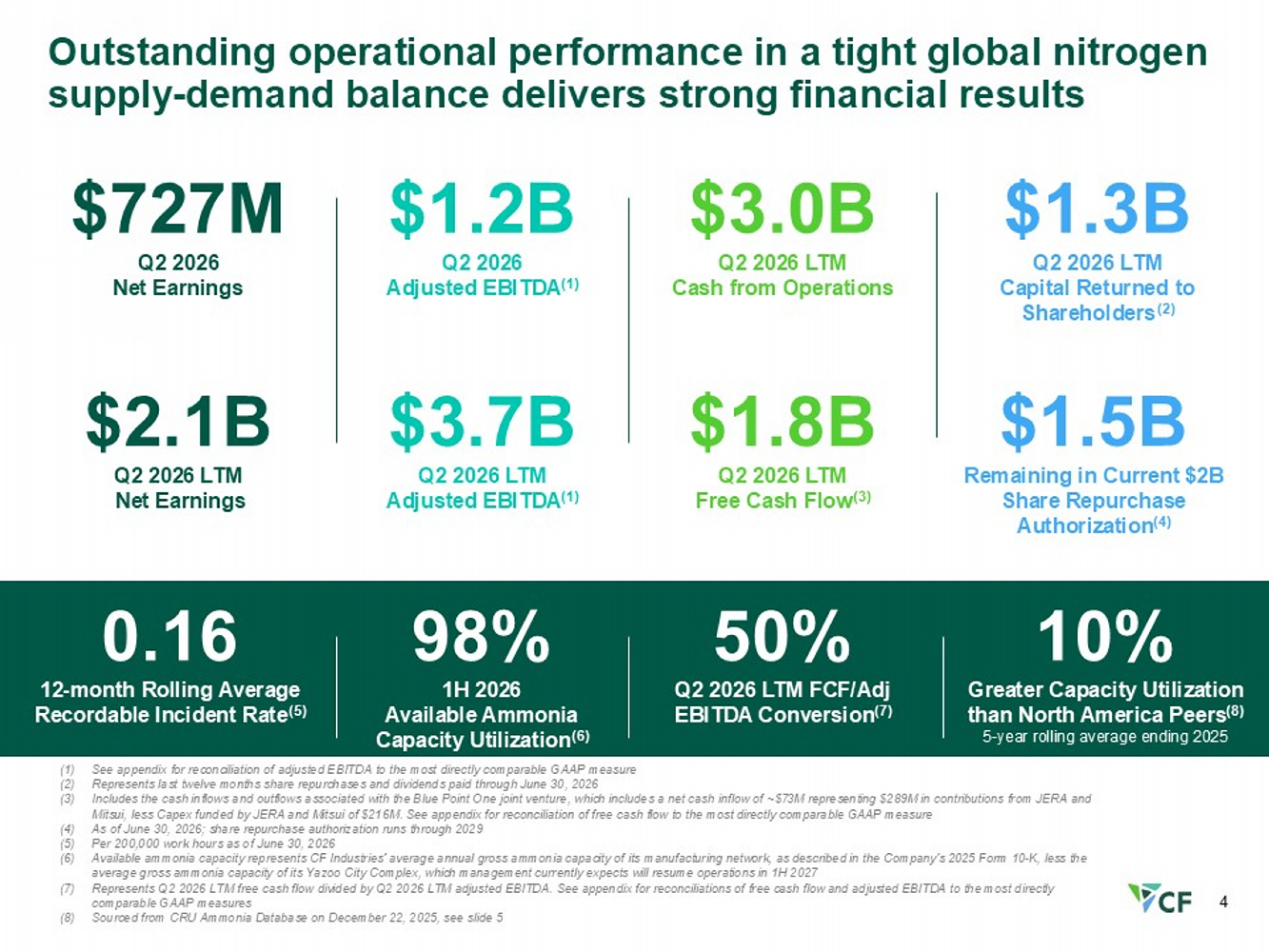
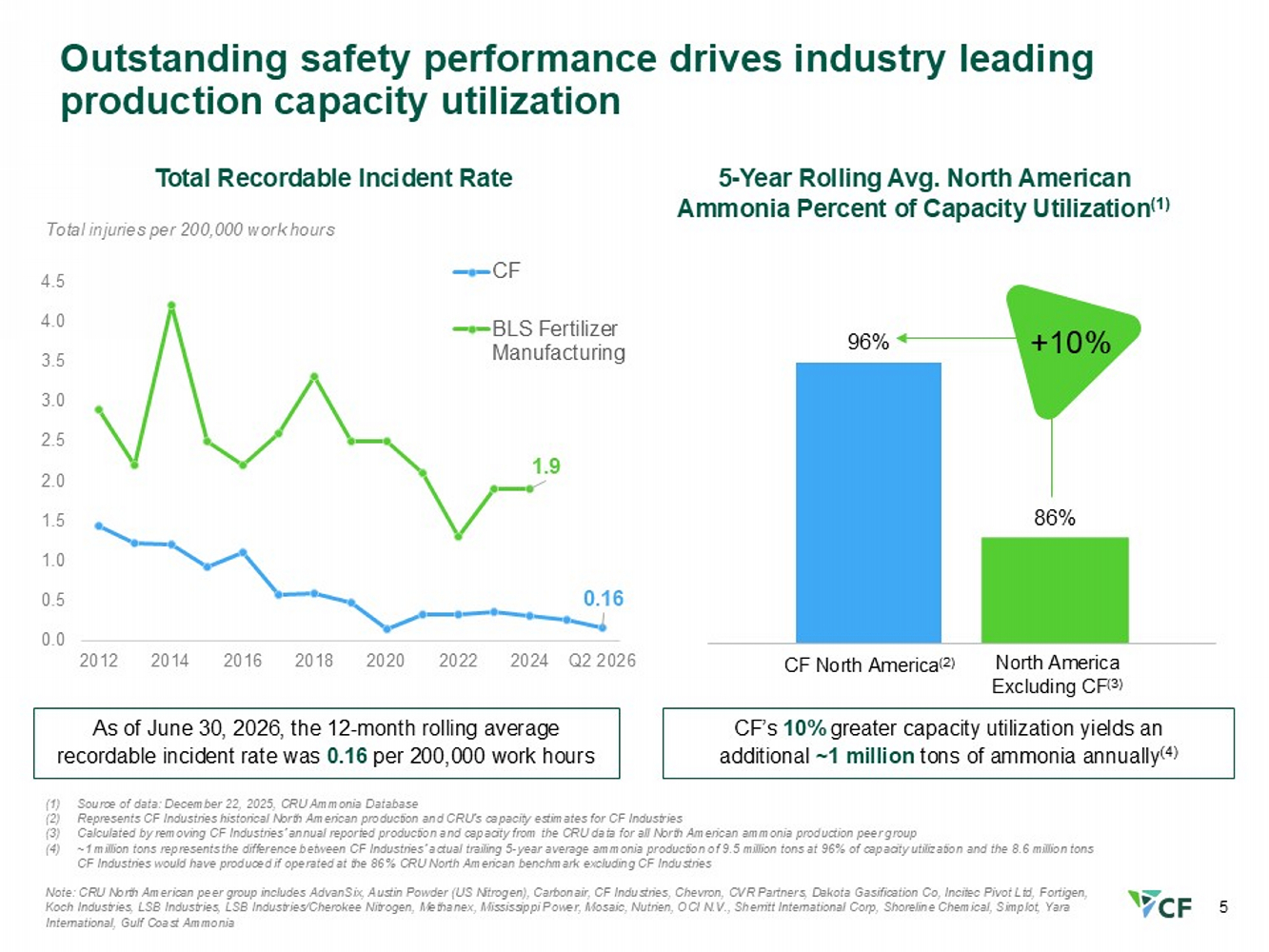
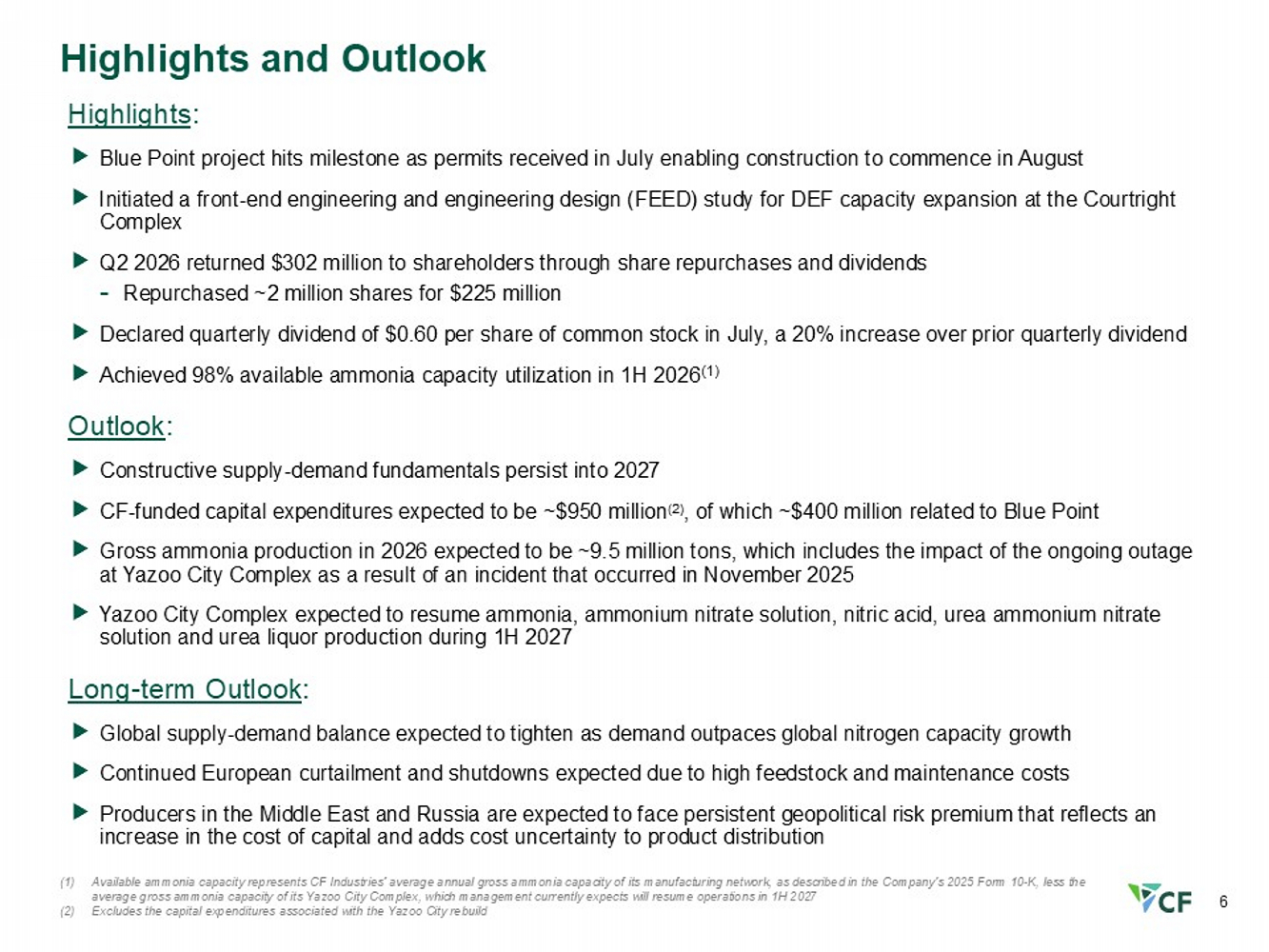
Good morning, everyone. In which we generated adjusted EBTA these results reflect global nitrogen supply demand balance. The teams continue to embrace our due for 200,000 hours' work, well below industry station in the first half. We operated our available ammonia capacity at nearly 98% of our strategic initiatives. To begin, strong lead items are ordered and module a existing network for 2027. After completing work to improve the site's long-term sustainability and operational flexibility, We also continue to be disciplined as we evaluate high-return projects across our network. Our EVTA and free cash in the Middle East in our industry that has been occurring over the years and exposed to the recent global nitrogen supply chain dislocation. Global nitrogen manufacturing and distribution network.
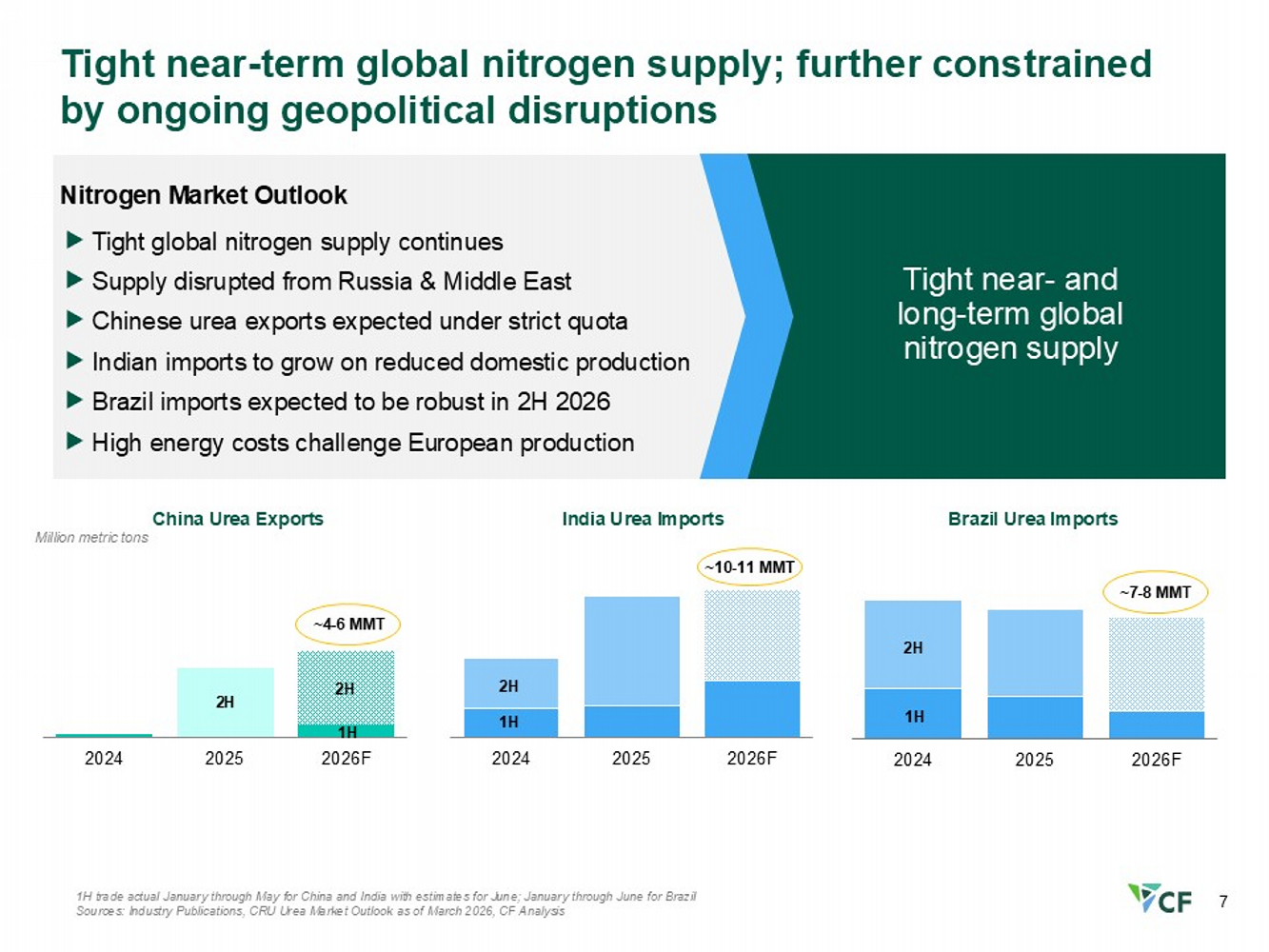
Any geopolitical changing global nitrogen market dynamics significantly supply demand balance was a conflict with the In regions where application for the year, many customers deferred in North America, agricultural demand remained strong through most of the first half of 2026, led by ammonia and urea. Our team created significant value by leveraging our operational flexibility to prioritize urea production over UAN. It also enabled us to deliver our second-highest DEN and ammonia fill programs in July. In a broader market, global nitrogen fundamentals remain tight, even before factoring in geopolitical conflicts. Rising capital costs, the additions, have kept supply growth constrained. Global nitrogen capacity remains exposed to geopolitical uncertainty. And this exposure has further tightened the global nitrogen supply-demand balance. We believe this will continue pricing due to higher logistics and insurance costs. High LNG prices continue to pressure production economics for marginal nitrogen producers and are likely to limit operating rates. We do expect China to export urea volumes similar to last year. Those exports are necessary to meet global demand, but they are not enough to materially loosen market fundamentals. On the demand side, and to remain firm through the upcoming application season, taken together, we expect the global nitrogen market to remain tight into 2027. The continued structural tightening through the end of the decade, as nitrogen capacity currently under construction falls short of historical demand growth, continues to gain 10% of our ammonia sales.
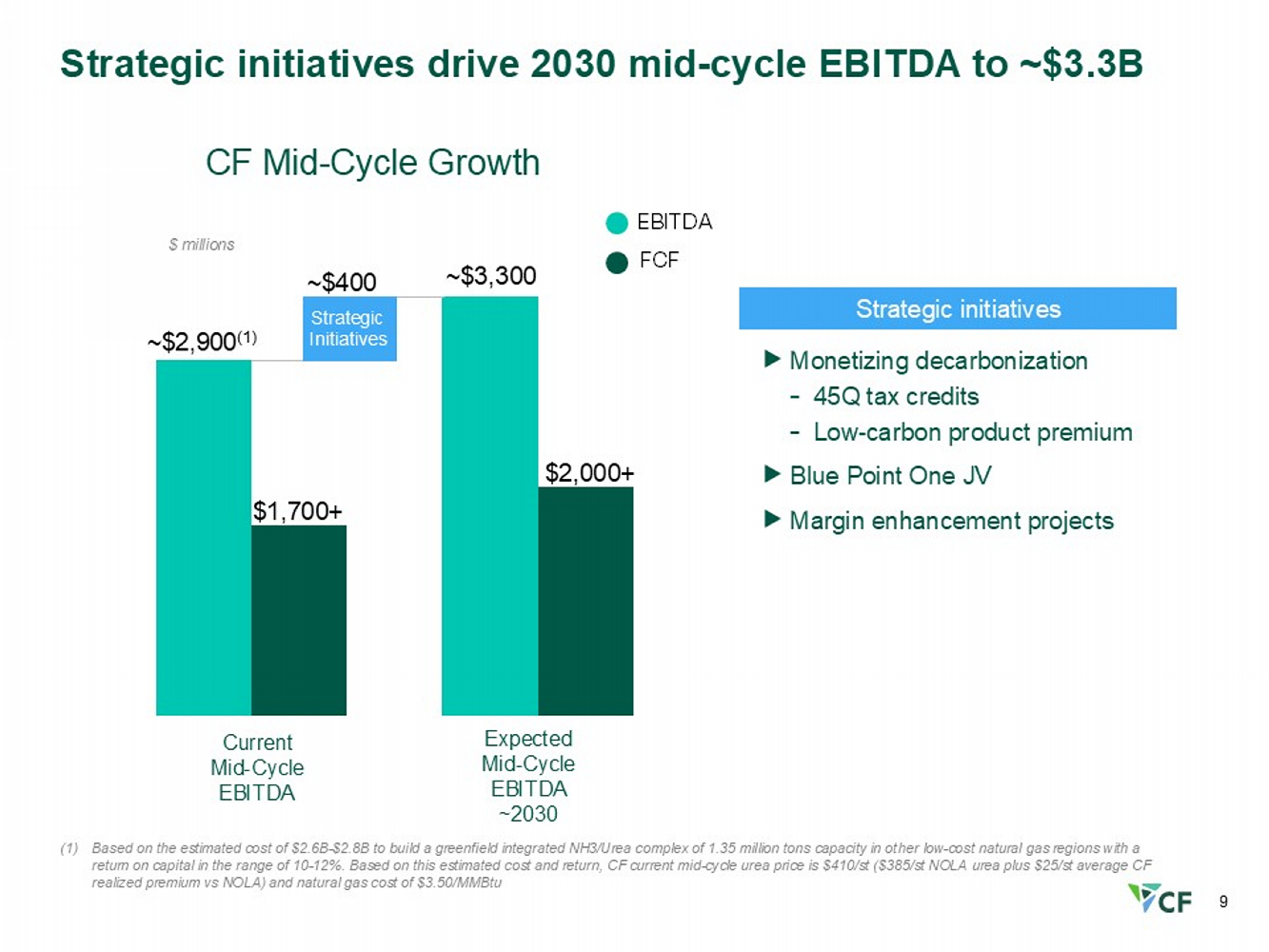
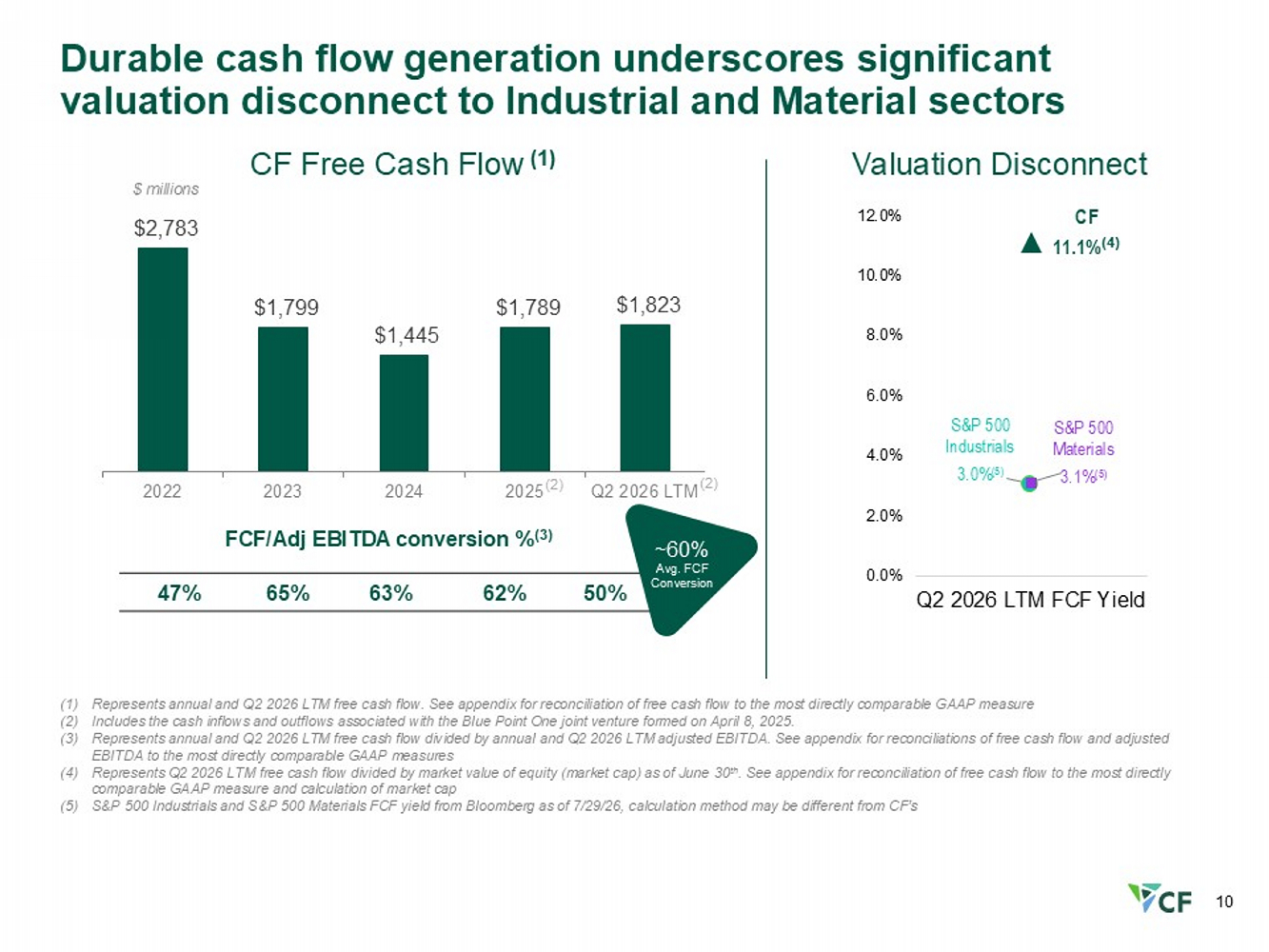
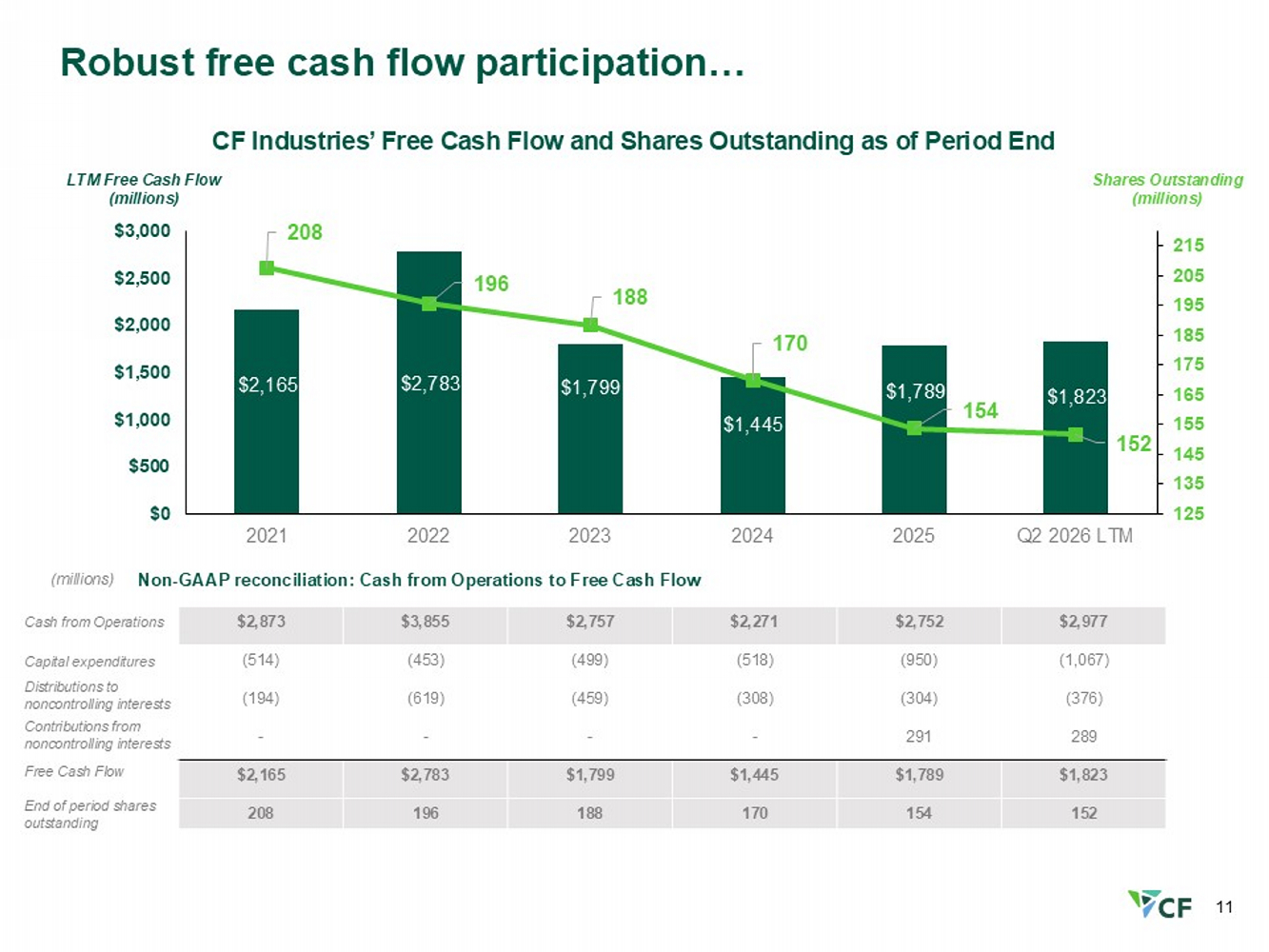
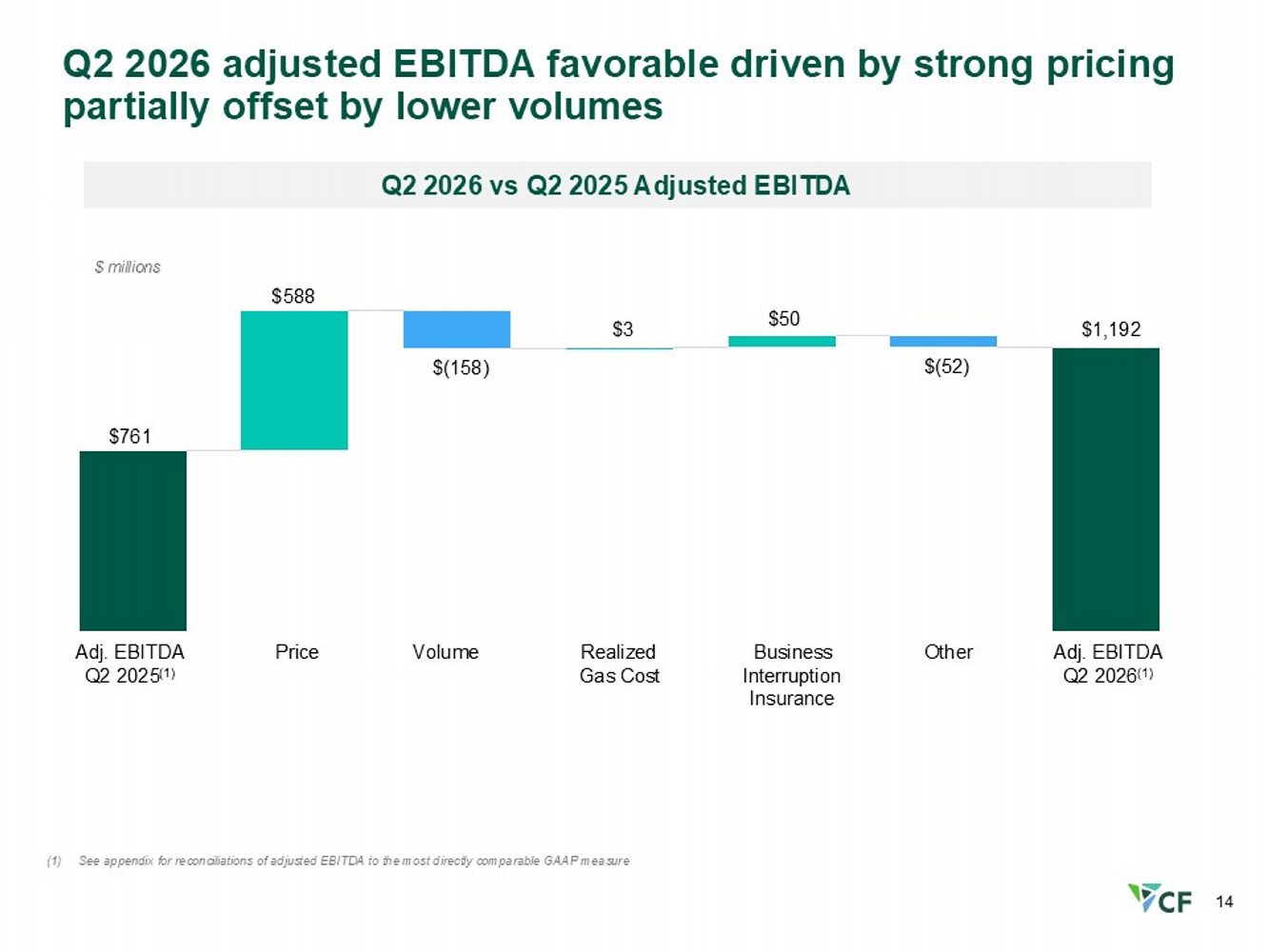
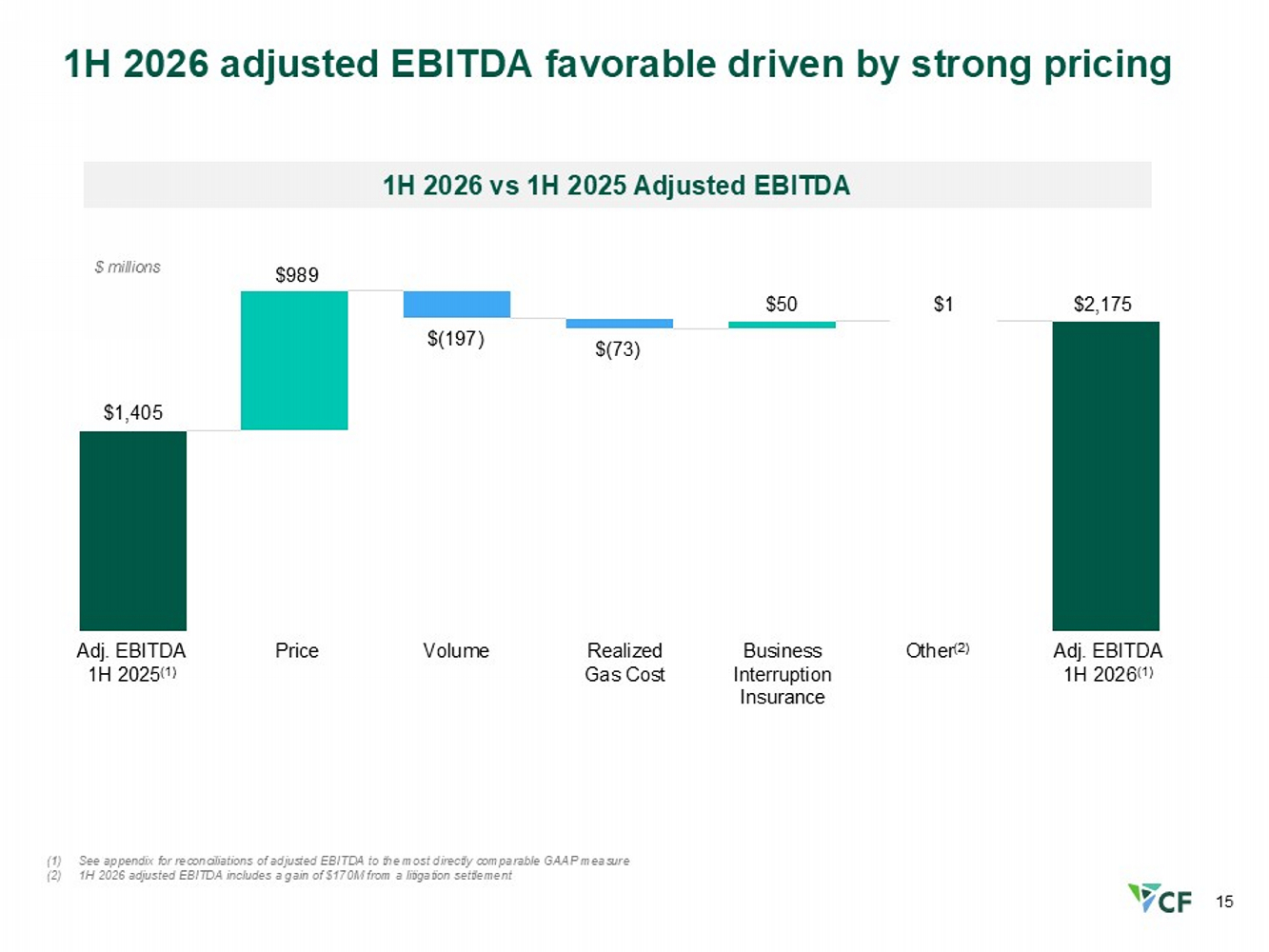
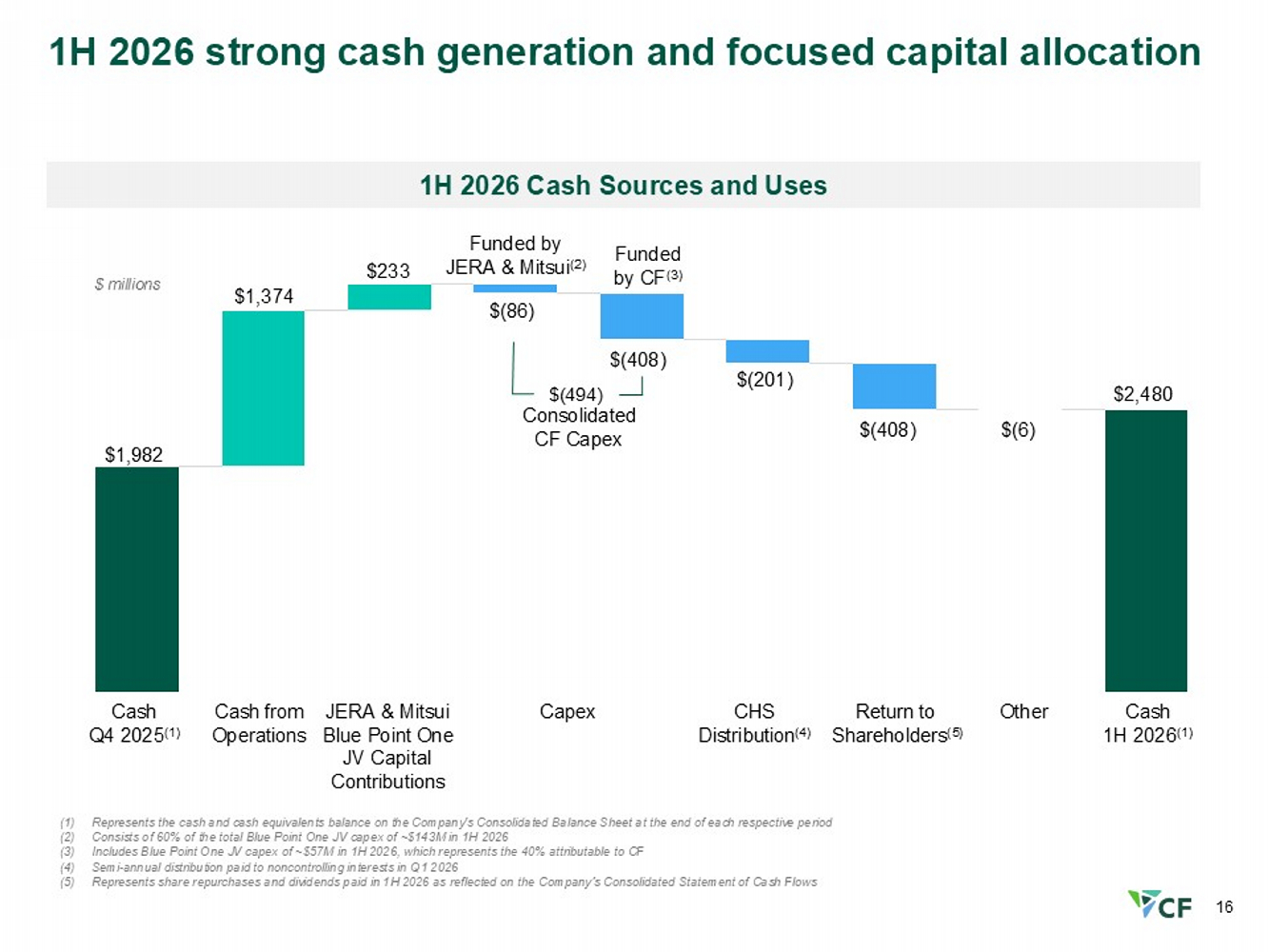
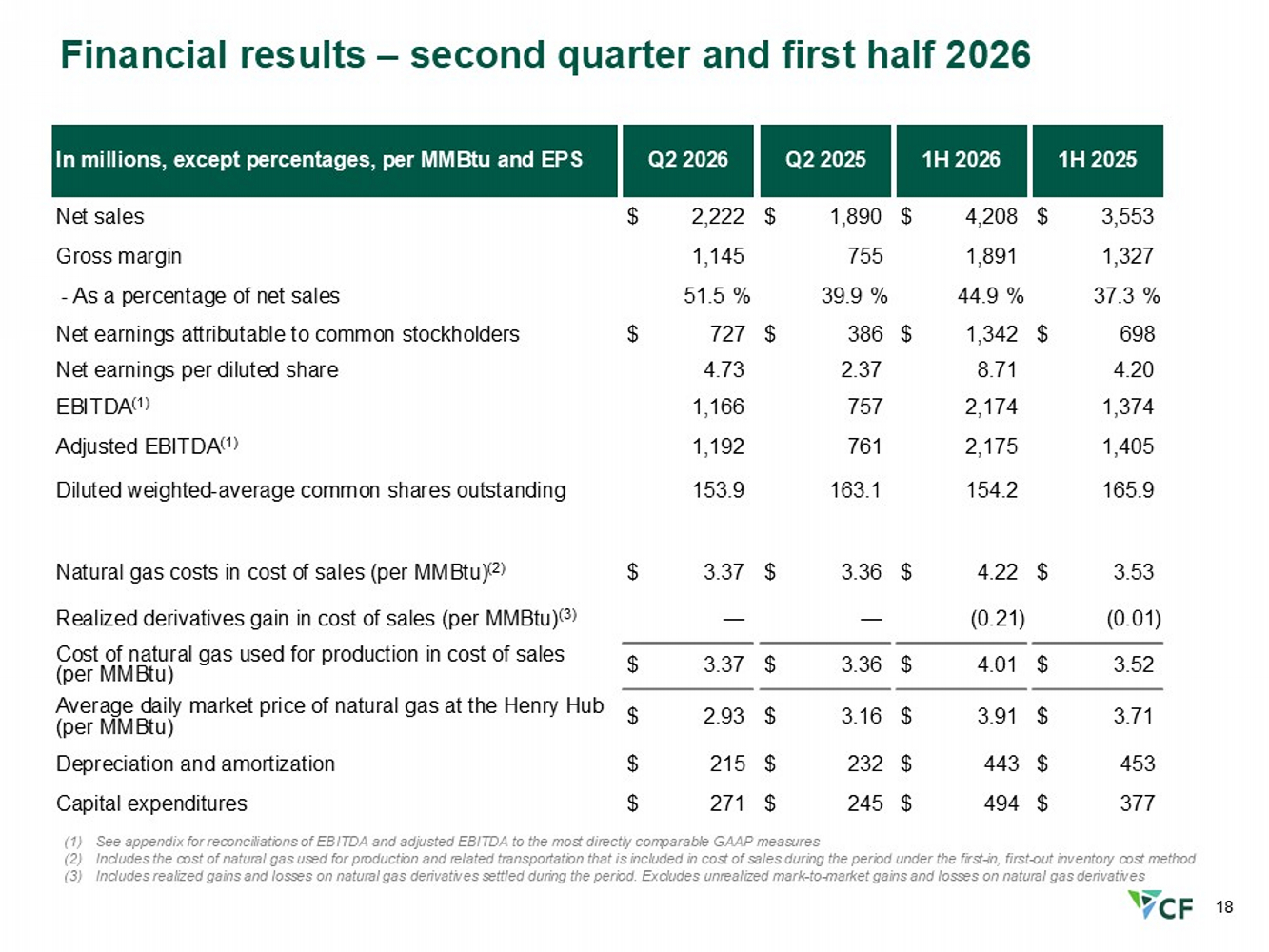
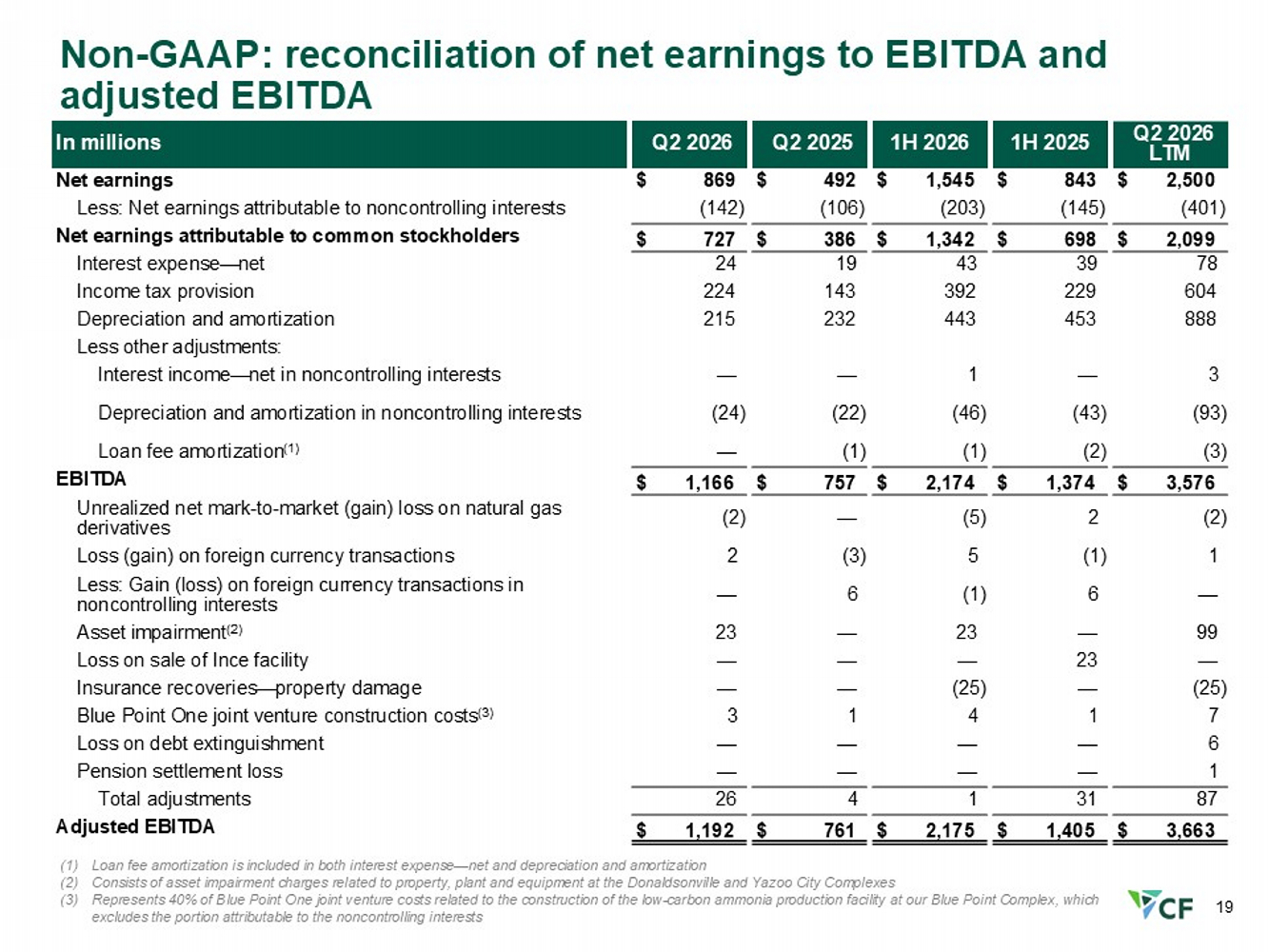
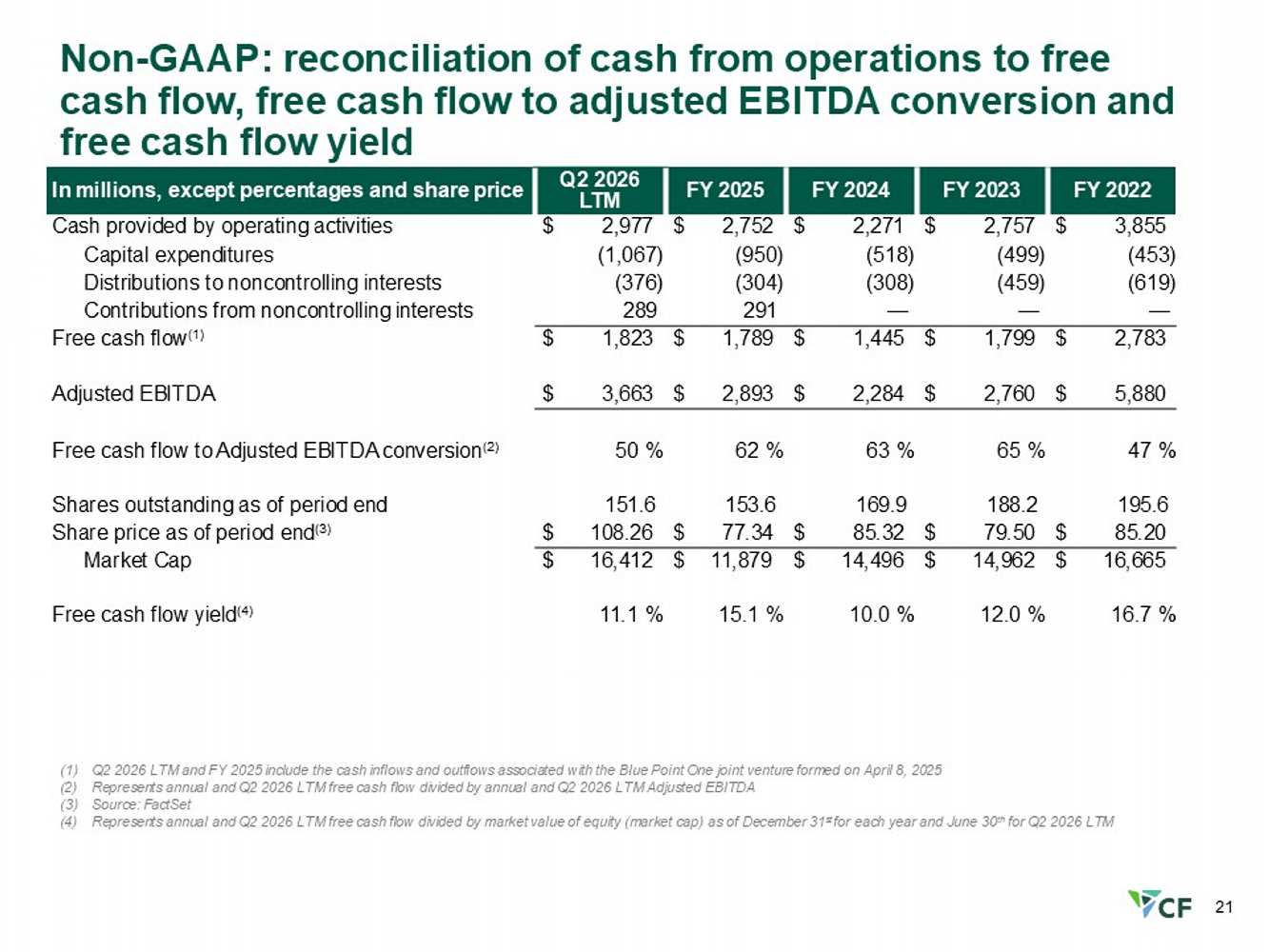
We reported net earnings attributable to common stockholders of $1.3 billion, or $8.71 per diluted share. EBITDA and adjusted EBITDA were both. For the second quarter of 2026, the company reported net earnings attributable to common stockholders of $727 million. EBITDA and adjusted EBITDA were both $1.2 billion. We continue to efficiently convert EBITDA into free cash flow. Our trailing 12-month net cash from operations was approximately $3 billion. See on slide 10, our EBITDA free cash producing predictable and stable free cash flow. Over the last 12 months, we have returned nearly $1.3 billion of free cash flow to shareholders. 10.6 million shares for $958 million, and $314 million in dividend payments. As we have reduced the number of shares out to the remaining shareholders, our dividend has doubled. Approximately $1.3 billion of capital expenditures in 2026, approximately $950 million. With construction at Blue Point expected to begin in August, we focus on mitigating our costs for building new nitrogen capacity in regions with low-cost natural gas has increased, narrowing the construction cost advantage those regions have historically improved. As you can see on slide nine, these higher costs mean that the urea price required to bring new capacity online has gone up as well. Based on our analysis, this supports a baseline mid-cycle EBITDA for CF Industries of approximately $2.9 billion and pre-cash flow of $1.7 billion. We also see that decarbonization, Bluepoint, and other margin-enhancing projects provide upside to our baseline. By 2030, we expect these strategic initiatives that are in-flight to raise our mid-cycle EBITDA to approximately $3.3 billion, a typical premium for higher freight and insurance costs and constrained global supply. These near-term dynamics provide fuel for growth and a greater ability to return. With that, I will hand it back to Chris before we open the Q&A.
Speaker 14
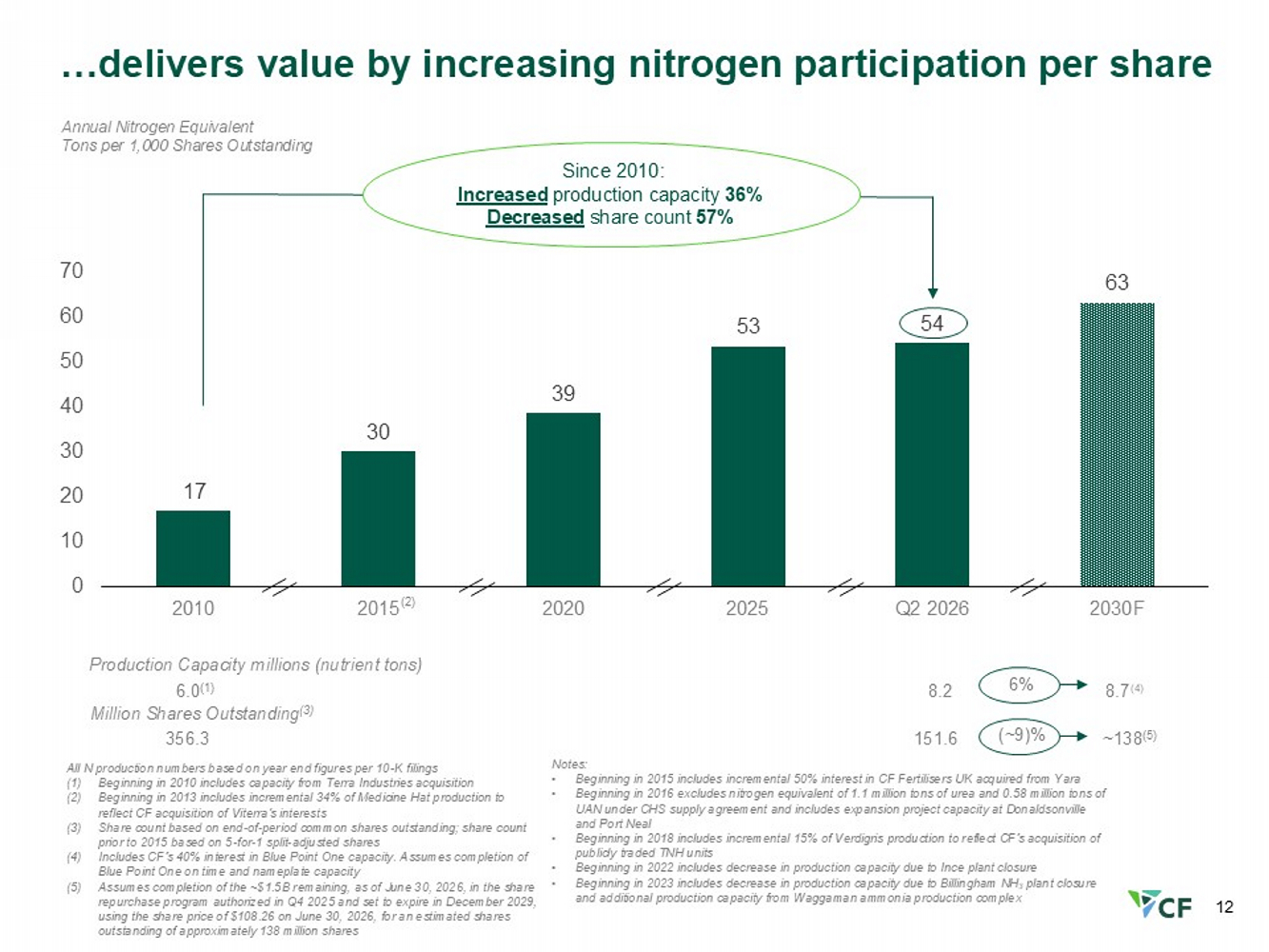
And dedication during the first half of 2026. The team continues to deliver safety and operational excellence while skillfully navigating our ever-changing global marketplace. As you can see on slide 12, increasing production and decreasing the number of shares outstanding in our underlying assets by more than 40% since 2020. In the near and long term, operational capabilities, strategic opportunities, the global nitrogen fertilized mid-cycle earnings. Against that background, our investments continue to strengthen, and our free cash flow generation remains highly. We are well positioned to continue to create value for long term.
Operator
We will now begin the question and answer session. To ask a question, you may press star, then one on your touchstone song. The first question comes from Ben Isaacson of Scotiabank. Go ahead, please.
Thank you very much and good morning. My question is on your new mid-cycle price of $410 a short ton for CF. can you talk about how much of that change is related to capital cost inflation versus how much is related to any structural or sticky changes that you see as a result of the conflict in the Middle East? Thank you.
Speaker 14
Yeah, thanks, Ben. Maybe for starters, I'd just take a step back and just say 20, we are free cash flow. It's not as if the empirical data and how we've company by increasing our production capacity and also lowering our fixed charges to get our free cash flow conversion where it is hasn't been successful. And sometimes we don't always feel like that's being recognized, but we have been performing at that. What I would say is, you know, construction costs, the gap between the U.S. and the rest of the world has closed. You're seeing labor, procurement timing, different things with being able to use module yards, where that difference between a U.S. project and a global project has changed drastically, I think. And then to your point, there are certain costs to remain structurally from the Middle East to the Gulf now is about $70, where a year ago it was certain to have any type of structural piece to that. Probably not. But is that $5 to $10 there? And a risk premium based on where those assets and from a NOLA price, 5 NOLA urea on a short ton to 385. Of that $30, there's probably $10 that may be associated with changes that don't go away as a result, and then the remaining amount, probably a closing of that gap between U.S.
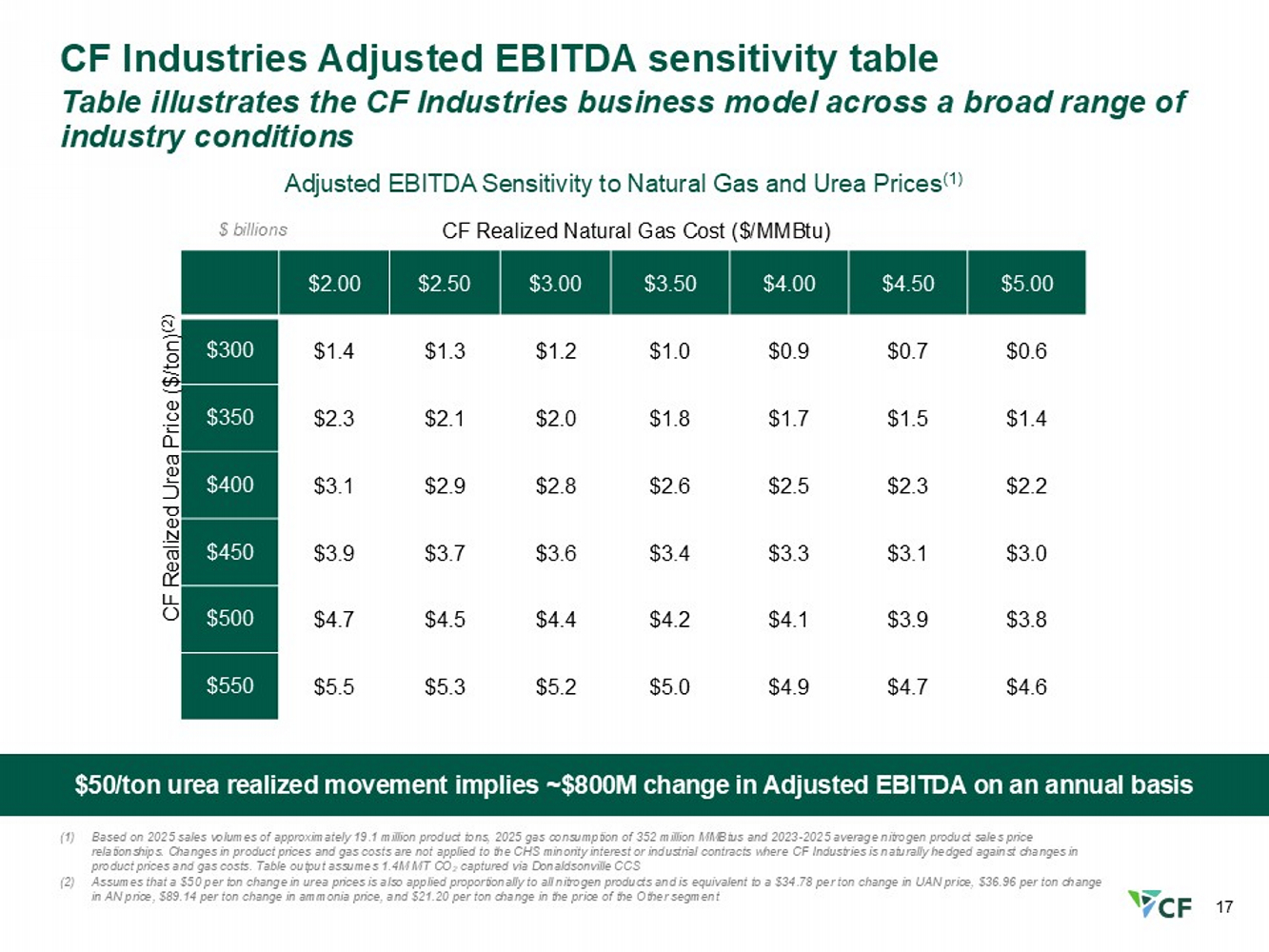
355 to 385. The underlying assumptions that we have is this is for a call to 1.3 to 1.4 million ton capacity site with a CapEx estimate of about 2.6 to 2.8 billion. If we assume 350 natural gas and a 10-12% financial return. That's how you get to the 385 price. You then use our economics and it gets to our EBITDA of $2.9 billion. One piece that I want to call out of what's in there and what's not in there is we also gave some color to get you to $3.3 billion. We'll get out of D-Ville and Yazoo City. The way to think about that, what's not in there, and I'll do this illustratively, you likely saw that we're pursuing a feed study for DEF. Because that has not been officially green-lit yet, that is not in that $400 million. If we get to that point through an investment decision, it will go in there. Likewise, in that $2.9 billion, as we're starting to realize the benefits of DeVille on carbon capture, that's actually shifted left into that $2.9 billion. Chris mentioned there's probably some context around a little bit of geopolitical premium there, but it's really the capital costs and sort of the realizing the benefits on carbon capture.
Operator
Next question comes from Joel Jackson of BMO Capital Markets. Go ahead, please.
Hi, good morning. It seems like looking at yourself and your peers' results, ignoring, you know, some of the lower volumes in Yazoo City, there's a bit of a buyer's holiday in nitrogen in Q2. And we all know what happened with commodity prices, nitrogen prices across the quarter as the war started and prices came down. But I wonder if you talk about that, you know, what does that set up for the second half of the year coming out of the last, I don't know, five, six months of volatility? yeah interesting uh you death northern hemisphere was uh completing the application season we did
see some uh movement in north america as i mentioned in my comments with movements amongst products with additional urea so we pivoted as well as def and that limited a little bit and we saw that happen and i we see a little bit i would say as the data is coming in with a possible small cut in consumption in North America, but not as big as relative to the other nutrients. Then the second half, we're bullish on the second half. When you look at what we've put together with our UAN fill program, the team did a great job of customers organizing that and getting it executed well. And the average price on that is probably close to 300. It extends into Q4. Solid demand, good movement. We're already seeing that. And then I mentioned in my prepared remarks about the fall ammonia season with positioning product for that demand in November. And so when we look at the retail wholesale side for us, which we know has been pushed down into the farmer, we see good.
Operator
The next question comes from Lucas Beaumont of UBS. Go ahead, please.
Yeah, I kind of just wanted to sort of follow up on the outlook there. I mean, I guess just giving kind of a soft demand here in the second quarter, like a more compressed kind of timeframe for deliveries in the second half. we've got this still impacted global supply issues and like now increasing cost curve support as well from European gas. So I guess just how do you kind of see the setup there for pricing as we move into the fall and the spring? You know, is there a point here where the market's going to kind of rapidly tighten and expose low inventory levels as demand picks up? And I guess when do you think that would sort of be timing-wise and is that setting us up for like much higher in-season U.S. premiums again coming up. Thanks.
Good morning, Lucas, and I think this is Bert. Soft Q2 demand and the deferrals that I mentioned in the southern hemisphere, we do believe that's going to catch up, and you're seeing that in India with the most recent tender. We anticipate India to be an import demand of 9 to 10 million tons, which is last year. We're seeing positive movement in South America, and I expect to see some grain movement, some grain consumption. But you're right, the compressed deliveries, it's going to be a poor lineup for some of these folks. But the values have come back down to a track. I think lower pricing will incent demand. But you're right, the EU gas advantage with European operations constrained that we believe in. So nitrogen, we're constructive for the back half of this year as well as 20, and I do think there'll be some tight pricing to come. When you look at, we still lost 5 million tons from the Middle East or from those countries that were unable to get LNG. We're seeing a little bit of movement out of China for exports to replace some of that, but that's probably in the 5 to 6 million ton range, so kind of a net zero. Places that are constrained with LNG, we see a tight market through next year.
Speaker 14
But just what's happening in Europe, as we see those prices that come down, you'll probably see more constraints on that as we've seen over the years where we're seeing curtailments and shutdowns occur. But on top of that is probably the one area we don't know is really what happens in the Gulf area. As Bert mentioned, that's a significant amount of volume that still needs to supply the world here. And if you're seeing curtailments in Europe and still some on and off again stuff in the Gulf area, that's really what's going to determine pricing from that. Volume-wise, as he mentioned, I think we feel very strong about what we're seeing.
Great, thanks. And then it's just on Yazoo City. So I mean, the repairs have sort of been pushed back a little bit into the first half of 2017. So I was just wondering kind of what the sort of swing factors there are in terms of sort of hitting the timeline. Anything to share sort of on the business interruption insurance that are there in terms of like the income and cost coverage, and just will you, are you looking to do anything different at the site, sort of with the rebuild, that could sort of deliver benefits to you after it's finished?
Speaker 14
Okay, I'll take, this is Chris, I'll take some of the first parts of that question and then turn the insurance discussion over to Andrew here. When we put out that we thought it would be late 2026, that was preliminary information on what needed to be done with a particular site and what the procurement timelines would be. You are seeing procurement timelines extend some, and that was primarily for electrical gear, and that's why we've moved it next year from a timing standpoint just as we've gained more information and better insight into that. Related to the site itself, we are changing how that site's going to be configured. We will no longer be prilling ammonium nitrate down there. We'll be doing ammonium nitrate solution along with ammonia and DEF down there. And really what we're building is probably increased flexibility, both from an operational and a logistics standpoint, where we'll have a broader customer base that we can start to, throughout the years here, what the opportunities and what we're changing at that particular site to make it a more sustainable. Andrew, now to talk through some of the insurance side of it.
Yeah, hi, Lucas. So I'll give a little bit of color on kind of three buckets. Accounting, I would say the insurance piece and a little bit of how to think about. Before of last year, we recorded a $25 million impairment on machinery and equipment. And then you'll see or have seen in Q2, we took another further impairment of $23 million for equipment we will no longer be able to use. And so total, that's just shy of $50 million of impairments that we've taken. On the insurance recovery to date, it's been about $75 million. We had $25 million of property damage that we recorded in Q1 and received in Q2. And we've had $50 million of business interruption insurance. When you look at it to date, it's been about a two-to-one ratio. Longer term, it will probably play out more like a three-to-one ratio. That business interruption insurance covers us for about 18 months as you look at that. Now, you will note, I just want to make sure this is clear, we are not including in our capital guidance an assumption for Yazoo City, and there's kind of two fundamental reasons. One, we expect the insurance recovery to offset that. And two, the timing is dynamic. When you look at the timing of the capital between the back half of this year and the first half of next year, it will be dynamic, and the insurance recovery. So when you look at that over a longer time frame, they will offset each other, but that's why we're not specific for the next question.
Operator
Yes, the next question comes from Benjamin Therrer of Barclays. Go ahead, please.
Hi, all. This is Rahi on for Ben. Maybe on S&D, are you seeing any impacts on the extra Texas capacity this year, like Gulf Coast ammonia, Woodside, or is this just largely offsetting Trinidad volumes? And maybe long or medium or long-term, how do you expect this to affect supply and demand once the impacts of the membrane, you know, settle down? Thank you.
Yeah, when you look at the Texas plants, there is lead. And so those tons have been absorbed. They've been moving around the world. They've had some contracts. And now with the RR plan, I assume a lot of that offsetting, that is one, that in some negative impacts, the phosphate produce more ammonia. So the market has come off the highs of Q2, and it's not depending on destinations. But we see these two plants, the Gulf will be absorbed into the market.
Speaker 14
And I think longer term, you know, we've talked about this, that the global S&D is tightening, you know, independent of what was happening in the Gulf during this particular timeframe. If you look at what are projected to come online between now and 2029 or 2030, there's just not enough to meet demand. And if there were some sort of resolution in the Gulf, as Bert mentioned, you're going to have other demand pieces that will grow because you can have sulfur, some more phosphate there. So we're still very much a tightening that continues to go on between now and the end of the decade in the nitrogen market here.
Got it. And thanks for the caller. And just a quick follow-up for Yazoo. Can you just walk us through the thought process that you're going to make, AN, UIN, et cetera there. Why not just do urea given the margin structure has been superior in the last 10 years? That should be it from us. Thank you.
Speaker 14
Yeah, from a urea standpoint, you're right. Urea is really the catalyst as to why we're going to see the global nitrogen market get tighter. We're looking at one of which is even for DEF. That's a urea project at Courtright. As you look at Yazoo City, the urea plant there would have to be a full-blown new urea plant, world-scale plant there. And we look at what we have opportunity-wise that BERT's commercial team has put together, both from an ANS, a UAN, and DEF, that it wouldn't really make sense to put in that type of distribution of those assets.
Operator
Thank you. The next question comes from Kristen Owen of Oppenheimer. Go ahead, please.
Hi, good morning. Thank you for the question. So I wanted to follow up on capital allocation. This is clearly an and strategy, not an or, just given the strong cash flow you've generated thus far. You raise the dividend, you're increasing the buybacks, and you're coming into peak CapEx period. But the one that I actually really wanted to ask about is this feed study on DEF. So can you just give us a little bit of background here, how you're thinking about the demand and economics for, say, industrial applications versus over-the-road applications? I know we've got some EPA changes coming up, so just a little bit of color on the DEF study.
Speaker 14
Yeah, so I'll let Bert start on the market and what we see that's interesting us in the market and the different areas where it is, and then I'll speak a little bit more specific to the project itself.
Yeah, DEF has been an interesting product, 15 years old, in terms of how long DEF has been an active part of our portfolio. and we produce it at different plants, but the 2.2 million tons, and this is urea equivalent tons. So in effect, two world-scale plants of urea are now being consumed in North America 15 years ago. And when you look at the growth, power units come into service, and the dosing rate has increased from a very low level 15 years ago, well, zero before that, get replaced. And an average power unit can last 9 to 11 years. And so that replacement rate is slow, but we see that taking place, and with the additional dosing rate continuing to increase for better efficiency, that's miles per gallon, as well as emissions control, part of next decade. And again, where we're a lot of sense to serve the East Coast market, which is growth to DF and insulation.
Speaker 14
Essentially, we've worked with OEM engine manufacturers all the way down to the retail side to make certain that we're aligned as to the growth that we see going forward. and I think all parties are seeing the same thing there. As Bert mentioned, you know, Courtright provides a unique opportunity for us. Today, Courtright has a net long position in ammonia that is a little bit logistically constrained both by what rail line it's on, having a lower margin ammonia that comes out of that particular plant. And because it's such a low margin ammonia that comes out of that plant, it's providing a better opportunity to put in an upgrade unit there. So as we look at this, you know, provided what comes out of the engineering and design study from a capital cost, but we feel that this is going to be a project that is not only going to grow into a market, the whole market is very strong for us, but is additionally something that's going to be well above our cost.
Your expectations for mix in the back half of the year, just given what you said about the fill programs, what fall application looks like, obviously the economics moved around quite a bit here in Q2, but just how you're thinking about mix of product in the back half of the year would be helpful.
Yeah, I would say we're looking at a normal slate in terms of the economics as we look at economic advantages against Q2. I think that was one of the issues on the Q2. And any inventory we have, we expect.
Operator
Next question comes from Christopher Parkinson of Wolf. Go ahead, please.
Thanks so much for taking my question. I totally understand the second half outlook in terms of steady demand, a lot of lost tonnage out of Costco as well as some of the Iranian tonnage to see the market tight for the foreseeable future. But at the same time, I'm curious on your interpretation of the U.S. and coastal benchmarks typically trading at a discount. Now, it seems like the international opportunities, especially in the third quarter, you know, should have been a little bit better, should be at least improving in terms of that prospective market tightness. So I'd love to hear your perspective across both ammonia and downstream in terms of how you see the dynamics playing out just in terms of, like, the ripple effects from lack of production the first, you know, quarter or two. Thank you so much.
Yes, when you look at what the countries are coming, and some of it is through these tons that everybody's been looking into, what markets we would move our tons to, you mentioned that, and so you've seen us build higher than normal. Benchmarks go, I think you're going to see.
And just as a quick follow-up to that, I'd love to hear your perspective. In the U.S. alone, and I apologize if I'm missing one, you've seen basically seven cancellations in terms of low carbon or blue ammonia over the last several quarters and perhaps a project or two are technically on lifelines. Chris, I'd love to hear your perspective on just kind of your intermediate, longer-term outlook. It also seems like the demand side of it's been a little bit more quiet versus some positive events back in 25. I'd love to just hear your dynamics in terms of market development, your position, how you're thinking about the overall blue point complex, and any incremental opportunities you see fit based on the fact that a lot of others have given up. Thank you so much.
Speaker 14
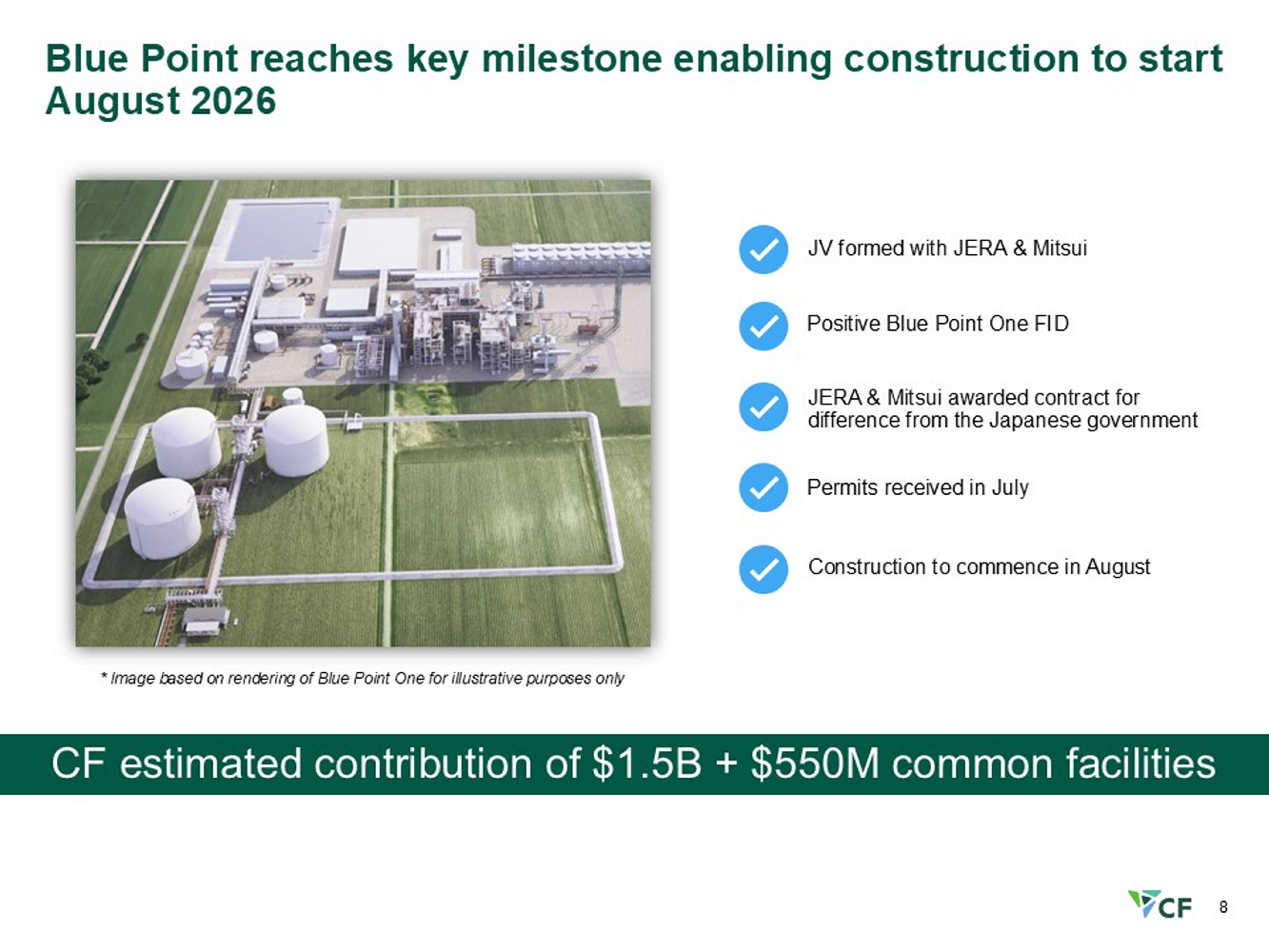
Yeah, and I think the ones that have given up were not necessarily good to begin with. Okay, so if we go back a few years ago, I've said this before, there was like a hundred green and blue plants announced, of which I think there's four in construction today, of which ours is one of them. So there was a lot of hype about what clean energy was going to be. Our analysis never showed more than we were thinking maybe seven of that 107 would be built. So I think we've been more pragmatic in this. As you look at that clean energy market, it's really similar to the DEF market that Bert mentioned. The million tons that'll be going both to Jira and Mitsui, our partners, is a million tons of incremental demand that didn't exist just a few years ago. And we're continuing to see, you know, some growth opportunities in Japan and other pieces of Asia, but it's going to be, you know, at a slower pace than what I think the original hype was. Whether we have it the same way, we store it the same way, we transport efficiencies that we have as an organization to lower our costs per ton on new construction and also the distribution of it reside with us and accrue to us that others don't have. And I think that's why you're seeing us continue to be bullish on both Bluepoint and maybe even a Bluepoint 2 is because of those assets and really that ability we have to produce that product.
Operator
The next question comes from Vincent Andrews of Morgan Stanley. Go ahead, please.
Thank you, and good morning. Chris, I wanted to ask you on the dividend, and maybe separately on another part of capital allocation, just sort of what your thought process is. Obviously, as the share account comes down, you can pay a higher dividend without spending more money. So is that just the plan going forward, and should we be anticipating maybe getting to more annual dividend increases versus I think the last one was maybe 23? And then separately, from an M&A perspective, In the U.S., obviously, there's a limited number of assets, but one just traded. Do you still have scope from a regulatory perspective where you think, you know, if other things became available, you would still look at that? Or should we be thinking about volume growth from here being more along the DEF or, as you just mentioned, blue point two?
Speaker 14
See, the Gulf Coast ammonia plant to Yara is in the process of that. We do believe that we still have some room from an M&A scope. I had given is that assets in our hands, whether we go back to what we did when we acquired with the investments we made, our best practice teams, or just looking recently at Wagamann where we've increased that, I think is a key to allowing us to continue to do. Now, as we look at those acquisitions, we want to be someplace that isn't in the third standpoint, could be constrained as time goes on. We like our low cost position. We like the low cost, one of them. But I think as we're seeing that pre-cash flow conversion and generation goes up just makes us more confident in increasing it as time goes on there.
Yeah, and this is Andrew. You know, the piece that I would share is, you know, our overall strategy on capital allocation has not changed. The hierarchy of driving strategic growth, share repurchases, and dividend, when you think about the dividend, I think of it as two fundamental principles. One, we want to be competitive with the marketplace. So, you know, the increase that we did took it from a 1.8% yield to 2.1% compared to the S&P of 1.1%. The second principle, what I would share, is we're conscious of what we spend in absolute. And you can look and you can probably see there's a range that we tend to target. It's not a hard and fast rule, but it's a range. And that range allows us to fuel growth into the top of our pyramid on strategic growth. So those are kind of the principles that we apply.
Speaker 14
Also be noted, the whole geopolitical underlying fundamentals that we see going forward, We're going to continue to be aggressive in share repurchases as our number one outlay of our capital allocation towards shareholders.
Operator
The next question comes from Andrew Wong of RBC Capital Markets.
Operator
Go ahead, please.
Hey, good morning. Thanks for taking my questions. So just kind of following up on that last thought there, Chris, and in the presentation, too, there's a couple of slides where you highlight the valuation disconnect that you see versus some of your peers. You just talked about why you think that that's the case, what's driving that disconnect, and then what can you do as CF to kind of close that gap?
Speaker 14
Well, what I would say that we can do to close that gap is continuing just to perform as we do at the highest level. Like I said, if you look at our free cash flow over the last six years on average, it's significantly higher than what we're suggesting the new mid-cycle is. So this isn't just a one-year, two-year type of thing. So for us, it's to continue to move forward and perform as we do from an operational, looking for margin enhancement, whether that be a DEF project, other utilization or debottlenecks, or whether that's organic and inorganic growth that has, you know, return profiles well above our cost of capital. You know, one of the reasons why I personally believe we trade in this is I think people are still trading 10 years ago on CF. We've increased our production volume by almost 40%. We've reduced our share count, and yet, you know, people are still thinking we're this over-levered company that is doing expansion projects. We're a significantly different company today based on what our capital structure is. It happened by accident. It's come through very methodical, and our working capital are the lowest in the industry. And by the industry, I mean basic materials. I mean chemicals, everything. And there's almost this against these three or four other peers, which I think is a – and as long as our shares are undervalued, we'll continue to buy our shares back.
I also think there's a misunderstanding of our assets, where our plants are located, and the terminals were going to be a low.
And so when you put all these, you look at it, as you can see, we're $500 million into a $2 billion program. We're looking at DCF analysis, comps, replacement value. Every calculation that we do suggests that there's an opportunity there, so we'll continue to be opportunistic.
I appreciate all that. And then maybe just one on costs. When I look at costs and I exote like gas and DNA, it does look like it's trended up a little bit in the past couple of quarters. Can you just speak to that? Is it mostly just the Aizu City or anything, like maybe some extra turnarounds or anything like that?
Yeah, let me give some color on costs in Q2. If you strip out the impact of volume and gas, our fixed costs were up about $75 million. And I'll do this kind of simply and illustratively, but I'll give you the context. So let's call that $70 million for the context that I'll share. About 10 of that was distribution and logistics, and that was probably the smaller piece of the puzzle, where you saw some mode mix going from barge into rail, and the rate on rail itself has gone up a bit. The other 60 is about a 50-50 split between higher purchased ammonia costs flowing through and the rest is fixed cost absorption tied to Yazoo City being down. So that kind of gives you the three pieces that are coming through there from a COGS.
Speaker 14
Ammonia, obviously, through the revenue line, and it is providing a margin. But, you know, one of the turnarounds of ammonia six in the years in which we do ammonia six.
Operator
Next question comes from Matthew Doit of VOA. Go ahead, please.
Hey, everyone. I just wanted to reconfirm, for CapEx on Bluepoint, what's your mix on fixed versus non-fixed EPC work?
Speaker 14
Essentially, when we looked at the Bluepoint project, the one thing we tried to do was mitigate our overall costs related to that. We did that a couple different ways. One was through our partnership with LINDY and even OXYS 1.5 on the CCS unit, but additionally even with Mitsui and JARA where they're providing some insight and administrative benefits along with as we go to the module yards in Asia. There's one area where what we have probably about 50% related to that, and that is in a couple different areas. One is in the engineering and the module yards. The other is in turnkeys that we try to do on the infrastructure pieces, whether it be the tank or some of the dock and bridge work and things like that. We're managing through this. As I mentioned earlier, we have our long lead items for blue point purchase. So some of those things that we're seeing with extension of lead times or increases in costs related to those, we started those in place even pre-FID on the project.
The quick follow-up, I mean, labor and assembly and build-out, I assume that's just, like, impossible to fix now in the Gulf?
Speaker 14
I mean, the portion that will be labor in the Gulf is going to be significantly lower than what we saw when we did the expansion projects back from 2012 to 2016. That's because a lot of the work from the modular piece is going to be done overseas. Maybe a third thing is one that allows you to probably get more skilled labor in there because you have a smaller trying to do there, but also just limits the high-cost labor that would be in the Gulf Coast.
I appreciate it. And if I could, I was just wondering about the underlying assumptions for 9 to 10 million tons in India this year. Because, I mean, they obviously ended last year with pretty good balances given all that buy. So I'm just kind of wondering if that 9 out of 10 assumes maybe shipments from last year into this year, or that's really like a back half loaded bid period.
If you do it on their fertilizer year, which is a tender for 2.5 and a tender for 1.77, 4.27 tons, they just announced the tender last week for an additional 1.7, and so you can do that math. That's roughly $6 million. We expect another tender by the end of this year. But they also tendered twice last year, or in the calendar year, once in January and once in February. And so if you go into their fertilizer year, that would extend into January through March. And they did almost 2.2 million tons. So when you add those all up, that gets you to 9 to 10 million tons expected. And you have to remember, they are an LNG importer, and they were running it suboptimally on their domestic operations. We estimate they lost 1.5 to 2 million tons of domestic production. So rolling all that up, and we're still not sure what can come out of the straight, is a pretty good estimate.
Operator
The next question comes from Mazair Mamadli of Rothschild and Company Redburn. Go ahead, please.
Thank you for taking my questions. I just wanted to ask a follow-up on the mid-cycle EBITDA targets. What is the sort of mid- to long-term market balance is assumed in that? I'm just going to give you an example. For example, India is striving to be more self-sufficient over the medium to long-term. In Euria, you have a number of projects that are in development that should theoretically come online. by the end of the decade, and that would theoretically remove demand from the global market. Is stuff like that factored in? How should we think about it?
Speaker 14
One is, I think if you look at the overall over the next four to five years, India does have a few projects, one of which is green, that I think you have to start to put probabilities on what is the time frame in which that's going to go. But even with all the announced products, you're going to have a deficit or extreme tightness in the S&D balance as we see it going out through 2030. Now, in saying that, just because India wants to become self-sufficient and other countries as well doesn't mean that there's not a capital cost that's incurred in order to drive and build those particular plants themselves. And if you look at it from an economic standpoint, it may make more sense to continue the import or these particular projects can be delayed. So how we look at the mid-cycle is we do build in what we have in flight when we're working with engineering teams. And usually you have a very good visibility, I would say, out five years because that's about the time it takes to build a plant. And then we start to manage that as time goes on and readdressing that. But today, really, as you look at the next few years, there's a plant in Qatar, there's one in UAE, there's our plant, and then one in Nigeria. But outside of that, I would say the others are a little bit at risk, whether that be Russian plants or some of these Indian plants that come on before 20 years.
Strained areas are in previous capacity coming in and old capacity.
Great. Makes sense. Thank you. And then I just wanted to sanity check something regarding 45Q. So when I look at Q1, there is 19 million of 45Q income, which, if I sort of divide it by the $85 a ton CO2 price, gives me a CO2 capture of slightly more than 200,000 tons. And as far as we know, Donaldsonville is around 500,000 tons CO2 per quarter. Is that calculation missing something, or is Donaldsonville CO2 still ramping up?
Speaker 14
Well, I think there's two points there. One, the revenue through the first half of the year is about $45 million associated with the 45Q, not the number that you suggested. The second part is this year we do expect the overall CO2 to be lower throughout the Donaldsonville facility, primarily because of the turnarounds that took place there. I mentioned earlier Ammonia 6, which is effectively two ammonia plants with its production, went through a turnaround. It's completed that turnaround now, but that turnaround began in June and went through July as well. So as a result of that, you're going to have lower CO2 that was available in order to sequester during that time frame. But I think the numbers themselves would show through in the income line, And the one thing I would mention is that we're not taking it to a Class 6 as of right now. And so as that is, we do believe, just to maybe follow up on that, that the Class 6 approval will be happening later this year, and then that will move to the $85. Because our transfer today is at a zero cost to the contractual rate.
Operator
The next question comes from Ed Lane Rodriguez of Mizuho. Go ahead, please.
Thank you. Good morning, everyone. Chris, in terms of the valuation, should we then expect to be more aggressive on the buyback in the second half of the year? Because the pace seems to be a little slower in the first half. And more importantly, as you noted, late into the second quarter, we saw global UER prices decline. But what was most surprising to me was that in the U.S., prices not only declined, but they were below last year's level. And that was despite all the supply disruption we had globally. How do we explain that?
Speaker 14
So from the share repurchase, I'll start with that, and then I'll let Bert touch on the urea price. On the share repurchase, we have a program, as Andrew mentioned, is still open with plenty of room there, and we believe that we are trading underneath our intrinsic. So checking all those boxes to be into the market, or basically what's something coming out of Oman or whatever, In the last six weeks, between $100 and $140. So we're going to be opportunistic and grab more shares as we see some of that volatility exists. But repurchasing shares, we have the cash flow to do it over and above what we're seeing from our strategic initiatives, and we'll continue to do that.
Yeah, regarding the Q2 price correction, you basically were Q1, openness to the Gulf, and then we were at the tail end of our season taking place. But then we've since corrected $15 level where we are today. And I think that's where we'll plane out. And then as we talked about.
Operator
The next question comes from David Simmons of PNB Paribas. Go ahead, please.
Yeah, thank you. Just another one on longer term outlook. So China is still adding capacity the rest of this decade. Is your view that they can start to export more than the 4 to 6 million tons you expect this year in the next few years? or do you think they add capacity to replace older plants at this stage?
I think yes and yes. The thing to me about China is the growth. We target them at an 82% to 83% operating capacity. They do have some older plants. But the growth of 4 million tons of ability to export is in the Chinese or ammonium sulfate.
Operator
Ladies and gentlemen, that is all the time we have for questions today. I would like to turn the call back to Martin Jerosek for closing remarks.
Thanks, everyone, for joining us this morning, and we look forward to seeing you at upcoming conferences.
Operator
The conference is now concluded. Thank you for attending today's presentation. You may now disconnect.