Operator
Greetings and welcome to Chimera Investment Corporation Fourth Quarter and Full Year 2024 Earnings Conference Call. At this time, all participants are in a listen-only mode. A question-and-answer session will follow the formal presentation. As a reminder, this conference is being recorded. It is now my pleasure to introduce your host, Victor Falvo, Head of Capital Markets and Investor Relations. Thank you, you may begin.
Thank you, operator, and thank you everyone for participating in Chimera's fourth quarter and full year 2024 earnings conference call. Before we begin, I'd like to review the safe harbor statements. During this call, we will be making forward-looking statements, which are predictions, projections, or other statements about future events. These statements are based on current expectations and assumptions that are subject to risks and uncertainties, which are outlined in the risk factors section in our most recent annual and quarterly SEC filings. Actual events and results may differ materially from these forward-looking statements. We encourage you to read the forward-looking statement disclaimers in our earnings release and our quarterly and annual filings. During the call today, we may also discuss non-GAAP financial measures. Please refer to our SEC filings and earnings supplement for reconciliation to the most comparable GAAP measures. Additionally, the content of this conference call may contain time-sensitive information that is accurate only as of this earnings call. We do not undertake and specifically disclaim any obligation to update or revise this information. I will now turn the conference over to our President and Chief Executive Officer, Phil Kardis.
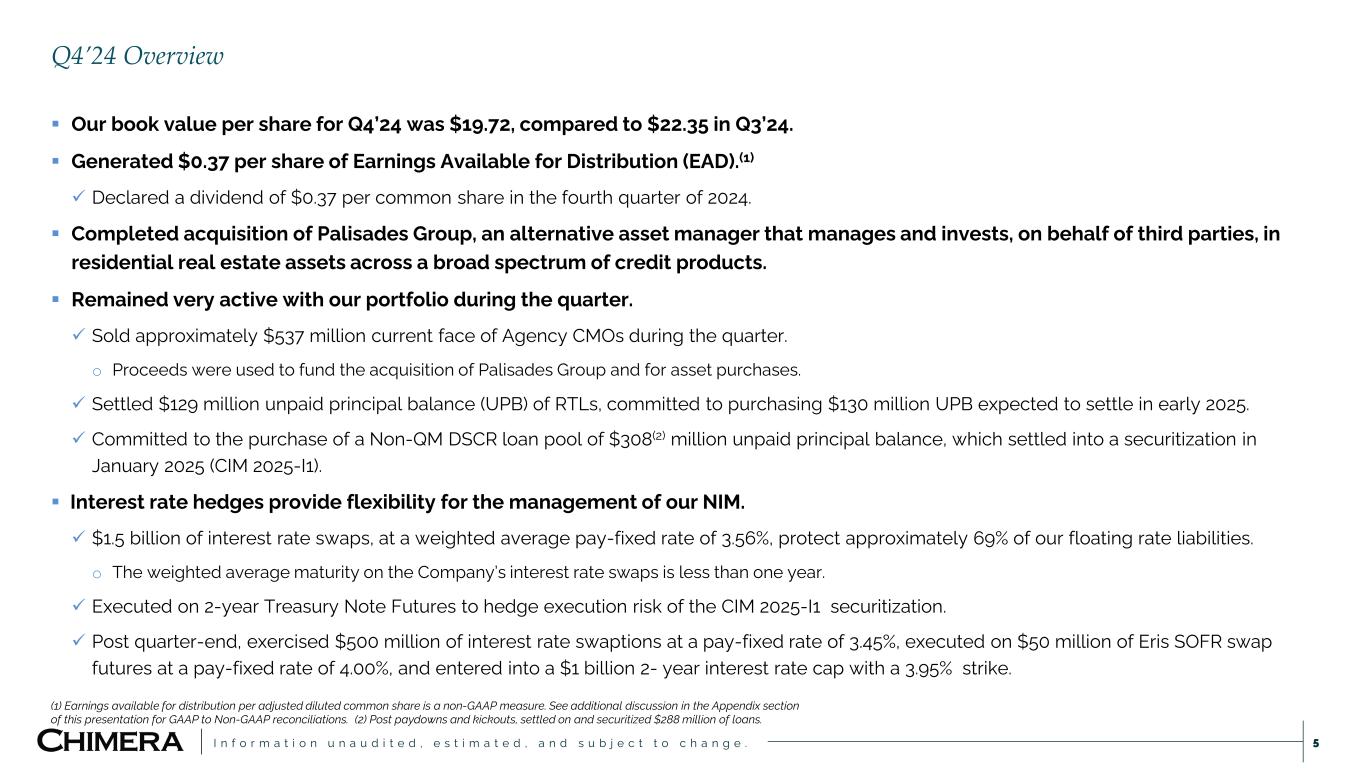
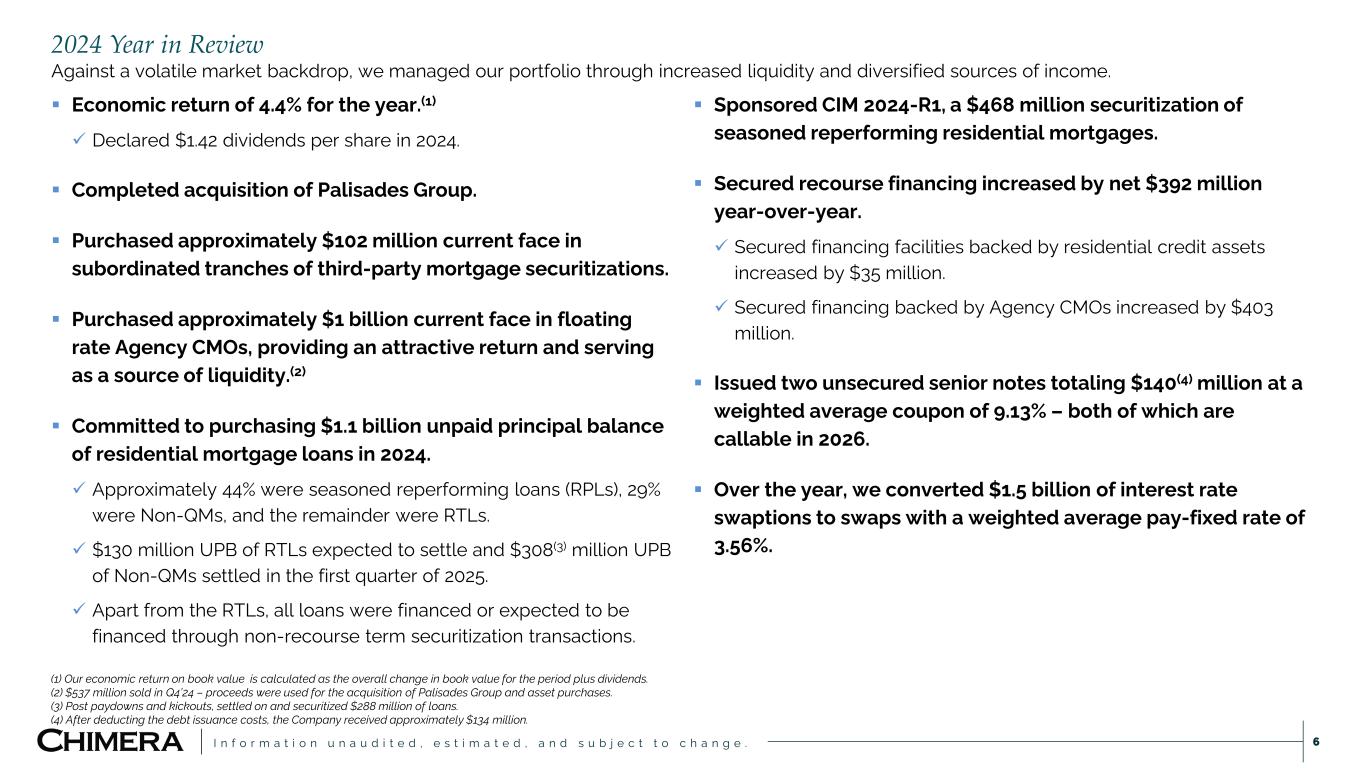
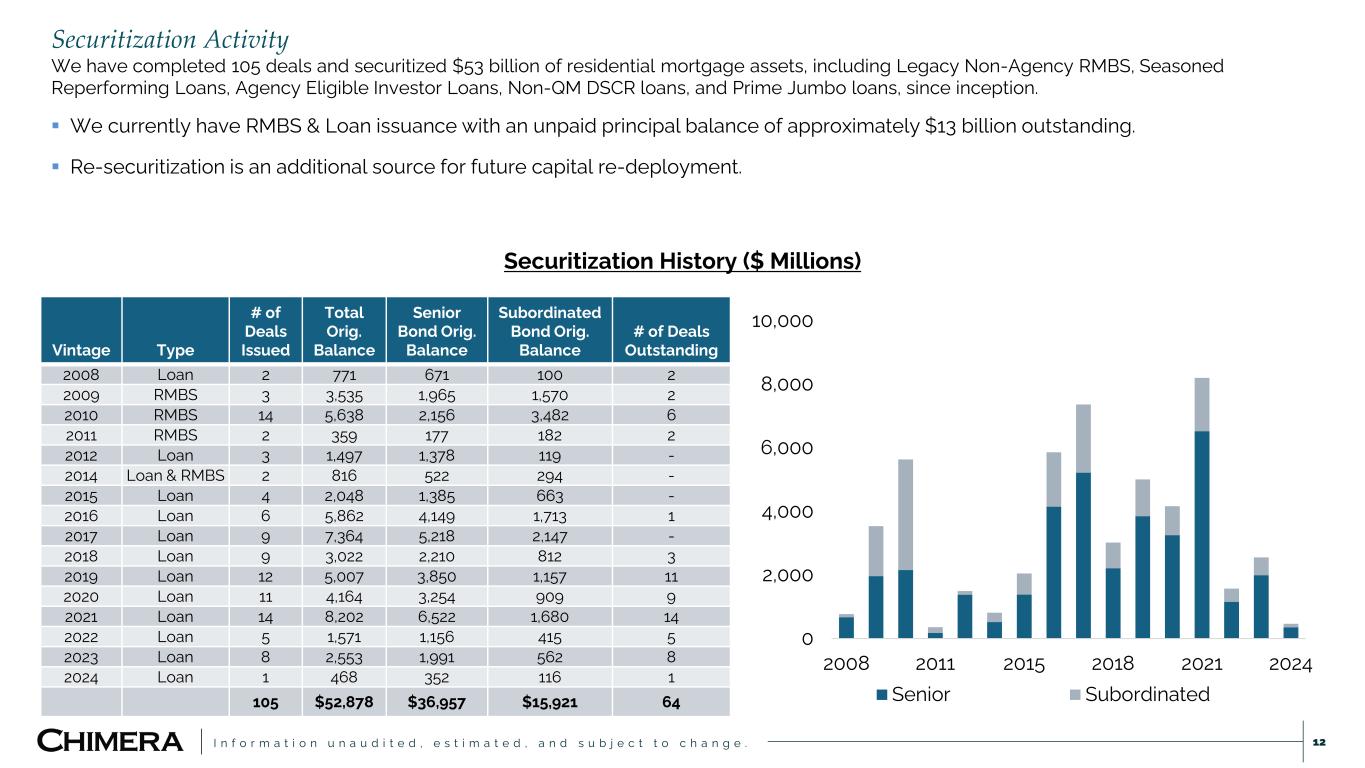
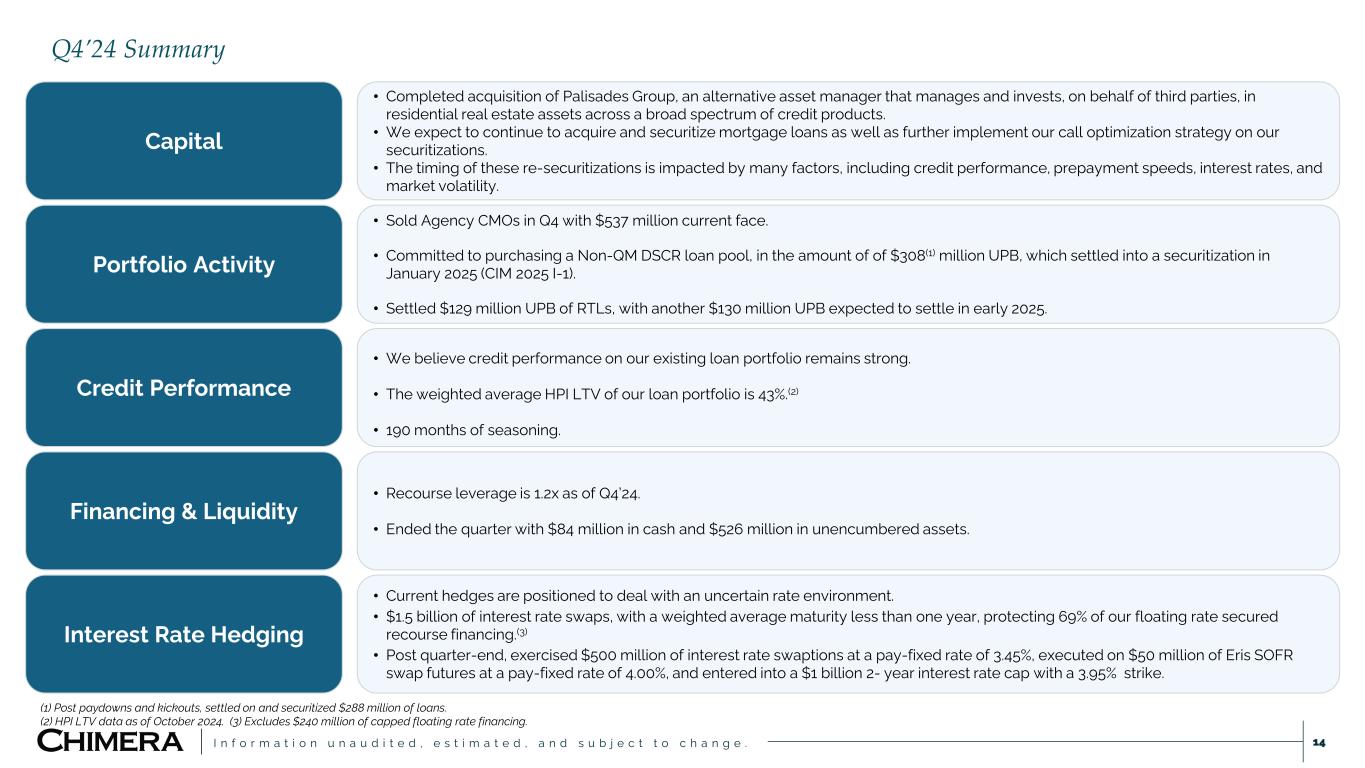
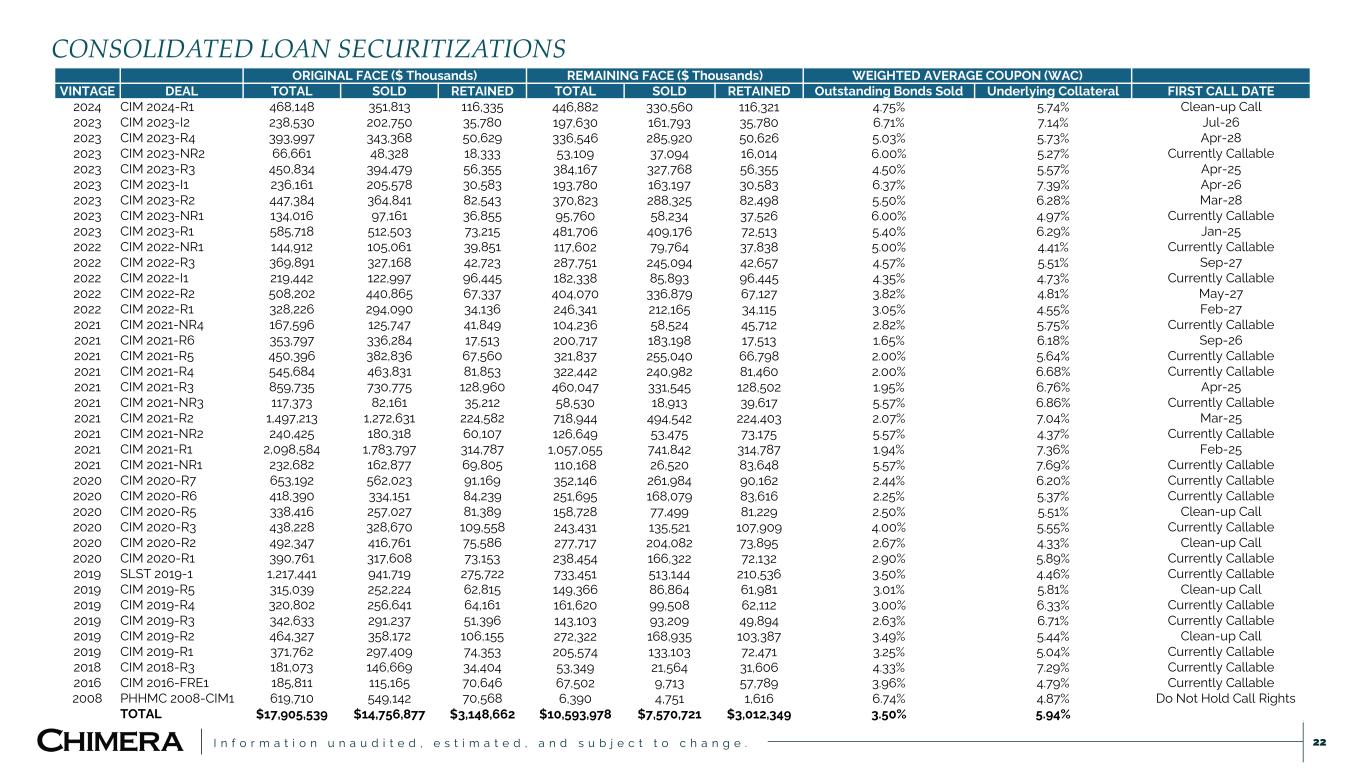
Good morning, and welcome to Chimera Investment Corporation's fourth quarter 2024 earnings call. Joining me on the call are Jack Macdowell, our Chief Investment Officer; Subra Viswanathan, our Chief Financial Officer; Dan Thakkar, our Chief Risk and Credit Officer; and Vic Falvo, our Head of Capital Markets and Investor Relations. After my remarks, Subra will review the financial results, and then Jack will review our portfolio before opening the call for questions. 2024 was another year of reversals. The first part of the year saw continued progress on reducing inflation and long-term rates improved from a high of 4.7% in April to 3.6% in September. However, the second half of the year saw inflation reduction stall and the Fed, with a softening labor market, reduced the Fed fund rate by 100 basis points over their final three meetings of the year. Long-term rates did not react as expected. For the first time in seven rate-cutting cycles dating back to the 1980s, the 10-year rose finishing the year at 4.6%, up 100 basis points despite the Fed cuts. During the fourth quarter of 2024, the term premium for the 10-year treasuries increased by 75 basis points, which reflects the market's uncertainty about future rates, the political environment, and the underlying strength of the economy. The housing market continued to face various challenges and unevenness due to many factors, including interest rates, affordability, and long-term supply/demand issues. The average 30-year fixed-rate mortgage started the year at 6.6%, peaked at 7.2% in May, and dropped to 6.1% in September, leading to a modest uptick in activity before ending the year at 6.9%. Unsurprisingly, home sales suffered. In 2024, sales of previously owned homes declined for the third consecutive year to the lowest level since 1995, reflecting what we believe to be the continuation of the lock-in effects. New home construction was up slightly from 2023, but new homes for sale that are under construction peaked in March and were slightly down from that peak in December. The number of completed new homes for sale hit its highest level in December since 2009. The new home inventory represents 8.5 months supply, which is above the balanced market of six months. But completed new homes were estimated to sell in 2.8 months, reflecting what we believe to be strong demand for newly built homes. On a positive side, home prices continue to increase. Between the third quarter 2023 and the third quarter 2024, US home prices rose 4.3% according to the FHFA's housing price index. We believe that this house price appreciation is positive for our existing portfolio due to further improvement in homeowners' equity. Another positive development for our business was credit spreads for asset-backed securities and other securitized products. Residential credit performance was particularly strong in 2024, driven by robust fundamentals due to low defaults, rising home prices, and record levels of homeowners’ equity. In addition, technical indicators were strong as non-agency RMBS gross issuance ended at approximately $137 billion, almost doubling from 2023’s issuance levels of $71 billion. Investor demand was very strong and credit spreads tightened in 2024, especially at the bottom of the capital structure, with credit curves flattening significantly. So what did all of this mean for our strategy in 2024 and what will it mean for 2025? In 2024, we managed our portfolio to increase liquidity and diversify sources of income. Consistent with that strategy, we deployed $209 million in proceeds from our equity raise in December 2023, and our two senior debt raises in 2024. We invested in floating rate agency CMOs. We believe these investments provide an attractive return while serving as a source of liquidity as we seek to deploy capital in loans or other investments as we did for the Palisades acquisition. We invested in subordinate tranches and newly issued third-party mortgage securitizations backed by re-performing mortgage loans and small balance commercial loans. We purchased residential transition loans. We purchased RPLs and securitized them in CIM 2024-R1. And in the fourth quarter, we committed to purchase non-QM loans, which we securitized this year. And finally, in December, we closed the acquisition of the Palisades Group, a US-based alternative asset manager specializing in residential real estate credit. Founded in 2012, Palisades manages and invests on behalf of third parties and residential real estate assets across the broad spectrum of credit products. Through this acquisition, we began providing third-party investment management and advisory services, which represents a new fee-based source of income and we believe the ability to grow our income on a capital-light basis. What are our plans for 2025? We continue to approach portfolio management in a disciplined manner and are expecting to operate in an uncertain environment. In 2025, we expect to continue to diversify our portfolio, increase liquidity, and grow our fee-based income revenue stream. While we'll continue to look for opportunities to acquire and securitize mortgage loans, we expect to grow our agency RMBS portfolio. In addition to supporting our regulatory compliance, we believe the agency RMBS portfolio will provide diversification, more stable dividends, and a source of liquidity for opportunistic asset and business acquisitions and provide protection in periods of volatility. By growing our agency portfolio, we are returning to our roots as a hybrid REIT. We intend to also look for potential opportunities to acquire mortgage servicing rights, which we believe will help hedge our loan portfolio as well as provide a diverse source of income for our dividends. With the Palisades acquisition, we have embarked on our strategy of enhancing returns to our shareholders through diversification of revenue. Palisades Advisory Services is the asset manager of our most recent securitization, and we expect to add them to our future securitizations, including the re-securitizations of our existing deals. We believe that combining Palisades' platform with ours will allow us to drive efficiency and performance across the portfolio. Lastly, we begun to see those investments of the fee-for-service-based income. It's early in the process, but we continue to believe the acquisition will be accretive to earnings. As we move into 2025 and beyond, we will look to expand and grow our non-discretionary investment asset management and advisory services and continue to look for opportunities to grow through a combination of organic and external growth. In addition, we plan on investing in technology that allows us to enhance and expand our asset management capabilities and drive operational efficiencies. We expect the source of funds for the portfolio diversification and growth initiatives to come from our existing portfolio as we return to our re-lever strategy. We have issued call notices on all of our outstanding and our securitizations and we expect to re-securitize the loans in the next couple of months. In addition, we expect to call some of our R securitizations in 2025. We will also look for opportunities to raise capital in the capital markets. Finally, we continue to seek opportunities to finance our retained notes from securitizations with long-term, limited, or non-mark-to-market financing facilities. As we have discussed in the past, we had an expensive non-mark-to-market facility coming due in January 2025. We were able to enter into a new or larger facility with better terms and greater than 400 basis point reduction in rate. By increasing the size of the facility, our interest expense is flat, but we were able to receive approximately $62 million to deploy in new investments. Our goal is to build a durable, more diversified portfolio and implement growth initiatives that are designed to provide stable and growing sources of income that will benefit our current stock price relative to our book value. We feel good about our business and we're finding new opportunities. And we increased the quarterly dividend by 12% in 2024. And lastly, we believe the acquisition of Palisades will further strengthen or expand our business and provide additional opportunities for growth for our shareholders. I will now turn the call over to Subra to review our financial results.
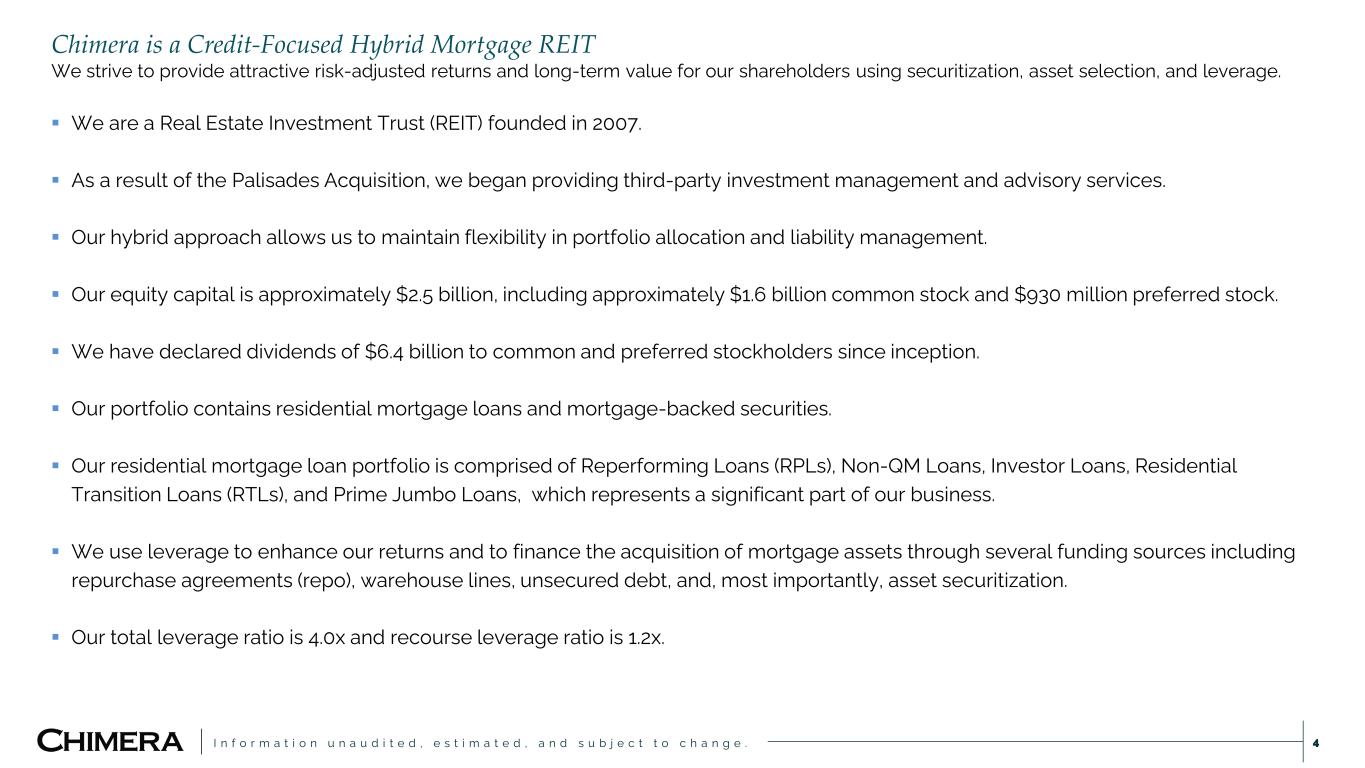
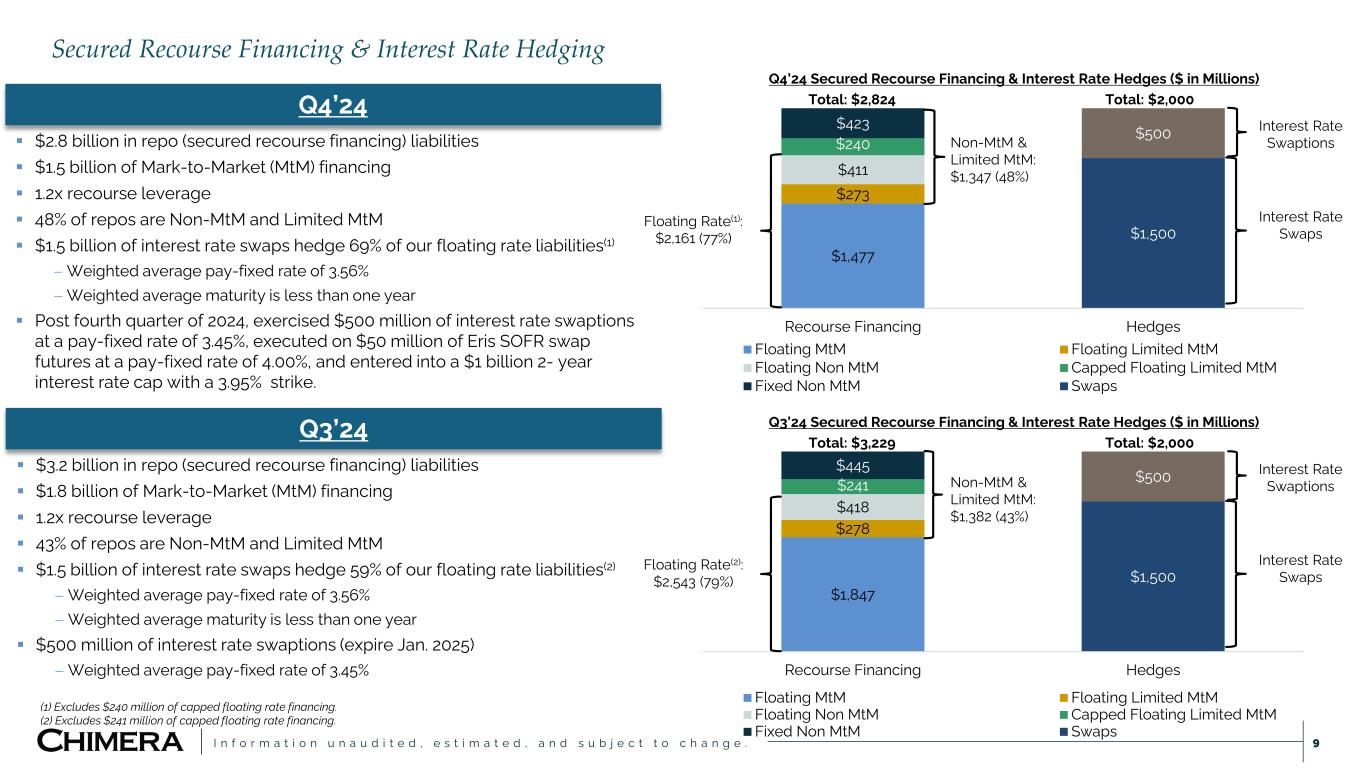
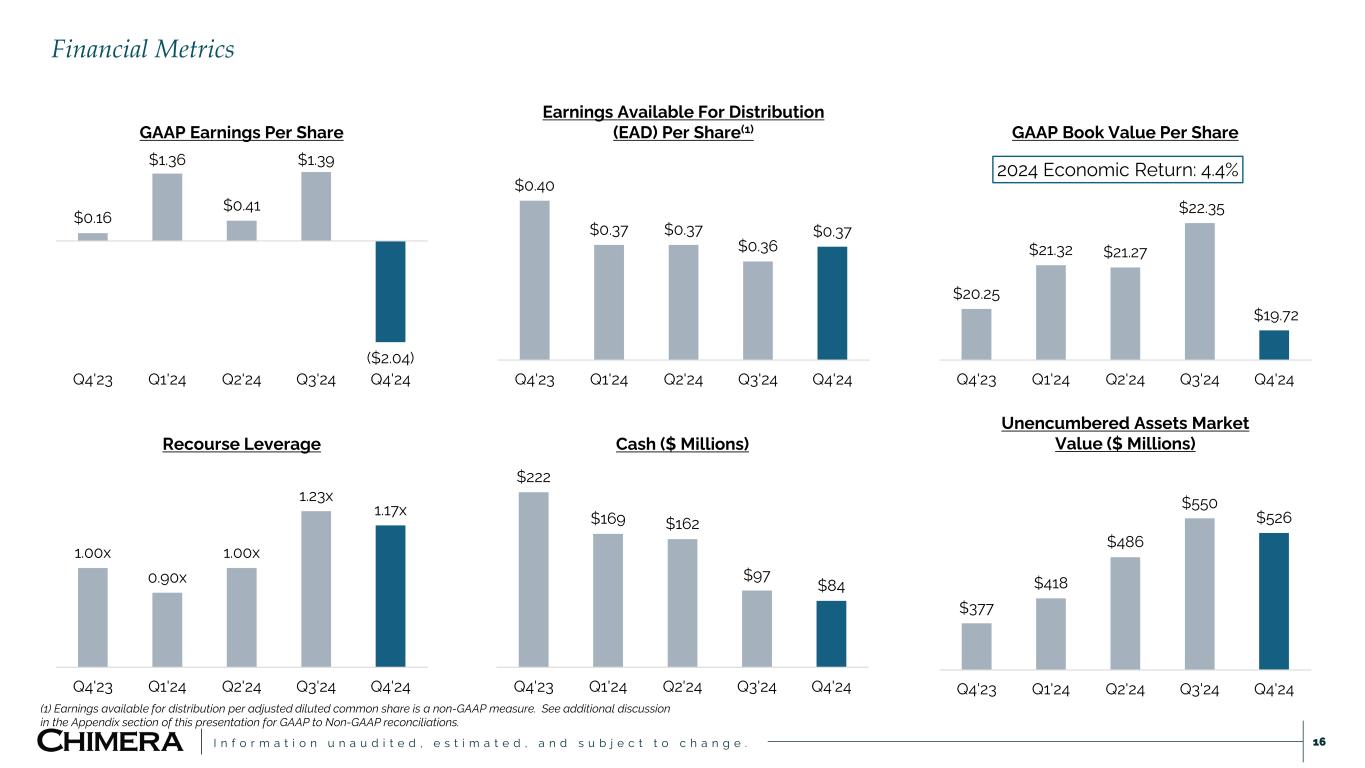
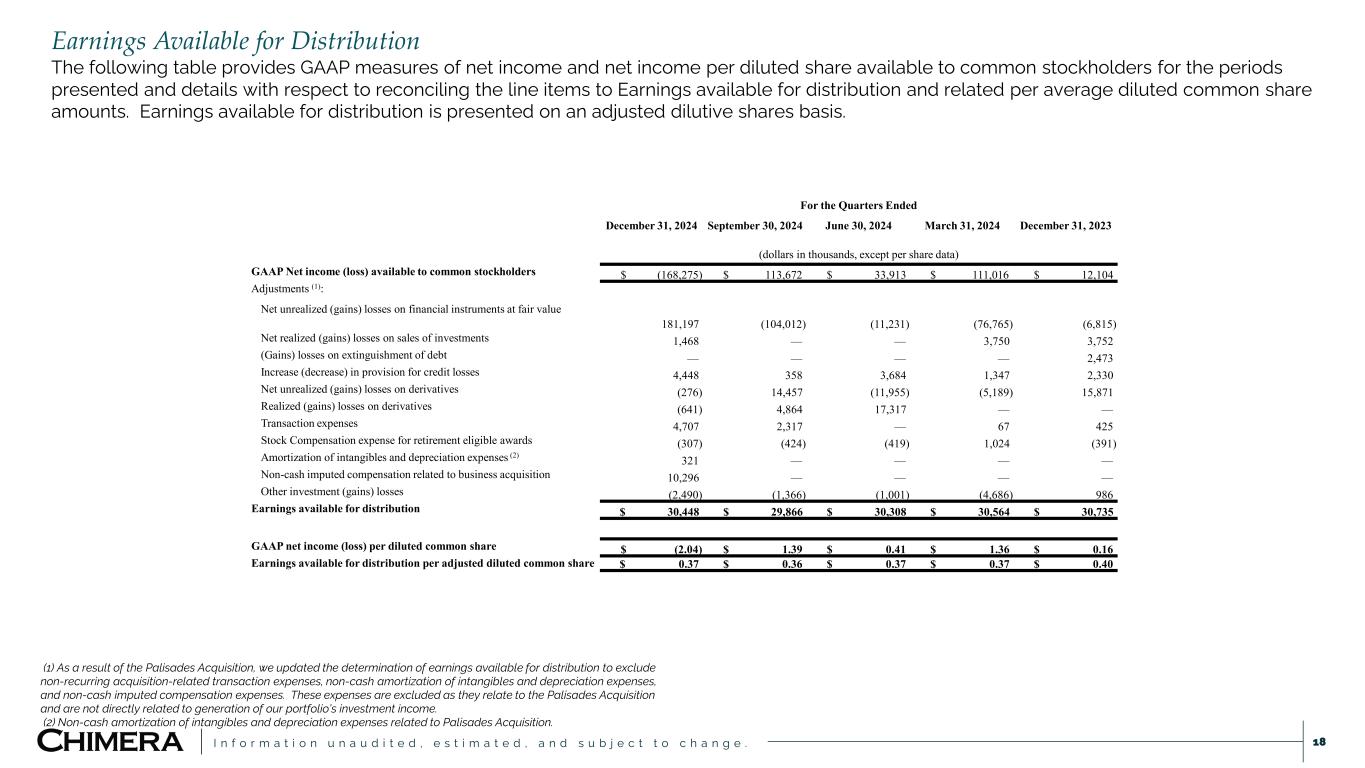
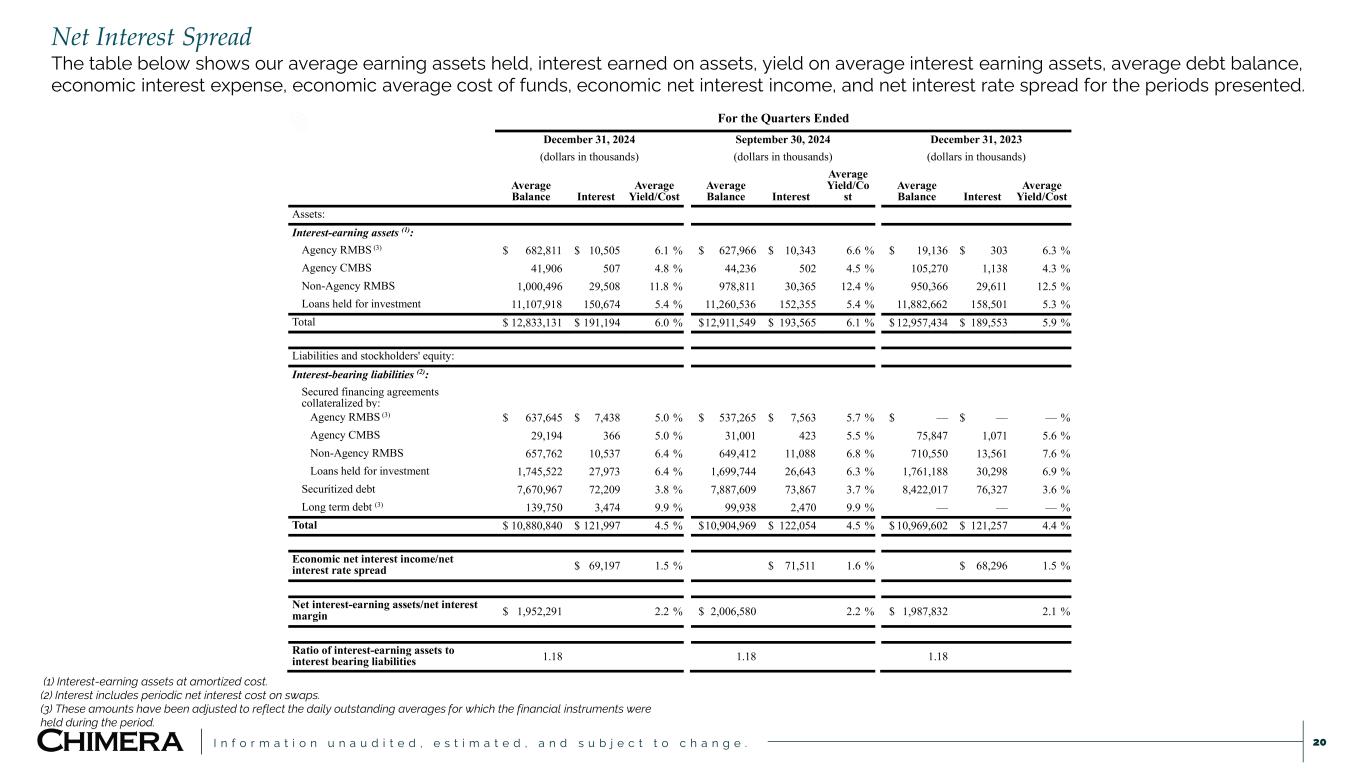
Thank you, Phil. I will review Chimera's financial highlights for the fourth quarter of 2024. GAAP net loss for the fourth quarter was $168.3 million, or $2.07 per share. And GAAP net income for the full year was $90.3 million, or $1.10 per share. GAAP book value at the end of the fourth quarter was $19.72 per share. For the quarter, our economic return on GAAP book value was negative 10.1% based on the quarterly change in book value and the fourth quarter dividend per common share. And for the full year, our economic return was a positive 4.4%, which includes $1.42 of dividends declared in 2024. On an earnings available for distribution basis, net income for the fourth quarter was $30.4 million or $0.37 per share and net income for the full year was $121 million or $1.48 per share. Our economic net interest income for the fourth quarter was $69.2 million. For the fourth quarter, the yield on average interest-earning assets was 6%. Our average cost of funds was 4.5% and our net interest spread was 1.5%. Total leverage for the fourth quarter was 4 to 1, while recourse leverage ended the quarter at 1.2 to 1. For hedging, financing, and liquidity, the company ended the year with $610 million in total cash and unencumbered assets. At year end, we had $2.2 billion floating rate exposure on our outstanding repo liabilities. Our total floating rate obligations, net of hedges, was $1.2 billion. We had $1.3 billion in either non or limited market features on our outstanding repo agreements representing 48% of our secured recourse funding. We had $1.5 billion pay-fixed interest rate swaps at a weighted average pay-fixed rate of 3.56% with a weighted average maturity of less than one year. The company also had a long position in $500 million swaption on a one-year pay-fixed interest rate swap with a rate of 3.45%. The company executed this option in January. In January, we closed on CIM 2025-I1 securitization. As part of our strategy to mitigate securitization execution risk on certain securitizations, at year end, we were short two-year treasury future contracts to protect the net interest spread of CIM 2025-I1. This short position was closed out in January. For the fourth quarter of 2024, our economic net interest income return on equity was 10.5%. Our GAAP return on average equity was negative 22.3%. And our EAD return on average equity was 7.2%. And lastly, compensation, general, administrative, and servicing expenses were marginally lower year-over-year while excluding expenses related to the Palisades acquisition. Our transaction expenses were significantly lower during the year due to reduced securitization activity in 2024. However, these expenses increased in the fourth quarter by $4.7 million, primarily from expenses related to the Palisades acquisition.
Speaker 4
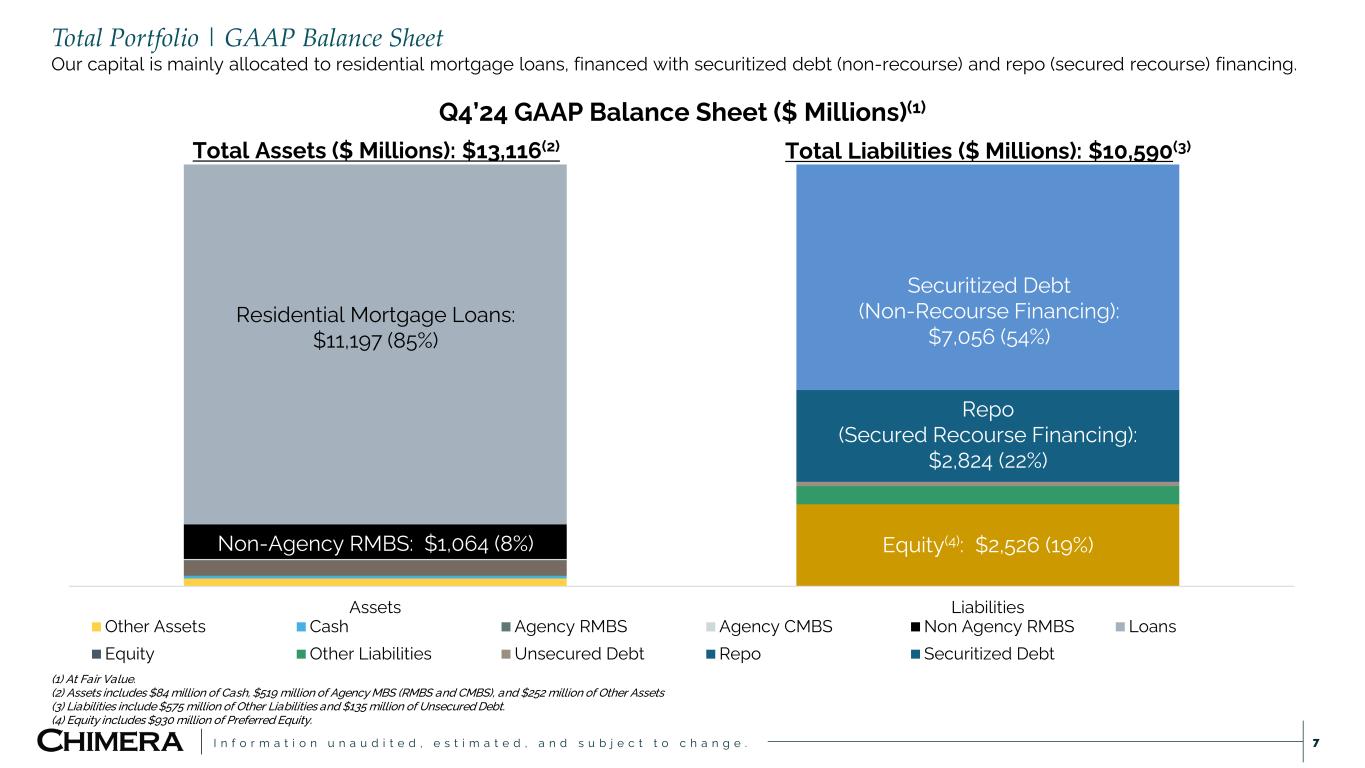
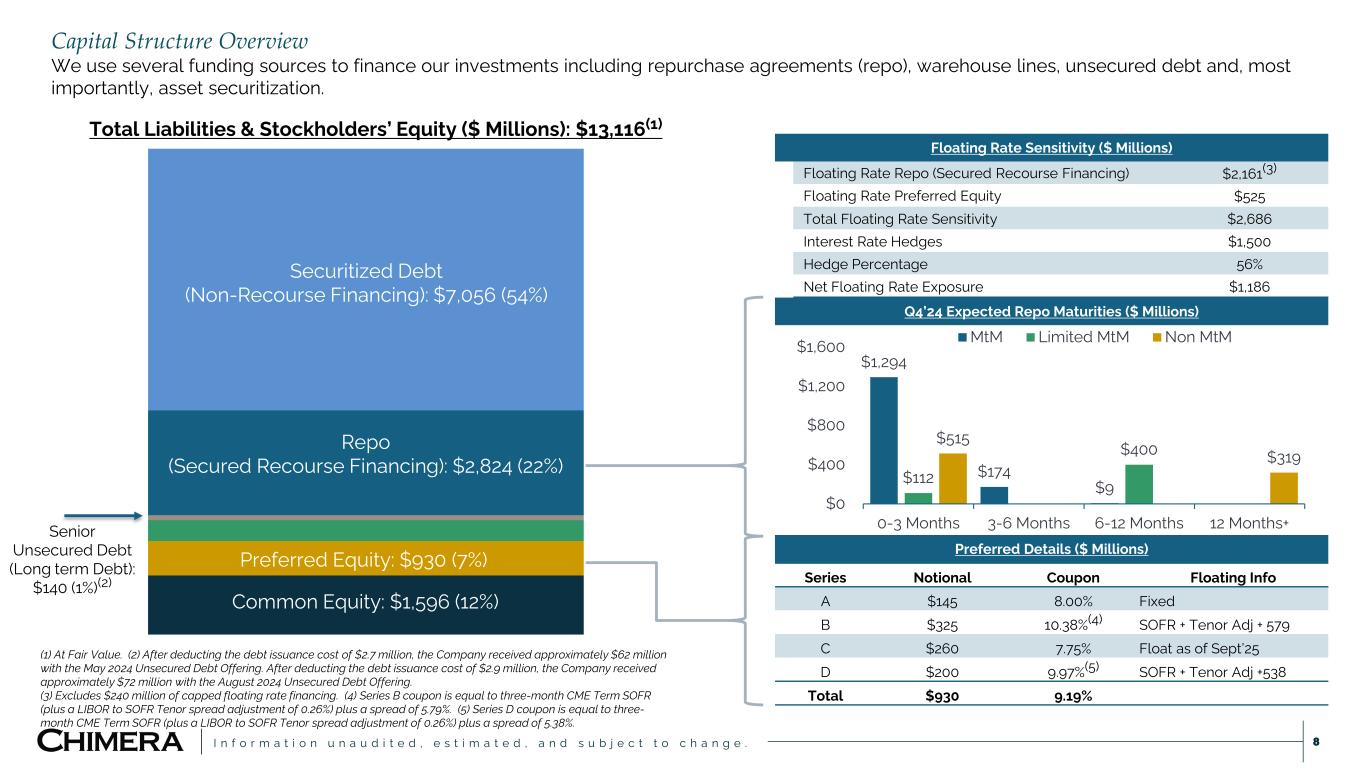
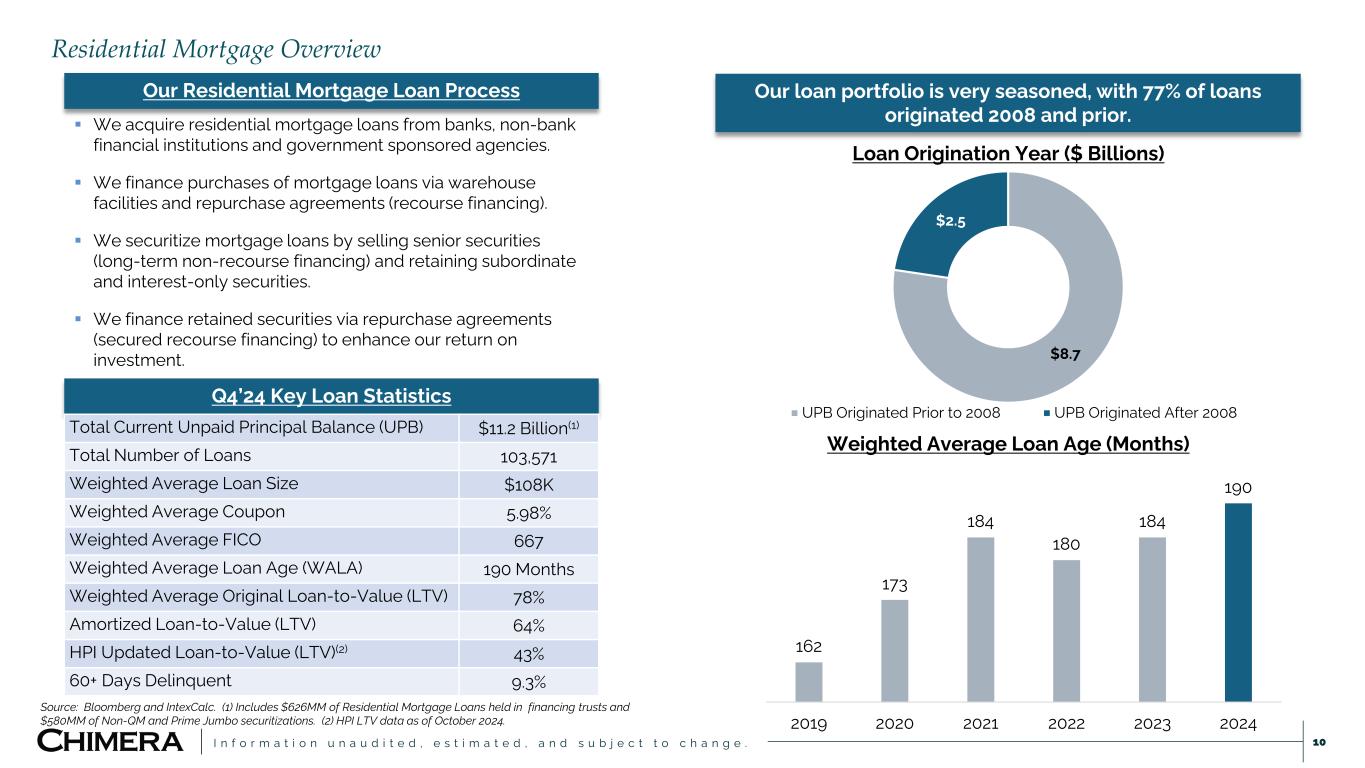
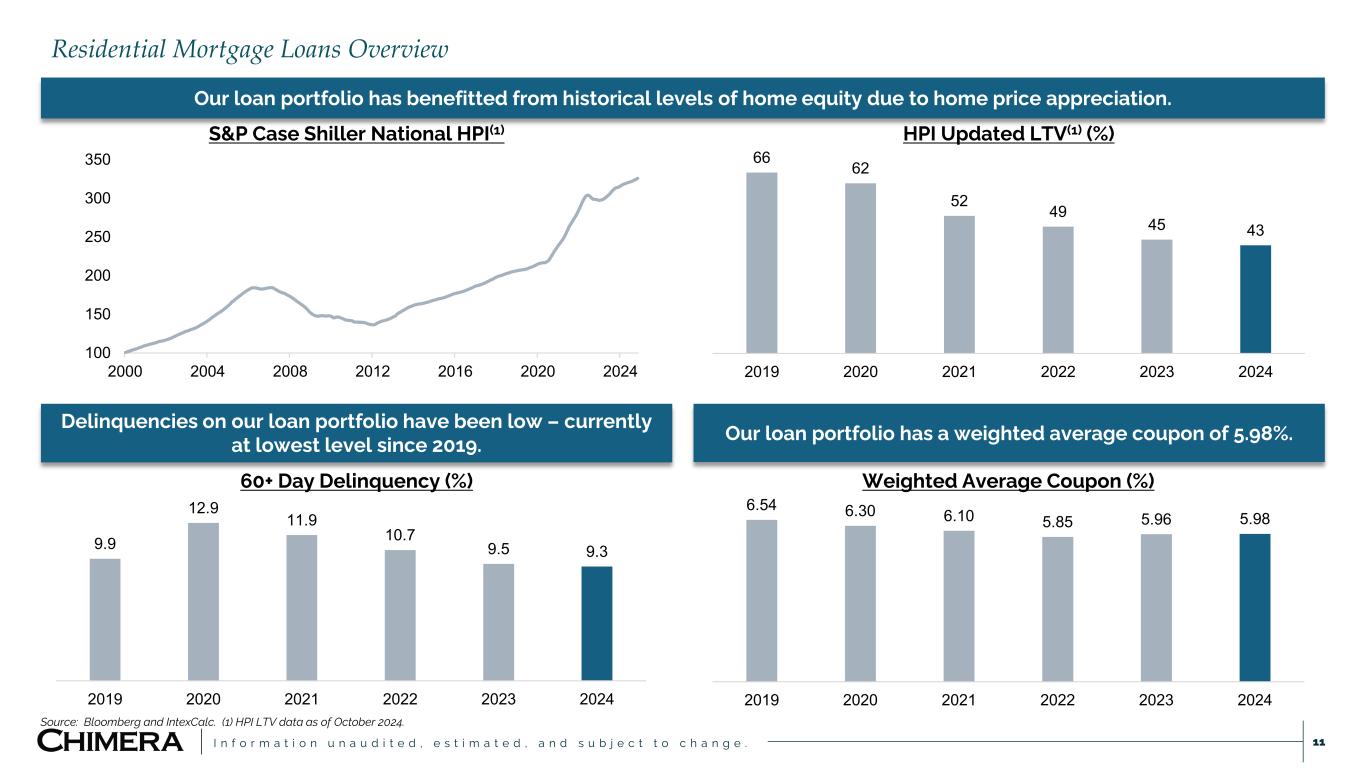
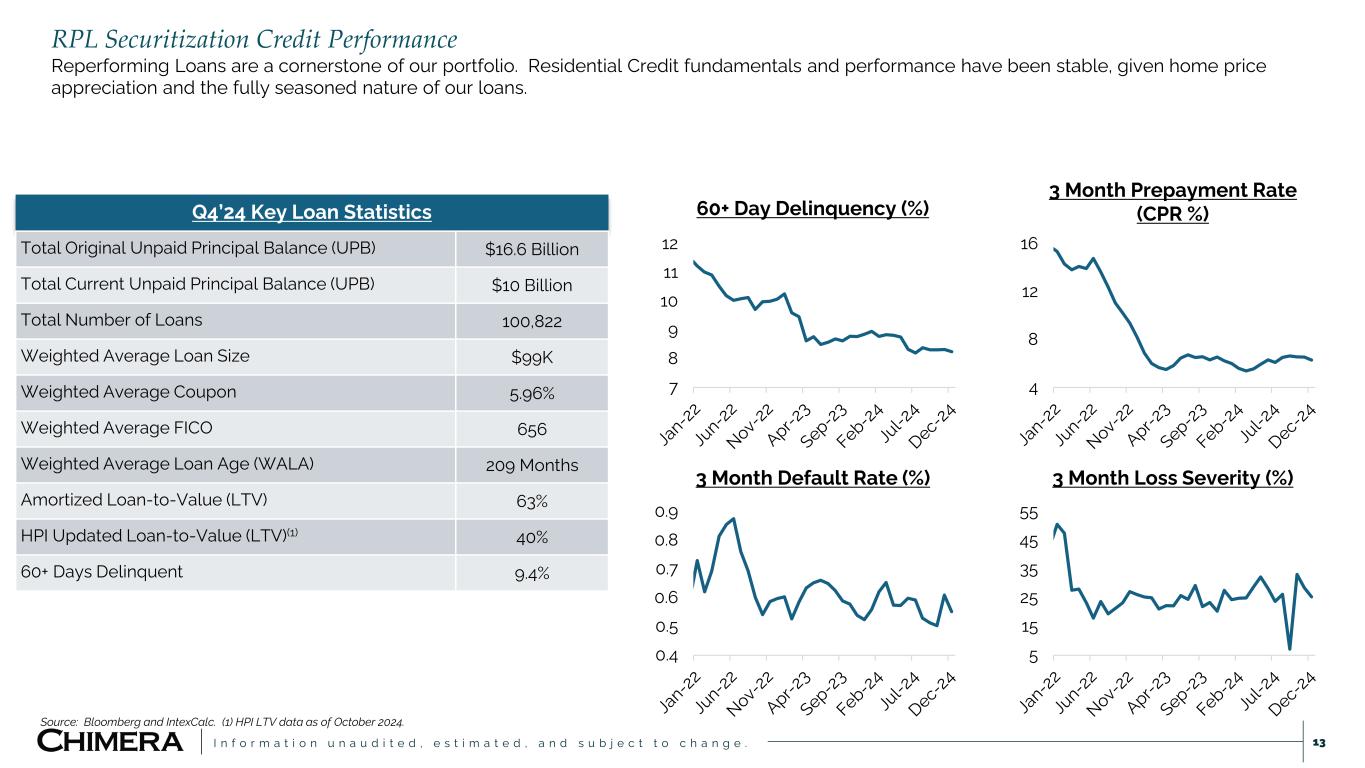
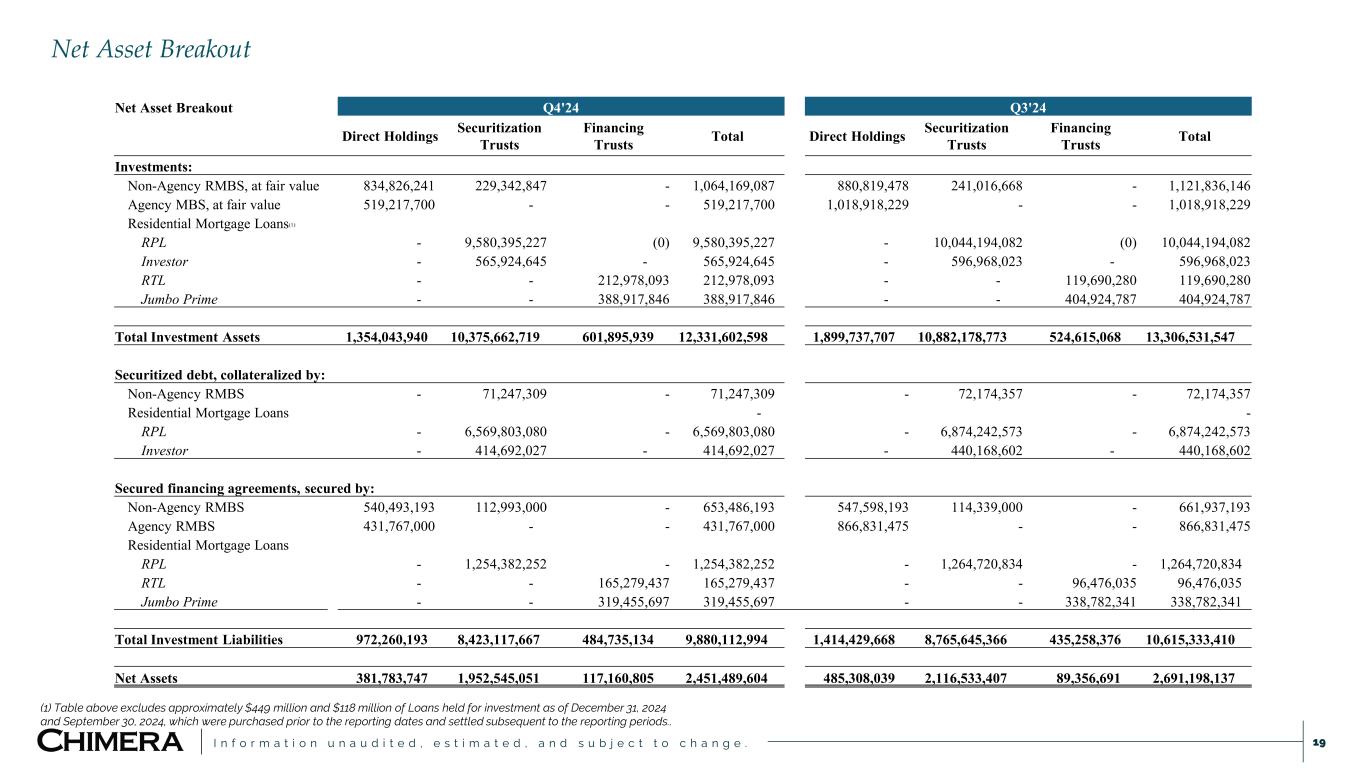
Thanks, Subra, and good morning, everyone. I'm excited to be here. Before diving into the portfolio, I'd like to start with a brief introduction and share a little bit about my background. My entire career, going back to the late 1990s, has been dedicated to mortgage credit and structured products. I began on the sell-side, focusing on mortgage and asset-backed securitization, where I worked on both deal execution and security structuring. I then spent nearly eight years on the buy side, both before and after the financial crisis, acquiring, structuring, and leading teams responsible for managing residential credit risks. A little over 12 years ago, I co-founded Palisades with a core objective of providing clients with access to diversified opportunities across the mortgage credit spectrum through a variety of asset and investment management activities. Core to that objective was building a team of highly motivated individuals and fostering a challenging and rewarding work culture. We're incredibly proud of what we built and we're even more excited to now be part of the Chimera team. It has now been just over two months since the acquisition in early December. I'm happy to report that the integration is progressing well and collaboration between the teams has been strong. I want to extend a special thanks to the entire team of Chimera professionals as they have worked tirelessly and patiently over the last eight weeks to integrate the teams into a single cohesive unit and I'm deeply grateful for their efforts. Moving on to the portfolio, as Phil mentioned, the fourth quarter was marked by a significant rise in interest rates and was also the first full quarter since early 2022 where we had a positively sloping yield curve. The spread between the 10-year and two-year Treasury widened by 19 basis points compared to the third quarter. At the same time, agency MBS spreads moved slightly wider while non-agency credit spreads tightened. While this rate environment provided compelling investment opportunities, it also negatively impacted our GAAP book value on a mark-to-market basis. It's important to note that the change in book value was a direct result of the changes in interest rates and credit spreads and not the result of any unexpected credit deterioration. In fact, credit performance remains strong across our various loan products and we expect to further enhance our asset-level credit risk management capabilities with the Palisades acquisition. Recall, our loan portfolio is primarily financed using non-recourse term securitization. This allows us to isolate credit risk while locking in our net interest margin and supporting our dividend paying ability. While non-recourse securitization financing provides structural leverage advantages compared to recourse debt, it can also introduce book value volatility during periods of sharp rate movements. And since we anticipate this question will come up in Q&A, through the end of business yesterday, we estimate our GAAP book value has increased approximately 3% due to rate and spread movements since year-end. During the quarter, we purchased $129 million of short-duration residential transition loans and were net sellers of $452 million in agency CMOs. And we ended the year with a $12.3 billion investment portfolio consisting of $10.7 billion of residential loans, $1.1 billion of non-agency RMBS, and $519 million of agency MBS. Our residential loan book includes $9.6 billion of seasoned legacy re-performing loans, $566 million of loans collateralized by investment properties, $389 million of prime jumbo, and $213 million of residential transition loans. Our seasoned re-performing loan portfolio, which makes up the vast majority of our GAAP assets, were on average originated over 17 years ago and have de-levered considerably as a result of years of principal amortization and rising home values. The portfolio's average loan balance is approximately $99,000 with an estimated loan-to-value ratio of 40%. Credit performance remains stable with serious delinquencies effectively flat quarter-over-quarter at 9.1% and down from 9.9% in the same period last year. The average interest rate on the portfolio sits right at 6% or just about 100 basis points below today's 30-year fixed mortgage rate of 6.9%. Given elevated mortgage rates, prepayments have remained range-bound for the last two years, and that continued in Q4 with speeds holding in the 6% to 7% range. While our portfolio has limited exposure to the recent Southern California wildfires, our thoughts are with all the affected families and individuals in those communities, including many of our close friends and colleagues. As for our exposure, while preliminary and subject to change, using property-level longitude and latitude coordinates, we have 36 properties located within a 5,000 square foot buffer zone of the wildfire boundaries. Four of these properties have confirmed damage. We have two confirmed cases of affected borrowers requesting assistance as a result of having to relocate due to smoke damage. Our asset management team continues to actively monitor developments and remain in close coordination with our mortgage loan servicing partners to ensure impacted borrowers receive support, communication is fluid, and our exposure is properly mitigated. While some areas affected remain inaccessible or closed to the public, we currently do not expect any material economic impact on our portfolio from these events. I'll speak briefly about portfolio financing. We ended the year with $7.1 billion of non-recourse securitized financing collateralized by our residential loan portfolio. Additionally, we had $2.8 billion of secured recourse liabilities collateralized by a combination of loans, some of our retained interest in securitizations, as well as our non-agency and agency MBS portfolios. Of our $2.8 billion of secured repo, $2.2 billion, or 77%, was floating rate, and importantly, nearly half or $1.3 billion was non-mark to market or limited mark to market. Our average repo funding cost declined by 22 basis points during the quarter due in part to Federal Reserve policy easing. During the year, our recourse financing increased by $392 million with over 90% of the increase attributable to the growth in the agency CMO portfolio. Subsequent to year end, in January, we closed our first securitization of 2025, effectively financing $287 million of investor loans. These loans carry a 7.9% average interest rate, an average credit score of 748, and an average loan-to-value ratio of 64%. We ended up selling $276 million of senior securities, representing 96% of the capital structure at a 5.8% cost of funds with strong demand from institutional investors across the capital structure. And we retained $12 million in subordinate and interest-only securities. With respect to our interest rate hedges, we maintain hedges primarily for the purpose of reducing risk related to our floating rate liabilities in order to maintain our EAD and dividend paying ability. We ended the year with $1.5 billion of active interest rate swaps with a weighted average pay-fixed rate of 3.56%, effectively locking in a fixed rate on approximately 69% of our floating rate liabilities or 56% including our floating rate preferred equity. In addition, in January, we further optimized our liability hedges by exercising a $500 million swaption with a fixed pay rate of 3.45%, shorting $50 million of swap futures, and purchasing a $1 billion two-year interest rate cap at a 3.95% strike. Moving on to the topic of portfolio construction, we enjoy a stable portfolio of seasoned, well-equitized, and consistently paying re-performing loans. However, to echo Phil's opening remarks, we are committed to and excited about the opportunity to use that foundation to further develop a resilient and diversified investment portfolio. Capital for this diversification effort can be sourced organically from our cash and unencumbered assets, portfolio paydowns, and also from equity capital that is embedded in our de-levered securitizations where we retain the right to call or redeem the senior securities. As we elect to exercise these call rights, we can either sell the loans or refinance them into a new securitization. In each case, this has the effect of unlocking capital that will give us the ability to redeploy into complementary investments. Credit fundamentals and housing finance are strong and optimism is priced into many asset classes. We are focused on making purposeful allocations in areas that we believe will enhance our portfolio construction, diversification, risk profile, and supplement our overall risk-adjusted return. Currently, the areas of focus that we believe have the potential to enhance the long-term durability of our portfolio include possible allocations to agency MBS, mortgage servicing rights, and perhaps continue to increase our allocation to short-duration, high-yielding residential transition loans. The agency allocation is intended to provide balance to the portfolio with a more liquid asset base relative to the less liquid subordinate securities we retain from our securitization programs. That liquid portion of the portfolio will allow us to pivot quickly into credit opportunities and we can dynamically ratchet up the agency allocation to capture relative value opportunities when they emerge, or take a more defensive posture during periods of market stress. Similarly, we see MSRs as an important component of our near-term investment strategy. Not only do we view the asset class as one that can produce an attractive risk-adjusted return but can also serve as a natural hedge to our loan portfolio and help offset book value volatility associated with movements in interest rates. Our investment team has a reach in infrastructure to source and manage products across the residential spectrum and we seek to continue deploying these resources in the quarters to come. Turning to resources, one of the most compelling aspects of our combined platform is the strength of our scaled infrastructure, advanced data management capabilities, and proprietary technologies. These tools are designed to empower our asset and investment management teams and optimize key workflows. By enhancing asset-level outcomes from the pre-acquisition due diligence phase through post-closing default management and loss mitigation, we work closely with our servicing partners to drive efficiency and performance across the portfolio. In just the first eight weeks since the acquisition, we have already taken the first step in this initiative by having Palisades Advisory Services named as the asset manager on our first securitization of 2025 and we plan on continuing to roll out this capability across the broader portfolio. Finally, I would like to reiterate Phil's comments about the Palisades acquisition. Our third-party asset and investment management capability presents a significant opportunity to grow our fee-based revenue by providing clients with diversified access to residential credit products and portfolios. This includes non-discretionary customized solutions, discretionary separate accounts, and private asset-backed credit funds. Palisades had experienced steady growth in recent years. However, by uniting these capabilities under the scaled Chimera platform, we expect to unlock substantial resources and enhance our ability to serve a broader range of institutional clients, including insurance companies, asset managers, endowments, foundations, and other institutional investors and allocators. We see these partnerships as highly complementary to our investment sourcing efforts for the REIT portfolio. The diverse capital base from our advisory clients and credit funds not only enhances our market reach, but also positions our team as a solutions provider in periods of market stress. In closing, the combination of the Palisades and Chimera teams strengthens our position as a leader in mortgage credit. Our combined team is passionate and takes great pride in our activities within this dynamic and central industry, and our team remains committed to executing our strategy with discipline and focus as we move into 2025. That concludes our remarks. We will now open the call up for questions.
Operator
Today's first question is from Bose George of KBW. Please proceed.
Speaker 5
Hey, everyone. Good morning. Can you talk about incremental ROEs and what you see as the normalized ROE, just given the current rate environment, which looks like it's going to be higher for longer?
Speaker 4
Yeah. Hey, Bose. This is Jack. Just with respect to normalized ROE, if you're referring to sort of what the opportunities we are looking at in the market today and where we're seeking to allocate capital, I mean, our target return at least on invested assets is going to be in that mid-teens area. And I think in the areas that we're focused on, notwithstanding the agency MBS, which has a purpose within our portfolio, but not necessarily seeking to be the driver of returns, with respect to MSRs and certainly what we're investing in on the RTL side of the portfolio, those are all hitting those types of return targets. With that being said, as we think about the entire portfolio, we're in a position of receiving paydowns, re-levering our deals, and when we do that, that will have the intended effect of allowing us to reinvest into higher yielding assets than what it's currently producing.
Speaker 5
And so on a net basis for the portfolio to kind of roll forward to a, say, a double-digit net ROE, is there a way to think about the timeline for that to happen?
Speaker 4
Yeah, I mean, it's a good question, and we talk about that a lot. And it really is a function of market conditions. When we think about areas where we have availability of capital, that's going to come from the things that we mentioned in our prepared remarks, organically at least, with respect to re-levering some of our securitizations where we have the call rights. And so we're constantly looking at those deals to understand what the economic impact of calling those deals are and redeploying that into new investments. So, it's really hard to predict sort of what the timeline is to reposition the portfolio, but that's definitely something that is top of mind for the balance of 2025.
Speaker 5
Okay, great. Actually, and then just switching over to book value, can you just talk about sort of the book value roll forward this quarter, just the drivers of the change?
Speaker 4
Yes, this is Jack. The change in book value was quite complex. It was largely influenced by the steepening yield curve in December, which typically affects both our loans and securitized debt in a correlated manner. When the longer end of the curve rose in December compared to the short end, and with tightening credit spreads, this had a significant impact on the value of our loans more so than on our securitized debt. An interesting point to consider is that when examining the fourth quarter, there was a $6 million difference in value for the year, where the loan value increased by that amount compared to securitized debt. We see this as somewhat unusual, but it primarily reflects the fluctuations in the values of our loans relative to securitized debt on our balance sheet and investment portfolio.
Speaker 5
Okay. Great. Thank you.
Operator
Thank you. The next question is coming from Doug Harter of UBS. Please go ahead.
Speaker 6
Thanks. You talked a little bit about the potential to add MSR. Can you just talk about the thoughts around potentially adding other hedges that might look to dampen book value volatility or your comfort with kind of accepting that volatility currently?
Speaker 4
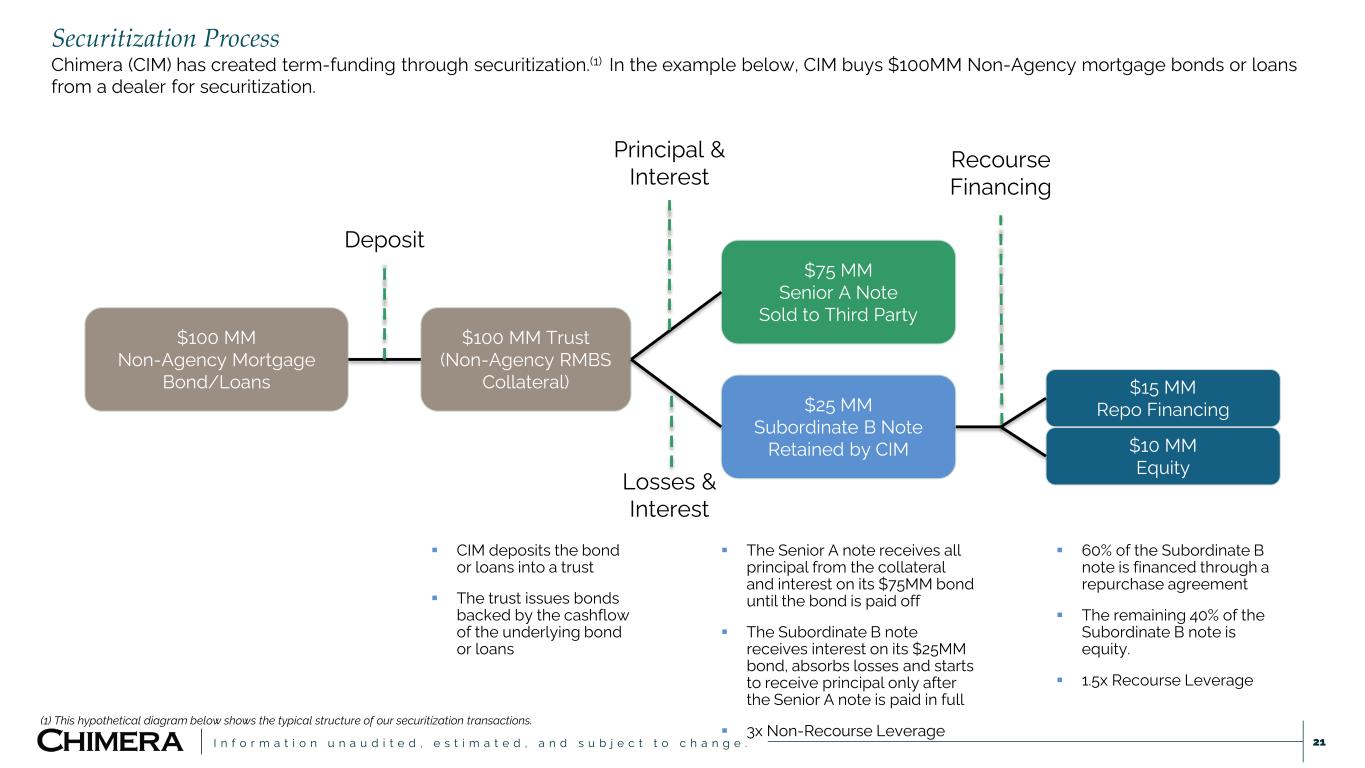
Yeah, good question. So, if you think about our strategy, our strategy is really focused on buying residential loans and securitizing them in non-recourse term financing structures. Those term financing structures allow us to effectively lock in our net interest margin and our dividend paying ability, as long as the loans are in those financing structures. So, that allows us to isolate credit risk and focus on the things that we believe are our core competency. So, our hedging strategy up to this point has been focused on the floating rate liabilities, the repo that we have on where we finance some of our non-agency securities or some of the retained portions of our securitizations. So if you look at all of our hedges, they really have been focused on further locking in our earnings and dividends paying ability. So, I think just as we sit here today, as a buy and hold investor, we have taken a position that we're accepting the risk of the book value volatility. However, as it relates to hedging with derivatives, now the MSR strategy, as you pointed out, that is a portfolio construction element that we see as being very important to add to our portfolio in an effort to stabilize book value, but instead of doing it with a yield diluting or earnings diluting derivative hedge, we're able to do that with a cash flowing, asset yielding allocation to the overall portfolio.
Speaker 6
I guess just on the buy and hold strategy, as you mentioned, you lever the subordinates of the retained pieces. Is there mark to market risk on those retained pieces that need to be hedged or are those all in non-mark-to-market facilities?
Speaker 4
Yeah, that's a great question. So, it's a combination. I think we provide that in some of our materials. The recourse financing that we have on our non-agency and agency as well as our retained pieces do have, I want to say about half of it is mark to market in…
Page 8 of the investor deck.
Speaker 4
Yeah, so I guess the quick answer is some of it is mark to market, some of it is non-mark to market. The big push that we have made over the course of the last year and continue to do so is to continue to put the less liquid retained portions of these securitizations into non-mark to market and even fixed rate facilities.
Speaker 6
Okay, thank you.
Operator
Thank you. The next question is coming from Eric Hagen of BTIG. Please go ahead.
Speaker 7
Hey, thanks. Good morning. Good to hear from you guys. During the quarter, in response to the increase in interest rates, did you receive a margin call and can you share how much cash or liquidity you posted for that margin call?
Hi, this is Phil. So, we received some margin calls, they were really immaterial, that's nothing that significant.
Speaker 7
Okay. Maybe just turning to like conditions in the securitization market, can you maybe share how you guys are thinking about the flow of capital in response to changing expectations for the Fed to cut interest rates?
Speaker 4
Yeah, I mean, you can see credit spreads have been tightening over the course of 2024 as well as coming into 2025. So from our perspective, we take all of that into account as part of the economic analysis that we go through as we're looking to exercise our call rights and seek to pull capital out and redeploy it. So, notwithstanding the CPI news that came out this morning, through yesterday, that was something that we thought was favorable conditions, continues to be good demand throughout the capital structure, especially down at the bottom end of the capital structure, just in the last deal that we did, our first deal of 2025 that we talked about. There was strong demand. I think that was the first time we've sold down to a BB in history.
Speaker 7
Okay. Thanks for the color. I appreciate it, guys.
Operator
Thank you. The next question is coming from Trevor Cranston of Citizens JMP. Please go ahead.
Speaker 8
Hey, thanks. Good morning. You mentioned adding MSR as a new asset class to help personally to help hedge some of the book value volatility. Can you elaborate a little bit on what kind of MSRs you guys are potentially looking at, if it's like current coupon type of product or if it's a little bit more seasoned lower coupon? And maybe also just provide some color on sort of how much approximate capital you'd be looking to deploy into that asset class over the next year or so. Thanks.
Speaker 4
Sure. I'll begin with the allocation perspective. It's difficult to provide a precise answer. We do have an internal model portfolio, but reaching that model depends on various factors, including market conditions and the capital we can generate from re-securitizations and re-levers. However, we are committed to progressing in that direction, and we expect to have more updates in 2025. Regarding MSRs as an asset class, we find value in them for several reasons. We aim to make intentional allocations within our portfolio. It’s not just about reacting to trades at any given moment, but rather contemplating how we want our portfolio to evolve over the next few years. MSRs are essential in this strategy. To maximize the benefits from the negative duration characteristics of an MSR, purchasing at the money coupons will be more effective than out of the money. We also need to assess relative value. Currently, lower coupons, which have less prepayment volatility, can present attractive characteristics because many market participants view the current coupon as having more recapture potential, creating value for numerous originators. We'll evaluate the entire coupon range of MSRs to identify relative value. Ultimately, we consider the duration offset and how it will stabilize our overall portfolio. If we opt for more current coupons, our allocation might be smaller, while a lower coupon portfolio would require more equity capital to meet our goals.
Speaker 8
Got it. Okay, that's helpful. And then can you guys maybe talk a little bit about your thoughts around the likelihood of GSE reform and what kind of opportunities that could present for Chimera if that were to end up happening? Thanks.
That's a complex question. When we discuss this in our investment committee, we start by considering the administration's declared priorities, which seem to include tariffs and trade policy, immigration, border security, and government efficiency. The issue is how much GSE privatization fits into the realm of government efficiency. Recently, the new HUD secretary has commented on GSE privatization, but it's unclear how prioritized this issue will be. From our standpoint, it's evident that policymakers desire to avoid any actions that could harm or disrupt the housing finance market. If we proceed with privatization, it is likely to be a lengthy process, and we will aim to ensure it does not adversely affect housing policy, focusing instead on promoting opportunities for increased home ownership. If we were to speculate on potential opportunities or risks, as we build our agency MBS portfolio, we see that the market today is often influenced by current headlines. These headlines could present us with opportunities to acquire agencies when spreads widen. Furthermore, if there is a shift towards privatization, it might result in a stronger emphasis on core products, which could push some non-core products into the non-agency segment. Beyond that, it's truly difficult to predict.
Speaker 8
Yeah, fair enough. Okay, thank you.
Operator
Thank you. At this time, I'd like to turn the floor back over to Mr. Kardis for closing comments.
I'd like to thank everyone for participating in our fourth quarter 2024 earnings call and I look forward to speaking to you on our 2025 first quarter earnings call. Thank you again.
Operator
Ladies and gentlemen, thank you for your participation. This concludes today's event. You may disconnect your lines and log off the webcast at this time, and enjoy the rest of your day.