Operator
Hello and welcome to the Clarus Mortgage Trust 4th Quarter 2025 Earnings Conference School. My name is Becky and I will be your conference facilitator today. All participants will be in a listen-only mode. After the speaker's remarks, there will be a question and answer period. If you wish to ask a question in this time, please press start followed by one on your telephone keypads. I would now like to hand the call over to Anne Wynne, Vice President of Investor Relations for Claris Mortgage Trust. Please proceed.
I'm joined by Richard Mack, Chief Executive Officer and Chairman of Claris Mortgage Trust, and Mike McGillis, President, Chief Financial Officer and Director of Claris Mortgage Trust. We also have Priyanka Garg, Executive Vice President, who leads Credit Strategies for Mack Real Estate Group. Prior to this call, we distributed CMTG's earnings release and supplement. We encourage you to reference these documents in conjunction with the information presented on today's call. If you have any questions, please contact me. I'd like to remind everyone that today's call may include forward-looking statements within the meaning of the Private Securities Litigation Reform Act of 1995. Actual results may differ materially from those indicated by these forward-looking statements. as a result of various important factors, including those disclosed in our other filings with the SEC. Any important looking statements made on this call represents our views only as of today, and we undertake no obligation to update them. We will also be referring to certain non-GAAP financial measures on today's call, such as distributable earnings, which we believe may be important to investors to assess their operating performance. For reconciliations of non-GAAP measures to the nearest GAAP equivalents, please refer to the earnings supplement. I would now like to turn the call over to Richard.
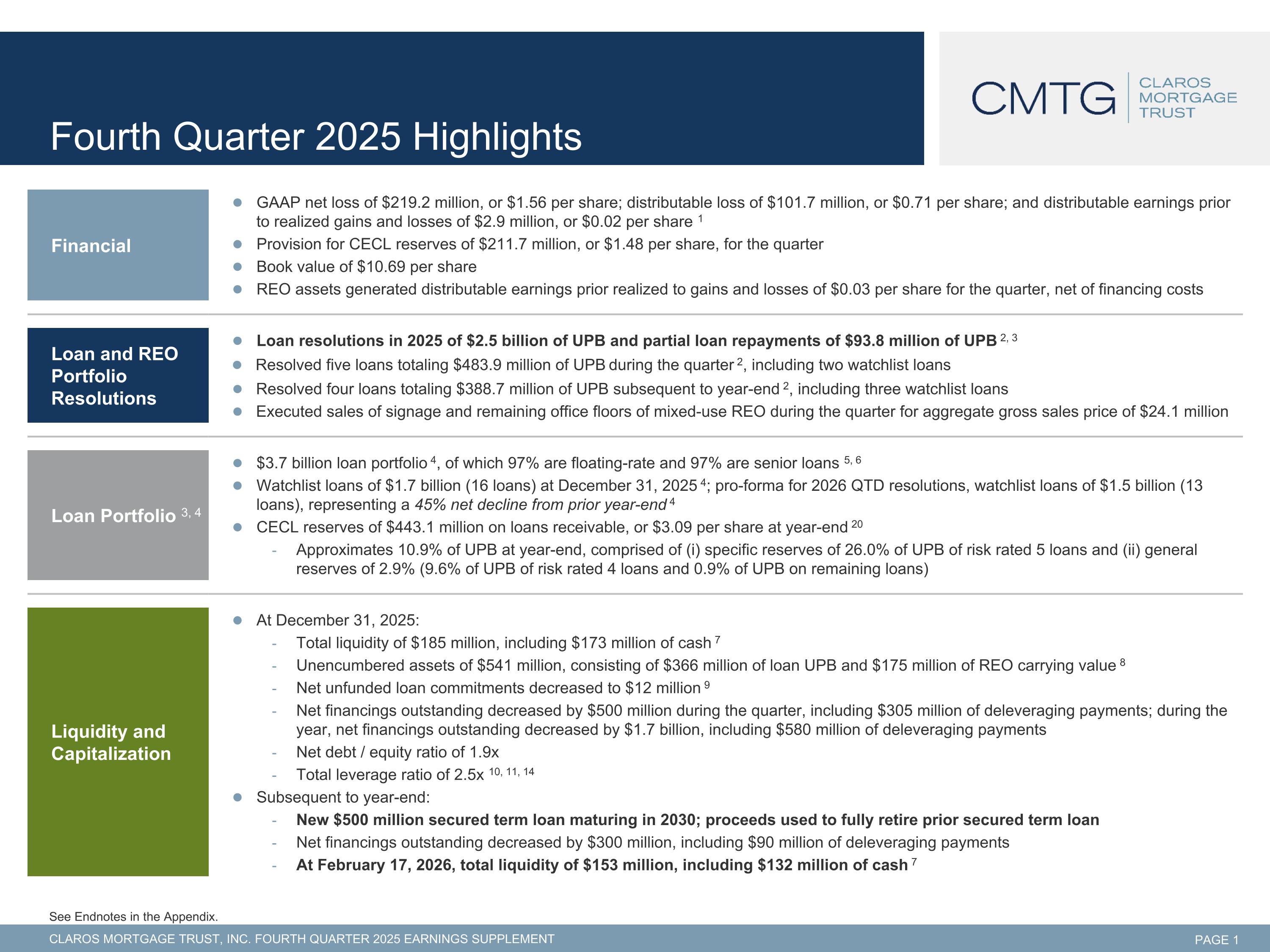
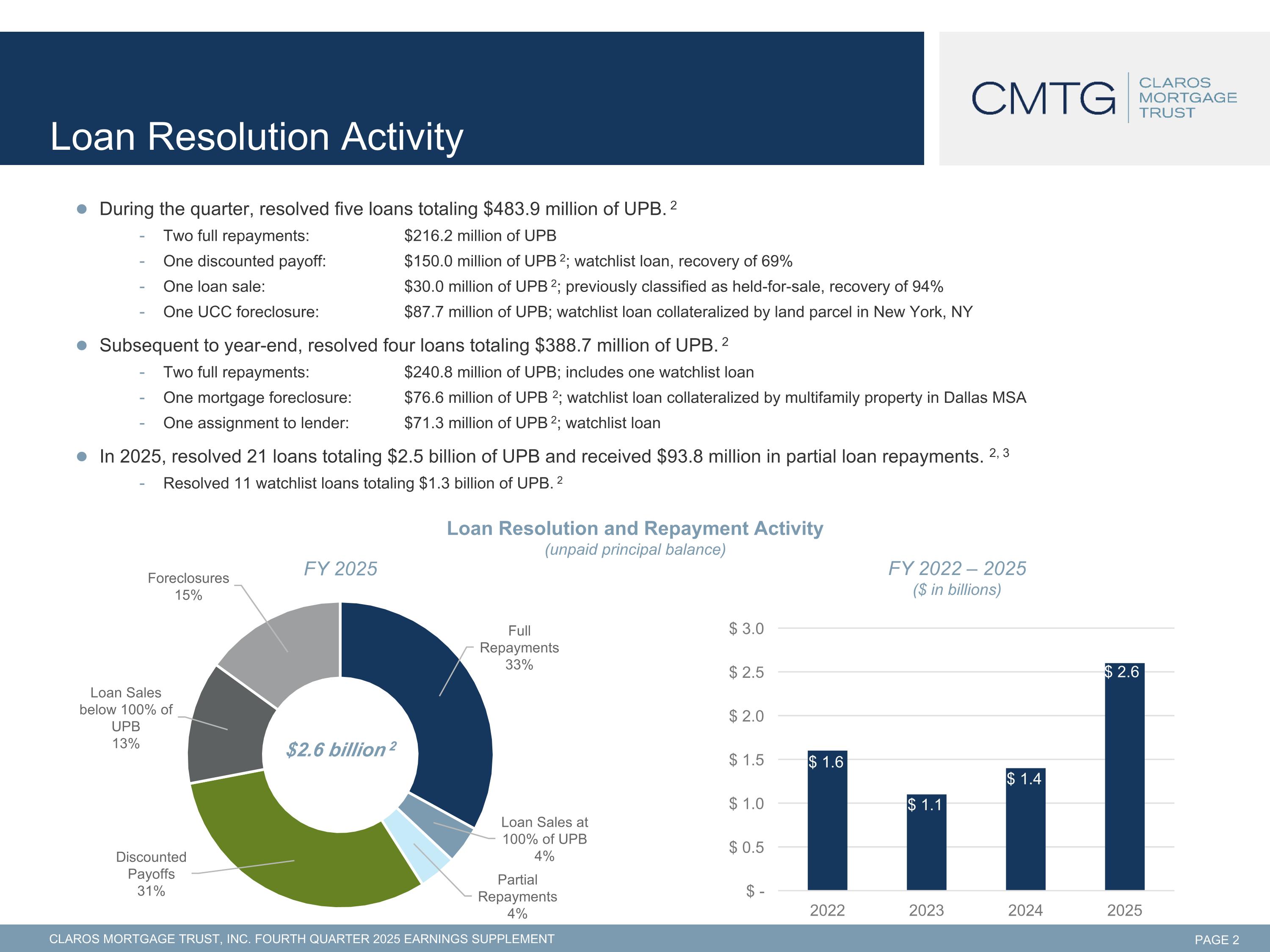
Thank you, Ann, and thank you all for joining us this morning for CMTG's fourth quarter earnings call. CMTG made a meaningful amount of progress last year, executing on several critical path items. In 2025, we accomplished the priorities we established at the start of the year, including resolving watchlist loans, enhancing liquidity, and further deleveraging the portfolio. One year ago, we established a $2 billion total resolution target for 2025, and I'm pleased to report that we meaningfully exceeded this target, closing the year with $2.5 billion of total resolutions. This included the resolution of 11 watchlist loans, representing an aggregate UPB of $1.3 billion. This activity reflects our commitment to repositioning the portfolio by transitioning out-of-watchless loans through thoughtful and decisive action. We also generated significant liquidity over the course of the year, which we used to meaningfully delever the portfolio and to reduce corporate debt. This momentum has carried into the new year, with $389 million of full loan repayments happening, including a New York City land loan that was a watchlist loan that had been on non-accrual since 2021. More importantly, subsequent to year-end, we retired the term loan B that was scheduled to mature in August of 2026. The term loan had a balance of $718 million in the first quarter of 2025 and was replaced with a new $500 million senior secured loan from HPS. This facility has four years of duration. Mike will provide additional color on this financing later in the call. We view this financing agreement with HPS as a positive for CMTG, as it extends the maturity of our corporate debt to 2030 and provides the necessary flexibility to continue executing our business plan of resolving watchlist loans, de-levering our balance sheet, and reducing our capital costs over time. Looking ahead to the coming year, we remain optimistic, but mindful of the macroeconomic backdrop and the uncertainty that has been a defining theme across the broader financial markets. With regard to real estate, we do not believe there will be a single catalyst that will drive an overnight recovery. Rather, we anticipate a period of gradual and steady improvement that will support transaction volume and investor confidence over time, especially if the bond market rally holds and rate cuts continue as expected. As it relates to property market fundamentals, we continue to observe encouraging indicators, including a reduction in new supply, tightening credit spreads, and improving financing costs for new originations. We also see increased demand for industrial space and significant investments in areas such as artificial intelligence and domestic manufacturing. We believe that investments in domestic manufacturing will support job growth and incremental demand for real estate over time. While AI investments are likely to support future productivity gains, the impact on commercial real estate, excluding data centers, is still quite uncertain. Overall, we see a constructive backdrop for commercial real estate and CMTG in the years ahead. But in 2026, our focus will remain on asset management and decisive execution as we continue to resolve watchlist loans and work through our REO assets. Our goal is to position the company to begin to evaluate new lending opportunities towards the end of 2026 and lay the groundwork for portfolio growth in subsequent years. Before turning the call over to Mike, I want to acknowledge that the last 24 months have been the most challenging business period of my career and for many others in the real estate industry. And so I want to thank Mike, Priyanka, and our entire team for their dedication and hard work during this difficult time and their commitment to overcoming the remaining challenges that are still ahead. I look forward to providing an update on our continuing progress in the coming quarters. And now I would like to turn the call over to Mike.
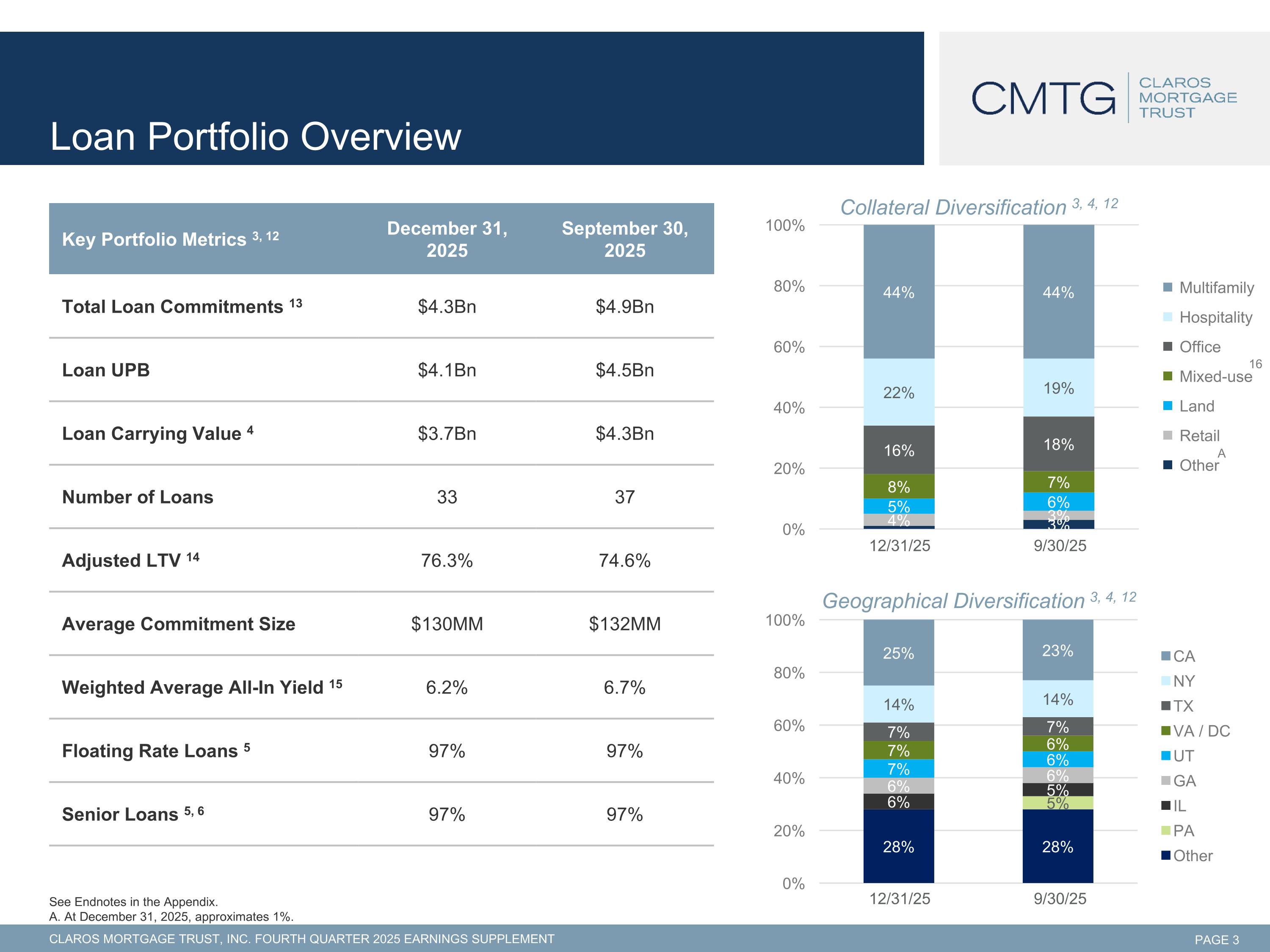
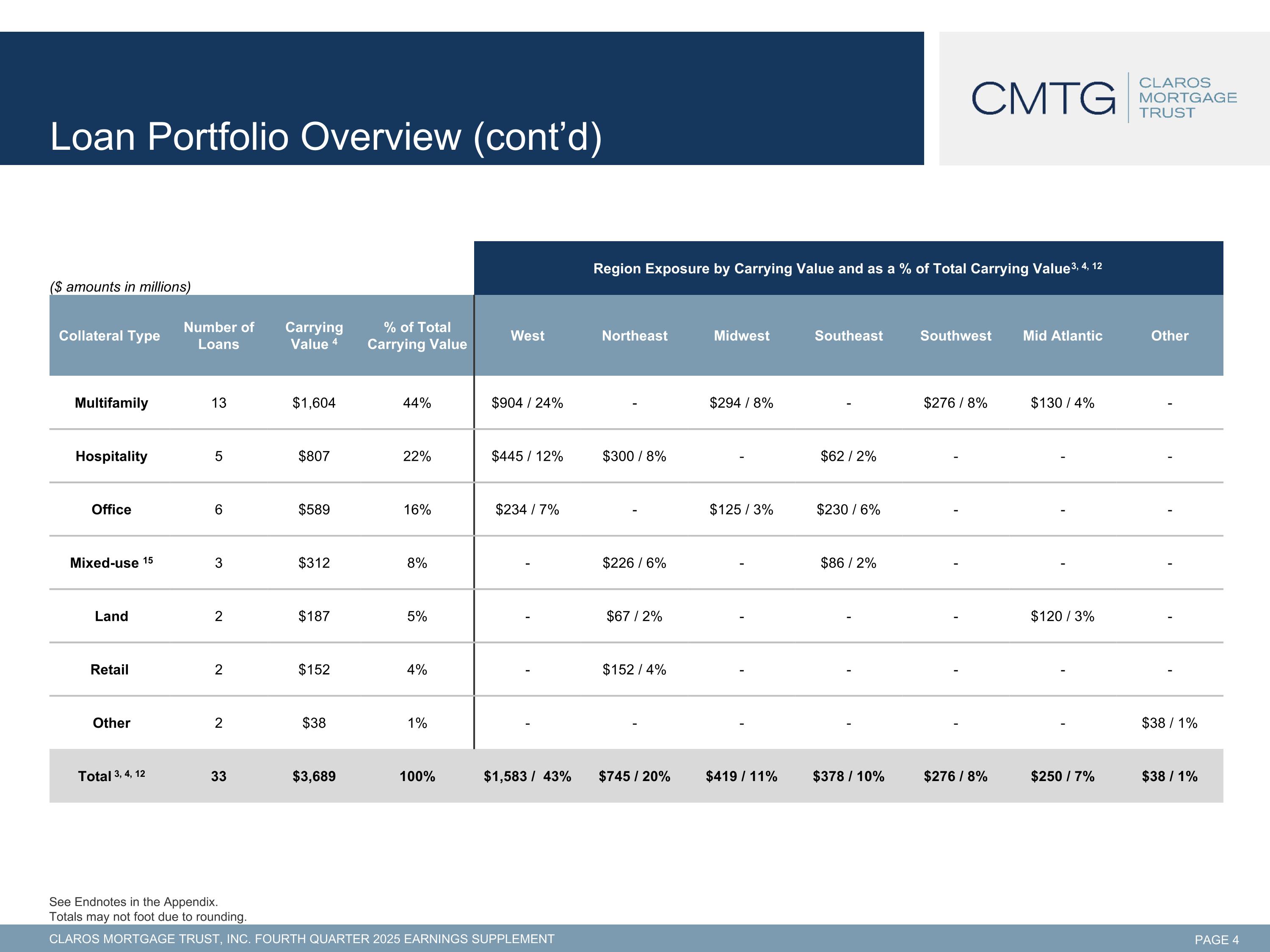
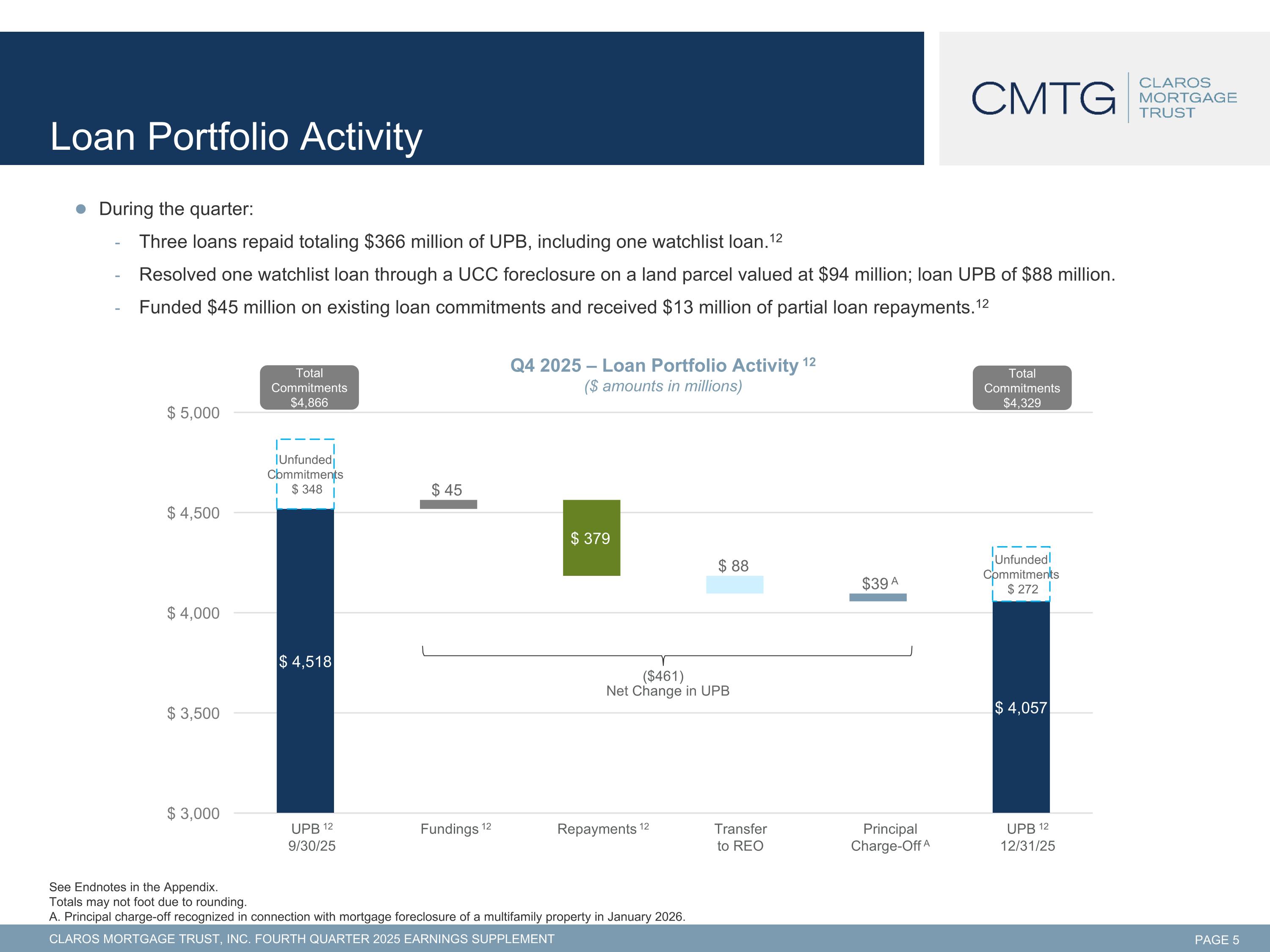
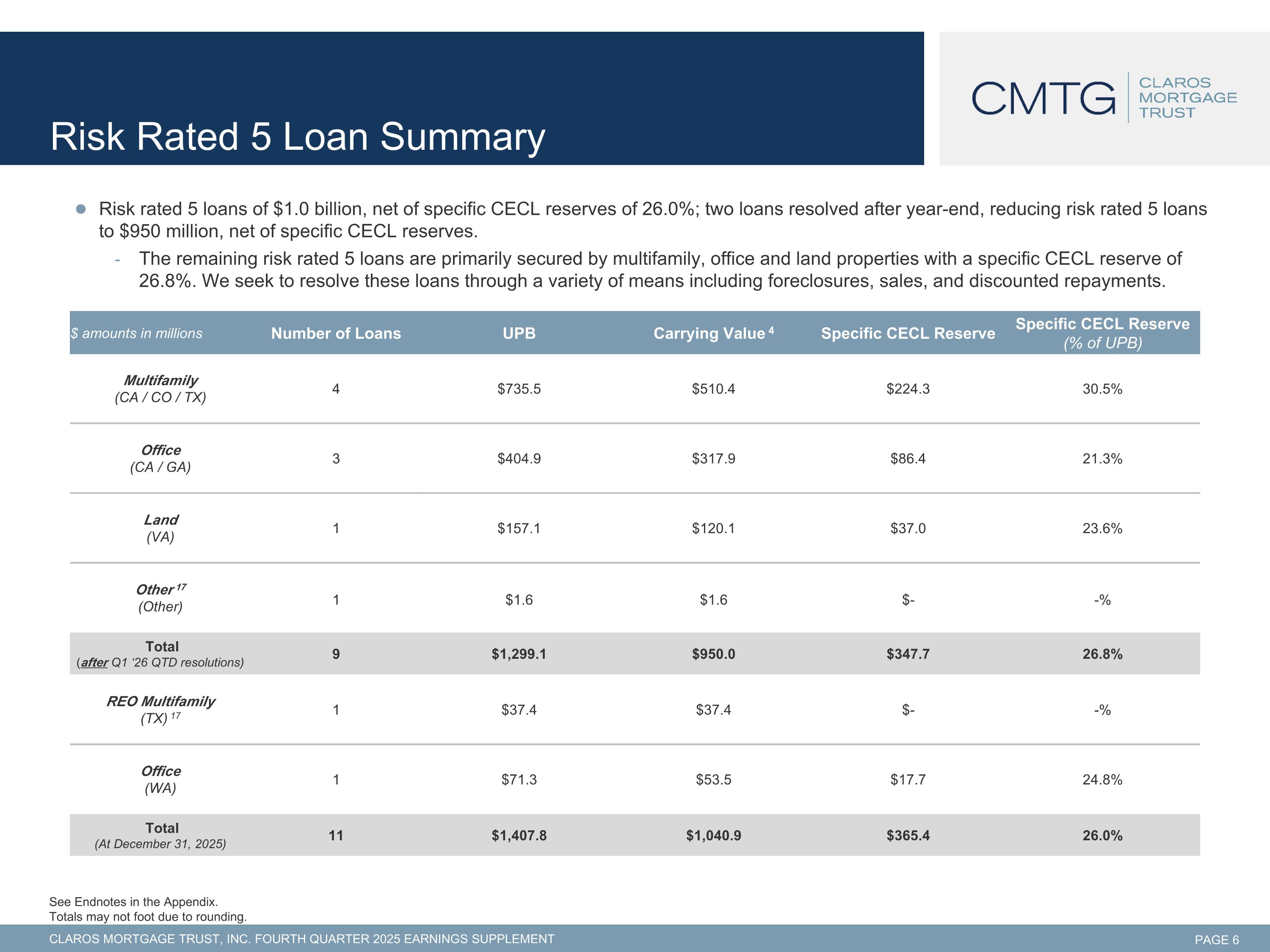
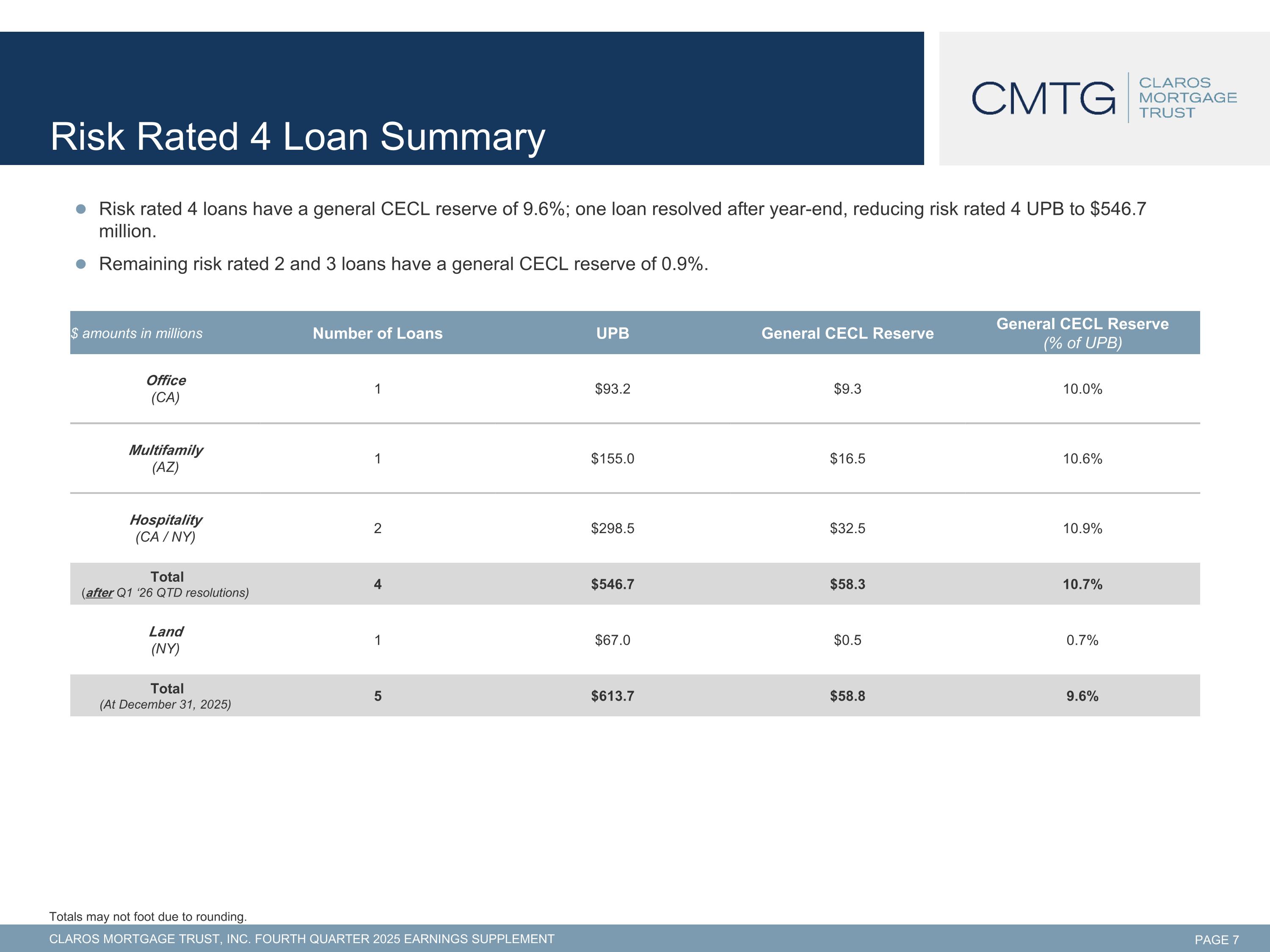
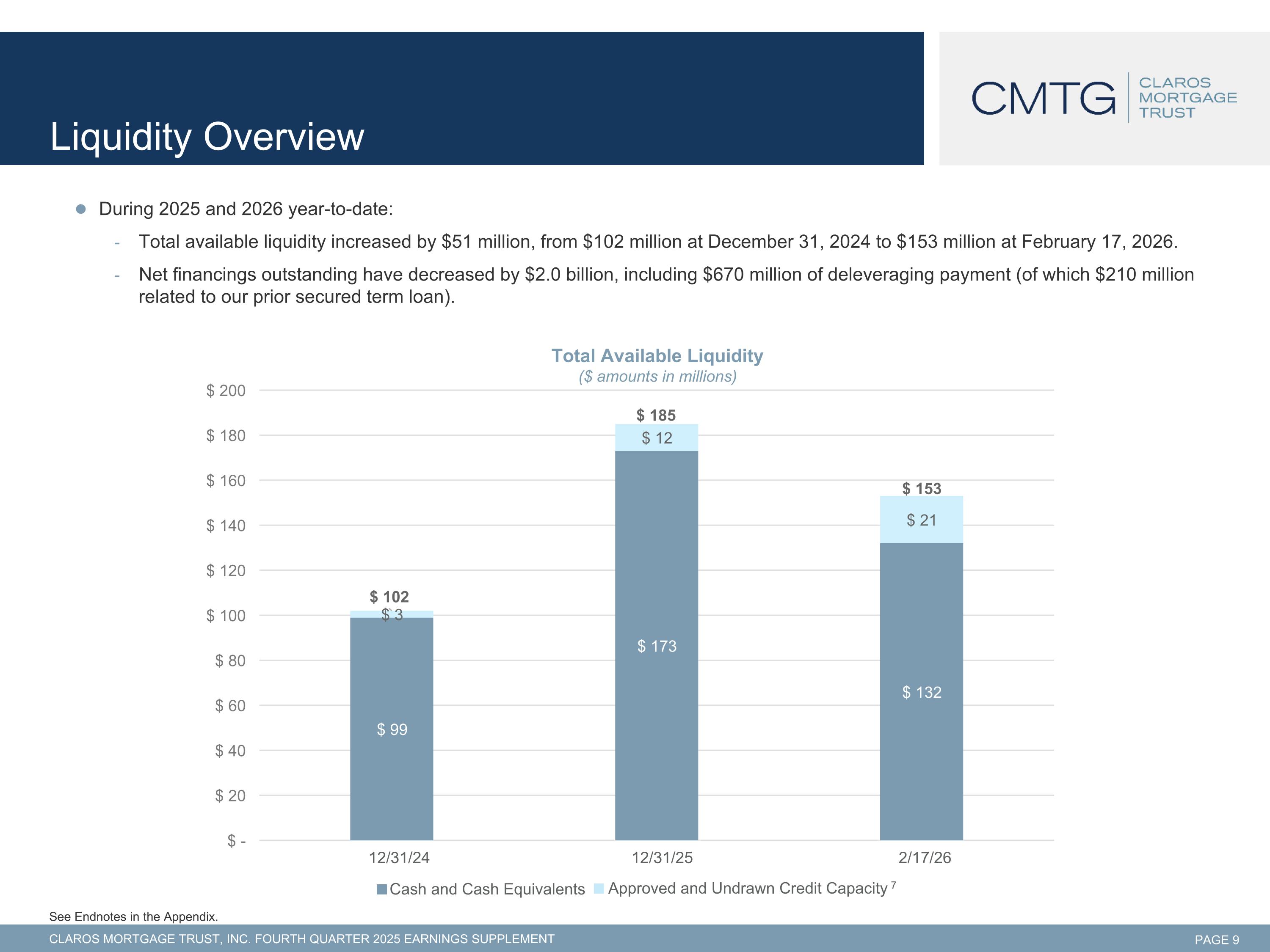
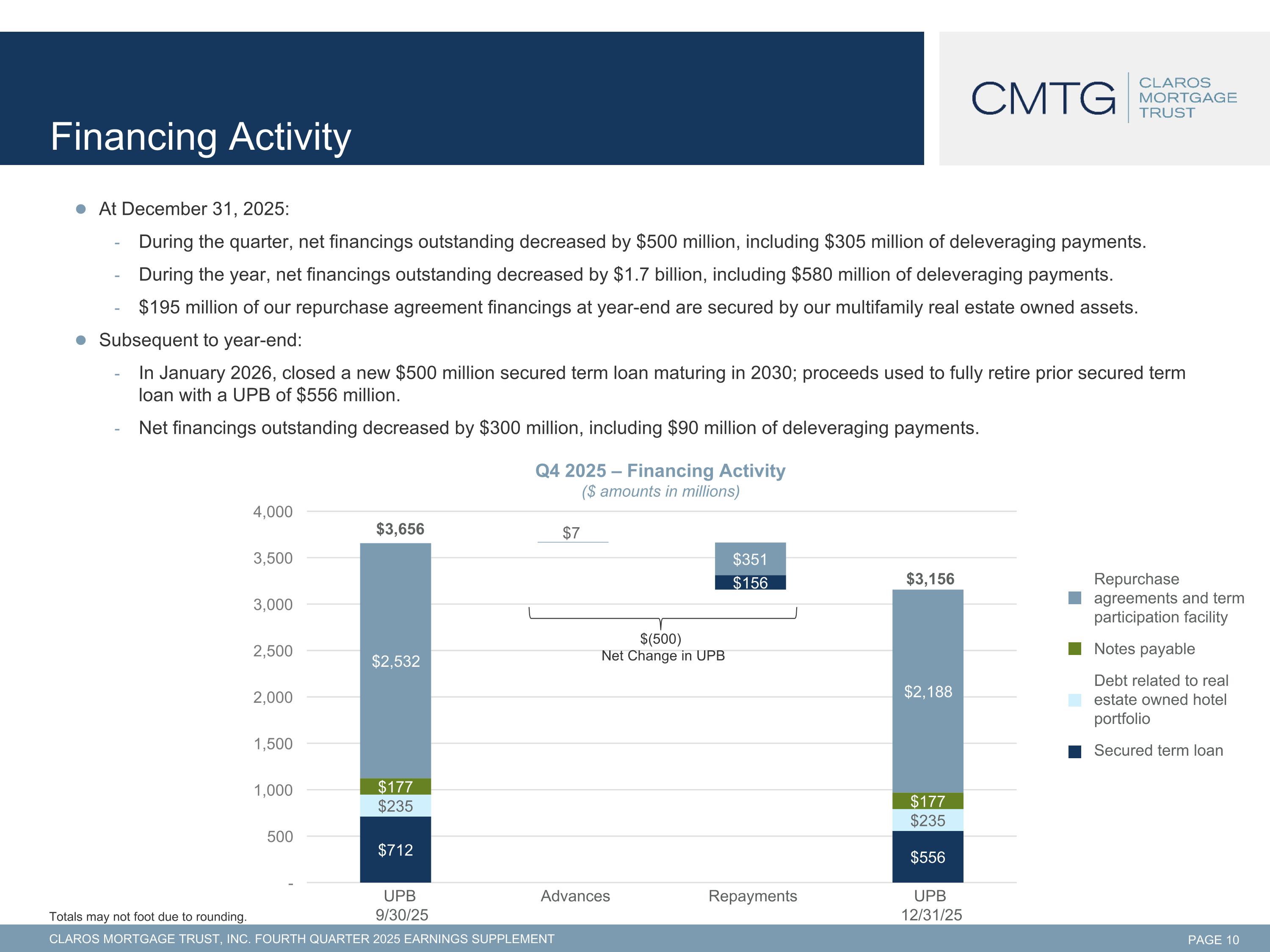
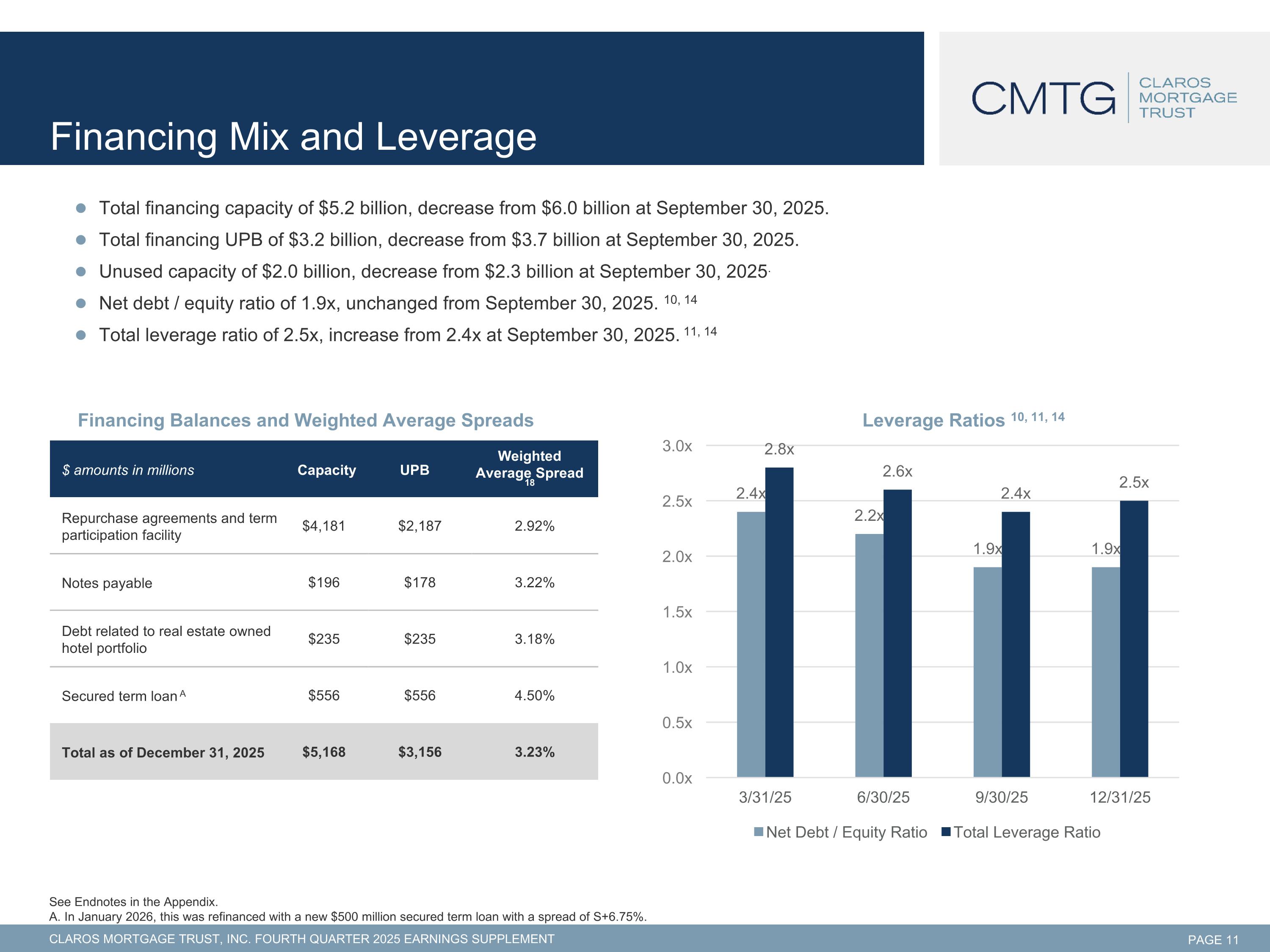
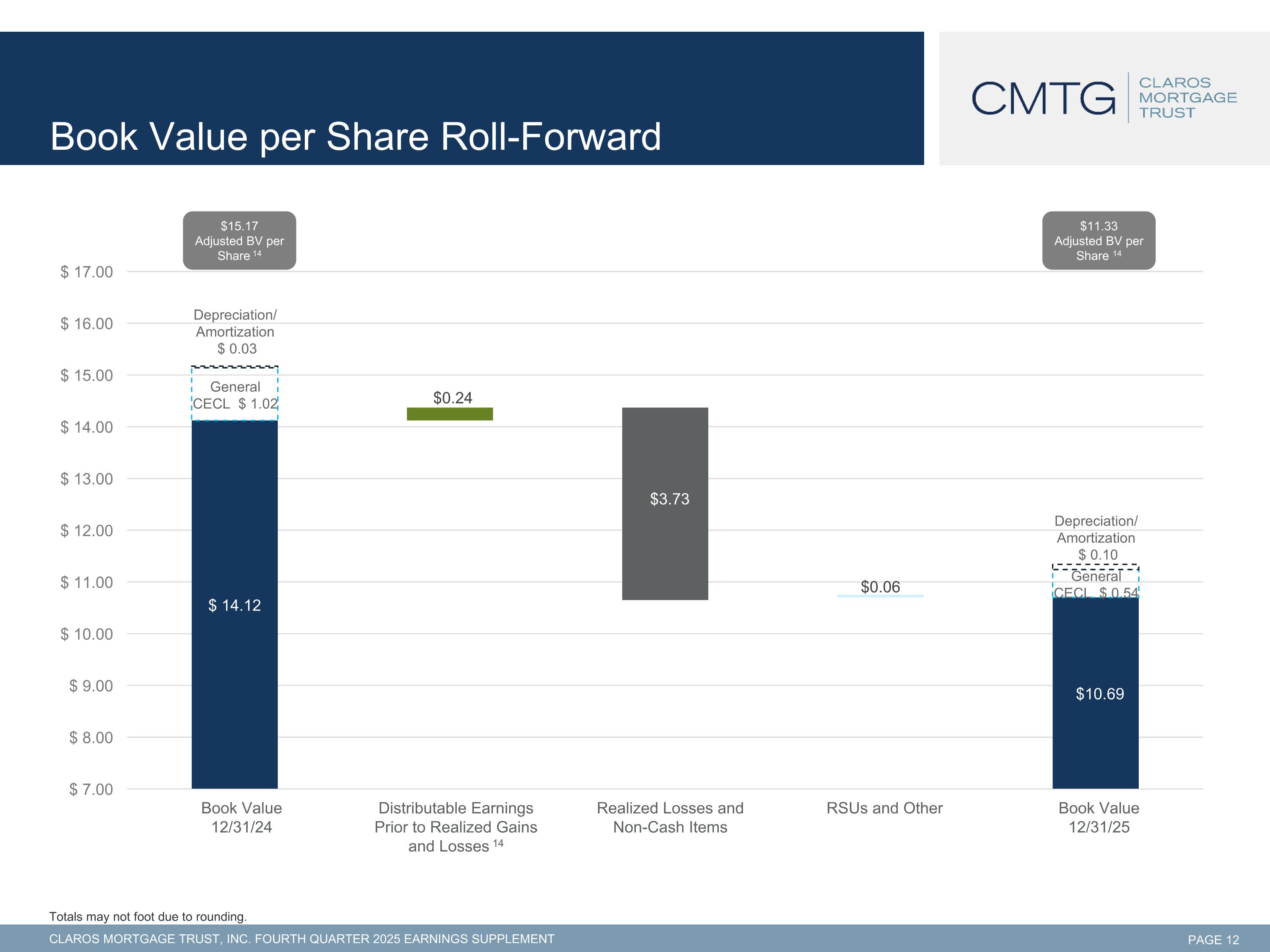
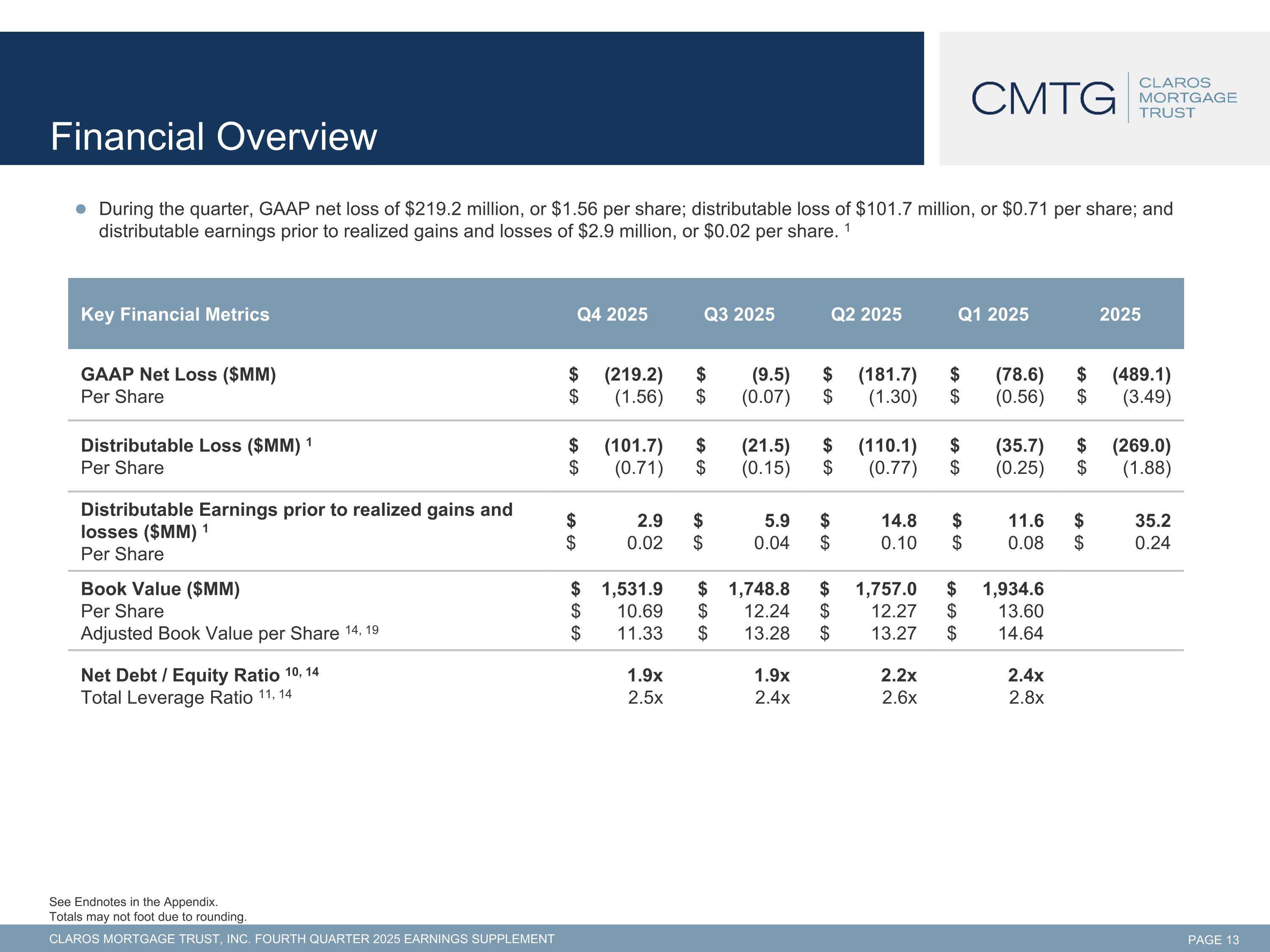
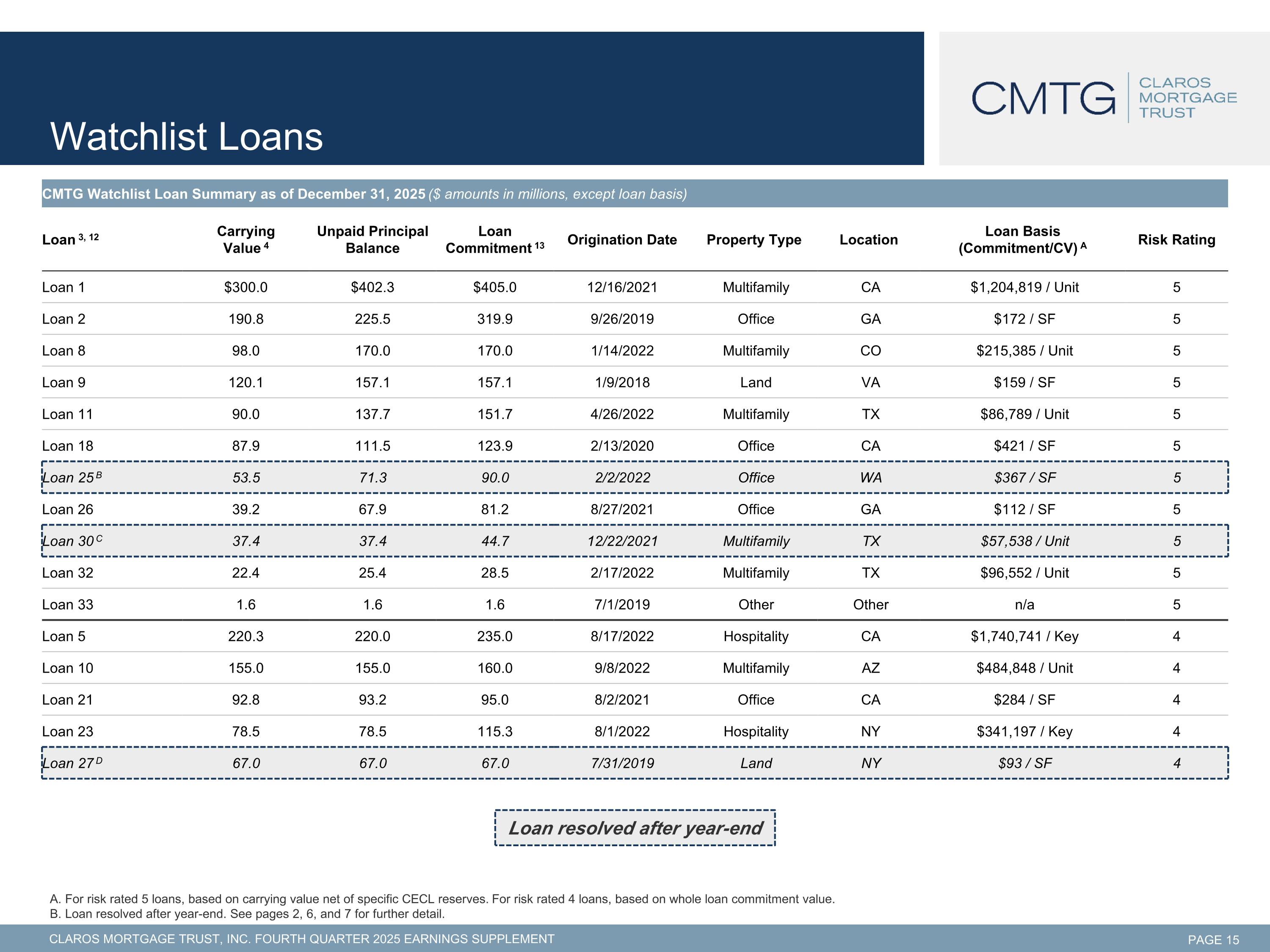
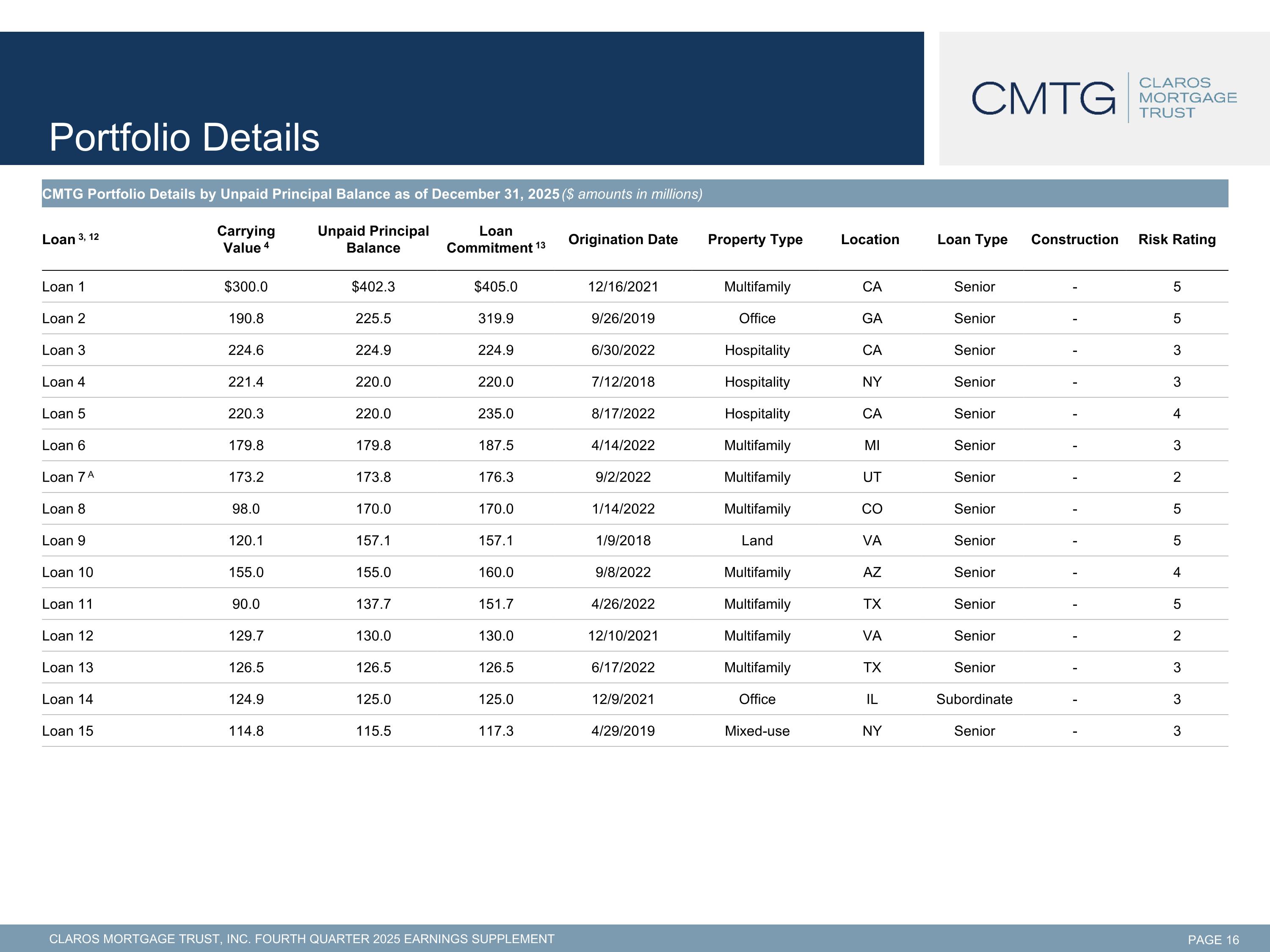
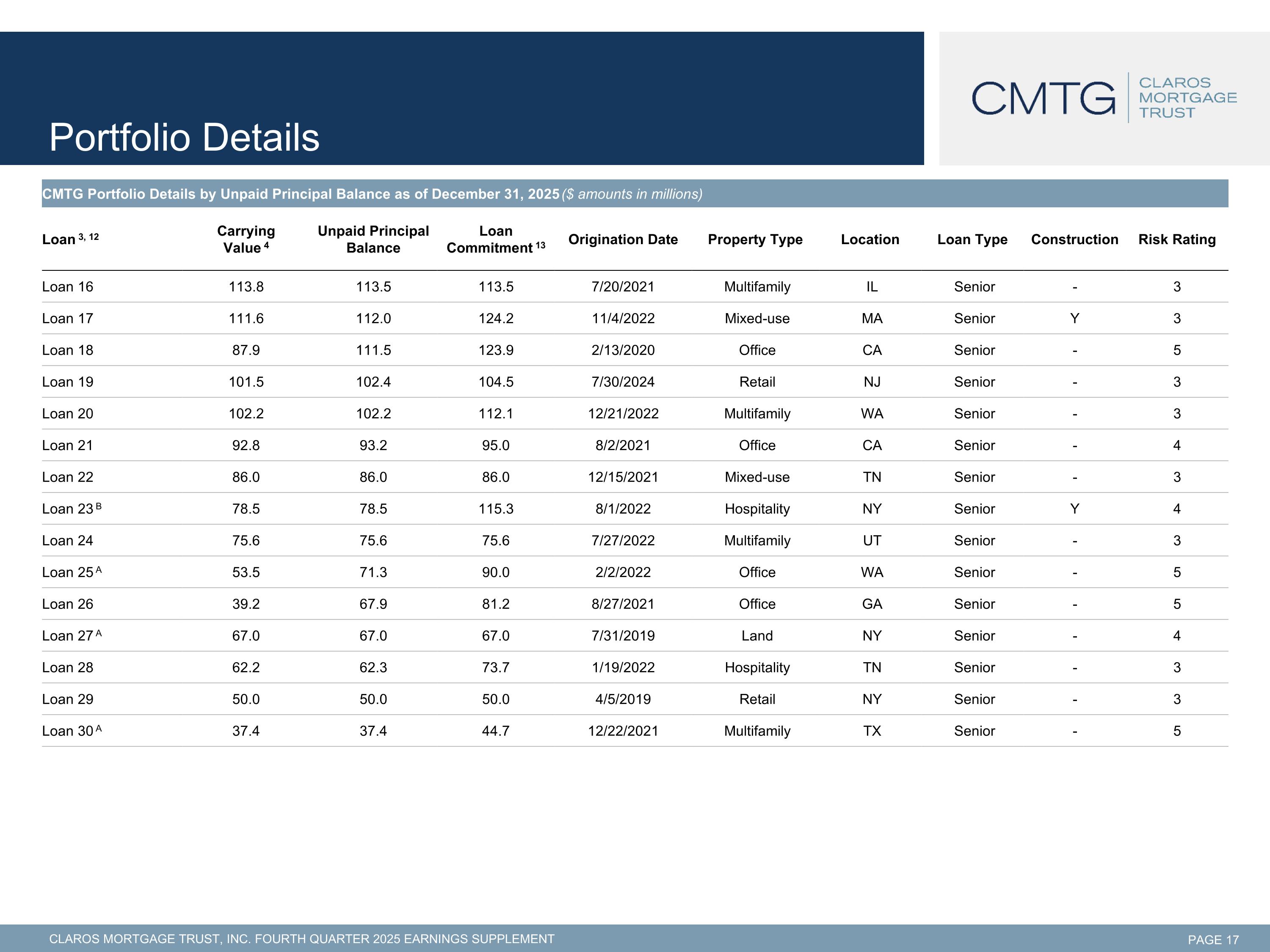
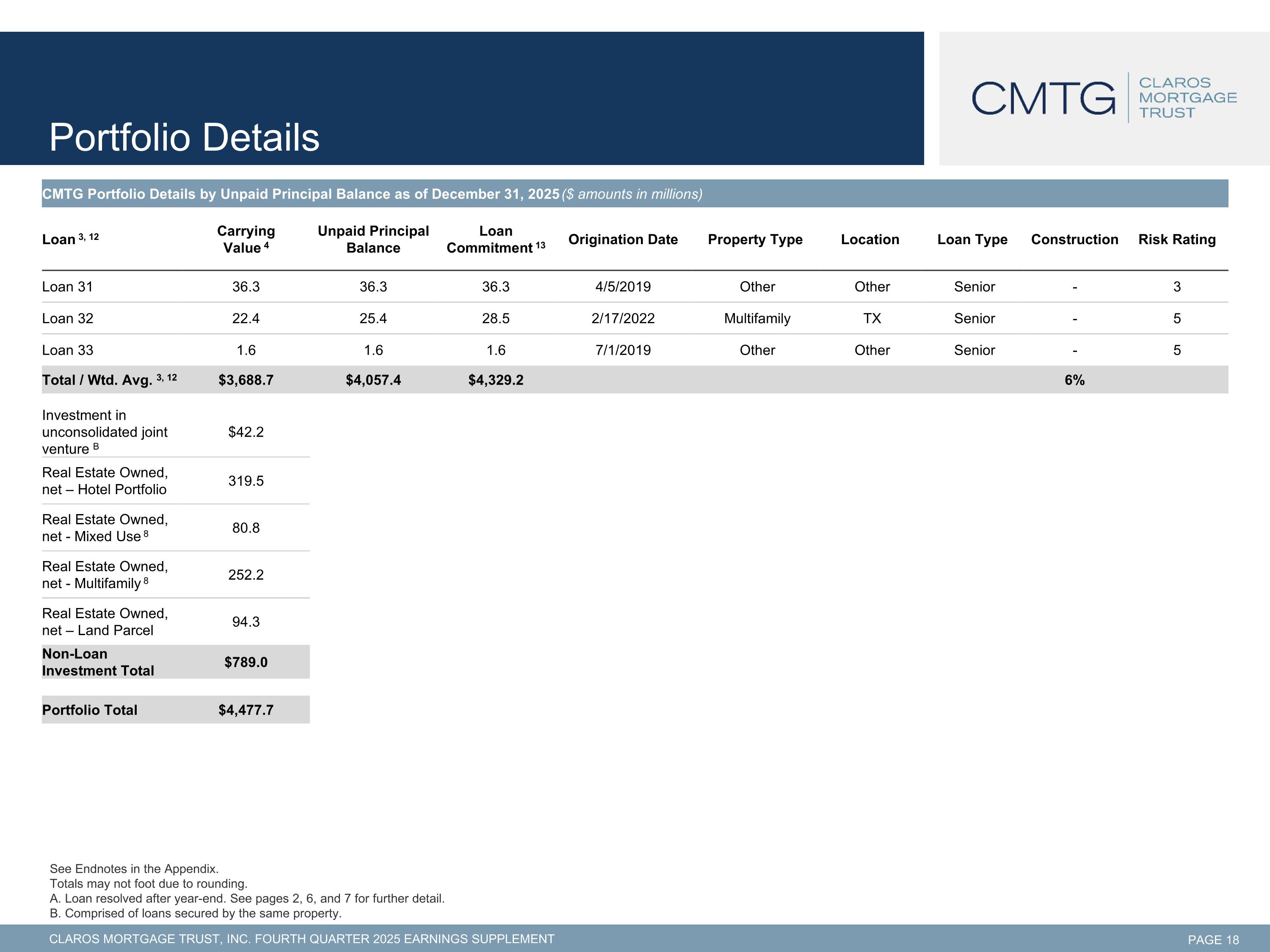
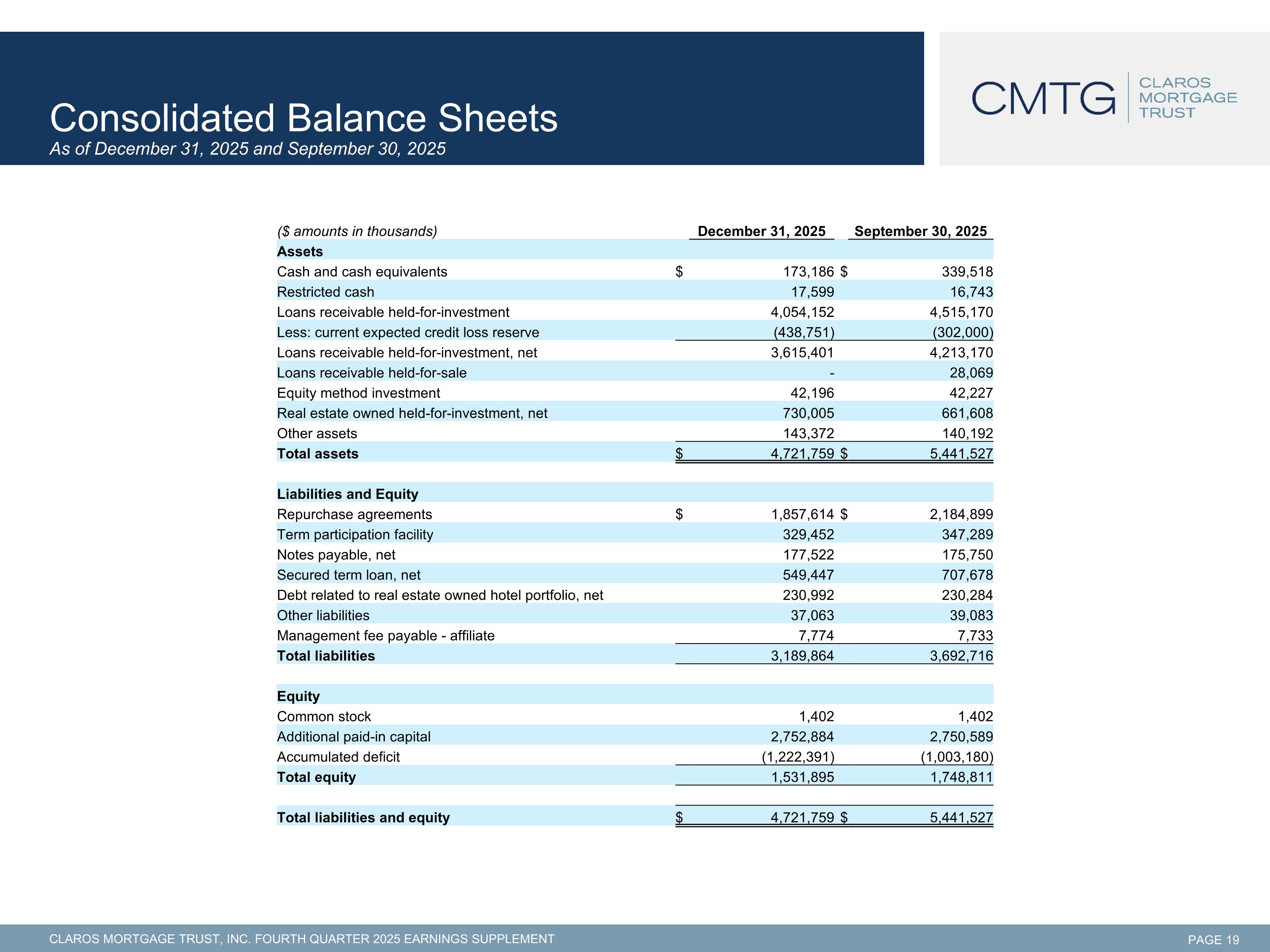
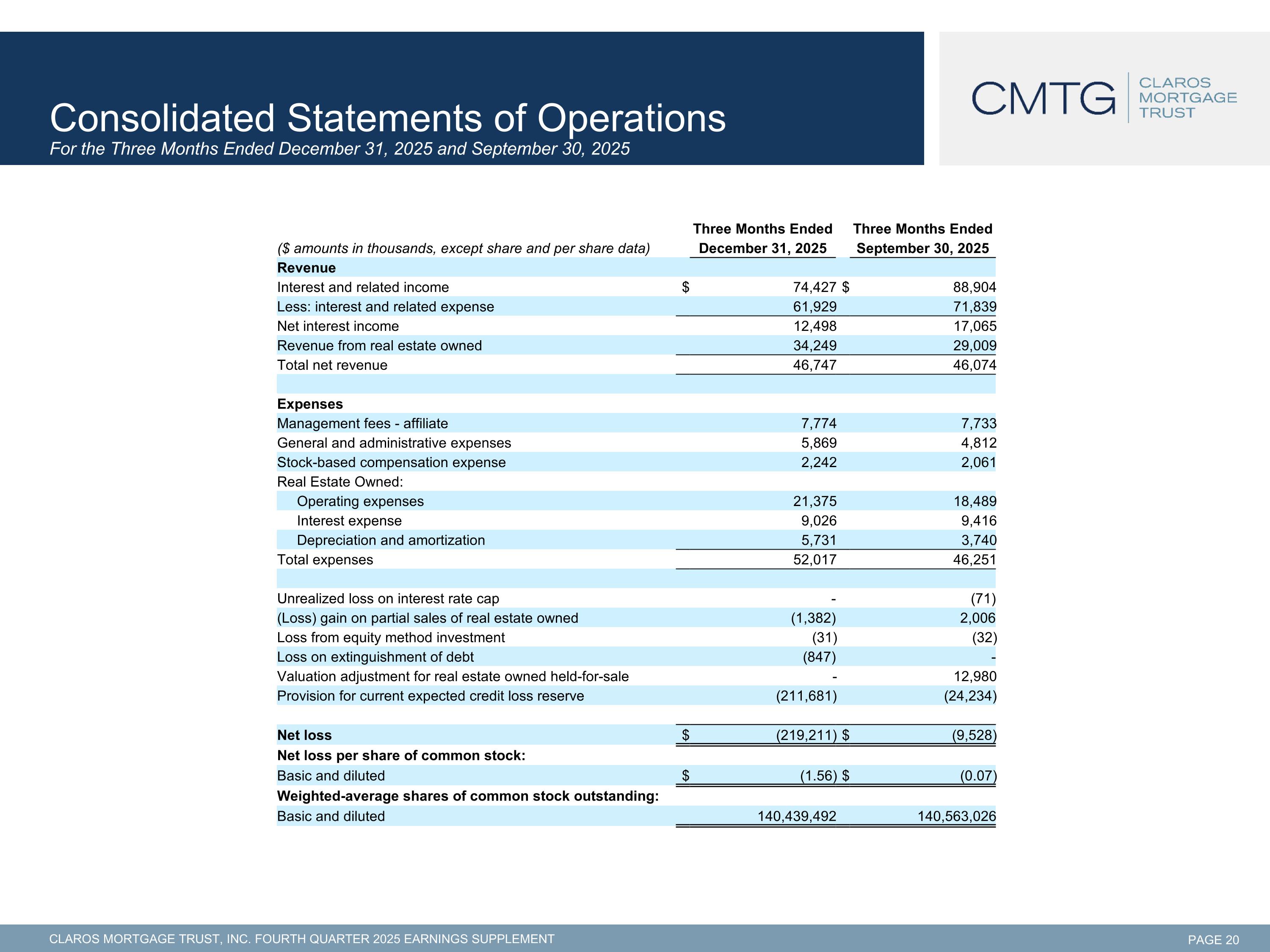
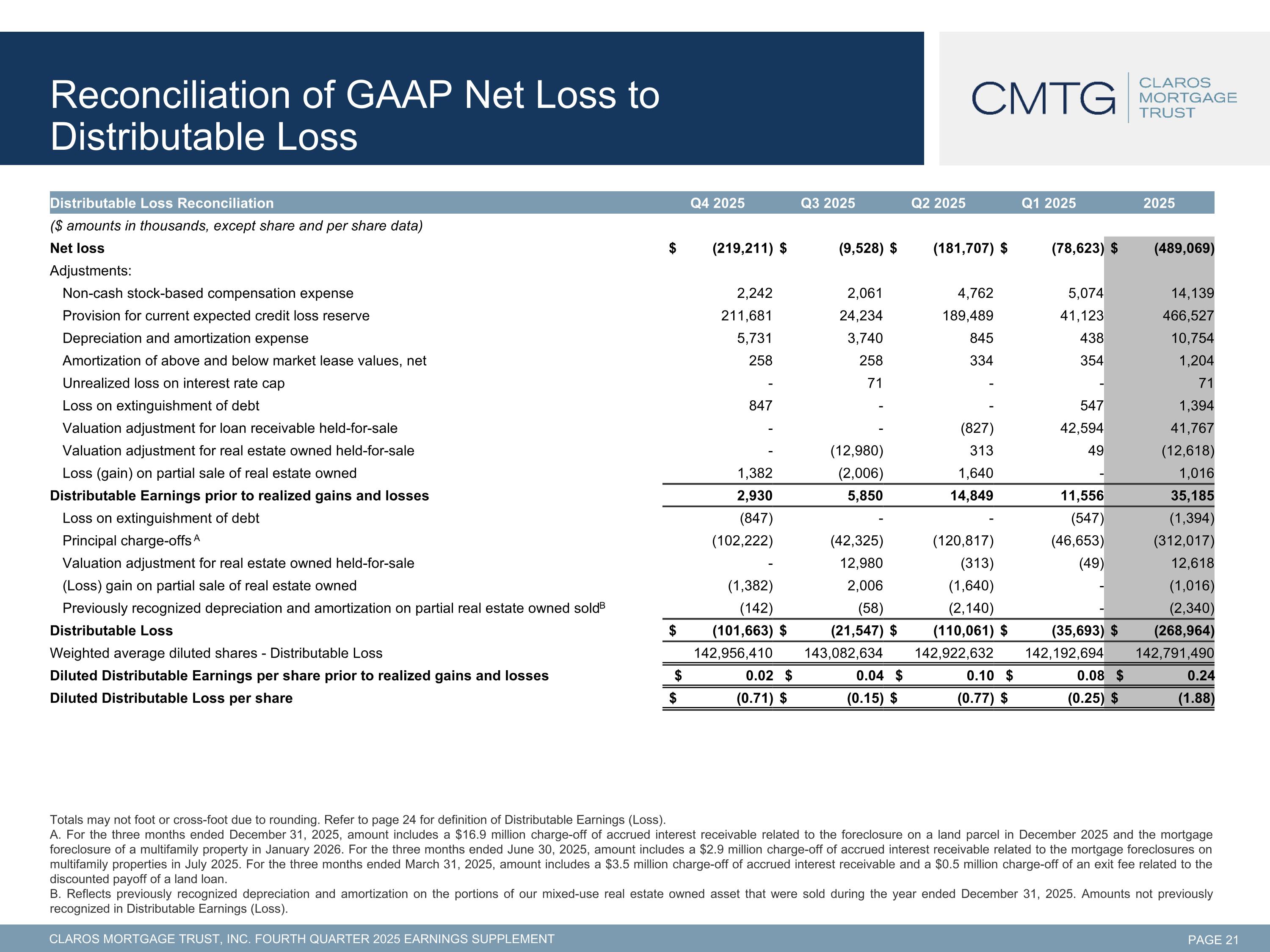
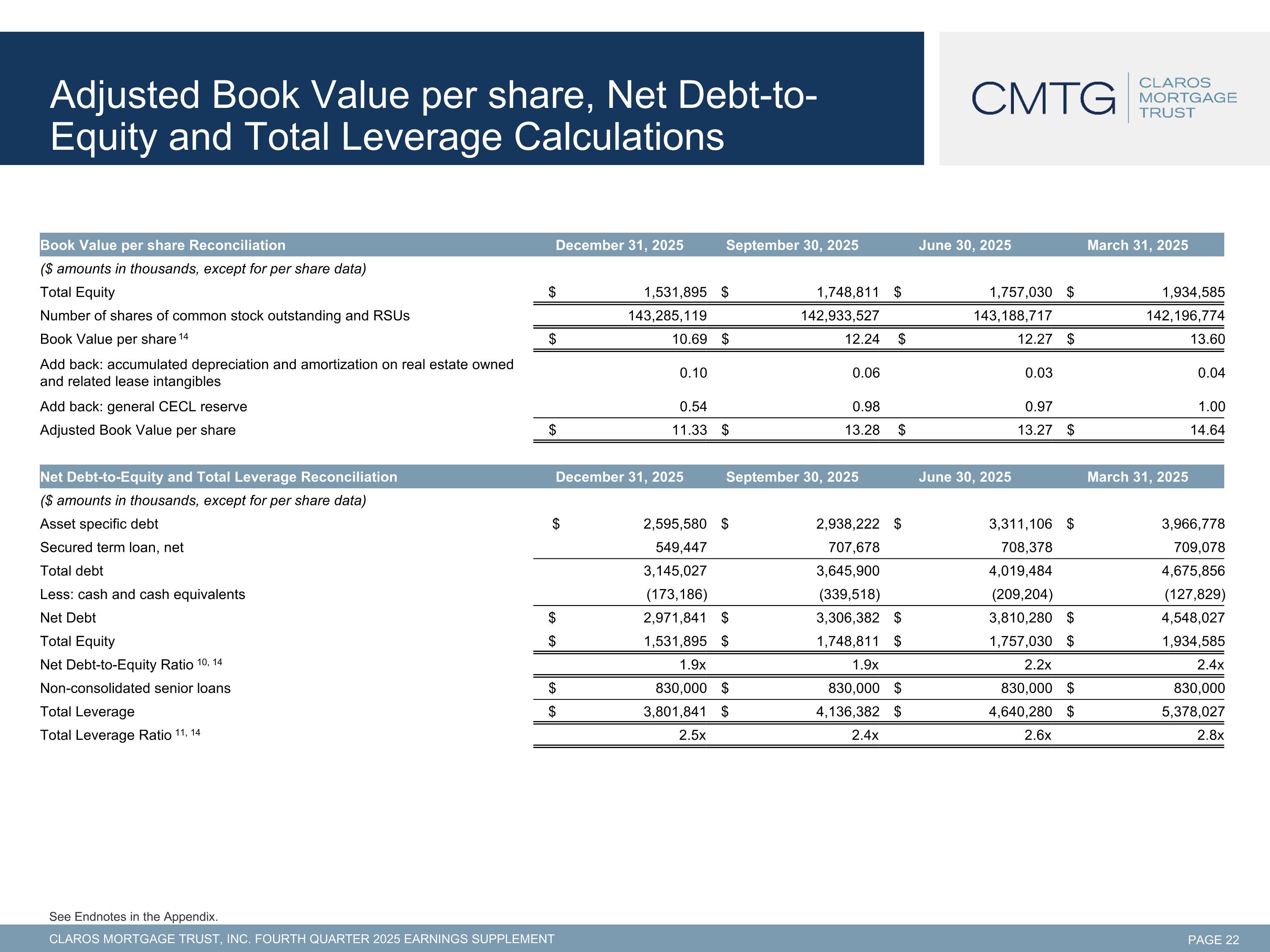
Thank you, Richard. For the fourth quarter of 2025, CMTG reported a gap net loss of $1.56 per share and a distributable loss of $0.71 per share. Distributable earnings prior to realized gains and losses were $0.02 per share. CMTG's held for investment loan portfolio continued to decline in the fourth quarter, decreasing to $3.7 billion at December 31st, compared to $4.3 billion at September 30th, and $6.1 billion at year-end 2024. Over the course of 2025, we reduced our exposure to select asset types that have generally been experienced secular headwinds as of the end of 2025 the portfolio no longer includes standalone life science office exposure decreased from 859 million to 589 million and land exposure decreased from 489 million to 187 million it's worth noting however that the decline in portfolio UPB over the past year was an inherent result of our strategy to turn over the portfolio and prepare for an eventual return to originations. Specific to the fourth quarter, the quarter-over-quarter decrease in UPB was primarily the result of four loan resolutions consisting of two regular-way loan repayments, one on a multifamily asset and the other on a life science asset, both in Pennsylvania. The other two were resolved by way of a discounted payoff and a foreclosure. In addition, as previously reported, we executed a sale of a $30 million Boston land loan. This transaction did not impact fourth quarter portfolio UPB because it was previously classified as held for sale at the end of the third quarter. The discounted payoff related to $150 million dollar previously four-rated office loan in Connecticut. Given the valuation of the collateral, we agreed to repayment at approximately 70% a par, which we view as a good outcome given current market values in a challenging sub-market and tenancy. The borrower was motivated to arrive at a resolution due to additional credit support that had been provided. This transaction enabled us to resolve a watch list loan, reduce CMTG's office exposure, and generate approximately $35 million in net liquidity for CMTG, which was then used to reduce outstanding debt. The discounted payoff resulted in a $46 million principal charge-off, however, it's worth noting that the impact of fourth quarter book value was marginal, as the potential loss had been previously contemplated within our general CECL reserve. Additionally, we resolved an $88 million New York City watch list and non-accrual land loan through a foreclosure process. The underlying collateral is a well-located undeveloped land parcel adjacent to Hudson Yards that allows for a mixed-use development. After reviewing the facts and circumstances of this loan's history, we concluded that foreclosing and ultimately marketing the land for sale was the best path to resolving the loan. Upon foreclosure, we assigned a carrying value of $94 million based on a third-party appraisal, approximately $6 million greater than our UPB, which further supported our decision to foreclose as a means to optimize recovery. We do not anticipate being long-term holders of this land and expect to seek an exit sometime in 2026. As Richard mentioned, last year we exceeded our $2 billion loan UPB resolution target, achieving $2.5 billion of UPB in resolutions for the year. This progress has continued into the new year, with CMTG reporting an additional $389 million in UPB of resolutions across four loans, which include two regular-way repayments. The first repayment was on a $67 million New York City land loan that was previously a four-rated loan that had been on non-accrual since 2021. The other was a $174 million loan collateralized by a newly built multifamily property in Salt Lake City, which generated net cash proceeds of approximately $52 million. This asset delivered last fall, which allowed the borrower to secure refinancing to lower its cost of capital. In addition, in line with our previously mentioned plans, we foreclosed on a multifamily property in Dallas with $77 million of UPB that was previously five-rated. Previously, the loan had a carrying value of $49 million and was written down to $37 million upon foreclosure. And last, we resolved a $71 million loan collateralized by a newly completed but vacant office property located in Seattle. Given the collateral value relative to our equity position, net of non-recourse, note-on-note financing, we determined the most prudent path was to transfer our rights and interests in our loan and the underlying collateral to the financing counterparty. Turning to portfolio credit, during the fourth quarter, the portfolio experienced a mix of ratings, upgrades, and downgrades. We downgraded a $220 million loan collateralized by a luxury hotel property located in Northern California to a four-risk rating. We continue to have conviction in the asset given the exceptional asset quality and highly desirable location and meaningful year-over-year improvement in operating performance. That said, the loan matured in August of 2025, and we have not reached terms in a modification with the borrower, which resulted in a downgrade to the loan's risk rating. We have also commenced foreclosure proceedings to provide additional optionality of outcomes. We also downgraded 3 loans to a 5 risk rating. In each case, the downgrades primarily reflect our decision to take a more aggressive approach in turning over the portfolio. I'd like to provide some color on these loans. The first loan is a $170 million loan collateralized by a multifamily property located in Denver. We are actively pursuing a near-term resolution for this loan and are currently in the process of executing our plans related to the asset. While we are limited in what we can share at this time, we have adjusted the carrying value of the loan as of December 31, 2025, to appropriately reflect our expectations for the anticipated resolution. We look forward to providing an update on this loan in the near future. The second loan is a $225 million loan collateralized by an office property located in Atlanta, Georgia, which matures in March. This asset, similar to other office assets in the area, continues to experience the challenges that have generally weighed on the office sector. We're currently evaluating our options for this loan. The last loan was the Seattle office loan that I just spoke to that we resolved subsequent to the quarter. During the fourth quarter, we recorded a provision for current expected credit losses of $212 million, which primarily consisted of $283 million provisioned to our specific CECL reserve prior to principal charge-offs and $62 million decrease in our general CECL reserve. the 283 million specific cecil reserve provision was primarily attributable to the three loans that were downgraded to a five risk rating during the quarter changes to collateral values of previously five rated loans and the previously mentioned 46 million dollar principal charge off relating to the connecticut office loan it's important to note that of the 283 million specific CECL provision, $75 million was related to loans that were resolved during the fourth quarter or in 2026 year-to-date. The decrease in general CECL reserve was primarily attributable to a reduction in the UPB of loans subject to general CECL reserves. As a result, our total CECL reserve on loans receivable held for investment increased from $308 million or 6.8% of UPB at September 30th to $443 million or 10.9% of UPB at year end. Our General Cecil Reserve decreased from $140 million dollars for 3.9 percent of loans subject to our general cecil reserve to 78 million dollars for 2.9 percent of upb of loans subject to our general cecil reserve turning to reo assets we made significant progress with our mixed use new york city reo asset during the quarter as a reminder we completed the commercial condominiumization of the building in may and as of year end we've sold all of the office floors as well as the signage component generating total gross proceeds of 67 million dollars which was generally in line with our carrying value we now intend to conduct the sale process for the fully leased retail component of the property we believe this asset has served as an example of how we can leverage our sponsors real estate expertise to creatively execute asset-level strategies and optimize outcomes. The New York REO hotel portfolio continues to perform well, with operating results exceeding expectations and annual NOI growth of approximately 14 years. This asset has been accretive to earnings, and given the refinancing we executed last year, we will continue monitoring the market for an opportune time to pursue an asset sale. Over the course of 2025, we've strengthened the balance sheet by focusing on generating liquidity and reducing leverage by $1.7 billion. We continued this focus into the new year by reducing leverage by an additional $300 million, of which $90 million was applied to asset-level deleveraging payments and towards the repayment of the term loan B. As Richard mentioned, at the beginning of 2025, the term loan B had a balance of $718 million and was scheduled to mature in August of 2026. In January 2026, we subsequently retired the term loan B and replaced it with a $500 million senior secured term loan from HPS, which matures in January 2030. This new senior secured term loan is priced at SOFR plus 675 basis points, and in connection with this financing, CMTG issued 10-year detachable warrants to purchase approximately 7.5 million shares of its common stock at an exercise price of $4 per share, which represents a 46% premium to the closing price for CMTG's common stock on January 30, 2026. In conjunction with the closing of the new term loan, we aligned and relaxed financial covenants across all of our financing facilities, which provides additional flexibility to execute our business plan going forward. Over the course of 2025, we decreased our net debt to equity ratio from 2.4x at December 31, 2024, to 1.9x at December 31, 2025. Following the closing of the Senior Secured Term Loan, we now have $153 million in liquidity, representing a $51 million increase compared to the prior year-end, despite the significant deleveraging that occurred in 2025. We accomplished a great deal in 2025, and we recognize there is more work ahead. By resolving watchlist loans, generating liquidity, reducing leverage, and subsequently addressing the term loan B maturity, we have strengthened the balance sheet and positioned the company well for the coming year. We look forward to building on this progress as we continue to execute across the portfolio. I would now like to open the call up to Q&A. Operator?
Operator
Thank you. If you wish to ask a question, please press star followed by one on your telephone keypad now. If you feel a question has been answered or for any reason you would like to remove yourself from the queue, please press star followed by two. When preparing to ask your question, please ensure your device is unmuted locally. Our first question comes from Rick Shane from JPMorgan. Your line is not open. Please go ahead.
Hey, guys. Thanks for taking my questions this morning. Look, I realize there's a lot of progress, both in terms of repayments and loan sales and foreclosures. Obviously, the significant reserves allow you guys or put you in a position to be able to negotiate resolutions for the loans. But obviously, you know, the stock is trading at an enormous discount to book. It's a very, very long path to earning, you know, generating a return that's anywhere near your hurdle rate. I think you guys know where I'm headed, which is we've seen at least one transaction in the space where a REIT who was much further along the path in terms of recovery decided to sell their assets near nav are there opportunities here outside of resolving this portfolio to extract shareholder value or to create your not extract but to create shareholder value rick uh thank you for that for that question um we are clearly always open to everything um but our goal right now has to be
cleaning the book up so that it is a much more transparent and easier to understand business. And I think we have to wait until we're able to deliver that before we can really understand if the market can evaluate our business properly.
And so I think that's where we are headed um at the moment thank you and then to follow that up you know nai has fallen has been cut in half uh throughout the year over the course of the year um i am curious as we head into q1 26 and you think about the non-accruals and the movement in the portfolio uh nii just pure net interest income was about $12.5 million in the fourth quarter. Is it likely that it will be again lower in the first and second quarter of the year, given how the portfolio is marked at this point?
Yeah, Rick, I think that's a fair assumption because as we resolve loans and deliver the book and get regular weight payoffs, that deleveraging will offset that to an interest expense side, and then further resolutions, non-accrual of earning assets should give us some capital to deliver, which should help further reduce interest expense. But I think that's a reasonable assessment. You know, we are in a process of transitioning the portfolio, so that net interest income line's going to be choppy until we sort of turn the corner on the book.
And then just one last question. I apologize for going first and then asking so many questions. But, you know, obviously you guys are, you've indicated that the reserve levels position you to aggressively start to resolve or continue to resolve loans during 2026? When we look at the reserve levels and over $400 million, I apologize, I won't look up the specific number. Realistically, what percentage of that reserve do you think could be translated into losses over the next months? Is it 25%, 50%, 75%? Just so that we can start to get some sense without knowing specifically what you guys are going to resolve, how quickly you think you're going to start resolving things.
Hey, Rick, it's Priyanka. I'll take that one or I'll start. We're reserving based on what we think is appropriate at this time. We've resolved a tremendous number of loans in 2025. Half of them are on our watch list. And year to date, we've already resolved three additional loans on our watch list. So we think we have a good sense of the reserves that we need to take in order to accelerate resolutions and turn over the book. And so, you know, we think we're appropriately reserved for that. Now, there can be new information and we might have changes in this really dynamic environment, depending on where negotiations with borrowers or financing counterparties or anything may go, but we think we're appropriately reserved today. And we have a lot of data points in a lot of different ways in terms of loan sales, which have really tapered off throughout 2025, more doing DPOs and other transactions, foreclosures. We think we have a really good sense of where the reserve level should be okay uh but i i appreciate that it the question's more about the timing of those resolutions as opposed to the level of the the reserve yeah yeah the timing look i think we go go ahead okay i was just gonna say i think we've go ahead should i call on somebody okay i'm going to start so i think that um the pace i mean we're really really focused on accelerating the pace of dispositions i mean both within the loan book as well as in the reo book we um we're we realize the value exactly what richard said earlier we need to turn over this portfolio and we need to make um very clear where you know to demonstrate our book value so i can't I don't want to give you specific timeframes, but I would hope that 2025 and our progress in 2025 suggests that we're moving very quickly, and we hope we're continuing to accelerate that. And furthermore, the stability of our balance sheet after the transaction that we just closed in January really helps us do that with even more strength and speed.
I appreciate the answer. Thank you, guys.
Operator
Thank you. Our next question comes from John Nicodemus from BTIG. The line is now open. Please go ahead.
Morning, everyone. Thanks for the time. With the term loan B refinancing completed, several more resolutions completed as well since we last spoke. How are you thinking about liquidity levels here in 26? I know you're looking to improve them and it is up year over year, but we did see it come down significantly since November, which is to be expected. Just trying to get a better handle on how we should think about the trajectory there for this year.
Sure. Thanks for the question. Well, I think a lot of the liquidity that was generated over the course of the year was used to deleverage the balance sheet, which we expect to continue to do as we continue resolving loans and our real assets over the course of 2026. we, given the deleveraging that we've done, we now have a pretty significant level of liquidity cushion over a minimum liquidity requirements. And faced with that and the very de minimis amount of future funding that we expect to occur on our existing loan portfolio, we feel that our liquidity is in a very good position right now. And to the extent we generate incremental liquidity above those levels, we'll continue to look to deleverage the balance sheet. But success for this year, by the end of the year, we're evaluating a variety of capital allocation options for available liquidity, whether that's originating new loans, further deleveraging the balance sheet or other kinds of allocation alternatives.
Thanks, Mike. That's really helpful. And then for my second question, this kind of goes into what Priyanka was mentioning in response to Rick's last question. But we've heard a lot about improvements for the greater commercial real estate sort of transaction activity, liquidity, and also have seen some of your peers talk about being more aggressive about resolving challenged loans or REO assets during this round of earnings. Given that backdrop, has that changed your expectations for sort of the pace or timing of sales out of both the REO portfolio as well as resolutions from the watch list? Thanks.
So, John, thanks for that. This is Richard. I think we're in a much more constructive environment such that the things that we had held off resolving, we're going to have much better performance out of. However, I want to say that the market is not fully back. Transaction volume is still lower than we had anticipated we'd be by this time. So I think we are trying to both react to the market and make the best execution that we can while being mindful that we need to quickly clean up our book. So it's a balance. I think on the whole, we are more focused on execution and delivering a clean book than we are waiting for the market to recover. But we're getting a little bit of the benefit of having waited on some of the assets that we're going to be able to resolve this year. And I'm sure Priyanka would like to add something to this.
Yeah, thanks, Richard. The only thing I would add, I agree with everything Richard said, I would add, though, that because of the healthier capital markets, both CMBS banks coming back into the mix, we're seeing more regular way repayments on larger loans. So I think that the theme we're going to see in this coming year are fewer extensions and modifications and more repayments, which, you know, on performing loans, which will then have an impact on NII, as we talked about during Rick's question, but it will still help turn over the book, getting that excess cash, and then having, you know, the decision on how to allocate that capital.
Great. Really appreciate it, Richard and Bianca, and thanks for the answers. Thank you.
Operator
Thank you. Just as a reminder, if you did want to ask a question, please press star followed by one on your telephone keypads now. Our next question comes from Chris Muller from Citizens Capital Markets. Your line is now open. Please go ahead.
Hey, guys. Thanks for taking the questions. I guess looking at your REO portfolio, most of the properties have some financing against them, and I see your comment that the hotel portfolio is the most profitable than the aggregate contribution to DE, but can you guys talk about some of the individual NOIs within that REO portfolio?
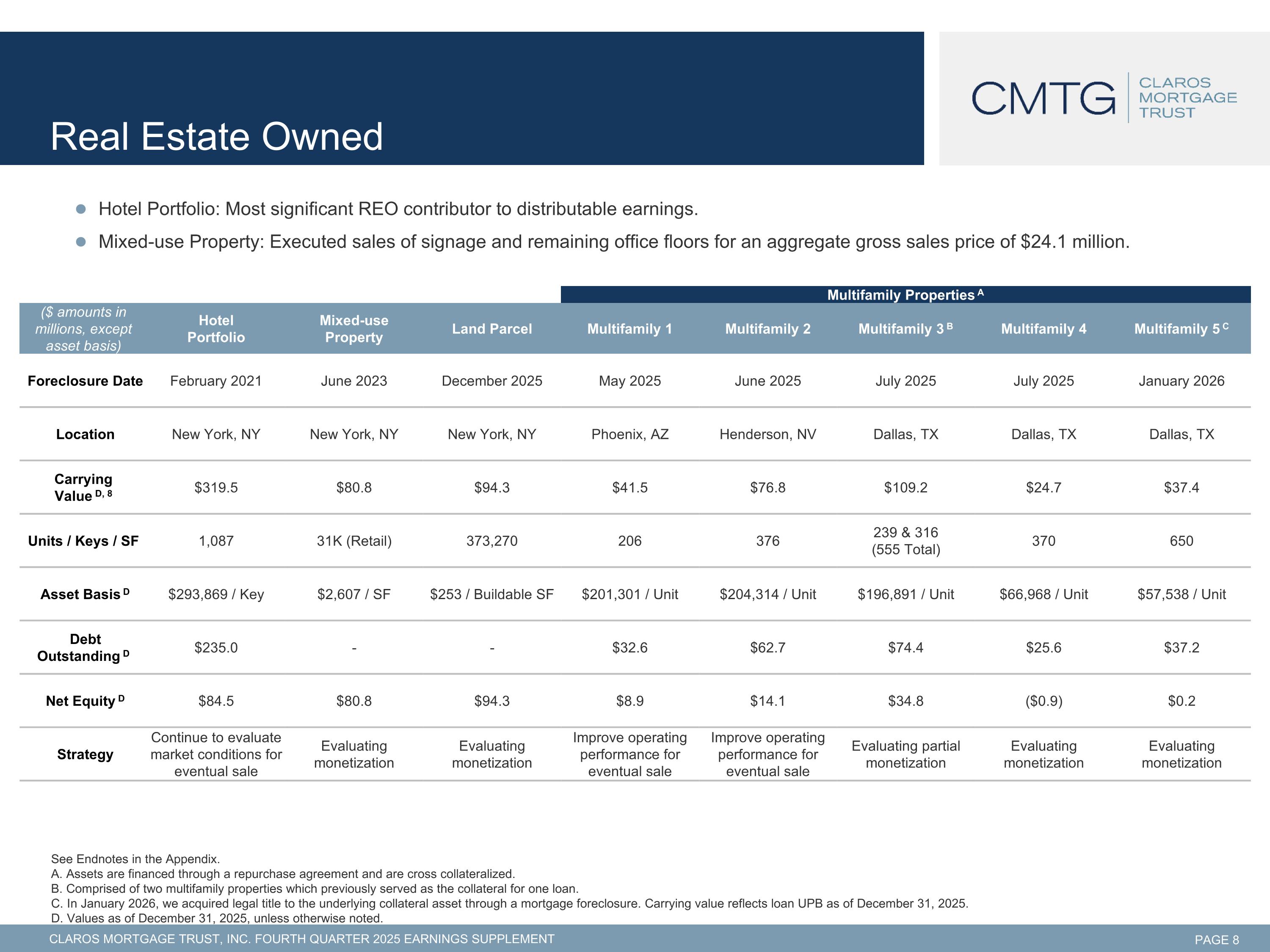
Yeah. Hi, Chris. I'll take that one. It's Priyanka. The NOI, so in the, we have the mixed use asset, which we're now, the only thing we're retaining is the fully leased retail. And so that's a hundred percent lease, tenants paying rent. So there's, you know, NOI coming off of that. That happens to be one that we're holding unlevered. In the multifamily assets that we have, REO, it is a mixed bag. There are some that are generating real NOI, others that are a little bit more challenged from an NOI standpoint, but that is all part of the plan to foreclose. The ones that are now generating NOI weren't generating NOI when we foreclosed. So the point is to come in there and make sure that we're spending capital in smart ways, accretively to, you know, market the asset appropriately to potential renters and also be a present owner who's holding the property managers accountable. So I think that to the extent that assets don't have positive NOI or meaningful NOI, it's all part of the plan and certainly was expected. And the last thing I would say is that capital that we're putting in there, you know, you mentioned that these are financed. The financing facilities have structure in them where there is capital being held back for us to spend at the properties. And that's, you know, not cash coming off the balance sheet.
Got it. And that's a good segue into my follow-up here. Do you guys expect a lot, or can you give a ballpark dollar amount of what you're expecting on CapEx for these REO properties?
It's not going to be a meaningful amount. I mean, I hesitate to give you a specific number because a lot of that is going to depend on our hold periods. So again, we're accelerating dispositions. You can see that in our earnings supplement on page 8. We sort of call out where we're accelerating dispositions. And so I think to the extent these are shorter-term holds, we're going to spend less capital. But we want to be prepared to spend more if the hold is longer.
Got it. That makes a lot of sense. And just one last quick one, if I could. Does the new term loan allow financing of watchlist loans?
We already have a facility that allows us to finance those loans. The new term loan is more of a corporate debt facility, even though it's senior secured, it's direct asset level.
Got it. Makes a lot of sense. Thanks again for taking the questions.
Operator
Thank you. We currently have no further questions, so I'll hand back over to Richard for closing remarks.
Well, I want to thank everyone for joining and for the questions. and maybe summarize some of the things that we've mentioned today. 2025 and beginning of 2026 have been about resolving watchlist loans, enhancing liquidity, leveraging the book by $2 billion. In 2025, there was $2.5 billion of resolutions. 2026 almost 400 so far we got the TLB retired we now have a relationship with HBS who's part of BlackRock the largest asset manager in the world all this amidst a constructive improving real estate credit market and real estate capital market in general and so while we're not here to declare victory we are seeing life at the end of the tunnel and we are getting closer to a clean book that we expect will allow the street to more appropriately value our stock. And that's really our goal every day when we come to the office. And so it's been hard. It's been a long road, but we are really excited to be feeling like we can see the light at the end of the tunnel and that the capital markets are cooperating with us. So we thank you for joining us and for monitoring our progress and for the questions and we'll look forward to speaking again at the next quarterly call thank you all this concludes today's call thank you for joining us you may now disconnect