Operator
Good day, everyone. My name is Layla and I will be your conference operator today. At this time, I would like to welcome you to the Ford Motor Company first quarter 2026 earnings conference call. All lines have been placed on mute to prevent any background noise. After the speaker's remarks, there will be a question and answer session. If you would like to ask a question during this time, please use the raise hand function, which can be found on the black bar at the bottom of your screen. At this time, I would like to turn the call over to Lynn Antipas-Tyson, Chief Investor Relations Officer.
Thank you, Layla, and welcome to Ford Motor Company's first quarter 2026 earnings call. With me today are Jim Farley, President and CEO, and Sherry House CFO. Joining us for Q&A is Andrew Crick, President of Ford Blue and Model E, Alicia Bowler-Davis, President of Ford Pro, Kumar Galhotra, Chief Operating Officer, and Kathy O'Callaghan, CEO of Ford Credit. Jim will give a high-level overview of the business, and sherry will provide added texture on the financials and guidance we'll be referring to non-gap measures today these are reconciled to the most comparable us gap measures in the appendix of our earnings deck you can find the deck at shareholder.com our discussion also includes forward-looking statements our actual results may differ the most significant risk factors are included on page 19 of our deck unless otherwise noted all comparisons are year over year. Company EBIT, EPS, and pre-cash flow are on an adjusted basis. Upcoming IR engagements include Naveen Kumar, CFO of Ford Pro at the Deutsche Bank Global Auto Industry Conference in New York on May 19th. Now I'll turn the call over to Mr. Farley.
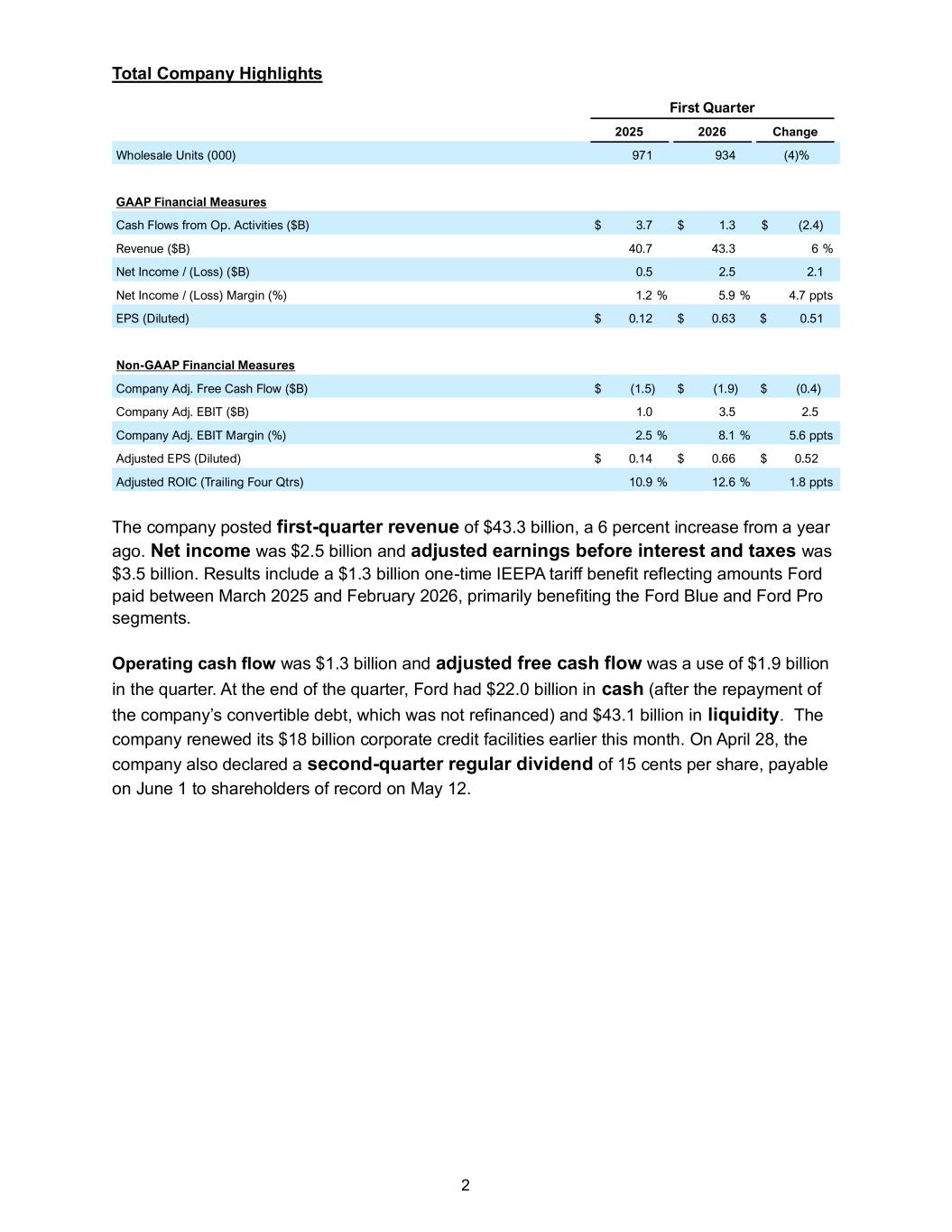
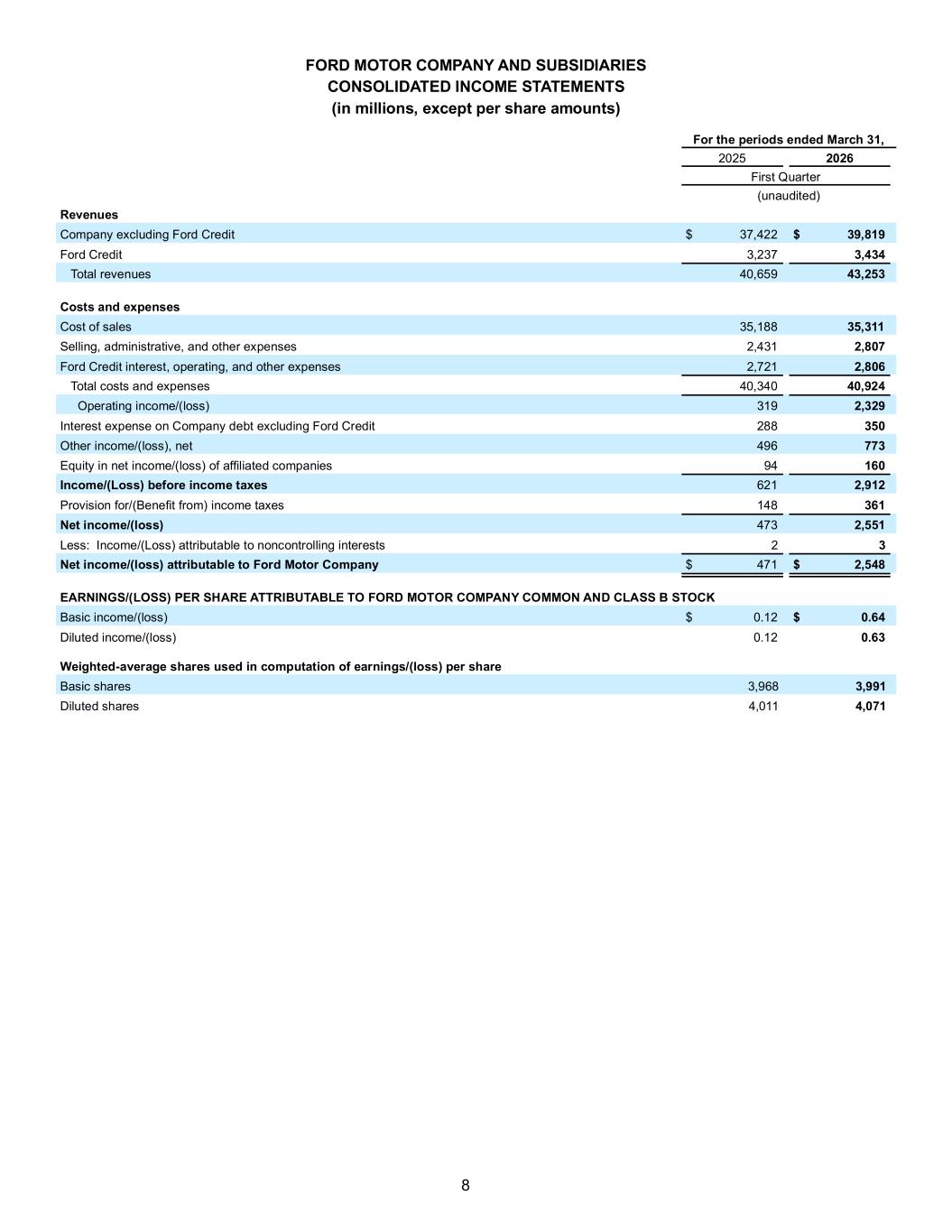
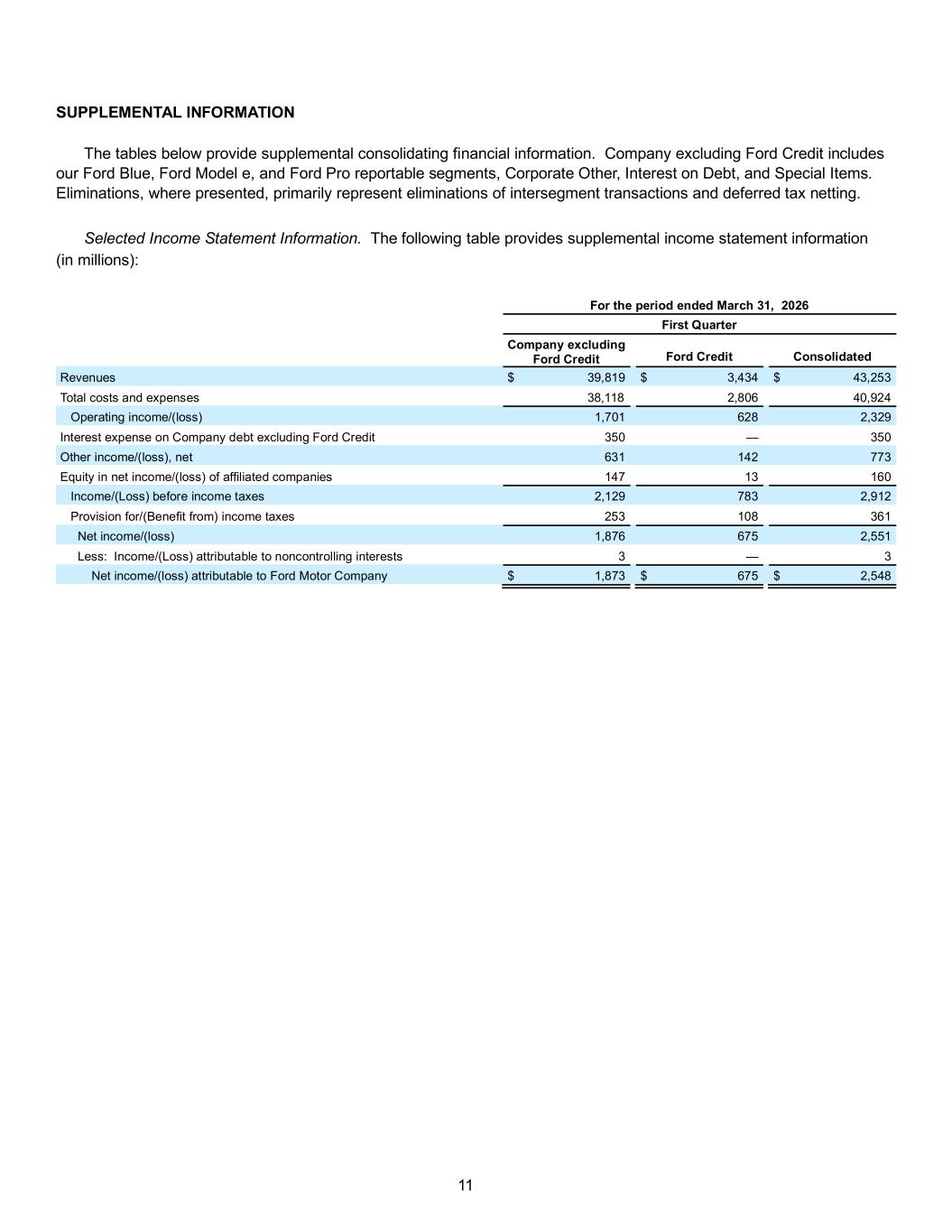
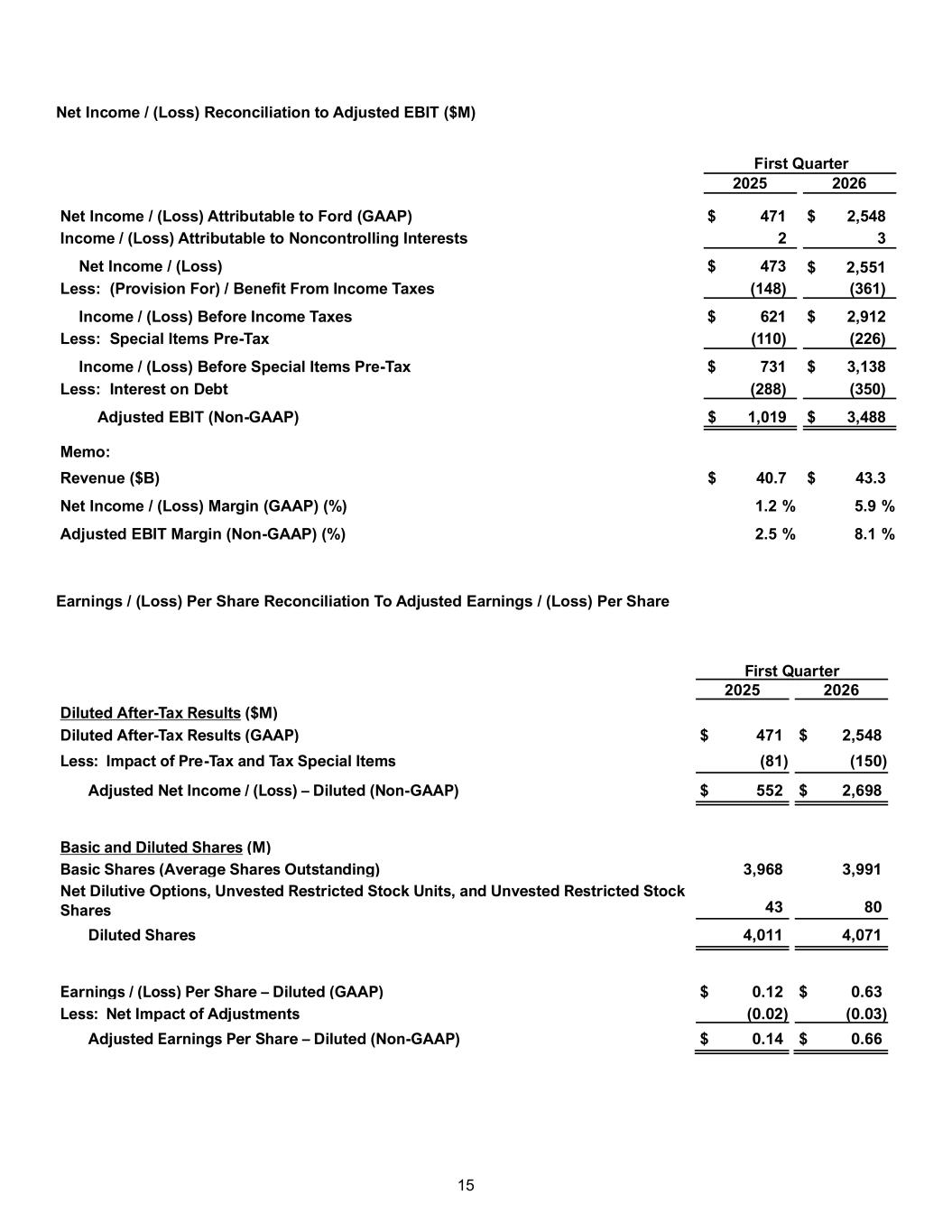
Thank you, Lynn, and thanks to all of you for joining us. I wanted to thank the Ford team, all of our dealers and our partners for a strong start to this year our results is quarter 43.3 billion in revenue 3.5 billion in adjusted ebit reflect a sharp execution and the momentum we're building for our ford plus plan accordingly we're raising our full year adjusted ebit guidance to between eight and a half and ten and a half billion dollars these results are encouraging but the bigger story is the modern ford that's now taking shape for five years we have relentlessly built the foundation of ford plus we strengthened our industrial system made real progress on quality cost and advanced our software capability and customer experience. Early this month, we took the next step in that evolution by establishing an end-to-end organization, product creation and industrialization. We unified our advanced technology, digital, and design teams with our global industrial system. This change aligns with the most intensive product and software rollout in our history. By 2030, almost all of our global volume will feature next generation electric architectures and in-house software this applies to every propulsion type as we deliver and scale high quality software-defined vehicles this new organization allows for faster decision making and reduce complexity this is the moment we integrate the digital soul of the vehicle the software all the silicon and the user experience with our world-class industrial execution among other things this alignment will support our high margin software and physical services revenue which was over 15 billion last year and we expect to grow that 15 billion nearly eight percent annually through the end of the decade this service growth is driven by offering customers indispensable digital experiences and investing and aftermarket sales with a focus on customer uptime, expanding our parts catalog, and enhancing our service network. We're also learning, we're also leaning into the Skunk Works model to improve all of Ford. They've done an incredible job creating the UEV platform, which represents a step change in efficiency and cost especially for the ev market but afford we're now integrating these skunk work breakthroughs back into our mainstream products and processes we're applying their advanced tools and physics based cost modeling to the highest volume internal combustion and hybrid lines this of course will reduce our costs and improve quality across the board Our product pipeline is aggressive. Between now and 29, we will refresh 80% of our North American portfolio and 70% of our global portfolio by volume. This includes the next generation F-150 and Super Duty, among many others. It also includes the launch of our universal EV platform in 2027 from our Louisville assembly plant in Kentucky. We are scaling that plant for significant volume to accommodate a variety of vehicles off that single platform. And speaking of electrification, our strategy remains focused on powertrain choice, not nameplate complexity. By the end of the decade, 90% of our global nameplates will offer electrified powertrains, including advanced hybrids, extended range electric vehicles and full EVs. Our financial health is driven by a leaner, more effective industrial system. We're on track to deliver another over a billion dollars in material and warranty cost improvements this year. And we will never stop. Our focus on quality is paying off. J.D. Powers recently ranked forward number four in the 2026 U.S. Customer Service Index, our best performance in 30 years. Finally, we remain resilient in the face of global uncertainty regarding the conflict in the Middle East. Of course, our priority is our team and the safety of them. We're monitoring the situation and working to minimize risk and find opportunities in much the same way we have navigated the pandemic the semiconductor shortage tear of headwinds and others we have the muscle memory to find cost offsets adjust our product mix quickly and proactively manage our supply chain in times of stress and crisis my main message today is this ford is a fundamentally stronger more modern company we have a foundation built on industrial fitness. We have the technology and we now have the unified organization to not just deliver but to compete to win. Ford is focused on execution, quality, and thrilling our customers. Over to you, Sherry.
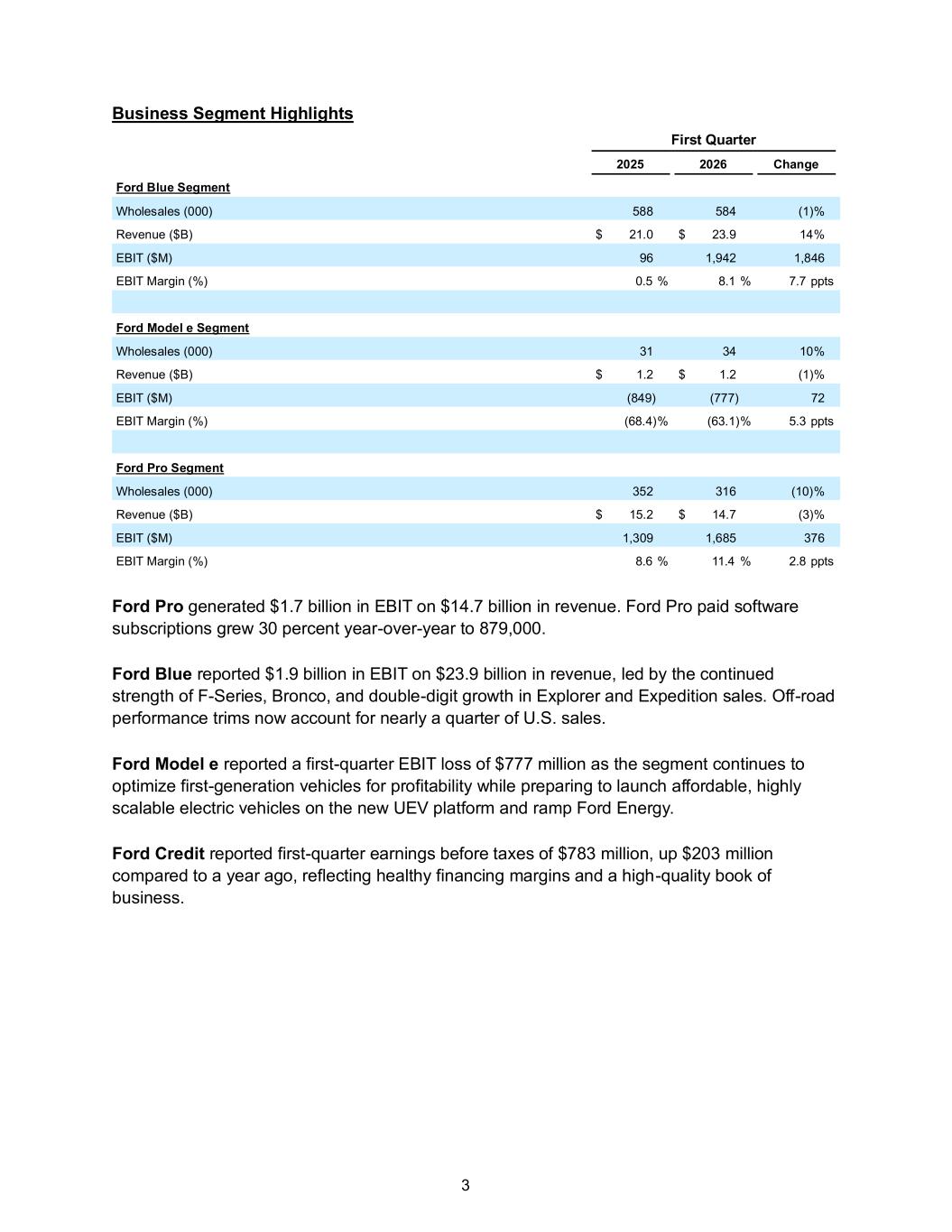
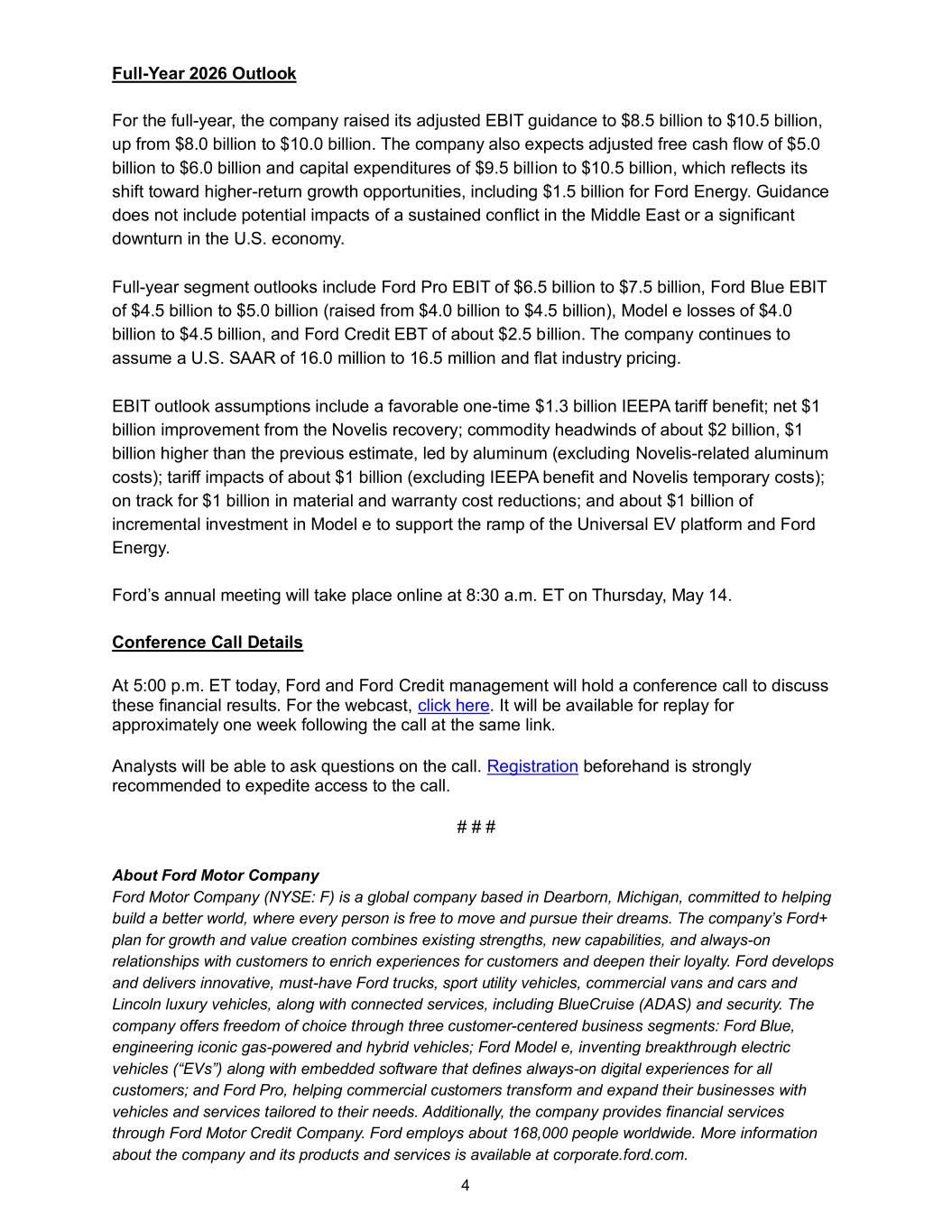
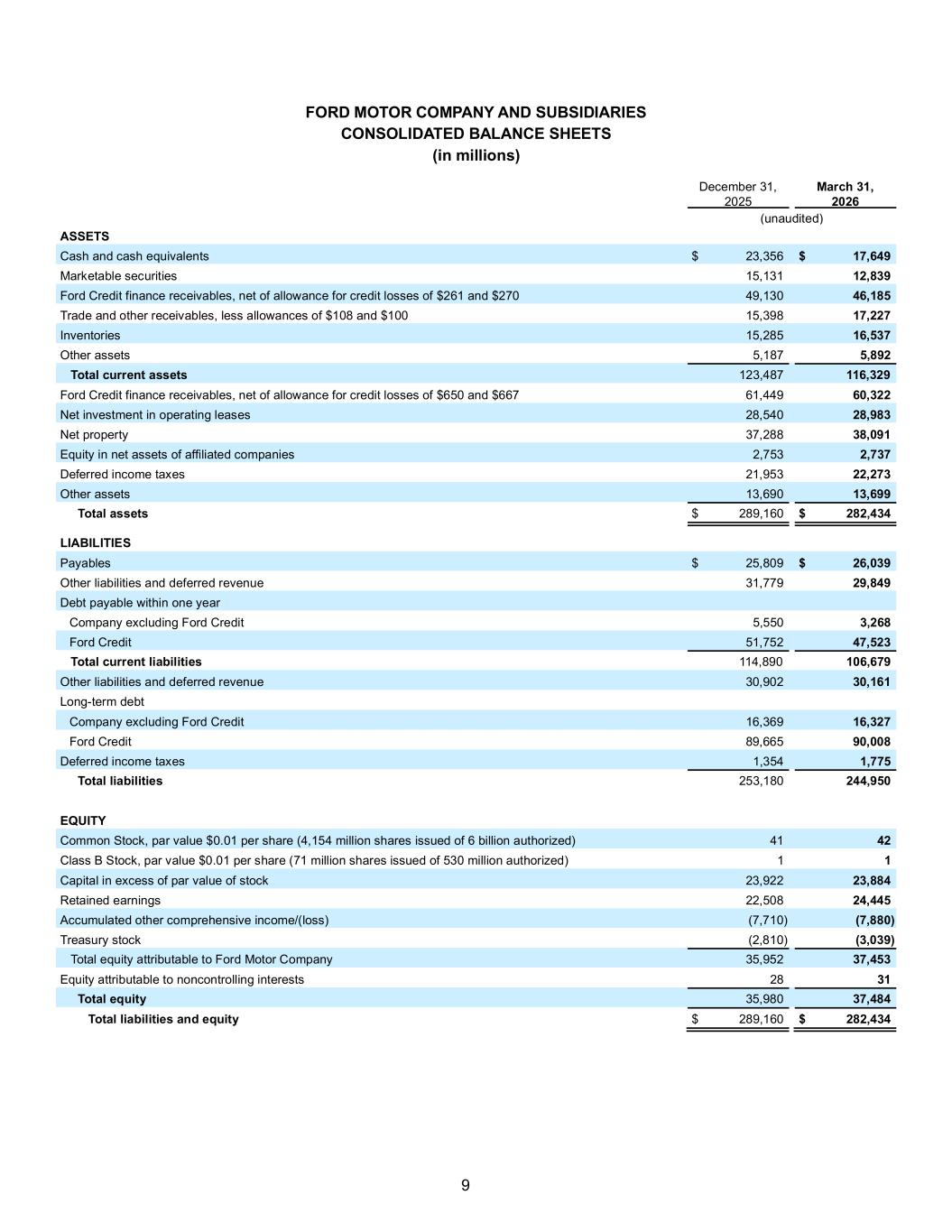
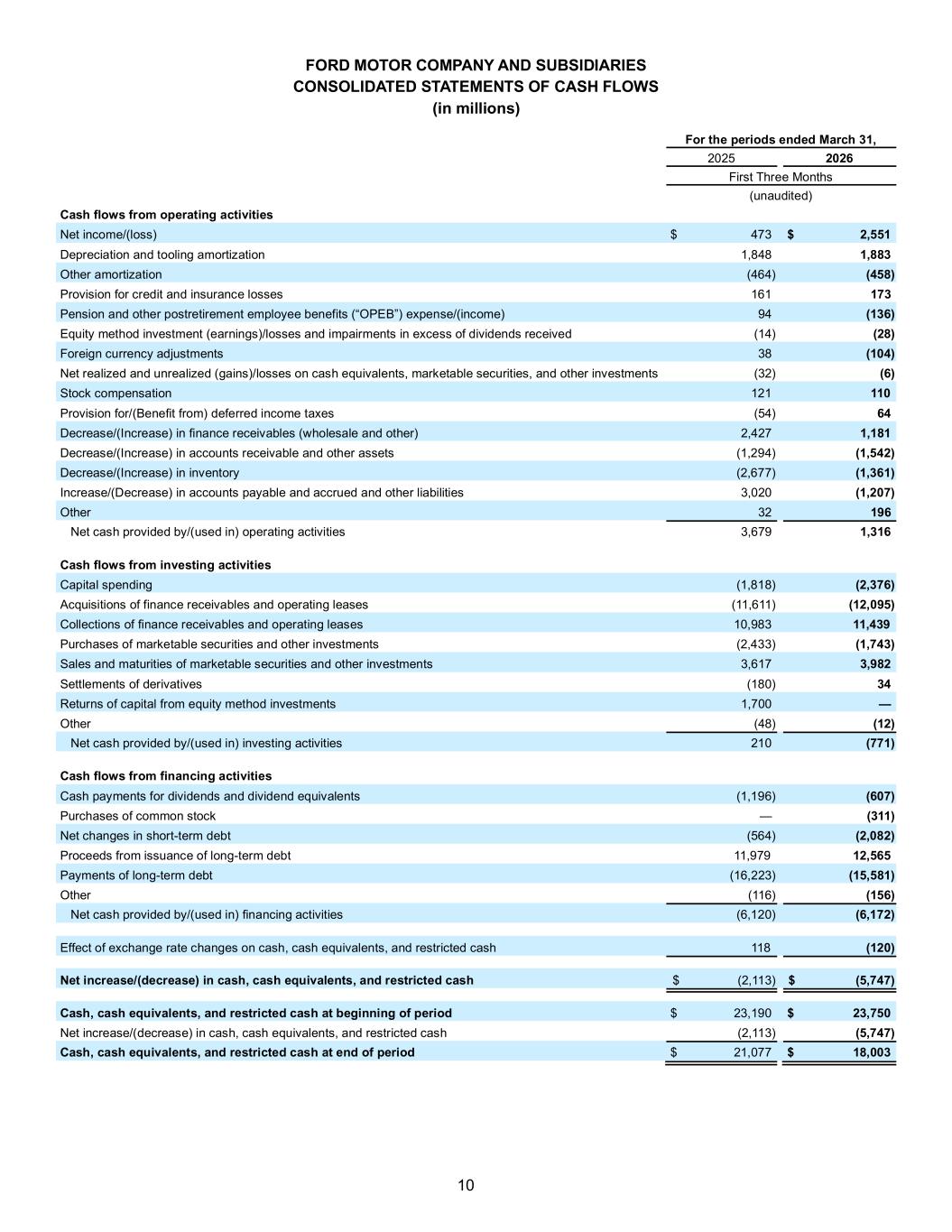
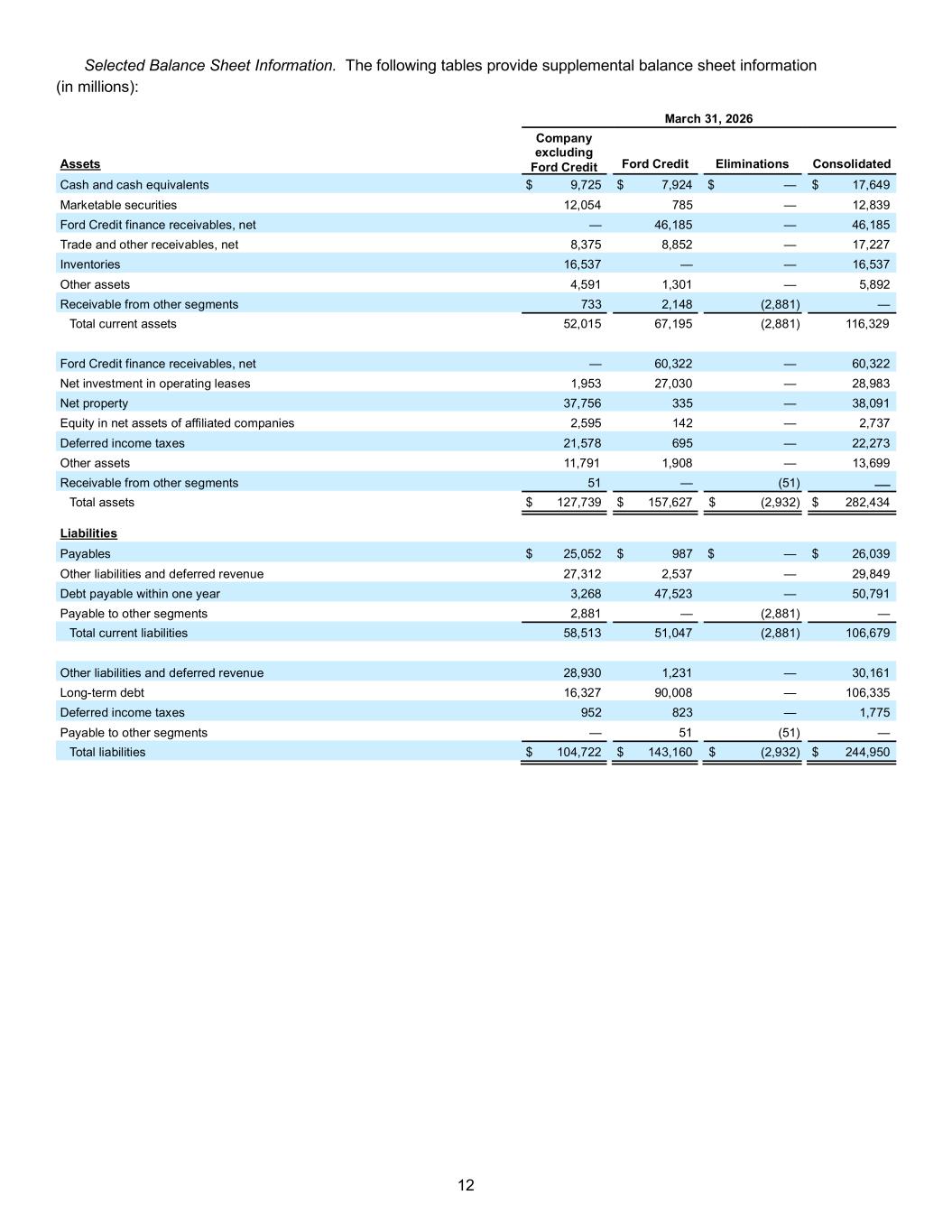
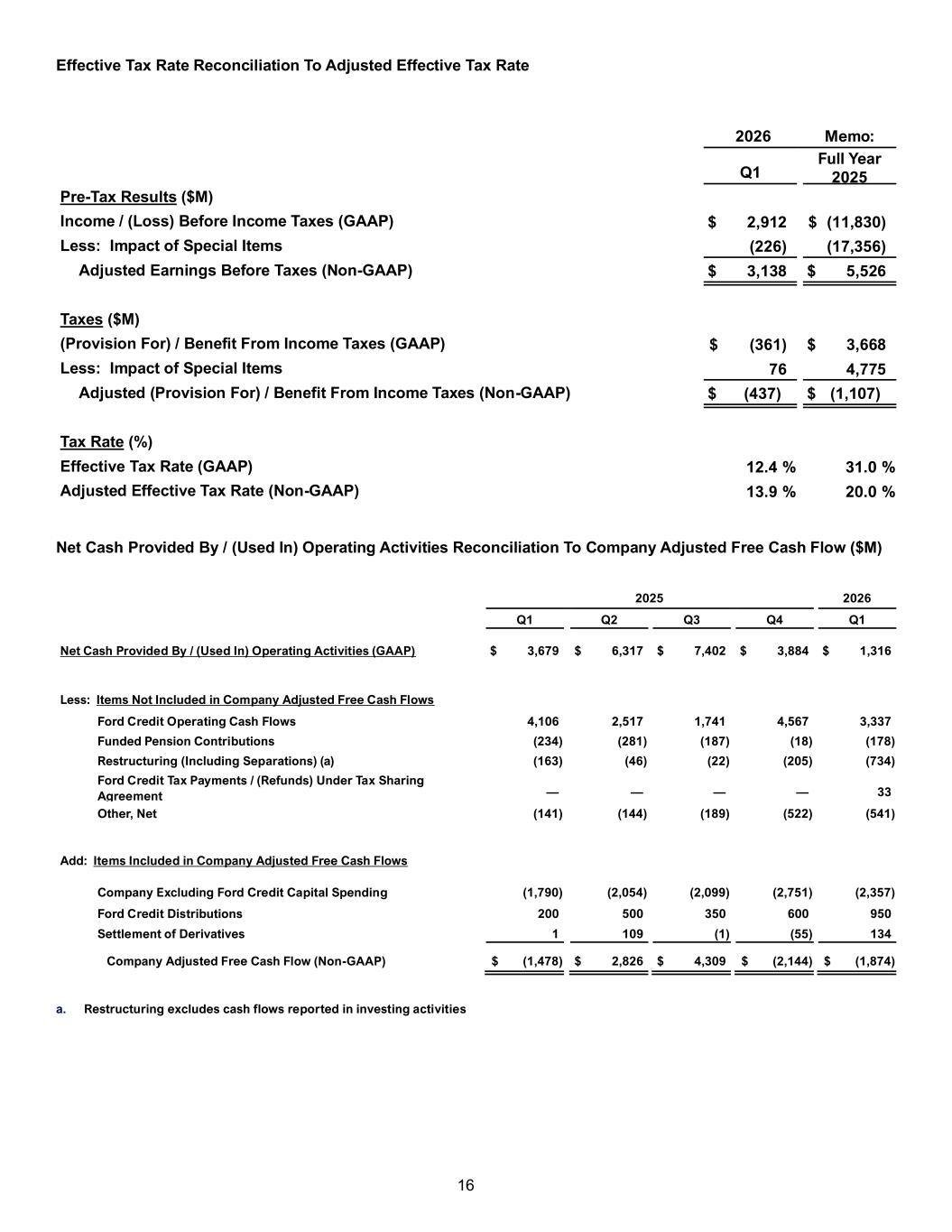
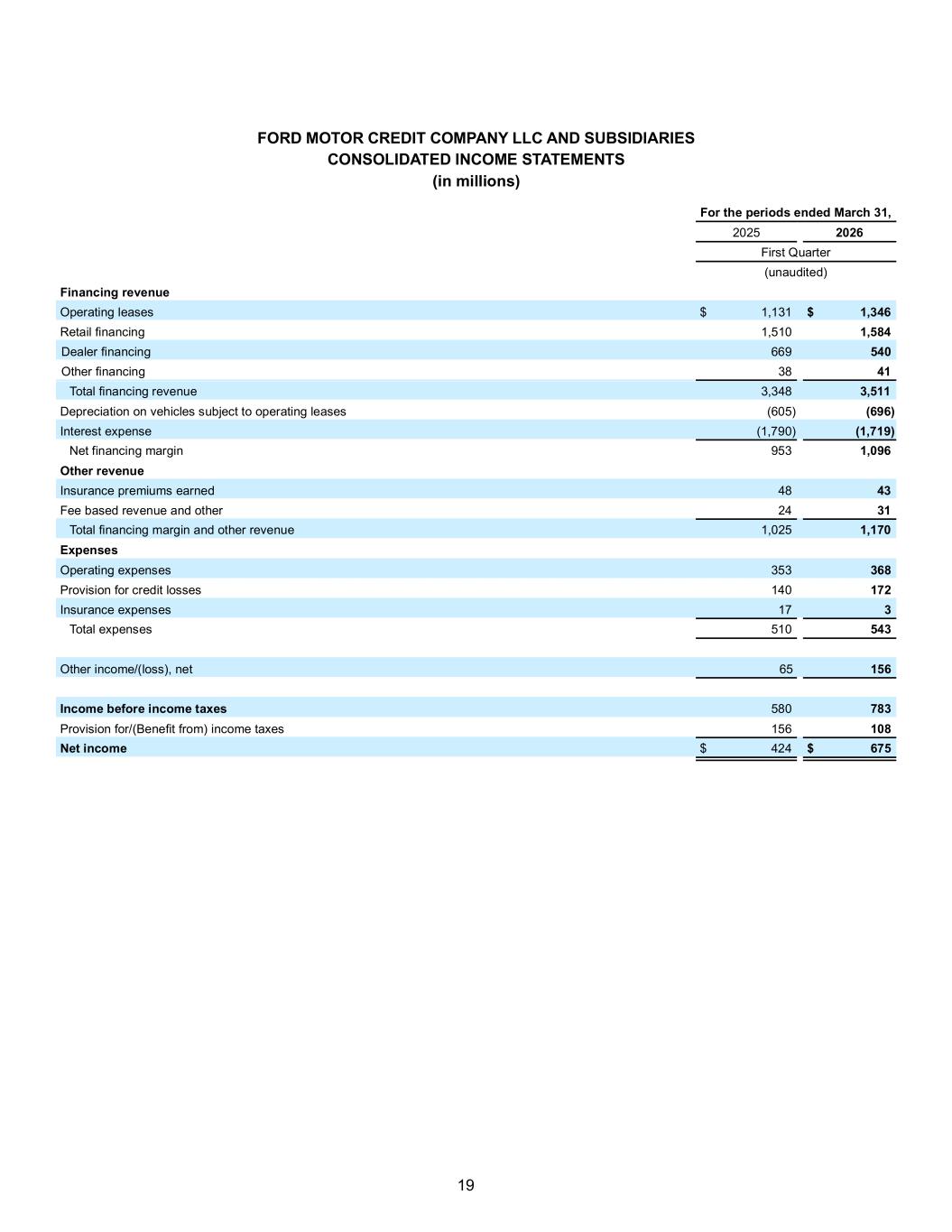
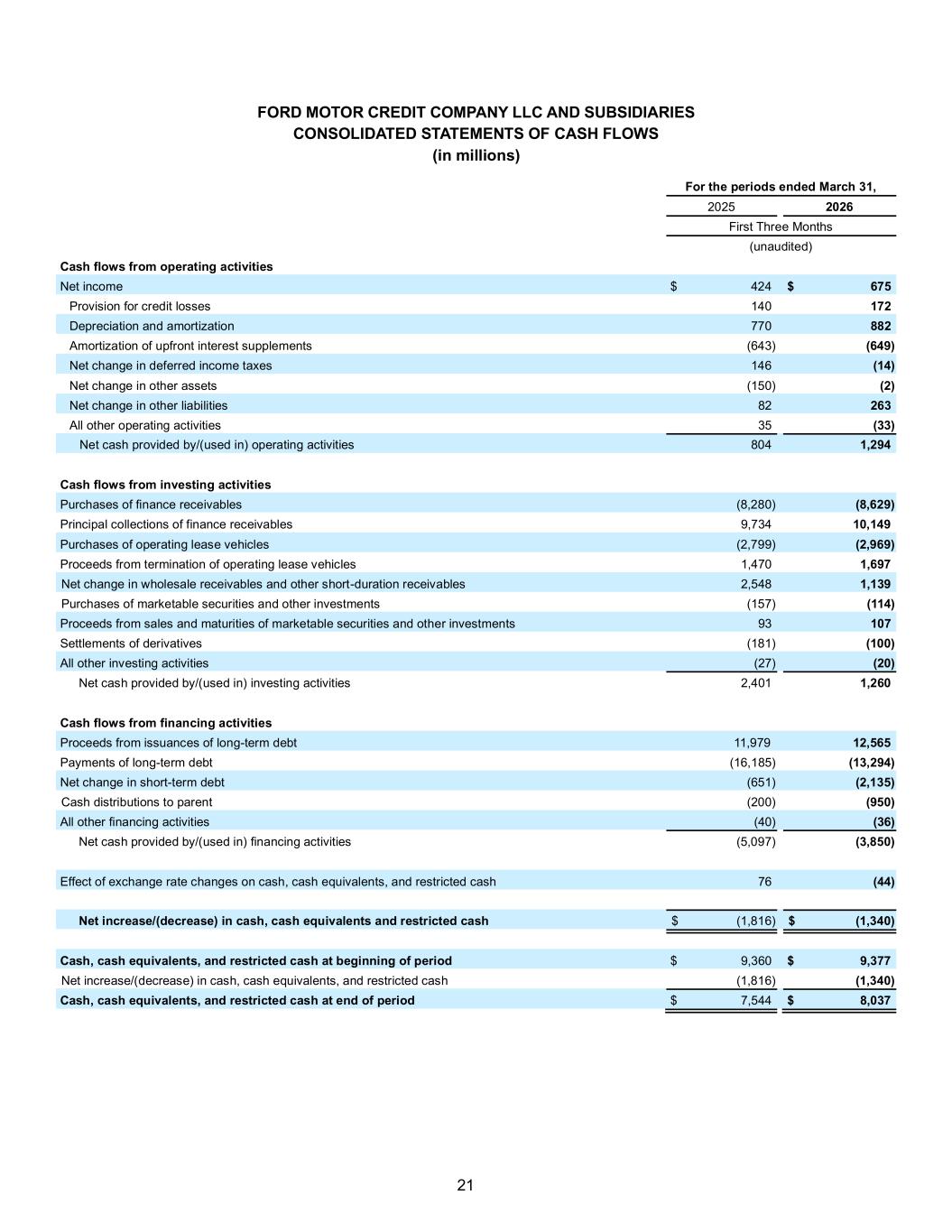
Thank you, Jim, and hello, everyone. Before I walk you through the details of our performance this quarter, let me start with a few items I know are top of mind for you. First, in Q1, we recognized a $1.3 billion benefit related to IEFA tariffs. This one-time adjustment largely benefits Ford Blue and Ford Pro at about $700 million and $500 million respectively. They are related to IEFA tariffs paid between March 2025 and February 2026. Second, our Novelis recovery is progressing as expected. We still expect a $1 billion improvement in EBIT year-over-year weighted towards the second This is net of $1.5 billion to $2 billion of one-time incremental costs to secure alternatively sourced aluminum until the Novelis facility is operating at full throughput later this Third, relative to U.S. inventory, we expect to remain within our target of 55 to 65 retail days supply for the year. F-Series sales remain healthy as inventory recovers from the Novella supply disruption. America's best-selling truck delivered year-over-year retail share improvement of 30 basis points in March, and we are carrying that momentum into Q2. Our team is effectively managing tight retail day supply by helping dealers fill inventory gaps while ensuring high demand trim levels are an ample supply. We are also producing a richer mix of product as we continue to ramp novellas. And importantly, on average, we are spending less on incentives than our competitors. In fact, for the quarter, F-150 had the highest retail share, highest average transaction price and the lowest incentive spend per unit versus our key competition now turning to the quarter we delivered adjusted ebit of 3.5 billion or 2.2 billion excluding the impact of the iefer the strength in the quarter versus our original guidance was primarily supported by a change in calendarization of cost improvements in timing of investments growth in software and physical services in higher net pricing our global revenue grew by over six percent despite a nearly four percent decline in volume which was expected as we exited low margin products like escape in north america and focus in europe in the us we had our highest q1 share of revenue in five years led by large utilities and trucks adjusted free cash flow was a use of 1.9 billion in the quarter more than explained by unfavorable timing differences higher net spending and changes in working capital on a full year basis we expect timing differences and working capital to be favorable our balance sheet is strong with 22 billion in cash and over $43 billion in liquidity, and we remain committed to our investment grade rating. We repaid our convertible debt without refinancing it and also relaunched our anti-dilutive share repurchase program, which we completed in the quarter. And earlier this month, we successfully renewed our $18 billion corporate credit facilities for another year. Our strong liquidity position provides us with the flexibility to manage in this dynamic environment and invest in higher return growth opportunities like Ford Energy. It also allows us to pay consistent shareholder distributions. In fact, yesterday we announced a declaration of our second quarter regular dividend of 15 cents per share payable on June 1st to shareholders of record on May 12th. now turning to segment highlights ford pro achieved EBIT of 1.7 billion against the backdrop of novellas related production disruptions ford pro continues to deliver higher margins through a powerful ecosystem of vehicles software in physical services we are scaling rapidly and increasing recurring revenue which bolsters resiliency in fact paid software subscriptions grew to 879 000 a 30 percent year-over-year increase by integrating innovations like ford pro ai we can help commercial fleet managers instantly identify maintenance needs leverage large data models on fuel usage to lower costs and optimize routes amongst other features all designed to provide better predictability productivity and profitability which our customers require as we look ahead the 2027 model year order books are just starting to open and we are seeing positive early indicators ford blue delivered 1.9 billion in ebit supported by the sustained sales performance of f-series and go-to-market discipline evidenced by q1 incentive spend below industry average additionally our off-road performance trims now account for nearly a quarter of u.s sales in maverick and f-150 continuous the best-selling hybrids in their segments importantly ford blues q1 performance highlights the strength of the underlying business and excluding ieva is representative of its ongoing run rate. For Ford Model E, EBIT was a loss of $777 million as we now start to benefit from the portfolio changes announced in December. In addition to investing in a leaner, more profitable portfolio, we are actively matching supply with demand globally to optimize profitability. And in the quarter, we benefited from a nearly 35 improvement in our gen 1 losses we also continue to step up our incremental 1 billion investment in uev platform and ford energy as we progress throughout the year ahead of their launches in 2027 as a result we expect first quarter to be the strongest quarter for Model E this year. Ford Credit delivered a solid quarter with EBT of $783 million, up $200 million, reflecting improvements in financing margin and enabled by a high-quality book of business. Results also benefited from favorable performance on our derivatives. Our portfolio performance is strong, and we maintain a highly disciplined approach approach to capital reserve in risk management practices. So let me turn to our 2026 outlook. For the full year, we now expect company adjusted EBIT of $8.5 billion to $10.5 billion, adjusted free cash flow of $5 billion to $6 billion, and capital expenditures of $9.5 billion to 10 and a half billion which reflects our shift toward higher return growth opportunities including one and a half billion for ford energy this year our guidance does not include the potential impacts of a sustained conflict in the middle east or a significant downturn in the u.s economy which could have a material impact on industry demand our full year segment outlook stay steady with ford pro ebit of six and a half billion to seven and a half billion model e losses of four billion to four and a half billion ford credit ebt of about 2.5 billion and for ford blue we have increased our guidance by 500 million to four and a half billion to five billion driven by a stronger underlying business our guidance continues to assume a usr of 16 million to 16 and a half million units in flat industry pricing now some context and important puts and takes for the year we have the 1.3 billion time iefa tariff benefit but we now expect commodity headwinds of just above 2 billion dollars about 1 billion higher than our previous estimate largely due to higher aluminum pricing driven by global supply constraints note though this excludes novella's related aluminum costs the impact of ongoing tariffs is unchanged at about 1 billion it is now a part of our run rate costs this excludes the iepa benefit and novella's temporary costs. As Jim mentioned, we're on track for $1 billion improvement in material costs and warranty reductions on top of the $1.5 billion of cost reductions we delivered in 2025. We continue to expect a net $1 billion improvement from the Novellis recovery. And as I mentioned earlier, about $1 billion of incremental investment in Model E to support the ramp of UEB platform and Ford Energy. Our Q1 performance highlights the benefits of our Ford Plus priorities, rigorously optimizing revenue across every segment through leading products and high-growth services, improving operating leverage, and exercising smart, accretive capital allocation decisions. The increase in our full-year adjusted EBIT guidance underscores these benefits. Thank you. And I'll now turn it over to the operator so we can take your questions.
Operator
If you would like to ask a question, please use the raise hand function, which can be found in the black bar at the bottom of your screen. To leave time for as many questions as possible, please limit to one question. Your first question will come from Joseph Spack with UBS. Your line is now open. Please go ahead.
Good afternoon, everyone. Sherry, maybe just to pick up right up on the commodity increase you mentioned about billion. I'm just trying to contextualize what you're assuming here, because I think in the past you talked about, call it an $8 billion steel aluminum buy, I think 40% of that's aluminum. You know, there's been some hedging and this is really only nine months. So I know prices have really gone up, but it looks like a pretty big number. So I just want to help understand what you're thinking for the balance of the year. And then, you know, how you would advise investors to think about that rate heading into 27?
Sure. Well, it's going to be a bit hard to be able to predict 2027 at this point, given the volatility that we've seen in the commodities. But let me just tell you in the near term what I'm seeing. So with respect to steel and aluminum, in particular, even before the Middle East situation started, we were already seeing global industry shortages. And that was first. Then you had the Middle East. And then you have to remember that Ford also has the aluminum supply shortage with respect to our primary aluminum supply, which is Novellis. These costs are not related to Novellis. We package those separately. We talk about those separately.
And when I talk about a $1 billion year-over-year improvement due to novellas that includes all the tariff costs but this is related to um the exposures that we have in aluminum and steel predominantly okay um and then i guess just the second question maybe um is there any update you could provide us on the novellas timeline i mean i think it you know there was some preliminary thought it could come online in the summer are we sort of on track there and if that if that happens how are you thinking about um that headwind you mentioned i'm just trying to sort of figure out the the the phasing timing because you know i guess
my prior assumption was that most of that novellas headwind would have been more in the first half if it was sort of expected to ramp through the year but i'm not quite certain that that's sort of um still the case so maybe you could just help us with some of that uh cost phasing time yeah Joe this is Kumar your assumptions correct we are still expecting the hot milk to restart in May there are two aspects of bringing any milk back online there's the restart itself and then there's the ramp up so all the enablers for both of these aspects are on track in the event the relaunch
doesn't go according to plan we do have contingency plans in place that means we have additional aluminum supply to ensure our plant production schedules aren't interrupted so the mill should be back online and if we have any hiccups we have contingency plans for the rest of the year and joe as you would expect it jim we have by grade we have several grades by step in the process we track it every day we know exactly the situation we have the float we have um and we also have learned how to back up the aluminum supply as kumar said in case the mill
Operator
ramps slower or the actual start data later thank you your next question will come from dan levy with barclays dan i see you've unmuted please go ahead hi can you hear me now we can yes Go ahead.
Okay. Thanks for taking questions. We know within the guidance that effectively the IEPA refund is being offset by the raw math. So really the net of the guidance improvements coming from improved operations, maybe you can just un-in the improved operations beyond the warranty material, which looks like that's consistent.
And how much runway do you have on this and can this offset uh you know any increases in raw maps that you might be seeing in 27 uh just given the staggering of uh costs that that are going to be hitting yes so as we look at you know kind of what's um what's the basically the the basis of our billion dollar raise um versus guidance it's going to be software and physical services is one of the biggest components there you know the ford pro business continues to have very high paid subscribers we now are up at 879 000 as i said in some of our prepared remarks gets 30 on a year over year basis the enterprise is also doing quite well across the physical services and the software the other item that was really big for us in q1 was the net pricing as we said you know the share of revenue highest in five years and you know this was really led as we said by uh full-size utilities and trucks and then we did have some timing differences in cost so some items hit in q1 that we were expecting to hit in q2 and that was very favorable for us so we took all that underlying performance um into consideration we felt that if half a billion dollars was the amount to be able to pull through for the full year and that's why our guidance reflects that your next
question will come from andrew porcoco with morgan stanley great thanks so much for taking the question um i did want to come back to the guidance here uh and maybe i'm missing some of the moving pieces but if i just look at your first quarter performance um 3.5 billion of adjust city but i think you had been essentially signaling sequentially flat which would have been like 1.1 billion for for the first quarter so you essentially beat by two and a half billion in the first quarter of which a little bit over one is from aipa um but but that would imply like even though that's offset by some incremental cost headwinds on the commodity side it would imply downside or some incremental costs elsewhere if your guide's only increasing by 500 million so can you maybe just help us break down some of those moving pieces in case I'm kind of missing anything in that bridge?
Yeah, I don't think you're missing anything in the bridge. It's just as I said, you know, we had the three components that were really driving this performance, and we're pulling through the amount of it that is sustainable. Some of it was timing differences, so we didn't want to put timing differences into a guidance Okay, got it.
And then, Jim, maybe one for you. You know, there's been a lot of headlines recently around some potential partnerships between Ford and some of the Chinese OEMs. And even outside of Ford, there's just a lot of focus in the marketplace around some of these vehicles coming out of China eventually potentially making their way into the U.S.
Can you just give us your updated thoughts on what that could look like and maybe any involvement that you might be interested in doing there? sure i'm sure glad there is a lot of focus on it um as america's largest auto producer we are we are totally dedicated to a thriving u.s auto industry and of course safeguarding our country's industrial base and that's just not economic vitality it's also a national security as a country and when we see china and japan and south korea they've really prioritized their domestic auto industry and and manufacturing for these same reasons that i mentioned i i would say to answer your question we leverage global partnerships and even ip sharing including with the chinese oes to grow our business around the world and but we are we are really fully committed to a level playing field here in the u.s and also safeguarding our home market because of the importance of the auto industry and our industrial base. You know, so how I would think about it is Ford continues to be a global company. We want to have the rights to win around the globe. We need IP and partnerships outside the U.S. to do that. And when it comes to the U.S. industry itself, we are extremely protective, as we should be, like China, South Korea, and Japan. are what that means in specific policies that will play out in our strategy as a company but as as america's number one auto producer you you you can understand our perspective that's great thank you your next question will come from alex perry with bank of america hi uh thanks for taking my questions here um in the materials i thought it was interesting i think you said the off-road
performance trims to count for 25 percent of the overall sales mix um can you give us a little bit more on on the strategy here and a little more color on how this is trended historically um is a strategy to prioritize some of these higher margin trims while production remains constrained and and maybe just remind us on the profitability of of some of these off-road trims first company average? Thanks.
Yeah, thanks. This is Andrew. Thanks for the question. Yes, that is part of our strategy. It's a big piece of why our blue business is doing well overall. In fact, if you look at our wholesales this past quarter in the first quarter, they were relatively flat, but we had an improved mix of Explorer Expedition. We phased out Escape. We're in the sell down of that and our f-series remain strong and we actually we grew our share in the off-road space 25 of our volume but our share actually grew by seven tenths of a point which was really important so and that's because we're able to lean into across multiple vehicles now series like tremor and raptor and really drive those mixes so it is relatively more profitable and it all plays back to our overall strategy of leaning into our profit pillars and winning with passion products. No boring products.
Perfect. Really helpful. And just a follow-up on commodities, can you just remind us how you're sort of hedged across the various commodities? And with the $2 billion commodity headwind, does this assume that prices sort of stay where they are today?
So if they were to come down this would provide a little bit of cushion in the guide yes the um the forward forecast that we gave you does the guidance we gave you assumes that they stay where they are which as you would know the forward curves are up we have a large number of contract types that we use we have in some cases we have fixed you know fixed costs other contracts multi-year contracts we have a lot of contracts that are based on indices and the impact is a quarter lagging so you're going to have a range there we also look at natural hedges that we have in our business as well so when we look to hedge we're taking the entire portfolio into consideration and we feel that we've got a pretty good handle to be able to provide you you know what we did in terms of commodities for the balance of the year if they go up substantially from here we obviously be back sharing that with you but um you're right if they go down that will be a net positive to the business perfect incredibly helpful best of luck going forward thank you thank you your next question will come from mark delaney with goldman sachs yes good afternoon thank you very much for taking the questions i was hoping to start on the comments the company uh spoke about in his prepared remarks on software and physical services i think you said you expect the 15 billion of revenue coming from those areas to
grow at a nearly eight percent uh rate annually through the end of the decade which is a pretty good outlook over several years so can you help investors to better understand what's driving that degree of revenue growth over uh the coming years and more importantly what does that mean for ebit uh sure you know this has been a critical part of our path to eight percent um and uh we've been planning for many years um as you can imagine before i answer your question directly we've had to invest a lot in our advanced electric architectures and our dealers haven't had to invest a lot in dealer capacity for the service really our focus is on two key areas we a lot more focus than these two but these are the ones driving our business the first is our after sales parts business this is a really key focus for the ford team we see growth in pro our dealers are massively investing in capacity for pro but we're also becoming a lot more successful in wholesaling parts from our dealers to third-party repair shops throughout the us as i mentioned we're going to expand our parts catalog in terms of price and diversity and we're going to start to focus on not just ford parts but multi-make parts um and i i think the other key distinguishing element for ford is that we have started to really get good at remote service almost 20 of all ford's repair now is done outside the dealership at our customers location And for our pro customers, they're especially excited about this because they don't have to come into the dealership. And this has really expanded our revenue on after sales. Inside the company, we're very focused on improving our repair order duration. That gives our dealers more capacity, so to speak, without having to build any more capacity. I think you know our growth in ADAS, our growth in ProIntelligent that Sherry mentioned, are both signature parts of our integrated services that seem to be growing about 30% to 40% a quarter with very high margins. When you look at the margins of the part business and the software business, this $15 billion that will be growing at 8% a year is highly profitable for the company. It also has a different revenue risk than our vehicle business. It's more of an annuity, and a lot of it tends to be anti-cyclical. That means that when the car business goes down, people tend to repair their vehicles. So this fitness we're developing on the parts side will help us on the anti-cyclical side. That gives you, I think, some window, and hopefully we'll be giving you more and more insights as to our ADAS strategy and pro-intelligence product would roll out in the coming years.
It's very helpful. My other question was on the pickup market, and Ford obviously has a very strong franchise in that segment with the F-Series, but you've also spoken to adding more product with the UEV-based pickup model coming, and then also the ICE truck you've talked about coming out of the Tennessee factory. We've also seen competitors lean into that segment more, so as you think about all the new models coming into the pickup space, maybe talk more on how how much of the market you think pickups can make up in the future, and then as you think about more supply coming into pickups, what are implications for profit margins in that important category?
Yeah, thank you for that question, Mark. This is Andrew, and I think it's important when you talk about the truck business maybe to look at it through the lens of both retail and commercial, because they're both really important parts of both customer groups. on the retail side you know the the truck business has historically been with the full size pickup and and medium pickup but what we've been able to do is really expand that the pickup segments themselves maverick has created a whole new segment and we've been able to really take advantage of that in fact we've changed it's if you look at the trends in the market you've seen a lot of car buyers go into truck and even utilities go into truck and we think that trend will continue, especially with the type of packaging that we're going to be able to provide. It worked on Maverick, and we are really excited about the UAV pickup and the packaging that that has to really appeal to not just truck buyers, but to source from SUV buyers as well. So we see the pickup market growing, and it's really growing across segments and price points on the retail side. And Alicia, maybe on the commercial side.
On the commercial side, i'll just ask i'll just comment similar to what andrew said we have commercial buyers that buy pickup trucks from maverick size all the way up to our f750 and we have products in those segments and we also have diverse power trains and we see that continuing to grow we continue to have strong orders for 2026 right now from fleet customers and we continue to see we just opened our 27 model year order books and we're starting we're seeing some early indicators so we know the demand is there is strong and we want to make sure that we have offerings from the very beginning maverick all the way to the higher pickup trucks how we like to think about um is that we want to future proof
our truck business to do that we want to offer customers more choice on the powertrain side and tie the powertrains to other benefits that a truck customer would want, like a hybrid for pro power on board. And part of protecting is not just having an affordable electric pickup or hybrid throughout our lineup, but it's also having a flow of customers that move through our lineup over time. On the pro side, it helps us with adjacency sales, but on the retail side, Those Maverick, those UEV sales, they are a juggernaut for loading our whole pickup business and the strength over time because we haven't seen our competitors invest like we have. I think the other thing that gets maybe overlooked about Ford's pickup strategy is our global strategy. Ford is really number one or number two in most markets around the globe. there are large pickup markets in thailand uh africa the middle east and south america and ranger is number one or number two in every one of those segments and we are future-proofing those lineups now as we speak with different power trains and even more affordable options and this is critical because we're seeing new competition in those markets from the chinese and so our pickup strategy is a global strategy we're trying to learn from the past where we're trying to you know future proof it in a way from oil shocks or movement of powertrain to actually
price points your next question will come from emmanuel rosner with wolf research great thank you so much um could you give us a sense of um expected cadence of earnings over the rest of the year and in particular maybe drivers of you know the much lower pace of earnings over the rest of it um with having done three and a half billion dollars in the first quarter that that means you're guiding at midpoint for six billion combined over the next three which is you know quite low i guess by historical standard i understand that you know commodities you know is obviously going to get sequentially quite a bit worse but then i would have thought the novellas cost uh you know would also you know start going away in the second half um so So maybe some of the puts and takes and the cadence, please.
Yeah, so as you move into the next half, obviously one of the big things is you're not going to have the repeat of IEFA. So that's $1.3 billion. Positive, as you said, with respect to Novalis, is we start to gain more volume. But we are going to be hit more as we're more towards the end of the year on commodities, as I alluded to earlier. And also, the other thing is we are investing more in our launches right now, and that's going to be Invest, our battery electric stationary storage business, the UEB platform, and also Oakville in Canada. So we have those investments that are going in and ramping as we exit the year. And there's cash elements of that, too, not just CapEx. So that and commodities, non-repeated by EFA, but then the positive is Novellis.
Okay, and cadence-wise, sorry, and then I have another follow-up question, but any sense on, is the degradation mostly in the second half, or is the second quarter ex-AIPA also, you know, quite a bit lower?
You know, fairly consistent, I would say, is it's Q2, you know, Q3, and Q4.
Okay, and then my second question is on free cash flow. can you give us a bit of color on um why um you know free cash flow was almost a burn of two billion dollars when you know ebit was quite robust even you know ex exaipa but i think most importantly um you know in the guidance you're not flowing through any of the improved ebit to the fully uh to the full year free cash flow guidance even though it seems to be driven by better underlying performance um why is that yeah so let me um hit your first um first question first so with respect to the 1.9 billion usage in the in the quarter um it's very typical for us as
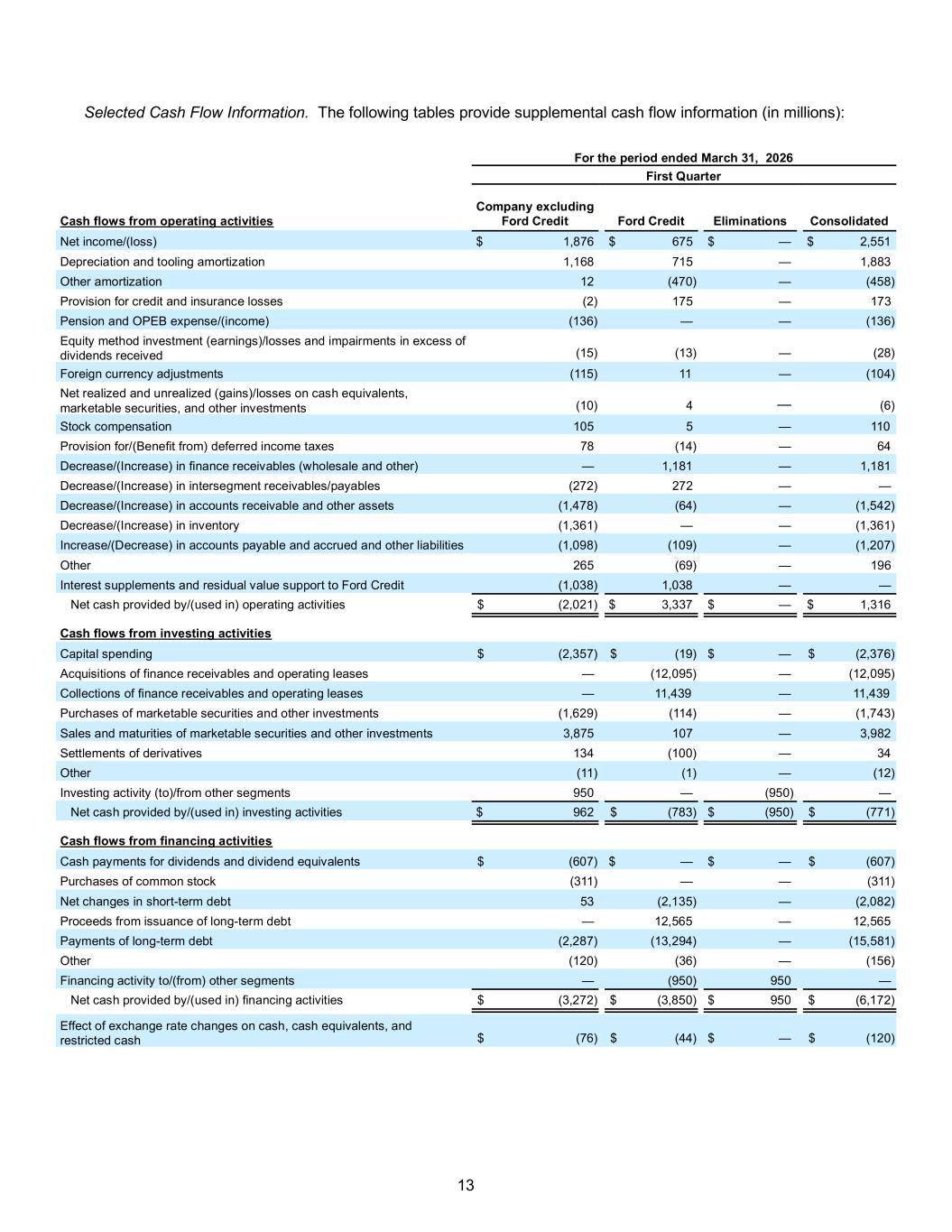
you move from q4 to q1 to have a usage of cash and that's because of the higher working capital that is needed uh we're typically at that point you are drawing down on inventory you're not typically producing as much the last couple of weeks of the year that was amplified for us with with the novellas disruption as well and you're paying out your payables so you're going to have that negative um start uh in addition for us this quarter our net spending was up and as i said we're investing in our future we've been really transparent about nine and a half to ten and a half billion this year and you're spending on uev you're spending on vests we're spending on um the future and then also um there's timing differences in there and we pay our compensation you know bonuses in q1 you also have timing differences associated with marketing incentive spends that are that are taking uh place as well so those are the big components we do expect this to reverse we do expect our uh free cash flow guidance to stay at five to six billion uh the big change as you know was the ieva tariff of the 1.3 billion and that we don't have certainty as to when that is going to come in so we did not put that in the guidance at this time if we get certainty that that's going to be sooner then we will certainly update accordingly and we thought
it's a little bit early to be pulling through some of the other cash items given some of the volatility uh that we're working through great thank you so much our next question will come from edison you with deutsche bank research hey thanks for taking uh our question wanted to to come back to something that you mentioned earlier about you know the u.s industrial base um how sensible or how realistic is it for ford to to play a bigger role in the kind of defense complex in you know in terms of supplying the pentagon well thank you for your question um as a most
american company report is always called the answer to duty um you know to support our country it was ventilators and covid of course um the arsenal of democracy um we work with as you know we are we are very successful with our government uh sales and business and pro um and so we have very close relationships through the vehicle side what i'd be able to say at this point um is two things first of all we are in early discussions the u.s government on some defense related projects uh we're not going to go into details of those today in addition and i would say equally important is ford's role as an anchor customer on on-shoring critical minerals and many other supply chain vulnerabilities we have in our country. And I think you should expect Ford to play an outsized role in manufactured-grade semiconductors, critical minerals like batteries and rare earths. And our supply chain is heavily engaged not only with our government, but new companies that are starting to emerge in our country to onshore some of this capability.
And I think maybe perhaps in short term that's the biggest role four can play in um you know helping our country understood understood and then separate topic um just coming back to autonomy uh it seems in robotex there's a lot more appetite now for for some of these tech companies like like uber and invaded sort of quasi subsidize um the oems has your kind of thinking about about robotex maybe evolved over the last you know three or four months i would say yes um not just over the last three or four
months it's something we've been uh frankly watching carefully as it evolves because we were involved in argo and are very well aware of both managing the fleet and and the sds system itself and the progress we kind of knew from argo what to look for as robotaxis became you know the SDS itself became more proficient. And we're starting to see that now. I think how you should think about Ford's approach is that we are completely focused on having the most efficient EV and the lowest cost of ownership in North America, number one. And number two, because of our pro business, we have the most fit repair and fleet management capability for new fleets, all fleets and that capability can be applied to all sorts of different fleets that's how we think about uh the market is emerges and um you know i think that's all we're prepared to say at this point thank you your next question will come from ryan brinkman with jp morgan brian your line is now open feel free to unmute oh thank you so much um thanks for taking the question is there an
update you might be able to provide on the relatively recently announced ford energy business? Has there been maybe proactive outreach to Ford from companies that you have existing B2B relationships with on the pro side of the business? How would you characterize that interest and maybe just remind on potential timing there?
Thank you, Ryan. Well, as you know, we are committed to over 20 gigawatt hours of capacity starting in the fourth quarter of next year that'll be mostly kentucky one and a little bit of marshall marshall will be really focused on uev but has some capacity for our energy business so that's the timing starting fourth quarter next year um the plants are coming online we are on track in the industrial manufacturing capability of of doing dc block it's not just the batteries themselves it's the containers it's the management of the battery that's all coming together as we expected we are very active in contracting customers as we speak we've had a lot of inbounds a lot of interest in ford because they understand that we have the best tech we have a lot of advantages financially and we have a great service and sales capability and of course the company has deep relationships with a lot of these as vehicle customers. So they know us. They know through Pro that we're a reliable company. And all I would say, Ryan, is that the energy business is the key element of our bridge to 8% margin.
Great. And then just as my follow-up, around the same time that Ford Energy was announced, you also broke news of the new strategic partnership with Renault. So I was just wondering if there might be any kind of update you can provide there, too, given that the first vehicles that were announced were electric vehicles. And I think that's an important, you know, piece of solving the puzzle in Europe. But I met with Hans Schep during the quarter. He's super energized about, you know, Renault on the commercial vehicle side in Europe. What do you think the broader potential for collaboration there might be?
Thank you, Brian, for your question. It's very pertinent. At this point, all we would say is that we believe that on the passenger car side, Renault has fully cost competitive platforms. And we intend to take advantage of that as Europe continues to electrify amidst the Chinese competition on passenger cars. On commercial, we have a very successful relationship, as you know, with Volkswagen, both on the pickup and the van side. And, you know, we have nothing to announce today, but certainly John, myself and the whole team are very focused on taking advantage of the Renault relationship across all of our businesses. And, you know, our commercial business at this point is still very profitable in Europe. We see it as the core of our profitability in the future on the vehicle side. And so we will do everything we need to, to maximize our scale and our cost advantage on commercial in Europe.
Great to hear. Thank you.
Operator
Our next question will come from Colin Langan with Wells Fargo.
Oh, great. Thanks for taking my questions. Just if I'm looking at slide 10, there's a 900 million of other, it's kind of unusual to have such a large item. Any color on what that is? And then also looking on that slide, cost is only 700 positive and includes the IEPA. I think the target is that you're supposed to get a billion of cost benefit for the year, which we mean underlying costs is actually worse year of year in Q1. So what is driving the weaker Q1 cost?
Well, first off, let me just hit on your question on other. That's really related to services, both physical and software. so that's where that's showing up so you had 900 million of software right well we also had compliance benefits services physical and software credit as well okay and then the cost piece is that just the cost savings pick up in the second half of the year this cost savings um if you're on slide 10 was related to the um q you tell me about the q1 bridge going from 1.3 billion in
board pro to the 1.7 yeah well i was just saying in the bridge it's 700 million positive but that includes 1.3 billion of iepah it's right so i mean x iepah it was negative so i'm just wondering why it's negative if the target for the year is a billion positive cost you have novellas in there as well okay and then just lastly if i go to slide 18 and i add up all the items it does seem like it's a little short of some good news uh seems like about 900 million short of all the items listed on that slide what is that is that volume you did mention regulatory savings just
other cost savings uh that were kind of missing in the walk i would say yeah it's a variety of other savings you know throughout the company as well so we thought that you know really it's um it cost is fairly flat on a year-over-year basis where we're really presenting very close to what we presented in the past the big changes as we've gone into this guide is we had the 1.3 billion uh resulting from the aifa supreme court ruling then we had the increase in the commodities which is offsetting so when you look at all of that together you're really looking at a pretty flat picture year-over-year because we already had a number of items that were offsetting.
Got it. All right. Thanks for taking my questions.
Operator
Of course. Your next question will come from James Piccariello with BNP Paribas. It appears you're on a phone, James. Star six will allow you to unmute.
Operator
We can hear you. Please go ahead.
Thanks. So I first want to ask about what's the level of confidence uh behind the 150 000 novellas recovery units you know based on what you've you know seen in your own production through the first quarter just you know where are we at on that and then as we as we think about the the raw materials right the 2 billion now in core commodities plus the 1.75 billion in alternative aluminum sourcing what was captured in in the first quarter on on that to combine bucket for for raw maps and and just how should we think about the cadencing for the rest of the year thank you so on the novella's recovery and the rebuild of
the mill i would say the confidence is high as jim i jim and i stated earlier um the restart date is on track all the enablers for the ramp up are on track and belt and suspenders if anything does go off we have contingency plans which means we have additional aluminum supply to ensure production so we feel good about the second half aluminum supply and not only our supply perspective but also as andrew said and in the speech we have a we're in a really good stock situation too so we're very confident we're going to need those units and i can just comment as well from a pro
perspective we still have very strong 26 model year orders we just opened up 27 those are we're seeing positive indicators and when you think about the novella's impacts we really postponed fleet orders and they're going to be required and needed in the second half and we haven't lost the customer so we are very confident um in in the demand in the second half of the year yeah and i guess i would just say that yeah we continue um you know with respect to novellas to expect a total cost of between one and a half to two billion we're tracking on on target you
know with respect to that i think you had a specific question in q1 related to temporary cost to source aluminum it's about 300 million so that that would include tariffs expedited freight and warehousing as well you know these things aren't straight line and there's just a lot of um factors that are involved well that's helpful thank you and then just as we think about the the 1 billion in ued in the ued platform and the marshall plant is that more second half weighted or pretty routable through the year in terms of just the investment and that's still tracking towards the 1 billion right so it's going to be um the uev investments we're already making some of those we're going to continue to make them through q2 q3 and q4 they will go up a bit as you get to q3 and q4 and then we also as i said we've got vests in there as well and we also have the oakville launch you know during that period of time also so three major items that are increasing in terms of investment.
Operator
Your next question will come from Itai McAuley with TD Cohen.
Great. Thanks. Hi, everybody. Just a couple of questions on the UEV platform. I'm just curious sort of what's left to do here as you prepare for next year's launch. And maybe thinking even out to 2029 towards your break even or profitability objective for model e how should we think about roughly the number of top hats that you're planning uh to launch on that platform maybe just lastly if i can sneak it in in the past you've mentioned using some new suppliers for uev uh any more updates uh you can share on how that's going thank you so itay this is uh kumar uh answering your first question on the let's say the industrial launch of the product there are four major pieces to it there's the hardware of key new parts like mega castings and you know uv has its own software platform so development and testing of
that platform excuse me third is the readiness of our suppliers with all the parts that are coming from suppliers and lastly number four is equipment installation at our plant we're in the middle of all four of these right now and all enablers and all indicators early indicators of these forward streams are on track so feel good about it your second piece of question number of top hats as As we've mentioned, it is a platform. We plan to have high volume at Louisville, but I think it's, we don't want to give away our plan to competition by talking about how many top hats or which top hats, it would be too early to do that.
The launch is bigger than the industrial launch, so we want to give you a little bit insight into the demand creation because that's critical for us yeah this is andrew we're confident on our launch plan in fact we're right on track to share our plans with dealers and take customer orders later this year and what we're really excited about is uh some of the ev market trends that we're seeing and and the the ev volume really heading towards the affordable space which really favors um this affordable uev platform positioning us right in the heart of the market so we're really pleased with that i think the the market is already predisposed to this price point but now
it feels like it's in the u.s the ev market is moving even closer to the uev platform yes um and there's really not much choice on a fully spec'd highly capable technological um vehicle platform that's really affordable uh you know there's not a lot of choice for customers a lot of compliance vehicles but this is a a real legitimate fully capable product for customers so we think the market is really moving and we understand that that's why we're working so hard on the demand creation um i think ued is is on as far as the new suppliers do you want to mention
anything about the new suppliers yeah i i would say that the ue uv team took a very uh interesting approach we did the toughest and the most complex commodities we designed them in-house this gives us a lot of control over those commodities and it gives us the ability to source those commodities at the highest quality and the best cost price points from new suppliers and these new suppliers have been great partners and we are working towards using that capability both the process as well as the new supply base in the rest of our portfolio what's exciting for me
is to see the team's pollination of the uev process new suppliers new way of developing a vehicle new IT tools that the development team uses. It's really starting to spread across the company. And to me, that's very encouraging to see because the greatest gift for UEV will likely be what it gives all of our other models and our team as a whole. Absolutely. That's very helpful.
Operator
This concludes the Ford Motor Company first quarter 2026 earnings conference call. Thank you for your participation. You may now disconnect.