Operator
My name is Layla and I will be your conference operator today. At this time, I would like to welcome you to the Ford Motor Company second quarter 2026 earnings conference call. All lines have been placed on mute to prevent any background noise. After the speaker's remarks, there will be a question and answer session. If you would like to ask a question during this time, please use the raise hand feature at the bottom of your screen. At this time, I would like to turn the call over to Maria Richardone, Chief Investor Relations Officer.
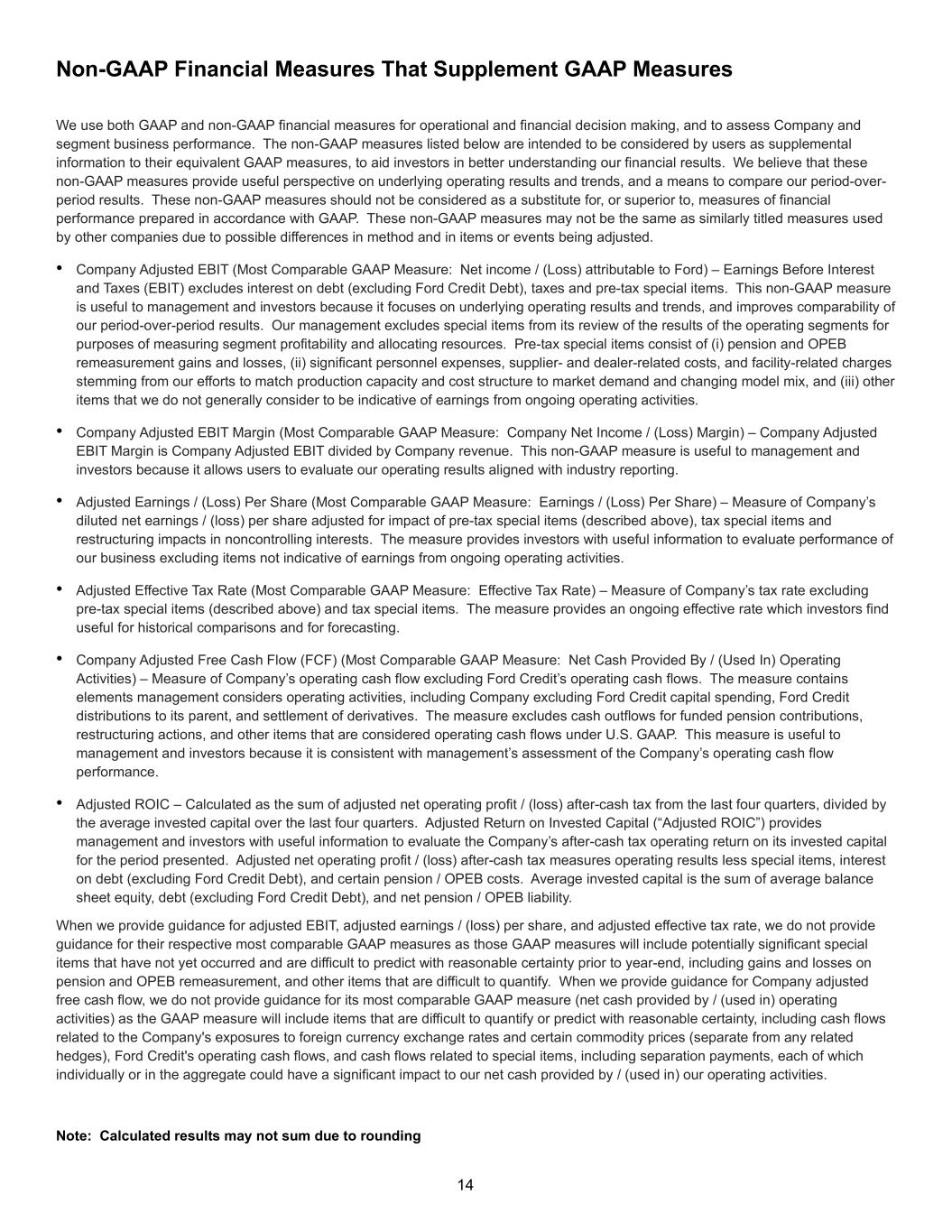
Thank you, Layla, and welcome to Ford Motor Company's second quarter 2026 earnings call. I'm Maria Richardone, Ford's new chief investor relations officer. I most recently came from Lockheed Martin, where I was treasurer and head of investor relations. I joined Ford because the opportunity ahead is tremendous. Few companies today are navigating a transformation of this scale and this consequence. My focus will be straightforward, clear, consistent communication with all of you, and ensuring the market understands how our differentiated strategy translates into profitable growth, capital discipline, and shareholder value. With that, let's jump in. With me today are Jim Farley, President and CEO, and Sherry House, CFO. Joining us for Q&A is Andrew Frick, President of Ford Blue and Model E, Alicia Bowler-Davis, President of Ford Pro, Humara Ghoultra, Chief operating officer, and Kathy O'Callaghan, CEO of Ford Credit. Jim will give a high-level overview of the business, and Sherry will provide added texture on the financials and guidance. We will be referencing non-GAAP measures today. These are reconciled to the most comparable U.S. GAAP measures in the appendix of our earnings deck. You can find the deck at shareholder.ford.com. Our discussion also includes forward-looking statements. Our actual results may differ. The most significant risk factors are included on page 20 of our deck. Unless otherwise noted, all comparisons are year over year. Company EBIT, EPS, and free cash flow are on an adjusted basis. Upcoming IR engagements include Mike Aragon, President of Integrated Services at the Goldman Sachs Communicopia and Tech Conference in San Francisco on September 8th, and the Morgan Stanley Annual Laguna Conference in Laguna Beach on September 17th. Now I will turn the call over to Jim.
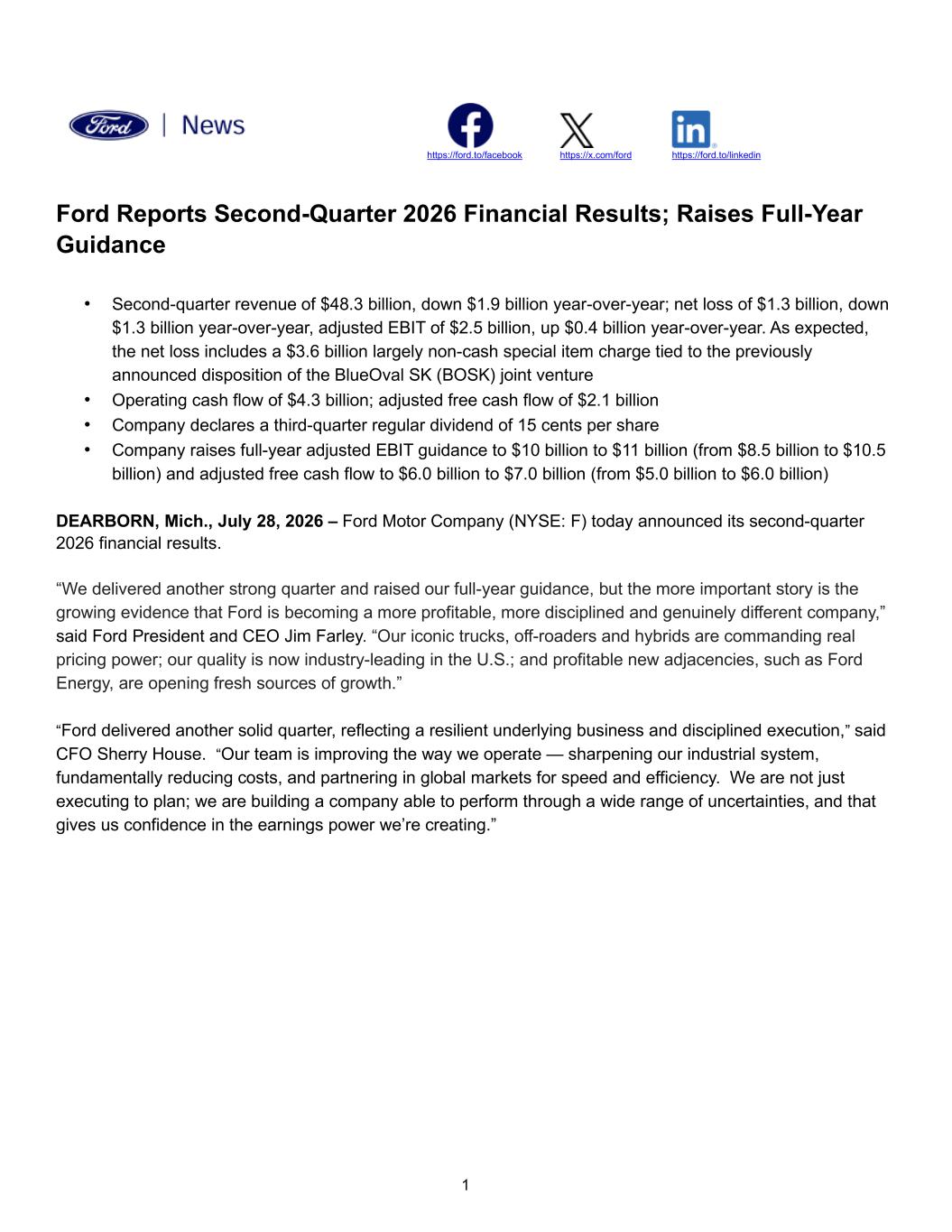
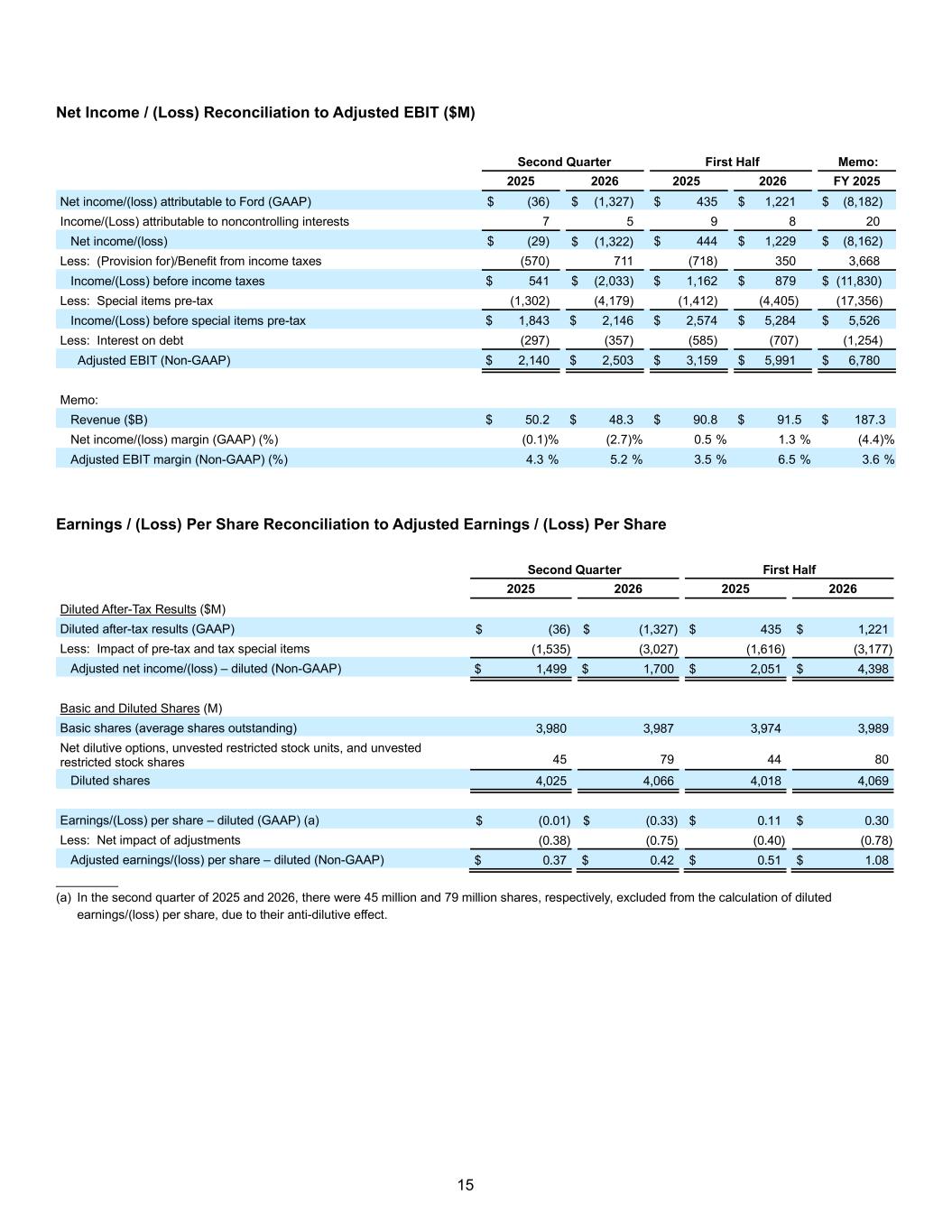
Thank you, Maria. I want to start by thanking our extended Ford team, all of our dealers and our suppliers for their commitment to delivering on our Ford Plus plan. I especially want to highlight all the Ford team members who work so effectively through the Novellas disruption. I also want to recognize our team in Canada, along with our labor partners, Unifor, under the leadership of Lana Payne, for reaching a ratified three-year agreement covering all of our Canadian employees. Our business in Canada and our manufacturing operations in Oakville are really important to our future at Ford. And this agreement also underscores how important USMCA is to our future at Ford and the opportunity we have to build a framework that levels the playing field for North American manufacturers, just like Ford, against the mass imports from Japan and South Korea that carry a huge currency advantage. In the quarter, we delivered a strong performance, generating $48.3 billion in revenue and $2.5 billion in adjusted EBIT. We're also raising and narrowing our full-year adjusted EBIT guidance to between $10 billion and $11 billion, a $1 billion raise at the midpoint. The most important part of the quarter is the growing evidence that our strategy is working. Ford's becoming a more profitable, more disciplined, and generally different company. Our Ford Plus plan focuses on three complementary areas. Of course, we have first our core auto operations, our retail and commercial vehicles that are becoming more profitable and more dependable. Second, we have the software and physical services layer, which is growing, margin accretive, and built into everything we do at Ford. And third, adjacency businesses, such as Ford Energy, that open all new sources of profit for the company. We play only where we have real competitive advantage, or we can build one. And we're ruthless about where we put our money. Every dollar must earn durable returns and drive profitable growth. So let's talk through each of these areas. On core automotive operations, our execution is underpinned by a fundamentally stronger industrial system. For more than three years, we've been relentless about building top quality, and that work is showing up. In our home market, Ford finished number one among all mainstream brands, J.D. Power's 2026 initial quality study. We see this win as a first down payment on a much more consequential virtuous circle, Going from initial quality to long-term durability, lowering our warranty costs even further, fewer recalls, stronger customer loyalty, more pricing power, and for our conquest and growth, improved resale value. Ford's quality renaissance goes hand in hand with our equally intense drive to improve our cost structure. We have significantly reduced our warranty and material costs since 2024, and we continue to optimize costs as we enter a heavy new product launch period over the next three years. Turning to the products themselves, we're reinforcing our strength in our trucks, our vans, our personality utility and off-roaders. iconic brands and distinctive products delivering real pricing power we can see it in the quarter in ford blue f-series remains the number one truck brand outselling the closest competitor by more than 80 000 units in the first half of this year and it's on track for 50 straight years at the top that's five decades of trust and capability with our customers, and we intend to extend our lead. But it's not just F-Series that makes our truck business strong. We continue to grow our customer base across our entire lineup that spans every price point in the U.S. truck market, from our Maverick all the way through the top end of our Super Duty. And there's much more to come soon, including an all-new F-Series and an all-new Super Duty. We also continue to see momentum with our off-road enthusiast vehicles. In fact, they now make up 25% of our U.S. sales in the second quarter. We made a huge bet on Bronco, Tremor and Raptor, and has paid off with higher growth and higher margins. And these vehicles are bringing new customers to Ford. They're younger, more affluent, and more geographically diverse, and we are investing to grow our leadership in this space. Stay tuned. Hybrids are another strength for Ford we plan to build on. The F-150 hybrid leads among full-size trucks, and the Maverick hybrid achieved record sales in the first half to become America's best-selling hybrid pickup. We plan to extend our hybrids across our entire lineup over the next several years. On the commercial side, Ford Pro is the cornerstone of our global business and holds commercial vehicle market share leadership in both North America and Europe. And the Oakville expansion I referred to earlier is on track to launch in the fourth quarter of this year, adding up to 100,000 units of additional super duty capacity. We're investing in super-duty production to increase our manufacturing flexibility, to add resilience, and to meet pent-up demand. These investments will help drive pro's future financial performance. And turning to Model E, we're aggressively driving down Gen 1 costs and will become a major-scaled competitor as we invest in affordable, versatile EVs. the louisville plant changeover for the new uev platform is well underway head forward you may have seen prototypes now of our first vehicles off the uev platform testing on roads across the u.s customer deliveries will begin next year the first uev product will compete in the affordable heart of the us ev market where we'll offer customers a wholly new proposition that we can't find in the market today. It starts around $30,000. It has more cabin room than the Toyota RAV4, plus it has a pickup truck bed. It has bi-directional charging capability, incredibly fun to drive, and personalized technology in the experience. In fact, we just announced Apple last week, as you know, will be the embedded map provider for every UEV platform vehicle. And we are very excited to show you much more about our move to be among the leaders in the EV space. In Europe, as you saw last week, we announced our agreement with Geely, which will bring speed and capital efficiency to our European operations. The second area of our Ford Plus plan is software and physical services, including our parts business. These businesses have significant room to grow, are central to our 8% margin target by 2029. And the idea is really simple. Combine our digital services, our large dealer network, our physical services into one seamless experience, building a flywheel across software, vehicles, and parts. On software, we're turning a one-time sale into a lifetime relationship, we said. We now have over 14 million connected vehicles. That's an enormous base to grow from. Our goal is to activate that base, driving real digital usage and convert engagement into reoccurring high margin revenues. Our services aren't just digital. They're also physical. We continue to grow our parts business. For example, we're expanding our parts catalog. We're growing our sales to U.S. wholesalers and co-investing with our dealers to increase service base and our mobile fleet. Customers love our mobile service. We have over 5,000 mobile service vans and trucks on the road. And we see net promoter scores much higher for remote service, leading to higher loyalty. In fact, in Q2, we delivered 1.5 million remote services at Ford, 1.1 million just in the U.S. Finally, we're making progress on our adjacent businesses. Earlier this year, we launched Ford Energy, reporting through Model E. It's a strategic business for us at Ford, but one with a very short payback. Ford Energy can win because it's built on capabilities few companies can match. tariff resilient, world-class U.S. manufacturing, leading battery technology, an iconic American brand that is already familiar to communities who are most in need for grid support and infrastructure upgrades, and of course, the ability to leverage our vast auto service expertise. By late next year, we expect to reach 20 gigawatt hours of annual capacity for Ford Energy, which is and we have potential to expand beyond that we believe this will position for energy among the leading energy storage manufacturers in north america scale matters in this business it drives efficiency improves the levelized cost of energy and creates a competitive advantage that is hard to match without the scale of global auto to leverage we're building a business that can integrate further into the energy ecosystem, and that aspires to create value far beyond the sale of our DC blocks. Our agreement with EDF Power Solutions North America is a good step to serve a broad and enduring customer base. We're in talks with a wide range of strategic customers and look forward to sharing more with you at the right time. As you can see, Ford is becoming more disciplined, higher return company. We have strong automotive business with an increased fit industrial system. To complement that business, we're scaling high margin software and physical services around a seamless customer experience while leveraging Ford credit. And adjacent to all of that, we're building new businesses like Ford Energy, where we can establish a competitive advantage. Over to you, Sherry.
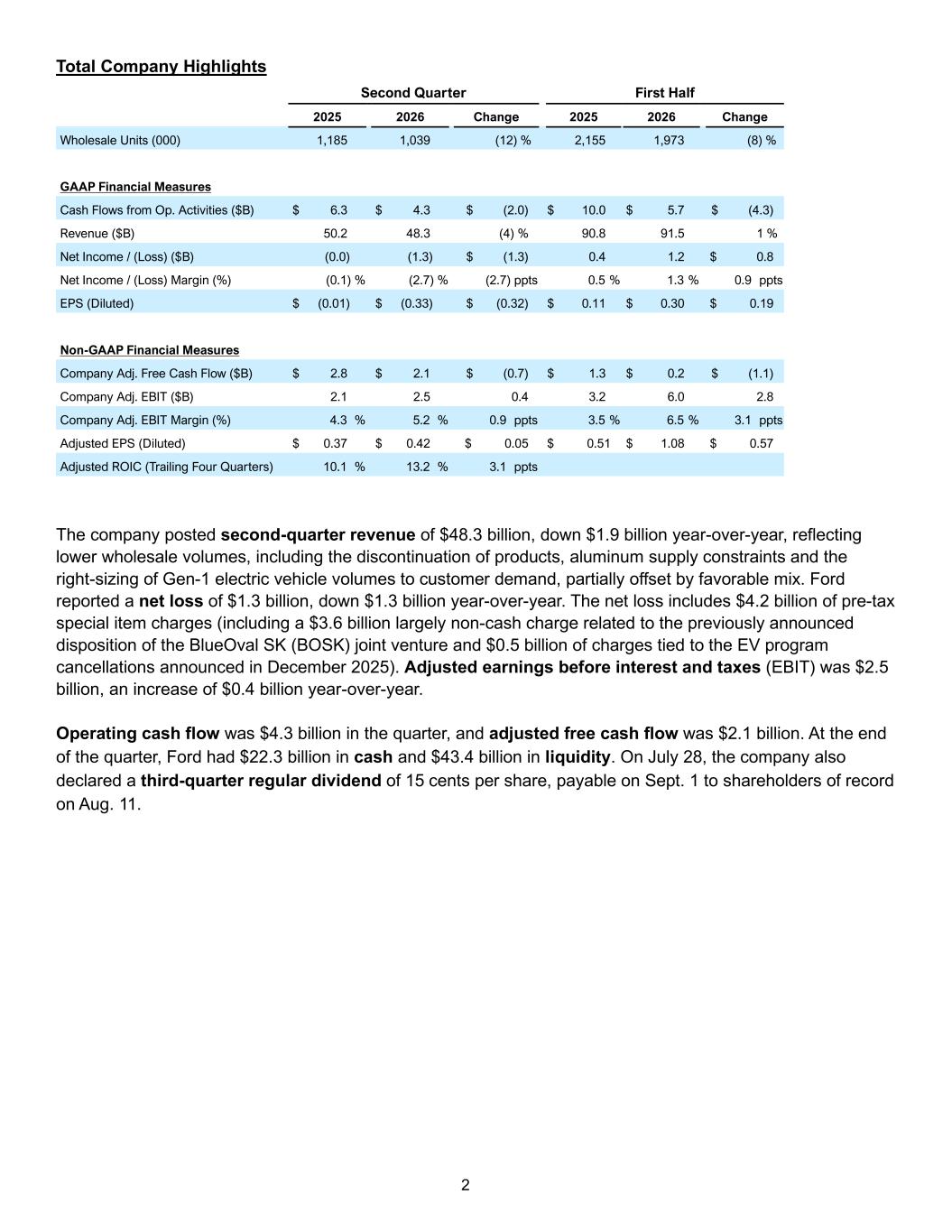
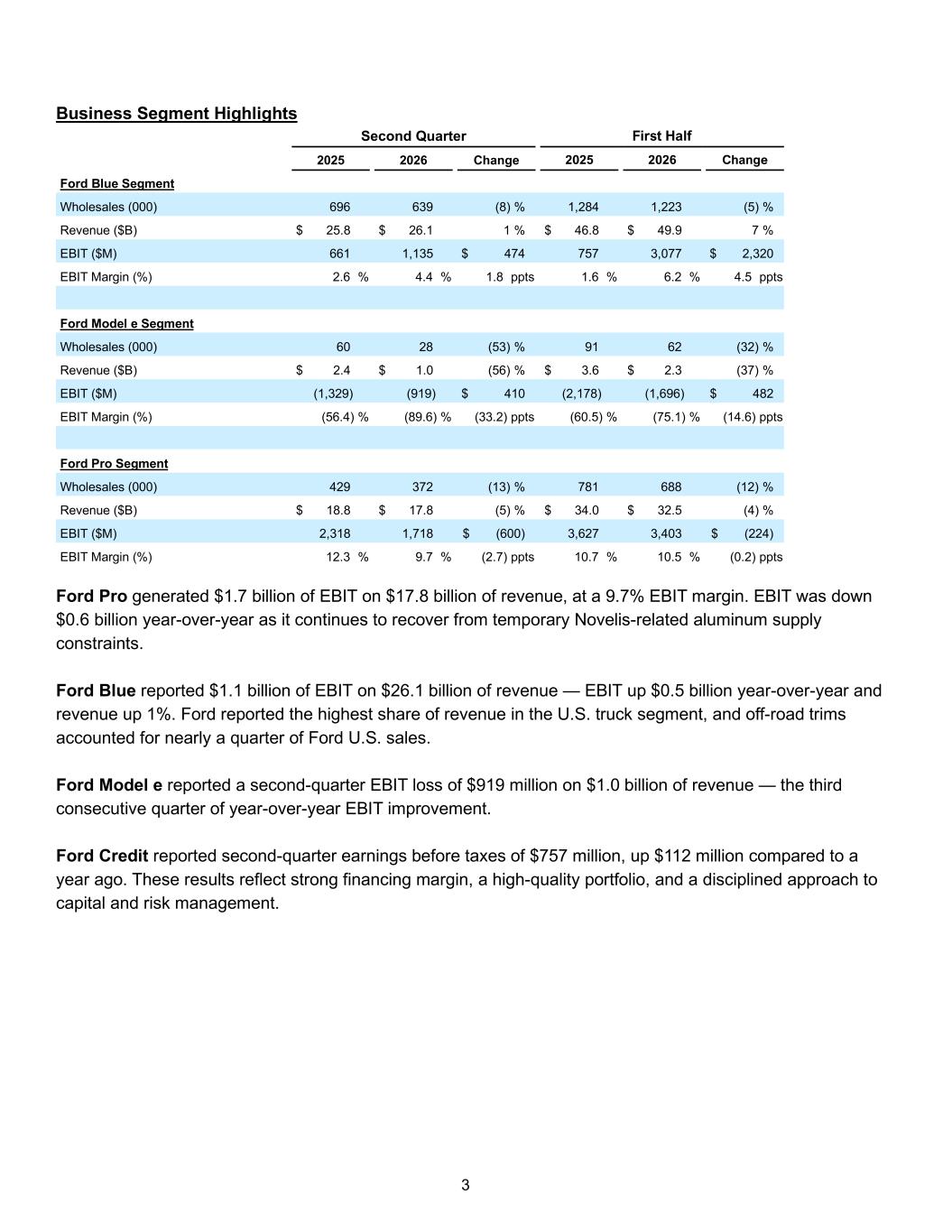
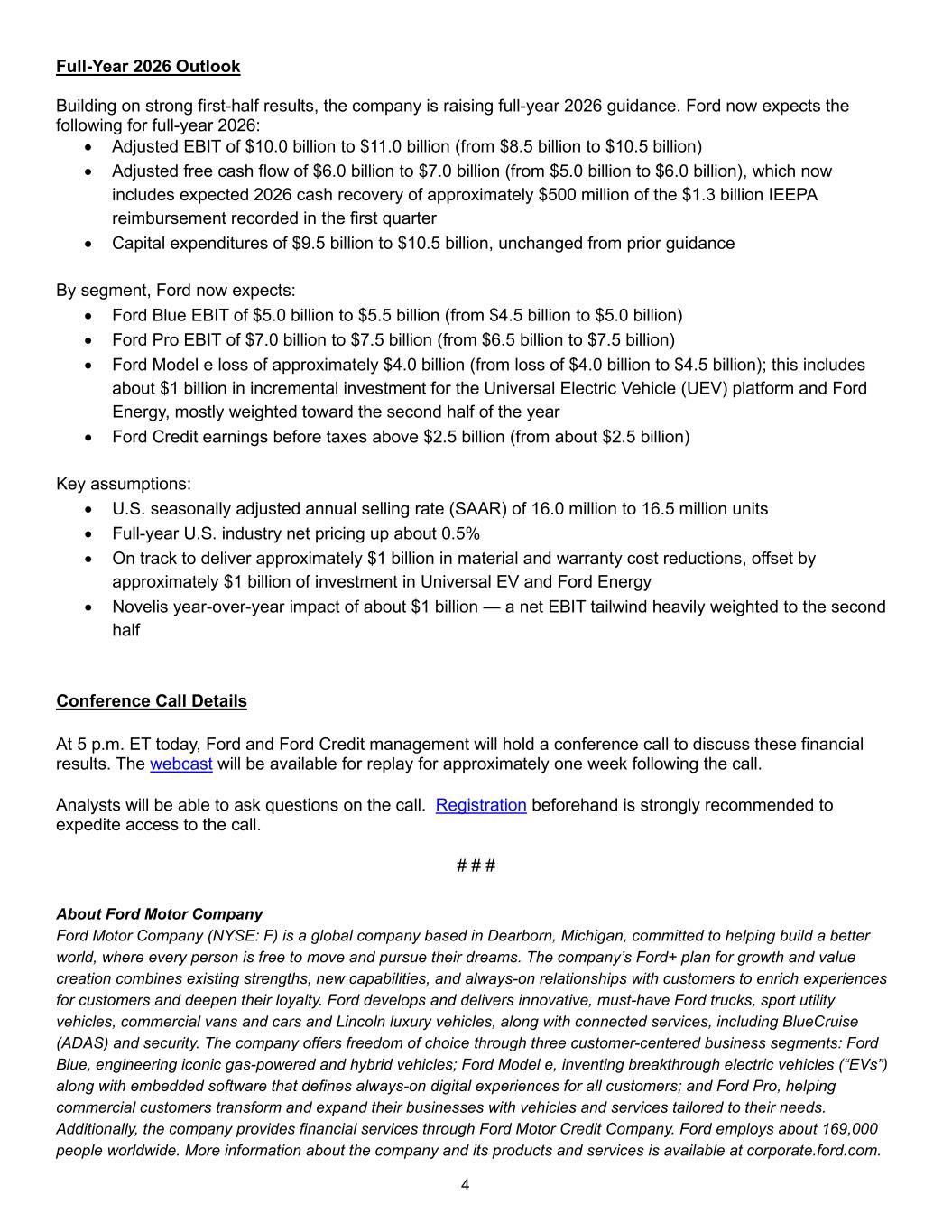
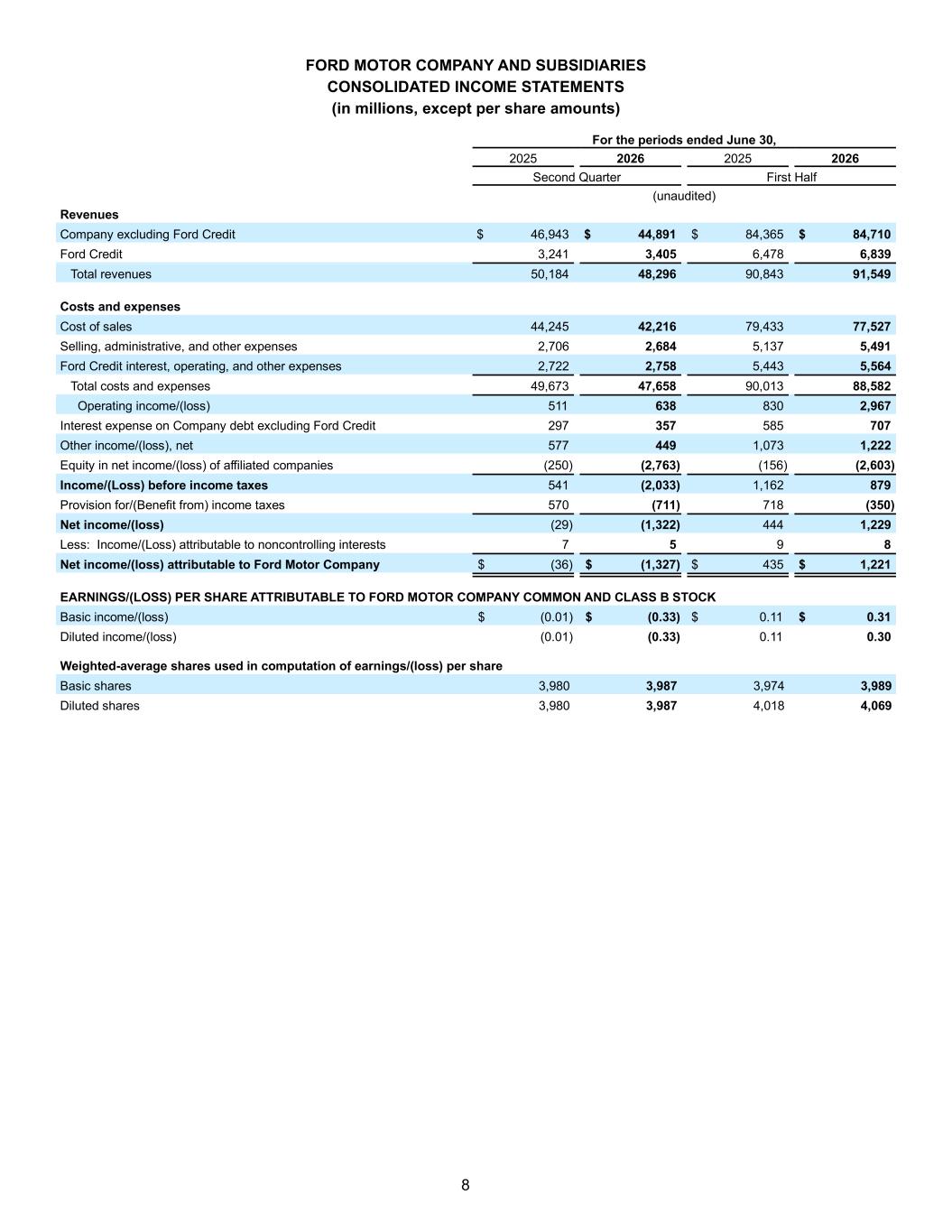
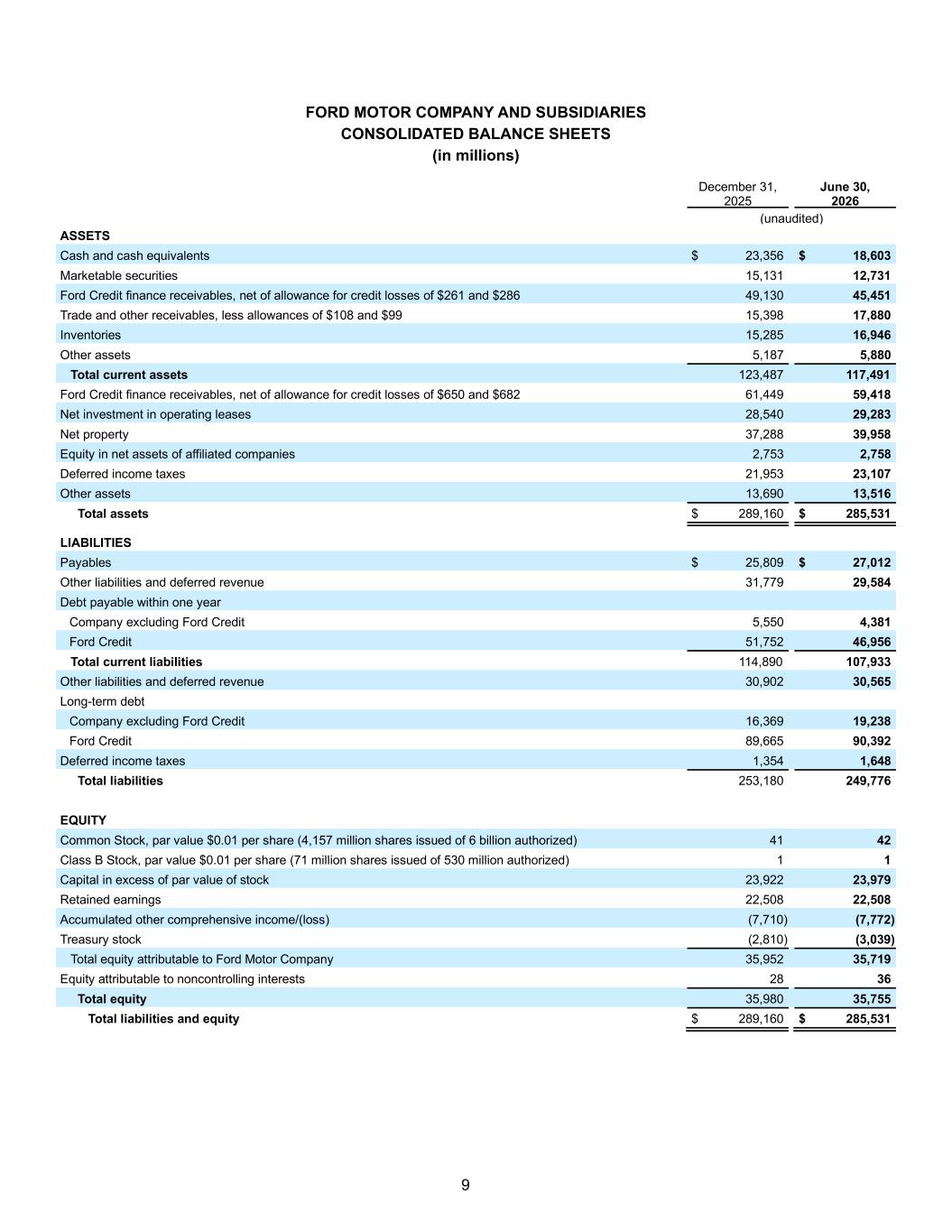
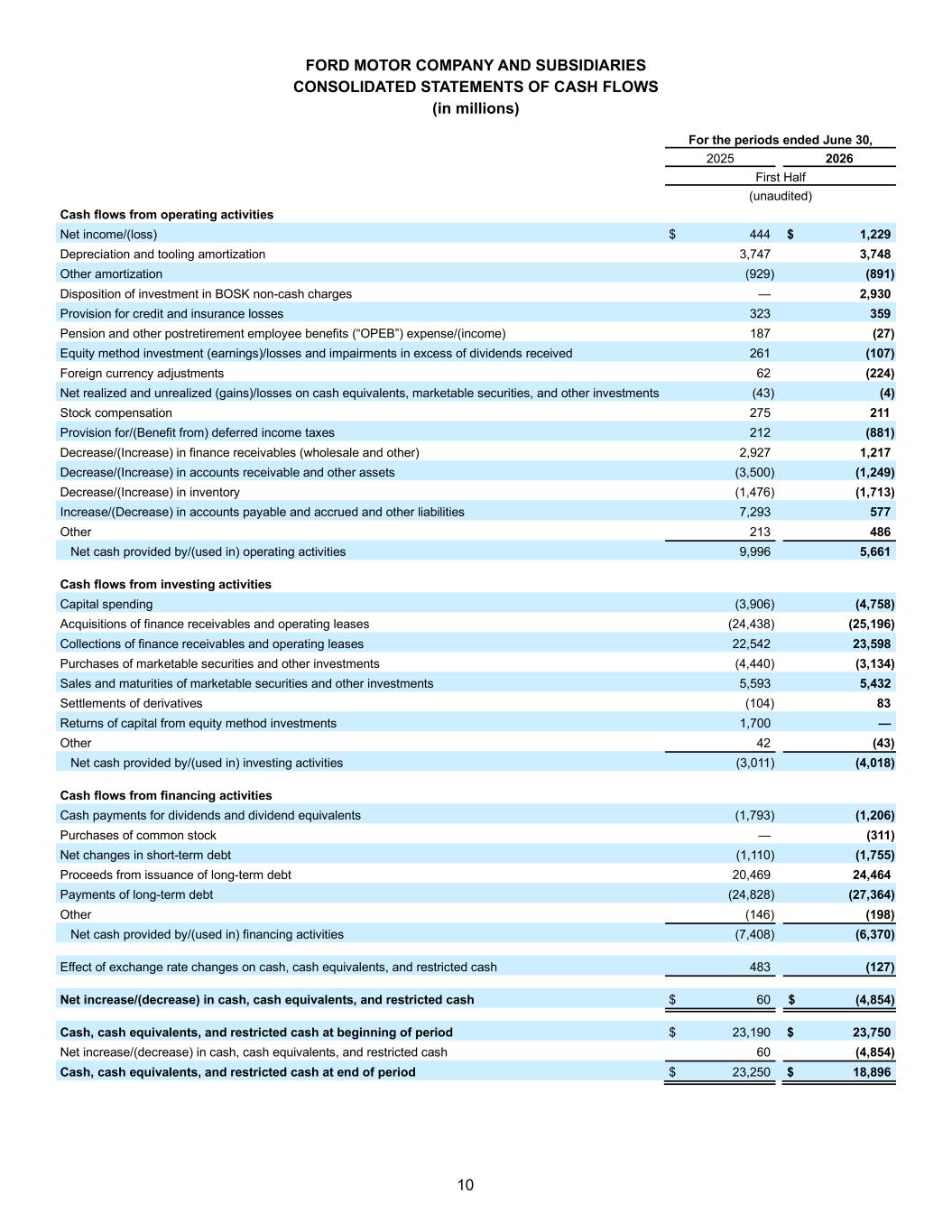
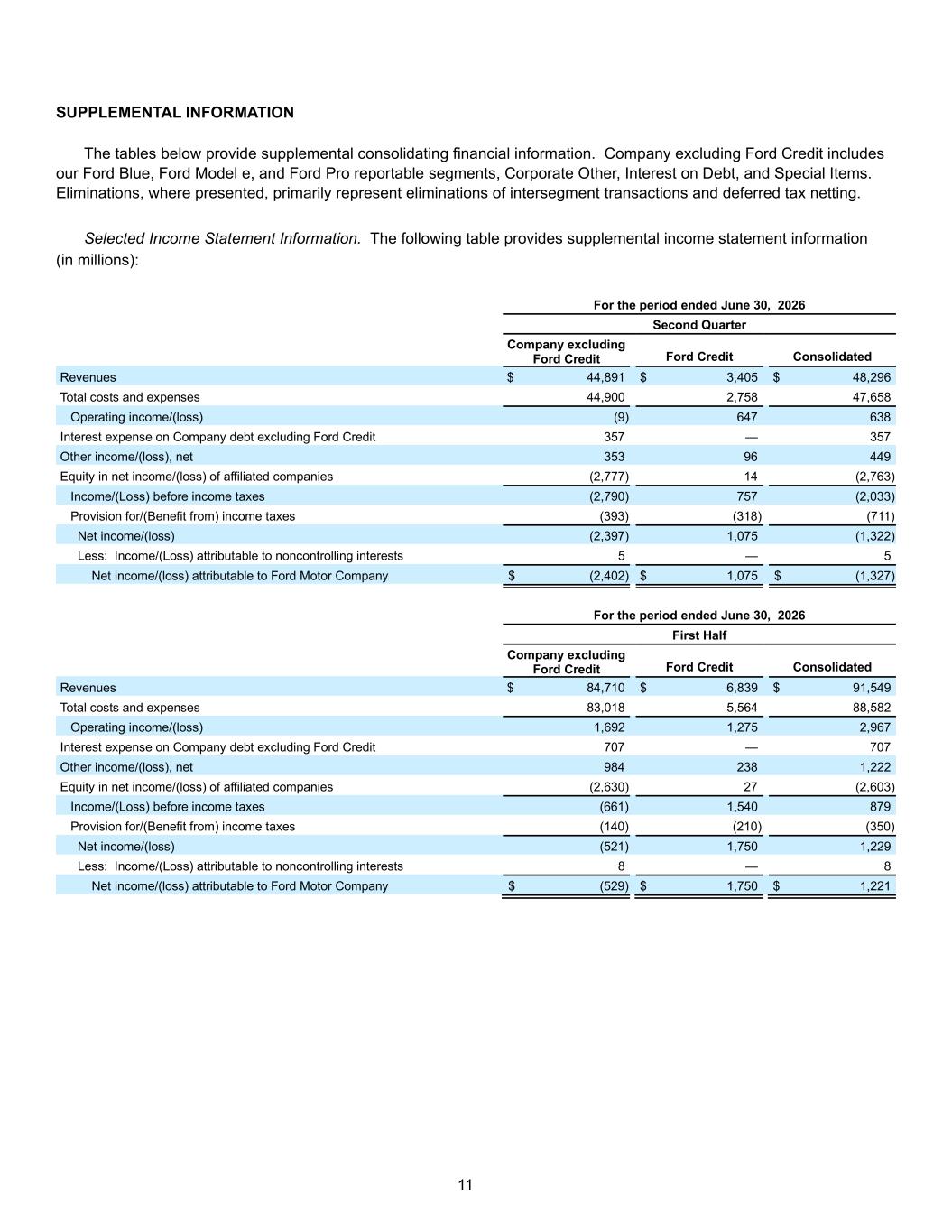
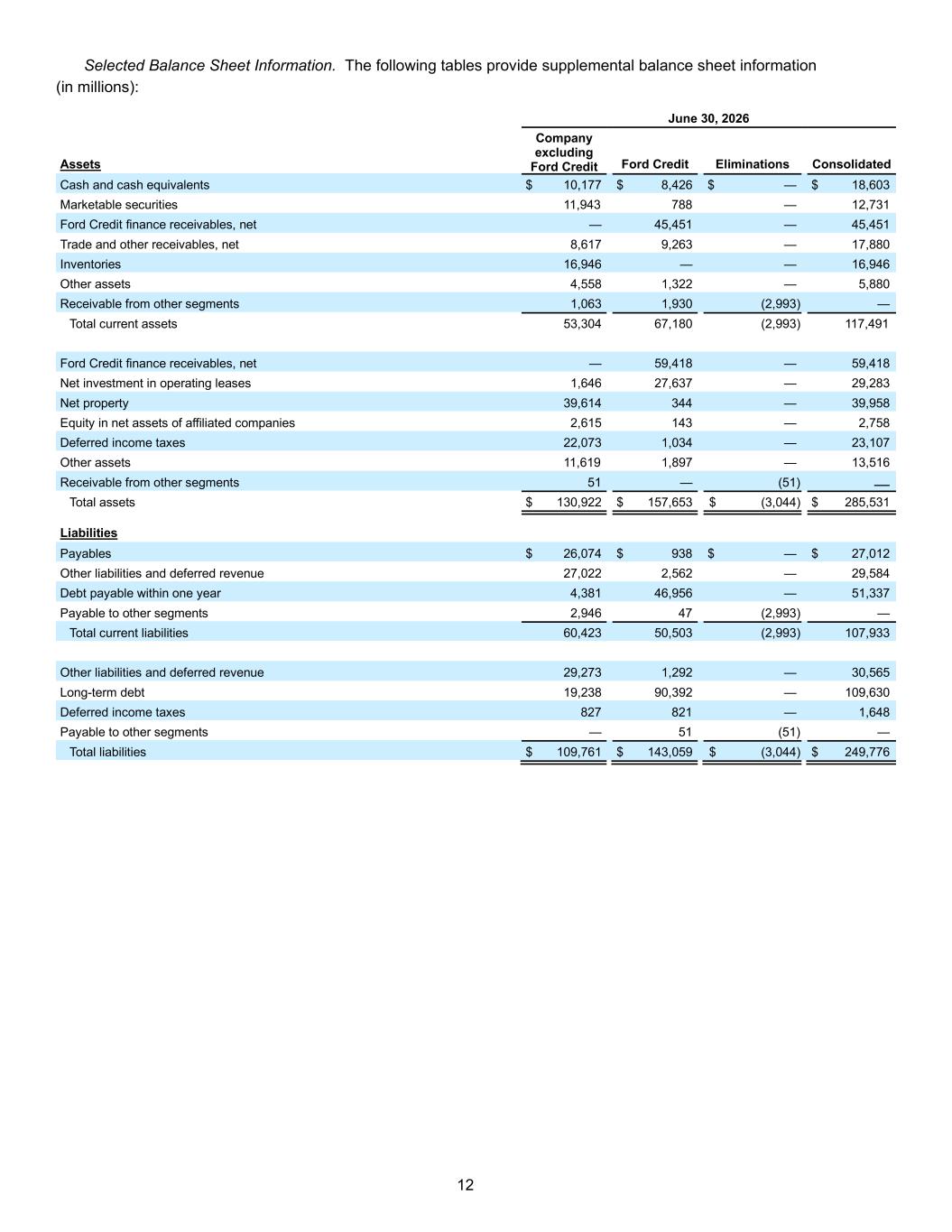
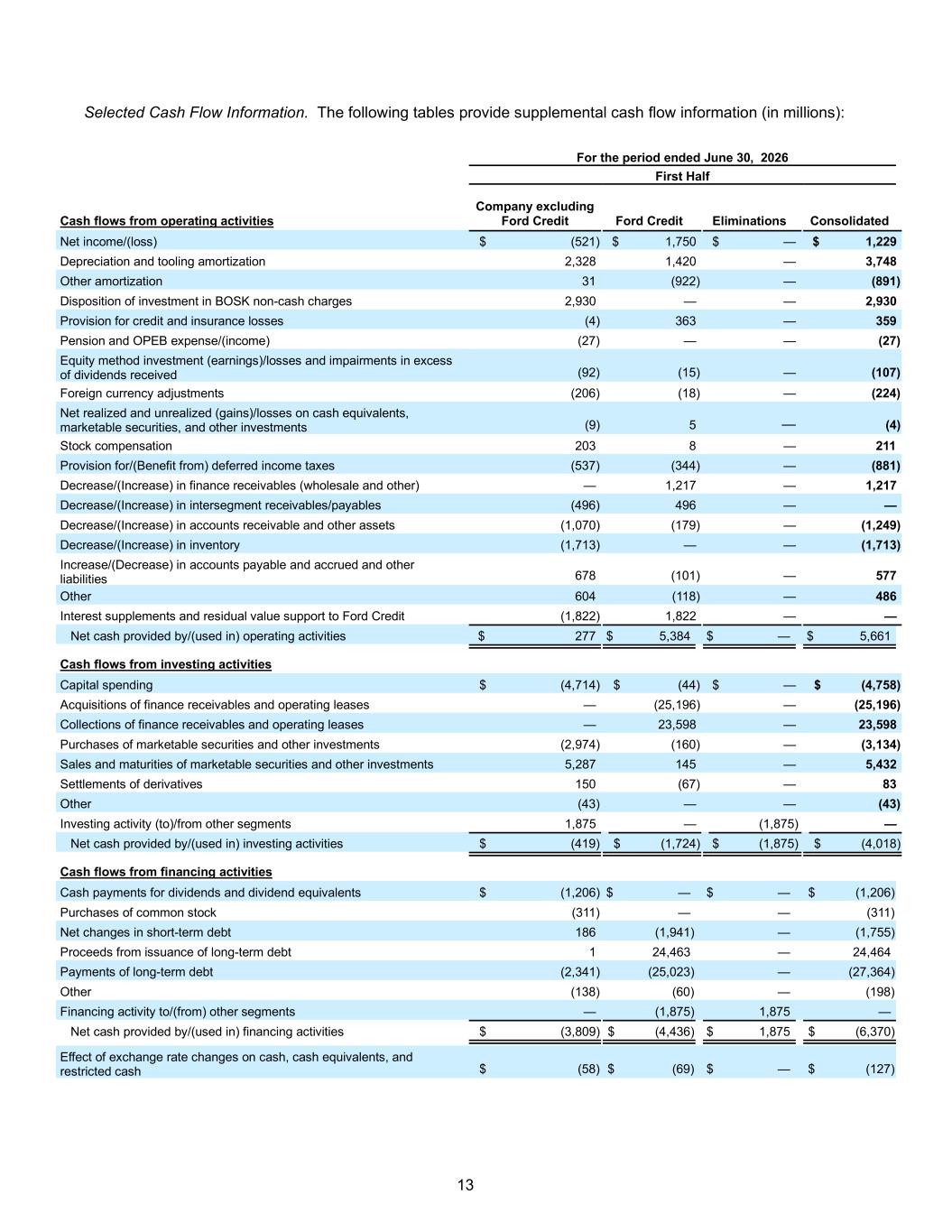
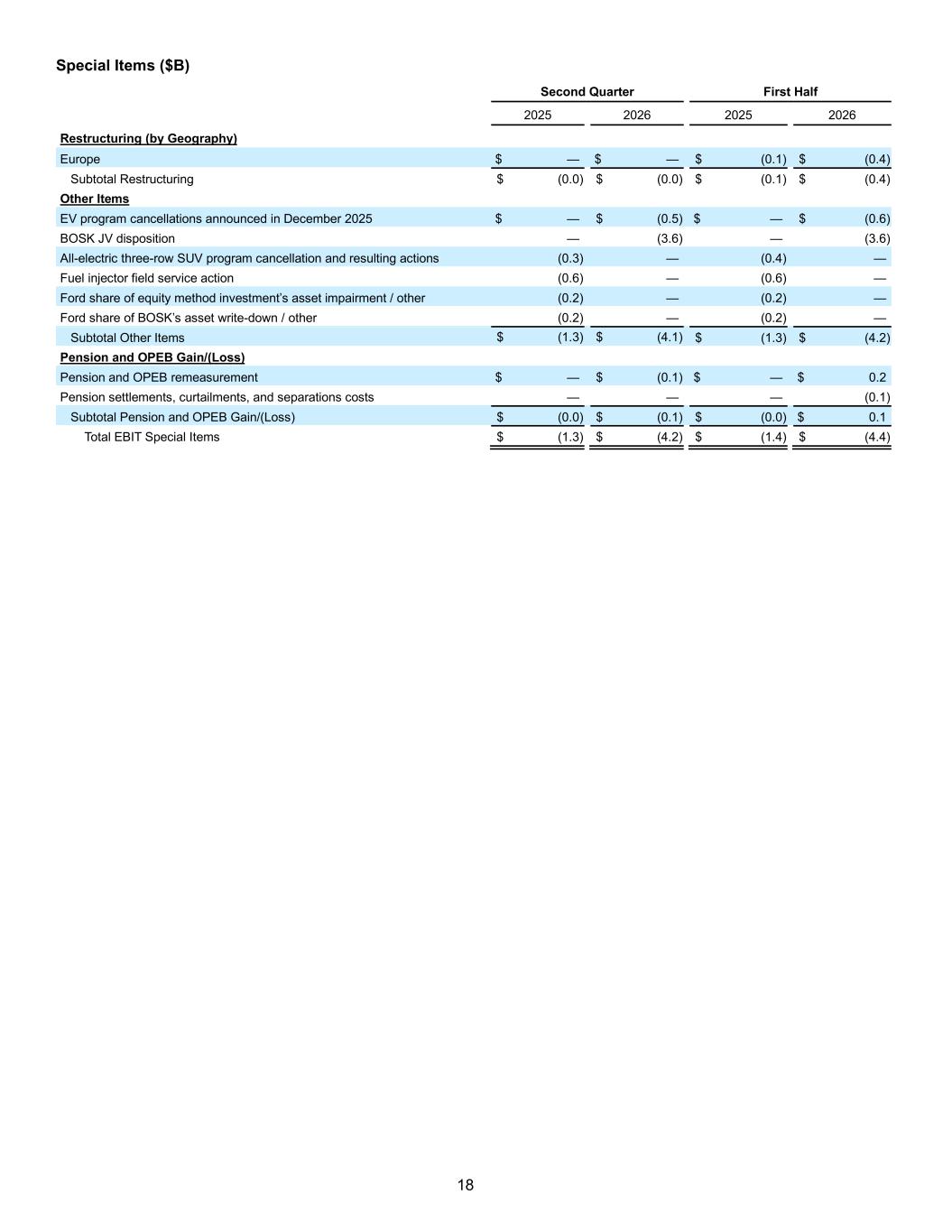
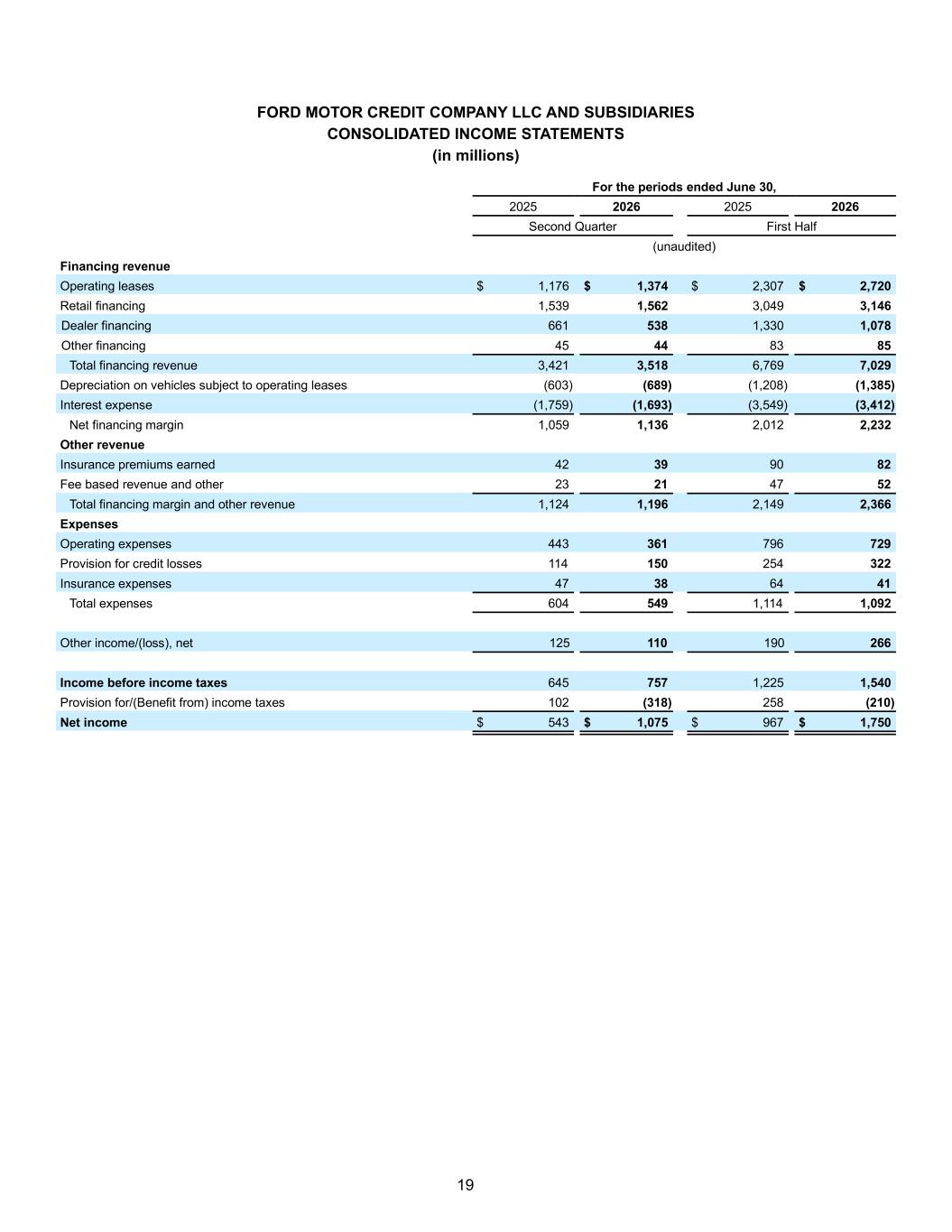
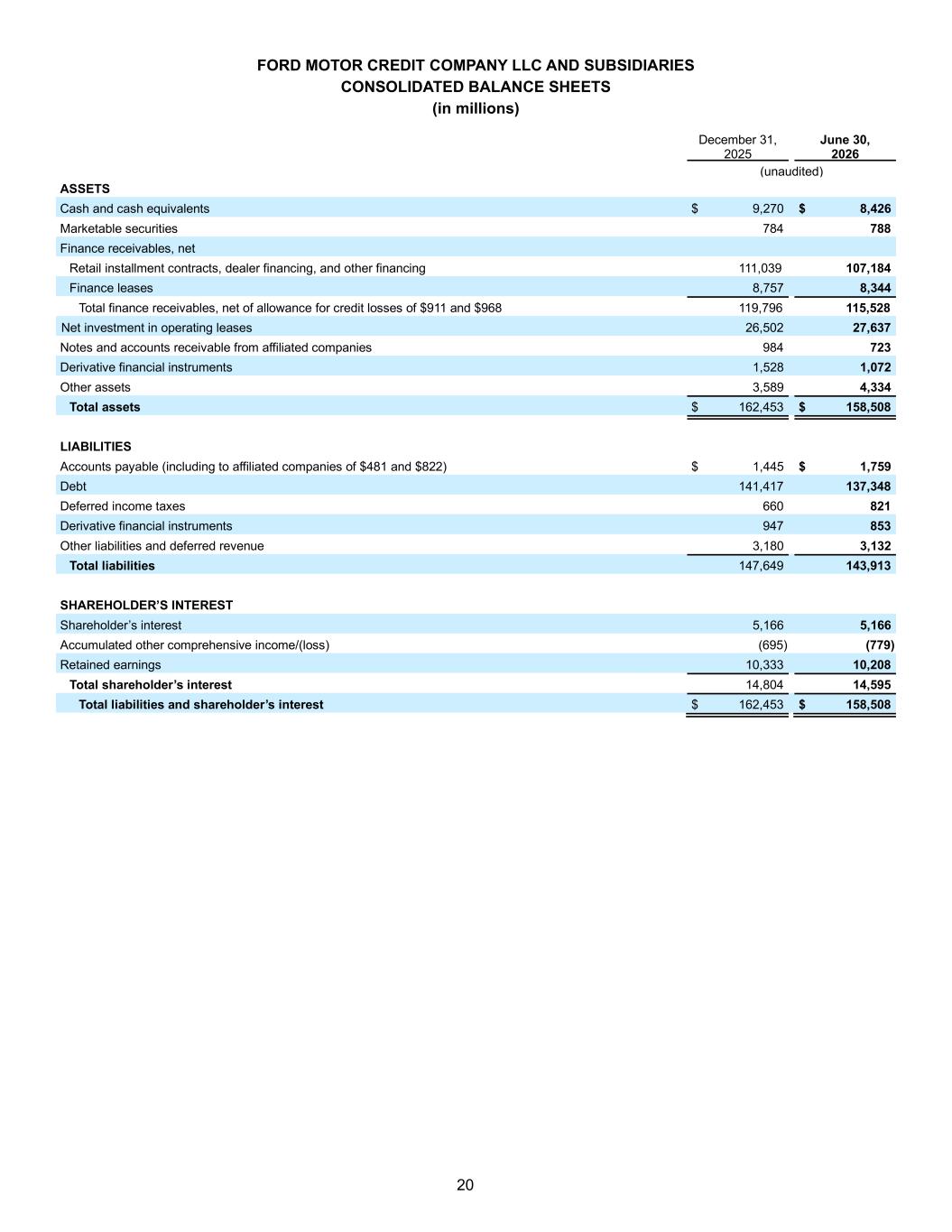
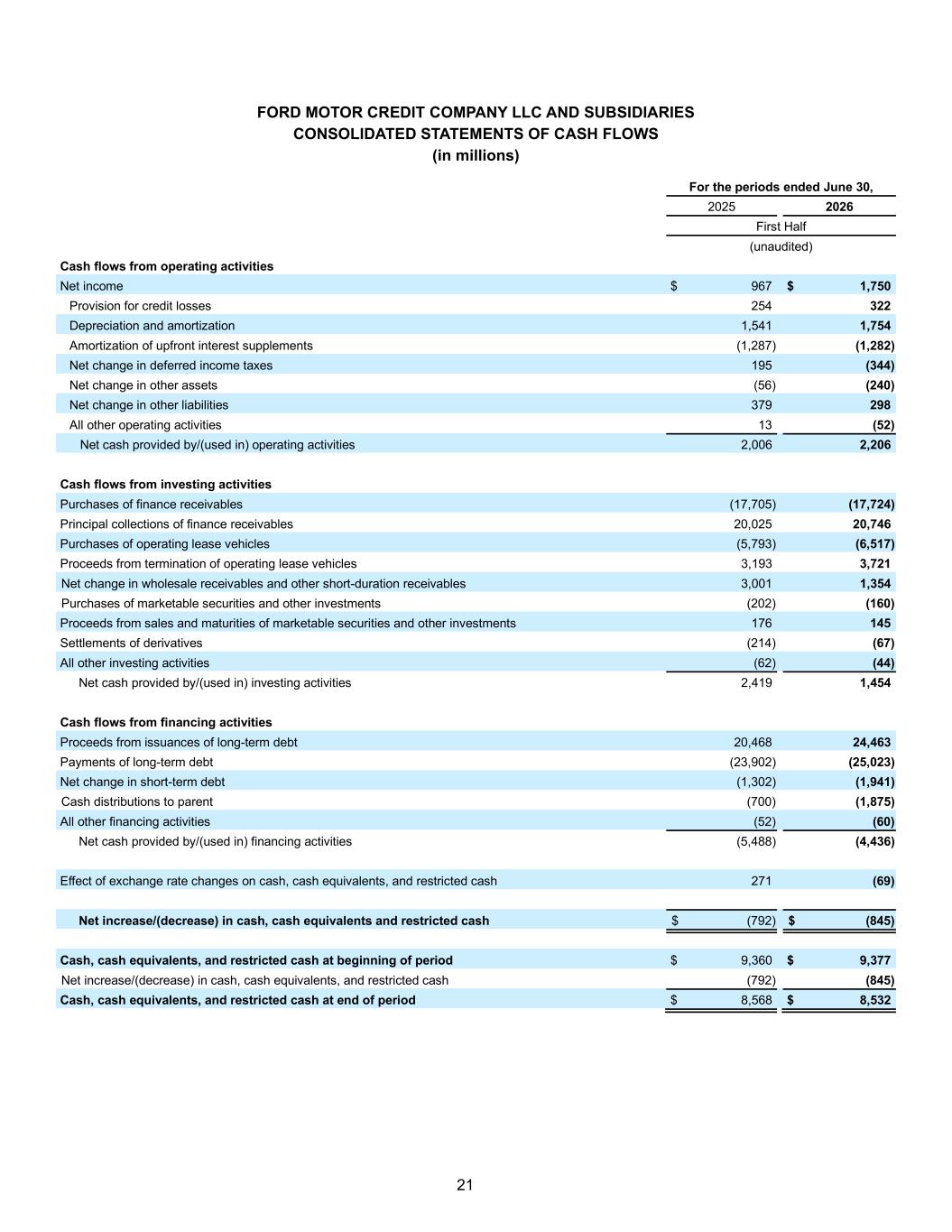
Thank you, Jim, and hello, everyone. Our second quarter results demonstrate our resiliency and intentional actions to drive profitability. In a complex macroeconomic and industry environment, we generated $48.3 billion in revenue, down 4% year-over-year, while earning $2.5 billion in adjusted EBIT, up 17%. Revenue was impacted due to expected volume reduction stemming from lower novellus aluminum supply and the sun setting of certain vehicles as we refresh our portfolio. Consistent with our deliberate actions to enhance profitability, this quarter's EBIT strength was largely a result of strong mix and net pricing. We generated $2.1 billion in company-adjusted free cash flow and ended the quarter with a strong balance sheet, including $22.3 billion in cash and $43.4 billion in total liquidity. We remain committed to our investment-grade rating in returning capital as shareholders. In fact, over the last five years, we have returned more than $16 billion through dividends and anti-dilutive share repurchases. And today, we announced a third quarter regular dividend of 15 cents per share. Before unpacking the segment results, I want to address our $1.3 billion net loss in the quarter. As we announced in December 2025, we recognized a one-time special item charge of $3.6 billion, of which approximately $500 million was cash. This charge was related to the May disposition of the Blue Oval SK Battery Joint Venture. We expect the vast majority of the remaining cash charges related to our December announcement, which total up to $2 billion, to be completed by the end of the year. Operationally, we are successfully navigating the Novellis Aluminum Supply Recovery Plan, and we remain confident in our net $1 billion EBIT improvement, heavily weighted to the second half of the year. Year to date, we have incurred about $800 million in Novelis-related temporary costs and now expect a full-year cost impact of about $1.5 billion. The hot mill restart is on track and contingency material is secured. U.S. inventory of 52 retail day supply is slightly below our target of 55 to 65 days, and we expect to return to targeted levels as the recovery progresses. Turning now to the core automotive highlights, Ford Blue delivered $1.1 billion in EBIT on revenue of $26.1 billion. Our revenue and EBIT were up 1% and 72% respectively, reflecting favorable product mix enabled by U.S. regulatory changes and higher net pricing, more than offsetting an 8% decline in wholesales. These results demonstrated that our focus on off-road vehicles and passion products is resonating. We had record sales for the Bronco family in Q2, and our three-row adventure utilities are growing, with Explorer and Expedition retail sales up 22% in the quarter. F-150 remained strong while inventories recover with a disciplined go-to-market execution in Q2 that included the highest retail share, lowest incentive spend, highest share of revenue with sales focused through our most profitable channels. Ford Pro delivered a solid quarter, despite significant headwinds, delivering $1.7 billion in EBIT on $17.8 billion of revenue, down 26% and 5% respectively, primarily due to temporary Novelis disruption. We continue to see growth in software and physical services, highlighting the durability of our ecosystem strategy, even in periods of disruption. This resiliency positions Pro to benefit from second half volume recovery. We are confident in the pricing power of our Pro business, and although early, 2027 model year customer contracting in North America is off to a fast start, placing us about a month ahead of where we were last year. For Model E, we reported an EBIT loss of $919 million on revenue of $1 billion, reflecting a 31% EBIT improvement on declining revenue. This was our third consecutive quarter of year-over-year EBIT improvement. Progress was driven by structural cost reductions, right-sized Gen 1 volumes, and lower U.S. incentives following regulatory relaxation. We continue to prioritize profitability and capital efficiency on our path to break even. As such, we expect to improve Gen 1 EBIT by approximately 40% year-over-year in 2026, paving the way for our investments in UEB and Ford Energy. Our software and physical services keep getting stronger. Total paid subscriptions grew about 50% to roughly 1.6 million, including more than 900,000 Ford Pro Intelligence paid subscriptions. Customers are actively choosing to pay for these services beyond an included trial, a direct signal of value. We've also seen positive net pricing in our parts business in line with the industry. These services carry attractive margins and create recurring customer relationships. Ford Credit delivered another solid quarter with EBT of $757 million, up $112 million. These results reflect our strong financing margin, our high-quality portfolio, and our disciplined approach to capital and risk management. We remain confident in the quality of our portfolio and ability to continue supporting the market shift toward longer-term financing options for customers. We also continue to execute on our multi-year certified pre-owned enterprise strategy, which ultimately protects our residual values. According to third-party data, our year-to-date CPO unit sales growth in the U.S. is over 20%, now positioning us as the number two CPO brand in the market. Now I'll turn to our 2026 outlook. For the full year, we now expect company-adjusted EBIT of $10 billion to $11 billion, narrowing the range and increasing the midpoint by $1 billion, driven by strong pricing and mix. An increase in adjusted free cash flow to $6 billion to $7 billion, which now includes flow-through of this higher EBIT in our expectation to receive in 2026 about $500 million of the $1.3 billion IEPA reimbursement we booked in Q1. And capital expenditures remain unchanged at $9.5 billion to $10.5 billion as we invest in higher return growth opportunities. Our guidance does not include potential impacts of a significant escalation in the Middle East or a material downturn in the U.S. economy, which could have a substantial impact on industry demand. For our full-year segment outlook, we now expect an increase in Ford Blue's EBIT range to $5 billion to $5.5 billion, a narrowing of Ford Pro's EBIT range to $7 billion to $7.5 billion, an improvement in Model E losses to about $4 billion. This includes about $1 billion in incremental investment for UEB and Ford Energy, mostly weighted towards the second half of the year. And for Ford credit, EBT is now expected to be above $2.5 billion. Our guidance continues to assume a U.S. SAR of 16 million to 16.5 million units, commodity headwinds of just above $2 billion, and we remain on track to deliver $1 billion in material and warranty cost reductions in 2026, enabling our increased investments in UEB and Ford Energy. For U.S. industry pricing, we now expect full year to be about a half a point higher at plus 50 basis points. The accomplishments this quarter reinforce our trajectory. The investments we are making in our truck lineup, UAV platform, Ford Energy, and high margin services will bolster our margins over time, keeping us firmly on the path to our 8% EBIT margin target by 2029. With that, let's open the line for your questions.
Operator
We will now begin Q&A. To ask a question, please use the raise hand feature, which can be found at the bottom of your screen. Please limit yourself to only one question. Your first question will come from the line of Andrew Prococo with Morgan Stanley.
Great. Thanks so much for taking the questions. Can you guys hear me?
Great. Well, congrats on the really strong results this quarter. I do want to start on the energy storage side of the business and just hoping to get more of an update in terms of the conversations that you're having on that front. Obviously, we saw the EDF agreement. So, you know, utilities do seem like the obvious customer here, given some of your longstanding relationships there with Ford Pro. But I am just curious to what extent you're having conversations directly with hyperscalers, you know, that might want to lock up some of your domestic, you know, battery capacity. So it's really a two-part question. One, are you engaging with the hyperscalers about direct offtake? And two, what inning would you say you're in in terms of getting some incremental contracts to the market? Thank you.
Sure. Just to take a step back, what we hear from our customers is we're in the center of the market. A 20-foot containerized LFP prismatic solution dc block with a two and a four hour configuration is exactly the heart of the market so that's a real positive they also appreciate our approach to service prognostics digital you know remote monitoring that's a real big positive that Ford can bring to the as a product we are people are excited about the talent in our team we have specialized talent that have real experience in this market building this business the kind of conversations we're having we're in the real depth now the demand signal is very strong for us and given there's about a six-month lag between kind of when you start when the projects have to land we're we're kind of a little bit we're like in the first or second inning to tell you all everything about the customer for 28 capacity um but it looks really good we're we're in line with our our forecast inside the company which i won't go over but um we're we're seeing a broad group of customers they are not just utility providers there are other in fact every day that goes by we see more broader application of storage batteries from broader customer basis we have a whole process where we're monitoring the customers they go through because these are project oriented these are project quotes we go from kind of initial early discussions then we go to you know the legal and contracting phase and then we have the final you know contract at the ends. So I would say we're kind of in the third inning of selling out the 20-28 capacity of 20 gigawatt hours. I would say, just to emphasize in my speech, that we have the capacity to upgrade at Kentucky One and that we are building prototype cells already in Marshall, Michigan. So this is not a theoretical business. We are building cells already. And obviously, Kentucky One is building out a little bit later than Marshall. Hope that gives you some more texture.
Yeah, that's great. If I could just sneak a quick follow-up there. What are some of the things that you're looking at specifically in terms of whether or not you decide to add additional capacity? Is it simply booking out the first 80% of that 20 gigawatt hours over multi-year period? Or are there other things that you're kind of looking at, whether it's legislative, tax credit related, in terms of your decision to go ahead and move and add more capacity?
I think your list is pretty good. I think it's basically three areas. Obviously, the tax treatment is very important for customers. We are also looking very carefully at strategic choices for the company. And we're looking, obviously, at the customer flows. So I would say the list you have is a good working list.
I don't want to get any more specifics than that.
Operator
As a reminder, please limit yourself to one question today. And our next question will come from Alex Perry with B of A. Hi.
Thanks for taking my questions here. And congrats on a strong quarter. So I just wanted to ask a bit more on the mix opportunity. So off-road performance trims and other higher margin trims, such as your B8 series, continue to increase as a percent of sales. Maybe just talk to us, what are the key drivers of the strong trim mix and how we should be thinking about the mix benefit throughout the balance of the year?
Yeah, thank you, Alex. This is Andrew Frick. We have seen certainly some product and series mix as a position of strength for us right now. And I think a couple of the key drivers are it's a direct reflection of the choices we've made in our brand positioning, as well as some of the regulatory environment changes that help us match customer demand. So Jim made some comments and his statements in his opening comments, and I'll maybe add a little context to that. We've seen growth in our portfolio mix, our product portfolio mix and large utilities and the Bronco family. In fact, Bronco family had our best first half sales ever. You mentioned off-road mix. We grew that by over three and a half points in the first half. And actually in the second quarter, it was up over four points year over year. And we have series mixes like Tremor that is now 15% of our expedition sales. And Raptor is really strong right now across our portfolio. We've grown our Raptor sales 9% so far this year. And you mentioned V8, so we're increasing our V8 mix as well. So bottom line, to answer the question is, we expect that level of product mix and series mix to continue through the balance of the year.
That's incredibly helpful. Best of luck going forward. Thank you. Thank you, Alex.
Operator
Our next question will come from Joseph Spack with UBS.
Thank you. Good afternoon, everyone. Jim, maybe you could just talk. You know, I heard in the prepared comments that the Novellus ramp is proceeding as expected. Maybe you could just talk a little bit about what you see for F-Series here in the back half, because in your guidance, you do factor in a lower volume recovery. So that's a little bit more measured, and it doesn't sound like it relates to Novella. So is that just some prudence because of what you're seeing in terms of the competitive dynamics in that segment? And you want to remain pretty vigilant there to protect price?
Yeah, thanks. I'd like Andrew to comment, but what we are seeing, you know, F-Series is around 45-day supply, which for us is very lean. So we have a lot of upside on the wholesale side, not just retail side. Andrew, anything you want to highlight?
Yeah, I would just add the overall truck demand right now across from Maverick all the way up to Super Duty is really strong. And, you know, we're seeing strength across the lineup. Maverick Hybrid achieved a record in the first half. for F-Series specifically, we're really confident in the strength of our F-Series business right now. Jim mentioned we're on our way to 50 years of leadership. And we lead the competition right now in key go-to-market metrics. So we have significantly lower incentives, higher share, higher share of revenue with really strong turn rates, which is indication of the strong demand. And we're also being really disciplined on our channel mix with the limited production we have. In fact, we've had really low rental volume where a lot of our competitors have really increased this year, year over year. So as Jim just mentioned, our day supplies are in good shape at 45. That gives us upside coming out, and the demand continues to look really strong.
What drives the lower volume recovery?
Can you repeat that, Joe?
I didn't hear it. We didn't hear you. You mentioned in the guidance that, you know, the lower aluminum headwind is offset by a lower volume, you know, the volume recovers at the lower end. So I'm just curious what changed.
It's just mix. It is just mix. And as I said, that we are planning to be able to still have a year over year improvement of one billion. So you had, you know, roughly $2.5 billion on the top line, $1.5 billion due to Novella's costs, now lower than what we had originally thought before we thought $1.5 to $2 billion, but now it's tracking at the lower end. So the results are going to be the same in terms of what we guided, and it's a mixed change.
Operator
Your next question will come from Mark Delaney with Goldman Sachs. Mark, you may now unmute your line and ask your question.
Good afternoon. Thank you for taking the question, which is on the tariff and trade environment. I think on tariffs, you left your outlook unchanged, but under the current policy rules, maybe talk about the ability to further mitigate that going forward. And you also spoke a bit on USMCA. And Jim, curious if you have any early thoughts around how the discussions are going and based on some of the proposals to potentially require more U.S.-specific content, how might that affect Ford's operations and supply chain?
Sure. Well, let me just come on a USMCA because it's very critical. Look, Ford is an unusual company in a way. We build the most in the US. We have the best ratio between imports and our local production. We also export the most. And even for us, this improved USMCA could be a great opportunity for the industry and for Ford. And we've had really good, not only conversations with the U.S. administration and USTR, but also with Mexico and Canada. So I think because of Ford, we're Ford, we have great access to everyone. And I think at the top of the house, we all have the same kind of principle, which is build a stronger U.S. industrial base. Our orientation for USMCA is maybe a bit different than others. We want to make it easier for Ford and other U.S. makers to compete with Japan and South Korea. They have incredibly strong local supply chains like steel and aluminum. They have much weaker currencies, in some cases, 40-year lows, and they have a modest 15% tariff. Even some of our domestic competitors import from those locations, and they have huge advantages. We are prepared to support revising the USMCA so long as it allows the promotion of more competitive US auto sector. And that's really our lens for this negotiation. It's really, we want to put Ford and companies like Ford that are committed to U.S. manufacturing in an advantaged, a better level playing field with these foreign competitors. We're in the early days of engaging. So at this point, I think, you know, it's very early days, but that's going to be our orientation. In terms of tariffs, et cetera, I think, you know, there has been some recent news, but I would say as a whole, Ford, I think, has done a good job with our exposure to tariffs. And I think we've worked really hard with the administration, as well as, you know, even our strategy around collecting cash to really manage through this in a way that advantages the company. I don't want to get into specifics because I think those are pretty well documented by the team. Thank you.
Operator
Your next question will come from Dan Levy with Barclays.
Okay, great. Thank you for taking the questions. You know, about a month ago, you put out a headline that you ranked number one in this J.D. Power initial quality study. And I know that, you know, warranty and quality has been sort of a journey for you and you reiterated some of the cost benefits this year.
But maybe you can just give us a sense of, you know, just an update and what this headline potentially means on incremental cost outs in the future on the warranty side and any reads factoring as well for 2027 and beyond. okay i think sherry it'd be great to get your view from the financial standpoint but i think the real essence of this is is this question about the lagging indicator of recalls versus our initial quality and i i would just emphasize that recalls are not all the same a software recall and a and a powertrain recall are quite different things so kumar if you want to make a comment about the kind of cost variance we're seeing?
So I'll go ahead and start with the financials. So we do see continued improvement on a year-over-year basis. I'll be very clear about that on warranty as well as material cost. And that is what comprises the $1 billion year-over-year improvement that we're looking to see that we do plan to reinvest in UEB and Ford Energy. In terms of where that's coming from, it's coming from coverages, which is initial quality, which is the number one mainstream brand award directly relates to. And that is one of the best indicators, as I'll let Kumar talk about, that our recall financials will also follow suit shortly.
Yeah, the initial quality improvement is great, but this focus is permanent. We're focusing on long-term durability and obviously lowering warranty costs. that will turn into eventually lower recall costs as well. So this year, we've recalled about 12 million vehicles, but the number of recalls is down very substantially from last year. It's down about 40%. And this reflects our intensive strategy to quickly find and fix any hardware or software issues and go the extra mile to protect our customers. We are seeing substantial improvements in our newer model years, both in numbers of recalls and recall volumes and, of course, Warnedee. So it's a bit of a, like Jim said, a virtuous cycle that's starting to begin. Initial quality, great. It'll turn into long-term quality as well as recall improvements over time.
So this is one of the most important roadmaps to our 8% margin is continue to close the cost gap. And we're seeing initial, you know, good initial indications. We want to do absolutely what's right for the customer. What I'm most excited about is the work I'm seeing in the next generation products and the powertrains. The team is absolutely obsessed with these next generation of products being engineered with the right supply chain to make a massive move forward in our cost of quality.
Operator
Our next question will come from the line of Tom Narion with RBC.
Yes, thanks for taking the question and welcome, Maria. So one of the big learnings that we're seeing in recent weeks has been how automakers are benefiting from software. We already know about how great this is for you guys at Pro, but I wanted to ask about Blue Cruise specifically. You know, could you comment about how Blue Cruise might be contributing to Ford financials? And then just an add on to that, the Apple Maps integration, you know, could this expand beyond the UVB platform to other Ford vehicles?
For sure it could. You know, we haven't made any announcements, but we're really impressed with the progress that Apple's made in their map. And we really see the benefit for customers to have a great integrated solution. I would guess the big story there for Ford is the transformation of our electric architectures. I don't think it's been covered in the media yet, but, you know, UEV has a fully zoned electric architecture with our own software. and our new generation products will come with a massive upgrade to our electric architectures with a lot of software coming from Ford. And in fact, the ADAS solution and the integration Apple Maps are going to be mostly Ford efforts. So that is a major step forward for our customers. And I think that's strategically the most important thing. We still continue to see um great revenue growth blue cruise it's it's probably on the retail side our best proof point for software um paid subscriptions in q2 grew by 20 percent um which is which is great to see um and in fact blue cruise made up 50 percent of our retail integrated services revenue so that's how important blue cruise is and the cost is going to come down the functionality will go up um even even the uev is going to have a ramp to ramp offrand on ramp uh l2 capability which no one in that segment at that price point has anything close to that um so on blue cruise i think for for people to get a dimension of the scale um we have now 12.1 million or more than 12 million hours um used since since launch and we have we're approaching a billion miles uh 840 million miles now in blue cruise it's something that our dealers are getting better at selling it's it's something that we are getting better at specking out tied to our series mix and packaging um so i would say it's it's really the revenue management capability in the company around the software is really improving that that doesn't take away at all all the pro software that also is uh you know is growing really fast but since that was your question wanted to hone in on on
adass and apple maps got it thank you our next question will come from mike ward with city group thank you very much good evening everybody and thanks for doing this um one clarification um Jim, you mentioned Super Duties, an extra $100,000. Did you specify where that was coming from? And then my question really is just to follow on the subscription side. You mentioned the Ford Pro at $900,000. I think that was in your sales release. And then, Sherry, you talked about 1.6 million subscriptions. Is the remaining portion of that Blue Cruise? And I assume you're looking at it from a financial standpoint on the margin contribution rather than revenue, given the size of Ford but is it getting to the point that in the next two years we could see these things the subscription revenues adding a half a point to margin at Ford Pro and overall Ford automotive margin is that the type of direction we're looking at yeah that's a that's a pretty long question but um thank you um maybe Alicia I'll ask you to comment on on uh Ford Pro uh software and then sherry if you want to touch on then then the subscription numbers i i will
just say overall companies measure subscription and paid subscription a little differently um and so it's it's kind of apples and oranges depending on the company some companies bundle them into our their vehicles with a trial we really at ford just philosophically we are focused on paid subscription um even though we have a lot of subscriptions that aren't paid for example trial We're very focused on paid subscription. So you'll hear that at Ford maybe more than others. Alicia?
Yeah, I can make a comment. First, Mike, on your first question around Jim mentioning 100,000 additional super duties. And so we're launching the Goldfield facility later this year, and we'll have capacity to produce up to 100,000 additional super duties. relative to software and pro we're continuing to drive a profitable growth really by expanding software services and parts to increase our share of the wallet as jim mentioned um we really focus on paid paid subscriptions and we're over 900 000 for pro um that's over 20 year over year growth and we expect to continue to see that growing through the balance of the year and it will continue to contribute from a margin perspective. Obviously, software has a higher margin, so not as high as a percent of revenue, but definitely contributing from a margin perspective.
And the net would be, as you said, primarily Blue Cruise.
And we could absolutely see this business, the integrated services being a half point of margin for the company. it's very profitable and we haven't really seen the margins come down and i can just clarify the question that you had on the paid subscription so as i said in my prepared remarks 1.6 million paid subscriptions that does include retail plus pro the 900 was the pro intelligence so the 700 remaining paid subscriptions is going to be retail it's going to be other pro services, and then it also includes Blue Cruise.
Operator
Our next question will come from Itai McAuley with TD Cowan.
Great, thanks. Good afternoon, everybody. Just kind of a quick question on just the updated guidance. I was hoping we could do a bit of a second half or first half bridge for Blue and Pro. It seems like the second half outlook for Pro is kind of nicely improved, but Blue seems a little bit lower. I'm just kind of curious to get the puts and takes between the two trajectories for those segments?
Yeah, so first, Anthony, just the enterprise-level guidance. The increase is really simple. That's mix and pricing, so I'll just put that out on the table. And then when you're talking about the second half, you're talking about the EBIT bridge between second half and first half. So there you would have had – and then do you want to get into Blue and Pro specifically? Yeah, I mean, really what you're seeing is you're seeing increased volume, right? You've got the super duty and you have the F series that are going to be coming back in full force for the second half of the year. You are going to have commodity increasing. You know, we had $500 million a year-over-year improvement or hit, impact rather, of commodities now. And when you get into the second half, you're going to have another $900 million. So the second half is going to have higher commodities that is hitting us. And also the second half has higher investment in UEB as well as Ford Energy. But you're really seeing in terms of the improvement is the volume increase in terms of mix and pricing.
Yeah, and I can just give a little more context from a pro perspective. So we expect to make up our postponed super duty fleet orders in H2 that was primarily explained by the impact of Novellas. And so we expect to end the year with our full recovery to Fort Pro's 2025 revenue run rate, and then super duty availability being aligned with demand. So if you look at the first half from a pro-EBIT perspective, $3.4 billion. Second half, if you follow in our guidance, is $3.6 billion to $4.1 billion. And that's really driven largely by the additional capacity that we have in the super duty space.
That's very helpful. Thank you.
Operator
Our next question will come from Emmanuel Rosner with Wolf Research.
Great. Thank you so much. So it's good to see all this operational and execution traction this year. Curious, do you expect further improvement in EBIT next year in 2027? And if so, would you be able to speak to us about some of the puts and takes and the drivers of further improvement?
Sure, Manuel. Thank you for the question and good to have you with us today. So I knew I wouldn't get out of this call without talking about 2027. But it's a little bit early to talk about it in detail, but let me give you some of the puts and takes, as you suggested. First up is going to be the non-repeat of the temporary aluminum sourcing costs that are associated with Nibelius. I just gave more precision around that number today, which we now expect to be about $1.5 billion. So that starts you out. As you look at the core, as you just pointed out, yes, you're absolutely seeing a fitter core business and one that has momentum. And it's going to be more durable for the long term. So I do expect to continue to see reductions in costs, especially in material costs and warranty, but also structural costs too. And as we just talked about, continued software and physical services growth. We do have launches that are going on in 27, so you're going to have launch costs associated with that, especially related to our battery energy, stationary storage business, Ford Energy, as well as the universal EV platform, both launching in 2027. And we're going to start investing and preparing for an all new U.S. truck lineup that we've started talking about a bit. On the headwinds, you're going to have the non-repeat of the IEPA tariff EBIT benefit. You'll remember that was $1.3 billion that we booked in Q1. And we'll have to see what happens with commodities. At this point, we are planning for four quarters of impact versus three quarters of impact in 26, and any improvement that might happen, we start to see a little bit of softening, that would be a tailwind. So in short, you see a company more efficient, more durable, and fitter, and better able to absorb headwinds.
Thank you. So that's a lot of puts and takes, but overall, would that net to a higher EBIT in your math, or is that too early to say?
It's too early to say at this point.
Operator
Our next question will come from Colin Langdon with Wells Fargo.
Speaker 11
Oh, great. Thanks for taking my question. Just wanted to, sorry, I have more of a modeling question to start off, but, you know, you mentioned $2 billion in raw materials. Did you say $500 is already incurred? So is that the other one and a half year over year is the headwind in the second half? And then you said the billion investment costs, little is it impacted already in the first And any color on the Novala itself, it's, you know, is that, how much is in the first of how much good news is in the second half. And then if I step back, the second half EBIT rate is stepping down. Why not annualize that? Because especially with the Novalis improvement, I would have thought that would actually help you. So what is sort of unusual in the second half that we shouldn't be annualizing that or should we?
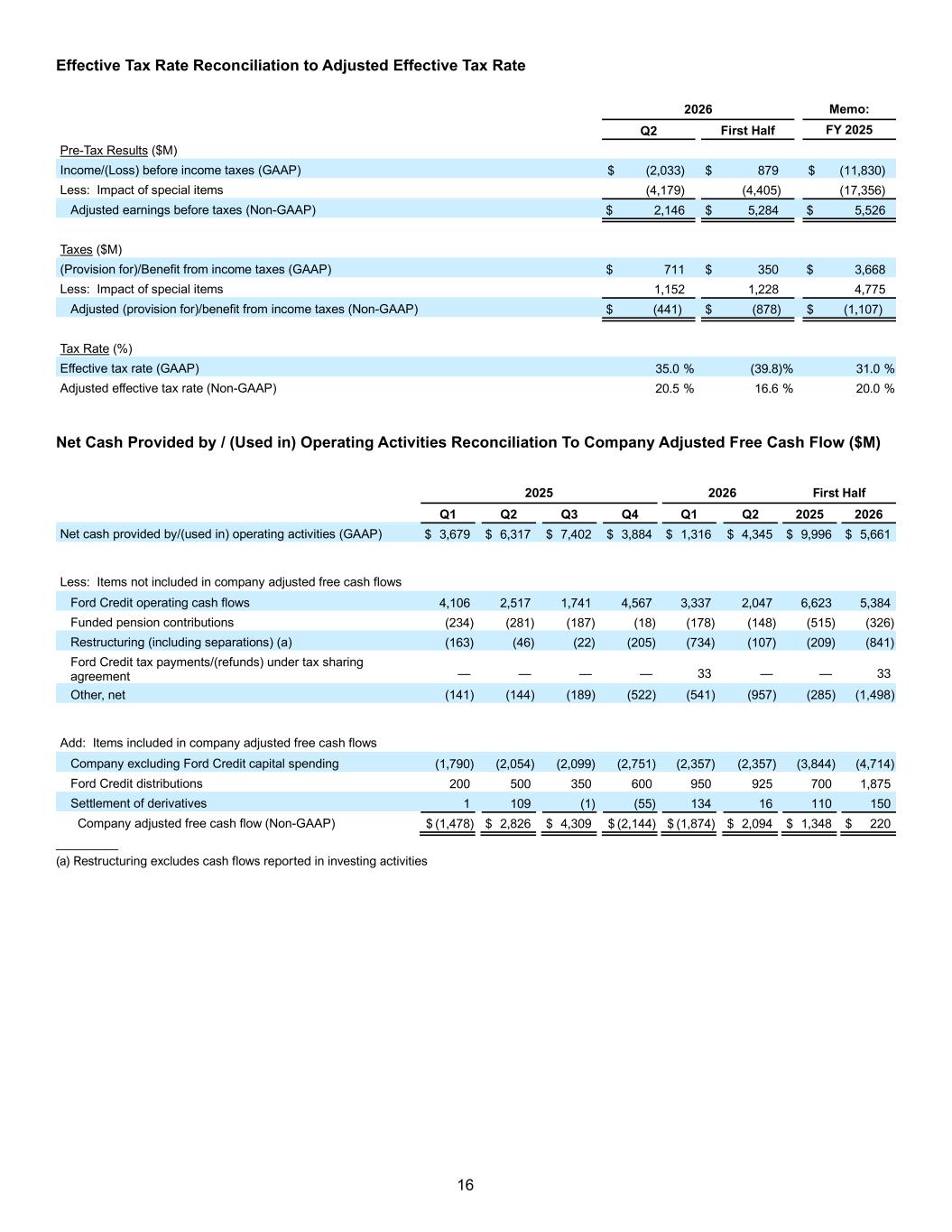
Okay, well, let's take those in turn, Helen. So first off with commodities, as we said, we're expecting a bit over $2 billion for the year. And I'm expecting about $1.5 billion of that to be in the second half. So $1.4-ish, right? We said about $900 additional to what we've already had. Then when you get to Novellis, at this point in time, we have had Novellis costs hit us at about $800 million. I also guided that I'm expecting the total cost to be about $1.5 billion. So the balance of that $700 million would be in the second half. Then you had a question on the first half bridge versus the second half bridge. And you're right, very strong volume and mix. Is that what your question was, second half versus first half EBIT bridge?
Speaker 11
Well, if I annualized the second half, it would imply a slowdown. So, and particularly with Novalis actually recovering, I think, you know, you're supposed to get those pickup volumes back up. So, why, you know, why shouldn't we not be concerned by the annualized slowdown, particularly as Novalis is sort of back on track in the second half?
Yeah, that's right. So, you've got, as you said, you've got the strong volume of mix coming in from Novalis, but you had some of that in Q2 as well. And what you're also going to see in the second half is unfavorable commodity pricing that I just talked about, two quarters versus one. And you also are going to have accelerated investments in Ford Energy, the universal EV platform and the Oakville launch. So a lot's coming at us in the second half, but this strength in coming back with the volume is going to be what's really enabling us to be able to be very close to where we were the first half when you take out the non-repeat of the IEFA one-time refund of $1.3 billion.
Yeah, and Colin, we can follow up offline and just go through the detail of the model so we can follow up after the call. I think we can take one last question. We're almost at the top of the hour.
Operator
Your last question will come from Edison Yu with Deutsche Bank.
Thanks for taking our question. I just want to ask about Ford Defense. Jim, you had mentioned on the last earnings call, you were kind of contemplating you were doing some work on a component side. I think just the other day, you're now confirmed to be working on a contract for the ISV. How should we think about this effort going forward and any sense on how big this could be in the next couple of years?
Sure. Thanks for your question. You know, Ford always calls, always answer the call to duty. That's our principle as a company. We did sign a contract with the U.S. federal government to produce three prototypes. They're considering for based on the super duty for military use. we're really excited to get into building those we we already dominate in that market in the commercial world we want to offer the u.s government the same advantages that our commercial customers get um and and that includes you know great parts availability and and everything else that comes along with being the leader um it's a great opportunity for us i think as a company um This particular opportunity in the transportation space, we are discussing, continue to discuss additional defense-related projects with the U.S. government, but we have nothing else to add at this point. We do believe we have a lot to offer, but we'll think through this as an adjacency. It has to be a strong business with really good returns and really, really good capital returns. I have to say, when you look at the scale of the opportunity here and all the opportunities versus something like BESS, which has a very short payback, they're pretty different opportunities. They're very asymmetric. So, as I said, we're very focused on these adjacencies that are very close to our core business, like BESS. Defense would be another one. There's a few others that we haven't talked about yet. Um, but they're not all the same and they, they don't, don't all have the same opportunity. Um, and I would say at this point, Ford Energy is, uh, is, is a great opportunity and we are really excited to get going with the U S government on these, uh, on these, uh, So stay tuned. Nothing else to add at this point.
Operator
This concludes the Ford Motor Company second quarter, 2026 earnings conference call. Thank you for your participation. You may now disconnect.