Operator
Good morning and thank you all for attending the First Horizon fourth quarter 2024 earnings conference call. My name is Bricka and I will be the moderator for today. All lines will be muted during the presentation portion of the call with an opportunity for questions and answers at the end. I would now like to pass the conference over to your host, Tyler Craft, Head of Investor Relations at First Horizon Bank. Thank you. You may proceed, data.
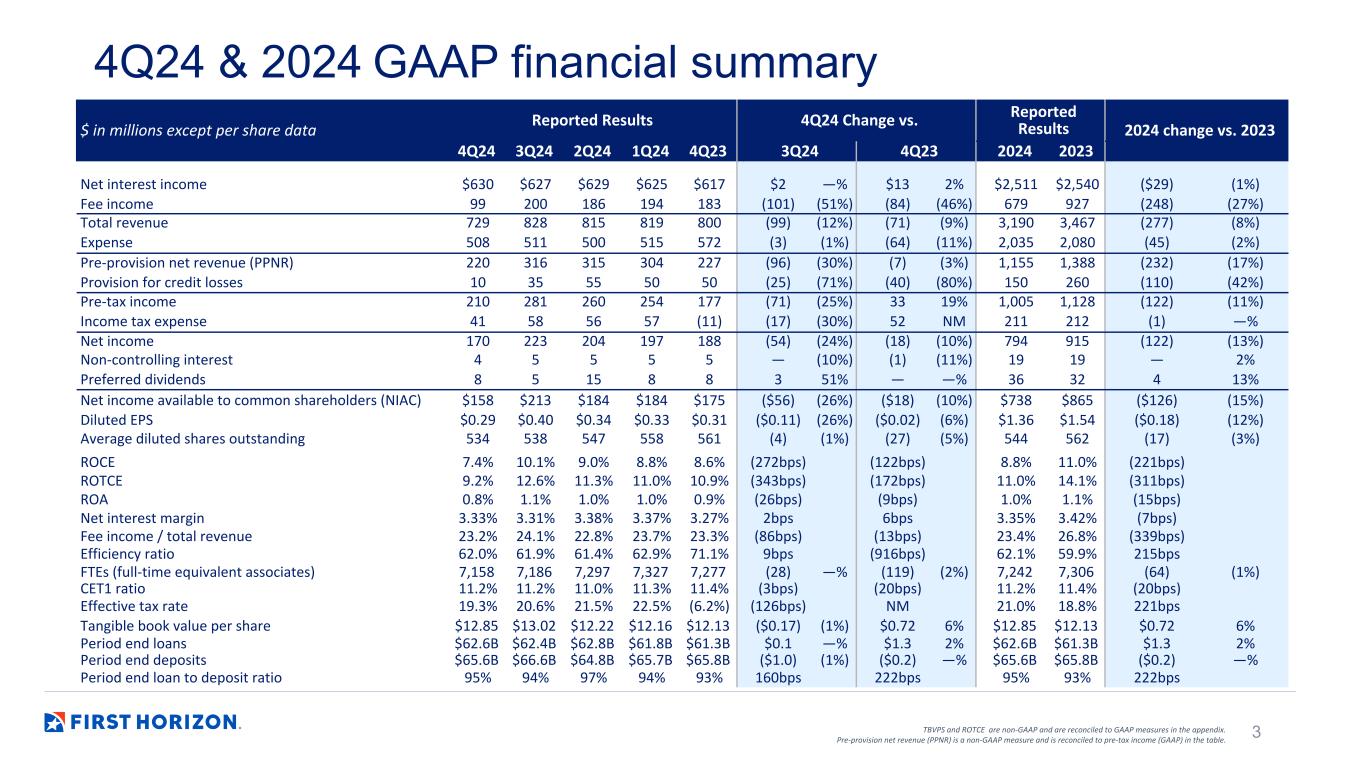
Thank you, Bricka. Good morning. Welcome to our fourth quarter 2024 results conference call. Thank you for joining us. Today, our Chairman, President, and CEO, Brian Jordan, and Chief Financial Officer, Hope Domchowski, will provide prepared remarks after which we'll be happy to take your questions. We're also pleased to have our Chief Credit Officer, Thomas Hung, here to assist with questions as well. Our remarks today will reference our earnings presentation, which is available on our website at ir.firsthorizon.com. As always, I need to remind you that we will make forward-looking statements that are subject to risks and uncertainties. Therefore, we ask you to review the factors that may cause our results to differ from our expectations on page 2 of our presentation and in our SEC filings. Additionally, please be aware that our comments will refer to adjusted results which include the impact of notable items. These are non-GAAP measures, so it's important for you to review the GAAP information in our earnings release and on page three of our presentation. And last but not least, our comments reflect our current views and you should understand that we are not obligated to update them. And with that, I'll hand it over to Brian.
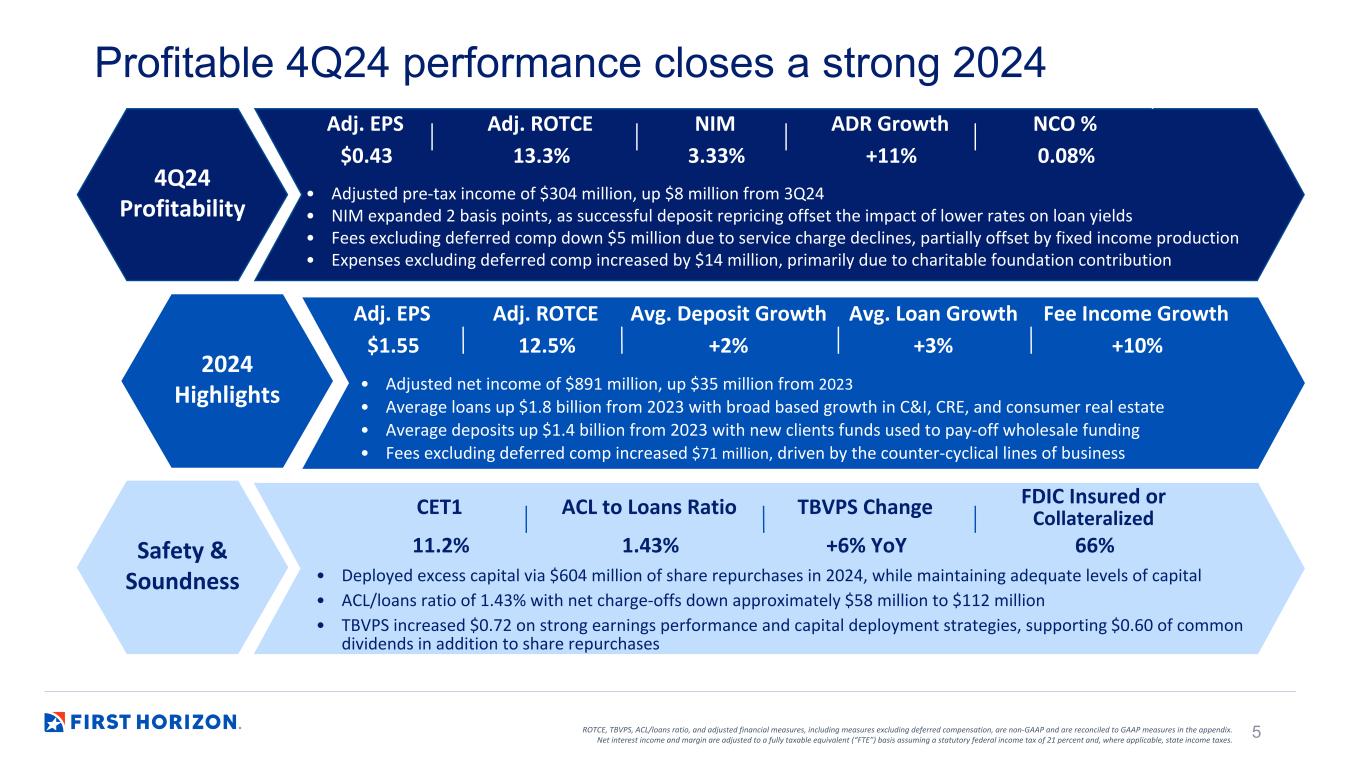
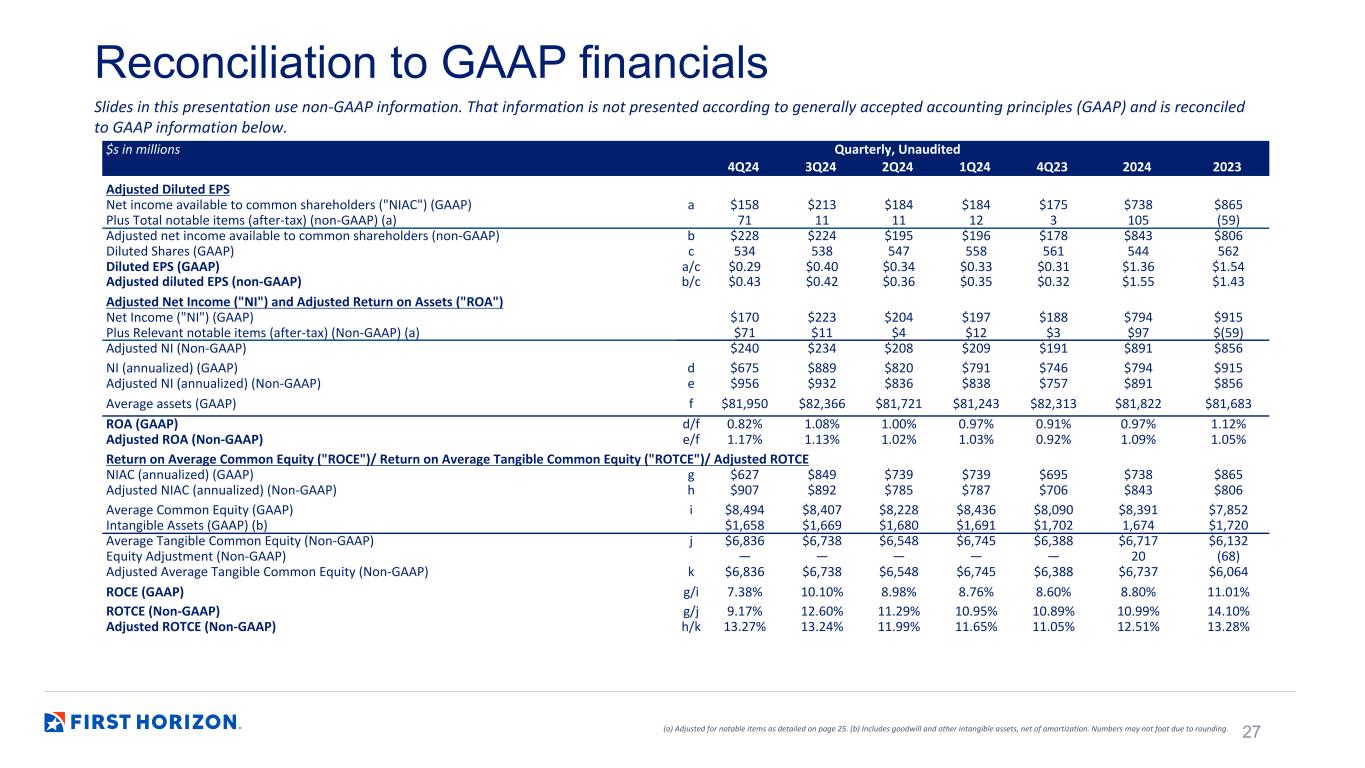
Thank you, Tyler. Good morning, everyone. Thank you for joining our call. Before I get into our 2024 results, I express our condolences to the victims, families, and first responders in New Orleans who were affected by the senseless act of violent 20-25. First Horizon has deep roots in New Orleans, and we are proud of the courage, compassion, and compassion. At First Horizon, we pride ourselves, including last year in Florida, western North Carolina, and eastern Tennessee, where tragedies like this one in New Orleans. Our team believes in our ability to be part of a recovery and positive change in the communities we serve. I am proud for shareholders in 2024 and am excited to build upon that momentum as we enter into 2025. On slide five, we have shared some of the financial highlights from this year. We ended 2024 with strong momentum, delivering EPS growth in the fourth quarter through margin expansion, counter-cyclical fee income growth, and strong credit performance. Hope will walk through the quarterly results in more details in a moment. As we look back on the full year, you can see the benefits of our diversified business model. We grew adjusted EPS by 12 or 8% from the prior year. We achieved an adjusted return on tangible common equity of 12.6% through continued strong performance from our banking franchise and positive trends in the counter-cyclical business. We maintained a strong net interest margin of 3.35% despite declining interest rates in the back half of the year. Additionally, our counter-cyclical businesses contributed an incremental $55 million to free provision net revenue. We continue to attract new clients and retain existing relationships, growing average loans by over 3% and deposits by more. Our net charge-off ratio for the full year of 18 basis points declined 10 basis points from the prior year, highlighting the value of our disciplined underwriting process. Over the year, we returned over 930 million of capital shareholders through dividends and share repurchases while maintaining robust levels of capital i am thankful for the dedication of our associates that our associates showed this year as they continue to deliver value for our shareholders our clients and our communities with that i'll hand the call over to hope to run through the financial results in more detail. Hope?
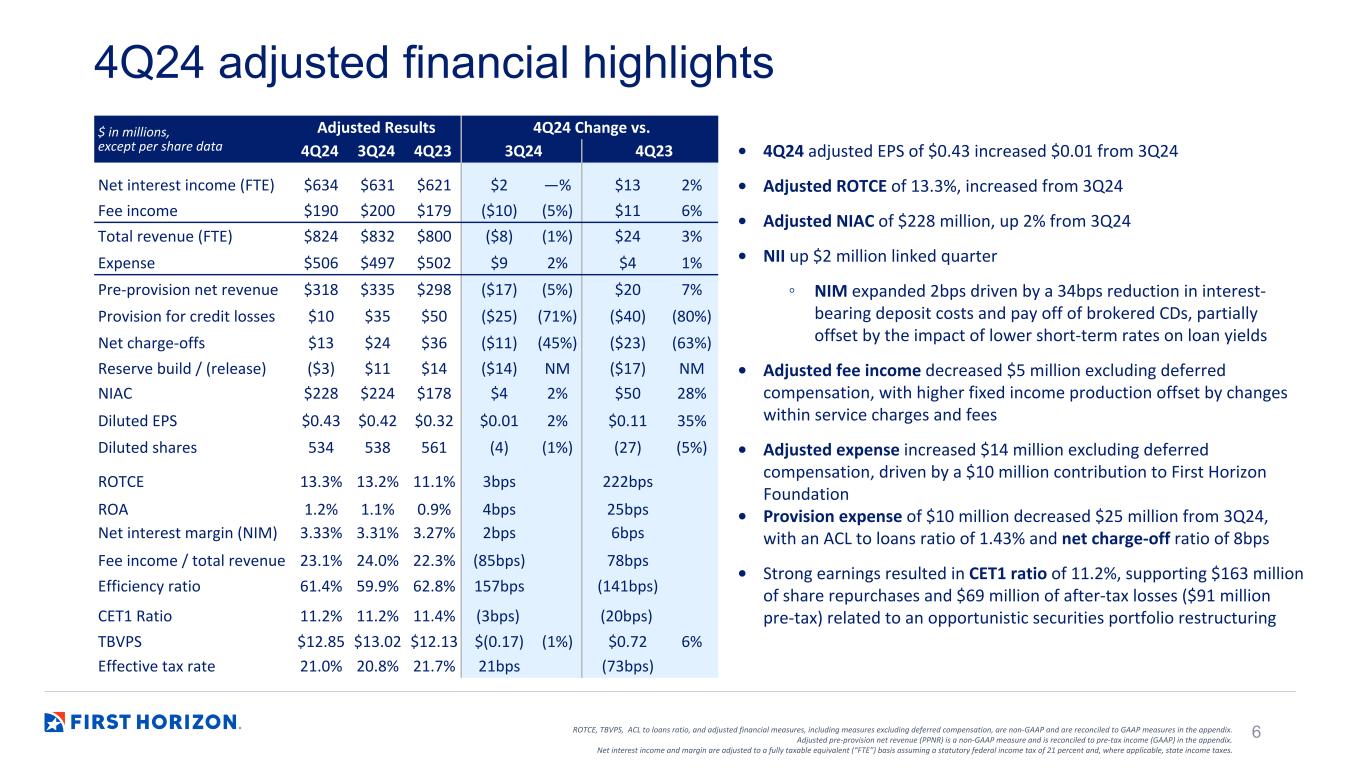
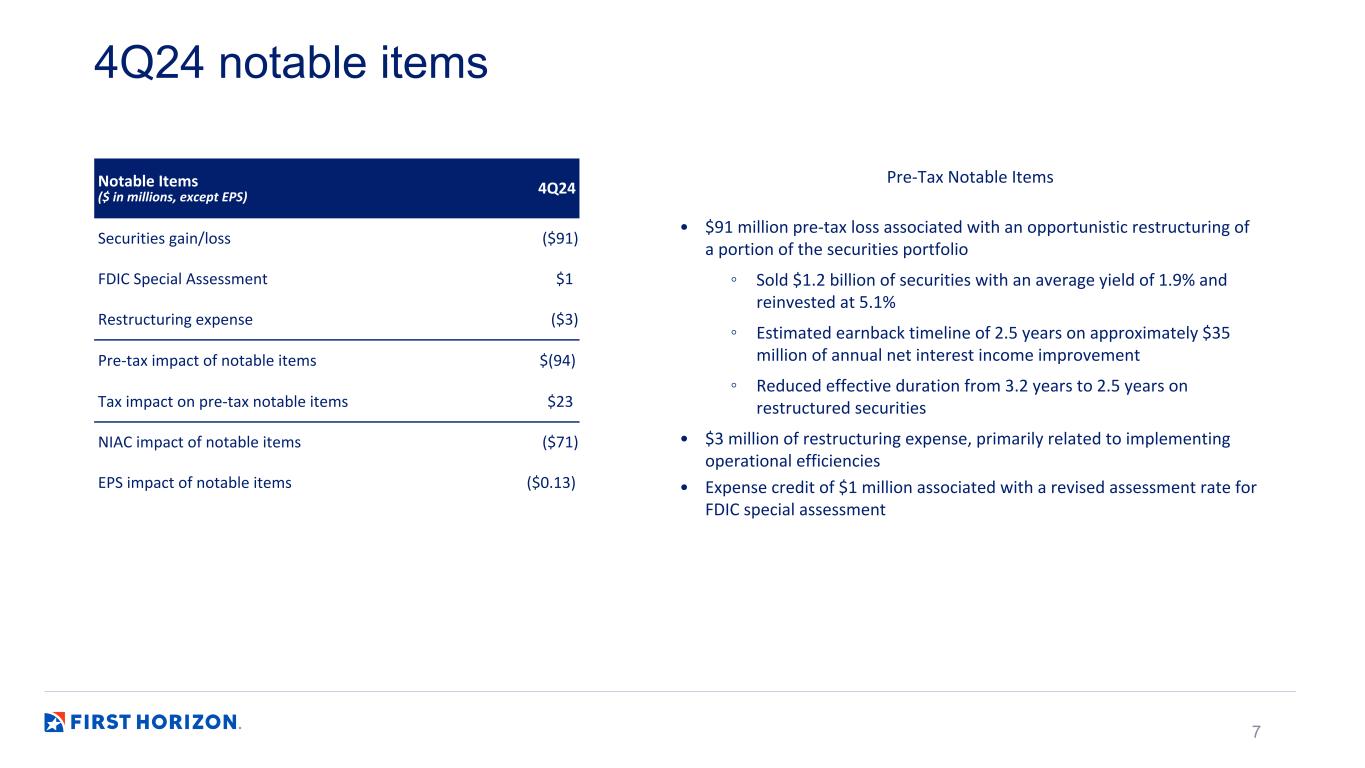
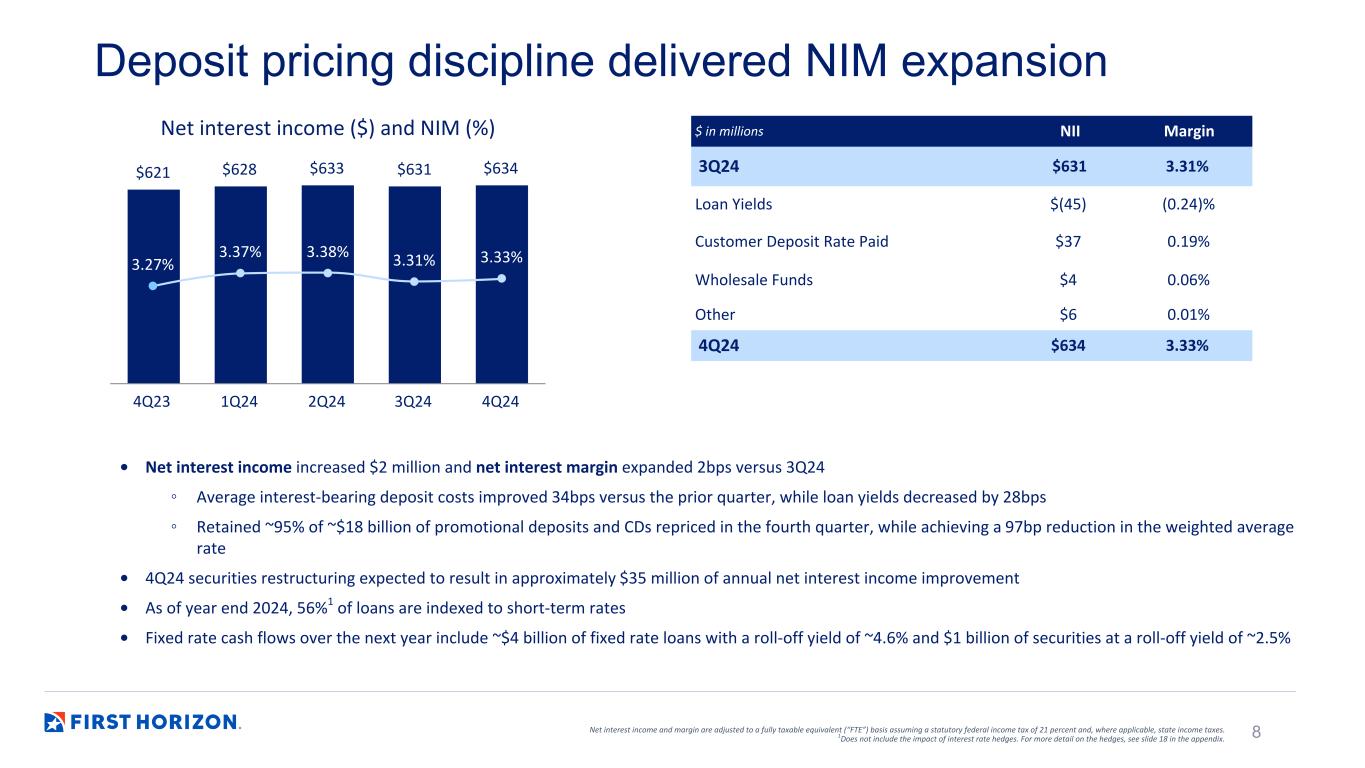
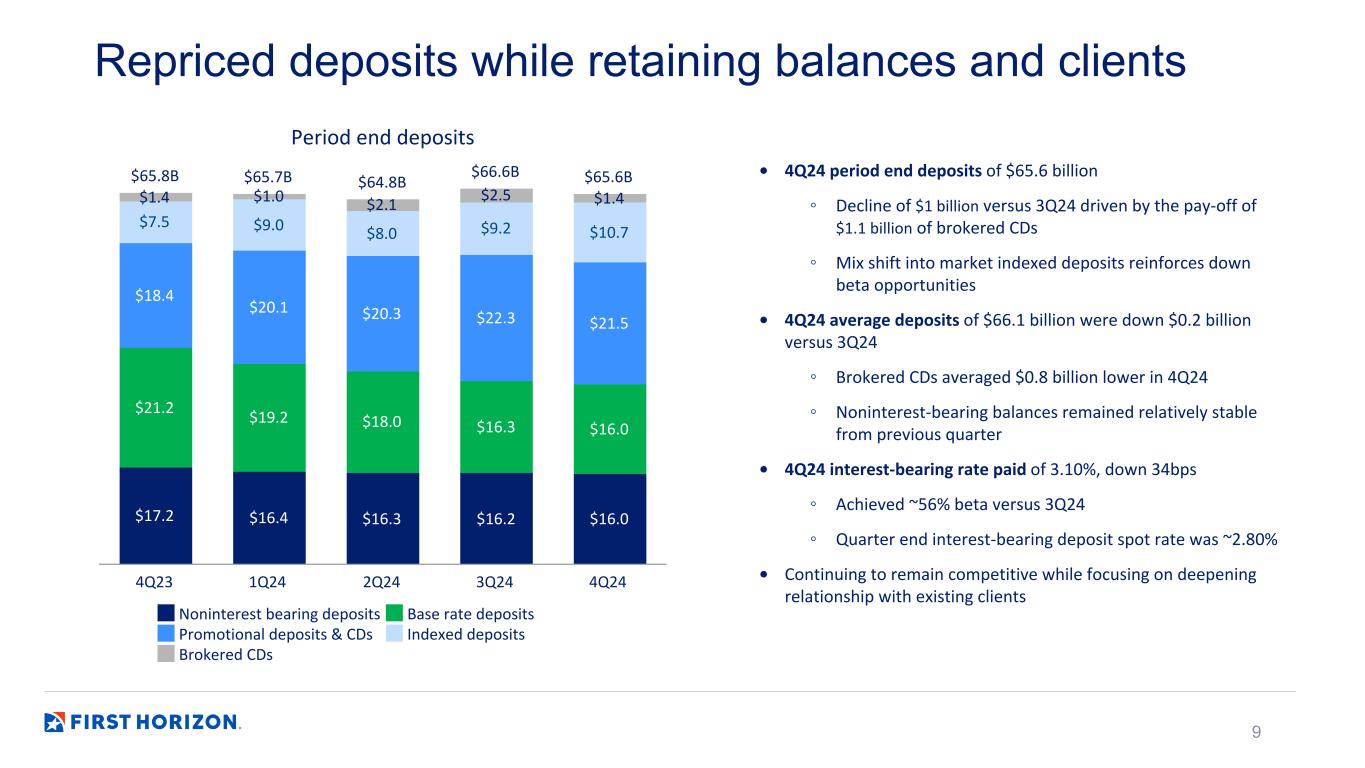
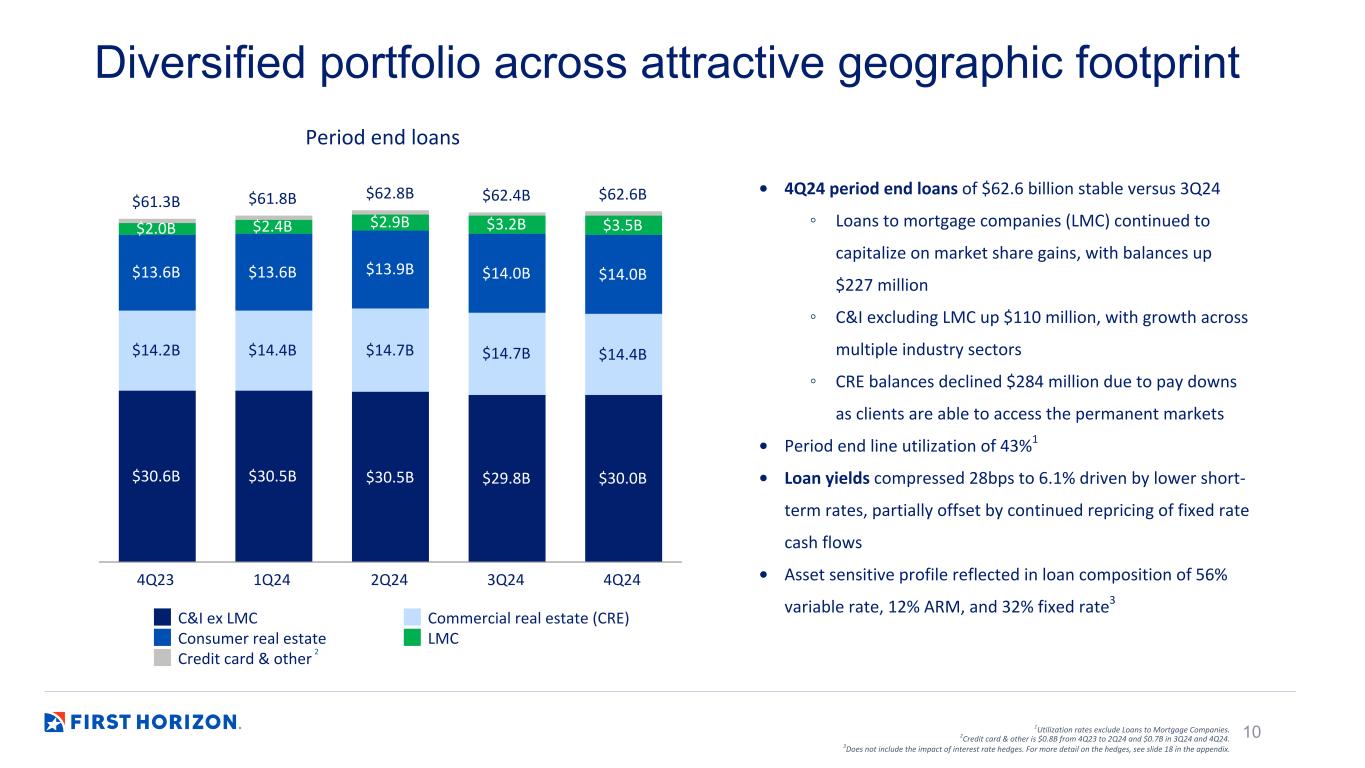
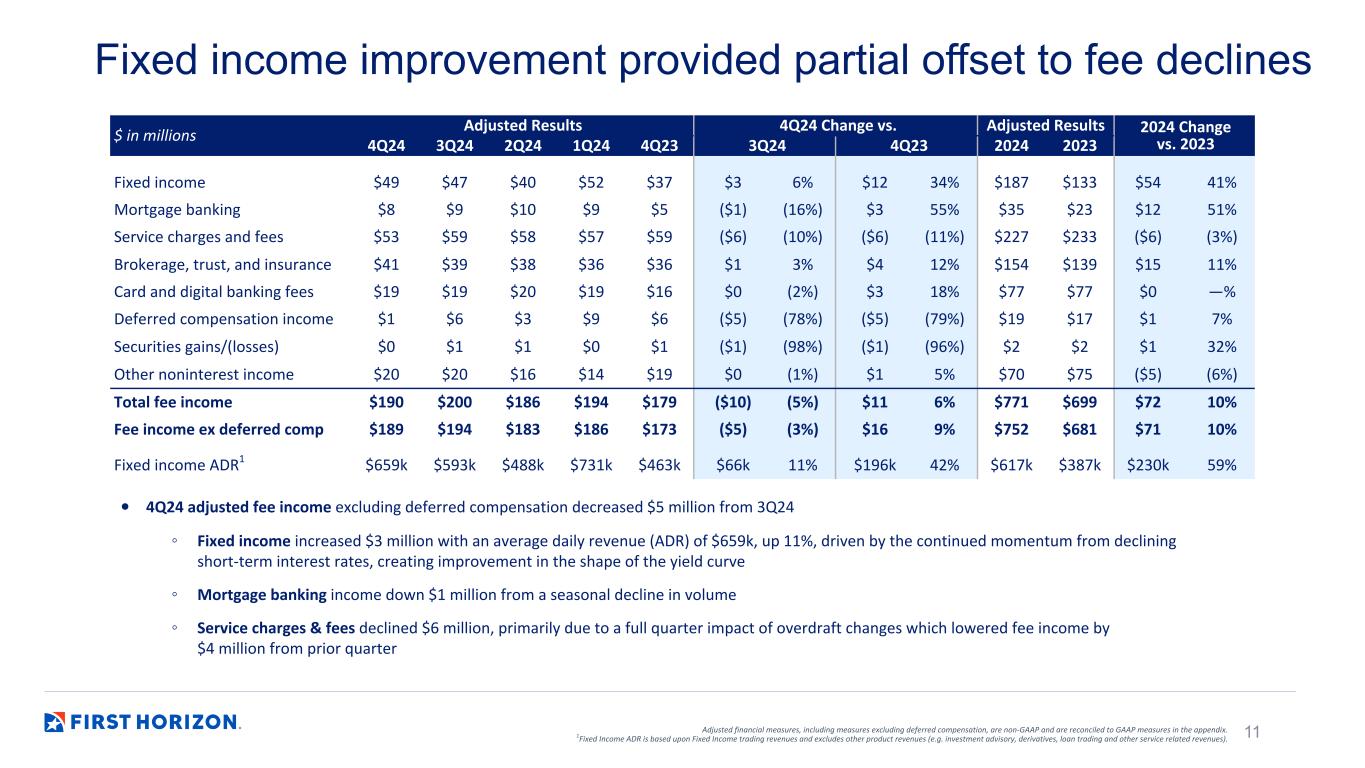
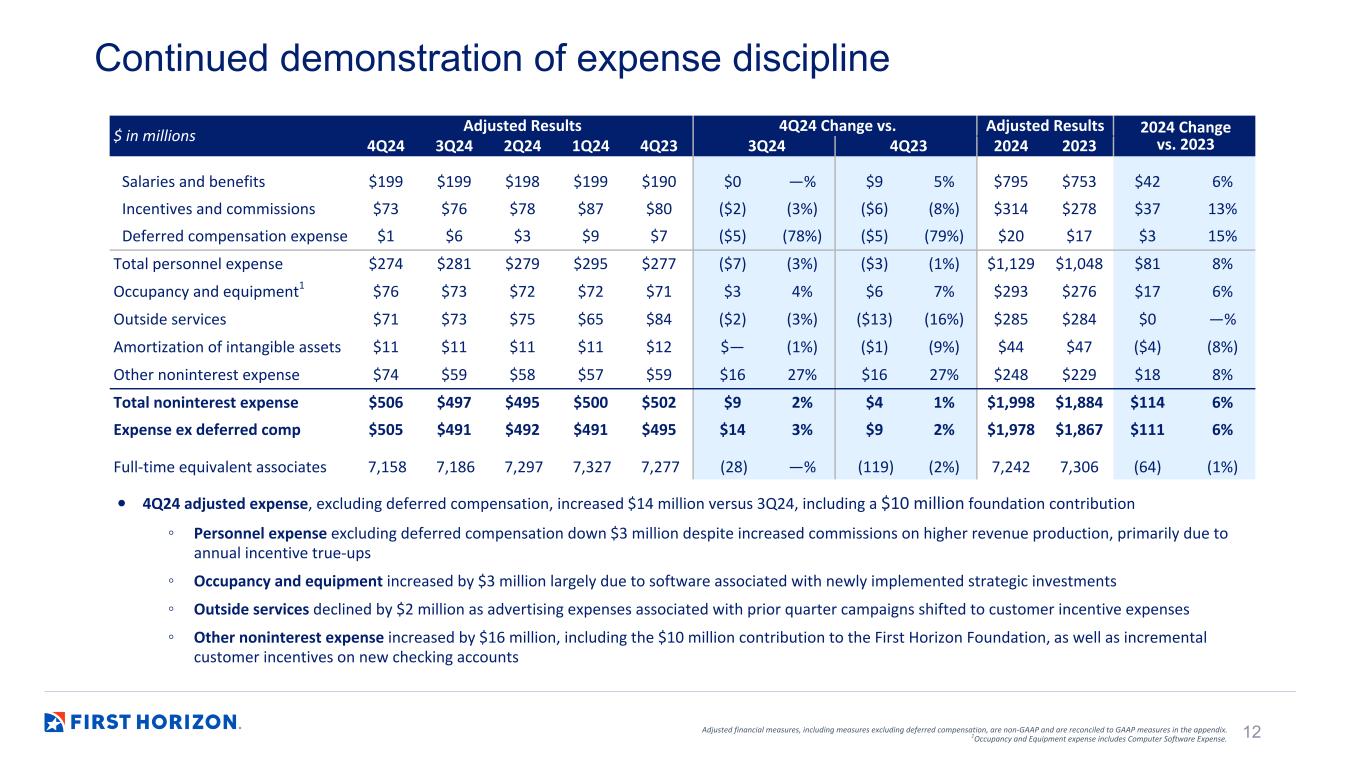
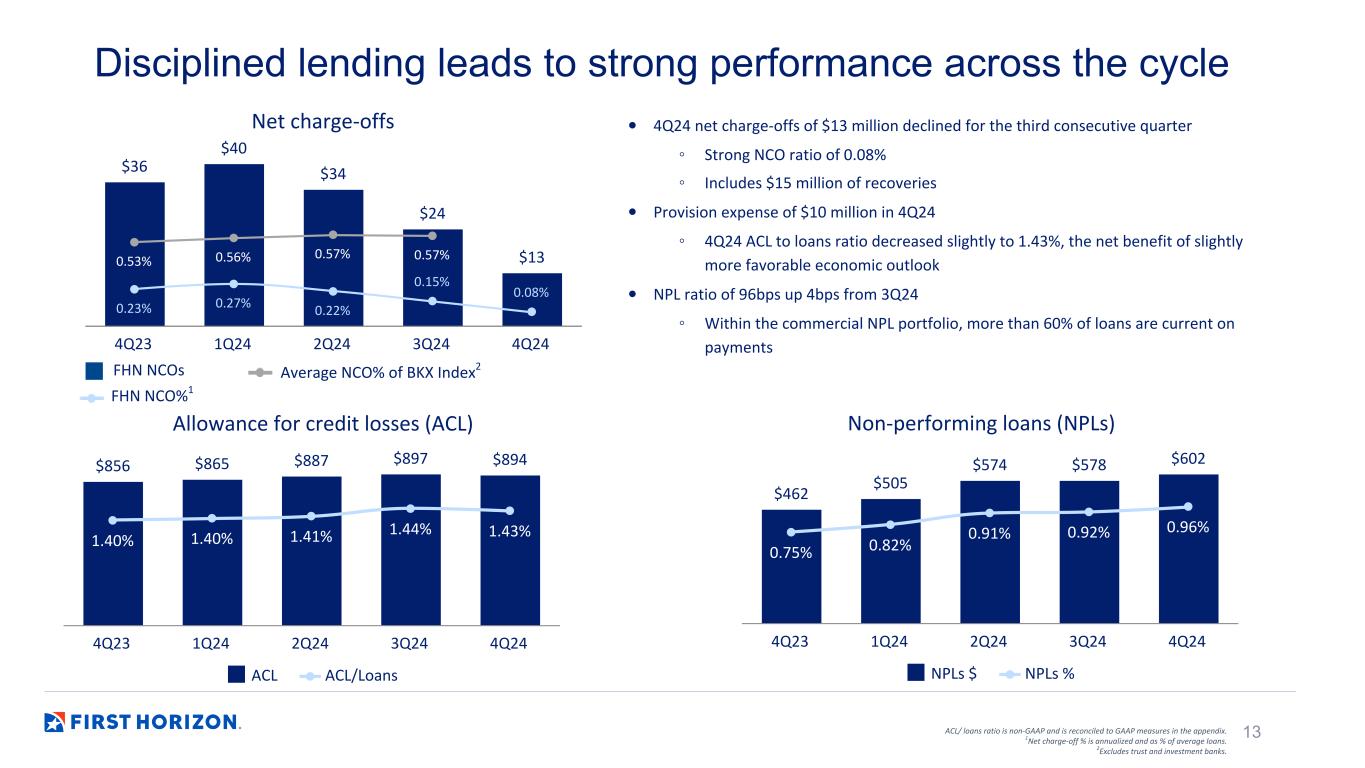
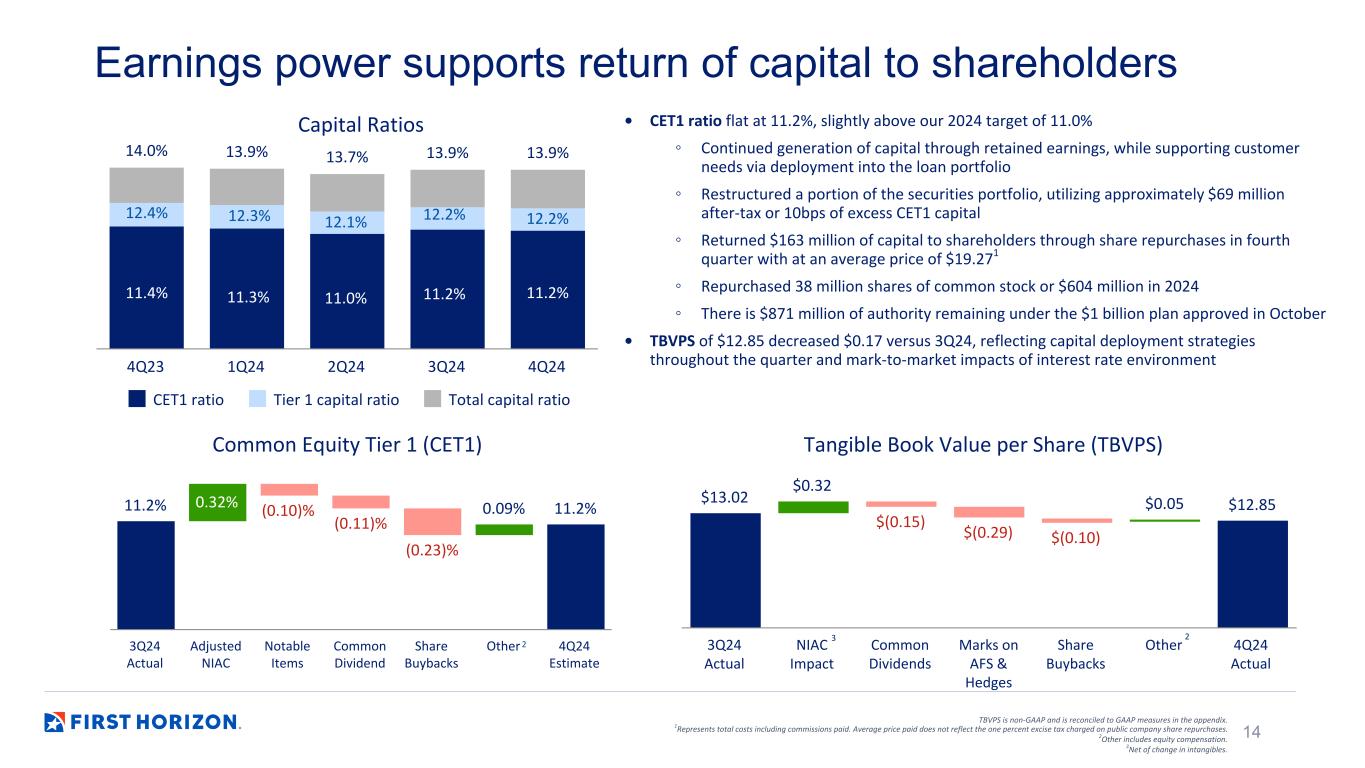
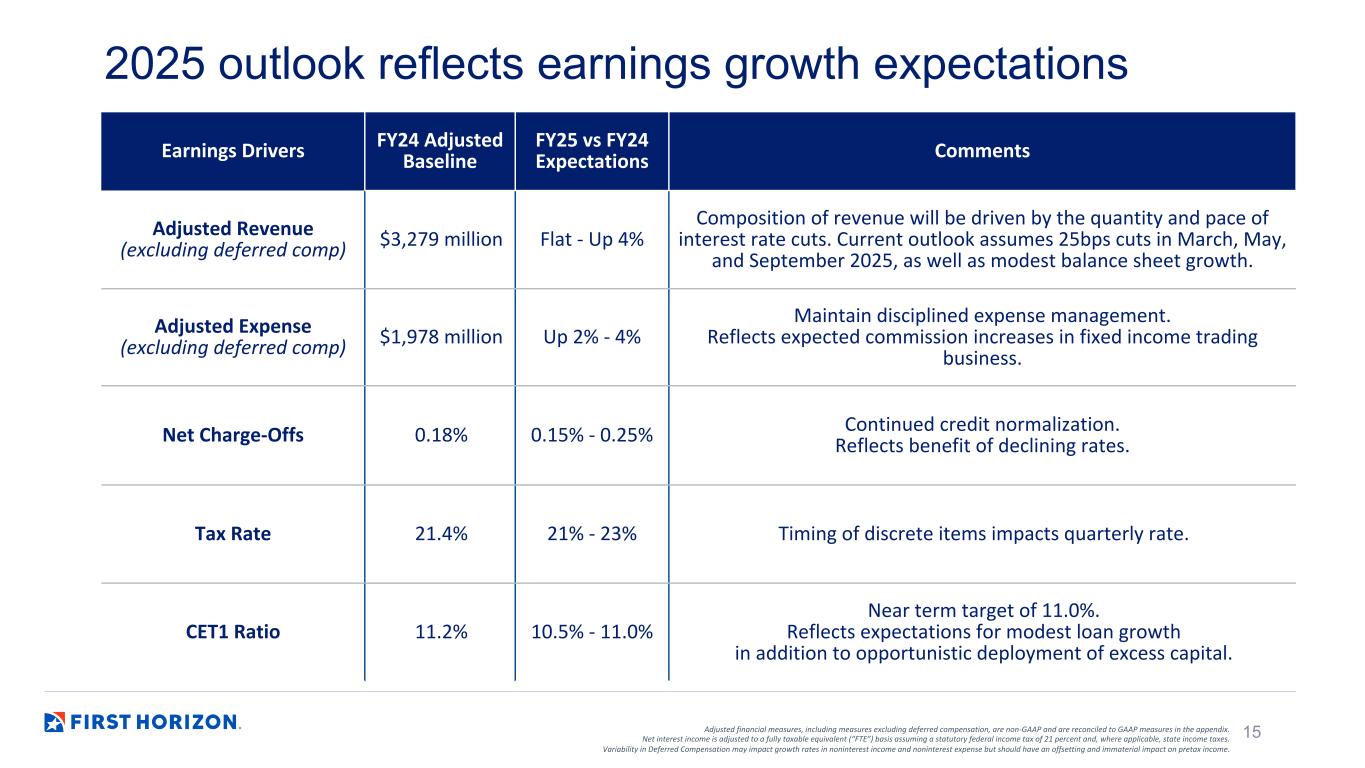
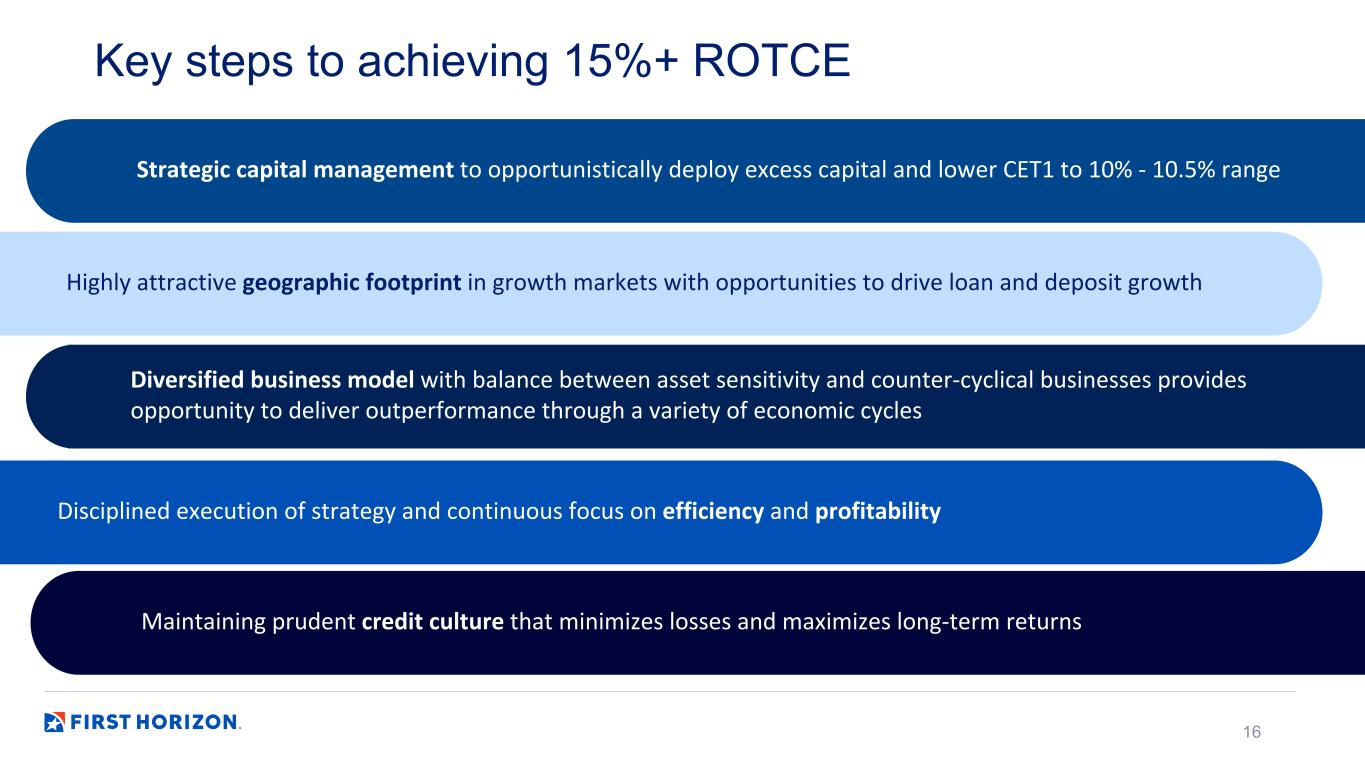
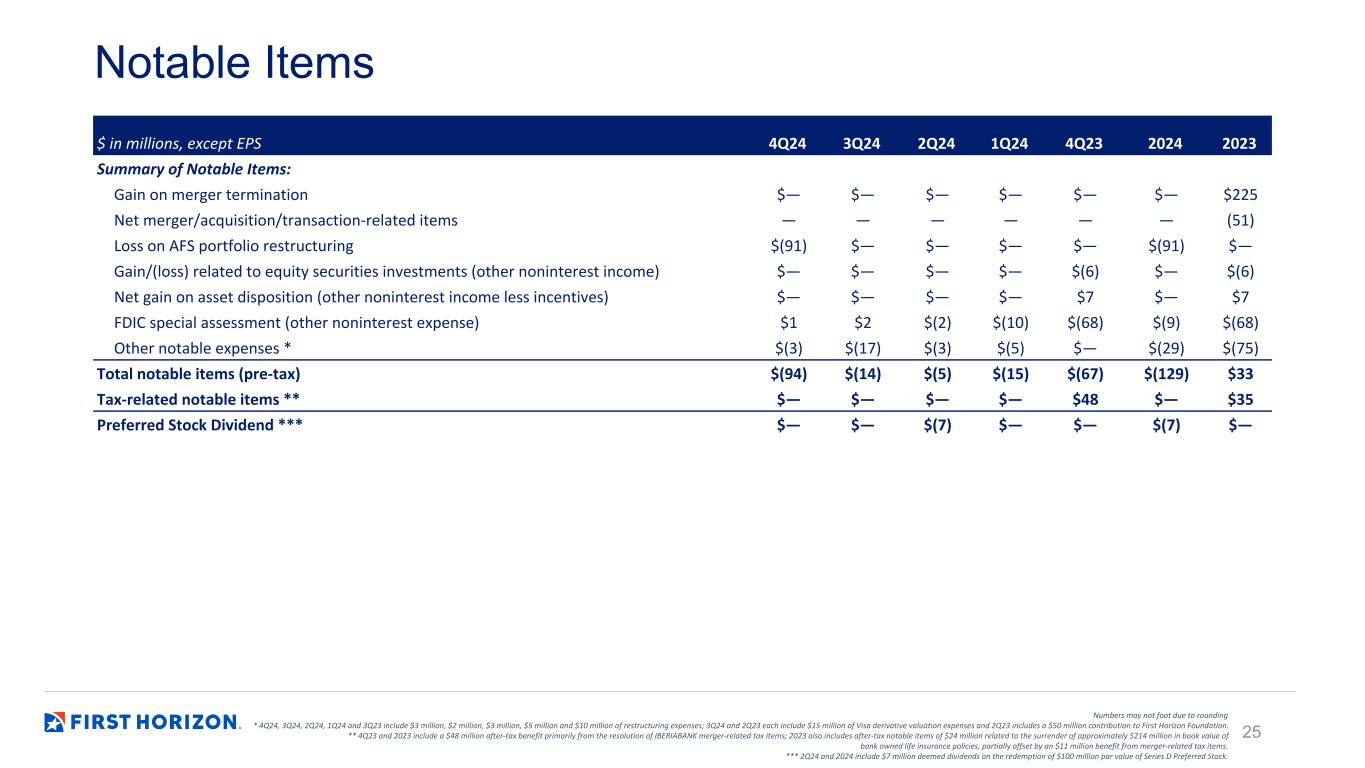
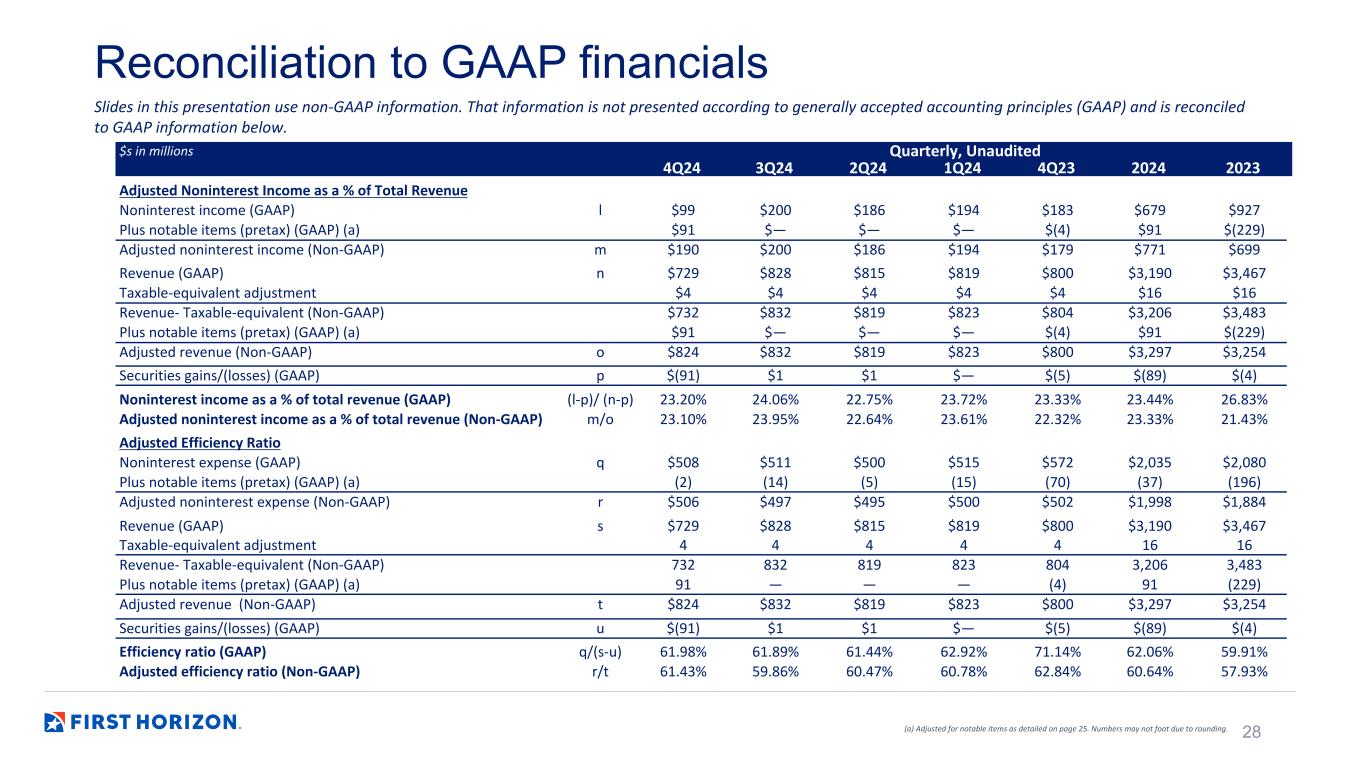
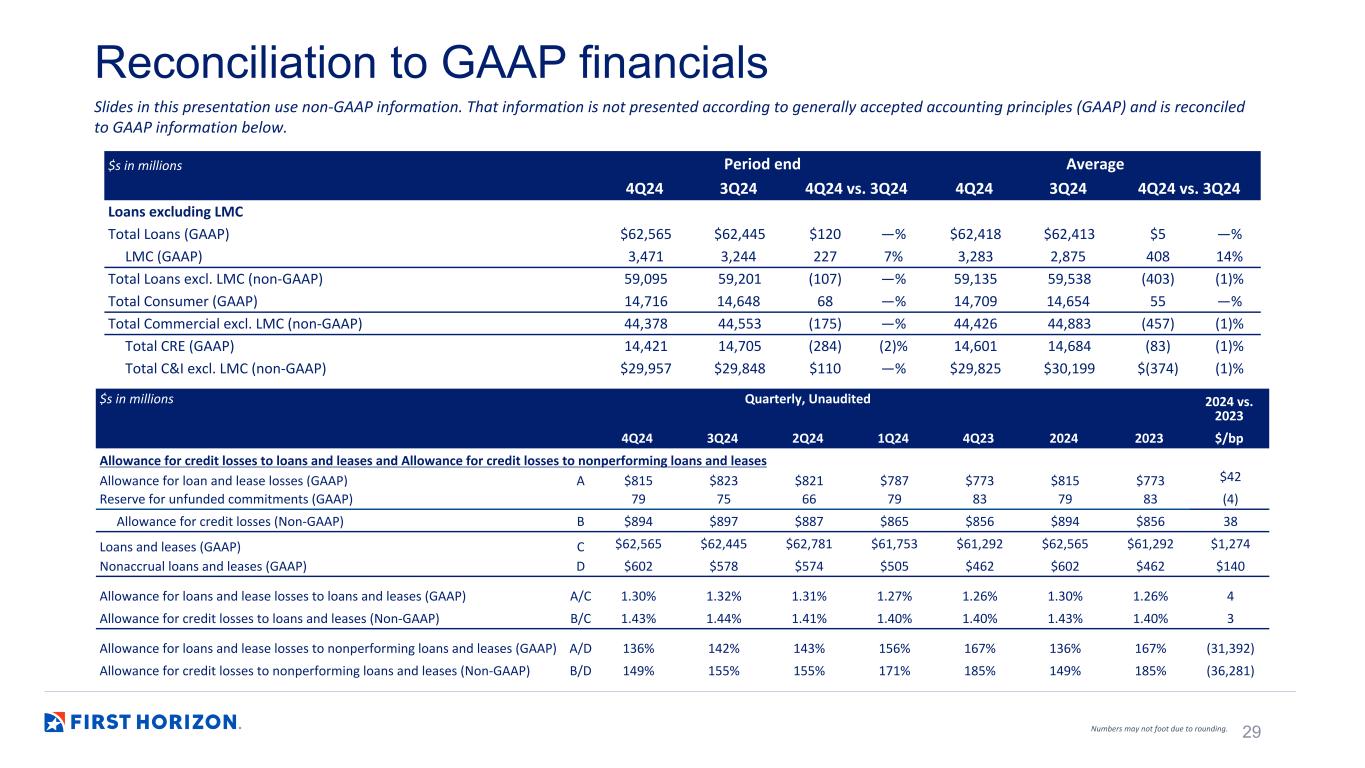
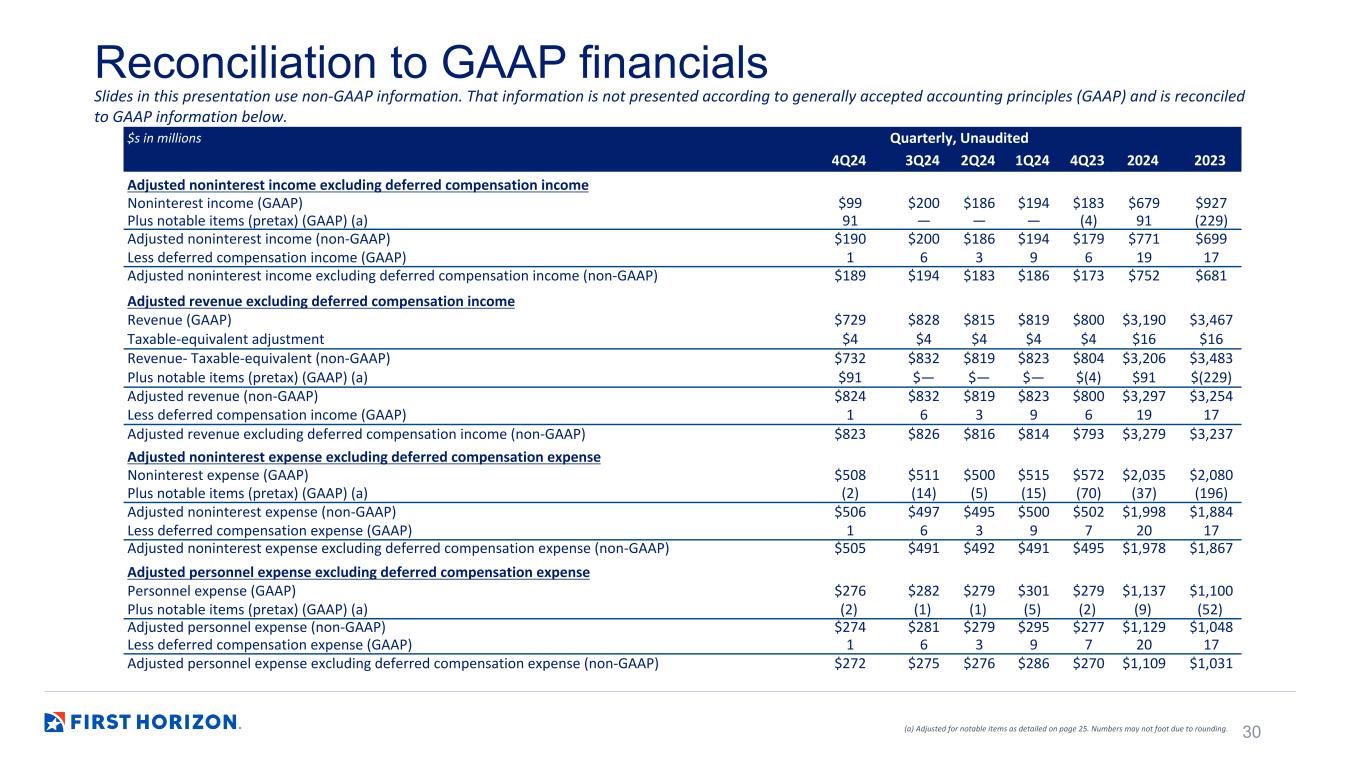
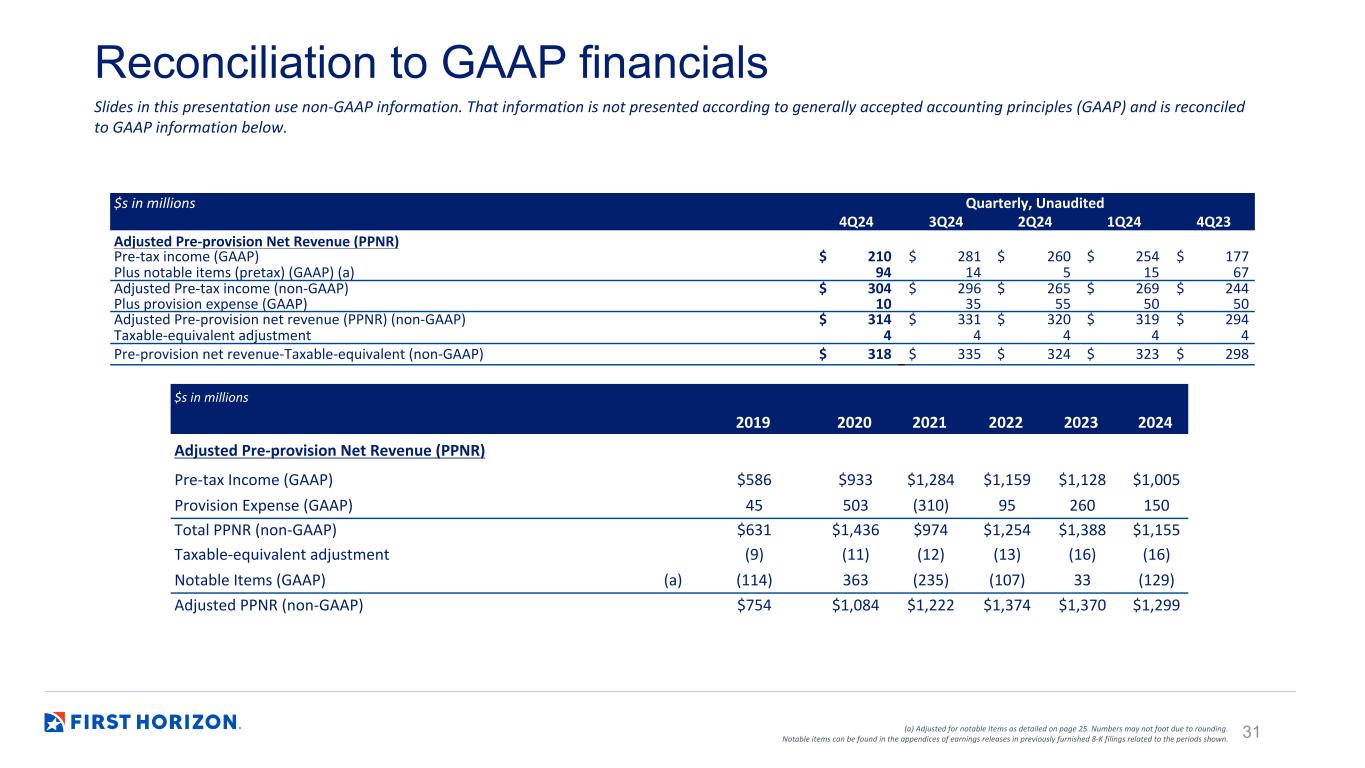
Thank you, Brian. Good morning, everyone. On slide six, you will find our adjusted financials and key performance metrics for the quarter. We generated adjusted earnings per share of 43 cents, a one-cent increase from the prior quarter. Our adjusted return on tangible common equity of 13.3% improved from the third quarter. Net interest income was up $2 million this quarter, as our focused repricing efforts resulted in a 34-basis point reduction to interest-bearing deposit costs, which offset the impact of lower short-term rates on loan yields. We continue to see outstanding credit performance from our portfolio, with net charge-off of eight basis points and $10 million of provision expense. The ACL to loans ratio decreased slightly to 1.43%, mostly due to the net benefit of a slightly more favorable economic outlook. Our CET1 ratio remained at 11.2%, even as we utilized $163 million of capital on share repurchases and $69 million of after-tax losses on an opportunistic securities portfolio restructuring, which I will touch on more on the next slide. On slide seven, we cover the notable items in the quarter, which reduced results by 13 cents per share. Fourth quarter pre-tax notable items include a $91 million pre-tax loss, which is the $69 million of after-tax loss noted on the prior slide, related to opportunistically deploying a 10 basis points of capital to restructure our securities portfolio to maximize go forward returns and shorten the duration we sold approximately 1.2 billion of securities with an average yield of 1.9 percent and reinvested at a 5.1 percent yield going forward the incremental annual impact at nii is expected to be approximately $35 million, resulting in an earn-back period of around 2.5 years. We also had $3 million of restructuring expenses associated with the ongoing operational efficiencies we continue to implement, and lastly, a $1 million credit to expenses as a result of a revision to the FDIC assessment. On slide 8, you will see that NII increased $2 million versus the prior quarter, as decreased deposit pricing mitigated the impact of declining short-term rates on loan yields. Margin expanded by two basis points from last quarter to 3.33%, driven by a 34 basis point decline in average interest-bearing deposit costs, which more than offset a 28 basis point reduction in average loan yields. I am extremely proud of what our bankers achieved this quarter, working with our clients to price deposits in a changing rate and competitive environment. We retained 95% of the $18 billion of promotional deposits and CDs which repriced in the fourth quarter, while achieving a 97 basis point reduction in a weighted average rate. We expect to see an approximate $35 million pickup in net interest income as a result of the portfolio restructuring executed in the fourth quarter. On slide nine, we demonstrate our continued ability to attract new clients, retain relationships, and manage funding costs. Period end balances were relatively stable, with a $1 billion decrease being driven by the payoff of $1.1 billion of brokered CDs. As we enter this declining rate cycle, mixed shift has slowed significantly, particularly in non-interest-bearing and base rate products. The average rate paid on interest-bearing deposits decreased to 3.10 percent, down from the third quarter average of 3.44 percent. Similarly, the spot rate was 2.80 percent at the end of the year, down over 50 basis points from 3.33% at the end of September. As I mentioned moments ago, we had tremendous success in retaining and repricing our maturing promotional rates, achieving almost 100% beta on those funds while retaining 95% of the balances. This continues our trend from 2023 of successfully reducing deposit rates on promotional accounts as we continue to acquire clients, retain balances, and deepen relationships. The pricing focus resulted in a 56% interest-bearing deposit beta since third quarter. On slide 10, we have an overview of loans. Period-end loans were up slightly from the prior quarter as loans to mortgage companies and C&I saw moderate increases offset by commercial real estate payoffs. We are excited about the market share gains we have seen in loans to mortgage companies. We are a lender of choice in the market as our steady commitment to the business provides stability to our clients. In 2024, we opened and expanded lines totaling $1.4 billion for new and existing clients. This has resulted in an increase of over $400 million in average balances from third quarter despite the impact of low origination volumes in the mortgage industry and seasonality, which typically reflects a volume decline in the fourth quarter. Commercial real estate balances declined modestly as clients successfully refinanced in the permanent market at maturities. As expected, loan yields were down 28 basis points from third quarter due to the impact of lower short-term rates on our 56% index portfolio. That impact was slightly offset by continued improvement in the fixed rate book and loans to mortgage company growth, which is a higher yielding loan book. On slide 11, we take a look at our fee income performance for the quarter. Fee income, excluding deferred compensation, decreased $5 million from the prior quarter. Fixed income continued to see improvements as a falling short-term rate environment and a more favorable yield curve in the fourth quarter provided more demand for that business. Average daily revenue increased to $659,000, up 11% from last quarter, driving a $3 million increase in fee income. As we completed key run-the-bank technology investments in 2024, we introduced changes related to overdraft charges that resulted in a $4 million reduction to service charges and fees in the fourth quarter, which we expect to remain in our run rate. The remainder of the service charges reduction expect to be isolated to this quarter. On slide 12, we show that excluding deferred compensation, adjusted expenses increased by 14 million, primarily driven by a $10 million contribution to the First Horizon Foundation. Personnel excluding deferred comp was down 3 million from last quarter as a true up-to-annual incentives offset increases in incentives on higher commission-based revenue. Occupancy and equipment expense was up $3 million this quarter, which was driven by incremental software costs associated with our strategic technology investments. Outside services declined by $2 million as marketing expenses related to new bank accounts shifted to other non-interest expense for customer incentives on previous quarter's campaigns. Lastly, other non-interest expense was up $16 million, with the two largest items being the $10 million contribution to the foundation, as well as the expenses associated with customer incentives as we continue to see success in attracting and retaining new-to-bank customers. I'll cover credit on slide 13, which continues to perform very well. Net charge-offs decreased by $11 million to $13 million, or eight basis points of average loans, which continues to be well below industry levels. Loan loss provision was $10 million this quarter, with our ACL to loans ratio decreasing one basis point to 1.43% as the net impact of the economic outlook was slightly more favorable compared to recent quarters. Non-performing loans increased by four basis points from the third quarter, driven by the continued impact of higher for longer interest rates and slower than anticipated multifamily lease-ups. Within the MPL portfolio, we continue to be encouraged by the trends as more than 60% of commercial MPLs are not past due on payments. Overall, we are pleased to see our strong underwriting and servicing proven out in our results over the cycle. On slide 15, we'll talk through our 2025 outlook, which is unchanged from what we shared in December. Our guidance was provided in December incorporating the forward curve, which had three rate cuts. However, we provided guidance ranges to accommodate for a range of possible interest rate and economic scenarios. Our balanced business model creates a resilient earning stream across economic environments, and we are well positioned to deliver on our 2025 guidance. Our revenue guidance is flat to up 4% as we see our counter-cyclical businesses as a natural hedge against our asset sensitivity. If we see incremental declines in interest rates, those businesses offset NII pressure, whereas less rate cuts result in higher NII. Continuing with our guidance, adjusted expenses are expected to increase between 2% and 4%. As we bring on incremental run rate from the implementation of our technology investments, the operational efficiencies we have identified this year are going to help offset that cost. If we see a significant pickup in fixed income and mortgage production, variable compensation could push us to the upper end of the range, though we remain committed to continuing to identify efficiencies to help offset that cost pressure. For net charge-offs, we remain confident in our disciplined underwriting standards and proactive approach to managing credit. Our guidance reflects a range of outcomes consistent with our strong performance in 2024. Lastly, we are committed to deploying capital and prioritizing organic client growth first, but with the ability to use our share repurchase authority to return excess capital to shareholders. We will continue to evaluate the environment and utilize the most opportunistic strategies to reach our 10.5% to 11% CET1 range. I'll wrap up as we turn to slide 16. I am proud of all the progress we made as a company this past year. As we turn our focus to 2025, I am extremely optimistic about the momentum we are carrying into the year ahead. We are well positioned to drive improved profitability through increased loan demand, flexible deposit pricing, and strong counter-cyclical lines of businesses. We are committed to minimizing increases to our expense base through strategic initiatives, and I have full confidence that we will continue to benefit from our strong credit performance. Our focus remains on delivering consistent returns to our shareholders, and I am certain that the actions we are taking will position us for a successful 2025 and beyond. And with that, I'll give it back to Brian.
Thank you, Hope. Our fourth quarter performance rounded out a solid year for First Horizon, demonstrating the strength and stability of our franchise. I agree with Hope that we have incredible momentum carrying us into 2025, and I'm excited to see us profitably grow this extraordinary franchise and improve shareholders. We remain committed to achieving a 15% return on tangible common equity over the next several years, and I'm confident that we are paving the path to that level of returns through efficient capital management and the earnings power of our balanced business model. We celebrated our 160th anniversary last year, which was made possible by the continued dedication of our incredible association. Thanks to each and every one of our team for all that you do for our shareholders, clients, our communities, and for each other. I believe that the people of First Horizon are the true difference maker for our unparalleled banking franchise and will be the reason that 2025 will be another success. Brika, we can now open it up for questions.
Operator
Thank you, Brian. We will now open up for the Q&A session. If you would like to ask a question, please press star followed by one on your telephone keypad. If for any reason you would like to remove that question, please press star followed by two. And again, to register for a question, please press star one. We will pause here briefly for a second to ask questions are registered. We have the first question from Michael Rose with Raymond James on the line.
Hey, good morning, everyone. Thanks for taking of my questions. Understanding that you guys did the securities portfolio restructuring, but the guidance is relatively the same, if I think I heard you right, at least last, before you gave the update this quarter, you were kind of contemplating positive operating leverage would be a little bit more challenging. Seems like with the restructuring, it would be a little bit easier, but does that give you the flexibility to maybe accelerate some of your investment priorities now that you have this kind of extra $35 million a year in interest income, or would you expect positive operating leverage to maybe widen out here? Thanks.
Michael, we feel that we have a good approach to expense investments back in the company, as we introduced 18 months ago, a three-year $100 million investment back in technology, as well as investments into our businesses. We're about halfway through that, and I don't see if there's anything on the horizon that would have us add incremental investments into that. We have done a great job managing costs and structuring what we need for the next couple years. As we talk about operating leverage, for us, we really talk about being PPNR positive and PPNR growth year over year.
As I mentioned in my prepared remarks, depending on the mix of where the revenue comes from, we could see expenses hit the higher end of the guidance from commission businesses hey Michael good morning this is this the securities repositioning clearly gives us more confidence and in our ability to create as you correctly voted and hope comment and we roll these these ranges out for early December time frame this does give us an awful lot of movement much you'll see you less if they contribute more. So it's one of those things where we didn't try it in the ranges. We think that's still an appropriate way to think of repositioning and average in that environment.
Very helpful. And then maybe just as my follow-up, if you could just kind of discuss, I saw the comment about Warehouse this quarter and the benefit from ShareGain. It was obviously a very positive surprise. Can you just talk about the prospects for that business and then just in your core banking business on the commercial side, are you starting to see anything more than just optimism around pipelines building? I mean, would you expect utilization rates to maybe pick up a little bit from here? Just trying to get a sense for what the demand schematic looks like. Thanks.
Yeah, this is Brian. I'll start and then Tom can pick it up from there. First, with mortgage warehouse lending, we were very pleased with the efforts over 2024 and our ability to gain some share. And it did show up in fourth quarter. As you know, in all likelihood, fourth quarter, first quarter tend to be seasonally the slowest. So we expect some seasonal slowdown after the first of the year until you get into the selling season in the second quarter. A mix in the portfolio, I think it's about 26% or so that is refi today. So that was just money. So it's going We are seeing good trends there, and over the broader commercial markets, pipelines have started to pick up a bit. We're hearing very positive commentary from across our footprint and customers. I think there's still a little bit of slowness until we get through the presidential transition early next week, and policy starts to take shape. But we're seeing some optimism, which we think is encouraging for the overall outlook for 2025.
Hey, Michael, I would just add regarding the mortgage warehouse business, we have long been recognized as experts in that space and how we have executed. But I think in addition to that, we've also been remarkably consistent throughout the cycle. We've continued to support our customers in that industry, and that has really shown up in our recent results. I think Hope O'Brien mentioned we had about $1.4 billion in increases in 2024. Over half of that came from new to bank. And so I think that really speaks to in that cycle. And elsewhere, we are starting to see some pipeline build. It's more in kind of the earlier stage pipeline.
Hey, thanks for taking my questions. Appreciate the color. Thank you.
Operator
Your next question comes from John Armstrong with RBZ.
Thanks. morning John hope maybe a question for you can can you talk a little bit about near-term margin expectations it feels like you have some momentum you've got you know the restructuring benefit lower deposit rates maybe less cuts you know maybe a little better warehouse balance starting point but do you expect some continued momentum in the margin from here I'm just curious on some of your kind of near to medium term thoughts.
John, we feel really good about how Q4 performed on margin. We had, you know, three rate cuts of 100 basis points, the first one coming at the end of Q3. So we did not have that, you know, we had a full quarter of that plus the two successive. And we were able to offset that with deposit cost decreases. So we feel strongly about our margin holding up through this environment, whether there's one or three cuts, or I saw a Wall Street Journal article that started talking about increases, I do believe that our margin will hold up well. I think we're heading into an environment today where we're just not sure what it's going to look like to give you exact guidance on where we think successive quarters could be as the forward curve has moved so significantly in the last five days.
Okay, but it sets up pretty well for the first quarter, I guess, is my point. It feels that way. Is that fair?
Oh, absolutely. In my prepared remarks, John, I talked about where our spot rate was down. So the average deposit cost rate versus spot rate, we're continuing to see that walk back. We have definitely seen a slowdown in competition, which Brian and I have talked about previously at the end of the year. But we believe our company has demonstrated the agility to manage margin through the cycle, regardless of increasing or decreasing rates. And then our margin is probably pretty stable where it's at within some single digit basis points.
So I think, John, it sets up the quarter. March doesn't continue into the first.
And then, Brian, very big picture for you, but what are you expecting or hoping for on regulatory changes and what would be good for First Horizon?
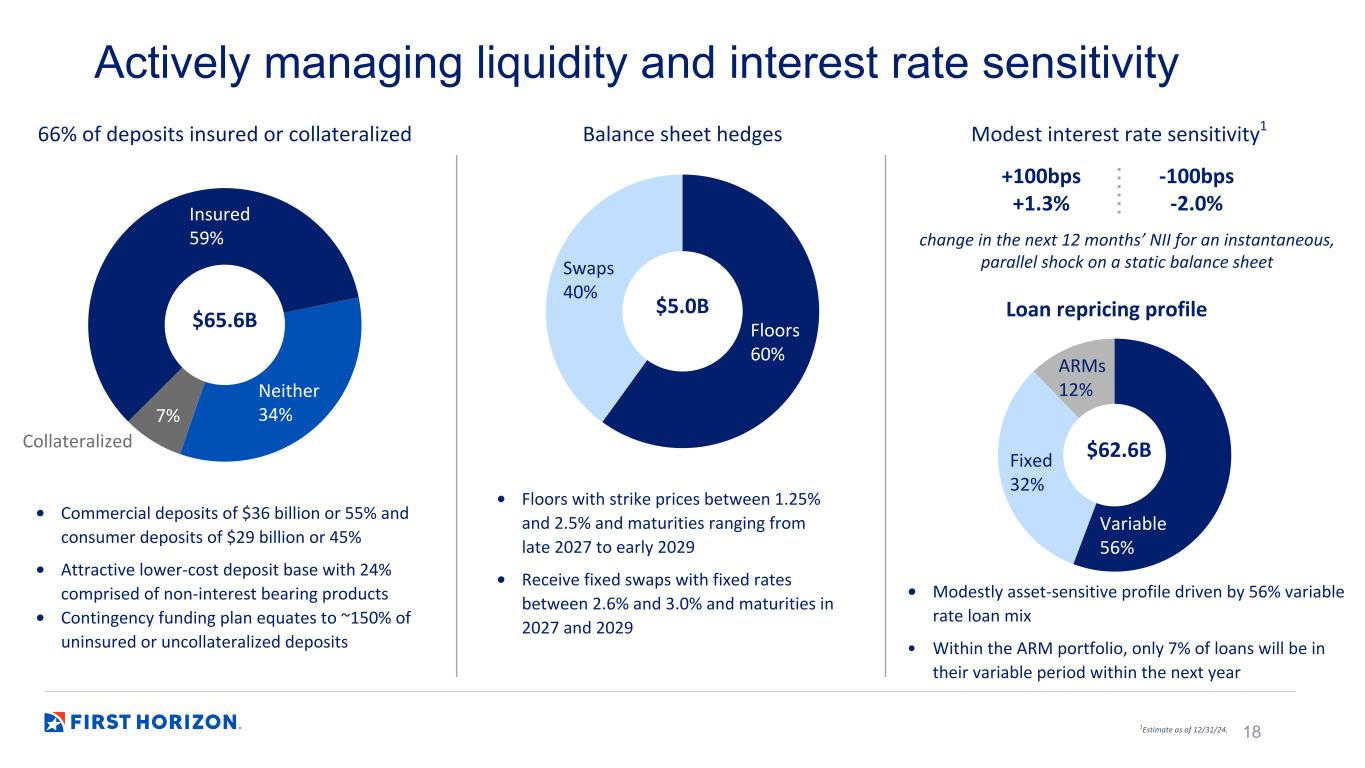
Yeah, I'd put it in the category of where we are in terms of asset size. I've talked fairly often and publicly about the significance of the cliff of crossing $100 billion in assets becoming. Things like TLAC are a perfect example of that. And my hope is that as the administration gets into place, that people will step back and look at really the legislation passed in 21, it was 2018. team and really differentiate based on riskiness to the financial system. So my hope is that the tiering that's in place today is maintained and maybe even further adjusted because I think there's a significant cliff that doesn't need to exist. We're an important part of the financial system, but our risk profile does not really change between $80 billion. I just think the cost structure off the roof like that. And that's probably, if I have a...
Operator
The next question comes from Ibrahim Poon Awawala with Bank of America on the line.
I just wanted to follow up. I think, Brian, you began talking about just the commercial pipelines. Not sure if you all spelled out what loan growth assumptions you have underlying your revenues slash NII outlook. And where are the obvious areas where you think like lending could pick up over the next three to six months? I mean, I'm assuming some of the administration's agenda on domestic capex is more of a 26 event by the time we see that in bank lending. But wondering if there are two or three areas, I think, line utilization in certain industries, et cetera, where we could see a bit more immediate pickup over the coming months.
Yeah. We're looking for something, you know, low marginally mid-single digits in terms of loan growth expectations for 2025. In all likelihood, commercial real estate was likely to pay down more than 2025, simply mini-perm or per. That said, even in commercial, you know, just people really being anxious to get in the economy. I think in the near term, in certain areas, being commercial-oriented and infrastructure in loan growth, again, we think it's sort of in that low to moderate single-digit area.
Understood. And I guess a separate question. Apologies if I missed it. When we look at the slide 16, the sort of steps towards the 15% plus ROTCE, given where we are today, given all the things that you lay out, how do you think about the timeframe of what's the best case scenario of how quickly could we get there?
We've talked about this a couple times before, but there's a couple levers. The first being where do we see loan growth pick up, where do rates stabilize, and how does our revenue stream start to normalize and pick up as we understand the economic environment in the next two or three years? But the other two parts are credit. We've had to build a high level of provision the last two and a half years. And as you can see, our charge-offs are holding up very well. So as we see provision, the sooner we can see provision normalizing, that will go hand-in-hand with that economic environment stability will help. And that leads to the third part, which is we're holding 11% CET1. Brian and I continue to say we'll evaluate it on a regular basis. And as we see stability in the economic outlook and feel comfortable, we'll bring that down. And so to summarize, the first level is revenue growth. The second is when provision starts to normalize and then our ability to get down to that lower end of our capital range of 10.5 will be the biggest predictors of timing.
We can't pin the tail completely on the donkey today, but I truly believe that we will make further and as Hope said, one of the key levers is dependent on what's going on in the economy or control, but we do believe we're holding excess capital and we can repatriate that to share our repurchase authorizations and so that can can be a meaningful start to getting those return that's helpful thank you thank you thank you we now have the next question from jared
shaw with barclays capital please go ahead hey good morning everybody um i guess maybe sticking with the capital question you know with that whole discussion it sounds like it's you know still with the goal of getting back to a 10.5% CET level, what would have to happen for you to feel comfortable even lower than 10.5%? I think when you look at what sort of drove the industry up to that, it was more credit concern, more liquidity concern, a different regulatory backdrop. Is there a timeframe where you could see that below 10.5%?
Yes, sure. Sure, I think when we look at capital, we talk about it in terms of CET1, but we look at our economic capital models, we look at our stress testing and disclose it even though it's not required, and we have conversations with our board about what the right capital levels are. An easy example, Jared, would be in the event that you had a significant refi or mortgage boom and you saw a significant increase in our mortgage warehouse lending business. We think that has very, very low, if any credit risk in that business, it turns very quickly, but it draws 100% risk weight in the underlying mortgage on the balance. Variables like that mix in the portfolio, its outlook in the economy, it is just sort of an overall, it chokes me up to talk about it, but overall outlook and the economy all affect how we feel about that range. But as we sort of rule of thumb, that 10.5 area.
Thanks. And then this is my follow-up just on credit. You know, good trends on the charge-off level. Can you give just a little color on what drove some of the increase in NPLs on the CRE side and how we should think about the allowances as a ratio to loans going forward from here, if it should be? Yeah, sure.
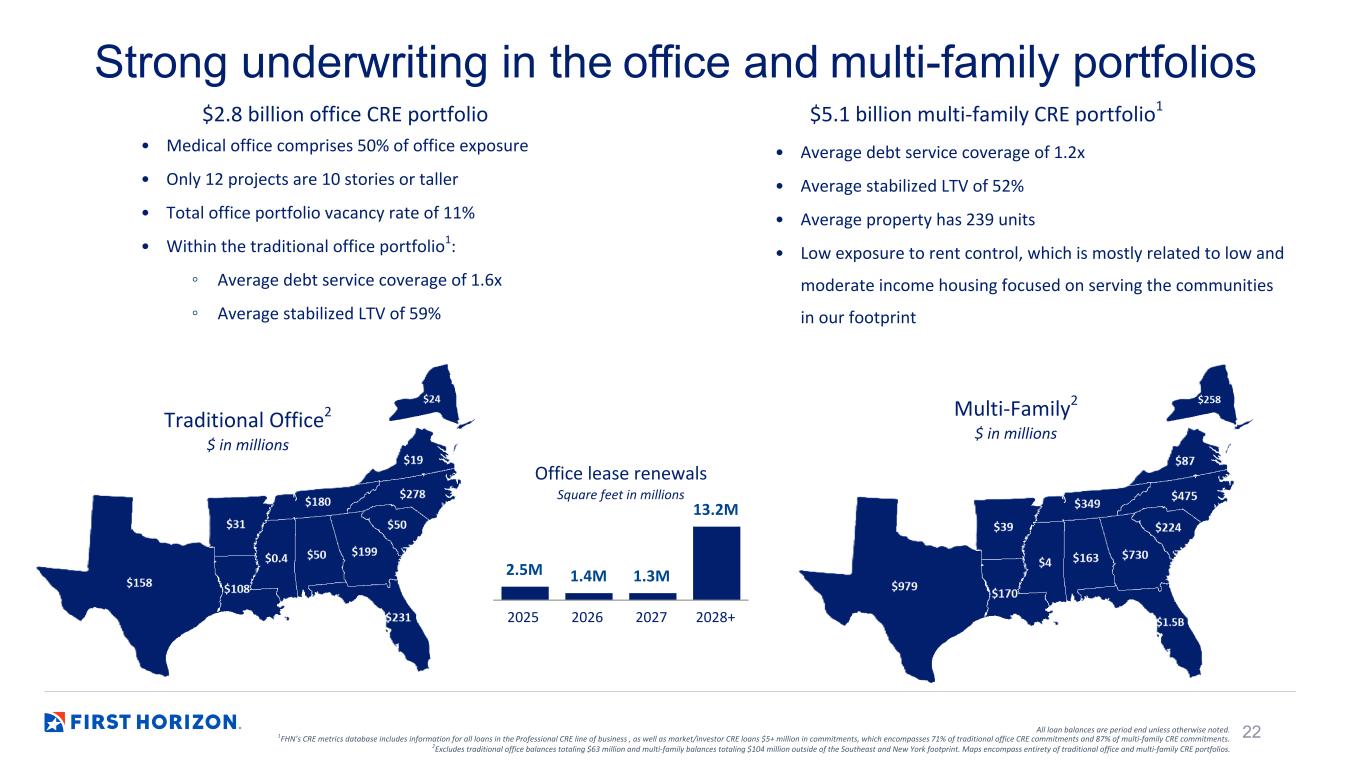
Yeah, absolutely. So as you noted, we had a slight increase in NPL, sorry, in NPLs of four basis points. That was driven predominantly by Cree. I think in Hope's opening comments, you mentioned what that's really driven by is specifically, we saw just a slower absorption in multifamily in particular. performance remains very good. NPL still have over 60, you know, that we've been vigilant. And, you know, in terms of looking forward, the slight decrease in the ACL that you saw is really a result of just a slightly more favorable economic outlook, where currently our forecasts are based on three rate cuts this year. What we do in terms of reserve and coverage going forward is going to be dependent, obviously, on our portfolio, fairly volatile at this point. So it's a little hard to to pin that.
Operator
Thank you. We now have Chris McGrattie with KBW on the line.
Oh, great. Good morning. Brian or Hope, on the revenue guide, the high end of the revenue guide, is that a scenario where you get the current forward curve? I know you have three cuts in your guide, but would that map to a no-cut or maybe one-cut scenario?
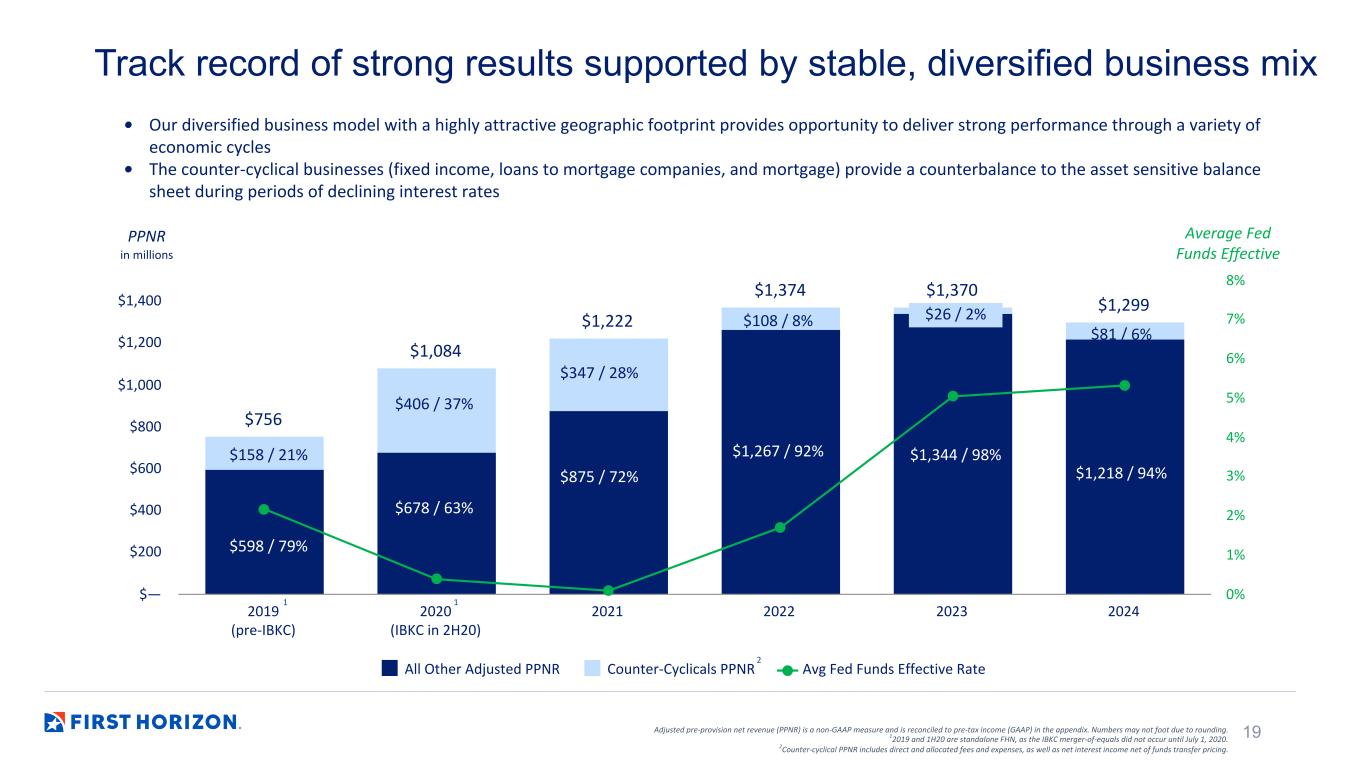
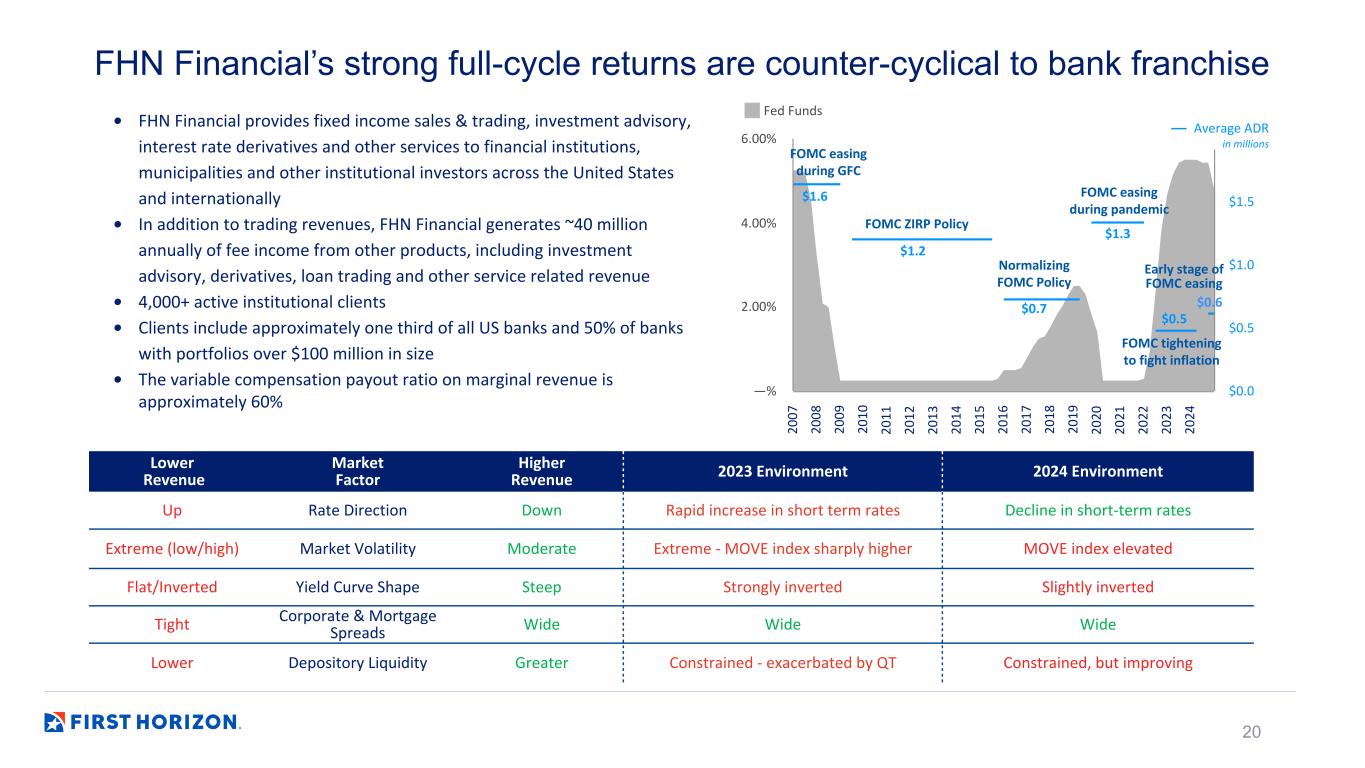
That is a help, but we also need to see the FHN financial and mortgage production stay, you know, at Q4 levels or we can't trade higher NII for, you know, the low 2023 levels that we saw in mortgage and FHN financial. The, you know, we have a slide in our appendix, Chris, that talks about the five main factors for what drives FHN financials revenue, you know, steady rates, not declining rates is one. The other is a steepened curve. We currently have a steepened curve. So I would say less rate cuts, a steepened curve, and more certainty in the economy going forward should help both our counter-cyclicals and our NII, you know, be at the higher end of their range.
Okay, great. That helps a lot. I missed the prior question on the timing of the bond restructuring. Could you just remind me when the quarter that happened? And then also, do you have any, I know you provided the spot deposit cost, but do you have the spot yield on the bond portfolio given the restructuring?
I do not have the spot yield on the bond portfolio with me, Chris. We complete. We did the bond structure at the end of Q4.
Operator
Thank you. We now have Nick with UBS.
Hi, good morning. Thank you for taking my question. Maybe just a follow-up on the fixed income business. I know in the fourth quarter it sounded like there were some up weeks and down weeks with ADR trending between $500,000 and $1 million, but a nice step up in total. Can you give us some color on how that trended into the end of the quarter and where you expect that to trend from here?
The year started, last week was a little bit unusual in that you had the day the markets were closed in remembrance. We don't see change in that business unless Unless something really happens to interest rates, we think we can have a pretty decent quarter. That momentum will continue into the first quarter.
Perfect. Thank you. And then also following up on the deposit cost repricing, obviously some really strong pricing into the quarter end to get to that spot rate at the end of December. Does the shifts in the forward curve impact how you're thinking about pricing from here going forward? Do you think you can maintain that downward repricing trajectory that you've generated to this point?
This cut so quickly and expected each month really allowed us to walk back rates. The competitive environment for guaranteeing rates for 90 days or six months that we saw earlier last year was not out there in the market for our clients to get calls on or for us to have to match or compete with. But if we, you know, as the forward curve has moved, there's, you know, a likelihood that we don't see a first rate cut till September currently priced in. I do think that we will see, you know, not the same ability to walk it back if we have a six or nine month pause. We do. We see a rate cut every two or three months. But you trade the, you know, not being able to walk deposit costs back to the fact that we have an asset sensitive balance sheet. So we don't have the loan yield coming down either without those successive cuts.
Yeah, I think from here, Nick, it's less likely. The movement of the Fed in terms of short-term rates will impact it, but I also think market dynamics, the impact of what competitors are doing, given that we're not playing solid rates, will influence it as well. Intend to defend that deposit base, and we continue to look to that deposit. It's a whole lot more complex than looking at what the rate is.
Understood. Thanks for taking my questions.
Operator
Thank you. We now have Anthony Elian with JP Morgan. Please go ahead when you're ready.
Hi, everyone. Just to follow up on the deposit cost question, you had in one of the slides your spot rate of 2.8%, which is about 30 base point lower than the quarter's average. I guess, does that fully reflect the benefits you expect from the cuts, Fed rate cuts in September? or are there any more incremental declines in deposit costs you would expect from here just from those cuts at the end of last year?
I think, you know, as we talked about in my comments, the spot rate is lower than the average, and so you will have Q1 averages down. It's really hard to predict, you know, what we think will happen with competition. I think we'll continue to walk back our rates, but as we see a competitive market come back, I just, I can't really say what i think exactly we will be you know how much we'll be able to walk it back or flat but i don't see it increasing at this point in q1 um but it is a changing deposit pricing environment which we've seen shift you know on on 30 days uh changing economic data last year and so q1 last year we saw deposit pricing come down and then it picked back up in q2 as competitors saw the rate the first rate cut move out. But we're going to continue to be disciplined in bringing in new-to-bank clients. For the last two years, we've shown that we can bring in new-to-bank clients early in the year, retain them at 90-plus percent, and walk-back rates.
Yeah. As a mathematical exercise, that spot rate would continue down as you have the maturity of 90-day promotional rate, things of that nature.
But as Hope said, there are a whole lot of other variable so you can't take that and necessarily extrapolate you can't extrapolate it but you have to layer in what do you think the competitive thank you and then my follow-up if your revenue guide comes in closer to the lower end or flat for this year can you just talk about the levers you have on the expense side uh for that to come in at the lower end or the up two percent range as well thank you if we come in on the lower end of our guide it will have to be that our fee income businesses that are highly commissioned you know had a fall off year over year which would naturally
bring our expenses down we are continuing every quarter every month to look at where we can take operational efficiencies out of the company we've announced a series of larger actions we took in 2024 that will bring momentum into 2025 in expense savings and we will continue to look for those if we see a changing environment we'll take a harder look at where we can cut some expenses out to continue to deliver positive PPNR, which we're committed to doing in 2025.
Operator
We now have Timur O'Pazilia with Wells Fargo. You may begin.
Hi, good morning. A follow-up question for me on the deposit side. Just looking at non-interest bearing, still seems to be some pressure within that category. It's been a couple of years in a row now where those balances are declining. Any way you could frame what the excess liquidity remains in that category and how much more potential risk there could be from further remixing out of DDA and 25?
Timmer, thanks for the question. We've seen stabilization in our balances the last, you know, two, two and a half quarters. I don't see a lot more of downward migrations. The mixed shift, I've said in my prepared remarks, I believe has, you know, completed. When we've looked at the data the last two quarters, we do see that, you know, when we look at the operating accounts versus the excess cash they're keeping, we're at a pretty small, you know, less than around $2 billion of excess in that portfolio on a monthly basis between debits and credits our customers have. But I think, you know, the mix shift as well as the Fed shrinking the deposit base was what drove that mix so significantly over 2023 and early 2024. And, you know, those factors aren't at play anymore.
Okay, great. And I apologize if this was already touched on, but just looking at higher rates and the effect on commercial real estate, I guess in the near term, expectations around paydown activity, do the higher rates actually slow the pace of paydowns? Maybe we see an acceleration as some property owners look to get out of some properties that they were hoping they could refi at lower rates. And I guess looking longer term, is there some sort of tail risk with rates where they are today? Or would rates have to go materially higher before you see some tail risk on the credit side there?
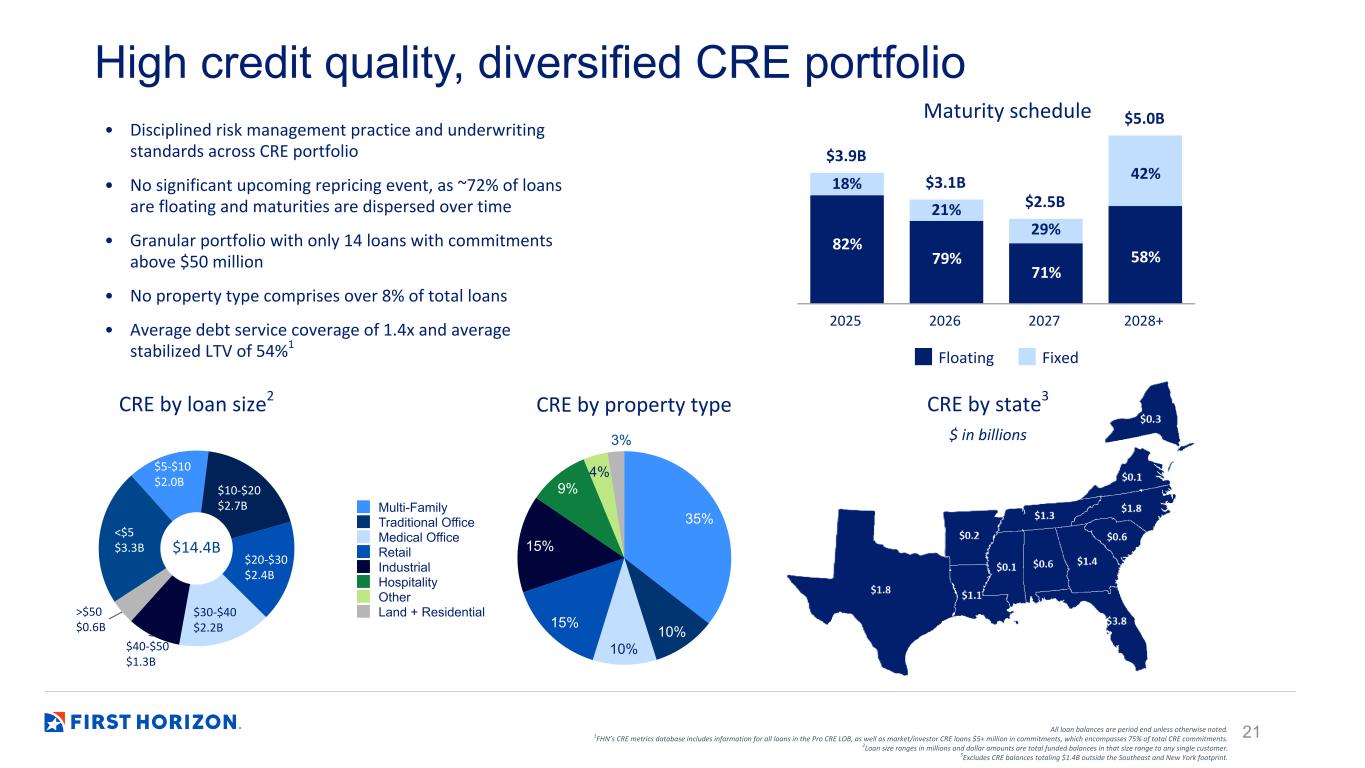
Yeah, the high rates have been having more of an effect on pipeline and delaying start of projects. In terms of kind of what's already in process and in lease up, it's really more determined by kind of the other per market. The higher rates obviously have some effect. It's harder to get into more attractive per financing, so that's resulting in some shorter term extensions. If we do see the rate cuts we're anticipating, you are probably more likely to see more of the completed projects and stabilized projects go into the per market. So I do expect that we'll likely see more refinances out of the portfolio.
Operator
Thank you. We now have Christopher Maranak with Jenny Montgomery Scott on the line.
Thanks. I wanted to ask about looking back on 2024 on technology spending and sort of kind of what you accomplish in the year and does that transition into more in 2025?
Excited to announce I have a new general ledger, which will not make our clients' ability to do business with us any better or generate any revenue. But one of our biggest, we had two large projects, one being a general ledger conversion, which did complete. And as the CFO, I was excited to see that complete on time. We also have talked quite a few times about our treasury management system. Following the MOE with Iberia, we put on hold converting to the one primary client system due to the merger that we were looking at doing, which did not end up happening. That was a large undertaking to move the legacy First Horizon clients onto that platform. Those were two very large projects that touched multiple systems across our company and required a lot of hands and people involved in it. So we completed both of those on time in 2024 and are excited to have those behind us.
We have a few large projects coming up that are more client-facing. we talk a lot about the run the bank being behind us and being able to invest and deliver new technology in 2025 and 2026 that improves the client experience their ability to do business with us and offers them new products i feel very good chris about the progress we made in in 2024 23 as well our teams did a lot of heavy lifting and some of it is hopes some of it was client facing like our treasury management systems have done a fantastic job closing a gap on some deferred maintenance and getting us into a position where we're now forward leaning in terms of how we invest in things like online mobile banking and customer facing real benefit that will deliver real benefit. I'm really proud.
Great. Thank you both for that color.
And it does sound like that, you know, part of the growth that you have in expenses this year will cover some additional tech spend i mean is that a fair impression without getting into too many details yes our technology spend our ongoing investments in our products our businesses are all embedded within our 2025 guidance we don't uh chris somebody asked earlier whether we we saw the if we saw revenue pickup would we add more expenses into new investments and i said we had a three-year plan we were committed to it we believe we had everything we needed on that roadmap great perfect hope thanks for reiterating i appreciate it thank you thank you just as a quick reminder at star one to register for any questions and we now have brennan crowley with
robert hey good morning guys thanks for taking my questions um i wanted to revisit capital and in particular the restructuring obviously the yield pickup is great here i'm just wondering if you guys can help us understand your thinking around the trade-off between buybacks and potentially further restructuring going forward, or if it was a one-time event? And if you are considering further repositioning, is there sort of an earn-back benchmark that you guys would target?
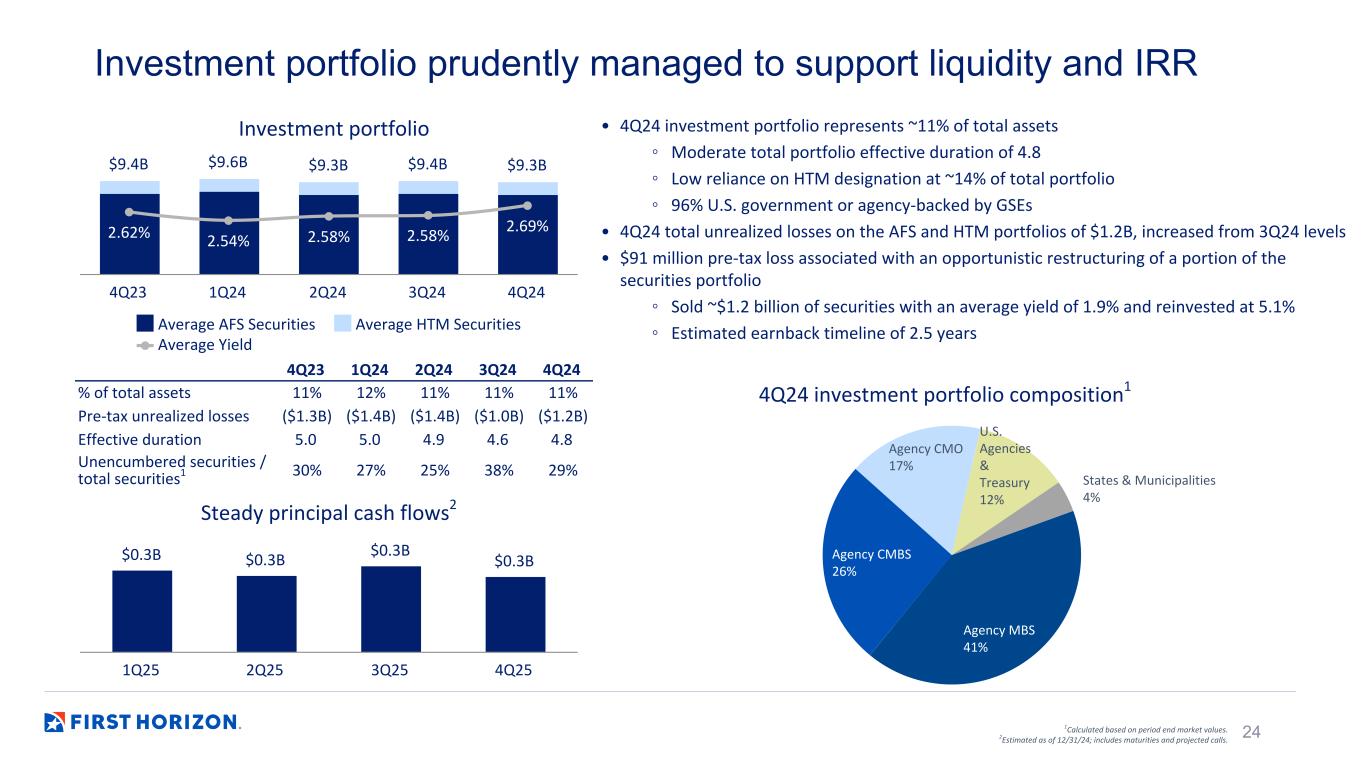
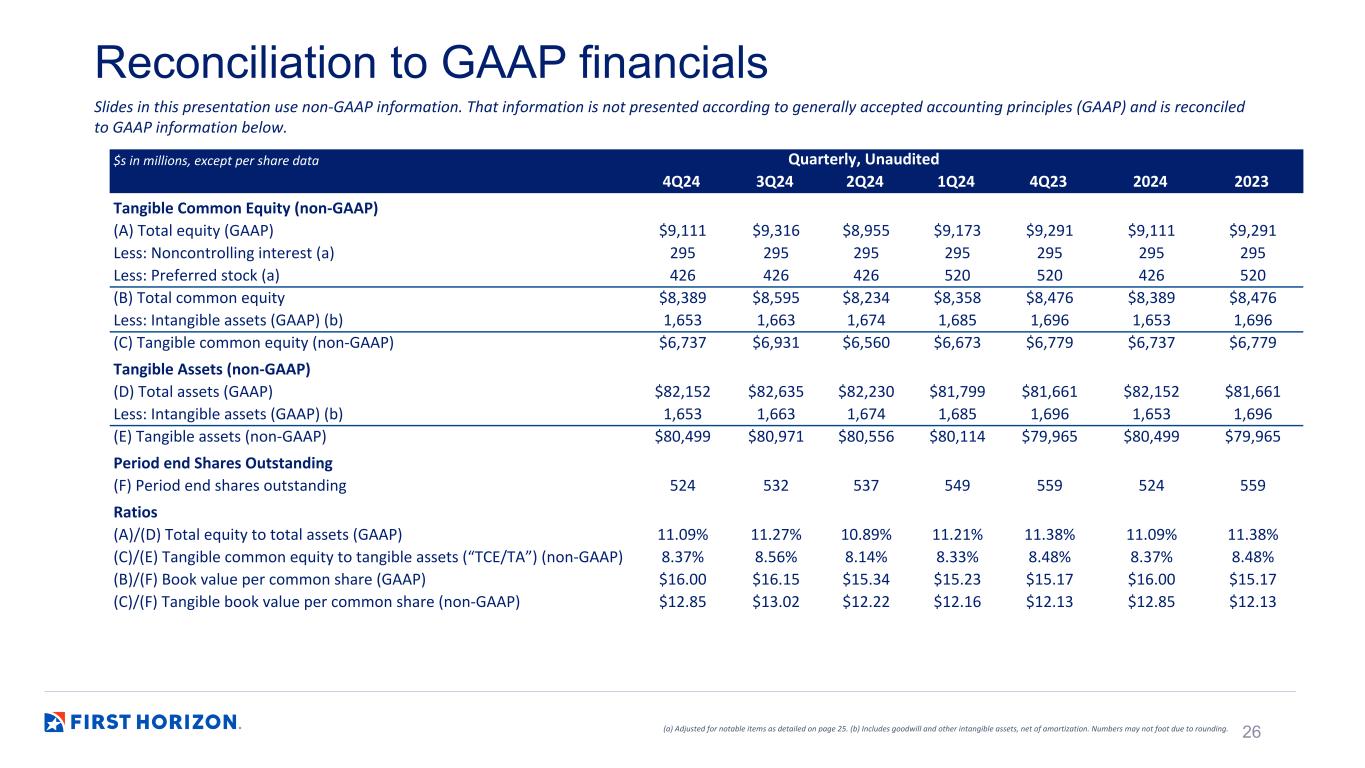
Well, yes. So in terms of the restructuring, it was an opportunistic restructuring. We took a little over a billion dollars of securities, and as Hope described, we sold them and reinvested. We significantly increase the yield on those but we also believe that we're positioning ourselves with one shorter duration and two better higher quality collateral and better performing collateral so and I think the securities portfolio for liquidity for interest rate asset liability manage interest rate sensitivity management as well as collateral so we looked at it in an opportunistic sense when we think about our capital and and return to the shareholders i described earlier how we really do a bottoms-up approach what's the appropriate capital levels and and the securities repositioning had an impact on regulatory capital it had no impact on our tangible book value per share it had because that was reflected in oci so that said you know we we will only be opportunistic in terms of repositioning the securities portfolio. We feel good about how that portfolio is performing. And while there is some residual OCI, that will come back over time. We believe in the valuation of our stock, and we believe that we are still at an attractive level and we have the ability to repurchase, you know, 800 plus million dollars of restock of shares, common stock. And we will use this excess capital as we generate it. And as we are able to bring down that CET1 ratio, if not through growth, we're going to look to bring it down by repatriating capital to our shareholders. So I think it was a good use of capital in the fourth quarter because it was an opportunistic transaction, but I don't think that should indicate anything about how we're going to deploy capital in the future. We will be opportunistic, but we think there's real value in our stock and we will look to continue to repatriate capital when we can't put it to work in terms of growing loans and customer activity.
We did not stop share buybacks to do the restructure. We did share buybacks the whole quarter until we went into our blackout and bought $163 million this quarter, which is the second highest quarter for the year, trying to target that 11% capital was still accreting earnings. We had the ability to do both. And when we ran the math on it, we stayed both in share buybacks and did the restructuring of our portfolio while staying above our near-term target capital.
Yep. No, that all makes sense. I appreciate the color. And then just as a quick follow-up, I wanted to zoom in on this service charge line item. And I'm just wondering if the Q4 numbers, kind of the run rate moving forward now that we have the full quarter of updated overdraft charges. And then if there was any ECR benefits and lower rates embedded in the quarter, if you can quantify that, that would be helpful as well.
In my prepared remarks and in the slide deck, we talk about it being a $4 million impact of service charge that will pull forward and be in our run rate. The rest were one-time items and just some seasonality or quarter to quarter changes that happen naturally. And we don't have any other, you know, impact that were in the run rate that would move forward.
Operator
Thank you. We have no current questions, so I would like to hand it back to the CEO, Brian Jordan, for some closing comments.
Thank you, Brica. Thank you all for taking time to join us this morning. We appreciate your interest in our company. If you have further questions, need additional information or just want to follow up, please reach out to us. again thank you for joining us and I hope everyone has a great day thank you all for joining I can confirm that does conclude today's call please enjoy the rest of your day and you may now disconnect from the call