Operator
Good morning, everyone, and thank you for joining us today to review Farmers National Bancorp's and Middlefield Bancorp's announcement of a definitive merger agreement. Before we continue, I remind you that forward-looking statements made during this presentation are made to the Safe Harbor Statement found in the presentation and our filings with the Securities and Exchange Commission, including Farmers' 2024 annual report on Form 10-K and subsequent SEC filings. These statements are not historical facts, but rather statements based on farmers' current expectations regarding its business strategies and its intended results in future performance, including the intended benefits of the merger. Forward-looking statements are not guarantees of future performance, and actual future results could differ materially from those contained in forward-looking information. Because forward-looking statements relate to the future, they are subject to inherent uncertainties, risks, and changes in circumstances that are difficult to predict, and many of which are outside farmers' control. Numerous risks, uncertainties, and changes could cause or contribute to farmers' actual results, performance, and achievements, and the intended benefits of the merger to be materially different from those expressed or implied by the forward-looking statements. For further information concerning factors that could materially affect actual results, performance, and achievements related to the forward-looking statements, please refer to the factors disclosed periodically in farmers' filings with the SEC as well as the disclosure statement in the presentation in Farmers and Middlefield's joint press release dated October 22, 2025. forward-looking statements speak as of the date made and farmers assumes no obligation to update any forward-looking statements to reflect future events, information, or circumstances that arise after the date of this presentation. A joint press release and presentation on the merger with Middlefield are available on the investor relations section of farmers' website. In addition, this call is being webcast and a replay will be available on Farmers Investor Relations website. And now, I'm pleased to introduce Kevin Helmut, Farmers Chief Executive Officer. Kevin, please go ahead.
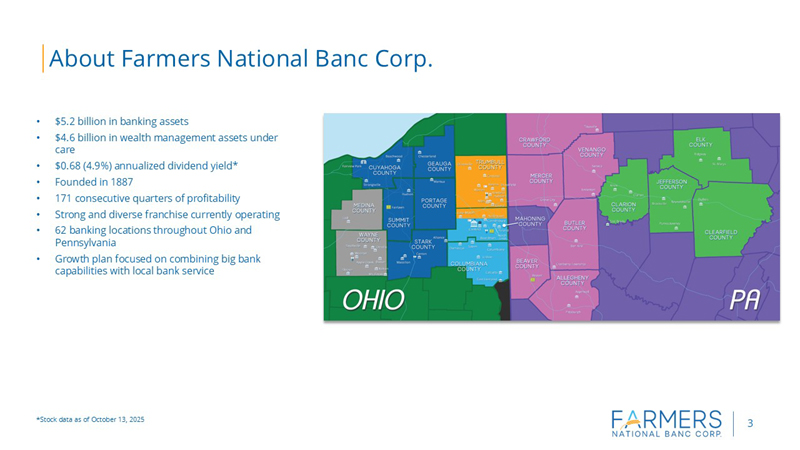
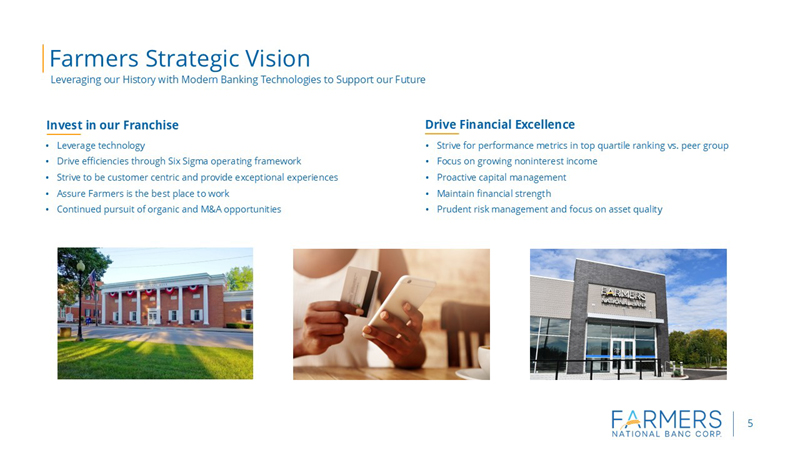
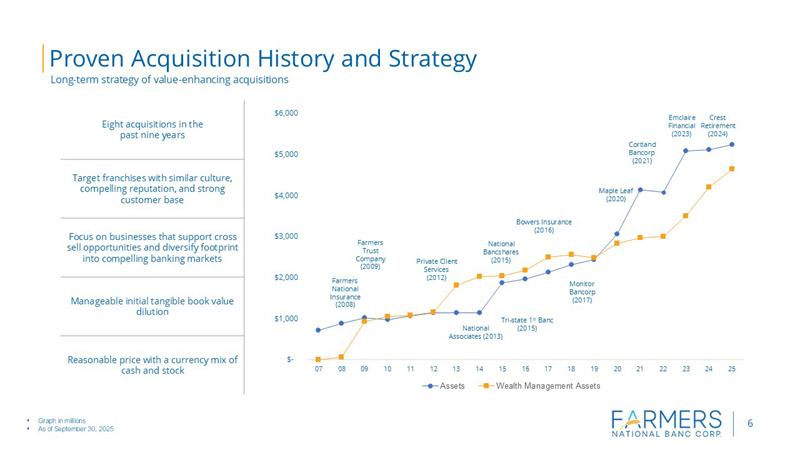
Good morning, and thank you for your time today. We are excited to share with you that this morning, Farmers National Bank Corp. and Middlefield Bank Corp. jointly announced the signing of a merger agreement to merge Middlefield into Farmers. Middlefield Bank Corp. is headquartered in Middlefield, Ohio, and is the holding company for the Middlefield Banking Company. On a consolidated basis, Middlefield has $2 billion in assets with 21 full-service locations and one loan production office throughout multiple compelling Ohio markets. When added to farmers $5.2 billion in assets, this transaction will increase our assets to $7.2 billion. At this scale, we believe our financial model will quickly benefit from significant operating leverage and drive increased financial performance. So today, I want to share with you the strategic rationale and financial implications of this exciting opportunity. Our transaction with Middlefield is strategically important as it provides a unique opportunity to acquire scale in several attractive Ohio communities and creates a foundation for future success as the community bank of choice in our markets. With six established locations and $163 million of deposit market share in greater Columbus markets, Middlefield will meaningfully expand our presence throughout central Ohio. Coupled with the establishment of our Dublin, Ohio, Loan Production Office and the fourth quarter 2024 acquisition of Dublin-based Crest Retirement Advisors by our subsidiary national associates, our Columbus strategic growth plan will be significantly accelerated. The Columbus market is a natural fit for our diversified financial services platform and Middlefield's strong community presence is well aligned with our strategic initiatives to grow in Ohio's largest and fastest growing region. Middlefield is also highly complementary to our Northeast Ohio franchise, creating significant market fill-in opportunities. For example, Geauga County has one of the highest median household incomes in the state. While Farmers currently maintains one office in the county and a modest share of local deposits, Meadowfield is the number one community bank and number two in deposit market share overall. The combination will establish Farmers as the leading community bank in Geauga County while broadening our reach and deepening relationships across key Northeast Ohio markets. We are very familiar with Middlefield's markets, culture, and communities. It is a well-run institution with an emphasis on strong core and lower cost deposits. There are a number of benefits that will transpire from this transaction, such as an opportunity to better compete for loan growth in new demographically rich markets with a larger legal lending limit. We are also excited to offer farmers robust wealth management services to Middlefield's customers to include Farmer's Trust Company, Farmer's National Investments, Farmer's National Insurance, Farmer's Retirement Services, and our private banking program. Both Middlefield and farmers take pride in their strong customer-centric cultures, making this transaction a great fit for both organizations. Like Farmers, Middlefield has a 100-plus year history of serving its communities. The combined company will consist of 83 branch locations throughout Northeast, Central and Western Ohio and Western Pennsylvania. We will acquire Middlefield Bank and merge into one combined company that will operate under the Farmers National Bank of Canfield name. We look forward to welcoming our esteemed Middlefield colleagues into the Farmer's family. Additionally, two Middlefield board members will join the Farmer's board to represent the legacy franchise and provide thoughtful guidance as we combine these two great companies. The transaction is expected to close in the first quarter of 2026, and we are working towards a conversion date in August of 2026, where both organizations will transition to Jack Henry, a new core platform. The core conversion will offer enhanced digital capabilities for our customers as well as a significant cost savings for our combined company. This will be the largest transaction in farmers' history when measured by banking assets, bringing our total acquisitions to nine in the last 10 years to include seven bank acquisitions. We have demonstrated a successful track record on our previous mergers as experience, talent, and passion run deep in the farmer's ranks. We have confidence that our acquisition experience should help mitigate integration risk with this transaction. Additionally, we expect our growth rates and profitability to be significantly enhanced as a combined company. I'm now happy to turn the call over to Troy Adair, our CFO, to review our third quarter financial results and provide additional details around the financial implications of this deal. Troy?
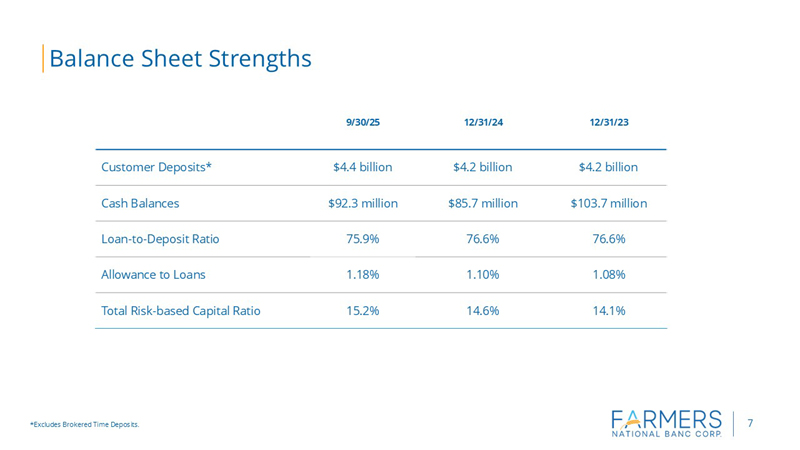
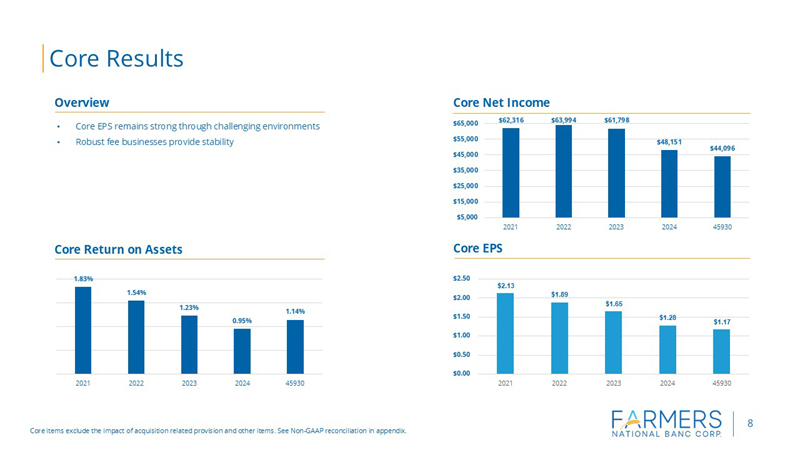
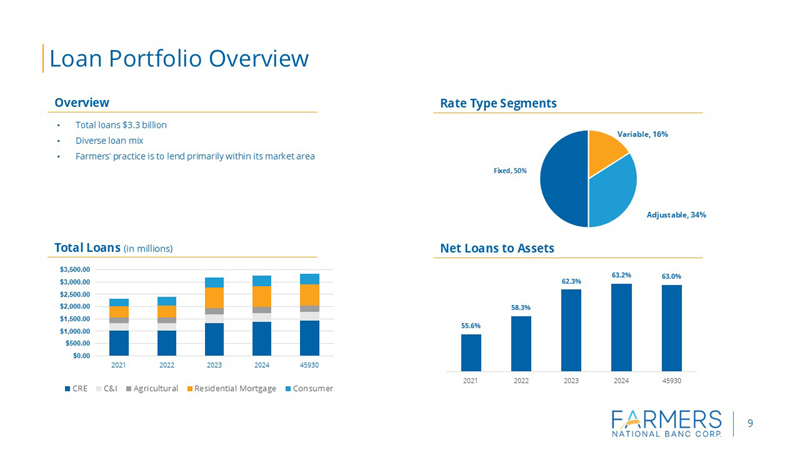
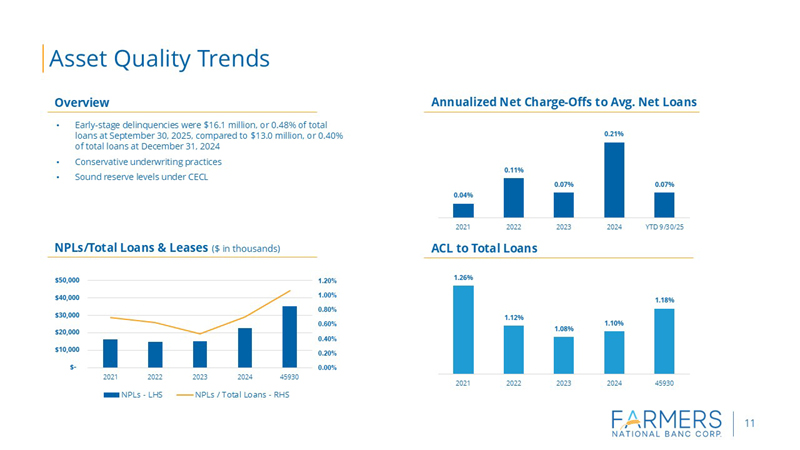
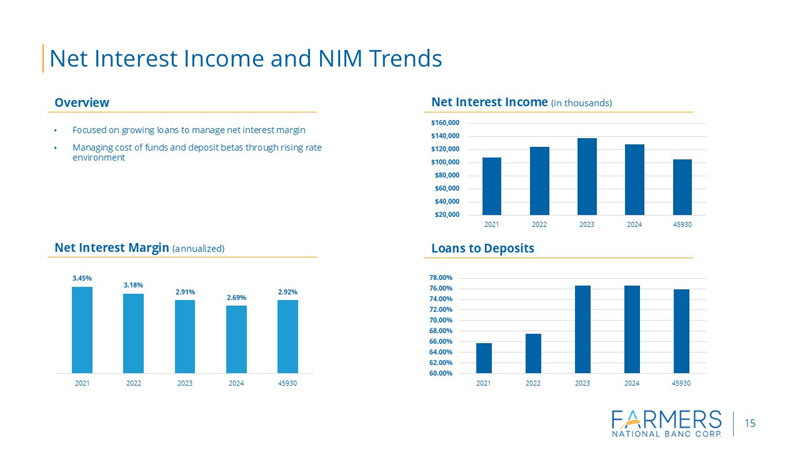
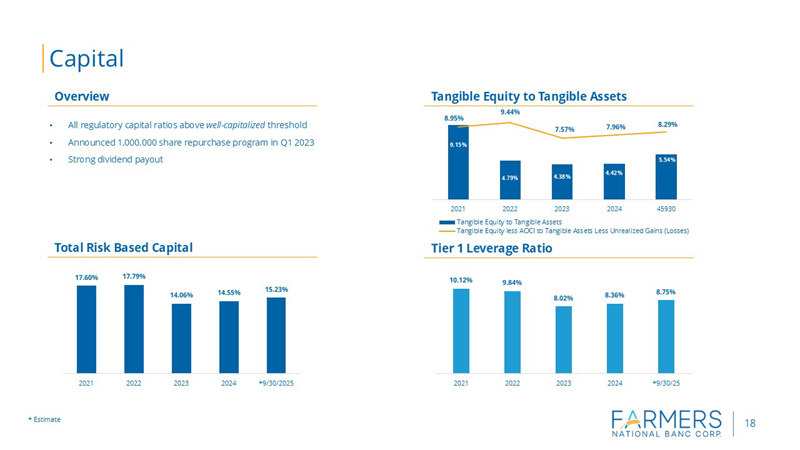
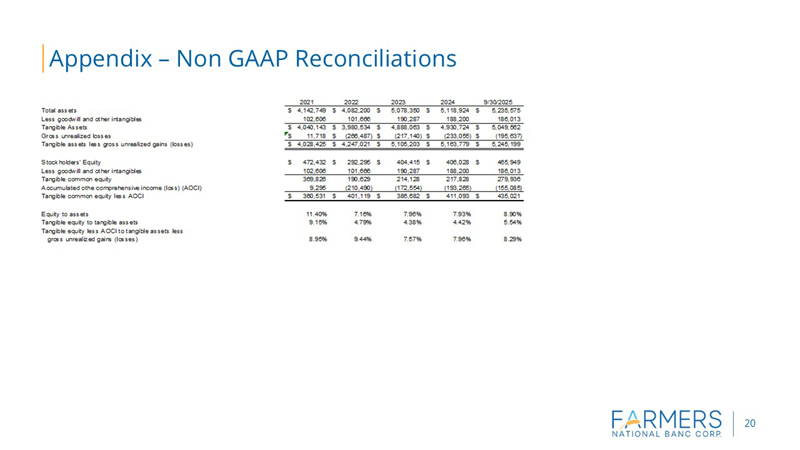
Thank you, Kevin, and good morning, everyone. We're very excited to make this announcement this morning, and in conjunction with this announcement, we're also going to talk a little bit about our third quarter financial results, which reflects solid operating and financial performance. Some highlights from our third quarter, we had our 171st consecutive quarter of profitability, well over 40 years of profitability that we've seen. We experienced solid loan growth of $34.4 million, representing an annualized growth rate of 4.2%. We had commercial loans, which led our growth in the quarter, increased by $30.1 million, or 6% at an annualized rate. Over the past three months, we've seen our net interest margin expand to 3%, which is the first time we've been over 3% in almost two and a half years. We opportunistically restructured $28.5 million worth of securities, and we've expanded the yield on this amount by 220 basis points on the reinvestment. As Kevin mentioned, farmers also made the strategic decision to transition to a new core platform. While we incurred an upfront charge of $3.1 million associated with this action during the third quarter, it will result in over $2 million of annual savings once the conversion is complete in August of 2026. Our efforts drove another strong quarter of profitability and earnings growth. We're proud of our performance in the third quarter and excited by the opportunities the middle field acquisition will have on our future financial performance. The Middlefield acquisition is structured as an all-stock transaction whereby shareholders of Middlefield will receive 2.60 shares of farmers' common stock for each share of Middlefield that they hold. Based on farmers' closing share price of $13.91 on October 20th, the total value of the transaction is $299 million, or $36.17 per share. The purchase price was approximately 163.5% of tangible book value and 14.1 times Middlefield's earnings for the last 12 months. This purchase price represents an attractive pay-to-trade ratio of 87.4%. We published a presentation that is available on the Investor section of our website in which we lay out several key assumptions. Regarding credit due diligence, management completed an in-depth review of Middlefield's $1.6 billion loan portfolio. Our due diligence team consisted of senior commercial credit and commercial banking personnel, as well as senior consumer, mortgage underwriting, and collections personnel. Management also engaged a third-party specialist to assess the loan due diligence, portfolio analytics and development of the credit mark. This gross credit mark is estimated at $28.5 million and represents 1.74% of Middlefield's gross loan portfolio. The due diligence team reviewed approximately 57% of the target's loan portfolio, including including the bank's classified and delinquent loans. We believe this comprehensive review provides an accurate assessment of the loan portfolio and the credit mark is both conservative and prudent in today's environment. Diluted earnings per share accretion for 2027 is estimated at approximately 7 percent, and the tangible book value per share dilution of approximately 4.4 percent is expected to be earned back in approximately three years using the crossover method. This includes a cost savings estimate of 38 percent based upon a middle field expense run rate. The acquisition will also push us over six billion in deposits and approximately five billion dollars in loans, while our capital levels will remain strong. We anticipate our pro forma total risk-based capital ratio to be approximately 13.7%, and TCE to tangible assets will increase to approximately 6.4%. I will now turn the call back over to Kevin for his final comments.
Well, very good, and thank you, Troy. As you can see, we are very excited about this opportunity that will help us expand into the demographically attractive central and western Ohio markets, while deepening our commitment to our legacy markets in Northeast Ohio and Western Pennsylvania. Middlefield is a high-quality company that offers tremendous upside for our shareholders. Farmers has continued to demonstrate a successful track record for executing on M&A and will strive to complete another successful transaction. So we would like to say thank you for joining our call today, and that's all for now.
Operator
At this time, we will begin the question and answer session. During today's Q&A, management will only take questions from farmers and middle field analysts. Analysts that would like to ask a question, please press star 1 on your telephone keypad. A confirmation tone will indicate your line is in the question queue. You may press star 2 if you would like to remove your question from the queue. For participants using speaker equipment, it may be necessary to pick up your handset before pressing the star keys. We ask analysts to limit themselves to one question and one follow-up so that others may have the opportunity to do so as well. One moment, please, while we poll for questions. Thank you. Our first question comes from the line of Daniel Timao with Raymond James. Please proceed with your question.
Thank you. Good morning, everyone. Congratulations on the deal. i guess first just on the on the balance sheet uh you know curious what you think if any um this the deal has the impact has on on the growth rate for for farmers obviously you guys haven't been growing a whole lot for for a while but um you know does this accelerate your ability and willingness to grow the balance sheet, where do you think that shakes out going forward?
Danny, hi. This is Troy Adair. This was one of the reasons that we found Middlefield to be attractive with the Columbus market, the way they've been growing loans over the last couple of years. We felt that this would enhance our ability to grow organically. We opened up the LPO in Columbus earlier this year, but obviously it's a smaller operation. So we really think that it will enhance our organic growth capabilities moving forward. Great. Thanks, Troy. And then,
you know, just from a balance sheet actions perspective, any anticipated changes to the balance sheet once the deal closes or going into the close on either side from either bank?
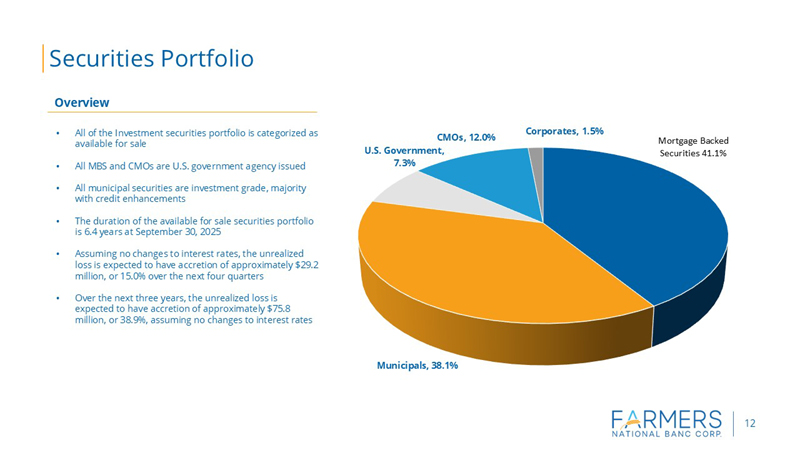
I think the marketplace is really creating opportunities for us in regards to our investment portfolio. I think restructuring opportunities will be possible. I think rates are down another 20 basis points since the end of the quarter. So if we get even better loan growth, we've got easy opportunities to fund that growth. so we can restructure, reduce some of our asset or liability sensitivity moving forward. We just think it opens up a lot of possibilities for us over the next 12 to 18 months.
Yeah, Danny, this is Kevin. Thanks for the questions. And, you know, I think just to add a little bit to what Troy said, and he said it well, and obviously in our earlier comments, Columbus we recognize is on a national stage from their economic development and growth perspective. And so adding it to what we now consider the triangle of Cleveland, Pittsburgh, and Columbus creates a fair bit of excitement for us. It's well documented that we've been able to acquire and execute on a number of transactions in the past. And I think, you know, thinking about just loan growth in this transaction maybe undersells it a bit in that, you know, one of the things we're really excited about is wealth management. That just doesn't grow fees. It grows relationships. And I think, you know, based on what we've been able to do in Pittsburgh and some of the early returns there and the early wins we're seeing in the market, you know, the playbook will continue to be similar in Columbus. We did close the fee acquisition in early January with Crest Retirement and then, as Troy mentioned, the LPO. And so just being able to add to our, you know, kind of the spark we've created down and around the greater Columbus market with this, as well as the Western markets in Hardin and Logan counties that Middlefield had is very exciting. And we love the fill-in opportunities. The fill-in opportunities in Northeast Ohio are communities that we know, great sources of funding. So we think it's the right opportunity, and we often talk about the strategic aspects of our acquisitions, and that's first and foremost. So loan growth on its own we're optimistic about, but I think as it fits into the overall plan is what makes us particularly excited. So, Danny, as always, we appreciate, you know, the thoughtful questions.
That's helpful, Collar. Kevin and Troy, thank you. I'll step back.
Operator
Thank you. As a reminder, if you would like to ask a question, press star 1 on your telephone keypad. One moment, please, while we re-poll for any additional questions. Thank you. Our next question comes from the line of Daniel Cardenius with Danny. Please proceed with your question.
Hey, morning, guys. Congratulations on the transaction. Just quickly, what does this deal do to your CRE concentration
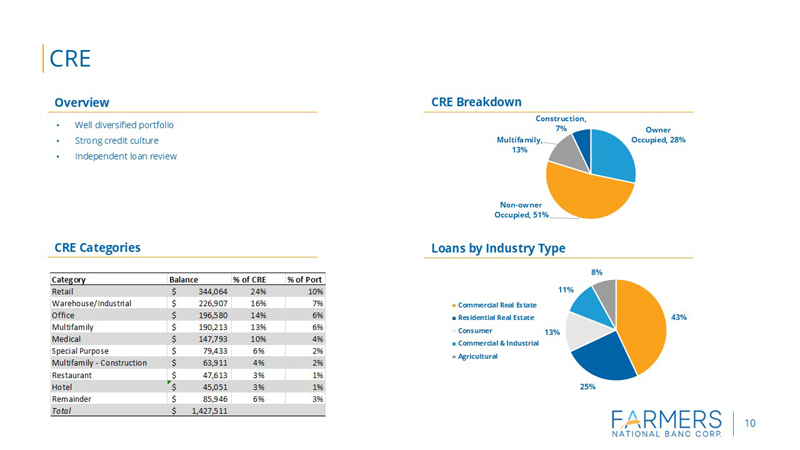
ratio? Dan, it raises it a little bit, but we're still well below the 300 percent regulatory limit. We think we've got a lot of opportunities, not only in the CRE space, but really more so in the C&I space. Middlefield has been doing a very nice job of growing that book of business. We think it will augment our efforts, and we think we've got a lot of runway with both of
those buckets in the loan portfolio. Dan, I would just add that Middlefield has done a great job in the last couple of years of focus in C&I too, which is of particular interest to us. And so So I think it'll be a balanced approach. As Troy said, it's opportunities to come up with CRE. You know, we have ample room there. But as excited about the CNI prospects as anything in this.
And then in terms of additional deals,
do you guys have capacity or appetite to look at multiple deals at once? And if you did, would these be pure play Ohio deals or would you look at expanding in Pennsylvania as well? Thanks again, Dan. So, you know, our thought process here is just it's really solely on Middlefield and their stakeholders. We have, as we mentioned in the release, our core conversion that we're very excited about as well. the Middlefield and farmers sides both have Jack Henry histories. You might remember the Cortland acquisition. They were on Jack Henry. We still have a number of associates as well as Middlefield's acquisition of Liberty where CEO Ron Zimmerle came from. They also have they were on Jack Henry. So, we're very excited about the resources we have there and the ability to convert successfully in August. And so, I think we're solely focused on, as I said, middle field and stakeholders in that conversion right now. So, we'll kind of, I'll kind of punt on that question for now. You know, you know us well, and we've been acquisitive, but for right
now, that's where our focus is. Okay, makes sense. Thank you. I'll skip that. Our next question is a
Operator
follow-up from Daniel Tameo with Raymond James. Please receive your question. Hello again. Well,
if I've got the floor here, I'll ask a few questions. Excuse me. Maybe just a follow-up on the expense side, the cost savings. So, you talked about, and Troy mentioned, uh two million annual savings from the from the core conversion um and that's happening in august um maybe just walk us through the timing of the of the cost savings as a whole if you're going to get some um you know initially in the first quarter or in the second quarter kind of post closing and then the the bulk of it post conversion is that is that the best way to think about it and and that two million you're talking about i'm assuming that that's uh you know fully baked into the cost savings you're talking about. Yeah, Dan, that's a great question. I'm sure,
you know, many people on the call won't understand that. So, let me lay out the timing so you understand and then Trill comment on that, you know, kind of the financials behind it that we've talked a lot about. So, you know, it's not unusual for us to see, you know, this length of time between, you know, signing and a conversion. We've managed through other transactions, benefit of doing a number of transactions recently with the same team. We're excited about that, but that, you know, that we have that scheduled for August. So, you know, as you can imagine, you know, we're thinking about, you know, end of first quarter close. And so we'll be, you know, running out the balance of that through conversion, you know, And so I think that would extend the time of the cost saves out to the end of the quarter. But Troy has some more specifics. But I just wanted to make sure that, you know, we kind of painted a picture there. Our last transaction with Farmers of Emlington, our experience was, you know, from announcement until conversion was about 11 months. And we actually anticipate that this one will be, based on that August timeframe, even shorter than that. So, again, we're well-versed. We're well-prepared, you know, for that type of time frame. It's not unusual for us. It does have an impact on those expenses, as you said, though.
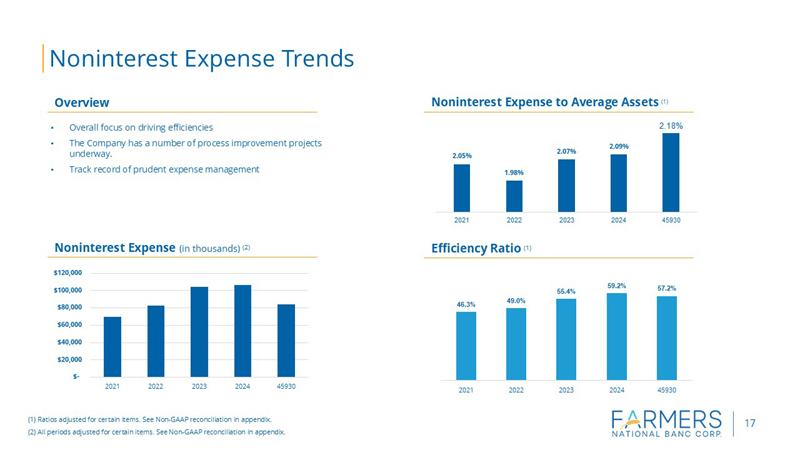
Yeah. And Danny, you know, the two million that we referenced in the press release, that is relative to armors on a standalone basis. The cost savings associated with Middlefield's core would be part of their 38 percent cost savings that we referenced. So, the two really are additive. So, significant cost savings with this contract negotiation. And we were going to have to go through this anyway. Our core was going to be sunsetting over the next several years. So, this was going to be a necessary step for both organizations because one of the benefits of this merger two in the conversion, Middlefield is on the same exact core as us. They're using the same exact general ledger system, so it creates some ease in the conversion process. Relative to your question pertaining to cost savings, because of the longer time between close and conversion, a lot of the cost savings will be a little more back-end loaded in 26. It's really why we were referencing 27 earning run rate, because 26 results aren't going to be so lumpy. We will have some cost savings immediately post-close, certain contracts, things of that nature, but a lot of the cost saves will be back half of the year, back in the fourth quarter.
Okay. All right. Very helpful. So the $2 million in savings are incremental to the deal cost savings. Is it fair to say there'll be additional kind of one-time costs then related to the core conversion that you'll recognize later in the year?
We will have some costs. I would estimate probably $750,000, you know, later in 26 related to that. But again, that run rate improvement will start immediately post-conversion.
Okay, great. And are those savings in the 2027 numbers that you gave, the 150 ROA, those are? Okay, okay.
Yeah, we anticipate most of the cost savings being in our run rate by December and into the first quarter of 27.
All right. And then on the funding side, Middlefield's got a little bit higher cost funding than Farmers does. How do you think about your ability to lower that to kind of match what you've got happening now and in terms of timing as well on that?
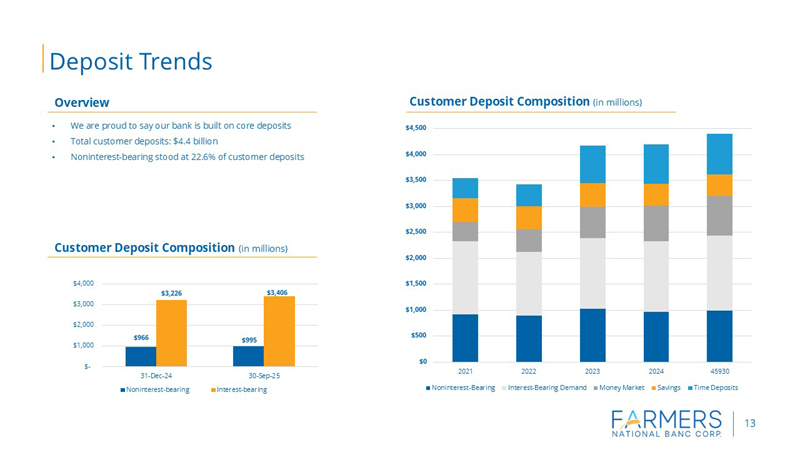
Sure. You know, I think there's two things going on. Number one, on the farmer's side, we've got a pretty long history of managing expenses, both operating expenses as well as deposit costs. Middlefield's had the benefit of growing their loan book fairly rapidly. They've been a little bit more aggressive on pricing. Obviously, our deposit base, our low loan-to-deposit ratio offers us some opportunities to continue to allow that group to grow the loan book but manage the deposit costs in a more efficient way. So, we think there's some opportunities there, some possible additional margin expansion additive to our liability sensitivity that we could see over the next 18 to 24 months. Okay, great. And lastly,
just to follow up on that, the loan-to-deposit ratio goes up for you guys, as you mentioned. What's a comfortable number for you now post the merger?
Danny, I think it goes, you know, we're going to say roughly 82. I mean, we've been, you know, 90 to 95 before. So, I mean, I'll tell you near term, it's probably 90. And I think that presents a lot of opportunity, as Troy said, on both sides of the balance sheet. So if I had to give you a number thinking about it today, you know, it would probably be 90.
Well, I think that's all for me. I don't know if Dan has any other follow-ups as well, but I appreciate the time today, guys.
Absolutely, Danny. Thanks again.
Operator
A final reminder, if you would like to ask a question, press star 1 on your telephone keypad. One moment, please, while we re-poll for any additional questions. Thank you. It appears we have no further questions at this time, and with that, the conclusion of today's call. You may disconnect your lines at this time. Thank you for your participation, and have a wonderful day.