Operator
Greetings and welcome to the Hagerty Fourth Quarter 2025 Earnings Call. At this time, all participants are in a listen-only mode. A question and answer session will follow the formal presentation. If anyone should require operator assistance during the conference, please press star zero on your telephone keypad. Please note this call is being recorded. I would now like to turn the conference over to your host today, Jay Koval, Senior Vice President of Investor Relations. Thank you, sir. You may begin.
Thank you, operator, and good morning, everyone. And thank you for joining us to discuss Hagerty's results for the fourth quarter of 2025. I'm joined this morning by McKeel Hagerty, Chief Executive Officer and Chairman, and Patrick McClima, Chief Financial Officer. During this morning's conference call, we will refer to an accompanying presentation that is available on Hagerty's Investor Relations section of the company's corporate website at investor.hagerty.com. Our earnings release, slides, and letter to stockholders covering this period are also posted on the IR website as well as our 8K filing. Today's discussion contains forward-looking statements and non-GAAP financial metrics as described further on slide two of the earnings presentation. Forward-looking statements include statements about our expected future business and financial performance and are not promises or guarantees of future performance. They are subject to a variety of risks and uncertainties that could cause the actual results to differ materially from our expectations. For a discussion of material risks and important factors that could affect our actual results, please refer to those contained in our filings with the SEC, which are also available on our Investor Relations website and at sec.gov. The appendix of the presentation also contains reconciliations of our non-GAAP metrics to to the most directly comparable gap measures that are further supplemented by this morning's AK filing. And with that, I'll turn the call over to McKeel.
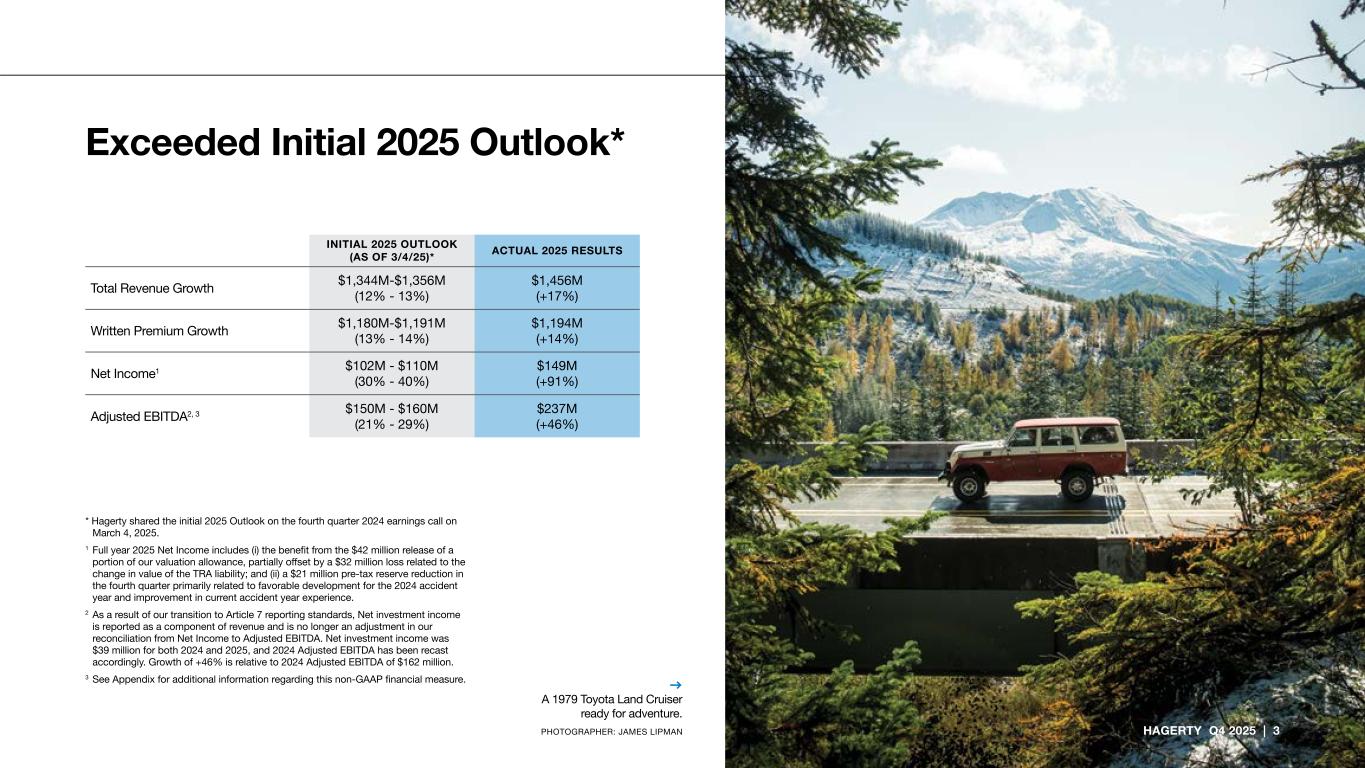
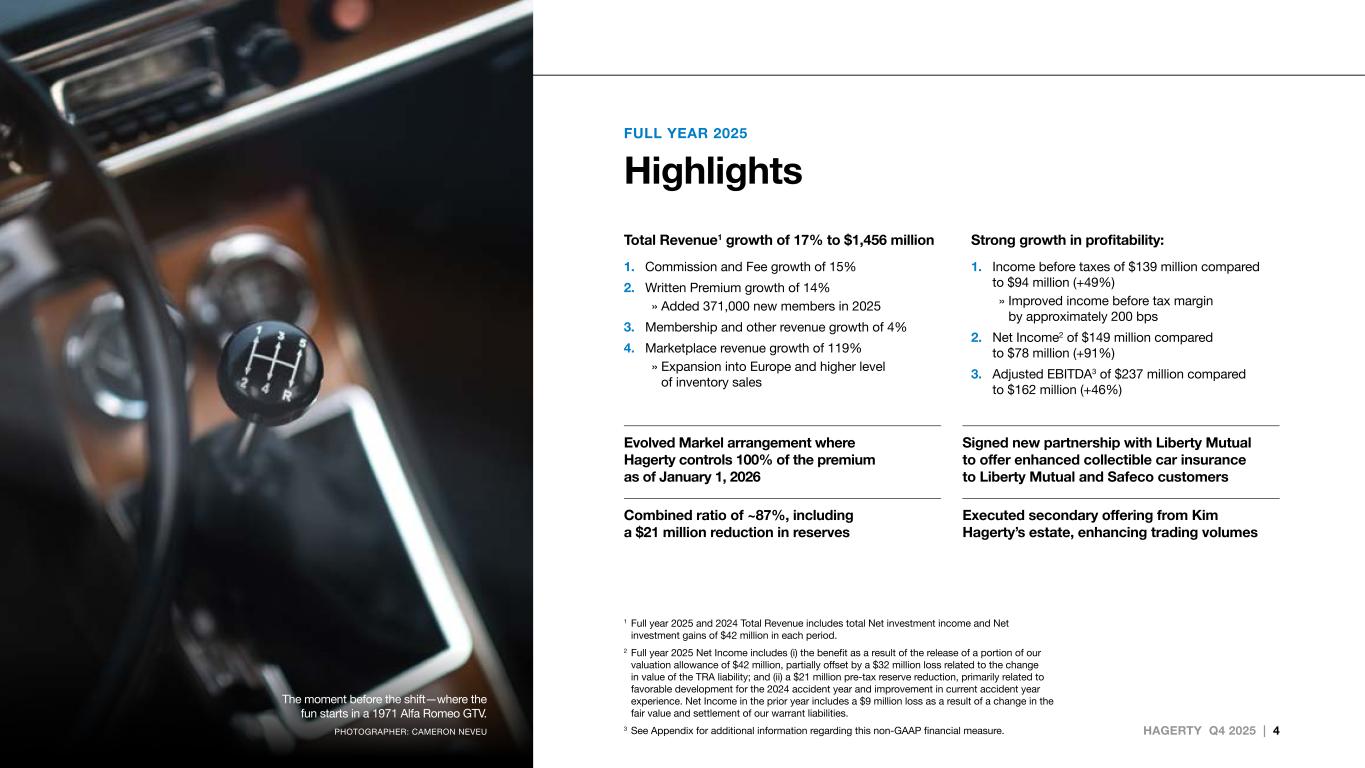
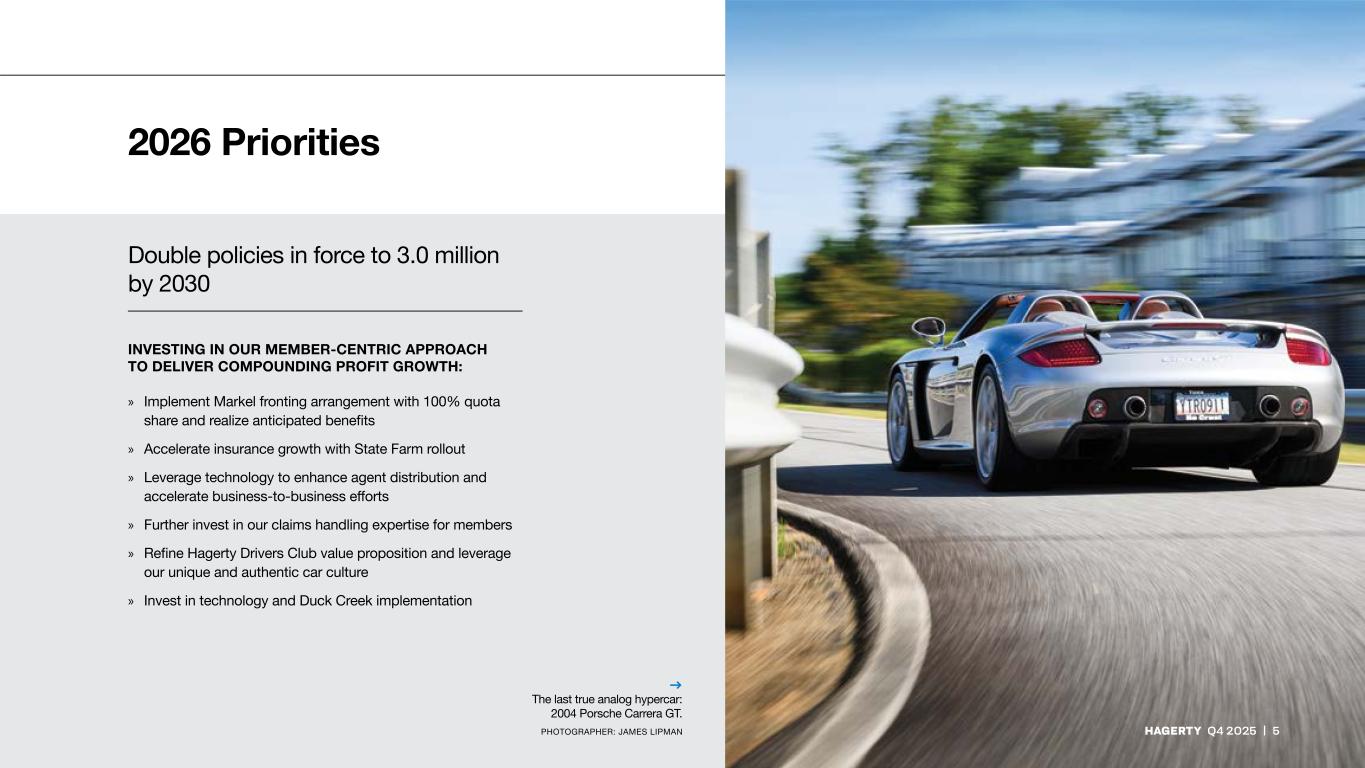
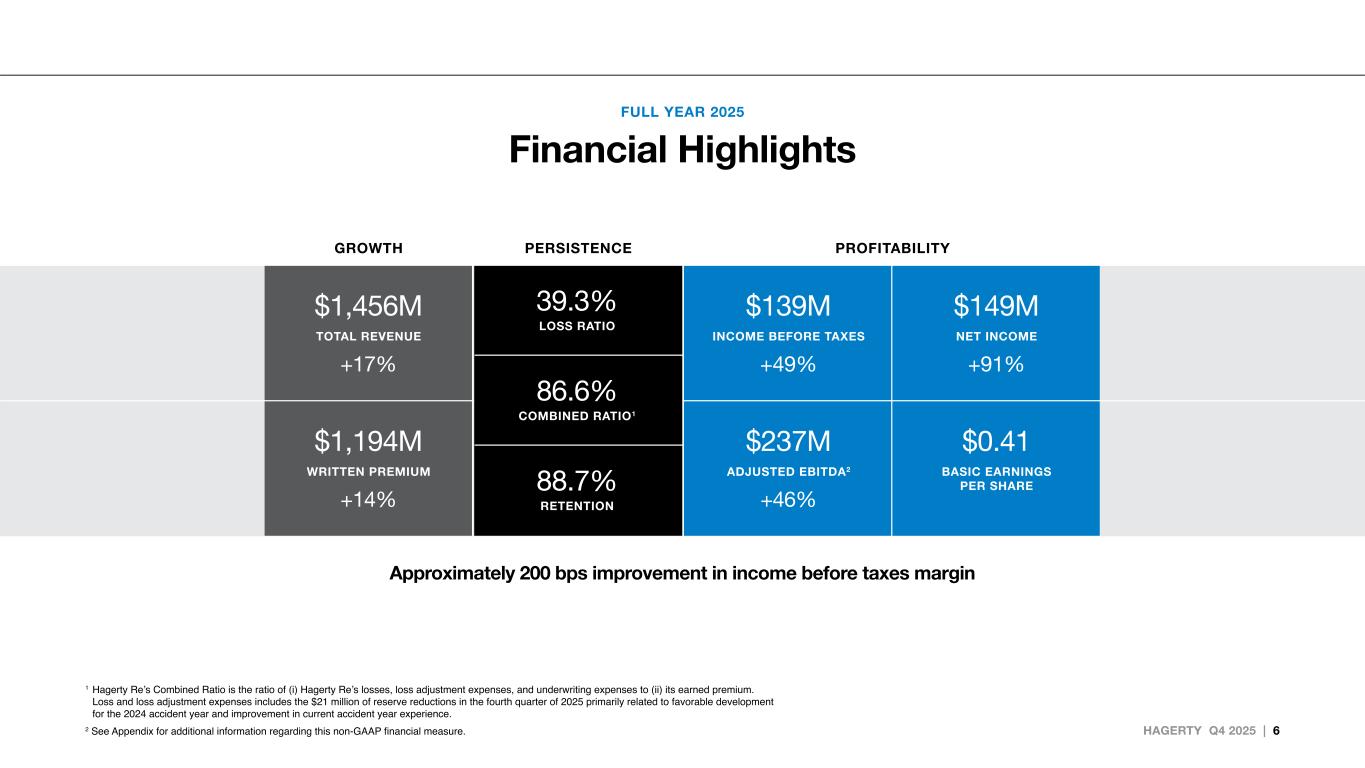
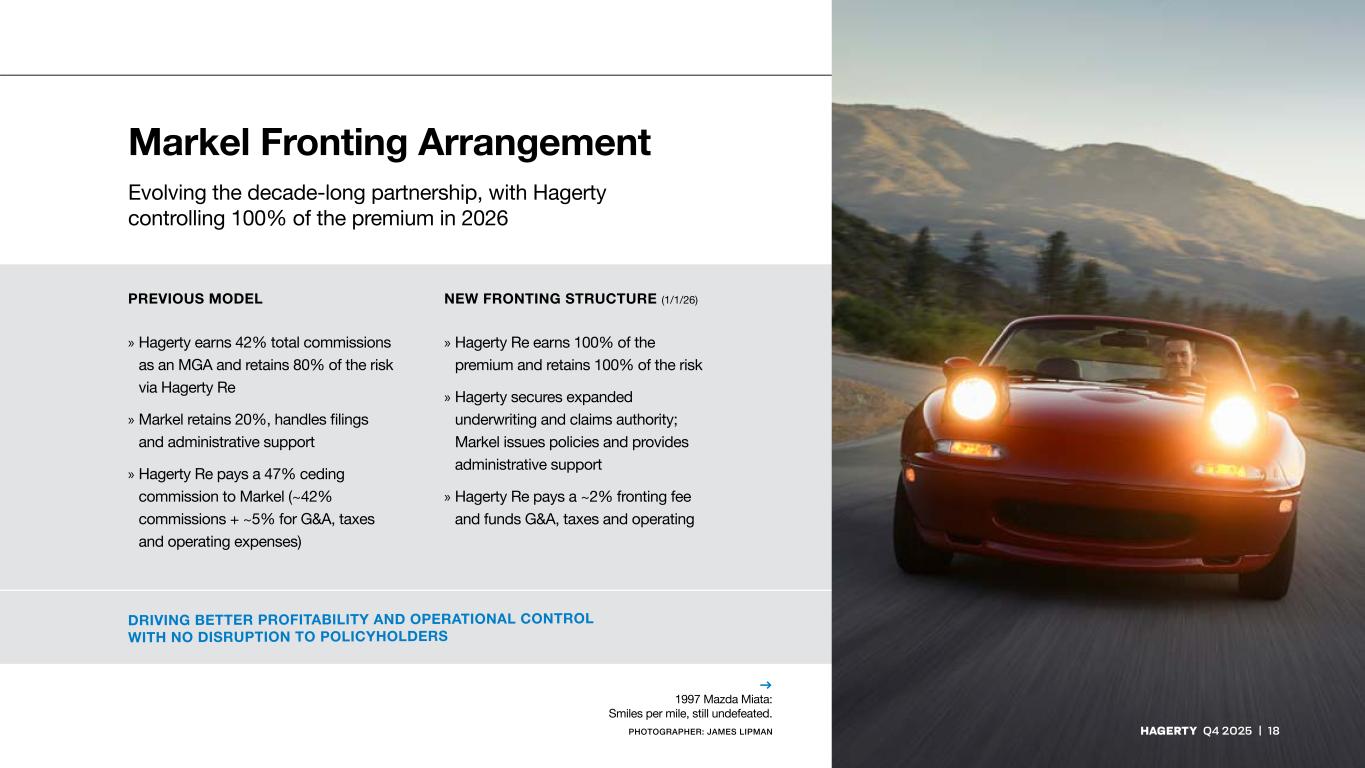
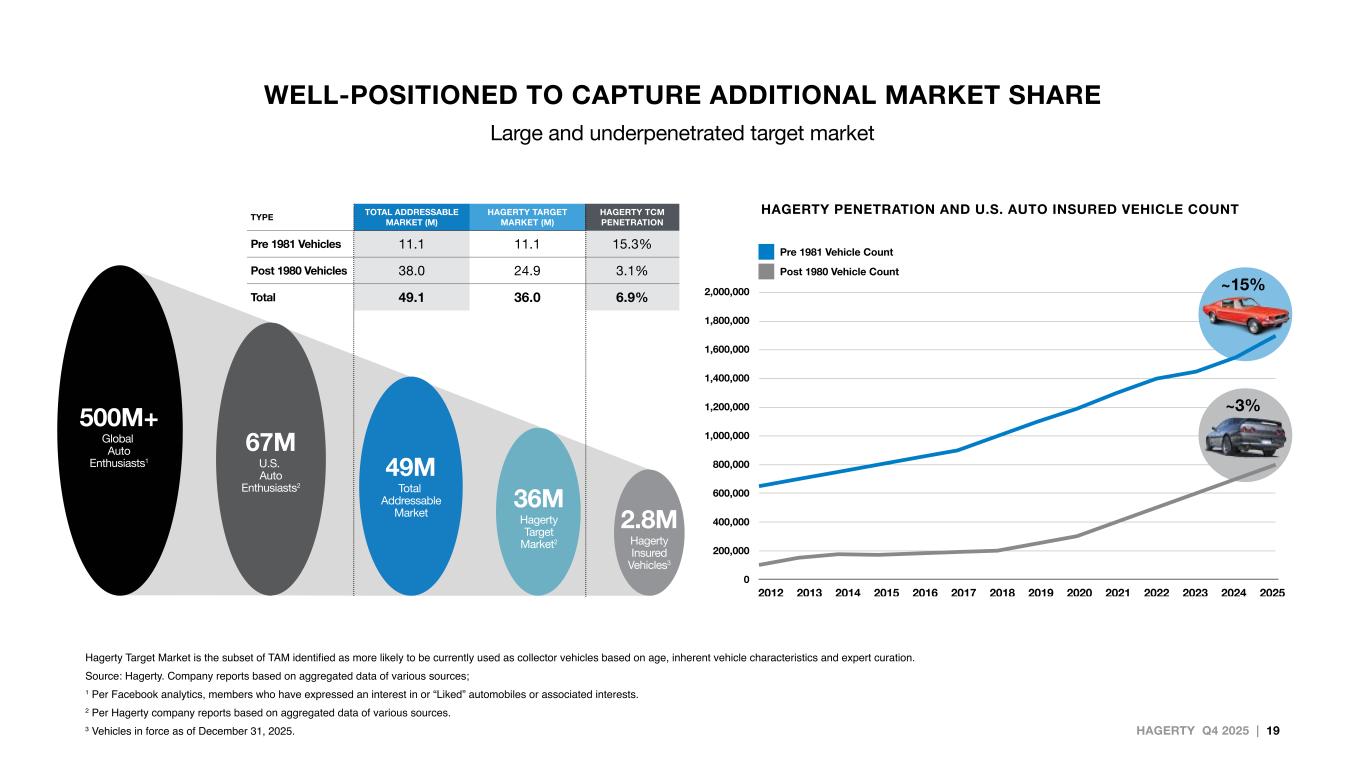
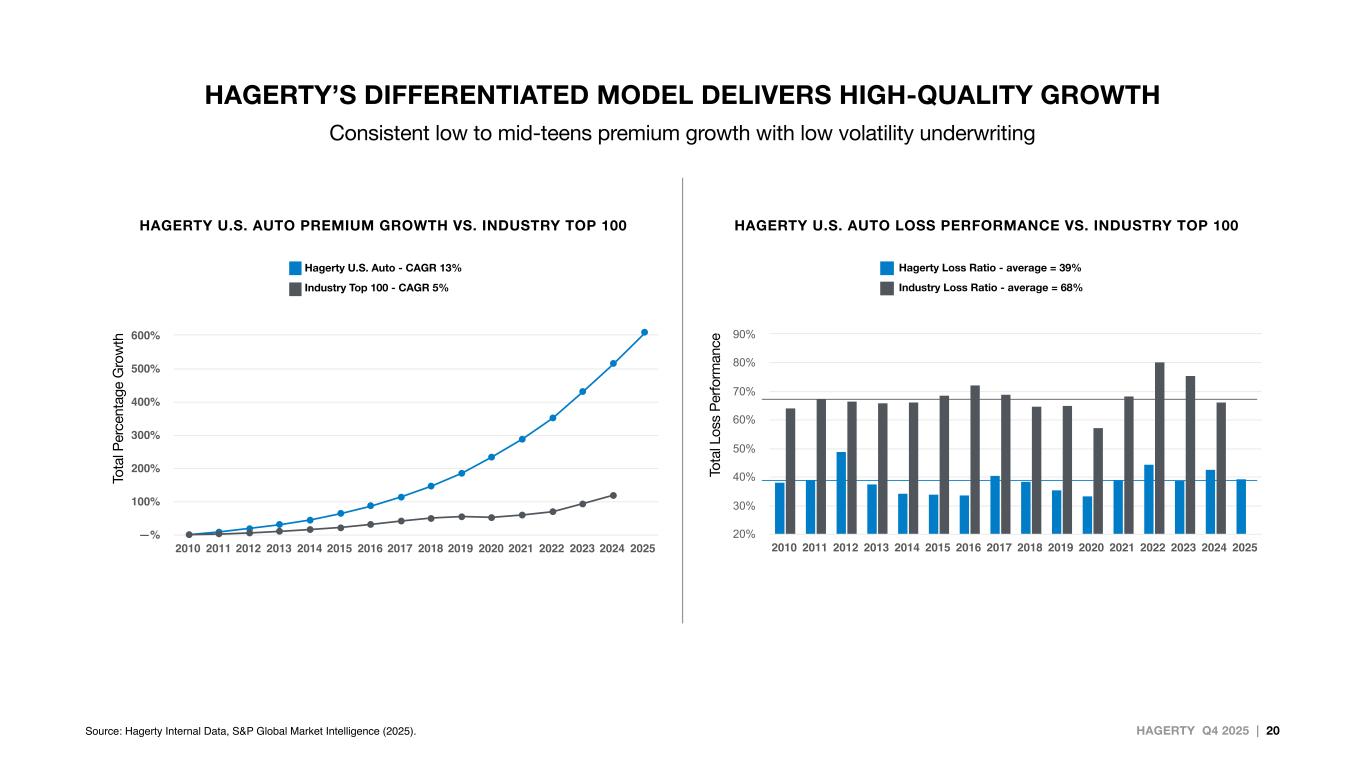
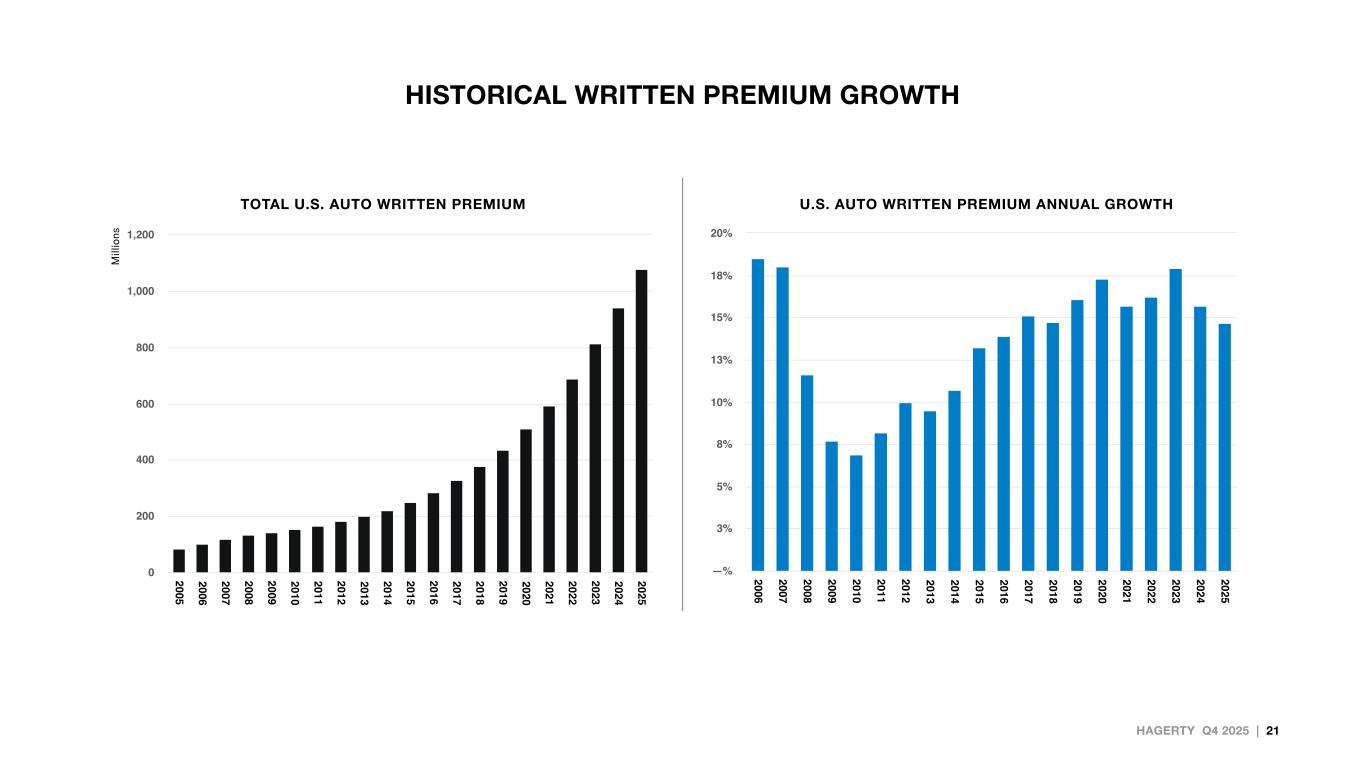
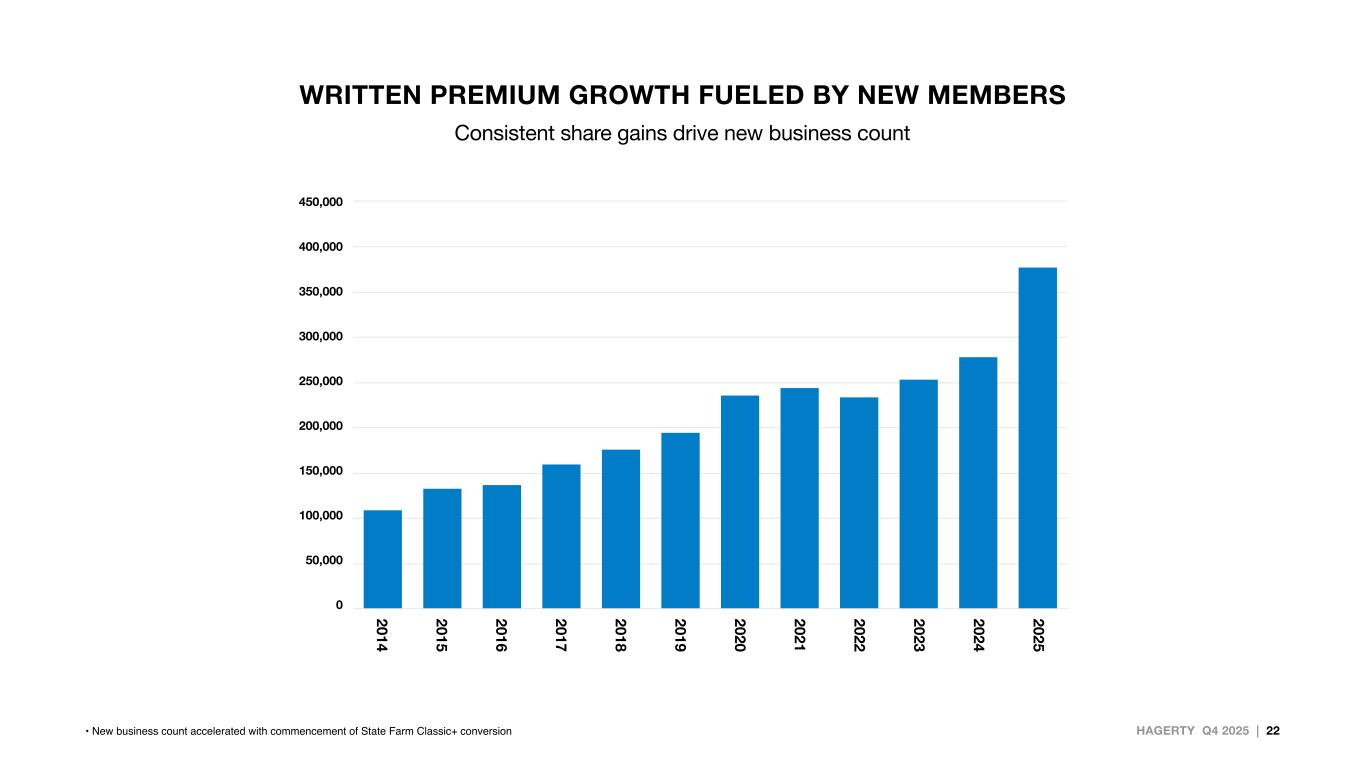
Thanks, Jay, and good morning, everyone. We appreciate you taking the time to join Hagerty's fourth quarter 2025 earnings call. As we approach the spring driving season, our team is hard at work preparing for the onslaught of new members we expect to add to the Hagerty ecosystem in 2026. Our members' cars are very special to them. and they are equally special to one-team Hagerty. This inherent love for their toys results in fundamentally better risk profiles due to the way our members care for their prized possessions. And Hagerty has the automotive expertise and guaranteed value proposition they are looking for to protect their cars. This includes innovating with new products and services that align Hagerty with our members' needs. Our member-centric approach built around the automotive passion, combined with our reinvestment posture, positions us to spin the flywheel faster, resulting in high rates of sustained written premium growth and even faster growth in profits, which should lead to strong returns for shareholders. Let me dig into our excellent results for full year 2025. Slide three shows how we handily exceeded our original expectations from a year ago, with revenue up 17% and net income surging 91%. Our profit growth benefited from record new business count and efficiency gains, as well as stable underwriting, and better-than-anticipated loss trends, which permitted us to reduce reserves by $21 million. 2025 marked the third straight year of executing on our strategy to deliver high rates of top-line growth while more efficiently translating incremental revenue into profits and cash flow. Since going public four years ago, we have compounded revenue by 23% per year and increased net income by over $200 million, reflecting the strength and differentiation of the Hagerty business model as our profit growth is driven by adding new members and not the rate cycle. Operating cash flow is growing quickly, up 24% to $219 million. This cash flow positions us to lengthen our leadership position by reinvesting back into to our value proposition for members. With excellent retention and strong net promoter scores, we are operating from a position of strength as we look to grow our share of the 36 million vehicle target market from just 7% today. Slide four shares some additional 2025 highlights. First, we welcome the record 371,000 new members to Hagerty's ecosystem of products and services. Written premium gains of 14% accelerated throughout the year and were better than anticipated thanks to share gains from our recurring revenue model. Importantly, our underwriting is not just high quality but also low volatility. We ended the year selling new State Farm Classic Plus business in 27 states and we are converting their US book of 525,000 vehicles in seven of those states. We also announced a new partnership with Liberty Mutual and Safeco. Marketplace and our auction businesses had an incredible year with revenue more than doubling as we expanded into Europe with auctions in Italy, Belgium, and Switzerland. Total transaction value of vehicles sold at auction and through private transactions came in at $566 million, making Hagerty the number two global player after just three short years in the market. Net income jumped 91% to $149 million as compounding premium growth, cost discipline, resource prioritization, and terrific execution by one team, Hagerty is fueling steady margin expansion. We also evolved our relationship with Markel by signing a new fronting arrangement where we retain 100% of the premium beginning January 1 of this year. For some perspective, it's an extremely rare occurrence in the insurance world to transition from earning a commission to capturing full economics, and we have been working toward this moment for over a decade, taking on more and more of the risk and premium, culminating with the recent move from 80% to 100%. We are excited to continue partnering with Markel as we deliver seamless experiences for Hire-D members with greater operational control. Our technology and digital teams are steadily moving us toward a modern cloud-based architecture that should result in future efficiency gains and scalable growth, including the launch of Enthusiast Plus on Duck Creek to capitalize on the burgeoning demand from younger generations of car lovers. We have continued to deepen our bench strength through several strategic hires across insurance, claims, technology, and marketplace. And finally, the estate of my late sister, Kim Hagerty, executed a secondary share offering that increased our float and trading volumes as we work toward being a more fully distributed public company. This is a long list of milestones, but at its core, 2025 was a year of investing for the future while delivering in the present. Let me move on to slide five and walk you through Hagerty's 2026 priorities, which are focused on further enhancing the member experience while becoming more efficient at delivering great products and services. First is implementing our new fronting arrangement with Markel, which creates a stuck function increase in potential underwriting profitability and investment income. To transition to this new 2% fronting arrangement, we are building out our internal team so we can control all aspects of our insurance risk, including administrative functions and regulatory filings. With this arrangement comes a complex set of non-cash transitional costs that Patrick will discuss in more detail. But the key takeaway is that our underlying profit and cash flow increase under the new arrangement. Our second priority is State Farm Plus expansion and and conversion of additional states. We will also prudently expand our Enthusiast Plus product after launching in Colorado last summer. Third is to refine our distribution strategy with partners and accelerate our B2B efforts, including agent distribution enhancements that should drive additional share gains for Hagerty. Fourth is to maintain the quality of our growth through further investments in our claims expertise. This includes building out the material damage and special investigative teams to ensure that claims are handled very quickly and accurately. Fifth is to enhance our member-centric approach and refine the HTC or Hiring Drivers Club value proposition. And finally, we will continue our multi-year tech transformation and Duck Creek implementation. Executing on these priorities in 2026 should result in another year of strong underlying growth in premiums and cash flow. Let me now turn the call over to Patrick to share more details on our results and initial 2026 outlook.
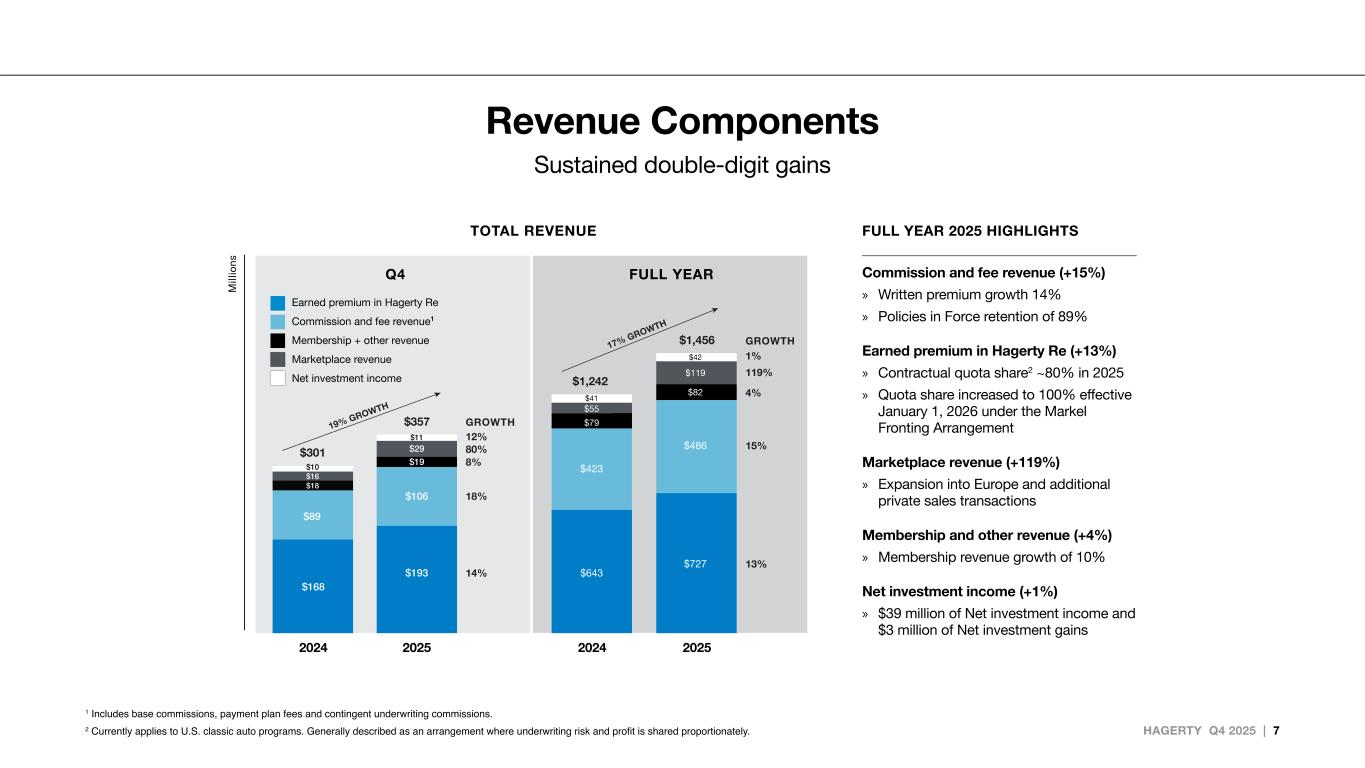
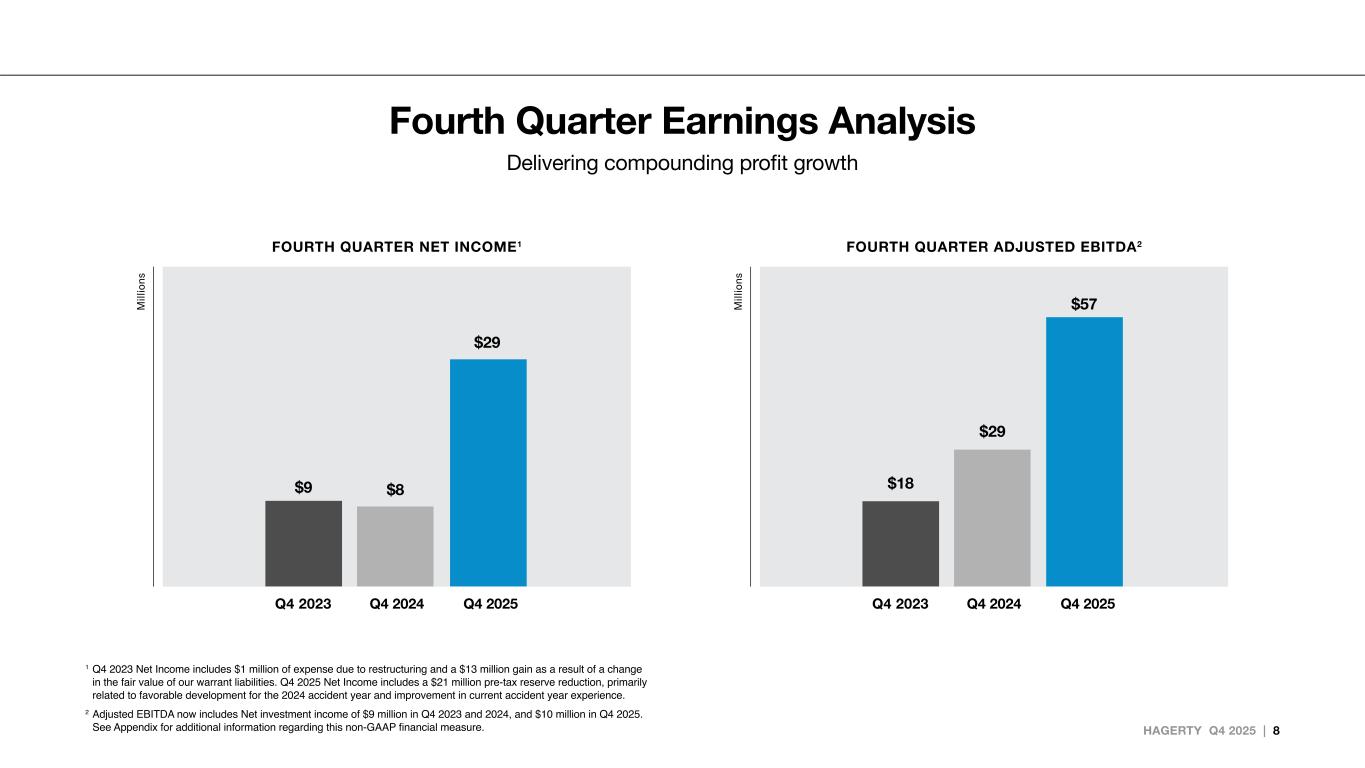
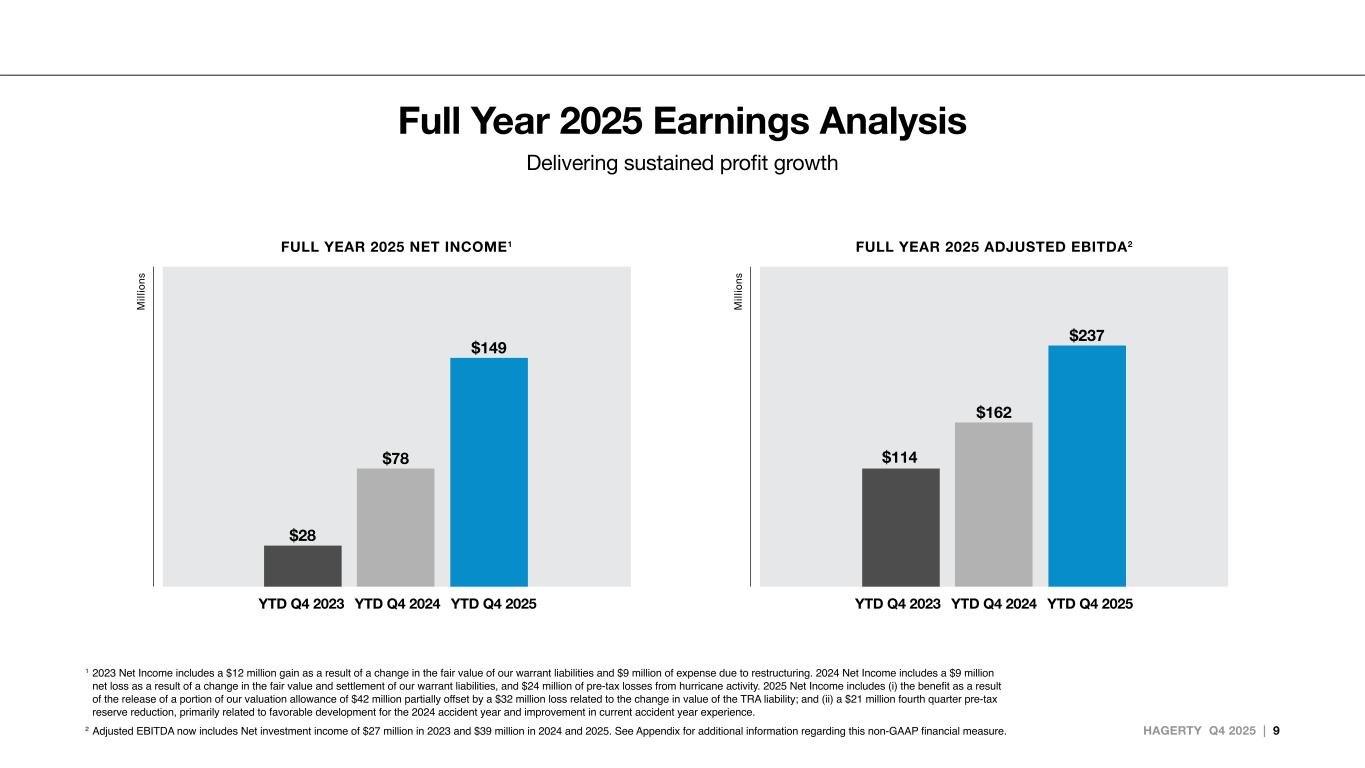
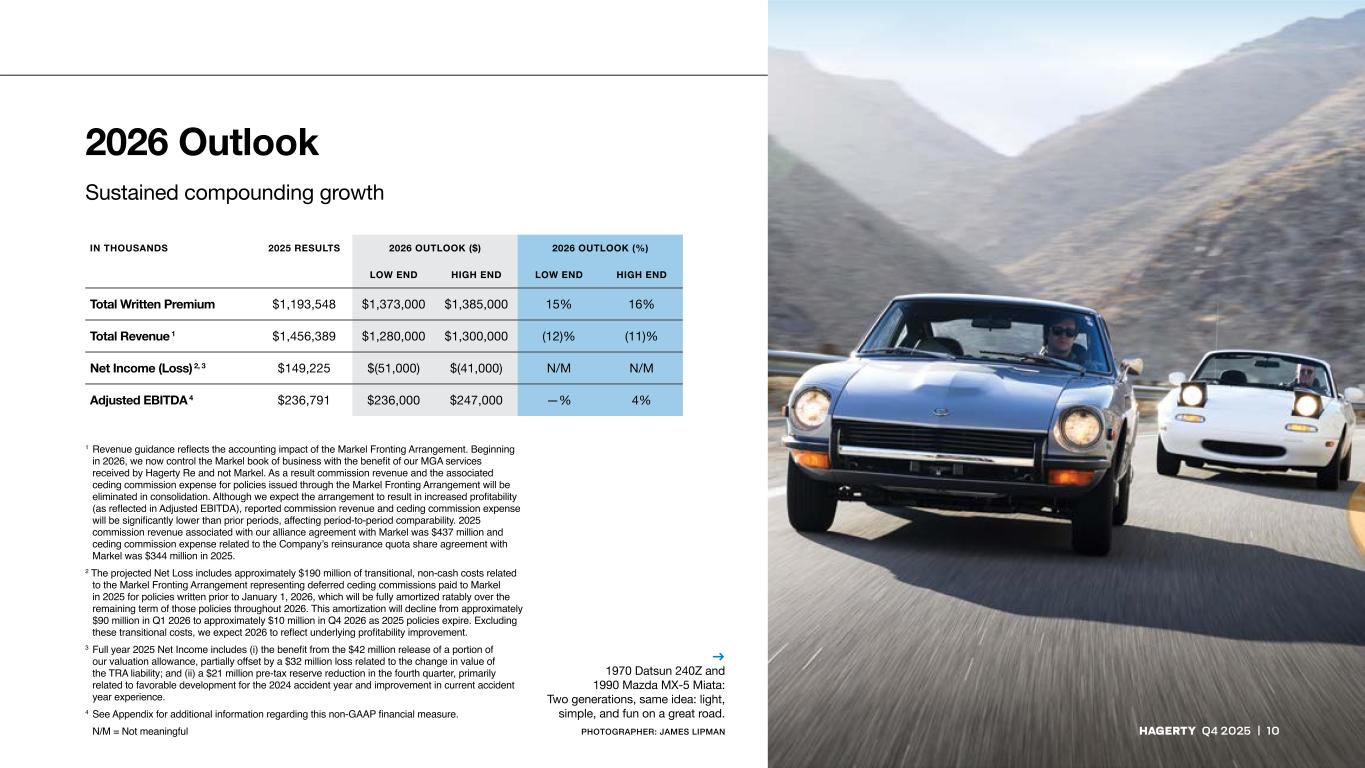
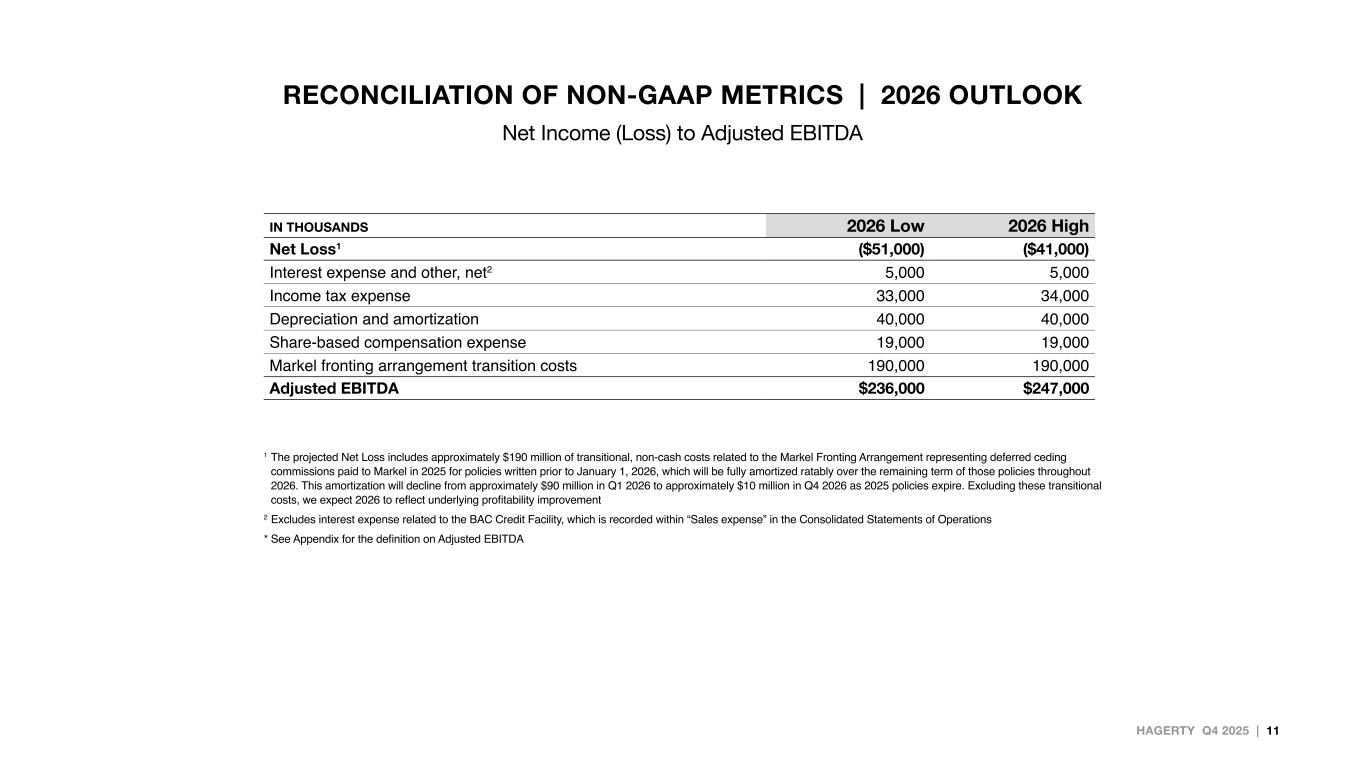
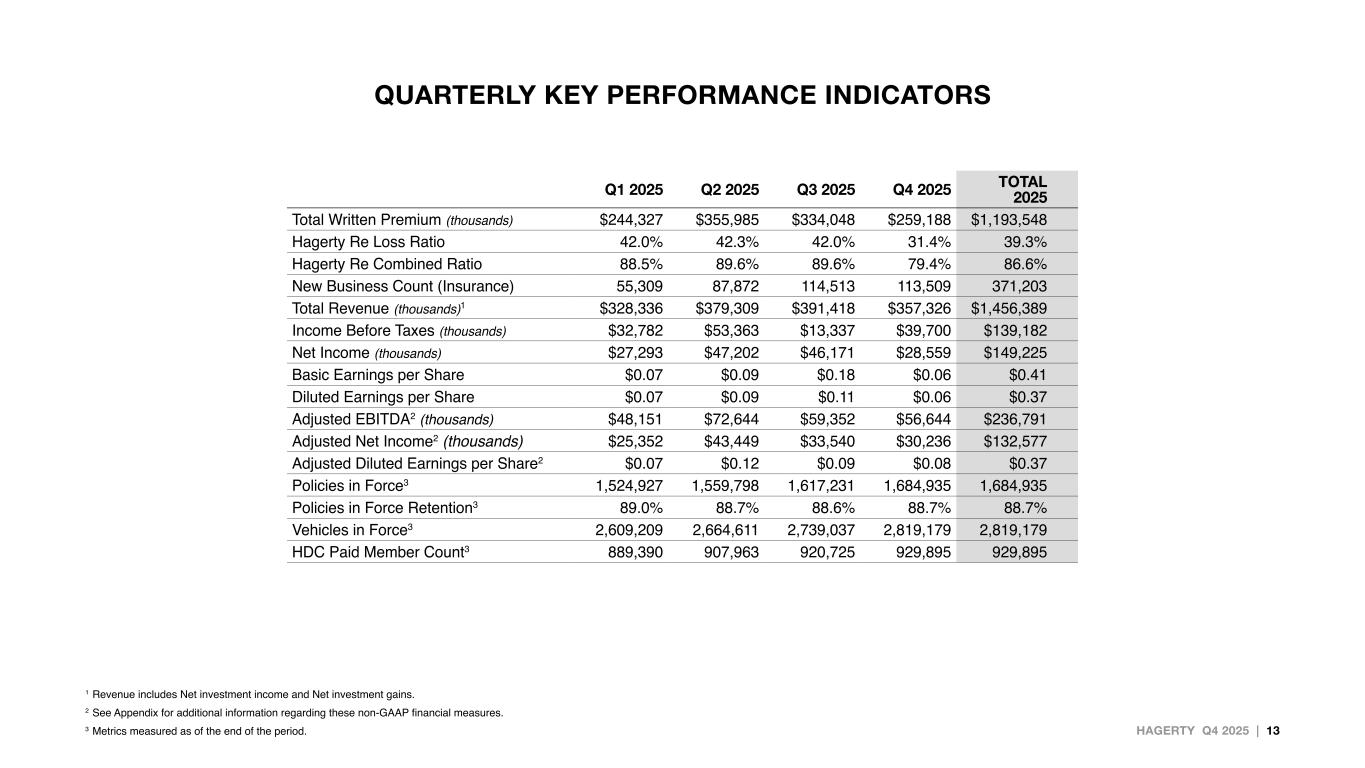
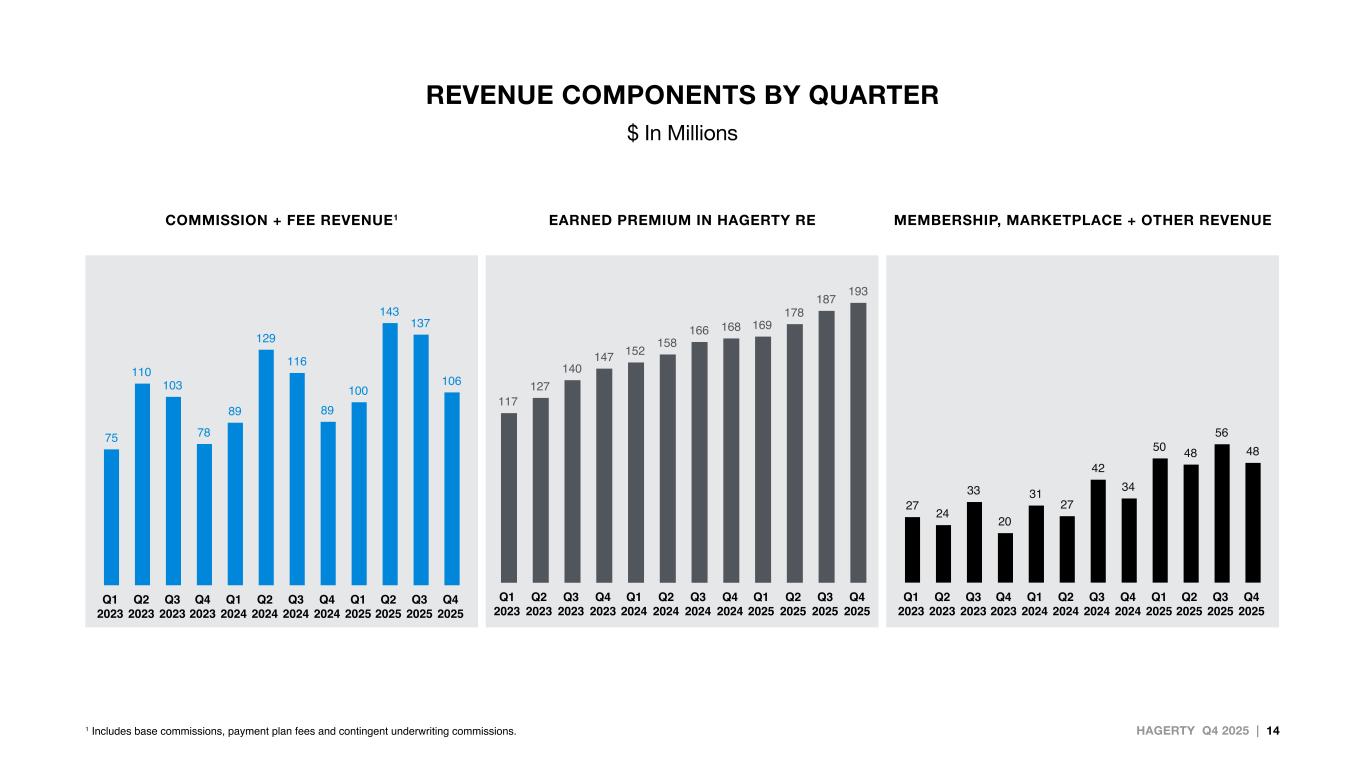
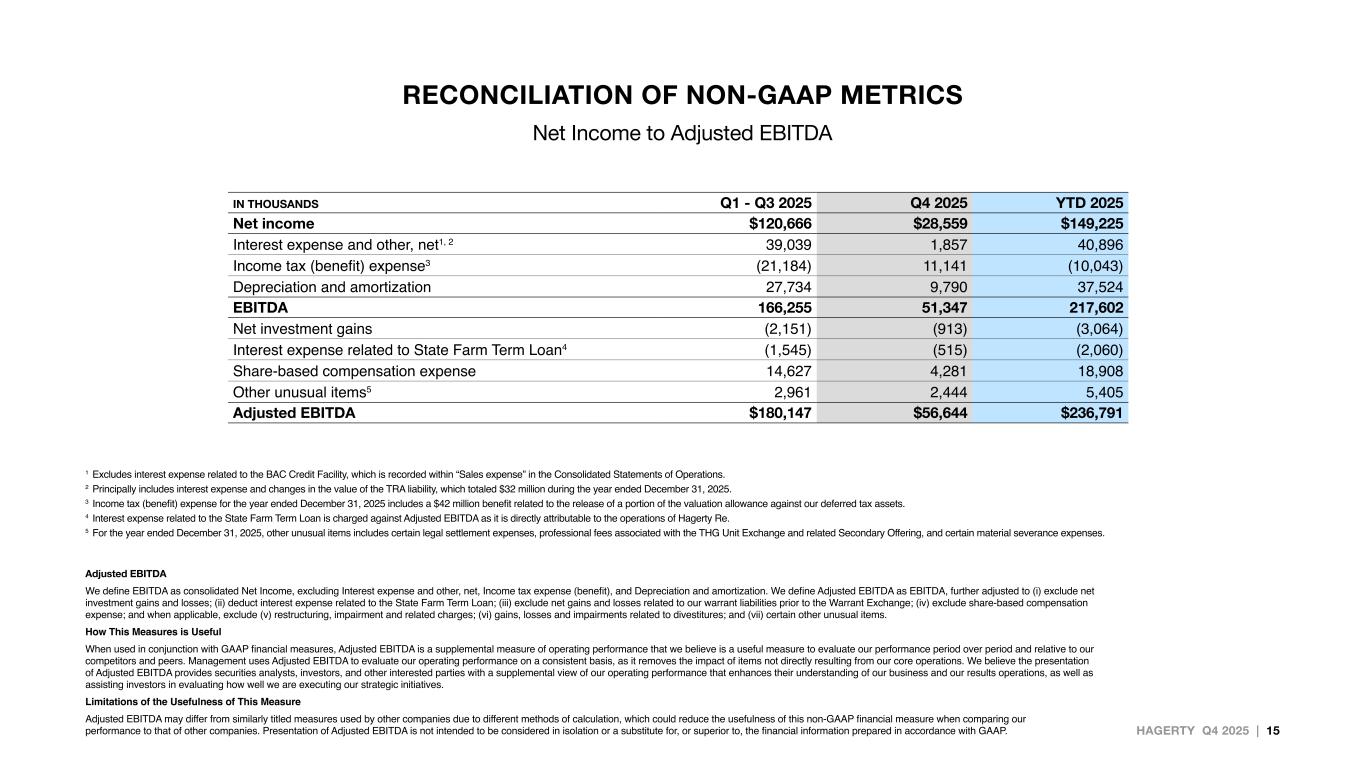
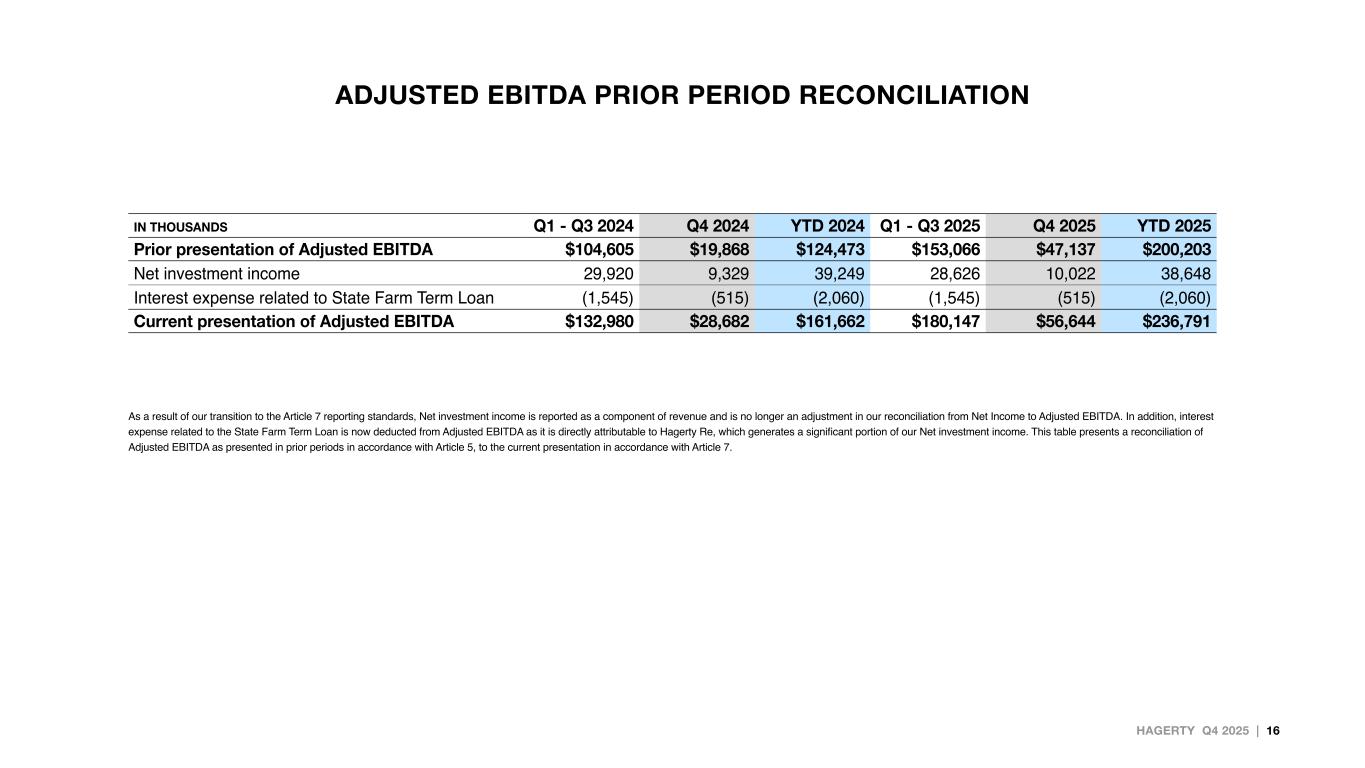
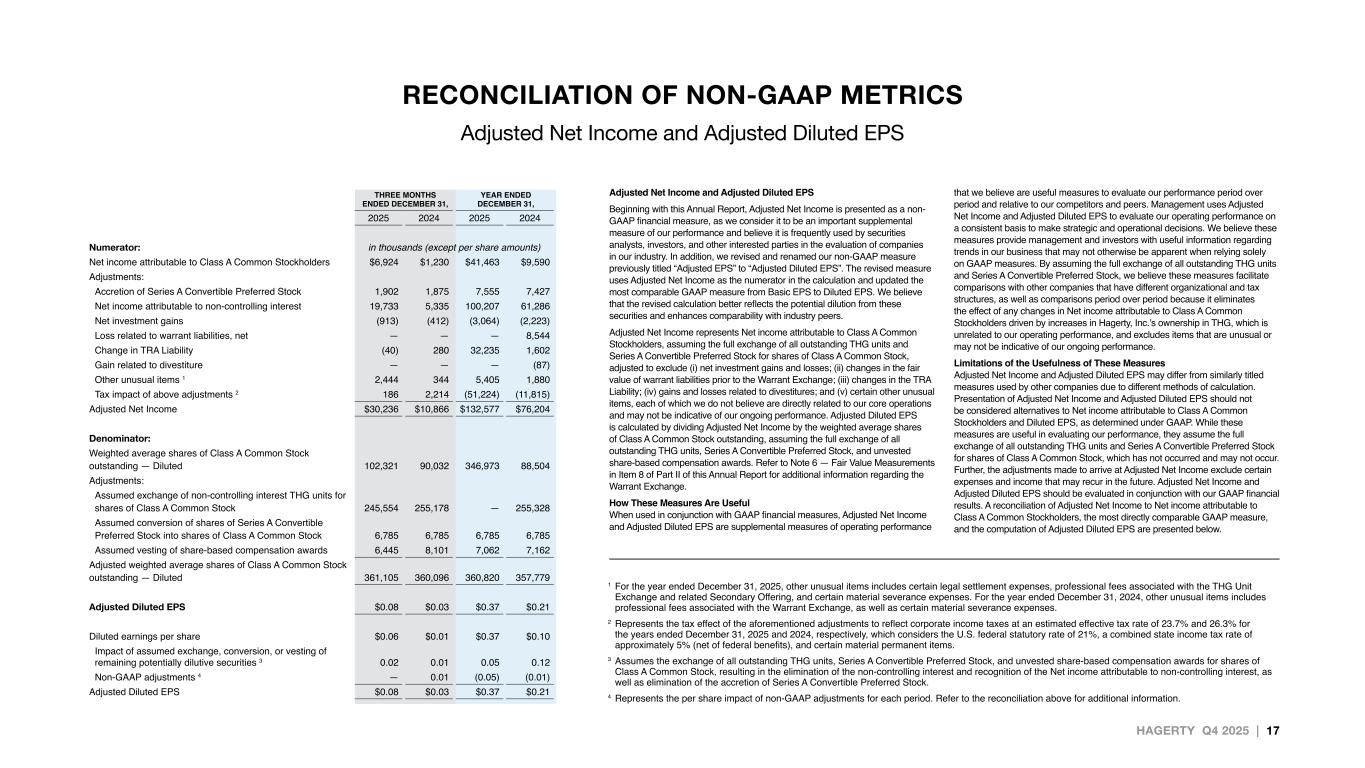
Thank you and good morning. Before I dig into the results, I wanted to mention that beginning this quarter, the company is presenting its consolidated financial statements in accordance with Article 7 for insurance companies, reflecting the ongoing transformation of the company's business operations. As a result, net investment income is now reported as a component of revenue, with prior periods recast for comparability. Also, beginning this quarter, we present two segments, insurance and marketplace. which is a result of the continued revenue growth and geographic expansion of the marketplace business with that let me walk through our fourth quarter results shown on slide six and seven in the fourth quarter total revenue increased 19 to 357 million written premiums through 19 due to robust new business count helped by ramping state farm conversions and our 89 retention commission and Investment fee revenue jumped 18% to $106 million. Earned premium grew 14% to $193 million. Marketplace revenue increased 80% to $29 million. Membership and other revenue grew 8% to $19 million. Net investment income, including gains, was $11 million for the quarter compared to $10 million in the prior year period. Turning to profitability, shown on Slides 8 and 9, we reported fourth quarter income before taxes of $40 million, up 186% year-over-year, after incorporating investment income into both periods. Our loss ratio in the quarter came in at 31%, positively impacted by 11 percentage points due to the $21 million reserve reduction. This reduction was primarily due to the favorable development for the 2024 accident year, as well as improvement in current accident year experience related to decreased severity and loss ratio trends in liability and physical damage claims. Fourth quarter G&A increased 24% and full year growth was up 15%, inflated by 8 percentage points due to software-related costs for a new insurance policy management system and and professional fees associated with the new Markel fronting arrangement. Salaries and benefits were up 20% in the fourth quarter and 19% for the full year due to incentive compensation accruals, given our strong outperformance and additional headcount to support growth. Adjusted EVA Doc came in at $57 million, up 97% year-over-year. Fourth quarter net income was $29 million, an increase of 238% from the fourth quarter of 2024. Net income attributable to Class A common shareholders was $7 million after attribution of earnings to the non-controlling interest and accretion on the preferred stock. And GAAP basic and diluted earnings per share came in at $0.06 for the quarter based on $100 million basic and $102 million weighted average diluted shares of Class A common stock outstanding. Adjusted earnings per share, defined as adjusted net income divided by $361 million fully diluted shares, came in at $0.08 for the fourth quarter. Let me reiterate a few of the key full year 2025 highlights that Makhil mentioned. Commission and fee revenue grew 15%. Earned premium for a risk-taking entity, Hagerty Reinsurance, increased 13%. Marketplace revenue jumped 119% to $119 million. 2025 was our third full year of owning Broad Arrow, and the team expanded into Europe with three successful auctions in 2025, plus January's auction at Retromobile Paris that launched 2026, with $21 million in sales. As McKeel mentioned, we delivered $624 million of total vehicle transactions, including $85 million of financing activity, and another $40 million in online sales on Hagerty Marketplace. With last week's announcement that Broad Arrow is now the official auction house of The Quail, a motorsports gathering during Monterey Car Week, it is clear that our team is firing on all cylinders and is on track to becoming the market leader to help members buy and sell their special vehicles. Membership and other revenue grew 4% to $82 million. Full year loss ratio for 2025 was 39%. With seeding commission for Hagerty-Ree at 47% of earned premium, our combined ratio was 87%, which includes three points of benefit from the $21 million reduction in reserves. Hagerty-Ree's return on equity for the year was 34%, despite building the surplus necessary for the incremental earned premium in 2026 from the new Markell arrangement. Our high-quality underwriting was recently recognized by AMBEST when they reaffirmed our A- rating and upgraded their outlook to positive. And we successfully renegotiated reinsurance terms for 2026 with a double-digit risk-adjusted decrease in costs. Income before taxes jumped 49% to $139 million as we expanded full-year margins another 200 basis points. And we delivered net income of $149 million, nearly double the prior year's $78 million. Full year net income includes the $21 million reserve reduction. This resulted in $0.37 of earnings per diluted share and $0.37 of adjusted earnings per share. Adjusted EBITDA grew 46% to $237 million from the prior year's $162 million, which includes investment income of $39 million in both periods, and we delivered full-year operating cash flow of $219 million as we capture more value across our ecosystem. We ended December with an unrestricted cash balance of $160 million and long-term debt of $178 million. Debt excluding back leverage for Broad Arrow Capital's portfolio of loans collateralized by collector cars was only $110 million. We also doubled our lending facility for Broad Arrow Capital to $150 million to meet the borrowing needs of our global customers. And we surpassed $1 billion of investment securities in 2025, primarily high-grade corporate and government bonds. Let me wrap up with our 2026 outlook shown on slide 10. We anticipate that 2026 will be another year of record growth driven by new business count account, and the evolved fronting arrangement with Markel. We expect written premium growth of 15% to 16% and acceleration from this past year's 14%. I want to highlight changes to our accounting related to the new Markel fronting arrangement that will start in the first quarter. Due to the expanded underwriting and claims authority granted to us under the new arrangement, we now control the Essentia book of business. We call that Essentia is the Markel insurance company that issues our policies in the US. While our USMGA and Hagerty RE will continue to operate in the same manner they have historically, Hagerty RE is now directly the customer of our MGA services, not Essentia. Therefore, Hagerty RE will now pay the commission directly to our MGA. As a result, the consolidated financials we disclose will no longer show commission revenue or the associated Seeding Commission expense previously paid by Hagerty-Ree to Markel. Commission revenue associated with the Markel Alliance arrangement was $437 million in 2025, and Seeding Commission expense related to the company's reinsurance business with Markel was $344 million. In the Consolidated Income Statement, these changes reduce reported commission revenue and seeding commission compared to prior periods. In a steady state year, like 2027, these will largely offset each other in our financials. 2026, however, is a transitional year, and we will have some noise we need to lay out in more detail to help you with comparability. I want to be clear. The driver of this noise is the strategically and economically attractive decision to assume the final 20% earned premium in our U.S. Book of Business with the new arrangement. This evolution gives us more control and flexibility, allows us to capture more of our high-profit, high-return underwriting business, and increases our investment portfolio. First, eliminating the commission revenue means 2026 revenue will come in below 2025 at between $1.28 billion and $1.3 billion. This is a bit counterintuitive considering our written premium, which is the key driver of insurance performance, is growing 15 to 16%. Second, for policies issued in 2025, Hagerty-Ree paid a seeding commission to Markel. We pay that upfront on the seeded premium with the expense being recognized over the one-year policy life. As of the beginning of 2026, In 2026, about half of it is still on our balance sheet at approximately $190 million. We will continue to amortize that amount in 2026 with these burn-off costs, inflating disclosed expenses, which will reduce reported profits before taxes by that $190 million. This is a non-cash transitional expense that only impacts us in 2026 as we begin operating under the new structure. These costs will decline to zero by year-end 2026 if they flow through the P&L, from roughly $90 million in the first quarter to $10 million in the fourth quarter. A related change to note is in 2026 and beyond, qualifying policy acquisition costs incurred by our MGA subsidiaries for policies issued under the fronting arrangement will be deferred and amortized over the policy term this includes items such as broker fees credit card fees and some people costs that are directly tied to generating new policies given the complexities around how these costs will impact gap net income we will use adjusted EBITDA to help you better understand our underlying profit and cash flow growth slide 11 reconciles the walk to adjusted EBITDA we recognize there is a fair bit of potentially confusing changes in the presentation of consolidated financial statements. Jay and I are happy to do follow-ups with anyone who would like to dive in. Wrapping up the guidance for 2026 and reflecting the transitional year, net income is anticipated to come in at minus 41 to minus 51 million dollars. We expect adjusted EBITDA to come in between 236 and 247 million dollars. In summary, 2026 is on track to be another great year of growth at Hagerty, but accounting changes will create temporary noise in our 2026 GAAP-reported results. 2027 should be a clean year as we will have fully amortized the 2025 Seeding Commission, and our reported results will more closely align with our underlying profit and cash flow. Longer term, we believe we are positioned to compound profit growth as we target doubling our policies in force to 3 million in 2030. Our differentiated model, brand strength, and high-quality underwriting enable us to grow profits predictably year after year through sustained market share gains and with low volatility. New business count-driven premium growth makes us unique in insurance, where most companies' profits are subject to the whims of the pricing cycle. And with an average annual rate increase of just 2% over the last five years, one-third the increase of daily driver peers, Hagerty is well-positioned as a consumer-friendly brand with a compelling value proposition that should enable us to create shareholder value for many years to come. With that, let us now open the call for your questions.
Operator
Thank you. We will now conduct a question and answer session. If you would like to ask a question, please press star 1 on your telephone keypad. A confirmation tone will indicate your line is in the question queue. You may press star 2 to remove yourself from the queue. For participants using speaker equipment, it may be necessary to pick up your handset before pressing the star keys. Once again, that's star 1 at this time. One moment while we poll for the first question. The first question comes from Michael Phillips with Oppenheimer. Please proceed.
Thanks. First question on Patrick on the guidance, and I know there's a lot of moving parts. But if we take the net loss number, maybe just take the midpoint of that and add the 190 or maybe the tax effect of the 190, are we still below the 2025, 149 million net income? And I know that's way too simplistic given all the moving parts, but is that a basic way to start thinking about things?
I think with all the complexity, what we're asking people to really focus on is this adjusted EBITDA guidance that we've provided. Okay. And so if you look at it that way, which is in the press release, it's the same definition we've always had for adjusted EBITDA. The only change that we've included is this last row, Markel fronting arrangement transition costs. We're adding back the 190. And if you look at it that way, 2025 was a really good year, and it included at the end of the year, when we took a look at the reserves, we had a release of just north of $20 million. If you kind of strip that out and then look at EBITDA 2025 and then the guidance for 2026, I think we're showing something up, like, you know, kind of 10, a little north of 10%. So that, I think that's the cleanest way to think about it.
Okay, maybe one quick one on that one.
The other one, just to clarify, is in 2025, we also had the VA release below the line for valuation allowance for tax purposes and the TRA benefit as well. And so those are noise in the net income number in 2025, that in 2026. for benefits to net income in 2026.
Okay. Maybe one quick one on the seeding commission to Markella 190. Is there any potential for that to move up from a property-related commission that might come in later, or is that kind of a solid number? Okay. On the loss ratio, this quarter you mentioned the reserve release, obviously, and then I don't think there was any last year. Last year, fourth quarter did have some cats a little bit. I guess if you back all that out, your current quarter loss ratio probably moved to around a 42. I have last year a 40. So you mentioned an improvement in the current accident year. I'm confused on that. Can you help me with that one? And it looks like to me the current accident year, again, goes from about a 40.4 to a 42. this year, once we back out the cats with PYD.
Once you back out the cats, and what else?
The 10.6 points of PYD this quarter. There's no cats, right? So, 31.4 goes to 42, I think, right?
The way that we're thinking about it, we did have the reserve release. We did have a very good year in 2022 loss perspective. As we look to 2026, we're assuming that our losses are in line with what we've guided to previously. right in the low 40s. We are doing a lot of things in terms of how we manage claims or we've built up our what we call the Material Damage Unit, and so things are trending in a positive direction, but from a guidance standpoint, think of it as being right around that consistent number of 41% that we've talked about, and that's the right way to model it.
Yeah, that is. Thank you. Let's go ahead for now. Appreciate it, Charlie.
Operator
The next question comes from Charlie Lederer with BMO Capital. So please proceed.
Hey, thanks. So maybe just on the written premium guidance, obviously 15% to 16%, really strong. Can you walk us through the assumptions, I guess, of how much of the acceleration is from State Farm, Liberty Mutual, and the legacy Hagerty, you know, operations? And then just to follow up on that, I think McKeel said that there's seven State Farm conversions ongoing. How many have been completed so far, and how many remain?
Yeah, in the written premium, we're not going to break it down by the different categories. The way to think about it is the traditional business, sort of the core traditional business, continues to grow at similar rates to what we've experienced. State Farm is definitely accelerating that in 2026, and then 2027 will pretty much wrap it up our big year. 25. We're in 27 states by the end of the year, seven of which are doing the conversions that you talked about. We're rolling out more conversions this year, so it really ramps up. So that is also a contributor. The Liberty Mutual, we announced that. We're getting underway. That is a relatively modest impact in 2026, and then we'll kind of ramp up from there.
Just looking at slide 19, if I compare the post-1980 TAM to what you showed last quarter, it did go up a little bit I guess can you walk us through the assumption changes is that a change in data or or does it reflect that you know an increase in its appetite for Hagerty as you'd expect this is a you know living breathing analysis and so we're regularly looking at we think the TAM is and this is just the passage of time right over time the older cars don't go away typically right once they become a part of our universe they're treasured
assets and people keep them and so you see very few of those coming out of the TAM but what happens is additional vehicles join the TAM right so they're still making cool cars that people view as enthusiast vehicles and those are exactly the kind of cars that we want to underwrite so it tends to grow over time so we just did an update thanks and maybe just one last one see you gave the numbers on the commission revenue from Markel in 25 and the Seed and Commission expense, too.
As we think about the commission and fee revenue in 26, you guys still expect to get some, right, from your ex-US operations and then the state farm business, right, that should all still flow through commission and fee revenue? Is that the right way to think about that?
Exactly. The commissions that our risk-taking entity pays to our MGA, that still happens underneath. But upon consolidation, the Commission for Revenue goes away and the Seeding Commission goes away. So that's what we're communicating. The other parts of our business where we continue to provide those MGA services, as you described, internationally, the UK business and State Farm, those will still show up as revenue on the P&L. Thank you.
Operator
The next question comes from Gregory Peters with Raymond James. Please proceed.
Hey, good morning, everyone. So, I think for the first question, I wanted to, you know, I was looking at your presentation and on slide five, you talked about the 2026 priorities, and I was intrigued that one of the items that wasn't really highlighted, which was a success in 25, was the marketplace revenue. And so I was just, when I triangulate, you know, the results you did in 25 with marketplace revenue and the guidance you've laid out for 26, just curious about your thinking about that area because that seems to be a strong area of growth for your company.
Yes, well, hey, thank you. And we were really proud of the delivery of, you know, both growth and profitability in 2025 from all of the marketplace activities, live auctions, and really starting to see a little bit of effort from the digital marketplace sales plus credit or capital plus everything else. You know, when we're talking about our priorities, you know, definitely a very insurance-focused year. It kind of goes with our technology spend and how we're focusing on the core business growth, absorbing the state farm business, et cetera, turning on new partnerships like Liberty Mutual, Safeco, that we'll see the benefit of in the years to come. But the marketplace business is, you know, continuing to be an important part of our picture, and our first really large sale actually happens next week, Amelia Island, which, you know, with the press release went out with a very large, which could be really meaningful for us in the first part of the year. So it's a big part of the business by nature, you know, in comparison to the insurance side of the house, it's a lumpier business. You just see a lot more variability. Teams are working really hard, but it is still a very important part of it. It's just not listed here.
I think as we think about the revenue from that, and Mikiel just mentioned it earlier, So it's low estimates are $105 million, and that's the largest auction we've ever announced in our history doing this. So we're very excited about that. The way we think about it is the live auction business and the digital auction business will continue to grow. Some of that's geographic expansion. We did our first sale in Paris this year, so that happened in January. And each of the other sales that we've got, we're up to schedule now where we've got eight scheduled auctions. our goal is to grow each of those. The private sale business, which had a phenomenal 2025, that's the more chunky sort of episodic business that McKeel was talking about. And it was a truly phenomenal year and we are expecting that business to do well again. But it's difficult from a confidence standpoint to put a high degree of confidence around the prediction there because it is just chunky and episodic.
And so as you're triangulating that may be one of the things that you need to think through a phenomenal year in 2025 we'll have a good year this year but it's hard to say it's going to be at the same level of where we ended up well you you your answer there got to the destination of what i was thinking about which is trying to work through the mechanics of the the flow through to the income statement for hagerty from both the digital and live marketplace so um that's clearly top of mind. Perhaps you can do that in further comments offline.
Yeah, we'd love to do that. And that's why we went to segment disclosure, right? The business has grown to a point where it makes sense to split it out. We're sharing that information, obviously, in the documents that we've posted, and we're happy to have an offline conversation. It's an important business and continues to grow.
Great. I appreciate that. The other thing that is topical this year in particular is technology, artificial intelligence, and chat GPT. I'm not sure there's a strong correlation between that and classic cars, but I'm sure there's opportunities across your organization to deploy technology to make you more efficient and more successful. Maybe you could spend a second and talk to us about what you're doing and where you're spending your money on that front to improve the company.
Thank you. It is, you know, it's not just a table topic or a topic du jour. It's important work for any kind of company, I think, and for us too. I think what we think about doubling the policies enforced by 2030, we have to find not just kind of core underlying efficiencies in how to run the business, but AI will be an important part of, in particular, how we personalize the experience for a much larger policyholder group and number group over time. This is where AI, we think, can really shine for us. But we have a number of initiatives underneath our overall technology investments that are both either piloting AI programs or actively using them in other ways. So these range from, you know, fraud detection on the claim side, how we're analyzing valuations for both marketplace and the insurance valuation services that we offer. We have a number of areas in just the administrative side of this business. We have a lot of people that work in administrative functions, and I don't know about you, but I myself am using AI every single day to do my job in a clearer, more effective way, and we have a number of initiatives to make that happen. But ultimately, it is that personalization of service that we think will be the key benefit for us with AI. So we have experiments, investments in every single part of that, and, you know, nothing to report yet in terms of concrete savings, as most companies are also realizing. But we're there, and we're very excited about what it can do for us.
Just one little detail follow-up. You mentioned claim fraud, and I guess it's counterintuitive, you know, sitting back here that you would expect there to be claim fraud in classic cars. Do you think the incidence level for claim fraud in your area of the market, it's got to be lower than the broader market, generally speaking, but maybe you have some perspective on that?
Yeah, it's just like claims frequency itself. It's lower than standard auto, but, you know, you're not immune to it. Our claims business is, you know, we're downstream, all sorts of things. So you insure more and more cars, you're going to have more and more claims, and you'll have more and more instances of, you know, potential fraud. You know, for us, it's just that we've always had an SIU or special investigative unit in this business as long as we've handled claims. We just have more sophisticated tools to make sure that we're, you know, we're watching the, you know, all the P's and Q's, if you will, when claims are coming in to make sure that we actually owe the claim. And we're really – between that and, as Patrick mentioned in an earlier answer, we stood up these new material damage units or what we used to call physical damage units that are just being very diligent, bringing in industry best practices in how you manage physical damage claims to make sure we pay what we owe, make sure the customer is happy, make sure we're working with our shops effectively, but you're not overpaying. And that's where, you know, it's – we're not immune from big industry trends, but definitely, as you mentioned, it's lower in our particular part of the automotive world.
Got it. Hey, thanks for the answers.
Operator
The next question comes from Elise Greenspan with Wells Fargo. Please proceed.
Hi, thanks. Good morning. I guess my first question, going back to, you know, some parts of the prior conversation, was just hoping, you know, you guys have, you know, spoken to, you know, long-term targets right around PIFQL, just trying to get a sense of just the outlook specifically for, you know, 2026, and then, you know, within 26, you know, just how much of, you know, of a ramp are you expecting, you know, from, you know, the, you know, the 525,000 State Farm policies?
So, as we mentioned, on State Farm, you know, we're now rolled out in 27 states as of the end of the year. So, seven of those were doing the conversions of the 525,000, the subset of that that's within those states. The other 20 were selling new business. And so, when a State Farm agent has a new car with the customer a new customer that's what we do initially and that's our rollout cadence we we always start with the new and that's to make sure that everything's working and the product you know the agents understand the product our systems all that stuff and then what we've done is we've we've shortened the time that we're just doing the new so we're accelerating when we switch over to new conversion and that really takes hold as we get into this year 2026 so the way to think about it is by the time we get to the end of this year you will move from those 27 states to close to full penetration there'll be a few that that stretch over into 2027 but most of the states will be up and running by the end of this year and we'll be making further progress in terms of the conversions as well uh it won't be until 2027 that that will be a pretty close to full all states are in conversion mode we're picking up those policies so there's still a couple more year ramp on it but this is the big year this is the year that you're going to see real acceleration and getting to that 525 and it'll happen kind of ratably over the course of the year okay um and then um and then in terms of you know there's a lot i guess within the guidance But in terms of, like, just the loss ratio and how we think about that trending during 2026,
any kind of, you know, color that you can provide there, you know, relative to 25, I guess, if we exclude the PYD, you know, how are you thinking about the overall loss ratio trending between the two years?
Yeah, I think I addressed that in the previous question. We still think it's, you know, the way we think about it is right at that low 40% number, you know, call it 41, something like that, that's the right, that's what we think about from a planning standpoint, because I think, you know, we, in the first and second quarter, we're probably going to look to that, just because there's not that much information yet on the first, on the prompt year. And as we get into the third and fourth quarter, we'll have more information, and there potentially could be some caps, and that's when we think about some adjustments. But that's our framework for it.
Operator
The next question comes from Matt Carletti with Citizens. Please proceed.
Thank you. This is David from Matt.
In terms of partnerships, I know there are currently multiple ongoing that continue to evolve, but is there any sort of pipeline for new potential partners?
Yeah, thank you very much. So, you know, these partnerships have been a big part of our growth story for, you know, almost 20 years. And, you know, just like all the conversation we have about State Farm, it's not just, you know, getting the conversation going and it's the contracting phase and the technology implementation phase, but then you get up and running and it can take a couple years to get them going. So we're super excited about the partnerships we have. As we mentioned, we announced the new partnership with Liberty Mutual and Safeco, which was for us a really cool kind of double win because it's not only a new partner, but it's also a partner that was actively competing with us in the collector vehicle insurance space. and they decided to partner with us instead of continuing to compete independently. So we're excited about that one. That will take a couple years to start realizing what it can be. We have active discussions with others, both kind of, you know, bigger, chunky partners that we don't currently work with as well, and kind of mid-tier and shuffle of partnerships that are very different than our typical insurance partnership, but that we think can be, as I said, kind of chunky new additional opportunities to fill the pipeline. So more to come, and we'll announce them when we can. Thank you.
Operator
The next question comes from Maxwell Fischer with Truist Securities. Please proceed.
Hi, thank you. I'm calling in for Mark Hughes. How are you thinking about free cash generation in 2026? I guess that's another way. How do you expect a year-end cash balance to compare to the $160 million you reported?
Yeah, for 2026, you should think about the cash conversion similar to what you saw in 2025. We are – it's kind of consistent with the numbers that we've shown over the last couple of years. Most of our CapEx is related to IT. There's not much else that we do that requires CapEx. And so we're investing in our new platform, but we've been doing that for the last couple of years, so that will be consistent in the normal investments we make in the overall IT world. So, from a cash flow standpoint, that ends up being pretty close to DNA as well. And then the rest of it really is what we've communicated in terms of the growth and the earnings power of the business. And you can start with our guidance around just data, but assume similar cash flow conversion we have this year.
And then following up on the AI question, and you might have answered this, I'm sorry if I missed it, but are you seeing any opportunity on the distribution front from AI?
Hey, thanks for the question. Clearly in the marketing function of the business, AI will, and we're actually already piloting some ways that we're thinking about how you can distribute better work through lead generation and kind of demand gen, but that's the main focus right now. I know that there are some, you know, sort of early announcements out in the industry about, you know, almost driven, different train, but, you know, the group is very actively looking in these areas, and we think, you know, because the underlying premise of our business is the emotional connection between human beings and these cool vehicles, AI is in more granular ways, especially as, you know, we were talking about in the earlier
TAM answer as new and newer vehicles come online and become, you know, sort of in our targets on it we still have to find not just the vehicle we have to find the right people very helpful thank you thank you and our last question comes from tommy met joint with kbw please proceed hey good morning um i had a question about what is your outlook for uh written premium per policy understand there's a lot of moving pieces with state farms coming on board the enthusiast plus program rolling out perhaps what you guys are filing with rates um so what do you see as the outlooks or written premium for policy in 26?
I think what's going to happen in 26, and the things that would pull it up are, you know, there's some rate things that are flowing through. There's some mixed things that flow through in valuation. And then some of it's just mixed, you know, where are we getting the business from? But the state farm business, which is really ramping up, you know, does have lower premiums, just the nature of those vehicles, the age of those vehicles and, you know, the insured value. and so that will be pulling down on that number either way we think about it is the core business continues to grow at the rates that we had talked about we've been very disciplined in terms of rate increases we talked about on the call of 2% over the last handful of years versus 6% for the broader industry and so we'll continue to have our kind of rate increases where appropriate so that will be that will be a tailwind for us the state farm it's just it's big it's meaningful, and so that will have a sort of counterbalance to that as we get into it.
And second, you mentioned the acquisition costs that are incurred by the MGA starting to get deferred and amortized over the policy term. In 26, will there be some cadence to the quarterly impact of that? I'm thinking perhaps in the first quarter with everything being deferred and not much getting amortized yet, you might get a stronger earnings profile in the first quarter, but then more than a normal impact in the back half of the year. Am I thinking about that right?
Yeah, the way to think about it is it kind of starts from zero, right? Because under the new regime, as we sell policies in 2026, whatever we're putting on the balance sheet is – and it gets amortized over the one-year lifetime. You end up, from a P&L standpoint, pushing those expenses forward. And so in 2026, you're going to have that ramp up, right? It's not until we get to the end of 2026, but we've renewed all those policies, taken on the new ones, and you've got sort of that full balance on the balance sheet, and it gets normalized in 2027.
Operator
Thank you. At this time, I would like to turn the call back to McKeel Haggerty for closing comments.
Thank you, operator, and thank you, everyone who called in and asked thoughtful questions. and thank you to One Team Hagerty for delivering fantastic near-term results while positioning Hagerty for durable compounding growth and margin expansion. Car culture is alive and well, with new generations of car lovers driving strong demand for fun cars, especially more modern enthusiast vehicles. In other words, the best is yet to come as we make it easier and more enjoyable to be a driving enthusiast by becoming part of the Hagerty community. We recently launched an ad campaign with our new marketing partner, Barrett Jackson, that I wanted to share with you as it encapsulates the essence of Hagerty. It goes something like this. At Hagerty, we don't see cars as things. They are unique, alive, and loved. We buy them, we wrench on them, and sometimes we curse them. But most of all, we drive them. Muscle cars, supercars, rad cars, one-of-one spec cars, coupes, convertibles, compacts, liftbacks, fastbacks, and hatchbacks. We love them all because cars are for driving and Hagerty is for drivers. We hope to see you next week at Amelia Island, Florida, outside of Jacksonville for our Concours d'Elegance on Saturday, March 7th, as well as two days of Broad Arrow auctions on Friday and Saturday. and cars and community on the main show field on Sunday our team is hard at work to make it the best Amelia Concours yet and with that never stop driving thank you this thus concludes today's teleconference you may disconnect your lines this time thank you for your participation and have a great day