Speaker 9
Good morning. My name is Angela, and I will be your conference operator today. At this time, I would like to welcome everyone to Harmony Biosciences' fourth quarter and full year 2025 financial results conference call. All participant lines have been placed on mute to prevent any background noise. After the speaker's remarks, there will be a question and answer session. If you would like to ask a question at that time, please press star 1 on your telephone keypad. Please be advised that today's conference may be recorded. Lastly, if you should require operator assistance, please press star zero. I will now turn the call over to Matthew Beck from Astor Partners. Please go ahead.
Thank you, operator. Good morning, everyone, and thank you for joining us today as we review Harmony Biosciences' fourth quarter 2025 financial results and provide a business update. Before we start, I encourage everyone to go to the investor section of our website to find the materials that accompany our discussion today, including a reconciliation of our gap-to-non-gap financial measures. At this stage of our life cycle, we believe the non-gap financial results better represent the underlying business performance. Our speakers on today's call are Dr. Jeffrey Dano, President and CEO, Adam Zesky, Chief Commercial Officer, Dr. Kumar Baddur, Chief Medical and Scientific Officer, and Sandeep Kapadia, Chief Financial and Administrative Officer. As a reminder, we will be making forward-looking statements today which are based on our current expectations and beliefs. These statements are subject to certain risks and uncertainties. Our actual results may differ materially, and we undertake no obligation to update these statements even if circumstances change. We encourage you to consult the risk factors referenced in our SEC filings for additional details. I would now like to turn the call over to our CEO, Dr. Jeffrey Dano.
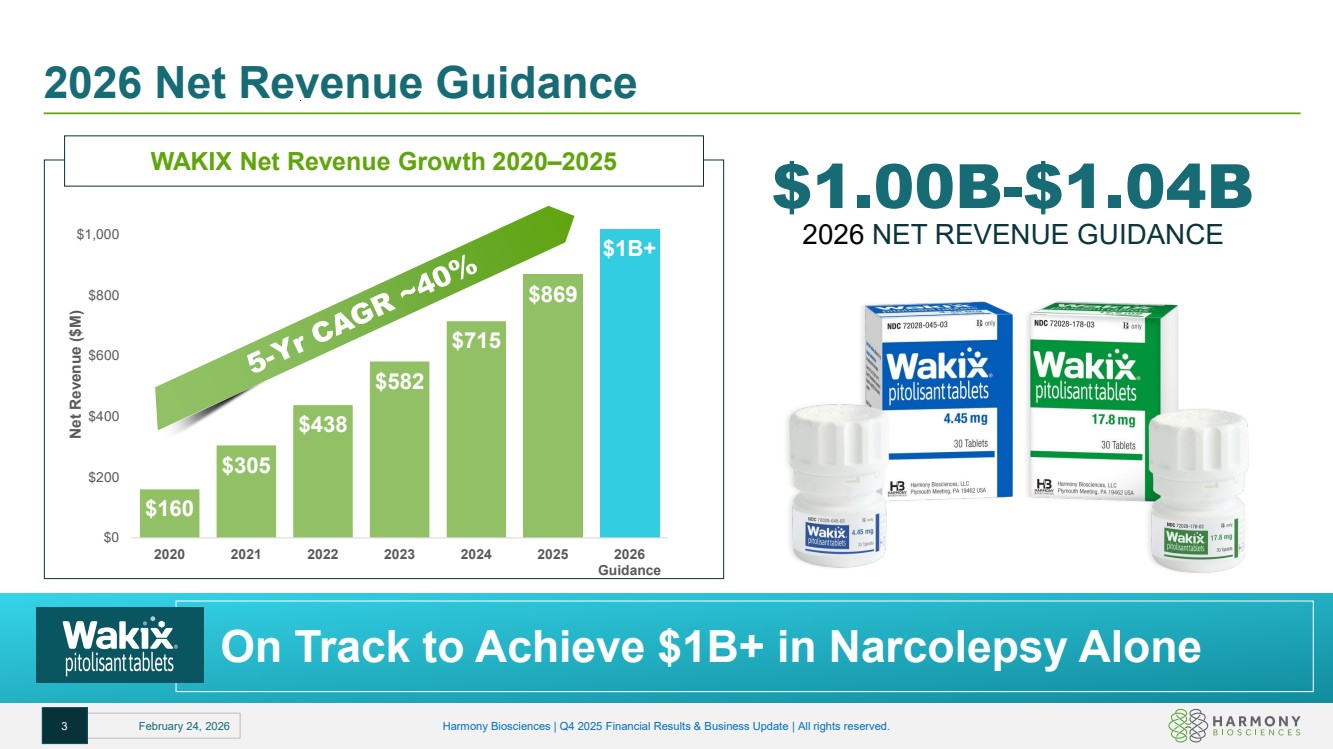
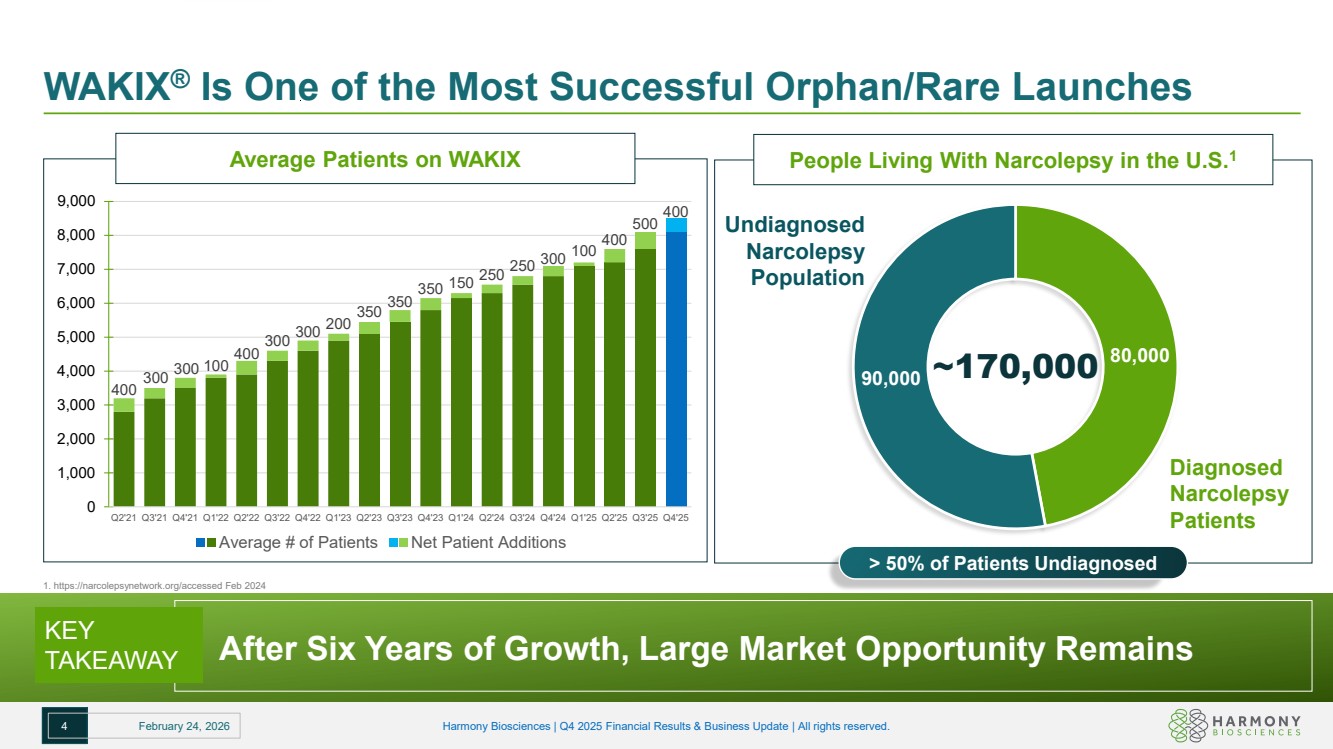
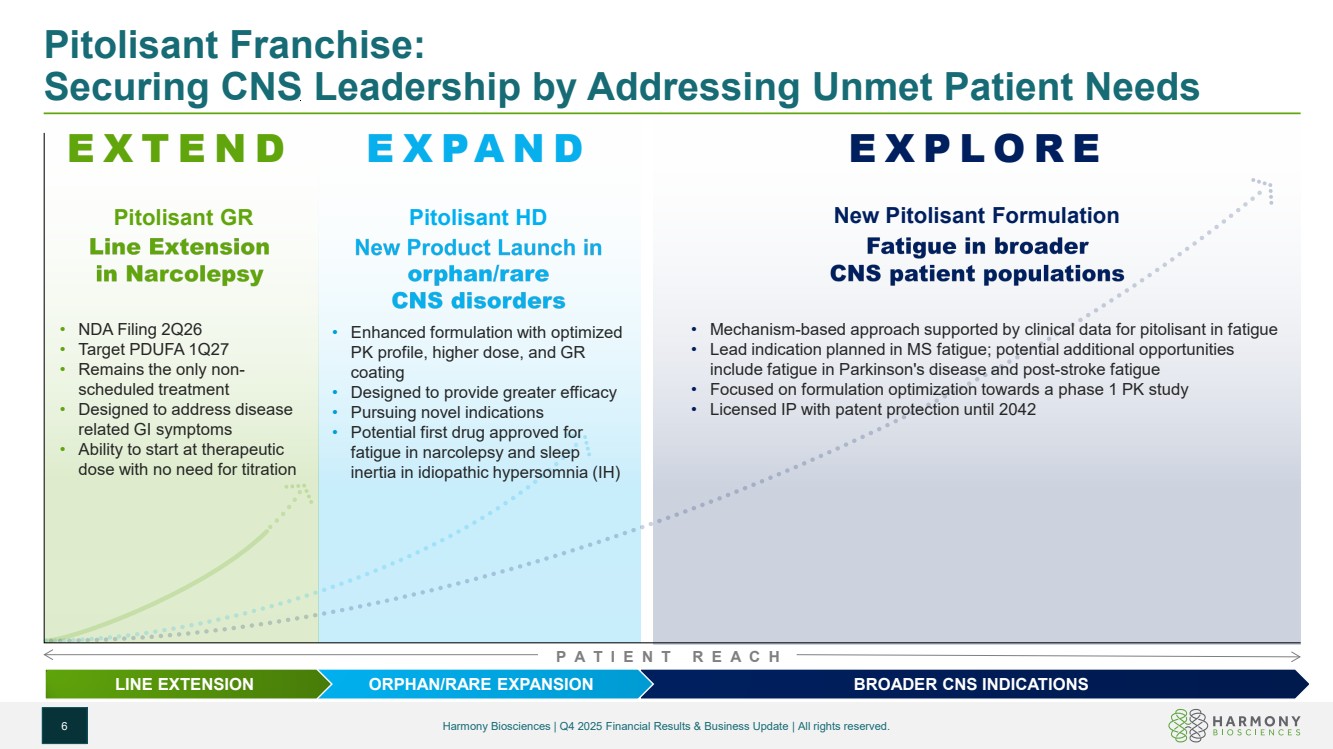
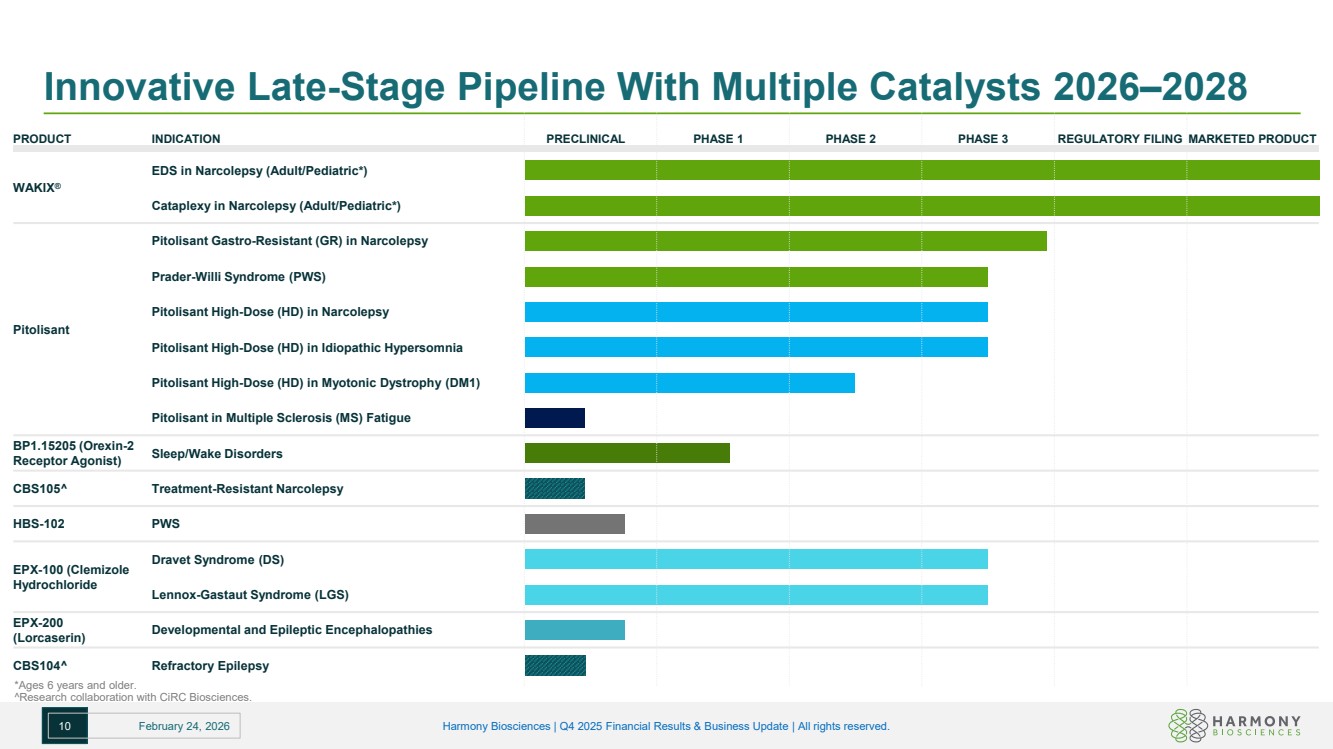
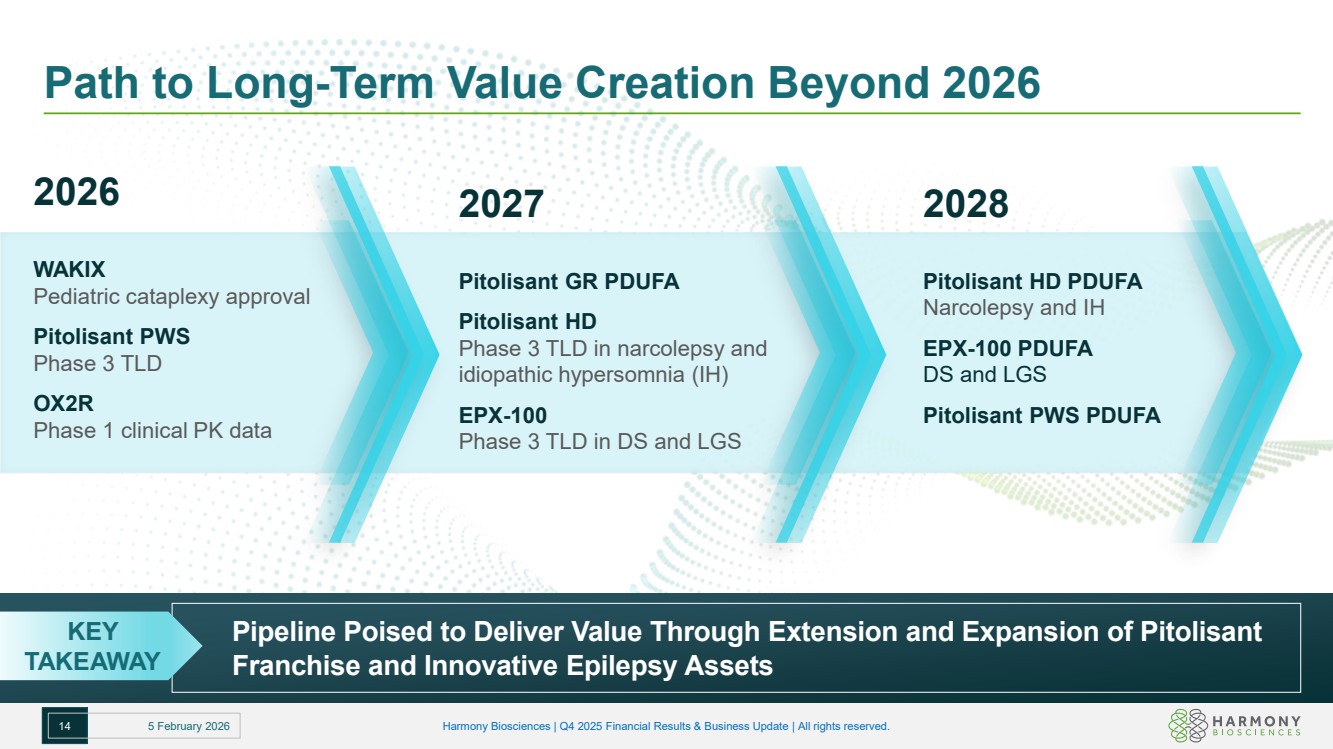
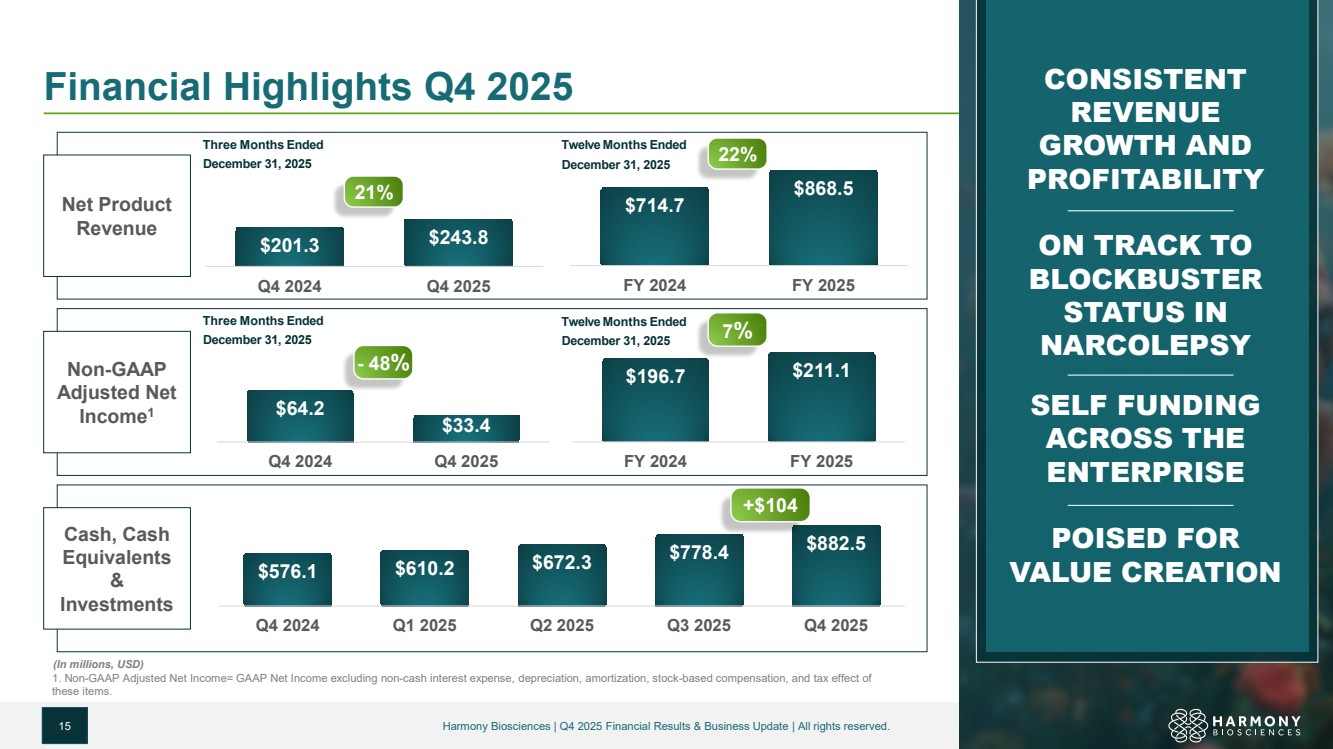
Thank you, Matt. Good morning, everyone, and thanks for joining our call today. I want to start off by recognizing the entire Harmony team for another outstanding quarter and a remarkable year in 2025. Our fourth quarter results reflect strong, sustained execution and have positioned us to achieve blockbuster status for WACIX this year. In Q4, we delivered $243.8 million in net product revenue, up from $201.3 million in the same period last year, driven by continued strong demand for Wacix based on its broad clinical utility and ongoing executional excellence by our commercial team. Q425 marked the third consecutive quarter with approximately 400-plus average patient ads, the first time in franchise history. This quarter's net patient ads brings us to approximately 8,500 average patients on Wacix. With 80,000 diagnosed patients with narcolepsy, there continues to be a large market opportunity to support strong growth. For full year 2025, WACIX generated $868.5 million in net product revenue, representing strong year-over-year growth and extending to six consecutive years of revenue growth and profitability. Looking ahead to 2026, we are guiding WACIX net revenue to blockbuster status of $1 to $1.04 billion for the first time in franchise history, underscoring the durability of the WACIX brand and the strength of our commercial engine. On the IP front, we have made good progress toward the goal of securing the WACIX franchise. We recently settled with three generic filers, resulting in us having settled with six of the seven and the filers. Based on these settlements, generic entry would occur no sooner than March of 2030 if we are granted pediatric exclusivity, which we are on track to obtain. As for last week's trial, we remain confident in the strength of our IP and will continue to vigorously defend it as the legal process and trial continues. In addition to the strong growth of Wakex, we are advancing the next-generation Patollison franchise. Patollison GR will extend the Wakex franchise and our leadership in narcolepsy as a line extension of wakex with its broad clinical utility we are on track for nda submission in q2 this year with a target padufa date in q1 2027 patolesin hd is designed to expand the patolesin franchise into unique indications in orphan rare diseases addressing unmet medical needs and we now have an opportunity to explore a new patolesin formulation to pursue broader indications in CNS patient populations in which fatigue is a prominent symptom. This strategy is a mechanism-based approach, as fatigue is mediated through histamine circuits in the brain, and patollicin works by upregulating histamine transmission in the brain, along with other neurotransmitters. This work is supported by newly licensed IP with patent protection until 2042, and we are excited for the opportunity to explore broader CNS indications with Patolisin. Kumar will provide more color on this opportunity later in the call. Our robust late-stage pipeline continues to advance with five ongoing phase three registrational trials toward five distinct CNS indications, and we are making good progress. These trials set us up for multiple catalysts over the next few years and, if successful, meaningful long-term value creation. Kumar will provide more details on the progress of our pipeline programs and the timing of these important catalysts during his R&D updates. In summary, Harmony enters 2026 with powerful momentum, a clear path to blockbuster status for Wakex in narcolepsy alone, record revenues and a large market opportunity that remains in narcolepsy for continued growth of Wakex, a life cycle management strategy that we are advancing to extend the success of Wakex, Expand next-generation patolicin into unique indications in orphan rare CNS disorders, along with our new opportunity to explore broader CNS indications with a new formulation of patolicin driven by a mechanism-based approach. And a robust late-stage pipeline with five ongoing Phase III registrational trials toward five distinct CNS indications. All of this reinforces our belief that we have built something rare in this industry, a profitable, self-funding biotech company with a strong balance sheet, well-positioned to build out our pipeline and expand our commercial portfolio to drive long-term value creation. With that, I'll turn the call over to Adam Zesky, our Chief Commercial Officer, for an update on our outstanding commercial performance. Adam.
Speaker 10
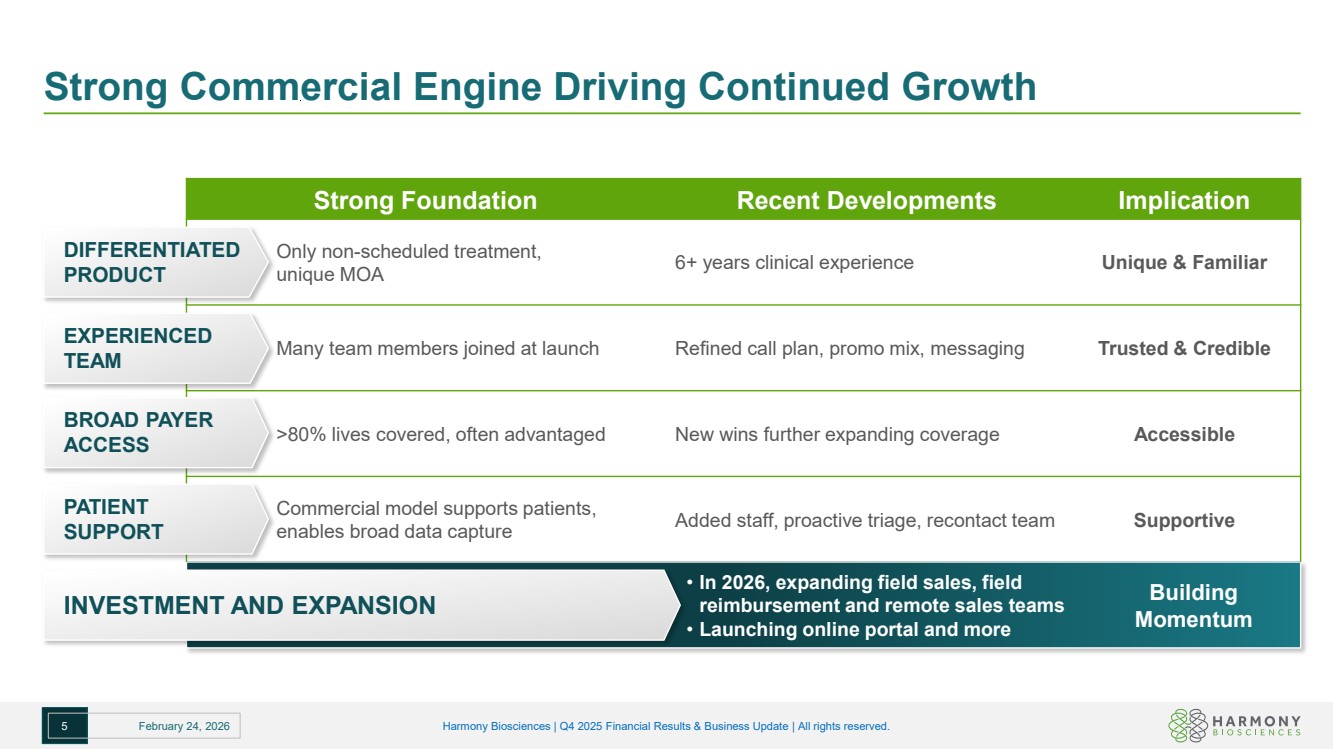
Thank you, Jeff. 2025 marked a year of unprecedented and record-setting performance for Wacix, and that performance continued in the fourth quarter. In Q4 of 2025, Wacix continued its remarkable trajectory with a third consecutive quarter of approximately 400 or more average patient ads, the first time this has been achieved in the history of the franchise. This level of sustained momentum speaks directly to the strength of the brand and the consistency of our execution. What's driving this performance is clear. Wakex maintains a unique, highly differentiated position as the only non-scheduled treatment option, which continues to fuel broad clinical adoption. Brand awareness, perceived efficacy, tolerability, and stable payer coverage remain exceptionally strong. And we've sharpened our commercial fundamentals, from field deployment and call planning to refined messaging, targeted promotion, new payer wins, and better patient support processes that shorten time to dispense and boost conversion. The compelling value proposition of Wakex, combined with continued strategic adjustments and strong operational execution, are delivering results, giving us confidence heading into 2026. In addition, right now, we are expanding our field-based teams by almost 20% across our field sales, field reimbursement, and remote sales teams, and we've already made progress in hiring for these roles. This investment will increase our presence in the market and demonstrates confidence in our continued growth. We will launch a new online portal to enable easier and faster access for patients, and we're continuing to deploy process improvements to further improve time to dispense and success rate. And we'll continue to look for opportunities for additional improvements and efficiencies moving forward. We're also extremely excited about the recent FDA approval of WACIX for the treatment of cataplexy in pediatric patients six years of age and older with narcolepsy. This approval further demonstrates the clinical value of WAKE-X for pediatric patients who experience cataplexy and gives their healthcare providers the option of prescribing WAKE-X to address excessive daytime sleepiness, cataplexy, or both in people six years of age and older living with narcolepsy. Our commercial teams were well prepared ahead of this approval with robust promotional strategy and began executing on those plans from the day of approval. With all of this momentum, we've announced full-year revenue guidance for Wakex to achieve blockbuster status of between $1 billion and $1 billion in revenue in narcolepsy alone. Looking ahead, Patolis and GR and Patolis and HD give us the opportunity to extend and expand the franchise with differentiated formulations that address important unmet needs while fully leveraging the commercial engine we built. Early feedback from market research with healthcare providers and payers has been highly encouraging, and we're preparing the organization to drive the next phase of growth as these assets come to market. In short, our commercial performance has never been stronger. The fundamentals are sound, execution is disciplined, and we have a clear path to sustained growth. Now, I'd like to turn the call over to our Chief Medical and Scientific Officer, Kumar Badur, to discuss the advancements in our clinical development programs. Kumar? Thank you, Adam.
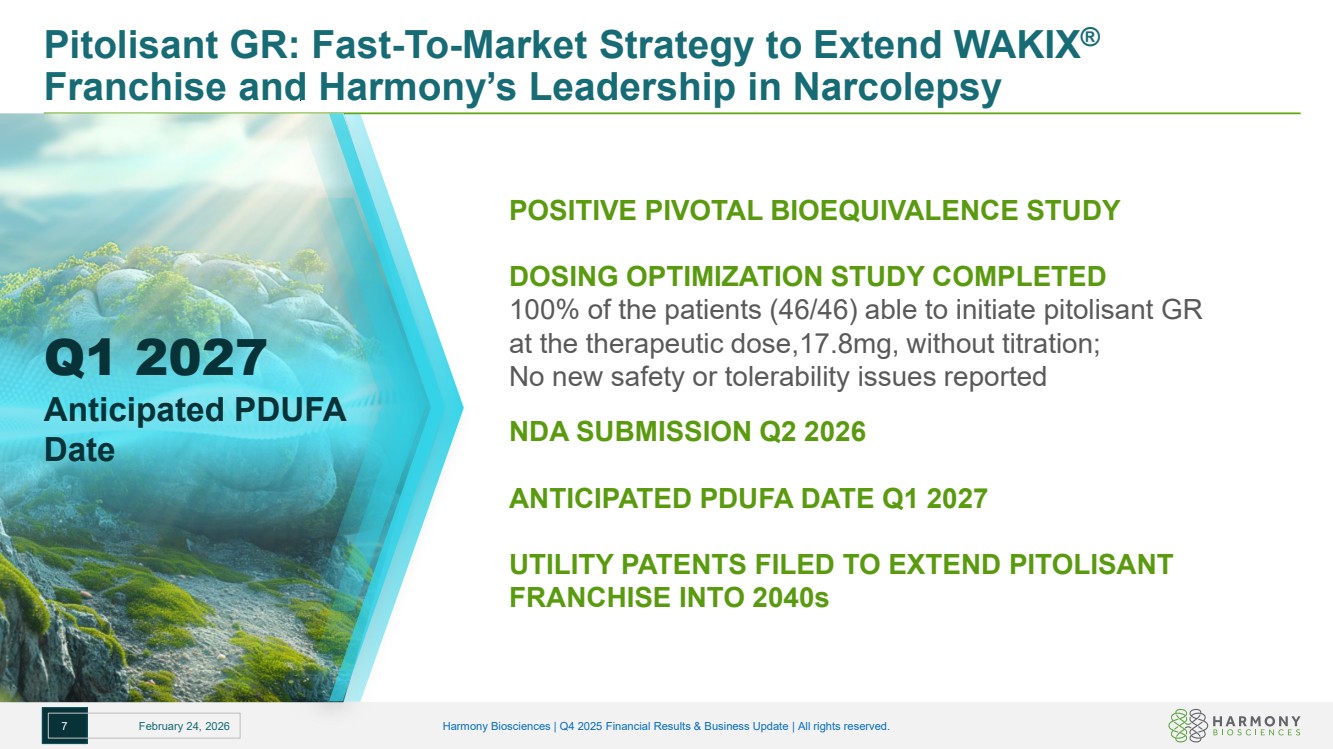
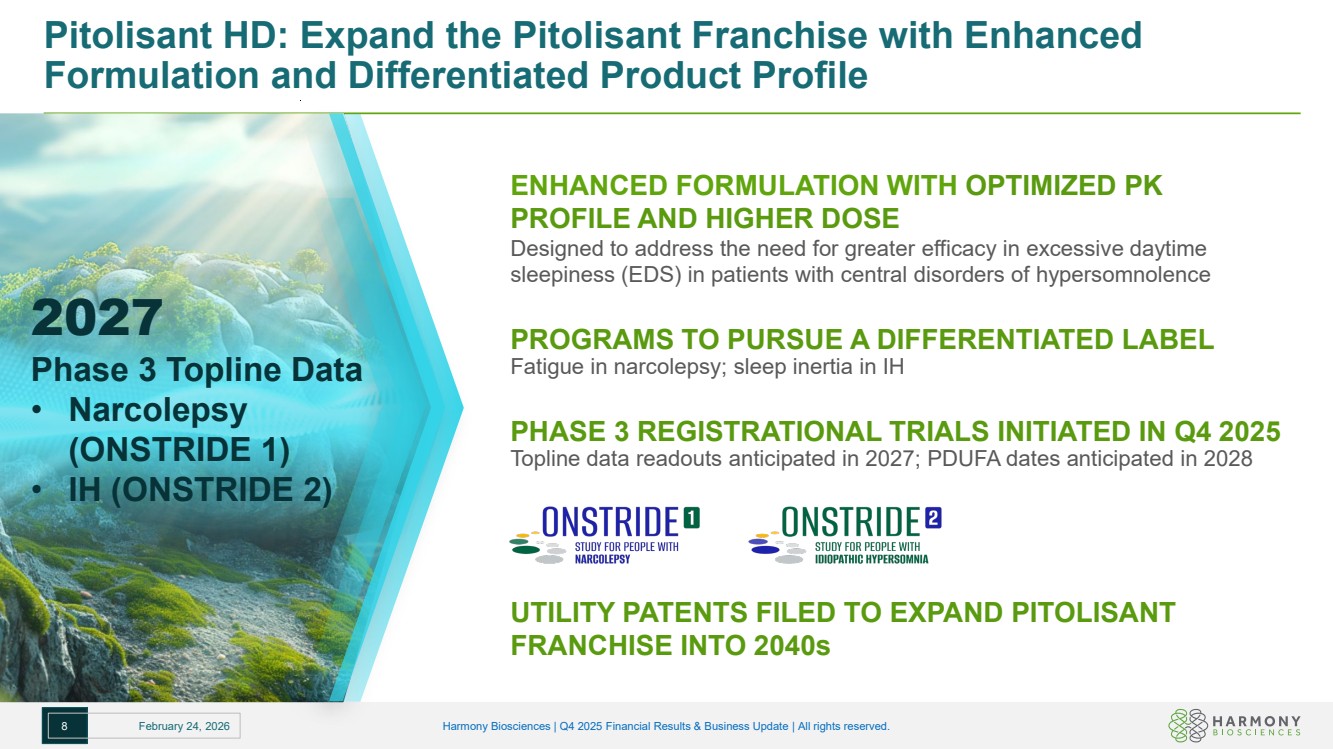
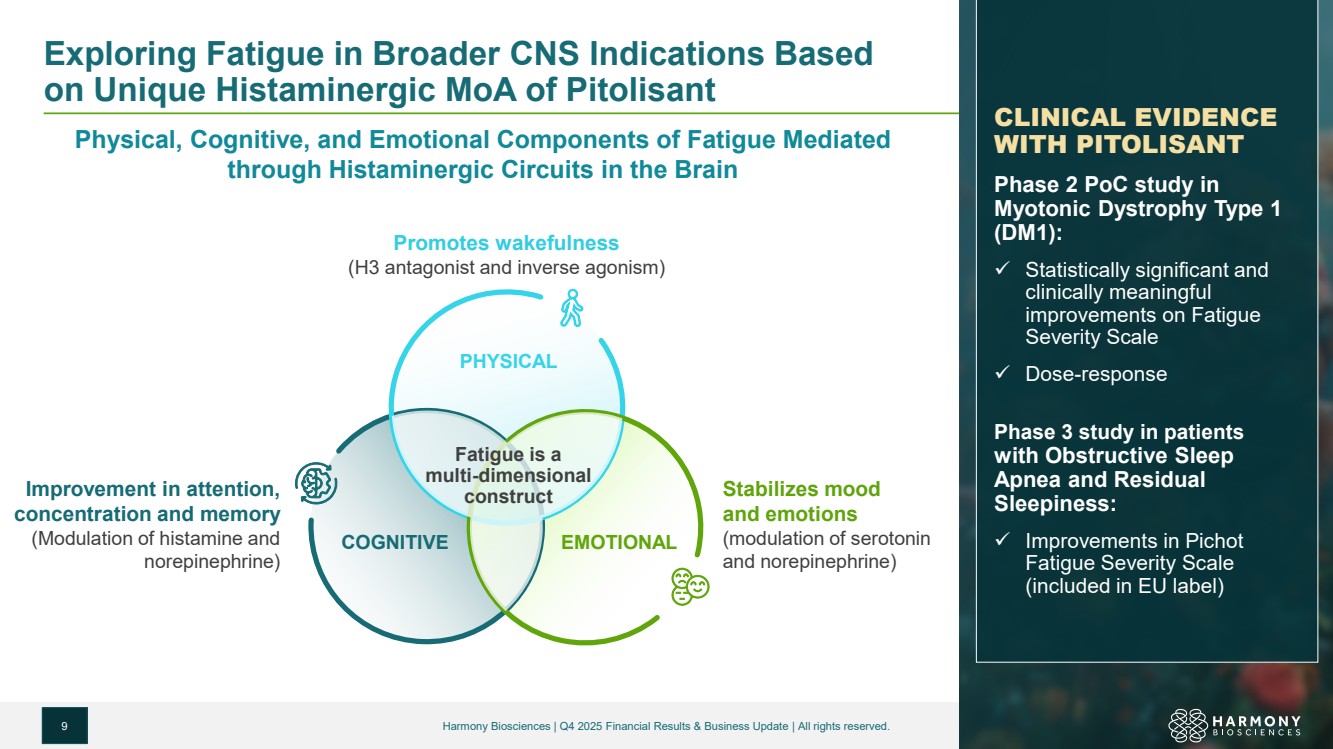
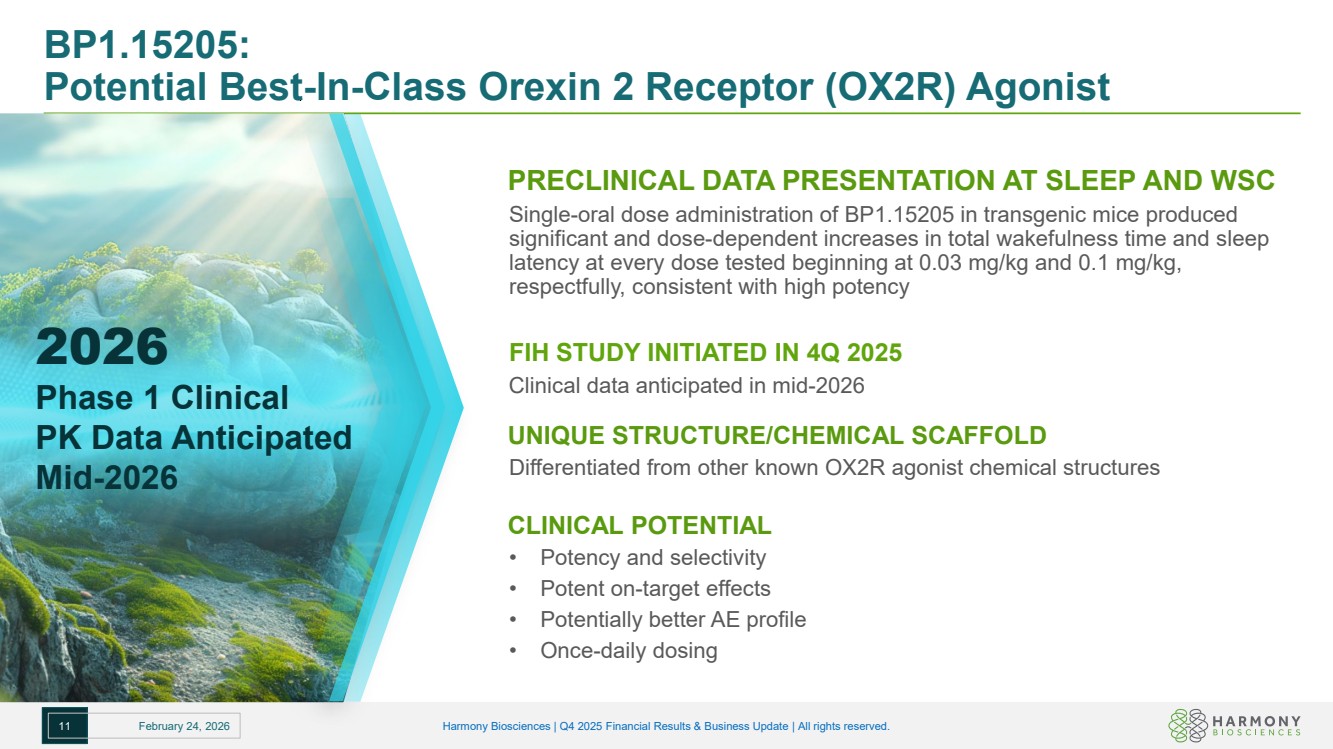
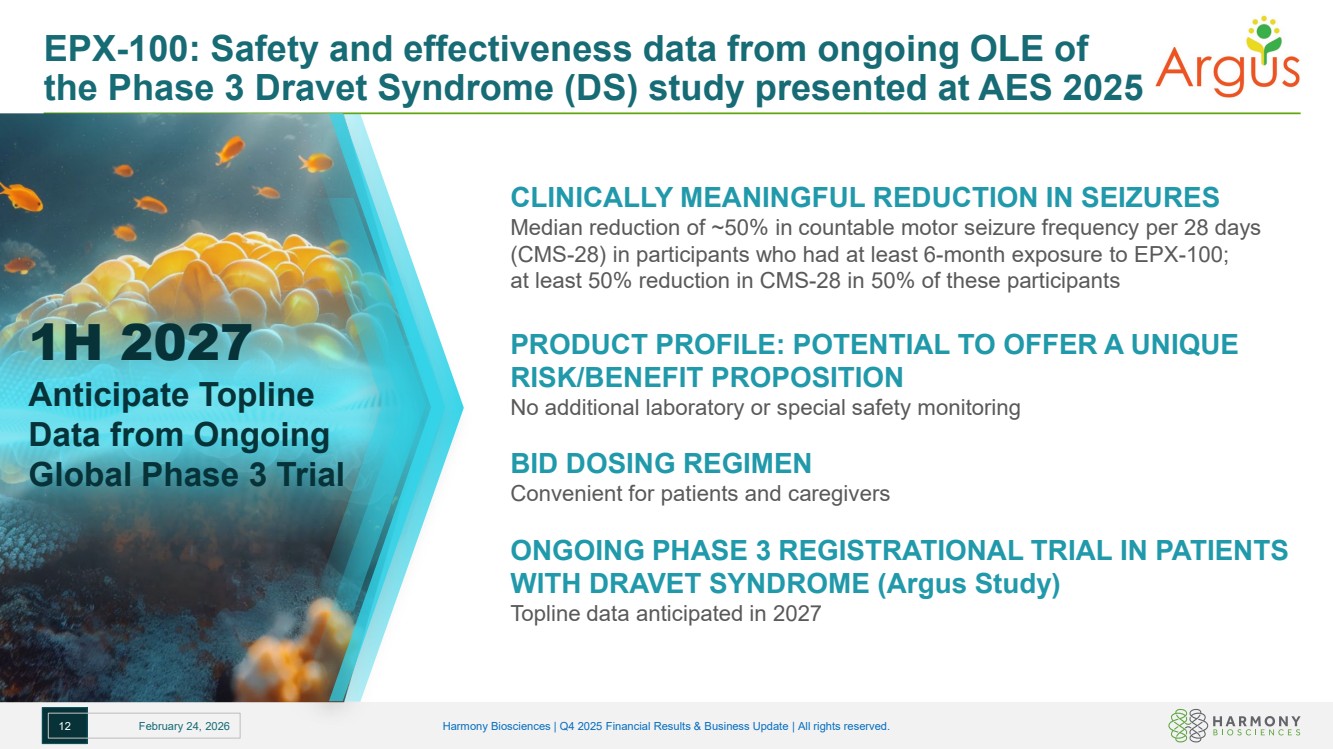
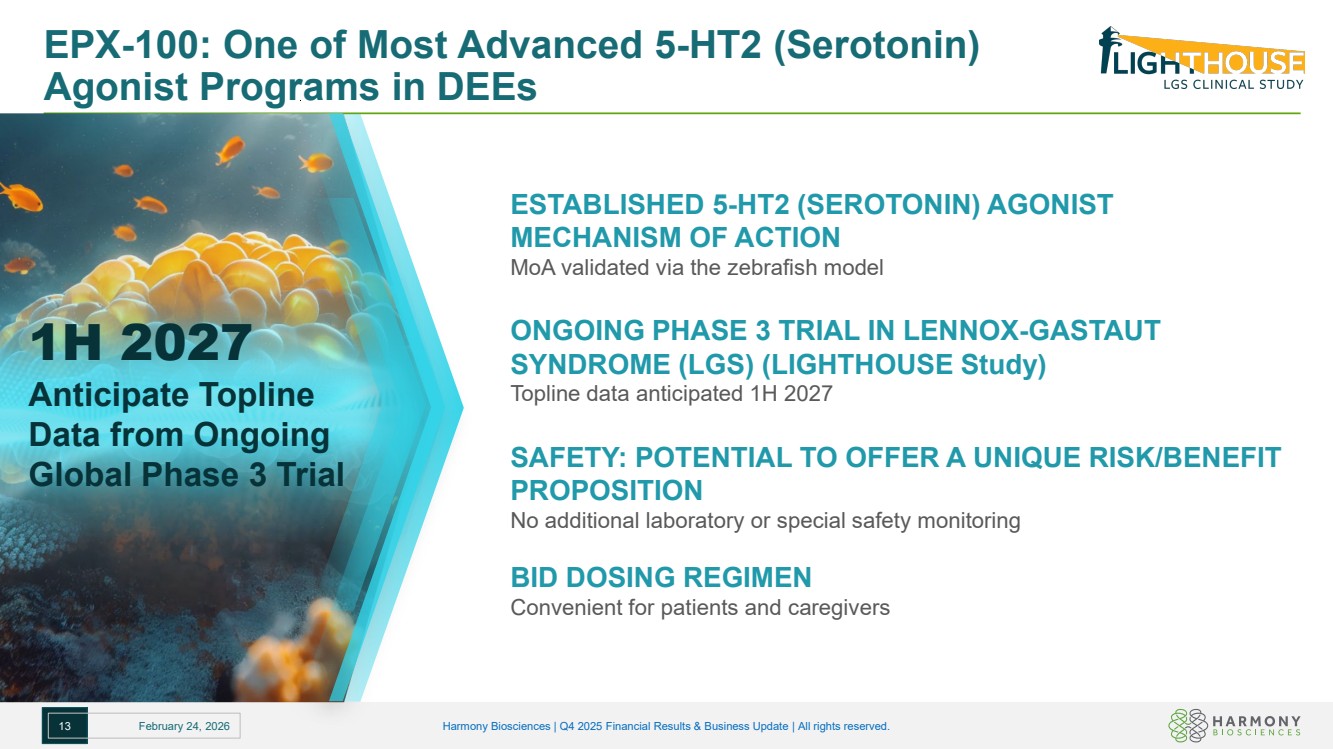
Good morning, everyone, and thank you for joining us today. Q4 2025 kept a year of significant scientific and clinical progress for Harmony, and we are entering 2026 with one of the most robust late-stage CNS pipelines in the industry. We now have five ongoing Phase III registrational clinical trials across five distinct CNS indications underscoring the breadth and depth of our development programs. I'll start with updates for our sleep-wake franchise. I'm pleased to highlight a new indication for VAKIX that the FDA approved on February 13th. The FDA approved WAKE-X for cataplexy in patients six years of age and older. This is another important milestone for WAKE-X, and it is now approved for both excessive daytime sleepiness and cataplexy in adults and children six years of age and older. This approval also advances our efforts towards achieving pediatric exclusivity for WAKE-X, which is an additional six months of regulatory exclusivity at the back end of the longest patent for WAKE-X. The data from the ongoing phase three study in Prater-Willi syndrome, the TEMPO study, is the other requirement for pediatric exclusivity, and we are on track for the top-line data from the TEMPO study in second half of this year. Across our next-gen pitolacin programs, pitolacin-GR continues to advance as a fast-market strategy after demonstrating bioequivalence to VACIX in a pivotal bioequivalence study and has the ability to initiate treatment at the therapeutic dose range at 17.8 mg, eliminating the need for titration, which is an important differentiation. We remain on track for an NDS submission in Q2, 2026, and target BUDUFA in Q1, 2027. Pitolescent HD, our enhanced formulation with an optimized PK profile and a higher dose, remains on track for top-line data in 2027 and BUDUFA in 2028. The phase 3 registrational clinical trials in narcolepsy and IH, that is the ONSTRIDE1 and ONSTRIDE2 studies, are ongoing. ONSTRIDE1 is a prospective placebo-controlled parallel or double-blind randomized clinical trial comparing pitolescent HD and placebo. This is an eight-week study evaluating excessive daytime sleepiness via subjective and objective endpoints, that is ESS and MWT, and we are also evaluating cataplexy and fatigue in this study. On strike two is also a prospective placebo-controlled parallel arm double-blind randomized clinical trial comparing pitolocent HD and placebo. This is an eight-week study evaluating symptoms of idiopathic hypersomnia via IHSF and sleep inertia via sleep inertia scale. The sample size for each of these studies is approximately 200 patients, and both programs are pursuing differentiated labels, fatigue in narcolepsy and sleep inertia in idiopathic hypersomnia. Both GR and ST formulations have utility patents filed extending and expanding the pitolocent franchise potentially into the 2040s. We are also very excited to announce the opportunity to explore broader CNS indications with a new formulation of pitolocent with an issued patent until 2042. As we have discussed in the past, the histaminological mechanism of fraction of pitolocent is uniquely positioned to address all three different dimensions of fatigue, physical, emotional, and cognition, and we have already generated clinical data to support the utility of pitholescent to treat fatigue. We plan to evaluate this new formulation for fatigue in broader indications with fatigue in multiple sclerosis of the lead indication and explore other opportunities such as post-stroke fatigue and fatigue in Parkinson's disease. Our current efforts are focused on formulation optimization and new modes of delivery and towards the phase 1 PK study. Beyond pitolifant, our Orexin-2 receptor agonist, BP1.5205, is enrolling in our phase 1 clinical study. We are on track for phase 1 PK data in mid-2026. As we have previously shared, BP1.5205 has demonstrated compelling preclinical potency, selectivity, safety, and efficacy, positioning it as a potential best-in-class Oryxin-2 receptor agonist. Moving on to our epilepsy franchise, EPX100 continues to advance in two global Phase III registrational programs. Enrollment is ongoing in both the Drouet syndrome and the Lennox-Gastaut syndrome programs. that is the ARCUS study and the Lighthouse study, respectively. The top-line data is expected in the first half of 2027 and BUDUFA in 2028. We recently presented the data from the open-label extension part of the Phase 3 study in Drouet syndrome at the AES meeting in December 2025, which supported a differentiated product profile for EPX100. The effectiveness data in patients who had at least six months of exposure to EPX100 showed clinically meaningful reduction in seizures, approximately 50% median reduction in seizures as measured by CMS28. In addition, we saw at least 50% reduction in seizures in half of the patients. EPX100 was found to be generally well-tolerated with no additional laboratory or special monitoring requirements with some participants exposed to EPX 100 for more than two years and approaching three years. Finally, on behalf of Harmony, I would like to thank all the patients and their families who are participating in our clinical trials, as well as the clinical investigators and site personnel for their efforts and commitment in helping us to advance our development programs. I'll now turn the call over to our CFO, Sandeep Kapadia, for an update on our financial performance.
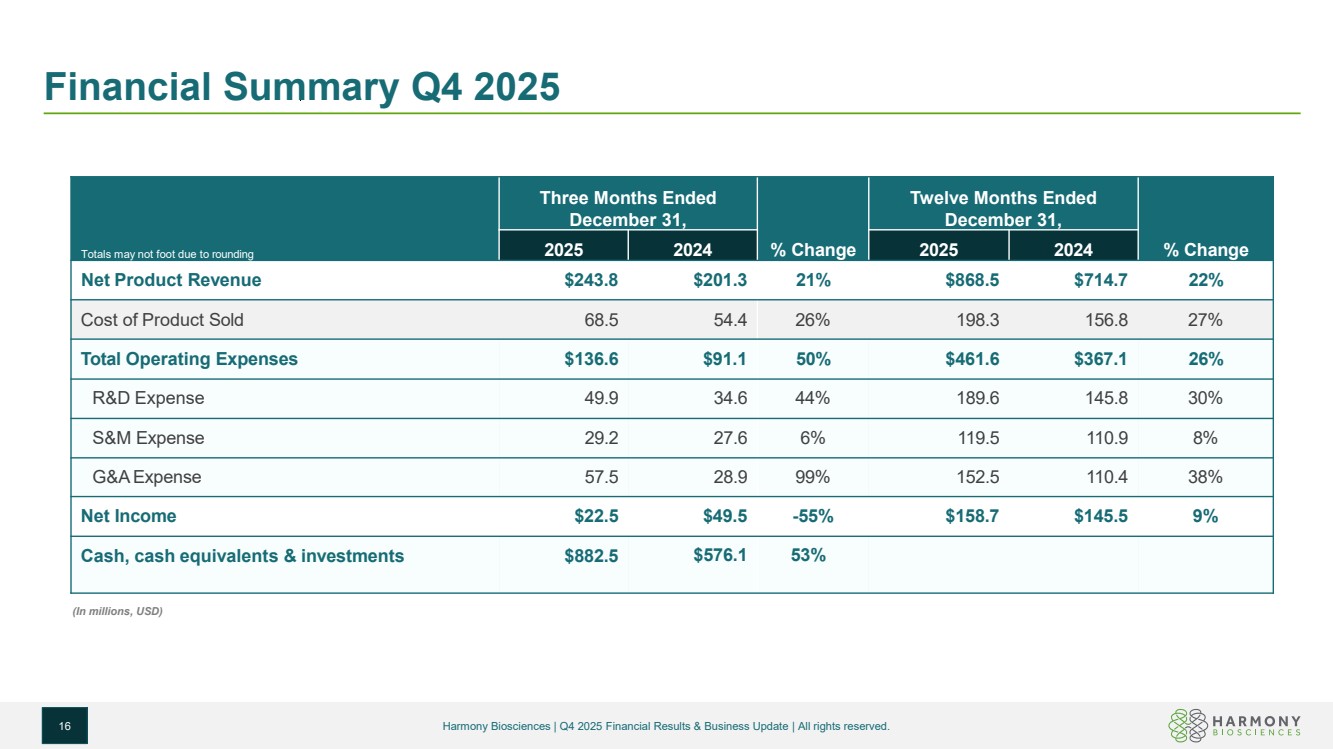
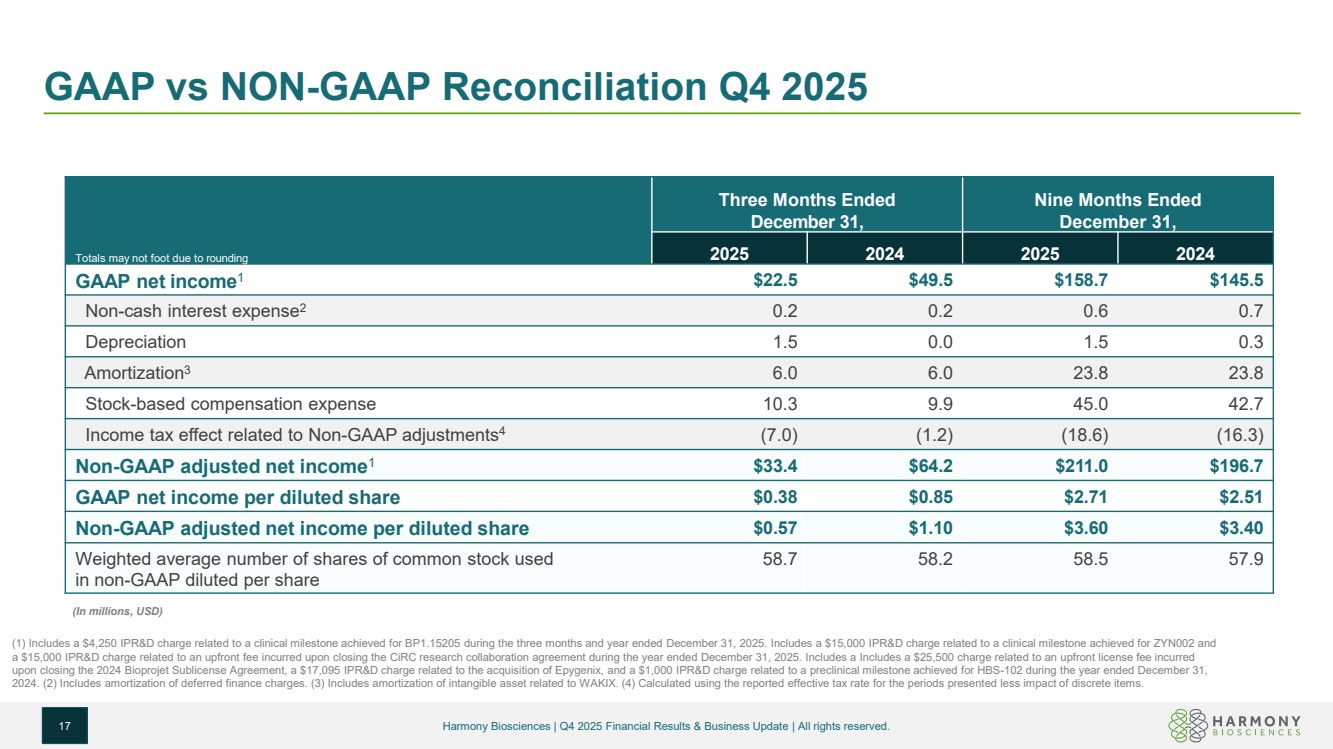
Sandeep. Thank you, Kumar, and good morning, everyone. This morning, we issued our fourth quarter earnings release and filed our 10K, where you'll find the details of our fourth quarter and full year 2025 financial and operating results. Our financial performance is also shown on slides 15 through 17. We finished the year with great momentum across the business, delivering strong growth across several of our key metrics, positioning us well as we head into 2026. We delivered another year of double-digit top-line growth as we reported net revenues above the top end of our previous guidance range. We continue to be a profitable, cash-generating company, funding the growth and advancement of our pipeline fully with the strength of our balance sheet. Our strong financial performance combined with a solid balance sheet, including approximately $882.5 million in cash, cash equivalents, and investment positions as well as we continue to invest in the advancement of our robust late-stage pipeline and look for additional value-enhancing opportunities to further build out our pipeline and add to our commercial portfolio. We reported net revenues of $243.8 million for the fourth quarter of 2025, compared to $201.3 million in the prior quarter, representing a growth of 21% and also our highest quarterly revenues to date. Performance in the quarter reflects the sustained strong underlying demand for WACIX. We also reported total operating expenses for the fourth quarter of $136.7 million, compared to $91.1 million for the same quarter in 2024. The growth in expenses was related to investments in our R&D to advance our late-stage pipeline, investments in the commercialization of wake-ups and narcolepsy, as well as ando litigation and settlement expenses during the fourth quarter of 2025. Non-GAAP adjusted net income for the fourth quarter of 2025 was $33.4 million, or $0.57 per diluted share, compared to $64.2 million, or $1.10 per diluted share in the prior quarter. We believe non-GAAP adjusted net income better reflects the underlying business performance. Please see our press release for a reconciliation of GAAP to non-GAAP results. We ended the fourth quarter with $882.5 million in cash, cash equivalents, and investments. The balance reflects robust cash generation of $348.2 million from operations in 2025, providing us with the financial flexibility to execute on our growth strategy. Looking ahead to our expectations for 2026, as previously disclosed, We are reiterating our guidance for WCAG's net revenue of $1 to $1.04 billion. We believe this guidance reflects our strong expectations for 2026 and demonstrates that we are on track to achieving blockbuster potential for WCAG's in narcolepsy alone. If you think about phasing of revenues for the first quarter of 2026, we expect to see the typical seasonal dynamics that the industry as a whole experiences each year in Q1. This includes higher gross-to-net deductions due to insurance plans resets and higher co-pay obligations, along with potential for drawdown in trade inventories. With respect to expenses, we expect significant increases in investments in R&D as we advance our pipeline with five ongoing registrational Phase III programs, along with plans for a sixth Phase III study anticipated to start later this year. Finally, business development is a high priority, and our intention is to deploy capital to expand our pipeline and commercial portfolio. In summary, I'm pleased with our strong financial performance in 2025. We've once again delivered a year with strong top-line growth, maintained healthy operating margins, while continuing to generate significant cash. This positions as well as we enter 2026 with the potential for significant value generation. And with that, I'd like to turn the call back over to Jeff for his closing remarks. Jeff?
Thank you, Sandeep. In closing, I'm incredibly proud of what the Harmony team accomplished in 2025. But that is behind us, and we are now focused on 2026 and excited for what is ahead. growth of the Wakex franchise, guiding Wakex to blockbuster status in 2026, extending the Wakex franchise with Patulsan GR's target PDUFA date in Q1-2027, expanding the Patulsan franchise with the advancement of the phase three trials with Patulsan HD in unique orphan rare CNS indications, a new opportunity to explore broader CNS indications with newly licensed IP and a new formulation of patollicin, and advancing a robust late-stage pipeline with five ongoing Phase III registrational trials toward five distinct CNS indications. It is because of these achievements that we continue to operate from a position of strength and drive significant momentum. This momentum reinforces our confidence that we have built something rare in this industry, a profitable, self-funding biotech company with a strong balance sheet, blockbuster commercial product, a pipeline position to deliver significant long-term value, and the capacity, experience, and commitment to generate even greater value through the pursuit of smart business development opportunities. Thank you, and I will now turn the call back over to the operator for Q&A. Operator?
Speaker 9
Thank you. At this time, if you would like to ask a question, please press star 1 on your telephone keypad. If you wish to remove yourself from the queue, you may do so by pressing star 2. We remind you to please pick up your handset and please limit yourself to one question and one follow-up question. We'll take our first question from Pete Stavropoulos with Cantor Fitzgerald. Your line is now open. Please go ahead.
Thank you for taking the question. Actually, I'm going to go to one of your earlier stage assets, EPX100 for Dravet at AES in December. He just commented on the baseline seizure rates and the baseline anti-seizure med use. How do they sort of compare to the real-world patients, and how do you compare to patients in other Dravet clinical trials? And with the interim OLE efficacy and safety data in hand for those, what's your view on the emerging benefit-risk profile? How competitive do you believe the emerging profile is? And where do you see it fitting into the current?
Good morning, Pete. Thanks for your question, and I'll turn it over to Kumar to respond. Hey, good morning, Pete.
Thank you for the question. These patients who participated in our Drouet syndrome study had treatment-resistant seizures. They were on an average approximately about four anti-seizure medicines. And their baseline seizures, I don't remember the exact number, what the baseline seizure was, but I can provide that information. But that was comparable to what we have seen in other studies as well. In terms of the value proposition, I mentioned on the call the efficacy that we saw in this study. the effectiveness data showed that we had at least about approximately 50% median reduction in seizures, and we also saw 50% reduction in seizures in about 50% of these patients. What's important is to see this alongside the safety and tolerability profile. We did not see significant nausea, vomiting, abdominal pain, diarrhea that is commonly seen with other medicines, including suppression of appetite. In fact, the only GI, AE of note, was diarrhea, which was seen in about 2% of the patients. Liver function tests also remain normal, which is an issue with some of the approved drugs. And EPX100 doesn't require any special monitoring. And also, the ease of use is also very important here. A liquid formulation PID dosing regimen is much more better suited in this patient population for patients and caregivers compared to some of the other drugs that are in development which have a TID dosing regimen. Thank you, Pete. Thanks, Kumar.
You want to follow up, if okay?
You know, you're going to have a... What's the PK, PD, and safety bar that you look for in the phase one to move this program into later stage studies? And where do you sort of see your EREX and two receptor agonists fitting into the emergency?
Yeah, we are dosing the, we are dosing, sorry, we are dosing subjects right now in our phase one PK study. By mid-2026, we will see clinical PK data, safety, and tolerability data. We don't anticipate to see anything different than what is already seen with other oraccent receptor agonists in this class, and we are making progress on advancing this to the next stage of development, which is sleep-deprived healthy volunteer study we plan to comment in the second half of this year. And in terms of how it fits with the competitive landscape look Takeda is ahead they have submitted an NDA and the others are in phase one and phase two studies and our goal is to really accelerate the clinical development by leveraging some of the learning that we have from other development programs that are ahead of us without compromising the quality of data thank you thanks Dean thank you and we'll move next to
Speaker 9
David Amsellum with Piper Sandler. Your line is now open.
Speaker 12
Thanks. Two for me. One on the orexin. Just wanted to clarify, are we going to get multiple ascending dose data in the second half in sleep-deprived healthies? And how are you thinking about indications here, given that you have a number of companies that are looking at narcolepsy NIH. Are you thinking beyond narcolepsy NIH, or is that going to be your core focus for the erection program? That's number one. And then number two, sort of a hypothetical here, but to the extent that with the patent case, if you were to not prevail, and there was an earlier than expected loss of excessivity, how do you think about cash conservation and ultimately trying to bridge from the LOE to your next set of development stage assets and commercialization of them. Thanks.
Yeah, good morning, David. Thanks for your questions. With regards to the Erexin 2 agonist, just a comment. In terms of, you know, target indications, I think, you know, we are we're contemplating broadly, you know, in addition to the primary targets, you know, in terms of our overall Rexin II program, you know, other opportunities beyond, you know, primary disorders of hypersomenal. So I think, you know, that is part of an overall development strategy. With regards to the emerging data, first, I just want to clarify, in terms of the PK profile, you know, the InHealthy Volunteers single-dose study, you know, we are looking to confirm the expected profile of, you know, once daily dosing with regards to the initial data that we'll read out. And Kumar, multiple ascending dose on sleep-deprived healthy volunteers?
Yeah, the multiple ascending dose study, David, will follow the single ascending dose study. And in parallel, we plan to conduct a sleep-deprived healthy volunteer study. In terms of the indications that Jeff was mentioning, we are keeping an open eye, and looking at everything, not just central disorders of hypersomalance, but other potential neuropsychiatric disorders, including several aspects of cognition, mood, and other things. We will pursue single ascending, multiple ascending dose study because that's something that we need to do regardless. And then we will evaluate the competitive landscape and decide which way to go.
And, David, with regard to your second question, with regards to the ongoing litigation. I think, as you're aware, I think it's premature. I'm not going to speculate on the future outcome of the trial, but I point you to the recent progress that we made in settling with three of the generic filers. So that currently brings the total number of settlements to six of the seven and the filers. We feel good about how that positions us going forward. Based on, you know, these settlements, you know, generic entry stands in March of 2030 if we're granted pediatric exclusivity, which we're on track to obtain. With regards to our cash position and how we stand, Sundeep?
Yeah, look, I think we're in a very strong cash position. You saw, you know, we generated close to, you know, $348 million cash last year. We have $880 million. We're in 12 positions who can be able to...
Speaker 9
And thank you. We'll move next to Jay Olson with Oppenheimer. Your line is now open.
Oh, hey, congrats on the progress, and thank you for taking the questions. Can you talk about any gating factors to filing the Patolisant GRNDA next quarter? And then separately, can you just talk about the pace of enrollment in your Phase III narcolepsy and IH studies for Patolisant HD, considering you've got some competitors also enrolling their studies. Thank you.
Good morning, Jay. Thanks for your question. We're excited about the Ptollus NGR. You know, it's sort of right around the corner in terms of NDA submission. Kumar, any gating items to that, or how are things looking?
Things are looking good. Good morning, Jay. We are on track to submit the Ptollus NGR NDA in second quarter of this year. As always, the final things that are needed for NDS submission, that's what we are working And we are on target for PUDUFA in Q1 of 2027. In terms of your question regarding the enrollment for vitolescent HD in narcolepsy and idiopathic hypostromia studies, you're absolutely right, Jay. There is competition for patients. We are very much aware of it. But we also have been in this field for a long time. We know the sites, we know the investigators, we have conducted studies in this patient population. So we are confident with our current timeline, which is top line in 2027 and Pudufa in 2028.
Thanks, Kumar. And with regards? Yeah, sure. With regards to Patalus and GR, I just want Adam to comment on how he sees the opportunity and how the commercial team is preparing for that.
Speaker 10
Great. Thanks, Jeff. Preparation is definitely underway. Looking for a PDUFA in 1Q27 that will have us launching several years before LOE with an opportunity to extend the Wakex franchise. This is a fast-to-market line extension strategy that provides a GR coding to patolescent and allows patients to start right at the therapeutic dose. So another layer of additional protection for a product that's already perceived as highly well-tolerated. and the addition of starting at a therapeutic dose, which has hopefully the benefit of securing faster patient outcomes. The strategy here is really focused on new patients that would have been prescribed WACIX as well as previous patients that we have the ability to recontact because we secure consent right up front anytime there's a patient referred for WACIX therapy. Both of those are tremendous opportunities, and we look forward to executing on that launch beginning in 1Q27 next year.
Speaker 9
Thank you. We'll take our next question from Greg Suvanna-Veja with Mazzuho. Your line is now open.
Speaker 5
Hi, everyone. This is Ryan on for Greg today. A couple of quick questions for me. I'm wondering if you could comment on the increase in SG&A that we saw in the fourth quarter, the dynamics behind that, and then any updates that you might have on EPX 200 and then we might hear more about that program.
Yeah. Just regarding the expenses in the fourth quarter, I mean, as I mentioned on the call, I mean, we did see an increase in expenses largely driven by the R&D investments as we start up our Phase 3s for both IH and narcolepsy in the HD program, you know, continued cost in terms of investments for weight kicks in narcolepsy commercialization there. And then I also mentioned that we did have handle litigation and settlement expenses in the fourth quarter so that the team could be prepared for the trial, which happened a few days ago as well. So, again, those are the key drivers for our expenses. And as I mentioned going forward, I think the key thing to note in terms of expenses is as we'll have five registrational studies ongoing this year and potentially six months planned for later this year, we will see some increases also in the R&D expenses as we go into 2026.
Thanks, Sandeep. Hey, Ryan. Good morning. Regarding liquid locasterin, which is EPX200, we are doing some pre-IND related work right now. Ryan, as you know, locasterin is more selective for 5-HT2C, and this drug probably has one of the largest safety and tolerability database out there, including a long-term cardiovascular outcome study. and also there is a lot of efficacy data in several DEs with this compound. Our goal is to leverage all of the data that is already available and pursue an accelerated development program and hopefully bring a new medication to patients with development and epileptic encyclopathy. Thanks, Kumar.
Speaker 9
Thank you. And we'll go next to Danielle Brill with Truist Securities. Your line is now open.
Alex
Analyst — Truist Securities
Hey, guys. This is Alex on for Danielle. Thanks for the question. Two little detailed questions. One follow-up on Jay's question on OnStride 1 and 2. Have those begun enrolling patients? Just we haven't seen any indication in clintrials.gov. And then on the OPEX expenditure, you mentioned the impact of some of the settlements and litigation. Was that primarily in the general administrative line item? Just kind of curious how that run rate we should expect moving forward. Thanks so much.
Good morning, Alex. On site one and two studies, as we mentioned in the past, we started initiating sites towards the end of last year, and it will be posted on clinicaltrial.gov, typically within 21 to 30 days after the first subject is enrolled. We are at different stages of site initiation, site activation, sites are getting prepared to enroll the patients.
Yeah, and regarding the expenses, yeah, most of them, they were all under DNA in terms of the end of litigation and settlement expenses. Some of it tend to be one-time expenses, and some will continue as we continue with the litigation process.
Alex
Analyst — Truist Securities
Great. Thanks so much. Thanks, Alex.
Speaker 9
And thank you. We'll move next to Corinne Johnson with Goldman Sachs. Your line is now open.
Speaker 0
Thanks. Good morning. Maybe I know you can't speak too much about the details of ongoing litigation, but you could help us understand kind of the timeline for decisions that are expected next, what process you kind of could anticipate for appeal for a situation like this and also kind of remind us the regulatory exclusivity timelines that you have and then I know you've talked about the litigation or the settlements you have kind of with six of seven of these other generic manufacturers but can you clarify what the impact this litigation might have on potentially like acceleration clauses in those settlements I think those are pretty standard but not sure if they're included here. Thanks.
Yeah, Corinne, thanks for your question. So with regards to, you know, the timing of the judge issuing a ruling, you know, it's really, it's hard to know and can't really speculate. You know, this is an ongoing legal process, and it's hard to know, you know, when that will complete and, you know, come to final decision. As a reminder, you know, there is, in the meantime, there is a stay, you know, that's in place that extends to February of 2027. And then based on the outcome of the trial, obviously an appeals process is available to both sides. I think we know that the litigation process as well as the appeals process, you know, takes time. And, you know, with that, while this was happening, again, I think pointing back to the progress we've made, you know, on the settlements in terms of six of the seven generic filers being settled, we feel that, you know, positions us well going forward, you know, with regards to the overall process. In the meantime, you know, there are other things going on with regards to, as we just spoke to, you know, Patolis and GR in extending, you know, the franchise. and, you know, that's, we remain, you know, with regards to last week's trial, you know, we remain confident in the strength of the IP, and we will continue to vigorously defend it, you know, as the legal process plays out, you know, after the trial. Kumar, in terms of regulatory exclusivities, So, in terms of our regulatory exclusivities of, you know, where we are with regards to, I mean, ODE with regards to EDS, you know, takes us to March of 26 and for cataplexy to October of 27.
Speaker 9
Thank you. Thank you. And we'll take our next question from Patrick Trucchio with HC Wainwright. Please go ahead.
Speaker 16
Hi, good morning. Just a couple of clarification questions and then a follow-up. First, I think you reiterated 2026 WACIC's guidance of $1 billion to $1.04 billion. What level of average patient growth is embedded in that range, and how much incremental contribution do you expect from the newly approved pediatric cataplexy indication in 2026?
Good morning, Patrick. Thanks for your question. Adam, what response to the patient growth supporting that?
Speaker 10
Yeah, thanks for the question. So for 2026 guidance, you know, exceeding basically a billion or blockbuster status, the underlying patient growth is consistent with what we've seen this year. So we expect that momentum to continue. We're really excited to see the third consecutive quarter of, you know, more than 400 patient ads in a quarter. We've never seen that before on the brand. We believe that's a strong foundation of momentum carrying us into 26, and we expect that to continue. You're going to see the regular and normal seasonality that we've seen over the last several years. Q1 tends to be a little bit slower as the start of the calendar year with payer resets and what have you. So we expect that seasonality to continue. But the underlying sort of average performance, we'd expect to continue the momentum we saw in 2025. Hopefully that covers the question.
Speaker 16
Yeah, that's helpful. And then just as it regards the broader CMS strategy of MS fatigue, I'm wondering first, can you elaborate on what existing clinical data supports patollicin's efficacy in fatigue? And what is the development timeline to the Phase I PCA study?
Good morning, Patrick. Regarding this new formulation, this is something we are very excited about. It's a new formulation with an issued patent until 2042. We have mentioned in the past about our interest to pursue fatigue based on the histaminergic mechanism of action. We have also said that fatigue is not an unidimensional construct. It's a multidimensional construct with physical, somatic, and cognition symptoms, and how pitolecent with its unique mechanism of action, working at tuberomammillary nucleus and the downstream effects on serotonin and norepinephrine is uniquely positioned to treat fatigue. To your question about clinical data, Patrick, we actually showed the efficacy data in fatigue with pitolecent in our myotonic dystrophy study, where we saw clinically meaningful improvement in symptoms of fatigue, and we also saw dose response. Similarly, we also saw clinical efficacy data in fatigue in patients with residual excessive data and sleepiness with the OSA. So armed with all of these data points, we plan to pursue broader CNS indications where fatigue is a prominent symptom and we have identified fatigue in MS as a lead indication because it's very well characterized, very well known, and about 80% of patients with MS have fatigue with more than and 50% having clinically significant fatigue. In terms of where we are with the development program, right now the focus is on formulation optimization and looking at potentially other modes of delivery and prepare for a PK study, clinical PK study. That's where we are. Thank you.
Speaker 16
Great. Thanks so much.
Speaker 10
And if I could just jump in, I neglected to answer the second part of your question around the pediatric cataplexy opportunities. So just a quick couple of words on that. We're really excited about the approval of pediatric cataplexy. We now have approval for EDS and cataplexy in both adult and pediatric populations, basically anyone over six years of age. The pediatric patient population represents about 5% of the total narcolepsy population, just to give you an idea around scale of the opportunity. But really, we see this as, look, this is an important addition to the label. It provides greater flexibility for health care providers in their ability to treat these patients. It's important new information that we will educate those health care providers on. And it, I think, reinforces WACIX as an appropriate treatment for peds, as well as having just broad clinical utility across almost all patients with narcolepsy. So our teams were really well prepared ahead of the approval. As I mentioned, we had a robust promotional and execution strategy ready to go, and we began executing on those plans really from the day of approval. Thank you for the question.
Speaker 16
Terrific. Thank you so much.
Speaker 9
Thank you. We'll go next to Jason Gerberry with Bank of America. Please go ahead.
Hey, guys. This is Robin Patel on for Jason Gerberry. Just a couple questions for us. The first is, I know you guys mentioned expanding the field sales and reimbursement teams in 2026. So maybe if you can just help us understand how much of this investment is dedicated to the core and archaeology market versus preparing for new launches like the Tolisant GR in the future. And then the second question is with regards to BB. Maybe if you can speak to the BB as a capital allocation priority versus share repurchases or other things and how you're planning to diversify beyond the Patola-Santa franchise ahead of an important IP outcome, providing clarity on this whole commercial asset.
Speaker 10
Thank you. yeah i didn't catch the um the first part of the question if you could repeat that i did yeah oh yeah okay adam good yeah the first part of the question was around the expansion um you know what does that look like and how much of that is related to core growing basically growing wake versus uh preparing for for gr i mean the short answer on that last piece is a hundred percent of investment expansion is around continuing to grow Wacix today. You know, our plans for how we will launch GR will take form as we progress through the calendar year this year and approach that PDUFA date in 1Q27. I'll remind that, you know, we were really pleased with the performance we saw in 25, really record-setting performance. And that was based on continuing to tweak some of the fundamentals around our sales execution, marketing promotional mix and messaging, adding some pair wins and supporting patients. As we enter 26, we trigger an expansion of our field-based teams. That's what you were asking about. Overall, it's about a 20% increase in total field-based personnel. So we see that as a really significant and meaningful increase in our share of voice. Also gives us the opportunity to rebalance territories that you want to do about every 18 months to two years. With our field sales teams, we're seeing that expansion more than 10%. Field reimbursement, more than 50%, or remote sales teams, more than 10%. So it's really meaningful, and we're excited about that opportunity. We've posted those roles. We're already in the process of hiring. We've already identified several of those candidates, so we expect those folks to be in place by the end of this quarter. That's our plan.
Thanks for the question. Thanks, Adam. Thanks, Adam. And with regard to the second question on business development, business development remains a high priority. for us, obviously, you know, with a very strong balance sheet, and we want to deploy that capital and, you know, invest in the business. As we said, you know, the sweet spot, the focus continues to be orphan rare CNS opportunities, late stage development, as well as commercial on market. We have the capacity to do that. Obviously, we have a strong commercial engine. We'd like to build out, you know, the commercial portfolio, dedicated business development team, and we're also, you know, looking, and we've said this before, you know, adjacencies, broader CNS indications. Obviously, we shared today a new opportunity that we're very excited about based on newly licensed IP with a new formulation of patollicin where we see a significant and opportunity around fatigue in broader CNS populations. So we are focused and committed to those efforts. Deploy our capital towards business development. Sandeep, any thoughts on capacity?
Yeah, look, I think we're in a very strong position. We have over $880 million in cash on the balance sheet in the last quarter. And just to your question, I mean, not only obviously we're looking at business development, but of course we also have $150 million capacity on the share buyback. So we're always looking at opportunities to drive value for shareholders. And that's something that, you know, we think we have the optionality as a company and to move forward.
Very good. Yep, thank you.
Speaker 9
Thank you. And we'll go next to Soyun Shin with UBI. Please go ahead.
Speaker 1
Good morning. Thank you for taking my question, and congrats on the great year. I have two questions, if I may. First, so it seems like the settlement for generic entry with the three additional antiphilers are now four months early, March 2030, if pediatric exclusivity is granted from the prior settlement agreement of July 2030. So, just wanted to check if I'm understanding it correctly. Does it mean without the pediatric exclusivity, the generic entry would start no earlier than September 2029 now? And my second question is on Prader-Rilley syndrome indication for WCAG. So the phase three reading out, second half of this year, potential put the fight in 2028. Here, I was wondering what are you envisioning opportunities from the PWS? It would support the pediatric exclusivity for Wakex and delayed generic entry too, but on just the PWS indication itself, the runway would just be about two years from launch if approved. Are you thinking of trying the PWS with the Pitocin HD as well?
So, Yun, thanks for your questions. With regards to your first one about the timing of the settlements, you are correct in terms of without the pediatric exclusivity, market entry would be September 2029, but we are on track, making very good progress towards pediatric exclusivity, which would take it to March of 2030. One of the important components of that, obviously, after the PEDS narcolepsy data, is the Prader-Willi program, both for potential indication, but, you know, the larger market opportunity, I think, as you're aware, is the six-month extension with the PEDS exclusivity. Kumar, further thoughts on that?
Yeah. Good morning, Sui. With the PWS, in the U.S. alone, there are approximately 15,000 patients with Prader-Willi syndrome. About half of these patients have significant excessive daytime sleepiness for which there are no drugs approved. So if we are successful with this study, we will go for an indication really addressing high unmet need in this patient population. And in terms of pitotocent HD being a potential option to pursue PWS, that's not how we are thinking right now, but that option is always open to us. Thank you.
Speaker 9
I see. Thank you. Thank you. And we'll take our next question from David Huang with Deutsche Bank. Your line is now open.
Hi. Good morning. Thanks for taking my questions. So maybe on the new Patolis formulation, could you talk a little bit about what characteristics and profile you expect to see with that product? How is it different from, let's say, Patolis and HD? And are there characteristics that lend itself to MSVT-related conditions? And then maybe a second question just around the IP estate for some of these life cycle management products. So could you just summarize again for us the IP that you either currently have or expect to obtain for Patolis and GR, HD, and then the new formulation? Thank you.
Kumari, on the new opportunity. Yeah. Hey, good morning, David. Thanks for the question. Regarding the new formulation, As we evaluated these opportunities, there might be some potential options for us with this new formulation that could potentially differentiate itself in terms of the PK parameters that probably will lend itself better for the treatment of fatigue in larger indications. Obviously, once we complete the human PK study, that's when we will get to know how exactly this will play out in human, and that will help us determine the next step. But for now, we are really excited about this particular formulation because, as I mentioned earlier to the other question, this is a very unique opportunity for us to pursue fatigue in broader CNS indication.
And, David, in terms of your second question about the IP estate, just briefly as a reminder, Pitolescent GR and Pitolescent HD utility patents filed out to 2044. This new formulation of Pitolescent, the opportunity there, is actually an issued patent that we have a license to out to 2042. So formulation work continues on. As Kumar mentioned, the potential of other modes of administration, looking at the potential, some of these patient populations where there's swallowing dysfunction and other methods of delivery, but an issued patent out to 2042.
Speaker 9
Thank you. And we'll take our last question from Ami Fadia with Needham & Company. Your line is now open.
Speaker 11
Hi, this is Purnah on for AMI. Thank you for taking our question. Are there any recent updates for the enrollment from the Argus and the Lighthouse studies? And just in case I missed this, what are the targets for the recent Salesforce expansion and when do you see that impact coming through?
Hey, good morning, Purnah. Argus and Lighthouse study, they continue to enroll and we continue to make progress. We are on track for top-line data in the first half of 2027 and to do fine 2028.
Speaker 11
And the second question, just to clarify, I just want to understand, when do you see the impact on the Salesforce expansion coming through?
Speaker 10
Yeah, and there was a question around the targets as well. We did add some targets, but let's say it was about 5%, so not a huge add. It's really improving our share of voice and rebounds in territories targeted at the existing target base that we've been targeting for some time. And when would we expect to see that impact? Obviously, as I mentioned, we'd like to get those folks on board and in place by the end of this quarter. And so from the impact standpoint, I guess you would expect to see the impact from that point forward.
Speaker 9
Thank you. I'm showing no further questions. I would now like to turn the call back over for any closing remarks.
Thank you, Operator. And thanks, everyone, for joining our call this morning, for your interest in Harmony Biosciences, and have a great rest of your day.
Speaker 9
This does conclude today's Harmony Biosciences fourth quarter and full year 2025 financial results conference call. You may now disconnect your line and have a wonderful day.