Operator
Good morning, everyone. My name is Beau, and I will be your conference operator today. At this time, I would like to welcome everyone to the Harmony Biosciences' second quarter financial results conference call. All participant lines have been placed on mute to prevent any background noise. After the speaker's prepared remarks, there will be a question and answer session. If you would like to ask a question at that time, please press star 1 on your telephone. Please be advised that today's conference is being recorded. And lastly, if you should require operator assistance today, please press star zero. I would now like to turn the call over to Mr. Brennan Doyle, Head of Investor Relations. Please go ahead, sir.
Good morning, everyone, and thank you for joining us today as we review Harmony Bioscience's second quarter 2026 financial results and provide a business update. Before we start, I encourage everyone to go to the Investor section of our website to find the materials that accompany today's discussion, including a reconciliation of our GAAP to non-GAAP financial measures. At this stage of our life cycle, we believe non-GAAP financial results better represent the underlying business performance. Our speakers on today's call are Dr. Jeffrey Dano, President and CEO, Adam Zewski, Chief Commercial Officer, Dr. Kumar Badur, Chief Medical and Scientific Officer, Peter Anastasiou, Chief Operating Officer, and Steve and Malakela, Interim Principal Financial Officer. As a reminder, we will be making forward-looking statements today, which are based on our current expectations and beliefs. These statements are subject to certain risks and uncertainties. Our actual results may differ materially, and we undertake no obligation to update these statements, even if circumstances change. We encourage you to consult the risk factors referenced in our SEC filings for additional details. I would now like to turn the call over to our CEO, Dr. Jeffrey Dano. Jeff.
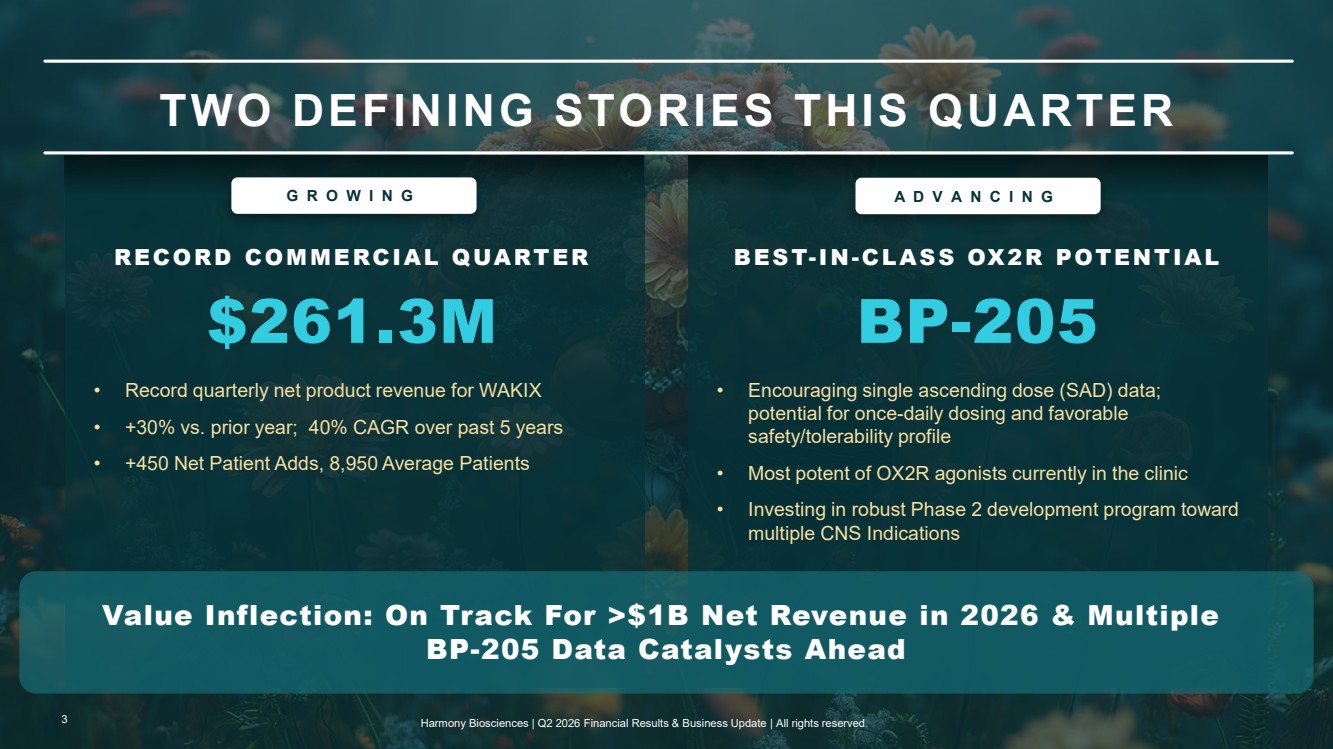
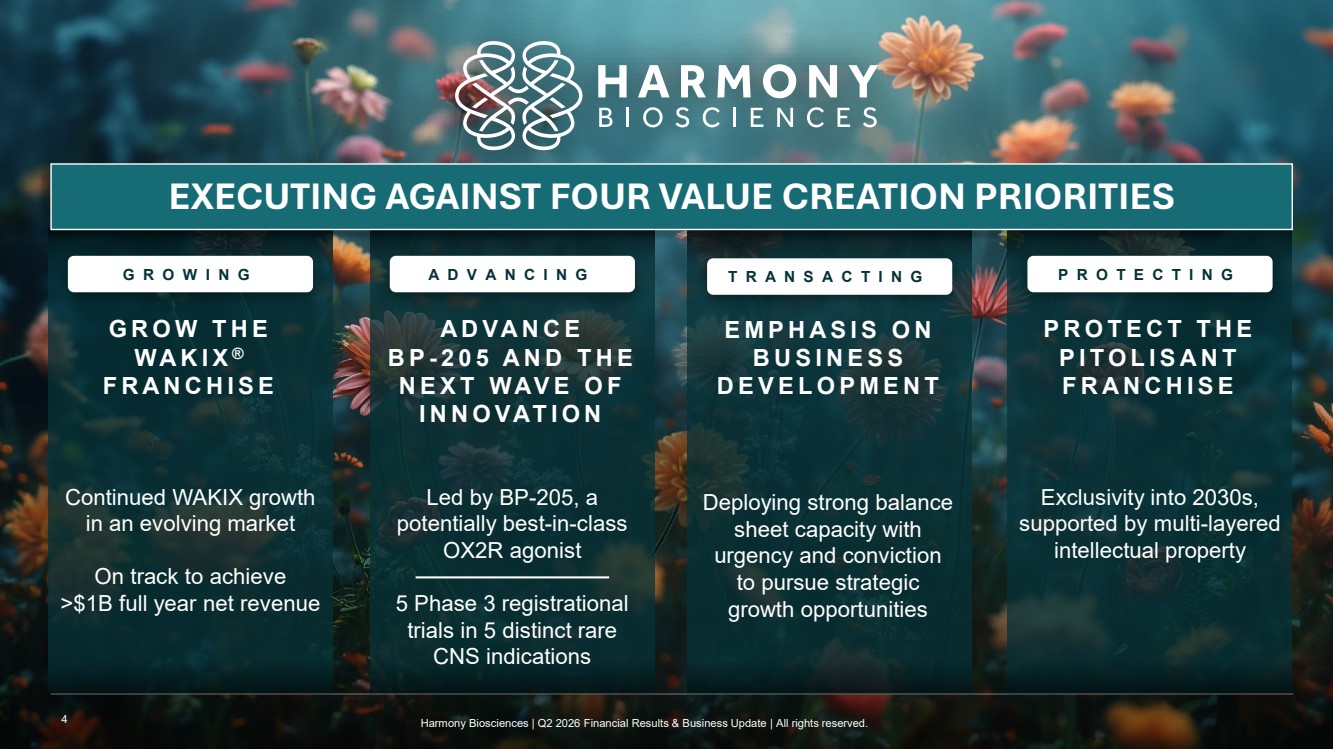
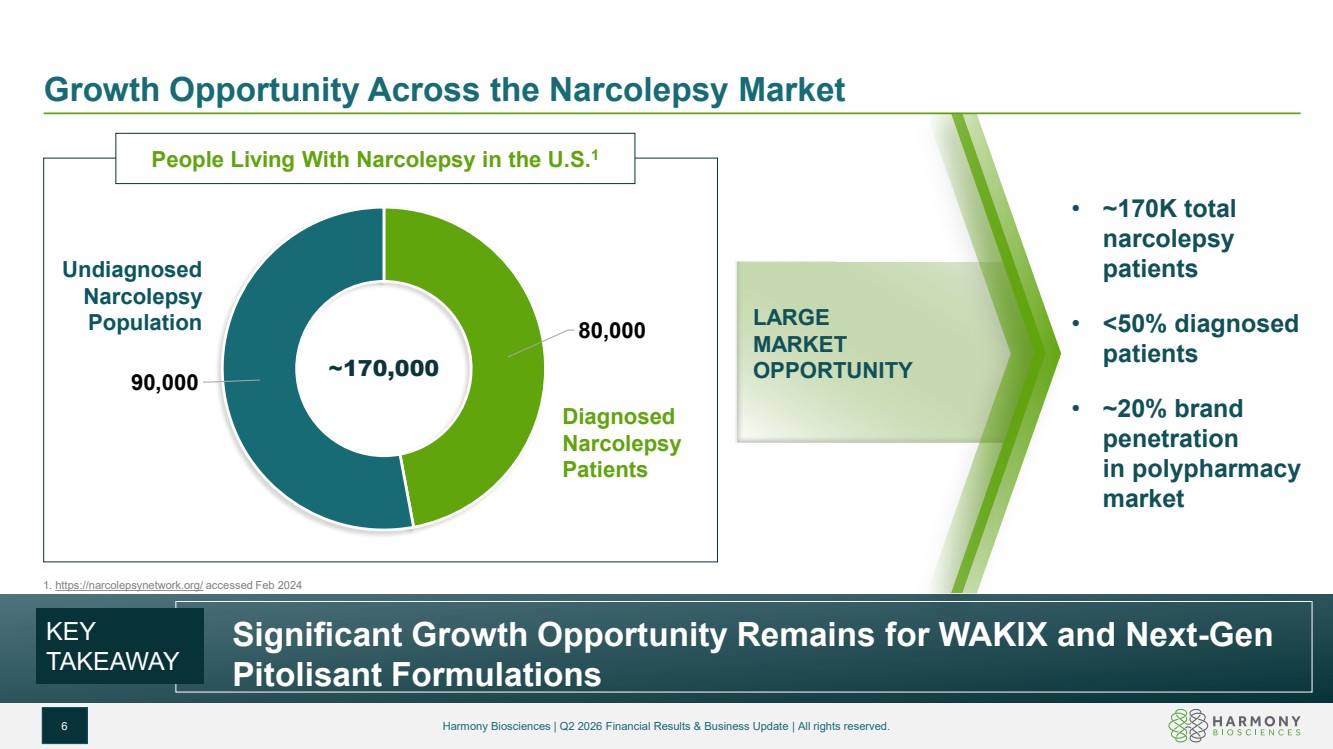
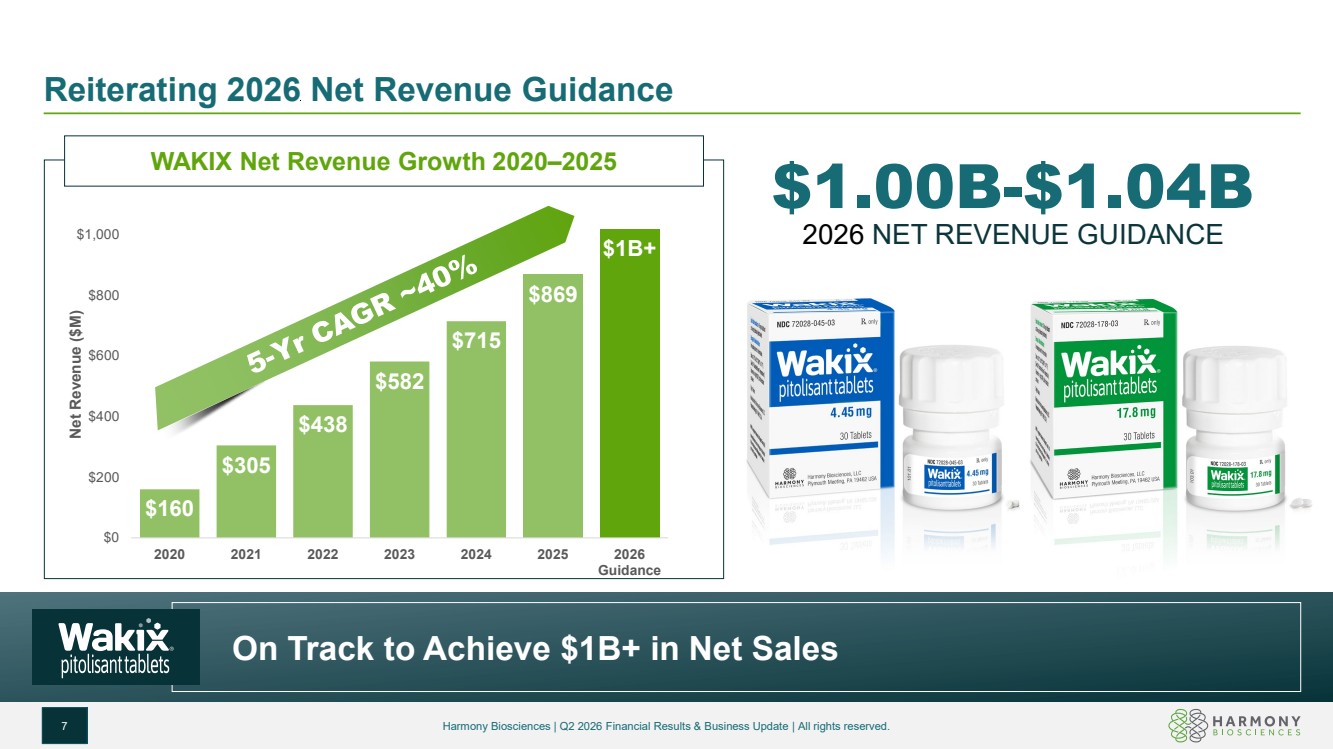
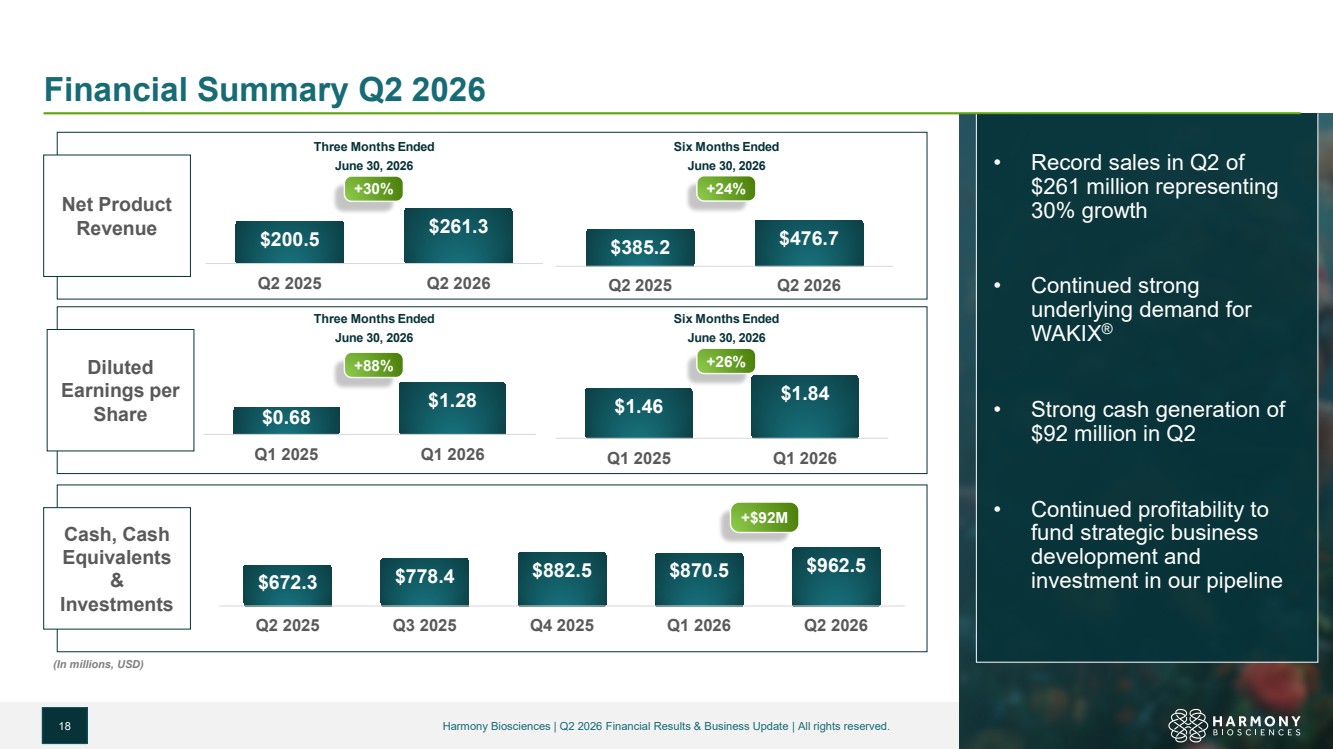
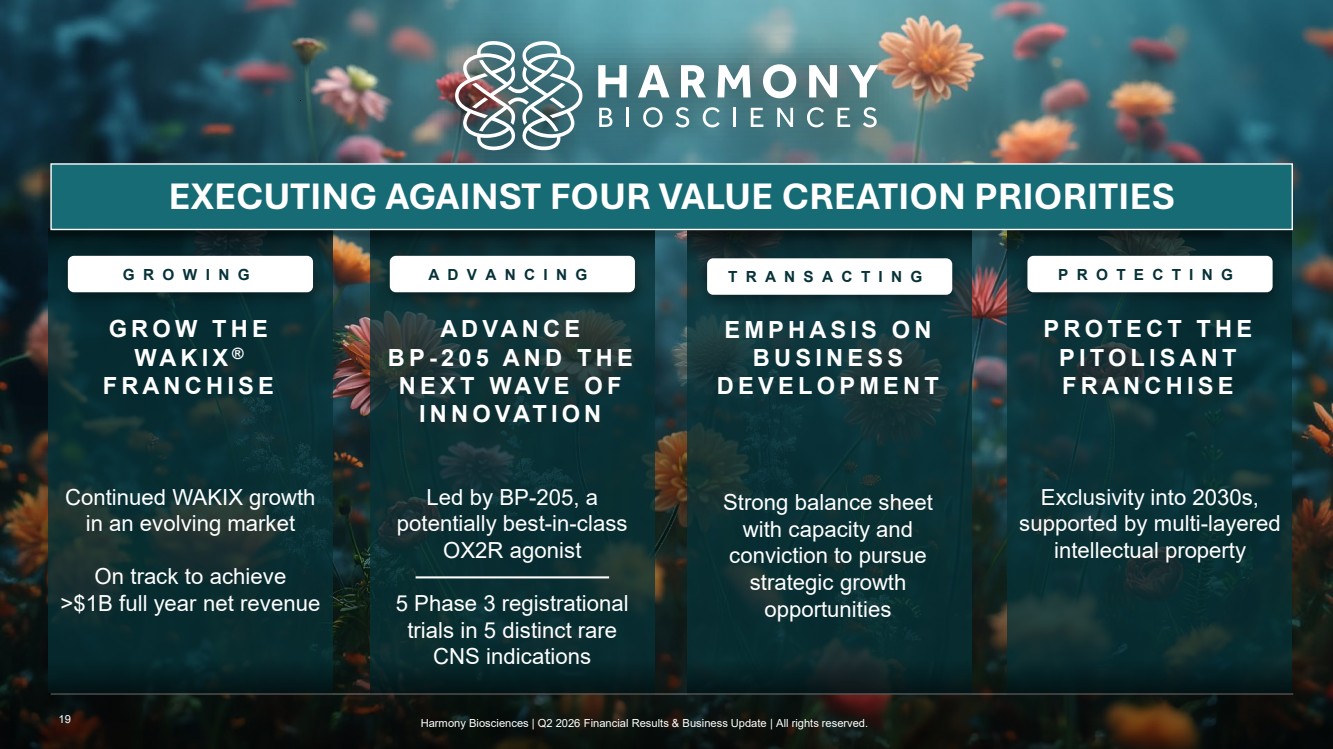
Thank you, Brandon. Good morning, everyone, and thank you for joining us today. This was a defining quarter for Harmony Biosciences on two fronts. Commercially, WACIX delivered record quarterly net revenue of $261.3 million, up 30% year-over-year, and up 21% compared to last quarter, signaling a decisive rebound from the seasonal headwinds we discussed on our first quarter earnings call. And importantly, on the R&D front related to our robust pipeline, today we shared encouraging data from a phase one single ascending dose or SAD study for BP205 that reinforces its potential as a best-in-class erexin-2 receptor agonist. Revenue is on track to exceed $1 billion this year, and our opportunity with our Erexin-2 agonist BP205 is coming into focus with multiple data catalysts over the next six months. The two key messages that I want you to take away from today's call are, first, continued strong growth for WACIX on track for over $1 billion in net revenue for the year, and And second, encouraging phase 1 PK data for our potential best-in-class Erexin II agonist BP-205 with multiple data catalysts coming in the next six months. The foundation upon which we continue to grow the business and advance our pipeline remains strong. We are a profitable, self-funding biotech company operating from a position of strength, a proven commercial engine now in its seventh year on the market, a robust pipeline centered around BP-205, our potential best-in-class Erexin II agonist, a balance sheet with the capacity and a management team with the expertise and conviction to execute on meaningful business development opportunities, and a multi-layered IP strategy to protect the Petolson franchise out to 2030. We continue to run the business aligned around our four priorities focused on value creation, growing the Wacox franchise in an evolving market, advancing our robust pipeline, transacting on strategic business development opportunities, and protecting our IP estate around the Tulleson franchise. Let me walk you through the highlights for each of these four priorities. First, the commercial performance this quarter was outstanding as we continue to grow the Wacix franchise in an evolving market. Our record quarterly revenue of $261.3 million keeps us firmly on track to achieve more than $1 billion in net revenue in 2026, which is why we are confident in reiterating our full-year guidance of $1 to $1.04 billion. WACIX has a compounded annual growth rate of about 40% over the last five years, and there continues to be a large market opportunity for WACIX, with about 80,000 patients diagnosed with narcolepsy and another 90,000 to 100,000 individuals not yet diagnosed. Turning to our pipeline and the focal point for this call, BP-205, our potential best-in-class Erexin II agonist, today we shared encouraging data from a Phase I single ascending dose PK study for BP-205. Kumar will take you through the SAD data results later in the call. At a high level, BP-205 is designed to deliver a differentiated profile as the most potent of the erexin-2 agonists currently in the clinic with excellent selectivity, and now with clinical PK data demonstrating a predictable PK profile with the potential for once-daily dosing, along with a favorable safety tolerability profile. These data strengthen our conviction that BP-205 could be a best-in-class erexin-2 agonist and reinforce our commitment to invest in the BP-205 development program. We will be initiating Phase II trials the middle of next year to evaluate multiple CNS indications as we believe BP-205 could have broad clinical utility. Next up for BP-205 is top-line data from the multiple ascending dose study in Q4, an initiation of a Phase 1B study in sleep-deprived healthy volunteers in the third quarter with top-line data readout expected early next year. Kumar will provide more color on BP-205 during his R&D update. One additional comment on BP-205 and our exciting Erexin opportunity. We have been leaders in the Sleep Lake space for almost a decade now and are leveraging our expertise to accelerate our BP-205 development program toward multiple CNS indications and become a leader in the Erexin space. In addition to organic growth, we have significant firepower to put toward business development for inorganic growth with approximately 963 million dollars in the balance sheet we have the capacity and the conviction to execute on meaningful transactions to drive long-term value peter will share more color around our bd strategy later in the call additionally he will provide an update on our multi-layered ip strategy and our efforts to protect the WACIX franchise. We have settled with six of the seven ANDA filers and are confident in the strength of our IP estate, which supports WACIX exclusivity to March of 2030, inclusive of six months of pediatric exclusivity, for which we are on track to obtain. In summary, this has been a defining quarter for Harmony Biosciences. We posted record revenue for Wakex in its seventh year on the market and shared encouraging data for BP205, which supports its profile as a potential best-in-class Erexin-2 agonist. With multiple data catalysts coming for BP-205 over the next six months and our focus on business development, Harmony is poised to deliver meaningful long-term value creation as we drive toward delivering innovative treatments for patients living with CNS diseases and unmet medical needs. With that, I will now turn the call over to Adam Zewski, our Chief Commercial Officer, for a closer look at our Q2 commercial performance.
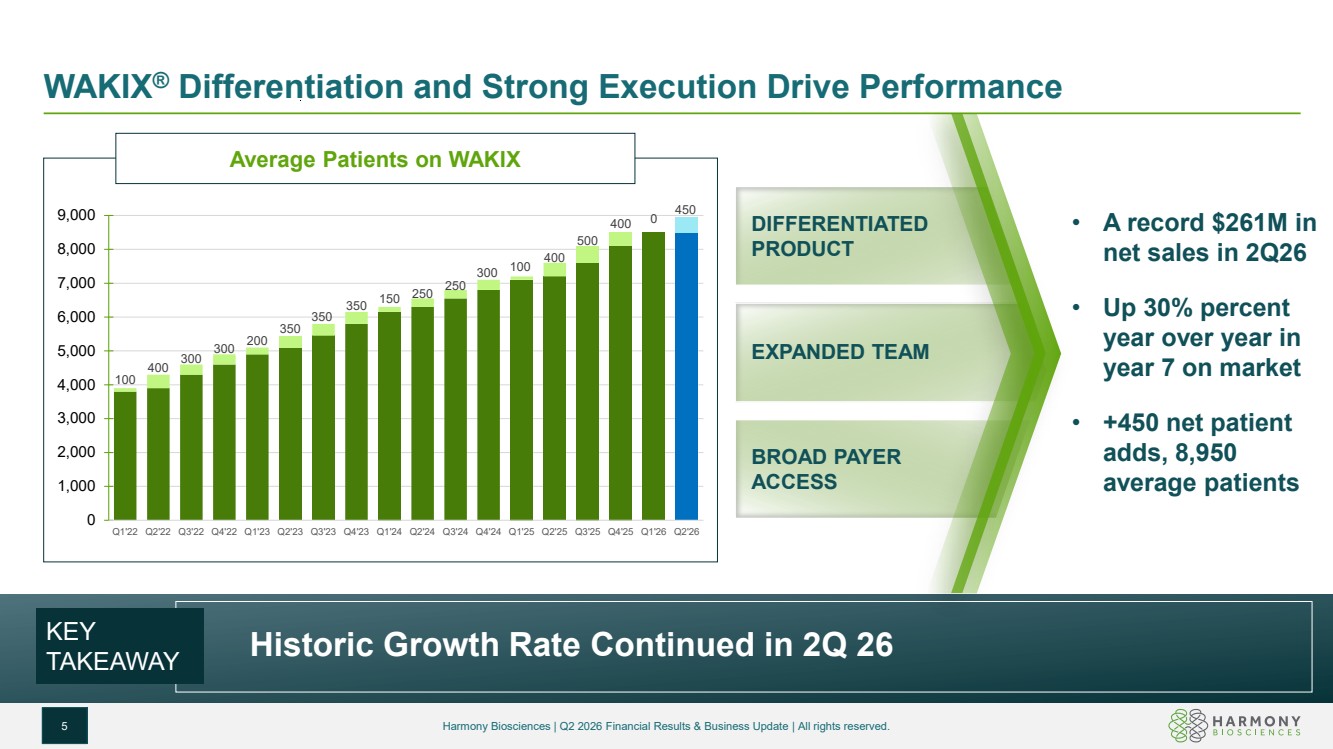
Adam. Thank you, Jeff, and good morning, everyone. The second quarter continued our strong growth and momentum trend. Waykix delivered $261.3 million in net sales, up 30% year-over-year, and up 21% over the first quarter. Now in its seventh year on the market and firmly on pace for our full-year guidance of $1 to $1.04 billion in net revenue. Last quarter, we saw a bit more pronounced seasonal market access headwinds that impact the industry every year. The elevated plan changes, plan switching, and premium increases, which can delay patient starts, especially in January. But the underlying fundamentals remained steady and consistent. This quarter, the demand-driven trajectory and patient additions continued. WAKEX achieved estimated average patients of 8,950, or an increase of approximately 450 patients from 1Q. This represents the highest 2Q increase in the history of the brand, the second highest increase all time, and with four of the last five quarters achieving 400-plus patient additions, our growth and performance has never been stronger. What's driving this continued performance is clear. WAKE-X owns a highly differentiated position as the only non-scheduled treatment option for narcolepsy patients. With now seven-plus years of clinical experience, healthcare providers are highly aware of WAKE-X and believe in its unique combination of efficacy, safety, and tolerability, with low drug-drug interactions, as well as with broad payer coverage with more than 80% of lives covered. This makes Wakex a familiar go-to option for any patient with narcoxy, and in any combination with other therapies in a highly polypharmacy market. And this will continue to remain true as the market continues to evolve. Q2 was the first quarter after our field team expansions which has expanded our presence by roughly 20 percent across field sales remote sales and field reimbursement this represents the largest expansion and increase in investment in the history of the brand all of those positions have been hired trained and fully deployed we also launched a new online portal easing the process to prescribe wakex for healthcare providers and office staff and we implemented changes to our reimbursement support process which is already showing results with patients able to secure way kicks faster and with higher success. As a result, we see significant continued growth potential in a total narcolepsy population of approximately 170,000, a diagnosis rate still under 50 percent and brand penetration of about 20%. Looking ahead, we're excited about our two life cycle programs to extend and expand the franchise. Patolesin GR builds on the Wacix safety and tolerability profile and enables patients to start at a therapeutic dose. Patolesin HD offers a new optimized formulation with up to two times the highest labeled dose of Wacix, all of the benefits of the GR formulation and potential for differentiated labeling regarding fatigue and narcolepsy and sleep inertia in IH. Finally, our erection program gives us the opportunity to deliver on the promise of efficacy with a favorable tolerability profile, once daily dosing, and potential use in a broad range of CNS indications. To summarize, we continue to operate from a position of strength. We are on track to achieve more than $1 billion in net sales this year, with a pipeline built to extend our leadership in sleep-wake for at least the next decade. I'll now turn the call over to our chief medical and scientific officer, Dr. Kumar Badur. Kumar? Thank you, Adam.
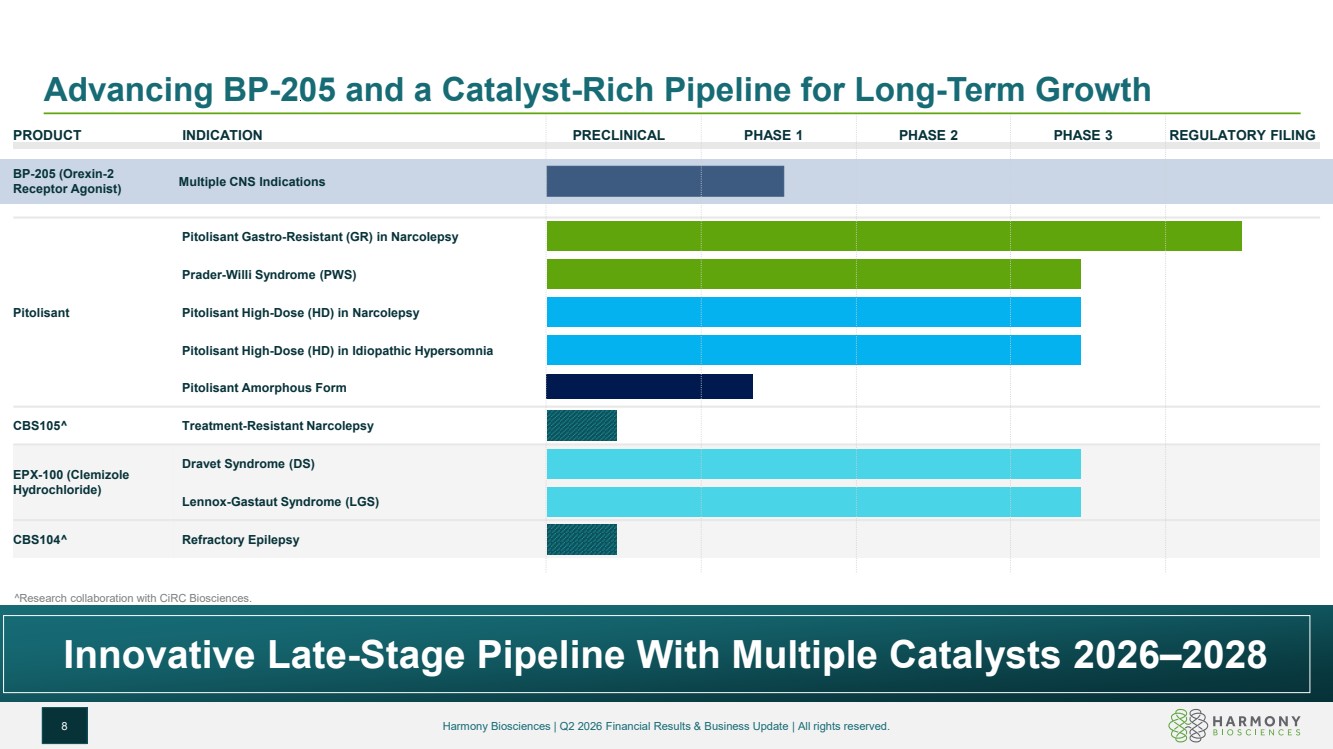
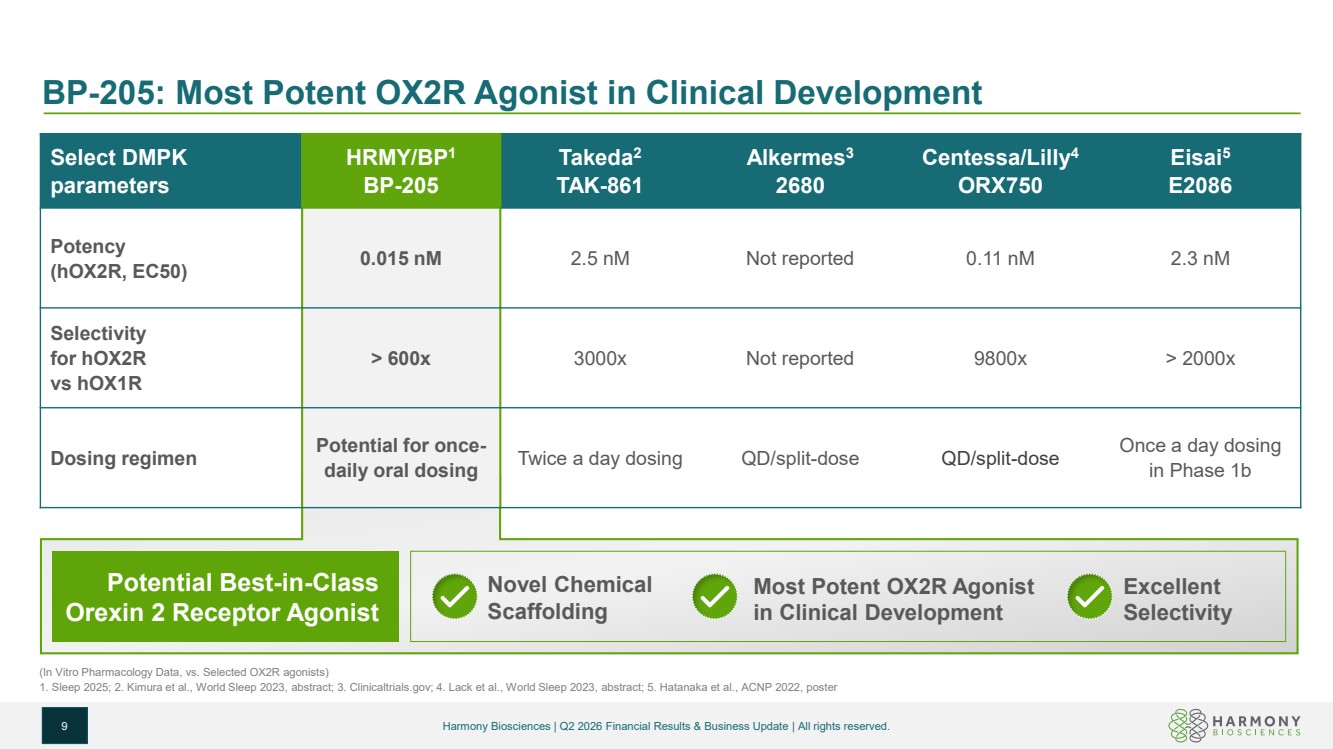
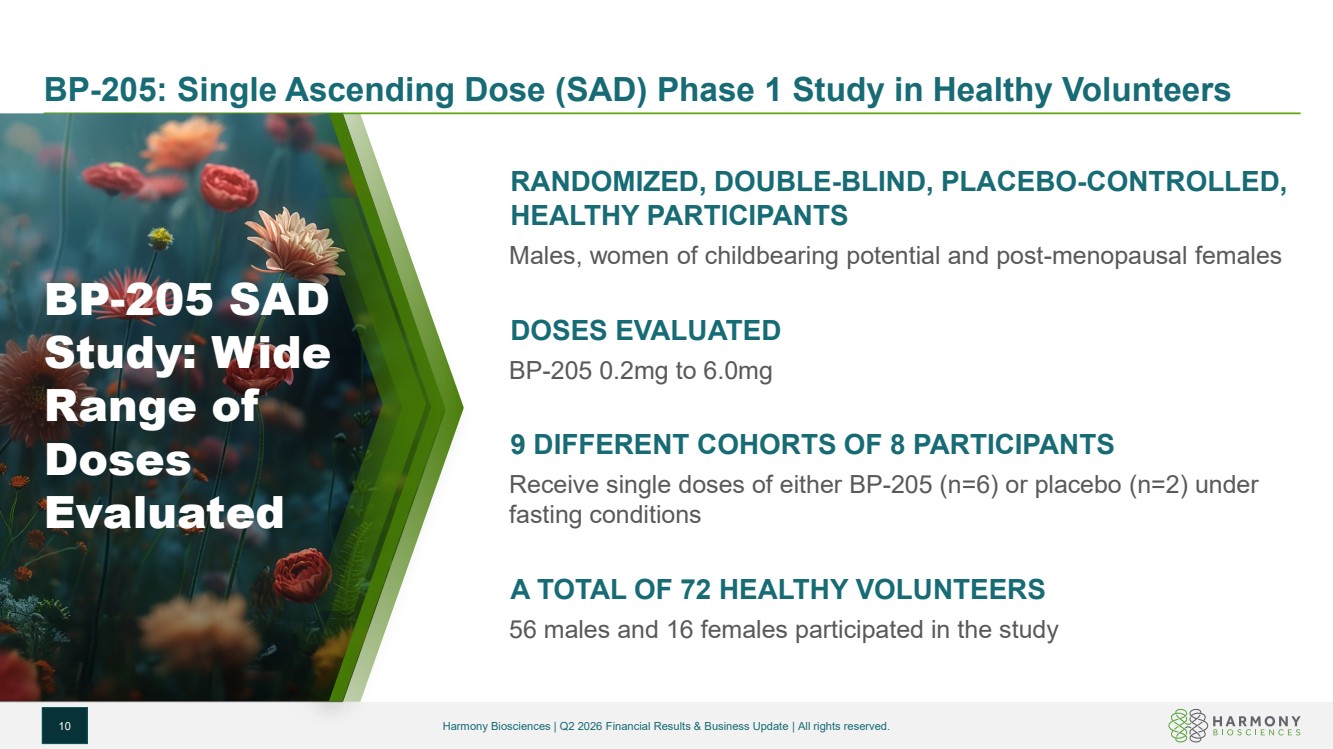
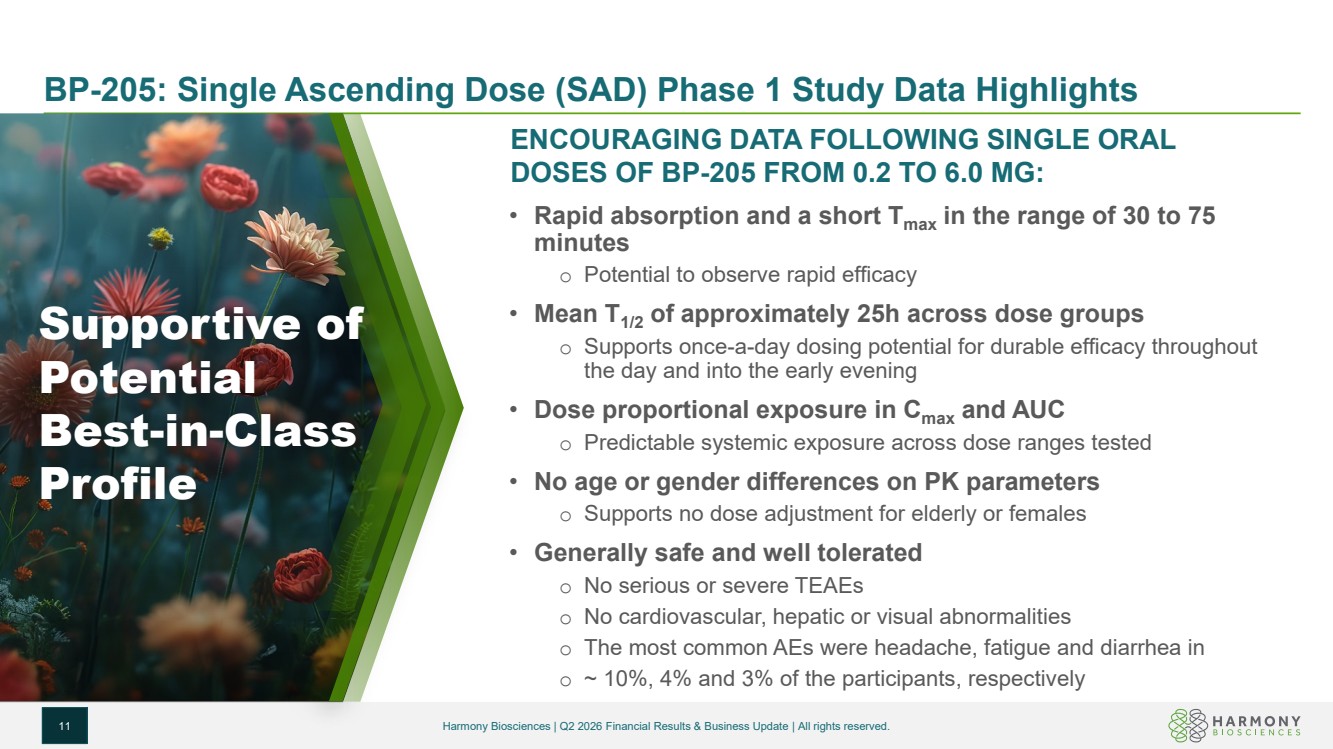
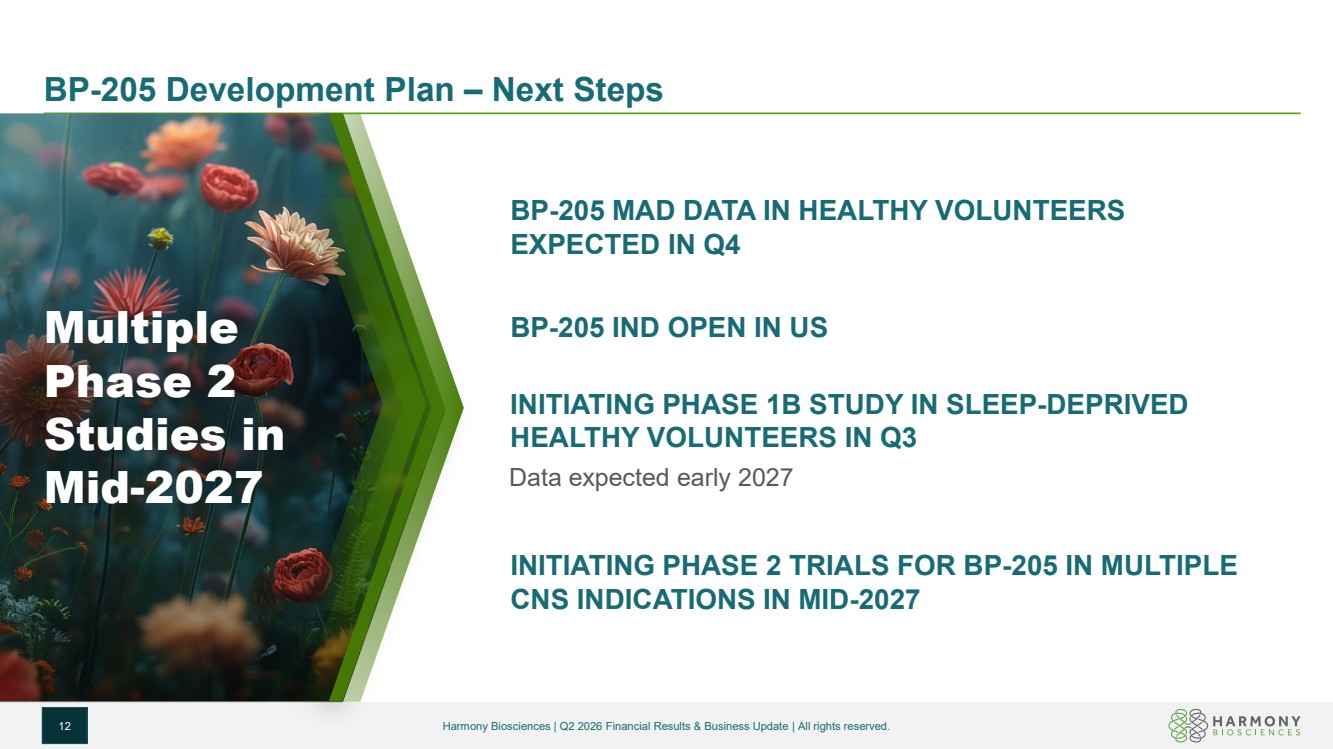
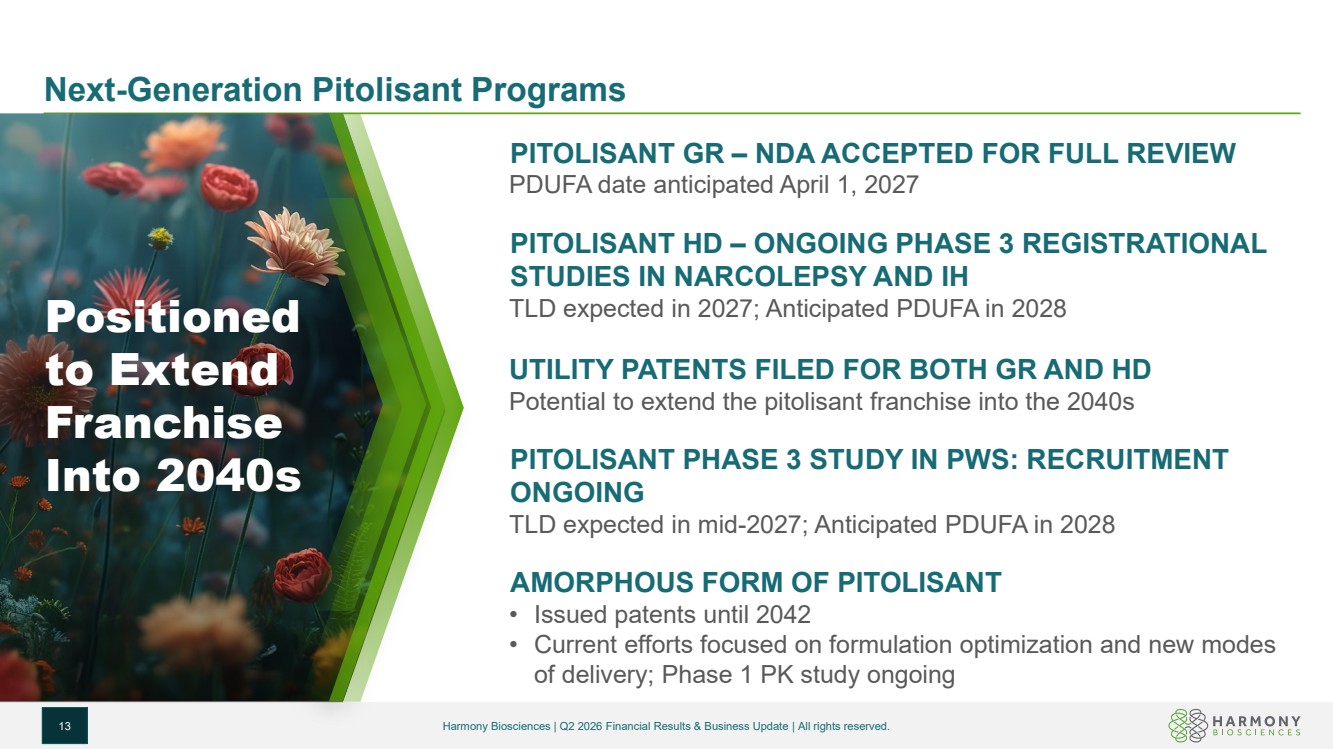
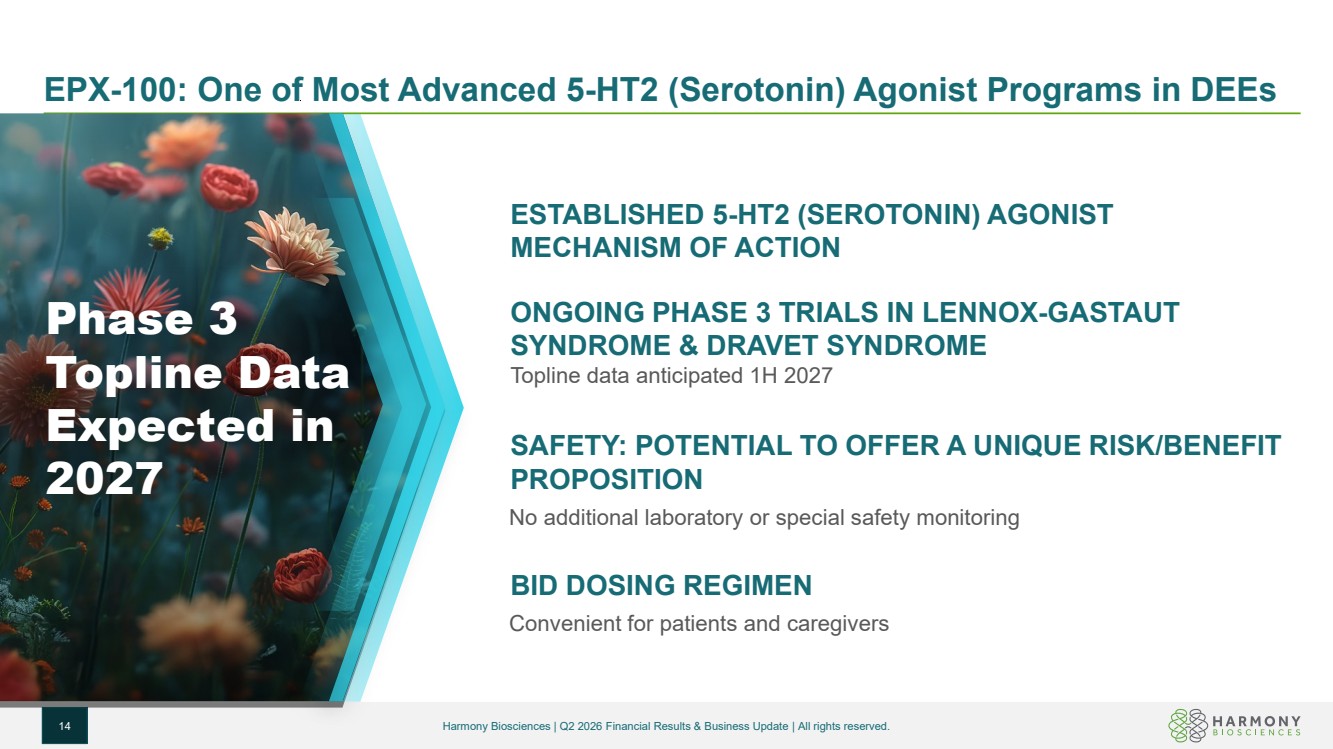
Good morning, everyone, and thank you for joining us today. We continue to make good progress across all our pipeline programs, including five phase three registration studies in five distinct-way neurological disorders. The headline for R&D this quarter is BP205, a potential best-in-class Erexin-2 receptor agonist. So let me start there. BP205 is built on novel chemical scaffold that confers unique potency, selectivity, and potentially avoids some of the molecular structure-related effects, such as hepatic and cardiac toxicity. It is the most important Erexin-2 receptor agonist in clinical development, with excellent selectivity for Erexin-2 or Erexin-1 receptors and over 150 other receptors of interest. The high-potency gives us the flexibility to use low doses and to pursue a broad range of CNS indications, including those with no obvious Erexin deficiency. Today, we reported data from the single ascending dose portion of our phase one study in healthy volunteers. In this randomized double-blind placebo-controlled study, across nine cohorts in men and women, each participant received a single dose of BP205 or placebo with doses ranging from 0.2 mg up to 6 mg. In total, 72 healthy volunteers participated in this study. The SAD study in Healthy Volunteers was designed to characterize pharmacokinetics and safety tolerability profile. Within that scope, the data was very increasing. Walking through the specific findings, BP-205 showed rapid absorption with a short T-max in the range of 30 to 75 minutes, pointing to the potential for rapid onset of efficacy. We observed a mean half-life of approximately 25 hours across dose groups, which supports once daily dosing and the potential for durable efficacy throughout the day and into the early year old. Exposure was dose proportional across CMAX and AUC across all doses, indicating predictable systemic exposure across the range tested. We found no age or gender differences in PK parameters, which supports no dose adjustment for elderly or female patients. Finally, and most importantly, BP-205 were generally safe and well-tolerated with no serious or serious treatment-emersive adverse events reported, including no cardiovascular, hepatic, or visual abnormalities. The most common adverse events were headache, fatigue, and diarrhea in approximately 10%, 4%, and 3% of the participants were speculating. To our knowledge, we are the first company to share this level of granularity on Oryxin-2 receptor single ascending dose data, and we're doing so because we have strong conviction in BP205 having the potential for a best-in-class profile. What comes next, multiple at same-dose study data analysis is ongoing and we plan to disclose those data in Q4. The US IND for DP205 is now open and we'll be initiating a phase 1D study in sleep-detired healthy volunteers in Q3 with the top-line data expected from this study in early 2027. That study is the one to watch, because it will provide the source signals of efficacy for DP205 and provide a basis for comparison against other orexin agonists. Given the potential for broad utility of this profile, we will be initiating phase two trials in multiple CNS indications in mid-2027. Turning to our other programs, I'm starting with next-gen pitolescent programs. We submitted the Pitolosin-GR NDA in the second quarter. The file is accepted for full review with a target period of April 1, 2027. Approximately 80 to 90 percent of patients with narcolepsy experience GI symptoms as part of the disease and Pitolosin-GR is designed to reduce the potential for GI AIDS while also allowing patients to initiate treatment at a therapeutic dose of 17.8 mg without titration. an important clinical differentiation. Pitolocent HD, an optimized formulation of pitolocent with GR coating and high dose, continues to advance in two phase three registrational trials, on-site one in narcolepsy and on-site two in idiopathic hypersomnia, with top-line data expected in 2027 and anticipate PUDUFA in 2028. These programs are pursuing differentiated labors, fatigue in narcolepsy, and sleep inertia in IH, symptoms for which there are no currently approved treatments. Utility patterns are filed for both Pidolosin-GR and Pidolosin-HD, with the potential to extend the Pidolosin franchise into the 2040s. Moving on, the phase three registration study in Prader-Willi syndrome, the TEMPO study, is actively recruiting patients, and we now expect top-line data in mid-2027. The delay in top-end data is mainly due to limited prevalence of people living with PWS and also experiencing the level of sleepiness that meets the criteria to enroll in this This study is designed with the input from the FDA not only to meet the registrational requirements but also fulfill the second and last requirement for pediatric exclusivity which gives us six points of additional regulatory exclusivity for wakings on the back end of the longest pattern. We remain on track to obtain pediatric exclusivity for their kids. We are also advancing the amorphous form of pedophones licensed from Norwegian, supported by an issued pattern through 2042. The current efforts are directed towards formulation optimization and ongoing phase one PK study. Finally, our epilepsy franchise, EPX100 continues to advance in two global phase 3 registrational plans, the Ardha study in Drouet syndrome and the Lighthouse study in Lennox-Gastaut syndrome, the pipeline data expected in mid-2027 and anticipated PUDUFA in 2028. In summary, we are encouraged by the data we share today for our orexin-2 atomist BP205, supporting its potential best-in-class profile and excited about the multiple data catalysts coming within the next six months of BB205. We also continue to make progress on the five phase three registrational clinical trials that we are conducting across our other pipeline programs which will contribute to additional data catalysts in 2027 and target PUDU4DATE in 2028. On behalf of harmony i want to thank the patients and the families for participating in our clinical trials along with the investigators and site personnel for the dedication in advancing our clinical trials i'll now turn the call over to our chief operating officer peter anastasidhu peter thank you kumar i want to provide a brief update on the final two objectives in our value creation strategy transacting on business development and protecting the Patolis franchise.
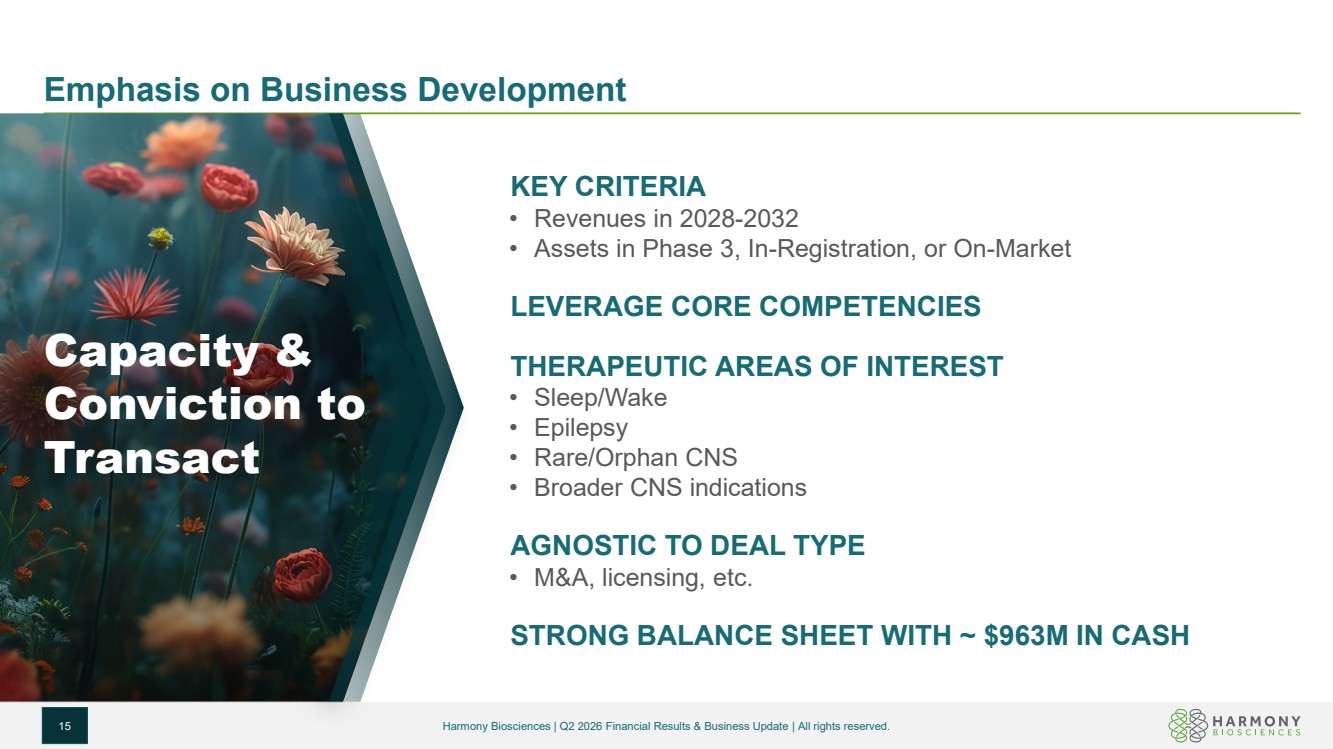
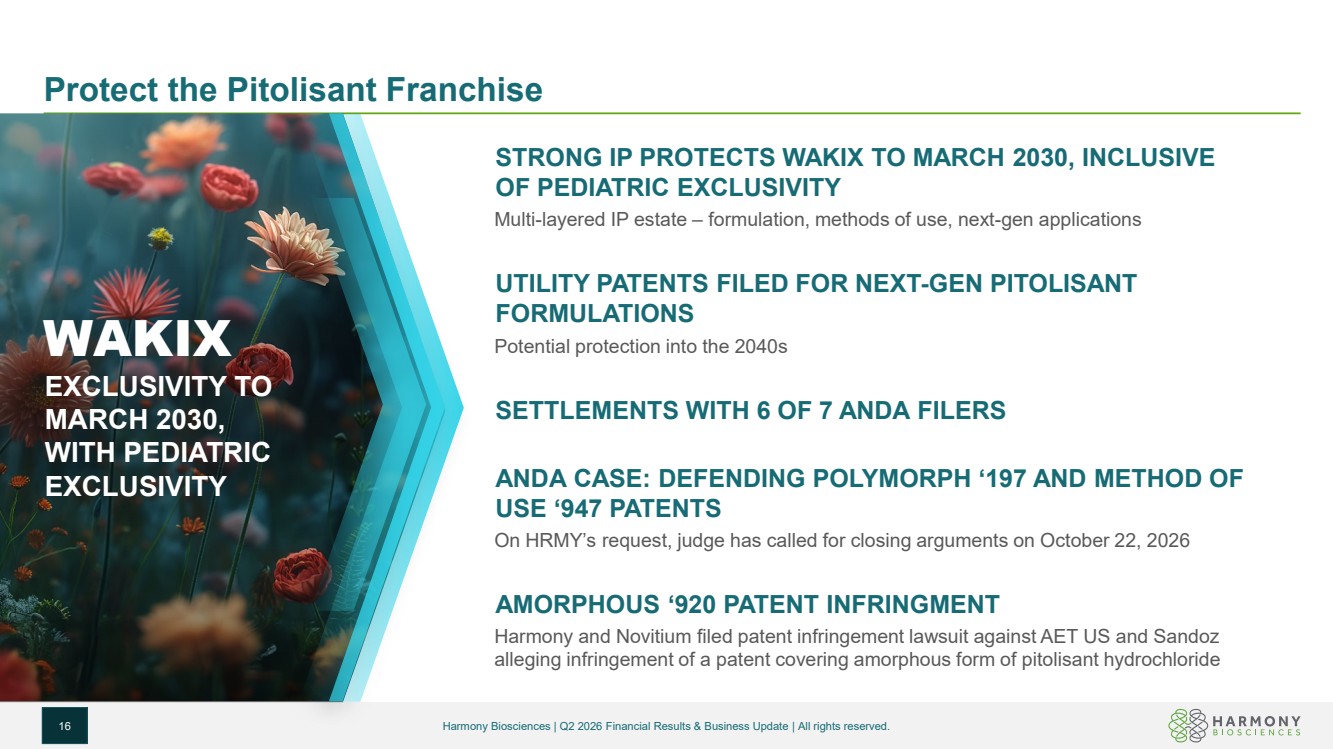
In business development, we are primarily focused on assets with revenue potential in the 2028 to 2032 time frame. We are prioritizing products in phase three, in registration, or on the market. We plan to leverage our core competencies and are directing our search and evaluation efforts in sleep-wake, epilepsy, rare-orphan CNS, and broader CNS indications. We are considering a variety of deal types, including M&A and licensing. With approximately $963 million on the balance sheet, we have both the capacity and the conviction to transact. You should not expect that we will allocate all of that capital on one transaction. Instead, we will likely engage in multiple transactions, and together, they can be transformative for Harmony. With regard to protecting patolescent, our IP estate is multilayered across formulations, methods of use, and next-generation applications, and it supports WAPE exclusivity into March 2030 inclusive of six months of pediatric exclusivity there's the potential for harmony to extend the patollison franchise through other formulations into the 2040s the additional patents and applications with respect to ongoing litigation we have settled with six of the seven and a filers and we have two active legal proceedings with the lone remaining and a filer the first is the end litigation with aet where we are defending our polymorph 197 patent and the method of use 947 patent the bench trial has concluded and the post-trial briefs are public harmony requested and the judge has called for closing arguments from both sides on october 22nd this year In April, Harmony and Novidium filed a new patent infringement lawsuit against AET Pharma U.S. and its marketing partner, Sandoz, alleging infringement of the 920 patent covering an amorphous form of patollicin hydrochloride. We are confident that we will prevail in both of these legal proceedings, enabling us to maintain exclusivity for Wakex into March 2030. I will now turn the call over to our Interim Principal Financial Officer, Steve Molakella.
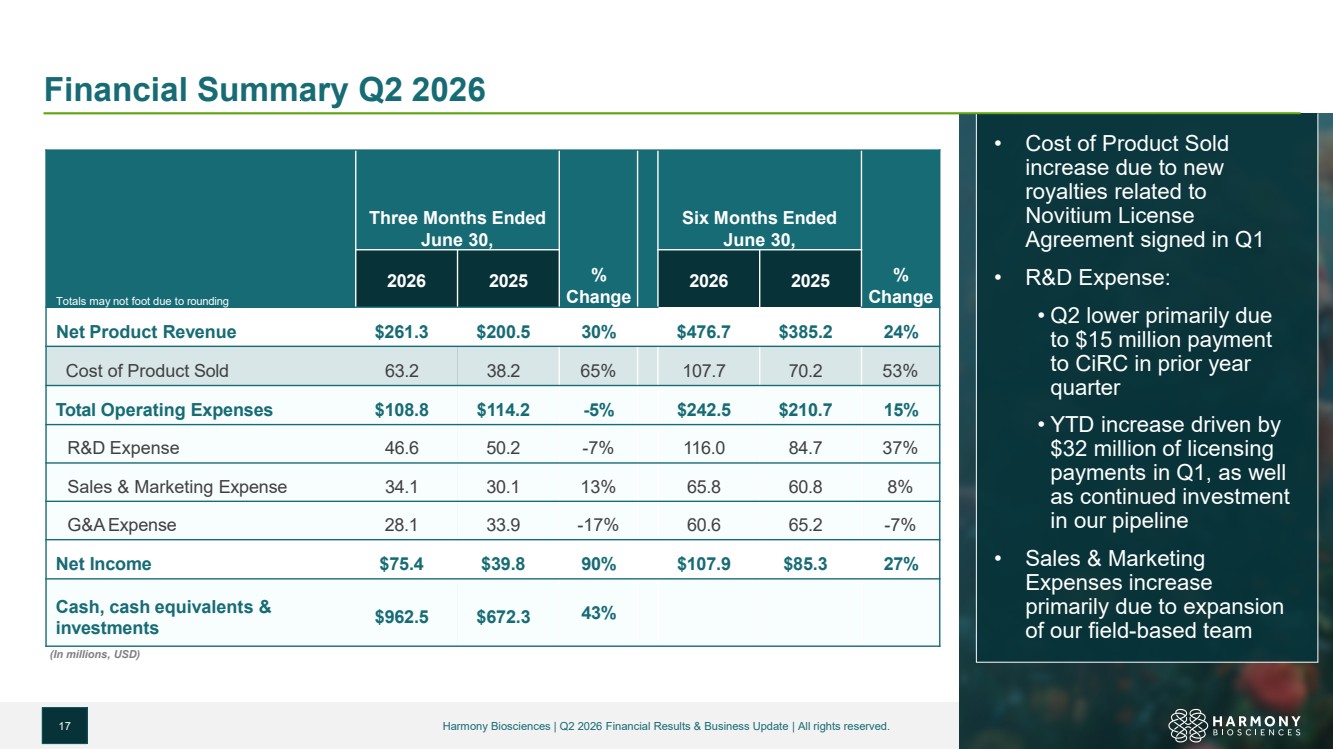
Thank you, Peter, and good morning, everyone. This morning, we issued our second quarter 2026 earnings release and filed our 10Q, where you will find details of our financial and operating results. We delivered strong financial results that reflect continued demand for WACIX and our a disciplined approach to managing expenses across the business. For the second quarter of 2026, we reported net revenue of $261.3 million compared to $200.5 million in the prior year quarter, representing 30% growth. Performance in the quarter reflects the continued robust demand for WACIX. Cost of products sold was 24.2% of net revenue compared to 19% one year ago. This year-over-year increase was primarily driven by new royalties related to the Dominion License Agreement which we signed in Q1 of this year. We reported total operating expenses of $108.8 million for the second quarter compared to $114.2 million in the prior year quarter. The decline in expenses was primarily driven by the $15 million upfront fee we paid to CERC in Q2 of 2025, with no corresponding amount in the current year period. This was partially offset by continued investments in R&D and the ongoing commercialization of WACIX. Net income for the second quarter was $75.4 million, or $1.28 per diluted share, compared to $39.8 million, or $0.68 per diluted share, for the prior year period. Finally, we ended the second quarter with $962.5 million of cash, cash equivalents, and investments, and $155 million in debt. we expect cash flow generation to continue to be strong in the coming quarters. That said, our intent is to deploy our cash towards strategic business development opportunities and to continue to invest in the growth of our pipeline and diversification of our commercial portfolio. And with that, I will turn the call back over to Jeff for his closing remarks. Jeff?
Thanks, Steve. In closing, this was a defining quarter for Harmony Biosciences, centered around two key accomplishments. We delivered record quarterly net revenue for WACIX and are on track to achieve greater than $1 billion in revenue for the year. And importantly, we took a big step forward in our Erexin II agonist development program, sharing encouraging phase 1 PK data for BP-205, which supports its potential best-in-class differentiated profile. And coming soon, MAD data in Q4 and data from a sleep-deprived healthy volunteer study for BP-205 early next year. We have been leaders in the sleep-wake space for almost a decade now and are leveraging our expertise to accelerate our BP-205 development program toward multiple CNS indications and become a leader in the orexin space. We continue to drive the business around our four priorities focused on value creation. Grow WACIX in an evolving market. Advance our robust late-stage pipeline with our potential best-in-class Erexin II agonist BP-205 as the centerpiece of our pipeline with multiple data catalysts coming over the next six months. Transact on strategic BD opportunities. And lastly, protect the Betolescent franchise based on our multi-layered patent estate and robust IP strategy that gives us confidence in defending the WACIS franchise out to March 2030. We believe that when we execute on these four priorities, Harmony is well-positioned to bring innovative treatments to patients living with CNS diseases while driving sustained long-term value for shareholders. Thank you for your attention. I will now turn the call back over to the operator for Q&A. Operator?
Operator
Thank you, Dr. Dano. Ladies and gentlemen, at this time, if you would like to ask a question, please press star 1 on your telephone. If you would like to remove yourself from the queue, you may do so by pressing star 2. We do remind you to please pick up your handset and please limit yourself to one question and one follow-up. We'll go first this morning to Pete Stavaropoulos at Cantor Fitzgerald.
Good morning and congratulations on the progress and thank you for taking our questions um my question uh is around the clinical program on bp205 um congrats on the sad data uh good good first step um and uh i'm curious on how the short team match uh relatively long half-life and high potency uh could translate into a differentiated clinical profile from both efficacy and safety standpoint you know especially compared to other erection and two-receptor agonists that are either BID or split dose, and how do you think they impact their use in the broader CNS indication?
Yeah, good morning, Pete. Thank you for your question. Yeah, with regards to BP205, you know, we are excited about the emerging clinical profile, you know, with the Phase I SAD data. I'll turn to Kumar to, you know, provide perspective on short half-life and the rest of the profile and the potential sumable relevance.
Hey, good morning, Pete. Thank you for the question. So you asked three questions, Tmax, half-life, and potency. Let's start with Tmax. The time to maximum concentration was very short, 30 to 75 minutes. And this is a very desirable feature because it results in rapid onset of efficacy. And that's especially important when you look at central disorders of hypostomal lens where patients are sleepy. And with the central disorders of hypersomal lens, if you look at indications such as idiopathic hypersomnia, for example, who have sleep inertia, again, short Tmax is very helpful. And also beyond central disorders of hypersomal lens, if you look at indications such as ADHD, again, a short Tmax would be very helpful. In terms of half-life, first and foremost, the longer half-life will facilitate QD dosing, which is always preferable from a patient perspective. And in terms of efficacy, it does help sustain wakefulness in the later part of the day and in early part of the evening. And if you look beyond NT1, for example, in 82, idiopathic hypersomnia and other central disorders, where there is no obvious deficiency of erexin, what we are trying to accomplish there is look at the higher cascade mechanism of orexin receptor agonists and depend on the downstream impact on histamine, norepinephrine, dopamine, and serotonin. So having a longer half-life dosing to steady state will be helpful in both hypersomalance disorders and non-hypersomalance disorders, the broader central nervous system disorders. Finally, the potency, we have always talked about the importance of potency. In fact, we have been talking about the importance of potency since we first disclosed our in vitro data in October 2004. And we are very impressed with the potency of BB205. This continues to be the most potent Oryxin-2 receptor agonist in clinical development. It gives us the flexibility to use low doses across all three-centred disorders of hypersolidolence and by extension, other broad CNS indications as well.
All right. Thank you, Kavash. Just a quick follow-up. How do you, you know, were you able to confirm target engagement? You know, do you know what 305 is actually activating the election to receptor in CNS?
Yeah, Pete, great question. Yeah, in our single ascending dose study, probably a reference specifically to insomnia and polycuria, we did not see those studies, but it's single ascending dose study, so there is some limitation in extrapolation of the safety and tolerability profile. We are not disclosing our multiple ascending dose data today because the data analysis are still ongoing, but in our multiple ascending dose study, we dosed for 15 days in healthy volunteers. What I can say is we did see some target engagement mechanistic EAE, such as insomnia and polycuria, but this is transient, and none of them were either serious or sustained, and we'll disclose full MAD data sets in Q4.
Yeah, thanks, Kumar. Pete, I just want to add a few additional comments as regards to the half-life, just frame of reference. I think, you know, as you may be aware, you know, neuropsych drugs that, you know, in the market that are dosed once daily typically have half-lives in the range of about 15 to 25 hours. So just an important sort of context, you know, with regards to the half-life we're reporting today, you know, 25 hours. One interesting, you know, analog is actually Wake-X. you know, wake-x half-life of about 20 hours, you know, dosed once daily in the morning, you know, convenient dosing for patients. So frame of reference with regards to the half-life of 24 hours, and importantly, as Kumar said, maintaining the physiologic tone of the erexin system when dosed to steady state, another important component of the PK profile. Thanks, Pete.
We'll go next now to David Wong at Deutsche Bank. there congrats on the quarter and the data update today and thanks for taking my questions so first question i i was wondering if you could just comment a little bit on the selectivity of your orexin vp205 for the orexin 2 receptor versus orexin 1. i think you have some preclinical data in the in the presentation and how that might compare against other orexin molecules out there And maybe just if you could just elaborate on the importance of potency versus selectivity. So that's my first question.
Thanks, David. Let me just have a brief comment. I think that comes down to a threshold effect. So a threshold effect with a part of selectivity, you know, after which there's really no incremental benefit. And then Kumar can provide, you know, sort of the data behind that.
Yeah. Good morning, David. it. In terms of the selectivity, you are probably referring to the in vitro data that is in the slide deck. We have over 600 fold selectivity for RxN2 receptors or RxN1 receptors. Potency and selectivity, they go hand in hand. If you look at the half maximal effective concentration at RxN2 receptor EC50 is 0.015 nanomolars and for RxN1 receptors it's 9.01 nanomolars. So that's over 600 fold selectivity. That's a lot of selectivity. We also looked at selectivity over 100 other receptors of interest and we saw greater than 1000 fold selectivity over there. Now what it implies from a clinical perspective. Based on the preclinical data, we have a predicted maximum therapeutic dose. If you look at that dose, we will have 140-fold margin for the maximum predicted efficacy dose in humans. And typically in central nervous system disorders, you work with a selectivity of around 20, 30, 40, and having 140-fold margin for orexin-1 receptor is pretty good, a lot more selectivity than we will ever need. And if there is ever a concern about AEs related to orexin-1 receptor agonism, look, we just disclosed the single ascending dose study, granted that it's single ascending dose study, we actually did not see anything to say that the drug is interacting with orexin-1 receptors, and the same was true with the preliminary MAD safety tolerability data as well. Great.
Thank you for that. And then my follow-up question pertains to the tolls in HD. I understand the top-line data would be next year. Could you just help maybe set some expectations for us? What would you, you know, what will you present in the top-line data for Pitolescent HD, and what's your level of confidence in getting a differentiated label?
Right. David, in terms of the top-line data for Pitolescent HD, we are on track for top-line data for both narcolepsy and idiopathic hyposomia in 2027, and 2-2 for dates in 2028. Let me start with narcolepsy. Pitolescent HD is an optimized formulation of pitolescent. So milligram to milligram is just not the same as, for example, Vakix formulation also has GR coating, and it's higher dose. And we have data to show some linear correlation between exposure and efficacy. So to start with, when it comes to excessive daytime sleepiness, we anticipate to see a larger effect size. And then we will also be pursuing a differentiated label for narcolepsy by targeting symptoms of fatigue. So that's narcolepsy. When it comes to idiopathic hypersomnia, we have disclosed a lot of data from our study. So we will not just be targeting excessive daytime sleepiness in idiopathic hypersomnia. We will have a high level of confidence, but we'll also be targeting sleep inertia, a very important symptom in patients with idiopathic hypersomnia, for which there are no approved treatments. And again, at last year's sleep meeting, we showed the effectiveness of pitolocine in treating sleep inertia as measured by sleep inertia questionnaires.
Operator
Thanks, Kumar. Thank you. We go next now to Greg Suvanovic at Mizuho.
Hey, good morning. Congrats on the progress. I wanted to get back to the orexin candidate and in particular can you talk more about the novel scaffold you're using for BP205 and in particular how different and what is that specific difference versus scaffolds used by other orexin candidates that directly translate or at least you believe directly translate to the orexin candidate. to a potential differentiator profile in both efficacy and safety tolerability, and then I have a follow-up, thanks.
Yeah, good morning, Greg, thank you for your question, and I'll turn it over to Kumar, but I think that's where the differentiated profile for BP-205 begins, you know, with that differentiated scaffold and chemical structure. Kumar can provide some more detail around that.
Yeah, good morning, Greg. I'm not a medicinal chemist, but I'll try to explain to the best of my ability. When the RxN2 receptor agonists were being developed, you may remember that there were some AEs that were caused because of reactive metabolites, for example, liver function test abnormalities. So Tazin, from who Bioprogen licensed and V sublicensed, And this drug was designed to stay away some of the molecular structure-related AEs, especially when it comes to hepatotoxicity and cardiotoxicity. So what it did was instead of going with the typical pyridone sulfonamide bicyclic moitis, which is a typical structure, they stayed away from it. And what it really provides is instead of this three-dimensional crystal structure, the structure is much more flat, and that is supposed to give us more potency and also help us with some of the structure-related EAS. And we saw that. We saw that in our pre-clinical profile where we showed very high potency. In fact, BP-205 was effective at a dose of 0.03 mg per gig in the narcolepsy transgenic mice model, the lowest dose that was ever used to test. And we saw the same profile in our single ascending dose study in terms of short TMAX, in terms of longer half-life, and the safety and tolerability profile to the extent we can extrapolate based on the single ascending dose. It's very favorable. So, overall, very encouraging data, both from a non-clinical perspective and from a limited data that we have on the clinical side.
Okay. Thank you very much. And then, you know, I think there are many of us who are excited about the potential for BB205 to be differentiated. But I think a question that I get often from investors is really relates to kind of developmental final timelines and how far you might be behind, say, Takeda or some of the other players. Can you comment on, maybe broadly speaking, how we should think about the clinical development program and kind of what's next in terms of timelines?
Yeah, so, Greg, I think, you know, at a high level, as you can hear today, you know, we are you know have the conviction to um to move quickly and accelerate the development timeline so um while we may not be first to market with regards to you know mt1 or um with regards to mt2 or ih you know the other hypersometers but importantly you know um looking at broader cns you know, indications. As we said, we'll be initiating multiple phase two trials mid-next year. And, you know, we believe with our experience, our know-how in the space, we'll be able to accelerate, you know, those development programs and potentially be first or second to market in some of the broader indications. So we have that commitment. We have that, you know, experience chance to move the program forward across multiple CNS targets, and we're building that momentum, and as we share, multiple data catalysts, you know, coming over the next six months.
And I would just add, Greg, that as we've seen in many therapeutic categories, the first or second asset isn't necessarily the best asset, and so we believe we've shown today today, some initial clinical data that supports that this is a differentiated profile that can be well set up to be best in class, not just in hypersomalance indications, but importantly in broader CNS indications where features like the potential for rapid onset of action, potential for once daily dosing are going to be very important. And so first isn't necessarily best, and we believe that we are developing what's emerging to be the best profile.
Thank you. Good point. Thanks, Greg.
Operator
Thank you. We'll go next now to David M. Selim at Piper Sandler.
Thanks. A couple from me. So I wanted to drill down more on Greg's question on different indications. So we already have a glimpse of potential other indications. There's alchemies with an ADHD program and also fatigue, an MS and Parkinson's program. Obviously, there are other potential indications across mood and cognition, for example. So given the business model, which is focused historically on rare, how are you thinking about these broader indications, particularly in these larger markets that are much more promotion intensive and your willingness to to dive into say mood or cognition where you're going to need considerably more commercial infrastructure so that's number one and then number two is sorry if i missed this but wanted to get a better flavor for your ip estate on 205 uh when the composition ip expires and talk to additional patents you know issued or pending thanks thanks David for your question so let me
let me start and I'll turn it over to Peter some thoughts so in terms of the opportunity with BP 205 and we're also working with our partner by a purge on on additional you know erection two compounds so there's a backup and then you know additional compounds you know based on novel chemical scaffold that we talked about. So I think that, you know, now we are looking at optionality. So we're looking, you know, at optionality as we advance the program with regards to, you know, obviously the hypersomnia and some of those programs are further ahead, but the broader CNS indications that, you know, that you alluded to. And, you know, there is a lot of activity, you know, in the space around some of the targets. You mentioned ADHD, you know, MS fatigue, et cetera. So we actually have worked with our partner, BioProjet, on some, you know, preclinical models and emerging evidence in what potentially could be the best of those targets, you know, with regards to preclinical proof of concept. So we are looking broadly, you know, with optionality and accelerating the development program opportunity, realizing that, you know, in indications in the orphan rare space, there's one opportunity there, and then other erects and two compounds to go broader with a different commercial model. And I'll turn it over to, you know, Peter, any additional things?
The only thing I would add is on your question about appetite. The appetite is strong, and I think it is based on the foundation that we just talked about, that this asset has the potential to be effective in both sleep-wake indications and the broader indications. And in particular, that's where the potency, I think, really helps us, because many of those broader indications are not indications where there's a rexin deficiency. And so having the most potent asset, I think, sets us up well from an efficacy perspective. And in terms of your question on appetite for investment commercially, et cetera, certainly Adam can chime in. But we have that appetite as well. Many of us have significant experience in many of those categories, even though the organization doesn't have experience in those categories, many of us within the organization And we, I think, have clearly established with the fact that we're on track to, you know, achieve a billion dollars in revenue that we have the commercial wherewithal. So to be able to scale up from that, you know, very strong commercial footprint we already have to take advantage of opportunities in these broader markets is something we're prepared to do and quite confident we can do. Oh, and then you asked about IP. The IP goes to 2043 with the potential for additional patent term extensions on top of And the composition patent expiry, is that 2043, isn't it earlier? No, that's 2043. Okay.
Operator
Thank you, David. Thank you. We go next now to Amy Fadia at Needham & Company.
Hi, good morning. Thanks for getting my question. Maybe a follow-up to the last couple of questions. As you think about sort of navigating the competitive landscape with this first orexin asset, 205, and some of the backup compounds that you talked about, how would you think about prioritizing either rare indications versus the larger markets with your first sort of initial program? Because I would assume that you want to think about the pricing dynamics in each of the different markets and appropriately develop each asset catered to a different market. So maybe you could sort of talk about how, maybe your current thoughts around how you're prioritizing around those and then maybe if i could squeeze in a question on uh rakex um with the strong uh patient ads that we saw this quarter uh if you could comment on how you anticipate the cadence of patient ads in the remainder of the year thanks good morning amy thanks for your questions um with regards to the first one and prioritizing um you know i think it's a combination of, you know, multiple factors.
You know, I think as Peter alluded to, you know, we have the ability and the conviction to pursue multiple CNS indications, you know, both the hypersomnias and these broader CNS indications. You know, understanding in terms of, you know, price point of an orphan rare indications such as narcolepsy and IH. So I think it's a combination of timing, but, again, we feel first to market may not be best. So there's still opportunity in the hypersomnias off of the strong foundation and the strong, you know, base and business that we built in that space with WAKE-X, but also excited about the broader CNS indications, accelerating those efforts, multiple Phase II trials beginning mid-next year. and then investing in, you know, in those safety studies, letting the data inform our opportunities going forward. And as Peter alluded to, with, you know, the commercial experience to, you know, to broaden that footprint, you know, broaden that effort, you know, towards those opportunities. So, I think we've got optionality, you know, multiple opportunities in both the hypersomnia's broader CNS indications and are moving the program forward to generate data covering both of those areas to, you know, inform our decisions on phase three development and, you know, eventual commercialization.
And I can speak to patient ads. Good morning, Ali. Good to hear from you. So we are very pleased with the performance we saw in 2Q, achieved 89.50 average patients. That's up 450 in the quarter. That is the second highest quarterly increase in the seven-year history of the brand. So very, very strong. And we've now seen four of the last five quarters actually achieving 400-plus patient ads. So the momentum is there. We're carrying that into Q3, and we'd expect that growth to continue through the end of the year, similar to what we've seen in prior years for WACIX. Very steady growth, very steady momentum, and we expect that growth to continue, hence confirming full-year guidance at a billion-plus in net sales, $1 billion to $1.04 billion for the year. Thanks for the question.
Operator
We'll go next down to Patrick Trippio with H.C. Wainwright.
Hello, good morning, everyone, and congrats on the progress.
This is Luis in for Patrick. I'm curious about the next steps for the 205 program.
So what efficacy data would give you confidence to advance phase two? What are the key gating items? Is there a minimum threshold that the FDA requires? What would be a go-no-go decision for you?
Luis, good morning, Luis. Thanks for the question. So I think the next steps, and then I'll hand it over to Kumar. So, as we said, you know, multiple data catalysts, you know, coming over the next six months, the MAD data that we'll read out in the fourth quarter, importantly, initiation of the sleep-deprived healthy volunteer study this quarter, data early 27. Obviously, the mechanism of action is proven. So, with regards to, you know, we anticipate a strong outcome in the sleep-deprived healthy volunteer study. The opportunity is also demonstrating at lower clinical doses, you know, at lower clinical doses, which could provide a very good risk-benefit profile, similar to Kumar alluded to in the preclinical model, at the lowest doses, you know, demonstrating sustained wakefulness. So that is the opportunity with regard to the sleep-deprived, healthy, you know, volunteer data. And then from there, Kumar, additional thoughts.
Yeah, sure. Good morning, Louis. Thanks for this question. Just building on what Jeff mentioned, the sleep-deprived healthy volunteers study, that's when we will see the first signal for efficacy. We anticipate strong and sustained response from the Sleep-Deprived Healthy Volunteers Study, and that is based on the profiles that we saw in our non-clinical studies, and also the early profile, the PK profile that we are seeing in our single ascending dose study. In terms of your question regarding go, no-go, gating decisions, those kind of things, as was alluding to, in NT1, the mechanism of fraction is established. There is RxN deficiency, you get RxN receptor agonist and you see efficacy. But beyond that, that's where the profile of BP205 becomes extremely important in terms of potency, in terms of selectivity, in terms of half-life, and also the safety and tolerability profile, the initial safety and tolerability profile that we shared today. We believe all of these features continue to support our belief that BB205 is a best-in-class RxN2 receptor agonist that will be helpful not just for central disorders of hypostomal violence, but beyond that, including many other broader central nervous system disorders. Thanks so much.
Operator
Thanks, Luis. Thanks.
We'll go next now to Jason Gerberry with Bank of America. oh hey guys uh this is chian for jason uh thanks for taking our question i have a question of bp205 and a follow-up as well um i'm curious can you talk about the shape of the pk curve should investor interpret the rapid t max as a high c max as well or peak peak concentration or does the pk curve have a flat peak to drop profile and then i have a follow-up after this yeah uh no uh thank you thank you for the question we haven't disclosed all the data because typically we disclose the full data set at a scientific meeting but your point in terms of t max and c max is t max
that's when we saw the maximum concentration of bb 205 and the t max varied in the range of 30 to 75 minutes.
Okay, and my follow-up question is on the extended half-life relative to other clinical programs, or other clinical recs and clinical programs. And I think those programs seem to have roughly around 10 hours of half-life or less. So, I'm curious, do you think you've stretched the needle between having a long enough half-life for a one-stating dosing and also having exposure level low enough at night time. Can you talk about dosing strategy to mitigate insomnia and really insight from the phase one med portion given you have talked about insomnia and polycuria as signal of target engagement early on the call?
Yeah, good question. In terms of half-life, we don't know the half-life or the exact half-life of the other programs because no one has shared the data in a comprehensive way like what we are doing in our SAD study. So I can only comment on BP-205. The terminal half-life that we saw in the single-ascending dose study was approximately 25 hours. If you look at the drugs that are administered once a day, for example, the half-life ranges anywhere between 14 to 20-plus hours. I just mentioned earlier, the half-life of pitolacine is 20 hours, and it's dosed once a day. So based on what we know about the PK profiles of the drug setter dosed once a day, we are confident that this profile fits QD dosing, which is preferable from a patient perspective. And it will also help to sustain wakefulness in the afternoon and in the early part of the evening. In your question about the long half-life and potential for AES, I mentioned earlier in our single ascending dose study, we did not see insomnia or polycuria that are some of the mechanistic targeting engagement-related AES, but in our MAD study, where we did dose for 15 days in healthy volunteers, we did see some insomnia and polycuria, but neither of them were neither severe nor sustained so the emerging profile that we are seeing is very much supportive of qd dosing helping the patient through the day and without necessarily
carrying the effects into night resulting in undesirable ease okay great thanks for taking our questions thank you thank you we'll go next now to danielle brill with truest hi guys good morning thanks for the question um maybe a bit of a follow-up to the prior one so you've confirmed insomnia on polyuria in your mad study and understanding you're not giving um numbers today but just wondering if you could maybe provide some directional color ahead of the data, specifically wondering if investors should expect incident rates to track similarly to peers in the 50 to 60 percent range, whether we should expect a dose response, and understanding there were transient events, did these resolve despite continued dosing, or did they fade over time as tolerance improved? And what should we expect in terms of discontinuity? Thank you.
Good morning, Daniel. Thanks for the question. All great questions. But at this point in time, those data are still being analyzed, and we plan to provide a comprehensive MAD data in the fourth quarter of this year. I can't comment anything beyond what I've already said, which is yeah we did see insomnia we did see some polycuria this was transient not sustained or severe okay maybe as a follow-up could you frame you know you talked a lot about how metrics that would support the best in class profile of bp205 could you frame on the safety front how you would define a best in class profile all right so from a safety perspective there are things that are class-related that we expect based on the mechanism of action and that there are things that are off-target depending on the chemical structure of the car, right? From a class-related I already mentioned what I can mention on this call which is from a single ascending dose study perspective we did not see cardiovascular, hepatic, or visual disturbances, specifically mentioning this because based on the development program from other sponsors, we have seen in the past some toxicity and some visual disturbances. In terms of off-target effects, we already talked about the selectivity, 600-fold selectivity over orexin-1 receptor agonist. And we already talked about the potency and the efficacy. Ultimately, what it comes down to is the product profile. The product profile based on efficacy, safety and tolerability, and ease of view. Based on the data that we have, as of today, the non-clinical and early clinical, So, high-potency, longer half-life, short PMAX, seeing some on-target, target engagement AEs, transient, not sustained, not severe, no off-target effects, and once-a-day dosing. We are actually very confident with the emerging product profile for BP-205. Thanks, Kumar.
Yeah, so I think, you know, Danielle, just to add, you know, overall benefit risk, you know, based on efficacy, safety, tolerability, as Kumar said. And, you know, also the opportunity with BP-205, our lower, you know, clinical doses, given its potency, both in, you know, NT1 and other disorders that don't have a rexin deficiency. So, that opportunity in terms of, you know, threading the needle, if you will, of a favorable, you know, benefit-risk profile is what we are, you know, working towards and what BP-205 is designed to deliver. So more data to come, but excited about the emerging profile and our opportunity in the broader Rhexin space.
Operator
Thank you. And ladies and gentlemen, that's all the time we have for questions this morning. Dr. Dano, I'd like to turn things back to you, sir, for any closing comments.
Thanks, operator. My thanks to all of you for being on the call today, for your interest in Harmony Biosciences and, you know, our opportunities ahead. Again, strong commercial performance this quarter. and excited about, you know, our opportunity, BP-205, and in the orexin space. Thank you, and have a great day.
Operator
Thank you, Dr. Dano. This does conclude today's Harmony Biosciences second quarter, 2026. Financial results conference call. You may now disconnect your line and have a wonderful time.