Operator
Good day, everyone, and welcome to the I3 Verticals 3rd Quarter 2026 Earnings Conference Call. Today's call is being recorded, and a replay will be available starting today through August 14th. The number for the replay is 855-669-9658, and the code is 946-6422. The replay may also be accessed for 30 days at the company's website. At this time, for opening remarks, I would like to turn the call over to Clay Whitson, Chief Strategy Officer. Please go ahead, sir.
Good morning, and welcome to the third fiscal quarter 2026 conference call for I-3 Verticals. Joining me on this call are Greg Daly, our Chairman and CEO, Rick Stanford, our President, Jeff Smith, our CFO, Paul Christians, our Chief Revenue Officer. To the extent any non-GAAP financial measures discussed in today's call, you will also find a reconciliation to the most directly comparable GAAP financial measure by reviewing yesterday's earnings release. It is the company's intent to provide non-GAAP financial information to enhance understanding of its consolidated GAAP financial information. This non-GAAP financial information should be considered by each individual in addition to, but not instead of, the GATT financial statements. This conference call may contain forward-looking statements within the meaning of the Private Securities Litigation Reform Act of 1995, including statements, among others, regarding the company's expected financial and operating performance. For this purpose, any statements made during this call that are not statements of historical fact may be deemed to be forward-looking statements. You are hereby cautioned that these forward-looking statements may be affected by important factors, among others, set forth in the company's earnings release and in reports that are filed or furnished to the SEC. Consequently, actual operations and results may differ materially from those discussed in the forward-looking statements. Finally, the information shared on this call is valid as of today's date, and the company undertakes no obligation to update it, except as may be required under applicable law. I will now turn the call over to the company's Chairman and CEO, Greg Daly.
Speaker 5
Greg Daly Thanks, Clay, and good morning to all of you on the call. Our third quarter results fell short of our expectations and were disappointed in the The primary challenge continues to be slower than expected growth in certain areas of the business, particularly within revenue streams that tend to be less recurring in nature. Jeff will elaborate further. Despite the disappointing quarter, there are aspects of the business that continue to perform well. Annualized recurring revenue grew at 8% year over year, reflecting the ongoing value of our software solutions provide to our customers and the strength of the markets we serve. We have several material go-lives recently that Paul is excited to share with you later in the call. We have laid the groundwork to realize margin expansion in the coming quarters. We remain confident in the long-term opportunity in front of us. Across our public sector and in-markets, agencies continue to prioritize modernization, digital engagement, and operational efficiencies. We believe our software platforms, transaction-based solutions, and deep domain expertise position us well to participate in these trends. With that, I'll turn it over to Jeff. He'll walk you through our financial results in more detail. Thanks, Greg.
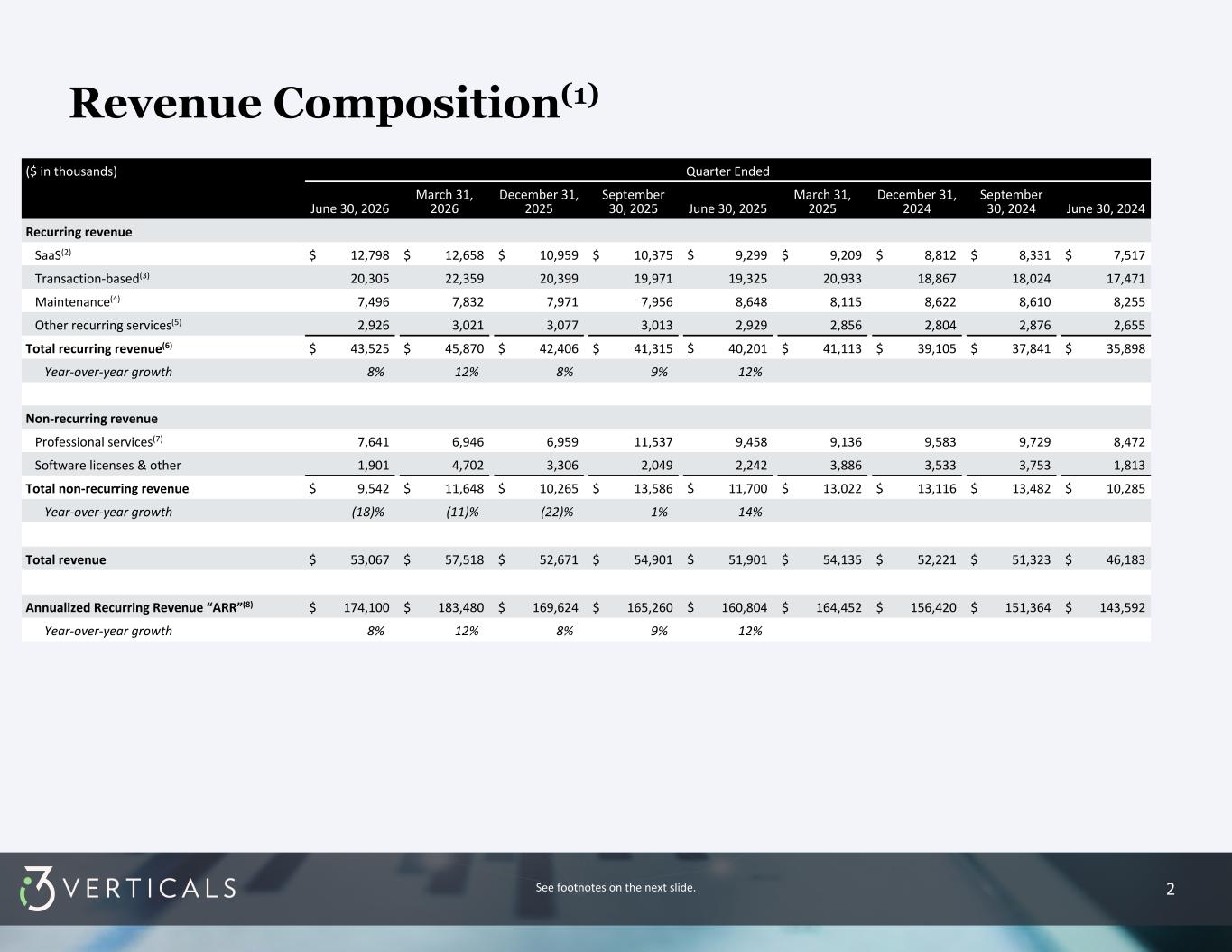
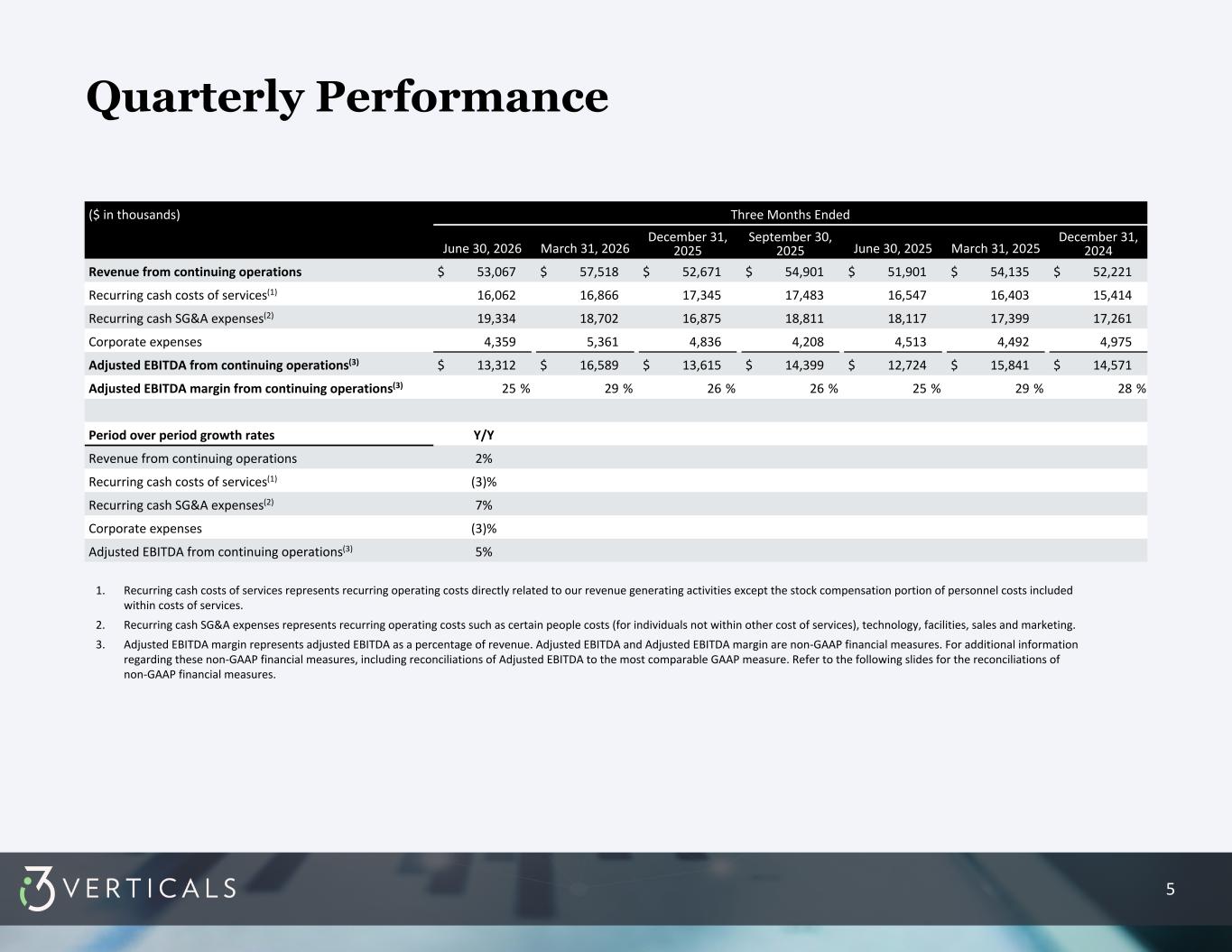
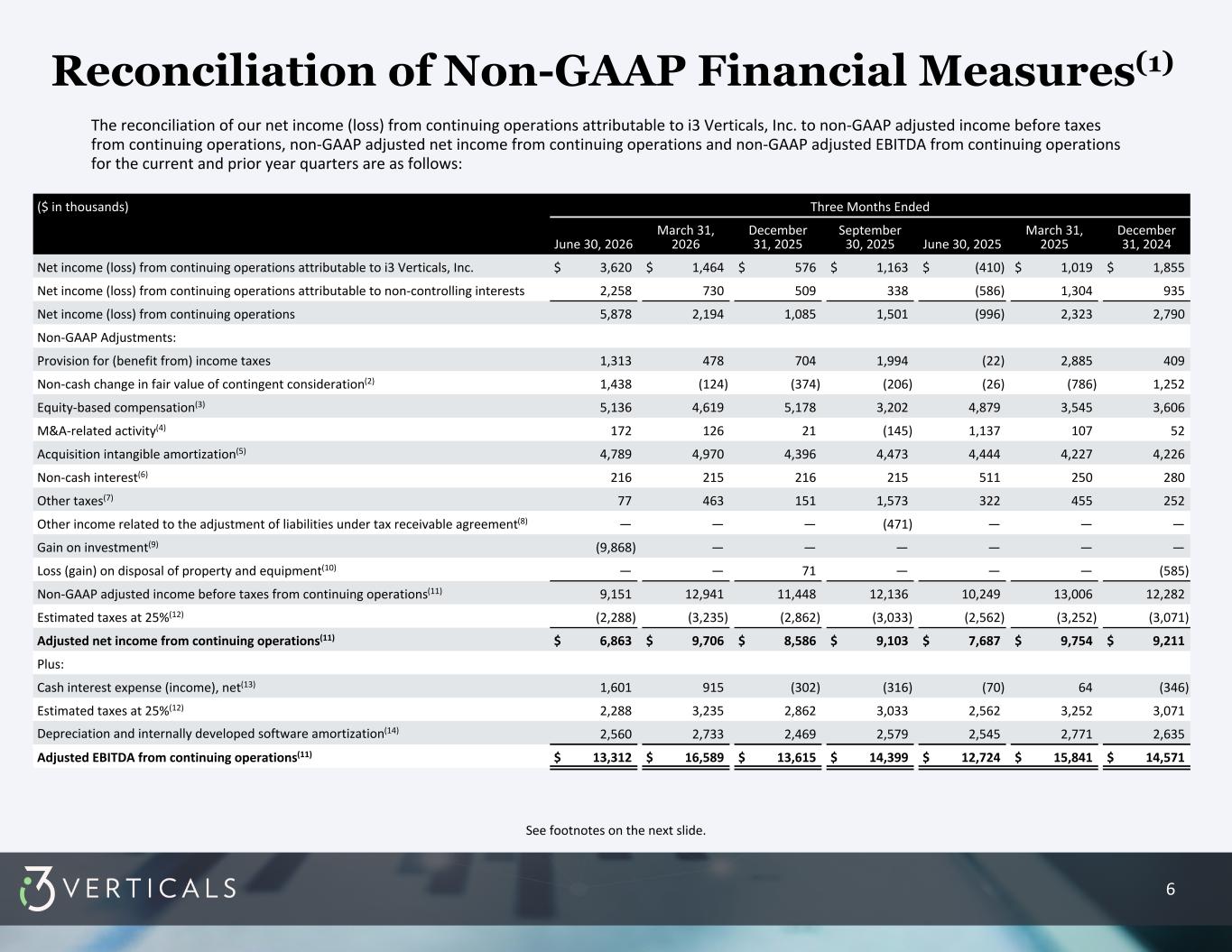
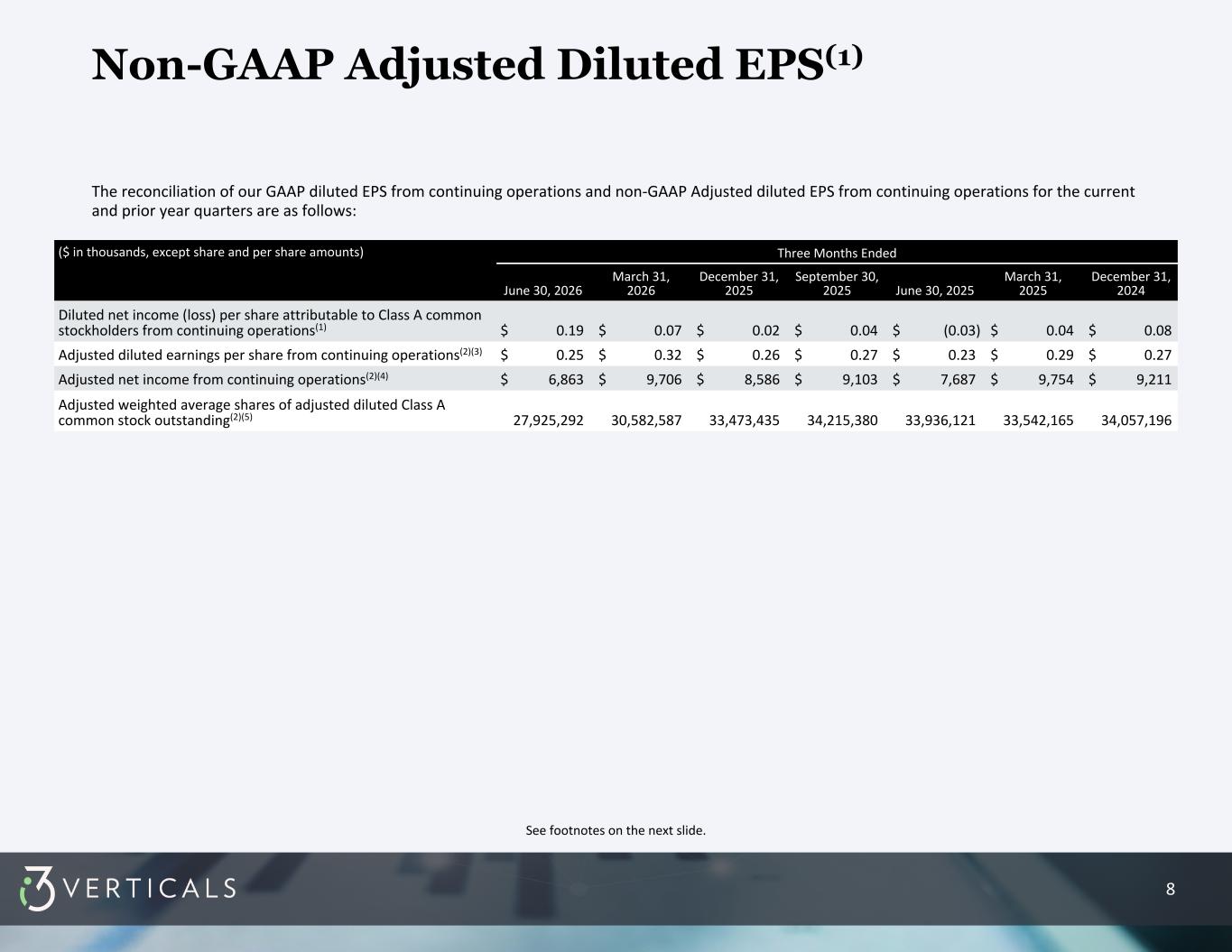
The following pertains to the third quarter of fiscal year 2026, which is the quarter ended June 30, 2026. Please refer to the slide presentation titled Supplemental Information on our website for reference with this discussion. Revenues for the third quarter of fiscal 2026 increased 2% to $53.1 million from $51.9 million for Q3 2025. Organic revenue was down 2% in the quarter, ampered by a $1.8 million decrease in professional services. The ongoing weakness in professional services continues to be concentrated in our utilities market. We expect the year-over-year drawdown in professional services to persist in the fourth quarter. Overall, nonrecurring revenue sources decreased 18% compared to the prior year. annual recurring revenues increased eight percent to 174.1 million for q3 2026 compared to 160.8 million for q3 2025 sas revenue grew 38 percent and transaction-based revenue grew five percent we are experiencing increased interchange rates related to high commercial card usage situation we are addressing with our processor in the fourth quarter In addition, we realized lower growth from our Resolve product in the third quarter than expected, but anticipate re-acceleration into the next fiscal year due to the slate of go-lives. Maintenance revenue decreased 13%, which is steeper than normal due to the timing of certain material SaaS conversions, but will be closer to 3.5% down go-forward. Overall, 82% of our revenues in the quarter came from recurring sources. We do not expect material license revenue the remainder of the fiscal year. Adjusted EBITDA increased 5% to $13.3 million for Q3-2026, $12.7 million for Q3-2025. Adjusted EBITDA as a percentage of revenues was 25% and increased from 24.5%. We continue to recognize efficiencies and savings due to process improvements and adoption of AI. We expect the adjusted EBITDA as a percentage of revenue to improve in the fourth quarter and continue to accelerate into the next fiscal year. Corporate expenses as a percentage of revenues were 8.2% for Q3 2026. Adjusted diluted earnings per share from continuing operations for the third quarter of fiscal 2026 increased 8.5% to $0.25 from $0.23 for Q3 2025. Again, please refer to the press release for a full description and reconciliation. You will notice an item in other income this quarter, a $9.9 million unrealized gain on a minority equity investment. Years back, we made a small investment in a business a former team member launched. We are pleased with their rapid growth and grateful that our investors participate in that success. Regarding the balance sheet, at quarter end, debt stood at $114.3 million. our cash balance was $2.6 million. We still have $285.7 million of borrowing capacity under our revolving credit facility and a 5x leverage constraint. The expectation remains that we will use any borrowings for opportunistic acquisitions and stock repurchases. Our share buybacks have reduced our total adjusted weighted average shares outstanding from over $34 million to under $28 million. Following updates are guidance for continuing operations for FY2026, which was last updated during our second quarter fiscal 2026 press release dated May 7, 2026. The outlook does not include acquisitions that have not yet been announced or transaction-related costs. Revenue, $216 million to $221 million. Adjusted EBITDA, $57 million to $60 million. Adjusted diluted earnings per share, $1.08 to $1.12. We appreciate that this is meaningfully lower than our previous guidance, primarily due to lower-than-anticipated professional services and the deceleration of transaction revenues. Looking past 2026, we expect better growth on a go-forward basis. Last quarter, we elaborated on several reasons for that, which all hold true. However, for 2027, our current expectations is mid-single-digit revenue growth, which is lower than previously guided high single-digit growth. I will now turn the call over to Rick for additional business-related comments.
Thank you, Jeff. Good morning, everyone. I want to spend a few moments discussing AI and the impact it's having on our business. Obviously, AI continues to be one of the most significant technology trends shaping our industry, And we view it not only as a standalone initiative, but as a strategic capability that is increasingly embedded throughout our operations and our customer-facing solutions. Over the past year, we have systematically deployed AI-enabled tools across product management, engineering, quality assurance, cloud operations, security, and customer support. These capabilities are helping us increase productivity, improve service delivery, accelerate innovation, and maintain a high standard of quality while operating efficiently. A good example is the integration we delivered this quarter connected to a client's court-based management system. What was originally considered an aggressive development timeline was completed in approximately one-third the time that similar projects would have historically required. More importantly, we did not just build a one-time integration. Because of the efficiencies created through AI-assisted development, we built a configurable integration framework that can now be leveraged for future deployments. We expect to bring two new clients live this quarter using that infrastructure, with a third immediately behind them. AI is also allowing us to improve quality, security, and long-term maintainability. We've expanded our investments in automation engineering and security engineering, enabling testing and security reviews to occur earlier in the development lifecycle. Human oversight with specific domain expertise and established quality controls remain central to our process. But issues are now identified sooner, reducing downstream costs and improving reliability for systems our customers rely on every day. The results are tangible. Internal sprint metrics show that more than 25% improvement in development velocity, and we are releasing software more frequently while maintaining a flat engineering headcount. Just as importantly, these internal advances are translating directly into customer value and commercial opportunities. Customers increasingly want solutions that automate routine work, improve accuracy, extract meaningful insights from data, and create more efficient user experiences. We are seeing this firsthand in our markets where AI-powered document processing capabilities are becoming a meaningful growth driver. Today, we hold eight contracts spanning Louisiana, Tennessee, North Carolina, and South Carolina for AI-enabled document extraction, redaction, and document separation services. These implementations began going live this quarter, and we are increasingly seeing extraction and redaction capabilities specified directly within customer procurement requirements rather than being viewed as optional enhancements. As we evaluate AI opportunities, our focus remains on solving real customer problems and generating tangible returns. We are applying AI in areas where we possess deep industry expertise, proprietary workflow knowledge, and trusted customer relationships. We believe this positions us to deliver differentiated solutions while creating opportunities for both future revenue growth and operating leverage. It's no secret that AI vendors are changing the way they price their platforms from per seat to usage-based models. While AI-related infrastructure costs are increasing across the industry, as models become more capable and agentic workflows become more sophisticated, we are actively managing those investments. Not all embedded features require the most robust and pricier platforms, but instead, some functions are basic and simply a less costly solution. In fact, we are starting to see competitive situations where before it was a take it or leave it on the proposal side for AI platforms. We believe we are still in the early stages of long-term transformation in the software, and the momentum we are seeing today reinforces our confidence that AI will be an increasingly important component of our growth strategy. With that, let me turn it over to Paul for revenue updates.
Speaker 4
Thank you, Rick. The third quarter remained active across our core markets with customers increasingly evaluating broader, more integrated platform solutions. Our strategic focus has translated this demand into a higher quality sales pipeline, more disciplined pursuits, stronger recurrent revenue opportunities, and shorter paths from booking to revenue recognition. We have enhanced our approach to identifying, qualifying, and pursuing public sector opportunities. Governments continue to invest in modernization initiatives, and I3's focus is on delivering integrated software platforms that serve as operational backbone for mission-critical functions. We are expanding our presence in the justice tech market, securing multiple core agency conversions that demonstrate the strength of that platform and our ability to compete successfully in large established markets. At the same time, we continue to advance our SaaS and cloud strategy, creating ongoing opportunities to migrate customers to more scalable, recurring software models. While selling remains a meaningful growth driver across our vertical markets, particularly where software platforms, payments, and adjacent workflow solutions can be bundled to increase customer value and deepen long-term relationships. We continue to make meaningful progress across our public sector portfolio, and our transportation business serves as a strong example of that momentum this quarter. I3 currently serves 34 jurisdictions across the United States and Canada. During the quarter, we launched a state electronic lean and title solution as part of a broader transportation platform. Unlike traditional ELT providers that operate as single-point solutions connecting to an existing state system, I3 provides mission-critical software across the entire title and registration ecosystem, including dealers, county clerks, state motor vehicle agencies, and integration points for lender service providers. This comprehensive approach enables a seamless end-to-end digital workflow that improves data accuracy, reduces administrative costs, enhances security, increases operational efficiency, and accelerates user adoption. Demand for our motor vehicle insurance verification solutions remained strong. During the quarter, we supported the implementation and launch of insurance verification systems in two major Midwestern states. Most recently, Kansas implemented the Kansas Insurance Verification system, a real-time platform designed to streamline compliance and strengthen enforcement statewide. The system enables immediate insurance verification for authorized agencies, connects with hundreds of participating insurers, and supports the state's effort to reduce uninsured motorists. In Georgia, following statewide approval and execution of agreements with all participating counties the state's vehicle renewal kiosk program is now fully operational this achievement further expands i3 verticals transportation footprint establishes additional recurring transaction revenue stream and provides a scalable foundation for future growth across the state education delivered another solid quarter driven by new customer additions and continued expansion with our existing base nearly half of the fiscal 26 bookings were generated from net new customers demonstrating the continued demand for our solutions on the innovation front we continue advanced ai initiatives in our education platform this quarter we initiated a proof of concept focused on ai driven inventory optimization menu planning and food cost management for school nutrition programs the initiative is designed to help educational institutions better optimize USDA meal program funding while improving efficiency, reducing waste, and providing actionable operational insights. Looking ahead, we remain confident in the long-term fundamentals driving public sector technology investment. Government agencies continue to prioritize modernization, automation, enhanced citizen experience, and greater operational efficiency. With our integrated software platforms supporting critical government functions we believe i3 verticals is uniquely positioned to capitalize on these trends we remain focused on disciplined execution expanding our market presence and delivering sustainable growth and long-term value to our customers and shareholders this includes my comments megan at this time we will open the call for q a please we will now begin the question and answer session to ask a question you may press stars and one on your telephone keypad if you are using a speaker phone please pick up your hands up before pressing the keys if at any time your question has been addressed and you would like to withdraw your question please press star
Operator
then two at this time we will pause momentarily to assemble our roster first question comes from madison sir with raymond james please go ahead hey good morning guys i appreciate you taking the questions here i wanted to start just on the fyi 26 revenue guide here obviously it was lowered by $6.5 million. Maybe just double click on the composition of that. I know, obviously, it's driven by non-recurring revenue, but is it mainly one large customer? Is it multiple? Any color on vertical? And just to be clear, is this a customer-driven kind of push out or lower, or is there any kind of implementation delays internally?
Thanks for the question, Madison. To unpack it a little bit for you. Of the 6.5 guide down, I've been about 4.5-ish or so that I would attribute to professional services. Within that, about 3 million of that is utilities, and I would classify that as push-out. It's just ongoing delays in our large CIS and a couple of smaller projects, but the vast majority of that being ongoing push-out there. About 500K justice, 500K licensing and permitting in our public administration and a significant project in our transportation market too is delayed a little bit. That brings you up to about 4.5 there. In the transaction revenue, you see that kind of throttle down this quarter. I view that as temporary. Big chunk of that is payments. Probably, you know, one million plus of that is the net take rate on payments and it's being driven by what we alluded to in the comments around elevated interchange around commercial cards and basically that's a data fix that is going in in the fourth quarter it's been hurting us for a while it was particularly acute this quarter and the fix has just been repeatedly delayed and there's been some dialogue with our our processor that we've just kind of been working through and we just had to bite the bullet here. And then our Resolve product, that is a product we've been upfront about just how excellent the pipeline and the growth is for it. It had a really weak quarter. It's subject to a number of forces that are kind of in the, you might call in the realm of things outside of our control, mostly the throughput of cases through the existing customer base. There will be times that that's a really great kind of wind in our sales item as that throughput's rising in the existing customer base and times when it's kind of dragged down a little bit. We also had some good long-run implementation things, but they were short-run disruption items within that product suite as we went on to a new version of the product this quarter.
Operator
But long run, that's going to continue to be a really strong growth driver for us. um so anyway that that's that's kind of the anatomy of the guide down okay yeah that's that's very helpful color jeff i appreciate it and then just a follow-up i think greg mentioned you know have a solid foundation for for margin expansion here can you guys maybe just touch on what gives you confidence in improving profitability jeff i know for example you've talked about ai efficiencies in in the past and historically you've talked about normalized margin improvement in the 50 to 100 basis point range. Is that still the right way to think about margins, given your comments around mid-single-digit revenue growth? Thanks, guys.
So, for the fourth quarter, we're looking at very strong margin growth. But I'll kind of take it out to 2027 and look at that. We already have reduced our cost structure, and I'm referring specifically to people costs and some other things like some rent and things like that materially. And frankly, there's a few things that have already been done that we're not getting the benefit from yet in Q3. Some of that is timing and some of that is also there were some offsets in this current quarter in the form of reserves we had to take on some of our receivables. And so those are one-time items and we already are looking at, you know, kind of a cleaner path to better margins in 2027. A little bit of that is also compressed by the revenue growth situation. And as that improves into 2027, the margin expansion will benefit from that as well. But the long-run guide that we've always put on margins being 50 to 100 basis points, I think you're looking north of the 100 basis points in 2027 currently we if revenue is growing in the mid single digits as we've kind of described here we should be more in the hundred to two hundred basis point margin expansion range for fiscal 2027 again if you have a question please press star then one Alex Margraf at KeyBank is having audio troubles but he emailed a question he'd like for us to address he's curious to understand the bridge back to single digit growth in 2027 and our degree of confidence in that path it's a really fair question from Alex we're definitely we're definitely sensitive to that and appreciate the market you need to kind of understand how we get from the growth picture in 26 to 27 so the first thing I would highlight is Greg and Paul touched on this in their comments but we have several significant go-lives in our transportation market. Two of those are sort of in what you might call the legacy I3 transportation market. Good recurring revenue go-lives that have just kicked in here in the fourth quarter. Those will be on a ramp-up period, so the impact in Q4 is going to be really modest, but the impact in 2027 will be stronger and then into 28. And the other two are in our most recent acquisition, the electronic insurance verification software. And frankly, we're not, that's not all touching our organic growth until we get to Q2 of 2027. But the growth in that acquisition is tremendous. They just have a really, really strong market position. The things that we had in the pipeline at the time of the acquisition several months ago are all on track and several material new things are also already in the hopper as well really great growth picture there once that becomes part of the organic picture that's going to be a nice significant uplift on its own also the board licensing and permitting software has had a really rough 2026 with a lot of project delays but they have a deep backlog of contracted implementation revenue and go-live slated for 2027 here. So, their picture gets a lot brighter in that period. I'll leave it to the go-lives in our resolve. Everybody's well aware of West Virginia, which will continue to progress forward. It'll be the back part of 2027 before we start going live on courts with that project. At that point, you get on the ramp of the recurring revenues but in the meantime we'll be you know we'll still have a slightly better diet of professional services in the next year and then finally in the utility space in both our portal business and the cis project that's been a really difficult year in that space in 2026 we've set the bar pretty low to grow over and what we see right now for 2027 looks a lot brighter on both of those fronts again if you have a question please press star then one concludes our question and answer session I would like to turn the
Operator
conference back over to Greg daily for any closing remarks and thank you everyone for dialing in this morning and we appreciate your support thank you the conference is now concluded thank you for attending today's presentation you may now disconnect