Operator
Good morning. My name is Krista, and I will be your conference operator today. I would like to welcome everyone to the JetBlue Airways 4th Quarter 2024 Earnings Conference Call. As a reminder, today's call is being recorded, and at this time, all participants are in a listen-only mode. I will now like to turn the conference over to JetBlue's Director of Investor Relations, Koush Patel. Please go ahead, sir.
Thanks, Krista. Good morning, everyone, and thanks for joining us for our fourth quarter 2024 earnings call. This morning, we issued our earnings release and a presentation that we will reference during this call. All of those documents are available on our website at investor.cheflee.com and on the SEC's website at www.sec.gov. In New York, to discuss our results are Joanna Garrity, our Chief Executive Officer, Marty St. George, our President, and Ursula Hurley, our Chief Financial Officer. During today's call, we'll make forward-looking statements within the meaning of the Safe Harbor Provisions of the Private Securities Litigation Reform Act of 1995. Such forward-looking statements include, without limitation, statements regarding our first quarter and full year 2025 financial outlook and our future results of operations and financial position, including long-term financial targets, industry and market trends, expectations with respect to tailwinds and headwinds, our ability to achieve operational and financial targets, our business strategy, and our plans for future operations, and the associated impacts on our business. All such forward-looking statements are subject to risks and uncertainties, and actual results may differ materially from those expressed or implied in these statements. Please refer to our most recent earnings release as well as our fiscal year 2023 10K and other financial and other filings for a more detailed discussion of the risks and uncertainties that could cause the actual results to differ materially from those contained responding gap measures, please.
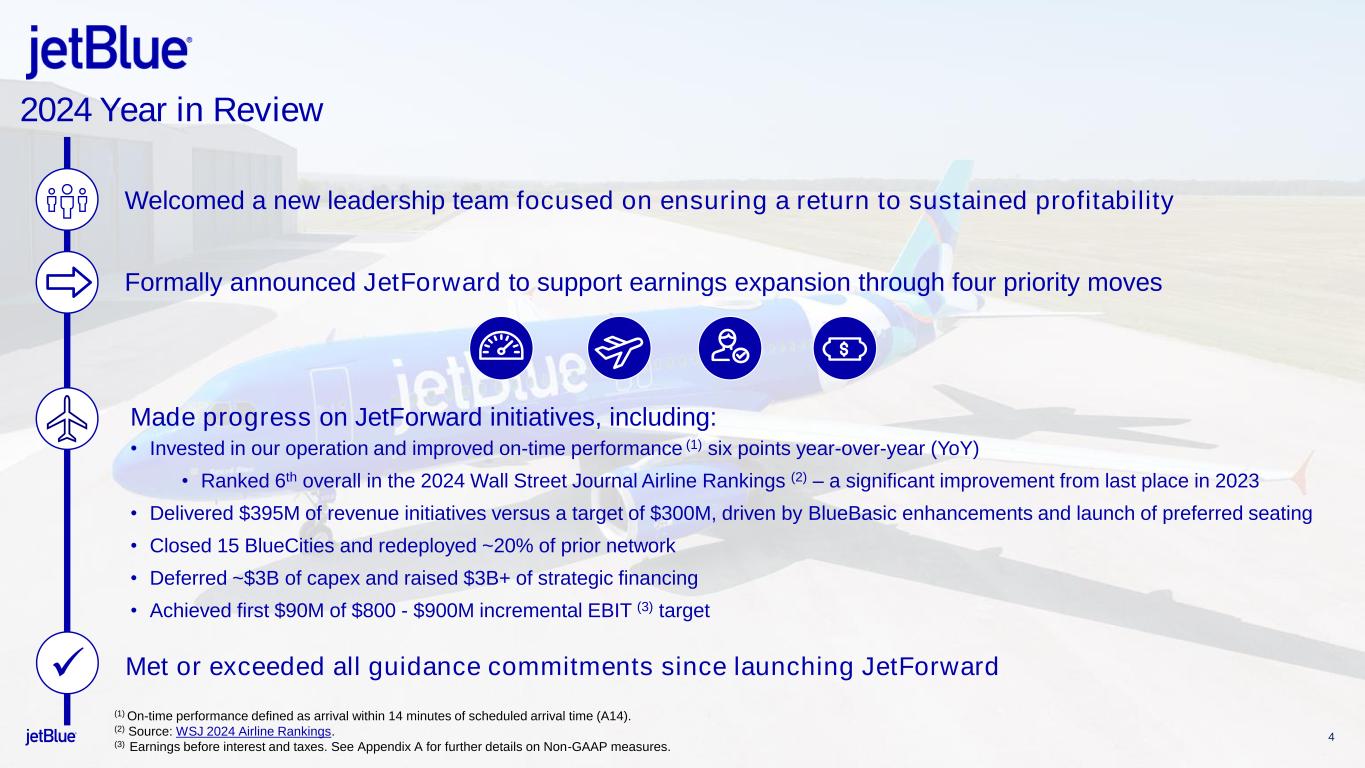
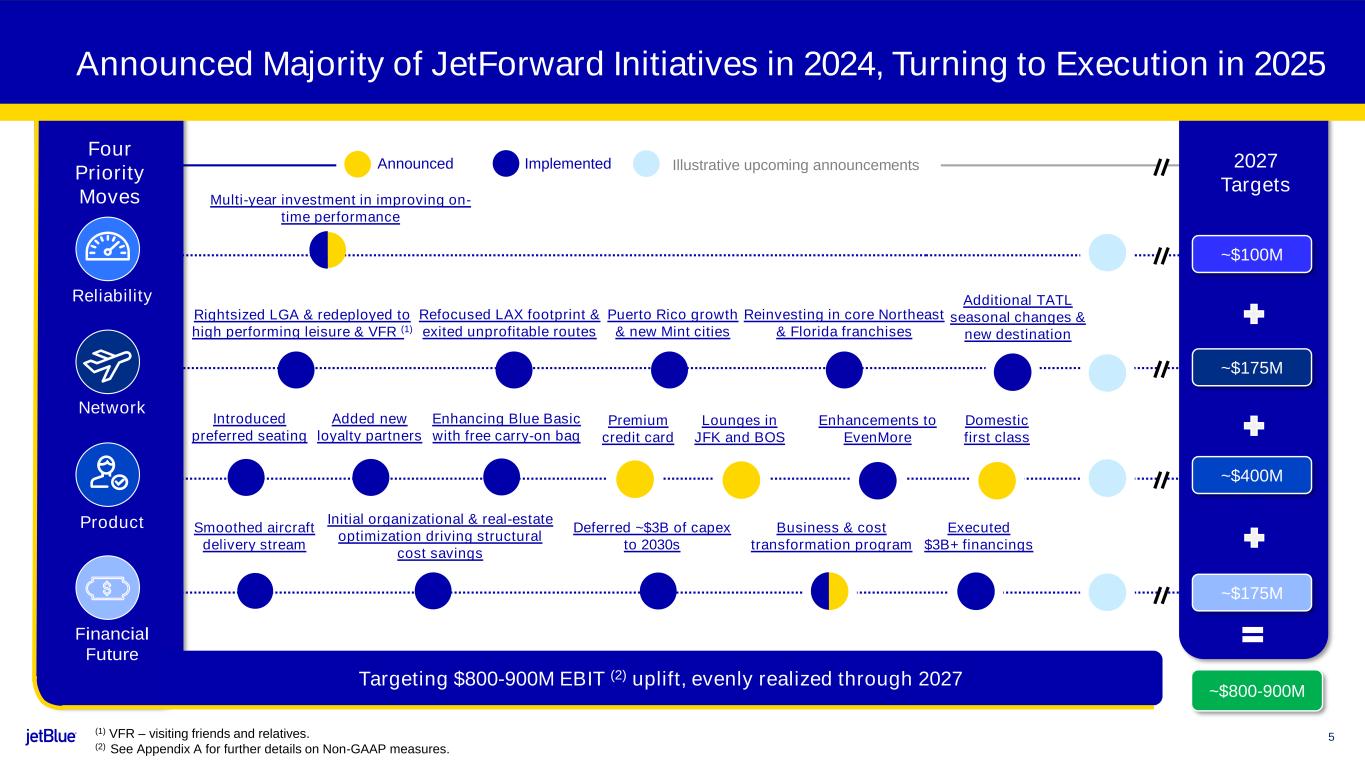
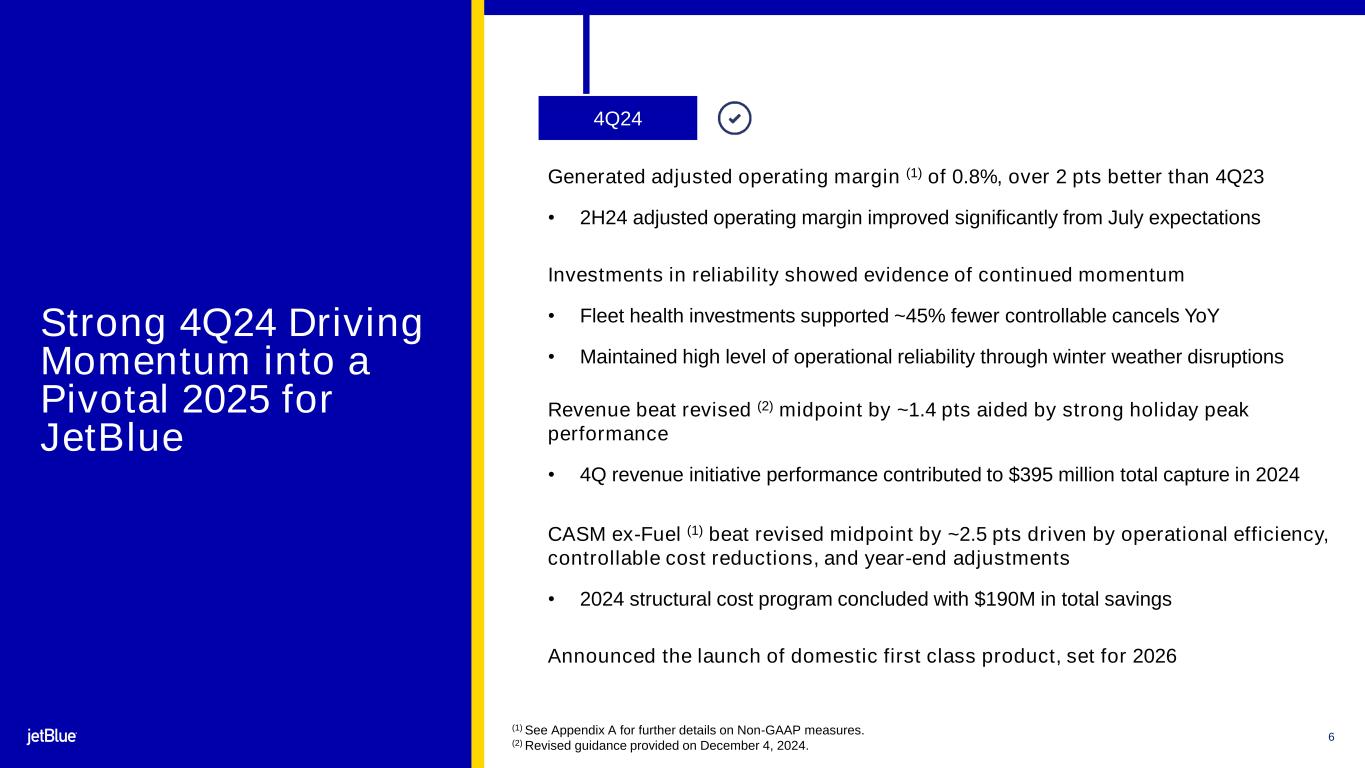
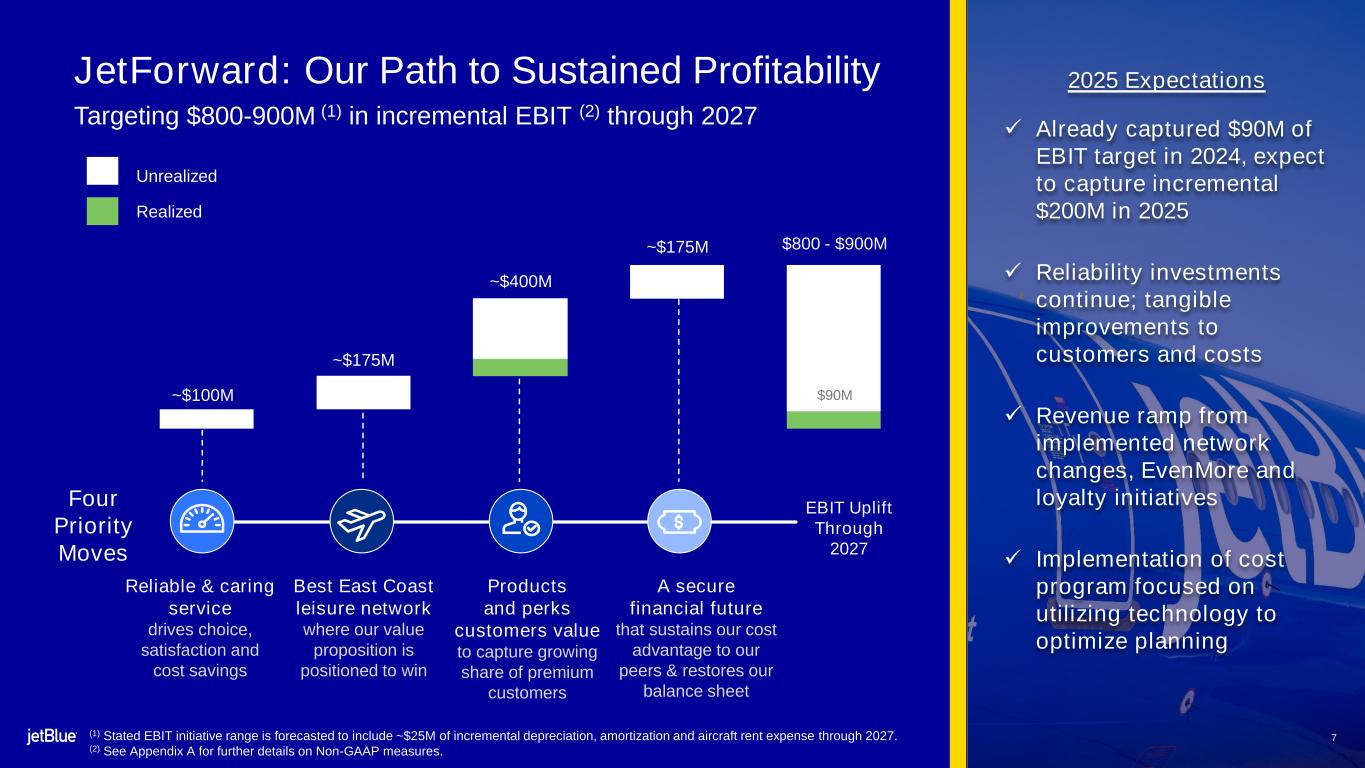
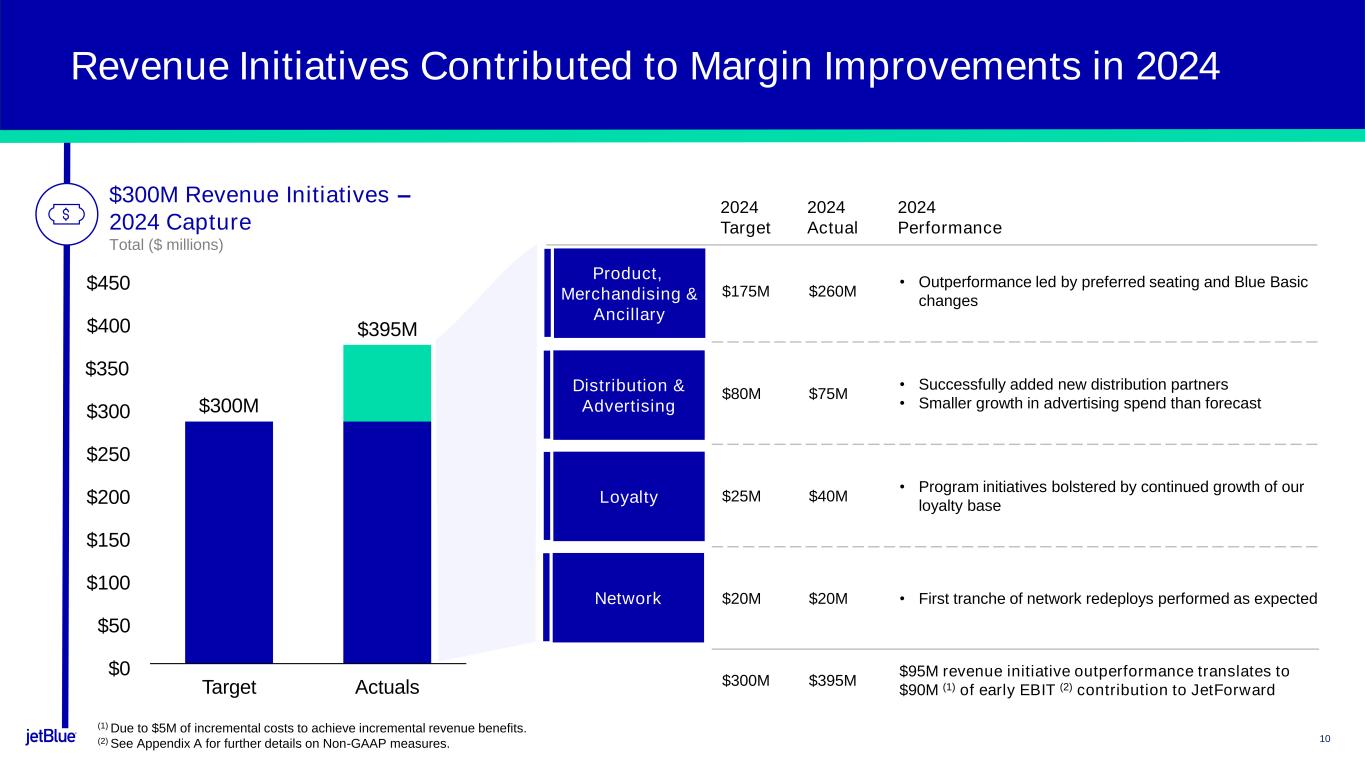
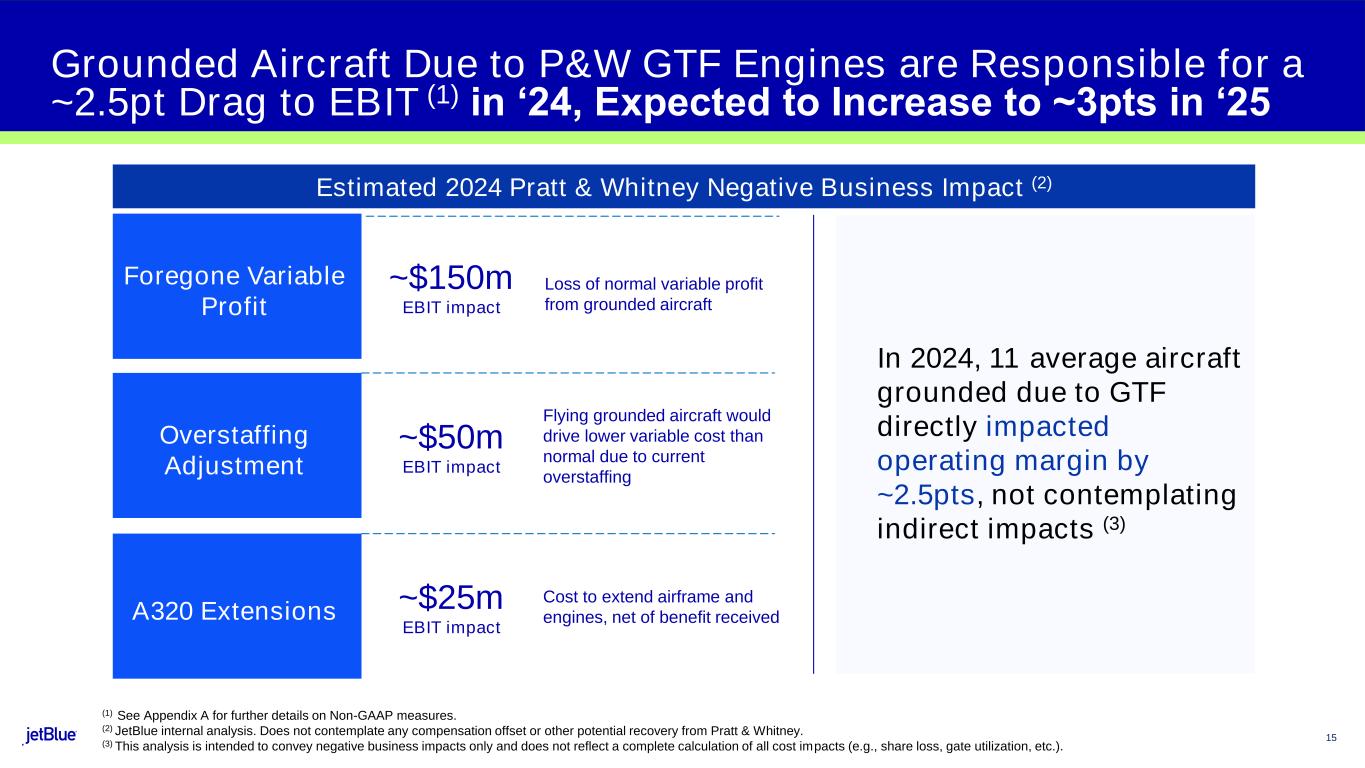
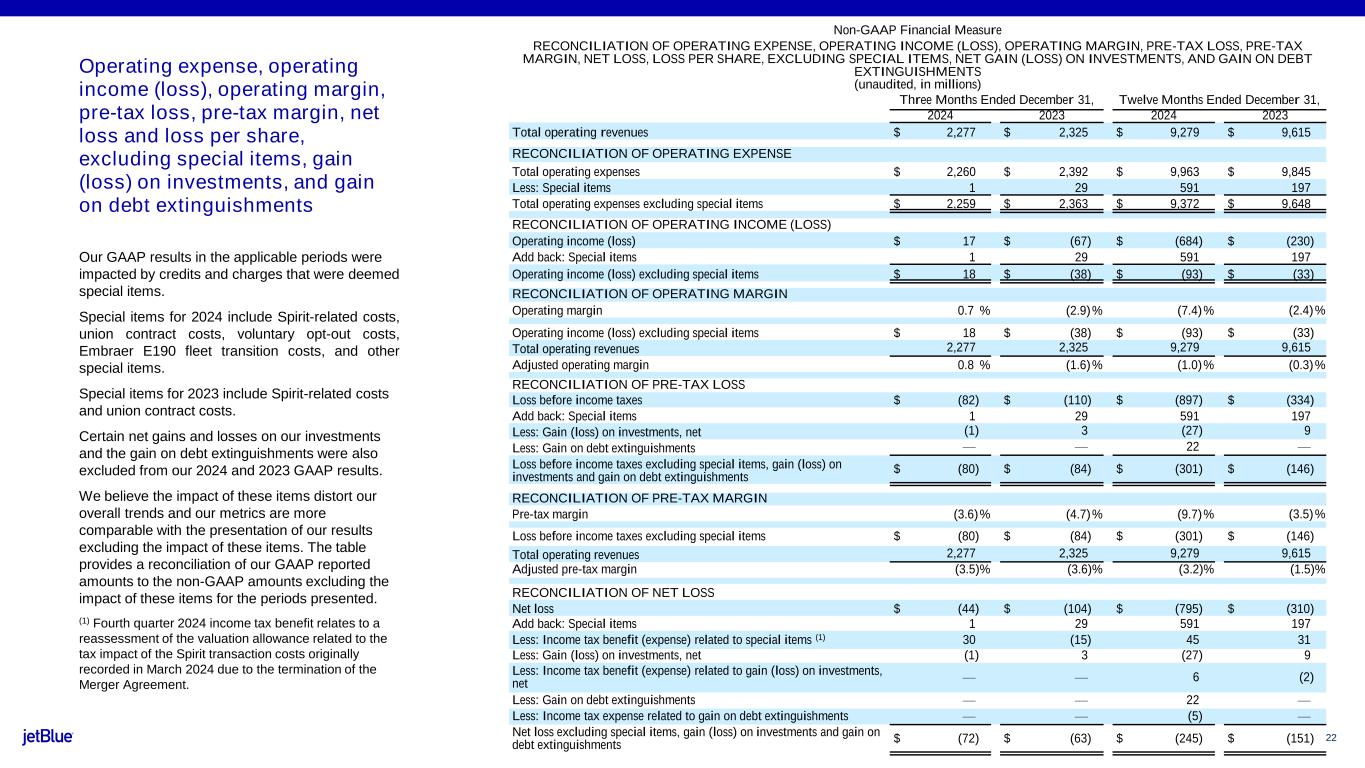
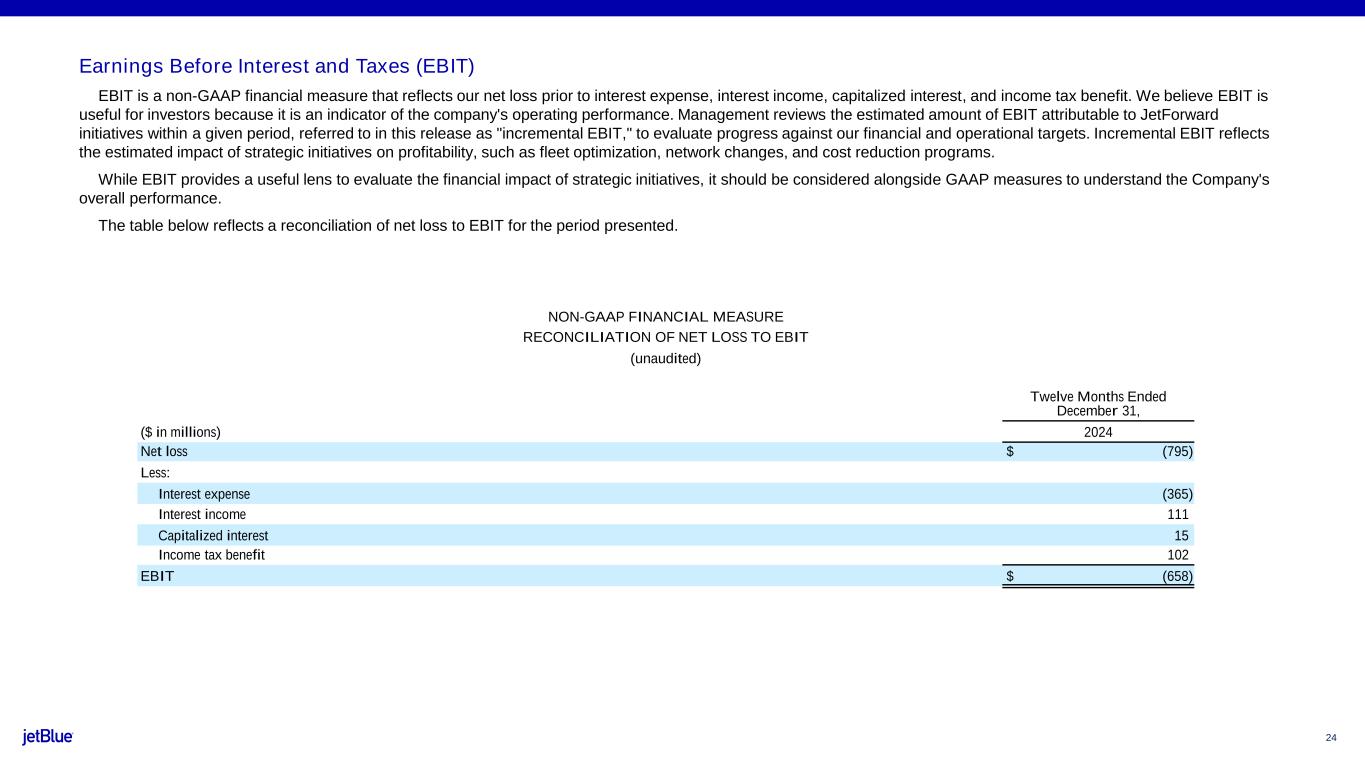
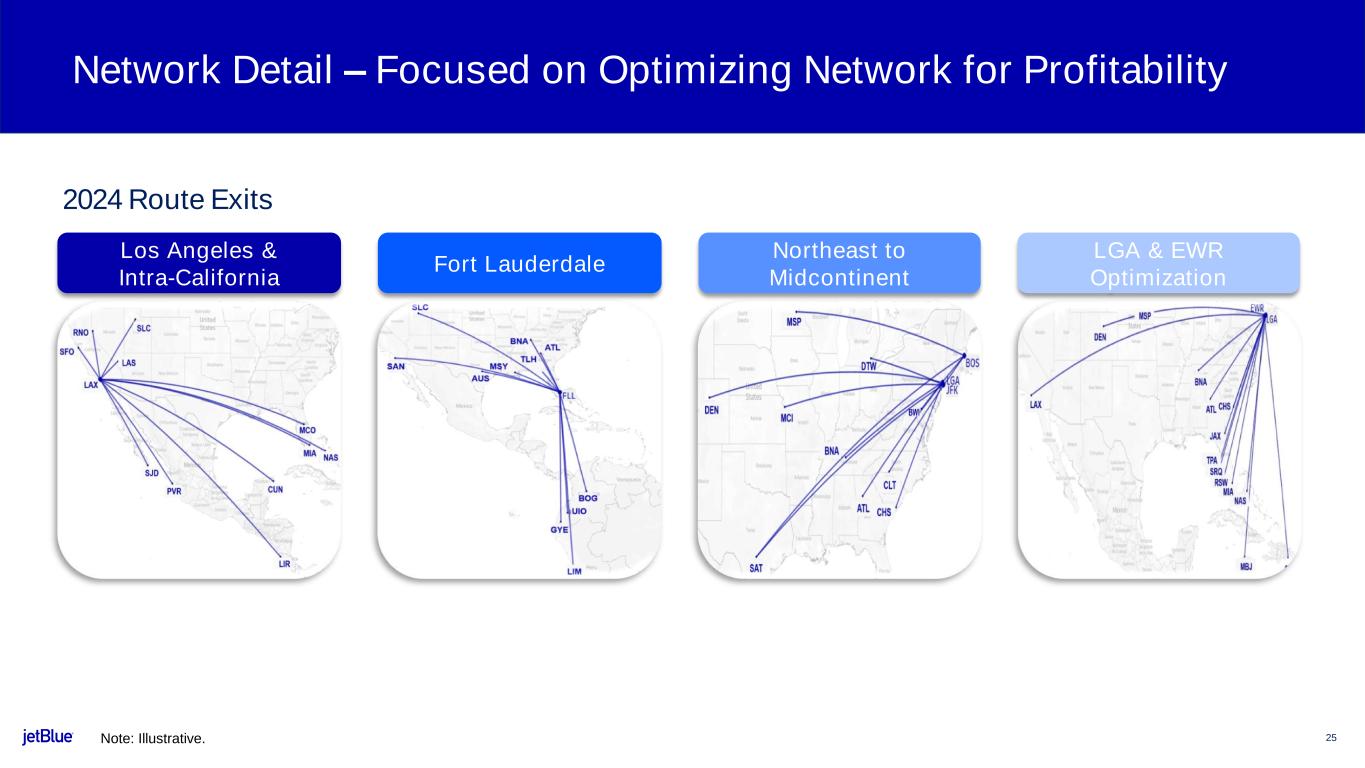
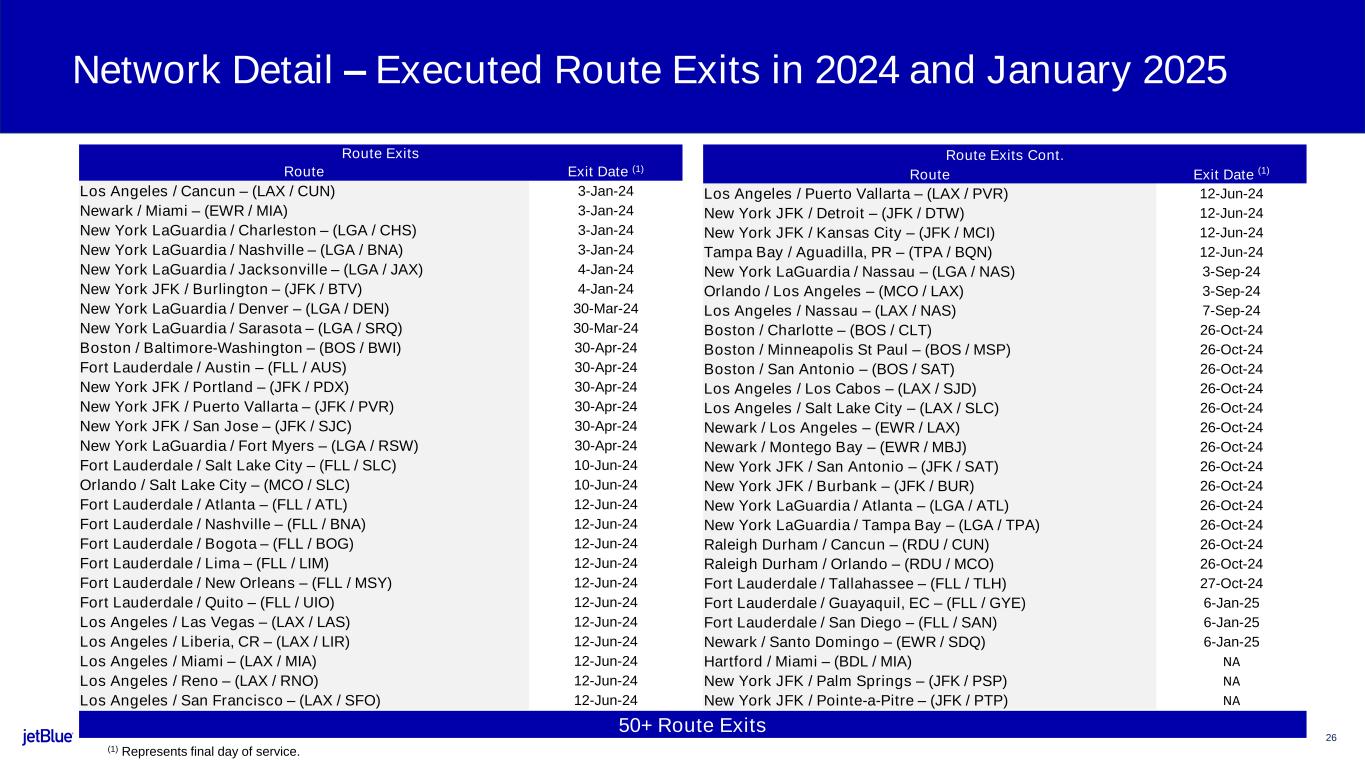
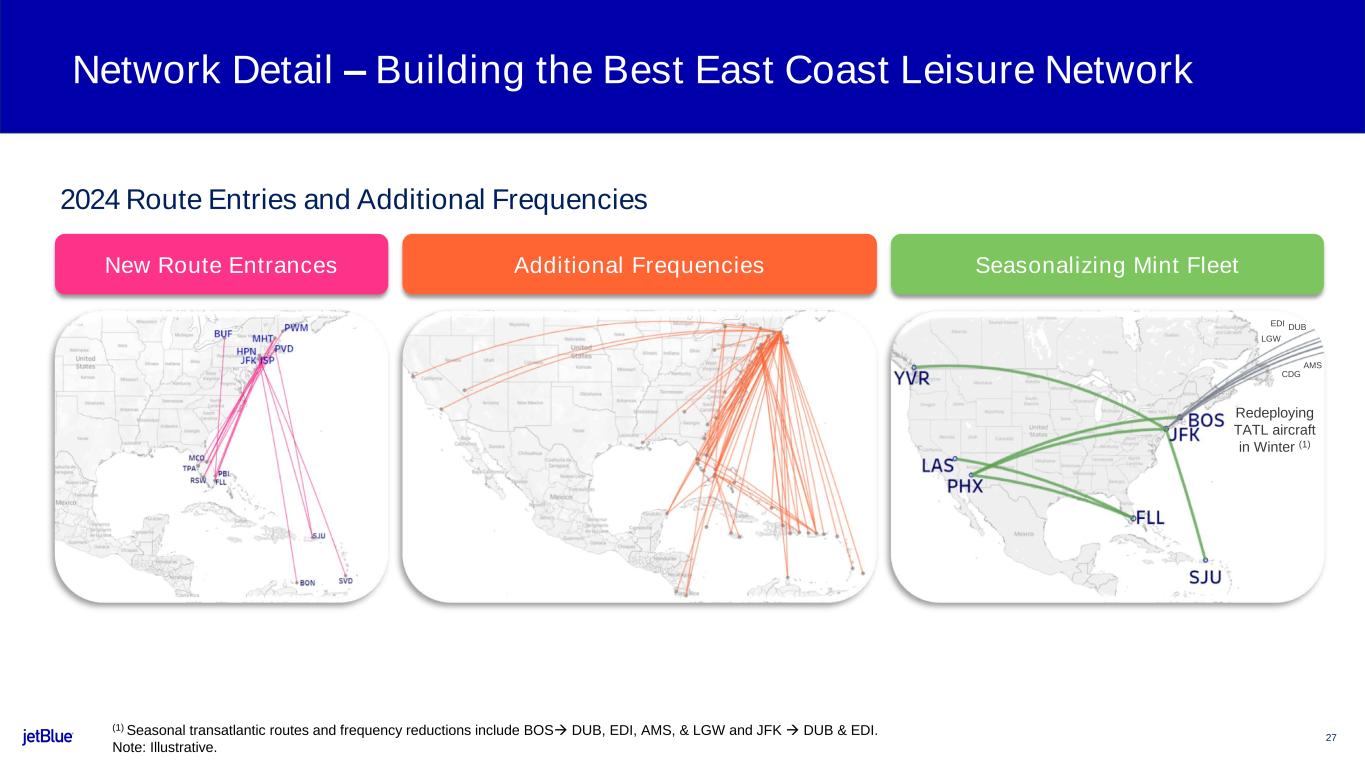
Good morning, and thank you for joining Jeff Lue's fourth quarter 2024 earnings call. Before I begin, I want to take a moment to express our sympathy and support to those affected by the devastating wildfires in Los Angeles, especially several of our crew members who have experienced tremendous loss. We ended the year with momentum, and I am pleased to announce for the fourth quarter, we generated a positive adjusted operating margin of 0.8%, over two points better than in 2023. 2024 was a period of transition for JetBlue, and at the onset of the year, we introduced a new leadership team who worked expeditiously to launch our standalone strategic plan, JetForward, last July. This plan is fundamental to achieving our goal of returning to sustained profitability. Though we weren't profitable for the year, we made progress in 2024 with operating margin expansion during the second half of the year. I'm very proud of the achievements so far and believe that the early results bear evidence that we are taking the right steps towards profitability. Turning to pages 4 and 5 of the earnings presentation. At the start of 2024, we knew we had big challenges to tackle, including evolved customer preferences, ongoing issues with Pratt & Whitney, air traffic control, and costs growing faster than revenues. JET Forward was designed to leverage our strengths to combat these challenges and put us back on a path to profitability. With great urgency, we announced and implemented over a dozen different strategic initiatives and made progress in every facet of our business, including customer satisfaction, crew member engagement and operational performance. We launched a multi-year investment to improve operational reliability, and we are seeing benefits across nearly all the metrics that we track for example on-time performance was six points better in 2024 than in 2023 net promoter score improved by nearly 10 points and we ranked sixth place overall in wall street journal's 2024 airline rankings improving three spots from last place overall in 2023 we closed 15 blue cities and redeployed over 20 of our network realigning our network into our core strengths on the East Coast. We refocused our LAX footprint and boosted flying across New England and the Caribbean. We reinvested in our core Florida franchises and expanded our San Juan focus city with the addition of a crew base and more flying. We also further seasonalized our transatlantic flying in the winter, creating new destinations for mint aircraft. Many of these changes are now in their early stages of ramp. We also announced and implemented a variety of changes to our products and perks to ensure we are evolving our offering to deliver the experience our customers want. We rolled out preferred seating, added multiple loyalty and distribution partners, and enhanced our Blue Basic offering by adding back a complimentary carry-on bag. This initiative has outperformed our expectations, and our data shows we are attracting incremental customers to JetBlue. To secure our financial future, we deferred $3 billion of capital expenditures to 2030 and beyond, and raised significant strategic financing to provide runway for JetForward. These moves strengthened our liquidity positions and will ensure we have the runway in place to achieve the benefits of JetForward. Alongside implementing these changes, we announced additional initiatives which launch this year and next, such as even more, domestic first class, lounges, a premium co-branded credit card, and a new cost transformation program. JetBlue has gone through immense change and feedback from our customers has been positive. Crew member sentiment on the strategy has also been encouraging, with crew member engagement scores up year over year, demonstrating better alignment across the organization in support of executing JetForward. Importantly, even as we take steps to evolve our offerings to meet the needs of customers today, I'm proud that our core product offering was once again rated best in the industry. In 2024, we were awarded the best economy class across U.S. Airlines by the Point Sky for the fifth time, boosted by our changes to Blue Basic and the personalization efforts we've implemented. The progress we made during 2024, combined with robust fourth quarter results strengthens the confidence we have in our ability to deliver on our commitments in 2025. Now, shifting to slide six to review fourth quarter performance. For the fourth quarter, we outperformed across all metrics relative to our updated guidance, enabling us to generate adjusted operating income of $18 million. We saw benefits from our continued investments in reliability as we persevered through and quickly recovered from inclement weather and ATC challenges over the holiday period. The operation delivered a completion factor of 99 percent in the quarter and on-time performance improved five points year over year despite navigating more air traffic control programs than in the fourth quarter of 2023. The improved operational performance also benefited our fourth quarter Chasm X fuel growth which finished better than the low end of our revised guidance range. Revenue beat our revised guidance midpoint by 1.4 points, aided by a healthy November and December holiday season and the performance of our 2024 revenue initiatives. These initiatives drove $395 million of revenue for the year, $95 million over our target of $300 million. Encouragingly, this was quicker ramp than we anticipated and was originally part of the forecast we expect for JET Forward in 2025. As a result, we are pleased to say we've already captured 90 million of our 800 to 900 million target for incremental EBIT through 2027. Going forward, we plan to provide biannual updates in the progress of Jet Forward with our next update scheduled for our July 2025 earnings call. We finished 2024 with a higher operating margin than we expected in July when we launched jet forward this strong performance combined with benefits from lower fuel resulted in 2024 operating margin three and a half points higher than what was implied by our july guidance turning to page seven in 2025 we plan to build an even more reliable and resilient operation as we continue refining our schedules to further improve on-time performance enhancing the tool set in our system operations center and investing in technical dispatch reliability to reduce controllable cancels marty and ursula will provide more detail on what to expect from our other priority moves this year in all we believe jet forward is on track to deliver about 200 million of incremental ebit contribution in 2025 as a result we expect to achieve a full year positive adjusted operating margin ranging from zero to one percent we recognize however there is still significant room to grow and close the gap to our industry peers the pratt and whitney aircraft groundings have been and will continue to be a significant impediment to margins in the near term we believe the groundings had a direct negative impact on operating margin of approximately two and a half points in 2024 and we estimate that direct impact will grow to three points in 2025 as AOGs are expected to increase to the mid to high teens. Ursula will expand on the breakdown of this impact. This is a pivotal year for jet flu, but also for the industry. With a new administration in Washington focused on efficiency, there is a real opportunity to structurally improve the FAA and fix the air traffic control challenges our industry has been plagued with. This could represent a clear benefit to the traveling public and another tangible tailwind if a focused effort is undertaken. We look forward to partnering with the new leaders at the DOT and FAA to help make this happen. I'm excited by the opportunity in front of us, and as we approach the 25th anniversary of JetBlue's first flight in February, I am confident we are executing on the right plan to usher in the next 25 years of flying. JetForward positions us to lean into our historic strengths, adapt to a changing industry, and meet our commitments to our shareholders, customers, and crew members, the first commitment of which is to run a sustainably profitable business, and we will continue to work with absolute urgency to get there. As we close the chapter on 2024, I would like to share a heartfelt thank you to our crew members who continue to deliver exceptional customer service while managing immense change.
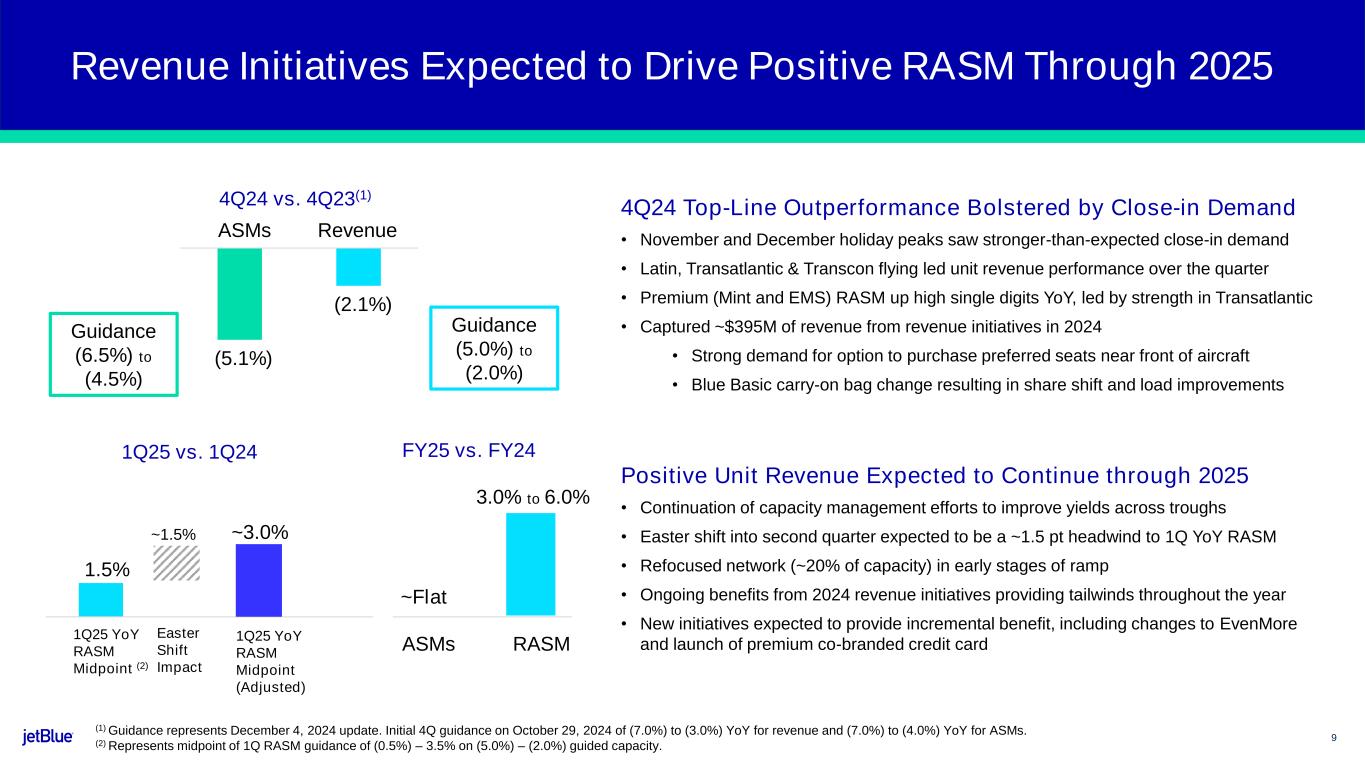
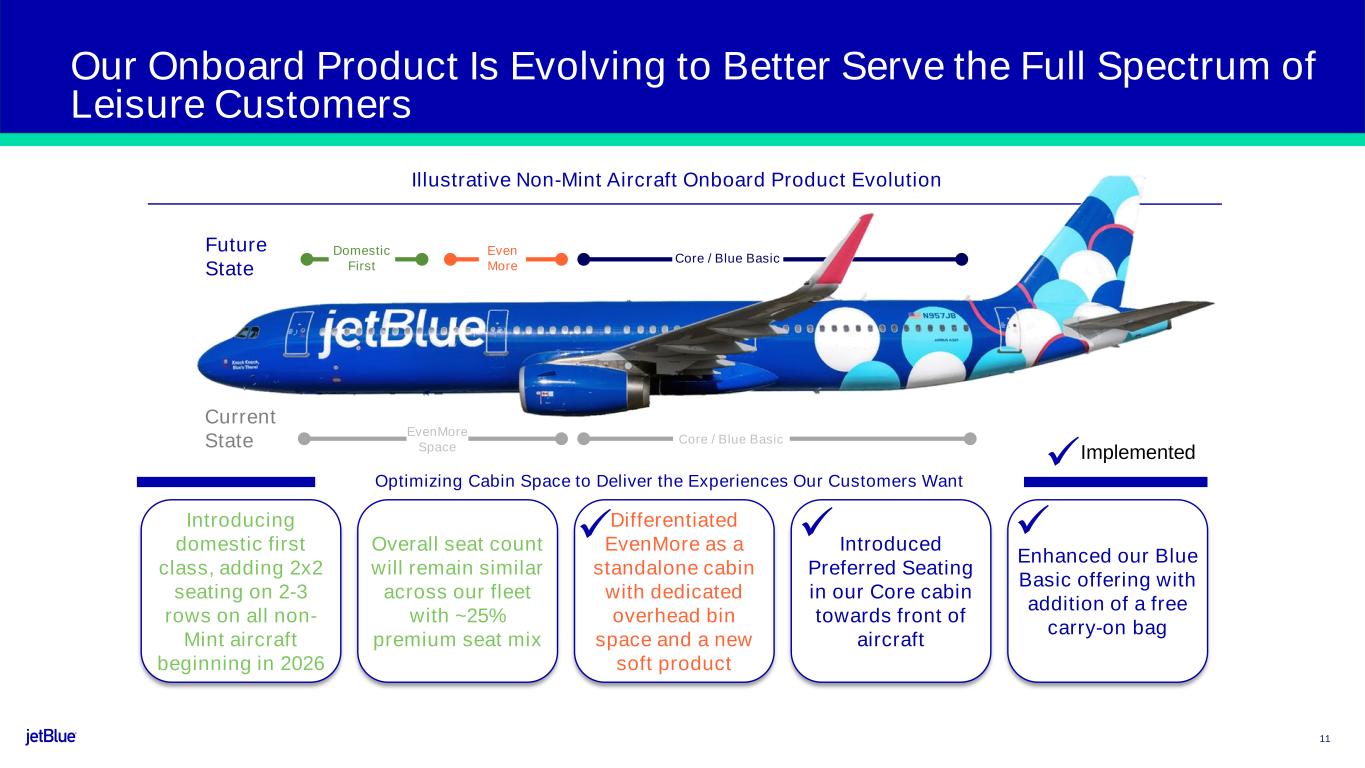
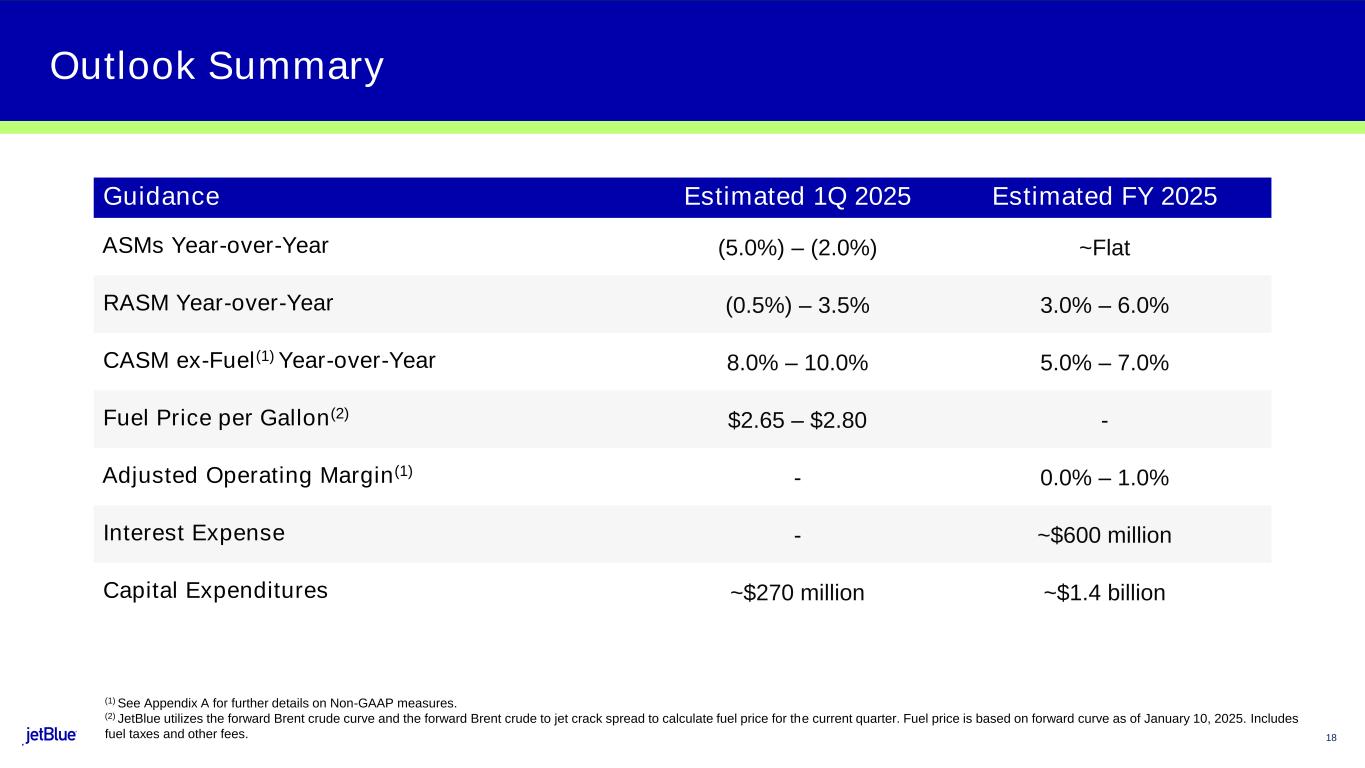
I would also like to recognize the efforts of those that stepped up during the holidays. without your commitment meeting our goals would not be possible we have incredible momentum coming out of 2024 and I'm excited to build on it in 2025 over to Marty for a commercial update and outlook thank you Joanna I echo your thanks to our crew members thank you all for delivering the JetBlue experience to our customers day in and day out especially over the busy holiday season turn to slide nine fourth quarter revenue performance was solid with unit Revenue is growing 3.2% year-over-year on 5%. Close-in demand was strong in the November and December holiday peaks. It helped to drive about 1.5 points of unit revenue improvement versus our initial guidance. Unit revenue was strong across many geographies. On the transatlantic front, we saw unit revenue ramp nicely as the region continues to mature, particularly as we enter our first winter with a more seasonal schedule. In our Latin leisure, and VFR flying, we are pleased with the RASM improvements we saw in the second half, which we covered sequentially as competitive capacity growth slowed from the first half. Our Transcon franchise continued to produce healthy year-over-year RASM supported by strong Mint performance. Across Mint and EMS, unit revenues were up in the high single digits year-over-year in the fourth quarter. The success of preferred seeding in 2024 is another testament to the strength of the premium leisure customer segment. It is healthy and growing, and we are enhancing our suite of products to better serve those customers, which is a multi-point improvement from where we were in 2019. Card STEM was up high single digits year over year, and active True Blue members were up low single digits. Exemplifying that, while the core airline may not be growing, our customers are driving outsized loyalty growth through their positive responses to the Jet Forward strategy and the enhancements to our program. The fourth quarter benefited from our 2024 revenue initiatives, which generated $395 million of top-line benefit for the year. The breakdown of these initiatives can be found on Slide 10 of the earnings presentation. Our revised blue basic carry-on baggage policy and preferred seething were the key contributors to quicker revenue capture in 2020. The progress from these revenue initiatives is only the beginning, and it provides us with significant momentum headed into 2025. Turning to our first quarter and full-year outlooks, first quarter capacity is planned to be down 5% to down 2% year-over-year, and for the year, capacity growth will be roughly flat compared to 2024. In the first quarter, we expect year-over-year RASM in the range of down 0.5% to up 3.5%, with a shift of Easter back into the second quarter expected to be a roughly 1.5-point As a reminder, the first quarter is a historically slower period of flying for Leisure Airlines with many trough weeks. We've also redeployed about 20% of our network, and much of it is in the early innings of In the first quarter, we are seeing elevated competitive capacity in many of these markets, particularly in the northeast of Florida. Competitive capacity will continue to ebb and flow, and we remain committed to competing in these geographies core to our jet forward strategy. As we look to the rest of the year, the continued execution of our JetWord Forward Plan is expected to propel unit revenue growth higher than first quarter levels. For the full year, we expect RASM to increase 3% to 6%. In May, we will launch new daily nonstop service to Madrid and Edinburgh from Boston as part of our efforts to expand and further seasonalize our transatlantic flying. Earlier this month, we made an additional network announcement, adding even more summer seasonal destinations in support of flying the best East Coast Leisure Network and as we continue to take a hard look at profitability across our network, we will plan to remain nimble and dynamic in our network optimization efforts. In 2025, complementing changes to our network. In addition to the merchandising changes to even more announced last quarter, we are updating the onboard experience to elevate the offering. Even more will now include dedicated overhead bin space and soft product enhancements among other perks. These updates go live today and position us well to compete with the premium economy options our domestic peers offer. We also recently added a new way for customers to pay for their flights using Venmo, demonstrating our commitment to enhancing customer experience on every step of the travel journey. Over the course of the year, several jet forward initiatives announced last year are also scheduled to go live, including our premium co-branded credit card, which begins accepting applications very soon, and our launch of Data Case Terminal 5 set to open the fourth quarter. Unlocking incremental margin and creative revenue is crucial to the success of our plan and the progress for the shareholders. Between the momentum we have for the 2024 revenue initiatives, the improvements in customer satisfaction as a result of a better operation, the ramp of our network changes and our 2025 jet forward initiatives, I am confident we have all the right pieces in place to generate meaningful unit revenue growth and achieve positive operating margin. Now I hand it over to Ursula for the financial update.
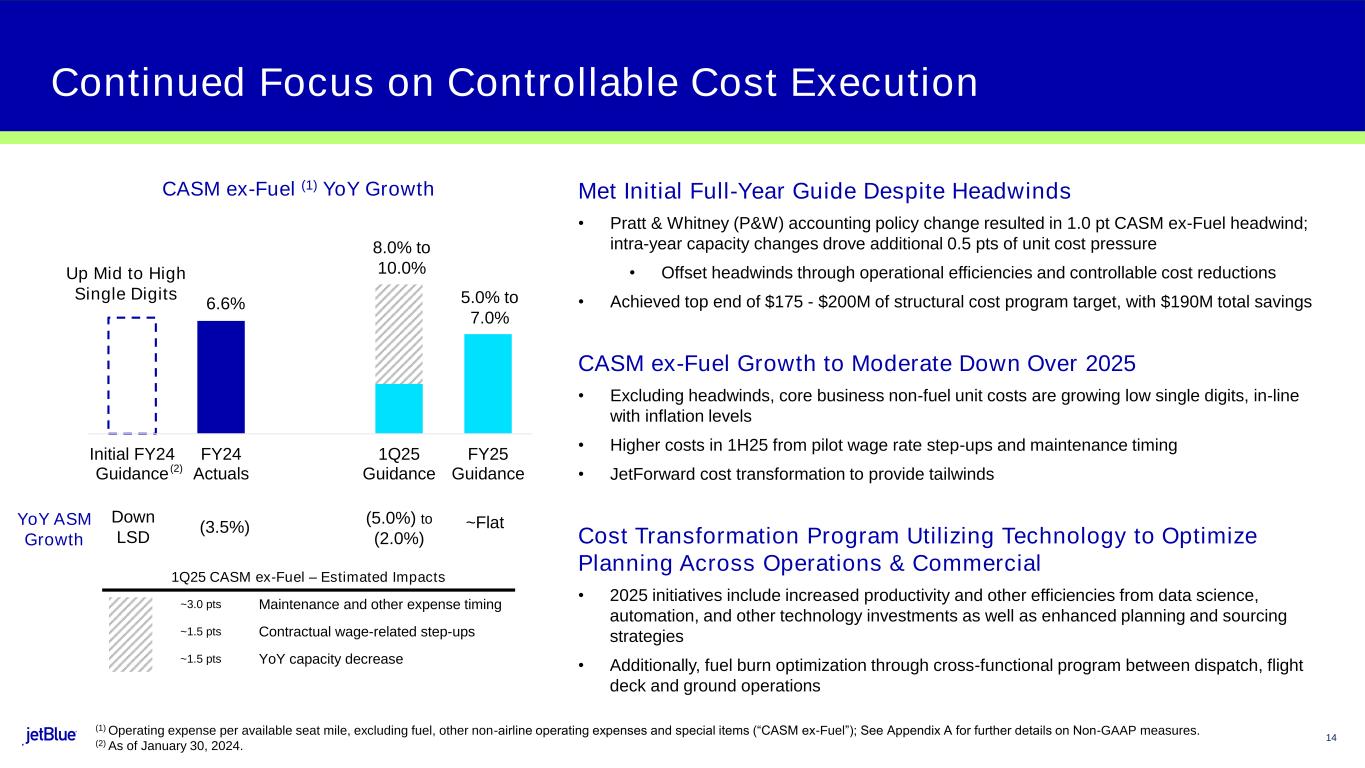
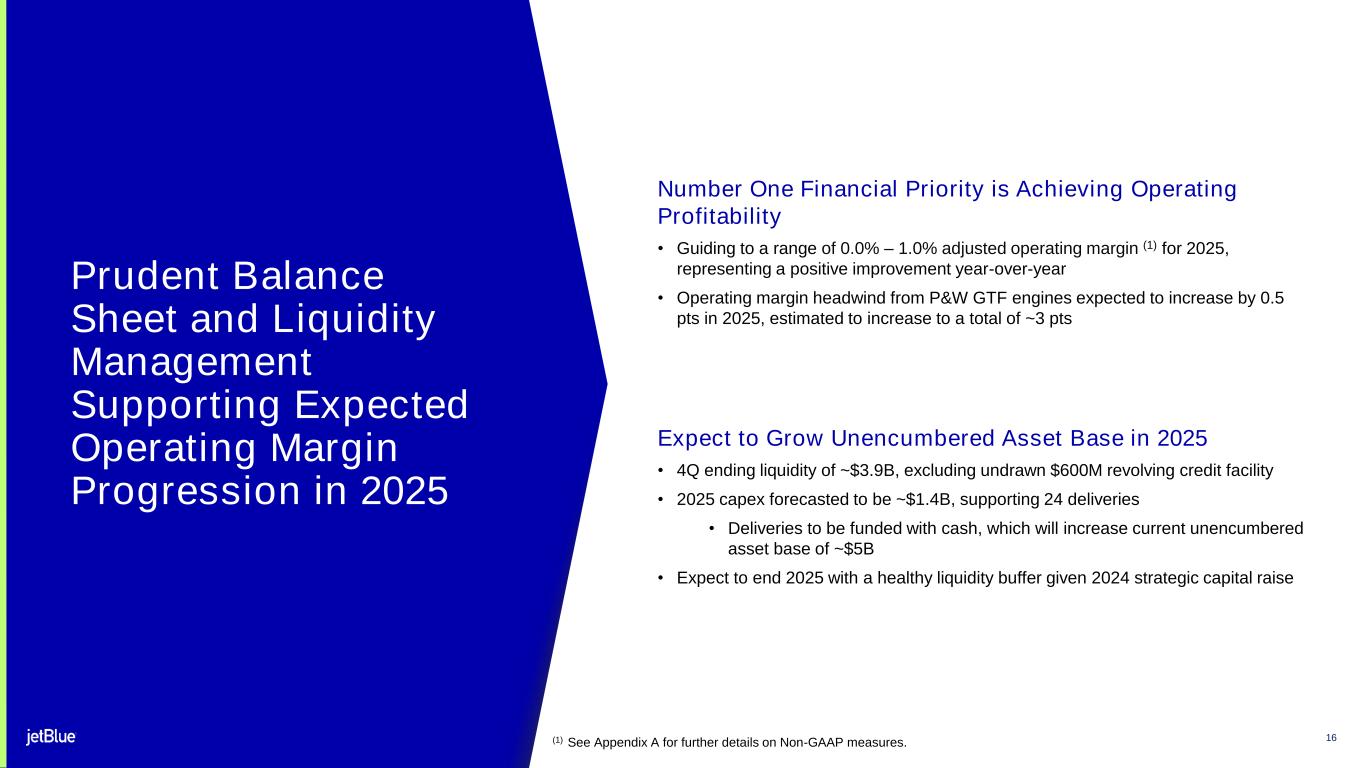
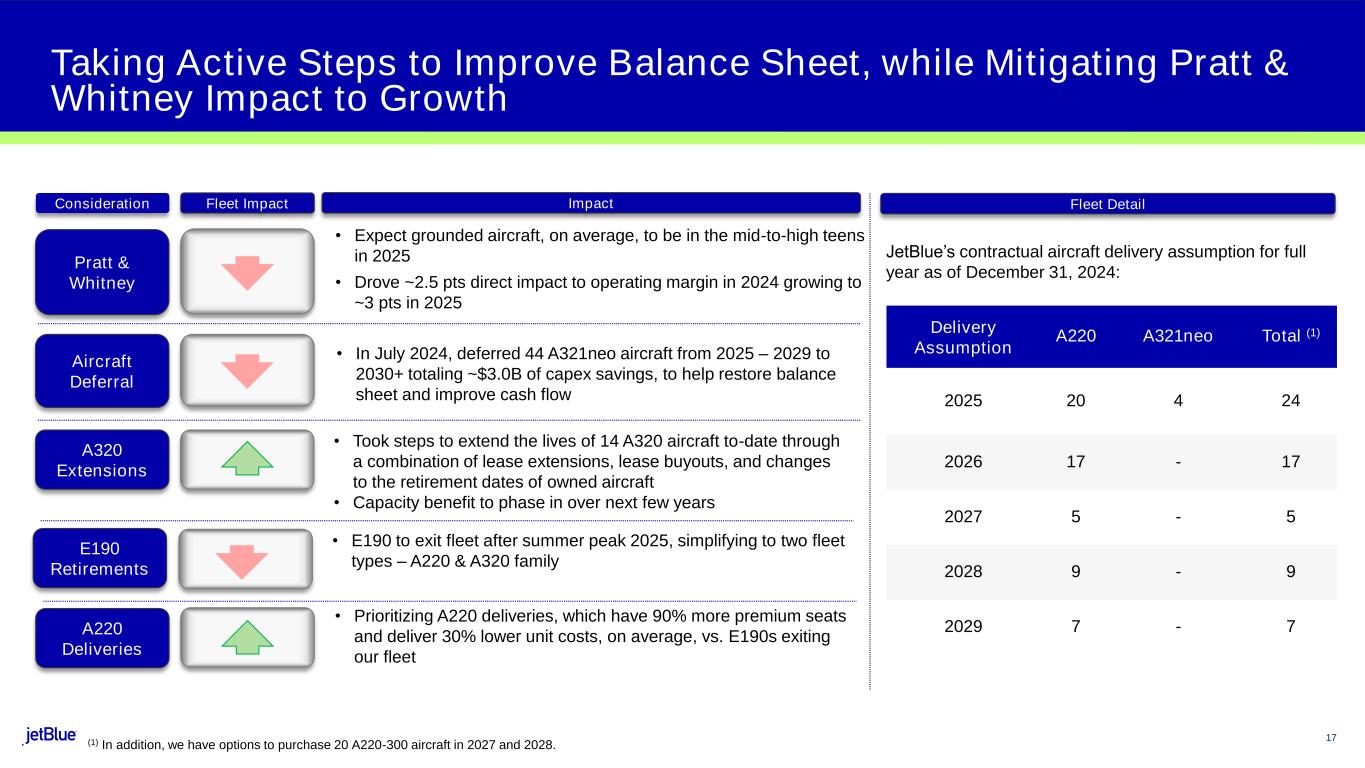
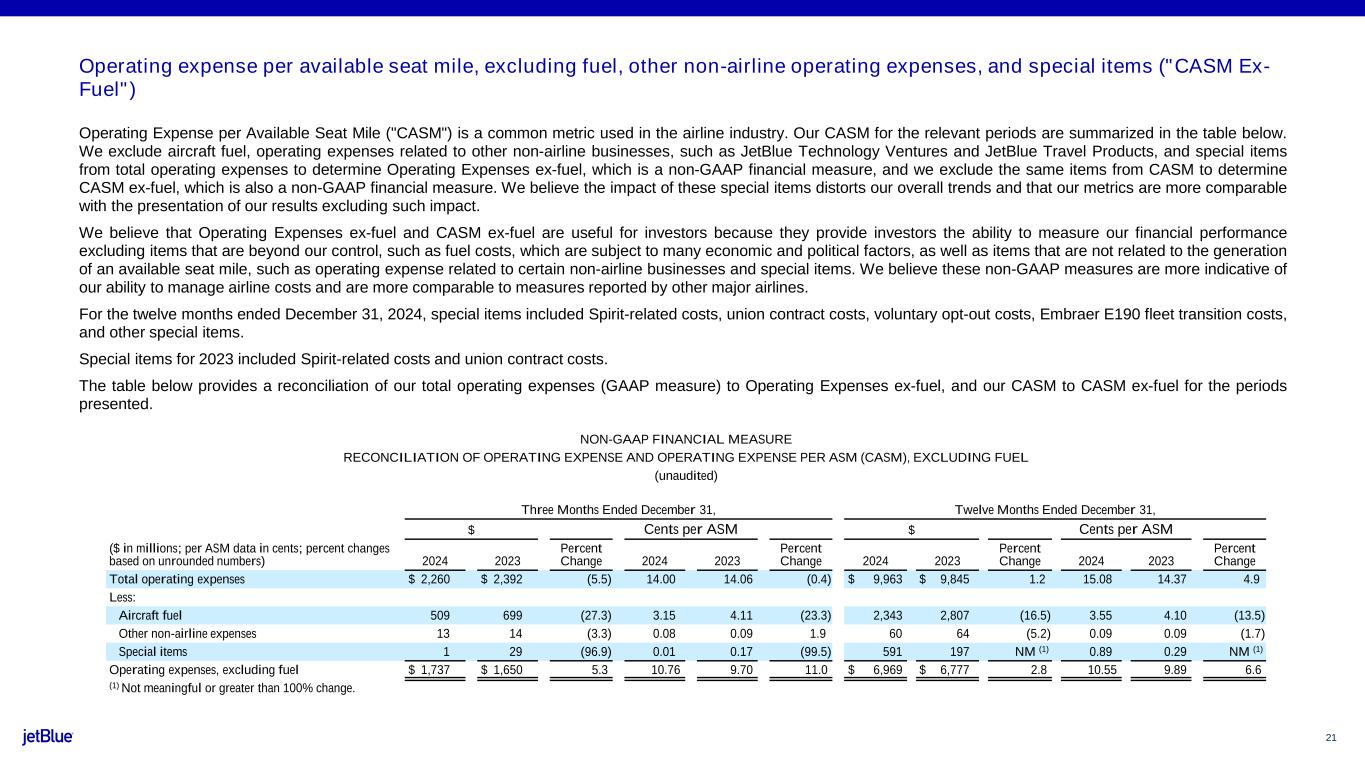
Thank you, Marty. In the early months of 2024, we refocused JetBlue on a path to profitability, which we have moved quickly to execute against. We exceeded our revenue initiative forecast of $300 million by $95 million, delivered on all of our commitments since launching JET Forward, concluded our structural cost program, delivering $190 million of benefit at the top end of our forecasted range, beat our ChASM-X fuel guidance four quarters in a row, and delivered full year 2024 ChASM-X fuel in line with our initial January guidance. Encouragingly, we ended the year delivering positive operating margins for the second half, a significant improvement from our July expectations. We also acted quickly to secure our financial future, deferring CapEx and raising over $3 billion of strategic financing, helping to provide JetForward the runway it needs to generate meaningful benefits. Our new leadership team delivered on our refocused commitments in 2024, and we aim to do the same in 2025. Now, turning to slide 14. For the full year, 2024 Chasm X fuel grew 6.6% year-over-year, firmly within our initial guidance of up mid to high single digits year-over-year. Through the combined benefits of controllable cost reductions, as well as reliability-driven cost efficiencies, we were able to offset about one point of headwind from the Pratt & Whitney compensation accounting change and a half a point of headwind from targeted capacity reductions in the second half. For the fourth quarter, unit costs increased 11%, which beat our revised guidance of 12.5 to 14 and a half percent driven again by operational efficiency controllable cost reductions and year-end adjustments with our performance over the year and in the fourth quarter we have sustained momentum on controllable costs heading into 2025 looking to this year we expect aircraft on the ground from the GTF engine issue to rise to the mid to high teens resulting in flat capacity and chasm chasm X fuel up five to seven percent and with the strong with the help of strong unit revenue growth we are forecasting positive operating margin in 2025 in line with the goal we first stated back in July as Joanna mentioned. The AOGs represented a significant headwind to our operating margin performance in 2024 and we estimate that impact will increase to about three points of drag to operating margin in 2025. We've broken down this impact on slide 15 of the earnings presentation. The direct impact includes the variable profit and staffing efficiencies we lose by not flying all of our available aircraft and also the net cost from extending our a320 fleet it does not include the indirect impacts to jet blue such as impacts to our market share and gate utilization this situation is fluid but ultimately transitory and the margin headwind is expected to resolve as the grounded aircraft count begins to decrease, which is expected to occur in the next year or two. In the meantime, we plan to continue employing creative growth and cost optimization strategies to offset as much of the impact as possible. We expect CASM-X fuel growth to remain slightly elevated in the first quarter of 2025, driven by the strategic capacity reductions during the trough laughing against our 2024 pilot wage rate step up in the timing of maintenance as a result we anticipate casamex fuel to be up eight to ten percent in the first quarter over the course of the year casamex is expected to moderate down from first quarter levels In 2025, we expect to begin realizing benefits from the $175 million 2027 jet forward cost transformation target, with CAPTCHA weighted more to the back half of the year. Cost savings include technology-driven efficiencies in our operational and commercial functions, enhanced planning and sourcing strategies, and savings from a cost-functional fuel burn optimization effort. Turning to our balance sheet on slide 16, in 2025, our financial priorities remain the First and foremost, achieving sustained operating profitability is critical, which will set us on a path to generate free cash flow and pay down debt in the coming years. One of the first steps towards securing our financial future was our $3.2 billion strategic capital raise last August. We ended 2024 with $3.9 billion of total liquidity, excluding our undrawn $600 million revolving credit facility. The incremental liquidity is expected to fund all aircraft deliveries in 2025 with cash, adding to our existing unencumbered asset base of about 5 billion. Our CapEx forecast for 2025 is approximately 1.4 billion and 270 million for the first quarter. We anticipate ending 2025 with a healthy liquidity buffer. Turning to our fleet plan on page 17, which has a number of puts and takes this year. In 2025, we expect 24 deliveries, 20 A220s, and four A321 NEOs. We've also been working to extend the lives of our A320 fleet, and thus far, we've taken steps to extend 14 aircraft through a combination of lease extensions, lease buyouts, and changes to the retirement dates of owned aircraft. The capacity benefits from these actions are expected to phase in over several years. Finally, in 2025, we plan to retire the remaining E-190 aircraft after the summer peak, fully replacing them with the more fuel-efficient and customer-friendly A220s. In closing, the culmination of our efforts from 2024 into 2025 is expected to result in positive operating margin for the year, a big milestone for JetBlue, and a commitment we made in July. By the end of 2025, we are forecasting nearly $300 million of total incremental EBIT generated from our JetForward program, growing to $800 to $900 million by the end of 2027. One constant in our industry is that it never stands still, and we know we can't control every change or challenge. However, with JetForward, JetBlue is relentlessly focused on outpacing our challenges and hitting our commitments for our shareholders, crew members, and customers. Thank you, and we will now open it up to questions. Over to you, Krista.
Operator
Thank you. If you would like to ask a question, please press star one on your telephone keypad to raise your hand and join the queue. And if you would like to withdraw that question, again, press star one. We do ask that you limit yourself to one question and one follow up. And for any additional questions, please requeue. Your first question comes from the line of Jamie Baker with JP Morgan. Please go ahead.
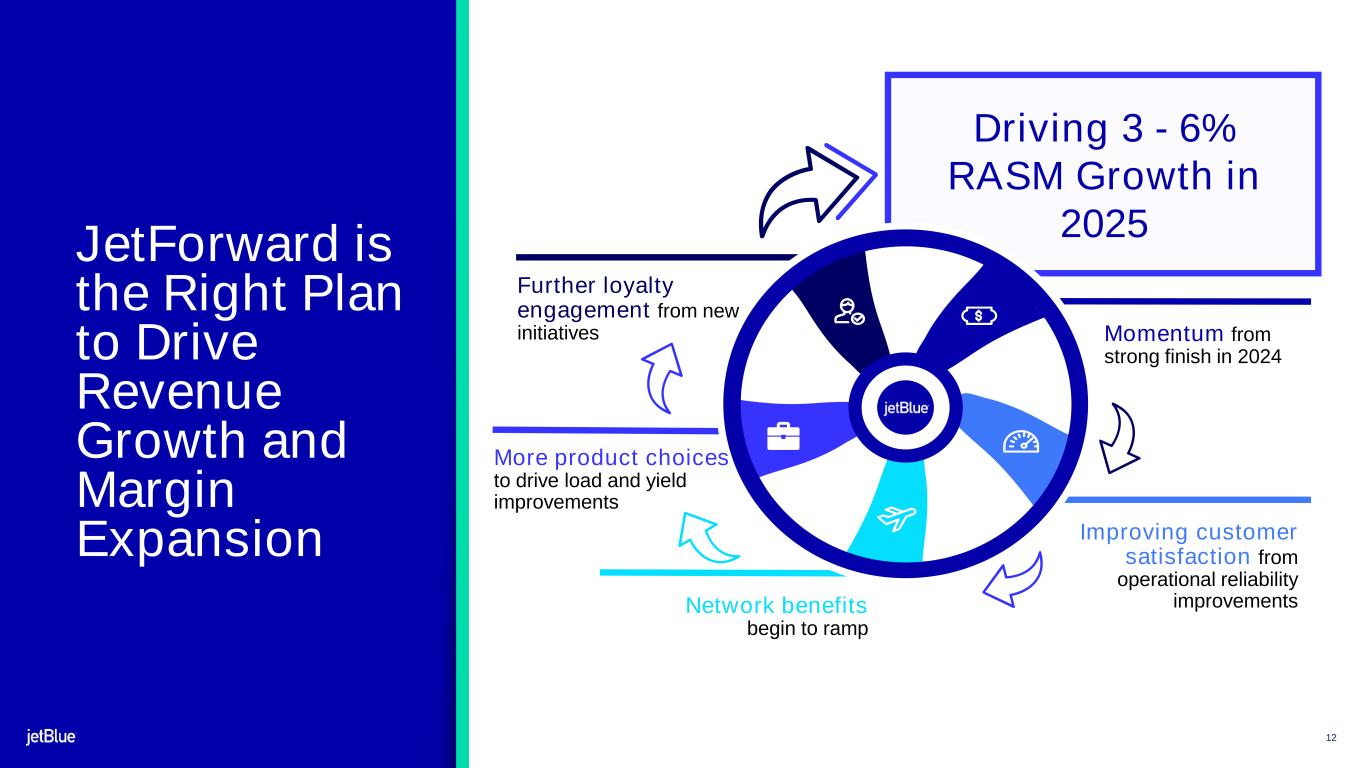
Oh, hey, good morning, everybody. Probably a couple for Marty. So, if we look at the implied revenue guide in the first quarter and compare it to the full year guide, it's clear that you're modeling for, you know, several points of acceleration. You know, basically slide 12 is what I'm referencing. But how should we think about each of those buckets of improvement? So, for example, let's just pick a round number you're modeling for five points of revenue acceleration. How much of that is rising tide? How much is idiosyncratic to Jet Forward? Maybe there's some corporate in there. You did call out the Easter shift. Yeah, that's my first question.
Sure. Thanks, Jamie. Thanks for the question. Well, obviously, the first easy chunk is Easter because it's a point-and-a-half move from first quarter to second quarter. And frankly, the rest of the improvement is basically the continued implementation of Jet Forward and the continued phasing of the benefits from all the things that we promised already and started delivering. There was no assumption in here about a dramatic change in competitive capacity. This is basically us managing what we can manage ourselves and delivering on all those commitments. So there's no sort of exogenous factor that's driving the numbers we're seeing. It's basically our forecast of the baseline JetBlue and putting on top of that all the things that we're doing. Obviously, we look at the normal factors, you know, GDP, CPI, competitive capacity, things like that. But we're not expecting any direction change from sort of consensus numbers out there right now.
And then as a follow-up to that, Marty, just looking at forward schedules, you know, you've got some double-digit growth going on in Boston. You called out two international markets. But, you know, relative to that full-year revenue aspiration, is it fair to characterize Boston as a likely RASM drag? And if so, could you quantify that?
I mean, obviously, with the growth that it's getting, you know, I say RASM growth in Boston is less than we're seeing elsewhere. I think that's a mathematical question more than anything else. I would say we're still not back to the peak we were in Boston pre-NEA. And frankly, you know, I think what we realized in the entire Northeast, and I think what was one of the things we talked about during the communication of the Jet Forward Plan, is that, you know, we had basically given up a lot of leisure lift when we moved airplanes from Northeast Leisure into basically LaGuardia to cover, you know, business, business bankruptcy and the NEA. So we finally finished unwinding LaGuardia growth in 2024, and those ASMs are being now redeployed back into where they originally were, which was Northeast Asia.
Okay. Very helpful. Thanks for taking my questions, Marty. Take care. Thank you.
Operator
Your next question comes from the line of Daniel McKenzie with Seaport Global. Please go ahead.
Oh, hey. Good morning, guys. Thanks for the time. So setting aside today's stock price, you know, it looks like you are, you know, giving us the first, kind of giving us your, you know, how you're thinking about normalized earnings longer term. So giving us the first pieces, sorry.
So if we could just, if all goes according to plan, you know, should investors simply add $650 million to their 2025 EBIT outlook to get to some semblance of normalized earnings if they want to discount back to the day? today yeah thanks dan appreciate the question i think maybe just pulling up a notch i'm really proud of the team and the momentum that they're delivering under jet forward you know we announced it back in july and have consistently met all of our guidance metrics were outperformed in many cases as you think about this year we should end this year with 200 to 300 of ebit and you should think of 26 and 27 as similar amounts so as we look at exiting jet forward at the commitment to 800 900 million of EBIT that obviously sits on top of a constructive macro backdrop and we're cycling against some of the Pratt headwinds so yeah you're thinking about it absolutely in in the right way you know I think frustratingly you know we would love to have you know I think even faster faster ramp but this is a multi-year strategy and it's not linear and we're focused on the long term here and getting JetBlue back to back to sustained profitability. So it's just going to take a little time but really really pleased with the progress so far. You know the implied guide when we launched JetForward for full year 24 was four and a half, negative four and a half op margin. We ended the year with negative one so a three and a half point improvement.
This year we're meeting our commitment to go out with a breaking better op margin and you know that'll that'll be a five point improvement since we launched jet forward so I think really good progress there and just continuing to focus on executing for the long term understood terrific and then Ursula second question on unit cost chasm X the chasm X cadence in particular I'm you know wondering how that trends throughout the year and you You know, can we, you know, does it imply as we exit 2025, some chasm x directionally as we head into 2026? Or is there some perspective you can share on Pratt & Whitney groundings that could potentially impact that?
Yeah. Good morning, Dan. Thanks for the question. So, I'm really proud of the team delivering on 2024 controllable costs guide that we laid out last January, despite Pratt & Whitney headwinds and also some capacity that we pulled down in the trough. Here in 2025, we're delivering exactly what we've been telling you guys. With roughly flat capacity, expecting a mid-single-digit unit cost growth, Q1 is very elevated. It's the most elevated throughout the whole year. That's really driven by timing of maintenance, as well as the pilot wage rate step up that we executed last August. So CASMX will come down in the quarters to come and I have a lot of confidence the team will deliver on the five to seven percent full year guide. As we look beyond 2025, the Pratt & Whitney scenario does continue to be really fluid. I do think that we will hit the peak AOG within the next one to two years. I mentioned that in my prepared remarks. You know, if we sit here in 2026 with a roughly flat capacity number, for example, I would yet again expect that mid-single-digit range in terms of controllable costs. You know, we do continue to see inflationary pressures, but with the launch of our new cost transformation program as part of Jet Forward, that is to offset the inflationary pressures.
Thanks so much for the time, you guys.
Operator
Your next question comes from the line of Duane Fenningworth with Evercore ISI. Please go ahead.
Hey, thank you. So just to follow up on Dan's question, one of the questions we're getting earlier this year is that bridge from the March quarter cost outlook to the rest of the year and 2Q specifically. So I wondered if you had any early thoughts on, you know, the shape of 2Q chasm relative to the first quarter.
Yeah, thanks for the question, Duane. As I said, you know q1 is the most um elevated um i do expect um you know there to be a step down as we head into the second quarter um you know we're not guiding here today but i would expect a different capacity layout as well which you can probably tell from the forward schedules that are already posted so i do envision us being you know in a positive slightly positive um capacity environment, which should also help support the step-down in Q2. As a reminder, the pilot wage rate step-up we granted last August, so that doesn't last until we hit August. So Q2, we'll see a headwind associated with that as well.
Got it. And then just, Marty, can you expand a little bit on what you're seeing in Caribbean and Latin and maybe taking Easter Shift off the table? You know, what sort of improvement are you seeing there and, you know, relative to the rest of the system and maybe just talking sequentially, you know, 4Q to 1Q or 4Q to 1Q adjusted for Easter Shift? Thanks for taking the questions.
Sure, Dwayne, thanks. I'd say Consistent with what we've heard about fourth quarter results and first quarter outlook, international is a strong point for us. Latin has actually fully recovered from what we had seen at the beginning of 2024, and Latin's actually been strong for us. A little bit of pressure in San Juan that's mostly capacity driven, but we're maintaining our customer base there very well. And also, Transatlantic has done very well. So, again, I think this is what we've heard. International is a strong point. I'd say on a relative basis, you know, international is, the transatlantic is really not big for us at all, enough to move the needle. And San Juan is a relatively big part of Latin. So, overall, I think the fundamental demand profile for Latin is very strong right now.
Operator
Your next question comes from the line of Tom Fitzgerald with TD Cowan. Please go ahead.
Thanks so much. Would you mind just touching on the competitive capacity in Fort Lauderdale, what you're seeing there?
Yeah, I mean, it's funny. When we had gone through the process of spare bankruptcy, there were a lot of conversations at the time about opportunities it may represent in Fort Lauderdale. I think if you look at the reorganization plan, they've put a stake in the ground that Lauderdale is important to them. And frankly, it's exactly what we had expected, because a lot of those were important to us, too. Overall, competitive capacity is still down in Fort Lauderdale. So we're actually in a very good environment, but I don't think we're expecting any significant pulldown from Spirit down there. And frankly, we're very happy with our Fort Lauderdale performing right now.
Okay, that's really helpful. And then I'd love to get your perspective on non-aircraft CapEx and in-flight entertainment, Wi-Fi, your mobile apps, just given kind of the arms race across the industry and making investments there.
Just kind of curious how you're thinking like the the size of investments you're thinking and any focus areas um what's your thoughts thanks again for the time yeah hey tom thanks it's joanna um i can let earth touch on the um the uh the capex question in general but from a wi-fi perspective um you know we've got a fully outfitted fleet of wi-fi vice that's the partner and it's free and we've had that for 10 years and we're the only carrier that can make that claim um and we continue to be very pleased with how that Wi-Fi relative to the competition is performing. We're obviously keeping a close eye on customer preference and the other opportunities that are out there, and we'll continue to make sure that we stay very competitive in this space. Maybe Urs, on just the CapEx?
So maybe just some color on the CapEx. So we had $1.6 billion in CapEx in 2024, so we're actually stepping down in 2025. So the guide is $1.4 billion. About 85% of that $1.4 billion is associated with aircraft. So not only do we have the 24 deliveries, but we also are investing in extending the A320s. And we're also investing in the ramp-up of domestic first class. So that's all embedded in the guide. The remaining 15%, you know, percent of the capex is associated with non-aircraft. So, Tom, to your point, you know, think technology, think airports, ground equipment, those are where those dollars are going.
Operator
Your next question comes from the line of Scott Group with Wolf Research. Please go ahead.
Hey, thanks. Good morning. I just want to make sure I heard right. is it that with the GTF issue that aircraft on the ground goes up in 26 and then potentially up again in 27? Is that right? And then any idea like when this is fully behind us as an issue?
Yeah. So thanks for the question, Scott. We tried to give you guys some color just on how burdensome that this is to JetBlue financially with which we've highlighted all the math on slide 15. As a reminder, we had 11 aircraft on the ground in 2024. In the guide that we're providing for 2025 today, we have mid to high teens. And as I mentioned in my prepared remarks, we believe we are likely approaching the peak in the next year or two. So we continue to work constructively with Pratt & Whitney to gain further color, quite frankly, on 26th and beyond. Obviously, there are a lot of inputs that can materially impact the number of aircraft that we have on the ground, everything from Pratt & Whitney's supply chain to their shop capacity. So, you know, it does continue to remain pretty fluid. But the next year or two, we believe that we'll be approaching the peak.
Okay. And then I'm guessing you can't say too much because you haven't announced anything yet, but any thoughts on timing for an NEA replacement and just is that part of Jet Forward or would that be incremental Jet Forward? Just how do you think about NEA?
Thanks for the question. So we're having conversations with a number of carriers right now to discuss the potential for future partnership. The judge in Massachusetts obviously laid out a framework that would be acceptable under at least the prior administration. So, you know, that's what we're looking at, but there's nothing to announce now. In terms of what's in Jet Forward, there's a very small amount of money associated with potential partnership, but nothing in a very meaningful way.
Thank you, guys. Appreciate it.
Operator
Your next question comes from the line of Michael Linenberg with Deutsche Bank. Please go ahead.
Oh, yeah. Hey, good morning. Marty, you withdrew from 15 cities, you redeployed 20% of your capacity. How have you seen the mix change, corporate versus discretionary as a result of those changes? And has there been a meaningful change to the booking curve, given the fact that now maybe a large percentage or a greater percentage of your customers are now booking further out. Can you just talk about some of the dynamics around your mix and maybe how you sell the product?
Hey, Mike. Thanks for the question. First thing I'll say is on a macro level, it is getting tougher and tougher to do business leisure mix post-COVID because we have the great mix of leisure in the middle who are customers who say they're on business. They pick it like they're on leisure more so. So it's less clear than it once was. What I will say is we've seen no significant change to the business mix that we have. And frankly, I think that's part of the reason why the cities that we've closed actually weren't working for us because we're carrying a lot of great leisure customers in places like Minneapolis, San Antonio, and we really weren't penetrating the business market. So we've seen no significant change to the booking curve or to the business leisure mix to that.
I think I'd just add as well, if you look at Q1 RASM, as a leisure carrier, we obviously experience a different sort of period given the trough that it is even when you adjust for that Easter shift. In the deck, we also have the slide that lays out the timing of the network announcements. And there was a number of really meaningful northeast changes made in the late October-November timeframe from a capacity standpoint. these are all an early ramp. And as I mentioned, you know, this isn't a linear plan and it's going to take some time for these markets to mature.
Great. And then just my second, you know, as we think about timing around first class, Ursula, I think I heard you that some of the capex this year is going to be tied to the installment of first class. Will JetBlue be in a position to start selling late 2025 first class or, you know, is that, you know, first quarter 2026 when you can and start selling the first-class product. Thanks for taking my questions.
Hey, Mike, I'll take that one. So there's some CapEx coming this year, which is basically the beginning of the process through seat design, certification, et cetera. But the first install is actually gonna be in 2026. So there'll be no revenue benefit to speak of in 2025. And by the way, that is exactly how it's laid out in the phasing of Jet Forward.
Great, thank you. your next question comes from the line of katherine o'brien with goldman sachs please go ahead hey good morning everyone um just wanted to follow up on some of the corporate commentary you know we've been hearing that corporate trends are seeing a bit of a pickup again this fall you know one of your competitors know that tuesdays wednesdays are looking better um i know you're focusing your network on your leisure dna but you know are you seeing any pickup out of new york Transcon or, you know, the traditionally more corporate-leaning flights like your New York to Boston flights, just any color there?
So what I'd say is, if you look at our corporate demand right now, the last two or three quarters, we've been sending records as far as the amount of money we're getting from our corporate accounts. That being the case, corporate is still a really small part of JetBlue's revenue base. So, you know, we're talking, you know, nine-digit number, and a low nine-digit number. So it's not a gigantic number. We are seeing great numbers, but I think, again, looking at our network and looking at where we fly and I think looking at our frequencies, you know, with the network as it exists, you know, we don't see ourselves as being a big corporate carrier. And I don't think it's been big enough for us to know a significant difference on Tuesdays and Wednesdays.
Got it. And then maybe just, Ursula, if you don't mind, one more on the GTF. I just want to confirm, I don't think you're begging in any kind of compensation from Pratt into your outlook. But, you know, when do you think you'll reach a settlement on those 2024, you know, damages or however you want to put it? And what form does that take? You know, is it going to be something we're going to be able to notice on the cash flow statement?
And then, you know, I know you've already filled with a couple of questions on this, but, and I don't want to get too myopic, but when you're saying one to two years from now on the peak, does that imply the peak is sometime, you know, January 28th, 2026 or later, just any color on on the gtf questions there would be really helpful thanks yeah morning Katie so the the situation with Pratt and Whitney continues to be pretty fluid and obviously as we've highlighted today it's a very material impact to our business so and the settlement negotiations are taking a while quite frankly, because of the materiality to the business, we want to ensure that we settle with something that is fair and acceptable. So I don't have any timing on that. It's a work in progress. In regards to your last question, just about the peak, I mean, when I say within the next year or two, I mean, that means that we hit peak, quite frankly, you know, between now and 2027. And so, you know, again, we work consistently and fluidly with PRAT, and so there are things that could accelerate this, and so we're watching it very closely.
Thanks. Totally appreciate the moving target.
Operator
Your next question comes from the line of Ravi Shanker with Morgan Stanley. Please go ahead.
Some of your mainline peers obviously highlighted strength in transatlantic demand in the first quarter, which, as you pointed out, is a seasonally weak period. Can you talk about what you guys are seeing there and potential for upside through the summer as well?
Sure. Thanks, Ravi. I'd say, first of all, the Atlantic is still on ramp for us. We added new cities in 24. We've announced new cities for 25, new routes for 25. So I think I look at our growth in the Atlantic as partially being strengthened and partially being ramped. So I don't want to get too aggressive as far as how we describe it. Most important thing for us is continued growth of yield and mint cabin. If you look at the configuration of the airplanes, we are very heavily mint focused. It is absolutely a fantastic product. I really think it's the best product across the Atlantic. And from that perspective, that's where we like to see the growth, and we're really seeing great growth as far as mint yield. So we're very optimistic about the results as the network exists right now. I'll also say that we deferred almost all of our 321 deliveries, Transatlantic 321 deliveries, since the 2030. So I'd say more or less roughly what you see is what you get right now. We'll continue to tweak that network and continue to move planes between the Atlantic and domestic summer to winter. But we're really happy with the choice to fly there. We're happy with our results, and we think it's going to be a nice profit source for us.
Got it. Great. Thanks for the color. And maybe as a follow-up, I just want to confirm the $95 million outperformance in revenue capture initiatives for 2024, is that all just pulled forward from future periods, which obviously is also very impressive? Or are you seeing pockets of potential strength or upside, which may end up even upsizing the target over time?
So as far as how we look at it right now, it does look all to be moved forward. A lot of us keep watching that going forward, but we've got pretty good visibility as far as things like preferred seating and the Blue Basic, and it does look like moved forward. I'm not saying at some point that won't grow, and hopefully as we grow, we'll see that grow in general, but fundamentally, we're very excited that this has come forward as it has. And frankly, I'm optimistic about all the initiatives in JetForward, not just the ones that we've already launched in 2024. So we're actually very excited. Again, with even more just launching today. So we're actually very excited about that.
Operator
Your next question comes from the line of Asavi Scythe with Raymond James. Please go ahead.
Hey, good morning. Marty, can I ask, you mentioned, you know, pressure in the northeast and Florida, but I think to Tom's question, you also kind of noted Florida capacity is down year-over-year at competitive capacity, and it seems like that's the case in Orlando too. I was wondering if you could provide a little bit more color, you know, in which cities or routes you're seeing kind of competitive pressures that you called out in, like, the northeast and Florida.
I'm not going to give a lot of color on that. I mean, clearly, from a competitive capacity perspective, the most competitive capacity pressure has been in Boston. But, you know, in general, I'm not sure, you know, yes, in Waterdale and in Orlando, the trends are actually good. I think some of the other cities, Palm Beach, Tampa, are not as good. but I don't look at any of them as really sticking out significantly other than Boston.
That's helpful. Thank you. And just on the kind of fleet plan, Ursula, it looks like some of the A220s that you thought might come in 2026 are shifted out. I was curious what kind of drove that.
And just on that investment question, is the investment in premium products on the CapEx meaningful or is that just just part of the kind of aircraft and not really meaningful yeah good morning sabi um you know the aircraft order books have been really fluid with delays and such so we just adjusted our delivery schedule to reflect the most recent timing information um from the airbus so to your point there were a few puts and takes um between 25 I will mention as you look at the overarching JetBlue aircraft order book, you know, we've talked a lot about Pratt & Whitney today and within the next one to two years, hitting the peak AOG. And I do just want to remind everyone at some point, this situation will become a tailwind and we will get airplanes back. And as you look at our order book in 27 and beyond, it actually lines up pretty well in terms of when we think we're going to get aircraft back due to the AOG issue. In regards to your last question around CapEx, you know, the investment into domestic first class, you know, that investment is going to be approximately $400 million over the next few years, and a small portion of that is included in the 2025 guide, as Marty mentioned, just for the startup of the ramp of the program. But I do want to remind everyone, I mean, between the domestic first class as well as the A320 extensions, I mean, these are, you know, very accretive, ROI positive, and in a timely manner. So, I feel good about the investments that we're making.
Makes sense. Appreciate the call. Thank you.
Operator
Your next question comes from the line of Tom Waterwitz with UBS Financial. Please go ahead.
Yeah, good morning, and thanks for the question. I wanted to circle back a little bit to, I think, where Jamie kicked off the Q&A, just asking about RASM. You know, it seems to me that one of the big concerns is just your 1Q RASM outlook looks a fair bit weaker than the industry. Marty, what's the framework? Would you expect, like, 2Q or second half for the RASM performance for JetBlue to kind of get back in line with what we see for the broader industry, or how do you think about the framework for that to be the case?
Well, Tom, thanks for the question. So first, let's talk about the sequential numbers that we're flashing right now. Again, we're very happy with the fourth quarter over performance, and we talked about that being very focused on really good results in the peak. As you sequence into first quarter, if you look at the historical trend of fourth quarter, the first quarter ransom, and you go, we've got 12 years' worth of this data, we're actually above that normal trending. So what we're producing in first quarter of 25 is actually higher than you would normally see for that time period. And I attribute a lot of that to Jet Forward. I will say versus the rest of the industry, we do face a competitive capacity headwind. I think if you look at the big four, they're all facing competitive capacity numbers that are under 1%, some of them like 0.3, 0.4%. United is actually negative. Our competitive capacity number is 3%. So, I think looking at the headwinds that we're seeing in first quarter, I feel great about where we stand as far as RASM, given all the things working against us, and I give a lot of credit on that to Jeff Ford, the issues we've laid out already. With respect to the improvements across the rest of the year, obviously the headwind we get in first quarter from Easter comes right back as a tailwind in second quarter. So that point-and-a-half bad guy in the first will come back as a point-and-a-half good guy in the second. And I think I want to be clear as we go through the year, we're not making any big assumption about competitive capacity coming down. There's no, back to the point I said to Jamie in the very beginning, there's no sort of a secret assumption that competitive capacity goes back down to 1% or 0.5%. I think the industry's at 0.4% right now. We're basically looking at the industry as it stands right now. A lot of this is just execution of the plan as we've laid it out. And I think what we've seen so far as far as the ramping of Jet Forward, how we've seen the network changes take. And I think we were especially happy with what happened in the fourth quarter with places like Islip where, you know, with the demand we were able to drive during the peak in the market. Islip's a market that was 25 years served by one of our big competitors to Florida and had success there very, very quickly, especially in the peaks. So I feel very bullish about Jet Forward as it goes forward. I just want to stress there's no – there are no numbers games as far as, you know, know, we need some sort of a big industry change to get the three to six. That is core stuff we can control.
Okay. Yeah, great. Thanks. And for the follow-up question, just wanted to ask about how we think about the kind of key levers and potential timing to get to a free cash break even. You know, it would seem like this year, potentially next year, you'd still be looking at a fairly significant use of cash.
So, I wanted to see if you could kind of multi-year offer any thoughts about is that more so driven by a capex reduction that might come in 26 27 or is it just a matter of kind of keep going on jet forward and get the operating margin up thank you thanks for the question tom um so we executed an aircraft deferral last year um it pays the way um for us to execute on Jet Forward and get the business healthy again and get us to consistent profitability, which is the number one priority. Number two is then getting the free cash flow positive. And I do feel like with the deferral and the way the order book lays out and just with the expected progression of Jet Forward, there is a means to get to positive free cash flow within the timing of the Jet Forward program. Priority number three will then be to start delevering the balance sheet. So make no mistake, we don't like where our metrics lie today, and we want to get back down to more competitive, reasonable balance sheet metrics. But we've got to continue executing on Jet Forward, get to consistent profitability before we can talk about taking steps to delever the balance sheet. Great.
Operator
Your next question comes from the line of Steve Trent with Citi. Please go ahead.
Good morning, everybody, and thanks very much for taking my questions. If I could follow up on the alliance question, I think Scott maybe asked earlier. Great color on what you said for how you're thinking about the U.S., But what about, you know, potential alliances overseas, sort of existing ones that are in place and maybe any new opportunities given, you know, some of the Latin American airlines today are going through, you know, some gyrations?
Hi, Steve. Thanks for the question. Well, first, I guess worth mentioning, we have 52, either 52 or 53 alliance partners across the world, including a lot of international carriers. I think we're especially lucky that New York is a very, very important gateway for international carriers, and we provide a lot of connecting lists there. So if you're not aligned with one of the other airlines there, we're a great partner as far as getting access to the interior U.S., where the fares tend to be higher. And we continue to grow that portfolio even as we negotiate with domestic carriers. We just added British Airways in, I think, the third quarter of this year, a limited partnership that's actually continued to grow. I think there's opportunities there. We're certainly not taking your eye off the ball on that type of partnership while we work on what might make sense for us on a domestic partnership.
Okay, I appreciate it, Marty. And for my follow-up, I recall you guys are offering some early exits for some of your older pilots. I'm guessing this is kind of a fairly small piece of the pie in terms of your labor costs and there would not be, you know, a significant cash event on the back of these packages that you'd offer. Thank you.
No, thanks. Obviously, looking forward to offering some early retirements from our pilots. I think it's a win-win for Jeff Liu and for some of our pilots who are ready to pursue something after they retire. So it's, you know, continues to be focus on how do we manage some of our elevated labor costs in a world where we have as many are prepped on the ground that we have right now with the Pratt & Whitney issue.
And there will be no major cash outflow, not material.
Operator
And ladies and gentlemen, that does conclude our question and answer session. And I will now turn the call over to Joanna for closing comments.
Thanks for joining us today. Very happy to answer your questions. You know, when we launched Jet Forward in July, we came out with a commitment to a 2025 year where we were break-even or better from an operating margin perspective, and I'm so pleased that the team is maintaining those commitments that we set out to do. We've got great momentum, really great progress on reliability, beat costs every quarter in 2024 last year, and since launching Jet Forward, we've outperformed on our revenue guidance as well. This is a multi-year strategy. it is not linear. And many of these programs start ramping in 2025, whether that's even more, which launched today, the Premier Card, which is launching at the end of the month, or even our domestic first class, which launches next year. So we have a lot happening, and there'll be a number of puts and takes through the quarter. So our focus is on the long term. Our focus is on hitting that annual expectation of break even or better, and we are off to a promising start. If you look at the midpoint of our 25 guide of a half a point, you can expect another five to six points of margin from Jet Forward in 26 and 27. And then we've got the Pratt and Whitney headwind of three points, which will become a tailwind as we cycle through that particular situation. So all in all, when you look at Jet Forward, a couple with Pratt and Whitney, you should expect nine points of operating margin improvement from 2025 on. So I'm pleased with the program and how we're executing to it and keeping our eye on the ball, which is the annual guide of break-even or better for operating margin. Thanks for your time today and we look forward to talking with you on the next call.
Operator
Ladies and gentlemen, this does conclude today's conference call. Thank you for your participation and you may now disconnect.