Operator
Ladies and gentlemen, good morning. My name is Abby, and I would like to welcome everyone to the JetBlue Airways second quarter 2025 earnings conference call. As a reminder, today's call is being recorded. At this time, all participants are in a listen-only mode. I would now like to turn the call over to JetBlue's Director of Investor Relations, Koush Patel. Please go ahead, sir.
Thanks, Abby. Good morning, everyone, and thanks for joining us for our second quarter 2025 This morning we issued our earnings release and a presentation that we will reference during this call. All of those documents are available at our website at investor.jetblue.com and on the SEC's website at www.sec.gov. In New York to discuss our results are Joanna Garrity, our Chief Executive Officer, Marty St. George, our President, and Ursula Hurley, our Chief Financial Officer. During today's call, we'll make forward-looking statements within the meaning of the safe harbor provisions of the private securities litigation reform act of 1995 such forward looking statements include without limitation statements regarding our third quarter and full year 2025 financial outlook and our future results of operations and financial position including long-term financial targets industry and market trends expectations with respect to tailwinds and headwinds our ability to achieve operational and financial targets our business strategy and plans for future operations and the associated impacts on our businesses. All such forward-looking statements are subject to risks and uncertainties and actual results may differ materially from those expressed or implied in these statements. Please refer to our most recent earnings release as well as our fiscal year 2024 10K and other filings for a more detailed discussion of the risks and uncertainties that could cause the actual results to differ materially from those contained in our forward-looking statements. The statements made during this call are made only as of the date of the call, and other than as may be required by law, we undertake no obligation to update the information. Investors should not place undue reliance on these forward-looking statements. Also, during the course of our call, we may reference certain non-GAAP financial measures for an explanation of these non-GAAP measures and the reconciliation of the corresponding and GAAP measures. Please refer to our earnings release, a copy of which is available on our website and on sec.gov. And now, I'd like to turn the call over to Joanna Garrity, JetBlue's CEO.
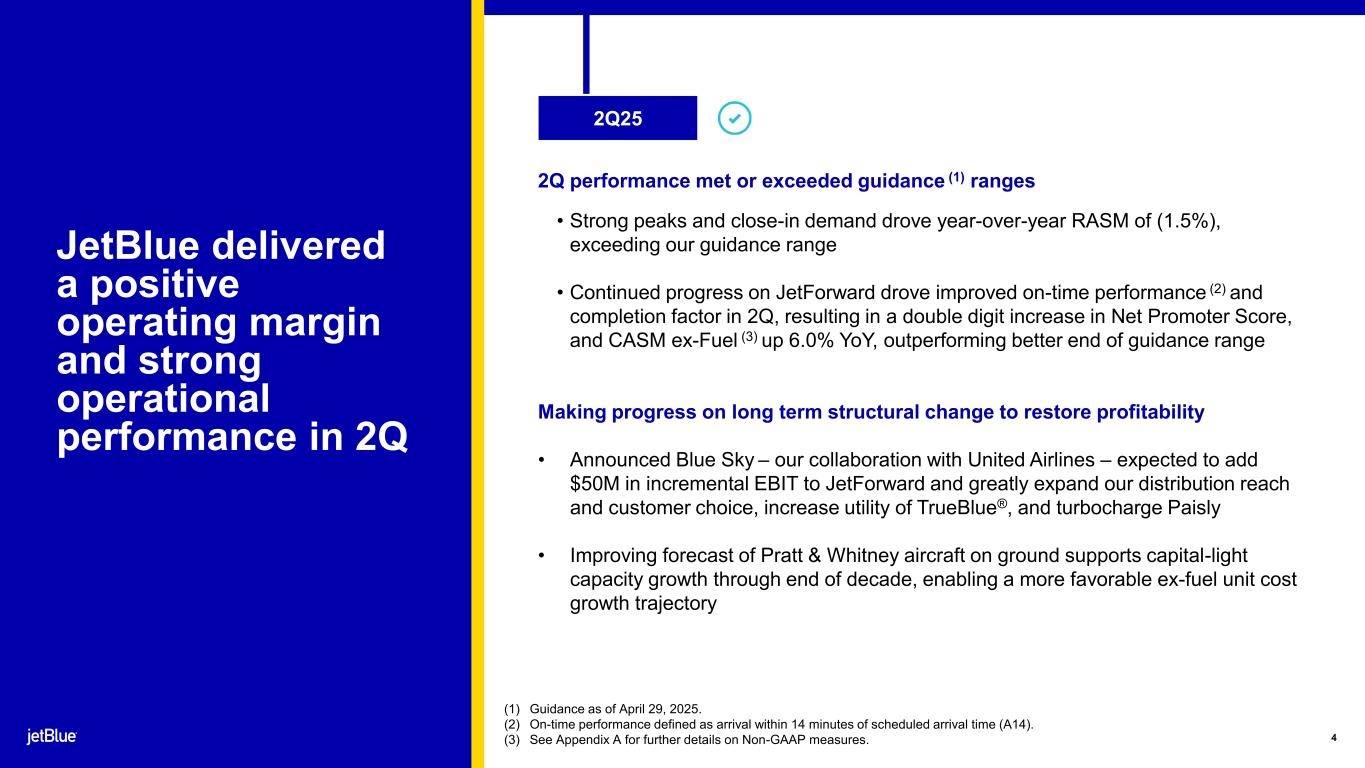
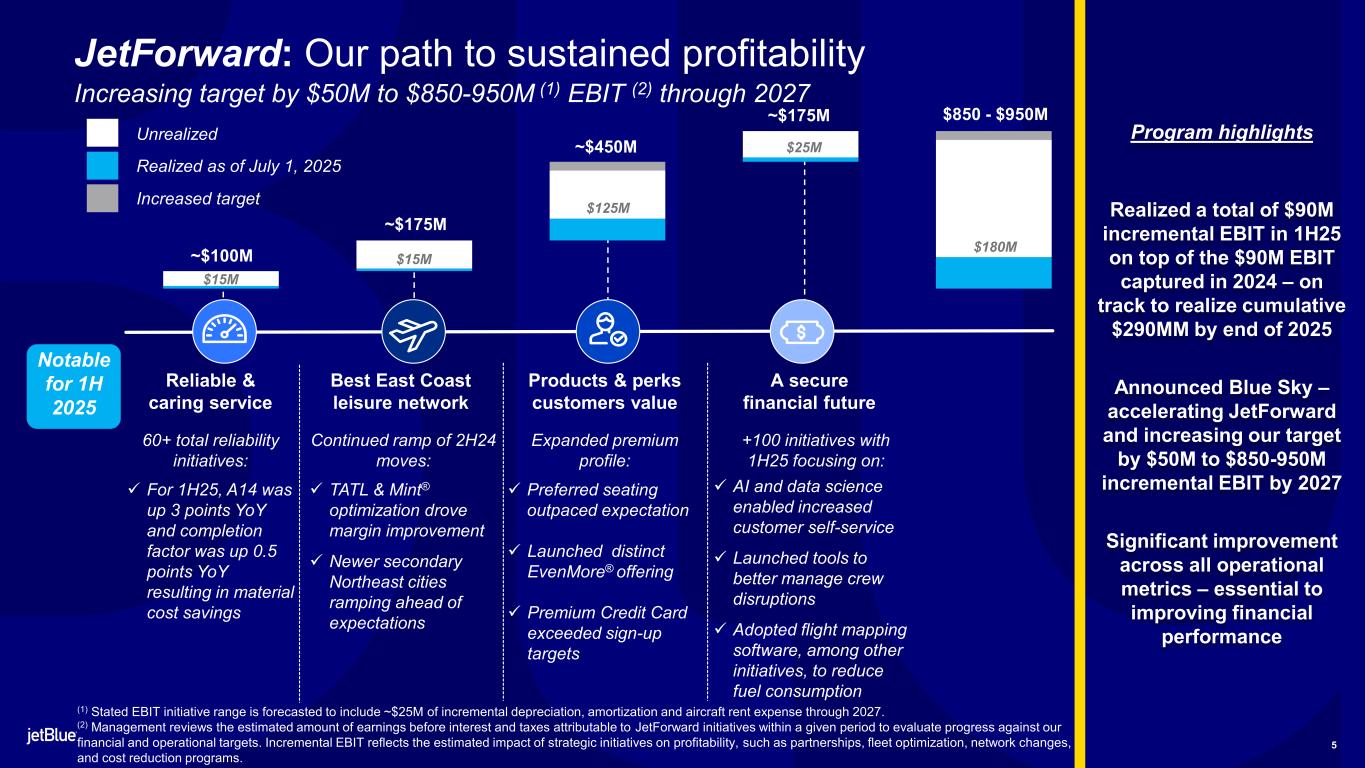
Good morning, and thank you for joining JetBlue's second quarter. We made meaningful progress with JetBlue's significant gains. I want to take a moment to thank our crew members. These results are as we entered the second quarter, demand stabilized, and then accelerated as the quarter progressed this resulted in a higher in may we marked another jet forward milestone introducing blue sky our collaboration with united airlines and we are now able secretary duffy the entire team as a reminder this is a traditional interline agreement opportunity to earn and redeem will united will also transition its distribution of non-flake and its relieving products and server collaboration is including the benefit from blue sky we are increasing our target for jet forward 50 million marty will share more details on the individual drivers but we are excited that blue sky will build on the tremendous progress we've made today due to the practice and we now expect to cycle through grounding my forecast enables us through the end of the decade certain we anticipated and enhancements in the first half of 2025 we've continued building on that momentum realizing an additional 90 million in ebit across 180 180 million even to 209 our efforts to drive a more reliable operation part of our reliable and carrying significant operational improvements year over year these improvements are also reflected in our customer satisfaction of 2025 our net promoter score was up double digits year over year building on improvement efforts to run a more reliable operation have contributed approximately 15 million of incremental EBIT benefit over the we realized cost disruption related spend such as lower overtime pay and fewer customer reaccommodations. Additionally, we are choosing us more options we are making in our operation, such as implementing increased schedule buffers and launching new tools to enable positive impact. We believe that on-time performance and customer satisfaction are leading indicators for improved financial performance, and that running a strong operation is essential. These investments are especially important when when we face disruptive weather, which is often compounded by air traffic control challenges. As we have experienced across our network, our efforts to adjust the network to our strengths and build the best East Coast Leisure Network are also maturing nicely. As you recall, in 2024, we closed 15 blue cities and redeployed over 20% of our network as we realigned to serve our core customer. These changes are ramping and are showing signs of relative improvement. For example, newer markets in secondary Northeast cities are exceeding expectations and are showing positive early traction. Overall network optimization represents $15 million in incremental EBIT over the first half of the year. As part of our product and PERF priority move, preferred seeding continues to outpace expectations, and our new premium credit card is on track to double full-year projections for acquisitions, highlighting the tremendous amount of demand by customers for our premium products lounges slated to open in JFK during the first fourth quarter and in Boston Logan in 2026 remain on track and will complement our premium car to enhance the overhaul value proposition of true blue we are also updating our onboard experience to better serve our premium customers this includes the enhancements even more launched earlier this year, and we also remain on track to begin rolling out domestic first class in 2026. At the same time, we are reinvesting in our brand and living the fund value. 25 for 25, JetBlue's 25th birthday promotion, our partnership with Bad Bunny, and our newly released Dunkin' and Super Mario livery are driving excitement and reinforce our unique style and brands. Altogether, products and perks have generated $35 million in incremental EBIT during the first half of 2025. Lastly, our cost transformation is underway to secure our financial future, with around 100 initiatives focused on technology enhancements throughout our business, supporting customer self-service, disruption management, and fuel savings. In total, cost savings have driven $25 million in EBIT and have contributed to our controllable cost outperformance with the second quarter marking our seventh consecutive quarterly cost beat jet forward is a comprehensive multi-year transformation and we're making meaningful progress our operation is improving we are building on our industry leading in-flight experience and we are getting back to our boots reigniting jetlu's spirit of innovation and disruption we know there's more work ahead but the momentum we've built gives us confidence that jet forward is the right plant, supported by the best crew members in the industry and a leadership team that is acting with urgency to meet the demands of a dynamic operating environment. With that, over to you, Marty.
Thank you, Joanna, and thank you to all of our crew members. As Joanna noted, improvements to our operational performance and customer satisfaction are true testaments to the work that you do day in and day out. It does not go unnoticed. I am thrilled to share that during the quarter, JetBlue was recognized by J.D. Power as the top airline for first and business class customer satisfaction in the 2025 North America Airline Satisfaction Study. Our core experience also rose three spots to second place in the economy and basic economy segments and two spots to second place in the premium economy segment compared to 2024. JetForward and York Commitment to the plan are driving real results and recognition. Over the quarter, we saw encouraging signs of an improvement demand environment as the number of closed-end bookings accelerated as the quarter progressed. Before we review quarterly results, I want to take a moment to talk more about Blue Sky. I am very excited we announced this new collaboration with United. As we evolve our network, it is even more important to provide customers with more choices to earn and redeem throughput points. Blue Sky features three primary value drivers. First, it will greatly increase choice for throughput members through the implementation of a traditional interline agreement, which expands our distribution reach and customer choice by cross merchandising flights on one another's websites and apps. Second, the collaboration promotes the growth of our loyalty business by offering reciprocal earn and burn between programs and elite status recognition, increasing utility of our points and the breadth and value of our program. Lastly, the collaboration will supercharge our high margin, high growth, and capital-like Paisley business, which is JetBlue's white-labeled platform for the distribution of hotels, round cars, cruises, travel insurance, and packages under brands such as United's and others. These EBIT benefits are split between our network priority move for interline benefits and our product and perks priority move for loyalty and payday benefits. Blue Sky is accelerating our transformation while bringing demonstrable benefits to customers across our system. Further, while the partnership is expected to begin generating value as soon as the fourth quarter, we are already seeing promising early traction. Since announcing Blue Sky at the end of May, new credit card signups accelerated in June. In fact, we have seen a double-digit increase in average daily card acquisitions in geographies outside JetBlue's core markets. This is early evidence that the collaboration is increasing our relevance and making the TrueBlue program more attractive. On Slides 8 and 9, we discussed the details of our second quarter revenue results and our unit revenue progression moving into the third quarter. We ran a strong operation during the second quarter and achieved a completion factor of 99.6%. Weather was generally favorable during the quarter, despite the typical convective weather challenges we saw during the back half of June. We ended the second quarter with a capacity down 1.5% year-over-year, towards the better end of our initial range of down 3.5% to down 0.5%. Demand trends for the first quarter continue into the second, with bookings characterized by strong peaks and relatively weaker troughs. As the quarter progressed, we saw significant strength in bookings within 14 days of travel. The closing bookings were especially apparent for peak travel and for our June. In addition to closing strength, our second quarter results were supported by action to better match supply with demand. Early in the quarter, we took significant capacity action in the troughs, and we removed almost eight points of off-peak capacity from May and three points in June, compared to the plan at the beginning of the year. Both the Easter and Memorial Day weekend peaks performed well. The Easter shift added almost 1.5 points to the second quarter rasm. Peak rasm for the quarter was positive on more capacity year-over-year. We also experienced nearly a point of rasm benefit from Newark book away as their traffic disruptions caused customers to temporarily shift travel to alternate airports in multiple neighboring states that benefit was transitory as the runway reopened in early June overall unit revenues declined 1.5 percent year-over-year in the second quarter two points above the top end of our guidance range the nature of closing bookings made forecasting challenging even within the quarter and in May and June revenue generated within 14 days of travel increased 7% year-over-year. Premium Cabin, Loyalty, and Transatlantic continue to demonstrate resilience. Premium unit revenues were up mid-single digits year-over-year during the quarter, and Loyalty remunerations were up 9% year-over-year. International continue to perform well, with Transatlantic unit revenues up low single digits for the quarter. As you look to the third quarter, we have seen the closest strength carry into July, July, including the Fourth of July holiday peak. We expect year-over-year unit revenue to be down between 6% and down 2% on ASMs ranging between down 1% and up 2%. As Joana mentioned, we have faced more weather challenges than usual and elevated air traffic control delays throughout July, which have pressured the operation and our completion factor thus far in the third quarter. Our third quarter capacity guidance assumes a more typical operating environment for August and September, and we'll continue to monitor our operations closely as the quarter progresses. We anticipate a similar demand environment in the third quarter compared to the second, with a continuation of strong peaks, elevated closing bookings, and weaker troughs. Notably, while demand is improving, there are a few one-time considerations that are impacting our sequential rise of progressions. In the second quarter, we benefited from both the Easter shift and Newark, representing roughly two points of RASM outlift. During the third quarter, we will be lapping one point of cross-strength benefit, or unlike many of our peers, we realized a revenue gain from peer book away during the event last year. Additionally, the midpoint of our guidance for the third quarter translates to a roughly two-point sequential increase in year-over-year capacity. Adjusting for these considerations, our third quarter RASM guidance implies continued demand and unit revenue improvement as we head into the second half of the year. Further out into the fourth quarter, we are optimistic that demand will continue to improve and we're using this as our overarching planning assumption. However, revenue forecasting remains challenging, giving elevated levels of placement bookings and an improving but still choppy macro environment. Therefore, we will not be providing revenue guidance beyond Q3. Thank you, and now over to Ursula for an update on our balance sheet and cost outlook.
Thank you, Mari. During the second quarter, we generated a modest operating profit, a small step on our road to sustain profitability. We also adjusted our fleet plan, remained disciplined with our balance sheet, and continued executing on our cost goals. These actions are grounded in our overarching objectives to enable capital-efficient, long-term growth, drive profitability, and generate free cash flow. Turning to slide 11 for an update on our fleet, at the onset of the year we shared that our Pratt & Whitney GTF related aircraft groundings were expected to average mid to high teens for the duration of 2025 and to peak one to two years into the future. I'm very pleased to announce that the forecast for aircraft on the ground has improved materially and we now expect to average fewer than 10 AOGs this year and believe that 2025 represents the peak, with the number set to reduce as we progress into 2026 and fully resolve by the end of 2027. The improved AOG forecast is primarily driven by the extension of required maintenance intervals due to better-than-expected GTS durability performance and aggressive self-help we have undertaken to source spare engines as a result of geared turbofan challenges we have not grown capacity since 2023 which has put meaningful pressure on unit costs and significantly impacted profitability the revised forecast now positions us to return to long-term capacity growth beginning next year since these aircraft are returning to service and are not new deliveries they represent an extremely capitalized source of growth. This will allow us to return to a more favorable unit cost growth trajectory, supporting our return to profitability and free cash flow generation. Growing sustainably is important to our jet forward strategy, and we have pursued various initiatives to balance growth, optimize earnings, and preserve capital across our fleet types. With our A320 fleet, we had planned to restyle all 10 of our remaining A320 Classic to mitigate AOG capacity pressure. Given the improved AOG forecast, we have decided to pause the restyling of four aircrafts and will instead park them after the summer peak, as previously communicated to our crew members. As we manage growth and balance sheet health, we have also decided to sell our two upcoming XLR deliveries. As a reminder, last year, we deferred roughly $3 billion worth of aircraft deliveries into the 2030s, including the majority of our A321 order book. Inducting these XLR deliveries would result in a costly orphan fleet of two aircraft for the remainder of the decade. Lastly, as previously announced, we officially end E-190 flying at the end of this summer, simplifying our fleet from three to two types, the Airbus A220 and A320 families. The A220 replaces our E190s and offers higher gauge with 90% greater premium seat exposure and better fuel efficiency, resulting in a 25 to 30% improvement in direct operating costs per seat. We took delivery of our 50th A220 earlier this month, and the fleet type represents the majority of our order book through 2029. For E-190 fleet, I'm pleased to announce we now have binding sale agreements for all 25 owned E-190 aircraft and engines. The transition began in the third quarter and will continue through the first half of 2026. Altogether, our revised fleet plan will enable sustainable and capital prudent capacity growth through the remainder of the decade starting in 2026 we anticipate capex will decline steadily through the end of the decade commensurate with our delivery schedule and trend below a billion dollars annually the fleet action will also help to preserve liquidity in the short term And in the second quarter, we ended with $3.4 billion in liquidity, excluding our $600 million undrawn revolver. This represents 37% of trailing 12-month revenue compared to our liquidity target of approximately 20%, and we've remained on track to end 2025 in excess of our target. Turning to slide 12 for our second quarter cost results and third quarter outlook. The second quarter was another strong quarter for cost performance. Driven by our operational execution and the progress of our jet-forward cost transformation program, the team successfully mitigated pressures from closing capacity adjustments to end the quarter with Chasm X fuel up 6% year-over-year, better than our initial guidance of up 6.5% to 8.5%. This marks the seventh consecutive quarter we have achieved or beat our cost guidance. The beat is primarily from a better-than-expected completion factor for the quarter, as well as timing shifts and fleet transactions. In addition to reducing capacity, we assessed our organizational structure and combined or restructured certain roles for greater efficiency at the leadership level. we also implemented across the board budget reductions at support centers and are closely assessing all spending a portion of the beat was attributable to these cost actions during the quarter as we took steps to respond to the evolving demand environment as part of our efforts to return focus to our core business we also announced the sale of assets from JetBlue Ventures to Sky Leasing. This unique transaction allows us to retain the upside of the investment portfolio and other benefits, including continued access to cutting-edge companies with greatly reduced costs. We expect to begin realizing these savings over the second half of this year. For the third quarter, we expect ChasmX Fuel to be up 4-6%, with approximately three points driven by maintenance and roughly two points from crew member wages as we fully lap the pilot wage increase from last August. Additionally, our third quarter CASM-X has been pressured by a difficult operation in July, representing a one-point CASM-X headwind from overtime, premium wages, and other disruption-related expenses. Our guidance assumes a more typical operating environment for August and September. Also for the third quarter, there are roughly two points of CASM-X benefit driven by fleet transactions, the majority of which is the gain on sale from a portion of our E-190s. We expect jet fuel to be in the range of 250 to 265 per gallon over the quarter, and we currently have no fuel hedges in place. For the full year, we remain focused on controlling what we can, and I'm pleased to announce we expect full-year TASM-X fuel of up 5% to 7% year-over-year on one and a half fewer points of ASM at the midpoint of our guidance. This reinstates our initial unit cost guidance from the onset of the year, despite lower capacity illustrating the benefits of our strong operation and cost reduction programs at the same time our full year interest expense remains unchanged at 600 million and our new capital expenditure forecast for 2025 is 1.2 billion dollars down slightly from our prior guidance we are working tirelessly to deliver value to our owners customers and crew members And we remain confident that JetForward is the right plan to get us there. We have the team, the strategy, and the runway in place to drive transformational change. And we're already seeing clear, tangible results in our operations, in customer satisfaction, and in our path back to profitability. Thank you, and we will now open it up for questions. Back to you, Abby.
Operator
Thank you. If you have dialed in and would like to ask a question, please press star one on your telephone keypad to raise your hand and join the queue. If you would like to withdraw your question, simply press star one a second time. If you are called upon to ask your question and are listening via speakerphone on your device, please pick up your handset and ensure that your phone is not on mute when asking your question.
To be able to take as many questions as possible, we ask that you please limit yourself to one question and one follow-up again it is star one to join the queue and our first question comes from the line of Dan McKenzie with Seaport Global your line is open oh hey good morning guys great job on the the second quarter a couple questions here if I get to start with growth from diminishing AOG starting in 2026 I wonder if you can just help us size the pace of that growth that we should expect. And just related to this, how much larger could JetBlue be today without adding pilot headcount?
Good morning, Dan. Thanks for the question. Given all the puts and takes with the fleet, we tried to lay out all the transactions that essentially are delivering us to be able to grow low single digits starting in 2026 through the end of the decade. So we're extremely pleased with the improvement in the AOG forecast, which we will complete and be through by the end of 2027. And then we've been trying to optimize the rest of the fleet, whether it be retiring the E190s, simplifying it by selling the two XLRs, and then deferring just some restyles. So we've landed on this low single digit. Obviously, we're willing and able to respond to the macro backdrop over that timeframe and increase capacity slightly or decrease capacity to better match the outlook based on the demand environment. So that's the trajectory. Obviously, we're extremely pleased to be able to see the light at the end of the tunnel in terms of the AOGs because this has been a material headwind on JetBlue. And I do believe that when the macro environment continues to improve, this will be a tailwind for us.
If I could just add on the pilot question, we have a sufficient number of groups. We've been managing the challenges with AOG through a series of voluntary programs across both our pilots and our in-flight and our airports, and so the benefit of a voluntary program is that because we knew the AOG issue was transient in nature, we will be able to sort of adjust our staffing levels appropriately as these aircraft come back.
Yeah, very good. Marty, if I could go to JetBlue's 51 partners. I remember when JetBlue first began adding partners. The stat you would share with us all was that, you know, these partnerships were filling equivalent of two to three planes per day and it's funny where's that stat today and then related to that you know is there less international inbound today that you would expect to come back in 2026 and 27 and you know roughly how many percentage points of rasm can that increase connectivity typically drive okay well a lot of questions dan thanks um let me start with this um We have 51 partners today, and we feed in multiple focus cities, and we're really happy with the partner portfolio that we have.
Obviously, the United partnership is going to be very, very important to us, and we're really excited about adding United into the portfolio, not just from a perspective of feed, but also what it's going to do for True Blue, what it does for Paisley, etc. So I see a lot of upside as far as how that goes. It's funny. I remember also the comments about, you know, it fills one airplane, two airplanes. And I think that was back when there was a lot of skepticism about low-cost airlines doing partnerships. Now it seems like everybody's talking about partnerships, including ultra-low-cost carriers. So I think we sort of don't really look at that way anymore because, you know, our view is this has been answered and we've proven that partnerships are very, very effective for us. The thing we have going for us is that if you're an international airline that wants access into the interior of the country and you're not a member of sky team obviously because you've got you know that one sky team airline with a sky team airline with a very big operation in new york and boston like your best way to get access into the interior us is jet blue and i think a lot of our partnerships uh a lot of partners uh and partnerships are tied to that presence we have in this marketplace uh i will also say not just adding united to the mix but we're looking forward to working with star alliance partners uh who we think will also appreciate the ability to get connectivity into the East through New York and Boston. But overall, I feel like there's so many things about the JetBlue model. And again, I came here in 2006 for the first time. So many things about the JetBlue model that people questioned when we first did them that are now basically accepted as normal course of business for low-cost airlines. And I think it's just another example. We're very proud of the partnerships we've done.
We love working with the partners that we do, and I see a lot of upside going forward. yeah that's perfect thanks marty and our next question comes from the line of tom fitzgerald with td cowan your line is open hi thanks so much for the time um i'm just kind of curious just looking at the um the different buckets for jet forward the four priorities are you able to provide any color about how um you know as you go from the 180 to the 290 which of the four buckets what you expect the contributions to be yeah I can take that I think in general it's kind of spread evenly across the four the four buckets I think if you
think about the back half of your network ramping continues to be a meaningful driver the most the change we made to the network were last Q3 last year and they're nicely in ramp but we've got a ways to go so you know pleased with the progress you know as we mentioned we've realized 180 of EBIT cumulatively 90 million in 1H, we'll see another 110 through the year end for a total of 290 by the end of this year. And we have very clear proof points across each one of the priority moves that Jet Forward is working, you know, but it is a multi-year plan and it's going to take some time to realize the full benefits of it.
Okay, great, thanks. That's really helpful. And then just as a follow-up, I'm just wondering if you mind providing any more color on And just kind of customer trends, like by the different segments over the course of 2Q and then just quarter to date, what you have kind of on the books, whether by core leisure, VFR, you know, True Blue, loyalty members, corporate.
Hey, Tom, I'll take that one. Thanks for the question. As far as what we're seeing, a lot of what we're seeing is similar to what we've heard from other airlines in their calls. Definitely doing better for international than domestic. Definitely doing better for premium versus the basic type customers. So I think we're sort of consistent in what we're seeing. We continue to see good numbers at True Blue, and we talked about some of the numbers as far as the growth of the credit card, our remuneration. I think overall, the trends are actually good. I think the most important trend, and it's one that I give all the credit to our crew members for, is our net promoter score. You know, the last report we had done for Net Promoter Score, we were at the top of the industry for NPS. And frankly, we've come a long way in the last three years. So from that perspective, I sort of look at that as sort of the straw that stirs the drink, so to speak, if we can use the baseball analogy. Because without a great customer experience, we can get these customers on board once, but they may not come back. But I have great gratitude for our crew members providing just amazing service so that the customers who do fly JetBlue are really happy and and hopefully come back and frankly i'm looking forward to having uh you know our partnership customers whether united or lufthansa whoever ends up being a partner i'll come to fly jet blue because again i feel like once you try this one she'll recognize how much better jet blue is and you very much appreciate the jet blue experience and look for us in the future uh i should mention you mentioned about business customers uh in general you know we have year over year we've taken a pretty big hit to our business customer network because we've closed a lot of their business routes we flew at LaGuardia. Notwithstanding, our business revenue is basically flat year-over-year for the quarter. So I actually see that as a very good sign.
Operator
And our next question comes from the line of Jamie Baker with J.P. Morgan. Your line is open.
Hey, good morning, everybody. So Marty, a question on JetBlue. Do you have a view on where they fly with their seven daily frequencies? I mean, you know, I'm assuming it's Transcon, you know, as opposed to, I don't know, flying to Dulles or something like that from JFK. So if it is Transcon flying, have you modeled for that increased competition as part of your overall blue sky estimate?
We illegal for us partner where they may intend to fly to JFK slots. So we have not had those conversations, nor do we intend to.
Operator
You know, obviously, we've made certain assumptions in our model as to what the impact of United flying those slots may be, and that is included in the value of the overall deal.
There's obviously a series of puts and takes. You know, United was obviously interested in the slots, and there is an impact to JetBlue if they operate those slots to a variety of different markets. At the same time, selling the JetBlue network over United.com has a very important revenue benefit for JetBlue. Likewise, the utility of the TrueBlue program in giving our customers global access. And as you know, we sort of focused our own network on trying to drive scale in the northeast. This is about trying to give scale to our customers to a global network. And then Paisley is sort of the real upside here in terms of the unique opportunity for us to basically provide a white-label platform for United to sell its non-air ancillaries.
Okay, perfect. Thanks for the clarification. And then maybe, Marty, this is one for you. and maybe it's too early to ask this question but you know you're obviously aware that certain struggling discounters are trying to lean into premium I mean it's more of a legroom exercise really but in any case in overlap markets have any of those new products that have begun being sold by your competitors having any impact on your results?
Hey Jamie great question and I will tell you we have seen no impact whatsoever from any of these so-called premium products uh that are competing against us i think if you look at you know our 15 years of experience actually 20 years of experience including even more legroom uh of premium products you know we have great great credibility with our customers that we can offer great great premium products and you know i feel like you can try to do that in a ulcc environment but i really don't feel like it's kind of come close to what we've been offering for 20 years. So from that perspective, I think I'll paraphrase Harry Truman, when the customer is choosing between a real premium product and a fake premium product, the real one's going to win. And fundamentally, that's what we're seeing right now. And if you look at, we just went through a recent announcement of some growth in Fort Lauderdale, where our biggest competitor is the ULCC. And frankly, I feel like that is an example of how well we are doing in that market. I mean, we really are the only non-ULCC option in Fort Lauderdale, and we're very competitive with the Hub Airport a couple miles down the beach. But even with all that, I think it's also worth mentioning and bringing us back to Jet We continue to evolve our premium products. We've relaunched even more with enhanced customer experience. And most importantly, we've announced a domestic first-class product that's coming out next year so even as well as we've done in premium and as well as the revenues also have been uh you know we're not risking our walls we'll continue to do more exciting products we could not be more excited about the domestic first class product and frankly i think our timing uh is great for it because we're really seeing that you know i keep using the phrase the barbell you know get the barbell of you know a lot of demand at the bottom and a lot of demand at the top and we are really well positioned to take to capture that demand at the top of the uh at the top of the demand curve.
Thanks. I appreciate that. It actually was some of those Fort Lauderdale ads that you announced that actually got me wondering about it. And I obviously share your skepticism. So thank you for your answer. Both of you.
Well, again, your opinion of my opinion don't matter. It's the customers. And the customers are voting with their feet, luckily.
Maybe a customer sometimes. I hope so, yes.
It's just refreshing for me to agree with the management on anything these days, it So, yeah. I was just pointing out.
We might let you in there.
Thanks, guys. Thanks, Jenny.
Operator
And our next question comes from the line of Savvy Scythe with Raymond James. Your line is open.
Hey, good morning, everyone. If I might follow up on Dan's earlier question on the capacity growth in 2026 a little bit more, just how much of that growth is coming from reversals of AOG and even in 2027? I'm just trying to get a sense of just how much of the, at least the very near-term growth in the next couple of years might be highly efficient from a cost perspective.
Good question, Stabby. I mean, the majority of the projected growth is driven by the improvements in AOGs. I mean, if you take a step back, our original guidance for this year was that we have mid to high teens number of aircraft on the ground, and we're now trending, you know, lower than 10 on average for the full year. We believe that this year is the peak. So as we navigate through 2026, you know, that will come down over time and be complete by the end of 2027. I think, you know, one of the major benefits here is gaining some efficiency on the unit cost growth trajectory. Obviously, we've been pressured in not being able to grow over the last two years, and so this should give us a level of efficiency on the cost side of the equation. So, again, you know, I'm hopeful that the macro backdrop is going to continue to improve, And when that does, this is going to be a tailwind for us, not only on the growth side, the cost side, but just from a true profitability perspective.
Appreciate that, Ursula. And if I might, I wonder if you could, and I don't know if this is a question from Marty perhaps, like just talk a little bit about what you're seeing on the competitive landscape and if like this current environment is causing any kind of change of behavior among any of your competitors.
That's a good question. Honestly, I would not call it anything unusual in a competitive landscape right now. The one thing that I would say is we're obviously watching very closely the pulldowns we're seeing in the ULCC world, and we've reacted to that with some of the growth we put in recently. I think another thing that is important to me on the list is just trying to understand what the likely trajectory is going to be of capacity for the industry, because I think we're still not exactly clear what the rest of the year is going to look like as far as growth rate, and that's obviously going to be very important as far as understanding what we should be expecting for the rest of the year. But overall, I'm not looking at any significantly sort of noteworthy change in behavior that I would call out. I don't know, Joanne, if you see something like that, but now we're – I think we're, you know, we're focused on the changes, you know, that we were putting forward in the original debt forward plan, you know, all the network changes that we went through, and that's – we're really sort of heads down on that right now.
Operator
That sounds – thank you. And our next question comes from the line of Mike Linenberg with Deutsche Bank. Your line is open.
Good morning, everyone. I want to go back to your comment just about this higher mix of close-in bookings, this acceleration. Is this temporary? Is this structural? I sort of think as JetBlue rolls out a first-class product next year, I mean, you're probably going to get – you're going to rebuild your share of corporate. I mean, are we on to something here?
Hi, Mike. Great question. And trust me, it's a question we ask ourselves every single day we look at the booking report, at least since we started to see the strength. I don't think any of us are ready to call this to be a permanent change. And it's one of the reasons why we're relatively cautious as far as our guidance. I do think, based on the research that we've done, I do believe a big chunk of it is just consumer sentiment and customers being cautious because of bigger uncertainty with all the stuff going on with tariffs and who knows what other stuff. I'm not sure I understand the core drivers of it, but it certainly has the feeling of the, I'm going to wait a while before I make my booking. I think the reason I mentioned that is because we really didn't see it in April, much too much, in any measure. It really was, I would say, middle of May when we started seeing Memorial Day, big bookings pick up. We had a fantastic Memorial Day, much better than forecast, and that really carried into But it does have the feeling of people just waited a long time to make their final decisions. And then when they decided, they made their bookings. But I would not call this something that we're expected to be a permanent fixture of a change for the booking patterns. Okay, great.
And then just my second, I know, I think, Jana, you called out the $50 million sort of incremental EBIT because of the United partnership. What was the placeholder amount that you had for partnerships in the original Jet Forward plan? Just trying to get a total size of the United contribution.
Yeah, thanks, Mike. Yeah, we haven't broken out the total amount. As we've said before in JetForward, there's a number of puts and takes that were only focused on kind of the contribution of each of the priority moves as a whole. So the $50 million incremental EBIT, that's largely associated with the benefits from Paisley as part of the United partnership, but we haven't broken it out. You should expect kind of full run rate of 2028 for Blue Sky. It takes some time to implement it, and it will be staged with benefits coming, you know, over the course of the next couple of years.
Operator
And our next question comes from the line of Catherine O'Brien with Goldman Sachs. Your line is open.
Hey, good morning, everyone. Thanks for the time. Marty, maybe just one more on the revenue environment. Can you just talk about RASM between the months of the second quarter, and then what's underlying the monthly progression for the third quarter guide? Anything you can provide on book yields or loads? And with bookings fairly close in, as you've been talking about, how are you going about your September forecast? Thanks.
Hi, Katie. Thanks for the questions. Good questions, too. As far as the progression, I think we really start and accelerate. We don't generally give a lot of monthly feedback but I'll just give a little bit right now. We really saw progression sort of Memorial Day forward and it was it was pretty hefty progression. I mean as you saw we had a pretty big beat for the second quarter. I think if you asked us that question on April 30th no one would have predicted a beat like that but really when we got to the middle of May we really started to see things turn on and continue and that has been continuing through July and August and excuse me, June, July, and August. And I think the real issue is that, you know, this is one of the only prolonged peak periods of the county year. And, you know, one of the things that every airline's been calling out, including some of the biggest sort of legacies, is that there's this pretty significant difference between peak and trough demand. Now, clearly we still have troughs. Our load factor will be down in third quarter versus third quarter 2024. And the troughs are weaker than the peaks. But in general, this is a period of really good peak demand. Specifically with September, we've done a lot of self-help in September as far as pulling down ASMs. We've pulled a lot of off-peak capacity. And again, thanks to some of the programs that Joanna mentioned with respect to voluntary leaves, we're doing the best we can to control our costs during September. And frankly, I think the fact that we continue to meet our cost guide and we have met it for six or seven quarters, I think seven quarters consecutively, even in light of all these changes, just shows how well we are doing as far as managing our costs, even with relatively close and scheduled changes. So I look at this and I feel like we will be well set up for the third quarter guide that we laid out. As of right now, I think with the work we've done in September, September actually has the highest year-to-year resume increase of the three months in the third quarter. So I think I think it just shows how well we've managed September through capacity, so I'm actually very positive about that.
That's great. Thanks for that caller, Marty. Maybe one for you, Ursula. With all the fleet updates driving low single-digit growth through the end of the decade, how should we be thinking about your historical comments on low single-digit growth driving mid-single-digit chasmets?
Should that be better over the next couple of years as Jet Forward initiatives ramp? yeah thanks for the question yeah previously we we've highlighted you know mid to high single digit growth will result in a flash casamek fuel so um you know if you just triangulate low single digit growth rate um obviously the unit cost performance will be um higher than sladish um you know i i'm extremely um pleased with the cost performance that the team has been executing to, I mean, at the highest level, you know, we've maintained the unit cost growth guide that we gave last in January, despite, you know, pulling capacity, you know, over one and a half points. So we're finding ways to take costs out of the business. Some of these decisions have not been easy, you know, between divesting, you know, the JetBlue tech ventures assets as well as, you know, additional budget targets and going through, you know, a corporate headcount support center review. Like, these are tough decisions, but, you know, we need to continue to deliver on costs. We've executed for seven quarters in a row, and I do think the AOG outlook will provide us the improvements that we're seeing here on the AOG outlook will provide us further efficiencies as we build the unit cost growth target for 2026 and beyond.
Operator
Good. And our next question comes from the line of Dwayne Fennec. with Evercore ISI. Your line is open.
Hey, thanks. Good morning. Just on the travel products business or Paisley business, can you expand on how you kind of generate a margin in that business on your own bundle? You know, what shape does that take? Is it commission-based? Is it kind of a third-party clearinghouse? Do you have negotiated agreements on room inventory, and then maybe you could contrast, again, high-level, broad strokes, you know, the margin you make on one of your own customers versus the margin you'd make on a third-party airline customer like United.
Hi, Dwayne. Thanks for the question. Great question, by the way. And I love talking about Paisley because, A, it's been a fantastic product for us and a great product for our customers, and, B, as you saw from our guide up for for jet forward it's going to be important part of our recovery program going forward an important part of blue sky so as far as how the map works it's actually very simple uh just as a reminder for those who don't understand what we do through paisley um it's selling all of our non-air ancillary products so that includes you know hotel packages under jet blue vacations brand it includes standalone rental cars and hotels it includes travel insurance includes cruises. We actually have like theme park tickets, like all sorts of things that customers use that are tied to a flight booking. Interestingly enough, we see customers who will book on Paisley who are not tied to a flight booking. You know, we've sold cruises originating in Asia, for example, because they like the prices that we have and the ability to earn through blue points. So Paisley has actually been great for our customers. We basically earn on commissions. So we get commissions from the hotels, from the rental car company, insurance, et cetera. We've negotiated. We don't release the exact number, but we're in the four digits of the number of hotels with whom we have contracts, in addition to a great exclusive deal right now with Avis for rental cars. And overall, it's been a great profit generator for us. The EBIT margin for paisley is in the 50s uh and climbing to the 60s uh it's also a very low capital business the only capital we spend is basically a little bit of um of it capex uh and frankly what we're most excited about is that um we can scale this product up with the addition of access to united customers and the way we describe it is basically it's a leads business uh you know we bring them 40 million needs, excuse me, the airline brings 40 million leads a year into Paisley, and now we're going to add, you know, nine digits of leads from United customers. We don't actually know what United's margins are for their current relationships, because that's not something that we would share, but when you look at what we're producing and what we believe we can produce for United, they made the independent decision that we would do a better job of generating profit for them than their current partners um we are splitting the commissions we are not releasing that split publicly so unfortunately i can't give you that amount of uh detail but we're really excited about it i know this is something that we are extremely good at we have a a group of people who are red ring from jet blue you know separate it systems separate everything they're in fort lauderdale they're not in new york and this has really been set up to be a white label for multiple brands We are talking to additional airlines over and above United. In fact, we're talking to some non-airlines. This group is very, very good at the same job, and we're really excited about its ability to contribute to profitability going forward.
Okay, appreciate the thoughts, Marty.
Operator
And our next question comes from the line of Atul Mahaswari with UBS. Your line is open.
Good morning. Thanks a lot for taking my question. On fourth quarter, I know you're not providing RASM guidance yet, But assuming demand stays at current levels, should RASM improve versus the third quarter, you know, on a year-over-year basis, so fourth quarter year-over-year versus third quarter year-over-year, does that improve in the fourth quarter if demand stays at current levels, or does it take a step back given you lapse in all the December strength from last year?
So just some directional color using your third quarter guidance as a marker would be helpful, assuming that the fourth quarter demand is in line with what you assume for third quarter okay hi tool thanks for the question um i'm i'm not even going to come close to a proximity guide so i'm going to answer your question very carefully because we've deliberately chosen not to guide fourth quarter uh and there's really two reasons one of them is that when so much of the strength we're seeing in third quarter is coming from close-end bookings which is a new pattern for us i don't know that we want to call that as a permanent change in the booking curve number one number two there's a lot of uncertainty as far as um the asms are going to be out there in the industry i think if you look at what airlines have reported their growth was that would give you one assumption on resum if you look at what's actually out there loaded and what practice has been as far as you know people actually flying that would give you a different number uh and frankly we are still offering a little bit too too many asms uh in the fourth quarter if you look at our annual guide for asms and look what's out there selling uh it's very to do the math that we have probably a little upper point of ASMs to pull in the fourth quarter that are still out there selling. So I think with the lack of visibility on both the pace on how permanent this change in booking patterns will be, and also on whether the capacity cuts in the fourth quarter will go forward for the rest of the industry, I think it's very too early to tell. That being the case, I think that what we've seen as far as the big overperformance in second quarter. And then on top of that, the progression in third quarter. Now, we're feeling very confident about where the revenue environment is as far as recovery. But I think it's way too soon to call the specifics of what you're asking for fourth quarter.
Yeah, we have less than 20% booked for Q4. And so as we get a bit closer, we'll be in a position to provide an update.
Okay, fair enough. And then as my follow-up, as you return to growth next year, where will this growth be concentrated? Like what markets, geographies that you believe you're underserving today that could benefit from this growth? And related to that, how do you ensure that this growth does not cause any meaningful RASM dilution next year that could maybe offset some of the ChasmX benefit that you might get?
Yeah, thanks for the question. So we're not going to open the playbook until our competitors where we're flying next year. So I think we'll keep that close to the vest until we're ready to communicate um more carefully what uh we're going to be doing with um with that sign i think in terms of your second question around um uh around how we're thinking about ensuring that the growth doesn't erode um rather than and or impact sort of that low single digit cost um trajectory um a few things you know the growth is very capital efficient we already own these aircrafts that are coming back into service um so there's very small costs associated with that as we think about it but you know if the environment doesn't improve or further degrades we have a number of different levers we can pull to manage that growth and i think if you look at what we've been doing this year we've been doing just that so we've reduced capacity um we've looked at um uh you know making actions with the fleet so we've taken four of our 10 classics and we're not going to be um reselling those we've also sold two xlr's and then we can obviously adjust utilization up and down as the case may be so you know i think we've got a track record of being pretty aggressive with the fleet um to manage the demand environment whether um you know it's the sales that we've done or you know as we think about going forward meaning to manage capacity um closer in so um you know we'll adjust as we need to but the goal is this is very efficient growth because we already own these aircraft and it should drive um improvements to unit costs thank you and good luck for the rest of the year
Operator
And our next question comes from the line of Ravi Shanker with Morgan Stanley. Your line is open.
Great, thanks, everyone. Just a couple of follow-ups here. I think you said earlier in the call that you expect Blue Sky to be implemented in stages. How do you think about that kind of ramping the next two, three years? Is that going to be pretty lumpy and kind of you give us some color on kind of when the next stage is going in? Or is it still going to be pretty linear?
Yeah, maybe I'll just grab it at high level. so we're still working on the implementation plan with united so i don't want to get into you know a ton of specifics um i will say the nea has set us up pretty well the northeast lines of america the technology we did behind that has set us up pretty well from a technology perspective um so you'll start seeing kind of earn and burn and interline sales come sooner um there's very little uh contemplated this year um those those will kind of layer in into 26 and then Paisley would come after that. There's some more technology needed to implement Paisley. Ultimately, we will not achieve, as I mentioned, kind of full year run rate until 2028.
Understood. And Marty, I think you were talking about next quarter and kind of how a lot of capacity has come out and you've taken a lot of trough capacity. But again, just going back to the kind of little bit of a blindsiding the industry got in February and March, and a lot of that came from close-in weakness, is that a risk that, you know, after a pretty decent kind of peak season with summer, that close-in continues to kind of resume that drop-off, if you will, in the third quarter? And if so, do you think the industry is taking on enough? Hey, Ravi.
I think the answer is, you know, we know what historical patterns have looked like as far as seasonality, I think the only question is, do we think economic sentiment, customer sentiment will take a step back? And I don't see any indication that that's going to be coming. Again, we do find the closing nature of this to be a little bit different, which is why we're a little bit apprehensive. But I don't think we're looking at this like we're waiting for a shoe to drop. We've gone back and looked at four or five relatively big step backs in demand, whether it's you know, world financial crisis, 9-11, you know, dot-com busts, things like that. And they follow a relatively predictable pattern. And frankly, we had said that fourth quarter was when we thought there'd be an inflection as far as a demand coming back up, because that's what we see historically in situations like this, and we actually see it in the third quarter. So from this point, I don't see any reason to be too cautious about it, but I'm probably more worried about the capacity situation than the demand situation. But obviously, we watch it very closely. We do have a good base in the books in the fourth quarter, but we have a lot of bookies to go. So I wouldn't want to get too far ahead of myself on that.
Yeah, if I could just add, I mean, I think we were the first to call it this year when we saw it and made very, very quick steps to try to drive cost savings out of the business and reduce capacity. And so we've got a playbook so that we can try to make the business as flexible as possible when we do see step backs in demand. And so I think if you look at what we did in kind of Q1 and into Q2 around reducing capacity, reducing discretionary spending, and, you know, other cost savings measures, you know, I think we're always focused on how we can try to keep the business as agile as possible in an industry that, you know, is more difficult to pull some of those costs out closer in.
Very helpful. Thanks, guys.
Operator
Our final question comes from the line of Connor Cunningham with Melius Research. Your line is open.
Hi, everyone. Thank you for squeezing me in. Just on, maybe I'm sticking with the, I mean, I appreciate that you're not giving fourth quarter guidance because it is obviously very dynamic, but I'm just, what I think, I would love to get your thoughts just on the capacity set up for 4Q in general, because last year was particularly strange for the election and so on. And, you know, when I think about how the progression of last year kind of played out, October and November were particularly weak and then really, really strong. in December of last year, post-election. So I think the biggest fear that a lot of folks have right now is that there's going to be too much supply come the fall, given the fact that RASM isn't inflecting a little bit here. So if you could just talk about the setup in terms of supply and to the end of this year, just how you think it all unfolds in general. Thank you.
All right. Thanks, Connor. And yes, obviously, this is one of our biggest concerns with calling the fourth quarter um but i i can only talk about my view of the world i can't talk about what our competitors are going to do because i really don't know i know what they've said and we'll see what they actually do because those tend to have been different at some points uh we're pretty consistent with what we say and what we do and things like this um we have right now we do have a little bit more capacity selling in the fourth quarter that capacity coming out relatively soon um we've given a guide for isms for the for the year and which you can you can calculate the fourth quarter number out of that. And that's what we're going to fly. I mean, absent some significant change in demand, you know, we do the ASM planning based on what we see demand to be. I think we have made incredible steps in this network in the last year, as far as all the changes we made tied to Jet Forward, and then followed that up with some very aggressive sculpting of peak versus trough. And frankly, I go back to the thing which I am eternally grateful for, is how well this company has risen to the occasion and continue to meet our cost guide while we were doing some pretty aggressive ASM polls on the Tuesday, Wednesday, Saturdays of the world. So I think we're at the point now where we feel relatively free to do these, you know, these moderate creative activities knowing that we'll get the cost out and we'll continue to do that. You know, fourth quarter is a pretty heavily trough, you know, pretty, pretty heavily trough quarter. I mean, certainly October, half of November, half of December. It's definitely trough. And we're going to be pretty aggressive as far as pulling capacity during those periods. Again, I'm not telegraphing it. You're able to see it out there already in what we've loaded that we pull the troughs down pretty well. And I look forward, you know, if we see this peak demand coming in like it is right now, I look forward to seeing that in the fourth quarter. But frankly, you know, we are a small airline in this business. Our ASMs are not going to drive significant impact industry RASM like the big four are. And I think we'll have to see what they do before I can make a call on that.
And then just a point of clarification, Ursula, the two-point benefit to Chasamex from the fleet changes, is that a sale? Are you booking a gain that's going to ultimately be a contrary expense? I'm just trying to understand the bridge as we move from third quarter to fourth quarter. My guess is there's just some sort of simplification benefit it as well. But just any thoughts there, that would be helpful. Thank you.
Yeah. So here's some color on the fleet transaction. So on a full year basis, we're actually going to have a gain across all these asset sales to the tune of 1.25 points of Chasm X benefit on a full year basis. Okay. And so then you back up. And in the second quarter, We actually outperformed on the Chasm X guidance and was driven by a gain on sale of these assets. So when I say assets, we got a multitude of different assets that we've been selling, right? It's the SLR-2 aircraft. It's the E-190s. And then we've also been doing some sale of these stocks on engines as well. So, quite frankly, those assets are being pretty well received by the market. And so, we're hence booking games above and beyond what we had anticipated. So, it was 0.5 points in the second quarter. We've obviously got two points in the third quarter. And then on a full year basis, to round it out, it's 1.25 points.
Awesome. Thank you very much.
Operator
And ladies and gentlemen, that will conclude today's call. And we thank you for your participation. You may now disconnect.